John Keats by Joseph Severn

John Keats by Joseph Severn (1821)

My Daily Art Display today centres around one of the greatest English poets, John Keats, and one of his most devoted friend, the English portrait artist Joseph Severn.

Joseph Severn was born in Hoxton near London in 1793.  He was one of seven children and the eldest son of a prosperous middle-class family.  His father was a music teacher and Severn besides being artistically talented was an accomplished pianist.   In 1807 his father arranged for him to be apprenticed to a London engraver, William Bond, a master of the stipple engraving technique.  When Severn was twenty-two years of age he enrolled at the Royal Academy Schools in London and four years later his first works were exhibited at the Royal Academy Exhibition.  That same year he was awarded the gold medal for his painting, Una and the Red Cross Knight in the Cave of Despair, the inspiration for this work being the epic poem by Sir Thomas Spenser entitled the Faerie Queen.  This prestigious award was even more special as the Royal Academy hadn’t awarded the medal for eight years.

It is thought that Severn first met the writer and poet John Keats around 1814 when he became part of the artistic circles of London.  He was not one of Keats’ closest friends but was one of Keats’ circle of literati and artists.  In 1817, John Keats and his brother George had to take time to nurse their brother Tom, who was suffering from tuberculosis.    In June 1818, Keats began a walking tour of Scotland, Ireland and the Lake District with his friend Charles Armitage Brown and his brother George and his sister-in-law Georgina before the latter pair set sail from Liverpool for a new life in America.  When Keats returned from his trip he continued to nurse his brother Tom and in doing so, exposed himself to the disease and it is thought by many that it was at this time that the disease took hold of John Keats.   His brother, Tom died in December 1818.

Tuberculosis took hold of Keats and he was counselled by his physicians to move to a warmer climate for the winter months.   Keats agreed to such a change of venue and a suitable travelling companion for him was sought.   Most of his close friends could not or would not go with him for various reasons and despite not being one of Keats’ “best friend” it was Severn who offered to accompany Keats to Italy for what was hoped to be an aid to the poet’s recovery.  Severn had always wanted to visit Italy and this proposed trip with Keats was his ideal opportunity. Severn was keen to study the great Italian Masters and be enthused by the beautiful landscapes of Italy. As he had just been awarded the gold medal by the Royal Academy he was eligible to apply for a travelling fellowship which gave him three years of artistic freedom funded by the Royal Academy. In order to receive this grant, Severn needed to paint an original in oil and have it shipped back to London. Once the painting was approved by a panel of judges, he would receive the precious fellowship and since Rome was the art capital of Europe, it made sense to Severn to travel there. His decision to leave England with Keats was not universally popular.  When he told his father of his plans, his father was horrified telling his son that he was risking his career and health by travelling with the ailing Keats and ordered him to remain in England. In Grant Scott’s book Letters and Memoirs, he recounts part of Severn’s late memoir in which he talks about this harrowing meeting with his father:

“…in his insane rage he struck me a blow which fell me to the ground…”

Severn was never to see his father again. However, Severn would not be deterred, packed his bags and embarked on what he believed was a voyage of convalescence, for his companion as Keats’s doctors had assured him that a stay in Rome would cure his condition.   It is extremely doubtful whether Keats believed the optimistic views of his doctors but it never crossed Severn’s mind that his companion would not fully recover once living in the favourable climate of the Italian capital.

In September 1820 Keats and Severn set sail for Naples on the vessel, Maria Crowther.  Although at the start of the voyage Keats’ illness seemed to be far from serious in the eyes of Severn, weeks into the voyage Keats became feverish and began to cough up blood and these physical signs of Keats’ illness affected Severn mentally.  In one of his letters he wrote of his time during the voyage with Keats:

“…He was often so distraught, with moreover so sad a look in his eyes, sometimes a starved, haunting expression that it bewildered me…”

The voyage itself had its problems.  The weather was constantly changing.  Stormy weather battered the ship one day and then the weather would completely change and the vessel would be becalmed lengthening the duration of the sea passage.  They finally arrived at the Italian port but then had to endure ten days in quarantine as news had travelled to Italy of a suspected outbreak of cholera in Britain.    Eventually the two men left Naples and travelled by carriage to Rome.  The pair eventually set up home in a villa on the Spanish Steps which is now the Keats-Shelly Memorial House Museum.  Keats’ health detonated and despite the ministrations of the medics he died on 23 February 1821 and was buried in the Protestant Cemetery in Rome and so, to carry out the last wishes of Keats, he was placed under an unnamed tombstone.  Joseph Severn and Keats’ close friend Charles Armitage Brown had the stone erected, which under a relief of a lyre with broken strings, was the epitaph:

“This Grave

contains all that was Mortal

of a

Young English Poet

Who

on his Death Bed, in the Bitterness of his Heart

at the Malicious Power of his Enemies

Desired

these Words to be

engraven on his Tomb Stone:

Here lies One

Whose Name was writ in Water. 24 February 1821″

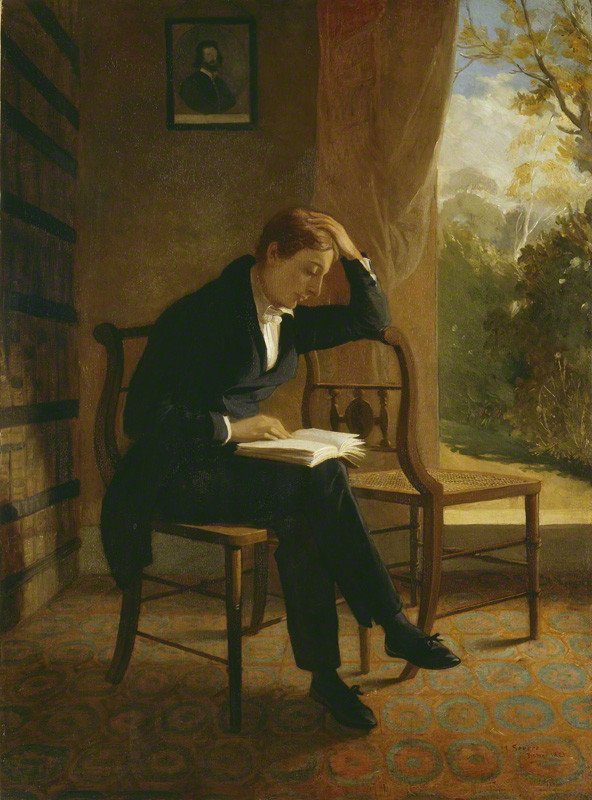
My Daily Art Display featured painting today is simply entitled John Keats and was completed by Joseph Severn in 1821.  Severn had painted a number of portraits of Keats but this was one which he painted after the death of his friend and whilst he was still in Rome.  Severn wrote about this painting saying that it was painted to evoke a last graceful memory of his friend around the time when Keats first began to feel ill.  It had been on a morning visit to Keats’ house in Hampstead and Severn said that the position of the two chairs was exactly how he remembered the scene.  All the individual items such as the carpet, chairs, open window and even the engraving of Shakespeare hanging on the wall in the background were faithfully recorded in Severn’s work.  Look how Severn has depicted the room with all its atmospheric shadows.  It is a wonderful portrayal of the young poet reading his book and in the background we see a heavily gathered curtain pulled aside allowing us a glimpse of Keats’ Hampstead garden.  Severn said that his visit coincided with the time Keats had just written his famous Ode to the Nightingale and Severn later said that he was struck with the first real symptoms of the sadness Keats had so finely expressed in that poem.

This portrait of Keats is, beyond doubt, a Romantic portrait of one of the unsurpassed Romantic poets.
Watson and the Shark by John Singleton Copley

Watson and the Shark by John Singleton Copley (1778)

When I first set eyes on today’s featured painting I thought it was something to do with Herman Melville’s characters, Moby Dick and Captain Ahab but it also reminded me somewhat of Théodore Géricault’s painting Raft of Medusa (see My Daily Art Display June 10th 2011).  Of course it is neither.  Today’s featured work of art is all about two men, John Singleton Copley and the subject of the painting, Brook Watson.  My Daily Art Display painting today is entitled Watson and the Shark and was completed by John Singleton Copley, the American artist, in 1778.  In My Daily Art Display March 6th 2012 The Copley Family, I gave you a short biography of the artist’s life, so you may want to look back to that blog to find more about this talented American painter.  Today however I will concentrate on the subject of Copley’s work, Brook Watson.

Brook Watson, who would later become Sir Brook Watson, 1st Baronet, was born in Plymouth, Devon in 1735.  He was the only son of John and Sarah Watson (née Schofield), who both died when Brook was just six years of age.  After their deaths, he went to live with his aunt and uncle in Boston Massachusetts.  His uncle was a merchant and ship owner whose livelihood came from the import and export of goods to the West Indies.  Probably with living at this American port and seeing the ships plying their trade it is not surprising that young Brook Watson hankered after the seemingly glamorous life of a sailor.  His uncle realising his nephew’s desire to join the Navy organised for him to become a crew member on one of his ships.

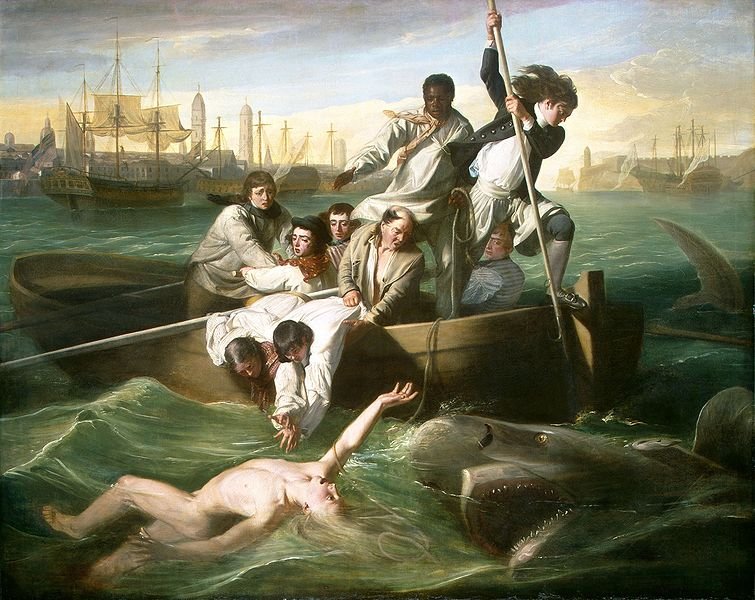
In 1749, the fourteen year old Brook Watson was aboard his vessel in Havana harbour and foolhardily decided to take the opportunity to go for a swim on his own.  He was attacked by a shark and his shipmates, who had been waiting on board to escort their captain ashore, launched a valiant rescue effort.  As the sailors rushed to Watson’s aid, the shark repeatedly attacked the struggling boy.  During the first attack, the shark stripped the flesh from Watson’s right leg, just below the calf.   In the second frenzied attack, the shark bit off Watson’s foot at the ankle.  His shipmates managed to rescue the boy who was then taken to a hospital in Havana.  Surgeons were unable to save his leg and it had to be amputated below the knee.  Watson remained in Havana for three months to convalesce.

If that was not bad enough, when young Watson arrived back in Boston he found that his uncle had been declared bankrupt.  Despite the loss of his right leg, Brook Watson managed to secure a position on another ship which traded between Boston and a port in Nova Scotia supplying the British Army at Fort Lawrence.  Despite the loss of his right leg, Watson was taken on by the British military and served them as a commissary until 1759 at which time he left Canada and travelled back to London.  Here he pursued a career as a merchant importing and exporting goods to Canada and Northeast America.  In 1760 he married Helen Campbell, the daughter of an Edinburgh goldsmith.

Watson’s Coat of Arms

In 1784 he entered the English political arena and became a Member of Parliament for the City of London, a position he held until 1793.  In 1796 he was elected Mayor of London.  Watson was made a baronet in 1803 and he had his coat of arms designed in such a way so as to record his encounter with the shark in Havana harbour.  If you look at the crest you will see underneath Neptune, who is brandishing his trident, the shield bearing Watson’s severed right leg, underneath which is the Latin motto Scuto Divino,  which means “Under God’s Protection”. Brook Watson died in 1807, aged 72.

My Daily Art Display’s featured painting today, Watson and the Shark was completed by John Singleton Copley in 1778 and exhibited that year at the Royal Academy.  Copley and Brook Watson had become friends after the American artist arrived in London in 1774.   Watson commissioned Copley to create a painting of the Havana harbour incident which had occurred twenty-five years earlier.   The painting was Copley’s first of a series of large-scale historical paintings he completed after settling in London.   He went on to produce three versions of today’s painting.      The original version of the painting went to Brook Watson.  The second one was a full-size replica which he kept for himself and can now be found in the Museum of Fine Arts in Boston.  His third and smaller version, with a more vertical composition, is housed in the Detroit Institute of Arts.

The painting when exhibited at the Royal Academy was a sensation, probably due to its horrific subject.  The painting is something of an exercise in overstatement and embellishment going beyond a realistic depiction, with the sole intention of evoking strong emotions in the viewer.  In the painting we see nine of Watson’s fellow seamen rushing to his rescue.  Copley who had never visited the Caribbean island of Havana relied on maps, prints and book illustrations of the Cuban harbour for his background.  Observe how Copley has added a dramatic touch to the scene by the way he is portrayed Watson’s rescuers.  Their facial expressions reveal not only their fear for their own safety but the concern they have for the fourteen year old boy who is being attacked by the shark.   One of the sailors has thrown a rope in the water, but it has not reached the young boy and dangles beyond his grasp. Two other crewmen lean over the side of the boat, in an attempt to reach the boy, while the elder boatswain clutches his companion’s shirt trying to ensure he too doesn’t fall into the water. The other terrified seamen in the boat row frantically, and the seaman standing in the front of the small boat has his boathook ready to thrust downwards into the body of the shark. Copley’s depiction of a shark has often been criticised and the most probable reason why the shark looks more like a mythical creature than a shark, is because Copley had probably never seen an actual shark and so was forced to paint a creature based on the description of others.

The young Watson lies on his back in the water transfixed in shock.  It is a romanticised portrayal of the incident as the gory detail of Watson’s severed right foot is hidden beneath the waves and there is only the slightest hint of blood on the surface of the water and in the mouth of the shark.  However there is no sign of the frenzied thrashing about the victim as he is being attacked by the shark.  Maybe Copley thought the inclusion of such a depiction would be a step too far.

After Watson died his will was read and as far as the painting was concerned, it stated:

“I give and bequeath my Picture painted by Mr. Copley which represents the accident by which I lost my Leg in the Harbour of the Havannah in the Year One Thousand Seven Hundred and Forty Nine to the Governors of Christ’s Hospital to be delivered to them immediately after the Decease of my Wife Helen Watson or before if she shall think proper so to do hoping the said worthy Governors will receive the same as a testimony of the high estimation in which I hold that most Excellent Charity and that they will allow it to be hung up in the Hall of their Hospital as holding out a most useful Lesson to Youth.”

The school’s Committee of Almoners accepted the painting in 1819.   In 1963 it was purchased from Christ’s Hospital by the National Gallery of Art, Washington, D.C.

The oil painting’s enormous acclaim ensured John Singleton Copley’s appointment to the prestigious Royal Academy, and he went on to earn a fortune selling engravings of its design.

Jacob and Rachel by William Dyce

Jacob and Rachel by William Dyce (1853)

The first time I featured a painting by William Dyce was over twelve months ago (My Daily Art Display, May 14th 2011) when I looked at his painting Pegwell Bay, or to give it its full and bizarre title, Pegwell Bay, Kent – a Recollection of October 5th 1858.   To find out why the painting had such a strange title you will have to check back on the earlier blog.

William Dyce was born in Aberdeen in 1806. His father was a fellow of the Royal Society and an eminent physician.  Dyce attended the Marischal College, which is now part of the University of Aberdeen.  He trained as a doctor before reading for the church. However the course of his life changed when aged nineteen he decided to become an artist and enrolled at the Royal Scottish Academy Schools in Edinburgh and later as a probationer at the Royal Academy of London.   At the age of nineteen he made his first trip to Rome and stayed there for nine months studying the works of the great Masters such as Titian, Rembrandt and Poussin.  He returned to Aberdeen but the following year he went back to Rome and this time stayed for eighteen months.   During this second visit to the Italian capital he met the German painter, Friedrich Overbeck, who was one of the leading artists of the Nazarene Movement.   The Nazarene Movement was made up of a group of early 19th century German Romantic painters who aimed to revive honesty and spirituality in Christian art. The name Nazarene came from a term of derision used against them for their affectation of a biblical manner of clothing and hair style.

By 1829 Dyce was back in Scotland and settled in Edinburgh for several years.  To survive financially he would carry out many portraiture commissions but his main love was his religious, history and narrative paintings.   In 1837, he was appointed Master of the School of Design of the Board of Manufactures in Edinburgh and produced a pamphlet on the management of schools like the one he was working at and this was well received, so much so, that he was transferred to London as superintendent and secretary of the recently established Government School of Design at Somerset House, which was later to become the Royal College of Art.   In 1844 he was appointed Professor of Fine Art in King’s College, London, and became an Associate of the Royal Scottish Academy, and in 1848 elected to become a  Royal Academician.

In 1850 Dyce married Jane Brand who was twenty-five years younger than him.  They went on to have four children.   He died at Streatham, Surrey in 1864, aged 58.

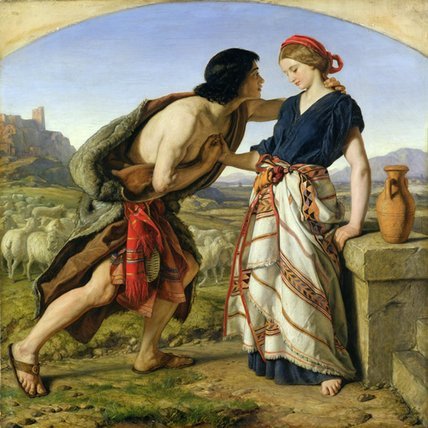
Today I am looking at a completely different type of painting by the artist in comparison to his seaside painting, Pegwell Bay.  This is a religious painting entitled The Meeting of Jacob and Rachel.  There were about four versions of this work by Dyce,  each of different size and with minor alterations but this one, which was completed by him in 1853,  is now housed in the Kunsthalle in Hamburg.  This was the original work and the only one which had a vase resting on the edge of the well.  The painting proved so popular with the public that Dyce commissioned Holman Hunt to make copies of it.

The painting is based on a story from the Old Testament book of Genesis (29: 9-14):

9 While he was still talking with them, Rachel came with her father’s sheep, for she was a shepherd. 10 When Jacob saw Rachel daughter of his uncle Laban, and Laban’s sheep, he went over and rolled the stone away from the mouth of the well and watered his uncle’s sheep. 11 Then Jacob kissed Rachel and began to weep aloud. 12 He had told Rachel that he was a relative of her father and a son of Rebekah. So she ran and told her father.  13 As soon as Laban heard the news about Jacob, his sister’s son, he hurried to meet him. He embraced him and kissed him and brought him to his home, and there Jacob told him all these things. 14 Then Laban said to him, “You are my own flesh and blood.”

This painting, Meeting of Jacob and Rachel, depicts the point in time just before Jacob kissed Rachel, and as the biblical text quotes the experience was so memorable, he lifted up his voice, and wept.  Jacob had fallen in love, at first sight, with this beautiful young woman, when he saw her standing at the well about to give water to her father’s flock of sheep.   Look at the way Dyce has portrayed Jacob.  The young man having just cast his eyes on his cousin is besotted with her.  He leans towards her almost balancing on one leg.  Look at his demeanour.  Look at the intensity of his expression as he looks into Rachel’s face. Look at his eagerness.   His emotions seem to be getting the better of him.  He clutches Rachel’s right hand and press it against his heart.  Maybe he wants her to feel how it is beating wildly.  His left hand rests on the nape of her neck.  He caresses her neck gently and at the same time his hand will guide her face towards his so that he may kiss her.  Now look at Rachel.  See how her expression differs from that of Jacob.  Her eyes are cast downwards in a gesture of modesty or is it coyness?  She cannot meet Jacob’s gaze.  The top half of her body leans away from Jacob and she steadies herself by placing her left hand on the well.

So does this meeting of man and woman result in a happy ending?  Well yes and no!   Rachel’s father, Laban was quite cunning and realised that Jacob was a young and strapping lad who could help out on the farm and so he offered him the hand of Rachel in the future, providing he would work for him.  Jacob agreed and worked for Laban for fourteen years without payment in the hope of getting the father’s blessing for his marriage to his daughter.  Then Laban made another condition for this marriage.  He wanted Jacob to first marry Rachel’s elder sister, Leah, after which he would be able to have Rachel as his wife.

So this is not just a story about young love but also a story of patient love and the way Jacob was willing to wait for Rachel.   This may have been uppermost in Dyce’s mind as it mirrored his relationship with his wife-to-be Jane Bickerton Brand who was born in 1831, for he was made to wait for her hand in matrimony as she was so young when they first met and the age difference of twenty-five years obviously further concerned her father.  William Dyce did wait and they did marry,  so all ended happily.

A Primitive City by Edward Calvert

A Primitive City by Edward Calvert (1822)

When I wander around various galleries, I am often lost in wonderment  when I stand in front of a massive painting.  I can remember when I was in Venice last year and visited the Accademia Galleries and stood before the giant work of Paolo Veronese entitled Feast in the House of Levi.     I was amazed at the magnitude of the work which measured  5.6 metres x 13metres and I could only wonder at how he managed to physically paint such a large scale picture.  How long must it have taken him?  Maybe he had some of his apprentices to help him but still it was an outstanding undertaking.  I find equally impressive miniature paintings and I am always filled with a sense of amazement at how these delicate paintings have been achieved.  My Daily Art Display featured painting today is one such miniature and I want you to feast your eyes on this lovely work of art entitled A Primitive City painted by the English artist Edward Calvert.

Edward Calvert was born in Appledore in the county of Devon in 1799.  His early schooling and art education was at Plymouth but coming from a seafaring area the young Calvert joined the Navy and spent five years serving his country.  A death of a close friend in naval action resulted in him leaving the force and coming ashore.  In 1824 he moved to London and it was here he, at the age of twenty-five, enrolled at the Royal Academy, where one of the professors was the artist, Henri Fuseli.  It was whilst in London that he met the ageing English painter, William Blake.  Blake and his paintings were one of his first great artistic influences and one that would remain with him for the rest of his life.  Blake’s art work inspired a number of aspiring artists and Calvert and some like-minded Romantic artists, who had fallen under the spell of Blake and his work formed an association known as The Brotherhood of the Ancients often simply known as The Ancients.  The leader of the group was Samuel Palmer but one of the most of the most important members of the group was today’s featured artist, Edward Calvert.  Others in the group were George Richmond and John Linnell.  This group of painters, who  all had a love of the spiritual art of the past, would often meet at the home of Blake, which they used to refer reverentially to as the House of the Interpreter.  They would also congregate at Palmer’s house in Shoreham, Kent to discuss Blake’s visionary ideology and to paint pastoral images with a mystical perspective.  They brought a new dimension to Romantic Art.  They brought a wondrous vision of a golden age set in quiet landscapes amidst a pastoral innocence and abundance.

Edward Calvert who was a man of private means left the Academy and concentrated on another love of his, wood-engraving.  He lived with his wife in Dalston in the London borough of Hackney for most of his life.  Calvert’s love of pastoral depictions disappeared gradually but his interest in ancient Greece increased. He visited Greece where he sketched prolifically.  Eventually, he gave up his printmaking and for the rest of his life his art was just for himself and for his own pleasure.  He would work in oil, watercolour and gouache and for his subjects he liked to focus on pagan mythology.  Latterly, Calvert became a recluse and died in 1883, aged 84.

My featured painting today is a tiny watercolour miniature, measuring just 7 cms x 10 cms (not quite 3 inches x 4 inches), entitled A Primitive City, which Edward Calvert painted in 1822.   The quality of this work of art is amazing with its clarity of line and jewel-like colouring and the amount of detail that is shown in such a small space.  It is an evening scene and in the background on the right, we see the waning moon as it hovers behind a distant walled city.  In the right mid-ground we see a peasant leading a donkey which staggers slowly heavily laden with two large baskets of grapes on its back.  Behind the donkey there is another cart, crossing a rickety wooden bridge, being pulled by a bullock, which is loaded with sacks of grain and driven by a woman.  The grapes and grain symbolise the Eucharistic wine and bread.  The pastoral theme is emphasized  by the shepherd and his flock which  we see depicted in the left mid-ground of the work.  If we carefully look at the city itself we see a woman drawing water from a well and above her we see another woman watching her from her viewpoint on the staircase between the two towers.

There is an innocence to the scene and this is accentuated by the beautiful, almost naked, young girl we see to the left of the picture who is about to take a swim in the nearby stream, which runs across  the foreground of the painting.  We can see Calvert’s love and interest in Classical art in the way he  has depicted the woman, as the stance of the scantily-clad young lady is almost certainly derived from the Venus Kallipygos, which is in the Naples National Archaeological Museum.  It could well be that the presence of the river was Calvert’s idea of symbolising the river of life and the nakedness of the young woman symbolic of innocence.  Above the girls head we see that the trees are full of fruit symbolising abundance.

This was Calvert’s vision of the perfect idyll, tranquillity and abundance.  It should be remembered that this work was completed before Calvert went to London and became part of The Ancients , which just goes to show that his ideas for artistic subjects were similar to those of artists he was yet to meet.

Portrait of a Woman by Bartolomeo Veneto

Portrait of a Woman by Bartolomeo Veneto (c.1525)

I have over the past blogs featured paintings of a women whose facial beauty I find quite stunning and have commented at length on their great beauty.  Two especially come to mind, Jeunesse Dorée by Gerard Brockhurst (My Daily Art Display May 16th 2011) and Virgin Annunciate by Antonello da Messina (My Daily Art Display May 1st 2012).  I mention this because today I am featuring another such painting which is a portrait of an exceptionally beautiful woman.  The title of the painting is simply, Portrait of a Woman and the artist is Bartolomeo Veneto.  I will look at the painting in detail later and explore the mystery of whose portrait it might be but first let me tell you a little about the artist.

Bartolomeo Veneto was born at the end of the fifteenth century but little is known of his early upbringing and family life.  The first time his signature was found on a painting, was on his work entitled Virgin and Child and it was dated 1502.  The signature itself gives an insight into his early days as he signed it:

“… bartolamio mezo mezo cremonexe venizian e…”

which when roughly translated means:

“…Bartolomeo half-Venetian and half Cremonese…”

In his early days he worked in Veneto, in North East Italy, Venice itself and Lombardy, which has its border to the west of Veneto.  Whilst in Venice he trained under Gentile Bellini, who was the most prestigious painter in Venice in the early sixteenth century.  Bartolomeo Veneto concentrated most of his art on portraiture and for that he received many commissions.

It is thought that around 1507 Bartolomeo worked at the Este court in Ferrara, which was ruled by the Duke of Ferrara, Alfonso I d’Este who in 1502 married for the second time.  His new wife was none other than Lucrezia Borgia and Alfonso was her third husband.  During his time at the court Bartolomeo gilded frames and made carnival decorations and completed a painting depicting the Virgin and Saints.  After three years at the court Bartolomeo moved on and he is reported to have been in Padua in 1512 and Milan eight years later and it was here that his portraiture became influenced by the portraits by Leonardo da Vinci who had been in this Italian city some years earlier.

Today’s featured painting by Bartolomeo Veneto, which he completed around 1525, is entitled Portrait of a Woman and is now housed in the Städel Museum in Frankfurt.  I suppose the first question one asks when looking at this beautiful half-naked woman is who is she?   There is no degree of certainty as to the answer but it is thought to be a portrait of Lucrezia Borgia.  What makes her stand out is the fact that the artist has placed her, in three-quarter profile, dressed in a white tunic against a black background and he would use this black background technique in other portraits.

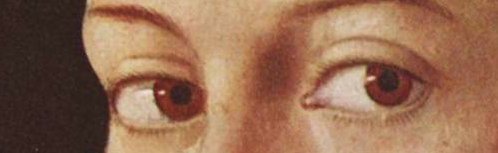
The staring eyes

Although she has turned to the left she keeps eye contact with us.  Although her left breast is bared, it is her gaze that catches our attention.  As we look at her we are almost mesmerized by that stare.  The way she looks at us is in some ways unnerving.  She has captured our attention.

Observe the ringlets of her golden hair as it cascades down her shoulders.  See how Bartolomeo has painted each strand of it in detail.  It is this extraordinary attention to detail that made his portraits so popular and led to many commissions from wealthy patrons.  This tempera and oil on wood panel bears the name of the ancient goddess of spring, Flora and she was often a character portrayed in Renaissance art.   In her right hand, she delicately holds up to us, between her slim index finger and thumb, a small posy of wild flowers consisting of daisies, anemones and buttercups,.  These three flowers are attributes of Zephyr’s wife Flora, the goddess who ushered in spring.  This is her offering to us.

A lavish jewel adorns her forehead.   Above the jewel is a blue silk band and her hair is covered in a veil which is crowned with myrtle, all of which lead us to believe that this woman is married.  Another jewel hangs between her breasts on a pendant, the placing of which adds to the sensuality of the portrait.  Having said that, I believe there is also chasteness in the way the artist has portrayed the woman.  Could this then be a portrait of Lucrezia Borgia?  The same Lucrezia Borgia who was one of the daughters of Cardinal Rodrigo Borgia, later to become Pope Alexander VI, and his mistress Vannozza Cattanei?  Could this be the portrait of a woman who was accused of incest with both her father and her brother Cesare?  Could this beautiful and delicate-looking woman be the infamous female who was accused of poisoning many of her adversaries and who had a string of extra-marital affairs?

So, are we looking at a beauty or a beast and is this a true likeness of Lucrezia Borgia?

The Vicar of Wakefield Reconciling his Wife to Olivia by Gilbert Stuart Newton

The Vicar of Wakefield Reconciling his Wife to Olivia
by Gilbert Stuart Newton (1828)

Today I am going to look at the life and one of the paintings of the Canadian born artist Gilbert Stuart Newton.  Newton was born in Halifax, Nova Scotia, one of twelve children in 1797.  His father, Henry Newton, who originally came from Boston, worked as a Customs official and his mother Anne Stuart came from a family of Scottish descent, who also lived in Boston, Massachusetts.  Her brother, Gilbert Stuart, was an artist and was generally believed to be one of America’s leading portraitists of the time and was to become one of his nephew’s first art tutors.   Gilbert’s parents moved from Boston to the Canadian port of Halifax in 1776 but on the death of his father in 1803, when he was six years old, his mother took her family back to her home town of Charleston, a district of Boston on the Charles River.

Although initially heading for a career in commerce he developed a love of art and his uncle Gilbert Stuart recognising his artistic promise took him on as one of his pupils.  Like many aspiring artists, Newton travelled to Europe to study painting, first in Florence and later in Paris and London.  He arrived in London in 1817.  During his travels, he made the acquaintance of the American artist, Washington Allston, (see My Daily Art Display, Feb 25th 2011),  the English genre painter Charles Leslie and the Scottish painter David Wilkie.  He enrolled as a student of the Royal Academy Schools in 1817 and exhibited his first work at the Royal Academy the following year.  Initially he focused his artistic talents on portraiture and had many well known sitters, such as the American author, Washington Irving and the American politician and then American Consul in Liverpool, James Maury.  He left England in 1831 and went back to America for a short period where he married but a year later he and his wife returned to England.

Gilbert Stuart Newton is principally remembered, not for his portraiture, but for his genre and literary scenes many of which were engraved.  Probably Newton will be remembered most of all for his depiction of literary subjects such as today’s featured painting entitled The Vicar of Wakefield Reconciling his Wife to Olivia, taken from Oliver Goldsmith’s novel, The Vicar of Wakefield.  He also depicted scenes from Shakespeare such as his 1831 painting entitled Portia and Bassanio.    Another scene from a novel he painted was that of Yorick and Grisette, two characters in Lawrence Sterne’s novel, A Sentimental Journey.  This work was exhibited in the Royal Academy in 1830.  In 1828 Newton was made and Associate of the Royal Academy and four years later was elected as a Royal Academician.  That same year, 1832, when he was made a Royal Academician was the also the year of the onset of his mental illness which progressively worsened to such a point that he had to be institutionalised in a private asylum in Chelsea.  Even whilst hospitalised he continued to draw, completing a number of sketches based on Shakespearian characters.   He died of consumption at the asylum in 1835 just a month before his thirty-eighth birthday.  He died alone as his wife along with their child had returned to America a few months earlier.

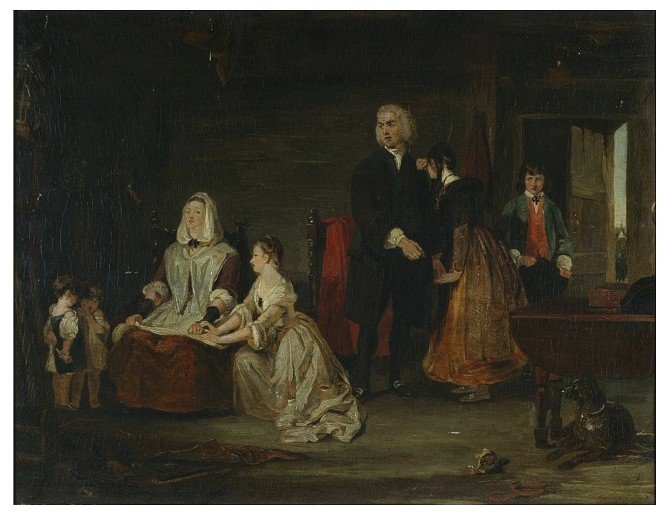
My featured painting today is Gilbert Newton’s work entitled The Vicar of Wakefield Reconciling his Wife to Olivia. It was painted as a commission for Lord Lansdowne.   The painting was exhibited at the Royal Academy Exhibition in 1828 and in the Exhibition catalogue against this work was the following quotation from Oliver Goldsmith’s 1766 novel, The Vicar of Wakefield.  They were the words uttered by the vicar to his wife imploring her, like him, to forgive the misdeeds of their daughter:

“…I entreat, woman, -that my words may be now marked once for all: I have here brought you back a poor deluded wanderer; her return to duty demands the revival of our tenderness … The kindness of heaven is promised to the penitent, and let ours be directed by the example…”

This novel, The Vicar of Wakefield, by Goldsmith was his most famous work of literature and in the painting we see Olivia, the vicar’s daughter, who had run away from home to be with the man she loved.  Her father, the vicar, eventually finds her and brings her home and we see him, in the right of the painting, comforting his distraught but repentant daughter, who has buried her face against his shoulder. To the left of the painting we see the vicar’s wife who has her back almost turned away from her husband and daughter and by her facial expression we must believe she hasn’t quite come to terms with what has happened.  She is now trying to balance the desire to punish her daughter for her misdeeds and yet show her some maternal love now that she is back in the fold.  Her hands are clenched tight in her lap and we can see by her facial expression that she is not in a forgiving mood.  Also included in the painting are the vicar’s two youngest sons who stand in front of their mother completely unaware of what is happening.   The younger daughter Sophia, who kneels at the side of her mother and who holds her mother’s hand in a comforting gesture, is pleading with her to forgive her errant sister, Olivia.  The vicar’s second son Moses, stands at the far right of the painting, by the open door of the house and looks somewhat bemused and unable to know what to do for the best.  The family dog lies under the table looking up aware of the commotion.

So how was the painting greeted by the art establishment in 1828?  The literary magazine of the time, The Athenaeum commented on the work:

“…A very interesting picture, cleverly composed, and well painted. The mother’s struggle between pride and tenderness, is admirably expressed, not only in her face and features, but throughout the whole figure; not more in the stiffness and erectness of carriage, than in the clenching of the hand on the knee. The patient and benevolent Dr Primrose, of Goldsmith, is finely characterised in the figure and head of the father: the affectionate sister, kneeling by her mother’s side, and anxiously interceding, is a picture of amiable loveliness; while Olivia, abandoned to shame, sorrow, and penitence, neglected in her attire, and with face averted, and concealed on her father’s shoulder, while her hand is most expressively held by his, forms, with the figure of the indulgent parent, a group replete with delightful expression. The hobbledehoy simplicity of Moses, and the panting and vague consciousness of the younger urchins, must not be overlooked; they are also most happy. The whole picture, in short, is full of truth, sentiment, and feeling…”

Disappointed Love by Francis Danby

Disappointed Love by Francis Danby (1821)

Francis Danby was an English painter, born in 1793, in a small village near Waterford, Ireland, where his father owned a farm.  When he was fourteen years of age his father died and he along with his mother and twin brother moved to Dublin.  Whilst living in Dublin, Francis Danby enrolled at the Royal Dublin Society’s Schools of Drawing where he received artistic training.  It was at this establishment that he met the renowned Irish landscape painter James Arthur O’Connor and it was through his mentorship that Danby developed a love of landscape painting. Danby also struck up a friendship with another fellow student, George Petrie, and they along with O’Connor left Dublin in 1813 and travelled to London.  By all accounts the trip had not been well planned financially and their funds soon ran out and they had to head back to Ireland, on foot, but on the way they stopped off in Bristol.  It was in this city that Danby managed to supplement his meagre worth by painting watercolours of the local scenes and selling them to the locals.  At the same time as selling some of his work, he kept back what he considered to be his best paintings and sent them to various London exhibitions.

The works of Francis Danby, which were shown at various London sites, received favourable reviews and were soon in great demand.  It was whilst still living in Bristol around 1818 that Danby joined an informal association of artists based around Bristol, which had been founded by the English genre painter, Edward Bird, known as the Bristol School or Bristol School of Artists.  In 1821, Danby had a painting of his first exhibited at the Royal Academy.  It was entitled Disappointed in Love and is My Daily Art Display’s featured work today.  In 1824 Danby left Bristol and moved to London.  It was around this time that Danby gave up his naturalistic and topographically accurate landscapes and moved towards poetic landscape painting.  Poetic landscapes gave one the geography and architecture of landscapes from a subjective point of view, using elements of myth, fantasy or the picturesque. Claude Lorrain is usually looked upon as the originator of this style and this style of painting culminated in the Romantic landscape of the 19th century.   A Poetic Landscape presents us with an imaginary place and for that reason the artists did not have to worry about topographical accuracy and it allowed them the opportunity to transform the characteristic features of, for example, Italian geography and architecture, and turn them into mythical or pastoral fantasy. This painting genre allowed artists to exaggerate the shape and height of mountains, delete or redesign buildings and objects, insert dramatically placed trees or human figures, and throw strongly contrasted lighting effects over it all. The public liked this style of landscape painting and did not care about the topographical veracity of what they saw.  People, at the time, preferred this style to the topographical landscape with its dryly objective recording of what was actually there.

Another artistic genre Danby began to draw on was the large biblical scenes such as his 1825 painting The Delivery of Israel,  which was exhibited at the Royal Academy and which led to him being elected an Associate Member of the Royal Academy.  In the next two decades Francis Danby produced many large biblical and apocalyptic paintings which were to rival his contemporary and renowned “high priest” of apocalyptic art, John Martin.

Francis Darby, already an Associate Member of the Royal Academy was put up for election in 1829 to become a Royal Academician.  When the votes were counted, he was devastated to find he had lost out by one vote to John Constable,  who was elected instead of him.  This year, 1829, was an annus horriblis for Danby as this was also the year that his marriage to his wife Hannah failed and he took himself a mistress.  Hannah went off with another artist Paul Falconer Poole who had spent some time in the Danby household.  London Society was scandalised by the goings-on at Danby’s household and in 1830 he went into self-imposed exile in Paris along with his mistress.  From 1831 to 1836 Danby worked out of Geneva reverting back to his topographical watercolour landscape art work.

The Deluge by Francis Danby

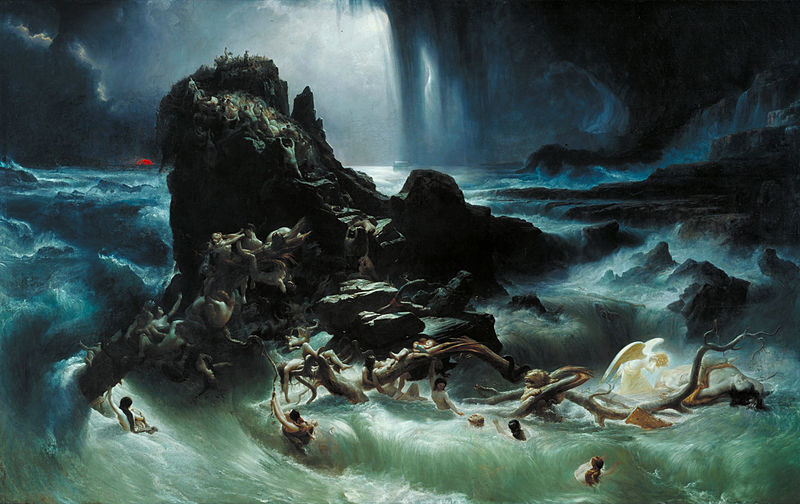
In 1837 he returned to Paris and a year later went back to living in London.  It was in that year he produced his famous work, The Deluge, which re-established his reputation amongst the art community.  This massive canvas, measuring 2.85m x 4.52m, depicted an area of harsh and violent weather and writhing, diminutive bodies trying to save themselves from the stormy waters.  The painting put Danby briefly back in the limelight.  However for Danby,  life as an artist was becoming too much for him and in 1847, aged 54, he left London and went to live in Exmouth, Devon.

Whilst living in Devon Danby still found time to paint concentrating on landscapes and seascapes but he also took up boatbuilding.  Francis Danby died in Exmouth, in 1861, aged 67.  To the end of his life Danby constantly had money problems and was embittered that he never gained the recognition he deserved from the Royal Academy and was never elected as a Royal Academician.  The final straw came two days before he died when he learnt that his ex-wife’s husband, Paul Falconer Poole had been elected a Royal Academician !

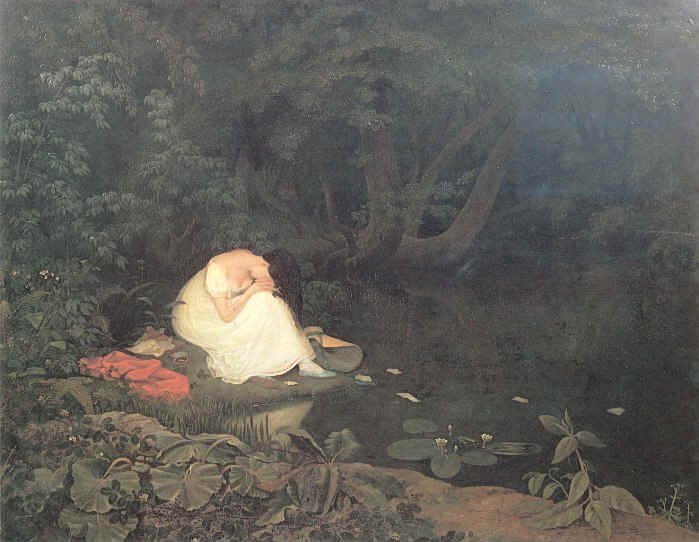
My Daily Art Display painting for today is by Francis Danby which he completed in 1821 and is entitled Disappointed Love.  The painting was the first painting Francis Danby exhibited at the Royal Academy, and it became one of his best-known works. Before us, we see a heartbroken young woman who has just been jilted.  Her hands cover her face as she sits weeping on the bank of a  lily pond surrounded by dark and murky woodland.  The occasional small white flowers, dotted around, struggle to lift the dark green and browns of the undergrowth.  This gloomy undergrowth mirrors the depressed mind of the young girl.   Her long dark tresses hang down over her white dress.   On the ground beside her we see her discarded bonnet, her scarlet shawl , a miniature portrait of her lover and other letters which she has not yet destroyed.    Her sad figure dressed in white is reflected in the water and in some way it seems that the water is drawing her to it so that she can end her life and her misery, in an Ophelia-like fashion.  Floating on the surface of the pond are pieces of a letter which she has torn up and discarded.  Eric Adams wrote a biography in 1973 on Francis Danby entitled Francis Danby: varieties of poetic landscape and he believes the setting for the painting was on the banks of the River Frome on the outskirts of Bristol and that the model for the painting was a model at the Bristol Artists newly founded Life Academy.  There was a lot of criticism of the painting, not so much for the poetical nature of the work but for its technical faults, in particular the lack of proportion of the plants in the foreground.

When the painting was put forward to the Royal Academy jurists to see if it should be allowed in to the 1821 Exhibition it was not wholly loved.  An account of the jurist’s comments on seeing Danby’s painting was reported some twelve years later as:

“…An unknown artist about ten years ago sent a very badly painted picture for the exhibition.  The committee laughed, but were struck by “something” in it and gave it admission.  The subject was this.  It was a queer-coloured landscape and a strange doldrum figure of a girl was seated on a bank, leaning over a dingy duck-weed pool.  Over the stagnant smeary green, lay scattered the fragments of a letter she had torn to pieces, and she seemed considering whether to plump herself in upon it.  Now in this case, the Academicians judged by the same feelings that influence the public.  There was more “touching” invention in that than in the nine-tenth of the best pictures exhibited there the last we do not know how many years.  The artist is now eminent…”

To my mind it is a beautiful painting, full of pathos, and one cannot but feel sympathy for the young girl.  It was for this reason that I was surprised to read an anecdote about this painting and the depiction of the girl.  Apparently the Prime Minister at the time, Lord Palmerston, was being shown the painting by its owner, the wealthy Yorkshire cloth manufacturer, John Sheepshanks and commented that although he was impressed by the deep gloom of the scene, it was a shame that the girl was so ugly.  Sheepshanks replied:

“..Yes, one feels that the sooner she drowns herself the better…”

How unkind !

This painting along with the rest of his outstanding art collection was presented to the Victoria & Albert Museum

Hope by George Frederic Watts

Hope by George Frederic Watts (1886)

George Frederic Watts was a Victorian painter and sculptor who was closely associated in his later years with the Symbolism Movement.  Symbolism came about in the 1880’s but by the end of the century it had almost died away having been overshadowed by the birth and rise of Modernism.  The Symbolist movement was a reaction against the literal representation of objects and subjects, where instead there was an attempt to create more suggestive, metaphorical and evocative works.  Symbolic artists based their ideas on literature, where poets such as Baudelaire believed that ideas and emotions could be portrayed through sound and rhythm and not just through the meaning of words. Symbolist painter styles varied greatly but common themes included the mystical and the visionary. Symbolists also explored themes of death, debauchery, perversion and eroticism. Symbolism moved away from the naturalism of the impressionists and demonstrated a preference for emotions over intellect.

George Frederic Watts was born on February 23rd 1817 in Marylebone, London and his Christian names were those of the great musician George Frederic Handel who was born on that date some 132 years earlier.  His mother and father struggled financially and this was not helped by the poor health of his mother who was to die when George was very young.   His father was a piano maker and took it upon himself to educate his son at home.  Much emphasis was placed on a conservative Christian upbringing and a love for classical literature.  Unfortunately, as is so often the case, his father’s compelling desire to force his Christian views on his son, eventually made George turn completely away from organised religions.

At the age of ten, George had some informal tuition from William Behnes, a local sculptor where he practiced drawing from the sculptures.  This training proved a godsend as by the age of sixteen he was able to support himself from the sale of his portraits.  In 1835, aged eighteen years of age, George Watts enrolled at the Royal Academy Schools.  Although Watts never enjoyed his time at the establishment and would often fail to attend he did exhibit some of his works at the 1837 Royal Academy Exhibition.  It was whilst studying art that he met and became great friends with Alexander Constantine Ionides, an art patron and collector.  Ionides commissioned many paintings from Watts and became one of his earliest patrons.

By 1840 Watts had moved away from portraiture and concentrated on historical paintings.  In 1843, he entered the first competition to design murals for the new Houses of Parliament.  Entries were to be of a narrative genre which endorsed patriotism and thus would be appropriate to the new legislative building.   His entry, Caractacus Led in Triumph through the Streets of Rome, gained him first prize in the competition and the prize money helped fund his artistic study trip to Italy where he remained for four years.  During his stay in Italy he learnt the secrets of fresco painting and completed many large scale paintings depicting scenes from Romantic literature.  However, he never gave up on his other artistic loves, portraiture and landscape painting.

Watts returned to London in 1847 and once again entered the Houses of Parliament competition.  This was the fourth one organised by the monarch and the government.  Watts won the competition with his entry Alfred Inciting the Saxons to Encounter the Danes at Sea.   Watts suffered from bouts of depression and he expressed his personal struggle with the illness in a series of four paintings which evoked a social realism theme.  One of these works entitled Found Drowned was my featured painting in My Daily Art Display of July 4th 2011.  In 1851 he went to live with his friend Henry Thoby Prinsep and his wife Sara at Little Holland House.  He lived with them for the next twenty-four years and it undoubtedly provided Watts with a secure environment for him to work and relax and provide a safe haven away from the rigours of the real world.  Little Holland House was a favourite meeting place of the young Pre-Raphaelite artists and literary people like Tennyson and it gave Watts then ideal opportunity to paint portraits of the aspiring literary and artistic luminaries of the day.

In 1878 Watts took part in the 1878 Exposition Universelle in Paris and submitted nine paintings and one sculpture.  He became an instantaneous celebrity on the European art scene.  During the 1880’s,  he produced many symbolic paintings which displayed close links to the work of his friend, the Pre-Raphaelite artist Dante Gabriel Rossetti, and the other Pre-Raphaelite artists such as Edward Burne-Jones.

In 1886 at the age of 69 Watts re-married, to Mary Fraser-Tytler, a Scottish designer and potter who was some thirty three years his junior.   In 1891 he bought a house in Compton, near Guilford, in Surrey and in 1904 had a gallery built nearby which became known as the Watts Gallery and which was dedicated to his work.  The Watts Gallery is still a very popular venue for art lovers. George Frederic Watts died that year aged 87, shortly after the gallery opening.

Hope is looked upon as certainly the most influential, and outstanding if not most unusual of all George Frederic Watts’ paintings. This portrayal of the poignant musician has struck a chord with audiences and critics ever since it was first displayed at the Grosvenor Gallery in 1886.  In 1887 at the Royal Jubilee exhibition held in Manchester the painting took pride of place in the middle of an entire wall dedicated to Watts’ work.  Numerous reproductions were made of this painting and many who saw it were deeply affected by what they saw and Watts received many letters from people who were greatly moved by the emotional impact it had on them. In the painting Watts has personified Hope as a young woman seated on a globe, hunched over, appearing to be almost asleep.  She wears a blindfold which symbolises her blindness and to the mental state she embodies. What was it about this work that such an effect on people?  It has to be Watts’ portrayal of this hunched, isolated, blindfolded and barefoot woman who appears to be on the edge of despair.  So why the title Hope?   Maybe in this case it is not hope meaning one’s optimistic thoughts but more of a feeling of almost despair; a hoping against hope.   As we take in the picture of the girl bent over listening to the music from her lyre we wonder why Watts has chosen the title.  The bluish grey background induces a melancholy mood. One critic commented that the painting did not evoke a feeling of hope and should have been entitled Despair.  Maybe that was the reason that in another version of his painting he has added a single star to the background to symbolise hope.  The girl, Hope, bends her ear to catch the music from the last remaining string of her almost shattered lyre. It is the faintest of hope as symbolised in her musical instrument which now with just one string left for her to make music and once that has broken, all hope of her producing a musical sound has disappeared.

Did the painting appeal to those who had almost lost hope themselves and in some way empathised with the vulnerability of the woman in the painting?  Watts had always sought, through his paintings, to communicate his message to as many people as possible. Some would criticise this aspect as being somewhat patronizing but Watts was a great master of narrative paintings and this was probably the reason why his conventional patriotic works he put forward for the Houses of Parliament were so successful.  Watts was surprised by the critical acclaim and popularity of his painting and attempted to follow up his success with Hope with two other works entitled, Faith and Charity, the other two “theological virtues” but they neither received the critical acclaim that his Hope painting achieved nor were they as popular with the public.

This version of the painting can be found in the Tate Gallery, London.

Peasant Girl Lighting a Fire. Frost, by Camille Pissarro

Peasant Girl Lighting a Fire. Frost by Camille Pissarro (1888)

My Daily Art Display’s featured painting today is entitled Peasant Girl Lighting a Fire. Frost, which was painted by Camille Pissarro in 1888 and can now be found in the Musée d’Orsay in Paris.  At this time Pissarro was still a leading light of the Impressionist movement, a movement he had helped to form.   However it was two years prior to this work that Pissarro began to become interested in the experimental work of young artists, who had adopted the fragmented brushstroke technique which Georges Seurat and Paul Signac were trying out, known as pointillism , a technique Pissarro used in parts of this painting.  For a more in depth look at pointillism see My Daily Art Display October 21st 2011 for a painting by Georges Seurat and November 29th 2011 for a painting by Paul Signac. Pissarro had been introduced to Seurat and Signac in 1885 and in the following years he began to work in the pointillist style which had then been adopted by the Neo-Impressionists.  By the time Pissarro was in his sixties he found that this pointillism technique too restricting and in the last ten years of his life he returned to a purer Impressionist style.
Camille Pissarro was fifty-eight years of age when he completed today’s featured work of art.  Ten years earlier his style of painting was such that he would portray nature in his landscapes by a myriad of smaller comma-like brushstrokes built up on the surface of the canvas such as his 1877 work, The Red Roofs (see My Daily Art Display of November 30th 2010).  Pissarro was concerned that these works lacked clarity and so he decided to change the way he worked.  He spent time working in collaboration with Degas, who was, of all the Impressionists, a great believer and advocate of figure painting and the primacy of the human figure at the expense of landscape background.  It was maybe the views of Degas that led to Pissarro to complete some works in which the human being(s) took pride of place in the painting, as is the case with today’s featured work.

The painting depicts two peasant girls working in a field in a cold and frosty winter morning and we see one of them tending a fire.  Pissarro often painted peasant women at work.  Two fine examples of this are his 1881 work entitled Girl with a Stick and the 1893 painting entitled Woman with a Green Shawl.  His portrayal of peasants received some criticism for copying the ideas of Jean-François Millet but Pissarro firmly contested such a notion.  However in general art critics looked upon his works as true representations of peasant life.  Look at the beautiful way in which Pissarro has depicted the landscape.  At the time of this painting Pissarro was extremely interested in the pointillism technique of Seurat and Signac and he used this method to present us with a sumptuous backdrop to the two girls.  The painting has a light and airy feel to it and there is a subtle delicate nature to the work.  The work was painted in Eragny just north-west of Paris where Pissarro and his family lived for a time.

In the far distance we can see the low hills topped by irregular spaced bushy trees.  In the middle ground, we observe grazing cows in the meadow, a line of poplar trees at the foot of the hills and possibly a hidden stream running horizontally across the mid ground.   Notwithstanding the backdrop, the focus of the painting is on the two girls in the foreground, who almost appear to stand next to us.  The scene is lit up by the sun, somewhere out of sight, to the left, which throws off long blue shadows across the field.  It is a wintry sun and still low in the sky, hence the long shadow of the girl in the foreground, which disappears off the painting to the right.    Although it emits light, the sun gives off little warmth and so our two young workers are wrapped up well.  The temperature is even colder due to the wind chill factor.  Look how the girls skirt and the smoke from her small fire are blown horizontally by the wind which comes from the left of the painting.  One can imagine how cold it is with the driving wind on a wintry day. We almost shiver as we look at this work of art.

The girls are both well wrapped up against the morning’s wintry chill.  The girl on the right, who seems no more than a child, is warming her hands by the fire.  She wears a blue dress and a thick dark brown coat.  She has a dark woolen hat on her head which is pulled down to protect her ears from the icy wind.   The older girl, who is closest to us and because of her height, is the main focus of our attention.  She has taken a branch from the pile behind her, and is about to break it up and add it to the fire.  She wears a pink skirt with a blue apron.  She too has protected her head, wearing a white scarf tied beneath her chin.  Her final layer of protection is a pink and white shawl from which emerge long black sleeves of her dress.

The colour combinations Pissarro uses to achieve the colour we see is fascinating.  The girls pink dress is made up of a combination of yellow, blue and pink.  The green grass of the meadow is achieved by using a combination green, blue, yellow, pink and white.  The only orange Pissarro used was for the flames of the fire.

Pissarro fled the traumas of the Franco-Prussian War in 1871 and, like Monet, went to live in London.   It was whilst in London that he saw a number of paintings by Turner.  Pissarro later commented on Turner’s works and was amazed by the way Turner succeeded in conveying the snow’s whiteness, not just by the use of white alone but by combining a host of multi-coloured strokes, dabbed in, one against the other, which when looked at from a distance, created the desired effect.  It is in this painting that Pissarro has, without the actual presence of snow, managed to give us a crystalline frost of a cold winter’s morning encapsulated in an aura of diamond blue.

Francesca da Rimini by Ary Scheffer

Francesca da Rimini by Ary Scheffer (1835)

What is your perception of Hell?  Do you think of it as a huge furnace full of burning souls, or simply a place of deprivation?  We do not know and I don’t believe we will ever know what it is like or whether it or its sister-place, Heaven, really exists and so with this lack of evidence we can then formulate in our own minds what it is all about without fear of contradiction.  One person who did just that was Durante degli Alighieri, better known simply as Dante Alighieri.  In the first part (Inferno) of his epic poem entitled Divine Comedy he tells of his journey he made through Hell with the Roman poet Virgil acting as his guide.  Many artists have painted pictures based on Dante’s Inferno with its concentric circles full of various types of sinners.  To get to the gates of Hell Dante and Virgil had to cross the river Acheron which could only be achieved by being transported by ferry, piloted by Charon.  My Daily Art Display (September 6th 2011) depicts the two men being ferried across the river made famous in the painting,  The Barque of Dante or Dante and Virgil in Hell by Eugène Delacroix.

According to Dante, Hell is situated within the Earth, it is made up of nine circles of torment.  The circles are concentric, and represent a gradual increase in evilness.  The outer circle, or the first circle is the resting place of those who were never baptised, the second circle was for people whose sin was one of Lust.  As Dante and Virgil moved inwards they came across circles which housed the souls who had committed the sins of Gluttony, Greed, Anger, Heresy, Violence, Fraud and Treachery.  It is interesting to note that for Dante, an Italian male, those who committed the sin of Lust were only in the second circle, as presumably in Dante’s mind, Lust was not that bad a sin!  The inner most part of this Hell ends at the centre of the earth, where Satan is held in bondage.   The sinners who populated each of the circles were punished in a fashion fitting their crimes, a system of contrapasso; derived from the Italian words contra and patior meaning  “suffer the opposite” a sort of poetic justice.

My featured painting today is about two lovers from Dante’s Divine Comedy who Dante and Virgil meet, trapped in the stormy darkness of the Second Circle of Hell (Lust)It is here that those overcome by lust during their time on earth have been sentenced to remain. Dante condemns them, and those like them, calling them “carnal malefactors” for letting their sexual appetites affect their reasoning. These hapless souls are blown to and fro by the terrible winds of a violent storm, without hope of rest and this symbolizes the power of lust to blow one about needlessly and aimlessly.  It is here that Francesca da Rimini tells Dante the story of how she and her lover Paolo ended up in this Second Circle of Hell.

Francesca da Rimini and Paolo Malatesta are depicted in the 1835 painting by Ary Scheffer, which is entitled Dante and Virgil Encountering the Shades of Francesca da Rimini and Paolo in the Underworld or simply Francesca da Rimini. .    The story goes back to the time when Francesca’s father, Guido I da Polenta was lord of Ravenna but had been at war with a rival  family,  the Malatesta family.  Peace between the two families finally came about and to cement their relationship Guido agreed that one of his daughters, Francesca, should marry Giovanni Malatesta, the son and heir of the Malatesta clan.  Although Giovanni was an able man and would on the death of his father become ruler, he was ugly and deformed.   The friends of Francesca’s father told him that if Francesca was to set eyes on Giovanni prior to the marriage, she would never go through with it. So the two fathers hatched plan and sent Giovanni’s younger brother Paolo to Ravenna with authorisation to marry Francesca in Giovanni’s name.   Paolo, unlike his elder brother was handsome and courteous and Francesca immediately fell in love with him. The marriage took place and the marriage contract signed and bride and bridegroom returned to Rimini, with Francesca still unaware of the deception.

In the morning following the wedding she became aware of the deception.  She was furious that she had been deceived and to make matters worse she realised that she had fallen in love with Paolo.  Giovanni left Rimini on business leaving Paolo and Francesca together and they both realised that they loved each other.   Their lovemaking was witnessed by Giovanni’s servant who sent word to his master, who then secretly returned home.  He went to Francesca’s room in which were the two lovers.  He banged on the door and shouted her name.  They recognised Giovanni’s voice.  Paolo pointed to a trapdoor in the floor that led to a room below. He told Francesca to go open the door as he planned his escape.   However as he jumped through the open trapdoor part of his jacket got caught on a piece of iron.  Francesca, unaware of his Paolo’s predicament, opened the door for Giovanni, believing she would be able to make excuses, now that Paolo was gone. When Giovanni entered the bedchamber he noticed Paolo caught by his jacket on the trap door.   He immediately ran towards the trapdoor and with his rapier drawn thrust it at Paolo intending to kill him. Seeing what Giovanni intended to do, Francesca quickly ran between the two brothers to try to prevent it. But Giovanni’s rapier was already thrusting downwards towards the hapless Paolo but before it struck him the blade passed through Francesca’s bosom. Giovanni was totally distraught by what he had done for he still loved Francesca.  He withdrew the blade of the sword from her body and immediately plunged it into his brother, killing him.  The next morning, amidst much weeping, the two lovers were buried in the same tomb.

In the painting we see Dante and Virgil standing to the right hand side watching as the two, almost-naked, lovers cling to each other.  Art critics at the time praised this exceptional work by Scheffer, and it was to become one of his most famous and most admired works.  Scheffer went on to produce several replicas of it.  The original painting can be found at the Wallace Collection, London.