Susan Catherine Moore Waters

Today I am delving into the life of the nineteenth century American painter Susan Waters.  It is difficult to compartmentalise her artwork, some, however, have labelled her a folk portraitist.  It is a mixture of portraiture which could be best described as quirky and animal paintings.  Her art, especially her early portraiture, is certainly easily recognisable as you will see.  I like its simplicity and although she will never be regarded as one of the American great artists, her depictions ooze a naiveté which is so endearing.

Susan Catherine Moore was born on May 18th 1823 in Binghamton, a small town in the Southern Tier of New York state on the border with Pennsylvania.  She was one of two children, both daughters, of a cooper, Lark Moore, and his wife, Sally, who were Hicksite Quakers.  As a young child Susan showed a talent for art.

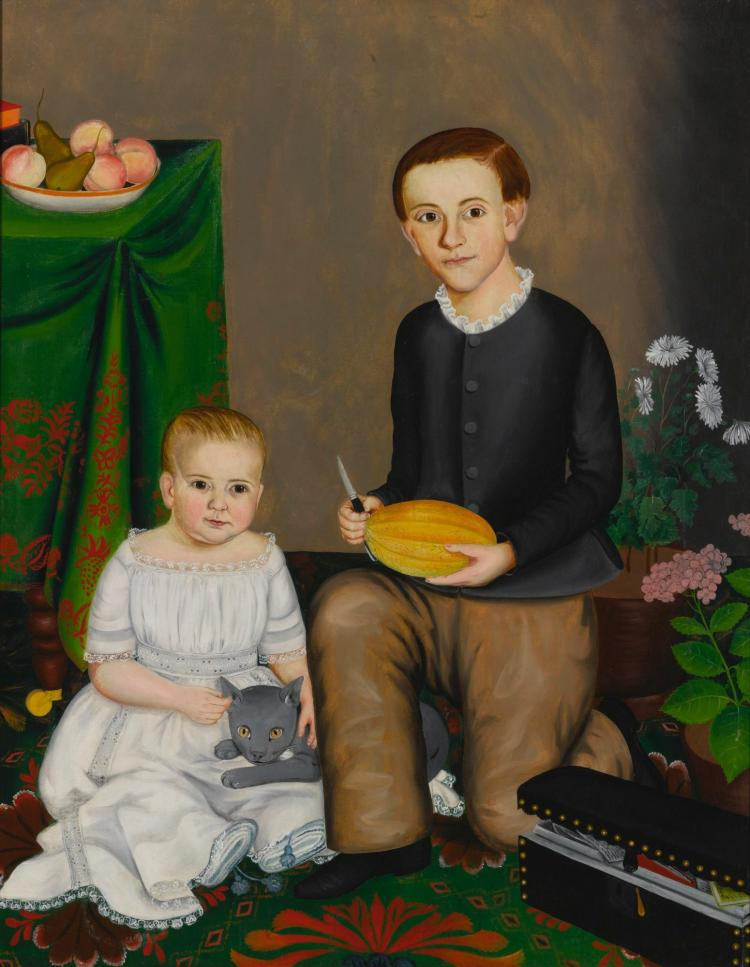
Two Children in an Interior Setting, One Child Holding a Grey Cat, the Other Holding a Piece of Melon by Susan Waters

Susan and her sister, Amelia, attended the fee-paying Boarding School for Females run by Quakers at the small Pennsylvania border town of Friendsville.  The town had been founded in 1819 and the majority of early settlers were Quakers.  At the age of fifteen, in order to afford to pay the fees for the school for her and her sister, Susan would paint copies for the Natural History course run by the school.  Although the school had basic art education lessons, Susan is considered to be a self-taught painter.

The Downs Children of Cannonsville, New York. by Susan Waters (1843)

On 27 June 1841, aged just eighteen, she married William C. Waters, a Friendsville Quaker and amateur artist, and he would encourage his young wife to develop her talent as a painter. She took up portraiture about 1843, when her husband became ill and was unable to support the family. She would travel around the outlying areas painting and selling portraits of the people and their children.  One of Susan’s earliest recorded signed paintings is her 1843 work entitled The Downs Children of Cannonsville, New York. It depicts two children with a dog and a toy wagon in a landscape setting which includes a white house in the background. The boy on the left holds a riding crop.

Helen M Kingman by Susan Waters (1845)

In 1845, Susan completed a set of three paintings featuring the Kingman family.  This signed and dated portrait of fifteen-year-old Helen M Kingman is one of the three works.  The young girl is depicted seated in a stencilled chair, wearing a salmon pink dress, against a grey-walled backdrop.  Note the potted plant on the windowsill, an accoutrement often seen in portraits of children.

Lyman Kingman by Sarah Waters (1845)

Another in the series is a portrait of Lyman Kingman dressed in a black suit, holding sheets of paper. Behind him are shelves of books at right and drapery at upper left.

The Lincoln Children by Susan Waters (1845)

In the 1840s Susan specialized in portraits of children, and this 1845 painting, The Lincoln Children, is a depiction of three of the twelve children of Otis Lincoln, an innkeeper who was plying his trade in the small rural town of Binghamton in New York State. The three small girls are Laura Eugenie, aged nine, Sara, aged three, and Augusta, aged seven and they have been positioned in a pyramid. They are all wearing decorative dresses, adorned with eyelet and lace. One of the girls holds a peach, another a small branch in one hand and a pencil in the other while the third has a book open upon her knee.  These trappings were added to the portrait to publicise the girls’ sweetness and their attentiveness whilst attending school. The fine-looking furnishings including an expensive floral-patterned carpet, the pretty plants on a stand in the right background, and the addition of the appealing puppy with its well-arranged stance coalesce and create a lovely image of domestic stability and cosiness and yet their intense expressions as they look out at us gives the painting a disconcerting openness.

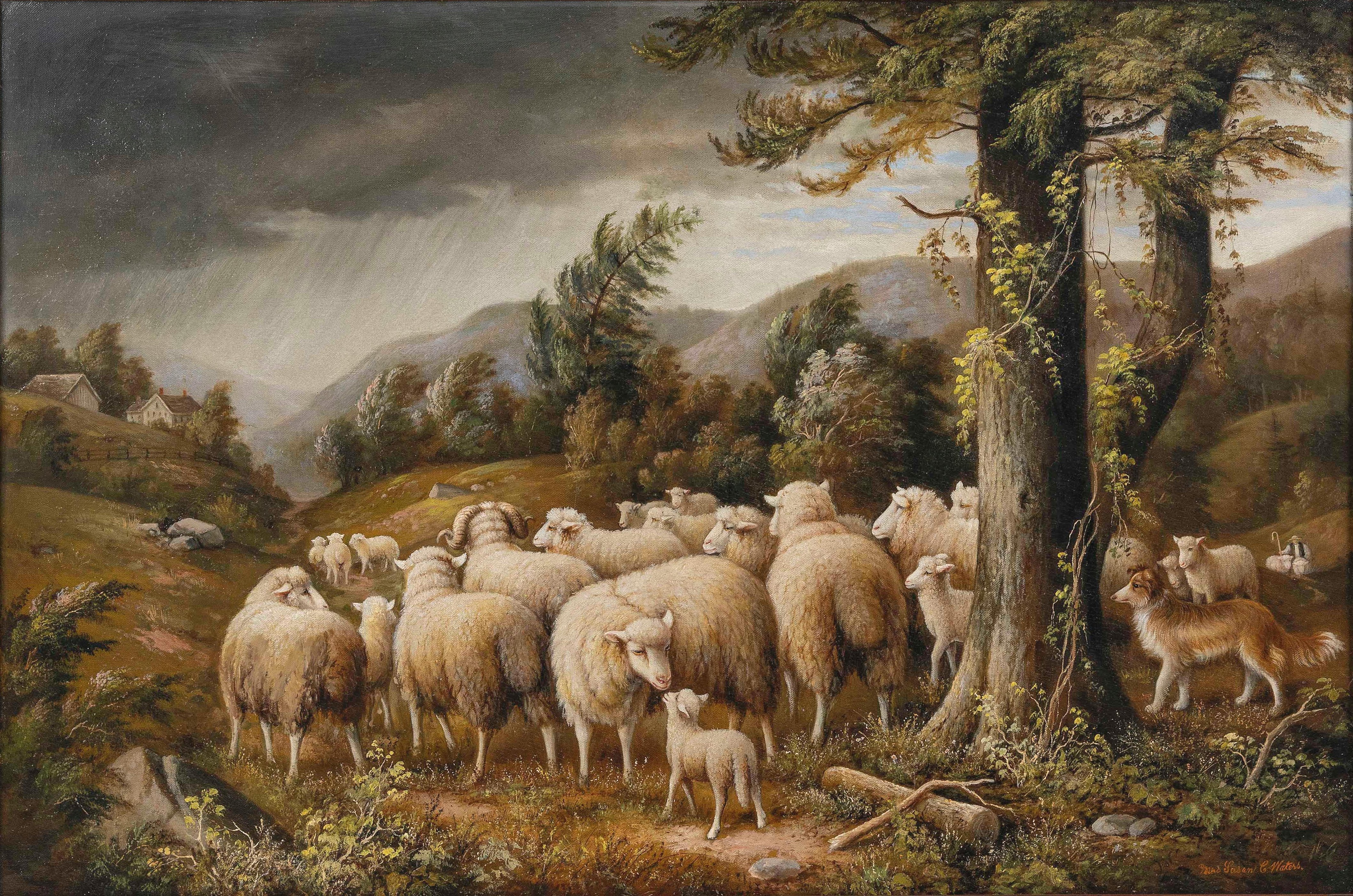
Herding Sheep before the Storm by Susan Waters

The Waters’ life was complicated, flitting from one temporary home to another. They continued to reside in Friendsville for several years, but by May of 1852 they had moved to Bordentown, New Jersey. They built themselves a cottage in the Quaker community of Bordentown and although they did not settle there permanently at that time, they would return to their house in 1866.

Chicken and Raspberries by Susan Waters

The couple sold their Bordentown cottage and journeyed to Mount Pleasant, Iowa, in 1855, returned to Friendsville four years later, and in 1866 finally resettled in Bordentown buying back their former home on Mary Street and it was here that they spent the rest of their lives. This was a base from which she taught art and produced over fifty of her later works, many of which were painting of animals in their natural settings, especially her favourite animals, sheep, and pastoral scenes. She was also an early photographer and produced many ambrotypes and daguerreotypes, which were early forms of photography. This made a lot of practical sense, as commissioned portraits were giving way to the more exciting medium of photography. 

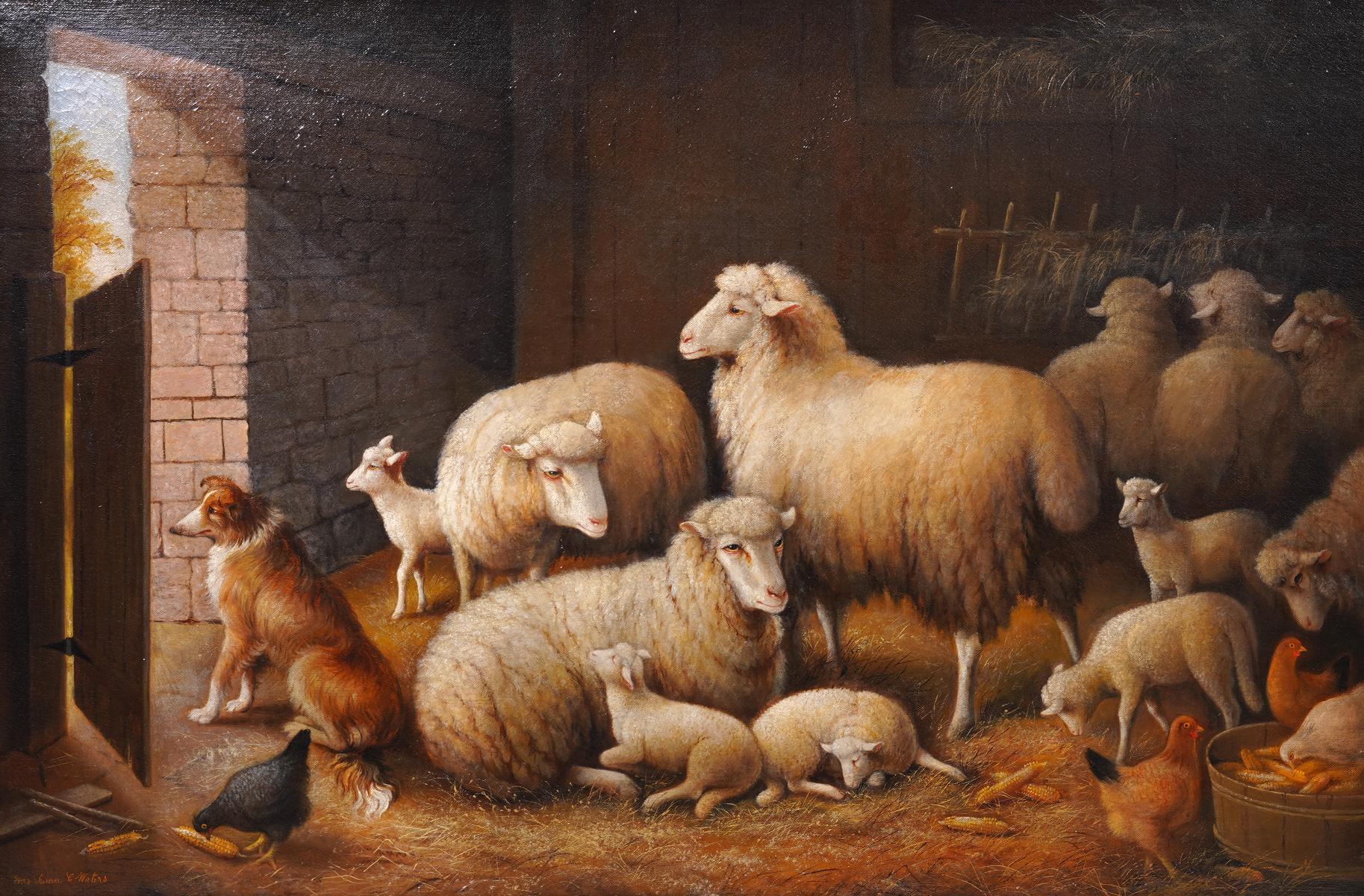
Barnyard Animals by Susan Waters.

Many of the animals depicted were kept in Susan’s own yard.

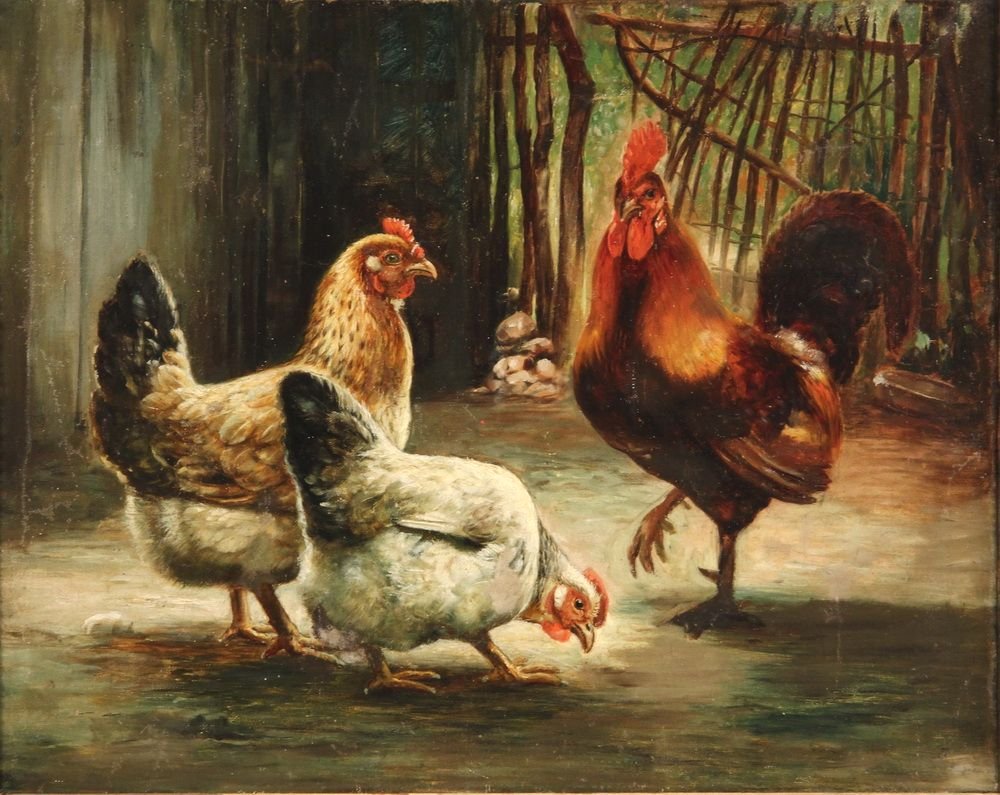
Rooster with two Chickens in the Yard by Susan Waters.

Whilst residing in Bordentown Susan Waters painted animal and still life pictures in a style which was more mature and academic than her earlier efforts at portraiture.  There was a greater sophistication with her depictions.

A Cache of Raspberries by Susan Waters

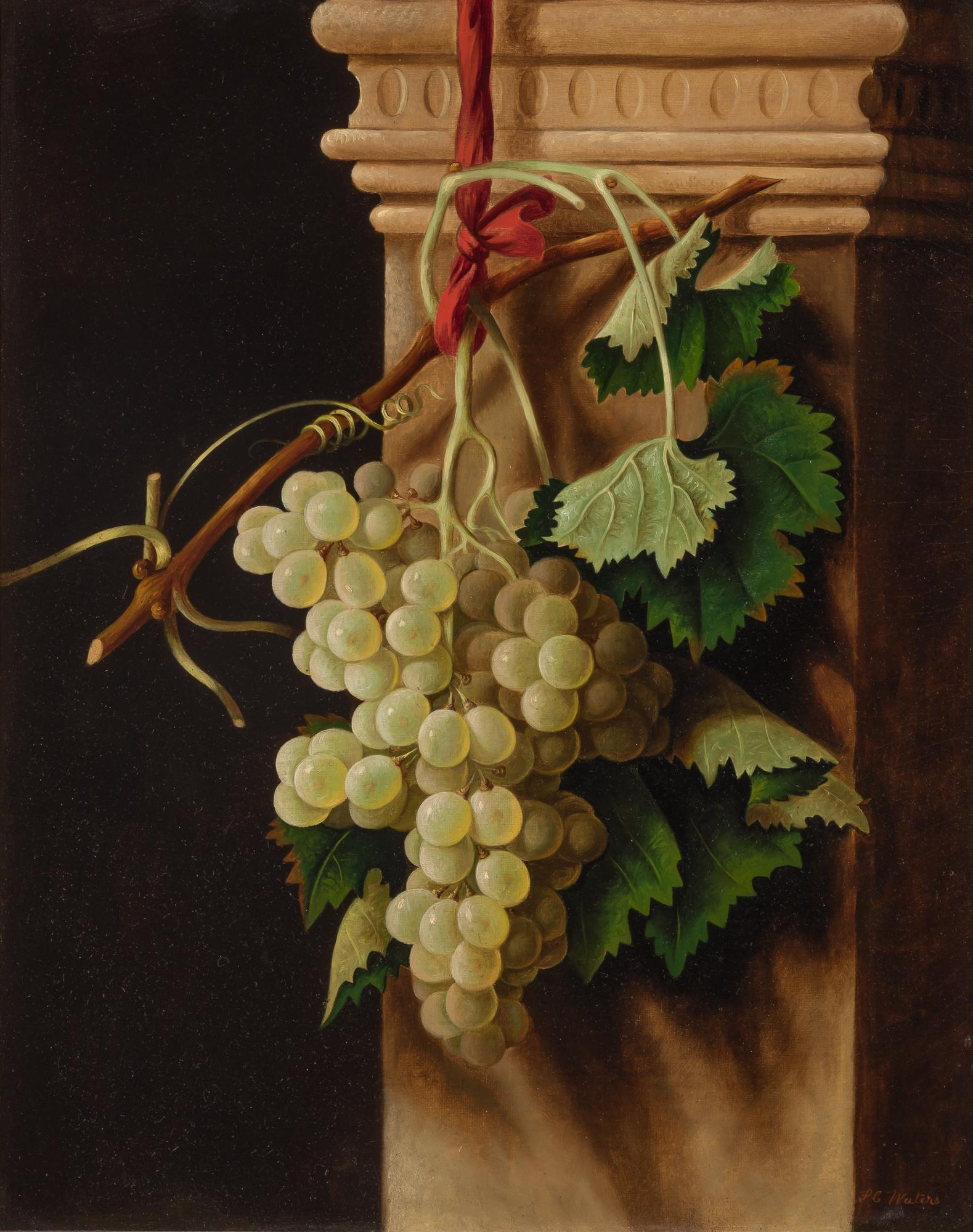
Susan also produced a number of excellent still-life paintings

Still life with Grapes by Susan Waters

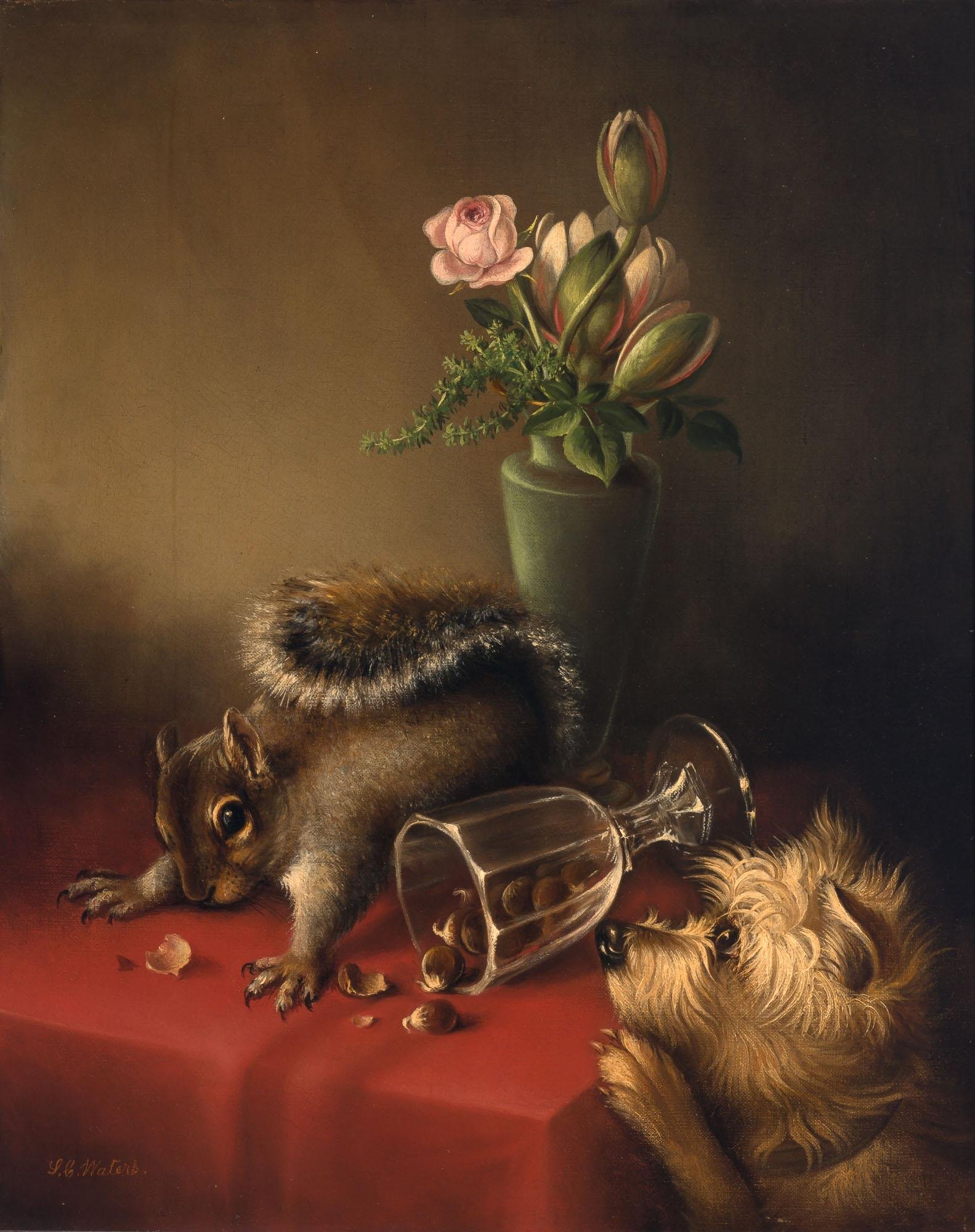
and sometimes a combined still-life and animal depiction as in her work entitled The Marauders.

The Marauder by Susan Waters

The artwork she produced and sold whilst living in Bordentown earned her recognition in her own lifetime.  It was not just from within her local community but from outside and in 1876, Waters was honoured with an invitation to exhibit some of her paintings at the Centennial Exhibition in Philadelphia. It was the first official World’s Fair to be held in the United States. She submitted two of her animal paintings.

Lighthouse on the Coast by Susan Waters

Susan Waters also became active in State politics when she became a member of the New Jersey Woman Suffrage Association, which was founded in 1867.  It was in this year that Lucy Stone delivered a speech on “Women Suffrage in New Jersey” before the state legislature.  This would have been a thrilling time to be involved with the movement, and Susan was elected recording secretary for the Association in 1871. She was also an Animal Rights activist.

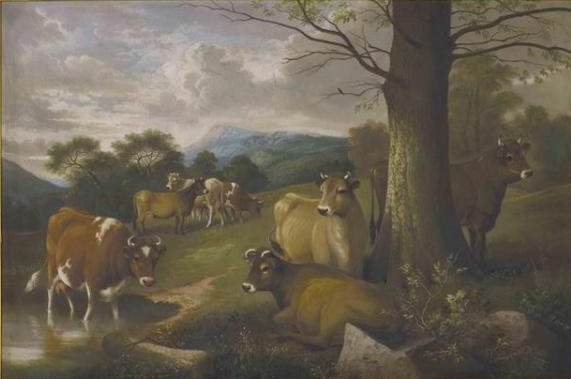
Pasture scene with cows and distant mountains by Susan Waters

After exhibiting successfully at the Centennial International Exhibition in Philadelphia in 1876, Susan discovered that her work was much sought after and it remained so for the rest of her life.  Her husband died in 1893 and from then on Susan dedicated herself to her art.  In 1899 she had to sell her home and go to a nursing home in Trenton New Jersey.  On July 10th 1900 Susan Catherine Moore Waters passed away at the age of seventy-seven.  Three days later she was buried alongside her beloved husband, William in the beautiful Bordentown cemetery.  Of her character, her obituary noted:

“…as beautiful as her paintings … her talent she could not bequeath…”

The folks of Bordentown will remember Susan Waters as a lady of refinement, modest and unassuming.  She was a lady of extraordinary ability, not just as a painter but as a writer and a speaker in the Society of Friends.

Alson Skinner Clark. Part 2.

Although based in Paris, Alson and his wife, Medora travelled extensively.  They visited Normandy and further afield to regions of Italy and Spain, the Netherlands, the Dalmatian coast, and Canada.  They would often return to their folks on Comfort Island and Watertown.  Alson also visited New York to see art dealer William Macbeth, who owned the first gallery at that time to deal solely in American art, to see if he could interest the art dealer in some of his work.

The Rising Sun, Malaga by Alson Skinner Clark (1909)

Having spent some time painting in Spain, Alson organised an exhibition of his Spanish paintings at the O’Brien Art Galleries in Chicago in March 1910.  It was Chicago’s first art gallery and one of the oldest family owned and operated gallery in the United States. It opened in 1855 as a frame shop, offering a variety of services to both artists and collectors.  The exhibition of Alson’s work was a great success and seventeen of Alson’s thirty-eight canvases were sold immediately and his New York dealer, William Macbeth, agreed to exhibit the unsold canvases in his gallery.

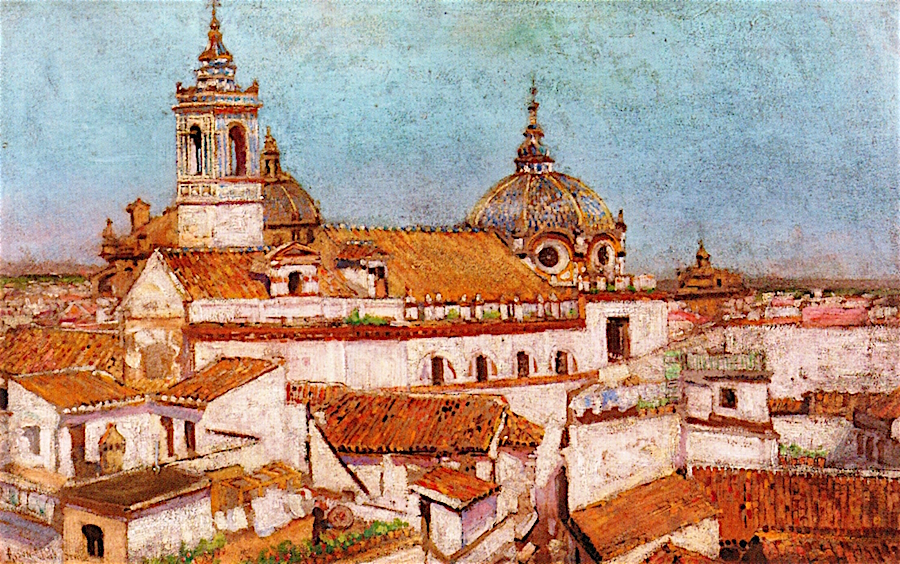
Rooftops Seville by Alson Skinner Clark (1909)


On the Beach, Normandy by Alson Skinner Clark (1910)

Alson and Medora Clark returned to Paris in June 1910 and visited the Giverny Art Colony.   The colony had started in the 1880’s and by the time Alson arrived in 1910 American artists were major players in the colony.   The colony by 1910 was very popular and with the influx of more and more artists as well as tourists the cost of living there had risen sharply.  Although Alson enjoyed the camaraderie of the Americans at Giverny, Medora was less impressed with the cliquish nature of the group.  She once described it:

“…The more I reflect on the possibilities of Giverny as a place to go, the less I care for it. The petty jealousies…the fights, the spying on you by your neighbours all works up to the least attractive place…to spend a season. Then the similarity in all of the work. I have kept out of it…”

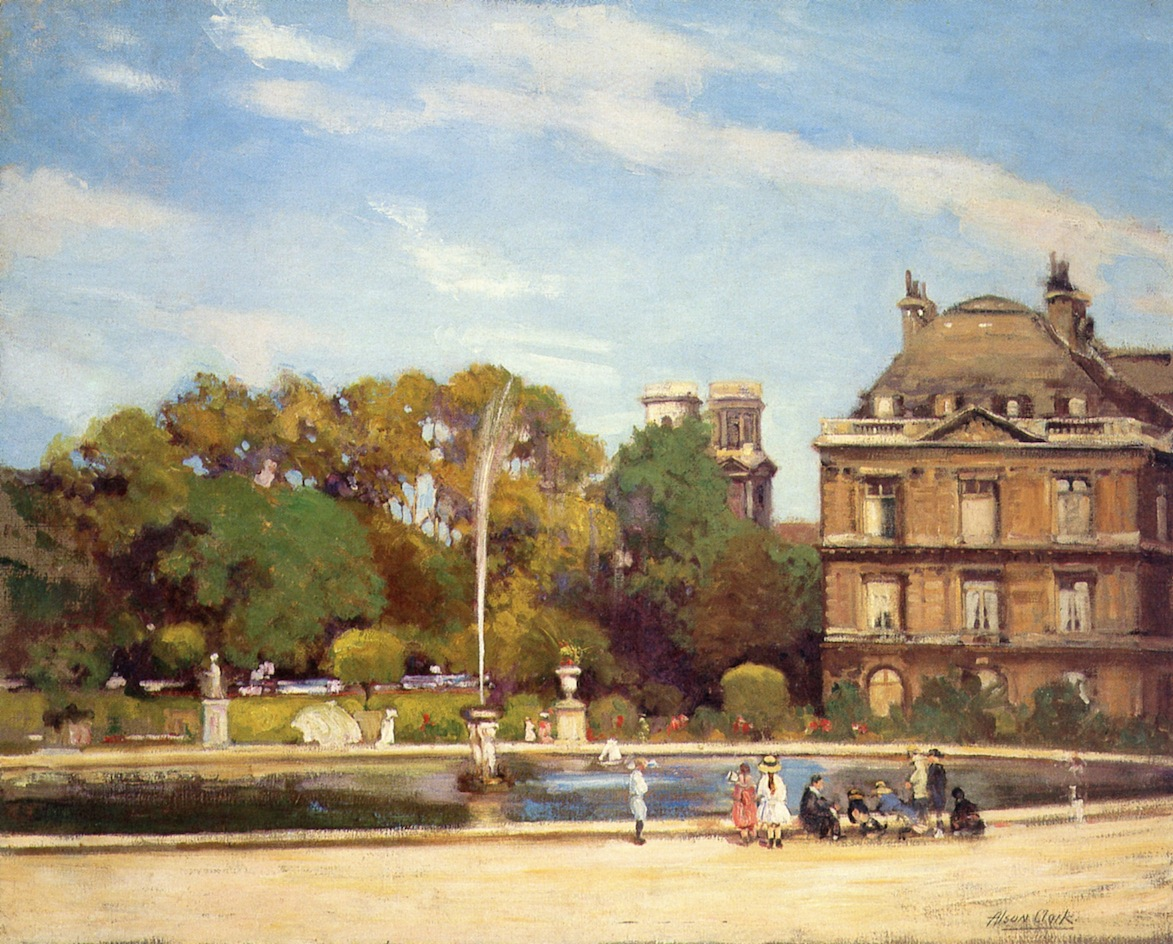
Luxembourg Gardens Pond, Paris by Alson Skinner Clark (1910)

Alson Clark’s exhibited his work at many venues such as The Art Institute of Chicago, The Pennsylvania Academy of the Fine Arts, the Paris Salon, and the National Academy of Design. He was always searching for new subjects to paint and the sale of his work through his New York and Chicago art dealers was making him financially secure.

Medora by Alson Skinner Clark (1917)

Having passed through the Panama Canal on a number of occasions I was fascinated by Alson Clark’s depictions of the building of the giant project. In the spring of 1913, Alson Clark, out of the blue, decided to visit the Panama Canal Zone where the construction on the vast and costly canal was nearing completion. Clark had made his mind up to somehow get himself involved in this exciting venture. He and his wife, Medora, boarded a steam ship and made the journey to Colon where they subsequently continued onto Ancon, on the Pacific side of the canal. Neither had letters of introduction nor any booked accommodation.  Fortunately for the couple both were procured.  Better still, the supreme commander of the project, Colonel George W. Goethals, gave Clark unprecedented access to the labour trains and construction sites.  Alson worked energetically despite the extreme heat in order to portray the excavations, the construction of the locks, and the railroad.

Alson Clark wrote to his mother about this time:

“…This is such a busy place for me I never get time to write more than a postal. We get off on the 6:40 train in the morning, getting up at five[1]thirty or so and get back at noon, leave for lunch and go off again at one-thirty, getting in at seven and after dinner go to bed…. In the afternoon at present, I go to the Culebra Cut where all the blasting has been going on and the slides, and I paint there. It is wonderful all over….”

Work Trains – Miraflores (Panama) by Alson Skinner Clark (1913)

For his painting Work Trains -Miraflores,  Alson Clark positioned himself on the western side of the Panama Canal where the construction of the Miraflores Locks was taking place.  It was here that when fully operational, ships could be lowered sixteen metres to sea level into the Bay of Panama, and the last step for ships crossing into the Pacific Ocean.  The depiction gives us a view looking down at the giant cavity which has been dug out to make the lock.  Down below we can just make out tiny figures working near trains which billow steam and smoke, which is testament to the monumental size and effort of this construction.

In the Lock, Miraflores by Alson Skinner Clark (1913)

The viewpoint for Clark’s painting, In the Lock, Miraflores, is from inside the centre of the lock. The depiction highlights the massive construction project which dwarf the many working figures which appear as tiny dots in the enormous industrial landscape. Alson Clark employed his impressionistic technique using a rich palette and bravura brush strokes to reveal bright light saturating the workplace. The lines of the train tracks, canal walls and cranes create a strong compositional design, which together emphasize the dramatic effect of the scene.

Pedro Miguel Locks, Panama by Alson Skinner Clark (1913)

The Pedro Miguel Locks contain a single set of parallel locks each containing a single chamber. All the present locks on the Panama Canal are operated by gravity. In the case of the Pedro Miguel Locks, fresh water from Gatun Lake and the Chagres River flows into the Culebra Cut. For southbound traffic, this water flows into the Pedro Locks. When the water flows out of the lock into Miraflores Lake, towards the Pacific Ocean, ships are lowered 31 feet. For northbound ships, they are raised 31 feet when water flows into the lock from the Culebra Cut until the level is equal with the Culebra Cut. Ships can then exit the lock. Thus, the entire system relies upon rainfall for its operation.

In the Cut, Contractors Hill by Alson Skinner Clark (1914)

Culebra Cut was the “special wonder” of the canal.  Here, men and machines labored to conquer the 8.75-mile stretch. Holes were drilled, filled with explosives and detonated to loosen the rock and rock-hard clay.  Steam shovels then excavated the spoil, placing it on railroad cars to be hauled to dump sites.

1915 Panama-Pacific International Exposition, San Diego, California

The Panama-Pacific International Exposition was a world’s fair held in San Francisco from February 20th to December 4th, 1915. Its stated purpose was to celebrate the completion of the Panama Canal, but it was widely seen in the city as an opportunity to showcase its recovery from the 1906 earthquake.  Alson Clark was invited to hold a solo exhibition at the event, an honour bestowed on very few American artists at that time.  He was awarded a bronze medal. 

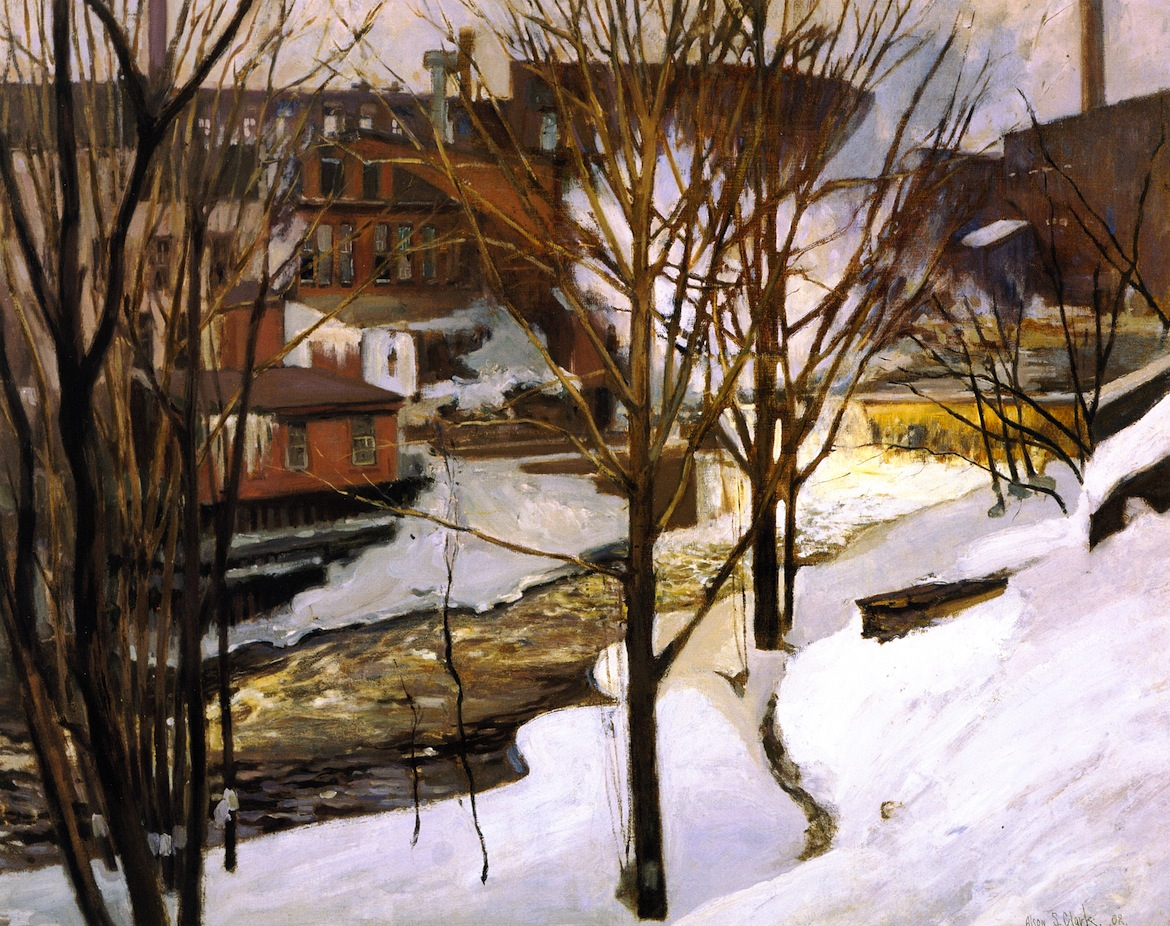
Frozen River, Jackson, New Hampshire by Alson Skinner Clark (1915)

The Clarks left Panama and decided to spend the summer of 1914 in France.  The holiday ended abruptly with the outbreak of the First World War and they rushed to get a sea passage back to America.  Once back in their homeland they accepted an invitation from Charles and Edith Bittinger to stay with them that winter in their New England home.  Charles was an American artist who explored the use of scientific techniques for artistic purposes. During World War I, he also played a prominent role in the development of naval camouflage. Alson was not put off by the extreme cold of New England and would go painting en plein air in snowshoes.

Charleston Houses (also known as St. Michael’s Alley) by Alson Skinner Clark (1917)

In January 1917, Alson and Medora agreed to join another couple on a short trip to Charleston. Clark had spent very little time in the southern states of America and was overcome by Charleston’s charm and history. He enjoyed the genteel Southern hospitality and undoubtedly would have stayed if not for a dramatic turn of events – The United States entered World War I.

Mission San Juan Capistrano by Alson Skinner Clark (1918)

Alson and Medora returned to Chicago in April 1917, and forty-one-year-old Clark enlisted in the US Navy.  He believed that his knowledge of the French language and his familiarity with the French countryside would make him an ideal candidate.  He was originally used as a translator and then in May 1918 he became a military photographer.  His task was to take aerial surveillance photographs which required him to hang over the side of an open plane !  Sadly this experience left him deaf in one ear and doctors advised him that once he returned to America, he should relocate a place which offered a warm climate and help his recuperation. This partial deafness took a toll on his mental health and he told his wife that he would not paint again

Mission San Gabriel by Alson Skinner Clark (1919)

However, once in California, his hearing steadily improved; he regained his spirits and resumed painting.   The couple settled in Southern California and the landscapes of this region offered Clark new and exciting possibilities for his art.  The region was dotted with romantic Spanish Colonial missions, and the proximity to Mexico offered a kind of pictorial exoticism.  Two of the couples’ favourite haunts were the Mission San Gabriel and Mission San Juan Capistrano.  Alson was charmed by the decaying architecture of the two structures.

Alson Clark’s mobile studio

In 1919, the couple decided to remain in California until it was safe to return to France.  They bought a small plot of land in Pasadena and put on it what they termed “a shack”.   Over time and with an increasing love of the Californian life they had a new home and studio built.  Alson, wanted to travel around the area to paint en plein air and so bought himself a truck which he converted into a mobile studio with built in easel and large umbrella to ward off the strong sunlight.

Montezuma’s Garden by Alson Skinner Clark (1922)

When Alson and Medora moved to Pasadena, Alson was reunited with fellow American Impressionist, Guy Rose, whom he had known when they were both at Giverny.  Rose had moved to California to teach at the newly opened Stickney School of the Fine Arts in Pasadena.  He had been director there since 1918 and asked Alson to join the faculty.  Unfortunately, in 1921 Rose suffered a debilitating stroke and Alson assumed directorship of the school.

Reverie (Medora on the Terrace) by Alson Skinner Clark (1920)

The year 1921 was also the year that Alson and Medora had their first child, Alson Junior.  Alson Senior had always lived and been allowed to paint in a quiet and serene atmosphere but with the arrival of Alson Junior all that changed and once again Alson was overwhelmed by the situation and would bemoan to Medora that his painting days were over !

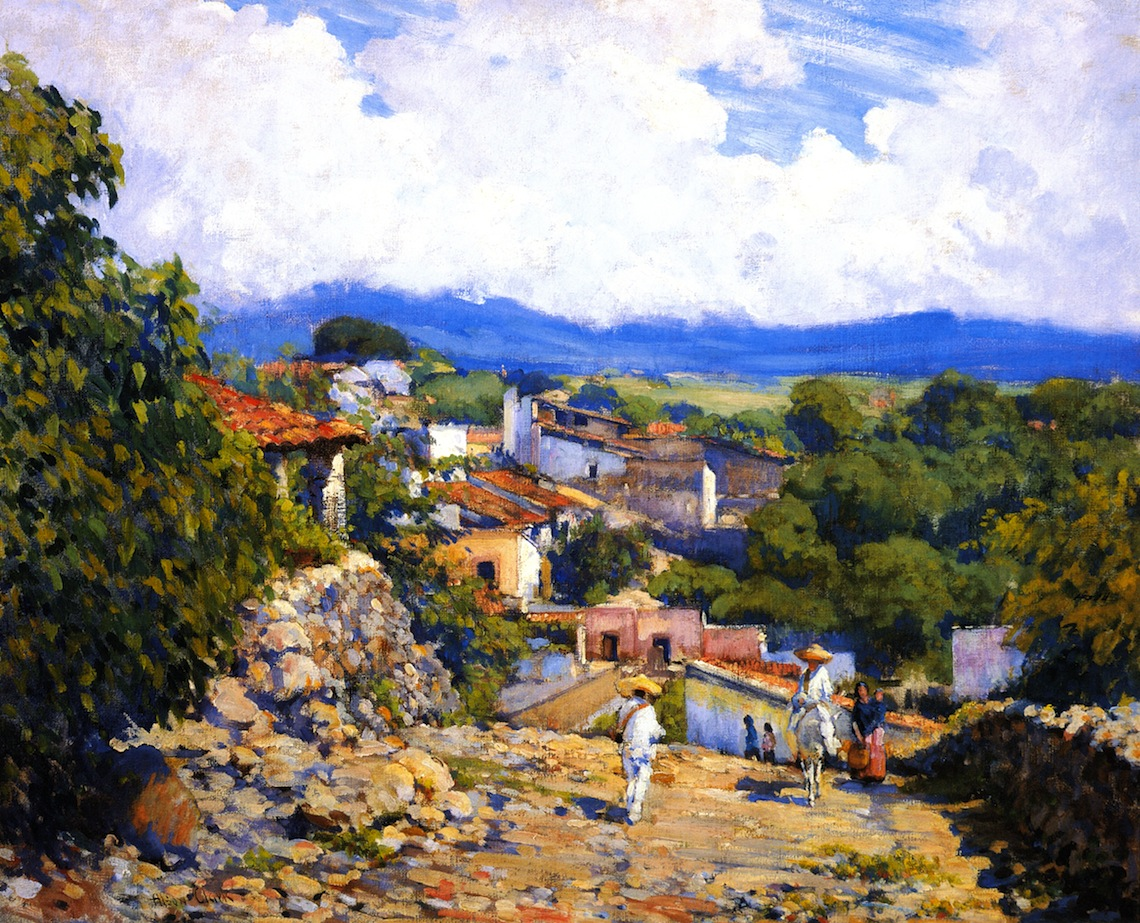
Road to Cuernavaca by Alson Skinner Clark (1923)

Through the auspices of Earl Stendahl, a pioneering American art dealer known for promoting California Impressionism, Alson Clark was afforded his first solo exhibition at Stendahl’s California gallery.  It was an East Coast/West Coast collaboration with Clark’s paintings being shown concurrently at the Corcoran Gallery in Washington DC as well as at the Art Institute in Chicago.  In 1922, after long consideration, Alson and Medora decided to make Pasadena their permanent home and so, sold their Paris studio and had all their possessions shipped to California.

After the Shower, Cuernavaca by Alson Skinner Clark (1923)

During the next several years, Alson travelled widely throughout southern California, the South-West and Mexico, the latter being one of Alson’s favourite places to visit.  His favourite Mexican destination was the southern Mexican town of Cuernavaca where he said he was influenced by both architecture and the indigenous people.

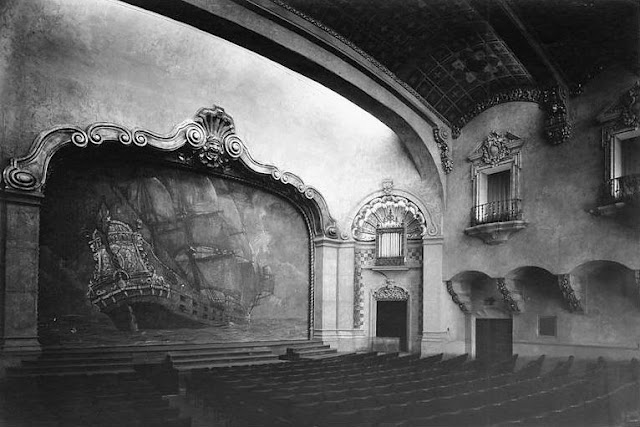
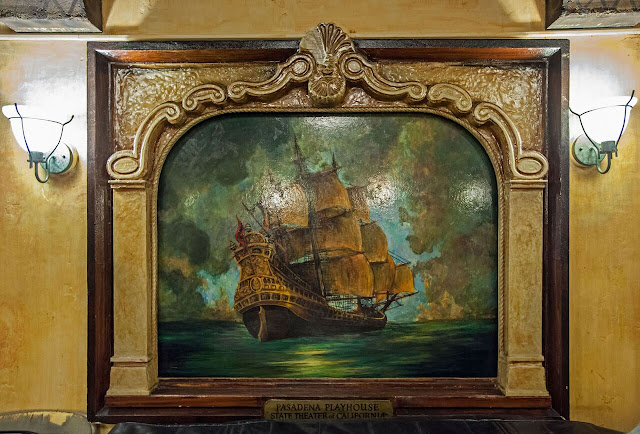
Pasadena Theatre curtain by Alson Skinner Clark (1925)

In 1925 Alson Clark was approached with a commission to design and paint the enormous theatre curtain (measuring twenty by thirty-two feet) for the newly built Pasadena Playhouse. 

Small scale painting of theare curtain

This added another string to Alson’s bow – that of a muralist.  The commission for the theatre was well received and more commissions for murals rolled in including  a series of murals on the history of California for the Carthay Circle Theatre in Los Angeles, murals at the Pasadena First Trust and Savings Bank and eight mural-size paintings for a men’s club in Los Angeles. Between these lucrative projects, Alson continued to paint en plein air in the late 1920s, and his work appeared in numerous successful exhibitions with private dealers and museums throughout the country.

Rooftops, Paris by Alson Skinner Clark (1936)

During the 1930’s Alson received numerous commissions to decorate dining rooms and libraries of private homes and designing wallpaper and although that may seem he was “selling his soul” for money, one has to remember that the country was in the depths of the Great Depression.

In 1935 he decided to drive across the country with his family, a journey that lasted twelve months.  Throughout that period Alson would sketch and paint.  In 1936 Alson and Medora made their last visit to Paris.  He was fascinated and charmed by what he saw, just as he had been when living there as a student.  One of his paintings he completed during this final visit to the French capital was entitled Rooftops, Paris, which was a view from the window of their apartment. It is now part of the McNay Art Museum collection in San Antonio. It was a gift from Medora Clark.

In 1945, Alson Clark’s health began to deteriorate due to a heart condition which also meant he was not allowed to drive, which ended his plein air painting.    In 1948 he was laid low with pneumonia which caused him to give up painting until the following March.  However, On March 23rd, 1949, two days before his seventy-third birthday, and within days of his resumption of working in his Pasadena studio, he suffered a debilitating stroke and died.  He is buried at Mountain View Cemetery, Altadena, California. Medora died on November 30th 1962, aged 81 and is buried in the same cemetery.

Much of the information I used for this blog came from an article in CALIFORNIA ART CLUB NEWSLETTER entitled An American Impressionist by Deborah Epstein Solon Ph D.

Alson Skinner Clark. Part 1.

Alson Skinner Clark

Alson Skinner Clark was an American Impressionist painter known for his landscape paintings and his murals, including at the Carthay Circle Theatre in Los Angeles and the First Trust and Savings Bank in Pasadena.  He was also an ardent photographer.  He was born on March 25th 1876 in Chicago, Illinois, to Alson Ellis Clark and Sarah Clark.  He had two brothers, Mancel and Edwin and a sister, Mary Emily, who died when young.  His father was not always a wealthy man as he came from an impoverished background.  He had served in the Civil War, and then moved to Chicago where he established a highly successful commodities business at the Chicago Board of Trade.  From then, his wealth increased and he was able to provide a comfortable lifestyle for his wife and family.

The Black Race by Alson Skinner Clark (1902)

Alson showed an early interest in art and was proving to be a gifted young painter.  In an 1956 interview for The Archives of American Art, a collection of primary resources documenting the history of the visual arts in the United States, his wife recalled her late husband’s early “artistic talent” saying:

“… I think the desire to draw was always extant with Alson Skinner Clark. When he was nine or ten years old, it made itself manifest—and obnoxious as well—to the his church-going parents, for during the long Sunday sermons he surreptitiously recorded the bonnets and bald pates in front of him in the only place available at the time—the frontispiece and blank rear pages of the family hymnals…”

His family supported and encouraged him to continue with his art by enrolling him in Saturday classes at the Art Institute of Chicago when he was just eleven years old. 

Breton Village, Rochefort-en-terre by Alson Skinner Clark (1903)

One of the perks of being part of a wealthy family was the ability to travel and in 1889 the Alson Clark and his family set off on a two-year trip around the world. For Alson it was his first taste of European art and no doubt instilled in the young man a love of both travel and painting. Back in America, Alson graduated from high school, and for a short period at the end of 1895 enrolled as a full-time student at The School of the Art Institute of Chicago.  The teaching of art at the Institute was based on the teachings at the French Academies and focused on drawing from casts and still-lifes before students were allowed to progress to drawing live models.  Alson was unhappy with the Institute’s system and after a quarrel with one of his teachers regarding the slow and arduous process of drawing from casts, Clark quit the Institute.

Despite his short but unhappy period at the Chicago Institute Alson was determined to carry on with his art and in 1896 moved to New York and studied under the tutelage of William Merritt Chase at the Art Students’ League of New York.  Despite being twenty-years-old, Alson’s mother would not let him live on his own in New York and so went with him bringing along his childhood friend Amelia Baker.  The three shared an apartment on Seventy-Seven Street and Columbus Avenue.  Alson’s mother Sarah justified this arrangement by saying:

“…For two years Mela [Amelia] and I have talked of spending a winter in New York, in Bohemian fashion, and have searched for a good reason for doing so, in vain till this time. Alson, however, came to the rescue in his desire to study art with a New York master, and made it seem a necessary thing to do…”

Early Nude by Alson Clark (1898)

When Chase opened his own school of art, Alson Clark, along with many other students, followed him.  Chase was a great influence on Alson, an influence which would remain with him for the years to come.   A painting completed by Alson, entitled Early Nude, which he completed in 1898 bears an inscription that Merritt Chase had also worked on the painting.

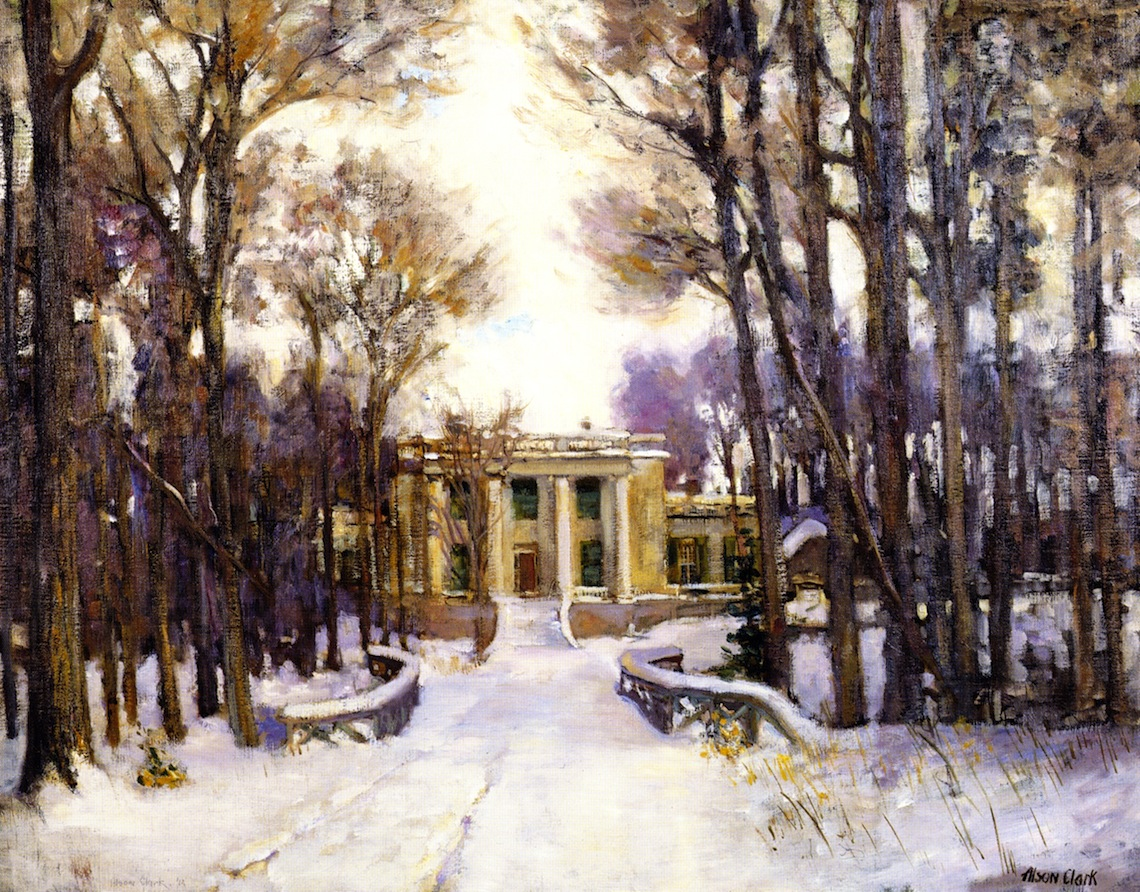
Mansion of Leroy de Chaumont near Watertown, New York by Alson Skinner Clark (1902)

For two summers Clark spent working en plein air at Merritt Chase’s school in Shinnecock, Long Island and it was the beginning of his love affair with plein air painting and his predisposition with the Impressionist style of painting.  In November 1898 Alson decided, like many other young aspiring artists, to leave America and travel to France to study at the famous French art academies.  The most popular art academy for visiting American artists was the Académie Julian.  However, the “rough and ready” Académie Julian was not for Alson, who commented that he found the working conditions “disgusting”.  Alson preferred to enrol at the newly opened Academia Carmen, which had been founded by James Abbott McNeill Whistler, where the business side of the school was handled by Whistler’s former model Carmen Rossi for whom, along with her musician husband, the school was named. Alson Clark was in awe of Whistler’s artistic talents and kept going to Whistler’s atelier on and off until it closed in 1901.  Alson would never to forget the teachings of Whistler.

Taking Paintings to the Salon, Paris, (c. 1905)

In March of 1899, Clark entered his first work in the Paris Salon. In a letter written the following month to his friend Amelia Baker, he described his experience:

“…Wednesday, Wilson and I went to the Salon to see the stuff carried in and all the awful things that went in—I never saw such a lot of bad painting. The wagons come up to the entrance and take their wads of pictures in and there are crowds of people watching the stuff enter. I have little hope that [my picture] will pass the jury but one can never tell as there is a great deal of “pull” in the Salon, and as I have not studied under any Frenchman I may be thrown out. I don’t care what happens although of course I would rather be in than out. Exhibitions are, after all, a farce…”

When his painting was rejected by the Salon jury, Clark feigned indifference stating:

“It doesn’t’ matter to me at all as I haven’t a reputation to make and there isn’t much honour in being in unless you get in squarely as only very few do.…”

The Violinist by Alson Clark (1901)

Despite his work being rejected by the jurists he never gave up trying to have one of his paintings was eventually accepted into a Salon exhibition for in 1901 his perseverance paid off with his painting, The Violinist being selected for that year’s Paris Salon exhibition.

Comfort Island Alexandria Bay, New York was built in 1883 by industrialist Alson E. Clark.

Whilst he had been living in America Alson Clark’s health was often very poor and was a frequent visitor to his doctor with stomach problems.  In 1901 whilst living in France he once again became ill and was advised he had to have his appendix removed.  In those days this was a serious operation and so he decided to return to America for the operation and set sail for New York on June 1st with surgery booked at a Chicago hospital that summer.  After the operation he recuperated at the family home on Comfort Island, one of the Thousand Islands in Alexandria Bay, New York.  Comfort Island, Alexandria Bay, New York was built in 1883 by his father Alson E. Clark and it is located on the St. Lawrence River in the Thousand Islands Region in what is known as Millionaire’s row.

Ile de la Cite, Paris by Alson Skinner Clark (c.1900)

In the Autumn of 1901 Alson rented a barn from the parents of his friend Amelia in Watertown a small, provincial city near Lake Ontario and the Canadian border and the closest city to Comfort Island.  This was the start of his career as a professional artist and the only one in Watertown. Now set up as a professional artist, he needed a model and he discovered that one of the local girls, Atta Medora McMullin, was willing to pose for him and her mother would act as her chaperone.  Soon love between artist and model blossomed but Alson had his doubts about being good husband material.  He wrote:

“…In the evening I would have liked to have seen Medora, but stayed home and wrote. I have no more business in marrying than the man in the moon for I am fickle and can’t help myself. It is a misfortune and not a fault.” Yet, just a few days later, he wrote, “In the afternoon she posed. I could not work as I wanted to tell her that I loved her but could not. We sat by the fire knowing each other’s minds…”

Landscape near Le Pouldu, France by Alson Skinner Clark (c.1900)

At the end of January 1902, Alson Clark professed his love to Medora and proposed marriage. She accepted.  Medora was to prove a very compassionate and supportive wife.  His first exhibition of his work was at Watertown and featured many paintings of Paris.  It was a success and he sold many works.  From there the exhibition moved to Chicago for Clark’s first major exhibition, at the Anderson Galleries.  Once again the exhibition was hailed as a great success and the Chicago Times declared:

“… Popular opinion has decided that it is a very promising display for a young artist…. Mr. Clark has a style of his own. It is suggestive of Japanese reminiscences, is refined and pleasantly frank…. The sentimental does not interfere with the boldness of using masses…”

From our Window, Paris by Alson Skinner Clark (1903)

Alson Skinner Clark and Atta Medora MacMullin wed on September 20th, 1902, and for their honeymoon they took a sea voyage to Europe on the S.S. Minnetonka.  On November 7th the couple moved into a Parisian apartment at 6, rue Victor Considérant.   Shortly after settling in, Alson’s friend, and fellow American artist, Frederick Carl Frieseke, moved in with them whilst waiting for the apartment above the Alsons to become available to rent.  Alson and Frieseke were good friends and Frieseke used to paint from the Clarks’ apartment balcony and would also occasionally use Medora as a model.  That winter Alson and Frederick painted continually so that they could build up a collection to put before the jurists at the Spring Salon.  They even split the cost of renting wagons to transport their work to the Salon.

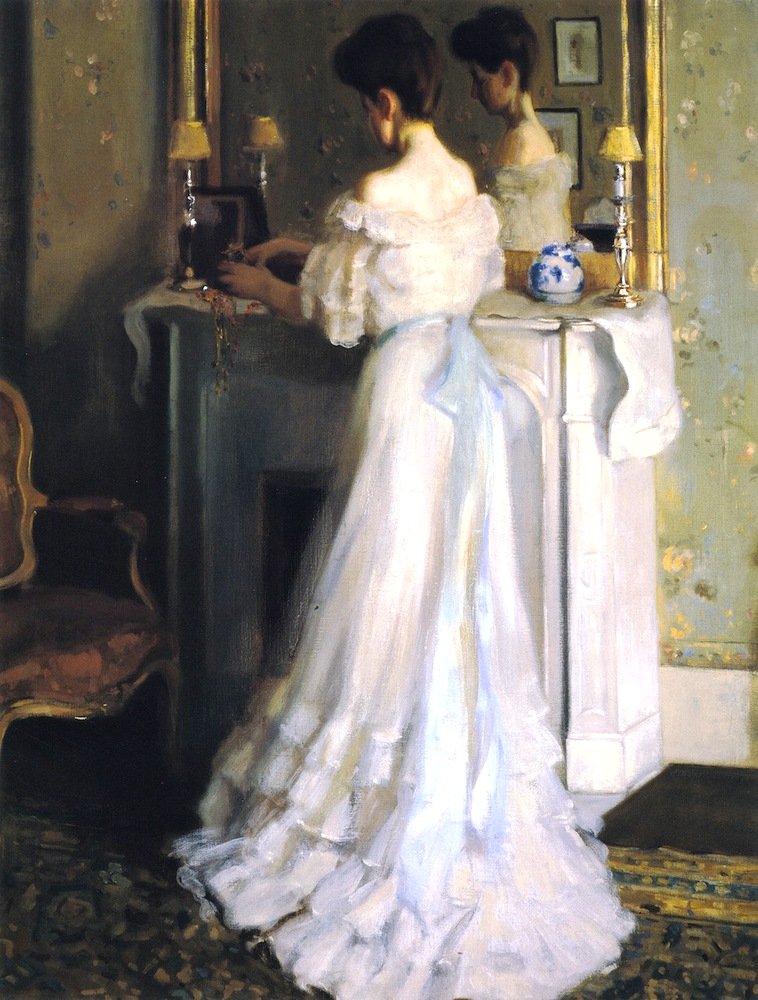
Les Colliers (The Necklaces) by Alson Clark (1905)

Alson Clark continually acknowledged the debt he owed Whistler and wrote to him many times confirming such indebtedness.  In 1905 Alson completed a work entitled Les Colliers (the Necklaces) and the style of the work mirrored many of Whistler’s works.  It was simply Alson’s way of paying homage to Whistler’s portraiture.  In the painting we see the lady, modelled by Medora, dressed in a flowing gown with her back to us, standing beside an elegant mantlepiece.  In her hands she holds a pair of necklaces

The Coffee House by Alson Skinner Clark (1906)

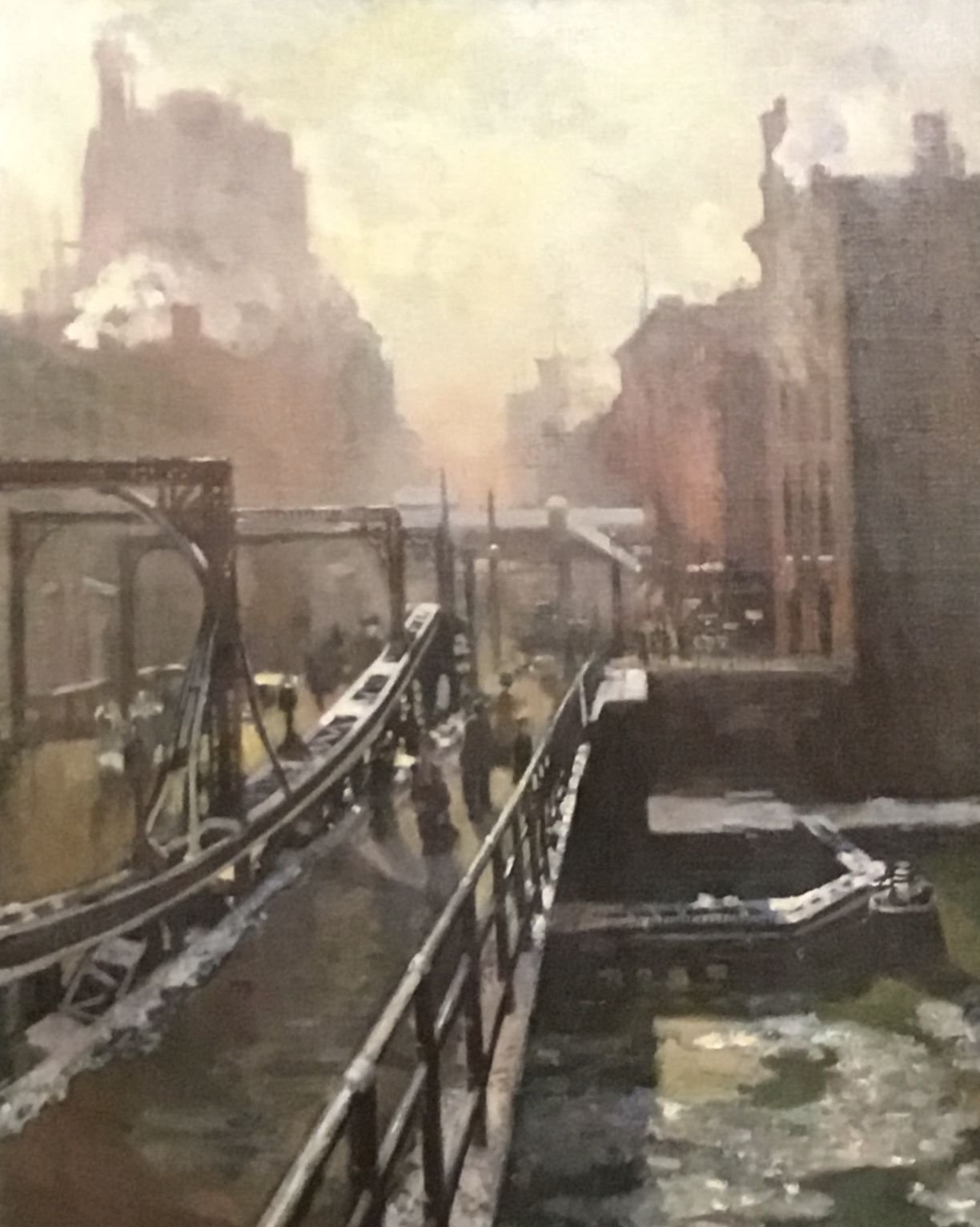
One of Alson’s early industrial paintings is his atmospheric work entitled The Coffee House which he completed in 1906.  It is a depiction of Chicago on a cold winter day.  We see ice floating down the river which is overlooked by monstrous dark skyscrapers which are looming through the smoggy atmosphere.  As we look at the painting our eyes are drawn into the picture by the curved ironwork of the State Street Bridge, 

Arrival of the Normandy Train, Gare Saint-Lazare, by Claude Monet (1877)

This is a typical depiction of urban realism and it is suggested that Alson may remember seeing such scenes depicted in Monet’s paintings such as his 1877 work, Arrival of the Normandy Train, Gare Saint-Lazare, which highlight both the ephemeral nature of fog and smoke and the atmosphere’s effect upon the forms of the city.

………….to be continued.

Much of the information I used for this blog came from an article in CALIFORNIA ART CLUB NEWSLETTER entitled An American Impressionist by Deborah Epstein Solon Ph D.

The Hayllar Family

Having recently looked at the Barnes School, the Williams family of English painters featuring a father and his six sons, I am today looking at another talented English family of painters featuring a father and his four daughters.  Let me introduce you to the Hayllars. 

James Hayllar, the patriarch.

James Hayllar, photograph by David Wylkie Wynfield (c.1860’s)

The patriarch of the Hayllar family was James Hayllar who was born in the West Sussex town of Chichester in 1829.  Despite parental opposition he decided to become an artist and, aged thirteen, enrolled at Cary’s Art School in 1842.  Francis Stephen Cary, a noted historical painter, who had once taught Rossetti and Millais, had become a pupil at Henry Sass’ Art Academy, and he, on the death of Henry Sass, took over the running of the academy in Bloomsbury and it then became known as Cary’s Art School.

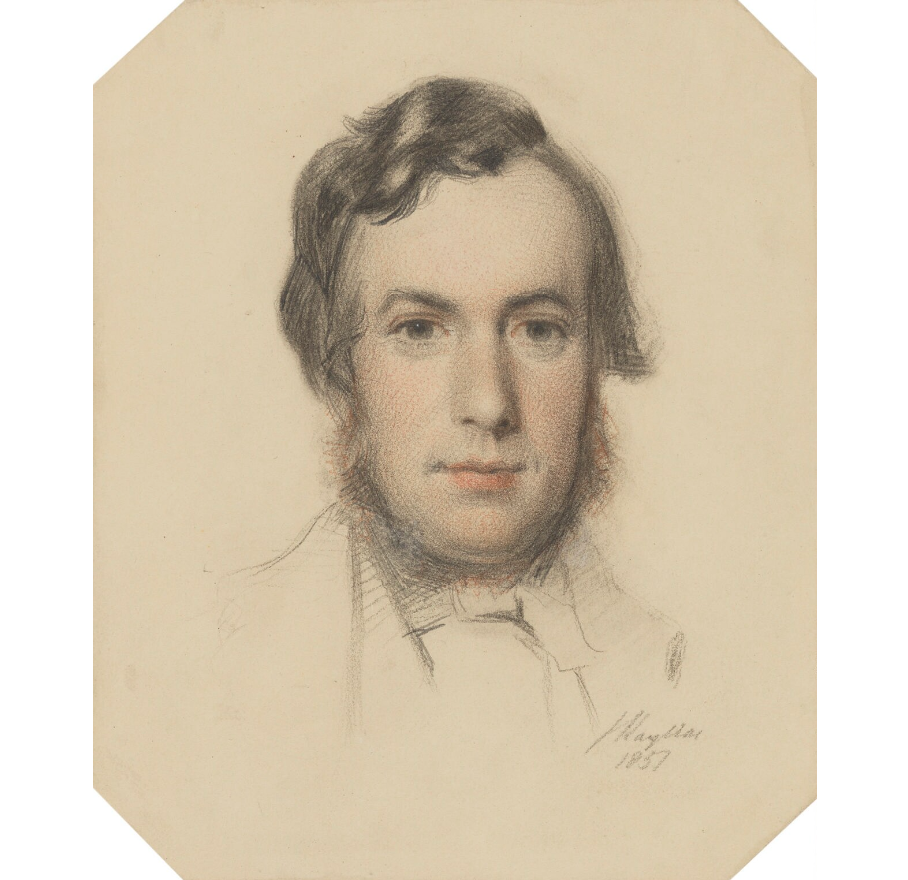
An 1851 pencil and chalk portrait of Stephen Cary by James Hayllar is in London’s National Portrait Gallery.

Cimabue’s Madonna by Frederic Lord Leighton (1853-1855)

On completing his studies at Cary’s Art School, Hayllar travelled to Europe and made a tour of the continental countries.  In 1851, whilst in Rome he met Frederic Leighton.  It is believed that Hayllar appears as one of the figures in Leighton’s monumental (2m x 5m) masterpiece, Cimabue’s Madonna, which he worked on between 1853 and 1855.

Granville Sharp the abolitionist rescuing a slave from the hands of his master by James Hayllar (1864)

Granville Sharp, who was born in 1735, was a scholar who campaigned for social justice. In 1787, with his fellow Anglican Thomas Clarkson and a group of Quakers, Sharp founded the Society for the Abolition of the Slave Trade. Sharp supported the resettlement of British and Canadian slaves to Sierra Leone, but despite reports about its moral decline and the resurgence of slave trading in the colony, maintained the view that the project was worthwhile.  James Hayllar’s 1864 painting Granville Sharp the abolitionist rescuing a slave from the hands of his master, depicts an event which occurred in 1765 and is based on Sharp’s involvement with the Abolitionist movement. In 1765 Sharp met Jonathan Strong, a slave seeking treatment for injuries sustained at the hands of his owner. Sharp took up Strong’s case and secured his release from prison when he was arrested as an escaped slave. Following this success Sharp began to research the legal status of slaves in Britain and argued on behalf of a number of slaves in court, which is why the background of Hayllar’s painting has the legal setting.

Miss Lily’s Carriage stops the Way by James Hayllar (1866)

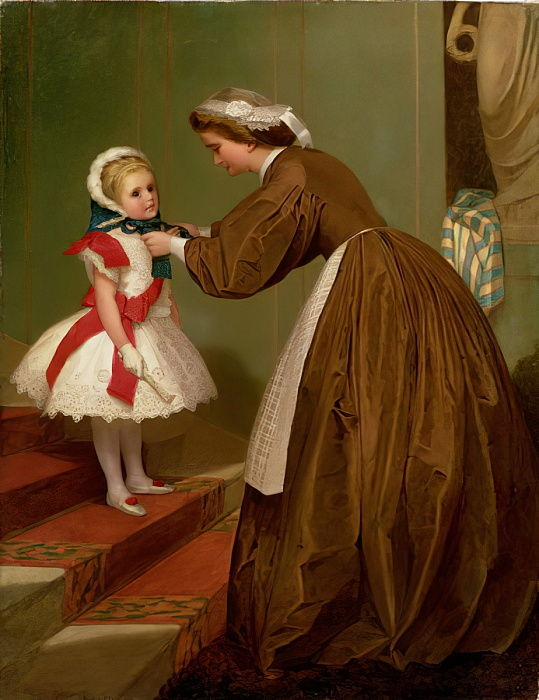
Hayllar exhibited his work at the Royal Academy focusing on literary and historical genre but by 1866 he changed tack and began a series of extremely well-liked genre studies of children and he completed a three painting series depicting a child attending a formal party. The first of these was Miss Lily’s Carriage stops the Way. In the first painting, Hayllar depicts a young child having her cloak adjusted before she makes an appearance at her first party.

Miss Lily’s First Flirtation by James Hayllar (1866)

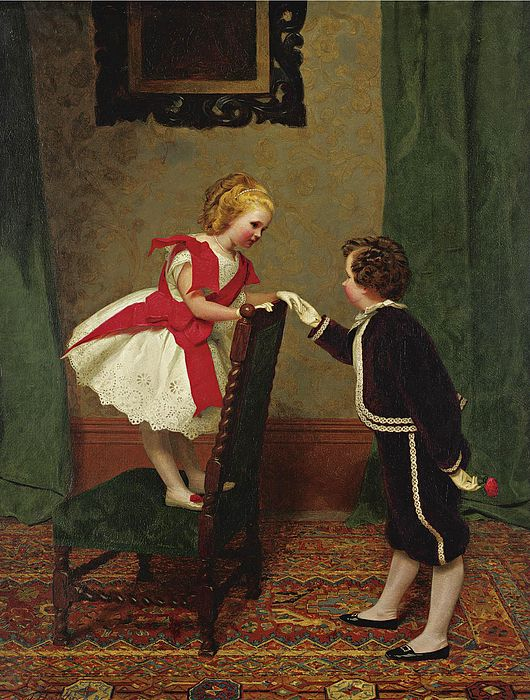
In the second work, entitled The First Flirtation,  we see the same young girl, Lily, enjoying herself at the party as she makes the acquaintance of a young boy similar in age to herself.

The Return from the Ball by James Hayllar (1866)

In the third painting entitled The Return from the Ball, Lily is seen being carried from the party by her mother, although her eyes are still open as she rests her head on her mother’s shoulder and we can see that the evening party has tired her out.  She still manages to clutch her lace fan in her silk gloved hand.

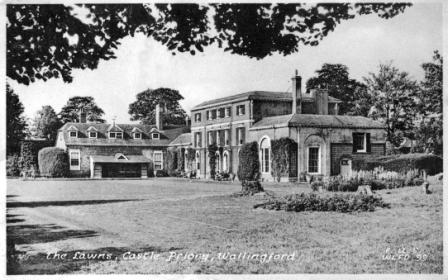
Castle Priory Wallingford, home to artist James Hayllar and his daughters,

 The series was well received and his standing as an artist rose.  His name was put forward as an Associate of the Royal Academy by William Powell Frith and Eyre Crowe, but he missed being elected by one vote and being very despondent regarding the outcome, never tried again.  Having given up hope of becoming an Academician he distanced himself from the Academy circle and also distanced himself from the English capital and London life in general and moved from his St Pancras home and settled down in the rural part of Suffolk at Carlton Rookery near the town of Saxmundham and in 1875 moved to the county of Berkshire and the town of Wallingford where he rented Castle Priory, a large house on the banks of the Thames.

Rivals Drink by James Hayllar (1881)

James Hayllar had married Ellen Phoebe Cavell in 1855 and the couple went on to have nine children, five daughters, Jessica Ellen in 1858, Edith Parvin in 1860, Eugenie Grace in 1861, Alexandra Mary in 1862 and Beatrice Kate in 1864.  They also had four sons, their first-born child, William Ernest in 1855, Reginald James in 1857 and their two youngest children, Thomas and Algernon in 1866 and 1868. 

Forty Winks by James Hayllar

Both parents and children led an exceptionally happy family life and they often played host to visiting neighbours and cousins.  The days were filled with games of tennis as well as artistic endeavour. The house was to provide his family with inspiration for their paintings.

The Only Daughter by James Hayllar (1875)

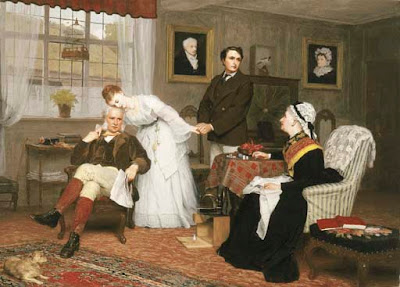
They were a very close family and of course, at a certain age, they would leave home and it is thought that James Hayllar’s 1875 painting entitled The Only Daughter was a reminder to him of the sad day when he “lost” one of his daughters.  The painting depicts an only daughter standing between her beloved father and the man who was to be her future husband.  His role in the young lady’s life would be to take over the protective mantle, once the role of her father and this successional responsibility is made plain by placing his head between the portraits of past generations on the wall behind him.

Lunchtime by James Hayllar

Hayller lived at Castle Priory until the death of his wife in 1899.  He them went to live in Bournemouth where he stayed until his death in 1920, aged 91.

The daughters of James Hayllar.

Jessica Hayllar

The Lemonade Drink by Jessica Hayllar

Of the nine children James and Ellen had, five were daughters and it was the female members of the family that followed in the footsteps of their father. James Hayllar and his wife’s third-born child was their first daughter, Jessica.

Fresh from the Altar by Jessica Hayllar (1890)

Jessica Hayllar was born on September 16th 1858.  She studied under her father and began to exhibit her art in 1879 and at the Royal Academy from 1880 to 1915. In the early days, up until 1900, her work was mainly depictions of domestic scenes of everyday life at Castle Priory.  Her genre scenes were described as being ones which were full of genuine charm.  For her models she nearly always used members of her family.

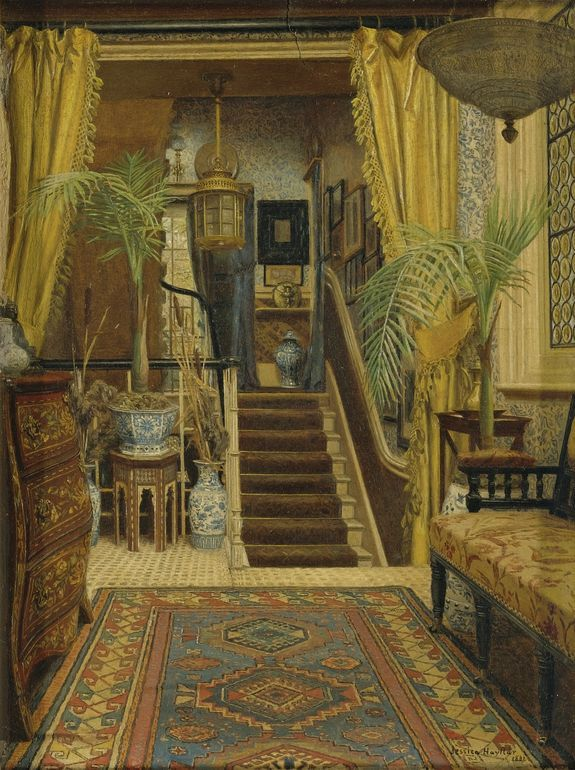
The Hallway with Potted Palms by Jessica Hayler (1882)

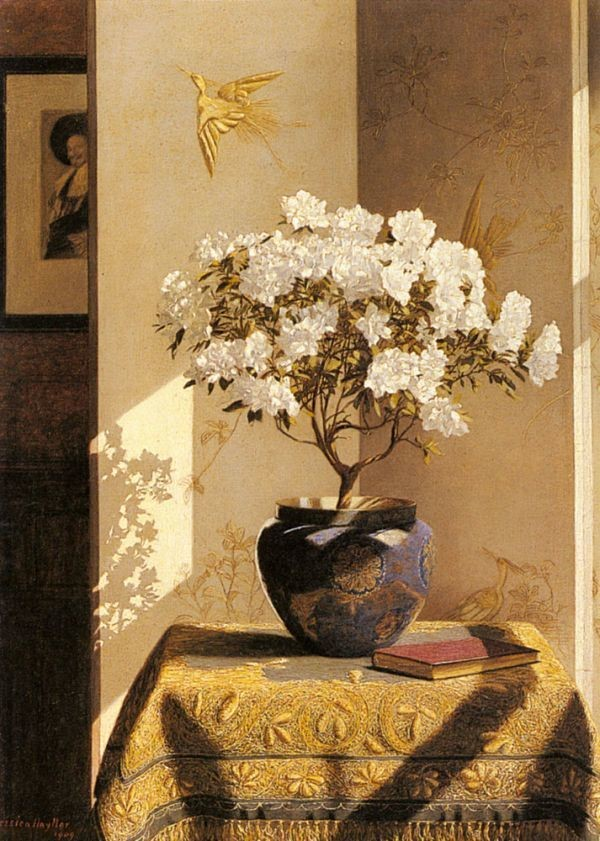
In 1900 she was badly injured in a carriage accident and was partially paralysed and confined to a wheelchair. From that moment the subject of her paintings changed and she started to paint floral still life works which often featured azaleas.

A Double Pink Azalea by Jessica Hayllar

Jessica Hayllar lived with her parents throughout her life and never married.  When her father left Castle Priory and went to live in Bournemouth she went with him.  Following her father’s death in 1920, Jessica moved to Surrey to live with her younger sister Edith Hayllar MacKay.

A Sunny Corner by Jessica Hayllar (1909)

Jessica Hayllar died on November 7th 1940, aged 82.

Alexandra Mary Hayllar

Alexandra Mary Hayllar wedding day photo (1885)

In comparison to her four sisters, Alexandra Mary Hayllar was the least prolific, and unlike her sisters, she only exhibited at the Royal Academy from 1880 to 1885.  Her paintings were mainly still life works or genre pieces which featured children.

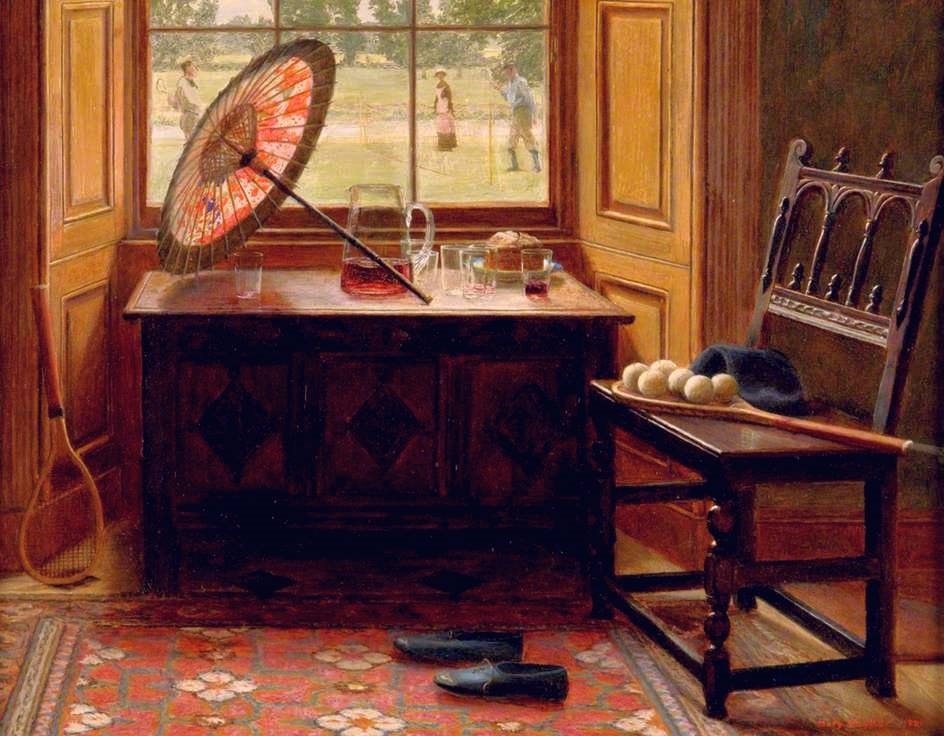
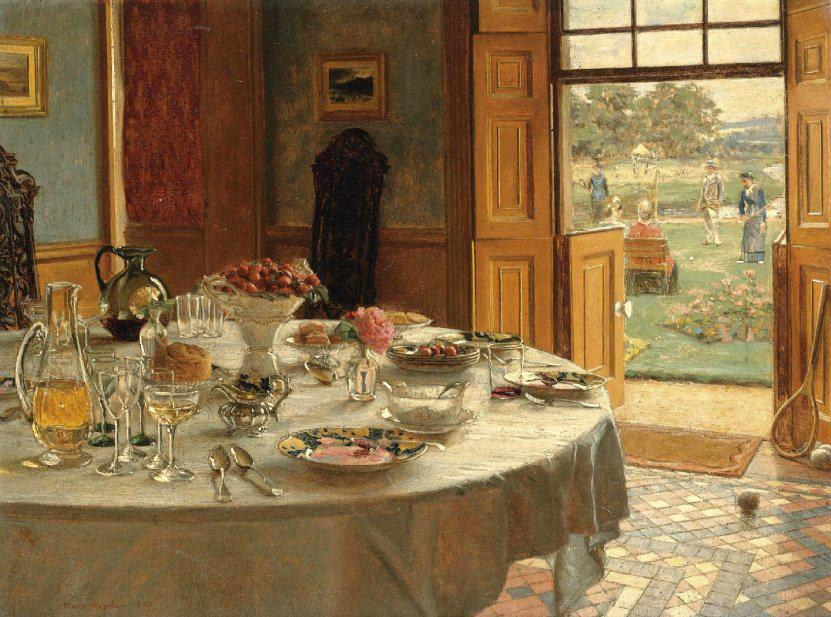
Lawn Tennis Season by Mary Hayllar (1881)

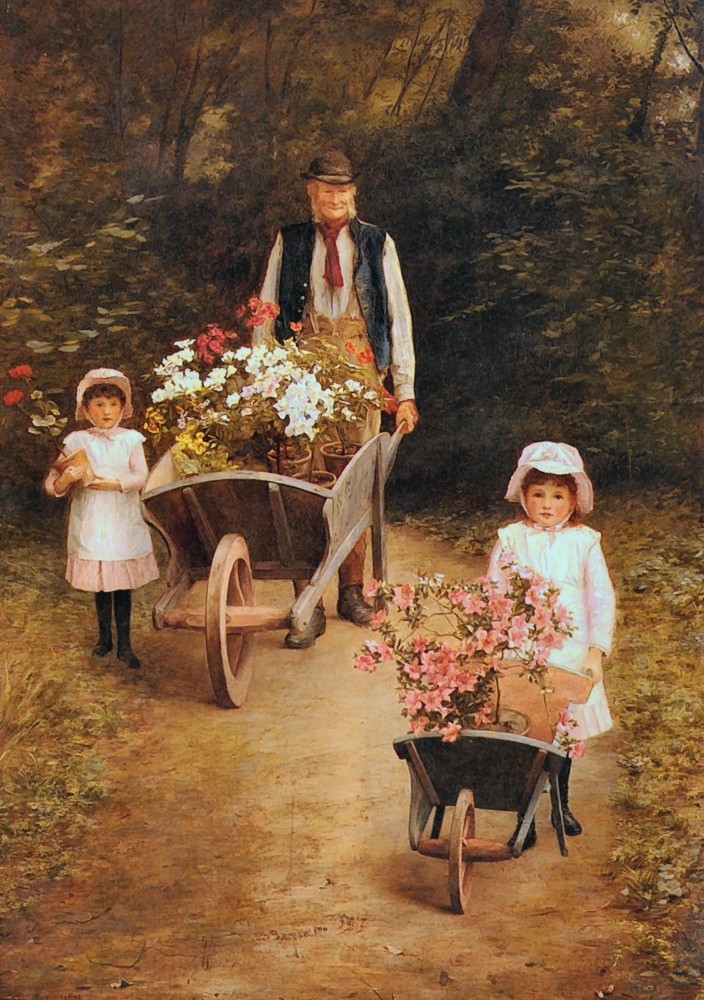
Despite her lesser output of work in comparison to that of her sisters, Mary was extremely gifted and like her sisters, she took pleasure in pictorially depicting the domestic life of the Berkshire countryside, as lived at her parents’ house, Castle Priory, Wallingford

The Tennis Party by Alexandra Mary Hayller (1907)

On July 1st 1885, at the age of twenty-two, she married Henry Wells in St Marys, Wallingford and this change of status coincided with her giving up painting and taking on the accepted role of supportive wife, keeper of the home and bringing up the children.  The couple had six children, two sons, Henry and Guy and four daughters, Dora, Muriel, Beatrice and Joyce.  All of the children at one time or another modelled for their aunts’ paintings.

Helping Gardener by Mary Hayllar (1884)
For a Good Boy by Mary Hayllar (1880)

Alexandra Mary Hayllar died in 1950, aged 87.

Edith Parvin Hayllar

Edith Hayllar (self portrait)

Edith Hayllar was the fourth child and second daughter of the British artist James Hayllar born in 1860.   As was the case for most English middle- and upper-class young ladies in Victorian times, art was an essential accomplishment and Edith, like her four sisters, adhered to the Victorian system of four to ten art classes a day by their father and this was to guarantee a proficiency in the basic art techniques such as proportion and perspective.   They would also be given instruction in modelling, etching, mezzotint, and engraving among other media.

In the Park by Edith Hayllar

Once their art lessons were completed, she and her sisters spend the rest of their time at home relaxing, partaking in outdoor sports such as tennis, plein air painting, and even some gardening. This relaxed lifestyle featured in the depiction seen in all the sisters’ paintings

Five o’clock Tea by Edith Hayllar

Of the five sisters, Jessica Hayllar and Edith Hayllar where the most well-known painters, and like their father, James, they specialised in genre painting.  It is thought that through the depictions in Edith’s paintings of women in domestic interiors with their families gave an insight into their lifestyle. The women in her genre works were observed running a well-organized households and clearly defined a woman’s role at any given time in their lives.  Edith had not taken on the role as a spokesperson for female independence and was content with the term “female dependency”

A Cozy Corner by Edith Hayllar (1887)

Edith works of art were shown almost every year from the 1880s–1890s at the Institute for Oil Painters and Dudley’s Gallery. In 1881 she had her first piece exhibited at the Royal Society of British Artists in London and then a year later, in 1882, another of her works was exhibited in the Royal Academy of Arts.

Summer Shower by Edith Hayllar (1883)

Maybe her best-known and best loved painting was her 1883 work entitled A Summer Shower, which was exhibited at the Royal Academy Exhibition.  It depicts a young man with a badminton racket courting a woman who is reclining in a chair next to him.  Through the window in the background, we can see the inclement weather has put a stop to all outdoor sporting activities.  One critic described the work as one of the most charming genre scenes of the nineteenth century.

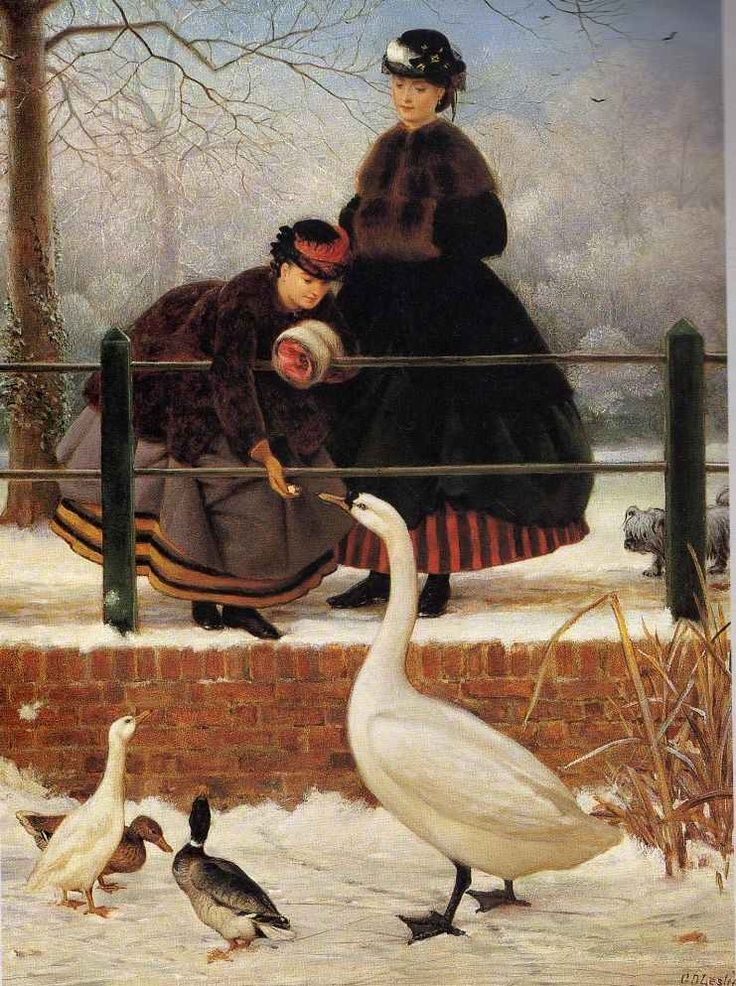
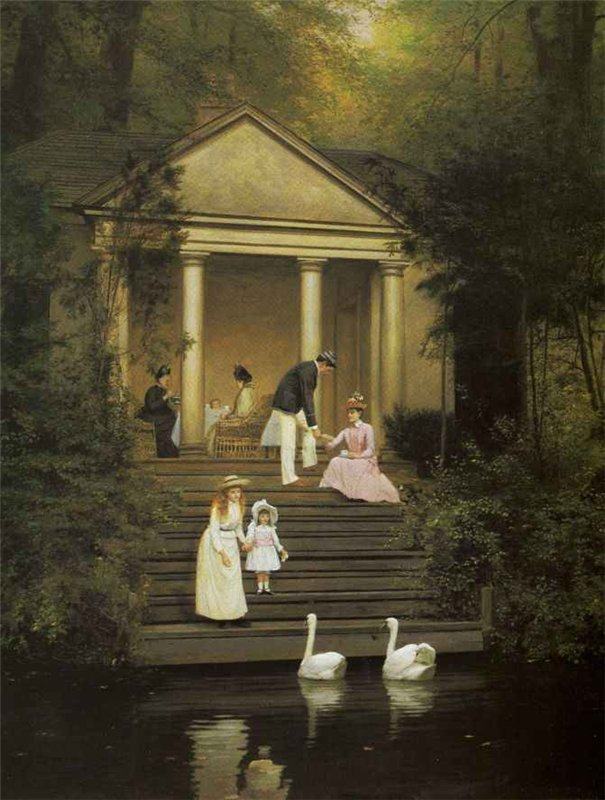
Feeding the Swans by Edith Hayllar

In 1900, at the age of forty, Edith married Rev. Bruce MacKay and the couple moved to Sutton Courteney.  Marriage also signalled the end of her painting career as she devoted her life to looking after the family household. Edith died in 1948, aged 88.

(Beatrice) Kate Hayllar

A Corner of the Shelf by Kate Hayllar

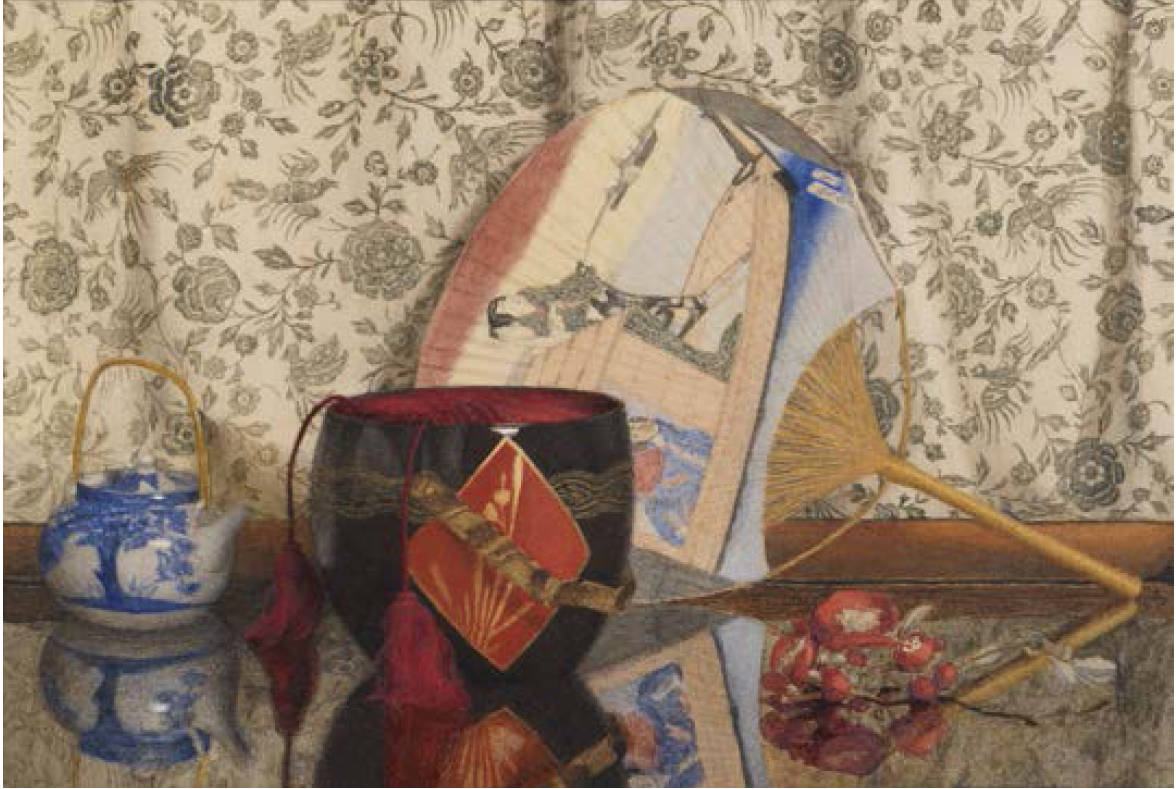
(Beatrice) Kate Hayllar was born on September 1st 1864 at 15 Mecklenburgh Square, London.  She was the seventh child of James and Ellen Hayllar and the youngest of their five daughters.  She, like her other sisters, loved to paint and were tutored by their father.  Most of her ideas for her work derived from the happy life she experienced when the family lived at Castle Priory, a large Thames-side house, close to the small town of Wallingford, Oxfordshire.  The family resided there from 1875 and 1899.  The beautiful interior of Castle Priory, its domestic events held there, the extensive well-laid out gardens, and the nearby countryside inspired the sisters to paint and the flowers they grew became their favourite subjects.  Kate Hayllar focused her work on small and intensely observed flower and still life subjects, many of which she exhibited at the Royal Academy and Royal Society of British Artists.

Souvenirs of Japan by Kate Hayllar (1883)

When her mother died in 1899 she gave up painting and became a nurse. She moved to Bournemouth with her father and sister Jessica. Later she went to live with her sister Mary at Wallingford, Berkshire. 

Eugenie Grace Hayllar

Eugenie Grace Hayllar was born in St Etienne, Ardèche, Rhône-Alpes, France on  August 26th 1861. She was the fifth child of James Hayllar and Ellen Phoebe Cavell.  Eugenie Grace Hayllar married Robert Fletcher Leslie and the couple had two children, Harry and Charles, born in 1891 and 1893 respectively.  Eugenie passed away on March 2nd 1943 in Wallingford, Berkshire, England. Her husband had died the year before.

I was unable to find any paintings attributed to her but we know that like her sisters she was taught to paint by her father.

The Barnes School

The Patriarch, Old Williams.

When I came across the words “Barnes School” in connection with art, I immediately thought it was referring to an artistic colony or a type of painting but I was wrong, albeit the name derived from the then rural town of Barnes, a district in the London Borough of Richmond upon Thames, where a talented artistic family had their painting studio.  The name referred to a nineteenth century family of gifted Victorian landscape painters who pictorially depicted the British countryside.  The head of this family of artists was Edward Williams. In this and the next three blogs I will be looking at the life and work of the talented patriarch and his six sons

Edward Williams (1781-1855)

Edward Williams was born some time in 1781 as baptismal records show him as being baptised on October 13th 1781 at St. Mary’s Church in the London borough of Lambeth.  Edward was the son of Edward Williams, an engraver and Mary Ward.  Mary came from a large artistic family. She was a sister of James Ward the well-known animal painter, and a sister of the equally well-known engraver, William Ward. Mary was also a sister-in-law of the talented figure painter George Morland, and a sister-in-law of Henry Chalon, another animal painter. The family history recounts that around 1793 Edward Williams’ mother left his father for another man, and their son Edward was sent to live with his maternal uncle, James Ward the painter. Ward was one of the outstanding artists of the day and was regarded as one of the great animal painters of his time.  It is not recorded as to whether Ward ever gave his young nephew any artistic training but there is no doubt that Edward must have been influenced by his brief association with Ward.

A Cottage in a Wooded Landscape by Edward Williams

After staying with Ward for a short period Edward Williams took up an apprenticeship with a carver and gilder named Thomas Hillier, who was not in any of the trade guilds but nonetheless had a shop on Silver Street, Golden Square, London. It was probable that Edward began his career carving and gilding picture frames, but it is also known that to support himself financially he painted and sold miniatures.

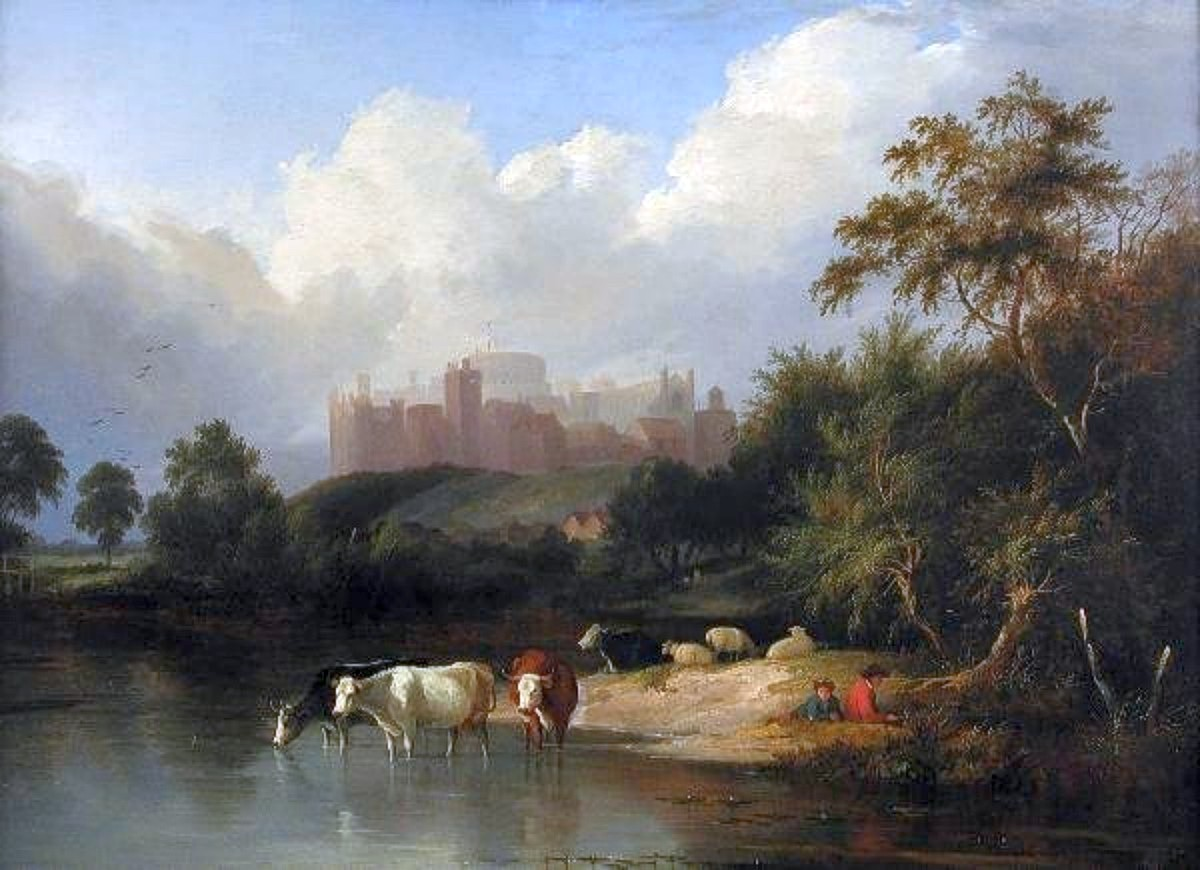
River Landscape with Windsor Castle by Edward Williams

Edward married Ann Hildebrant, who was the daughter of Frederick and Sarah Hildebrant, on February 12th, 1806 at St. Pancras Church in London. Ann was twenty-five and Edward was a year younger.  Although Edward Williams’ profession was as a carver and gilder he was amongst relatives who were all well-known painters and engravers, and consequently, as time passed, Edward re-invented himself as a painter. 

The Jewish Cemetery by van Ruisdael (c.1655)

His initial delving into the world of art was when he started to copy well known landscape paintings of the Dutch Baroque era of the 1600’s, such as those by Jacob Isaackszoon van Ruisdael and Meindert Hobbema. 

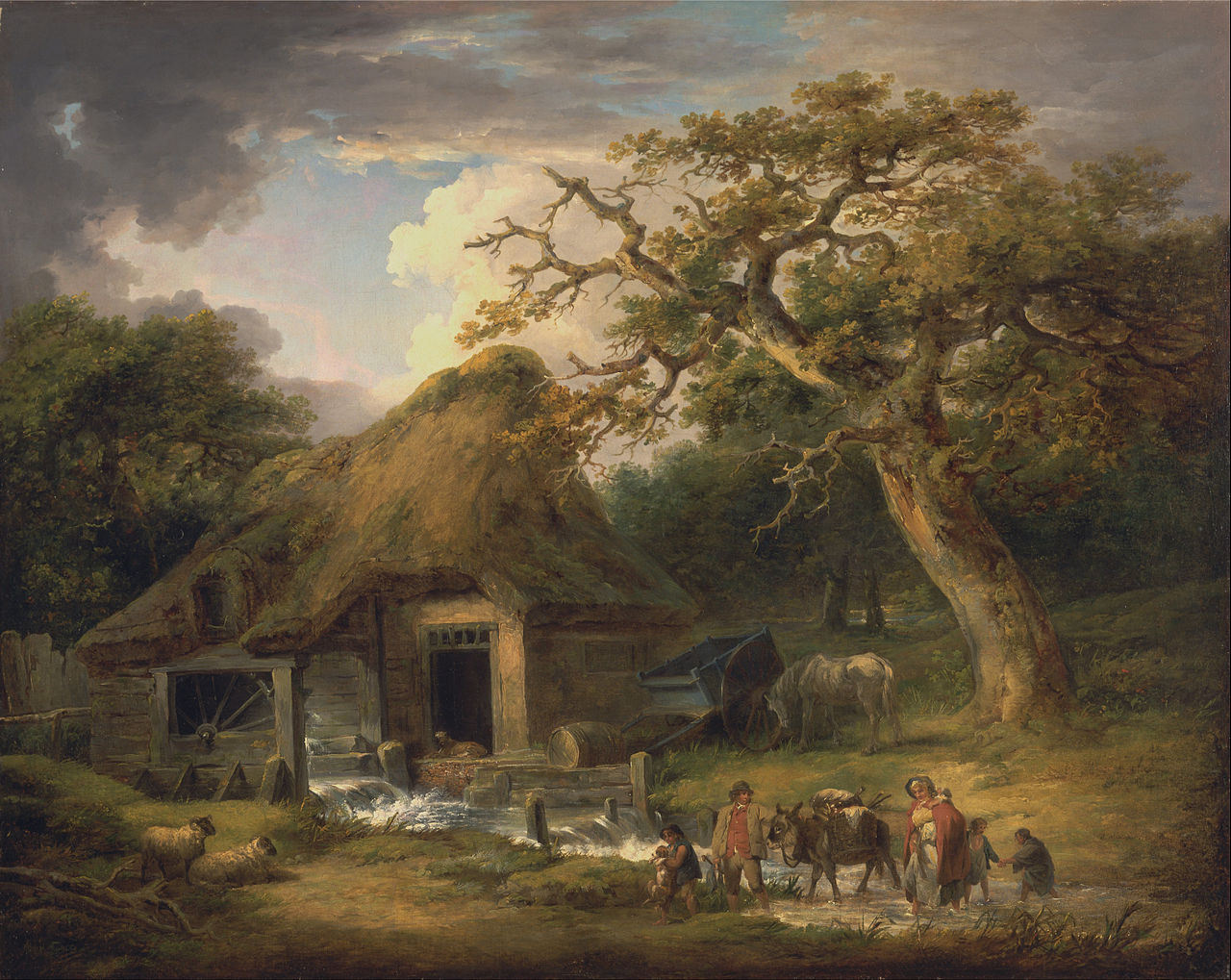
The Old Watermill by George Morland (1790)

Following this phase in his artistic career, he concentrated on copying works by contemporary landscape painters, such as his uncle, George Morland. Edward took the decision to become a landscape painter which was a risky choice as landscape art was, at the time, considered to be an inferior genre.

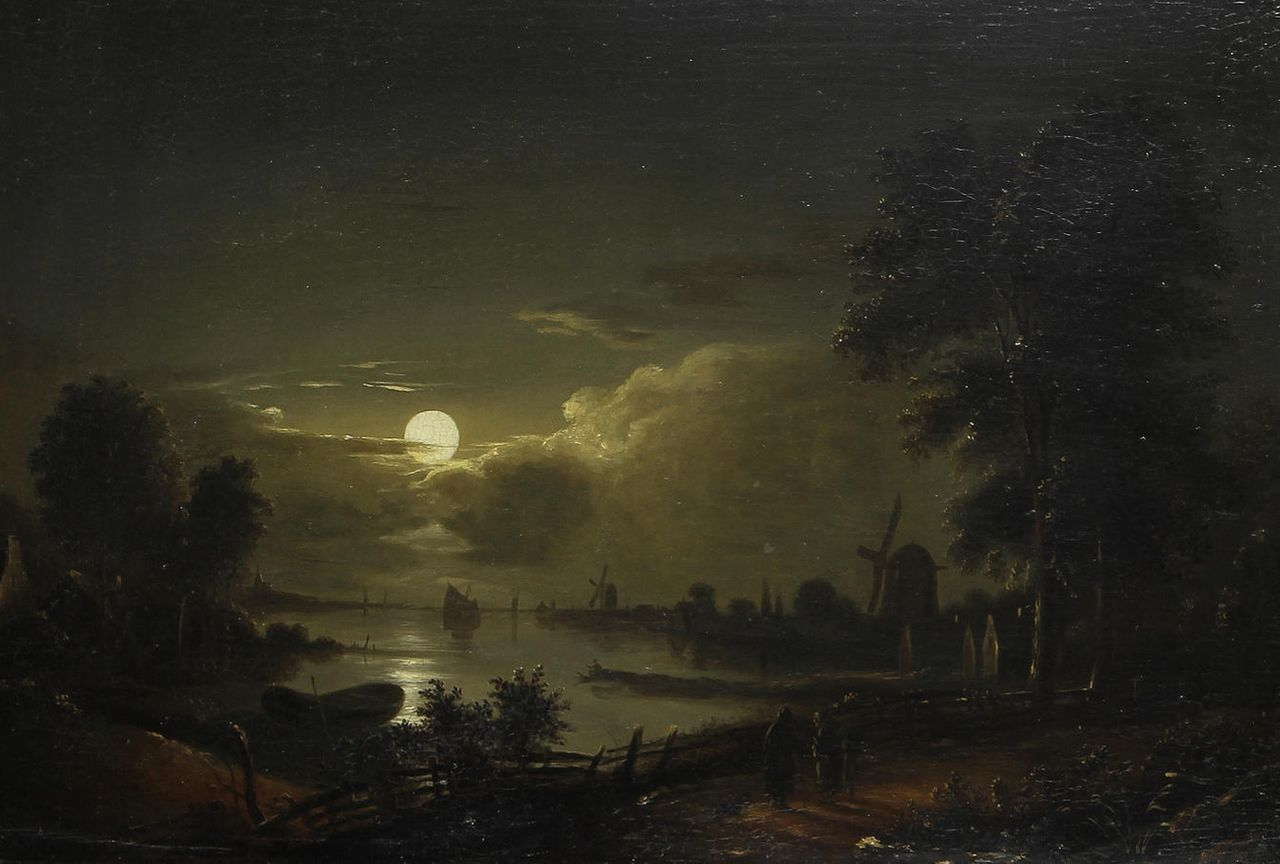
River by Moonlight by Edward Williams

Edward Williams became known for his moonlight scenes.  Edward Williams often shared art exhibition venues with his sons, causing some confusion with the public who had trouble telling one Williams painting from another. He is often called “Old Williams” to distinguish him from his oldest son, and he is referred to in some of the art journals of the time as “Moonight Williams”, as moonlit scenes of the Thames were one of his favourite subjects in his paintings

A View on the Banks of the Thames by Edward Williams

As he got older, for river scenes along the Thames.

Edward and his wife Ann Hildebrandt had married in February 1806 and went on to have eight children.  The first-born was Edward Charles Williams who was born on July 10th 1807 and because he had been given the same name as his father, Edward Williams, his father became known in his later years as “Old Williams” to distinguish himself from his eldest son .  Two more sons followed, Henry John Boddington Williams in October 1811, George Augustus Williams in May 1814.   Then followed the Williams’ only daughter, Emily Anne Williams who was born in June 1816.   Arthur Gilbert Frederick Williams arrived in December 1819 followed by Sidney Richard Percy Williams in March 1822.  Identical twin boys Alfred Walter Williams and Charles Williams were the final additions to the Williams family in July 1824.  Sadly, Charles Williams died shortly after birth.

Crossing the Stream, A Wayside Chat by Edward Williams

Edward and his wife Ann lived in various residences, in what is now termed the West End of London, in Percy Street, Foley Street, and Charlotte Street.  In 1827 the family moved to Cromer Street in the St Pancras area where they stayed for almost twenty years.  By 1846 with the continuous sale of the father and sons’ paintings, the family’s finances had improved.  Add to that fact the family had grown, they needed a larger residence and so moved to 32 Castelnau Villas, Barnes.  Edward Williams spent his final years there with his wife Ann.  She died, aged 71, and was buried on September 24th, 1851 at the Barnes Parish Church.  Old Williams was overcome with the grief from the death of his wife and he died just four years later at the age of 74 on June 24th, 1855 at his Castelnau Villa house.  He along with his wife now rest in the Old Barnes Cemetery.  Sadly, the cemetery has been turned into a nature sanctuary by the city council and the graveyard has fallen into disrepair and is overgrown with bushes and vines.

……………..to be continued.

Most of the information I have found for these blogs about the Barnes School came from the excellent website of Mike Clark, entitled Genealogy of the Percy, Williams and Ward families.  If you would like to read an in-depth account of the Williams family, this is a must-read.

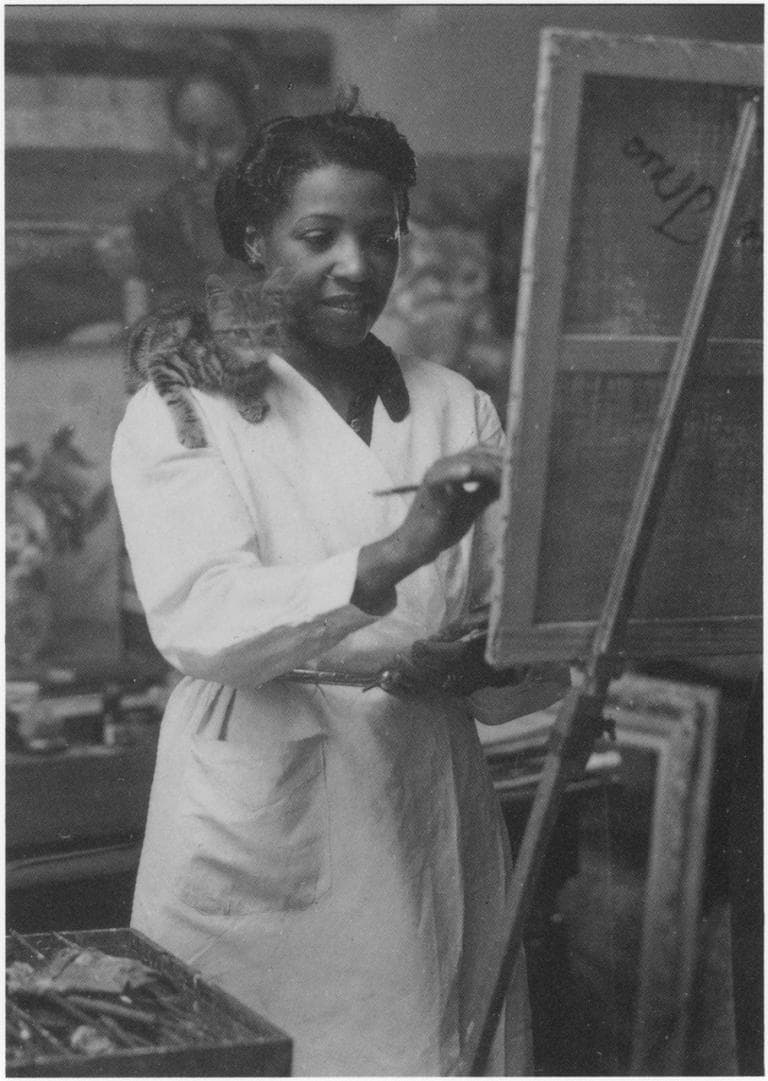
Lois Mailou Jones

Lois Jones, artist and teacher - NARA - 559227.jpg
Lois Mailou Jones

Lois Mailou Jones was born in Boston, Massachusetts on November 3rd 1905.  Her mother Carolyn ran a beauty parlour and made and designed hats.  Her father, Thomas Vreeland Jones was a superintendent of a large office building, who attended night school to become a lawyer.  At the age of forty he graduated from Suffolk Law School, the first African-American to earn such a degree from that school. He went on to become a lawyer.  Whilst still a child her parents moved to a house on Martha’s Vineyard and it was here that Lois first came into contact with people who were to influence her future life.

As a child, Lois enjoyed drawing and painting and her parents encouraged her.   She was given her first set of watercolours at the age of seven. She enjoyed her time at school and recalled:

“…The schools were not segregated and I had the good fortune to have my teachers interested in my talent and I received much encouragement,” she said. “My happiness was to go to Martha’s Vineyard as soon as school was out. It was a great joy to live with nature. Environment is so important to any artist…”

1937 or '38. (Courtesy of the Museum of Fine Arts, Boston)
Lois Mailou Jones (c.1938)

She attended the local primary school and in 1919 she was enrolled at the High School of Practical Arts in Boston. During her four years of studies there, she also attended evening classes at the Boston Museum of Fine Arts thanks to an annual scholarship she was awarded. She developed an interest in fashion and costume design and became an apprentice with Grace Ripley,  an academic and costume designer. Lois Jones worked with Ripley after school and on Saturdays, where she would become familiar with exotic costumes and African masks which would later feature in her artwork.  Her interest in African masks also led her to creating costume designs for the Denishawn School of Dancing and Related Arts, the first dance academy in the United States to produce a professional dance company.

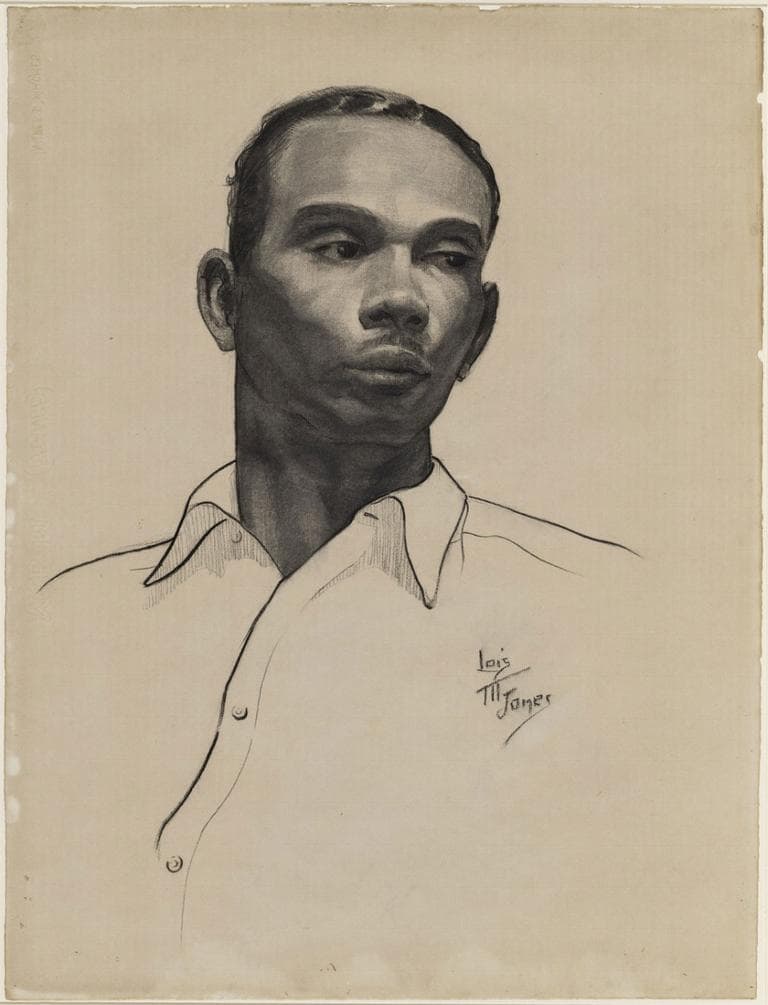
Loïs Mailou Jones "Negro Student," 1934, charcoal on paper (Courtesy of the Museum of Fine Arts, Boston)
Negro Student by Loïs Mailou Jones (1934)

Lois was only seventeen years old when she held her first solo exhibition in Martha’s Vineyard. Jones began experimenting with African mask influences during her time at the Ripley Studio. In 1923, at the age of eighteen, Lois attended the School of the Museum of Fine Arts in Boston where she studied, not art, but design.  She was an outstanding student and she won the Susan Minot Lane Scholarship in Design. Whilst studying for her degree she also took evening classes at the Boston Normal Art School, a public college of visual and applied art in Boston.

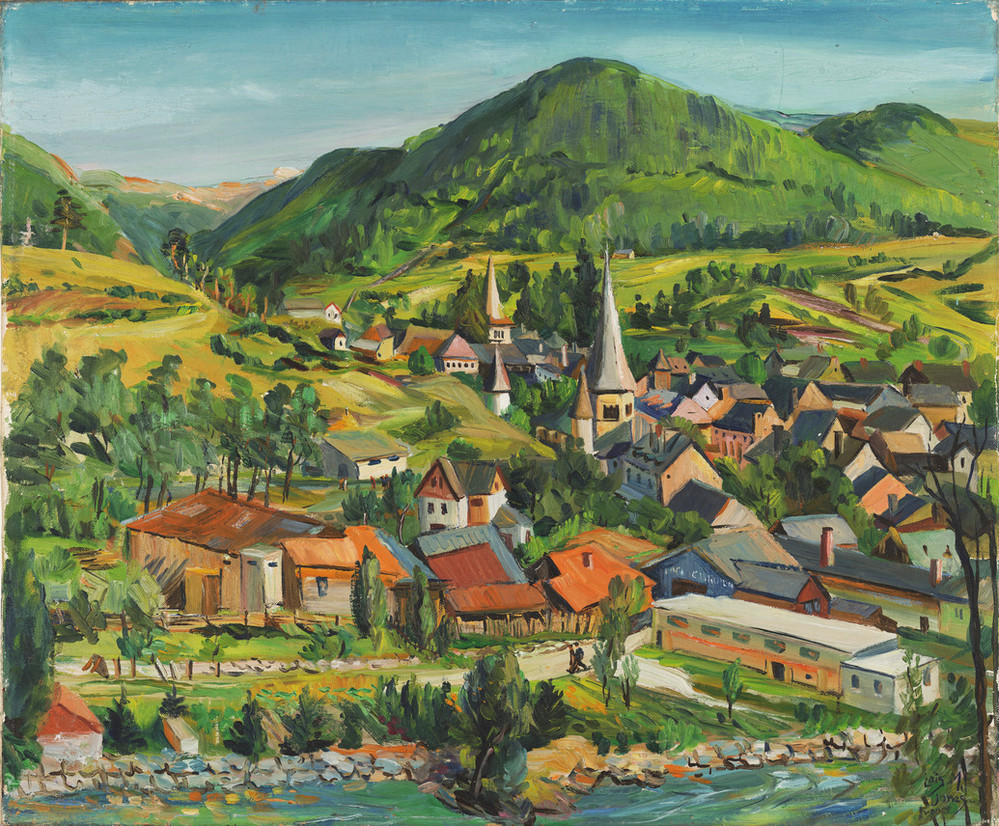
Beneath a soft blue sky, a picturesque village nestles in a valley between a river in the extreme foreground and verdant mountains. Combining loose and discrete brushstrokes with a palette of greens and golds, the painting recalls Paul Cézanne’s late 19th-century landscapes.
Arreau, Hautes-Pyrénées by Lois Mailou Jones (1949)

Lois Jones began to search for something which would bring her recognition as an artist.  Whilst searching she discovered the Harmon Foundation of New York, which had been established in 1921 by wealthy real-estate developer and philanthropist William E. Harmon.  It was the first major foundation supporting African American creativity and ingenuity and held national competitions for black artists.  Lois exhibited several of her works at these exhibitions and received several awards.  It was through this foundation that she became interested in black America’s 20th century movement known as the Harlem Renaissance. During the summers of the 1920’s and 1930’s, Lois Jones spent much of her time in Harlem and this had the most reflective influence on her early development as an artist. During these visits, Jones was engrossed in the art and theories of the Harlem Renaissance.   The Harlem Renaissance was an intellectual and cultural revival of African American music, dance, art, fashion, literature, theatre, politics.  At the time, it was known as the “New Negro Movement”.

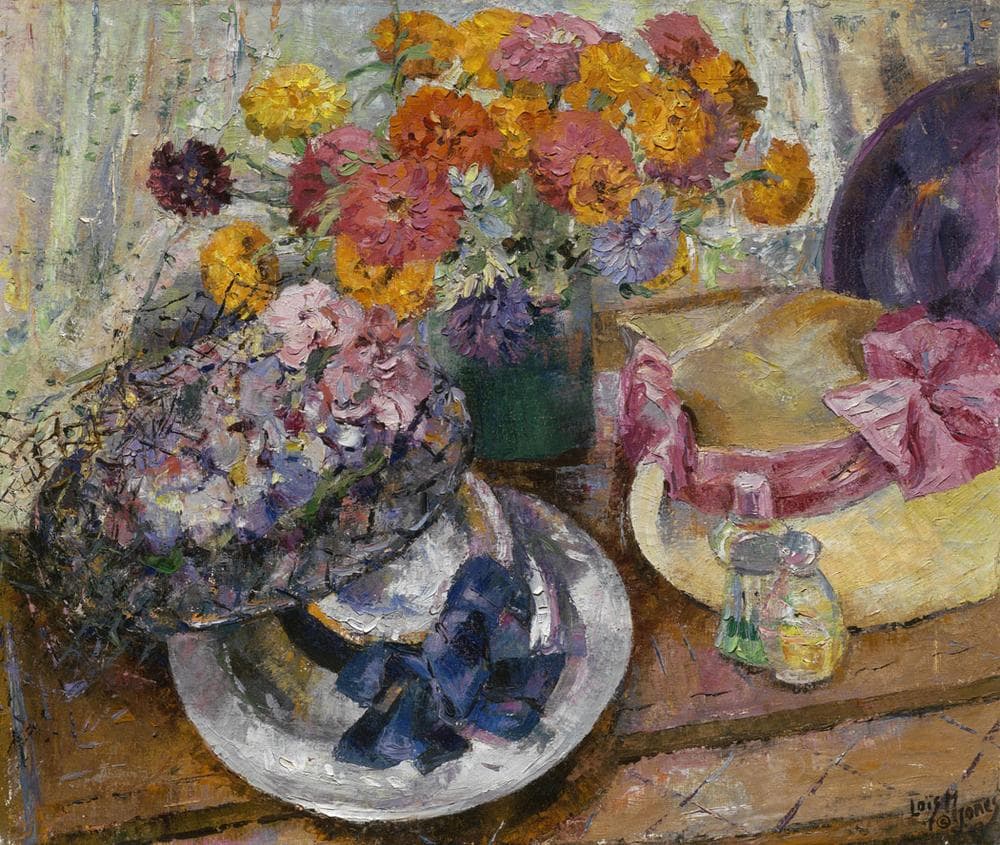
Loïs Mailou Jones "My Mother's Hats," 1943, oil on canvas. (Courtesy of the Museum of Fine Arts, Boston)
My Mother’s Hats by Loïs Mailou Jones (1943)

Throughout the early part of her life she continued to take the opportunity to study.  In 1934, she attended classes at Columbia University where she studied different cultural masks and in 1945, she received a BA in art education from Howard University, a private, research university, graduating magna cum laude. Not long after Lois left college, she decided to take up the role as an educator.  She applied for a teaching post at the Boston Museum School but the director rebuffed her application saying that she should apply for a job in the South where “her people” lived.  This racially prejudiced opinion from a person of such stature must have shocked her.  Not to be put off by such bigotry she continued to look for work and finally was accepted for a teaching post at Palmer Memorial Institute, a historically black prep school, in Sedalia, North Carolina.  The Institute was founded by nineteen-year-old Charlotte Hawkins Brown, an African American educator in 1902 with the aim of teaching elementary and high school students in rural North Carolina.  It was named after Brown’s benefactor and friend, Alice Freedman Palmer, and originally the Institute began in an old blacksmith shed.  Whilst working as a prep schoolteacher, she taught the children folk dancing, piano playing and even coached a basketball team. 

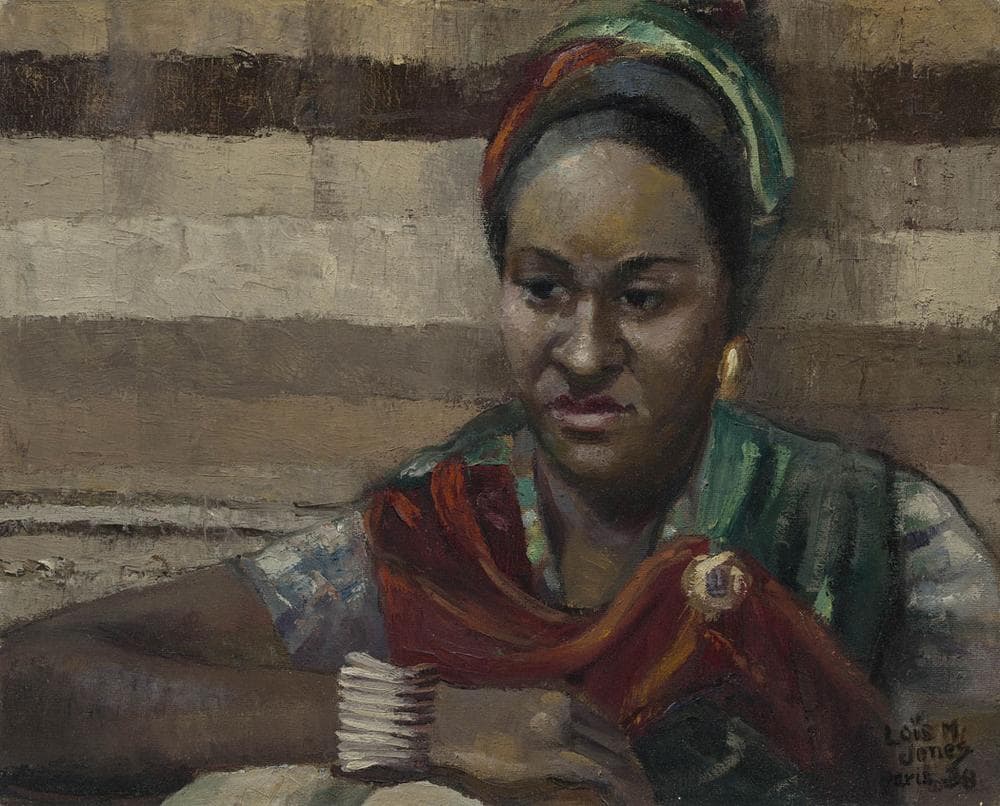
Loïs Mailou Jones "Jeanne, Martiniquaise," 1938, oil on canvas (Courtesy of the Museum of Fine Arts)
Jeanne, Martiniquaise, by Loïs Mailou Jones (1938)

In 1930, Lois was offered and accepted a position at Howard University in Washington, D.C. by James Herring, who had  founded the Art Department at Howard University and served as mentor to many artists and art historians. Lois Jones remained there, as professor of design and watercolour painting, until her retirement in 1977. Lois’ main ambition whilst at Howard University was to ensure her students were made ready for a competitive career in the arts and to aid this ambition she would arrange for established artists and designers to visit her classes and give talks, demonstrations and workshops.  In doing this she became an ardent advocate for African-American art and artists.

See the source image
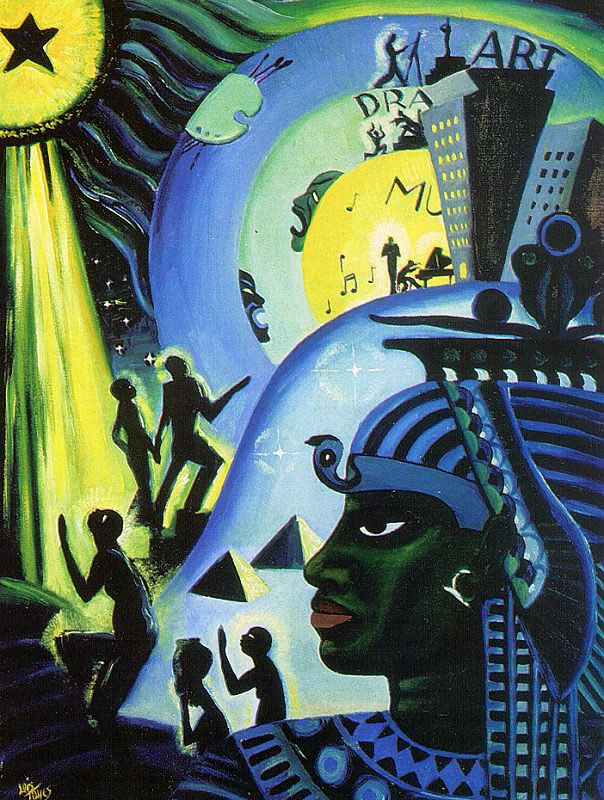
The Ascent of Ethiopia.by Lois Mailou Jones (1932)

In 1932 Lois Mailou Jones created a painting entitled The Ascent of Ethiopia. The painting is the pictorial story of the grim and challenging journey of African Americans who, through years of sacrifice and intolerable difficulties, have managed to create a legacy built on their trials and tribulations. It has been a constant fight for African Americans from the time they lived in Africa, the sea voyage to America and once there, how they have had to fight to attain their artistic and intellectual pinnacle.  Lois Jones painting depicts this story by her use of certain elements of design and colour, and space. The works she created throughout her life tell the story of many different cultures. In this painting she chooses to represent her own culture. This work of art was Jones’ way of expressing intense and reflective respect for her race. When we study the painting the first thing our eyes focus on is the figure wearing a blue and black headdress in the right foreground.  It takes up a quarter of the canvas.  The figure looks to the left as it observes the other figures, who are carrying pots on their heads, and pointing skywards at a bright star.  They are all ascending towards a city, comprised of two large buildings, at the top right of the painting.

  In front of the buildings are two entertainers, one of whom is playing the piano whilst the other I think is preparing to sing as we see musical notes all around him. Behind these two big buildings there’s a big round yellow circular object protruding from the side, surrounded by two blue/turquoise concentric circles. It has a face, and someone on a bended knee appearing to be acting on top of it. The turquoise-coloured circle is bigger than the previous one and has a face coming out towards the inside. Further up there’s someone painting on top of the blue circle with the words art above enclosed within the blue circle. A symbolic palette and brush are painted within that same blue circle, the star in the top left corner has rays of squiggly blue, green, and black streaks that radiate diagonally. The star is inside of a yellow circle shining down on the people gesturing towards it, this picture reflects what Jones was trying to convey to her audience.  The painting is a tale of transition, a long and tortuous voyage from the poverty of Ethiopia to America where African Americans, through hard work and dogged determination, became talented actors, artists and entertainers.  It is also about cultural identity.

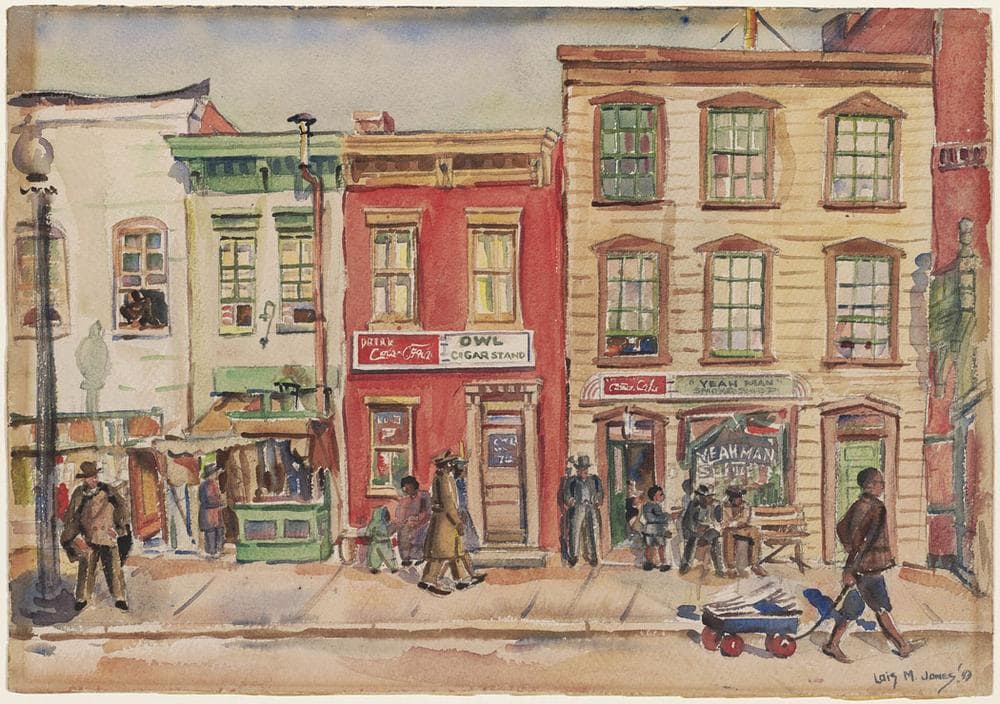
Loïs Mailou Jones "Seventh Street Promenade," 1943, watercolor with graphite underdrawing on paper (Courtesy of the Museum of Fine Arts, Boston)
Seventh Street Promenade, by Loïs Mailou Jones (1943)

In 1937, Jones was awarded a fellowship to travel and study in Paris at the Académie Julian. That year, whilst in France, she produced more than forty works of art, including thirty watercolours, may of which were plein air renditions.   Two of her paintings were accepted at the annual Salon de Printemps exhibition at the Société des Artists Français for her Parisian debut.  What also pleased Lois during her twelve months stay was that unlike in America, she was fully accepted in society and that the colour of her skin mattered little.  She managed to obtain an extension to her fellowship which allowed her to travel to Italy.

Les Fétiches, by Lois Mailou Jones (1938)

In 1938, she completed one of her best-known pieces, entitled Les Fétiches.  It was and African inspired painting that now hangs in the Smithsonian American Art Museum.  Painted in a Modernist style it features five overlapping masks from different African tribes and conveys a mysterious spiritual dimension summoned by ritual dance.  To the right of the main mask, we see what is known as a red religious’ fetish.   The term “fetish” (fétiche in French) refers to an object believed to have supernatural powers, or in particular, a human-made object that has power over others.  The masks and fetish appear to float in the mass of a black painted canvas.  When in France, Lois would probably have seen many different African objects and masks at the Musée de l’Homme, an anthropology museum in Paris.  In Les Fétiches, the Songye people’s masks and African Dan masks are visible.

See the source image
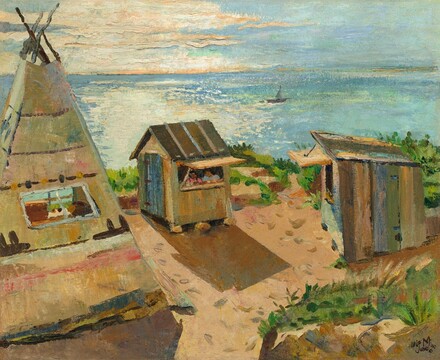
Indian Shops, Gay Head, Massachusetts, by Lois Mailou Jones (1940)

In 1941, Lois Jones entered her painting Indian Shops Gay Head, Massachusetts, into the Corcoran Gallery’s annual competition which she had completed the previous year.  For her the main problem with exhibiting her work at this prestigious exhibition was that the Corcoran Gallery prohibited African-American artists from entering their artworks themselves and only work from “white” artists was deemed acceptable.  Jones asked Céline Marie Tabary, her friend and arts professor at Howard University who championed African-American art in 1940s Washington, D.C. to enter her painting so as to side-step the racist rule. This painting by Lois won the Robert Woods Bliss Award but she could not collect the award herself and she had to arrange for Tabary to mail the award to her.   In 1994, the Corcoran Gallery of Art gave a public apology to Jones at the opening of the exhibition The World of Lois Mailou Jones, 50 years after Jones hid her identity.

See the source image
Mob Victim (Meditation) by Lois Mailou Jones (1944)

In 1944 Lois Jones painted one of her most controversial and thought-provoking works.  A philosophy professor at Howard University and founder of the Harlem Renaissance, Alain Locke, encouraged her to depict her heritage in her paintings and this led to her painting, Mob Victim (Meditation).  She remembered how the painting came into being, saying that she had been walking along U Street Northwest in Washington, DC. when she saw a man walking along and she stopped him and asked if he would pose in her studio for her painting which would depict a lynching scene.  The man told Lois that he had actually witnessed a lynching and mimicked the pose that the man held before being lynched and visually illustrated a contemplation of imminent death which was well understood by blacks during the 1940s.  The image we see of the man whips up deep and powerful feelings as we observe the innocence of the black man who is calling into question the intolerable actions of society.  Look at the questioning expression in the man’s eyes.  It is a very emotional work which poses the simple question, why?

See the source image
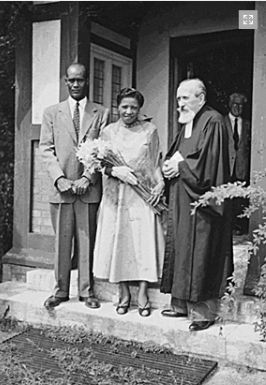
Wedding of Louis Vergniaud Pierre-Noel and Lois Mailou Jones

In 1953, at the age of forty seven, Lois finally married Haitian graphic artist Louis Vergniaud Pierre-Noel.. They had been close friends for twenty years and he had influenced Lois by introducing her to the bright colours and bold patterns of Haitian art and she would immerse herself in the Haitian culture during their annual trips to her husband’s homeland. Jones’s style shifted again after she married   She once said that the art of Africa is lived in the daily life of the people of Haiti.

Colorful painting by Lois Mailou Jones featuring a young African girl in face paint, with depictions of masks and decoration in the background
Ubi Girl from Tai region by Lois Mailou Jones (1972)

In 1970 she visited Africa for the first time.  She journeyed to eleven different countries on the African continent. The trip had been made possible with a grant from Howard University to keep a record of the various artists she met.   She returned to the African continent in 1972, 1976 and 1977. In the painting a young woman looks out at us from under her partially closed eyelids. The girl’s face is surrounded by two types of masks: in profile, is a large Dan mask from Liberia or Côte d’Ivoire, and drawn within orange outlines are two Pende masks from the Democratic Republic of the Congo. Masks were thought to be powerful ways of communicating with spirits; the Dan mask represents a specifically female spirit, and the blue and red twisting lines in the lower left corner are a pattern of the Edo, from Benin Kingdom, called “rope of the world” representing a person’s lifetime.,   The woman’s forehead and cheeks are painted white for her initiation celebration into womanhood and vivid diagonal red lines overlap at the bridge of her nose, which leaves her mouth and chin uncovered. Loïs Mailou Jones was captivated by this woman and created the portrait in 1972, entitled Ubi Girl from Tai region.  The Tai region was part of Côte d’Ivoire, which Lois visited during her extended trip to Africa. The artist had a long-held dream of traveling to Africa since her twenties, and at the age of 65, she fulfilled her career-long ambition.

Lois Mailou Jones (1905-1998)

Jones continued to produce beautiful works of art.  On her 84th birthday in November 1989, Jones had a major heart attack which necessitated a triple bypass operation.  On June 9th 1998, Jones died at the age of 92 at her home in Washington, DC and is buried on Martha’s Vineyard in the Oak Bluffs Cemetery.

Charles Frederick Ulrich

Charles Frederic Ulrich (c. 1895)

My featured artist today is Charles Frederick Ulrich, the late nineteenth-century realist painter of portraits and genre scenes who spent much of his life as an expatriate in Europe.  He was born on October 18th, 1858 in New York, the son of a German émigré photographer and painter, Friedrich Ulrich and his wife, Caroline Ulrich (née Hartje) .  Following his ordinary schooling, he studied at the National Academy of Design in New York and it is thought that he spent some time studying at the Cooper Union School of Art.  From there, in October 1875, at the age of seventeen he crossed the Atlantic and travelled to Munich where he enrolled at the Royal Academy of Fine Arts in Munich.  Here he learnt all about how to capture the subtle effects of daylight and became influenced by seventeenth century Dutch genre paintings as well as the genre paintings by contemporary German artists.  In 1879 one of his paintings was awarded a bronze medal.  His primary instructors were the German landscape and genre painter, Ludwig von Löfftz and the German history painter, Wilhelm von Lindenschmit. He also became friends with the American painter, John Henry Twachtman, who was a fellow student in Löfftz’s class and joined the circle of American-born artists who associated with Frank Duveneck in Munich and the Bavarian town of Polling.  The two artists travelled together to Polling, Germany, where an American artists’ colony had formed and they signed the guestbook sequentially in the spring of 1876. 

Around 1882 Ulrich returned to New York and began exhibiting his work at the National Academy of Design. The next five years were highly productive, resulting in most of the artist’s best-known works.

The Wood Engraver by Charles Frederick Ulrich (1882)

His first painting to be exhibited at New York’s National Academy of Design was his 1882 work entitled The Wood Engraver. It was hailed a resounding success by the critics who considered the painting to be “his best.” A New York Times review of the National Academy exhibition described the painting as:

“…a picture of a woman at work before a window engraving a wood block. It is excellently painted both in figure and interior by Charles Frederick Ulrich…”

The Glass Engraver by Charles Frederick Ulrich (1883)

His painting, The Wood Engraver signified a peak period of his career, and later he would produce a series of works depicting workers. It was a subject for which he is best known for.

 In the Land of Promise, Castle Garden by Charles Frederic Ulrich (1884)

In 1883 he was elected an associate member of the National Academy. In 1884 Ulrich completed one of his most famous paintings entitled, In the Land of Promise—Castle Garden.  Castle Clinton or Fort Clinton, previously known as Castle Garden, is a circular sandstone fort located in Battery Park, in Manhattan, New York City. Built from 1808 to 1811, it was the first American immigration station, where more than 8 million people arrived in the United States from 1855 to 1890. The painting depicts a scene in Castle Garden, and Ulrich has us concentrate on a young immigrant mother at the reception station. She is sitting on her trunk which probably contains all of her worldly possessions. She breastfeeds her baby as her daughter looks off to the left.  Look behind the mother and daughter and you will see a bowler-hatted man tending to his ailing wife. Disease was rife in Castle Garden with cholera and smallpox being rampant in the crowded conditions, although it has to be said that in New York City itself, the conditions were no better. The centre was closed by the government due to cholera and smallpox epidemics and Castle Garden was replaced by another immigration resort that has become much more emblematic in collective memories, the small island of Ellis Island, where immigration services were active from 1892 to 1954

Portrait of Thomas B. Clarke, by Charles Frederic Ulrich (1884)

The painting, In the Land of Promise—Castle Garden, attracted the attention of Thomas B. Clarke, a lace and linen manufacturer who had become the country’s foremost collector of contemporary American art. Clarke was influential in numerous aspects of the New York art world, for he was treasurer of the National Society of Arts, chair of the Union League Club’s art committee, president of the New York School of Applied Design for Women, and a founding member of both the National Sculpture Society and the National Arts Club. Ulrich won the National Academy’s first Thomas B. Clarke Prize for Best American Figure Composition and as an expression of his gratitude, Ulrich painted the portrait of the collector.

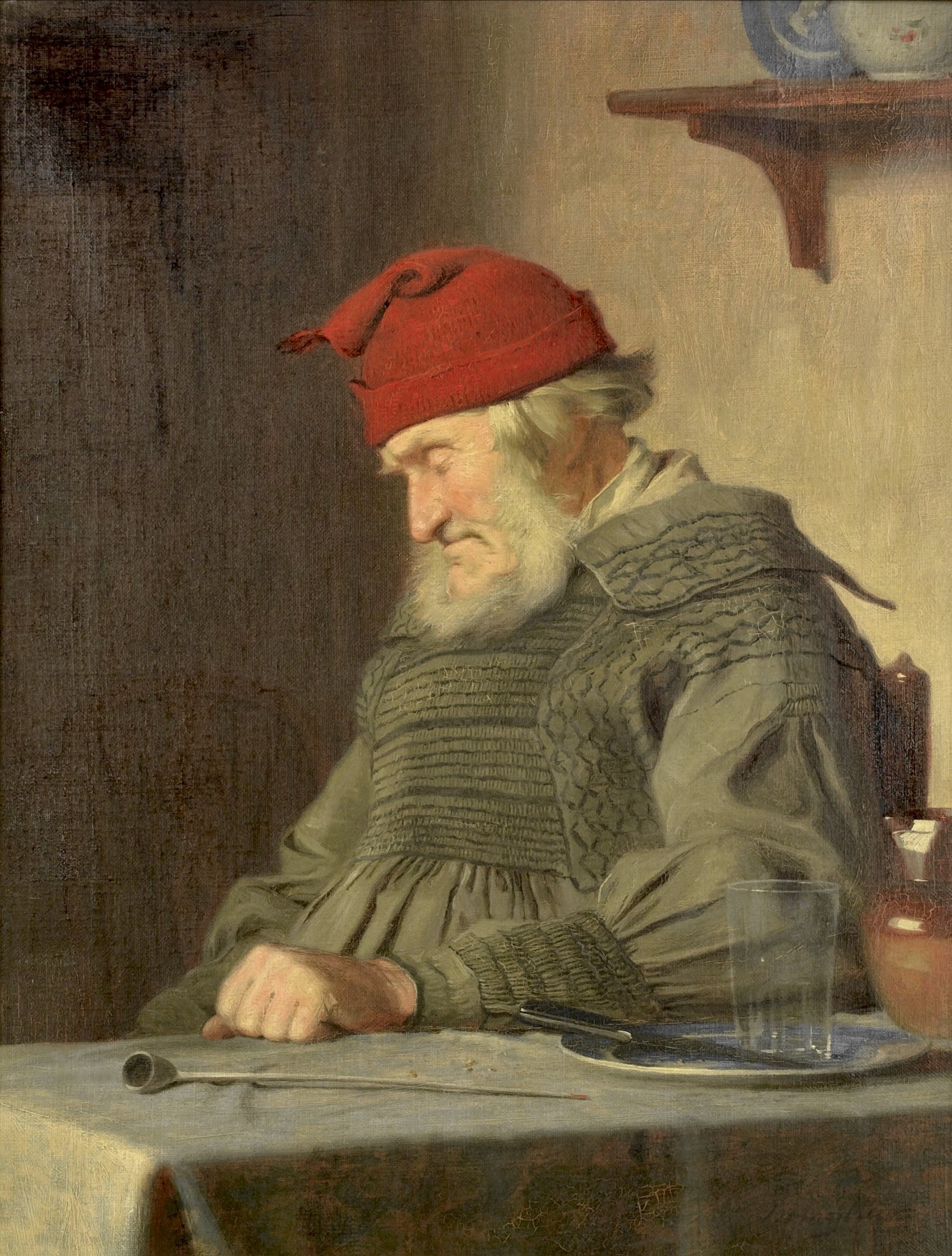
An old fire-place / Granny by Charles Frederic Ulrich (1882)

In the mid 1880’s, Charles Frederic Ulrich built up a standing that was largely based on his small-scale genre scenes.  One of example of this was his 1882 painting entitled An Old Fireplace which was often referred to as A Granny.  The setting for this painting is believed to be the Ephrata Cloister, a historic German Anabaptist hermitage located west of Philadelphia which was founded in 1732. Ulrich’s austere depiction of the interior reflects the long history of Ephrata and is reinforced by the sitter’s old age and plain and simple dress.  It depicts life there as it was during his own time with its original hearth converted into a simple kitchen.

The Village Printing Shop, Haarlem, Holland by Charles Frederic Ulrich (1884)

In the summer of 1884, Ulrich returned to Europe and journeyed through Belgium and Holland.  He had made this trip with fellow American artists, William Merritt Chase and Robert Blum.  Ulrich and Blum became great friends over the next three years.  Whilst in the town of Haarlem in the Netherlands, Ulrich completed one of his best known works, The Village Printing Shop, Haarlem. The setting for the painting is a spartan workroom illuminated by the light coming through an open window. Ulrich depicts a boy who has paused during his work to allow himself to take a drink of water.  He stares at the blank wall in front of him and we wonder what is he thinking.  In the background we see two men operating a platen printing press.  Look how Ulrich has enriched the work with his attention to detail such as the ornament on the cast-iron stove.  Look at the clutter on the tabletop in front of the boy, where a bottle of water and a chipped second cup are casually placed amidst stacked blocks of type and other printing-related paraphernalia.

Glassblowers of Murano by Charles Frederic Ulrich (1886)

Ulrich left Europe and returned to New York in late 1884.  He so enjoyed his time in Europe that he immediately started to plan another voyage to there the following year and this time he planned to remain for a longer period.  It was not just his love of Europe that made him want to leave the shores of America but the lack of sales of his paintings.  According to a critic of the era, his abrupt departure was due to his “proclaimed disgust at the sordidness of an unappreciative public, which refused to bankrupt itself in the purchase of over-priced pictures.”

Ulrich went back to Holland and then moved to Venice, where he established a home in 1886.  It was here that he completed his painting, Glass Blowers of Murano which now hangs in the Metropolitan Museum of Art, in New York.   Ulrich depicts workers blowing glass, a craft which was revived in Venice during the late nineteenth century. The setting for the work is the city’s glassmaking centre on the island of Murano.   Murano’s reputation as a centre for glassmaking was born when the Venetian Republic, fearing fire and the destruction of the city’s mostly wooden buildings, ordered glassmakers to move their furnaces to Murano in 1291. Murano glass is still associated with Venetian glass.  Ulrich’s was fascinated with artisan subjects which came at the time of the international Arts and Crafts movement, which valued old-fashioned handicraft rather than industrial production. Ulrich was awarded a substantial cash award in 1886 at the National Academy of Design’s second Prize Fund Exhibition.  This indicated the degree to which an international taste had emerged in American art.

Charles Frederick Hugo Otto Ulrich

Although he maintained contact with Blum and Chase, organized exhibitions of American art in Munich in 1888 and 1892, and visited New York briefly in 1891, Ulrich remained in Europe.  He exhibited at the London Royal Academy in 1889 and 1890, in Munich at the Glaspalast, and after 1893 at the Secession exhibitions. He contributed three works to the art display at the World’s Columbian Exposition in Chicago in 1893, but he focused mainly on showing his paintings widely in Europe. As a result, his work is now relatively little known in the United States. In 1897, in Munich, thirty-nine-year-old Ulrich married twenty-year-old Margarethe Oppenheim, the daughter of the banker, Hugo Oppenheim.  The couple had one son, Charles Frederick Hugo Otto Ulrich, who was born on July 29th 1901.

Waifs in an Orphanage by Charles Frederic Ulrich (1884)

In 1906, Ulrich’s name appears on the membership list of the Deutscher Künstlerbund, making him one of its earliest members.  The aim of the Deutscher Künstlerbund (Association of German Artists) was to ensure the freedom of art, to offer a public forum for different artistic trends and to support young artists.  These intentions were taken into account at annual exhibitions which took place in various German cities and sometimes in foreign countries.

Charles Frederic Ulrich died of pneumonia on May 15th 1908, aged 49.

Sionah Tagger

In many of my blogs I have featured European artist who had ancestors who were part of the European Jewish community such as Marc Chagall, Chaim Soutine, Max Liebermann, Diego Rivera and Isaac and Joseph Israels.  As I look down the list of Jewish painters it appears to be dominated by male artists.  In this blog today I want to feature one of the great female Jewish painters, Sionah Tagger, who was one of the pioneers of Modernist painting in Israel.

See the source image
Sionah Tagger

Sionah Tagger was born in Jaffa, Israel on August 17th 1900.  She was the eldest daughter of Shmuel and Sultana Tagger, who were members of the Ahuzat Bayit group, the founders of Tel Aviv. Their house where she was born was at 3 Rothschild Boulevard and was the first two-storey house in Tel Aviv.  Her ancestors hailed from Spain and in the latter part of the fifteenth century they moved to Holland and then later they lived in Germany and Bulgaria.  Sionah’s father Shmuel, when he was just an infant, left Bulgaria with his family and immigrated to Palestine in 1868.  In 1890, when he was twenty-two-years old, he married Sultana, who was the daughter of a wealthy resident of the Old City in Jerusalem.  The newly-weds moved to Nahalat Shiva, the third neighbourhood built outside the walls of the Old City of Jerusalem in the 1860s.  Later, they moved to Jaffa, where Shmuel set up a business importing furniture and trading in leather. As a practicing Jew, Schmuel was involved in the founding of Jaffa’s central synagogue and of the Ohel Moed synagogue in Tel Aviv.

Sionah Tagger 1900 - 1988 Young Girl on the Beach,
Young Girl on the Beach by Sionah Tagger (1918)

Sionah Tagger had seven brothers and sisters – Asher, Baruch, Miriam, Shoshana, Hezkia, Shalom and Yosef. She was the oldest girl.  Sionah attended a number of different schools in Jaffa, Tel-Aviv and Jerusalem including the School for Girls in Neve Tzedek, the Levinsky Teachers Seminar and the Alliance School in Jerusalem, before starting her first artistic education with Avraham Eisentein-Aldema, one of the early Israelie bohemians. From there she began evening classes at the Hatomer Cooperative Studio at the Gymnqsia Herzliya in Tel-Aviv, which had been founded by Yaacov Peremen. Yosef Constantinovsky (Constant) and Yitzhak Frenkel were the most important painting teachers at the studio. Both instilled in their students the spirit of Russian Futurist Cubism, which was based on French art.

Ziona Tagger 1900- 1988 Children in the Yard
Children in the Yard by Sionah Tagger

From the age of twenty-one, Sionah enrolled on a course at the Bezalel School of Art in Jerusalem, despite her former teachers being opposed to the Academic, Romantic style of the Bezalel School’s artistic training. Whether she had been swayed by the views of her previous art teachers, Sionah was one of the students who protested against Boris Shatz, the founder of the Belazel School and Abel Pann one of the principal lecturers for their conservative approach

Sionah Tagger — AWARE Women artists / Femmes artistes
 The Train Passing through Neveh Tsedek by Sionah Tagger (1928)

Sionah first exhibited some of her works at the “First Artistic Exhibition” organized by Ferman at Gymnasia Herzliya in Tel Aviv.  In the late 1923 with support from her family she travelled to Paris, where she stayed for two years, living in the Montparnasse district of the capital.  She attended the newly opened academy of André Lhote which was situated close to the Montparnasse railway station.  The academy of André Lhote was much sought after and attracted an unprecedented number of international students. During her time in Paris, she studied draughtsmanship, composition and painting and over time she became influenced by Cubism, the revolutionary new approach to representing reality.  The movement was founded by artists Pablo Picasso and Georges Braque around 1907/8 but by the 1920’s when Sionah was in Paris she was attracted to the Fauvist works of André Derain. Although she returned home in 1925, she became the first female member of the Hebrew Arts Association. She revisited the Lhote Academy during her stay in Paris in 1930/31, as well attending the Académie de la Grande Chaumière.

Sionah Tagger — AWARE Women artists / Femmes artistes
Poet Avraham Shlonsky by Sionah Tagger (1925)

After two years, Sionah returned to Israel and joined the local group of modern artists. They organised many exhibitions, some at the Ohel Theatre, at the Tower of David in Jerusalem. In 1931, Tagger held a solo exhibition at Gymnasia Herzliya in Tel Aviv, which was titled “Framed Portraits.” Sionah also participated in several exhibitions in Paris. On December 7th 1934 she gave birth to her son Avraham who would later become a member of the Knesset from 1977 to 1996 and for a time was the Minister of Agriculture. In 1938, Sionah exhibited her paintings in Cairo, at the Friedman-Goldenberg Gallery.

See the source image
Sionah, in military uniform, with her son

During World War II, four of her brothers joined the British army and in 1942, Sionah Tagger, who at the time had an eight-year-old son, volunteered for the British Army, serving in one of the British army’s ATS divisions where she served mainly in Egypt and in the Western Desert where they carried out administration work.   They were later also trained as ambulance and delivery drivers. World War II was at its peak, and the Jewish population of Mandatory Palestine was in danger.  In 1944, Sionah was released from the army and went back to Tel Aviv, where she held a large exhibition of her paintings in the lobby of Habima Theatre.  The exhibition included 40 oil paintings, 30 watercolours and sketches depicting the experiences of female soldiers in the British army.

Sionah Tagger — AWARE Women artists / Femmes artistes
Jaffa by Sionah Tagger (1932)

Although she had extended stays in Paris, she also journeyed around Germany, Italy and Spain but always returned to her Israeli homeland where she would paint local landscapes. In 1948 Tagger represented Israel in the Venice Biennale.  In the Northern Israeli town of Safed there was an artist’s colony.  The founding members of the Artists’ Colony settled in Safed shortly after the creation of the State of Israel in 1948 and they took over an abandoned mosque which they turned into an exhibition centre for their artists’ cooperative. This Artists’ Colony was very important in the development of Israeli art.

Sionah Tagger at home in Safed

Sionah arrived in Safed in 1951 and bought a nineteenth-century church at the heart of the city’s Christian-Arab neighbourhood. A short time after she bought the building, Sionah related that a priest had come to the house to carry off the bell that had been located in the church’s bell tower.  Thirty years after settling in Safed Sionah recalled early life in the Safed Colony:

…The views and alleyways lured painters to Safed. In the evenings we would walk around the city and talk about art. After Castel came Isakov, Shemi, Frankel, Marzer, Holtzman, Amitai, Lerner, Zachs and myself. We had no electricity during the artist’s colony’s first days, and so we used oil lamps instead. Our parties were all illuminated by the light of an oil lamp, and each one of us would tend to it in turn. Water was also scarce, and so we would carry water in cans from the dormant spring located in the artists’ colony…”

Sionah Tagger (1900-1988)

Tagger held over 40 solo exhibitions, partly because she had to make her living from the sale of her works, and she participated in numerous group exhibitions in Israel and abroad. Sionah Tagger died on June 16th 1988, aged 87.

Cornelius Johnson

Portraiture is an art form which goes back to ancient times and before the advent of photography it was the only way to chronicle the appearance of someone.  However the way the sitter was portrayed by the artist afforded them the illusion of power, importance, virtue, beauty, wealth, taste, learning or other qualities of the sitter. Often it was the artist’s “duty” to depict the sitter in a flattering way, although some portraitists, like William Hogarth, refused to flatter, and would often have their works rejected by the person who had commissioned the portrait.   The artist I am featuring in today’s blog was one of the leading portrait artists of the seventeenth century. He painted everything from miniatures to small scale royal portraits, portraying aristocracy, lawyers, gentry and merchants

Cornelius Johnson or Cornelis Janssens van Ceulen (Cologne) was born in October 1593 in London to a Flemish/German protestant family . He was baptised at the London Dutch Reform Church at Austin Friars much used by the Netherlandish community in London.  His father was Cornelius Johnson who had been a religious refugee from Antwerp and his paternal grandfather had come from Cologne.  His mother was Johanna le Grand.  It was thought that Cornelius could have received his first artistic training, whilst in the Netherlands, from Michiel Jansz. van Mierevelt.  It is known that Cornelius had definitely returned to England by 1619 for it is recorded that he was a witness at the baptism of his nephew, Theodore Russell.  During the 1620’s he lived and had his studio in the London parish of St Ann, Blackfriars, as did the other leading portraiture artist, Anthony van Dyck and the English father and son miniaturists, Isaac and Peter Oliver. 

Portrait of a Woman, Traditionally Identified as the Countess of Arundel  by Cornelius Johnson (1619)

His earliest paintings date from 1619 and soon he had created a large number of portraits with his sitters coming from various upper levels of society.  One of his early works was a portrait of Alathea Talbot, Countess of Arundel, a famous patron and art collector, and one of England’s first published female scientists.  She was the third daughter of George Talbot, 7th Earl of Shrewsbury, K.G. and his step-sister Mary, daughter of Sir William Cavendish, who married in 1606 Thomas Howard, Earl of Arundel. Johnson has depicted the countess wearing a red dress trimmed with lace with a white lace collar and a gold earring with a blackbird pendant in her right ear.

On July 16th 1622 at the Dutch Church in London, Cornelius married Elizabeth Beke, a lady from a migrant family based in Colchester.  Their first son, James, was born on September 30th 1623 but died young.  Another son, Cornelius Junior, was born in London in August 1634 and went on to follow in his father’s footsteps, and become a painter.

Thomas Coventry, 1st Baron Coventry by Cornelius Johnson ( 1639)

During the 1620’s his fame as an artist soon spread.  Johnson’s most constant client was a lawyer, Thomas, 1st Baron Coventry of Aylesborough, a prominent English lawyer, politician and judge.  He sat for Johnson on at least five different occasions during the 1620s and 1630s. This portrait, shows him with the bag of the Lord Keeper of the Great Seal, and the mace of the Speaker.

John Finch, Lord Finch of Fordwich, formerly known as Sir Nicholas Hyde by Cornelius Johnson

Cornelius Johnson painted the portraits of many senior legal figures including Sir John Finch. Finch was Speaker between 1628–1629. On 10 March 1629, as Speaker, he tried to adjourn the House of Commons on the King’s command, following a disagreement between the King and Members of Parliament over King Charles I’s belief that by the royal prerogative he could govern without the advice and consent of Parliament. Civil War was creeping ever closer.

Lady Margaret Hungerford by Cornelius Johnson (1631)

Another dignitary to sit for Johnson was Lady Margaret Hungerford, the daughter of a wealthy London alderman who had married Sir Edward Hungerford in 1621.  Her husband owned vast tracts of land in England and were spent much of their time at Corsham House in Wiltshire and Farleigh Hungerford Castle in Somerset.  We see the sitter wearing an orange patterned dress with a large white lace collar, a gold-and-black jewel necklace and an orange flower in her hair. In the top right-hand corner of the picture, there is a coat of arms. It is a sumptuous depiction of the details of the costly lace, her embroidered and spangled dress and silver braided ribbons, topped off with expensive jewellery. It must have taken Johnson many hours to perfect the depiction.

Charles I by Cornelius Johnson after Daniel Mytens (1632)

Cornelius Johnson collaborated with Daniel Mytens, a Dutch Golden Age portrait painter, in a full-length portrait of the monarch, Charles I, in 1631.  Mytens had moved from the Netherlands to London in 1618 and had become one of James I and Charles I’s court painters. In the background is a view of Windsor Castle and at the king’s feet is his trusty King Charles spaniel.

Charles I by Anthony van Dyke (1634)

In 1632 Johnson was appointed one of King Charles I’s court painters.  The appointment was termed

“…his Majesty’s servant in ye quality of Picture Drawer to his Majesty…”

Around 1634 Daniel Mytens returned to the Netherlands where he worked and continued to paint but also was an art dealer in The Hague.  This you may think gave Johnson the advantage as being the lead court painter but it was not to be as another artist came on to the scene.  Of all the Stuart kings, Charles I was the most passionate collector of art as he viewed paintings as a way of endorsing the lofty view of the monarchy.  Antwerp-born, Anthony van Dyke arrived in England in April 1632.  It was not van Dyke’s first time in London as he had spent six months there at the end of 1620 before heading off to Italy.  Although he was travelling around Italy Van Dyck remained constantly in touch with the courts of James I and Charles I’s and whilst travelling around Italy he helped King Charles’s agents in their search for paintings. He also sent to England some of his own works.  In April 1632 van Dyck returned to London and immediately became a court favourite as well as being welcomed by king Charles who knighted him in July and set out that van Dyke should receive a pension of £200 a year  The wording of the grant document referred to Van Dyke as principalle Paynter in ordinary to their majesties.  He was provided with a house on the River Thames at Blackfriars, then just outside the City of London, thus avoiding the monopoly of the Worshipful Company of Painter-Stainers.  Van Dyke’s Blackfriars studio was frequently visited by the King and Queen and later a special causeway was built to ease their access from the river. Charles rarely sat for another painter while van Dyck lived.

The artistic trajectory of Cornelius Johnson was stalled.

Charles II as a Boy by Cornelius Johnson (1639)

In 1639 Johnson received a royal commission to paint the three young children of Charles I and his French princess wife Henrietta Maria.  First was a portrait of Charles’ eldest son, Charles, who would later become Charles II.  It depicts the nine year-old-boy as a boy soldier, which appears to be a powerful piece of propaganda. Charles I was executed in January 1649 at the climax of the English Civil War and the country became a de facto republic led by Oliver Cromwell. When Cromwell died in 1658, the English monarchy was restored and Charles II became monarch on his thirtieth birthday on May 29th 1660.

James II as a Boy by Cornelius Johnson (1639)

Cornelius Johnson painted the portrait of Charles I’s second son, James, when he was six-years-old. It was not until forty-six years later, in 1685, on the death of his brother, Charles II, that he became king of England.

Princess Mary by Cornelius Johnson (1639)

The third 1639 royal portrait by Johnson was of the English princess, Mary, who was the eldest of Charles I’s children and the sister of Charles II and James I.  She was eight years old at the time of the painting.

William II, Prince of Orange and his bride Mary Stuart by Anthony van Dyke (1641)

Two years later, in 1641, Mary who was just nine years of age was married to the future stadtholder of the Netherlands, fifteen-year-old William II of Orange. Eight days after her husband’s death in 1650, Mary gave birth to a son, William III of Orange, who later became King of England.  After the restoration of the monarchy in England in 1660, Mary left the Netherlands to join in the celebrations in London, where she fell ill with smallpox and died, aged 29.

Robert, Lord Bruce, later 2nd Earl of Elgin by Cornelius Johnson (1635)

Johnson painted many portraits of children, either individually or in pairs, and consequently was much in demand with English and Scottish clients.  An example of this genre was Johnson’s 1635 portrait entitled Robert, Lord Bruce, later 2nd Earl of Elgin and 1st Earl of Ailesbury.  We see before us a fashionably dressed young sitter, Robert, Lord Bruce, who was the only child and heir of the Scottish nobleman Thomas Bruce, 1st Earl of Elgin. As a young child, Bruce received little formal education, but once he became a teenager, he travelled to Europe and was one of the first Scots to embark on the Grand Tour. By 1659, twenty-three-year-old Bruce had become an active royalist conspirator and was involved in plans for an uprising against the government, which led to his arrest.  

Thomas Bruce, 1st Earl of Elgin by Cornelius Johnson (1638)

The portrait had been commissioned by the boy’s father, Thomas Bruce.  One must believe that Thomas Bruce was pleased with the resulting portrait of his son as three years later, in 1638, he commissioned Johnson to paint a full-length portrait of himself.

Portrait of Willem Thielen by Cornelius Johnson

The community that Cornelius Johnson lived among centred itself around the Austin Friars, the Dutch church in London.  At the time of the late sixteenth century the Dutch community was the largest group of expatriates living in London and numbered around five thousand out of the total population of one hundred thousand at the time. About half of the Dutch residing in London were Protestants who had fled the Flemish Low Countries due to religious persecution.   Others were skilled craftsman, including brewers, tile makers, weavers, artists, printers and engravers, who came to England for economic opportunities. Johnson was commissioned to paint portraits of many of these distinguished members of this Netherlandish community. 

Portrait of Madame Thielen by Cornelius Johnson

One such pair were Willem Thielen, the Minister of Austin Friars, and his wife Maria de Fraeye.

The 1st Baron Capel and his Family by Cornelius Johnson (c.1640)

From left to right: Arthur Capel 1st Earl of Essex (1631-1683), his father Arthur Capel 1st Baron Capel (1604-1649), Henry Capel 2nd Baron Capel (1638-1896), Elizabeth, Lady Capel (died 1661), Charles Capel (died 1657), Elizabeth Countess of Carnarvon (1633-1678), and Mary Duchess of Beaufort.

It was around 1640 that Cornelius John received the commission to paint a large family group portrait of the 1st Baron Capel and his wife and their five surviving children. It is a depiction which celebrates fecundity, good health, good looks and stylish elegance. Lord Capel was a diehard Royalist. Appropriately, given the horticultural interests of the Capels, the family are pictured here posing in front of their formal garden at Little Hadham Hall in Hertfordshire. The baron’s wife is dressed modestly and somewhat behind the times. She is seen wearing a two-tiered cape trimmed with lace to conceal her bodice, but her daughters wear lace collars that were démodé for about five years.

The Greet Peece by van Dyke (1632)

The set-up for Cornelius Johnson’s depiction of the Capel Family was thought to have come from van Dyke’s 1632 depiction of Charles I and his family.

Anthony van Dyke died in 1641 and this should have added to the opportunities for Johnson whose work and reputation had been overshadowed by van Dyke.  However, Johnson was not to have that boost in England because at the time of van Dyke’s death the political situation in England was fast deteriorating and by 1642 Charles I had fled from London.  George Vertue, an English engraver and antiquary, whose notebooks on British art of the first half of the 18th century are a valuable source for the period, in October 1843 he wrote of Cornelius Johnson’s predicament:

“…being terrifyd with those apprehensions & the constant perswasions of his wife, the family emigrated to the Netherlands…”

In Alexander Finberg’s 1922 book A Chronological List of Portraits by Cornelius Johnson he talks about Johnson’s “pass”, parliamentary permission to travel and leave England. Finberg wrote:

“…Cornelius Johnson, Picture Drawer, shall have Mr Speaker’s Warrant to pass beyond the seas with Emmanuel Pass and George Hawkins and to carry with him such pictures and colours, bedding, household stuff, pewter and brass as belonged to himself…”

On October 27th 1643 Johnson left London and sailed to Middelbourg, Zeeland, a city in Southwest Netherlands. Middlebourg was part of the The United Provinces often referred to as  Netherlands, or the Republic of the Seven United Netherlands.

Apolonius Veth by Cornelius Johnson (1644)

Once residing in Middelbourg Johnson joined the painter’s guild, The Guild of St Luke. One of Johnson’s first commissions was a lucrative and prestigious one. It came from Apolonius Veth, who was the burgomaster of Middelbourg.

Cornelia Veth by Cornelius Johnson (1644)

Apolonia Veth also commissioned Johnson to paint a portrait of his wife, Cornelia.

The Hague Magistrates by Cornelius Johnson (1647)

For a time, Cornelius Johnson and his family left Middelbourg and went to live in Amsterdam. Cornelius carried on with his portrait commissions but also took on multi-figure commissions. One such was his 1647 painting entitled The Hague Magistrates.

The Middelburg Archers’ Guild by Cornelius Johnson (1650)

Another of Johnson’s multi-figured civic portraits was his 1650 painting entitled The Middelburg Archers’ Guild. One presumes the Guild commissioned Johnson for the painting. Johnson’s old client Apolonius Veth was Deacon of the Guild the year Johnson worked on the painting so, as he appears in the depiction, maybe he was the person who commissioned the work.

Regulierskerk in Utrecht

During 1652 Johnson relocated his family to Utrecht and resided in the high-status address of Herrenstraat. Portrait commissions kept rolling in from the elite families of Utrecht and Johnson was soon regarded as a leading portrait painter. Cornelius Johnson sometimes known as Cornelis Jonson van Ceulen died on August 5th 1661, aged 67 and the funeral service was held in the Regulierskerk in Utrecht

Clara Peeters – The Queen of Still Life paintings

I suppose painters challenge us with trompe l’oeil aspect of their depictions partly as a joke, as in the case of M C Escher and partly as an outward show of their technical brilliance. Trompe l’oeil (trick of the eye) is often incorporated in still life paintings and in many facets of a still life work we can appreciate the expertise of the artist.  The words still life derive from a Dutch word stilleven while the French prefer nature morte and Italian, natura morta meaning dead nature.  Still life paintings are those which depict inanimate objects, whether they be such things as musical instruments, kitchen utensils and tableware as well as portrayal of dead animals, foliage or musical instruments etc.  Often the inclusion of an inanimate object in a painting has a symbolic meaning whilst at other times it is simply art for art’s sake.

What Is Vanitas
Vanitas Still Life with a Skull and a Quill (1628) by Pieter Claesz

The term memento mori, a Latin phrase meaning ‘remember you must die’ is often a term used when describing certain types of still life works.  Paintings, for example, which may include a portrait with a skull but other symbols commonly found are hour glasses or clocks, extinguished or guttering candles, fruit, and flowers.  Closely related to the memento mori picture is the vanitas still life.  I find the depiction of these inanimate objects fascinating and feel that they are completed by the most talented artists. 

Basket of Flowers by Balthasar van der Ast (1622)

Unlike me, the French Academy of the seventeenth century did not agree.  According to the French Academy their hierarchy of genres (or subject types) for art established in the seventeenth century, still life paintings were ranked at the bottom – fifth after history painting, portraiture, genre painting (scenes of everyday life) and landscape. It is thought that still life and landscape paintings were considered lowly because they did not involve human subject matter.

Still Life with Jug, Berkemeyer and Smoking Utensils_Pieter Claesz_17th century
Still Life with Jug, Berkemeyer and Smoking Utensils by Pieter Claesz (1640)

We know people buy portraiture to remember someone.  People buy landscapes and seascapes for their beauty and often to remind themselves of places they loved to visit.  Genre paintings were scenes of everyday life which often were also pictorial tales of morals and sometimes the realist genre paintings told of harsh times suffered by the less fortunate.  But who would buy still life paintings?  I suppose a beautiful flower arrangement depicted in a floral still life lights up a room but what about still life paintings which depict dead animals, food and expensive homeware?  Buyers of such work may believe that the painting reflects their affluence or hunting prowess.

The spoils of the chase guarded by a dog by Jan Fyt (c.1630)

When you look through the list of sixteenth and seventeenth still life painters, very few women’s names appear and yet there are a few.  The most obvious are the seventeenth century artists, Rachel Rausch with her floral still life works and Judith Leyster.   Today I want to look at the life and works of the greatest female still life painters, Clara Peeters.  She was by far the best-known female Flemish artist of this era and one of the few women artists who became a professional artist in seventeenth-century Europe, and she achieved that status despite constraints on women’s access to artistic training and membership in guilds.

Still Life Self portrait by Clara Peeters (c.1610)

Clara Peeters was born in Antwerp but when it comes to her date of birth there is some confusion.  It is known that a Clara Peeters, the daughter of Jean (Jan) Peeters was baptized on May 15th 1594 in the Church of St. Walburga, Antwerp and other records indicate that Clara Peeters and Henric Joosen were married in the same church on May 31st 1639.  So is that Clara Peeters the famous artist?  Although she is a major figure in the history of European still life painting, almost nothing is known about Clara Peeters’s life with certainty. Early researchers confused her with other women bearing the same relatively common name, ranging from an Antwerp heiress to an Amsterdam prostitute.  Also, we have to be wary of jumping to conclusions as Peeters was a very common name in Antwerp.

Still Life by Clara Peeters (1607)

Another factor which casts doubt on the birthdate of 1594 as her paintings, which were dated 1607, would mean she completed them she was just thirteen years of age and that is extremely unlikely so the conclusion is Clara was born in the 1580’s.

Still Life with Fish, a Candle, Artichokes, Crab, and Prawns by Clara Peeters (1611)

At a point in time when she was living in Amsterdam Clara Peeters produced one of her still life masterpieces in 1911.  It was entitled Still Life with Fish, a Candle, Artichokes, Crab, and Prawns.  Before us we see what looks like a wooden table upon which is a selection of seafood, such as boiled crabs and shrimp, several freshwater fish including two carp, a roach, several ide or orfe, and a northern pike.  Behind the food there is a dark glass goblet, a brass candlestick with an unlit but partially burnt out candle, a Rhenish stoneware jug, a copper strainer with a brass colander in which are two artichokes. 

The reflected face

Although you will not see it in the main picture if you were able to take a close look at the lid of the jug you would see a reflection/self portrait of Clara wearing a large headpiece.  She, like a number of famous artists, included her own portrait in a number of her paintings.

Still Life with Sparrow Hawk, Fowl, Porcelain and Shells, zoomed in
Still life with Sparrow Hawk, Fowl, Porcelain and Shells by Clara Peeters (1611)

Another painting in the Prado collection by Clara Peeters is her 1611 work entitled Still Life with a Sparrow Hawk, Fowl, Porcelain and Shells and is thought to have been in the Spanish royal collection.  In this work we see a life-sized Eurasian sparrow hawk balanced on the edge of a wicker basket.  Due to its large size we believe it to be the female of the species.  Sparrow hawks would typically be used in the gardens surrounding a palace or a city, and not only by men but also by women and children learning the art of falconry.  Lying lifeless in the basket is a large mallard, and a woodcock.  At the left, with its head hanging from the table is a hen.  A dead thrush lies on the table.  The small red bird to the right is a common bullfinch.   The bullfinch often appeared in Clara’s still life paintings and this could well be because of its vivid red colouring and in this work contrasts well with the green head of the mallard.  Along the side of the wicker basket are a line of dead finches, hanging by their necks.    One question you might ask yourself is why have one live bird depicted among so many dead ones.  I think the reason is that the smaller dead birds could well be the prey of the living sparrow hawk.  Again in this painting, as it was in the previous one, note how Clara has contrasted the soft feathered bodies of the birds with the harder and finer surfaces of the shells and porcelain dishes.

Kraak bowl (c.1600)

The several plates and bowls of white kraak porcelain are stacked on top of a blue and white kraak plate, an item which appeared in a number of Peeters’ paintings.  In this painting the blue colour of this dish has faded and this is probably due to the cobalt-based pigment used.  Kraak ware or Kraak porcelain is a type of Chinese export porcelain produced mainly in the late Ming Dynasty, in the Wanli reign.   It was among the first Chinese export wares to arrive in Europe from the late sixteenth century via Portugal and Spain, and spread throughout the continent mainly through Habsburg networks.  It often featured in Dutch Golden Age paintings of still life subjects which included foreign luxuries.

Image result for still life with flowers, gilt goblet, almonds, dried fruits, sweets, biscuits, wine and a pewter flagon
Still life with flowers, a Silver Gilt Goblet, Dried Fruits, Sweetmeats, Bread Sticks, wine and a Pewter Flagon by Clara Peeters (1611)

For the less squeamish but keeping to the subject of food I give you Clara Peeters’ 1621 painting entitled Table with Cloth, Salt Cellar, Gilt Standing Cup, Pie, Jug, Porcelain Plate with Olives and Cooked Fowl.  There are no dead animals on this table, just simple and tasty fare.  The arrangement of inanimate objects would appear random when in fact Peeters probably spent much time with the arrangement.  Firstly, she would want what was placed on the table to look like an everyday table set for a feast.  However, she would ensure that none of the objects blocked the view of another. The glass in the background containing the red wine is a fluted façon de Venise glass and was the type that was being manufactured in Antwerp by Italian glassblowers at the time. It is probable that the red wine had been imported from France, Italy or Spain. At the time of the painting much of food in the Dutch capital, such as wine, oil, salt, raisins and figs had come from Spain.  In this painting we see these fruits, together with almonds and sugar candy, in a large wide bowl known as a bianchi di Faenza vessel, a type of earthenware made in Faenza, an Italian city in the province of Ravenna, in the late sixteenth and early seventeenth centuries..

Reflections

Look carefully at the gilt goblet and the pewter flagon.  These are objects that appear in other of her still life paintings and also once again, she painted her self-portrait – three times in the raised parts of the goblet and four times in a vertical line on the pewter jug. This inclusion of herself portraits in some of her works is believed to be a form of a proclamation that she was a female painter and proud to be one in a profession dominated by men.

Clara Peeters - Still Life with Cheeses, Almonds and Pretzels.jpg
Still Life with Cheeses, Almonds and Pretzels by Clara Peeters (1615)

The Still Life with Cheeses, Almonds and Pretzels which she completed in 1615 is one of Clara Peeters’ best works and is part of the Mauritshuis collection. The depiction features a stone table top on which is a tin plate with three cheeses on it.  Above the cheeses is a smaller plate of butter shavings. In the foreground, on the left there are two pretzels, next to which is a knife with a beautifully decorated silver handle, three almonds and a blue-white plate of Wan Li porcelain filled with dried figs, almonds and raisins.  In the background we see a stoneware jar and a partially gilded lidded glass à la façon de Venise.  On the right side of the table there is also a sandwich and two raisins.  It is a meticulous depiction even down to small damages to some of the items and the hole in the cheese where a testing tube had been inserted.  As with all her still life works she has a remarkable ability to depict textures.  Look how she has depicted the crumbly nature of the dark green cheese and the softness of the shavings of butter as well as the reflective quality of the wine glass.  Her colour palette consists mainly of delicately harmonised yellow and reddish-brown shades and by doing this she has added warmth to the depiction but it is contrasted by the cool blue and white bowl at the right foreground.  The dark background and the way she has placed the objects in close proximity to each other offers a scene of intimacy.

The ornate knife

Look at the knife in the foreground that overhangs the edge of the table. The blade has an Antwerp mark, but more of interest is the ornate handle, which is decorated with ornaments and figures that signify love and marriage.  Although not clear in the picture, at the top a vignette of entangled hands with a burning heart and below it the allegorical figures of Faith and Temperance.  This type of knife, along with a matching fork in a pouch, was given as a wedding cutlery as a gift at weddings.  Even more interesting is the side of this bridal knife, on which Clara has put her name in the form of an engraved inscription, which is unusual as it is one of the few still lifes that she has signed her name in full, rather than her usual signature on her paintings “CLARA P”.    Maybe the reason for the full name on the knife handle was because it was her own wedding gift. However, whether she ever married is still unknown. 

Face of Clara in the lid of the jug

Once again we see the added personal touch to this still life work for if you take a closer look you can uncover in the metal lid of the stone jug the reflection of a face with a white cap: this is Clara herself and as in other paintings by her this reflection appears to be a secondary “signature”.  This incorporation of a self portrait in a painting soon caught on and many other artists followed suit.

Florero (2)
Vase of Flowers by Jan Brueghel the Elder (Jan Velvet Brueghel), 1609

Paintings depicting vases of flowers were very popular at the time.  One of the leading exponents was Jan Breughel the Elder.

Bouquet of Flowers by Clara Peeters (c.1612)

One of Clara Peeters’ floral still life paintings is in the Met Museum of New York. The painting depicts a luxurious bouquet of flowers in a roemer glass, which stands on a low stone shelf. The painting is awash with primary colours which make it stand out against a plain dark background.  The bunch is a mix of late spring and early summer blooms and include roses, tulips, narcissi, carnations, and irises. We see that some of the flowers have shed their petals which now lie on the pitted ledge.  Clara Peeters was an expert when it came to depicting reflective surfaces, an example of this is her depiction of the glass with its ornamented base and serrated foot. We see a butterfly perched on the stem of a fallen flower and in a way, this brings to life this still life work.
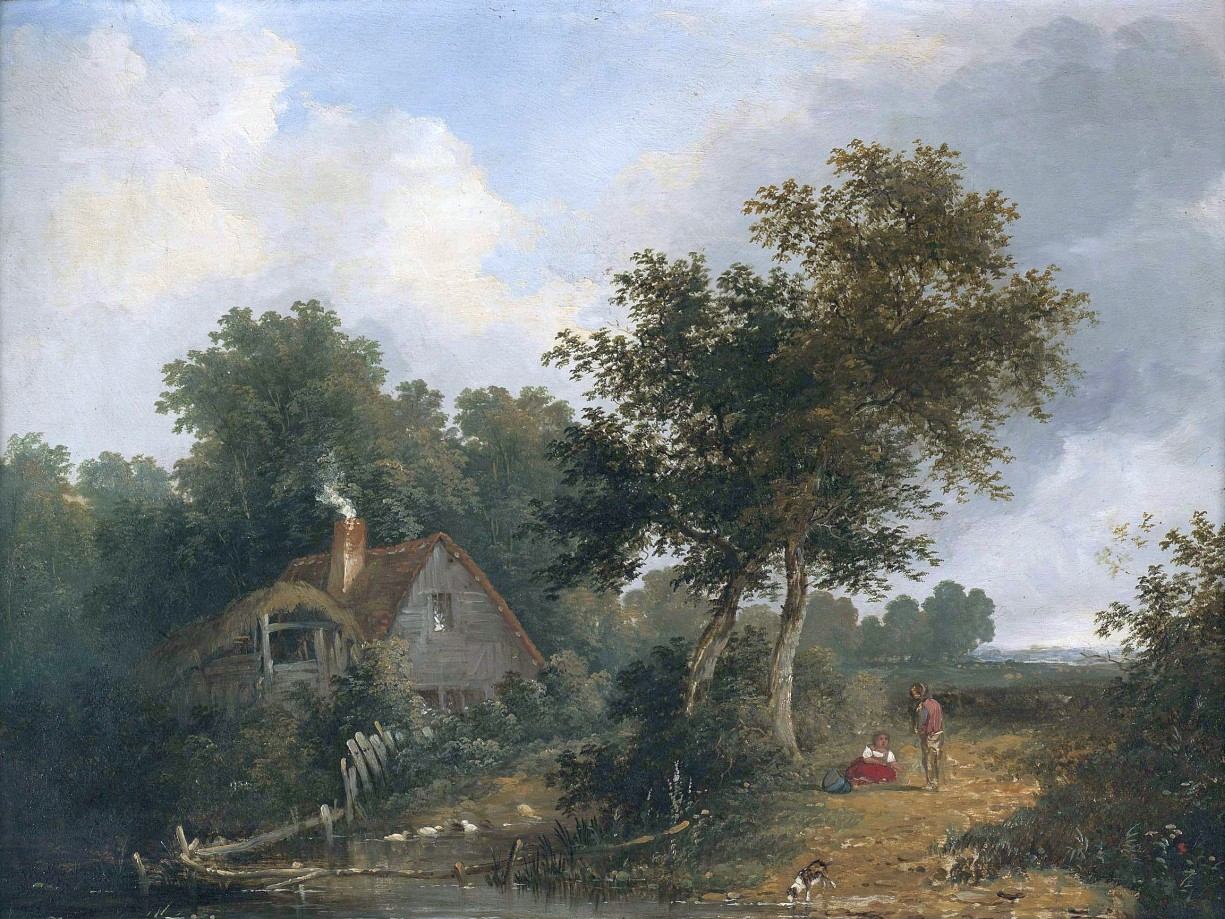
One has to presume that Clara Peeters’ choice of still life paintings is a result of the restrictions imposed on female artists. Female artists rarely followed an art education, certainly never being allowed to paint naked models, a must-do requirement if you wanted to become a history painter.  On the other hand, everyday objects were within reach of female painters.  Peeters’ still life artwork was in great demand with the buying public.  Already in the first half of the 17th century there was work by her in collections in the Northern Netherlands as well as her still lifes in the royal collection in Madrid. As was explained at the beginning of this blog the date of her birth is not precisely known.  It is the same for the date of her passing but it is presumed to be sometime after 1657.