For My Daily Art Display today, I am staying with an English artist but instead of a landscape painter and a man as was the case yesterday I am focusing on a lady artist, one of the most important portrait painters of 17th century England and who has been described as the first professional female English painter. Her name is Mary Beale and the subject of today’s portrait painting is her husband Charles.
Mary Beale was born in 1633, in Barrow in the county of Suffolk. Her father was the Reverend John Craddock, who was the local puritan rector. He was an amateur painter and was acquainted with all the local artists, one of whom was Peter Lely, a portrait painter. Although Mary Beale was never a pupil of Peter Lely there is no doubt that throughout her life she was influenced by his artistic style. Her mother was Dorothy Brunton who sadly died when Mary was just ten years of age.
In 1652, at the age of eighteen, she married Charles Beale, a cloth merchant and amateur artist and she went to live with him in Covent Garden, London. The Beales had two sons who survived past childhood, Bartholomew and Charles. Her husband, Charles became deputy clerk of the patents office in about 1660, by which time Mary had begun to study portraiture. In 1664, the Beales moved away from London. Charles had lost his job at the patents office and so they had a loss of income and they decided life would be cheaper in the country, so they moved to a farmhouse in Allbrook in Hampshire. A second reason for the move was for their own safety as that year saw the onset of the Great Plague in London which was to kill a fifth of the population of London.
In 1670, Mary and her family, returned to London and she set up a studio in Pall Mall. Here she painted many portraits of the aristocracy and local gentry. Her husband, not only acted as her assistant, but looked after the business side of her artistic venture and her son Charles trained as an artist in his mother’s studio. Her work was very popular and she received many commissions. In her husband’s diary he recorded that in the 1670’s his wife received no fewer than 140 commissions for portraits. Having returned to London she became reacquainted with Peter Lely who had been made the Court Artist to Charles II and many of Mary’s commissions were to paint copies of Lely’s works.
Mary Beale died in 1699, and was buried at St James’s, Piccadilly. Her husband died in 1705. The Beales’ first child Bartholomew died when he was young. Her second son also called Bartholomew studied portraiture but eventually gave up any thoughts of being a full time artist and took up medicine. Her third son Charles jnr. became a painter specialising in miniatures.
The painting today, simply entitled Charles Beale, is a portrait of her husband. She has portrayed him as a poet and clothed him accordingly in a style of unkempt abandon. His disheveled state was that of the preserve of poetic and melancholic genius. I love the informality of this painting with the sitter’s relaxed pose dressed in a brown gown underneath which we can see an open-necked chemise. This portrait is in direct contrast to the portraiture norm when the sitter is expected to be shown in a strong courtly pose. This is a portrait that exudes casualness and familiarity which of course one expects of a husband’s portrait carried out by his loving wife. This portrait has done away with the use of background drapery or Arcadian imagery which was so popular at the time and would no doubt have been included if this had been a commissioned work. It is an engaging and intimate portrait. The couple were very much in love and in his notebooks he always referred to his wife as his “Dearest and most Indefatigable Heart”. There was great equality in their relationship and the fact that after losing his job he “worked” for his wife, which was acting against all contemporary notions of married life. Religious, social and medical teaching stressed the secondary role to be played by women, whose place was determined forever by Eve’s original Sin. But Charles had no qualms about his position of apparent subservience. Mary was a firm believer of equality between a husband and his wife and between man and woman outside of marriage. She even put down her thoughts on the subject in 1660 when she wrote Essay on Friendship. In Tabitha Barber’s book Mary Beale she quotes Mary’s thoughts on the subject of friendship and equality between husband and wife, writing:
“…This being the perfection of friendship that it supposes its professors equally, laying aside all distance, & so levelling the ground, that neither hath therein the advantage of other…”’
Regarding the relationship in marriage between husband and wife, Mary wrote:
“…In marriage, God had created Eve as ‘a wife and Friend but not a slave…”
Mary Beale painted numerous portraits of her husband Charles which is testament to the deep affection between them.
This painting presently hangs in a private collection.
I am returning today to an English Victorian artist whom I showcased back on June 25th. The featured artist in My Daily Art Display today is one of the greatest watercolour painters of his time, Thomas Girtin, and the painting I am featuring today is a work he completed in 1802 entitled Morpeth Bridge.
Thomas Girtin was born in Southwark, London in 1775. His father was a prosperous brush-maker but died when Thomas was still very young. His mother remarried and her husband, a Mr Vaughn, was a pattern-draughtsman. Girtin’s artistic training started when he was only eight years of age. He took drawing lessons from Thomas Malton, a painter of topographical and architectural views. Another of Malton’s pupils at the time was J M W Turner. It was around this time that he signed up to a seven year apprenticeship with Edward Daves, a watercolourist and mezzotint engraver. In 1794 and 1795 Girtin and his friend Turner were put to work copying Dr Thomas Munro’s collection of J R Cozen’s drawings and colouring prints with watercolours and slowly but surely both young men learnt their trade.
When Girtin was nineteen years of age he exhibited his first work at the Royal Academy and soon his reputation as a watercolourist grew. His style of watercolour painting was such that he has been recognised as being the originator of Romantic watercolour painting. With fame came commissions and patronage and Girtin acquired two very wealthy patrons, Lady Sutherland and Sir George Beaumont, who played a crucial part in the creation of London’s National Gallery by making the first bequest of paintings to that institution.
In 1800, Girtin married Mary Ann Borrett, the sixteen year old daughter of a well-to-do City goldsmith, and set up home in St George’s Row, Hyde Park. By 1801, his fame as an artist had spread and he was a prized houseguest at his patrons’ country houses. His work was in such demand that he could charge 20 guineas for a painting. In late 1801 to early 1802, he went to live in Paris. It was during his sojourn in Paris that he painted watercolours and made a series the pencil sketches which he engraved on his return to London. They were published as Twenty Views in Paris and its Environs after his death. In the spring and summer of 1802, Girtin produced what many believe was his greatest work, a 360 degree panorama of London, entitled the “Eidometropolis”. It was 18 feet high and 108 feet in circumference. It was hailed as his greatest masterpiece.
Sadly, his health was deteriorating and that November, Girtin died in his painting room; the cause was variously reported as asthma or “ossification of the heart.” Girtin’s early death reportedly caused his friend Turner to remark, “Had Tom Girtin lived I should have starved”
Today’s painting, Morpeth Bridge was completed around 1802, the year of Girtin’s death. He had travelled around Northumberland two years earlier and made a number of sketches of the countryside and towns. In the painting, we see the bridge silhouetted against a starkly lit building. Despite the gold and light brown hues of the buildings, there are dramatic contrasts of light and shade and the sky above is dark and threatening and there is an ominous, almost sinister, mood about the setting. The great clouds which pass overhead dramatically darken some of the buildings and water. There is just a hint of a break in the clouds where we catch a glimpse of blue sky which is reflected in the mirror-like surface of the still water and the arc of the bridge. Girtin was able to convey drama and tension in his paintings by his clever depiction of light.
The painting hangs in the Laing Gallery in Newcastle upon Tyne.
Granida and Daifilo by Gerard van Honthorst (1625)
As I research paintings and artists for my blog, I delve into various books which I have and of course use the internet. One of the best art history magazines about is The Burlington Magazine which is published monthly. However although I have, in a rush of blood to the head, almost signed up for it, the cost of a few pence under £20 per issue I feel is just too much. However the other day I bought the Centenary Anthology of the magazine from eBay and although I have just skimmed through some of the 250+ pages I am pleased with my purchase. It was as I flicked through the pages I came across a beautiful work by Gerard van Honthorst and I thought it was time to feature this Dutch painter and one of his works.
Gerard or Gerrit van Honthorst was born in Utrecht in 1592. His father was a textile painter and his younger brother Willem also went on to become an artist. His first taste of art came when he was apprenticed to the great Dutch painter Abraham Bloemaert. Bloemaert, who resided in Utrecht, was an outstanding teacher and virtually all the aspiring young Utrecht painters of that time, who went on to become famous, had at one time studied under this artistic master.
In his early twenties, Honthorst travelled to Italy and during his stay in Rome where he lived in the palace of a patron of Caravaggio, Vincenzo Giustiniani, he was influenced by the works and style of the famous artist who was at the height of his popularity. Whilst in Italy, Honthorst developed a similar artistic style to Caravaggio in the way he often portrayed his figures in the darkness of night lit by candlelight and this style acquired him the Italian nickname Gherardo delle Notti (Gerard of the Night). His paintings were very popular and he managed to acquire a number of wealthy patrons including the powerful Scipione Borghese the Italian Renaissance cardinal who was a great patron of the arts and an avid art collector. He was also patron to Caravaggio. Another of his patrons was Marchese Vincenzo Giustiniani an aristocratic Italian banker and art collector
Honthorst returned to Utrecht around 1620 and that same year married Sophia Coopmans. Along with his fellow artist, Hendrick ter Brugghen, they set up an art school in Utrecht. Due to the influence of Caravaggio on the works of the two Dutch painters and the way their paintings showed strong and bold contrasts between light and dark known as chiaroscuro, they were looked upon as representing Utrecht Caravaggism.
In 1622 van Honthorst joined the Guild of St Luke in Utrecht and three years later was made president of the society. Van Honthorst fame as a painter spread and he was much sort after as a teacher so much so that in 1627 he moved to a much larger house and turned part of it into his workshop. The following year, following his rising artistic reputation reaching the English court, he was invited to work at the court of King Charles I. He remained in England until the end of 1628 at which time he returned to Utrecht.
In 1637 Van Honthorst moved to The Hague when he became the court painter to the Princess of Orange and received a number of commissions for portraits from the Dutch ruler Frederick Hendrick, Prince of Orange and his family and during this period he also worked on the decoration of the royal residences. His fame spread and he received many royal commissions from the likes of the French Queen Maria de Medici, mother of King Louis XIII, King Christian IV of Denmark and Elizabeth of Bohemia, Charles I of England’s sister.
With success came great wealth and he was fortunate enough to live a luxurious lifestyle. Gerard van Honthorst died in Utrecht in 1656, aged 64.
The featured painting in today’s My Daily Art Display is entitled Granida and Daifilo which Gerard van Honthorst completed in 1625 and was commissioned by Stadholder Frederick Hendrick for his residence at Honselaerdijk and was to form part of a number of paintings of pastoral scenes.
The title of the painting refers to the characters in a pastoral play written by Pieter Hooft, the Dutch historian, poet and playwright entitled Granida. The story of the play was that Granida and Daifilo were lovers. Granida, the daughter of an eastern king, was betrothed to Prince Tisiphernes but one day became lost while out hunting. She came upon a shepherd Daifilo and his mistress Dorilea who had just quarrelled. Daifilo fetched water for the princess to drink and fell in love with her. He followed her to court and, after several twists and turns in the story, they fled to the woods together to live a pastoral life. However, Daifilo was taken prisoner by one of Granida’s several suitors. The play had a happy ending and the couple were finally reunited after the intervention of Tisiphernes who took pity on the young pair and gave up his claim to her.
The colours of this painting are bright and the details of the two protagonists in this amorous scene set in this idealised woodland setting give it a touch of classicism. Nevertheless, there is a touch of realism, which was associated with the Caravaggists as we see the dirty soles of Daifilo’s feet. In the background to the right we see the soldiers approaching the lovers with the intent to arrest them.
The play set a fashion for pastoral idyll in the Netherlands where Granida and Daifilo became iconic symbols of love. The play was noted for the delicacy of its poetry and the simplicity of its moral. The moral to this tale was that individuals and nations can be at peace only when rulers and subjects alike shun ambition and seek only to serve. Though not well known today, it was a very popular work in early 17th century Netherlands, and Granida and Daifilo were the subject of many important paintings by Dutch masters.
The painting can be found in the Centraal Museum, Utrecht
We are now at the height of the summer holiday season and work at my Bed & Breakfast place is becoming more hectic and I am finding that I have less free time on my hands to devote to the blog. I sometimes wonder whether my blog should have been entitled My Every Other Day Art Display! Having said that I spent yesterday afternoon walking around Betwys y Coed, a small town in a very scenic area of North Wales, and it was during this walk that I came across a very old, 14th century church. What was even more fascinating was its connection with an English mid-nineteenth century artist and a series of his painting. The artist in question is David Cox and the oil painting, which he completed in 1852, is entitled Funeral at Bettws Church.
David Cox was born in Birmingham in 1783. His father was a simple blacksmith and the family lived in a poor area of the city and were, as we would euphemistically put it these days, “financially challenged”. His first art tuition came from Joseph Barber, the English landscape painter, who as Birmingham’s first drawing master had set up an academy in the city to train aspiring artists. Cox eked out a small wage by working as a theatre scenery painter. At the age of twenty-one, Cox went to live in London and continued his artistic training, this time under the tutelage of the English watercolourist, John Varley. He made some visits to North Wales and started a job as a commercial artist; producing illustrations to accompany travel writer Thomas Roscoe’s two volumes of Wanderings and Excursions in Wales.
To survive financially, David Cox also took odd jobs in the art world’s Grub Street, as a scene painter, by selling views of London and the River Thames to booksellers at two guineas the dozen. Grub Street was famous for its concentration of impoverished writers, artists and aspiring poets. Its bohemian society was set amidst the impoverished neighborhood’s low-rent flophouses, brothels, and coffeehouses. Cox also enhanced his income by teaching art, spending some time as a teacher at a boarding school for young ladies. He even published a book on art.
He later moved south of the Thames and settled into life at Dulwich where he taught a number of art students. Cox exhibited at the Royal Academy for the first time in 1805. Four years after moving to London he married Mary Ragg who was the daughter of his landlady. A year later in 1809, the couple had their first child, a son, David Jnr. In 1814 to escape city life he and his family moved to rural Herefordshire and took up residence in the county town of Hereford where he taught at a girl’s school. In the late 1820’s he travelled extensively through Western Europe and in 1827 the family moved back to London. David Cox was now in his forties and had, by now, built up a reputation as a fine landscape painter and the sale of his works was increasing.
In 1841, Cox gave up teaching and moved back to his birthplace, Birmingham, this time to the small town of Harborne, a few miles south of the city. It was throughout the 1840’ and 1850’s that David Cox would make annual pilgrimages to North Wales where he enjoyed the beautiful rugged scenery and revelled in the many opportunities the area gave him for his landscape subjects. He fell in love with the Vale of Clwyd and the village of Betws-y-Coed in Conwy and his paintings of this area inspired the 19th Century Birmingham School of artists to follow in his footsteps. Soon artists from around the country descended on this small Welsh village. Many believe it was during this period that he completed some of his finest watercolours. Suprisingly enough it was until the mid 1850’s that Cox started painting in oils. David Cox died in Harborne in 1858, aged 75.
The sheer range of David Cox’s work is amazing and many considered him to be an equal to some of his more famous contemporaries such as Turner, Constable and Richard Bonnington. Cox was noted for his skill in encapsulating in his paintings the unpredictable British weather, which was no more apparent than in North Wales. He is probably best known for his many works associated with the small town of Betws y Coed which nestles at the edge of the Snowdonia National park and sits alongside the River Conwy.
With artists like Cox and their portrayal of the beautiful landscape around Betws y Coed, the village began to draw in artists from many parts and it became both an artist’s colony and a favourite tourist spot. Many of the artists flocked to Betws-y-Coed to learn more from David Cox, who made his home at the Royal Oak Hotel each summer. He actually painted the original pub sign. The surrounding area offered not only the remarkable scenery but it offered an insight into Welsh history as it was supposedly near the site of the massacre of the bards by King Edward I.
In the painting before us we see a group of mourners attending a funeral, standing outside the gates of St Michaels Church, Betwys y Coed. The original church would have been built in the latter part of the Celtic Church era around the eighth and ninth century. Nothing visible remains of that earliest ‘Bettws’ church which derives its name, Bettwys, meaning ‘Bede House’, as in rosary beads and thus meaning a “house of prayer”. The whole church seems to have been rebuilt during the 14th–15th century. This is still the oldest building in Betws y Coed today with parts surviving from the 14th or 15th century. It was mostly rebuilt and enlarged, with the addition of a vestry and north transept in 1843. However, even after enlargement, it still could not cope with the rising numbers of worshippers and it became redundant as a village church with the building of St Mary’s Church in 1873. Although the church is now officially closed for regular public worship, a service is normally held on St Michael’s Day (29th September) and a candle-lit Carol Service at Christmas tide. The Church houses an excellent quality 14th century stone effigy of Gruffydd ap Dafydd Goch – a close relative of the last Welsh Prince of Wales – Llewellyn ab Gruffydd. A rustic oak pulpit has the date 1697 upon it, but some say that date is graffiti, and that the pulpit dates to an earlier period. The Church font is dated from the 13th century, although the pillar is from a later date. In the churchyard there are many 18th century gravestones, some leaning against the church walls, and there are still even 17th century grave stones to be seen.
Many of the visitors to Betws-y-Coed in Victorian times were artists, and they were drawn to St Michael’s Church, which stands besides the river Conwy and was frequently the subject of paintings done by artists from the new artists’ colony, which thrived in the second half of the nineteenth century. Today’s featured oil painting by David Cox entitled Funeral at Bettws Church, which he painted in 1852, is a prime example. The painting is housed in the Bury Art Gallery. In it we see the small church of St Michael in the background framed by two massive yew trees. It is said to depict the funeral of the daughter of the landlord of the Royal Oak, where Cox used to stay. The death of this young girl would have affected the whole village. The sunset setting of this painting makes it very atmospheric. Cox was not known for his symbolism but this is very symbolic, with the setting of the sun and little children gathering poppies – symbolic of death.
Welsh Funeral by David Cox
David Cox painted a number of similar paintings, one, a watercolour, entitled The Welsh Funeral (1848), which is at Birmingham Art Gallery and there is the initial preparatory chalk sketch of the funeral painting at the Ashmolean Museum at Oxford.
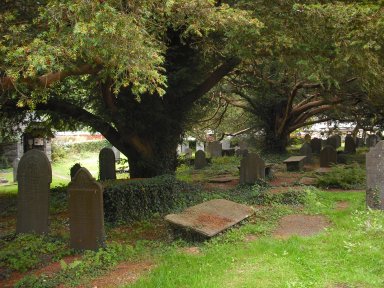
The massive yew trees
One noticeable change to the vista now is the fact that the yew trees have grown and spread even more and when you stand at the gated entrance to the church and graveyard, it is now almost impossible to see the church between the two enormous trees.
Present day church
So my walking trip yesterday did have artistic connotations but is also the reason for no blog. My thanks go to Anne Hammond who introduced me to this beautiful little church and its connection with today’s featured artist and who led our small party of intrepid walkers on this voyage of discovery.
Mademoiselle Lange as Danaë by Anne-Louis Girodet (1798)
My Daily Art Display today has the slight whiff of scandal about it, or to be more precise, about the sitter for the painting. It is a tale of two paintings, a disgruntled sitter and a furious artist. The title of today’s featured works are Mademoiselle Lange as Danaë and Mademoiselle Lange as Venus and the artist who painted both these rather erotic works in 1799 was the French painter and illustrator, Anne-Louis Girodet de Roucy-Trisson but more commonly known as Anne-Louis Girodet. Here was an artist whose works straddled the rationalism of Neoclassicism and the flights of fantasy associated with Romanticism.
Girodet was born in Montargis, a small town some 100 kilometres south of Paris in 1767. He had an unhappy start to life with both his parents dying when he was young and he then came under the guardianship of Doctor Trioson who took care of his well-being and education. Later Girodet would add the surname of his guardian to his own in recognition to everything the doctor had done for him when he was young. There is a train of thought that the good doctor was actually Girodet’s natural father. Initially Girodet studied to become an architect and had a desire to follow a military career but finally he decided that the life of an artist was for him.
He studied with Jacques-Louis David and in 1789 was awarded the Prix de Rome by the Royale de Peinture et de Sculpture and with that came the scholarship to travel to Italy and stay at the Academy of France in Rome. Girodet remained in Rome for five years.
He returned to Paris in 1793 and concentrated on portraiture and was well known for his glorifying portraits of Napoleon Bonaparte. One of his best known and most controversial portraits is one of the painting I am featuring today. He also spent a lot of time doing illustrations for books. In 1815 his erstwhile guardian Doctor Trioson died and Girodet inherited a fortune and for the rest of his life he spent little time painting and concentrated on writing poetry. Girodet died in Paris in 1824, aged 57.
So that was a little bit about the artist and now to delve into the much more colourful life of the sitter of this painting, Anne Françoise Elisabeth Lange. She was born in Genoa in 1772. Her mother and father were both musicians who with their company of players, travelled throughout Europe performing in musical shows. The young Anne Françoise soon became a young child performer. At the age of sixteen she made her first performance at the famous Comédie-Francais as a pensionnaire, and five years later she was promoted to the position of a sociétaire. It is an interesting theatrical hierarchy. A pensionnaire is promoted to a societaire by a decree of the Ministry of Culture, from names put forward by the general administrator of the Comédie-Française. Once one has achieved the rank of a sociétaire, an actor automatically becomes a member of the Société des Comédiens-Français and receives a share of the profits plus they also receive a number of shares in the Société to which he or she is contractually linked.
Triumph followed triumph in her rolls and soon she became a notable performer in Paris. The turning point came in 1793 when she appeared in a play which had Royalist connotations and as Paris was in the clutch of the Revolution anything alluding to royalty or the monarchy was taboo and the theatre was shut down and the play’s author and the actors were arrested. She spent two periods incarceration and narrowly escaped the guillotine thanks to having friends in “high places”.
Elisabeth Lange bore a daughter, Anne-Elisabeth Palmayre to her wealthy lover, Hoppé, a wealthy banker from Hamburg and two years later bore a son to another lover, Michel-Jean Simons, a Belgian supplier to the French army, whom she later married, after which her acting career virtually came to an end. Disaster struck Simms’ business and he was ruined almost leaving the family destitute. Michel-Jean Simons died at the family’s Swiss home in 1810 and his wife Elisabeth Lange died six years later in Florence.
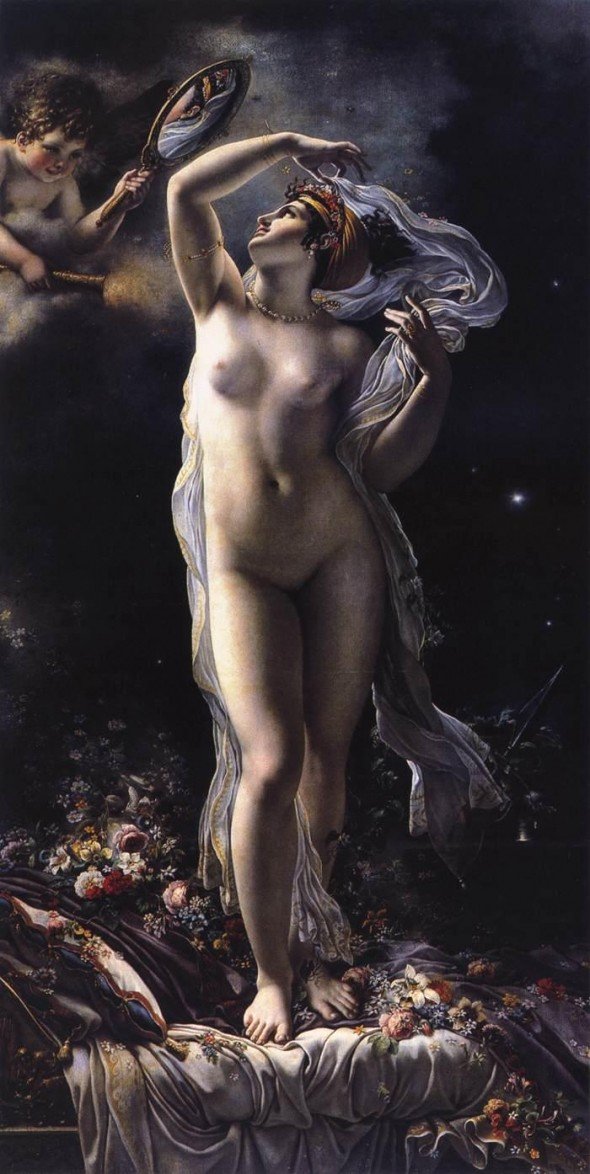
Mademoiselle Lange as Venus by Anne-Louis Girodet (1798)
Miss Lange was both very talented and extremely beautiful. She had approached the artist, Girodet, to paint her portrait. He duly obliged and depicted her as Venus, in which she held the pose seen in depictions of the Birth of Venus but in this painting it is Cupid who holds the mirror up to Venus for her to study her reflection. He exhibited the painting at the 1798 Salon exhibition but the sitter was horrified by her depiction and demanded that Girodet should remove it from the exhibition and from public view. Furthermore she refused to pay Girodet the agreed amount for the painting. The artist was furious and in an act of revenge took the painting out of the exhibition, removed it from its frame and ripped it up. He then sent the pieces to Mademoiselle Lange. However his revenge was not complete as he decided to paint another portrait of Elisabeth Lange but this time showing her in a very unfavourable light. He rushed off a satirical painting of Mademoiselle Lange as Danaë in just a few days. Eighteenth-century artists sometimes portrayed people as mythological characters to highlight their virtues but this time Girodet wanted to highlight Mademoiselle Lange’s vices. Danaë was one of the mortals loved by the Greek god Zeus, who transformed himself into a shower of gold and fell upon her. Girodet shows Miss Lange as a prostitute greedily catching and gathering the gold coins in a sheet. In the painting Girodet has featured a turkey with peacock feathers wearing a wedding ring, symbolizing her final lover and husband Michel-Jean Simons whom she married for his fortune, and to the bottom right we have a bizarre mask with the features of another of her lovers, Lord Lieuthraud, with a gold piece stuck in one of its eye sockets. Look at the mirror she holds. It is cracked and this symbolises her inability to see herself as she is, or how Girodet saw her – vain, adulterous and avaricious.
This painting is now at the Minneapolis Institute of Arts.
Religious Processionin in Kursk Province by Ilya Repin (1883)
Ilya Efimovich Repin was born in 1844 in the town of Chuhuiv, now part of eastern Ukraine. His parents were a family of military settlers. Military Settlements in thise days were places which allowed the combination of military service and agricultural employment. At the age of twelve, his art training took the form of an apprenticeship with the local icon painter, Ivan Bunakov and throughout his life religious representations remained of great importance to him. When he was 19 he entered the St. Petersburg Academy of Arts and studied portraiture. It was whilst at that artistic establishment that the Rebellion of the Fourteen took place in September 1863 The rebellion consisted of fourteen young artists who left the Academy in protest against its rigid neoclassical dicta and who refused to use mythological subjects for their diploma works.. The rebel artists insisted that art should be close to real life and they formed the Society of the Peredvizhniki to promote their own aesthetic ideals. In order to reach the widest audience possible, the society organized regular travelling exhibitions throughout the Russian Empire. Later, Repin would be become a close friend and associate with some of them and fifteen years on after returning from Europe he would join the group. But for the time Repin remained at the Academy and in 1871 won the prestigious Major Gold Medal award and received a scholarship to study abroad.
Repin went abroad in 1873 travelling around Italy before settling in Paris. It was whilst he was in Paris that he came in contact with the Impressionists and their works which had a lasting effect upon his use of light and colour and he witnessed their first exhibition in 1874. Although he never joined the group and was often critical of their style, which he considered too distant from reality, he was greatly influenced by some of the artists’ en plein air style of painting. In 1876 he left Paris and returned home to Russia, settling down in Moscow. During his period in Moscow he visited the country estate of Abramtsevo belonging to Savva Mamontov a wealthy Russina patron of the arts (See Valentin Serov – My Daily Art Display Feb 24th). Following the Bolshevik Revolution Repin went to Kuokkola, Finland to live in the estate he had built and which he called Penates. Repin produced his greatest works during the latter two decades of the nineteenth century although he continued painting well into the twentieth century. Repin died in 1930 in Kuokkla, at the age of 86. After the Winter War between Russia and Finland and the Continuation War between the two countries between 1939 and 1944, Kuokkala became Russian. In 1948, it was renamed Repino in honor of today’s artist Ilya Repin
My Daily Art Display featured painting today is entitled Religious Procession in Kursk Province and was completed by Repin in 1883. This massive oil on canvas painting measures 175 x 280cms. The setting for the painting is a time of drought and we see a large group of people crossing the parched earth. The leaders of the procession carry aloft a miracle-working icon to a church which lies nearby. What is interesting about the procession is that there is a great mix of people of various social standing in the community. Scan the painting, look at the various characters Repkin has depicted. He, by his portrayal of how the people are dressed, stresses the difference in their social status and highlights life’s inequalities. Some are in rags whilst others are bedecked in rich caftans. We focus our eyes on the young hunchback as he struggles along with his makeshift crutch totally focused on the icon, which is being held on the shoulders of the monks. To him, it may mean salvation. To him, life cannot get any worse and for him this procession will lead him to a better existence. Compare that with the posture of the cavalry officer atop of his horse who oozes a kind of sanctimonious piety, his attitude appears to be of one who only half believes in the power of the icon and who probably, unlike the hunchback, needs little that the icon can possibly offer anyway. This is a “them and us” scene, a “have and have not” scenario, which Repin liked to depict in his realist paintings. This was part of a slow build up to the revolution which would take another twenty years to arrive with its 1905 initial uprisings leading eventually to the ultimate revolution in 1917 which finally destroyed the Tsarist rule and the inequalities of life. For Repkin this procession we see before us in this painting maybe an allegory for the slow but unyielding forward advance of the working classes towards social change.
Repin was a Realist painter and focused much of his work on the social dilemmas of his country. He was aware of the inequalities of the Tsarist system and although that same system treated him well, he was aware that for a vast majority of his people, life was unfair. Ivan Kramskoi, the Russian artist and critic and leading light of the Society of the Peredvizhniki of which Repin was a member, said of his Repkin’s perception of life’s inequalities:
“…Repkin has a gift for showing the peasant as he is. I know many painters who show the moujik [Russian peasants], and they do it well but none can do so with as much talent as Repin…”
The painting hangs in the State Tretyakov Gallery in Moscow and I would so like to stand in front of the painting and absorb the atmosphere that Repkin has conjured up in this magnificent work.
Madame de Ventadour with Portraits of Louis XIV and his Heirs by The French School (c. 1715-1720)
For My Daily Art Display today I am returning to French art and a painting which is attributed to the French School around 1720. The title of the work is Madame de Ventadour with Portraits of Louis XIV and his Heirs. It has all the grandeur and splendour one would expect in the pre-Revolution days when French life was controlled by the Monarchy.
I suppose the first thing I should talk about is who are all these people standing before us with their dignified regal poses? In the painting we see four adults and a child in what is meant to look like an elegantly decorated room in the Palace of Versailles. In the right background we can see the lavish gardens of the palace. The people in the painting pose like actors playing to an audience and maybe we are that audience who marvels open-mouthed at such opulence. Seated centre stage, as befits the most important person of the group, is King Louis XIV, the King of France. Leaning on the back of his chair is his son, Louis, the Grand Dauphin and heir to the French throne. On the right dressed sumptuously in a red velvet coat with gold brocade is the Dauphin’s eldest son and Louis XIV’s grandson, Louis, Duc de Bourgone who is second in line to the French throne. The lady on the left is the lady of the title of the painting, Madame de Ventadour, who was the governess to the royal children and finally, the child in front of her, who is actually a boy despite the dress, and he is the great grandson of Louis XIV, Louis, the Duc d’Anjou, who would later become King Louis XV. Two other personalities are present in the painting but only in the form of busts. On the plinth in the left background we have the bust of King Henri IV, the deceased head of the Bourbon dynasty and on the plinth to the right we have the bust of King Louis XIII the deceased King of France and Louis XIV’s father. Madame de Ventadour can be seen to the left of the painting but more about her later.
Louis XIV’s father Louis XIII had an arranged marriage with Anne of Austria when he was only fourteen years of age. Anne suffered four miscarriages and the Royal couple waited twenty-eight years for their first child, Louis, to be born in 1638. Five years after the birth of his son, Louis XIII died. An amusing anecdote is related regarding the deathbed scene of the forty-one year old Louis XIII and his five year old son. The dying man asked his son did he know who he was, the little boy replied:
“….Louis the Fourteenth, Father….”
To which his father quickly retorted:
“…You are not Louis the Fourteenth, yet….”
Louis came to the throne as Louis XIV on the death of his father at the age of four and ruled France for just over seventy-two years from 1643 to 1715 and as such, it is one of the longest recorded reigns of any European monarch. He was known as the Sun King as he identified himself with the Sun God Apollo and it was probably in his honour that the picture of Apollo riding his chariot, which we see on the rear wall, was incorporated into the painting.
As the title of the painting states, this is a painting depicting Louis XIV’s heirs. Actually we are looking at members from four generations. We have the king seated, his son with the white wig, his grandson with the red coat and his great grandson the small child. So why did this little boy, the king’s great grandson, become the next king on the death of his great grandfather? The reason is simple but in some ways tragic. Louis XIV lived a very long life, dying just four days before his seventy-seventh birthday in 1715. His eldest son, the man standing behind his chair in the painting died of smallpox in 1711, aged 49. The next in line for the throne would have been Louis XIV’s grandson, the Duc de Bourgogne, the man in the painting wearing the red coat, but he, his wife and one of their sons died of a measles epidemic in 1712. This meant the little five year old boy, Louis duc d’Anjou, who we see in the painting with his governess Madame de Ventadour became Louis XV.
But why is this lady included in this royal portrait? Like many of her family, Madame de Ventadour was the Gouvernante des enfants royaux, (Governess of the Children of France). She became the royal governess in 1704. It was amusing to read about her husband, Louis, Duke of Ventadour for though through marriage she became a duchess, she had a lot to put up with. In L C Syms’ book of 1898 entitled Selected Letters of Madame de Sévigné (Madame de Ventadour’s daughter) one letter described the Duke de Ventadour as being
“horrific — very ugly, physically deformed, and sexually debauched”
However, she was credited as having saved the life of the soon to be Louis XV at a time when his elder brother, father and mother all succumbed to the deadly disease. The family was treated by the royal doctors, who bled them in the belief that it would help them to recover; instead, it merely weakened them and reduced their chances of survival. She decided that she would not allow the same treatment to be applied to the two year old Duke of Anjou so Madame de Ventadour locked herself up with three nursery maids, and refused to allow the doctors near the boy.
The painting was commissioned to celebrate the role of the lady in ensuring the continuation of the Bourbon dynasty. It is interesting to see how the seated king and the young child point to each other. Maybe that symbolises the connection between great grandfather and his great grandson in as much as the crown passed between these two and circumvented the other two men in the painting. If we want to look at symbolic connections in this painting, look how the bust of Louis XIII on the right hand pedestal, the seated Louis XIV and the little boy, Louis XV, the three consecutive French monarchs, are connected by an imaginary diagonal line – just a coincidence ?
The painting can be seen by visiting the Wallace Collection in London.
My Daily Art Display today is about two paintings and the reason I am looking at two is because the second one, which is a copy of the first by a different artist, is almost identical but not quite and it does show up certain details much clearer, which are harder to see on the original work by Jan Steen. Sounds interesting? – Well then, read on !
Jan Havicksz Steen was born in Leiden around 1626. He was the eldest son of the brewer and former grain merchant, Havick Jansz Steen and his wife, Elisabeth Capiteyn, the daughter of a city clerk. Steen was brought up in a well-to-do Catholic family home. His forefathers and parents had run the tavern, The Red Halbert, for two generations. Jan Steen, like his contemporary Rembrandt, went to the Latin School and later became a student in the Department of Letters at Leiden University. Art historians question whether he actually studied at the university as he never attained a degree. It is thought that he may have enrolled at the university to take advantage of the privileges bestowed on students, such as exemption from serving in the civic gurad and not having to pay the municipal excise tax on beer and wine ! His artistic education was overseen by the German painter, Nicolaes Knupfer, a specialist in history paintings and produced works based on stories from the Bible, from Greek and Roman history and from mythology. He was to have a great influence on Jan Steen. Two other painters who had some bearing on Steen’s future artistic career were the brothers Adriaen and Isaac van Ostade, both of who lived in nearby Utrecht
In March 1648, at the age of twenty-two, Jan Steen and Gabriel Metsu, a fellow artist, founded the painters’ Guild of St Luke at Leiden. It was shortly after that time that, Jan Steen went to The Hague where he met and became assistant to Jan van Goyen, the prolific landscape artist. Within a short space of time Steen left his lodgings and moved into van Goyen’s home. In October 1648 Jan Steen married van Goyen’s daughter Margriet and the couple went on to have six children, their first child, a son Thadeus was born in 1651. Van Goyen and Steen worked together for a further five years until 1654 at which time Steen and his family moved to Delft and to supplement his income from his art, he rented a brewery for 400 guilders a month, known as De Slang (The Serpent), also sometimes known as De Roskam (The Curry Comb) which was on the Oude Delft canal, but the enterprise met with little success.
The year 1654 was to be a momentous and a tragic year for Delft and its inhabitants. This was the year in which The Delft Explosion occurred on October 12th, when a gunpowder store exploded, destroying much of the city. Over a hundred people were killed and thousands wounded. Thirty tons of gunpowder had been stockpiled in a former Clarissen Convent in the Doelenkwartier district of the city. On that morning the keeper of the magazine, which stored the explosives, opened up the store and an enormous explosion followed. The death toll could have been much worse but fortunately many of the people of Delft had gone to a market at the nearby town of Schieden. One of the casualties of the explosion was the artist Carl Fabritius, many of whose paintings were also destroyed in the explosion and fire. After this disaster and the fall-out from the First Anglo-Dutch War, the art market in the city almost collapsed and sales of Steen’s works fell sharply. Once again Jan Steen moved his family.
Jan Steen, following his departure from Delft in 1657, moved around the country, living for a time in Warmond, a small village north of Leiden and in 1660 moved to Haarlem where the next year Steen became a member of the Haarlem Guild of St Luke. In May 1669 his wife died and the following year his father died. Jan Steen inherited the family house in Leiden (his mother had died a year earlier) and he moved his family back home. He returned to Leiden in 1672 when again he opened a tavern. The year 1672 in Holland was known as the rampjaar (“disaster year”). In that year, the Republic of the Seven United Provinces was after the outbreak of the Franco-Dutch War and the Third Anglo-Dutch War attacked by both England, France, and the invading armies very quickly defeated the Dutch States Army and conquered a large part of the Republic. Steen’s unsuccessful brewery business and the fall in his art sales led him into debt which was further exacerbated by his heavy drinking.
In April 1673 he re-married. His second wife was Maria Dircksdr van Egmont, the widow of a Leiden bookseller, who soon after gave birth and the forty-seven year old artist became a father yet again. Jan van Steen died penniless in 1679, aged fifty-three. After his death, his wife had to sell most of their possessions and her husband’s paintings to pay off his many debts. Maria died eight years later.
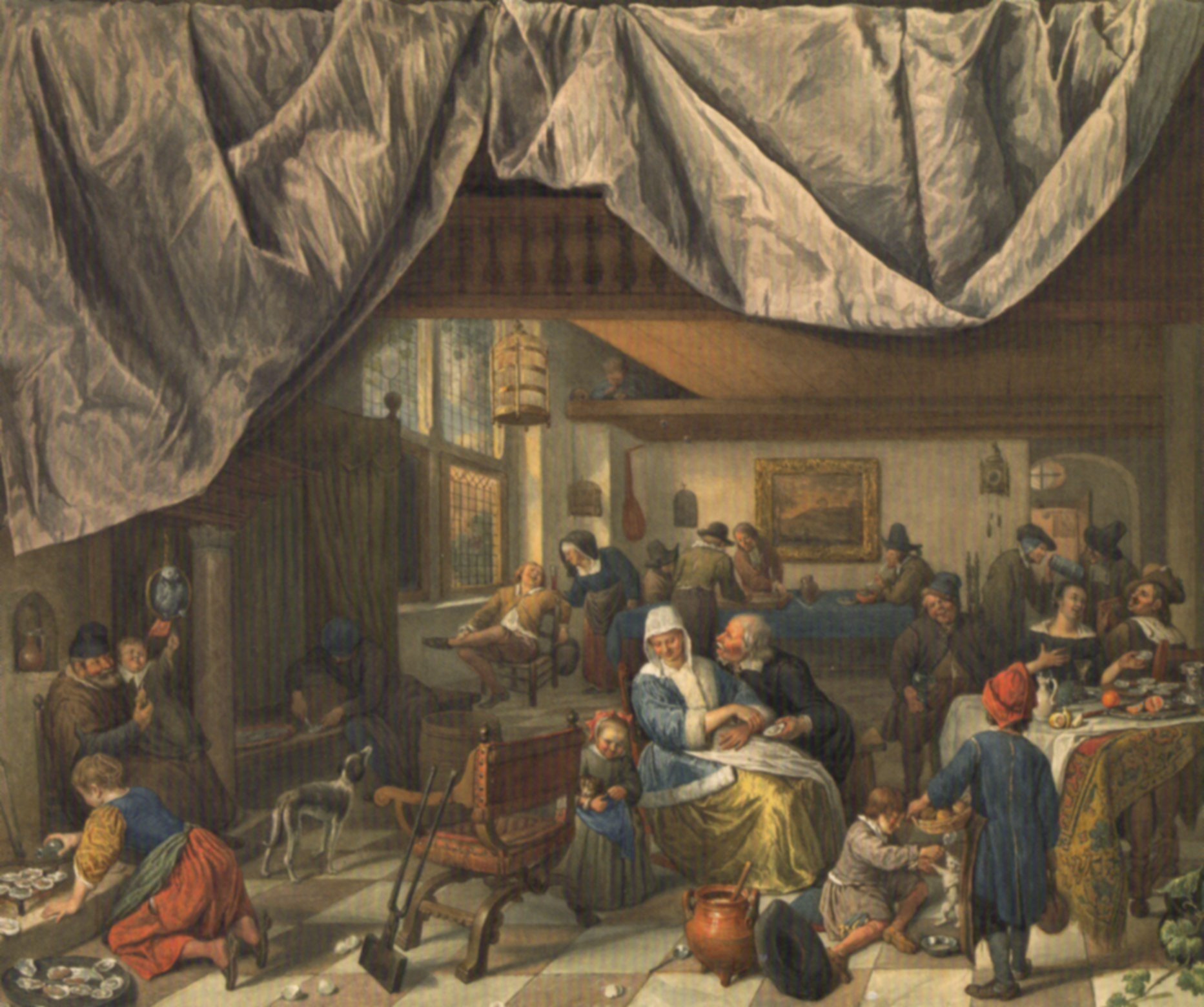
My Daily Art Display’s featured painting by Jan Steen is entitled The Life of Man which he completed around 1665. In the painting before us we glimpse into the busy bar of a tavern full of people of various ages with one thing in common – they are all there to enjoy themselves. They create their own enjoyment through making music, singing and playing tric-trac, the popular dice game of that time. In the centre of the painting we see a young woman, dressed in blue and white, seated, turning away from an older man who is offering her an oyster. We can see by the smile on her face that maybe her initial rebuff of his gift may soon be reversed. Behind the pair we can see a hunchbacked lute player, who looks on and seems happy to ridicule the mismatched pair.
To the right of the picture we see a young woman and another lute player sitting together at a table. This relationship seems to be prospering, if the sultry look she is giving the musician is anything to go by. It would appear that the owners of the tavern are use to preparing and selling large quantities of oysters, a supposed aphrodisiac, to their clientele.
As I have said many times before I like paintings where a lot of things are going on as every time I look at one of these paintings I notice something different. Cast your eyes around the tavern scene and see what you can discover. To the left we can see an old man eating an oyster and on his knee he has a small child who is wriggling from his grasp trying to grab the tail of a parrot. In the central foreground we see a small girl cradling a small dog in her apron and by the table on the right and sitting on the floor is a small boy who is trying to teach a kitten to stand on its hind legs. It is interesting to focus on the small boy in the right foreground, with the blue coat and red hat, who holds a basket of bread rolls under his arm. Jan Steen has painted this figure with his back to us and has used this technique in other paintings and what it does is to get us to look at where the boy is looking and thus the artist gets the viewer to focus his or her eye into the depths of the picture.
Across the top of the painting we have what looks like a raised curtain and what Steen wants us to accept that we are not just looking at any old tavern but in some ways we are looking at a stage and the curtain is a theatre curtain raised to show the cast of players. In Shakespeare’s play, As You Like It, there is the famous line:
All the world’s a stage,
And all the men and women merely players:
They have their exits and their entrances;
And one man in his time plays many parts,
As the painting is by a Dutch artist maybe we should look at the Dutch saying by Joost van den Vondel:
“De wereld is een schouwtoneel Elk speelt zijn rol en krijgt zijn deel.“
Which translated roughly means:
“ The world‘s a stage
Each plays his role and gets his share”
And so maybe Jan Steen wants us to look at this scene as more than just people in a tavern but as “the world stage “and the people we see in the tavern are just players.
The Life of Man by Reinier Craeyvanger (c.1840)
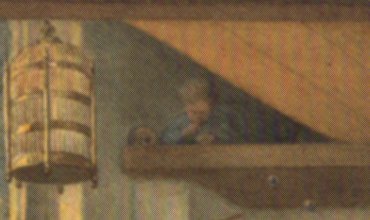
And so I come to my second painting which is also entitled The Life of Man but the artist is Reiner Craeyvanger. It is obviously a copy of Jan Steen’s work but I am showing it for two reasons. Firstly, when I was researching the painting by Jan Steen I kept reading about “a boy lying in the loft above, blowing bubbles”. I searched Jan Steen’s painting for hours looking for the boy and couldn’t find him and convinced myself that the picture I had was a cropped version of the original. However when I saw Craeyvanger’s copy I immediately saw the boy and when I looked back at Steen’s painting I could just make out a fuzzy image of the boy. See if you can find him.
Boy on balcony blowing bubbles
The boy is laying there blowing bubbles and next to him is a skull. From this we must believe that both are symbolic and the message is, that like a bubble which will suddenly burst, our life may suddenly come to an end and we die and of course the addition of a skull which we often see in Vanitas painting symbolises that death is always around the corner. Although it is not very clear in the attached pictures the painting on the rear wall has a gallows in it and that again is harking back to life and death.
There are two other interesting things in the painting. Firstly we see broken egg shells scattered on the floor which could be symbolically interpreted as the frailty of life itself, and secondly, look at the right background and the old woman staring into a tankard. She is a kannekijker, which literally translated means a “pot looker” or “someone who looks into a pot”. This gesture was a well-known literary and artistic convention of the time that signified the habitual drinker or drunkard. I am sure there is more symbolism incorporated in this painting, such as why has Steen depicted a pot with a spoon and a hat in the foreground? How are we to interpret these objects or maybe there is nothing to interpret!
However I will leave you with a question. Although Craeyvanger has carefully copied Jan Steen’s painting, what is the main difference between his work and that of Jan Steen’s painting? I am not talking about colours, tones or technique. It is more obvious than that, something is missing from the later painting, but what ?
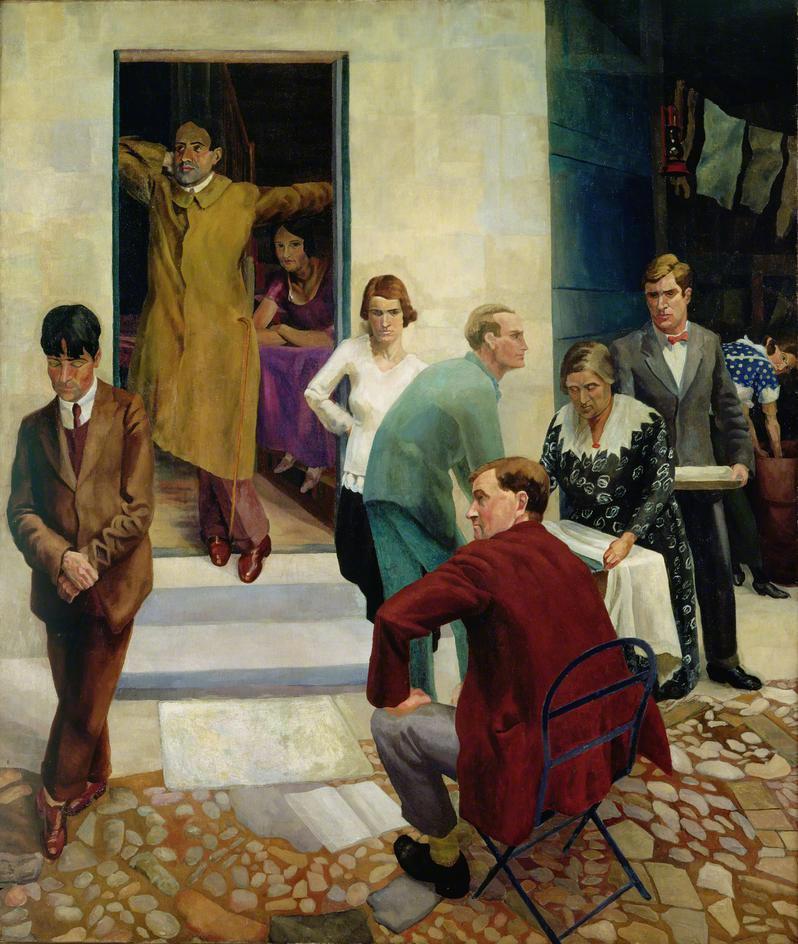
Gathering on the Terrace at 47 Downshire Hill, (1925) by Richard Carline
If you go back to My Daily Art Display for August 5th and the painting by Sir Stanley Spencer, you will find a mention of Richard Carline, as Spencer married his sister Hilda. Richard Carline was born in Oxford into a family of artists. It was an artistically talented family. Richard Carline’s parents, George and Annie Carline were both artists who married in 1885 and had five children and the three youngest of these Sydney, Hilda and Richard all became respected painters.
Richard Carline’s works included landscapes and portraits, often of his contemporaries. In 1913 Richard Carline enrolled at the Percyval Tudor-Hart’s Académie de Peinture et de Sculpture, in Paris. Following a short period teaching, Carline served in World War I where he was appointed an Official War Artist. Along with his brother he became well-known for his war pictures from the air. In the 1920’s, the Carlines’ Hampstead home at Downshire Hill became a focus point for artists such as Henry Lamb, John Nash, Stanley Spencer and Mark Gertler who would have regular meetings there to discuss the arts. It was during this time that Carline was clearly influenced by Stanley Spencer, transforming everyday scenes into something monumental. Unlike Spencer, Carline achieved this without actually exaggerating figures or their gestures to the degree that Spencer did. In 1924 he started a five year stint teaching at the Ruskin School of Drawing at Oxford. His first solo exhibition came about in 1931 at the Goupil Gallery in London. During the Second World War Carline supervised camouflage of factories and airfields. When the war was over, he was involved in helping to found the Hampstead Artists’ Council in 1944. In 1946-47 he was appointed as the first Art Counsellor to UNESCO, and from 1955 to 1974 was chief examiner in art for the Cambridge Local Examinations Syndicate. He also published a number of books including Pictures in the Post: the Story of the Picture Postcard, 1959; Draw They Must, 1968; and Stanley Spencer at War, 1978. The latter, I bought off eBay last week !!
Richard Carline died in 1980 aged 84.
The Carline family home, which George and Annie Carline bought in 1916, was 47 Downshire Hill in Hampstead, London and it was here that many artists would meet and discuss art, politics, religion and life in general. One of the regular visitors, the Australian-born British painter, Henry Lamb, described the artistic meetings as a veritable cercle pan-artistique. Many of the group would embark on painting holidays together.
My Daily Art Display featured painting today by Richard Carline, entitled Gathering on the Terrace at 47 Downshire Hill, Hampstead, shows one such meeting of the Downshire Hill Circle. The painting was judged as one of Carline’s most impressive works. Before us we have a group portrait. From left to right we have Stanley Spencer, James Wood, Kate Foster, Hilda Carline (later to become Mrs Stanley Spencer), Henry Lamb, Richard Hartley, Annie Carline and Sydney Carline. Richard Carline was meticulous in his preparations for this work. He painted an oil study of each of the group before slotting them into his group portrait. His 1924 preparatory oil study of Stanley Spencer for this group portrait is also a stand-alone painting of his, entitled Study of Stanley Spencer. Looking at the study one has to presume that he hadn’t quite properly calculated the height of the preparatory study as he had to add Spencer’s shoes separately alongside the figure.
What enhances this group painting is the varied but individual characterization of each person. This was not done by accident as Carline said his intention was to somehow convey the individuality of the people assembled at his parent’s house. In his own words Carline described the group portrait:
“… [I] sought to convey the conflicting personalities gathered at our house – Stanley [Spencer] peering up and down as he expounded his views on this or that, James Wood hesitating in the doorway whether to come or go, Hilda absorbed in her own thoughts, Hartley sitting at ease, Lamb courteously attentive to my mother, with Sydney always helpful…”
This paintings, Gathering on the Terrace at 47 Downshire Hill, Hampstead , along with the Study of Stanley Spencer, are housed in the Ferens Art Gallery in Hull. It is a gallery I have never visited but looking at their website it is one I will put down as a “must visit” location.
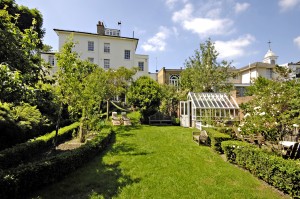
Finally, I always like to imagine what a place, depicted in a painting, looks like today. I did this with my entry about Renoir’s boathouse in his painting Luncheon of the Boating Party which I featured in My Daily Art Display of August 2nd, so I wondered what the house at 47 Downshire Hill looks like today. So below is a picture of it I found of it on the internet!
I will start My Daily Art Display today with a look at a local folklore that of the Devil’s Bridge. Like most folklore there is not simply one version of the tale but many different versions of it depending on which country the structure is situated. The first time I came across this phenomenon was when I visited Cahors in France and went to see the spectacular 14th century Pont Valentré Bridge.
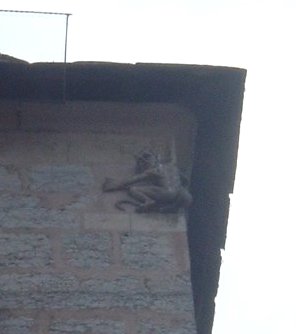
The Devil clinging to one of the towers of the Pont Valentré
Built in 1308 and completed seventy years later it became associated with the legend of the Devil’s Bridge and the architect Paul Gout made reference to this by placing a small sculpture of the devil at the summit of one of the towers.
The folklore of the Devil’s Bridge is all about the Devil, a bridge builder and his bridge. The main gist of the story is that a bridge builder sets about building a bridge across a river or river gorge, but at some point in the building of the structure the bridge builder realises he hasn’t the strength or time to complete the task and has to turn to the Devil for assistance. The price levied by the Devil for his assistance is that he should receive the first soul that crosses it.
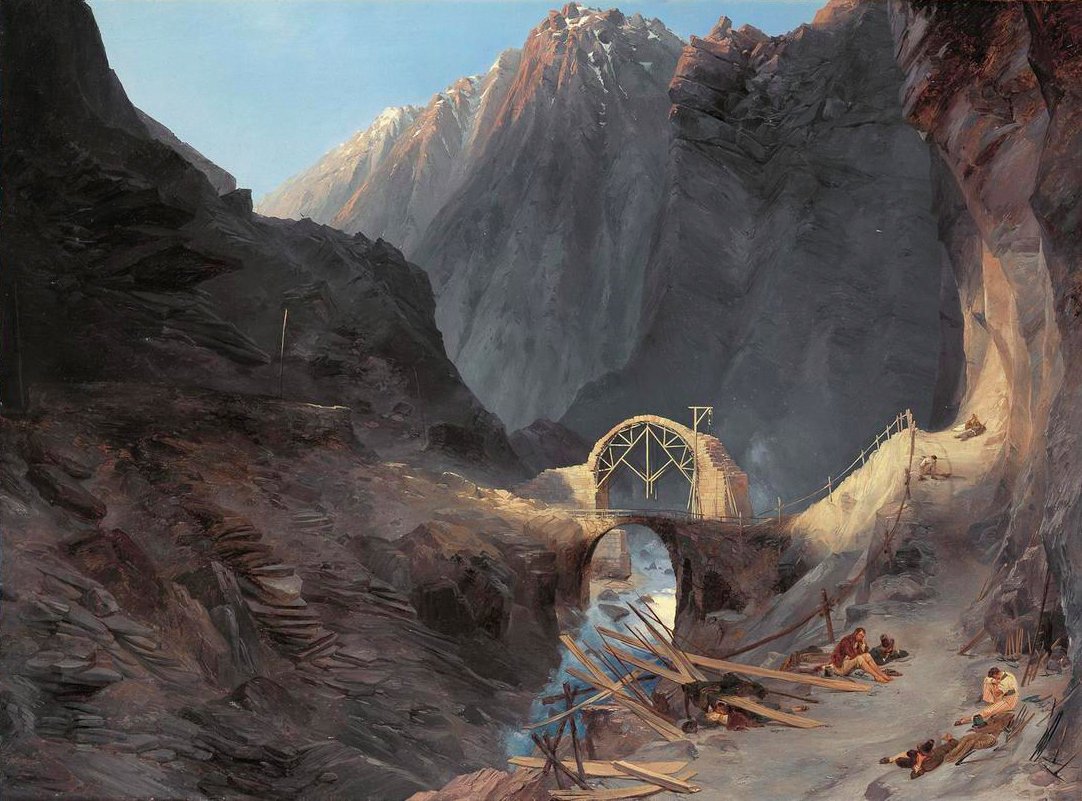
Die Teufelsbrücke by Karl Blechen
In my featured painting, Teufelsbrücke or Devil’s Bridge painted by the German Romantic artist, Karl Blechen, in 1832. In the painting we see the Devil’s Bridge straddling the Swiss River Reuss as it passes through the Schöllenen Gorge on its way to Lake Lucerne. The legend of this particular Devil’s Bridge states that the river was so difficult to cross that a Swiss goat herdsman asked the Devil to make a bridge. The Devil duly appeared, but required that if he should construct the bridge, the soul of the first to cross it would be given to him. The herder agreed, but instead of crossing the bridge first and risk losing his soul he drove a goat across ahead of him, thus tricking the devil. The Devil was so angry that he had been duped he fetched a rock with the intention of smashing the bridge, but an old woman drew a cross on the rock and this prevented the Devil from being able to lift it. The rock is still there and, in 1977, 300,000 Swiss Francs were spent to move the 220 ton rock by 127 m in order to make room for the new Gotthard road tunnel.
Karl Blechen was born in Cottbus in 1798. His father was a local tax collector and Karl started his working life as a minor bank official. It was not until he was aged twenty four that he began to study art. In 1822 he enrolled at the Akademie der Künste, Berlin (Academy of the Arts). Later when he was working in Dresden as an apprentice in an art studio he was befriended by two artists also based in the city , the German painter, Caspar David Friedrich and the Norweigen artist, Johan Christian Dahl who were leaders in the fields of art known as Romanticism and Realism. My Daily Art Display has featured some of their works and they are well worth viewing. Their styles would influence Blechen in his future works. In 1828 he travelled to Italy where he remained for a year studying art and in particular, oil painting. It was here that he was introduced to the en plein air style of painting and was influenced by the works of English landscape painter, Turner who was also in Italy at this time and by the French landscape painter, John-Baptiste Corot, who at this period in time, lived in Italy. He returned to Germany and in 1831 and was awarded a professorship at the Berlin Academy. Despite this academic recognition the sales of his work were disappointing and this depressed him. His depression and mental state deteriorated and four years later, at the age of thirty-seven he was diagnosed as being mentally unstable. Blechen died in 1840 in Berlin, a broken man, aged forty-two.
When Karl Blechen visited Italy his journey fostered an interest on visual phenomena and how light and colour effects landscapes. A number of his paintings were categorised as being of a Romantic genre. The Romantic artists, of which Blechen was one, applauded individualism, subjectivism, irrationalism, imagination, emotions and nature – emotion over reason and senses over intellect. Whilst Blechen was returning back to Germany he travelled along the St Gothard’s pass and the Teufelsbrücke was still being built. This Devil’s Bridge depicted by Blechen in his painting is enclosed by snow-capped mountains which soar into the sky and below them we can see the raging torrents of the Reuss River. I think what I like most about this painting is the beautiful way in which Blechen has depicted the sunlight penetrating a gap in the mountains to light up the bridge and some of its builders. It is as if somebody has switched on a spotlight to illuminate the scene. In the central mid ground we see the arch of the old bridge and the partly constructed arch of the new one with its scaffolding. The illuminated partly-built new arch is dwarfed by the mountains and one wonders whether its frailty and exposed position will be able to withstand the forces of nature when gale force winds relentlessly charge down the valley. There is also a sensation of remoteness about the scene. We are aware that we are miles from civilisation but can marvel in the savagery of nature. In the right foreground we see some of the bridge builders taking a well earned rest from their labours amongst all their building materials.
Karl Blechen has managed to create an image which is both awe-inspiring and beautiful and one which makes us realise how small we are in comparison to our surroundings. This awesome painting by Karl Blechen, which I have featured today, hangs in
the Bavarian State Picture Collection housed in the Neue Pinakothek in Munich.








 my daily art display