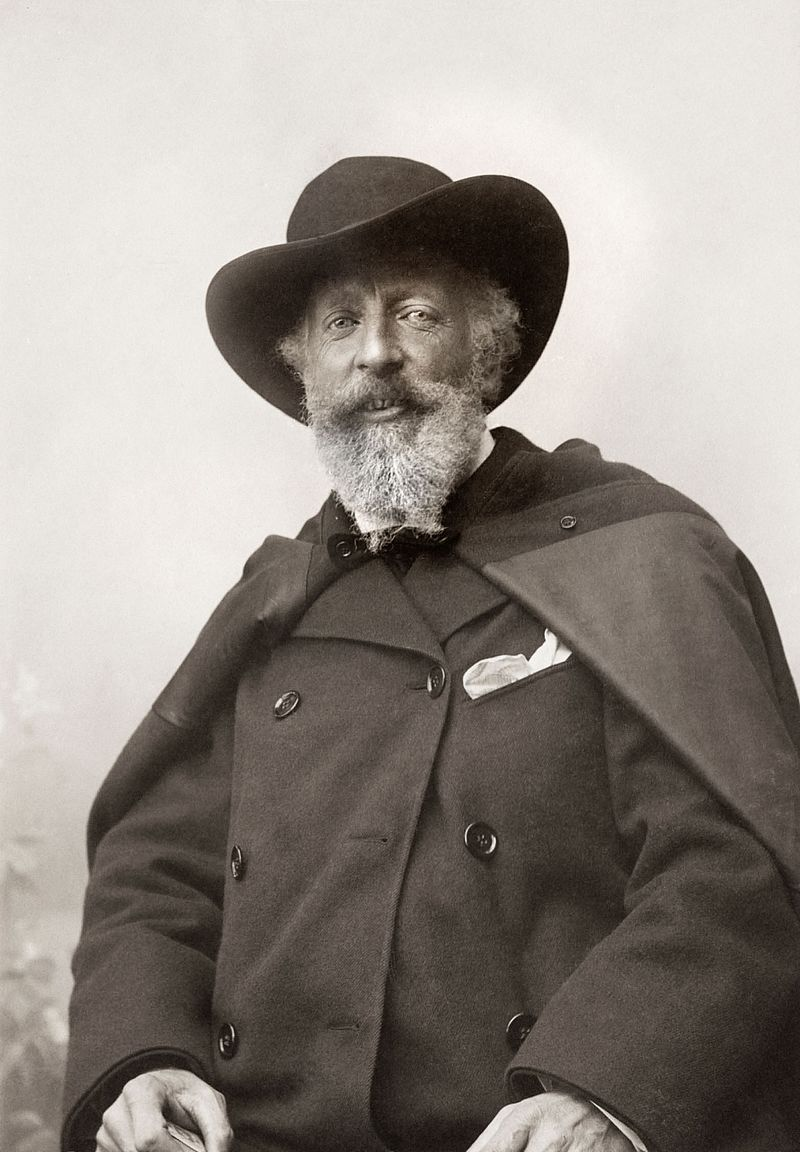
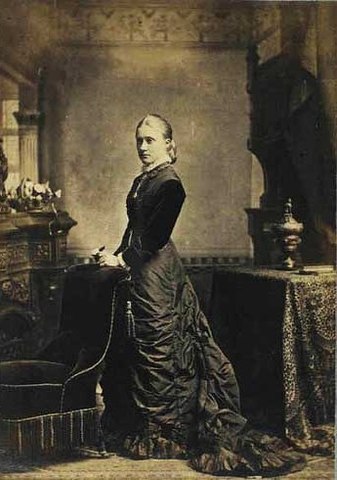
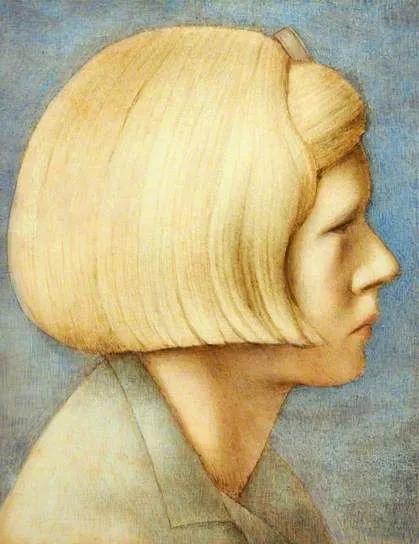
Holger Drachmann

The Artist, the Poet, the Lover of Women.

Holger Drachmann

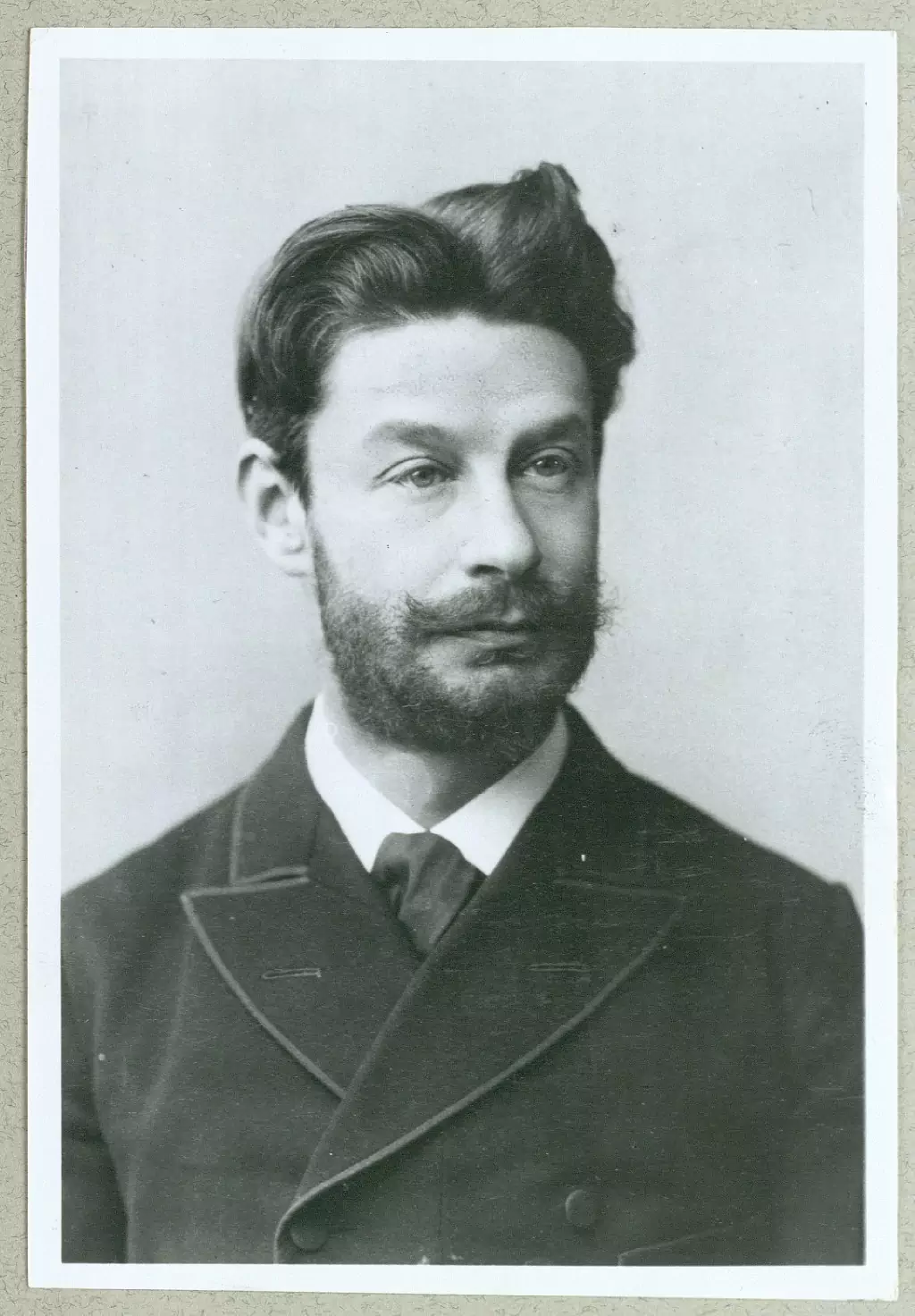
The subject of this week’s blog is the nineteenth century Danish poet, dramatist and painter Holger Drachmann. Holger Henrik Herholdt Drachmann was born on October 9th, 1846 in Copenhagen. He was the son of Andreas Drachmann and his wife Vilhelmine.  Holger was one of five children, having an older sister, Erna and three younger sisters, Mimi, Johanne and Harriet.

Andreas Drachmann

His father. Andreas, initially trained as a barber whilst studying for his medical exams. In 1831 he was an assistant to a surgeon in the Danish navy and eventually passed his exams to become a surgeon in 1836.  He left the navy in 1845 and became a physician at Langgaard’s orthopaedic institute and in  1859 he founded the first institute of medical gymnastics in Copenhagen.

Coastal party north of Årsdale, by Holger Drachmann (1869.)

In March 1857, when Holger was ten years old, his mother Vilhelmine died.  She was just thirty-six years old.  Once he completed his schooling in 1865 he went to University where he remained for three years.  He then transferred to the Academy of Fine Arts and studied under Carl Frederik Sørensen, a noted marine painter and soon Holger developed a love for that painting genre.  Art was a great love of Holger but around this time he developed another love, a love of literature. 

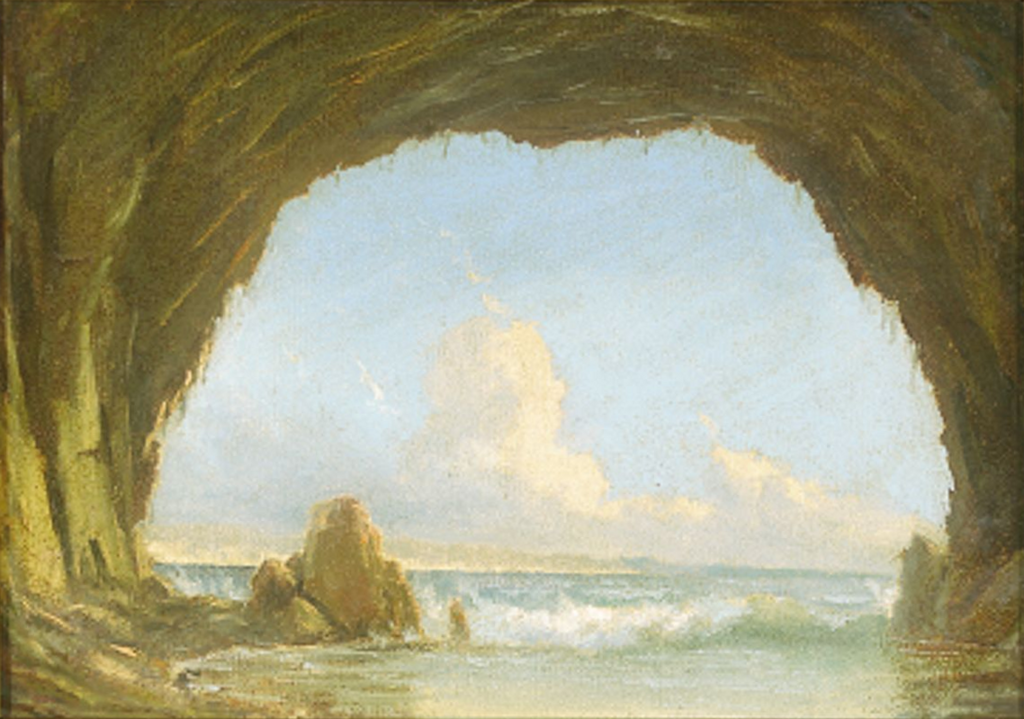
View of the island of Maïre west of the Goudes district, Marseille by Holger Drachmann

This painting above is thought to have been painted by Holger during his voyage around the Mediterranean in 1867.

Rocky Coast by Holger Drachmann

The beauty and ferocity of the sea is captured in Drachmann’s painting entitled Rocky Coast. It depicts the unstoppable waves of the blue-green sea crashing violently against a towering rock formation in the foreground of the painting.  To the left, we see heavy grey storm clouds.  It is a depiction which is devoid of figures and one’s focus is simply concentrating on the violent force of nature.  There is nothing noted as to the location of the scene but during his lifetime he visited many places, such as the Orkney Isles, and Norway, with their rocky coasts and archipelagos or it could have been locations in Newfoundland or Nova Scotia, places he visited during his long trip to North America.

Våde ovn, Bornholm. by Holger Drachmann

To further his interest in marine painting, Holger went to stay on the island of Bornholm.  This Danish island is located in the Baltic Sea, to the east of mainland Denmark, and south of Sweden.  It was here he painted a number of seascapes. One of his Bornholm paintings depicted Vade Ovn, a notable rock or group of rocks attached to the underlying bedrock. It is a grotto, part of the area known as Helligdomsklipperne.

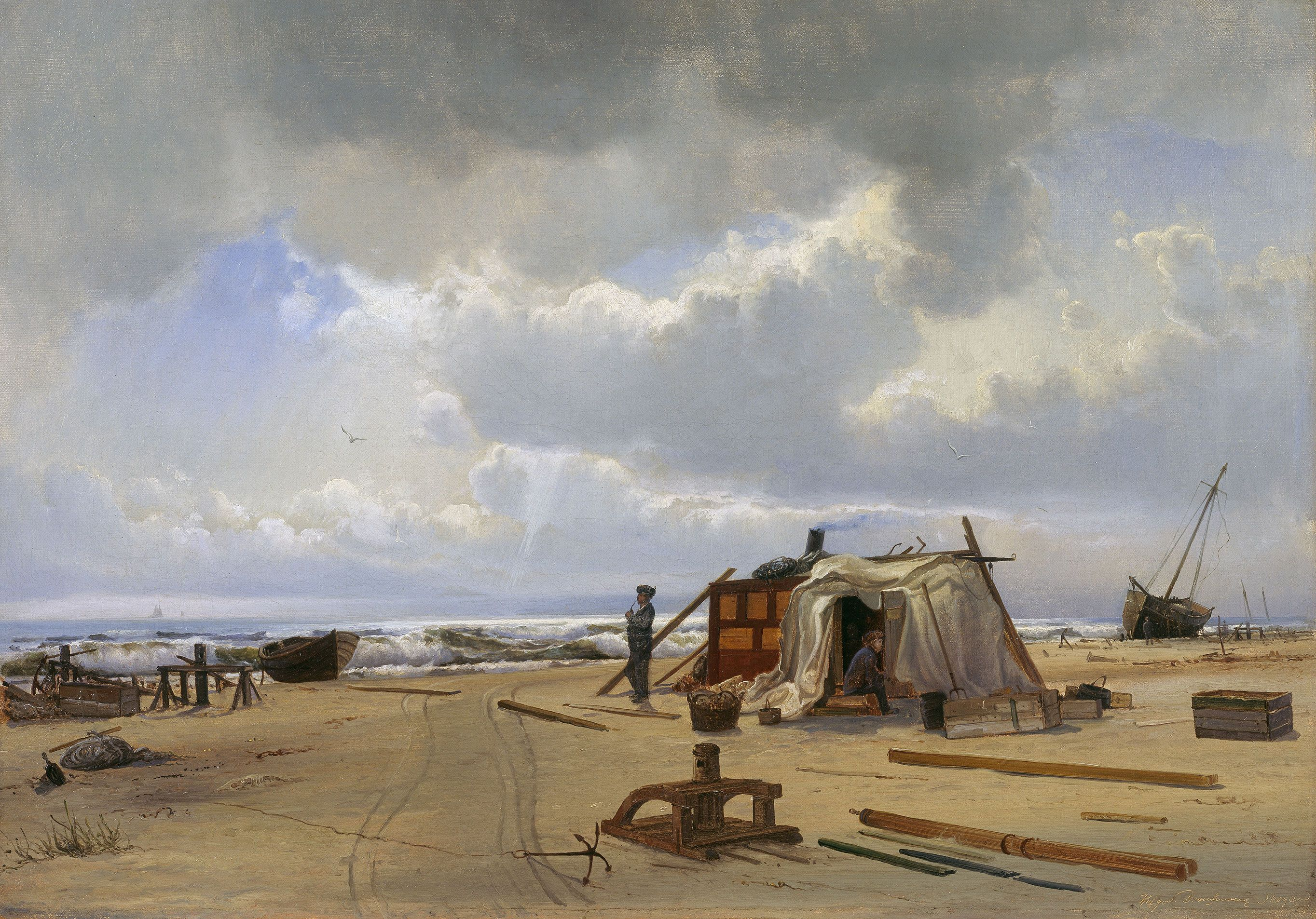
A wreck hut on Skagen’s beach by Holger Drachmann

The Skagen artists’ colony is now as famous as the ones at Barbizon or Newlyn and Holger Drachmann was an important figure in the history of the Skagen artists’ colony, for it was he, who first arrived there in 1872 together with Norwegian Frits Thaulow, and he then persuaded many artists to go there with him during the following years. He fell in love with the area with its  breath-taking nature and the simple life it afforded people.

View from Knippelsbro with the Sugar Factory by Holger Drachmann
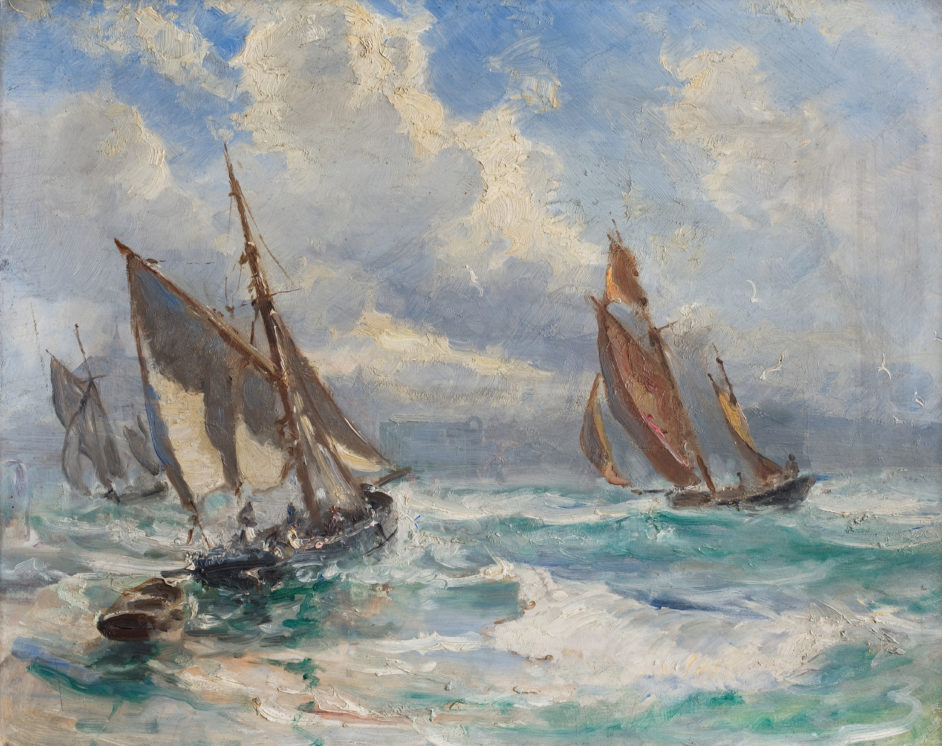
Fishing boats in Stormy Weather by Holger Drachmann

Besides his love of painting and fame as an artist, Holger Drachmann had two other great loves. He had the love of literature and poetry and was a renowned poet. He was part of the Scandinavian Modern Breakthrough Movement which was a movement of naturalism and which debated the literature of Scandinavia, which replaced romanticism near the end of the 19th century.

Georg Brandes

Around 1870, Drachmann became motivated by the writings of the Danish critic and scholar Georg Brandes, who had greatly influenced Scandinavian and European literature.  It was a time when art became secondary to literature in Drachmann’s life.  He had travelled quite extensively around England, Scotland, France Spain and Italy and had started a habit of sending accounts of his travels to the Danish newspapers. 

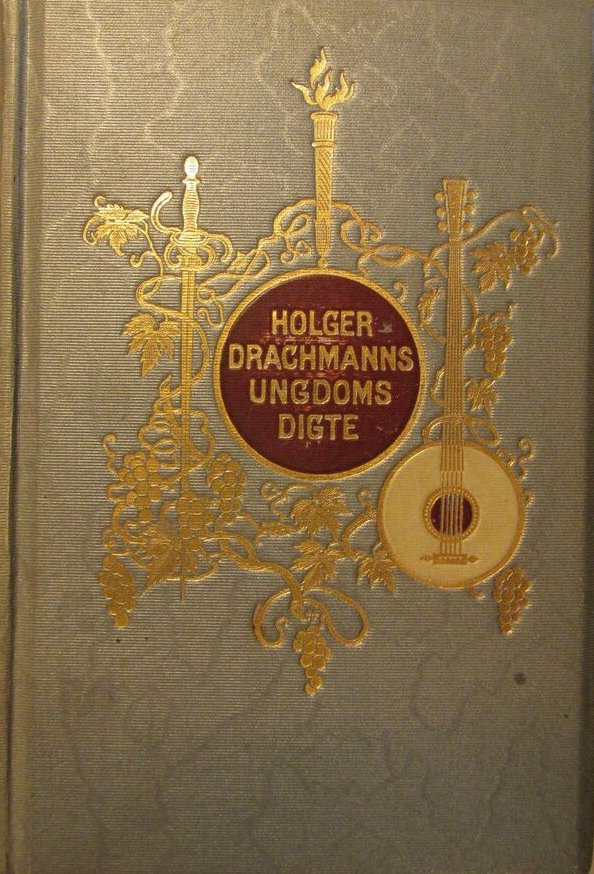
Digte (Poems)

Drachmann made his debut in 1872 as a prose writer with the collection With Coal and ChalkIn and that same year he had a book of his poems entitled Digte (Poems) published. He also joined the group of young Radical writers who were also followers of Brandes.  For Drachmann it was a time of contemplation and soul searching as to whether painting or writing would be his prime driving force. Drachmann established his position as the greatest poet of the Danish modern movement of his time with such collections as Dæmpede Melodier (1875; “Muted Melodies”), Sange ved Havet (“Songs by the Sea”) and Venezia (both 1877), and Ranker og Roser (1879; “Weeds and Roses”). The prose Derovre fra Grænsen (1877; “From Over the Border”) and the verse fairy tale Prinsessen og det Halve Kongerige (1878; “The Princess and Half the Kingdom”), demonstrated a patriotic and romantic trend that brought him into conflict with the Brandes group.   Drachmann was one of the most popular Danish poets of modern time though much of his work is now forgotten. He unites modern rebellionist attitudes and a really romantic view of women and history. 

Kristian Zahrtmann – Portrait of Vilhelmine Erichsen (1867)

Earlier I said that Drachmann had two great loves other than his art. He loved writing and poetry as I have just recorded but his other great love was women !

Whilst on the island of Bornholm in 1869, Holger Drachmann met his first wife Vilhelmine Charlotte Erichsen, She had been a good friend and muse for both Drachmann and another artist, Kristian Zahrtmann who was also living on Bornholm and who had painted her portrait when she was fourteen-years-old.   Zahrtmann was besotted with the young girl who modelled for him.  In a letter in 1868 to his friend and fellow artist August Jerndorff ,  he wrote:

“…I have had a young girl of mine of mine painting who interests me greatly. An adorable child – she is 16 years old – cannot be seen; After all, she is at an unfortunate age for most people, to which is added an extraordinary height and width, a short neck and stooped posture, but these are flaws that only all the more accentuate her beauty. A more regular face is unthinkable- – Her hair and eyes are almost black, her mouth bulging, and the pale yellow color, with its vexing and the utterly regular, narrow eyebrows, becomes so southern and melancholic dreamy that I can be so seized by it that the brush shakes in my hand. She herself does not know that she is beautiful, on the contrary, I think that she considers the yellow-laden color hideous, and at all she knows very little, both of knowledge and of what life is and gives…”

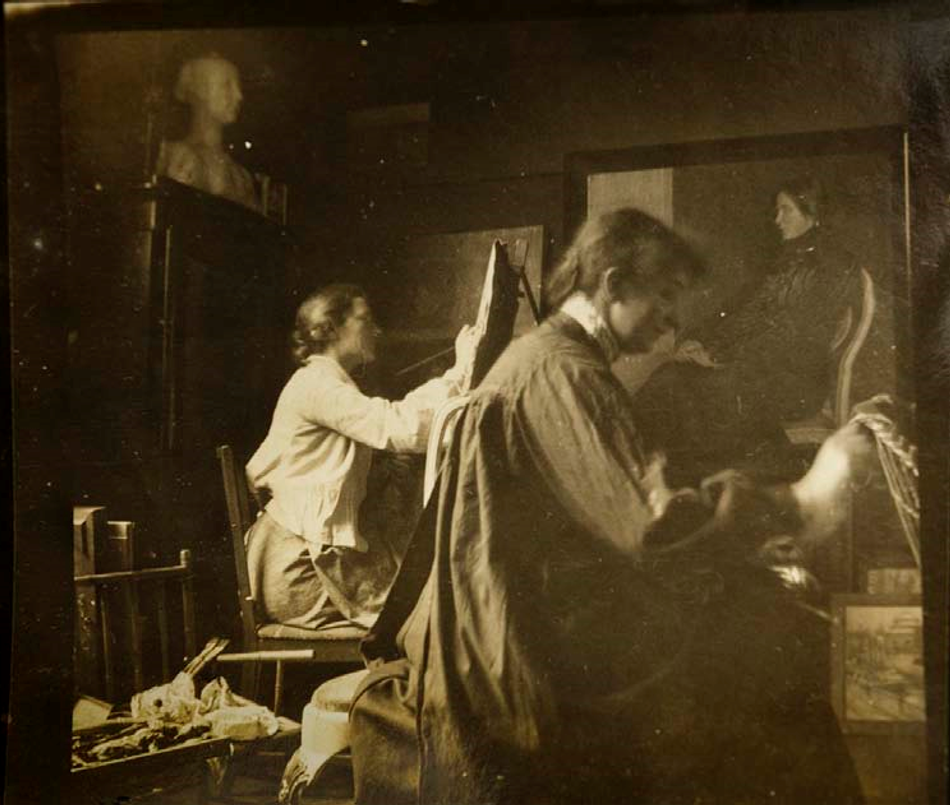
Marie Henriques (on the left) and Eva Drachmann painting, probably at the Art School for Women in Copenhagen, (c.1900)

But three years later, in 1869, when she was seventeen, Vilhelmine fell in love with twenty-three-year-old Drachmann and they got engaged.  Two years later, on November 3rd 1871 Holger and nineteen-year-old Vilhelmine married  in Gentofte Sogn, København.  To be able to marry Vilhelmine had to lie about her age, declaring that she was twenty-one.   Holger was twenty-five years old and so did not need her parents’ permission for the marriage.  On November 4th 1874 they had a daughter, Eva, but at the end of that year, they separated and finally divorced in 1878. It was a bad-tempered divorce and in a fit of rage Vilhelmine destroyed all correspondence and manuscripts from Holger that she possessed. Eva Drachmann wrote about her mother and father in her 1953 book Vilhelmine, my mother:

“…They divorced after 4 years of marriage. As the poet’s muse, Vilhelmine had entered into a cohabitation of whose seriousness and difficulties none of them had the slightest concept. Of the two, she was the largest child. She didn’t have time to grow up before it was all over. As an old woman, she reflected on how fateful the disaster came………. After all, in childhood and growing up, she had done nothing useful – nothing but dream…”

Eva Drachmann married for the first time in 1899 and the ceremony was held in a local manor house as the parish priest of the local Flade Church, refused to marry the couple in the parish church, citing Eve’s father’s godless lifestyle.

Polly Culmsee

Around 1866, three years before he met his first wife, Vilhelmine, Holger Drachmann had struck up a friendship with Valdemar Culmsee, the son of Frederick Culmsee, the owner of the Havreholm Paper Mill on the Danish island of Zealand.  It was during a visit to their home in 1866 that he met Emmy Culmsee, Valdemar’s twelve-year-old sister and her older sister Polly who was sixteen. Polly had later married Charles Thalbitzer and had two children with him but around the time Holger Drachmann and his wife had separated in 1874 she had a relationship with Holger and had his child, Agnes Gerda.  Polly eventually divorced her husband and she and Holger left Denmark for Sweden because of the social scandal they had created in Copenhagen.  They intended to be married in Paris when Drachmann was legally divorced from his wife. Now living in the Swedish town of Lund, Polly fell ill and Drachmann took her to a local doctor, Alphons Theorin, and sought his help with the care of Polly. Bizarrely, Polly transferred her affection from Holger to the doctor who in turn fell passionately in love with his patient which created yet another scandal as the doctor abandoned his wife and their three children and ran off with Polly to the central Swedish town of Sveg, where he managed to arrange a position as a provincial doctor.

Emmy Culmsee

The bizarre story of Holger Drachmann love life does not end there.  Polly’s younger sister Emmy had moved with her parents to Kristiania, where she stayed until she travelled to Hamburg in 1876 to study languages and it was in this German city that she once again met Holger.  He told her he was devastated by a relationship break-up and she was very comforting.  However he failed to impart to her that the relationship had been with her married sister, Polly. On finding out about the involvement of her sister she broke off with Holger and settled into a life as a German language teacher.  However, in 1878 whilst on holiday in Hamburg, out of the blue, she received a call from Copenhagen from Holger Drachmann’s married sister Erna Juel-Hansen. She told Emmy that Holger had suffered a breakdown when Polly left him.  Emmy went to Copenhagen and cared for Holger and nursed him back to full health.  Emmy and Holger married and they adopted his and Polly’s daughter, Agnes Gerda.  Emmy and Holger went on to have four more children of their own. 

Amanda Jensine Nielsen (Edith)

Sadly in 1887 Holger, for whatever reason, began an affair with Amanda Jensine Nielsen a cabaret artist in Copenhagen, despite the fact that he was married and twice her age.  He and Amanda became lovers and he would refer to her as Edith.  He even mentioned her in his 1890 novel Forskrevet, a depiction of Denmark in 1880 and the then political dispute between Right and Left, as well as the cultural dispute between citizen and bohemian

Holger Drachmann by Peder Severin Kroyer

Eventually Holger grew tired of his affair with Edith and moved on to another young actress.  His many scandalous affairs with his “muses” were often the fuel of his inspiration.  On his deathbed he said that his two biggest muses were Vilhelmine and Edith.

Drachmanns Hus in Skagen

Holger Drachmann died in Copenhagen on January 14th 1908, aged 61.   He is buried in the sand dunes at Grenen, near Skagen and following his death his Skagen home, Drachmanns Hus, became a museum.

Rudolph von Alt

Self-portrait (1890)

The focus of my blog today is to look at the life and work of the nineteenth century Austrian painter Rudolph Ritter von Alt.  The word “Ritter”is used as a title of nobility in German-speaking areas.  It translates approximately to the British designation “Sir”, denoting a Knight.  It is not a first or middle name of the person.  The artist was born Rudolph Alt and used the title of a Ritter after he gained nobility in 1889.

View from the Artist’s Studio in Alservorstadt toward Dornbach by Jakob Alt (1836)

Rudolph was born in Vienna on August 28th 1812.  His father, Jakob Alt, the son of a carpenter, was a German landscape painter and lithographer who was born in Frankfurt am Main in 1789 where he received his first artistic tuition and later moved to Vienna where he enrolled at the city’s Academy of Fine Arts.  Jakob Alt travelled through Austria and Italy, hiking through the Austrian Alps, all the while painting scenes of beauty. He also depicted many scenes of the neighbourhood along the River Danube and in the city of Vienna.

Room of Archduke Ludwig Victor in the Hofburg, Vienna by Franz Alt (1861)

Rudolph Alt had a younger brother, Franz, who was nine years his junior and who also became a famed Austrian landscape painter. His work can be seen in the collection of the Metropolitan Museum of Art, the Cooper Hewitt Museum (Smithsonian), the Albertina Museum, the Museum of Fine Arts, Budapest and other international collections.

The Dachstein Mountain from Lower Lake Gosau by Rudolphe von Alt (1838)

Rudolphe, like his father before him, went on many hiking-trips through the Austrian Alps and northern Italy and fell in love with the spectacular landscapes he witnessed.

View of the Strada Nuova against the Giardini Pubblici in Venice by Rudolph von Alt (1834)

 In 1833, he travelled to Venice where he pictorially recorded his visit. He was inspired by the city of Venice and took the opportunity to visit neighbouring areas as well as the Italian capital, where he completed a number of architectural paintings

The Capitol in Rome by Rudolphe von Alt (1835)

Rudolphe von Alt was a talented watercolourist and during his journeys around Italy he completed many watercolours featuring various Italian cities.

Port of Santa Lucia, Naples by Rudolphe von Alt (1935)

In 1830, five years before he took the throne, Emperor Ferdinand I of Austria started to develop a plan which entailed the commissioning of paintings depicting the most beautiful views of the Austrian Empire. Jakob Alt, and his eldest son, Rudolf were two of the commissioned artists and between them they painted about one hundred and seventy of the three hundred completed works.  The project came to an end in 1849 a year after Ferdinand abdicated.

The Josef square in Vienna by Rudolphe von Alt (1831)
The St. Stephen’s Cathedral in Vienna by Rudolphe von Alt (1831)
View of Salzburg by Rudolpe von Alt (1831)

Der Hohe Markt in Wien  by Rudolphe von Alt (1836)

Rudolphe’s watercolour depictions of interiors of wealthy patrons’ residences brought him more recognition from the Austrian public

Interior at Palais Windischgrätz in Renngasse in Vienna by Rudolphe von Alt (1848)

Salon in the Apartment of Count Lanckoroński in Vienna by Rudolphe von Alt (1881)

The library in the Palais Dumba by Rudolphe von Alt (1877)
The Blue Drawing Room at the Valtice Palace by Rudolphe von Alt (1845)

The grandeur of the interior of many palaces was captured by Rudolphe in his magnificent watercolour paintings. Originally the Gothic Valtice palace was founded in the 12th century by the bishops of Passau and in 1530 Valtice became the place of residence of the princely family of Liechtenstein, one of the wealthiest families in Europe. 

Drawing Room at the Rasumofsky Palace by Rudolphe von Alt (1836)

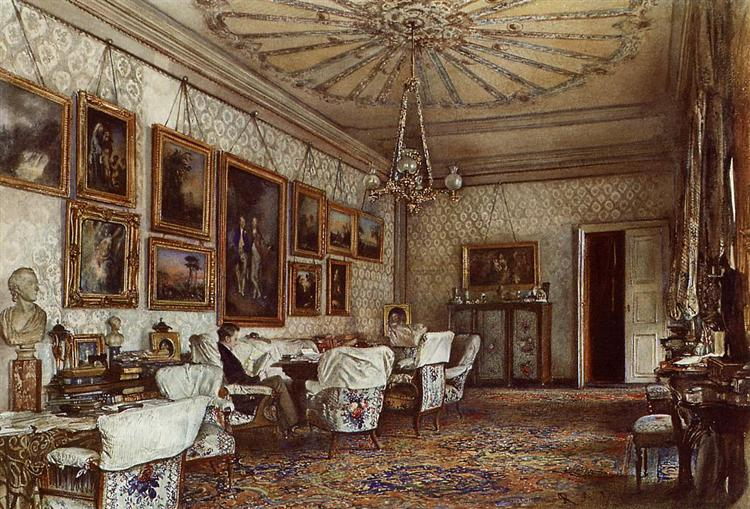
A less formal room was captured by Rudolphe von Alt in his 1836 watercolour entitled Drawing Room at the Rasumofsky Palace. The palace was commissioned by Prince Andrey Razumovsky  as a Neoclassic embassy which would be worthy of the representative of the Russian Tsar, Alexander I. It was built at the prince’s own expense on Landstraße, close to the centre of Vienna. Razumovsky then filled the rooms of the palace with antiquities and modern works of art.

The Staircase of the State Opera Thatre, Budapest by Rudolphe von Alt (1873)

A large number of Rudolphe von Alt’s paintings are held in the Princely House of Liechtenstein collections in Vaduz, Liechtenstein and Vienna.  The Princely House of Liechtenstein is one of the oldest noble lineages in Europe being first mentioned in the twelfth century.  The Princely House of Liechtenstein is one of the oldest still extant noble lineages in Europe. The first documented bearer of this name was a Hugo von Liechtenstein, mentioned in archival sources dating to between 1120 and 1143.

View from the Klausen Valley to Modling Castle by Rudolphe von Alt (1827)

The family’s art collection had its beginnings in the sixteenth century and has been influenced over time by the varying interests of individual princes.  The collection has been assembled over several centuries, and now the Collections of the Prince von und zu Liechtenstein are one of the most important private art collections in the world, containing around 1,600 paintings with masterpieces ranging from the early Renaissance to the second half of the nineteenth century, including works by Lukas Cranach the Elder, Quentin Massys, Raphael, Peter Paul Rubens, Anthony van Dyck, Frans Hals, Rembrandt, Ferdinand Georg Waldmüller, Friedrich von Amerling and Hans Makart and today’s artist, Rudolphe von Alt,

Organ Base by Master Anton Pilgram in St Stephen’s Cathedral, Vienna by Rudolphe von Alt (1876)

Alt demonstrated a remarkable talent for expressing certain peculiarities in nature. He managed to paint nature authentically by focusing on the different hues of sky, the colour-tone of the air and the vegetation.

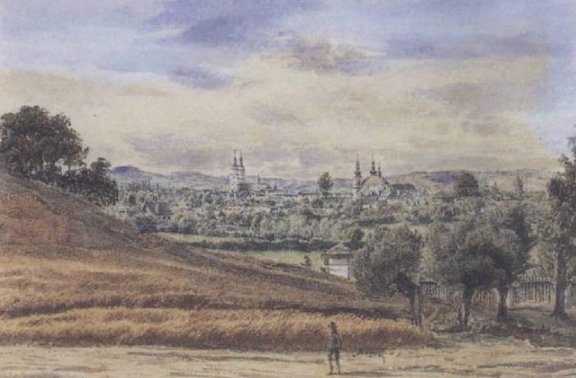
Ansicht von Jägerndorf mit ländlicher Staffage by Rudolphe von Alt

His later works were more Impressionistic in style but maybe above all von Alt will be remembered for his exquisite architectural and indoor scenes, genres that made him famous in Vienna.

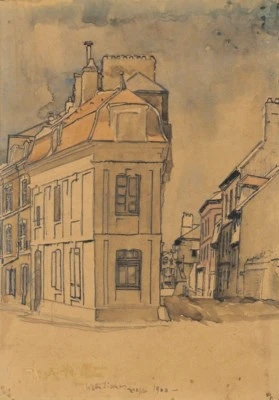
Alservorstadt, Vienna

Rudolphe Ritter von Alt died in Vienna on March 12th 1905, aged 92. Most of his paintings are held by various museums in Vienna.

Carl and Karin Larsson. Part 2.

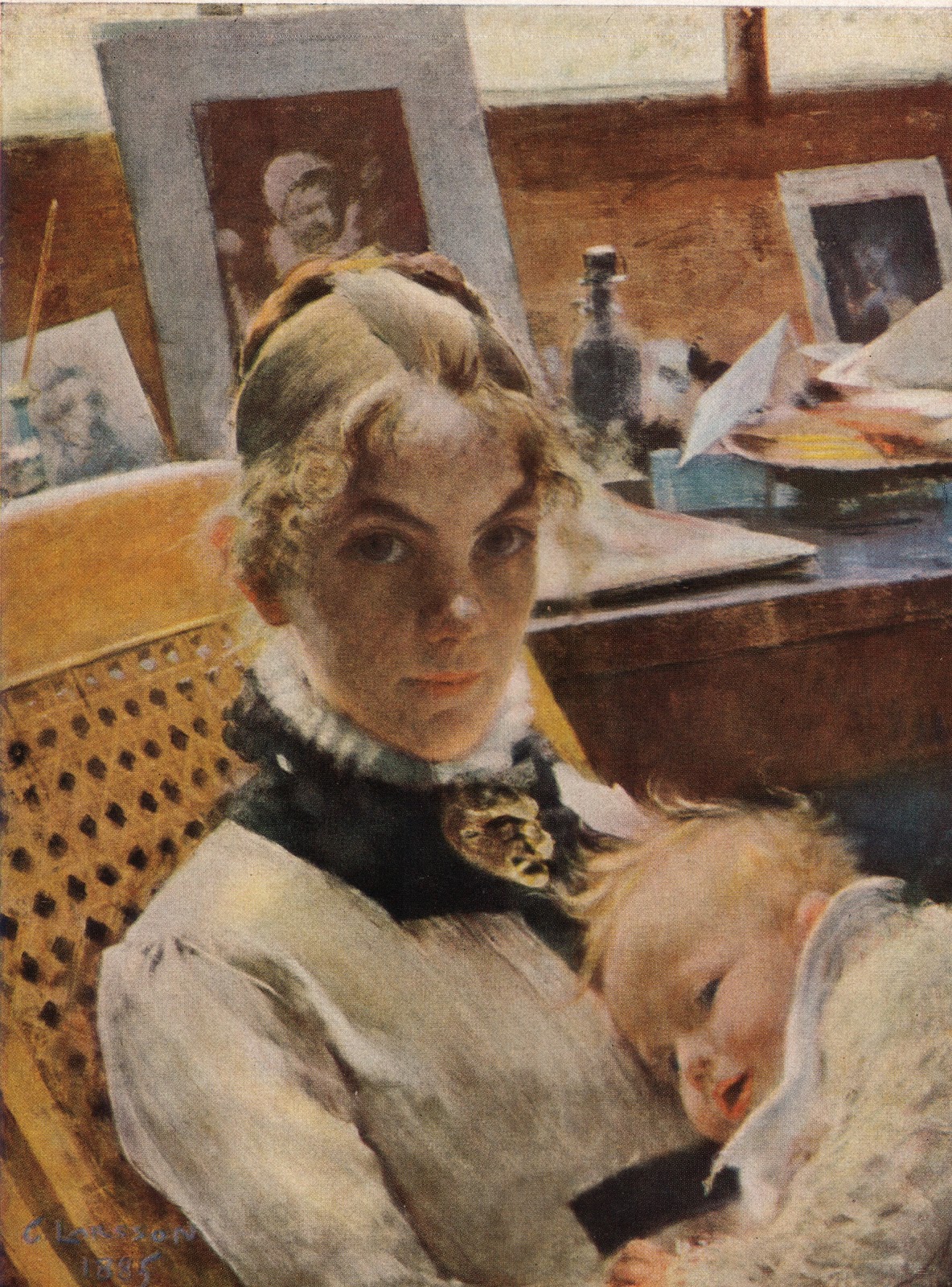
Karin Larsson with her firstchild, Suzanne (1885)

Carl and Karin Larsson married in late 1882 and in 1884 their first child, Suzanne was born.  Their second child, a son Ulf, was born in 1887 but sadly died when he was eighteen. In all, Carl and Karin had eight children.  After Ulf came Pontus in 1888, Lisbeth in 1891, Brita in 1893, Mats in 1894 but he died aged just two months, Kersti in 1896 and finally Esbjörn in 1900.  It is quite obvious that Karin’s time was taken with the upbringing of their children.

Lilla Hyttnäs by Carl Larsson

In 1888 the couple returned to Sweden with their two children and on deciding to settle permanently in Sweden Karin’s father, Adolf Bergöö, gave them a wooden cottage in the countryside of central Sweden, which had belonged to relatives. The house named Lilla Hyttnäs, was situated in the town of Sundborn, in Falun Municipality, 250 kilometres north-west of Stockholm. 

Ett Hem by Carl Larsson

Carl remembered his first visit to the cottage accompanied by his father-in-law and in his 1899 book, Ett Hem (A Home) he wrote:

“…The cottage stood right on a bend in the Sundborn River, just where it gets a smidgeon wider. Everything inside was spick and span, the furniture was simple, but old fashioned and robust, handed down by their parents, who had lived in the vicinity. While I was here, I experienced an indescribably delightful feeling of seclusion from the hustle and bustle of the world, which I have only experienced once before (and that was in a village in the French countryside). When my Father in law suggested buying me a small property in the same village, I declined, saying that only something resembling this little idyll would suit an artist…”

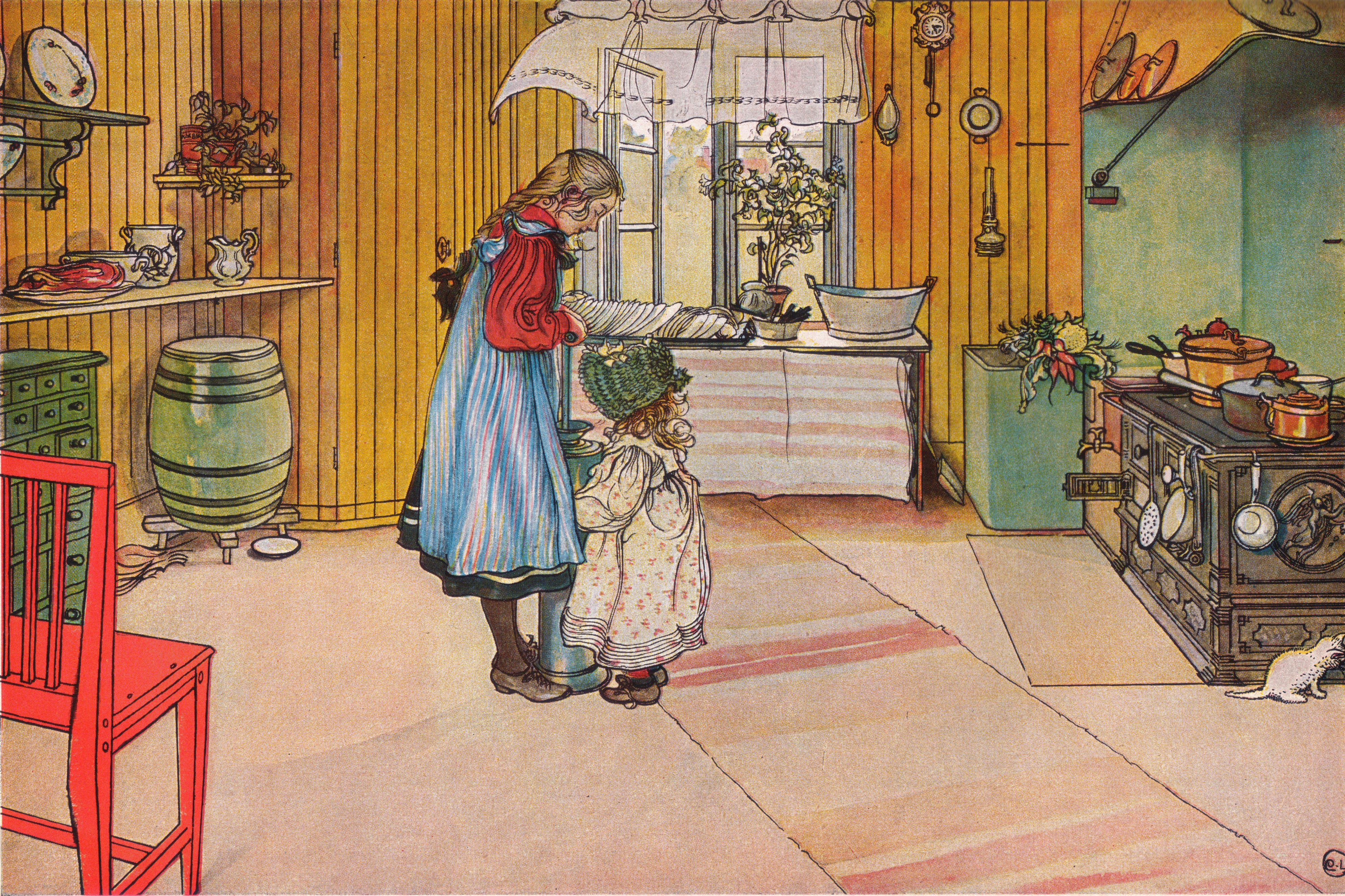
The Kitchen by Carl Larsson (1898)

Lilla Hyttnäs soon became Carl and Karin’s mutual art project in which their artistic talents found expression in a very modern and personal choice of colour schemes and interior design. The couple favoured bright colours, and filled the rooms with handcrafts, which mirrored the Arts and Crafts Movement which had inspired them.  The Arts and Crafts movement was an international trend in the decorative and fine arts that first emerged in the mid-nineteenth century in the British Isles and then spread to the rest of Europe and America.

Karin Larsson weaving.

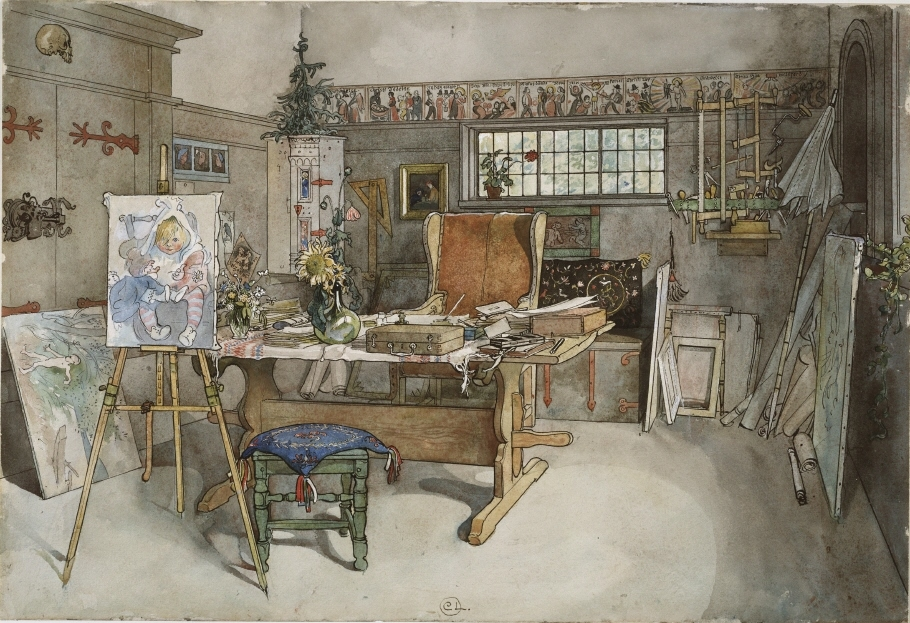
Karin Larsson was a young mother, but on top of that she was an ambitious woman who although she had stepped back from her painting, she had replaced the canvas with other artistic goals that would see her use needles, thread and silks instead of brushes and paint.  She would now concentrate on home furnishings which would brighten up the old cottage.  The cottage interior had now taken the place of the canvas.  Her great inspiration was William Morris, who was a leader of the English Arts and Crafts movement, and she liked to incorporate foliage designs across her upholstery.  Karin’s husband, Carl, created a series of twenty-six watercolours, entitled A Home which depicted the beautiful interior designs of his wife.

The Studio (From “A Home” watercolor series) by Carl Larsson

Karin Larsson spent mch time designing fabrics for their furniture. One example of this is the chair cover (below).

Chair cover designed by Karin Larsson

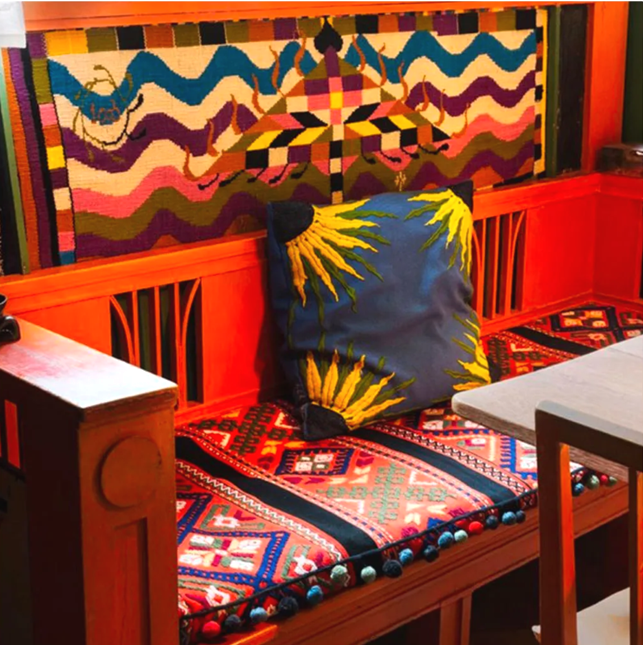
Her beautifully, highly colourful designs were used for bench cushion covers.

Bench cushion cover designed by Karin Larsson

The transition from painting to textile art and home furnishings by married females was in those days an acceptable evolution and was not seen as something forced upon them by their husbands.  In the work she lovingly put together to create their home she was able to express herself through the medium of textiles, and furniture design.

Rocking Chair designed by Karin Larsson

Karin’s life at Lilla Hyttnäs was tiring.  She had to cope with the everyday house chores and eight children to manage.  Her eighth child, a son, Esbjorn had been born in 1900.  However, she still found time to design and weave a large amount of the textiles which she utilised in her home.  She also spent time embroidering, and designing clothes for herself and the children.   The aprons, known as karinförkläde in Swedish, were worn by her and the other women who worked at the house.

Daddy’s Room by Carl Larsson

Carl Larsson’s bedroom at Lilla Hyttnäs was a through-room. The door is wide open to the end room where his wife and the smaller children slept. The white four-poster bed with embroidered curtains stands in the middle of the floor. It has several ingenious features, such as a bench, a chamber-pot cupboard and a small, built-in bedside table. Look closely at the background and you will see that this is also a self portrait as we can just observe the artist, looking in a mirror, doing up his collar buttons.

Cosy Room by Carl larsson

The interiors of the Larsson home were characterised by rural simplicity. Nevertheless, every detail was carefully designed, with influences from England, Scotland and Japan.

The Kitchen by Carl Larsson

The kitchen, which was first and foremost a place for household chores, did not display the same modern interior style and comfort as the rest of the house.

Through Larsson’s paintings and books their house has become one of the most famous artist’s homes in the world. The descendants of Carl and Karin Larsson now own this house and keep it open for tourists each summer from May until October. The rooms of the house featured in many of Carl’s paintings and books.

Self portrait in New Studio by Carl Larsson

Besides depictions of their home featuring in his artwork which highlighted Karin as a talented interior designer, Carl featured his wife and children in many of his paintings.

Karin and her first child Suzanne by Carl Larsson (1887)

In 1905 Carl featured his seventh child, eleven-year-old Kersti in his watercolour work.

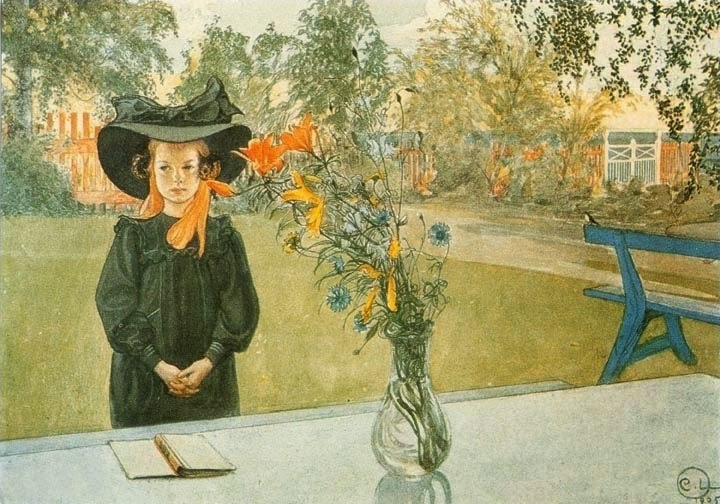
Kersti in Black by Carl Larsson (1907)

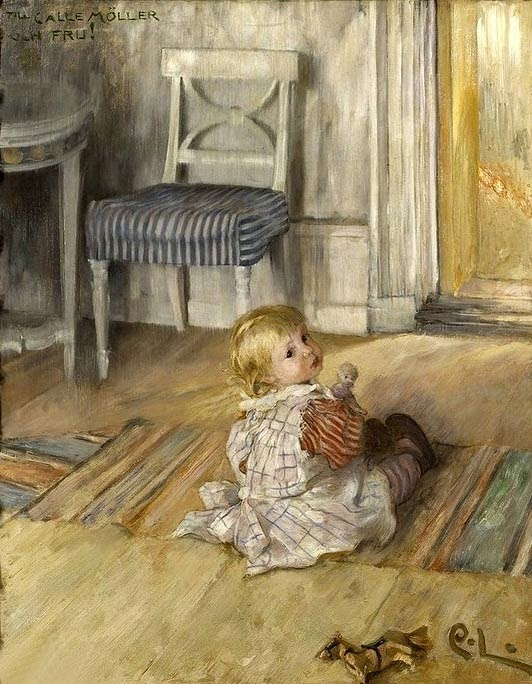
In his 1890 watercolour it was his third-born child, two-year-old son, Pontus, who featured.

Pontus on the Floor by Carl Larsson (1890)

The Christmas spirit was captured in some of his family portraits.

Brita dressed as Iduna

Carl and Karin’s fifth child, daughter Brita, was depicted as Idun or Iduna, the Norse goddess of Spring and rejuvenation.  Norse mythology tells us that Idun was the keeper of the magic apples of immortality, which the gods must eat to preserve their youth.  Iduna carried her apples in a box made of ash (called an eski), along with her fruit, and this box served as one of Idun’s major symbols. 

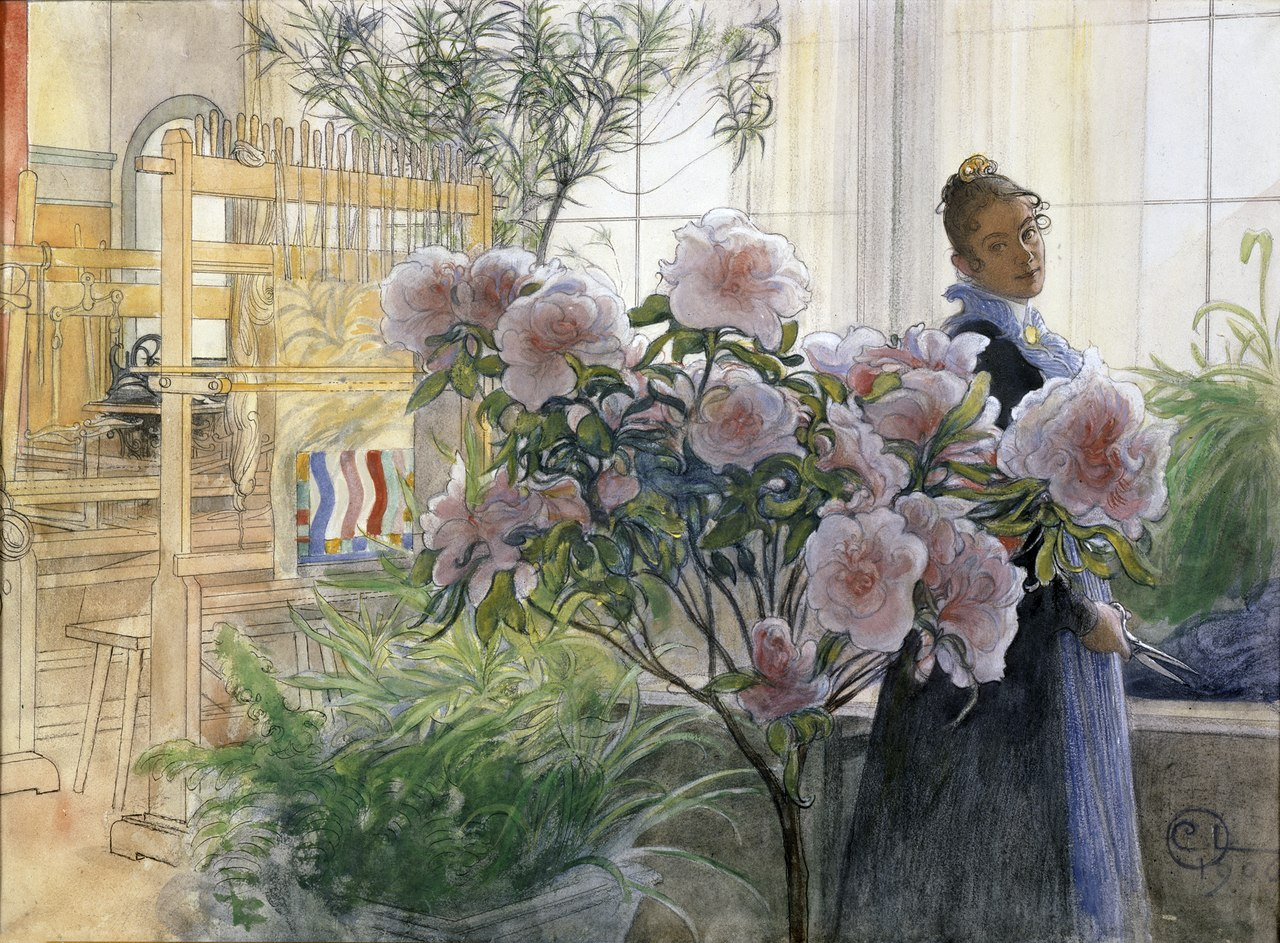
Azalea by Carl Larsson featuring his wife Karin

Carl Larsson travelled away on a number of occasions leaving the household and his children the sole responsibility of his wife.  Karin employed the carpenters and painters needed to transform Lilla Hyttnäs and was the one who made all the decisions with regards its interior.  He never underestimated the role she played in their marriage and this was evident when you look at his artwork and read his books.

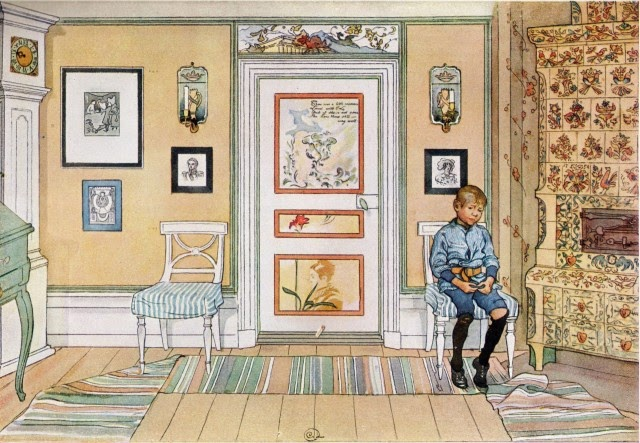
In the Corner by Carl Larsson

In his book Ett Hem, there is an amusing watercolour by Carl of his son Pontus sitting rather gloomily on his chair in an empty room.  Larsson talked about the depiction saying that he took the idea from the sight of a gloomy little boy who had been sent from the table as he had misbehaved during the family meal and had been left to deliberate on his misbehaviour whilst languishing in the beautiful room. Pontus’ bad behaviour was probably not a factor in this work but his punishment was real, that of having to sit still for such a long period whilst his father sketched the scene !  The depiction is probably more about the room itself and the combination of the striped chair covers and rugs, with the tiles of the fireplace.

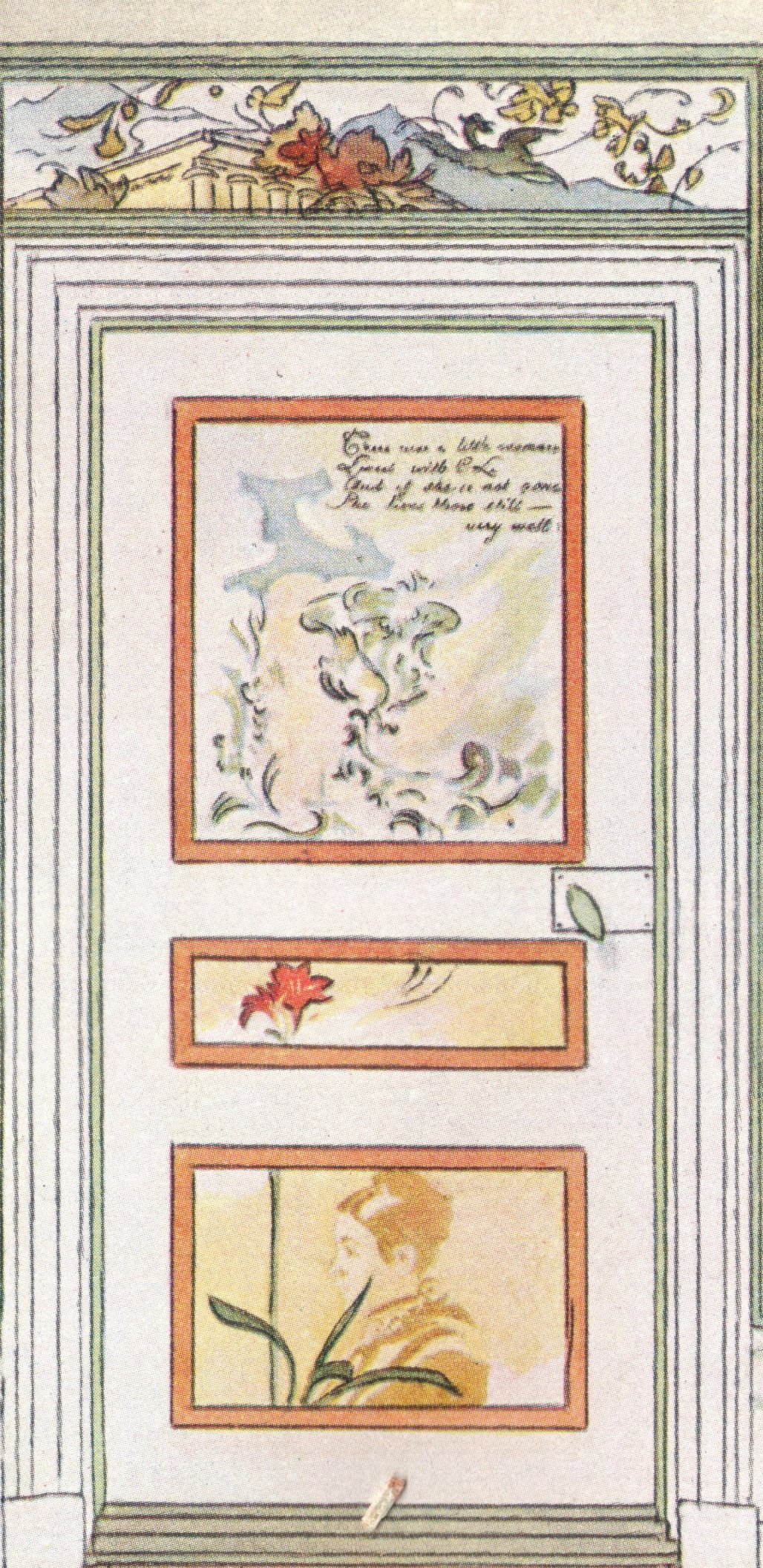
The Door

The central part of the painting is taken up by the door.  The design of which is a mix of irregularity on the lower panel whilst the panel above  is a drawing based on a poem by the English Victorian artist and writer Kate Greenaway’s poem:  There was an old woman, who lived on a  hill and changed by the artist to There was a little woman who lived with Carl Larsson.  Above the door we see decorations, and even though it was a classical temple, it is surrounded by leaves.

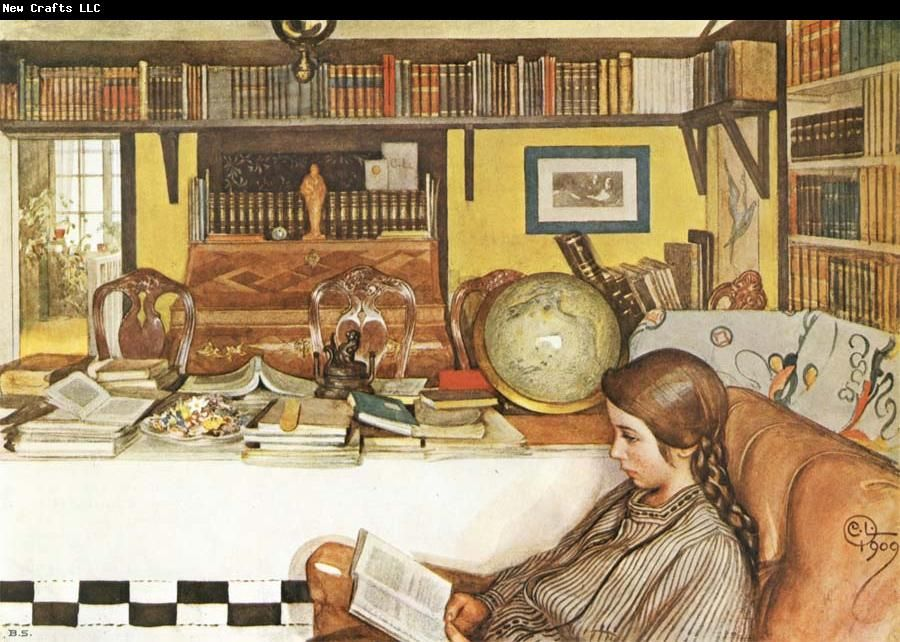
The Reading Room by Carl Larsson

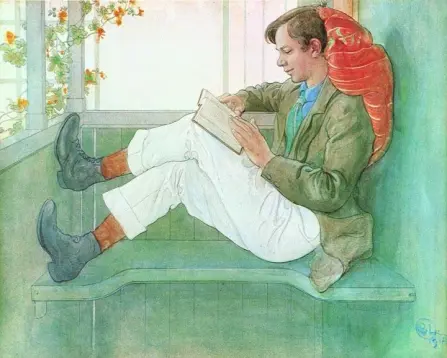
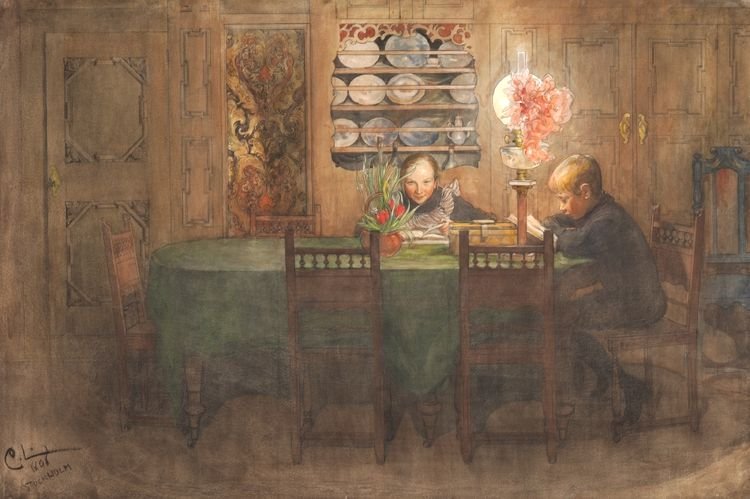
In many of his paintings featuring the interior of Lilla Hyttnäs and his family, reading was a recurring topic and was probably a means of enhancing the idea that his young family were well educated, unlike himself, during his torrid childhood.

Karin Reading by Carl Larsson (1904)

Homework by Carl Larsson

Carl and Karin Larsson’s popularity increased considerably with the progress of colour reproduction technology in the 1890s.   The Swedish publishing house Bonnier published books written and illustrated by Carl Larsson and containing full colour reproductions of his watercolours, such as Ett Hem. (A Home).

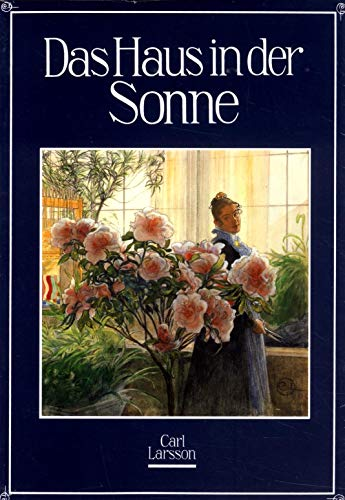
Das Haus in der Sonne by Carl Larsson

However, the print runs of these rather expensive art books were small in comparison to those published in 1909 by the German publisher Karl Robert Langewiesche.  He had chosen a number of Carl’s watercolours, drawings and text by the artist, which culminated in the publication in 1909 0f Das Haus in der Sonne (The House in the Sun), which became one of the German publishing industry’s best-sellers of the year with forty thousand copies sold in three months, and which required more than forty print runs.  Carl and Karin were delighted with the success.

 Car Larsson’s 1907 mural Gustav Vasa’s procession into Stockholm, 1523  (7 x 14 metres)
Nationalmuseum Stockholm.

For all his paintings depicting his wife, children and beloved home, all his illustrating work for books and newspapers, he considered his large-scale frescoes as his most important work.  He created frescoes for schools, museums and other public buildings.  In 1907, Larsson completed his mural of Gustav Vasa’s procession into Stockholm, 1523, which was hung with his other commissioned murals in the National Museum in Stockholm, part of a series of murals which he had been working on since the mid-1890s.

Midvinterblot (Midwinter Sacrifice) by Carl Larsson (1915)

In 1915 Carl had just completed his last monumental work, Midvinterblot (Midwinter Sacrifice), which measured 6 x 14 metres (20ft x 46ft). This was yet another fresco commission he had received from the National Museum in Stockholm and this would like several other of his works adorn the walls of the museum. This new fresco painting would be placed on the wall of the hall which led to the central staircase of the museum.  The painting, entitled Midvinterblot (Midwinter Sacrifice) depicts a legend from Norse mythology in which the Swedish king Domalde is sacrificed at the Temple of Uppsala in order to avert famine. Larsson was rightly excited with the commission but devastated when the museum rejected the finished work.  Larsson was extremely bitter with the museum’s decision.  In his autobiography, he wrote:

“…The fate of Midvinterblot broke me! This I admit with a dark anger. And still, it was probably the best thing that could have happened, because my intuition tells me – once again! – that this painting, with all its weaknesses, will one day, when I’m gone, be honoured with a far better placement…”

Later in the book Larsson admitted that the paintings depicting his family and home:

“…became the most immediate and lasting part of my life’s work. For these pictures are of course a very genuine expression of my personality, of my deepest feelings, of all my limitless love for my wife and children…”

The controversial rejection of Larsson’s painting rumbled on well past his death in 1919.  Some schools of Swedish artists loved the work whilst others hated it.  The painting was never hung in its designated space and the wall remained bare. 

The painting’s final resting place.

In 1987, one artist from the “school of detractors” offered the museum a monumental painting for free, provided it would adorn the empty space but the museum declined the offer.  The painting was then sold to a Japanese art collector, Hiroshi Ishizuka, who in 1992, agreed to lend it back to the museum for its major Carl Larsson exhibition.  The painting was hung exactly where Larsson had intended.  On seeing the giant painting, the public loved it and wanted the museum to buy it from the Japanese owner.  With the aid of public and private donations, the museum and the Japanese owner came to an agreed price and in 1997 the painting was purchased by the museum and the painting remained in its “rightful” place and it remains part of the museum collection.

Carl Larsson died on January 22nd 1919 aged 65. His wife Karin died nine years later on February 18th 1928 aged 68.

Abram Yefimovich Arkhipov and the Peredvizhniki.

In past blogs about Russian artists I talked about an artistic group known as the Peredvizhniki, often referred to as The Wanderers or The Itinerants and the artist I am looking at today was also a member of this group.  The Wanderers gave a voice to Russian art for the first time in the country’s history. Their art answered the people’s search for solutions to their country’s problems. Many of these artists completed works which were parodies of Russian life and were, through their depictions, critical political statements about the Russian ruling class.   Russian art critics had voiced their concern with regards the state of Russian art stating that it was devoid of any originality.  They wanted artists to focus more on native themes rather than concentrating on what they termed “cosmopolitan garb”. 

In 1863 a group of fourteen students, led by Ivan Kramskoi, who were studying at the Imperial Academy of Arts in Saint Petersburg found the rules of the Academy too limiting.  They also believed their tutors were too conservative and so decided to take a stand.  They believed art should be available to all people and, as many could not visit the grand city galleries, they would take their art to the people. They formed Артель художников, the Petersburg Cooperative of Artists (Artel of Artists).  The society resolutely maintained independence from Russian state support and took their art, which depicted the contemporary life of the people from Moscow and Saint Petersburg, to the provinces.  In 1870, this organization was succeeded by the Peredvizhniki.   The Wanderers established a new social artistry that depicted the lower classes and highlighted the issues surrounding social injustices. Of the aims of the Group, Kramskoi believed that their paintings should, as well as being beautiful, be both wise and educational.  Among the movements leading members were Ilya Repin, Ivan Shishkin, Konstantin Makovsky, Vasily Perov and Vasily Polenov.

Abram Arkhipov; Portrait by Ilya Repin

Today’s artist under the spotlight is Abram Yefimovich Arkhipov who was also a member of the group.  Abram was born Abram Efimov[ich] Pyrikov on August 15th 1862, the son of Efim Nikitich and Arina Fedorovna Pyrikovs.  He was raised in an impoverished household in the small and remote village of Yegorovo, in the Ryazan province, two hundred kilometres south-east of Moscow.  He would later adopt the surname “Arkhipov” in honour of his great-grandfather, Arkhip Rodionovich.

Winter by Abram Yefimovich Arkhipov

Abram showed an interest in art when he was a young boy at the village school.  However, the only artistic tuition Abram received whilst at home was from traveling icon painters, one of whom, Zaykov, who had connections with the Moscow School of Painting, which was formed by the 1865 merger of a private art college, established in Moscow in 1832 and the Palace School of Architecture, which had been established in 1749.  It was one of the largest educational institutions in Russia. Zaykov was impressed by the Abram’s artistic talent and encouraged him to enter the School. His parents were proud of him and offered him great encouragement to continue with his love art.  In 1877, despite being impoverished peasants they managed to collect enough money to send him to study at the School of Art, Sculpture and Architecture in Moscow.


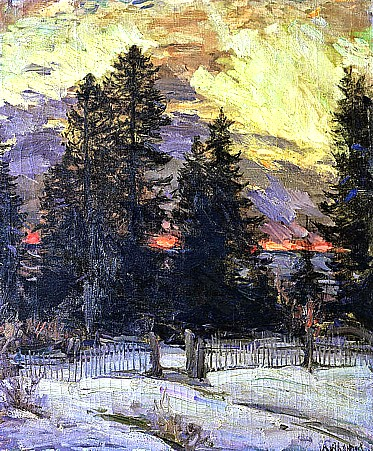
Sunset over a Winter Landscape by Abram Yefimovich Arkhipov

Abram was accepted at the School in 1877 and he studied there for five years. Here he studied alongside future greats in Russian art such as Ryabushkin, Kasatkin and Nesterov and he was tutored by the leading painters of the time, Vasily Perov, Makovsky, Polenov and Savrasov.  Arkhipov left the Moscow School and in 1884 transferred to the Academy of Arts in St. Petersburg. Here he was academically successful and some of his paintings were selected for permanent storage at the Academy’s Museum. 

Village Iconographer by Abram Yefimovich Arkhipov

Something, however, was not right and Abram broke off his studies at the St Petersburg Academy and in 1887 returned to study at the Moscow School of Art, Sculpture and Architecture . The reason for his sudden departure from St Petersburg is not fully known but it is thought that he was discouraged by the Academy’s strict way of teaching art.  However, the reason could have been more mundane, and he simply had no financial means to continue his studies in St Petersburg.

Sick Woman by Abram Arkhipov (1885)

Arkhipov had completed a painting entitled Sick Woman in 1885 and two years later at the Moscow School’s student’s exhibition he exhibited it.  It depicts two women in a dark and dank interior.  The artist’s mother sits with her head dejectedly inclined, her eyes fixed at one point,  Next to her sitting on a straw-filled bed is her neighbour who had come to pay the sick woman a visit. She too has the same dimmed sorrowful look in her eyes The postures of the two women, with their tired, unhappy faces is a depiction of their humility, despondency and misery. The only uplifting aspect to this painting is the sunlight, emanating through the open door.  Maybe Arkhipov wanted to remind us that happiness and beauty do exist somewhere. It is a work that gives out both quiet sadness and an air of deep compassion for human suffering.  The painting proved to be a major breakthrough in Archipov’s life as the work was bought directly from the student exhibition by Pavel Tretyakov, the art collector and owner of the Tretyakov Gallery in Moscow.

On The River Volga by Abram Arkhipov (1889)

Once Abram had completed his studies, he decided to embark on a painting trip with some of his former students, along the River Volga.  From this journey he completed a number of paintings like his 1889 work, On the Volga. It proved to be a successful fusion of a genre scene and lyrical landscape.

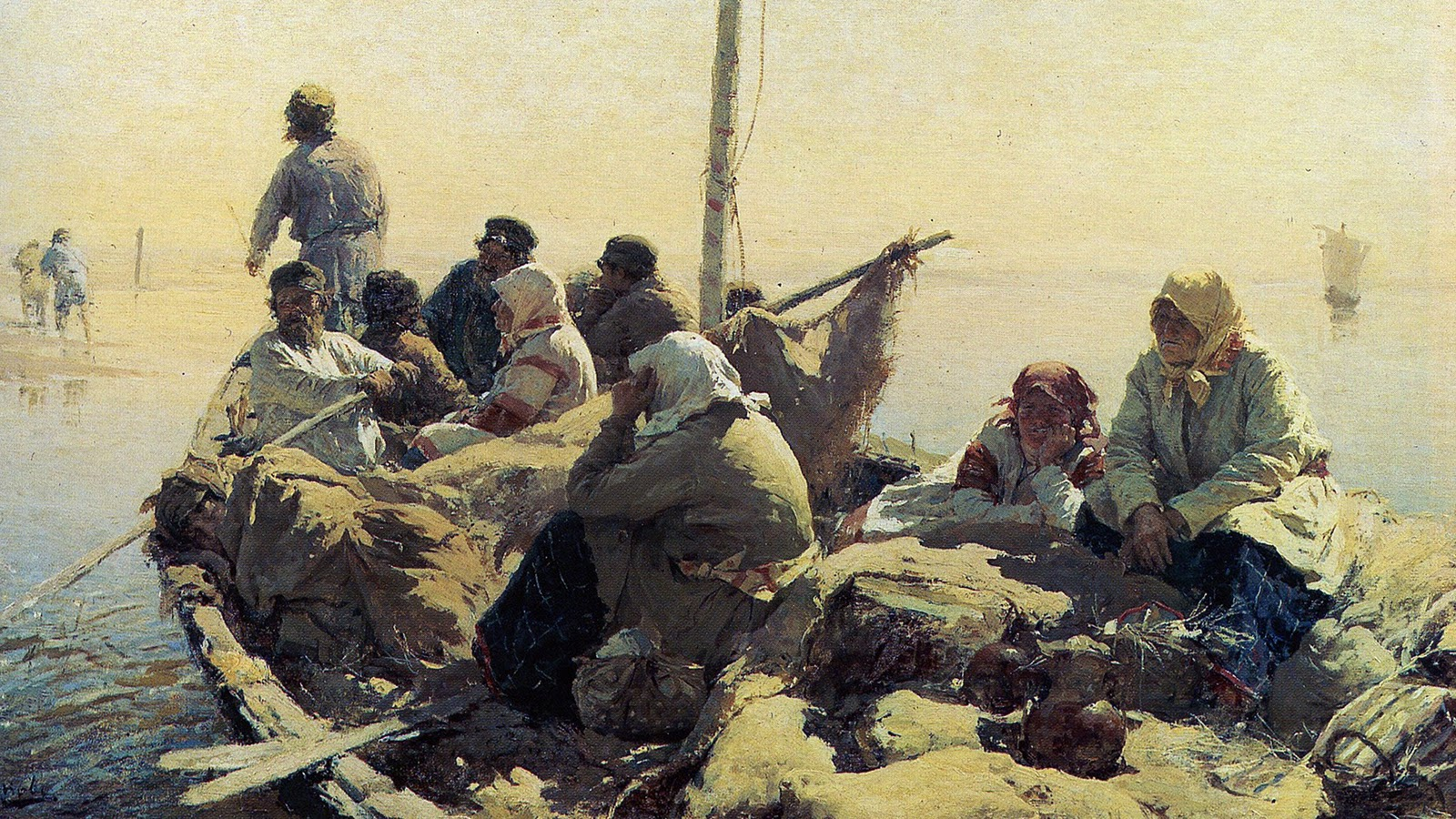
Along the River Oka by Abram Arkhipov

A similar river scene which Arkhipov painted at that time was Along the River Oka. It depicts a barge floating along the river filled with weary peasants, who seem lost in thought. It should not just be taken on face value as a river scene as it is a story about impoverished people who are capable of enduring a great deal without losing their strength and resoluteness. It is both a declaration of the beauty of Russian nature, with its blue horizons, the spring flooding of its rivers, and its streams of sunlight. Arkhipov has used a subdued colour scheme which is in accord with the general mood of the painting. His artistic style has changed. Compared to the careful detail of his early works, his style has become more free, expansive and passionate.  Of the painting, the Russian art critic Vladamir Stasov wrote:

“…The whole picture is painted in sunlight and this can be felt in every patch of light and shade, and in the overall wonderful impressions among the people on the barge, the four women—idle, tired, despondent, sitting in silence on their bundles—are portrayed with magnificent realism…”

In the Evening by Abram Yefimovich Arkhipov

The work earned Arkhipov membership of the Society for Traveling Art Exhibitions in 1890.  He was now one of the Peredvizhniki.  It was the largest art association of the second half of the nineteenth century and their exhibitions were held in Russian cities such as Riga, Kiev, Kharkov, and Odessa. Its objectives was three-fold:

Delivery to the inhabitants of the provinces the possibility of contacts with Russian art

Development and love of the arts in society

Making it easier for artists to sell their works.

Radonitsa (Before the Church Service) by Abram Yefimovich Arkhipov (1892)

Many of Arkhipov’s paintings were juxtapositions of landscape and genre works such as his 1892 painting entitled Radonitsa or Waiting for Church in which we see a large group of peasants sitting on the floor outside a church waiting for the doors to open and the service begin, but this is not just any service, this is Radonitsa.  Radonitsa is a universal church day when relatives and friends of the deceased celebrate the commemoration of those who have died.  In the Russian Orthodox Church it is this commemoration of the departed which is observed on the second Tuesday of Easter.  The word derives from the Slavic word radost meaning joy and so it is not looked upon a s a mournful day but one of joyful remembrance.  It is the Christian belief that lies behind this joy, is the remembrance of the resurrection of Jesus and the joy and hope it brings to all.

The Ice is Gone by Abram Yefimovich Arkhipov (1895)

Another of Arkhipov’s paintings which is a mixture of genre and landscape is his 1895 work entitled The Ice is Gone.  The painting depicts the connection between nature and the peasants. In a way, it is like the previous work.  It is a celebration.  The celebration is because the Spring has finally arrived and the ice on the rivers has melted and once more the peasants can use the flowing rivers to their advantage.

Women Labourers at the Iron Foundry by Abram Yefimovich Arkhipov (1896)

Many of Arkhipov’s paintings depicted the harsh plight of female peasant workers and their brutal working environment.  One such work was his 1896 painting entitled Women Labourers at the Iron Foundry in which we see two women sitting outside the foundry in the relentless hot sun, trying to relax from their physical labour.  Black smoke rises against a backdrop of low, wooden workshops.

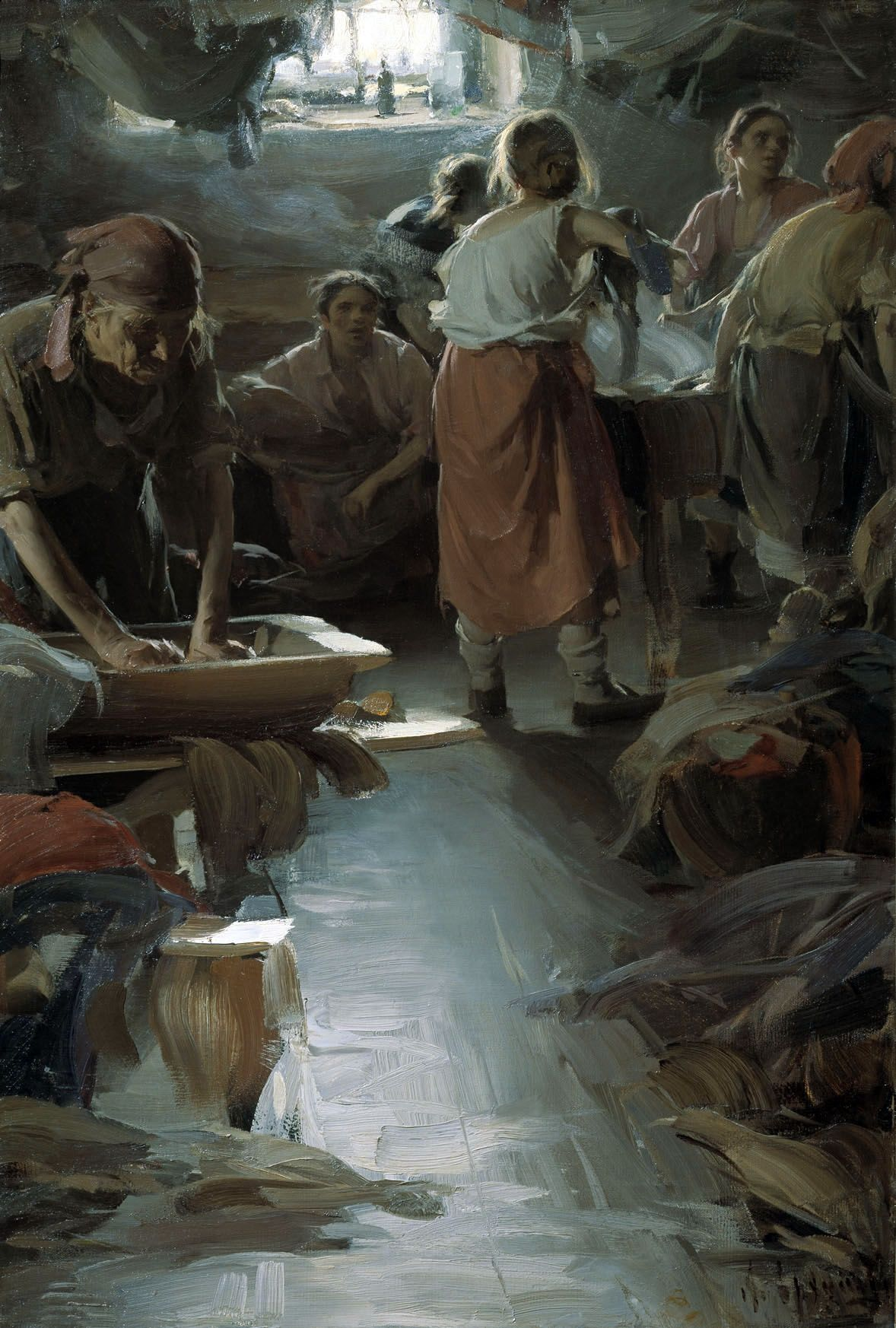
The plight of the female worker was again highlighted in two paintings by Akhipov entitled Washer Women which he completed 1899.  One hangs in the Tretyakov Gallery in Moscow and one in the State Russian Museum in St Petersburg. They were based on a series of studies Abram made of life in the wash-house and are depicted in the muted colours associated with Realism paintings.  We see the bent backs of prematurely aged women, toiling amid the steam and heat of their workplace.

Washer Women by Abram Yefimovich Arkhipov (1899)

Washer Women by Abram Yefimovich Arkhipov (1899)

In one work he depicts many peasant women working to clean the village’s laundry. For an accurate portrayal, Abram visited many washhouses making sketches always keen to find figures which would enhance his final work.  Eventually he found his “perfect” model and rearranged the depiction around her.  She was an elderly woman whom we see on the left of the second work, sitting hunched over, totally exhausted. All the women look defeated and overcome by their physical efforts.  These two works by Arkhipov’s highlight the plight of woman who had to work in such harsh, almost inhuman conditions just to earn some money to feed their families.  Again, like his other Reailist paintings he has used muted colours, the works only lit up by the light coming in from the small window at the rear, which shows up the steam coming up from under their hands as they wash the clothing. Many of the details stay the same in both works, for example, their hair being tightly tied back and the same women appearing in the background of both paintings. The women are all hard at work in the upper painting, whereas the lower work focuses on the elderly woman talking a break.

Arkhipov’s paintings are brutally realistic and are important pieces in history revealing much about the conditions in the USSR during this time by showing the truth behind the closed doors of the washhouses. The opportunity for women to get better and less arduous jobs was just not available to them.

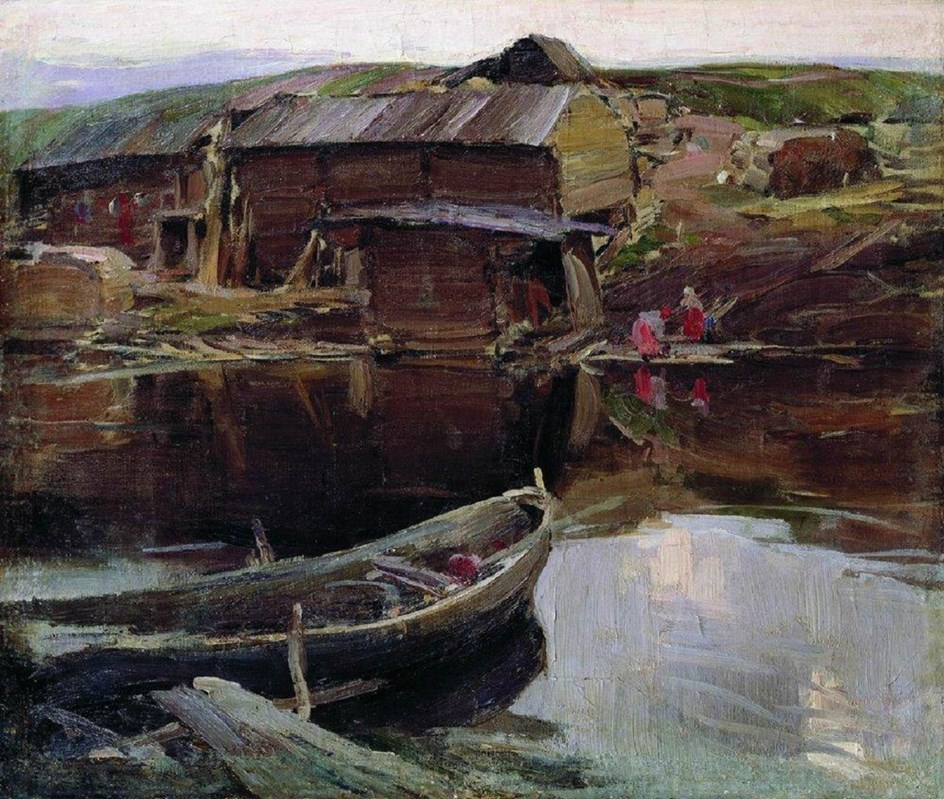
Northern Village by Abram Yefimovich Arkhipov (1902)
In the North by Abram Yefimovich Arkhipov !903)

In 1902 Arkhipov took the first of a number of trips to the White Sea and from the sketches he made during these journeys he produced two memorable landscape works. A Northern Village in 1902 and In the North in 1903.  They signalled a move away from Realism works and a move towards the landscape genre of paintings.

Around 1903 came the formation of the Union of Russian Artists which was the coming together of former Peredvizhniki members and those who had been part of the World of Art, an artistic movement inspired by an art magazine which served as its manifesto de facto, which was a major influence on the Russians who helped revolutionize European art during the first decade of the 20th century.  Arkhipov became one of its founding member in 1903.

Around 1903 came the formation of the Union of Russian Artists which was the coming together of former Peredvizhniki members and those who had been part of the World of Art. The Union of Russian Artists lasted until their exhibition in 1910 when due to a split between St. Petersburg and Moscow artists due to harsh words and denouncements of the paintings by various factions.  Arkhipov decided that he had had enough of the constant bickering and resigned.

The Visit (also known as On a Visit; A Festive Spring Day) by Abram Yefimovich Arkhipov (1915)

Following his resignation from the group he reverted to his favoured painting style, that of genre painting and the depiction of peasants. However, the muted coloured realist paintings soon gave way to a more colourful Impressionist style as seen by his 1915 work entitled The Visit (also known as On a Visit; A Festive Spring Day)

The Tea Party by Abram Yefimovich Arkhipov (1919)

Another highly colourful painting was his 1919 work entitled The Tea Party.

Around 1920, Arkhipov became interested in the genre of psychological portraiture.  Psychological portraiture is when an artist tries for something more than a simple physical representation of the sitter but tries to reflectand depice the character of the portrayed person. In essence the painter is endeavouring to capture a range of the sitter’s emotions in fractions of a second or for the finished work to tell us more about the personality of the person in a single image.

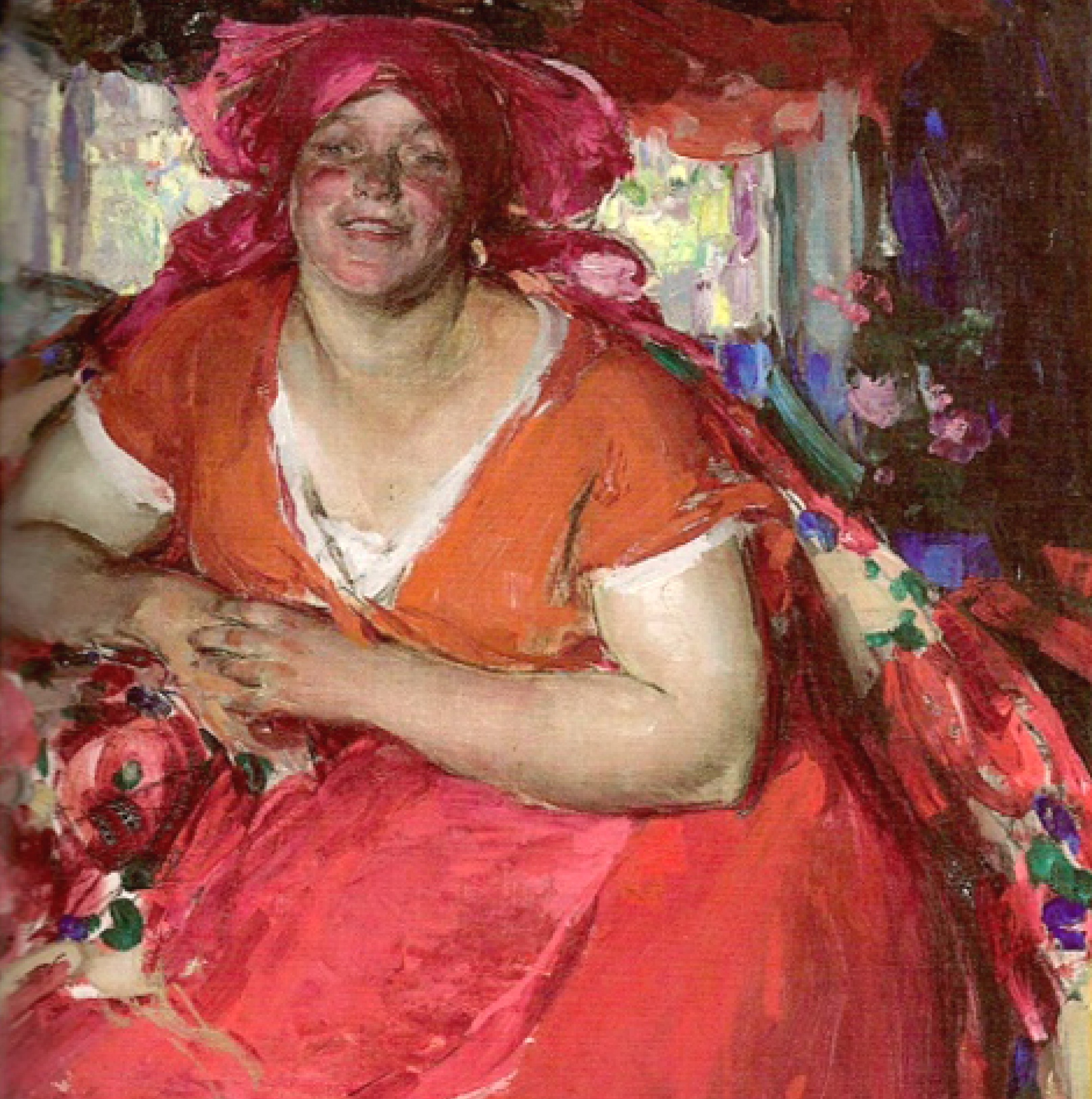
A Girl with a Jug by Abram Yefimovich Arkhipov (1927)

Arkhipov painted an unusual series of portraits of peasant women and girls from the Ryazan and Nizhny Novgorod regions. They are all dressed in bright national costumes. with embroidered  scarves and beads. Painted with broad lively strokes, the paintings are marked by their decorative nature and buoyant colours, with rich reds and pinks predominating. The most famous of his portraits is his 1927 painting entitled Girl with a Jug. It depicts a Russian woman dressed in an orange top, a bright red bottom, an apron with a bright pattern.  In her hands she holds a bright blue cup and a jug of milk.  The dark background, painted by the artist, sets off the girl.  Her figure is hidden from us by the wide sleeves and a skirt.  She smiles confidently as she looks out at us with an affectionate countenance.  The painting is a mass of colour and yet Arkhipov seems to also focus on the inner beauty of the woman which he believes is a window into the Russian soul, strong and yet truthful, open-minded, and generous.  In this colourful cycle of painting female peasants, Arkhipov has loosened the shackles of his gloomy realist depictions and his shown us a different side to his art.

Young Girl by Abram Yefimovich Arkhipov (1920)

In 1924 Arkhipov joined the Association of Artists of Revolutionary Russia, and in 1927, to mark his fortieth year as an artist, he was among the first artist who was awarded the title of *People’s Artist of the Russian Republic*.

Abram Yefimovich Arkhipov died in Moscow on September 25th, 1930 aged 68.

John Downton

Self portrait by John Downton (c.1928)

My featured artist today is the lesser-known British painter John Downton who was born on March 27th, 1906 in the Kent town of Erith, some twenty kilometres south-east of London.  He was the youngest of three children of Albert Victor and Flora Edith Downton (née Mitchell).  John had two older sisters, Hilda and Mary both of whom had intended to study medicine but their plans were thwarted by family circumstances and health reasons.

At the age of four John attended the Erith Convent where he was a pupil for the next four years.  In 1914 he transferred to the Erith Grammar School.  It was around this time that John developed a love for music.  His father played the flute and the piano and was a prominent member of the local church choir.  John’s uncle, Hedley, gave John a violin and during the following years John became an important member of the school orchestra.  The other great love of the teenager was his desire to read, particularly books by ancient philosophers and other “serious” works of English literature.

Portrait of a Young Woman by John Downton (1929)

Apart from his music and books, John had an overriding passion for art and even built a summer house/studio in the family garden where he did his painting.  When he was seventeen the school entered his pencil sketch, Biplanes: A Study, into the Royal Drawing Society at the Guildhall, London and he was awarded a Silver Medal.  As a teenager he was fascinated by all things military and penned many sketches of war machines and yet, later in life he became a pacifist.

Woman at the Window by John Downton (1934)

In 1922, when he was sixteen years old, his mother noticed an advert in The Times which stated that a Professor Gaugot, who was a lecturer at the Sorbonne, was willing to teach an English boy to speak French and so young John Downton headed to Paris where he stayed with the Gaugot family.

Child with Roses by John Downton (1936)

A year later in 1923 John accompanied his two sisters to Italy where they visited Venice and the Northern Italian Lakes as well as the Swiss towns of Lucerne and Lugano.  This was the start of John’s love affair with travel.  His favourite destinations were Northern Italy and Switzerland.

Having completed his schooling John was accepted into Queen’s College, Cambridge.  Initially he took Part 1 of the English Tripos and in 1927 was placed into the Second Class but the following year he decided to abandon English and instead enrolled in the History of Art course and once completed, he received a First Class degree.  During his three years at the university John immersed himself in their musical activities.

Hilda Downton by John Downton (1929)

In the Autumn of 1928, having completed his three-year degree course, John Downton enrolled at the Slade School of Art which at the time was presided over by Henry Tonks, a British surgeon and later draughtsman and painter of figure subjects, chiefly interiors, and a caricaturist who was Slade Professor of Fine Art from 1918 to 1930.  John, like many of the Old Masters of the past, preferred the medium of tempera but the Slade tutors wanted him to change his favoured painting medium and embrace a more modern style of painting.  There was to be no common ground and so on May 21st 1929, John resigned.  In a forward to John Downton’s 1937 book, The Death of Art, an art critic and author wrote about Downton’s falling out of love with the Slade and the Academy’s thoughts on art.  He wrote:

“…A certain kind of rather drably coloured, sober urban realism was the style in favour.  Not for Downton though: he had pretty certainly made up his mind what he wanted to do and what sort of painter he wanted to be well before he arrived at the Slade and it has much more to do with the legacy of Piero della Francesca than that of Sickert and Cezanne…”

Downton’s art was a return to the art of the early Renaissance.

In 1930 John Downton and his sister set off on an European trip.  They based themselves in the Côte d’Azur town of Menton and from there they took day trips out to the Italian Riviera towns of Ventimiglia and Genoa.  Much longer trips were taken by the pair when they visited Milan and Lugano as well as his beloved Italian Lakes.

Portrait of a Young Lady by John Downton (1929)

Around 1930, John bought Park Cottage in the Kent village of Sundridge, some twenty miles, south-east of London.  He spent much of his time renovating the property and buying antique furniture at auction to furnish the rooms.  After two years living there, he realised it was too small for him and his artwork and so he moved out and rented the cottage to a fellow artist, Vincent New.

In April 1932 John Downton was awarded his M.A. and, as if to celebrate the successful completion of his studies, he took a trip to Tunis and returned via Naples, where he remained for a few months.  On arriving back to England John searched for a new home and eventually purchased a property with a north-facing conservatory in which he could paint.  The property was in Observatory Gardens, in the London borough of Kensington.

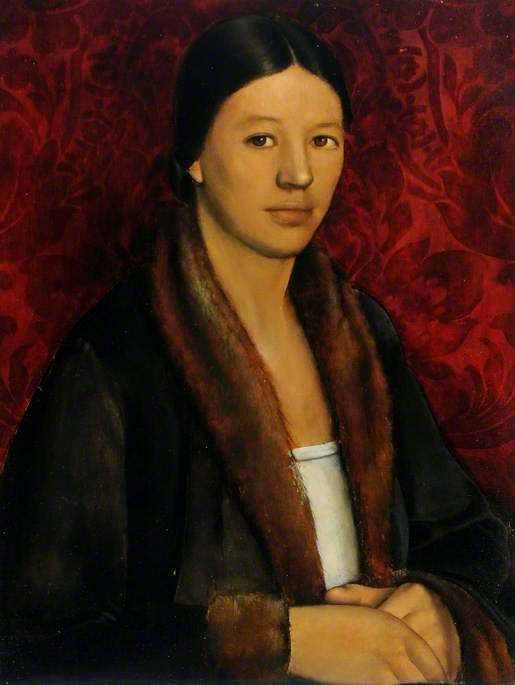
Frances Witts by John Downton (1935)

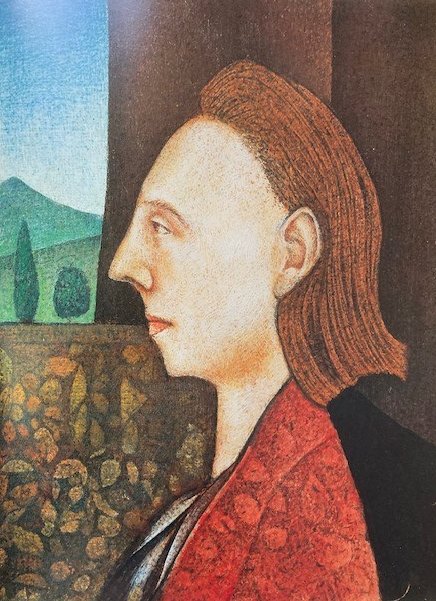
Around 1935, John Downton completed a poignant in memoriam portrait of his cousin Frances Witts.  She had died of pneumonia aged just twenty-six.  He used a family photograph for this work.

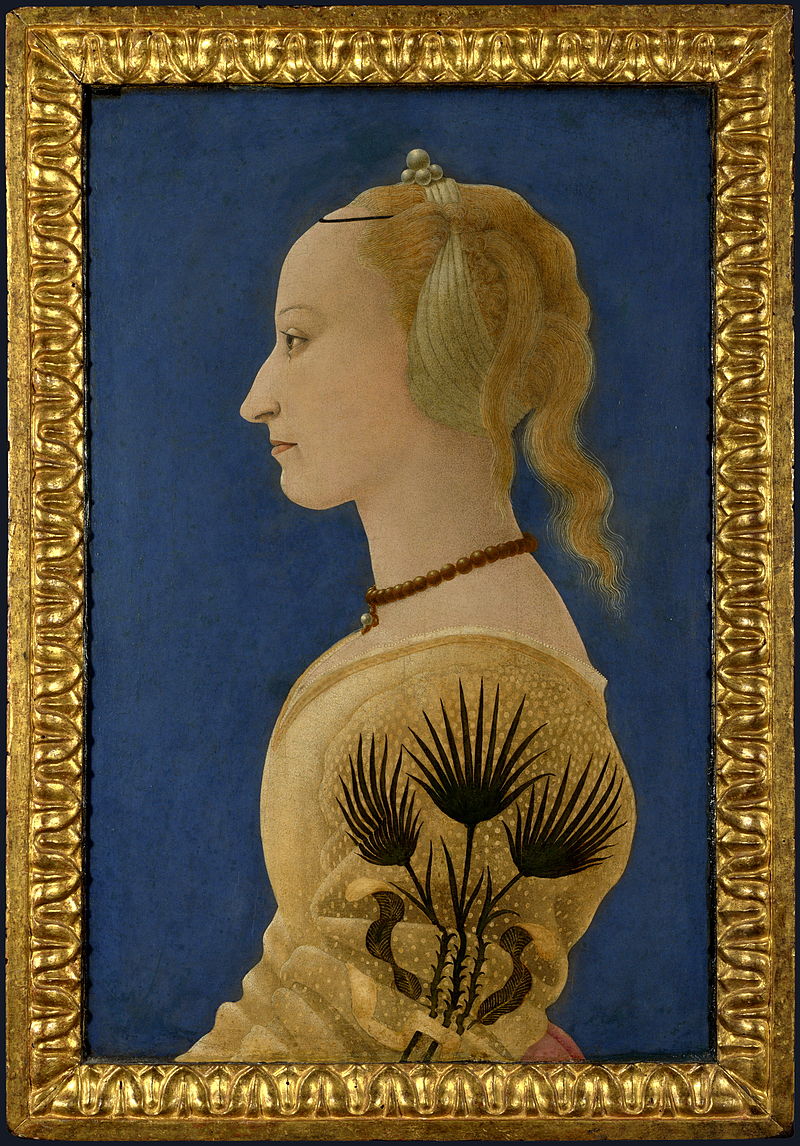
Portrait of a Lady in Yellow by Alesso Baldovinetti (1465)

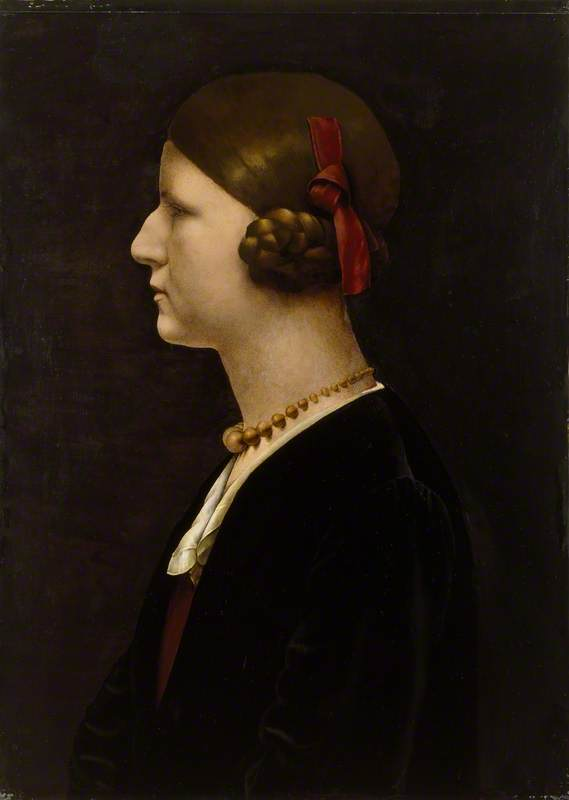
Downton was influenced by profile portraits executed by Florentine painters such as Baldovinetti’s 1465 work entitled Portrait of a Lady in Yellow but art historians believe this portrait of his cousin was influenced by the Milanese painter, Ambrogio’ de Predis and his c.1490 work, Beatrice d’Este, which was once attributed to Leonardo da Vinci. 

Portrait of a Lady (Beatrice d’Este) by Ambrogio’ de Predis

Downton’s memorial portrait has a dark and rich tonal quality and he has based it on a conservative portrait of the past and has accomplished an image that is both solemn and inspiring.  The woman in Downton’s portrait, like the Italian females in the portraits mentioned earlier, includes a necklace with diminishing size of beads whilst her hair is similarly geometric but in Frances Witts’ case it is gathered at the sides rather than at the back of the head.

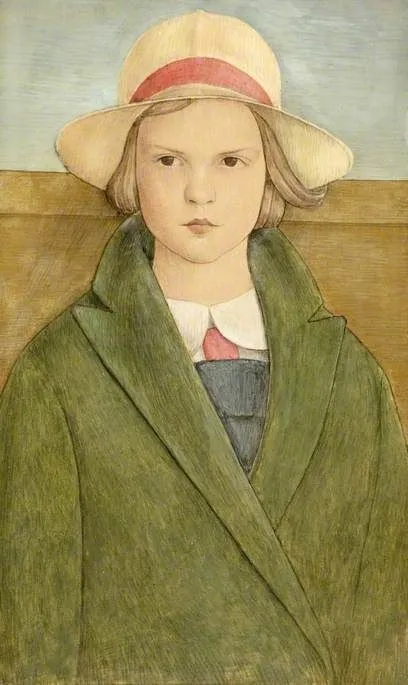
Nora Russell by John Downton (1936)

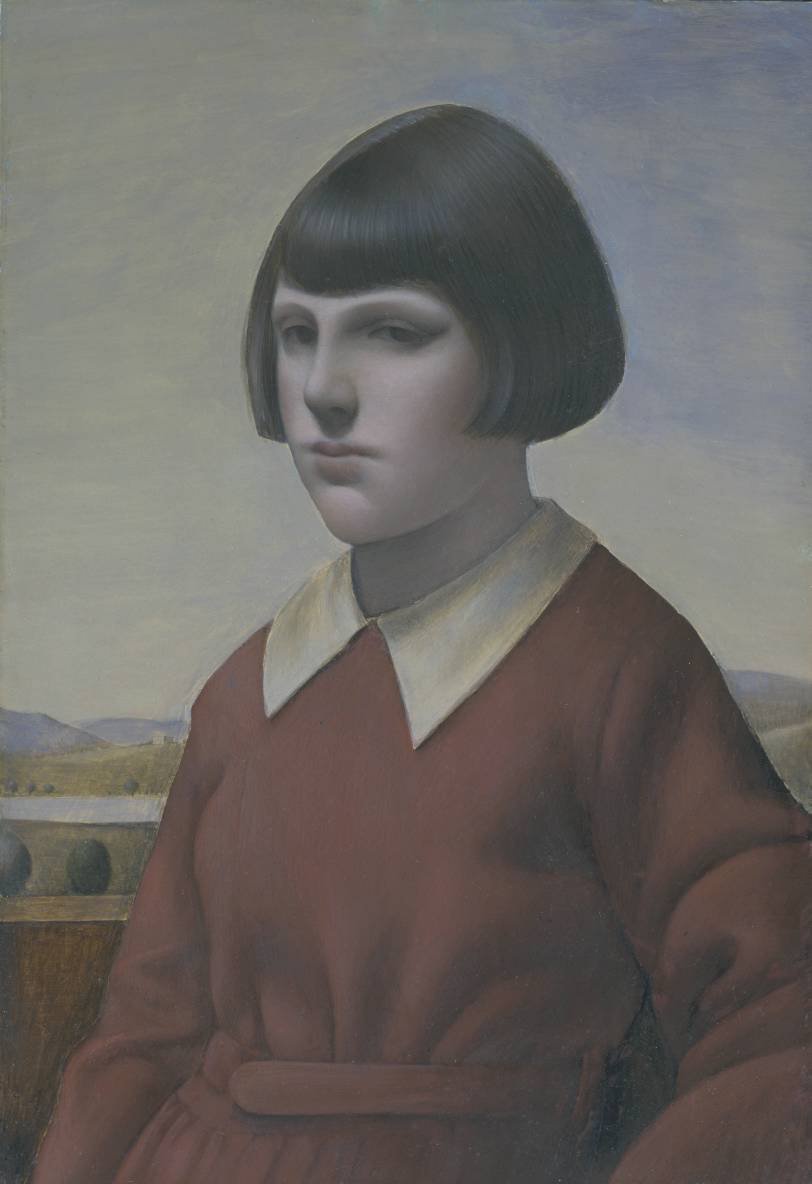
Between 1936 and 1940 John Downton exhibited work at the Royal Academy Summer Exhibition.  His two submissions in 1936, which were considered to be his masterpieces, were The Battle and and Nora Russell.  The latter painting was executed in egg tempera and, despite it being a simple depiction of a young schoolgirl, it is evocative in the way it reminds us of the spirit of Quattrocento female portraiture, that is to say, female portraiture in fifteenth-century Italy, which portrayed womanly perfection as established in Catholic doctrine, illustrating the special social roles that upper-class women fulfilled at the time.

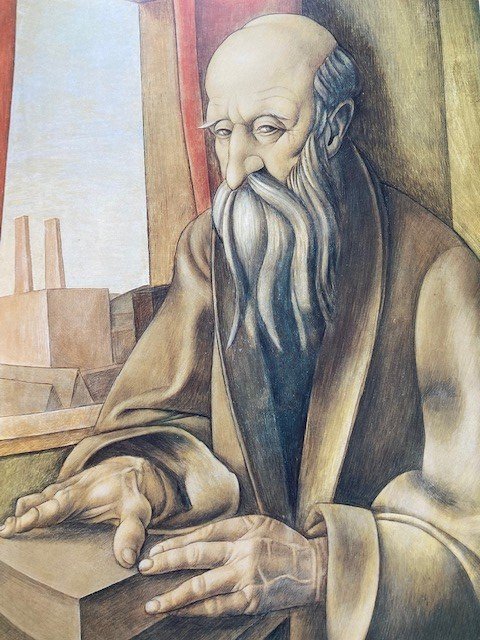
The Battle by John Downton (1935)

The title, The Battle, the second of his submitted painting to the 1936 Royal Academy Summer Exhibition, is to do with conflict but not a battlefield scene, as you may have expected.  It is all about the battle between modern industrialisation and the ideal of Renaissance humanism, which was a revival in the study of classical antiquity, at first in Italy and then spreading across Western Europe in the 14th, 15th, and 16th centuries, a cultural legacy, literary legacy, and moral philosophy of classical antiquity.

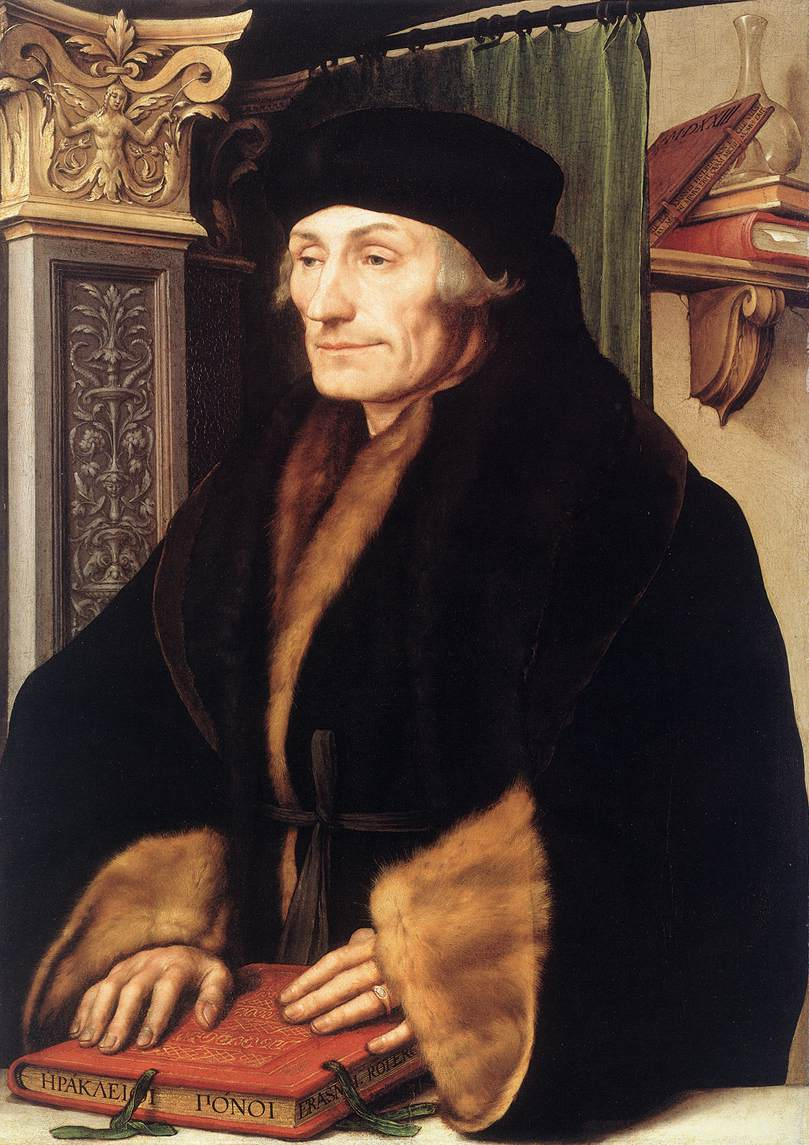
Erasmus of Rotterdam by Hans Holbein the Younger (1523)

The figure and its stance in the painting is based upon Holbein’s 1523 work, Erasmus of Rotterdam.  Erasmus was the leading humanist at the time.  Both works accentuate the hands of the sitter.  In the Louvre collection there are studies of hands made by Holbein as preliminaries for his painting.  In Downton’s painting we see through the window an abstract depiction of a modern factory.

Joan Harris by John Downton (1937)

John Downton was always on the move and made many more house relocations and in August 1937 he took up residence in Cambridge.  That year he submitted his work entitled Joan Harris to the Royal Academy Summer Exhibition where it was subsequently chosen to be shown in The Prominent Living Artists Exhibition which was staged at the Russell-Cotes Museum in Bournemouth.  Joan Harris was the daughter of John Downton’s Cambridge neighbour.  From a letter she wrote him during the sittings for the portrait we can gather that Downton completed more than just this one portrait of her.  She wrote:

“…I hope you will finish the picture soon; but if you ever want me to come and sit for you again, just let me know and I will come any time that I am able.

When you have finished the picture I hope I will be able to see it and if you get the first picture back in Cambridge I would like to see it, and I know Mummy and Daddy would love to see it as they never saw it when it was completed…”

Portrait of a Girl by John Downton (1938)

Downton’s 1938 submission to the RA Summer Show was Portrait of a Girl which unusually for Downton depicted the model against a landscape background giving the impression that it was a plein air portrait.  There is a definite resemblance to the style of one of my favourite portrait artists, Gerald Brockhurst.

Portrait of a Woman by John Downton (1955)

A strange looking portrait going under the title Portrait of a Woman was completed by John Downton in 1955. 

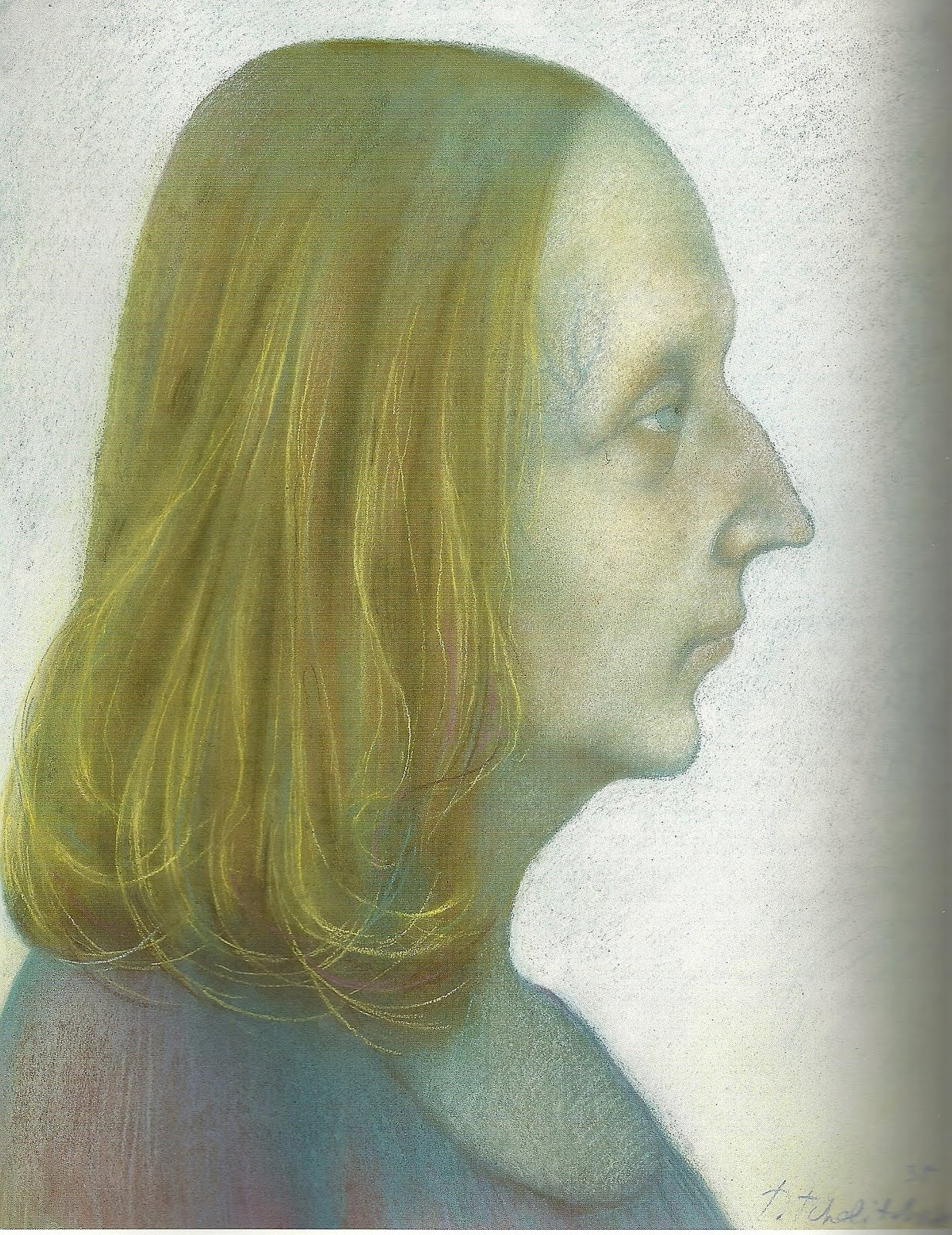
Edith Sitwell by Pavel Tchelitchew (1935)

It is thought that the depiction was loosely based on the Polish painter, Pavel Tchelitchew’s portrait of his good friend Edith Sitwell in 1935.

Girl Conducting by John Downton (1940)

In 1938, now living in Cambridge, Downton was having to cope with the rejection by Faber & Faber of his manuscript, The Death of Art, but which was published years later. In 1940 Downton submitted three paintings to the Royal Academy Summer Exhibition, Eve, A Girl Conducting, and A Child. His painting entitled Girl Conducting is all about his depiction of the girl’s hands and it is such a facet in many of his works. The finished product did not come easily for Downton, who made numerous sketches of hands until he had perfected them. Many of the depictions were influenced by Renaissance paintings. The three paintings Downton submitted to the RA that year were to be the last of his offerings to that establishment.

Woman in Flemish Head Dress by John Downton

So why did Downton stop exhibiting his work at the RA ? In the foreword to Downton’s book The Death of Art, which his sister, Hilda, finally had published in 1995, the writer and critic John Russell Taylor explained:

“…He seems to have felt himself marginalised in a world increasingly unsympathetic to everything he stood for. In 1939 he moved to Florence in an attempt to escape the materialist twentieth century, but then almost immediately had to return to Britain at the outbreak of war. The war itself was even more of an alienating factor, a total outrage to his dearly held pacifist principles. And a general feeling that the mainstream of British Art was moving further and further away from his own ideals, first into luxuriant Romanticism and then into freeform abstraction, caused him to withdraw altogether from exhibiting his own art after 1940…”

Bearded Profit by John Downton (1975)

Now back home in England with the war waging in Europe, John Downton received his conscript papers.  Downton had always been a pacifist and went before the Review Board to argue his case for not fighting.  The Board accepted that he was a genuine conscientious objector and so, in September 1940, he was put to work on a farm near Ludlow.  That same year his two sisters moved north to Pitlochry in Scotland and later Downton moved north to be with them and work on the land of the local farmer.

Portrait of a Woman by John Downton (1940)

When the war ended Downton moved south and took up residence in the Kent town of Sevenoaks.  He remained there for two years but then returned to Cambridge where he stayed until 1964 but when his lease ran out on the property he was renting in 1971 he moved back to Sevenoaks and rented a large ground floor flat with a cellar, close to where his sisters, Hilda and Mary were then living.  Mary became very ill with asthma in 1986 and died.   In December 1990 a water pipe burst in the cellar and caused a flood which partly destroyed some of his books and manuscripts he had stored in the room.  He struggled to save and move the heavy boxes of books and this exertion damaged his heart.  He was confined to hospital for two weeks and on discharge went to live with his sister, Hilda, who looked after him during his final days.  John Downton died on July 31st 1991, aged 85.

John never married but was in no way a recluse as his time was taken up with his painting and his love of music.  He had many friends who valued his company.  His sister, Hilda died in 2006, aged 104.

Eva Gonzalès. The French Impressionist.

In today’s blog I am looking at the life and work of the nineteenth century French painter, Eva Gonzales.  Eva Gonzalès is one of the great women artists of the nineteenth century along with Berthe Morisot, Mary Cassatt and Marie Bracquemond.  She was associated with the Impressionist movement despite her not exhibiting any of her paintings at any of the eight Impressionist exhibitions.

Eva Gonzalès

Eva was born in Paris on April 19th 1849 into a middle-class family.  Her father was Emmanuel Gonzalès, who came from a bourgeois family of Spanish Monegasque origin.  He was a novelist and playwright and her mother was Marie-Céline Ragut, who was a musician and daughter of a Lyon industrialist. Eva had a younger sister, Jeanne Constance Philippe Gonzalès.  Both Eva and Jeanne were encouraged to study art.  Eva could not attend the most prestigious art school, Ecole des Beaux-Arts as, at the time, the school did not accept any women who wanted to study art.  However, coming from a wealthy family, it allowed her parents to buy the services of the top teachers  and after she left school in 1866 she began taking lessons at the women’s studio run by the French portrait and landscape painter and printmaker Charles Chaplin, who was connected to the state-funded French Academy. 

Le Thé by Eva Gonzalez (1865)

One of Eva’s early paintings was entitled Le Thé which she completed in 1865.

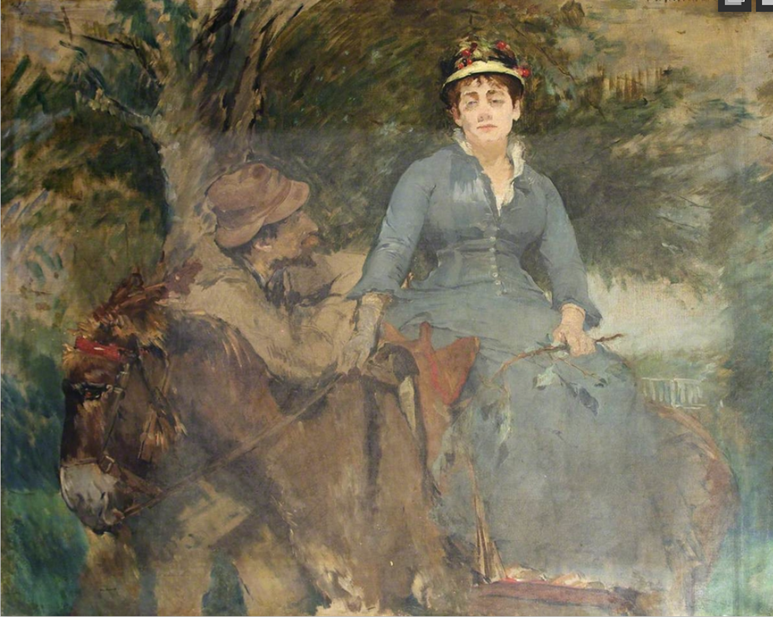
The Donkey Ride by Eva Gonzalès (1880)

In February 1869, following a long period of classical training Eva took the decision to enter the studio of Edouard Manet and become his pupil and improve and refine her art.  She admired Manet’s work despite all the controversy surrounding some of it.  Manet had a provocative, some would say, scandalous reputation. He was a major player in the avant-garde art scene. He had repeatedly challenged the art establishment, submitting bold and unconventional works such as his 1863 painting, Déjeuner sur l’herbe, depicting a scantily dressed bather, a nude woman sitting at a picnic with two fully clothed men. The Salon jurists rejected the work and so Manet decided to exhibit it at the Salon des Refusés (Salon of the Rejected) which was a parallel exhibition to the official Salon, as an alternative exhibition in the Palais des Champs-Elysée. Manet completed another work that year, a nude painting, entitled Olympia, which was accepted by the Salon jurists in 1865 but the art critics and many of the public viewed the work as being shocking and scandalous when it was first unveiled at the Paris Salon.

Enfant de troupe (Soldier boy) by Eva Gonzales (1870)

Eva had been introduced to Manet in 1869 by Belgian painter Alfred Stevens and subsequently became his only pupil. She exhibited three works at the 1870 Salon, one of which was Enfant de troupe (Soldier boy).

Le Fifre (The fifer) by Edouard Manet (1866)

It was a positive artistic homage to her teacher’s Le Fifre (The fifer), which Manet had completed in 1866. Ironically, the Salon jurists rejected the work.

Portrait of Eva Gonzales by Edouard Manet (1870)

At the same (1870) Salon at which Eva had her painting, Enfant de troupe, exhibited, Manet ‘s portrait of her was also on show. The portrait was thought to have begun in February 1869 and involved numerous sittings, with the completion being around March 1870 and was shown at the Salon the same year. The portrait depicts Eva painting at her easel.  She is shown wearing an immaculate flowing white gown with transparent bodice, low-cut neckline and short sleeves and it brings to mind portraits by Goya who had influenced Manet and this Spanish-like appearance also reminds us of Eva’s Hispanic identity. The dress fills Manet’s masterpiece, with its brightness contrasting against the dark background making it almost an artificial light source. The one question the portrait brings to mind is whether we are looking at Gonzales the painter or Gonzales the artist’s model. If Manet wanted to highlight his pupil as an accomplished artist would she not have been posed in a painter’s smock standing, observing her painting and with brush on the canvas. Instead Gonzales is depicted in what would have been thought, at the time, as an immodest pose. A pose with so much bare skin that would have normally been modelled by a member of the lower-class hired sitter.

Manuscript

On the floor besides her we can see a half-rolled canvas carrying Manet’s signature.  This is a simple reminder to the viewer of his role as Eva’s teacher. .

La Loge by Renoir (1874)

Theatre auditoriums, and in particular the theatre boxes were popular places for the “society” people to mingle and exchange gossip and were popular depictions often chosen by the Impressionists. The most famous of these works is one by Renoir entitled La Loge (The Theatre Box) which was exhibited at the First Impressionist Exhibition in 1874 and now is part of the London Coutauld’s collection.

Une loge aux Italiens by Eva Gonzales (1874)

Eva Gonzales completed a similar work entitled Une loge aux Italiens (A box at the Théâtre des Italiens), which she also completed in 1874.  She submitted this painting to the Salon jurists for inclusion in the 1874 Salon but it was rejected.   Eva Gonzalès then made some changes to the painting and, five years later, once again submitted it for inclusion at the 1879 Salon and this time it was accepted.  The critics loved the work. Gonzales was pleased to tell people that she had been a pupil and a good friend of Manet.  Manet’s influence on Gonzales can be clearly seen in this painting in the choice of a modern subject and the way Gonzales has juxtaposed light with dark, with the pale skin and light-coloured fabrics against a dark background.  Also, note the inclusion by Eva of the bouquet which rests on the edge of the box and its similarity to the bouquet held by the maid in his Olympia depiction.

Sketch by Manet

One also has to remember that Manet made a pastel sketch of a similar depiction which may have influenced Gonzales when she made changes to her original painting. Look at the way Eva has depicted the two people in the painting.  There is a strange disinterest between the two figures.  On the right we have Henri Guérard, Eva’s husband. In 1879 Eva had married Guérard after a three-year courtship.  He was a graphic artist and Manet’s engraver.  The two people who often sat for Eva’s painting were her husband, Henri Guérard and her sister Jeanne, who after Eva died in 1883, at the age of 35, married Guerard and became the step-mother of her sister’s child.

Le Moineau (The Sparrow). by Eva Gonzaès (1870)

One of my favourite paintings by Eva Gonzalès was her early work entitled Le Moineau (The Sparrow).  The teenage model for this painting was the artist’s sister Jeanne.  Jeanne Gonzalès appeared in over twenty of Eva’s works.  It is a portrait of great elegance. It is a depiction of quiet introspection, and it illustrates the intimate connection that existed between Eva and Jeanne. Eva has focused on the graceful features of her favourite model, her younger sister Jeanne who was then in her teens, Eva’s portrait is a study on the interaction between light and shadow. She has focused the direct light on her sister’s bare back, and casts Jeanne’s face in soft shadow, which gives a somewhat air of inscrutability.  Jeanne is dressed in a swathe of transparent chiffon, seems lost in her own thoughts, as she gazes off into the distance.  Meanwhile, balanced on the edge of her hand, is the little sparrow.  It looks enquiringly up at her.  Eva has added touches of bright colour with the ears of corn that embellish her sister’s braided hair.

Morning Awakening by Eva Gonzales (1877)

Another painting by Eva Gonzales featuring her sister Jeanne is her 1877 work entitled Morning Awakening.  Eva Gonzales never completed a self portrait but featured her sister in many of her works.  Maybe she believed there was a familial resemblance.  This is a natural everyday depiction of her sister awakening in the morning.  This painting portrays a young woman, soon after she has awakened. Her facial expression is one of being distant, not quite fully aware of he surroundings. Eva has concentrated her depiction on the skin and black hair of the female which contrasts vividly with the white of the bedding and her bedclothes.  It is thought that Manet had advised Gonzales to depict her sister naked in bed but she refused the erotic suggestion and in all her works which featured Jeanne she was always depicted as a “pure” person.

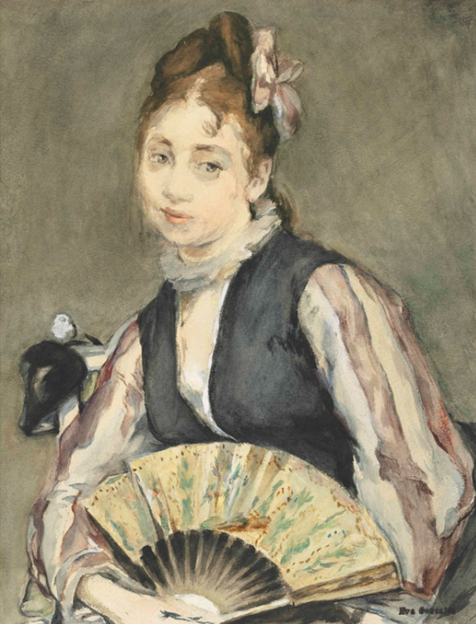
Portrait of Jeanne Gonzales by Eva Gonzales (c.1872)

It is believed that Jeanne Gonzalès was a mirror-image of her sister, Eva, and in her paintings of her sister, Eva depicted Jeanne the way she wanted to imagine herself.  Around 1872 Eva completed a portrait of her sister, simply entitled Portrait de Jeanne Gonzalès.  It is an excellent and intimate portrayal of her sister.  Jeanne is adorned in a dress made of soft delicate fabric.  Here, Jeanne is pictured wearing an elegant pale pink and black dress, her brunette hair swept into an elaborate style and adorned with a pink ribbon and in her hand she holds an open fan.  The painting was completed soon after Eva Gonzalès had begun studying under Manet, and there are elements of Manet’s style in the depiction such as the soft brushstrokes, plain and simple background devoid of any items or colours which would detract from the sitter.  Jeanne also has the same inscrutable look of contemplation that are reminiscent of Manet’s attention-grabbing female portraits.  However, in this work Eva has implanted into this portrait of her sister a feeling of tenderness which is a telling reflection of the intimate kinship between the two women.

Nanny and Child by Eva Gonzalès (1878)

For my last choice of paintings by Gonzalès I have chosen another work by her which was probably influenced by one Manet’s famous works which he completed in 1873 entitled The Railway. Eva’s painting is entitled Nanny and Child which she completed whilst in Dieppe in 1878. In her work she depicts an interplay between a nanny and a child.  The Nanny looks out at us as she sits on a bench.  To her right her young charge, who has her back to us, is grasping at the lattice work of a fence.

Le Chemin de fer (The Train) by Edouard Manet (1874)

Manet’s painting was the last one featuring Victorine Meurent who was his favourite model and who had modelled for Manet for his infamous works, Olympia and the Déjeuner sur l’herbe. Le Chemin de fer (The Train) was exhibited at the Paris Salon in 1874, and eighty years later donated to the National Gallery of Art in Washington, D.C. in 1956 by Horace Havermeyer, the son of a prominent family from New York, of German origins, that owned significant sugar refining interests in the United States.  In Manet’s painting we once again see a Nanny and a young girl.  They are positioned by an iron fence near the Gare Saint-Lazare in Paris. The daughter of Manet’s neighbour Alphonse Hirsch models the young girl.

The most obvious difference between the two works is space.  Eva Gonzalès has chosen to make her depiction full of open space whereas Manet’s work is somewhat claustrophobic in the way he has depicted the two figures hemmed in between the narrow foreground and the black metal railings.  Gonzalès has gone for an airier open-space depiction of a summer’s day with sunlight streaming through trees in the background.  Eva Gonzalès’ work is not just a copy of her Master’s painting.  It is a well considered and highly original response to the subject, which she has reimagined and turned into a work,  wholly new and unquestionably her own.

In 1879, after a three-year engagement, Eva married Henri Guérard, a graphic artist and Manet’s engraver.   The couple had a son named Jean Raymond who was born in April 1883, shortly before Eva received news of the death of Manet on April 30th 1883. A week after the death of her mentor, on May 6th 1883, Eva Gonzalès died of an embolism at the age of thirty-four.  Her death left her son to be raised by his father and her sister, Jeanne, who later became Guerard’s second wife.

The Allure of Dieppe for the Great Artists

Dieppe

Dieppe is a coastal town in the Seine-Maritime department in the Normandy region of northern France.  It is a seaport on the English Channel at the mouth of the river Arques, which is famous for its scallops, and has a regular ferry service to Newhaven in England, Dieppe has a popular pebbled beach, a fifteenth century castle and the churches of Saint-Jacques and Saint-Remi.  In my blog today I am looking at the French town and its association with French and British artists who made the coastal town a favoured meeting place.  The cross-Channel connection between the artists of the two countries came about with the British contingent arriving in Dieppe from London by way of Brighton or Newhaven.  One of the earliest travellers on this route was the English marine and landscape painter, etcher, illustrator, author and a leading member of the Norwich School of painters, John Sell Cotman, who arrived in the French town in 1817. The crossing from Brighton had taken him forty-two hours.

Dieppe from the Heights to the East of the Port by John Sell Cotman (1923)

Cotman was born in Norwich, the son of a silk merchant and lace dealer.  He was educated at the Norwich Grammar School where he displayed an early talent for art. Although it was intended that he followed his father into the family business John was determined to achieve a career in art and moved to London in 1798, where he met artists such as J. M. W. Turner, Peter de Wint and Thomas Girtin, whose sketching club he joined.

The-Chateau of Dieppe and the Prison, Normandy, seen from the Beach by John Sell Cotman (1817)

Cotman travelled to Dieppe in 1817 and 1818. On his initial trip he arrived at the French port on June 20th and stayed five days at the Hotel de Londres.  On his second visit the following June, he just remained long enough to pass customs formalities, renew friendships and then set off inland.

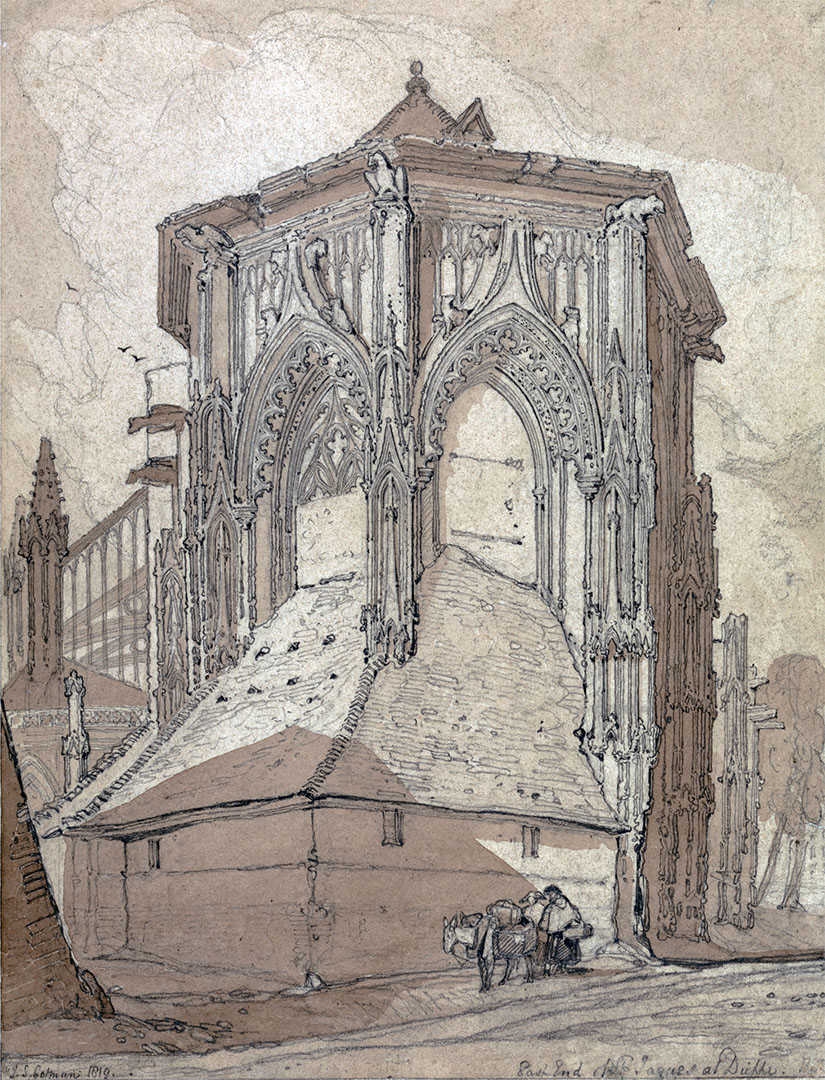
East End of the Church of St Jacques at Dieppe, by John Sell Cotman (1819)

One interesting painting featuring a building in Dieppe by Cotman is his 1819 painting entitled East End of the Church of St Jacques at Dieppe.  The church was built in the late twelfth century to become a stage for the pilgrims of the way to Saint Jacques de Compostela.  The church is seen from a close angle.  Cotman’s viewpoint is in a confined street at the rear of the building and must have been challenging to try to sketch it.  Because of this difficulty, Cotman reduced the height of the structure in his depiction.   To the left we see the buttresses with an open square to the right, and a ramshackle lean-to building against the walls in front.  In the foreground two women are seen driving a donkey loaded with panniers of laundry.

East end of the Church of St Jacques at Dieppe today

Another English artist who visited Dieppe was Turner.

Dieppe Harbour by J.L.Turner (1826)

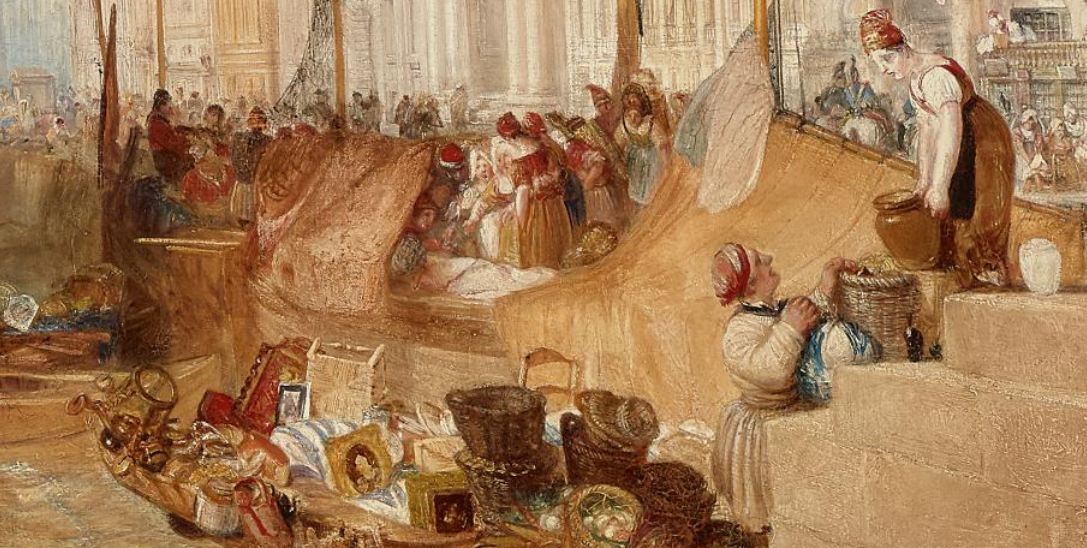
Joseph Mallord William Turner visited the French fishing port of Dieppe, in Normandy, on two occasions making preliminary sketches, before he completed his painting, The Harbor of Dieppe: Changement de Domicile​, at his London studio.  Although modernisation had come to Dieppe in the form of steamboats, Turner chose to exclude them from the depiction and instead focused on the vibrancy brought about by the  arrival of hundreds of people parading along the quayside which is glowing in the sunlight.  This bright golden tones of the depiction was criticised by journalists of the time considering them more appropriate to a southern climate. The painting was exhibited at the Royal Academy Exhibition and is now part of the Frick Collection in New York.

Changement de Domicile

The French subtitle Turner assigned the painting, Changement de Domicile meaning change of home address may refer to the couple in the right foreground, who we see loading or maybe, unloading household objects from a boat. Turner completed the painting in 1826, a year after exhibiting it in the Royal Academy, along with its companion piece Cologne: The Arrival of a Packet Boat: Evening, one set at dawn, the other at dusk. As with most of Turner’s paintings, the composition was drawn from sketches made in situ, dating back to his 1821 trip to France.

Chateau d’Arques by Turner

Turner completed a number of watercolour paintings featuring the Chateau d’Arques, which is situated seven kilometres south-east of Dieppe. It is a 12th-century castle in the commune of Arques-la-Bataille in the Seine-Maritime département of France.

L’Hotel Royal, Dieppe by Walter Sickert (1894)

Another artist who depicted the French coastal town in his paintings was the German-born English painter, Walter Sickert.  Sickert was fascinated with this popular Normandy resort and was a regular visitor for over forty years.  He was so much in love with the town that he lived there between 1898 and 1905.

Dieppe Harbour by Walter Sickert

Sickert’s first trip to the French coastal was shortly after he married Ellen Cobden and was with his new wife during their honeymoon in 1885.  His first depictions of Dieppe were of the harbour and beach scenes.

Le Pollet, Dieppe by Walter Sickert

For Sickert, the town of Dieppe became too popular with visitors during the summer months and so he steered clear of the bustling tourist streets and spent time amid the local fishing community which lay east of the harbour, which was known as known as Le Pollet, a district of Dieppe located in the valley, on the right bank of the mouth of the coastal river Arques which flows into the English Channel.

In Sickert’s House, Neuville by Harold Gilman (1907)

In 1899, soon after his separation from his first wife Ellen Cobden, Sickert settled with a local fisherwoman named Augustine Villain and her family in Neuville, a suburb just beyond Le Pollet. An artist friend of Sickert, Harold Gilman, and his family stayed in Sickert’s house at Neuville, outside Dieppe, from the summer of 1907 and whilst there, he took the opportunity to depict the interior of the house.

The Blind Sea Captain by Walter Sickert (1914)

The friendships Sickert developed whilst living in Neuville and Le Pollet were very different to the circle of friends he had made in the more up-market area west of the town. He even learnt to speak in the ancient dialect of the fishing community and many of his works depicted the local people of the area.

Pays de Caux by Richard Parkes Bonington (1823)

Cauchois is a prominent dialect of the Norman language. The Pays de Caux is one of the remaining strongholds of the Norman language.  One of the main towns of this large area is Dieppe.  The English Romantic landscape painter, Richard Parkes Bonington, had moved to France at the age of 14 and so, is often considered to be a French artist.  His landscapes were mostly of coastal scenes, with a low horizon and large sky, which highlighted the brilliant way he handled light and atmosphere.   In his painting, Pays de Caux: Twilight, we see before us a wide empty seascape at twilight, with some cliffs to the left, and with it being low tide we are able to see the flat beach which stretches into the distance.  The horizon is low, and the pale, cloudy sky almost overwhelms the painting.  In the central foreground there is a dark group of figures on the shore.

The Fish Market, Dieppe by Louis-Gabriel-Eugene Isabey (1845)

It was not just the works of English painters who featured life in Dieppe. The French painters also selected the town for their depictions. Louis-Gabriele-Eugène Isabey was among the first of the nineteenth-century French painters to be stimulated by Dieppe and the Normandy coast.  Although the title of this work suggests a fish market in Dieppe it is thought that Isabey was influenced more by the Dutch and Flemish still life paintings.  The painting illustrates Isabey’s competent use of shadows and darker tones, which results in a contrast with the more brightly lit areas, such as the fish stall.  It also creates an effect of distant space, framing the clifftop chateau which we can just about see in the background.

The Harbour of Dieppe by Charles-François Daubigny (1877)
The Port of Dieppe by Daubigny (1866)
Fishing Harbour Dieppe by Daubigny

The French painter, Charles-François Daubigny, also completed many depictions of Dieppe Harbour.

Throughout the nineteenth century, the city of Dieppe was a magnet for artists who wanted to depict its pebbled beaches, colourful harbour, and the many Renaissance château around and about. The great artists such as Turner, Delacroix, Daubigny, Pissarro, and Whistler all stayed for a time in the northern French town, which was a centre of transportation between Paris and London with it being positioned on the English Channel in Normandy.

Henry Clay Frick

The wealthy industrialist, financier and avid art collector, Henry Clay Frick, had bought paintings depicting views of Dieppe by Daubigny and Turner in 1904 and 1914, respectively which were then put on show in his New York Gallery. 

The Frick Collection, New York.

The Frick Gallery has now added a third, View of Dieppe Harbour, an 1873 watercolour and graphite drawing of the French city by the French painter, Antoine Vollon.  The Frick Collection received the work from the pre-eminent Vollon scholar, Dr. Carol Forman Tabler, in memory of her parents, Mr. and Mrs. Alexander A. Forman III.

View of Dieppe Harbour by Antoine Vollon (1873)

This watercolour by Vollon depicts a panoramic view of the city from the southern side of the port’s inner harbour, looking north. At the centre, we see the Gothic church of St. Jacques. To the left we catch a glimpse of Dieppe’s white cliffs and the château rises in the distance.  This vantage point used by Vollon afforded him a view not of the usual scenic beaches and magnificent ships but instead we see rough-hewn buildings and small fishing boats. We see the masts of the tiny figures of the fishermen on the shore. The two women in the foreground wear the headdresses, billowing skirts, and clogs which were typical of female attire of the residents of Le Pollet.

Harbour Scene, Dieppe (Le Port de Dieppe) by Gaugin (1885)

Paul Gaugin completed his painting entitled Le Port de Dieppe in 1885.  It depicts choppy sea in the foreground, which he painted in pale greens, blues and yellows. Through the middle-ground we see a number of small sailing boats moored in the harbour.  There are buildings on the quayside, some of which are coloured pale yellow, blue or white.  In the background to the left is the church of Notre Dame des Greves.

L’Eglise de Varengeville à Contre-Jour by Monet (1882)

Monet completed his painting The Church at Varengeville, Grey Weather, (L’Eglise de Varengeville à Contre Jour) in 1882. Monet loved painting depictions of the sea and the cliffs and he knew that this subject matter was guaranteed to appeal to Parisian collectors. He often travelled to the Normandy coast in the north of France during the 1880s, painting rocky shorelines and breathtaking vistas in the popular tourist towns of Dieppe, Étretat, and Pourville. In nearby Varengeville-sur-Mer, five miles west of Dieppe, Monet came across this mariners’ church perched atop a steep cliff overlooking the English Channel. He set up his easel on a hillside opposite the church and painted three versions of this scene at various times of day and under different atmospheric conditions.  He was to use this system later with his depictions of his haystacks and Rouen Cathedral series of the 1890s.

The Shore, Pourville by James McNeil Whistler (1899)

Lying just west of Dieppe is a former fishing village, which became Pourville-sur-Mer in the early nineteenth century.  It was a popular resort in Normandy. The village attracted many talented artists, one of which was Claude Monet, who completed several landscapes paintings of the area. 

In the summer of 1899, James McNeil Whistler stayed with his ward, Rosalind Birnie-Philip, and her mother at the Pavillon Madeleine, Pourville-sur-Mer, whilst he was convalescing from a recurrent illness. Apart from brief excursions elsewhere, he remained from the end of July until 26th October. While he was there, he painted a series of nine small seascapes on panel, thinly brushed, and subdued but refined in colour.

View of Dieppe by Spencer Gore (1906)

Spencer Frederick Gore was a British painter of landscapes, music-hall scenes and interiors, usually with single figures. He was the first president of the Camden Town Group and was influenced by the Post-Impressionists.  He seems to have first visited Dieppe in 1904 whilst on a trip to the Normandy coast with Albert Rutherston and Walter Russell. Rutherston, who knew Walter Sickert through his elder brother, suggested that they visit him there, and thus two of the key figures of the Camden Town circle met for the first time. In 1906, the year of the painting, Walter Sickert lent Gore his house in Dieppe for the summer, and during this trip Gore produced a number of studies of the town. In his 1906 work entitled View of Dieppe which depicts a view overlooking the town, it can be seen that Gore was gradually exploring the broken brushstrokes and concentrated colour that he so much admired in the paintings of his friend Lucien Pissarro.

Beach Scene, Dieppe by Charles Conder (1895)

Charles Edward Conder, an English-born painter, lithographer and designer, was born in Tottenham, Middlesex in 1868. He emigrated to Australia and was a key figure in the Heidelberg School, arguably the beginning of a distinctively Australian tradition in Western art.

Dieppe by Charles Conder

He spent several years as a young child in India until the death of his mother in Bombay, when Charles was four/ He was then sent back to England and attended a number of schools including a boarding school at Eastbourne, which he attended from 1877.  He left school in 1883, at the age of fifteen and his father decided that his son should follow in his footsteps as a civil engineer.  The following year Charles Conder was sent to Sydney, Australia, where he worked for his uncle, a land surveyor for the New South Wales government. Charles hated the work although he enjoyed painting and sketching landscapes. In 1886, he left the job and became an artist for the “Illustrated Sydney News”.

Dieppe by Charles Conder

In 1890, he moved to Paris and studied at the Academie Julian, where he befriended several avant-garde artists. He spent the rest of his life in Europe, mainly Britain, but visiting France on many occasions.  In 1895, Conder came to Dieppe, attempting to socialise among the artistic.

I could go on and on but decided to stop here. It is places like Dieppe that inspire painters and I hope one day you too will find the perfect place to take out your easel and brushes and bring the place to life with your depictions.

Helen Allingham

Helen Allingham (c.1901)

When depicting life in rural England, artists had to decide whether their depictions would focus on the hard lives endured by the peasant workers or focus on the beautiful idyllic life folk had who managed to escape the industrialization of the cities.  The artist I am looking at today was of the second group of painters who wanted to cast her artistic spotlight on the beauty of rural life and was well known for her depictions of country cottages.  Let me introduce you to Helen Allingham.

Helen Allingham (c.1885)

Helen Mary Elizabeth Paterson was born into a well-to-do middle-class family on September 26th, 1848 in the small village of Swadlincote, near Burton on Trent in Derbyshire, England. She was the eldest of seven children born to Alexander Henry Paterson, a rural physician, and Mary Chance Herford, the daughter of a Manchester wine merchant. Within her first year of her life, the Patersons moved to Altrincham, Cheshire where Helen’s father set up a medical practice and the young family grew and prospered. It was during these years that young Helen’s interest and talent in art blossomed, inspired by her maternal grandmother, Sarah Smith Herford, a landscape painter and her aunt, Laura Herford, a professional and accomplished artist. 

The Little Emigrant by Laura Herford (1868)

One of Laura Herford’s most endearing paintings is her The Little Emigrant which she completed in 1868.  It depicts a young girl seated on the deck of a ship, with her head resting on her hands, her right arm on the ship’s railing. She has golden hair, wears a maroon dress with red and white striped neck scarf.  The work was painted by Laura after her visit to Auckland and Nelson.  The idea of the depiction is believed to be after Laura had listened to an account by a real emigrant to New Zealand on the siling ship, Lord Auckland, when as a child she remembered sitting for days and weeks on the seat that ran round the waist of the ship, under the high bulwarks, looking out over the wide, wide sea. She sat there dreaming of the homeland to which she would never return.

Laura Herford

In her twenties Laura Herford was heavily drawn into the argument of the recognition and training of female artists.   She signed the 1859 petition to admit women to the Royal Academy. She submitted several drawings to the Academy’s admissions tutors signed “L. Herford“. The use of initials masked her gender, leading to the assumption that she was a man.  She was admitted on the merits of these drawings and an offer was made to “L. Herford, Esq” and she took up her place at the Academy in 1860 !!!  She exhibited at the Royal Academy from 1861 to 1869 and also at the Suffolk Street Gallery and the British Institution.  Later, she invited her sister’s daughter, the painter Helen Paterson Allingham, to come live with her in London at the start of her career.

Helen’s mother, Mary was also an artist but gave it up when she married.  Helen’s father’s medical practice failed and the family moved out of the small rural community, which Mary never liked, and relocated to Altrincham, Mary’s hometown.  Her husband purchased another medical practice in the town.  The new practice thrived and soon the family could afford to have a house built in the countryside at Bowden.

Lessons by Helen Allingham

Helen Paterson attended the Unitarian boarding school, once attended by her mother and which had been founded by her grandmother, Sarah Smith Herford.  In May 1862, when Helen was aged thirteen, tragedy struck her family.  Her father battled to treat local victims during a severe diphtheria epidemic.  Dr. Paterson succumbed to the disease himself, along with Helen’s three-year-old sister Isabel.

Shortly after the death of the father, the young family moved to Edgbaston, Birmingham where their Paterson aunts helped house and feed them, but money was tight.   As time passed, Helen’s artistic talents grew and she enrolled in the Birmingham School of Design.  Here for fifteen shillings a term, she studied Drawing, Perspective, Practical Geometry and Painting, three times a week.  After three years of study, Helen won the School’s Special Prize, given to her for her outstanding anatomical studies.  The School was so impressed with her talent they advised her to apply to the Royal Academy Schools.


Spring on the Kentish Downs by Helen Allingham

At age seventeen, Helen secured a place in the Royal Female School of Art in London. A year later, in 1867, she was accepted into the prestigious Royal Academy Schools, a door first opened to women by Helen’s aunt Laura just a few years before.  The Royal Academy Schools boasted a number of highly thought of masters of the art world who visited and taught the students.  Helen Paterson was influenced the most by the lectures and tuition given by Frederick Walker, Sir Frederick Leighton, and Sir John Everett Millais, who was a co-founder of the Pre-Raphaelite movement. The tuition at the Royal Academy was free, but Helen still needed money to pay for her accommodation and living expenses. With that in mind, she sought work with engraving firms, sketching figures and scenes in black & white, and in 1869 was commissioned by the Once A Week magazine, a weekly illustrated literary magazine to contribute four full-page illustrations. Her work was well received, and this led to more commissions by other periodicals and children’s books while she continued her schooling three days a week.

Beneath the Cherry Tree by Helen Allingham

In 1870, twenty-two-year-old Helen was hired as one of the founding staff members, and the only female, on The Graphic, a British high-quality weekly illustrated newspaper, first published in December 1869.  During the next three years, commissions to illustrate books and periodicals continued to pour in and by 1872 Helen decided to give up her schooling at the Academy and work as a commercial artist. Some of her most important commissions included illustrations for Thomas Harding’s fourth novel, Far From the Madding Crowd which was first published in 1874.
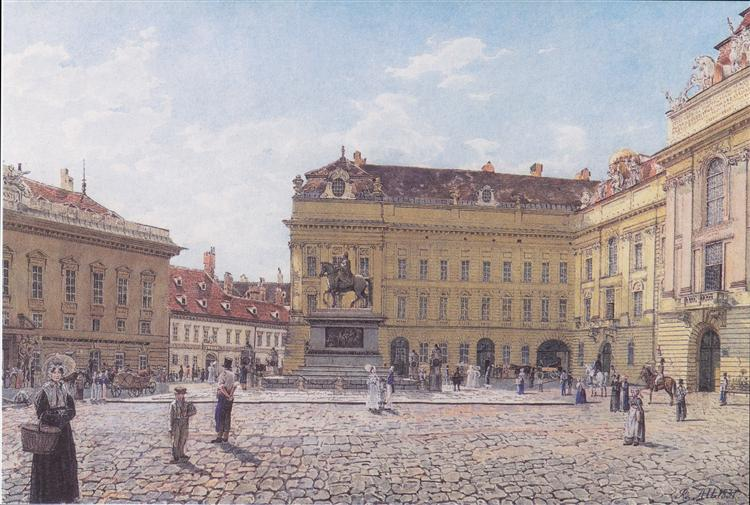
Two sudden and unexpected deaths in the early 1870’s greatly saddened Helen.  In October 1870 she was summoned from her lodgings by William De Morgan who was concerned that his fellow lodger at Fitzroy Square, Laura Herford, had not been seen that day.  He knew that Helen was a relative of Laura Herford and so when the two went back and entered Laura’s lodgings they found her lying dead in bed.  She had been suffering from constant toothache and be self-medicating with morphine and it was thought that she had died from an accidental overdose.  She was thirty-nine-years-old.

Louisa Paterson by Helen Allingham (1871)

One year later, in November 1871 Helen was summoned home.  On returning to the family in Cheshire she was told that her eighteen-year-old sister Louisa was dying of consumption.  There was little Helen could do but help the family at this sad time and sit with her sister and help her mother nurse her dying sister.  During the times Helen sat at her sister’s bedside she made several pencil sketches of Louisa and one small and emotional watercolour of her.

The Saucer of Milk by Helen Allingham

Now in London and because of her commissions, Helen’s circle of friends grew and she came into contact with prominent writers and artists.  One such friend was William Allingham, the editor of Fraser’s Magazine.  William Allingham was born on 19 March 19th 1824 in Ballyshannon, a small town in the south of County Donegal in Ulster in the north of Ireland, which is now in the Republic of Ireland. He was the son of the manager of a local bank who was of English descent.  When William was nineteen, he became a Customs officer, and he was stationed at different places in Northern Ireland until he was thirty-nine years old. Shortly after he obtained his appointment with the Customs, he made his first trip to London and after that first visit, made many more to the English capital.  He would submit many articles to London’s periodicals. He retired from the Civil Service in 1870 and moved to London and sub-editor of Fraser’s Magazine under J. A. Froude, whom he succeeded as editor in 1874.  It was also in 1874, on August 22nd, that Allingham and Helen Paterson were married after the briefest of engagements.  He was fifty and she was a month away from her twenty-sixth birthday. William Allingham had developed many good friends in London’s literary and artistic circles such as Thomas Carlyle, Alfred Lord Tennyson, Robert Browning, John Ruskin, and Dante Gabriel Rossetti.

Portrait of William Allingham by Helen Allingham (1874)

A few months after their marriage, Helen Allingham painted a portrait of her husband.

Thomas Carlyle by Helen Allingham

The newly weds went to live in a house at Trafalgar Square, in the borough of Chelsea, close to William Allingham’s best friend, the Scottish essayist, historian and philosopher, Thomas Carlyle. Such was their close friendship that William had taken Helen to visit Carlyle before they married, just to make sure Carlyle approved of his choice of wife ! Helen and William became regular visitors to Thomas Carlyle’s home in London and after many preliminary sketches completed a painting of their good friend. Look at how Helen has incorporated all the details of the furnishings of Carlyle’s room.

The Interior of Thomas Carlyle’s Dining Room by Helen Allingham (1881)

Helen’s other paintings depicted the interior of Carlyle’s rooms at his residence in Cheyne Row London. It is said that such an accurate depiction of the room aided the National Trust when they came to the restoration of the room.

Married life suited Helen and she no longer had to go out to work.  She gave up her position at the Graphic and in a way she had been pleased to have worked at the journal for four years and it had allowed her to regularly send money to her mother.  Although working for the Graphic had been advantageous, Helen was pleased to be able to concentrate on her paintings, especially her watercolours and she did manage to do some freelance book illustrations for novels written by her friends, George Elliot, Thoams Hardy and Tennyson.

A Cottage with Sunflowers at Peaslake by Helen Allingham

In November 1875 Helen gave birth to her first child, a son, Gerald Carlyle named after her and her husband’s good friend. In February 1877 a second child, a daughter, Eva Margaret, was born. Her third child, a son, Henry William was born in 1882. He was the love of Helen’s life and she would often wear a locket with just his picture inside. In 1874 Helen Allingham had two of her watercolours, The Milkmaid and Wait for Me, exhibited at the Royal Academy and in 1875 she was put forward by the eminent watercolourist, Alfred Hunt, to become an Associate in the Royal Watercolour Society.  She was later to become the first woman to be admitted to full membership.

Harvest Moon by Helen Allingham (1879)

Her early work tended to feature large figures in a landscape, but later, influenced by their holidays in the country, her style shifted more to smaller figures with emphasis on the rural scene itself.  During the seven years the Allinghams lived in London, Helen exhibited more than a hundred watercolours, some depicting her own children as models.  During her early days, Helen produced rural depictions featuring large figures.  However, in her later paintings she focused on the inanimate and nature itself and any figures depicted were much smaller. 

On February 5th 1881, after a short illness, Helen and William’ close friend, Thomas Carlyle died, aged 85.  His death came as a terrible shock to them and now that he was not a close neighbour any more, they felt no reason to stay in the English capital.  They decided to move into the country and settled in the small Surrey hamlet of Sandhills.  It was from this new base that Helen developed the love of depicting pretty cottages. Sandhills proved to be an idyllic and peaceful resting place for both Helen and William.  He was able to spend time writing poetry and Helen passed the hours painting watercolours depicting the rural areas around their home, the numerous pretty flower gardens, her children as they grew up and of course the “chocolate-box” country cottages which were all around where they lived.  As the boom of industrial development continued to threaten traditional rural life, Allingham’s paintings captured unblemished landscapes and historic cottage architecture in superb detail.  Helen was fervently concerned for the preservation of the English countryside and this love of hers was also held by the viewing public.  In 1886 Helen was invited by the Fine Arts Society to hold a one-woman exhibition with the title Surrey Cottages.

A Cottage near Brook, Witley, Surrey by Helen Allingham

Helen’s depiction of the old, thatched cottages was not just an act of sentimentality but it was to remind people of what life was like before the railways built their tracks through acres of beautiful land and with the arrival of the railways came the hordes of middle-class families into rural communities.  Some bought the cottages and refurbished them while others demolished them and built modern monstrosities.  For Helen, the task was to memorialise the beauty and tranquillity of rural life and the exquisiteness of the country cottage which she depicted with such accuracy. She would roam the countryside and paint en plein air the cottages which were marked for demolition.  She would add small figures to the scenes and sometimes would substitute thatch rooves to depictions of cottages which had been modernised with man-made materials but at the same time tried to avoid the idealistic depictions.

Irish Cottage by Helen Allingham (1891)

In 1888, Helen’s husband William became ill with persistent indigestion and the couple decided to move away from the countryside and return to London to be close to family friends.  They took up residence in Hampstead in a large home in Eldon Road.  William Allingham’s health continued to deteriorate and despite an operation in the Spring of 1889, he died that November, aged 65, leaving Helen, then forty-one, to support herself and three young children, aged fourteen, twelve, and seven.  In 1891 Helen and her children travelled to the Irish town of Ballyshannon where their father, William was born and laid to rest.  A monument had been erected in honour of their late father and Mary took the opportunity to visit some of his relations.  She also painted a number of watercolours of the landscape and the peasant cottages.

In 1890 the Royal Society of Watercolours opened their membership to women, and Helen had the honour of being the first elected into the Society.  Helen exhibited her scenic country watercolours every year in London and her depictions of rural cottage scenes grew in popularity.  In 1903 Helen collaborated with Marcus B. Huish for a book about English country life titled Happy England, which featured eighty colour plates of Helen’s watercolours.

In 1905 she and her brother, Arthur Paterson, collaborated to produce a  book entitled “The Homes of Tennyson” which contained twenty of her paintings.  More books followed including editing several books of her late husband’s poetry. Helen continued to paint and exhibit her work.  On September 28th, 1926, two days after her seventy-eighth birthday, Helen Allingham died of a acute peritonitis while visiting an old friend at Valewood House in Haslemere, just a few miles from her old country home in Sandhills.


Most of the information for this blog came from the

The religious works of Andrea Mantegna

Bronze Bust of Mantegna attributed to Gian Marco Cavalli

The artist I am featuring today is the fifteenth century painter, Andrea Mantegna, who created many magnificent religious works.  Andrea Mantegna was born into a lower working-class family in late 1490 or early 1491 in Isola di Carturo a small village close to Padua which was then within the Republic of Venice.  His father, Biagio, was a carpenter.  When he was eleven years of age he started an apprenticeship with Francesco Squarcione, an Italian painter from Padua.   His school was very popular at the time and over a hundred painters passed through the school.  Padua, then, was looked upon as a great place to be if you were and aspiring artist and the likes of Uccello, Lippi and Donatello spent time in the city.  Mantegna, who was gifted with a precocious talent, stayed with his tutor for six years.

Although he gained a great reputation as an artist and was admired by many, he left Padua and spent most of his life in Verona, Mantua and Rome where he carried on with his paintings.  In 1460 he entered the service of Ludovico Il Gonzaga the Marquis of Mantua as his court artist.  This engagement earned Mantegna a great deal of money which was a sign of the high regard in which his work was held.  Whilst employed by Gonzaga he completed many fresco paintings of the Gonzaga family.

St Luke Polyptych by Andrea Montagne (1453-1454)

One of his early works was the St Luke polyptych which he completed as the altarpiece for a Benedictine Abbey of Santa Giustina in Padua.

Saint Justina

Santa Giustina (St. Justina) is depicted at the lower level of the altarpiece at the far right.   She is identified by the palm branch (a symbol of martyrdom) and the short sword in her breast which refers to her martyrdom in Padua in AD 303, during the persecutions of the Christians by the Roman Emperor Maximian.

Saint Luke (detail from Polyptych of St Luke by Mantegna)

In the central panel of the polyptych we see St. Luke depicted writing his gospel. Although many depictions of the saint feature an ox or calf, they are absent but in keeping faith with the fact this is an altarpiece for a Benedictine abbey, Mantegna has provided Luke him with a monk’s tonsure.

Man of Sorrows (detail from Polyptych of St Luke by Mantegna)

Above St. Luke, we see two saints either side of an image of the Man of Sorrows.  This is an iconic religious image that shows Christ, usually naked above the waist, with the wounds of his Passion prominently displayed on his hands and side.

St. Julian the Hospitaller (detail from Polyptych of St Luke by Mantegna)

The panel to the far right of that portrays St. Julian the Hospitaller, a Roman Catholic saint, depicted as a young nobleman. As in many depictions of this saint, he is holding a wrapped sword, held downward.  In his left hand he holds a palm branch symbolising martyrdom.

St. Prosdocimus (detail from Polyptych of St Luke by Mantegna)

To the left of St. Luke there is a portrait of St. Prosdocimus.  In one hand he holds the bishop’s crosier, which is an ecclesiastical ornament which is conferred on bishops at their consecration.

Other members of the deity depicted in the altarpiece are St. Jerome whose left hand points to his breast and his right holds a stone, which refers to the penances he endured to rid himself of shocking thoughts. We see him depicted in his usual red robes.  Two other figures in the lower tier are dressed in the brown Benedictine monk’s habits, each hold the martyrdom symbol of a palm branch.

Polyptych of Saint Zeno by Mantegna (1457-60)

Another beautiful altarpiece fashioned by Mantegna was a commission he received from the abbot of the Basilica of San Zeno, Gregorio Correr.

Central panel of the San Zeno polyptych

It comprises of three main painting above a predella comprising of three almost square scenes.  The central panel of the San Zeno Altarpiece depicts the Madonna holding her Child and surrounded by music-making angels.  She is seated on a marble throne decorated with Roman-inspired reliefs. Hanging across the top of the three main paintings are garlands that appear to be affixed to the top of them.

Left-hand panel depicting Saints Peter and Paul, St John the Evangelist and St Zeno.

To the left and right of this main panel there are portraits of eight saints.  The saints to be included in these two paintings was the choice of the commissioning abbot.  On the left are Peter, Paul, John the Evangelist and Zeno; on the right, Benedict, Lawrence, Gregory and John the Baptist.

Right-hand panel depicting Saints Benedict, Lawrence, Gregory and John the Baptist.
The predella

The three paintings of the predella depict biblical scenes. Presently, the three paintings on the predella are not the originals which were taken by Napoleon in 1797 along with the main picture which was restored to Verona in 1815. The original outer two predella paintings are now in Tours, Musée des Beaux-Arts and the centre one is in the Louvre. 

The Agony in the Garden

The left-hand panel depicts the Agony in the Garden.  The setting is Gethsemane and we see an angel floating high above with the cup that symbolizes the inexorable fate reserved for Christ. Beyond the dead tree Mantegna has attempt to depict Jerusalem in accurate detail. A winding road leads through a rural scene with unrepaired boundary walls to the main gate. The central temple towering over the rest of the buildings was modelled on the Omar Mosque, which in the Middle Ages was often taken for Solomon’s Temple.

The Crucifixion

The middle painting depicts the Crucifixion.  The setting is a cracked rocky plateau on Golgotha. The place of execution is marked by holes in the rock, that had already been used for other crosses. At the foot of Christ’s cross lies the skull of Adam, the first man. According to legend, Adam’s grave was at Calvary and was exposed by the earthquake when Christ died.

The Resurrection

The panel on the right of the predella depicts the Resurrection.  In the centre of this painting, the bright apparition of Christ stands out, emphasized by the darkness of the rocky grotto. The faces of the guards show a range of reactions to the miracle of the Resurrection, from a still sleepy figure gazing in front of him to a soldier rising to his feet in amazement.

The Uffizi Triptych by Andrea Mantegna (1460-1470)

The Adoration of the Magi  known as the Triptych of the Uffizi, is a tempera painting on wood by Andrea Mantegna, completed around 1460 and is now part of the Uffizi collection in Florence. One of the questions regarding this triptych is whether it is one!   The work is composed of three panels which only came together in 1827.  The fact that they then became encased in a nineteenth century ornate frame does not make them part of a triptych and some art historians doubt that Mantegna created them as a triptych or envisaged them to be set up as one in the way they are now arranged.  The three works were commissioned in the for Ludovico III Gonzaga’s private chapel in the Castle of St. George in Mantua.

Ascension of Christ (Detail of the Uffizi Triptych by Mantegna)

The left hand panel of the triptych, known as the Ascension panel, we see a number of saints, gazing upwards at Christ as he floats skywards surrounded by a mandorla of angels. Immediately below Christ stands Mary, who faces towards us in the lower section of the panting, slightly raised on a ledge of rock.

Adoration of the Magi (detail of the Uffizi Triptych by Mantegna)

The central panel of the triptych is the Adoration of the Magi. The three Magi symbolize both the three ages of man and also the three continents which were known at that time, Asia, Europe, and Africa. The adherents of different cultures among the followers of the kings are depicted realistically – they were familiar because of the activities of cosmopolitan Venice, a major trading centre and slave market. Once again we see the mandorla of angels around the Virgin Mary. Mandorla is an Italian word for almonds or almond shaped.   It is a term often used in Christian art when describing an aureole enclosing figures such as Jesus Christ or the Virgin Mary

The Circumcision (detail of The Uffizi Triptych by Mantegna)

The panel on the right depicts the Circumcision of Christ on New Year’s Day, eight days after he was born as was written in the bible (Luke 2:21-24):

“… On the eighth day, when it was time to circumcise the child, he was named Jesus, the name the angel had given him before he was conceived.  When the time came for the purification rites required by the Law of Moses, Joseph and Mary took him to Jerusalem to present him to the Lord  (as it is written in the Law of the Lord, “Every firstborn male is to be consecrated to the Lord and to offer a sacrifice in keeping with what is said in the Law of the Lord: “a pair of doves or two young pigeons…”

On the left of the painting we see Joseph carrying a wicker basket, in which are two pigeons.

St Sebastiano Church, Mantua

Mantegna moved with his family to Mantua at the behest of the Marquis Ludovico III Gonzaga of Mantua.  On many occasions Ludovico had tried to persuade the artist to enter his service.  Finally in 1460 Mantegna was appointed court artist where his salary was seventy-five lire a month, a very large sum of money in those days.  Mantegna was the first painter of any repute to be based in Mantua.  During Mantegna’s long stay in Mantua, he and his family lived near the San Sebastiano church dedicated to St. Sebastian.  Maybe this is what fascinated Mantegna with the saint as he went on to paint three versions of Saint Sebastian.

St. Sebastian by Mantegna (Kunsthistoriches Museum, Vienna) 1456=59

It has been suggested that the first painting by Mantegna depicting Saint Sebastian was completed around 1459 whilst he was still living in Padua.  A few years earlier many of the Padua citizens had been taken ill, many of whom died. Mantegna contracted the plague virus but he managed to recover from the deadly disease. Saint Sebastian received the widest veneration and was called especially in times of plague as an emergency helper.  It is thought that the portrait of the saint was commissioned by the Padua city elders to celebrate the end of the pestilence outbreak.  Mantegna completed the work in 1459, a year before he left the city for Mantua.. Sebastian is tied to the ruins of a Corinthian column, his body is pierced with numerous arrows.

Rider in the cloud

Look at large white cloud at the top left of the painting. You should just be able to make out the figure of a man astride a horse. According to the Italian art historian Battisti, the theme refers to the Book of Revelation (19: 6-11):

“…Then I saw heaven opened, and behold, a white horse! The one sitting on it is called Faithful and True, and in righteousness he judges and makes war…”

The nude figure of the martyr, which resembles a stone sculpture, is placed in front of an antique architectural backdrop, which looks even more “authentic” due to the Greek signature (“the work of Andrea”) on the left edge of the pillar. This first version of Saint Sebastian can be found in the Kunsthistoriches Museum in Vienna.

Saint Sebastian by Mantegna (Louvre) (c. 1480)

Mantegna’s second version of his depiction of Saint Sebastian, which he completed around 1480, is now part of the Louvre collection in Paris.  The Louvre’s St. Sebastian was once part of the Altar of San Zeno in Verona. In the late 17th century-early 18th century it was recorded as being in the Sainte Chapelle of Aigueperse, in the Auvergne region of France.  Its presence there is related to the marriage of Clara Gonzaga on February 24th 1482, in Mantua, at the age of seventeen, to Gilbert of Bourbon-Montpensier, who in 1486 succeeded his father as Count of Montpensier and Dauphin of Auvergne.  It remained there for over four hundred years until it was acquired by the Louvre in 1910 part of the art and ancient book collector, Jules Maurice Audéoud’s legacy to the State.

The Archers (detail from the Louvre Saint Sebastian by Mantegna)

The picture depicts the saint with a well sculpted body, tied to the ruins of a Corinthian column and pierced by numerous arrows. We look at him from below which enhances our perception of the strength and power of his figure. Sebastian’s head and eyes are turned toward Heaven which is affirmation of his unwavering Christian beliefs whilst bearing the pain of martyrdom. At his feet are a pair of grim-faced archers.  Their inclusion is intended to create a contrast between the man of steadfast faith, and those who are only attracted by disrespectful and evil pleasures. It is thought that the man with the arrows is Mantegna himself.

Detail of the antique city in the background of the Louvre St. Sebastian by Mantegna

Look at the detail Mantegna has put into the background. The classical ruins are typical of Mantegna’s pictures. The cliff path, the gravel and the caves are references to the complications of trying to reach the Celestial Jerusalem, the fortified city depicted on the top of the mountain, at the right middle-ground of the painting, and described in Chapter 21 of John’s Book of Revelation:

“…Then I saw a new heaven and a new earth, for the first heaven and the first earth had passed away, and there was no longer any sea.  I saw the Holy City, the new Jerusalem, coming down out of heaven from God, prepared as a bride beautifully dressed for her husband…”

Saint Sebastian by Mantegna (Galleria Giorgio Franchetti alla Ca’ d’Oro, Venice) (c.1490)

Andrea Mantegna’s panel depicting Saint Sebastian, now in the Galleria Franchetti at the Ca’ d’Oro, is the last of his three paintings of Saint Sebastian.  This painting, like the previous two, focuses on Saint Sebastian’s martyrdom, in which he is executed by a firing squad of archers who plunged their arrows into his body.  Given that these arrows inflicted numerous wounds all over his body, Sebastian came to be invoked during times of the plague, due to the many body sores that it provoked.  The story goes that Sebastian miraculously survived the execution due to the strength of his faith. He, according to legend,  was rescued and healed by Saint Irene of Rome, who also became a popular subject for 17th-century artists. Shortly after his recovery he went to Emperor Diocletian to warn him about the fate of sinners, and as a result was clubbed to death.

Whereas the first two of Mantegna’s depictions of Saint Sebastian resemble each other in style and represent the saint in a setting of classical architectural ruins, with lush landscapes and blue sky filling the background, this third is more sombre and is in complete contrast with the Montagne’s earlier works featuring the martyred saint. In this version he is silhouetted against a neutral, shallow background, brown in colour.  Look at the facial expression in this version.  It makes viewers much more aware of the pain he is suffering. 

Candle

In the lower right corner, an inscription wrapped around a smoking extinguished candle reads

“…NIHIL NISI DIVINUM STABILE EST. CAETERA FUMUS…”

(Nothing is stable except the divine. The rest is smoke.)

The Lamentation of the Dead Christ by Mantegna (c.1480)

I cannot finish this blog about Mantegna without focusing on my favourite work of his, The Lamentation of the Dead Christ which was completed around 1490.  It is one of very few oil on canvas paintings of the period.  It is an almost monochromatic vision of Christ.  The painting has a limited amount of tonal colouring, mainly pink, grey and golden-brown.   The setting of the painting seems to be a morgue-like and claustrophobic space with its cold dark walls.  This poorly lit space intensifies the paleness of the body.  The forceful image is of the body of Christ laid out on a stark and granulated marble slab.  Mantegna has toyed with the rules of perspective making the head large, whereas if the rules of perspective had been adhered to then the head would be much smaller than the feet.  There is an intense foreshortening of the body which makes it appear heavy and enlarged.   

Christ’s suffering, before death, is plain to see.  Mantegna has given us an unusual vantage point.   It places the observer at the feet of the subject and by doing so, adds to one’s sense of empathy. It could almost be described as a gruesome sight.  The face of Christ is lined.  His head of wavy hair rests upon a pink satin pillow.  The wounds seen on the back of his hands are like torn paper, as is the horizontal cut in his side made by the spear. It is almost blasphemous, as here Christ has not risen from the dead and he is like us mortals.  In the foreground are the feet of Christ each with dried puncture marks made by the crucifixion nails.  Look at the skill in which Mantegna has painted the folds of the shroud.

The mourners (detail from The Lamentation over the Dead Christ by Mantegna)

At the left we have three mourners, Mary, Saint John and perhaps slightly hidden by the other two mourners, Mary Magdalene.  Their tear-stained faces are distorted in grief.  These contorted facial features derive from the masks of classical tragedy.  One cannot help but be moved by their expressions.

In terms of Classical art, Andrea Mantegna was one of the greatest of his time.

Ralph Blakelock Part 2.

The sad ending and Beatrice Van Rensselaer Adams

During the 1880’s, Blakelock carried on painting.  He still derived pleasure from painting and showed his work at various exhibitions.  Often, unable to pay the rent, Blakelock was repeatedly forced to move his large family from home to home in northern New Jersey and Harlem including a period of time spent with his in-laws who lived in Brooklyn.  His wife, Cora, gave birth to more children. The seventh-born, Ruth, arrived in 1893, the same year that Blakestock exhibited some of his work at the World’s Columbian Exposition in Chicago.  In 1897 Cora and Ralph’s eighth child, Allen, was born.  During his ongoing mental health issues brought on by the financial stress of not being able to feed his family, he fluctuated in and out of lucid periods, but he still managed to capture beautifully haunting scenes of moonlit skies, glades of leafless trees and multicoloured streaks of clouds.

The demands of housing and feeding his family continued to worsen his mental health.  In his 2003 biography of Blakelock, entitled The Unknown Night: The Genius and Madness of R. A. Blakelock, an American Painter, the author Glyn Vincent, described Blakelock’s eccentric behaviour at that time:

“…Mr. Blakelock began grandiosely adding price tags of millions of dollars to the backs of his paintings. He based his images on scratches in his enameled bathtub; started carrying around an antique dagger; and draped himself in embroidered sashes and belts with trimmings that his wife described as “long strings of beads and trinkets of all sorts…”

Moonlight by Ralph Blakelock (c.1899)

In 1899, on the day of the birth of his ninth child, Douglas, Ralph Blakelock was once again sectioned in a mental ward at the Long Island State Hospital at Flatbush. He was later transferred to Middletown State Homeopathic Hospital in June 1901, where he was treated for dementia praecox, which we know today as paranoid schizophrenia, leaving his wife and children destitute. Initially he was confined to a secluded ward but later was placed in an open ward where he had the freedom to move about the grounds and even visit the nearby village.  This was just the beginning of an increasingly unbelievable story.

1902 Auction catalogue for Lotos Club exhibition

There now follows a strange twist in Blakelock’s life. Almost as soon as Blakelock went into the Long Island State hospital, his works began to receive recognition from the critics especially after his one-man exhibition of his work at the New York Lotos Club in December 1900. Further exhibitions at the prestigious club followed including one held in September 1902 for Exhibition of paintings by Ralph Albert Blakelock, from the collection of Hon. Frederick S. Gibbs.

Moonlight Sonata by Ralph Blakelock (c.1892)

Within a few years Blakelock’s paintings that he had once sold for a pittance were being resold for several thousand dollars.  It is so ironic that the moment of his greatest triumph with his art came while he was sectioned at the Middletown hospital. On February 21st 1916, his painting, Brook by Moonlight sold at auction, part of the Catholina Lambert collection, for $20,000.  This, at the time, was a record amount ever paid at auction for a living American artist.   Later in 1916 he was finally elected to full membership at the National Academy of Design. 

The news of the record payment for his painting Brook by Moonlight was extensively covered in the media and it captured the imagination of a young New York woman, Beatrice Sadie Filbert Adams.  It is a story which has a hint of the Anna Sorokin/Anna Delvey story which has recently become famous through Netflix.   But who was Sadie Filbert Adams?

Mrs Van Rensselaer (c.1925)

Beatrice Sadie Filbert was born in 1884 in the town of Fishkill, sixty miles north of New York.  Her mother had been employed as a servant and Sadie never attended state schooling but was educated for a number of years at the home of her mother’s employer.  When she was sixteen, she and her older sister went to live in New York.  Two years later, in 1902, she married Louis Adams whom she described as a Chicago millionaire.  Louis actually had rich relatives but none of their wealth ever came to him and he was “a person of interest” to the Cincinnati police.  He went by a number of aliases as he plied his trade as a scam artist and swindler who had taken money from many unsuspecting and naive women.    It is thought that Sadie was complicit in many of his scams.  In October 1906, Louis Adams was convicted and jailed for his crimes and their two children were temporarily taken into care at an Albany orphanage.  Two months later the younger child, a daughter, died of diphtheria.    Sadie was heartbroken and managed to remove her son, Van Rensselaer, from the care facility.

Sadie or Mrs Van Rensselaer Adams, as she liked to be called, now gained money by writing begging letters to wealthy prominent people, mainly men and this soon led to a duplicitous lifestyle similar to that of her jailed husband. Two such wealthy philanthropists who gave her money to cover her living expenses as well as a loan whilst they pondered over how best to help her were Henry P Crowell of the Quaker Oats Company and Harold F McCormick of the International Harvester Company, the son of Cyrus Hall McCormick, an American inventor and businessman who founded the McCormick Harvesting Machine Company, which later became part of the International Harvester Company in 1902.  McCormick was also treasurer of International Harvester subsidiary, Wisconsin Steel Company which leased mines including the Victoria Iron Mine of which Mrs Adams had an eighth share which it is believed she had acquired from her husband.  Wanting to see her prosper legitimately they arranged for her to embark on a three-year nurse-training course at the Michael Reese Hospital in Chicago.  She was not enthused by the nurse training and lasted just seven months before quitting, citing the ill health of her son as her reason for leaving.

Illustration in Tacoma Ledger newspaper Blakelock confined in an insane asylum

Sadie Adams left Chicago and returned to New York but still kept close to wealthy philanthropists.  Here she involved herself in fundraising for the women’s division of the endowment association of Lincoln Memorial University, Tennessee.  She would send out begging letters for financial contributions including ones to President Taft and President Woodrow Wilson.  In the Spring of 1916, she became aware of the extensive publicity surrounding Ralph Blakelock who was languishing in a mental institution.  One such article appeared in the Washington newspaper, the Tacoma Ledger, dated May 14th 1913 in which an imaginary illustration depicts Blakelock in his cell at the Middletown (New York) State Homeopathic Hospital

Mrs Van Rensselaer then began to involve herself with Blakelock’s friends and help organise an exhibition of his work and the money raised would go to achieving his release and provide for him and his family once released from the asylum. It was also a trust, which purported to help the poverty-stricken artist and his destitute family. She contacted a young newspaper reporter, Harrison Smith, who was working for the New York Tribune, and told him about Blakelock.  Smith then went to visit the artist at the mental hospital.  The young journalist found the artist to be lucid and yet rambling and reported that Blakelock was fantasising about an imagined “diamond of the Emperor of Brazil” which he said had been stolen from him.  The journalist believed that Blakelock’s claim to be a great artist was not being believed by the asylum authorities or staff and so arranged for the artist and the asylum director to visit Manhattan where a gallery was holding a retrospective of Blakelock’s work.  The rookie journalist was hailed for his major news story despite omitting the part in which Blakelock had told him that some of the paintings on show at the gallery were forgeries.  In an account given by Smith many years later he said that he had omitted Blakelock’s comments as he believed Blakelock’s sanity at the time was in question.

Front page of New York Evening Journal (September 18th 1916)

By now Adams had assumed absolute control of the Blakelock Fund, which was reputed to be $35K,  and in early September 1916, she, with the help from money she took from the Fund, managed to afford to move Blakelock from the Middletown Hospital to a bungalow studio at a private sanatorium in West Englewood, New Jersey.  Not only was the money used to facilitate the move it allowed her to lavishly furnish the place and bring in large canvases, paints and brushes so that Blakelock would continue to paint more masterpieces which she could sell.  The newspaper headlines at the time read:

Blakelock May Recover Genius.

(New York World, September 10th 1916)

Freed from Insane Asylum, Has Six Months’ Probation to Prove Sanity

(New York Times.  September 6th 1916)

Untitled – Moonlight with Figures by Ralph Blakelock (1916)

Adams realised that Blakelock could be her cash-cow and took on the sole control of his artistic output.  Adams maintained that it was all done for Blakelock’s benefit and she said in a gesture of his gratitude Blakelock painted a rough sketch on cardboard which he gave to her.  It was unsigned but on the reverse, Adams had written:

“…This picture was painted by Blakelock for me as a momento of my efforts in his behalf and the figures are supposed to represent he and I…”

In the depiction we see the couple standing in the moonlight, surrounded by woods and mountains, at a gateway which probably leads symbolically away from the Middletown Asylum.

The Vision of Life by Ralph Blakelock (c.1897)

Adams managed to limit visits to him from his family and even had his wife Cora sign a waiver of her right to contest the guardianship as Adams had told her it would be best for her husband to be under Adams’ guardianship.  Adams also promised Cora that funds would be released to her and her family to move to a more respectable residence and which would be fully furnished.  Cora never received this promised payment.  The family tried to visit Blakelock but Adams always blocked their requests and even moved Blakelock to a new, but secret, sanatorium so they even lost contact with him.  She even returned Blakelock to the Middletown Asylum when the money ran out or as a punishment.  By the Spring of 1919, Blakelock had become fearful of Adams and her wild physical tantrums and decide he would be safer at the Middletown facility.  However on July 2nd 1919, Adams managed to extricate him from that safety and back into her custody for the last time.  A month later, on August 9th 1919, seventy-one-year-old Blakelock was dead.  Cause of death was given as a stroke or heart attack.

Such a sad end to the life of an extremely talented artist.

For a full account of the relationship Sadie Filbert (Beatrice Van Rensselaer Adams) had with Blakesock you should try and read an excellent twelve page article written by Dorinda Evans, entitled Art and Deception: Ralph Blakelock and his Guardian which appeared in The American Art Journal (Volume 19, No.1 Winter 1987). I discovered the article at the JSTOR website. It is a fascinating read and supplied me with so much information for this blog.