The Large Bathers by Paul Cézanne

The Large Bathers by Cézanne (1907) Philadelphia Museum of Art

Paul Cezanne was born on January 19, 1839, in Aix-en-Provence.   His father, Louis Auguste Cézanne was the co-founder of a banking firm and Cézanne was brought up in a wealthy and prosperous environment which eventually, on his mother’s death in 1897, resulted in him receiving a large inheritance.  When he was thirteen years of age Paul Cézanne entered the Collège Bourbon, where he met and became friends with Émile Zola. This friendship was important for both of them; for with their youthful romanticism they always pictured themselves having successful careers in the art world of Paris and as we now know their dreams turned to reality with Cézanne becoming a highly successful painter and Zola a highly successful writer.   Throughout his life Cézanne would look back on his childhood and teenage years in Aix when he and his friends would spend many heady sunlit days soaking up the Provencal climate as they would go down for a swim in the nearby Arc River.  Maybe with that in mind, it is not surprising that Cézanne would recall those days pictorially, completing almost two hundred works featuring people, both male and female, bathing, sometimes in groups, sometimes singly, nearly all with landscape backgrounds.

The featured painting in My Daily Art Display today is one of his three larger works entitled The Bathers and sometimes referred to Large Bathers (Les Grandes Baigneuses) so as to distinguish it from some of his smaller works on the same theme.  This painting is housed in the Philadelphia Museum of Art.  The other two large works can be found in the National Gallery, London and the Barnes Foundation, Merion, Pennsylvania.  It is thought that Cézanne worked on all three paintings simultaneously.   All three were completed during the last ten years of Cézanne’s life and in some ways characterise his move towards abstraction.  This can be seen in the way the faces of the bathers are without any definition and their bodies seem to merge with the landscape.  Look at how Cézanne has depicted the angle of the back of the figure on the left which runs parallel to the tree.  It is almost as if he or she is part of the landscape.  I say “he or she” as are we sure of the sex of these bathers?  There is  little or no narrative to the painting, nothing to interpret, no symbolism although we must wonder a little as to who the two figures are that are seen on the other side of the river and why did the artist add in the swimmer who breaks the surface of the river as he swims past the naked gathering.

This work of art, which Cézanne started in 1897, was not completed until 1906, the year of his death and is looked upon as one of his greatest works.  It was the last of the three large works to be completed.  The painting of female nude figures in a pastoral setting had been done many times before by artists such as Titian and Nicolas Poussin, but their works often harked back to classical mythology, such as the depiction of the goddess Diane and her handmaidens, but in this work by Cézanne there is no mythological connotation.  The figures stemmed from Cézanne’s own imagination and possibly things he remembered from childhood and not from actual observation of models.

The women in some way exude a “goddess-like” aura and almost appear to be on a stage with the trees on either side forming a theatrical proscenium arch.  The bathers seem totally relaxed.  There is a definite calmness about Cézanne’s depiction of this river bank scene. As we look at the painting our eyes focus on three triangular structures.  The two triangular formations made by the groups of naked bathers on each side of the foreground and the central larger triangular structure formed by the leaning trees on each side and the horizontal of the blue-coloured river forming the base of the triangle.  The blue of the river splits the two bands of ochre coloured earth on either side.
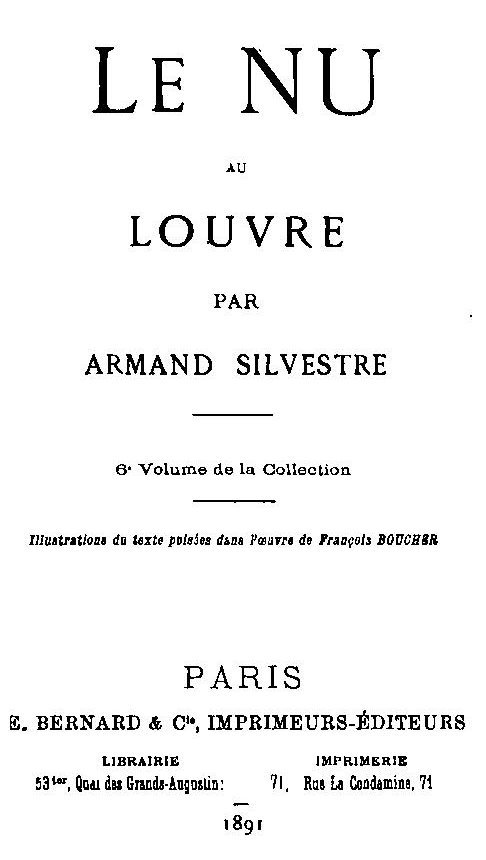
Le Nu au Musée du Louvre by Armand Silvestre

These three works featuring the bathers are thought to have been Cezanne’s final delving into the nude figure and his desire to associate human oneness with nature.  We know that Cezanne had a fascination with the depiction of the nude and would use photographs to aid his depictions.  The young French artist Francis Jourdain recounts the tale in his 1950 book Cézanne in which he visited Cézanne at his studio in 1904 and was shocked to discover that Cézanne owned a small art book, entitled Le Nu au Musée du Louvre, which consisted of photographic illustrations of nudes. Jourdain was shocked by it and described it as an affreux album jadis à Paris dans un kiosk des boulevards, (an awful album once bought in a kiosk in Paris boulevards).   The publication contained photographs of paintings and sculptures of nudes from Ancient Greek times up to the modern times.  Le Nu au Musée du Louvre was written by Armand Silvestre in 1891.  He had who also had written a five volume work, Le Nu au Salon.  He justified his work saying that it was to highlight the beauty of the feminine nude.

Cézanne would have wanted this book as it was literally a gold mine of images of the nude female figure and of course unlike live models who would constantly have wanted to move and grumble about having to sit still, the photographs were static and uncomplaining!  The professor of Art History, Theodore Reff, in his 1958 Harvard dissertation, Studies in the Drawings of Cézanne summed up Cezanne’s positive attitude to the use of nude photographs against the use of actual nude models:

“… [Unlike the models, the photographs] never moved or grew tired and more important, they never confronted him with the easily disturbing eroticism of the flesh.  Assimilated to an ideal aesthetic world of canvas or marble, they were neutralised and approachable…”

Of course the main disadvantage was that the photographs were of a single view but along with Cézanne’s sketches, the photographs served both as models of ideal beauty and as an aide-memoire for him when he represented the nude figure in natural settings as we see in today’s featured work.

When I look at today’s featured painting I cannot help but think it is like a preliminary sketch for a later completed painting.  There are many primed areas of unpainted canvas which show up as white patches.  Look closely at the figure in the foreground on the extreme right.  Are we looking at a pair of arms or are we looking at the backs of slightly bent legs?  To my mind we are seeing the long arms of the figure which only just shroud remnants of earlier legs. Look also at the face of the woman seated on the ground in the left foreground.  She has no face at all.  .

Although some would disagree, I believe this is an unfinished work, “completed” in the year he died.  Other say that Cézanne is asking us to use our imagination as to what is going on and does not want to spoon feed us with what we would term a “completed work”.  I prefer to go along with the Philadelphia Museum of Art’s description of their painting:

“…the painting has the feel of an unanswered question; a testament to the “anxiety” Picasso famously declared it to be the source of his great interest in Cézanne.  The artist left unresolved the startling contrast between the lushly painted landscape and the stiffly drawn, expressionless faces…”

Picasso once referred to Cézanne as “my one and only master” and in his youth the young Spanish painter was believed to have carried a gun, waving it half-seriously at anyone who annoyed him, particularly anyone insulting the memory of Cézanne. “One more word,” he would say, “and I fire.”

At first the three large Bathers canvases were not hailed by the public as masterpieces but Cézanne’s fellow contemporary artists saw the greatness in these last works of the genius.  Matisse commented:

“At critical moments in my artistic adventure it gave me courage; I drew from it my faith and endurance.”  

Cézanne had been out painting in fields near to his home and had been caught in a torrential downpour which soaked him to the skin.  He headed home but collapsed and had to be rescued by a passing motorist.  The next day, he got up to carry on with his painting but later on he collapsed once again.  The girl who had been modelling for him called for help and he was put to bed, which he never left it again.  Cezanne died of pneumonia on October 22nd 1906, aged 67.

On his death the painting I have featured today was bought from Cézanne’s son by Ambroise Vollard.  Vollard was one of the most important dealers and art collectors in French contemporary art at the beginning of the twentieth century and someone who championed the cause of  the then unknown artists such as Cézanne, Renoir, Gaugin and Van Gogh.   It became part of the collection of the Philadelphia Museum of Art in 1983.

Finished or unfinished that I will leave you to decide but nevertheless it is looked upon as one of the great masterpieces of art.
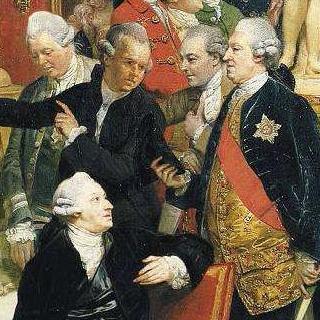
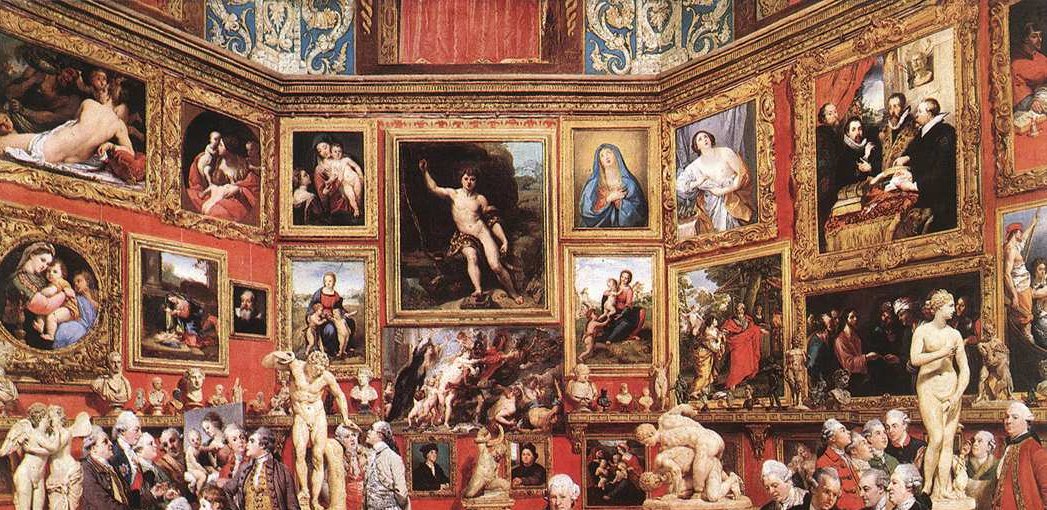
The Tribuna of the Uffizi by Johan Zoffany (part 2)

Tribuna of the Uffizi by Johan Zoffany

Thomas Beckford, the celebrated English art collector and novelist, wrote of the Tribuna of the Uffizi:

”…I fell into a delightful delirium which none but souls like us experience, and unable to check my rapture flew madly from bust to bust and cabinet to cabinet like a butterfly bewildered in a universe of flowers…’’

For anybody who has just clicked on this page you need to look at the previous blog first as this is a follow-on blog and will not really make sense if you had not read the previous one.

In this blog I am going to reveal the names of the paintings which formed part of the main work by Johan Zoffany entitled The Tribuna of the Uffizi but first, I will introduce you to some of the characters Zoffany included in his work.  It was the inclusion of some of these people, which upset his patrons, King George III and his wife Queen Charlotte.

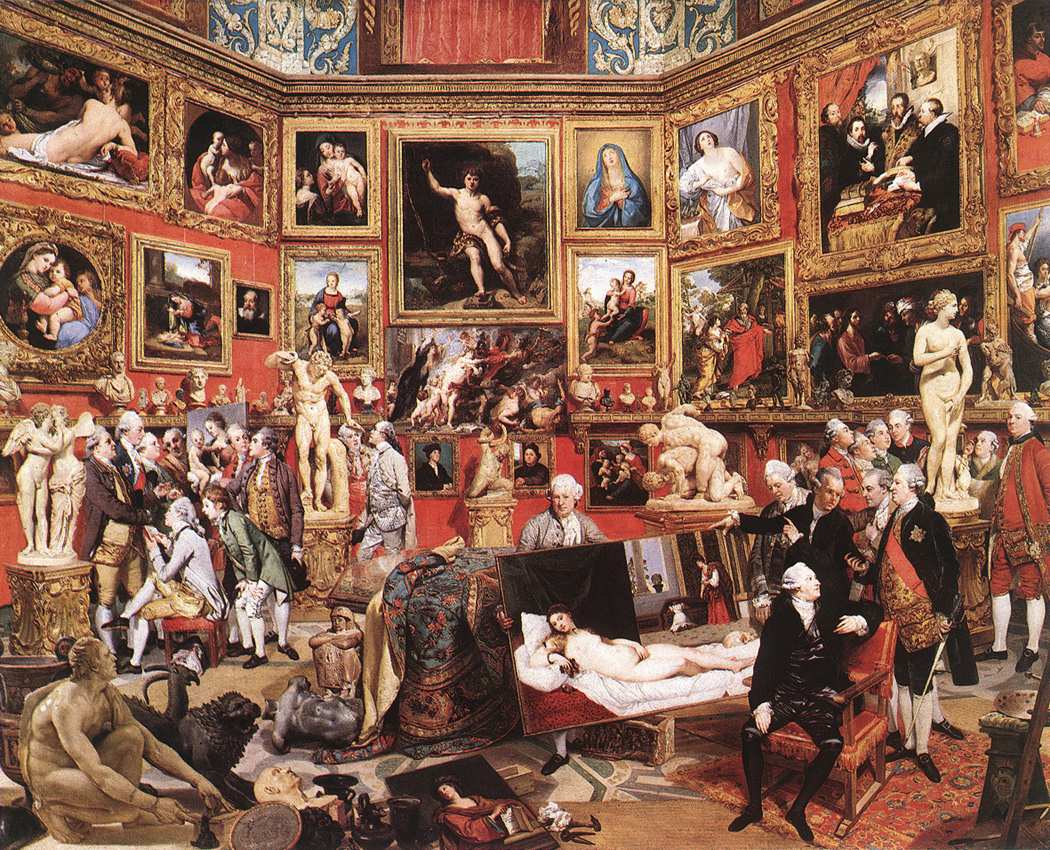
If we look at the central foreground we have six gentlemen clustered around the Venus of Urbino painting by Titian.  The gentleman seated is the Honourable Felton Hervey who was the ninth son of the 1st Earl of Bristol and who was Equerry to Queen Caroline of Ansbach, wife of George II, and had passed through Florence on his Grand Tour in 1772.

The two gentlemen, dressed in black standing behind the chair are, on the left with his right hand on the painting and his left hand pointing towards the Roman marble sculpture, The Wrestlers, is Thomas Patch.  The man on the right is Sir Horace Mann, British envoy to the Grand Duchy of Tuscany.  It was the inclusion of these two gentleman that upset George III and his wife.  Thomas Patch was an English painter, engraver and caricaturist. He travelled to Rome, where he met Joshua Reynolds and worked in the studio of Joseph Vernet, producing pastiches of Vernet’s work and his own views of Tivoli. However, in 1755 Patch was banished from the Papal States for some homosexual act and settled in Florence.   Here he earned a living undertaking art commissions from well-off young British men who were passing through Florence and Rome on Grand tours.

Sir Horace Mann was a diplomat and long standing British resident in Florence.  He kept an open house for British visitors at Florence, inviting them for conversazione, which were formal gatherings where something related to the arts was discussed when there was no performance at the theatre. His generosity and kindness was universally acknowledged, although his close friendship with the painter Thomas Patch sullied his reputation.  The two gentlemen in the fawn coats, both Grand Tourists, are Valentine Knightley of Fawsley, who stands between Patch and Mann and John Gordon who looks at the Titian painting, over the arm of Thomas Patch.  The man standing behind the painting is Pietro Bastianelli, who was a custode (custodian) of the Uffizi Gallery.

To the left of painting we see six men clustered around the Niccolini-Cowper Madonna which was painted by Raphael in 1508 and according to the provenance of the painting was bought by Zoffany in 1772, who resold it three years later.  After changing hands a number of times, the painting came into the possession of Andrew Mellon, the American banker, industrialist, philanthropist and great art collector.  On his death in 1937, the painting was bequeathed to the National Gallery of Art in Washington.  The four men to the left of the painting are from left to right, George, 3rd Earl Cowper, Prince of the Holy Roman Empire and avid art collector and frequent visitor to Florence.  Next to him is Sir John Dick, Baronet of Braid and was, at the time, British Consul at Leghorn and next to him looking up at the painting is Other Windsor, the 6th Earl of Plymouth who was known to have been in Florence in the first half of 1772.

Standing to the left and just looking around the Madonna painting is the artist himself, Johan Zoffany, who would often include himself in his group portraits.  The two men standing to the right of the Madonna are a Mr Stevenson, dressed in a red dress coat, who was the travelling companion to George Legge, Lord Lewisham, the portly man with the gold-coloured waistcoat, who stands next to him.  Legge was a member of the royal court of George III and he and Stevenson were known to have been in Florence in 1777.  The man, sitting sketching, is the artist,  Charles Lorraine-Smith and looking over his shoulder is Richard Edgcumbe who went on to become the 2nd Earl of Mount Edgcumbe.  He was a writer on music and also later in life became a politician

The final grouping on the right hand side of the painting are clustered around the Venus de’ Medici, a life-size Hellenistic marble sculpture depicting the Greek goddess of love Aphrodite.   It is a 1st century BC marble copy, perhaps made in Athens, of an original bronze Greek sculpture.  It was the grouping of these men staring at the posterior of Aphrodite and the lewd comments made by many of the Grand Tourists about the sculpture that offended Queen Charlotte as I explained in the previous blog.  The four men standing behind the statues and gazing up at “her” are from left to right, George Finch, the 9th Earl of Winchilsea,  a great cricket lover and patron to the sport and Messrs. Wilbraham, Watts and Doughty all of whom visited Florence on their Grand Tour between December 1772 and February 1773.  Standing in front of the Venus de’ Medici are, on the left Thomas Wilbraham, who was accompanying his brother and on the right, James Bruce the Scottish traveler and travel writer who had spent the previous dozen years in North Africa and Ethiopia, where he traced the origins of the Blue Nile.  He was known to have been in Florence in 1774.

And now to the paintings that are on display.  How many did you recognise?  I have already mentioned Titian’s Venus of Urbino and Raphael’s Niccolini-Cowper Madonna and here is a list of the others which Zofanny included in his painting.

On the left-hand side wall there are two large paintings hanging above three others.  The upper paintings from left to right are Bacchante by Carracci and Charity by Guido Reni.  The three paintings below from left to right are Madonna della Sedia by Raphael, Virgin and Child by Correggio and Galileo by the Flemish painter, Justus Sustermans.

On the wall facing us there are nine paintings.  The three on the upper level from left to right are Madonna and Child with Saint Catherine by the School of Titian, the large painting in the middle is Saint John by Raphael and the upper right work is The Madonna by Guido Reni.  The middle layer of paintings on this wall, from left to right, comprises of Madonna del Cardellino by Raphael.  In the middle is Horror of War by Rubens and to the right is Madonna del Pozzo by the Florentine painter, Francesco di Christofano, better known simply as Franciabigio.  The three smaller paintings below eye-level on this wall are, from left to right, Sir Richard Southwell by Hans Holbein, Portrait of Verrocchio by Lorenzo di Credi but has since been identified as a Raphael’s portrait of Perugino and Holy Family by Niccolo Soggi.

Finally on the wall to the right there are a further six painting although the two works of art on the extreme right are partly hidden.  The three on the upper tier are from left to right, Cleopatra by Guido Reni, The Painter with Lipsius and his pupils by Rubens and Leo X with Cardinals de’ Medici and de’ Rossi by Raphael.  The three works on the lower tier are from left to right, Abraham and Hagar by Pietro da Cortona which is now hanging in the Kunsthistoriches Museum in Vienna.  In the middle hangs The Tribute Money attributed to the School of Caravaggio and on the right is The Miracle of Saint Julian by Cristofano Allori.

The only other painting not mentioned as yet lies face up on the floor in the foreground just to the left of the Venus of Urbino and is The Samian Sibyl by the Italian Baroque painter, Giovanni Francesco Barbieri, better known as Guercino or Il Guercino.

I apologise for so much detail in one blog but I hadn’t realised it would be so complicated to try and describe what was in front of our eyes!!

The Tribuna of the Uffizi by Johan Zoffany

The Tribuna of the Uffizi by Johann Zoffany (1772-77)

Johan Zoffany was born Johannes Josephus Zoffaly in Frankfurt-am-Main in 1733.  His father Anton Zoffaly was a court cabinet maker and architect to Alexander Ferdinand, Prince of Thurn and Taxis and it was at the Prince’s court that young Johan was brought up.  When the Prince took up residence in Regensburg, Zoffany served as an apprentice to the local painter, Martin Speer.  In 1750, at the age of 17 when he had completed his apprenticeship Johann travelled to Rome and studied with the portrait painter, Agostino Masucci.  In 1757, now back in Germany, Zoffany was commissioned by the Elector of Trier to paint frescoes and paintings for his new palace at Trier and his Ehrenbreitstein Palace in Koblenz.

In 1760 Zoffany travelled to London.  Here he was initially employed by Benjamin Wilson, the painter and printmaker and it was from his connection with Wilson that Zoffany came to the attention of one of Wilson’s patrons, the actor and theatre impresario, David Garrick, and he commissioned Zoffany to paint a number of theatrical works which featured the actor in famous theatrical roles.  Garrick also had Zoffany paint some conversation pieces of he and his wife set in the grounds of his Hampton estates.  The term Conversation Piece is an informal group portrait, often full length but usually small in scale in a domestic interior or garden setting and was a very popular art genre in 18th century England.   They would often portray a group of people apparently engaged in genteel conversation or some activity.  Usually the group would be members of a family, but sometimes friends would be included.  In some conversation pieces groups of friends or members of a society were depicted.  It was for these works that Zoffany made his name in England.

Zoffany’s fame spread among the London elite and commissions started to roll in for his portraiture and conversation pieces.  One such commission came from the Prime Minister, John Stuart, the 3rd Earl of Bute, who wanted Zoffany to paint portraits of his three sons and another portrait of his three daughters.  It was thanks to Bute that Zoffany was introduced to King George III and his wife Queen Charlotte in 1763.  Both were impressed by his work and commissioned Zoffany to paint portraits of their family.  The Royal Academy of Arts had been founded in December 1768 through a personal act of King George III.  Its task was to promote the arts of design in Britain through education and exhibition.  There were originally thirty four founder members, with Sir Joshua Reynolds its first President.  The rules stated that there would be forty Academicians.  In a Council of the Royal Academy in November 1769 it was reported to those present that “his Majesty had been pleased to appoint Mr Johan Zoffany to be one of the forty Academicians”.  Zoffany was now a Nominated Member of the Academy.

The Portraits of the Academicians of the Royal Academy by Johan Zoffany (1771-2)

George III also set him a task to paint a group portrait of the Royal Academy members which Zoffany duly completed in 1772 and was entitled The Portraits of the Academicians of the Royal Academy.  Zoffany himself is seen with brush and palette in his hand at the far left of the painting.  The king and his wife were delighted with the painting and Queen Charlotte commissioned Zoffany to paint an even larger and more elaborate conversation piece set in the Tribuna of the Uffizi, which would depict the art treasures held within the octagonal room.   Zoffany travelled to Italy to carry out the commission in 1772 and did not complete the ambitious work until 1777.

Zoffany returned to England with his masterpiece but was distressed to find that his genre of conversation pieces had gone out of vogue and his work was no longer required by his wealthy and fashionable clients.  He could have reverted to his other artistic forte, that of portraiture, but at the time he had many very successful rivals for that type of work, such as Thomas Gainsborough and Joshua Reynolds as well as the emerging “new kid on the bloc” George Romney.

By 1783 Zoffany had all but given up hope of receiving commissions for his work in England and decided to travel to India in his search for rich patrons.   For the next six years Zoffany bided his time in the sub-continent travelling between Calcutta and Lucknow completing commissions he received from the wealthy British colonials and the local Lucknow aristocracy.  Once again he had the opportunity to carry on with his beloved conversation pieces.  Such was the popularity of his work that he was inundated with commissions and by the time he returned to England in 1789 he had made his fortune.

Zoffany died in 1810, aged 77.  He was one of the greatest exponents of the English Conversation piece with its Rococo flamboyance and will also be remembered for the charm of his theatrical works depicting scenes from popular plays of the day.

My Daily Art Display featured painting today by Zoffany is looked upon as one of his greatest works.  It is his grand conversation piece entitled The Tribuna of the Uffizi, which he started in 1772 and completed in 1777.   Going to Italy at the behest of his Royal patrons, George III and his wife Queen Charlotte, to paint this work had not been his original plan as in 1772 he had hoped to secure a passage on Captain Cook’s vessel when he set sail on his second voyage to the South Seas but the offer of a sea voyage never materialised and so he took up the commission from Queen Charlotte to travel to Florence and record in a painting the collection of art and sculpture which the Grand Duke of Tuscany had put together in the Tribuna of the Uffizi Gallery in Florence.  Queen Charlotte had envisaged this work would be a pendant to Zoffany’s earlier work owned by the English rulers entitled Academicians of the Royal Academy which he completed in 1772 and was well received by the royal family.

The Tribuna was an octagonal room within the Uffizi Gallery, designed in the late 1580’s by Bernardo Buontalenti in which the art collection of Francesco de’ Medici would be housed.  In 1737 it came into the possession of Pietro Leopoldo, Grand Duke of Tuscany.  The commission was a great challenge to the talents of Zoffany as the Tribuna art collection was one of the greatest in all Europe.  Was it a true reproduction of what was there at the time?   Not quite, as Zoffany had to experiment and alter the perspective of the room in order to incorporate all the various pieces of sculpture and in some cases he had to reduce the size of individual pieces.  The collection of art in the Tribuna during the time Zoffany was painting it was also going through a slight reorganisation and this gave him the excuse to make his own decision as to what would be on display.   In doing so he omitted some paintings which were actually on display and added others which although housed in the Uffizi were never hung in the Tribuna.  One of these was Titian’s Venus of Urbino which we see in the central foreground.  There were also a number of paintings by Guido Reni which were housed in the Pitti Palace but were transported to the Uffizi just for Zoffany to copy!

There are twenty five paintings shown in this work.  How many can you identify?   All I will tell you is that amongst them there are six by Raphael, three by Guido Reni, two by Titian, two by Rubens and one each by Carracci, Corregio and Holbein.

Besides the works of art, sculptures and other artefacts, the painting is populated by no fewer than twenty two men all of whom were either connected with the Uffizi Gallery or were a miscellany of Grand Tourists.  So who were these Grand Tourists and what was the Grand Tour?  The Grand Tour was the traditional trip around Europe taken by mainly upper-class wealthy young European men, although primarily the term is associated with the British elite and nobility.   It reached the height of its popularity in the seventeenth and eighteenth century and it was a kind of rite of passage for this wealthy elite.   One amusing aspect of Zoffany’s inclusion of the men was that during the many years he worked on the painting he would add and remove people as he saw fit and would tell some of the travellers they had to sit for him as the George III had specifically asked for their portrait to be included.  Of course that was never the case.  The one thing Zoffany was adamant about was that he would not portray a woman within the group.  It is thought that this could be due to the fact that he incorporated some lewd visual jokes into the painting.   Look at the group of men to the right who are staring at and fascinated by the backside of the Venus de Medici.  This sculpture had been well-known for the lewd comments made about it by the Grand Tourists.  In Vicci Coltman’s book entitled Classical Sculpture and the Culture of Collecting in Britain since 1760 she quotes a comment made by Charles Townley, the English country gentleman and antiquary who had made a couple of Grand Tours whilst Zoffany was painting his masterpiece.  Townley had said that he had been told that:

“…the sight of the Venus in the Florence Gallery will give you some yammering after a Tuscan Whore…”

It was not just the heterosexual innuendos that made Zoffany’s painting risqué, but his addition of two well known homosexuals, Thomas Patch, in the right foreground in conversation with another homosexual, Sir Horace Mann.  Patch is pointing at the sculpture The Wrestlers and their addition in the painting was to prove a step too far.

Zoffany returned to England in 1779 and delivered the painting to his royal patrons.   Queen Charlotte was horrified to see the room cluttered by so many men and worse still to incorporate lewd innuendos of both a heterosexual and homosexual nature.  She was especially shocked that Zoffany had included portraits of the two infamous homosexuals into the scene.  George III reluctantly paid for the work but had it placed out of sight in a room in Kew Palace.  The artist Joseph Farrington was active in the social, cultural, and professional art world of his time and he kept a daily diary from 13 July 1793 until his death, missing only a few days. This diary often referred to the London art world. The diary eventually constituted 16 volumes and in one of the volumes Farrington recounts a conversation between George III and the artist William Beechey in which he quotes the king as saying of Zoffany’s Tribuna of the Uffizi:

“…[The King] expressed wonder at Zoffany having done so improper a thing as to introduce the portraits of Sir Horace Man[n], [Thomas] Patch, & others, who were considered as men addicted to improper practices – He sd. The Queen wd. Not suffer the picture to be placed in any of Her apartments…”

It is thought it was not so much that Zoffany took it upon himself to add the twenty two Grand Tourists into the painting but it was the character of some of them that shocked and offended George III and his Queen.  Zoffany never again received a royal commission and from that day on lost their patronage.

This is a beautiful work and one of unbelievable detail.  I stood before it yesterday when I visited the preview of the Johan Zoffany RA, Society Observed exhibition at the Royal Academy in London.  If you are in London you should make a point on visiting this exhibition which runs until June 10th.

Tomorrow I will give you the answer to the names of the paintings and the artists who painted them

The Copley Family, by John Singleton Copley

The Copley Family by John Singleton Copley (1777)

In my last blog I looked at the English portraitist James Sharples and talked about how he took his family from England to America in search of patrons and their lucrative commissions.  He was just one of many European artists who decided that the way to make a fortune from their art was by crossing the Atlantic.  He of course had not only to compete against the new immigrant artists who had also made the journey but he also had to compete for work against America’s own painters.  Today in My Daily Art Display I am focusing my attention on of those great 18th century American artists, John Singleton Copley, who in fact moved across the Atlantic in the opposite direction, from Boston to London.

John Singleton Copley was born in 1738 in Boston, Massachusetts.  Both his parents, Richard and Marie were of Irish descent and had arrived in America just two years before he was born.  His mother ran a tobacco shop which was on the Long Wharf pier at the port.  His father, who was also a tobacconist, suffered from poor health and went to the West Indies around about the time of his son’s birth in the hope that the warmer climate may help,  but he died there in 1748, although the actual year of his death is contested.   His mother remarried when Copley was 10.  She married the engraver, painter, and schoolmaster Peter Pelham and it was believed that he gave young John Copley his first artistic tuition.   Pelham made his living by selling his portraits and engravings and even ran evening classes in arithmetic and writing as well as a dance class.  Another tutor of Copley was the Scottish born portrait painter John Smybert who had left his homeland and had come to America in 1826.  Both Copley’s tutors died when he was just thirteen years of age and so his artistic tuition was handed over to Joseph Blackburn, an English portrait painter, who had left home and worked in Bermuda and in colonial America.  Blackburn worked in Boston and eventually set up a studio in the town.  Although this master-student partnership started well it ended in acrimony.  The master (Blackburn) realised his student (Copley) was becoming a far better artist than himself and jealousy ended the arrangement. 

Boy with a Squirrel by John Singleton Copley (1765)

In 1776 Copley had sent his painting, entitled Boy with a Squirrel, to London, for the Society of Artists Exhibition.  The painting featured his step-brother, Henry Pelham with his pet squirrel.  It was the first work of art painted in America to be exhibited abroad and it was well received by the critics and on the strength of this work he was made a Fellow of the Society of Artists of Great Britain.  Benjamin West, the American artist who had moved to London in 1763,  invited Copley to do as he had done and move to Europe to continue his artistic studies.  For Copley, the invite was tempting and in some ways made him more unhappy with his present situation.  He was aware of his talent and the lack of artistic stimulation in Boston.  In the book Letters & Papers of John Singleton Copley and Henry Pelham, 1739-1776, there is one letter which Copley wrote to the American artist, Benjamin West:

“…In this Country as You rightly observe there is no examples of Art, except what is to [be] met with in a few prints indifferently executed, from which it is not possible to learn much…”

However although the invite to leave America was tempting Copley was aware that his portraiture was selling well and he had a good standard of living, mixing with the aristocracy who were his patrons and so he decided to stay in Boston and wrote back to Benjamin West in 1768 explaining his reasons:

“…I should be glad to go to Europe, but cannot think of it without a very good prospect of doing as well there as I can here. You are sensable that 300 Guineas a Year, which is my present income, is a pretty living in America. . . . And what ever my ambition may be to excel in our noble Art, I cannot think of doing it at the expence of not only my own happyness, but that of a tender Mother and a Young Brother whose dependance is intirely upon me…”

Susanna Farnham Clarke (Mrs Susanna Copley) by John Singleton Copley

However, although not wanting to move to England himself, he continued to send his art work to London where his artistic reputation was on the rise.   In 1769 John Copley married Susanna Farnham Clarke, whose father was one of the richest Boston merchants and a very wealthy and powerful business man, the Boston agent for the prestigious Honourable East India Company.   Copley and his wife were very happy and his wife’s beauty was portrayed in a number of her husband’s paintings.  The Copley’s marriage lasted for forty-five years and they went on to have six children.
Copley’s early works were in oils but he then began to dabble with pastels.  By the age of nineteen Copley had built up a reputation as an outstanding portraitist.  However Copley wanted to branch out and tackle historical paintings which at the time were very popular and the market for them was excellent.  Copley’s family connections and his wife’s relatives were Loyalists, staunch supporters of British Colonial rule.  Copley’s father-in-law was the merchant to whom the cargo of tea was consigned which sparked the infamous Boston Tea Party in December 1773 and this incident and what followed drove Susanna Clarke’s father to the brink of bankruptcy.

The unstable political climate worsened by the day, leading in 1774 to the rise of patriotism and the birth of the Patriots, the supporters of the colonists of the British Thirteen United Colonies who would within eighteen months rebel against British control.  Copley’s lucrative work started to dry up and it was because of his fear of an oncoming war that Copley decided to take up Benjamin West’s invitation to come to England.  His clear intention was to return to America as soon as the troubles were over, at a time when there would be a resurgence of his once-thriving art business and he would be looked upon once again as America’s leading portrait painter.  He set sail for England from Boston on June 1st 1774 leaving his mother, wife and children in the care of his step brother, Henry Pelham.  Copley had fully intended to return soon to America but the long and bloody War of Independence which eventually broke out in 1775 forced him to postpone his return. After the war ended, Copley financial situation no longer permitted a return, and the painter ended up staying in Britain forever.

On his arrival in England in 1774 Copley sought out Benjamin West who introduced him to Sir Joshua Reynolds both of whom were founder members of the Royal Academy of Art.  Copley set off in September of that year on a nine month European tour taking in Paris before moving to Italy and from there journeying north into Germany and the Low Countries.  In 1775 whilst still in Europe, Copley became alarmed at the deteriorating political situation in America and for the safety of his family.  In a letter to his step brother, Henry Pelham, he wrote:

“…if the Frost be severe and the Harbour frozen, the Town of Boston will be exposed to an attack;  and if it should be taken all that have remained in the town will be considered as enemies to the Country and ill treated or exposed to great distress…”   

Having also been alarmed about the situation at home, Copley’s wife and children, unbeknown to her husband,  had already left Boston at the end of May 1775 and arrived in London where they stayed with her brother-in-law.  Her father and her brothers followed shortly after.  Copley returned from his European trip and he and his wife set up home in London where Copley remained for the rest of his life.  By the start of the nineteenth century, life for Copley the artist, was becoming problematic.  He was still painting but sales were declining probably due to the Napoleonic Wars.  The house his family were living in was expensive to run and the cost of putting his son, John Jnr. through law school was proving costly.  The problem for Copley was that he couldn’t equate the fall of his earning power with the necessity to rein back his expenditure.  He became very depressed with life and by 1810 his health was concerning those around him.  At a dinner party in August 1815 Copley suffered a stroke and although he seemed to be recovering, he suffered a second seizure the following month and died in September 1815, aged 77.

On his death, Copley was deep in debt and his barrister son, John, who would later become Lord Lyndhurst and Lord Chancellor of Great Britain, had to settle his father’s financial affairs, maintain his parents home and look after his mother, Susanna, until she died in 1836.

In My Daily Art Display today I am featuring the large oil on canvas painting entitled The Copley Family, by John Singleton Copley, which he completed in 1777 and is now housed in the National Gallery of Art in Washington.  It measures 184cms x 229 cms (72 inches x 90 inches).  He started this group portrait painting a year after his family had arrived from America and settled in London and shortly after he himself had returned from his artistic tour of Europe.  Although an accomplished portraitist, this was the first time Copley had executed a group portrait.  The figures are almost life-size and his talent as a portraitist ensure that they all have a life-like appearance.

Copley himself is seen standing at the back of the family group grasping a sheaf of sketches and stares out at us in a manner which gives the impression that he is about to introduce the members of the Copley family to us.  Copley’s father-in-law, the once prosperous merchant, Richard Clarke is seated on the left of the painting, stern-faced avoiding our gaze, holding the youngest of his grand-daughters, Susanna.  To the right of the painting we see Copley’s wife Susanna, cradling her son John.  Look at how Copley has captured the look of love and tenderness in his wife’s face as she gazes down at her son.  On the far right of the painting and to his wife’s left, her daughter, Mary, vies for her attention.  Standing upright and in a formal pose is Copley’s eldest child, his daughter Elizabeth.  It is interesting to note that in those days boys wore dresses like their sisters until they were about six or seven years of age and old enough to wear breeches.

Copley had decided on the setting of the painting so as to give an air of classical refinement.  He has achieved that by the inclusion in the painting of elegant and fashionable furnishings and as we look over the shoulders of his sitters we see the ancient and classical Arcadian landscape à la Claude Lorrain and this background setting could well have come from paintings Copley had seen during his travel around Italy.  This group portrait of a family is of greater intimacy as it is the father who has lovingly depicted the scene.

Bronze statue of John Singleton Copley in Copley Park, Boston

John Singleton Copley’s hometown Boston has memorialised their artist by naming a city square after him, Copley Square, located in the Back Bay district of the city.  The square-shaped park at the centre is a mass of greenery and on the north side is the bronze statue of the artist.

The Sharples Family

My Daily Art Display today is not about a single painting but about a talented artistic family of English portrait painters.  This was a veritable dynasty of artists of the highest quality.  The head of the family was James Sharples who was born in Lancashire around 1751.  Originally his family had intended that James should study for the Catholic priesthood and he was sent to France for his initial training.   The theological path that his parents had wanted him to follow was not for James and he returned to England.    Instead James followed his chosen profession, that of an artist. At the age of twenty-eight, whilst living in Cambridge, he had four of his pictures accepted for the 1779 Royal Academy Exhibition.  Two years later he moved to Bath where he set himself up as a portrait painter and art teacher.

He and his first wife had a son, George.  Little is known of him but it is thought he could have also been an artist as in the 1815 Royal Academy Exhibition there was a painting by a “G Sharples of London”.  With his second wife James fathered a second son, Felix who eventually came to live with James and his third wife Ellen Wallace.  Ellen Wallace, who was of French extraction, lived in Bath and came from a Quaker family.   She was born in 1769 and was eighteen years younger than James.  They had met whilst she was attending one of his art classes.   James and Ellen Sharples married in 1787 and went on to have two children of their own, James Jnr. born in 1788 and Rolinda born in 1793, both of whom became artists.

George Washington by James Sharples (1796)

Around 1794 James, his wife Ellen and the three children, James, Felix and Rolinda set off for America.  It is thought that James believed that in America it would be possible to make a good living by painting portraits of the leading American figures of the time.  The sea voyage did not go to plan as their ship, according to Ellen Sharples’ diaries, was captured by a French privateer and James and the family were taken to Brest where they were kept prisoners for seven months.  The following year they were eventually released and continued on with their voyage to America, and eventually arrived in New York.   Sharples started working in New York and Philadelphia, which was the then seat of government and a place full of eminent people, including local and national politicians.  It is known that in the execution of his work Sharples  made us of an instrument known as a physiognotrace.  This was a device which was designed to trace a person’s profile in the form of a silhouette.

Slowly but surely, Sharples built up commissions for his portraiture.  The whole family then embarked on a painting tour of New England picking up lucrative commissions which often entailed making reasonably priced copies of his original portraits of American political leaders, such as George Washington, Thomas Jefferson, James Madison and John Adams.   Around 1797 when the family was living in Philadelphia, Ellen Sharples  began to draw portraits professionally.   At this time, there was a  great demand for reasonably priced copies and Ellen’s career of copying her husband’s original portraits on commission flourished and she could command virtually the same price for her miniatures as her husband charged for his mini-portraits. It was not just the mother and father who had artistic talents as their three children under their parents’ tutelage soon became accomplished artists in their own right and were soon able to contribute work for the family business.  Portraiture in America at that time was highly competitive not only because of home-grown American artists but more so from European painters who, like Sharples, had travelled to America in search of their fortune.   This intense competition made it necessary for artists to travel and look for clients rather than wait at home for clients to come knocking upon their doors.   James Sharples often had to drag his family from place to place in search of commissions.

James and Ellen Sharples soon built up reputations as talented portraitists who concentrated on small scale pastel portraits and whose work was in great demand and slowly but surely they became financially secure.  James Sharples died of heart trouble in 1811, aged 60 and Ellen and her two children, James and Rolinda returned to England.  Felix Sharples, who was at this time twenty-five years old, chose to stay in America, working as a portrait artist, where he died in 1830 aged 44.

Charles and Catherine Darwin by Ellen Sharples (1816)

Ellen, along with James and Rolinda settled down in Clifton, just outside Bristol and the three of them set up a family business producing small-scale pastel portraits for clients. Rolinda Sharples began to work in oils and she moved away from being a miniaturist and ventured into the highly competitive world of full-scale portraiture and history paintings depicting groups of people.  Rolinda was elected an honorary member of the Society of British Artists in 1927 and was one of the first female artists to attempt multi-figure compositions, which formed part of the pictorial historical records of the time.

The Stoppage of The Bank by Rolinda Sharples (1831)

The painting above entitled The Stoppage of the Bank by Rolinda Sharples was completed in 1831.   The background to this painting relates to the happenings in 1825 when England had just recovered from the Napoleonic Wars and the country’s economy started to boom.   In the euphoria of this boom, even the most clear-headed of  bankers made risky loans ( a familiar story ??).  The bubble burst in April 1825 and the stock market crashed.   By the autumn a number of country banks had failed causing panic.   It was a financial catastrophe, which led to widespread ruin and misery for the unfortunate people who had all their capital invested in the failed banks.  This is the setting, which Rolinda Sharples illustrates in her painting.   The scene before us takes place in a fictional street, called Guinea Street but which had a great similarity to the real Corn Street in Bristol.   On the right of the painting is a bank whose closure is causing shock and consternation to the people waiting outside attempting to get their money.  Behind, we see the famous Dutch House which stood on the corner of Wine Street and High Street until destroyed in the Blitz. The church in the centre background is All Saints Church.  Rolinda Sharples used some artistic licence when she placed the church in that position, one presumes it was for artistic effect.

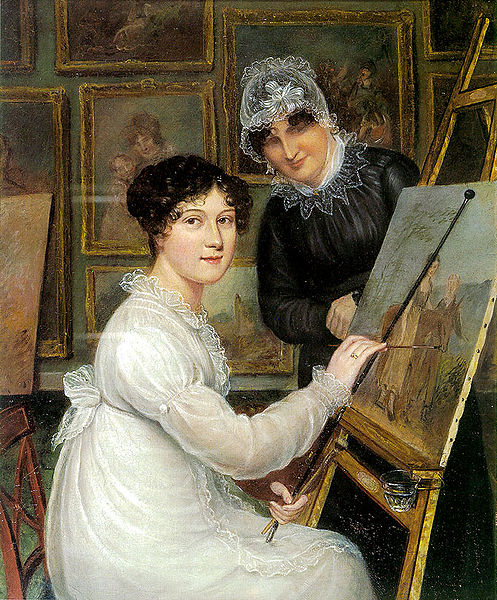
The Artist and her Mother by Rolinda Sharples (c.1820)

Both Rolinda and her brother James predeceased their mother.  Rolinda died of breast cancer in 1838, just forty-five years of age and James Jr. died of tuberculosis in 1839.  Ellen Sharples, the last of the Sharples family, died in 1849 aged 80.

Manao tupapau -The Spirit of the Dead Watching by Gaugin

Manao tupapau -The Spirit of the Dead Keep Watch by Gaugin (1892)

Paul Gaugin – Part 3 (Conclusion)

 Today I am concluding my look at the life of Paul Gaugin.  My earlier blogs on February 23rd and February 25th looked at the early and middle part  of Gaugin’s life and should probably be read before you begin today’s offering.

We had reached 1887 and left Gaugin desperately wanting to leave France and head for Panama where he believed he would be able to lead a worry-free lifestyle.  He and his artist friend Charles Laval set sail in April of that year and before reaching Colon in Panama the ship weighed anchor off the island of Martinique.  They eventually arrived at Colon and Gaugin was disappointed not only with the area but also that his plea to his brother-in-law for financial assistance was turned down.  Gaugin and Laval now had insufficient money to return to their newly chosen destination, Martinique.  It was then imperative that they found the funds from another source to pay for their proposed sea passage and so they worked on the construction of the Panama Canal.  The French had made the first attempt to construct a sea-level canal in 1880 under the leadership of Ferdinand de Lesseps who had been involved in the construction of the Suez Canal some twenty five years earlier.  Gaugin and Laval finally accrued enough money for their trip to Martinique in June.   The Gods however didn’t look favourably on the two intrepid artists for whilst on the island of Martinique both Gaugin and Laval were extremely ill suffering from bouts of malaria and dysentery.  The pair returned to Paris in November 1887.  Despite his illness during his sojourn on Martinique, Gaugin believed his short time on the island was a defining moment in his life.  He wrote enthusiastically about it in a letter to his wife, Mette, in February 1888:

“…you must remember that I have a dual nature, the Indian and the sensitive civilised man.  The latter has disappeared [since my departure], which permits the former to take the lead…. the sensitive man has disappeared, which permits the Indian to forge resolutely ahead…”

Although he did not complete many paintings whilst at Martinique due to illness, what he brought back to Paris was remarkable and well received.  Gaugin lodged once again with the Schuffenecker family in Paris and struck up a friendship with Theo van Gogh, who worked as an art dealer for his family business at the Goupil Gallery.  Theo took on Gaugin on the strength of these Martinique works of art.  Theo’s brother Vincent van Gogh invited Gaugin to join him in Arles so that together they could set up and artistic colony and art institution which Vincent termed “A Studio in the South”.  Gaugin was disinclined to join Van Gogh on this project but Theo paid him to go to Arles to keep an eye on his brother.  In October 1888 Gaugin travelled south to Arles and stayed with Vincent van Gogh in the Yellow House.  The two artists were incompatible and within two months, and after many violent arguments, Gaugin left Vincent and returned to the Schuffenecker household in Paris.  Of his disagreements with van Gogh, Gaugin wrote in a letter that December to a fellow artist, Émile Bernard:

“….Vincent and I don’t agree on much, and especially not on painting….. He is romantic, whereas I, I am more inclined to a primitive state…”

 Van Gogh and Gaugin had a different philosophy to their art.  Van Gogh liked to have the subject he was painting in front of him whilst Gaugin preferred to paint from visions in his mind.  Once again we see Gaugin talking about his alter ego, that of him being the primitive man.

By 1889 the curse of wanderlust struck Gaugin again and this was heightened by his visit to the Exposition Universelle, the World Fair held in Paris that year.  Within the exhibition there were many stands highlighting the beauty and opportunities of the overseas French colonies.  Gaugin believed he could set off for one of these far-flung territories along with some of his artistic friends and set up a Studio of the Tropics.  Initially Gaugin favoured going to the French colony of Tonkin, which is now part of Vietnam or maybe go to Madagascar but finally he decided on Tahiti. Another reason for Gaugin to leave France could well have been that his preferred art dealer, Theo van Gogh,  who had managed to sell many of his works, suffered a mental breakdown and  died suddenly in January 1891 and with him went Gaugin’s main source of income.

In March 1891 Gaugin finally had agreement with the French government to sponsor his trip to Tahiti and in return for a reduced cost of the sea passage, he would record the customs, landscape and people in his paintings of the French colony.  Before he set sail he went to Copenhagen to see his wife and children and unbeknown to him at the time, it would be the last time he sees them.  Gaugin set off from Marseille on April 1st and arrived in the Tahitian port of Papeete on June 9th.   The Tahiti that Gaugin finds was not the Tahiti he had envisaged.  This was not the land of plenty which the Exposition Universal had described.  Tahiti was a down-at-heel French colony and Gaugin believed the native Tahitians had been ruined by missionary zeal.  What he had expected to see just did not exist.

His first works after he settled in Papeete were portraits of Tahitian women demurely dressed in their “Sunday-best” clothes but the demand from France was paintings of the pure full-blooded naked primitive native women.  They neither wanted to see depictions of the missionary-converted women, nor did they want to see the mixed race women, the product of their parents’ relationship with passing sailors.  Gaugin decided that if he was to find the true spirit of Tahiti he must move out of the colonial capital of Papeete and so along with his young mistress he went to Mataiea and away from the colonial influence of the capital.  He now felt much happier and in a letter to George-Daniel de Montfeid, the French artist, art collector and biographer of Gaugin, he wrote:

“…I am now living the life of a savage, walking around naked except for the essentials that women don’t like to see (or so they say)…”

Gaugin remained in Tahiti but his lack of money and hand-to-mouth existence was affecting his health and he became depressed and hankered to return to France but the Governor of the Island refused to let him leave.  In the spring of 1893, he sent a number of his Tahitian paintings to de Montfreid to be exhibited and sold.  In the autumn of 1893 he finally managed to leave the island and returned to Paris where he fully expected to be acclaimed a hero for all the Tahitian works of art he had sent home.  His works were exhibited at the Durand-Ruel Gallery in Paris and although they were well received by critics, sales were disappointing.

In the spring of 1894 he revisits Pont Aven with his very young Javanese mistress.  Gaugin had returned to this artist colony, not as a respectable gentleman artist but as the uncouth primitive savage, a persona which he had developed during his Tahitian stay.  His constant fornication with very young and under-age girls earned him a certain notoriety and his heavy drinking bouts often lead to fights with the locals and on one occasion his ankle was shattered causing him to be laid up for more than half a year.  In early 1895 he received his come-uppance for his unrestrained debauchery over the years when he was diagnosed as having contracted syphilis.  He is completely disillusioned with France and he sold as many of his paintings as he could and left the shores of France for the last time and headed back to Tahiti.

Life back in Tahiti was not kind to the ageing artist.  To his great disgust, the country had become more modern.  His health was slowly but steadily deteriorating due to the onset of the symptoms of syphilis.  His financial situation worsened and in 1897 he suffered a series of heart attacks. He also received the sad news from his wife Mette that his daughter Aline had died of pneumonia in Copenhagen, at the age of 20.   In the early months of 1898, in a moment of complete despair, he went into the mountains and attempted to kill himself with arsenic.  It does not kill him but badly damaged his internal organs and he had to be often hospitalised to stabilise his condition.  More bad news from home was to follow as his third and favourite child, Clovis, died in 1900 aged just 21.

In 1902 he moves from Tahiti to Atuona on Hiva-Oa in the remote Marquesas Islands where he died the following year of syphilitic heart failure, just a few weeks short of his fifty-fifth birthday.

My Daily Art Display featured oil on burlap painting today was completed by Gaugin in 1892 during his first stay in Tahiti and is entitled Manao tupapau -The Spirit of the Dead Watching and is housed at the Albright-Knox Art Gallery in Buffalo, New York.  Manao tupapau is the spirit of the dead.  The painting is a mass of colour, the yellow blanket, the black and gold valance and the phosphorescent greenish sparks on the violet background, which exaggerate the creepy atmosphere.     This is a highly atmospheric and sensuous scene, full of mystery and foreboding.  Fear emanates from the painting.  Gaugin explained his thought process when he painted this picture:

“…I have made a nude of a young girl… who is a Maori. These people traditionally fear the spirits of the dead… I must explain this fear with as few of the time-honoured literary devices as possible… there are a few flowers in the background but… as they only exist in the girl’s imagination… I make them like sparks… finally I have made the ghost just a plain little woman, for this girl… can only picture the spirits of the dead as looking like the person who has died…”

Gauguin in choosing the face-down pose of the young naked girl knew it could be highly problematic when it was seen by the French public and of course it was these very people who would be the potential buyers of his art.    He must have been fully aware that his depiction of the young girl would strongly hint at lovemaking, which had just occurred or was about to happen.  It is interesting to note that very few paintings up until then depicted the naked body of a woman lying down.  The one well-known exception was probably the Reclining Girl by François Boucher (My Daily Art Display, May 30th 2011).   Not to be detracted from his desire for that pose Gaugin probably then decided to incorporate the “spirit of the dead” theme with the fear that came with it, so as to add some gravitas to the work.

We need to understand the thought process of the Tahitians when it came to life and death.  The Tahitians divide their day into two halves: daylight, or ao, and darkness, or po.  With po they associate the tupapaus, and therefore they fear the night.   The tupapaus are the Tahitian personifications of the spirits of death.  For the Tahitians they are a genuine and permanent threat to them and they associate them with the darkness of night.   The Tahitians are so afraid of them that they never go out of their homes at night without a light, and even with a light they never venture out alone. They always keep their homes lit at night, so as to ward off the tupapaus.

Before us we see a young dark-skinned Tahitian female as she lies naked, face down on her stomach on top of a bed with a stray tendril of her jet-black hair lying across the pillow.  She is probably in her early teens, Gaugin’s age of choice for his mistresses.  She exudes an abundance of sexuality. Her body retains some of the “puppy fat” of a young female.  There is firmness to her limbs and buttocks and a definite seductiveness about her pose, which of course was all in the mind of the artist.    Her body is stiff as if she dare not move an inch for fear of the repercussion of so doing, although one can imagine that inwardly she is shuddering with fear.  She is terrified by the presence of the hooded spirit of death with its averted phosphorescent-coloured eye, which we see sitting crouched at the foot of the bed.  For the young girl, death was not a strange occurrence as  European ships and the sailors  brought to the island diseases such as smallpox, dysentery, scarlet fever and tuberculosis for which Tahitians had little or no immunity.  Add to this the weapons the sailors brought with them to the island to ttrade for food and which provided the natives with a much more effective killing machine during local rival confrontations.  She has witnessed death through disease and local confrontations many times over and by his depiction of this scene and despite its exotic colouring, Gaugin is, in a way,  commenting on the fragility of Tahitian life.

It is as if the spirit is keeping a vigil at the foot of the bed.  Maybe the girl believes the spirit has come to take her to the “next world”.  Native Polynesians believed that the phosphorescence of the light was the spirits of the dead.  The hag-like spirit with bulbous lips is seen in profile and the face and eye reminds me of Ancient Egyptian drawings of women.  The hand of the evil spirit lies menacingly on the bed.  In this case the spirit is the embodiment of an old woman dressed in a black shawl but for the frightened girl she is probably the embodiment of a dead relative who may have come for her.   In his 1901 book entitled Noa Noa: The Tahiti Journal of Paul Gauguin, Gaugin recalled the incident.  He had just returned home unexpectedly late one night.  The room was in darkness.  He struck a match and saw his wife, Tehura……

“…immobile, naked, lying face downward on the bed with the eyes inordinately large with fear . . . Might she not with her frightened face take me for one of the demons and spectres of the Tupapaus, with which the legends of her race people sleepless nights?…”

It is a remarkable painting and for me the story behind it adds to its appeal.

That ends my look at Gaugin and his life and I wonder what you think of him as a man and as an artist.  The two are quite different.  Such differences between the personality of a person and the quality of what he or she  produces have always existed and still do nowadays.  So should we just take in and enjoy what Gaugin has produced and put to the back of our minds his way of life and his proclivity for sex with under-age girls or is that just too difficult?  By compartmentalising Gaugin’s lifestyle and Gaugin’s art work, are we simply justifying the unjustifiable?

La Vucciria by Renato Guttuso

La Vucirria by Renato Guttuso (1974)

I am leaving the final part of My Daily Art Display’s look at the life of Paul Gaugin until my next blog and thought I would feature a painting I came across the other day when I was watching an art/ travelogue/cooking programme, which looked at the artistic treasures of the Sicily whilst the presenters sampled the local dishes.  In the first of three programmes they visited Palermo and in one section we were shown the manic hustle and bustle of La Vucciria, the popular market of the town.  When I was researching this blog I came across a description of this marketplace given by a resident of the town.

“…There are no words in any language to accurately describe this place. It is a mix of heaven and hell in one place! The mix of smells and people and cultures all in one market. You can glimpse into the life of the real people of the city. I go there almost every day because I can’t get enough…”

What fascinated me the most about the market was a painting of it by one of Sicily’s most famous artists, Renato Guttuso, and so I have made him my artist of the day and his painting simply entitled La Vucciria the featured painting for today’s blog.

Renato Guttuso was born on 26 December 1911 at Bagheria, a small town on the north west coast of Sicily, some ten kilometres east of Palermo. His father Gioacchino was a land-surveyor and also an amateur watercolourist.  His mother was Giuseppina d’Amico.  Probably due to his father, Guttuso learnt to paint at a very early age.   At the age of thirteen he began signing and dating his paintings and drawings which at the time were, in the main, copies of nineteenth century landscapes.  He went to high school in Palermo and then on to the university, where he studied European art, from Courbet to Van Goghand to Picasso.
In 1931, when he was twenty years of age he had two of his paintings accepted for the Prima Quadriennale d’Arte Nazionale in Rome and this gave him the chance to attend the exhibition and see the works of the greatest Italian artists. The following year his works appeared in an exhibition in Milan.  To supplement his income as a painter he worked as a picture restorer for the Picture Gallery of Perugia and the Borghese Gallery in Rome.  He was also interested in commenting and writing articles on art and the trends of modern art.  However the first article he contributed to the left-wing Palermo newspaper, L’Ora,  fell foul of Fascist censorship.

In 1935 Guttuso did his military service in Milan and two years later went to live in Rome where he set up his studio and had his first solo exhibition.  Guttuso kept producing outstanding works: nudes, landscapes, still lifes.  In 1941 he produced one of his most famous paintings entitled Crocifissione(Crucifixion), which is now looked upon as one of the most relevant masterpieces of the Twentieth Century.  He explained the meaning of the work:

: “… this is a time of war. I wish to paint the torment of Christ as a contemporary scene … as a symbol of all those who, because of their ideas, endure outrage, imprisonment and torment”.

This controversial painting for which he is probably best remembered, denounced the horrors of the war under a religious guise. His depiction of one of the most famous Christian events provoked widespread controversy.  The Vatican authorities even issued an edict forbidding the religious to look at the canvas.

In 1942 Gutusso turned his hand to stage design for musicals, creating both scenery and costumes for performances at the Teatro della Arte in Rome.  During the war Gutusso moved out of the capital city and joined the Resistance movement which was strongly opposed to fascism.  At the end of the war, he visited Picasso in Paris and this was to be the beginning of a lifelong friendship between the two painters.   He, along with some other like-minded artists, founded the “Fronte Nuovo delle Arti’ (New Arts Front), a group of politically aware artists who aimed at making up for those European artistic experiences whose circulation in Italy had been prevented by Fascism. Social themes and scenes of everyday life prevailed in his painting.   In 1950 Guttuso was awarded the World Council of Peace prize in Warsaw, and in the same year his first one-man exhibition was held in London.  Large-scale paintings of his were regularly shown at the Venice Biennale, always stimulating debates and controversies.  In 1972, Guttuso was awarded the Lenin Prize at the time of his exhibition at the Art Academy in Moscow. The following year Guttuso selected a relevant collection of works, both his own and by other artists, which would form the core of the future municipal art gallery of Bagheria.  In 1976 he was elected a Senator of the Republic for the Italian Communist Party, a political party he had been an active member since joining in 1937,

Guttuso died on 18 January 1987, leaving major works to the Galleria d’Arte Moderna, Rome. He had previously entrusted other works together with a rich collection of documents to the Museum in his native town of Bagheria which had been dedicated to him. This museum, Museo Guttuso, which is housed in the 18th century Villa Cattolica, owns the largest collection of his paintings, drawings and graphics.

And so to the painting I am featuring today, La Vucciria by Renato Guttuso which he completed in 1974 and can be found in Palermo’s Palazzo Steri.  It is a sort of folk art type of painting.  When I watched the TV programme and the part which looked at La Vucirria, nothing seems to have changed in almost forty years since the artist depicted it in his painting.  The naked electrical lights dangling over head still remained.   The Sicilian word vucciria means “confusion” and we can recognise the aptness of that name in the painting.   Look at the scene.  Can you imagine the noise and smells that emanate from this market as the vendors scream out descriptive delights of their precious products?  The many fish stalls have to be kept constantly wet to maintain freshness and the floor around these areas are never dry.  The closeness of the market to the port ensures the freshness of the fish and this is depicted by the artist as we see them curled, still in rigor mortis.    The painting is a rich and colourful, some would say gaudy, portrayal of life in the market.  The colours are so vibrant and pulsating.

There is verticality about the painting as the path between stalls moves almost in an upward direction through the centre of the painting to the top.  This is Sicily and, as we know, Sicily is synonymous with the Mafia and maybe there is a dark side to the painting.  Observe either side of the woman in white who has her back to us.  To her left there is the fish seller.  Note how he looks across at the cheese seller to the right of the woman.  Notice how they scowl at each other.  The fishmonger grasps the swordfish almost as if he is grabbing hold of a blade.  If one looks closely at the cheese seller there is evidence of a pentimento, which is where there is evidence in the form of traces of previous work that shows us that the artist has changed his mind as to the composition whilst he was in the process of painting. The word actually derives from theItalian word pentirsi, which means “to repent”.   It is thought that the partly hidden hand of the cheese seller once was painted with a knife in it.  Are we witnessing a brewing vendetta between the two men?  Does the woman in white have anything to do with the bad feeling?  Are the two vendors vying to be her lover?  The vertical line through the centre of the painting was looked upon as the vertical line of life and the horizontal line of sight between the warring cheese seller and the fishmonger was looked upon as the horizontal line of death and of course the intersection of the two lines form a cross.

Renato Getups was deeply anti-fascist and an ardent communist all his life.  He was also anti-Mafia and so it was ironic that in 2009 when a leading mafia financier, Beniamino Zappy, was arrested and had his art collection confiscated there were many paintings by Gattuso.  A spokesman for the anti-Mafia investigators said, with a touch of humour, of Zappy:

”…He is part of a criminal organization, the Mafia, but

The Swineherd, Brittany, The Schuffenecker Family. Madame Gaugin by Paul Gaugin.

Life Story of Paul Gaugin (Part 2)

In my last blog I gave you a brief outline of Gaugin’s life up until April 1871 when Gauguin, having completed his military service, returned to his late mother’s home in St Cloud, only to find it had been destroyed during the year-long (July 1870 – May 1871) Franco-Prussian War.  He then moved back to Paris and takes an apartment close to where his former guardian Gustave Arosa lives with his family.  In 1872, through Arosa’s business connections with the owner of a stockbroker firm, Paul Bertin, Gaugin becomes a bookkeeper for the company.

The Schuffenecker Family by Paul Gaugin (1889)

It is whilst working here that Gauguin meets the part-time artist and his co-worker, Émile Schuffenecker, who joined the firm a few months earlier.  The friendship grew and they used to spend time in the Louvre studying the paintings of the Old Masters.  In December that year Gustave Arosa introduces Gauguin to a Danish woman Mette-Sophie Gad.  Mette was a judge’s daughter and formerly a governess to the children of a Danish Minister of State and she was in Paris with a friend to improve her cultural education.  Gaugin and Mette married in Paris in November 1873 and they became great friends with Emile Schuffenecker and his wife, Louise.  The Schuffeneckers who married seven years later in 1880 had two children, a daughter Jeanne born in 1882 and a son, named Paul after Gaugin, was born in 1884.   Gaugin and Mette’s first child, Emile (named after their friend Schuffenecker), was born in September 1874.  The couple at this time were experiencing a good standard of living derived from Gaugin’s earnings at the financial brokerage.

Mette Gad (Madame Gaugin) in an Evening Dress by Gaugin (1884)

Gauguin love of art blossomed, thanks mainly to two people.  Firstly from his former guardian Gustave Arosa who had, along with his brother, managed to build up an impressive collection of paintings from the likes of Gustave Courbet, Jean-Baptiste-Camille Corot, Eugène Delacroix and Jean-François Millet and it was Arosa who introduced Gaugin to Camille Pissarro who would occasionally tutor him.    The other person who encouraged Gaugin to paint was his friend and work colleague Émile Schuffenecker and the two of them would often go off on Sundays on painting trips.  The pair also spent the occasional evening at the life classes at the art school, Académie Colorossi.  To give one an idea of how quickly Gaugin learnt the art of painting, it should be noted that in 1876, within four years of starting to paint, Gaugin had a landscape Under the Tree Canopy at Viroflay accepted at that year’s Salon.  There was also a family connection with art as Mette’s sister Ingeborg had married the Norweigan painter Fritz Thaulow and when he and Gaugin got together they would discuss painting and Thaulow would offer critical advice to Gaugin about his works of art.

At the start of 1877, Gauguin decided to leave Paul Bertin’s stockbrokerage firm and move to André Bourdon’s bank. The job at the bank was better for Gaugin as it had regular business hours which meant that he could set aside regular periods for his painting.   Financially life was still good.  He received a regular salary from the bank and he had been very successful with his speculations on the Paris stock market.  Gaugin and his wife moved house and went to live to Vaugirard, a suburb in the south west of Paris, where they rented rooms in a property owned by the sculptor, Jules Bouillot and one of their neighbours was Jean-Paul Aubé.

In 1877 Gaugin’s daughter Aline was born and the following year there is an upturn in Gaugin’s financial situation as share prices rise and bank bonuses roll in.  Gaugin spends this money on buying contemporary art by the likes of Camille Pissarro and some of the other Impressionist painters.  In 1879 Gaugin is invited by Pissarro and Degas to exhibit some of his work at the Fourth Impressionist Exhibition.  That same year, Gaugin’s second son, Clovis, is born.  Life is good for Gaugin and his wife. They wanted for nothing. They are happily married; he is earning good money at the bank and is exhibiting more of his paintings at the Impressionist Exhibitions.  In April 1881 his third son Jean-René is born.

However, as in life, all good things come to an end.  For Gaugin the end came in January 1882, for it was then that the Paris Bourse (French stockmarket) crashed.  It caused the worst crisis in the French economy in the nineteenth century. The crash was triggered by the collapse of l’Union Générale Bank that month.  Around a quarter of the brokerage firms on the Bourse were on the brink of collapse and Gaugin lost most of his money he had riding on the stock market.   Now it was decision time for Gaugin; should he get out of the once lucrative world of finance altogether and concentrate on his art but by taking this course of action he risked the wrath of his wife?   That was his dilemma and despite having an ever expanding family to support (his fifth child Paul, often known as Pola was born in December 1883), he decided to turn his back on finance and commerce and become a full-time artist.    In January 1884 on the advice of Pissarro, Gaugin, now with little of his savings left and very little income coming in from the sale of his paintings,  moved his family from Paris to Rouen where the cost of living was less than in the capital.  Sales of his work were slow and he has to sell off some of his much loved art collection.  This life of poverty did not go down well with his wife Mette and the couple were constantly arguing and their marriage started to unravel.

In the summer of 1884 Mette had had enough of their impoverished lifestyle and along with the children sailed off to Copenhagen to be with her parents    She does return to Gaugin in Rouen and tells him that she has secured a position teaching French to Danish children but told him there was a great opportunity for him to sell his art work in Copenhagen as the Danes are showing an interest in Impressionism art.   In November 1884, Gaugin reluctantly joined his family and his in-laws, the Gad family, in Copenhagen and works for a while as a tarpaulin salesman for Dillies & Cie. on a commission-only basis.  Whereas his wife is very happy to be back home, he is extremely unhappy.  He could not speak the language, hated the job which he found demeaning and which got in the way of his one true love – his art.  However he persisted with his painting and in January 1885 wrote a somewhat upbeat letter to Shuffenecker in which he said:

“.. Here [in Copenhagen], I am more than ever tormented by art and although I have to worry about money and look for business, nothing can deter me…”

To make things worse the exhibition of his art work at the Academy of Art in Copenhagen proved to be a failure and is shut down after just five days.  Although he managed to paint a little he could not keep down a job and bring in money for his family and his attitude did not please his in-laws.  To Gaugin, his wife and her parents were holding him back and so in June 1885, he decided that enough was enough and returns to Paris with his favourite child, his second son Clovis.   Art historians have often discussed Gaugin’s split from his wife and many would have you believe it was not so much that he abandoned his wife but more the case that she threw him out.  Whatever the situation was Gaugin when he arrives back in Paris arranges to have six year old Clovis live with his sister Marie who is now married to a Chilean businessman Juan Uribe.   Between the years of 1883 and 1886, due to the many upheavals in his life, Gaugin paints very little.  In the summer of 1886, thanks to some financial assistance from his sister, his son Clovis attends a boarding school, leaving Gaugin free to travel to Pont-Aven, a picturesque Breton village and a centre for a community of artists.  He is happy here and is soon looked up to by his fellow artists.  In a letter to his wife in July 1886, Gaugin wrote:

“… I am respected as the best painter in Pont-Aven, although that does not put any more money in my pocket…”

Gaugin fell in love with Brittany and the Breton way of life. He lived for five months in the Pension Gloanec boarding house and struck up a friendship with the artists Charles Laval and Émile Bernard before returning to Paris in the autumn of that year.

Gaugin is unhappy with life in Paris and has once again developed a wanderlust,  maybe brought on by his days in the navy, and once again the desire to get out of the capital city and travel kicks in, as he explained in a letter to his wife Mette in January 1887:

“…what I want above all is to leave Paris which is a wasteland for a poor man… I am going to Panama to live the life of a native.  I know a little island called Tabogas a league off panama; it is virtually uninhabited, free and very fertile.  I shall take my paints and brushes and reinvigorate myself far from the company of men…”

I am wondering whether Gaugin occasionally feels pangs of guilt about leaving his wife in Copenhagen as in a letter to her in February 1887, he writes to her and tries to justify his departure and tries to get her to look on the bright side of their separation:

“…You are in your house, comfortably furnished, surrounded by your children, doing a tough job but one that you enjoy, you see people, and as you like the company of women and your compatriots you must be satisfied sometimes. You enjoy the comforts of married life without being bothered by a husband. What more do you want other than more money, like many others…”

I once again break off this life story of Gaugin at a point in his life when he looks forward to leaving France and enjoying a worry-free lifestyle in the Caribbean and Central America.  Was his journey a success and did it bring him the all that he desired.  I will tell you in the next blog.

The Swineherd, Britanny by Gaugin (1888)

One of the paintings Gaugin completed during his stay in Pont Avon was entitled The Swineherd, Britanny which he completed in 1888 and now hangs in the Los Angeles County Museum of Art.

This colourful work of art is much more realistic than his later works in the way the artists divides the various areas of the canvas.  There is a definite foreground in which we see the swineherd with his pigs.  There is a middle-ground partly separated from the foreground by a long low stone wall.  In the mid-ground there is the small village with its tall spired-church and a collection of houses and cottages with their black-tiled roofs.    There is a definite background in which we see the blue sky over rolling hills with its patchwork-quilt like fields.

The Vision After the Sermon (Jacob wrestling with the Angel) by Paul Gaugin

The Vision after the Sermon (Jacob and the Angel) by Gaugin (1888)

The featured artist in My Daily Art Display blog today is the much loved French post-impressionist painter Paul Gauguin.  This is the first time I have featured a painting by the artist which I am sure is very remiss of me.  I have spent a great deal of time researching Gaugin’s life.  There are numerous books and articles about his life and what I found strange is that they don’t all agree on some of the lesser known facts.  I have tried to bring together the masses of information I have discovered about the great man and I have made an informed guess as to which is the true version of some of the things that happened to him.  My collated version of his life is a little too long to put into one blog so over the next few weeks I will serialise the fascinating tale of his life and on each occasion include one of his major works.  So let me start at the beginning…………………………

Aline Gaugin, mother of Paul Gaugin

Eugène Henri Paul Gauguin was born in Paris in June 1848.  His father, Pierre Guillaume Clovis Gaugin was a radical French journalist working as an editor for the liberal-leaning, anti-Bonapartist National newspaper. His mother was Aline Maria Chazal, who was half French and half Peruvian Creole and who like her husband had strong political convictions. Paul Gaugin was the youngest of the couple’s two children, and their only son.   Gaugin’s maternal grandmother, who lived in Peru, was Flora Tristan.  She was the daughter of a Peruvian nobleman, and came from a very powerful and wealthy Peruvian dynasty.   She was a socialist writer and activist and also one of the founders of modern feminism.

In 1848 Louis-Napoleon Bonaparte came to power which caused a great deal of political unrest.  It ended in a coup d’état and revolution in 1851 and the dissolution of the French Assembly along with the imposition of Napoleon III on his people.  Gaugin’s father held strong political against Napoleon III and he frequently expressed such opinions in newspaper articles.  In August 1849 because of the political turmoil, he and his family fled Paris and headed for Peru with the idea of setting up a newspaper in Lima.   Gaugin’s father, Clovis, suffered a sudden heart attack during the voyage and died, aged 35, leaving Paul, his mother and sister Marie to fend for themselves. They lived for four years in Lima with Paul’s great-uncle and his family. Gaugin’s mother sought protection and help for her family from  the powerful and wealthy Don Pio Tristan Moscoso, the head of their extended family, who had family connections with the president of the country.

Despite the Gaguins sharing the exclusive and wealthy lifestyle of the Moscosos in Lima, when an opportunity arose to return home to France at the end of 1854, Aline seized it.  She was well aware that her presidential cousin was losing political power and that Don Pio’s promises to leave her a comfortable legacy might come to nothing.  Gaugin’s mother Aline decided that her best opportunities of an independent life lay in Europe.   Around this time she had also received word that her late husband’s father, Guilliame Gaugin, a retired merchant and widower, who was close to death, wanted to make his only grandchildren, Paul and Marie, his heirs.  Aline Gaugin realised that her future and that of her family now lay not in Peru but back in France.

In 1855 Aline, Marie and Paul Gaugin returned to Orléans, and went to live with their paternal grandfather.   While living there Paul and Marie attend an Orléans boarding school as day students. Their grandfather Guillaume died within months of their return to France, and it was also around this time that Aline’s great-uncle, Don Pio de Tristan Moscoso, died in Peru.  In 1859, Paul Gauguin enrols in the Petit Séminaire de la Chapelle-Saint-Mesmin, which was one of the top boarding schools located a few miles outside of Orléans, where he completed his education over the next three years.  His mother leaves Orléans and moves to Paris, and her children live with her there while on school breaks.  With the money she has received in her father-in-law’s will and because she was a trained dressmaker, she opens her own dressmaking business on the rue de la Chaussée in Paris in 1861.  Aline Gaugin falls ill in 1865 and retires to the Parisian countryside of St Cloud, a western suburb of Paris.  It is whilst living here that she meets and is befriended by a Parisian financier, Gustave Arosa, a wealthy Jewish businessman of Spanish descent who has his summer residence near to her home.

After his spell at the boarding school in Orléans, Paul Gaugin attends the Loriol private school in Paris where he prepares for the very demanding École Navale’s entrance examination.  It is probably at this juncture in Gaugin’s life that he receives his first artistic training as part of the exam is to be able to draw from plaster casts and live models as well as technical drawing and map making.  He doesn’t succeed in the exams but in December 1865, aged 17, Gaugin is accepted as a pilotin (officer cadet) in the merchant marine and his first positioni is on the vessel Luzitano which plied its trade between Le Havre and South America and Martinique.  He eventually reaches the rank of second lieutenant at the age of eighteen.  His mother Aline dies in July 1867 aged 42 whilst her son is away and in her will she entrusts Paul Gaugin and his sister Marie to the guardianship of Gustave Arosa.  Gaugin’s arrives back in Le Havre in December 1867 and he leaves the ship.  In January 1868, Gauguin joins the French navy to fulfil his military service requirement and in that March becomes a sailor third-class aboard the vessel, Jérôme-Napoléon in Cherbourg.  At the start of the Franco-Prussian War in July 1870, Gaugin serves in the French Naval campaigns in the Mediterranean and North Sea.

In April 1871 Gauguin completes his military service and returns to his late mother’s home in St Cloud, only to find it has been destroyed during the Franco-Prussian War.  He then moves back to Paris and takes an apartment near to where his former guardian Gustave Arosa lives with his family.

Jacob Wrestling with the Angel by Gustave Doré (1855)

I will leave Gaugin’s life story at this point in time, 1871, and look at My Daily Art Display’s featured painting which Gaugin completed in 1888.  It is entitled La Vision après le Sermon (La Lutte de Jacob avec l’Ange) [The Vision After the Sermon (Jacob wrestling with the Angel].  It can now be found in Edinburgh, hanging in the National Gallery of Scotland which purchased the painting in 1925 for a mere £1150.  The depiction of Jacob battling the angel had been depicted in paintings and murals before.  Rembrandt painted the scene in 1659 and Eugène Delacroix painted a mural of the scene in 1861 which can be seen in the Church of St-Sulpice in Paris, which of course has received thousands of visitors since the church was featured in the book The Da Vinci Code.  Works of art concerning the subject were also painted by Gustave Doré in 1855 and Gustave Moreau in 1878.  The latter two could well have been seen by Gaugin.

The painting before us by Gauguin has no identifiable light source and it is dominated by heavily-outlined flat areas of pure and contrasting colours.  The perspective Gaugin uses is sharp and by doing this he forces us to look at the paintings background and Jacob’s tussle with the angel.  The grass instead of being green is red.

The Plum Garden in Kameido by Hiroshige (1857)

A tree lying across the painting, bottom right to top left creates a strong diagonal as it dissects the painting, separating the real world from the imaginary one.  At the time of this painting France was being flooded with all things Japanese and it is thought that the way the tree dissects the painting in Gaugin’s work is something he may have seen in the woodblock print of The Plum Garden in Kameido by the Japanese artist Ando Hiroshige.  To the left of the tree we see a solitary cow and a group of Breton women wearing their traditional headdresses.  Each design of headdress denotes the ladies class, marital status, standing in society as well as which part of the area the woman comes from.   The women have emerged from a church service and on the far right of the painting is the priest who has just delivered the sermon.  On the other side of the tree we have the imaginary world created in the minds of the people after hearing the priest’s sermon about Jacob’s struggle with the Angel.

Here we see Jacob wrestling the angel and it is thought that Gaugin’s portrayal of the pair wrestling could have been based on one of the Japanese artist, Katsushika Hokusai’s prints of sumo wrestlers in his 1888 publication The Manga.  The story of Jacob and the Angel comes from the Book of Genesis, Chapter 32, in which we are told that Jacob is frantically trying to prove to the angel that he has repented for his sins and will not allow the Angel to leave until he has been successful.

This painting is all about what Gaugin believes the women will be thinking on leaving the church after hearing the priest’s sermon.  Gaugin loved the simple faith of the peasants and their spiritualism.  He believed that art should be about the inner meaning of the subjects, and not necessarily about their obvious outward appearance. He explains his thoughts about this painting in a letter he wrote to Vincent van Gogh in September 1888.

“…I have just painted a religious picture, very clumsily; but it interested me and I like it. I wanted to give it to the church of Pont-Aven. Naturally they don’t want it. A group of Breton women are praying, their costumes a very intense black. The bonnets a very luminous yellowy-white….. An apple tree cuts across the canvas, dark purple with its foliage drawn in masses like emerald green clouds with greenish yellow chinks of sunlight. The ground (pure vermilion). In the church it darkens and becomes a browny red. The angel is dressed in violent ultramarine blue and Jacob in bottle green. The angel’s wings pure chrome yellow.  The angel’s hair chrome  and the feet flesh orange…”

Gaugin offered the painting to the local curé of the church in Nizon, Pont Aven but he was horrified by the depicted scene and declined the offering!

Isabella by John Everett Millais

Lorenzo and Isabella by John Everett Millais (1849)

My favourite Pre-Raphaelite artist is, without doubt, John Everett Millais and I have featured a number of his paintings in previous blogs.  As you know, as I have mentioned it before, I like paintings with a story behind what is depicted by the artist and so merging my two favourite aspects of art I am delighted to present you with Millais’ painting entitled Isabella, also sometimes referred to as Lorenzo and Isabella or The Pot of Basil.  Some of you may know the story and poem behind this early work of art by the Pre-Raphaelite painter but for those who do not, let me lead you through the background of this work and to the medieval allegorical tale, Decameron, written around 1352 by Giovanni Boccaccio.   The word Decameron comes from the combination of two Greek words; déka meaning ‘ten’ and hēméra  meaning ‘days’ and thus decameron means ‘ten day event’.

The Decameron is set in Italy around the 1350’s at the time of the Black Death.  It tells of a group of ten people, seven young women and three young men who escape from the plague-ridden town of Florence and head into the hills of Fiesole and a deserted villa where they stay for a fortnight.  In order to while away the evenings, each one of the group had to tell a story on each night for ten days.  No story would be told on the one day set aside for the chores around the villa nor would a story be narrated on the holy days and thus in all ten stories would be told on the ten evenings making a total of 100 tales.  The stories are sometimes of a bawdy nature and range from the erotic to the tragic.   Each of the ten young people is made King or Queen of the company for one of the ten days in turn. This gives him or her, the right to choose a theme and a topic for the ten stories that day.

The painting I am featuring today is based on a story told by one of the young women, Filomena, on the fourth day and that days theme for all the stories was that they mus be tales of love that ends tragically.  She tells the story of Lisabetta and her three brothers who live a very rich life togetherthanks to the wealth they have inherited after the death of their father.  She has fallen in love with their manager Lorenzo and it was not long before they became lovers.  Her affair with Lorenzo was kept a secret from her brothers but, unbeknown to her, her eldest brother saw his sister sneak into Lorenzo’s bedchamber.  He was horrified as it was he and his brothers’ plan to marry her off to a wealthy nobleman and increase their own wealth.   He informed his brothers as to what he had witnessed and they hatched a plot to kill Lorenzo.  Days passed without incident until one day the brothers asked Lorenzo to accompany them on a trip, during which they murdered him and buried his body.  On returning home they told their sister that Lorenzo had been sent away on business.  A long time passes without any sign of Lorenzo and Lisabetta is heartbroken.  One night Lorenzo appears to her in a dream and shows her where he is buried. She goes there and disinters the body and brings away his head.  She takes the severed head wraps it in a fine napkin and buries it into a flower pot over which she plants basil, and other sweet herbs.  Each day she sheds tears over the pot which nourish the herbs.  Eventually the brothers get to hear about this pot of herbs, take it from her and discover the head of Lorenzo, which they re-bury.  Isabella is once again heartbroken, grows weak from sorrow and eventually dies of grief.

A narrative poem by John Keats, entitled, Isabella or the Pot of Basil, written in 1818, is adapted from this story in which the girl is  not now Lisabetta but Isabella.  When the painting was exhibited at the Royal Academy in 1849 the following stanzas from Keats’ poem was included in the catalogue:

Fair Isabel, poor simple Isabel!
Lorenzo, a young palmer in Love’s eye!
They could not in the self-same mansion dwell
Without some stir of heart, some malady;
They could not sit at meals but feel how well
It soothed each to be the other by.
These brethren having found by many signs
What love Lorenzo for their sister had,
And how she lov’d him too, each unconfines
His bitter thoughts to other, well nigh mad
That he, the servant of their trade designs
Should in their sister’s love be blithe and glad
When ’twas their plan to coax her by degrees
To some high noble and his olive trees.

To read the poem in full go to: http://www.bartleby.com/126/38.html

I stood before this painting a week ago when I visited the Walker Art Gallery in Liverpool and one could not help but be moved by this beautiful work of art.  The Pre-Raphaelite brotherhood members were fascinated by the poetry of Keats and Holman Hunt and Dante Rossetti intended to produce a series of etchings for book illustrations of Keats’s ‘Isabella’.   John Millais worked up his drawings into this large painting which he completed in 1849.  This was his first major painting and what is more remarkable is that he was only nineteen years of age.

The doomed lovers

The setting for the painting is a meal table around which sat a number of people including the three brothers, Isabella and Lorenzo.  The brothers have just found out about their sister’s affair with Lorenzo but have said nothing to her although they are already formulating a plan in their minds as to how to kill Lorenzo.  Isabella, wearing grey, sits at the right and is being handed a blood orange on a plate by her doomed lover, Lorenzo.   A cut blood orange is symbolic of the neck of someone who has just been decapitated and this alludes to the time in the future when Isabella will cut off the dead Lorenzo’s head after finding him buried. The sedate portrayal of mealtime is broken as we see Isabella’s eldest brother, hunched over, rocking forward on his chair as he furiously kicks out at a frightened dog while cracking a nut. His face is contorted in anger as he lashes out at the helpless animal.  Next to him sit his two brothers.  Their demeanour is much calmer and there is certain smugness about their expressions for they are aware of their brother’s plan to kill Lorenzo.  Observe the brother who holds up his glass of wine.  Observe how he is slyly and surreptitiously glancing at Lorenzo and Isabella.  He can see the look of desire in Lorenzo’s eyes as he studies his lover who has demurely avoided his penetrating gaze.

Millais has exaggerated the intensity of the painting by juxtaposing colours and tones.  Look at how Millais has contrasted the white towel draped over the arm of the servant, standing on the far right of the picture, with his black tunic.  The legs of this servant adorned in yellow stockings almost merges with the background colour of the floor and the marble base of the balustrade.

What I like about the work is how Millais has made each one of the diners different and each having very distinctive characteristics.  Common among Pre-Raphaelite works is Millais attention to detail.  Look at the plates on the table.  Each has an exquisite pattern.    Another distinctive Pre-Raphaelite feature is the inclusion of images and patterns within the image as a whole. Each of the majolica plates has a distorted picture glazed into its surface. Look too at the bench seat Isabella is sitting on.  See how Millais has gone to pains to depict the seat. The base of the bench on which Isabella sits contains an intricate carving depicting a kneeling figure, below which we see the letters PRB, which stand for Pre-Raphaelite Brotherhood.

Sketch of Dante Rossetti for the Lorenzo and Isabella painting (courtesy of George Landow)

The people sitting around the table were modelled by Millais’ friends.  The wife of his half-brother was the model for Isabella.   William Rossetti, Dante Rossetti’s brother, was Lorenzo, who sits next to Isabella; Dante Rossetti is the model for the man at the far end of the table on the right with a wine glass held to his mouth.    The older man on the right-hand side of the table dabbing his mouth with a serviette is none other than John William Millais, the artist’s father.   Walter Deverell, a fellow artist and student of Dante Rossetti and Frederic Stephens, an art critic, and one of the two ‘non-artistic’ members of the Pre-Raphaelite Brotherhood sat for the other two brothers who sit on the left hand side of the table.  Amusingly, the brother who kicks out at the dog is painted from memory of a John Harris, a person who had bullied John Millais when they were together at the Royal Academy Schools.

Millais has symbolised Lorenzo and Isabella’s love for each other by including a depiction of the white rose and passion flower entwined in the arch above their heads, and also by them sharing a blood orange.  We see the dog with its head on Isabella’s lap which is a sign of Lorenzo’s devotion for her and of course the fact that her brother aims a kick at the dog symbolises his feeling for Lorenzo.  In this painting we have no doubt that death will soon follow and of course we know it will be the death of Lorenzo.  Millais has included some symbols of death in the painting, for instance the brother holding up his glass of blood-red wine as he contemplates the end of Lorenzo.  Other symbols of death are the hawk, which perches on the back of an empty chair, pecking at a white feather which is a symbol of peace.  We see below the arm of the nearest brother a salt cellar lying on its side with the salt, which is considered a symbol of life, scattered on the tablecloth.  This spilt salt symbolises the spilt blood which will soon occur when the brothers kill Lorenzo.  Note how the salt is covered by the shadow of the brother’s forearm, thus implicating him in the heinous crime which is soon to happen.  Look at the right background and on the top of the balustrade we see a large pot containing basil and this may be the one in which Isabella will place Lorenzo’s severed head.   When you stand close up to the actual painting you can just make out designs on the majolica plates on the table.  On one there is the scene of David beheading Goliath whilst another shows Prometheus having his entrails pecked out by an eagle.  All of which is a reminder of the violence that is soon to follow.

The picture was sold to a tailor for £150 and a new suit.