Maga’s Daughter by Andrew Wyeth

Maga’s Daughter by Andrew Wyeth (1966)

Today I am returning to an artist I first featured almost twenty months ago.  The artist in question is Andrew Wyeth and in My Daily Art Display of January 3rd 2011 I looked at his famous work entitled Christina’s World.  It is an extremely poignant painting and one which will always linger in my memory.  I do recommend you go and have a look at it and see what you think.  My featured painting today is a beautiful portrait which Andrew Wyeth completed in 1966 and is entitled Maga’s Daughter.   The reason for the title will become apparent when you read the life story of Andrew and his wife Betsy.

Andrew Wyeth was born in 1917 in the town of Chadds Ford, Delaware County Pennsylvania.  His mother was Carolyn Brenneman Wyeth (née Bockius), a lady from Wilmington.  His father was Newell Convers (N.C.)Wyeth, an artist and one of America’s greatest illustrators.  N.C. Wyeth had moved from Massachusetts as a young man to study with the illustrator Howard Pyle in Chadds Ford and it was here in 1908 that he and Carolyn married.  He then built his home and studio on an eighteen acre homestead close to the site of the Brandywine battlefield, where in 1777 the Continental army led by George Washington fought the British army in the American Revolutionary War.  The couple went on to have three daughters and two sons of which,  Andrew was the youngest.   All the children were extremely talented. The eldest child, Henrietta is considered by many art scholars to be one of the great women painters of the 20th century.  Carolyn Wyeth, the second daughter was also an artist whilst the youngest daughter, Ann, was a talented musician.  Andrew Wyeth’s elder brother, Nathaniel, was a mechanical engineer and inventor.

Andrew Wyeth’s father although wanting to devote his time to painting had to, for financial reasons, concentrate on his work as an illustrator.   It was a well paid profession and the family lived a comfortable lifestyle.  As a child, Andrew never kept well, one illness followed another and consequently he spent a lot of time at home and his father had to provide him with home tutoring.   There was a marked difference between father and son.  His father was a big man and had boundless energy which was in marked contrast to his frail and delicate son.   Later in life Andrew Wyeth remembered those days closeted at home with his father.  He wrote:

“…Pa kept me almost in a jail,” Wyeth recalled, “just kept me to himself in my own world, and he wouldn’t let anyone in on it. I was almost made to stay in Sherwood Forest with Maid Marion and the rebels…”

Before Andrew Wyeth had reached his teenage years his father had achieved celebrity status as an illustrator having illustrated Robert Louis Stevenson’s famous book, Treasure Island.  Following on from this success he illustrated other famous novels such as James Fenimore Cooper’s Last of the Mohicans and Daniel Defoe’s Robinson Crusoe.   Andrew Wyeth was taught art by his father, who inspired his son’s love of rural landscapes, sense of romance, and instilled in him a feeling for the Wyeth family artistic traditions. From an early age, the youngster soon began to enjoy drawing and with his father’s guidance, he quickly mastered figure study and watercolour techniques. Andrew soon became fascinated by art history and loved to look at works by not only the Renaissance Masters but native born American artists, such as Winslow Homer.  In 1937, when he was twenty years of age, Andrew had his first one-man exhibition of watercolours at the Macbeth Gallery in New York City. It was a resounding success and all the works exhibited were sold.  It was now that he was certain in his own mind that a career as an artist was all he wanted.  This immediate success which he achieved did not reassure him as like many talented people he was exceedingly self-critical.  He was irritated by some of his work believing it to be too facile.

It was in 1939 that Andrew Wyeth met Betsy Merle James.  Betsy James was born in the village of East Aurora in New York State in 1922.  Her father, Merle James, a trained artist, worked as a printer for the newspaper, Buffalo Courier-Express.  Her mother was Elizabeth “Maga” Browning (hence the title of today’s featured painting).   Betsy grew up as the youngest of three girls.  In the 1930’s the family spent their summers with their friends on Bird Point, a promontory jutting out into the Atlantic Ocean, close to the town of Cushing, Maine.   The next door neighbours were Alvaro Olson, a blueberry farmer and his sister Christina .  This was the Christina of Wyeth’s famous painting Christina’s World. As a young girl Betsy became great friends with Christina.  In 1939, on Andrew Wyeth’s twenty-second birthday, while spending the summer in Maine, the seventeen year old Betsy James and the twenty-two year old Andrew Wyeth met.  At this initial meeting Betsy James took Andrew to Cushing to introduce him to her long-time friend Christina, who had been crippled by polio in childhood.   Strangely, at this first meeting, it was not Christina who made the greatest impression on Andrew Wyeth but the weather-beaten, three-story, steep-roofed, clapboard house, built on a coastal promontory which was her home.  However later Christina and Andrew became good friends and she featured in many of his paintings including three beautiful portraits entitled, Christina Olson (1947), Miss Olson (1952), and Anna Christina (1967). Christina even allowed him to convert one of the rooms in their farmhouse into a studio.

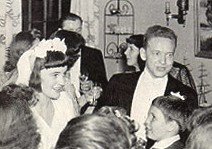
Betsy and Andrew’s wedding day (1940)

Andrew and Betsy dated all that summer and in the fall, when Betsy went off to the Colby Junior College in New Hampshire, they faithfully corresponded with each other.  They were in love and the following year they married and set up home in an old schoolhouse which lay on the Wyeth family land.  Although Betsy was not an artist, Andrew continually sought her judgement on his work.  Sales of Andrew Wyeth’s works of art grew steadily and Betsy managed the business side leaving her husband to concentrate solely on his art.  Betsy had a strong character and exerted almost as much influence on her husband as his father.  In the early days of her marriage, she believed that she had to battle with Andrew’s father to gain her husband’s  attention.  She once commented to Richard Meryman, Andrew Wyeth’s biographer, on her battle with her father-in-law:

“I was part of a conspiracy to dethrone the king — the usurper of the throne. And I did. I put Andrew on the throne…”

In 1943 the couple had their first child, a son Nicholas.  A second son, James followed three years later and would become a renowned artist in his own right.  Eighteen years after the couple married and settled in to life in the school house, they moved and bought an old 18th century gristmill on the banks of the Brandywine River in Pennsylvania.  Whilst her husband spent days on end painting, Betsy set about restoring the old mill, converting it into a home and a studio.

The featured painting today is Maga’s Daughter by Andrew Wyeth, which he completed in 1966.  It is a portrait of his beloved wife Betsy, whose mother was Elizabeth “Maga” James .  She posed in a three-quarter view.  She stands erect.  Her bearing is one of dignified pride as she averts her eyes away from the viewer.  Atop her head is an antique riding hat with its drawstrings dangling freely on either side of her face, almost if they were acting as a frame of a picture.  She wears a drab-coloured, high collared dress which almost blends in with the slightly lighter coloured background.  There is a faint flush of colour to her cheeks and a smile is forming on her lips.  What beautiful eyes she has, lit by the unseen light source to the left of the painting.

What was Andrew Wyeth thinking as he painted this portrait?  Actually we know,  for he told us:

 “…It’s my wife, Betsy. I had worked a long time on this and knew it wasn’t working. At the time I was on board of trustees of the Smithsonian Institution – quite prestigious. But Betsy didn’t like it, telling me that my work would suffer because of all these boards. I left for Washington one morning, and Betsy got furious, really flew into a rage. All the way down I kept thinking of that colour rising up high into her cheeks. I knew I had captured her. The colour of those cheeks under her coal black hair and that hat gives the portrait a real edge. Really caught her. It’s more than a picture of a lovely looking woman. It’s blood rushing up. Portraits live or not on such fine lines! What makes this, is that odd, flat Quaker hat and the wonderful teardrop ribbons and those flushed cheeks. She could be a Quaker girl who’s just come in from riding… ”

Andrew & Betsy Wyeth, October 15, 2008

On January 16, 2009, Andrew Wyeth died in his sleep at his home in Chadds Ford, Pennsylvania, after a brief illness. He was 91 years old.  Andrew and Betsy Wyeth had been married sixty nine years

James Tissot and Kathleen Newton

Kathleen Newton in an Armchair by James Tissot (1878)

My blog today is the second part of the life of the French painter James Tissot.  In my last offering I looked at one of his beautiful and unusual religious paintings and I told you a little about the life of the artist but purposely left out his relationship with the special lady in his life, which I wanted to save for today.

In 1870 France was in turmoil.  The Franco-Prussian war had broken out, which was the conflict between France, under Napoleon III and the Kingdom of Prussia and was the final straw in the conflict between the two nations.  France was defeated and Paris was eventually occupied by the Prussian army.  Tissot was a member of the Garde Nationale which was tasked with defending the French capital and later became a member of the Paris Commune, which was a quasi-government that briefly ruled Paris and acted as protectors of the Parisians and their property from March to May in 1871.   However, Tissot, whether through business reasons or concerns he had for his personal safety, decided to leave his homeland and that year went to England where, through his art, he had built up a network of friends and business contacts.  One of these was Thomas Gibson Bowles, the proprietor of the popular magazine Vanity Fair.  Bowles not only provided Tissot with a place to stay in London but he also employed him as a caricaturist on the magazine.  Whilst in London Tissot also exhibited at the Royal Academy.  As was the case when he was in France, Tissot depicted in his paintings many of the chic ladies of London and he was a genius in the way he depicted them bedecked in the most expensive and sumptuous clothing which he carefully detailed.   These paintings were very popular and soon, through their sales, he managed to buy his own house in St John’s Wood, which, at that time, had become a popular and much sort after enclave for artists.  Tissot was not only admired as a great artist by the London Society but through the auspices of Thomas Bowles he was given entry into the social and artistic circles of London.

This particular time, 1874, was the starting point for the French Impressionists and his friend Degas tried to persuade Tissot to exhibit at their first exhibition but he declined the offer.  His decision to refuse to exhibit did not in any way cut him off from his Impressionist friends as he remained great friends with Berthe Morisot who visited him at his London home and also he remained very friendly with Edouard Manet.  The following year, 1875, the two travelled to Venice on a painting trip. It was around 1875 that he first met Kathleen Newton, a stunningly beautiful divorcee and it was Tissot’s relationship with her that afforded him, as an adult, his only period of a real family life.  She would dominate the subject matter of his paintings.

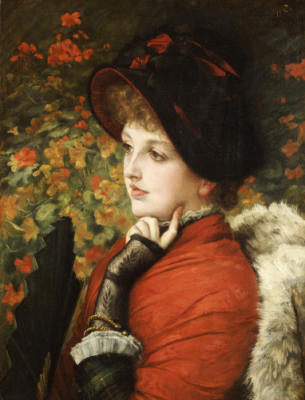
A Type of Beauty by James Tissot (1880)

Kathleen Irene Ashburnham Kelly was born in 1854 and brought up in Lahore and Agra.  She was the youngest of five children and came from an Irish Catholic family.   Her grandfather, Charles Kelly, left Ireland and practiced medicine in London. His son, and Mary’s father, Charles Frederick Kelly joined the East India Company and was stationed in Lahore where he worked as a clerk.  He married Flora Boyd, whose family came from the North of Ireland, and the couple had five children, Charles (Charley), Frederick WD (Freddie), George Lloyd (George), Mary Pauline (Polly) and Kathleen Irene (Kate).   In 1858, Charles Kelly, who had now added the family name “Ashburnham” to his own name, was transferred to Agra.   Kathleen’s father finally achieved the rank of chief adjutant and accountant officer in Agra and eventually retired around 1865, left India and returned with his wife and daughters to live in London.  When Kathleen was sixteen she travelled back to India to marry Isaac Newton, who was a surgeon attached to the Indian Civil Service. This was to be an arranged marriage orchestrated by her father and she had little or no input into the choosing of her future husband.

During the sea passage to India she was befriended by a Captain Palliser of the Bengal Rifles regiment who was returning to the sub-continent to rejoin his regiment.  (Other versions of her life state that Palliser, although a captain, was a naval officer).  Their friendship grew during the long sea passage and they became lovers and despite his pleas to her to cancel her wedding plans, she and Isaac were married in January 1870.  Being a devout Catholic, Kathleen decided to tell the local priest of her affair with Captain Palliser.  For him to forgive her of her sins the priest told her she should first tell her husband about this relationship.  She took the priests advice and told her husband who was horrified and as their marriage had not been consummated; her husband immediately instigated divorce proceedings on the grounds that his wife had not been a virgin on her marriage day.  Kathleen returned to England, the sea passage being paid for by the lovestruck Captain Palliser, who accompanied her, as a gesture of good will for her agreeing to be his mistress.  Their affair continued and she became pregnant but still refused to marry him.    When she arrived back in England she went to stay with her father, who was at the time courting a widow.  Kathleen’s daughter Muriel Mary Violet Newton was born there on 20 December 1871, which was also the same day as her Decree Nisi came through.   Later Kathleen and her daughter Violet went to live with her sister Polly and her husband at Hill Road, St John’s Wood.

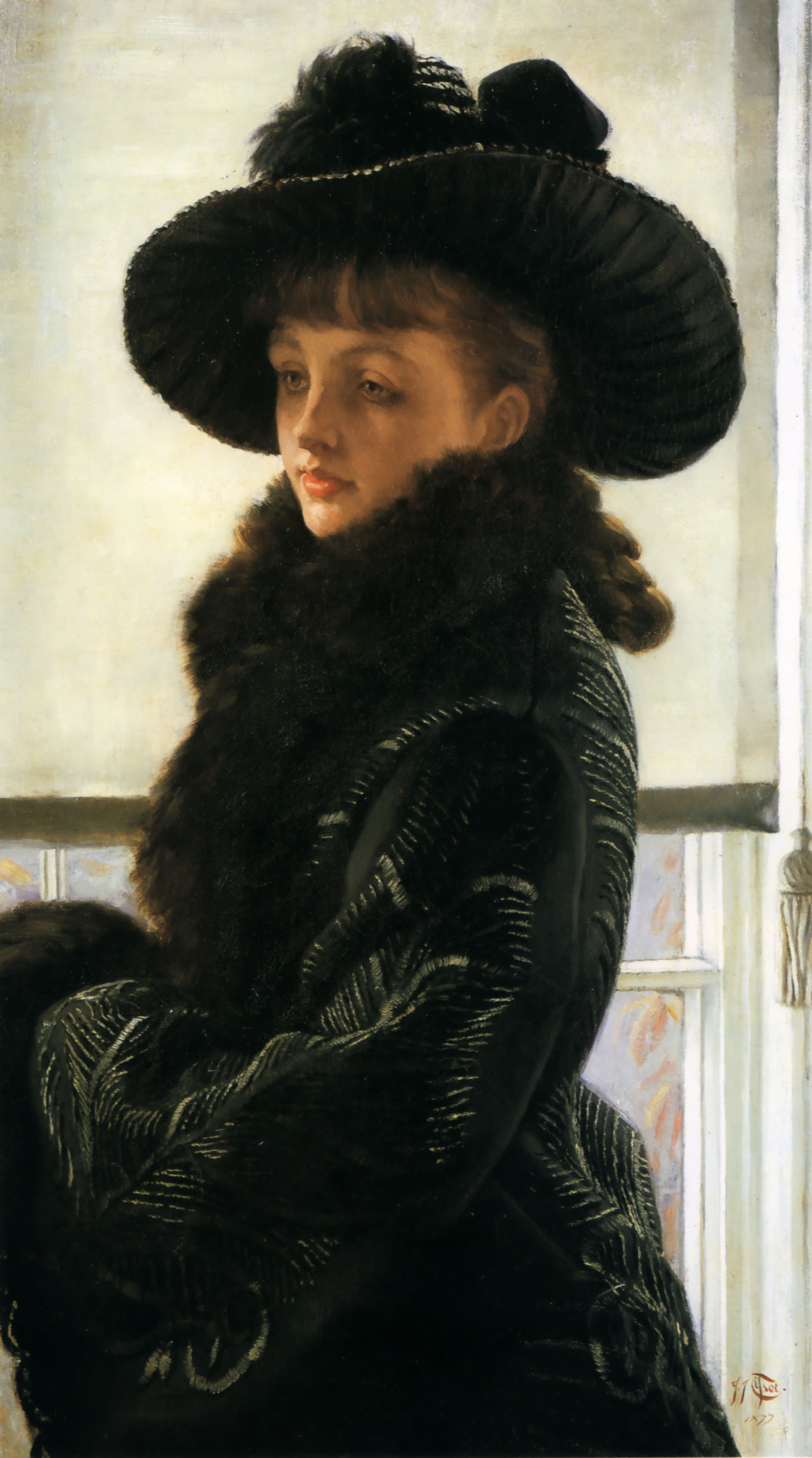
Mavourneen (Portrait of Kathleen Newton) by James Tissot (1877)

It was about four years later around 1875, that James Tissot, who was also living in St John’s Wood, London, met Kathleen Newton née Kelly.  The next step in their relationship came in March 1876 when Kathleen gave birth to a son, Cecil George Newton Ashburnham, who it is believed had been fathered by Tissot. Kathleen and James Tissot became lovers and she moved in with Tissot.  (It should be noted that census records cast some doubt whether they lived together and it is thought that Kathleen’s two children spent most or all of their time living with their aunt Polly and her family).   For Tissot, as was the case with Captain Pallister some five years earlier, he was smitten by this stunningly beautiful young woman.  His terms of endearment for her were mavoureen (Irish Gaelic for my love) and his native French phrase ravissante Irlandaise (lovely Irish).  Kathleen Newton became the love of Tissot’s life, his muse and adored lover.  Tissot described his time with Kathleen as one of “domestic bliss” and the happiest times of his life.  He completed many paintings featuring Kathleen of which I have featured some in my blog today.

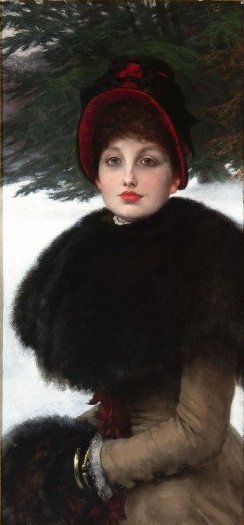
A Winter’s Walk by James Tissot (1878)

There was one great setback with his relationship with Kathleen for James Tissot.  Although it was not uncommon for successful and wealthy men to keep a mistress they did not, like Tissot, parade them around openly and advertise their liaison.   Tissot’s open and very public display of his affair with Kathleen shocked the London society which had once welcomed him with open arms and he had to choose between his social life and Kathleen.   For Tissot there was no question as to which course of action he would choose.  Kathleen was the love of his life and he chose her over life amongst London society.  He and Kathleen settled down to a life of domesticity and were happy to mix with their many artistic friends who continued to support them.  They never married and this may be due to their rigid Roman Catholic upbringing and beliefs.

Kathleen Newton in the Garden by James Tissot

This charming painting shows Kathleen sitting on a rug in the garden next to her daughter Violet.  The other small girl holding the parasol is her niece, Lillian Hervey. Sitting on the wall is her sister, Mary Hervey (Polly), who you can see ruffling the hair of Cecil George Newton who is thought to be the son of James Tissot.

————————————————————————————————————————————–

In the late 1870s Kathleen’s health started to deteriorate with the onset of tuberculosis.  Tissot remained devoted to her.  In 1882, Kathleen’s health declined rapidly with the onset of consumption.  The illness gave her great pain and Tissot was visibly distraught by the physical state of his wife and her sufferings.   Kathleen was aware that she was dying and she was saddened to witness how heartbroken her husband was, witnessing her long lingering death and so in November 1882, aged just twenty eight, she took an overdose of laudanum and died.  Sadly because she had committed suicide she was not able to be buried in consecrated ground.

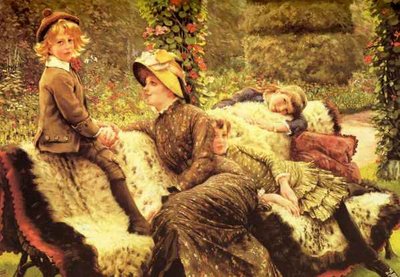
The Garden Bench by James Tissot (1882)

The painting above shows Kathleen Newton and her children, Cecil George and Violet and her niece, Lilian Hervey, the daughter of her sister Polly.  Although Tissot exhibited the painting, he would not sell it and kept it with him as a memorial until his death.

————————————————————————————————————————————–

One week after Kathleen’s death, Tissot left his London home at St John’s Wood, and never returned to it. The house was later bought by the artist Alma-Tadema.  Tissot was inconsolable and never really recovered from Kathleen’s death. Tissot never married and like many people who are devastated by the loss of a loved one he turned to Spiritualism, and on a number of occasions tried to contact his beloved Kathleen.

This somewhat sad story about a French artist and his fallen women is one of the great 19th century English love stories.   My interest in James Tissot was born out of a comment I received from Lucy Paquette who said she was publishing an eBook this autumn, entitled Hammock, a novel based on the life of James Tissot.  I hope, like me, you will be looking out for this publication.

Patricia O’Reilly has also written a novel about Kathleen Newton entitled A Type of Beauty: The Story of Kathleen Newton (1854-1882) which I am hoping to buy as novels based on lives of artists or one of their paintings always fascinate me.

What Our Lord Saw from the Cross by James Tissot

What Our Lord Saw from the Cross by James Tissot

My blog today is the first of a two part look at the life and art work of Jacques-Joseph Tissot, later to be known as James Tissot.  In this first part I will look at his life and a religious painting with a difference, which was one of a series he completed  between 1886 and 1894.   In my next blog I will introduce you to the “love of his life”, who featured in a number of his later works.

Jacques-Joseph Tissot was born in 1836, in Nantes, a French seaport on the north-west coast of France.   Tissot was the second of four sons born to Marcel Théodore Tissot, an affluent linen merchant and successful businessman, who owned a country house, Château de Buillon, close to the town of Besançon and Marie Tissot, née Durand, a clothes and hat designer who helped in her husband’s business.  Tissot was brought up in a very religious household with both his parents being devout Roman Catholics.   At the age of twelve he was sent away to a Jesuit boarding school in Belgium, in the town of Brugelette, which in those days was one of the leading seats of learning for children of the Roman Catholic faith and attracted many pupils from different countries.  In her 1985 biography, Tissot by Krystyna Matyjaszkiewicz, she points out that it was at this college that Tissot first came into contact with English children.  She wrote:

“…Pupils at Brugelette included Catholics from England, and it may have been through friendships at Brugelette that Tissot became interested in all things English and began to style himself James, the name he was using by 1854. When new laws enabled the Jesuits in 1850 to open a college at Vannes in Brittany Tissot returned to France and attended school there, subsequently moving to another in Dôle (near Besançon), a bastion of Catholicism….”

His early family life would later have a bearing on some of his paintings such as his beautifully crafted depictions of ships which he would have seen in the local harbour of Nantes and his devout religious upbringing would have given him an interest in religious paintings.

By the time he was seventeen years of age, Tissot had decided to become an artist, much to the annoyance of his father, who had hoped his son would follow in his footsteps and run the family business.  His father eventually relented and in 1855, aged 19, Tissot went to Paris, lodging with an artist friend of his mother, Jules-Élie Delaunay.  He then worked in the studios of the French academic painters, Jean-Hippolyte Flandrin and Louis Lamothe who had learnt their trade as pupils of Ingres.  During his stay in Paris, he would, like many aspiring artists, spend a great deal of time at the Louvre copying the  works of the Old Masters and it was around this time that he met other contemporary artists such Degas, who also had once studied under Lamothe, the American artist, James McNeill Whistler and Édouard Manet.   Four years after arriving in Paris, Tissot exhibited five of his works at the 1859 Paris Salon.

Within a relatively short time he became an admired painter and received a number of commissions for wealthy patrons.  There was also a change in Tissot’s painting style from his medieval-styled works to everyday life seen through his portraiture.  He would depict modern Parisian women as they went about the city and its suburbs and he would spend time perfecting the way he depicted their style of dress, and such an interest in this aspect probably harked back to the days spent with his family clothing business and admiring his mother’s talents as a designer.  Much later in his life, in 1885, there was a major exhibition of his work at the Galerie Sedelmeyer, Paris, where he showed 15 large paintings in a series called La Femme à Paris.  These paintings represented different types and classes of women, shown in their professional and social contexts.

Because I want to save the middle part of Tissot’s life and his love affair with Kathleen Newton, until my next blog, I am going to skip to the year 1885 which is the year in which the artist experienced a re-conversion to Catholicism. It is said that one day, during a church service, he had a vision of Jesus tending to people in a ruined building. It was, Tissot believed, his Road to Damascus.   It was this return to his Roman Catholic beliefs which led him to spend the rest of his life illustrating the Bible. It is not unusual for us to hear of people being struck by this “born again Christian” phenomena but in the case of James Tissot many of his friends found his sudden return to Roman Catholicism, at a time when there had been a French Catholic revival and a coinciding surge in purchasing religious paintings, just too much of a fortuitous coincidence !!  Nevertheless, from then on Tissot devoted himself to painting religious subjects. He totally immersed himself in all things religious and painted works connected with bible.  His biographer, Krystyna Matyjaszkiewiczn wrote of Tissot’s religious fervour:

“…Tissot set off for Palestine on 15 October 1886, his fiftieth birthday.  He returned to Paris in March 1887 with sketchbooks full of drawings and a burning compulsion to illustrate the life of Christ. The idea developed into publishing images of events, places, people, and incidental detail, with extracts from the Gospels and biblical commentaries. Tissot made further visits to Jerusalem in 1888 and 1889. By April 1894 he had completed 270 watercolours, which were displayed at the Champ de Mars, Paris, to awe and amazement…”

Tissot travelled to the Holy Land and this marked the beginning of a 10-year campaign to illustrate the New Testament.  He would return to Palestine and back to Jerusalem and the surrounding area in 1888 and 1889 to make further studies of the landscape and the people.   The culmination of the project resulted in his The Life of Christ collection which was a compilation of 350 watercolours that depicted detailed scenes from the New Testament, from before the birth of Jesus through to the Resurrection, in a chronological narrative.  Two hundred and seventy of them were exhibited at the Paris Salon of 1894.     It is reported that these works of art caused a sensation. Men were described as reverently doffing their hats whilst women wept and knelt before the pictures.  Some women even crawled like penitents through the show.   The exhibition of his biblical works moved to London in 1896 and New York at the end of 1898 before the entire collection was purchased by the Brooklyn Museum in 1900.   In 1897 a French version of the profusely illustrated Tissot Bible was published and a year later an English version was available.   This further enhanced the artistic reputation of Tissot and made him very wealthy.   In the last few years of his life, Tissot worked on paintings depicting scenes from the Old Testament, eighty of which were exhibited in Paris.  He had, by this time, retired to Château de Buillon, the residence he inherited on the death of his father.   Tissot was never to complete the series of Old Testament works as he died at his chateau in Doubs, France in 1902, aged 66.

My featured painting today is one of the biblical scenes from the New Testament completed by James Tissot during the period 1886-1894.   It is an opaque watercolour over graphite on gray-green woven paper entitled What Our Lord Saw from the Cross.  It is regarded as one of the most memorable of the series of biblical images by the French painter.  It is totally different from the normal crucifixion scene paintings when, in almost all cases, we look up at the figure of Christ hanging from the cross.  In Tissot’s painting, we are the eyes of Christ and it us who looks down from the cross at the people below.  By doing this Tissot has allowed us to imagine ourselves in Christ’s place and by doing so we are able to empathise with him and maybe we can imagine what was going through his mind as he looked down upon friends, who had come to lend their support, and his enemies who have participated in his death and had come to gloat at his predicament.

From our viewpoint we look downwards at the crowd.   We see Mary Magdalene, in the immediate foreground, with her long red tresses swirling down her back, kneeling below the feet of Christ, which we can just see at the bottom centre of the painting. Further back we see the Virgin Mary clutching her breast, while John the Evangelist looks up with hands clasped. Some Roman soldiers are looking on, including a centurion who is clad in red. He has a downcast and remorseful expression on his face and Tissot has no doubt placed him at the scene reminding us of the passage in Luke’s Gospel 23:47 which stated:

“…Now when the centurion saw what was done, he glorified God, saying, Certainly this was a righteous man…”

The men on horseback in the right mid ground of the painting are Jewish scribes. They have a look of satisfaction on their faces for Christ was their rival.  These were the very men who had put pressure on Pilate to have Christ crucified.   Their plan had succeeded and their rival had been removed.  Look towards the centre of the background and one can see that Tissot has depicted the entrance to a tomb, the very place in which the body of Christ will be laid to rest after he has been brought down from the cross.

This is truly a remarkable work of art and I would love to go to the Brooklyn Museum to see the complete series.

In my next blog I will tell you about Tissot’s beloved Kathleen Newton, an Irish divorcee, and look at some of his portraits of this woman, who was the love of his life.

The Family Portraits of Franz von Lenbach

The Artist with his Wife Lola and his Daughters Marion and Gabriele (1903)
Städtische Galerie im Lenbachhaus

My recent blogs have in some ways been connected.  I will be in the middle of researching one artist when I come across another, who I feel I just cannot ignore and so my next featured artist has already been decided upon before I have completed my research on the current one.  A few blogs back I looked at the life of Frida Kahlo.  Whilst looking at literature concerning her and other female artists I came across Gabriele Münter and from her I focused on her one-time lover Wassily Kandinsky.  On looking at his life I found that one of his early art tutors was Franz von Stuck and he was the subject of my last blog.  I had decided to stop this train of thought when choosing a new artist but then during my research on von Stuck I stumbled across a contemporary of his, Franz von Lenbach and although I had decided to stop this system of choosing artists I found his portraiture awesome, especially his depiction of his own family.  I just could not pass up the chance of introducing this German painter to you and share with you some of his wonderful family portraiture.

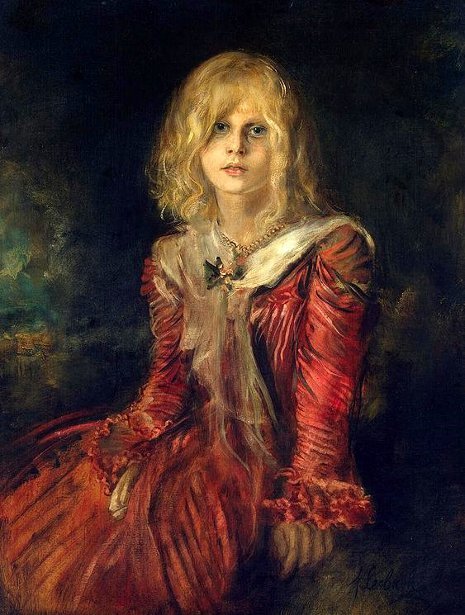
Marion Lenbach by Franz Lenbach

Franz Lenbach or to give him his full title, after ennoblement, Franz-Seraph Ritter von Lenbach was born in 1836 in the small town of Schrobenhausen which lies about forty miles north of Munich.  His father was a master builder and stonemason.  Initially Franz had planned to follow in his father’s footsteps and become a master builder himself and accordingly in his early teens, he enrolled at the Landshut Technical College to study the art of stone masonry and architecture.  At the age of fifteen he began to concentrate on sculpture and started to work in the studios of the German sculptor, Anselm Sickinger.  If it had not been for his elder brother, Karl August Lenbach, who was a painter, then maybe Franz would have carried on in his father’s profession.  However his brother introduced him to John Baptist Hofner, the German painter of animal and genre scenes and who had previously studied at the Akademie der Bildenden Künsten in Munich and it was he who introduced Franz Lenbach to drawing and painting.  Hofner and Franz Lenbach would often spend time going off together on painting trips and Hofner taught Lenbach the skills of en plein air painting.

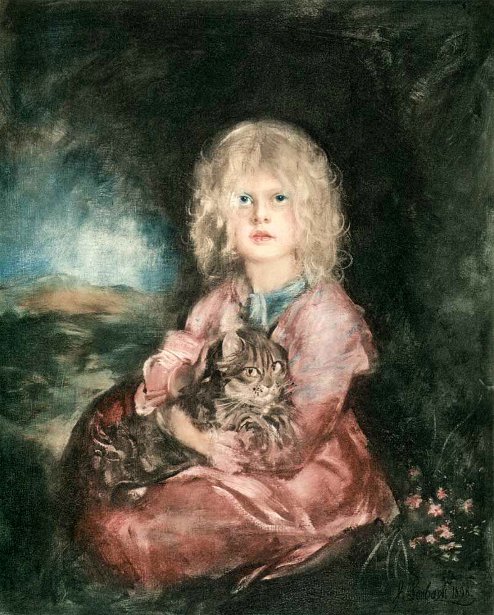
Marion With Cat by Franz Lenbach

For Franz Lenbach to gain admission to the Akademie der Bildenden Künsten he needed some formal groundwork training in art and so, in 1852,  at the age of sixteen, he enrolled at the Polytechnische Schule in Augsburg, following which he trained in the studio of Albert Gräfle, the Munich portraitist.  Finally Franz enrolled at the Munich Academy of Fine Arts in 1854.  Three years later he was studying under the great German historical painter Karl Theodore Piloty.  From the sale of one of Lenbach’s works, Peasants Trying to Take Shelter from a Thunderstorm in a Chapel and a scholarship, he managed to accumulate enough funds to go Rome with Piloty and Piloty’s brother Ferdinand, who was also an artist.  So impressed was Theodor Piloty with the artistic talents of Lenbach that in 1860, he put Lenbach’s name forward for the post of professorship of the Kunstschule in Weimar, which had just been opened.  Lenbach took the position and remained there for two years but by the end of this tenure he realised that life in academia as an art professor was not for him.

Gabriele Lenbach in Armour by Franz von Lenbach

It was around this time that Franz Lenbach met Adolf Friedrich, Graf von Schack,  who was a German poet, historian of literature and an avid art collector.  Schack had wanted to build up a formidable art collection for himself and although extremely wealthy he could not afford to buy paintings by the Old Italian Masters so he approached Lenbach and other aspiring young artists to set about copying some of his favourites.  Once Lenbach agreed to carry out this commission he was sent to Rome to start copying some of the famous works.  Here he met some other artists, such as Arnold Böcklin and Anselm Feuerbach who had also been commissioned as copyists by Schack.  So pleased was Schack with what Lenbach produced he sent him to Florence in 1865 to carry on the good work.

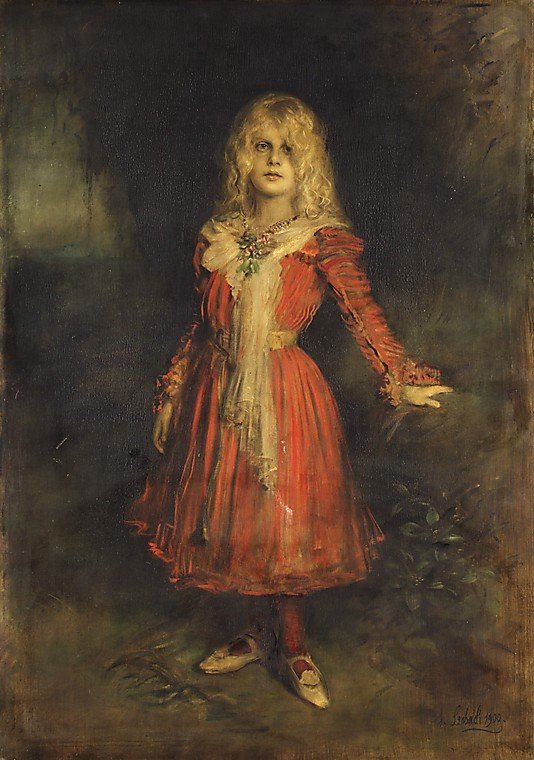
Marion Lenbach, the Artist’s Daughter by Franz von Lenbach (1900)

Whilst working in Florence Lenbach met Karl Eduard Baron von Liphart, a central figure of the German expatriate art colony in Florence, and it was through him that Lenbach picked up some lucrative portraiture commissions.  From Florence he travelled to Spain in 1867 with Ernst von Liphart the son of his benefactor.  The following year he and Liphart along with his patron, von Schack went to Tangiers. When he returned from North Africa he moved to Vienna and began to concentrate on his portraiture work.  Many famous people sat for Lenbach including Richard Wagner, Emperor Franz Joseph I, Ludwig I, King of Bavaria, Emperor Wilhelm I and he completed almost a hundred portraits of Otto Fürst Bismark.  It was during this period that Lenbach became recognised as the most famous contemporary German portrait painter.

Städtische Galerie im Lenbachhaus
Munich

In 1882 Franz Lenbach was ennobled, and became known as Franz von Lenbach.  Four years later in 1886 he procured himself an estate in Munich and with the assistance of his friend Gabriel von Seidl, the German architect, he designed and had built a Florentine villa which took almost four years to complete.  The city of Munich acquired the building in 1924, and today, the Lenbachhaus houses the city’s gallery.  In 1900 he won the Grand Prix for painting in Paris.   Lenbach died in Munich on May 6, 1904, aged 67.

My featured paintings today are not the ones Lenbach did of famous politicians and rulers of various countries but the intimate portraits of his family.    Lenbach had married twice and had three daughters, Marion, Erica and Gabriele.  His daughters and his second wife, Charlotte (Lolo) Freiin von Hornstein appear as models in many of his paintings and it some of these beautiful portraits that I have included in today’s blog.

Die Sünde by Franz von Stuck

Die Sünde by Franz von Stuck (1893)

Today I am want to look at the life and times of one of Wassily Kandinsky’s early art tutors, the German painter of mythological and allegorical scenes, Franz von Stuck.  Stuck was not just simply a painter.  He was a man on many talents.  Stuck was also a sculptor, printmaker, illustrator and architect.
Franz von Stuck was born in 1863 in Tettenweis, a village in the farming area outside the city of Passau and which lies close to the Austrian-German border about 150 kilometres north east of Munich.  He was brought up in a moderately affluent Catholic family who plied their trade as farmers and millers.   He enjoyed drawing from an early age and it is said that when he was just six years of age he would spend time drawing caricatures of the local village people.  At the age of fifteen he went to Munich to study art.  He first attended the Königliche Kunstgewerbeschule, a high school of applied arts in the city.  One of his teachers was the German landscape painter Ferdinand Barth.  After three years at this school, Stuck transferred to Munich’s Akademie der Bildenden Künste (The Academy of Fine Arts) where he received tuition from the German history painter, Wilhelm Lindenschmit the Younger and Ludwig Löftz.  Once he had completed his art tuition at the Akademie he found some work as an illustrator for various Munich publications such as Die Jugend, a cultural weekly publication, which soon became a style-setting icon that launched the German art nouveau movement, named Jugendstil,  after the magazineand the Fliegenden Blätter (Flying Pages), which was the name of a humorous and satirical German weekly magazine which was full of illustrations and caricatures.  Stuck’s input in these magazines over a four year period enhanced his reputation as an artist and illustrator.

In 1889, he began to paint in oils and that year he submitted his work, Der Wächter des Paradieses (The Guardian of Paradise) for inclusion at the Jahresausstellung exhibition at the Glastpalast in Munich.  This venue was the glass and iron edifice modeled after London’s Crystal Palace.  The building, like the Crystal Palace, was destroyed by fire,  in 1931 and resulted in the destruction of over a hundred artworks from the early 19th century .   For his painting, Franz Stuck was awarded a gold medal and a prize of sixty thousand gold marks.  This painting depicted a mythological scene and was the type of depictions that would appear in many of his works, the best of which was thought to be his paintings which depicted a solitary figure rather than his group figure works.  Franz Stuck had become a leading figure in the Munich avant-garde side of art life but also figured prominently in the official art world of the German city.

At the end of the nineteenth century, Munich was a place at the forefront of German art.  It was a charismatic city for German artists of every style who wanted to create something new, something different.    The city itself had a young, modern, and exciting feel about it and was a place where artists could create and conceive new styles.  The majority of Munich’s fine art painters belonged to the Königlich-privilegierte Münchener Künstlergenossenschaft (MKG) (Privileged Royal Artists’ Association of Munich).  This was the largest social and professional society for artists in Bavaria which had been founded in 1869.  Its remit was to further the interests of a wide range of artists both in and around Munich.   All was well until the Künstlergenossenschaft  Salons (The Society’s exhibitions) of 1889 and 1891 when the jurists, the people whose job it was to decide which works of art would be exhibited, chose a large number works which were blatantly biased towards Naturalism, Impressionism and Symbolism.  Following this the majority of artists within the Society voted for the implementation of regulations which would insist that future juries would cease favouring any one kind of art and guarantee that diversity of outlook would be their key criteria when choosing works for inclusion.   Over a hundred artists within the Association refused to accept this dictate and seceded in April 1892.   One of the co-founders of this new group of artists was Franz von Stuck.

More than a hundred artists came together as a new group by founding the Verein bildender Künstler Münchens e. V. Secession (Association of fine artists in Munich Secession).  This new artistic grouping refused the historicism propagated by the academies and wanted to create something new.    Their motto was that art concerns the whole man and the whole social life.  Besides the artists themselves, there were some very influential backers to the formation of this new association such as George Hirth the writer, publisher and founder of the avant-garde magazine Jugend.  Initially the Secession found little favour with official circles because of its modernist leaning and in the belief that this Secession would bring disunity to the Munich art scene and would lead to the fall from grace of Munich as a great centre of German art and allow Berlin to take its place as the centre of German culture.  However once the Secessionists gained in popularity, the official line changed and Luitpold, who was then Prince Regent ofBavaria, and other government officials gave their full support to the Secessionists, provided them with financial support and bought up many of the paintings from their exhibitions.  At the Secessionist exhibition in 1893 Franz von Stuck’s painting Die Sünde (The Sin) was shown and it caused a sensation.

In 1895 Franz von Stuck was given the position of professor at the Academy of Fine Arts, in Munich, an establishment where he had once studied.  Two of his most famous students were Paul Klee and Wassily Kandinsky, both of whom would go on to establish the Blaue Reiter art group.   He also became chairman of the board of the Genossenschaft Pan [Pan Co-operative], designing the covers for Pan, its art magazine.  It was around this time that he designed and had built the Villa Stuck for himself.  It was testament to his extraordinary abilities in design, sculpture, interior decoration and architecture. He also designed the furniture for his house and these won him another gold medal, at the 1900 World’s Fair in Paris.

Franz had an affair with Anna Maria Brandmaier, the daughter of a local baker, which resulted in the birth of a daughter, Mary Franziska Anna. The child was given into the care of Mary Lindpaintner, a wealthy American widow of a Munich physician.  On March 15th 1897 von Stuck married Mary Lindpaintner and his daughter grew up in his own house. Seven years later, in 1904 he and his wife would formally adopt her after a legal battle against the young girl’s natural mother. He also adopted the two children from Mary’s first marriage, Olga and Otto.

In 1906 he was knighted as Franz Ritter von Stuck. His Symbolist paintings, including many sensual nudes, and combine a linear style with an erotic flare. In 1913, at the height of his artistic success and fame, Stuck decided to build a studio next to the villa. Completed in 1914, it was double the size of the existing structure and contained two stories. The first floor was for sculpture and the second, with its 16.5-meter-wide, 7-meter-high dome was used for painting.  Franz von Stuck died in Munich on August 30, 1928 aged 65.  His house, Villa Stuck,  remains a living testament to the man and the artist.  Villa Stuck is a nationally and internationally renowned meeting place for the art of the 19th bis 21. to 21 Jahrhunderts. Century. Eine bedeutende Sammlung von Werken Franz von Stucks (1863-1928) und internationale Ausstellungen zur Kunst um 1900 sowie zur modernen und zeitgenössischen Kunst machen die Villa Stuck zu einem einzigartigen Ort des Kunsterlebens. An important collection of works by Franz von Stuck and as well as international exhibitions of modern and contemporary art transform Villa Stuck into a unique place.

My featured painting today is Stuck’s highly acclaimed work entitled Die Sünde (The Sin) which he completed in 1893 and is now housed in the Neue Pinakothek Museum, Munich.  It was first exhibited at the Secessionist Exhibition of 1893 and which, at that time, caused a sensation by the controversial nature of the depiction.   It is by far his best known painting of which he made many versions in the period of from 1891 to 1912. The main effect of the painting is created by the contrasts in the colours and by the concept of the picture.

In the painting we see a woman who coyly exhibits her bare breasts and stomach which the artist has bathed in light whilst the he has hidden the rest of her body in the darkness of an alcove. A snake lies on her right shoulder and the reptile curves around the back of the woman’s neck and along her left shoulder.  The snake symbolises original sin for it was a snake that tempted Eve to eat first the fruit from the tree of knowledge, and then it was she who tempted Adam.   The woman in the painting is not a woman but women in general.   In this painting the woman, with her snake, represents evil.   The woman before us is controlling us, the viewer, us, the voyeur.  She is tempting us.  We stand still in front of her and cannot avert our eyes.   She is mesmerising us.  She is inviting us to join her.  Are we sucked in by her beauty even though we know the dangers that would follow?   The viewer is curious and may be longing for adventure and is willing to submit himself or herself to the attraction of the unknown.   If we were to step forward into the painting we would cut off the source of light and all would be dark and we would be left with just the woman and her snake, then what?

The massive gilded frame of the painting adds to the contrast with the darkness of the painting itself.  Such heavy frames as this one were very common in Jugendstil art, with the artists themselves designing their own frames for their own works of art.

When it was first exhibited in its present home, the Neue Pinakothek Museum, Munich, it caused a sensation with crowds flocking to see this piece of seductive and erotic art. The painting left a lasting impression on those who viewed it and this effect was described by one who viewed the work:

“…The fame of the painting drove us through the galleries; we stopped nowhere and opened our eyes for the first time when we were finally standing opposite it. It was displayed on a special easel in its broad, monumental gold frame, […] and now all three of us stared at the night of hair and snake which did not allow too much of the pale, female body to be seen. The shadowed face with the bluish-white of the dark eyes was less important to me at first than the iron sheen of the nestling snake, its evil, beautifully designed head and the dull chequered pattern on its back, over which a delicate blue line ran like a seam. […] There are works of art that strengthen our sense of community, and there are others that seduce us into isolation. Stuck’s painting belonged to the latter group..”

Compositions, Impressions and Improvisations by Kandinsky

Impression III (Concert) by Kandinsky (1911)

Impressions III (Concert) was painted by Kandinsky soon after he had attended a concert by Arnold Schonberg in Munich in 1911 and according to the exhibition catalogue notes the painting should be looked upon as:

 “…one of modern art’s most outstanding examples of synaesthesia, correspondences between music and painting that other early twentieth-century artists sought. A dynamic wave of yellow paint flows across the painting from left to right like a great swell of sound that seemingly reverberates to and fro. Above it in the upper half of the painting is an energetic black in a diagonal position. In the preparatory pencil sketches one can clearly decipher the scene with the open, black grand piano as well as the curved backs of the seated listeners and those standing along the wall…”

—————————————————————————————————————————————-

This is my final look at the later life of Wassily Kandinsky and some of his more abstract works of art.   In this blog I am featuring three of his these works, one from each of his three self-classified categories.   After 1910, Kandinsky decided to compartmentalise his work into three groups. The first he called Impressions and these paintings would still retain an element of naturalistic representation. They would be direct impressions of nature. The second category he deemed would be Improvisations and these paintings would convey spontaneous emotional reactions inspired by events of a spiritual type. The last category he termed Compositions. These were paintings which were not done spontaneously but put together carefully, over a period of time, following a number of preliminary studies. These were to be his most complicated works. Although the titles he gave to the three categories seems somewhat arbitrary in fact they harked back to his love of music and in the way he connected, in his own mind, art and music.  He would often add musical titles to his individual works such as Fugue, Opposing Chords or Funeral March.  By doing this, he wanted to evoke sound through sight and create the painterly equivalent of a symphony that would stimulate not just the eyes but the ears as well.

Kandinsky is believed to have had synaesthesia.   Synaesthesia comes from two Greek words Syn which means together and Aesthesis which means sensation.   It is a condition that allows a person to appreciate sounds, colours or words with two or more senses simultaneously. Kandinsky believed that colours and painted marks triggered particular sounds or musical notes and vice versa. Did Kandinsky have synaesthesia?  Maybe we will never know for sure but what we do know is that he was preoccupied all his life with the correlation between sound and colour. Following a performance of Wagner’s great opera Lohengrin in Moscow Kandinsky recalled:

“…I saw all my colours in spirit, before my eyes. Wild, almost crazy lines were sketched in front of me…”

Let me now return to his life story.  In my last blog we had reached the point when Kandinsky and some of his artist friends had set up Der Blaue Reiter group as a rival to their previous exhibiting association the NKVM (The Neue Künstlervereinigung München).    In the first exhibition held by the Der Blaue Reiter group, Kandinsky exhibited three of his works, entitled, Impression-Moscow, Improvisation 22 andthe painting which had been rejected by the NKVM jury, Composition V.  The exhibition came with a small almanac that Kandinsky and Franz Marc had been working on and the foreword of which set out to explain what visitors to the exhibition would see.  They wrote:

“…We are not seeking to propagate any precise or special form in this small exhibition.  Our purpose is to show, in the variety of forms here represented, how the inner wish of the artist takes shape in manifold forms…”

The exhibition which besides including works from artists, Kandinsky and Münter, included works from Franz Marc, Auguste Macke, Henri Rousseau to name but a few.  It also included strange sketches by the Austrian composer Arnold Schoenberg.  It was a confusing mish-mash of works, and artistic styles, which totally baffled and stunned both viewers and art critics alike. Even the most benevolent critics found great difficulty in finding some sort of common ground between the various artistic styles on show.   It was also around the time of this first exhibition that Kandinsky published his book Uber das Gestige in Kunst (Concerning the Spiritual in Art) in which he presented the reader with his thoughts about what he envisioned was the new purpose of art and his writing showed the great diversity of Kandinsky’s intellectual and artistic awareness.  In his book he discussed the spiritual foundations of art and the nature of artistic creation.  He also wrote an analysis of colour, form and the role of the object in art, as well as the question of abstraction.

Improvisation 19 by Kandinsky (1911)

Improvisation 19 was completed by Kandinsky in 1911.  Annegret Hoberg, the curator at the Städtische Galerie, Lenbachhaus, Munich, which houses many of Kandinsky’s paintings, including this one, wrote about the painting in the exhibition catalogue:

“…It seems as if an unknown ritual occurs in Improvisation 19, a kind of initiation and enlightenment of figures who can be understood as novices. One sees translucent figures outlined only in black. On the left is a procession of smaller form presses forward to the front, followed by shades of colour. The largest part of the painting, however, is filled with a wonderful, supernatural blue, which also shines through the group of figures shown in profile on the right, who seem to move toward a goal outside the painting. The spiritual impact of these long, totally incorporeal figures draws both on the uniformity (that is, they are all the same height, as in Byzantine pictures of saints) and on the fact that deep blue, almost violet shade in their heads may symbolize extinction or transition….This work underscores Kandinsky’s almost messianic expectation of salvation through painting…”

—————————————————————————————————————————————–

The onset of World War I in 1914 affected Kandinsky, as being a Russian citizen, he had to leave Munich immediately.  He along with Gabriele Münter left and went to Goldach in Switzerland, a small town on Lake Konstanz.  They remained there until December of that year when Kandinsky went to Moscow and Münter travelled to Stockholm where she would remain and wait for him.  Kandinsky did go to Stockholm and met with Münter for the last time.  Their close relationship which had started back in 1902 had recently being deteriorating and by March 1916, it had run its course and the one-time lovers parted for the final time.  Kandinsky returned to Moscow and soon after his arrival in the Russian capital he met a young woman, Nina von Andreyevskaya, the daughter of a Russian general, and in February 1917 the two were married.

Whilst in Moscow Kandinsky spent much of his time not only painting but working as a teacher, writer and administrator.  He immersed himself in the cultural politics of Russia and collaborated in the new reforms in art education. He was director of the theatre and film section of Narkompros, which was the Peoples Commissariat for Enlightenment.  In February 1919 the Museums of Painterly Culture were established in Moscow and St Petersburg and Kandinsky became the first director of the institutions and worked hard to expand the organization by setting up a further twenty-two museums in the Russian provinces.    In May 1920 Kandinsky helped set up Inkhuk, the Institute for Artistic Culture and he formulated a curriculum for the teaching of art which was based on his strongly held belief that there was an inter-relationship between art and music and looked closely at fundamental forms and colours.  His theories did not go down with many of the Russian avant-garde artists on the staff of the institute.  They firmly rejected any kind of irrationality in the creative process and because of such differing views between these leading artists and himself Kandinsky found his position weakened and ultimately untenable.

In the autumn of 1921 a road to salvation was offered to him by Walter Gropius, a German architect and founder of the Bauhaus School in Berlin, who invited Kandinsky and his wife to visit the school.  This was a different Germany from the one he left at the outbreak of war.  Many of his artist friends, such as Franz Marc and Auguste Macke, had been killed fighting in the war, whilst others had moved away.  The Berlin art scene had changed.  The Neue Sachlichkeit (New Objectivity) movement was now to the fore.   This grouping of German artists executed works in a realistic style, and they reflected what was characterized as the resignation and cynicism of the post-World War I period in Germany.   Leading protagonists of this style of art were George Grosz, Otto Dix and Max Beckman.  Also popular at the time were the works of the Expressionists and the cultural movement known as Dadaism.  This movement was, in the main, a protest against the brutality of the War and the members were also against what they believed was an oppressive intellectual rigidity in both German art and its everyday society. All of these artistic genres were diametrically opposed to all forms of abstract art, and so when, on arrival in Berlin, Gropius offered him a professorship in the Bauhaus in Weimar, Kandinsky jumped at the chance to start a new life in a new city.

In 1924, an artist friend from his Munich days, Paul Jawlensky, introduced Kandinsky to the German art collector and art dealer, Emmy Scheyer.  At that meeting she also met Kandinsky’s fellow Bauhaus faculty members, Lyonel Feininger and Paul Klee.   She formed the four artists into an exhibition group called Blaue Vier (The Blue Four) and Scheyer became their representative in America.  The four artists often toured, sometimes as far as America, giving lectures and staging Blaue Vier art exhibitions.

When Kandinsky left Russia he had to leave the majority of his paintings behind. They were sold but the return on them was poor due to the falling value of the Russian currency.   However during his eleven years at the Bauhaus he completed over three hundred paintings and several hundred watercolours, all of which he catalogued.  His time at the Bauhaus ended in 1932.  The previous year had marked the start of a vitriolic campaign against the Bauhaus by the Nazi party and the following year they had it shut down.  Kandinsky and his wife fled from Germany and went to Paris and settled in a new apartment in Neuilly-sur-Seine.  Kandinsky continued to paint and within twelve months living in Paris his output totaled an amazing 144 oil paintings and approximately 250 watercolours.   Kandinsky, although born in Russia, had been granted German citizenship in 1928 but when he tried to renew his passport in 1939, his request was declined.  That year, just before the start of World War II, Kandinsky managed to obtain French citizenship.

Composition IX by Kandinsky (1936)

Composition IX was completed by Kandinsky in 1936.  In the work we can make out multiple diagonal bands of colours and small shapes that resemble embryos as much as crustaceans.  This canvas earned Kandinsky criticism for not sufficiently articulating the background and the shapes. Nevertheless, it is one of the rare large format canvasses to which Kandinsky once again applied the name of Composition.  In his book, Concerning the Spiritual in art, he said that this one, of all his “Compositions”, was his most accomplished painting. In total, he completed only ten in all throughout his entire career. Sadly, when the French government purchased it for just 5000 francs rather than the 100,000 he had demanded, he felt quite humiliated.  This complex canvas is in fact one of the two works that the French State bought from Kandinsky during his lifetime.

—————————————————————————————————————————————–

His last known watercolours and drawings were completed in the summer of 1944 and he held his last exhibition at the Parisian gallery, Galerie L’Esquisse that same year.  Wassily Kandinsky died of arteriosclerosis in December 1944, aged 78.

I have to admit I have struggled with this blog, the third covering the life and times of Wassily Kandinsky.  I struggle to understand abstract art even though leading up to this offering I have read reams of information with regards this type of art.  I have included three of Kandinsky’s paintings, one from each of his designated “types”.   I will not insult those of you who are very knowledgeable about this form of art by trying to explain, interpret and analyse the works but have relied on exhibition catalogue descriptions of the works.   I would like to have ended this blog by saying how much I like the works of Kandinsky but to do so, would be extremely economic with the truth.  I will conclude this look at the life and works of Wassily Kandinsky with one of his quotes:

“…Lend your ears to music, open your eyes to painting, and… stop thinking! Just ask yourself whether the work has enabled you to ‘walk about’ into a hitherto unknown world. If the answer is yes, what more do you want?…”

Have you managed the “walk about” ?

Grüngasse in Murmau by Wassily Kandinsky

Grüngasse in Murnau by Kandinsky (1909)

In my last blog I was following the life story of Wassily Kandinsky and had reached the juncture in his life, 1901, when he had opened up his own art school, Phalanxschule, in Munich.  The previous winter, along with help from some of his like-minded artist friends, he had launched the exhibiting association, known as the Phalanx, and they had held their first exhibition in August 1901.

First Phalanx Exhibition in 1901

Kandinsky designed the Art Nouveau styled poster advertising its opening.  In all the Phalanx held twelve exhibitions during its ten years in existence and it was in the seventh one in 1903 that works by Claude Monet were exhibited.  The tenth exhibition included a number of works by post-Impressionists such as Paul Signac, Felix Vallotton and Henri Toulouse-Lautrec.

Jugend magazine cover

In the final years of the nineteenth century and at the beginning of the twentieth century, the in-vogue artistic style in southern Germany was Jugendstil or as we may better know it, Art Nouveau.  The German word, Jugendstil means “youth style” and derives from the German cultural weekly publication Jugend.  The style-setting iconic magazine, founded by George Hirth, promoted the Art Nouveau style.  This up-and-coming art form was both artistically graceful and stylistically revolutionary. The Jugendstil artists and designers had their base around Munich, and while their work stylistically was likened to that of the French Art Nouveau of the fin de siècle era, the Jugendstil art depicted many Teutonic and mythological themes.  Probably due to this, many of Kandinsky’s works at that time consisted of figure studies, scenes of knights on horseback, scenes from romantic fairytales and some fanciful reminiscences that he clung to of his beloved Moscow.  The second Phalanx exhibition contained many Jugendstil works.

Kandinsky and his wife Anya Chimiakin separated by mutual consent in 1904 and he and his former Phalanxschule art student Gabriele Münter, who had become his lover, set off on a number of trips around Europe.  They travelled to the Netherlands and Tunisia in 1904.  The following year was spent in Italy and for a year between 1906 and 1907 the pair settled down Sèvres, a town in the outer suburbs of Paris.  During this stay he exhibited works at the avant-garde Salon d’Automne and the Salon des Indépendants.   At this time in Paris the art work of Gauguin, the Nabis, who were a group of Post-Impressionist avant-garde artists, Matisse and other Fauves were being exhibited.  Fauvism was the first of the major avant-garde movements in European twentieth century art, and was characterised by paintings that used powerfully vivid, non-naturalistic and exuberant colours.   This exposure to fauvism resulted in Kandinsky starting to paint fauvist-inspired landscapes in which the manner he used colour quickly departed from the naturalistic and descriptive.  His use of colour was for reasons of expression, and in a lot of cases, non-naturalistic, motivations.  Colour to Kandinsky now became ever more important and as this importance grew in his mind, the less he painted post-Impressionist type landscapes. Kandinsky’s colours became more brilliant and vibrant.  Often his paintings around this time were large areas of solid bright colours set in sharp contrasts of light and dark and warm and cold.

Although travelling around Europe, Kandinsky always found time to return to Russia and exhibited some of his works at Moscow and St Petersburg exhibitions.   In 1908 Kandinsky and Münter returned to Munich.   From there, they often took painting trips to southern Germany, during which they visited the small town of Murnau, which nestled in the foothills of the Bavarian Alps.  Both Kandinsky and Münter fell in love with the sprawling landscape of this area and found great inspiration from the scenic views with its kaleidoscope of colours with the high Bavarian Alps acting as an awe-inspiring background.  The following year, the couple bought a house in the town and their two artist friends from Munich, Jawlensky and Werefkin often stayed with Kandinsky and Münter and together the group produced a number of wonderful landscape paintings and works depicting the town of Murnau itself.   One of these works was one done by Kandinsky in 1909 and is today’s featured painting.  It was an oil on cardboard painting entitled Grüngasse in Murmau which depicted one of the local streets in the town where he was living.

It was during the time the four artists lived under the same roof that conversation often turned to art and new forms of art.  The most important result of these artistic discussions was that gradually Kandinsky’s became more interested in abstraction in art,  in which representational forms, whether people or places, would increasingly melt away and be replaced by colours and basic shapes.  In this Abstract art, the painting did not depict a person, place or a thing in the natural world, even in an extremely distorted or exaggerated way.   So the subject of the painting was based on what you saw, such as colours, shapes, and simple brushstrokes.  Kandinsky believed that different colours provoked different emotions. He believed that the colour red was lively and confident; green was peaceful with inner strength; blue was deep and supernatural; yellow could be warm, exciting, and disturbing and white seemed silent but full of possibilities. Kandinsky had now also decided to compartmentalise his work into three categories.  The first he called Impressions and these paintings would still retain an element of naturalistic representation.  They would be direct impressions of nature.  The second category he deemed would be Improvisations and these paintings would convey  spontaneous emotional reactions inspired by events of a spiritual type.  The last category he termed Compositions.  These were paintings which were not done spontaneously but put together carefully over a period of time, following a number of preliminary studies.  These were to be his most complicated works.  Although the titles he gave to the three categories seems somewhat arbitrary in fact they harked back to his love of music and in the way he connected, in his own mind, art and music.  Kandinsky said of the connection between colour and music and of the connection between an artist and a musician:

“…Colour is the keyboard, the eyes are the harmonies, and the soul is the piano with many strings. The artist is the hand that plays, touching one key or another, to cause vibrations in the soul…”

In the spring of 1909, the four artist friends from the house in Murnau, Kandinsky, Münter, Jawlensky and Werefkin along with Adolf Erbslöh and Alexander Kanoldt, all of who had studied art in Munich, formed an exhibiting society known as The Neue Künstlervereinigung München (NKVM)    (New Artists’ Association of Munich).  Their exhibitions were to be an alternative to established exhibitions. The aims of this newly formed group were laid out in the preamble to the founding circular of the Neue Künstlervereinigung München.  It stated aims were:


“…We believe that the artist is continuously collecting both impressions from the outer world of nature and experiences from an inner world. And that he is searching for artistic forms to express the interaction between these types of impressions, forms which must be free of all irrelevant detail in order to express only what is necessary in a powerful way – in short, the pursuit of an artistic synthesis. This seems to us to be a solution that currently unites increasing numbers of artists. In founding this association, we hope to create a physical form for intellectual relationships between artists and to make it possible to speak to the public with a single voice…”

The NKVM mounted their annual group exhibitions at Galerie Thannhauser in Munich. The first NKVM show at the Thannhauser Gallery was held in December 1909 and a total of 128 works of art were put on display.  The second exhibition followed in September 2010 and this was opened up to French and Russian avant-garde artists, such as Georges Braque, Picasso, André Derain, Maurice de Vlaminck and Alexander Mogilevsky.

Suddenly with these exhibitions Munich became the centre of avant-garde art.  These exhibitions of avant-garde and abstract art were not universally popular with the Munich art critics of the time.  They were very forthright in their condemnation of one of Kandinsky’s entries, Composition II, unanimously agreeing that the painting was simply the work of a madman or somebody high on drugs.

The third exhibition of the NKVM was set for December 2011 and artists were asked to submit their painting to the exhibition jury so they could be considered as suitable or not for inclusion in their third exhibition.  By 1911 Kandinsky’s work was becoming more abstract in nature and some of the groups fellow artists were starting to criticise his style.   One of his main submissions, Composition V, was rejected by the jury as being too big and not in accordance with their Society rules on size but it was thought that it was also considered to be too abstract.  This decision pleased some of the artists in the group and annoyed others, such as his close friends, Münter, Jawlensky and Werefkin and the German painters Franz Marc and August Mack, and a schism in the NKVM occurred.  Kandinsky immediately resigned and along with his supporters formed a new exhibition group to rival the NKVM.  The group was called Der Blaue Reiter (The Blue Rider).  The origin of the name of this new group was once thought to have come from Kandinsky’s own painting which he completed in 1903 entitled Der Blaue Reiter but in Annette Vezin’s 1992 book, Kandinsky and the Blue Rider, she wrote that Kandinsky wrote 20 year later that the name of the society came from Franz Marc’s enthusiasm for horses and his own love of riders, combined with the fact that he and Marc both loved the colour blue.  To further annoy the NKVM group, Kandinsky’s Blue Rider group decided to hold their first exhibition at the same time as the third exhibition of the NKVM and in a room next to theirs!

I will pause my story on the life of Kandinsky and in my next blog delve into his later life and the works he produced.

The Isar near Grosshessolohe by Wassily Kandinsky (1901)

The Isar near Grosshessolohe by Wassily Kandinsky (1901)

My last blog featured the German artist Gabriele Münter and I talked about her relationship with her one-time art teacher and lover, the Russian painter and gifted writer, Wassily Kandinsky.  Today I am going to delve into his early life and feature one of his earliest paintings.

Wassily Wassilyevich Kandinsky was born in Moscow in 1866.  He was the son of, Vasily Silverstrovic Kandinsky, a tea merchant.  In a short-lived partnership, his father married Lidia Ticheeva and Wassily was their only child. Wassily recalled that when he was just three years of age he was taken on vacation to Italy and even at that young age he was fascinated by the colours that were all around him.  In his 1913 essay entitled Reminiscences he wrote:

“…The first colours that made a strong impression on me were bright, juicy green, white, carmine red, black and yellow ochre.  These memories go back to the third year of my life.   I saw these colours on various objects, which are no longer as clear in my mind as the colours themselves…”

This photographic memory he had for colours and scenes that he witnessed in his everyday life in his beloved Moscow were to remain with him throughout his life and were to prove to be an inspirational source in his paintings.  Kandinsky loved Moscow and was devastated when at the age of ten he was taken to live in Odessa by his father, who had been made manager of a local tea factory.  Shortly after he and his family moved to Odessa, his father and mother divorced and Wassily was brought up there by his mother’s sister, Elizabeth Ticheeva.  At the age of ten he had his first art and music lessons at the primary and grammar school in Odessa, where he remained for the next nine years.

Aged twenty, Kandinsky enrolled at Moscow University where he attended classes in law, economics and ethnography (a branch of anthropology dealing with the scientific description of individual cultures).  His dissertation, The Legality of Workers’ Wages, focused on the legitimacy of labourers’ wages.  In his last year of studies, he received a commission from the Society of Natural Science, Ethnography and Anthropology to go on a research expedition to Vologda in north west Russia, where he recorded the local peasant laws, and it was during this period that he came into contact with the folk art of the region.  He was taken with the colourful decorative houses and the people dressed in their bright and vibrant peasant costumes, all of which made a lasting impression on him.  He never forgot the colourful scenes and later these memories would be encapsulated in some of his early works.  His report back to the Society after his trip was well received and he was made him a member of the Society, opening the way for him to pursue numerous  lucrative jobs.

His university life came to an end in 1892 when he received his law degree and became a member of the Law Society.  He was the offered a position as lecturer at the university which he accepted and it was whilst in that post that he met his cousin, Anya Chimiakin, and after a short courtship, they married.  In 1896 at the age of thirty he was offered a professorship at Tartu University and this was to be a pivotal point in his life.  He had to decide whether to carry on with his lucrative academic career or veer towards an artistic life and all the financial uncertainties that go with it.  One major factor in his eventual decision to tread the artistic path was when he visited an exhibition of French Impressionists in Moscow at which he saw the painting by Claude Monet entitled Haystack at Giverny, which is now housed in the Pushkin Museum of Fine Arts, Moscow, Russia.  Kandinsky was in awe of the work.  He later wrote of his thoughts when he saw Monet’s painting:

“…And suddenly for the first time I saw a picture.  The catalogue told me it was a haystack.  I could not recognise it as such.   The inability to perceive was embarrassing.  I felt that the painter had no right to paint so unclearly.  Dully I felt that the subject of the painting was missing.  And I noticed with astonishment and confusion that not only does the picture enthral one, but also impress itself indelibly on the memory, always quite unexpectedly appearing down to the last detail before one’s eyes.  This was all unclear to me and I was unable to draw any simple conclusions from this experience. But what was totally clear to me was the unexpected power of the palette, a power which had earlier been hidden from me, but which surpassed all my dreams…”

Kandinsky decided, at that late age of 30, to give up his academic career and study art.  At this time Munich was regarded as a cosmopolitan city of art and it was an exciting period for art at that time in the German city as the Munich Sezession had just taken place three years earlier when a number of modernist artist groups had split from the conventions of nineteenth century Salon painting and Salon-style exhibitions.  The Munich Sezssion was committed to excellence in all areas of artistic ventures and its paramount raison d’etre was to have an international and multidisciplinary approach to art.   So, in 1896, Kandinsky travelled to Munich and enrolled on a three year course at the Anton Ažbe’s school of painting.  Ažbe was a Slovene realist painter and teacher of art.   He founded his own school of painting in the Bavarian city, which became a popular attraction for Eastern European students. Whilst attending this school of art he met and befriended the Expressionist painters, Alexei Jewlensky, a fellow Russian, and the Russian-Swiss Expressionist painter, Marianne von Werefkin.

After an initial failed attempt in 1898, Kandinsky applied and was accepted into the Munich Academy of Art  in 1900, where one of his tutors was Franz von Stuck, the great German Symbolist and Art Nouveau painter, who at the time was considered the finest draughtsman in Germany.  One of his fellow students in Stuck’s class was Paul Klee who would later work alongside Kandinsky.  In 1900 Kandinsky exhibited some of his work at the Moscow Artists Association.  Kandinsky was not completely happy with the art scene in Munich.  He believed it to be too conventional and conservative and too associated with the affluent middle-class, and very narrow-minded in its doctrines.  The following year Kandinsky decided to bring together some like-minded artist friends so that together they could exhibit a more progressive selection of their work.  This idea bore fruit and in 1901 he, along with Rolf Niczy, Waldemar Hecker, Gustave Freytag and Wilhelm Hüggen, founded the exhibiting association called Phalanx.  Kandinsky was the main driving force behind the project.  The group aimed to help overcome the difficulties that often stood in the way of young artists wishing to exhibit their work and it attempted to redress the sexual inequalities found in the Munich Akademie by allowing men and women equal access to exhibitions.  Following the success of the association Kandinsky, who was its president, opened his own school for painting and drawing, known as the Phalanxschule.  One of the first pupils to enrol in his school was the German artist, and soon his lover, Gabriele Münter (see My Daily Art Display July 28th 2012)

I have chosen for my featured painting today one of Kandinsky’s earliest works.  It is entitled The Isar near Grosshessolohe, which he completed in 1901 and which is now housed in the Stadtische Galerie in Lenbach, Germany.  Großhessolohe is a small town, which lies on the banks of the River Isar, some five miles south of Munich.  To me, the painting has the look of the works of French Impressionists and maybe the exhibition of their works in Moscow, which Kandinsky had witnessed five years earlier, had a bearing on this painting.  Kandinsky had loved the Impressionists use of colour and this early painting of his highlights his similar passion for colour.  Kandinsky was one of the most important innovative painters of modern art and was considered the father of abstraction and yet in this early painting of his we have no hint of how his future works would change.  In my next blog we look a little further into Kandinsky’s life and witness how his art

The Blue Mountain by Gabriele Münter

The Blue Mountain by Gabriele Münter (1909)

A couple of blogs ago I looked at the life of Frida Kahlo and, in the course of following her life story, talked about her husband the Mexican muralist Diego Rivera.  Although Frida was an artist in her own right, I wonder if she suffered from the description:  “Frida, wife of the great Diego Rivera”.  How often was she looked upon as just that – merely the wife of the great Rivera?   There have been many romantic attachments between artists and between literary figures in the past, and they are mostly described in a manner where the men are looked upon as the celebrated ones in the partnership.  The male in the relationship is viewed as the great initiator or the knowledgeable inventor of this and that, while the female of the relationship is denigrated as simply somebody who follows the man subserviently in his shadow.  Today I am going to look at the life of another female artist who, for almost twelve years had, as her lover, the great Russian painter Wassily Kandinsky and one wonders how much influence she had on him and his work.    Her name is Gabriele Münter.  How many of you recognise her as a talented artist in her own right and how many of you just know her as the intimate friend and lover of the “great” Kandinsky?

Gabriele Münter was born in Berlin in 1877.  Her youth was spent in Herford and Koblenz.  She came from an upper middle-class background and from a young age enjoyed to draw and paint.  When she continued to show an interest in art, her parents decided to support her artistic ambitions and provide her with private tuition and when she was twenty years of age and after she had completed her normal education they arranged for her to attend the Malschule für Damen (Womens’ Artist School) in Dusseldorf.  At this time in Germany, women were not allowed to attend German Academies because of their sex for in Germany at the turn of the 20th century, only men were able to access government-subsidised Academies.  Her period at this school lasted just a year as she was disappointed with the artistic education it offered.  For a time she stayed at home with no job and little of interest to occupy her mind.  In 1898, she was twenty-one years of age and by this time,had lost both parents.  On the death of her parents her sister and her inherited a sizeable amount of money and the two of them decided to take a holiday to America, where their father had lived and her mother had been born and it was where the sisters still had family connections.  The two of them remained in America for two years.

In 1901 having returned to Germany, Gabriele decided to once again take up some formal artistic training and enrolled at the Künstlerinnen-Verein in Munich.  This Ladies Academy of the Munich Art Association was modeled on the prestigious Royal Bavarian Academy of Fine Arts and it allowed its female students the freedom to choose their own courses and offered them the opportunity to both paint in studios and paint en plein air.  One of her tutors during at the Academy was Angelo Jank, the German animal painter and graphic artist.   A year later Gabriele left the Academy and in 1902 she  enrolled at the newly established Phalanxschule in Munich The Phalanx  was an association of avant-garde artists who were opposed to old fashioned and conservative viewpoints in art.  One of its founder members was the Russian painter, Wassily Kandinsky.   Kandinsky, who had initially studied law and economics at Moscow University, did not turn to painting until he was thirty years of age.  It was then that he abandoned his promising career in academic law to attend art school in Munich in 1896.    He was elected president of the Phalanx association and also became the director of the Phalanxschule (Phalanx School of Painting). Gabriele was one of its first students.

In 1902 and 1903 Gabriele Münter attended Kandinsky’s summer landscape classes which were held in southern Bavaria.  Kandinsky was, at that time, still a married man having married his cousin, Anna Chimyakina in 1893.  The pair had separated by mutual agreement in September 1904, although they remained friends. They eventually divorced in 1911. However despite being still married, he and Gabriele became close and in 1902 a love affair between the two began.    Münter was always grateful for what she learnt about art in those summer classes especially the ability to paint much quicker.   In Reinhold Heller’s biography of the artist entitled Gabriele Münter: The Years of Expressionism 1903-1920, he quotes her comments on the help she received from Kaminsky:

“…My main difficulty was I could not paint fast enough. My pictures are all moments of life- I mean instantaneous visual experiences, generally noted very rapidly and spontaneously. When I begin to paint, it’s like leaping suddenly into deep waters, and I never know beforehand whether I will be able to swim. Well, it was Kandinsky who taught me the technique of swimming. I mean that he has taught me to work fast enough, and with enough self- assurance, to be able to achieve this kind of rapid and spontaneous recording of moments of life…”

The house in Murnau

Kaminsky and Münter travelled extensively around Europe between 1904 and 1908, including living in Sèvres, a suburb of Paris, for almost a year in 1906.  After years of gruelling travel visiting the major European cities, the pair was ready to settle down and arrived in Murnau, a small Bavarian village in the foothills of the Alps, seventy kilometres south of Munich. The following year Kandinsky persuaded Gabriele to buy a newly-built house in Kottmüllerallee in Murnau.   It had a view to the east, over the valley basin and onto the village and church hill.   Together with Kandinsky, their artist friends Alexi von Javlensky and Marianne von Werefkin, they worked there during the summer months, living a simple life.   Gabriele spent time tending the garden and furnishing the house with her own paintings, religious folk art, and local handicraft. She and Kandinsky lived there until 1914.  In 1909 Münter experimented with a new painting medium.  It was known as Hinterglasmalerei  or as it known here, Reverse painting on glass, which is an art form consisting of applying paint to a piece of glass and then viewing the image by turning the glass over and looking through the glass at the image. In France it was known as Verre Églomisé.  Münter had first learnt this technique whilst she was living in Murnau.

That same year, 1909, that the couple settled in Murnau,  Kandinsky, Gabriele Münter and their fellow artist friend Alexi Jawlensky founded the Neue Künstlevereinigung  (NKV)  (New Artists’ Association), which was an exhibiting group of avant-garde artists.  The members of this association were artists who, although they did not have similar styles of painting, were nevertheless united in their opposition to the official art of Munich.    They held two exhibitions in the art dealer, Heinrich Thannhauser’s Moderne Galerie in Munich in September 1909 and 1910.  In the latter exhibition there were also works from Picasso, Georges Braque and Maurice de Vlaminck.  Kandinsky was to later describe the rooms in the gallery as “perhaps the most beautiful exhibition spaces in all of Munich.”  Many of the works in the second annual exhibition were from Russian artists and maybe because of this, the show was not well received in Bavaria as the Germans were becoming fearful for their own culture.

Probably, due to the fact that the artists in this association had very different ideas on painting styles, discord was bound to occur and the “final straw” came late 1911, just prior to the NKV’s third annual exhibition, when Kandinsky submitted a large abstract painting, entitled Composition V, for inclusion but it was rejected by the exhibition jury for being too abstract and at 193cms x 274cms, it was far too big for inclusion.  Kandinsky was furious and he and Gabriele Münter along with a few others left the group and set up a rival artistic exhibiting association known as Der Blaue Reiter (The Blue Rider).   Then in that December, they simultaneously set up their own exhibition in the building next to the Thannhauser’s Moderne Galerie, where the NYK group was holding their annual exhibition.

Kandinsky and Münter Winter 1916 Stockholm

World War I broke out in 1914 and Kandinsky was compelled to leave Germany.  In the August of that year he and Gabriele moved to Switzerland.   Their relationship had been faltering for some time and at the end of 1914 the love affair was over and despite having been engaged to marry they never took that final step.   Gabriele left Switzerland and went on to Sweden whilst Kandinsky returned to his native Moscow.   They met once more in Stockholm at an art exhibition at Gummersson’s Art Gallery but after that their paths would never cross again.   In 1917 Kandinsky married Nina Andreevskya, the daughter of a Russian general, some twenty-seven years his junior.

Between 1917 and 1920 Münter lived in Copenhagen, after which she returned to Germany and her house in Murmau.   In 1925 she moved to Berlin where two years later she met the philosopher and art historian Johannes Eichner.  From 1928 Eichner would be Gabriele Münter’s lifelong companion and from 1931 Gabriele, until the end of her life, lived and worked in Murnau.   She led a reclusive and modest lifestyle but still continued to paint.

One of the greatest gifts Gabriele Münter bestowed on the art world besides her huge role in the history of early German modernism was that during World War II, whilst living in Murmau, she hid Kandinsky’s works and those from other artists from the Nazis and despite several house searches, the works of art were never found.   In 1957, on her eightieth birthday, Münter gave her entire collection, which consisted of more than 80 oil paintings and 330 drawings, to the Stadtliche Galerie in Lenbachhause in Munich, the former villa of the “painter prince” Franz von Lenbach.   This collection consisted of many works by herself and Kandinsky as well as works of their other artist friends in the Blue Rider Circle.   This generous gift turned the Lenbachhaus overnight into a museum of world significance.   The Gabrielle Münter and Johannes Eichner foundation was established and has become a valuable research center for Münter’s art, as well as the art that was done by the Blaue Reiter group

Gabriele Münter died on 19 May 1962 at home in Murnau where she is buried. She was 85 years old.

My featured painting today by Gabriele Münter is entitled The Blue Mountain which she completed in 1908 having just arrived in Murnau.   This painting always brought her fond memories of that time in the tranquil surroundings of the foothills of the Bavarian Alps and her time with Kandinsky.  Almost fifty year later in 1957 she put pen to paper about the painting of this picture.  She wrote:

 “Javlensky stayed behind on the Kohlhuber Landstrasse and painted – I walked on until I turned off to the right and up a bit towards Löb. There, from above, I saw the Berggeist Inn sitting there, and the way the path rose and behind it the blue mountain and the small red evening clouds in the sky. I quickly jotted down the image appearing before me. Then, it was like an awakening for me, and I felt as though I were a bird in song. I never spoke to anyone about this impression, just as I don’t tend to chatter all that much anyway. I kept the memory to myself, and now, after so many years, I am telling it for the first time…”

The trees, clouds, and mountains in this painting are simply reduced to elementary geometric forms and, like the sky and the meadows, they are coloured in artificial tones of green, yellow, and violet.  There is something about this painting and others like it that reminds me of the colourful works of Hockney which I saw at his exhibition at the Royal Academy earlier this year.

Winter Landscape with koek en zopie at night by Andreas Schelfhout

Winter Landscape with Cake and Zopie at night by Andreas Schelfhout (1849)

In my last blog I looked at the life of Johan Jongkind.  His initial artistic tuition came when he attended the Drawing Academy of The Hague and it was here that he was taught by Andreas Schelfhout.  Having looked at the life of the pupil I thought it only right to spend some time looking at the life and work of the teacher, so today my featured artist is Andreas Schelfhout.

After the great periods of Dutch art in the Golden Age of the 17th century, there came many economic and political problems which lessened the activity in art in the country. However, the fine arts in the Netherlands enjoyed a revival around 1830, which is a period that is now referred to as the Romantic School in Dutch painting. The style of painting during this period was an imitation of the great 17th century artists. The most widely accepted paintings of this period were landscapes and paintings which reflected national history.   One of the leading painters of this time was Andreas Schelfhout whose works included landscapes, especially winter scenes, and also paintings depicting woodlands and the dunes between The Hague and Scheveningen.

Andreas Schelfhout became one of the most important and influential Dutch landscape artists of the 19th Century.   He was born in The Hague in 1787.  His father owned a gilding and picture framing business and it was here that Andreas worked until 1811.  During this time Andreas painted a number of pictures in his spare time and in 1811 he submitted some of his works at an exhibition in The Hague for amateur artists.  His paintings were well received, so much so, that his father realised that his son may be able to earn a living as an artist and so arranged for him to study art under Joannes Breckenheimer, a painter of stage scenery.   Breckenheimer taught him to paint motifs such as city scenes and landscape but also instructed him in the technical aspects of painting, such as perspective and paint preparation.  Schelfhout, during this time, made detailed studies of the great 17th Century Dutch  Masters of landscape art such as Meindert Hobbema and Jacob van Ruisdael. It was also during this period that he learned to sketch en plein air.   Schelfhout remained with Breckenheimer for four years at which time he decided to go it alone and set up his own workshop in 1815.

In those early days his works were very popular with the art lovers from The Hague but little was known about him in the outlying areas.  Soon however his fame spread to Belgium and with fame, came commissions.  In 1818 he exhibited a set of four paintings depicting the four seasons at an exhibition in Amsterdam and that year he became a member of the Royal Academy for Visual Arts of Amsterdam.  The following year, 1819, he received a Gold Medal at the exhibition in Antwerp and three years later, in 1822, he was named Fourth Class Correspondent of the Royal Dutch Institute and from that moment on his reputation was ensured.  His landscape work was mainly of summer scenes of the countryside, which at that time were far more popular than the winter landscape works.  However this latter type of landscape painting became increasingly more popular with the art buying public and Schelfhout began to exhibit some of his winter landscape paintings in the many exhibitions held in the towns and cities of the Netherlands as well as the Salons in Brussels and Antwerp.  He completed a large variety of paintings over the next few years, winter and summer landscapes, beach scenes, moonlight subjects and a few paintings of animals.  Records show that his annual painting output was about twenty, of which,  over seventy per cent were winter or summer landscapes.

In 1833, Schelfhout decided that it was time to find new landscapes to paint and to travel again so as to increase his knowledge other artistic trends. He first visited France.  Whilst staying in Paris he came into contact with the French Romantic landscape painters and it was after studying their works that his landscape paintings took on brighter colours in comparison to his previous sober palette.  Two years later, he crossed the Channel to visit England where he was able to study the works of the great English landscape artist, John Constable.  Art historians believe, that following these trips, Schelfhout’s palette became warmer and his choice of motifs became more varied.  He taught at The Hague Academy and, as we saw in my last blog, one of his pupils was Johan Jongkind.

He became a member of the Pulchri Studio which was formed in 1847 and which was, and still is, an important art institution and art studio based in The Hague.  The Pulchri Studio was established as there was a growing discontent among the young artists in The Hague about the apparently insufficient opportunities for training and development.  The founders believed that the studio could provide an outlet for art intellectuals to model their work and to exchange thoughts and opinions.  It was in this studio that Schelfhout would complete paintings from the sketches he had made earlier, during his art trips.

The height of his career came in the 1840‘s and 1850’s when his summer landscapes such as Landscape near Haarlem gained him international renown.  However he will probably always best be remembered for his depiction of Dutch winter scenes with their perfect clarity of the ice and the delicate blue wintry tone.  In his later years he became part of the Hague School, which was the name given to a group of artists who lived and worked in The Hague between 1860 and 1890. Their work was heavily influenced by the realist painters of the French Barbizon School. The painters of The Hague school generally made use of relatively somber colors, which is why the Hague School was sometimes referred to as the Gray School.

Schelfhout died on 23rd April, 1870. He was buried in the Eik en Duinen Cemetery in The Hague. His death made a deep impression on the art-loving city and numerous influential figures followed the funeral procession. His death marked the end of the era we now call Romanticism.

Although his portfolio of work included a wide range of themes, he became best known for his winter scenes. He was a Master of the winter landscape genre often embellished with skaters on the frozen waterways.  It was these works of Andreas Schelfhout which continue to be his most sought after works. His skilfully and delicately executed winter landscapes gained him great success and enhanced his reputation both in his home country and abroad.   He became known as the Claude Lorrain of the winter scene.

My featured work today is a winter landscape scene by Andreas Schelfhout entitled Winter Landscape with koek en zopie at night, which he completed in 1849.  It combines the artist’s talents as a painter of winter landscapes and a painter of scenes bathed in moonlight.  Koek en Zopie is the name given to small stands that sold hot food and drinks that kept the skaters warm. ‘Koek’ is the generic term for cakes and ‘zopie‘ is an old recipe for a warm mix of beer, rum and spices.  In today’s painting we see the Koek en zopie stand on the bank, to the left of the frozen river, illuminated by some sort of brazier, which will, along with the alcoholic zopie,  help to keep the skaters and the vendor warm.

The painting is part of the Rademakers Collection, which is a private compilation of romantic paintings from the 19th century owned by Jef Rademakers, a former owner of a television production company.   In the eighties he was commissioned to make a series of documentaries about art in Dutch collections. These programs brought him into close contact with the art world: museums, dealers, auction houses and art historians.  From this, he started to realise that besides being an admirer of art, one could also become the owner of art works from the past.   In the 1990’s, Jef Rademakers decided to renounce the world of television and to hand over his production company. From that moment on he started a new life as a fulltime collector of art. Nowadays the Rademakers Collection consists of more than a hundred highly romantic paintings from mainly Dutch and Belgian masters of the 19th century.   The art works in his collection are now often loaned out to foreign galleries and museums.