Alphonse Mucha. Part 1

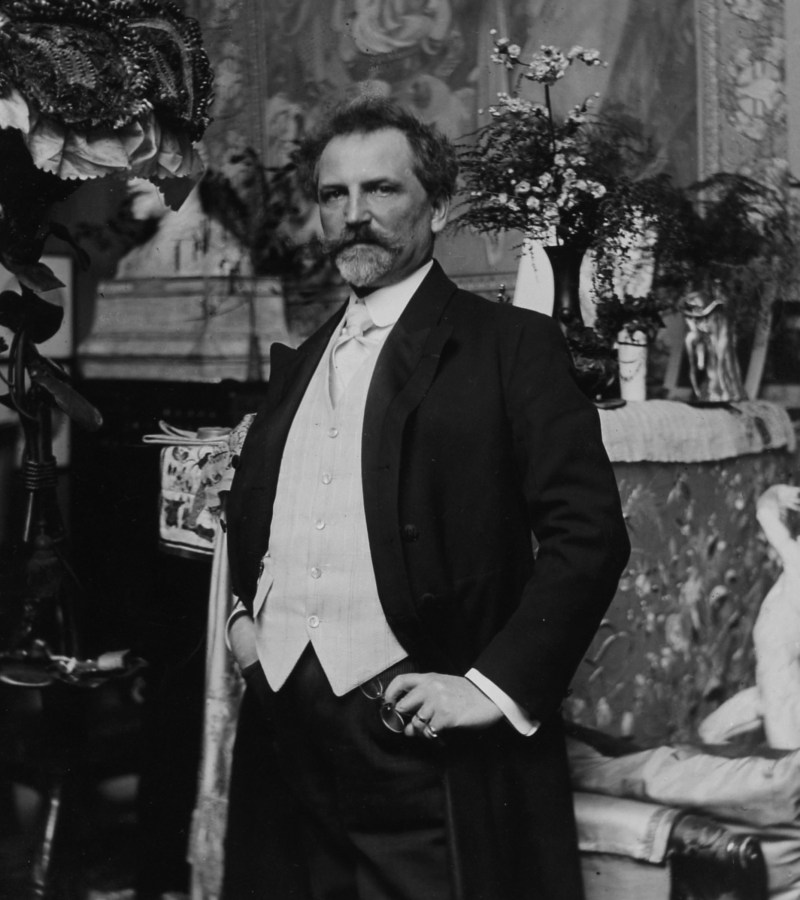
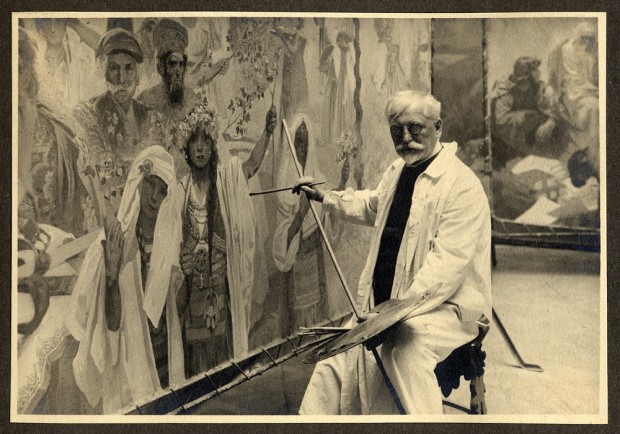
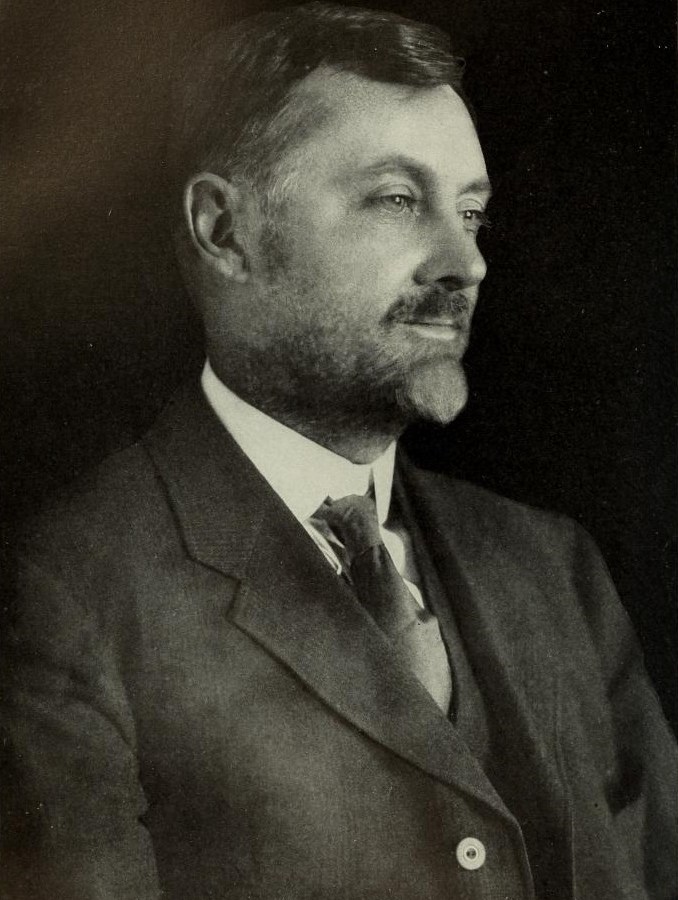
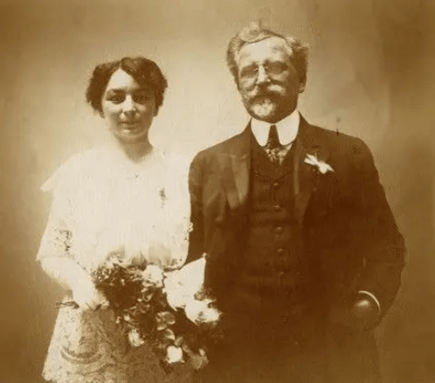
                              Alphonse Mucha in his Paris studio on Rue de Val de Grace (c. 1899)

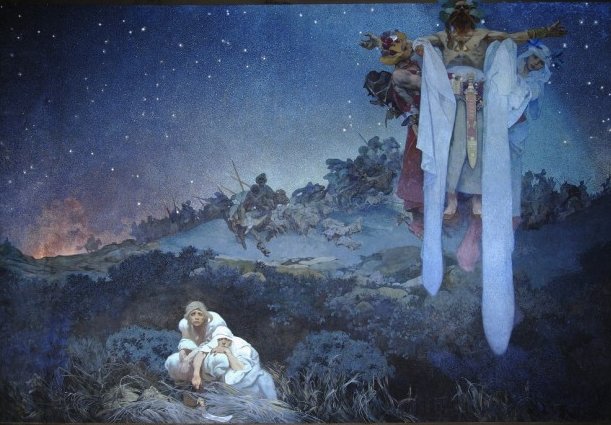
The artist I am looking at today is a Czech painter, illustrator, and graphic artist, who spent the first part of his artistic life living in Paris during the Art Nouveau period and where he became best known for his stylized and decorative theatrical and advertising posters.  This was all to change when, at the age of 43, he returned to his homeland of the Bohemia-Moravia region in Austria where he dedicated himself to completing a series of twenty monumental paintings, known as The Slav Epic, which pictorially portrayed the history of the Slavic people.  I will talk about that great series in the later blogs but for today let me tell you about the early life of Alphonse Marie Mucha and his wonderful illustrative work.

Alphonse Maria Mucha was born on July 24th 1860 in the small town of Ivančice in the southern Moravia region,  which is now the Czech Republic, but then was a province of the Austro-Hungarian Empire.  His father Ondřej Mucha was an usher at the Ivančice courthouse and his mother Amálie was the daughter of a miller.  Alphonse was the eldest of five children.  He had three sisters, Anna, Andéla and Antoine and one brother, August.  He also had two stepsisters from his father’s first marriage.  Alphonse was gifted musically.  He was an alto singer and also a talented violinist.  He also enjoyed drawing.

                                                          Crucifixion by Alphonse Mucha (1868)

One of his earliest works is entitled Crucifixion which he completed around the age of eight.   It can be seen from the depiction that the young boy was influenced by the Catholic Church and its teachings.  As a young boy he was inspired by the Catholic rituals and later in life he recalled attending church for the Easter celebrations:

“…I used to kneel for hours as an acolyte in front of Christ’s grave. It was in a dark alcove covered with flowers heavy with intoxicating fragrance and wax candles were burning quietly all round with a sort of sacred light which illuminated from below the martyred body of Christ, life-size, hanging from the wall in utmost sadness… How I loved to kneel there with my hands clasped in prayer. No-one in front of me, only the wooden Christ hanging from the wall, no-one who would see me shutting my eyes and thinking of God-knows-what and imagining that I am kneeling on the edge of a mysterious unknown figure…”

                             Choirboys at Gymnázium Slovanské in Brno by Alphonse Mucha (1872)

 After primary school he was to move into secondary schooling but this had to be paid for and his parents just did not have the funds as they were already paying for the education of his two stepsisters.  However, as he was such a good musician his music teacher arranged for him to meet to Pavel Křížkovský, the choirmaster of St Thomas’s Abbey in Brno, who was impressed with Alphonse.  Alphonse’s family had hoped that through Křížkovský, their son would be able to become a member of the choir and with this would come a monastery scholarship which would pay for his secondary education.  Unfortunately for Alphonse, Křížkovský was not able to admit him and get him funding as he had already attained sponsorship for another musician.  However, Křížkovský arranged for twelve-year-old Alphonse to be interviewed by the deputy choirmaster of the Cathedral of St. Peter and Paul,  Leoš Janáček, who admitted him as a cathedral chorister and funded his studies as a boarder at the Gymnázium Slovanské, the high school in Brno.  Alas, nature took its course and eventually the teenager’s voice broke and he had to leave the choir but instead played the violin during the church services.

Although it was due to his musical talents that Alphonse was able to complete his schooling he still believed in a possible artistic future and he set about gaining employment as a theatrical scene designer.  The next step for him was to gain some formal artistic tuition and so, in 1878, aged eighteen, he applied to enrol on a course at the Academy of Fine Arts in Prague, but was rejected.   They harshly advised him to follow a different career path.  In 1880, aged 19, he travelled to Vienna, which at the time was looked upon as the political and cultural capital of the Austro-Hungarian Empire.  Here Alphonse was taken on as an apprentice scenery painter for the Kautsky-Brioschi-Burghardt painting workshop, which produced stage scenery and theatre curtains, a company which made sets for Vienna theatres.   Vienna to Alphonse was like a breath of fresh air and he enrolled at some of the city’s art classes..

                                                                  Hans Makart, Self-portrait, (1878)

Now living in this large city, Alphonse was able to visit art galleries and theatres, tickets to which were given to him by his employer.  During his visit to the galleries, he came across the works of Hans Makart, the renowned 19th-century Austrian academic history painter, designer, decorator, who was famed for his monumental works of portraiture. Like many artists in the late nineteenth century, Alphonse began to experiment with photography as an aid to his artwork.  

                             The fire catastrophe at the Ring Theatre in Vienna (December 8th 1881)

In 1881, just a year after he arrived in Vienna, fate once again stepped into Alphonse Mucha’s life when a fire destroyed the Ring Theatre, which was the main customer of the firm he worked for.  Within the series of theatre fires in the 19th century, the catastrophe at the Ring Theatre in Vienna was the worst because of at least 450 fatalities. There are several crucial points, which led to a disaster in this extent: The fire was not reported immediately, the people in the theatre were not informed in time, the emergency lighting was not working, the architectural structure of the building made the way out long and complicated, and the theatre staff was unable to cope with this case of emergency. 

                          Decorative murals at the Hrušovany Emmahof Castle

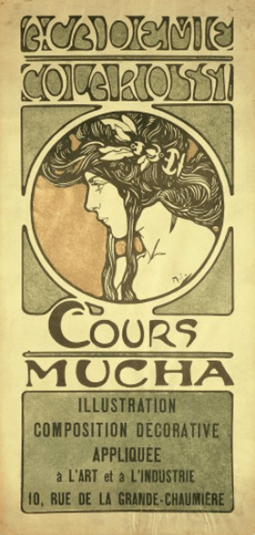
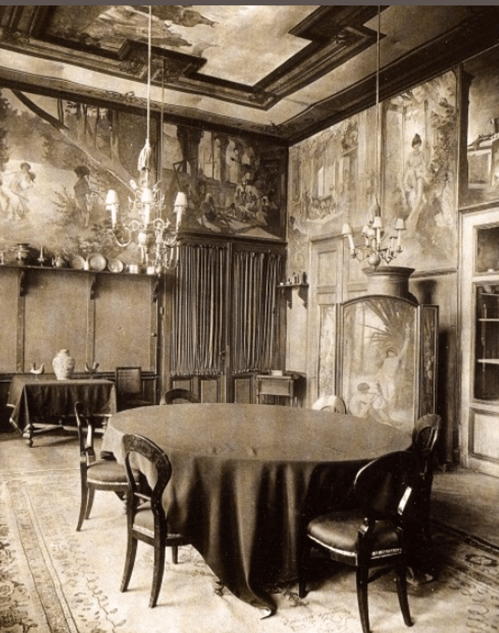
Alphonse was now made redundant and had to decide whether to remain in Vienna or head back home to Ivančice.  In the end, he did neither but took a train through Austria and into Moravia.  By the time he arrived at Mikulov in southern Moravia his money had run out and he had to alight from the train.  He needed somewhere to stay in the town but had no money.  Fortunately, he was able to “pay” for his board and lodgings by sketching some portraits.  His portraiture was seen by Count Eduard Khuen-Belasi, the local landowner and he was so impressed by the standard of Alphonse’s work that he commissioned him to paint murals for his Hrušovany Emmahof Castle near Hrušovany nad Jeviškou and his Gandegg Castle in the Tyrol, as well as reconstructing the Castle’s portraits and the decorative murals.  So amazed with Alphonse’s work, the Count decided to sponsor Alphonse’s formal training at the Munich Academy of Fine Arts for two years.  Following the completion of his studies in 1887 the Count arranged for Alphonse to go and study in Paris at Académie Julian and Académie Colarossi.

                                         Portraits of Saints Cyril and Methodius                                                    St. John Nepomucene Catholic Church in Pisek, USA by Alphonse Mucha (1887)

The Count funded Mucha’s  expenses until the end of 1889 at which time the flow of money stopped and it is thought that the Count wanted Alphonse to become independent and survive by his work alone.  It was a blow to Alphonse who had for the last three years, no financial worries.  He now had to balance his income against expenditure and learnt to survive on a diet of lentils and beans and began to eke out a living by providing illustrations for a variety of magazines and books.  However, his hard work paid off and he was soon able to establish himself as a successful and reliable illustrator.

Sarah Bernhardt as Gismonda poster by Alphonse Mucha

Was it sheer luck, or fate once again, that on December 26th 1894 Alphonse happened to be at Lemercier’s printing works, when Sarah Bernhardt, the star of the Parisian stage, called de Brunhoff, the printer’s agent, with an immediate demand for a new poster for her production of Gismonda.  Unfortunately for Lemercier all his regular artists were on holiday and so in an act of desperation he approached Alphonse to produce the poster.  The poster was of a long narrow format (216 x 74cms) and the subtle pastel colours and the ‘halo’ effect around the subject’s head were to remain features of Mucha’s posters throughout his life.  It was a depiction which oozed both grandeur and solemnity and was in stark contrast to other garish street posters of the time.  This Art Nouveau advertising poster was for the four-act comedy, Gismonda, by Victorien Sardou, which was being staged at the Théâtre de la Renaissance in Paris. Sarah Bernhardt was both director and actor. This poster by Mucha was produced to promote the new production which opened on January 4, 1895.  Mucha portrayed Bernardt as an exotic Byzantine noblewoman wearing a splendid dress and an orchid headdress with a palm branch in her hand. This costume was worn in the last act, the climax of the comedy, in which she joined the Easter procession.  The Gismonda poster which Alfonse Mucha created was a sensation and it was so popular with the Parisian public that collectors bribed bill stickers to obtain them or simply went out at night and, using razors, cut them down from the hoardings.  Bernhardt was delighted with Mucha’s work and continued to use this poster for her American tour in 1896.  She offered Mucha a five-year contract to produce stage and costume designs as well as posters.

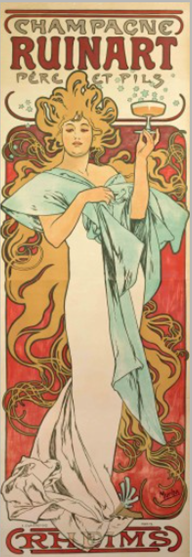
Champagne Ruinart poster by Alphonse Mucha (1896)

This Champagne Ruinart poster is one of Mucha’s earliest commissions from the printer and lithographer Ferdinand Champenois and was included in the seminal Exposition d’Affiches Artistiques Françaises & Etrangères Moderns & Retrospectives held in Rheims in November 1896.

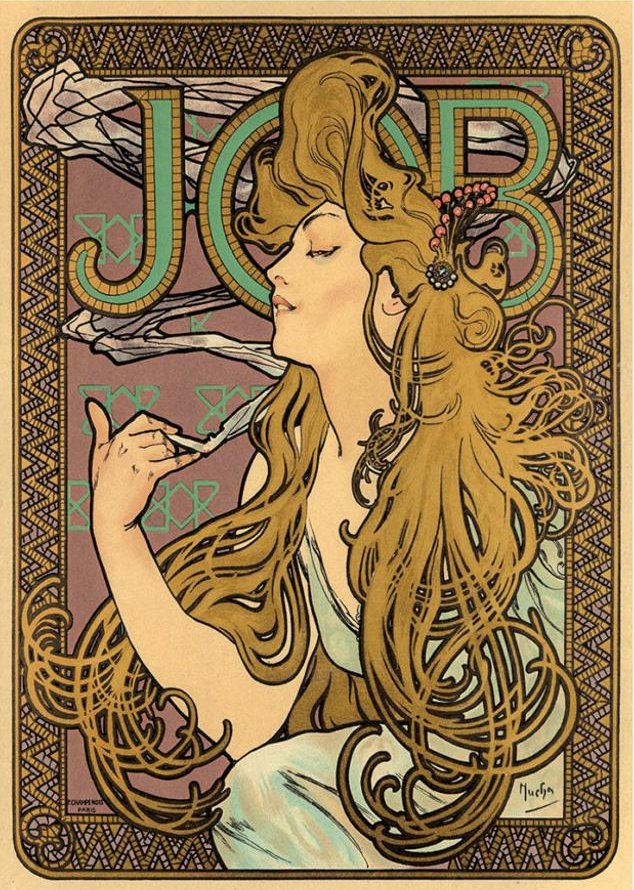
                                             JOB cigarette papers poster by Alphonse Mucha (1897)

Alphonse Mucha’s success with the Sarah Bernhardt posters precipitated in many more commissions for advertising posters. He designed posters such as the one for JOB cigarette papers…

Moët Chandon Crémant Impérial poster by Alphonse Mucha (1899)

…and for Moët-Chandon champagne.

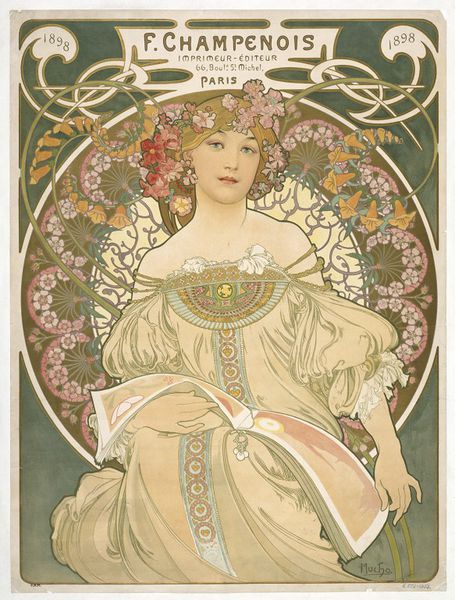
                             Champenois poster by Alphonse Mucha

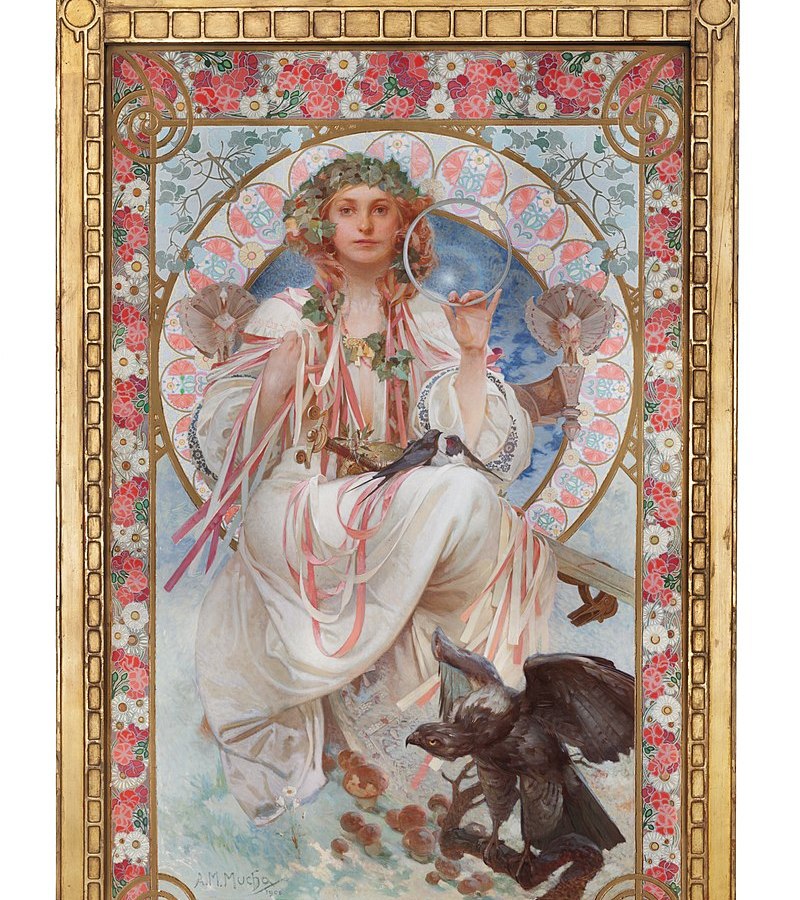
At the turn of the twentieth century, Alphonse Muhca continued to create posters for Ferdinand Champenois, who had his premises at 66 Boulvd. St. Michel, Paris.  He signed an exclusive contract with the company to produce commercial and decorative posters.  With Gismonda ‘le style Mucha’ was launched.  Mucha was established as the preeminent exponent of Parisian Art Nouveau.  This 1897 lithograph depicts a beautiful young girl in a sophisticated pink dress with red and blue embroidery. The girl wears pink and red flowers in her dark blonde hair and is surrounded by the heavy floral ornamentation and spirals characteristic of much of Alphonse Mucha’s work.  Over the next decade Mucha illustrated posters and decorative panels, books, magazine covers, advertisements, theatre programmes, menu cards, calendars, and postcards many using Champenois as his printer.

          Calendar illustration designed by Alphonse Mucha for La Plume

Alphonse also designed a calendar which featured a woman’s head around which were the twelve signs of the zodiac in a halo-like disc. The rights for the illustration were sold on to Léon Deschamps, the editor of the arts review La Plume, who brought it out with great success as the magazine’s calendar for 1897. This was Mucha’s first work under his contract with the printer Champenois and was originally designed as an in-house calendar for the company.  The majestic beauty of the woman is emphasised by her regal bearing and elaborate jewellery.  It became one of Mucha’s most popular designs; at least nine variants of this lithograph are known, including this one which was printed without text to serve as a decorative panel.  Between 1896 and 1904 Alphonse Mucha created over one hundred poster designs for Champenois. These prints were sold in various formats, ranging from expensive versions printed on Japanese paper or vellum, to less expensive versions which combined multiple images, to calendars and postcards.

                       Railroad poster advertising travel to Monaco and Monte-Carlo (1897)

His posters almost always depicted beautiful women in sumptuous settings with their hair generally curling in arabesque forms and filling the frame. In 1897 Alphonse produced a poster for the railway line between Paris and Monaco-Monte-Carlo but it neither showed a train nor any identifiable scene of Monaco or Monte-Carlo. It simply depicted a beautiful young woman in a dream-like pose, surrounded by whirling images of flowers, which implied the turning wheels of a train.

            Poster for Alphonse Mucha’s 1897 retrospective exhibition at the Salon des Cent

Alphone Mucha’s reputation as an illustrative artist grew and he was invited to exhibit his work in the Salon des Cent exhibition in 1896, and a year later he had a major retrospective in the same gallery exhibiting 448 works. The art magazine La Plume made a special edition devoted to his work, and his exhibition travelled to Vienna, Prague, Munich, Brussels, London, and New York, which boosted his international reputation.

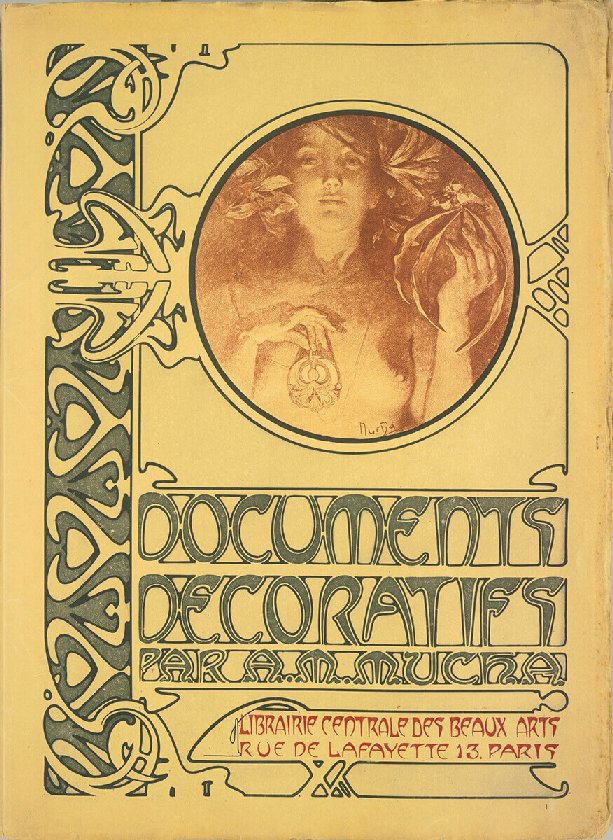
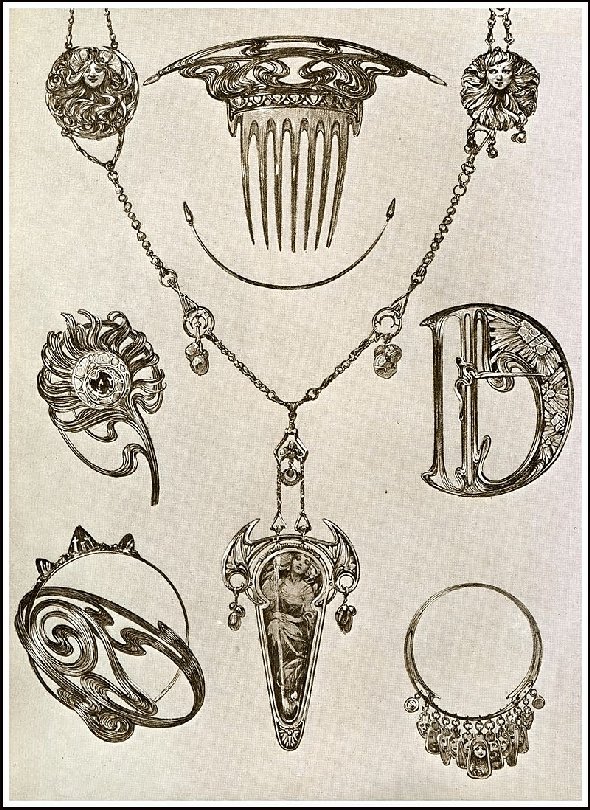
                                  Jewelelry designs by Mucha in Documents Decoratifs (1901)

In 1899 Alphonse entered into a collaboration with the jeweller Georges Fouquet to make a bracelet for Sarah Bernhardt in the form of a serpent, made of gold and enamel, similar to the costume jewellery Bernhardt wore in Medea.

                               Cascade pendant designed by Alfons Mucha for Fouquet jewelers, (1900)

The Cascade pendant designed for Fouquet by Mucha in 1900 is in the shape of a waterfall.  It is composed of gold, enamel, opals, tiny diamonds, paillons, and a barocco or misshapen pearl.

………………………to be continued


Much of the information for this came from the excellent website The Mucha Foundation

Ralph Hedley. Part 2.

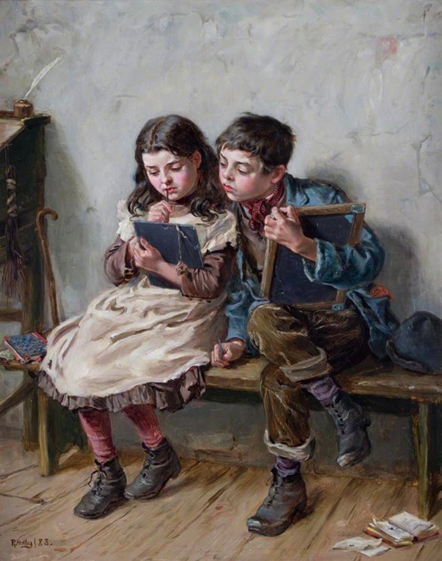
                                       In School by Ralph Hedley (1883)

Another of Hedley’s paintings projecting school life was his 1883 work, In School.  The boy in the painting was John Irwin, the younger brother of Tom Irwin, who worked at Ralph Hedley’s woodcarving shop.

                         The Ballad Seller, the Black Gate by Ralph Hedley (1884)

Hedley used Irwin in a number of his painting. one of which was his 1884 work known as The Ballad Seller.  The setting is the Black Gate in Newcastle with Castle Garth in the background.  The red roofs of Castle Garth can be seen behind the Black Gate in Ralph Hedley’s depiction. The Black Gate formed the entrance to the street, which had been built inside the castle walls. There was only a short stretch of street left standing by the time Hedley painted this picture. It has now all been demolished, though the outline of the street can still be seen.  It is thought that Hedley made many plein air sketches for the background.  In the painting we can see the rough wooden fence that had been put up around the Black Gate in 1883 by the Newcastle Society of Antiquaries during the renovation work.  Hedley’s painting depicts broken and missing stones as well as damaged window glass.  The Black Gate of the Norman castle, which was completed at the end of the thirteenth century, had become run down.  However, the painting is all about the trade of selling ballads.  Ballad sellers were looked upon in the eighteenth century as impoverished, uneducated, and morally-lacking people who were allegedly conspiring with pickpockets.  It was suspected that whilst plying their trade, they hoped to distract their audience with their songs while the pickpockets went to work.  Later, they would share their ill-gotten gains.  Ralph Hedley would have witnessed poor women street sellers having to take their children with them, like the baby in the ballad-seller’s arms in this picture.  John Irwin was once again used as a model for one of the boys.

                             Shoeing a refractory horse (Shoeing the Bay Mare) by Ralph Hedley (1883)

Older brother Tom Irwin was himself the model for one of the men in Hedley’s 1885 painting Shoeing a refractory horse in the stocks – Shoeing the bay mare.  He was the man standing on the right wearing the brown cap, velvet jacket and velvet trousers.  He was seventeen years of age when he modelled for the work.  Tom Irwin, who worked at Ralph Hedley’s woodcarving workshop, and his family arrived in Newcastle around 1880.  He remembered the first meeting with Hedley and how the artist had admired their clothes:

“… When we came from the country where we had been farming, we brought several quaint articles of clothing, caps, clogs, baskets etc, which proved invaluable to your father’ work, and… which we know were much appreciated by him… “

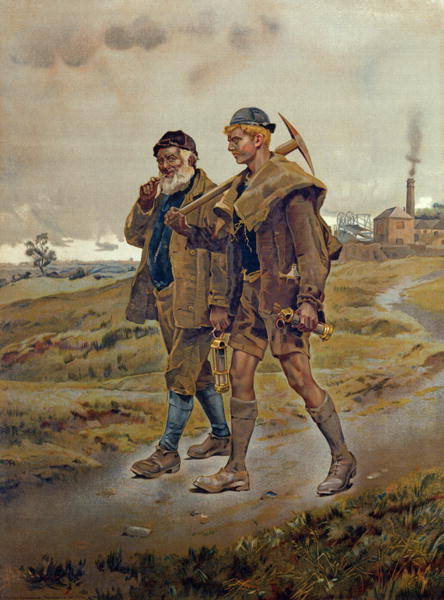
                                    Going Home by Ralph Hedley (1888)

Ralph Hedley believed that art should be a pictorial record of the working lives of local people, and his paintings were particularly valuable for the record they provide of everyday life on Tyneside in the late 19th and early 20th centuries.  His 1888 painting, Going Home, is a depiction of two coal miners returning home from working at the pit at Blaydon, near Gateshead. The younger of the two men wears a cap to protect his head from the low beams, and he wears a pair of shorts because of the heat in the mine. In his hand is a safety lamp and a sack to kneel on. This was an extremely popular painting and a print of it was made the following year which proved extremely popular with the public.

                                                   Go, and God’s will be done! by Ralph Hedley (1891)

One of Ralph Hedley’s 1891 paintings, Go, and God’s Will be Done, fascinates me as there is a story behind the depiction.  At first glance there is obviously something dramatic happening in this painting, but what is it all about?  On the floor in the left foreground a cat sleeps peacefully before the fire, unaware of the chaotic happenings going on in the room.   This is the home of a lifeboatman and in the bed is his wife who is very ill.  The husband, in his shirt sleeves, leans over to talk to her.  Next to him stands a lifeboatman who has come to take him away to their lifeboat.  The door of his cottage is held open by his daughter and we can see that outside there is a gale force wind blowing over rough seas, in which is a boat in trouble.  The call has gone out for all the local lifeboatmen to rush to launch the lifeboat and the wife’s husband is torn between his duty to his sick wife and his duty to the lifeboat rescue.  The painting is based on the English poet and journalist, George Roberts Simms poem, The Lifeboat.  The words of the poem which Hedley has illustrated so beautifully are:

“…I didn’t move, but pointed to the white face on the bed-

“I can’t go, mate,” I murmured; “in an hour she may be dead,

I cannot go and leave her to die in the night alone.”

As I spoke Ben raised the lantern, and the light on my wife was thrown;

And I saw her eyes fix strangely with a pleading look on me,

While a tremblin’ finger pointed through the door to the ragin’ sea,

Then she beckoned me near and whispered “Go, and God’s will be done!

For every lad on that ship, John, is some poor mother‘s son…”.

So how did the story end?   It had a happy conclusion.  The husband went with the lifeboat and helped to save the crew of the sinking ship. One of them was his long-lost son, and when he took him home, his mother was overjoyed and recovered from her illness.  The poem was quoted in the exhibition catalogues when the work was exhibited in 1891 and 1892, in Newcastle, Liverpool, Leeds, and South Shields, and in the Royal Academy.  The painting is now in the collection at Harris Museum and Art Gallery, Preston.

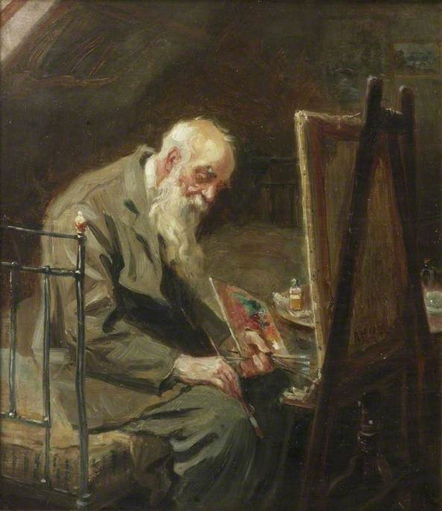
                       Ars Longa. Vita Brevis by Ralph Hedley (1900)

Hedley completed an interesting work in 1900 entitled Ars Longa, Vita Brevis which was exhibited at that year’s Royal Academy Exhibition.  It would almost be classed as a Vanitas painting focusing on the unstoppable transience of life but it does not have the usual Vanitas symbols such as burnt out candles and skulls.  And yet the title of the painting, Ars longa, Vita Brevis meaning Art is long, life is short is the perfect title for a Vanitas work.  The painting is one that elicits our sympathy for the aging artist we see before us.  Look how the depiction evokes this feeling.  The setting is a small drably-coloured attic space in which we see the artist sitting on his bed in front of an easel.  He loosely holds his palette and brushes and yet he has to rest them on his knees.  He has nodded off to sleep in the middle of his work.  Is it that he is tired or is it a sign that he has almost given up on life?  What are his circumstances and what are his thoughts?  Is he lonely and without friends?  Does he mull over his past life and consider past decisions that he has made and which have brought him to this point in his life?  I will leave you to decide.

                                                                          Duty Paid by Ralph Hedley (1886)

In the foreground of his 1886 painting, Duty Paid, we see a man has come to an office on the quayside to collect a parcel brought in by the ship. He puts his money on the table which is due in Custom’s Duty and one of the Customs officers meticulously fills in details of the payment in a ledger. On the other side of the table, another official seals the parcel with red wax, evidencing that duty has been paid. This is a typical Ralph Hedley depiction of local people and local scenes. His oeuvre provided us with an important record of life in the region in that period between the late 19th to early 20th centuries.

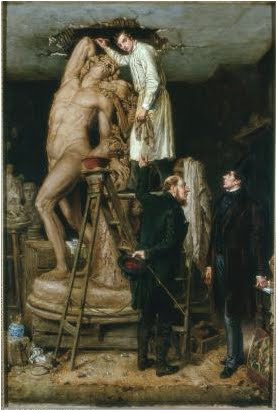
     John Graham Lough in His Studio by Ralph Hedley

One of the strangest paintings by Ralph Hedley depicted John Graham Lough an English sculptor who was recognised for his funerary monuments and a variety of portrait sculpture. He also produced ideal classical male and female figures.  Lough had come to London in 1824 to study the Elgin Marbles at the British Museum.  He was living and had his studio on the first floor of a house in his Burleigh Street lodgings, above a greengrocer’s shop, and it was there that he embarked on a mould for his massive statue of Milo of Croton based on his studies of the Elgin Marbles and the work of Michelangelo.  According to Joshua Lax’s 1884 book, Historical and Descriptive Poems, this was the sculptor’s big chance at being a successful sculptor.   The biggest problem Lough faced was that his studio was too small and the ceiling height was too low for him to complete the statue.   Joshua Lax explains:

“…With the recklessness of a bold genius reduced to desperation, he actually broke through the ceiling of the room above him and made for himself sufficient space to work at his statue. The owner began to take steps for instituting legal proceedings, and even consulted Mr. Brougham (afterwards Lord Brougham) for this purpose. Brougham went to look at the Milo, and see for himself what Lough had done… The news of the strange affair soon spread, and, before long, the whole street where Lough’s room was situated was lined with the carriages of ladies and gentlemen, who had come to view the place, and to see Milo…”

In the painting we see the unhappy landlord and his lawyer, Henry Brougham at the base of the sculpture whilst the sculptor is at work on the upper part of the work, unrepentant with his destruction of the ceiling in his lodgings.

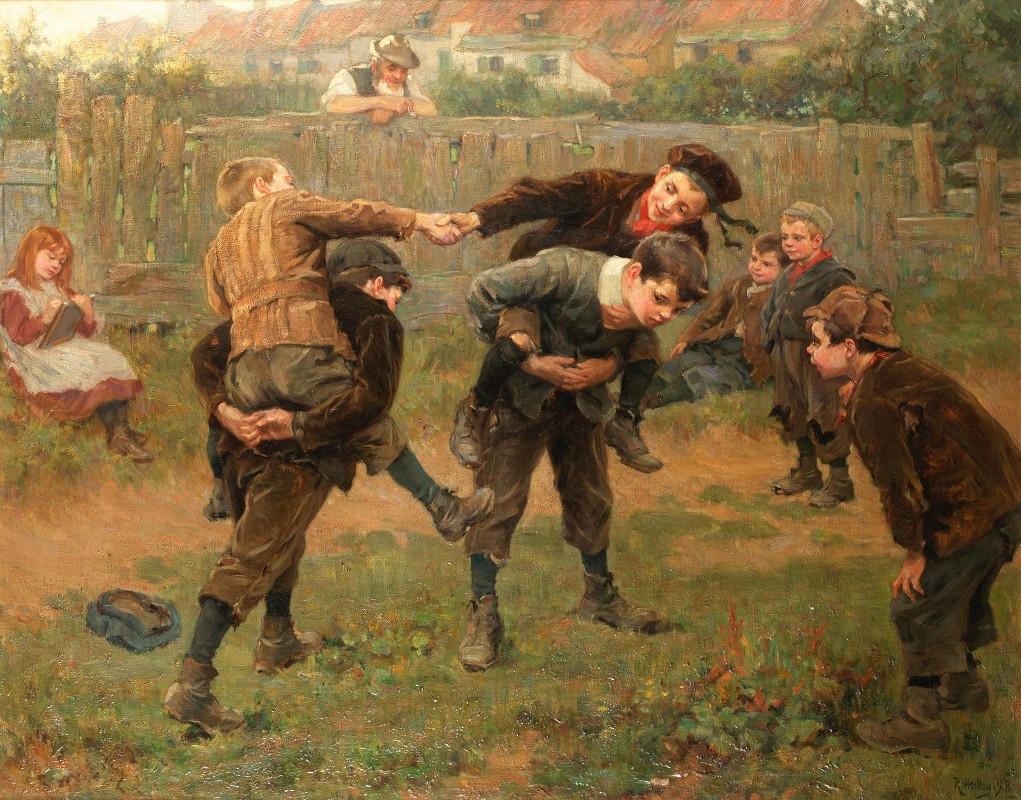
                                                         The Tournament by Ralph Hedley (1898)

In 1898 Hedley completed a painting which was to realise the highest price for one of his paintings at auction, (£43,020 at Bonhams in 2004).  It was entitled  The Tournament.  Hedley was influenced stylistically by the Newlyn school and other social realist painters.  He also focused on life in his much-loved Newcastle and the surrounding Tyneside area for his subject matter. The scope of his depictions was enormous.  It ranged from the uncompromising realism of workers on the dockside and miners to the delightful naivety of children at play, as we see depicted in The Tournament.

                                                           One-time home of Ralph Hedley in Newcastle.

Ralph Hedley’s involvement with the Bewick club, as successful exhibitor, committee member and eventually as president, guaranteed him a number of wealthy patrons for both his wood carvings and his paintings. However, his work was also loved by the working class, the subject of many of his works, and they gained access to his work through the many reproductions of his most well-known works could be found in local papers, tea promotions and adverts for cigarettes. He became a member of the Royal Society of British Artists and exhibited a number of paintings at the Royal Academy.

                                                                                          Blue Plaque

Ralph Hedley died on June 11th 1913 aged 64 at his terraced home in 19 Belle Grove Terrace, Newcastle-on-Tyne.  There is a blue plaque commemorating Ralph Hedley who lived in the house from 1888 to his death in 1913.

Ralph Hedley. Part 1

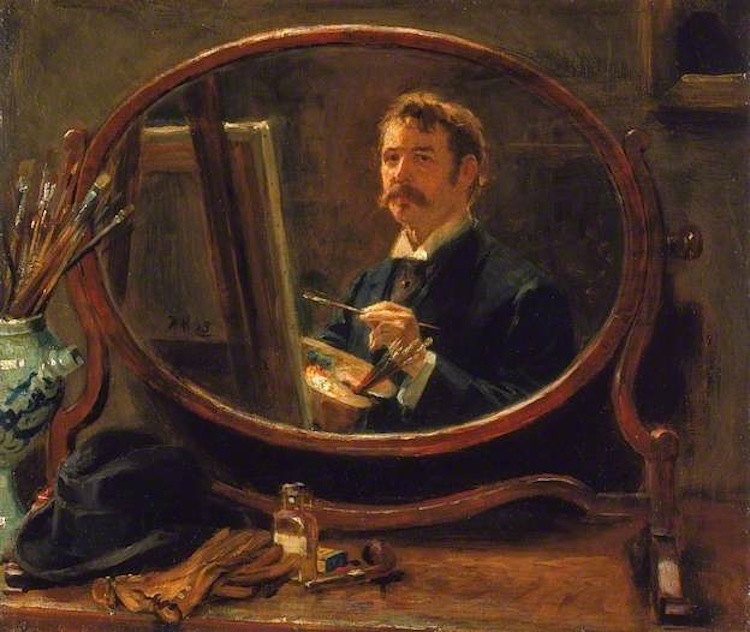
                                                            Self portrait by Ralph Hedley (1895)

In this blog I am once again returning to nineteenth century social realism art.  Today’s artist was a genre painter who was also known for his wood carvings and book illustrations. Let me introduce you to the English painter, Ralph Hedley.

Ralph Hedley was born in the North Yorkshire village of Gilling West near Richmond on New Year’s Eve 1848, the son of carpenter, Ralph Hedley, and his wife Anne Hedley.  The Farrier’s Arms in Gilling West was the first house Ralph lived in.  Around the age of two, Ralph and his family left Yorkshire and moved to Newcastle upon Tyne where the Industrial Revolution had opened up new opportunities for work. 

                                                      Iron and Coal by William Bell Scott (1855–60)

Ralph attended school up to the age of thirteen and then became an apprentice at the wood carving workshop of Thomas Tweedy and during his evenings he attended art and design classes at the Government School of Art in Newcastle upon Tyne, where the principal was the Scottish poet and artist, William Bell Scott, a landscape and history painter who had also painted scenes from the Industrial Revolution in his work.  The Industrial Revolution had changed the life of the population.  Changes which were good for some but for others who had moved to the cities to grab the new opportunities for work there had been adverse consequences due to the rapid growth of dense urban areas with their problems of public health, housing, crime, and poverty.  William Bell Scott greatly influenced Ralph Hedley.  And at the age of 14 Ralph was awarded a bronze medal by government’s Department of Art and Science.

On completion of his apprenticeship with Thomas Tweedy, Hedley set up his own woodcarving and architectural sculpture business, which proved a great success.  As a wood carver, he received many commissions for decorative work in churches.  In 1874. Hedley married his wife Sarah Storey and they had six children, three boys and three girls. One daughter died in an accident, but the other five would all take up woodcarving as well, and two of his sons, on the death of their father, would take over the running of the workshop.

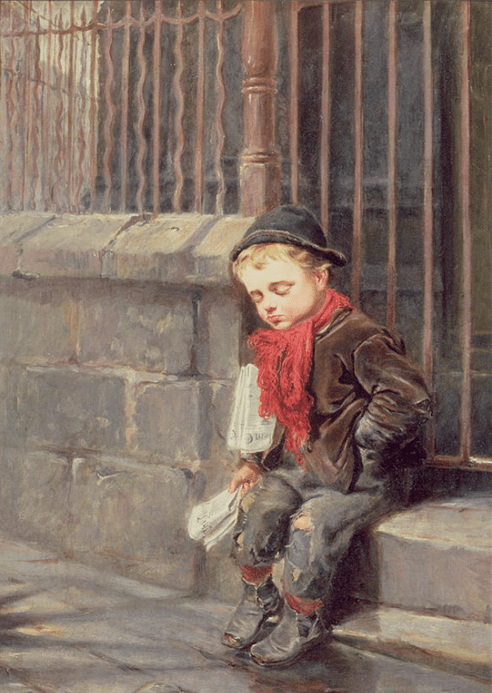
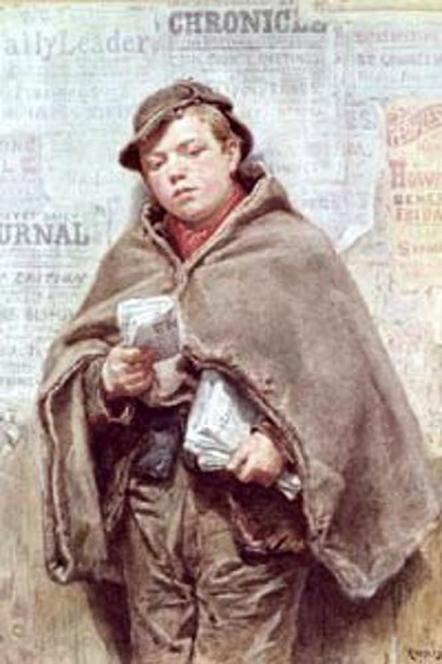
                                          The Newsboy by Ralph Hedley (1879)

Despite working as a wood carver, Hedley loved to spend his free time painting, and he had many of his works accepted into the Royal Academy’s exhibitions.   Hedley had more than fifty of his paintings displayed at the Royal Academy between 1879 and 1904. In 1879, he completed his painting entitled The Newsboy accepted by the Royal Academy’s jurists for inclusion at that summer’s exhibition.  It is a humorous depiction of a very young boy who has succumbed to tiredness and fallen asleep on some stone steps as he waits to offer people his newspapers.

                                      The Newsboy by Ralph Hedley (1892)

Thirteen years later Hedley returned to the subject with his 1892 version of the The Newsboy.  An article about this picture appeared in the Evening Chronicle of 27 January 1930:

“…For years this young newsboy stood against the hoardings which then occupied a site practically opposite the Central Station…..Seen almost invariably with a sack around his shoulders this young seller of ‘Chronicles’ became a familiar figure…”

                 Blinking in the Sun (Cat in a Cottage Window) by Ralph Hedley (1881)

In 1881 Hedley completed one of his best-loved paintings, Blinking in the Sun (Cat in a Cottage Window) sometimes referred to as Ralph’s Cat.  This tabby cat has that lazy, “loving-the-sunshine” expression on its face which every cat lover will recognise as their feline searches out the warmest spot they can find. Its sleek fur looks like it is a well cared for feline.  The cat is sitting on the windowsill of an old stone cottage next to an old earthenware pot of geraniums and narcissi and a Chinese vase of red tulips.

                                                                      Thomas Bewick by James Ramsay

Ralph Hedley and a number of fellow Newcastle artists set up the Bewick Club in 1884, an art group named after Thomas Bewick, the famous Northumbrian wood engraver. The club held a number of exhibitions which attracted large numbers of artists from the region.  The works on show varied from landscapes and seascapes to genre depictions that had a sense of gritty realism.  The raison d’être of the Club was to promote the needs of professional artists and to urge not only the patronage of rich individuals but of the interested less wealthy local population.

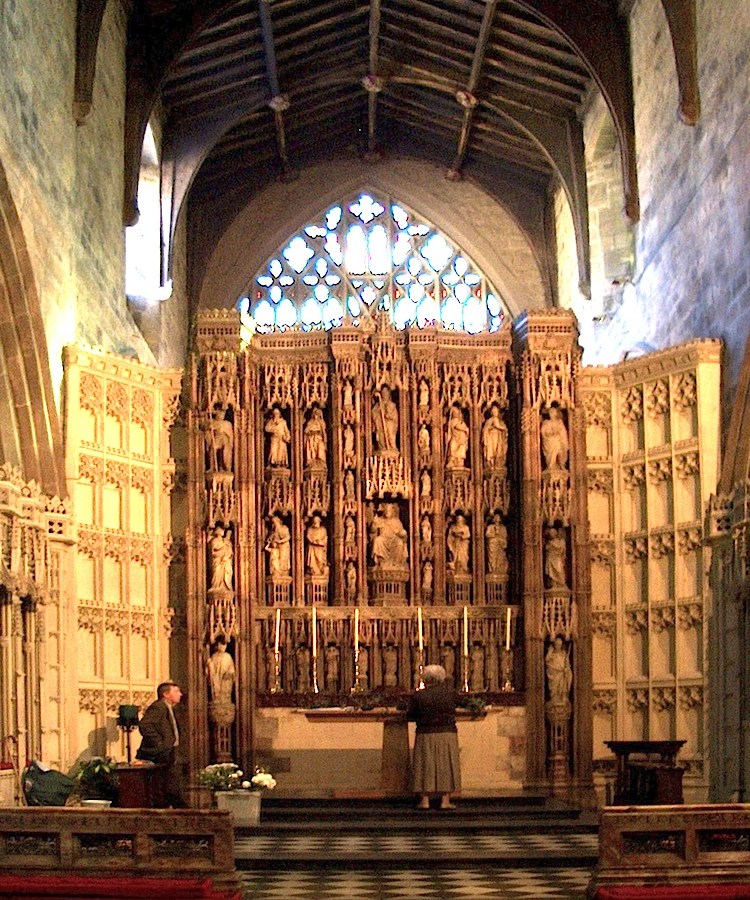
                           Chancel and Reredos, The Cathedral Church of St Nicholas, Newcastle.                        Photograph by Peter Loud, as captured from his impressive panoramic virtual tour of the cathedral.

Between 1882 and 1889 Ralph Hedley’s skills as a wood carver were put to use in the renovation of the interior of the Chancel and Reredos of the Cathedral Church of St Nicholas, Newcastle.  His workshop carved the choir and rood screen for the scheme by architect Robert James Johnson.  John McQuillen, author of The Church of St. Nicholas, With a Brief Sketch of the History of Newcastle wrote of Hedley’s role in the internal renovations:

“…The richly-carved woodwork, a creation in which grace and strength are united, is strictly in keeping with the severe style of the chancel, and in accord with ecclesiastical traditions, was executed by Mr Ralph Hedley, and splendidly upholds his craftmanship and artistic feeling…”

Hedley’s great-granddaughter, Clodagh Brown, said that Hedley was responsible for the exceptionally fine wood carving in the choir, including the rood screen, Bishop’s throne, and canons’ stalls with misericords.  For more details of Hedleys work in the cathedral take a look at Victorian Web page: 

 http://victorianweb.org/painting/hedley/woodcarvings/1.html

What I believe was Hedley’s greatest contribution to society was his pictorial history of everyday life in Tyneside during the latter part of the nineteenth century and the early part of the twentieth century. When he died in 1913, the Newcastle Daily Chronicle recognised the importance of his work, writing:

“…What Burns did for the peasantry of Scotland with his pen, Ralph Hedley with his brush and palette had done for the Northumberland miner and labouring man…”

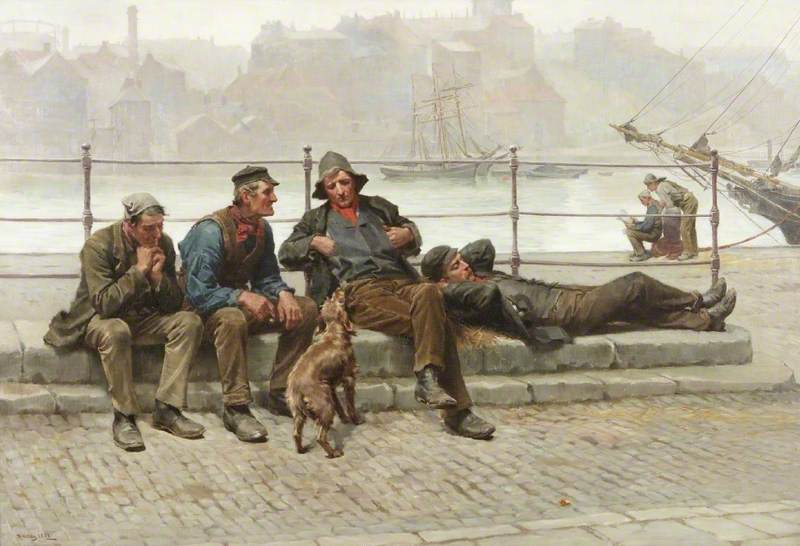
                                                                 Out of Work by Ralph Hedley (1888)

The Industrial Revolution in Britain was a period deemed to be between 1780 and 1830.  It was an episode in British history which saw the transition from being agricultural to being industrial.  There was a movement of the population from the rural areas to the urban areas.  The standard of living for those working-class people who came to the city in search of work was of a poor standard and to make matters worse, work was hard to come by and when you achieved employment, the wages were meagre and barely enough to survive and support your family.  These hard times were ones Hedley depicted in his paintings.  One example of this is his 1888 painting entitled Out of Work with an alternative title, Nothing to do.  The setting is the dockside of the River Tyne.  The four men had queued for a job that morning but were not hired.  Now all they have to do is to sit around and wait to re-apply for work the next morning.  Look at their distraught expressions.  They know they have to return home to their families and break the bad news.

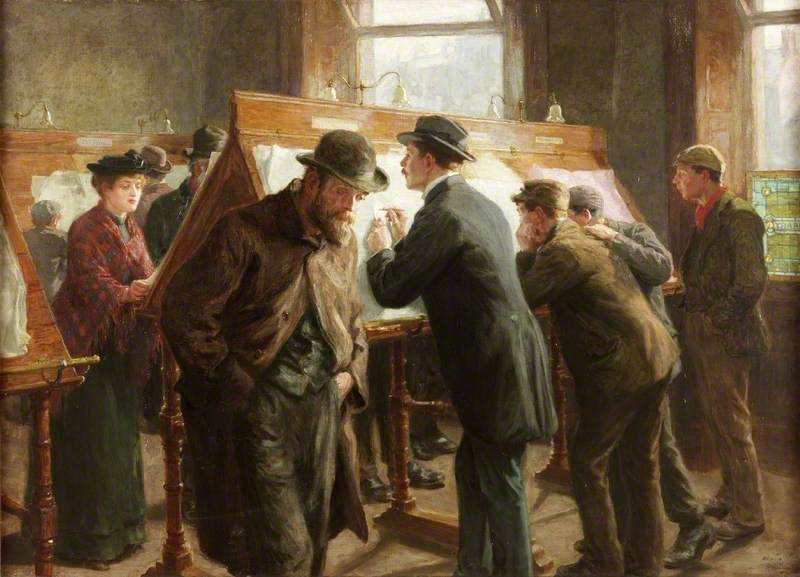
                                                            Seeking Situations by Ralph Hedley (1904)

Another of Hedley’s work which focused on the plight of the unemployed is his 1904 painting, Seeking Situations.  The setting for Hedley’s work is what we would now call a “Job Centre”.  In it we see a number of men, some only young lads who may be looking for their first job, and a single female.  They are all studying the job adverts which are posted on the information boards.  According to the Laing Gallery in Newcastle which owns the painting, the setting is in fact the Victoria City Library, a building which was situated close to the artist’s studio in Newcastle.  It is interesting to look carefully at the various individuals Hedley has depicted.  In the foreground there is a bearded gentleman who is slightly hunched over.  Looking at the way he is dressed, he does not look like a manual worker and probably held, at one time, a supervisory role.  He looks sad and dejected.  He is walking away from the noticeboards having not been able to find any suitable employment.  His age and reduced ability are probably working against him.  Contrast his hunched and crestfallen demeanour with that of the young man to the right of him.  Again, by his clothes we know he is not a manual worker.  He is dressed in typical office-clothes.  His appearance and mood could not be more different to that of the bearded gentleman.  He looks pleased and eager as he spots a job description which would suit him perfectly.  He hastily writes down the information.  The only woman depicted in the painting is dressed well and has a refined air about her.  She is probably looking for shop work rather than factory work.  This compassionate but entirely unemotional work was a great example of social realism and is one of Ralph Hedley’s best-known paintings.

                                                                  Barred Out by Ralph Hedley

Young children of working-class families and their lot in life was depicted in many of Hedley’s paintings, as was there time at school.  A fine example of this genre was his 1896 painting with the unusual title, Barred Out.   The title is all about a widespread custom, up to the 19th century, known as the ‘barring-out’ of the schoolteacher by his pupils. On a certain day agreed by the school authorities, the pupils planned to bar the classroom door with the teacher outside and refused to let him in until he agreed to their terms, which were usually for a half-holiday, or something similar.  In Hedley’s painting we see schoolchildren enjoying the North-East custom of barring the teacher from the classroom on the 29th of May,  until the holidays for the next year had been agreed. One boy is wearing a Northumberland hat with a red pom-pom. Ralph Hedley has depicted the setting as a shabby country classroom in which children of many different ages are being taught together. The children’s clothing albeit shabby and multi-patched does not detract from the depiction of happy and healthy children.  However, although some of the children’s clothes are patched, they seem happy and healthy.

………………….to be continued

Ernest Biéler

                                           The Braiding of Straw by Ernest Biéler

If you went into a room, on the walls of which were a large number of paintings by the great artists of the past but without identifying labels, how many do you think you would recognise?   If there were three painting in the room done by each artist, although not grouped together, how many would you be able connect to each artist.   For the art history aficionados, maybe the brushstrokes would act like fingerprints.  Maybe the colours used by the individual artists would lead you to solve the quest.  If they are figurative paintings maybe an artist has his/her own way of depicting them.  The reason for those questions is that my artist today has such recognisable paintings that I am sure after reading this blog and looking at his paintings you will be able to identify his work when you see it.  Let me introduce you to the nineteenth century Swiss painter Ernest Biéler.  He was a multi-talented artist, draughtsman, and printmaker. He worked in oil, tempera, watercolour, gouache, ink, charcoal, pastels, acrylic and pencil. He also created mosaics and stained-glass windows.

Portrait of Nathalie Biéler, the artist’s mother by Ernest Biéler(1906)


Portrait of Samuel Biéler,the artist’s father by Ernest Biéler (1906)


Ernest Biéler was born on July 31st, 1863, in Rolle in the Canton of Vaud in Switzerland. It is located on the north-western shore of Lake Geneva between Nyon and Lausanne.  His father, Samuel Biéler, was a veterinarian and his mother Natalie de Butzow, of Finnish-Polish descent, was a teacher of music and art. Ernest’s maternal grandfather was in the diplomatic corps, and was a one-time Finnish ambassador to Switzerland until his sudden death, which  brought difficult financial times to the family.

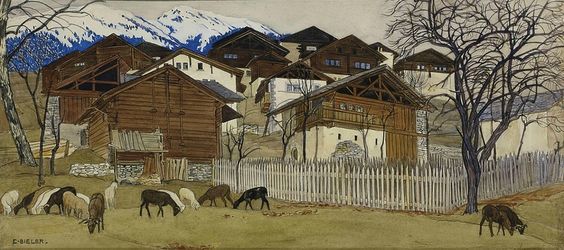
                                                       Paysage a Saviese by Ernest Biéler (1925)

Samuel Biéer and his wife Nathalie had nine children, two of whom died in infancy. With finances tight, Ernest’s father moved his family to Lausanne, where he had been offered a well-paid post as a lecturer in zoology at the University of Lausanne. Although little is known with regards Ernest Biéler’s early childhood, it is understood that in 1880, aged seventeen he graduated from the College of Art in Lausanne and then, went to Paris to study art at the Académie Julian.

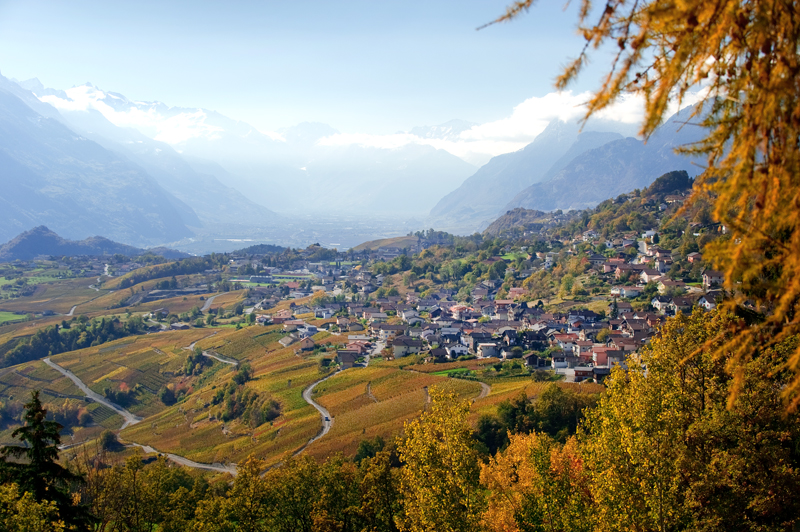
                                                                                               Savièse

Often in our lives we do something that unbeknown to us at the time will affects our future plans.  For twenty-one-year-old Ernest Biéler the time was the summer of 1884 during a walking holiday in the high peaks of the Vallais region, in the southwest of Switzerland. To its south lies Italy and the Aosta Valley and Piedmont and to the southwest France the Auvergne-Rhône-Alpes of France.  During his hike, Ernest visited the remote mountain village of Savièse. 

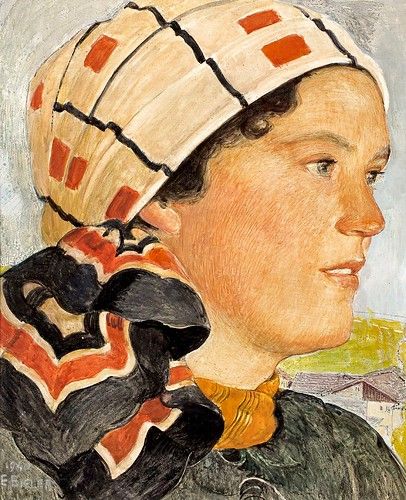
                                    Girl with Scarf by Ernest Biéler

From there, the beautiful landscapes stretched in all directions, and the people that inhabited the village seemed to almost have circumvented civilization.  The village, its people and the spectacular landscape had a great effect on Biéler and would feature in many of his works.  This village was to become a great part of his life and through his depictions of the village and the people it would cement his place in the art world which was what he had always strived for.

         Devant l’église de Saint-Germain à Savièse (Outside the Church of Saint-Germain in Savièse)                                                                                           by Ernest Biéler (1886)

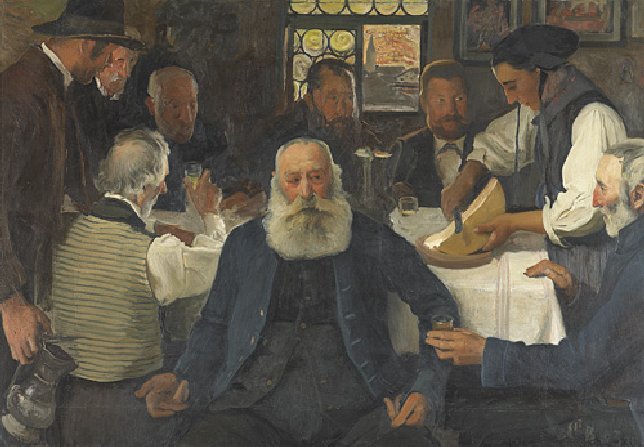
Biéler was fascinated by the Savièse folk and their traditions.  Add to this the ideal outdoor conditions with the brilliant light, which was ideal for plein air painting  He went back to the Savièse in the autumn of 1886 and completed numerous sketches that he would use later for one of his masterpieces.  He organised for the following summer to have a large stretcher delivered to his Paris studio for him to complete his ambitious work. Biéler completed the painting in his Parisian studio using his preliminary sketches.  The finished work entitled Devant l’église de Saint-Germain à Savièse (Outside the Church of Saint-Germain in Savièse) was extremely large, measuring 204 x 302cms. The setting for this work was not one particular church in a particular village but rather a commonplace church with its mighty stone pier and its arched doorway.  Before us we see a large group of women gathered together in the warm sunlight.  They are all turned out in their dark blue Sunday dresses and are following the mass from the outside.  Some are diligently studying their prayer books whilst others have been designated as child minders.  By its composition and handling, the work was bound to arouse the interest of avant-garde circles: the figures are made monumental by the close framing.  Look at the way Biéler has referenced the effect of the intense sunlight. The way the folds of the clothes reflects this penetrating light.  The effect of the light can be seen in the way the artist has added the bluish shadows, applied in broad brushstrokes, to the walls.  We can see in this work how Biéler was influenced by the French Impressionists.   The painting was seen by a counsellor of state from Vaud, Eugène Ruffy, who bought it for the Musée cantonal des Beaux-Arts in Lausanne.  The one stipulation of the sale was that Biéler was allowed to keep the painting for a while so that he could present it at the Salon of 1887 in Paris.

                                                                 Retour du bapteme by Ernest Biéler

Many painters in the late nineteenth century clung to the beauty of rural life and religious ceremonies in a way of counteracting the swiftly changing world due to industrialisation which witnessed rural people leaving their communities to search for their dreams in the towns and cities.  Biéler and many artists such as Jules Breton and Jean-François Millet depicting such ceremonies and village communities was a way of remembering the peaceful times in rural communities.

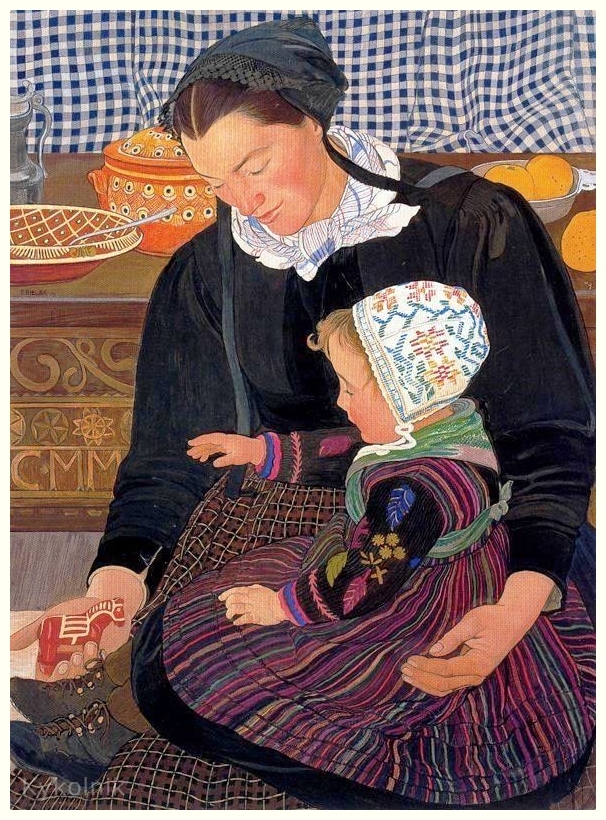
                                                             Mother and Child by Ernest Biéler

In 1892, Biéler was struggling financially and had to sell his property to pay off the many debts he had accumulated. He left Paris and settled in Geneva and was fortunate enough to receive a commission to paint the ceiling in the new concert hall, the Victoria Hall. The building came about thanks to the Consul of England, Daniel Fitzgerald Packenham Barton, who was based in Geneva and had two great passions, navigation, and music, and being one of the extremely rich could satisfy both of them. He arranged that the Geneva architect John Camoletti built the Hall, and he dedicated it to his sovereign Queen Victoria.   In 1894, the building was completed.  The theme of Biéler’s ceiling paintings was Harmonia, queen of Thebes, the mythical figure of harmony.

                                 Sketch for the ceiling of the Victoria Hall mural by Ernest Bieler (1893)

On September 16th 1984, the concert hall was engulfed in flames that partly destroyed the interior décor. That night the interior of the Hall was devastated and the world-famous organ simply melted and collapsed. It was soon decided to restore the interior of the hall as far as possible in the original style, which was flamboyant and heavily decorated. The City having decided to restore the building, also decided that the ceiling décor which had been painted by Ernest Biéler had to be replaced by a contemporary work by Dominique Appia.

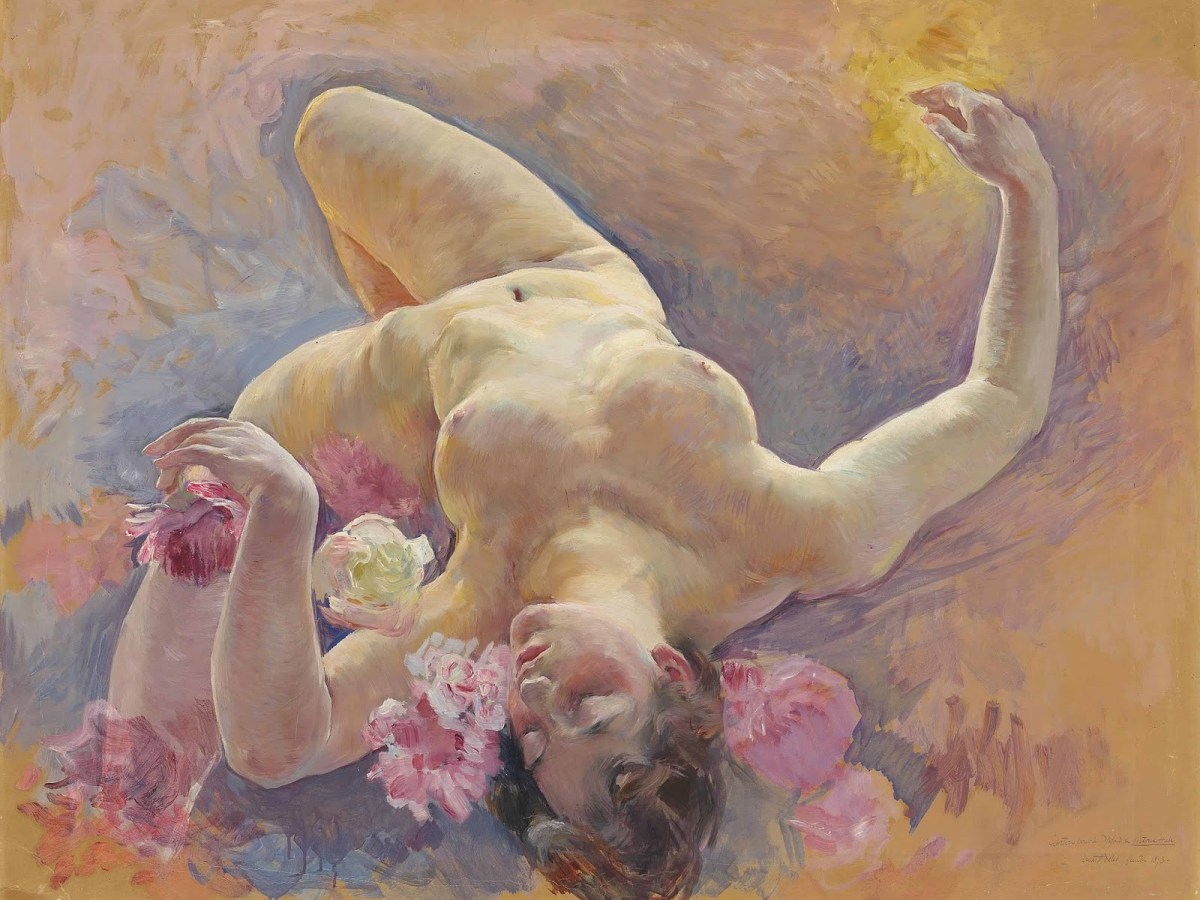
                                                               Naked, Ringing the Bell by Ernest Biéler

One original ceiling image which caused a controversy at the time was Biéler’s painting, Naked, ringing the bell.  However, the commission was hailed a success and Biéler’s reputation grew, bringing financial rewards.

                                                                     La Râclette, by Ernest Biéler (1903)

In 1896, Biéler rented a house for a workshop in Savièse, and immersed himself in village life but he had to return to Paris so as to carry on with his studies at the Académie Julian.  Along with fellow artists, such as Édouard Eugène Francis Vallet, Raphaël Ritz, and others, Biéler founded the Ecole of Savièse. This name became synonymous with his unique style of work, in which we see an extraordinary level of detail, that became extremely popular with the public.  In the first decade of the twentieth century, Ernest Beeler began building a large house of his own in Savièse with his own workshop and various auxiliary facilities.   In 1900, aged 37, he exhibited two works that earned him a silver medal in the Paris Salon and was made a Knight of the Legion of Honour.

                                                                   Vue de Savièse by Ernest Biéler

Around 1906, Biéler became undecided about his painting style.  Should he abandon his realistic painting style in favour of modernism, which rejected history and conservative values such as realistic depiction of subjects and which adopted a period of experimentation in the arts from the late 19th to the mid-20th century.  When asked whether he was a realist or an idealist, he simply replied:

“…An artist can strive for both. One does not exclude the other. The national feeling has nothing to do with art…”

                                               Le vieux duc de savize cloutiergranois by Ernest Biéler

In 1909, at the age of 46, Ernest Biéler married a Parisian divorcee, Michelle Laronde, who already had a young son and was an art tutor.  They decided to live in Paris rather than the village of Savièse.  The reason, as he wrote to a friend, was because his new wife was “too urban to live in Savièse.” In fact she did not want to have anything to do with Switzerland which caused a problem for Biéler, as his main source of income was from Switzerland, where he was still receiving numerous commissions, and for that reason he had to stay for long periods in Switzerland without his new wife.

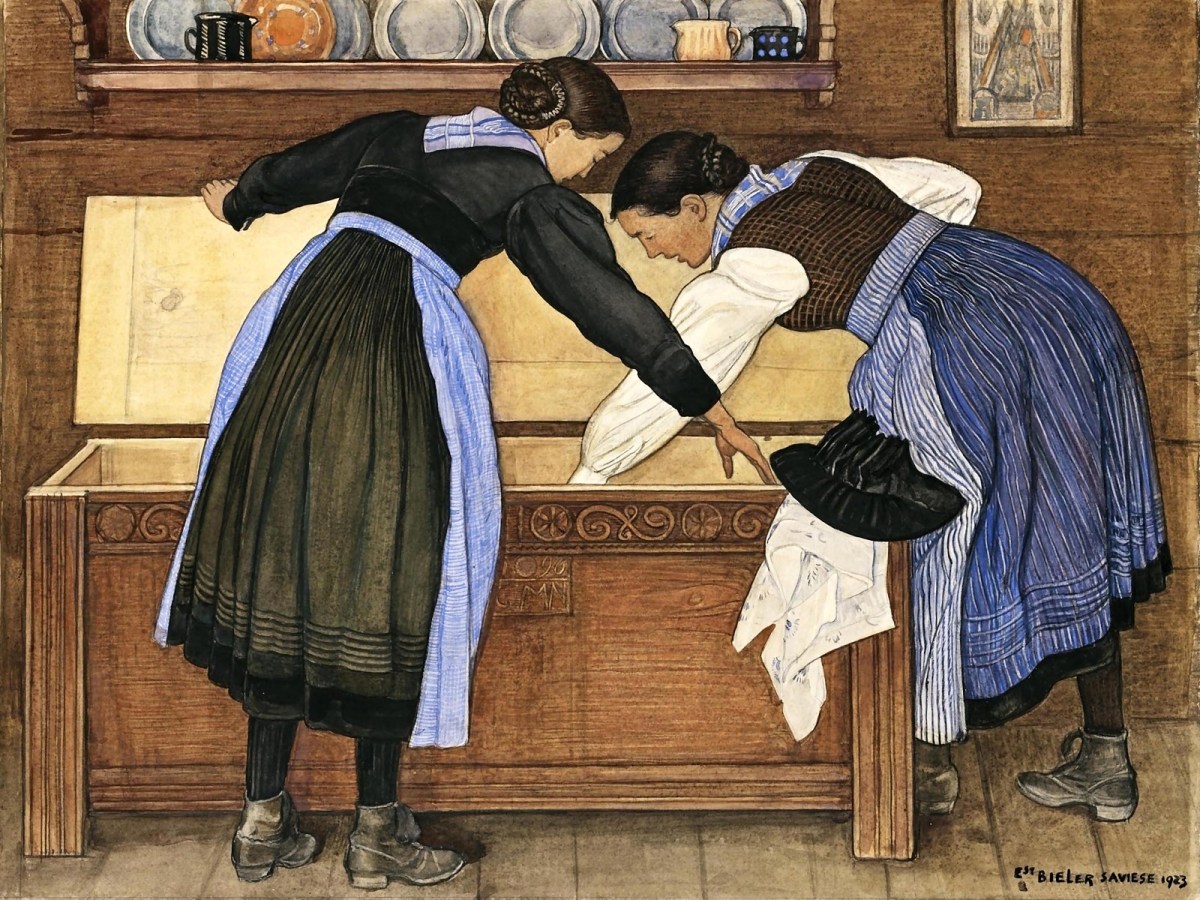
                                                        Deux jeunes Valaisannes by Ernest Biéler

The second decade of the twentieth century proved to be a problematical and difficult period for Biéler.    In 1911 his father died.  Seven years later his mother died and during that intervening period war raged in Europe.  In 1916, Biéler reluctantly decided to leave his wife and the French capital and move to Vevey, a Swiss town, close to Lake Geneva and about thirty miles north-west of his beloved Savièse.  In 1917 he buys a house in Montellier-sur-Rivaz.  Now living apart from his wife, there followed the inevitable divorce in 1921.

                                   L’Eau mysterieuse (Mysterious Waters) by Ernest Biéler (1912)

During this decade, it was not just these personal problems of death and divorce that he had to deal with, he also had an artistic setback.  He had been working for four years on his exceptionally large (146.3 x 376.4 cms) painting, L’Eau mysterieuse (Mysterious Waters).  Although it was acclaimed when it was shown in Paris in 1912 and subsequently bought by the Gottfried Keller Foundation, after it was exhibited in Switzerland, it failed to persuade him to remain in the French capital.  Biéler had meant the work to be an art nouveau manifesto with the aim to establish in Paris the importance of this graphic style and of the seldom-used medium of egg tempera.  The work is painted on sheets of paper mounted on canvas and set within a large wooden frame which had been fashioned to Biéler’s instructions. Its long, narrow format recalls the works seen on cassoni, or marriage chests which are a rich and showy Italian type of chest.  These long and narrow paintings had been revived by the English Pre-Raphaelite Edward Burne-Jones. The smooth-flowing depiction is of thirteen princesses fanning out in the foreground which is offset by a number of the trees in the background. The basin into which the women stare, occupies nearly half of the painting.  The setting is autumn with fallen leaves on the ground and the surface of the pond.  The women are kneeling, gazing into the pond, fascinated by their own reflections and worry at what they see – their unstoppable ageing.  However, this depiction is all about Ovid’s myth of Narcissus, enchantment and the feminisation of heroes which was popular at we entered the twentieth century.

                                              Jeune Chevrier (Young Goatherd) by Ernest Biéler

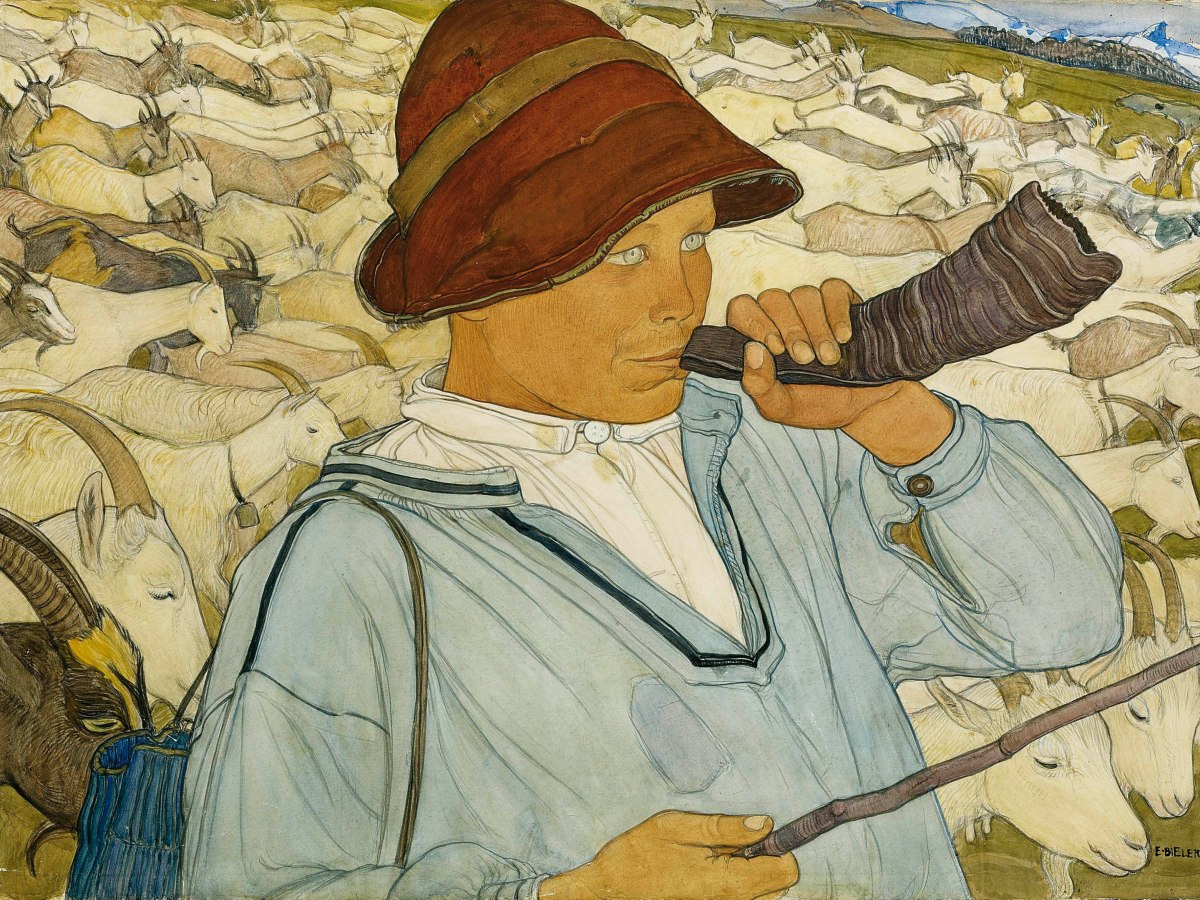
In 1917 Ernest set up shop in a vast studio in Montellier near Rivaz and there he began producing the great decorative works that will ensure him lasting fame. He created stained-glass windows for churches (Saint Francis, Lausanne; Saint Martin, Vevey; Saint Germain, Savièse), mounted-canvas ceilings (Victoria Hall, Geneva; Theatre of Bern) and frescoes (Jenisch Museum, Vevey; the main hall of the Greater Council, Sion).  

                                                       L’Homme des Camps by Ernest Biéler, (1917)

From 1923, Beeler spent the last 25 years of his life in Savièse. In 1928, when he was sixty-five years of age, he married for the second time.  His second wife was Madeleine de Kerenville, who was 20 years his junior.

Ernest Biéler died in Lausanne on June 25th, 1948 and is buried in St. Martin’s Cemetery in Vevey.

Hilda Rix Nicholas. Part 4.

                                                                            Hilda Rix Nicholas (1910)

Many of Hilda’s works were sold and the success of the exhibition led to many of her Australian works of art touring London and British regional art galleries.   The most prestigious of these being at the Royal Academy in London and at the International Society of Sculptors, Painters and Gravers,

                                                                          His Land by Hilda Rix Nicholas

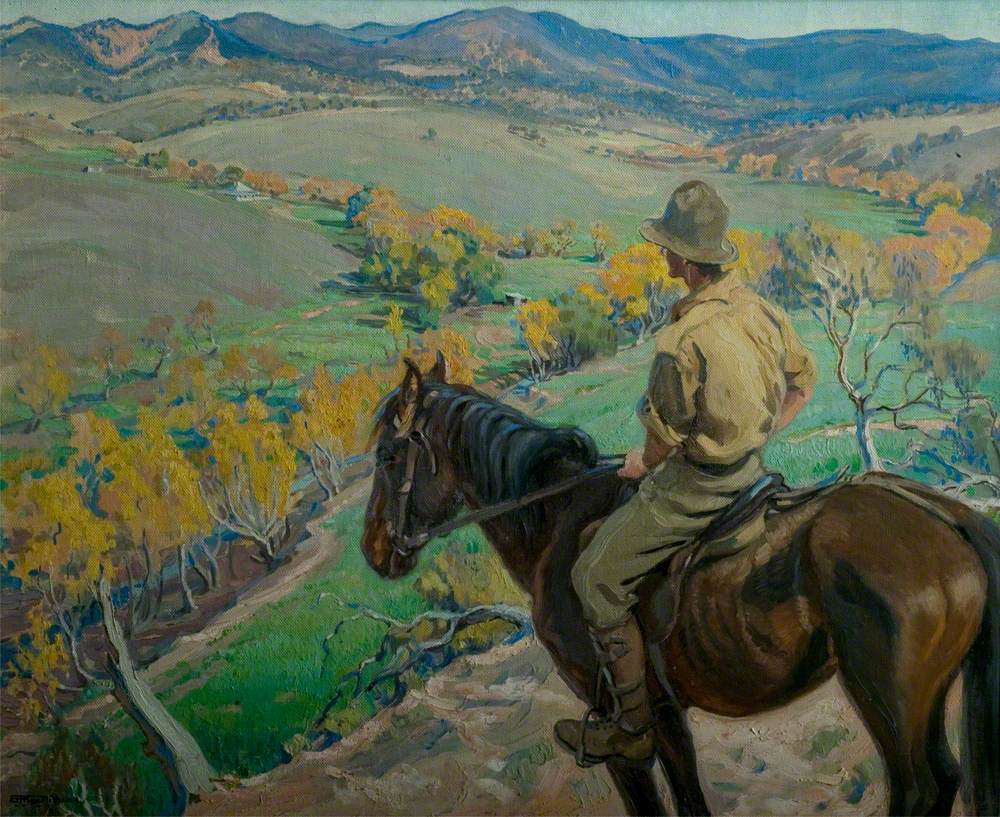
A solo exhibition of her work was on view in December 1924 at the Beaux Arts Gallery, London, and one of the works on display was His Land, which was described as having “the rare quality of conveying the spirit of life in the Commonwealth.  Back in Australia, the December 5th 1925 edition of the Newcastle Morning Herald printed an article about the painting and the exhibition:

AUSTRALIAN WOMAN ARTIST.

Something of the beauty and grandeur of life in Australia is to be found in the art exhibition opened at the Beaux Arts Gallery, Bruton-place, by the Australian High Commissioner. The artist. Mrs.Hilda RIx Nicholas, is an Australian and her works possess the rare quality of conveying, the spirit of life in the Commonwealth as well as portraying) that life pictorially. “His Land.” The most important work of the exhibition. might almost be termed great. It is a perfect example of the difficult art oil figure and’ landscape combination. In the foreground ‘is a young settler on horseback; contemplating a vast sunlit valley, which stretches away to the distant Blue Mountains. A. J. Munnings himself could not have painted horse and rider better. The trees, fields, and mountains are brightly coloured, and the whole picture. seems.to convey, the sunny heat-laden atmosphere of Australia.

It was not just in English galleries that her work was exhibited,  for in Paris, she appeared at the Société Nationale des Beaux-Arts Spring exhibition in Paris, in which she had eight works, a very large number for a single artist. The Société not only hung many of her paintings and drawings, she was elected an Associate to the organisation in that year.

            Les fleurs dédaignées by Hilda Rix Nicholas (1925)

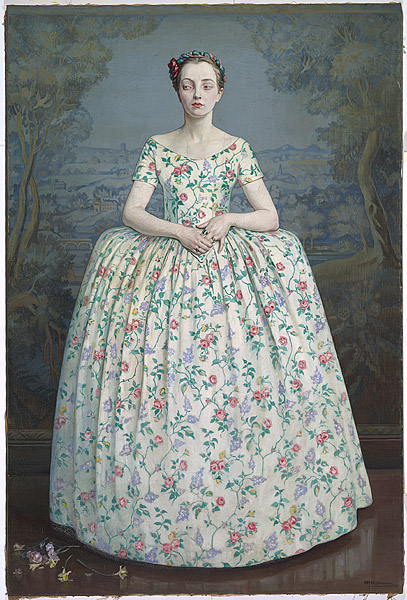
One of her most famous paintings was completed in 1925 whilst she was living in Paris.  It was entitled Les fleurs dédaignées (The scorned flowers).  It was a monumental painting, the largest of all her works, measuring 193.0 x 128.5 cm (76 x 51 inches).  Rix Nicholas concentrated on details of costume and decoration.  The ornate eighteenth-century-style floral dress we see on the model was created by the artist specifically for the painting.  The female stands indoors before an early twentieth-century pastiche of a seventeenth-century Flemish tapestry, which was once owned by the artist.   So, what is going on in the depiction we see before us?  Look at the female.  Her pale skin appears smooth and without blemish, almost like a porcelain doll.  Her head looks so small in relation to her voluminous dress.  The model for this work was a Parisian professional model and a prostitute, apparently with a reputation for being moody and cantankerous and this comes across as we study her face.  She stands upright in a dignified but arrogant manner.  She pouts.  What is she thinking? Look at her facial expression, is it an expression of contempt or maybe sullenness?   On the floor at her feet, we can see a bouquet of flowers which she has discarded and which are mirrored in the pattern of her dress.  What was the artist’s reason for that?   Are they from her lover who she has now rejected?  Look at her gaze.  Who is she looking at out the corner of her eyes?    So many unanswered questions.  Many art historians have had their say but few agree and so it is up to you to come up with answers!

When the work was displayed in Sydney in 1927, the art correspondent for The Sydney Morning Herald of June 27th wrote:

“…For combination of grace, dramatic strength, and clearness in technique this picture would be difficult to surpass. There is nothing finicky about it; it tells its story with vivid directness. As a background to the figure Mrs. Rix Nicholas has set a piece of antique tapestry, so that the trees on either side lean in arch-wise over the head, the face and shoulders stand out clearly against an expanse of sky, and behind the body and limbs extends a countryside full of towers and rivers and trees. The quaint conventionality of this background accords exactly with the late eighteenth-century costume, all sprigged with roses and heliotrope; and the whole mass of detail harmonies [sic] perfectly with the type of the model’s face. It is a cold, selfish face. The artist has brought out with revealing strokes an expression of vindictive malice which is for the moment resting there; and the hands, the fingers of one grasped tightly by the other, give a clear indication of nervous tension within. The treatment of flesh tones and the general arrangement [sic], drawing attention gently but not too obtrusively to the columbines scattered on the polished floor—those are excellent…”

The painting was purchased by the National Gallery of Australia in 2008 from the artist’s son, Rix Wright.

                                               Le Bigdouen by Hilda Rix Nicholas (1925)

During her period in France Hilda put together a number of new paintings including portraits of traditional life and costume, whilst she spent her summers in Brittany.  Before she left Europe, she had Le Bigouden, a painting she completed in 1925, hung at the Royal Academy’s 1926 Summer Exhibition.  Le Bigouden and La Bigoudène were the names given to men and women who inhabited the Pont-l’Abbé region of Brittany

                                                      The Fair Musterer by Hilda Rix Nicholas (1935 )

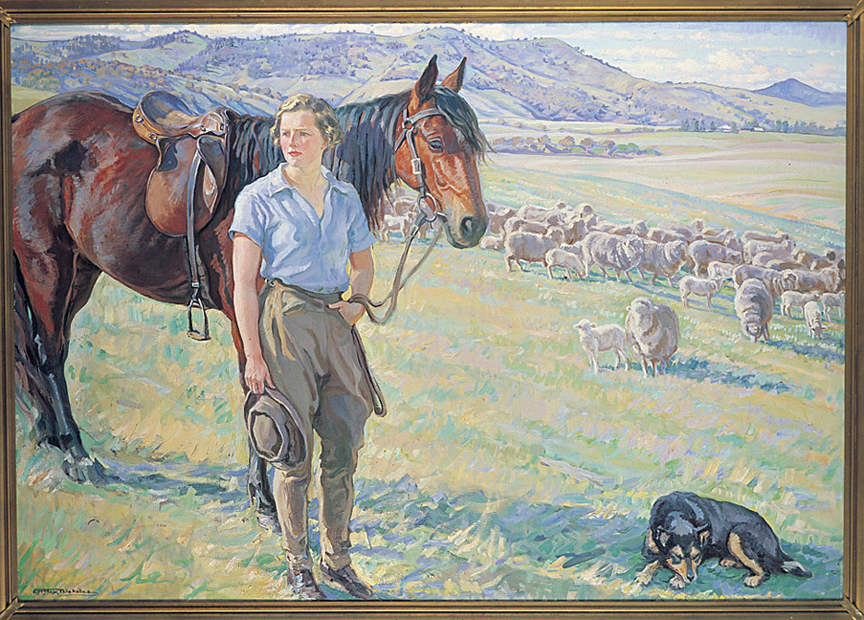
At the end of 1926, Hilda Rix Nicholas and Dorothy Richmond returned together to Australia. They decided to continue with their painting adventures and bought a car, modified it to hold all their painting paraphernalia and set off to roam New South Wales and Queensland and paint the Australian landscape from Canberra and the Monaro plains to the south, up into central Queensland .  Hilda returned to Delegate where she had spent time before setting sail to Europe.  Once again, she met up with farmers, Neil, and Edgar Wright.  For Hilda it was a welcome return to the man she loved and On June 2nd 1928 she and Edgar Wright married in Melbourne.   In 1930, Hilda and her husband had their only child, a son, whom they named Rix.  Hilda stopped painting during their son’s infancy but once he became a young boy, she resumed with her art.  Coincidentally, her friend and travel companion, Dorothy Richmond, married Edgar Wright’s cousin, Walter, and settled in the same region.

                 The Shepherd of Knockalong by Hilda Rix Nicholas (1933)

Hilda and Edgar Wright went to live in a property called Knockalong in the Tombong valley which was situated close to Delegate.  It was a large and successful pastoral station, run by Edgar and his station hands and he is represented as the Shepherd of Knockalong in Hilda’s 1933 painting.  The painting, which is one of the first works that Hilda Rix Nicholas produced, following her return to painting in 1934, after the birth of her only child,  was one of many which depicted the life on the land in the Monaro of New South Wales, which is one of the centres of Australia’s rich and productive farmland.

                                                    Rix – The artists son by Hilda Rix Nicholas (c.1948 )

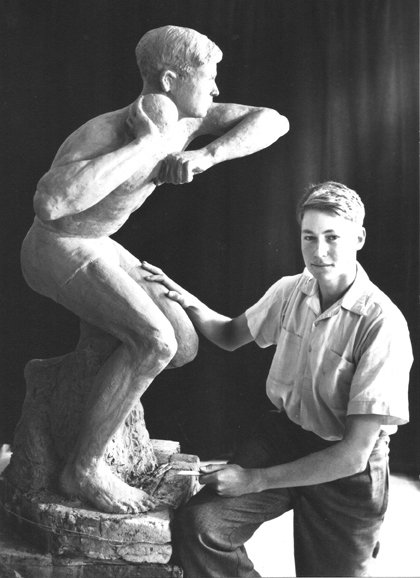
Their son, Rix attended boarding school at Tudor House and then at Geelong Grammar. It was whilst attending the grammar school that he fell in love with sculpting. in fact, he created the two gateway sculptures that still adorn the entrance today.  There was a differing of opinion between mother and father as to what their son’s future path should be.  His father wanted him to take over the Merino stud and his mother wanted him to pursue an art career. In the end, to keep both happy, he combined his love for the southern Monaro landscape and his sculpting He managed the property and when he had free time, he created his sculpted works of art.

                                                                     The Shearer by Rix Wright (1949)

Rix created The Shearer when he was just 19 years old. Cast in bronze, The Shearer bends at the hip over a held sheep, its fleece almost entirely removed and laying at its feet.

Hilda carried on producing works of art for the next twenty-five years and had them shown at numerous exhibitions but by the time of her last exhibition, her love of painting was diminishing and the thoughts of what she had achieved and what was her future began to depress her.  In a letter to her son she talked of that depression, writing:

“…Not doing anything creative is nearly killing me. The trouble is that there is no one near me who cares whether I ever do any more work or not … I feel the artist in me is dying and the dying is an agony … only one’s self knows the craving and the best part in one is aching unsatisfied…”

                   Rix Wright, son of Hilda Rix Nichols Wright

At this juncture in her life, with her health deteriorating, and her fervour for art fading, she did exhibit for the final time in 1954 in Sydney.  It was a group exhibition with two of her oil paintings shown alongside her son’s sculpture The Shearer also on display.

Hilda Rix Nicholas Wright died in Delegate on 3 August 1961, a month before her seventy-seventh birthday.

Hilda Rix Nicholas. Part 3.

The Pink Scarf by Hilda Rix Nicholas (1918)

In March 1918, Hilda Rix Nicholas left England on a sea voyage back to Australia.  She and her late husband’s brother, Athol Nicholas, arrived in Melbourne on May 10th. She needed to get her love of painting back on track and she did this through the city’s Women’s Art Club and the support of Henrietta Maria Gulliver, one of its founding members.  She was soon back in the groove and in November she was amongst the members of the Art Club whose works were displayed at the Athenaeum Hall.  The art correspondent of the Punch magazine (November 21st, 1918) wrote:

“…The dominating personality of the show is Mrs Hilda Rix Nicholas, who exhibits a charming profile of a young girl entitled The Pink Scarf which is painted in Mrs Nicholas’ most arresting manner…”

                                                        In Picardy by Hilda Rix Nicholas (c.1914)

When she travelled to Australia Hilda brought with her the sketches and paintings she had completed during her time in Europe and North Africa and over a hundred were exhibited at the Melbourne’s Guild Hall.  The exhibition was a great success and many of her paintings were sold including her 1914 work, In Picardy, which was purchased by National Gallery of Victoria.  The exhibition moved to Sydney and more of her paintings were bought by private collectors as well as several purchased by National Gallery of Victoria.

       Australian Official War Artists by George Coates (1920)

Hilda left Melbourne and moved to Mosman, a coastal suburb on the Lower North Shore of Sydney.  She continued to exhibit her portraits of Australian military men.   She painted heroic images of soldiers which accentuated the spiritual aspects of war and was in line with the thoughts of the day with regards Anzac mythology and the unashamed masculinity of the Australian nationhood.  The paintings were works of unapologetic patriotism.  They were loved by the public but more conservative critics were troubled by the modern and ‘masculine’ characteristics of the exhibition.  With the public liking her patriotic paintings she tendered for a war memorial mural at the Melbourne Public Library but was not chosen.  The mural commission was given to Harold Septimus Power.  An official portrait by George Coates in 1920 depicted the Australian War Artists. The group portrait includes the official War Artists; standing l-r: (Sir) John LongstaffCharles BryantGeorge LambertA. Henry FullwoodJames QuinnSeptimus PowerArthur Streeton, seated back l-r: Will DysonFred Leist, front: George Bell.  Note they are all male !

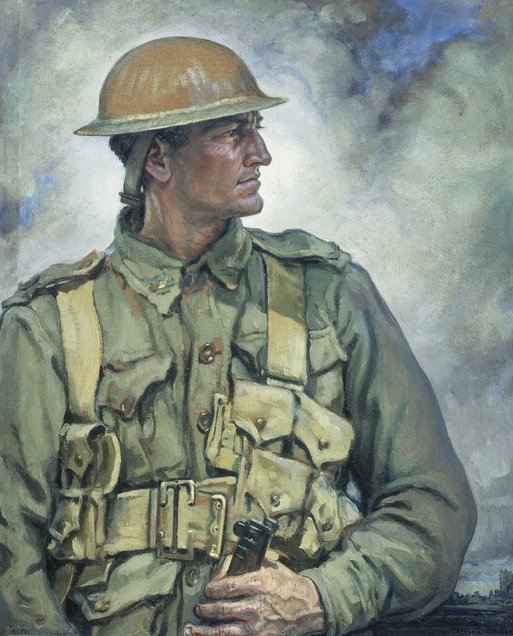
                                                A Man by Hilda Rix Nicholas (1921)

One of her patriotic works was her painting simply entitled A Man.  For her model Hilda chose a returned serviceman.  She must have thought about her late husband as she painted this work.  Look at the way that through her brushstrokes she has affectionately fashioned pockets, buttons, pouches for ammunition and creases in the sleeve.  This anonymous ANZAC hero is framed by stormy skies and with so many of the troops dying on the battlefield one realises that despite the uniform, the tin helmet and rifle they all failed to keep him safe.  Although this is a patriotic depiction it is also a portrayal of defencelessness as much as it is of military might.  Having failed to receive the commission for a war memorial mural at the Melbourne Public Library, Hilda abandoned her military portraiture work and began to concentrate on painting local landscapes and portraits.  

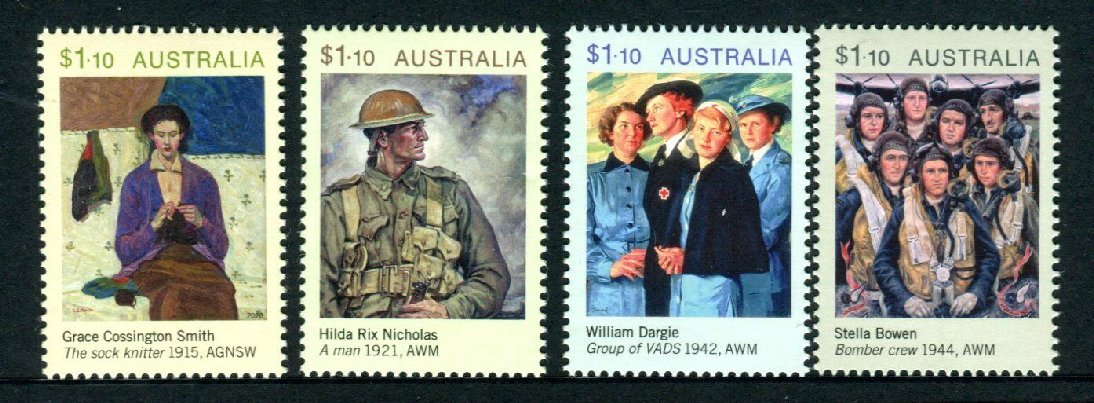
                                                                                         Australian Stamp issue

Hilda believed that the public’s taste in art had changed.  Despite the numerous Australian casualties in the First World War, estimated at 62,000 killed and 156,000 wounded, gassed, or taken prisoner. The Australian population wanted not just to think of their dead but consider the future and a reminder of this was to reflect on their beautiful land and the hard-working Australians who remained and were carrying on with their life.  It was not just in art that this desire to look forward was seen, as many writers of the time, such as Henry Lawson and Banjo Paterson, penned stories who eulogised about the merits of pioneer life.

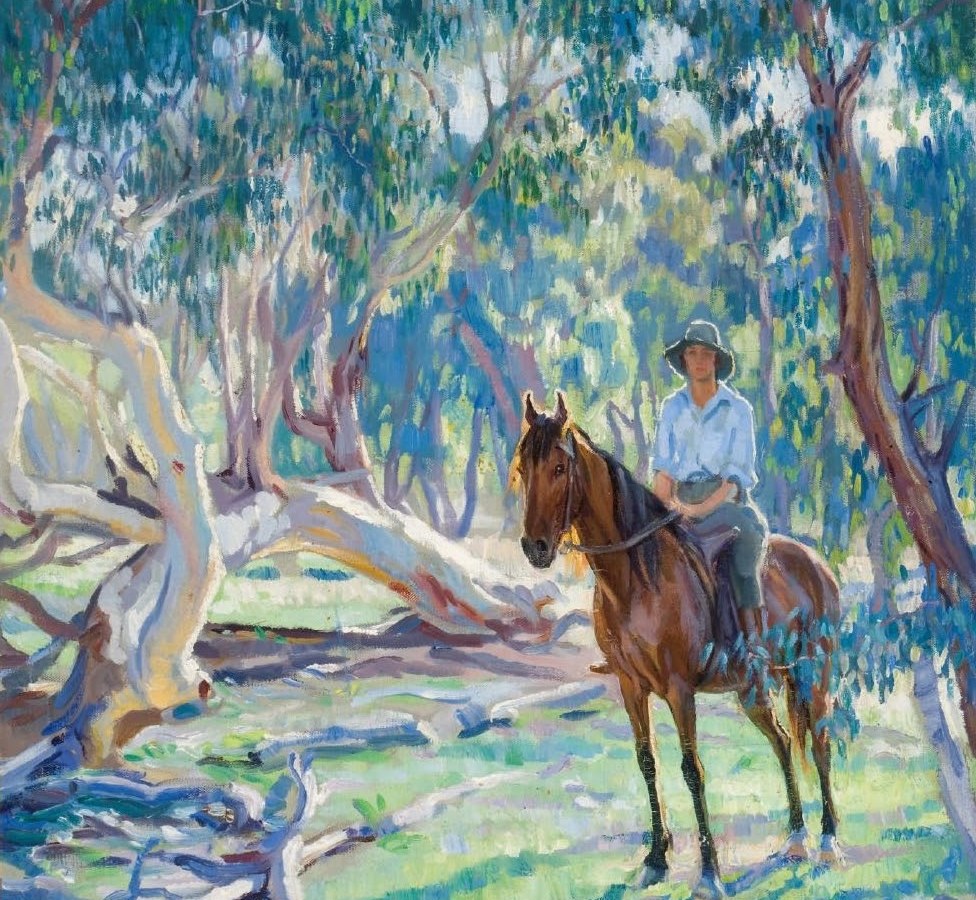
                               In the Bush, Dorothy Richmond on Horseback by Hilda Rix Nicholas

In 1922, accompanied by her friend Dorothy Richmond, whom she had met in Sydney around 1919, Hilda set out to paint in rural New South Wales and one of the paintings she completed around this time was one depicting her friend on a horse.  The painting was entitled In the Bush, Dorothy Richmond on Horseback.

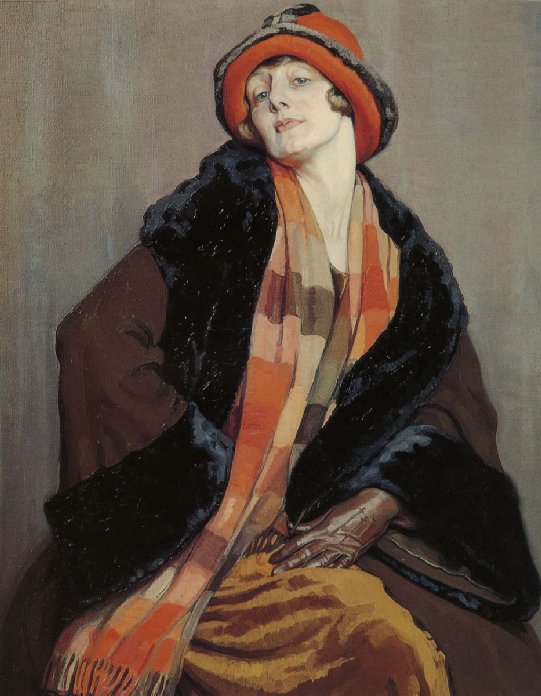
                  Une Australienne (Dorothy Richmond), 1926 by Hilda Rix Nicholas

Hilda completed a portrait of her friend, Dorothy Richmond in 1926, entitled Une Australienne, Dorothy Richmond.  It is a strong portrait of her good friend.  Dorothy is dressed in the height of fashion.  She looks out at us with a forceful pose, one of belief in her self-importance, almost haughty but the look gives her a sense of empowerment.  She has posed with her head turned causing tension on her neck muscles.  This was one of eight pictures Hilda Rix Nicholas had exhibited in the Salon of 1926. The Salon judges were impressed with her work, and she was made an Associate of the Société Nationale des Beaux-Arts as a result.

                                                         In Australia, His Land by Hilda Rix Nicholas

Around 1923, Hilda and Dorothy first travelled to Delegate on a painting trip.  The small New South Wales town was situated just a few kilometres from the state border between New South Wales and Victoria. The area was ideal for landscape painting.  The couple stayed in a property owned by the Wright family and soon Hilda became friendly with Ned Wright and his cousin Edgar.  It was during their stay at Delegate with the Wrights that she completed one of her most well-known works, In Australia, His Land.  The painting was a portrait of Ned Wright, the manager of the property at Delegate.  He is depicted on horseback, with his pipe clasped between his teeth.  His stance is casual, self-assured, and heroic, which was consistent with the up-beat nationalism of Australia at the time. The backdrop to the portrait is a panoramic view of an Australian pastoral landscape.  

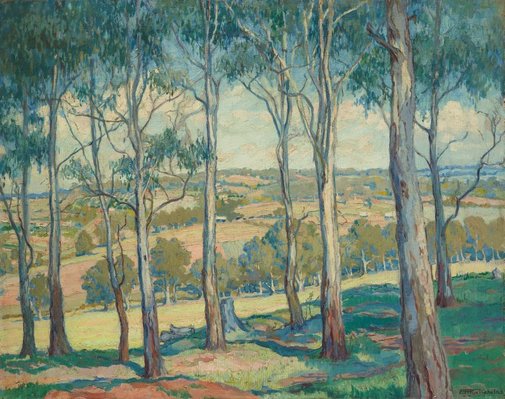
             Through the gum trees, Toongabbie by Hilda Rix Nicholas (c.1920)

A similar setting can be seen in her 1920 work, Through the Gum Trees, Toongabbie. It is a commemorative depiction of the Australian landscape, which she held so dearly. For Hilda it was a way of paying homage to the land of her birth.  It is a painting full of light and for Hilda it was all about recording the beautiful landscape.  We can imagine the joy and pride she got from painting the scene as we look at the distant land through the trees which have cast giant shadows on the ground.  She commented on why she wanted to spend her time depicting the Australian landscape, giving her reason as:

“…show the people [of Europe] what is possessed in a land of beauty where the colour scheme is so different, and which sent so many gallant men to the struggle for liberty…”

                              The Three Sisters, Blue Mountains by Hilda Rix Nicholas (c.1922)

Another of her paintings, Three Sisters, Blue Mountains of that time captured the spectacular view of the Three Sisters.  It is an unusual rock formation representing three sisters who according to Aboriginal legend were turned to stone. The character of the Three Sisters changes throughout the day and throughout the seasons as the sunlight brings out the magnificent colours.  The Aboriginal dream-time legend has it that three sisters, ‘Meehni’, ‘Wimlah’ and ‘Gunnedoo’ lived in the Jamison Valley as members of the Katoomba tribe.  These beautiful young ladies had fallen in love with three brothers from the Nepean tribe, yet tribal law forbade them to marry.  As the lives of the three sisters were seriously in danger, a witchdoctor from the Katoomba tribe took it upon himself to turn the three sisters into stone to protect them from any harm. While he had intended to reverse the spell when the battle was over, the witchdoctor himself was killed. As only he could reverse the spell to return the ladies to their former beauty, the sisters remain in their magnificent rock formation as a reminder of this battle for generations to come.

 It was always in Hilda’s plans to return to Europe and take with her the collection of landscape works she had built up in the previous six years and so, after a successful exhibition of her work in Sydney in 1923 she packed up her things and was ready to return to France.  In 1924, Hilda, along with her travelling companion, Dorothy Richmond, set sail, on the SS Ormonde, for France, with the intention of exhibiting her work.  Also, aboard the vessel was the Australian Olympic team travelling to the 1924 Paris Summer Olympics and the Adelaide Chronicle of July 19th 1924 carried a fascinating story about an incident on the voyage:

“…The Australian artist, Mrs. Rix Nicholas, has been included amongst Australia’s aspirants for Olympic honours. This surprising information comes from a member of the team in a letter to his parents, received only this week. On the voyage home aboard the Ormonde it was noticed that one of the passengers paid particular attention to the athletes when they were on deck for daily training.  Day by day she continued to study every member at work. Eventually she summoned sufficient courage to approach the manager (Mr Merrett), with the request that the team be lined up. He agreed, and Mrs. Nicholas selected a certain member as a model. Although somewhat embarrassed, he agreed to pose. When the team arrived in Paris it was learned that an artists’ competition was to be held, in conjunction with the Olympic games, and it was decided that Mrs. Nicholas should represent Australia as the Olympic candidate. The painting, when completed, will be entered m the competition for artists.  It was on this account that she was included, and all were overjoyed at having a Woman representative…”
Hilda and Dorothy arrived in Paris in June 1924 and rented a studio in Montparnasse which had formerly been the home of the French painter Rosa Bonheur.  In 1925, Hilda’s works were exhibited at the Georges Petit Galerie in Paris, which was a popular alternative exhibition space to the official Salon.  Her paintings were much admired by the critics and public and the exhibition was deemed a great success.  Her success in Paris was recorded in the February 28th 1925 edition of the Sydney newspaper, The World News, a newspaper published in Sydney, Australia from 1901 to 1955.

GIFTED VICTORIAN ARTIST.

SHOWS “AUSTRALIA” IN PARIS.

Fashioned of the stuff that good and true women are built of, there is little wonder in the cabled news that Mrs. Hilda Rix Nicholas, the clever painter from, the southern Australian State, Victoria, has made good as an artist in Paris, one of the great art centres of Europe.  She is an intensely patriotic Australian, and, swayed by this fine feeling, recently gave an exhibition of her country’s typical scenery and atmosphere in a series of exquisite paintings that attracted the Parisian critics and the public. Notwithstanding that she was already represented in the Luxembourg National Gallery, the French Government purchased one of the group, entitled “In Australia,” for the same gallery, which has only two other Australian artists represented, viz.. [Arthur] Streeton and [Rupert]Bunny.

………………..to be concluded.

Hilda Rix Nicholas. Part 2. Morocco and many family tragedies

Morocco, marketplace with pile of oranges by Hilda Rix Nichols painted during one of her two trips to Tangier

It would have been almost impossible to actually paint plein air in oils in the chaotic marketplaces, so Hilda resorted to completing many outdoor pencil and crayon sketches and then later fashioned a completed work when she returned to her hotel.  Her painting style had changed and was now more in line with the Post Impressionists.  An example of this is her work entitled Morocco Marketplace with the Pile of Oranges.  It is a good example of the changes that her style underwent in Morocco. Now she is painting with flowing brush strokes in thick slabs of impasto, a technique used in painting, where paint is laid on an area of the surface in very thick layers, usually thick enough that the brush or painting-knife strokes are visible. The scene is framed by buildings in the background and strewn across the foreground we see a large pile of oranges. The mountain women are wearing red striped skirts and bright haiks, the large pieces of cotton, silk, or wool cloth worn as an outer garment by some Moroccan women.   

                            Men in the Marketplace by Hilda Rix (1914)

In 1914 she completed her painting entitled Men in the Market Place, Tangier.   It is set during the late afternoon once all the shops had closed and in front of us are a group of men deep in conversation.  She has cleverly used a much-reduced palette of pale blues, creams, browns, and yellows.  We do not see the facial feature of the men as they are bathed in a dark grey shadow whilst the buildings behind them are bathed in late afternoon light.  Hilda wrote a letter home describing how she had to endure the strong sunlight coming from the low sun.  She wrote:

“…’The sun has sunken down in a daffodil bed – feeling he has well earned his rest. (But I have a bone to pick with him – he burnt my arms while sketching till they positively hurt – next time I’ll fool him & put gloves over them). The Moors have turned around from their haggling & marketing, gossiping & dreaming & murmuring to face the setting sun, their lips moving in prayer, their eyes beautiful to look upon – The pale yellow light giving a weird pallidness to the sheet of faces …”

                                                       Grande Marché, Tangier by Hilda Rix (1916)

Hilda completed a pastel drawing, Grand Marche, Tangier, which she later copied in oils.  When it was exhibited in her show at Paris’ Galerie J. Chaine and Simonson in 1912 it was much admired and was bought by the French government for the collection of the Musée du Luxembourg.  Centre stage in the depiction we see two women wearing red-and-white-striped cotton dresses or skirts, covered by white robes.  Their legs are bare and they wear red shoes and socks. One of them pulls her white robe tighter across her upper body. The other, who has her back turned to the viewer, is carrying something on her back, which could be her young child.  The art critics for the French edition of the New York Herald was impressed by Hilda Rix’s realist art, stating that in his opinion the figures in her compositions must surely have been sketched and later added to the finished work.  He further commented:

“…’This artist has the ability to make lifelike images in remarkable compositions bringing outstanding realism and accurate impressions that capture the ‘types’ to be found among the Moroccan people…”

Not everybody loved the painting as the art critic of The Sydney Morning Herald commented that:

“…the drawing and colour are eccentric, after the post-impressionist manner” and described the central figure as “grotesque in its want of finish…”

 Moroccan Market Scene by Hilda Rix Nicholas (crayon and pastel on paper)

The paintings which she did during her periods in North Africa led art historians to compartmentalise her as an Orientalist, a term which referred to the depiction of people or places in present-day Greece, Turkey, North Africa or the Middle East, by painters from the West.  In addition to displaying the results of her trip at the Salon, she also had her Tangier works exhibited in 1913 and 1914 at the Société des Peintres Orientalistes Français, an art society which staged not only Orientalist paintings, but also encouraged the travel of French artists in the Far East. Her work was illustrated in the Notre Gazette, reflecting her emerging status as an important artist, and there were many column inches in the French about her exhibitions.

                           Moroccan Loggia by Hilda Rix Nicholas (1912-1914)

Her colourful paintings featuring life in Morocco highlighted the powerful North African light and concentrated on the people and their colourful clothing and sometimes the local architecture.  It could be levied against her that many of her depictions were idealised versions of life in Morocco and steered clear of the more squalid aspects of the poverty that pervades the area and yet in Jeanette Hoorn’s 2012 biography, Hilda Rix Nicholas and Elsie Rix’s Moroccan Idyll : Art and Orientalism, she takes the opposite view, writing:

“…She did not seek out or embellish her pictures with the “orientalist” stereotypes that she had learned while growing up in Melbourne…In her writing and painting, she actively campaigned against what she saw as the fakery of “orientalism”. Her pastel drawings and oils strive to present an accurate account of the dress, manners and appearance of her subjects…”

Hoorn believed that Rix and her sister were, to a significant extent, counter-orientalist as they endeavoured to portray everyday life in Tangier as they found it, rather than presenting generalised views of the orient.  Rix adopted a counter-orientalist position in lectures and articles upon her return to Australia.   There were some that viewed her North African depictions as being somewhat abstract and flat and that could well be due to the influence Matisse had on her. 

                             Hilda Rix painting in Tangier market place (1914)

Matisse returned to Morocco in October of that year while it was two years later that Rix returned to North Africa, this time accompanied by her sister, who also sketched and wrote but whose main function was to be company for her sister and provide assistance and protection from enquiring bystanders while Hilda painted.  Hilda was surrounded by spectators as she sketched and painted and her audience would, on occasions, halt the flow of the traffic

                                         The Arab Sheep Market Tangier by Hilda Rix Nicholas (1914)

Another of her works from her second trip to Morocco was her 1914 painting entitled The Arab Sheep Market, Tangier.   The searing North African sunlight illuminates the whitewashed buildings and the textured garments worn by the shepherds.  Hilda Rix has used a striking palette of pinks, purples and oranges which is an acknowledgement of the Fauvism style of painting.  Sadly, a house fire claimed many works from her African series of paintings.

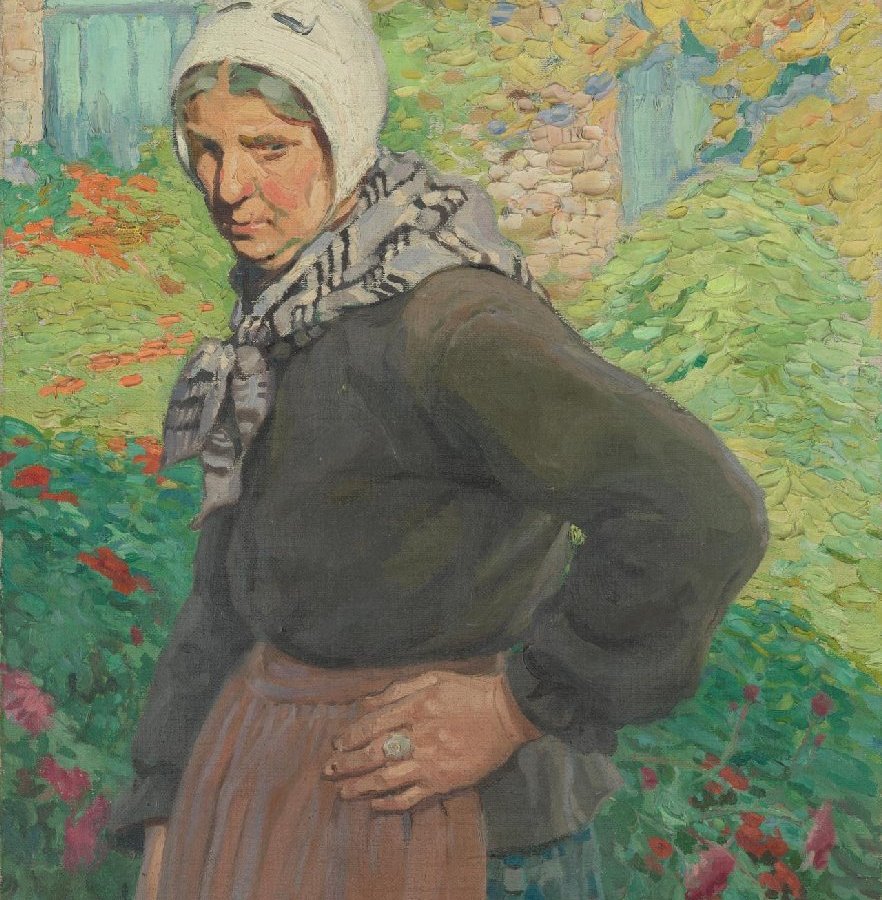
                                Grandmère by Hilda Rix Nicholas (1914)

Hilda and Elise returned to France in 1914. Around this time, whilst she was in her studio at Étaples, she completed a work entitled Grandmère.  It is a plein air work which shows an elderly peasant woman in a beautiful garden setting affording the work a luminously colourful background.  Many of Hilda’s paintings were bought by the French government, exhibited in the Salon and the Société des Peintres Orientalistes Français, and she was elected an Associate of the Société Nationale des Beaux-Arts. 

                                           Hilda with her mother and sister during European trip.

Hilda still had studios in Paris and one for the summer months spent in Étaples.  The summer of 1914 she was at Étaples but the outbreak of World War I on July 28th 1914 resulted in Hilda, along with her sister Eliseand her mother evacuating to London.  If that upheaval was not enough, Hilda had to endure a number of family tragedies.  Her mother had been taken unwell during the Channel crossing and was admitted to hospital on arrival in England.  Although Hilda’s mother was not fully recovered, she left hospital and went to recuperate at a nursing home.  At the same time as the mother was extremely ill, Hilda’s sister Elise contracted typhoid and died on September 2nd 1914, aged 37.  Hilda kept the death of her sister a secret from her mother who she believed was too ill to receive such sad news.   Her mother slowly recovered and was later told of the death of her daughter.  For the next eighteen months Hilda Rix painted few paintings presumably because she spent all her time looking after her mother and was too tired to concentrate on her paintings.  She remembered the time saying:

“… I could scarcely put one foot in front of the other and walked like an old thing…”

 Finally, in March 1916 Hilda’s mother, Elizabeth died.

Hilda and Matson after the marriage

Enter onto the scene, Major George Matson Nicholas, a soldier from Melbourne.   George, usually referred to as Matson, was the eldest of six brothers.  Before he enlisted in the Australian army in April 1915, he had been a schoolteacher.  He fought at the Battle of Gallipoli and was wounded.  Once recovered he was sent to France where he was awarded a Distinguished Service Order at Pozieres, single-handedly capturing an enemy machine gun post.   His regiment was based in Étaples, and according to Hilda’s stories, he found her paintings which she had left behind when she had had to quickly abandon her Étaples studios.  Then, during his leave he travelled to London in pursuit of Hilda. They met in September 1916, love blossomed between the two, and on October 7th 1916 they married in St Saviour’s, Warwick Avenue in London.   

Major George Matson Nicholas charcoal and pastel drawing by Hilda Rix Nicholas drew this portrait of her new husband two days after their wedding on October 9th 1916

Two days after the wedding Hilda completed a sketch of her husband. Three days after the wedding Major George Matson Nicholas returned to the front and assumed command of the 24th Battalion,  He was shot and killed in action at the Normandy town of Flers on the Western Front on November 14th, aged 39.

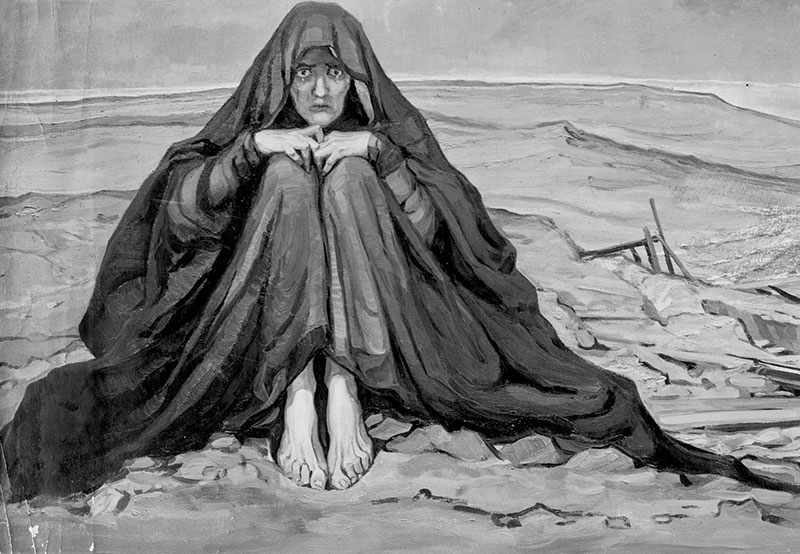
                                           These Gave the World Away by Hilda Rix Nicholas, (1917)

Hilda was devastated and in a diary entry she wrote that she had lost the will to live.  In her grief Hilda Rix Nicholas painted morbid images, symbolic of death and sacrifice in war which contrast markedly with the light and life of her French and Moroccan works.  One such work was entitled These gave the world away which she completed in 1917.

                                               Central panel of Pro Humanitate by Hilda Rix Nicholas (1917)

Another of her war paintings was Pro Humanitate, the central panel of a triptych. It clearly depicts the futility of war and more personally for Hilda, the tragedy of her short marriage to Nicholas.  The work comprised of three panels.  The left-hand panel depicted an outdoor scene with a happy couple standing on top of a hill contemplating their future together; the central panel depicts a soldier husband giving his life for the cause of humanity.  Hilda Rix has depicted the soldier at the moment of his death with arms outstretched in a crucifixion pose.  The right-hand panel of the triptych portrays the heartbroken wife grieving and is watched over by the shadowy figure of her lost hero.  Rix Nicholas offered her triptych Pro Humanitate, which depicted Australian soldiers, to the  Australian War Memorial, which was building a collection of art commemorating the war, but it was rejected; the acquisitions committee described it as “of too intimate a character for inclusion in a public collection.

                                                           Desolation by Hilda Rix Nicholas (c.1917)

She painted a strange and moving painting around 1917 entitled Desolation.  This work depicts an emaciated woman crying.  She is shrouded in a black cloak and is squatted down staring at us.  The setting is a battle-scarred landscape which lacks any vegetation.   The National Gallery of Australia holds a charcoal drawing made as a study for the work.  In a review, the Arts correspondent for the Sydney Morning Herald, wrote:

“…Desolation is almost gruesome in the grim delineation of the figure typifying all the widowed world in one lone woman. There she sits, lost in an awful reverie, over the stricken battlefield.  The work is an epitome of wasteful ruin …”

Sadly, both Desolation and Pro Humanitate were destroyed in a fire.

…………………………….to be continued.

Hilda Rix Nicholas. Part 1.

                          Hilda Rix Nicholas (circa 1910)

The other day, I was looking through a list of famous nineteenth and twentieth Australian artists.  The compiler of the list believed that the greatestAustralian painters were Sidney Nolan, Peter Booth, Arthur Boyd, John Brack, Tom Roberts, Russel Drysdale, Frederick McCubbin, and John Olsen. I had heard of a number of these but what surprised me about the list was that it contained no female artists and so I decided to focus this blog on one such painter.

                                   Henry Finch Rix

Emily Hilda Rix Nicholas was born on September 1st 1884, in the Australian city of Ballarat, some twenty-five miles north west of Melbourne.  Her father, Henry Finch Rix was born in Woolwich, Kent on January 12th  1848, and her mother, Elizabeth Sutton, was born in Manchester, England in 1853.  They had both emigrated as children with their families in the middle of the nineteenth century and the pair met and married in 1876. The couple had their first child, Elsie Bertha in 1877 and Hilda was born seven years later.  Henry Rix was a mathematics teacher, an amateur poet and talented sportsman.  He was a teacher at Bendigo, Ballarat and at Carlton. After a brief stint teaching in Ballarat, he was a mathematics master at Wesley College Melbourne for ten years between 1874 and 1884. He played for Carlton’s Australian Rules team and later became Inspector of Schools.  In the book, A History of State Education in Victoria, Henry Rix was described as:

“…Of the men who have labored and passed away since 1900, Mr. H. F. Rix deserves to be especially remembered. Working under the result system, he foresaw the new day and strove to make it possible. His enthusiasm, his industry, his initiative, his research, and his sympathy made him a great inspector and a leader in educational reforms…”

Henry’s wife, Elizabeth, as well as being an accomplished singer, helped run a successful music business in Ballarat.  She played an active part in the Austral Salon, a non-profit organization founded by a small group of women journalists in Melbourne in 1890 as a club for women writers. It then developed into a club whose aim was to introduce aspiring young musicians to an interested audience.  She was also a talented amateur painter and had her own studio in Melbourne’s Flinders Street.  Hilda and her sister Elsie being brought up in a musical household both learnt musical instruments and would perform at local shows.  Elsie, like her mother, had a beautiful voice and performed at the Austral Salon.  Hilda, as a small child, developed a love of drawing and painting and she and her sister would often design advertising posters for events at the Austral Salon.

                      Frederick McCubbin -Self-portrait, (1886)

Hilda attended Merton Hall High School, now Melbourne Girls Grammar School and although she was not an exceptional student she did excel in art under the tutelage of a Mr Mather. On leaving Merton Hall in 1902, eighteen-year-old Hilda enrolled on a three-year course at the National Gallery of Victoria Art School where one of her teachers was the foremost Australian Impressionist, Frederick McCubbin.  Notwithstanding his standing in the art world, Hilda was critical of McCubban’s teaching style which she referred to as being “vague persuasions”.  However her biographer John Pigot, in his 2000 book, Hilda Rix Nicholas: Her Life and Art, writes that the creativity of individuals rather than imitating the style of any one school of painting; he (McCubban) modelled the importance of nationalistic ideas and subjects that would become so prominent in her later painting and McCubban’s work emphasised the painting’s subject over technical considerations.

                                                 An early sketch by Rix Nichols

Hilda Rix’s work was so good that, although still a student, she had some of her drawings shown at annual exhibitions at the Victorian Artists’ Society and the Austral Salon.   To earn herself some money she worked as a professional illustrator submitting her work for inclusion in textbooks and periodicals.  Hilda was always with pencil and sketch pad and in her early days would persuade extended family members to sit for her whilst she sketched their portraits.  Studies in two sketchbooks from her early years in Melbourne are now held at the National Library of Australia and in 2012 one of Rix’s early sketchbooks survives and pages from it were reproduced in Karen Johnson’s book, In Search of Beauty: Hilda Rix Nicholas’ Sketchbook Art

                                         Poster for the Salon des Beaux Arts (1913) by Hilda Rix

For most would-be artists who lived away from Europe such as Americans and Australians the Holy Grail was to visit and study art in Paris and London.  Hilda’s father Henry decided to offer her a chance to sample the European art world and, in 1906, planned a family trip to England which, being as he was an educator, would also afford him the opportunity to study British education reforms.  All his plans came to nought as Henry died that year, on February 27th aged just fifty-eight.  His death at such a relatively young age precluded his widow from receiving a pension.  After many discussions the family managed to cobble together money from an inheritance, money earnt from their rental income from their home, and finally money Hilda and her mother raised by selling off their many works of art and  they were able to set sail for England early in 1907.

                             John Hassall in his studio, 1909

For Hilda, going to Europe to study art was only part of the solution to her improving her artistic skills, she needed to find a good teacher who was willing to tutor her.  Before she left Australia, she spoke to Arthur Streeton, the Australian landscape painter who was the leading member of the Heidelberg School, which was also referred to as Australian Impressionism.  He suggested that on arrival in London she contacted John Hassall, an English illustrator, who, in 1901, had opened his own New Art School and School of Poster Design in Kensington.  When Hassall looked at Hilda’s work he was impressed by its quality and agreed to mentor her.  She remained with him until the end of 1907 at which time, she, her mother and sister left England and travelled to Paris and rented an apartment in Montparnasse

                                                                 The Ferry by Emanuel Phillips Fox

In Paris Hilda made many friends who were involved in the art world, such as fellow Australian, Emanuel Phillips Fox.  Fox had arrived in Paris in 1896 and enrolled at the Académie Julian, where he gained first prize in his year for design.  The following year he trained at the École des Beaux-Arts where two of his tutors were William-Adolphe Bouguereau and Jean-Léon Gérôme, who were considered the greatest artists of their time. He returned to Australia in 1890 but returned to London after receiving a commission to paint a scene of the landing of Captain Cook in Australia, which had the strange caveat that he must paint the work abroad.

               The Landing of Captain Cook at Botany Bay 1770 (1902) by Emanuel Phillips Fox

The 1902  painting, The Landing of Captain Cook at Botany Bay, 1770,  depicts a wholly European perspective on the inauguration of relations between the British visitors and the local Aboriginal men of Botany Bay. In a post-Federation display of nationalistic projection, it shows Captain Cook stepping onto Australian land as part of a shore party, heroically interceding between the threatening local men who brandish spears and his own marines who aim to shoot them. 

                      Portrait of Ethel Carrick, c.1912. 

Hilda Rix also met Fox’s wife, Ethel, an English-born Impressionist and Post-Impressionist painter.

In Paris Hilda enrolled at the Académie Delécluse, operated by academic painter Auguste Joseph Delécluse.  It was an atelier-style art school which was very supportive of women artists, and, in fact, it allotted more space to women students than to men.  Men and women were trained separately, and it had two studios for women and only one for men.  It was an extremely popular place to learn, especially among English and American women artists. At the height of its popularity, it was one of the four best-known ateliers in Paris.  From this artistic establishment, Hilda moved to the Académie de la Grande Chaumière, where one of teachers was the Swiss-born illustrator Théophile Steinlen.  She also studied at Académie Colarossi. It was around this time that Henri Matisse had a studio in the French capital and, as was the case with other professional artists, he also sometimes attended Colarossi’s to gain access to their models which he could use, free of charge, for his work.  Matisse would also open the door of his studio to aspiring artists whom he would offer tuition and have them experiment with the techniques of Post Impressionism.  It could well be that this is where Hilda first met Matisse.

Retour de la chasse by Hilda Rix Nicholas, (1911)

Whilst living in Paris, the family would travel to Italy and other parts of France including Étaples, the fishing port in the Pas-de-Calais department in northern France which was so popular with artists.  In 1909 Hilda Rix met and became very friendly with a Dutch architecture student Wim Brat.  Their initial love ended when Hilda realised how her fiancé was a “mother’s boy” and was completely dominated by her, a woman who strongly disapproved of Hilda.  Inevitably, Hilda broke off the engagement.  Notwithstanding this personal setback, Hilda continued with her painting and exhibited her work at the 1911 Paris Salon.  The painting, Return of the Hunt, was completed by Hilda in 1911 and depicts a woman on horseback in chocolate brown leather gloves with a large hare slung over her back.

                                                                     Three friends by Hilda Rix (1912)

Hilda Rix, accompanied by her sister and mother, took up residence in the rural art colony of Étaples the summer of 1910.  Here she met Henry Ossawa Tanner, a well-established American artist in France, who was viewed as one of the leaders of the Étaples artists’ colony and a member of the art organization, the Société Artistique de Picardie.  It was not just France and Italy which seduced artists, many started to cross the Mediterranean to paint and sketch in North Africa.  Hilda Rix made two painting trips to the African continent.   The first was in January 1912 when she travelled with a group of artists, including Henry Ossawa Tanner, and his wife, who were visiting Morocco via Madrid, Cordoba, and finally Algeciras, they had hoped to take a boat to Tangiers but the weather was too bad, which forced the travellers to Gibraltar for what proved a rough crossing to the Moroccan port.

Morocco, marketplace with pile of oranges by Hilda Rix painted during one of her two trips to Tangier

Tanner being an African American and Rix being a female made them unconventional and exceptional travel and work companions on this journey.  They stayed in Tangier and the northern port town of Tétouan.  Matisse and Hilda Rix stayed in the Grand Hôtel Villa de France for most of February and March. They both painted views from the windows of their rooms at the hotel.   Both of them worked on portraits and would use the same models and utilised an unused room in the hotel which the owner allocated to them.  The room became a temporary studio space. 

                                                          Hamido sleeps by Hilda Rix Nicholas (1914)

An example of the similar portraiture was Hilda’s painting, Hamido Sleeps and Matisse’s work, Moroccan Amido.  In both cases the young model was a stable-hand at their Tangiers hotel.

Moroccan Amido by Matisse (1912)

In Matisse’s painting the young man stands easily and naturally, his slim long-legged form is emphasised by the narrow canvas format the artist has used.  In the painting, Matisse captures the dark skin, the bright white shirt, the pure colours of the waistcoat and short trousers.

                                               Through the arch to the sea by Hilda Rix Nichols (1914)

Hilda loved Tangier and spent hours sketching and painting in the open-air markets.  She wrote home about how she loved Tangier and its market, writing:

“…Picture me in this market-place – I spend nearly every day there for it fascinates me completely – have done 16 drawings and two oil things so far – Am feeling thoroughly at home now so am going to take out my big oil box – wanted to get used to people and things first – Oh how I do love it all! … Oh the sun is shining I must out to work…”

                                       Hilda Rix painting in Moroccan marketplace

Hilda Rix was fascinated by the buying and selling in the marketplace as well as the multitude of colours of the clothes worn by the people.  In a letter home, dated February 12th 1912, she wrote:

“…”See how most of them are covering their faces – They have mostly cream draperies & perhaps orange waistcoats and little tight mauve green trousers – (tight at ankle) – Some may be wonderfully dressed under[neath]…”.

In a postcard she sent home a week later she wrote:

“…’Picture me in this market-place – I spend nearly every day there for it fascinates me absolutely – Have done 16 drawings and two oil things so far – Am feeling thoroughly at home now so am going to take out my big oil box – wanted to get used to people and things first – Oh I do love it all! …”

…………………..to be continued.

John Pototschnik. The living rural artist.

Of the 850+ blogs I have done in the last ten years, I think only three have been about living artists.  Maybe I was concerned that they would be upset with what I had written or maybe they would be unhappy if I had been inaccurate, although I try to get facts from various sources to avoid errors.  My featured artist today is a person who commented how he liked one of my blogs and when I looked at his blog/website and some of his artwork I decided that he would make for an ideal subject.  I wrote to him and he was happy for me to do a small bio on his life and art, so let me introduce you to John Pototschnik, pronounced Poe-toe-sh-nic.  John is a Signature member of the Oil Painters of America and a Master Signature Emeritus member of the Outdoor Painters Society. He is recognized in “Who’s Who in American Art” and “Who’s Who in the Southwest.” In addition, his work has appeared in multiple artist magazines and books.  He’s also the author of a best-selling book: Limited Palette Unlimited Color published by Streamline Publishing. 

John was born in England, in the Cornish coastal town of  St. Ives, on November 14th 1945.  His father was Ernest Felix Pototschnik, a native of Kansas whilst his mother, Patricia Mary Pototschnik (née Symons) was born in Trewartha, Lelant in Cornwall. She was Ernest’s second wife.  Ernest’s first wife died during the birth of their son Ernest Francis.   John’s father was a member of the US Army which was stationed in England during the Second World War and he met Patricia when he attended a local dance.  John’s mother once told him that she remembered that first meeting saying she was especially attracted to Ernest because of his short stature, the way he carried himself, and the American uniform. The couple soon fell in love and were married in St Ives on February 12th 1945.  John was their eldest child and he has a sister, Patsy Ann.

                                              At the Edge of Town by John Pototschnik (24 x 30ins)
The sound of an approaching train can be heard in the distance. There has been a brief, early afternoon shower. The mailman has yet to deliver the day’s mail and pick up the letter in the box addressed to a dear friend. Children are just getting out of school and will soon arrive home on the school bus. (Location: Kansas) https://www.pototschnik.com/paintings/at-the-edge-of-town/

Around 1946 Ernest Pototschnik was discharged from the army, and returned to America where he purchased a home in Wichita, Kansas, prior to his wife and John travelling across the Atlantic on the Queen Mary some months later to join him.  The family relocated to Wichita, Kansas and remained there for the next twenty-two years.  John attended the Blessed Sacrament Catholic School in Wichita and then enrolled at the city’s Chaplain Kapaun Memorial High School.  At school John enjoyed draughtsmanship and biology.  He liked to sketch especially aircraft and racing cars. As a youth, his parents were comfortable with him going off on his own, exploring the neighbourhood.  He even went door-to-door selling his mother’s cookies or collecting money for his paper route.  John also often spent time with his father on hunting trips.  He believes this freedom to roam was how he built up his love of small American towns.

After graduating from High School in 1963, he went to the Pittsburg State Teacher’s College in Pittsburg, Kansas for one year.  During his early life at home there had been no exposure to art and the possibility of becoming an artist was never in consideration.  However, it was during the time at the College that John had the first thoughts about art being a definite possibility in his future.   He remembered purchasing the Famous Artist School correspondence course but admitted that he never completed it.  He explained that there was just no time for this extra-curricular study as life was filled with college work, athletics, and an after-school job. He said that he had little time for anything else.

                                                 Be Still My Soul by John Pototschnik (30 x 40ins)
A time of reflection, contemplation, and dreams comes easily in the peacefulness of the country. The soft light and gentle breeze refresh the soul. (Location: Georgia. Private collection).  Last year, this work was awarded the Silver Medal at the Oil Painters of America 27th Annual National Juried Exhibition of Traditional Oils, which was held at the Steamboat Art Museum in Steamboat Springs, CO. Of the more than 2,000 entries, only about one-tenth of those were selected for the exhibition.

In June 1964, John enrolled at Wichita State University and embarked on a four-year Bachelor of Fine Arts degree with a major in Advertising Design.  During his university days he worked for a number of graphic design and illustration companies.  One of the companies was Oblinger-Smith Planning Consultants where he worked as a graphic designer and, it was here, that through a work colleague he met Marcia who in October 1971 became Mrs Marcia Pototschnik.  His love of airplanes also had him sign up for the USAF College Reserve Officer Training Corp (ROTC). Upon graduation from college, I was guaranteed an Air Force commission and on leaving university in June 1968, John spent the next four years working for the United States Air Force stationed at El Segundo, California where he worked as an Internal/Public Information Officer working in community relations and edited the base newspaper.

                           For a Moment, All the World Was Right by John Pototschnik (30 x 40 ins)
For a Moment, All the World Was Right – It’s a busy world, full of noise, stress and worry, but for the young playmates, for this time in their life, all in the world is right. Being with friends, loved by their parents, feeling safe and protected…that is their reality. They are content and happy. (Location: New Hampshire. Private Collection)

Following completion of his time in the military in June 1972, he moved to Dallas and set about establishing a freelance illustration career although he proudly states he had his first paying job when he was ten years old, mowing lawns in the summer, raking leaves in the autumn and shovelling snow in the winter and at fifteen earned money as a part-time dish-washer at a local department store and during his first year of college days he was a consummate hamburger-flipper!  For the next ten years of his life he worked as an illustrator for all the major advertising agencies and design studios.  Of this decade as an illustrator he said he enjoyed the time:

“…I very much enjoyed working as a freelance illustrator. There was a great variety of work and its associated challenges. Being able to meet those challenges and satisfy a client was very rewarding. I also liked seeing my work in print. It also afforded me the opportunity to work in a number of media: pencil, pen/ink, watercolour, and acrylic. It also trained me to work under pressure and to meet tight deadlines…”

But all good things had to come to an end and for John the graphic design jobs were very time consuming and he said that his life revolved around long working hours and frequent bouts of little sleep.  This lifestyle of constant pressure and ever-demanding deadlines could not go on forever and so in 1982 John made the decision to leave the world of illustration and graphic design and turn his mind to the world of Fine Arts.

                                             Meeting of the Lines -by John Pototschnik (20×20 ins)
Many train lines congregate in this small agricultural town. The area bristles with activity. The sounds of the grain industry and rumble of the trains are heard throughout the town and are enchanting to young boys. (Location: Kansas. Private collection)

However, it was not just himself he had to consider as now he had a wife and two sons, Jonathan in 1975 and two years later a second son, Andrew.  But what did his wife think of his decision to quit his lucrative graphic designer career.  John comments:

“…Marcia has always been supportive of my art career regardless of the direction I decided to take it. She is a woman of common sense and has never been materialistic, in that she needed things to make her happy. She loved being a mother and homemaker…”

One can see how the decision to enter the world of Fine Artist was a financial gamble and he spoke about the decision:

“…Many well-known illustrators were leaving the field and moving into the fine arts in the 1970’s.  It was something I had always wanted to do but was told from the very beginning, “You’ll never make a living as a fine artist”. So, I chose to work in the commercial art side of the business. Seeing other illustrators make the leap encouraged me to do the same…”

               Plein air oil painting, Wylie Church by John Pototschnik (16″ x 12″)
When John heard about a plan to tear down the original St. Anthony’s Catholic Church, he worked hard, along with a committee, to save the structure and even wrote a letter appealing to the Bishop. Not only did the tiny church remain, but it is now immortalized in one of his paintings.

The switch to Fine Arts from being an illustrator and graphic designer was a massive change in John’s life and he was aware of the perils of this transition, saying:

“…Change is always a gamble. Fortunately, I was pretty naïve concerning what it would take to succeed, and to the realities of the fine art business. I thought the transition would be smooth and easy. I would just start painting different subjects, charge the same prices I was getting as an illustrator, and begin calling myself a fine artist. The only part of that that worked out was that I was painting different subjects. Galleries recognized my work as being illustrative, and nothing sold at my illustration prices.  Fortunately, the transition was eased somewhat by a friend who suggested I paint a series of paintings showing that the oil industry and wildlife could co-exist in the same area. If I did the paintings, he agreed to help me find six corporate sponsors that would purchase the paintings and their accompanying prints. That project worked well as it gave me time to begin working in oil, painting en plein air, developing my work, and funding my first year in the fine arts. Actually, there was not much thought given to financial success. I just figured one way or another this would work. However, it did take seven years to return to the level of income I was making as an illustrator…”

                                                        Rural Hideaway by John Pototschnik (25 x 28 ins)
Where does the road lead? Does it lead to a beautifully secluded little house in this gentle, non-threatening, peaceful environment? The question invites wonderful speculation and the viewer can visualize themselves walking that road to discovery. (Location: Georgia. Private collection)

So how did the change of artistic direction go for John?  He recalled those early day struggles:

“…Yes, there was a definite struggle. I did not realize it when I set my mind on becoming a fine artist, but fine art was beginning all over again. It is not a continuation of an illustration career; it’s starting a new career. I grew the career by doing lots of small paintings (5”x7” – 8” x 10”). These sold at very reasonable prices. I sold a lot of them, which helped grow a collector base. Then I began writing a monthly newsletter in order to stay in contact with the collectors.  Determining the price structure for my paintings is interesting in itself: As stated earlier, I began using illustration prices for the paintings…nothing sold. I then cut the prices in half…nothing sold. I cut the prices in half again…I then began selling just about everything. That’s why those early paintings were so reasonable…”
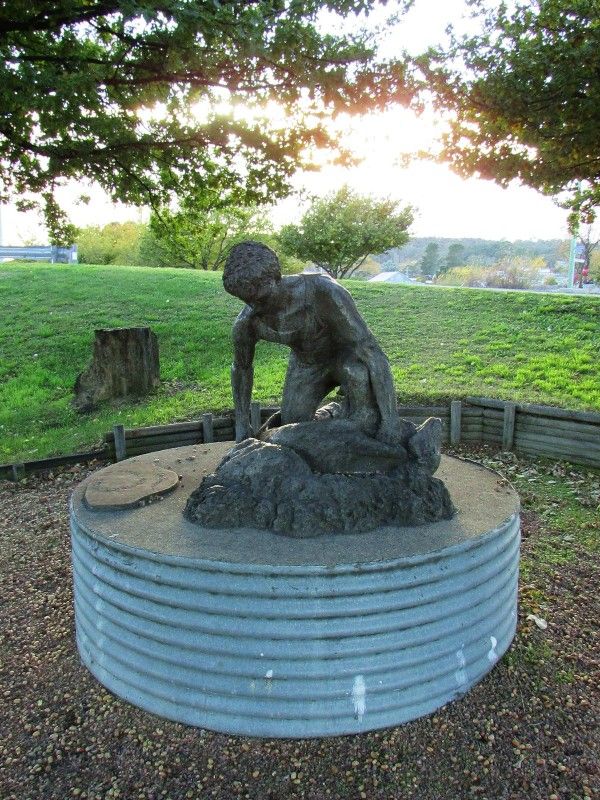
                                      Saturday Afternoon Game by John Pototschnik (16 x 20 ins)
School is over for the week. Classmates and neighbourhood friends enjoy a game of basketball at this small town American home. Location: Kansas)
https://www.pototschnik.com/paintings/saturday-afternoon-game/

John has painted in many mediums but his favourite is oils as it dries much slower than acrylic and thus affords him the chance to manipulate and correct his work until it is just right.  He also is pleased by the way oils has substance and retains brushstrokes.  When I asked John about his depictions being predominantly rural, he commented:

“…Much of what I paint are deeply felt impressions formed during my childhood. I grew up in the 1950s. It was a totally different time. I grew up in small neighbourhoods, small houses, small towns, near the country. My parents and grandparents had flourishing vegetable gardens. My mom made homemade cookies which I sold door to door. I had newspaper routes in which I delivered morning and evening newspapers door to door. I was free to ride my bicycle all around town and visit my friends. All these things, and much more, are in my work…”

His finished works are often the result of plein air painting which he enjoys but he says that about 99% of the plein air work is just for learning how to get a good handle on understanding nature. Some of those studies are used as a starting point for larger studio works. Less frequently, they are completed compositions unless they are for an art show or plein air competition, then, I will do larger completed works on location.

                                                   Land of Abundance by John Pototschnik (35 x 65)
Holmes County in the state of Ohio is an Amish community. Retaining many of the old world ways, eschewing many of the modern world’s technology and conveniences, the typical means of transportation is the horse and buggy. The magnificently kempt structures and fields are an endless source of inspiration for me. (Location: Ohio)
https://www.pototschnik.com/paintings/land-of-abundance/

In so many of the artists I have looked at over the years many depict realist situations, such as the poverty of the peasants and the back-breaking labour they had to endure and so I asked John why he has not also painted those often harrowing depictions.  He replied:

“…. I’ve never experienced personally the realities and hardships of actual farm life. I’ve been around farms, mainly as a child, so to this day have a more romanticized view. As an adult, I’m not unaware of the reality. I just choose to depict something that is somewhere between Realism and Idealism…”

He is also aware of the taste of the buying public.  Do they want paintings depicting hard-hitting realism on the walls of their house or would they rather have idealised rural beauty adorning their lounges and dining rooms?  John believes the latter is the case and the sale of his works of art bears out that assumption.

I asked him which of the great artists of the past he admired most.  He was most definite with his reply:

“…My favourite expressions of art are found in the Barbizon and Naturalism schools. Breton and Millet are certainly two of my favourites, but there are many more from that era, painting in that genre. There are so many artist’s works, past and present that I greatly admire, so I will say that the 1800s is my absolute favourite period in art history…”

                                                      Staying Home by John Pototschnik (16 x 27ins)
A few inches of snow on a day of bitterly cold temperatures comes to a close. The porch light comes on. It’s just too cold to go out tonight, We’re staying home where it’s warm. (Location: Texas)
https://www.pototschnik.com/paintings/staying-home/

He said he loved the works of Camille Corot, Charles-Francois Daubigny, Jean-Francois Millet.  In their paintings he saw a great sensitivity to people and nature. They have the ability to express all nature’s subtleties in such a unified, calming, peaceful way which he found very appealing. Only what is necessary is stated, nothing is overworked.  He also liked the Naturalism of the art of Stanhope Forbes, Jules Bastien-Lepage, Leon Lhermitte, Pascal-Adolphe-Jean Dagnan-Bouveret, Charles Sprague Pearce, Frank Bramley, Jules-Alexis Muenier, George Clausen, Gari Melchers, and Jules Breton. He liked how the Naturalists works are highly refined, almost photographic. Subjects are of common folks in everyday situations, people of the land, usually depicted in rural settings. I find all this extremely appealing, especially the high degree of finish.  Finally, he said that he loved the work of the Russian Itinerants, such as Arkhipov, Kramskov, Levitan, Perov, Repin, Svetoslavsky and how their paintings are gritty, earthy, bold, and emotionally powerful.  He summed it up by saying:

“…The common thread running through all the work I most love is a sense of the real. Subjects are of common folk doing common tasks. They are not idealized. Small towns, cottages, rural landscapes, and people going about their daily lives in that environment predominate. All of the above artists speak of the reality and truth of everyday life, there is no pretentiousness. I feel each artist has approached their work and subject with humility and is therefore able to capture the soul and spirit of the subject with great sensitivity…”

                              Remembering Murphy Grocery by John Pototschnik (14″ x 24″ – Oil}
John could often be found with his easel painting on the side of the road. His painting of the old Murphy Grocery Store at FM 544 and Murphy Road evokes nostalgia in many who remember the store. He has sold many prints of the painting and the original hangs in the Smith Public Library today.

I finally asked John on his views for Fine Art in the future and the up and coming aspiring artists. How will the future compare with the past?  He replied:

“…I’m not sure what the future holds for the fine art of painting. There will always be a place for beautiful things, things that elevate, but whether individual hand-crafted paintings will have as much value and importance to future generations as they have had in the past, I don’t know.

Lack of art education, shortened attention span, ever expanding technology, increased desire for the latest and greatest thing…and a new generation that has had little exposure to fine art… could greatly affect how fine art is valued in the future.  

That being said, among serious art students, there seems to be a real move toward realism, and even classicism. Non-objective art among many is seen as empty and devoid of substance. They want more. Ateliers, teaching solid drawing and painting principles, have sprung up around the world. The Art Renewal Center is a strong influence in promoting a return to representational art. Also, the current plein air movement in the United States has encouraged a huge number of amateur artists to pick up their brushes and go outdoors. The negative side of the plein air movement is that people seem to think if a work is done in plein air, it must be good. What I see is a lot of poorly executed, poorly composed, and poorly drawn works. When these works are promoted in magazines and social media, one is led to believe the work is good and that anyone can be an artist. Doing something quickly is better than doing something thoughtfully and carefully seems to be the driving force.  

Painting workshops are very helpful in providing for an artist’s livelihood. Unfortunately, many that are teaching should not be teaching because their work is of poor quality. Also, not every good artist is a good teacher. I recommend choosing one’s instructor carefully.  

Finally, I disagree with students taking one workshop after another, jumping from one instructor to the next. Over and over again, I see this happening but see no improvement in the students work. It seems it’s more about saying I studied with so-and-so, than actually seriously applying what is taught…”

John has received many awards for his art and in 2018 the Art Renewal Center, the largest online association with 50,000 of the greatest works in history, recognized him as a Living Master (ARCLM). The requirements for Living Master status are extensive with the main caveat being, “The artist has dedicated themselves to becoming a realist artist with the wish to express our shared humanity through the visual arts.”


To find out more about John Pototschnik have a look at his website:

https://www.pototschnik.com/about/