
Britain had a number of locations favoured by artists. There was Newlyn in the south-west and Snowdonia in North Wales to mention just two. In the next two blogs I want to look at artists who were born or worked in the south-east county of Suffolk during the late eighteent6h century to the early twentieth century. I am not focusing on the renowned artists such as Gainsbouough, Constable and Cotman but will be looking at the life and works of painters that you may not have heard of but their works of art depict the beauty of this area of England.
George Frost
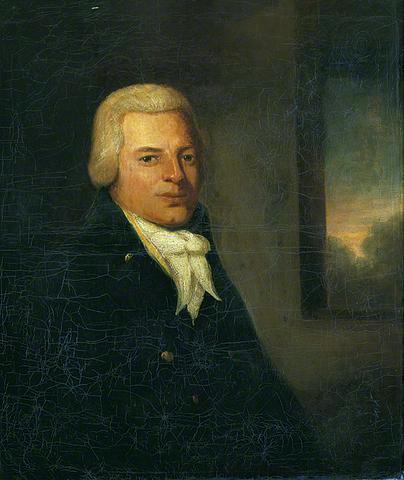
My first “lesser known”artist from Suffolk is George Frost. He was baptised at Barrow, Suffolk on February 21st 1745, and was the son of George Frost a builder at Ousden, Suffolk, and his wife Thomasin.

The Common Quay, Ipswich by George Frost (1820)
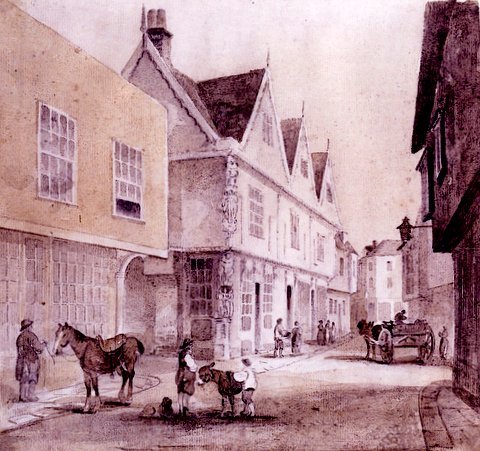
Asssembly Rooms, Tavern Street Ipswich by George Frost (c.1800) Pen and ink with grey and buff washes over pencil.
George began his career working in his father’s business but later secured a position in the office of the Blue Coach Company in Upper Brook Street, Ipswich, where he continued until his retirement in 1813. Working there involved multiple jobs such as dispatching the coaches, the buying in of hay, straw, oats, etc., paying wages of the workers, and looking after the company’s horses and coaches, while his wife also helped in the office. Once his office work was concluded for the day Frost would leave and would go out and about for the remainder of the day and ikndulge in his love of painting. George had a natural talent for drawing and he painted topographical watercolours of Ipswich but later began sketching the countryside around the Suffolk town in pencil and black chalk. He became acquainted with John Constable probably through his work at the coach office and by around 1800, the two artists sketched amicably together along the banks of the River Orwell. Frost often visited London and it is thought that he had been dealing in paintings. He died after a lingering illness, on June 28th 1821, aged 77, and is buried at St Matthew’s Church, Ipswich.
Thomas Churchyard
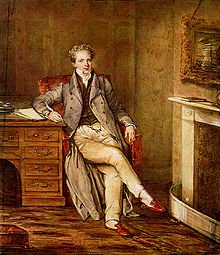
Thomas Churchyard was the only son of a Melton butcher and grazier. Following his education at Denham Grammer School he was articled to a local solicitor. He became a country lawyer in Woodbridge in 1822 and lived in the Suffolk town but his enduring love was for painting and he completed hundreds of watercolours and oils.

Country House in a landscape, probably Shrubland Hall by Thomas Churchyard Inscribed verso ‘Emma’, with a pencil sketch of landscape verso.
Churchyard also formed a friendship with the poets Bernard Barton and Edward Fitzgerald and the group became known as the “wits of Woodbridge”. Besides painting, he was a lifelong avid art collector and, on his death, his estate included works by Gainsborough, Constable and Crome. Churchyard’s work is held in the Tate Gallery, The British Museum, the V & A and the Ashmolean.
Shortly before his death Churchyard was careful to inscribe each of his most prestigious works in his studio with the names of his seven daughters. On the reverse of the “Country House” painting there is the inscription “Emma” who was Churchyard’s second daughter. Why ?
He is recorded to have said at the time:
“…My dears, there will not be any money for you when I die, but I will leave you my paintings, which one day will be worth more than any money I could ever have hoped to have made…”.
Henry Bright
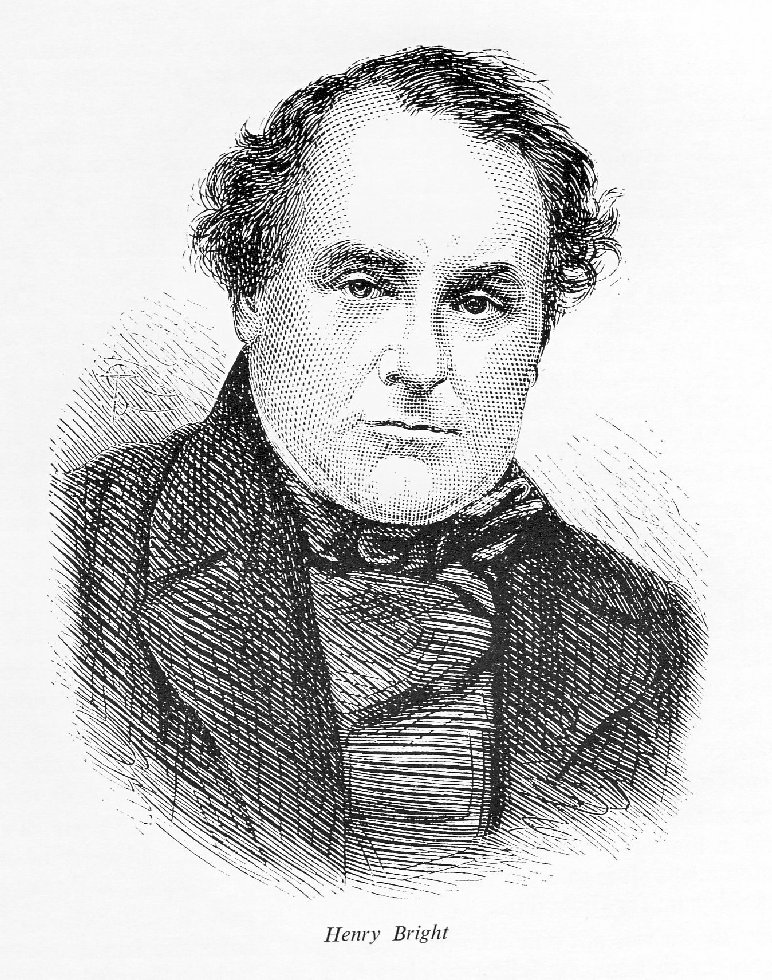
Henry Bright was a well-known English landscape painter connected with the Norwich School of painters. He was born at the family home, also his father’s business premises, on June 5th 1810 in Saxmundham, Suffolk. Henry was the third son and one of nine children of Jerome Bright, a clockmaker, and Susannah Denny, of Alburgh in Norfolk, who were married on June 28th 1790.
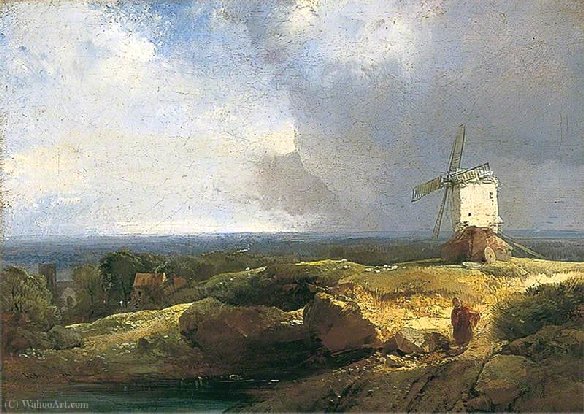
Landscape with Windmill by Henry Bright (1841)
Henry attended a School for Young Gentlemen in North Entrance Saxmundham. As a teenager he was indentured as a chemist’s apprentice in Woodbridge and later was transferred to Norwich and to Paul Squires’ chemist and soda water manufacturer who was also a keen collector of art, and it was he who introduced Bright into the local artistic circles. Later Bright became a dispenser at the Norfolk and Norwich hospital

On the Broads by Henry Bright (1833)
Having always loved sketching Henry Bright was determined to become an artist, and fortunately managed to persuade his parents to let him transfer his indentures to artist Alfred Stannard of Norwich and he became a member of The Norwich Society of Artists. Henry married Eliza Brightly at Saxmundham parish church on May 8th 1833. She was the youngest daughter of the late Alfred Brightly, a liquor merchant, of New York, North America and granddaughter of Thomas Brightly, a Saxmundham farmer. The couple went on to have two sons, who both died in childhood, and two daughters. In 1836, Bright and his family moved to Paddington, London where he lived for some twenty years, subsequently moving to Grove Cottage, Great Ealing and exhibiting in London. He sold his second Royal Academy exhibit to Queen Victoria, which ensured a following among the metropolitan elite, only returning to Saxmundham after the death of his wife at Ealing in 1848.
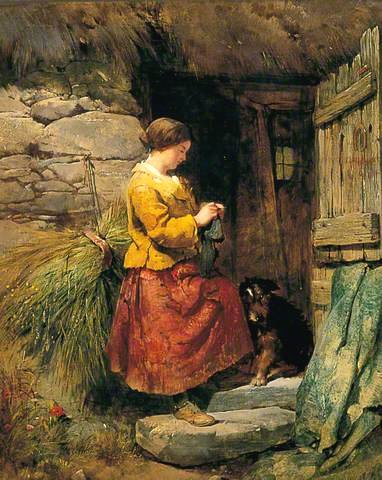
The Colttage Door by Henry Bright (1864)
Bright earned up to £2,000 per annum from his many royal and aristocratic pupils, including the Landgravine of Hesse-Homburg, the Grand Duchess Marie of Russia, and many local Suffolk artists as well as publishing chromolithographs and drawing books, such was his reputation that he gave his name to Bright’s Superior Coloured Crayons and his testimonials included Winsor & Newton’s Moist Water Colours.
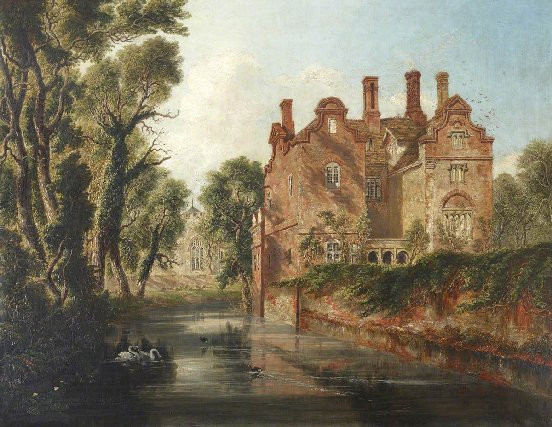
Landwade Castle by Henry Bright
Bright was a natural draughtsman and his watercolours, typically of open skies and landscapes, have considerable freedom, freshness, and richness of colour; he also made many drawings in chalk or pastel of old and picturesque buildings. He remained active in East Anglia and was vice-president of the Suffolk Fine Arts Association. After living at various addresses, in October 1870, Bright returned to Ipswich, living at the house of his niece, where he died after months of illness on September 21st 1873, aged 59 and was buried in Ipswich cemetery five days later. At the time of his death, he was said to have enough commissions to last him for ten or twelve years.
Edward Robert Smythe
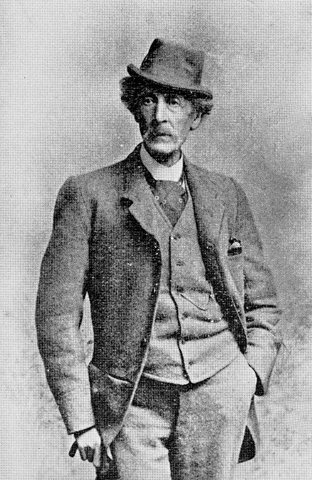
Edward Robert Smythe was an English painter of rustic landscapes and an exhibitor at London’s Royal Academy. He was born at Berners Street, Ipswich in 1810 and baptised St Nicholas Church, Ipswich on 10 February 1815. He was the son of James Smyth and his wife Sarah Harriet née Skitter who married at Norwich on June 14th 1811. James was an accountant with bankers Bacon, Cobbold, Rodwell, Durningham & Cobbold in Tavern Street, Ipswich who added a final ‘e’ to his surname.
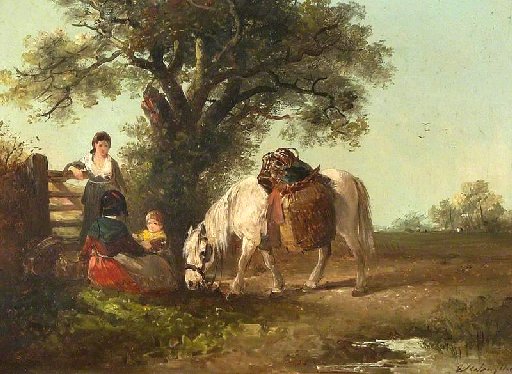
Two Women, Child and Pony by Edward Robert Smythe
Edward, from an early age, had a strong interest in drawing and loved to sketch views of the Suffolk coastline. He quickly became looked upon as a very talented artist and was soon elected to the Ipswich Society of Artists and opened his own studio at the ‘Old Shire Hall’.
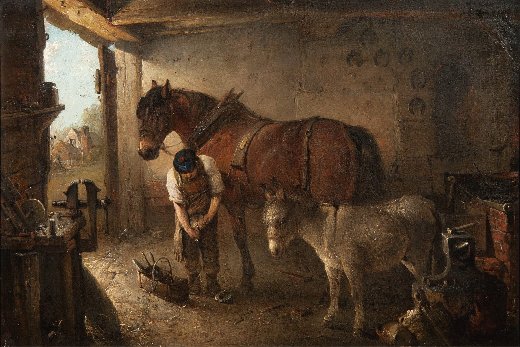
A Farrier Shoeing a Plough Horse with a Donkey in a Forge Interior by Edward Smythe (1899)
In the early 19th century, Ipswich was still mainly an agricultural area but this all changed with the arrival of industrialisation which gradually eroded its rustic charms. Edward Smythe was an artist with a deep connection to nature, and left Norfolk for Bury, Lancashire, in 1851, which had managed to safeguard its agricultural roots. His landscape and figurative works concentrated upon his personal view of the world and was influenced by both the uncomplicated endeavour of rural communities and the gnarled beauty of the Suffolk countryside. His depictions featured what was termed ‘rugged realism’ of his local neighbourhoods such as the leaning timber-framed cottages, overgrown foliage, weary cattle groups, and dog-eared inn-dwellers. Rarely does a tree grow straight in his rustic rose-tinted utopia.
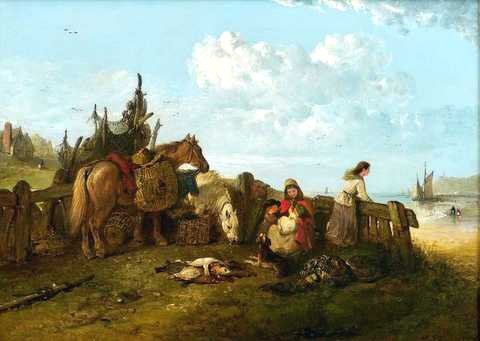
Fisherfolk besides the Sea by Edward Robert Smythe
About 1840, he moved back to Norfolk and the city of Norwich where he joined the Norwich School of Painters. On March 15th 1848 he married Ellen Burman a resident of Ipswich and it was here in 1849 that they had their first child, Edward Robert, jun. On September 13th 1850, now living in the Suffolk village of Elmswell, he was declared insolvent. By 1861, he and his wife had further children born at Bury St Edmund’s, Francis (Frank) Rowland in 1852, Ellen Kate in 1854 and Mary Emily in 1856, and their daughter Louisa Jane, who died on 7 April 7th 1861, aged 3 years and 7 months. In 1879 whilst living in Bury St. Edmonds his wife died aged 52. Two years after the death of his wife Edward went to live in Ipswich with his married daughter Ellen Kate. Edward Robert Smythe died in Ipswich on, July 5th 1899, aged 88, and was buried in Ipswich cemetery three days later.
John Duvall
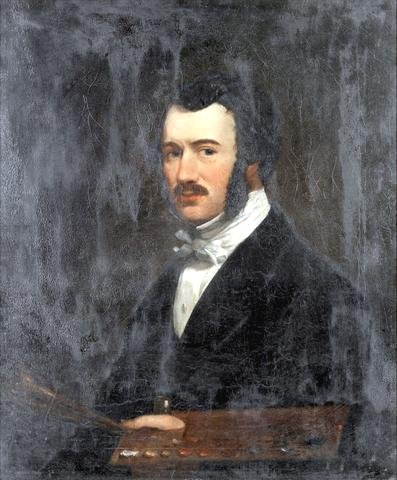
John Duvall was born in the Kent seaside town of Margate on September 3rd 1815. He was a nineteenth century English artist who painted landscapes, sporting and rustic subjects. He moved to the Suffolk port town of Ipswich in 1852 where he set up his studio in the Butter Market and began to teach drawing. Although he started off as a portrait painter, the number of portrait commissions declined due to the advent of photography and so he decided to start to focus on painting horses and some of his depictions of the animals provided illustrations for the Suffolk Horse Society’s Stud Book.

The Suffolk Show at Christchurch Park by John Duvall (1869)
In his 1869 painting, The Suffolk Show at Christchurch Park John Duvall depicts Colonel Barlow in the centre foreground with his prize-winning Suffolk Punch Dalesman. Next to him is his son, Eustace, while his groom Chapman is riding Topstall. The artist has included himself in the depiction, lying on the ground smoking a pipe with a sketch of a horse lying on the ground behind him. Duvall’s son has also been depicted. He is the one on the left of the two men under the tree on the far left of the painting.
John Moore
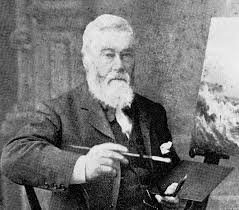
John Moore was born in the Suffolk town of Woodbridge on May 16th 1920 and was baptised in February 1821. Woodbridge was a hotbed of local artistic movements, with poets and painters regularly to be seen about the town. Woodbridge was influenced by the local artist/lawyer, Thomas Churchyard, known as the lawyer painter, who would often forego his business duties for painting trips and John Moore’s early works were testament to this inspiration.
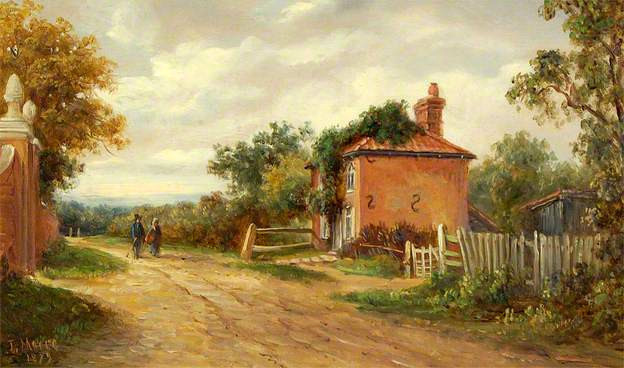
John Moore became a professional artist after pursuing an early career as a decorator and producer of specialist decorative effects, and these trades left him with a thorough understanding of painting techniques. The experience enabled him to paint quickly and confidently, his smooth touch of the brush displaying skills only matched by a handful of far more famous artists. By the time the Ipswich Fine Art Club’s exhibitions commenced in 1875 his works were very sought after, appearing as a prolific exhibitor almost every year at these exhibitions until he died. Some local newspaper critics compared him to Turner and Clarkson Stanfield, the premier marine painters of his day.
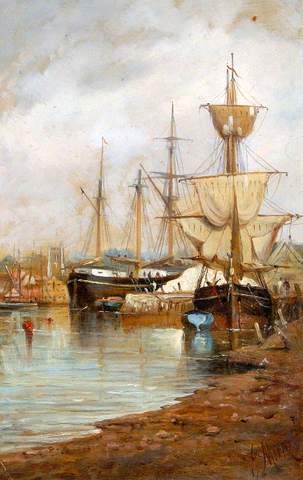
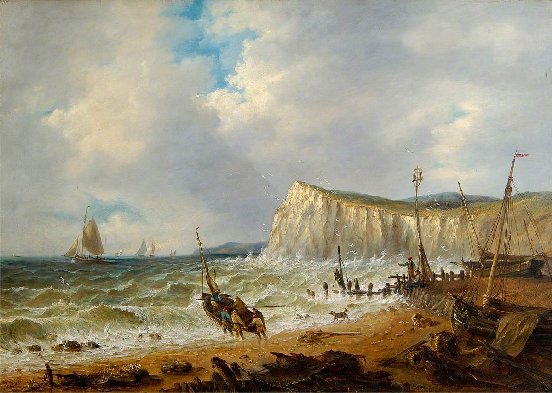
Northumberland Coast Scene by John Moore
According to his accounts in 1877 he travelled to Scotland to carry out a commission for the Cobbold family. Art exhibitions featuring his work were displayed at the Ipswich Art Club between 1877 and 1882. Many of these paintings depictied scenes of Northumberland. Oten they focused on dramatic depictions of shipwrecks and fisherman battling against rough seas.
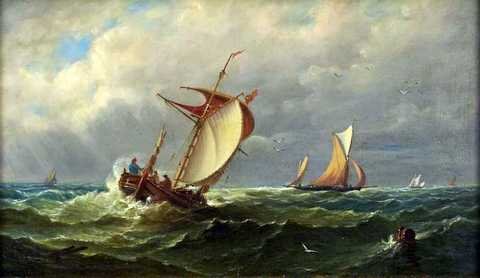
Fishing Boats in a Swell By John Moore
John Moore’s first wife, Caroline, died in 1877 and his second wife, Harriet, died in 1901. Having outlived his two wives; he moved from Suffolk to the neighbouring county of Norfolk and the town of Diss where he spent the final few years of his life at the home of his friend George Scolding where he died on 8 April 1902, aged 82 and was buried in Ipswich cemetery.
…….to be continued.
Information for this blog was gained from the following websites:
East AnglianTraditional Art Centre
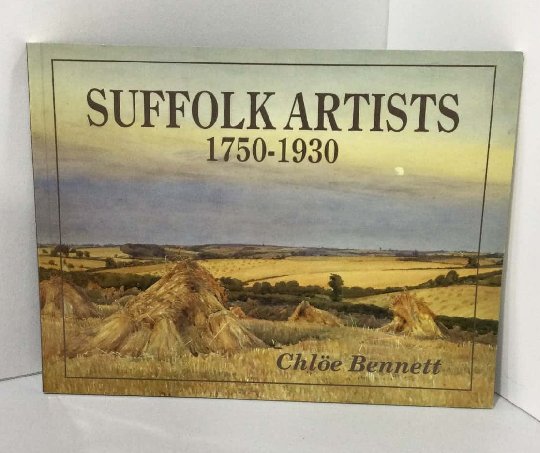
Also from a book I found in a Brighton second-hand bookshop by Chloe Bennett entitled Suffolk Artists (1750-1930).

 my daily art display
how does one subscribe to your blog? I found it by accident while searching for a painting by Millet. thanks!
Hi Judy,
I am not sure how you were directed to my blog but if you enter: https://mydailyartdisplay.uk/category/suffolk-artists/ this should take you to the site and at the bottom of the right hand column you can enter your email address which will mean that you have subscribed to receiving new blogs when I post them………Jonathan