Double Nude Portrait by Sir Stanley Spencer

A few days ago I watched a television programme which looked at twentieth century British artists and My Daily Art Display today looks at one of the paintings which the programme highlighted.  It was a work of art by Sir Stanley Spencer, completed in 1937 and is entitled the Double Nude Portrait, sometimes known as Leg of Mutton Nude, for reasons we will look at later   I like this painting for its honesty but also because of the story behind it.  It is a story of three people: Spencer and his two wives.  In a way, it is a story about love, infatuation, lust and how bad decisions can change lives.
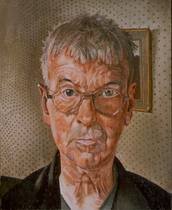
Stanley Spencer

Stanley Spencer was born in 1891 in Cookham, Berkshire, a small village on the River Thames, situated west of London.  Spencer loved Cookham and was to spend most of his life living in this idyllic spot.  He started his art studies at the age of seventeen when he attended the Slade School of Art, which was part of the University College, London, and where he remained for four years.  The First World War intervened and Spencer joined the Royal Army Medical Corps in 1915 and from there he transferred to the Berkshire Regiment the following year.  He witnessed the savage conflict in Macedonia but he physically survived the war although mentally scarred by the horrors he encountered whilst in active service.  Sadly, when he returned to Cookham after the war he learnt that his brother Sydney had been killed in the war three months earlier.
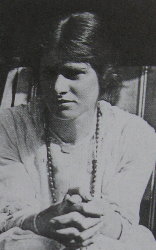
Hilda Carline

Whilst Stanley Spencer attended the Slade School of art he became friendly with a fellow student, Sydney Carline who was one of three children of the British painter and illustrator George Carline.  Sydney had two younger artistic siblings, a brother, Richard and a sister Hilda.  Although George Carline actively encouraged his two sons to become artists he never encouraged his daughter to follow the same path and she idled her time at home in Oxford.  Eventually when she was twenty-four her father arranged for her to go to a London art school in Hampstead, which was run by Percyval Tudor-Hart.  Such was her artistic progress that five years later, in 1918, aged twenty-nine, she also was admitted to the Slade School of Art.   It was around this time that Sydney met Hilda when he was invited to a Carline family meal in 1919.  Spencer was immediately smitten by the lovely Hilda and recalled that first meeting saying:

‘…As she came towards me … with the soup, I thought how extraordinary she looked … I could feel my true self in that extraordinary person….I felt she had the same mental attitude to things as I had. I saw myself in that extraordinary person. I saw life with her…..’

Within a few weeks of that first meeting Spencer wrote to Hilda asking to buy one of her paintings.  He wrote:

‘…there is something heavenly in it and the more I look at it, the more I love it..”.

There followed a quite tempestuous courtship, their relationship had its ups and downs and had to withstand many heated arguments.  Having said that, the couple spent a lot of time painting together and Spencer was very complimentary about her artistic talent.  Hilda Carline went on to exhibit many of her works at the Royal Academy and the New English Art Club, an artists’ society, a society which was founded in 1886 in reaction against the conservatism of the Royal Academy.

In 1925 Hilda Carline and Stanley Spencer married at Wangford in North Suffolk, a place which was well known to Hilda as during the First World War she was stationed there as a Land Girl.  By the end of the year Hilda had given birth to a baby girl, Shirin.  During the next few years the couple moved around southern England until January 1932, at which time Stanley could afford to buy Lindworth, a comfortable residence in the centre of Cookham, with its tennis court and large garden.  This was solely his choice as his wife would have preferred to live in central London to be close to the centre of the art world as well as being close to her widowed mother who still lived in Hampstead.  For Stanley, returning to Cookham gave him the chance to recapture the early inspirational ecstasies which he called Cookham-feelings.   Of this special feeling, and of his day in this idyllic setting, he once wrote:

“.. We swim and look at the bank over the rushes.  I swim right in the pathway of the sunlight.  I go home to breakfast thinking as I go of the beautiful wholeness of the day.  During the morning I am visited, and walk about being that visitation.  Now everything seems more definite and to put on a new meaning and freshness.  In the afternoon I set out my work and begin my picture.  I leave off at dusk, fully delighted with the spiritual labour I have done…”

So Stanley Spencer is delighted with his life and Hilda, his wife, is reasonably happy, so what could possibly go wrong with this idyllic lifestyle?   Sadly Stanley like many of us didn’t appreciate what he had.

Patricia Preece

Enter the third person in this story – Patricia Preece.  Patricia had, along with her artist friend and lesbian lover, Dorothy Hepworth, moved to the village of Cookham.  It was in 1929, when Patricia working in the local High Street café first met Stanley Spencer.   Stanley, Hilda and their daughter Shirin, who were visiting the village, came in to the café for lunch.  After a conversation about their love for art Spencer invited the two women to visit the Spencer-Carline house parties and picnics and where she was often courted by Hilda’s brother Richard Carline.  Spencer and Preece had, besides their art, another thing in common, their love of Cookham.  This was in complete contrast to Hilda’s feelings for the village, a situation which saddened her husband.

The relationship between Spencer and Hilda and Patricia Preece started off well, in fact for the first three years they were best of friends and in 1933 Stanley Spencer and Patricia went off together on an artistic assignment in Switzerland with Hilda’s blessing. Richard Carline’s devotion to Patricia ended when he belatedly realised the truth about her relationship with her live-in lover Dorothy.  Patricia now turned her attentions to Stanley Spencer, not for amorous reasons but for the reason of his extensive art world contacts which would help her and Dorothy with their artistic careers and also because she, who was comparatively poor, knew that Stanley was a wealthy man.  Patricia’s financial situation worsened when the knitwear business of the Hepworth family, from which Dorothy received great financial remuneration, went bankrupt.  By 1934, the life of the two women had reached crisis point, their Cookham home was about to be repossessed and they had no money to pay every-day bills.
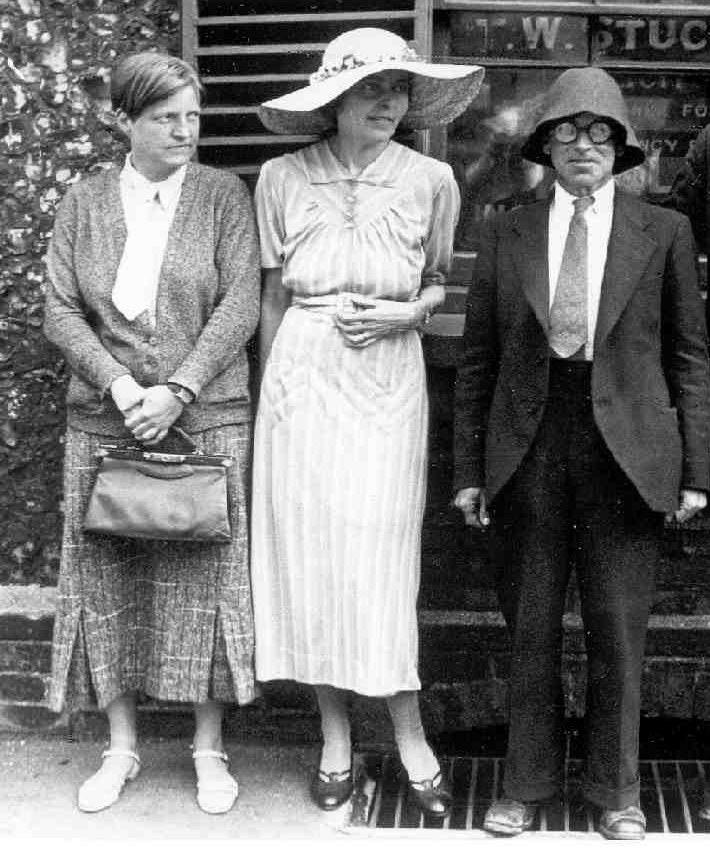
From l to r.  Hepworth, Preece and Spencer
From l. to r. Hepworth, Preece and Spencer

Stanley Spencer rode to the women’s rescue by suggesting they came to live with Hilda and him.  Hilda was having none of her husband’s rescue plan.  She also became very concerned by her husband’s closer than ever relationship with Patricia.  She took comfort by leaving Cookham for periods of time along with her daughters, going to stay with her mother.  Her absence from the family home was all that Patricia needed to get closer to Stanley.  They would visit each other’s houses even though Patricia’s lover Dorothy was not best pleased with this blossoming relationship.  Stanley and Patricia sadly had different agendas.  For Patricia, Stanley Spencer’s money and contacts were of prime importance whereas for Spencer there was a sexual desire.

Hilda initially fought to save their marriage.   However, when her brother George became seriously ill towards the end of 1932, she went to London to be with him. By 1934, she knew that she could no longer stay with her husband and moved to London.  Spencer became more and more obsessed with the flirtatious Preece, and he showered her with gifts. She persuaded him to divorce his first wife and to sign his house over to her. Patricia Preece married Spencer in 1937 and they were supposed to go on honeymoon in Cornwall.  Preece and Dorothy  went on ahead and in fact Spencer never joined them, remaining in Cookham to finish a painting.  Hilda went to Cookham and, finding a warm welcome from Spencer, spent the night with him. Spencer proposed a ménage à trois with her and Patricia but Hilda would not accept being his mistress, having once been his wife. Preece was shocked by this turn of events and refused thereafter to have sexual relations with him.
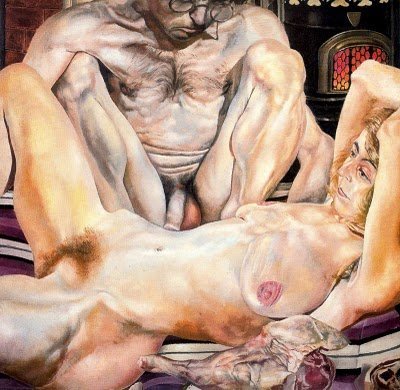
Double Nude Portrait by Sir Stanley Spencer (1937)

So that is the story of the three people and now let us look at the painting which Spencer completed in 1937, the year of his second marriage.  It is a stark and explicit painting of the artist and his second wife Patricia Preece.  It was painted at a time when Spencer realised the mistake he had made leaving his first wife Hilda and marrying this femme fatale.  Look at the forlorn depiction he gave himself as he squats before his uncaring wife.  His skin tone is a dull grey.  We are not looking at a man of great virility.  Whereas artists in the past have portrayed themselves or their sitters as virile and glamorous, we see in front of us an unidealized vision of a man.  He stares down at the breasts of his wife but he is not aroused.  Look at his flaccid penis which presumably alludes to his lack of virility and the non-consummation of his marriage.  Look how Spencer has depicted Preece.  She lays there, legs apart with a vacant look on her face.  She does not look at Spencer.  She exudes an air of disinterest.  Spencer’s depiction of his wife acknowledges her rejection of him.  There is no eye contact.  The bodies are not touching.  There is a total disconnect between husband and wife.  You know the marriage is doomed.   There are two other interesting objects in the painting.  Firstly in the foreground we have a leg of mutton (hence the alternative title of the painting) and in the background we have a lit gas fire.  We can presume that the cold leg of mutton somehow symbolises the coldness of his wife as she lies in front of him and it is in contrast to the heat from the fire which is the only thing in the painting which is going to give warmth to the artist.

Would you say the painting is erotic?  Does it have the eroticism of a Schiele painting?  To me, the painting is sexual but not erotic.  It is an honest painting and tinged with sadness.  Should we be sad for the artist or should we simply look upon him as somebody who has rightly got his just deserts?  Could things get any worse for Spencer?  Well, actually the answer to that is yes.

Preece being a gold-digger and Spencer being besotted and somewhat foolish was persuaded to sign his house and financial affairs over to Preece who never left her lover Hepworth.  It is also thought that she had some leverage over Spencer and threatened to expose him and his erotic paintings unless he agreed to the financial terms.   There was no acceptance in the 1930’s for such sexual works.  Patricia  eventually evicted Spencer from the house, and would not grant him a divorce, but continued to receive payments from him. After he was knighted in 1959, she insisted on being styled Lady Spencer and claimed a pension as his widow. Spencer’s fear of being exposed by Preece over his erotic paintings made him keep today’s painting under his bed where it remained until he died.  Spencer lived to regret leaving his first wife and constantly wrote to her and occasionally visited her and their two children.

Sir Stanley Spencer died in 1959, aged 68.  Hilda Carline died in 1950 aged  61.  Patricia Preece died in 1966 aged 72.  Wendy Hepworth died in 1978, aged 80.

The Floor-scrapers by Gustave Caillebotte

The Floor Scrapers by Gustave Caillebotte (1875)

Although I am sure people love to see the paintings of the so-called “Masters”, I believe it is good to look at the works of lesser known artists and by doing so, one can discover hidden gems.  After Renoir’s famous painting Luncheon of the Boating Party,which I featured yesterday,  I decided today that I would look for a painter, who until yesterday had been unknown to me.  However, I do understand that this may be due to my simple lack of artistic knowledge and in fact the artist is well known to you, if so, I apologise!

It is often the case that when I am researching a painting I come across another artist, whom I have never heard of, and that is the reason for my choice of artist today.  Amongst the guests at Renoir’s luncheon was his friend and lesser known Impressionist, Gustave Caillebotte and I decided to make him my artist of the day and I want to look at his unusual painting entitled Les raboteurs de parquet [The Floor Planers].

Caillebotte was born in Paris in 1848 and brought up in a very respectable and very wealthy upper-class family environment.  His father, Martial had inherited the family textile business.  Martial Caillebotte had been widowed twice before he met and married Gustave’s mother, Céleste.  When Gustave was eighteen his father moved the family home from Paris to the town of Yerres, a south-eastern suburb of Paris on the Yerres River,  an area which was familiar to the family as they had spent many summers there.

Gustave studied law when he was twenty years old and passed all his exams two years later. That year, he was drafted into army to fight in the Franco-Prussian War.  It was after the war and on leaving military service that Gustave wanted to concentrate on art and study painting.  He set up an artist’s studio in the family home and in 1873 he entered the École des Beaux-Arts in Paris.  The following year his father died and in 1878 his mother passed away, at which time the three brothers shared the family fortune.  It was also around this time that Gustave met and became friends with Edgar Degas and came into contact with the Impressionists, a group of artists who had rebelled against Academicism art and academic painters, whose works were exhibited in the Paris Salon.  This group of artists had their own Impressionist exhibitions, the first of which was held in 1874.

In 1876 the Impressionists held their second exhibition and Caillebotte exhibited eight of his paintings including today’s featured work, The Floor Scrapers, which he completed in 1875.  The style of this work belongs to the Realism genre but unfortunately for Gustave the art establishment only considered peasants and farmers from the countryside as acceptable subjects in works of art which highlighted the realism of working-class life.

The Floor-scrapers, sometimes known as The Floor-strippers  was painted in the artist’s family home.  It is a painting which depicts working class people hard at work and although that in itself was not an unusual subject for French paintings as it had been done many times before but the difference was that in previous French paintings, the depiction of the hardships of the working class was all about working class farmers or country peasants.  This painting depicts the urban working class and as such it was one of the first such representations.  Caillebotte presented his painting for the exhibition at the Paris Salon in 1875 but it was rejected.  The Jury of the Salon were shocked by its crude realism and some went so far as to describe it as being vulgar and offensive.  The artist was both disappointed and angered by their stance and decided that exhibiting his works at the Paris Salon was not going to be the future course for his paintings.  Instead, he decided to align himself with another group of French artists, who like him, were disillusioned by the narrow views of the academics and had formed themselves into their own artistic group – the Impressionists.

The work of art today is simply a painting depicting men hard at work.  Here we see three men stripping the varnish off the floor of the artist’s new apartment.  There is neither a moralising message nor is there a left wing political message.  Caillebotte is merely showing the men hard at work carrying out a strenuous task.  This is why the artist was looked upon as one of the most gifted French realist painters of his time.  Look how Caillebotte has depicted the musculature of the upper body of his three workers as they perform their back-breaking task on their hands and knees.  See how the artist has made the light of the late afternoon streams through the long balcony window and illuminate their backs.   It harks back to the heroes we saw centuries earlier when we looked at the paintings of the heroes of Antiquity. France, like Britain, had just gone through an Industrial Revolution and with urbanization came a new social class which was termed la classe ouvrière or working class and it was in complete contrast to the bourgeoisie.  The hard working men we see in Caillebotte’s painting may have been brought up in the countryside and therefore they were used to exhausting and strenuous work and had moved to the city to seek their fortunes.

At the time of this painting, France was in its Second Empire stage and Paris was undergoing massive change under the Haussmann’s Renovation of Paris which was the great modernisation plan for the city which had been commissioned by Napoleon III.  The project encompassed all aspects of urban planning, both in the centre of Paris and in the surrounding districts: streets and boulevards, regulations imposed on facades of buildings, public parks, sewers and water works, city facilities, and public monuments. The planning was influenced by many factors, not the least of which was the city’s history of street revolutions.  This was a time of great change and in a way Caillebotte wanted to change art and what had been previously unacceptable, he wanted to be accepted but he was a little ahead of his time as far as this painting was concerned.  There is a great contrast in colours used in the painting from the light blue walls to the dark browns of the floor and the men’s clothes.   I note that a bottle of wine and a glass has been added – a French prerequisite to help with a day’s work !

Luncheon of the Boating Party by Pierre-Auguste Renoir

Luncheon of the Boating Party by Auguste Renoir (1881)

My Daily Art Display today features one of the best known Impressionist paintings.  It is Luncheon of the Boating Party by Renoir which he painted in 1881.  Although I would rank Impressionism outside my top three favourite art genres, I was fascinated by this painting and the story behind it.

Maison Fournaise (c.1890)

I suppose firstly I should examine the setting for the painting, which is the balcony at the Maison Fournaise.  This building is situated on the ÎlIe de Chatou, an island situated across from the small town of Chatou, which is situated on the right bank of the Seine.   Boating on the Seine became a very popular form of recreation in the middle of the eighteenth century and whereas Argenteuil, a little way upstream from Chatou, where the Seine is wider and with its more prevalent winds, attracted sailors, the Îlle de Chatou was the ideal spot for rowers.  Alphonse Fournier, who was a river toll collector and a part-time boat carpenter, set up his boat building workshop along with his boat rental business in 1857.  Alphonse also used to organise boat regattas and water festivals.   At the same time, his wife, an accomplished cook, opened a restaurant next door.  This restaurant, combined with the boat rental facility and its many organised boating events, was a very popular family-run business.   Their daughter Louise-Alphonsine, who became a popular and well-known artist’s model, greeted the clients whilst their son Jules-Alphonse charmed the ladies and assisted them into the boats.  Artists visiting Maison Fournaise were never short of potential models for as Renoir wrote:

“…..I was constantly spending my time chez Fournaise-there I found as many beautiful girls as one could ever wish to paint!…..”

The Island of Chatou had other thing going for it.  Rail travel allowed Parisians easy access to this area in the countryside.  If you look carefully under the awning you can just make out, at the top left, the blue-gray outline of the Chatou railroad bridge, part of the government’s recently completed transportation projects that had made access to this riverside destination possible to everybody, not just to the members of the upper class.

La Maison Fournaise, today.

The setting also radiated   peace and tranquillity along with its ideal light conditions and proved a haven for artists with the likes of Claude Monet, Alfred Sisley, Berte Morisot, Edouart Manet and Camille Pissaro often visiting the location.   Auguste Renoir was also a regular caller and he once described his love of the establishment in a letter to friend:

“…You could find me anytime at Fournaise’s. There, I was fortunate enough to find as many splendid creatures as I could possibly desire to paint……….. I can’t leave Chatou, because my painting is not finished yet. It would be nice of you to come down here and have lunch with me. You won’t regret the trip, I assure you. There isn’t a lovelier place in all Paris surroundings….

The Fournaises’ two businesses flourished until 1906 when Madame Fournaise closed the restaurant and four years later Alphonse Fournaise wound down his boat rental enterprise.  Then, unfortunately, over the years,  the deserted premises started to fall into disrepair.  Madame Fournaise died in 1937.  By the 1970’s the buildings were at the point of complete dereliction.  However in 1977 the town of Chatou bought the building and five years later it listed it as a building of historic significance, joining the register of Les Monuments Historiques and restoration work began with the support from The Friends of Maison Fournaise and The Friends of French Art.   Currently the building is a museum, La Fournaise Museum, and in 1990 a restaurant reopened on the premises

So now we know the setting for the painting let me introduce you to some of the people featured in this wonderful painting.  As in a number of Renoir’s paintings, he liked to include portraits of his friends.

The Participants
  1.  Aline Charigot, seen holding a dog, was a seamstress and part time model for Renoir.  Aged twenty-seven at the time of the painting met Renoir in 1880 and they were married in 1890, despite a thirteen year age difference.  The couple had three children, Pierre, Jean (who became the well-known filmmaker) and Claude.  Despite being much younger than Renoir she died four years before him in 1915, aged 61 and was buried in the churchyard at Essoyes in the Champagne-Ardennes region of France which was her childhood home.  Renoir who died a few months before his seventy-ninth, in Cagnes, was laid to rest alongside his beloved wife.
  2. Jules-Alphonse Fournaise, wearing a straw boater and sportsman’s T shirt leans against the balustrade.  He was the son of the owner of Maison Fournaise and was in charge of the boat rentals.
  3. Louise-Alphonsine Fournaise, leaning against the balustrade is the daughter of the owner of the establishment and a war widow.
  4. Baron Raoul Barbier, sporting a brown bowler hat, has his back to us as he engages the proprietor’s daughter in conversation.  Formerly a cavalry officer and war hero later became mayor of colonial Saigon.  The two loves in his life were women and horse racing.
  5. Jules Laforgue, a Symbolist poet, journalist on the La Vie Moderne newspaper and private secretary to Charles Ephrussi (No.8)
  6. Ellen Andrée, seen drinking from her glass. Aged 24 at the time of the painting, she was a Parisian actress and mime at the Folies Bergère and sometime artist’s model for Renoir, Manet and Degas (See My Daily Art Display June 7th where the actress has modeled for the Degas painting).
  7. Angèle Leault, some time Parisian actress and singer and also a market flower seller.
  8. Charles Ephrussi, wearing a top hat and in conversation with his secretary.  Russian-born Ephrussi was a wealthy art collector and historian as well as being editor of the prestigious art magazine, Gazette des Beaux-Arts.  He was a great supporter of the Impressionist painters.
  9. Gustave Caillebotte, in the right foreground with a cigarette in his hand.  He was a good friend of Renoir and a well-known painter in his own right.  He was a collector of Impressionist paintings and also one of Renoir’s wealthy patrons.  Renoir’s prominent positioning of Caillebotte was not accidental but was a measure of his importance to Renoir.  He lived in a house overlooking the Seine, not far from Chatou.  Caillebotte  was trained as an engineer, built boats and was a great sportsman.  This maybe accounts for Renoir’s youthful portrayal of him (he was 33 at the time of the painting) in his boating attire, consisting of a sleeveless white T shirt and blue flannel pants.  On his head is a flat-topped straw hat around which a blue ribbon is tied.  This indicates that Caillebotte was a member of the privileged Cercle Nautique de la Voile boating club.  He was godfather to Renoir’s eldest son, Pierre.
  10. Adrien Maggiolo , Italian journalist on Le Triboulet newspaper.
  11.  Eugène-Pierre Lestringuez, official at the Ministry of the Interior and close friend of Renoir who often modeled for his paintings.
  12.  Paul Lhote, wearing a straw hat in conversation with Lestringuez and the actress Jeanne Samary.  He was a writer of short fiction and a journalist and close friend of Renoir.
  13.  Jeanne Samary, holding her black-gloved hands to her ears.  Actress at the Coméie-Francais in Paris.

With this group of people we can see that Renoir was illustrating the nature of Maison Fournaise which welcomed customers from a variety of social backgrounds from the wealthy aristocrats to the humble actors.   With the new rail system in place along with the shortened working week, everyone, no matter what their occupation, was able to escape the city and enjoy the pleasures of the Parisian suburbs at the weekends.  The forty year old artist in producing this large masterpiece depicted the modern life of Parisians as they relaxed.  Renoir’s painting captures the idyllic atmosphere as his friends wine and dine on the riverside terrace.  Renoir gathered most of the participants in the painting together early on so that he could organize the composition.  Later he worked on the individual figures as and when they were able to model for him.  It was a grueling time for the artist and Renoir felt the pressure on him to complete the work.  He had a love-hate relationship with the work commenting once:

“… I no longer know where I am with it, except that it is annoying me more and more….”

He made many changes to the work before he was completely satisfied. The final result was a veritable gem of Impressionism.

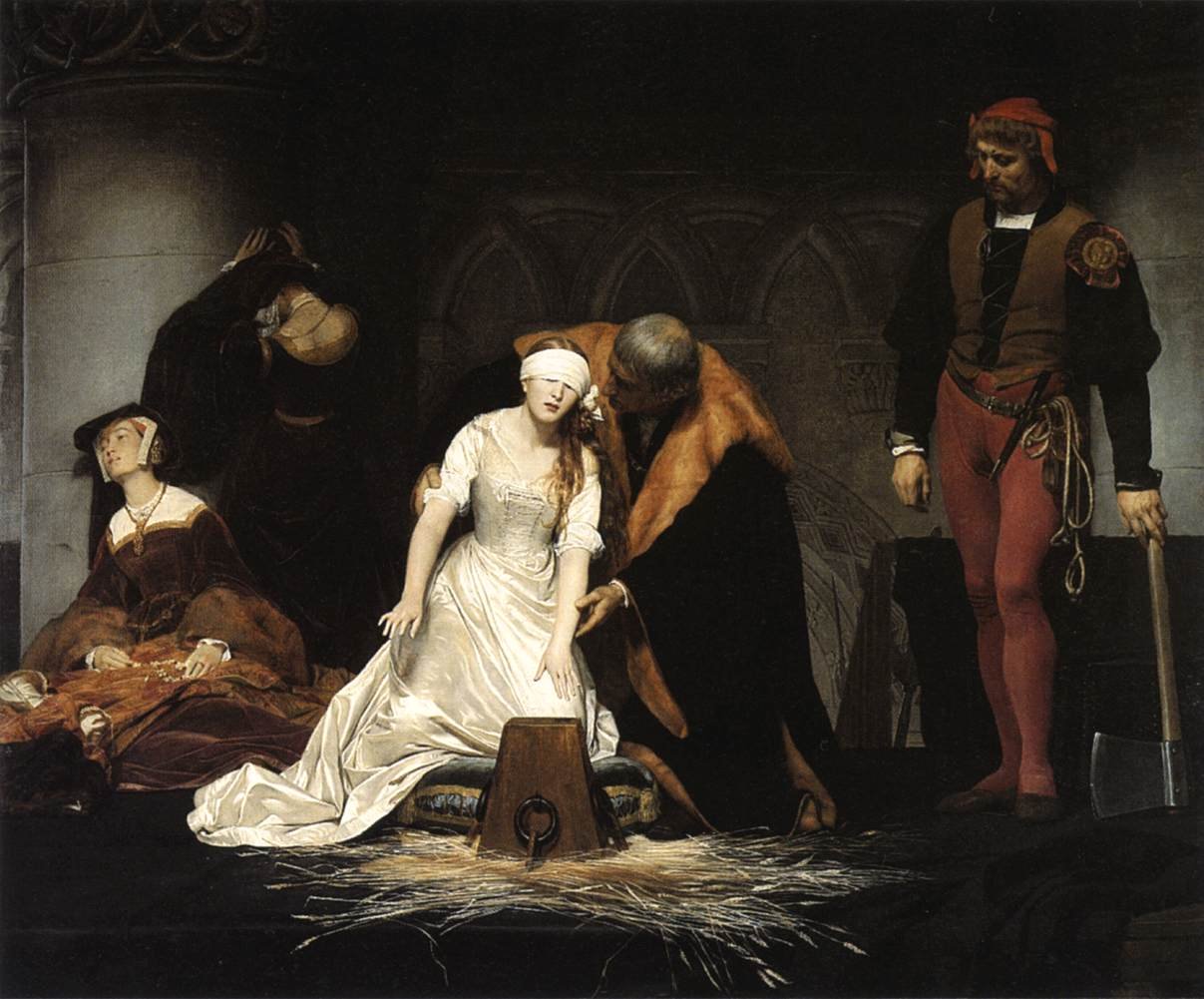
The Execution of Lady Jane Grey by Paul Delaroche

The Execution of Lady Jane Grey by Paul Delaroche (1833)

My Daily Art Display today is all about a 19th century French painter and a 16th century Queen of England, who reigned for just nine days.  The painter in question is the French Academic painter Hippolyte Delaroche, better known as Paul Delaroche, who was to become one of the most popular History painters of his time.  He was brought up in a wealthy household and began his artistic career under Antoine-Jean Gros, the French History and neoclassical painter, famous for his life-size historical paintings.

Delaroche exhibited his first painting at the age of twenty-five and it was at this exhibition he met and became friends of Théodore Géricault and Eugene Delacroix.  These three artists were to form the great triumvirate of Parisian historical painters.  The historical works of Delaroche exuded drama which was so popular with the French people.  His paintings depicted historical events which occurred in his homeland and portrayed great characters in French history such as Joan of Arc (Joan of Arc in Prison), Napoleon,  Napoleon abdicating at Fontainbleau (1845) and Marie Antoinette (Marie Antoinette leaving the Convention after her sentence) as well as historical events which took place across the Channel in England such as Elizabeth I,  Death of Queen Elizabeth (1828),  the execution of Archbishop Laud, Strafford Led to Execution (1836) and The Execution of Lady Jane Grey (1833), today’s featured painting.

Louise Vernet

On June 30th I featured a painting by Claude-Joseph Vernet and looked at the Vernet artistic family tree.  A person on the lower branch of the tree was the artist’s grandson Horace Vernet and it was his young daughter, Louise, whom Delaroche married.  Anne Elizabeth Louise Vernet, some seventeen years his junior was to become the love of his life and Delaroche went on to paint many portraits of her, including Head of an Angel (1835).  Tragically, in 1845, Louise died of a fever at the age of thirty-one and Delaroche never recovered from his loss.  He made a beautiful but haunting graphite sketch of his dead wife entitled Louise Vernet on her deathbed  (1845),  which is now housed at the Walters Art Museum in Baltimore.  It is a wonderfully poignant drawing in which we see Louise laying blissfully in profile.  The pale skin and her lifeless body signifying she has died and although her body had suffered the ravages of fever,  Delaroche’s portrait offers us nothing but an angelic beauty.

The paintings of Delaroche were soon turned into reproductive prints which allowed his great works, which had been exhibited at the Paris Salon, to be circulated internationally.  Delaroche died in Paris in 1856

Today’s featured painting is entitled The Execution of Lady Jane Grey which he completed in 1833.  The Execution of Lady Jane Grey, which is depicted in this work of art, occurred almost three hundred years earlier.  It was first exhibited at the Paris Salon in 1834 where it caused a sensation.  It is very large oil on canvas painting almost 250cms x 300cms.  During the 1820’s and 1830’s in France,  a kind of “Anglo-mania” swept the country and this interest in English history had, in part, been fuelled by the novels of Sir Walter Scott and his tales of the battles and conflicts between Roundheads and Cavaliers during the Civil War,  which in some ways mirrored what happened during the violent and turbulent times of the French Revolution.  The setting for the painting is the morning of February 12th 1554.   The painting depicts the last moments in the life of the seventeen-year old Jane Grey, who was the great granddaughter of Henry VII and who was proclaimed Queen of England upon the death of young King Edward VI, a Protestant like herself.  She was young, intelligent and a political pawn whose destiny was out of her control and her reign only lasted for nine days in 1553.  Due to the plotting of the followers of Henry VIII’s Catholic daughter, Mary Tudor, she was convicted of high treason and sentenced to death in the Tower of London.

The painting has a few historical inaccuracies as we know that Lady Jane Grey was actually executed outdoors on Tower Green and not inside a chamber of the Tower of London.  She was also not dressed in a white satin dress along with the depicted whalebone corset and for a beheading her hair would not have been allowed to fall to her waist but instead would have been tucked up high above the head.  However let us not quibble about historical accuracy and rather just let us feast our eyes on this very dramatic painting.

In the painting we have five figures.  The central character of the painting is the tragic figure of the blindfolded Lady Jane Grey, in her under garments, who has just knelt down on a cushion behind the block where soon her neck will rest.  On either side of the block we see iron rings to which her wrists will be bound.   Look how she gropes with her outstretched arms, her hands in front of her, trying to locate the wooden block.  She is being gently guided to the executioner’s block by the elderly Lieutenant of the Tower, who at the time, was Sir John Brydges.  We get the feeling that he feels sadness for the young girl’s plight and his attentiveness and concern as depicted by Delaroche adds more pathos to the painting.  His hulking figure attired in a black coat, lined with orange-brown fur, looms over her and is a perfect contrast to the white attire of his charge ,which would soon be splattered with her blood.  Her sad figure with its golden-red hair is being illuminated from above.  It is a very dark painting with the exception of this lighting, which highlights the young girl and is in some way like a spotlight on a dark stage focusing light on an actor.   To the left we see two of her ladies-in-waiting, beside themselves with grief.  One, who is so distraught, has slumped to the floor, her eyes closed, her head turned away from her mistress.  She is clutching the outer garments of her mistress.  The other, who cannot bear to witness the execution weeps uncontrollably.  Her hands are above her head, grasping the grey column.  Her face is pressed hard against the stony structure.  The executioner stands in his blood-red hose to the right, the fingers of his left hand loosely holding the handle of the axe.   A pile of straw painted in the finest of detail, lies before the executioner’s block, in readiness to catch and soak up the victim’s blood.  Look how the artist has cleverly painted the straw which looks like it is almost falling out of the painting.  We can almost imagine that by leaning forward we could pull out a piece.

As we look at the painting we experience a myriad of feelings – horror of what is about to happen, compassion and pity for the fate of the young girl, despair that such a thing could take place in a civilised society.  The way Delaroche has painted the scene makes us feel that we are there, standing in front of the victim.  We are actual witnesses at the execution.   We are simply voyeurs who cannot change history.  We cannot prevent the neck of the young girl being severed by the executioner’s axe.  It is interesting to note how none of the five figures in the painting look towards us.  They are not aware of our presence.

Whether the painting is factually inaccurate does not lessen its greatness nor does it any way diminish the standing of the artistic genius who has created a work that tugs at our emotions.