The Return from Inkerman by Elizabeth Thompson

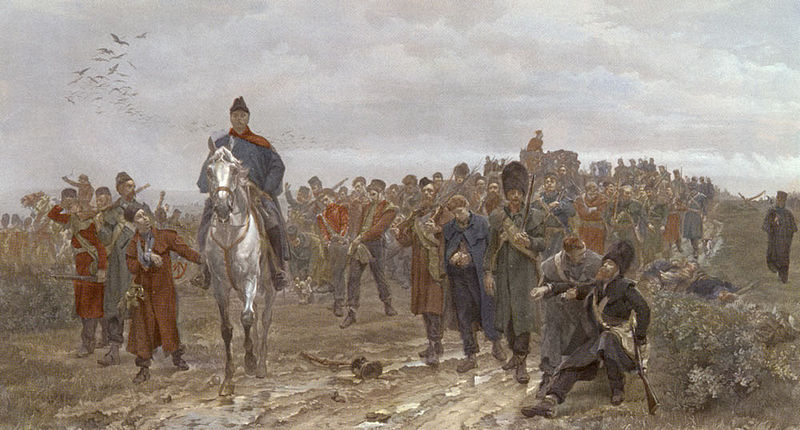
The Return from Inkerman by Elizabeth Thompson (1877)

My Daily Art Display today is a war painting depicting the conclusion of the Battle of Inkerman and the British troops, or what was left of them marching back to camp.  The work of art was painted by Elizabeth Southerden Thompson, the British female painter, who had attained celebrity status with her history paintings, and especially those depicting military conflicts involving British troops.

She was born in Lausanne, Switzerland in 1846 and at the age of thirteen, when she and her family lived in Italy, began to receive art tuition.  In 1862 she travelled to London where she enrolled in the Female School of Art which along with the National School of Art coalesced into the Royal College of Art in 1869.    In 1869, with the family now living in Florence she enrolled in the Accademia di Belle Arti which was the top-rated academy for drawing in the whole of Europe.  Her favoured art genre at the outset of her painting career was that of religious art and it was not until she went to Paris at the age of twenty-eight that this was to change.   In Paris she came across the works of Jean-Louis Meissonier the French Classicist painter who was famed for his works of art depicting Napoleon and his armies and other military scenes.  She also saw works by the military painter Édouard Detaille, who had been a pupil of Meissonier.  She was so enthused with their military paintings that she decided that in future this was to be her choice of art genre.

In 1873 she completed a work entitled Missing which depicted two wounded French officers during the Franco-Prussian War and which was the first of her paintings to be accepted by the Royal Academy.  The following year she exhibited a painting which was to be one of her most popular and made her a nineteenth century celebrity.  It was entitled The Roll Call and it depicted a scene from the Crimean War in which we see a battalion of the Grenadier Guards, many of who were wounded and exhausted, gathered around for the roll call so as to ascertain who had and who had not survived the latest battle.  The painting was shown around the art capitals of Europe and in doing so her fame as an artist spread throughout the continent.

In 1877 she married a Tipperary man, Sir William Francis Butler, who was an officer in the British army and who rose in the ranks to finally become a lieutenant-general.  This army life of her husband afforded Elizabeth, now Lady Butler, the opportunity to travel with him throughout the British Empire.  The couple went on to have six children but the burden of motherhood did not prevent her from painting many more military scenes.

When her husband retired from the army in 1905 the couple retired to Bansha Castle in Tipperary.  Her husband died in 1910 but she remained at Bansha until she was seventy-six years of age at which time she went to live with her youngest daughter.  She died in 1933 just a month short of her eighty-seventh birthday.

The featured painting today is entitled The Return from Inkerman by Elizabeth Thompson which she completed in 1877.  This was the final work of her quartet of paintings she did between 1874 and 1877 depicting scenes from the Crimean War.  The painting depicts a ragged column of exhausted soldiers trudging back to camp, many of who are wounded and are only just able to stand up.  Their commanding officer on horseback rides at the head of the column.  The men try to keep their heads held high as they pass fallen comrades who lie at the side of the road.  Their tattered uniforms remind us of the ferocity of the battle which has just concluded.  The battle took place on the heights of Inkerman where the Russians had mounted a counter-attack on the British forces.   The weather had been terrible during the battle with driving rain interspersed with thick fog making the commanding of the troops difficult for both sides.  This battle was one of many bloody encounters which occurred during the siege on the Russian town of Sebastopol in November 1854 and was part of the Crimean War campaign.  It was a ferocious battle and cost the lives of 2,500 British and 12,000 Russian troops.   In her painting the troops depicted are mainly from the Coldstream Guards and the 20th East Devonshire regiment.

While she never witnessed actual warfare, she was in Egypt for some years in the 1880’s with her husband and many of her pictures were drawn accurately using models in some cases, or observing soldiers on manoeuvres or practicing charges at Aldershot. To help with her paintings, the soldiers even re-enacted the battle in their original uniforms worn throughout the campaign.

There is a great sense of realism to this painting.  In it we see the men and their suffering.  However in some quarters this realism was too much to bear.  As would be the case now, the public did not want to be reminded of such sufferings on the battlefield.  For most of the public and the hierarchy of the Royal Academy they preferred more uplifting depictions of victorious battles and acts of heroism which would lift people’s spirits.  Many artists pandered to such wishes but as the French master of military paintings, Édouard Detaille, commented:

“…L’Angleterre n’a guère qu’un peintre militaire; c’est une femme…”

(England has only one military painter; and it is a woman)

However Elizabeth Thompson would not change her style and defended it in her 1922 autobiography, writing:

“…I never painted for the glory of war, but to portray its pathos and heroism…”

However she still had many supporters of her painting style.  Wilfred Meynell, the Victorian biographer, wrote in his book The Life and Work of Lady Butler:

“…Lady Butler has done for the soldier in Art what Mr. Rudyard Kipling has done for him in Literature – she has taken the individual, separated him, seen him close, and let the world see him…..”

The Daily Telegraph of the day wrote of Elizabeth Thompson’s great ability as a female military artist, writing:

“…Miss E. Thompson, a young lady scarcely heard of hitherto, with a modest, sober, unobtrusive painting, but replete with vigour, with judgement, with skill, with expression, and with pathos – such expression as we marvel at in Hogarth for its variety, such pathos as we recognize under the rough or stiff militarism of Horace Vernet – has shown her sisters which way they should go, and has approved herself the valiant compeer even of most famous and most experienced veterans of the line. To the unselect many, to the general public, Miss Thompson is as new as the Albert Memorial at Kensington; and it is for that reason that we hail her appearance with this honest, manly Crimean picture, as full of genius as it is of industry. We say that this sign is a wholesome one; because in every work of art-excellence executed by a woman, and commanding public acceptance and applause, we see a manacle knocked off a woman’s wrist, and a shackle hacked off her ankle. We see her enlarged from wasting upon fruitless objects the sympathies which should be developed for the advantage of humanity. We see her endowed with a vocation which can be cultivated in her own home, without the risk of submission to any galling tyranny or more galling patronage…”

The Five Children of Charles I by Sir Anthony van Dyck

The Five Children of Charles I by Sir Anthony van Dyck (1637)

Antoon van Dyck, or as we better know him, Anthony van Dyck, was born in Antwerp in 1599.   He came from a wealthy Flemish family, his father being an affluent silk merchant, and whether it was because of his prosperous upbringing or his inherent artistic talent, even at a young age it was recorded that he was, besides being very gifted, an extremely precocious boy.  He studied art under Hendrick van Balen, the Flemish Baroque painter, who also tutored up and coming artists such as Frans Snyders and Jan and Peter Bruegel the Younger.  He started producing quality works of art at the age of fifteen and three years later was accepted into the Guild of St Luke, the Antwerp painter’s guild as a free master.   At the age of eighteen he became chief assistant to the great Rubens whom he stayed with for three years during which time he continued the output of his own paintings and slowly but surely enhanced his own reputation.  Rubens said on a number of occasions that van Dyck was the most talented artist he had ever trained.

In 1620 he was invited to England to work for the then monarch King James I of England (King James VI of Scotland), who had been told that the young van Dyck was in the employment of the master, Peter Paul Rubens, and that the young man’s talent and works were exceptional and were almost on par with the great master himself.  During his stay in London, van Dyck came across works of Titian which were part of the art collection of the Earl of Arundel, one of the king’s courtiers.  Van Dyck remained in London for six months before returning home.  At the end of 1621 he moved to Italy and stayed there for six years studying the works of the Italian masters whilst visiting many of the Italian art capitals such as Rome and Genoa. It was whilst in Italy that van Dyck developed and perfected his skill as a portraitist.

In 1627 van Dyck once again returned to his birthplace, Antwerp but was only to stay there for one year before accepting an invitation to return to London by the new English monarch, Charles I, who had acceded to the throne two years earlier.   King Charles was one of the greatest art collectors of all the English monarchs amassing an unbelievable collection of works of the great masters, some of which had been purchased and brought to England by his agents with the help of van Dyck,  who also sent the monarch some of his own paintings.  Charles loved art and would invite the artists such as Gentileschi and Rubens to his court where he would commission new works.

In 1632 van Dyck returned to London where he joined the royal court, received a house as well as a country retreat, a monetary retainer and was knighted.  He soon became the favourite painter of King Charles and his wife Queen Henrietta Maria and over the years carried out numerous portraits of the couple and their family and it is around this time, actually 1637, that van Dyck completed today’s featured painting.

My Daily Art Display today is Sir Anthony van Dycks’ painting entitled The Five Eldest Children of Charles I.    When one looks at a painting of a male sitter one often describes it as a handsome and debonair portrayal of a man and if the sitter is a female, one often terms it as a beautiful and attractive portrayal of the lady.  However, the portraits of children and animals can often be termed differently and one of the favourite descriptions is “cute”, and this certainly sums up today’s portrayal of the monarch’s children and their large pet dog.

Queen Henrietta Maria, a catholic, was the youngest daughter of King Henry IV of France and she gave birth to nine children, two of which were stillborn.  At the time of van Dyck’s painting the royal couple had five children, Charles, Mary, James, Elizabeth and Anne.  Today’s painting is hailed as one of the greatest group portraits of all time.  The children are portrayed as children and not as was often the norm, tiny adults.   We have in the centre with his arm resting on the family pet mastiff, Charles who would become King Charles II.   Van Dyck has surprisingly afforded him an unusual air of authority for one so young.  He looks out at us with a thoughtful countenance.  The very large dog sitting calmly by his side adds even more gravitas to the young boy, the future King Charles II.

To his right we see two children standing side on to us.  Their look is somewhat shy and demure as they gaze out at us. The taller of the two on the far left is the six year old Mary, Princess Royal, whilst although looking like her little sister, is in fact her younger brother James who would later become King James II of England.

Elizabeth and Anne

On the opposite side of the painting we see a young girl cradling a baby, with the small spaniel at her feet.  This is the two year old Princess Elizabeth and the baby, who had been born that year, is Princess Anne.   The round, somewhat chubby rosy cheeks of the pair, contrasts well with their linen white caps and the string of pearls around Elizabeth’s neck.  Tragically neither Elizabeth nor Anne lived long.   Elizabeth, after the fall from power of her father during the two Civil Wars, spent her last eight years held as a prisoner of Parliament.  She died of tuberculosis aged 14, a year after her father’s execution.  Her mother always maintained that she had died of a broken heart caused by the untimely death of her father.    Baby Anne died aged 3, and like her sister, the cause of death was tuberculosis.

Above the seated girl we have an exquisite still life behind which we see a far-off landscape which was often a trademark of van Dyck’s portraits.    There is a tranquil elegance about this painting.  The children seem contented, even happy and thus it is sad to realise that twelve years on from the completion of this family portrait, their happy family life would be shattered with the premature death of Elizabeth and the execution for treason of their father, Charles I.

So what do you think of the painting?   The nineteenth-century Scottish portrait painter Sir David Wilkie was in no doubt with regards its quality describing it thus:

 “……the simplicity of inexperience shows them in most engaging contrast with the power of their rank and station, and like the infantas of Velasquez, unite all the demure stateliness of the court, with the perfect artlessness of childhood….”

Eastward Ho and Home Again by Henry Nelson O’Neil

Today I am offering you two paintings by Victorian painter Henry Nelson O’Neil.   The reason for the joint display is that the works are connected and the story behind them is intertwined.

O’Neil was born in Russia to English parents in 1817.  He returned to England at the age of six and when he was nineteen years of age studied at the Royal Academy Schools.He was a historical painter, that is to say the subject matter in most of O’Neil’s paintings depicted a momentous moment in history.  At one time, the genre of  history painting was traditionally regarded as the highest form of Western painting and the works would fit into the most esteemed position in the pecking order of painting genres.   These historical works were thought of as corresponding to the epic in literature.

In the 1840’s O’Neil was a co-founder of The Clique, which was a group of like-minded young artists, based around the St John’s Wood area of London, who regularly met to peruse each other’s works and offer their own critiques.  The coming together of this group was in some ways an act of rebellion against the Royal Academy and in what they saw as its imposition of artistic restrictions.  This group wanted to add more realism to their work.  They wanted their works to have greater emotional intensity which at the time was frowned upon by the Academy establishment.   I had already mentioned this group when I looked at a painting by Richard Dadd (June 29th) another co-founder of The Clique.  This group of artists denounced the Pre-Raphaelite Brotherhood and their works and O’Neil was the most vociferous in his opposition to their art.  As with most things, The Clique eventually broke up but Henry O’Neil still believed in its principles and he continued to embrace highly emotional scenes in his works and this can be seen clearly in my two featured paintings today.

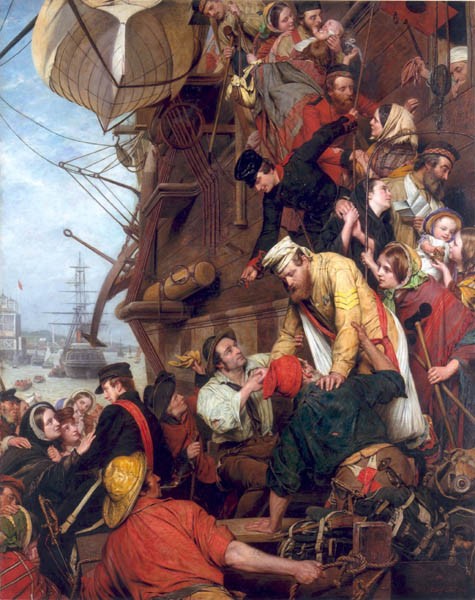
Eastward Ho by Henry O'Neil (1857)

The two works I am featuring today in My Daily Art Display are entitled Eastward Ho and Home Again.  The first was painted by O’Neil in 1857 and the latter completed the following year.  Eastward Ho focuses on the embarkation of British troops on a ship at Gravesend on their way to India to fight in the First War of Independence, known as the Indian Mutiny.    For the British people this was a just war and brought about a fierce feeling of patriotism amongst the people, who were shocked by India’s challenge to British rule and British supremacy on the sub-continent.  Sadly as in most conflict the populace are whipped up into a frenzy of righteousness by the media of the day and the young men and now young women on both sides go off to fight with a sense of belief that theirs is a just cause, their God is on their side and anyway it will all be over soon and it will be other people who will be killed, not them.  In this case they were fighting for their Empire.   The painting however was well received with the Illustrated London News describing the work and its popularity as:

“….a national epic. No wonder it is so popular that such crowds assemble around it, scanning every feature of the various actors, till at last they begin to imagine themselves present at, and participators in, the scene…”

The newspaper of the day, The Times, put it:

“….Hope and aspiration are busy among these departing soldiers, and if mothers and wives, and sisters and sweethearts, go down the side sorrowing, it is a sorrow in which there is no despair, and no stain of sin and frailty…..”

In the first painting, we see the soldiers boarding the ship bound for India and their loved ones bidding them emotional farewells.  It is a poignant scene for despite the bravado and sense of duty of the young men going off to fight their just cause with nothing but a rousing sense of duty, we observe their loved ones who are going to be left behind reluctantly letting their fighting men’s fingers slip from their grasp as they move down the gang plank.  For the men we can only see in their faces optimism and patriotism whilst in the faces of the women we see fear and a sense of foreboding.

Home Again by Henry O'Neil (1858)

O’Neil buoyed up by the success of Eastward Ho decided to work on a “follow-up” painting depicting the return of some of the fighting men to their loved ones a year on.  The soldiers are seen going down the gangway of their troop ship.  The main character appears to be the bearded soldier in khaki uniform with his Kilmarnock “pork-pie” cap under a white cotton Havelock, which was worn to afford the wearer’s neck protection from the blazinga nd merciless Indian sun.

However at this juncture not all the men returned and for many wives and girlfriends there was nobody to wait for on the quayside.  Sadly as we are only too aware of in our present time, some young fighting men who return are not the same men, physically or mentally, as those who went out, once full of optimism.   Although O’Neil wanted to be faithful to his beliefs of Realism painting he knew that for the painting to be well received he had to concentrate on the joyous return of the fortunate ones and play down the sadness of the bereaved and the portrayal of the badly injured.  He was applauded for the painting’s lack of, what the media termed,  overemotional sentimentality.  The Times of the day commented:

“…..The crowd round the picture delight to spell out the many stories it includes – its joyous reunitings, its agonies of bereavement; the latter kept judiciously down…..”

O’Neil’s follow-up work was another outstanding success and it was taken on tour around the country and it was estimated that almost sixty thousand people went to see it.  In 1860 the two paintings were exhibited side by side in Piccadilly, London where viewers had to pay six pence to view the two works.  Numerous prints of the two paintings were made and sold.

What fascinates me about the two paintings is that O’Neil has deliberately depicted some of the same people in both works.  Below I have highlighted two examples of this.  Maybe if you look closer you will find more examples of this.

The injured soldier being helped down the gangway (above left) and his wife waving him off (above right)

In another example below, the Chelsea Pensioner on the gangway waving goodbye to his son (below left) and again waving to him from the quay as he returns safely back home (below  right).

The paintings are beautiful examples of O’Neil’s work no matter what we think of his portrayal of war and those who go off to fight and I love the comparison between the emotions shown in the two works – joyous optimism that the men off to fight for their country against the somewhat muted return with its relief and sadness.

O’Neil fared well as an artist and managed to have almost a hundred paintings accepted into exhibitions at the Royal Academy, an establishment, although as a member of The Clique, he once criticised.   He was made an Associate of the Academy two years after exhibiting these two featured paintings.  O’Neil died in 1880 aged 63.

In some ways it is sad to note that nothing has changed in 150 years.  At the onset of battle campaigns the media focus on the adventure of war but now thankfully, despite the wishes of various governments,  they are not adverse to recording the devastating affect such wars have on individuakls and their families.

Mother and Child by the Sea by Johan Christian Dahl

Mother and Child by the Sea by Johan Christian Dahl (1840)

You would be forgiven for thinking today’s painting is by Caspar David Friedrich as it has all the hallmarks of similar paintings by the German Romantic painter.  My Daily Art Display today is in fact a painting by Johan Christian Dahl, who was the leading Norwegian landscape painter of his time.  The work is entitled Mother and Child by the Sea which he completed in 1840.

Dahl was born in Bergen Norway in 1788, son of a fisherman.  He studied art at school and thanks to a group of wealthy Bergen citizens who sponsored him and gave him funds, he was able to travel to the Danish capital, Copenhagen, where, at the age of twenty-three, he enrolled at the Royal Danish Academy of Fine Arts. Seven years later, in 1818, Dahl left Copenhagen for a European tour of the major art centres in Germany and Italy.  He never forgot his homeland and made many journeys back to Norway where he made many sketches of the country’s rugged landscape.  In 1824 he became professor at the Dresden Academy of Fine Arts.  Whilst living in Dresden he became part of a celebrated artistic circle which included Casper David Friedrich and with these fellow artists shaped the era of German Romantic painting which began in the second half of the 18th century.  Friedrich and Dahl when they first met immediately hit it off and they became great friends.  Friedrich helped Dahl find lodgings and buy canvas and paint.  When Dahl moved into the house where Friedrich lived, they became even closer friends. They were godfathers to each other’s children, they sent paintings together to the various exhibitions, and when one had visitors, these were taken to see the works of the other. The two friends were regarded as the typical pair of complementary artists, Friedrich was the idealist painter and Dahl the naturalist painter, but both truly committed to Romanticism. They were considered a pair to such an extent that they were always mentioned together in the exhibition reviews and people tended to order companion pieces from them.  They had differing artistic techniques.   Dahl would start his subject directly on to canvas, composed from the various drawings and studies scattered around him, at great speed and with his studio full of visitors. Friedrich began his painting only after days of meditation when the entire scene stood clearly before his inner eye. He then worked in successive thin glazes, in order to have the whole composition visible at every stage in the process. Friedrich preferred an empty studio where nothing distracted his contemplation, and when he was painting the sky in his landscapes, nobody dared to speak to him.

Johan Dahl had quite a sad personal life.  He first married in 1820 and they had four children but sadly his wife, Emilie, died giving birth to their son, Siegwald in 1827.  In 1829 his son Alfred and daughter Marie died of scarlet fever.  He remarried in January 1830 to one of his art students, Amalie von Basserwitz, but she too died in childbirth that December.  This left Dahl, with the help of his housekeeper, to bring up his two children from his first marriage, Siegwald and Caroline.   Dahl, himself, died in Dresden in 1857, aged 69.  Over seventy years later his remains where brought back to his Norwegian homeland and buried in the cemetery of St Jacob’s church in Bergen.

The painting today was Dahl’s second version of the scene and was completed the same year as his great friend Casper David Friedrich died and in some way may have been Dahl’s tribute to the German Romantic artist   It depicts a woman with her child standing on a rocky coastal landscape pointing to a boat out at sea.  The scene is illuminated by moonlight.  Dahl, like many artists during the Romantic period, painted a number of pictures with moonlight over water and of this setting he once wrote:

“…The special thing I have succeeded in doing in this piece is the faint light cast by the moon over all the scenery, a peace that is spread all over the area, which makes it solemn and beautiful. The light in the clouds, the moon, the reflections in the water, in short a certain dimness that predominates it, if I dare say it, which must both be and not be, and shows that it is night…”

The mother and child await the arrival of the boat and the homecoming of the child’s father, one of the two figures we can just make out on the deck of the craft, which moves towards them across the glassy calm sea.  It is a tranquil night.  The moon peeks through an opening of the clouds, lighting up a patch of the otherwise dark sea causing a pearlescent shimmer over the water.  There is an air of optimism about this painting as the moon lights up the scene and we see the excitement of the child at his father’s safe return.  There is a magical feel to this work of art.

Found Drowned by George Frederic Watts

Found Drowned by George Frederic Watts (c.1850)

For the second consecutive day I want to present a painting to you which has a connection with a poem.  My Daily Art Display painting today is entitled Found Drowned and was painted by the Victorian painter George Frederic Watts in 1850.  It is almost certain that the idea for the painting came from Watts having read The Bridge of Sighs, the poem written by Thomas Hood just before his death in 1845.

Watts was born in London in 1817 and his Christian names came from the fact that he was born on the composer, George Frederic Handel’s birthday.  He was brought up in an impoverished household, did not attend school, being taught at home by his father.  Despite these early setbacks in life, he achieved acceptance into the Royal Academy when he was eighteen years of age.  In 1843 he won first prize in an artistic competition to design a mural for the Houses of Parliament and although this never came to fruition, the monetary value of the prize enabled him to travel to Italy.  He remained in Italy until 1847 at which time he returned to London.

On his return to London he made the acquaintance of Henry Prinseps, an amateur artist and director of the East India Company, along with his circle of friends and in 1850, Prinseps, his wife Sara, along with some of her sisters and Watts obtained a twenty-one year lease on Little Holland House which belonged to Henry Fox, 4th Baron Holland, and a friend of Watts.  The house, not only became a place for them to all live and entertain their friends, but it gave Watts a studio for his painting.

In 1864 Watts painted portraits of the Terry sisters, Kate Terry and her famous actress sister Ellen Terry.  Watts was besotted by Ellen and despite the fact that she was still a little way short of seventeen years of age and he was thirty years her senior, they married.  The marriage was doomed to failure and a year after the marriage she eloped with her lover forcing Watts to sue for divorce.

In the early 1870’s when the lease ran out on the Little Holland House, Watts acquired another house in London and also one in Freshwater on the Isle of Wight.  In 1877 his divorce with Ellen Terry finally came through and nine years later at the age of 69 Watts re-married, this time his bride was Mary Fraser-Tytler,  a Scottish designer and social reformer, some thirty-three years his junior!   In 1891 he bought land in Guilford, Surrey and they named the establishment Limnerslease, which was a combination of the words “limner” meaning artist and “leasen” meaning glean and by it they had built the Watts Gallery which was a museum dedicated to his work.  It was the first and only remaining purpose-built gallery in Britain devoted to a single artist.  It eventually opened in April 1904, shortly before the death of Watts.

So that is the story of today’s artist and so now let us study his poignant painting and understand why he should depict such a heart-rending scene.  When Watts returned to London from Italy he was traumatized by the extremes of riches and poverty that he could see all about him.  It moved him and he realised that through his art he could bring home the inequalities of life.

The background of the painting is the London skyline and we are viewing it from under Waterloo Bridge and in the distance we can just make out Hungeford Suspension Bridge.  Waterloo Bridge had been a common place for suicides with people throwing themselves off the structure into the Thames.  In the foreground Watts has painted a “fallen woman”, a reasonably common subject in Victorian paintings.  She has drowned and been washed up on the shores of the Thames. Was it an accident or had life proved just too much for her to bear?  In those days, female suicides caused by adulterous relationships or financial hardship, which then led to prostitution, were not uncommon happenings.   Her body is lit up and is in stark comparison to the darkened background.  Her dress still floats in the murky polluted waters.  She is lying on her back with her arms stretched out in a cruciform adding religious symbolism to the picture.  In her left hand she is clutching hold of a chain, attached to which is a heart-shaped locket and this again makes us believe that unrequited love may have had some bearing on the situation.  In the night sky we see a very bright pin-point of light which could be a star of the planet Venus and Watts probably added this as a symbol of hope that maybe there will be a better after-life for the dead woman.  Look at the young woman’s face.  It appears calm.  Maybe at last she is at peace with herself.

It is interesting to note that the title of the painting Found Drowned was legal phraseology often used by coroners when there is no conclusive evidence of suicide, such as a note, and thus the coroner’s report avoids the stigma attached to suicides, which would automatically rule out a Christian Burial.

I end today’s blog with the Thomas Hood’s poem Bridge of Sighs which it is believed was the basis of Watts’ painting.  Read it through and then look at the painting and see if you agree that there is a connection between the two.

One more Unfortunate,
Weary of breath,
Rashly importunate,
Gone to her death!

Take her up tenderly,
Lift her with care;
Fashion’d so slenderly
Young, and so fair!

Look at her garments
Clinging like cerements;
Whilst the wave constantly
Drips from her clothing;
Take her up instantly,
Loving, not loathing.

Touch her not scornfully;
Think of her mournfully,
Gently and humanly;
Not of the stains of her,
All that remains of her
Now is pure womanly.

Make no deep scrutiny
Into her mutiny
Rash and undutiful:
Past all dishonour,
Death has left on her
Only the beautiful.

Still, for all slips of hers,
One of Eve’s family—
Wipe those poor lips of hers
Oozing so clammily.

Loop up her tresses
Escaped from the comb,
Her fair auburn tresses;
Whilst wonderment guesses
Where was her home?

Who was her father?
Who was her mother?
Had she a sister?
Had she a brother?
Or was there a dearer one
Still, and a nearer one
Yet, than all other?

Alas! for the rarity
Of Christian charity
Under the sun!
O, it was pitiful!

Near a whole city full,
Home she had none.

Sisterly, brotherly,
Fatherly, motherly
Feelings had changed:
Love, by harsh evidence,
Thrown from its eminence;
Even God’s providence
Seeming estranged.

Where the lamps quiver
So far in the river,
With many a light
From window and casement,
From garret to basement,
She stood, with amazement,
Houseless by night.

The bleak wind of March
Made her tremble and shiver;
But not the dark arch,
Or the black flowing river:
Mad from life’s history,
Glad to death’s mystery,
Swift to be hurl’d—
Anywhere, anywhere
Out of the world!

In she plunged boldly—
No matter how coldly
The rough river ran—
Over the brink of it,
Picture it—think of it,
Dissolute Man!
Lave in it, drink of it,
Then, if you can!

Take her up tenderly,
Lift her with care;
Fashion’d so slenderly,
Young, and so fair!

Ere her limbs frigidly
Stiffen too rigidly,
Decently, kindly,
Smooth and compose them;
And her eyes, close them,
Staring so blindly!

Dreadfully staring
Thro’ muddy impurity,
As when with the daring
Last look of despairing
Fix’d on futurity.

Perishing gloomily,
Spurr’d by contumely,
Cold inhumanity,
Burning insanity,
Into her rest.—
Cross her hands humbly
As if praying dumbly,
Over her breast!

Owning her weakness,
Her evil behaviour,
And leaving, with meekness,
Her sins to her Saviour!

The Bard by John Martin

The Bard by John Martin (1817)

My Daily Art Display today looks at a painting and the poem which inspired the work of art.   The artist who painted the picture was the English Romantic painter John Martin and his work which I am featuring today is entitled The Bard which he completed in 1817.

Martin was born in 1789 in the small Northumbrian village of Haydon Bridge which lies close to Hexham.  He was the youngest of thirteen children.  He attended the local school an although he showed a talent for drawing was not academically gifted.   In 1804, his father arranged for him to become an apprentice coach painter in Newcastle in order for him to learn the art of heraldic painting but John was not happy with the work and this, coupled with problems with wages, resulted in the cancelation of Martin’s  indentures.   His father then arranged for him to be tutored by Boniface Musso, an artist who had come to the country from Italy.  In 1806 John Martin moved from Northumbria to London with Boniface Musso and his son Charles, who a few years later sets himself up in the china and glass business and employed John Martin.  Not long after however, the business of selling painted china fell out of fashion and Musso’s business failed.

John Martin moves out of the Musso household in 1809 when he marries Susan Garrett.  The following year John submits a painting of a water nymph entitled Clytie, to the Royal Academy but it is rejected.   In 1811 he was delighted when he has his painting A Landscape Composition accepted.  The following year, by which time he has become a full-time artist, he managed to get a second painting exhibited at the prestigious establishment entitled Sadak in Search of the Waters of Oblivion and it eventually sells for 50 guineas to the Member of Parliament and  Governor of the Bank of England, William Manning.    Many of his works of this time were large in size depicting grand biblical scenes.  During this period many people made the Grand Tour of the Middle East and the Holy Land and so Martin’s paintings became very fashionable.

The year 1813 was to prove a very sad and traumatic year for John Martin with both his mother and father as well as his grandmother and one of his sons, Fenwick, dying.  His painting continued after a period of mourning and still his subjects were mainly biblical and the enormous canvases often depicted scenes of apocalyptic death and destruction.  In 1814 there is another addition to his family with the birth of his fourth child, sadly however that same year his second son, John, dies.  More bad luck was to befall the artist as he submits another painting of a water nymph for inclusion at the Royal Academy but whilst it was waiting to be hung another artist, whilst touching up his painting,  accidentally spills some dark restorative varnish over it and his work is ruined.

Joshua Commanding the Sun to Stand Still upon Gibeon by John Martin (1816)

In 1816 his fifth child Zenobia is born and in that year he exhibits his masterpiece Joshua Commanding the Sun to Stand Still upon Gibeon and once again Martin’s obsession with depicting Old Testament scenes.  For the first time we see Martin, instead of depicting a solitary figure in his biblical scene,  has filled the location with a multitude of little figures both Palestinian and Isrealites, whilst the spear-brandishing figure of Joshua takes centre stage.

And so to 1817 and the year John Martin painted today’s featured painting, The Bard.  I was drawn to this work as it has a connection with the Conwy Valley, where I live and I like its connection to a poem, with the same name, written by by Thomas Gray in 1755.  In the poem Gray narrates the story of King Edward I of England and his conquest of Wales in the late 13th century.   Following his victory over the Welsh Edward decided that all the bards, the professional poets, could be dangerous if they were allowed to spread the story of the bygone power of the Welsh people as this may incite the defeated Welsh to rise up against their English masters.

Edward ordered the Bards to be slaughtered and the painting depicts the fate of the last surviving bard who has been chased by Edward’s troops and who has climbed a precipice above a swirling river.  He stands aloft cursing the English troops, who having left their castle, are in pursuit of their quarry .  The castle, based on the one at Harlech, we see perched on rocks in the left middle-ground.  In the left foreground we see Edward’s riders with banners unfurled as they rush along the valley side like a swarm of ants.  On the top of the cliff on the opposite side of the fast flowing river we observe the bard, cursing his pursuers before throwing himself off the ledge and plunging to his death.

The painting is an example of sublime landscape style, which was very popular at the time, in which the landscapes feature craggy mountains, similar to those seen in the Alps, instead of softer rounded ones.  Waterfalls and trees seem taller than in actuality and there is a certain savagery about the depiction of the vistas.  I leave you to look at this amazing painting and read extracts from Gray’s poem, The Bard.

“Ruin seize thee, ruthless King!
Confusion on thy banners wait!
Tho’ fanned by Conquest’s crimson wing,
They mock the air with idle state.
Helm, nor hauberk’s twisted mail,
Nor e’en thy virtues, Tyrant, shall avail
To save thy secret soul from nightly fears,
From Cambria’s curse, from Cambria’s tears!”
Such were the sounds that o’er the crested pride
Of the first Edward scattered wild dismay,
As down the steep of Snowdon’s shaggy side
He wound with toilsome march his long array.
Stout Glo’ster stood aghast in speechless trance:
“To arms!” cried Mortimer, and couched his quiv’ring lance.

On a rock, whose haughty brow
Frowns o’er cold Conway’s foaming flood,
Robed in the sable garb of woe
With haggard eyes the Poet stood;
(Loose his beard and hoary hair
Streamed like a meteor to the troubled air)
And with a master’s hand, and prophet’s fire,
Struck the deep sorrows of his lyre.
“Hark, how each giant-oak and desert-cave
Sighs to the torrent’s awful voice beneath!
O’er thee, O King! their hundred arms they wave,
Revenge on thee in hoarser murmurs breathe;
Vocal no more, since Cambria’s fatal day,
To high-born Hoel’s harp, or soft Llewellyn’s lay.


Enough for me: with joy I see
The diff’rent doom our fates assign.
Be thine Despair and sceptred Care;
To triumph and to die are mine.”
He spoke, and headlong from the mountain’s height
Deep in the roaring tide he plunged to endless night.

Sir Joseph Banks by Benjamin West

Sir Joseph Banks by Benjamin West (1773)

My Daily Art Display today features two celebrated men, one the American artist, Benjamin West and the other his English sitter, the naturalist and botanist Sir Joseph Banks.

Benjamin West was born in Springfield Pennsylvania in 1738.  He came from a large family, being the tenth child.  His father was an innkeeper and ran different inns during Benjamin’s early life.  Being one of such a large family he had to look after himself a lot of the time, had little formal education and as far as his art was concerned he told his biographer, John Galt,  that he was taught how to make paint by the native Indians.  During his teenage years he began to paint, mainly portraits.  The provost of the College of Philadelphia, Doctor William Smith saw one of his works and was so impressed, he offered the twenty year old West an education which up to then had been sadly lacking but maybe more importantly he offered West the chance to meet members of the affluent society of Pennsylvania and in some cases, ones with political connections.

In 1760 these newly-found connections were to prove fortuitous as with the help of financial support from William Allen, a very wealthy merchant and mayor of Philadelphia, he travelled to Italy where he spent time copying the works of the Italian Masters such as Titian and Raphael.  Three years later he moved from Italy to England where he established himself as a portrait painter.  His works were well received and he soon built up a rich cliental including the prestigious patronage of the monarch, King George III, who appointed West the court’s historical painter.  He retained the monarch’s patronage until the turn of the century.   Whilst in England he met the great English portraitist, Sir Joshua Reynolds, and together, with the help of the monarch, founded the Royal Academy of Arts in 1768.  Reynolds was made the inaugural president and West became the second president of the Academy in 1792, a position he held until 1802.  Four years later he became Academy president again and retained that position until his death in 1820 aged 82.

The sitter for today’s portrait was Sir Joseph Banks.  Born in 1773 in London, Banks was to become the outstanding botanist of his generation.   The son of a Lincolnshire country squire and Member of Parliament, he unlike Benjamin West, received the best education possible passing through the finest educational establishments such as Eton, Harrow and Christ College, Oxford.  On the death of his father, Joseph Banks inherited the family estate of Revesby Abbey in Lincolnshire.  He had always retained his interest in science and botany and soon he began to move in the top scientific circles of London.  In 1776 he became a member of the Royal Society of London for Improving Natural Knowledge, better known simply as the Royal Society.   He was to hold the position of president of the Society from 1778 until his death.  He became a scientific adviser to King George III and through this managed to persuade the monarch to fund expeditions to the “new territories”.  In 1768 Banks was made the leading scientist on Captain James Cook’s first expedition which lasted three years, journeying to the southern hemisphere on HMS Endeavour.  On his return home from this epic voyage he was received by the public as a “returning hero” and many portraits were made of the “man of the moment” including one by Reynolds and one by today’s featured artist.

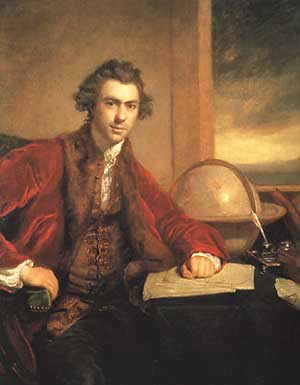
Joseph Banks by Sir Joshua Reynolds (1773)

My Daily Art Display’s featured painting is the portrait painted of our hero by Benjamin West in 1773, simply entitled, Sir Joseph Banks.  His depiction of Banks differed somewhat from the Reynold’s portrait, which was completed the same year.  In Reynolds’ portrait we see the well-groomed and charming explorer and botanist smiling at us.  He is completely at ease, sitting forward in his armchair, with his arm resting on a table strewn with pages of a letter, quill pen and ink stand and a freestanding globe.

Benjamin West’s work is a full length portrait of Banks standing amongst a selection of artefacts that the explorer had brought back home.  He is wrapped in a Tahitian cape and by him is a native headdress, a paddle from a canoe and a carved fighting staff.  If we look down at his feet we can a Polynesian adze, which was a tool used for carving and smoothing wood and by it are pages of a notebook which was a reference to the myriad of notes Banks made during his expedition with regards to all the flora and fauna he had come across during the three-year journey of discovery around the South Pacific territories.  The painting with its accoutrements even has a hint of the American Wild West, which of course the artist, West, would have seen in paintings back home.  There is also a classical element to this picture with its column and tied-back curtain in the background.  West may have picked up this type of detail when he was studying works of art during his Italian sojourn.

So there you have it, two men of completely differing backgrounds, upbringing and education, Benjamin West the artist and Joseph Banks the explorer, both of whom went on to head up prestigious London societies, and were connected through this painting and their dealings with King George III of England.