Jacob and Rachel by William Dyce

Jacob and Rachel by William Dyce (1853)

The first time I featured a painting by William Dyce was over twelve months ago (My Daily Art Display, May 14th 2011) when I looked at his painting Pegwell Bay, or to give it its full and bizarre title, Pegwell Bay, Kent – a Recollection of October 5th 1858.   To find out why the painting had such a strange title you will have to check back on the earlier blog.

William Dyce was born in Aberdeen in 1806. His father was a fellow of the Royal Society and an eminent physician.  Dyce attended the Marischal College, which is now part of the University of Aberdeen.  He trained as a doctor before reading for the church. However the course of his life changed when aged nineteen he decided to become an artist and enrolled at the Royal Scottish Academy Schools in Edinburgh and later as a probationer at the Royal Academy of London.   At the age of nineteen he made his first trip to Rome and stayed there for nine months studying the works of the great Masters such as Titian, Rembrandt and Poussin.  He returned to Aberdeen but the following year he went back to Rome and this time stayed for eighteen months.   During this second visit to the Italian capital he met the German painter, Friedrich Overbeck, who was one of the leading artists of the Nazarene Movement.   The Nazarene Movement was made up of a group of early 19th century German Romantic painters who aimed to revive honesty and spirituality in Christian art. The name Nazarene came from a term of derision used against them for their affectation of a biblical manner of clothing and hair style.

By 1829 Dyce was back in Scotland and settled in Edinburgh for several years.  To survive financially he would carry out many portraiture commissions but his main love was his religious, history and narrative paintings.   In 1837, he was appointed Master of the School of Design of the Board of Manufactures in Edinburgh and produced a pamphlet on the management of schools like the one he was working at and this was well received, so much so, that he was transferred to London as superintendent and secretary of the recently established Government School of Design at Somerset House, which was later to become the Royal College of Art.   In 1844 he was appointed Professor of Fine Art in King’s College, London, and became an Associate of the Royal Scottish Academy, and in 1848 elected to become a  Royal Academician.

In 1850 Dyce married Jane Brand who was twenty-five years younger than him.  They went on to have four children.   He died at Streatham, Surrey in 1864, aged 58.

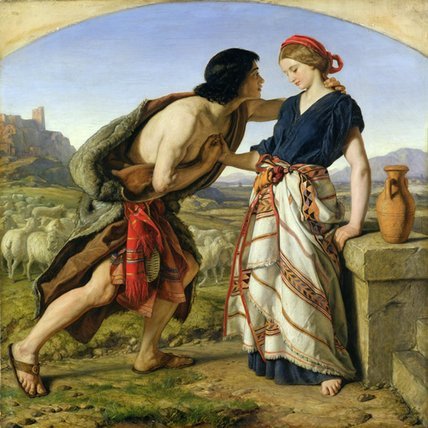
Today I am looking at a completely different type of painting by the artist in comparison to his seaside painting, Pegwell Bay.  This is a religious painting entitled The Meeting of Jacob and Rachel.  There were about four versions of this work by Dyce,  each of different size and with minor alterations but this one, which was completed by him in 1853,  is now housed in the Kunsthalle in Hamburg.  This was the original work and the only one which had a vase resting on the edge of the well.  The painting proved so popular with the public that Dyce commissioned Holman Hunt to make copies of it.

The painting is based on a story from the Old Testament book of Genesis (29: 9-14):

9 While he was still talking with them, Rachel came with her father’s sheep, for she was a shepherd. 10 When Jacob saw Rachel daughter of his uncle Laban, and Laban’s sheep, he went over and rolled the stone away from the mouth of the well and watered his uncle’s sheep. 11 Then Jacob kissed Rachel and began to weep aloud. 12 He had told Rachel that he was a relative of her father and a son of Rebekah. So she ran and told her father.  13 As soon as Laban heard the news about Jacob, his sister’s son, he hurried to meet him. He embraced him and kissed him and brought him to his home, and there Jacob told him all these things. 14 Then Laban said to him, “You are my own flesh and blood.”

This painting, Meeting of Jacob and Rachel, depicts the point in time just before Jacob kissed Rachel, and as the biblical text quotes the experience was so memorable, he lifted up his voice, and wept.  Jacob had fallen in love, at first sight, with this beautiful young woman, when he saw her standing at the well about to give water to her father’s flock of sheep.   Look at the way Dyce has portrayed Jacob.  The young man having just cast his eyes on his cousin is besotted with her.  He leans towards her almost balancing on one leg.  Look at his demeanour.  Look at the intensity of his expression as he looks into Rachel’s face. Look at his eagerness.   His emotions seem to be getting the better of him.  He clutches Rachel’s right hand and press it against his heart.  Maybe he wants her to feel how it is beating wildly.  His left hand rests on the nape of her neck.  He caresses her neck gently and at the same time his hand will guide her face towards his so that he may kiss her.  Now look at Rachel.  See how her expression differs from that of Jacob.  Her eyes are cast downwards in a gesture of modesty or is it coyness?  She cannot meet Jacob’s gaze.  The top half of her body leans away from Jacob and she steadies herself by placing her left hand on the well.

So does this meeting of man and woman result in a happy ending?  Well yes and no!   Rachel’s father, Laban was quite cunning and realised that Jacob was a young and strapping lad who could help out on the farm and so he offered him the hand of Rachel in the future, providing he would work for him.  Jacob agreed and worked for Laban for fourteen years without payment in the hope of getting the father’s blessing for his marriage to his daughter.  Then Laban made another condition for this marriage.  He wanted Jacob to first marry Rachel’s elder sister, Leah, after which he would be able to have Rachel as his wife.

So this is not just a story about young love but also a story of patient love and the way Jacob was willing to wait for Rachel.   This may have been uppermost in Dyce’s mind as it mirrored his relationship with his wife-to-be Jane Bickerton Brand who was born in 1831, for he was made to wait for her hand in matrimony as she was so young when they first met and the age difference of twenty-five years obviously further concerned her father.  William Dyce did wait and they did marry,  so all ended happily.

Ruth in Boaz’s Field by Julius Schnorr von Carolsfeld.

Ruth in Boaz’s Field by Julius Schnorr von Carolsfeld (1828)

Today I am returning to a biblical work of art and one which I saw at the National Gallery in London a fortnight ago, and like a number of paintings I have recently reviewed, it was hanging in Room 41.  There are a number of biblical events which seem to be favourites with the artistic fraternity, such as the Crucifixion, the Deposition, Susanna and the Elders, Lot and his daughters,  just to mention a few.  Today’s depiction of these two biblical characters is no different, as one or both have been seen in paintings by Michelangelo, Chagall, William Blake, William Morris, Fabritius, Nicolas Poussin and Rembrandt just to mention a few.  The biblical characters in question are Ruth and Boaz and the painting I am featuring today is entitled Ruth in Boaz’s Field by the German painter, Julius Schnorr von Carolsfeld.

Julius Schnorr von Carolsfeld was born in Leipzig in 1794.  His father, Johann Veit Schnorr was an engraver and painter and he gave his son his initial artistic training.  When Julius was seventeen years of age he attended the Vienna Academy where he studied for four years under the German portrait and historical painter, Heinrich Füger.  It was at this establishment that he made friends with fellow students, the German painter, Ferdinand Olivier and the Austrian painter Joseph Anton Koch.   A couple of years prior to enrolling at the Vienna Academy,  six of the students had formed an artistic cooperative in Vienna and  called it the Brotherhood of St. Luke or Lukasbund, a name, which followed the tradition for medieval guilds of painters.  In 1810 four of them, Johann Friedrich Overbeck, Franz Pforr, Ludwig Vogel and Johann Konrad Hottinger moved to Rome, where they occupied the abandoned monastery of San Isidro.   Julius Schnorr von Carolsfeld followed this group to Rome when he had completed his four-year course in 1815.

This grouping of German and Austrian Romantic painters was known as the Nazarenes and their formation was a reaction against Neoclassicism and the repetitive art education of the academy system. By setting up this group they hoped to return to art, which personified spiritual values, and this group sought stimulation from the works of artists of the late Middle Ages and the Early Renaissance periods.  The goal of the Nazarenes was to add to their works of art a purity of form and spiritual values which they saw in Renaissance art.  The group lived a semi-monastic existence, and they were given the name Nazarenes, by their detractors, as a term of derision, used against them for the quirky way they dressed, which imitated a biblical manner of clothing and hair style. They remained undeterred for the Nazarenes believed this was a way of re-creating the nature of the medieval artist’s workshop.  Most of their works were centered around religious subjects.

Julius returned to Germany in 1825 and went to live in Munich where he was employed by  King Ludwig I,  who that year had succeeded his late father, King Maximillian I, and had become King of Bavaria.  Julius and his staff then set about decorating the King’s palaces.  Julius was a follower of Lutherism and his later artistic phase featured biblical works.   His biblical works were often crowded scenes and were frequently criticised for their lack of harmony, unlike his featured painting today.  His biblical drawings and the cartoons he made for frescoes formed a natural lead up to his designs for church windows. His designs would then be made up into stained glass windows at the royal factory in Munich.  His fame as an artist soon spread and besides his commissions from German patrons he received many more from abroad, including ones for windows in both Glasgow and St Paul’s cathedrals.

Julius Schnorr died in Munich in 1872 aged 78.

Today’s oil on canvas painting entitled Ruth in Boaz’s Field Boaz is a biblical tale narrating the story of the first meeting between Ruth and Boaz and was painted by Julius Schnorr von Carolsfeld in 1828.   This picture was painted in Munich and based on drawings he had made a few years earlier whilst in Italy.

The subject is taken from the Old Testament Book of Ruth. Here we see the Moabite woman, Ruth, meeting with Boaz and she is gleaning (gathering up corn left after the harvest) to support her widowed mother-in-law. The landowner Boaz who talks to her has come to show his admiration for her hard work in supporting herself and her mother-in-law, Naomi.

Ruth was a daughter-in-law of Naomi, a woman from Bethlehem, who had left the city in order to escape the famine.  She, along with her husband Elimelech and their two sons, Mahlon and Chilion, travelled to the land of Moab which lay east of the Dead Sea.  However Naomi’s husband dies.  Later Naomi’s sons marry Moabite women but ten years later both of the sons die leaving Naomi with her two daughters-in-law, Orpah and Ruth.  Naomi feeling there was no reason to remain in Moab any longer decides to return alone to Bethlehem telling her daughter-in-laws to stay in Moab and return to their parent’s homes. Orpah goes back to her family but Ruth refuses to leave her mother-in-law, Naomi saying:

“…Where you go I will go, and where you stay I will stay. Your people will be my people and your God my God. Where you die I will die, and there I will be buried. May the LORD deal with me, be it ever so severely, if even death separates you and me…”

Naomi and Ruth then travel back to Bethlehem.  It is harvest time and in order to support her mother-in-law and herself, Ruth goes to the fields to glean (to gather up corn left after the harvest).  The story (Book of Ruth: 2) continues with the story:

“…And Ruth the Moabitess said to Naomi “Let me go to the fields and pick up the leftover grain behind anyone in whose eyes I find favour. “Naomi said to her, “Go ahead, my daughter.”   So she went out and began to glean in the fields behind the harvesters. As it turned out, she found herself working in a field belonging to Boaz who was from the clan of Elimelech.  Just then Boaz arrived from Bethlehem and greeted the harvesters, “The Lord be with you!”.  “The Lord bless you!” they called back.

Boaz asked the foreman of his harvesters, “Who is that young woman”    The foreman replied, “She is the Moabitess who came back from Moab with Naomi”.   She asks Boaz, “Please let me glean and gather among the sheaves behind the harvesters.”  She went into the field and has worked steadily from morning till now, except for a short rest in the shelter.’

So Boaz said to Ruth, “My daughter, listen to me. Don’t go and glean in another field and don’t go away from here. Watch the field where the men are harvesting, and follow along after the girls.”

When she sat down with the harvesters, he offered her some roasted grain. She ate all she wanted and had some left over.  As she got up to glean, Boaz gave orders to his men, “Even if she gathers among the sheaves, don’t embarrass her. Rather, pull out some stalks for her from the bundles and leave them for her to pick up, and don’t rebuke her.”

So Ruth gleaned in the field until evening. Then she threshed the barley she had gathered, and it amounted to about an ephah. She carried it back to town, and her mother-in-law saw how much she had gathered, Ruth also brought out and gave her what she had left over after she had eaten enough.

Her mother- in-law asked her, “Where did you glean today? Where did you work? Blessed be the person who took notice of you!” Then Ruth told her mother-in-law about the one at whose place she had been working. “The name of the person I worked with today is Boaz,” she said….”

The romantic story of Ruth and Boaz has a “happy ending” and for those of you who want to know what happened after that first meeting in the cornfield on the outskirts of Bethlehem you will have to read the Old Testament Book of Ruth (1-4).

Of all the biblical depictions of the couple I have seen in works of art I believe this to be the best.  The colours and tones used by the artist are superb.

The Stoning of Stephen by Adam Elsheimer (c.1604)

The Stoning of Saint Stephen by Adam Elsheimer (c.1604)

Today I am staying with the religious theme and I am also looking at another painting which is housed at the National Gallery of Scotland in Edinburgh.  My featured painting today is entitled The Stoning of Stephen by Adam Elsheimer.

Adam Elsheimer was born in Frankfurt-am-Main, Germany in 1578.  He was the son of a tailor and one of ten children.  His initial training as an artist was under the tutelage of Philipp Uffenbach, the German painter and etcher.  It is thought that in those early days he may have also been influenced by the works of the Dutch painter, Gillis van Coninxloo, as his early works show signs of the way the Dutch artist depicted forest scenes.  Coninxloo, at the time, was living in the nearby Frankenthal region having had to flee his native country in order to avoid religious persecution.

In 1598, after his initial artistic training in Frankfurt, Elsheimer travelled to Munich and from there headed south into Italy.  He initially settled in Venice and it is thought that whilst there he worked as an assistant to Hans Rottenhammer, a German painter who specialized in highly finished small scale paintings.  Rottenhammer was a master craftsman who was known for his highly-finished cabinet paintings on copper, depicting religious and mythological subjects, which were a mix of both German and Italian fundamentals of design and technique.  The term cabinet paintings was used to describe small works of art, which are usually no larger than two feet square but in many cases are much smaller. The name is especially used for paintings that depict full-length figures painted on a small scale, as opposed to a head painted nearly life-size, and these works of art are painted very precisely and with great delicacy. From the 1600’s onwards wealthy collectors of art would keep cabinet paintings in locked cabinets, hence the name, or sometimes they would be on show in a relatively small and private room in a house, to which only those with whom the house owners were on especially intimate terms would be admitted.  Elsheimer learnt a great deal from Rottenhammer in the time they were together. Most of Elsheimer’s works were cabinet paintings painted on copper plates. He was particularly admired for his use of diverse sources of illumination.  Using copper as his “canvas” meant that his pictures remained of small dimensions. But copper was an excellent medium on which to paint. It meant that Elsheimer was able to include more than fifty figures on this miniature-like plate. Copper also allowed him to put on paint in very fine and delicate strokes and by doing so the detail could be both intricate and decorative. He also took advantage of the medium to select and use very brilliant colours.

In the spring of 1600 Elsheimer moved to Rome and it was here, through his contact with Hans Rottenhammer that he met and became friends with the Flemish landscape painter, Paul Bril.  Soon Elsheimer built up a friendship with a number of artists who were working in the Italian capital at the time, such as Rubens and David Teniers the Elder.  The artistic work carried out by Elsheimer was noted in the Schilder-Boeck, which was written by the art historian Karel van Mander  in 1604.  In it van Mander praised the artist but described him as slow-working and making few drawings.    It was this small output that led to Elsheimer’s financial ruin.

In 1606, Elsheimer married Carola Antonia Stuarda da Francoforte, a lady of Scottish ancestry and a fellow Frankfurter, and in 1609 they had a son. The son was not mentioned in a census a year later, which could have been because he died as an infant or possibly because he had been put out to a wet nurse.  His wife had been the recent widow of the artist Nicolas de Breul.  In 1606, Elsheimer was admitted to the Academia di San Luca, the Roman painters’ guild.  He was a very religious man and converted to Catholicism in 1608.   In spite of his fame and talents, he appears to have both lived and impoverished life and died penniless.

Despite his reputation for being an influential artist of his time he was a perfectionist and he dwelled for ages over a single work.  This led to him being unable to finish enough pieces to actually make a living.  This perfectionist trait along with frequent bouts of depression which stopped him working combined to reduce his artistic output.  Elsheimer, despite having a talent that inspired Rembrandt and Peter Paul Rubens, and in spite of his fame and obvious talents, lived and died in difficult financial circumstances.  In his latter days he had set up a partnership with a wealthy etcher, Count Hendrick Goudt to complete a number of works but he was unable to fulfil his part of the contract with his partner.  Worse still, he had also borrowed a sum of money from his partner but was unable to repay him and was thrown into a debtor’s prison, where he died in 1610, aged 32.   Sadly, he only painted for a period of about thirteen years and only twenty-seven pictures are attributed to him.

Rubens, who owned a couple of Elsheimer’s paintings, wrote of him saying:

“…..he had no equal in small figures, landscapes, and in many other subjects. …one could have expected things from him that one has never seen before and never will see….”

And on news of his Elsheimer’s death Rubens wrote to a friend:

“…Surely, after such a loss, our entire profession ought to clothe itself in mourning.  It will not easily succeed in replacing him………….. For myself, I have never felt my heart more profoundly pierced by grief than at the news…”

Contemporaries described him as an extraordinary artist who “invented a style of small sceneries, landscapes, and other curiosities”.

The painting today is based on the New Testament story of the martyrdom of Saint Stephen.  The scene is set in Acts 7: 55-60

“…..But Stephen, full of the Holy Spirit, looked up to heaven and saw the glory of God, and Jesus standing at the right hand of God   “Look,” he said, “I see heaven open and the Son of Man standing at the right hand of God.”


 At this they covered their ears and, yelling at the top of their voices, they all rushed at him, dragged him out of the city and began to stone him. Meanwhile, the witnesses laid their coats at the feet of a young man named Saul.

 While they were stoning him, Stephen prayed, “Lord Jesus, receive my spirit.”  Then he fell on his knees and cried out, “Lord, do not hold this sin against them.” When he had said this, he fell asleep…”.

Elsheimer’s painting on copper is entitled The Stoning of Stephen which he completed around 1604 and which can now be seen in the National Gallery of Scotland in Edinburgh.  St Stephen was one of the first seven deacons of the Christian Church appointed by the Apostles and also its first Christian martyr.  His fervent preaching had incurred the hostility of the Jewish authorities who accused him of blasphemy and he was sentenced to be stoned to death outside the walls of Jerusalem.

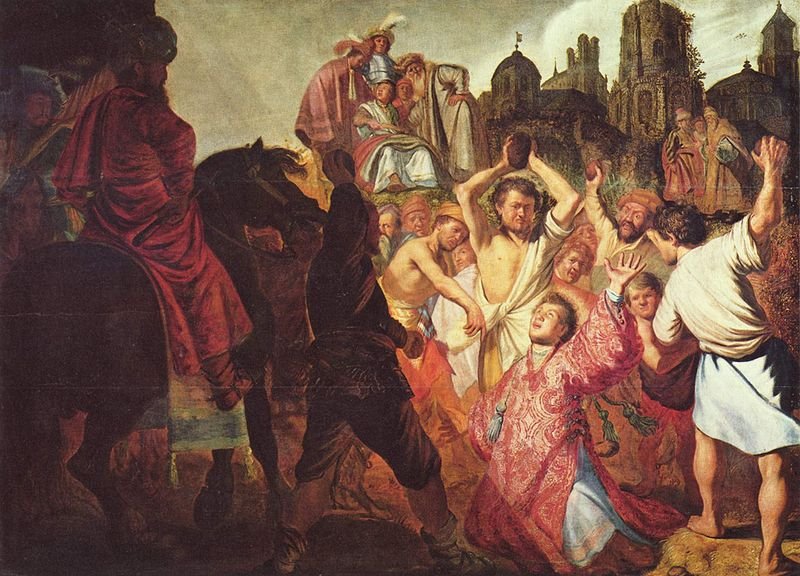
The painting before us shows the point in time just before Stephen’s execution.  He has sunk to his knees.   There is a gentle naivety about his expression.  He actually seems surprised with what is about to happen to him.  He is open-mouthed uttering his last words to God asking him to receive his spirit. His tormentors with their arms held aloft clutch large stones which they are about to rain down on the ill-fated Stephen. It is at this time that he is said to have experienced a vision of heaven and a beam of intense light  penetrated the clouds and shines down on the kneeling saint almost like a spotlight focuses on an actor on a stage.  Stephen is dressed in the robes of a deacon, and angels tumble towards him bearing the palm fronds of martyrdom and a laurel crown.

It is a small work of art measuring just 35cms x 29cms (14 inches x 11 inches).   It is an extremely colourful work and the artist has magically depicted the beams of light, emanating from the heavens at the top left of the painting, and falling on the head of the martyr.  The painting is divided into three diverse areas with diagonals creating clear tonal contrasts.  This effect is known as chiaroscuro.  To the left and right, the painting is in shadow.  On the left-hand side we see a man on horseback presiding over the execution.  This is Saul of Tarsus, who would himself late convert to Christianity and become the future Saint Paul.  On the right-hand side, also in shadow, we see some Roaman soldiers, one of whom is on horseback, and a gathering group of spectators.  The middle section is illuminated, and in this section we see Stephen and his young executioners.

The Stoning of Stephen by Rembrandt (1625)

Rembrandt’s first dated work is entitled The Stoning of St Stephen, which he completed in 1625 at the age of 19, and appears to be a response to Elsheimer’s painting of the subject.  The same chiaroscuro effect can also be seen in his version of the painting.

For me, besides the exquisite colouring and the astonishing amount of detail  Elsheimer has brought to this painting, I love the magical Italianate landscape which forms the background.  Elsheimer’s delicate portrayal of the trees and the Roman ruins exudes such a beautiful and enchanting quality. I would have loved this work of art to have been on a much larger scale but then maybe some of the enchantment would have been lost.

The Flemish landscape artist Paul Bril, who befriended Elsheimer, may have, at one time, owned this painting.

Christ in the House of Martha and Mary by Johannes Vermeer

Christ in the House of Martha and Mary by Johannes Vermeer (c.1655)

Once again, as promised in my last blog, I am returning to a painting depicting the two biblical sisters Mary and Martha.  The setting for this painting is their meeting with Christ at their home, which unlike the setting and the story behind Cagnacci’s painting Martha Rebuking Mary for her Vanity which I featured in yesterday’s blog; this meeting was recorded in the Bible.  In Luke 10:38-39 it states:

“…As Jesus and his disciples were on their way, he came to a village where a woman named Martha opened her home to him.  She had a sister called Mary, who sat at the Lord’s feet listening to what he said.  

The depiction of this meeting has been painted by many artists, such as Tintoretto in 1580, Diego Velázquez in 1618, and Rubens who painted a similar scene in 1628 but moved the setting to an outdoor terrace.  Christ at Home with Martha and Mary was painted by Joachim Beuckelaer, a kitchen scene, but from which we learnt about the rivalry between Mary and Martha.  A similar kitchen scene was depicted in the late 16th century painting entitled Christ in the House of Mary and Martha by Vincenzo Campi.  In these last two paintings Martha is depicted working hard in the kitchen whilst Mary is sitting at the feet of Christ listening to what he had to say.  The tension between the two women as highlighted in these paintings was recorded in the Book of Luke 10:40-42:

“….But Martha was distracted by all the preparations that had to be made. She came to him and asked, “Lord, don’t you care that my sister has left me to do the work by myself?  Tell her to help me!”      “Martha, Martha,” the Lord answered, “you are worried and upset about many things,  but few things are needed—or indeed only one Mary has chosen what is better, and it will not be taken away from her…”

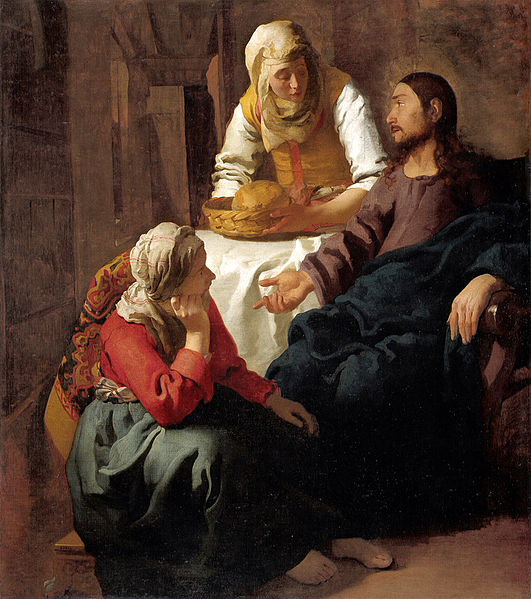
However the painting I am featuring today depicts Mary and Martha in seemingly perfect harmony as they listen to the words of Christ.  The painting is by the great Dutch Master, Johannes Vermeer and is entitled Christ in the House of Martha and Mary and hangs in the National Gallery of Scotland in Edinburgh.  He completed the work around 1655 and it is believed to be one of his earliest surviving paintings, coming some ten years before his more famous works, such as Girl with a Pearl Earringwhich he completed in 1665.    It is also thought to be one of his largest paintings, measuring 160 cm × 142 cm (63 in × 56 in) and this probably means it was painted for a specific commission.  The fact that the work is so large and has a very dark backdrop, unlike most of Vermeer’s later works it may not have been accredited to Vermeer but for his recognisable signature on the stool which Mary sits upon.

Christ in the House of Martha and Mary by Erasmus Quellinus the Younger (1650)

There is a certain similarity with the way Vermeer has painted the folds in Christ’s robe with the 1650  painting  Christ in the House of Martha and Mary by the Flemish artist Erasmus Quellinus the Younger (Musée des Beaux-Arts, Valenciennes) and one that Vermeer may have actually seen as his father, Reynier Jansz,  was an art dealer.

Before us we have the three figures, named in the title of the painting, in a kind of triangular formation almost filling the canvas.  The background is sombre and somewhat dark which ensures that we are not distracted from the three figures depicted in the work.  Our viewpoint is from the bottom left of the painting which leads art historians to believe that this could have been intended for an altarpiece which would have been above eye level.

Christ is seated, looking very relaxed.  There is a soft glow emanating from his head and this ensures that he is seen as the main figure of the three.  He wears a dark blue robe over a brown undergarment.  It is an unusual shade of blue and not the ultramarine that we see in later works by Vermeer.  The right arm of Christ stretches out as he points towards Mary.  At the same time he focuses his attention on Martha.  Our attention is immediately drawn to his outstretched arm as the colour of his skin and the brown sleeve of his undergarment stand out against the pure white of the table cloth.

Mary sits on the floor at the feet of Christ, her head resting on her hand.  She looks lovingly at Christ hanging on his every word.  Of the three she is by far the most exquisite.  Vermeer has painted her lovingly and may have been sympathetic with her contemplative nature.  Mary’s positioning in the painting at the feet of Christ is somewhat controversial as that place was usually taken up by one of Christ’s disciples and in those days for a teacher to accept a female as a disciple was unheard of.

Martha stands at Christ’s right-hand side  and we see her placing a loaf of bread on the table whilst at the same time leaning slightly forward listening to his words.  Her eyes are downcast and yet her eyebrows are raised in a questioning gesture.  She looks somewhat saddened and dissatisfied with something.  Could it be she is not happy with Christ’s support of Mary’s contemplative role?   There is a hint of a pout in her expression, which could hark back to the conflict between the two females.   All looks tranquil and peaceful in Martha and Mary’s house but I wonder if the fact that Martha is bringing in the food whilst Mary just sits and listens to the words of Christ harkens back to the different roles the women play in the household and the discord between the two sisters is caused by such differing roles.  Maybe we are at a point in time that Christ is explaining to Martha that although she is the “worker” of the household who is serving up the bread which she may just have baked, Mary’s role as a contemplative disciple is equally as important. This is more forcibly portrayed in other works of art.  I am sure there are many theologians who have looked in to the relationship between the two sisters but the general consensus is that Martha is the more aggressive and work-like female whereas Mary is the more quiet and contemplative woman.

Much has been written about the two females and it has been interesting to study the various paintings featuring the two sisters and by doing so trying to read the mind of the artist and figure out what he or she is trying to tell us about the women.

Martha Rebuking Mary for her Vanity by Guido Cagnacci

Martha Rebuking Mary for her Vanity by Guido Cagnacci (c.1660)

Today I am returning to an artist I featured back in My Daily Art Display of April 24th 2011 when I looked at two paintings of his depicting the death of Cleopatra.  He is the Italian painter of the late-Baroque period, Guido Cagnacci.

Guido Cagnacci was an Italian painter belonging to the Bolognese School, which rivalled Florence and Rome as centres of painting.    He was born in 1601 in Santarcangelo di Romagna, a town in the province of Rimini where he spent the early part of his life.  Later, he moved to Rome where he met fellow artists Simon Vouet, and Giovanni Francesco Barbieri, often better known simply as Guernico.   Cagnacci had also been a pupil of Guido Reni and he tended to combine references to classical models and to Raphael’s work with his own lively interest in the type of daring perspectives and brilliant compositions that the Baroque style favoured.   It is also believed that during this time he may have studied under an ageing Ludovicio Carracci.  He moved back east to Venice in 1650 and started to paint very sensual scenes with seductive, half-naked girls as his subject, His later paintings often featured semi-naked women as Lucretia, Cleopatra and even Mary Magdalene, as we will see in today’s offering.  These erotic paintings were very popular and much sought after by collectors at the time and through them, his popularity spread.  In 1658 he journeyed to Vienna where he gained the patronage of Emperor Leopold I and that was his ticket to fame and riches.  It also gave him the opportunity to bring to the German-speaking lands the latest classical style.

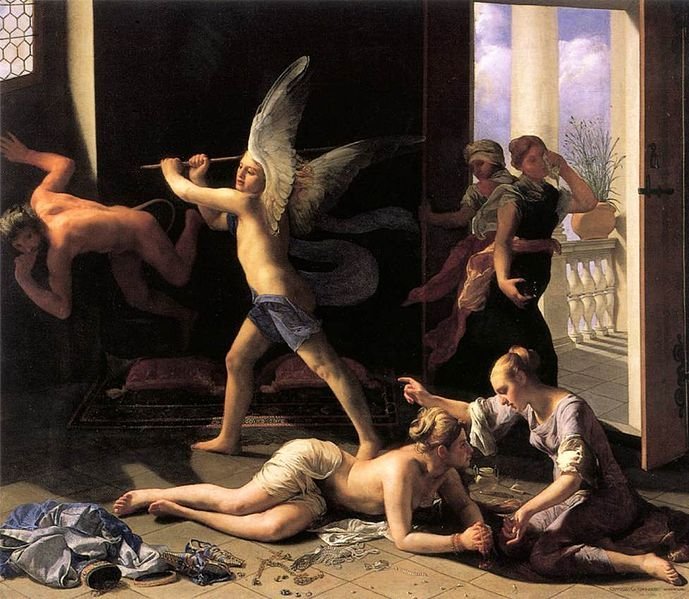
It is his contentious painting of a semi-naked Mary Magdalene that I am featuring in My Daily Art Display today.  The painting, which Cagnacci completed around 1660, is entitled Martha Rebuking Mary for Her Vanity.  The title of the painting brings up the first question one needs to consider and that is who is Mary?    Many would say that the Mary in the title is Mary Magdalene but others would disagree.  Mary and Martha are the most familiar set of sisters in the Bible. In the books of Luke and John, the pair, who lived in Bethany were described as friends of Jesus and who had a brother called Lazarus.  Though some earlier interpreters blended the person of Mary of Bethany with Mary Magdalene, current theologians believe she was a different person.  In Latin tradition, Mary of Bethany is often identified as Mary Magdalene while in Eastern Orthodox and Protestant traditions they are considered separate persons. The Orthodox Church has its own traditions regarding Mary of Bethany’s life beyond the gospel accounts.  However I will go along with the idea that in this painting we are looking at Mary Magdalene and her sister Martha.

Cagnacci's Mary Magdalene

The painting is a vivid and somewhat melodramatic allegory of Virtue conquering Vice.  Cagnacci has managed to blend reality, idealism and fantasy in the way he has portrayed the occurrence.   Lying prostrate on the floor is the semi-clad Mary Magdalene being rebuked and lectured to by Martha who sits on the floor in front of her.  Martha leans forward and is fervently lecturing her sister about the sins of Vanity pointing to the allegorical scene we see in the background. She is passionately trying to get her sister to discard the life of pleasure she had been leading up until then and turn to the life of virtue as a true follower of Christ.  Mary would seem to have recognised the life of sin she had been leading and realised, in response to the admonitions of her sister Martha, the error of her ways.  As a dramatic act of changing course, she has discarded her lavish and extravagant outer garments, jewellery and her other worldly possessions which we see scattered on the floor around her.

To the right of the painting we see a couple of servants, one in tears, symbolising contrition whilst the other looks back in disbelief and annoyance at Mary’s act of repentance and she symbolises the unremorseful face of Vanity.   In the background, mirroring what is happening in the foreground, we see an angel, symbolising Virtue driving out the demon which represents Vanity.  Cagnacci has in some ways tailored the story of the discarding of the woman’s clothes so as to give us an unusually sensuous depiction of the semi-naked Mary Magdalene.  He was often criticised for this sort of eroticism in his paintings, with critics maintaining that some artists could make anything salacious and Cagnacci was one of these.  However one must remember that Cagnacci knew that this type of painting sold well, so he would not be put off by his detractors.

The scene, which Cagnacci has painted, does not come from any particular passage in the Bible and we must believe the artist has manipulated the biblical facts of the differing character of the two sisters to suit the story behind this work.  The story of the differing personalities of Mary and her sister Martha was painted many times before by many different artists and in my next blog I will feature one by Johannes Vermeer.

Cagnacci probably completed this work whilst working for Leopold I at the Austrian court in Vienna.   The painting later went to the Gonzaga court in Mantua, which had strong ties with the court at Vienna. The painting was acquired by the Norton Simon Art Foundation and is currently housed at the Norton Simon Museum in Pasadena, California.

Ruth Weisberg and her painting

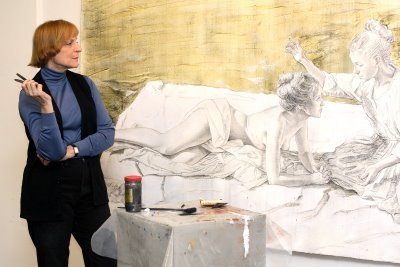
When I was researching the painting I discovered that the Museum had held a special exhibition in November 2008 entitled Guido Cagnacci and the Resonant Image which featured the Los Angeles artist Ruth Weisberg’s series of works in dialogue with Cagnacci’s Baroque masterpiece Martha Rebuking Mary for her Vanity.  It was based on her intuitive artistic reaction to the work.  Ruth created over twenty paintings and drawings which were pictorial stories on the themes of repentance, anger and ultimately the triumph of virtue over vice. In one she even depicts herself and family members as characters from the Cagnacci work.

The Risen Christ by Bramantino

The Risen Christ by Bramantino (c.1490)

Today I am returning to an Italian painting for My Daily Art Display and want to look at The Risen Christ by the fifteenth century Italian painter and architect, Bartolomeo Suardi.  He was better known simply as Bramantino, (little Bramante) as he was a devoted follower of his one-time tutor the great Italian architect, who designed St Peters, Donato Bramante.

Bramantino was born in Milan in 1456, the son of Alberto Suardi.  Initially trained as a goldsmith but later turned his attention to painting.  His initial artistic training was with Donato Bramante who profoundly shaped his artistic style.  His style as a painter is somewhat complex and diverse.  In his early career he was also influenced by the drawings of Piero della Francesca.  It was not until he was in his mid-thirties that he exhibited his first works.  It was at this time, around 1490, that he completed today’s featured painting, The Risen Christ as well as another of his great compositions, The Adoration of the Magi

Bramantino worked for Gian Giacomo Tivulzio for whom he designed a series of cartoons for a  tapestry cycle on the twelve months of the year which can now be found in the Castello Sfozesco.  Trivulzio, a nobleman and warlord, had over time, built up a great wealth, which he used in part as a patron of arts and in particular on works by Bramantino.   These commissions included the Trivulzio Chapel in the Basilica of San Nazaro in Brolo where he was eventually buried. In 1508 Bramantino was in Rome on a commission he had received from Pope Julius II to produce some frescos for one of the reception rooms in the Vatican.  The next year following his work for the pontiff he returned to Milan and was inundated with new artistic and architectural commissions.  In 1525 aged sixty-five he was appointed architect and painter to Maria Sforza, the Duke of Milan.  In the following years he produced many religious paintings for his patron including a Crucifixion which I saw when I visited the Pinacoteca Brera in Milan and a Virgin and Child with Saints, which is in the collection at Palazzo Pitti in Florence.

Bramantino died in Milan in 1530 aged 70.

My Daily Art Display featured painting is an oil on panel work entitled The Risen Christ which Bramantino completed around 1490 and is now hanging in the Museo Thyssen-Bornemisza Gallery in Madrid.  It is a haunting portrayal of Christ.  I feel somewhat uneasy when I look at this work of art.   It is a very powerful portrayal but the power of it is not dependent on a depiction of violence or splashes of blood oozing from wounds.  In some ways, and in comparison to other paintings which depict the risen Christ, it is somewhat downbeat.  This is not a portrayal of a triumphant Christ having risen from the dead.

 Before us is a full frontal ,three-quarter length portrayal of Christ with the shroud of his burial wrapped around his shoulders.  This is a man who has passed through death and is now no longer part of this world.   Look at the luminosity Bramantino gave to Christ’s skin.  It is a combination of translucent white and grey.   The cloak, which Christ is wearing, has a metallic lustre and mirrors the paleness of his skin.  The shroud and the body of Christ seem to emit light.  His body, with its raised veins, shows the wound caused by the lance to his right side and the palms of his hands show the scars caused by the crucifixion nails.  In contrast to the colour of his body, his face is not so pale with Bramantino contrasting the ghostly pallor of the body with the reddish/brown of his face and his red hair which hangs down to the shoulders. The long hair and the and the hint of a beard which follows the jaw line helps to elongate the face.  Despite the colouring, his face is gaunt and haggard and bears testament to his mental and physical suffering he has had to endure.  There is a distinct look of sadness in his reddened eyes.  He looks directly at us but it is a penetrating and hauntingly pained look.  He almost appears to look through us with this riveting stare.  There is an air of detachment about Christ which serves to emphasise the fact that he is no longer part of our world. 

To the left, in the background we have a nocturnal landscape.  We can just make out a riverscape with a ship with its tall cross-shaped masts and two campaign tents topped by golden balls.  This part of the painting  is illuminated by moonlight and in some way manages to offset the emotional stress of the foreground.  Bramantino’s architectural interest can be seen coming out of the darkness on the right of the painting in the form of some classical architecture which could represent Christ’s burial tomb in the Garden of Gethsemane. To the left the buildings seemed to have fallen into a state of disrepair with vegetation growing wild from their tops.

What I like about this painting is that Bramantino has managed to stop us in our tracks when we first cast our eyes on the work.  He has managed that without the histrionics of bloody gore.  The pale figure has grabbed our attention and made us focus our mind on what has happened during the lead up to this situation.

Portrait of St John of Avilla by Pierre Subleyras

Saint John of Avila by Pierre Subleyras (1746)

Pierre Subleyras was born in Saint-Gilles-du-Gard, a town close to Nimes in the south of France in 1699.  He was a pupil of his father and later of the French painter, Antoine Rivalz, in Toulouse. In 1726 he studied at the Royal Academy of Painting and Sculpture in Paris, where he was awarded the Premier Prix de Rome, which was a scholarship for arts students, principally of painting, sculpture, and architecture. It was created, initially for painters and sculptors, in 1663 in France during the reign of Louis XIV.   It was awarded annually and came with a bursary for promising artists having proved their talents by completing a very difficult elimination contest. The competition was open to the students of the Academy and starting in 1666, the award winner could win a stay of three to five years at the Palazzo Mancini in Rome paid for by the King of France.    

In 1728, Subleyras went to Rome where he received a painting commission from Frederick Christian, the Elector of Saxony, and this led to him being accepted into the Roman artists’ guild known as the Academia di San Luca.  He remained in Rome for the rest of his life and carried out many commissions for the Catholic Church.  He painted a variety of subjects, which included portraits of Pope Benedict XIV.  He also painted the portrait of the Italian priest and nobleman who was a great art collector and patron of Subleyras and who was eventually elevated to become Cardinal Valenti Gonzaga.  He painted many still-lifes, but his reputation was built around his religious paintings, which are much more serious in spirit than most French work in the Rococo period.

His most famous work is the Mass of St Basil, which he painted for St Peter’s.  The painting that served as the cartoon for this altarpiece was commissioned from Pierre Subleyras.   He was paid for the picture, which is now in S. Maria degli Angeli, Rome.  This huge picture was highly acclaimed when it was unveiled in 1748, but Subleyras died before he could follow up his success.  A modello of the work is currently housed at the Metropolitan Museum in New York.

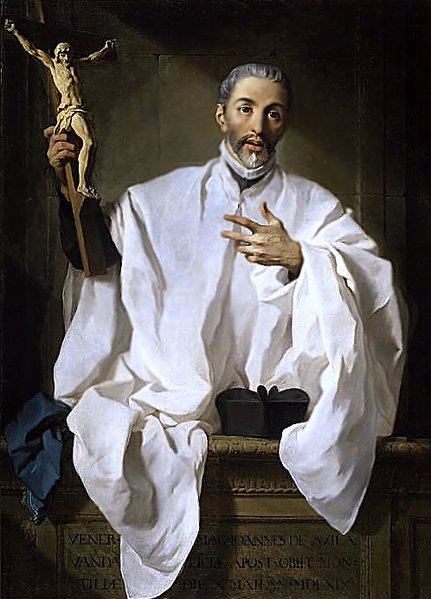
However, My Daily Art Display featured painting for today is another of Subleyras’ works.  It is his portrait of St John of Avilla which he completed in 1746 and now hangs in the Birmingham Museum and Art Gallery.  Saint John of Avila (1500-69) is often known as the Apostle of Andalusia.  Shortly after his ordination to the priesthood, Saint John gave his family’s wealth to the poor and prepared to do missionary work in the New World. However, the Archbishop of Seville intervened, for in the wake of the release of the southern-most region of Spain from almost eight centuries from 711 to 1492 of Islamic rule, the archbishop wanted to restore and revitalize the Catholic Faith in Andalusia, and he convinced Saint John, who was a renowned preacher, to take on the task.  He remained in Andalusia for nine years and afterwards continued his missionary activities throughout Spain and is, to this day, one of the most beloved of Spanish saints.  He was beatified by Pope Leo XIII on November 12, 1893, and Saint John was canonized on May 31, 1970, by Pope Paul VI.  St John of Avila is one of the Catholic Church’s greatest heroes, even if relatively little is known about him outside Spain, where he is patron of the nation’s priests.

It is a mesmeric work with the light falling on the white vestments of St John as he stands in the pulpit holding up the cross with the crucified Christ. The long fingers of his left hand lay across his chest as he points towards the cross.   His greying hair adds to the dignity of the figure.  His dark eyes look out at us as he preaches his sermon. His black biretta lays before him on the edge of the raised pulpit.  This painting is a personification of his greatest gift – the power of oratory and it was this God-given gift that enabled him to win over the hearts of minds of the Andalusian people.

Lot and his Daughters by Artemisia Gentileschi


Lot and His Daughters by Artemisia Gentileschi (C.1640)

The other day I was asked a question about a painting and the painting within that painting and it was whilst researching into the answer I came across My Daily Art Display’s featured painting of today.  My Daily Art Display painting today is entitled Lot and his Daughters by Artemisia Gentileschi.  I had previously featured a painting with the same title by Lucas Cranach the Elder back on August 20th and there are numerous similar works by other Renaissance artists who have depicted the biblical scene including Orazio Gentileschi, the father of today’s featured painter.

Artemisia Gentileschi was born in 1593 in her parents’ home on Via Ripetta, near S. Giacomo degli Incurabili, a church dedicated to St James the Great, in the Corso near Piazza del Popolo. She was the first born of five children of the Tuscan painter Orazio Gentileschi, then 30, and Prudentia Montone Gentileschi, who was then just 18 years old.   The Gentileschi family always lived in the artists’ quarter between Piazza del Popolo and Piazza di Spagna, in the Campo Marzio, Latin for the Field of Mars and the nearby church of Sta. Maria del Popolo, which was built in 1520 and contains works by Raphael, Bernini and Caravaggio.  Artemisia’s mother died in childbirth aged 30 when Artemisia was just twelve years of age and she was brought up by her father.  Artemisia studied painting in her father’s workshop and accounts of her early life tell of how she was a far better student than her brothers who were also being trained as artists by their father.  Her father introduced her to the Roman artists of the time including the great Michelangelo Merisi da Caravaggio.

Much of Orazio Gentileschi’s work was influenced by Caravaggio and in turn Artemisia’s style of painting in her early artistic days was also inspired by him.  The one main difference between the painting styles of father and daughter was that Orazio’s works were idealized, her paintings were more naturalistic in nature.  Artemisia was indebted to her father in the way he supported her artistic ambitions as at that time women were not considered to be intelligent enough to be an artist and her artistic talent, which was plain to see even in those early days, was heavily criticised by her male counterparts who were jealous of her artistic gift.  Artemisia was not to be put down and fought for her right to become an artist and her determined and unwavering attitude eventually gained her the respect she deserved and ultimately it gained her justifiable credit for her work.

She produced her first major work at the age of seventeen.  It was Susanna e i Vecchioni (Susan and the Elders) which she completed in 1610.  This biblical subject was another which had been, and was to be painted many times over.  However Artemisia’s painting shows how she incorporated the realism of Caravaggio into the work and is one of the few Susanna paintings showing the actual sexual assault of the two Elders as a traumatic event.

Two years later an incident occurred which was to change the course of Artemisia’s life.  Her father was working on a commission for Pope Paul V inside the Pallavicini Rospigliosi Palace along with fellow painters, one of whom was the Florentine artist,  Agostino Tassi.  Orazio got on well with his fellow worker and contracted him to tutor his daughter privately. It was during this tutelage that Tassi raped Artemisia. At the time she was nineteen years of age.  Instead of reporting the incident to her father she said nothing and continued to have sexual relations with her mentor, as Tassi had managed to placate her by promising her marriage.   Tassi however, had other ideas and broke off the liaison citing her unfaithfulness with another lover as the reason for the end of the relationship.   It was at this point that Artemisia’s father pressed rape charges and Tassi was arrested and put on trial for rape and for the theft of a painting from Orazio’s workshop.

The trial lasted several months and is well documented and the transcripts of the trial still exist.   The case followed a similar pattern that is familiar nowadays with the defendant maintaining that his victim had not been a virgin but was a willing lover and in fact had had many lovers and was an insatiable “whore”.  The assertion that Artemisia was not a virgin was the crucial issue and it has to be remembered that the fact that Artemisia had maintained that she had been a virgin prior to the rape was the only reason the courts would countenance a trial.  However she had to undergo the embarrassment of a number of  thorough gynaecological examinations by midwives to determine whether she had been “deflowered” recently or a long time ago and she even underwent intense questioning sometimes being tortured using a sibille, a type of thumbscrews, for the officials to come to a decision about the charges she had laid against Tassi.  Tassi denied ever having had sexual relations with the virginal Artemisia and brought many witnesses to testify that she was “an insatiable whore.”   During the court case, it came to light that Tassi had previously been imprisoned for having an affair with his sister-in-law and had planned to kill his wife.   Unfortunately for Tassi, a witness was produced who recounted how he had heard Tassi boasting about raping Artemisia.  Tassi was found guilty and sentenced to one year’s imprisonment.

A month after the trial ended, her father arranged for Artemisia to marry a Florentine artist, Pietro Antonio di Vicenzo Stiattesi and soon after the couple moved home to Florence.  Soon after the trial, Artemisia Gentileschi painted Judith Slaying Holofernes .  The painting is remarkable not only for its technical proficiency, but for the original way in which Gentileschi portrays Judith, who had long been a popular subject for art.  A year after moving to Florence, Artemisia gave birth to their daughter Prudentia.  In all they had four sons and the one daughter but it was only Prudentia who survived childhood.  She and her husband worked at the Academy of Design, and Artemisia became an official member there in 1616.  This was an extraordinary tribute to be paid to a woman of her day and this almost certainly came through the good auspices of her Florentine patron, the Grand Duke Cosimo II of the powerful Medici family.   It was during her time in Florence, that he commissioned a number of  paintings from her and soon betters her husband’s reputation.  Artemisia Gentileschi remained in Florence producing works for Cosimo II until his death in 1621 at which time she returned to Rome.

The following year her husband is charged with assaulting one of a group of Spaniards, who were outside their home serenading Artemisia. By 1623, her husband is no longer listed as being a household member and it appears that they have separated permanently. Artemisia continued to live in Rome until about 1627,when she moved to Venice.  A year later she was in Naples, living with her daughters and servants.  Always in search of new patrons she finally found one, King Charles I of England who was an art-collecting monarch and who surrounded himself with many continental artists including Artemisia’s father Orazio.  Her patronage ended suddenly with the outbreak of the English Civil War and the execution of her patron Charles.  Artemisia returned to Naples where she spent the rest of her life.  She died in there in 1654, aged 61.

Although the story about Lot’s wife being turned into a pillar of salt when she disobeyed God by looking back at the burning cities of Sodom and Gomorrah is very well known and told to children who receive bible studies or religious education, the follow-up biblical tale about Lot being plied with wine until he was drunk by his daughters, who then seduce him, and have a sexual relationship with him in order to have children is for obvious reasons often left off the religious curriculum in schools, or at least I can say, with hand on heart, it wasn’t mentioned during my religious lessons.

The Bible passage Genesis (19: 30-38) sets the scene:

30 Lot and his two daughters left Zoar and settled in the mountains, for he was afraid to stay in Zoar. He and his two daughters lived in a cave. 31 One day the older daughter said to the younger, “Our father is old, and there is no man around here to give us children—as is the custom all over the earth. 32 Let’s get our father to drink wine and then sleep with him and preserve our family line through our father.”

33 That night they got their father to drink wine, and the older daughter went in and slept with him. He was not aware of it when she lay down or when she got up.

34 The next day the older daughter said to the younger, “Last night I slept with my father. Let’s get him to drink wine again tonight, and you go in and sleep with him so we can preserve our family line through our father.” 35 So they got their father to drink wine that night also, and the younger daughter went in and slept with him. Again he was not aware of it when she lay down or when she got up.

36 So both of Lot’s daughters became pregnant by their father. 37 The older daughter had a son, and she named him Moab; he is the father of the Moabites of today. 38 The younger daughter also had a son, and she named him Ben-Ammi ; he is the father of the Ammonites of today.

Artemisia Gentileschi painted the subject in the 1640’s at the height of the Baroque era.  In the painting she elected to portray the scene of wining and dining prior to the first seduction.  Lot sits between his two daughters at the entrance to their cave.   In the left background, far behind them, the city burns, and in the middle distance Lot’s wife is frozen into a Baroque statue, her arms outstretched in terror. The three main figures are intricately interlocked by a system of rhyming arms and legs.   Three prominent arms take us across the painting from left to right in a slowly falling rhythm: the daughter’s arm on the wine jug rhymes strongly with Lot’s lower arm which in turn intersects with a third arm that curves gently down to the tabletop. This strong physical  linking, with its relationship to the wine jug, wine glass and bread, has set the scene and in some ways incriminates the father and daughters in the incest which follows.  In this portrayal of the scene unlike others the artist has not depicted Lot as somebody who is so drunk that he is incapable of knowing what is happening and thus unable to thwart the incest.  He is not shown as a passive victim of the affair.  Artemisia has portrayed all three members of the family as having an active role of what is about to happen.  The girls are virgins, a state which will soon change.

The daughter to the right of the painting is well highlighted and one must suppose that she is the elder daughter and the first to seduce her father.   Look at the colours of the girls’ clothing; blue, white and gold.  We have the rich blue which is the colour often used in the portrayal of the Virgin Mary.  We have the white which symbolises virginal innocence and we have gold which is symbolic of purity and preciousness.  The elder daughter twists round, almost contorted, to look at her father.  One end of the rich blue fabric snakes between her thighs whilst the other end lies close to the thighs of her father.  Is that just coincidental or are we to believe that maybe Artemisia has placed the sash between the daughter’s thighs as an indication that this is exactly where her father will position himself during their sexual act?  Again, are we reading too much into the painting if we compare the bread which is on the table as having had its outer skin violently broken and its fresh interior exposed to the light with the act of the virgin being deflowered?  Another strange departure from the biblical tale is the action of the father.  In the Bible we are told that the daughters plied their father with drink so he became drunk and did not know what was about to happen, but look closely at the picture.  The daughter with the wine is on the left and the father is passing his wine glass to the daughter on the right as if he is plying her with wine and not the other way around.  Look at his facial expression.  What do you read into it?  Is it a look of a man who is becoming befuddled and not in control of the situation or is this the look of a man who is beginning to enjoy himself and is encouraging his elder daughter to imbibe and  take pleasure in what is happening?  Is this another way in which Artemisia is implicating him in the sexual acts which were to follow?  Is Artemisia trying to tell us that the man is not without guilt?  So the question you must ask yourself as you look at this painting is whether the artist is portraying Lot as almost a lecherous old man or one that is being hoodwinked by the daughters?  If you believe the former, as a lot of feminists do, why did Artemisia portray him that way?  Had her being raped altered her view of men and thus she would not have us believe Lot was just an old man being hoodwinked by his daughters?  Remember also that her artistic career and her eventual fame did not come easily as she was thwarted throughout her life – by whom?  Men !!!!

Many questions and some controversial answers.   I will let you form your own conclusions.

Just a little addition to the original blog:

The sibille was a long cord which was wound round the base of each finger then the palms of two hands were tied together, palm to palm, at the wrists.   Then the cord was threaded around each pair of fingers.  A large wooden screw is then attached and turned so the cord tightens digging into the flesh, cutting it and eventually it would cut down to the bone.  The pain would have been excruciating.

Flagellation of Christ by Piero della Francesca

The Flagellation of Christ by Piero della Francesca (c.1460)

My Daily Art Display today has me in a quandary.  When I choose a painting for the day I have to spend a number of hours researching the artist, the painting and the subject of the painting and then try and collate all I have discovered into a meaningful and yet not too verbose blog.  Sometimes I struggle to find the information I need from the hundreds of art books I have hoarded, the internet and the local library.  On other occasions, like today, I was overwhelmed by the vast amount of information there was with regards the work of art and now I have the difficult task of trying to filter out what I don’t need.  In this case, I also have to contend with the many varied and conflicting interpretations of what we are actually looking at.  The one thing which is common to all that I have read about the work of art is the praise upon praise which has been heaped on it and yet when I look at it, I struggle to appreciate or understand its so-called “greatness”.  However I will let you decide and if you want to comment and tell me that like Kenneth Clarke, the art historian, who declared it to be the “Greatest Small Painting in the World”,  you also believe it to be one of the greatest paintings of all time, then tell me why you think that.

Before I talk about the painting, let me first look at the life of this Early Renaissance painter and mathematician, Piero della Francesca.   Yes, you read that correctly – mathematician, for as well as being a revered painter, he is now looked upon as the greatest mathematician of the 1400’s.   Piero was born in 1415 in the town of Borgo Santo Sepolcro, now Sansepolcro, eighty kilometres east of Florence.  His father Benedetto de’ Franceschi was a tradesman and his mother was Romana di Perino da Monterchi.  At an early age he began his artistic apprenticeship and at the age of fourteen he and another apprentice, Domenico Veneziano worked on frescoes for the Sant’ Egidio Church in Florence.  It was during this time spent in Florence that Piero would have probably come into contact with the great Florentine artists of the time such as Fra Angelico, Mantegna and the architect, Brunelleschi.

Records show that Piero had returned home to San Sepolcro by 1442 and three years later had received a large commission from the Compagnia della Misericordia, a confraternity of Borgo San Sepolcro, for a polyptych as an altarpiece for the local church, Church of the Misericordia,.  The confratentiy had asked Piero to complete the work in three years, setting the anticipated completion date as 1445.  Piero however did not feel constrained by this suggested timeline and any way he had many other projects on the go at the time and in the end did not complete the altarpiece until 1462, some seventeen years late!

Piero della Francesca travelled widely around Italy completing commissions for frescoes including some papal work in Rome.  At the age of fifty-four he moved to Urbino, where for almost the next twenty years he worked for Count Federico III da Montefeltro, the Lord of Urbino (see My Daily Art Display for March 23rd).  It was during his stay at Urbino that he completed today’s featured work, The Flagellation of Christ, somewhere between 1455 and 1460. 

In his later years, around 1482, Piero della Francesca was living in Rimini where he had a studio.  As he grew older he had given up painting, the artist biographer Vasari put this down to his failing eyesight but this has since been contradicted because it is known that he wrote and completed a mathematical treatise in 1485, when he was seventy years of age.  It could be that his love of mathematics had overtaken his love of painting.  He died in 1492, aged seventy seven at his home in San Sepolcro.

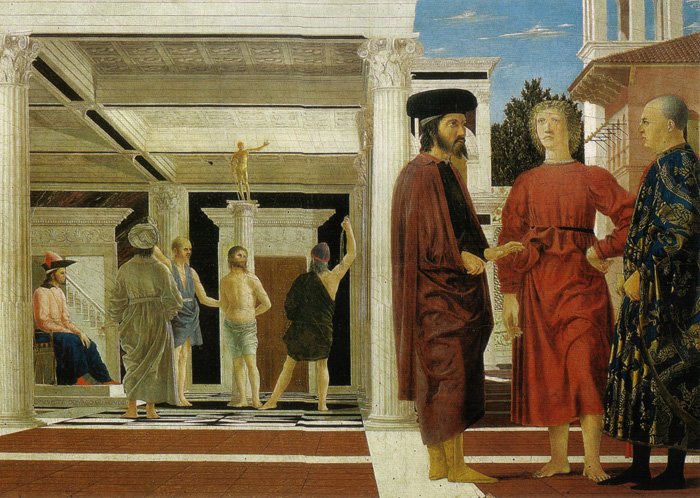
 The Flagellation of Christ is an oil on panel painting and one of the most famous paintings completed by Piero della Francesca.  It is one he painted during his first visit to Urbino.  Look closely at the painting.  The setting is the portico of Pontius Pilate’s palace in Jerusalem.  Are we looking at one scene divided into an outdoor and indoor location or are the two scenes we observe, depictions of two different times?    The latter is a popular theory.  It is generally agreed that the inner depiction of the flagellation is set at the time of Christ but the outdoor setting in the right foreground, with the three men, is set in the fifteenth century.  One pictorial argument favouring the time separation of the two scenes is that the background scene is illuminated from the right whilst the outdoor scene with the three men is illuminated from the left.

The whole scene is dominated by architecture with a stunning use of perspective which adds a sense of realism and manages to draw our eyes towards the small figure of Christ despite the fact that the actual flagellation takes place in an open gallery in the middle ground of the work.   Also in the flagellation scene, we have Pontius Pilate seated on the left and possibly King Herod with his back to us.   In the foreground on the right hand side we see three figures, who appear not to be paying any attention to what is happening behind them. So who are all the various people featured in the painting?  It would be great if there was a clear cut answer to that question but different experts have different ideas and so I had better offer you a few alternatives and let you pick which one sounds the most probable to you.

One theory put forward about the reason for the commissioning of this work is that that the painting was an attempt to favour the reconciliation between the two Christian churches, of the East and of the West, because of an impending attack by the Turks on Constantinople. Both the presence of the character in the centre, dressed after Greek fashion, and an inscription on the frame convenerunt in unum would seem to support this interpretation.

We know that the painting was commissioned by the then Duke of Urbino, Federico da Montefeltro.  The conventional interpretation of this painting and the one which is still upheld in Urbino as the true interpretation of the work, is that the three men in the right foreground of the painting are, in the centre, the Duke of Urbino, Oddo Antonio da Montefeltro, the predecessor of Federico, the commissioner of the work, and is flanked, on each side by his advisors, Manfredo dei Pio and Tommaso di Guido dell, Agnello.    All three were dead.  Oddo Antonio was assassinated a few months after coming to power because of the unpopularity of his laws and his advisors suffered a similar fate.  Another interpretation is that Oddo Antonio is in the centre and the characters either side of him were his assassins, Serafini and Riccardelli.  A third suggestion is that this is simply a dynastic painting commissioned by Federico in which he has his three predecessors depicted.

There are more possibilities and books and treatises have been written about the painting with various suggestions as to the identity of each of the characters  but I will leave it there and if you want to look deeper into the interpretation of the painting, do so and I will be interested to see what you find out.  So back to my original question which still puzzles me; why is this painting by Piero della Francesca look on as being “a great work”?    Is it the artistic quality of the painting or is it the mathematical quality of the perspective which has art historians tell us it is a gem?

Rebecca and Eleazar at the Well by Giovanni Battista Piazzetta

Rebecca and Elizear at the Well by Giovanni Battista Piazzetta (c.1740)

Today I am returning to Italy for My Daily Art Display painting.  It is a painting based on a biblical tale and one that features the work of the Venetian rococo painter of religious subjects, Giovanni Battista Piazzetta.  Piazzetta was born in Venice in 1682.   His father, Giacomo was a sculptor, and he gave his son his first artistic tuition, concentrating on wood sculpture.  Starting in 1697, at the age of fifteen Giovanni started studying painting under the auspices of the painter Antonio Molinari, an Italian artist of the Baroque era of Venice. Later in his early twenties he went to Bologna and studied under Giuseppe Mari Crespi, another Baroque painter, who was part of the Bolognese School of painting.   The Bolognese School of painting thrived in this capital city of Emilia Romagna during the 16th and 17th centuries and was considered the equal of Florence and Rome as the perceived centre of Italian painting.   It was probably Crespi who persuaded Piazzetta to take up genre subjects.   Piazzetta remained in Bologna for two years and was influenced by the works of another Bolognese artist, Giovanni Francesco Barbieri, who was the cross-eyed painter and who was better known by his nickname, Guernico, which in Italian means ‘squinter’!  Guernico was renowned for his religious paintings and altarpieces, with their rich colours and dramatic storytelling and his influence can be seen in some of Piazzetta’s own religious works.  Today’s featured painting is a great example of this aspect of his work.

Piazzetta returned to Venice in 1710 but struggled somewhat to get commissions in comparison with his artistic contemporary, Sebastiano Ricci and the young “newcomer on the block” Giovanni Tiepolo,  who had both begun to corner the market with their popular late Baroque/Rococo works.  However Piazzetta supplemented his income by illustrating books. His presentation drawings, portraits, and character heads, usually made in charcoal or white chalk, were also in wide demand from discerning collectors. He was a slow worker, and often painted the same subject several times with subtle modifications.  He was a perfectionist.  In 1750 Piazzetta became the first director of the newly founded Venice Academy of Fine Arts, which was established by the Senate and included courses of Academy Figure, Portrait, Landscape and Sculpture.  He devoted himself in the last few years of his life to teaching and although never wealthy he was always admired for his art work.   He died in Venice on April 28, 1754, aged 72.

My Daily Art Display featured painting today is by Piazzetta and is entitled Rebecca and Eleazar at the Well.  He completed this oil on canvas painting around 1740 and was one I saw when I visited the Brera Gallery in Milan.  As I said at the beginning, this painting is based on the Old Testament story in the Book of Genesis, (Chapter24).  For those of you are unfamiliar with the story let me give you a précis of the biblical tale.

Abraham who was  well advanced in years, had a son named Isaac and wanted to find a good wife for him.  He spoke to his trusted servant Eleazar and said:

“…Put your hand under my thigh, that I may make you swear by the Lord, the God of heaven and God of the earth, that you will not take a wife for my son from the daughters of the Canaanites, among whom I dwell, but will go to my country and to my kindred, and take a wife for my son Isaac…”

The servant Eleazar was concerned that the woman he chose for Abraham’s son would not want to come back with him and asked why he could not choose a local girl instead, but Abraham would have none of that idea and eased the mind of his servant:

“ … The servant said to him, ‘Perhaps the woman may not be willing to follow me to this land. Must I then take your son back to the land from which you came?’   Abraham said to him, ‘See to it that you do not take my son back there.  The Lord, the God of heaven, who took me from my father’s house and from the land of my kindred, and who spoke to me and swore to me, ‘To your offspring I will give this land,’ he will send his angel before you, and you shall take a wife for my son from there.  But if the woman is not willing to follow you, then you will be free from this oath of mine; only you must not take my son back there.”  So the servant put his hand under the thigh of Abraham his master and swore to him concerning this matter…”

And so Eleazar set off on his quest and he later relates the meeting with Rebekah:

“…Then the servant took ten of his master’s camels and departed, taking all sorts of choice gifts from his master; and he arose and went to Mesopotamia to the city of Nahor.  And he made the camels kneel down outside the city by the well of water at the time of evening, the time when women go out to draw water…”

So Eleazar had reached the well but was now concerned about how he would decide which woman he should choose for the wife-to-be of Isaac:   

 “…And he said, “O Lord, God of my master Abraham, please grant me success today and show steadfast love to my master Abraham.  Behold, I am standing by the spring of water, and the daughters of the men of the city are coming out to draw water. Let the young woman to whom I shall say, ‘Please let down your jar that I may drink,’ and who shall say, ‘Drink, and I will water your camels’—let her be the one whom you have appointed for your servant Isaac. By this I shall know that you have shown steadfast love to my master.”

 Before he had finished speaking, behold, Rebekah, who was born to Bethuel the son of Milcah, the wife of Nahor, Abraham’s brother, came out with her water jar on her shoulder. The young woman was very attractive in appearance, a maiden whom no man had known…”

 Then Rebecca’s brother and mother came to Eleazar, who was standing at the well:

 “…Then Laban and Bethuel answered and said, “The thing has come from the Lord; we cannot speak to you bad or good.  Behold, Rebekah is before you; take her and go, and let her be the wife of your master’s son, as the Lord has spoken.”    When Abraham’s servant heard their words, he bowed himself to the earth before the Lord.  And the servant brought out jewelry of silver and of gold, and garments, and gave them to Rebekah. He also gave to her brother and to her mother costly ornaments…”

 So it is at this point of the story that we can now look at today’s painting in which Piazzetta pictorially displays the meeting at the well of Eleazar, Abraham’s servant and messenger and Rebekah (Rebecca), Isaac’s future wife.  The characters in the painting are dressed in fashionable eighteenth century clothes.  Eleazar, dressed in brown with a rose-coloured sash around his waist, holds the jewellery which he is offering to Rebecca who clutches to her side a pitcher of water.   She looks slightly taken aback at the offering.  The half-figure composition painted with a light and luminous palette could almost be a pastoral scene with the cattle, camel and a dog squeezed into the left of the painting.

This meeting between Eleazar and Rebecca was the subject of many paintings including ones by Tiepolo, Poussin and Murillo.  However of the ones I have looked at I believe the painting by Giovanni Battista Piazzetta is the best.