The Portraiture of Christen Købke

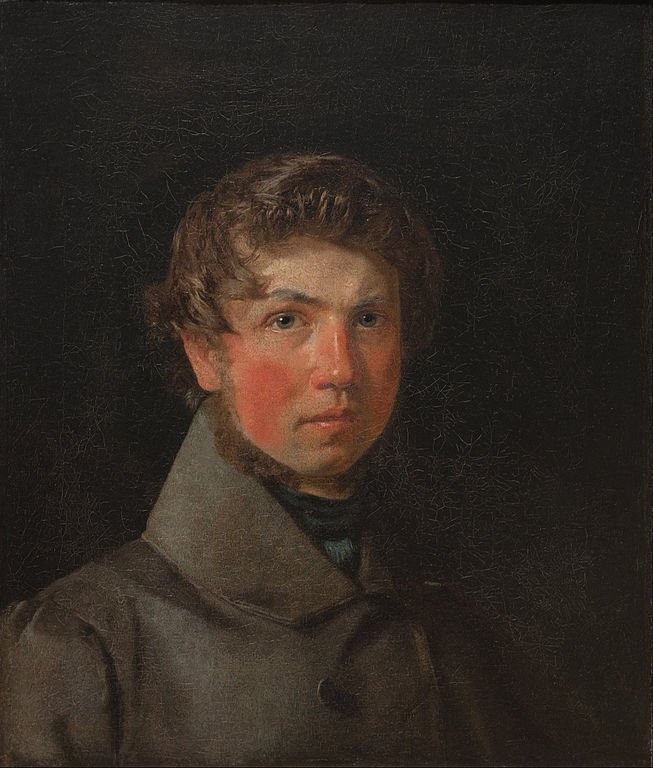
Self Portrait by Christen Købke (1833)

Today, as I promised in my last blog, I am going to continue looking at the life of the Danish painter Christen Købke and concentrate on some of his intriguing and exquisite portraiture work.

Portrait of the Artist's Wife,Susanne Cecilie Købke by Christen Købke (c.1836)
Portrait of the Artist’s Wife,Susanne Cecilie Købke by Christen Købke (c.1836)

In my last blog, I had reached the year 1836 in the life of Købke and he had just completed a series of works featuring the Frederiksborg Castle.   A year later, in November 1837, Købke married Susanne Cecilie Købke, whom he called Sanne, and shortly afterwards painted a portrait of his young bride.  The following August after gaining a travel stipend awarded to him by the Royal Danish Academy, Købke leaves his wife and home and along with the Danish decorative artist, Georg Christian Hilker, sets off on a two year painting expedition around Europe.  On their way to Italy they call at Dresden and Munich and pass through Austria before arriving in Rome on December 8th 1838.  It is in the Italian capital that Købke meets up with many other Danish artists living in the Eternal City as well as the sculptor and medallist, Frederik Krohn, his brother-in-law, who had married his sister Susanne.  In May 1839 Købke, along with Hilker and another Danish artist, Constantin Hansen journey to Naples and later to Capri where they stay until the end of that year painting out in the open air.  The following year Købke spends months examining the ruins of Pompeii where he completes a series of sketches and paintings.
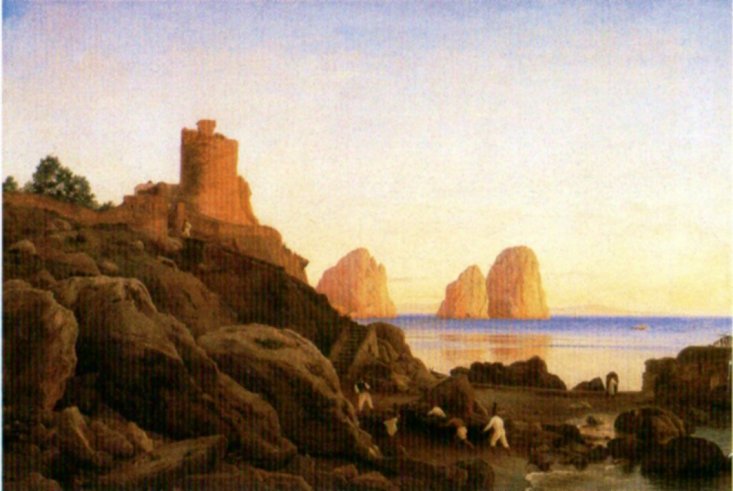
View of Marina Picola on Capri by Christen Købke (1846)

In September 1840 Købke returns home to Copenhagen and in June 1841, Købke’s wife Susanne gives birth to their first child, a son, Hans Peter Carl.  In 1842 Købke applies for membership to the Royal Danish Academy which accepts his proposal of a landscape work featuring Capri as his membership piece.   He was given two years in which to complete the painting.  In 1843 Købke’s father, Peter, dies.  By the end of 1844 Købke has still to complete his membership piece for the Academy but fortunately they give him a two year extension.  In 1845 his second child was born, a daughter, Juliane Emilie.   In 1846 he had finally finished the painting entitled View of Marina Picola on Capri and submits it to the Academy.  To his amazement and disappointment the Academy rejects the work. 

Christen Købke's gravestone
Christen Købke’s gravestone

On February 7th 1848, Christen Købke died of pneumonia, aged 37 albeit his family maintained that the rejection of his painting by the Academy was a contributing factor in his death.  Købke was buried in Assistens Cemetery in Copenhagen.   He left behind his wife Susanne and children Hans and Juliane.  His wife died the following year and his children were looked after by Købke’s sister Sophie.


Today’s blog concentrates on some of Købke’s portraiture.   Portraiture is not simply the representation of a specific individual or individuals.  It is not just documentary evidence of a person’s features.  A good portrait looks into the soul of the person and can be used to define who the person is and by so doing the finished work gives us a clear and coherent sense of the real person we see before us on the canvas.   If one thinks about a media outlet, such as a newspaper office, and think about the use of their photograph archives.   Take an example of an editorial the newspaper wants to put out an article about a celebrity.  They go to their photo archives and pick a photo which corroborates the story that they are writing.   In other words, the picture  gives one an idea about that person’s character but of course we need to remember that the newspaper can manipulate their story by cleverly using a photograph simply to prove their point, whether it be true or false.  This is the same with portraiture.  The portrait artist is able to manipulate his or her work so that the finished depiction can present certain characteristics or status of the sitter, which the sitter wants us to see. The portraitist can also add objects to the portrait so as to represent an idea, such as wealth by adding luxury furnishings or by depicting the sitter in expensive clothing.  They can add smouldering candles or a skull to create a Vanitas painting in which they want us to contemplate the passing of time and our own mortality.  In other words, the secret to great portraiture is not just how well the finished likeness is to the sitter but about how much it tells us about the sitter, about his or her place in society and their character.


As far as the Academic “pecking order” was concerned portraiture was secondary to History Painting in the painting genres.  Portraiture has been around since the Ancient Egyptians with their wall paintings depicting their gods and their Pharoes.  We saw portraiture in the form of sculptures and on the coinage in Ancient Greek and Roman times.  The Renaissance brought us portraits of the royalty, nobility and religious leaders and later we were to see portraits of the nouveau riche and the bourgeoisie classes.  In present times the art world is flooded with portraits of so-called “celebrities”.  All the sitters for these portraits wanted the artist to create a portrait which would confirm their new position in society.

Christen Købke’s portraits differ from many of his contemporaries as he liked to depict the sitter in such a way so that we could read their character from their expressions.  He had decided what their character was and translated that into the painting.  Some of his best portraiture was a simple head and shoulder depiction with no external accoutrements such as furniture or items which could be used to tell the story of the sitter.  The story of the sitter was in the face – the facial expression was to tell its own story.  His works were the culmination of his probing of the personality of the sitter.  Throughout his life, Købke was to complete numerous portraits.  The majority were single-figure portraits whose image was full of character.  However this intense searching for character in a person and his disinterest in having tell-tale inclusion of items advertising their status was in some ways counterproductive as for many would-be major portrait commissions that was just what sitters wanted and Købke’s modus operandi could well explain his lack of many lucrative commissions.  When we look at many of his portraits they are of family members, friends and acquaintances and not for rich fee-paying clients.  It was their loss as his outstanding talent as a portrait artist cannot be questioned.

His self-portrait, at the start of this blog, was the only one he ever painted and it was completed around 1833 when he was twenty-three years old.  It is a head and shoulder pose against a plain dark background which can thus not distract our eyes from looking directly at the sitter.  Although now in his early twenties there is a boyish look to him and that is enhanced by his ruddy-red cheeks, a facial quality which allegedly went down well with the local Italian girls when he visited their country some years later.  He has an engaging countenance and a look of sincerity.
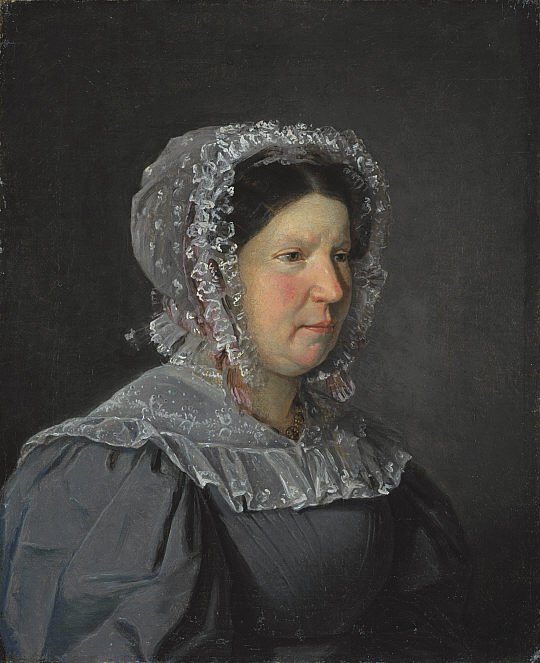
Portrait of the Artist's Mother, Cecilia Margrete, née Petersen by Christen Købke (1829)
Portrait of the Artist’s Mother, Cecilia Margrete, née Petersen by Christen Købke (1829)

Købke also painted his parents portraits.   Portrait of the Artist’s Mother, Ceilia Margarete, née Petersen was completed in 1829 when he was nineteen years of age. Six years later, he completed a portrait of his father, entitled Portrait of the Artist’s Father, Master Baker Peter Købke.  

Portrait of Inger Margrethe Høyen, née Schrøder, The Art Historian N.L. Høyen's Mother by Christen Købke (1832)
Portrait of Inger Margrethe Høyen, née Schrøder, The Art Historian N.L. Høyen’s Mother by Christen Købke (1832)

One of my favourite portraiture works of Købke was one he completed in1832.  It was a portrait of Inger Høyen, who was the mother of his friend and mentor, the art historian, Niels Høyen.   The portrait, simply entitled Portrait of Inger Margrethe Høyen née Schrøder, was completed by Købke in 1832.  It is a beautifully painted work brimful of characterisation.  It is a very sympathetic depiction of an old lady.  Inger was a prosperous, self-made woman, the daughter of a Jutland gardener who went on to marry a man who worked as a distiller in a local brewery and who would later go on to run his own distillery.  By all accounts she was a mild-mannered but astute person who possessed an imaginative quality.  Look how Købke has portrayed her.  Notwithstanding the wrinkles of time on her face he has clearly depicted her as a woman with a caring and an unassuming nature, an unpretentious character whose face radiates charm and kindness.

Portrait of the Landscape Painter, Frederik Sødring by Christen Købke (1832)

The final portrait I want to show you by Købke differs from most of his portraiture as there is a background to the painting and has objects included in the depiction which were there as an aid to telling the story of the sitter and his friendship with the artist.   It is a carefully crafted work and needs to be studied carefully.  As I told you in the last blog, Købke, in 1832, just before completing his Academy training, rented a studio with his friend and fellow student, Frederik Sødring in Toldbodvej, which was close to the Citadel.  The street is now renamed Esplanaden.  It was in that same year that Købke painted his friends portrait as he sat in their studio.  The painting is entitled Portrait of a Landscape Painter Frederik Sødring.  What is amazing about this painting is that Købke was just twenty-three years of age when he completed this work. He gave the portrait to Sødring as a twenty-third birthday present and on the reverse of the canvas there is an inscription written by Sødring:

“…Presented to me by my friend!  Ch: Købke on my birthday 31 May 1832…”


It is an intimate portrait done by friend, of a friend.  I am struck by Sødring’s youthful ruddy cheeks.   Before us we see Sødring relaxing, partly slouched in an upright wooden chair, in a somewhat  inelegant fashion.  I wonder how the sitter and artist decided on the pose.   Despite his somewhat ungainly posture, there is an air confidence about him.   In his left hand he holds his palette whilst in his right hand, which rests on his leg, he holds a palette knife. He is ready to start painting.   Sødring is wearing a striped shirt and brocaded silk waistcoat with a black velvet collar.   Look how well the folds of the crisp cotton shirt and the brocade are beautifully painted by the artist.   What did Købke want the painting tell the world about his friend and their friendship?  Can you imagine the conversation between the two artists during the hours the portrait was being painted?  

Købke has also managed to give us the impression that their studio was not pristine but somewhat untidy, somewhat cluttered – a working space.  The setting appears “stage-managed” and items have been added to the portrait which mean something to the two men.   Behind the sitter we see a door with an ornate brass latch and on the door is hanging an oval mirror.  Why would you hang a mirror on a door?   Maybe the answer is in the reflection we can see in the mirror of an easel and a picture frame.  By including these images in this way it allowed Købke to not have to fill the painting with the actual easel or have his friend sitting before it.  The depiction of mirrored reflections within a painting was used by many artists, especially the Dutch and Flemish painters.  Famous paintings incorporating mirrored reflections include the Arnolfini Portrait by Van Eyck and Velazquez’s painting Las Meninas.

Also on the doors are a number of copper engravings, some of ancient Roman ruins and one of a cow.  After Købke’s death in February 1848 an itinerary was made of all his works and those of other artists he had collected.  Amongst the list was five etchings by Paulus Potter, the Dutch painter, who was famous for his depiction of cows and the one we see in the Sødring portrait is more than likely to be one of those.  Below the mirror we see an accomplished still life depiction on a mahogany table incorporating a potted ivy plant and some sketch books.  The ivy is a plant which always clings to its support, and in art symbolises attachment and undying affection and its inclusion in the painting is probably a reminder of the close friendship between the two aspiring artists, Sødring and Købke.  The items placed on the table are of different textures and subtle colours which add an element of contrast.  Amongst them is an eye-catching red box, which because of its vibrant colour, captures our attention and draws our eyes towards the table and its contents.  To the right of the seated artist, leaning against the panelled wall, is a portable artist’s folding stool which alludes to Sødring’s artistic forte, plein air landscape paintings.  The painting is housed in the Hirschprung Collection, the Copenhagen art museum which is located close to the much larger Danish National Gallery.  The works of art in this smaller museum concentrate on paintings of the Danish Golden Age from 1800 to 1850.

 Sadly during Købke’s lifetime his artistic work was not appreciated and he received few commissions.  His life was relatively short and his total output was small compared to many of his contemporaries and much of it was held by family members.  However, as is often the case, Købke is now looked upon by art historians as one of the most distinguished Danish painters of his time.  He is now thought of as one of the most gifted among the Danish Golden Age painters.


I am ending this blog on a personal note.   My first blog was published on November 9th 2010 and today’s blog is my 500th !   Back at the start of this venture I had no idea that I would complete so many but as long as I get enjoyment out of researching the works and the artists I will try to carry on a little longer.   I was always determined that my blog should not just be a painting and its title.  I wanted to write more about the subject of the painting, the life of the artist and a little about the history of the time.   When I look back at the early blogs I see I wrote far fewer words but I was able to publish more often.  However, recently, it has been my intention to write in more depth and publish less blogs and although the “Daily” in the title of my blog is now a misnomer I feel the “more in-depth but less frequent” publications are for the best.  I would like to thank the many of you who have favourably commented on the blogs and to the couple of people I have upset with my words, I apologise.

Sophie Gray by John Everett Millais

Sophie Gray by John Everett Millais (1857)

Much has been written about the love triangle of the pre-Raphaelite artist, John Everett Millais, the art critic, John Ruskin and his wife, Euphemia Gray.  This year we will be offered two feature films, Effie and Untouched exploring their relationship but for today I want to look at the life of Millais’ other sister-in-law, Sophie Gray.  Sophie was Effie’s younger sister, and today I am featuring the amazing portrait of her by her brother-in-law, Millais.

Sophie Gray was born in Kinnoull, a suburb of Perth, Scotland in 1843. She was brought up in a comfortable family environment, her father, George Gray, having his own solicitor’s practice, along with money from property investments in Perth.  Her family, although not considered to be rich, could neither be described as poor and she would have had everything money could buy to ensure that she was kept safe, warm and in good health. George Gray and her mother, Sophia Margaret Gray, née Jameson, had fifteen children although by the time Sophie, their tenth child, arrived, five had died and sadly, before Sophie had reached her seventh birthday in 1850 another two of her siblings had passed away and a third died a year later.  Sophie was fifteen years younger than her elder sister Effie.

Effie Gray, first met John Ruskin, who was a family friend, in 1840, when she was twelve, whilst she was on a visit to Herne Hill and they met again a a year later.  Six years passed before their next encounter in October 1847 and it was at this meeting that John Ruskin started to fall in love with the nineteen-year old Effie, so much so that when Ruskin returned to his home in London, he wrote to Effie’s father and asked for her hand in marriage. George Gray consented and marriage plans for the following year were drawn up. These plans were disrupted by Effie’s father becoming almost bankrupt due to a railway speculation going awry. However, the wedding did eventually take place at Effie’s home in Bowerswell House on April 10th 1848.

At the time of the wedding Sophie was just five years old and she would often go to London and stay with her sister and Ruskin.  Effie, in many ways, became a second mother to her.   The marriage between Effie and Ruskin as it has been well documented was not a success and could have been down to many reasons such as their totally different personalities and their differing temperaments for Effie was naturally sociable and flirtatious, and soon began to feel oppressed by her husband’s  dogmatic and unbending personality.  In April 1854, Sophie had been staying with her sister and husband and on the pretext of having to take her little sister back home to Scotland Effie left the marital home at Herne Hill and never returned.  The marriage was annulled on the grounds of non-consummation in July of that year.

Sophie Gray (aged 10) by Millais (1854

Sophie Gray had first met John Everett Millais in 1853 and she, like her sister, Effie, had modeled for him.  He painted several pictures of her and this led, in some quarters, to speculation as to Millais relationship with his young sister-in-law.  The first painting of Sophie produced by Millais was a sensitive watercolour drawing of her, in oval form, in January 1854 when she was just ten years old. Millais appears to have been totally entranced by the prettiness of the young girl who would soon become his future sister-in-law.  When he had completed the work he wrote to Sophie’s mother extolling the virtues of her daughter.  He wrote:
“…What a delightful little shrewd damsel Sophia is…I do not praise her to please you, but I think her extremely beautiful, and that she will even improve, as yet she does not seem to have the slightest idea of it herself which makes her prettier—I am afraid that ignorance cannot last long…”

Autumn Leaves by John Everett Millais (1856)

Sophie continued to sit for Millais; in fact, she was being used as his model more than he used Effie.  Her sister Effie, now divorced from Ruskin had moved back to Scotland and from August 1855 lived with Millais at Annat Lodge which was close to her parent’s home at Bowerswell and so Sophie was always on hand to sit for Millais.  Sophie’s beauty had become even more noticeable as she changed from a young girl to a young teenager.  One of next paintings Millais completed of Sophie was in 1856 when she had yet to reach her thirteenth birthday.  It was entitled Autumn Leaves which he exhibited at the Royal Academy that year.   In this painting Sophie is one of four girls standing around a smouldering bonfire of fallen leaves which they had been collecting.  The twilight setting is the garden at Annat Lodge and in the background we see the Arochar Alps. The girl on the left is Sophie’s younger sister Alice, who was two years her junior.  Next to her is Sophie who is, like Alice, dressed in a green velvet dress.  On the right there are two young working-class girls from the village, Matilda Proudfoot and Isabella Nicol.  Millais used these same two local girls as sitters for his beautiful painting, The Blind Girl, (See My Daily Art Display May 16th 2011).  As we look closely at these four young girls Sophie stands apart as the one who is not to be looked upon as a young girl but one who should be considered as becoming a young woman.

The painting received mixed reviews.  John Ruskin described the work as:

“…the first instance of a perfectly painted twilight…”

and

“…[It] will rank in future among the world’s best masterpieces…”


For others, like some of the members of the Royal Academy, the subject of the painting baffled them.  One wrote:

“…We are curious to learn the mystic interpretation that will be put upon this composition…”

John Millais’s wife, Effie, wrote that her husband had intended to create a picture that was “full of beauty and without a subject”.  Millais wrote to his friend and art critic, Frederic Stephens, who was also one of the two “non-artistic” members of the Pre-Raphaelite Brotherhood and who had written a glowing report about the work.  Millais explained the thought behind the painting stating that he:

“… intended the picture to awaken by its solemnity the deepest religious reflection. I chose the subject of burning leaves as most calculated to produce this feeling…”

However my featured painting today is the truly haunting head and shoulder intimate portrait entitled Sophie Gray which he completed in 1857 when his sitter was just fourteen years of age.  The young girl occupies an uncharacteristically large portion of the picture.   A delicate light illuminates the left side of her face and this emphasizes the golden brown colour of her hair with its auburn highlights.  Sophie’s clothes are unremarkable.  They are dark in colour and simply decorated with an embroidered heart with three flowers within it.  What an enigmatic portrait.  Her long hair frames her face and becomes one with the equally dark background, leaving only her pale skin and the touch of lace at her throat as an absolute contrast.  Sophie looks out at us.  Her ice-blue eyes stare blankly and expressionless.  Her lush red lips and rosy cheeks are a contrast to her white skin and dark background.  Her lips are defiantly pursed and her chin is tilted up slightly in a determined manner.  This is a young woman of great self-confidence for one so young.  The way Millais has depicted the beauty of his young sister-in-law leaves us in no doubt for the fondness he had for the young girl. It is an alluring and haunting portrait.  This is a very personal work of art.  There is a definite connection between the artist and the sitter and one feels that had he not loved his wife, his relationship with Sophie may have been much different.

Alice Gray by Millais (1857)

This beautiful Pre-Raphaelite painting, dating from the height of the movement, is a pendant to a similar head of Sophie’s younger sister Alice, who was another of Millais’ favourite models.   Both works were bought from Millais by his friend, the Pre-Raphaelite landscape and figurative artist, George Price Boyce, for himself and on behalf of his sister Joanna, also an artist. There is a well-defined difference between the two portraits. The painting of Alice, the younger of the two sisters is simply an uncomplicated portrait of a young and somewhat immature girl, whereas the portrait of Sophie is a painting which demonstrates the electric energy that was present between the sitter and the artist.

So what became of Sophie Gray?   She had major mental health problems and in 1868, in her mid-twenties, she spent time away from home, staying at Manor Farm House in Chiswick receiving medical care from a Doctor Thomas Tuke, who was a noted practitioner in mental health.  She remained under his care, away from the family home, and did not return to Scotland until the following year.    Sophie did not marry until 1873, at what was in Victorian times looked upon as a very advanced age of thirty. She married Sir James Key Caird, who was a wealthy jute manufacturer, and the couple had one child, a daughter Beatrix Ada a year later.  A portrait of their daughter, when she was five years old, was painted by Dante Rossetti.  The marriage was an unhappy one and Sophie’s husband paid little attention to his wife’s needs and was often absent from the marital home.   Sophie spent much of her time alone with Beatrix, mostly living between Dundee and Paris.   She had suffered from anorexia nervosa for a good deal of her life and in her later years lost a lot of weight.  In 1882, with her health rapidly deteriorating, she had to return to the care of Doctor Tuke but her health never improved and on March 15th 1882, aged 38 she died.  The cause of death was put down to “exhaustion and atrophy of nervous system, 17 years”.

As I wrote this blog I couldn’t help but wonder how the beautiful thirteen year old we see in the main picture could lead such a sad life and die so young.  Such a waste of life.

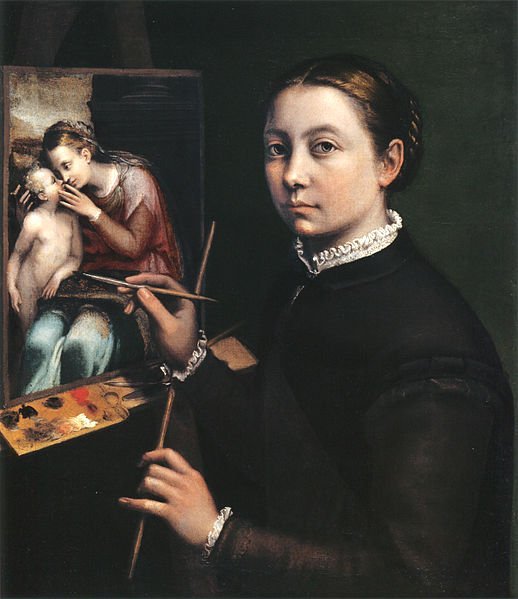
Self-portrait at the Easel Painting a Devotional Panel by Sofonisba Anguissola

Self-portrait at the Easel Painting a Devotional Panel by Sofonisba Anguissola (1556)

Let me introduce you to a female artist, whom I am ashamed to admit, I had never heard of, but whom Giorgio Vasari, the Italian biographer of artists, made the following comment:

“…[She] has shown greater application and better grace than any other woman of our age in her endeavours at drawing; she has thus succeeded not only in drawing, colouring and painting from nature, and copying excellently from others, but by herself has created rare and very beautiful paintings…”

My featured artist today is the Italian Renaissance painter Sofonisba Anguissola. Her christian name came from a strong family connection to ancient Carthaginian history and her parents named their first daughter after the tragic Carthaginian figure who lived and committed suicide during the Second Punic War.  Sofonisba Anguissola was born in Cremona, a city in the Lombardy region of Northern Italy, around 1532.  Her father was Amilcare Anguissola and her mother was Bianca Ponzone.  Both parents came from affluent and noble families and they lived a privileged and affluent lifestyle.  Sofonisba was the oldest of seven children.  She had one brother, Asdrubale and five sisters, Elena, Lucia, Europa, Minerva and Anna Maria.   All of her sisters except Minerva became artists.

Having come from such an advantaged family background was somewhat unusual for women artists of the sixteenth century, as any of note, tended to be daughters of impoverished artists.  The family wealth coupled with the father’s belief that all females should be educated ensured that Sofonisba received an all-round and extensive education, including studying drawing and fine art.   The fact that she came from a wealthy and privileged background did not however avoid the restrictions imposed by the Italian art establishment, such as forbidding female artists from studying anatomy or attending life drawing classes as it was deemed inappropriate for a female to view a naked model, which consequently meant a female could not study the human anatomy to the same extent as a male artist could and because of this she was unable to carry out the complex multi-figure compositions which were at the heart of the popular large-scale religious and historical works.  With those obstacles in mind, Anguissola decided to concentrate on portraiture using female models, which were accessible to her, and instead of historic settings she concentrated on having her sitters shown in homely and unceremonious settings.  Self-portraits and portraits of family members were her most frequent subjects and it was not until much later in life that she turned to paintings incorporating religious themes.

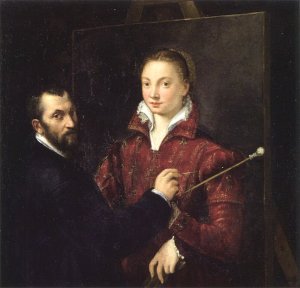
Self-portrait with Bernardino Campi by Sofonisba Anguissola (1550)

At the age of fourteen Sofonisba and her sister Elena attended the studio of Bernardino Campi, the Italian Renaissance religious painter and portraitist who was based in Cremona.  She pictorially recorded the time she was with Campi in her double portrait depicting her mentor painting a portrait of her.  The work, entitled Bernardino Campi Painting Sofonisba Anguissola, was completed by her during her last year as his pupil in 1550, when she was just eighteen years old.   After Campi, Sofonisba studied under the Italian artist Bernardino Gatti, often known as il Sojaro, and continued being tutored by him for three years, eventually leaving him when she was twenty-one years of age.

In 1554, Anguissola journeyed to Rome, where she spent her time sketching various scenes and people. The highlight of her stay in the Italian capital was when she was introduced to the great Master himself, Michelangelo Buonarotti.   We know the two met as in the Buonarrotti Archives held in Florence there is a letter, dated May 1557, from Sofonisba’s father Amilcare to Michelangelo in which he writes thanking him for spending time with his daughter:

“…honourable and thoughtful affection that you have shown to Sofonisba, my daughter,

to whom you introduced to practice the most honourable art of painting…”

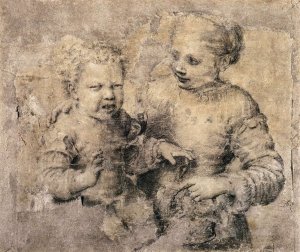
Asdrubale Bitten by a Crayfish by Sofonisba Anguissola (c.1554)

Intrigued by her artistic talent Michelangelo asked her to sketch him a picture of a weeping boy and the result was her sketch entitled Asdrubale Bitten by a Crayfish.  Sofonisba rose to the challenge and sketched her young brother, Asdrubale, being bitten and being comforted by one of his sisters.  Michelangelo was so impressed with the drawing that he gave her some sketches from his notebook and asked her to copy them in her own style.  She complied with his request and the results of her efforts again astounded the Master and because he recognised how artistically talented she was, for the next two years, he agreed to mentor her.  Again we have been made aware of the high regard in which Michelangelo held Sofonisba’s work as in a letter dated May 1558, (held in the Buonarrotti Archives) her father wrote to Michelangelo thanking him for praising his daughter’s artwork:

“…[you were] kind enough to examine, judge, and praise the paintings done by my

daughter Sofonisba…”

In 1558, aged twenty-six, Sofonisba Anguissola left Rome and went to Milan and it was here she received a commission to paint a portrait of Ferdinand Alvarez de Toledo, the Duke of Alba.  The sitter was so pleased with the resulting painting that he recommended her to Philip II, the King of Spain.  Court officials invited Sofonisba to come to Madrid and be part of the Spanish court.  This fact alone is clear evidence of Sofonisba’s artistic talent and her success, as it would have been unheard of that such a powerful leader as Philip II would countenance an insignificant artist being invited to join and live at the Spanish court and paint for his new Queen.

Late in December 1559 she arrived in the Spanish capital and took up her role at the Spanish court as a court painter as well as being one of the attendants to the Isabella Clara Eugenia, the Infanta Isabella, and later as a lady-in-waiting to her mother, Philip’s new queen, his third wife, Elisabeth of Valois (the Queen consort, Isabel of Spain) who was an accomplished amateur portrait painter.  This shared love of art between Sofonisba and Elisabeth flourished and Sofonisba would often offer artistic advice and give the queen some artistic tuition.   Sofonisba soon received many official commissions to paint portraits of the king and queen’s family and courtiers.  These were very different to her earlier portraiture work which were very informal as Philip and his wife wanted the portraits he had commissioned Sofonisba to paint to show the wealth and power of the sitters by paying attention to background and peripheral objects such as fine and sumptuous clothing, jewelled adornments and priceless furnishings.  This type of portraiture took time and skill but the finished products were always well received by the sitters.

Her artistic talents were also recognised by another powerful leader, Pope Pius IV who asked Sofonisba to paint a portrait of the Queen consort, Isabel, and have it sent to him.  Giogio Vasari in his book, Le Vite de’ più eccellenti pittori, scultori, ed architettori (Lives of the Most Eminent Painters, Sculptors and Architects) quotes a letter the pontiff sent Sofonisba thanking her for the painting and praising her work.  In the letter he wrote:

“… Pius Papa IV. Dilecto in Christo filia.

 We have received the portrait of our dear daughter, the Queen of Spain, which you have

sent… We thank you and assure you that we shall treasure it among our choicest possessions,

and commend your marvellous talent which is least among your numerous qualities

 Rome, 15 October 1561…”

In 1571 Sofonisba married Don Francisco de Moncada, who was the son of the Prince of Paterno, Viceroy of Sicily.  King Philip II facilitated the marriage, and paid her dowry of twelve thousand pounds.  She remained at the Spanish court for a further seven years after which time, and with Philip’s permission, she and her husband left Madrid and travelled to Palermo, Sicily. They arrived in Palermo in 1578 but sadly her husband died the following year.  The year following her husband’s death, Sofonisba decided to visit her family back in Cremona and embarked on a sea passage from Palermo to Genoa.   She never made it back home as she fell in love with the young captain of the ship and the couple married shortly after, in January 1580, in Pisa.  Sofonisba was forty-seven years of age and was much older than her seafaring husband.  The couple settled down at the seaport of Genoa and with her husband’s money, along with a pension from Philip of Spain, the pair had a comfortable lifestyle and Sofonisba had her own quarters including an art studio within her husband’s family’s large house.  Her reputation as an accomplished artist spread throughout Europe and she received many visits from young aspiring painters.  The couple moved to Palermo and were visited in 1624 by the Flemish painter, Anthony van Dyck, who at the time was twenty-five years old and travelling around the island of Sicily recording his travels in words and sketches in his diary.  At the time, Sofonisba was ninety-two years old and van Dyck sketched Sofonisba sitting in a chair.   All around the sketch he wrote notes in Italian, a rough translation of which is:

“…portrait of the painter Signora Sofonisba, done from life in Palermo in the year 1624, on 12 July: her age being 96 years, still with her memory and brain most quick, and most kind, and although she has lost her sight because of her old age, she enjoyed to have paintings put in front of her, and with great effort by placing her nose close to the picture, she could make out a little of it…”

It is interesting to note that according to van Dyck, Sofonisba was 96 years old in 1624 and this of course would make her birth date 1528 which is some four years earlier than the date given in a number of reference books.

Page from van Dyck's sketchbook
Page from van Dyck’s sketchbook

Van Dyck recorded in his diaries that her eyesight was weakened (it is thought she suffered from cataracts) but for a lady of 92 (or 96!) she was still mentally alert.  She had completed her last work in 1620 and had become a patron of the arts.  On November 16th 1625, Sofonisba died in Palermo aged 93.

On her birth centenary seven years later, her husband had a plaque placed on her tomb which read:
“…To Sofonisba, my wife…who is recorded among the illustrious women of the world, outstanding in portraying the images of man…

Orazio Lomellino, in sorrow for the loss of his great love, in 1632, dedicated this little tribute to such a great woman…”

Sofonisba was not only appreciated in her own lifetime but continues to be appreciated in modern society albeit I had to admit her name was new to me, which gives you some idea as to my artistic knowledge!

My Daily Art Display’s featured painting today is an early self portrait by Sofonisba Anguissola which she completed in 1556 and is entitled Self-portrait at the Easel Painting a Devotional Panel.  It is housed at the Museum-Zamek in the town of Lancut in south-east Poland.

This is one of many self portraits by the artist, which she sent as gifts to prospective patrons as she could not respectably enter into competition with male artists for paid commissions.   Around this time, there was a highly respected author, Baldassare Castiglione, the count of Casatico, an Italian courtier and diplomat, who held great sway with the public with regards manners at the court and how one should behave if of noble birth.  The book, which had a widely circulated publication in 1528, was entitled The Courtier.  In a way it was also a torch-bearer for women’s equality as it advocated the same education for aristocratic women as that offered to aristocratic men and one can only presume that Sofonisba’s father had read the book and agreed with its conclusions as he made sure that his daughters were not only educated in Latin, classical literature, history, philosophy, math, and sciences, but also that they were schooled in the courtly arts, such as music, writing, drawing, and painting.  Castiglione had written in his book about how aristocratic women of the court should dress.  He wrote:

“…she should always dress herself correctly and wear clothes that do not seem vain and frivolous…”

We can see by the way Sofonisba has depicted herself in this self portrait, wearing a modest black gown, lace collar and cuffs, the absence of jewellery and a simple hairstyle, which precluded any hint of easy virtue, that she had taken on board the advice given by Castiglione in his book.

Sofonisba looks out at us, brush in hand.  She is in the act of painting and is simultaneously the subject and object, the painter and the model of the painting.  Her painting is a re-working of the legend of St Luke the Evangelist, who it was believed, was the first to have painted a portrait of the Virgin but in this painting she has taken on the role of St Luke  and we see her painting of the Virgin and Child resting on the easel.

I love this self portrait.  There is nothing fancy about Sofonisba’s portrayal of herself.  It is an understated depiction.  It is a somewhat discreet portrait of a virtuous noblewoman and its beauty and exquisite artwork challenged the belief in those days that women artists lacked artistic skills.

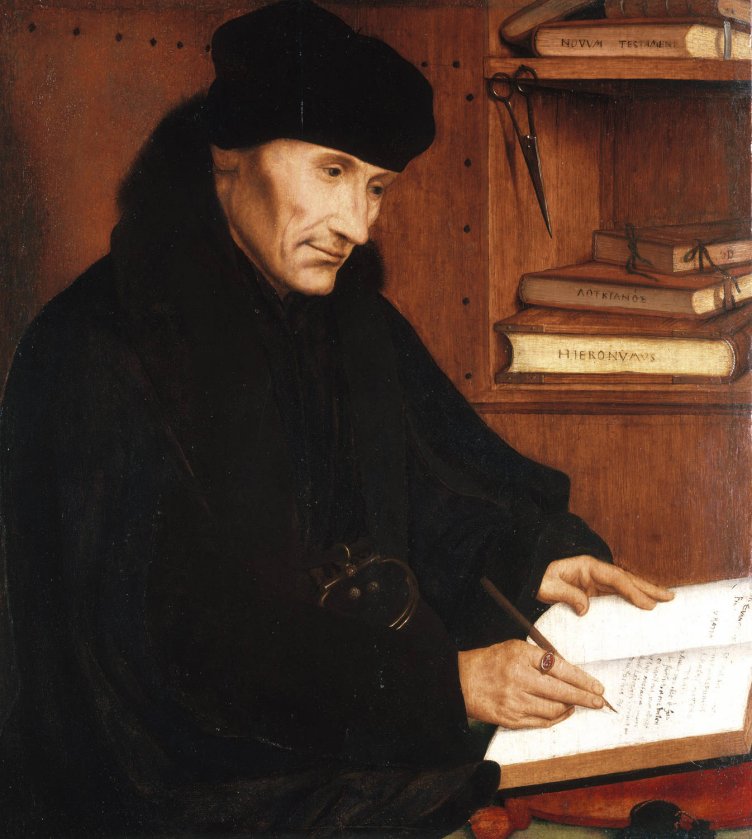
Desiderius Erasmus and Pieter Gillis by Quinten Massys

Desiderius Erasmus by Quinten Massys (1517)

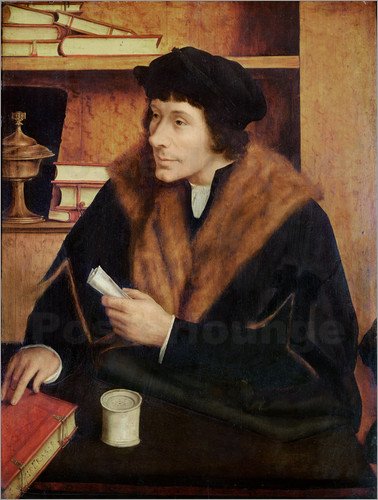
We are in the run-up to Christmas and many of us will be struggling to come up with ideas for the perfect gift for a beloved friend.  The problem is even further exacerbated if the friend is wealthy and wants for very little.  What do you give somebody who has everything?  What gift can you give someone which will forever remind him or her of your close and enduring friendship?  My featured painting today is all about this.  It is about three friends, two of whom want to give the third a gift; a memento of their friendship and so they decided to present their friend with two portraits of themselves, known as a friendship diptych.  To make their gift even more special they decided to commission the foremost painter of the time to carry out the work.  The two gift givers were the humanists, Desiderius Erasmus and Pieter Gillis and the recipient of their gift was Thomas More.  The artist they commissioned to paint the friendship diptych was the Flemish painter Quinten Massys.

The beneficiary of the two paintings was Thomas More, an Oxford University graduate.  During his time at university he wrote comedies and studied both Greek and Latin literature.  In 1494, after he had obtained his university degree, he returned to London and was admitted to Lincoln’s Inn and in 1501 became a barrister.    He was a very religious man and at one time had decided to give up his career in law and become a monk and for a time lived at a Carthusian monastery.  His mental torment between following a secular or religious life was finally decided three years later when he chose to serve his country as a parliamentarian and entered Parliament in 1504.

Pieter Gillis by Quinten Massys (1517)

In 1499, whilst Thomas More was living in London he met the Dutch Renaissance humanist and scholar, Desiderius Erasmus.  This initial meeting of the two men turned into a lifelong friendship and they continued to correspond on a regular basis during which time they worked collaboratively to translate into Latin and have printed some of the works of the Assyrian satirist, Lucian of Samosata.  It was through his meeting with Erasmus that Thomas More met Erasmus’ friend, Pieter Gillis, a fellow humanist, a printer by trade and town clerk of Antwerp.  One of Thomas More’s most famous compositions was his two-volume work entitled Utopia.  It is a depiction of a fictional island and its religious, political and social customs and was More’s way of commenting upon the social and political ideas of the day as well as highlighting and satirising the failings he saw all around him.  In the first volume, entitled Dialogue of Counsel, it began with correspondence between More himself and others, including Pieter Gillis.  The whole idea of the book came to Thomas More whilst he was staying at the Antwerp home of Gillis in 1515.  On his return to England in 1516, Thomas More completed the work and the first edition was edited by Erasmus and published in Leuven.  Thomas More dedicated this work to Pieter Gillis.

In 1517, a year after the publication of the first edition of More’s work, Desiderius Erasmus and Pieter Gillis, decided to send portraits of themselves to Sir Thomas More. This friendship diptych would act as a virtual visit to their English friend in London and they approached Quinten Massys to carry out the two paintings as he was the leading Antwerp painter at that time. Erasmus’ portrait was the first to be completed because the portrait of Gillis was constantly being delayed due to him falling ill during the sittings.  The two men had told Thomas More about the paintings which may not have been a wise move as More constantly queried them as to the progress of the paintings and became very impatient to receive the gift.  The two works were finally completed and were sent to More whilst he was in Calais.

The portrait of Erasmus, which is part of the Royal Collection and is currently on show at the Dürer to Holbein; The Northern Renaissance Exhibition at the Queen’s Gallery in London, depicts Erasmus working in his study. The way in which Massys has portrayed Erasmus was a popular way of depicting St Jerome, and so the setting used in the portrait probably alludes to the fact that Erasmus had just published a new edition of the writings of St Jerome.

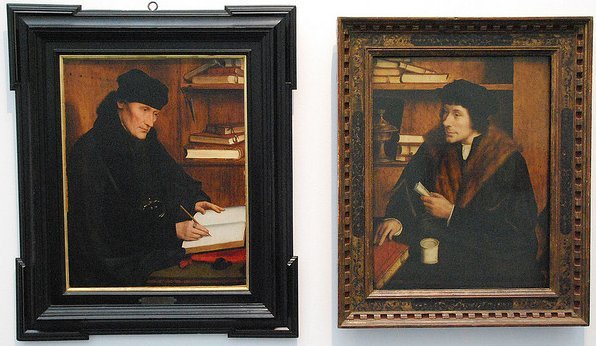
It is interesting to look at the books on the shelves in the background.  On the upper shelf of the Erasmus painting there is a book which has the inscription Novum Testament which alludes to Novum Testamentum Graece, the first published edition of the Greek New Testament produced by Erasmus in 1516.  On the lower shelf there are three books.  The bottom tome has the inscription Hieronymus which refers to Erasmus’s editions of the New Testament and St Jerome; on top of that book there is one with the inscription Λουκιανός which is the Ancient Greek word for Lovkianos or Lucian and refers to Erasmus and Thomas More’s collaboration in translating Lucian’s Dialogues.   The inscription on the uppermost book is the word Hor, which originally read Mor.  The first letter was probably altered during an early restoration, for besides Mor being the first letters of Thomas More’s surname they almost certainly refer to the satirical essays written by Erasmus whilst staying with Thomas More in his London home in 1509 and entitled Enconium Moriae (Praise of Folly).  This collection of essays was considered one of the most notable works of the Renaissance.  We see Erasmus writing in a book.  This depiction has been carefully thought out for the words one sees on the page paper are a paraphrase of St Paul’s Epistle to the Romans, the handwriting is a careful replication of Erasmus’s own hand, and the reed pen he holds was known to be Erasmus’s favourite writing tool.  If you look closely, in the folds of Erasmus’ cloak you can just make out a purse.  It could be that Erasmus wanted the artist to include this in order to illustrate his generosity.  Erasmus and Gillis made a point of informing Thomas More that they had split the cost of the painting because they wanted it to be a present from them both.  If you look at the two paintings side by side then one can see that Massys has cleverly continued the bookcase behind the two sitters and this gives the impression that the two men depicted in the two separate panels occupy the same room and are facing each other.

The Friendship Diptych
Copy of The Friendship Diptych
Galleria Nazionale d’Arte Antica, Rome

If we were to look now at the two paintings of Erasmus and Gillis, side by side, we would question whether they were in fact two halves of a diptych as they have different dimensions.  This has been explained away by the fact that the Royal Collection painting of Erasmus has been cut and the one of Gillis, which is in the private collection of the Earl of Radnor at Longford Castle, has been extended but it is believed that the original dimensions of both had matched perfectly. Furthermore, both panels have the brand of Charles I on the reverse and the fact that they were together in the seventeenth century seems to confirm that they constitute the original friendship diptych.

The artist, Quinten Massys also spelled Matsys or Metsys, was the foremost artist of his day in Antwerp.  He was born around 1466, in the town of Louvain which is situated in the Flemish Province of Brabant in Belgium.   His father Joost Massys was a blacksmith and his mother was Catharina van Kincken and they had four children.  For a time Quentin helped his father in his blacksmith and metalwork business.  Little is known about Massys’ early life and what we do know could be based on fanciful legends!  One such story was that Quentin abandoned working as a blacksmith and became an artist in order to impress a young lady, an artist’s daughter, who found art and artists romantic.  However a more mundane reason for Quinten to give up as a blacksmith was given by the painter, art historian and biographer of Netherlandish artists, Karel van Mander, in his 1604 Schilder-Boeck, who wrote that Quinten was a sickly youth and lacked the physical strength needed by somebody working in the metalwork and blacksmith profession.

Quinten Massys moved to Antwerp where he was admitted to the Antwerp St Lukas Guild.  He married when he was twenty-six years of age.  His wife was Alyt van Tuylt and the couple went on to have three children, two sons, Quinten and Pawel and a daughter Katelijne.  His wife died in 1507 and Quentin remarried a year later.  His new wife was Catherina Heyns and she and Quinten went on to have a further ten children, five sons and five daughters.  Shortly after their father’s death, two of his sons, Jan and Cornelis went on to become artists and members of the Antwerp Guild.

Thomas More was knighted in 1521 and in 1523, he became the speaker of the House of Commons and in 1525 chancellor of the Duchy of Lancaster. Seventeen years after Thomas More received his friendship diptych from Erasmus and Gillis, he was dead.  He had risen to power under Henry VIII but had fallen foul of the English ruler in 1534 by refusing to swear to the king’s Act of Succession and the Oath of Supremacy, statutes which made Henry the supreme head of the Church of England.  Sir Thomas More believed that the supreme head of the church was the Pope and this stated belief lead to him being indicted for treason on charges of praemunire, which was the offense of introducing foreign authority into England and was intended to reduce the civil power of the Pope in England.  The jury found him guilty and he was sentenced to be hanged, drawn and quartered, which was the usual punishment for traitors who were not the nobility.  However Henry VIII commuted this to execution by decapitation. Sir Thomas More was executed on 6 July 1535.   His last words were a declaration that he died “the king’s good servant, but God’s first”

La Fornarina by Raphael Sanzio

La Fornarina by Raphael (1520)

My Daily Art Display today features an Italian lady, Margarita Luti.  She became known as La Fornarina which in Italian means “the baker’s daughter”.  She was the daughter of Francesco Luti, a local baker from Siena who worked in the Roman district of Santa Dorotea.  The reason she became famous was not because of her father’s occupation but because she modelled for and was the mistress of the great Italian High Renaissance painter, Raphael Sanzio.  It was well documented that Raphael Sanzio was a very passionate man and had many mistresses in his time.  In the book, The Lives of the Artists by Giorgio Vasari, the biographer described the artist and how his love of women affected his work:

“…Raphael was a very amorous man who was fond of women and he was always quick to serve them. This was the reason why, as he continued to pursue his carnal delights, he was treated with too much consideration and acquiescence by his friends. When his dear friend Agostino Chigi commissioned him to paint the first loggia in his palace, Raphael could not really put his mind to his work because of his love for one of his mistresses; Agostino became so desperate over this that, through his own efforts and with the assistance of others, he worked things out in such a way that he finally managed to bring this woman of Raphael’s to come and stay with him on a constant basis in the section of the house where Raphael was working, and that was the reason why the work came to be finished…”

Although Margarita Luti is not actually named by Vasari her name does appear in scribbled notes on the original pages of the manuscript which would become his second edition of his Lives of the Most Excellent Painters, Sculptors and Architects.  The painting entitled La Fornarina, by Raphael hangs in the Palazzo Barberini in Rome and a further copy can be found in the Galleria Borghese, in Rome.  The work was completed around 1520 when Raphael was thirty seven years of age.  This was also the year in which on Good Friday, April 6th he died. Before us is a portrait of a beautiful young woman who is almost nude.  Her skin is flawless as alabaster. Her cheeks are flushed and pink, She stares out to her left and smiles, presumably at the artist as he works on her portrait.

Venus Pudica
Venus Pudica

She is pictured with an oriental style hat on which is attached a large jewel Her breasts are bare. Her right arm crosses her body and her right hand pulls a diaphanous veil over her stomach and abdomen in a gesture which mirrors the posture of women as seen in classical sculptures such as the Venus pudica, apose that became the custom for the nude Aphrodite figures in the Late Classical period.   It is a very suggestive pose and I am not sure whether she is attempting to cover her breast or in fact she is turning it slightly towards us and her lover, Raphael.  Or could it be that her right hand is pressed against her heart as she looks at Raphael as a gesture of her love for him?  Her left hand rests between her thighs, the fingers splayed out and outlined by the deep, bloody-red of her discarded gown.  On her left arm there is a narrow leather band on which is the name of the artist – RAPHAEL URBINAS.  On the third finger of her left hand she appears to be wearing a ruby wedding band.   The presence of a ring was only discovered in the early part of the twenty-first century when the painting underwent some X-Ray analysis during restoration and cleaning work.

The fact that Raphael painted her with a wedding ring would have been very controversial at the time for six years earlier, in 1514; he had become engaged to marry.   He had been pressured by Cardinal Medici Bibbiena’s to marry one of his nieces, a lady named Maria Bibbiena.   Raphael did not want to refuse the Cardinal, but managed to postpone the matter, saying that he would prefer to wait three or four years before entering into marriage.  However after stringing along the cardinal and his niece for four years, Raphael had to agree to the marriage, but managed to keep putting off the date for the big occasion with a string of excuses.   So why had this engagement lasted six years without it ever ending in marriage?  There are a number of theories.  One is that Raphael had already married Margarita Luti in secret years earlier and therefore could not marry Maria Bibbiena.  Another possible reason is that his engagement to Maria had brought him additional status.  He was made a “Groom of the Chamber”, a papal valet, which in itself afforded him status at court and more importantly an additional income.  He would not want to jeopardise that.  He was also made a knight of the Papal Order of the Golden Spur, an honour which was also bestowed on the artists Titian and Vasari.   All such honours would have been lost if he had had to admit to being already married.  So why was the ring on the sitter’s finger not discovered immediately?  It was not just the ring, which was painted out, as the restoration work also uncovered that the myrtle branches we see filling the background of the painting and which are thought to be symbolic of love and marriage were not always there.  The X-Ray analysis of the painting show that originally there had been a landscape background, similar to that seen in da Vinci’s Mona Lisa.
The reason for the over-painting is that it is thought that the work which was found in Raphael’s studio when he died had “finishing touches,” added, including a cover-up of the Margarita Luti’s ring finger by his student, Giulio Romano, who then went on to sell the painting.

Raphael Sanzio died in April 1520 possibly even on April 6th, the day of his 37th birthday.  There are numerous speculative explanations as to the cause of his death.  Probably the most bizarre was put forward by Vasari when he postulated that Raphael died on his 37th birthday after a wild night of celebratory sex with Margarita causing him to lapse into a fever and when a doctor arrived Raphael was too embarrassed to admit to what had brought on this feverish state and then had been given the wrong medicine by the doctor which went on to kill him.  Other historians, who also disagree of the date of his death, have put his demise down to working too closely with arsenic and lead based paints or overwork or heart failure.

And so I leave you with one of the world’s greatest artists and his portrait of the love of his life, but is it?  Is this a portrait of the little baker’s girl who became Raphael’s lover?  Some would disagree.  Some art historians, including Doctor Claudio Strinati, superintendent of the National Museums of Rome, now believe that the way in which Raphael’s has depicted the lady is too refined to have been just done for his own pleasure and in fact, due to the quality of the work, was a commission for a wealthy and influential patron and that patron could have been his friend Agostino Chigi.  According to this theory, the woman in the painting was not Margarita Luti but Chigi’s long-time mistress, and later his wife, Francesca Ardeasca.  We know that Chigi had commissioned Raphael to work at his new “palace”, the Villa Farnesina, and the two had become friends so much so that when the lovelorn Raphael’s mind was so distracted having been parted from his beloved Margarita whilst working on the commission, Chigi had supplied a room in his palace for Margarita so that he could better focus on the work in hand.

So is this enchanting portrait of the dark-eyed woman we see before us today Raphael’s paramour or his patron’s wife?  Is this a painting carried out for love or for money?  We will probably never know for sure as there are no other portraits of Chigi’s wife, Francesca, and therefore no possibility to compare likenesses.  Maybe this doubt adds to the mystification of the portrait and I will let you make up your own minds.

Having extolled the beauty of some other women in featured paintings in early blogs I look at this lady and question her purported beauty but as “beauty is in the eye of the beholder” I will again allow you to decide and leave you with the comments made by French writer, Gustave Flaubert who wrote about La Fornarina in his satirical work entitled Le Dictionnaire des idées reçues (Dictionary of Received Ideas):

“…Fornarina.  C’était une belle femme; inutile d’en savoir plus long…”

(Fornarina. She was a beautiful woman. That is all you need to know)

Portrait of a Man and His Wife by Ulrich Apt the Elder

Portrait of a Man and His Wife by Ulrich Apt and Workshop (1521)Queen's Gallery London
Portrait of a Man and His Wife by Ulrich Apt and Workshop (1521)
Queen’s Gallery London

My featured artist today is probably unknown to most of you as he was to me.  He is the late Gothic painter Ulrich Apt the Elder, who was born in Augsburg around 1460.  The work I am featuring today fascinated me when I saw it the other day at the Northern Renaissance Dürer to Holbein exhibition, which is being held at the Queen’s Gallery in London and runs until April 14th 2013.  It is a wonderful exhibition and one I can thoroughly recommend.

Ulrich Apt the Elder was the fourth son of the German painter Peter Apt who trained and worked in the German city of Augsburg.    Little has been written about the artist but we do know from documents that he became an independent master at the age of twenty-one and became an important member of the Guild of Painters, Glaziers, Carvers and Gilders.  He concentrated on religious commissions and it is thought that his first major commission he obtained was in 1491 when he completed a very large fresco of St. Christopher in the Augsburg Cathedral.   He also accepted many portraiture commissions from the leading citizens of Augsburg society, who were enamoured by his conservative style. He was given a very important and lucrative commission from the city of Augsburg in 1516 for frescoes to decorate their town hall.  It is known that Ulrich had built up his business to such an extent that he had all but established a monopoly in mural painting in Augsburg, and from his tax records it can be seen that his business thrived and he had become extremely wealthy.  His three sons worked with him and he trained several Augsburg artists of the next generation.   There has been much discussion amongst art historians as to who actually painted the various works which came from the workshop as a number were done collaboratively and a number of the painters including those of his family had similar styles.    Apt’s eldest son Jacob became an independent master in 1510 and died in 1518.  The second, Ulrich Apt the Younger, was active as a painter in 1512 and continued until 1520.  The youngest, Michael, became a master in 1520 and is documented working as a painter until 1527.    It is thought that during his lifetime he made many journeys to the Low Countries and it is following these visits that his artistic style became noticeably more predisposed towards Netherlandish painting.   Ulrich Apt the Elder’s works, because of this, began to influence other Augsburg artists of the time.  Apt’s studio decided to follow the Netherlandish manner and tradition.  However not all of his contemporary artists from Germany followed this artistic path, for painters such as Hans Holbein the Elder and Hans Burgkmair favoured, and were influenced by, the works of Italian painters, particularly those from Venice

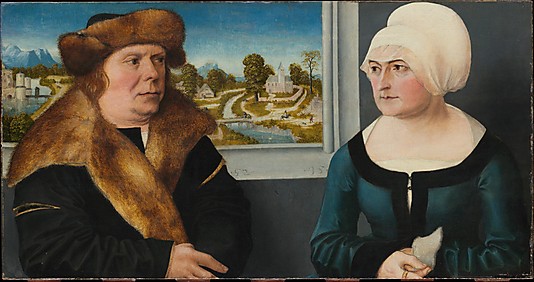
My Daily Art Display’s featured oil on limewood work today is entitled Portrait of a Man and His Wife and was completed in 1512.  In all, the artist painted three versions of this work.  One may wonder why he should do that and the answer could well lie with why the picture was painted in the first place.   It is thought to be a painting to commemorate a wedding and therefore, as we do nowadays, commemorative copies celebrating the marriage were given as gifts to various close relations as well as one being kept by the happy couple.  One copy of the painting is now held in a prívate collection, one is now owned by the Queen of England, having been first acquired for the collection of King Charles I, who received the painting as a gift from Sir Henry Vane, the Comptroller and then Treasurer of the King’s Household.   A third version is on display at the Metropolitan Museum of Art in New York, which acquired their painting in 1912.

In the painting we see the bride and groom, behind which there is a landscape in which there is a centrally positioned church.  Bearing in mind the date of the painting and the fact that it was carried out in Augsburg, art historians believe it to be the wedding of Lorenz Kraffter and Honesta Merz, a couple, who went on to have nine children.  The groom was the son of James Lindsay of Crafford who immigrated to Augsburg from Scotland.   What is interesting to note is the positioning of the man and woman in relationship to the background landscape.  The man is placed in the middle of the finely and beautifully detailed landscape with a castle shown at his back.  From this, we are to deem that this man is of great importance and holds at position of great consequence in Augsburg society – a “man of the world”.  However, look at how the artist has positioned the bride.  She is placed against a blank and dark wall which alludes to her role in life, that of domesticity and enclosure within the marital home.  The landscape in both paintings is criss-crossed by narrow winding paths and two meandering rivers, which curve around the church and castle.  In the New York version the river is given a bluish tone.   Another interesting aspect of the paintings is the three sets of numbers, two of which one can see on the lower sill of the window.  They are “52,  “35”  and “1512” which although not clearly shown in my attached pictures is plainly on view in the painting I stood in front of, and is in between and above the two other numbers.  The “52” indicates the age of the man whilst the “35” denotes the age of the woman and the “1512” alludes to the date the painting was completed by the artist.  The husband is dressed sumptuously in a gown lined with marten and the manner in which he is dressed denotes his high-standing in the local society

The incorporation of a detailed landscape view seen through a window has probably derived from artists such as Hans Memling and its inclusion in this work highlights the power of the Netherlandish influence on the artists of Augsburg in the latter part of the fifteenth century.  Hans Holbein the Elder, another Augsburg painter, would often incorporate architectural settings in his portraits. Although this is essentially a wedding portrait and the focus of the painting is the bride and groom, look at how Ulrich has spent much time in the fine painstaking details of the background landscape with its trees and buildings.

Although I cannot find a picture of the third copy of this painting it is easy to see the differences in the two paintings on offer today, which may lead one to believe that different artists in Ulrich Apt the Elder’s workshop may have had some part in the execution of the works.   A tracing for the figures was obviously shared since they match almost perfectly.  The one in the privately owned Schroder collection is said to be of the highest quality and it is believed that all of that work was carried out by Ulrich Apt himself.  The version held in the Royal Collection, which was previously considered to be a seventeenth-century copy of that in the Schroder collection, has revealed that after recent cleaning and conservation work, it is a very good version by Apt and his workshop.

Originally thought to be by Quinten Massys, and at the end of the seventeenth century it was attributed to Holbein the Younger and furthermore, in the nineteenth century it was thought to be a portrait of his parents. However in 1928, the German art historian Karl Feuchtmayr identified the artist as Ulrich Apt.

Portrait of a Man and His Wife by Ulrich Apt the Elder (1512)Metropolitan Museum of Art, New York
Portrait of a Man and His Wife by Ulrich Apt the Elder (1512)
Metropolitan Museum of Art, New York

The Metropolitan Museum of Art’s copy, shown above, is different in a number of ways to the one held in the Royal Collection.   The first and most obvious difference is the colour of the woman’s dress.   In the Royal collection she is wearing a dress, the color of which is drab brown, whereas in the New York painting it is light turquoise.   According to the MMA, their copy of the painting has been severely overcleaned in the flesh tones. They also comment that splits that run horizontally across the panel at the levels of the sitters’s mouths and foreheads have been filled and in-painted.

Portrait of Countess Golovine by Élisabeth-Louise Vigée Le Brun

Portrait of Countess Golovine
by Élisabeth Vigée Le Brun (c.1797-1800)

Today is the third and final part of my look at the life of one France’s greatest female portraitists, Élisabeth-Louise Vigée Le Brun, but as to why I came to showcase this particular artist I have to make a terrible admission.   I have been unfaithful once again.  My undying and faithful love for a beautiful woman has now fallen by the wayside, not once, but twice.  Last week I looked at a woman and in my mind I told her that she was the most beautiful and the most alluring creature I had set my eyes upon.  What worries me is that this is the third time I have uttered these words in the last couple of years.  How can I be so fickle?

Jeunesse Dorée by Brockhurst

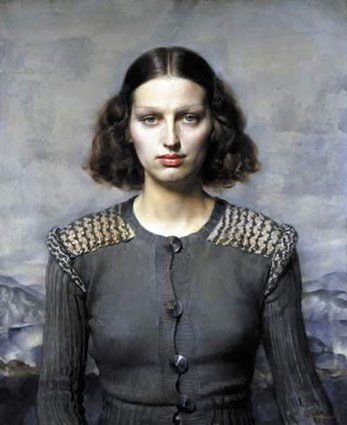
Ok, before you press the escape button, horrified by my infidelity, let me say that my love or is it infatuation is not for an actual woman but for a woman in a painting.  It all started back on May 16th 2011 when I told you about the time I stood before the painting Jeunesse Dorée.  I was rooted to the spot at the gallery, staring at Gerald Brockhurst’s portrait of Kathleen Woodward, the lady who was his beloved muse and who modelled for this painting.  I couldn’t take my eyes off her face.  There was something magnetic about the way she stared out at me.  I have since visited the gallery on a number of occasions just to pay homage to this beautiful woman.

Virgin Annunciate by Antonello da Messina

So that was that.  I was convinced that no other woman would compare with Kathleen’s beauty or so I thought.  However, almost a year later, (My Daily Art Display May 1st 2012), I came across a painting by Antonello da Messina entitled Virgin Annunciate.  As the title states, this was a painting of the Virgin Mary but the model the artist used for Mary was a humble Sicilian girl and for once the Virgin Mary portrayed in a painting, appeared simply as a young girl.  The model the artist had used for this work was a stunningly beautifully girl.  Words failed me as I looked into her eyes.  She had the most gorgeous face.  She had such an innocent air about her, which of course was befitting such a depiction.  There was such an unsullied loveliness about her that for a moment in my mind I discounted the haunting visage of Kathleen Woodward of Jeunesse Dorée, and yet how could I be so capricious?

And so my undying love of beauty had been transferred from a young English woman to a young Sicilian girl but I was determined that it was going to stop there, and so it would until I went to the Barber Institute of Fine Arts at Birmingham University a fortnight ago and “met” Countess Varvara Nikolaevna Golovina as portrayed by my featured painter, Élisabeth-Louise Vigée Le Brun.  Before I tell you more about the sitter and eulogise about her physical beauty, let me complete Élisabeth’s life story.

Maria Carolina by Élisabeth Vigée Le Brun (1791)

The French Revolution had begun and in October 1789, the Palace of Versailles had been stormed by a mob and the Louis XVI and his wife Marie Antoinette had been detained.  Élisabeth, because of her connections with Marie Antoinette, had to hurriedly leave France with her daughter and her daughter’s governess and head for the safety of Italy.  She visited Turin, Bologna, and Rome where her paintings met with great critical acclaim and she was elected to the Roman Accademia di San Luca.  From Rome she moved on to Naples.  Her artistic reputation preceded her and she received many commissions, including royal ones from the Queen of Naples and her husband King Ferdinand IV.  Look closely at the portrait (right) of the Queen, Maria Caroline.  Does she remind you of somebody from my last blog?  There is a very close resemblance with Marie Antoinette and this should not be too surprising as they were sisters.

During her European journeys, Élisabeth gained a travelling companion, who would remain alongside her and her daughter for the next nine years.  His name was, Auguste Jean-Louis Baptiste Rivière, a painter, who had also fled revolutionary Paris and made his way to Turin, where he had met up with Madame Vigée Le Brun and her daughter. Thereafter, he accompanied them and their servants on their trek across Europe and into Russia. During this time the two artists often worked in tandem, Vigée Le Brun painting life-size portraits, some of which were copied in miniature or simply on a small scale by Rivière. She wrote of him in her memoirs:

“…M. de Rivière was an astonishing actor in comic roles. Moreover he possessed every kind of talent, which caused the painter Doyen to remark that M. de Rivière was a little nécessaire de voyage literally a travelling case, but in French a play on words, meaning that he was a necessary adjunct during her voyages. The fact is that he was a fine painter and he copied all of my portraits in the form of large miniatures in oil. He sang very agreeably, played the violin and the bass viol and could accompany himself at the piano. He was endowed with intelligence, perfect tact and such a good heart that despite his distractions, which were frequent and numerous, he was able to oblige his friends with as much enthusiasm as success. M. de Rivière was short, svelte, and he never lost his youthful appearance, so that even at the age of sixty his thin waist and his bearing led one to think he was thirty…”

In 1795, Vigée Le Brun left Vienna and travelled to Russia where she was received by the nobility and painted portraits of numerous aristocrats including the last king of Poland Stanisław August Poniatowski and members of the family of Catherine the Great.  Catherine was not initially happy with Vigée Le Brun’s portrait of her granddaughters, Elena and Alaxandra Pavlovna, because of the amount of bare skin the short sleeved gowns revealed.  However, in order to please the Empress, Vigée Le Brun added sleeves giving the work its characteristic look. This alteration seemed to please the Empress who subsequently agreed to sit herself for Vigée Le Brun.  The proposed portrait never came to fruition as Catherine died in 1796 of a stroke before this work was due to begin.  While in Saint Petersburg, Vigée Le Brun was made a member of the Academy of Fine Arts of Saint Petersburg.   However less pleasing to Élisabeth was her daughter Julie’s decision to marry a Russian nobleman.

And so to My Daily Art Display’s featured work, entitled Portrait of Countess Golovine.  It is of Varvara Nikolaevna Galitzin, the daughter of Lieutenant General Prince Nicholas Feodorovitch Galitzin and his wife, née Prascovia Ivanovna Chouvaloff.  She spent the first fourteen years of her life on her father’s estate of Petrovska, near Moscow. After his death, she and her mother went to live in Saint Petersburg in a house on the Nevsky Prospect next to that of her uncle, Ivan Ivanovitch Chouvaloff.   She was named maid-of-honour at the Imperial court in 1783.   In spite of her mother’s opposition, she married the handsome wealthy but profligate Count Nicholas Nikolaevitch Golovin.   For a time she lived in Paris in the society of the old French aristocracy, but returned to Russia when Napoleon seized power.   Élisabeth and the countess formed a close friendship and in the artist’s memoirs, she wrote of her sitter:

“…Countess Golovin was a charming woman, whose wit and talents were enough to keep us amused, for she received few visitors. She drew very well and composed delightful love songs that she sang while accompanying herself on the piano. Moreover she was on the lookout for all the latest European literature with which she was familiar as soon as it was known in Paris…”

In the painting we see the Countess almost entirely enveloped in the red cloak which is embroidered with a neoclassical design. She wears a deep gold headband.  She stares out at us.  Her eyes are fixed on ours with unwavering, and somewhat unnerving frankness.  What made me lose my heart to this woman was the captivating way her left hand, which grasps her shawl, sweeps up wards clutching the material to her body.  Her loosely flowing auburn hair cascades down on to her shoulder. There is a ray of light falling at an angle from left to right which cuts the background diagonally into dark and light sections and by doing this the artist has emphasised the drama of the pose. There is an aspect of spontaneity about the pose and it is this aspect of the portrait which totally seduced me.

The painting was acquired by the Barber Institute of Fine Arts in Birmingham in 1980 where it hangs today.

After a sustained campaign by  Élisabeth’s ex-husband and other family members to have her name removed from the list of counter-revolutionary émigrés, she was able to return to France in 1802, during the reign of Emperor Napoleon I.   Her husband died in 1813 and six years later she suffers the tragedy of the death of her daughter.  She recalled these times in her memoirs:

“…I must now speak of the sad years of my life during which, in a brief space, I saw the beings dearest to me depart this world. First, I lost M. Lebrun. True that for a long time I had entertained no relations whatever with him, yet I was none the less mournfully affected by his death. You cannot without regret be separated forever from one to whom so close a tie as marriage has bound you. This blow, however, was far less than the cruel grief I experienced at the death of my daughter. I hastened to her as soon as I heard of her illness, but the disease progressed rapidly, and I cannot tell what I felt when all hope of saving her was gone. When, going to see her the last day, my eyes fell upon that dreadfully sunken face, I fainted away. My old friend Mme. de Noisville rescued me from that bed of sorrow; she supported me, for my legs would not carry me, and took me home. The next day I was childless! Mme. de Verdun came with the news, and vainly tried to soften my despair. All the wrong-doing of the poor little one vanished – I saw her again, I still see her, in the days of her childhood. Alas! she was so young! Why did she not survive me?…”

She bought a house in Louveciennes, Île-de-France, and lived there until the house was seized by the Prussian Army during the Franco-Prussian War in 1814.   She then moved to Paris where she remained until her death in her apartment at the Hotel Le Coq, rue Saint Lazare, at the age of 86,  on March 30th 1842 .  Her body was taken back to Louveciennes and buried in the Cimetière de Louveciennes near her old home.  On her tombstone were the words:

“Ici, enfin, je repose…”

(Here, at last, I rest…).

In all, Vigée Le Brun painted over 660 portraits and 200 landscapes which are in galleries and museums all over the world.   In 1835 she published her memoirs.

For a full account of Élisabeth’s life you should try and get hold of her autobiography, Memoirs of Madame Vigée Lebrun translated by Lionel Strachey.  There is an internet version to be found at:

http://digital.library.upenn.edu/women/lebrun/memoirs/memoirs.html#XVIII

Élisabeth-Louise Vigée Le Brun and Marie Antoinette

Marie-Antoinette of Austria, Queen of France
by Élisabeth Vigée Le Brun (1778)

I had intended this blog to be the concluding look at the life and some of the works of Élisabeth-Louise Vigée Le Brun but instead I am just concentrating this blog on a couple of the portraits Élisabeth did of the Queen consort Marie Antoinette and look at Élisabeth’s life up to her forced exile from France.  My next blog will conclude Élisabeth’s life story.

At the end of my last blog we had reached 1775 and Élisabeth’s step father had retired from his jewellery business and the family had moved to an apartment in a large property, Hotel de Lubert, which was situated on the rue de Clery.    The Hotel de Lubert was also where the painter and art dealer Jean-Baptiste Pierre Le Brun had his gallery.  Soon after settling into her new home, Élisabeth took a great interest in the beautiful masterpieces which filled Le Brun’s apartment and gallery.   She recalled this time in her memoirs saying:

“…I was enchanted at an opportunity of first-hand acquaintance with these works by great masters.  Monsieur Lebrun was so obliging as to lend me, for purposes of copying, some of his handsomest and most valuable paintings. Thus I owed him the best lessons I could conceivably have obtained…”

Six months after moving in to her new home Le Brun proposed marriage to Élisabeth.   She was not physically attracted to him but was concerned about her family’s financial future, hated living with her stepfather and after much persuasion from her mother, who believed Le Brun was very rich, agreed to Le Brun’s proposal.  Even on her wedding day on January 11th 1776, Élisabeth had her doubts about the wisdom of her decision for she later wrote:

“…So little, however, did I feel inclined to sacrifice my liberty that, even on my way to church, I kept saying to myself, “Shall I say yes, or shall I say no?” Alas! I said yes, and in so doing exchanged present troubles for others…”

Élisabeth’s fears were soon borne out for although she termed her husband as being “agreeable” he had one great character flaw – he was an inveterate gambler and soon his money and that which Élisabeth earned from her commissions was frittered away.  However before the money had run out, Élisabeth and her husband bought the Hotel de Lubert in 1779, and her Salons, which she held there became one of Paris’ most fashionable pre-revolutionary venues for artists and the literati.  Two years later, on February 12th 1780, her only child Jeanne Julie Louise was born.   In 1781 she and her husband left Paris and journeyed to Flanders and the Netherlands and it was during this trip that she saw some of the works by the great Flemish Masters and these paintings inspired her to try new painting techniques. During their time in Flanders she carried out various portraiture commissions for some of the nobility, including the Prince of Nassau.

It was back in the year 1779 that Élisabeth first painted a portrait of Marie-Antoinette, Louis XVI’s queen consort.  It was at a time when the lady had reached the pinnacle of her beauty.  In her memoirs Élisabeth described Marie-Antoinette:

“…Marie Antoinette was tall and admirably built, being somewhat stout, but not excessively so. Her arms were superb, her hands small and perfectly formed, and her feet charming. She had the best walk of any woman in France, carrying her head erect with a dignity that stamped her queen in the midst of her whole court, her majestic mien, however, not in the least diminishing the sweetness and amiability of her face. To anyone who has not seen the Queen it is difficult to get an idea of all the graces and all the nobility combined in her person. Her features were not regular; she had inherited that long and narrow oval peculiar to the Austrian nation. Her eyes were not large; in colour they were almost blue, and they were at the same time merry and kind. Her nose was slender and pretty, and her mouth not too large, though her lips were rather thick. But the most remarkable thing about her face was the splendour of her complexion. I never have seen one so brilliant and brilliant is the word, for her skin was so transparent that it bore no umber in the painting. Neither could I render the real effect of it as I wished. I had no colours to paint such freshness, such delicate tints, which were hers alone, and which I had never seen in any other woman…”

Both the artist and sitter formed a relaxed friendship and in her first portrait (above) the queen is depicted with a large basket, wearing a satin dress, and holding a rose in her hand. The painting was to be a gift for Marie-Antoinette’s brother, Emperor Joseph II, the Holy Roman Emperor, and a further two copies were made, one of which she gave to the Empress Catherine II of Russia, the other she would keep for her own apartments at Versailles.  In all, Élisabeth painted more than thirty portraits of the queen over a nine year period

Élisabeth’s friendship with Marie-Antoinette and her royal patronage served her well as in 1783,  her name had been put forward by Joseph Vernet for election to France’s Académie Royale de Peinture et de Sculpture.   As her morceau de réception (reception piece) she submitted an allegorical history painting entitled La Paix qui ramène l’Abondance (Peace Bringing Back Prosperity).  She also submitted a number of her portraits. The Académie however did not categorise her work within the academy categories of either portraiture or history.  Her application for admission was opposed on the grounds that her husband was an art dealer, but because of Élisabeth’s powerful royal patronage, the Académie officials were overruled by an order from Louis XVI.  It is thought that Marie Antoinette put considerable pressure on her husband on behalf of her painter friend.

Having royal patronage and being great friends with Marie-Antoinette was a boon when the Royalty was loved by its people but once the people turned against Louis XVI and his queen, as happened during the French Revolution, then any friends the royal couple had were equally detested and at risk from the mob.  Attacks on Élisabeth Vigée Le Brun’s character had started back in late 1783 when the newspapers wrote stories about an alleged affairs she had with the Finance Minister, Charles Alexandre, Vicomte de Calonne, the Comte de Vaudreuil and the painter François Menageot.  The rumours persisted and it all came to a head in 1789 when fictitious correspondence between Élisabeth and Calonne was published in the spring.  Rumours about her lavish lifestyle abounded, even though they were not altogether true.  She was now starting to realise that having close connections to the monarchy, which she had once considered to be advantageous, was becoming a dangerous liability.

Marie Antoinette and her Children
by Élisabeth Vigé Le Brun (1788)

Élisabeth Vigée Le Brun’s last portrait of Marie-Antoinette was completed in 1788 and entitled Marie Antoinette and her Children.  The setting is a bedroom or a private chamber within the Royal palace.  Marie Antoinette is seated with her feet on a cushion.  This depiction of her posture symbolizes her status and high position in society.  She has a young infant on her lap and her son and daughter are either side of her.  In the painting we see her son, Louis-Joseph, Le Dauphin, standing to the right. Louis-Joseph suffered from bad health all his young life with the onset of early symptoms of tuberculosis and he died of consumption in 1789, a few months before his eighth birthday.   On the Queen’s lap sits Louis-Charles, Duc de Normandie, who on the death of his elder brother, became the second Dauphin. Following the guillotining of his father Louis XVI,  he became known as Louis XVII. This young boy was imprisoned in The Temple, a medieval Parisian fortress prison, where he died in 1795, aged ten, probably from malnutrition but rumour also has it that he was murdered.  Standing on the Queen’s right is Marie Therese Charlotte de France, Madame Royale.  She was Marie-Antoinette’s eldest child.  She too was imprisoned in The Temple but was the only member of the Royal family to survive the ordeal.  She remained a prisoner for over a year but Austria arranged for her release in a prisoner-exchange on the eve of her seventeenth birthday, in December 1795.  In the painting we can also see depicted an infant’s cradle which Louis-Joseph points to and lifts the covers showing it as being empty.  This empty cradle is a reference to Princess Sophie, Marie Antoinette’s other daughter, who was born in 1786 and died of convulsions two weeks before her first birthday.  This very poignant painting still hangs at Versailles.

On the night of October 6th 1789, following the invasion of Versailles by Parisian mobs and the arrest of the royal family, Élisabeth Vigée Le Brun left the mayhem of Paris with her daughter and governess in a public coach and headed for Italy.  She had hoped to return to France in the near future when the situation had settled down but in fact she never set foot back in France for twelve years.

My next blog will look at the latter part of Élisabeth’s life and I will regale you with my tale of infidelity which was the reason for featuring Élisabeth-Louise Vigée Le Brun in the first place !!


Self Portraiture by Élisabeth-Louise Vigée Le Brun

Over the next two blogs I want to introduce you to and look at the life of one of the finest 18th century French female portraitist, Élisabeth-Louise Vigée Le Brun.  In my initial blog about her I want to examine her early life and show you three of her self portraits and in the following blog I will conclude her life story and tell you about her friendship with Marie-Antoinette, her exile from the land of her birth and relate how I was once again unfaithful having been seduced by a new beauty !  Sounds interesting ?

Self Portrait in a Straw Hat (age 22)
by Élisabeth-Louise Vigée Le Brun (1782)

Today’s artist was born Élisabeth-Louise Vigée in April 1755 on the rue Coquilliere in Paris, just six months before another baby girl was born in the palace of Emperors of Austria in Vienna, a priveleged child, who would become the queen of the French nation and also play a large part in Élisabeth’s life.  That Viennese baby was Marie-Antoinette.   But let me return to Élisabeth.  Élisabeth was the daughter of Louis Vigée, a portraitist and professor at the Academie de Saint Luc .  Her mother, Jeanne Maissin was a hairdresser by trade.  At the age of 3 months, she was sent to a small farm near Épernon, where she was looked after by relatives.  She stayed with them until she was six years old.  Following this, she attended the convent school, Couvent de la Trinite in the Faubourg Saint Antoine district of Paris, as a pensionnaire, (a boarder) where she remained until she was twelve years old.  It was here that she first displayed her young talent for drawing and painting.  In her memoirs she wrote about her time at the boarding school, her love of drawing and the trouble it often got her into but also the pleasure her father had in her interest in art.  She wrote:

“….During that time I scrawled on everything at all seasons; my copy-books, and even my schoolmates’, I decorated with marginal drawings of heads, some full-face, others in profile; on the walls of the dormitory I drew faces and landscapes with coloured chalks. So it may easily be imagined how often I was condemned to bread and water. I made use of my leisure moments outdoors in tracing any figures on the ground that happened to come into my head. At seven or eight, I remember, I made a picture by lamplight of a man with a beard, which I have kept until this very day. When my father saw it he went into transports of joy, exclaiming, “You will be a painter, child, if ever there was one!…”

On returning to live at home on a permanent basis, her father gave Élisabeth her first drawing lessons when she was allowed to attend his drawing classes which he gave to students in his studio.  Sadly his tuition did not last long as Louis Vigée died on May 9 1767 in his apartment on the rue de Clery.   To lose her father at the age of twelve was a traumatic experience for Élisabeth and she recalled the moment:

“…I had spent one happy year at home when my father fell ill. After two months of suffering all hope of  his recovery was  abandoned. When he felt his last moments approaching, he declared a wish to see my brother and myself. We went close to his bedside, weeping bitterly. His face was terribly altered; his eyes and his features, usually so full of animation, were quite without expression, for the pallor and the chill of death were already upon him. We took his icy hand and covered it with kisses and tears. He made a last effort and sat up to give us his blessing. “Be happy, my children,” was all he said. An hour later our poor father had ceased to live…”

Self Portrait with her Daughter (Maternal tenderness)
by Élisabeth-Louise Vigée Le Brun (1786)

Élizabeth’s father had, on his death, left the family penniless and his widow had to find ways of clearing their debts and pay for her son’s schooling and it is with that in mind that, in December of that same year, 1767, she married a wealthy jeweller, Jacques François Le Sevre and the family moved to an apartment on the rue Saint Honore facing the Palais Royal.    However any thoughts she had that her rich husband would solve the family’s financial problems were soon dashed as he turned out to be miserly with his money and just provided the bare minimum for his wife and her son.  Élisabeth, by this time, had been earning her own money from commissions but was made to hand it over to her step-father for him to use as he saw fit.

Élisabeth began taking drawing lessons with her friend Blaise Bocquet from the history painter and Academician, Gabriel Briard, who had a studio in the Louvre.  During her training she copied the paintings of the Old Masters at the Louvre and the Palais-Royal, which housed the magnificent Orléans art collection, and during this period she encountered the French artist, Claude Joseph Vernet.  He would often give her artistic advice and encourage her and more importantly introduced her to prospective important and wealthy patrons.  She also met the Abbé Arnault, of the French Academy.  She later described him as a man of strong imaginative gifts, with a passion for literature and the arts and recalled how his conversation enriched her with ideas.     It was the studying of the Old Masters’ paintings which furthered her knowledge of anatomy, perspective, and the other important aspects of history painting which she was not allowed to formally study, simply because of her gender.  She spent a great deal of time copying the heads in some of the pictures by Rubens, Rembrandt and Van Dyck, as well as several heads of girls in paintings by Jean-Baptiste Greuze.  She was a great admirer of Greuze’s portraiture because, from them, she learnt about his use of  the demi-tints when portraying flesh colouring.

By this time Élisabeth had decided that her future lay in her art and she would strive to become a successful painter.  However her choice of career was problematic simply because she was a female.  As a female, she was excluded from formal academic training and artistic competitions and this factor alone gave her a distinct disadvantage in comparison to the training afforded to her male contemporaries.  At this time in France, the most prestigious type of painting was history painting but to achieve a reputation as a great history painter one had to undergo an all-embracing formal artistic education into the likes of the technique of painting the nude male and how to best arrange figures within a painting for it to be accepted as an acceptable narrative work.  However for reasons of modesty, females were not allowed to paint nude males and so as this formal training was not yet available to aspiring female artists, they had to settle for painting portraits, landscapes and genre works.  She now decided to specialise in portraiture.

Self Portrait with Daughter (à la Grecque)
by Élisabeth-Louise Vigée Le Brun (1789)

In 1774, aged nineteen, Élizabeth applied to join the Academy of Saint Luke where her father had taught. She was accepted and that year she exhibited several of her works at their Salon.  Her portraiture and the way in which she depicted her sitters in a flattering manner was very popular and much in demand.  In 1775 she married a wealthy art dealer and amateur painter, Jean-Baptiste-Pierre Le Brun.  The marriage was a marriage of convenience orchestrated by her mother.  Five years later, the couple had their only child, Jeanne Julie Louise, born on February 12th 1780.  It was not a love match, but more of a mutually-beneficial pact that benefitted them both.  .  Her husband marketed her work and endorsed her artistic career while also profiting from her artistic output.  It worked well and the couple became quite affluent and lived a luxurious lifestyle, which allowed them to mix socially with the highest circles of society. Soon Élisabeth and her husband would hold fashionable soirées at their home.  Their guests included artists, writers, and important members of Parisian society.  In 1776 she finally managed to achieve her ultimate aim.  She secured her first royal commission when she was asked to paint a series of portraits of King Louis XVI’s brother, the Comte de Provence.  Before long she even caught the attention of the king and queen themselves and Élisabeth was summoned to the court in 1778 to paint her first portrait of the Marie Antoinette. Marie Antoinette had had her portrait painted by many artists but neither she nor her mother, Marie-Thérèse were ever fully satisfied with the results.  However, they both approved of Élisabeth’s depiction which, although it admirably conveys her royal status, it was actually much more simplified and natural than most of the earlier official portraits of the queen.  This portrait marked the start of a close relationship between Élisabeth and Marie-Antoinette.  This relationship greatly enhanced the reputation of the artist and led to many wealthy commissions. Louis XVI was equally impressed by her artistic work and in Wendy Slatkin’s book, Women Artists in History, she quotes Louis XVI’s comments about Élisabeth and her work:

“…I know nothing about painting, but you have made me love it…”

Élisabeth was a devoted royalist and idolized Marie Antoinette and the rest of the royal family.  It was however this close friendship with Marie-Antoinette which was to alter the course of her life.

Portrait of Susan Lumsden by Rubens

I have included three self portraits in this intial blog about the artist Élisabeth-Louise Vigée Le Brun.   The first one entitled Self Portrait with Straw Hat was completed in 1782 and is held in a Swiss private collection.  Élisabeth exhibited this work at the 1783 Académie royale de peinture et de sculpture (Royal Academy of Painting and Sculpture), Paris.  Of this painting the artist wrote:

“…I was so delighted and inspired by Rubens’ Le Chapeau de Paille that I completed a self portrait whilst in Brussels in an effort to achieve the same effect.  I painted myself wearing a straw hat with a feather and a garland of wild flowers and holding a palette in one hand...”

For a more comprehensive look at Rubens’ Le Chapeau de Paille, also known as Portrait of Susanna Lunden go to My Daily Art Display of March 11th 2011.

Lady Hervey and her Daughter by Angelika Kauffmann

The second self portrait I have featured was completed by Élisabeth in 1786 and is entitled  Madame Vigée-Le Brun and Her Daughter, Jeanne-Lucie, known as Julie (1718–1819).  The painting is thought to have been inspired by a work by Angelika Kaufmann, entitled Lady Hervey and her Daughter which depicted Elizabeth Drummond, Lady Hervey and her daughter Elizabeth Catherine Caroline Hervey later to become The Honourable Mrs Charles Rose Ellis.  The work by Vigée Le Brun is one of maternal tenderness and is somewhat reminiscent of the sentimental pictures of Jean-Baptiste Greuze which Élisabeth had studied in her younger days.


The third portrait in this blog is entitled Madame Vigée-Le Brun et sa fille, Jeanne-Lucie-Louise, dite Julie (Madame Vigée-Le Brun and her daughter Jeanne-Lucie-Louise, known as Julie) and is often referred to as Self Portrait with Daughter (à la Grecque).  It is currently housed at the Louvre in Paris.

Maga’s Daughter by Andrew Wyeth

Maga’s Daughter by Andrew Wyeth (1966)

Today I am returning to an artist I first featured almost twenty months ago.  The artist in question is Andrew Wyeth and in My Daily Art Display of January 3rd 2011 I looked at his famous work entitled Christina’s World.  It is an extremely poignant painting and one which will always linger in my memory.  I do recommend you go and have a look at it and see what you think.  My featured painting today is a beautiful portrait which Andrew Wyeth completed in 1966 and is entitled Maga’s Daughter.   The reason for the title will become apparent when you read the life story of Andrew and his wife Betsy.

Andrew Wyeth was born in 1917 in the town of Chadds Ford, Delaware County Pennsylvania.  His mother was Carolyn Brenneman Wyeth (née Bockius), a lady from Wilmington.  His father was Newell Convers (N.C.)Wyeth, an artist and one of America’s greatest illustrators.  N.C. Wyeth had moved from Massachusetts as a young man to study with the illustrator Howard Pyle in Chadds Ford and it was here in 1908 that he and Carolyn married.  He then built his home and studio on an eighteen acre homestead close to the site of the Brandywine battlefield, where in 1777 the Continental army led by George Washington fought the British army in the American Revolutionary War.  The couple went on to have three daughters and two sons of which,  Andrew was the youngest.   All the children were extremely talented. The eldest child, Henrietta is considered by many art scholars to be one of the great women painters of the 20th century.  Carolyn Wyeth, the second daughter was also an artist whilst the youngest daughter, Ann, was a talented musician.  Andrew Wyeth’s elder brother, Nathaniel, was a mechanical engineer and inventor.

Andrew Wyeth’s father although wanting to devote his time to painting had to, for financial reasons, concentrate on his work as an illustrator.   It was a well paid profession and the family lived a comfortable lifestyle.  As a child, Andrew never kept well, one illness followed another and consequently he spent a lot of time at home and his father had to provide him with home tutoring.   There was a marked difference between father and son.  His father was a big man and had boundless energy which was in marked contrast to his frail and delicate son.   Later in life Andrew Wyeth remembered those days closeted at home with his father.  He wrote:

“…Pa kept me almost in a jail,” Wyeth recalled, “just kept me to himself in my own world, and he wouldn’t let anyone in on it. I was almost made to stay in Sherwood Forest with Maid Marion and the rebels…”

Before Andrew Wyeth had reached his teenage years his father had achieved celebrity status as an illustrator having illustrated Robert Louis Stevenson’s famous book, Treasure Island.  Following on from this success he illustrated other famous novels such as James Fenimore Cooper’s Last of the Mohicans and Daniel Defoe’s Robinson Crusoe.   Andrew Wyeth was taught art by his father, who inspired his son’s love of rural landscapes, sense of romance, and instilled in him a feeling for the Wyeth family artistic traditions. From an early age, the youngster soon began to enjoy drawing and with his father’s guidance, he quickly mastered figure study and watercolour techniques. Andrew soon became fascinated by art history and loved to look at works by not only the Renaissance Masters but native born American artists, such as Winslow Homer.  In 1937, when he was twenty years of age, Andrew had his first one-man exhibition of watercolours at the Macbeth Gallery in New York City. It was a resounding success and all the works exhibited were sold.  It was now that he was certain in his own mind that a career as an artist was all he wanted.  This immediate success which he achieved did not reassure him as like many talented people he was exceedingly self-critical.  He was irritated by some of his work believing it to be too facile.

It was in 1939 that Andrew Wyeth met Betsy Merle James.  Betsy James was born in the village of East Aurora in New York State in 1922.  Her father, Merle James, a trained artist, worked as a printer for the newspaper, Buffalo Courier-Express.  Her mother was Elizabeth “Maga” Browning (hence the title of today’s featured painting).   Betsy grew up as the youngest of three girls.  In the 1930’s the family spent their summers with their friends on Bird Point, a promontory jutting out into the Atlantic Ocean, close to the town of Cushing, Maine.   The next door neighbours were Alvaro Olson, a blueberry farmer and his sister Christina .  This was the Christina of Wyeth’s famous painting Christina’s World. As a young girl Betsy became great friends with Christina.  In 1939, on Andrew Wyeth’s twenty-second birthday, while spending the summer in Maine, the seventeen year old Betsy James and the twenty-two year old Andrew Wyeth met.  At this initial meeting Betsy James took Andrew to Cushing to introduce him to her long-time friend Christina, who had been crippled by polio in childhood.   Strangely, at this first meeting, it was not Christina who made the greatest impression on Andrew Wyeth but the weather-beaten, three-story, steep-roofed, clapboard house, built on a coastal promontory which was her home.  However later Christina and Andrew became good friends and she featured in many of his paintings including three beautiful portraits entitled, Christina Olson (1947), Miss Olson (1952), and Anna Christina (1967). Christina even allowed him to convert one of the rooms in their farmhouse into a studio.

Betsy and Andrew’s wedding day (1940)

Andrew and Betsy dated all that summer and in the fall, when Betsy went off to the Colby Junior College in New Hampshire, they faithfully corresponded with each other.  They were in love and the following year they married and set up home in an old schoolhouse which lay on the Wyeth family land.  Although Betsy was not an artist, Andrew continually sought her judgement on his work.  Sales of Andrew Wyeth’s works of art grew steadily and Betsy managed the business side leaving her husband to concentrate solely on his art.  Betsy had a strong character and exerted almost as much influence on her husband as his father.  In the early days of her marriage, she believed that she had to battle with Andrew’s father to gain her husband’s  attention.  She once commented to Richard Meryman, Andrew Wyeth’s biographer, on her battle with her father-in-law:

“I was part of a conspiracy to dethrone the king — the usurper of the throne. And I did. I put Andrew on the throne…”

In 1943 the couple had their first child, a son Nicholas.  A second son, James followed three years later and would become a renowned artist in his own right.  Eighteen years after the couple married and settled in to life in the school house, they moved and bought an old 18th century gristmill on the banks of the Brandywine River in Pennsylvania.  Whilst her husband spent days on end painting, Betsy set about restoring the old mill, converting it into a home and a studio.

The featured painting today is Maga’s Daughter by Andrew Wyeth, which he completed in 1966.  It is a portrait of his beloved wife Betsy, whose mother was Elizabeth “Maga” James .  She posed in a three-quarter view.  She stands erect.  Her bearing is one of dignified pride as she averts her eyes away from the viewer.  Atop her head is an antique riding hat with its drawstrings dangling freely on either side of her face, almost if they were acting as a frame of a picture.  She wears a drab-coloured, high collared dress which almost blends in with the slightly lighter coloured background.  There is a faint flush of colour to her cheeks and a smile is forming on her lips.  What beautiful eyes she has, lit by the unseen light source to the left of the painting.

What was Andrew Wyeth thinking as he painted this portrait?  Actually we know,  for he told us:

 “…It’s my wife, Betsy. I had worked a long time on this and knew it wasn’t working. At the time I was on board of trustees of the Smithsonian Institution – quite prestigious. But Betsy didn’t like it, telling me that my work would suffer because of all these boards. I left for Washington one morning, and Betsy got furious, really flew into a rage. All the way down I kept thinking of that colour rising up high into her cheeks. I knew I had captured her. The colour of those cheeks under her coal black hair and that hat gives the portrait a real edge. Really caught her. It’s more than a picture of a lovely looking woman. It’s blood rushing up. Portraits live or not on such fine lines! What makes this, is that odd, flat Quaker hat and the wonderful teardrop ribbons and those flushed cheeks. She could be a Quaker girl who’s just come in from riding… ”

Andrew & Betsy Wyeth, October 15, 2008

On January 16, 2009, Andrew Wyeth died in his sleep at his home in Chadds Ford, Pennsylvania, after a brief illness. He was 91 years old.  Andrew and Betsy Wyeth had been married sixty nine years