Marie Laurencin Part 2.

Marie Laurencin, Paris (c.1912.)

Marie Laurençin’s paintings dating from around 1910 have a strong flavour of cubism. However, she once again stated that although the experiments of cubism fascinated her, she was adamant that she would never become a cubist painter because she was not capable of it.

Bateau-Lavoir c. 1910

Laurençin spent a lot of time at Picasso’s open studio at the Bateau-Lavoir, (Laundry Boat) building at 13 Rue Ravignan at Place Emile Goudeau in Montmartre in the 18th arrondissement of Paris.  The building was so nicknamed as it was said to resemble the public clothes-washing boats moored on the Seine in the early years of the twentieth century. The ramshakle building was said to strain and groan when it was windy—just like the those laundry boats on the Seine. Here, Laurençin exhibited her work along with a group of artists known as the Bateau-Lavoir, which was the residence and meeting place for a group of outstanding artists and men of literature.  It was here that she met Max Jacob, the French poet, painter, writer, and critic, and André Derain, the French artist, painter, sculptor and co-founder of Fauvism.  She was also introduced to Gertrude Stein, the American novelist, poet, playwright, and art collector to whom she made her first sale in 1908.

Les jeunes filles (Jeune Femmes, The Young Girls) by Marie Laurençin (1911)

In 1911 Laurençin completed her painting entitled The Young Girls.  Marie Laurencin showed The Young Women at the Salon des Indépendants in Paris in 1911, alongside works by other artists painting in a similar style. The exhibition, which gave rise to the term “cubism”, caused a scandal but was also the breakthrough for Cubist art.  This work depicts four pale-skinned dark-eyed women with dark hair, independent of each other and yet overlapping.  They are all wearing  grey robes and stand against an abstracted pastoral backdrop. The female on the left is a violinist, playing music for the figure beside her, who dances. At the centre of the depiction we see a woman seated facing the dancer, but she turns her head to look back at us.  On the right, another woman appears in motion, carrying a bowl of fruit under her right arm and reaching down with her left hand to stroke the nose of a doe. All the limbs of the women have a fluidity which mirrors the drape of their dresses.   Their bodies are outlined with heavy black lines.  Laurençin has experimented with this depiction and artistic style. 
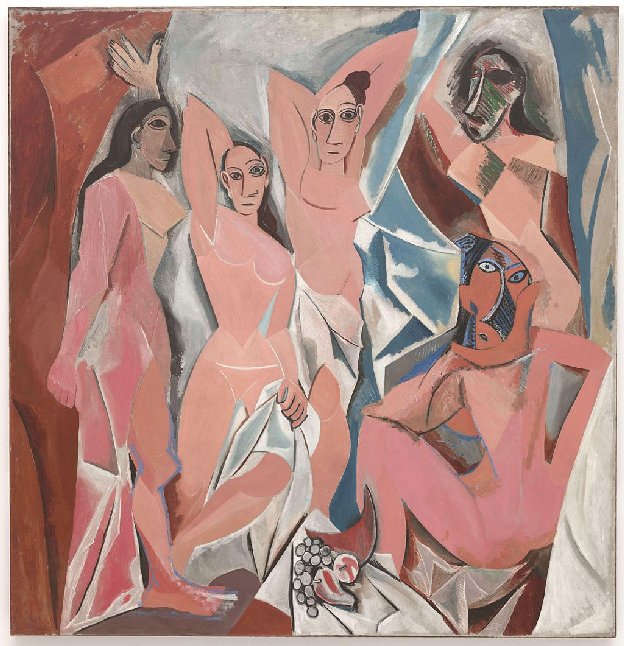
Les Demoiselles d’Avignon by Picasso (1907)

The posture of the four women with their flat, mask-like faces seems to have been influenced by her friend, Picasso’s 1907 painting Les Demoiselles d’Avignon.  In a way the work can be considered as a suggestion that the four women represent a fertile sphere of feminine creativity.  The presence of the doe is symbolic of femininity and naturalness that was a common theme in Laurencin’s work.  Critics believe the painting alludes to the of lesbian self-fashioning and as a celebration of an independent female realm.  The painting can be viewed at the Moderna Museet in Stockholm.

Portrait de jeune femme by Marie Laurencin

In 1913, Marie Laurençin’s mother died and this sad event coincided with her ending her relationship with Apollinaire, but this ending could have something to do with his reputation as a philanderer.   However, she would remain close to Apollinaire until his death, aged 38, in 1918. Her split from Apollinaire freed Laurencin of his Cubist influence, but at the same time, isolating her. On June 24th 1914, in Paris, Marie married Baron Otto van Wätjen, a German Impressionist and Modern painter whom she had first met as fellow students at the Académie Humbert.  

Marie Laurencin, Cecilia de Madrazo and the Dog, Coco by Marie Laurençin (1915)

In the Tate Britain, London, one can see the 1915 work by Laurençin entitled Marie Laurencin and Cecilia de Madrazo and the Dog, Coco.  Cecilia was an art collector friend of Maria.  Laurençin told a fellow artist that the painting was completed in 1915 while she and her husband were exiled in Madrid.  The girl wearing the hat is Cecilia de Madrazo, a young Spaniard, and the other figure is Marie herself wearing a pink dress with her dog poking up between them.  She had bought the dog from an English sailor at Malaga. Marie Laurencin was staying in Madrid with the Madrazos at the time.  Marie has depicted herself with short hair which covers her ears and forehead.  Although her skin is grey it is sharply in contrast with pink cheeks and lips and black eyes which are focused downwards.  Cecilia is fascinated by the dog.  She stares down at it and pushes a finger towards its very long snout. Cecilia’s skin is almost white, with pink lips and cheeks.  She is wearing a grey dress and has a white hat, with a large blue bow, atop her dark hair. The backdrop, almost without detail, is grey and there is a pink curtain at the right edge of the painting; the colour scheme is very limited, with Laurencin utilising only grey, pink, blue and very small amounts of beige. This painting is representative of Laurencin’s work, which has been both appreciated and criticised for its deliberately feminine aesthetic.  Marie’s palette concentrated on  pastel colours. The two figures depicted add a sense of peace and charm and they own the conventional female virtues of loveliness, sophistication and meekness. Laurencin’s unapologetic embrace of visual pleasure and the way she developed an aesthetic that acclaimed female softness, elegance and sweetness was itself a radical position. Laurencin’s painting has depicted such qualities as part of a creative process in which a masculine form is utterly unnecessary, and in a way it is a presentation of a work in which both artist and subject are female.   

The Fan by Marie Laurencin (1919)

In 1919 Laurencin completed her painting entitled The Fan and this, like the previous work, is part of the Tate Britain, London collection.  The painting was purchased by Gustav Kahnweiler, an art dealer, as a gift for his wife, Elly.  He and his wife amassed a modest art collection focused on Cubist paintings, sculptures, and works on paper. After the couple moved to England in the 1930s to escape Nazi persecution, Gustav and Elly loaned and gifted works from their collection to the Tate.  It is believed that the woman in the oval frame is Laurencin herself but the identity of the other woman is unknown.  The fan, which was a symbol of vanity, was one of Laurencin’s favourite accessories. The painting depicts a pink shelf that holds two images of women, one in a rectangular frame and the other in a round frame, against a pink and grey background. The portrait to the left, in the larger, rectangular frame, shows a woman and a dog in greyscale, accentuated by a pale blue ribbon, hat and curtains.  Next to it is an oval frame at the centre of the painting depicting a woman reputed to be Marie Laurencin herself, though it is unclear if this is a portrait or indeed a mirror. The lower right corner of the painting is dominated by the folds of a fan, painted in grey and white, that is cut off at the canvas’s edge.  Laurencin has cleverly depicted the fan in a position that could be seen as being held by someone who is staring at the two frames on the shelf.  The two portraits in the frames on the shelf are positioned such that the figures appear to look out towards us but also towards the person holding the fan.  There is an air of mystery about the depiction and the identities of the figures.  Some believe that the woman in the rectangular frame is Nicole Groult, a dressmaker with whom Laurencin is likely to have had a romantic relationship.
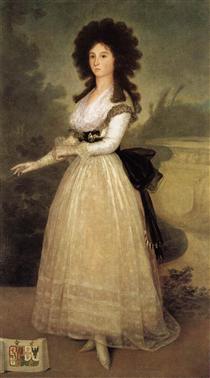
Dona Tadea Arias de Enriquez by Goya (1793)

Once married to Otto van Wätjen, Laurencin automatically lost her French citizenship and so took up German citizenship. She and her husband moved to neutral Spain at the beginning of the First World War in order to avoid France’s anti-German sentiment.  Here, Laurencin became involved with the Dada movement, editing the art and literary magazine 391, a Dada-affiliated arts and literary magazine created by Francis Picabia.  She also spent time looking closely at the work of Francisco Goya, whose dignified, dark-eyed women captivated her.

Simultaneous Windows on the City by Robert Delaunay (1912)

During this period in Spain she became great friends with Sonia Delaunay and Robert Delaunay, who had similarly left France to avoid the War.   Robert was an artist of the School of Paris movement, who, with his wife Sonia Delaunay and others, co-founded the Orphism art movement, noted for its use of strong colours and geometric shapes.

……to be continued.

Pablo Picasso – The early days, Part 1

Having returned home from a four-day vacation in Paris I need to catch up with writing my blog.  In my last blog I promised two entries with regards the life and works of Picasso and so, true to my word that is what I will give you.  Before I start I have a terrible admission to make.  I do not like the works of Picasso.  Yes, I know that is artistic anathema but at least I am honest.  I suppose the one caveat to that controversial assertion is that it is the later works of Picasso which I do not like and so my next two blogs will cover some of his earlier paintings and the fascinating beginnings to the Spanish artist’s life.

Pigeons by José Ruiz Blasco (Picasso's father) 1888

It was 11:15pm on Tuesday October 25th 1881 that Picasso was born in Malaga, Spain.  His father was Don José Ruiz y Blasco, a painter of birds in their natural habitat, especially pigeons, and who at the time was a professor of drawing at the Escuela Provincial de Bellas Artes in Malaga and a curator at the local art museum.  Picasso’s mother was Maria Picasso y Lopez.  He was the first-born of their children.  He was baptised Pablo Diego José Francisco de Paula Juan Nepomuceno María de los Remedios Crispiniano de la Santísima Trinidad, honouring a number of saints and some of his relatives.  To that already long name was added the names of his father “Ruiz” and his mother “Picasso” which was a requirement of Spanish law.  He was known simply as Pablo Ruiz.  Picasso’s father’s marriage to his wife was considered at the time as his father marrying beneath himself as he was from minor aristocracy and had a much higher standing in the community than that of his wife who was also without a dowry.  Although she brought no money into the relationship she did bring energy and thriftiness which was to serve her husband and family well.  Another thing Maria brought to the marital home was a bevy of females – her family, which consisted of her widowed mother and two unmarried sisters, Eladia and Eliodora along with a maidservant and so the young Pablo was brought up in a household full of women, all of whom were devoted to the little boy.

In late December 1884 Picasso’s sister, Lola was born, just three days after the devastating earthquake which destroyed large parts of the city of Malaga, killing almost eight hundred people and destroying 4000 homes.  The Picasso family fled the city and temporarily took refuge at the house of his father’s employer.  One wonders whether the young Picasso associated giving birth with the cataclysmic earthquake !   A second sister, Concepcion, was born when Pablo was six years old.  In 1891 the art museum which Picasso’s father had been its curator had closed down and as this was the main source of his income the father decided, for economic reasons, to uproot his family from Malaga an move everybody to La Corunna in the far north west of the country where he had gained employment as a teacher at the Guarda School of Fine Art.  By now, Picasso, aged almost eleven had developed a talent for drawing and his artistic skills blossomed to the detriment of his normal school work.  His father realised that his young son’s artistic talent would soon outshine his own and decided to transfer his own ambitions to those of his son and concentrated on getting his son, and now protégé, the very best artistic training.

In late 1894, when Picasso was barely thirteen years of age, tragedy struck the family with his four year old sister, Conchita, contracting diphtheria.  The young Picasso related years later that at this time he entered into a bargain with God that if he spared his sister’s life then he would give up all thoughts of painting again.   The fact that she was dying was concealed from Conchita and the family, for her benefit, celebrated the Christmas period as usual but sadly on January 10th 1895, she died.  Picasso was devastated by the death. In Arianna Stassinopoulos Huffington’s biography of Picasso entitled Picasso: Creator and Destroyer, she relates a conversation the artist had with his young lover Françoise Gilot, during which he tells her about his bargain with God with regards the life of his sister and his artistic career and the dilemma that had encompassed.  Huffington explains the thought process of the guilty Picasso regarding the prodigious bargain he had made with God saying:

“…he was torn between wanting her saved and wanting her dead so that his gift would be saved.  When she died, he decided that God was evil and destiny an enemy.   At the same time he was convinced that it was the ambivalence that had made it possible for God to kill Conchita.  His guilt was enormous, the other side of his belief in the enormous power to affect the world around him.    And it was his compounded by his primitive, almost magical conviction that his little sister’s death had released him to be a painter and follow the call of the power he had been given, whatever the consequences…”

In September 1895, the family made the sea passage from La Corunna to Barcelona, stopping off in Malaga to visit relatives.  Once in Barcelona, Pablo entered the local art academy, La Llojta School of Fine Arts, where his father had just gained the post as professor of drawing.   As far as Picasso and his father were concerned this was a great move as they were leaving the northern provincial town of La Corunna and moved to the great artistic centre of the Catalan capital.   Barcelona was the making of the adolescent Picasso.  It is in the Catalan city that Picasso starts to look into two utterly diverse worlds, the world of religion and the world of sex.  Pablo often received religious guidance from his wealthy and devout uncle, Doctor Salvador Ruiz, who would also aid him financially and who first met with young Pablo at his birth when he breathed life into what, at first, was considered to be a still-born baby.  His sex education comes to the fourteen year old Picasso by way of his frequent visits to the city brothels in the Barrios Chino.

First Communion by Pablo Picasso (1896)

In 1896, after a lot of persuasion from his father and probably through the good auspices of his father, Picasso entered a painting, entitled First Communion, into a major art competition, the Exposicion de Bellas Artes, in Barcelona, which was a means for young aspiring Catalan artists to exhibit their works of art.  His father posed as the model for the father in the painting and his sister Lola posed as the First Communicant.  The son of a friend of his father posed as the altar boy.  Picasso was just fourteen years of age when he painted this work.  He not only concentrated on the three individuals but spent a similar amount of time in depicting the still-life floral arrangement, the candelabra and the altar cloth.  The painting did not win a prize at the exhibition but for a fifteen year old having his work accepted into the exhibition with such aspiring artists was an honour in itself and his road to artistic fame had begun.

Science and Charity by Picasso (1897)

It was his father’s belief that his son would achieve success as an academic painter, and this heartfelt belief started to bear fruit in 1897 with Picasso’s painting entitled Science and Charity, which was awarded an honourable mention in Madrid at the General Fine Arts Exhibition.   Picasso’s father once again poses as the man in the painting, this time, the doctor whose skill and knowledge will determine the patient’s fate.  Picasso commented on the use of his father in his early paintings and how it remained with him all his life, saying:

“…Every time I draw a man, I think of my father.  To me, man is don José, and will be all my life…”

The painting did not win any medals but received an “Honorable Mention” albeit the critics were not happy with the way Picasso had depicted the woman’s hand which lies limply at the side of the bed.  The dark coated doctor at the bedside symbolises learning, literature and science whilst the religous nun symbolises all that is good, succour and charity.     Although put up for sale in Madrid the work was not sold and Picasso and his father presented the work as a gift to Picasso’s Uncle Don Salvador Ruiz whilst spending their summer vacation with his family.  The painting is now housed at the Picasso Museum in Barcelona.

It was during this summer sojourn that Don Salvador and Picasso’s father planned the next step in Picasso’s career and managed to gather together enough money from their relatives in Malaga to send Picasso to the Royal Academy in Madrid but as you will see in the next blog their plans failed.

My next blog will look at the adolescent Picasso developing an independent spirit, free of parental control.  I will also look at some of his early friendships and yet another tragedy which was to remain with him for the rest of his life.

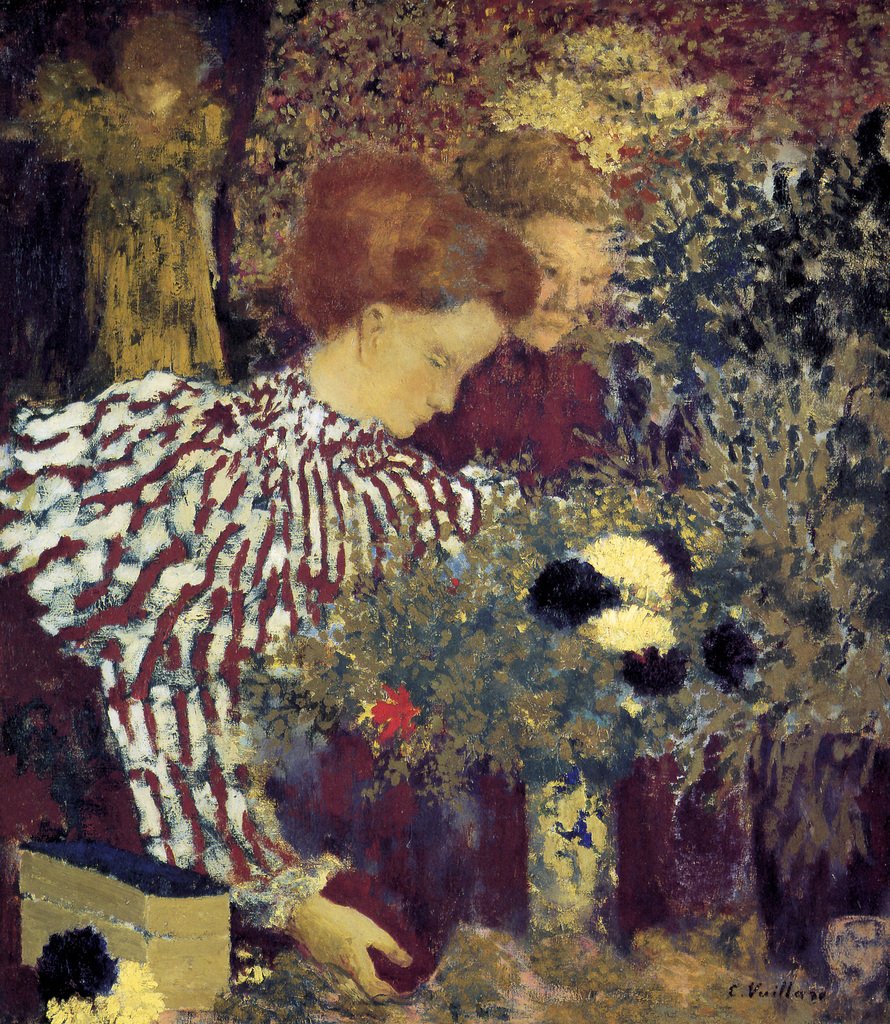
Le Corsage Rayé by Jean-Édouard Vuillard

Le Corsage Rayé by Édouard Vuillard (1895)

Today I am featuring a work by the French painter and printmaker, Jean-Édouard Vuillard.  Vuillard was born in 1868 in Cuiseaux, a commune in the region of Bourgogne in eastern France.  His father was a retired sea captain and his mother a seamstress.  When he was nine years old the family moved to Paris where his mother established a dressmaking workshop in their apartment.  In1883, when Édouard was fifteen years old his father died.  Following the death of his father Édouard received a scholarship so that he could continue with his secondary education at the Lycée Condorcet.  It was here that he met and became friends with another aspiring artist, Ker Xavier Roussel.  Vuillard left the school the following year and he and Roussel continued their artistic education at the studio of Diogène Maillart, which was formerly the studio of Eugene Delacroix.

In 1887, at the age of nineteen, Vuillard finally managed to be accepted at the Ecole des Beaux-Arts.  He had tried twice before but on each occasion failed to pass the entrance exam.  In 1889 he enrolled at the Académie Julian where he met Maurice Denis, Pierre Bonnard, Paul Ranson and Paul Sérusier.  It was Vuillard along with this group of young art students that formed the artistic grouping which came to be known as Les Nabis.  The French term nabi refers to a person inspired to speak the word of God and is clearly related to the Hebrew term for prophet (nebia) and the Arabic term  for prophet (nábi) .  The actual term was first used by the poet Henri Cazalis who drew a parallel between the way these painters aimed to revitalize painting (as prophets of modern art) and the way the ancient prophets had rejuvenated Israel.

In 1898 Vuillard set off on his European travels, visiting Venice and Florence and the following year made a trip to London.  In 1890 Vuillard put forward some of his paintings for the 1890 Salon.  He was both devastated and angered by the rejection of his works by the Salon jurists and vowed never to put forward any of his future works for Salon consideration.  Until the turn of the century Vuillard worked in theatrical circles, illustrating theatre programmes for the Théâtre Libre and even helped to set up the Théâtre de l’Oeuvre , with Aurélien Lugné-Poë which presented the work of the young French Symbolist playwrights and introducing major foreign dramas.  Vuillard continued to illustrate theatre programmes and design and paint theatrical settings.  In 1901 Vuillard had some of his works exhibited at the Salon des Indépendents and two years later put forward some paintings for the Salon d’Automne, an exhibition staged as a reaction to the conservative policies of the official Paris Salon.

Vuillard continued to live with his widowed mother and did so until her death in 1928.  A large number of his paintings had domestic themes or depictions of dressmaking scenes which would be set in the rooms of their house.  Often in these works Vuillard and his fellow Nabi painter, Pierre Bonnard, used domestic interior scenes as a setting for their paintings.  They were at pains to depict these domestic interiors with all their warmth, comfort and tranquil seclusion.  This type of subject matter became known as Intimism.  These paintings were marked by a gentle humor, and were finished in the subtle variety of soft, blurred colours.  The works would capture the light and atmosphere of the occasion but unlike Impressionism they would often embellish and distort the natural colour so as to communicate mood.  Many of his portraiture also retained the sense of Intimism with its calm domesticity.  Vuillard continued to receive numerous commissions from private patrons to paint portraits and decorative works as well as frescoes for public buildings. These commissions for public paintings included the decorations in the foyer of the Théâtre des Champs-Élysées and murals in the Palais de Chaillot and in the League of Nations in Geneva.  In his later years Vuillard concentrated on portraiture.

Jean-Édouard Vuillard died in La Baule, in the Loire-Atlantique department in western France, in 1940, aged 71.

My Daily Art Display’s featured oil on canvas painting is entitled Le Corsage Rayé,  which Vuillard completed in 1895 and can now be seen in the Collection of Mr and Mrs Paul Mellon at the National Gallery of Art in Washington.  The work was one of a set of five paintings, known as The Album,  based on household subjects, and commissioned by the Polish-born lawyer, journalist and art collector, Thadée Natanson, the publisher and co-founder of an artistic and literary journal called La Revue Blanche.  He was also a champion of Vuillard’s art and he and his wife were close friends of the artist.   The set of oil paintings were depictions of deep-coloured and richly textured interior scenes of varying formats, representing young bourgeois women engaged in simple domestic activities.  The set were to hang in the various rooms of Natanson’s Paris apartment.  In the case of this work it shows a woman arranging flowers.  The woman who modeled for this work is almost certainly Natanson’s wife, the concert pianist, Misia Godebska.

The woman dominates the painting with her puffed sleeved vintage dress in red and white stripes. No doubt the many years Vuillard watched his mother complete dresses in her studio aided him in the depiction of the woman’s clothing. The woman we see before us is arranging flowers in a vase. It is interesting to note that Vuillard has depicted the flowers not with an explosion of colour but has portrayed them with dull earthy colours.  This reason for this one presumes is so that they do not in any way detract from the clothing of the woman which Vuillard wants to be the focus of our attention.     Behind the woman we see another woman, dressed in what looks like a red uniform and is probably one of the woman’s servants.  Although this is a simple scene of domesticity the presence of the servant in some ways heightens the status of Misia.

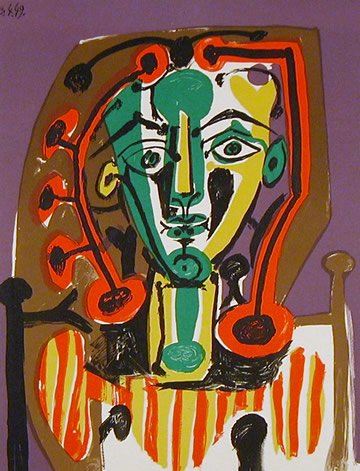
Le Corsage Rayé by Picasso

I end this entry by mentioning Picasso.  There are two reasons for this.  Firstly, Picasso made a drawing in 1949 entitled Le Corsage Rayé and his lithographer, Fernand Mourlot had the image recreated in a 300 copy edition.  I thought you would like to compare it with today’s featured work.   The second reason for mentioning Picasso as my next two entries will feature works by the artist and although I am not a fan of his later works I am fascinated by some of his earlier paintings and enthralled by the early part of his life.

The paintings were sold at auction by Thadée Natanson in 1908,  several years after he and his wife Misia were divorced.

My next blog will be about four days away as I am about to embark on my annual pilgrimage to Paris and soak up the atmosphere of the French capital and hopefully take in a gallery visit.  I am also hoping, depending on the weather, to visit La Maison Fournaise (see My Daily Art Display August 2nd 2011) and Giverny.

au revoir !