

Laura Sylvia Gosse (1881-1968)
For a number of years now, probably for centuries, many female artists have been discounted as hobby-painters or painting because art for many was like playing the piano, a social grace that every young woman should achieve. It is even more annoying when a man and a woman work side by side and yet it is the reputation of the male artist that is remembered. An example of this is looking at two Camden Town Group artists, one a founder, the other on the periphary as it was an all-male domain. I am sure you have heard of Walter Sickert but what about his friend and contemporary, Laura Sylvia Gosse. Sylvia who ? Let me set the record straight.

The Artist’s Mother by Laura Sylvia Gosse
Sylvia Gosse was actually born Laura Sylvia Gosse but was always known by her Christian name, Sylvia. She was born in London on February 14th 1881, the youngest of three children. She had an elder sister, Teresa Emily and an elder brother, Philip Henry.

Edmund Gosse by John Singer Sargent
Her father, Edmund Gosse was a poet, literary critic and librarian of the House of Lords. Her mother was Ellen Gosse (née Epps), an artist in the Pre-Raphaelite circle who had studied under Ford Madox Brown, and whose sister, Laura Theresa, an aspiring artist, had married Lawrence Alma-Tadema.

| Fountains at Pernes Les Fountaines, Provence by Laura Sylvia Gosse |
Sylvia’s family home in Delamere Terrace was in the London borough of Paddington, and was always inundated with people from both the art and literary world with visitors such as the great writers of the time, such as Henry James, Thomas Hardy, Robert Louis Stevenson and Rudyard Kipling. In early childhood, Sylvia loved to paint and draw and her favourite subject being her pets. At the age of thirteen, Gosse went to an art school in France, where she stayed for three years and she recounted that it was there that she felt she belonged. She returned to England and studied at the St John’s Wood School of Art. In 1906, aged fifteen, she enrolled at the Royal Academy Schools.
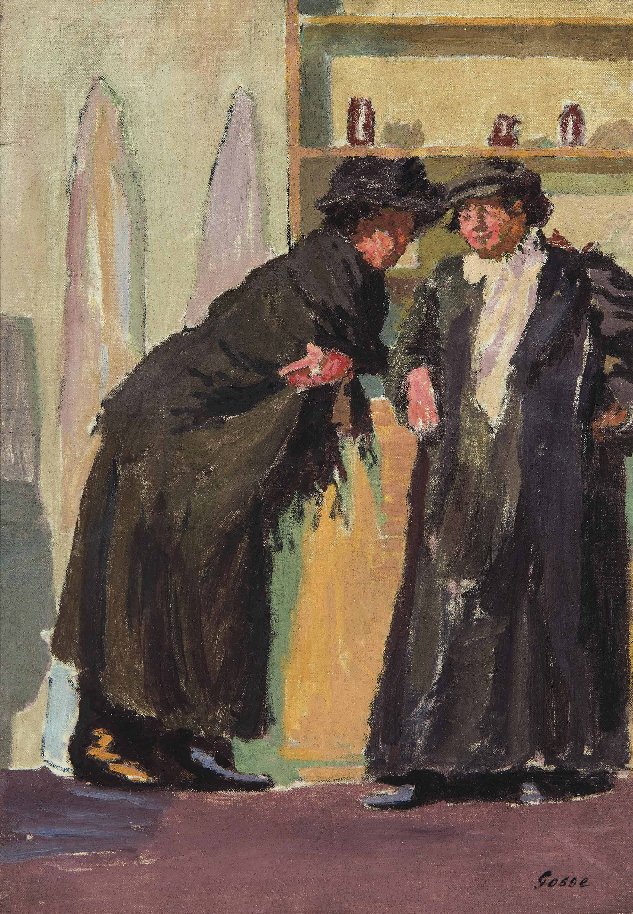
The Gossip by Laura Sylvia Gosse
One of the frequent visitors at the Grosse household was the artist Walter Sickert and it was during one of his visits that he began talking to Sylvia and looked at her artwork. He was captivated by her work and obvious artistic talent and suggested she learn the art of etching. Sylvia began to attend Sickert’s evening classes at the Westminster School of Art and in 1909 went as a pupil to his new art school, which he ran with Madeline Knox at 209 Hampstead Road, London. Sickert’s dual role with Knox at the art school ended when Knox resigned following Sickert’s illness, and having had to run the school singlehandedly. Sickert approached Sylvia Gosse, his pupil, to see if she would accept the position as associate director.

Rowlandson House – Sunset by Walter Sickert (1911)
Walter Sickert rented Rowlandson House in Camden Town from 1910–14, during his time with the Camden Town Group. This summertime depiction of the building looks north up Hampstead Road from the back garden, the time of day nearing twilight, which Sickert has indicated by daubs of pink and mauve in the pale sky. The trees in the far background form the edge of Mornington Crescent Gardens.

Sylvia was made co-director of the Rowlandson House School but did this position alongside Sickert put them on an equal footing? As a woman in an artistic world which did not always value them, it became clear during her time at Rowlandson House, that her relationship with the Camden Town Group which she was ineligible to join, being a female, despite Sickert being its leader, was not even-handed. According to Kathleen Fisher, Gosse’s biographer and friend, who wrote Conversations with Sylvia. Sylvia Gosse – Painter, 1881-1968, Sylvia Gosse taught the less-able students at Rowlandson House, as Sickert would grow bored and impatient and dismiss them. The School became known as the Sickert and Gosse School of Painting and Etching. Silvia served as co-principal from 1910 until it closed in 1914 and during that period, she taught some of the classes and took over responsibility for the practical organisation and finances. Sylvia Gosse had an independent income, and without her financial backing the school would have closed much sooner.
The school which Gosse and Sickert jointly ran until 1914 when it closed. During those years, Gosse’s own painting career also began to progress. Sylvia Gosse could be described as being slightly introverted (or was she just shy?) and was not known as a very sociable person. One of her pupils, Marjorie Lilly recalled Sylvia, saying:
“…she might appear at Number 15 [Fitzroy Street] on At Home days, but rarely; being very shy, she always chose the most inconspicuous corner she could find, looking harassed and hunted, and hardly spoke…”
Despite this she was always very supportive of her fellow artists and completely dedicated to Sickert.

Chateau Dieppe by Layra Sylvia Gosse (c.1925)

La Place Saint Jacques by Laura Sylvia Gosse (c.1920)
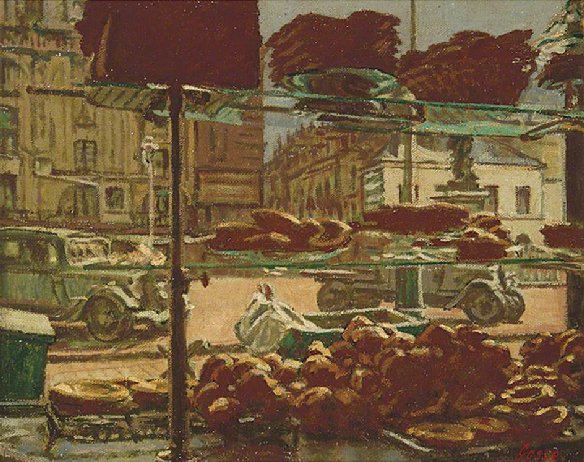
Grande patisserie, Place Nationale, Dieppe, France by Laura Sylvia Gosse (1930)
Walter Sickert had always loved visiting France and would regularly travel to the Normandy coastal town of Dieppe. Sylvia often accompanied Sickert on his travels, notably when he stayed in Dieppe, and she had a small cottage near his home. Many of her paintings featured the French town.

Envermeu, France by Laura Sylvia Gosse (c.1920s)
The small town of Envermeu which lies ten kilometres east of Dieppe also featured in many of Sylvia’s paintings.
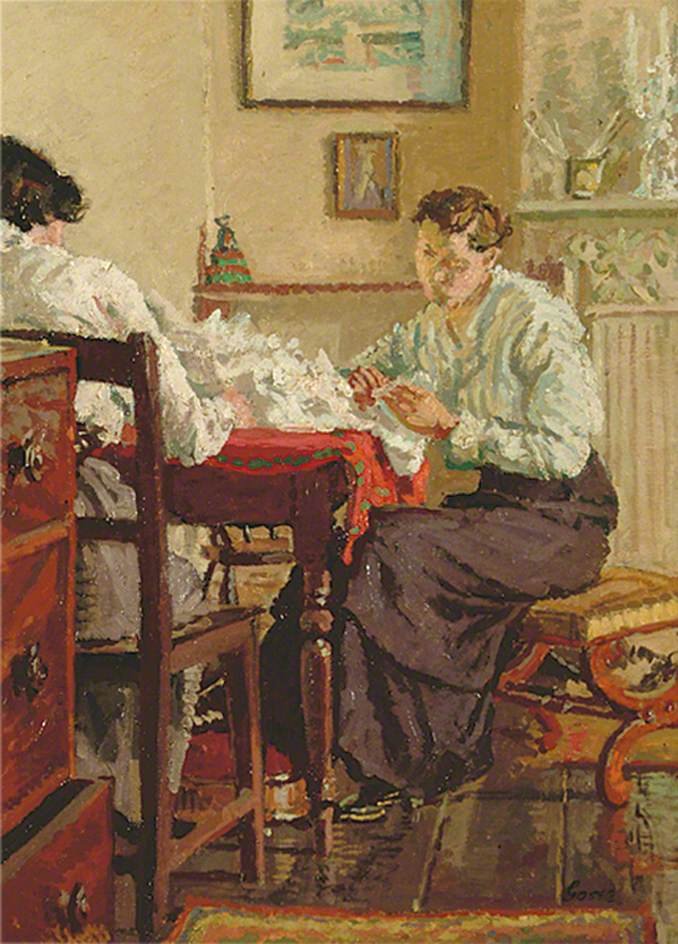
The Seamstress by Laura Sylvia Gosse
Many of the paintings of the Camden Town group focused on the subject of ordinary life, which often concentrated on the life of the poor and dispossessed, and how their life was one of boredom and squalor. Gosse tended to focus more on the hard-working women, such as the seamstress and the printer.

The Printer by Laura Sylvia Gosse (c.1915)
Sylvia’s painting, The Printer, which she completed around 1915 shows a woman labouring at a press.
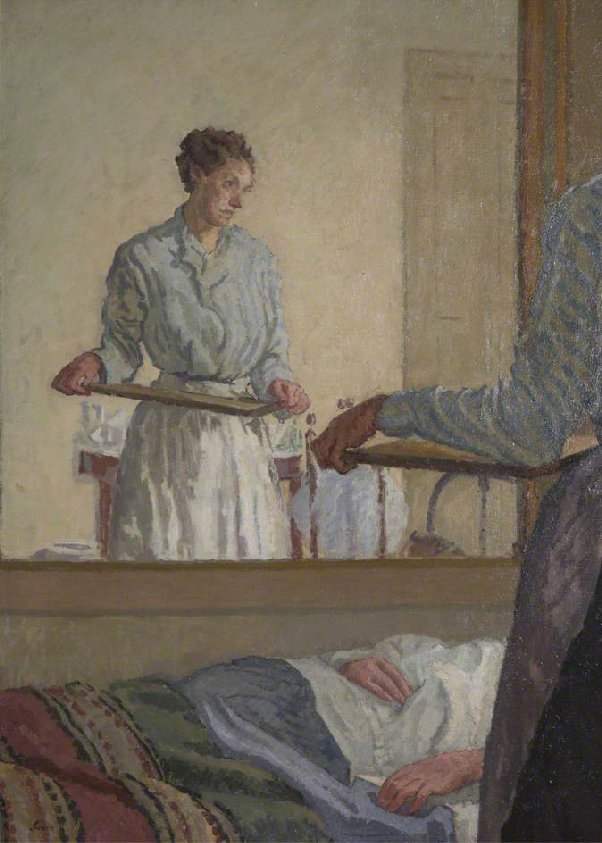
The Nurse by Laura Sylvia Gosse
In her painting, The Nurse, we see her approaching her patient. In this depiction, we see her as she is reflected in a mirror above the sickbed. This is not a depiction that beautifies the nursing profession it is simply one that shows us an unglamorous workaday appearance of a nurse tending the sick.
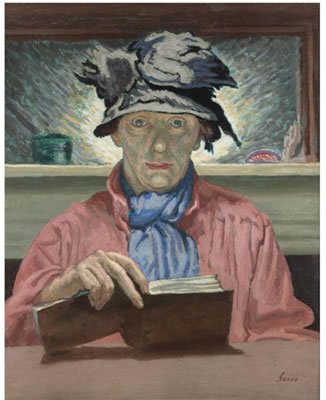
Mrs Alexandra Russell by Laura Sylvia Gosse
During the 1920s and 1930s Sylvia’s paintings were on display at many of best-known commercial galleries. She was elected to the Royal Society of British Artists in 1930 and continued to support Sickert loyally until his death in 1942.

In 1951 Sylvia bought a bungalow in Ore, a large village in the urban area of Hastings, in the county of East Sussex. It was here that she planned to spend her last days painting, but alas, she suffered from cataracts, which made painting and sketching increasingly problematic. However, it was her belief that every painter should die with a brush in their hand, so despite her severely reduced vision, she still managed to visit exhibitions and help inspire young artists. She died in the Buchanan Hospital, Hastings on June 6th 1968 at the age of 87.
 my daily art display