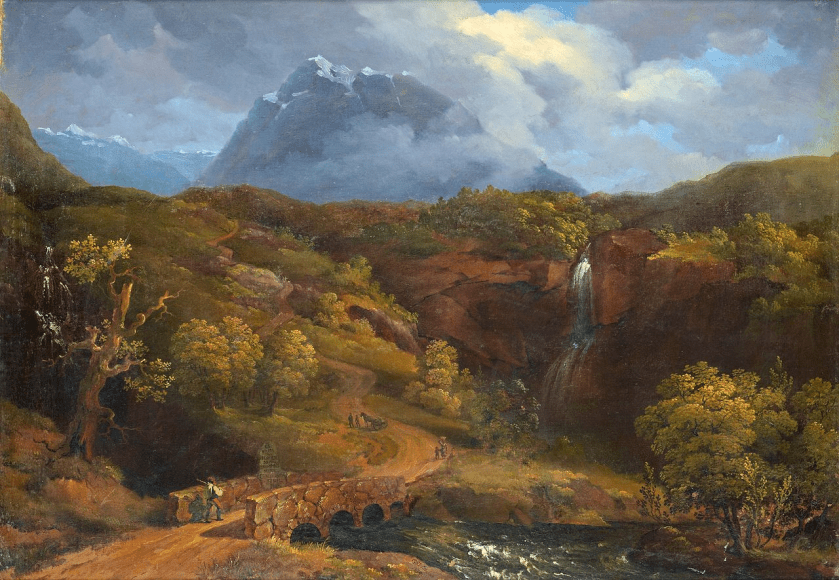
The artists of the Norwich School of Painters. Part 2 – John Crome

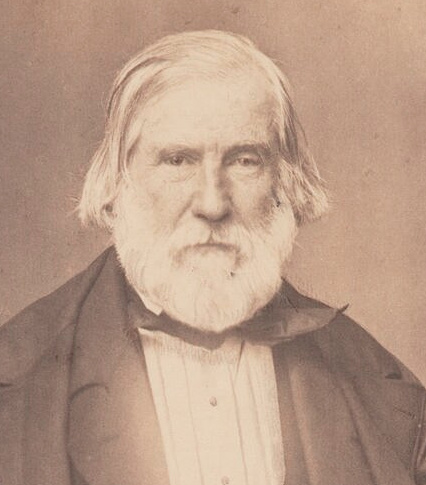
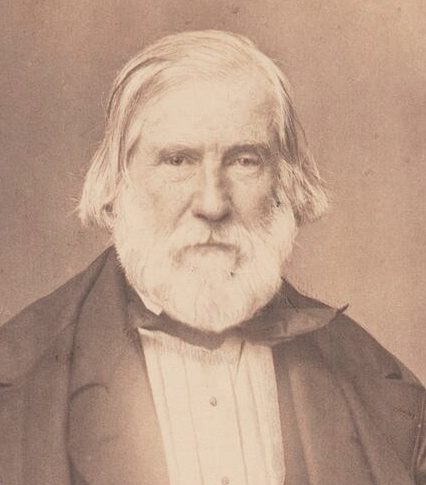
Portrait of John Crome, by Michael William Sharp

One of the founding members of the Norwich School of Painters was John Crome. Crome would become one of the three great landscape painters who came from East Anglia. The other two were Gainsborough and Constable. East Anglia was not known for its spectacular or romantic landscapes. Unlike North Wales or the Lake District, there was little to inspire a landscape painter and yet the quiet pastures of the Stour valley and the Dutch-like vistas of the Norfolk Broads attracted many nature lovers.
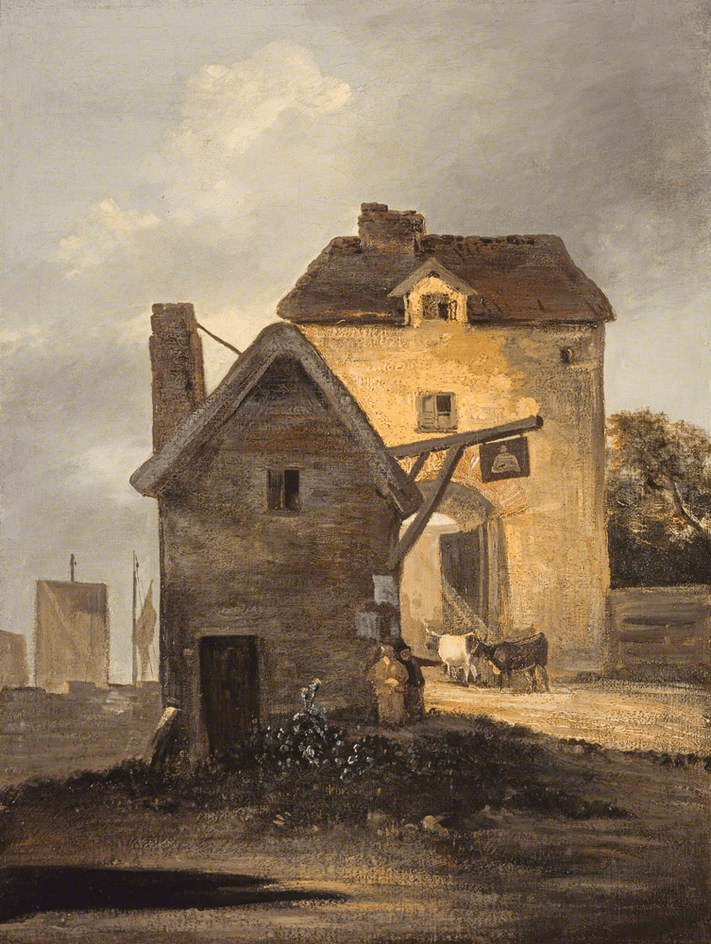
The Bell Inn by John Crome (1805)

Crome was born on December 22nd, 1768 at the small Norwich ale-house called The King and the Miller and was baptised three days later on Christmas Day at St George’s Church Tombland, Norwich. Crome’s father, John, was an impoverished journeyman weaver. He was also either an alehouse keeper or lodged in an alehouse in a very disreputable part of Norwich, known as Castle Ditches. Crome’s mother was Elizabeth Weaver. Crome had very limited schooling and left  at the age of twelve to become an errand boy to the distinguished Doctor Rigby. After a few years living with and serving the doctor, his employer arranged for him to be apprenticed to Mr Francis Whisler, a coach, house and sign painter, of 41 Bethel Street Norwich. Crome commenced his seven-year apprenticeship on August 1st, 1783. At first Crome’s job was to grind the coloured pigments and look after the brushes. He eventually was allowed to paint the signs, which meant that he had to learn the skill of making the depictions on the signs, stand out at a distance and this talent can be seen in many of his later paintings.

The Beaters by John Crome (1810)

During his apprenticeship he struck up a friendship with Robert Ladbrooke, another young apprentice, one who was training to become a printer. The two young men, both of the same age, had one underlying desire – that of becoming painters. The two decided to work together to achieve that aim and rented out a garret and bought some art prints from the local Norwich print-seller, Smith and Jaggers, which they could spend time copying, and thus, honing their artistic skills. Crome and Ladbrooke would go on drawing trips into the fields sketching the scenery and then sell some of their works to the local print-seller.  The print-seller was impressed with what the two young men could achieve and bought some of their drawings and it is very likely it is through Crome’s drawings that he gained the attention of Thomas Harvey, a local amateur artist and art collector. Thomas Harvey owned a number of paintings by old and modern Flemish and Dutch Masters, particularly Meindert Hobbema and Jacob van Ruisdael, which he had acquired through the good auspices of his Dutch father-in-law.  He also had a collection of works by Gainsborough and Richard Wilson, which he allowed Crome to study and copy.

Moonrise on the Yare by John Crome (c.1811-6)

Through Thomas Harvey, Crome met William Beechy, a leading portrait artist who studied at the Royal Academy Schools in 1772, and is thought to have studied under Johan Zoffany. Beechy first exhibited at the Academy in 1776. In 1781, he moved to Norwich. Beechy could see that Crome was a very talented artist and became his mentor.   Beechy, although living in Norwich, had a studio in London which Crome would visit regularly. Beechy wrote about the first time he met Crome:

“…Crome, when I first knew him, must have been about twenty years old, and was an awkward, uninformed country lad but extremely shrewd in all his remarks upon art, though he wanted words and terms to express his meaning. As often as he came to town he never failed to call upon me and to get what information I was able to give him upon the subject of that particular branch of art, which he made his study. His visits were very frequent and all his time was spent in my painting room when I was not particularly engaged. He improved so rapidly that he delighted and astonished me. He always dined and spent his evenings with me…”
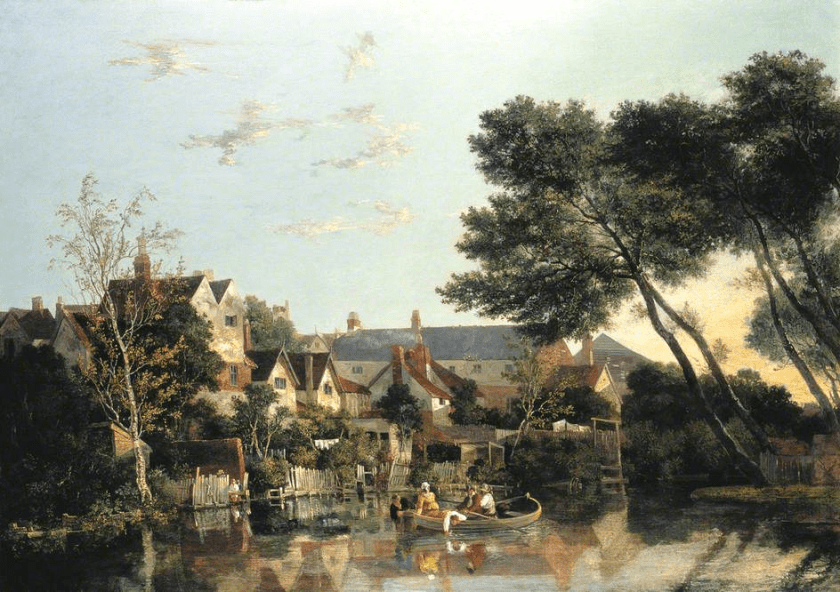
Norwich River, Afternoon by John Crome (c.1819)

On October 2nd 1792, Crome married Phoebe Berney in the medieval St Mary’s Coslany church in the centre of Norwich. The couple went on to have eight children, six sons and two daughters. Two of his sons, John Berney Crome and William Henry Crome became well-known landscape painters.

One of Crome’s rare forays out of the country came in October 1814 when he and two friends crossed the Channel on their way to Paris. Napoleon Bonaparte had just been defeated and hundreds of Englishmen flocked to Paris to view the art treasures held in the Louvre some of which were the spoils Napoleon had collected during his victorious campaigns. On October 10th, 1814, Crome wrote home to his wife informing her that he had arrived safely:

“…My Dear Wife, After one of the most pleasant journeys of one hundred and seventy miles over one of the most fertile countreys I ever saw we arrived in the capital of France. You may imagine how everything struck us with surprise; people of all nations going to and fro – Turks, Jews etc. I shall not enter into ye particulars in this my letter but suffice it to say we are all in good health and in good lodgings…”
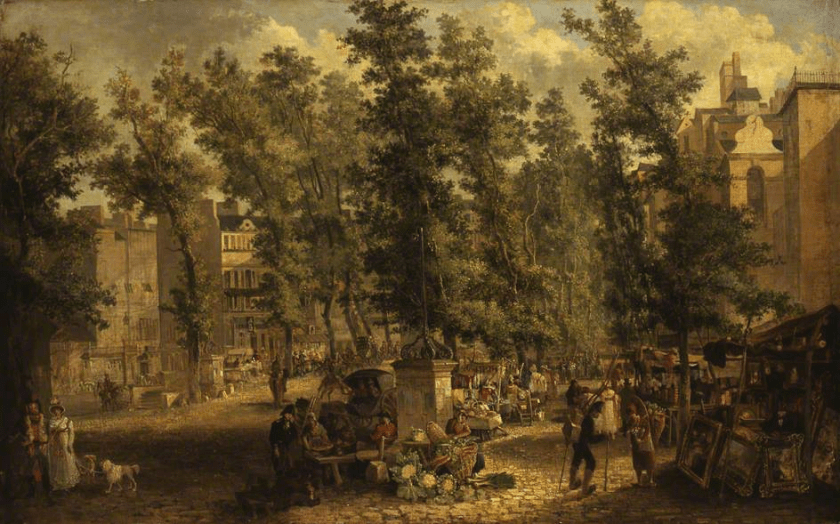
Boulevard des Italiens, Paris by John Crome (1815)

Whilst in the French capital Crome set about pictorialy recording his visit and from the sketches he made, he completed a number of paintings on his return home. In 1815 he completed Boulevard des Italiens, Paris. It is a wonderful work, full of life and energy as we see people milling around the flea market. Crome exhibited the work in the Norwich Exhibition in 1815.

Another painting which came from his many sketches he made whilst in France, was one he sketched whilst on his journey back home. It was entitled Fishmarket on the Beach at Boulogne and Crome completed it in 1820.
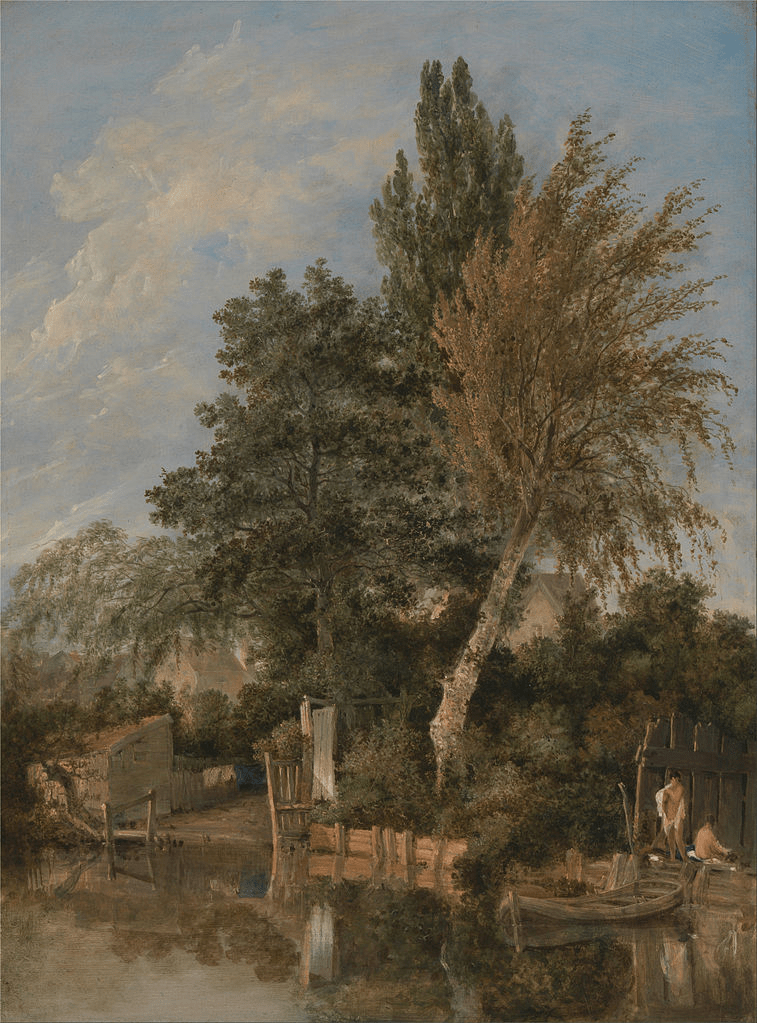
Boys Bathing on the River Wensum, Norwich by John Crome (1817)

Unlike many other English artists, John Crome, besides his one trip to Paris, rarely ventured outside his beloved country and preferred to explore the countryside of East Anglia. He preferred the home life surrounded by his family. His main focus was on the English landscape and especially the natural scenery of the Norfolk area. He maintained that he only painted what he saw and never took poetic licence with his subjects.  As he succinctly put it, I simply represented Nature as I saw her.  Of Crome’s choice of depictions, one art critic wrote:

“…Crome painted ‘the bit of heath, the boat, and the slow water of the flattish land, trees most of all, the single tree in elaborate study, the group of trees, and how the growth of one affects that of another, and the characteristics of each…”
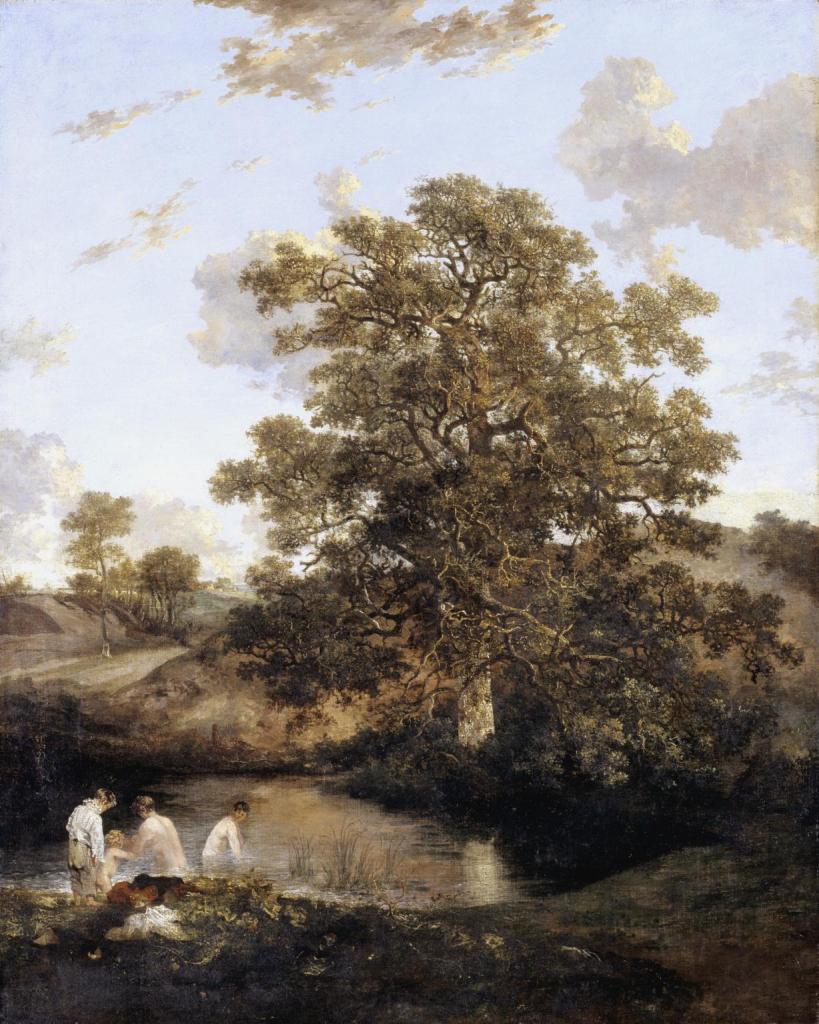
The Poringland Oak by John Crome (c.1818-1820)

Crome was a gifted draughtsman and an authority when it came to depicting trees. He was one of the first artists of his generation to portray individual tree species in his works, rather than just painting simplified structures. His favoured tree was the English Oak tree. A fine example of this is his oil on canvas work entitled The Poringland Oak which he completed in 1820. Poringland is a village in the district of South Norfolk, England. It lies 5 miles south of Norwich city centre and the heathland around the village was one of Crome’s favourite haunts. The depiction centres on a large oak tree that would have been familiar to local residents. Look at the details of the tree Crome has given us. Look how he has masterfully depicted the clouds. This painting came many decades before the Impressionist works and yet it is a study of light, as the sun begins to set. The depiction we see before us is a perfect idyll. The sun is setting bathing the heath in a golden warmth. Bathers, wanting to relax, have taken to the lake after a hard day’s work.
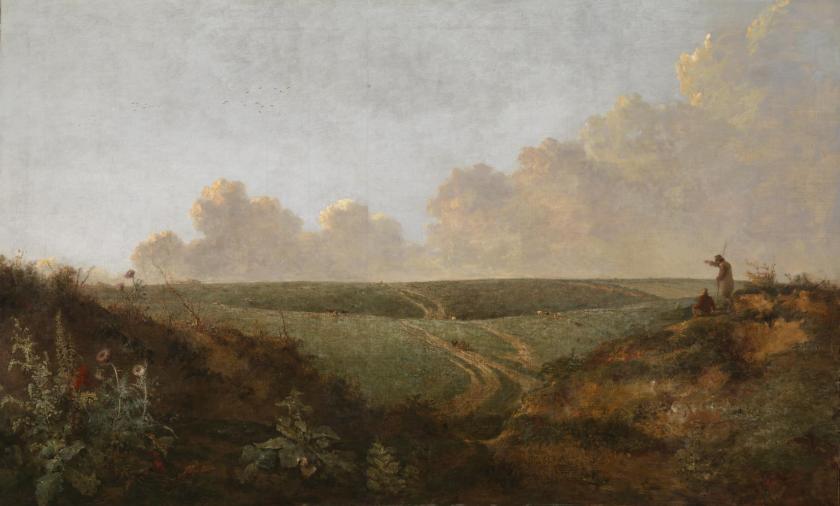
Mousehold Heath, Norwich by John Crome (c.1818-20)

Another of Crome’s paintings featuring the area he loved so much was completed around 1820 and was entitled Mousehold Heath, Norwich. Mousehold Heath was a well–known stretch of common land which lies five miles north of the city of Norwich. It is a unique area made up of heathland, woodland and recreational open space.  Crome’s painting accentuates its vastness and lack of cultivation. In the foreground Crome has depicted clumps of wildflowers and, in the distance, we can just make out cattle grazing freely on the heath. The painting has the feel of a Dutch painting such as those by Aelbert Cuyp which Crome may have seen in the painting collection of Thomas Harvey. Although this painting was completed around 1820 it was probably a view of the Heath some five or ten years earlier as around 1814 a large quantity of land, including this area, was “enclosed”. Once enclosed, use of the land became restricted and available only to the owner, and it ceased to be common land for communal use. In both England and Wales, this process of allowing cultivation of open land was to boost the production of food.
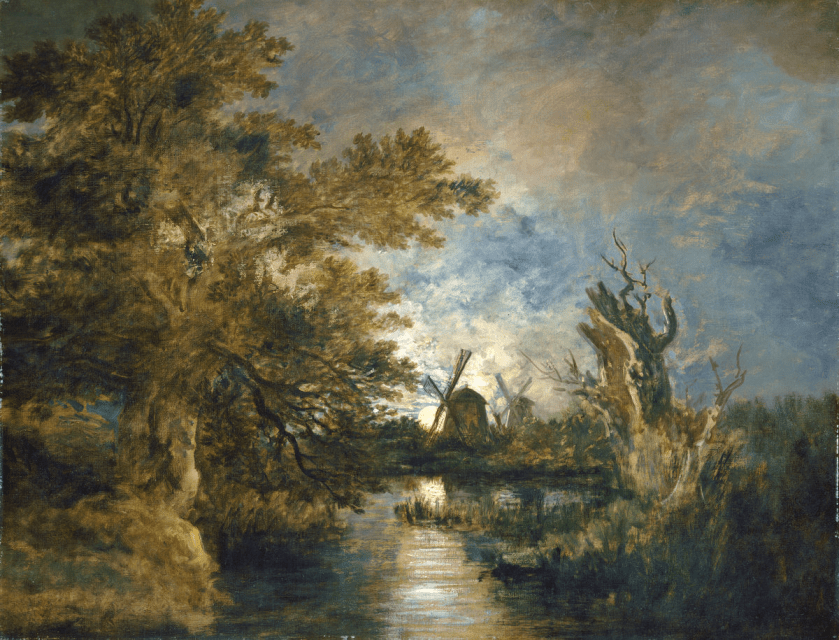
Moonlight on the Yare by John Crome (c.1817)

Besides the money he received for his paintings his income was further increased by teaching art to the “great and good” and he often travelled around to various country homes in his profession as a drawing master. It was during these visits that he would once again have come across many paintings by the Dutch and Flemish Masters. Seeing such collections also gave him an interest in starting his own collection and soon he was fixated on attending sales at auction rooms and he soon built up his own collection of books, prints and drawings. He bought and bought and soon his home was cluttered by his purchases. One can only presume that his wife stepped in and told him that “enough was enough” for an advert appeared in the Norfolk Chronicle:

“…At Mr Noverre’s Rooms, Yarmouth on Wednesday the 23rd of September 1812 and two following days. A capital assemblage of Prints and Books of Prints; Etchings; Finished Drawings and Sketches by the best masters – Woollett, Strange, Fitler, Bartolozzi, Rembrandt, Waterloo etc. They are the genuine sole property of Mr Crome of Norwich – a great part of whose life has been spent collecting them. Descriptive catalogues, price 6d. each of the booksellers of Yarmouth, Norwich, Lynn, Ipswich and Bury…”

There was no mention of the name of the auctioneer and thus it is supposed that Crome himself ran the auction. Although Crome’s had lost his precious collection he was soon visiting sales rooms again, steadily building a new collection !

Landscape by John Crome

John Crome’s life came to an end, after a sudden illness, on April 22nd 1821. He was fifty-two years old. Crome’s thoughts were constantly directed towards the art he so passionately loved. It is believed that on the day of his death he spoke to his eldest son, twenty-seven year old John Berney Crome. He begged him never to forget the dignity of Art, saying:

“…John, my boy, paint but paint for fame, and if your subject is only a pigsty – dignify it…”

It is said that Crome’s last words on his death bed were a cry from the heart and a loving testament to his favourite landscape painter:

“…Oh, Hobbema !  my dear Hobbema, how I loved you…”

John Crome was buried in the medieval church of St George’s-at-Colegate, Norwich and according to The Norwich Mercury, the local newspaper,  an immense concourse of people bore grateful testimony to the estimation in which his character was generally held.

John Berney Crome by George Clint (c.1820)


John Crome was often referred to as “Old Crome” to differentiate him from his talented son the artist John Berney Crome who was referred to as “Young Crome”.


A good deal of information about the Norwich School of Painters came from a book published in 1920, entitled The Norwich school; John (“Old”) Crome, John Sell Cotman, George Vincent, James Stark, J. Berney Crome, John Thirtle, R. Ladbrooke, David Hodgson, M.E. & J.J. Cotman, etc. by Charles Geoffrey Holme.  This book can be read on-line at:

https://archive.org/details/cu31924014891992/page/n3
 

Francis Danby. Part 2.

Financial problems, plagiarism and marital difficulties.

Francis Danby

In 1821, Francis Danby fathered a fourth son, Thomas, and the family were still living in the Bristol suburb of Kingsdown.  Aross the River Avon, on the south-west side of the Avon Gorge, was a large area of woodland known as Leigh Woods.

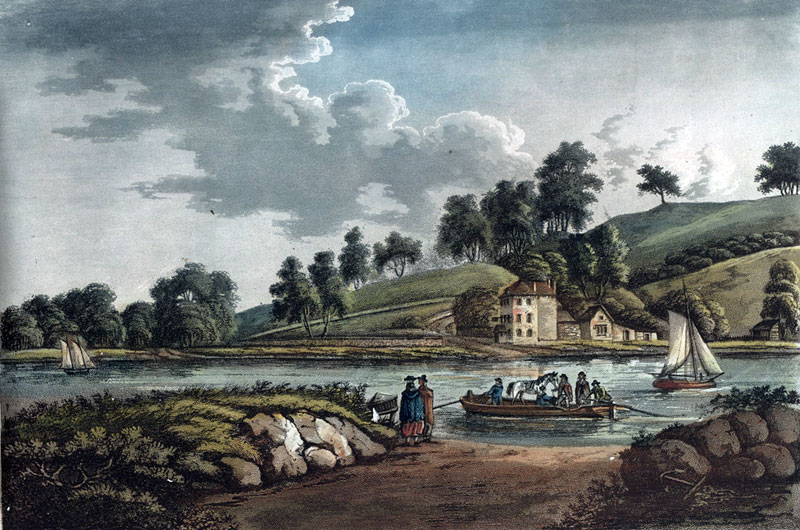
Rownham Ferry from the Somerset side in 1797 by John Hassell

This was a magnet for artists who had a large range of picturesque views to paint and sketch en plein air. However in the 1820’s, there was no Clifton Suspension Bridge which did not get built until 1864 and so, to cross the Avon Danby and fellow painters living in Bristol would have to traverse the river by means of the Rownham Ferry and then walk along the tow path before ascending Nightingale Valley.

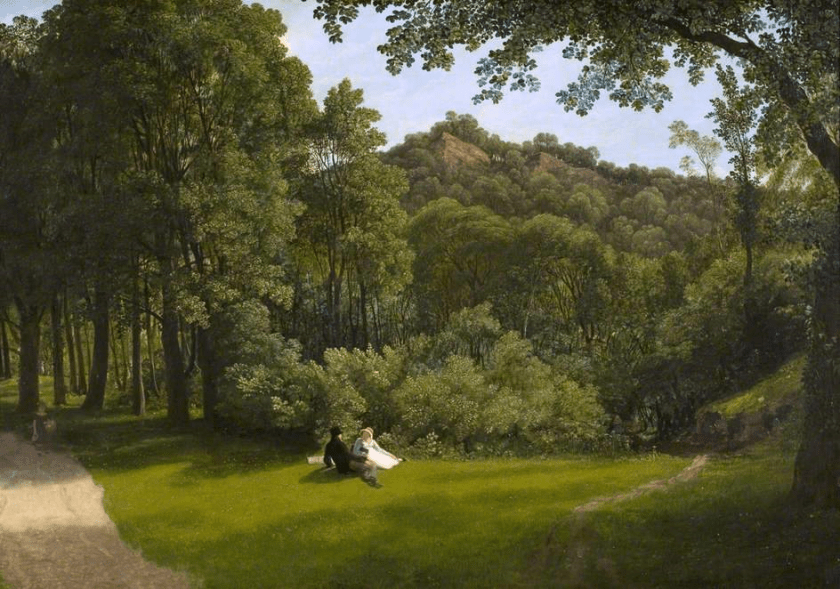
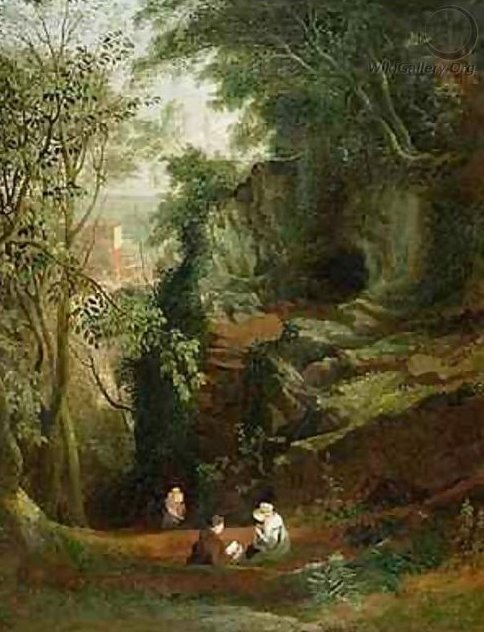
A Scene in Leigh Woods by Francis Danby (1822)

Francis Danby completed his painting A Scene in Leigh Woods in 1822. This oil on panel painting measuring 35 x 50 cms is awash with many tones of green but such variation of tones and tints is well managed. The sunlight coming from the right hand side has struggled to penetrate the dens foliage and this results in the shadows not being so dense. The artist has moved away from his two companions who are busily sketching and by distancing himself from his friends he has been able to give us a very relaxed scene. The Revd. John Eagles, a writer and amateur artist, wrote about the friendship between artists when they descended on Leigh Woods and how Leigh Woods was the best painting-ground. In an article, he wrote about the colours one could find there:

“…they were of all shades, but rich as if every colour had by turns blended with them, yet unmixed, so perfect in predominance was the green throughout. So varied likewise was the texture, whether effected by distance, by variety of shade, by opposition, or by character of ground. There was much of emerald, not in colour only, but in transparent depth…”

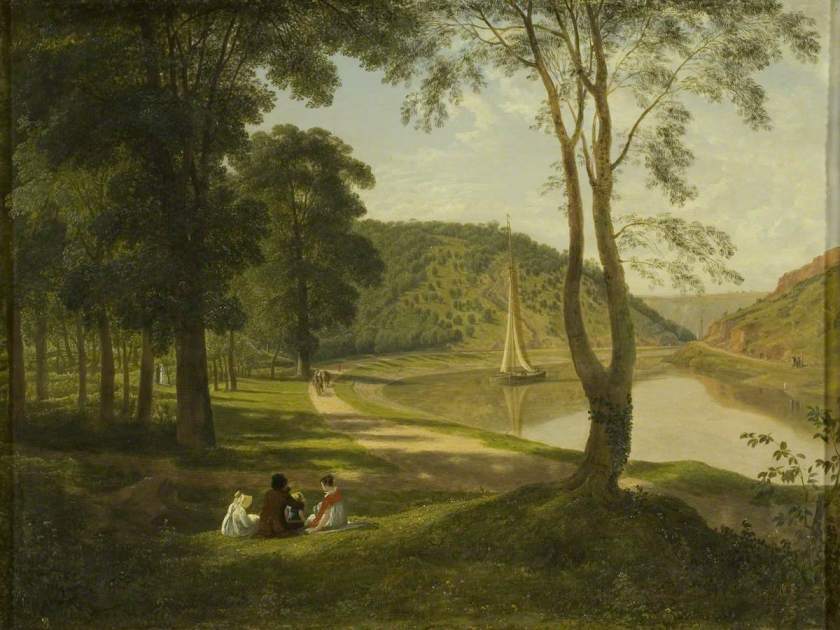
View of the Avon Gorge by Francis Danby (1819)

Danby also completed another painting in 1822, View of the Avon Gorge, which is a companion piece to A Scene in Leigh Woods. This painting depicts a view looking downstream across the entrance to Nightingale Valley which was a favourite spot for the artists of the Bristol School. In the painting we can see a quarry barge moving slowly up the River Avon. In the distance you can just make out the Sea Walls and to the right you can just see the construction of the Bridge Valley Road which eventually ran around the riverbank on the right.

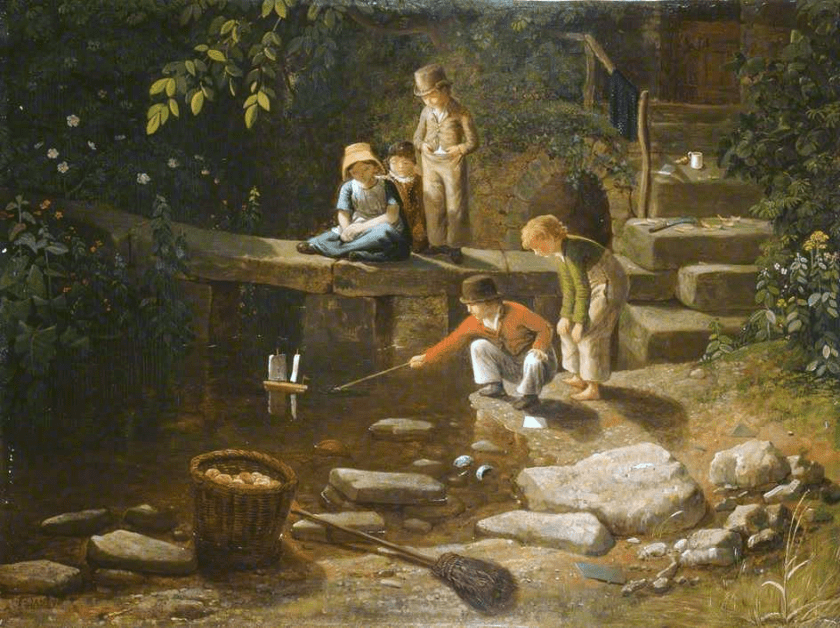
Boys Sailing a Little Boat by Francis Danby (c.1822)

Another of Danby’s captivating paintings was one he also completed in 1822 which was entitled Boys Sailing a Little Boat. It depicts four young boys and a young girl on a riverbank and a small stone bridge. They are fascinated watching their small model boat floating in the water. A basket of potatoes lies on the riverbank and presumably the children had been taxed to peel them but the thrill of watching their boat in the river has been a distraction. It should be remembered that at this time Danby had four sons and it is thought he could also have a daughter so this may have been his idea of portraying them all in this scene.

Sunset at Sea After a Storm by Francis Danby (1824)

In 1824, all was not well with Francis Danby. He was heavily in debt and he decided his only recourse was to take flight. He and his family left Bristol in April and headed to London where he believed he could make more money selling his work. The breakthrough for Danby came in July that year when he exhibited his painting, Sunset at Sea after a Storm at the Royal Academy which was then bought by the President of the Royal Academy, Sir Thomas Lawrence, who became Danby’s mentor. Not only did Lawrence buy Danby’s painting but he put him forward as an Associate of the Royal Academy. Danby was duly elected in November 1825.

Francis Danby – An Enchanted Isle

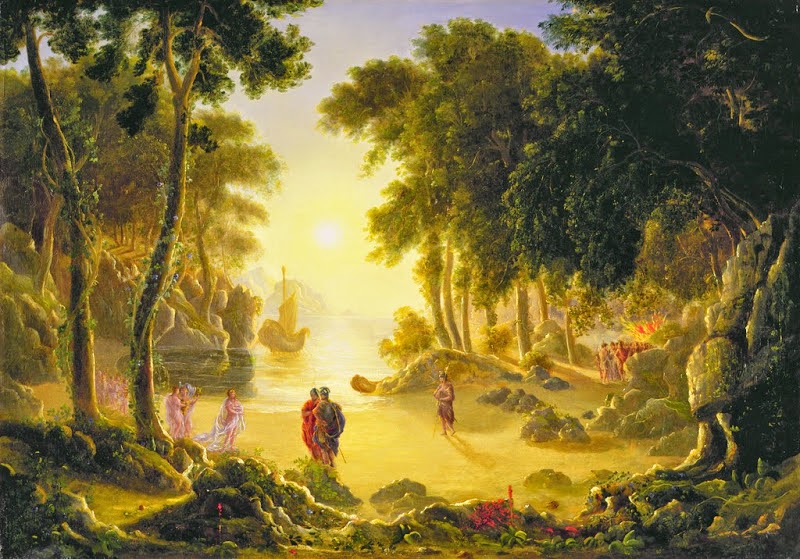
Following the good reviews of his painting, Sunset at Sea after a Storm, he followed it up with An Enchanted Isle which had been commissioned by his patron, John Gibbons, and which was shown at the British Institution, to great acclaim.

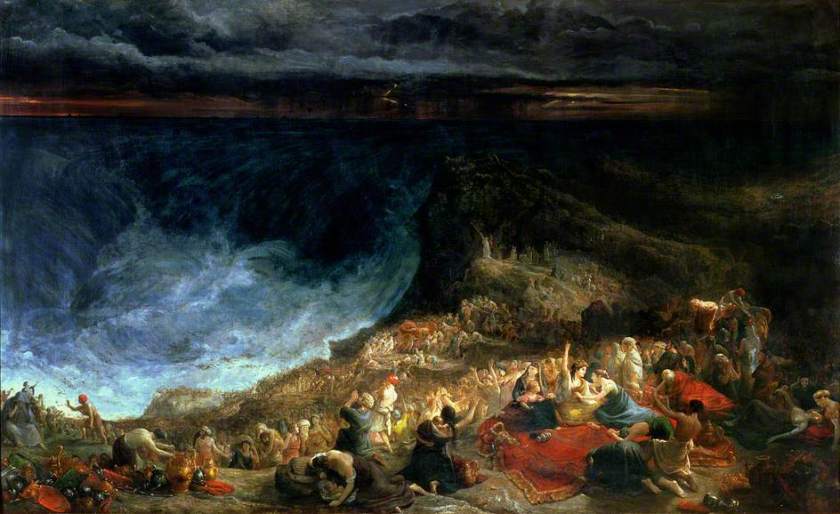
Danby, Francis; The Delivery of Israel out of Egypt; by Francis Danby (1825)

However his next painting, The Delivery of Israel out of Egypt, which he exhibited at the 1825 Royal Academy Exhibition, was a veritable triumph and was immediately bought by the Marquis of Stafford who was the President of the British Institution for £500. The story of the sale of the work is fascinating. The Marquis saw the painting at a private viewing and immediately mounted his horse and rode of to Danby’s house and bought it. An hour later Lord Liverpool rushed into Danby’s house wanting to buy the work, only to be told he was too late.

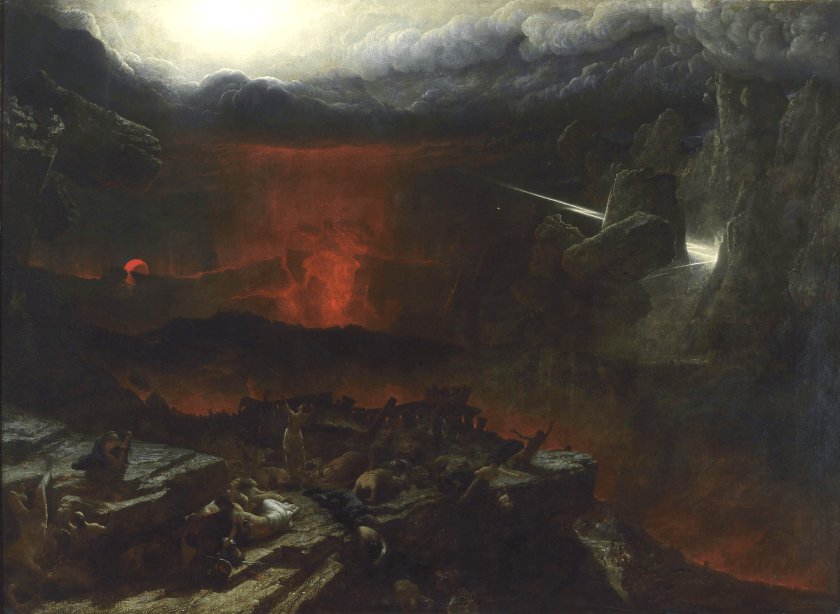
The Opening of the Sixth Seal by Francis Danby (1828)

In 1828, Danby completed a somewhat different painting from his light and airy Bristol landscapes. It was entitled The Opening of the Sixth Seal. He actually started the painting in 1825 but gave up on it accusing fellow painter, John Martin, of plagiarising the depiction with his Deluge work. It caused quite a controversy at the time. He returned to the work two years later and completed it in 1828. The depiction was based on the biblical text from the Book of Revelations (6:12-17):

“…I watched as he opened the sixth seal. There was a great earthquake. The sun turned black like sackcloth made of goat hair, the whole moon turned blood red, and the stars in the sky fell to earth, as figs drop from a fig tree when shaken by a strong wind. The heavens receded like a scroll being rolled up, and every mountain and island was removed from its place. Then the kings of the earth, the princes, the generals, the rich, the mighty, and everyone else, both slave and free, hid in caves and among the rocks of the mountains. They called to the mountains and the rocks, “Fall on us and hide us from the face of him who sits on the throne and from the wrath of the Lamb! For the great day of their wrath has come, and who can withstand it?…”

It tells of the opening by God of the sixth seal on a scroll, the earth is rent and mankind descends into disarray. The sun becomes black and the heavens collapse; a king slumps among now worthless symbols of his sovereignty (crown and sceptre), people cower in fear of the wrath of God, and a city falls to rubble in the background.

The slave

It is interesting to note that Danby added to his depiction a topical reference to slavery. If you look to the left of the painting you can make out a crouching figure, similar to that adopted as the symbol of the abolitionist movement, and at the centre of the painting there is the figure of a liberated slave, who has broken the shackles that were wrapped around his wrists. This liberated figure in some way answers the question at the end of the biblical text.  So why did Danby choose to paint this very different depiction? The answer probably lies with the fact that the slave trade had been discontinued in 1807 in Britain but the Bill for the abolition of slavery itself was not passed until 1833. Danby was not known to have had any particularly strong feelings for the religious subject in his works, but was opposed to slavery and was conscious that there was a prevailing appetite for the apocalyptic in art. In this work he has excelled at depicting dramatic phenomena in nature, from spectacular sunsets to lightning storms. The painting proved the most popular work at the Royal Academy in London in 1828.  It was a triumph, loved by public and critics alike. Danby had been elected as an Associate of the Royal Academy in November 1825 and now, following the success at the Academy exhibitions, he had high hopes that he would be elected a full member of the Academy. However there was one problem. The other candidate who stood for election was John Constable and Danby began to fear the worse as he anxiously awaited the result of the ballot, saying:

“…the awful moment is coming…..if Constable is put in, I think I will run out…”

As a full member of the Academy he could apply for funds and he knew that Constable would have no reason to ask for money as his wife had just inherited £30,000 and thus Danby believed that the Academy may look on that factor as a reason for choosing Constable. Danby’s fears were well founded and in February 1829 Constable beat Danby by one vote.   Danby was both furious and bitter. He accused Constable as being underhanded and that the Academy had chosen the rich over the poor adding:

“…for the Academy I have much cause to be ashamed as it lowers their value when it is so evident that the have elected Constable for his money…”

His accusation against the Academy held some credence with the National Press, which must have hurt Constable. Even worse for Constable the President of the Academy, Sir Thomas Lawrence, was openly disappointed with the Academy’s choice.

A Study for The Golden Age (pencil and bodycolour on grey paper) by Francis Danby (1827)

A Danby painting of around this time had an interesting tale to it. Around 1826 when Danby was working on a Cleopatra painting for John Gibbons he mentioned to his patron that he had conceived an idea for a large work. It was to be called The Golden Age but he promised it would not hinder the Cleopatra painting although that work was causing him problems. Lord de Tabley, a patron of Turner, had shown an interest in buying one of Danby’s paintings and so Danby sent him a preliminary study of The Golden Age (above), but unfortunately Lord de Tabley was too ill to look at it and so Danby turned to his patron, Gibbons. In a letter to Gibbons in January 1827 Danby included a small sketch of his ideas for The Golden Age. He had to temper his enthusiasm for this new venture with the promise that Cleopatra had not been forgotten. He also once again told his patron he was in financial difficulty and in danger of debtor’s prison and asked for a loan of £300. Gibbons gave Danby more money and agreed to take the finished Golden Age painting.

Boy Fishing, Stapleton by Francis Danby (1823)

Despite the money, Danby’s life became even more problematic and turbulent. It was anxious times on two fronts for Danby as he had both financial and marital problems to contend with. Despite selling his paintings he was continually asking his patron John Gibbons for money to pay off his debts which were mounting. In December 1829 Danby left London for Paris in order to escape his creditors only returning briefly the following January to attend the funeral of his friend, the President of the Royal Academy, Sir Thomas Lawrence, but he had to make a hasty return to the French capital when his creditors were about to serve him with writs.

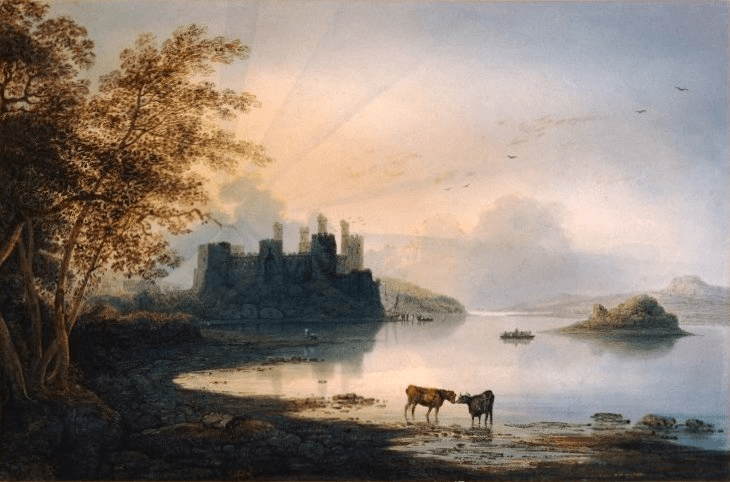
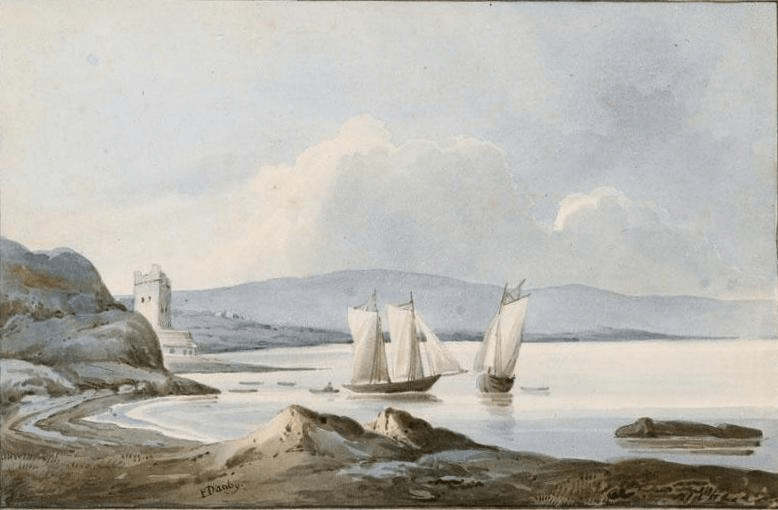
Conway Castle by Francis Danby

In June 1830, Danby with four of his seven children, moved to Bruges. He once again contacted John Gibbons expressing his parlous situation and also informing him that his marriage to his wife Hannah was at an end due to her infidelity with a Bristol artist, Paul Falconer Poole and her having also abandoned their children. In later letters to John Gibbons, Danby stated that he only married Hannah out of kindness and implied that she was already pregnant. He ended by saying that the marriage had resulted in a precarious and unhappy life.  Ironically, Danby was now living with his mistress, Ellen Evans, who would give him three more children.

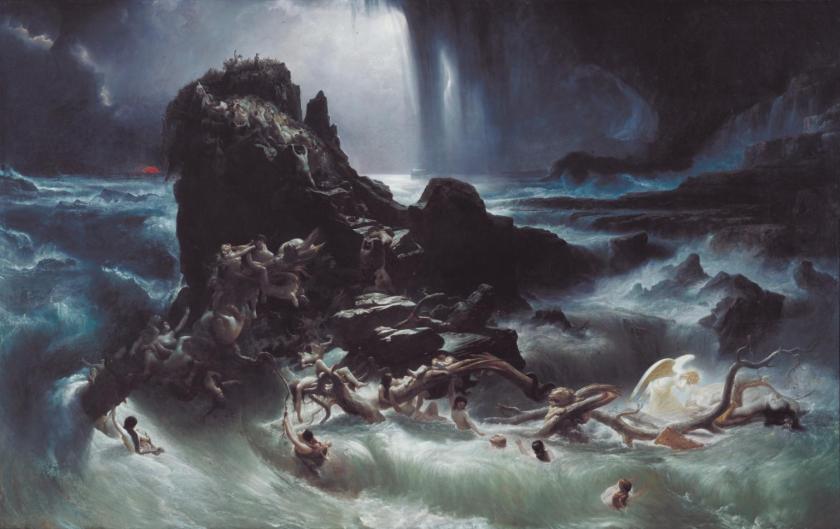
The Deluge by Francis Danby (1840)

The last painting of Danby’s that I am showcasing is his monumental work, The Deluge, which he completed in 1840. It measures 285 x 452cms and is one of the largest works Danby ever painted. He had been away from England for eleven years, living in Europe but had, in 1839, returned to London. The subject of the painting could well have been chosen as to compete directly with his nemesis John Martin who had also exhibited two of his trilogy of Deluge themed paintings at the Royal Academy in 1840. Martin had decided to depict the story of the deluge in a number of paintings whereas Danby decided that the story should be depicted in a solitary work. The writer and critic William Makepeace Thackery wrote about the painting in in Fraser’s Magazine a literary journal published in London, praising Danby’s treatment of the subject, which he considered to be superior to  those by John Martin, Turner and even Poussin, :

“…He has painted the picture of “The Deluge”; we have before our eyes still the ark in the midst of the ruin floating calm and lonely, the great black cataracts of water pouring down, the mad rush of the miserable people clambering up the rocks…”

The painting which is now housed at Tate Britain, London is described by the Gallery as:

“…As well as such meteorological portents as lightning, a comet, and a blood-red setting sun, Danby has also extended his theme by the use of symbolic references to destruction, in particular the juxtaposition of the serpent and the drowning lion, and the angel weeping over the dead giant. This giant may have been included by Danby on account of the references to venerable giants and heroes that occur in Genesis vi, 4, at the beginning of the account of the Deluge…”

The background is believed to have been derived from the coast of Brittany, a place Danby is known to have visited in 1838. The picture also shows the effects of Danby’s three years stay in Paris, such as the rising pinnacle of figures struggling up the rocky promontory which could have been inspired by a similar compositional form of Gericault’s Raft of the Medusa and Poussin’s Deluge painting which we know he copied during visits to the Louvre in 1837.  The national press liked the work but the public were less impressed in comparison to the notable success he had had with his Opening of the Sixth Seal work.

Landscape near Clifton by Francis Danby (1823)

Danby remained in England for most of the rest of his life. He lived in London until 1842 and then moved to Kent. In 1846 he was living in Exmouth, Devon where he not only painted but enjoyed sailing and boat building. His ever-loyal patron John Gibbons died in August 1851 and in 1856 Francis Danby took a long lease on Shell House on the Maer. where he devoted time to boatbuilding. He constructed his yacht ‘Dragonfly’ on the Maer.  This boat was shipwrecked off the coast at Axmouth in 1860.  It is thought that his studio in Exmouth was just off Exeter Road where he would have had a good view of the river Exe. Francis Danby died at home on February 10th, 1861, aged 67. He was buried at St John -in-the-Wilderness at Withycombe, Exmouth.

Francis Danby. Part 1, the early days.

Francis Danby

My featured artist today is the Irish-born painter Francis Danby who was one of twins born in the small village of Killinick, just south of the county town of Wexford, on November 16th 1793. His father was James Danby, a small-time farmer, whose family had lived in the area since the 1730’s. James Danby had first married Susanna Harvey in 1762. She was the daughter of a Wexford vicar and the couple had two children, John Henry and James. His second marriage took place in 1781 when he married the Dubliner, Margaret Watson, who gave her husband three children, twins Thomas, who died young, and Francis as well as a daughter, Frances Olivia.

A View in County Wexford by Francis Danby (1813)                                                                                               A View in County Wexford (Saint Nicholas’ Clonmines and Bannow Bay)

In 1798, at the age of five, Francis and his family suffered the emotions and terrors associated with the Wexford Rebellion which has gone down in Irish history as one of the most bloody, the most bitterest and yet the most successful insurrections. It began in May 1798 and lasted a month. It was the Society of United Irishmen’s Rising against the British domination of Ireland. The leaders of the rebellion maintained that the rebellion was purely political and not an issue of religion but some of the bloody massacres which occurred did indicate sectarian tensions as motives. There was also the factor that grain prices had collapsed in 1797 and 1798, and also new taxes were being levied by the British government on the malt industry which caused tremendous hardship in many regions, but especially Wexford. The rebels fought for a reform of legislature and the redistribution of political power.

As a protestant and feeling unsafe in the small village of Killinick, James moved his family to the city of Wexford in 1799. He wrote to a friend:

“…My family like many others were destroyed by political and party feeling, many of them lost their lives on both sides of the unhappy question…”

Francis Danby’s father’s fear for his and his family’s lives is borne out with the wording of the preface to his will which he made the following year:

“…Having lately escaped assassination and being convinced of the savage disposition of the majority of people, I am more than ever reminded of the uncertainty of life…”

Panorama of the Coast at Sunset by Francis Danby (1813)

In late 1799, the family were once again on the move. This time they travelled to Dublin, the home town of Francis’ mother. In 1807 James Danby died and through the vagaries of the inheritance laws, whatever money he had was left to the children of his first wife and Francis Danby received nought. Francis finished his schooling in 1811 and decided he wanted to become a professional artist. His mother considered his request and agreed to his ideas, since there seemed little hope in her son moving towards any other meaningful professions.

Conway Castle by Francis Danby

Francis Danby enrolled at the drawing schools of the Dublin Society and it was here he met and became great friends with two aspiring landscape painters, George Petrie and James Arthur O’Connor. In 1813, at the age of nineteen, Francis had his first painting, entitled Landscape – Evening, exhibited at the Society of Artists of Ireland and it was sold for fifteen guineas and with that princely sum Francis travelled to London in June 1813, along with Petrie and O’Connor, to see what the England capital had to offer young artists. Francis, like his two travelling companions, headed for the Royal Academy Summer Exhibition and he wrote about it and how it inspired him:

“…the wonders of which I was so struck that they increased my ambition, and from my twentieth year I have been an English Artist…”

It is thought that Francis Danby never returned to Ireland and he never declared any love for his birthplace. The journey of the three friends ended after two weeks when Petrie was summoned home from London by his father. Francis Danby and O’Connor had not managed to make any money whilst in London and decided that they too must return to Ireland. They knew a captain of a sailing packet who would give them free passage from the port of Bristol back to Ireland, so all three, who had very little money, set off to walk the hundred and twenty miles to the seaport.

The Avon Gorge from the Stop Gate below Sea Walls, pen and ink drawing by Francis Danby (1818)

They arrived and Petrie left them and returned to Ireland. Danby and O’Connor managed to sell two watercolour paintings of the Wicklow Mountains to a Bristol bookseller, John Mintorn and later they completed four drawings of the Avon Gorge which again they sold to Mintorn. They had now accumulated some money but it was not enough to buy two tickets on the boat to Ireland. Danby, knowing that his friend O’Connor, had four young orphaned sisters at home in Ireland, gave him the ticket.

The Eagle’s Nest, Killarney by Francis Danby

Francis Danby was now the only one of the three Irish travellers left in Bristol and was lodging at a baker’s shop on Redcliffe Hill, close to the River Avon. Danby was approached by his landlord, named Fry, who lived in Winscombe, Somerset, asking him to travel down from Bristol, stay with his son and paint some family portraits and this he did and it was during his stay at the home of the landlord’s son that he came across a young woman, Hannah Hardedge, who was one of the servants. Francis Danby was immediately attracted to this young woman and soon they were married. Danby described the lead up to the nuptials in a letter:

“…I was invited down to Somersetshire to paint some portraits amongst the farmers and drank cider. I took a great fancy to one of their servants, a little red-faced bare-footed wench, my Irish brogue I suppose was against me. I could not succeed however in any way but by promising to marry her. She, on the word of a young gentleman who was confoundedly out at the elbows, willingly consented to come with me to Bristol…”

“Out at the elbow” was a seventeenth century phrase meaning poverty stricken. The girl’s condition for going back to Bristol with Danby was on the understanding they would be married. The couple were married on July 4th 1814 at Winscombe parish church. In the parish register it was noted that Hannah was illiterate and she marked her name with a simple cross. Danby was twenty years old. The couple remained in Somerset at the home of her family and Danby rarely returned to Bristol. The first child the couple had was Francis James, who records show was baptised on August 13th 1815, followed eighteen months later by his brother, James, who was baptised on April 27th 1817. According to the Bristol Index, Francis Danby and his family left Somerset in 1817 and moved back to Bristol, staying at 21 Paul Street, Kingsdown. In 1818, Danby and Henriette had a third child, another son, John. A year later, in 1819 the family moved to 9 Kingsdown Parade.

Francis Danby – The Upas, or Poison-Tree, in the Island of Java – painting by Francis Danby, (ca. 1820)

Francis Danby had concentrated on watercolour painting but in January 1820, he had his first oil painting shown in London at the British Institution. It was entitled The Upas or Poison Tree in the Island of Java. It was a large work measuring 169 x 235cms and he had started work on it in 1819. The subject of the painting, the Upas Tree, comes from the poem The Loves of the Plants by Erasmus Darwin. Part of the poem (lines 237-8 of canto III) describe the plant and its deadly properties:

“…There is a poison-tree in the island of Java, which is said by its effluvia to have depopulated the country for 12 or 14 miles round… With the juice of it the most poisonous arrows are prepared; and, to gain this, the condemned criminals are sent to the tree… to get the juice…and are pardoned if they bring back a certain quantity of poison. But…not one in four are said to return. Not only animals of all kinds… but all kinds of vegetables also are destroyed by the effluvia of the noxious tree…the face of the earth is quite barren and rocky intermixed only with the skeletons of men and animals, affording a scene of melancholy beyond what poets have described or painters have delineated…”

The fable about the tree and its deadly properties was based on the poisonous anchar tree. The tale was further embellished in an article which appeared in the London Magazine in December 1873, six years prior to Erasmus Darwin’s poem.

This submission to the British Institution was Danby’s entry to the London art scene. Sir Richard Redgrave, an English landscape artist, genre painter and administrator, was full of praise for Danby’s painting, saying:

“…a wonderful first attempt……..and to succeed in such a subject required a poetical mind, joined to powers of the highest order: no mere landscape painting, no mere imitation of Nature, would suffice to picture to us the gloomy horrors of this land of fear…”

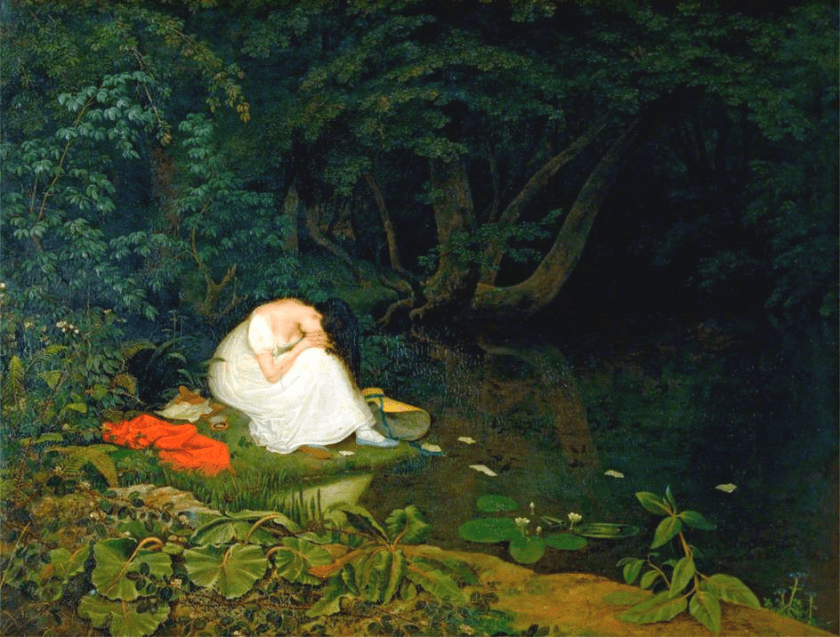
Disappointed Love by Francis Danby (1821)

In 1821 Danby’s fourth son, Thomas, was born and this was also the year that Danby had his first painting accepted by the Royal Academy for their annual exhibition and it became one of his best-known works. It was entitled Disappointed Love. The depiction is of the dark recesses of the River Frome near Stapleton, a north-eastern suburb of Bristol. Stapleton was a favourite destination for Bristol-based artists, such as George Carmichael, Edward Rippingille and Edward Bird and all three had completed works depicting a girl seated alone in a wooded landscape. However it is considered that Danby’s work was far better than theirs.

The painting depicts a heartbroken young woman who has just been jilted. Her hands cover her face as she sits weeping on the bank of a lily pond surrounded by dark and murky woodland. The occasional small white flowers, dotted around, struggle to lift the dark green and browns of the undergrowth. This gloomy undergrowth mirrors the depressed mind of the young girl. Her long dark tresses hang down over her white dress. Beside her, we see her discarded bonnet, her scarlet shawl , a miniature portrait of her lover and other letters which she has not yet destroyed. Her sad figure dressed in white is reflected in the water and it almost seems that the water is drawing her to it so that she can end her life and her misery, in an Ophelia-like fashion. Floating on the surface of the pond are pieces of a letter which she has torn up and discarded. Eric Adams wrote a biography in 1973 on Francis Danby entitled Francis Danby: varieties of poetic landscape and he believes the model for the painting was a model at the Bristol Artists newly founded Life Academy. There was a lot of criticism of the painting, not so much for the poetical nature of the work but for its technical faults, in particular the lack of proportion of the plants in the foreground.
When the painting was put forward to the Royal Academy jurists to see if it should be allowed in to the 1821 Exhibition it was not wholly loved. An account of one of the jurist’s comments on seeing Danby’s painting was reported some twelve years later as:

“…An unknown artist about ten years ago sent a very badly painted picture for the exhibition. The committee laughed but were struck by “something” in it and gave it admission. The subject was this. It was a queer-coloured landscape and a strange doldrum figure of a girl was seated on a bank, leaning over a dingy duck-weed pool. Over the stagnant smeary green, lay scattered the fragments of a letter she had torn to pieces, and she seemed considering whether to plump herself in upon it. Now in this case, the Academicians judged by the same feelings that influence the public. There was more “touching” invention in that than in the nine-tenth of the best pictures exhibited there the last we do not know how many years. The artist is now eminent…”

It is a beautiful painting, full of pathos, and one cannot but feel sympathy for the young girl. It was for this reason that I was surprised to read an anecdote about this painting and the depiction of the girl. Apparently the Prime Minister at the time, Lord Palmerston, was being shown the painting by its owner, the wealthy Yorkshire cloth manufacturer, John Sheepshanks and commented that although he was impressed by the deep gloom of the scene, it was a shame that the girl was so ugly. Sheepshanks replied:

“..Yes, one feels that the sooner she drowns herself the better…”

With that unfeeling comment I will close the first part of my blog on Francis Danby !

Alfred Robert Quinton, the chocolate box painter.

People’s taste in art is a very personal thing. What some of us like is anathema to others. The main consideration when we choose our favourite paintings or favourite artist should be that they or their work make us feel good, inspired and happy. Why should we decry art that others like even if we consider it to be trivial or amateurish? What makes people who are critical about a certain painting or certain genres think that they are the great experts on art. Let us just like what we like and allow others to like what they like.

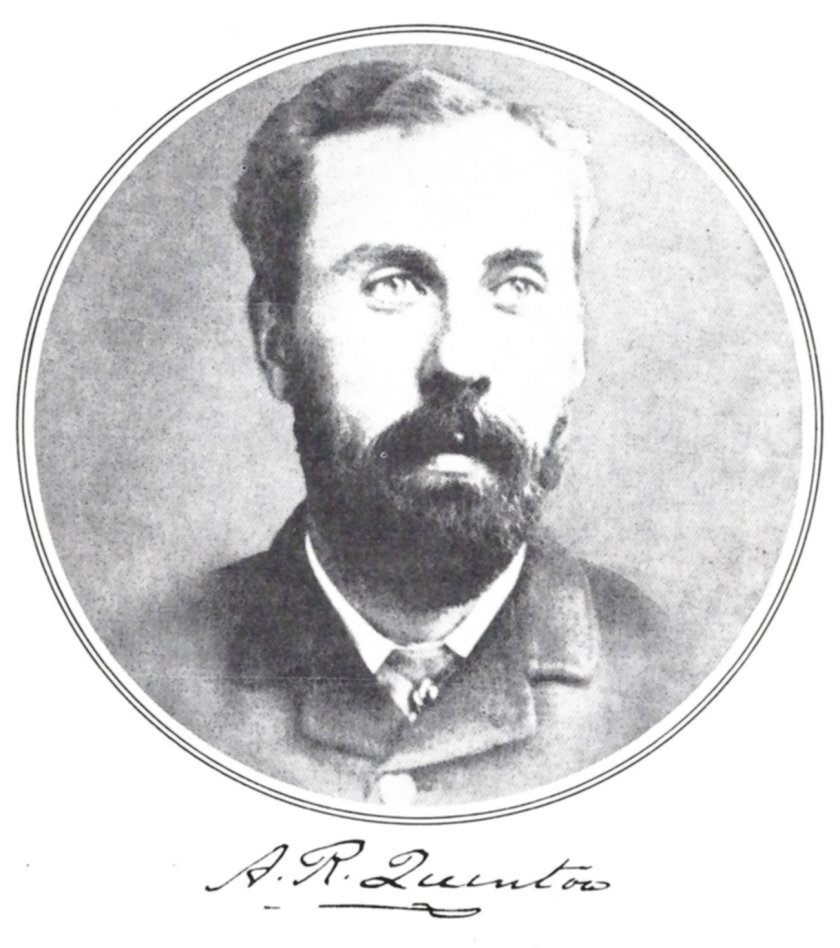
Alfred Robert Quinton

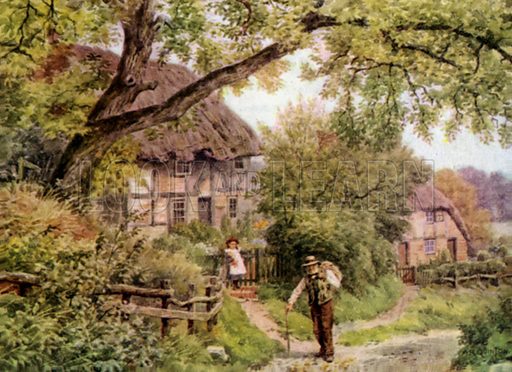
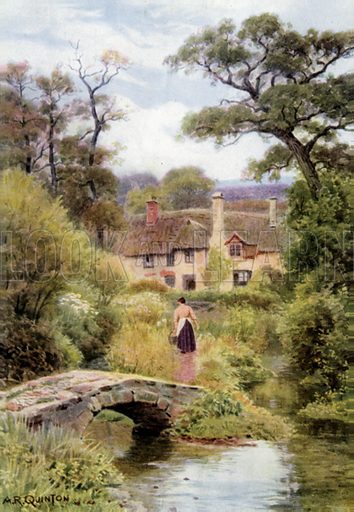
This is all a round about way of justifying the art genre of today’s featured painter. It is a genre which is liked by many but decried by others. My featured artist today is Alfred Robert Quinton, an English nineteenth century watercolour painter who was known for his depictions of villages and landscapes. Detractors label his work as being chocolate-box art. This term derives from scenes of a highly stereotypical nature found on biscuit and chocolate boxes. They were often scenes of the English countryside depicting charming cottages with little girls adorned in pretty dresses dancing happily with their pets. Now the term chocolate-box art is more of a judgemental and derogatory expression. The decriers call these works over-sentimental and kitsch and yet, at the time, they were very popular, albeit in recent years they have fallen slightly out of favour.

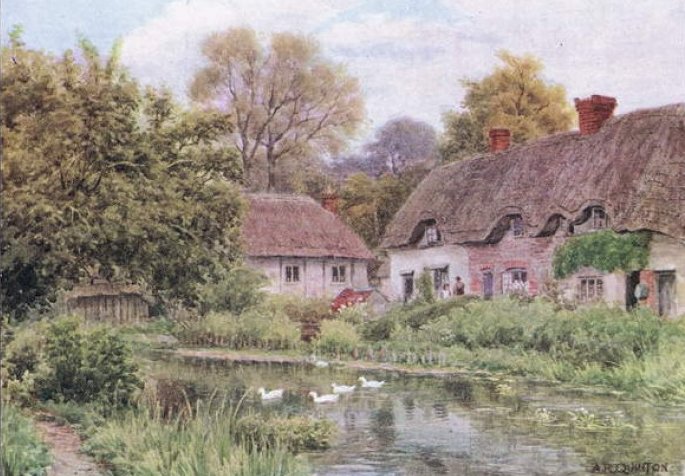
Cottages at Lake, Nr Salisbury, Wiltshire, from The Cottages and the Village Life of Rural England by Alfred Robert Quinton published by Dent and Sons Limited, 1912

Alfred Robert Quinton was born in Peckham, London on October 23rd 1853. He was the youngest of seven children, the fifth son of John Allan Quinton and Eliza Quinton (née Cullum). His parents came from the county of Suffolk. John Quinton was from Needham Market and his wife, whom he married in 1840, was from Ipswich. John and Eliza Quinton moved from Suffolk to 5 Ellington Terrace, Islington, London in 1850. John Quinton, a printer, editor of periodicals, and supporter of the Liberals, was staunch Congregationalist and worked for the Religious Tract Society, an organisation which published Christian literature intended originally for evangelism, but also incorporated literature aimed at children, women, and the poor. John eventually became editor of titles such as The Boys’ Own Paper, The Girls’ Own Paper and The Sunday at Home. Alfred was influenced by his father, who lived to be eighty-eight, and was a regular Congregational Church attender and supporter of the Liberal Party.

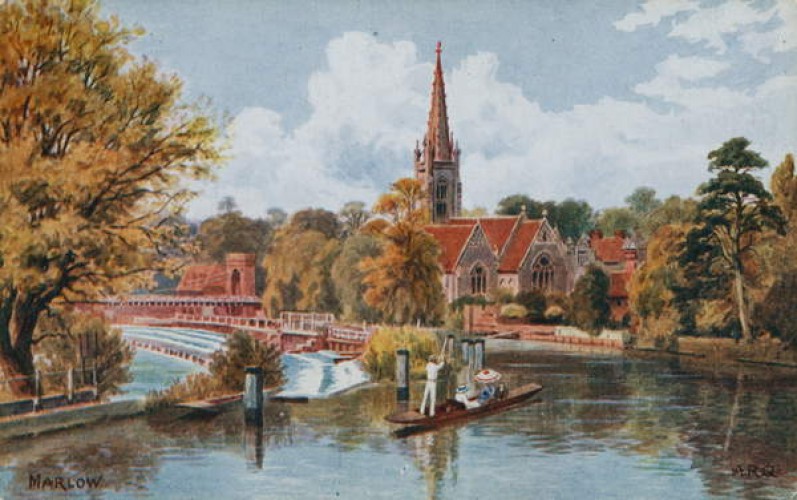
Marlow by Alfred Robert Quinton

Alfred attended the Hornsey School in North London and excelled in art. He was a hard working pupil and when he was fourteen years old, received a book prize for his hard work, entitled Drawing From Nature. A Series of Progressive Instructions in Sketching To Which are Appended Lectures on Art Delivered at Rugby School. It was to be one of his favourite possessions and an inspiration to him on his artistic journey.

The Bell Inn Waltham St Laurence, Berkshire by Alfred Robert Quinton

Alfred left school and went to study at Heatherley’s Art School, which boasted Burne Jones, Rossetti, Millais, Lord Leighton, and Walter Sickert amongst its former students. From there Alfred became an apprentice engraver but soon decided to concentrate on becoming a professional artist. Initially Quinton worked in oils but his last-known work in that medium is dated 1885. From then on he concentrated on watercolour painting and black and white drawings. He exhibited his work at many London galleries and exhibited a large painting, Above Wharfedale, Yorkshire at the Imperial Jubilee Exhibition in Liverpool on the occasion of the Golden Jubilee of Queen Victoria. In 1879 his watercolour work, At Gomshall, Surrey was his first work to be exhibited at the Royal Academy.

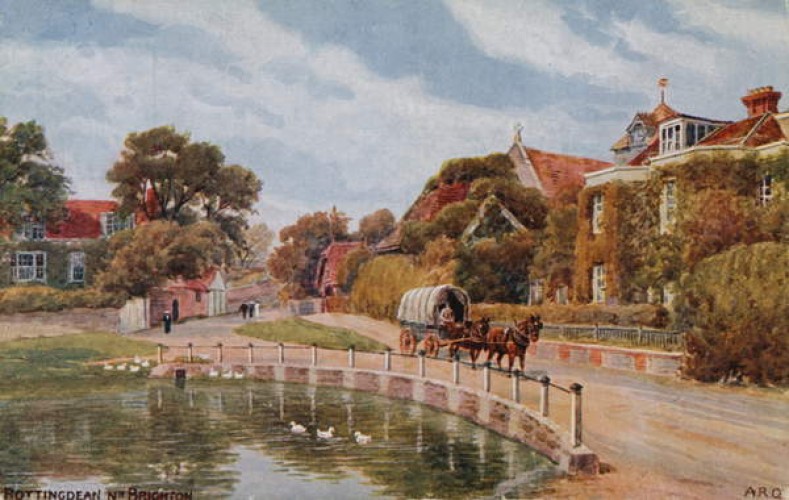
Rottingdean near Brighton by Alfred Robert Quinton

Although Quinton was not a member of the Academy, his paintings were seen there on a regular basis, in fact, he had twenty works of art exhibited on the walls of the Academy between 1879 and 1919. Later however, his work was banned by the Royal Academy because they disapproved of what they termed, his ‘commercialisation’ of art. Quinton also exhibited at the Royal Society of British Artists and the New Watercolour Society, which later became the Royal Institute of Painters in Watercolours. Quinton’s original London studio was in Bolt Court, Fleet Street but in 1880 he moved to a studio in New Court, Lincoln’s Inn which he shared with a contemporary of his, the artist Henry Bailey.

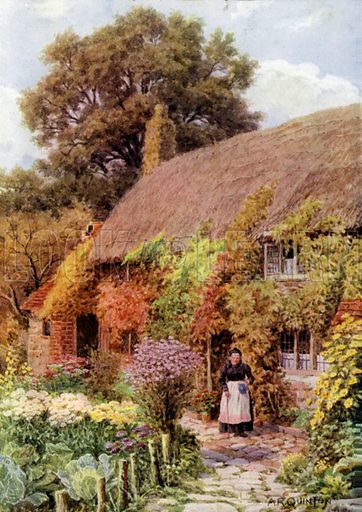
Granny’s Cottage, Henley Common, near Midhurst, Sussex by Alfred Robert Quinton

Alfred Quinton regularly travelled throughout Europe in the early 1880’s. His favourite foreign trips were his sea voyages to Spain and the coastal town of Malaga and it was during one of his return trips home from the Spanish port that he met his future wife, Elizabeth Annie Crompton. The couple married at Bolton, Lancashire on May 20th, 1885. He was thirty-two and she was twenty-seven years of age. The couple went to live with Quinton’s parents who had a house in Finchley, London and they stayed there until his mother died in 1886. That year, on March 5th 1886, their son Leonard was born at Hampstead, London. A second son, Edgar, was born in 1891. Sadly, Edgar, who suffered from heart problems, died aged twenty-one, in 1912.

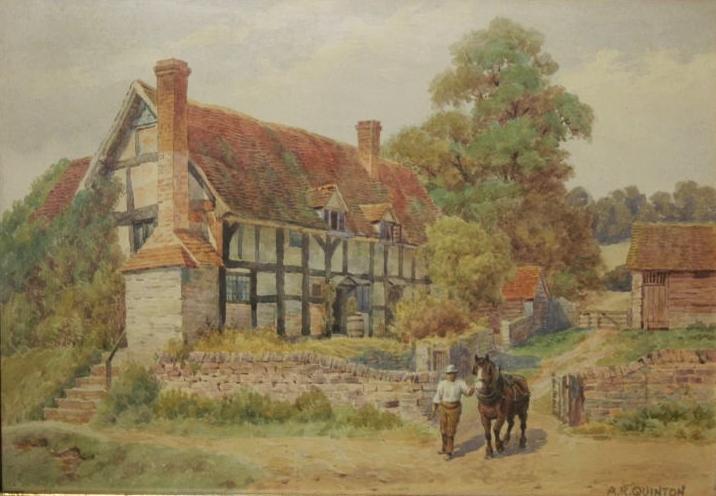
Dudging-Exhall Shakespeare Village by Alfred Robert Quinton

Quinton had a routine for each year. He would go off on his travels for three months during the summer and during this time would make hundreds of sketches and took and bought photographs of the places he visited, and then settle down at home to convert the sketches into paintings during the autumn and winter months. Quinton’s paintings were very popular and sales of them allowed him to purchase Westfield, a large eleven-roomed house with its own studio in Finchley, which, at the time, sat alone among the fields in the countryside. This home remained in the family until 1974, forty years after Alfred Quinton’s death.

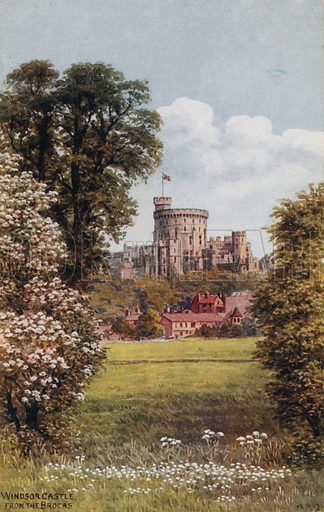
Windsor Castle, from the Brocas by Alfred Robert Quinton

Not only did Quinton sketch during his summer journeys but he also kept a diary of his travels in England and Europe and these would be published in articles with accompanying illustrations by him. One such journey happened between May and October 1895 when he and his cycling companion, thought to be his artist friend, Henry Bailey, travelled from Land’s End to John O’Groats and this mammoth cycling trip was serialised in the journal, Illustrated Sporting and Dramatic News. Of the long journey, Quinton wrote:

“…Our idea was to tour leisurely from end to end, to enjoy varied scenery which our native land presents in such variety to those who care to see it and to study the life and character which we might meet with on the road…”

This was just one of the many he completed during his lifetime and was typical of the Victorians desire to travel.

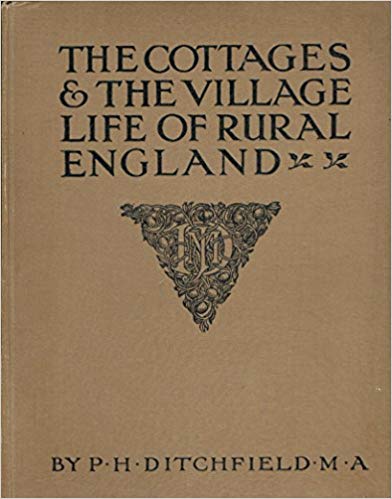
The Cottages and Village Life of Rural England.by P H Ditchfield with Coloured and Line Illustrations by A.R. Quinton

The well-known English historian and a prolific author, Peter Hempson Ditchfield (P.H. Ditchfield) wrote a book The Cottages and the Village Life of Rural England in 1912 and Quinton provided seventy-one illustrations for it. Quinton recalled the collaboration fondly:

“…We have explored together some of the quaint nooks and corners, the highways and byways, of old England, and with the pen and brush described them as they are at the present time. We have visited the peasant in the wayside cottage…..entered the old village shop, and even taken our ease at an inn…”

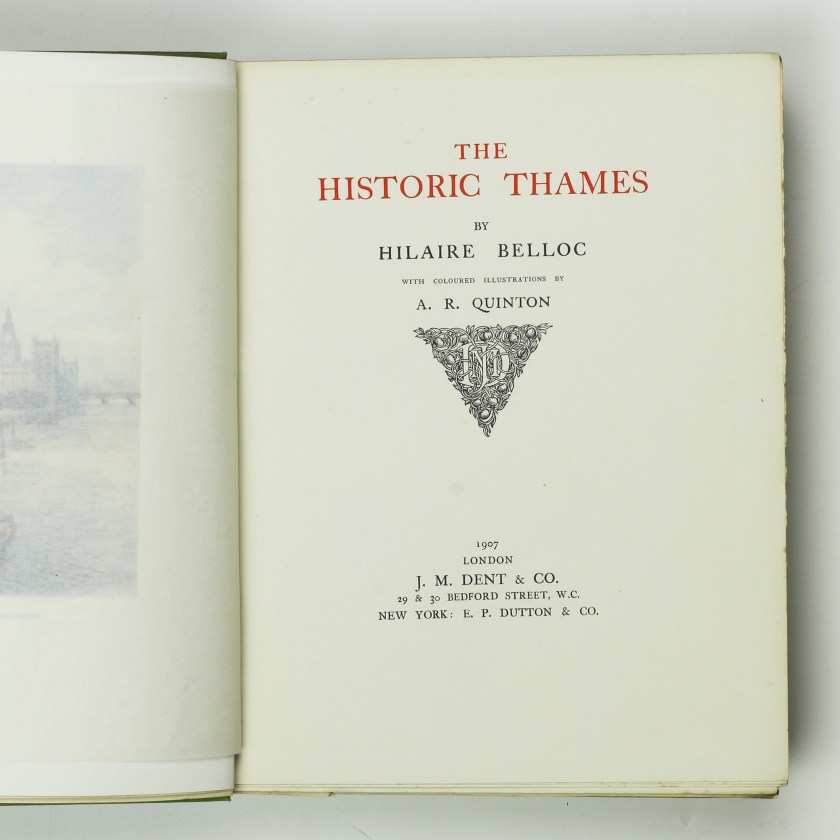
The Historic Thames by Hilaire Belloc with illustrations by Alfred Robert Quinton

He provided illustrations for other books and magazines including a set of illustrations featuring the Wye Valley and Wharfedale in 1902 for the Art Journal. One of his most prestigious collaborations was his fifty-nine illustrations for Hilaire Belloc’s 1907 book The Historic Thames, which is considered a minor classic during the early part of the twentieth century.

Victoria Statue, Castle Approach, Windsor by Alfred Robert Quinton

The illustrations included views of Lambeth Place, Tower Bridge, the Houses of Parliament, Hampton Court and Windsor Castle and it took Quinton the summers of 1905 and 1906 to complete the illustrations, many of which were exhibited at the Suffolk Street Gallery which was the home of the Royal Society of British Artists. Two of the paintings on display were purchased by The Duke and Duchess of York for their private collection.

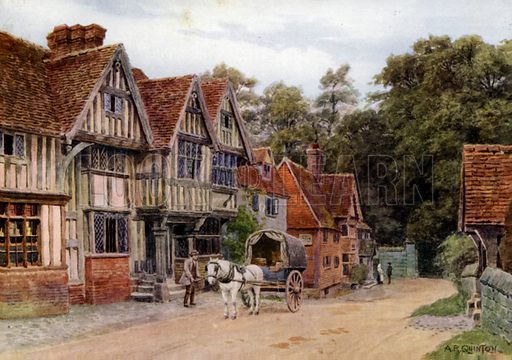
Chiddingstone, Kent by Alfred Robert Quinton

During the 1870’s and 1880’s Quinton struggled to sell his paintings, achieving a top price of fifteen guineas if he was lucky. But his fortunes changed by the early twentieth century and by 1920 his large 4 x 5ft works were fetching around one hundred guineas. In the early days of his career, most of his money came from book and booklet illustrations, but during the late 1890’s and the early 1900’s when he became a recognised landscape painter his paintings began to sell well

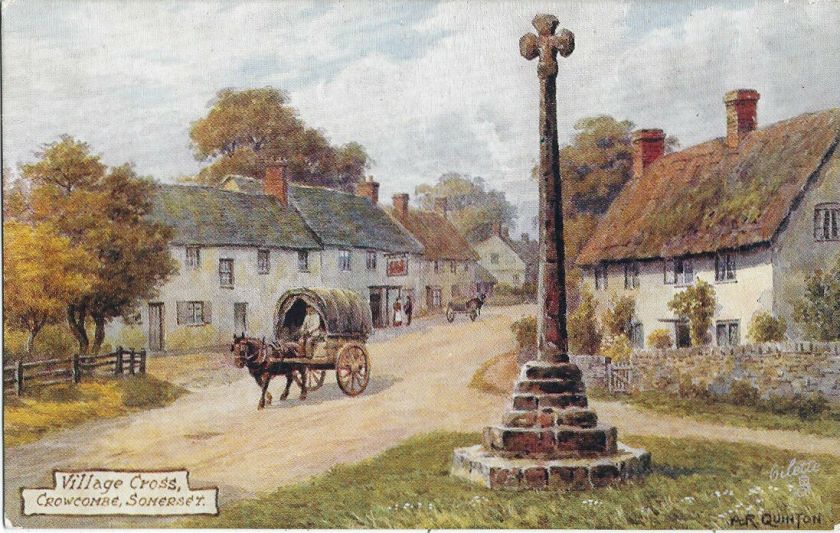
Village Cross, Crowcombe, Somerset by Alfred Robert Quinton

The postcard publisher Raphael Tuck began to produce images from Quinton’s watercolours in a series called Village Crosses.

However Quinton’s main outlet for his work came from Joseph Salmon, the Kent printer and art publisher who founded and owned J Salmon Limited.  Joseph Salmon, who had a personal interest in photography, had begun to publish black and white reproductions of photographs of the Sevenoaks neighbourhood in Kent as postcards. By the end of 1903 Salmon decided that picture postcards reproduced from paintings would be the way forward and he commissioned local artists to paint pictures of their local area.
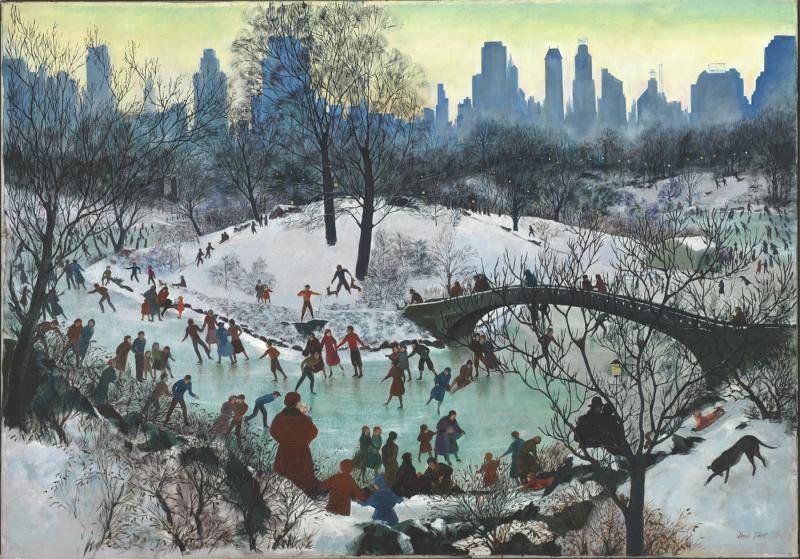
A By-lane at Houghton, Sussex by Alfred Robert Quinton

Around 1911 Joseph Salmon visited the Selfridges Store in London and visited its art department where he noticed an art display featuring watercolour paintings of cottages and countryside scenes mainly of the Worcestershire area. The signature on all the works was A R Quinton. Salmon bought six of the watercolours and arranged with Quinton to have the copyright of the works and then had them reproduced as postcards. They proved a great success and it was to be the start of a collaboration between artist Quinton and printer J. Salmon which would last until Quinton’s death in 1934.

Footbridge, near Porlock, Somerset by Alfred Robert Quinton

Quinton was a prolific painter. In 1924, he completed one hundred and forty-three paintings which were delivered to J. Salmon for reproducing as postcards. Even in the last year of his life he managed to complete forty-seven commissioned works and one, an unfinished work, was on the easel where he had left it, the day before he died. His total artistic output was approximately two thousand watercolour paintings for Salmon postcards. For Quinton it was a lucrative association with Salmon as up until November 1922 he received four pounds for each painting, then his fee increased to five guineas per work. The artistic genius of Alfred Quinton was his ability to capture the flavour and colour of English rural life at the turn of the century. In his paintings, he was able to combine accuracy with an impression of rural peace and harmony which made his work so popular with the public. He was in love with the English countryside.

Alfred died at his beloved Finchley home, Westfield, on 10 December 1934, aged 81. His wife Elizabeth died ten years after her husband on February 16th 1945. She was 86. Their eldest son Leonard died on January 14th 1981.

Why was his work so popular? It is probably the nostalgia of the carefree days spent in the countryside, away from the fast paced towns and cities. P.H. Ditchfield, the author, whom Quinton collaborated in 1904 and 1912 summed it up, writing:

“…Agitators are eager to pull down our old cottages and erect new ones which lack all the grace and charm of our old-fashioned dwellings. It is well to catch a glimpse of rural England before the transformation comes, and to preserve a record of the beauties that for a time remain…”

Eilert Adelsteen Norman – The Norwegian Fjord painter.

If you are a lover of landscape paintings. If you have ever been seduced by the dramatic beauty nature offers up. If you have ever dreamt about cruising along a Norwegian fjord then this blog is especially for you. Our guide to the mesmerising beauty of nature is the nineteenth-century Norwegian landscape painter Eilert Adelsteen Normann.

Eilert Adelsteen Normann as a Young Man (possibly a self-portrait)

Eilert Adelsteen Normann was born on May 1st 1848 in the northern Norwegian coastal town of Bodin which lies on a peninsular between the great fjords of Vestfjorden and Saltfjorden. It is at the heart of a rough mountainous area full of beauty but only readily reachable by sea. Eilert Adelsteen was the second of six children, having four brothers and a sister. His father was Johan Normann, a merchant and hunting skipper as well as being a part-time farmer. His mother was Catharina Weitgan, the daughter of a shoe and umbrella maker.

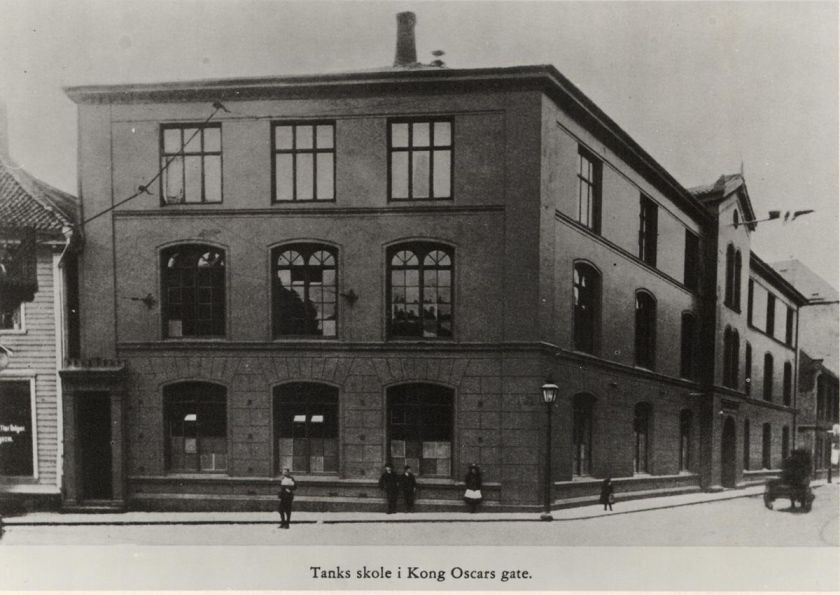
The Tanks senior secondary school at Bergen

When Adelsteen was twelve years old he was sent to school in the city of Trondheim which was over four hundred miles from his home. He later transferred to the Tanks Videregående Skole, a senior secondary school which had just opened in new premises in Bergen five years earlier. In 1869, when Adelsteen was twenty-one-years-old, tragedy struck the family when his eldest brother was killed at sea in a shipping accident in the Bay of Biscay. Adelsteen was now the oldest of his siblings and it fell on his shoulders to take up the mantle of heir to his father’s trading business which was based on the island of Vågøya. It was for this reason that he went to Copenhagen to study business practices which would stand him good stead when the time came to run the family business.

Trollfjord in Lofoten near Vesterålen by Adelsteen Normann

I have not been able to find out what happened in Copenhagen but all I know is that in that same year he arrived there to study business, 1869, he left and travelled to Düsseldorf and enrolled on a three-year course at the Kunstakademie Düsseldorf where he studied under Andreas Müller and later Albert Flamm and Eugen Dücker, the Baltic German romanticist painter, famed for his landscape and marine works.

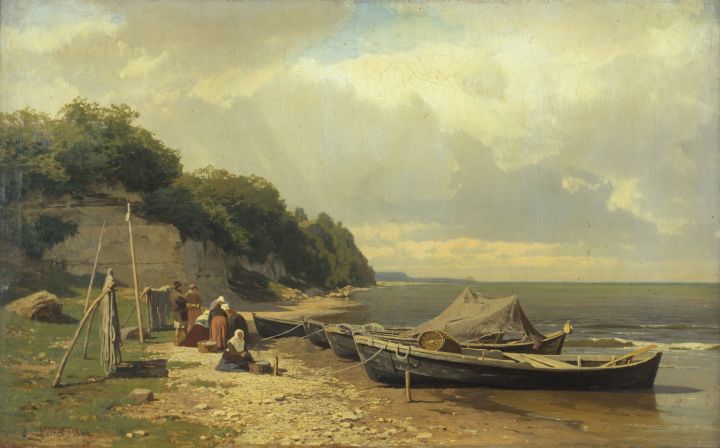
Seashore at Tiskre by Eugen Ducker (1866)

Dücker headed up the landscape class at the Academy. Adelsteen Normann became part of the Düsseldorf School of Painting. The paintings of this School were typified by delicate and detailed landscapes, that were sometimes imaginary and often focused on a religious or allegorical story with a landscape setting.

From Hardanger by Adelsteen Normann

In 1872, despite only having studied art for three years at the Düsseldorf Academy Normann exhibited some of his landscape paintings, featuring Norwegian fjords, at an exhibition in Düsseldorf and some were purchased by the Düsseldorf Art Association. More were bought up by the art associations of Lubeck and Leipzig. In June 1872 he exhibited and sold more of his work at the Nordic Industrial and Art Exhibition in Copenhagen which was held between June and November. The Danish-Prussian War of 1864 was over, and the conservative Hojre political party had control of the Danish parliament and they wanted to join the world’s fair movement to show off the country’s progress in agricultural (which had suffered during recent years) industrial, and the arts. Visitors attending the Exhibition during the nearly five-month run was over six hundred thousand and once again many of Normann’s paintings of the Norwegian fjords were sold.

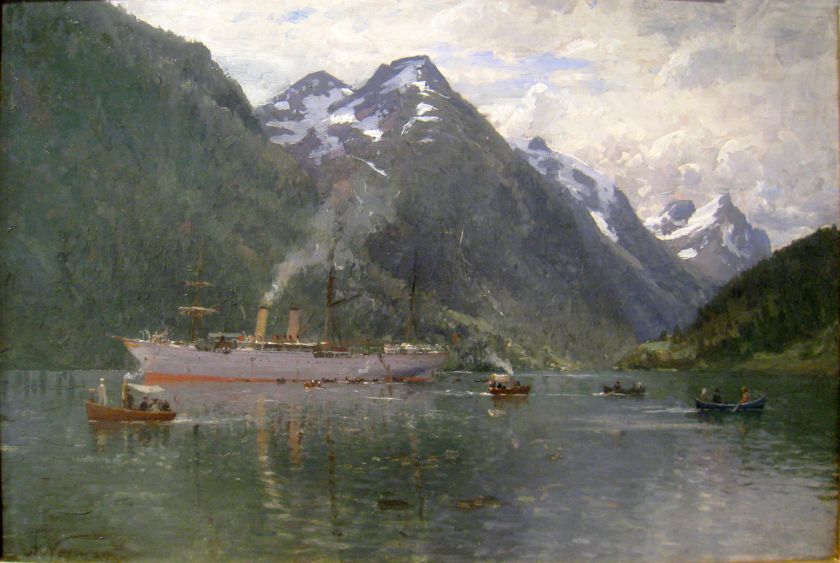
The Steamship by Adelsteen Norman

From 1869 until Adelsteen Normann lived in Germany but he and his family would return most summers to Western Norway, the northernmost parts of Nordland and the rugged area around Lyngen, a municipality in Troms county, where he would find more and more spectacular landscapes to paint. He would sketch and photograph the scenery and return to his studio in Dusseldorf and Berlin to complete the paintings.

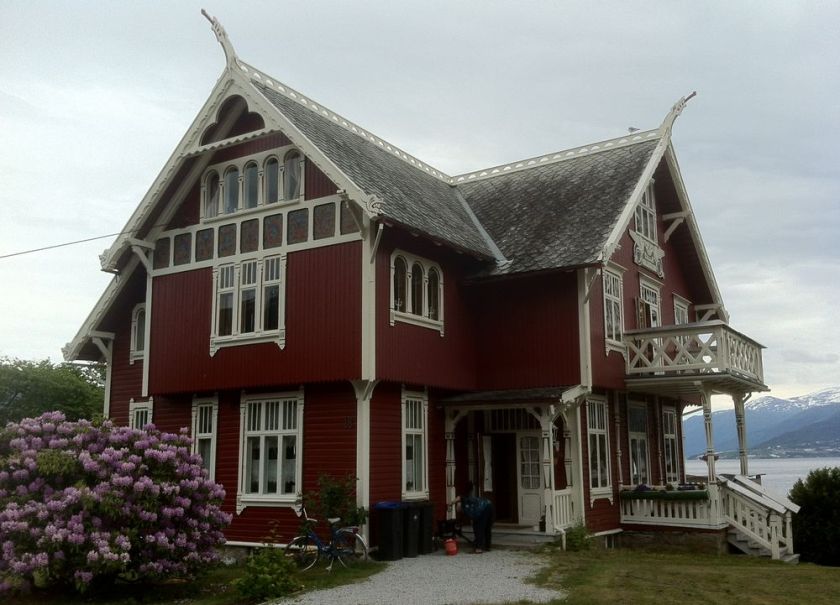
A dragon style house on the Sognefjord

Adelsteen Normann left Dusseldorf in 1883 and went to live in Berlin. He continued to return each summer to Norway and in 1890, he bought a plot of land in Sjøtun,  an area nestling on the edge of Kattfjord, and set amongst the spectacular mountains on the island of Kvaløya.  This idyllic location was only 40 minutes from Tromsø and had a spectacular view overlooking the Sognefjord. The following year he then purchased his house which arrived in pre-fabricated kit form from a company in Trondheim who had their men erect the structure. It was a “dragon style” house with lots of wood carvings and dragon figures. Normann’s dragon-style villa  was the first to be built by an artist in this particular style, and it became the prototype for the ones that came later. These houses in Balestrand became a special talking point of the town and were to become very important for the town’s tourism and so have always been well preserved. Normann’s summer house at Balestrand remained with his heirs until 1934.

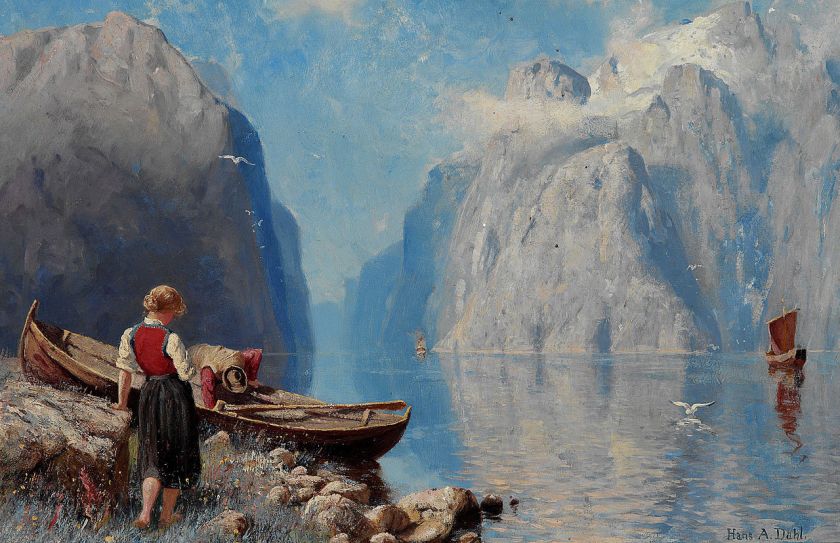
Norwegian fjord landscape by Hans Dahl

During his time at the Kunstakademie Düsseldorf Normann became friendly with fellow student Hans Dahl, a fellow Norwegian. Dahl’s Norwegian landscapes depicting the mountains and fjords were similar to Normann’s works but Dahl nearly always included figures in his landscapes.

Villa Strandheim

It was Adelsteen Normann who advised Dahl to build a villa in Balestrand and three years after Normann’s own residence was completed, Dahl had his own erected. It was called Villa Strandheim.

Kaiser Wilhelm II (left) with Hans Dah (centre) l in the garden of Villa Strandheim

Hans Dahl and Adelsteen Normann were close friends of Emperor Wilhelm II of Germany. Like Normann, Dahl returned to Balestrand from Germany each summer and Dahl organised large garden parties at Villa Strandheim. It was here that the Emperor was a regular guest. In 1910 the Dahl’s son Hans Andreas Dahl built a studio near his father’s villa.

Northern Norway fishing village by Eilert Adelsteen Normann (1880)

Whilst living in Germany, Normann married Catharina Hubertine Weitgan who came from the Rheinland. The couple had 4 children: Emma, Otto, Olga and Walter. When Catharina died in 1911, sixty-three-year-old Normann re-married that same year. His second wife was Luise Rostalski, who was thirty-five-years younger than her husband. Together they had a son called Adelsteen.

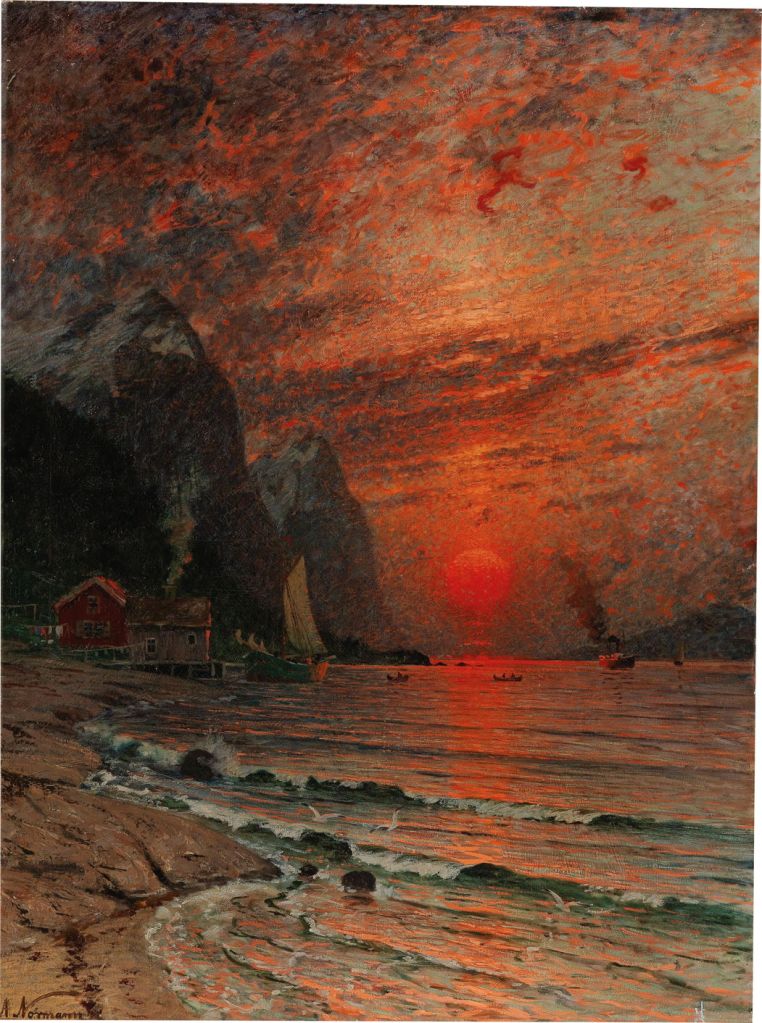
Sunset over the Fjord by Adelsteen Normann

Normann exhibited his works in a number of venues in Europe including the important Salon de Paris from as early as 1882. His works earned a ‘Mention Honorable’ in the 1884 Salon and he was awarded a bronze medal in 1889. In Berlin Normann became well-known both as an artist and as a board member of the Verein Berliner Künstler and he established a school for painters.

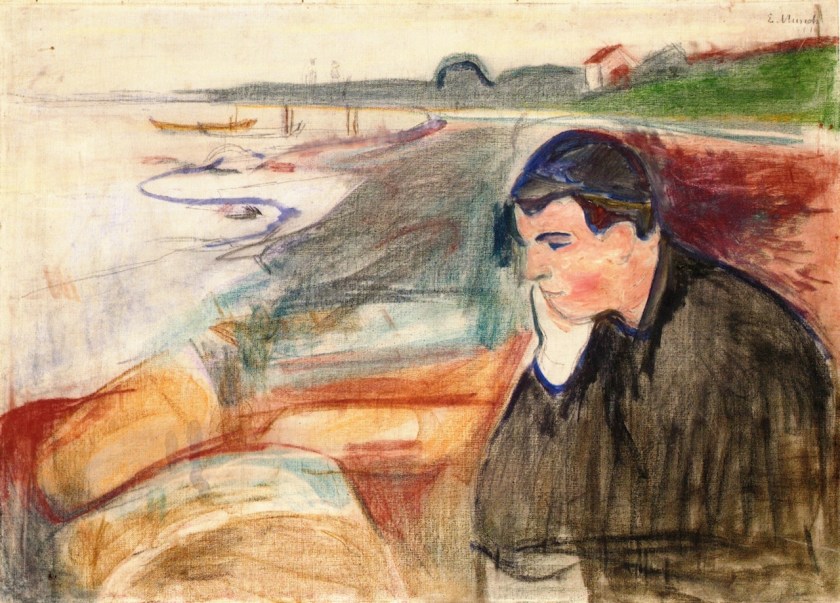
Evening. Melancholy, by Edvard Munch (1891). Oil, pencil and crayon on canvas.

During his annual visit back to Norway in 1891, Normann took the opportunity to exhibit some of his fjord landscapes in Oslo, at the Kristiania Art Society, at the same time that the young Edvard Munch was exhibiting some of his paintings in the city. including his work, Evening. Melancholy. Normann was so impressed that in 1892, on behalf of the Verein Berliner Künstler (Society of Berlin Artists), he invited Edvard Munch to present his work at the Society’s November exhibition. Twenty-eight-year-old Munch felt flattered by Normann’s invite and agreed to come. He felt honoured to put his work before famous and established artists and hopefully his work would be seen by more sophisticated and knowledgeable public in Berlin.

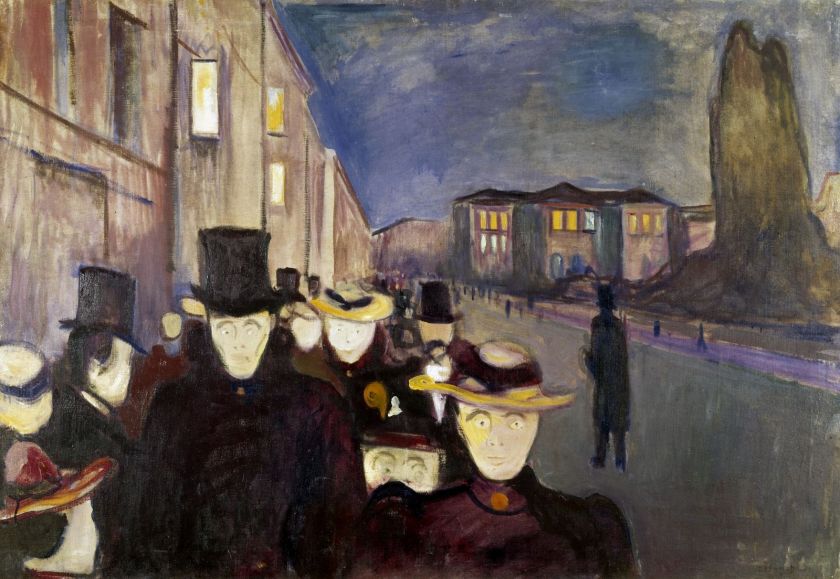
Evening on Karl Johan by Edvard Munch (1892)

Munch arrived in Berlin with more than fifty-five works. It was the Society’s first one-man exhibition. Munch and Normann collaborated in preparing the exhibition, which was held at the newly built Architektenhaus. Was the exhibition a success? No, in fact it was a disaster. It appears the Society was not ready for Munch’s Symbolist artistic style which some of the members hated. The society members either loved them or hated them. The majority of members described Munch’s images as being repugnant, ugly and mean, and they caused an outrage. The Verein (The Association of Berlin Artists) held an extraordinary meeting on November 11th, and in a vote of 120 to 105, it was decided to close the exhibition after just one week, leaving Munch perplexed as to why he had been invited in the first place. The row over the merit of Munch’s one-man exhibition and the scandal following the early closing of it caused a number of the younger Society members, who were not prepared to put up with such an insult to an invited guest, broke away from the traditionalist stance of the Verein and joined together to form what they termed a “free association for the organization of artistic exhibitions”. They organized an art exhibition in the spring of 1892 as Die Elf. They did not however leave the main Society, so as to ensure the opportunity to display their work at its future exhibitions.

The dispute regarding Munch and his artwork shattered the art society! So how did Munch look upon the disaster? In Arne Eggum’s 1984 book, Edvard Munch: Paintings, Sketches, and Studies, Munch was amused and was quoted as saying:

“…Never have I had such an amusing time—it’s incredible that something as innocent as painting should have created such a stir…”

August Strindberg by Edvard Munch (1892)

The exhibition went on to later showings in Düsseldorf and Cologne before returning to Berlin. During Munch’s four years in Berlin while fraternising with like-minded artists and writers, such as his close friend August Strindberg, at a bar called the Black Piglet, Munch created some of his major and best-known works, including The Scream, The Vampire and Madonna. The exhibition and the humiliating effect it had on the Verein Berliner Künstler was well documented at the time, but for Munch, it resulted in the start of his international fame.

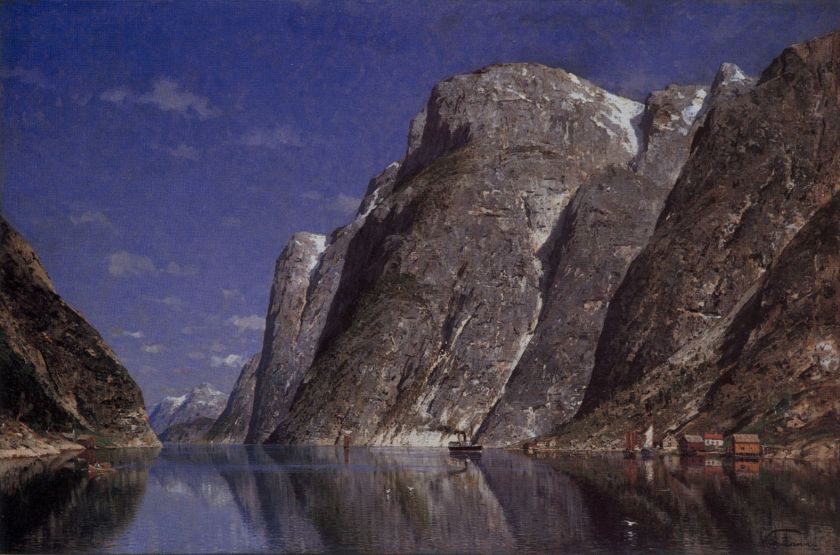
Sognefjord by Adelsteen Normann

Adelsteen Normann was one of the favourite painters of Kaiser Wilhelm II, who loved his landscape works featuring the Norwegian fjords. Most of Normann’s paintings depicted Norwegian fjord landscapes as well as modern life in Norwegian fjord villages with steam-driven cargo ships and large tourist ships. Normann, through his landscape works, is credited with making Norwegian fjords a popular tourist destination, especially with the upper classes, who would also buy his paintings as a memento of their travels. In the early 1890s, whilst living in Berlin he was also doing good business selling his paintings to hotel owners

Fishing vessels on a Norwegian fjord by Adelsteen Norman

Adelsteen Normann was a regular exhibitor. He received recognition for his work and was awarded many medals and awards, for his paintings including the Prince of Wales Medal 1874, Médaille d’honneur at the Salon in 1884 and a gold medal in Lyon in 1889. In 1897, he was appointed Knight of the 1st Class of the St. Olav Order. He has many paintings in museums around the world as well as in private collections.

View of a Fjord by Adelsteen Normann

In his later life, Normann was afflicted with asthma and in 1917, on medical advice, he returned to Norway. Despite his illness he carried on painting. Unfortunately for Normann who was already suffering breathing problems due to his asthma he was ill equipped physically to withstand the Spanish flu epidemic which swept across Norway in 1918. In Norway the epidemic killed between 13,000-15,000 people, most of them during the autumn of 1918 and mostly from pneumonia or pulmonary complications.

Eilert Adelsteen Normann (1848 – 1918)

Adelsteen Norman died in Kristiania (Oslo) on December 26th 1918 aged 70. The urn containing his ashes was returned to the Stahnsdorfer Waldfriedhof, in Berlin.

The Palm family. Part 1 – The father, Gustaf Wilhelm Palm.

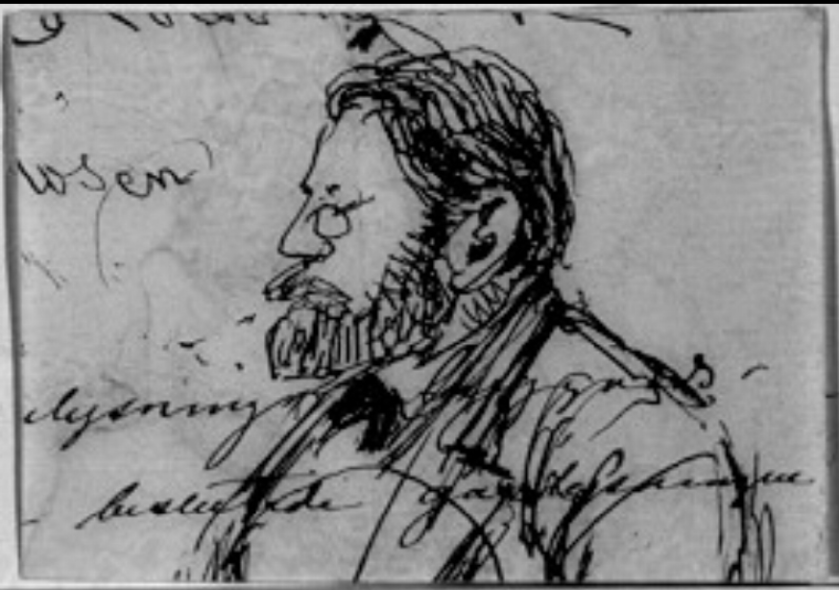
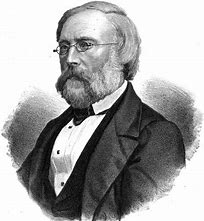
Portrait sketch of landscape artist Professor Gustaf Wilhelm Palm by Fritz von Dardel,

There has to be an enticement to become an artist if one or both of your parents or siblings is a successful painter. Maybe such a family connection is to do with artistic genes. My featured painter today had the perfect start on her road to an artistic future as her father and her maternal grandfather, Johan Gustaf Sandberg,  were accomplished painters and must have nurtured her love of sketching and art when she was young.  In my next blog I will look at the life and works of the talented daughter, the landscape painter, Anna Palm, later Anna Palm de Rosa, but today I want to concentrate on the talents of her father.

View of Subiaco by Gustaf Wilhelm Palm (1884)

Gustaf William Palm was born in Norra Åsum, a small village close to the town of Kristianstad in Southern Sweden on March 14th 1810. He went to school in Kristianstad and when his regular schooling was completed in 1825 he picked up some work in Lund through the good auspices of a friend, Johan Rabbén, who arranged for him to complete some illustrations for a book on European algae written by Carl Agardh. In 1828, when Gustaf was eighteen years of age, he enrolled at the Royal Academy of Painting and Sculpture in Stockholm.

View of Gripsholm Castle by Carl Johan Fahlkrantz (1819)

Gustaf Palm was greatly influenced by the works of the acclaimed Swedish romantic landscape painter, Carl Johan Fahlcrantz, whose paintings were often in the form of a somewhat diffused romantic mood with warm, dark colours.

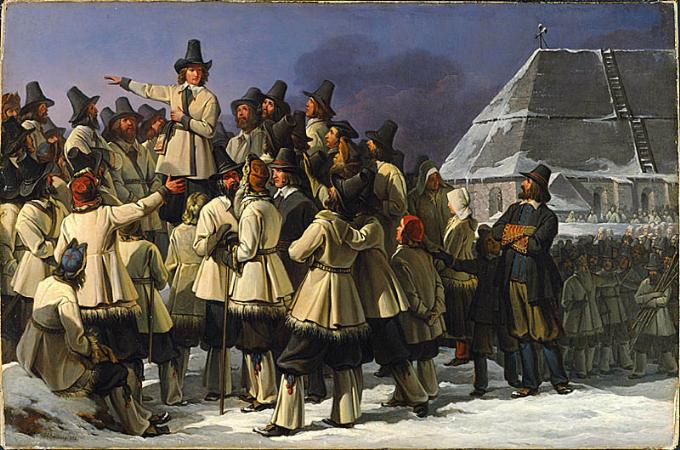
Gustav Vasa Speaks to the Dalecarlians at Mora J G Sanberg (1836)

Another influential figure for Gustaf Palm was his Academy professor, and father-in-law, Johan Gustaf Sandberg, a foremost history painter whose works of art often depicted Norse mythology, folklore and Swedish history. One such painting was Gustav Vasa Speaks to the Dalecarlians at Mora, in which we see Gustav Ericksson trying to drum up support with the people of Dalarna in his fight against the Swedish king Christian II during the Swedish War of Liberation in 1521.

Motif from Norway by Gustaf Wilhelm Palm (1835)

Whilst at the Academy Gustaf Palm received many awards for his work and was commissioned to produce illustrations for Sven Nilsson’s book, Skandinavisk Fauna and Sandberg’s illustrated book, One Year in Sweden. In the summer of 1833 Gustaf and fellow artist, Mikael Gustaf Anckarsvärd , travelled to Norway and Norrland on a painting trip and one of Gustaf Palm’s early paintings from this journey was entitled Motifs of Norway which he completed in 1835.

View of the Riddarholmskanalen, Stockholm by Gustaf Wilhelm Palm (1883)

In 1837 Gustaf developed a problem with his eyes and travelled to Berlin to find a cure for the disease. En route he stopped off in Copenhagen where he met the Danish painter, J C Dahl. He remained in Berlin for a year before moving to Vienna in 1838. In Vienna he exhibited some of his work at the Vienna Academy of Arts. His art works depicting Scandanavian landscapes were very popular and the Austrian public deemed his rugged landscapes to be quite exotic and they sold well.

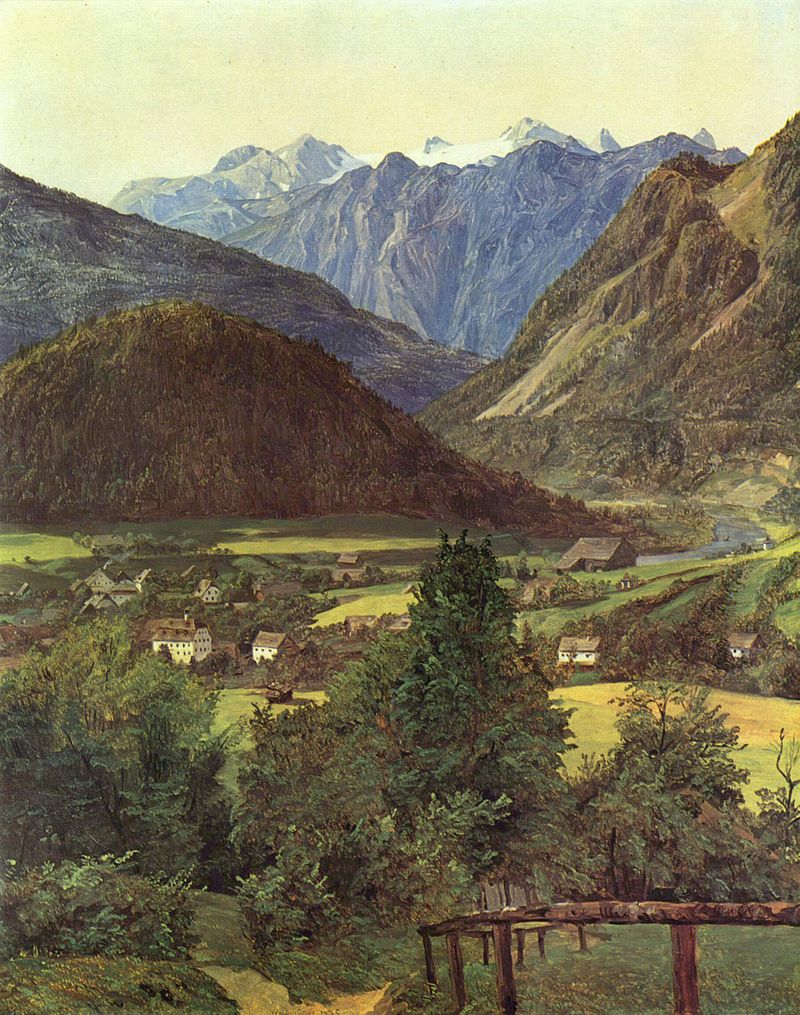
Dachstein by Ferdinand Georg Waldmüller (1839)

Gustaf Palm began to be influenced by the popular Austrian writer and landscape artist, Ferdinand Georg Waldmüller whose work was in great demand at the time.

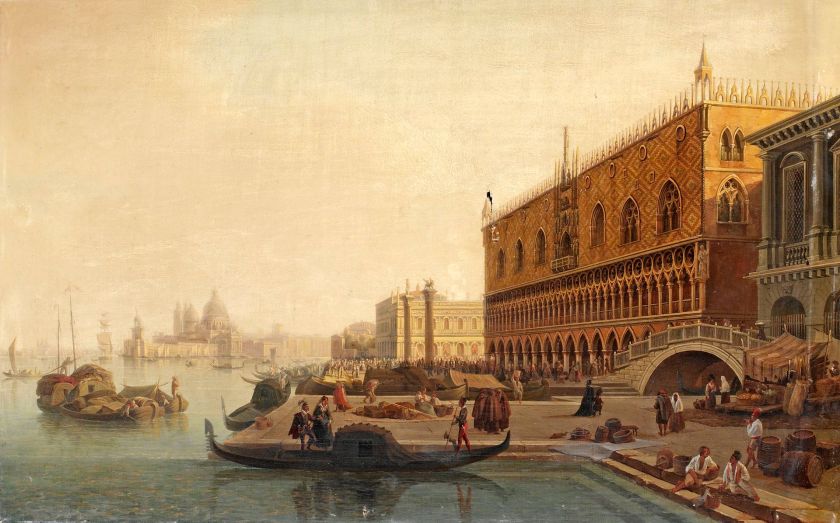
View of Venice by Gustaf Wilhelm Palm (1843)

In 1840 Gustaf Palm left Austria and travelled to Venice, first visiting Hungary and Trieste. He arrived in Venice in the November of that year and soon set about sketching the various facets of this beautiful city, the canals and surrounding lagoon and these he took with him and converted into paintings when he went onto Rome at the end of July 1841. He was to remain in the Italian capital for the next ten years.

View of Ariccia by Gustaf Wilhelm Palm (1841)

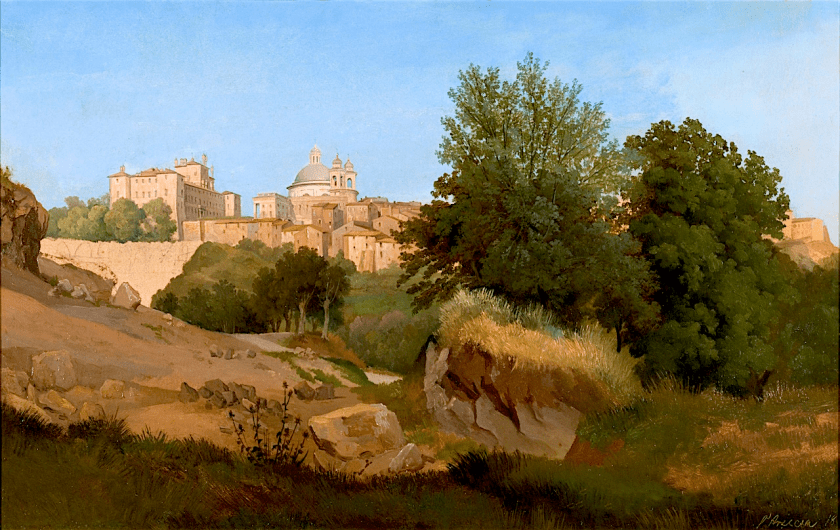
One of his early paintings during his stay in Rome was View of Ariccia which he completed in 1841 and was a landscape work depicting the town which lies thirty kilometres south-east of the capital. It is now housed in the Los Angeles County Museum of Art.

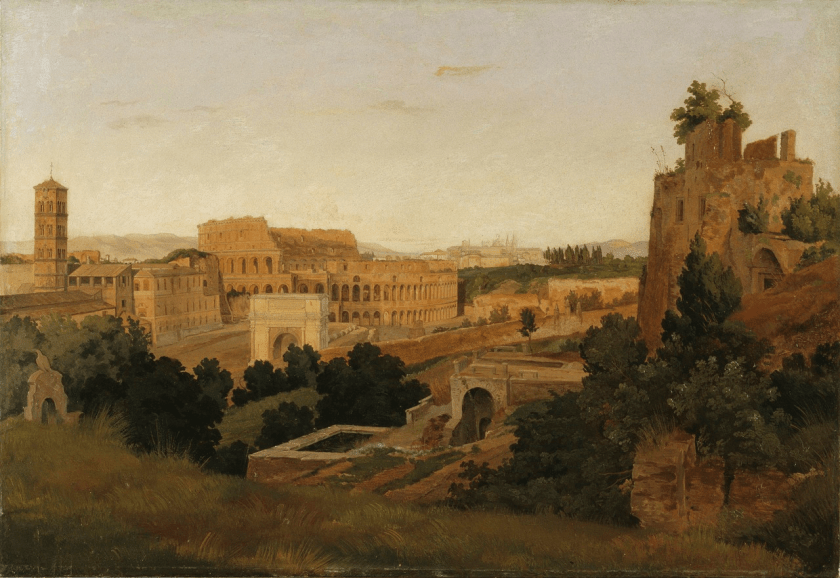
View of Rome with the Colosseum by Gustaf Wilhelm Palm (1847)

Rome at the time was awash with visiting artists. Tourists flowed through the Italian capital and were often on the look out for something to remind them of their visit and so a painting depicting the city sights or the outlying countryside was a must-have thing. There was a German artist colony and there was a Swedish art colony, to just mention a few, and Gustaf Palm soon became acquainted with the artists. He made friends with the Swedish sculptors Johan Niclas Byström and Bengt Fogelberg and became a lifelong friend of the Swedish watercolour painter, Egron Sellif Lundgren.

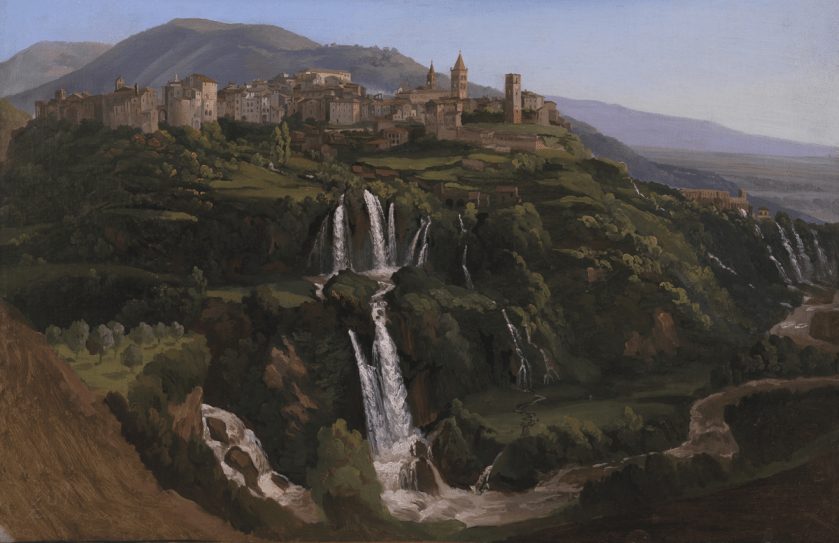
View of Tivoli in Italy by Gustaf Wilhelm Palm (1844)

Gustaf completed many landscape paintings depicting the hills surrounding Rome, views of Tivoli with the catacombs as well as may of the small picturesque towns close to the city.

The Road from Pellegrino to Palermo by Gustaf Wilhelm Palm

In December 1851 Gustaf left the Italian capital and moved to Paris and yet he continued to use his sketches from his time in Italy to complete paintings and seemed to dismiss the Parisian surroundings. In October 1852 he left Paris and travelled home to Stockholm. When he returned home he was elected a member of the Royal Academy.  From his Swedish base he made a number of painting trips to central Sweden and up to the far north to Norrland.  In 1856, Gustaf Palm married Eva Sandberg, the daughter of the painter and professor Johan Gustaf Sandberg and three years later the couple had a daughter, Anna. From 1860 Gustaf taught at the Academy as a professor of elementary drawing, and he held the position until the school was withdrawn at the end of 1878 and transferred to the Technical School.

Vue in the neighborhood of Bie by Gustaf Wilhelm Palm (1870)

In 1870 Gustaf completed a beautiful landscape painting of the area close to the hamlet of Bie in central Sweden entitled Vue in the neighbourhood of Bie. The exquisite depiction shows an artist standing in the road sketching the wooden cottage. The old wooden structure has a roof insulated by layers of grass. A man in the foreground struggles with a heavy pail of water which he is going to give to his horse. His unhitched wagon lays by the wayside. Going along the path leading to the house is a woman carrying a heavy bag. Maybe she and the man have been into town for supplies.

Gustaf Wilhelm Palm

Gustaf Wilhelm Palm continued to teach until 1880 and died ten years later on September 20th 1890. He was 80.

Jean-Baptiste Oudry – animals and hunting scenes artist and so much more.

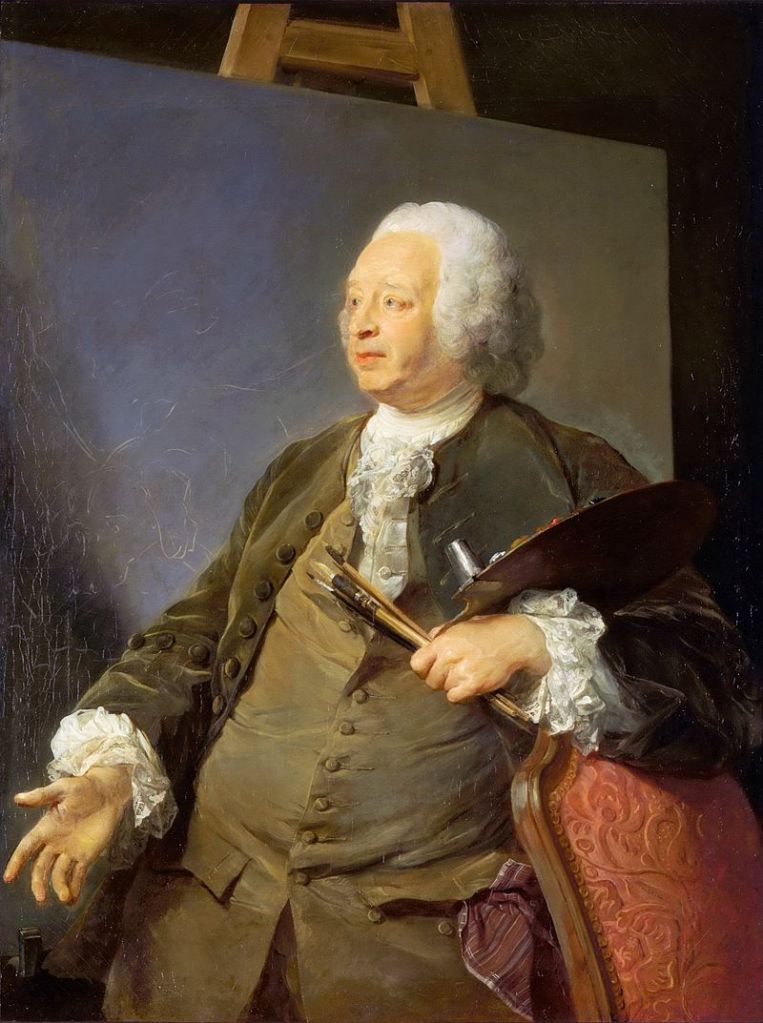
Jean-Baptiste Oudry, by Jean-Baptiste Perronneau.

My last nine blogs focused on female artists and in many cases their fight for equality and so, for this blog, I thought I better give the men a chance. I have gone back to the end of the seventeenth century to look at the work of a distinguished French artist whose painting genre was looked upon by the Academies of Europe as the lowest genre in the hierarchies of figurative art.
The hierarchy in figurative art was established in the wake of the Italian Renaissance for works in 16th century Italy by the prodigious Italian Academies in Rome and Florence and they were later ratified by all the major European Academies, such as the French Académie de peinture et de sculpture, which was one of the leading Art establishments of the time. The hierarchical list, the top genre being the most important in the eyes of the Academicians, was:

 History painting, including historically important, religious, mythological, or allegorical subjects
Portrait painting
Genre painting or scenes of everyday life.                                                               Landscape and cityscape art
Animal painting
Still life

This hierarchical listing was based on a division between art that made a cerebral effort to render visible the universal essence of things and that which merely consisted of mechanical copying of particular appearances. Basically, the list meant that Idealism was honoured and more favoured than Realism.

Let me introduce you to the Master of animal and still life painting, the French artist Jean-Baptiste Oudry. Oudry was born in Paris on March 17th, 1686, the youngest of three brothers. His father was Jacques Oudry, a painter, art dealer, and from 1706, the director of the Académie de St-Luc art school, which was the only serious competition to the more prestigious and influential Académie royale de peinture et de sculpture. He was to give all his sons their initial art tuition. Jean-Baptiste’s mother was Nicole Oudry (née Papillon).

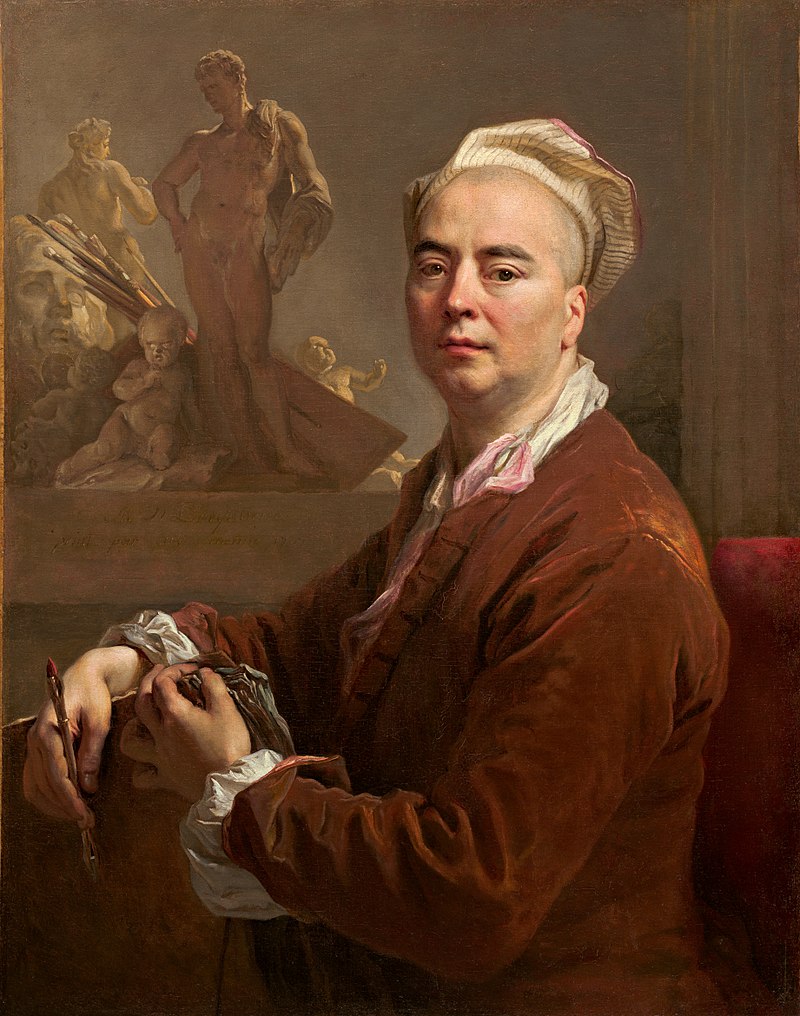
Self-portrait of Nicolas de Largillierre.(1707)

Jean-Baptiste Oudry began his artistic studies at the age of eighteen. In 1704, he first studied with the Marseilles-based Catalan-born French painter Michel Serre, a cousin of the portraitist Hyacinthe Rigaud. The following year Oudry began a five-year apprenticeship with the portrait painter, Nicolas de Largillierre whilst also enrolling in drawing classes at the Académie de St-Luc and the Académie Royale de Peinture et de Sculpture in Paris. Largilliere set Oudry the task to copy the works of the Flemish and Dutch schools of the seventeenth century. Through the teachings of Largillierre Oudry began to perfect his sense of colour and enhance his skills as a painter of still life and portraiture, both genres in which his master had rightly built up his reputation. In 1708 Oudry submitted a now-lost bust-length painting of Saint Jerome as his reception piece and this gained him the status of Master in the Académie de St-Luc.
Jean-Baptiste Oudry began giving art tuition to some students, one of whom was Marie-Marguerite Froissé, the daughter of a miroitier (a mirror-maker) and in 17o8 master and student married. The couple went on to have thirteen children, one of who, Jacques Charles Oudry, followed in his father’s footsteps and became a painter.

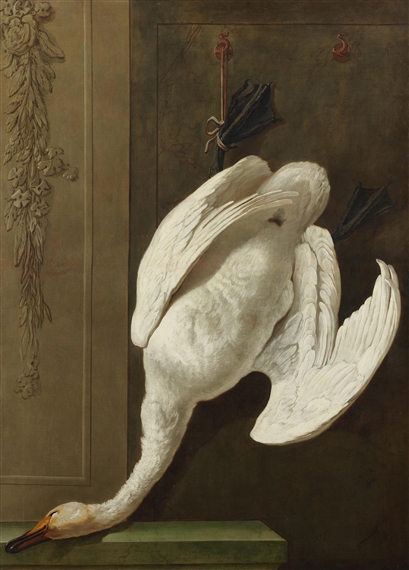
A still life of a swan by Jacques Charles Oudry (Oudry’s son)

After completing his apprenticeship, Oudry set up his own business and concentrated on portraiture commissions and still-life painting to earn money but times were hard so he tried to paint whatever was popular with the public. He wanted to create his own style of portraiture and not be seen as just copying the style of his former tutor, Nicolas de Largillierre, who was at the peak of his fame. Oudry’s clients were mostly of the modest bourgeoisie and the lesser nobility.

Abundance with her Attributes by Jean-Baptiste Oudry (1719)

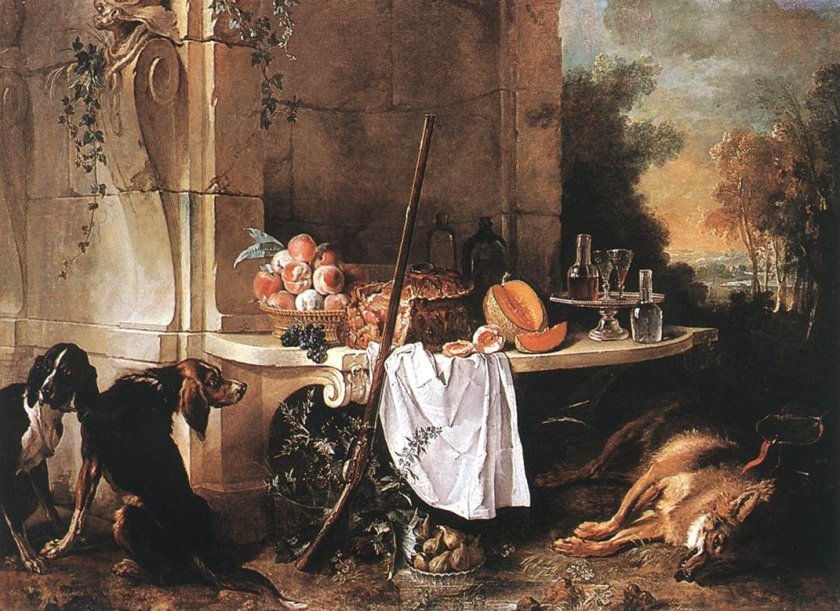
His financial predicament changed for the better in 1719 when thirty-three-year old Oudry was elected to membership of the Académie Royale de Peinture et de Sculpture (French Royal Academy) as a history painter with his reception work, Abundance with her Attributes. Although classed as a historical painting, look at the superbly painted surrounding array of fruits, vegetables, and animals. It was this talent for painting animals and still life objects that would make him famous. His main rival in this field of painting was Alexandre François Desportes, who at the start of the 18th century had been the principal painter of these genres in France.

Dead Wolf by Jean-Baptiste Oudry (1721)

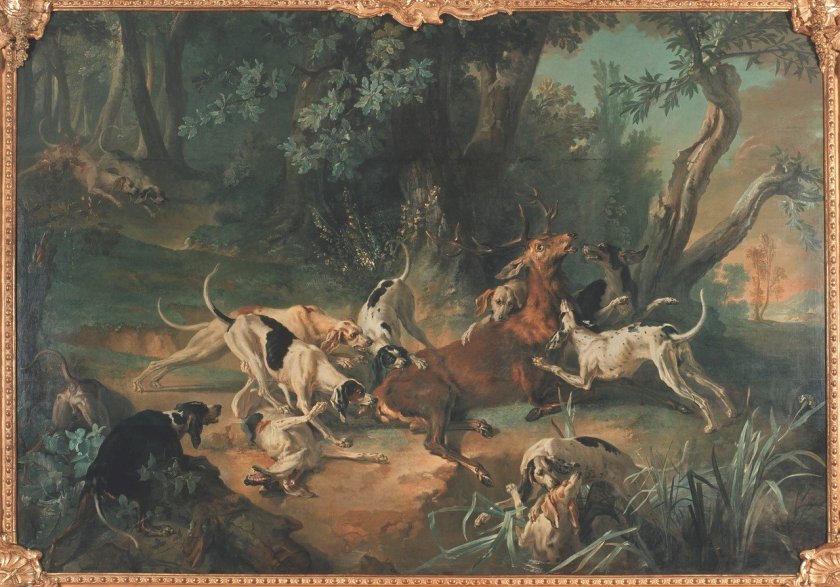
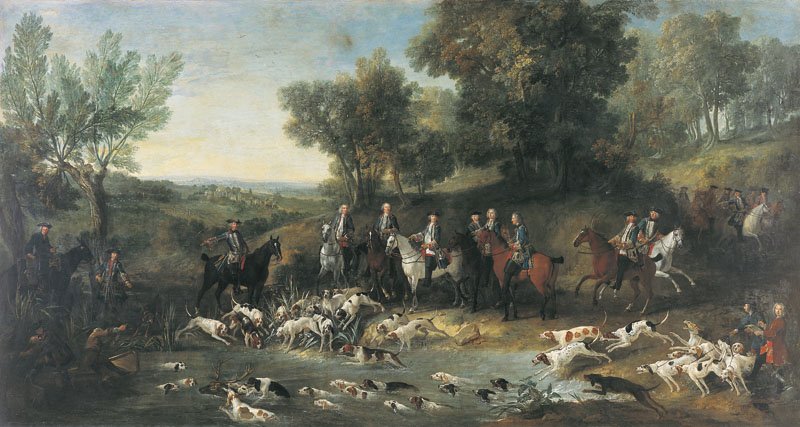
In 1721 Oudry completed pendant paintings Dead Wolf and Dead Roe which can be seen at the Wallace Collection in London. These masterpieces were followed by several large hunt pictures, the most notable of which was his large 1723 painting (almost five metres wide) entitled Stag Hunt which was his breakthrough work. It can now be seen at the Stockholm Royal Palace.

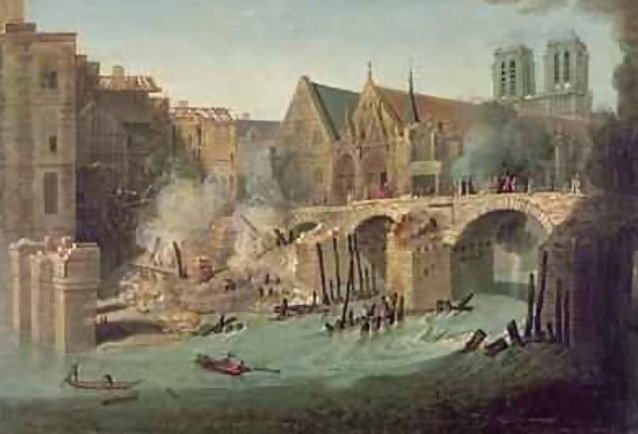
Fire of the Petit Pont by Jean-Baptiste Oudry (1717)

It was around this time that Oudry reduced the number of portraiture commissions he accepted and concentrated on his still-life and hunting scenes which were beginning to become ever more popular. He even experimented with other genres such as landscapes and cityscapes as can be seen in his 1717 painting, Fire of the Petit Pont.

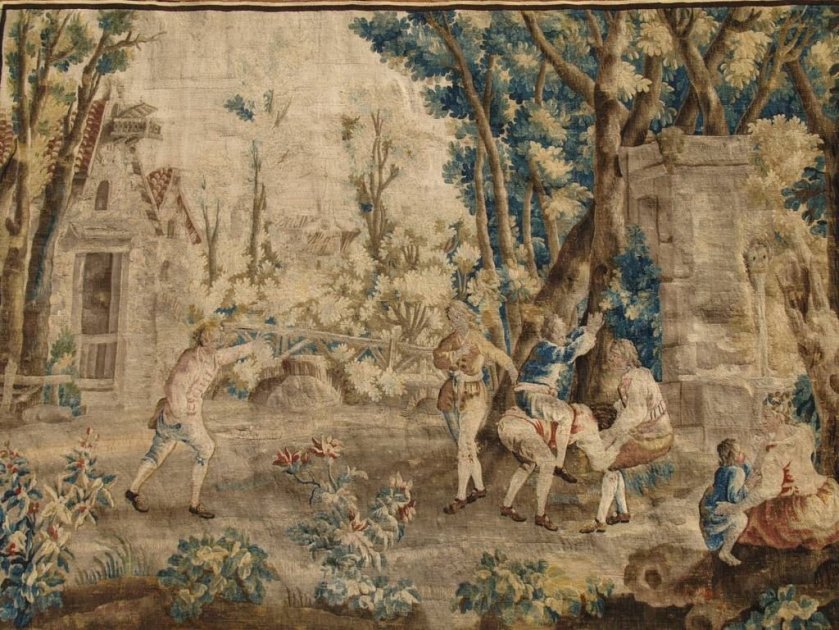
Le cheval fondu tapestry designed by Jean-Baptiste Oudry (1730)

During the 1720s, Oudry’s paintings of animal and hunting scenes were looked upon as the best in France and through them he even managed to impress the French king, Louis XV. Royal patronage soon followed and from 1724 onwards, Oudry spent all his time creating royal commissions. Through his honoured royal patronage Oudry became the most visible artist at the Paris Salon of 1725 and the following March he was granted his own solo exhibition at the palace of Versailles. His exhibition was a great success and this along with his paintings at the Salon led to him being offered a position at the royal tapestry works at Beauvais in July 1726 where he became the painter of tapestry cartoons. In 1734 Oudry became director of the factory and shortly afterwards he employed François Boucher as factory painter and the collaboration between Oudry and Boucher was one of the reasons for the success of the Beauvais tapestry works in the eighteenth century. During this period Oudry’s painting output declined and it was this way until 1737.

Stag Hunt by Jean-Baptiste Oudry (1723)

However, his work was in such great demand that he opened his own workshop which produced copies of his works for sale to the public. Between 1722 and 1725, Jean-Baptiste Oudry concentrated on his still-life and hunting scenes and would exhibit his works at the annual open-air Exposition de la Jeunesse which was held on Corpus Christie in the Place Dauphine and on the adjoining Pont Neuf in Paris which was the only public venue available to him.

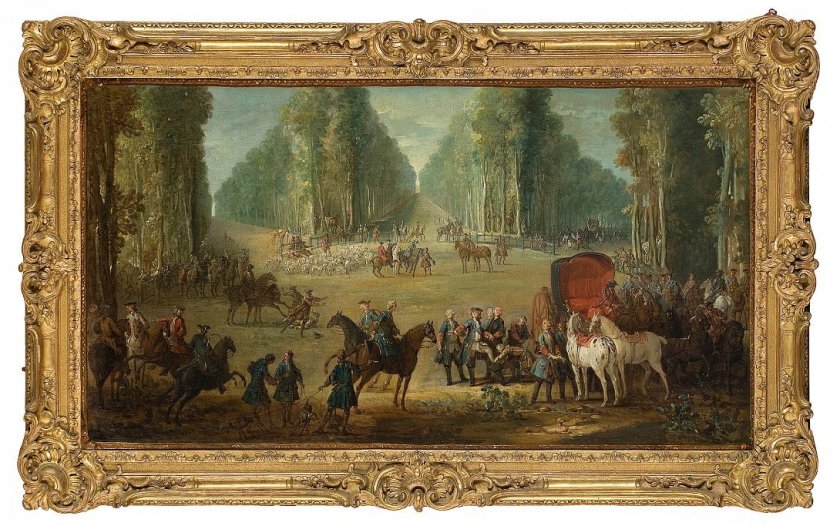
Royal Hunts of Louis XV by Jean-Baptiste Oudry

The Salon in Paris was the official exhibition of art sponsored by the French government. It originated in 1667 when Louis XIV sponsored an exhibit of the works of the members of the Académie Royale de Peinture et de Sculpture. The exhibitions, to begin with, were not annual events, in fact they were quite sporadic with only one exhibition being held between 1704 and 1737 but from 1737 they became annual events. The Salon’s original focus was the display of the work of recent graduates of the École des Beaux-Arts and exhibiting one’s work at the Salon de Paris was vital for any artist to achieve success in France. Having one’s work in the Salon was tantamount to achieving royal favour and in the early days, before the inception of art dealers, it was the only way an artist had to sell their works. The return to annual exhibitions could be one of the reasons why in 1737 Oudry returned to painting and every year after, he would exhibit his works at the Salon.

Through his friend, Jean-Baptiste Massé, a portrait-painter and miniaturist, Oudry was introduced to Henri-Camille Marquis de Beringhen, Premier Ecuyer du Roi (Master of the King’s Private Stables), and organiser of the royal hunt, and he played a part in launching Oudry’s artistic career at court. He arranged for Oudry to have a studio and lodgings for himself and his family in the Tuileries Palace, so that he could work on royal commissions.

Misse and Turlu,Two Greyhounds Belonging to Louis XV by Jean-Baptiste Oudry (1725)

Oudry’s hunting scenes were very much admired by Louis XV, and Oudry portrayed the king’s favourite royal hounds, Misse and Turlu, and painted scenes of the king riding to the hunt, which was the monarch’s sporting passion.

Henri Camille, Chevalier de Beringhen (1722)

Occasionally, Oudry painted portraits, one of which was of the twenty-nine-year old, Marquis de Beringhen. Once again, this painting is part portraiture and part still-life with dead game, a living animal, and a landscape. It typifies Oudry’s method of painting: the stylish elegance of the rococo style is combined with a perceptive sense of observation. We see the marquis sitting upon a knoll at the base of a tree. He is splendidly dressed in his linen shirt, a pale grey hunting coat lined with teal-blue velvet and trimmed with silver braid and buttons, breeches, and thigh-length boots. We see strands of his powdered hair swept back and tied with a black silk ribbon. He holds aloft a red-legged partridge in his left hand and with his right hand he strokes his faithful pointer. To the left, behind the dog we see lying on the ground a powder horn, fowling piece, game, and a game bag. To the right of the marquis, in the distance, we can just make out two women talking on the terrace of a country house, which may be pure idealization and just included as a befitting noble setting that Oudry had devised for the Marquis de Beringhen. Oudry once again highlights his artistic techniques in the way he depicts the lace of Beringhen’s shirt and the silver embroidery on his coat, and in the feathers of the partridge and the fur of the hound.

Grand Buffet, Still Life with Monkey, Fruit and Flowers by Jean-Baptiste Oudry (1725)

Oudry soon broke Desportes’ royal monopoly and his work output grew. In 1725, the Paris Salon held an exhibition, the first since 1704, and Oudry submitted twelve pictures, including one entitled Grand Buffet but also known as Still Life with Monkey, Fruit and Flowers, which can be seen in the bottom right corner of the November 25th, 1725 edition of the French gazette and literary magazine Le Mecure de France.

Salon de 1725 as advertised in Le Mecure de France

In 1726 Oudry provided twenty-six paintings for an exhibition at Versailles. His other important acquaintance, Louis Fagon, the king’s Intendant des Finances, arranged for Oudry to become the painter to the royal tapestry works at Beauvais. This was to be the start of a new direction for Oudry who over the next decade designed a number of tapestry sets, including four pieces depicting Comedies of Molière, eight pieces based on Ovid’s Metamorphoses and four panels depicting Fables of La Fontaine.

The Fables of La Fontaine – The Two Pigeons by Jean-Baptiste Oudry

Between 1729 and 1734, Jean-Baptiste Oudry produced a total of 276 beautiful and highly finished drawings, including a frontispiece, which illustrated tales from the famous 17th century work by Jean de La Fontaine, Les Fables choisies mises en vers (Selected Fables Rendered in Verse). Each of the scenes was drawn with the brush with black ink and grey wash, heightened with white gouache, on sheets of blue paper, with each image surrounded with a wide border brushed on the same sheet in a darker shade of blue, acting as a fictive mount. These drawings, all made during this five-year period have long been recognised as Oudry’s most famous works as a draughtsman.

Louis XV Stag Hunting in the Forest at Saint Germain-en-Laye by Jean Baptiste Oudry (1730)

In 1728 Oudry began on a royal commission Louis XV Stag Hunting in the Forest at Saint Germain-en-Laye. It was a massive painting, measuring 210 x 390cms. Louis XV was a keen and knowledgeable hunter who knew the name of every one of the dogs in the pack. This work was painted for the hunting pavilion in Marly, and again it is a combination of animal painting and landscape genres. Oudry depiction set in a clearing in the forest of Saint Germain, is the moment of the halloo, the cry or shout used to attract attention or to give encouragement to dogs in hunting.

A Wild Sow and her Young Attacked by Dogs by Jean-Baptiste Oudry (1748)

Louis XV liked this work so much that, in 1733, he commissioned Oudry to produce three tapestry cartoons illustrating the hunts. The tapestries, woven under Oudry’s supervision at the Gobelins factory, were intended to decorate the king’s bedchamber and antechamber and the Council Chamber at the Château de Compiègne. In 1738, it was decided that the series should comprise nine cartoons; the last was completed by Oudry in 1746 and delivered to Gobelins. They made two sets of the tapestries. One set for the chateau at Compiègne and the other was sold to Philip, Duke of Parma, the King’s son-in-law.

Clara the Rhinoceros in Paris by Jean-Baptiste Oudry (1749)

In the 1720s and 1730s, Jean-Baptiste Oudry established himself as the preeminent painter in France of hunts, animals, still lifes, and landscapes. His Painted Menagerie focused on a set of eleven life-size portraits of exotic animals from the royal menagerie at Versailles, painted by Oudry between 1739 and 1752. The paintings ultimately went into the ducal collection in Schwerin, Germany. The most famous of these is the splendid portrait of Clara, an Indian rhinoceros who had become a celebrity in mid-eighteenth-century Europe.  The Indian rhinoceros, who was born in Assam and had been named Clara, caused a sensation in Europe. A Dutch captain, Douwe Mout van der Meer, brought the three-year-old rhino in 1741. It was an animal that had never been seen before in Europe and he presented her at the Saint-Germain Fair in Paris, where she inspired many artists to undertake drawings and studies of her. Jean-Baptiste Oudry’s depiction of her is life size. The grand painting was shown at the Paris Salon in 1749 and acquired in 1750 by Duke Christian Ludwig II of Mecklenburg-Schwerin together with Oudry’s series of menagerie paintings. In all, there were approximately 57 drawings by him which ended up in the possession of the court in Schwerin.

Farmhouse by Jean-Baptiste Oudry (1750)

Although Oudry is remembered for his animal and hunting scenes his idealized landscape work was of the highest quality. In 1750 the Dauphin, Louis, the elder son on Louis XV, commissioned Oudry to paint a picture of rural life which would highlight the bountiful and beauty of Ile-de-France and to promote the state’s progressive agricultural policy. Later the painting became known as The Farmhouse.

Jacques-Charles Oudry – Nature morte avec chien et le canard

Oudry was not a very wealthy man but lived comfortably. Oudry lost some of his responsibilities when Louis Fagon, the king’s Intendant des Finances, was replaced by Daniel-Charles Trudaine. Oudry suffered two strokes in quick succession in 1755. The second left him paralysed and he died shortly thereafter in Beauvais on April 30th, 1755, aged 69. He was buried in the Church of Saint-Thomas in Beauvais. His son, Jacques-Charles Oudry, trained by his father, was also an accomplished painter.

Winter landscapes

For many of you, the sight of snow is a curse, for others it is a sight of wonderment. Maybe the falling of snow, like Christmas presents, is just a meaningful event for children. Many believe snow should only be enjoyed if seen in a photograph or postcard and not deep on the ground in front of one’s house or in one’s driveway. For all you snow-sufferers, let me offer you some works of art which highlight the beauty of snow depicted by different artists, some of whom may be better known for other artistic genres.  Artists love to see the trees in winter, devoid of their foliage, leaving just exposed skeletons. Such winter scenes have their own exquisiteness.

Sunset scenery with snow-covered road and a small farmhouse by Harald Julius Niels Pryn

Sunset Scenery with snow-covered road and a small Farmhouse was one of many paintings featuring wintery conditions by the Danish artist Harald Julius Niels Pryn. Pryn was born on April 11th, 1891 in Frederiksberg, Denmark and lived and worked in Bagsværd, a northern suburb of Copenhagen. He was a self-taught artist and eventually developed the skill to be considered one of the great landscape artists of his time. In his own country he was a well-known Danish landscape painter. His specialty and main subjects were light-filled winter landscapes.  Look at the many colours he used to depict the snow.

Winter Caravan on the Road by Ivan Konstantinovich Aivazovsky

Ivan Konstantinovich Aivazovsky, but baptized as Hovhannes Aivazian, was born in July 1817 into an Armenian family in the Black Sea port of Feodosia in Crimea and spent most of his life there. He was a Russian Romantic painter and although this work, Winter Caravan on the Road, is a winter landscape, he is deemed to be one of the greatest masters of marine art with the vast majority of his works being seascapes. He also often depicted battle scenes, Armenian themes, and portraiture. He was educated at the Imperial Academy of Arts in Saint Petersburg, Aivazovsky travelled to Europe and lived briefly in Italy during the early 1840s. He then returned to Russia and was appointed the main painter of the Russian Navy. He was sponsored by the state and was well-regarded during his lifetime. The saying “worthy of Aivazovsky’s brush”, popularized by Anton Chekhov, was used in Russia for describing something lovely.  It is the haunting image of the horse-drawn procession emerging from the forest mist which appeals to me.  It gives the painting a mystical quality.

Christmas Eve along the Hudson with the Palisades across the River by Samuel S Carr (c. 1879)

Christmas Eve along the Hudson with the Palisades across the River, was painted by the American artist, Samuel S Carr around 1879. Carr was born in England in 1837. He trained at the Royal School of Design in Chester, and around the age of twenty-five immigrated to America and went to live in New York where he studied mechanical drawing. He never married and moved to Brooklyn in 1879 where he lived with his sister Annie and her husband, and remained there for twenty-eight years. He became the president of the Brooklyn Art Club. Much of his work were pastoral scenes which were quite popular in the 1890s and Carr would vary the times of day and seasons in his work.  In the background seen between the large houses we can just make out the steep cliffs on the Jersey side of the Hudson River known as the Palisades.

Winter Landscape by Louis Apol (c.1885)

Probably because of the inclement winter weather in the Low Countries many of the Dutch and Flemish artists painted winter landscapes. Lodewijk Frederik Hendrik (Louis) Apol was a Dutch painter and one of the most prominent representatives of The Hague School. He was born in September 1850 and as a young man received private art lessons. In 1868, aged eighteen, he received a scholarship from the Dutch King Willem III in 1868. He specialized in winter landscapes and this painting, entitled Winter Landscape, demonstrates his extraordinary talent. This painting, like many of his other landscape works are devoid of people and other figures (except the black crows). In 1880 Louis Apol went on an expedition on the SS Willem Barents to Spitsbergen (Nova Zembla) in the Polar Sea. This sea voyage proved to be a great influence on his work.

Winter Morning by Ivan Choultsé

Ivan Fedorovich Choultsé, a Russian realist landscape painter, was born in St Petersburg on October 21st, 1874. After finishing school, he became an electrical engineer and painted in his free time. It was not until he was thirty-years-old that he seriously studied art. Like our previous painter, Louis Apol, Choultsé travelled to Spitzbergen where he completed a number of depictions of the Arctic landscape. By 1916 Choultsé was already known for his art and members of the Tsar family bought his paintings. He painted spectacular snow scenes in which the light seems to come from behind the canvas and glow. The critics were not as complimentary with regards his art and called them photographic and, as such, non-art. However, the public did not agree, and his intricate style of painting is termed “magic-realism”.  Look carefully at his depiction of the snow.  Look how powdery it seems.  It is so life-like. His fame spread across Europe and as far as America and Canada where his paintings sold well. Toronto art dealer G. Blair Laing wrote in his book Memoirs of an Art Dealer, 1979:

“…He painted spectacular snow scenes in which the light seems to come from behind the canvas and glow. The critics scorned these pictures as photographic and called them non-art – but today this style of painting is called “magic-realism” and is much admired by critics and museum..”

Winter Landscape by Caspar David Friedrich (1811)

If ever you wanted a haunting winter scene, none could probably surpass the 1811 painting, Winter Landscape, by the nineteenth-century German Romantic landscape painter Caspar David Friedrich, who many believe is the most influential German artist of his generation. This is not just a winter landscape there is an element of religious symbolism. Look carefully at the foreground and you will see a crippled man sitting on the ground with his back against a large rock. Often at first glance observers miss the figure who seems to blend with the rock.  His crutch lies abandoned in the snow.  It appears he has given up on life.   He looks upwards at the crucifix, hands clasped in prayer. It is thought that the evergreen trees symbolise faith and the Gothic cathedral which looms out of the mist in the background, symbolises the promise of life after death.

The Magpie by Claude Monet (1868-69)

Claude Monet worked on his painting La Pie (The Magpie) during the winter of 1898/9. Monet tackled the great challenge of a snow-covered landscape. The setting for this work is near the commune of Étretat in Normandy. Monet lived in a house near here with his girlfriend, Camille Doncieux and their one-year-old son, Jean. This painting of a place in the countryside near Etretat, was painted en plein air by Monet and uses very unusual pale, luminous colours. In the work we see a solitary black magpie perched atop a gate. The light of the sun shines upon freshly fallen snow creating blue shadows. The work is hailed as one of the best winterscapes by Monet and is part of the Musée d’Oresay permanent collection.  It is said to be one of its most popular.

Hunters in the Snow by Pieter Bruegel the Elder by Pieter Bruegel the Elder (1565)

One of my favourite sixteenth-century painters is Pieter Bruegel the Elder and I am particularly fond of his painting Hunters in the Snow.  The painting is one of a series of works that featured different times of the year. This is a depiction of a wintry scene in a flat-bottomed valley. Three hunters, with little to show for their labours, are returning from an expedition accompanied by their dogs who also appear tired and demoralised after their fruitless outing. The hunters’ backs are bent as they trudge wearily through the snow. It appears to be a cold, yet calm overcast day, and Breugel has used whites and greys to convey the state of the weather. As we look down into the valley we see a number of frozen lakes and a river, on which we can see the silhouettes of the villagers enjoying the weather by skating and playing on the ice.

Skating in Central Park, by Agnes Tait (1934)

Another painting featuring winter pastimes on frozen lakes is the painting Winterscape, Skating in Central Park which was painted in 1934 by the American artist Agnes Tait. I particularly like this work as whenever I visit New York I always visit this beautiful park. Agnes Tait was born in 1894 and was a “Jill of all trades” being a painter, pen-and-ink artist, lithographer, book illustrator, muralist and dancer. Tait depicted the park in late afternoon as the low sun produces a beautifully coloured sky. Her modus operandi for this work was to complete the painting of the landscape first and, only then, add the figures which she would forge into small groups and by doing this she achieved a colourful pattern against the snow and ice. The very dark, almost black tree trunks  is in contrast to the white snow on the ground and the white mist atop of the background trees.

Winter Landscape with Skaters by Hendrick Avercamp

Many of the Dutch and Flemish winter paintings focus on how the people enjoyed the winters when lakes and canals were frozen over and they were able to go out on them and skate. One great exponent of that genre was Hendrick Avercamp. Avercamp was born in Amsterdam in January 1585, a time of the The Little Ice Age, which brought colder winters to parts of Europe and no doubt as a child he had spent the winters skating on the frozen lakes and canals. He later moved to Kampen, a town to the east of Amsterdam. Averkamp, who was mute, was known as “de Stomme van Kampen” (the mute of Kampen).  I particularly love this type of work.  I specifically like the busyness of the depiction.  Everywhere you look there is something going on.

The Drum Bridge and Yuhi Hill at Meguro by Utagawa Hiroshige (1857)

Utagawa Hiroshige was born in Edo in 1797 and originally it was envisioned that he would follow the career of his father, who was a fire-watchman. Both his parents died in 1809. Hiroshige is one of the two great masters of the Japanese landscape woodblock print, the other being Hokusai. Hiroshige’s forte was for his depictions of scenes which featured snow and rain, and has led him to be known as “the artist of rain, snow and mist”. For me, there is something special about Japanese woodblock prints and so one which incorporates a winter scene such as Drum Bridge and Yuhi Hill at Meguro, from the series “One Hundred Famous Views of Edo, had to me in my list of favourites.

Riverside near Mustio by Victor Westerholm

Two contrasting paintings, both depicting winter conditions and yet so different you would not believe they were from the same artist. In his painting Riverside near Mustio, look how Westerholm has, with just a few brushstrokes, and use of tones of grey and green, depicted the glass like surface of the water with its reflective quality.
Victor Axel Westerholm was born in Finland on 4 January 1860, at Nagu island in the Turku archipelago. He was the son of Vicor Westerholm, a ship’s captain, and Maria Westerholm (née Andersson). At the young age of nine, he attended the Finnish Art Society’s Drawing School in Turku. Later he would go to Germany and study under Eügen Ducker in Düsseldorf and then later enrolled at the Académie Julian in Paris. In his late twenties, he became a teacher at the school of the Society of Art in Turku, and in 1891 became the director of the Turku art museum.

Evening Sun by Victor Axel Westerholm

He often painted winter landscapes and sunsets in the archipelago of Åland, where he had his summer residence, Tomtebo, close to the Lemström Canal. It was here that he founded and artists’ colony.  In his work, Evening Sun, look how the red colour of the buildings draw your eyes to focus on them.

Christmas Moonlight by Thomas Kinkade

I don’t suppose I could give you an insight into winterscapes and the hint of Christmas without including a painting by the American artist Thomas Kinkade who was the King of homely, some would say syrupy depictions. His painting Christmas Moonlight certainly evokes a feeling of happiness, serenity and contentment, all of which are things we strive for in life. It is sad to think that the artist himself, in the latter days, could not achieve these feelings for himself.

Poor Woman of the Village by Gustave Courbet

In complete contrast to the Kinkade painting, I thought I would look at a work by the Realist painter, Gustave Courbet. Gustave Courbet was a French painter who came from an affluent family but preferred the company of the ordinary folk. Courbet led the Realism movement in 19th-century French painting and was unswerving in his belief that his depictions of life must be truthful, “warts and all” and by so doing, rejected Academic teachings and the Romanticism movement.
In his painting, Poor Woman of the Village, we see his realistic attitude to a winter scene. The snow-clad landscape is no different to most but the main subject, an old woman, is a study of hardship. In the foreground we see a young child accompanied by an old woman dragging along her goat. This is not a painting oozing with symbolism. It is a painting which evokes a sense of realism as to the plight of the woman and the child as they battle the elements. It is a depiction of the unforgiving severity of winter.

It is for you to choose whether you like the Kinkade style or the Courbet style.  Do we need a period of escapism to make us feel better about life?  Whatever your choice, I wish you all a Happy Christmas.


Peder Mork Mønsted – The great Danish landscape artist.

By The River, Brondbyvester by Peder Mønsted (1922)

Landscape and seascape painting must be the most popular art genre. Like all painting genres there are many good examples and some exceptional examples of such paintings. In today’s blog I want to highlight the exceptional landscape work of the nineteenth century Danish painter, Peder Mork Mønsted, who due to his naturalistic plein-air depictions, was considered the foremost landscape painter of his day in Denmark.

The Red Umbrella by Peder Mønsted (1887)

Mønsted was born on December 10th, 1859, a few years following the end of what was known as Den danske guldalder (The Danish Golden Age). This period of Danish history straddles the first half of the nineteenth century and is a period of outstanding creative production in Denmark. The start of the nineteenth century had been a disastrous period for Denmark and especially its capital, Copenhagen which had suffered from fires, bombardment and national bankruptcy, but it was also a period when the arts took on a new period of inspiration and originality brought on by the Romanticism movement of Germany, which was at its peak in the first half of the nineteenth century. It was a period when much of Copenhagen had to be rebuilt and this saw the development of Danish architecture in the Neoclassical style. The city took on a new look, with buildings designed by Christian Frederik Hansen and by Michael Gottlieb Bindesbøll.

The Gatehouse in the Park of Villa Borghese, Rome, by Christoffer Eckersberg (1816)

This Golden Age was most commonly associated with the Golden Age of Danish Painting from 1800 to around 1850 which included the work of Christoffer Wilhelm Eckersberg (see My Daily Art Display five-part blog starting August 5th, 2016) and his students, such as Wilhelm Bendz, Christen Købke, Martinus Rørbye, Constantin Hansen and Wilhelm Marstrand. Eckersberg taught at the Academy in Copenhagen from 1818 to 1853, and became its director from 1827 to 1828. He was an important influence on the following generation, in which landscape painting came to the fore. He taught most of the leading artists of the period.

A Summer Day at the Dyrehaven by Peter Skovgaard

Peder Mork Mønsted was born near Grenå in eastern Denmark. He was the son of Otto Christian Mønsted, a prosperous ship-builder, and Thora Johanne Petrea Jorgensen. He had an elder brother, Niels. He was a pupil at the Crown Prince Ferdinand’s Drawing School in Aarhus where he studied under Andries Fritz, the Danish landscape and portrait painter. After leaving the Drawing School in 1875, Mønsted moved to Copenhagen and enrolled on a three-year art course at the Royal Academy of Art where he received tuition in many facets of art including the tutoring in figure painting by the Danish genre painter, Julius Exner. It was at the Academy that he began to learn about, and be influenced by, the art of Christen Købke and Pieter Christian Skovgaard, a romantic nationalist painter and one of the main figures associated with the Golden Age of Danish Painting. Skovgaard is particularly known for his large-scale depictions of the Danish landscape.

Summer Evening on Skagen’s Southern Beach with Anna Ancher and Marie Krøyer by Peder Severin Krøyer (1893)

In 1878 Mønsted left the Academy to study under the artist Peder Severin Krøyer. Krøyer was one of the best known and the most colourful of the Skagen Painters, who were a community of Danish and Nordic artists living and painting in Skagen, Denmark. Krøyer was the unofficial leader of the group.

In the Shadow of an Italian Pergola by Peder Mønsted (1884)

In his early twenties, Mønsted travelled extensively. In 1882 he journeyed through Switzerland and on to Italy where he visited the isle of Capri. During these journeys he would constantly sketch the people and the landscapes. One such painting to come from that Italian trip was completed in 1884 entitled In the Shadow of an Italian Pergola. Before returning to his home in Denmark he visited Paris and stayed there for four months during which time he studied at the studio of William-Adolphe Bougureau, the French academic painter.

The Smoking Moor by Peder Mønsted (1898)

Mønsted was a habitual traveller constantly seeking places and people to paint. In 1884, he first visited North Africa returning to Algeria in 1889. One of his later paintings, a portrait entitled The Smoking Moor, came from his time in North Africa.

Olga by Peder Mønsted (1917)

Peder Mønsted besides being an exceptional landscape painter was also a talented portraitist as we can see in his 1917 work, simply entitled Olga.

The Cloister, Taormina by Peder Mork Mønsted (1885)

In 1885 his journeys took him to Sicily and Taormina, the commune in the Metropolitan City of Messina, which lies on the east coast of the island. It was from this visit that Mønsted completed his painting The Cloister, Taormina.

Unloading Stone from a Barge at Ouchy by Peder Mork Mønsted (1887)

Mønsted visited Switzerland on several occasions and his 1887 painting Unloading Stone from a Barge at Ouchy recalled the time he visited the port of Ouchy which is situated south of the city of Lausanne, on the edge of Lake Léman.

On March 14th, 1889, at Frederiksberg, Peder Mork Mønsted married Elna Mathilde Marie Sommer. Nine years later the couple had a son, Tage.

King George I of Greece by Peder Monsted

In 1892, Mønsted travelled to Greece, where he was a guest of King George I, who was Danish. While there, he completed portraits of the Royal Family including one of the king himself at the top of a ship’s gangway.

With his royal invitation to Greece, he also took the opportunity to depict the ancient sites. The above large-scale work (80 x 137cms) is one of his finest paintings of the last decade of the nineteenth century. It is thought that the two finely-dressed people depicted to the left in the mid-ground are King George I and his wife, Queen Olga of Greece. Further to the left are members of the famous Presidential Guard known as the Evzones.  From Greece, Mønsted travelled to Egypt and Spain.
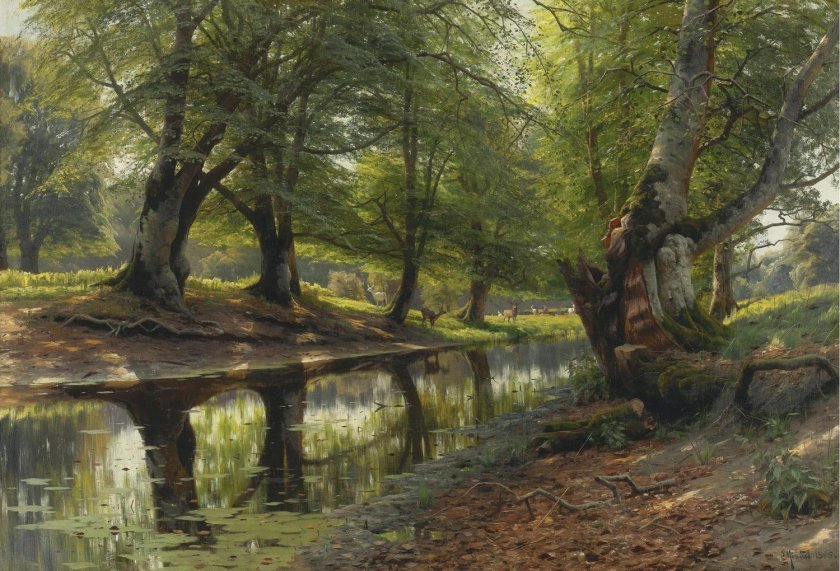
Landscape with River by Peder Mønsted

However, Peder Mork Mønsted will always be remembered for his beautiful landscape works often featuring his native countryside. It is hard to describe the works in a single word but if one had to then words like serene, placid, and tranquil come to mind. His depiction of water in the form of rivers and brooks and the surface reflections are breathtakingly beautiful.  One good example of this is his painting Landscape with River.

Creek North of Copenhagen by Peder Mønsted

Mønsted continued all his life to paint the Danish and Scandinavian landscapes and coastlines. His depictions of nature were poetic, even romantic. His forte as far as his landscape works are concerned is his discerning eye for the grandeur of nature and his unerring ability to record both detail and colour.

Spring Landscape in Saeby by Peder Mork Mønsted (1912)

Of all the motifs within the landscape theme, water seems to be one that arouses the greatest admiration when depicted with serene beauty. It is in such landscape works that there is a multitude of conditions that challenge and stimulate an artist, whether they be beginners or the most experienced painters. It is known that many famous Impressionists had real problems when it came to the representation of water in their compositions and ended up with their depictions, concentrating much more on the effects 0f light on a scene rather than on a realistic representation.

A Tranquil Forest Lake by Peder Mork Mønsted (1904)

The onset of World War I caused Mønsted to curtail his European travels but the 1920’s and 1930’s once again saw him journeying around the Mediterranean countries.

A Sleigh Ride Through a Winter Landscape by Peter Mønsted (1915)

His travels produced numerous sketches that later became paintings which he presented at several international exhibitions. Most of his landscapes were, however, devoted to Scandinavia. He was especially popular in Germany, where he held several shows at the Glaspalast in Munich. During his later years, he spent a great deal of time in Switzerland and travelling throughout the Mediterranean. Most of his works are now held in private collections. In 1995, a major retrospective, called “Light of the North”, was held in Frankfurt am Main.

The Community of Hoje Taastrup, outside Copenhagen by Peder Mønsted

Philip Weilbach’s artistic icon, Weilbach Dansk Kunstnerleksikon often just referred to as Weilbach, is the largest biographical reference book of Danish artists and artists and the entry on Peder Mønsted sums up the work of this great man:

“…[Mønsted’s] great success was largely a consequence of his ability to develop a series of schematic types of landscape, which could each individually represent the quintessence of a Scandinavian, Italian, or most frequently Danish landscape. In motifs, built up around still water, trees, and forest, he specialised in portraying the sunlight between tree crowns and the network of trunks and branches of the underwood, the reflections on the water of forest and sky and snow-laden winter landscape paintings with sensations of spring, often all together in the same painting. Insofar as Mønsted included figures in his paintings, these were principally used as ornaments with a view to emphasising the idyllic character of the motif; and only rarely were the figures and the anecdotal element given as prominent a role as in traditional genre paintings…

Peder Mork Mønsted died in his Danish homeland on June 20th 1941, aged 81.

Florence Ada Fuller

Florence Fuller (1867 – 1946)

The artist I am featuring today is the South African-born, Australian portrait and landscape artist Florence Ada Fuller.  She was born in Port Elizabeth, South Africa in 1867, one of several children of Louisa and John Hobson Fuller.  As a child, she emigrated with her family to Melbourne.  In 1883, aged sixteen years of age, Florence attended the National Gallery of Victoria Art School and for two years between 1884 and 1886 she worked part-time as a nanny.

Going Out with the Tide by Robert Hawker Dowling (c.1882)

During this period she received artistic tuition from her English-born uncle Robert Hawker Dowling, a painter of orientalist and Aboriginal subjects, as well as portraits and miniatures. He was Melbourne’s most sought-after portraitist of the early to mid 1880’s

Sir Henry Loch by Robert Hawker Dowling(1885)

One of his portraits was the 1885 one of Sir Henry Loch, later 1st Baron Loch of Drylaw, who was Governor of Victoria from1884 to 1889. This portrait was completed by 1885 and shown in exhibitions in that year.

Barak – last chief of the Yarra Yarra Tribe of Aborigines by Florence Fuller (1885)

In 1885, through the good auspice of her uncle, Florence, then eighteen years old, received a commission from Ann Fraser Bon, the Scottish-born philanthropist and a formidable woman who fought strenuously to protect the limited rights of Aboriginal people.  She asked Florence to complete a formal oil on canvas portrait of William Barak, the leader of the Wurundjeri people, who was also an artist, and who became an advocate and leader in the wider Aboriginal community.  The work was acquired by the State Library of Victoria.  It is interesting to note how two art critics viewed the finished portrait.  One complimented the way in which Fuller avoided romanticising Aboriginal people while another critic said that in his opinion the portrait was an idealisation of the man rather than a truthful portrait.

Amy, the Artist’s Sister by Florence Fuller

In 1886, Robert Dowling, returned to England and Florence gave up her work as a governess and decided to concentrate on her art, opening up her own studio in Melbourne.  For all aspiring artists, to get a wealthy patron is an ideal start to their artistic career and Florence Fuller procured one by a strange turn of fate.  Her uncle who had completed the portrait of Sir Henry Loch had started on a portrait of his wife but had not completed it by the time he went on his visit to London.  Sadly, in 1886, aged fifty-nine, he died shortly after arriving in England.  Florence was then asked by Sir Henry Loch to complete his wife’s portrait, which she did and Lady Loch was so pleased with the end result, she became Fuller’s patron.

Dawn Landscape by Florence Fuller (1905)

Florence later received tuition from the Australian landscape painter, Jane Sutherland.  Sutherland, who had been born in New York, emigrated to Sydney, Australia in 1864 when she was eleven years of age.  She was one of the founding members of the plein-air movement in Australia, and a member of the Heidelberg School, an Australian art movement which has often been described as Australian Impressionism.  Sutherland was also one of few professional female artists and had to constantly strive for equality and fought hard to further the professional reputation of female artists during the late nineteenth century.

Weary by Florence Fuller (1888)

In 1888, Fuller completed a pair of realism paintings featuring poverty.  They were entitled Weary and Desolate and both featured child poverty against the backdrop of a ship berthed at the docks in Melbourne. The powerful imagery of the painting, Weary,  depicting a homeless child was a potent declaration on the disadvantaged in sharp contrast to the booming economy of the Australian city and although similar paintings by English Victorian realist artists were common this artistic work of urban realism was a shaming of Australian society and its injustice and as such, was very unusual. Look how Fuller has included the tattered advertising hoarding, its message frayed and in shreds weathered by time and the elements almost making its messages unintelligible.  The title of the work is based on the poem, Weariness, by Longfellow with its opening lines:

“…O little feet! that such long years

Must wander on through hopes and fears,

Must ache and bleed beneath your load…”

Inseparables by Florence Fuller (1891)

At an exhibition of the Victorian Artists’ Society in 1889 Fuller won a prize for the best portrait by an artist under the age of 25. Another portrait of a child by Fuller which has a happier connotation is her 1890 work Inseparables which depicts a child reading her book.  The joy the child gets from reading is depicted in this warm painting.   One of the interesting things about studying a painting is our “take” on it.  A good example of this is how this painting was viewed by two very different experts.  The work was shown as part of The Edwardians exhibition at the National Gallery of Australia and the curator saw the depiction as a “love of reading”.  On the other hand, the Australian art historian Dr Catherine Speck looked upon the work as being all about “subversion” because it portrayed a young woman reading and by doing so “gaining knowledge” rather than the stereotypical role of a family and home maker.

Lady in a Wicker Chair by Florence Fuller

Another of Fuller’s paintings which focused on the enjoyment of reading was her work Lady in a Wicker Chair.  In the depiction, we see the lady leaning forward, as if someone is coming into the room where she is reading. She ensures that she doesn’t lose the place in her book by marking it with her hand. Look how Fuller has made sure the attention of the viewer is solely on the lady by darkening and blurring the detail of the background.

Sydney Harbour (View Across Double Bay from Darling Point) by Florence Fuller (c. 1920)

In 1892, she, accompanied by her married sister Christie, left Australia, and travelled to Cape Town to recuperate from an illness.  She and her sister were the guests of her uncle Sir Thomas Ekins Fuller, a member of the Parliament of the Cape of Good Hope and it was through him that she was introduced to Cecil Rhodes, the British businessman, mining magnate and South African politician, who served as Prime Minister of the Cape Colony from 1890 to 1896.   She left South Africa in 1894 but before she went she completed a painting depicting the home of Cecil Rhodes.  Fuller returned in 1899 and had a number of meetings with Rhodes in order to put together studies for five portraits of him.

Whilst Yet the Days are Wintry by Florence Fuller

In 1894 Florence travelled to Europe.  Her first port of call was Paris where she enrolled at the Académie Julian, where one of her tutors was William-Adolphe Bouguereau.  It was at a time when French art schools had just recently opened their doors to women.  This was not a popular move with many of the male artists, who felt threatened and the aspiring female painters were often held in contempt by some of the male tutors.  The female students at the Académie often suffered from lowly and congested conditions.  Whilst there, she exhibited her work at the Paris Salon in 1896 and again in 1897.  Her works were also exhibited at the Royal Academy in 1897 and later in 1904, as well as being hung at exhibitions at the Royal Institute of Oil Painters and the Manchester City Art Gallery.

The Swan River, Perth by Florence Fuller (c.1904)

She returned to Australia in 1904 and for the next five years lived in Perth, where her sister Amy lived.  Fuller held an exhibition of 41 works in Perth in 1905, and the newspaper proprietor Winthrop Hackett described one of her paintings, Early Morning, which was later purchased for the Art Gallery of Western Australia:

“…it is probably the greatest success in the domain of pure impressionism … because of its pure tone, its admirable perspective and its strongly vivid reproduction of that mysterious and evanescent but always brilliant colouring that is momentarily lent by the sunrise…”

A Golden Hour by Florence Fuller (1905)

In 1905, she completed a painting entitled A Golden Hour.  When the National Gallery of Australia bought the painting in 2013 they described it as:

“…a masterpiece … giving us a gentle insight into the people, places and times that make up our history…”

The depiction is of a tranquil early evening, the end of a beautiful day.  The sun is slowly setting and it gives off a warm glow over the xanthorrhoea, grasses and wildflowers, and lights up the trunks of the white gum trees. In the midground we see a couple walking side by side through the wildflowers towards the valley. Look at the mountains and the sky in the background which have been painted in many pink tones, adding tranquillity to the scene.  If we close our eyes we can sense this calmness, this serenity, and soon our imagination even allows us to hear the sound of birds as they circle the gum trees.  The setting of the landscape is the Darling Ranges in Western Australia, and the couple we see in the painting are John Winthrop Hackett, businessman, philanthropist and owner of the West Australian newspaper, and his new wife Deborah Vernon Hackett, née Drake-Brockman, who had married Hackett in 1905, when she was just eighteen years of age, much to the horror of her family. When exhibited in October 1905 the art critic for The Western Australian newspaper called the painting the pièce de résistance of Fuller’s exhibition. Many of the art critics of the time were also complimentary with regards to the work, citing the expertly balanced composition and the masterful way Fuller had depicted the hills and sky but most of all praised ‘the wonderful light effects which they referred to as ‘the golden glories of late afternoon’.

Deborah Vernon Hackett by Florence Fuller (c.1908)

The lady depicted in A Golden Hour also appeared in another painting by Florence Fuller, entitled Portrait of Deborah Vernon Hackett, which she completed around 1908.  Hackett was born in West Guildford, Western Australia, in 1887, she was the daughter of surveyor Frederick Slade Drake-Brockman and heroine Grace Vernon Bussell and younger sister of Edmund Drake-Brockman.  On August 3rd 1905, at the age of 18, she married Sir John Winthrop Hackett who was forty years her senior much to the annoyance of her family. He was a newspaper proprietor, newspaper editor, and prominent Western Australian politician.  Fuller depicted Hackett compassionately.  The portrayal capturing the young woman’s grace and charm. But she also conveyed the complexity of the twenty-one-year old woman’s character through the contrast between the femininity of her soft, pale-blue dress and the dramatic black hat.  She gazes directly at us.  It is a somewhat piercing expression questioning why we are staring at her.

Girl with a Doll by Florence Fuller (1890)

Florence Fuller joined the local theosophy society in Perth in May 1905, after attending a talk given by the enigmatic theosophist Charles Webster Leadbeater.  Fuller’s time was taken up by the local branch of the society variously holding the positions of secretary, treasurer, and librarian of the local branch.  She went on to paint many portraits of the leaders of the Theosophical Society.  In 1911, she travelled to London and three years later journeyed to India and visited Adyar, the headquarters of the Theosophical Society.

Florence Fuller in her Studio

Later that year Fuller returned to NSW and settled in Mosman where she mainly painted miniatures.  In 1920, the Society of Women Painters in New South Wales established a School of Fine and Applied Arts, with Florence Fuller appointed as the inaugural teacher of life classes.  Fuller began to suffer from mental illness, which deteriorated over time, and in 1927, at the age of sixty, she was committed to Gladesville Mental Asylum where she died nearly two decades later, on July 17th 1946, aged seventy-nine. She was buried at Rookwood Cemetery, New South Wales.