
Paris, Mary and Renske
The previous blog ended in the autumn of 1935 with Cyril Mann entering the Royal Academy Schools where he received thorough academic training and a chance to meet fellow ambitious young artists. Whilst a student there he remained in contact with Bernard Clarke, the chaplain at the Paddington Toc H. His initial gratitude with being able to study at the school, and have his tuition paid for by his benefactor, Erica Marx, faded a little over the three years he was there as his appreciation turned to the feeling that he was entitled to what the world had on offer and what he had received was rightfully his just desserts. It was this sense that the world owed him which would last throughout his lifetime and often upset others. It was this sense of negativity to anything that had benefited him which would blight his life. The RA Schools stuck to the doctrine of most leading academies of art throughout Europe to savour and teach traditional academic values and skills and dismiss artistic modernity. However, Cyril, not agreeing with that premise, did agree that he had received a solid technical foundation in painting and drawing.
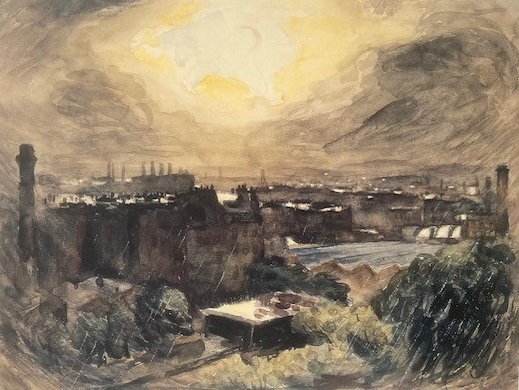
Rainy Skyline, Paris by Cyril Mann (c.1938)
It was during his time at the RA Schools that Cyril decided to call into the nearby tea shop on Piccadilly and was served by a young woman, Mary Jervis-Read. Besides her work at the café, she was also in a school in Regent Street, studying to become an art teacher. She was described as being pretty, seemingly fragile and yet had an inherent strength of character which certainly fascinated Cyril. Nothing seemed to come from this initial meeting although contact details were exchanged. In 1938, Cyril had completed three years at the RA Schools and decided to leave and follow the example of many young British art students – go to Paris to study art at one of the many ateliers. Fortunately for him, his sponsor, Erica Marx, was still prepared to fund his studies in France,
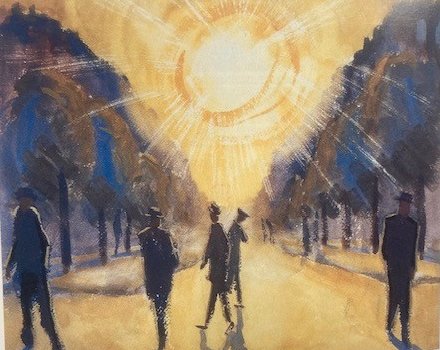
Park Scene, Paris by Cyril Mann (c.1938)
Cyril Mann arrived in Paris and took a room at the Hôtel de France in the Rue de la Sorbonne and enrolled part-time at the Académie de la Grande Chaumière in the Montparnasse district of the city. Here he came under the tutelage of the Scottish Colourist, John Duncan (J.D.) Fergusson. For Cyril, studying art in Paris, was like artistic freedom. Freedom, he believed, from the numbing academic approach served up by the RA Schools. One of the few close friends Cyril made at the RA Schools, was Guy Roddon, who came over to Paris to see his friend, stayed at Cyril’s hotel. Cyril gave him a tour of the capital and “taught” him how to survive on a few centimes. They ate at one of Cyril’s favourite workers’ restaurants in St Germain where he said they could eat a hearty meal for hardly any money. Alas, he was to regret his choice of venues as he came down with a severe bout of food poisoning. That debilitating illness made Cyril consider his Paris location and lifestyle and so moved out of the putid centre of the French capital and settle for a more salubrious area near the Porte d’Orléans in the city’s 14th Arrondissement.
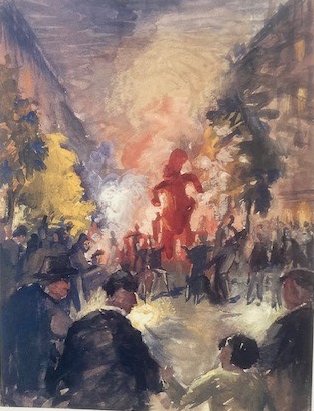
Political Rally, Paris by Cyril Mann (1938)
Another visitor for Cyril was the young waitress who had caught his eye in the London tearoom where she worked. She too was enamoured with the young artist. Cyril and Guy would regularly meet with a group of international students and would spend many an evening and into the night discussing art. At this time Cyril had become almost fixated with the works of Turner and how the English Master had depicted the sun and how the effects of direct sunlight had on the subjects of his paintings.

Place de la Concorde by Cyril Mann (c.1937)
In his 1937 painting, Place de la Concorde, Cyril Mann has once again completed a depiction whilst facing the sun. People are mere silhouetts seen a against a fountain. This method of painting, facing the sun, was one of Mann’s early favourite styles and can be seen in many of his early works.

Pont Neuf, Paris by Cyril Mann (1937)
Another of Cyril’s paintings, Pont Neuf, Paris, which depicted the famous Parisian bridge against a blazing sun backdrop was one he considered to be his first masterpiece.
Cyril and Guy went on a short holiday to Montbazon, five miles south of Tours, a commune on the River Indre, a tributary of the Loire. It was a rural area and whereas Guy Roddon favoured the views of the landscape, it was obvious that Cyril preferred urban depictions for his paintings and rural beauty never had an emotional impact on him. On occasions when Cyril had depicted trees in his paintings they would be overshadowed by urban elements. However, although the bustling city of Paris offered Cyril a plentiful opportunity for his depictions, he seemed to be more interested in depicting the effect of the sunlight on the buildings and yet it was maybe more than this. It appeared to be that Cyril was more interested in the sun itself.

Cyril Mann, on leave from the army,his wife Mary and their daughter Sylvia (1941)
In the early months of 1939, war brewing in Europe and Cyril decided to return to London where Mary Jervis-Read was waiting for him. By the outbreak of World War II in September 1939 Cyril, once again out of work, and Mary, were living together in what could be termed a loving but hand-to-mouth existence but despite all the financial hardship and future uncertainty, the couple married and the next year their daughter Sylvia was born..

The Red Letter Box by Cyril Mann (c.1949)
Before the birth of his dauhter Cyril received his call-up papers and assigned to the Royal Engineers but was turned down for overseas active service due to him suffering from “hammer-toes”, a deformity of the muscles and ligaments and due to this he was never put on active service but instead served with the Royal Artillery in the anti-aircraft defence on the South Coast of England. His time in the army affected his relationship with his daughter and wife and it also did not give him time to paint. His return to painting only came in 1946 when he was demobbed.
All his life Cyril was a difficult man to live with. He frequently had temper tantrums and people around him were very careful what they said to him so as to avoid such “explosions”. It was not only his friends that witnessed these outbursts, but his wife Mary was also wary of her husband’s fits of temper. Cyril’s outbursts often centred around his frustration at not being recognised as a great artist. One cause for discord was that Mary wanted another child but Cyril did not as she was the family breadwinner and he reckoned that they could not afford a new addition to the family. Sadly, Mary did become pregnant but suffered a miscarriage. The relationship between Cyril and Mary came to a head in 1950 when she left him, walking out in the middle of the night and taking with her their ten-year-old daughter, Sylvia. Mary commented on the inevitable break-up:
“…To live with Cyril you had to love him very much. I suppose that in the end I didn’t love him enough. But maybe no one could have done…”
Although Mary’s relationship with Cyril was over, his daughter remained fond of him despite and continued to visit him after he and her mother had gone their separate ways.
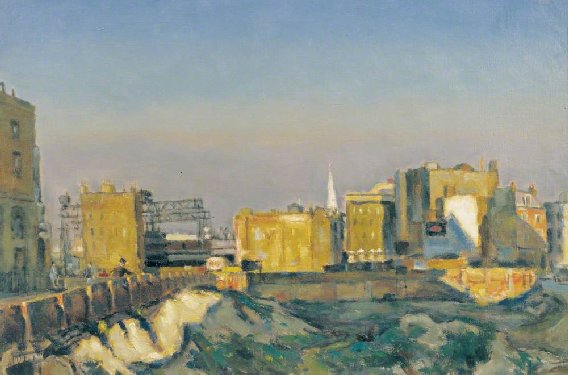
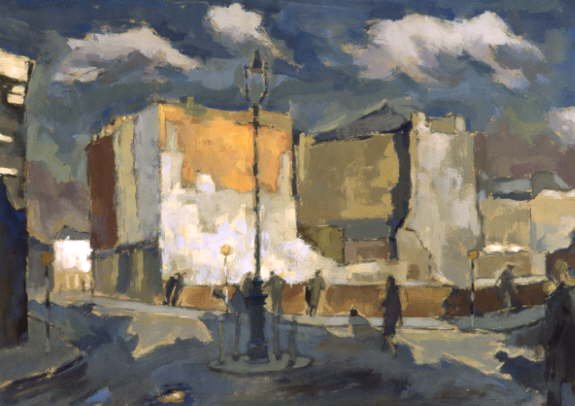
Bombsite around Paul Street by Cyril Mann
The depictions painted by Cyril after the war were surprising. Many of his paintings featured the devastation of properties during the Blitz. For some reason Cyril believed that these would be sort after by the public but he had overestimated people’s desire to be reminded about the hellfire they had lived through often resulting in the death of their relatives. One example of this was his painting, Bombsites around Spitalfields and another was his gouache on brown paper painting entitled Bombsites around Paul Street, an area which was heavily bombed and where the present Barbican is now situated.
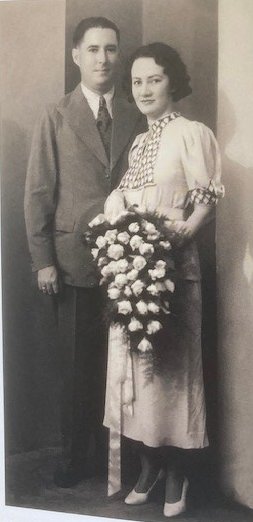
Renske’s parents on their wedding day (June 1937)
Due to the rumblings of war in Europe, Cyril Mann had returned from Paris in the early part of 1939 and he and Mary were reunited. That same year, almost seven and a half thousand miles away from London, another woman, who was to play a major role in Cyril’s life, was born. She was Renske van Slooten, the daughter of a Jewish-Dutch father, Maximiiaan, a civil engineer and his Dutch-Indonesian wife, Nini, who before raising a family, was a newspaper journalist. Renske was born in the university town of Bandung, Java on August 24th 1939 and was brought up in a well-to-do family lifestyle in a beautiful house, with servants and luxury cars.

Renske and Bastiaan with their mother Nini.
She had a older brother Bastiaan who had been born the previous year. All this good living and happy lifestyle came to a shuddering end on February 28th 1942 when the Japanese forces invaded the island.
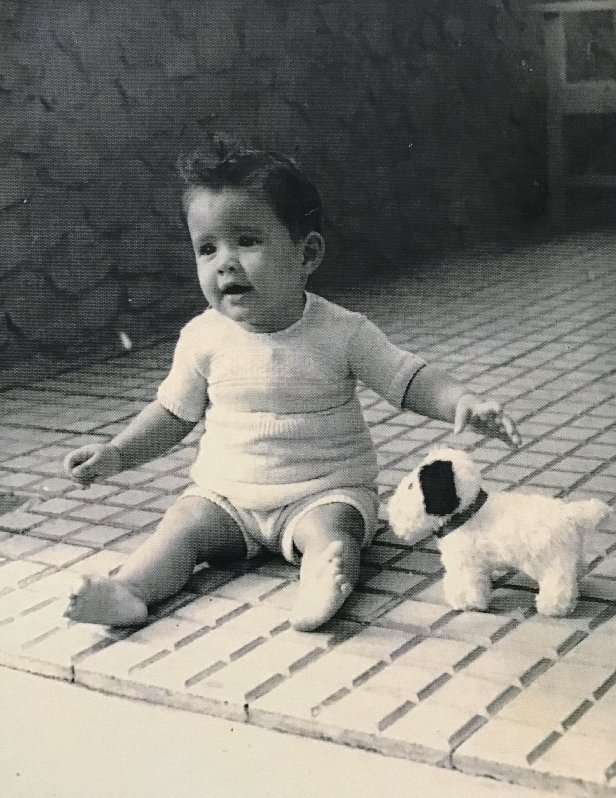
Baby Renske
Renske’s father was an officer in the army and was captured and taken prisoner and transported to Burma where he was forced to work on the notorious Burma railway and for three years the family had lost contact with him, fearing the worst. Renske along with her mother and brother were unceremoniously evicted from their palatial home by the occupying forces and went to stay with their grandmother where they remained until the end of the war in 1945. Renske’s father eventually returned home. He was very ill and emaciated, so much so, he was barely recognisable and he too was horrified to see the state my brother and I were in, also emaciated, with swollen stomachs brought on by malnutrition and beriberi. The family moved from Bandung to Java’s capital Batavia (now Jakarta) to try and start a new life but in 1949 The forces of the Indonesian Liberation Movement fought an independence battle with the Dutch-backed government which eventually led to the Dutch relinquishing the country and eventually Dr Sukrano became the first president. One of the president’s first edicts was that all Dutch-Indonesians must choose between remaining in the country and giving up their Dutch passports or being expelled from their homeland, taking nothing with them. Renske’s parents chose the latter.
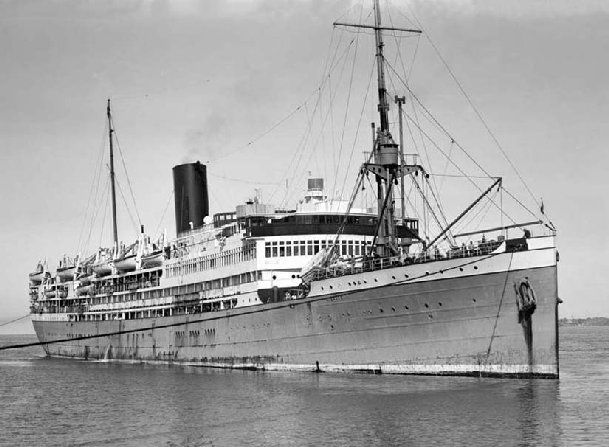
MS Skipjack
In 1950 Renske, her family including her grandmother, left Java on the Sibajak, which was once a luxury liner that had been converted into a troop ship. Her mother was eight months pregnant with her third child, Adriaan. Between 1945 and 1950 the Netherlands Government required the Sibajak as well as other Dutch Liners to be utilised to evacuate their citizens and other people from their threatened colony and also to transport troops to the various theatres of war on the other side of the globe. It was a horrific voyage and Renske remembers her mother being sick during the whole voyage. The ship was over-full with refugees escaping Sukrano’s regime.
The family landed in Rotterdam and travelled to The Hague where Renske’s father had secured some emergency accommodation. On August 24th 1950, a month after their arrival in The Netherlands and eleven years, to the day, after the birth of Renske, her brother Adriaan was born.

Cyril Mann painting en plein air
Renske’s father’s Bandung civil engineering degree was not recognised in The Netherlands and so he had to return to university in Delft to gain a second engineering degree. Renske’s mother was struggling with running the household as she couldn’t cook or organise housekeeping, all of which had been carried out by their servants back in Java. What was worse for the family was the racism they encountered. The Netherlands had suffered under the five-year Nazi occupation. There were food and housing shortages and now five years after the war had ended three hundred thousand “dark-skinned” penniless refugees had been given sanctuary in this country.

Cyril Mann setting up his exhibition at the Park Row Gallery of the Midland Group of Artistsand Designers in 1953
Things did improve for Renske and her family. Her father was appointed a lecturer in mechanical engineering at the local technical college and the family received a legacy on the sudden death of Renske’s wealthy Jewish grandmother with which her father purchased a semi-detached house in an upmarket suburb. In October 1953 there was another addition to the family with the birth of Francisca. After completing a torrid time at primary school where she was bullied, Renske managed, after some private coaching, to gain entrance to an all-girls grammar school where she gained good results in her final exams in maths and four foreign languages. Then came a dividing of opinions on her future between Renske and her parents. She wanted to go to art college but they demanded that she took a paying job and contribute to the family finances. This did not please fifteen-year-old Renske who vividly remembers an incident shortly after hearing of her parents’ plans for her:
“…I was walking around a park in my home town of Dordrecht, when the Park warden came up to me and asked why I looked sad. I told him: my parents won’t let me go to art school. I have to learn shorthand typing.’ The park warden replied: ‘I’m psychic, and I tell you that you’ll have all the art in your life you could want. You’ll marry an artist. You’ll know him the minute you see him. In fact, I see him standing behind you.’ A few minutes later, the park warden again: ‘No, that can’t be him… he’s too old. That must be his father. He’ll look after you for the rest of your life…”

The family Renske left behind in Holland when she went to London. Mother Nini van Slooten, Francisca born in 1953, Adriaan born in 1950 and Bastiaan her elder brother and father, Max van Slooten.
And so at the age of sixteen she was enrolled at a secretarial college to learn shorthand and on securing her first secretarial job, her mother took half of her take-home pay, which made her aggrieved and, in her mind, poor. Renske intensely disliked living in Dordrecht and was delighted to leave there and travel to London where she arrived in July 1959, a month before her twentieth birthday. She received no opposition from her parents with regard so her travel plans and maybe her departure ended the clashes between her and her mother and father. In her own words Renske explained:
“…I think my parents were relieved to see the back of me, and I don’t blame them in retrospect. I was not the perfect daughter, sulky and bored, frequent boyfriend trouble and never falling for the right prospect. Lacking ambition myself, badly educated with frequent spells without any schooling due to the war and later independence struggles, nobody had any expectations of me (including myself)…”
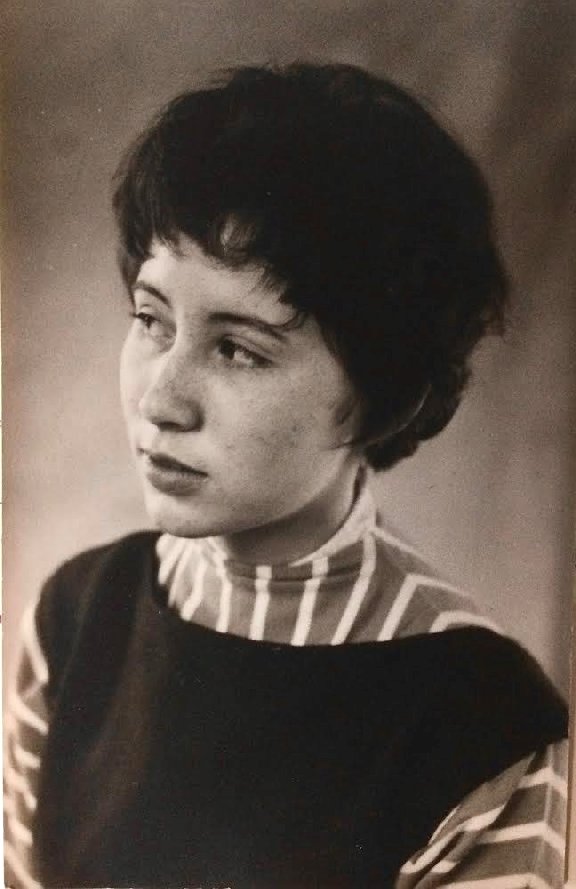
Renske, aged 19, just before she went to London
On arriving in the English capital, Renske had to secure a secretarial position but she was well qualified as she was competent in Dutch, French and English shorthand as well as being fluent in them. She soon found work with a salary four times greater than she was receiving in the Netherlands. She stayed in the local YWCA and soon struck up friendships with the other girls who were from many different countries. It was not all work and no play for Renske and one day a young Cypriot asked her out to go with him to a dance at the Hammersmith Palais in West London. As he got to know her he realised that she, like him, had a love of art and he offered to take her to one of his art evening classes he used to attend and so meet his former teacher. She agreed, they went and he introduced her to his art teacher – Cyril Mann.
……. to be continued.
It would not have been possible for me to put together this and following blogs about the artist, Cyril Mann, without information gleaned from a number of sources:
The comprehensive biography of Cyril Mann, The Sun is God by John Russell Taylor
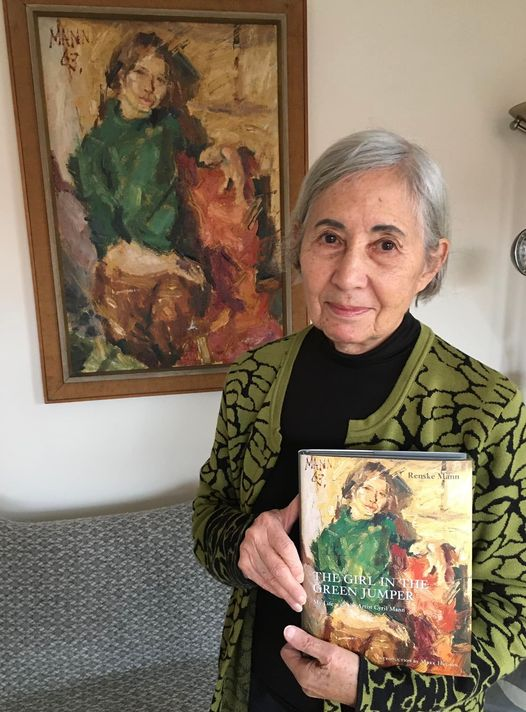
Renske Mann with her book The Girl in the Green Jumper, My life with the artist Cyril Mann
The intimate autobiography of Cyril Mann’s life by his second wife Renske, entitled The Girl in the Green Jumper.
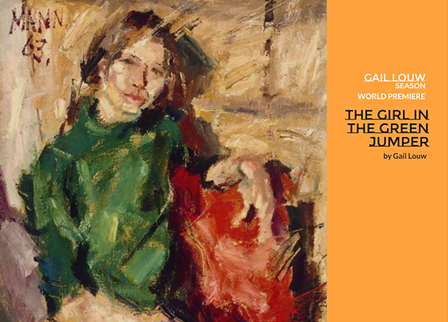
This autobiography has now been turned into a play which receives its World Premiere on Wednesday March 13th at the Playground Theatre, London, 8 Latimer Rd, London W10 6RQU
Finally, and most importantly I owe many thanks to Renske Mann herself who provided me with information and photographs appertaining to her late husband Cyril.
Piano Nobile Gallery London for information and pictures.
 my daily art display