Max Liebermann

My artist today is the German painter Max Liebermann.  Liebermann was a key figure in the nineteenth century German art scene, who was well-known for his part in bringing Impressionism to the German art world and was one of the founder members of the Berlin Secession.

Photograph of Max Liebermann by Jacob Hilsdorf (1904)

Max Liebermann was born in Berlin on July 20th 1847.  He was the second born child of Louis Liebermann and Philippine Liebermann (née Haller).  He had an elder sister, Anna and two younger brothers, Georg and Felix. His father was a wealthy Jewish fabric manufacturer who later became a banker.  Max’s paternal grandfather Josef Liebermann was a textile entrepreneur and in 1860, the Liebermann family bought the Dannenberg’sche Kattun-Fabrik, which was one of the foremost companies for the production of cotton in Europe. Max was brought up in a very wealthy family environment.
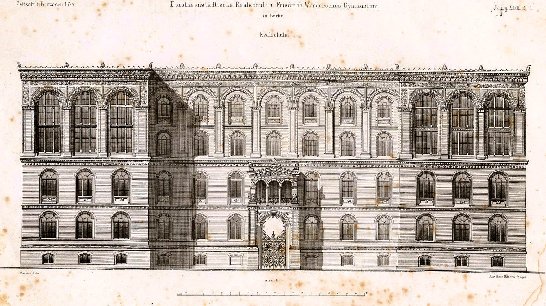
Dorotheenstädtische Realschule, Berlin.

In 1851, aged 4, Max attended the local humanistic nursery school.  He was not impressed with the school and throughout his school days, he had an aversion for his teaching establishments.  On completion of his time at primary school he attended the Berlin Dorotheenstädtische Realschule. Max was not a great scholar and spent most of his time drawing rather than studying. 

Palais Liebermann at Pariser Platz 7, to the right of the Brandenburg Gate (1892)

In 1857, when Max was ten years old, his father Louis bought the impressive Palais Liebermann, located in Berlin-Mitte at Pariser Platz 7, north of the Brandenburg Gate. Although Max’s family were Jewish his parents decided to bring Max up in the Jewish denomination known as Reform Judaism which was a highly liberal strand of Judaism and is characterized by little stress on ritual and personal observance, rather than the stricter orthodox way of life of their grandfather. The family attended church services in the reform community but increasingly turned away from the more orthodox way of life of their ancestors.

The Shoemaker by Max Liebermann (1881)

In 1859 Max’s father commissioned a portrait of his wife by the artist Antonie Volkmar. During one of the sittings Philippine Liebermann had her son Max accompany her to the artist’s studio. The story goes that Max asked the artist for a pen and paper so he could pass the time sketching. Antonie Volkmar was so impressed with Max’s sketching that she told his mother that Max would become a fine artist. Max’s parents, although aware of that prediction, wanted their son to carry on with his normal schooling and a compromise was reached that if he carried on attending school and did well, they would enrol him in private painting lessons from Eduard Holbein and Carl Steffeck. Upon finishing primary school, his father, Louis Liebermann, chose for Max and his brothers. the Friedrichwerdersche Gymnasium, a prestigious humanistic grammar school, where the sons of Bismarck had studied.

Workers on the Beet Field by Max Liebermann (1876)

Max graduated from the Gymnasium in 1866 and carried out his parent’s wishes by enrolling at the Friedrich Wilhelm University in Berlin where he studied chemistry, like his brother before him.  However he was still more interested in his painting and would often miss lectures to go off on painting trips or helping out at Carl Steffeck’s studio.   Later he attended the University of Berlin and studied law and philosophy but once again his mind was solely on art and in January 1868, following little progress with his studies, he was asked to leave.  One can only imagine how his parents took this turn of events. They were furious as to how their son had wasted this golden opportunity.   Whether it was the case that they had to make the best of a dire situation and realised that their son was only interested in his art, they arranged for Max to enrol at the Grand Ducal Saxon Art School in Weimar where he studied under the Belgian history painter, Ferdinand Pauwels.  Pauwels took his students on a visit to the Fridercianum (Kassel’s Gemaeldegalerie), which has one of the world’s best collections of early German and Flemish paintings, amongst which are nineteen works by Rembrandts. These works were to influence Liebermann for the rest of his life. 

Amsterdam Orphanage by Max Liebermann (1876)

The Franco-Prussian War broke out in 1870 and twenty-three-year-old Max was captivated by the general population’s patriotic fury and passion. However, Max was unable to join up for military service on medical grounds and so volunteered as a medic for the Johannitern, the Order of St. John and he witnessed the war at the Siege of Metz. The battlefield carnage during the siege distressed Max and his patriotic war fervour waned rapidly.
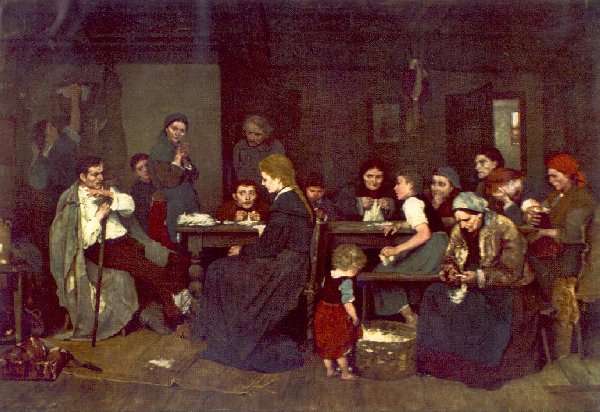
Tépéscsinálók (Tear Makers) by Mihály von Munkácsy (1871)

In the Spring of 1871, Liebermann lived in Düsseldorf, where the influence of French art was greater than in Berlin. Whilst in the city he met Mihály von Munkácsy, a Hungarian painter, who had earned international reputation with his genre pictures and large-scale biblical paintings. His paintings often featured scenes from the daily lives of peasants and poor people. Max saw Mihály von Munkácsy’s recently completed work entitled Tépéscsinálók and this stimulated his interest in genre painting. The subject of Munkácsy’s painting comes from memories of the 1848 Hungarian Revolution also known as the War of Independence and it depicts a wounded soldier, leaning on his crutches in a dark interior, recounting the story of life on the front line and the difficult battles he had experienced. Whilst the men were at war the girls, women, old people, and children remained at home in their villages looking after returning wounded soldiers, their kinfolk, who had suffered mentally and physically on the battle front. In this depiction the villagers listen attentively to the soldier’s emotional story and many cry (hence the painting’s title “Tearing Up”). Mihály von Munkácsy depicted the scene with particularly sympathetic memories, since the War of Independence and the tragic events that followed caused his sad childhood and saw him orphanhood at the age of six.
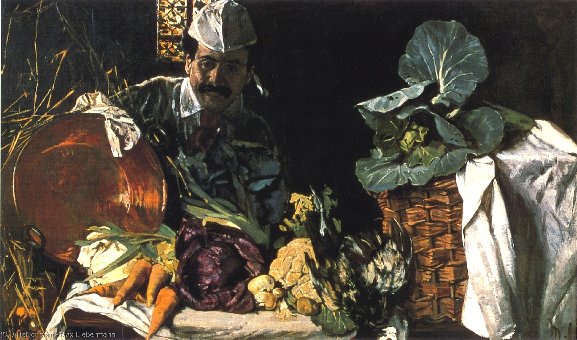
Self portrait in Kitchen with Still Life by Max Liebermann (1873)

Realising that the Netherlands was a place he had to visit to satiate his appetite for genre painting, Max, thanks to financial assistance from his brother, travelled to Amsterdam and Scheveningen. It was the first of many trips he made to the the Netherlands, a country he said inspired him.

Die Gänserupferinnen (Goose Pluckers) by Max Liebermann (1872)

When Max returned home in 1872 to continue with his studies at Weimar, his studio colleague Thomas Herbst had brought back a drawing of geese-plucking women from a study trip. Liebermann decided to use this motif and merge it with the style of Munkácsy and realised that this would be the basis of his next work. He then started on his large (120x170cms) painting entitled Die Gänserupferinnen (Goose Pluckers), which is now part of Berlin’s Alte Nationalgalerie collection. The work is painted in dark tones and depicts the simple task of goose plucking but the scene bears a resemblance to Mihály von Munkácsy’s work, Tépéscsinálók. It was the first painting that the twenty-five-year-old Liebermann exhibited in public at a Hamburg art exhibition. The art critics acknowledged the skilful painting style of Liebermann but were highly critical of the subject calling it distasteful and labelling him as the “painter of the ugly”. The painting was then exhibited that same year in Berlin but the critics were again fervently critical as they had been in Hamburg. However, the work found a buyer in the railway millionaire Bethel Henry Strousberg and with the money from the sale of the painting Liebermann travelled to Paris. His time in Paris was spent looking at the works of French artists such as Millais and Courbet and he was impressed by their style and motifs. Bethel Henry Strousberg’s empire later collapsed and he became bankrupt and had to sell some of the paintings he had collected over the years. Louis Liebermann, Max’s father, bought the Gänserupferinnen (Goose Pluckers) painting from him.

Potato Harvest in Barbizon by Max Liebermann (1875)

Liebermann had now discovered his first and favoured style, one which was both a realistic and unsentimental depiction of working people, and yet a style which avoided disdain, shaming of the subjects but also shied away from false romanticising of the people depicted. It was Realism. Liebermann became disillusioned with the German art scene which he believed had become too old-fashioned and somewhat retrograde and he was even disenchanted with Germany itself, so in December 1873 Liebermann travelled to Paris where he set up home and studio in Montmartre. Once settled in the French capital he sought out the artists who were looked upon as leading Realism artists of the day as well as the plein air Impressionism painters but many refused to meet with him due to the sour taste the Franco-Prussian War had left and the bitterness the defeat by the Prussian forces had caused and it had only ended three years earlier.
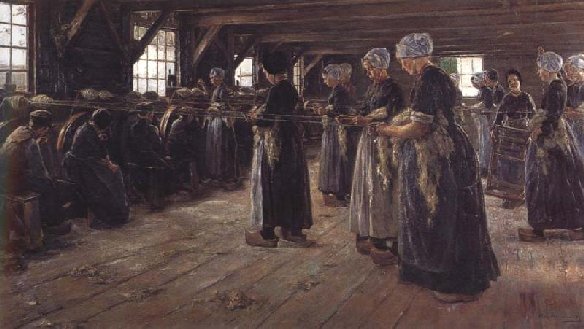
Flax Spinners by Max Liebermann (1889)

Besides still being influenced by Munkácsy, Liebermann had fallen in love with the art of French Barbizon painters Constant Troyon, Charles-François Daubigny, Camille Corot but above all Jean-François Millet. It was in 1874 that he submitted and had accepted his Die Gänserupferinnen (Goose Pluckers) painting to the Salon de Paris. However, this received negative reviews in the Parisian press, especially those newspapers which held nationalist views following the Franco-Prussian war. The first summer Liebermann spent in Paris it saw him travel to Barbizon, situated near the Forest of Fontainebleau, the home of the Barbizon School of artists, whose painters practiced en plein air painting which proved to be of great importance for the development of Impressionism. Liebermann decided to revert from the old-fashioned, heavy painting of Munkácsy, and became more engrossed in the methods used by the artists of the Barbizon School.

From 1874 Max Liebermann continued his studies in Paris and it was during thus time that he became increasingly interested in rural motifs, in “simple” people working on the land.

………to be continued.


Much of the information was found in various Wikipedia sites but also in:

The Art Story

Liebermann Villa am Wansee

Artcatto Gallery Revisited

I have just returned home from a twelve-day holiday in Spain and Portugal and once again when I was in the Algarve I visited the town of Loulé and went to one of my favourite small galleries, Artcatto, one which I featured in September 2022.  There was a new selection of outstanding contemporary art, and in this blog I will concentrate on work by three of  the artists.

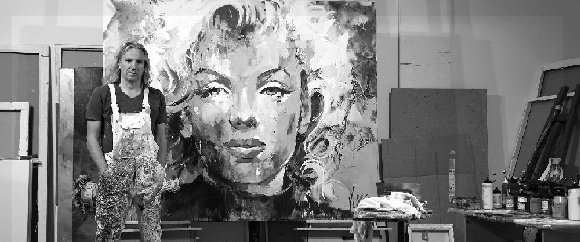
Voka at work in his studio

Voka in his studio

“I’M EVER SEARCHING FOR THE PERFECT PAINTING. BUT ALWAYS HOPING NOT TO FIND IT – BECAUSE IT’S THE SEARCH THAT I REALLY LOVE SO MUCH.”

These are the words of the artist known as Voka.  Voka was born in Austria in 1965 and now lives and works in his studio in Puchberg am Schneeberg, a town in the south-eastern part of Lower Austria. 

Jimi by Voka (2020) Acrylic on wood.

He has described his artistic style as spontaneous realism.  For him, this style is a revival of the significance of contemporary art, which he looks upon as a valued tradition in a new era.  His paintings are distinguished by his use of bright colours which portray subjects of everyday life, portraits, and sports.

Frida by Voka

His paintings exploit texture and his dramatic mark making animate the subjects of his artwork. In his portraiture series simply called Heads, VOKA put his subjects in the centre of his work. His artistic style is easily recognisable, which evolves out of the vitality of a moment in time.   His portraits are not only of important personalities but also often depict unknown characters.  The aim of Voka’s portraiture is not only to capture the facial characteristics of his subjects but he endeavours to ascertain the “true being” behind the presence”.

Andy Warhol by Voka

Voka says that every one of his paintings is a huge challenge for him, but especially with the “heads” series.   He says that he exhaustively analyses every person he depicts. For him, every person is special and exceptional in their own way. The person I depict is unique. He believes that every person who he observes or meets or who hurries past him has their own story to tell. He also reckons that when he paints them, these stories become his. None of his portraits are a mirror image of the real person.  They are always a portrait of his point of view.

Vienna by Voka

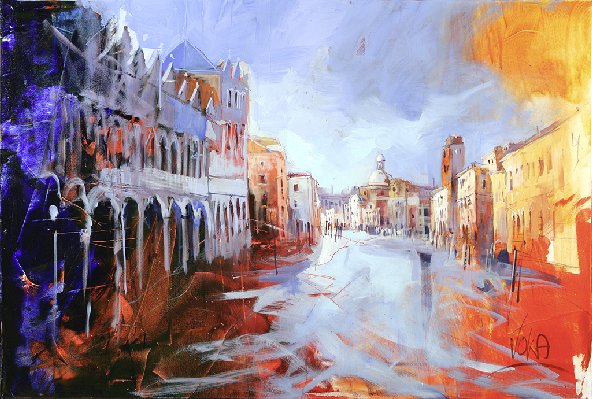
Voka’s artwork is not just portraiture. He has completed many cityscapes such as Vienna……

Venezia by Voka

……..and Venice.

The city by Voka

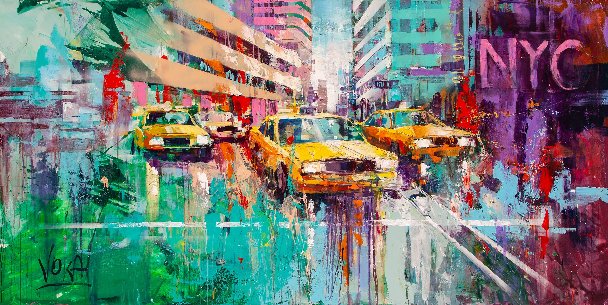
NYC by Voka

Voka also liked to depict the chaotic life in the city such as his many paintings of the streets of New York. He described his love of these vibrant city depictions, saying:

“...I like to go to the busy parts of a city- the pedestrian zones, market halls, usual meeting places. Here, in a short space of time, new pictures are always being created before my eyes without me ever having to change location. Cities are often rigid and unmoving places in spite of their impressive architecture. It is the people who breathe life into them and this life couldn’t be more diverse: the movement of the people, their clothing, mentality and customs, their dealings with one another often differ notably depending on where you are. Every bit of this earth has its own rhythm and I try to capture it…”

Voka’s artwork can be found in collections and museums throughout Europe, Russia and America.

Thomas Bossard

In the gallery there were also a number of paintings by the French artist, Thomas Brossard.

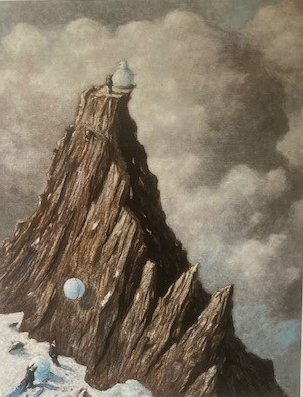
Le Bonhomme de Niege by Thomas Bossard

Thomas Brossard was born in the French town of Poitiers and studied Graphic Arts in Lille from 1987 to 1993 at the Institut Saint Luc à Tournai, Belgium.  His original plan was to go into advertising where his graphic art would be needed.  His future plans were put on hold when he became enamoured with the theatre.  He explains his change of heart:

“…It was at the Théâtre du Capitole in Toulouse, as a painter-decorator, that I was able to Begin to express my artistic palette in all its versatility: illustration, painting, scenography, frescoes, photography, decoration, etc. by creating numerous decorations for works of art (Die Meistersinger, Siegfried, Twilight of the Gods, The Magic Flute, The Auberge du Cheval Blanc, etc.). I then worked as a set designer for various directors’ stage, notably Pierre Debauche. I have also directed storyboards for short films and commercials, not to mention sets designed for a TV series produced by Vagabonds Movies. I also made drawings on porcelain for Yves Deshoulières’ factory. Finally, I have created posters for shows, festivals and feature films…”

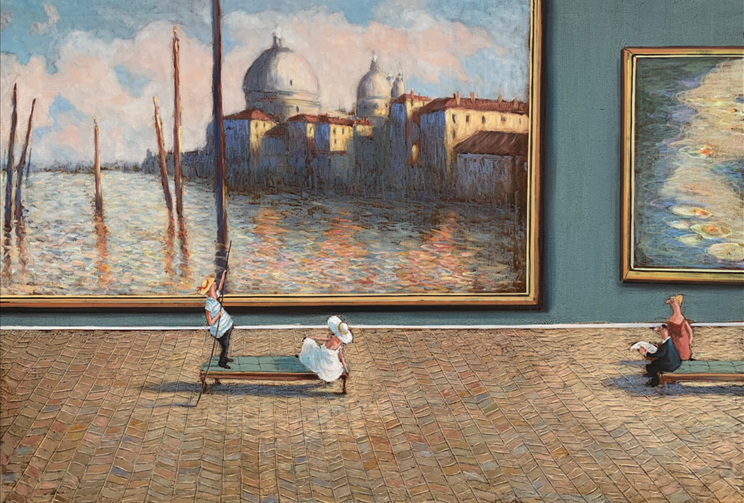
Balade à Venise by Thomas Bossard

His depictions of the theatre reveal the humour and comical life behind the scenes and his large canvas’s show the insignificance of man.  Prior to becoming a professional artist, he worked with in the theatre, creating and putting together stage sets for plays and opera. 

Les Gagnants by Thomas Bossard

Looking at his work, it is easy to see that Bossard has a very deep understanding of human nature.

La Cuisine Gastronomique by Thomas Bossard

His work has been greatly influenced by artists such as Velasquez, Vermeer, and Rembrandt. Thomas works long hours in his studio with just his music as company; he has a great love of classical music. He exhibits his work in Paris, Toulouse, and throughout France, as well as in British galleries in London, Birmingham, Cambridge, Edinburgh and Falmouth.

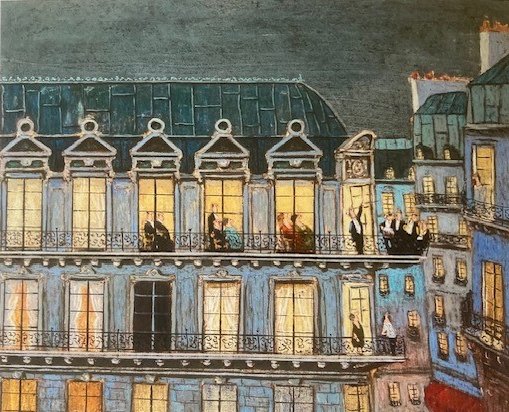
La Petite Balcon by Thomas Bossard

There is a childlike simplicity about Bossard’s work and yet there is a certain something which captures our gaze.  The depictions are often mischievous and naïve and yet are pleasing to the eye.

Mr Brainwash (Thierry Guetta)

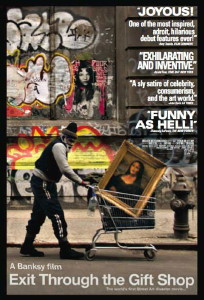
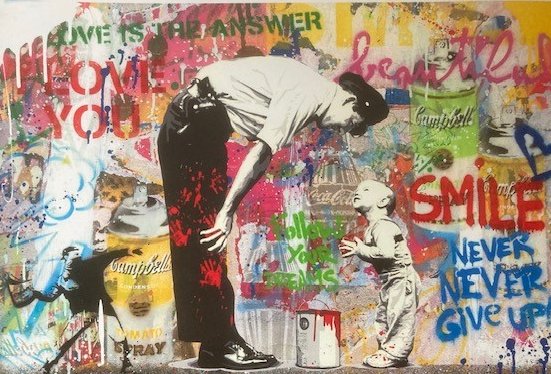
My third offering is works of art from Thierry Guetta who uses the psuedonym Mr Brainwash. His contemporary art is best thought as a morphing between pop art and street art and came to the fore after a documentary film, Exit Through the Gift Shop, directed by Banksy. 

The film was Academy nominated and regales the evolutionary passage of the street art movement with Mr Brainwash, like Banksy, bringing art to the masses.

Banksy Thrower by Mr Brainwash

Guetta’s art style has been described as both innovative and fearless. It is a combination of pop art of the past and the raw components of his early street art work. There is such a similarity between the works of Mr Brainwash and Banksy that some believe they are one and the same person.

Not Guilty by Mr Brainwash

His exhibitions are breathtaking in size and his artwork can be seen in the film and TV world , such as Molly’s Game, Billions, Shameless and The Kardashians. 

Madonna’s “CELEBRATION” Album cover by Mr Brainwash

He has designed a number of album covers for the likes of Madonna who approached him to design fifteen different covers for the worldwide release, singles, DVDs and special edition vinyl of her Celebration album.

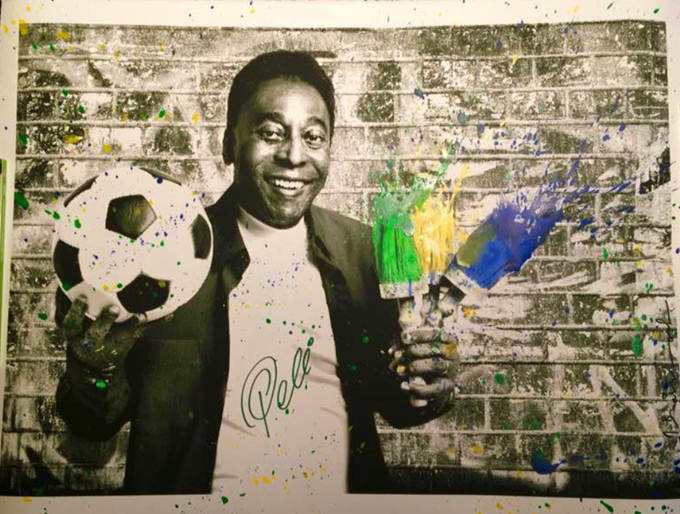
Pele by Mr Brainwash

Photo of Pele with Mr Brainwash

There is a childlike simplicity about Bossard’s work and yet there is a certain something which captures our gaze.  The depictions are often mischievous and naïve and yet are pleasing to the eye.

Work Well Together by Mr Brainwash

Thierry Guetta was born on January 31st, 1966 in Garges-lès-Gonesse, a commune in the Val-d’Oise department in northern France, He is best known by his moniker Mr. Brainwash, and now lives in Los Angeles.

Brother’s Advice by Mr Brainwash

Mr Brainwash has had his work shown at many exhibitions, both in America and Europe.

Although I said at the beginning I would be featuring three different artists who had works on show at Artcatto when I visited there a fortnight ago, I cannot end this blog with out mentioning my favourite paintings which still have a small room to themselves and are still on show.

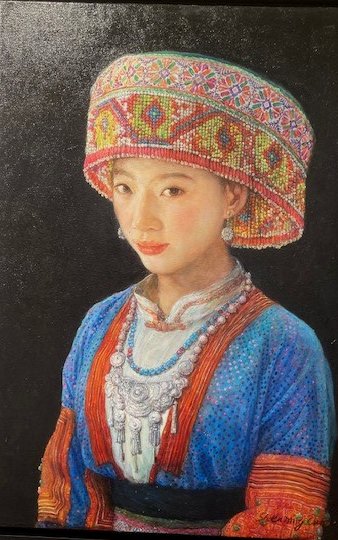
Beautiful Headress by Shen Ming Cun

Shen Ming says that he draws his inspiration from the ancient traditions, crafts and culture of the tribes of the Miao, Yao and Dong of the remote GuangXi region of China. Time does not stop still and there are large changes in China which is causing a massive strain on the ancient way of life in these small village communities and as the young people leave the villages to seek work in the large cities one has to wonder how long these cultures can survive.

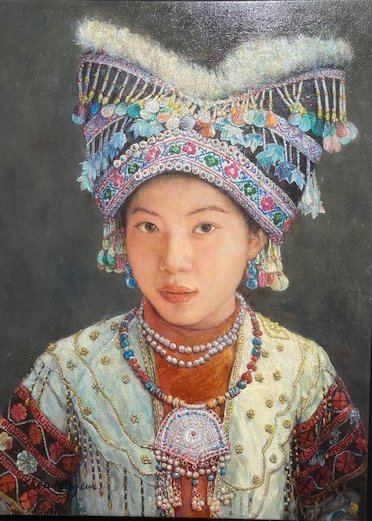
Looking at You by Shen Ming Cun

Each of the tribe has a quite unique tradition in dress and adornment from the other. The young girls sew everything entirely by hand and their jewellery is crafted in the village.  Shen’s artwork the inimitable customs, dress and heritage of these minority tribes of Southern China. His painting demonstrate his empathy and admiration of these tribal people as they possess a lyrical beauty, dignity and grace.

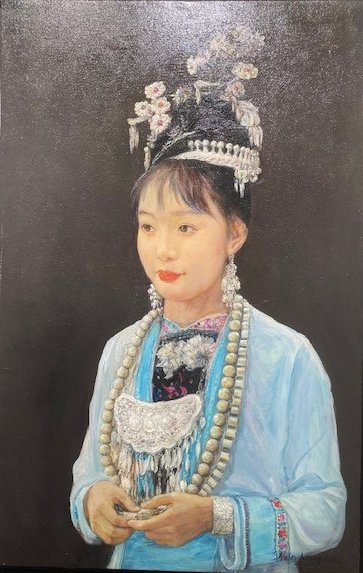
Silver Necklace by Shen Ming Cun

Shen’s artwork manages to capture the chromatic vibrancy of the costumes and ornate silver jewellery with a lightness and confidence that has undoubtedly led to his success. Their clothes and adornments are genuine symbols of the wealth, religion, ritual and national consciousness that shape their lives. Shen explains his inspirational art:

“…I have spent a long time researching the richly colourful cultural heritage of the Yao and Miao nationalities and the Dong minority of Southern China. Over the years I have lived amongst them and become friends with these beautiful people who radiate pure goodness and a simple love of life. Cultivating their ancestor’s achievements, they turn life into immortal art…”

Ralph Blakelock. Part 1.

The American Impressionist.

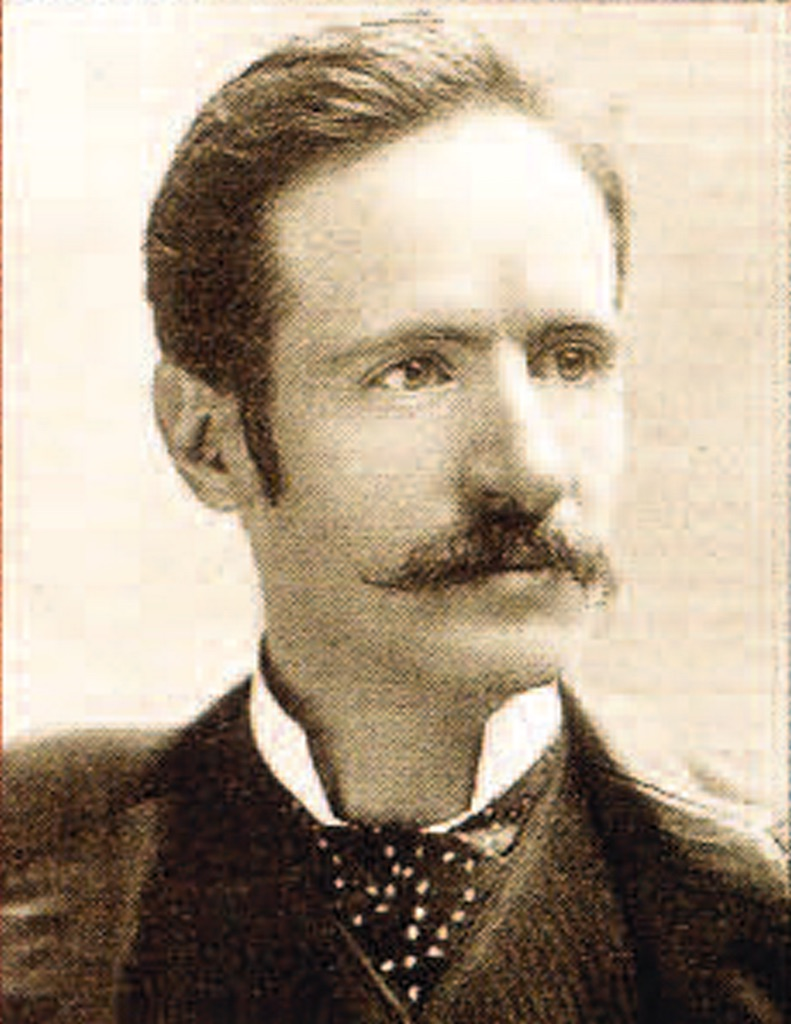
Ralph Blakelock

A blog I wrote some eleven years ago featured an artist who spent the last twenty years of his life in an asylum. He was Richard Dadd, the English Victorian painter.  Today I am looking at the life and works of an American painter, Ralph Albert Blakelock, a contemporary of Dadd, who was also incarcerated in an asylum during the last eighteen years of his life.

Woodland Cabin by Ralph Blakelock (1864)

The art of Ralph Albert Blakelock is termed as being of the Romanticism movement.  The Romantic movement, which emphasized emotion and imagination, emerged in response to the artistic disenchantment with the Enlightenment ideas of order and reason.  Blakelock was a painter known mainly for his landscape paintings related to the Tonalism movement.   Tonalism is, at times, used to describe American landscapes derived from the French Barbizon style, which accentuated mood and shadow.

Landscape by Ralph Blakelock (c.1865)

Ralph Blakelock was born on Christopher Street in New York City on October 15th, 1847.  He was the son of Ralph Albert and Caroline Blakelock. His father was an English immigrant carpenter, who would later serve as a police officer before becoming a homeopathic doctor. It was not Ralph’s father but his uncle James A. Johnson, a choirmaster who was to be Ralph’s cultural mentor. Ralph had connections with art through his uncle’s friendship with the great American landscape painters of the time, Frederic Church with and James Renwick Brevoort. Ralph had four brothers and four sisters. His father had hoped that Ralph would follow in his footsteps and study medicine and so it transpired that in 1864, seventeen-year-old Ralph began to study medicine at the Free Academy of New York.  However he gave up his studies at the academy after he had completed the third semester.

Hudson River Landscape by Ralph Blakelock (1867)

Blakelock ended his further education in 1866 and began to study art and paint landscapes full-time. To look for different landscapes to paint he made several sketching trips in upstate New York and New Hampshire. One of his first exhibition pieces was exhibited at the National Academy of Design in 1868, when he exhibited a view of the White Mountains.

 Morning – near Devil’s Den, White Mountains by Ralph Blakelock (1868)

The voyage of discovery for Blakelock proved to be central to his artistic vision and was to be an influence on his work for the rest of his life. Such cross-country trips had become popular with artists such as Albert Bierstadt and Thomas Moran but their journeys were part of expeditions funded by the US government, unlike the one Blakelock undertook on his one-man adventure. He wanted to “go West” and explore more of his country and whilst doing so, sketch and paint what he saw. 

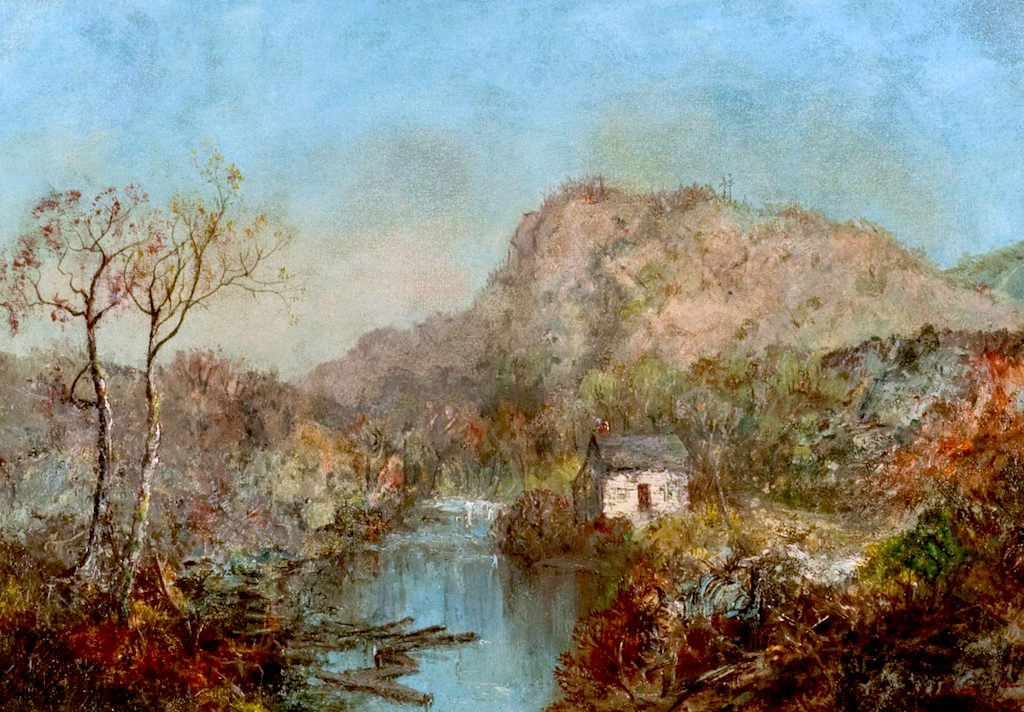
House by the Stream by Ralph Blakelock (1869)

In 1869, thanks to his father’s financial backing, Blakelock began the first of two lengthy journeys to the western territories of the United States. His extensive travelling was done using the train, stagecoach, and horseback, and his trip took him to the states of Kansas, Colorado, Wyoming, Utah, and Nevada, finally arriving on the west coast and California. After spending time in that state, he travelled south into Mexico. It is thought that he arrived back home by sea in 1871. The voyage of discovery for Blakelock proved to be central to his artistic vision and was to be an influence on his work for the rest of his life.

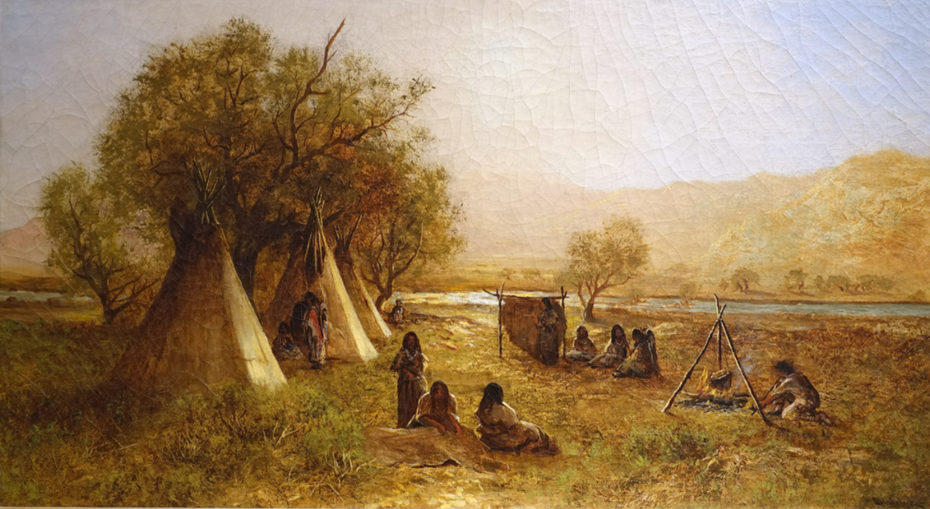
Cheyenne Encampment by Ralph Blakelock (1873)

A year later, in 1872, Blakelock embarked on a second western trip. Blakelock spent all his time sketching and painting and it was during this voyage of discovery that he became interested in one of his most lasting subjects for his work – the Native Americans. He painted tableaux of American Indian dancers, tented encampments and native Indian horseback riders Like artists who had journeyed west, there is no doubt that Blakelock was impressed by the vastness of the landscape. He spent time with various American Indian tribes and would often travel alone into the wilderness on horseback and spent time with tribes of the Great Sioux Nation.   It was a time when the Native Americans were still retaining many of their traditional practices despite the constant incursion on their lands by the white Americans from the East who were expanding  rapidly taking hold of the land belonging to the Native Indians.  Blakelock liked to depict Indian encampments in his paintings.  His paintings were not just about pretty scenes, they were a pictorial history of the time.  Mark Mitchell, the American writer and the Holcombe T. Green Curator of American Paintings and Sculpture at the Yale University Art Gallery,  wrote in his 2008 article Radical Color: Blakelock in Context about Blakelock’s work during his travels West:  He wrote:

“…they were documents of his experience and observations, but with time they became documents of his memory, as well as the memory of the nation at large…”

Sunshine in the Woods by Ralph Blakelock (1876)

Once Blakelock returned to New York after his wanderings in the West he rented his own studio and exhibited his work at the National Academy as well as the Society of American Artists and the Brooklyn Art Association. Initially his paintings followed the Hudson River School style

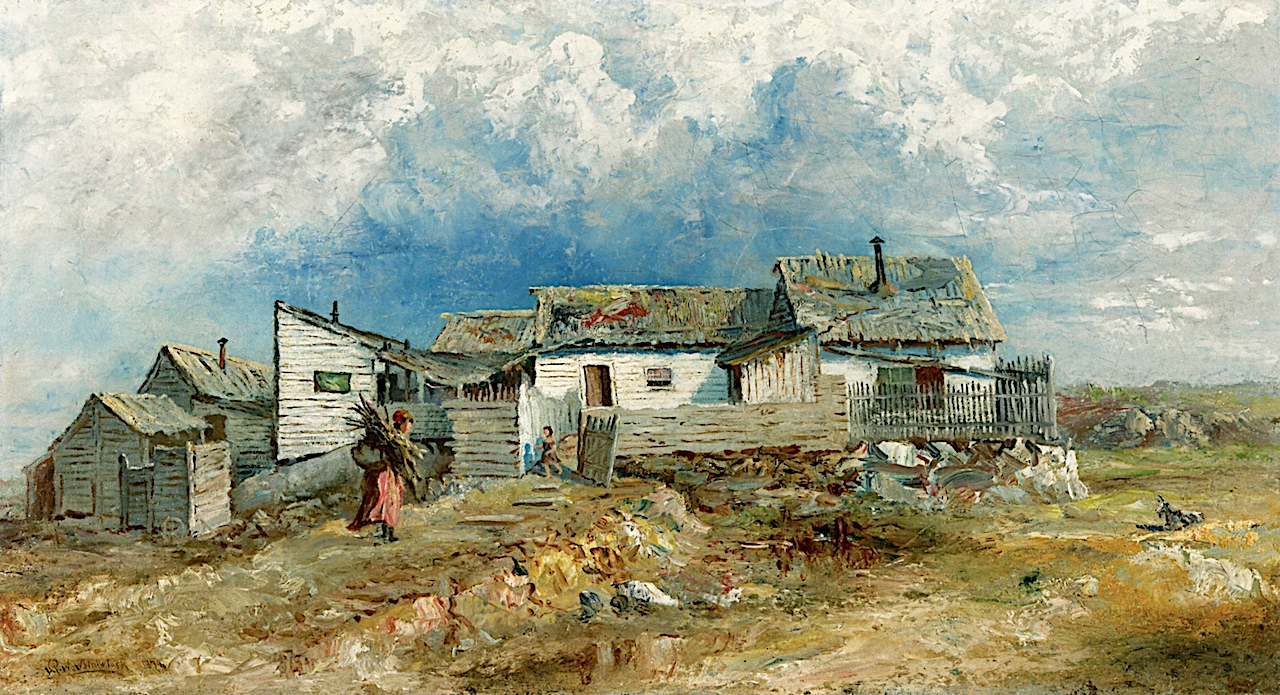
Shanties in Harlem by Ralph Blakestock (1874)

Now back on the East Coast, Blakelock began to concentrate on depictions of the northern edges of the outer city (what is now 55th Street and Central Park), which had yet to be developed.  Here he focused on the shanties which were starting to appear.  One such painting was his 1874 work entitled Shanties in Harlem.

Portrait of Cora Bailey (Mrs. Ralph Blakelock) by Ralf Albert Blakelock

In 1877, Blakelock married Cora Rebecca Bailey and, soon after, the first of their nine children, Carl, was born.  It was probably at this time in Blakelock’s life that things started to go wrong.  Unfortunately for Blakelock the art critics did not look upon his work favourably and the public were reluctant to buy his paintings at the advertised price.  Coming into play was the dreaded balance of matching income with expenditure.  His income was decreasing as he was having to sell his work cheaply.  However, the increasing size of his family had to be housed and fed. He had to increase his rate of production of his paintings to boost his income.  In his book, The Unknown Night: The Madness and Genius of R. A. Blakelock, An American Painter, Glyn Vincent tells that Blakelock’s wife, Cora, in a letter to the art dealer, Robert Vose, who ran the Vose Gallery in Boston, wrote that her husband did just that.  She wrote:

“…His best work took a long time to complete and in the meantime he had to live. Pictures were painted to keep things going. He could paint a really good picture in less time than anyone else I ever saw…”

In 1880, his second child, Marian is born and in 1883, Blakelock moved into the prestigious Tenth Street Studio Building, in New York and had famous neighbours such as William Merritt Chase and Frederic Church. He took part in the 1884 Society of American Artists exhibition and this boosted his reputation with his work being hailed by the press as being among the best works on show.  Clarence Cook of the Tribune wrote:

“…it was the best work of his which we have seen, marked not only by rich coloring, but by the possession of a distinctive character…”

The year 1884 was the year of the birth of his third and fourth chiId, twins, Claire and Ralph and so it became a dire financial struggle and to support his new and rapidly growing family. Blakelock would sometimes take jobs as an art teacher and later would produce small paintings of birds, flowers, and landscapes on plaques at E. C. Meekers Art Novelty Shop in New Jersey while he and his family lived nearby in East Orange. 

A Waterfall, Moonlight by Ralph Blakelock (1886)

Despite the good press reviews of his work, Blakelock was still struggling financially.  One reason could be that to avoid paying dealers a commission for selling his work he sold his own paintings and although he saved money, he lost the power of marketing and advertising a dealer would have afforded him. In 1886, the popular journal, Harper’s Weekly, reviewing an exhibition at the National Academy of Design praised Blakelock’s painting entitled A Waterfall, Moonlight hailing it as the best landscape in the exhibition, and the art critic admitted that he was surprised to see the name of the artist having completed such a powerful landscape. The painting featured elements that are typical of Blakelock’s style, such as generalized and silhouetted forms, glowing moonlight, and thick paint.  The foliage that frames the edge of the canvas echoes the irregular contours of the tree so much that it gives the impression that the forms are almost able to interlock.

Brook by Moonlight by Ralph Blakelock (1891)

The year 1886 was also the year of the birth of Ralph’s fifth child, Mary, and, tragically, the year of the death of one of his twins, his two-year-old daughter Claire. In 1887 his sixth child, Louis was born. The financial stress on Blakelock continued to mount and cause him mental stress until March 1890, when it culminated in his first mental breakdown and he was taken by his brother to the Flatbush Insane Asylum.

Photograph of the Sherwood Building, Manhattan (c.1902)

Blakelock stayed in the asylum for a short time and on his release, a wealthy patron of his, the English-born textile firm owner, Catholina Lambert allowed Blakelock, his wife Cora, and their four children to come to his estate in Hawley, Pennsylvania, to convalesce. Having recuperated, he returned to New York, where Blakelock began working out of fellow artists’ studios and later president of the National Academy of Design, Harry Watrous’s studio in the Sherwood Building.  This building was at 58 West 57th Street, at the southeast corner with Sixth Avenue (Avenue of the Americas) in Midtown Manhattan, New York City. The building was constructed in 1879 as artists’ apartments. It was here that Blakelock painted his masterpiece Brook by Moonlight which is now part of the Toledo Museum of Art collection. Depicting moonlight, sunsets, and twilight were favourite depictions of Blakelock  It is said that they held a special attraction for Ralph Albert Blakelock for their poetic qualities and in this work he expressed his personal response to nature in this mysterious and haunting moonlit forest.

Sadly the life of Ralph Blakelock was going to take a turn for the worse…..

…….to be continued.

Alson Skinner Clark. Part 1.

Alson Skinner Clark

Alson Skinner Clark was an American Impressionist painter known for his landscape paintings and his murals, including at the Carthay Circle Theatre in Los Angeles and the First Trust and Savings Bank in Pasadena.  He was also an ardent photographer.  He was born on March 25th 1876 in Chicago, Illinois, to Alson Ellis Clark and Sarah Clark.  He had two brothers, Mancel and Edwin and a sister, Mary Emily, who died when young.  His father was not always a wealthy man as he came from an impoverished background.  He had served in the Civil War, and then moved to Chicago where he established a highly successful commodities business at the Chicago Board of Trade.  From then, his wealth increased and he was able to provide a comfortable lifestyle for his wife and family.

The Black Race by Alson Skinner Clark (1902)

Alson showed an early interest in art and was proving to be a gifted young painter.  In an 1956 interview for The Archives of American Art, a collection of primary resources documenting the history of the visual arts in the United States, his wife recalled her late husband’s early “artistic talent” saying:

“… I think the desire to draw was always extant with Alson Skinner Clark. When he was nine or ten years old, it made itself manifest—and obnoxious as well—to the his church-going parents, for during the long Sunday sermons he surreptitiously recorded the bonnets and bald pates in front of him in the only place available at the time—the frontispiece and blank rear pages of the family hymnals…”

His family supported and encouraged him to continue with his art by enrolling him in Saturday classes at the Art Institute of Chicago when he was just eleven years old. 

Breton Village, Rochefort-en-terre by Alson Skinner Clark (1903)

One of the perks of being part of a wealthy family was the ability to travel and in 1889 the Alson Clark and his family set off on a two-year trip around the world. For Alson it was his first taste of European art and no doubt instilled in the young man a love of both travel and painting. Back in America, Alson graduated from high school, and for a short period at the end of 1895 enrolled as a full-time student at The School of the Art Institute of Chicago.  The teaching of art at the Institute was based on the teachings at the French Academies and focused on drawing from casts and still-lifes before students were allowed to progress to drawing live models.  Alson was unhappy with the Institute’s system and after a quarrel with one of his teachers regarding the slow and arduous process of drawing from casts, Clark quit the Institute.

Despite his short but unhappy period at the Chicago Institute Alson was determined to carry on with his art and in 1896 moved to New York and studied under the tutelage of William Merritt Chase at the Art Students’ League of New York.  Despite being twenty-years-old, Alson’s mother would not let him live on his own in New York and so went with him bringing along his childhood friend Amelia Baker.  The three shared an apartment on Seventy-Seven Street and Columbus Avenue.  Alson’s mother Sarah justified this arrangement by saying:

“…For two years Mela [Amelia] and I have talked of spending a winter in New York, in Bohemian fashion, and have searched for a good reason for doing so, in vain till this time. Alson, however, came to the rescue in his desire to study art with a New York master, and made it seem a necessary thing to do…”

Early Nude by Alson Clark (1898)

When Chase opened his own school of art, Alson Clark, along with many other students, followed him.  Chase was a great influence on Alson, an influence which would remain with him for the years to come.   A painting completed by Alson, entitled Early Nude, which he completed in 1898 bears an inscription that Merritt Chase had also worked on the painting.

Mansion of Leroy de Chaumont near Watertown, New York by Alson Skinner Clark (1902)

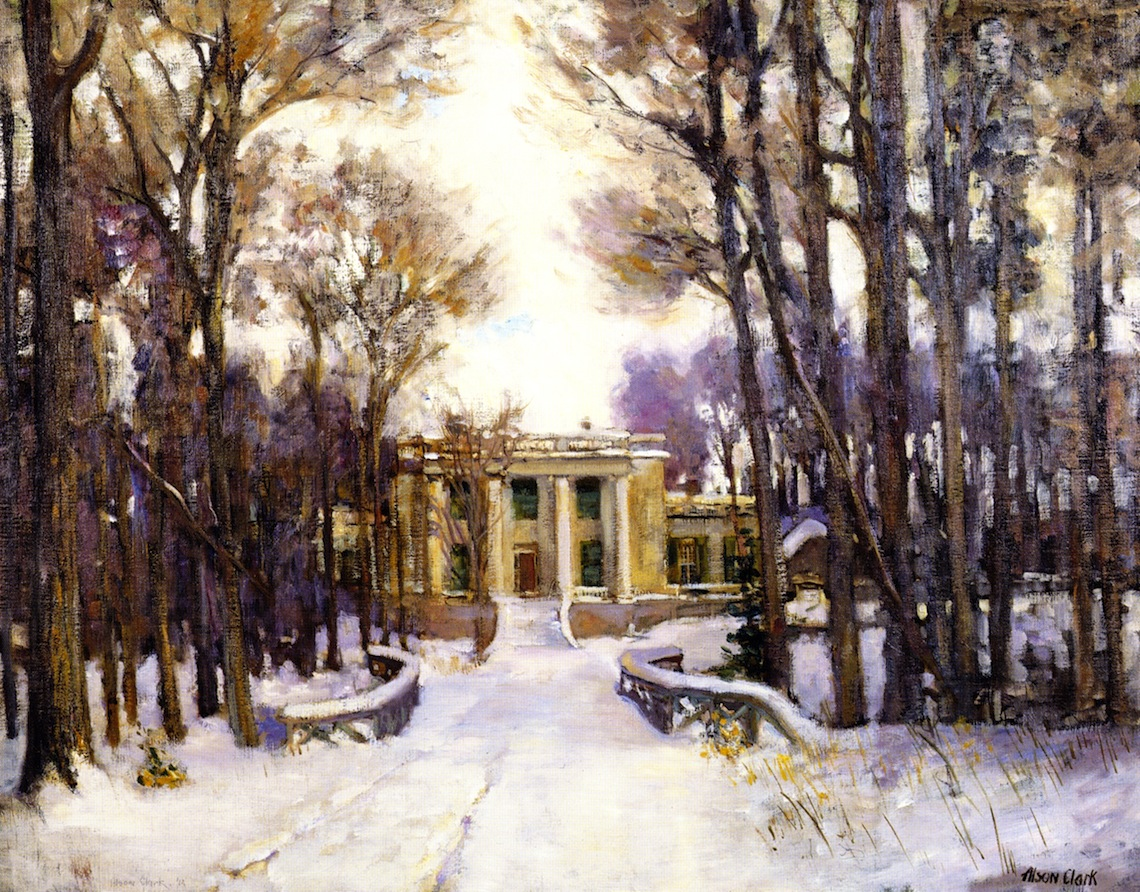
For two summers Clark spent working en plein air at Merritt Chase’s school in Shinnecock, Long Island and it was the beginning of his love affair with plein air painting and his predisposition with the Impressionist style of painting.  In November 1898 Alson decided, like many other young aspiring artists, to leave America and travel to France to study at the famous French art academies.  The most popular art academy for visiting American artists was the Académie Julian.  However, the “rough and ready” Académie Julian was not for Alson, who commented that he found the working conditions “disgusting”.  Alson preferred to enrol at the newly opened Academia Carmen, which had been founded by James Abbott McNeill Whistler, where the business side of the school was handled by Whistler’s former model Carmen Rossi for whom, along with her musician husband, the school was named. Alson Clark was in awe of Whistler’s artistic talents and kept going to Whistler’s atelier on and off until it closed in 1901.  Alson would never to forget the teachings of Whistler.

Taking Paintings to the Salon, Paris, (c. 1905)

In March of 1899, Clark entered his first work in the Paris Salon. In a letter written the following month to his friend Amelia Baker, he described his experience:

“…Wednesday, Wilson and I went to the Salon to see the stuff carried in and all the awful things that went in—I never saw such a lot of bad painting. The wagons come up to the entrance and take their wads of pictures in and there are crowds of people watching the stuff enter. I have little hope that [my picture] will pass the jury but one can never tell as there is a great deal of “pull” in the Salon, and as I have not studied under any Frenchman I may be thrown out. I don’t care what happens although of course I would rather be in than out. Exhibitions are, after all, a farce…”

When his painting was rejected by the Salon jury, Clark feigned indifference stating:

“It doesn’t’ matter to me at all as I haven’t a reputation to make and there isn’t much honour in being in unless you get in squarely as only very few do.…”

The Violinist by Alson Clark (1901)

Despite his work being rejected by the jurists he never gave up trying to have one of his paintings was eventually accepted into a Salon exhibition for in 1901 his perseverance paid off with his painting, The Violinist being selected for that year’s Paris Salon exhibition.

Comfort Island Alexandria Bay, New York was built in 1883 by industrialist Alson E. Clark.

Whilst he had been living in America Alson Clark’s health was often very poor and was a frequent visitor to his doctor with stomach problems.  In 1901 whilst living in France he once again became ill and was advised he had to have his appendix removed.  In those days this was a serious operation and so he decided to return to America for the operation and set sail for New York on June 1st with surgery booked at a Chicago hospital that summer.  After the operation he recuperated at the family home on Comfort Island, one of the Thousand Islands in Alexandria Bay, New York.  Comfort Island, Alexandria Bay, New York was built in 1883 by his father Alson E. Clark and it is located on the St. Lawrence River in the Thousand Islands Region in what is known as Millionaire’s row.

Ile de la Cite, Paris by Alson Skinner Clark (c.1900)

In the Autumn of 1901 Alson rented a barn from the parents of his friend Amelia in Watertown a small, provincial city near Lake Ontario and the Canadian border and the closest city to Comfort Island.  This was the start of his career as a professional artist and the only one in Watertown. Now set up as a professional artist, he needed a model and he discovered that one of the local girls, Atta Medora McMullin, was willing to pose for him and her mother would act as her chaperone.  Soon love between artist and model blossomed but Alson had his doubts about being good husband material.  He wrote:

“…In the evening I would have liked to have seen Medora, but stayed home and wrote. I have no more business in marrying than the man in the moon for I am fickle and can’t help myself. It is a misfortune and not a fault.” Yet, just a few days later, he wrote, “In the afternoon she posed. I could not work as I wanted to tell her that I loved her but could not. We sat by the fire knowing each other’s minds…”

Landscape near Le Pouldu, France by Alson Skinner Clark (c.1900)

At the end of January 1902, Alson Clark professed his love to Medora and proposed marriage. She accepted.  Medora was to prove a very compassionate and supportive wife.  His first exhibition of his work was at Watertown and featured many paintings of Paris.  It was a success and he sold many works.  From there the exhibition moved to Chicago for Clark’s first major exhibition, at the Anderson Galleries.  Once again the exhibition was hailed as a great success and the Chicago Times declared:

“… Popular opinion has decided that it is a very promising display for a young artist…. Mr. Clark has a style of his own. It is suggestive of Japanese reminiscences, is refined and pleasantly frank…. The sentimental does not interfere with the boldness of using masses…”

From our Window, Paris by Alson Skinner Clark (1903)

Alson Skinner Clark and Atta Medora MacMullin wed on September 20th, 1902, and for their honeymoon they took a sea voyage to Europe on the S.S. Minnetonka.  On November 7th the couple moved into a Parisian apartment at 6, rue Victor Considérant.   Shortly after settling in, Alson’s friend, and fellow American artist, Frederick Carl Frieseke, moved in with them whilst waiting for the apartment above the Alsons to become available to rent.  Alson and Frieseke were good friends and Frieseke used to paint from the Clarks’ apartment balcony and would also occasionally use Medora as a model.  That winter Alson and Frederick painted continually so that they could build up a collection to put before the jurists at the Spring Salon.  They even split the cost of renting wagons to transport their work to the Salon.

Les Colliers (The Necklaces) by Alson Clark (1905)

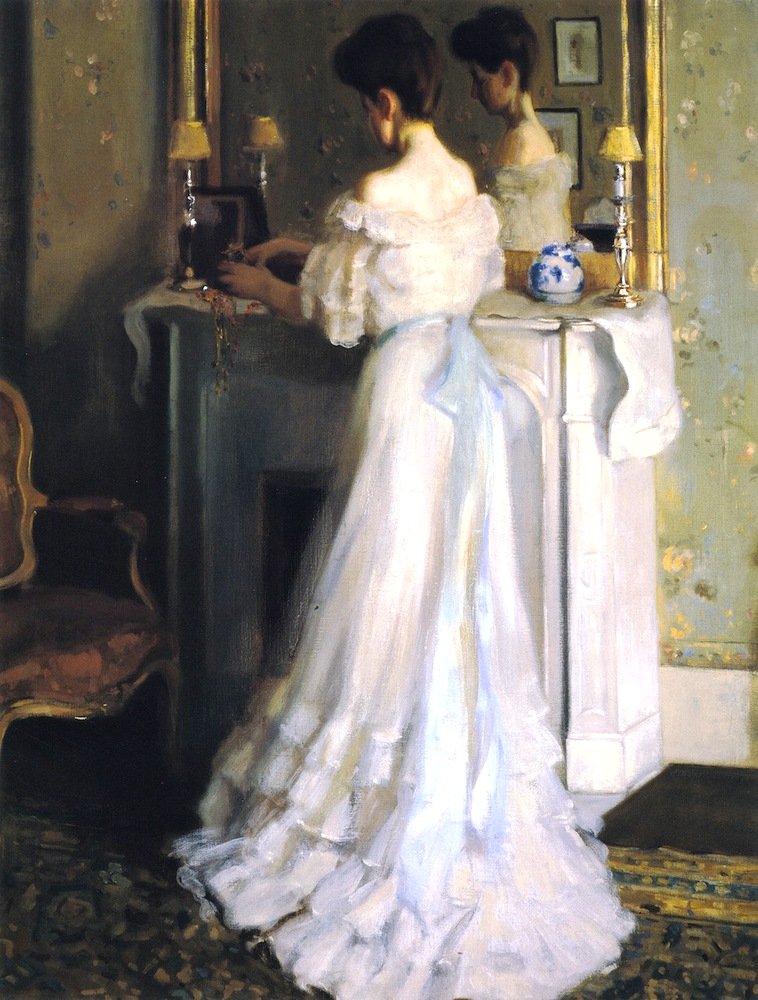
Alson Clark continually acknowledged the debt he owed Whistler and wrote to him many times confirming such indebtedness.  In 1905 Alson completed a work entitled Les Colliers (the Necklaces) and the style of the work mirrored many of Whistler’s works.  It was simply Alson’s way of paying homage to Whistler’s portraiture.  In the painting we see the lady, modelled by Medora, dressed in a flowing gown with her back to us, standing beside an elegant mantlepiece.  In her hands she holds a pair of necklaces

The Coffee House by Alson Skinner Clark (1906)

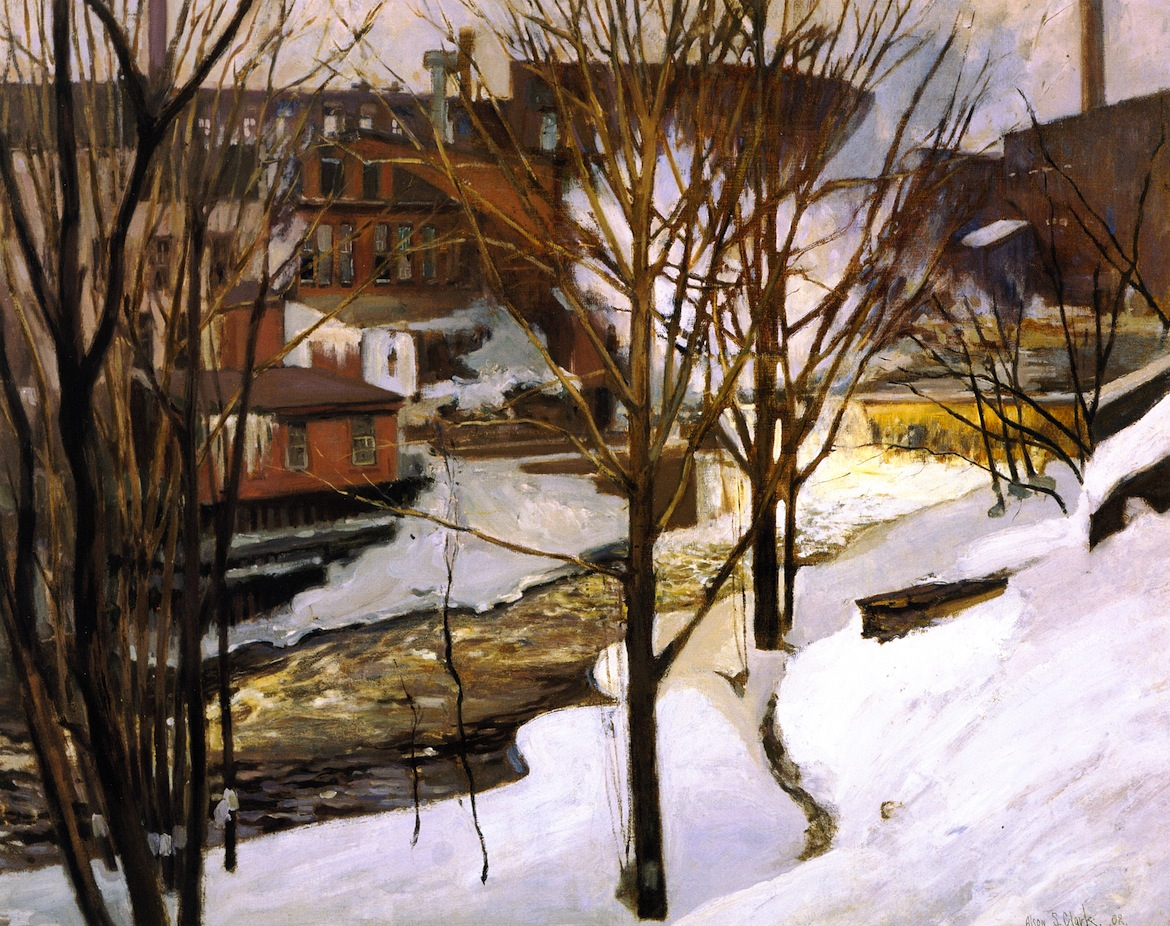
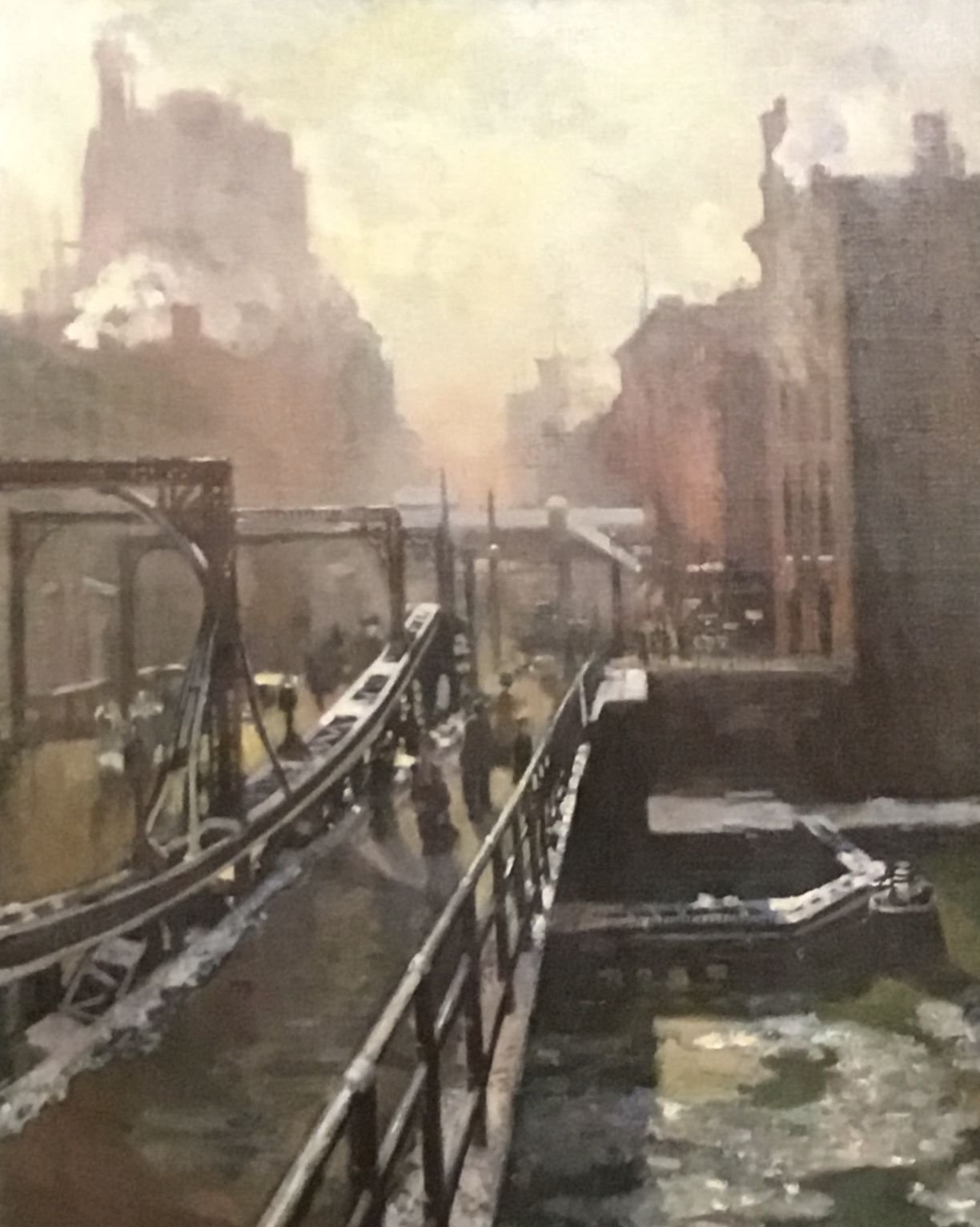
One of Alson’s early industrial paintings is his atmospheric work entitled The Coffee House which he completed in 1906.  It is a depiction of Chicago on a cold winter day.  We see ice floating down the river which is overlooked by monstrous dark skyscrapers which are looming through the smoggy atmosphere.  As we look at the painting our eyes are drawn into the picture by the curved ironwork of the State Street Bridge, 

Arrival of the Normandy Train, Gare Saint-Lazare, by Claude Monet (1877)

This is a typical depiction of urban realism and it is suggested that Alson may remember seeing such scenes depicted in Monet’s paintings such as his 1877 work, Arrival of the Normandy Train, Gare Saint-Lazare, which highlight both the ephemeral nature of fog and smoke and the atmosphere’s effect upon the forms of the city.

………….to be continued.

Much of the information I used for this blog came from an article in CALIFORNIA ART CLUB NEWSLETTER entitled An American Impressionist by Deborah Epstein Solon Ph D.

Pierre Adolphe Valette

Self portrait by Pierre Adolphe Valette (1912)

I first came across the artist I am featuring in this blog through his famous English pupil, L.S.Lowry.  Today I want to explore the beautiful and very different paintings of the French artist Pierre Adolphe Valette.

Valette was born on October 13th 1876 in the family home on the rue de Roanne in the east-central French industrial town of Saint Etienne, some sixty kilometres south-west of the city of Lyon.  Saint-Etienne was a vibrant industrial centre similar to the English city of Manchester which would later become a home to Valette.  Valette’s father, Ferdinand, who was born close by in 1846, worked as an armourer at the firm of Claude Brondel and he and the family could be socially termed middle-class and were financially well-to-do.  In 1872, Adolphe’s father Ferdinand, when he was twenty-six, had married his wife, Madeleine, a dressmaker, an occupation she soon relinquished after marriage.

Pierre Adolphe Valette

Ferdinand and Madeleine had their first child, a son, Ferdinand Claude Marie in January 1873.  Their second child, Antoine Emile Edouard soon followed in September 1874 and the third child Pierre Adolphe, the subject of this blog, arrived in 1876.  The family was completed in June 1881 with the birth of their fourth child, and their only daughter, Marguerite Aglaée Nathalie. She was born with a slight mental and physical handicap and was looked after for forty-seven years by her mother.

Saint-Etienne,  École de dessin, renamed École régionale des arts industriels in 1884,

Adolphe Valette was brought up in St Etienne and like all the locals had to put up with the cold, damp and smog of the industrial pollution of this industrialised town.  The first French railway had arrived at St Etienne with its horse-drawn wagons in 1832 and twelve years later steam locomotives took their place.  Adolphe was enrolled by his father at the Ecole Régionale des Arts Industriels where he studied engraving.  It was a school, which as the name suggests, stressed the interaction between industry and the arts.  His father had hoped that Adolphe would learn all about metal engraving which could be used in the armoury sector, such as the engraving on weapons.  His studies also encompassed history and anatomy.  Valette received art tuition at Ecole Régionale des Arts Industriels from Jean Dablin, who was later become the founder of the Société des Arts du Forez’ of which Valette would become a member.  Adolphe Valette was influenced by Dablin’s choice of subjects such as works featuring industrial landscapes and coal mines.

A Lady Reading by Pierre Adolphe Valette

It has not been documented as to why Valette decided to leave St Etienne and move to Lyon.  It maybe he had exhausted the subject matter for his paintings or that he wanted to establish himself as an artist in the city of Lyon.  He worked hard in Lyon.  He worked as an engraver during the day and spent the evenings painting.  He attended evening art classes in the city and from September 1895 he was a student at the Ecole Municipale de Dessin de la Guillotière.  Whilst there he received numerous accolades for his work, receiving a silver medal for figure drawing and in the academic year of 1895/6 he came top of the class.  The following year, in a sketching competition, he received first prize, a rappel de médaille de Vermeil.  His consistency of performing well at the college demonstrated Valette’s artistic talent

Still life with flowers by Pierre Adolphe Valette (1917)

More and more awards came Valette’s way during his period at the Lyon academy.  Valette eventually left Lyon and travelled to Bordeaux.  Nobody has given a reason for this move as surely for a blossoming artist, Paris would have been the logical destination.  The Paris art scene was booming with the acceptance of the Impressionist movement.  Artists like Monet, Pissarro, Degas and Morisot were all selling their works. 

Matinée d’hiver, place Pey Berland à Bordeaux by Alfred Smith (c.1893)

Although Bordeaux was away from the great Impressionist upheavals seen in the French capital there was an influx of Impressionism by way of Pierre Cazaubon and the British painter, Bordeaux-born, Alfred Smith, whose father was of Welsh origin and whose mother was from Bordeaux. This painting above by Smith may be termed gloomy while others assert that it is atmospheric but as you will see later, Valette must have admired the work as it would influence his many works depicting the city of Manchester. Smith painted a series of works focused on views of European cities with pedestrian plying their way down wide boulevards with depictions of local transport such as cabs and trains.  They were true chronicles of everyday city life and Pierre Valette would complete similar works of the northern English city of Manchester in the early decades of the twentieth century.

Open Air Class by Pierre Adolphe Valette (1906)

Valette settled down well in Bordeaux and managed to get a job as an engraver and a professional draughtsman.  He also enrolled at the Ecole Municipale des Beaux-Arts et des Arts Décoratif, a very prestigious academy.  As before he did well at the academy and gained many prizes for his drawings and paintings.  One of his tutors at the Academy was Paul-François Quinsac, a painter of the French School known as Academic art, a specialist in mythological and allegorical subjects, figures and landscapes.  He was also a fashionable portrait painter loved by the Bordeaux upper classes.  Valette was also tutored by Charles Braquehaye in the art of drawing from a live model.  Valette continued to do well at the Academy.  The Academy gave out a number of scholarships to its best students so that they could support themselves whilst studying.  One of the most important scholarships was the Poirson scholarship named after Auguste Poirson who funded the award and bequeathed his vast collection of paintings to the Musée des Beaux-Arts de Bordeaux. 

Paris by Adolphe Valette

In 1903 Valette was awarded the scholarship, worth 400 Francs.  The money was to fund a trip to Japan to study Japanese art and prints and how it interacted with French Impressionism.  The four hundred franc award was not quite enough to fund the study trip but the Poirson scholarship administrators were told that Valette would fund the shortfall.  Little is known as to what happened next, except to say that Valette left the Academy that year, 1903, and because he could not raise the extra money for the trip to Japan, the scholarship money was never handed over to Valette.  That must have hurt but he was still determined to seek wider horizons in his search for a way to improve his artistic skills.   One may have thought Paris would be his destination but instead, he decided to travel to England.  Why England? Maybe it was the fact that in 1904, England and France had just jointly signed the Entente Cordiale, a series of formal political agreements that negotiated peace between England and France and there was a burgeoning admiration between the well-to-do of each nation.  It was also true that many French artists, such as Monet and Pissarro, because of the 1870-71 Franco-Prussian war, had travelled to England to study the works of Constable and Turner.

Plymouth Grove by Pierre Adolphe Valette (1909)

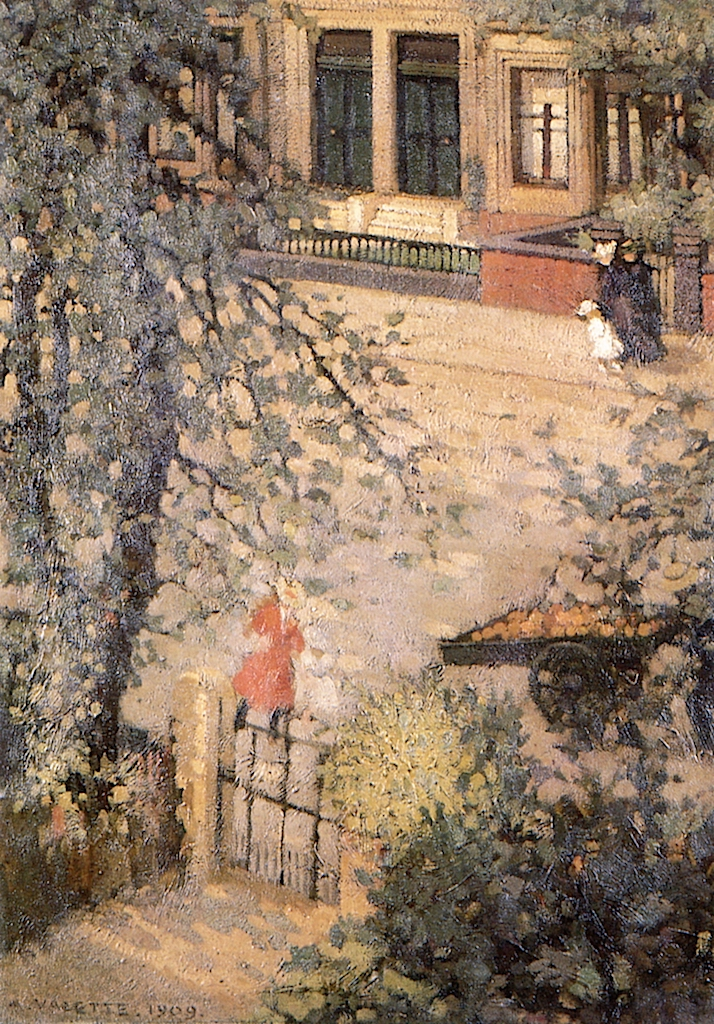
Having arrived in England in 1904 Valette enrolled on courses at the School of Art at Birkbeck College, London in April 1905.  However, his stay there was very short and he left the English capital and travelled north to Manchester.  It is thought that Valette went to Manchester with the intention to find work as an engraver and as an artist in a connection with this industrial north-west city.  Valette was not disappointed as he quickly found work at the Norbury, Natzio printing company and secured lodgings at Plymouth Grove in Victoria Park, Manchester.  The company was all about general and colour printing which at the time was ground-breaking technology.  The company specialised in posters and trade publicity.  Whilst there, Valette produced the company’s trade calendars which were exquisite and refined works, a sort of Japanese-style art.

Manchester Municipal School of Art

Besides working at the printing company, twenty-eight-year-old Valette enrolled as a student at the Manchester Municipal School of Art in 1905.  There were five hundred students enrolled at the school. Half attending day courses whilst the other half attended evening classes.  Valette, who had a full time job, enrolled in the life drawing and engraving evening classes.  The future famous English artist LS Lowry enrolled at the Manchester school the same year as Valette but he had to start in the preparatory classes whereas, because of his experience in art, Valette entered the higher classes of the school.

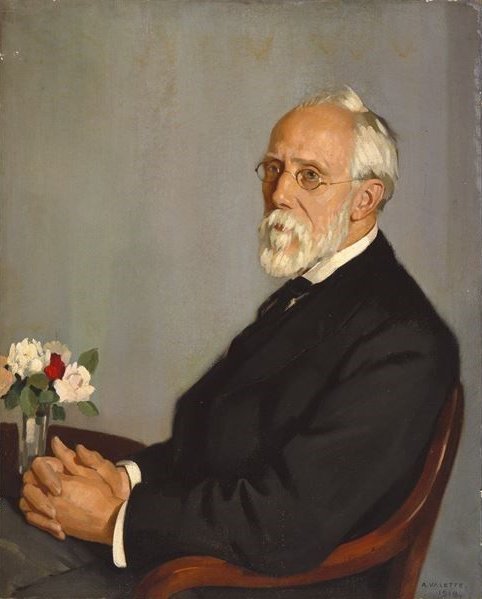
Portrait of John Henry Reynolds by Pierre Alphonse Valette (1919)

Valette proved himself to be an exceptional student, so much so that the head of the academy, Richard Glazier, suggested that Valette should apply for the post of Master of Painting and Drawing.  Glazier probably liked the idea of having a proven French artist on his staff as this would an international flavour to the academy.  Valette applied and in March 1906 he was awarded the post at annual salary of two hundred and twenty-five pounds.  One of Valette’s conditions when he accepted the post that he would be a “hands-on” tutor and would be able to paint alongside his students.  This was a French teaching style, painting by demonstration, and this was new to the United Kingdom. Valette’s knowledge of the French Impressionism movement and what was happening in the French studios allowed him to breathe fresh life into the teaching of art and, at the same time, circumvent the stuffy academic way of teaching the subject.  The director and secretary for the Manchester School of Art when Valette enrolled was John Henry Reynolds and in 1919 Valette completed a portrait of the man.

Drawing from Antiques class at Manchester Municipal School of Art

The famous English painter, L.S.Lowry, or to give him his full name, Laurence Stephen Lowry, enrolled in the evening classes at the Manchester Municipal School of Art in 1905 at the age of seventeen.  A few years on Lowry took part in the Drawing from Antiques course.  The School had a large hall containing many Renaissance classical statues of male and female nudes which gave the students the opportunity to learn and produce drawings of the classical poses.  Lowry produced a number of sketches which Valette appreciated and found the time to convince Lowry to continue with his art studies.  Lowry expressed great admiration for Valette, who taught him new techniques and showed him the potential of the urban landscape as a subject.  Of Valette Lowry described him as “a real teacher … a dedicated teacher”, and added:

“I cannot over-estimate the effect on me of the coming into this drab city of Adolphe Valette, full of French impressionists, aware of everything that was going on in Paris…”

Manchester Ship Canal by Adolphe Valette

What drew me to the artwork of Valette was his impressionist style paintings depicting urban scenes of Manchester often depicting its canals swathed in a smog-filled haze over the lights and dark ironwork of the industrial city.  His painting, His Manchester Ship Canal painting, depicted the barges on the canal and managed to capture the ever-changing effects of light, cloud and movement outdoors.

Albert Square, Manchester by Adolphe Valette (1910)

Valette’s 1910 painting entitled Albert Square is an atmospheric, smog-filled view of one of Manchester’s main squares.  We are viewing it from the southwest side and in the foreground we observe the dark figure of a man, wearing a cloth cap and knee-length coat.  He is plying his trade, pushing a handcart, his figure silhouetted against the wet cobbles. In the mid-ground we see a parked a hansom cab beneath the statue of Gladstone.  The horse feeds from a nose-bag as the driver manages to take a breather.  To the left of the scene, a group of figures congregate around a motorcar parked beneath the Albert Memorial and the statue of Oliver Heywood can be seen to the right.

India House, Manchester by Adolophe Valette (1912)

Valette’s 1912 painting, India House, depicts a secluded view, looking down the River Medlock in Manchester, as viewed from Oxford Bridge and looking in the direction of India House, the large office building which is situated on Whitworth Street. The upper part of the painting is a  framed view of an archway belonging to the railway viaduct spanning Oxford Road. At the centre of the work our eyes strain to see, through the haze, the materialising form of India House, with its numerous lit up windows reflected in the water below. On the left of the painting is what used to be the Refuge Assurance building which would later become the Palace Hotel.  On the river we can see two flat barges.

York Street leading to Charles Street, Manchester by Adolphe Valette (1913)

In 1913, Valette completed his painting entitled York Street leading to Charles Street, Manchester.  It is a typical Valette style work featuring a smog-ridden industrial scene, depicting York Street, Manchester, and looking towards an arched railway bridge spanning the street, over which we can see a steam train crossing.  In the right foreground we see two labourers shovelling a pile of coal on the road and to the right, a single motor car drives along the road to the left.  The pavements are full of people.  All around are tall blackened buildings each emitting tiny lights which struggle to penetrate the smoggy atmosphere.

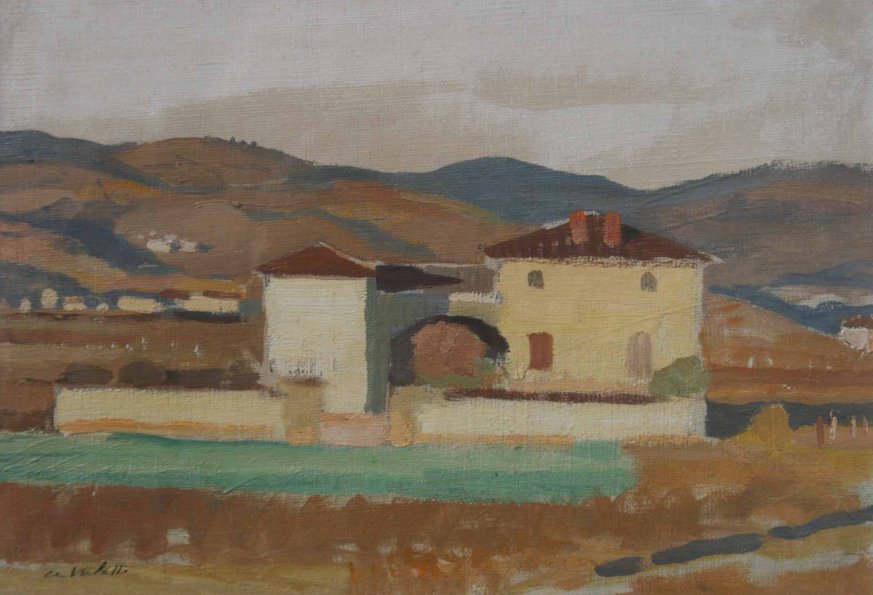
Ferme Sanlaville, La Combe, Blace by Adolphe Valette

In 1920 Valette resigned from the Manchester Municipal School of Art owing to ill health but remained in Lancashire for eight more years, during which time he was involved in private art tuition.  In 1928 he returned to Paris, and later moved to Blacé en Beaujolais, where he painted portraits and country landscapes. He died there on April 18th, 1942, aged 65.

Although his work contained many colourful landscape scenes and a large number of beautifully crafted portraits.   I will always think of Pierre Adolphe Valette as the artist who depicted the smog-filled urban depictions of Manchester.

Frederick Frieseke. Part 2.

Frederick Frieseke

In the Spring of 1902, Frederick Frieseke was back in America after a five-year stint in France.  His reason for returning to his country was two-fold.  He wanted to take care of his American side of his career and probably more importantly he had come to be with his stepmother who was seriously ill.  Once on American soil he wanted to have some of his artwork exhibited at two prestigious exhibitions – the Art Institute of Chicago and then the Pennsylvania Academy of the Fine Arts.  Having exhibited in Paris at the Societe Nationale des Beaux-Arts and the Salon stood him in good stead.  Frederick held a series of meetings with William R. French, director of the Art Institute of Chicago, which resulted in a special exhibition of eight of his paintings, which were hung together in Chicago’s annual exhibition.

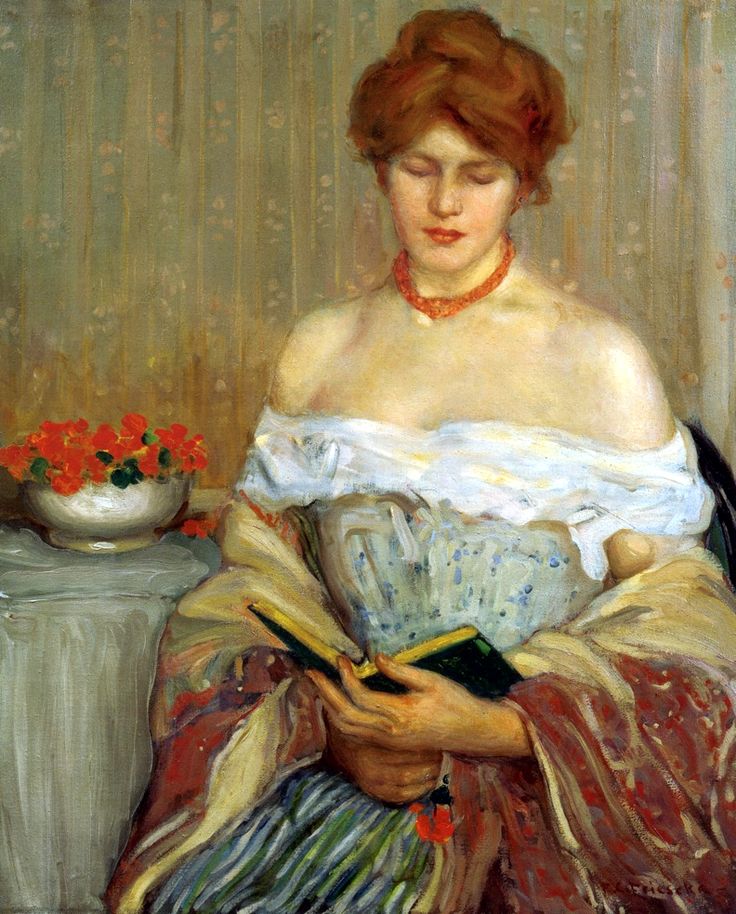
Gertrude, Girl with a Book by Frederick Frieseke (1902)

During the next seven months Frederick spent time in Owosso, transacted business in New York and Chicago, and was able to maintain his flow of drawings for Wanamaker, as well as visiting Sadie in New York. Frederick continued to paint whilst in Owosso and he employed a local young woman, Gertrude Hallowell to model for him. One such work was his painting, Gertrude, Girl with a Book, which he completed in 1902, featured Hallowell.

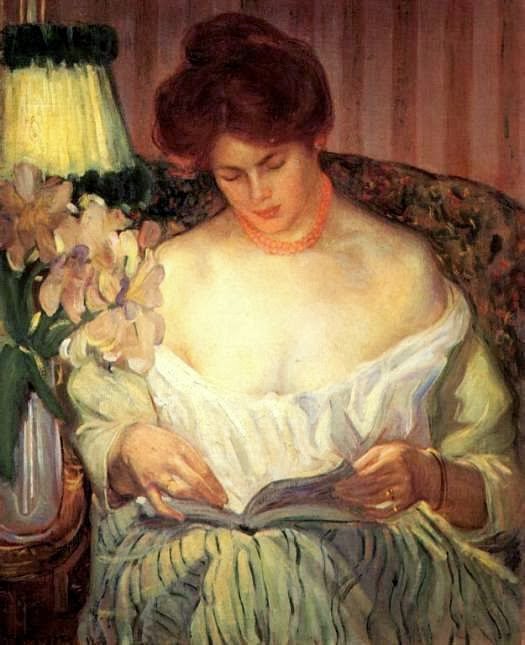
Woman Reading beside a Lamp by Frederick Frieseke (1902)

Another portrait featuring Hallowell was his painting entitled Femme lisant a cote d’line Inmpe (Woman Reading beside a Lamp) which he also completed that year.

The Green Sash (Medora Clark) by Frederick Frieseke (1904)

Frederick returned to Paris in November 1902 and moved into his new studio and apartment at 6, rue Victor Considerant, which was situated on the opposite side of the Place Denfert Rochereau. The rooms he rented were on the first floor above the apartment of the newly married Alson and Medora Clark, with whom he was to build up a great relationship with for the next few years.  The couple were pleased to provide Frederick with a kind of domestic permanency and friendship. The three often shared meals and spent evenings together. Medora soon became Frederick’s model and posed for his 1904 painting entitled The Green Sash.

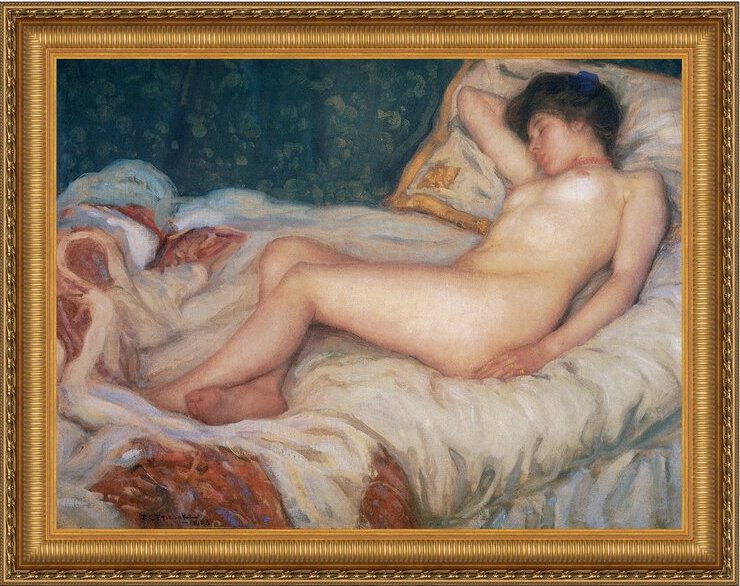
Sleep by Frederick Frieseke (1903)

Fredeick Frieseke also engaged the services of a Parisian model, Jeanne Blazy, someone who had worked with the leading artists at the time.  For Frederick she was not just his model, she was also a great help to him taking over some of his domestic chores.  In a letter to Sadie Byers dated March 27th 1904, he wrote:

“…I’ve had a nice model. She’s as useful as anything in other things besides posing. Brings my things for luncheon and cooks them before she leaves, hunts up anything I wish and is always cheerful. Always late but works on as long as I wish. She has posed for Whistler and lots of the big men. Posed for MacMonnies’ statue in the Luxembourg…”

See the source image
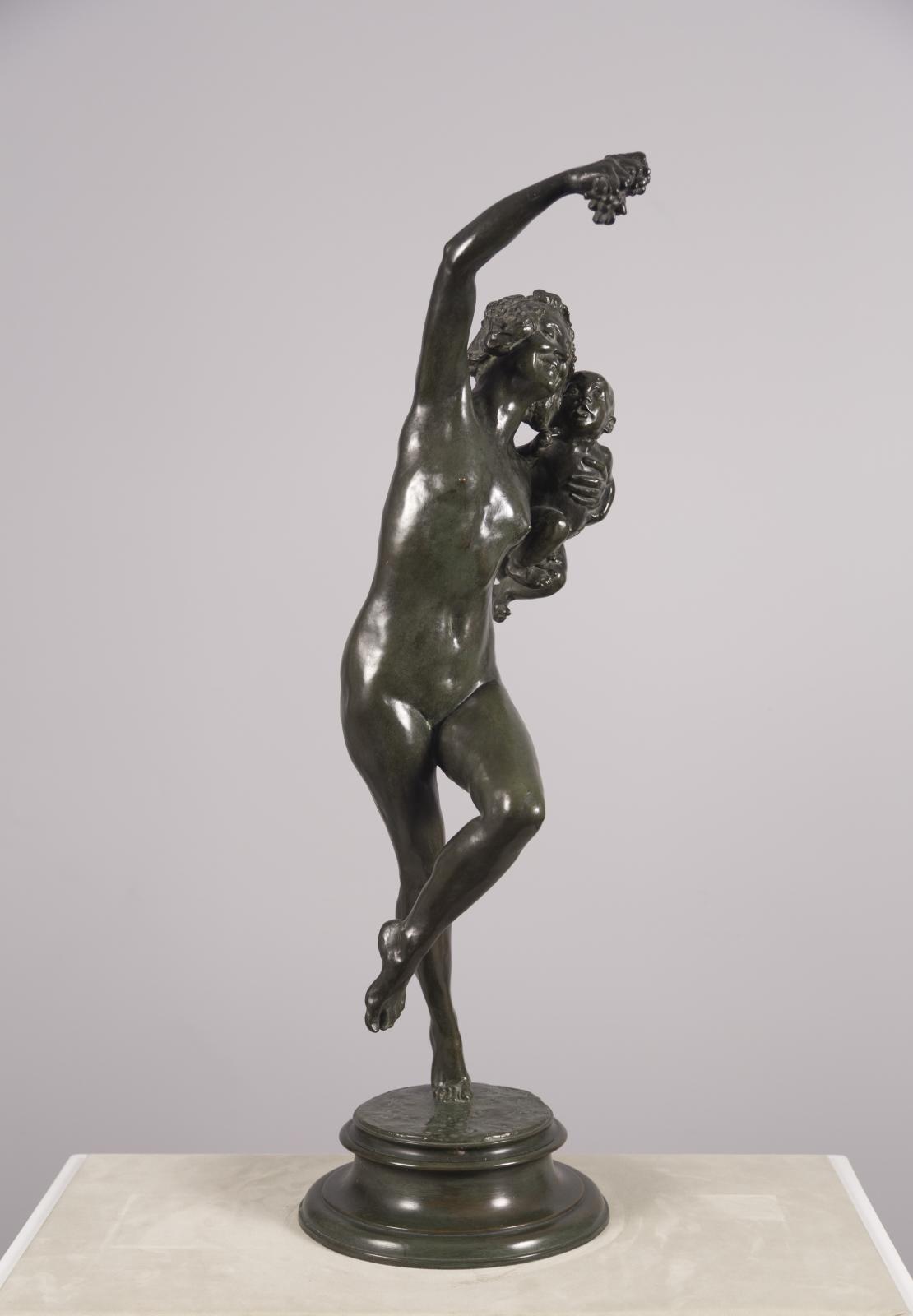
Bacchante with Infant Faun by Frederick McMonnies

The bronze statue he wrote about was Bacchante with Infant Faun by the American sculptor William Frederick McMonnies’ 1894 work and it was Blazy’s talent of standing on one foot for a long time while balancing an infant on her arm, as she apparently did for MacMonnies’s Bacchante with Infant Faun.  It was exhibited at the 1893 Salon of the Societe Nationale des Beaux-Arts and later purchased for the Luxembourg Museum.  Frederick used Jeanne Blazy for his 1903 painting entitled Sleep.

Sadie O’Bryan and her family returned to Paris in October 1903 and took a small apartment at 206, boulevard Raspail.  Just around the corner was the Dome, the cafe-restaurant where the American artists were often to be found and Frederick lived a short ten- minute walk away.  Sadie’s father, Judge O’Bryan died suddenly on March 1st, 1904, following an operation for appendicitis. This meant that the family had to make a hasty return to America.  Frederick had been with the family around the time of Sadie’s father’s death and decided to return to America with them.  The family and Frederick left France on March 5th 1904 on the SS. Saint Paul and arrived in New York on March 13th and then travelled to Pittsburgh.

Frederick and Sadie were now apart once again.  She in Pittsburgh with her family and he in New Jersey.  They kept on with their correspondence and in one poignant letter he tried to console her.  He wrote:

“…Yesterday morning I went to see Foote, and he was surprised enough to see me. Got me onto the floor and jumped on my—what one should keep covered—and we had a nice day together. It was horribly hard for me to leave you the other night. And when I came back for my umbrella and found you crying —dear me—I most disgraced us all by putting my arms around you. Dearie, the first days of your getting home are going to be hard ones for you all…”

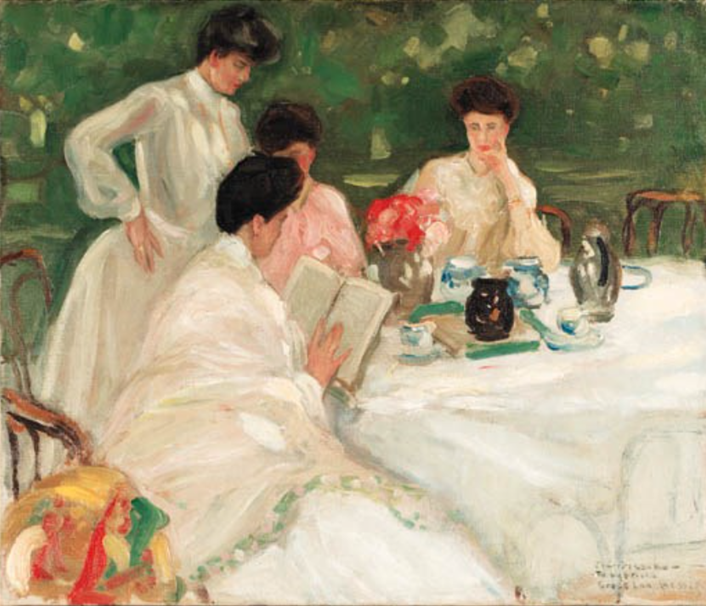
Le Thé au Jardin by Frederick Frieseke (1904)

Frederick Frieseke had associated with a group of Americans artists and their partners, including the Clarks, who frequented the residence of Grace Lee Hess, at her house in Moret-sur-Loing, some fifty kilometres southeast of Paris, beyond Barbizon and Fontainebleau.  It was here that Frederick and his friends celebrated the Fourth of July, and it was also here that Frederick executed his first large figure painting done plein air, Le Thé au Jardin (Tea in the Garden), featuring Grace Lee Hess and friends. This is a classic work in the Impressionist manner and a magnificent example of Frederick Carl Frieseke’s early style. His paintings completed between 1904 and 1919 epitomise his ambitious and important ventures into the world of Impressionism.  It was the first true en plein air work that Frieseke painted and Le Thé au Jardin marks the most noteworthy turning point in the artist’s career.

Frieseke had not only had Grace Lee Hess model for his large painting, Le Thé au Jardin but had also completed a portrait of her.  Their relationship blossomed and may have given Hess thoughts of romance but Frederick, and even though he liked to be spoiled by Hess, was wary of this turn of events.  It all came to a bitter end when Frederick announced his engagement to Sadie and in a letter to his betrothed, he talked about his rift with Grace Lee Hess:

“…It’s all over between Miss Hess and myself. She refuses to see me and insists that I’ve not acted honorably etc., which is very much too bad. And I’m sorry to lose her friendship but, well, I love Sadie very much and she loves me and while she may not be so keen at discovering my faults and correcting them—yet I think for that reason we will get along beautifully . . . and not quarrel as was the habit of Miss H and myself. At least I corrected the offenses and she did the quarrelling…”

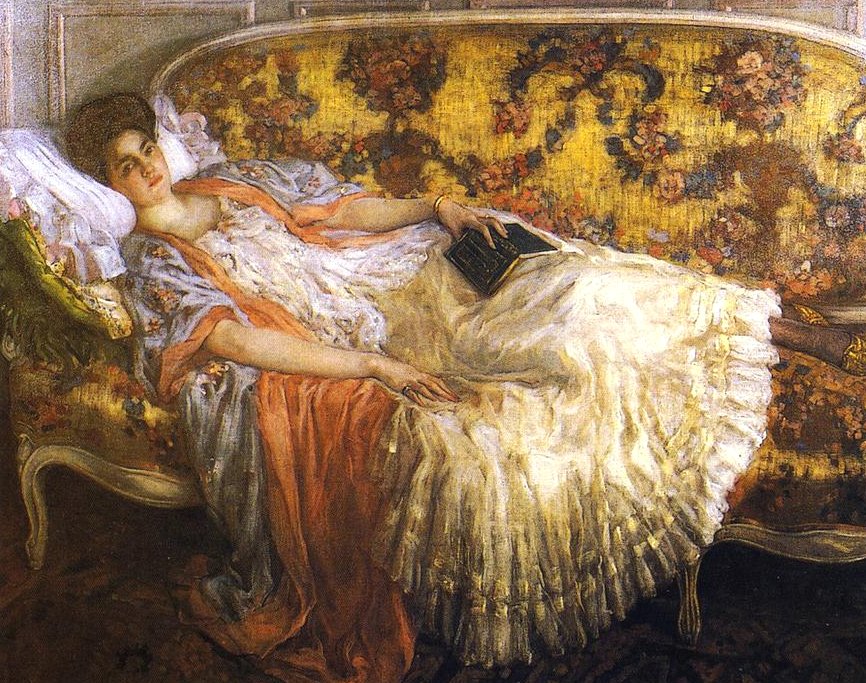
Rest (Femme au Sofa) by Frederick Frieseke (1906)

Frederick Frieseke and Sadie O’Bryan were finally married on June 27th 1905.  In 1906 Frieseke completed a formal wedding portrait of his wife entitled Rest (Femme au sofa).  This work, which appeared at the Salon that year, marked a new direction of Frieseke’s work. It was the start of what was to be many of his domestic depictions that would occupy him for the rest of his life – the embellishment of his intimate relationship he had with his wife and family.

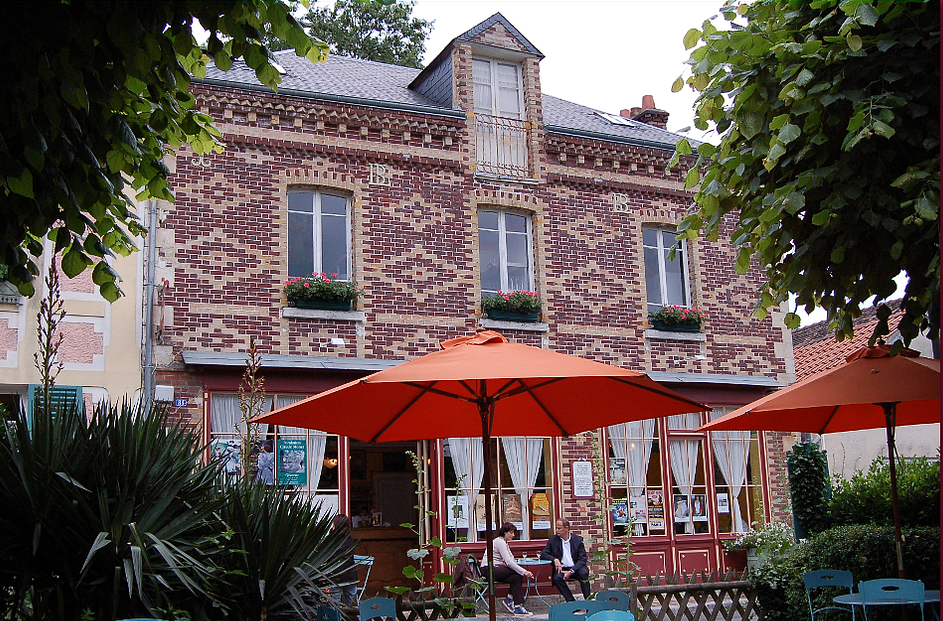
Hotel Baudy (now a restaurant)

Beginning in 1906 they began to escape the cold smoky atmosphere of Paris and spend the warmer months in Giverny, which at the time was a small rural village fifty miles west of Paris on the right bank of the Seine as it runs towards the sea.  At the time it was a well-established art colony which was popular with American artists who had crossed the Atlantic to further their artistic experience.  It was not just a community that solely painted.  It was a group of like-minded people who enjoyed socialising.  The men would take time off to fish. There was also numerous evenings where they would listen to or play music.  Days were often spent playing tennis at the courts of the nearby Hotel Baudy.  Models were brought in from Paris and posed nude in the protected gardens. Often the artists would pose for each other.  The Friesekes would often take tea with the Monets, who were neighbours and Monet and Sadie, who both loved gardening would spend hours deliberating on the proposed expansion of Monet’s garden, and the new bridge from which his water lily garden could be enjoyed.

…………………………………….to be continued.

Hilda Rix Nicholas. Part 1.

                          Hilda Rix Nicholas (circa 1910)

The other day, I was looking through a list of famous nineteenth and twentieth Australian artists.  The compiler of the list believed that the greatestAustralian painters were Sidney Nolan, Peter Booth, Arthur Boyd, John Brack, Tom Roberts, Russel Drysdale, Frederick McCubbin, and John Olsen. I had heard of a number of these but what surprised me about the list was that it contained no female artists and so I decided to focus this blog on one such painter.

                                   Henry Finch Rix

Emily Hilda Rix Nicholas was born on September 1st 1884, in the Australian city of Ballarat, some twenty-five miles north west of Melbourne.  Her father, Henry Finch Rix was born in Woolwich, Kent on January 12th  1848, and her mother, Elizabeth Sutton, was born in Manchester, England in 1853.  They had both emigrated as children with their families in the middle of the nineteenth century and the pair met and married in 1876. The couple had their first child, Elsie Bertha in 1877 and Hilda was born seven years later.  Henry Rix was a mathematics teacher, an amateur poet and talented sportsman.  He was a teacher at Bendigo, Ballarat and at Carlton. After a brief stint teaching in Ballarat, he was a mathematics master at Wesley College Melbourne for ten years between 1874 and 1884. He played for Carlton’s Australian Rules team and later became Inspector of Schools.  In the book, A History of State Education in Victoria, Henry Rix was described as:

“…Of the men who have labored and passed away since 1900, Mr. H. F. Rix deserves to be especially remembered. Working under the result system, he foresaw the new day and strove to make it possible. His enthusiasm, his industry, his initiative, his research, and his sympathy made him a great inspector and a leader in educational reforms…”

Henry’s wife, Elizabeth, as well as being an accomplished singer, helped run a successful music business in Ballarat.  She played an active part in the Austral Salon, a non-profit organization founded by a small group of women journalists in Melbourne in 1890 as a club for women writers. It then developed into a club whose aim was to introduce aspiring young musicians to an interested audience.  She was also a talented amateur painter and had her own studio in Melbourne’s Flinders Street.  Hilda and her sister Elsie being brought up in a musical household both learnt musical instruments and would perform at local shows.  Elsie, like her mother, had a beautiful voice and performed at the Austral Salon.  Hilda, as a small child, developed a love of drawing and painting and she and her sister would often design advertising posters for events at the Austral Salon.

                      Frederick McCubbin -Self-portrait, (1886)

Hilda attended Merton Hall High School, now Melbourne Girls Grammar School and although she was not an exceptional student she did excel in art under the tutelage of a Mr Mather. On leaving Merton Hall in 1902, eighteen-year-old Hilda enrolled on a three-year course at the National Gallery of Victoria Art School where one of her teachers was the foremost Australian Impressionist, Frederick McCubbin.  Notwithstanding his standing in the art world, Hilda was critical of McCubban’s teaching style which she referred to as being “vague persuasions”.  However her biographer John Pigot, in his 2000 book, Hilda Rix Nicholas: Her Life and Art, writes that the creativity of individuals rather than imitating the style of any one school of painting; he (McCubban) modelled the importance of nationalistic ideas and subjects that would become so prominent in her later painting and McCubban’s work emphasised the painting’s subject over technical considerations.

                                                 An early sketch by Rix Nichols

Hilda Rix’s work was so good that, although still a student, she had some of her drawings shown at annual exhibitions at the Victorian Artists’ Society and the Austral Salon.   To earn herself some money she worked as a professional illustrator submitting her work for inclusion in textbooks and periodicals.  Hilda was always with pencil and sketch pad and in her early days would persuade extended family members to sit for her whilst she sketched their portraits.  Studies in two sketchbooks from her early years in Melbourne are now held at the National Library of Australia and in 2012 one of Rix’s early sketchbooks survives and pages from it were reproduced in Karen Johnson’s book, In Search of Beauty: Hilda Rix Nicholas’ Sketchbook Art

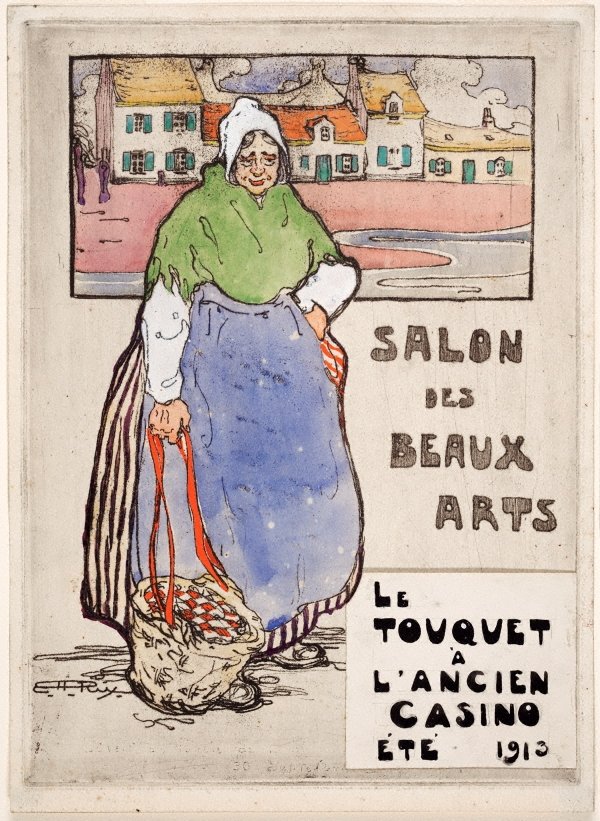
                                         Poster for the Salon des Beaux Arts (1913) by Hilda Rix

For most would-be artists who lived away from Europe such as Americans and Australians the Holy Grail was to visit and study art in Paris and London.  Hilda’s father Henry decided to offer her a chance to sample the European art world and, in 1906, planned a family trip to England which, being as he was an educator, would also afford him the opportunity to study British education reforms.  All his plans came to nought as Henry died that year, on February 27th aged just fifty-eight.  His death at such a relatively young age precluded his widow from receiving a pension.  After many discussions the family managed to cobble together money from an inheritance, money earnt from their rental income from their home, and finally money Hilda and her mother raised by selling off their many works of art and  they were able to set sail for England early in 1907.

                             John Hassall in his studio, 1909

For Hilda, going to Europe to study art was only part of the solution to her improving her artistic skills, she needed to find a good teacher who was willing to tutor her.  Before she left Australia, she spoke to Arthur Streeton, the Australian landscape painter who was the leading member of the Heidelberg School, which was also referred to as Australian Impressionism.  He suggested that on arrival in London she contacted John Hassall, an English illustrator, who, in 1901, had opened his own New Art School and School of Poster Design in Kensington.  When Hassall looked at Hilda’s work he was impressed by its quality and agreed to mentor her.  She remained with him until the end of 1907 at which time, she, her mother and sister left England and travelled to Paris and rented an apartment in Montparnasse

                                                                 The Ferry by Emanuel Phillips Fox

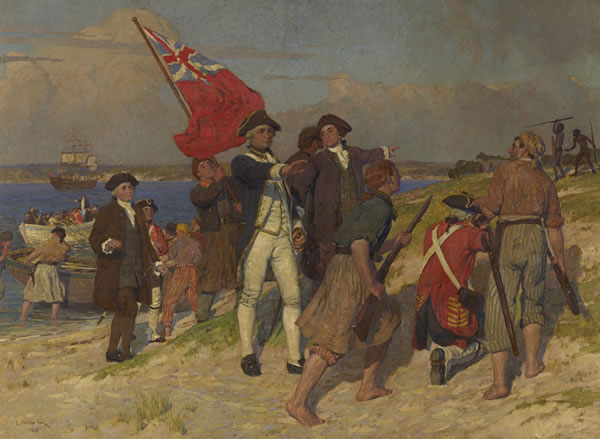
In Paris Hilda made many friends who were involved in the art world, such as fellow Australian, Emanuel Phillips Fox.  Fox had arrived in Paris in 1896 and enrolled at the Académie Julian, where he gained first prize in his year for design.  The following year he trained at the École des Beaux-Arts where two of his tutors were William-Adolphe Bouguereau and Jean-Léon Gérôme, who were considered the greatest artists of their time. He returned to Australia in 1890 but returned to London after receiving a commission to paint a scene of the landing of Captain Cook in Australia, which had the strange caveat that he must paint the work abroad.

               The Landing of Captain Cook at Botany Bay 1770 (1902) by Emanuel Phillips Fox

The 1902  painting, The Landing of Captain Cook at Botany Bay, 1770,  depicts a wholly European perspective on the inauguration of relations between the British visitors and the local Aboriginal men of Botany Bay. In a post-Federation display of nationalistic projection, it shows Captain Cook stepping onto Australian land as part of a shore party, heroically interceding between the threatening local men who brandish spears and his own marines who aim to shoot them. 

                      Portrait of Ethel Carrick, c.1912. 

Hilda Rix also met Fox’s wife, Ethel, an English-born Impressionist and Post-Impressionist painter.

In Paris Hilda enrolled at the Académie Delécluse, operated by academic painter Auguste Joseph Delécluse.  It was an atelier-style art school which was very supportive of women artists, and, in fact, it allotted more space to women students than to men.  Men and women were trained separately, and it had two studios for women and only one for men.  It was an extremely popular place to learn, especially among English and American women artists. At the height of its popularity, it was one of the four best-known ateliers in Paris.  From this artistic establishment, Hilda moved to the Académie de la Grande Chaumière, where one of teachers was the Swiss-born illustrator Théophile Steinlen.  She also studied at Académie Colarossi. It was around this time that Henri Matisse had a studio in the French capital and, as was the case with other professional artists, he also sometimes attended Colarossi’s to gain access to their models which he could use, free of charge, for his work.  Matisse would also open the door of his studio to aspiring artists whom he would offer tuition and have them experiment with the techniques of Post Impressionism.  It could well be that this is where Hilda first met Matisse.

Retour de la chasse by Hilda Rix Nicholas, (1911)

Whilst living in Paris, the family would travel to Italy and other parts of France including Étaples, the fishing port in the Pas-de-Calais department in northern France which was so popular with artists.  In 1909 Hilda Rix met and became very friendly with a Dutch architecture student Wim Brat.  Their initial love ended when Hilda realised how her fiancé was a “mother’s boy” and was completely dominated by her, a woman who strongly disapproved of Hilda.  Inevitably, Hilda broke off the engagement.  Notwithstanding this personal setback, Hilda continued with her painting and exhibited her work at the 1911 Paris Salon.  The painting, Return of the Hunt, was completed by Hilda in 1911 and depicts a woman on horseback in chocolate brown leather gloves with a large hare slung over her back.

                                                                     Three friends by Hilda Rix (1912)

Hilda Rix, accompanied by her sister and mother, took up residence in the rural art colony of Étaples the summer of 1910.  Here she met Henry Ossawa Tanner, a well-established American artist in France, who was viewed as one of the leaders of the Étaples artists’ colony and a member of the art organization, the Société Artistique de Picardie.  It was not just France and Italy which seduced artists, many started to cross the Mediterranean to paint and sketch in North Africa.  Hilda Rix made two painting trips to the African continent.   The first was in January 1912 when she travelled with a group of artists, including Henry Ossawa Tanner, and his wife, who were visiting Morocco via Madrid, Cordoba, and finally Algeciras, they had hoped to take a boat to Tangiers but the weather was too bad, which forced the travellers to Gibraltar for what proved a rough crossing to the Moroccan port.

Morocco, marketplace with pile of oranges by Hilda Rix painted during one of her two trips to Tangier

Tanner being an African American and Rix being a female made them unconventional and exceptional travel and work companions on this journey.  They stayed in Tangier and the northern port town of Tétouan.  Matisse and Hilda Rix stayed in the Grand Hôtel Villa de France for most of February and March. They both painted views from the windows of their rooms at the hotel.   Both of them worked on portraits and would use the same models and utilised an unused room in the hotel which the owner allocated to them.  The room became a temporary studio space. 

                                                          Hamido sleeps by Hilda Rix Nicholas (1914)

An example of the similar portraiture was Hilda’s painting, Hamido Sleeps and Matisse’s work, Moroccan Amido.  In both cases the young model was a stable-hand at their Tangiers hotel.

Moroccan Amido by Matisse (1912)

In Matisse’s painting the young man stands easily and naturally, his slim long-legged form is emphasised by the narrow canvas format the artist has used.  In the painting, Matisse captures the dark skin, the bright white shirt, the pure colours of the waistcoat and short trousers.

                                               Through the arch to the sea by Hilda Rix Nichols (1914)

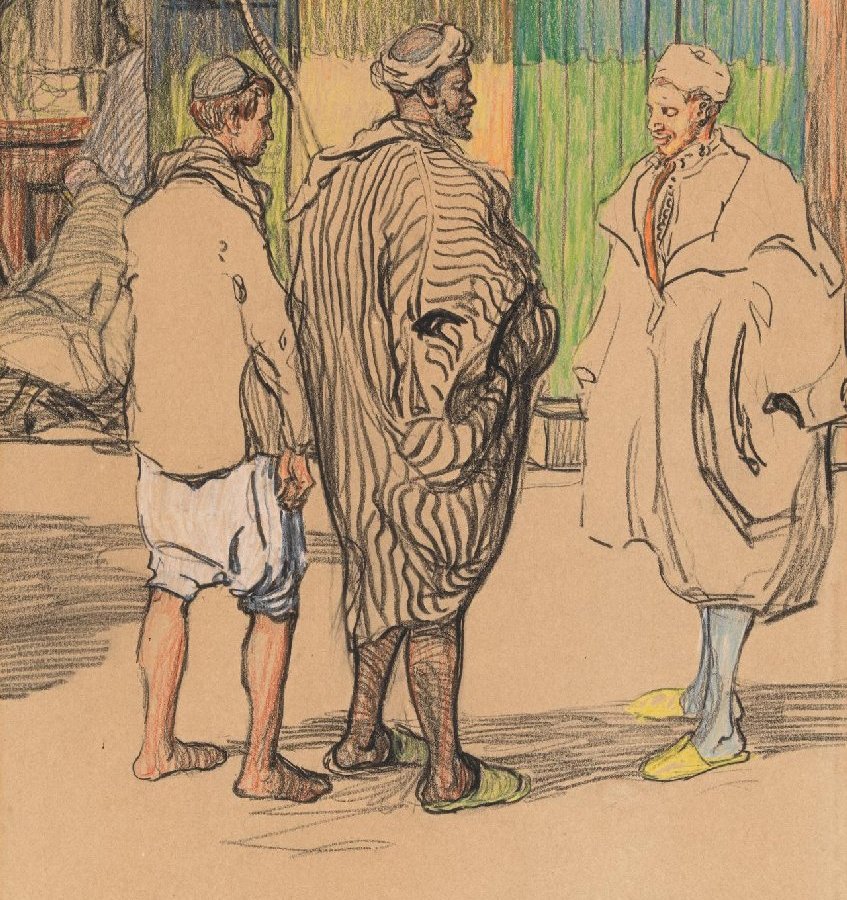
Hilda loved Tangier and spent hours sketching and painting in the open-air markets.  She wrote home about how she loved Tangier and its market, writing:

“…Picture me in this market-place – I spend nearly every day there for it fascinates me completely – have done 16 drawings and two oil things so far – Am feeling thoroughly at home now so am going to take out my big oil box – wanted to get used to people and things first – Oh how I do love it all! … Oh the sun is shining I must out to work…”

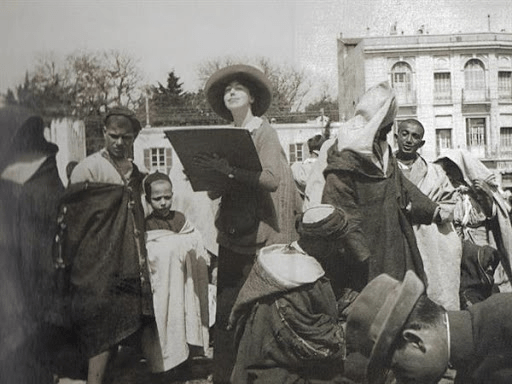
                                       Hilda Rix painting in Moroccan marketplace

Hilda Rix was fascinated by the buying and selling in the marketplace as well as the multitude of colours of the clothes worn by the people.  In a letter home, dated February 12th 1912, she wrote:

“…”See how most of them are covering their faces – They have mostly cream draperies & perhaps orange waistcoats and little tight mauve green trousers – (tight at ankle) – Some may be wonderfully dressed under[neath]…”.

In a postcard she sent home a week later she wrote:

“…’Picture me in this market-place – I spend nearly every day there for it fascinates me absolutely – Have done 16 drawings and two oil things so far – Am feeling thoroughly at home now so am going to take out my big oil box – wanted to get used to people and things first – Oh I do love it all! …”

…………………..to be continued.

Frederick Childe Hassam – The American Impressionist.

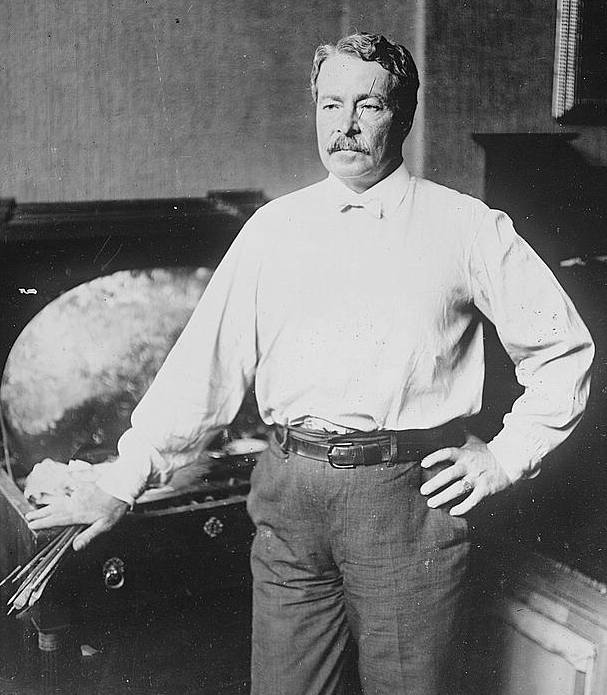
Frederick Childe Hassam

Today I am looking at the life of the nineteenth century American painter, and an important illustrator during the “golden age” of American illustration in the 1880s and 1890s.  He was a leading American Impressionist, although he baulked at that “title”.   Let me introduce you to Frederick Childe Hassam.

Self portrait

Frederick Childe Hassam was born on October 17th 1859 in the family home on Olney Street on Meeting House Hill, Dorchester, the upper middle-class suburb of Boston.  He was the son of Frederick Fitch Hassam and Rosa Delia Hassam (née Hawthorne) who hailed from Maine.  His father, a Boston merchant and hardware store owner, collected Americana well before this hobby became a popular pastime and he passed this interest in history along to his son.  Hassam was educated at Dorchester’s Meeting House Hill School and Dorchester High School, where he studied French, German, Latin and Greek while playing several sports.  Childe had his first lessons in drawing and watercolour whilst a pupil at the Mather public school in Dorchester, although his parents showed little interest in his art.

The Evening Star, by Childe Hassam, pastel on tan paper, (1891)

The family’s fortunes changed dramatically on November 9th 1872 with the sudden outbreak of fire in the basement of a commercial warehouse in the city.  The fire burnt for twelve hours and in that time had destroyed 65 acres of Boston’s downtown, 776 buildings and much of the financial district, including Childe Hassam’s father’s business.  For financial reasons, Childe had to drop out of high school without qualifying, and get a job, so as to help his family in their time of dwindling finances.  His father arranged for his son to work in the accounting department of publisher Little Brown & Company, but his lack of ability to work with figures soon ended that career.  Childe had talked to his parents about his love of painting and sketching and eventually persuaded his father to allow him to take up an artistic career.   Childe Hassam managed to secure a position as an apprentice wood engraver with George Johnson.  In a short time, Childe had proved himself to be an accomplished draughtsman producing designs for commercial engravings such as images for letterheads and newspapers.

A Back Road, by Childe Hassam, (1884)

It was around 1879 that Hassam began painting in oil but his favourite medium was watercolours.  Childe Hassam’s initial formal art studies began in 1878 when he joined the Boston Art Club.  The institution was founded in 1854 by local artists in order to instigate a democratic organization where there would be a collaboration in the promotion, selling and education of art.  From there he enrolled at the Lowell Institute in Boston which ran classes in freehand practical design.

Old House, Nantucket by Childe Hassam (1882)

In 1882, Childe Hassam took part in his first public group exhibition at the Boston Art Club.  Other artists at the Boston Art Club, at that time were nationally prominent painters such as William Merritt Chase, Robert Henri, Winslow Homer, Maurice Prendergast, and John Singer Sargent.  Following his success at this exhibition Childe Hassam submitted some of his watercolour paintings for his first solo exhibition held at the William & Everett Gallery in Boston.

Childe Hassam illustration for St Nicholas Children’s magazine

In 1882, Hassam became a freelance illustrator and founded his first studio. His illustration forte was his illustration of children’s stories for magazines such as Harper’s Weekly, Scribner’s Monthly magazine, and The Century. He continued to develop his technique while he attended the drawing classes at the Lowell Institute, which was a division of MIT, and at the Boston Art Club, where he took life painting classes. 

New signature

The following year, his friend Celia Thaxter convinced him to drop his first name, Frederick, and thereafter he was known simply as “Childe Hassam”. He also began to add a crescent symbol in front of his signature.

Gate of the Alhambra by Childe Hassam (1883)

Because of his formal art training was limited he was advised that he should travel to Europe and enhance his artistic knowledge.  The advice came from fellow Boston Art Club member, Edmund Henry Garrett, an American illustrator, bookplate-maker, and author as well as a highly respected painter, who was renowned for his illustrations of the legends of King Arthur.  Garrett persuaded Hassam to accompany him to Europe in the summer of 1883.  The two travelled extensively through Great Britain, The Netherlands, France, Italy, Switzerland, and Spain and during their journey they would study the Old Masters at various museums and create watercolours of the various European landscapes.  While in Paris he was very much influenced by the painterly brushstrokes and pure colours of the Impressionists and it was noticeable that around this time his palette brightened and he discovered a love for depicting city subjects which would stay with him all his life.  In all, Childe Hassam completed sixty-seven watercolours and these were exhibited at his second one-man exhibition in 1884.

Maude Sewing by Childe Hassam (1883)

After a long courtship, Hassam married Montreal-born Kathleen Maude Doan in February 1884 and during their lifetime together, she organised the Hassam household, arranged all her husband’s travel itineraries and looked after the other domestic tasks. She featured in a number of his paintings including his 1888 work, Geraniums, which he presented at the Salon exhibition that year.

Paris Scene by Childe Hassam (1887)

During the early 1880s, the couple lived in Boston, and Hassam became one of a small number of American artists to paint watercolours of urban street scenes.  Although he believed that his paintings had improved, he decided to return to Paris and seek further artistic tuition.  In 1886 he and Maud arrived at the French capital for the start of their three year stay and Hassam attended classes at the Académie Julian, where he studied under the influential instructors Gustave Boulanger and Jules-Joseph Lefebvre.   To make ends meet Hassam would send his oil and watercolour painting back to Boston to be sold.  The money he received for them was enough for he and Maud to afford to stay in Paris. During his time in Europe, he continued to prefer mundane street and horse scenes, shunning some of the other depictions favoured by the Impressionists, such as opera, cabaret, theatre, and boating. 

Le Jour de Grand Prix Day by Childe Hassam (1887)

In 1887 he completed his painting Le Jour de Grand Prix Day which now hangs in the Museum of Fine Arts, Boston.  Whereas he normally painted using a darker more tonal palette, in this work he used light colours to encapsulate the impression of a bright sunny day.  The setting was the journey to Longchamp in the Bois de Boulogne and the Grand Prix de Paris horse race which was held annually in June at the Longchamp track.  The affluent racegoers bedecked in their finery can be seen riding atop the horse-driven coaches which travel along the tree-lined avenue Bois de Boulogne, which is now Avenue Foch.  In the top left of the painting we catch a glimpse of Arc de Triomphe.  A slightly larger version of the painting, which is in the New Britain Museum of American Art collection, was exhibited at the Paris Salon of 1888.  Of the painting Childe Hassam said;

“…I am painting sunlight. . . a ‘four in hand’ and the crowds of fiacres filled with the well-dressed women who go to the ‘Grand Prix…”

Geraniums by Childe Hassam (1888)

He also liked to paint garden and “flower girl” scenes, some of which included a depiction of his wife, Maude, an example of which is his 1889 painting entitled Geraniums which he presented at the Salon exhibition that year. During his three-year stay in the French capital he managed to exhibit at all three Salon exhibitions.

Fifth Avenue Winter by Childe Hassam (1915)

The couple returned to America in 1889 and went to live in a New York City studio apartment a studio apartment at Fifth Avenue and Seventeenth Street.  Hassam began making paintings and etchings of New York city. Hassam saw the city as a place of similar beauty and excitement to Paris especially in the fashionable neighbourhoods along Fifth Avenue and at Washington Square.  It was from this apartment window that Hassam painted the view outside.  His 1915 painting entitled Fifth Avenue Winter depicts the bustling Manhattan thoroughfare which was quickly becoming a popular shopping district around the time he made this work. His composition features flecks of colour and blurred forms to depict reflected light and rapid movement. The accelerated pace of modern city life is evoked by the depiction of the street full of streaming traffic, including two green double-decker buses at lower right.  The fashionable street was the route taken at that time by horse-drawn carriages and trolley buses. It was one of his favourite paintings and he exhibited it several times. The work now hangs in the Cleveland Museum of Art.

Fifth Avenue in Winter by Childe Hassam (c.1892)

Around 1892, Hassam painted a view of the busy thoroughfare in Winter.  The work entitled Fifth Avenue in Winter now hangs at Pittsburgh’s Carnegie Museum of Art

End of the Trolley Line, Oak Park, Illinois by Frederick Childe Hassam (c 1893),

Childe Hassam and his wife lived in New York for the rest of their lives.  He would work on his illustrations in his studio and when, weather permitting, he would go out and paint landscapes en plein air.  Not long after settling in the city, Childe Hassam became involved in the setting up of The New York Watercolour Club in 1890 and became its first president.  The organisation, unlike the American Watercolor Society, accepted both men and women into its ranks and the Club’s first exhibition was held that year.  The organisation’s exhibitions were jury-selected affairs and thus the standard of the works on show was much higher than other artistic societies.  The New York Watercolor Club’s exhibitions were held in the building which was constructed as the result of the founding of the American Fine Arts Society at 215 West 57th Street in 1889. Other art organizations headquartered in the building were the American Federation of Arts, American Watercolor Society, Artists’ Aid Society, Mural Painters, and the Art Students League of New York. Its galleries also held National Academy of Design, Architectural exhibitions.

Washington Arch, Spring by Childe Hassam. (1893)

Hassam’s painting Washington Arch, Spring which he completed in 1893 is an example of why he was termed an Impressionist and also highlights his love of cityscapes and ones which depict the hustle and bustle of life on  the tree-lined avenue settings which were often seen in French Impressionist paintings.  The marble Roman triumphal arch is situated in Washington Square Park, in the Greenwich Village neighbourhood of Lower Manhattan, New York City.  The depiction of the Stanford White designed arch reminded Hassam’s of the Arc de Triomphe in Paris. Hassam lived just north of the Square, and so he was able to watch the various stages of its construction, transitioning from first a temporary wood and plaster structure, to the eventual beautiful marble structure which was completed in 1892. The depiction is unusual in a way as the Arch which is at the end of Fifth Avenue is partially blocked by trees.  In the work, Hassam included several pedestrians along with a street cleaner and a horse-drawn carriage.

Celia Thaxter’s Garden, Isles of Shoals, Maine by Childe Hassam (1890)

At the beginning of the 1890’s Childe Hassam focused a number of his paintings with floral depictions and many were set in the gardens of his friend, the New England poet, Celia Laighton Thaxter who lived with her father at his Appledore Hotel on the Isles of Shoals, a group of small islands and tidal ledges situated approximately 6 miles off the east coast of the United States, straddling the border of the states of Maine and New Hampshire.  He painted images from Appledore Island.  He said that he found the rocks and the sea are the few things that do not change and that they are wonderfully beautiful.

Coast Scene, Isles of Shoals by Childe Hassam (1901)

Among them is the 1901 view Coast Scene, Isles of Shoals, the first painting by Childe Hassam to enter the collection of the Metropolitan Museum.  The oil painting is done in luminous colours, and depicts the remote Isles of Shoals off the rocky shoreline of New England, which was a favourite haunt of Childe Hassam at the end of the 19th century and where he painted a series of similar coastal scenes.  Childe Hassam liked to journey out of the city and he loved to visit places such as Newport, Portsmouth, Old Lyme, Gloucester, and other New England and this urge to free himself from the bustling city made him decide to buy a summer residence.

Old House, East Hampton, L.I. by Childe Hassam (1919)

Childe and Maude Hassam first visited East Hampton in 1898 at the invitation of his friend and fellow artist Gaines Ruger Donoho. During the next two decades the couple returned to Long Island during the spring and autumn as the guest of New York businessman Henry Pomroy. In 1919, Hassam and his wife Maude purchased Willow Bend, an eighteenth-century shingled cottage at 48 Egypt Lane. The house was sold to the Hassams by Donoho’s widow who lived next door. Childe Hassam moved into “Willow Bend” in May of 1920 and remained in the house until that October. This became their annual routine which they would maintain for the rest of his life.  While in East Hampton, Hassam sought inspiration from his surroundings and found beauty in the local architecture, the uneven coastline, and the wild landscape of eastern Long Island. During his six month stays in East Hampton, Hassam produced a series of works that focused on his home and its surrounding landscape.  Though Hassam rejected being associated with French Impressionists, there is an obvious influence seen in his painting Old House, East Hampton, a typical East Hampton clapboard home, with its rich colours and quick brushstrokes.

Just Off the Avenue Fifty Third Street, May 1916 by Childe Hassam (1916)

Hassam’s interest in flag subjects dates back to his time spent in Paris from 1886 to 1889. Inspired by the flags and banners displayed on Bastille Day in the area where he lived.   Just Off the Avenue, Fifty-third Street, May 1916 is the first work in the flag series that Hassam painted during the First World War. The sun-dappled street, trees and façades of the grand brownstones are painted in a vibrant palette characteristic of Hassam’s technique at the height of his abilities. In the work. We see a refined residential street in New York, a favoured subject of the artist.  Hassam depicts decorations for the patriotic parade that took place along Fifth Avenue and he has immersed the viewer in an atmosphere of nationalistic pride.

Allies Day, May by Childe Hassam (1917)

During the First World War Childe Hassam created his famous images of flags of the United States and its allies which some scholars have characterized as Hassam’s contribution to the war effort.  One such painting was his 1917 work entitled Allies Day, May.

October Sundown, Newport by Childe Hassam (1901)

In 1920 Hassam received what he deemed to be the greatest honour of his career when he was elected to The American Academy of Arts and Letters.  The Academy is an honour society of the country’s 250 leading architects, artists, composers, and writers. Each year it elects new members as vacancies occur.  When Childe Hassam died, he bequeathed several hundred artworks to the Academy.

Frederick Childe Hassam died in East Hampton, Long Island on August 27th 1935, aged 75.  His wife Maude passed away eleven years later on October 13th 1946.  She was 84.  

Alfred Sisley. Part 3 – the latter years.

1882 photograph of Alfred Sisley

Alfred Sisley returned to France late on October 18th, 1874 after his four-month summer holiday spent in London. Sisley had been living in the town of Louveciennes since 1872 but in the winter of that year, Sisley and his family moved to 2 avenue de l’Abreuvoir in Marly-le-Roi, a commune in the Île-de-France region, in north-central France, located in the western suburbs of Paris, 18 kilometres from the centre of Paris.

The Church at Noisy-le-Roi: Autumn by-Alfred Sisley (1874).

Many art historians believe that during the time Sisley lived in Marly-le-Roi between 1875 and 1880, he produced his finest works.  In the late autumn of 1874 Sisley completed a work featuring the town of Noisy-le-Roi which lay about 4 kilometres south-west of Marly-le-Roi. It was entitled The Church at Noisy-le-Roi: Autumn. In some ways, it is an unusually constructed work. The subject of the painting, the church has been placed in the mid-ground and there is no visual access to it from the foreground. Our view towards it through the foreground landscape is restricted by the fence line and a number of squat trees. The painting was exhibited at the Hôtel Drouot in Paris on 24 March 1875 along with works by Renoir, Monet, and Morisot. It was purchased by Paul Durand Ruel and submitted to the Salon jurists in 1876 but was turned down. The painting was sold on a number of occasions including an 8500 francs sale to Baron Henri de Rothschild in 1899. It was later bought by Sir William Burrell, a Scottish shipping merchant and philanthropist, who in 1944 gave it to the City of Glasgow Corporation. The one proviso was that this work and the whole of his collection was to be housed in a building far enough from the city centre so that the works could be shown to their greatest advantage, and to avoid the damaging effects of air pollution at the time.

The Burrell Collection at Pollok Park, Glasgow

It took the trustees more than 20 years trying to find a suitable resting place for Burrell’s collection, one which met all the criteria set out in the Trust Deed. A venue was finally found in 1967 when the Pollok Estate was given to the city of Glasgow. The Trustees also had to waive certain terms of the deed which allowed the current site, in Pollok Park to be used. The park was only three miles from the city centre but within the city boundaries.  

La barque pendant l’inondation by Alfred Sisley (1876)

In December 1872 Sisley had painted four pictures showing floods at Port-Marly. In 1876 there was another flood and Sisley executed seven paintings as documentary evidence of its different stages, from the first rise in water level to the return of the river to its normal course. Being well settled in Marly-le-Roi, Sisley was there to witness the great floods of 1876. In March that year, the Seine burst its banks and flooded many of the riverside villages and towns including the neighbouring village of Port-Marly. In his 1876 painting, La barque pendant l’inondation (Boat in the Flood) he depicts a wine merchant’s house, À St Nicolas, which almost looks like it is resting on the mirrored surface of the flood waters. The artist produced six paintings of this event. He cleverly captured the great expanse of water with moving reflections that transformed the peaceful house of a wine merchant into something mysterious and poetic. Sisley’s viewing point gave him an oblique-angled view of the scene which meant that the wine-merchant’s shop becomes the predominant feature of the work and Sisley has been able to depict architectural aspects of the building, especially the upper section. The light colour tones are offset by the black pigment used for the window openings giving a sharp contrast between light and dark. The industrialist, Ernest Hoschedé, originally owned the painting.  He was one of the first major supporter of the Impressionists’ art. His wife Alice became Monet’s second wife. A year after Hoschedé bought the painting his business collapsed and he became bankrupt. The painting was later sold by Durand-Ruel to the wealthy art collector, Comte Isaac de Camondo who had amassed a large number of works by the French Impressionists. He bequeathed this work and a number of other paintings from his collection to The Louvre in 1908, three years before his death. The painting was transferred to its current home, Musée d’Orsay, in 1986.

The Flood at Port-Marly by Alfred Sisley (1876)

The work we see above, The Flood at Port-Marly is housed in the Carmen Thyssen-Bornemisza Collection in Madrid. In the painting we see the rue de Paris in Port-Marly. On the right, behind the trees, we can see the overflowing River Seine. The sky is littered by wind-swept clouds which scurry across the sky. Sisley was able to give a marked emphasis to the movement of the clouds through the use of a low horizon line. We can see the road and how the water has flooded the pavements. The sun has reappeared and the water level is starting to recede, which allowed Sisley to set up his easel in the middle of the street and once again return to the use of a central perspective which can be found in many of his paintings. This technique derives from the classical tradition of French landscape painting. In September 1876, shortly after Sisley had concluded his series on the floods at Port-Marly, Stéphane Mallarmé, a French poet and critic, published an article on the Impressionist artists in the London magazine The Art Monthly Review. He said of Sisley:

“…He captures the fleeting effects of light. He observes a passing cloud and seems to depict it in its flight. The crisp air goes through the canvas and the foliage stirs and shivers…”

A Street in Louveciennes by Alfred Sisley (1878)

Sisley’s relationship with the Impressionists can be gauged by a set of statistics. At the first exhibition in 1874, Sisley exhibited five paintings, in the second exhibition in 1876 he had eight paintings displayed and in the third Impressionist Exhibition seventeen of his works were displayed. He did not exhibit any of his paintings at the fourth, fifth or sixth shows. So why? It is thought that two of the reasons could have been the lack of critical acclaim and success at the first three exhibitions but maybe more importantly there was a fragile sense of unity and some tension between the painters at these joint exhibitions. The fourth, fifth and sixth exhibitions were dominated by Degas and the works on show tended to be figure painting rather than landscape painting so this could also be a reason for Sisley backing away. There were few Impressionist artists that had a foot both in the figurative and landscape camps but Pissarro was the one exception and he exhibited at all eight of the Impressionist exhibitions. Sisley was also aware that he had to sell more works and become more well known to dealers and so turned back to the Salon. In a letter to the French journalist, author, and art critic, Théodore Duret Sisley wrote:

“…I am tired of vegetating, as I have been doing for so long. The moment has come for me to make a decision. It is true our exhibitions have served to make us money and in this have been useful to me, but I believe we must not isolate ourselves too long. We are still far from the moment we shall be able to do without the prestige attached to official exhibitions. I am therefore determined to submit to the Salon…”

A Turn of the River Loing, Summer by Alfred Sisley (1896)

Following the third Impressionist exhibition Sisley tried to get his works accepted by the Paris Salon jurists but failed. In October 1878 Sisley left Marly and moved to avenue de Bellevue in Sèvres, a town in the southwestern suburbs of Paris. Sisley’s finances were deteriorating fast. His paintings only sold for small amounts. He was borrowing money so that he and his wife were able to survive and, to make things worse, some of the lenders were demanding repayment of his debts. In 1880 Sisley could no longer afford to live in Sèvres and moved his family to Moret-sur-Loing, a town south of Paris on the edge of the Forest of Fontainebleau.

A Village Street in Winter, by Alfred Sisley (1893)

Paul Durand-Ruel kept buying paintings from the Impressionists and having them exhibited at various exhibitions and then hopefully selling them on for a profit. However, around the late part of the 1870’s the sale of his paintings was much lower in comparison to the number he had purchased and so he had to source some finance to cover his future buying plans. He turned to Jules Feder, the head of the Union Générale bank in Paris and an important early collector of Impressionist art. In 1880, Feder advanced a great deal of money to Paul Durand-Ruel, enabling the dealer to resume purchasing work from the Impressionists. Immediately upon receiving Jules Feder’s support Durand-Ruel acquired thirty-six paintings from Sisley. This all changed in February 1882 when Union Générale bank collapsed which, in turn, brought about the collapse of the French Stock Exchange, and triggered a general recession, and Jules Feder, the head of the bank, was ruined and because of that Durand-Ruel had to pay the banker back all the money that he had advanced him. Durand-Ruel, with no money to buy further Impressionist paintings, resulted in an extremely uncertain few years for the artists whom Durand-Ruel had supported, particularly Sisley… For the next several years Durand-Ruel was unable to advance money to the Impressionist painters he had always generously supported, and those works he did buy were at much reduced prices and because of this, Sisley was especially hard-pressed to make ends meet.

Bords du Loing, Saint-Mammes (The River Loing at Saint-Mammes) by Alfred Sisley (1885)

Things were changing for Sisley. Paul Durand-Ruel purchased his last painting by Sisley, Saint-Mamme’s from the River Loing, for 200 francs in February 1886. The Impressionists were starting to go their own ways. Renoir and Monet had gained public recognition whereas Sisley had not. This must have hurt Sisley and according to John Rewald in his 1961 book, The History of Impressionism, Sisley had become suspicious and sulky not even seeing his old companions anymore. The French art critic of the time, Arsène Alexandre wrote:

“…he [Sisley] added to his woes by creating imaginary ones for himself. He was irritable, discontented, agitated…..He became utterly miserable and found life increasingly difficult…”

Bridge at Villeneuve la Garenne by Alfred Sisley (1872)

Whereas Monet and Pissarro came back into Paul Durand-Ruel’s fold, Sisley refused. Durand-Ruel and his sons had bounced back and in the 1890’s once again had a successful network of connections in Europe and America who bought from the company. Probably due to his state of depression, Sisley ignored the opportunity to return to Durand-Ruel and benefit from the sales of his work. It was the beginning of the end. Sisley’s wife Eugénie died of cancer in October 1898. Sisley, who was ill himself, did not attend the funeral. He had been attending a doctor for five months but in November 1898 he suffered a massive haemorrhage and his health was deteriorating rapidly. Sisley died of cancer on January 29th 1899, aged 59. Sisley was buried on February 1st 1899 at the cemetery in Moret attended by his children and fellow artists such as Monet, Renoir, and Tavernier.

Dawn by, Alfred Sisley, (1878)

Sisley had been in the process of gaining French citizenship before he died, but on his death. remained an English citizen. His son Pierre settled his estate. According to records at Dammarie-les-Lys, the regional archives for Seine-et-Marne, Sisley’s legacy to his children comprised of his wardrobe, worth 50 francs, furniture worth 950 francs and money obtained from his paintings worth 115,640 francs, making it a total of 116,640 francs, equivalent to £4,665.

The Seine at Port Marly with Piles of Sand by Alfred Sisley (1875)

I end this blog with the words of Monet who, a week before Sisley’s death, wrote about Sisley to his friend Gustave Geffroy, the French journalist, art critic, historian, and novelist:

“…Sisley is said to be extremely ill. He is truly a great artist and I believe he is as great a master as any who have ever lived. I looked at some of his works again, which have a rare breadth of vision and beauty, especially one of a flood, which is a masterpiece…”

Alfred Sisley. Part 2 – London and Paul Durand-Ruel

Alfred Sisley by Renoir (1876)

The year is 1870 and on July 19th France had declared war on Prussia. The war went badly for France and the siege of the Paris ended in an armistice on January 28th 1871. It was a crushing defeat for the French and for the Parisians three months of further violence and bloodshed was to follow from March to May of that year with the uprising known as the Paris Commune. Alfred Sisley lost everything that he owned at his apartment in Bougival. Like so many others, his house was looted and destroyed by the occupying forces. As mentioned in the previous blog, worse was to follow as in 1871 his father’s business collapsed and his father became bankrupt and later died penniless. Alfred Sisley had now to rely on the sale of is paintings for he and his family to survive. Artists needed a way to exhibit and sell their works and at one time the Paris Salon was the only and the way to do that and that depended on their work being accepted by the Salon jurists, but then came the art dealers with their private galleries and this meant the artists did not have to rely on the Salon to market their work.

Enter Paul Durand-Ruel who was to play a part in Alfred Sisley’s life in the 1870’s. Durand-Ruel was born in Paris, on October 31st, 1831, the son of shopkeepers Jean Durand and Marie Ruel. It was in their shop that they allowed famous artists to display their paintings and sketches. In the 1840’s, their shop soon became a regular rendezvous for artists and collectors alike, so much so that Jean Durand decided to turn their shop into an art gallery. Their seventeen-year-old son, Paul, joined the family business in 1848. It must have been an exciting time for the young man as he was sent all over Europe to seek out new artists and sell their paintings. In the mid-nineteenth century, his father’s gallery specialized in paintings produced by the landscape artists of the Barbizon School, such as Corot. Paul Durand-Ruel knowledge of art grew and in 1863 he was acknowledged as the firm’s resident art expert. Following the death of his father in 1865, Paul Durand-Ruel took over the business.
Photograph of  Paul Durand-Ruel’s grand salon at Rue de Rome . Paris, with ‘Dance in the City’ by Renoir

During the Franco-Prussian War Durand-Ruel left Paris and escaped to London. It was in the English capital that he met up with a number of exiled French artists including Charles-François Daubigny, Claude Monet, and Camille Pissarro. Paul set up his own London art gallery at 168 New Bond Street and in December 1870, he staged the first of ten Annual Exhibitions of the Society of French Artists.  Soon Durand-Ruel became acquainted with their works and through them met their fellow artists.

Paul Durand-Ruel by Renoir (1910)

Paul Durand-Ruel returned to Paris, and there, he secured Impressionism’s place in history through tireless promotion across Europe and the United States and enthusiastic Americans ensured its success. Durand-Ruel discovered, promoted, protected, advocated, and finally exported the work of Sisley, Renoir, Monet, Degas, and Pissarro. Of al the art dealers, he was by far the most committed to their art. He invested in it at a time when all they had to show were refusals and derision at their efforts. It was an interesting relationship between Durand-Ruel and the artists. It was almost a one-way association. He offered them passionate and financial support, the painters repaid him with the only thing they had: their loyalty, which in a way, counted for nothing since he was almost the only dealer who wanted their work. Often, he would over-pay for their finished paintings so as to keep their prices up, but he was rarely able to sell it on. He admitted he was not a good businessman and once said that if he had died when he was in his mid-fifties, he would have died penniless. This was mainly due to the Paris Bourse crash of 1882 which was the worst crisis in the French economy in the nineteenth century. Durand-Ruel was forced to repay the money he had borrowed from Jules Feder, 0ne of the struggling directors of the ill-fated l’Union Générale bank, which eventually collapsed. It was a bank established by Catholic grandees in 1876 to compete with the famous German-Jewish Rothschild bankers.

Claude Monet, Impression, soleil levant (Impression, Sunrise), 1872,

However, everything changed for Durand-Ruel around 1892 when he succeeded in establishing the market for Impressionism in the United States. The first official French Impressionist exhibition in the United States opened at New York City’s American Art Association from April to May, 1886, and later, in 1887, it moved to the New York City’s National Academy of Design with additional works of art. Of the American buying public Durand-Ruel is quoted as saying:

“…Without America, I would have been lost, ruined, after having bought so many Monets and Renoirs. The two exhibitions there in 1886 saved me. The American public bought moderately . . . but thanks to that public, Monet and Renoir were enabled to live and after that the French public followed suit…”

In 1887, Paul Durand-Ruel opened a New York City gallery at 297 Fifth Avenue named Durand-Ruel & Sons; two years later, in September 1889, it moved to 315 Fifth Avenue, and finally, in 1894, to 398 Fifth Avenue. The gallery was managed by his three sons, Charles, Joseph, and Georges.

Alfred Sisley may not have lived to share the American public’s recognition enjoyed by the likes of Renoir, Monet and Degas but they still liked his atmospheric landscapes which were shown at many of the American exhibitions and were part of many private collections before 1914.

In July 1874, Sisley made a return trip to London with his friend the famous French Opéra-Comique singer, Jean-Baptiste Faure, an avid collector of Impressionist paintings. Faure bankrolled their trip by buying six of Sisley’s works. The pair stayed initially in South Kensington before moving to Hampton Court. Hampton Court was a popular leisure resort with good accessibility to central London. In that year Sisley completed a painting depicting part of the bridge joining Hampton Court with the small village of East Molesey on the south side of the river Thames. It was entitled Une Auberge à Hampton Court (Hampton Court Bridge: The Castle Inn). The Castle Inn, which some believe could have been where the pair were staying, is the focal point of the painting. The relaxed leisurely feeling is depicted by the elegantly clothed figure as he saunters down the road towards us. Sisley has overpainted the light grey ground with bright tones. Look how Sisley has emphasised the broad gravel street by placing his figures to the very edge of it and by doing this he has established a broad vacant zone directly in front of us.

The Bridge at Hampton Court, Alfred Sisley, (1874)

Another work painted by Sisley in 1874 featured the opposite end of the bridge at Hampton Court and is entitled Hampton Court Bridge: The Mitre Inn. The bridge in the painting was the third one on this site having been built in 1865. This was replaced by the current bridge, constructed of reinforced concrete, faced with red bricks and white Portland Stone, in 1933. The inn is the red brick building on the left. There was an inn at each end of the bridge. On the south end was the Castle Inn (previous painting) and on the north end there stood the Mitre Inn. In this painting we once again see the depiction of part of the cast iron bridge which spanned the Thames at Hampton Court and it is thought that Sisley painted this view whilst on the terrace of the Castle Inn.

Regatta at Hampton Court, by Alfred Sisley (1874),

This viewpoint was used by him for his painting, Regatta at Hampton Court. The large trees on the left and centre of the painting hide the entrance to Hampton Court, one of the royal palaces.

Under the bridge at Hampton Court, Alfred Sisley (1874)

By far one of the quirkiest paintings of the bridge by Sisley was his work entitled Under Hampton Court Bridge. The dramatic depiction is painted from beneath the cast iron and brick bridge and the view between the avenue of bridge piers is of the far riverbank and a pair of rowing boats.

Three paintings of the Hampton Court bridge by Sisley, a bridge which was not known for its beauty, with one commentator of the time asserting that

“…it was one of the ugliest bridges in England, and a flagrant eyesore and disfigurement both to the river and to Hampton Court…” 

However, for Sisley it was a structure worthy of his time and effort.

..………………to be concluded