Susan Valadon, Part 1 – The early years

Suzanne Valadon aged 24

In my next few blogs I want to look at the life of a female who was both a great artist and artist’s model and whose name is synonymous with the artistic world of the late nineteenth/early twentieth century Montmartre.  She was, and still is, loved by the feminist movement who applaud her guts and determination.  She is Suzanne Valadon.   I want to spend time and look at the artistic friends she made during her life and how they adored her.  She was, to many artists, a model, a muse and, in some cases, a willing lover.   To fully understand why her lifestyle was as it was, one must go back and examine her family roots and look at her early childhood which was , as is the case for nearly all of us, the sewing and the germination of the seed which would eventually blossom and shape our lives. 

To examine her early life one needs to scrutinize the circumstances of her birth and for that it is necessary to look into the life of her family.   Her mother was Madeleine Valadon who was born in the small rural village of Bessines, close to the town of Limoges.  What we know of Madeleine comes from her own lips later in life and because she frequently changed the facts one needs to be careful as to what to believe.   She maintained that as a teenager she had once been married to a man from Limoges named Courland and that he died in jail when she was just twenty-one years of age but by which time she had given birth to a number of his children.  After his death Madeleine reverted back to her family name of Valadon and returned to her family home.  As a young girl, she was taught to read and write by nuns who also taught her to stitch and sew. She then fortuitously managed to secure employment as a live-in seamstress to the well-to-do Guimbaud family who lived nearby.  It was a position which she was pleased to accept and felt no grief for having to leave her children in their less than salubrious family home whilst she was living in comparative comfort close by.   She soon established herself as the head of the servants in the Guimbaud household and, unlike them, even dined with the family.  She remained in this employment for thirteen years but it came to an end when she once again became pregnant.   According to her, the father of the child was a local miller who was killed in an accident at work.  In later life she viewed the accident which killed him as divine retribution for making her pregnant!     

Naturally the small Bessines community was shocked by the news of her pregnancy and lack of a husband to act as a father figure to her newborn.  The Guimbaud family however treated her well and she remained in their house until her child, a daughter, was born.  According to the official records, the child was baptised Marie-Clémentine Valadon on September 23rd 1865.   It was not until she was nineteen years of age that Marie-Clémentine started calling herself Suzanne and this apparently was the suggestion of her friend, the artist, Henri Toulouse Lautrec.    It is also interesting to note that despite that documented official registration of her birth Suzanne always maintained she was born in 1867. 
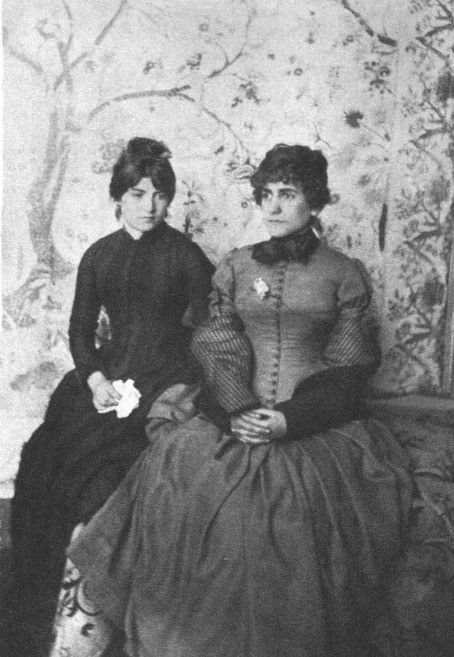
Madeleine Valadon with her daughter Suzanne

Madeleine Valadon left Bessines with her baby in January 1866 and headed for Paris.  She never looked back.  She never saw or communicated with her family, her other children or her former employer, the Guimbaud family, ever again and one can only wonder why she wanted this complete break from her past. 
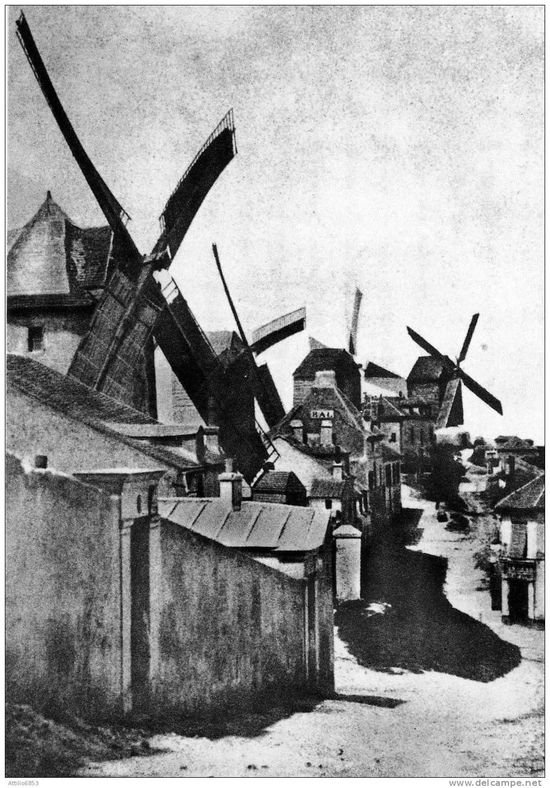
The windmills of Montmartre, taken in 1839 by Hippolyte Bayard

She arrived in Paris confidant that she would be able to earn a living as a seamstress.   Madeleine Valadon was amazed at the sight that greeted her to the north of the capital city – a hill on top of which were a number of windmills, a vista which was similar to the rural views back home.  The steep hill she viewed was the Mount of Martyrs, named after the execution of the first bishop of Paris, St Denis and his faithful lieutenants, St Rustique and St Éleuthère in the third century – Montmartre.  Madeleine settled into lodgings at the base of the hill in the Boulevard de Rochechouart and then, with a glowing reference from the Guimbaud family, set off to procure employment as a seamstress.  Her plans did not come to fruition as jobs were scarce and finally, in desperation, she had to settle for the menial job as a scrub-woman, cleaning floors whilst the wife of the concierge of her lodgings looked after Suzanne. 

Madeleine, no doubt aware that for her daughter to succeed in life she had to be educated, and so arranged for a priest to teach her to read and write and then had her attend the convent run by the nuns of St Vincent de Paul as a day pupil for a continuance of her education and to be taught, as she was, to become a seamstress.  However, once again her plans went awry with the start of the Franco-Prussian War which culminated in the siege of Paris by the Prussian army at the end of 1870 and the ousting of the French government, which retreated from Paris and based itself in Bordeaux.  In May 1871, following the conclusion of the Franco-Prussian War and the lifting of the Prussian siege of Paris, the French government returned to Versailles on the outskirts of Paris ready once again to rule the capital.  However many of the Parisians, who had suffered during the Paris siege, blamed their government for their misery and deprivation which they had to endure.  They remembered with bitterness the days they had to scavenge for food eating dogs, cats and rats to survive.  Out of this sense of bitterness and betrayal came the rise of the Communards.  The Communards were a group of working class disaffected Parisians who did not want the French government to return to control Paris.  They were very active around the area where Madeleine and Suzanne lived and their bloody determination that the defeated French government would not return to Paris from their bolt-hole at Versailles set up a clash which was in fact a mini civil war and which claimed the lives of more than twenty thousand Parisians. 

Suzanne, during these times of turmoil, had still attended the St Vincent de Paul convent for her lessons and during the Paris siege had been fed by the nuns from their home-grown produce.  However during the Paris Commune clashes between the government forces and the Communards the fighting had been so intense that the nuns barricaded themselves in the convent and closed it down to the day pupils and so Suzanne like many others lost their opportunity for learning and being fed.  Suzanne, who was six years of age and like many children of her age, revelled in not having to go to school.  Her mother, on the other hand, despaired and began to drink heavily.   At the end of the Paris Commune struggle at the end of May 1871 and with it, the return to law and order under the French government, the St Vincent de Paul nuns felt it safe to re-open their convent to their day pupils and Suzanne, who had enjoyed the freedom from the discipline of school life and the boredom of lessons reluctantly had to return to the confines of the convent.  She rebelled and was frequently absent preferring to play in the streets and on the hill of Montmartre with new friends both children and adults.   She mixed with the lowest elements of society, the prostitutes, the beggars and the thieves and loved every minute of it.  Later in life she recalled those times:

“…From that day the streets of Montmartre were home to me.  It was only in the streets that there was excitement and love and ideas – what other children found around their dining room tables…” 

Suzanne lived a feral existence.  She was small in stature and had a fierce temper and would often succumb to uncontrollable rages and on the streets of Montmartre she was often referred to as “The Little Valadon Terror”.   Her mother Madeleine became more morose and apathetic as the years passed.  She lost total interest in life and frequently descended into an alcoholic haze.  She rarely cleaned their lodgings and seldom did any laundry.  She begrudged cooking and having to feed Suzanne and when they ate at meal times they would normally eat apart.  Nothing Suzanne would do would lift her mother’s spirit.   Despite this lack of maternal love for Suzanne the two lived together for almost sixty years.  In later life Suzanne often depicted her mother in paintings.  She would nearly always portray her as being old, wrinkled and toothless but showed her hard at work. 
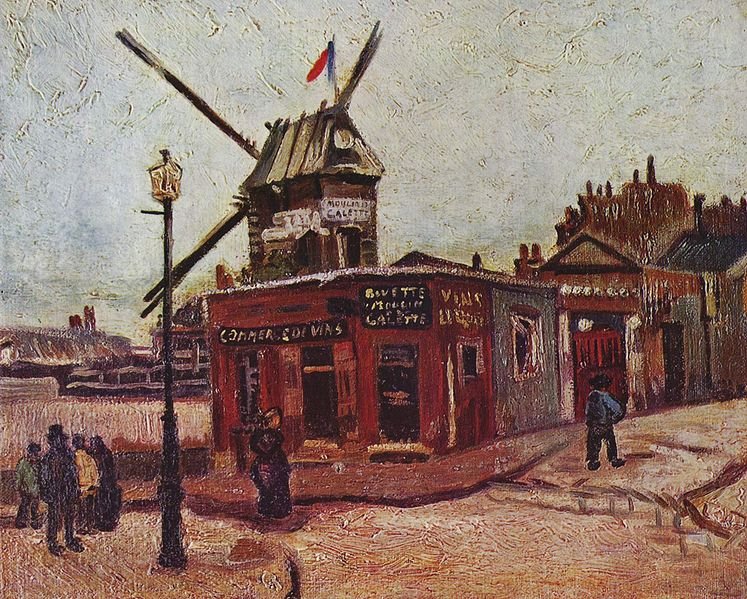
Le Moulin de Galette by Vincent van Gogh (1886)

Montmartre since the beginning of the 19th century was the centre of artistic life and drew artists, musicians and writers to it like a magnet.  Studio garrets shot up everywhere in which the artists would paint day in and day out and in the late evenings would look for some respite and so bars and music and dance halls, such as the notorious Moulin Rouge.  

L'Absinthe by Degas (1873)
L’Absinthe by Degas (1876)

The Café de la Nouvelle-Athènes, was a meeting place for the up and coming artists of the time including the “new kids on the block”, the Impressionists and it was outside this establishment that Degas depicted the two drinking companions in his famous 1876 work L’Absinthe  (See My Daily Art Display June 7th 2011).  Another popular establishment was Le Chat Noir, which opened in November 1881 in Boulevard Rochechouart, the same street where Madeleine and Suzanne lived and was run by the entertainment impresario, Rodolphe Salis.  The Divan Japonais, a café-concert (a combination of a concert hall and a pub) was a haunt of the French painter, Henri Toulouse-Lautrec.  Probably one of the most popular was the Moulin de la Galette.  This was originally a windmill, one of the thirty windmills on La Butte de Montmartre, which Madeleine saw as she arrived from Limoges.  The windmill owners then added a goguette (a wine shop) which also sold galettes (flat round crusty pastries) and later incorporated a dance hall and restaurant.  It was here that Suzanne Valadon reminisced that she had first set eyes on Degas whom she described as:  

“…a small round-shouldered man, fragile and sad-eyed, in pepper-and-salt tweeds, his throat swathed in woollen scarves…”

In 1874, at the age of nine, Madeleine took Suzanne to an atelier de couture where she was apprenticed as a seamstress.  Suzanne hated the life and made numerous attempts the workplace but unlike the nuns the workhouse owner would beat her when she was dragged back to the factory by her mother.  She stayed there for three years but eventually left and took jobs as a waitress in a café, a push-cart vendor of vegetables and working with horses at a livery stable.  It was this last job in which one of her jobs was to walk the horses around the streets.  People would stop on the street and watch this small young girl with her large horses.  Suzanne, ever the entertainer, was not content with just walking the horses but began to perform acrobatic tricks upon the horses to gain more notice and a modicum of applause.   In later years, she reckoned that a circus owner witnessed one of her “performances” and offered her a job.  She loved this new colourful and exciting life.  Although her role at the circus/carnival was a horse riding act, one day she was asked to stand in for a trapeze artist who had been taken ill.  She had done some trapeze work and so agreed.  Unfortunately the performance went badly and she fell, injuring her back and her circus life came to an end. 

                                                                        …………………… to be continued.

Having been chastised the other day for not acknowledging some of my sources I thought I had better behave myself today and tell you that most of my information came from a book I read (and I am still reading it) on the life of Suzanne Valadon entitled The Valadon Drama, The Life of Suzanne Valadon, written by John Storm in 1923.

Other sites I visited to find some pictures were:

http://lapouyette-unddiedingedeslebens.blogspot.co.uk/

http://youngbohemia.blogspot.co.uk/2012/01/suzanne-valadon_8445.html

http://www.messynessychic.com

The Blog:  It’s about time
http://bjws.blogspot.co.uk


The Poor Fisherman by Pierre Puvis de Chavannes

The Poor Fisherman by Pierre Puvis de Chevannes (1881)

My last blog looked at the early life of Pierre Puvis de Chavannes as well as feature a series of four large wall paintings he completed in the 1860’s.  In today’s blog I will conclude his life story and feature one of his best known paintings entitled The Poor Fisherman.  

Following the success of his wall paintings for the Musée de Picardie he went on to complete many other wall painting commissions, such as the staircase of the Hôtel de Ville at Poitiers.  In 1874 the Department of Fine Arts in Paris commissioned him to paint a number of wall paintings depicting the childhood and education of St Geneviève, the patroness of Paris, for the church of Saint Genevieve, which is now the Pantheon.  Puvis procured a second commission  for work in the Pantheon in 1896, depicting Genevieve’s accomplishments in old age which consisted of a single composition coupled with a triad of panels, the whole of which surmounted by a frieze. 

One of his largest commissions came in 1891 when Charles Follen McKim a partner in the architect firm of McKim, Mead and White, who had designed the new Boston library, went to Paris and approached Pierre Puvis to provide wall paintings for the grand staircase and loggia of their new building.  Puvis agreed to carry out this extensive commission despite being sixty-seven years of age.  Then Puvis had a change of heart when he accepted a commission for work in the Paris City Hall and so the following year, 1892, the Americans had to send over another representative to Paris to ask Puvis not to renege on his original agreement. After prolonged negotiations in July 1893 Puvis put pen to paper and the contract for the wall paintings was finalised, agreeing to pay the artist the sum of two hundred and fifty thousand francs.  Puvis completed his Paris City Hall commission in 1894 and in 1895 he began on the paintings which were to adorn the walls of the Boston Library.  To ensure that the wall paintings blended in with the internal architecture the architects sent Puvis samples of the marble which was to be used for the staircase and its surroundings.  Puvis worked on the wall paintings at a purpose built studio at Neuilly, just outside of Paris and completed them in 1898.  They were then shipped out to America.   Puvis never saw for himself his paintings in situ in the Boston library.   For a much more detailed account of this commission it is worth having a look at:

http://cool.conservation-us.org/jaic/articles/jaic36-01-005.html 

Pierre Puvis did not exclusively work on large-scale wall paintings, he would often relax by carrying out smaller easel paintings and today I am featuring one such work which he completed in 1881 and entitled The Poor Fisherman, which is housed in the Musée d’Orsay. Although not the size of one of his wall paintings, it is still a large work, measuring 155 x 192 cms.

The Angelus by Jean-François Millet (1859)

In the painting we see a forlorn-looking man, head bent, standing up in his boat with his hands clasped together in front of him as if in prayer and it is his stance along with the connection between Christ and his Apostles and fishermen, which gives the painting a somewhat religious feel to it.  Is he praying for success in his forthcoming fishing expedition or as some would have us believe it could be that it was noon and, as a practicing Catholic, the fisherman was reciting an Angelus prayer.  This supposition is based on the similar stance of the figures seen in Millet’s 1859 The Angelus painting.   On the bank there is a woman, his daughter, collecting flowers and his sleeping baby, lying on his back in a bed of wild flowers. One is struck by the bleak landscape and the contrast between the seemingly happy female as she picks the flowers, the peacefully sleeping child with the troubled poverty-stricken fisherman as he bows his head down in silent contemplation.   

The work was exhibited at the Paris Salon in 1881 and received a mixed reception and was not sold until 1887 when the French State purchased the work whilst it was on show at the French art dealer, Durand-Ruel’s showroom.  So what is there not to like about the work?  Is it just too depressing?  Does it fail to conform to the artistic norm?  In an article in the December 1916 issue of the The Art World magazine entitled “A Trivial Work of Art: The Poor Fisherman by Puvis de Chavannes, the art critic Petronius Arbiter summed up the painting:

“…It is an absolutely trivial work; and, coming from him, was a complete surprise and much criticized at the time. In the first place the lines of the composition are so zigzag that the work is irritating instead of soothing to the eyes. Then the sprawling of the badly drawn child over a low shrub, every leaf and branch of which would prick out of it all sense of sleep or even of comfort, is absurd.  Then the head of the mother is too large, and the hair that of a man rather than that of a woman. Then the man looks ‘sawed-off,’ for he is represented as standing with his knees against a seat in the boat. But where is the rest of his lower legs? The boat is either not deep enough or his lower legs are abnormally short, or sawed-off. This is also manifestly absurd. Then the head is so childishly constructed as to be ridiculous. Moreover, what is he doing – praying, fishing, philosophizing over his destiny, or what? The whole thing is childish to a degree. Here we have a meaningless ‘individuality’ with a vengeance…”

However the article’s author begrudgingly had some good words to say about the work:

“…The picture has but one redeeming feature – its charming colour.  A delicate general tone of mauve pervades the whole creation and the gradation of the tones in the water are so skilfully painted that we are drawn into the far distance whether we will or no.  That is, the values of the picture are remarkably true…”

Le Pauvre Pêcheur by Pierre Puvis de Chavannes (1881)  The National Museum of Western Art
Le Pauvre Pêcheur by Pierre Puvis de Chavannes (1881) The National Museum of Western Art

The artist painted another version of The Poor Fisherman in which he depicts just the fisherman and his baby child which this time lies in the botom of his boat.  This copy can be seen at the National Museum of Western Art in Tokyo.

Pierre Puvis de Chavannes died in October 1898 aged 73.   Shortly before his death he married his long time companion, Princess Marie Cantacuzène.   She died just a few months before her husband.

Following my last blog, which looked at the early life of Pierre Puvis de Chavannes, I was ticked off by the author Aimée Brown Price for using information from her books on the artist and not acknowledging the fact.  To defend myself I have to say up until receiving her email I had no idea she had written these books and probably took her information unknowingly from a third-party source.  However to rectify my misconduct I have given you below the title of her books on Pierre Puvis de Chavannes and I am sure if you want to read a more detailed account of the life and works of the artist they will be invaluable.

Aimée Brown Price, Pierre Puvis de Chavannes. Volume I: The Artist and his Art.  Volume II:  A Catalogue Raisonné of the Painted Work. New Haven: Yale University Press, 2010. ISBN 9780300115710, box set, two volumes, 750 pp. 1200 illustrations.

Pierre Puvis de Chavannes. Part 1 Wall paintings

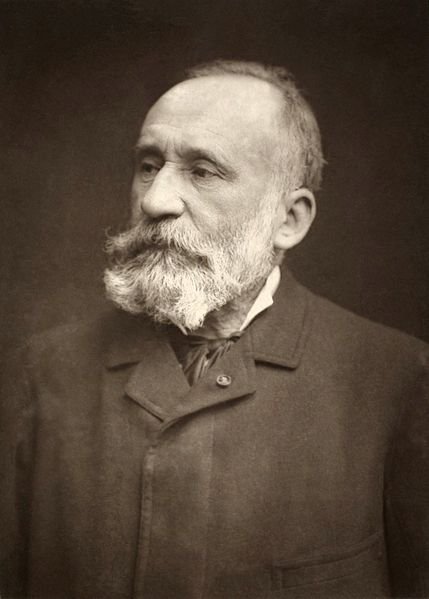
Pierre Puvis de Chavannes (1882) aged 58.
Pierre Puvis de Chavannes (1882)
aged 58.

In my previous couple of blogs I looked at two married couples, all four of whom were artists who based themselves around Copenhagen and the Skagen area of northern Denmark.  The two wives, Anne Ancher née Brøndum and Marie Krøyer née Tiepcke both spent time studying art in various Paris ateliers, one of which was run by the French painter, Pierre-Cécile Puvis de Chavannes and so I thought over the next two blogs it would be interesting to look at his life story and examine some of his truly beautiful works of art.  In this first part I am going to concentrate on a series of his decorative works – his first set of wall paintings which can be seen at the Musée de Picardie in Amiens, a town in the Picardy region of northern France.  Pierre-Cécile Puvis, as it was not until somewhat later in life that he attached the ancestral name of his Burgundian forefathers “de Chevannes” to his surname, was born in Lyon, into a wealthy bourgeois family in December 1824.  His mother was Marguerite Guyot de Pravieux and his father, Marie-Julien-César Puvis de Chavannes, who was the Chief Engineer of Mines for the region.  His father’s wealth would ensure that Pierre never wanted financially for the rest of his life.  Pierre was the youngest of four children.   He had two sisters, Joséphine and Marie-Antoinette and a brother Edouard.     He went to school at the Lycée Royal and the Collège Saint-Rambert, in Lyon.  Later he attended the Lycée Henri IV in Paris and in 1842 at the age of eighteen Pierre Puvis had obtained his baccalaureate.  By 1843 both Pierre’s parents were dead.  His mother died in October 1840 and his father died three years later in Nice.   In 1843 he briefly enrolled at a law school in Paris but left after a few months. His father had had high hopes that his son would follow in his engineering footsteps.   However, any hopes of proceeding on to an engineering career via the l’Ecole Polytechnique in Lyon were dashed when he was struck down with a serious illness whilst studying for the entrance exam.  For most of 1844 and 1845 he had to convalesce at the home of his sister Joséphine and her husband Esprit-Alexandre Jordan in Mâcon in central France.   

In 1846 his life was to change as for part of his recuperation he decided to go on a trip to Italy.   It was during his journey around Italy that he fell in love with the art that he saw, and the frescos and murals stimulated his interest in painting and so, on his return to Paris, he announced his intention to become a painter.  The first painter he approached for an apprenticeship was the French history painter and portraitist Emile Signon but he was turned down and told to seek out Ary Scheffer who eventually arranged for Pierre to be trained at the atelier of his brother, Henri Scheffer.   In 1848 Pierre embarked on a second trip to Italy, this time accompanied by the painter Louis Bauderon de Vermeron.  On returning from Italy in late 1848, he worked at Eugène Delacroix’s studio but this only lasted a fortnight as Delacroix was taken ill and the studio was closed and Pierre went to work at the atelier of the French history painter Thomas Couture.  In 1850, Pierre Puvis set up his very own studio in rue St Lazare and in that year he had his first work, Dead Christ, exhibited at that year’s Salon. 

Later in the 1850’s Pierre Puvis, art changed and he concentrated on large decorative pieces for large houses or other important establishments.  These were neither frescos nor murals but were painted canvases which were then affixed to the wall.   These wall paintings were often secured to walls by a method known as marouflage where the canvas was “glued” to the wall by an adhesive which when it dries is as strong as plaster or cement.  The terminology marouflage comes from the French word, maroufle, which is the word to describe the sticky substance which has congealed at the bottom of artist’s paint pot.  

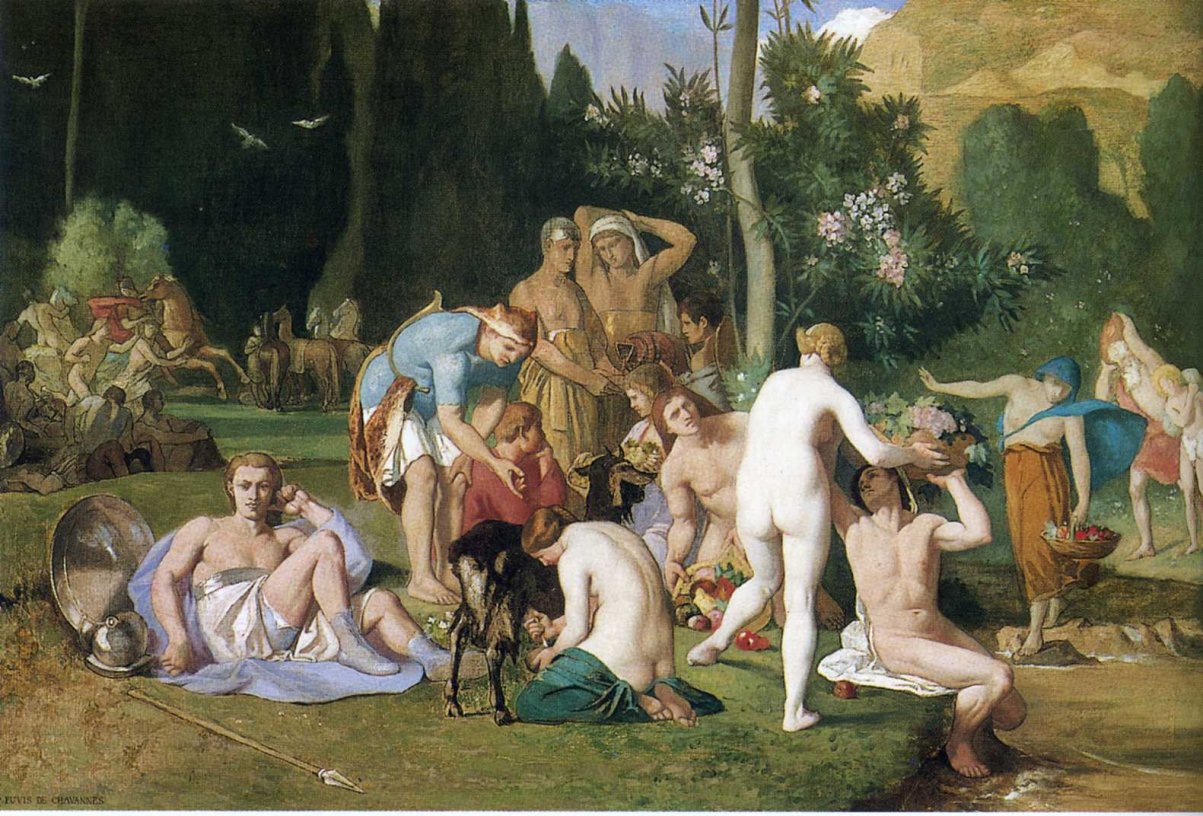
Le Paix (Peace) by Pierre Puvis de Chavannes (1861)

In 1861 Pierre Puvis produced two large paintings, each measuring 3.4 x 5.5m, one entitled Peace and the other, its companion piece was entitled War.  The work entitled Peace depicted an idyllic land with figures from ancient times relaxing in a peaceful landscape, with not a care in the world.  In the background we can see people riding horses, running and dancing whilst in the foreground we observe goats being milked.  Fruit is plentiful and we see it being gathered up.    Life in this state of peace and tranquillity could not be better and it is thought that Pierre Puvis based his work on Virgil’s fourth Eclogue in which the poet described such a place: 

“…..the uncultivated earth will pour out

her first little gifts, straggling ivy and cyclamen everywhere

and the bean flower with the smiling acanthus.

The goats will come home themselves, their udders swollen

with milk, and the cattle will have no fear of fierce lions….”

La Guerre (War)  by Pierre Puvis de Chavannes (1861)
La Guerre (War) by Pierre Puvis de Chavannes (1861)

In the work entitled War things couldn’t have been more different.  Gone is the idyllic landscape, now supplanted by a background showing a gloomy and desolate landscape in which we can see homes burning.  In the left mid-ground we see a soldier in all his armour, with his red cloak fluttering behind him as he pitilessly kills civilians.   In the foreground we see women on their knees begging for mercy as three riders sound their horns.  Could it be they are the attackers sounding off in a triumphal fashion or are they fleeing the enemy and urging their people to hurry along?  Behind the horsemen we see a column of stragglers, some being carried, fleeing the enemy.  Look at the beast on the ground to the left of the women.  See how by showing the white of its eye we get a sense of its fear whilst the other animal, next to it, raises its head, its neck stretched to the limit, as it bellows for mercy.  The French State purchased Peace and because Puvis did not want his pair of paintings to be separated he donated War to the French State.  Following the completion of Peace and War in 1861, Pierre Puvis found himself without any commissions so decided to paint two more works to act as companion pieces to Peace and War

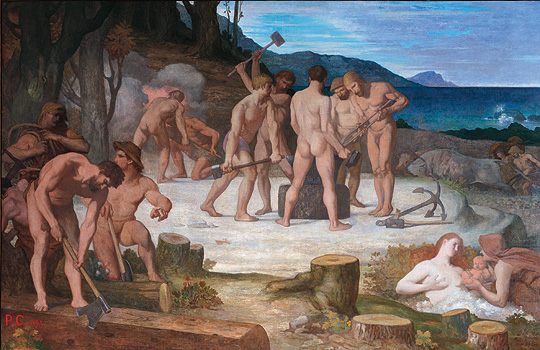
Le  Travail (Work) by Pierre Puvis de Chavannes (1863)
Le Travail (Work) by Pierre Puvis de Chavannes (1863)

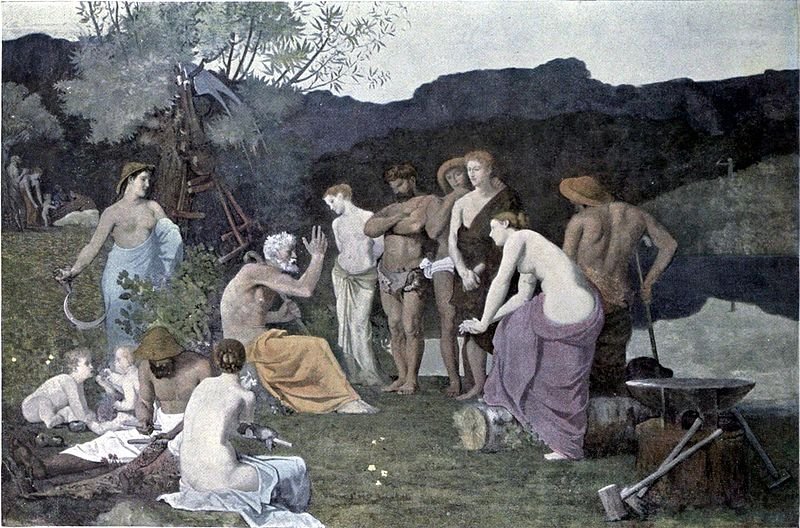
He entitled them Work and Repose and submitted them to the Salon of 1863. 

Le Repos (Repose) by Pierre Puvis de Chavannes (1863)

At around this time in Amiens a new museum, Musée de Picardie, was being built and one of its architects, Arthur-Stanislas Diet, approached Pierre Puvis to see if all four of these works could be placed on the wall of the museum’s monumental main staircase and the gallery.  He agreed.  The French State loaned the first two paintings to the museum and Pierre Puvis donated the other two works. 

La Paix by Pierre Puvis de Chavannes (1867) Philadelphia Museum of Art
La Paix by Pierre Puvis de Chavannes (1867)
Philadelphia Museum of Art

Four years later in 1867, Pierre Puvis produced smaller versions of Peace and War which can now be seen at the Philadelphia Museum of Art. 

La Guerre by Pierre Puvis de Chavannes (1867) Philadelphia Museum of Art
La Guerre by Pierre Puvis de Chavannes (1867)
Philadelphia Museum of Art

In my next blog I will feature some of Pierre Puvis’ smaller works and continue with his life story.

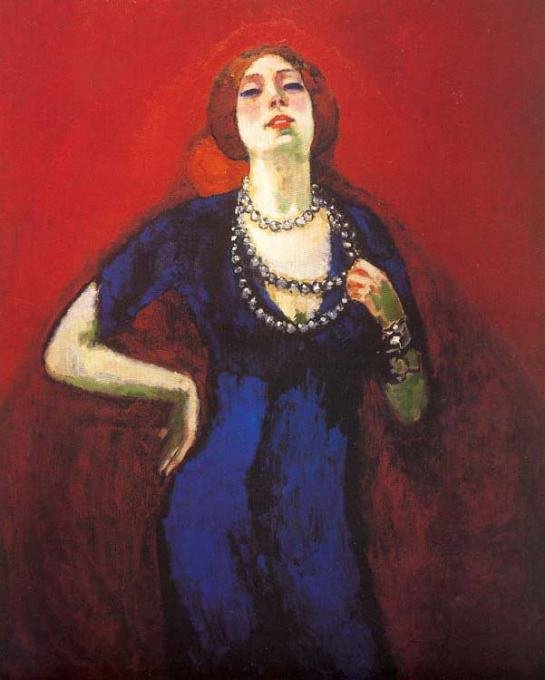
Kees van Dongen, his life, his family and his art

Portrait of Guus Preitinger by Kees van Dongen (1910)

Last Thursday I embarked on my monthly pilgrimage to London to visit a couple of art galleries and take a look at two new art exhibitions and it was during those visits that I found a few paintings which I will include in my forthcoming blogs.  Two of my featured paintings today were not in a specific exhibition but were in the permanent collection of The Courtauld Gallery, which is a veritable gem when it comes to medium sized galleries and one you should put on your “to visit” list the next time you are in the capital.  Today I am highlighting some works by the Fauvist Kees van Dongen, which feature his wife and daughter.

Cornelis Theodorus Marie van Dongen, better known as Kees van Dongen, was born in January 1877 at Delfshaven, which is now a suburb of Rotterdam.    At the end of 1892, he enrolled as a student on a five-year course at the Akademie voor Beeldende Kunsten (Academy of Visual Arts) in Rotterdam, now known as the Willem de Kooning Academy, named in memory of the famous Dutch artist Willem de Kooning.    As a student he also needed to earn some money and so he carried out some illustrative work for the local newspaper, Rotterdamsche Nieuwsblad.  His own artistic work in these early days was greatly influenced by the Dutch artist, Rembrandt and many of his works displayed the dark tones of the great Dutch master.

It was whilst he was at this Academy that he became very friendly with another art student, Juliana Augusta “Guus” Preitinger.  Guus had been born in Cologne but early in her life the whole family had relocated to Rotterdam and eventually they all became Dutch citizens.  She revealed a great aptitude for drawing in her childhood years and her family supported and encouraged this artistic talent and had her enrol at the Academy.  On completion of their studies, Kees and Guus decided to move from The Netherlands and seek their fortune in the European capital of art, Paris.  Guus went off to Paris first in search of employment and Kees followed in 1899.   Shortly after arriving in Paris van Dongen met Félix Fénéon, the art critic and Parisian anarchist who had become a great supporter of a new group of French artists lead by Georges Seurat, whom he had christened, Neo-Impressionists.  Van Dongen and Fénénon became great and long lasting friends.

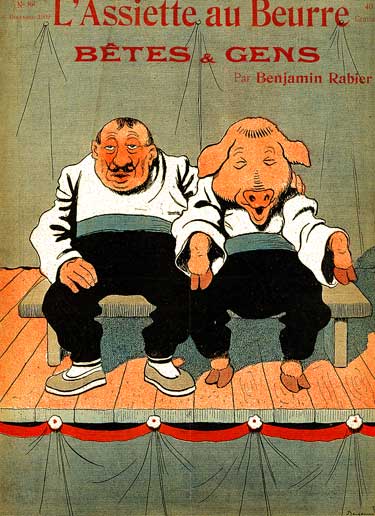
Between 1900 and late 1903, van Dongen did very little painting, probably due to financial difficulties. Through the good offices of Théophile Steinlen, a Swiss-born French Art Nouveau painter and printmaker, who worked for the satirical papers of the day,  L’Assiette au beurre, Le Rire, L’Indiscret and Le Frou-Frou , he managed to get some work for van Dongen on these periodicals and with the money van Dongen earned as an illustrator he managed to set up house with Guus Preitinger.

L'Assiette au Beurre magazine cover of 1902
L’Assiette au Beurre magazine cover of 1902

Van Dongen’s began to take an interest in the social and political affairs of Paris.  He especially took a great interest in the environment and lifestyle of the city’s prostitutes and courtesans.   He spent a lot of his time producing illustrations for political and social publications especially the journal L’Assiette au beurre, which was the most remarkable and resilient of cartoon journals of social protest in France during the first decade of the twentieth century.  It was a journal which looked at things such as the corruption of politicians and the country’s violence against the poor and the downtrodden.   Van Dongen illustrated an entire issue of L’Assiette au beurre (dated 26 October 1901) which was devoted to the subject of prostitution from the perspective of the conditions of the prostitutes and the tone of the edition indicated their belief that prostitution in contemporary Paris was a phenomenon symptomatic of the degeneration of the bourgeoisie.

In June 1901, Kees van Dongen and Guus Preitinger married.  Their first child, a son, was born that December but died when only two days old.    In 1904, Kees van Dongen was sponsored by Paul Signac and Maximilien Luce, to exhibit at the Salon des Indépendants and in that same year he had a major breakthrough with his art when he was granted gallery space at Ambroise Vollard’s establishment.  Vollard, one of the major art dealers in Paris, was a champion of avant-garde art and allowed van Dongen to show almost a hundred of his works, most of which were his early works depicting scenes from Holland, the Normandy coast and Paris.  The following year, van Dongen exhibited two of his works at the Salon des Indépendants, and at the infamous 1905 Salon d’Automne exhibition.  The Salon d’Automne was founded two years earlier by a group of artists and poets that included Renoir, Eugène Carrière, Georges Rouault and Édouard Vuillard, under the leadership of the Belgian architect, Frantz Jourdain.   They set up their Salon in direct competition to the conservatism of the official Paris Salon and the Salon des Independents and welcomed any artist who wished to join.   The decision on what would be allowed into their exhibition was, like the Paris Salon, to be decided by their own jury, which was selected by drawing straws from the new group’s membership, and it was their intention to give the decorative arts the same respect accorded the fine arts.   Their 1905 exhibition, which included the two works by van Dongen, was probably their best known for it was at this show that one of the visitors was the art critic Louis Vauxcelles, who on entering a room set aside for paintings by Matisse, Vlaminck, Albert Marquet, André Derrain and van Dongen, he commented on the “violence” of their works and their uninhibited use of pure non-naturalistic colours.   Seeing a traditional sculpture uncomfortably situated in this room amidst these hotly coloured paintings, Louis Vauxcelles joked to Matisse that it was like “a Donatello among the fauves [wild beasts]”. This group of painters was from that day on known as the Fauves and Fauvism as such was born.

In April 1905 Kees van Dongen and his wife Guus had a daughter whom they named Augusta but would always be known as Dolly.   The family moved to the Montmatre district which was a favourite haunt of the artistic community.   They moved into an apartment in the somewhat dark and squalid building on the heights of Montmatre, nicknamed Le Bateau Lavoir.  Pablo Picasso  and his companion Fernande Olivier had a studio next to theirs and the two artists became close friends.   Fernande Olivier referred to the strong ties between the two artists and their respective entourages in her memoirs Picasso and His Friends and In Love with Picasso.    In the latter she recalled how Picasso loved Kees and Guus’ daughter Dolly.  She wrote:

“…Pablo loved little Gusie and played with her without getting bored, she could get him do whatever she wanted. I didn‘t know at the time that he could take so much pleasure in being with children. We would have liked to have a child, but as this wish was never realized, we had to be content with the little Van Dongen…”

Fernande Olivier by Kees van Dongen (1905)

It was whilst living here that Picasso painted his famous Les Demoiselles d’Avignon.   Many other artists moved into the apartment block and  it soon became a meeting place for all the contemporary artists of the time. Although the paintings by van Dongen continued to show the power and passion of Fauvism, by 1907 most of the other Fauvists had moved on and had begun to explore new styles.  Van Dongen produced a series of portraits of Picasso’s “lover” Fernande in a wide range of styles, and she established herself as his preferred model, alongside his wife Guus.   His painting at this time was turning increasingly to women, and the often erotic depictions were out of step with the time, and would often provoke a somewhat prudish reaction

Gypsy by Kees van Dongen (1911)

In 1907 van Dongen had met the German Expressionist  Max Pechstein who was visiting the French capital.   Pechstein was one of the most prominent artists of German Expressionism. He was hailed by some of his contemporaries as the leading member of the Dresden-based Die Brücke group.  Their meeting led in 1908 to Van Dongen being invited to exhibit alongside the group.   His works went on to influence a number of its members.  In the winter of 1910-1911 van Dongen visited Spain and Morocco. This was his first time he had been able to observe, first-hand, Moorish architecture, with its palaces and the mosques with their fascinating minarets, the contrast of dark passages and dazzling white walls baked by a scorching sun. What fascinated Van Dongen was the look of the Andalusian people, the movement of the bodies of the flamenco dancers as they danced to the wild rhythms of their tambourines and the colours of the flower-embroidered Manila shawls.  After his travels, an exhibition of his works was held at the Galerie Bernheim Jeune in June 1911 under the title Hollande, Paris, Espagne, Maroc and this further established the reputation of the works which were influenced by his travels through the southern lands.

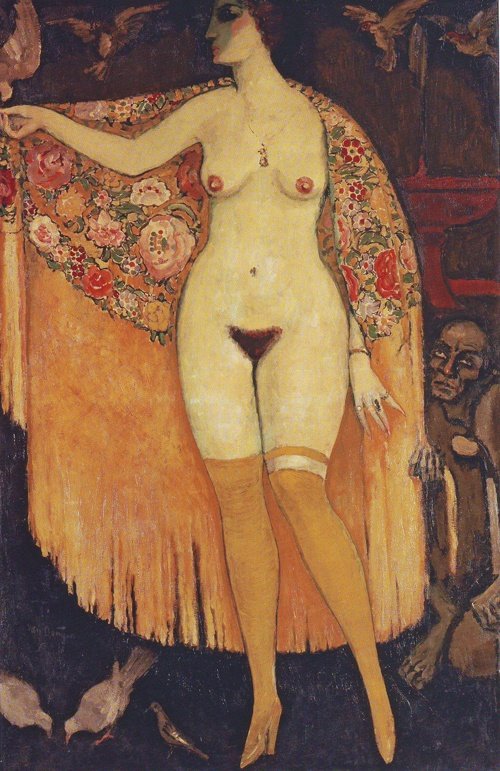
Tableau by Kees van Dongen (1913)

It was around this time van Dongen began to develop a reputation as a socialite.  He often hosted masquerade parties at his new home, which was an apartment in Montparnasse.  His lifestyle and his art was the talk of the Paris fashionista. His paintings now often depicted licentious nudes and other such erotic subjects, which often caused uproar among critics and admirers alike. One such painting was a nude portrait of his wife Guus which he completed in 1913 and was entitled Tableau (also known as The Beggar of Love or Nude with Manila Shawl).  The figure crouching on the floor to the right is of Kees who is admiring and bowing before the beauty of his wife.   He exhibited the work at the 1913  Salon d’Automne and the work was considered so scandalous and immoral that the police removed it from the gallery.  Van Dongen condemned its removal saying:

“…For all those who look with their ears, here is a completely naked woman. You are prudish, but I tell you that our sexes are organs that are as amusing as brains, and if the sex was found in the face, in place of the nose (which could have happened), where would prudishness be then? Shamelessness is really a virtue, like the lack of respect for many respectable things…” 

Portrait de Mme Jasmy by Kees van Dongen (1916)

In 1914, Guus took her daughter Dolly to Rotterdam for the summer to see their families. However the outbreak of World War I prevented them from returning to Kees in Paris until 1918.   In 1917, Kees van Dongen, whilst living alone in Paris, started a relationship with a married socialite, the fashion director  Léa Alvin also known as Jasmy Jacob.   She proved to be the conduit between van Dongen and the upper classes and through her introductions, came numerous portraiture commissions.  When Guus and Dolly returned to Paris it was not long before Guus heard rumours about her husband’s infidelity.  This proved to be the final straw in the break-up of their marriage and they eventually divorced in 1921.   Guus Preitinger died in 1946.

In 1926 he was awarded the Legion of Honour and the following year the Order of the Crown of Belgium.  In 1929 van Dongen became a French citizen.  He and his art, were the toast of French society.  He cut an ostentatious and colourful figure in Paris. His lifestyle was full of controversy and his extravagant nightly studio parties were attended by film stars, masqued politicians and artists.   He spent most of his time completing portraiture commissions.   He was the typical society artist who lived a bohemian lifestyle and who brought added colour and excitement to the Parisian upper classes.  He was only too well aware how to please his female sitters, saying:

“…The essential thing is to elongate the women and especially to make them slim. After that it just remains to enlarge their jewels. They are ravished……….Painting is the most beautiful of lies…”

His success as a society portraitist enhanced his reputation as an artist with the French bourgeoisie, especially the society women, and his numerous commissions allowed him to live a carefree and affluent lifestyle.

In 1938 he met Marie-Claire Huguen, who two years later bore him a son, Jean Marie.  At that time van Dongen was 63 years old !!   The couple finally married in 1953, and this new second family gave van Dongen new purpose, a new life. He carried on working on his portraiture work which was much in demand and he also continued with his illustrative work for books by the likes of Voltaire, Proust and Kipling.  The latter years of his life was spent with his family in Monaco where he died at home in 1968 at the age of 91.

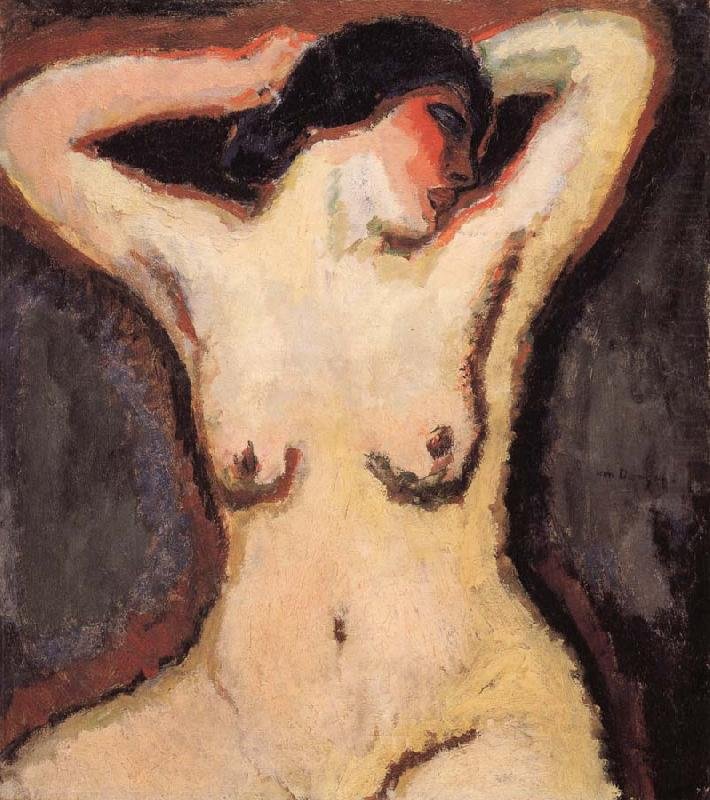
The Torso or The Idol by Kees van Dongen (1905)

One of the paintings by Kees van Dongen, which  I saw at London’s Courtauld Gallery was entitled Torso, sometimes known as The Idol, which he completed in 1905 and was one of two portraits of his wife, Guus Preitinger,  which he exhibited at that year’s Salon d’Automne.    It is a large and somewhat “in your face” painting.  There is an overt sexuality about this work.  It is a depiction of complete sexual abandonment.   Guus lies back with her hands behind her head.  Her arms form two triangles of space either side of her head.  The curvature of her arms mirrors the curvature of her hips in the lower half of the work.   Prominently depicted in the very centre of the painting are her nipples.  It is if the artist wants them to have pride of place.  Van Dongen has used various shades of red and pink to depict the flushed cheeks of her face.  Could it be she was embarrassed by the artist, her husband’s, gaze as he painted her image?   Her pale body is set off dramatically against the heavy black and brown lines which he has used to outline her torso and her breasts.  The paleness contrasts with the dark background.  I found it a rather disturbing painting.  It did not have the beauty of many depictions of the female nude I have seen before.   There was something very rough, almost unpleasant about the full-frontal depiction and in some ways this diminished the sense of eroticism.  In my opinion, the female body in this painting has not been put on a pedestal for us to adore its beauty.  That is just my opinion and I am sure many of you will beg to differ.  However, when I stood in front of this work, it had the same affect on me as when I stood before many of Egon Schiele’s nude or semi nude portraits.

Portrait of Dolly by Kees van Dongen (c.1912)

One of Kees van Dongen’s favourite models for his paintings was his daughter Dolly and she appears in many of his portraits.  In the one at the Courtauld Gallery she is probably just seven years old.  This a portrait of a child, his young daughter but by the way she is given an open pose, and the way he has given her red cheeks, painted lips and large eyes, there is something of an adult feel to the painting.

I came across a couple of fascinating videos on the internet, one of which was a sub-titled interview with van Dongen’s daughter Dolly, aged 82, made in 1987 in which she talks about her father and his paintings.  I am sure you will find it interesting.

 http://www.arttube.nl/en/video/Boijmans/Dolly#.UTWlQ6KeMsJ

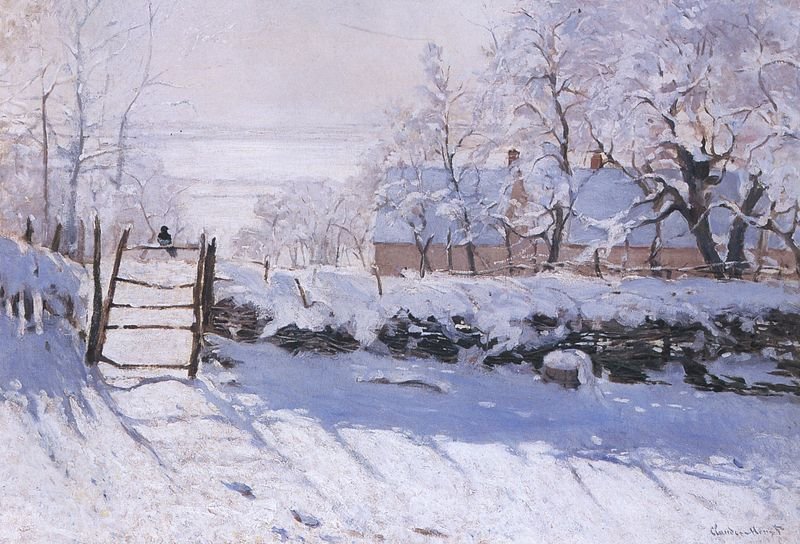
The Magpie by Claude Monet

The Magpie by Claude Monet (1868)

Being in a much milder, wetter and windy climate it is always a novelty to see snow except atop distant mountains and for those of you are knee-deep in it, you have my sympathy, as I tend to agree with those who say snow is fine when viewed on a greetings card but not when one has to trudge through it.  However there is nothing as beautiful as a painted snow scene and for My Daily Art Display featured painting today I am featuring a beautiful depiction of a snow scene by Claude Monet entitled The Magpie, which is reputed to be one of the most popular paintings in the Musée d’Orsay collection.

Monet painted this work during the winter of 1868-9 whilst he was living at Étretat with his wife Camille and his one-year old son Jean.  He had left Paris and one of the reasons for his departure from the capital was given by him in a letter to his artist friend, Frederic Bazille:

“…In Paris one is too preoccupied with what one sees and hears, however strong-minded one may be, and what I shall do here will at least have the virtue of being unlike anyone else’s work, because it will simply be the expression of my personal experiences…”

Monet had been going through a very tough and trying period in his life.  Although his painting Woman in Green was exhibited in the 1866 Salon his offering of Women in the Garden the following year was rejected by the jury of the Salon.   None of the pictures he sent in the spring to the International Maritime Exhibition at Le Havre were sold and worse still, the canvases were seized by his creditors.   His lover, Camille Doncieux, whom he had met in 1865, had become pregnant and in August 1867 gave birth to their son, Jean-Armand-Claude.   Although his father had finally and reluctantly come around to his son’s chosen profession as an artist, he was totally against his son’s liaison with Camille and told him that he would only offer him financial help if he left Camille.  Monet’s financial situation in Paris had become dire and he survived on hand-outs from his friends.  His money problems and now the impending arrival of his child, which was yet another mouth to feed, were so bad that in 1868 he had attempted suicide by throwing himself off a bridge into the River Seine.  Penniless, Monet was forced to return home alone to his father’s house in Sainte-Adresse, a small coastal town west of Le Havre, and there he lived with his aunt, abandoning Camille in Paris.  To add to all these financial and family problems he suffered partial loss of his sight in July 1867 which prevented him from painting and sketching out of doors.

His luck finally changed in 1868 when he fortuitously received some timely aid from his very first patron, a shipowner and art collector, Louis-Joachim Gaudibert, who supported him by commissioning him to paint three full-length life-sized portraits.  Two were of Guadibert himself and the third one of his wife,  (Portrait of Madame Gaudibert).  He also managed to sell his painting Camille to Arsène Houssaye, the editor of the magazine L’Artiste, for 800 francs. Now, finally, with some money in his pocket he was able to return to Paris to once again be with Camille.  Gaudibert also helped Monet rent a house in Étretat for his family in late 1868. Recovering from an episode of depression, Monet joined Camille Doncieux and Jean at the house in Étretat in October 1868.  He wrote to Bazille about his change of fortune:

“…Thanks to this gentleman of Le Havre who’s been helping me out, I’m enjoying the most perfect peace and quiet and I look forward to do some worthwhile things…”

It was whilst he lived here that Monet painted the many famous scenes of the cliffs at Étretat and it was in December 1868 that he painted today’s featured work, The Magpie.  Although en plein air painting may be a joy in the sunny warm days of summer, it becomes a challenge in the cold harsh winter days but Monet was not deterred by this and never let the elements confine him to working indoors.  In fact he often claimed that he preferred the countryside in winter.  Monet loved to experience the differing effects light had on the countryside and for him the understated difference of shadows upon the snow covered ground presented him with a different challenge from the sun on green grass and blue water.  It would mean a complete change of palette with more emphasis on the whites, greys and violets.  He wrote to Frederic Bazille extolling the virtues of his surroundings and the freedom to paint en plein air:

“…I spend my time out in the open, on the shingle beach when the weather is bad or the fishing boats go out, or I go into the countryside which is very beautiful here, that I find perhaps still more charming in winter than in summer and, naturally I work all the time, and I believe that this year I am going to do some serious things…”

Before us we have Monet’s oil on canvas winter landscape scenes of the countryside close to Étretat.  It is entitled La Pie (The Magpie).  It is a prime example of the natural effet de neige (effect of snow).   It was one of the earlier snowscapes that Monet painted.  In all he completed over hundred snowscape paintings. The snow lies upon the ground.  A solitary magpie perches on the top rung of a wooden hurdle gate.  Its black and white feathers, along with the dark bark of the trees, contrast starkly against the snowy landscape and, despite the small size of the bird, it become the focus of the work. Its inclusion in the scene in some ways breathes life into the painting. The source of light comes from the background and dramatically creates blueish gray shadows of the wattle fencing on the pristine snow in the foreground.   Monet and the Impressionists, instead of making the shadows in their paintings a conventional black, preferred  to use coloured shadows as they believed that adding colour represented the actual, changing conditions of light and shadow as one would see in nature.  However this idea did not set well with the Salon jurists and this work by Monet was rejected when he submitted it for exhibition at the 1869 Salon.    There is a beautiful luminosity about this work.  In summery paintings the sky would normally be lighter in colour and tone in comparison to the ground colour but of course in winter this all changes and as we see in this work the sky is darker than the snow-covered ground.  Look at the way Monet has depicted the snow.  It is not pure white but more a tinted white and where the shadows straddle the snow-covered ground in the foreground we have patches of gray-blue.  We can also see darker spots in the snow of the foreground indicating that the snow is not as deep here and the ground below it is showing through the whiteness.

The painting is considered by art historians as one of Monet’s best and most accomplished snowscapes.  Monet once revealed that he wanted to paint not things in themselves but the air that touched things – the enveloping air.  I will leave you with a quote from a Harper’s Magazine article entitled The Enveloping Air in which the author John Berger wrote:

“… Monet once revealed that he wanted to paint not things in themselves but the air that touched things – the enveloping air.   The enveloping air offers continuity and infinite expansion.  If Monet can paint the air, he can follow it like following a thought.  Except the air operates wordlessly and when painted, is visibly present only in colours, touches, layers, palimpsest, shades, caresses, scratches……… Like many innovative artists, Monet, I believe, was unclear about what he had achieved.  Or, to be more precise, he could not name his achievement.  He could only recognize it intuitively

Classical Greek Landscape with Girls Sacrificing Their Hair to Diana on the Bank of a River by Pierre-Henri de Valenciennes

Classical Greek Landscape with Girls Sacrificing Their Hair to Diana on the Bank of a River by Pierre-Henri de Valenciennes (1790)

As an artist, he has been spoken of as the father of French Neoclassical landscape painting and an artist, who was for landscape painting what Jaques-Louis David was for history painting, so how can I ignore this eminent and much honoured French painter.

My featured artist today is Pierre-Henri de Valenciennes, who was born in Toulouse in 1750.   He studied at the Academy of Painting, Sculpture and Architecture of Toulouse, under the tutelage of the local history painter and pastelist, Jean-Baptiste Despax, an artist who had spent much of his life in the decoration of churches and monasteries in and around the French city.  It is probably from him that Valenciennes became familiar with the iconography of conventional classical and biblical subjects.  Another of Valenciennes’ early teachers was the miniaturist, Guillaume Gabriel Bouton.

When Valenciennes was nineteen years of age his work came to the attention of Mathias Du Bourg, a prominent and wealthy Toulouse lawyer, merchant and councillor at the Toulouse parliament, who became his patron.  In 1769 Du Bourg invited Valenciennes to accompany him on a trip to Rome where he stayed for two years before returning home.  At the end of that year, 1771, Valenciennes went to live in Paris and, through the recommendation of Du Bourg, managed to get himself a placement in the studio of Gabriel-François Doyen, who at the time was one of the leading French history painters.  Another person Du Bourg introduced Valenciennes to was Etienne-François, comte de Stainville, Duc de Choiseul, a French military officer, diplomat and statesman who became another of Valenciennes’ patrons.  Valenciennes would often spend time at the country estate of his new patron and soon developed an interest in the native landscape.

In 1777, Valenciennes made another trip to Italy and this time remained there for almost eight years.  He travelled extensively around what was then termed the Kingdom of the two Sicilies, which was the largest of the Italian States, prior to Italian unification and extended south of Rome and included the island of Sicily.  Valenciennes also found great pleasure in journeying around the campagna, the low-lying area which surrounds Rome.  He did return once to Paris in 1781 where he met and received tuition from Claude-Joseph Vernet.   Vernet strongly urged him to work en plein air.  In 1787, Valenciennes applied to become a member of the Académie Royale and following a short probationary period and the submission of his reception piece, a historical and imaginary landscape work entitled Cicero Uncovering the Tomb of Archimedes, he was accepted into the hallowed institution.   His painting was one of two Salon works which he had accepted at the Paris Salon that year.  From this first submission to the Paris Salon, Valenciennes would exhibit annually, large landscape works there until 1819, the year of his death.  Valenciennes quickly established his reputation at the Salon as a painter of paysage historique (historical landscapes inspired by mythology and Greek antiquity). These large-scale works which represented imaginary visions of the classical past, earned Valenciennes the title, “the David of landscape.”

Once he established himself at the Academy, he opened his own studio in 1796.  At this time, the European Academies believed in a strict hierarchy in figurative art, which had originally been postulated for painting in 16th century Italy and which still held good two centuries later. The hierarchy was:

History painting which also included works which had narrative religious mythological and allegorical subjects

Portrait painting

Genre painting which were scenes of everyday life

Landscape painting and cityscapes and cityscape

Animal painting

Still life painting

Many artists would not accept the Academy’s hierarchal approach and would invent new genres and by doing so, raised the lower subjects to the importance of history painting. Joshua Reynolds, the English portraitist, achieved this by inventing the portraiture style that was known as the Grand Manner in which his works flattered his sitters by likening them to mythological characters.   The French artist, Jean-Antoine Watteau invented a genre that was known as fetes gallants in which he would depict scenes of courtly amusements which took place in Arcadian setting.  These often had a poetic and allegorical quality, which, as such, were considered to elevate them within the hierarchy.  Valenciennes, like many landscape artists before him such as Nicolas Poussin and Claude Lorrain, endeavoured to elevate the status of their landscape work by incorporating mythological figures into their works.

Claude had ennobled his paintings of the Roman countryside by adding biblical and classical narrative references and by doing this enforced an idealized vision of balance and harmony on the world before him. This emphasis on timeless landscapes augmented with historical vignettes could be seen in Valenciennes’ large salon landscape paintings.  Valenciennes was adamant that the status of landscape painting should be elevated.  In his efforts to see this through he put out a famous treatise entitled Élémens de perspective pratique à l’usage des artistes (Reflections and Advice to a Student on Painting, Particularly on Landscape) in which he gave landscape painting the full practical and theoretical examination it was due but which up until then had been denied.  This work remained the most influential treatise on landscape painting for decades to come.   Things did change in the nineteenth century France with French landscape painting undergoing a remarkable transformation from a minor genre, rooted in classical traditions, to a primary vehicle for artistic experimentation.

In 1812 Valenciennes was appointed Professor of Perspective at the École Impérial ses Beaux-Arts, a position he held for the next four years.  During his time at the art school he managed to nurture an up and coming set of French landscape artists, such as Nicolas Bertin, Achille Michalon and Jean-Baptiste Deperthes.  In 1816 the Académie even encouraged Valenciennes’ favoured painting genre, paysage historique (historical landscape painting), by presenting a special Prix de Rome award for the best landscape painting.   Much to Valenciennes’ delight the first winner of the award went to Michallon, one of his students.

Pierre-Henri de Valenciennes died in Paris in 1819, aged 68 and is buried in the Parisian Père Lachaise Cemetery.

My featured work today by Valenciennes is one he completed in 1790 and exhibited at the Salon the following year along with six other landscape paintings.  It is entitled Classical Greek Landscape with Girls Sacrificing Their Hair to Diana on the Bank of a River.

When young girls wanted to marry, they were asked to lay their personal belongings of their virginity on an altar to Artemis (Diana). They were such things as toys, dolls, and locks of hair. This represented their transition from childhood to adulthood closing the door of the domain of the virgin goddess forever.  In ancient times, hair, and the way it was worn, identified class and status. Young girls and unmarried women wore their hair long and loose but once they were married it was coiled upon their heads; prostitutes and women of easy morals coifed their hair in elaborate ringlets and curls. The girls’ short hair now identified them as virgins dedicated to perpetual chastity in the image of Diana, with a consequential curtailment of fertility.  When he painted this picture in 1790, Valenciennes was at the height of his artistic career and had already established himself as the master of the paysage historique genre.

In the foreground of this work we can see a small lake.  To the right of the lake there is a marble statue of the goddess Diana, under a leafy arbour, holding her bow with a small stag standing by her side.   On the far side of the lake we can see a circular altar, which looks very much like the base of a large column.  Around this altar we see three young women.  On the altar we can see hair that two have laid down as a sacrifice to Diana whilst we see the third woman in the process of cutting off locks of her hair.  In the middle ground we can just make out two other women standing in an open sunlit plain pointing towards a stream on the left middle ground where we can just make out more women who are in the process of drying their washed clothes on a large stony outcrop.  The building behind the plain is a circular fort along with its high stone walls which divide the composition into two diverse zones.

On the other side of the walls of the fort, to the left, we can see a range of desolate and infertile hills extending into the distance. The Temple of the Sibyl can also be seen atop a mountainous outcropping at left of composition.  If we look closely at the hinterland and beyond, on the other side of the wall, we can make out a number of impressive buildings which extend across the plain.  In this beautiful landscape painting, the viewer’s eyes quickly pass over the small figures shown in the foreground and are lifted to the expansive and idyllic natural space that stretches into the distance.   Even the statue of the goddess directs her attention to the landscape. So even though Valenciennes has added a touch of mythology to his work he seemed more interested in the natural landscape which he hopes will occupy most of our gazes.

The painting is housed at the Mount Holyoke College Art Museum in South Hadley, Massachusetts which was founded in 1876 and was one of the first collegiate museums in the United States.

Portrait of Countess Golovine by Élisabeth-Louise Vigée Le Brun

Portrait of Countess Golovine
by Élisabeth Vigée Le Brun (c.1797-1800)

Today is the third and final part of my look at the life of one France’s greatest female portraitists, Élisabeth-Louise Vigée Le Brun, but as to why I came to showcase this particular artist I have to make a terrible admission.   I have been unfaithful once again.  My undying and faithful love for a beautiful woman has now fallen by the wayside, not once, but twice.  Last week I looked at a woman and in my mind I told her that she was the most beautiful and the most alluring creature I had set my eyes upon.  What worries me is that this is the third time I have uttered these words in the last couple of years.  How can I be so fickle?

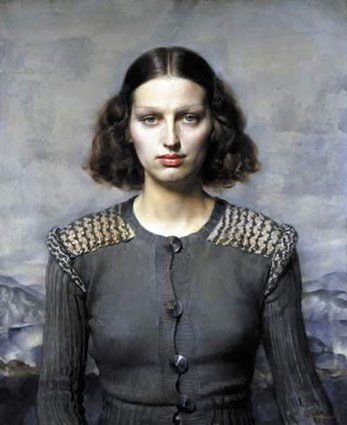
Jeunesse Dorée by Brockhurst

Ok, before you press the escape button, horrified by my infidelity, let me say that my love or is it infatuation is not for an actual woman but for a woman in a painting.  It all started back on May 16th 2011 when I told you about the time I stood before the painting Jeunesse Dorée.  I was rooted to the spot at the gallery, staring at Gerald Brockhurst’s portrait of Kathleen Woodward, the lady who was his beloved muse and who modelled for this painting.  I couldn’t take my eyes off her face.  There was something magnetic about the way she stared out at me.  I have since visited the gallery on a number of occasions just to pay homage to this beautiful woman.

Virgin Annunciate by Antonello da Messina

So that was that.  I was convinced that no other woman would compare with Kathleen’s beauty or so I thought.  However, almost a year later, (My Daily Art Display May 1st 2012), I came across a painting by Antonello da Messina entitled Virgin Annunciate.  As the title states, this was a painting of the Virgin Mary but the model the artist used for Mary was a humble Sicilian girl and for once the Virgin Mary portrayed in a painting, appeared simply as a young girl.  The model the artist had used for this work was a stunningly beautifully girl.  Words failed me as I looked into her eyes.  She had the most gorgeous face.  She had such an innocent air about her, which of course was befitting such a depiction.  There was such an unsullied loveliness about her that for a moment in my mind I discounted the haunting visage of Kathleen Woodward of Jeunesse Dorée, and yet how could I be so capricious?

And so my undying love of beauty had been transferred from a young English woman to a young Sicilian girl but I was determined that it was going to stop there, and so it would until I went to the Barber Institute of Fine Arts at Birmingham University a fortnight ago and “met” Countess Varvara Nikolaevna Golovina as portrayed by my featured painter, Élisabeth-Louise Vigée Le Brun.  Before I tell you more about the sitter and eulogise about her physical beauty, let me complete Élisabeth’s life story.

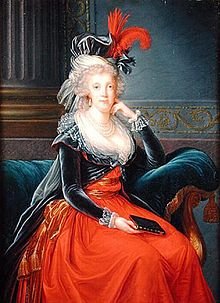
Maria Carolina by Élisabeth Vigée Le Brun (1791)

The French Revolution had begun and in October 1789, the Palace of Versailles had been stormed by a mob and the Louis XVI and his wife Marie Antoinette had been detained.  Élisabeth, because of her connections with Marie Antoinette, had to hurriedly leave France with her daughter and her daughter’s governess and head for the safety of Italy.  She visited Turin, Bologna, and Rome where her paintings met with great critical acclaim and she was elected to the Roman Accademia di San Luca.  From Rome she moved on to Naples.  Her artistic reputation preceded her and she received many commissions, including royal ones from the Queen of Naples and her husband King Ferdinand IV.  Look closely at the portrait (right) of the Queen, Maria Caroline.  Does she remind you of somebody from my last blog?  There is a very close resemblance with Marie Antoinette and this should not be too surprising as they were sisters.

During her European journeys, Élisabeth gained a travelling companion, who would remain alongside her and her daughter for the next nine years.  His name was, Auguste Jean-Louis Baptiste Rivière, a painter, who had also fled revolutionary Paris and made his way to Turin, where he had met up with Madame Vigée Le Brun and her daughter. Thereafter, he accompanied them and their servants on their trek across Europe and into Russia. During this time the two artists often worked in tandem, Vigée Le Brun painting life-size portraits, some of which were copied in miniature or simply on a small scale by Rivière. She wrote of him in her memoirs:

“…M. de Rivière was an astonishing actor in comic roles. Moreover he possessed every kind of talent, which caused the painter Doyen to remark that M. de Rivière was a little nécessaire de voyage literally a travelling case, but in French a play on words, meaning that he was a necessary adjunct during her voyages. The fact is that he was a fine painter and he copied all of my portraits in the form of large miniatures in oil. He sang very agreeably, played the violin and the bass viol and could accompany himself at the piano. He was endowed with intelligence, perfect tact and such a good heart that despite his distractions, which were frequent and numerous, he was able to oblige his friends with as much enthusiasm as success. M. de Rivière was short, svelte, and he never lost his youthful appearance, so that even at the age of sixty his thin waist and his bearing led one to think he was thirty…”

In 1795, Vigée Le Brun left Vienna and travelled to Russia where she was received by the nobility and painted portraits of numerous aristocrats including the last king of Poland Stanisław August Poniatowski and members of the family of Catherine the Great.  Catherine was not initially happy with Vigée Le Brun’s portrait of her granddaughters, Elena and Alaxandra Pavlovna, because of the amount of bare skin the short sleeved gowns revealed.  However, in order to please the Empress, Vigée Le Brun added sleeves giving the work its characteristic look. This alteration seemed to please the Empress who subsequently agreed to sit herself for Vigée Le Brun.  The proposed portrait never came to fruition as Catherine died in 1796 of a stroke before this work was due to begin.  While in Saint Petersburg, Vigée Le Brun was made a member of the Academy of Fine Arts of Saint Petersburg.   However less pleasing to Élisabeth was her daughter Julie’s decision to marry a Russian nobleman.

And so to My Daily Art Display’s featured work, entitled Portrait of Countess Golovine.  It is of Varvara Nikolaevna Galitzin, the daughter of Lieutenant General Prince Nicholas Feodorovitch Galitzin and his wife, née Prascovia Ivanovna Chouvaloff.  She spent the first fourteen years of her life on her father’s estate of Petrovska, near Moscow. After his death, she and her mother went to live in Saint Petersburg in a house on the Nevsky Prospect next to that of her uncle, Ivan Ivanovitch Chouvaloff.   She was named maid-of-honour at the Imperial court in 1783.   In spite of her mother’s opposition, she married the handsome wealthy but profligate Count Nicholas Nikolaevitch Golovin.   For a time she lived in Paris in the society of the old French aristocracy, but returned to Russia when Napoleon seized power.   Élisabeth and the countess formed a close friendship and in the artist’s memoirs, she wrote of her sitter:

“…Countess Golovin was a charming woman, whose wit and talents were enough to keep us amused, for she received few visitors. She drew very well and composed delightful love songs that she sang while accompanying herself on the piano. Moreover she was on the lookout for all the latest European literature with which she was familiar as soon as it was known in Paris…”

In the painting we see the Countess almost entirely enveloped in the red cloak which is embroidered with a neoclassical design. She wears a deep gold headband.  She stares out at us.  Her eyes are fixed on ours with unwavering, and somewhat unnerving frankness.  What made me lose my heart to this woman was the captivating way her left hand, which grasps her shawl, sweeps up wards clutching the material to her body.  Her loosely flowing auburn hair cascades down on to her shoulder. There is a ray of light falling at an angle from left to right which cuts the background diagonally into dark and light sections and by doing this the artist has emphasised the drama of the pose. There is an aspect of spontaneity about the pose and it is this aspect of the portrait which totally seduced me.

The painting was acquired by the Barber Institute of Fine Arts in Birmingham in 1980 where it hangs today.

After a sustained campaign by  Élisabeth’s ex-husband and other family members to have her name removed from the list of counter-revolutionary émigrés, she was able to return to France in 1802, during the reign of Emperor Napoleon I.   Her husband died in 1813 and six years later she suffers the tragedy of the death of her daughter.  She recalled these times in her memoirs:

“…I must now speak of the sad years of my life during which, in a brief space, I saw the beings dearest to me depart this world. First, I lost M. Lebrun. True that for a long time I had entertained no relations whatever with him, yet I was none the less mournfully affected by his death. You cannot without regret be separated forever from one to whom so close a tie as marriage has bound you. This blow, however, was far less than the cruel grief I experienced at the death of my daughter. I hastened to her as soon as I heard of her illness, but the disease progressed rapidly, and I cannot tell what I felt when all hope of saving her was gone. When, going to see her the last day, my eyes fell upon that dreadfully sunken face, I fainted away. My old friend Mme. de Noisville rescued me from that bed of sorrow; she supported me, for my legs would not carry me, and took me home. The next day I was childless! Mme. de Verdun came with the news, and vainly tried to soften my despair. All the wrong-doing of the poor little one vanished – I saw her again, I still see her, in the days of her childhood. Alas! she was so young! Why did she not survive me?…”

She bought a house in Louveciennes, Île-de-France, and lived there until the house was seized by the Prussian Army during the Franco-Prussian War in 1814.   She then moved to Paris where she remained until her death in her apartment at the Hotel Le Coq, rue Saint Lazare, at the age of 86,  on March 30th 1842 .  Her body was taken back to Louveciennes and buried in the Cimetière de Louveciennes near her old home.  On her tombstone were the words:

“Ici, enfin, je repose…”

(Here, at last, I rest…).

In all, Vigée Le Brun painted over 660 portraits and 200 landscapes which are in galleries and museums all over the world.   In 1835 she published her memoirs.

For a full account of Élisabeth’s life you should try and get hold of her autobiography, Memoirs of Madame Vigée Lebrun translated by Lionel Strachey.  There is an internet version to be found at:

http://digital.library.upenn.edu/women/lebrun/memoirs/memoirs.html#XVIII

Élisabeth-Louise Vigée Le Brun and Marie Antoinette

Marie-Antoinette of Austria, Queen of France
by Élisabeth Vigée Le Brun (1778)

I had intended this blog to be the concluding look at the life and some of the works of Élisabeth-Louise Vigée Le Brun but instead I am just concentrating this blog on a couple of the portraits Élisabeth did of the Queen consort Marie Antoinette and look at Élisabeth’s life up to her forced exile from France.  My next blog will conclude Élisabeth’s life story.

At the end of my last blog we had reached 1775 and Élisabeth’s step father had retired from his jewellery business and the family had moved to an apartment in a large property, Hotel de Lubert, which was situated on the rue de Clery.    The Hotel de Lubert was also where the painter and art dealer Jean-Baptiste Pierre Le Brun had his gallery.  Soon after settling into her new home, Élisabeth took a great interest in the beautiful masterpieces which filled Le Brun’s apartment and gallery.   She recalled this time in her memoirs saying:

“…I was enchanted at an opportunity of first-hand acquaintance with these works by great masters.  Monsieur Lebrun was so obliging as to lend me, for purposes of copying, some of his handsomest and most valuable paintings. Thus I owed him the best lessons I could conceivably have obtained…”

Six months after moving in to her new home Le Brun proposed marriage to Élisabeth.   She was not physically attracted to him but was concerned about her family’s financial future, hated living with her stepfather and after much persuasion from her mother, who believed Le Brun was very rich, agreed to Le Brun’s proposal.  Even on her wedding day on January 11th 1776, Élisabeth had her doubts about the wisdom of her decision for she later wrote:

“…So little, however, did I feel inclined to sacrifice my liberty that, even on my way to church, I kept saying to myself, “Shall I say yes, or shall I say no?” Alas! I said yes, and in so doing exchanged present troubles for others…”

Élisabeth’s fears were soon borne out for although she termed her husband as being “agreeable” he had one great character flaw – he was an inveterate gambler and soon his money and that which Élisabeth earned from her commissions was frittered away.  However before the money had run out, Élisabeth and her husband bought the Hotel de Lubert in 1779, and her Salons, which she held there became one of Paris’ most fashionable pre-revolutionary venues for artists and the literati.  Two years later, on February 12th 1780, her only child Jeanne Julie Louise was born.   In 1781 she and her husband left Paris and journeyed to Flanders and the Netherlands and it was during this trip that she saw some of the works by the great Flemish Masters and these paintings inspired her to try new painting techniques. During their time in Flanders she carried out various portraiture commissions for some of the nobility, including the Prince of Nassau.

It was back in the year 1779 that Élisabeth first painted a portrait of Marie-Antoinette, Louis XVI’s queen consort.  It was at a time when the lady had reached the pinnacle of her beauty.  In her memoirs Élisabeth described Marie-Antoinette:

“…Marie Antoinette was tall and admirably built, being somewhat stout, but not excessively so. Her arms were superb, her hands small and perfectly formed, and her feet charming. She had the best walk of any woman in France, carrying her head erect with a dignity that stamped her queen in the midst of her whole court, her majestic mien, however, not in the least diminishing the sweetness and amiability of her face. To anyone who has not seen the Queen it is difficult to get an idea of all the graces and all the nobility combined in her person. Her features were not regular; she had inherited that long and narrow oval peculiar to the Austrian nation. Her eyes were not large; in colour they were almost blue, and they were at the same time merry and kind. Her nose was slender and pretty, and her mouth not too large, though her lips were rather thick. But the most remarkable thing about her face was the splendour of her complexion. I never have seen one so brilliant and brilliant is the word, for her skin was so transparent that it bore no umber in the painting. Neither could I render the real effect of it as I wished. I had no colours to paint such freshness, such delicate tints, which were hers alone, and which I had never seen in any other woman…”

Both the artist and sitter formed a relaxed friendship and in her first portrait (above) the queen is depicted with a large basket, wearing a satin dress, and holding a rose in her hand. The painting was to be a gift for Marie-Antoinette’s brother, Emperor Joseph II, the Holy Roman Emperor, and a further two copies were made, one of which she gave to the Empress Catherine II of Russia, the other she would keep for her own apartments at Versailles.  In all, Élisabeth painted more than thirty portraits of the queen over a nine year period

Élisabeth’s friendship with Marie-Antoinette and her royal patronage served her well as in 1783,  her name had been put forward by Joseph Vernet for election to France’s Académie Royale de Peinture et de Sculpture.   As her morceau de réception (reception piece) she submitted an allegorical history painting entitled La Paix qui ramène l’Abondance (Peace Bringing Back Prosperity).  She also submitted a number of her portraits. The Académie however did not categorise her work within the academy categories of either portraiture or history.  Her application for admission was opposed on the grounds that her husband was an art dealer, but because of Élisabeth’s powerful royal patronage, the Académie officials were overruled by an order from Louis XVI.  It is thought that Marie Antoinette put considerable pressure on her husband on behalf of her painter friend.

Having royal patronage and being great friends with Marie-Antoinette was a boon when the Royalty was loved by its people but once the people turned against Louis XVI and his queen, as happened during the French Revolution, then any friends the royal couple had were equally detested and at risk from the mob.  Attacks on Élisabeth Vigée Le Brun’s character had started back in late 1783 when the newspapers wrote stories about an alleged affairs she had with the Finance Minister, Charles Alexandre, Vicomte de Calonne, the Comte de Vaudreuil and the painter François Menageot.  The rumours persisted and it all came to a head in 1789 when fictitious correspondence between Élisabeth and Calonne was published in the spring.  Rumours about her lavish lifestyle abounded, even though they were not altogether true.  She was now starting to realise that having close connections to the monarchy, which she had once considered to be advantageous, was becoming a dangerous liability.

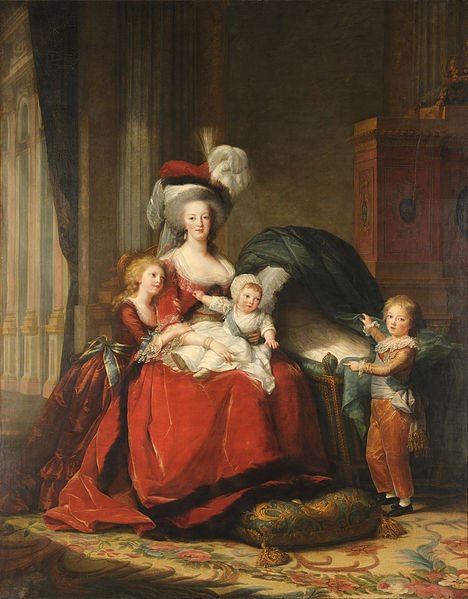
Marie Antoinette and her Children
by Élisabeth Vigé Le Brun (1788)

Élisabeth Vigée Le Brun’s last portrait of Marie-Antoinette was completed in 1788 and entitled Marie Antoinette and her Children.  The setting is a bedroom or a private chamber within the Royal palace.  Marie Antoinette is seated with her feet on a cushion.  This depiction of her posture symbolizes her status and high position in society.  She has a young infant on her lap and her son and daughter are either side of her.  In the painting we see her son, Louis-Joseph, Le Dauphin, standing to the right. Louis-Joseph suffered from bad health all his young life with the onset of early symptoms of tuberculosis and he died of consumption in 1789, a few months before his eighth birthday.   On the Queen’s lap sits Louis-Charles, Duc de Normandie, who on the death of his elder brother, became the second Dauphin. Following the guillotining of his father Louis XVI,  he became known as Louis XVII. This young boy was imprisoned in The Temple, a medieval Parisian fortress prison, where he died in 1795, aged ten, probably from malnutrition but rumour also has it that he was murdered.  Standing on the Queen’s right is Marie Therese Charlotte de France, Madame Royale.  She was Marie-Antoinette’s eldest child.  She too was imprisoned in The Temple but was the only member of the Royal family to survive the ordeal.  She remained a prisoner for over a year but Austria arranged for her release in a prisoner-exchange on the eve of her seventeenth birthday, in December 1795.  In the painting we can also see depicted an infant’s cradle which Louis-Joseph points to and lifts the covers showing it as being empty.  This empty cradle is a reference to Princess Sophie, Marie Antoinette’s other daughter, who was born in 1786 and died of convulsions two weeks before her first birthday.  This very poignant painting still hangs at Versailles.

On the night of October 6th 1789, following the invasion of Versailles by Parisian mobs and the arrest of the royal family, Élisabeth Vigée Le Brun left the mayhem of Paris with her daughter and governess in a public coach and headed for Italy.  She had hoped to return to France in the near future when the situation had settled down but in fact she never set foot back in France for twelve years.

My next blog will look at the latter part of Élisabeth’s life and I will regale you with my tale of infidelity which was the reason for featuring Élisabeth-Louise Vigée Le Brun in the first place !!


Self Portraiture by Élisabeth-Louise Vigée Le Brun

Over the next two blogs I want to introduce you to and look at the life of one of the finest 18th century French female portraitist, Élisabeth-Louise Vigée Le Brun.  In my initial blog about her I want to examine her early life and show you three of her self portraits and in the following blog I will conclude her life story and tell you about her friendship with Marie-Antoinette, her exile from the land of her birth and relate how I was once again unfaithful having been seduced by a new beauty !  Sounds interesting ?

Self Portrait in a Straw Hat (age 22)
by Élisabeth-Louise Vigée Le Brun (1782)

Today’s artist was born Élisabeth-Louise Vigée in April 1755 on the rue Coquilliere in Paris, just six months before another baby girl was born in the palace of Emperors of Austria in Vienna, a priveleged child, who would become the queen of the French nation and also play a large part in Élisabeth’s life.  That Viennese baby was Marie-Antoinette.   But let me return to Élisabeth.  Élisabeth was the daughter of Louis Vigée, a portraitist and professor at the Academie de Saint Luc .  Her mother, Jeanne Maissin was a hairdresser by trade.  At the age of 3 months, she was sent to a small farm near Épernon, where she was looked after by relatives.  She stayed with them until she was six years old.  Following this, she attended the convent school, Couvent de la Trinite in the Faubourg Saint Antoine district of Paris, as a pensionnaire, (a boarder) where she remained until she was twelve years old.  It was here that she first displayed her young talent for drawing and painting.  In her memoirs she wrote about her time at the boarding school, her love of drawing and the trouble it often got her into but also the pleasure her father had in her interest in art.  She wrote:

“….During that time I scrawled on everything at all seasons; my copy-books, and even my schoolmates’, I decorated with marginal drawings of heads, some full-face, others in profile; on the walls of the dormitory I drew faces and landscapes with coloured chalks. So it may easily be imagined how often I was condemned to bread and water. I made use of my leisure moments outdoors in tracing any figures on the ground that happened to come into my head. At seven or eight, I remember, I made a picture by lamplight of a man with a beard, which I have kept until this very day. When my father saw it he went into transports of joy, exclaiming, “You will be a painter, child, if ever there was one!…”

On returning to live at home on a permanent basis, her father gave Élisabeth her first drawing lessons when she was allowed to attend his drawing classes which he gave to students in his studio.  Sadly his tuition did not last long as Louis Vigée died on May 9 1767 in his apartment on the rue de Clery.   To lose her father at the age of twelve was a traumatic experience for Élisabeth and she recalled the moment:

“…I had spent one happy year at home when my father fell ill. After two months of suffering all hope of  his recovery was  abandoned. When he felt his last moments approaching, he declared a wish to see my brother and myself. We went close to his bedside, weeping bitterly. His face was terribly altered; his eyes and his features, usually so full of animation, were quite without expression, for the pallor and the chill of death were already upon him. We took his icy hand and covered it with kisses and tears. He made a last effort and sat up to give us his blessing. “Be happy, my children,” was all he said. An hour later our poor father had ceased to live…”

Self Portrait with her Daughter (Maternal tenderness)
by Élisabeth-Louise Vigée Le Brun (1786)

Élizabeth’s father had, on his death, left the family penniless and his widow had to find ways of clearing their debts and pay for her son’s schooling and it is with that in mind that, in December of that same year, 1767, she married a wealthy jeweller, Jacques François Le Sevre and the family moved to an apartment on the rue Saint Honore facing the Palais Royal.    However any thoughts she had that her rich husband would solve the family’s financial problems were soon dashed as he turned out to be miserly with his money and just provided the bare minimum for his wife and her son.  Élisabeth, by this time, had been earning her own money from commissions but was made to hand it over to her step-father for him to use as he saw fit.

Élisabeth began taking drawing lessons with her friend Blaise Bocquet from the history painter and Academician, Gabriel Briard, who had a studio in the Louvre.  During her training she copied the paintings of the Old Masters at the Louvre and the Palais-Royal, which housed the magnificent Orléans art collection, and during this period she encountered the French artist, Claude Joseph Vernet.  He would often give her artistic advice and encourage her and more importantly introduced her to prospective important and wealthy patrons.  She also met the Abbé Arnault, of the French Academy.  She later described him as a man of strong imaginative gifts, with a passion for literature and the arts and recalled how his conversation enriched her with ideas.     It was the studying of the Old Masters’ paintings which furthered her knowledge of anatomy, perspective, and the other important aspects of history painting which she was not allowed to formally study, simply because of her gender.  She spent a great deal of time copying the heads in some of the pictures by Rubens, Rembrandt and Van Dyck, as well as several heads of girls in paintings by Jean-Baptiste Greuze.  She was a great admirer of Greuze’s portraiture because, from them, she learnt about his use of  the demi-tints when portraying flesh colouring.

By this time Élisabeth had decided that her future lay in her art and she would strive to become a successful painter.  However her choice of career was problematic simply because she was a female.  As a female, she was excluded from formal academic training and artistic competitions and this factor alone gave her a distinct disadvantage in comparison to the training afforded to her male contemporaries.  At this time in France, the most prestigious type of painting was history painting but to achieve a reputation as a great history painter one had to undergo an all-embracing formal artistic education into the likes of the technique of painting the nude male and how to best arrange figures within a painting for it to be accepted as an acceptable narrative work.  However for reasons of modesty, females were not allowed to paint nude males and so as this formal training was not yet available to aspiring female artists, they had to settle for painting portraits, landscapes and genre works.  She now decided to specialise in portraiture.

Self Portrait with Daughter (à la Grecque)
by Élisabeth-Louise Vigée Le Brun (1789)

In 1774, aged nineteen, Élizabeth applied to join the Academy of Saint Luke where her father had taught. She was accepted and that year she exhibited several of her works at their Salon.  Her portraiture and the way in which she depicted her sitters in a flattering manner was very popular and much in demand.  In 1775 she married a wealthy art dealer and amateur painter, Jean-Baptiste-Pierre Le Brun.  The marriage was a marriage of convenience orchestrated by her mother.  Five years later, the couple had their only child, Jeanne Julie Louise, born on February 12th 1780.  It was not a love match, but more of a mutually-beneficial pact that benefitted them both.  .  Her husband marketed her work and endorsed her artistic career while also profiting from her artistic output.  It worked well and the couple became quite affluent and lived a luxurious lifestyle, which allowed them to mix socially with the highest circles of society. Soon Élisabeth and her husband would hold fashionable soirées at their home.  Their guests included artists, writers, and important members of Parisian society.  In 1776 she finally managed to achieve her ultimate aim.  She secured her first royal commission when she was asked to paint a series of portraits of King Louis XVI’s brother, the Comte de Provence.  Before long she even caught the attention of the king and queen themselves and Élisabeth was summoned to the court in 1778 to paint her first portrait of the Marie Antoinette. Marie Antoinette had had her portrait painted by many artists but neither she nor her mother, Marie-Thérèse were ever fully satisfied with the results.  However, they both approved of Élisabeth’s depiction which, although it admirably conveys her royal status, it was actually much more simplified and natural than most of the earlier official portraits of the queen.  This portrait marked the start of a close relationship between Élisabeth and Marie-Antoinette.  This relationship greatly enhanced the reputation of the artist and led to many wealthy commissions. Louis XVI was equally impressed by her artistic work and in Wendy Slatkin’s book, Women Artists in History, she quotes Louis XVI’s comments about Élisabeth and her work:

“…I know nothing about painting, but you have made me love it…”

Élisabeth was a devoted royalist and idolized Marie Antoinette and the rest of the royal family.  It was however this close friendship with Marie-Antoinette which was to alter the course of her life.

Portrait of Susan Lumsden by Rubens

I have included three self portraits in this intial blog about the artist Élisabeth-Louise Vigée Le Brun.   The first one entitled Self Portrait with Straw Hat was completed in 1782 and is held in a Swiss private collection.  Élisabeth exhibited this work at the 1783 Académie royale de peinture et de sculpture (Royal Academy of Painting and Sculpture), Paris.  Of this painting the artist wrote:

“…I was so delighted and inspired by Rubens’ Le Chapeau de Paille that I completed a self portrait whilst in Brussels in an effort to achieve the same effect.  I painted myself wearing a straw hat with a feather and a garland of wild flowers and holding a palette in one hand...”

For a more comprehensive look at Rubens’ Le Chapeau de Paille, also known as Portrait of Susanna Lunden go to My Daily Art Display of March 11th 2011.

Lady Hervey and her Daughter by Angelika Kauffmann

The second self portrait I have featured was completed by Élisabeth in 1786 and is entitled  Madame Vigée-Le Brun and Her Daughter, Jeanne-Lucie, known as Julie (1718–1819).  The painting is thought to have been inspired by a work by Angelika Kaufmann, entitled Lady Hervey and her Daughter which depicted Elizabeth Drummond, Lady Hervey and her daughter Elizabeth Catherine Caroline Hervey later to become The Honourable Mrs Charles Rose Ellis.  The work by Vigée Le Brun is one of maternal tenderness and is somewhat reminiscent of the sentimental pictures of Jean-Baptiste Greuze which Élisabeth had studied in her younger days.


The third portrait in this blog is entitled Madame Vigée-Le Brun et sa fille, Jeanne-Lucie-Louise, dite Julie (Madame Vigée-Le Brun and her daughter Jeanne-Lucie-Louise, known as Julie) and is often referred to as Self Portrait with Daughter (à la Grecque).  It is currently housed at the Louvre in Paris.

Réunion de famille (Family Reunion) by Frédéric Bazille

Family Reunion by Frederic Bazille (1867-69)

Often when I am driving down a large highway and see that the traffic flow in the opposite direction has stopped resulting in a formidable two or three mile tailback and I go further on, past the hold-up, around a bend in the road, and see cars heading towards the stopped traffic, the drivers of which are completely oblivious to what is around the bend.  They are happily driving on.  Life for them is good.  Maybe they are heading home or heading for a destination they have been counting down time to reach.   They have great plans with regards what they will do when they reach their destination.   It is at times like these that I think about life and death and the way we, like the driver and passengers of the cars heading unwittingly towards the tail-back.  We are happily going about our business, completely unaware of what is about to happen to us in a few minutes, or a few hours, or a few days or a few months hence.

So why do I start my art blog in such a fashion?   The reason is that for my next two blogs I am featuring works by two young artists who had their whole lives ahead of them and who must have believed theirs was to be a successful and happy future and yet because of a conscious decision they both made, their lives would end suddenly in the theatre of war.  Today I am going to once again look at the life and works of the nineteenth century French painter Frédéric Bazille and in the following blog I want to introduce you to an artist, who you may not have come across before, the English Victorian painter Brian Hatton.

Jean Frédéric Bazille was born in Montpellier at 11, Grand’rue in 1841. His father was Gaston Bazille and his mother was Camille Victorine Bazille (née Viliars).  Gaston Bazille was a wine merchant, senator and president of the Agricultural Society of Herault.  He was the head of an affluent and cultured upper middle-class Protestant family.  He and his wife had three children, Suzanne the eldest, followed by Jean Frédéric and Claude Marc.  Whilst living in Montpellier, Bazille became acquainted with a friend of his father, a local art collector Alfred Bruyas.  Bruyas was also a close friend and patron of the artist Gustave Courbet and, over time, he had built up a sizeable art collection with works by Jean-François  Millet, Jean-Baptiste-Camille Corot, Eugène Delacroix and of course, many by his friend Courbet.   Young Frédéric Bazille often had the chance to examine these precious works and was fascinated with and inspired by the collection.   This was to be the start of the young man’s love affair with art.  He began to paint and sketch but his father told him that if he wanted to continue with his art he had to agree to continue with his studies. He graduated from high school in Montpellier, where he obtained a degree in 1859, and as he would do anything to continue with his art, he went along with his father’s wishes and began his medical studies at the Faculty of Montpellier.

To continue with his medical studies, Bazille had to move to Paris and so in November 1862 he travelled to the capital.   Whilst in Paris, Bazille, unbeknown to his father, spent more time sketching and painting than getting on with his medical studies.    In late 1862, Bazille enrolled at the private art studio of Charles Gleyre, the Swiss historical painter.   Whilst at this atelier he met and became friends with fellow aspiring artists, Claude Monet, Auguste Renoir, Alfred Sisley and James McNeil Whistler.   Monet and Renoir would become close friends of Bazille’s and they were to influence his artistic style and approach toward art, particularly through the practice of en-plein air painting and directly observing life and nature.  During this time, a frequent meeting place for these artistic friends was the Café Guerbois in Paris, where new ideas and theories were discussed passionately.    Bazille, unlike Monet, had no money problems.  He came from a well-off family and he would often pay for many a round of drinks.   Bazille also paid for studio rent and art supplies and always helped ease the financial worries of the likes of Monet by buying some of their paintings and by doing so ensured that his new-found friends would be saved from complete financial despair.

When Gleyre’s studio closed the following year Bazille decided to leave Paris and follow his friends whilst he waited on the results of his medical exams.  In 1863 he went and lived alongside Monet at Chailly and learnt the en plein air painting technique in the Forest of Fontainebleau.  In 1864, he found out that he had failed his medical exams, much to his father’s disappointment.   Bazille gave up any idea of entering the medical profession and, from this time on, he concentrated all his efforts on his painting.

France declared war on Prussia on 19 July 1870 but the other German states quickly joined on Prussia’s side and France was soon defeated.  In August 1870, at the age of 28, Frédéric Bazille, against the wishes and advice from his friends, enlisted in the Third Regiment of the Zouave.    Zouave was the title given to certain light infantry regiments in the French army which trained in Algeria.   One must remember that Bazille was a wealthy man and could, if he had so wanted, not have gone to war, for in those days, even if he had been drafted, he and his family could have paid for another person to substitute for him. However Bazille chose to serve his country.   Bazille died on November 28th 1870 at the Battle of Beaune-la-Rolande, near Orléans.  Bazille’s biographer, François Daulte wrote about the incident:
“... The company halted on the top of ridge overlooking Beaune. It was greeted with a hail of Prussian bullets. The first of the men advancing toward the town fell like flies …….. In the general chaos women and children were escaping from the town and running towards isolated farm buildings which would offer some protection …….. Bazille’s turn came and he charged, crying: “Don’t shoot! Women and children!” He was hit by two bullets to the arm and chest. He fell, face down in the earth, fifty metres from the château where Corot had painted one of his masterpieces…”

Bazille died on the battlefield just eight days before his twenty-ninth birthday.   His family was devastated and his father travelled to the battlefield a few days later to take his body back for burial at Montpellier.

My featured painting today is probably Frederic Bazille’s most famous work, entitled Réunion de famille also called Portraits de famille (Family Reunion also called Family Portraits) which he completed in 1867 and altered slightly two years later.  It is a large painting, measuring 152cms x 230cms.  The subject of the work is an extended family gathering at Bazille’s family’s country estate at Méric, near Montpellier during the summer of 1867.  The sun is shining brightly but the people are safeguarded from the harsh rays of the sun by the very large tree on the terrace, the foliage of which filters the sunlight, which allows the artist to cleverly depict the very sophisticated light and shadow effects against the subjects, their clothing and surroundings.  Look at the strong contrasts of the bright colours between that of the landscape and the sky in comparison to the shaded areas under the tree.  As the sunlight manages to filter through the leaves it manages to light up some of the pale clothing contrasting it against the darkness of the jackets, shawl and apron.  It illustrates how Bazille’s liked painting in the light of the South of France.

In this painting, Bazille has depicted various figures in a tableaux-type style.  Although there is a peaceful feeling about this depiction, it is just a group of figures.  There is a lack of interaction between the family members with all the figures stiffly-posed and all, except the father, looking towards us as if we were the photographer recording this family get-together.  The photographer aspect of this painting may not be as far-fetched as it seems as it is known that around about this time Frédéric’s brother Marc married Suzanne Tissié and it could well be that Frédéric was in some ways recording the family get-together a few days after this wedding.  There is an air of confidence about the demeanours of the people depicted, which probably came with their affluent status in society.  In the picture Bazille has included ten extended family members and he even added himself in the painting.  He is not in a prominent position.  He has squeezed himself into the far left of the painting, which may infer that he was somewhat reluctant to include himself.    Next to him stands his uncle by marriage, Gabriel des Hours-Farel.  Seated on a bench with their back to him is his mother, Camille, and father, Gaston, whilst at the table is his aunt, his mother’s sister, Élisa des Hours-Farel and her daughter Juliette Thérèse.     Standing by the trunk of the tree with their arms linked are Bazille’s cousin Thérèse Teulon-Valio, the married daughter of Gabriel and Élisa des Hours-Farel,  and her husband, Emile.  On the right of the painting, standing by the terrace wall is Marc Bazille, Frédéric’s brother with his wife of a few days, Suzanne Tissié and his sister Suzanne.    The Bazille and des Hours families used to spend every summer on the magnificent estate of Méric, in Castelnau-le-Lez, a village near Montpellier. The house and its grounds were slightly higher up, overlooking the village.

Two years later, after it was shown in the Salon, Bazille re-worked parts of the painting, replacing little dogs, which had been in the foreground, with a somewhat contrived still life made up of a furled umbrella, a straw hat and a bunch of flowers.

The painting was accepted by the French Salon of 1868, which slightly embarrassed Bazille as his friend Monet had failed to get any of his works accepted by the Salon jurists that year.  Bazille didn’t gloat much about his inclusion in the Salon, stating that his being chosen over Monet was “probably by mistake.”  Bazille’s is often now looked upon as a dilettante, an amateur who flirted with avant-gardism but lacked application and so remained a follower rather than a leader. However some of his contemporaries would disagree, Camille Pissaro described him as:  “one of the most gifted among us.”

Bazille produced many beautiful works of art during his short lifetime and who knows what he may have accomplished if he had not patriotically decided to fight for his country and sadly, within a year of painting today’s picture he was lying dead on a battlefield.