Balthus. Part 4. Setsuko and the latter days

The two sons of Balthus, Stanislaus and Thadée, edited a book in which they put together letters that their father had written.  The book was entitled Correspondance amoureuse avec Antoinette de Watteville 1928-1937 which was published in 2001.  One of the letters, dated August 31st 1933 was a letter from Balthus to his father in which he told of his worries about people analysing his work too much and how he tried to ensure that his depictions did not open up the possibility of various interpretations.  He wrote:

 “…The horrible danger for me, though, is to fall into the trap of becoming anecdotal, but it won’t happen…”

The Golden Days by Balthus (1944-46)

However, a painting he completed in 1946, entitled The Golden Days, received many interpretations which probably annoyed the artist.  The work of art can be seen in the Hirshhorn Museum, part of the Smithsonian Institution, Washington, DC.    So, should one just look at the painting and not try to guess what was in the mind of Balthus when he painted this picture?  Before us is a good looking teenage girl slumped contentedly on a small chaise longue. In her left hand she holds a white hand mirror.  The mirror is bathed in light from the window behind her.  She studies her own reflection.  As we have seen in many of Balthus’ paintings her legs are spread wide apart and her short skirt has ridden up exposing her thighs.  Her bodice lies open and has slipped off her right shoulder.  Around her neck we see a pearl necklace.  On her feet is a pair of white slippers.  Behind her there is a wooden table upon which is a white bowl.  In the background there is a roaring fire being tended to by a man who is stripped to the waist.  So, do we take the painting at face value as Balthus says we should do, or do we start to interpret what we see before us?  That’s your choice but I would like to quote a passage in an art essay written by Andre Pijet about the works of Balthus and, in particular, his interpretation of The Golden Days.  He was adamant that Balthus’ paintings need to be decoded and by doing so it would reveal the meaning of each element.   Pijet wrote:

“…The artwork shows a young girl stretched comfortably on a small sofa and she is preoccupied by looking at the reflection of herself in the white mirror, which she keeps in her left hand. The mirror symbolizes the world, life, femininity, love, and vanity. The pearl necklace on her neck refers to the virginity, health, perfection, and preciousness. The right hand hung down looks as it is suspended in the air. Her torso is partly uncovered suggesting a delicate touch of feminine coquetry. The girl’s legs are spread in provocative invitation of sexual curiosity. Together, the white slippers on her feet, the white mirror and the white pillow behind her head as well as the white bowl on the table completed with the white light projected from the window situated in the back symbolize the innocent purity of the young female beauty. The entire room is divided by the two sources of light. The white light coming from the window on the left is mixed with the red reflections projected by the chimney. Both these lights blend together exactly in the area of the girl’s spread legs suggesting the boundaries between the innocence and the sexual initiation. The sofa itself has a shape of the hiking shoe suggesting that the young beauty is on her way approaching the sexual fire of her first erotic experience. The man on the right is preparing the ground for her erotic enlightenment by warming up the room. On the left side of the chimney, a small statue with phallic forms is standing. Just beside the sculpture the log tongs are leaning against the chimney surface. The log tongs have the shape of female crotch as well as the form of infant what symbolize the process of future maternity. The chimney itself suggests the female sexual organs and the small in posture man working hard to keep the fire on representing symbolically the process of sexual intercourse. The man with his right hand covered with the white glow is touching the chimney that suggests clearly the act of defloration. The massive quantities of symbolic information, which is easily readable after close examination of all elements of the painting, refer to the passage of time from the childhood to the adolescence and the first encounter with sexuality…”

It is interesting to note that Sabine Rewald, the foremost exponent on Balthus and his art, in her book Balthus: Cats and Girls, which was published in conjunction with the 2013 Balthus exhibition at the Metropolitan Museum of Art in New York, never tried to interpret this work of art.

The sitter for this painting was fourteen year old Odile Bugnon and in an interview with Sabine Rewald in 1986, the now married Odile Emery, said that her family of farmers leased the farmstead, part of the Le Guinzet estate outside of Fribourg, from the baron de Cholet and Balthus had been commissioned to paint a portrait of the baron and his two daughters.  On one of his last visits Balthus saw Odile playing with some of the baron’s children.  He asked if she would like to pose for him.  She agreed and Balthus then attained permission from her mother.  When she arrived for her sitting Balthus was horrified to see that her mother had taken her to the hairdressers and dressed her up in a pretty dress and black slippers and stockings.   Balthus was appalled by the transformation and got Odile to change into the clothes we now see in and carefully posed her in the depiction we now see before us.

Although we see Odile’s right hand flopped downwards and her fingers pointing towards the floor, in his original version, those fingers were stroking a cat, which was later over-painted shown above.  Odile remembers the setting and the pose she was told to take by Balthus.  She remembered the roaring fire but said there was no man tending it.   As Balthus never completed the work until after he had moved to Villa Diodati in Coligny a small town outside of Geneva in October 1945, Odile never saw the finished work.

Whilst living in Fribourg, Antoinette gave birth to their first son, Stanislas, in October 1942 and in February 1944 their second son Thadée was born.  In March 1946 having spent the previous six months in Coligny Balthus and his family ended their Swiss exile and returned to Paris.

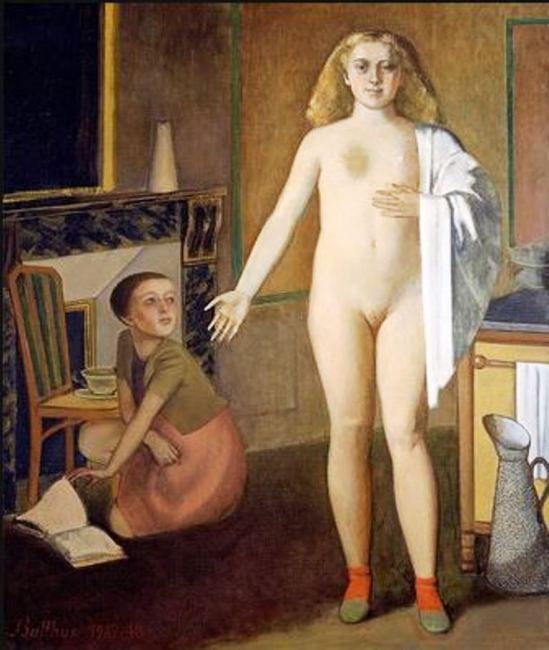
The Room by Balthus (1948)

On returning to his Paris studio at 3 cours de Rohan,  he worked on his large painting 190 x 160cms (75 x 63in.), which was entitled The Room.  He started the work in 1947 and completed it a year later.  It is a painting of contrasts.  What is the setting?  If we look to the left, we see a fire and an ornate mirror, so maybe it is the salon but if we look to the right we see a cooking stove, a towel rack and a speckled water pitcher, so is it the kitchen?  Maybe it is a forerunner of a “kitchen diner” !  The two characters depicted in the work are completely dissimilar. Kneeling on the floor and resting her elbow on a chair is a plainly dressed girl who had been reading a book, which lies open on the floor.  She is looking up at the other woman, a colossal nude.  This woman has long reddish blonde hair and a very thickset body.   She has a white towel draped over left shoulder and arm like a cape.  The open palm of her right hand points towards her kneeling companion in a gesture of an introduction.  What is the relationship between the two figures?  Are they mistress and servant?

Madonna della Misericordia by Piero della Francesca (1462)

Some art historians have said that the stance and size of the nude woman reminds them of the 1462 religious work by Piero della Misericordia, entitled Polyptych of the Misericordia.  The centre panel of this polyptych showed a very large depiction of the Madonna surrounded by a number of much smaller, in size, followers.  Balthus who spent time in Italy in 1926 copying paintings may have come across this religious work, which is housed in the Pinacoteca Communale in Sansepolcro, a town some 70 kilometres east of Siena.

In 1947 Antoinette left Paris with her two sons who were aged three and five.  Balthus had decided that his marriage to Antoinette was at an end and their best course of action was to amicably separate.  However, it was almost twenty years later before the couple divorced.

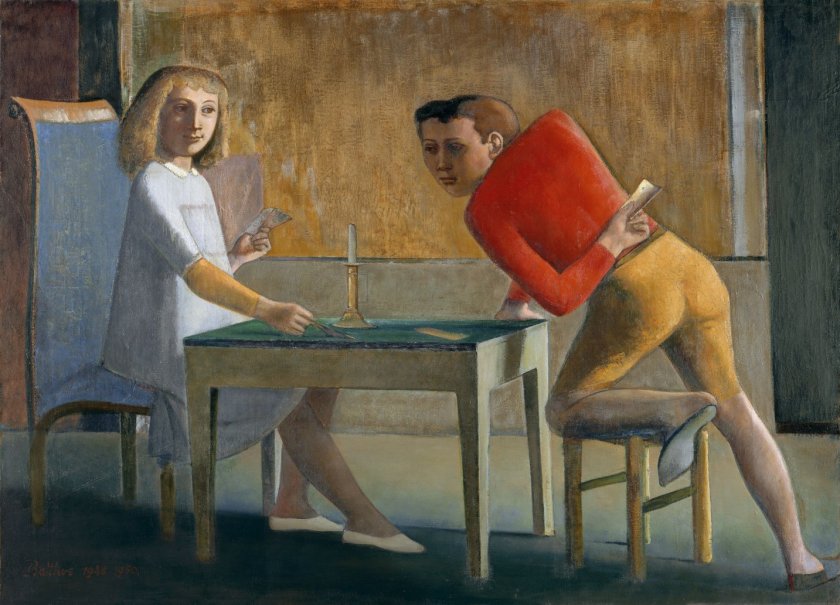
The Card Players by Balthus (1950)

In 1950 Balthus completed another painting depicting the game of cards.  This time he has shown two players, a girl and a young man.  The painting is simply entitled The Card Players and is housed in the Museo Thyssen-Bornemisza in Madrid.  The setting is an unadorned dark room.  The painting depicts two youngsters, a boy and a girl, playing cards at a table on which a candlestick stands. The room is lit up by light which emanates from the right-hand side of the room and which illuminates various objects and, in some way, seems to add to the mystery of the picture.  We get the impression from the smile on the girl’s face that she is winning and the boy is losing despite his attempt to cheat, as seen by the card hidden behind his back.  The depiction of the boy by Balthus is unusual as we see him both in a frontal and profile view.

In January 1949 Balthus’ father Erich died.   Balthus spent a lot of time in the early 1950’s designing theatrical sets and costumes for plays, operas and ballets.  In 1961 having achieved so much in theatre work he was appointed director of the Académie de France in Rome by his close friend André Malraux, the French Minister of Cultural Affairs.  Balthus was to remain in that post and live in Rome until 1977.

Setsuko in 1991
Setsuko in 1991

In 1962 Malraux asked Balthus to go to Japan as France’s official “ambassador of art” in order to organize a major exhibition of Japanese art to be held in Paris.  During that visit he met Setsuko Ideta, a nineteen year old, first-year student at the Tokyo Sophia Jesuit research University.  She was the same age as his first son Stanislaus!  Setsuko served as the English translator to the Balthus’ group who were touring the temples in Kyoto.

Setsuko remembered her first meeting with Balthus:

“…We met we spoke, they quarrelled…”

Balthus told her he was 50.  But as Setsaku said, it was not true, he was 54.   It has to be remembered Balthus was a Leap Year child, born on February 29th.  The German poet Rainer Maria Rilke, who had an affair with Balthus’ mother, told Balthus that having a leap-year birthday meant he’d slipped through a crack in time, into a “kingdom independent of all the changes we undergo”, and so Balthus liked to divide his real age by four, so allowing himself to admit to being 50 was somewhat of a compromise!  In his book Balthus: A Biography, the author, Nicholas Fox Weber described Setsuko:

“…Setsuko was the embodiment of much that he cherished: female beauty, youthful vitality,piercing intelligence and the charms and diffidence of the Orient…”

Countess Setsuko Klossowska de Rola

Setsuko was steeped in her Japanese heritage and came from the Samurai family of Kyushu.  She was poised and confident.  Balthus and Setsuko were married on October 3rd 1967.  Balthus and his first wife, Antoinette, were divorced in 1966 after twenty years of separation.

Balthus' daughter Harumi
Balthus’ daughter Harumi

In September 1969, Balthus’ mother Baldine died in Paris, aged 83.  In April 1973 Setsuko gave birth to a daughter, Harumi.  In 1977, Balthus  leaves the position of director of the Académie de France and after living sixteen years at the Villa Medici in Rome, he moves back to Switzerland.  Balthus had served two terms as director and was reluctant to leave the Italian capital but at that time there were many high profile kidnappings and he and his wife believed they may one day become targets and so it was the time to leave Balthus’ beloved Rome.

Balthus with his wife, Setsuko, their daughter, Harumi, and granddaughters at the Grand Chalet in Rossinière

Balthus, Setsuko and their four year old daughter Harumi went to live in Le Grand Chalet at Rossinière.  It was a magnificent building.  It was the largest known all-wooden structure of its kind in Europe, it was built between 1752 and 1756 by Jean-David Henchoz.

It was to remain Balthus’ home until he died there in August 2001, aged 93.  Balthus had been taken ill but left the hospital the night before he died to see once more his large chalet at Rossinière.  The funeral was held in the Swiss village of Rossinière, and was attended by a number of high-profile guests, including Prince Sadruddin Aga Khan, the supermodel Elle McPherson and Bono. The French and Italian governments also sent representatives.  After the ceremony in the village church, two horses pulled a carriage with the coffin draped in black. The artist was buried at the foot of a hill on a plot owned by the Balthus Foundation, some 300 metres from the chalet.      The Irish singer Bono, who was Harumi’s godfather sang at Balthus’ funeral.

Love him and his artwork or hate him for his use of young girls as models, I have found his life story fascinating and can understand why he was one of France’s most famous twentieth century artists.

Balthus – Part 2 – Young girls and controversy

Self Portrait by Balthus (1940)

In my second part of my look at the life and works of Balthus I am going concentrate on his depiction of pubescent girls which were to shock both the public and critics alike when they first exhibited in 1934 at the Galerie Pierre in Paris.  I have in some earlier blogs discussed what is, to some, termed as beautiful erotic art whilst others look upon the depictions as unacceptable and pornographic.  Those paintings by the likes of Egon Schiele and Lucien Freud were depictions of adult female models but in the case of Balthus’ paintings the models he was using were pre-pubescent girls.  I leave it to each person to decide whether the depiction of these young girls was simply the work of an artist and therefore as art, was acceptable or whether there was something very offensive and disturbing about the paintings.  Everybody is entitled to their own opinion.

I need to remind you that the depiction of young girls naked or semi-naked in paintings is not just something that interested Balthus.  Many other well known artists used young girls as models and portrayed them in their works of art.

Little Girl by Otto Dix

There was Otto Dix, the German painter, and often talked about as the most important painter of the Neue Sachlichkeit, which was an artistic style in Germany in the 1920 which set out to confront Expressionism.  It was looked on as being a return to unsentimental reality and one which concentrated on the objective world, unlike Expressionism which was more abstract, romantic, and idealistic.  His 1922 painting Little Girl in front of Curtain, which can now be seen at the Minneapolis Institute of Art, was judged to have flown in the face of morality.  This painting of a young naked girl is portrayed in a realistic style, maybe too realistic as it details the blue veins of her body.  She looks emaciated and she stares past us with a haunted expression. Her childhood is probably a thing of the past as, sadly, is her innocence.  A pink flower clings to the curtain behind her, and in her hair we see a bright red bow.   The artist himself once said:

“…I will either become notorious or famous…”

This painting probably allowed Otto Dix to achieve his first goal.

Puberty by Edvard Munch (1894)

The great Norwegian painter, Edvard Munch, who is best known for his paintings entitled Scream, also produced a painting in 1894 featuring a pre-teen naked girl.  The painting which was entitled Puberty depicts a young pubescent girl, nude, sitting with her legs together.  There is an air of shyness about her and this could be that at her age she is starting to become aware of the changes to her body.

Standing nude young girl 2 by Egon Schiele (c.1911)

The celebrated Austrian Expressionist artist Egon Schiele who, at the time,  was living with his lover, Valerie Neuzil, in the small country town of Neulengbach, close to Vienna.  This was a quiet suburban setting full of retired officers and snooping neighbours.  Schiele was arrested in April 1912 on suspicion of showing erotic drawings to young children who posed for him, of touching the children while he drew them and of kidnapping one of the young girls who frequented his studio.  Some of the charges were dropped and he spent three days in jail.  A year earlier he produced the work entitled Standing Nude Young Girl 2.

The reason that I featured these three paintings was not that I considered them any sort of justification for Bathus’ portrayal of young girls but simply to point out that many artists have painted scantily-clad or naked young girls.

Balthus had been earning money with his portraiture, mainly of older society women, and he was very discontented with this.  He actually hated this type of work calling his finished portraits, “his monsters”.  In October 1935 Balthus moves to a new and larger studio at 3 cour de Rohan.  Just three blocks away was the rue de Seine and it was at No. 34 that the Blanchard family lived, mother, father who worked as a waiter in a nearby bistro, daughter Thérèse and son Hubert who was two years older than his sister.  When Balthus first caught sight of Thérèse she was just eleven years of age and having approached the family Thérèse agreed to model for him.  She was not a beautiful girl but she appealed to Balthus.

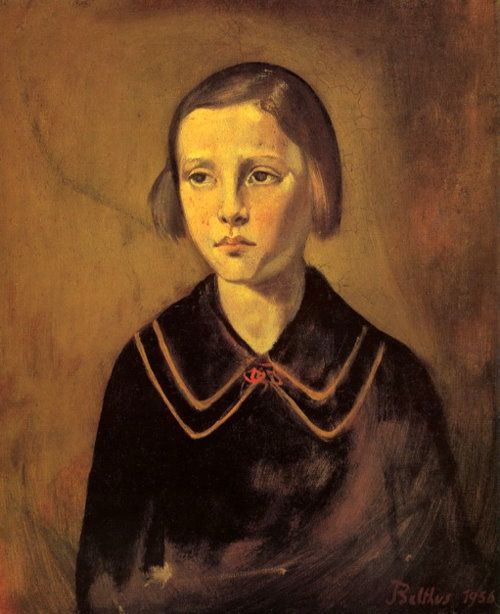
Thérèse by Balthus (1936)

The first painting Balthus completed of Thérèse Blanchard was in 1936 and was simply entitled Thérèse.  Balthus would go on to use her as a model more than any other person.  In this work, Balthus has captured her moody and serious look and it was that aspect of her that attracted Balthus to his young model.  Her dark dress seems to go hand in hand with her mood and it is just the bright red piping on the collar of the dress which manages to liven up the portrait

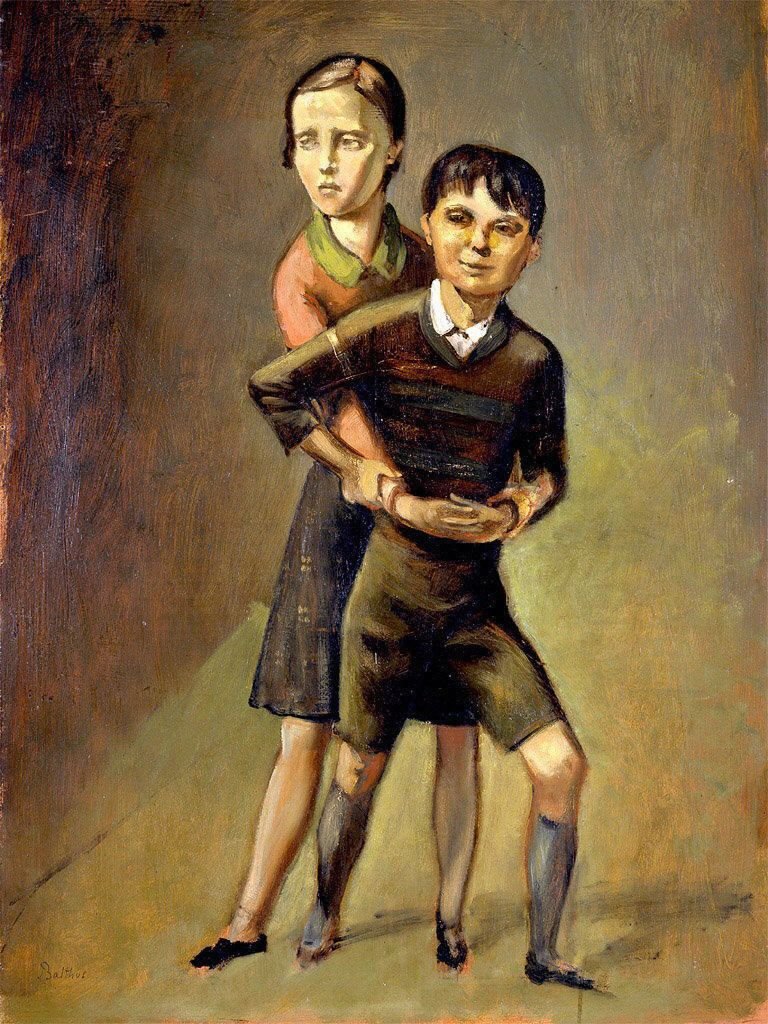
Brother and Sister by Balthus (1936)

In that same year Balthus completed a painting of Thérèse and Hubert entitled Brother and Sister.  Once again Balthus has portrayed Thérèse’s expression as moody and sullen in contrast to the smiling happy face of her brother.  Thérèse’s arms are wrapped round the waist of her brother, not as a sign of sibling affection, but as she was trying to make him stand still for Balthus.  Their clothes are very plain.  Hubert seems to be wearing the attire of a schoolboy whilst his sister is wearing a simple plaid skirt and a red sweater with a green collar.

The Blanchard children by Balthus (1937)

In 1937 the two Blanchard siblings appear in a painting by Balthus entitled The Blanchard Children.  Thérèse is now twelve years old and her brother is fourteen years of age.  The setting is Balthus’ studio and one notices there are no childlike accoutrements such as toys, pens or books.  It is a very stark depiction.  This was not an oversight by Balthus but his belief that the starkness would intensify the dramatic effect of the picture.  If we look under the table, we can see a bag of coal sat in the corner. Why would Balthus add this?  The answer maybe that Balthus, whilst living in Germany, remembered what happened on the eve of the Feast of St Nicholas on December 5th when children put their shoes out in the hopes of some sweets in the morning.  The story goes that, St. Nicholas does not travel on his own but with his companion, Black Peter, who places coal in the shoes of the children who had been naughty !

Wuthering Heights illustration by Balthus

The strange posture of the two children is probably based on an illustration Balthus produced for Emily Bronte’s 1847 novel Wuthering Heights.  The illustration relates to Heathcliffe, partly kneeling on the chair, turning towards Cathy who is on her hands and knees partly under the table, writing her diary.  The painting was given to Balthus’ friend Picasso.

Thérèse with Cat by Balthus (1937)

The first controversial painting Balthus did with Thérèse as his model was completed in 1937 and entitled Thérèse with Cat.  It was a small work measuring 88 x 77cms (34 x 31 in).  Here once again we see the un-smiling Thérèse seeming to look at something behind us.  She looks slightly dishevelled with one sock down to her ankle and one sleeve pushed up her arm.  The red and the turquoise colour of her clothes stand out against the dark background.   Her left leg is raised and her foot rests on a stool and this pose means that her white underpants are visible to the viewer.  She has been asked to pose in a certain way and by the look of her expression she is well aware of how the artist looks at her.  A large cat lies on the floor next to Thérèse.  It appears to be the same cat that appeared with Balthus in the painting King of the Cats (see previous blog).  The painting is now housed in The Art Institute of Chicago.

The Victim by Balthus (1939 - 1946)
The Victim by Balthus (1939 – 1946)

One of his best known works is one he started just before the onset of World War II but was not completed until March 1946.  It was entitled The Victim. It was one of his largest paintings measuring 132 x 218 cms (52 x 86in) and it was because of that size of it that he had to leave it in his Paris studio when he and his wife, Antoinette, at the onset of war, moved to Champrovent in Savoie which had not been occupied by the Germans.  They later moved to Switzerland to live with Antoinette’s parents and did not return to his Paris studio until March 1946.  We see a life-sized ashen body of a naked woman lying on a white sheet which covers a low bedstead.  Is she merely asleep or is she dead?  Does the title answer the question?  The title comes from a novella written by Balthus’ friend, the writer Pierre Jean Jouve.  His 1935 book La Scène capitale contained two novellas, La Victime and Dans les années profondes.

Below the bedstead and in the right foreground of the painting we can just make out a knife lying on the dark floor, the blade of which points directly to her heart.  Although, through the painting’s title we gather that the girl is dead, there is no sign of a wound on her body and neither blood on her body nor on the knife.  Was she strangled?  So it is up to us to decide whether the girl is dead or simply in a trance but we must remember that Balthus started to paint this before war broke out and only concluded it a year after the end of the war and the atrocities of war would be fresh in the artist’s mind.  Another question is, who sat for this painting and the answer is in some doubt.  The shape of the girls face and the cut of her hair leads many to believe it is Thérèse Blanchard, the only doubt being that she had never before posed nude for Balthus

Thérèse Dreaming by Balthus (1938)

A year later (1938) Balthus completed Thérèse Dreaming, another but similar painting to to Thérèse and the Cat, again featuring the now thirteen year old Thérèse.  The setting is once again his studio and we see her sitting before us in a similar pose.  This is a much bigger painting, measuring 150 x 130cms (59 x 51 in).  This time he added a striped wallpaper (which did not exist in his studio) as a background and this time we can see the additional still life of a vase and a canister on a table.  The cat is once again part of the picture and we see it at the side of Thérèse lapping up some of its milk.  In the previous painting Thérèse was looking almost towards us but in this painting but in this work she has looked away, with her eyes closed, as if enjoying a daydream.  Thérèse’s clothes are unadorned and unfussy.  As Sabine Rewald wrote in her book Balthus Cats and Girls :

“…she appears the epitome of dormant sexuality.  Her white lace-trimmed slip surrounds her legs like a paper cornucopia wrapped around a bunch of flowers.  The cat lapping milk from a saucer serves as another tongue in cheek erotic metaphor…”

Since 1998 the painting has been housed in the Metropolitan Museum of Art in New York as part of the Jacques and Natasha Gelman Collection.

The Guitar Lesson by Balthus (1934)

By far the most controversial and notorious painting by Balthus was one he completed in 1934 entitled The Guitar Lesson.  It is a merging of sex and violence which shocked those who saw it.  It is an encounter between a dominating and tyrannical women, who is the music teacher, in her early twenties, and a young girl, her student, thought to be about twelve years old. The music lesson has been halted.  A guitar lies on the floor and the woman has thrown the girl across her lap and pulled her black dress up over her waist.  The fingers of the teacher’s left hand dig into the upper part of the girl’s inner thigh.  It is as if the teacher is strumming a human guitar.  The girl lies there, naked from her navel to her knees.  The lower parts of her legs are covered by white socks.  The music teacher has grabbed a chunk of the young girl’s long hair and is yanking her head downwards.   To save herself from falling and in an attempt to alleviate the pain caused by her hair being pulled, the girl has grabbed the collar of the music teacher’s grey dress which uncovers the woman’s full right breast.  Her nipple juts out which indicates to us that the teacher is sexually aroused by what she is doing.

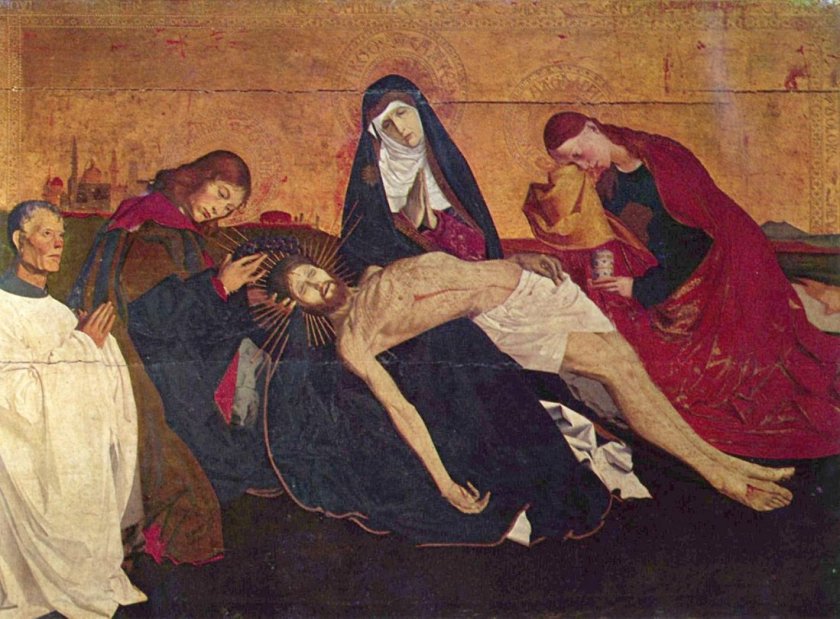
Pietà of Villeneuve-lès-Avignon by Enguerrand Quarton (c.1860)

The positioning of the girl lying across the thighs of the teacher has often been likened to the 1455 painting Balthus must have seen in the Louvre, Pietà of Villeneuve-les-Avignon by  Enguerrand Quarton.

Portrait der Schwester des Künstlers (Baladine Klossowski) by Eugen Spiro (1902)

The girl who posed for The Guitar Lesson was Laurence Bataille, the daughter of a concierge.  She would come to Balthus’ studio with her mother who acted as her chaperone.  The striped wallpaper background and the grey dress of the music teacher were the same as we see in Baladine Klossowski 1902 portrait by her older brother Eugen Spiro.  It was first shown at  Balthus’ one man exhibition in April 1934 at the Galerie Pierre in Paris.   The gallery owner, Pierre Loeb, and Balthus decided that the painting should be placed in the back room of the gallery, but covered up, so that it, in fact, became a “peep show” for a select “priveleged” number of visitors.  The provenance of the painting is quite interesting. It was bought by James Thrall Soby, an American author, critic and patron of the arts, in 1938.  He had intended to exhibit along with his other paintings at the Hartford’s Wadsworth Atheneum in Connecticut but because of the controversial nature of the painting it remained unseen in the museum vaults.  Soby realised that there was no point in owning a painting that could never be exhibited and so, in 1945, he exchanged it with the Chilean surrealist artist, Roberto Matta Echaurren, for one of his paintings.  Roberto Matta Echaurren’ wife Patricia left him and married Pierre Matisse but one of the things she took with her was this painting.  Pierre Matisse, the youngest child of  Henri Matisse owned a gallery in New York and the painting remained hidden away in the vaults.  In 1977, it appeared for a month at Pierre Matisse’s 57th Street gallery in New York. It was a sensation and the press reviews referred to the painting and the art critics of the various newspapers and magazines wrote about it but said that they could not show the painting as it would shock the readers.   After the one month long show it was never exhibited again.

When the 1977 exhibition closed the gallery offered it to New York’s Museum of Modern Art.  It was accepted by the museum but it was not put on show instead it was kept hidden away for five years in the basement.  In 1982 the Chairman of the Board of the MOMA, Blanchette Rockefeller, the wife of John D Rockefeller III, saw it at a small presentation of the works of art given to the MOMA by Pierre Matisse.  She was horrified by Balthus’ depiction terming it sacrilegious and obscene and demanded that it was returned to the Pierre Matisse Gallery immediately.  The Pierre Matisse gallery took it back and then sold it in 1984 to the film director, Mike Nichols. In the late 1980’s he sold it to the Thomas Ammann Gallery in Zurich.  They sold it on to an unknown wealthy private collector who I saw in one newspaper report, was the late Stavros Niarchos.  On his death in 1996 the painting became the property of his heirs.

In my next blog I will take a last look at the life of Balthus and share with you some more of his artworkwork.

—————————————————————————

Besides information about the life of Balthus and his art gleaned from the internet I have relied heavily on two books which I can highly recommend.

Firstly,  there is an excellent book  entitled Balthus Cats and Girls by the foremost expert on Balthus, Sabine Rewald.

Secondly, a very thick tome by Nicholas Fox Weber entitled Balthus, A Biography.


Balthus. Part 1. Mitsou and the King of the Cats

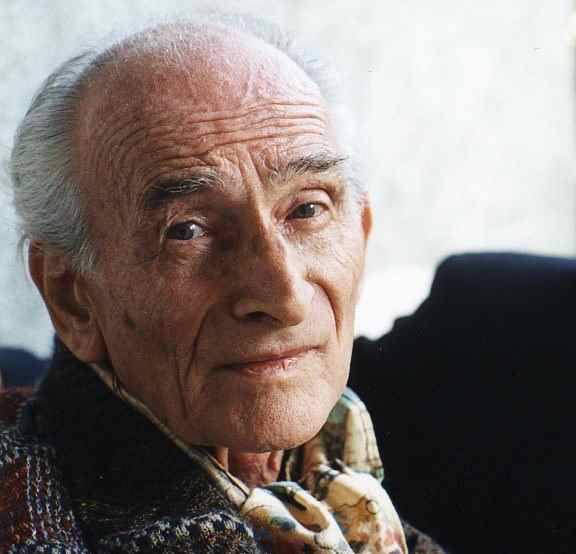
Balthus aged 88
Balthus aged 88

In my next few blogs, I am looking at the life and art of the French born painter Balthasar Klossowski de Rola, more simply known as Balthus.   Some of his artwork shocked the world and I have to warn you that some of his paintings you may find disturbing, and have often been termed offensive and disgusting.  These will appear in Part 2.

So what do we know about Balthus’ life?  The answer is “very little” and that is exactly how the artist wanted it to be.  As far as his life story was concerned, he wanted to preserve his anonymity, so much so, when negotiating with the Tate Modern, which was about to launch a retrospective of his work in 1968, he sent the curator of the exhibition a telegram which read:

“..NO BIOGRAPHICAL DETAILS.  BEGIN:  BALTHUS IS A PAINTER OF WHOM NOTHING IS KNOWN.  NOW LET US LOOK AT THE PICTURES.  REGARDS.  B…”

Balthus was born in Paris at the end of February 1908.  His father Erich Klossowski was a noted German historian and painter, who had come from a family which belonged to Polish nobility, and whose coat of arms was known as the Rola, which was used by a number of szlachta families.  The szlachta was a legally institutional privileged noble class and Balthus added the title “de Rola” to his name.  Balthus’ mother was Elisabeth Dorothea Spiro, but as a painter, used the name Baladine Klossowska.  She gave birth to two sons, Pierre in 1905 and Balthus in 1908.  Pierre went on to become a much heralded writer and philosopher.  Balthus and his family lived in rue Boissonade in Paris’ 14th arrondissement.  He and his brother had a privileged upbringing as his parents were part of the cultural elite in Paris and would entertain many of the cultural icons of the time such as the French writer and playwright, Jean Cocteau, André Gide, the Nobel prizewinning writer, and the French painter, Pierre Bonnard.  The family, who held German citizenship, along with Balthus’ uncle, the painter, Eugen Spiro, had to move out of Paris at the onset of World War I and they travelled to Berlin where Balthus’ father worked at the Lessing theatre as a stage and costume designer.

In 1917, Balthus’ mother and father separated and she took her sons, Pierre and Balthus, away from Berlin and set up home in Berne.  Later she and her two sons move to Conches, a small town just south of Geneva, and stayed with friends before renting a two-room apartment in rue Pré-Jerôme in 1920.  Balthus, as a child loved to draw and it was in 1919, whilst living in Conches, that, at the age of eleven, he produced a book of forty graphite and ink drawings.  The drawings were based on the experiences he had, when he fell in love with a stray cat which he called Mitsou and through his drawings he tells of his happiness derived from his feline friend and the sadness of losing his new friend.  It was in 1919 when Balthus’ mother Elisabeth first met Rainer Maria Rilke in Geneva.  He was a writer and poet.  They quickly became lovers, a relationship which lasted until he died of leukaemia in December 1926.  It was an unusual relationship as Rilke said he needed his own space when he worked and so the couple did not live together on a permanent basis.

Mitsou
Mitsou

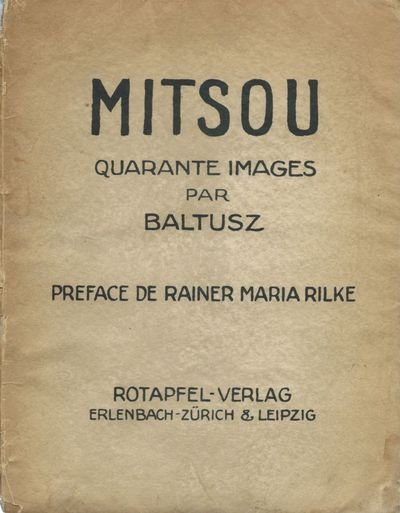
On one of Rilke’s visits to the Klossowski home to see Elizabeth he saw the Mitsou drawings  done by her son, Balthus,  and was he was so impressed by them that  he offered to write the preface for the book and arranged for it to be printed in 1921 under the title Mitsou, Quarante images (Mitsou, Forty Images).  The set of forty drawings were an animated tale of how he found a cat on a park bench.

Finding the cat
Finding the cat

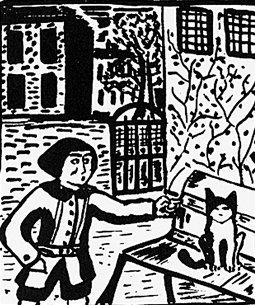
In the opening drawing of the set we see the boy tentatively leaning towards the cat making sure he doesn’t scare it off.  Look how Balthus has given the boy an air of astonishment as he looks at the cat, by shaping the mouth, raising the thick eyebrows and the angling the chin.  In complete contrast, the cat looks out at us in a statuesque sphinx-like way, totally unfazed by the boy’s approach.  Although the story is about him and the cat, Balthus has added other elements to the drawing.  The setting is a courtyard which is separated from a house by a wall and a gate.  He has also included vines climbing up the wall as a backdrop.

Losing the cat
Losing the cat

From this time on, Balthus love of cats was shown by the number of times he depicted felines in his artwork.  Drawing number 40 of Mitsou, the last one of the set, depicts Balthus crying when he realises the cat has run off and his feline friend has gone forever.

 In the summer of 1919 the family spend time in the picturesque Swiss village of Beatenberg which lies between the Bernese Alps and the still blue waters of Lake Thun.  It is whilst here that Balthus works as an assistant to the painter, Margrit Bey.  For next four summers Balthus and his family would return to Beatenberg and work alongside Margrit.  Between 1919 and 1921, during their stay in Conches both Balthus and his brother study at the College Calvin in Geneva.  For Balthus, the years between 1919 and 1921 were some of the best times he ever had and he was always pleased to recall those days

Rilke and Elisabeth Klossowska at Chateau Muzot (1923)

His mother was in love with Rilke and he was devoted to her.   Balthus also bonded with Rilke and he received nothing but compliments for his artwork from the writer.  To Balthus, Rilke was almost a surrogate father.

In April 1921 Baladine and her two sons move back to Berlin and go to live with her brother Eugen and later stay with her sister, Gina Trebicky.  Elisabeth had some of her paintings accepted for an exhibition of female artists at Galerie Fleckhtheim in Berlin and it is at this time that she is persuaded to change her name as an artist to Baladine.

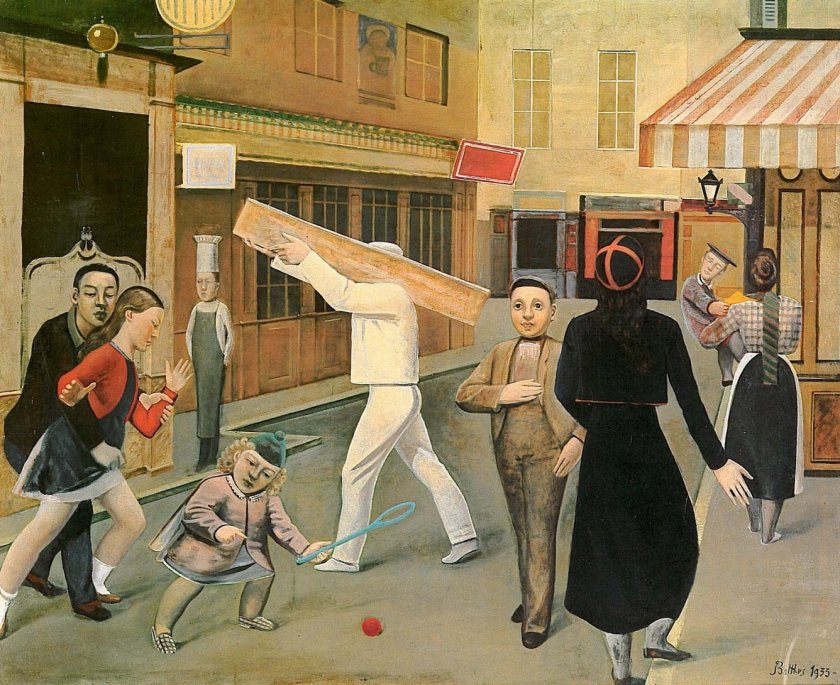
In 1934, Balthus produced his first large scale painting entitled The Street.  It measured 195 x 240cm (77 x 94 ins).  He had already painted another version of this five years earlier, just before he journeyed to Morocco but some of the characters had changed.  The setting in both works is the rue Bourbon-le Château.

The Street by Balthus (1929)

In this earlier version, seen above in black and white, we see a grandfather figure in top hat and topcoat holding firmly onto two young children as they cross the road.  The boy, in shorts, wears a hat with a pom-pom whilst the young girl dressed in a skirt and flowered hat.  In the later version this trio has been replaced by two other characters, which caused the outrage!

The Street by Balthus (1933)

The 1934 version was one of a number of his works of the time which shocked the audience at Balthus’ first solo exhibition which was held in the Galerie Pierre in Paris.  The people in the street seemed to have stopped and are frozen in mid-flow, almost trance-like.   For this work Balthus retained the baker, the workman crossing the road with a plank of wood on his shoulder along with the woman carrying a young child, albeit now looking like a little man.   In this version we also have a young girl, racquet in hand, chasing a ball across the street. Again although possessing the height of a child she seems to be more like a small woman.   Balthus was questioned about that but he simply refused to elaborate more than saying “she is simply a little girl”.  The same boy, as seen in the first version, is still strolling haughtily towards us but is set back slightly in comparison to the first version.  However the major change is the inclusion of the two figures in the left foreground.  These two replace the elderly gentleman and the two young children.  The man tries to grope the girl as she passes him by and she raises her arm maybe in shock or maybe to strike her assailant.

Pierre Loeb the owner of Galerie Pierre said that having looked at the painting described it as a scene of anguished phantoms sleepwalking in a strange dreamlike state.  Balthus believed Loeb’s comments were nonsensical and although Loeb exhibited Balthus’ art in his gallery bringing him to the notice of the public, Balthus loathed him and termed him a “typical outsider who lacked true vision of what really mattered to painters”.

The painting was bought from Galerie Pierre in 1937 by James Thrall Soby, an American author, critic and patron of the arts.  However the painting was so controversial and so many of his friends disliked the sexual connotation that Soby wrote to Balthus in 1955 and asked him to retouch the gesture of the figures on the left.  Soby was surprised when Balthus agreed and wrote:

“…I used to like shocking people, but now it bores me…”

When Soby died in 1979 this painting was bequeathed to the Museum of Modern Art in New York.

The King of the Cats by Balthus (1935)

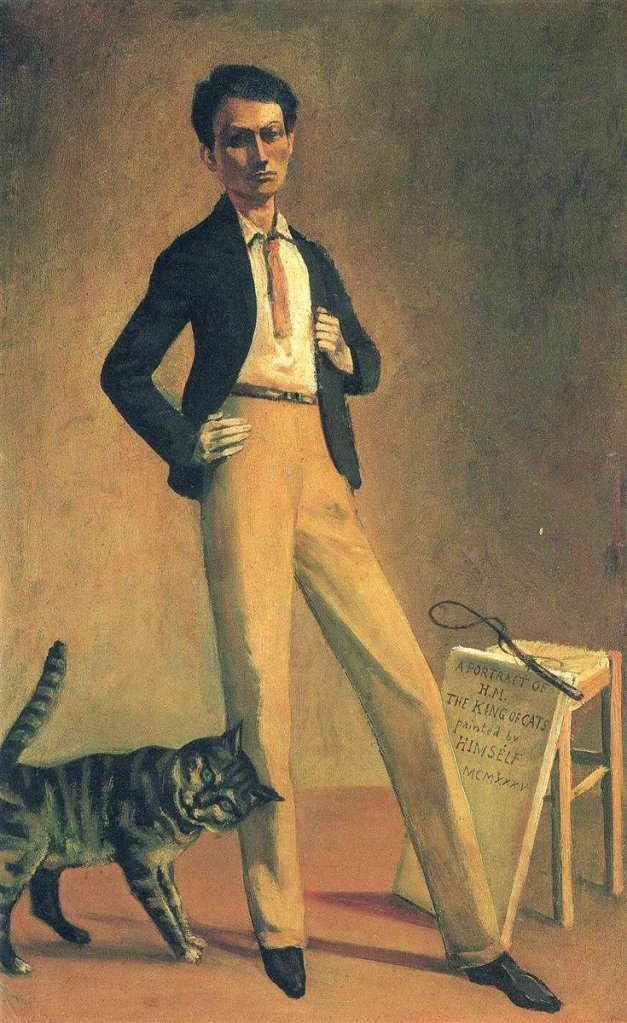
I am concluding this first part of my look at the life and art of Balthazar Klossowski by showing you the painting, the title of which the artist gave himself.  This is just one of three self portraits completed by Balthus.  The title of the 1935 painting was King of the Cats. Balthus was twenty-seven years of age when he painted this work.  It was painted in his Paris studio in rue Furstenberg.  The studio, which he bought in May 1933 was a fifth floor attic room  It was also the first property he ever purchased and  he remained here until October 1935.

Balthus had always had a love of cats and in this work we see him standing in a somewhat arrogant and aloof pose, with his beloved cat lovingly rubbing itself against his leg.  Because the view of the artist is seen from below it elongates him and adds to his imperious stance.  He is dressed in saffron pants, white shirt and red tie and a black jacket.  On his feet is a pair of pointed black shoes.  On the floor, to his left, is a stone slab leaning against a high stool with the inscription:

A PORTRAIT OF

H.M.

THE KING OF THE CATS

Painted by

HIMSELF

MCMXXXV

Balthus has added a little humour to the painting by placing a lion tamer’s whip on top of the stool !

It was in that year that Balthus started to sign his letters “King of the Cats”, the first being a letter, written in January 1935, to his soon to be wife, Antoinette de Watteville.

There is an air of self confidence about the figure and this has been put down to 1935 being a good year for him after the turbulent times of 1934 when his first one-man exhibition at the Galerie Pierre, featuring many depictions of pre-teen girls in erotic poses,  scandalised the critics and public alike.  The fall out over these paintings made Balthus give up painting for almost a year.

In the second part of my look at Balthus I will focus on the paintings which caused such a furore when exhibited in Galerie Pierre in Paris.

Besides information about Balthus and his art gleaned from the internet I have relied heavily on two excellent books which I can highly recommend.

Sabine Rewald, Curator for Modern Art, Dept. Of Modern and Contemporary Art at The Metropolitan Museum of Art.
Sabine Rewald, Curator for Modern Art, Dept. Of Modern and Contemporary Art at The Metropolitan Museum of Art standing next to Balthus painting entitled Thérèse

First there is the book Balthus Cats and Girls by the foremost expert on Balthus, Sabine Rewald.

Secondly, a very thick tome by Nicholas Fox Weber entitled Balthus, A Biography.

Alexandre Cabanel Part 4 – Portraiture

Alexandre Cabanel (1823-89)

 In my last look at the life and works of Alexandre Cabanel I want to concentrate on his genius as a portraitist.   In my last blog I had reached 1863, the year in which his most famous work, Naissance de Venus (Birth of Venus), was exhibited at that year’s Salon, which was subsequently purchased by Napoleon III and is now on display at the Musée d’Orsay.  The work received great revues despite the subject’s nudity which caused some adverse comments.   Cabanel, at the age of forty, was honoured that year, when he was bestowed with the status of Officer of the Legion of Honour and was elected a member of the Institut Impérial de France.  On January 1st 1864 he opened his own studio at the École des Beaux-Arts.  He was reputed to have been an excellent teacher, who was well loved by his students, many of whom went on to win the Prix de Rome.  Many of his students went on to regularly exhibit at the Salon.

 Cabanel’s reputation as a leading artist of the time was well established by 1860 and his mastery of portraiture was well known throughout Europe and he had become the favoured portraitist of the European aristocracy.  In the 1863 Salon besides his Birth of Venus painting he exhibited a portrait of Countess de Clermont Tonnerre who had married into one of the most famous old families in France.

Emperor Napoleon III by Alexandre Cabanel (c.1865)

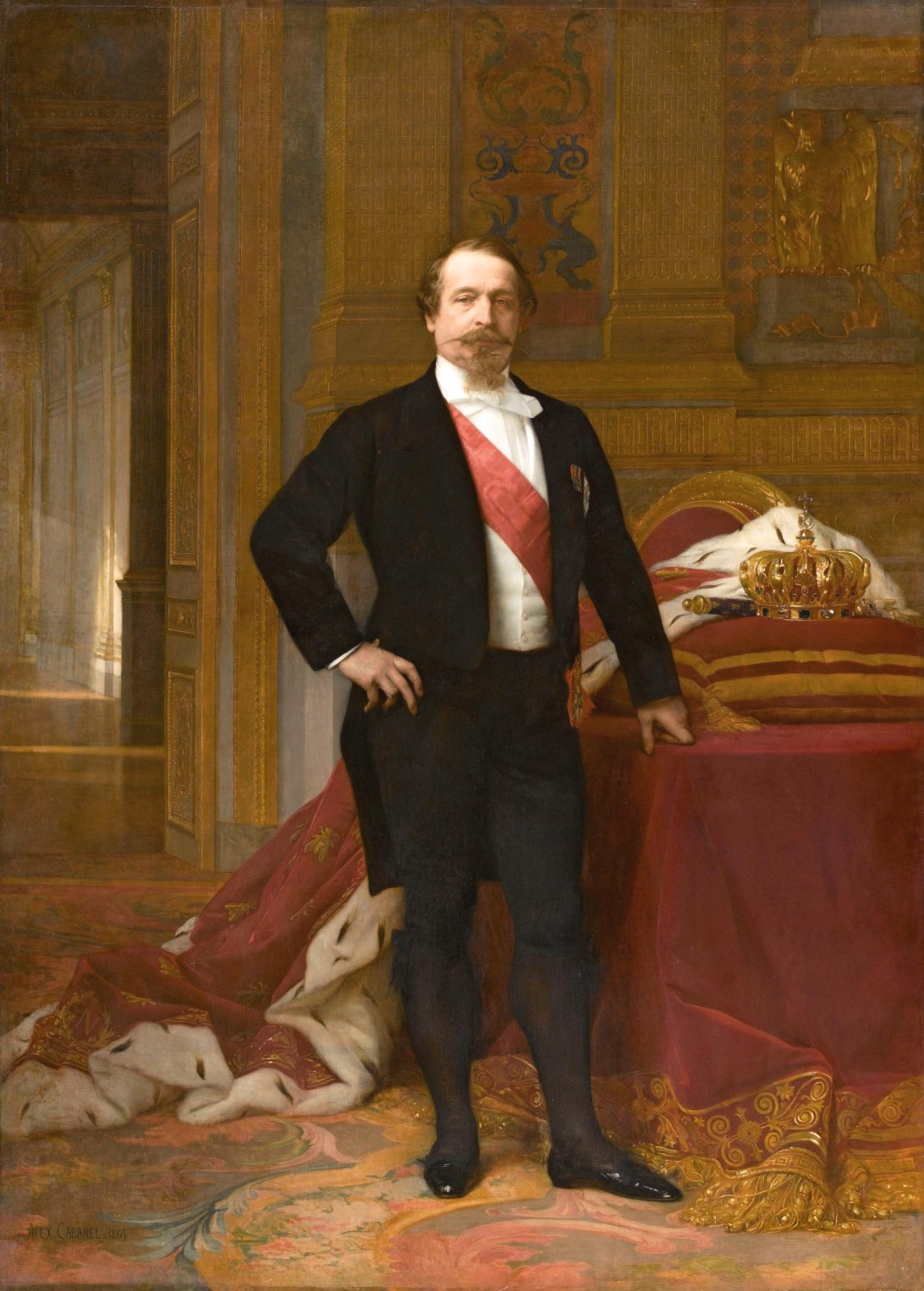
Napoleon III and his wife, the Empress Eugénie, had, up to this time, commissioned several royal portraits from Franz Xavier Winterhalter, Edouard Dubuffe and Hippolyte Flandrin.  Their portraits of Napoleon III were acclaimed by critics and yet the royal couple were not completely satisfied and so, in 1864, decided to commission Cabanel to paint a new portrait of Napoleon.  For Cabanel, this was the ultimate commission.  The portrait was completed and exhibited in the 1865 Salon and won Cabanel a Medal of Honour.    What the critics liked so much about the work was its simplicity and sophistication.  This was not a normal portrait of a ruler in military uniform.  In this work, the Emperor is depicted wearing a simple black evening suit, under which we see his military sash.  The ceremonial robes can be seen draped on a chair at his side.  There was a sense of modesty about the Emperor although his depiction maintained an aristocratic tone.  It was if he was truly “one of the people” which may well have been part of what the ruler wanted his portrait to depict of him.  The 1886 edition of the Magazine of Art, which was an illustrated monthly British journal devoted to the visual arts, and which was published from May 1878 to July 1904 in London and New York included an article by Alice Meynell, who wrote that Cabanel’s royal portrait remit was to produce:

 “…a portrait which should be more expressive of the stability, suavity, and prosperity of the Empire, and he not only succeeded in this, but produced a work which was in many solid qualities the finest example of his talent…”

The painting is now housed at the Musée du Château de Compiègne.

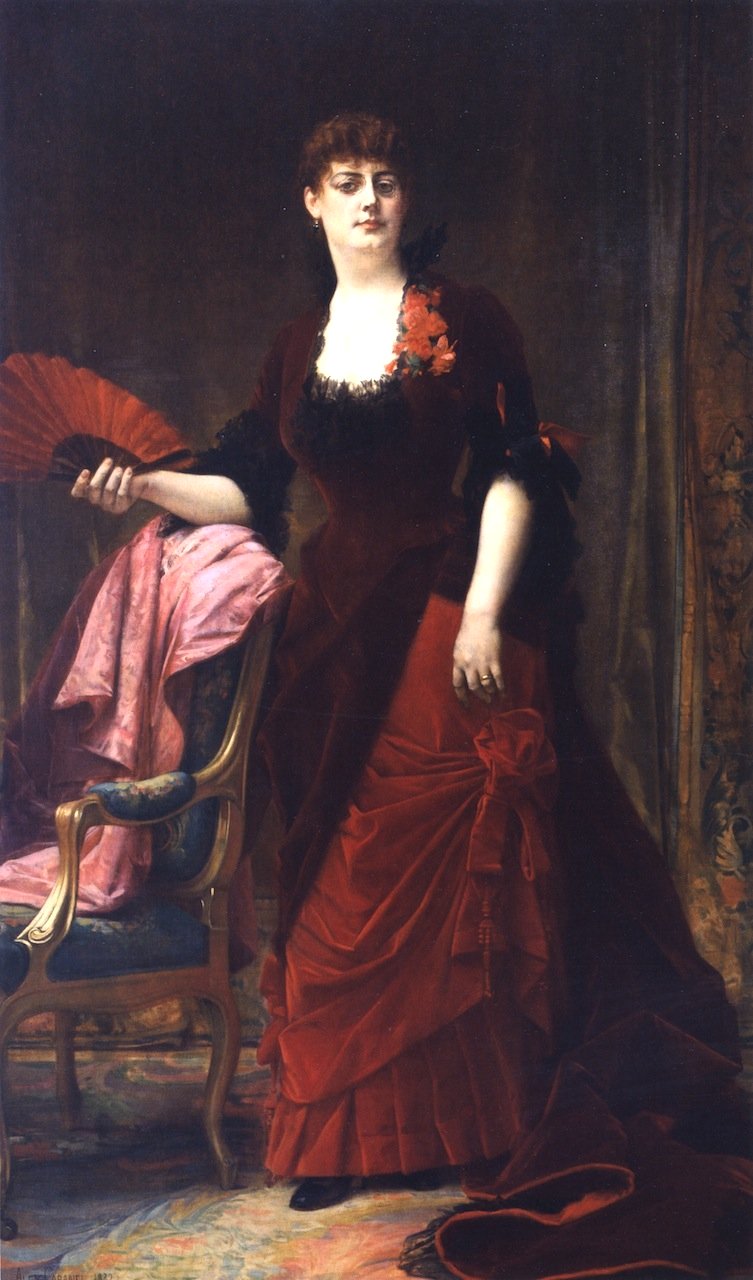
  The work was acclaimed a masterpiece, not only in Europe, but also in America and, along with Cabanel’s portraits of high-society European women,  it was this work by him which almost certainly inspired wealthy Americans to choose Cabanel to paint their portraits and portraits of their family members.  Portraiture had always been a lucrative genre but the fact that Cabanel was a man of means indicates that, for him, portraiture was not just a means of earning money but was an art genre he loved and many of his portraits were exhibited at the various Salons

Catharine Lorillard Wolfe by Alexandre Cabanel (1876)

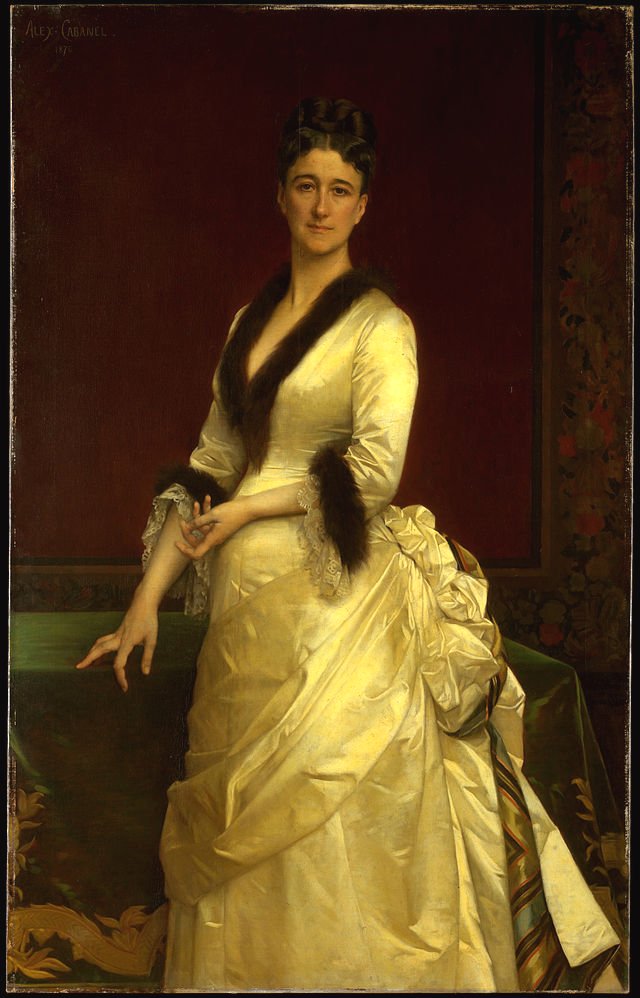
Catharine Lorillard Wolfe was an American philanthropist and art collector. She gave large amounts of money to institutions of which her most significant gifts were two bequests to the Metropolitan Museum of Art in New York . She also left her large collection of popular contemporary paintings to the museum, together with $200,000.

————————————————-

To have one’s portrait or a portrait of one’s partner painted by a well-known artist was a means of letting the world know that you had “arrived”.  You had made good and the “right” artist could depict you as a man or woman of class and wealth.  Around the 1880’s following the end of the American Civil War many people had amassed fortunes, much of which was spent on art – not just any art but the contemporary art of the European painters, especially works by the French artists.  In America, the period which spanned the final three decades of the nineteenth century was known as the Gilded Age.  The phrase Gilded Age derives from the many great fortunes created during this period and the way of life this wealth supported and the phrase was coined by Mark Twain’s 1873 novel, A Gilded Age, A tale of Today.

Mary Frick Garrett, by Alexandre Cabanel (1883)

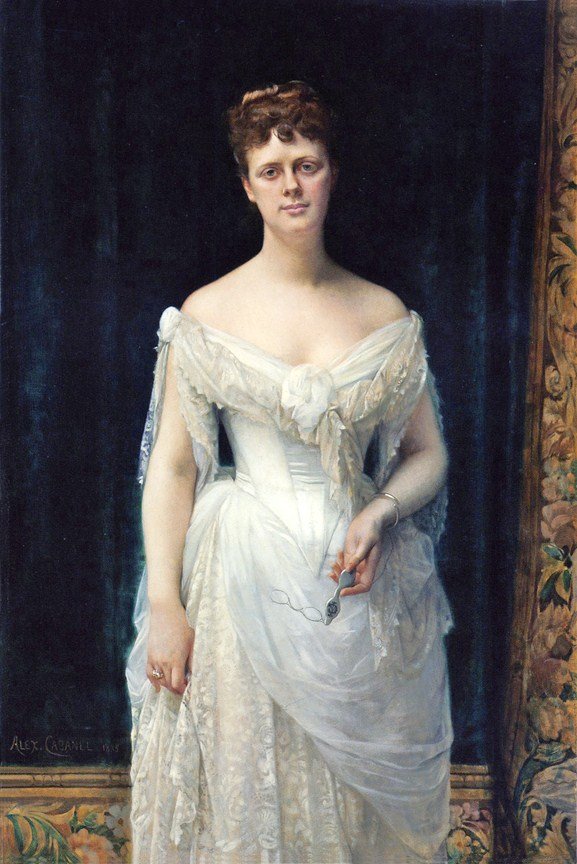
Mary Sloan Frick married Robert Garrett, the oldest son of John W Garrett, who was president of the Baltimore and Ohio Railroad and Robert Garrett & Sons Bank.  Cabanel painted this portrait whilst his sitter was on holiday in Paris in 1883.

—————————————–

America’s industrial economy boomed.  It was a time of great wealth for the industrialists such as John D Rockefeller, with his oil, Andrew Carnegie, with his steel and Cornelius Vanderbilt, the railroad and steamboat tycoon.  For wealthy Americans like them, having a painting by a French artist hanging in one of the rooms of their large mansions signalled not just your wealth but alluded to your knowledge of European art and thus enhanced your air of intellectual prowess.  For these rich Americans what would be even better than just owning a painting by a well-known French artist, would be to have that artist paint your portrait or your wife’s portrait.  That would really impress your friends!

Olivia Peyton Murray Cutting by Alexandre Cabanel (1887)

 In 1877, Olivia Peyton Murray married William Bayard Cutting, a member of New York’s merchant aristocracy, an attorney, financier, real estate developer, sugar beet refiner and philanthropist.  Ten years later he commissioned Cabanel to paint a portrait of his wife which can now be found at the Museum of the City, New York.

———————————————-

Alexandre Cabanel’s reputation as an outstanding academic painter and portraitist was acknowledged on both sides of the Atlantic and his work was in great demand.

Mrs. Collis Potter Huntington by Alexandre Cabanel (1882)

Mrs Collis Huntington married Collis Potter Huntington, who was one of the Big Four of western railroading and who built the Central Pacific Railroad, which formed part of the first American transcontinental railroad.

—————————————————

A man of wealth would like to be portrayed by an artist in quite a sombre mood depicting his serious business-like nature whereas they would like their wives and daughters to be portrayed in the finest clothes, with the most expensive of jewellery but the women were not to be portrayed as being frivolous instead they must be seen as intelligent figures who played, like their husbands or fathers, a key role in society.

In a book which was published to coincide with Alexandre Cabanel’s retrospective 2010 exhibition at the Wallraf-Richartz Museum in Cologne, Michel Hilaire, the director of the Musée Fabre of Montpellier, where many of Cabanel’s work are housed, wrote of Cabanel’s life:

“…It was the end of a fulfilled life and artistic career characterised by hard work, but also full of success and esteem…”

Alexandre Cabanel died at his Paris home on the rue Alfred de Vigny close to the Parc Monceau Paris on January 23rd 1889, aged 65.

————————————————–

 For an excellent article on Alexandre Cabanel and his American portraits you should go and read an excellent article by Leanne Zalewski :

http://www.19thc-artworldwide.org/spring05/64-spring05/spring05article/300–alexandre-cabanels-portraits-of-the-american-aristocracy-of-the-early-gilded-age

Alexandre Cabanel. Part 3 – The Birth of Venus

Alexandre Cabanel by Achille Jacquet (c.1883)

This is the third and penultimate instalment of my look at the life and works of Alexandre Cabanel.  Over the years I have looked at the life of many artists and so often I find that they were rebellious as far as their art and their art training was concerned.  They rebelled at the authoritarian way the Academies taught art and believed that their way was the true way.  However my current artist, Cabanel, was a true believer of the State-run Academies and Academic training.  He was a true Academician.  In the first two blogs about Cabanel, I featured his academic-style history paintings depicting people from mythology and the Bible.   In this blog I want to carry on looking at his life and concentrate on one of his most famous works of art, which is considered to be his greatest masterpiece.  I ended the last blog about Cabanel around the time of the World Exposition in Paris in 1855.  He exhibited a number of works at this event and was awarded the first-class medal and in November that year he was made Knight of the Legion of Honour.

 Allegory of the Five Senses by Alexandre Cabanel (1858)

Allegory of the Five Seasons by Alexandre Cabanel (1858)

Cabanel spent much of the next ten years carrying out decorative commissions.  One such commission was to decorate the elaborately carved ceiling of the grand salon of Hotel Chevalier de Montigny which had been purchased by the brothers Isaac and Emile Péreire, who had made their fortune in finance and industry.  This building in Paris is now home to the British Embassy.  During 1857 and 1858 Cabanel painted an Allegory of the Five Senses on the ceiling which was framed by four oval medallions signifying the arts of dance, poetry, fancy poetry and eloquence.  The Péreire brothers were so pleased with Cabanel’s work that six years later they commissioned him to add six vertical wall panels to the walls of the salon.  The panels featuring six female figures represented the hours of the day.

Birth of Venus by Alexandre Cabanel (1863)

In 1863 Cabanel produced one of his most celebrated works of art entitled Naissance de Venus (Birth of Venus).  It was exhibited at that year’s Salon and, in the year of Cabanel’s fortieth birthday, it marked the high point of his career.    The subject of this work of art was based on a story from classical mythology which told of the birth of Venus.  Although the paintings depicting this occurrence focus on the beauty of the event the mythology behind the tale is a little gorier as it tells how she arose from the foam of the sea shore. This miraculous creation came to being after Saturn castrated his tyrant father, the supreme sky god Uranus.   Saturn had sliced off Uranus’ genitals, and threw them into the sea. As the genitals drifted over the water, the blood and semen that issued forth from the severed flesh mixed with the sea water to foment the growth of the child who would become Venus.   The Greek poet Hesiod gives us a less graphic version of the birth of Venus writing that Venus (Aphrodite) sprang from the foam of the sea as a fully developed woman.  Zephyrus, the God of the west wind, then carried her across the sea on a clam shell, to Cythera and then to Cyprus. There, Aphrodite was welcomed by Horae, daughter of Themis, who dressed her up and adorned her with precious jewels before taking her to the Immortals at Olympus.

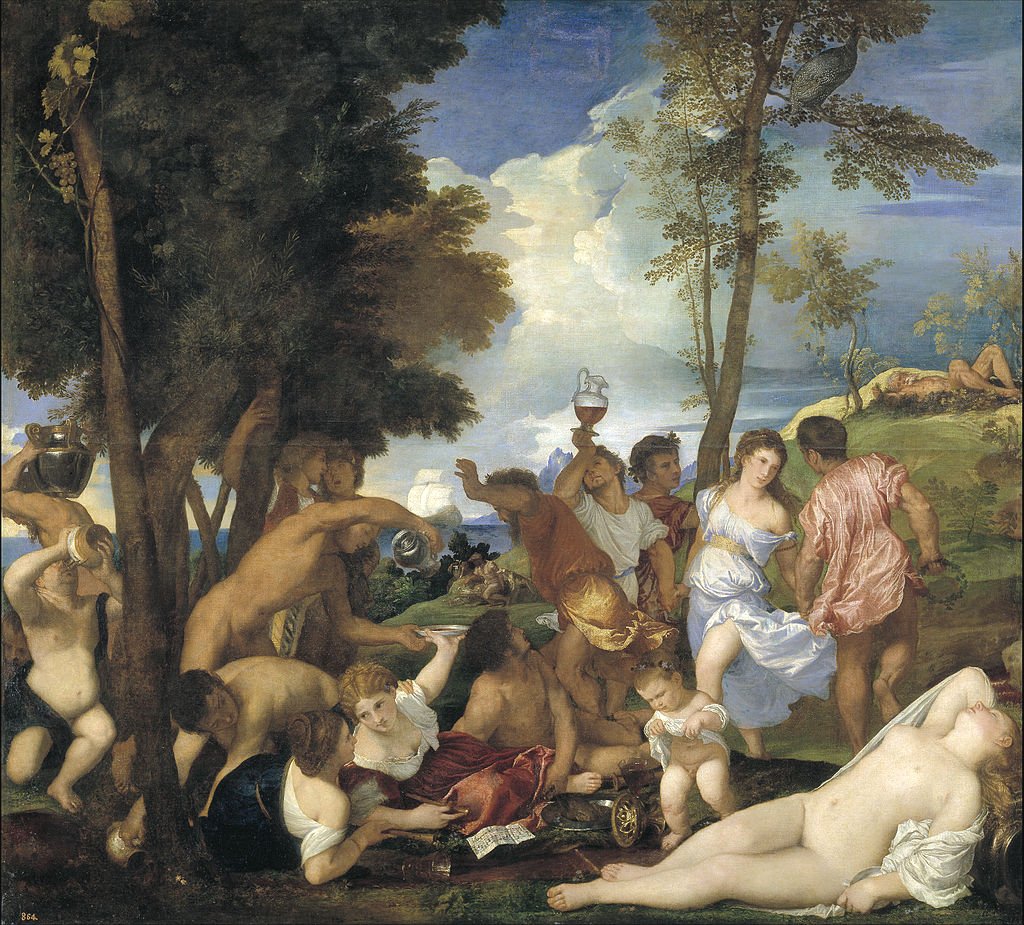
Bacanal de los andrios by Titian (c.1526)

In Cabanel’s painting, we see Venus resting on the crest of a wave, her long hair cascading around her body, surrounded by five putti.   Many art historians believe that the way Cabanel depicted the posture of his Venus could have been influenced by a painting by Titian and the way he depicted the naked lady in his 1526 work entitled The Bacchanal of the Andrians.

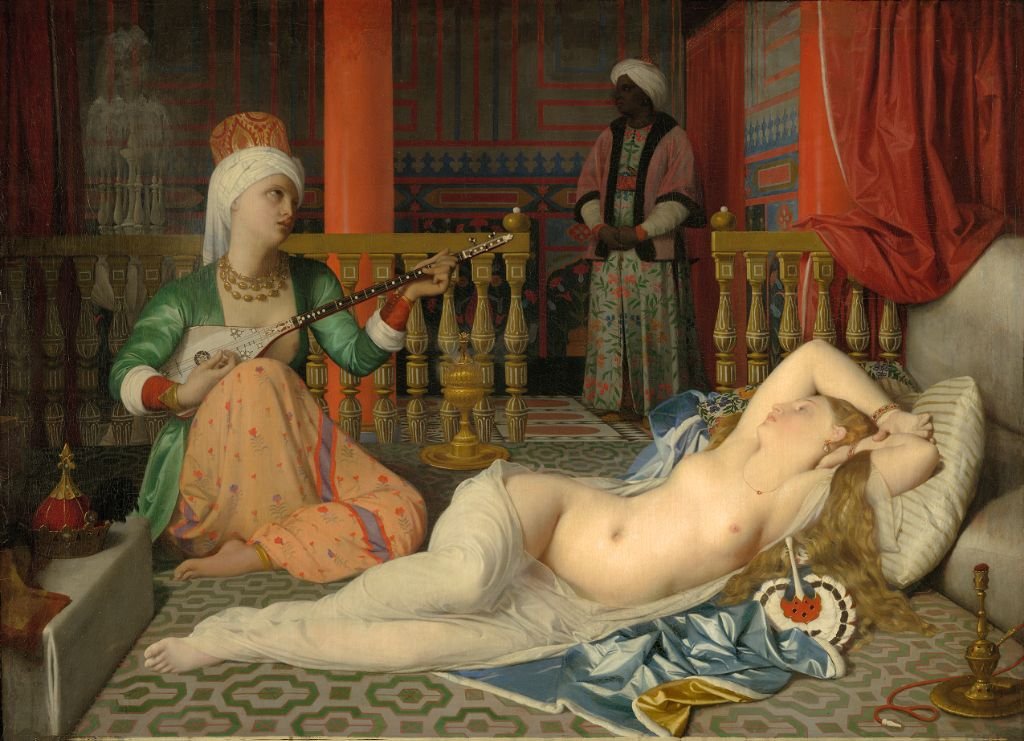
Odalisque with a Slave by Titian (1840)

If we look at the posture of Cabanel’s Venus we can also draw a comparison with the way Ingres depicted the woman in his 1842 work entitled Odalisque and Slave.

 Nudity in works of art at the time of Cabanel were deemed acceptable only if they could be tied in to a mythological theme and by so doing, any hints of eroticism in the depiction were justified and any hint of a public outcry over a lascivious depiction was countered by talk of classicism.  Not all were “taken in” by such a justification as the popular French writer of the time, Emile Zola, decried Cabanel’s depiction of Venus saying:

 “…The goddess, drowned in a sea of milk, resembles a delicious courtesan, but not of flesh and blood – that would be indecent – but made of a sort of pink and white marzipan…”

 Another person that was not swayed by the classical argument for depicting nudity was the eminent French art critic Théophile Gautier who, in June 1863, wrote, an account of that year’s Salon, in the journal Le Moniteur universal and commented about Cabanel’s The Birth of Venus:

 “… One might say, one has drawn aside curtains to reveal a young woman asleep; she reclines on her bed, the crest of a wave, stretches out her arms, pulls up a leg, abandons herself to the waves that rock her, and surrenders her skeins of long hair like seaweed to the rhythm of the blue water.  The swell makes her body arch and accentuates her youthful charms all the more strongly…”

 Criticism of the work on moral grounds were voiced and it would appear that one such critic was close to Cabanel as in a letter he wrote to his niece on May 30th 1863, he tried to justify the depiction of the nude in his painting.  He wrote:

 “…I do not complain at the little sympathy that my theme provokes in you, yet occasionally it is a mistake to view a painting only in moral terms……usually the subject is merely a pretext to hint at or to express an underlying ideal, an ideal for which the public is more receptive on account of its familiarity with the subject…… I would be glad to eliminate such misgivings among the family in Montpellier…”

The Birth of Venus by Botticelli (1486)

The strange thing about the Salon of 1863 was that there was not just one Birth of Venus but three albeit one did not have that exact title.  The Birth of Venus had been depicted on a number of occasions in the past, the best known of these being Botticelli’s 1486 version.

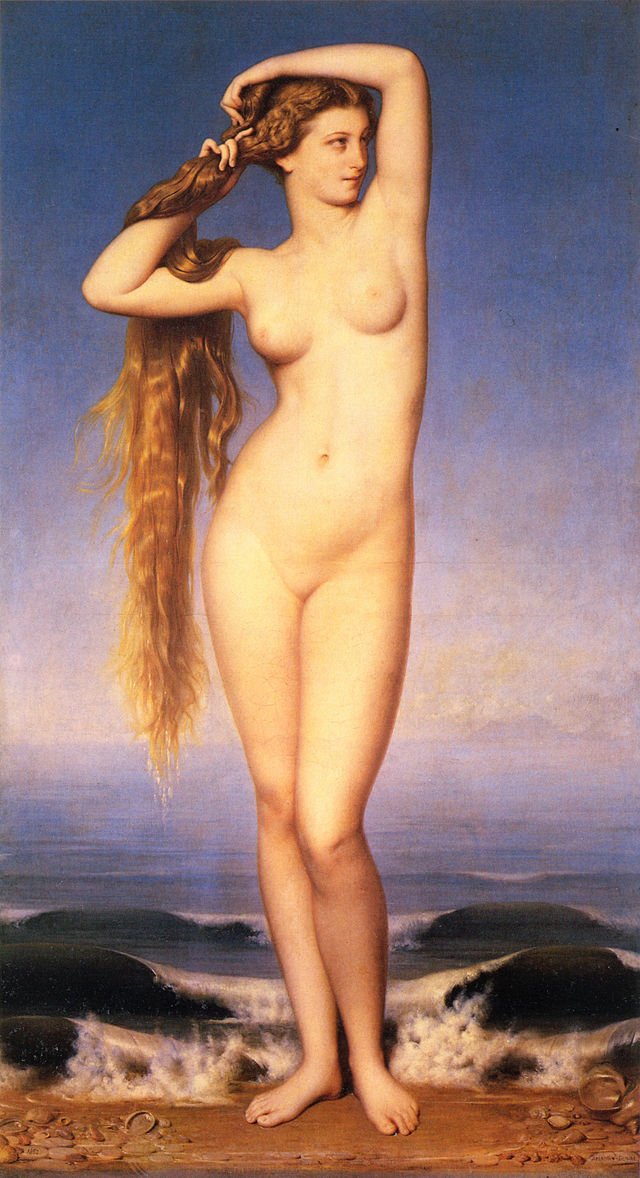
Birth of Venus by Amaury-Duval (1863)

However, besides Cabanel’s version, two other artists decided to feature the Birth of Venus in the work which they submitted to the 1863 Salon.  The first was a painting by Amaury Duval.

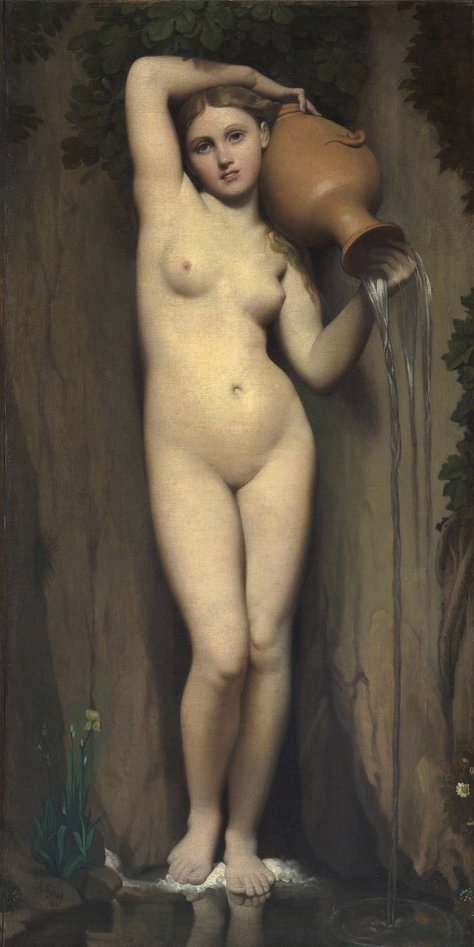
La Source by Ingres (1856)

Duval had been a student of Ingres and his offering may have been influenced by his master’s work La Source which Ingres started whilst in Florence around 1820 but did not complete until 1856 when he was living in Paris.

Venus Anadyomène by Ingres (c.1848)

 Another painting which could have influenced Amaury Duval when it came to the way he depicted the stance of Venus could have been another work by Ingres completed around 1848 entitled Venus Anadyomène.

The Pearl and the Wave by Paul Baudry (1862)

The other Birth of Venus painting to rival Cabanel’s painting at the 1863 Salon came from Paul Baudry.  His work did not have the title “Birth of Venus” but instead because of the inclusion in the work of a depiction of an oyster shell, it was entitled La Perle et la Vague (The Pearl and the Wave) which he completed in 1862 and which now hangs in the Prado in Madrid.  In this work we see Venus not being supported by a wave but lying on a rocky ledge with the foaming sea as a background.  She turns her head towards us as she gazes backwards over her shoulder.  In a series of essays, Old Masters and New Essays in Art Criticism, the influential nineteenth American painter, writer and teacher of art at the Art Students League in New York, Kenyon Cox, praised the painting writing that it was:

 “…the most perfect painting of the nude” in the 19th century…”

 He went on in his essay to highlight the “grace of attitude”, of the well-rounded but slim body of the young woman, with her visible dimple in the shoulder.  He could not praise Baudry’s work enough calling it “a pure masterpiece”

Although the Salon had three Venus painting the general opinion at the time was that the one by Cabanel was the best.


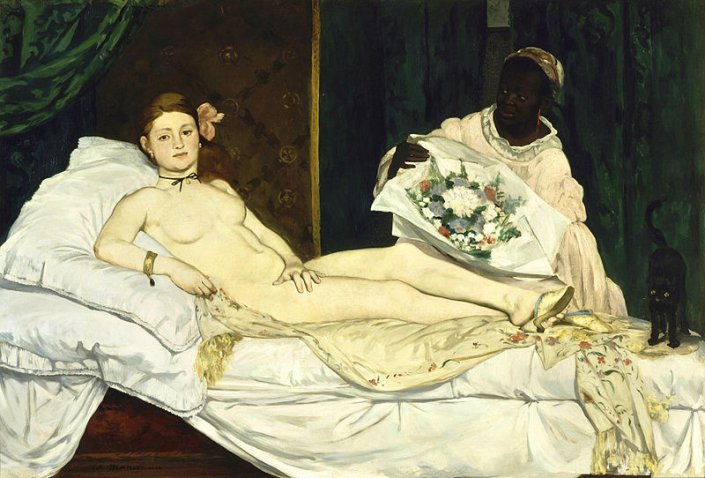
Olympia by Manet (1863)

The public and the authorities liked the work by Cabanel and accepted the classical justification for depicting a nude woman lying on the crest of a wave.  It is ironic that Edouard Manet’s risqué exhibit, Olympia, at the 1865 Salon caused a furore (see My Daily Art Display Oct 12th 2011).  Many conservative art critics termed the work immoral and vulgar.  So why would this painting of a nude woman suffer such criticism and the Birth of Venus works two years earlier escape such censure?  The answer is probably because the lady in Manet’s work was a courtesan or high-class prostitute and was devoid of any classical mythological or biblical connotation and the way she stares out at us in a provoking and challenging manner was thought to be a step too far and an unwanted reminder that her profession blossomed within Paris Society.

 Alexandre Cabanel’s The Birth of Venus painting was bought by Napoleon III and now can be found in the Musée d’Orsay.  Cabanel sold the reproduction rights of this work to Goupil, the French art dealers.  They had their in-house artist, Adolphe Jourdan, make two smaller copies of the work which Cabanel later re-touched and signed as per his agreement with Goupil.  One, sold as a work by Cabanel, now hangs in the Dashesh Museum of Art in Manhatten having originally been purchased by Henry Derby the American bookseller and art collector.  The other copy was commissioned in 1875 from Goupil by John Wolfe, and his cousin Catharine Lorillard Wolfe, the daughter of a tobacco heir, John David Wolfe, and the only woman among the 106 founders of The Metropolitan Museum of Art.  She was a philanthropist, patron of the Arts and avid art collector.  This version, which now hangs in the Metropolitan Museum of Art in New York, is slightly smaller.

 In my next blog I will take a final look at the life and works of Alexandre Cabanel and concentrate on his portraiture.

 I gleaned most of my information for this blog and the next ones about Cabanel from a great book I came across entitled Alexandre Cabanel – The Tradition of Beauty which was published to coincide with La tradition du beau exhibition of Cabanel’s paintings, which was held at the Wallraf-Richartz Museum in Cologne in 2011 and the Musée Fabre in Montpellier in 2010.

 I also came across an excellent website which goes into much greater detail about Cabanel and is well worth a visit.  It is:

Stephen Gjertson Galleries

http://stephengjertsongalleries.com/?page_id=2851

Alexandre Cabanel. Part 2 – the Prix de Rome and his return to Paris

I had reached the part in Alexandre Cabanel’s life story with him staying in the Villa Medici in Rome studying art, gifted to him as a reward for coming the “Second –First prize” winner in the Prix de Rome competition.  For Cabanel,  life in Rome was all about his art and very little to do with the outside distractions of the Eternal city.  He had admitted to his close friend Alfred Bruyas that he was lonely and just had his art as company.

Triumph of Galatea by Raphael (Villa Farnesina) (1514)

One of the requirements of the artists, who had been awarded the Prix de Rome scholarship to further their studies at the Villa Medici, was that they would submit work for examination annually and those artists who were history painters would also make copies of ancient sculptures and the Old Masters.  Cabanel had already done this sort of thing before coming to Rome when he would copy works of art by Velazquez, and Titian which he saw at the Louvre.  Cabanel was a great lover of the works of Raphael and took the opportunity, whilst in Rome, to copy Raphael’s frescoes which adorned the Villa Farnesina in the Trastevere district of the city.  At this time in his life, Raphael was Cabanel’s favourite artist of the past.

Orestes by Alexandre Cabanel (1846)

As a history painter Cabanel had to study and draw life-sized figures from nature.  They also had to present, on an annual basis, one finished drawing based on a work by an Old Master, and one drawing from the antique. The works of art that the student produced were first exhibited at the Villa Medici in the April. Their work was then sent back to Paris in the May to be judged at the Institute and following that they were exhibited to the public in the autumn.    In 1846, Cabanel’s submission was entitled Orestes, who was the son of Clytemnestra and Agamemnon and who was the subject of many Ancient Greek plays and appeared in many stories by Homer.  Much to Cabanel’s horror his painting was severely criticised by the judges of the Academy who said it was an oversized and inept composition.  The painting is housed in the Musée Fabre in Montpellier.

The Fallen Angel by Alexandre Cabanel (1847)

The next year, 1847, stung by the criticism but not deterred, Cabanel submitted a work entitled The Fallen Angel which is also part of the Musée Fabre collection.  Cabanel’s inspiration for this work was John Milton’s 1667 epic poem Paradise Lost and the fallen angels, Moloch, Belial, Mulciber, Mammon and Beelzebub.  In the work we see the “fallen” angel – fallen from grace and banished by God.  It is a classic portrayal of a naked man by an academic artist with the crafted way he depicts the musculature of the figure.  The angel has both arms raised and his fingers of his two hands interlocked hiding most of his face.  Despite this shielding of his facial expression, it does not hide from us his feelings as we can judge his mood by what we see in his eyes.  There is a look of vengeance and anger in his eyes.  He knows someone will pay for his ejection from the side of God.  He retains his pride but thinks about retribution. The subject shocked the exhibition jurists as no students had ever submitted from Rome a painting which featured the Devil.  This was a history painting submission and certain rules had to be followed and the jurists and academics who examined the work criticised it for bordering on a style of Romanticism.  In her book on Cabanel, Procès verbaux de l’Académie des Beaux-Arts (Minutes of the Academy of Fine Arts), Sybille Bellamy-Brown quoted the Academics’ remarks about the painting.  They stated:

“…The movement is wrong, the draughtsmanship imprecise, the execution deficient…”

Once again Cabanel was distraught at not being able to understand their criticism.  He wrote of his feelings with regards the criticism to his friend Alfred Bruyas, especially as he had worked tirelessly on the painting:

“…That’s my reward for all the trouble I gave myself not to submit an average piece of work…”

John the Baptist by Alexandre Cabanel (1849)

In 1849, his annual submission was a religious work entitled John the Baptist ,which like the other two works can be found at the Musée Fabre in Montpellier.  In this work we see John the Baptist preaching in the wilderness, surrounded on either side by his followers, both old and young.    To the left of the painting we see a staff planted firmly in the ground.  It takes the form of a cross and from the cross flutters a banner on which is written Agnus Dei, (Lamb of God).  The depiction is a dramatic one and, finally for Cabanel, it was well received by the Académie members back in Paris.  Cabanel, as a winner of the Prix de Rome, also had the right to be admitted to the Salon and works he submitted for inclusion at the Salons did not have to be scrutinised by the Salon jurists.  This work featured in the 1850 Salon and at the end of the exhibition was bought by the French State.

The Death of Moses by Alexandre Cabanel (1850)

In his final year, 1850, his annual painting submission was The Death of Moses.  Set in the wilderness, the painting depicts Moses dying in the presence of God whilst in the background we see the Promised Land that the Lord said he would never see due to his lack of belief in the Lord.   Angels surround the dying Moses and comfort him.  The inspiration for such a depiction almost certainly came from the works of art by Michelangelo and Raphael which Cabanel had seen during his five-year sojourn in Rome.   For Cabanel, this was a major work of art and one, which in the beginning, began to worry him as to whether he could deliver the finished product.  His self-doubt can be seen in a passage from a letter he wrote to his brother:

 “…I have imposed upon myself a large, very difficult, formidable task, since I seek to represent the image of the Eternal Master of the sky and the earth—to represent God—and next to Him, one of His most sublime creatures, deified in some way by His contact. This should give you an idea of my all-absorbing preoccupations. Still, this terrible task advances, but not without cruel mishaps. I know that that’s how it is on the path where my instincts have led me, and which is undoubtedly the most beautiful of all the arts, but one has to be strong and love it passionately in order to handle the obstacles one encounters…”

Cabanel left Rome and returned to Montpellier in 1851 and later that year returned to Paris.  He submitted his painting, The Death of Moses to the 1852 Salon and it received rapturous reviews.  The well respected and influential journalist and art critic of the time, Théophile Gautier, wrote in La Presse littéraire of May 16th 1852:

“…The Salon painting that most directly follows on from elevated, serious, profound art, whose prototypes are Michelangelo and Raphael is The Death of Moses by Monsieur Cabanel, Prix de Rome winner in 1845.  In his case, his stay at Rome, which sometimes can be detrimental to young artists, has indeed been profitable.  One can see how he has eaten the bread of angels and nourished himself on the marrow of lions…”

This was praise indeed and coming from such an influential source, Cabanel’s career in Paris could not have begun any better.

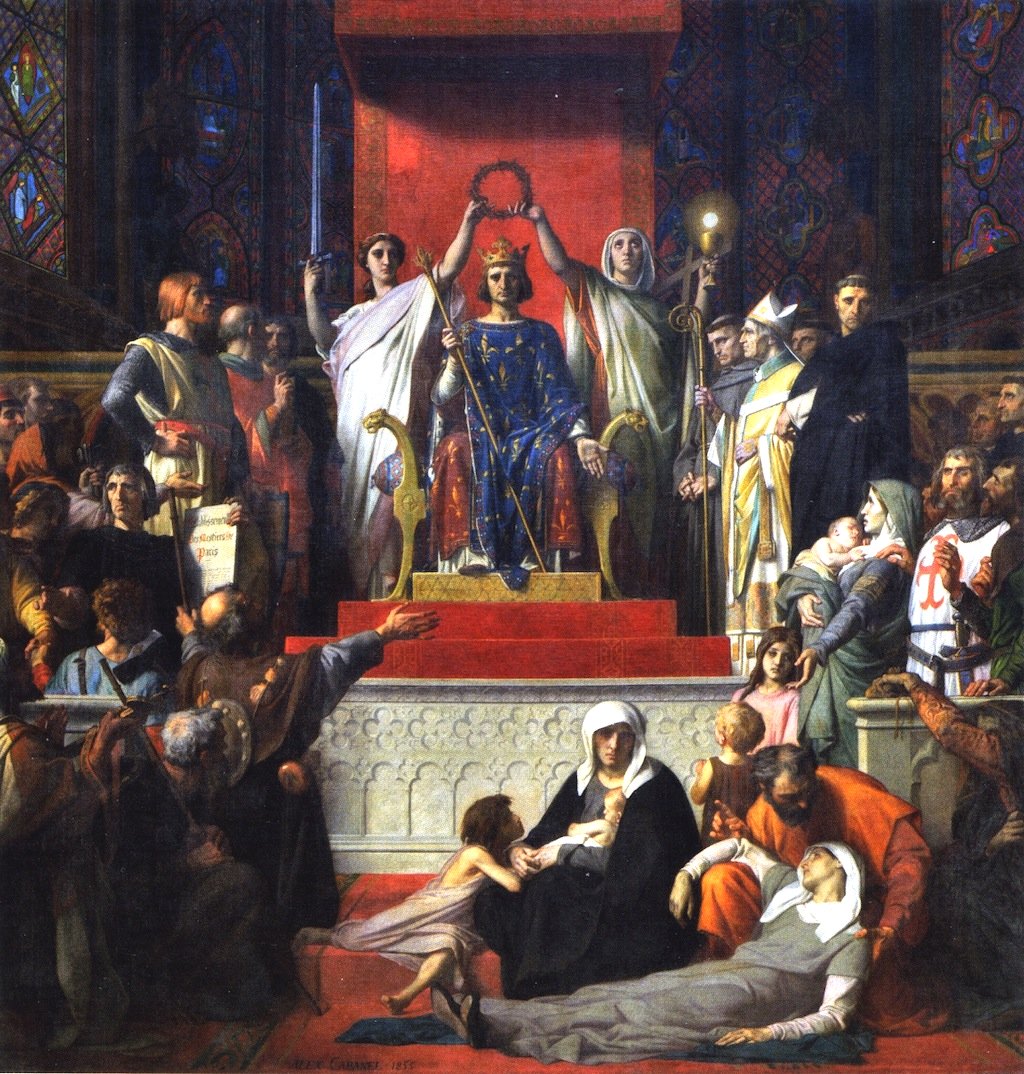
The Glorification of St. Louis by Alexandre Cabanel (c.1853-55)

In 1855 the World Exhibition came to Paris for the first time.  It went on to be held in the French capital on four other occasions.  The Exposition Universelle, as it was known in France, was an international Exhibition held on the Champs-Élysées from May to November.  Part of this World Fair would be dedicated to exhibits of fine art and Cabanel quickly realised to have his paintings exhibited at such an event would gain him world-wide notoriety.  He submitted two of his works of art.  The first one was entitled The Glorifcation of Saint Louis which had been commissioned by the French state for the Gothic chapel of Sainte-Chapelle at the royal Chateau de Vincennes.  The chapel and the subject of the painting were connected as it was at this chapel that Louis IX’s relics of the Crown of Thorns were initially kept.  Cabanel also had an ulterior motive for painting this picture as it now established a connection between himself and the reigning monarch Napoleon III.  Cabanel knew that his future success would be assured if his art went hand in hand with a good working relationship with the monarchy.

Christian Martyr by Alexandre Cabanel (1855)

The second work of Cabanel which appeared at the Exposition Universelle was entitled Christian Martyr.  Although the title would lead one to believe this was yet another work depicting the killing of a martyr it didn’t for it shows a group of Christians, at dusk, lifting the body of a martyred female believer from a boat up to a group of fellow believers above who are ready to carry her into a burial chamber.   The woman dressed in a dark yellow tunic lies lifelessly in the arms of the men who are lifting her up.  Her head lolls downwards and her face has the grey-green pallor of death.  It is a moving depiction and we see an elder standing behind the group of rescuers, with his arms outstretched in prayer for the soul of the martyr.  The man to the right of the scene leans against the parapet anxiously searching into the distance for the approach of the authorities.

The two paintings were also exhibited at the Salon of 1855 and The Christian Martyr painting was subsequently purchased by the Societé des Arts et des Sciences at Carcassonne for its Musée des Beaux Arts.

In my next blog I will continue to look at the life of Cabanel, his portraiture and one of his most famous works, The Birth of Venus.

 —————————————————————

 I gleaned most of my information for this blog and the next ones about Cabanel from a great book I came across entitled Alexandre Cabanel – The Tradition of Beauty which was published to coincide with La tradition du beau exhibition of Cabanel’s paintings, which was held at the Wallraf-Richartz Museum in Cologne in 2011 and the Musée Fabre in Montpellier in 2010.

I also came across an excellent website which goes into much greater detail about Cabanel and is well worth a visit.  It is:

Stephen Gjertson Galleries

http://stephengjertsongalleries.com/?page_id=2851

Alexandre Cabanel. Part 1 – The early days and Rome

Self portrait by Alexandre Cabanel (1852)

My featured artist today, Alexandre Cabanel, was one of the most well respected Academic artists of the nineteenth century.  In my next couple of blogs I will look at this remarkable artist and some of his paintings.  His works of art varied from portraiture to historical, classical and religious scenes all executed in an academic style.  The term Academic art, also referred to as academicism or eclecticism, is traditionally used to describe the style of art which was championed by the European academies of art, notably the Académie des Beaux-Arts.  For Cabanel, Academic art was the true art and during his lifetime he would clash with Impressionist painters and their artistic style.  Cabanel was also well known for his décorations d’intériur.

 Alexandre Cabanel was born in September 1823 in Montpellier, France.   He was the ninth child of Pierre-Jean Cabanel and Marie Anne Jean Cabanel.  Even at a young age he showed an early artistic talent and when he was eleven years of age he attended the drawing classes at the Montpellier’s free École des Beaux-Arts, which was run by the French genre painter Charles François Matet.  Matet  was also curator of the Musée Fabre in Montpellier.   Cabanel earned himself some money whilst studying by making copies of artworks which were housed in the city’s Musée Fabre which he then sold.   In 1836, thanks to Matet’s recommendation, the Montpellier council awarded Cabanel his first art scholarship to allow him to study in Paris.

 Three years later Cabanel’s artistic talent was recognised as being so good that he was awarded a second scholarship to return to Paris.  The scholarship was a blessing as his father, who was a cabinet maker, could not have afforded to send him to the French capital.    Alexandre did go, thanks to the municipal two-year grant and in the October of 1840, a month after his seventeenth birthday, Alexandre Cabanel enrolled at the School of Painting at the École des Beaux-Arts in Paris as a pupil of François-Edouard Picot .  Picot was a well established painter who had studied under Jacques Louis-David and had tried to continue David’s artistic style, that of neoclassical values, to which, in his own works, Picot often added a more romantic flavour.

 For Cabanel the École des Beaux-Arts was not just an establishment which taught art it was a place where he was able to study literature, history and religion.  Cabanel received a good, well-rounded education and he thrived on the learning that was offered to him and in a way, it helped him convert his knowledge into visual imagery that would play a part in his future works of art. When his two-year scholarship came to an end in the summer of 1841 his mentor Picot wrote to the Montpellier authorities pleading on Cabanel’s behalf, for a further scholarship for his protégé and in return he would gain employment for Cabanel in the form of a major commission in the Hôtel de Ville in Paris.

Agony in the garden by Alexandre Cabanel (1844)

In 1843 aged nineteen, Cabanel exhibited his first work of art at that year’s Salon.  It was entitled Agony in the Garden, which is currently housed in the Musée des Beaux-Arts de Valenciennes.  In this work Cabanel has placed the Christ figure off-centre.  Behind him are a group of his persecutors.

 All the time Cabanel was attending L’École des Beaux-Arts he had one aim – to have a painting of his accepted into the establishment’s coveted Prix de Rome competition, in which the winning work of art enabled the artist to receive a scholarship for them to study for a number of  years at the Villa Medici in Rome.  There were also Prix de Rome scholarships for the best proponents of architecture, sculpture, music and engraving.

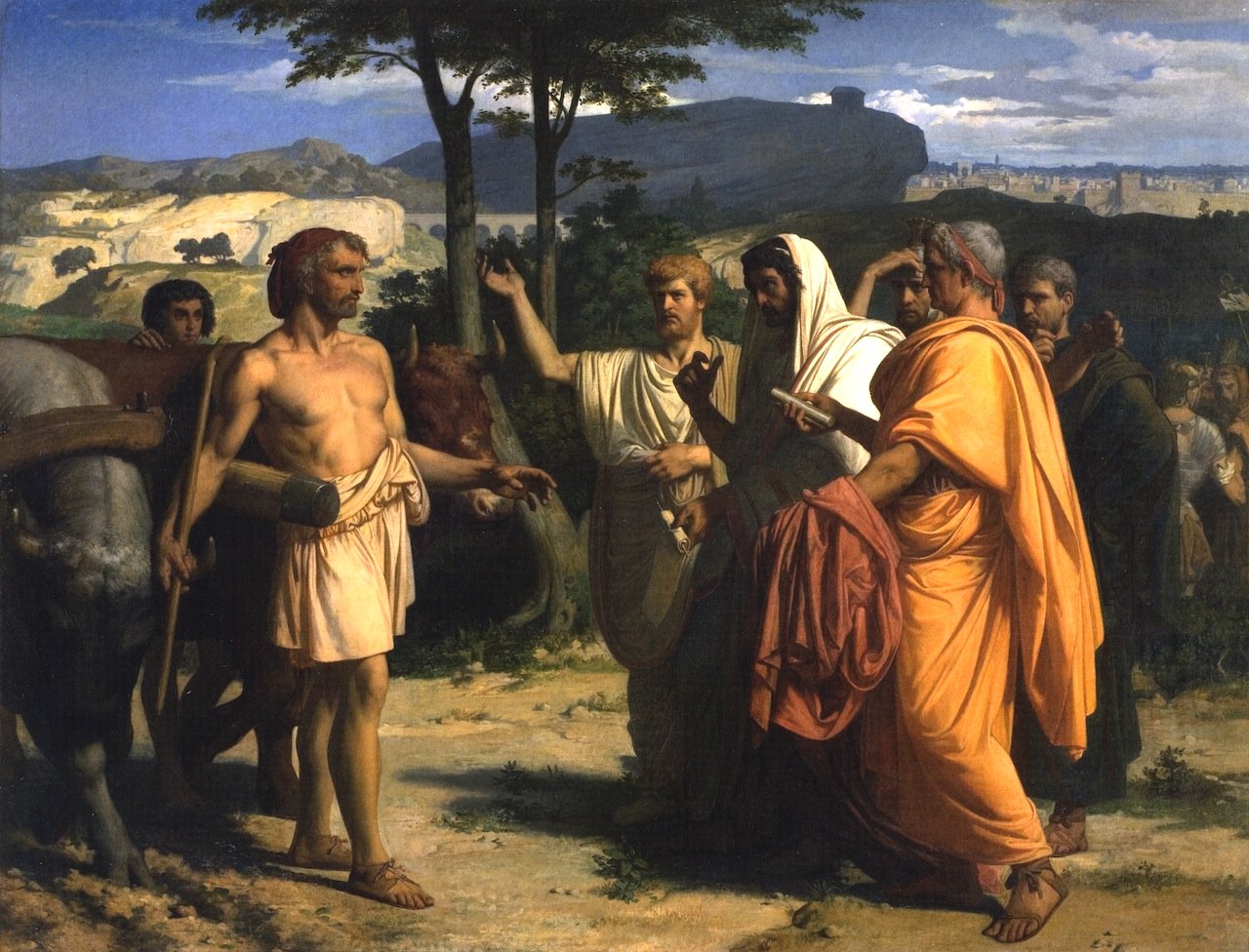
Envoys of the Senate offer the Dictatorship to Cincinnatus by Alexandre Cabanel (1844)

In 1843 he managed to reach the preliminary round of the competition with his work entitled Odysseus is Recognised by his Servant and buoyed up by that minor success he entered the competition again in 1844 this time with his painting, Envoys of the Senate offer the Dictatorship to Cincinnatus but he was only awarded sixth place.

The Mocking of Christ by Alexandre Cabanel (1845)

Better luck came in the 1845 competition when his work The Mocking of Christ, sometimes referred to as Christ at the Praetorium,  was judged and was awarded second place, with a fellow student of Picot, François-Léon Bénouville taking the top prize.   However second prize would not get the artist to Rome but the permanent Secretary to the Académie des Beaux-Arts, Désiré Raoul-Rochette, pleaded Cabanel’s case to be allowed to go to the Villa Medici as no Grand Prize for Music had been awarded that year.  A lot of wrangling followed between Rochette and Jean Victor Schnetz,  who was director at the Villa Medici, and who was against awarding Cabanel a scholarship.  In the end Schnetz backed down and Cabanel was granted a simple scholarship to go to Rome, which was to last for five years and the Prix de Rome second prize given to Cabanel was converted into a “Second First Grand Prize”.  All winners of the Prix de Rome received a financial allowance to cover the cost of their trip to Rome plus they were given a sum of money to cover their personal expenses and those they incurred during the production of their work. They also received free room and board.  The artists who came to the Villa Medici were allowed considerable freedom to paint subjects of their own choosing, but throughout their tenure they were all required to complete certain projects.  This allowed the French government, which had funded the scholarships, a way of assessing the progress of the Prix de Rome winning artists.  For the artists it was also a chance to bring their work to the attention of the members of the Academy, who also judged their annual submissions to see if their artistic ability had progressed.

 In January 1846 Cabanel set off for Rome.  It was early on in his stay at the Villa Medici that he met a fellow Montpellier citizen, Alfred Bruyas, who was enjoying the delights of the Grand Tour.   Bruyas was the son of a wealthy banker.  He was formerly taught art and would like to have become a professional painter despite his father’s wishes that he should embrace the world of finance and become partner in his father’s bank.  Bruyas loved art and loved to paint but soon realised he would never become a great artist and so concentrated on becoming an avid and discerning collector of art and a patron of the arts.  Many of his friends were artists such as Gustave Courbet.

Alfred Bruyas by Alexandre Cabanel (1846)

Bruyas supported Cabanel in these early days and in 1846, as a kind of repayment , Cabanel painted Bruyas’ portrait which now hangs in the Musée Fabre in Montpellier.  In the painting, Bruyas is depicted as a gentleman-traveller , dressed in his velvet-collared frock coat with a fashionable yellow waistcoat and pink and white cravat.  He is standing on the terrace of the Villa Borghese in Rome.  Bruyas and Cabanel became great friends during their short time together and Cabanel became very depressed when his friend left Rome in the summer of 1846.  Cabanel  would write to Bruyas telling him of his feeling of great loss when the latter had left the Eternal City.  In one letter, he wrote:

 “…Several times of an evening, I have put down on paper details from my present life so as to send them to you in letters.  On re-reading them, however, even I found them joyless and full of sorrow that I burned them…”

 For many aspiring artists who went to live in Rome they loved the liveliness of the Italian capital with all it had to offer but ,according to Cabanel, all Rome offered him was the chance to paint and copy the works of the Italian Masters.  He cut a lonely figure which was summed up in a letter he wrote to Bruyas in 1847.  In it he wrote that all he had left for consolation was his art :

 “…I have been leading a rather an orderly life, one completely devoted to art.  I have remained as untouched, as pure as Rome’s vestal virgins of days gone by……………….What’s more, I am weary of chasing after happiness that turns out to be an illusion, what’s the use?  Especially when I believe that I have long found it in my art for instance; I devote myself to it with complete freedom just as one devotes oneself to love or poetry…”


La Chiaruccia by Alexandre Cabanel (1848)

In 1848 Cabanel completed three amazing paintings for Bruyas, all of which are now in the Musée Fabre in Montpellier.  They were to be hung together in the form of a triptych.  The first was a painting of an Italian lady in traditional country peasant costume.  It is entitled La Chiarrucia.  The woman who modelled for this work also sat for many of the artists who lived and studied at the Villa Medici.

A Thinker, a Young Roman Monk by Alexandre Cabanel (1848)

The second of his three works, which was to be placed between the other two,  was entitled Un penseur, jeune moine romain,  (A Thinker, a Young Roman Monk)  and depicts a Franciscan monk lost in thought among the ruins of the Forum.

Albaydé by Alexandre Cabanel (1848)

The third, and my favourite, was simply entitled Albaydé.  The character of the title comes from Victor Hugo’s poem Fragments of a Serpent, which was one from a 1829 collection of poems known as Orientalia. The scene would appear to be a harem .  Cabanel has depicted the young woman, an Oriental courtesan, through the lustful eyes of the poet as she lies back languorously and looks out at us seductively with half closed eyes.  The beauty of this woman emanates from her eyes which I saw described as doe-like.  Her silken robe is open to the waist exposing the curve of her breasts.  She clutches a periwinkle vine which lies across her thighs.  It is a very sensuous depiction and she and La Chiaruccia ,either side of the monk, must have made for quite a formidable combination on Bruyas’ wall.

In my next blog I continue with Alexandre Cabanel’s life story and look at more of his exquisite paintings.

————————————————-

I gleaned most of my information for this blog and the next ones on Cabanel from a great book I came across entitled Alexandre Cabanel – The Tradition of Beauty which was published to coincide with La tradition du beau exhibition of Cabanel’s paintings, which was held at the Wallraf-Richartz Museum in Cologne in 2011 and the Musée Fabre in Montpellier in 2010.

Ary Scheffer

Self portrait by Ary Scheffer (1795)

I have often mentioned in previous blogs that the subject for a blog frequently comes from something I have stumbled upon whilst researching another blog.  Today’s blog is all about the Dutch painter Ary Scheffer who had a connection with the artist I talked about in the last two blogs, Théodore Géricault, but more of that connection later as I first want to look at the life of the Dutchman who was a leading Romantic painter.

Ary Scheffer came from an artistic background.  His father was Johann- Bernhard Scheffer a portraitist who originally hailed from Hamburg but from his early teenage years lived in the Netherlands.  He had married Cornellia Lamme, another artist who concentrated on miniature portraits.  Ary Scheffer’s maternal grandfather was Arie Lamme the Dutch landscape painter.  The couple, who lived in Dordrecht,  had three sons, Ary, the eldest, was born in February 1795, his brother Karel Arnold Scheffer who was born in 1796, went on to become a journalist and writer and their youngest, Hendrik, who also became an artist, was born in September 1798.

The Three Brothers Scheffer in a Landscape by Ary Scheffer (1824)

Ary Scheffer was given his first artistic tuition by his parents but when he was eleven years of age his parents enrolled him at the Stadstekenacademie in Amsterdam on a three year art course.   During that time he put forward one of his paintings, Hanibal Searing to Avenge the Death of his Brother Hasdrubal, in the first Exhibition of Living Masters in Amsterdam in 1808.

The painting is now in the Dordrecht Museum along with a number of his other works which are hung in the Ary Scheffer Room.  That same year, his father became the court painter of Louis Bonaparte, who ruled over the Kingdom of Holland, a position bestowed on him by his brother, Napoleon Bonaparte.  Ary’s father only held the position for a year as in 1809 he died.  Following the death of her husband, Cornelia Scheffer moved to Paris with her three sons where Ary and his brother Hendrik became pupils at the studio of the French painter, Pierre Guérin.   Ary and Hendrik were in good company at the studio as two of their fellow pupils would become the figureheads of the French Romantic movement in art, Eugène Delacroix and Théodore Géricault.

Ary Scheffer later attended the École des Beaux-Arts in Paris and from 1812 for the next thirty five years exhibited works at the annual Salons.  Along with Delacroix and Géricault, Ary Scheffer is recognised as one of the great painters of the Romantic school.  Following the end of the Revolution and the fall of Napoleon Bonaparte the French bourgeoisie once again came to prominence and along with the State were the main patrons of the Arts.   Scheffer’s work was very popular and at the end of each Salon his paintings would be snapped up by eager buyers.

The Soldier's Widow by Ary Scheffer
The Soldier’s Widow by Ary Scheffer

In the 1822 Salon he exhibited his very sentimental painting Soldier’s Widow which was very popular and although the whereabouts of the painting is unknown there are a number of monochrome prints of the work.

General Lafayette by Ari Scheffer (1823)

Ary Scheffer was also an excellent portraitist and in 1823 he completed probably one of the best portraits. It was of General Lafayette, the French aristocrat and military officer.  It was a full-length standing portrait that was the most popular image of Lafayette as an older man, who had once been a general in the American Revolution War (1775-83) against the British and a close friend of George Washington.  Lafayette was a popular subject for prints in the first half of the 19th century.  He was a hero to both the French and the Americans; he was the first foreign dignitary to address a joint session of the U.S. Congress and in 1824, on the occasion of Lafayette’s celebrated tour of the United States, Ary Scheffer presented his painting to the U.S. House of Representatives. It has hung to the left of the Speaker’s rostrum since the opening of the current House Chamber in 1858.  Lafayette would later figure in the French Revolution in 1789 and in the July Revolution of 1830 which led to Louis-Philippe becoming ruler of the French nation.  This painting, entitled Gilbert de Motier, Marquis de Lafayette, is now part of the collection of the US House of Representatives in Washington.

When Louis-Philippe came to power in 1830 it marked the zenith of Scheffer’s artistic career.  Scheffer, before the July revolution, had been giving drawing lessons to Louis-Philippe’s children and a great friendship between artist and his pupils blossomed.  Once Louis-Philippe came to power after the 1830 Revolution, Scheffer attained an influential position within the court. Louis-Philippe became the patron of the artist and the Orleans family bought many of Scheffer’s paintings. Scheffer received numerous lucrative commissions for the Musée Historique at Versailles, which Louis-Philippe founded in 1837 and which was situated in the wings of the Palace of Versailles.   The gallery which is one hundred and twenty metres long houses and also includes extensive tables that illustrate the major military events of the history of France.

Princess Marie d'Orléans by Ary Scheffer (1831)
Princess Marie d’Orléans by Ary Scheffer (1831)

Ary Scheffer also completed a number of Royal portraits including one in 1831 of Princess Marie of Orléans the third child and second daughter of Louis-Philippe and his wife Maria Amalia of the Two Sicilies.  She later became the wife of Duke Alexander of Württenberg.  She was the most talented artist of all the Royal children and was constantly encouraged to pursue her love of art and sculpture by Ari Scheffer.  Sadly she died of tuberculosis when she was just twenty-five years old.

Marie Amélie of Naples, Queen of the French by Ary Scheffer (1857)

Another member of the he French Royal Family who featured in one of Scheffer’s portraits was Marie-Amalia, the niece of Marie-Antoinette and the wife of Louis-Philippe.  Louis-Philippe had reigned as the French monarch from 1830 when he came to power following the July Revolution and ruled for eighteen years but was deposed in the February 1848 Revolution which resulted in he and his wife, Marie-Amalia living a life in exile in England.

Claremont
Claremont

The couple lived at Claremont, a stately home owned by Leopold of the Belgians, but lent out to Queen Victoria.  In 1850 Louis-Philippe died but his widow remained at Claremont for the rest of her life.   Ary Scheffer visited Claremont in 1857 at which time he completed the portrait of the ex-Queen.   In it we see a frail seventy-five year old lady in mourning.

Death of Géricault by Ary Scheffer (1824)

What persuaded me to feature Ary Scheffer was when I was looking at the death of Théodore Géricault at the young age of thirty-two; I came across a painting entitled The Death of Géricault by today’s featured artist, Ary Scheffer.  It is beautiful work of art which highlights the French Romanticism style, which was so popular at the time.  Look at the man sitting on the chair who was presumably one of Géricault’s close friends.   Look at the way Scheffer has depicted him.  He grasps Géricault’s limp wrist with his right hand whilst he buries his head on his left hand which lies across the back of the chair which he is sitting on.  It is almost a scene from an old silent Hollywood movie or part of an amateur dramatics production.  The physician holds Géricault’s left hand which lies almost lifeless over his heart.  Look at Géricault’s face.  It is sunken.  It is almost skull-like.   In my last blog I featured Géricault’s last self-portrait which was a very disturbing depiction and somebody commented that it could not have been that bad but what we see in Scheffer’s painting is very close to that self-portrait.  This was the end for the great artist.

Théodore Géricault and Monomania

Self Portrait by Théodore Géricault

In my last blog I looked at some works by Théodore Géricault.  I examined his paintings which featured horses and the military and his masterpiece The Raft of the Medusa which I had examined in detail in my blog of June 10th 2011.  I finally looked at a highly erotic work which he painted for his own delectation around about the same time of the Medusa work.  In this blog I want to look at what I consider as his finest works, a series of portraits of men and women who had serious mental issues.

Raft of the Medusa by Théodore Géricault (1819)

Having completed The Raft of the Medusa around 1819 he exhibited it at that year’s Salon under the title Scène de Naufrage (Scene of Shipwreck).  It was hailed as the star piece of that year’s Salon and was well received by the French public including Louis XVIII himself, who had sponsored the exhibition.  Such was the fame of this work that Géricault was invited to London in June 1820 to exhibit the painting at William Bullock’s Egyptian Hall in Piccadilly.  It drew in crowds from all over the country and by the time the exhibition ended at the end of 1820, more than forty thousand people had come to view the masterpiece and as Géricault had negotiated a fee based on the number of people who paid to see his work it is thought that he walked away with twenty thousand francs and so it was just as well the French government would not countenance the purchase of the work when the 1819 Salon closed!

A year later, at the end of 1821, Géricault left London and returned to Paris.  It was at this time that he embarked on a series of ten portraits of people who were suffering from what is termed monomaniaMonomania is an exaggerated or obsessive enthusiasm for or preoccupation with one thing.  It is a type of partial insanity.  The word was first used by the French psychiatrist Jean Étienne Esquirol around 1810 and was a notion typified by the presence of an expansive fixed idea in which the person’s mind was diseased and deranged in some aspects but otherwise normal in others. So why would Géricault focus on this type of person and who commissioned the ten small works?

The man who commissioned the paintings is known to be Étienne-Jean Georget.  Georget was an intern at Salpêtrière, the women’s asylum in Paris, and later the medical supervisor at a private asylum in Ivry.  As to how the two men met is still up for debate amongst art historians.  One theory is that Géricault was treated by the psychiatrist.  He had been suffering from depression accompanied by paranoid delusions which culminated in a nervous breakdown around 1819.  Another possibility was that the two met during one of Géricault’s visits to the hospital morgue where he would go to acquire dissected limbs which he often used in his preliminary studies for major works, such as his Raft of the Medusa painting.  It could have been that Georget had commissioned the work as he believed such an artistic task would help Géricault recover from his own mental dark period.  When Géricault completed the work he gave them to the psychiatrist as a way of expressing his thanks.  Some art historians however believe that it was a simple commission, the result of which would help Georget in his studies into monomania.  However it should not be forgotten that Géricault had an intense interest in the causes and results of mental instability for his grandfather and one of his uncles had died insane. At the time Géricault was formulating his painting The Raft of the Medusa, which featured a group of men adrift on a raft after the sinking of their vessel Medusa, he knew that the key to success would be an authentic depiction of the terrified and dying seamen.   Géricault portrayed the men on the raft as dead or dying, desperately trying to signal for help.  To achieve a sense of realism he had contacted a variety of medical specialists. His principal concern had been to gain access to human bodies in various states of putrefaction, to ensure the genuineness of the finished painting and it could have been that he also talked to the likes of Georget about the psychological trauma suffered by the victims of the Medusa shipwreck.  It is known that he interviewed the surgeon, Henry Savigny, who had been serving on the vessel when the shipwreck occurred and the doctor, at the time, had been putting down in print his experiences and the way it mentally affected the stricken crew members.

Whatever the circumstances were we know the five paintings I am going to feature initially belonged to Georget.  He, like Géricault died when he was in his early thirties.   I mention five works and yet one of Géricault’s early biographers, Charles Clément, talked of there being ten portraits.  However, only five remain.  So did the missing five feature five other mental patients?  What is currently believed is that Georget had asked Géricault to paint a further five works featuring the same five people at a later time so as to highlight the change in their appearance.  For Georget this was the study of physiognomy, an art of judging character from the face and phrenology, which would link the external form of the cranium as indication of mental faculties.  Simply put it was the assessment of a person’s character or personality from his or her outer appearance.  We have no names as to the sitters, just the monomania that is afflicting each of them.  In his book On Madness, published in 1820, Georget is most definite that madness can be seen in the face of the afflicted.  He wrote:

“…In general the idiot’s face is stupid, without meaning; the face of the manic patient is as agitated as his spirit, often distorted and cramped; the moron’s facial characteristics are dejected and without expression; the facial characteristics of the melancholic are pinched, marked by pain or extreme agitation; the monomaniacal king has a proud, inflated expression; the religious fanatic is mild, he exhorts by casting his eyes at the heavens or fixing them on the earth; the anxious patient pleads, glancing sideways, etc…”

Certainly harsh and in some ways unfeeling words from the psychiatrist and are in complete contrast to the sympathetic way Géricault depicted the sitters.

The five surviving portraits are entitled Portrait of a  Man Suffering from Delusions of Military Command;    A Kleptomaniac;  Portrait of a Woman Suffering from Obsessive Envy;     A Woman Addicted to Gambling and A Child Snatcher.  It seems likely that the featured women were inmates of the women’s hospital Salpêtrière, while the men were chosen from the many male inmates of the male asylums of Charenton and Bicȇtre.

Portrait of a Woman suffering from obsessive envy by Théodore Géricault (1822)

The first of the five I am featuring Portrait of a Woman Suffering from Obsessive Envy, which is housed in the Musée des Beaux-Arts in Lyons.  She avopids our gaze.  Her eyes are red-rimmed.  She has suffered and is probably still suffering.  Her case notes stated that she suffered from “envy obsessions” and maybe the slightest hint of a green tint to her face was the artist’s way to signify her obsession with envy.

Portrait of a Man suffering from Delusions of Military Command by Théodore Géricault (1822)

Next we have a man who suffers from delusions of grandeur and the portrait is entitled A Man Suffering from Delusions of Military Command which is in the Museum Oskar Reinhart in Winterthur in Switzerland.  The man in this particular portrait believed he was Napoleon and maybe Géricault believed that it was not just his sitter who had delusions of grandeur but it was targeted at the man himself, Napoleon, who may also suffered a similar delusional belief in himself as the head of the French Empire.  One needs to remember my previous blog when I featured some of Géricault’s military paintings.  Maybe now, like many French people after the defeat of Napoleon, he had misgivings about the glory of battle.  It is a very sympathetic portrayal of the old man and there is an air of sadness about his demeanour.  He looks like a defeated man and could well be an allegory for a defeated nation.

Portrait of a Kleptomaniac by Théodore Géricault (1822)

My third offering is the painting entitled Portrait of a Kleptomaniac which is housed in the Museum of Fine Arts in Ghent.  It is a strange depiction.  Just by looking at him we know there is something wrong in his life both physically and mentally.  He is dishevelled.  His sallow skin tone alerts us to him being ill.  His beard is unkempt and his hair is uncombed and messy.  Look at his face.  Look at the redness of his left cheek which looks swollen as if he has been involved in a fight.  He stares out at us, or maybe past us, but we have no idea what he is thinking. It is an empty gaze.  Géricault probably had no idea what his sitter was thinking but he made sure he captured every small detail about the man and maybe he wants us to decide on what has brought this man to the asylum.

Portrait of a Woman suffering from an  Obsessive Gambling disorder  by Théodore Géricault (1822)
Portrait of a Woman suffering from an Obsessive Gambling Disorder by Théodore Géricault (1822)

The fourth painting is entitled A Woman suffering from and Obsessive Gambling Disorder and can be found at the Louvre in Paris.  The old woman in the painting avoids stares out at us but it is a blank stare.  One has no idea what she is thinking.  She is lost in her own world, a world she is resigned to but does not enjoy.   Her eyes are red-rimmed probably brought on by the amount of mental and physical pain she has had to endure.  Her mouth is tense.  You can see in her facial expression that she is disturbed by something but with what?

Portrait of a Child Snatcher by Théodore Géricault (1822)

The final portrait by Géricault is entitled A Child Snatcher.  Before us we have a man who looks distinctly unhappy with his lot in life.   He is dressed in old brown clothes and has a dishevelled look about him.  His face is haggard.  His life has not been easy.  The dark background give us the distinct impression that this man lives in a world of isolation.  It is as if, as a resident of a mental institution, he has been cut adrift by society.  He avoids our gaze and looks to the side in a somewhat shifty manner.  Although we would compartmentalize this type of portrait as one of realism there is an element of romanticism in the way Géricault does not want us to judge the sitter.  Looking at the man we would not know his crime but the title of Child Snatcher tells us all we need to know about a man who in the present day would be probably be classed as a paedophile.

Last self portrait by Théodore Géicault (c. 1823 - 1824)
Last self portrait by Théodore Géicault (c. 1823 – 1824)

If you think that the five portraits were very disturbing and yet very real, I will leave you with one other shocking portrait.  It is the last self-portrait by Géricault, which he completed when close to death.  What a terrible sight it must have been as he looked in the mirror as he worked on his own portrait.  Remember this was a young man in his early thirties.

 The five existing portraits were discovered unframed and unstretched by Louis Viardot , the husband of the famous  French mezzo-soprano, Pauline Viardot .  Viardot was an artist himself, and a great admirer of Gericault, and so he recognised the style of the works as that of Géricault.  Géricault’s biographer Charles Clément researched the origin of the works and found that they had all belonged to a certain Dr Lacheze, to whom they had been bequeathed by another medical man, the psychiatrist Dr Etienne Georget.

Théodore Géricault's tomb at Père-Lachaise cemetery in Paris
Théodore Géricault’s tomb at Père-Lachaise cemetery in Paris

Théodore Géricault died in January 1824, aged 32 and is buried in the Père-Lachaise Cemetery in Paris.  This series of portraits featuring mentally disturbed people was completed by an artist who also suffered depression during his later life.  In 1810, he wrote to his best friend, Pierre-Joseph Dedreux-Dorcy:

 “…Now I am disoriented and confused. I try in vain to find support; nothing seems solid, everything escapes me, deceives me. Our earthly hopes and desires are only vain fancies, our successes mere mirages that we try to grasp…”

Whereas Dr Georget was more clinical and some would say somewhat cold-hearted about his desire to have the portraits of these people we can see in the way Géricault depicted them with sympathy and even empathy.

Théodore Géricault – horses, military and the erotic

Théodore Géricault by Alexandre Colin (1816)

In the last few blogs I have talked about paintings which, at the time, shocked the establishment. In this blog I will be looking at a painting by one of the great French artists that, no doubt, would have shocked the nation of art lovers if it had ever been exhibited but in fact it only surfaced 170 years after its completion. The artist in question is Théodore Géricault, who is looked upon as one of the early leaders of the Romantic Movement and who went on to inspire another great artist of the Romantic Movement, Eugene Delacroix. The painting that probably would have astonished the art world, if it had been exhibited, was entitled Three Lovers and was completed around 1820 when Géricault was twenty-nine years of age. He must have been working on this painting at the same time that he was painting his great 1819 masterpiece The Raft of the Medusa (see My Daily Art Display of June 10th 2011).

Raft of the Medusa by Théodore Géricault (1819)

Théodore Géricault was born in Rouen, France in September 1791. His family were of the upper middle class bracket. When Géricault was four years old the family moved from Rouen to Paris. He received the normal education as a child and teenager but showed little interest in his studies at the lycée. During his early life Géricault had two great passions in life – art and horses and loved to go horse riding a pastime which would literally be the death of him. When he was seventeen years of age his mother died and he received a sizeable inheritance.

In 1808, aged seventeen years of age, he enrolled at the studio of Carle Vernet, who was best known for his paintings of horses. Two years later, in 1810, he moved to the studio of Pierre-Narcisse Guérin, a much admired classical painter where he received a much enhanced academic training in art. After just six months working with Guérin, Géricault left the studio to concentrate on copying the great works housed at the Louvre. He did this for three years.

Charging Chasseur by Théodore Géricault (1812)

In 1812 he entered a painting into the Salon. It was originally entitled Equestrian Portrait of M.D***, later to be changed to The Charging Chasseur. It was a depiction of a mounted Napoleonic cavalry officer who is ready to attack the enemy. The chasseur sits astride his grey stallion, sword in hand, raring to go into battle. The horse, with flying mane and foaming mouth, enforces the animal’s aggressive passion. This was a true war-horse. This was what was good about war – bravery of man and animal and ultimate victory. The painting met with critical acclaim. Everybody loves a winner !

Wounded Cuirassier leaving the Field of Battle  by Théodore Géricault (1814)
Wounded Cuirassier leaving the Field of Battle by Théodore Géricault (1814)

Two years later, in 1814, buoyed by this success, Géricault once again exhibited The Charging Chasseur along with a newly completed work at that year’s Salon, entitled The Wounded Cuirassier leaving the field of Battle but to his amazement and annoyance the art critics were critical and the public were dismissive of his effort. So, why the change of heart amongst the critics and the public? Géricault loved the subject of horses and horsemanship and during the Napoleonic era such subject matter proved irresistible to him and the French public. For Géricault, his love was to depict the powerful combination of a rider dressed in his magnificent uniform and the sheer animal power of his horse. However, this was not the normal depiction seen in academic battle paintings where the artist focused on a mass of soldiers led into battle by a famous general. These were paintings depicting victorious battles. However, in The Wounded Cuirassier leaving the field of Battle we see a depiction of a single anonymous wounded soldier with his battle-weary mount limping from the battlefield. This was definitely not what the establishment and the art critics wanted to see. Maybe Géricault’s biographer, the nineteenth century art historian, Charles Clément, summed it up perfectly when he wrote of the difference between the two works:

“…In 1812 success was still in the air, whilst in 1814 everyone knew they were facing defeat…….The echoes of the cries of distress from our suffering armies on the plains of Russia resounded through the lands. Hearts were full of fear and terror. It is this universal feeling which Géricault expressed in his painting and explored in the Wounded Cuirassier…..He painted two pictures, the first about glory and the other about faded glory…”

In 1816 with a desire to win a three-year paid scholarship in Rome he competed for the Prix de Rome. However his work just got him to the semi final stage before his offering was eliminated. Still with a desire to go to Italy he decided to fund himself. He stayed in Italy visiting Florence, Rome and Naples before returning to Paris a year later. It was during this period in Paris (1818-19) that he set about painting his famous work The Raft of the Medusa. This was an enormous work of art which measured approximately 4.9m x 7.2m (16ft x 23ft). It was also during this time that he decided to paint, for himself, a small highly erotic work entitled Three Lovers.

Three Lovers by Théodore Géricault (1817-20)

Three Lovers which is now housed in the Paul Getty Museum in Santa Monica measured just 22.5cms x 29.8cms (9 inches x 12 inches). The picture is dominated by a large bed that is framed by furniture and a large curtain which is partly drawn to the side. In some ways it is as if we were theatre-goers and we are looking at a stage with the theatre curtain pulled to one side for us to enjoy the performance, and what a performance!

Sated
Sated

At one end of the bed we see a dark haired woman lying somewhat lethargically against some blue pillows. She is naked from the waist up and her arms are spread wide exposing her rounded breasts. She looks closely at a pair of lovers who are making love. By her expression we feel that she is sated, probably having already had her turn of lovemaking with the man who is now pleasuring himself with the blonde woman at the opposite end of the bed. She is now happy to watch as the pair make love. She has now taken on the role as voyeur. The blonde and the man are locked in an intimate embrace. She half kneels on the bed between his thighs. Although he is almost hidden from view his naked legs would suggest he is lying semi-naked beneath his lover. The blonde woman is not naked but her white dress is pulled up to her waist by the man’s encircling arm which exposes her naked thigh and buttock. The way in which she has positioned herself on top of the man and the way she has her arms tightly wrapped around his neck exhibits her obvious arousal.

The stocking
The stocking

Géricault has depicted the blonde woman’s stocking down at her ankle which adds to the erotic nature of the painting.

It is a highly erotic work of art and because of the nature of the depiction Géricault would almost certainly have painted it for himself. He would never have intended it to be exhibited as he would have known full well that it would have been condemned by both critics and public for its dubious morality in a society which strongly adhered to religious and moral values and which condemned sexual excesses and misbehaviour. Of course having said all that it could well be that such erotic encounters did take place between prostitutes and their customers despite people pretending such excesses did not occur. Maybe Géricault was reminding himself of what did happen in dimly lit rooms where passions prevailed over civic respectability.