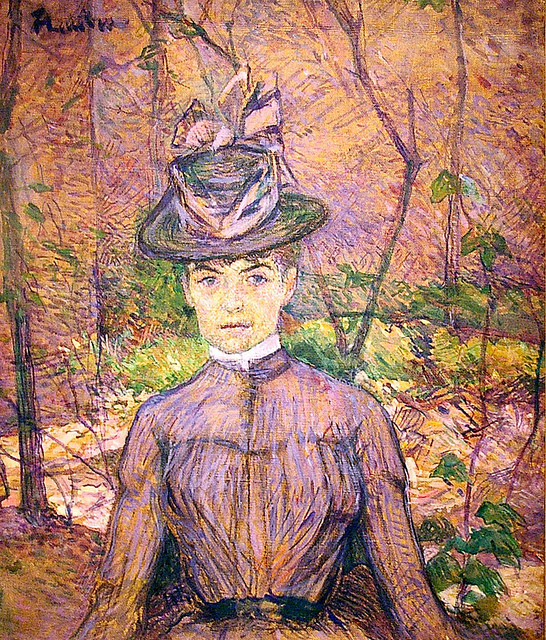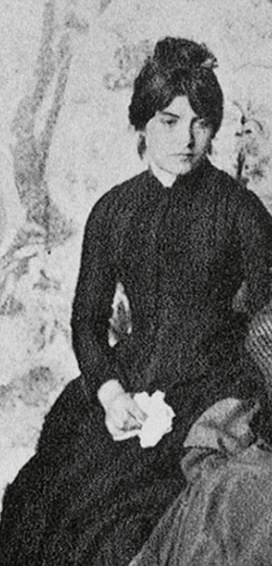
Suzanne Valadon. Part 7 – The final years

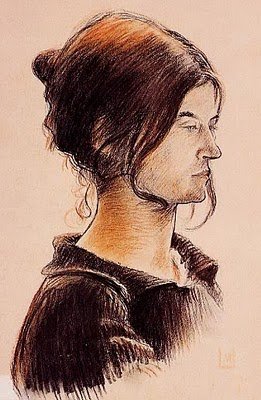
Portrait of His Mother Suzanne Valadon by Maurice Utrillo

With their newly found wealth the acrimonious arguments ceased, long-standing bills were paid and new clothes were bought for Suzanne, her husband and her son.  There was also a change in the fortunes of the trio for before they were all artists and all exhibited their works but now the Bernheim Jeune gallery just wanted paintings done by Suzanne and Maurice.  Utter was now reduced to the role as their manager.  He was the one who negotiated deals and organised exhibitions at home and in Europe.   The new wealth brought happiness to their friends and neighbours as Suzanne was a generous soul.  It was said that tiny street urchins would along the narrow streets of Montmartre clutching onto 100 franc notes which Suzanne had thrown to them from her top floor window in rue Cortot.  Suzanne did not forget her mother in this exciting time and arranged to have a splendid granite tomb placed above her grave.  She must have been thinking of the future for she the tomb inscribed in gold letters:

Valadon – Utter – Utrillo

Suzanne also remembered those idyllic months she spent with André in Belleville when he was recuperating and so she decided that she and André should return there for a visit.   Sadly, as we all know, it is foolish to try and re-live old memories and their return was not as idyllic as she had imagined it would be as the couple lapsed into numerous arguments.  
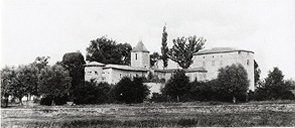
Chateau de St Bernard

The one thing which did lift their spirits was an impulse buy on the day they were to return to Paris.  They bought themselves a chateau which lay close to the River Saône, just 25 kilometres north of Lyon.  They bought Le Chateau de St Bernard from the owner Antoine Goujot.  The purchase lifted their spirits and they immediately sent out invites to all their friends back in Paris along with money to pay for their travel.  Money was no object when it came to supplying food and drink to the chateau parties. 

Finally André and Suzanne had to return to Paris and once again relations between the couple began to deteriorate.  Their marriage was under extreme pressure and during their vociferous arguments André Utter struggled to remember the good days they had shared together when Suzanne was the one true love of his life.  In those days he was mesmerized by both her outer and inner beauty and could not understand what had changed.  The problem with Suzanne, although he could not see it, probably emanated from her mental and physical failure to grow old gracefully coupled with the effect her son’s mental issue were having on her.   Maurice’s behaviour was also affecting Utter but he was less sympathetic as he himself had been an alcoholic and had weaned himself off drink and therefore he could not accept Maurice’s behaviour.  Sadly Utter was overlooking Maurice’s mental issues which had little to do with drink.  For Suzanne and André there were still times of unfettered sexual activity but these bouts became less frequent.  The new wealth of the couple could not compensate for their troubles and could not fix them. 

Suzanne, Maurice and André in their studio

André Utter began to have love affairs and Suzanne was aware of his infidelity and strove to stop them but probably knew the situation was beyond redemption.  She believed the reason for her husband’s infidelity was her fading looks whereas in reality it was probably due to her fragile mental state that had killed their relationship.   Utter’s amorous trysts did not make him happy for very long as the women, aware of his wealth, were ever demanding.  Soon he could not differentiate between their love for him and their love for his money.  When one of his affairs ended disastrously, as they all did, he would return to Suzanne and beg her forgiveness.  The locals were well aware of the situation between Suzanne and André and Suzanne being aware of this, ensured that everybody should be aware of her selfless magnanimity in forgiving her errant husband.  As his sensual liaisons were not giving him the pleasure any more he turned back to drink as being drunk allowed him to escape reality and distance himself from his many lovers and the acerbic tongue of his wife.  He would constantly bemoan his lot in life.  Nobody loved him or his paintings any more.  During his drunken outbursts he would become vile and malicious and Suzanne suddenly saw a different André.  This was not the man she fell so deeply in love with back in 1908. 
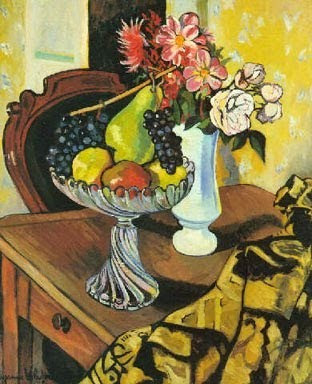
Still Life by  Suzanne Valadon (1918)
Still Life by Suzanne Valadon (1918)

Suzanne tried to console herself by throwing herself back into her art which was still commanding a high price and the fact that her son’s works realised four or five times more that hers did not bother her; in fact she was proud of Maurice’s achievements.  The subjects in her paintings changed.  Gone were the nude studies to be replaced by still life depictions often featuring flowers which were painted in somewhat crude colours which she always liked using.  She still went back alone to her chateau and host luncheons and dinner parties.  Her extravagant lifestyle carried on.  She would feed her dogs with only the best faux-filets and her cats feasted on caviar.  People looked her as being a foolish old woman but she continued undaunted. 
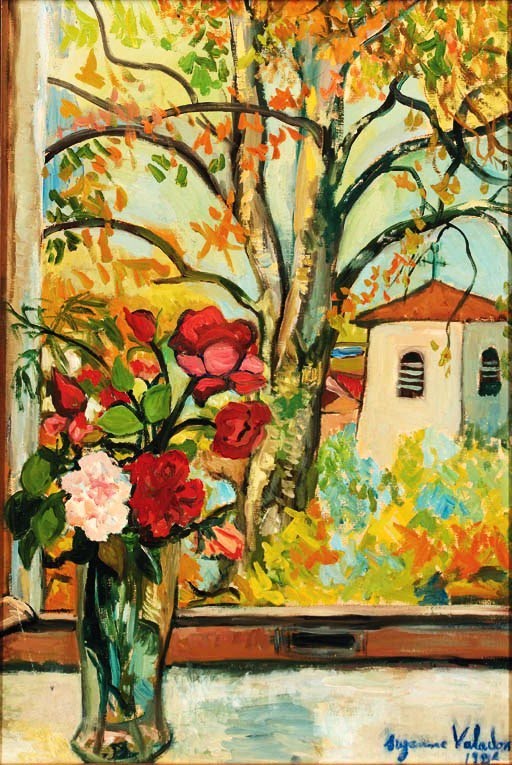
Bouquet de fleurs devant une fenêtre à Saint-Bernard by Suzanne Valadon (1926)

In 1924 Maurice voluntarily placed himself in a Paris sanatorium which was close by at Ivry.   Maurice was still unable to accept that he had mental issues and put down his problems solely to his alcohol addiction.  Suzanne was heartbroken that at the time of her son’s greatest artistic triumphs he was hell-bent on destroying himself.  It could be that for the first time in her life she realised that the symptoms Maurice displayed as a very young child was the onset of his mental issues and could not forgive herself for not doing more then to try and cure what was ailing her son.  Once Maurice left the sanatorium Suzanne took him off to the chateau and employed a male nurse to look after him.  She tended to all his needs.  She fed him.  She dressed him and would go for long walks with him and at night she would sit in a chair next to his be until he fell asleep.  André made a number of visits to the chateau but the romance and the love he had for the place had gone and the tantrums and behaviour of Maurice now simply annoyed him.  Later he reflected on this saying: 

“…This Eden was transformed into a real hell.  I thought we had bought the place for peace.  But Maurice was able to scream and shout about to his heart’s content.  Suzanne replied in kind.  And only the walls and the fish in the Saône listened to them…”

Officials at the Bernheim Jeuene gallery were beginning to worry about Suzanne’s profligacy and so as to protect the interests of their co-client, Maurice Utrillo, purchased a house for him in the Avenue Junot and put it in his name.   It was a modern building with a studio and a small garden which Suzanne enjoyed tending.  Gardening and flowers were the one and only thing Suzanne loved about life.  Utter remained in their house at No. 12 rue Cortot as it still had memories for him of the beautiful woman he had once loved and the pictures he had once painted.  Years later, after Suzanne had died, Utter wrote to a friend:

“…Always I dream of the rue Cortot and the beloved Suzanne.  When we first moved there, how beautiful everything was – except for the gossips!   And I knew then that it was the place I should always keep in my heart.  Every man has a home.  He is lost if he does not treasure it…”

Suzanne Valadon at work in her studio (1926)

Suzanne’s art was still appreciated and in 1929 she was invited to show in the Exhibition of Contemporary Art – Women and Flowers and in the same year she exhibited work in the Painters, Self-Portraits exhibition.  It was at this exhibition that she showed her extraordinary nude self-portrait which featured her as an aging woman gazing into a mirror.   In 1932 Suzanne, Maurice and André had a joint exhibition of their work at Gallerie Moos in Geneva and they were all delighted with sales figures.  That year Suzanne had a one woman exhibition of her paintings, drawings and etchings at the Galleries Georges Petit in Paris.  It was an outstanding success.  One of the visitors to the exhibition was Suzanne’s friend from her chateau days, the then Mayor of Lyons Édouard Marie Herriot who also served three times as Prime Minister and for many years as President of the Chamber of Deputies.  Of the exhibition he wrote:

“…Alive as Springtime itself and, like Spring, clear and ordered without interpretation, Suzanne Valadon pursues her magnificent and silent work of painting……. I think of the words of Théopile Gautier  ‘Summer is a colourist, winter a draftsman’.  To us who admire and love her art, Suzanne Valadon is springtime – a creature in whose sharp, incisive forms we find fountains of life, the spontaneity of renewed day-to-day living.   And those matters of the nineteenth century whose names we revere, I marvel that so scrupulous a respect for truth of form is able to achieve such a fete of colour and movement…”
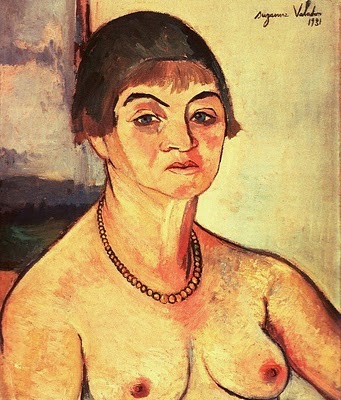
Suzanne Valadon Self Portrait (1931)

Suzanne also had another troubling matter to deal with.  What was to become of Maurice when she died?  Her answer to that was that he should marry.  Suzanne did not want to lose “control” of her son but believed a kind and dedicated woman would be the ideal wife for her troubled son.  One candidate Suzanne had in mind was André Utter’s sister Gabrielle.  Gabrielle, now in her thirties, had like André come from a humble background.  She was a very caring person, deeply religious and not at all unattractive.  In some ways she pitied Maurice which was a kind of love but in a maternal or sisterly sense.  She and Maurice would talk together for hours and did all things close friends would do but this was not a physical relationship.  After four years of this “courtship”, Suzanne, tired of waiting, forced the issue of marriage with Maurice but he was horrified with the suggestion and replied vitriolic ally:

“…I’ve had enough tragedy in my family with one of that family…”

An official delegation of the government descended on Chateau de Bernard to formally present Maurice with the Cross of the Legion de Honor  in 1927 for his services to Art, for by this time he was an internationally acclaimed artist.  I have to admit that whilst researching this blog I read that the award was in 1928 and other sources said 1929!
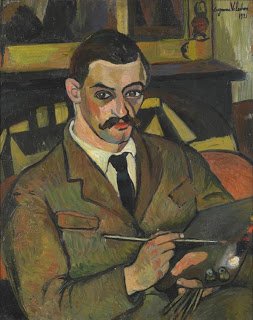
Portrait of her son Maurice Utrillo by Suzanne Valadon

In January 1935, now in her sixty-ninth year, Suzanne was taken seriously ill  and rushed to the American Hospital at Neuilly where she was diagnosed with uremic poisoning.   One of her visitors was Lucie Valore, who had reverted to her maiden name and who many years ago was Lucie Pauwels, who visited Suzanne with her banker husband to buy some of her paintings.  Her husband had died two years earlier.  What happened and what was said at Suzanne’s bedside depends on the version of the story you wish to believe.   According to Suzanne, Lucie had simply come to visit her and during the visit had said that as Suzanne was unable to look after Maurice she would take on the role as carer.  However Lucie remembered the visit differently as she simply remembered Suzanne’s anguished questions as to who would look after her son and on hearing those tormented pleas had volunteered to take up the burden that Suzanne had borne for such a long time.  Who knows what the true version of events was, but for sure it was easy to realise that it was the start of a contest for who should bear the responsibility for looking after Maurice Utrillo.  When Suzanne had planned a wife for Maurice she always believed she could still control him and his life.  She wanted a compliant wife for Maurice one whom she could manipulate.   However she realised right from the start that Lucie Valore was not a person she could control or manipulate and so she desperately tried to end the relationship.  It did not work for Maurice made the decision to rid himself of the Montmartre life and replace it with a life with the banker’s widow.  Maurice Utrillo and Lucie Valore were married in a civil ceremony at the Montmartre mairie and later in a religious ceremony at Angoulème.  Although Suzanne was present at the civil ceremony she refused to attend the religious one.
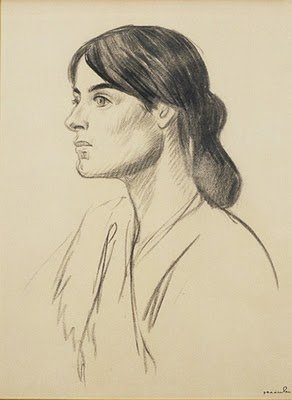
Suzanne Valadon by Théophile-Alexandre Steinlen

The newlyweds remained in Angoulème for twelve months and Lucie took on both the role as Carer for Maurice but also as his business manager which had once been looked after by André Utter.  Lucie in a way controlled Maurice by carefully rationing his alcohol consumption so that it would not affect his artistic output.  Lucie was an astute business manager as she controlled the output of his work to the art dealers so as to artificially raise the value of his paintings.  His paintings grew in value and with this increased income the couple bought a large house with extensive grounds  in the fashionable town of Le Vésinet, to the north west of Paris.  Despite Lucie’s attempts to win over the support of Suzanne, her attempts failed and slowly Suzanne’s contact with her son lessened.  Although she was aware that Lucie had controlled Maurice’s outbursts it could be that she resented the fact that Lucie had succeeded where she had failed.  Suzanne had lost her mother, her husband and now her son what was left in her life?   The answer came in the form of another young aspiring artist, Gazi.  He was a young man with a swarthy collection and rumour had it that he was the son of a mogul emperor.  Locals referred to him as Gazi the Tartar but for Suzanne he was simply a young artist from Provence whom she befriended.  He eventually lived with her and looked after her like a devoted son with his mother.  He would sit with her in the evenings and listen to her tales of the past, about Pierre Puvis de Chavannes, Renoir and the little Master, Degas.

In May 1937 Suzanne was invited to attend the Women Painters Exhibition at the Petit Palais in Paris.  She had several of her latest paintings on show as well as some of her earlier work.  It was a celebration of French female artists and along with her works were paintings by  Vigée le Brun, Berthe Morisot, Eva Gonzalèz and Sonia Turk.  She spent hours critically viewing all the works of art and that evening she spoke to a friend who had accompanied her to the exhibition:

“…You know, chérie, I often boasted about my art because I thought that was what people expected – for an artist to boast.  I’m very humble after what we have seen this afternoon.  The women of France can paint too.  But do you know, chérie, I think God made me France’s greatest woman painter…”
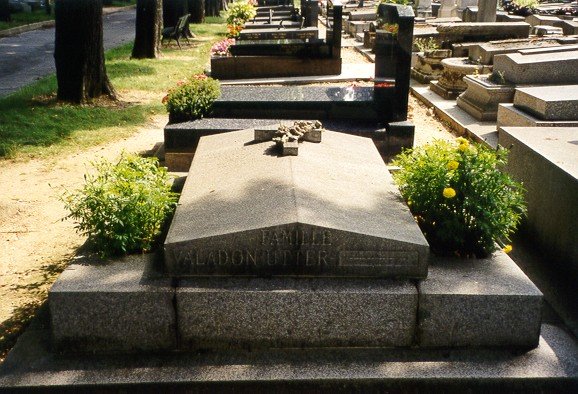
The grave of Suzanne Valadon at the Cimetière parisien, St. Ouen.

In April, 1938, Suzanne Valadon was sat before her easel painting a floral still life when she was struck down by a stroke.  Neighbours heard her cry out and rushed inside to help her and found her lying motionless on the studio floor.  She was rushed to hospital but the next day, the 7th April1938, she passed away, aged 73.  Her daughter in law, Lucie, took care of the funeral arrangements as her husband, Suzanne’s son, Maurice, was in a state of collapse at home in Le Vésinet.  A funeral service was held at the Church of Saint Peter of Montmartre on April 9th.  The church was crowded to see the old lady, the great painter, begin her last journey.  Her husband André Utter was there and inconsolable.  His once greatest love had finally achieved peace.  She was buried in Cimetière  parisien de St Ouen.
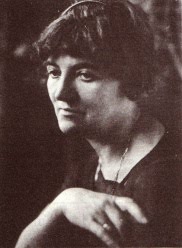
Suzanne Valadon (Marie-Clémentine Valadon) 23 Sept 1865 - 7 Apr 1938
Suzanne Valadon
(Marie-Clémentine Valadon)
23 Sept 1865 – 7 Apr 1938

André Utter became the owner of the castle to the death of Suzanne Valadon in 1938. He sold it in 1945 and died in Paris a few years later in 1948.   Suzanne’s son Maurice Utrillo died on 5 November 1955, and was buried in the Cimitière Saint-Vincent in Montmartre and not in the family grave as Suzanne had planned.  In 1963, eight years after the death of her husband, Utrillo’s wife Lucie, founded the Association Maurice Utrillo, which housed a collection of documents and photographs recording the history of the lives of her and her husband as well as Suzanne Valadon and André Utter.   Lucy Utrillo died in 1965.  

When I started writing about the life and works of Suzanne Valadon I had no idea that it would stretch over seven separate blogs.  The more I wrote the more fascinated I became and the more I read about her life.  In the end I could not bear to leave out little bits of information I had just gleaned.   At one point I had decided not to go into too much detail about her son, Maurice Utrillo, but I soon realised that as he played such a key role in Suzanne’s life, it was important that I examined his relationship with his mother and grandmother and later his relationship with Suzanne’s lover Paul Mousis and her husband André Utter. 

What did you make of Suzanne’s life?   Were you less sympathetic with her lot in life believing she brought all her problems upon herself?   How did you feel about her relationship with her son Maurice?  Did you blame her for paying too little attention to him when he was a young child and by doing so, allowed his mental issues to worsen irrevocably or do you think that once she had been told by the doctors that Maurice “would grow out of it”, it was all she had to go on?  So can you empathise with her?  

For me, I felt sadness for her when she realised she was losing her greatest asset, an asset that in so many ways shaped her life.  The asset was her beauty but as we all know, one cannot hold on to it forever.

—————————————-

Most of my information came from a book I read on the life of Suzanne Valadon entitled The Valadon Drama, The Life of Suzanne Valadon, written by John Storm in 1923.

Other sites I visited to find some pictures were:

http://lapouyette-unddiedingedeslebens.blogspot.co.uk/

http://youngbohemia.blogspot.co.uk/2012/01/suzanne-valadon_8445.html

http://www.messynessychic.com

The Blog:  It’s about time :  http://bjws.blogspot.co.uk
Suzanne Valadon. Part 6 – André Utter, the War and a change in circumstances

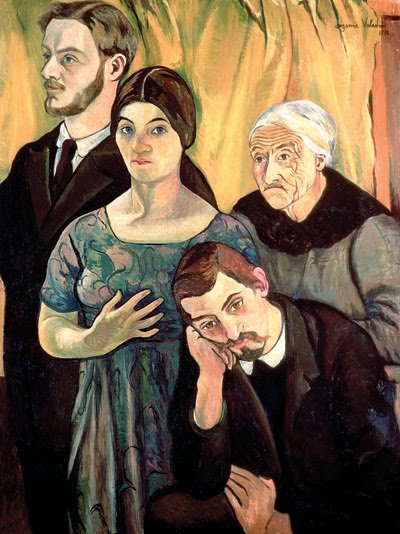
Self Portrait with Family (André Utter, Madeleine Valadon and Maurice Utrillo) by Suzanne Valadon (c.1910)
Self Portrait with Family
(André Utter, Madeleine Valadon and Maurice Utrillo)
by Suzanne Valadon (c.1910)

My last blog about Suzanne Valadon ended with the appearance on the scene of André Utter, a handsome young artist.  Utter and Suzanne’s son Maurice slowly became friends as they both had a shared love of art and soon they became inseparable.   Suzanne was delighted that at long last her son had found a companion.  Utter, a son of a plumber was three years younger than Maurice.  He had done well at school and his mother had high hopes that he would eventually enter a learned profession or even the priesthood whereas his father was convinced he would follow him into his plumbing business.  However Utter ignored their wishes as he was determined to become an artist and live the colourful life that went with the profession and he had strolled around the streets of Montmartre observing the artists sitting with their box of paints and easels and would try to engage them in conversation. 

It was 1908 when Utter first caught site of Suzanne, who was then forty-three years old.  He had been painting in a street at Montmagny with his friend Edmond Heuzé and as he wrote later:

“…She passed by, ignoring us but I began to dream about her…”

She had blossomed into a true beauty – small in stature, but with a voluptuous figure which exuded sensuality.   Later Maurice introduced Utter to Suzanne at his home at Pierrefitte-Montmagny and Utter recalls that first meeting:

“…That evening Maurice told his mother about our meeting.   His mother was pleased.  Apparently she thought I should be a good influence on him.   The next day Maurice introduced me to her.  She was a young woman I had been dreaming about!    She showed me two of her paintings, some pastels, some drawings and some etchings.   I left on a cloud…”

Utter during his late teens would become a leading figure of a group of young men who aspired to become great artists.   These self-taught young artists would try to emulate the established painters of Montmartre who they looked upon as their “role models”.  The young men, like their “role models” would paint en plein air by day and drink heavily at night.  Their favoured drink would be the powerful green spirit, known as “la fée verte” – absinthe.  After a number of glasses of absinthe they too, like their elders, experienced the dream-like effect it gave them after which they would fully experiment and sample the pleasures of love and sex!   Utter enjoyed copying the mannerisms of the street artists and at the age of thirteen he would often be seen wandering the streets with a pipe clenched between his teeth.

When Utter and Suzanne met in 1908 it was around the time that she had started to become disillusioned with her life at the big house in Montmagny and the bourgeois lifestyle she had thrust upon her by her “husband” Paul Mousis.   Mousis began to be aware of her disillusionment and in a desperate attempt to make things better he suggested they moved back to Montmartre and just used the Montmagny house as a weekend retreat.   Mousis rented a house at No.12 rue Cortot which had a separate studio attached.  The problem was he had made this gesture too late because Suzanne’s passion for the bourgeois lifestyle had waned months earlier and her relationship with Mousis had been in freefall with fierce arguments between them becoming the norm.  Another cause of their arguments was their differing views on how best to deal with the mental health issues her son, Maurice, which he was now frequently and more violently displaying.  Suzanne was wilting under the intolerable stress of having to pretend to be the happy “housewife” but at the same time she was well aware that her comfortable lifestyle was solely due to the wealth of Mousis.  Her dilemma was simple.  Was she prepared to forego the luxuries his wealth brought her and if she did leave him what would happen to Maurice? 

Adam and Eve by Suzanne Valadon (1909)

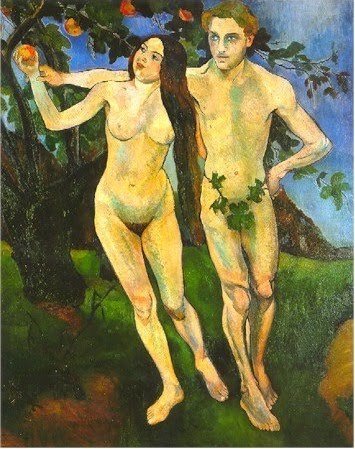
One day in 1909 whilst standing outside her home on rue Cortot she saw André Utter and she invited him in and from this meeting came her painting entitled Adam and Eve, which now hangs in the Musée National d’Art Moderne, at the Georges Pompidou Centre in Paris.  She posed as Eve whilst Utter posed as Adam.  She is fully naked whilst his genitals are hidden from view by carefully placed leaves.   Strangely there is no facial interaction between the two figures and although he has his hand on her wrist to try and stop her pulling the apple from the tree, there seems no relationship between man and woman.   The painting was exhibited at that year’s Salon d’Automne and what pleased Suzanne more than just its inclusion at the exhibition  was the fact that it was hung next to her son’s painting entitled Pont Notre Dame.    Later Utter posed for her two versions of The Joy of Life which Suzanne completed in 1910 and 1911. 

It was around this time that Utter and Suzanne’s son Maurice, shared the same lodgings at No.5 Impasse de Guelma and it was here that Suzanne would regularly meet up with Utter and eventually became his lover.  One would have thought that Suzanne would want to keep this love affair a secret so that no word of it got back to Mousis but that was not the case as often the pair would sit hand in hand at café tables, staring into each other’s eyes like lovesick teenagers and they seem unconcerned that their intimate relationship was on show to the world.  Utter loved, and was totally fascinated, by Suzanne despite the twenty year age difference.  The one artistic thing Utter brought to the relationship was his persuasion and her acceptance that she should move away from sketching and concentrate on oil painting. 

Portrait of her Son Maurice Utrillo, his Grandmother Madeleine and the Dog, by Suzanne Valadon (1910)

Although Utter and Suzanne were lovers and didn’t hide the fact from anybody, Suzanne still lived with Mousis and this eventually became intolerable and so, in 1909, she finally decided to leave him, packed up her belongings and along with her two cats, her German Shepherd dog, Pierret, and a goat, left the house at Montmagny and went to live with Utter and her son.  Two years later they would move to her former home at No.12 rue Cortot.  Soon the apartment and studio became a meeting place for young aspiring artists and poets.   Artists such as the Fauvists Raoul Dufy and Georges Braque and the Italian figurative painter Amedeo Modigliani were frequent visitors.  Modigliani was twenty-five at the time and had settled into life in Le Bateau Lavoir, a commune for penniless artists. 

The year was 1912 and, even as early as then, there was rumblings of a possible war in Europe.  Two years later in June 1914 it all came to a head when the heir to the Austro-Hungarian throne, Archduke Franz Ferdinand and his wife, Sophie, were shot dead by Gavril Princip on the streets of Sarajevo whilst making an inspection of the town.   A month later the French Socialist leader and pacifist, Jean Jaures, who had been an advocate of rapprochement with the Germans was gunned down as he sat in a café by a twenty-nine year old French Nationalist, Raoul Villain, who was an advocate of France going to war with Germany.  Three days later Germany declared war on France.  A feeling of patriotism swept through Montmartre as it did in the rest of France and as was the case in England, young Frenchmen rushed to army recruiting offices and celebrated what they believed would be a short and joyous war against the loathsome Imperial German forces but sadly, like the young Englishmen who marched to war, their euphoria was short lived. 

André Utter was one of the first to enlist.  He attended the army recruiting centre in February 1915 and was accepted and sent to the training centre at Argentan.  He eventually joined the 158th Infantry Regiment at Fontainebleau.  Before he left for the front he and Suzanne were married which ensured that she would receive an allowance from the military as a soldier’s wife.  She had been desperate to stop him enlisting but struggled to find a way.  Years earlier her body would have been enough to persuade a lover to be attentive and never to want to leave her side but she was now forty-nine years of age and Utter was just twenty-eight.  Suzanne was more and more conscious that her body was fighting a losing battle against the relentless march of time, and this despite her frequent changing of her date of birth! 

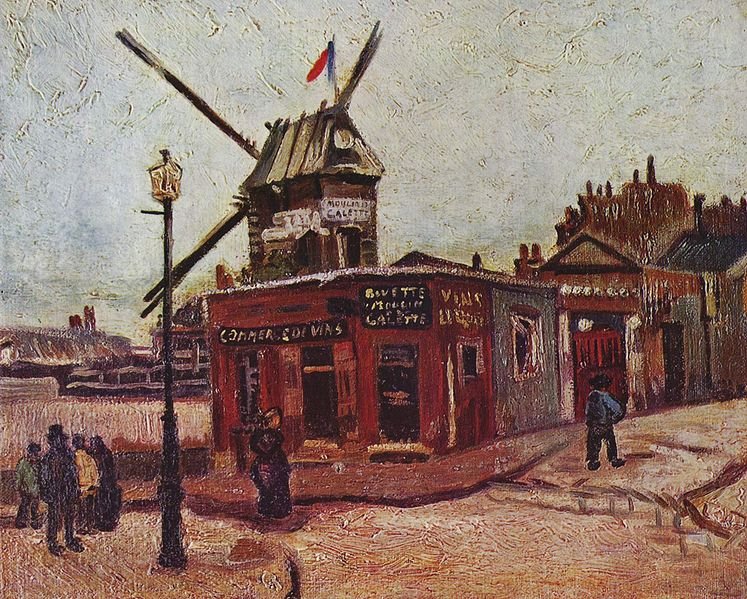
The Moulin la Galette (c.1918) by Maurice Utrillo

The year 1915 was Suzanne’s annus horribilis.  In June that year, her mother Madeleine died aged 84.   In August her son Maurice was placed in an asylum at Villejuif where he remained for three months and of course her husband was fighting a war.  Suzanne struggled to keep painting whilst her husband was away.  In 1917, however, the Bernheim Jeune Gallery in Paris, staged by their artistic director, Felix Fénéon, a long time admirer of Suzanne’s work, put on a joint exhibition of the works by Suzanne and her son, along with some paintings by her husband André Utter.  It was not only the works of the three that drew in the crowds but the extravagant and titillating tales that surrounded the trio.  Sales of the work were unfortunately poor but this was probably due to the war. However a nude painting by Suzanne and the painting entitled Moulin de la Galette by Utrillo were purchased by the eminent French fashion designer Paul Poiret.  Later, Poiret would tell his clients how chic it would be if they, like him, owned an original work by Suzanne Valadon or her son Maurice Utrillo and of course this led to a chain-reaction of feverish buying by the likes of the prestigious art dealers in the Rue du Faubourg  St Honoré. 

In that same year, 1917, Utter was wounded in the shoulder at the battle in the Champagne region of France and in January 1918 he was dispatched to an army recuperation centre at Belleville-sur-Saône.  Suzanne immediately rushed to his side eager to tell him about the increasing sales of her paintings, drawings and etchings.  It was a joyous reunion.  She dedicated her time to him, looking after his every need and for three months they lived in their newly-discovered idyll.   Utter was released from the army in January 1920 and returned to Paris to be with his wife and her son Maurice.  Suzanne was now fifty-four years old and even she had to admit that her looks, which once stirred the loins of most men, were beginning to fade.  She craved admiration.  She craved attention and would dress and act in the most strange fashion so as to achieve her aims.  She was desperate for Utter to admire and desire her as he once did when they first met.  She was hyper-sensitive to his comments and she would be angered and sulk if his words were not the ones she was hoping for.   Utter, in turn, was disappointed that those idyllic days at Belleville had not carried on in Paris.  Their arguments, which became more frequent, were more intense, more acidic and more vociferous. 

Following the cessation of the First World War money became freer once again and people began to cash in on their war savings and head for Paris to buy art.   The wealthy descended on the French capital and the raised prices this buying spree had caused did not daunt them.  Many bargain hunters headed to Montmartre in search of a bargain buy and it was around this time that a wealthy Belgian banker, Monsieur Pawels and his wife, Lucie, a former actress called on Suzanne.  Lucie wanted to be great friends with Suzanne but she was not wholeheartedly sold on reciprocating this friendship.   Sales of Suzanne, Maurice and Utter’s works continued to grow.  Whether she became slightly jealous of her husband and son’s sales we may never know but she was always adamant that her work was the best and she of the three was the most accomplished painter.  She was quite outspoken about this, once saying:

“…I do not seek to be known but to be renowned.  For I shall go to the Louvre.  That will be my glory…”

In 1920, with help from friends, she was elected as an associate of the Société des Artistes Indépendents.   As time went buy she became vainer, more arrogant, and more egotistical.  The person who suffered most from this attitude was her husband, Utter.  She demanded of him his admiration of her as a great artist and almost a recognition that she was a superior being.  She demanded his subservience.   One can only wonder what Utter thought of his situation living with a wife and her son, both of whom were suffering from mental issues. 

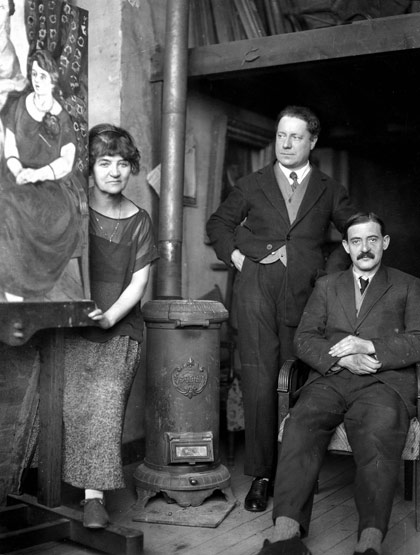
Suzanne Valadon, Her Son Maurice Utrillo (seated, right) and André Utter, (1920)

In 1921 Utter arranged a joint exhibition of Suzanne and Maurice’s work at Berthe Weill’s gallery.  It was an outstanding success and soon works by Suzanne Valadon and Maurice Utrillo were commanding high prices.  This sudden surge of demand for their work caused the Gallerie Bernheim-Jeune in the summer of 1923 to offer Suzanne and Maurice a contract guaranteeing them a minimum annual payment of a million francs (the equivalent of $60,000 at the time) for all their future works.  This was a turning point in the lives of Suzanne, her husband and her son.  It was today’s equivalent of us winning the lottery.  Their life was about to change.

Suzanne Valadon Part 5. Her son Maurice Utrillo, her husband Paul Mousis and her lover Erik Satie

Suzanne Valadon and her son Maurice (c.1889)

My look at the life of Suzanne Valadon would not be complete if I didn’t spend some time looking at the early years of her son Maurice and how he had such an effect on her life.  In my earlier blogs I told you that Suzanne, who was eighteen years at the time, gave birth to her son on December 26th 1883.  She was unmarried at the time and would never reveal the identity of the father.   She decided on the name Maurice for her son, reasoning that as none of her previous or present lovers had that Christian name it would therefore not give a hint as to who actually was Maurice’s father.  However in January 1891 she persuaded one of her former lovers, Miguel Utrillo to agree to sign the Act of Recognition naming himself as Maurice’s father.  The document was signed on February 27th 1891and it stated:

“…27 February 1891.  Act of Recognition of Maurice, Masculine Sex.  Born 26 December 1883 and inscribed on the 29th following at the mairie 18th arondissement as son of Marie Valadon and unnamed father.  Set up by us Charles-Paul-Auguste Bernard, assistant to the mayor, officer of the civil state 9th arondissement, on the declaration made by Michael (Miguel) Utrillo, 28 years of age, journalist of 50 Boulevard de Clichy, who has recognised as his son the aforementioned Maurice.  In the presence of Charles Mahut, 44 years of age, employed, residing in Paris, 5b Impasse Rodier, and of Félix Dunion, 44 years of age, waiter, residing in Paris, 3 rue Saint Rustique, who have signed with the petitioner and ourselves after reading.    Paris. 8 April 1891…”

One should note that the document refers to Suzanne by her original Christian name Marie (Marie-Clémentine) and not Suzanne, the name she changed it to on the advice of Toulouse-Lautrec.  So was Miguel really Maurice’s father, if not, why would he sign such a document?  It was not as if it was a “spur of the moment” decision as one can see by the dates at the start and the end of the document the process took almost six weeks to complete which would have given Miguel time to consider what he had been asked to sign and time to back out of the agreement.  Whether Miguel was the father we will probably never know.   She had many lovers as a teenager including Pierre-Puvis de Chavannes, the French artist.  There was also Adrian Boissy, the drunken accountant from an insurance company she met at the Moulin de Galette one night, and who according to Suzanne, took her to his home, plied her with drink and raped her. 

There is probably no greater love than that which a  mother gives to her children and although I am sure there was a maternal love between Suzanne and Maurice her maternal instinct must have been sorely tested as Maurice was not a normal child.  During his very early days Maurice was looked after solely by Suzanne’s mother, Madeleine, and their Breton maid, Catherine, whilst Suzanne pursued her career as an artist’s model.  To say that Maurice was not a typical child would be something of an understatement.  At times he would lie peacefully on his grandmother’s lap and then suddenly his body would become stiff and he would shudder violently, biting his lip until it bled and hold his breath until his whole face turned purple.  In later childhood this small waif-like little boy would throw himself on the floor in fits of rage.  Suzanne’s grandmother’s only solution was to give him some watered down wine to try and calm him down.  It was not Suzanne that spent the most time with him but his grandmother.  It was she who comforted him during his fits and rages.  It was she who fed and clothed him.  It was she who shared her bed at night with him.  It was she who gave him the nickname Mamau which stayed with him all his life.  Madeleine had spent little time or had shown much love towards her daughter Suzanne and she was now probably trying not to make the same mistake with her grandson.  In turn, Maurice loved his grandmother and revelled in her company.  Suzanne was not jealous of this grandmother/grandson close relationship, in fact as she had tried, without success, to please her mother all her life she was pleased that she had “given” her son to her mother as this had evoked so much pleasure.

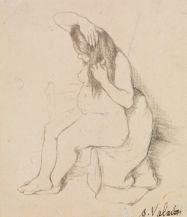
Nu assis se coiffant by Suzanne Valadon (1896)

At the age of five Suzanne enrolled Maurice at a nursery school, Pension La Flaiselle, in the rue Labat.  Her son hated the school, in fact he was terrified by it and yet although knowing his fear, Suzanne never walked the long distance up the hill to reach the place which, by doing so, would have afforded her son a modicum of comfort.  This terror Maurice felt began to have an effect on life at home as the older he got the more he would lapse into spells of depression often followed by bouts of extreme violence which manifested itself into the smashing of the household china and ripping down the curtains.  Despite the doctor’s prognosis that he would “grow out of it”, the violent episodes continued but at no time could Suzanne see the correlation between his mood swings and his unhappiness at the school.   Suzanne saw his terror of school life as a form of cowardice and whimpishness for one has to remember that as a child of Maurice’s age, Suzanne was completely fearless.  Suzanne showed Maurice little sympathy; on the contrary, she was embarrassed by his antics. When things got out of hand at home Suzanne would just leave the house to party or be with a lover and leave Maurice for her mother to handle.

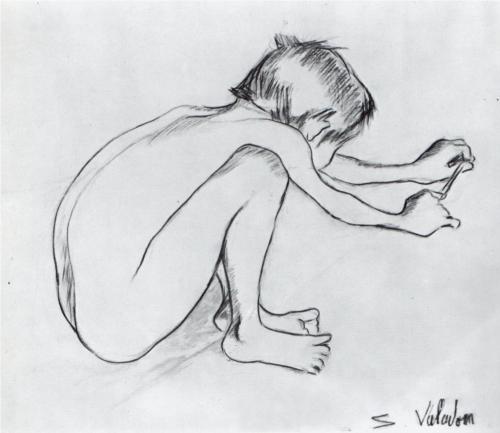
Maurice playing with slingshot by Suzanne Valadon (1895)

It was in 1888 that a new lover for Suzanne came on to the scene in the form of a young wealthy banker, Paul Mousis, whom she had seen around the café-cabaret establishments, Auberge du Clou and the Chat Noir.  Mousis would mingle with the artists who were at the Auberge du Clou and because he was a generous man, he would keep them supplied with drinks, and by this gesture, he was accepted as “one of their own”.  The Auberge was just a short distance from Toulouse-Lautrec’s home and Mousis along with his new friends would often visit the painter’s home and join one of Lautrec’s frequent soirées and it was here that he met Suzanne, who was acting as Lautrec’s unofficial hostess.  Mousis was immediately besotted with this beautiful young French woman and within a few weeks of their first meeting he had proposed marriage.  She refused him but said that she would readily become his lover.  Her reasoning was quite simple.  Being Mousis’ lover meant that she was on equal terms with him, whereas marrying Mousis would make her his property and in some way subservient. 

During her late teens and early twenties Suzanne had a number of lovers and would often tire of them very quickly.  Mousis offered her not only his companionship and love-making but financial stability and yet Suzanne, three months into their relationship, strayed, this time towards the strange enigmatic musician and composer, Erik Satie whom she met whilst he was playing the piano at Le Chat Noir café.  Twenty-one year old Satie was a dropout from the Paris Conservatoire, who had given up the bourgeois lifestyle he had whilst living with his parents, and moved to the bohemian lifestyle of the Montmartrois.   One would have thought that Paul Mousis would have been horrified at this turn of events but he wasn’t, maybe because he too was having a liaison with another woman!   Satie was besotted with Suzanne.  He even proposed marriage to her on their first meeting.  He lavished upon her numerous gifts, took her for walks in the Luxembourg Gardens and strange as it may seem, he would often go out in the evening with Suzanne and Mousis.  This was indeed a ménage à trois.  However the leading role in this love triangle was always Suzanne.  She choreographed the love triangle.  She constantly fussed around Satie looking after all his needs, such as feeding him, darning his socks and cleaning for him.   In Ornella Volta’s 1989 book, Satie seen through his letters, the depth of his love for Suzanne can be clearly seen.  He wrote to his brother in 1893:

“…I shall have great difficulty in regaining possession of myself, loving this little person as I have loved her …she was able to take all of me. Time will do what at this moment I cannot do…”

Mousis was not deterred by the presence of Satie as he felt that Suzanne was the only woman who could satisfy him sexually.  However all good things had to come to an end and Mousis became tired of the love triangle and told Suzanne it must end.  She refused to give up Satie and so Mousis went off for six months.  He did return and once again took up with Suzanne but now it was the turn of Satie to complain and tell Suzanne to end her relationship with Mousis.  Once again and highlighting her control of the love triangle she refused and Satie ended the ménage à trois being unable to share her with Mousis.

Portrait of Erik Satie  by Suzanne Valadon (c.1892)
Portrait of Erik Satie by Suzanne Valadon (c.1892)

In 1894 Suzanne and Mousis set up house at No. 2 rue Cortot, just two doors away from the house belonging to Satie.  After a short while, neighbours would refer to Suzanne as Madame Mousis.  She did visit Satie and it was in 1892 in his one-room house, two doors away, at No. 6 rue Cortot, that she had painted the twenty-six year old musician’s  portrait.  It is entitled Portrait of Erik Satie and it can now be found in the Musée National d’Art Moderne, Centre Georges Pompidou in Paris.  It was Suzanne’s first attempt at portraiture in oil.  It measures just 22 x 41 cms and because the height of the portrait is double that of its width there is an elongated look to it.  Satie almost fills the canvas.  His facial expression in this painting is one of dourness.  His red lips are partly hidden by his waxed moustache and the pince-nez glasses give him an intellectual air. 

In the summer of 1886 Suzanne and Satie parted company in acrimonious circumstances.  It is not clear what happened to initiate this final breakdown of their relationship, but final it was.  It is alleged that Satie was devastated, hurling himself on the floor weeping bitter tears and bitterly declaring that he was left with “nothing but an icy loneliness that fills the head with emptiness and the heart with sadness”.  In 1889 Satie left Montmartre and his one and only true love, Suzanne Valadon. It was also 1896 that Mousis and Suzanne were said to have married, but did they ever officially marry?  Although Mousis was often referred to as “Suzanne’s first husband” there is no official record of their marriage or divorce in either the mairies of Montmartre or Pierrefitte-Montmagny and maybe when her friends talk of  her marriage to Mousis it was just a figurative expression rather than a literal one.

Nu à la toilette by Suzanne Valadon (1892)

If we go back four years to 1892 there was a change in Suzanne Valadon’s lifestyle.  Her wealthy lover, Paul Mousis had tired of the bohemian lifestyle of Montmartre and wanted to return to his former bourgeois lifestyle which he believed befitted a successful banker and so he decided to lease a house in the village of Pierrefitte, situated in the Seine valley, and which lay twenty kilometres north of Paris.  This was to be a weekend retreat for himself, Suzanne and her family.  Suzanne’s grandmother, Madeleine, was delighted to move back to a quiet rural village similar to the one she had been brought up in.   She was now in her late sixties, a somewhat wizened old woman who suffered badly from rheumatism and who was still addicted to alcohol and spent much of her time in a semi-drunken haze.  Her one love, her one great pleasure in life was her grandson Maurice.  He still suffered from swiftly changing moods and his grandmother could only control his uncontrollable rages by plying him with glasses of wine.   However the alcohol did not always have the desired effect and instead of calming him down it lead to him demanding more glasses of it until he virtually passed out. He had become an alcoholic.

In 1894 Mousis, who loved living in the area decided to build the family a new house atop the Butte Pinson which was between the village of Pierrefitte and the village of Montmagny.  Suzanne was still uncertain about the move away from Montmartre so Mousis told her that the building of the new house was simply a business investment.  He also tried to persuade Suzanne that to achieve a great artistic standing she needed to move away from the chaos of Montmartre life.  As a compromise he agreed that Suzanne should keep her Montmartre studio in the rue Cortot.  Suzanne would commute back and forth between their home at Montmagny and her studio in Montmartre by her own pony and trap which Mousis had given her.  Soon she began to appreciate life at Montmagny and developed a passion for flowers and the enjoyment of gardening. 

Notwithstanding her new lifestyle and her love of nature, she was not able to ignore the ever-increasing problem she had in her life – her son Maurice and his worsening mental behaviour.  By his teenage years he like his grandmother had become addicted to alcohol but now it was not just wine, it was now the “green devil” itself, absinthe.  In his late teens he had also become much more violent during his uncontrollable rages and Mousis and Suzanne consulted many doctors and psychiatrists.  It culminated in 1901, just before his nineteenth birthday, when during a particularly nasty rage a doctor was called to forcibly sedate him and he was committed to the asylum of Saint-Anne where he remained for three months.   This was a terrible time for Suzanne as it was during her son’s confinement she also learnt of the death of her good friend and mentor, Henri Toulouse-Lautrec, who had died in a sanatorium at the age of thirty-seven.  The cause of death was partly put down to complications arising from his alcoholism and Suzanne must have wondered what her son’s fate would be.

Whilst Maurice remained in the asylum, Suzanne filled her life by concentrating on her art and spent nearly all the time at her studio in rue Cortot where she completed a series of nude drawings for which she served as her own model.  Maurice was finally released from the asylum and according to his mother, “he looked better than he has for years – and so beautiful”.  He was off drink but was very listless, avoided everybody and sat reading his books.  A turning point came when Suzanne persuaded him to take up art as a hobby.  Reluctant at first, he soon took a liking to it and within two years, would spend most of his time in his mother’s studio in Montmartre.  In that time, he had completed no fewer than 150 works. By the age of twenty-three he was living in her studio.  The only think he disliked about life in Montmartre was the people.  People everywhere and he just wanted to shut himself away from them all.  They annoyed him and soon the rages returned and to cope with the rages he turned back to drink and would, during the day, paint with excruciating hangovers.  Despite his abhorrence of people he would still go out and wander around Montmartre painting en plein air.  When buoyed by alcohol he would engage in conversation with others in the drinking establishments he frequented.  He always introduced himself as Maurice Valadon, adamantly shunning the name “Utrillo”.  The drinking resulted in his old habits returning – the violent outbursts of rage often culminating in fights with the locals. 

One day in 1909, which was to have an effect on his life and the life of his mother Suzanne, he was sitting outside painting when he was approached by a young man who introduced himself as a fellow artist.  He was André Utter.

                                               …………………………. to be continued.

Suzanne Valdon. Part 4 – Henri Toulouse-Lautrec and Degas

Self portrait by Suzanne Valadon (1883)

In my last blog, Part 3 of the life story of Suzanne Valadon, I talked about her relationship with the French painter Pierre-August Renoir and looked at his 1883 Dance Series of painting, two of which featured Suzanne.  At the end of the blog I stated that Renoir had nurtured Suzanne’s interest in art.  I suppose nurturing was the wrong word to use as although Renoir’s art influenced Suzanne it was more his dismissive attitude to her early attempts to paint and sketch that had an effect on her.  Renoir had a somewhat condescending attitude towards her attempts at drawing and painting and this along with his preference for Aline Charigot over her rankled Suzanne all her life.  However Renoir’s indifference regarding her artistic attempts galvanised the young woman in her mission to prove him wrong and at the same time it fostered in her a desire to become a great artist in her own right, for if nothing else, Suzanne was a very headstrong and determined character and one who would never accept failure lightly. 

Suzanne Valadon did however receive valuable help and support with her quest to become an artist.  This help came from two completely different sources.   Her initial help came from a young French artist who had just come on to the Parisian art scene and it was through his good auspices that she was introduced to an elderly artist who, at the time, was viewed as The Master of all the French artists.   The young artist was Henri de Toulouse-Lautrec and the Master was none other than Edgar Degas.

My Utrillo at the Age of Nine by Suzanne Valadon (1892)

Unabashed by Renoir’s attitude Suzanne set about sketching with pencil and charcoal.  She sketched avidly.  Any free time she had from her modelling engagements were spent sketching.  It was in the Spring of 1887 that she first met the twenty-two year old, Henri Toulouse-Lautrec, who had a top floor studio at No.7 rue Tourlaque, the same building in which Suzanne, her mother Madeleine and her son Maurice were living.  Toulouse Lautrec was once described as having a grotesque appearance.  At the age of fourteen, he slipped on a floor and broke his left thigh bone.  The following year, while out walking, he fell and broke his right thigh bone.  Neither leg healed properly.  It is now believed that this was due to a genetic disorder.  After these breaks, his legs never grew any longer which resulted in him attaining a height, as an adult, of just 1.54 m (5 ft 1 in) despite have a full sized torso.  His walk was just an embarrassing shuffle.  Add to this physical deformity his oversized nose, his dark and greasy skin and full black beard which masked his face, one can envisage the physical and mental torment he must have suffered.  However, despite this, he was quite a gregarious person and had a buoyant character and soon after setting up his studio it took on a new role as a meeting place for local artists and members of the literary set.  Lautrec would often provide food and drink at these meetings and conversation would often centre on art, artists and artistic trends.  Suzanne Valadon often helped Lautrec with these get-togethers and soon she was considered the unofficial hostess of Lautrec’s soirées.  One should remember that Suzanne was quite short in stature and so standing next to the diminutive Lautrec they made for an “ideal couple”.  Suzanne had always been a very good looking woman and so, when standing next to him her physical beauty meant eyes were immediately focused upon her and not her little companion. 

Suzanne was not “backward in coming forward” at these events and would unreservedly give her opinion on current artistic trends.  As ever, her wit and the acidity of her tongue came to the fore ensuring that the evening would never be dull and of course, her physical beauty was always admired by all the male guests.   As Suzanne helped Lautrec to run his parties and add her own brand of verbal entertainment at them Toulouse-Lautrec expressed his gratitude by taking an interest in her early art. He was also the first person to buy a couple of her sketches.   He hung them on the wall of his lodgings and was often amused when visitors attributed them to artists such as Degas and Théopile Steinlen, the painter and printmaker, but all viewers of these works were in agreement that they had been done by an accomplished artist. 

The Hangover; Portrait of Suzanne Valadon by Henri de Toulouse Lautrec (c. 1888)

Suzanne and Toulouse-Lautrec would often wile away their time together sketching.  He completed a number of portraits of her but would never pose for her.  One of the best portraits Toulouse Lautrec did of Suzanne was his 1888 painting entitled Gueule de Bois (The Hangover) in which we see her sprawled across a café table.  She received no payment from Lautrec for modelling for this picture.  It would have been unthinkable considering all the help he had given her.  Soon Toulouse-Lautrec began to advise Suzanne, not just on things artistic, but everyday things such as how she should dress what hats she should wear and would often accompany her on shopping trips. 

Portrait of the Artist Suzanne Valadon  by Toulouse Lautrec (1885)
Portrait of the Artist Suzanne Valadon by Toulouse Lautrec (1885)

It was Toulouse-Lautrec who persuaded her to change her name from that which she was baptised, Marie-Clémentine, to Suzanne as he believed her birth name was just too mundane for an up-and-coming artist.  Suzanne agreed to the change of name and she gave Lautrec the very first painting she completed, which had been signed “Suzanne Valadon”. 

It was on the insistence of Toulouse-Lautrec that in 1887, Suzanne went to see Edgar Degas and took along some of her sketches.  She recalled the time:

“…Lautrec’s great brown eyes laughed behind his thick glasses and his mouth was solemn and grave as a priest’s when he told me I must go to M. Degas with my drawings…” 

When she arrived at Degas’ house for the first time,  Suzanne always recalled that day stating on a number of occasions that it was “the wonderful moment of my life”.  She arrived at the house in rue Victor Massé clutching her portfolio of sketches.  She was extremely nervous in his presence.  She recalled the time vividly.  Degas took her sketches, moved to the window to see them better and slowly thumbed through them mumbling comments to himself, occasionally looking up at her.  On completing his examination of her work he turned to Suzanne, who was sitting straight-backed in a chair, and uttered the words that she would never forget:

“…Yes it is true.  You are indeed one of us…”

Nude getting into the Bath besides the Seated Grandmother by Suzanne Valadon (1903)

Degas, who had once described himself as simply a colourist with line, could see the merit in Suzanne’s work despite her work was in a pure and savage state and the sketches were totally without refinement, and yet there was a sense of grace about them.  Suzanne and Degas became good and long-lasting friends.  It was a friendship which would have, in some ways, seemed strange as Degas and Suzanne came from different backgrounds and different social classes but it could be the fact that Degas was uneasy in the company of women of his own social strata and that made Suzanne and ideal companion.  During their many meetings she would show him her latest work which he would assess and give advice and she in return would tell him all the gossip and news from Montmartre, for he rarely set foot outside stating he was too ill and it was also around this time that his eyesight began to fail. 

Although Suzanne Valadon was a self taught artist it is generally accepted that she owed a lot to Edgar Degas.  It was he that supervised her first engravings and it was he who ensured that Ambroise Vollard, one of the most important art dealers of the time, presented an exhibition of Suzanne’s engravings at his gallery in 1895.  As far as Suzanne was concerned, Edgar Degas was “The Master”, an artistic genius.  Of all the artists she came across, he was the one she respected the most.  She hung on his every word, basked in his praise for her work and although he had lost a number of friends due to his petulance and grumpiness, she looked on his irascibility as part of his charm and charisma.  Degas could do no wrong in her eyes.  Degas too loved her companionship and Suzanne Valadon was one of the few people who could call herself a friend of the great man and she was immensely proud of this mutual friendship.

                                                           ……………………………………….. to be continued

Suzanne Valadon. Part 3 Pierre-August Renoir

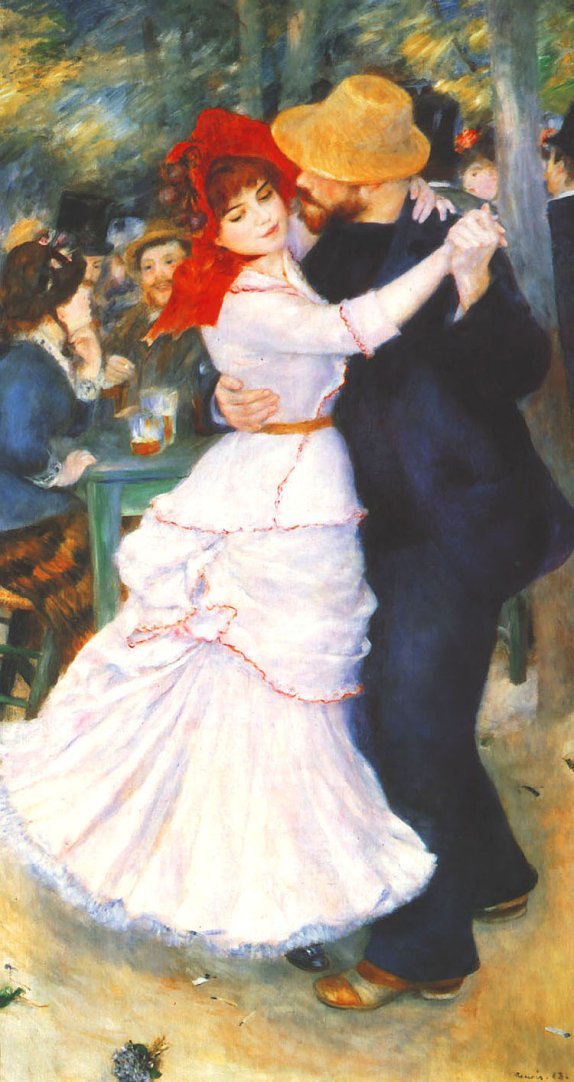
Dance at Bougival by Renoir (1883)
(featuring Suzanne Valadon and Eugene Pierre Lestringuez)

I ended my last blog about Suzanne Valadon with her relationship with Pierre Puvis de Chavannes ended and she had moved back in with her mother.  That summer she had become pregnant and in December 1883 had given birth to a baby boy whom she named Maurice.   The following year, after she had got herself back in shape and had employed a nanny to look after her son, she went back to her old life of modelling for artists by day and revelling in  café-bar life at night…..    

In 1883, before she became pregnant Suzanne was employed as a model by Pierre-August Renoir.  Besides being an artist an artist’s model they had something else in common – they both originated from Limoges.  Renoir had returned to Paris after extensively travelling around Europe and North Africa.   Despite being moderately well-off due to the sale of his paintings he chose to live in the less salubrious area of Montmartre.  Suzanne and Renoir would stroll along the streets of Montmartre arm in arm and nobody was in any doubt that they had become lovers.  They would go dancing at the Moulin de la Gatte on Sundays and picnic at Argenteuil and Chatou on sunny summer days. 

However, I want to turn the clock back two years to 1881 to look at what Renoir was doing at the time and, by doing so, look at the interaction between Suzanne and him a couple of years later.   Renoir had completed his famous painting Les Déjeuner des Canotiers (Luncheon of the Boating Party) in 1881 (see My Daily Art Display August 2nd 2011), which had been a group portrait of his friends dining on the upstairs terrace of Restaurant Fournaise which was in the small village of Bougival on the bank of the River Seine.   It was here that his friends would gather to eat and dance and watch the oarsmen row their boats up and down the river.  One of the people depicted in the painting was Aline Charigot who Renoir would eventually marry in 1890 albeit Aline had already given birth to their son, Pierre, in 1885. 

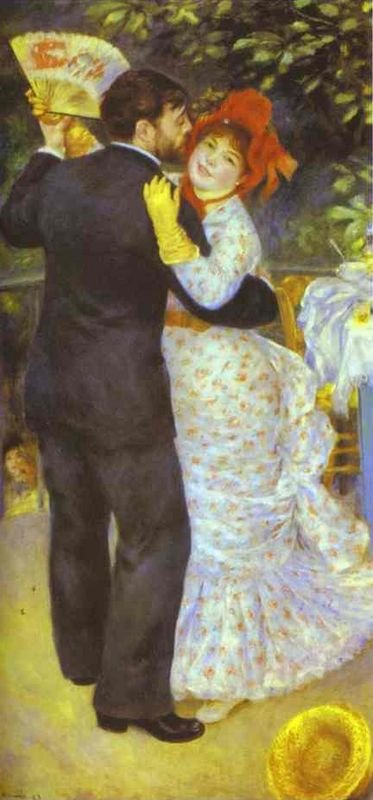
In 1882,  a year after completing the Déjeuner des Canotiers painting he was commissioned by Paul Durand-Ruel to complete three paintings, which became known as the Dance Series.  The series consisted of Dance à Bougival, Dance in the City and Dance in the Country.  These were life-sized works measuring about 180 x 90 cms.  In all three paintings there are two main characters, a male and a female dancing.  In the first two paintings, the model for the female was Suzanne Valadon and in the third one, the model was Aline Charigot. 

Dance in the City by Renoir (1883) (featuring Suzanne Valadon and Paul Lhôte)
Dance in the City by Renoir (1883)
(featuring Suzanne Valadon and Paul Lhôte)

The setting for Renoir’s painting Dance in the City is a high class Parisian establishment, for this is a “white ball”, which was favoured by the upper classes. Although the painting once again depicts a couple dancing, this work is all about the woman as the man is almost hidden from our view.  There is a shimmering opulence about this work.  Renoir has depicted the woman, modelled by Suzanne Valadon, wearing a two-piece white silk gown, – her toilette de bal (dance dress).  The cut of her dress reveals her back and shoulders.  Her partner, was thought to be modelled by Renoir’s close friend, Paul Lhôte, a journalist and writer of short fiction.  He is wearing formal evening wear and the tails of his long coat swish with the movement of the dance.    Both the man and woman wear white gloves which in a way makes the dance a more formal event ensuring that the bare hands of the man do not touch the delicate skin of the woman.  Their hands are clasped as in the Dance à Bougival but in this painting it is just the lightest coupling of hands. 

Suzanne Valadon always maintained that the Dancing à Bougival work featuring her was painted in-situ at Bougival thus implying that she was part of the Bougival “in-crowd”.  In later life she talked about her relationship with Renoir and the Dance à Bougival painting saying:

“…He fell in love with me and at Bougival he painted me in his famous picture…”

However Renoir stated quite categorically that he simply made a few sketches of Suzanne and the paintings was completed at his studio.  The painting Dance à Bougival is housed at the Museum of Fine Arts in Boston which acquired the work in 1937.  In this painting we see Suzanne Valadon dancing with Eugene Pierre Lestringuez, another of Renoir’s friends, who was an official at the Ministry of the Interior and who featured in a number of Renoir’s works including Les Déjeuner des Canotiers.  In this outdoor dance scene there is not the formality that we saw in the painting Dancing in the City.   Gone is the woman’s formal toilette de bal, replaced by a light pink dress with red piping.  The hands of the dancers are not gloved.  Gone is the man’s formal attire, replaced by a loose fitting blue jacket and wool sweater and atop his head he wears a yellow straw hat which hides part of his face and his eyes.  Gone are the lightly touching hands and in its place we see the left hand of the man gripping the lady’s hand tightly while his right hand snakes around her waist pulling her body into his.  Suzanne wears a large bright red hat, the colour of which draws your eyes to it and, by doing so, we focus on the faces of the dancers.  Look at the faces closely.  The woman pulls her face away from that of her partner and looks downwards avoiding any eye contact with the man whilst he stares at his partner with an unnerving intensity.  What is going on between the pair?  There is a strange uneasiness, tenseness, between the couple. There is no sense of intimacy between the dancers.

Facial expression (Detail from Dance at Bougival)
Facial expression
(Detail from Dance at Bougival)

As the artist, Renoir, was the one to decide on how he would depict the pair’s facial expressions and body language, what made Renoir portray the couple in this way?  Was Renoir in some way transferring Suzanne’s character into the painting?  This was supposed to be a joyful event in which couples twirl in the open air so why this pensiveness?  It is almost as if the man has said something inappropriate to the woman and she is slightly offended or could it be that the averting of her eyes is simply her way of teasing her dancing partner? 

Dance in the Country by Renoir (1883) (featuring Aline Charigot and Paul Lhôte
Dance in the Country by Renoir (1883)
(featuring Aline Charigot and Paul Lhôte

Another question posed by Renoir’s Dancing series paintings that although Suzanne Valadon modelled for Dancing à Bougival and Dancing in the City why did the artist decide to switch to Aline Charigot for Dancing in the Country, who we see depicted partnering Paul Lhôte.  When I look at and compare  the faces of the two females depicted in the paintings I have to say that Suzanne’ thinner and more delicate face  is the more attractive and sophisticated and it could be that for a country dance scene Renoir decided that the fuller face with the rosy cheeks of Aline were more suited when it came to the ambience of the country.  Or could it be that Aline Charigot’s insisted that she, and not Suzanne, featured in the third work. 

The one aspect that the Bougival and City paintings have in common is the distracted expression on the face of Suzanne Valadon.  In both paintings she pays little attention to her partner and lacks the smile which Aline Charigot has on her face in Dancing in the Country.  Is this just coincidental?  Could it be that Renoir’s depictions of Aline and Suzanne give us a better feeling as to how he viewed his two lovers.  

The Bathers by Renoir (1887)

Suzanne travelled to Guernsey with Renoir in order for him to paint some pictures including a nude portrait of her.  Although he later destroyed the painting it is thought that he used the face for the central character in his painting The Bathers which he completed in 1887.  Amusingly, Suzanne was adament that it was not just her face that was used for the painting, but her whole body !!   Their painting trip to Guernsey was rudely interrupted with the news that Aline Charigot was coming to visit Renoir and one can only imagine Suzanne’s anger when Renoir arranged for her to return to Paris immediately so that the women would not meet.  There was obviously no love lost between Aline and Suzanne both vying to be Renoir’s one true love.  As I said earlier, Aline won that battle as she and Renoir eventually married.  

Suzanne Valadon by Pierre Auguste Renoir (1885)

Suzanne’s position as Renoir’s lover ended almost as soon as it had begun but she still modelled for him and in 1885 he completed a head and shoulder portrait of her.  At our first glance of this portrait we are aware of her facial expression.  It is not one of happiness but is one of despondency but it is still a charming depiction of his one time lover.

The Ponytail (Suzanne Valadon) by Renoir (1886)

In 1886 he completed another portrait of her which is sometimes referred to as The Braid (Susan Valadon) or The Ponytail (Susan Valadon) and which is housed in Museum Langmatt, Baden.   This is a far more sensuous portrait of Suzanne and her downward gaze adds to her innate sensuality.  There is no doubt that she was an extremely beautiful woman and one can see why artists like Renoir were drawn to this amazing young lady.  Renoir, besides employing her as a model and becoming her lover, did something else which was to change the course of her life.  He took an interest in her desire to draw and paint and nurtured the idea that she, one day, would become a great artist. 

                                                ………………………….. to be continued.

If you would like to have a more in-depth view of Suzanne Valadon’s lifestory then I would recommend that you read a book entitled The Valadon Drama, The Life of Suzanne Valadon, written by John Storm in 1923.

Susan Valadon. Part 2 – The artist’s model

Suzanne Valadon
Suzanne Valadon

In my last blog I looked at the early life and upbringing of my featured artist, Susan Valadon.  She and her mother Madeleine had moved from Limoges and had come to live in the Montmartre district of Paris.  They had survived the siege of the capital by the Prussian army as well as the bloody fight between the Communards and the French government troops which followed.  Suzanne had been trained as a seamstress but had ended up as a teenager working in a circus which culminated in her being injured in a fall whilst standing in for a trapeze artist.  She now needed to find an alternate income source……………

A friend of Suzanne suggested that she should consider becoming an artist’s model despite the modelling profession was looked upon as a risqué form of employment and just one inevitable step from becoming the artist’s lover and it was a profession which was frowned upon in many quarters.  Her mother believed that her daughter would become nothing more than a common prostitute but Suzanne, headstrong as ever, was not to be deterred.  Suzanne would meet every morning at the fountain in the Place de Pigalle with other young girls and wait to see if she would be chosen by an artist.  She had a lot of things going for her.  She had an elfin-like vivaciousness.  Her skin was soft and ivory in colour.  Even though she was till just sixteen years of age her figure had ripened.  She was a cross between an attractive and charming child and a self-assured voluptuous woman and more importantly ,as far as her job prospects were concerned, she was just what an artist was looking for.  She was constantly being chosen to model and she adored this new life.  She recalled the first time she was picked out of the waiting group of prospective models and sitting before an artist for the first time: 

“…I remember the first sitting I did.   I remember saying to myself over and over again ‘ This is it! This is it!’  Over and over I said it all day.  I did not know why.   But I knew that I was somewhere at last and that I should never leave…”

For her, modelling for artists meant that she was one of the players on the Montmartre artistic stage.  Her daily routine was fixed.  She would pose for the artists in the afternoons until the light started to fail, then in the evening she would accompany them to the bars and café-concerts and partake in what was known as the “green hour” – the time for relaxation in the pub, the time for stimulating conversation, but most importantly, the time for imbibing the 136 proof, anise-flavoured, green spirit, absinthe.

In 1882, when she was seventeen years of age, she was summoned by the French artist, Pierre Puvis de Chavannes, to attend his studio at Neuilly.   Pierre Puvis, who was fifty-seven at the time, was still a bachelor but was involved in a long lasting loving, but non-sexual, relationship with Princess Marie Cantacuzène, the wife of a Romanian nobleman.  Pierre and Marie would eventually marry in 1898, a few months before both of them died, Marie in the August and Pierre in the October.  Despite the forty year age gap Pierre Puvis and Suzanne became lovers and she moved into his Neuilly apartment.  She was dumbstruck by the opulence of his home.   This was a far cry from the lodgings she shared with her mother.  Pierre and Suzanne however could not have been more dissimilar in temperament.  She was wild, edgy and vocal whereas the artist was quietly spoken, laid back, and often lost in quiet contemplation.  She would hanker after a night at a café-cabaret while Puvis wanted nothing more than to go for a quiet stroll with her along the banks of the Seine. 

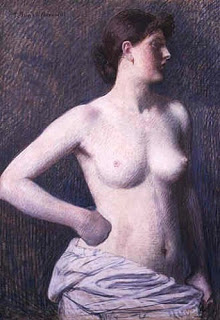
Suzanne Valadon by Pierre Puvis de Chavannes (1880)

Susanne Valadon modelled for Pierre Puvis de Chavannes for his pastel on paper work which he completed in 1880.  The nude study was untitled but one can see the physical attraction of the model to the artist.  It is a stunningly beautiful work of art.  Suzanne, like many of the artists’ models had no problems with posing nude and early photograph below shows her in such a pose.

Suzanne Valadon          (photo)
Suzanne Valadon
(photo)

The liaison between Pierre Puvis and Susan Valadon lasted for six months and during that time he probably became a slightly more spirited person through being around Suzanne and in return he seemed to have instilled a calming influence on the hyper young woman. It was the first time that Suzanne had been in some ways dominated by a man.  It would appear to be a similar situation to the Eliza Doolittle and Henry Higgins scenario in Pygmalion.  Inevitably the liaison came to an end.  It did not end in a fiery confrontation with insults being hurled.  Their liaison as lovers had run its course.  It was just a quiet and mutual ending to a relationship which they had both enjoyed.  Suzanne returned home to live with her mother in her one-bedroom Montmartre lodgings on the rue du Poteau but still on occasions modelled for Pierre. 

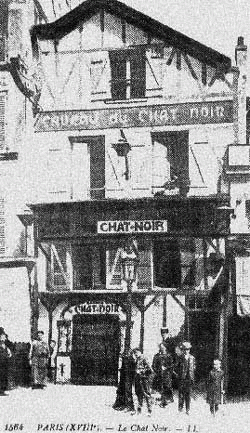
Le Chat Noir
Le Chat Noir

Suzanne soon returned to her old ways of modelling by day and celebrating at night and one evening whilst in Le Chat Noir she met Miguel Utrillo, a Spanish engineering student who was studying in Paris.  Soon the two became close friends which inevitably lead them to become lovers.   Utrillo was not the first man since Puvis that Suzanne had slept with as she had quite a number of sexual partners and so maybe it was not surprising that in late summer of 1883 she became pregnant.  The question on most people’s lips was – who was the father of Suzanne’s child?   Her friends would question her and put forward a name, to which Suzanne, not at all upset by the questioning, would just smile and amusingly state: “It could be” or “I hope so”.   Suzanne gave birth to a baby son on December 26th 1883 after a very prolonged and painful birthing process overseen by an irritable midwife and her ever drunk mother.  After giving birth Suzanne lapsed into a coma for two days.  The baby was registered at the town hall in Montmartre as Maurice Valadon.   Why Maurice?   Suzanne’s reasoning behind the choice of name was that none of her recent lovers had the name Maurice!   

Her old one-bedroom apartment in which she had been living with her mother was now not big enough and so after the birth Suzanne and her baby along with her mother Madeleine moved into a three-bedroom apartment in rue Tourlaque.  This was more expensive but Suzanne was not concerned, nor had she been concerned when she was pregnant and too big to be used as an artist’s model and her money from modelling dried up.   She was receiving money from an admirer or lover but she would never reveal the source of her income.  Once up and about, Suzanne reverted to her nights out at the bars and clubs accompanied by different men including Miguel Utrillo.

                                                                                          ……. to be continued

Susan Valadon, Part 1 – The early years

Suzanne Valadon aged 24

In my next few blogs I want to look at the life of a female who was both a great artist and artist’s model and whose name is synonymous with the artistic world of the late nineteenth/early twentieth century Montmartre.  She was, and still is, loved by the feminist movement who applaud her guts and determination.  She is Suzanne Valadon.   I want to spend time and look at the artistic friends she made during her life and how they adored her.  She was, to many artists, a model, a muse and, in some cases, a willing lover.   To fully understand why her lifestyle was as it was, one must go back and examine her family roots and look at her early childhood which was , as is the case for nearly all of us, the sewing and the germination of the seed which would eventually blossom and shape our lives. 

To examine her early life one needs to scrutinize the circumstances of her birth and for that it is necessary to look into the life of her family.   Her mother was Madeleine Valadon who was born in the small rural village of Bessines, close to the town of Limoges.  What we know of Madeleine comes from her own lips later in life and because she frequently changed the facts one needs to be careful as to what to believe.   She maintained that as a teenager she had once been married to a man from Limoges named Courland and that he died in jail when she was just twenty-one years of age but by which time she had given birth to a number of his children.  After his death Madeleine reverted back to her family name of Valadon and returned to her family home.  As a young girl, she was taught to read and write by nuns who also taught her to stitch and sew. She then fortuitously managed to secure employment as a live-in seamstress to the well-to-do Guimbaud family who lived nearby.  It was a position which she was pleased to accept and felt no grief for having to leave her children in their less than salubrious family home whilst she was living in comparative comfort close by.   She soon established herself as the head of the servants in the Guimbaud household and, unlike them, even dined with the family.  She remained in this employment for thirteen years but it came to an end when she once again became pregnant.   According to her, the father of the child was a local miller who was killed in an accident at work.  In later life she viewed the accident which killed him as divine retribution for making her pregnant!     

Naturally the small Bessines community was shocked by the news of her pregnancy and lack of a husband to act as a father figure to her newborn.  The Guimbaud family however treated her well and she remained in their house until her child, a daughter, was born.  According to the official records, the child was baptised Marie-Clémentine Valadon on September 23rd 1865.   It was not until she was nineteen years of age that Marie-Clémentine started calling herself Suzanne and this apparently was the suggestion of her friend, the artist, Henri Toulouse Lautrec.    It is also interesting to note that despite that documented official registration of her birth Suzanne always maintained she was born in 1867. 

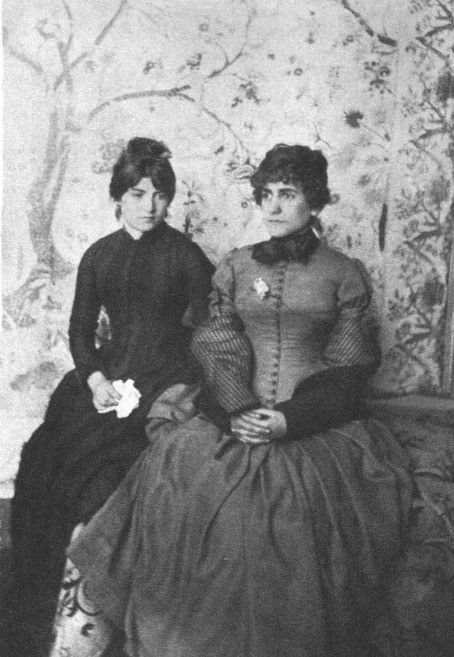
Madeleine Valadon with her daughter Suzanne

Madeleine Valadon left Bessines with her baby in January 1866 and headed for Paris.  She never looked back.  She never saw or communicated with her family, her other children or her former employer, the Guimbaud family, ever again and one can only wonder why she wanted this complete break from her past. 

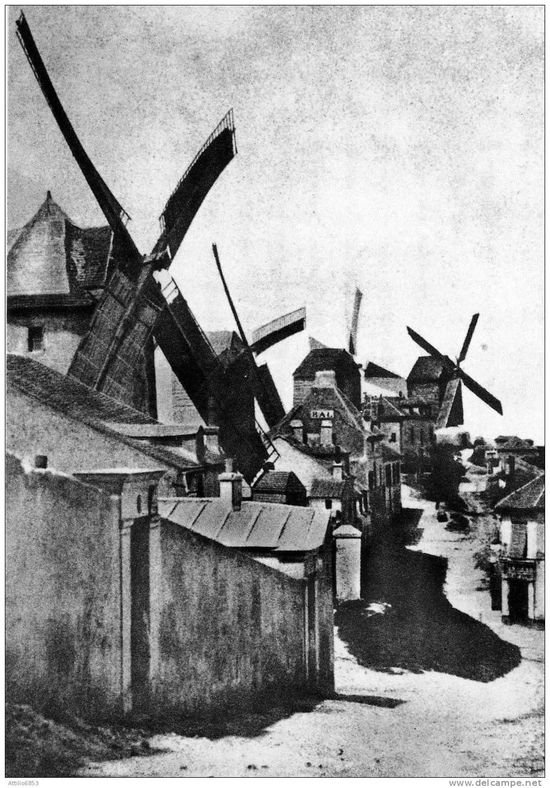
The windmills of Montmartre, taken in 1839 by Hippolyte Bayard

She arrived in Paris confidant that she would be able to earn a living as a seamstress.   Madeleine Valadon was amazed at the sight that greeted her to the north of the capital city – a hill on top of which were a number of windmills, a vista which was similar to the rural views back home.  The steep hill she viewed was the Mount of Martyrs, named after the execution of the first bishop of Paris, St Denis and his faithful lieutenants, St Rustique and St Éleuthère in the third century – Montmartre.  Madeleine settled into lodgings at the base of the hill in the Boulevard de Rochechouart and then, with a glowing reference from the Guimbaud family, set off to procure employment as a seamstress.  Her plans did not come to fruition as jobs were scarce and finally, in desperation, she had to settle for the menial job as a scrub-woman, cleaning floors whilst the wife of the concierge of her lodgings looked after Suzanne. 

Madeleine, no doubt aware that for her daughter to succeed in life she had to be educated, and so arranged for a priest to teach her to read and write and then had her attend the convent run by the nuns of St Vincent de Paul as a day pupil for a continuance of her education and to be taught, as she was, to become a seamstress.  However, once again her plans went awry with the start of the Franco-Prussian War which culminated in the siege of Paris by the Prussian army at the end of 1870 and the ousting of the French government, which retreated from Paris and based itself in Bordeaux.  In May 1871, following the conclusion of the Franco-Prussian War and the lifting of the Prussian siege of Paris, the French government returned to Versailles on the outskirts of Paris ready once again to rule the capital.  However many of the Parisians, who had suffered during the Paris siege, blamed their government for their misery and deprivation which they had to endure.  They remembered with bitterness the days they had to scavenge for food eating dogs, cats and rats to survive.  Out of this sense of bitterness and betrayal came the rise of the Communards.  The Communards were a group of working class disaffected Parisians who did not want the French government to return to control Paris.  They were very active around the area where Madeleine and Suzanne lived and their bloody determination that the defeated French government would not return to Paris from their bolt-hole at Versailles set up a clash which was in fact a mini civil war and which claimed the lives of more than twenty thousand Parisians. 

Suzanne, during these times of turmoil, had still attended the St Vincent de Paul convent for her lessons and during the Paris siege had been fed by the nuns from their home-grown produce.  However during the Paris Commune clashes between the government forces and the Communards the fighting had been so intense that the nuns barricaded themselves in the convent and closed it down to the day pupils and so Suzanne like many others lost their opportunity for learning and being fed.  Suzanne, who was six years of age and like many children of her age, revelled in not having to go to school.  Her mother, on the other hand, despaired and began to drink heavily.   At the end of the Paris Commune struggle at the end of May 1871 and with it, the return to law and order under the French government, the St Vincent de Paul nuns felt it safe to re-open their convent to their day pupils and Suzanne, who had enjoyed the freedom from the discipline of school life and the boredom of lessons reluctantly had to return to the confines of the convent.  She rebelled and was frequently absent preferring to play in the streets and on the hill of Montmartre with new friends both children and adults.   She mixed with the lowest elements of society, the prostitutes, the beggars and the thieves and loved every minute of it.  Later in life she recalled those times:

“…From that day the streets of Montmartre were home to me.  It was only in the streets that there was excitement and love and ideas – what other children found around their dining room tables…” 

Suzanne lived a feral existence.  She was small in stature and had a fierce temper and would often succumb to uncontrollable rages and on the streets of Montmartre she was often referred to as “The Little Valadon Terror”.   Her mother Madeleine became more morose and apathetic as the years passed.  She lost total interest in life and frequently descended into an alcoholic haze.  She rarely cleaned their lodgings and seldom did any laundry.  She begrudged cooking and having to feed Suzanne and when they ate at meal times they would normally eat apart.  Nothing Suzanne would do would lift her mother’s spirit.   Despite this lack of maternal love for Suzanne the two lived together for almost sixty years.  In later life Suzanne often depicted her mother in paintings.  She would nearly always portray her as being old, wrinkled and toothless but showed her hard at work. 

Le Moulin de Galette by Vincent van Gogh (1886)

Montmartre since the beginning of the 19th century was the centre of artistic life and drew artists, musicians and writers to it like a magnet.  Studio garrets shot up everywhere in which the artists would paint day in and day out and in the late evenings would look for some respite and so bars and music and dance halls, such as the notorious Moulin Rouge.  

L'Absinthe by Degas (1873)
L’Absinthe by Degas (1876)

The Café de la Nouvelle-Athènes, was a meeting place for the up and coming artists of the time including the “new kids on the block”, the Impressionists and it was outside this establishment that Degas depicted the two drinking companions in his famous 1876 work L’Absinthe  (See My Daily Art Display June 7th 2011).  Another popular establishment was Le Chat Noir, which opened in November 1881 in Boulevard Rochechouart, the same street where Madeleine and Suzanne lived and was run by the entertainment impresario, Rodolphe Salis.  The Divan Japonais, a café-concert (a combination of a concert hall and a pub) was a haunt of the French painter, Henri Toulouse-Lautrec.  Probably one of the most popular was the Moulin de la Galette.  This was originally a windmill, one of the thirty windmills on La Butte de Montmartre, which Madeleine saw as she arrived from Limoges.  The windmill owners then added a goguette (a wine shop) which also sold galettes (flat round crusty pastries) and later incorporated a dance hall and restaurant.  It was here that Suzanne Valadon reminisced that she had first set eyes on Degas whom she described as:  

“…a small round-shouldered man, fragile and sad-eyed, in pepper-and-salt tweeds, his throat swathed in woollen scarves…”

In 1874, at the age of nine, Madeleine took Suzanne to an atelier de couture where she was apprenticed as a seamstress.  Suzanne hated the life and made numerous attempts the workplace but unlike the nuns the workhouse owner would beat her when she was dragged back to the factory by her mother.  She stayed there for three years but eventually left and took jobs as a waitress in a café, a push-cart vendor of vegetables and working with horses at a livery stable.  It was this last job in which one of her jobs was to walk the horses around the streets.  People would stop on the street and watch this small young girl with her large horses.  Suzanne, ever the entertainer, was not content with just walking the horses but began to perform acrobatic tricks upon the horses to gain more notice and a modicum of applause.   In later years, she reckoned that a circus owner witnessed one of her “performances” and offered her a job.  She loved this new colourful and exciting life.  Although her role at the circus/carnival was a horse riding act, one day she was asked to stand in for a trapeze artist who had been taken ill.  She had done some trapeze work and so agreed.  Unfortunately the performance went badly and she fell, injuring her back and her circus life came to an end. 

                                                                        …………………… to be continued.

Having been chastised the other day for not acknowledging some of my sources I thought I had better behave myself today and tell you that most of my information came from a book I read (and I am still reading it) on the life of Suzanne Valadon entitled The Valadon Drama, The Life of Suzanne Valadon, written by John Storm in 1923.

Other sites I visited to find some pictures were:

http://lapouyette-unddiedingedeslebens.blogspot.co.uk/

http://youngbohemia.blogspot.co.uk/2012/01/suzanne-valadon_8445.html

http://www.messynessychic.com

The Blog:  It’s about time

http://bjws.blogspot.co.uk
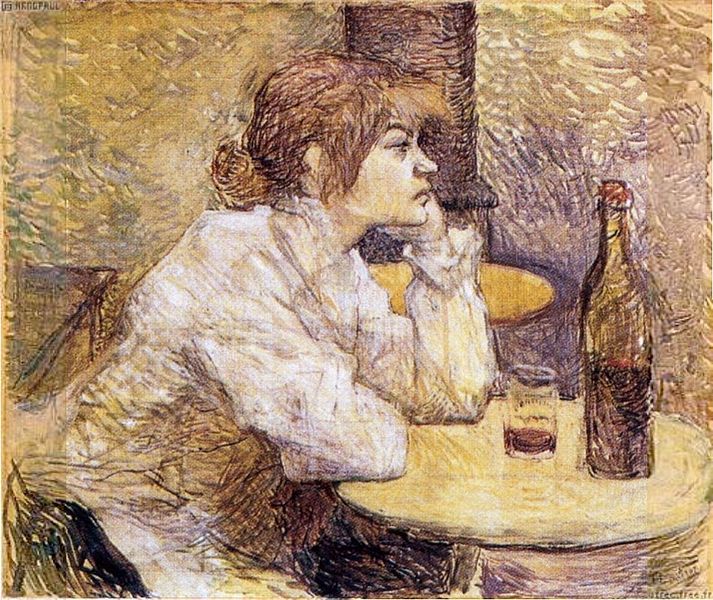
 

Zinaida Serebriakova – Part 2.

My blog today continues with a look at the life of the Russian painter, Zinaida Serebriakova.  At the end of my last entry I told you that she and her family’s life had been turned upside down by the onset of the October Bolshevik Revolution in 1917.  Lenin, who was the leader of the Bolsheviks, wanted to keep the peasant classes on his side so when he made his attempt to overthrow the provisional Russian government, he ensured the neutrality of the peasants by offering them land, owned by the aristocracy.  The Revolution saw the riches, property and lands owned by the aristocratic classes being taken from them by the Bolsheviks and redistributed to the peasants.   That October, Serebriakova had been living at her family estate of Neskuchnoye when the Bolshevik forces descended upon her and her family.  When it was all over the reserves of Neskuchnoye had been plundered and the family was left without food.   Zinaida was left with nothing – no income, no husband, for he had been dragged off by the Bolsheviks and jailed and would die of typhus, which he contracted during incarceration, two years later.  Notwithstanding the fact that she was penniless and had no means to earn money, she was responsible for the upbringing of her four children as well as having to care for her widowed mother.    Zinaida was forced to give up oil painting in favour of the less expensive techniques of charcoal and pencil sketching
Zinaida eventually managed to get some work at the Kharkov Archaeological Museum, where she made pencil drawings of the exhibits.   In December 1920 she and her family went to live with her grandfather who had an apartment in Petrograd.    Petrograd had formerly been known as St Petersburg but when World War I broke out in August 1914 it was decided to change the name of the Russian capital from the Germanic  St. Petersburg to the more Russian equivalent, Petrograd.  It was not until 1991, with the collapse of the Soviet Union, that the city reverted back to the name of St Petersburg.   Because of a Bolshevik dictate which stated that all inhabitants of private apartments had to share their living space with other people, Zinaida found herself sharing her lodgings with artists from the Moscow Art Theatre.

In Ballet Dressing Room (Big Ballerinas) by Zinaida Serebriakova (1922)

Serebriakova’s work during this period focused on theatre life. It was around this time that her daughter Tatyana became interested in ballet and her mother managed to get her enrolled at the prestigious ballet school of the Imperial Mariinsky Theatre, the home of the Russian Ballet, where Zinaida’s uncle, Alexander Benois was the scenic director.   Much of Zinaida’s time was absorbed by the theatre and she produced a series of exquisite pastels on the balletic life at the theatre.  Many of her works showed young ballerinas in their dressing room preparing to go on stage.

In 1924 Zinaida Serebriakova got the offer of work in Paris and with some financial help from her uncle Alexander Benois, she left St Petersburg and headed to the French capital, leaving behind her four children with her ailing mother.  A few years later Zinaida managed to bring her son Alexander and her daughter Katya to live with her in Paris but her son Yevgenyi and her daughter Tatiana had to remain in Russia with their grandmother, and it was not until 1960 that she was able to have Tatiana visit her in Paris.

Zinaida was now one of many Russian exiles living in Paris who could not return to her homeland.   She earned a living by painting society portraits. Her children also often featured in her work, and her daughter often posed in the nude.   She also painted other female models, reclining in her studio with patterned wraps and decorative drapes. These works were of a very informal nature and often highly erotic.  According to her daughter Ekaterina these nude studies were probably the most intimate images of the female body in Russian art.   She later wrote:

“…The female nude was mother’s favourite subject. While she was in Russia young peasant women would pose for her. In Paris her friends would come over to her studio, drink a cup of tea, then they would stay and pose for her. They were not the professional models that you might find in Montparnasse and maybe this is the reason why they are so natural and graceful…”

Sleeping Nude (Katya).by Zinaida Serebriakova (1934)

Zinaida completed one of her best known nude studies of her daughter, Ekaterina, in 1934, entitled Sleeping Nude (Katya).  It was a veritable masterpiece which is similar in imagery to the sleeping Venuses of the Venetian masters, the nymphs of Boucher and the bathers of Cabanel and Renoir.  In this work, Zinaida does not offer us some anonymous heroine from Greek mythological tales but presents us with an innocent young girl, who lies before us, totally relaxed, her cheeks flushed from sleep.  It is so natural and it is even more endearing knowing that the model for this painting was her twenty-two year old daughter, Katya who had modelled for her mother for the previous fifteen years.

Sleeping Girl in the Blue (Katyusha on a Blanket)by Zinaida Serebriakova (1923)
Sleeping Girl in the Blue (Katyusha on a Blanket)
by Zinaida Serebriakova (1923)

In 1923, before Zinaida left for Paris she had painted a nude study of the then ten-year old Katya, entitled Sleeping Girl in the Blue (Katyusha on a Blanket), in which we see her young daughter, in all her innocence, sprawled across a blue blanket.

Zinaida’s uncle Alexander Benois, an artist, art critic and co-founder of the art magazine and movement Mir iskusstva (World of Art), commented on the way his niece had portrayed her naked young women.  He wrote:

“…[Her nude studies were] not by a generalised sensuality but by something specific, which we recognise from our literature, from our music, from our personal experiences. This is truly the flesh of our flesh. Here is that grace, that comfortable languor, that cosy, domesticated side to Eros – all of which are actually more alluring, more subtle and sometimes more perfidious, more dangerous than what Gauguin found on Tahiti and in search of which blasé Europeans left their pampered life at home and set off in the footsteps of Pierre Loti, across the whole of the white, yellow and black world…”

Zinaida Serebriakova’s nudes were always dignified, self-assured and classically beautiful.  She created the most sensual and intimate images of the female body in the Russian art and remained true to the Neo-Romantic tradition and her classical training.  At an exhibition of Russian art at the Midi Fair in Brussels in 1928, people noted Serebriakova’s ‘nude’ oeuvre and it was here that she met the industrialist, the Belgian nobleman, Baron de Brouwer.   So impressed was he with her work that he became her patron and commissioned her to paint portraits of his family.

Reclining woman (Etude de femme hadija) Marakech by Zinaida Serebriakova (1932)

De Brouwer also financed her painting trip to Morocco where he owned a plantation.  Zinaida set off for North Africa on her own and fell in love with the colour and light Morocco afforded her.  The baron had wanted her to bring back paintings of the area and its people.  He had also said that he had wanted to some nude studies of the Arab women but Zinaiad found this very difficult to achieve.  She wrote:

“…He (Brouwer) wants nude paintings of the lovely native women, but it’s a fantasy hardly worth dreaming about – even in their veils which cover everything but their eyes nobody will pose for me. There is no question of a nude…”

However she did return with many paintings of the area and the Arab and Berber women, some of whom she had even managed, with much haggling and offers of financial rewards, to get some to pose in the nude but it was difficult.  She wrote of this time:

“…As soon as you sit to draw the women walk away – Arabs don’t wish to be drawn, so they immediately close up their shops or charge up to 10 or 20 francs for tea an hour!…”

De Brouwer was delighted with the works Zinaida brought back from North Africa, so much so, that he commissioned her to paint a series of murals for his villa Manoir du Relais in Pommeroeul near Mons, in Belgium.  Zinaida customized the theme of this mural series to that which appealed to her patron.  The baron had a love of classical art, which of course was ideal for somebody like Zinaida who had a talent for painting portraits of the naked human form.  She set about the commission and decided to paint four separate vertical panels each displaying a standing nude,  each with their allegorical attributes which in some way would mirror the leisure activities and talents of de Brouwer.

Jurisprudence by Zinaida Serebriakova (1937-8)

One of the figures would be Jurisprudence, which would represent the baron’s career as a lawyer.  A second would be Flora, which would symbolize his passion for gardening, his plantations and his love of flowers.   Light, would be another figure which referred to his role as a director of power and gas plants and finally Art which would embody his interest and patronage of the arts.  For Zinaida there could only be one possible candidate for the role of model for the four nudes, which would be depicted on the four vertical panels.  It was to be her daughter Katya.  Her stance in each panel was to be different turning slightly for each depiction.  A further two large horizontal panels (145cms x 710cms) were also created and these depicted four maps in cartouches.  Zinaida left the painting of these to her son, Alexander, and these were of Flanders, Morocco, India and Patagonia. Next to the maps Zinaida had added half-seated female nudes which were initially intended to represent the four seasons, but she later changed their titles to the countries represented on the maps they adorned. Years later, Zinaida wrote about this commission:

“…The assignment was to paint decorative geographical maps in the 18th-century style, single-tined (my son did the maps); and I painted in the corners of the maps, against that background, the images of the ‘four seasons’ (summer with a sheaf, spring with flowers, etc.), and four figures standing in ‘niches’ on another wall. I painted all this in Paris and, unfortunately, did not see how all this looked on the walls, because the house was not quite ready yet, and the residents were yet to move in … during the war the area was a battlefront, and de Brouwer’s summer house was destroyed…”

Even more pleasing to Zinaida’s was the comments by her artist brother Yevgeni Lanceray, who on seeing photographs of the paintings wrote to her:

“…I love them..You have exactly that which others around you do not – an understanding of composition. The panels are excellent in the simplicity of their execution, completeness of shape, and so monumental and decorative. You completely understand the form of objects. Particularly difficult, I think, is the panel Jurisprudence… It is especially elegant and richly executed. In everything is simplicity and parsimony, so to speak, of decoration and attributes. I envy you your ease, your flexibility, and how broad and accomplished is your representation of the body…”

Nadezhda Tregub of the Tretyakov Gallery in Moscow wrote about the four nude figures:

“…These murals can be considered entirely cosmopolitan works: they were accomplished on a commission from Belgium, by an artist from Russia who worked in France, and who drew on the major achievements of all European art…”

Sadly the baron and his wife did not have much time to enjoy the murals which were completed in 1937/8 as both died during the Second World War, and it was also thought that their house had also been destroyed. In fact this assumption was incorrect as the house remained standing and even changed ownership a number of times. The murals also remained untouched for over 70 years, but curiously the owners did not recognise the work as being done by Zinaida.  They thought they had been executed by an unknown Flemmish artist.

In 1966 a large exhibition of Zinaida Serebryakova’s works was mounted in Moscow, Leningrad and Kiev and the critics loved what they saw.  In September of the following year Zinaida died in Paris, at the age of eighty-two. She was buried in the Sainte-Geneviève-des-Bois Russian Orthodox cemetery in Paris.  The cemetery is a burial place for more than 10,000 Russian emigrants, including the celebrated ballet dancer, Rudolf Nureyev.

Self-portrait at the Easel Painting a Devotional Panel by Sofonisba Anguissola

Self-portrait at the Easel Painting a Devotional Panel by Sofonisba Anguissola (1556)

Let me introduce you to a female artist, whom I am ashamed to admit, I had never heard of, but whom Giorgio Vasari, the Italian biographer of artists, made the following comment:

“…[She] has shown greater application and better grace than any other woman of our age in her endeavours at drawing; she has thus succeeded not only in drawing, colouring and painting from nature, and copying excellently from others, but by herself has created rare and very beautiful paintings…”

My featured artist today is the Italian Renaissance painter Sofonisba Anguissola. Her christian name came from a strong family connection to ancient Carthaginian history and her parents named their first daughter after the tragic Carthaginian figure who lived and committed suicide during the Second Punic War.  Sofonisba Anguissola was born in Cremona, a city in the Lombardy region of Northern Italy, around 1532.  Her father was Amilcare Anguissola and her mother was Bianca Ponzone.  Both parents came from affluent and noble families and they lived a privileged and affluent lifestyle.  Sofonisba was the oldest of seven children.  She had one brother, Asdrubale and five sisters, Elena, Lucia, Europa, Minerva and Anna Maria.   All of her sisters except Minerva became artists.

Having come from such an advantaged family background was somewhat unusual for women artists of the sixteenth century, as any of note, tended to be daughters of impoverished artists.  The family wealth coupled with the father’s belief that all females should be educated ensured that Sofonisba received an all-round and extensive education, including studying drawing and fine art.   The fact that she came from a wealthy and privileged background did not however avoid the restrictions imposed by the Italian art establishment, such as forbidding female artists from studying anatomy or attending life drawing classes as it was deemed inappropriate for a female to view a naked model, which consequently meant a female could not study the human anatomy to the same extent as a male artist could and because of this she was unable to carry out the complex multi-figure compositions which were at the heart of the popular large-scale religious and historical works.  With those obstacles in mind, Anguissola decided to concentrate on portraiture using female models, which were accessible to her, and instead of historic settings she concentrated on having her sitters shown in homely and unceremonious settings.  Self-portraits and portraits of family members were her most frequent subjects and it was not until much later in life that she turned to paintings incorporating religious themes.

Self-portrait with Bernardino Campi by Sofonisba Anguissola (1550)

At the age of fourteen Sofonisba and her sister Elena attended the studio of Bernardino Campi, the Italian Renaissance religious painter and portraitist who was based in Cremona.  She pictorially recorded the time she was with Campi in her double portrait depicting her mentor painting a portrait of her.  The work, entitled Bernardino Campi Painting Sofonisba Anguissola, was completed by her during her last year as his pupil in 1550, when she was just eighteen years old.   After Campi, Sofonisba studied under the Italian artist Bernardino Gatti, often known as il Sojaro, and continued being tutored by him for three years, eventually leaving him when she was twenty-one years of age.

In 1554, Anguissola journeyed to Rome, where she spent her time sketching various scenes and people. The highlight of her stay in the Italian capital was when she was introduced to the great Master himself, Michelangelo Buonarotti.   We know the two met as in the Buonarrotti Archives held in Florence there is a letter, dated May 1557, from Sofonisba’s father Amilcare to Michelangelo in which he writes thanking him for spending time with his daughter:

“…honourable and thoughtful affection that you have shown to Sofonisba, my daughter,

to whom you introduced to practice the most honourable art of painting…”

Asdrubale Bitten by a Crayfish by Sofonisba Anguissola (c.1554)

Intrigued by her artistic talent Michelangelo asked her to sketch him a picture of a weeping boy and the result was her sketch entitled Asdrubale Bitten by a Crayfish.  Sofonisba rose to the challenge and sketched her young brother, Asdrubale, being bitten and being comforted by one of his sisters.  Michelangelo was so impressed with the drawing that he gave her some sketches from his notebook and asked her to copy them in her own style.  She complied with his request and the results of her efforts again astounded the Master and because he recognised how artistically talented she was, for the next two years, he agreed to mentor her.  Again we have been made aware of the high regard in which Michelangelo held Sofonisba’s work as in a letter dated May 1558, (held in the Buonarrotti Archives) her father wrote to Michelangelo thanking him for praising his daughter’s artwork:

“…[you were] kind enough to examine, judge, and praise the paintings done by my

daughter Sofonisba…”

In 1558, aged twenty-six, Sofonisba Anguissola left Rome and went to Milan and it was here she received a commission to paint a portrait of Ferdinand Alvarez de Toledo, the Duke of Alba.  The sitter was so pleased with the resulting painting that he recommended her to Philip II, the King of Spain.  Court officials invited Sofonisba to come to Madrid and be part of the Spanish court.  This fact alone is clear evidence of Sofonisba’s artistic talent and her success, as it would have been unheard of that such a powerful leader as Philip II would countenance an insignificant artist being invited to join and live at the Spanish court and paint for his new Queen.

Late in December 1559 she arrived in the Spanish capital and took up her role at the Spanish court as a court painter as well as being one of the attendants to the Isabella Clara Eugenia, the Infanta Isabella, and later as a lady-in-waiting to her mother, Philip’s new queen, his third wife, Elisabeth of Valois (the Queen consort, Isabel of Spain) who was an accomplished amateur portrait painter.  This shared love of art between Sofonisba and Elisabeth flourished and Sofonisba would often offer artistic advice and give the queen some artistic tuition.   Sofonisba soon received many official commissions to paint portraits of the king and queen’s family and courtiers.  These were very different to her earlier portraiture work which were very informal as Philip and his wife wanted the portraits he had commissioned Sofonisba to paint to show the wealth and power of the sitters by paying attention to background and peripheral objects such as fine and sumptuous clothing, jewelled adornments and priceless furnishings.  This type of portraiture took time and skill but the finished products were always well received by the sitters.

Her artistic talents were also recognised by another powerful leader, Pope Pius IV who asked Sofonisba to paint a portrait of the Queen consort, Isabel, and have it sent to him.  Giogio Vasari in his book, Le Vite de’ più eccellenti pittori, scultori, ed architettori (Lives of the Most Eminent Painters, Sculptors and Architects) quotes a letter the pontiff sent Sofonisba thanking her for the painting and praising her work.  In the letter he wrote:

“… Pius Papa IV. Dilecto in Christo filia.

 We have received the portrait of our dear daughter, the Queen of Spain, which you have

sent… We thank you and assure you that we shall treasure it among our choicest possessions,

and commend your marvellous talent which is least among your numerous qualities

 Rome, 15 October 1561…”

In 1571 Sofonisba married Don Francisco de Moncada, who was the son of the Prince of Paterno, Viceroy of Sicily.  King Philip II facilitated the marriage, and paid her dowry of twelve thousand pounds.  She remained at the Spanish court for a further seven years after which time, and with Philip’s permission, she and her husband left Madrid and travelled to Palermo, Sicily. They arrived in Palermo in 1578 but sadly her husband died the following year.  The year following her husband’s death, Sofonisba decided to visit her family back in Cremona and embarked on a sea passage from Palermo to Genoa.   She never made it back home as she fell in love with the young captain of the ship and the couple married shortly after, in January 1580, in Pisa.  Sofonisba was forty-seven years of age and was much older than her seafaring husband.  The couple settled down at the seaport of Genoa and with her husband’s money, along with a pension from Philip of Spain, the pair had a comfortable lifestyle and Sofonisba had her own quarters including an art studio within her husband’s family’s large house.  Her reputation as an accomplished artist spread throughout Europe and she received many visits from young aspiring painters.  The couple moved to Palermo and were visited in 1624 by the Flemish painter, Anthony van Dyck, who at the time was twenty-five years old and travelling around the island of Sicily recording his travels in words and sketches in his diary.  At the time, Sofonisba was ninety-two years old and van Dyck sketched Sofonisba sitting in a chair.   All around the sketch he wrote notes in Italian, a rough translation of which is:

“…portrait of the painter Signora Sofonisba, done from life in Palermo in the year 1624, on 12 July: her age being 96 years, still with her memory and brain most quick, and most kind, and although she has lost her sight because of her old age, she enjoyed to have paintings put in front of her, and with great effort by placing her nose close to the picture, she could make out a little of it…”

It is interesting to note that according to van Dyck, Sofonisba was 96 years old in 1624 and this of course would make her birth date 1528 which is some four years earlier than the date given in a number of reference books.

Page from van Dyck's sketchbook
Page from van Dyck’s sketchbook

Van Dyck recorded in his diaries that her eyesight was weakened (it is thought she suffered from cataracts) but for a lady of 92 (or 96!) she was still mentally alert.  She had completed her last work in 1620 and had become a patron of the arts.  On November 16th 1625, Sofonisba died in Palermo aged 93.

On her birth centenary seven years later, her husband had a plaque placed on her tomb which read:
“…To Sofonisba, my wife…who is recorded among the illustrious women of the world, outstanding in portraying the images of man…

Orazio Lomellino, in sorrow for the loss of his great love, in 1632, dedicated this little tribute to such a great woman…”

Sofonisba was not only appreciated in her own lifetime but continues to be appreciated in modern society albeit I had to admit her name was new to me, which gives you some idea as to my artistic knowledge!

My Daily Art Display’s featured painting today is an early self portrait by Sofonisba Anguissola which she completed in 1556 and is entitled Self-portrait at the Easel Painting a Devotional Panel.  It is housed at the Museum-Zamek in the town of Lancut in south-east Poland.

This is one of many self portraits by the artist, which she sent as gifts to prospective patrons as she could not respectably enter into competition with male artists for paid commissions.   Around this time, there was a highly respected author, Baldassare Castiglione, the count of Casatico, an Italian courtier and diplomat, who held great sway with the public with regards manners at the court and how one should behave if of noble birth.  The book, which had a widely circulated publication in 1528, was entitled The Courtier.  In a way it was also a torch-bearer for women’s equality as it advocated the same education for aristocratic women as that offered to aristocratic men and one can only presume that Sofonisba’s father had read the book and agreed with its conclusions as he made sure that his daughters were not only educated in Latin, classical literature, history, philosophy, math, and sciences, but also that they were schooled in the courtly arts, such as music, writing, drawing, and painting.  Castiglione had written in his book about how aristocratic women of the court should dress.  He wrote:

“…she should always dress herself correctly and wear clothes that do not seem vain and frivolous…”

We can see by the way Sofonisba has depicted herself in this self portrait, wearing a modest black gown, lace collar and cuffs, the absence of jewellery and a simple hairstyle, which precluded any hint of easy virtue, that she had taken on board the advice given by Castiglione in his book.

Sofonisba looks out at us, brush in hand.  She is in the act of painting and is simultaneously the subject and object, the painter and the model of the painting.  Her painting is a re-working of the legend of St Luke the Evangelist, who it was believed, was the first to have painted a portrait of the Virgin but in this painting she has taken on the role of St Luke  and we see her painting of the Virgin and Child resting on the easel.

I love this self portrait.  There is nothing fancy about Sofonisba’s portrayal of herself.  It is an understated depiction.  It is a somewhat discreet portrait of a virtuous noblewoman and its beauty and exquisite artwork challenged the belief in those days that women artists lacked artistic skills.

Portrait of Countess Golovine by Élisabeth-Louise Vigée Le Brun

Portrait of Countess Golovine
by Élisabeth Vigée Le Brun (c.1797-1800)

Today is the third and final part of my look at the life of one France’s greatest female portraitists, Élisabeth-Louise Vigée Le Brun, but as to why I came to showcase this particular artist I have to make a terrible admission.   I have been unfaithful once again.  My undying and faithful love for a beautiful woman has now fallen by the wayside, not once, but twice.  Last week I looked at a woman and in my mind I told her that she was the most beautiful and the most alluring creature I had set my eyes upon.  What worries me is that this is the third time I have uttered these words in the last couple of years.  How can I be so fickle?

Jeunesse Dorée by Brockhurst

Ok, before you press the escape button, horrified by my infidelity, let me say that my love or is it infatuation is not for an actual woman but for a woman in a painting.  It all started back on May 16th 2011 when I told you about the time I stood before the painting Jeunesse Dorée.  I was rooted to the spot at the gallery, staring at Gerald Brockhurst’s portrait of Kathleen Woodward, the lady who was his beloved muse and who modelled for this painting.  I couldn’t take my eyes off her face.  There was something magnetic about the way she stared out at me.  I have since visited the gallery on a number of occasions just to pay homage to this beautiful woman.

Virgin Annunciate by Antonello da Messina

So that was that.  I was convinced that no other woman would compare with Kathleen’s beauty or so I thought.  However, almost a year later, (My Daily Art Display May 1st 2012), I came across a painting by Antonello da Messina entitled Virgin Annunciate.  As the title states, this was a painting of the Virgin Mary but the model the artist used for Mary was a humble Sicilian girl and for once the Virgin Mary portrayed in a painting, appeared simply as a young girl.  The model the artist had used for this work was a stunningly beautifully girl.  Words failed me as I looked into her eyes.  She had the most gorgeous face.  She had such an innocent air about her, which of course was befitting such a depiction.  There was such an unsullied loveliness about her that for a moment in my mind I discounted the haunting visage of Kathleen Woodward of Jeunesse Dorée, and yet how could I be so capricious?

And so my undying love of beauty had been transferred from a young English woman to a young Sicilian girl but I was determined that it was going to stop there, and so it would until I went to the Barber Institute of Fine Arts at Birmingham University a fortnight ago and “met” Countess Varvara Nikolaevna Golovina as portrayed by my featured painter, Élisabeth-Louise Vigée Le Brun.  Before I tell you more about the sitter and eulogise about her physical beauty, let me complete Élisabeth’s life story.

Maria Carolina by Élisabeth Vigée Le Brun (1791)

The French Revolution had begun and in October 1789, the Palace of Versailles had been stormed by a mob and the Louis XVI and his wife Marie Antoinette had been detained.  Élisabeth, because of her connections with Marie Antoinette, had to hurriedly leave France with her daughter and her daughter’s governess and head for the safety of Italy.  She visited Turin, Bologna, and Rome where her paintings met with great critical acclaim and she was elected to the Roman Accademia di San Luca.  From Rome she moved on to Naples.  Her artistic reputation preceded her and she received many commissions, including royal ones from the Queen of Naples and her husband King Ferdinand IV.  Look closely at the portrait (right) of the Queen, Maria Caroline.  Does she remind you of somebody from my last blog?  There is a very close resemblance with Marie Antoinette and this should not be too surprising as they were sisters.

During her European journeys, Élisabeth gained a travelling companion, who would remain alongside her and her daughter for the next nine years.  His name was, Auguste Jean-Louis Baptiste Rivière, a painter, who had also fled revolutionary Paris and made his way to Turin, where he had met up with Madame Vigée Le Brun and her daughter. Thereafter, he accompanied them and their servants on their trek across Europe and into Russia. During this time the two artists often worked in tandem, Vigée Le Brun painting life-size portraits, some of which were copied in miniature or simply on a small scale by Rivière. She wrote of him in her memoirs:

“…M. de Rivière was an astonishing actor in comic roles. Moreover he possessed every kind of talent, which caused the painter Doyen to remark that M. de Rivière was a little nécessaire de voyage literally a travelling case, but in French a play on words, meaning that he was a necessary adjunct during her voyages. The fact is that he was a fine painter and he copied all of my portraits in the form of large miniatures in oil. He sang very agreeably, played the violin and the bass viol and could accompany himself at the piano. He was endowed with intelligence, perfect tact and such a good heart that despite his distractions, which were frequent and numerous, he was able to oblige his friends with as much enthusiasm as success. M. de Rivière was short, svelte, and he never lost his youthful appearance, so that even at the age of sixty his thin waist and his bearing led one to think he was thirty…”

In 1795, Vigée Le Brun left Vienna and travelled to Russia where she was received by the nobility and painted portraits of numerous aristocrats including the last king of Poland Stanisław August Poniatowski and members of the family of Catherine the Great.  Catherine was not initially happy with Vigée Le Brun’s portrait of her granddaughters, Elena and Alaxandra Pavlovna, because of the amount of bare skin the short sleeved gowns revealed.  However, in order to please the Empress, Vigée Le Brun added sleeves giving the work its characteristic look. This alteration seemed to please the Empress who subsequently agreed to sit herself for Vigée Le Brun.  The proposed portrait never came to fruition as Catherine died in 1796 of a stroke before this work was due to begin.  While in Saint Petersburg, Vigée Le Brun was made a member of the Academy of Fine Arts of Saint Petersburg.   However less pleasing to Élisabeth was her daughter Julie’s decision to marry a Russian nobleman.

And so to My Daily Art Display’s featured work, entitled Portrait of Countess Golovine.  It is of Varvara Nikolaevna Galitzin, the daughter of Lieutenant General Prince Nicholas Feodorovitch Galitzin and his wife, née Prascovia Ivanovna Chouvaloff.  She spent the first fourteen years of her life on her father’s estate of Petrovska, near Moscow. After his death, she and her mother went to live in Saint Petersburg in a house on the Nevsky Prospect next to that of her uncle, Ivan Ivanovitch Chouvaloff.   She was named maid-of-honour at the Imperial court in 1783.   In spite of her mother’s opposition, she married the handsome wealthy but profligate Count Nicholas Nikolaevitch Golovin.   For a time she lived in Paris in the society of the old French aristocracy, but returned to Russia when Napoleon seized power.   Élisabeth and the countess formed a close friendship and in the artist’s memoirs, she wrote of her sitter:

“…Countess Golovin was a charming woman, whose wit and talents were enough to keep us amused, for she received few visitors. She drew very well and composed delightful love songs that she sang while accompanying herself on the piano. Moreover she was on the lookout for all the latest European literature with which she was familiar as soon as it was known in Paris…”

In the painting we see the Countess almost entirely enveloped in the red cloak which is embroidered with a neoclassical design. She wears a deep gold headband.  She stares out at us.  Her eyes are fixed on ours with unwavering, and somewhat unnerving frankness.  What made me lose my heart to this woman was the captivating way her left hand, which grasps her shawl, sweeps up wards clutching the material to her body.  Her loosely flowing auburn hair cascades down on to her shoulder. There is a ray of light falling at an angle from left to right which cuts the background diagonally into dark and light sections and by doing this the artist has emphasised the drama of the pose. There is an aspect of spontaneity about the pose and it is this aspect of the portrait which totally seduced me.

The painting was acquired by the Barber Institute of Fine Arts in Birmingham in 1980 where it hangs today.

After a sustained campaign by  Élisabeth’s ex-husband and other family members to have her name removed from the list of counter-revolutionary émigrés, she was able to return to France in 1802, during the reign of Emperor Napoleon I.   Her husband died in 1813 and six years later she suffers the tragedy of the death of her daughter.  She recalled these times in her memoirs:

“…I must now speak of the sad years of my life during which, in a brief space, I saw the beings dearest to me depart this world. First, I lost M. Lebrun. True that for a long time I had entertained no relations whatever with him, yet I was none the less mournfully affected by his death. You cannot without regret be separated forever from one to whom so close a tie as marriage has bound you. This blow, however, was far less than the cruel grief I experienced at the death of my daughter. I hastened to her as soon as I heard of her illness, but the disease progressed rapidly, and I cannot tell what I felt when all hope of saving her was gone. When, going to see her the last day, my eyes fell upon that dreadfully sunken face, I fainted away. My old friend Mme. de Noisville rescued me from that bed of sorrow; she supported me, for my legs would not carry me, and took me home. The next day I was childless! Mme. de Verdun came with the news, and vainly tried to soften my despair. All the wrong-doing of the poor little one vanished – I saw her again, I still see her, in the days of her childhood. Alas! she was so young! Why did she not survive me?…”

She bought a house in Louveciennes, Île-de-France, and lived there until the house was seized by the Prussian Army during the Franco-Prussian War in 1814.   She then moved to Paris where she remained until her death in her apartment at the Hotel Le Coq, rue Saint Lazare, at the age of 86,  on March 30th 1842 .  Her body was taken back to Louveciennes and buried in the Cimetière de Louveciennes near her old home.  On her tombstone were the words:

“Ici, enfin, je repose…”

(Here, at last, I rest…).

In all, Vigée Le Brun painted over 660 portraits and 200 landscapes which are in galleries and museums all over the world.   In 1835 she published her memoirs.

For a full account of Élisabeth’s life you should try and get hold of her autobiography, Memoirs of Madame Vigée Lebrun translated by Lionel Strachey.  There is an internet version to be found at:

http://digital.library.upenn.edu/women/lebrun/memoirs/memoirs.html#XVIII