Musée Jacquemart-André, Baron Haussman and Georges de la Tour

Having been touring Europe for the last three weeks I have had a rest from my blog.   The last part of my journey was a short three-day stay in Paris and it was almost seven years since I had graced this wonderful city. I have visited many art galleries around the world, and my favourites have been the ones that offer something else other than walls of artwork.  I do like artwork which is hung on walls of the interiors of beautiful buildings.  It is like a 2 for 1 offering beautiful architecture and magnificent paintings.
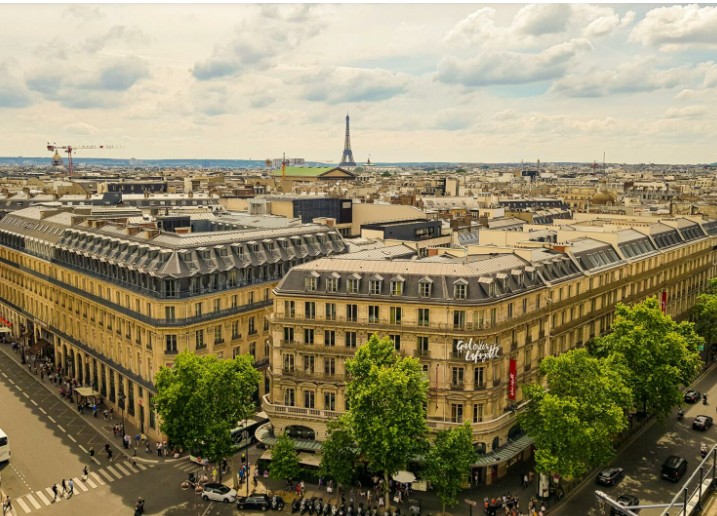
Baron Haussman’s Paris

Whilst in Paris there was an exhibition of one of France’s great 17th century artists, and one of the greatest exponents of 17th century Baroque painting, Georges le Tour.  However, first let’s have a look at the impressive building which was hosting the exhibition.  The Musée Jacquemart-André is a private museum located at 158 Boulevard Haussmann in the 8th arrondissement of Paris.  The street named after Georges-Eugène “Baron” Haussmann, a French administrator, who in the mid nineteenth century, with the backing of Emperor Napoleon III, was responsible for the transformation of the ancient impoverished and unhealthy areas of Paris which involved the demolition of 19,730 historic buildings and the construction of 34,000 new ones. Old narrow streets gave way to long, wide avenues characterised by rows of regularly aligned and generously proportioned neo-classical apartment blocks faced in creamy stone.

One such building was Musée Jacquemart-André, situated on Haussman Boulevard, which was the private home of Édouard André and his wife Nélie Jacquemart which was to display the art they collected during their lives. It was what the French term it as a hôtel particulier, a grand urban mansion. Edouard André bought land on the newly created Boulevard Haussmann with the intention of having a mansion built. Building started in 1869 by the architect Henri Parent and completed in 1875. 
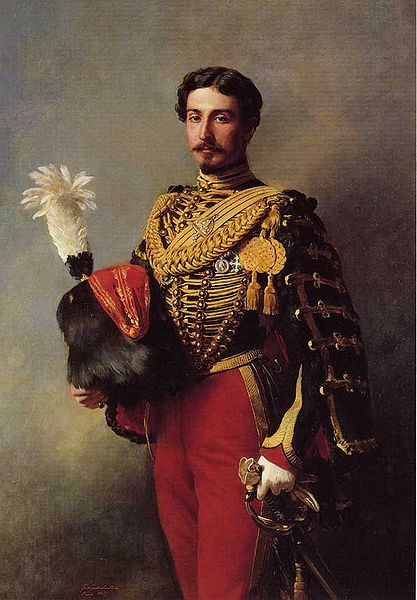
Portrait of Édouard André by by Franz Xaver Winterhalter. 

Nélie Jacquemart and Édouard André were an improbable and mismatched couple.  She was a Catholic woman and a famous society portrait painter, and he was the Protestant heir to a banking fortune. 
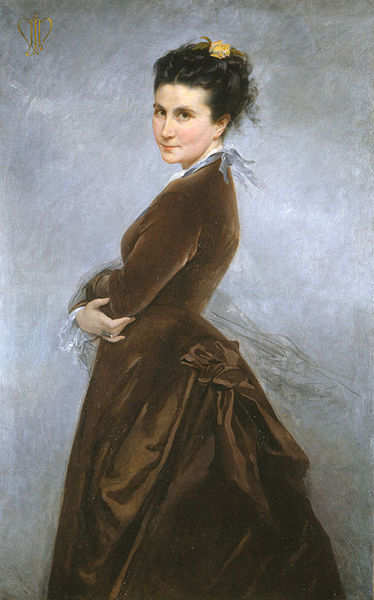
Nélie Jacquemart – Self portrait

They married in 1881. Nélie had painted Édouard André’s portrait ten years earlier. Each year, the couple would travel to Italy, buying works of art and slowly amassing one of the finest collections of Italian art in France. When Édouard André died in 1894, Nélie Jacquemart carried on the renovation of their home.  She also made many trips to Japan and neighbouring far-east countries adding many Oriental works to the collection.  Following her husband’s dying wishes, on her death in 1912, she bequeathed the mansion and its collections to the Institut de France as a museum, and it opened to the public in 1913. The couple’s relationship led to one of the most notable private art collections of fin-de-siècle Paris.

The Tapestry Room
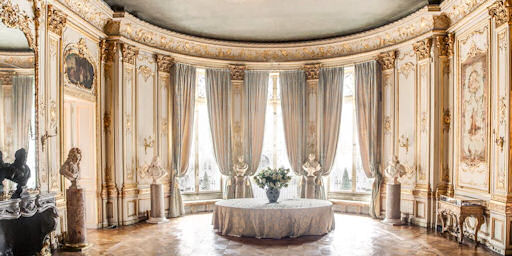
The Round Room

Once inside the Musée Jacquemart-André we are able to glimpse into the splendour of Parisian aristocratic life as it was in the 19th century.  We can witness the luxurious setting, both inside and outside of Édouard André and Nélie Jacquemart former mansion.  Adorned with the finest works of art, one can see in every room the evidence of their passion for Italian and French art.  This was a building which hosted extravagant receptions and soirees.
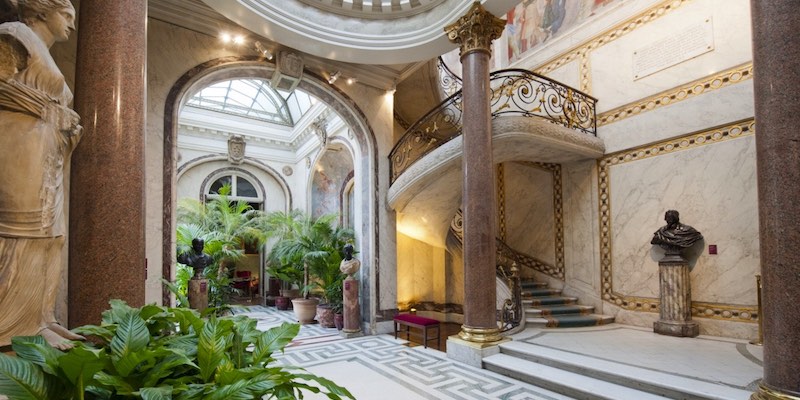
The Winter Garden and Staircase


Grand Salon

Their collection of Italian artwork which Nélie meticulously curated is legendary and includes paintings by Sandro Botticelli, Giovanni Bellini, and Andrea Mantegna. Besides these Italian works of art, the museum houses an remarkable array of French, Dutch, Flemish, and English paintings, as well as sculptures, antique furniture, and objets d’art. Wandering through rooms one observes how they have been preserved in their original state, and one feels that we have been immersed into the world of Parisian high society.

One of the State Rooms and Picture Gallery

The grand salons were designed for hosting lavish events and feature stunning frescoes, sculptures, grand sweeping staircases, and luxurious decor. The experience of walking through lavishly decorated rooms and halls allows us to see how the affluent lived in a bygone era of luxury.
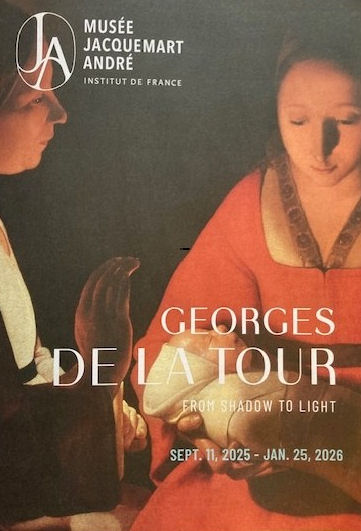
Once the excellent tour of the rooms and garden of the mansion was complete, I went to see the Georges la Tour exhibition which was spread across several upstairs rooms.   It was entitled From Shadow to Light which alludes to the way La Tour explored in his paintings nocturnal scenes, half hidden candles, light filtering through a translucent page, glimmers on a skull or a lantern punctuating the darkness in which meditation unfolds.
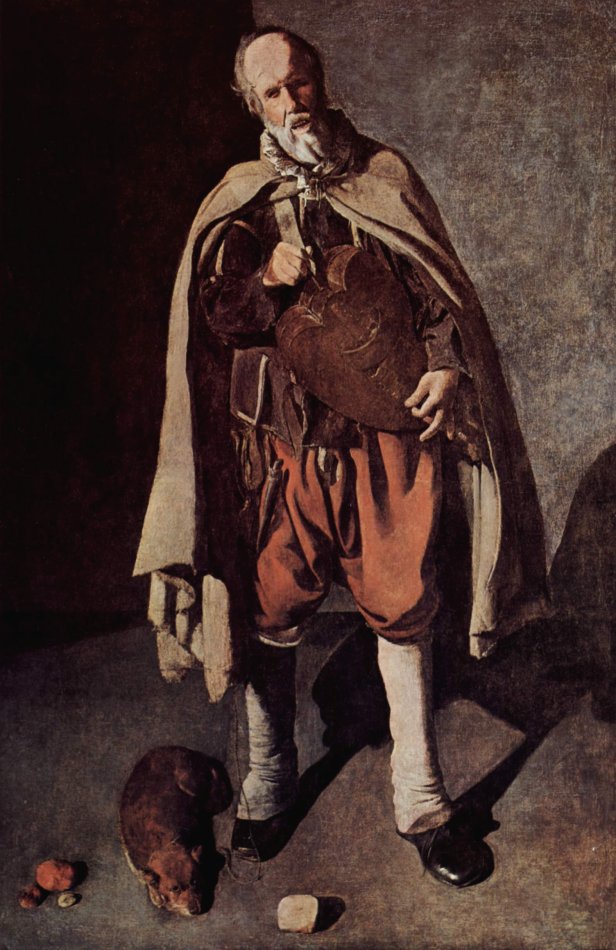
The Hurdy=Gurdy Man with a Dog by Georges de la Tour (1625)

Georges de la Tour was baptized in March 1593 in Vic-sur-Seille in Lorraine.  He was the second of seven children, born into a family of bakers.  Following a fire started by French troops during the Thirty Years’ War, his home, his studio, and some of his works were destroyed and he and some of his family escaped to Nancy.  A year later la Tour was appointed “First Painter to the King” by Louis XIII and as such, he lived in the Louvre and was officially recognized by the court and the Parisian artistic community.   At the height of his career, he painted for many prestigious patrons such as Cardinal Richelieu and the Dukes of Lorraine and became one of the wealthiest painters of his time.
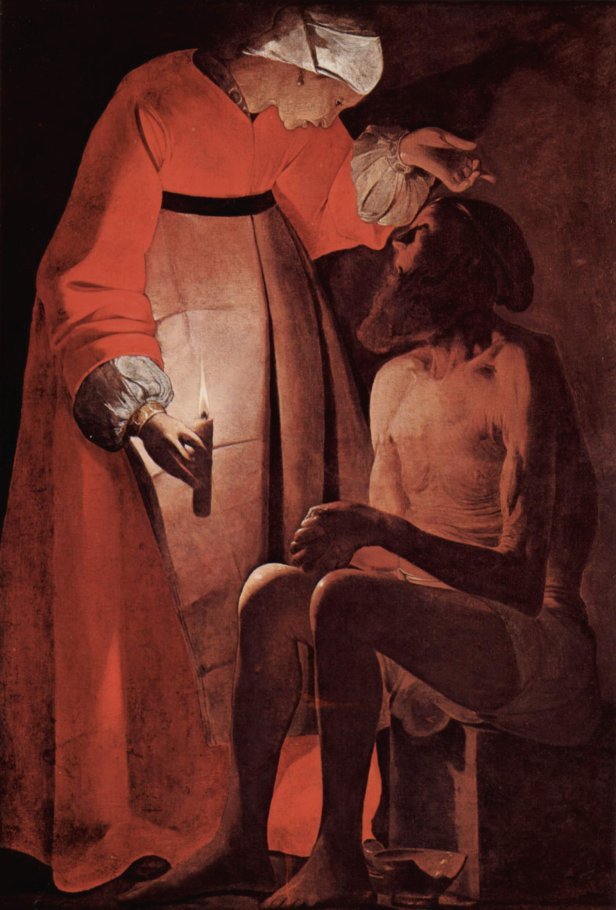
Job Mocked by his Wife by Georges de la Tour (1635)

As can be seen in his paintings, Georges de La Tour was influenced by the Italian painter Caravaggio whose style was then spreading throughout Europe. It is not thought that de la Tour ever travelled to Italy but he was probably influenced by Dutch and Lorraine Caravaggism.  De la Tour developed a personal and daring interpretation of chiaroscuro that made him truly original. His paintings are notable for their realism and sober compositions, which contrast with the dramatic intensity of Italian Caravaggist works. Although de la Tour’s work used the technique of chiaroscuro  his style is of painting is often alluded to as tenebrism.  Tenebrism, which comes from the Italian word tenebroso meaning dark, gloomy, mysterious and is a style of painting using especially pronounced chiaroscuro, where there are violent contrasts of light and dark, and where darkness becomes a dominating feature of the image. This technique was developed to add drama to an image through a spotlight effect and is common in Baroque paintings. Tenebrism is used only to obtain a dramatic impact while chiaroscuro is a broader term, also covering the use of less extreme contrasts of light to enhance the illusion of three-dimensionality.

St Peter Repentent by Georges de la Tour (1645)

The pamphlet that went with the exhibition describes the painting of St Peter as:

“…The celebrated St Peter Repentent exemplifies this sober style, in which lightbecomes the principal sign of the divine. The visual rhyme between the saint’s tonsureand the rooster’s crest introduces a discreet irony, a singular perspective on religious iconography…”

The painting is based on the Bible story of Jesus’s arrest on the night of the Last Supper, when the apostle Peter denied knowing him. Although Christ forgave his betrayal, Peter was consumed by guilt. In his painting, La Tour represents Peter as an old man, reflecting on his past actions in a state of perpetual repentance. The apostle’s red-rimmed eyes and the uncertain light of the lantern evoke the feeling that the Peter has spent anxious sleepless nights and the use of muted colours and simple forms give visual expression to Peter’s solemn and dejected emotions.
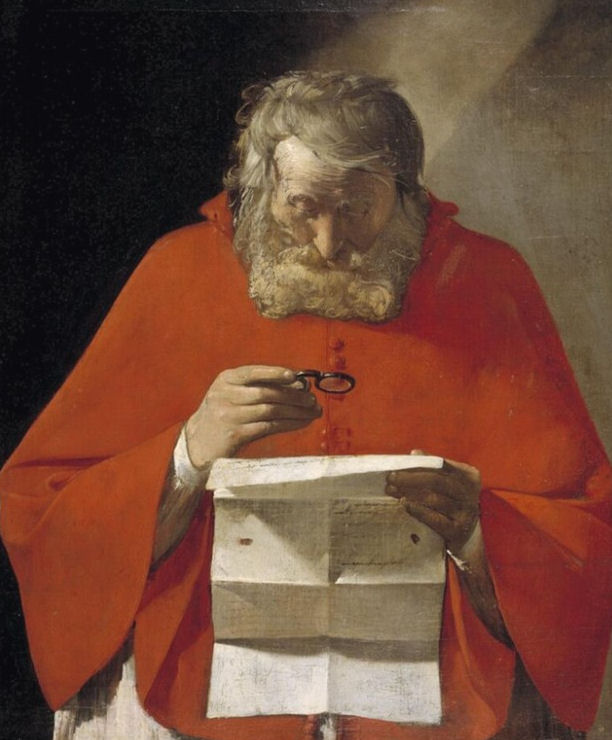
St Gerome Reading a Letter by Georges de la Tour (1629)

The painting by Georges de la Tour’s Saint Jerome Reading a Letter was completed around 1629 and is a masterclass in how to make a single, ordinary action, in this case, reading, carry the weight of a whole life. St Jerome was an early Christian priest, confessor, theologian, translator and historian and his image fills the frame at half-length, wrapped in a cardinal-red mantle.  His head bends slightly forward, and a wisped halo of grey hair catches the light that slants in from the upper right in a wedge-like form.  In his left hand, Jerome holds a creased sheet of paper and in his right hand, he lifts a small pair of spectacles toward the page, trying to focus on the written words.
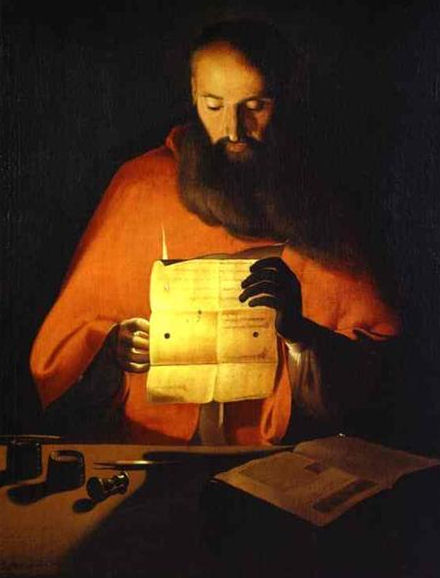
St Jerome Reading by Georges de la Tour (1650)

Georges de La Tour is best known for his religious paintings, which are instilled with extraordinary spiritual intensity despite the look of simplicity. In complete contrast to the religious works, de la Tour was interested in scenes of games of cards and dice as well as genre scenes. His interest in depicting card players and card cheats can be seen in two versions he made two years apart.

The Cheat with the Ace of Clubs by Georges de la Tour ( 1630–1634)

The earlier version is one of two versions of the composition by de la Tour and is known as The Cheat with the Ace of Clubs.   There are a number of variations in details of colour, clothing, and accessories between the two paintings.  This one is now hanging in the Kimbell Art Museum in Fort Worth, Texas.
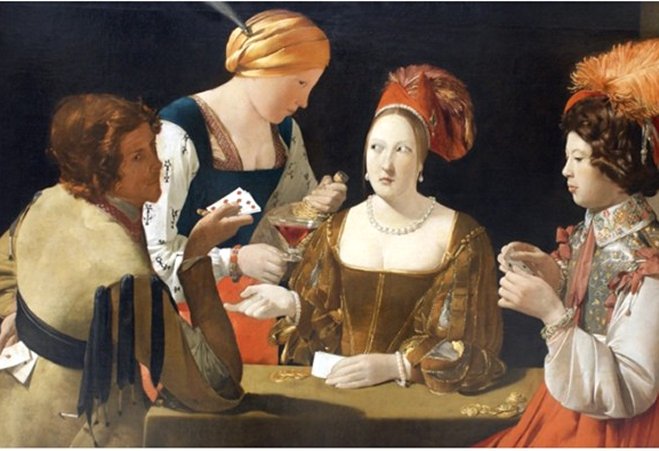
The Card Sharp with the Ace of Diamonds by Georges de la Tour (1636-38)

The work, the later variation, depicts a card game in which the wealthy young man on the right is being cheated of his money by the other players, who both appear to be part of the scheme. The card sharp on the left is in the process of retrieving the ace of diamonds from behind his back.

The Dice Players by Georges de la Tour (1651)

De la Tour’s painting entitled The Dice Players is a genre painting which he completed in 1651.  In the work he depicts a group of five figures who are deeply absorbed in their game with dice. Their intimate gathering around a table, illuminated by a single, subtle light source, is a good example of his tenebrism-style that emphasizes dramatic contrasts between light and dark. Look how each figure has a different facial expression as we see them all concentrating on the game.  Besides this, look at how the artist has depicted details of their period clothes and he has created, through the dim, atmospheric lighting, a vivid record of 17th-century life, and a sense of realism to the scene. De la Tour has used a sombre palette and the careful attention to textural details highlights the gravity of the moment.
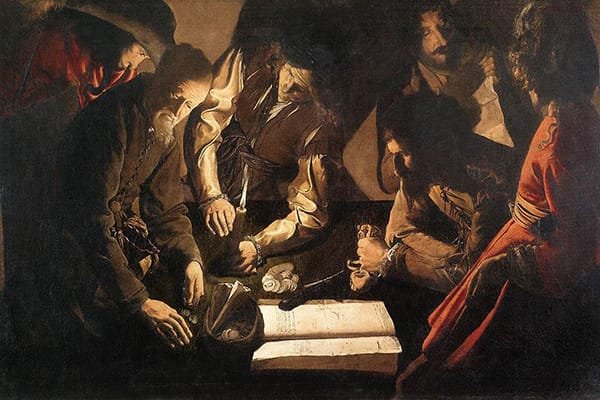
Payment of Taxes by Georges de la Tour (1620)

The painting entitled Payment of Taxes by Georges de La Tour was completed around 1620. Once again it highlights la Tour’s love of the artistic movement known as Tenebrism which is characterized by dramatic illumination and stark contrasts between light and dark. It is a large painting measuring 152 by 99 centimetres. The painting depicts a group of figures huddled together around a table. The depiction is dramatically lit by a single, stark light source, casting deep shadows and creating a profound sense of volume and space. This light appears to emanate from a candle or lantern which is out of view, highlighted by the reflective surfaces and illuminating select portions of the figures and objects. The men gathered around the table are engaged in an exchange, with a distinct focus on the act of counting or possibly exchanging money. The artist has focused their expressions and their hands and that emphasizes the gravity and concentration of the transaction at hand. The use of light and shadow not only gives the scene an emotional feeling but it also guides the viewer’s gaze through the composition, emphasizing the movement of money encapsulated in this painting.

Peasant Couple Eating by Georges de la Tour (c.1620)

Georges de la Tour’s painting entitled Peasant Couple Eating was completed around 1623, at the early part of his artistic career.   The two half-length figures which are almost life-size are tightly framed in the pictorial space.  They face us as if we have interrupted them during their meagre meal of dried peas.  The man exhibits a sour and resentful look as he looks down.  The woman stares fixedly at us with her deep-set almost dead eyes as she raises a spoon to her mouth.  As the background is a simple grey, we have no idea where the event is taking place.  However, this background enhances the old couple.  The painting of half-length figures like this one was a characteristic of Caravaggio’s style, an artist who influenced de la Tour in his early works.  This painting proved very popular and there are records of three 17th century copies.

In the book, Georges de la Tour of Lorraine, 1593-1652, by Furness, the author wrote of the artist:

“……Georges de la Tour is classed as a realist.  Realist he is in that his subjects, predominantly if not exclusively religious, are represented in terms of “real” life, often the life of his own country-town and surroundings in Lorraine.  But he avoided naturalism; rather, he chose to simplify, modelling his forms by marked contrasts of light and shade, and using large volumes and severe lines, with great selective economy of detail…”


Some of the paintings shown in this blog were not at the exhibition but I wanted to show you more of la Tour’s work.

Did I enjoy the exhibition ? The painting were excellent. However, for me the downside was two-fold. Firstly the rooms displaying the paintings were overcrowded (and this was a timed-enterance exhibition). Some people were moving clockwise whilst others moved anticlockwise and it felt slightly claustrophobic. Secondly all the paintings were accompanied by a card describing the work but they were all in French, rather bilingually. My love of visiting art museums is to buy a book with regards the exhibition and in this case a book about the actual museum itself and the works of the artist were on sale in many languages but none in English.. Brexit ???

I recommend you to the gallery website:

Musée Jacquemart-André | Museum in Paris

Luigi Loir

The painter of Parisian boulevards.

Luigi Loir

My featured artist today lived in Paris during the Belle Epoch. The Belle Epoch was that period in time in France, between the end of the Franco-Prussian War of 1871 and the start of World War I in 1914. The term Belle Epoch is obviously a retrospective term as it is used to describe a time of optimism, peace and, for some, prosperity. I say “for some” as Paris was then both the richest and poorest city in France. A study of people living Paris in the early 1820’s deduced that just over a quarter of Parisians were upper- or middle-class while three-quarters were termed impoverished. Although this may seem a terrible disenfranchisement of the majority of Parisians, the comparative situation at that time in New York, known as the Gilded Age, showed that the wealthiest two per cent of American households owned more than a third of the nation’s wealth, and the top ten per cent of the population actually owned roughly three quarters of the city’s wealth.

Baron Haussmann and Napoleon III make official the annexation of eleven communes around Paris to the City. Painting by Adolphe Yvon

The artist I am showcasing today is Luigi Loir, or to give him his full name, Luigi Aloys-Francois-Joseph Loir. He was to become famous for his paintings depicting contemporary Paris, a city which had been extensively renovated. The renovation began around 1852 and lasted almost twenty years. Baron Haussmann, who was the Prefect of the Seine, was tasked by Napoleon III to carry out a massive urban renewal program of new boulevards, parks and public works in Paris and was looked upon as Haussmann’s renovation of Paris. The programme of public works Haussmann set about saw him arrange for the chaotic maze of tiny streets with their poor sanitation being bulldozed and replaced by wide, straight, tree-lined avenues, which connected the rail terminals and allowed for rapid and easy movement across the city possible for the first time.

Curinier in his 1899 Dictionnaire National Des Contemporains (National dictionary of present-day people) wrote of Luigi Loir:

“…One can say of this master that he created a genre: the “parisianism”…he is, in effect, the painter of Paris par excellence ; no different aspects of the city, often momentary and fleeting, and none of his successive transformations, is of any secret to him. The vigour of his colours, as well as in the brilliance of his mornings and of his afternoon sun, such as the mists of his twilights, is of a correct observation, that still enhances the conscientious study of the environment…”

Luigi Aloys-Francois-Joseph Loir was born on January 22nd, 1845 in Gorritz, Austria. His parents, of French origin, were Tancrède Loir François and Thérèse Leban. His family lived in Austria as employees of the French royal family, the Bourbons. His father was a valet while his mother was a governess and Luigi’s first two years were spent living at Gorritz Castle. In 1847, Luigi’s family along with the Bourbon family left Gorritz and moved into exile to the Duchy of Parma.

Paris, Morning by Luigi Loir (1890)

All was well for the Bourbon household in Parma until 1859 when the Bourbons were driven out by a revolution following the French and Sardinian victory in the war against Austria. The following year, the Luigi’s family, including his sister, returned to France but he remained in Parma and began studying painting and enrolled at the city’s Academy of Fine Arts in 1853. His artistic studies at the Academy came abruptly to an end in 1863 when news from Paris reached him of his father’s failing health. He immediately set off for Paris. For this eighteen-year-old it was his first time in the French capital and it was Baron Haussmann’s Paris that would inspire his scenes for the rest of his career. In 1865, he made his debut at the Paris Salon with his first notable work, a view of Villiers-sur-Seine that received very high praise. He continued to exhibit at the Salon, receiving multiple awards there, throughout his life.

Paris with Snow by Luigi Loir (1889)

Luigi Loir soon came under the influence of the artist Jean-Aimable Amédée Pastelot who became his primary art tutor. Pastelot, was a painter who concentrated on depicting characters from the Comédie delle’art, flowers and genre paintings in watercolour and gouache. He also produced many illustrations for caricature journals which were very popular during this period.

Jean Pastelot c. 1865

It was whilst working in Pastelot’s studio that Loir began experimenting with his art and trained to become a muralist. One of Loir’s first mural commissions was to paint the wall and ceiling friezes at the Châteaux du Diable (the Devil’s House), a bourgeois mansion in Bordeaux, in 1866.  Loir experimented in various media; mainly oils, watercolour and lithographs, and would also try out different art forms ranging from decoration, theatrical costumes, and illustrations for novels and gained a lot of artistic knowledge during his time with Pastelot.

Porte St Martin At Christmas Time In Paris by Luigi Loir (c.1889)

Luigi Loir was not just a painter. He was probably more known for his hundreds of graphic designs for commercial advertisements, book and music illustrations, menus. He also created numerous designs and theatrical decorations. Loir was recognized as being a very talented graphic artist, and received many commissions for his work, such to design the official exhibition cover of the 1900 Exposition Universelle in Paris. It was around this time that print had been recognised as a genuine art form. Luigi Loir transformed the art of the poster.

Le Boulevard sous la Pluie by Luigi Loir (1889)

Luigi Loir’s awards were numerous. In 1898 he was made Chevalier de la Legion d’Honneur. He was also a member of the Société de Peintres-Lithographes, member of the Société des Aquarellistes, and a member of the Jury of the Société des Artists Français and of the Société des Arts Décoratifs since 1899. His artwork can be seen in galleries around the world.

Bond of the B.Sirven Co. issued May 14th 1901. Illustration by Luigi Loir

Charles Baudelaire, the Author of Modernism, once said that artists should represent the contemporary environment and there is no doubt that Luigi Loir embraced Baudelaire’s call. Looking at Loir’s style it is easy to note that he was interested in Impressionism and yet his work reflected that of many Naturalist painters. He designed some of the packaging for the famous LU French biscuit company and also illustrated a bond of the company B. Sirven, which was issued 14. May 14th 1901.

Boulevard Haussmann, Paris by Luigi Loir

Loir was entranced by the Parisian street scene which had been transformed by Haussmann’s mission to reshape the Parisian landscape transforming it from a labyrinthine network of dark and dingy narrow medieval streets, into the complex order of grand boulevards.

Evening in Paris by Luigi Loir

Loir must have taken from Pastelot an interest in capturing figural qualities, but Loir invested this type of training instead into his own synthesis of figures and landscape to produce the natural replication of the activity along the Parisian streets. This interest in the Parisian street scene was influenced, however, by another transformation that had entirely reshaped the Parisian landscape and how Parisians spent their leisure time. Beginning in the 1850s, Baron Georges Haussmann undertook an enormous project that changed Paris, from a labyrinthine maze of medieval streets, into the complex order of grands boulevards. For Loir, the streets themselves became the centre of activity – whether it be the bohemian centre of Montmartre or the upper-class promenades of the leisure class. Loir spent hours each day walking the streets in search of inspiration, all the time, studying them and the Parisians who populated them.

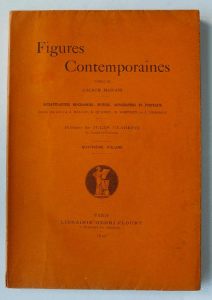
In one of the volumes of Figures Contemporaines: Tirées De L’album Mariani, illustrated biographies of famous contemporary characters from 1894 to 1925, Luigi Loir’s relationship with Paris as depicted in his art was explained:

“… he understands the sites; he likes the twilights in them; he studies all of their aspects. His canvases give off the reflection of a faithful mirage, of a conscientious study of urban nature. There is a dilettantism of a stroller and the contemplation of a poet in him. One feels that all of his impressions are real and that he only paints them while under a spell. His interest in the urban cityscape is perhaps more complex than a simple depiction of Paris and its inhabitants. Lori’s sincere reflections on the changing effects of both the different times of day and the weather, show the aesthetic reflection put into his paintings…”

Sortant De La Madeleine, Paris by Jean Béraud

Luigi Loir was not alone when it came to depicting life in Paris. A contemporary of his was the Russian-born Frenchman, Jean Béraud. Jean Béraud was known for his depictions of the changing face of Paris and the nightlife during the Belle Époque. He, like Loir, was captivated with modern life in Paris, especially after the major infrastructure project of what was termed, Haussmannisation, named for Georges-Eugène Haussmann, the prefect chosen to lead the urban renewal project. Béraud painted the newly widened boulevards, the new transportation systems and the intermingling of people from a wide array of social spheres. However, the scenes Béraud and Loir produced were different. Loir was more interested in depicting the environment whereas Béraud wanted to depict the people. In C.-E. Curinier, Dictionnaire Nationale des Contemporains, the difference between the two painters was succinctly put:

“…It is Béraud who paints the Parisians of Paris, but Loir who paints the Paris of the Parisians…”

The Quay of the Seine, Paris by Luigi Loir

In Loir’s depiction of Paris scenes his attention is not given to individual details so much as light and atmosphere

In 1870, Loir was commissioned into the military to record the battles of Bourget, part of the siege of Paris during the Franco-Prussian War. Loir concentrated exclusively on painting views of Paris. In these works, Loir caught and expressed the many faces of Paris, at all hours of the day and during different seasons. It was because of his work during this campaign of 1870, that Loir was elected to be the official painter of the Boulevards of Paris. This boosted his career and reputation. In 1879 in was awarded the Bronze medal from the Exposant Fidele des Artistes Francais. Loir was also elected into the Legion of Honor in 1898.

Luigi Aloys-François-Joseph Loir died in his beloved Paris on February 9th 1916 aged 70.

Eugène Galien-Lalou – the painter of Paris

Eugene Galien-Lalou (1920)
Eugène Galien-Laloue (1920)

La Belle Époque, which literally means “Beautiful Age” is a name given in France to the period from the end of the Franco-Prussian War in 1871 and the start of World War I in 1914. So why was this termed a beautiful age?   Probably the reason for naming this period thus was because, for the middle and upper classes in France, the standards of living and security increased in comparison with the dark days that went before.  The devastation and death toll of the Franco-Prussian War and the short-lived but bloody battles of the Paris Commune were over.  Napoleon III’s period of power had ended and a Third Republic was declared.  It was a period free of wars affecting France.  It was a period of economic affluence and an era of many new innovations both cultural and technological.  For many it was a good time which needed to be savoured.  My artist today is one who lived and painted during this time and his Parisian street scenes of the time depicted an opulence which many, but the poorer classes, could enjoy. Let me introduce you to the French painter Eugène Galien-Laloue.  He was a consummate draughtsman.  His depictions of fin-de-siècle Paris architecture was of an amazing standard and yet he was not just a cityscape painter as he was equally adept with his landscape work in which he brought to life the rural French countryside.

Paris Street in Autumn by Eugene Galien-Lalou
Paris Street in Autumn by Eugène Galien-Lalou

In his tiny gouaches Galien-Laloue rendered every detail of fin-de-siècle Parisian architecture with absolute precision, but in his landscape works he was more attuned to the painterly tradition of the Barbizon School and the Impressionists, recording life in the rural French countryside in light-filled canvasses.  Galien-Laloue painted with great delicacy a wide variety of subjects.    Eugene

Un 14 Juillet, Place de la Republique by Eugène Galien-Lalou

Eugène Galien-Laloue was born in Montmartre, Paris, on December 11th 1854, almost a year after his father, Charles Laloue, an artist and set designer, married Eugène’s mother, Endoxi Lambert in December 1853.  Eugène was the eldest of nine children and the large family lived on Rue Leonie in the Montmartre, which at the time was an artistic community where many of the Parisian artists and freethinkers lived.  Eugène, even as a child, demonstrated his artistic ability and almost certainly his early training from his father, who liked to paint, and being a set designer was a talented draftsman.  Charles Laloue died suddenly in 1869 when Eugène was fifteen years old and the family, which only just made ends meet when he was alive, struggled to survive financially.  Eugène, was forced to leave school so that he could find work and help his family and his mother secured him a job as an assistant to a notary.

Place de Bastille by Eugène Galien-Laloue

In 1871, aged seventeen, filled with a sense of patriotism and nationalism, Eugène joined the army but to do so he had to lie about his age.  The war with Prussia was a short but deadly affair which France lost.  Fortunately, Eugène came through the bloody war unscathed and once the war ended he left the army and returned to civilian life.  His one aim in life was now to become a professional artist.  For an aspiring artist in Paris there was just one course one had to take to reach that ultimate goal.  One had to become a member of the prestigious L’Académie des Beaux-Arts, which was looked upon as the hub of the Parisian art world.  Some of the artists of this French Academy also served on the jury that selected paintings for the well-respected Salon de Peinture et de Sculpture, held at the Palais de l’Industrie on the Champs-Élysées, at which more than a thousand artists and sculptors had their works of art and sculptures displayed.  Unlike today there were only a small limited number of galleries where artists could show their work and so gaining access to the Salon was crucial for their success as painters and getting approval from the Salon hanging jurists was critical.

Flower Marketby by Eugène Galien-Laloue
Flower Market by by Eugène Galien-Laloue

In order to be nominated to the French Academy, an artist followed a well-tread course of instruction.  Students attended either the official school, the École des Beaux-Arts de Paris, or if they or their parents were affluent, received instruction in the private atelier of an established artist, often one who had connections with luminaries of the Salon.  Academic learning in the nineteenth century to become an artist was not an easy process.  The tuition was laborious albeit meticulous and it started off with the students learning draughtsmanship by copying engravings and sketching Roman and Greek sculpture, which was known as “working from the antique,” which translated, meant sketching black and white tonal studies from classical marble statuary or casts.  If the student had mastered that task, then the tutor would allow them to progress to the next phase of learning.  Advancement from one phase of instruction to another was based on the aspiring young artist mastering what they had been taught.  Progression was not based on an indiscriminate period of instruction.   They would then move on to drawing nude models using just graphite or charcoal.

Théatre de la Ville byby Eugène Galien-Laloue
Théâtre de la Ville by Eugène Galien-Laloue

Following several years of drawing the young artists would begin to paint.  This would be carried out under the direction of a time-honoured master and, when he believed his scholars to be ready, they would be allowed to submit their work to the Salon.  Having been trained by an established and well-respected painter would count for a great deal with the Salon’s jurists.  Not only did the jurists control which paintings would be exhibited they also decided on the placement of the paintings on the monumental and crowded wall of works.  A good placing of an artist’s painting (at eye level) ensured that they would be noticed by the buying public.  In the days of Eugène Galien-Laloue the Academy favoured large figurative works and looked on painting landscapes as a mere hobby one did when holidaying in the many artist colonies!

Illustrated railway poster of the time

Records do not show whether Eugène attended the Academie des Beaux-Arts or any other academy, such as L’Academie Julian but when one of his works appeared at the Salon it was noted in the catalogue that he was artistically trained by his uncle, Charles Laloue, but of course this was also the name of his father, so maybe there was some confusion as to who did train Eugène.  In life, everybody needs a good break, a stroke of luck, and for Eugène it was the seemingly unbounded industrial enlargement of La Belle Epoque and one aspect of this was rapidly developing rail network which was growing westward from Paris. Eugène was hired as an illustrator for the French railways, the Chemins de Fer de l’Ouest.  The Compaigne de l’Ouest was formed in 1855 through the merger of several smaller railways operating in the western suburbs of Paris, largely serving Normandy and Brittany. Destinations served included London and Jersey (through ports in Normandy and Brittany), as well as Rouen, Dieppe, Saint-Germain, Mont St. Michel, Mers-les-Bains, Treport, and other outlying places.   Illustrators, like Eugene, were employed to illustrate the sights that awaited passengers on their rail journeys and these were used to seduce potential passengers to find out more about what lay at the end of the line.  To carry out his job as a railway company illustrator Eugène had to travel to all these “exotic” places out West and sketch the rural landscape along the way.

En Normandie by Eugène Galien-Laloue

Eugene exhibited his work for the first time in 1876 at the Museum of Reims, where his work Le quai aux fleurs par la neige (Flower Market Along the Seine Under the Snow) was shown. The following year he exhibited for the first time at the annual Parisian Salon, showing En Normandie (In Normandy) as well as two other gouaches. He preferred executing gouaches since they were less time consuming as his oils and, in fact,  brought comparable prices.

Harbour Scene by Eugène Galien-Lalou

After some time, Eugène Galien-Laloue decided to become self-employed and set himself up in his own Paris studio in rue de Clignancourt.  He spent a lot of his time alone which did not seem to bother him.  Acquaintances described him as a loner, an introvert, who was never happier than when he was working alone in his studio or sitting quietly managing his business.  Modern city life with all its gaiety did not appeal to him.  Maybe he became somewhat crotchety as it was said of him that he was a loner and someone who did not suffer fools gladly, and because of this characteristic people found it very difficult to befriend him.

The French Art Expert, Noe Willer, who was author of Galien-Laloue’s catalogue raisonné wrote of this aspect of Galien-Laloue’s character:

“…He was not eccentric but always conservative, practically a royalist.  He was obsessed with his painting.  In his private life he found simplicity alluring: he married three sisters, one after the other (beginning with the youngest and ending with the oldest).  They had all lived next door to him.  He lived a monastic life.  All worldly pursuits, games, alcohol, the pleasure of the flesh were not for him. Riding his bicycle to places in Paris to paint was his only physical exercise…”

View of the Grands Boulevards by Eugène Galien-Lalou

The cityscape of Paris was changing rapidly during Eugène Galien-Laloue lifetime.  It all began around the 1830’s when Parisians were complaining about the condition of their city.  The city was overcrowded.   The streets with their open sewers were narrow and dark.  Paris had become a very dangerous and unhealthy environment to live in and the people were not happy with the government.  A whiff of revolution was once again in the air.  Tampering with the problem was not helping and so Napoleon III, in 1854, and his interior minister brought in Georges Eugène Haussmann, known as Baron Haussmann, to oversee the “rebuilding” of the city.  He had the slums torn down and the narrow streets were turned into wide avenues.  Large parks were created as were small villages on the periphery of the city.  A new theatre was built and the Paris Garnier opera house was completed in 1875.  The cit,y after many years of change, became a desirable place to live and it was this revitalisation of Paris which became the subject of the many Belle Epoque artists such as Eugène Galien-Laloue.

Summer Landscape with River by Eugène Galien-Laloue

These Belle Epoque artists were pleased to depict the reality of the newly refurbished French capital with its cafés, parks and buildings.   More importantly this now beautiful city was a magnet to tourists, visitors from Great Britain and the United States came to Paris while they were partaking of the “Grand Tour” and  Galien-Laloue had a ready market for his work which concentrated on depictions of the city.  These depictions were just the treasured mementos the American tourists wanted to take home with them for it is known that many of Galien-Lalou’s cityscapes made their way across the Atlantic and into the collections of wealthy Americans from New York, Boston and Chicago.

La Madeleine sous la neige by Eugene Galien-Laloue
La Madeleine sous la neige by Eugène Galien-Laloue

One of Galien-Laloue’s favourite subjects was, L’église Sainte-Marie-Madeleine; less formally known as La Madeleine.  This Roman Catholic church, looking more like a Roman temple, occupies a commanding position in the 8th arrondissement of Paris and was originally designed as a temple to the glory of Napoleon’s army.  Galien-Lalou depicted the building and the area surrounding it in both summer with the flower markets brightening up the grey buildings and in winter with snow on the ground and people rushing to get to the warmth of their destinations.

River in Normandy by Eugène Galien-Laloue

In complete contrast, many people, who moved from the countryside in search of work and went to live in the bustling and noisy city, hankered after a more tranquil life in the countryside they had left behind and wished to be reminded of their rural idyll of the past.  Paintings depicting rural landscapes became popular and Galien-Laloue and the Barbizon painters of the time filled the void in the market for those people who wanted a landscape painting to remind them of the peaceful serenity of nature they had left behind.  Galien-Laloue had cornered both markets – Parisian street scenes and his rural landscape works which he made when he journeyed around the roads and villages of the Ile-de-France Region and the riverside views along the tree-lined banks of the rivers Seine and Marne.

In the early 1900’s Eugène and his family left the city of Paris and went to live at Fontainebleau, a town fifty kilometres south east of Paris which is surrounded by a large and scenic forest.  Eugène now fifty years of age was probably drawn to this area because of its beautiful and quiet environ and the slower pace of life such an idyll afforded.

Snow Scene in Paris by Eugène Galien-Lalou

In 1904 he once again put forward a painting which was exhibited at that year’s Salon.  It had been fifteen years since Galien-Laloue had exhibited at the annual Salon due partly to the politics of the Salon and maybe because his sales were so good that he no longer needed the Salon to be a sales vehicle. World War I broke out in August 1914 and the ever-patriotic Galien-Laloue put himself forward to fight for his country but, at that time, he was sixty years of age and he was considered too old for military duty.

Eugène Galien-Laloue married three times which in itself is not unusual but the extraordinary thing was that his three wives were sisters.  He married Flore Bardin in the 1880’s and they had one child, a son, Fernand.  She died in 1887 and five years later he married her elder sister Ernestine.  This second marriage lasted thirty-three years until she died in 1925.  They had a daughter Flore.  A short time after the death of his second wife he married for a third time this time to another of the Bardin sisters, Claire.  Claire died in 1933 and Eugène, now almost eighty years of age, moved back to Paris to live with his daughter Flore, her husband and his grandchildren.

Sortie La Théatre by Eugene Galien-Laloue
Sortie La Théâtre by Eugène Galien-Laloue

Galien-Laloue never stopped painting but his output of pictures decreased.  Despite living with his family, he became even more introverted and lived a rather solitude lifestyle.  When the German army moved towards Paris in 1940, the family left their city home and went to their summer residence in their country at Chérence in Val d’Oise.  During this flight from the French capital Eugène broke his arm which curtailed his ability to paint.

Eugène Galien-Laloue died at Chérence on April 18th 1941, aged 86.

Many of his paintings also bore other names such as “L.Dupuy”, “Juliany”, “E.Galiany”, “Lievin” and “Dumoutier”.  The reason for this is thought to be that he had a sales exclusivity contract with certain galleries that gave them the exclusive right to sell all his works and so to get around this he may have decided to sell some of his works under a different name !   So why those pseudonyms?   J. Lievin’ was the name of a soldier he met during the Franco-Prussian war, ‘E. Galiany’ is an Italianized version of his own names, and ‘L. Dupuy’ was the name of a neighbour, Dupuy Léon.  Although he signed the paintings, very few of them showed a date and art historians have found it difficult to actually date them.