
When talking about American Urban Realism in art one thinks of The Ashcan School, which was an artistic movement in America during the late 19th and early 20th century. The name given to the group originated from a criticism written in the graphically pioneering American magazine of socialist politics, The Masses, in March 1916 by the cartoonist Art Young, who asserted that there were too many “pictures of ashcans and girls hitching up their skirts on Horatio Street.” The artists associated with this school of painting that produced works portraying scenes of daily life in New York, especially in the city’s poorer neighbourhoods, were Robert Henri, George Luks, William James Glackens, Everett Shinn, George Bellows and John Sloan.
Today I want to look at another group of American realist painters who were also based in New York city and who also focused on everyday life in the city. For them it was all about the bustling area which centred around 14th Street and around Union Square in Lower Manhattan during the Depression era. During the 1920s and the 1930s, these artists continued the tradition established by the Ashcan School. They became known as the Fourteenth Street School of Artists. This group of painters were inspired by the legacy of the Ashcan School artists who depicted urban life and this new group established studios in the Fourteenth Street area and were inspired by the crowds that would daily swamp the nearby streets.
Reginald Marsh

Reginald Marsh sketching on 14th Street, New York, 1941.
The first of the artists of the Fourteenth Street School I am looking at is Reginald Marsh. He was born on March 14th, 1898, in an apartment in Paris above the Café du Dome. He was the second son born to American parents who were both artists. His father was Frederick Dana Marsh, who attended the School of the Art Institute of Chicago, where he worked with artists preparing murals for the Chicago World’s Fair in 1893. He went to Paris where in 1895 he married Alice Randall, a fellow Chicago art student and miniature painter. Whilst living in Paris, the couple had two sons, James in 1896 and Reginald two years later. Reginald’s father was one of the earliest American painters to depict modern industrialisation in America. The family lived affluently due to Reginald’s paternal grandfather. James Marsh, who had made a fortune in the Chicago meat packing business.
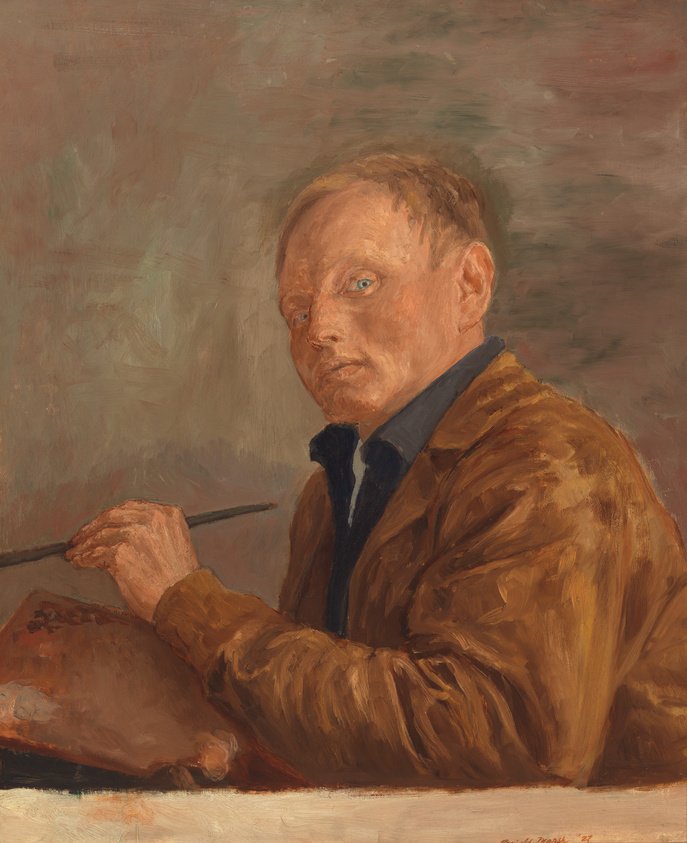
Self Portrait by Reginald Marsh (1927)
Reginald Marsh’s family moved to America in 1900 and relocated to Nutley, New Jersey where they set up a studio/home at No. 16 The Enclosure, a street that had been established as an artists’ colony some decades earlier by the American painter Frank Fowler, who had once owned their house. This resulted in Reginald being immersed in the world of art and painters who nurtured his love of painting and sketching. It was not just that art could be a good outlet for the teenager but it helped him to socialise with others and as he was a somewhat introverted and often tongue-tied boy, and so this was a bonus.
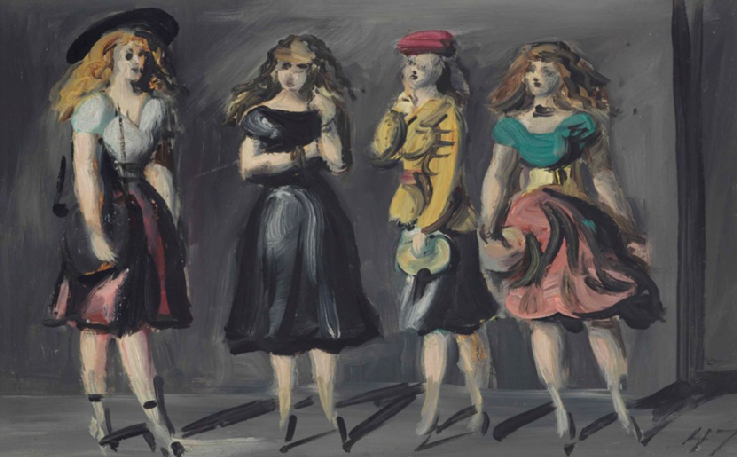
Four Women by Reginald Marsh (1947)
In 1914, the family moved to New Rochelle, in New York State. The family went on to buy an estate in Woodstock, New York, where they spent most of their summers. Reginald Marsh attended various schools including the Riverview Military Academy in Poughkeepsie and the Lawrenceville Preparatory School in New Jersey. After graduating from high school he enrolled at the Yale School of Art, the art school of Yale University, where he made a name for himself as an illustrator and cartoonist for the Art School’s humour magazine, The Yale Record

Figures on the Beach by Reginald Marsh (1921)
After graduating from Yale in 1920, Marsh re-located to New York, where, in 1922, he enrolled for a short period at the Art Students League. It was while studying art at this establishment that he gained a great deal of experience in painting and drawing from his skilled tutors, especially Kenneth Hayes Miller, an American painter and printmaker. Whilst at the Art Student League he became friends with fellow artist, Betty Burroughs. Their relationship grew and twelve months later, the couple married and as Betty’s father, Bryson Burroughs, was a curator at the Metropolitan Museum of Art he was able to introduce his son-in-law to important figures in the art world. Reginald Marsh was now the family’s breadwinner, and so he began painting seriously.
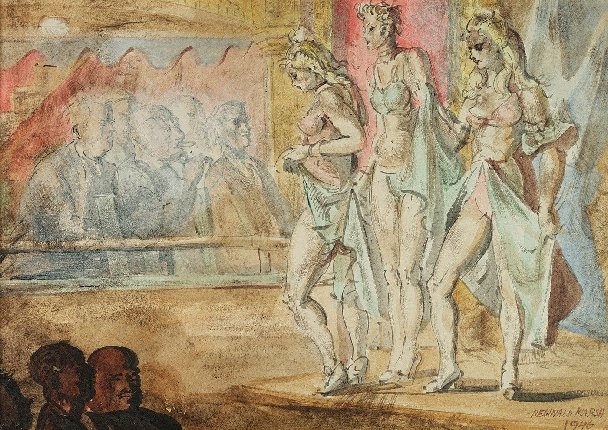
Burlesque by Reginald Marsh


Gaiety Burlesque by Reginald Marsh (1930)
Once Marsh had graduated from Yale School of Art he moved to New York in his search for employment as a freelance illustrator. His first opportunity came when the New York Daily News commissioned him to produce depictions of vaudeville and burlesque performers. Burlesque and vaudeville shows were at the height of their popularity and Marsh’s depictions of burlesque dancers, chorus girls and strippers. Although some people often criticised them for their raunchiness and vulgarity, others were delighted by the comedy and satire emanating from his portrayals. In Edward Laning’s 1973 book, The Sketchbooks of Reginald Marsh, he described burlesque as:
“… the theater of the common man; it expressed the humor, and fantasies of the poor, the old, and the ill-favored…”
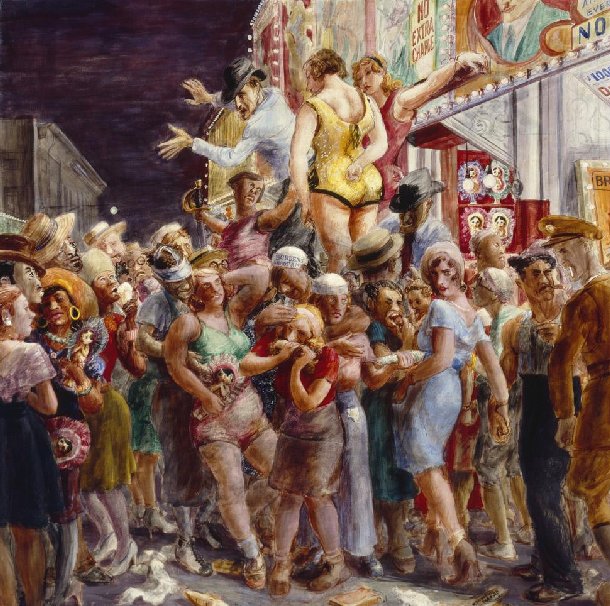
Wonderland Circus, Sideshow Coney Island by Reginald Marsh (1930)

Coney Island by Reginald Marsh (1933)
Mrsh’s job as a staff artist for the New York Daily News gave him the opportunity to explore the underbelly of society: He would wander the streets of Lower Manhattan, and gain inspiration from the burlesque shows along Bowery Street, the storefront windows and advertisements, and the beaches of Coney Island. Marsh also captured the throngs of theatre goers at these shows or outside the theatres and side-shows.
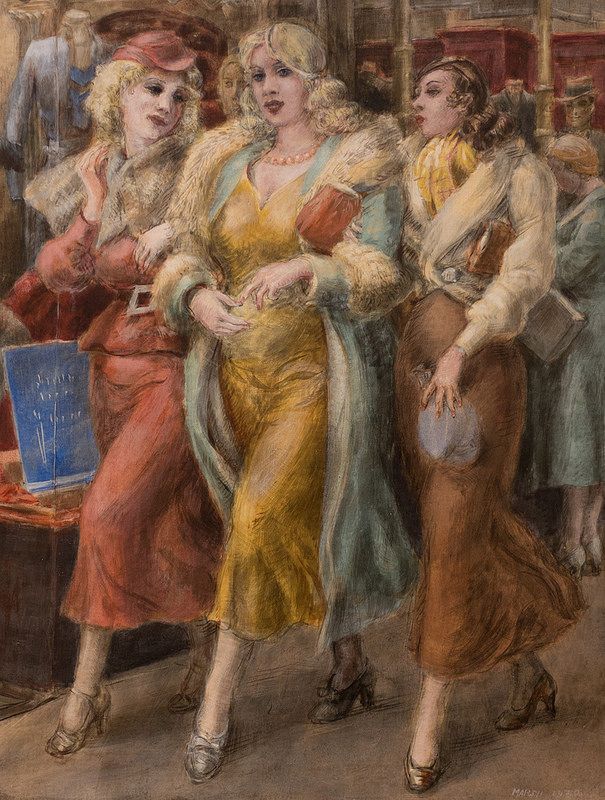

Ten Cents a Dance by Reginald Marsh
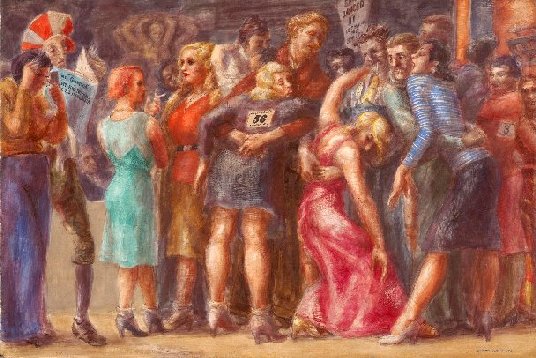
Zeke Youngblood’s Dance Marathon by Reginald Marsh (1932)
And there was the ever-popular but brutal Dance Marathons !
The New Deal was formulated by President Franklin Delano Roosevelt’s administration which came up with ideas on how to alleviate the suffering of those who had neither jobs nor any money to support themselves. For the artistic community, Roosevelt came up with a number of schemes such as the Public Works of Art Project, the Treasury Section of Painting and Sculpture and the Treasury Relief Art Project. The Federal Art Project (FAP), which was created in 1935 as part of the Work Progress Administration (WPA), was one which directly funded visual artists and provided posters for other agencies like the Social Security Administration and the National Park Service. The William Jefferson Clinton Federal Building in Washington DC, which is a complex of several historic buildings, one of which was originally called the New Post Office, was completed in 1934. It housed the headquarters of the Post Office Department. The Clinton Federal Building was one of the initial locations that integrated various New Deal artworks that were originally commissioned and displayed in federally constructed buildings by the Treasury Department Section of Fine Arts during the 1930s and 1940s. In 1936, Reginald Marsh completed two murals for the interior of the building.
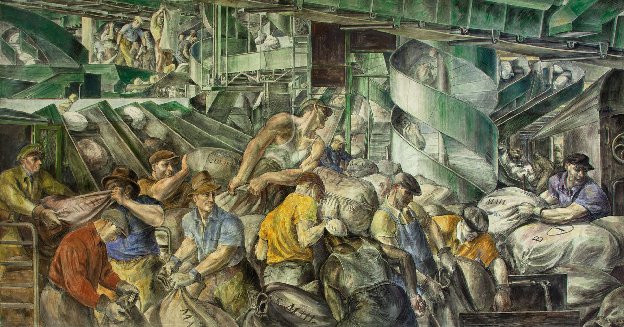
Sorting the Mail by Reginald Marsh (1936) This mural was for the Ariel Rios Federal Building, Washington, D.C.
In preparation for his mural, Sorting the Mail, Marsh completed a number of preliminary sketches of the railway mail service which was located under the old Penn Station in New York, as well as the New York post office department building. He observed the new and modern technology, talked to the postal workers and watched them unloading and sorting the mail. Marsh’s depiction conveys the feverish dynamism of the workers. We see swarthy-skinned muscular men lifting and lugging large bags of mail. The various skin tones of the men allude to it being a diverse workforce of differing nationalities

Unloading the Mail by Reginald Marsh (1936)
Marsh’s other mural Unloading the Mail was also completed in 1936. The depiction in this mural was all about the international movement of mail from country to country. Marsh visited the Cunard liner RMS Berengaria which had docked in New York harbour. The Cunard line vessel, as well as carrying passengers across the Atlantic, brought mail to America from Europe and further afield. He made many sketches of the ship itself but the mural depicts the activities that occurred in the harbour boat which was used to bring the mail from the liner ashore for distribution. To the left we can catch a glimpse of the Manhattan shoreline whilst to the right we can see the officers of the liner handing the sacks of mail to the crew of the harbour tender. At the bottom left of the painting we can see a man, seated, tallying the sacks of mail that had been offloaded from the liner.

The Bowery by Reginald Marsh (1930)
By 1930, Reginald Marsh’s career was well established and thanks to inheriting some money from his late grandfather was comfortably well-off. Despite his wealth Marsh began to focus his work on depicting those who were less fortunate. It was his poignant depictions of the poverty suffered by the lower classes during the Great Depression that featured in many of his works, such as his 1930 work entitled The Bowery. In this painting Marsh has depicted the plight of the people hit hard by being out of work and in some cases, homeless. The scene before us has been created using a brown palette. We see large groups of men, who had suffered financially due to the financial crash, loitering along Bowery Street underneath many neon signs advertising cheap hotel accommodation. Above and to the right we catch a glimpse of the Third Avenue overhead railway.
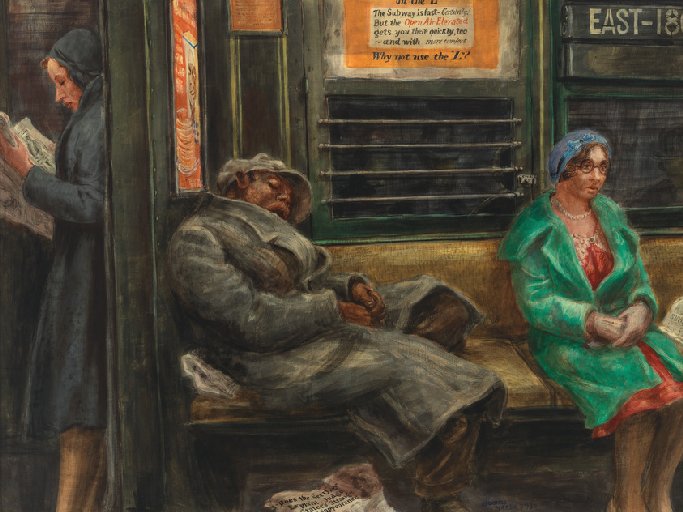
Why Not Use The L by Reginald Marsh (1930)
A fascinating painting with and equally fascinating title is Reginald Marsh’s 1930 work, Why Not Use the “L”. The “L”—or “el”, is an elevated train that rose above the city streets. The western end started at Eight Avenue and 14th Street, ran through Union Square to the opposite end of the line at Rockaway Parkway, Brooklyn. The painting depicts three people in the railway carriage during the Depression. The woman to the right looks out apprehensively whilst the man seems exhausted. A second women to the left seems oblivious to her surroundings as she reads the newspaper. There are a number of advertising posters attached to the wall of the carriage. Reginald Marsh had accurately copied the adverts into his sketch books and added them to his final work.

One such advert extols the joys of Buckwheat Pancakes while another asserts that this form of transport is the best, using the title of this painting:
“…The subway is fast—certainly! But the open Air Elevated gets you there quickly, too—and with more comfort. Why not use the “L”?…”
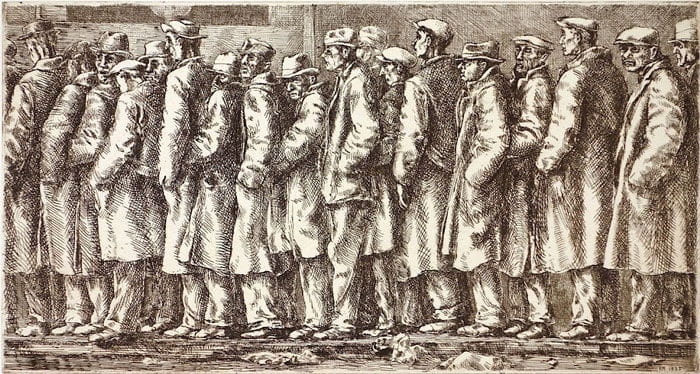
Bread Line – No One has Starved by Reginald Marsh (1932)
For my last offering of a Reginald Marsh work I am looking at his very poignant etching entitled Bread Line–No One Has Starved. He completed this in 1932, at the height of the Great American Depression. It depicts a line of destitute men as they stand waiting in resignation for some sort of public assistance. The men are crowded into the black and white depiction and there is little to differentiate them. It is a depiction that represents poverty in general rather than an individual’s poverty. Marsh favoured depictions of the poor and down-and-out people and dismissed depicting the affluent saying that well-bred people were no fun to paint.
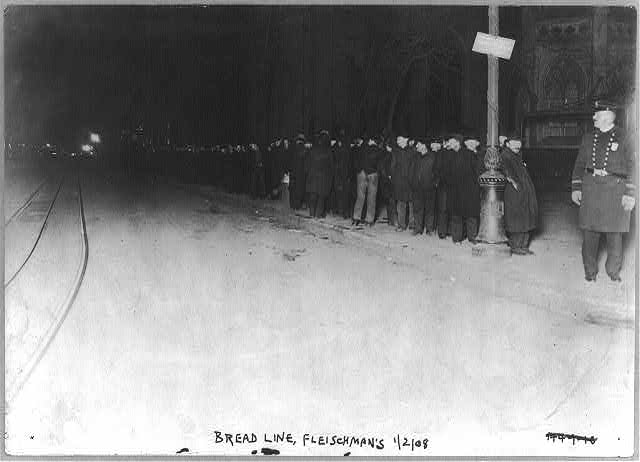
The Bread Line – the stark reality. Bowery men in bread line at Fleischman’s Restaurant, N.Y.C. – Thursday 2nd January 1908
By 1932, the unemployment figure in America had risen to unparalleled levels and President Herbert Hoover was forced to admit to a congressional committee that no one, not even the federal government, really knew how many people were unemployed. Nevertheless, President Hoover, who at the time was seeking re-election, insisted that the underlying conditions of the American economy were sound and that no one has starved, and this phrase was incorporated into the title of Marsh’s p[ainting.
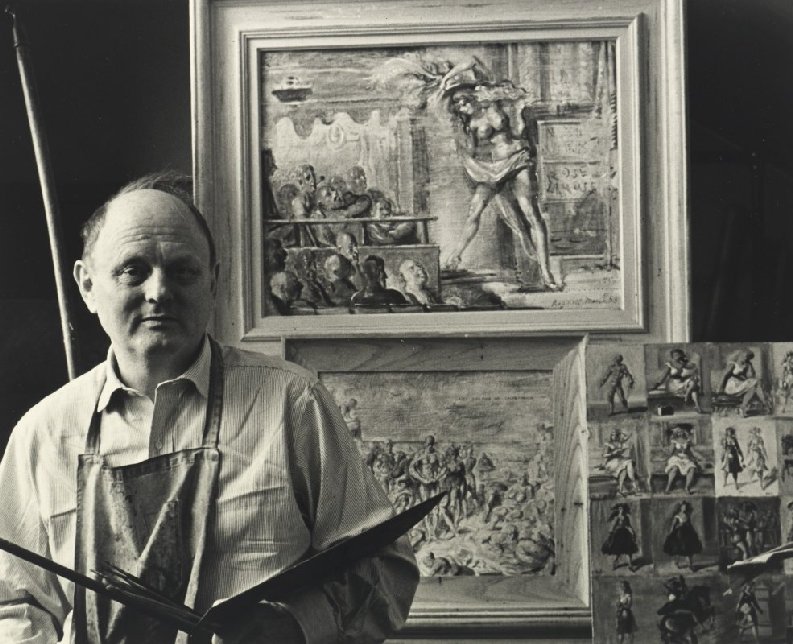
Reginald Marsh at work (1954)
In the 1940s Reginald, Marsh became an important teacher at the Art Students League of New York, whilst carrying on his work as a magazine illustrator for well-known magazines such as Life, Fortune, and Esquire. Sadly for Marsh his style of art became less appreciated and this affected him. Shortly before his death, he was awarded the Gold Medal for Graphic Arts by the American Academy and the National Institute for Arts and Letters. His disillusionment at the lack of appreciation of his art at that time became apparent when he received the award and said that I am not a man of this century.
Reginald Marsh died from a heart attack in Dorset, Vermont, on July 3rd, 1954, aged 56.
As usual, a great deal of information came from various Wikipedia sites but most came from the excellent sites below:
ART CONTRARIAN
incollect
ART HISTORY
QUEST ROYAL FINE ARTS
INSIDE THE APPLE






 my daily art display