Alice Neel. Part 6. The latter years

 Alice Neel (1900-1984)
Alice Neel
(1900-1984)

Alice Neel had been receiving money for her involvement with the Works Project Administration (WPA).  The WPA was the largest and most ambitious American New Deal agency, employing millions of unemployed people, mostly unskilled men, to carry out public works projects.  The WPA employed musicians, artists, writers, actors and directors in large arts, drama, media, and literacy projects.  At its height in 1936, this federal project, the Federal Art Project employed over 5,300 artists. The Arts Service Division created illustrations and posters for the WPA writers, musicians, and theatres. However, with the onset of World War II, mass unemployment ended as millions of men joined the services and so President Roosevelt decided that there was no longer a need for such a national relief programme and the WPA was closed down at the end of 1942.  Alice was out of work and had then to turn to the state for public assistance which she kept drawing on for the next decade.

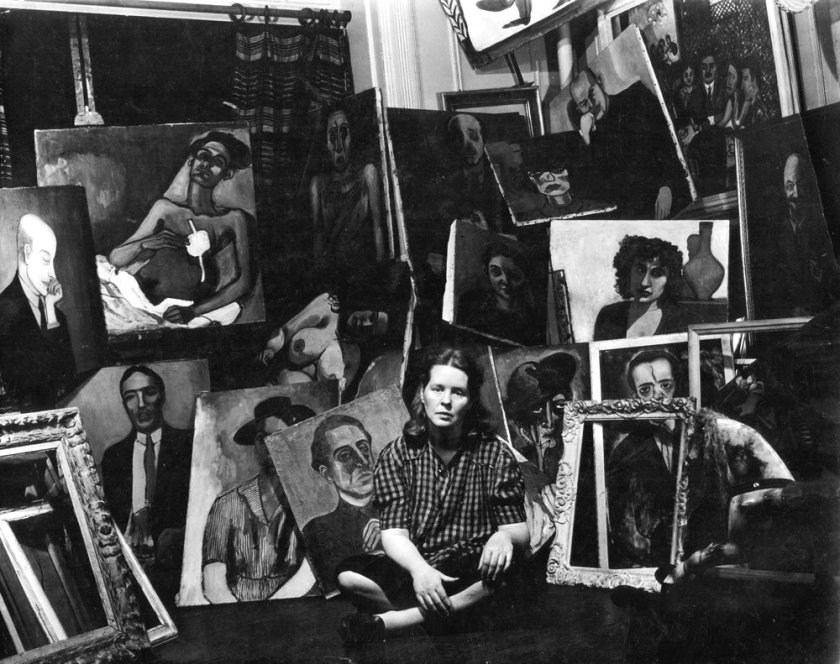
Photograph of Alice Neel sitting before her paintings which was used in the inviation to the exhibition

In March 1944 Alice held a solo exhibition at the New York Pinacotheca Gallery run by Rose Fried.  This was her first solo exhibition since 1938.  There were twenty-four of her works on display. The exhibition received mixed reviews.  An article in the prestigious art magazine, ArtNews, described her work:

“…Neel’s paintings at Pinacotheca have a kind of deliberate hideousness which make them hard to take even for persons who admire her creative independence … Nor does the intentional gaucherie of her figures lend them added expression. However, this is plainly serious, thoughtful work and in the one instance of The Walk, it comes off extremely well…”

As Bob Dylan once said The Times They are a-changin and this was the point in time that Alice Neel found herself.  After the 1944 Alice Neel’s retrospective exhibition at the Pinacotheca, gallery director Rose Fried never showed anything with a figure in it.  According to Neel, Rose had become a pure abstractionist and the works that Alice produced were no longer wanted.  The art world was changing; it had almost completely turned its back on Social Realism which had been the art form that had made Neel’s work so popular in the 1930’s.  So, Alice had to change but as another famous lady politician once said, “this lady is not for turning” and Alice likewise would not change her artistic style to suit others. In an interview with Eleanor Munro for her 1979 book Originals, American Women Artists, Neel is quoted as saying:

“…I never followed any school.  I never imitated any artist.  I never did any of that…”

Sam and Hartley By Alice Neel

For Alice Neel, she knew what she wanted to paint and nobody or nothing was going to alter her artistic desires even though New York was now awash with European émigré artists who were leaders in the world of Cubism, Dadaism and Surrealism such as Max Ernst, André Breton, Marcel Duchamp and Salvador Dali, all of who had fled across the Atlantic to avoid the rise of Nazism.  Alfred Barr had founded the MOMA and in October 1942, millionaire, Peggy Guggenheim, who was married to Max Ernst, had arrived in New York from war-torn Europe had opened a new gallery/museum.   It was called The Art of This Century Gallery.  The Art of This Century Gallery was situated at 30 West 57th Street in Manhattan and occupied two commercial spaces on the seventh floor of a building that was part of the midtown arts district which included the Museum of Modern Art, and three of the four galleries were dedicated to Cubist and Abstract art, Surrealism and Kinetic art, with only the fourth, the front room, being a commercial gallery.

During the 1950’s Alice Neel was kept under surveillance by the FBI.  In a memo from their Miami office based on a 1954 letter sent to them by an informant they concluded that Alice Neel was:

“…a muddled romantic, Bohemian type Communist idealist who will carry out loyally the Communist sympathiser type of assignment, including illegal work if ordered to do so…”

Their file on her and her activities remained open until the early 1960’s.

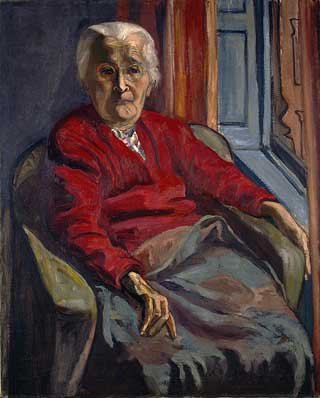
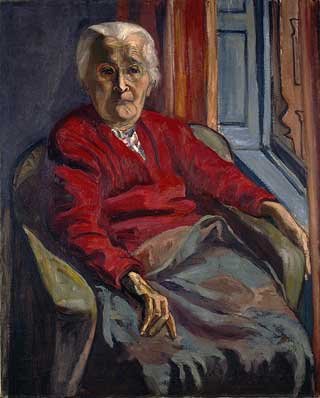
My Mother by Alice Neel (1952)

In March 1953, Alice’s mother comes to live with her in her Spanish Harlem apartment.  Sadly a year later Alice snr. aged 86, died from complications brought on by a broken hip.  For Alice, this was yet another traumatic moment in her life  She had always had to battle with depression and the death of her mother triggered the onset of the debilitating malaise for the next few years.  Physically she put on weight and sought the comfort of alcohol.

Alice often complained that she could not get any gallery space for her works of art.  She painted prolifically but still wanted to exhibit them.  The problem was that her genre of art had lost its appeal with the public.  She was going through a difficult period with mental health issues and was attending therapy sessions with a psychologist, Dr Anthony Sterrett.  He spent time with her trying to make her become more self-confident and self-assertive and it was he who persuaded Alice to contact Frank O’Hara to see if he would sit for her.  O’Hara was an American writer poet and art critic who was working as a reviewer for the prestigious art magazine, Artnews, and who, in 1960 was Assistant Curator of Painting and Sculpture Exhibitions for the Museum of Modern Art.  This position at the MOMA made him a prominent figure in New York City’s art world. He was looked upon as a leading figure in the New York School, which was an informal group of artists, writers and musicians who drew inspiration from jazz, surrealism, abstract expressionism, action painting and contemporary avant-garde art movements.

Frank O'Hara by Alice Neel (1960)
Frank O’Hara by Alice Neel (1960)

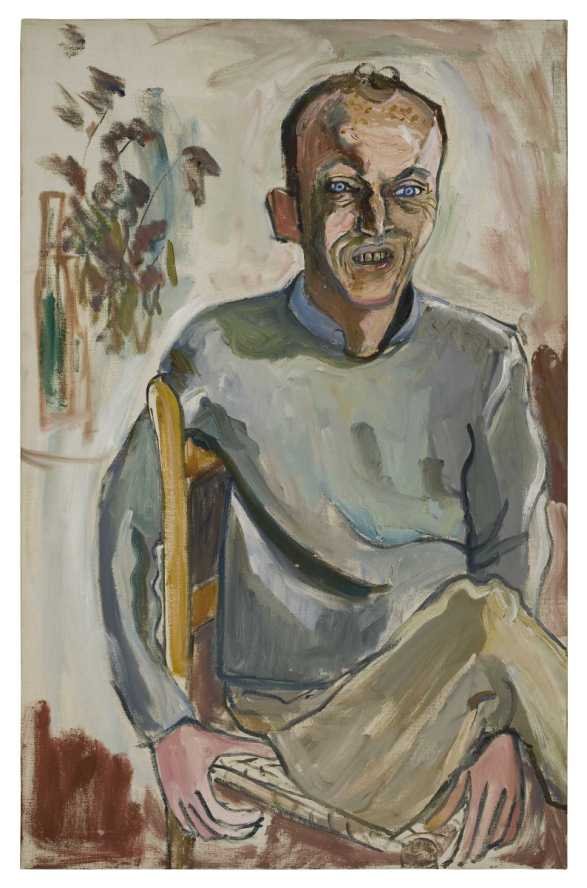
Alice completed two portraits of O’Hara in 1960 and they were looked upon as her breakthrough works.  In the painting, Frank O’Hara, Alice has beautifully and faithfully captured his distinguishing and unique profile.  The side view is hawk-like which is softened slightly by the bunch of lilac behind his head.

Frank O'Hara No.2 by Alice Neel (1960)
Frank O’Hara No.2 by Alice Neel (1960)

In stark contrast, the second portrait, Frank O’Hara No.2 is a more shocking depiction of the man.  Our eyes are immediately drawn to his bad teeth, which looked like tombstones, his sharp nose and somewhat wild eyes.  To be brutally honest, at first, he comes over as being ugly, even, dare I say, repulsive, but there is a vulnerability about Neel’s depiction of him.

Six years later, in the early morning hours of July 24, 1966, O’Hara was struck by a jeep on the Fire Island beach, after the beach taxi in which he had been riding with a group of friends broke down in the dark.  He died the following day.

Kate Millett by Alice Neel (1970)

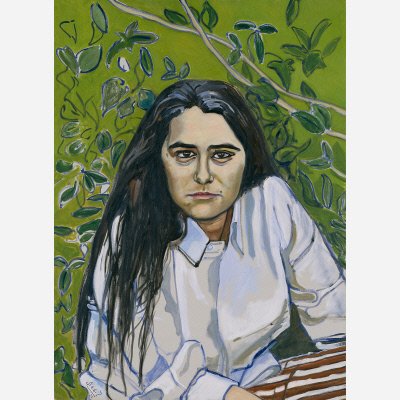
In America, the 60’s was dominated by the Civil Rights movement and the Vietnam War with its protests which swept the country.  It was also a time when the second wave of the modern feminist movement emerged.  It was a time when there was the growing cry for equal opportunity for women and it soon became one which could not be ignored.   Enter Katherine Murray “Kate” Millett, best known as Kate Millett.  She was an American feminist writer, educator, artist, and activist. She attended Oxford University and was the first American woman to be awarded a postgraduate degree with first-class honours by St. Hilda’s.  She is probably best known for her ground-breaking 1970 book Sexual Politics, which was her doctoral dissertation at Columbia University.

Time magazine cover
Time magazine cover

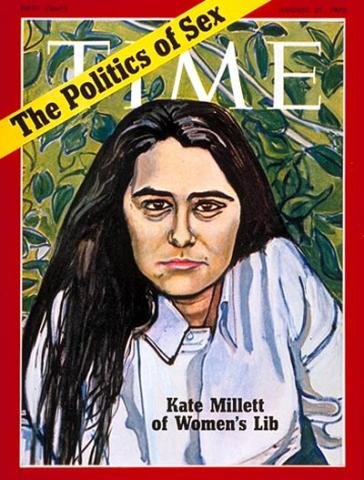
This book became a bible for feminism and feminist protest was such a hot topic that in August 1970, Time magazine decided that Kate would be the face of the feminist movement and therefore should appear on the cover of their magazine.  Millet was unimpressed by the way she was heralded as the embodiment of the movement and refused to pose for a painting by Alice Neel which would be used for the cover.  She believed that no one person could presume to represent the objectives of the feminist movement.  Time magazine was not to be put off by her refusal and instead asked Neel to complete the portrait, using a photograph.  After the publication of the magazine Alice Neel and her art was always linked with the feminist movement but as Alice once quipped, she had been a feminist before there was feminism!

Andy Warhol by Alice Neel (1970)

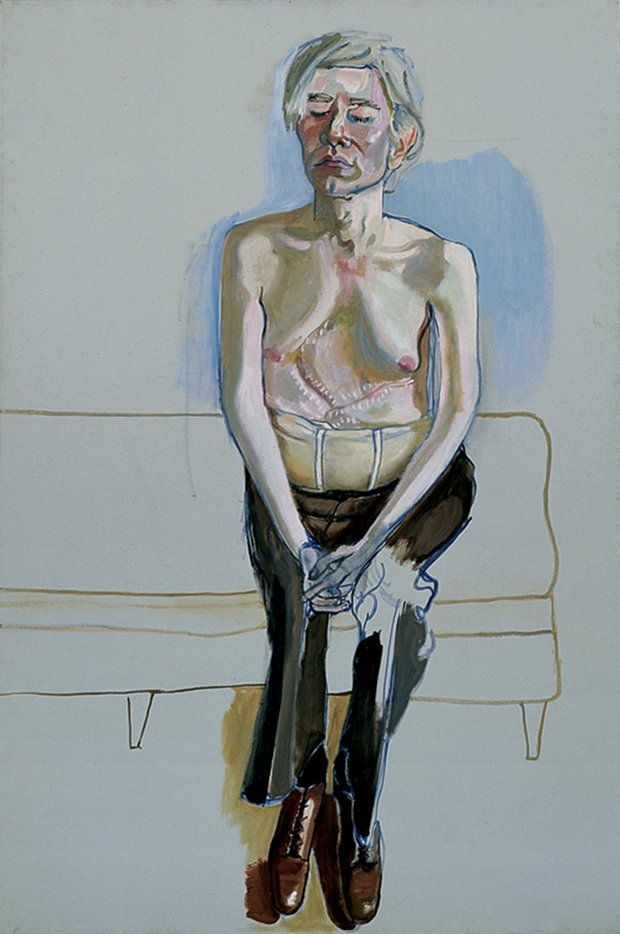
The year 1970 was also the year that Alice Neel painted one of her most famous works, a depiction of Andy Warhol.  The painting can be found at the Whitney Museum of American Art, New York and rather than me trying to describe the painting I have reproduced the words of the museum’s audio-guide which was put together by Trevor Fairbrother, an independent curator and writer:

“…It’s an interesting year for both of these artists. Alice Neel was seventy years old when she painted it, and in a sense, was just hitting her stride as an important American realist. She’d had an incredible career since the thirties, but she hadn’t really had much recognition until the wave of feminist interest in the arts in the sixties. And suddenly she was a forebear for a whole new generation of feminist artists and writers.  The late sixties were much harder on Warhol. He’d been shot two years before Neel painted this portrait—an attempted assassination by a member of his artistic circle. In posing shirtless for Neel, he exposes the corset that he was required to wear for the rest of his life. He also bares his aging body, his chest sagging so that he almost appears to have breasts.  She shows him—I think it’s this kind of essence of loneliness and vulnerability, but at the same time I think she knows that he knows that everybody is looking at him. He was very much invested in famous artists. He wanted to be a kind of brand-name Pop artist, and he certainly is that now, long after his death. He, Warhol, in a sense is rising to her challenge to sit for her, to be painted and to take his clothes off. And so, in a sense, he’s doing a brave thing, but he’s also―he’s getting through it by shutting his eyes and being very focused internally.  I think part of the soulfulness of this picture is the fact that it might seem unfinished. I wouldn’t say it’s unfinished. I think she decided she had what she needed, and she stopped where she was ready to stop. The picture doesn’t need more…” 

Fame came to Alice Neel late in life and she believed she had the right to bask in the glory.  Her son Hartley recounted his mother’s feelings about this sudden fame:

“…She felt it was something she deserved.  She basked in it.  She really enjoyed it.  When we were young, she struggled, waiting around for some critic to review her work, up or down.  All of the sudden they were saying good things about her.  Her paintings were on the walls, and people were buying her work.  It was all different.  She wasn’t bitter.  She had a very upbeat attitude toward the whole thing…”

Self-portrait by Alice Neel (1980)

On October 14th 1980 at the Harald Reed Gallery on East 78th Street in New York a benefit dinner for the Third Street Music School Settlement was being held at which was the debut of an art exhibition entitled Selected 20th Century American Self Portraits, one of which was Alice Neel’s nude self-portrait which she had begun five years earlier.

She looks out at us completely oblivious or unconcerned about what we are thinking about why an eighty-year-old woman would want to depict herself naked.  Does she feel vulnerable?  There is no sign of that in her facial expression, in fact Neel’s steely gaze rivets us.  She exudes an air of self-confidence, despite her less than picture-perfect body.  We see her sitting regally in an upholstered chair with its hard vertical-striped arms which tend to accentuate her yielding and bounteous rolls of flesh.   It is a “warts and all” portrait.   She does not hide the visible signs of aging.  Instead she has decided to reveal herself with characteristic truthfulness and somewhat defencelessness. Yet there is also a sense of pride in this depiction.  In her right hand she holds a paintbrush whilst her left hand grasps a rag and, as we see no easel or canvas in the depiction, the two serve as artistic elements. The only personal accessory depicted is the presence of her eyeglasses which may have been added by her to remind us of her frailty and that she has passed her prime.

The painting was of course controversial and caused a stir but it also was testament that it was an audacious work by an artist who at the time was at the top of her form.  The other unusual aspect of this work was that beside a few pencil-sketched self-portraits, it was her first self-portrait painting.  The painting now resides at the National Portrait Gallery, Washington.

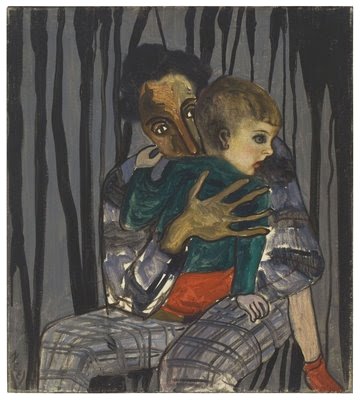
Loneliness by Alice Neel (1970)

In 1970 Alice completed a work entitled Loneliness, which she ironically referred to as a “self-portrait”.  It was about this time that her younger son Hartley had married Ginny and moved to Massachusetts.

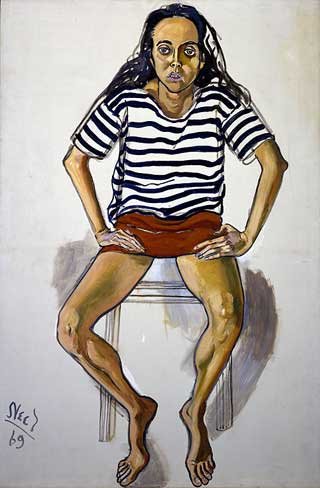
Ginny in a Striped Shirt by Alice Neel (1969)

Throughout her life Alice continued with her portraits of her family.  Her future daughter-in-law, Hartley’s wife, Ginny featured in her 1969 work, Ginny in a Striped Shirt.  Ginny was a feminist who looked upon Alice as a role model and they became good friends even before she became involved with Hartley.

Pregnant Woman by Alice Neel (1971)

Her other daughter-in-law, Nancy, Richard’s wife and Alice’s assistant during the last two decades of her life, was depicted in Alice’s 1971 painting, Pregnant Woman.  In the work, we see an image of her husband looming in the background.

In 1980 Alice Neel’s physical health takes a turn for the worse and after a series of tests it is decided that she had to be fitted with a pacemaker to regulate her heart rate. Four years later in 1984, during a routine visit to the Massachusetts General Hospital to have her pacemaker checked, X-rays indicate that she has advanced colon cancer which has already spread to her liver. She immediately undergoes surgery and afterwards returns to Vermont to stay with Hartley, Ginny and their children while she recuperates.

From the Spring to the Summer of 1984 she returns to New York and Spring Lake. With the help of her son and his wife, Richard and Nancy, and despite her rapidly deteriorating health, she continues with her busy schedule including an appearance on the Johnny Carson Show

Among her many commitments, interviews for the ArtNews article continue, and, on June 19th, she makes a second appearance on ‘The Tonight Show’ during which she insists that Johnny Carson visit her in New York to sit for a portrait. In July, she had to receive chemotherapy which further weakened her.  Despite her weakened condition, she continues to paint.

Alice Neel died in her Upper West Side Manhattan apartment on October 13th 1984 surrounded by her family and was buried in a private burial ceremony at a cemetery near her studio in Vermont.  On February 7th 1985, a memorial service for her is held at the Whitney Museum of American Art.

My look at the life and works of Alice Neel has been a long journey stretching over six blogs and yet I know I have missed so much out about her life and because she was a prolific artist I know I have only scratched at the surface with regards her works of art.  I have been careful not to be judgemental with regards her lifestyle which probably added to her problems but she had a difficult and often sad life which often was beyond her endurance.  She however always wanted to do her own thing and I leave you with one of her quotes:

“…”I had a very hard life, and I paid the price for it, but I did as I wanted,” Miss Neel said then. ”I’m a high-powered person…”  

– – – – – – – – – – – – – – – – – – – – – – – – – – – – – –

I have used numerous internet sources to put together this and the other blogs on the life and art of Alice Neel and I am currently reading a fascinating book about the artist by Phoebe Hoban entitled Alice Neel: The Art of Not Sitting Pretty. It is a very interesting read and one I can highly recommend.

Alice Neel’s art is being shown at several exhibitions in America but there are also a series of exhibitions of her work travelling around Europe at the current time including one I am due to visit next month:

Gemeentemuseum, Den Haag, Holland

(November 5th, 2016 – February 12th 2017)

Alice Neel. Part 5. Sam Brody, the new man in her life, family portraits and “he said, she said”

It is almost five weeks since I published Alice Neel.  Part 4 and the reason for the delay was not my lost interest in the subject but having to suffer the trauma of house moving!

– – – – – – – – – – – – – – – – – – – – – – – – – –

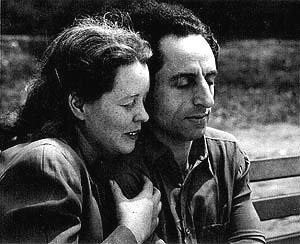
Alice Neel and Sam Brody (1940)

The year was 1940 and another man entered Alice Neel’s life.  He was the photographer and film critic Sam Brody.  Brody was born in London on New Year’s Day 1907.  His parents were Abraham and Sophie Brodetsky (later shortened to Brody).  He was raised by Russian Jewish parents who had immigrated to America in 1920, via Paris and London when Sam was thirteen years old.  His father was a journeyman tailor who eked out a living in various sweatshops and he and his family struggled financially and maybe because of this lifestyle Brody’s father was a great believer of Marxism, a philosophy he would pass on to his son who would cling to those beliefs for the rest of his life.

The Workers Film and Photo League

Sam Brody was a founding member of the Workers Film and Photo League (WFPL) which was an organization of filmmakers, photographers and writers which began in 1931 dedicated to using film and photography for social change and presenting, in a documentary-format, the Great Depression from a Marxist perspective. These documentaries focused on the burning issues of the time such as the U.S. Labour Movement, the National Hunger marches of 1931 and 1932 and the Bonus March 1932. Much of the output was not for general release was shown more at Communist Party and trade union events.  There was also a philanthropic aspect to the work of the WFPL organisation as they joined up with Workers International Relief group to show their films at fund raising events.

Sam, Snow (How like Winter) by Alice Neel (1945)

It was in January 1940 that Alice Neel met Sam Brody at a Works Progress Administration (WPA) meeting.  Alice was introduced to him by her friend, the sculptor, Blanche Angel, who told her that Brody was an excellent photographer and would be an ideal choice to take some photos of her new son, Richard. This was just two months after her lover and father of her new-born child, José Negron had walked out the family home.  According to Alice Neel, there was an immediate magnetism between her and Brody (not corroborated by Brody!) and she was very forthright in her 1959 interview with the photographer, Jonathan Brand about him and how she had attracted him:

“…He was such a show off, such and intellectual.  He came home with me that night.  And of course he fell in love with me immediately.  He was very gallant when he fell in love.  He brought me flowers, and he came every day.  He told me he had divorced his wife because she had an affair with a travelling salesman…”

Sadly for Alice, the last fact was not true.  However, a few weeks after their initial meeting Brody moved into Alice and her son’s East 107th Street New York apartment.  Although José, the father of Alice’s son had moved out he kept returning for visits in order to give Alice some money and during his visits, as Brody would angrily term it, he would “serenade” her with his guitar.  Brody’s anger with José relationship with Alice may seem reasonable to many but for the fact that he had lied to Alice with regards his marital status.  Brody had married a Russian woman Claire Gebiner in 1927 and the couple had two children, a son Julian and a daughter Mady.  Even when Brody moved in with Alice he would visit Claire and his family every afternoon.  For a long time neither Alice nor Claire knew of each other’s existence!

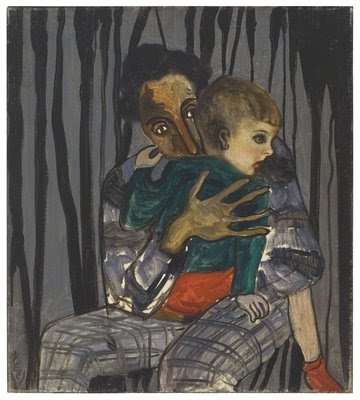
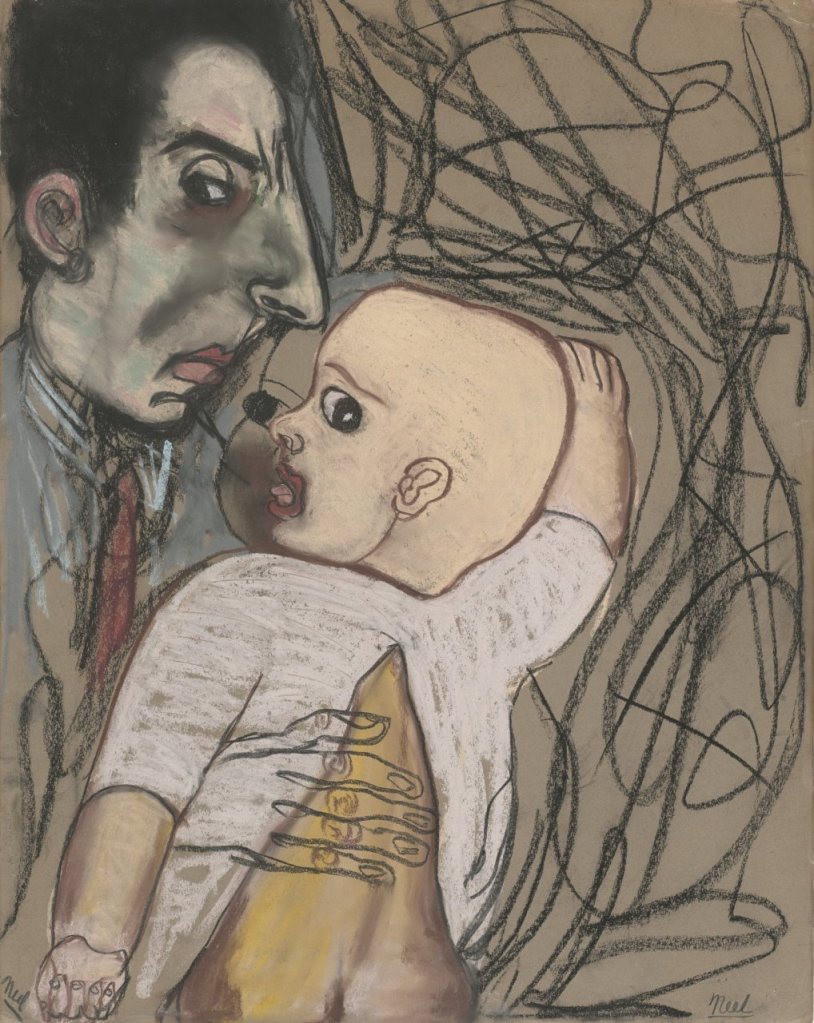
Sam and Hartley by Alice Neel

Alice was drawn to Sam Brody as she considered him to be an intellectual and believed in his fight for worker’s rights and his support for the downtrodden.  On the other hand, she soon realised that Brody had a fiery temperament and the two would have many fierce and passionate arguments which turned into unbridled screaming matches.  Ironically, despite Brody “two-timing” Alice and Claire, he was jealous of Alice’s previous relationships with the likes of John Rothschild and her previous lover and father of her child, José Negron and it was said that Brody and Rothschild had come to blows.  What is more sinister about Brody’s relationship with Alice was that he took out his jealousy on Alice’s son Richard whom he derived a violent dislike.  In the documentary Alice Neel, Richard Neel recalled this violence:

“…He used to kick me under the table all the time.  He kicked me under the table and one time I screwed up enough courage to say ‘Stop kicking me under the table’.  Well she [Alice] had to go out that evening and he beat me up.  He really did………. It was intermittent but it was physical violence and it was directed at Alice and it was certainly directed at me…”

Sam and Richard by Alice Neel (1940)

Neel who was painfully aware of the treatment of her son by Brody painted a very moving picture of the two entitled Sam and Richard in 1940.  In the work we see a venomous looking Sam tightly grasping the terrified Richard.  Richard almost became blind due to dietary deficiencies when he was one-year old and this must have added to his pain.

In January 1941 Alice became pregnant with Sam Brody’s child and on September 3rd a son, Hartley Stockton Neel was born.  The joy of this birth was tempered by the fact that soon after the event Brody’s wife Claire caught sight of her husband wheeling the pram and lovingly lifting Hartley out of the carriage.  Claire, as one can imagine, was devastated.  Not only was her husband two-timing her but he had a child with another woman.

Phillip Bonosky, the writer and friend of Alice,  wrote about Sam Brody in his journal and described him and his behaviour towards Alice’s children:

“…A Jew…. who is obviously a pathological case of some sort.  I met both the boys [Richard and Hartley].  The eldest one [Richard] is almost totally blind as a result of a dietary deficiency when he was just one year or so old.  The youngest boy’s father [Brody] who seems to flit about the country pounces down on them from time to time and while he is there, he tortures and abuses the eldest child and showers psychopathic affection on the younger one, his own.  Alice herself is torn by her feelings for and against him and doesn’t know what to do…”

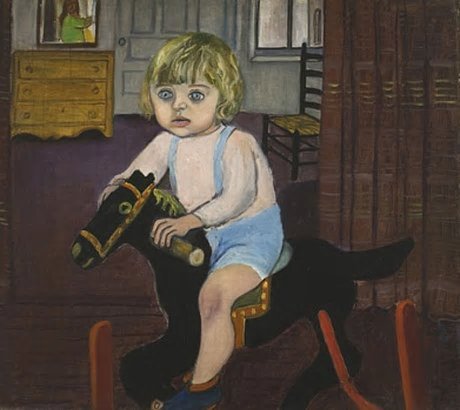
Hartley on the Rocking Horse by Alice Neel (1943)

Hartley featured in a number of his mother’s paintings.  In a 1943 painting Hartley on the Rocking Horse we see her younger son on a rocking horse. Look at his facial expression.  Is it one of joy to be astride the horse?  I rather think his wide-eyed facial expression is not one of delight but more one of fear that he may fall off and he may have had to be coaxed to stay on the “beast”.  If you look carefully at the mirror in the background you will see that the artist has added a mirror-reflection of herself.

Richard at Age Five by Alice Neel (1946)

Two years later in 1945 Neel painted a portrait of her five-year old son, Richard entitled Richard Age Five. His troubled upbringing can be seen in the demeanour of the youngster.  Look carefully at the depiction.  See how he clings to the back of the chair.  Look at his wide-eyed expression.  There is a vulnerability about the child and knowing the background of his upbringing and his bad relationship with his mother’s lover, Brody, we can sympathise with what he had to endure.

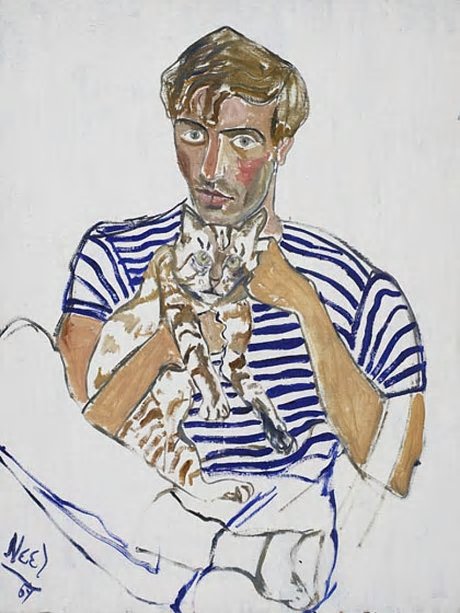
Hartley with a Cat by Alice Neel (1967)

Twenty-five-year-old Hartley appeared in another work painted by his mother in 1967 entitled Hartley with a Cat.

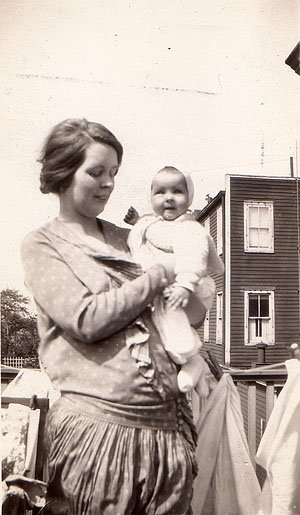
Alice Neel holding her daughter Santillana (1927)

Alice gave birth to four children.  Her first-born child Santillana died of diphtheria just days before her first birthday and never featured in any of Alice’s paintings although there is a 1927 photographs of her and her mother.

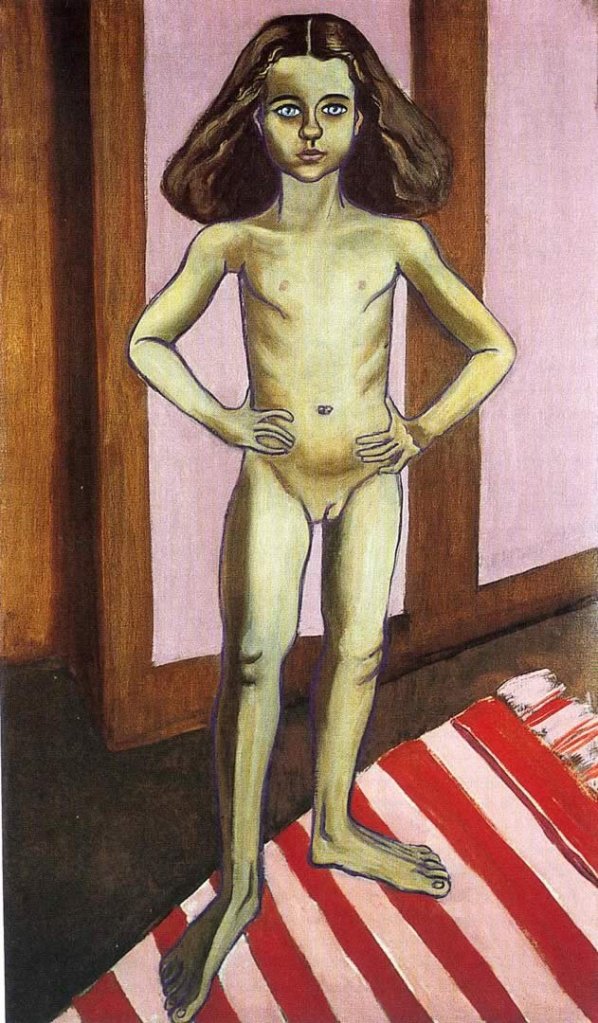
Isabetta by Alice Neel (1934)

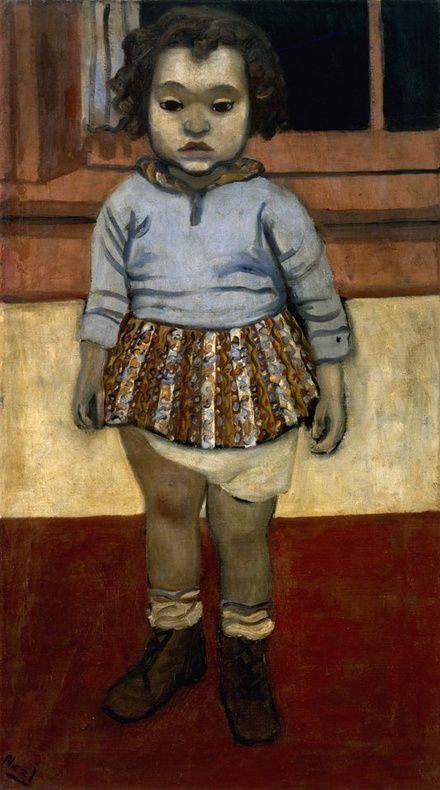
Her second born child Isabetta, who was born in 1928, featured in just one painting by Neel and this 1934 work is a controversial depiction of the six-year old.  For those of you who have not read the early blogs on Alice Neel, Alice and her Cuban husband Carlos Enriquez had Isabetta in November 1928 but soon after Carlos took his daughter to live with his family in Cuba and Alice, who had a major mental breakdown and was hospitalised never regained custody of her daughter.  Neel was rarely given access to her daughter except on one occasion in 1934 when mother and daughter were together long enough to paint the most extraordinary and, some would say, scandalous portrait. The little girl stands naked with her hands planted firmly on her hips in what looks like a rebellious pose, one that makes it clear that despite what is offered to her to stand still, she is having none of it.  Isabetta defiantly focuses her fierce blue gaze fixes on her mother almost as if she is questioning why should she stand before her naked.  Look out the artist has depicted her child’s hands.  The fingers are claw-like giving the child a more sinister air.  What was going through Alice Neel’s mind when she painted this portrait?   I struggle to understand why a mother would depict her daughter in such a fashion.  Only she knows.

It is obvious to all mothers the trauma the loss of her child affected Alice but we should not discount the trauma the child suffered with the loss of her mother.  Did she feel abandoned?  Isabetta and her mother met once more when she was ten years old.  It was not a good visit maybe because Alice was heavily pregnant with Richard and Alice and Isabetta never bonded.  There were to be many traumatic times in Isabetta’s life including, when she was eighteen years old, her proposed nuptials were called off by her fiancé’s parents, two weeks before the wedding.  Maybe the separation from her mother and other setbacks she had to endure stayed with her all her life as in 1982, aged 54, she committed suicide. Her mother, Alice, was to die two years later.

Two Girls in Spanish Harlem by Alice Neel (1941)

Whilst living in the Spanish Harlem district of New York Alice painted many studies of the inhabitants such as her 1941 double portrait of two young girls, Carmen and Hilda entitled Two Girls in Spanish Harlem (Carmen and Hilda) which was a beautiful example of her artistic ability.

Spanish Family by Alice Neel (1943)

I particularly like her 1943 painting entitled Spanish Family which depicts a mother and her three children.  Look how Neel has portrayed the facial expressions of the four characters.  Words are not needed to express how they all feel.  None are smiling.  The mother looks despondent and we get a feel of what life must have been like for her during those hard times.

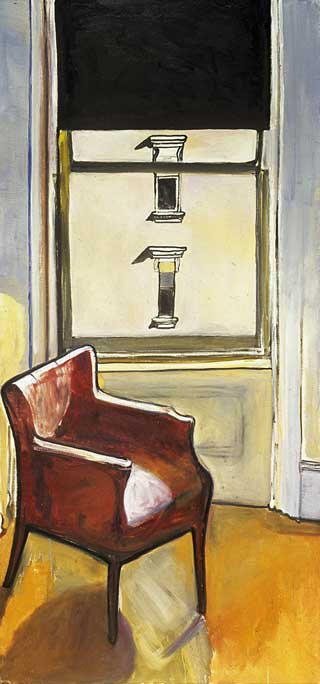
Fire Escape by Alice Neel (1948)

A 1948 painting by Neel, entitled Fire Escape, deviated from her normal figurative work and shows a tenement building close to where she lived.

Dead Father by Alice Neel (1946)

On May 3rd 1946 Alice Neel’s father, George, died, aged eighty-two and the day following the funeral in Colwyn Alice painted his portrait, Dead Father. In Patricia Hills book Alice Neel, she quotes Alice talking about the painting:

“…He was a good and kind man and his head still looked noble.  I didn’t set out to memorize him, because I was too affected.  But the image printed itself…”

My Mother by Alice Neel (1946)

That same year Alice completed a painting of her newly-widowed mother.

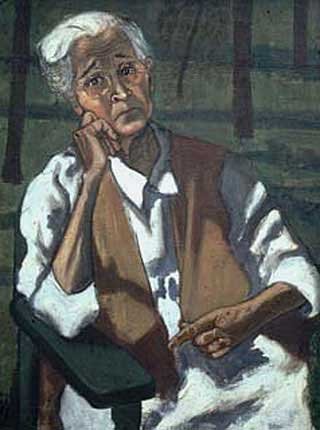
My Mother by Alice Neel (1952)

Six years later, in 1952, she completed another depiction of her mother, Alice snr.

In the title of this blog I added “he said, she said”.  The reason for this is that most of the information I got for these blogs about Alice Neel came from the book Alice Neel.  The Art of Not Sitting Pretty by Phoebe Hoban and during my delving into the many internet sites about the artist I came across one by David Brody who was the son of Sam Brody and Sondra Herrera whom he married after his liaison with Alice Neel ended in 1958.  He was unhappy with what Phoebe Hoban had written about his father and for the sake of being even-handed I thought you should have a look at what he wrote:

http://www.sambrody.com/hoban.html

In my next blog I will take a final look at the paintings and life of this great American figurative artist.


Alice Neel. Part 4 – José Santiago Negrón

Alice Neel (1900–1984) was one of the most significant American painters of the 20th century. Her psychologically charged portraits tell intimate and unconventional stories, as much about people living on the margins of society and in subcultures as about the New York cultural elite and her own family. Alice Neel led an exceptionally interesting life as a single parent and a feminist in a time when the world of art was largely male-dominated.

Ateneum Art Museum, Helsinki

Alice Neel Exhibition 10.6.2016 – 2.10.2016

————————————————————————–

Fishing Pier, Spring Lake by Alice Neel (1938)

Alice spent the summer of 1934 with her mother and father in a cottage at Spring Lake, New Jersey, a short distance from the beach.  She was still with John Rothschild, who had help fund the buying of the single storey, red-shingle cottage in 1935 and he, besotted with Alice, had left his second wife in the summer of that year. Sadly for John, it was a one-way relationship as she was often very rude to him and would often refer to him as the “money man” but she would never dispense of his company even when she had other love interests, and to be fair to her, he too had many other affairs whilst being close to Alice.

John with Hat by Alice Neel (1935)

Neel completed a portrait of John in 1935 entitled John with Hat in which we see him in a white suit wearing a hat with the sea as the background.  In an interview with Patricia Hills in 1982, Neel talked about the painting and voiced her dislike of Rothschild’s character:

“…I painted him in a hat, that’s when I decided to get rid of him……I thought anybody that could take that much joy out of the hat and suit, there was something wrong with him……He was utterly empty.  He really had the makings of a voyeur in that way…”

Of course she didn’t dump John.  Maybe sense prevailed or as she put it:

“…But I didn’t really get rid of him because he kept pursuing me and I had such a hard life that it was very nice to go to Longchamps or the Harvard club for dinner…”

Kenneth Fearing by Alice Neel (1935)

It was the 1930’s and America at this time was in the middle of the Great Depression and the labour classes were suffering badly.  One of the great poets and novelist of the time, who encapsulated in his work those desperate times, was Kenneth Fearing and he was depicted in a 1935 painting by Alice Neel.  Fearing was a fervent left wing radical and Marxist and co-founder of the Partisan Review, a literary and arts magazine with close ties with the Communist Party, USA.  He championed the cause of the downtrodden worker and is depicted in one of his favourite haunts, a late night coffee shop. Fearing is illuminated by a single lightbulb, a symbol of enlightenment and modernism.  It is a painting of symbolist iconography.   We see him wearing his large artsy-type glasses, with a cigarette dangling from his lips, reading a book which is propped up in front of him.   Alice Neel depicted a skeleton squeezing blood out of Fearing’s heart, which was meant to symbolise his heartfelt feelings for all the people who were suffering during the troubled times of the Depression.  Fearing may not have been impressed by this iconography as when he saw the work he told Neel to remove what he termed “that Fauntleroy” from his heart.  However, Neel was adamant about the inclusion saying:

“…The reason I put it there was that even though he wrote ironic poetry, I thought his heart bled for the grief of the world…”

 There are a number of minor “characters” depicted in the work including, in the foreground, a baby, which was said to be Fearing’s son who was born that year, and a newlywed couple. The rest of the cast of characters formed part of a tormented world, a world of disorder and chaos, which we see going on around Fearing whilst he quietly reads his book.  In the foreground there are some disfigured soldiers and bleeding corpses.  In the right background we can see police beating civilians.

Pat Whalen by Alice Neel (1935)

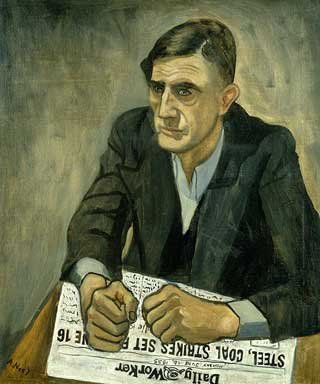
Another communist to feature in one of Neel’s 1935 paintings was the Irish labour organiser, Pat Whalen, a longshoreman who had organised many dock strikes.  He sits at a bare wooden table in his creased and shabby coat and open-necked shirt. The background is bare.  This painting is all about the man and his face, his furrowed brow and piercing blue eyes.   She depicts him staring into the middle-distance of a promised future, his heavy, oversized fists clenched over a copy of the Daily Worker, which was the Communist Party USA (CPUSA) newspaper.

José Santiago Negron by Alice Neel

In September 1935, Alice Neel moved alone to an apartment in West 17th Street in New York. She would not countenance John moving in with her so he moved to his own apartment close by.  Alice would return to Spring Lake every summer but not to the small cottage but to a larger house she bought later.     It was shortly after her arrival in New York that Alice and John Rothschild visited the nightclub, La Casita, and there, performing in a band, was José Santiago Négrón a handsome Puerto Rican nightclub singer and guitarist. Alice was immediately attracted to the “beautiful Latino”.   He was slender, dark and handsome.  He was also ten years younger than Alice and was married with a young child, Sheila.  Alice acknowledged the similarity between him and her first husband as quoted by Cindy Nemser, the American art historian and writer and founder and editor of the Feminist Art Journal:

“…You know what he was?  He was a substitute for my Cuban husband although he was completely different…”

During an interview with the American art historian Patricia Hills, Neel recounted that first meeting with Negron and her successful seduction of the Puerto Rican:

“…I went to the nightclub with John [Rothschild] and I had on a silver lame dress that was beautiful and José was charmed with all this wealth and elegance.   Toward José I made my one aggressive action.  I went down there one night, to that nightclub, and I knew José was going to want to come home with me, and he did…”

Sheila by Alice Neel (1938)

In a very short time Negron left his wife Molly and child Sheila and moved in with Alice.

Nazis murder Jews by Alice Neel (1936)

In September 1936 Alice Neel completed a work entitled Nazis Murdered Jews in which she depicts a Communist organised torchlight protest at which she and some of her Works Progress Administration (WPA) colleagues took part.  Neel was one of the few artists of the time that highlighted the fate of the Jews at the hands of the Nazis.

Tragedy once again struck Alice in 1937.  In January that year she became pregnant, much to her delight but much to the prospective father, José Negrón’s displeasure.  He threatened to leave her.  In July, six months into the pregnancy she had a miscarriage.  Her unborn daughter had been strangled by her own umbilical cord.  Add to this heartbreak, the fact that Alice and José had money problems and this was also causing stress to their relationship.  Notwithstanding this, Alice became pregnant again at the end of 1938.  She must have been in a quandary as to what to do as it is known that her friend John Rothschild gave her money for an abortion and although she accepted the gift, she spent it on a phonograph!

Elenka by Alice Neel (1936)

The imminent birth of her child made Alice and José abandon the bohemian life of Greenwich Village and move to a quieter apartment in East 107th Street in the Spanish Harlem neighbourhood of Upper Manhattan and it is in this area where she would remain for the next twenty-four years.  This neighbourhood proved a wonderful place for her to paint pictures of her surroundings and the many characters who lived there.

Life with José Negrón was good.  In a 1969 interview she mused joyfully about those days referring to her then unborn child:

“…I was out in nightclubs every night.   I did the tango, the rhumba, all those dances.  Richard is the product of nightclubs…”

The Family by Alice Neel (1938)

On September 14th 1939 Alice gave birth to her first son.  Alice and José called him Neel Santiago but this strange combination of Christian name and surname, Neel Neel, was later dropped and he became known as Richard Neel.  In December 1935, less than three months after the birth of his son, José Negrón walked out of the relationship with Neel,  This was the second time he did this, having left his wife Molly and their daughter, Stella, to live with Alice.  José Negrón’s nephew Ralph Marrero commented on the relationship break-up:

“…I don’t think Alice was interested in staying in touch with José.  Alice was more interested in her art and José was interested in himself…”

Alice put a different spin on the event in an interview with Jonathan Brand in 1969.  She stated:

“…Of course José should never have done what he did.  It was wrong…..He never should have left like that.  I could have tried to stop him but the whole thing sickened me.  I thought it was so frivolous.  We had lived together for five years…..why pick this time when this little kid is maybe four or five months old and just leave like that?  I thought it was frightful…”

José Negrón had never married Alice but would later  go on to marry two more times and, although born a Catholic, ended up becoming an Episcopal priest.

T B Harlem by Alice Neel (1940)

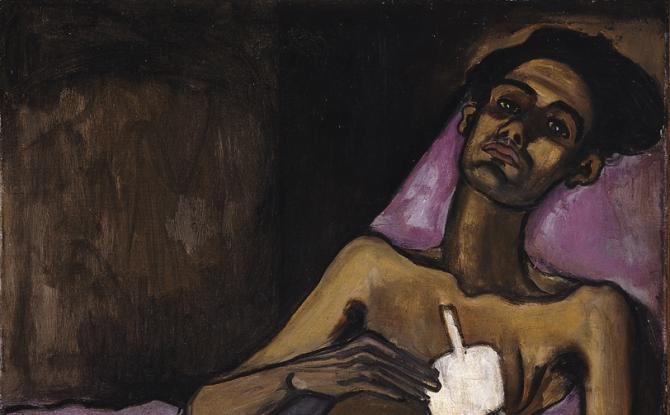
One of the most moving paintings Alice Neel did featuring José Negrón’s family was one entitled T.B. Harlem which she completed in 1940, a year after José had left the family home.  It was a painting which drew attention to the poverty and social isues of the time and yet never lost sight of the individuality of the sitter.   In this painting, Neel depicted José’s brother Carlos Negrón. Carlos was just twenty-four at the time of the painting and had, two years earlier, moved from Puerto Rico to Spanish Harlem.  At this time tuberculosis spread in overcrowded urban neighbourhoods, and at the time of the painting, the only available treatments to counteract the disease were radical. In the painting we see Carlos with a bandage on his chest covering the wound from his thoracoplasty, a procedure that was originally designed to permanently collapse the cavities of pulmonary tuberculosis by removing the ribs from the chest and by so doing, rest the tuberculosis-infected lung by removing ribs.  Although it is a good likeness of Carlos, Neel distorted and elongated his neck and arms. In the painting Alice has used heavy, dark lines to emphasize and flatten Carlos’ silhouette and the lines around his wound draw attention to the sunken misshapenness of his left side. Carlos’ face conveys a sense of dignity.  His right hand lies across his chest in a pose which we saw in traditional images of the martyred Christ.

………to be continued.

– – – – – – – – – – – – – – – – – – – – – – – – – –

I have used numerous internet sources to put together this and the following blogs on the life and art of Alice Neel and I am currently reading a fascinating book about the artist by Phoebe Hoban entitled Alice Neel: The Art of Not Sitting Pretty. It is a very interesting read and one I can highly recommend.

Alice Neel’s art is being shown in a number of exhibitions in America but there are also a series of exhibitions of her work travelling around Europe at the current time:

Painter of Modern Life at the Ateneum Art Museum, Helsinki

(June 10th – October 2nd 2016)

and at the

Gemeentemuseum, Den Haag, Holland

(November 5th, 2016 – February 12th 2017)

Alice Neel. Part 3 – The men in her life – Kenneth Doolittle, John Rothschild and Joe Gould

Alice Neel
Alice Neel

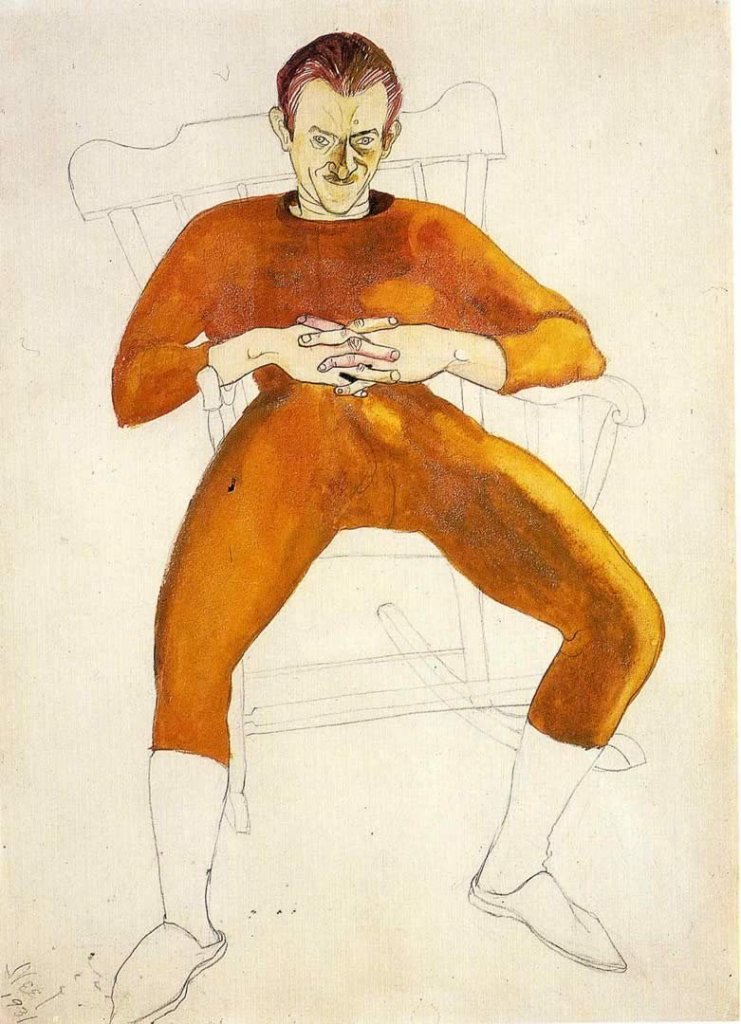
Alice Neel was finally released from hospital in September 1931, almost thirteen months after her initial breakdown.  Once discharged from hospital she reacquainted herself with her friend Nadia Olyanova and her Norwegian Merchant Marine husband, Egil Hoye, who were now living in Stockton New Jersey.  It was during one of her visits to her friends that September, that she meets a friend of theirs, another Merchant Marine, Kenneth Doolittle. Doolittle had joined the merchant marines at the age of sixteen and it was during his first voyage that a fellow seaman introduced him to the world of communism.   Early the following year Alice and Doolittle moved in together and lived in an apartment on Cornelia Street in Greenwich Village, which was looked upon, at the time,  as the centre of bohemian life, an area which was full of bohemian cafés and bars, a place where eccentricity was the norm.  Alice was aware of Doolittle’s character flaws, one of which was that he was a drug addict and also a very jealous man, especially with regards to her relationships with other men.  Cindy Nemser, an American art historian, writer, as well as being the founder and editor of the Feminist Art Journal.  She was an activist and prominent figure in the feminist art movement who was best known for her writings on the work of women artists.  She wrote an article in the magazine Art Talks regarding Alice Neel and Kenneth Doolittle in which she quotes Alice’s thoughts on her lover:

“…I lived with a sailor. A rather interesting chap who played the guitar and sang and was rather nice except that he liked dope.  He had a coffee can full of opium.  I didn’t dare smoke opium since I had just had this nervous breakdown, but they smoked opium at my apartment…”

In Patricia Hills 1983 book, Alice Neel, the author wrote that Alice’s mother was far from being impressed with Doolittle and wanted to separate the two lovebirds.  Alice’s mother was quoted as saying:

“…Why don’t you go stay with your sister in Teaneck, instead of out there with that dirty old sailor…”

However, the relationship continued despite the maternal warning.

Well Baby Clinic by Alice Neel (1928)

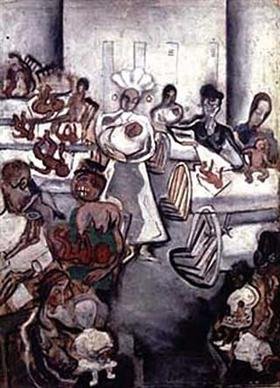
In May 1932, Alice took part in the first Washington Square Outdoor Art Exhibit.  The Washington Square Outdoor Art Exhibit was, and still is, a biannual outdoor art festival which originated in 1931 by Jackson Pollock.  Pollock, who had fallen on hard times financially, would leave his Greenwich Village studio and set up his paintings on the sidewalk in hope that it may boost sales. Now these outdoor exhibits held by local artists help them sell their paintings and also help them gain recognition for their talents.  It was at this exhibition that Alice presented her 1928 work, Well Baby Clinic.  In the painting we see a nurse clothed in white and holding a baby. The pristine whiteness of her uniform contrasts with the dirty off-white colour of the nursery walls.  The nurse stands in the centre of the hospital ward and is surrounded by mothers feeding and cosseting their children whilst other babies can be seen lying unattended on white beds. In some ways this simplistic painting is quite disturbing, and probably offered the jaundiced view of childbirth held by the artist.  Alice Neel completed the work just a fortnight after the birth of her second child, Isabetta.

Degenerate Madonna, 1930, by Alice Neel

Neel also exhibited a very controversial painting at the exhibition entitled Degenerate Madonna but after many vociferous protestations from the Catholic Church she was asked to remove the work.  This was her take on the Madonna and Child genre

It was at this exhibition that she met a man who would be ever present throughout her life as her best friend and loyal supporter.  He was John Rothschild.  He had walked up to her during the exhibition and praised her work and later invited her and Doolittle to join him for drinks at his place.  John was a Harvard graduate who came from a wealthy background. His family owned the travel firm, Open Road.

Kenneth Doolittle watercolour by Alice Neel (1931)

Alice’s relationship with Doolittle had intensified, however, it all came to an abrupt end in December 1934, after Doolittle, in a fit of jealous rage, slashed or burnt a large number of her early works. He was thought to have been jealous of Neel’s relationship with another man but others believed that “the other man” was her art and the amount of time she dedicated to her painting.   Later Neel recalled the incident, as quoted in Wayne Kostenbaum 1997 book Alice Neel: Paintings from the Thirties:

“…Kenneth Doolittle cut up and burned about sixty paintings and two hundred drawings and watercolors in our apartment at 33 Cornelia Street. Also, he burned my clothing. He had no right to do that. I don’t think he would have done that if he hadn’t been a dope addict. He had a coffee can full of opium that looked like tar off the street. And it was a frightful act of male chauvinism: that he could control me completely. I had to run out of the apartment or I would have had my throat cut. That was a traumatic experience as he had destroyed a lot of my best work, things I had done before I ever knew he existed. It took me years to get over it….”

After the violent break up with Doolittle, Neel moved out of their apartment and being homeless went to stay with John Rothschild, and thanks to some financial help from his parents she had enough money to buy a small cottage in Spring Lake, New Jersey.  At the time, Rothschild was married with children but told Alice that he loved her and left his wife and became Neel’s lover but he wanted a more formalised relationship but Neel was happy with a less prescribed liaison, added to which she was often openly scathing about his prowess as a lover.  She was unconvinced regarding the future of their relationship and later that year left him and moved, to live alone, in a Manhattan apartment.

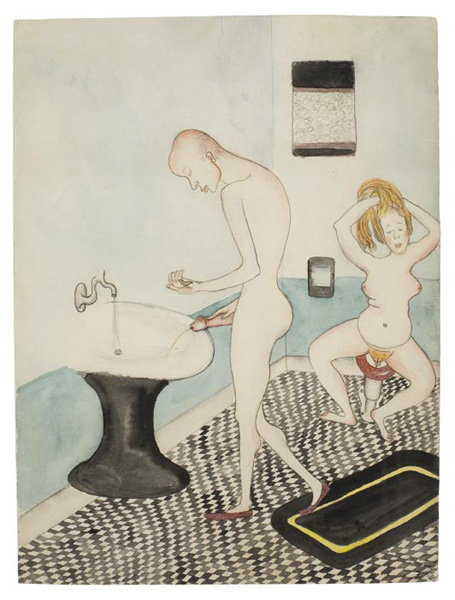
 That same year Alice depicted the two of them in the bathroom after a bout of lovemaking, in a painting entitled Bathroom Scene.

Untitled (Alice Neel and John Rothschild in the Bathroom) by Alice Neel (1935)

Alice Neel who was now in her mid-thirties, depicted herself in her 1935 painting entitled Alice and John in the Bathroom as a beautiful and curvy woman, with her long red hair. We see her seated on the toilet urinating while her lover, John Rothschild, stands at the sink, urinating with an erect penis in his hand. Stephanie Buhman in her 2009 article in on-line art magazine artcritical describes the painting:

“…Neel can be seen sitting on a toilet seat while urinating. John stands at the sink, urinating with an erect penis in his hand. Various shades of red accentuate details, such as Alice’s pubic hair, the toilet seat, John’s slippers and the head of his penis. Alice’s legs are turned outward, her arms crossed over her head, almost taking on the posture of an Indian deity. The scene could not be more humbling in its honesty and lack of glorification. Leaving the viewer in the role of a voyeur, Alice and John in the Bathroom is an ode to the pure sense of trust and privacy that two individuals, despite all imperfections, can experience when truly caring for each other…”

The work in no way beautifies the lovemaking which had just happened and I wonder what was in her mind when she painted this shockingly explicit work.

The first exhibition of the Washington Square Outdoor Art Exhibit was so successful that a second one was held that November.  The second event was even bigger than the first with over three hundred artists participating.  Juliana Force, who was the Director of the Whitney Museum of American Art, and who had endorsed the exhibition, was so impressed with the works on show that she invited many of the exhibitors to meet her and talk about their work and their artistic struggle to survive financially

At the end of 1933, Alice Neel enrolled in the Public Works of Art Project (PWAP), a government-funded program run under the auspices of the Whitney Museum of American Art and its director Juliana Force, aided by Vernon C. Porter.  In the 1977 book, New York City WPA Art: Then and  and Now, she recalled the time:

“…The first I heard of the W.P.A. was when in 1933 I received a letter from the Whitney Museum asking me to come and see them. I was interviewed by a young man who asked me ‘How would you like to paint for $30 a week?’ This was fabulous as most of the artists had nothing in those days and in fact there were free lunches for artists in the Village … All the artists were on the project. If there had been no such cultural projects there might

An interesting painting by Neel was completed in 1933 whilst she was part of the Works Progress Administration, which was a New Deal program to help the impoverished and unemployed.  In the work we see a scene which Neel could empathize with as she was then also struggling financially.   Before us we see a room at The Russell Sage Foundation, which had been established by Margaret Olivia Sage in 1907.  The aim of the foundation was to try and improve the social and living conditions in the United States.

Investigation of Poverty, Russell Sage Foundation by Alice Neel (1933)

In the painting, at the centre rear, we see an elderly grey-haired lady facing side on to us.  She is dressed all in black and we notice that she has her head buried in her hands. Her black clothing probably signifies that she is a widow. We see her seated in front of a small table around which are her interrogators. They look directly at her and one of them seems to be talking to her.  From looking at her, caste your eyes on her inquisitors.  How would you describe their expressions –reflective and yet detached?   It is an unusual grouping.  The men are all wearing suits and ties and the women all wear hats.  In the left foreground, with his back to the viewer, a man sits leaning forward, apparently one of the questioners.  The painting is all about the despair of the central character even though we cannot see her face. Despite the fact that the people investigating her status seem to be well-meaning, the woman is clearly bewildered by the situation that has necessitated her being at this meeting, a prerequisite if she wants financial assistance.  Alice Neel, through this painting, captures the essence of what life was like for the poor during the Depression.  What could be more demeaning than an old lady having to suffer the questions posed by the “suits” in order to gain financial help?.  In the right foreground we see two men, side on to us, who are next in line to be questioned.  One of them has a white moustache and is well dressed in suit and tie.  By the look of his expression he too seems overwhelmed by the ordeal

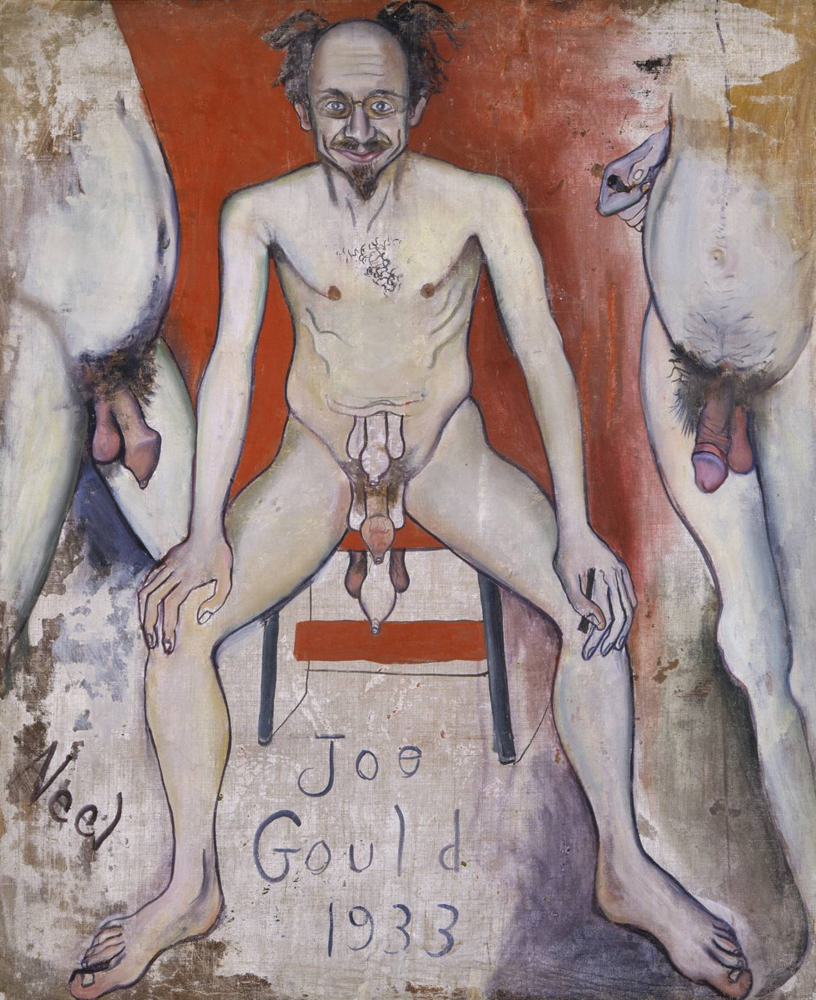
Joe Gould by Alice Neel (1933)

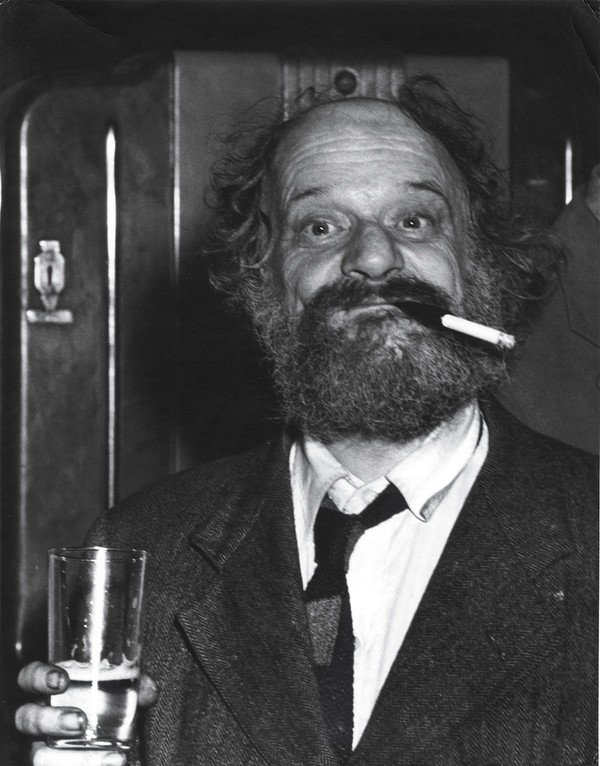
That year Alice Neel completed a somewhat controversial painting of Joe Gould.  For over three decades Gould, who was a homeless Harvard graduate, and a Greenwich Village eccentric who went from bar to bar telling those who would listen to him about the book he was writing.  It was not just any book, he said it was to be the longest book ever written, entitled An Oral History of Our Time.  There must have been something appealing about him as he was well supported by the Greenwich Village artists, poets and writers of the time.

Joe Gould
Joe Gould

The stories of his large tome spread and a journalist, Joseph Mitchell, on the New Yorker wrote a couple of pieces about Gould and his famous book.  Sadly for Mitchell the book was just a figment of Gould’s imagination !   However, Gould became a local legend thanks to all the publicity and it went to his head as he truly believed that his fame was well deserved and that now he was a great attraction especially for the women.  It was probably because of his belief that he was such a lady’s man and a great lover, again, like the book, probably a figment of his imagination, resulted in the way Alice Neel depicted him in her 1933 controversial painting, Joe Gould, which an art critic described as “a symphony of cocks”

In 1934 Alice receives a letter from her estranged husband Joe Enriquez, who on on the news of his mother’s death, had left Europe and returned to his home in Cuba.   In the letter he asked Alice to consider a reconciliation but by now she had other men in her life, her lover Kenneth Doolittle and her ardent admirer John Rothschild and so she declined the “invitation” and she and her husband were never to meet again.

In the early thirties Neel completed a number of nude paintings.  There was nothing erotic or genteel about them, on the contrary these paintings and sketches were down to earth “warts and all” honest depictions of nude men and women.

Alienation by Alice Neel (1935)

In her 1935 watercolour on paper work entitled Alienation she depicted herself lying voluptuously in bed while her friend and lover John Rothschild stands over her.  It is interesting to note that at this time the painting of nudity was not considered appropriate for a female artist to pursue.

Nadya and Nona by Alice Neel (1933)

Another early example is Nadya and Nona which she completed in 1933.  It is a challenging and provocative painting of two nude women lying in bed which scrutinised the subject of sexuality but at the same time avoided any erotic or seductive nuances.

It is around this time that another man comes into her life.  He is a married nightclub singer Jose Santiago Negron………………….

…………………to be continued.

– – – – – – – – – – – – – – – – – – – – – – – – – –

I have used numerous internet sources to put together this and the following blogs on the life and art of Alice Neel and I am currently reading a fascinating book about the artist by Phoebe Hoban entitled Alice Neel: The Art of Not Sitting Pretty. It is a very interesting read and one I can highly recommend.

Alice Neel’s art is being shown in a number of exhibitions in America but there are also a series of exhibitions of her work travelling around Europe at the current time:

Painter of Modern Life at the Ateneum Art Museum, Helsinki

(June 10th – October 2nd 2016)

and at the

Gemeentemuseum, Den Haag, Holland

(November 5th, 2016 – February 12th 2017)

Alice Neel. Part 2 – First true love, heartbreak and dark days

Photograph of Alice Neel titled Alice Enríquez 1929.

Alice’s love of art and her determination ensured she did well gaining a number of awards for her portraiture.  In the summer of 1924 she attended the summer school at Chester Springs organised by the Pennsylvania Academy of the Fine Arts.  In some ways it was an idyllic place to fall in love, which she did.  Here students were able to take part in portrait classes as well as landscape drawing and painting classes.

Alice Neel and Carlos Enriquez (1924)

Whilst on this course Alice met and became friends with a fellow artist, Carlos Enríquez de Gómez.   She asserted later that he was tall, dark and handsome and absolutely gorgeous.  Carlos, like Alice, was born in 1900.  His birthplace was the small rural village of Zulueta, Cuba.  He came from one of the wealthiest wealthy Cuban families.  His father was was a sugar cane plantation owner and a physician, who even tended the Cuban president Gerardo Machado.  Carlos received little academic artistic training with the exception of taking painting classes while in high school at the Escolapios in Guanabacoa during 1918-19 and so he could almost be classified as being a self-taught painter.  He completed his schooling in Havana where he graduated and, because his parents wanted their son to obtain a technical degree, which would then allow him to enter the world of business, they enrolled him at the Curtis Business School in Philadelphia to study commerce.  However, Carlos was not wanting to be a “captain of industry”, he wanted to paint.  He wanted to become an artist and so in 1924 he enrolled at the Pennsylvania Academy of the Fine Arts summer school.

Carlos Enríquez by Alice Neel (1926)

It must have been love at first sight for these two young aspiring artists.  Unfortunately for Carlos, all thought of art died as all he wanted was to be with his beloved Alice.  In July the course organisers lost patience with him and his lack of work and expelled him.  Alice quit the Summer School course in protest.  Carlos returned home to Cuba but in a letter to Alice, he wrote:

“…How wonderful would it be if you were a lost princess in the woods and of course as the legend always says, I riding a horse will find you crying … Weep no more my fair lady….. I’ll say … for I have a kingdom in my heart for you…”

Alice continued with her studies at the Philadelphia School of Design for Women and in her final year wins the Kern Dodge Prize for best painting in life class and in June 1925 she graduated from the school.  This final year of her studies had been traumatic.  She missed her new love and recalled that year:

“…After I met Carlos, I went back to school, and although I worked hard, it wasn’t like the other years, it wasn’t as good.  The year was ruined by the fact that I wanted to be in Havana even then and marry…”

Collecting Souls, Gathering Dust: The Struggles of Two American Artists, Alice Neel and Rhoda Medary

Having completed her course at the Philadelphia School for Women Alice Neel spent time with her closest friends, fellow aspiring artists, Rhoda Medary and Ethel Ashton and the three of them would take classes on a Sunday afternoon at the local Graphic Sketch Club.  Medary and Neel suffered from similar problems in life.  In an interesting biography of the two artists written in 1991 by Gerald and Margaret Belcher, entitled Collecting Souls, Gathering Dust: The Struggles of Two American Artists, Alice Neel and Rhoda Medary, the authors illustrate how difficult life was for women who wanted to be artists, especially those burdened with overbearing mothers and weak husbands As students at the Philadelphia College of the Arts, both Neel and Medary were said to have been difficult, contentious, talented, and impulsive. Rhoda Medary was believed to have been the more talented student, who married for love, gave up painting, and spent 34 years following her handsome but feckless and withdrawn husband around the country. Frustrated and angry, she didn’t resume painting until after he’d committed suicide.  Her children abandoned her, and she’d found a place supervising the student art store at Beaver College.

Rhoda Myers with Blue Hat by Alice Neel (1930)

In 1930 Alice Neel depicted her friend in a couple of nude painting, one of which was entitled Rhoda Myers with Blue Hat.  It is a strange painting and a hardly flattering depiction of her friend.  We see Myers seated and nude, dressed only in pearls and a large blue hat. Myers’ figure is depicted with a dark outline and flat form of her body.  This was a style Alice Neel used to counter a depiction of the female nudity as sexually enticing.  In her 2002 book Alice Neel: Women.  Mirror of Identity, Caroline Carr wrote about this painting, saying:

“…The bored, distracted visage, the roughness of the flesh, and the flatness of the breasts are rendered so that nothing invites the viewer to touch, gaze, or be aroused. Moreover, the manner in which the form occupies the foreground and fills the frame of the canvas metaphorically forbids the viewer to enter the space of the observed.”

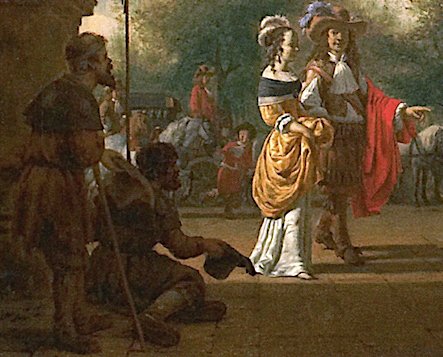
Beggars, Havana. Cuba by Alice Neel (1926)

In May 1925, Carlos returned to Colwyn to see Alice and he proposed to her.  She accepted and on June 1st 1925 the couple married.  Enrico wanted to take Alice back with him to Cuba but she was too nervous to leave her hometown.  Carlos was devastated and returned to Cuba alone.  At the start of 1926 he returned to Colwyn and by February he had convinced Alice to return with him to Cuba.  They travelled by overnight train to Key West in Florida and then took a six-hour trip on a ship to Havana.

Mother and Child Havana by Alice Neel (1926)

The couple moved in with Enrico’s parents and then into their own apartment in the La Víbora district of Havana.  The couple exhibited works in the city.  On December 1926 Alice gave birth to their first child, Santillana del Mar Enríquez.  Sadly, the child only survived for seven months before dying of diphtheria, the same illness that had killed Alice’s eldest brother.

The couple frequently travel between Cuba and America before finally settling down in an apartment in West 81st Street in the West Side of Upper Manhattan in the autumn of 1927.  To help support her and her husband Alice took a job at a Greenwich Village bookstore owned by Fanya Foss whom she depicted in a 1930 portrait entitled Fanya.

Untitled (Woman with a Cat) by Alice Neel (1932)

Two years later Neel produced a painting which has been given the title Untitled (Woman with Cat) which is believed to be another depiction of Fanya Foss.

 Alice, her husband and their daughter moved from Manhattan to the Bronx at the end of 1927, shortly after which, her daughter, Santillana, died.

Alice Neel holding her daughter, Santillana (1927)

In November 1928, whilst living in the Bronx, Alice gave birth to her second child, a daughter, Isabella Lillian, who became known as Isabetta.   It was around this time that problems appeared with regards Alice and Enrquez’s relationship.  The couple had often planned to go to Paris but it had never happened.  However, in May 1930 Enriquez, along with Isabetta, left America and travelled back to his parent’s home in Cuba.  His idea was to leave his daughter with his parents whilst he returned to America, collected Alice and for them both to head off to France.   Alice had agreed to the plan and had even sub-let their New York apartment and moved back in with her parents in Colwyn.  She also found work at the art studio of her friends, Ethel Ashton and Rhoda Meyers.  Everything seemed to be going to plan, but………

Well Baby Clinic by Alice Neel (1928)

On reflection, Enriquez who was still in Cuba realised that the money he and Alice had saved was not enough to fund their joint trip to Paris and he then made the decision to go to the French capital on his own, leaving Isabetta in the charge of his two sisters.   One can only imagine what Alice Neel thought of this decision.  She tried to immerse herself into her painting but it didn’t prove enough to distract her from what her husband had done and the “loss” of her daughter.   In August 1930 Alice Neel suffered a nervous breakdown whilst at her family home.  One can get a feel for how she was feeling by her handwritten note:

“…Carlos went away. The nights were horrible at first … I dreamed Isabetta died and we buried her right beside Santillana….”

Portraits of their daughter Isabetta by Carlos Enríquez (left) and Alice Neel in Nexus New York at El Museo del Barrio

Alice Neel’s mental condition deteriorated and in October she was admitted to the Orthopaedic Hospital in Philadelphia where she remained over the Christmas period.  Her husband, by this time, must have been concerned with his wife’s health for he returned to America and made a few hospital visits.  Alice’s parents agreed to take her out of the hospital and looked after her in the family home in Colwyn but this proved a bad decision as shortly after her return home Alice attempted to kill herself by gassing herself in the house’s gas oven.  She was taken away and admitted to the Wilmington Hospital in Delaware.  Following a further attempt to kill herself whilst in hospital she was transferred to the suicide ward of the Philadelphia General Hospital.

One has no idea what was going through her husband’s mind at the time but in the Spring of 1931 he decided to leave America and his sick wife and he returned to Paris.  Alice was transferred to the suicide ward of the local Gladwyne Colony sanatorium where she was encouraged to continue with her painting as a sort of therapy.  She was finally released from hospital in September 1931, almost thirteen months after her initial breakdown.  Once discharged from hospital she reacquainted herself with her friend Nadia Olyanova and her Norwegian Merchant Marine husband, Egil, who were now living in New Jersey.  It was during one of her visits to her friends that September, that she meets a friend of theirs, another Merchant Marine, Kenneth Doolittle.

Kenneth Dolittle by Alice Neel (1931)

In 1931 she painted a portrait of him.  We see him, fully clothed, sitting upright in a chair, staring out at us.  His penetrating gaze is somewhat unsettling.  He frowns and one gets the impression that he was not a willing sitter for Neel.  His face is pale grey and lined.  His facial expression is grim and unfriendly.  The paleness of the depiction is only offset by the slight tinge of red of his nose and the stark red colour of his tie which immediately attracts our attention.  Alice’s liaison with Doolittle was to prove another disaster in her choice of companion!

…………………………… to be continued.

– – – – – – – – – – – – – – – – – – – – – – – – – –

I have used numerous internet sources to put together this and the following blogs on the life and art of Alice Neel and I am currently reading a fascinating book about the artist by Phoebe Hoban entitled Alice Neel: The Art of Not Sitting Pretty. It is a very interesting read and one I can highly recommend.

Alice Neel’s art is being shown in a number of exhibitions in America but there are also a series of exhibitions of her work travelling around Europe at the current time:

Painter of Modern Life at the Ateneum Art Museum, Helsinki

(June 10th – October 2nd 2016)

and at the

Gemeentemuseum, Den Haag, Holland

(November 5th, 2016 – February 12th 2017)

Alice Neel. Part 1 – The early days

Alice Neel (1900 - 1984)
Alice Neel (1900 – 1984)

My artist today is a twentieth century American artist, who although maybe not as well known as Georgia O’Keeffe or Frida Kahlo, was once described as one of the great figurative painters of the twentieth century.   The definition of “figurative art”, which is sometimes given an “–ism” as being figurativism, is any form of modern art that retains strong references to the real world and particularly to the human figure.

The subjects of her paintings ranged from her family, and friends to a mish-mash of writers, poets, artists, students, textile salesmen, psychologists, cabaret singers, and homeless bohemians. It was this unconventional assortment that became a kind of dialogue with, the city in which she lived. Her works were often acute observations, often humorous, of political and social issues, including topics such as gender, racial inequality, and labour struggles. Her work served as a social chronicle of New York and America in the twentieth century. She is known primarily for her portraits of her many friends, lovers, family members and art-world acquaintances. The depictions of these people are sometimes emotionally penetrating and often somewhat brutal. Today I am examining the life and work of Alice Neel.

Alice Neel's parents (c.1907)
Alice Neel’s parents (c.1907)

Alice Hartley Neel was born on January 28th 1900 in Gladwyne Pennsylvania. Her father was George Washington Neel, a clerk for the Superintendent Car service of the Pennsylvania Railroad, who descended from a family of steamship owners and opera singers. Her mother was Alice Concross Hartley who maintained she was a descendant of Richard Stockton, one of the signatories of the Declaration of Independence. Alice referred to her father as a “little gray man” who was completely controlled by his wife. Alice was the fourth of five children. She had three brothers, Hartley, the eldest of the siblings who died aged eight, around the time of Alice’s birth, two younger brothers, Albert and Peter and a sister, Lilian. Soon after Alice was born the family moved to Colwyn in Darby Township, a borough in Delaware County, lying just west of Philadelphia. It was in Colwyn that Alice Neel went to the local primary school and in 1914 to Darby High School.

Alice Neel, aged 5 (1905)

So what did Alice think of life in Colwyn? An insight into her thoughts about her early life came in 1983, a year before she died, when she described her life in the small Pennsylvanian town:

“…I lived in the little town of Colwyn, Pennsylvania, where everything happened, but there was no artist and no writer. We lived on a street that had been a pear orchard. And it was utterly beautiful in the spring, but there was no artist to paint it. And once a man exposed himself at a window, but there was no writer to write it. The grocer’s wife committed suicide after the grocer died, but there was no writer to write that. There was no culture there. I hated that little town. I just despised it. And in the summer I used to sit on the porch and try to keep my blood from circulating. That’s why my own kids had a much better life than I had. Because boredom was what killed me…”

 Alice looked up to her mother as being the dominant parent. In an interview with Ted Castle for the October 1983 Artforum journal she commented on this dominant position in her mother and father’s marriage:

 “…My mother was the real head-of-the-household type. My father didn’t even care to be boss. He was a nice philosophic person. I was more interested in my mother because she was bright, she knew more and she was quicker on the draw…”

In Eleanor Munro’s 2000 book, Originals, American Woman Artists, Alice Neel’s comments about her mother are quoted:

“…She had a strong independent character, stronger than I, but she was terribly nervous. She could have done anything, run a big business establishment. She was very well-read and very intelligent, and she had a terrific capacity, but she couldn’t compromise…”

So, even though she accepted that her mother was the influential parent, she also had to accept some negative comments from her. Alice recalled how she once told her mother that she wanted to become an artist only to be told:

“…I don’t know what you expect to do in the world, Alice. You are only a girl…”

 Alice’s mother’s comments probably derived from her own mother’s jaundiced attitude to women, who believed women had no important role in life. Despite her mother’s views, Alice was not to be deterred. Alice had always liked drawing and painting as a child. In her 1983 biography of Alice Neel, Patricia Hills recalls how despite the many put-downs by her mother, Alice knew what she wanted to be.

“…I always wanted to be an artist. I don’t know where it comes from. When I was eight years old the most important thing for me was the painting book and the watercolours. When I was very small about five or six, my most important Christmas present would be a colouring book…”

In 1914 Alice attended the Darby High School and four years later, in June 1918, when she was eighteen years old, she graduated. Her family decided that a career in the civil service would be good for her and would also help the family financially. She attended a business course including typing and stenography and then sat and passed the civil service exam and was given a secretarial post with the Army Air Corps in Philadelphia. She remained there for three years at the end of which she was offered a secretarial position at  Swarthmore College, a private liberal arts college, but she rejected the offer deciding to spend the summer with her sister, Lilly, who lived in Pittsburgh.

Alice Neel aged 17 (1917)

Alice’s greatest love was her art and whilst working as a civil servant she attended evening classes at the School of Industrial Art in Philadelphia. This establishment, now a university, known as the University of the Arts (UArts) is one of the oldest schools of art or music in the United States.  In November 1921, after three years as a civil servant Alice had managed to save a little money and this was enough to cover the cost of enrolling at an art college and for the first year’s tuition.

Philadelphia had two main art establishments, the Pennsylvania Academy of the Fine Arts and the Philadelphia School of Design for Women. She thought very carefully about which to choose but eventually decided to apply to the latter. She cited four main reasons for her choice. Firstly, she preferred to go to an all-women school so not to be pestered by amorous boys. Secondly the Pennsylvania Academy, being the alma mater of Mary Cassatt was a great believer of teaching art à la Impressionism and furthermore she was not a great admirer of Renoir-like art. Another reason was that she had heard the teaching at the Academy was very strict and deviating from their artistic teaching was anathema and one has to remember that she was already showing signs of being rebellious.  Finally the Philadelphia School of Design for Women (Now the Moore College of Art and Design) offered two courses, one in Fine Arts and the other in commercial design and it was this latter course she told her parents she was going to take. This allowed them to believe that their daughter had a plan for her future as a paid illustrator after completing the course, and that they were happy with. However after a short period she switched to the Fine Arts course, which was her great love, but didn’t tell her parents until later. Her savings paid for her first year’s education and because she proved such a talented student she received the Delaware County Scholarship, which enabled her to afford the second and third year fees.

Alice Neel xxThe Philadelphia School of Design for Women was founded in 1850 and it became the largest school for women. The long-time director of the school, between 1886 and 1920, was Elaine Sartain, the American painter and engraver, whose father, John Sartain, had served on the board as vice president for years. One thing Elaine Sartain will be remembered for was her decision to allow life-drawing classes at the School albeit using draped male and nude women models. However this introduction of life drawing classes was uncommon for women artists at the time.  The new Dean, Harriet Sartain, Elaine Sartain’s sister-in-law, had interviewed Alice for a place at the school.

Alice and her sister Lilly (1921)

Alice Neel studied landscape painting under Henry Snell, the London-born American Impressionist painter.   Snell was a member of the New Hope, Pennsylvania School of Landscape Painting. He taught at the Philadelphia School of Design for Women from 1899 to 1943, and often took his art class students abroad during the summer, sometimes visiting his native England, spending time at the art colony of St. Ives on the coast of Cornwall.   Alice also attended portraiture and life-drawing classes run by Rae Sloan Bredin, an American artist who was a member of the New Hope, Pennsylvania School of Impressionists.  One of her favourite tutors was the Leipzig-born American painter Paula Balano who taught drawing and anatomy. In Patricia Hills book Alice Neel the author quotes Alice with regards Balano:

“…There was one very good teacher, a woman Paula Balano, who used to design stained glass windows for a living. And she was great because she taught you to draw and she taught anatomy at the same time, so it wasn’t just the cold medical stuff of anatomy. She would teach you, for instance, that the bone ends here. The mouth has a circular thing like a rubber band, so when you get old it is pursed in. She was great. She once said to me, ‘The things that are hard for other people are easy for you, but the easy things, you can’t do…”

Alice
Alice

Alice’s love of art and her determination ensured she did well, gaining a number of awards for her portraiture. In the summer of 1924 Alice attended the summer school at Chester Springs organised by the Pennsylvania Academy of the Fine Arts. Here students were able to take part in portrait classes as well as landscape drawing classes. Whilst she attended the summer school, Alice met and became friends with a fellow artist, Carlos Enriquez Gomez.

This was a meeting which changed her life and not ultimately for the better

………………………….to be continued

– – – – – – – – – – – – – – – – – – – – – – – – – – – – –  – – – – – – – – – – – –

The lack of Alice Neel’s paintings in this blog is for the reason that she really didn’t start painting seriously until the mid 1920’s and therefore in forthcoming blogs when I follow her life, I will introduce you to some of her wonderful paintings.

I have used numerous internet sources to put together this and the following blogs on the life and art of Alice Neel and I am currently reading a fascinating book about the artist by Phoebe Hoban entitled Alice Neel: The Art of Not Sitting Pretty. It is a very interesting read and one I can highly recommend.

Alice Neel’s art is being shown in a number of exhibitions in America but there are also a series of exhibitions of her work travelling around Europe at the current time:

Painter of Modern Life at the Ateneum Art Museum, Helsinki

(June 10th – October 2nd 2016)

and at the

Gemeentemuseum, Den Haag, Holland

(November 5th, 2016 – February 12th 2017)

Ferdinand Georg Waldmüller and the Biedermeier era

Portrait of the fictitious character Gottlieb Biedermeier from the Munich Fliegende Blatter

My blog today starts with a caricature of Gottlieb Biedermeier.  Gottlieb is not the artist of the day.  He is just the lead-in to the star attraction.  Gottlieb Biedermeier, more commonly referred to as Papa Biedermeier, used to appear as a cartoon character in the popular newspaper, Fliegende Blätter, a German weekly non-political humour and satire magazine which appeared between 1845 and 1944 in Munich, and it is through his regular appearance that  this period was actually termed the Biedermeier era, an era which stretched between the defeat of Napoleon in 1815 and the Republican revolts against European monarchies of 1848, which began in Sicily, and spread to France, Germany, Italy, and the Austrian Empire.   Papa Biedermeier was a comic symbol of middle-class comfort. The art of the Biedermeier period came to be characterized by what art critics of the period termed “rigorous simplicity.”   The works of art often had an enamel-like finish that masked individual brushstrokes. Landscape and portraiture grew in importance while history painting declined.  In painting, the Biedermeier style reflected the bourgeois, simple, joyful, affable and conformist environment, enhanced the aesthetics of the natural beauty and has influence on contemporary art and design.

Early Spring in Vienna Forest by Ferdinand Waldmüller (1864)

In Austria painters during this time portrayed a sentimental and virtuous view of the world but in a realistic way. The German word best describing the emotions derived from the art is gemütlichkeit, which is a space or state of warmth, friendliness, and good cheer. Other qualities of gemütlichkeit include cosiness, peace of mind, belonging, and well-being.  In other words, a “feel good” factor and such comfort, as depicted, emphasized family life and private activities, especially letter writing and the pursuit of hobbies. No Biedermeier household was complete without a piano as an indispensable part of the popularized soiree. Soirees perpetuated the rising middle class’s cultural interests in books, writing, dance, and poetry readings—most subject matter for Biedermeier paintings was either genre or historical and most often sentimentally treated.  The leading Austrian exponent of this type of art is my artist of the day.  He is Ferdinand Georg Waldmüller.

The Girl Antonia Seemann by Ferdinand Waldmüller

Ferdinand Georg Waldmüller was born in Vienna in January 1793.  In 1807, at the age of fourteen, Waldmüller studied Fine Arts at the Academy of Fine Arts in Vienna under the Austrian painter, draughtsman, and well-respected teacher,  Hubert Maurer, who had been teaching art at the Academy since 1785. Waldmüller remained there until 1811. Waldmüller then went to Presburg in Hungary to study portraiture.  Following that he worked in Croatia as a drawing teacher for the children of the Count Gyulay, the governor of Croatia before returning to the Academy in 1813 to carry on with his artistic studies, this time concentrating on portraiture.

Whilst in Vienna Waldmüller would visit the court and municipal galleries where he would make copies of the Old Masters.

Martyrdom of St Andrew by Jusepe de Ribera (1628)

One example of this is his version of Juseppe de Ribera’s Martyrdom of St Anthony which the Spanish artist completed in 1628 which is now in the Szépmüvészeti Museum in Budapest.   St. Andrew was St Peter’s brother and preached around the Black Sea Area.  According to legend he was crucified on two pieces of wood which formed an “X” which has since become known as the cross of St Andrew.

Martyrdom of St Andrew by Ferdinand Waldmüller (1821)

Waldmüller’s copy of the painting can be seen in the Akademie der bildenden Künste in Vienna. Waldmüller had hoped to sell the copies he made of the paintings of the Old Masters but the income from this venture was insufficient for him to live and support himself.

Katharina Waldmüller (née Weidner) by Joseph Weidner

In 1814, Waldmüller  married a well-known Austrian opera singer, Katharina Weidner and he worked as a scenery designer at the various venues at which his wife was performing.   He took up the role as professor of art at the Academy of Fine Arts in Vienna and in 1823 exhibited for the first time at the Vienna Akademie.

Ferdinand Georg Waldmüller Kaiser Franz I (1827)

For the next decade he travelled around Europe, enhancing his reputation as a leading portraitist of his time and in 1827.  He received royal patronage following his portrait of the nineteen year old Franz I, who would become the Holy Roman Emperor in 1845.

Portrait of a Young Lady by Ferdinand Waldmüller (1820)

His art at the time concentrated on portraiture, an art genre in which Waldmüller excelled.  His portraits had a high smooth-finish and decorative detail and were often compared to the French Neo-classical painter Ingres.  One of his most beautiful portraits is entitled Portrait of a Lady, which he completed in 1820.

Portrait of Beethoven by Ferdinand Waldermüller (1823)

One of the most famous of his sitters was Ludwig van Beethoven who sat for him in 1823.  The portrait had been commissioned by the Leipzig publishers Breitkopf & Härtel.  According to notes and letters, it was a one-off sitting and even that was interrupted.  So in the short time he had, Waldmüller only portrayed Beethoven’s face, and it was later, back in his studio, that he added the clothes and probably also parts of his hair.  The original was destroyed in 1943 but fortunately, the portrait was so popular in the late nineteenth and early twentieth century that it was reproduced and copied many times.

Julia Comtesse Apraxin by Ferdinand Waldmüller (1835)

Perhaps, one may consider his portraits of children a little too “syrupy” but this should not detract from the excellent portraits.  In 1835, Waldmüller, whilst living in Vienna, completed a commission to paint the portrait of seven year old Julia Aspraxin, the daughter of  Count Alexandr Petrovich Aspraxia, a serving Russian in Vienna.

Portrait of the Future Emperor Franz Josef I of Austria as a Grenadier with Toy Soldiers by Ferdinand Waldmüller (1832)

In 1832 he painted a portrait of the two-year-old Franz Josef, the future Austrian Emperor entitled Portrait of the Future Emperor Franz Josef I of Austria as a Grenadier with Toy Soldiers.  The child posed for the artist in the uniform of a grenadier along with some similarly dressed Hungarian wooden figures.  It is like a state portrait on a miniature scale. The child, with his blue eyes, looks out innocently unaware of his future role and the disasters that would follow.

Old Elms In Prater by Ferdinand Waldmüller (1831)

Waldmüller painted pictures of all genres and had soon built up his standing as a talented landscape painter.  His beautiful landscape artistry was appreciated by the public and in the 1850’s he became very interested in the depiction of sunlight and the contrast between light and shadow which one realises was a pre-cursor to Impressionism.  I especially like his 1831 paintings featuring the elm trees in Prater, the large park in Vienna.   One was entitled Old Elms in Prater.  Look at the extraordinary detail.

Elms In Prater by Ferdinand Waldmüller (1831)

The other simply, Elms in the Prater.  His landscape artistry was based on his strong belief that art should be determined by the careful and meticulous examination of nature.  For Waldmüller, a talented colourist and someone who had a great knowledge of nature, it was all about natural observation achieved by plein air painting and not so much the way art was taught in academies. It was, like the Impressionists, fifty years later, about the effect of light.

View Of The Dachstein With The Hallstättersee From The Hütteneckalpe At Ischl by Ferdinand Waldmüller (1838)

Another beautiful landscape work was his 1838 painting entitled View Of The Dachstein With The Hallstättersee From The Hütteneckalpe At Ischl.

He became the curator of the Gemäldegalerie of the Academy of Fine Arts in 1829, a post he held for almost three decades.  However in 1849 and again in 1857,  he wrote critical papers with regards the Academy and academic teaching of art and,  at the age of sixty-four , was forced to resign from his position at the Academy.

Corpus Christi Morning by Ferdind Waldmüller (1857)

The third “string” to Waldmüller’s artistic bow was his great talent as a genre painter.  His genre paintings shied away from idealisation or pretentiousness and although he would often add historical and religious elements to his depictions he was never afraid to highlight social criticism in the paintings.   Through his depictions of life in the countryside his paintings extolled the virtue of rural life and at the same time highlighting the positivity of family life.  Such joyousness can be seen in his 1857 painting, Corpus Christi Morning.  Life for the peasant class may not all laughing and dancing but for that moment in time life could not be better.  It was a gemütlichkeit time.

Ferdinand Georg Waldmüller, Children decorating a Conscript's Hat (1854)
Ferdinand Georg Waldmüller, Children decorating a Conscript’s Hat (1854)

Ferdinand Georg Waldmüller completed his painting Children decorating a Conscript’s Hat in 1854. The painting depicts a very poignant moment.  It was an occasion of great importance to rural families.  We see a group of girls, maybe his sisters,  decorating the hat of a young man who has been called up to fight for his country during his compulsory military service. His hat is being decorated with flowers and ribbons. The decorating of the hat is a time of joy and merriment which masks the possible horrors the young man may encounter.  As far as art is concerned, it is a masterpiece of evocative genre painting and, the work is a testament to how Waldmüller depicts the intricate interplay of light and shadow.

The Departure of the Conscript by Ferdinand Waldmüller (1854)

Another work by Waldmüller, The Depature of the Conscript, shows the family of a conscript saying their farewells and wishing him a safe journey.  His mother places the decorated hat on the head of her son.  Look how the boy wraps one arm around his mother whilst his other hand is held lovingly by his father.  It is now that maybe they realise that the ceremony of decorating the hat will mean nought if their beloved son does not return home.  In the background we see women in tears.  A young man, maybe the conscript’s younger brother, looks back pensively at his older brother wondering when it will be his time to join the military.  The conscript’s young sisters try to cling hold of him, not wanting him to go.  This is not a scene of joy but one of realism, one of foreboding.

I have always loved genre paintings especially when there are numerous characters depicted.  Each time I look at painting like this I discover something different.

In 1851, Waldmüller, aged 58,  married his second wife, 25-year-old Anna Bayer. He carried on exhibiting his work at various exhibitions, including the prestigious World Exhibition in Paris and at the International Exhibition in London. In 1856 he travelled to London where he sold thirty one of his paintings to the royal household and court. By the 1860s, the Academy in Vienna had forgiven Waldmüller’s transgressions and outspoken views critical of their institute and their teaching methods and he was once again welcomed back to the Viennese artistic fold.  He was knighted in 1865, shortly before his death that August, aged 72.

Ferdinand Georg Waldmüller, Self-Portrait at the Easel, (1848)

Ferdinand Georg Waldmüller is looked upon as one of the most important Austrian painters of the Biedermeier period.  His superb artistic talent, as a landscape painter, was never questioned.  He was an advocate of plein air painting, putting down on canvas what the eye could see.  This to him was of greater importance than the art taught in academies.  The way in which he achieved an accurate characterisation of the human face took his portraiture to another level.  His genre works which depicted rural everyday life were outstanding.  The depictions, often moralising and socially judgemental would set a marker for future artists who favoured this genre.

I give you Ferdinand Georg Waldermüller.

Two Mallorcan artists – Coll Bardolet and Miró.

During the last seven days I have been soaking up the sun and heat of Mallorca and now, whilst sheltering from the continual rain, I thought I would look at two artists who had an attachment to this Balearic Island.  Their work could not have been more different.  The artwork of the first artist was bright and beautiful whilst the work of the second artist, who is, by far, more famous, left me unmoved but I will try not to judge and simply accept that beauty is in the eye of the beholder.

Josep Coll Bardolet at work

The first artist I am featuring is the Catalan painter Josep Coll Bardolet, whose work I came across at a gallery in the quaint Mallorcan town of Valldemossa.  He was born in November 1912 on mainland Spain, in Campdevànol, a village in the province of Girona.  When he was fifteen years old the family moved to the city of Vic, a small town twenty miles south of where he was born and where Coll Bardolet began his education at the Escola Municipal de Dibuix and worked as a painter and decorator. It is in that year in Vic that he held his first exhibition of his paintings. Having developed a love of landscape painting he then enrolled at the Landscape Painting School in Olot, which is now known as Escola d’Art i Superior de Disseny d’Olot .  The town of Olot, which lay twenty miles east of Campdevànol, is known for its natural landscape, including four volcanoes which are scattered around the city centre.  The town was also famous for its cultural activity, with its various art movements such as the Olot School of landscape painting.  The Olot School was a group of painters that created an artistic style in the second half of the 19th century, similar to the French Barbizon School.

Cala Deiá by Josep Coll Bardolet

In July 1936, the Spanish Civil War broke out and Bardolet, being a pacifist, decided to leave his homeland and cross the border to France.  He travelled to Tours and here he studied at the town’s Academy of Fine Arts.  The following year he moved to Brussels where he was appointed professor at the city’s Académie Royale des Beaux-Arts.

Majorcan Landscape (Oil on tablex) by Josep Coll Bardolet

In 1939 he returned to Spain and his beloved Catalonia and it is whilst here that he makes a number of journeys to Mallorca, each time staying longer and longer on the island.  He was fascinated by the island’s light, landscape and its folk dances and it is these themes which play a major part of his art.  His paintings were exhibited both on the mainland at Barcelona and on the island at Palma.  His love of the island grew over the years and finally in 1944 he settled permanently in Valdemossa.    He bought a house with a studio and a garden next to the Charterhouse of Valldemossa, a former Carthusian monastery, which is now a museum.  Here he lived with a small dog, a cook and a housekeeper.  Over the next twenty years he worked tirelessly completing paintings which are exhibited in galleries throughout Europe as well as Boston, USA.

Collidores by Josep Coll Bardolet

In 1987 he was declared an honorary citizen of Valldemossa, the town he had made his home for over forty years.  In 1988, in recognition of his achievements the Coll Bardolet  Art Gallery was opened in Campdevànol, the village where he was born seventy-six years before.

Spanische Tänzer by Josep Coll Bardolet

Thirty miles north-east of where Bardolet used to live in Valldemossa is the town of Escorca and there is the Santuari de Lluc, a monastery and pilgrimage site.  In 1984, with the celebration of the centenary of the Coronation of the Virgin the museum expanded with the addition of a considerable acquisition of modern art and sculpture, which was further extended to include rooms dedicated to the work of Josep Coll Bardolet who made two donations totalling 236 works of art in 1989 and 1995.  The new and definitive collection was opened on 10th September, 1995 and is made up of the Coll Bardolet Collection of portraits, drawings, gouache and water-colours.

The Coll Bardolet Cultural Fundation

In 1990 Bardolet was awarded the Saint George Cross by the Autonomous Government of Catalonia and the Gold medal of the Community of the Balearics Islands.  The Coll Bardolet Cultural Foundation was established in 2005 with the works donated by him to the town of Valdemossa.  The Foundation has two main objectives. The first is to preserve, exhibit and publicise the pictorial work of Josep Coll Bardolet and the Foundation’s private collection of his work, and the second is to promote the fine arts in all of their facets and forms.  The Foundation, which I visited last week, is in a three storey building in the centre of Valldemossa.  The first floor of the building features a permanent exhibition of Coll Bardolet’s paintings, which primarily consist of landscapes of Mallorca, though they also include still lifes, flower compositions and his well-known renderings of traditional Mallorcan folkdance scenes. The second floor houses temporary exhibitions, and the ground-level floor accommodates different cultural activities, such as conferences and concerts.  The building was restored under the auspices of the Balearic Islands Government and the Valdemossa Town Council.  The works in this permanent collection captivate the beautiful Mallorcan scenery.

Josep Coll Bardolet (1912 - 2007)
Josep Coll Bardolet
(1912 – 2007)

Josep Coll Bardolet died in Valdemossa in July 2007, aged ninety-four.

———————————————————

Joan Miro at work
Joan Miro at work

The second artist I am featuring today is the Barcelona-born painter who also had a connection with Mallorca.  He is Joan Miró.  I visited the museum dedicated to his art work, the Fundación Pilar i Joan Miró (Pilar and Joan Miró Foundation) museum whilst visiting Cala Major just a little way west of Palma.  Although born in Catalonia, both his mother and wife came from the Balearic Island of Mallorca.  The museum is comprised of a main building which houses his works which he donated, a library, a sculpture garden, Miró’s Sert studio, a building designed by his friend of twenty-five years, the Spanish architect and city planner, Josep Sert.

Inside the Gallery at the Fundación Pilar i Joan Miró, Palma Mallorca

In 1937, Josep Sert designed the Pavilion of the Spanish Republic for the Paris Exposition Universelle, for which Miró painted a large format oil painting, The Reaper, also known as El campesino catalán en rebeldía (Catalan peasant in revolt).

Joan Miró working on The Reaper

It was an enormous mural, 5.5metres tall.  Sadly it was destroyed or lost in 1938 and only a few black and white photographs survive, including one showing Miró working on the mural.

Inside Miró's Sert Studio
Inside Miró’s Sert Studio

The Sert studio is the one he used from the time he arrived on the island in 1956 until his death in 1983.  Almost twenty years earlier, in May 1938, whilst living in exile in Paris, he wrote about how owning his own spacious atelier would give him so much pleasure:

“My dream, when I can set somewhere, is to have a large workshop, not so much for lighting, north light, etc., that I find indifferent as to have more space, many fabrics, because the more I have work, the more you come to me to do “.

In 1956 his Sert atelier was ready for him and Miró remembered the time well, saying:

“…In the new study, I had enough space for the first time. I could unpack boxes containing works long ago […] When I took everything in Mallorca, I started myself […] I was ruthless with myself. I destroyed many fabrics, especially a lot of drawings and gouaches… “

Finca Son Boter
Finca Son Boter

Also on the land, there is the Finca Son Boter which he often used as a studio.  The structure is of a typical eighteenth century Mallorcan manor house and its name derives from the surname of the owner of the land in the fourteenth century, the merchant Llorenc Boter.  The closeness of Son Boter to his Sert studio was commented upon in Miró’s letter to Josep Sert.  In October 1959, he wrote:

“…I just bought Son Boter, the magnificent house located behind ours. What, besides being a good investment, puts us safe from possible fastidious neighbors. I also serve to make fabrics and monumental sculptures, as well as to decongest the workshop…”

Sculpture outside Miro's studio
Sculpture outside Miro’s studio

The cost of the building was probably offset thanks to the funding which came with the Guggenheim prize, which he had won in 1958 for the creation of two ceramic murals he did for the UNESCO headquarters in Paris.

View of Cala Major, Palma, from the Joan Miro Museum

Joan Miró maintained a close relationship with Mallorca throughout his life. Although he was born in Barcelona on April 20, 1893, his mother, Dolores Ferrà, and his maternal grandparents were from Mallorca and from 1900, when he was only seven years, he began to spend part of the summer with his maternal grandmother in Mallorca.

Joan Miro and Pilar Juncosa (1929)

In 1920 Miró made his first trip to Paris, which would was to prove the turning point in his life.  In October 1929 his ties with Mallorca strengthened when he married Pilar Juncosa Iglesias.  Pilar’s mother, Enriqueta, was cousin of Miró’s grandmother.

 Joan MiroIn 1936 he travelled to Paris with his latest works, which were to be exhibited in New York. When the Spanish civil war broke out, he decided to stay in Paris and his wife and daughter joined him.   He lived and worked in an apartment at 98 Boulevard Auguste Blanqui, Paris and attended life classes at the Académie de la Grande Chaumière, where he produced a large number of drawings.  In the summer of 1939, with the onset of the Second World War he and his family left Paris and moved to Varengeville-sur-Mer in Normandy, where he rented a house and where the family remained until 1940.
Z 097At the end of May 1940 the Germans bombed Normandy and Miró decided to return to seek refuge in Spain with his family.  His fame had by now crossed the Atlantic and in 1947 during his first trip to America, he produced a mural painting for the Gourmet Room at the Terrace Plaza Hotel in Cincinnati.

Initially, Miró and his family had left France for Barcelona, but Miró had been an active sympathiser for the Republican struggle during the Spanish Civil War a few years earlier and this made him unpopular with Franco’s new regime, and so in 1956, he and his family decided to set up home in the relative isolation of Mallorca.  .

Joan_Mir_Espa_a_Catalu_a_El_nacimiento_del_d_aIn 1956 Miró  summed up his love of the Balearic Island:
“…This wonderful country … We are about to buy a house near Palma in a beautiful land. Dividing my time between here [Mallorca] and Paris, and occasionally travelled to New York, would be ideal for work and health… “

Joan Miró died in Palma de Mallorca on Christmas Day 1983, aged 90. He was buried in the Montjuïc cemetery, Barcelona on December 29th.

Oiseau dans La Nuit by Joan Miro (1973)

I have purposely not commented on the paintings as they are not the kind of art that I can understand or appreciate.  I am however mindful of what somebody once told me.  They said I must embrace all types of art and never make the crass comment that a child could have done better !  As I said at the beginning, beauty is in the eye of the beholder, so maybe this is your type of art, and if it is, enjoy.


Thorolf Holmboe

Thorolf Holmboe
Thorolf Holmboe

In past blogs I have looked at some of the well known Norwegian painters such as Edvard Munch, Thomas Fearnley, Johan Christian Dahl and Peder Balke.  In today’s short blog I am going to examine the life and work of another artist from that country, one less well-known, Thorolf Holmboe.

Thorolf Holmboe (Norwegian, 1866-1935), Landscape in Moonlight with a House, by Thorolf Holmboe (1914) Oil on canvas, (120 x 80 cms).
Landscape in Moonlight with a House, by Thorolf Holmboe (1914)
Oil on canvas,
(120 x 80 cms).

Thorolf Holmbloe was born in May 1866 in Vefsn a municipality in Helgeland which is the most southerly district in Northern Norway.  He was the eldest son of Othar Ervigius Holmbloe, a Customs cashier and Sofie Birgitte Andrea Hall.  He had two sisters, an elder one, Halfrid and a younger one, Gudrun and four younger brothers, Othar, who was also an artist and illustrator although he trained as a chemist and Birger, Jens and Thorvald.  Around the age of eight Thorolf and his family moved to the coastal town of Tromso and it was around this time he received his first watercolour painting lessons.  His father, who had an interest in art and was a founder of a local gallery, and probably encouraged his son to take up painting.

Still life by Thorolf Holmboe (1907)

Thorolf attended school in Christiania (now called Oslo) and graduated in 1884.  He then attended the military academy where he was a reserve officer in 1886.  In 1886, he studied marine art under the Norwegian marine painter, Carl Wilhelm Barth.  That year he travelled to Berlin where he enrolled, for a year, at the Berlin Academy of Art and studied under the professorship of the Norwegian romanticist artist and revered landscape painter Hans Gude.  After returning to Norway he studied at the Drawing School in Christiania under the sculptor, Julius Middelthun.

In August 1888 Thorolf married Julia Caspara Nilssen and the couple went on to have two children, a son, Erik Oscar born in 1895 and a daughter Erna Johanne who was born in 1899.

Fishing Village, Lofoten by Thorolf Holmboe

In 1889 he again left home to study art.  This time Holmbloe travelled to Paris where he remained for two years and studied at the atelier of the French painter, Fernand Cormon, who was a regular exhibitor at the annual Paris Salon.  Cormon had in the past had Toulouse-Lautrec, Louis Anquetin,  Van Gogh and Émile Bernard as former students.  Holmboe also attended classes at the École des Beaux-Arts where he was tutored by the French painter, Léon Joseph Florentin Bonnat .

Nordic Landscape (Nordlandsmotiv) by Thorolf Holmboe

Many of the Norwegian artists at the time completed paintings which formed what was termed a “Norwegian style” as they focused wholly or in part on aspects of Norwegian heritage.  Holmboe avoided this style and instead focused on Norwegian nature especially around his former home in the north of the country.  For him the beauty of his homeland is what he wanted to bring to the fore and this style was very popular with buyers in Norway and the rest of the world.

The Journey by Thorolf Holmboe

He completed many seascapes and it was probably his early life around Vefsn and Tromso that had such a great influence on his art.  He developed a strong affinity for the ocean and the power of the sea and this empathy with the power of nature stayed with him for the rest of his life.

He exhibited in Munich in 1891 and Paris in 1900 and went on to exhibit internationally and was granted solo exhibitions in Paris, Antwerp, Stockholm, Gothenburg, Copenhagen and London.  In his 1907 exhibition in London he exhibited many of his snow scenes.  More recently his work appeared in an exhibition entitled Symbolism in Norwegian Landscape Painting at the Palazzo del Diamanti in Ferrara, Italy in 2001.

Thorolf Holmboe "Polar bear on Ice" design for Porsgrund porcelain vase
Thorolf Holmboe “Polar bear on Ice” design for Porsgrund porcelain vase

Between 1906 and 1925, Holmboe came up with designs and artwork for the famous Norwegian pottery maker, Porsgrund.  The pottery with some of his designs were used as decoration in the exhibition halls of the 1913 Prima Esposizione internazionale d’arte della Secessione Romana (First Roman Secession Exhibition).

Marine painting by Thorolf Holmboe

Many of Holmbloe’s paintings featured seabirds, rocky cliffs and the rough coastal waters

Fra Akerselven (From Akerselven) by Thorolf Holmboe

Around the start of the twentieth century Holmboe’s paintings took on a more gloomy appearance.  It was also around the time that he completed paintings featuring the River Akerselven which flows through the city of Oslo.  One such work is his 1902 painting entitled Fra Akerselven (From Akerselven).  It depicts the River Akerselven which flows through the Norwegian city.

Utsikt over Akerselven by Thorolf Holmboe (1903)

Another painting featuring the river was done in 1903 entitled Utsikt over Akerselven (Overlooking Alerselven).  Once again it is a painting made up of dark and muted colours and this has added to the realism of the depiction.

Illustration to The Trumpet of Nordland

One of the most original Norwegian writers of the nineteenth century was the Lutheran priest and poet,  Petter Dass, whose most famous work was Nordlands trompet (The Trumpet of Nordland), a versified topographical description of northern Norway.  It gives a lively picture, in verse, of the life of a clergyman in this part of the country.  In the 1892 the edition of Petter Dass’ book, with its descriptions of the people and nature of Northern Norway, it was accompanied by the illustrations of Thorolf Holmboe.   Holmboe also designed many book covers, folders, telegrams and postcards.

Hekkende skarv (Nesting Cormorants) by Thorolf Holmbloe

In 1908 Holmboe participated in a hunting expedition to Spitsbergen and Hopen where he painted hunting and wildlife. Particularly popular were the pictures of polar bears that “sail” on ice floes (see the Porsgrund vase above).

Peonies in a Vase by Thorolf Holmboe

The first decade of the twentieth century proved a difficult time for Holmboe to sell his works of art and despite his huge popularity at home he could not establish himself internationally and so he relied financially on his book illustration work and decoration designs.   However it was not all gloom for him in that first decade as he did receive good reviews of his marine paintings when they were exhibited in Antwerp in 1903 and 1904 and in Berlin in 1907 and 1909.  Things changed after the First World War with their being a greater demand for works of art and Holmboe was ready having built up a large collection of his paintings.   The subjects of these works were varied and included bathing scenes, marine life, still lifes, interiors and garden landscapes.  Thorolf Holmboe was appointed Knight of the 1st Class Order of St. Olav in 1900 and he was knighted by the French Legion of Honour.

Thorolf Holmboe died in Oslo in March 1935, aged 68.

Christoffer Wilhelm Eckersberg. Part 5. Clouds and marine paintings

If there is one other thing I have learnt since taking an interest in art is that by reading up on the paintings and the artists one learns a lot about history, whether it be European or American.  One picks up on things which should have been learnt at school but sadly passed one by.  Today’s look at the work and life of Christoffer Eckersberg is a good example of this in the way I have learnt a little about Danish history.

In 1807 the British shelled the Danish capital, Copenhagen.  This was the second ferocious onslaught on the Danish city as six years earlier a similar attack had been made.  It was all to do with the Napoleonic War and the Franco-Russian alliance secret agreement to ensure that Denmark and Sweden would assist them in a naval blockade of British trade.  British diplomats went to Copenhagen to ask the Danish government to put their naval ships under British command until the Napoleonic War had ended but the Danes would not agree and so on September 2nd 1807, the British army landed in Denmark and attacked the Danish capital.  The Danes finally surrendered and their naval ships were taken over by British sailors and sailed to England that October.

The Fire of the Church of Our Lady by Christoffer Eckersberg (1807) The Royal Library, Copenhagen
The Fire of the Church of Our Lady by Christoffer Eckersberg (1807)
The Royal Library, Copenhagen

My first painting I am looking at today by Christoffer Eckersberg, The Fire of the Church of Our Lady, records the terrible onslaught on Copenhagen and is a prime example of history through art.  The work shows the burning of the church steeple of the cathedral of Copenhagen, during the night of September 4th 1807. The steeple eventually fell to the ground.  In the painting we see the pandemonium in the neighbouring street due to the fierce assault and the resulting blitz.

The Bombardment of Copenhagen. View from Ostervold by Christoffer Eckersberg (1807) (50 x 60cms) Museum of National History, Frederiksborg Castle
The Bombardment of Copenhagen. View from Ostervold by Christoffer Eckersberg (1807)
(50 x 60cms)
Museum of National History, Frederiksborg Castle

Another of Eckersberg’s painting depicting the bombardment of Copenhagen can be seen in his 1807 work The Bombardment of Copenhagen.  View from Østervold.  Shortly after the British naval bombardment of the Danish capital, Eckersberg, who was living in Copenhagen, made many drawings, for prints, of the conflagration of the most famous landmarks of the city and by doing so captured for posterity the terrible events.  He managed to capture the feeling of panic which gripped the citizens of Copenhagen when the first shells fell on their beloved city.  Works like this were in general demand and brought about a patriotic stirring that swept through the Danish population in the wake of this British bombardment.

Cloud Study, Thunder Clouds over the Palace Tower at Dresden by J C Dahl (1822) (21 x 22cms) Nationalgalerie Berlin
Cloud Study, Thunder Clouds over the Palace Tower at Dresden by J C Dahl (1822)
(21 x 22cms)
Nationalgalerie Berlin

When Eckersberg returned to Denmark in 1816 after his stays in Paris and Rome he lost contact with most of the international artists of the time, with one exception, the Norwegian painter J C Dahl.   Johan Christian Dahl lived in Norway but spent much time in Dresden and would pass through Copenhagen on his journeys between there and his homeland.  It is known that J C Dahl was fascinated by clouds and their formation and had produced many works featuring this natural phenomenon, one of which was his 1825 painting, Cloud Study, Thunder Clouds over the Palace Tower at Dresden.  For Dahl, the sky was an integral part of a landscape painting, and he would spend many hours observing cloud formations and watch as they crossed over land.

Eckersberg and Dahl developed a lasting friendship and it could have been Dahl’s fascination with clouds and his interest in meteorology that infected Eckersberg, so much so that Eckersberg began a twenty-five year hobby of keeping a daily meteorological diary and would regularly sketch cloud formations.  J C Dahl would also have informed Eckersberg about how both artists and art theorists in Dresden were showing great interest in cloud formations.  Eckersberg was also fascinated by the work of Luke Howard the English manufacturing chemist and amateur meteorologist who in 1802 classified the various tropospheric cloud types and believed that the changing cloud forms in the sky could unlock the key to weather forecasting.

C.W. Eckersberg (1783-1853), Studie af skyer over havet, 1826
Study of Clouds over the Sea by Christoffer Eckersberg (1826) (20 x 31cms) Statens Museum for Kunst, Copenhagen

In 1826 Eckersberg decided to master the art of painting clouds and he took himself off to Kalkbraenderibugten, a bay just north of Copenhagen so that he could paint a range of studies of clouds over water and the painting above, Study of Clouds over the Sea, is one he completed that year

A Russian Fleet at Anchor near Elsinore by Christoffer Eckersberg (1826) (32 x 59cms) Statens Museum for Kunst, Copenhagen
A Russian Fleet at Anchor near Elsinore by Christoffer Eckersberg (1826)
(32 x 59cms)
Statens Museum for Kunst, Copenhagen

Looking at Eckerberg paintings so far I have concentrated on his mythological and biblical works along with some of his portraiture and nude studies but another genre of works favoured by Eckersberg was his marine works which also featured cloud depictions.  A prime example of this is a work he completed in 1827 entitled A Russian Fleet at Anchor near Elsinore.

View of a Harbour by Casper David Friedrich (1816)

The next marine painting by Eckersberg I am featuring could well have come about from a visit he made to the atelier of Casper David Friedrich in Dresden in 1816, on his way home from Rome.  It is quite possible that during that meeting he saw Friedrich’s newly completed work View of a Harbour.

The Russian Ship of the Line “Asow” and a Frigate at Anchor in the Elsinore Roads (1828) (63 x 51cms) Statens Museum for Kunst, Copenhagen
The Russian Ship of the Line “Asow” and a Frigate at Anchor in the Elsinore Roads (1828)
(63 x 51cms)
Statens Museum for Kunst, Copenhagen

This marine painting by Eckersberg is one of my favourites and also one of his best known marine works.  It is his magnificent 1828 painting entitled The Russian Ship of the Line “Asow” and a Frigate at Anchor in the Elsinore Roads.  It is a triumph of detail, not just of the vessel itself and the way he has truthfully represented all the details of the rigging but how he has painstakingly depicted the cloud formation.   So can we look at this as a mastering of plein air painting?  Actually, no !   This is an idealised marine painting made up from a number of Eckersberg’s sketches done at different times and different locations.  He may have been able to see some Russian ships at the Elsinore Roads in 1826, but at a great distance away, and it was not until sometime later that he observed a number of Russian ships at close quarters when they were at anchor in the Copenhagen Roads and it was during that fleet’s visit that he was able to go aboard the admirals’ ship, Azob, (although he later called it Asow !).  He started the painting in 1828 and for accuracy got hold of some constructional drawings of the vessels from the naval dockyard.  He even went as far as consulting his meteorological diary to check the weather conditions on the day the Asow was at anchor off Elsinore, and so the completed 1828 painting is not what Eckersberg saw on that day at Elsinore in 1826 but what he would have seen if he had been able to set off from land in a boat to witness, close up, the mighty Asow.

Eckersberg loved marine painting and in his later years concentrated on this genre at the expense of his once favoured landscape works.

A View towards the Swedish Coast from the Ramparts of Kronborg Castle by Christoffer Eckersberg (1829)

A View towards the Swedish Coast from the Ramparts of Kromborg Castle by Eckersberg is another example of his marine/cloud painting.  From his diary we know that this plein air work was started in September 1826 but was not completed until January1829 .  The artist had positioned himself on the ramparts of the castle looking out across the Øresund towards the coast of Sweden, which was just four kilometres away.   The castle which is on the extreme north-eastern tip of the island of Zealand is in the town of Helsingor and was immortalised as Elsinore in Shakespeare’s play Hamlet. It is a painting which doesn’t just focus on ships and clouds but looks at life going on inside the castle.  We see two maids tending to newly-washed clothes.  We can also see military personnel looking out at the warship in the Øresund strait.  They are engaged in guarding the castle and stand by the gun emplacements.  A Danish flag flutters in the wind as a reminder of the importance of the fortification to the country

The Corvette Galathea in a Storm in the North Sea by Christoffer Eckersberg (1839) (48 x 64cms) Statens Museum for Kunst, Copenhagen
The Corvette Galathea in a Storm in the North Sea by Christoffer Eckersberg (1839)
(48 x 64cms)
Statens Museum for Kunst, Copenhagen

My final look at Eckersberg’s marine paintings is one he completed in 1839 with the title The Corvette Galathea in a Storm in the North Sea.  Eckersburg had been a passenger on the vessel in the May of that year when it was crossing the North Sea on its way to Dover and encountered a fierce storm, which lasted two whole days.  On his return home he wrote up about this dramatic voyage in his diary which he later translated into this painting.  In his diary he wrote:

“…hideously rough waters, in which the ship veered horribly, now up and down, now to one side or the other, making it difficult to hold on tight………when the sun was shining the sea had the most extraordinary beautiful colour, pure blue and green, with glittering white foam….”

Eckersberg’s depiction of the Galathea is as if he had been witnessing the event from another vessel.  The sketches he made in the diary of the event were full of blues and greens of the sea, interrupted by the white of the foam which topped the waves.

The painting was completed in a month, on his return home from Hamburg.

A Sailor Taking Leave of His Girl by Christoffer Eckersberg (1840) (35 x 26cms) Ribe Art Museum
A Sailor Taking Leave of His Girl by Christoffer Eckersberg (1840)
(35 x 26cms)
Ribe Art Museum

Another of my favourite Eckersberg painting has a nautical theme and yet there is no sign of a ship.  It is a quirky work entitled A Sailor Taking Leave of His Girl which he completed in 1840.  He recorded the completion of this work in a diary on June 25th 1840, in which he wrote that he had “completed a small painting depicting a sailor taking leave of his girl”.  It was Eckersberg’s interest in depicting everyday scenes and quite ordinary events in his art which resulted in a work like this.  This type of work featuring scenes from the streets of Copenhagen was favoured by him back in the days when he was attending as a student at the Royal Danish Academy of Art.  In this small work Eckersberg has offered a small part of a relationship story between a sailor and a lady and has left us to fill in the background to the happening we see before us.  He referred to this type of depiction as a “fleeting moment”.   Look at the shadows on the wall.  In the painting we see the man and woman drifting apart and yet the shadow shows them merged.  Maybe these two images are asking us to decide what comes next.  Is it a final parting or will there be a reunion?  Look how the sailor points to the shadow.  Is this a reassuring gesture to the woman that one day they will be “as one”?  Maybe that is just too romantic a reasoning.  Maybe it is simply a sailor on leave from his ship wanting to seduce the young woman and take her off to a more secluded place.  I will leave you to decide !

Langebro, Copenhagen, in the Moonlight with Running Figures by Christoffer Eckersberg (1836) (45 x 33cms) Statens Museum for Kunst, Copenhagen
Langebro, Copenhagen, in the Moonlight with Running Figures by Christoffer Eckersberg (1836)
(45 x 33cms)
Statens Museum for Kunst, Copenhagen

My final offering is also a “fleeting moment” depiction.  Eckersberg completed Langebro, Copenhagen, in the Moonlight with Running Figures in 1836.  This is what is termed as one of Eckersberg’s “unresolved narratives”.  The idea for this work came to Eckersberg in October 1836 when he was taking a stroll along the waterfront.  He decided to paint a depiction of the bridge, not in the daytime but he decided to make it part of a nocturnal moonlight scene.  To the depiction of the bridge he has added a number of people running along it, towards us.  As was the case in the previous work, Eckersberg has depicted a scene and let us, the observers, work out what is going on.  Are the people running away from something, such as a fire or are they running towards something?  There are certainly signs of desperation in the way the people have been portrayed.  Look at the woman by the bridge railing.  What is she pointing at?  The painting poses many questions.  One line of thought is that in the same year Eckersberg completed the work the Danish novelist Carl Bernhard published his new work Dagvognen (The Stagecoach), the climax of which is set on the Langebro and told of a young man  rescuing a young woman who is trying to drown herself.

Christoffer Eckersberg was married three times.  In the Part 1 of this blog I talked about his first and somewhat disastrous marriage to Christine Rebecka Hyssing the father of his first child.  This ended in divorce in 1816 after just three years.  The following year he married Julie Juel, the daughter of his great mentor, the Danish portrait painter, Jens Juel.  Julie died in 1827.  A year later, in 1828, Eckersberg, aged 45 married Julie’s sister Sanne.  They were married for twelve years until her death in 1840.  Eckersberg fathered eleven children.

Christoffer Wilhelm Eckersberg died in 1853 of cholera.  He was seventy years of age.