Cecilia Beaux. Part 7 – The final years

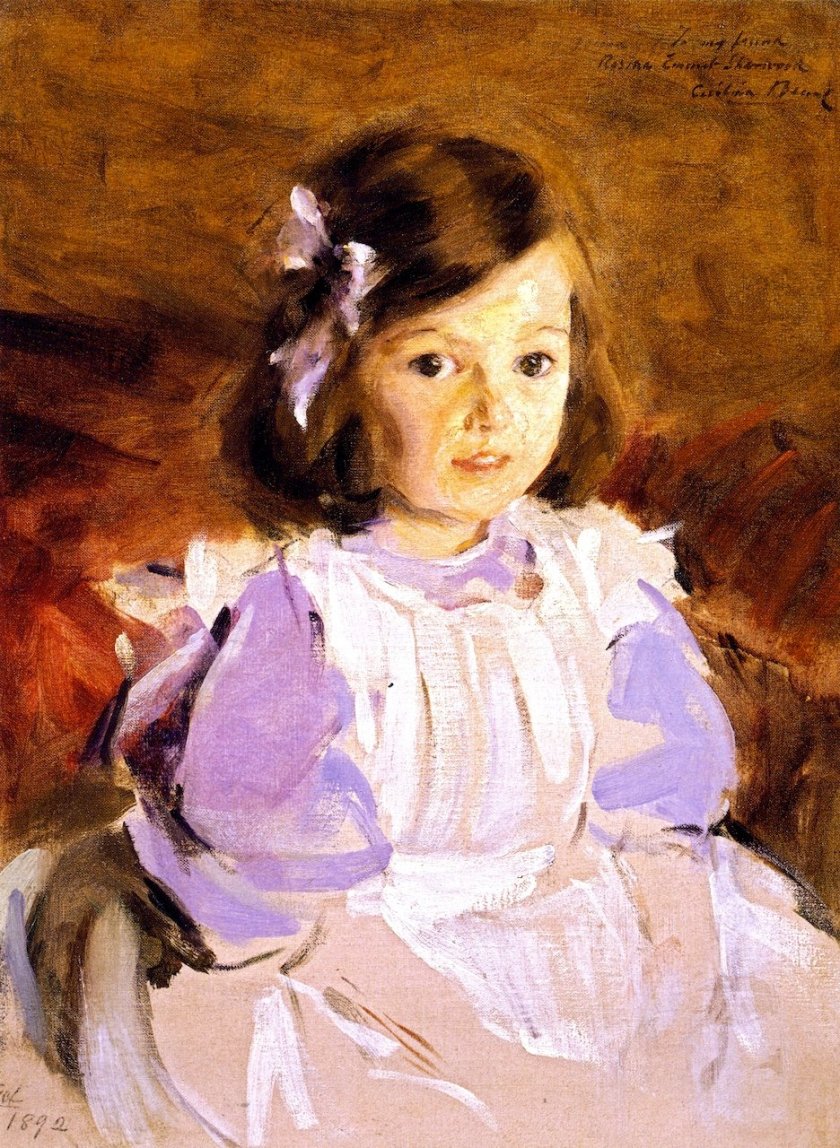
Cynthia Sherwood by Cecilia Beaux (1892)

Upon returning to the United States, Beaux became one of the most sought-after portraitists in Philadelphia and New York. One of the first paintings by Cecilia Beaux, which was acclaimed by the critics for its gentle innocence, was a portrait she did for her friend and fellow artist, Rosina Emmet Sherwood in 1892. It was a portrait of her friend’s daughter Cynthia Sherwood. Rosina Emmet Sherwood was a book illustrator and one of the foremost female painter of that time and was a close friend of Cecilia’s. The two women had met through their connection with the arts, and in 1892 they wanted to celebrate their friendship by swapping portraits. Cecilia gave Rosina a portrait depicting her second child and eldest daughter, three-year-old Cynthia. The painting is made up of a tonal mixture of lilacs, crimson, and whites. In the work we see Cynthia sitting on a red sofa. She has a white ribbon in her hair and is wearing a white pinafore over a blue-grey dress and her arms rest in her lap. Rosina was delighted with her daughter’s portrait which was exhibited at the 1895 Society of American Artists’ annual exhibition. In a letter to Cecilia, Rosina wrote about how her daughter’s portrait was well received by fellow artists and critics alike:

“…My dear — you and Cynthia were the lions of the Exhibition yesterday. Really, much as I admired the picture, I was startled at its brilliancy and force…. It never looked so like Cynthia before. The artists all moved about it…. Mr. Chase said he would give anything to own it and Robert Reid, after extravagantly praising the big picture [Sita and Sarita] said he liked Cynthia’s portrait much the best. Kenyon Cox said that for the sort of portrait painting you chose to do, you do it better than any man he knew except John Singer Sargent. So there Madame!…”

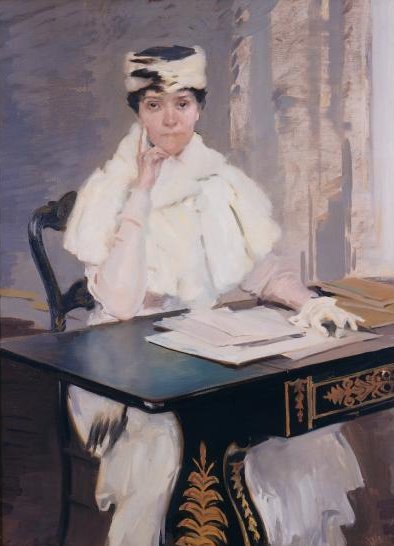
Cecilia by Rosina Emmet Sherwood (1892)

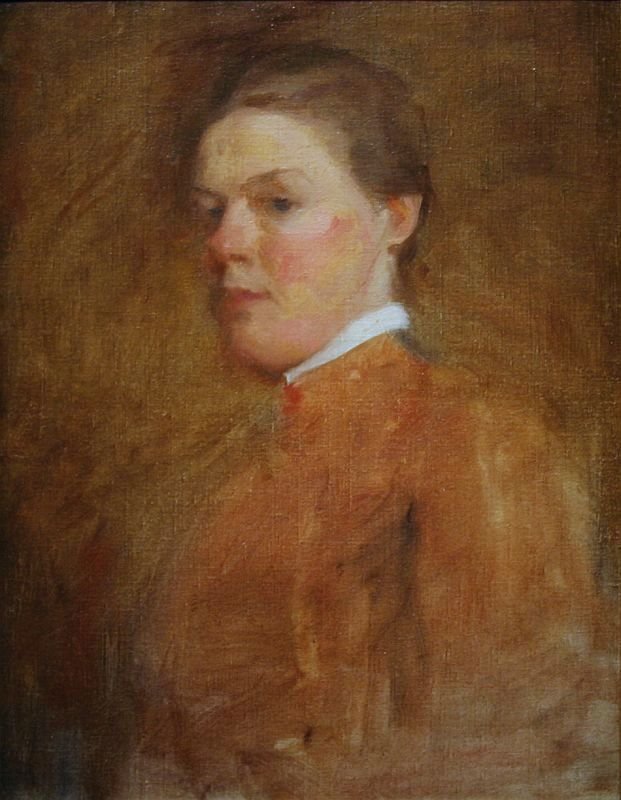
In return Rosina painted a portrait of her close friend. Cecilia was so enamoured with the portrait that she kept it all her life and, on her death, it passed down to her great-niece.

Ernesta (Child with Nurse) (1894)

Two years later, in 1894, Cecilia completed another portrait of a young girl, her two-year-old niece, Ernesta Drinker, entitled Ernesta (Child with Nurse). In the painting, we see the young girl holding the hand 0f her nurse, Mattie. The portrait of Cecilia’s young niece reveals the well-to-do world of the advantaged child. It is a sentimental portrait focusing on the first tentative steps of the young girl and if we look closely at the tightly clasped hands of adult and child, we see how Cecilia has depicted the partnership between the dependent child and the caring protective adult. We view the painting at the child’s eye-level. The figure of the nurse is cropped at the waist, and so we just see the arm and skirt of the nurse which makes us aware of the size of the diminutive child. From where we stand viewing the portrait, we soon realise that it is all about the world of the child. The portrait of young Ernesta was shown at the Society of American Artists in their spring exhibition in 1894. In 1896 the painting was awarded a third-place bronze medal at the Carnegie Art Institute’s first International exhibition.

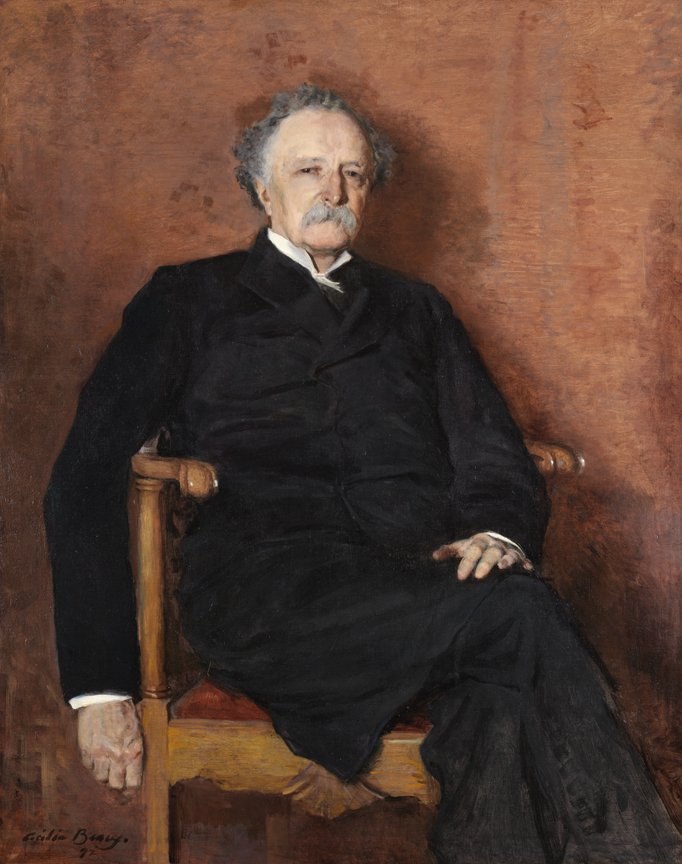
Reverend Matthew Blackburne Grier by Cecilia Beaux (1892)

Cecilia Beaux’s child portraiture was very popular and in much demand, but this was just one “string to her bow”. During the year in which she completed the portrait of Cynthia Sherwood she completed a portrait of an eminent man, The Reverend Matthew Blackburne Grier, who lived just two doors away from Cecilia’s family home. The subject of the painting is the retired Presbyterian clergyman and former editor of The Presbyterian who had come to live in West Philadelphia. Cecilia had approached him and asked if he would sit for her. In the portrait, we see him sitting in the tricornered Chippendale chair which was a much-used accoutrement of her studio. Within a year of its completion the painting became a prize-winning portrait, winning her the Philadelphia Art Club’s Gold Medal in 1893.

Self portrait by Cecilia Beaux (1894)

In May 1894, Cecilia Beaux was elected an associate of the National Academy of Design. Admission to this academy was conditional on her agreement to the Academy’s Constitutional rule that she must submit a portrait of herself for the Academy’s permanent collection. For Cecilia it was a moment in time that she must decide how she wanted to portray herself. She was now thirty-nine years old and had the self-confidence to believe that she was both good-looking and cultured and she decided that those characteristics needed to be depicted in the finished portrait. The completed Self Portrait also shows off her beauty. Her lavender, beige and white striped silk dress accentuated her elegance appearance. This is not a depiction which in any way exudes her sexuality. It is all about her professionalism and serious dedication to her art. Nobody could question her beauty but for Cecilia, she wanted to be remembered not for her physical attributes but for her exceptional artistic talent.
In 1895 Cecilia was appointed the “Instructor of the Head Class of the Schools,” at the Pennsylvania Academy with a salary of $1,200 a year. This appointment given to a female was the talk of the local newspapers. One newspaper commented:

“…Never before, either in this country or abroad, has a woman been chosen as a member of the faculty in a famous art school. It is a legitimate source of pride to Philadelphia that one of its most cherished institutions has made this innovation…”

Beaux taught at the Academy for two decades in either a “Head Course” or a “Portrait Class”. Her classes were mixed, and she was constantly pressing her female students telling them that they had to work twice as hard as their male students if they wanted to achieve success.

At the height of her long career, Beaux painted the cream of the American elite. She received commissions to paint portraits of the “great and the good” including college presidents, businessmen, socialites, eminent medical men and women, and political notables.

Mrs. Thomas A. Scott (Anna Riddle) by Cecilia Beaux (1897)

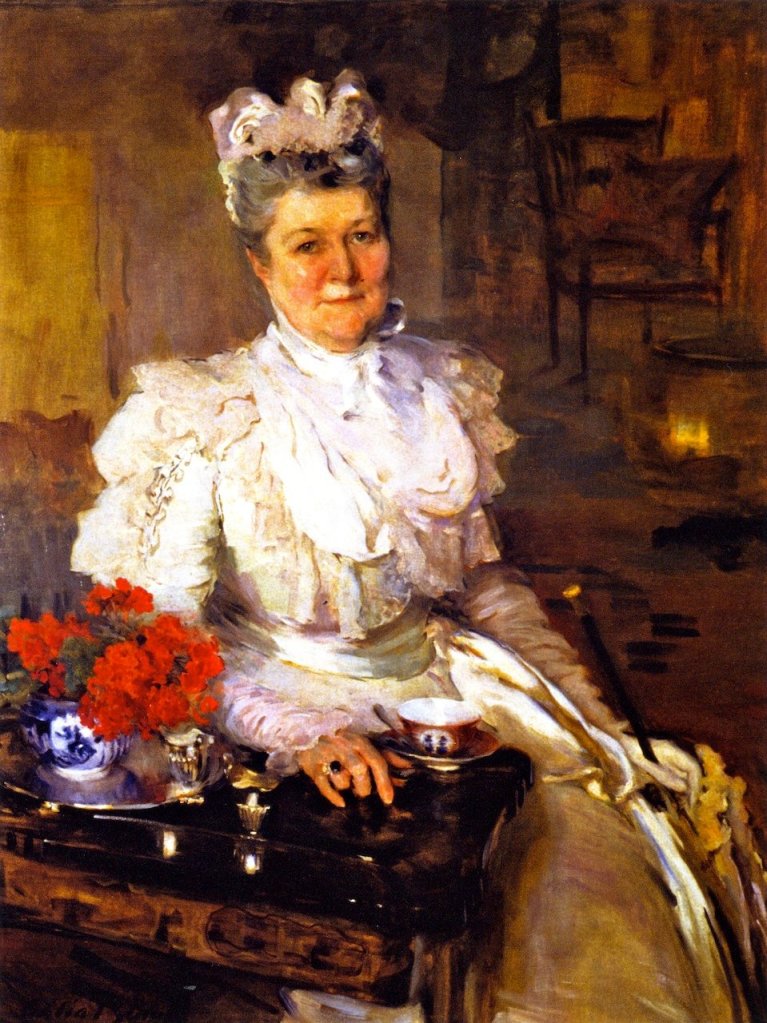
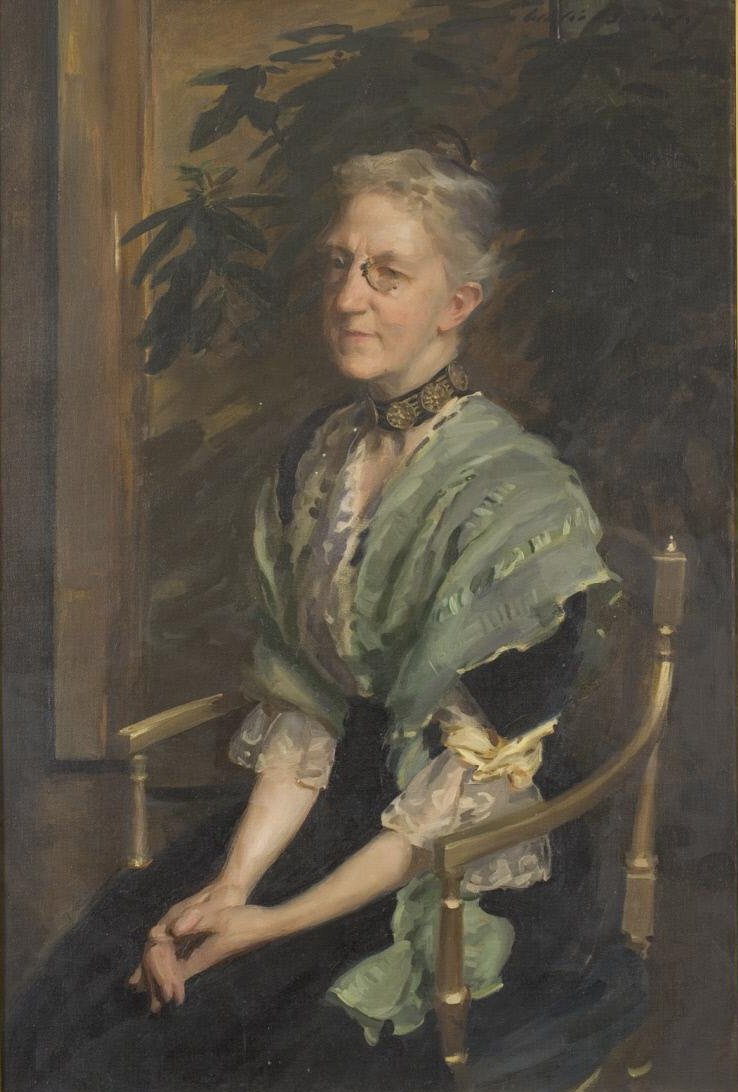
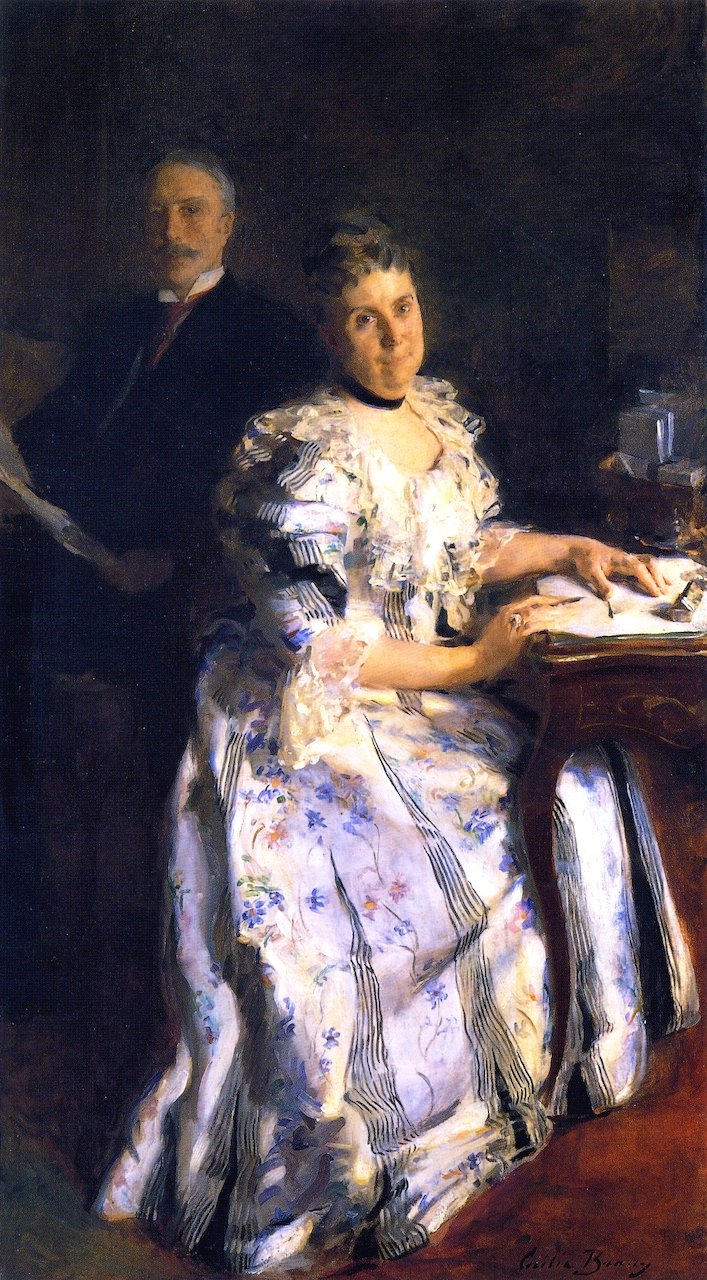
In 1897 she accepted a commission to paint a portrait of the former Anna Riddle, who was the wife of Thomas Alexander Riddle, an American businessman, railroad executive, and industrialist. He was the fourth president of the Pennsylvania Railroad.  In this sumptuous portrait we see the fifty-eight-year-old lady adorned in a shimmering ivory-satin gown and white-lace cap. Her left hand holds on to a parasol which rests against her knee. Her right hand, suitably bejewelled as was becoming for such a wealthy lady, rests on a marble side table. On top of the table we can see a silver tea tray, a blue bowl of red geraniums, and a brown porcelain Chinese export teacup all of which help to portray the status and wealth of the sitter and her family. In the background we can just make out a faint sketching of a round table and chair.

Mrs. Clement B. Newbold by Cecilia Beaux (1896)

Cecilia Beaux had received the commission to paint the portrait of Mrs Thomas Alexander Scott on the strength of her previous year’s bridal portrait of her daughter, Mary Dickinson Scott (Mrs. Clement B. Newbold), at the time of her wedding to Clement Buckley Newbold the wealthy banker and financier in 1896.

Portrait of Dr. John Shaw Billings by Cecilia Beaux (1895) in the National Library of Medicine

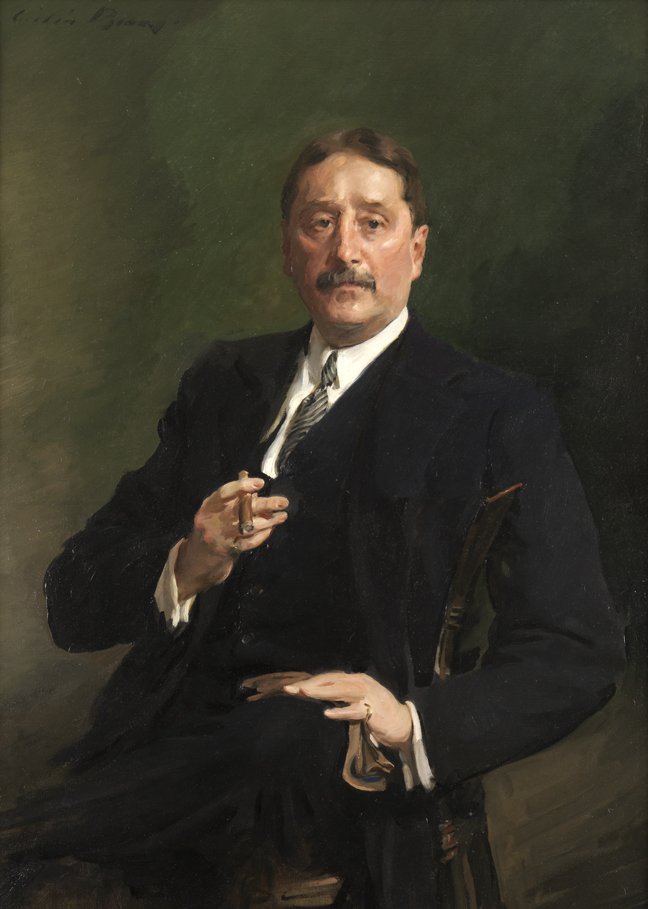
In the autumn of 1895 Cecilia was commissioned to paint a portrait of Dr. John Shaw Billings, a renowned surgeon and librarian, who had made significant contributions to the American medical profession. He sat for Cecilia at her Chestnut Street studio. It was his testimonial year and at a dinner honouring him he was presented with a silver box containing a check for $10,000, “in grateful recognition of his services to medical scholars”. The sum of money had been raised by 259 physicians of the United States and Great Britain. Money was also set aside for the commissioning of his portrait by Cecilia Beaux and it was later presented Beaux’s work to the Army Medical Museum and Library in Washington, D.C.

By 1900 the Cecilia Beaux’s work was in great demand and clients came from all over the east coast to sit for her and she decided she needed to base herself in New York. Richard and Helena Gilder were very close friends of Cecilia’s whom she had met through her former tutor Catherine Drinker and her husband Thomas Janvier. Richard Watson Gilder was a poet and editor of the periodicals Scribner’s Monthly and The Century Magazine, and the Gilders were leading lights of an artistic literary and music circle in New York and it was through Cecilia’s friendship with them that she had received many portrait commissions from the rich and famous. The Gilders lived in New York and during her protracted stays in the city she would stay with them. Eventually she got herself a studio on the corner of South Washington Square and Broadway, which was close to the Gilder’s house on East 8th Street.

Mrs. Theodore Roosevelt and Daughter Ethel by Cecilia Beaux (1902)

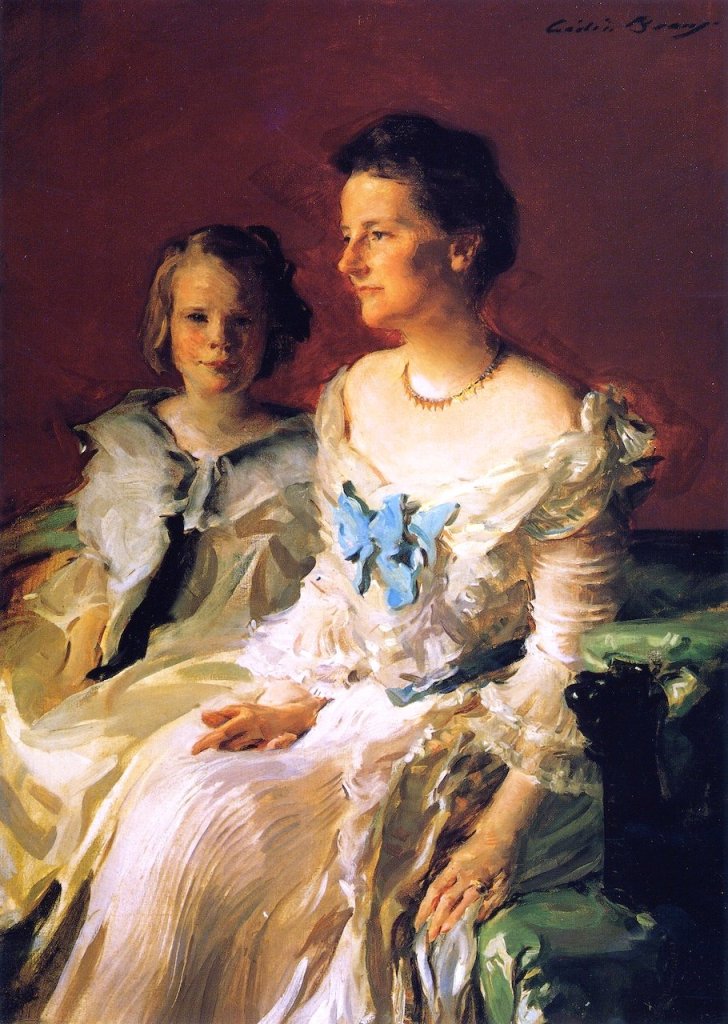
Cecilia’s portraiture was so popular that she could be very circumspect on which commissions she chose to accept. She was once quoted as saying that it doesn’t pay to paint everybody, and by adhering to that rule she ensured that she became one of the most famous late nineteenth century American portrait artists whose clientele was mainly drawn from the upper class. One of her most famous sitters was, Edith Roosevelt, the second wife of the United States president, Theodore Roosevelt who sat for Cecilia 1n 1902.
Cecilia recalled the sittings for the portrait:

“… A number of visits to Washington were needed for the work, and the portrait was painted in the White House. It was to have been of Mrs. Roosevelt only, but her daughter Ethel consented to literally ‘jump in,’ greatly enlivening, I hope, her mother’s hours of attention to posing. This attention was constant and sympathetic, but not static, and did not need to be. They generously devoted the Red Room to me for a studio……………..… I chose — and upholstered — a covering for the broad seat on which Mrs. Roosevelt and Ethel could dispose themselves easily; the warmth of the Red Room got somehow into the picture, and fortunately we proceeded without many changes. I understood from the first that it was not to be an official portrait, and I think every one was satisfied that, as it was created among intimate circumstances, its spirit might be the same…”

Cecilia Beaux and Thornton Oakley at Green Alley (1907)
Thornton Oakley was an American artist and illustrator

With all the pressure of work, Cecilia decided that she needed a sanctuary away from her hectic city life. In her biography, she wrote:

“…I began to dream of a change, of’ a pied-a-terre even then — of a shift of the year’s divisions — for work, and rest. Why not, I thought, have the summer for my working time, and take my rest in a short winter period? I had never looked on painting as toil, but I had sometimes felt that the city winter contained too much of everything, and that the summer, if considered as a holiday, was boring in being desœuvre [at a loose end]. Why not have long, unhurried bouts of painting, when off hours would be spent in delicious air — morning and evenings of thrilling loveliness — a long, long summer…”

Green Alley
Cecilia Beaux’s home at Eastern Point, Gloucester, Mass.
Photograph, ca., 1920, by T. E. Morr.

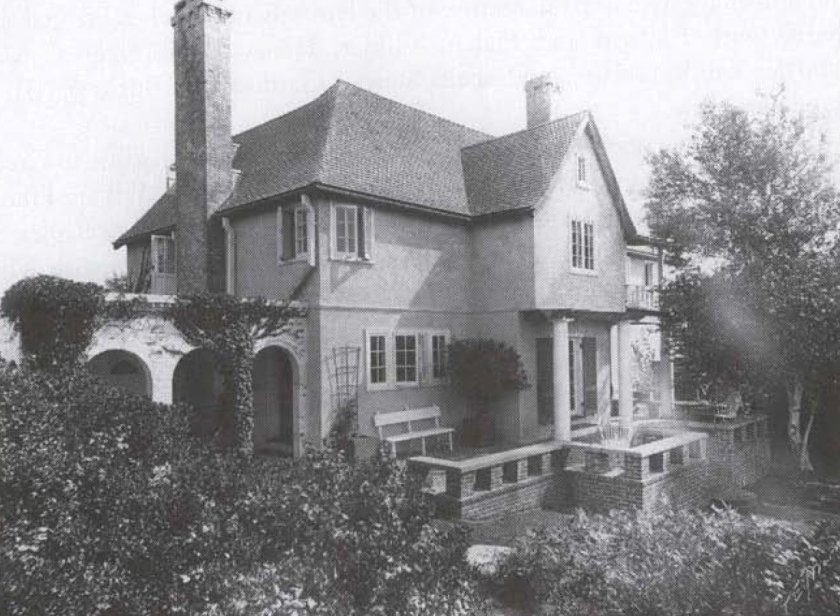
Cecilia decided to rent a place in East Gloucester on Cape Ann in Essex County, Massachusetts. She, along with her Aunt Eliza, Uncle Will, and other relatives first visited the idyllic New England fishing village in July 1887, staying at the Fairview Inn and returned there on a regular basis. In 1903, she decided not to stay at the inn but instead rented a cottage on Eastern Point for the summer. She used to refer to it as the Rock of Calif and whilst she spent the summers there her companion on her first Parisian trip, her cousin, May Whitlock, acted as her housekeeper, and would do so for almost forty years. Whilst at the cottage Cecilia looked for some land where she could build her own house. She finally found the perfect spot, a thickly wooded space on the harbour side of the road, part-way between the lighthouse and the town of Gloucester. She then commissioned the building of a house and studio on the plot of land and was finally able to move into her new house on August 7th, 1906. She named her house Green Alley.

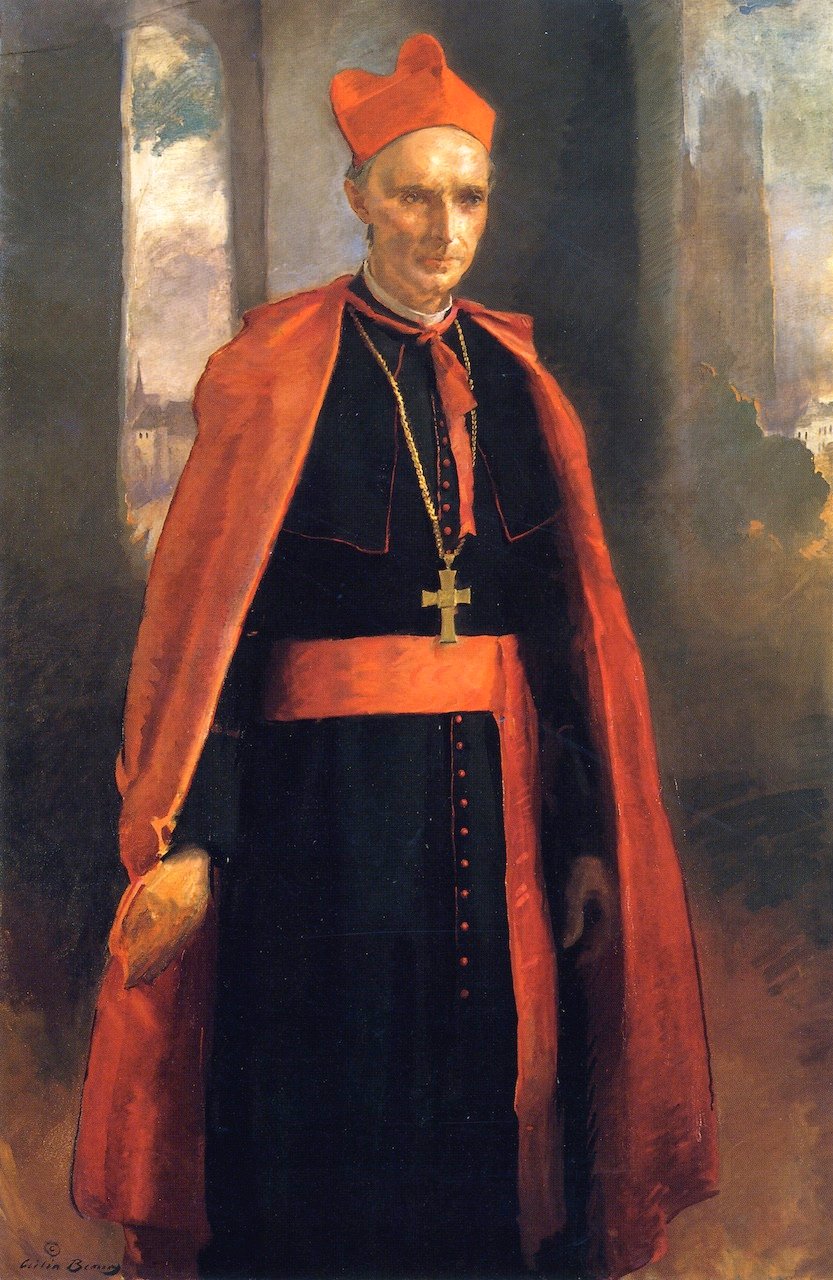
Cardinal Mercier by Cecilia Beaux (1919)

In 1910, her beloved Uncle Willie died. She was devastated by the loss, as William Biddle was the foremost male in her early life after her father left the family home after the death of his wife. William Biddle was just fifty-five years of age when he died.

Georges Clemenceau by Cecilia Beaux (1920)

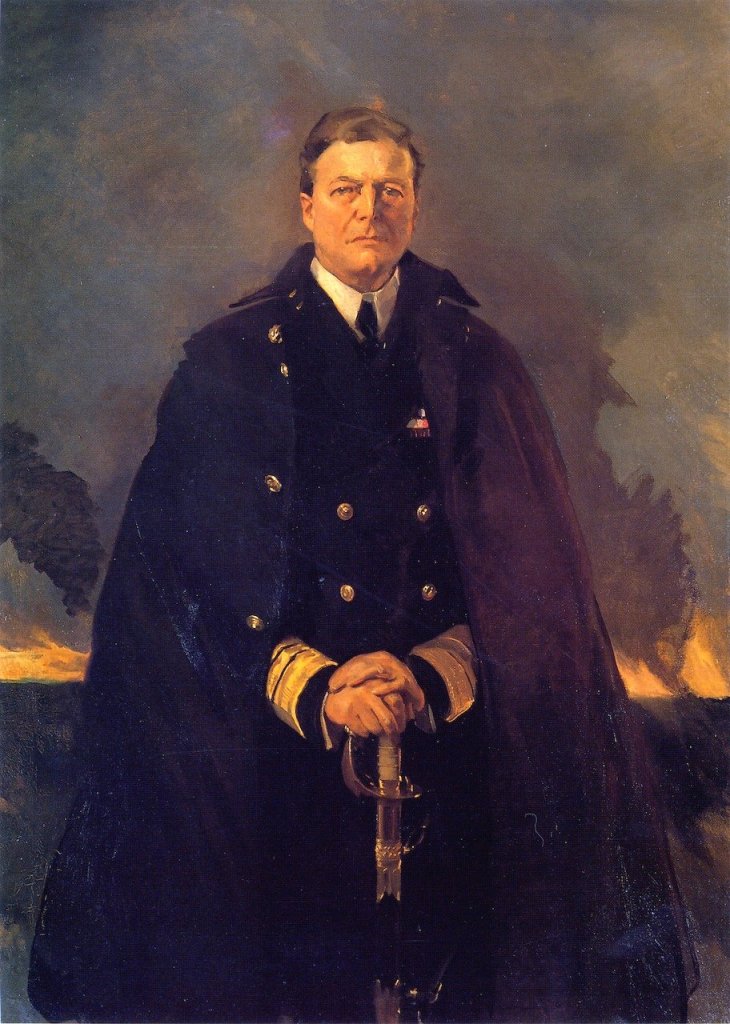
With the backing of the Smithsonian Institution in 1919, the National Art Committee devised, and were overseers of a project by which American artists would paint the portraits of prominent World War I leaders from America and the allied nations. The National Art Committee selected Cecilia as one of eight painters commissioned to execute portraits of the war heroes. The committee set aside $25,000 for each artist to paint three portraits. Cecilia’s task was to paint the portraits of Cardinal Désiré-Joseph Mercier, the Belgian Cardinal who was renowned for his staunch resistance to the German occupation of his country during the Great War. She was also to paint a portrait of Admiral Lord David Beatty, who led the 1st Battlecruiser Squadron during the First World War and Georges Benjamin Clemenceau, who was a French politician, physician, and journalist and who was Prime Minister of France during the First World War.

Admiral Sir David Beatty (also known as Lord Beatty) by Cecilia Beaux (1920)

Cecilia Beaux continued with her regular visits to Europe accompanied by various companions. One such trip in the summer of 1924, with a young Boston artist, Aimée Lamb, ended disastrously when Cecilia, who was sixty-nine-years-old at the time, whilst out walking in Paris along the rue St. Honoré, caught her heel on the pavement, fell and broke her hip. The accident  occurred on June 30th and after ten weeks in a clinic she still was not allowed to return home until November. The terrible accident was a devastating blow to Cecilia, as it crippled her for the rest of her life and necessitated her to wear a heavy steel brace and walk with a crutch. It badly affected how she was able to paint and her output dwindled.

Cecilia Beaux received numerous awards and accolades for her work which was exhibited many times in many countries. She died of coronary thrombosis at her beloved home, Green Alley, on September 17th, 1942. She was aged eighty-seven. Following her cremation in Boston, her ashes were buried in the West Laurel Hill Cemetery in Bala-Cynwyd, Pennsylvania.

This is my seventh and final blog looking at the life of this amazing artist. So much is missing from what I have written. So many of her paintings have not been shown and yet maybe it will tempt you to read her autobiography (Background with Figures) or read the many excellent essays written about Cecilia Beaux by Tara Leigh Tappert.


Most of the information for the blogs featuring Cecilia Beaux came from two books:

Background with Figures, the autobiography of Cecilia Beaux

Family Portrait by Catherine Drinker Bowen

and the e-book:
Out of the Background: Cecilia Beaux and the Art of Portraiture by Tara Leigh Tappert.

Extracts from letters to and from Cecilia Beaux came from The Beaux Papers held at the Smithsonian’s Archives of American Art

Information also came from the blog, American Girls Art Club In Paris. . . and Beyond, featuring Cecilia Beaux was also very informative and is a great blog, well worth visiting on a regular basis.:
https://americangirlsartclubinparis.com/

Photographs came from an article I found entitled The Only Miss Beaux, Photographs of Cecilia Beaux and her Circle by Cheryl Leibold of the Pennsylvania Academy of the Fine Arts.

Cecilia Beaux. Part 6 – Visits to England, the Return Home and Family Portraits.

Cecilia Beaux (c.1888)

……………….Cecilia Beaux finally returned to Paris in December 1888 after her summer in Concarneau and her six week European journey and the first thing she had to contend with was to find some new accommodation.  Her one priority was that her new “home” had to be better than the dismal and dire Pension Villeneuve which she and her cousin May Whitlock had had to put up with on their arrival from America in January. They eventually settled for a “room-only” fifth-floor attic apartment in a Latin Quarter maison meuble (furnished house) at 30 rue Vaugirard, situated in the 6th arondissement across the road from the Luxembourg Gardens.  Cecilia was delighted with her new home, writing:
“…There were five flights for us, but easy, broad, spotless, and without taint of late decades. I would like to boast openly that I have lived in an attic in Paris, a tiny chamber in the mansard, with a dormer window opening its croissee eastward and sunward. The window would hold a plant or two, and outside was the leaden ledge that took the rain on stormy days. Leaning out one could look down upon the Senate, grey and dignified, and the Luxembourg Gallery was very near. The iron railing of the garden was across the way…”

However, it was still winter, still cold and the accommodation was still damp so one of her first purchases was a stove, for which she paid four francs.

Portrait of Henry Sandwith Drinker by Cecilia Beaux (1901)
(Cecilia’s nephew)

Cecilia returned to the Académie Julian to study art but this time she attended  the original branch of the academy which was at the Passage des Panoramas, which meant she had to make the two-mile journey crossing the Seine each day. It is interesting to read in her 1930 autobiography, Background with Figures, that she was less than enamoured with the teaching at the academy and although she could have attached herself to an atelier headed up by a well-known artist she was not convinced of the benefit of such a move. She wrote:

“…I might have delivered myself, of course, to an individual master. There were several of high repute who admitted disciples. By an instinct I could not resist, I shrank from the committal, although there would have been contacts resulting from it of high value and interest. I saw no special direction in any exhibited work (I fear to say it), among the living, that I felt like joining…”

Cecil Kent Drinker by Cecilia Beaux (1891) (Four-year-old nephew of Cecilia Beaux)

Cecilia was also unhappy that there were few critiques by the tutors which would have given her some constructive criticism. All the tutors would tell her that she should just “keep on as I was going”. It was not that she was simply negative about the teaching at the Julian for she had definite ideas of how art should be taught and how the tutors should act:

“…What the student above all needs is to have his resources increased by the presence of a master whom he believes in, not perhaps as a prophet or adopted divinity, but one who is in unison with a living world, of various views, all of whose roots are deep, tried, and nourished by the truth, or rather the truths that Nature will reveal to the seeker. He is the present embodiment of performance in art, better called the one sent, representing all. He is serious, quiet, a personality that has striven…”

Cecilia’s room in rue Vaugirard was too small for it to be used as a studio and for her a studio was a primary requisite not just to carry out painting but it was a place for quiet contemplation. With that in mind she managed to secure a nearby small ground-floor working place at 15 rue Notre-Dame-des-Champs which was situated at the southern end of the Luxembourg Gardens. Later Cecilia and her cousin and companion, May Whitlock would give up their room at the rue Vaugirard house and move their belongings into the studio.
Newnham Grange in 1890

In May 1889 Cecilia made a solo trip to England. She had been invited by her one-time Philadelphia friend Martha Haskins “Maud” du Puy, now Mrs Maud Darwin, to come up to Cambridge and stay with her, her husband George Darwin, who was the eldest son of the naturalist, Charles Darwin, and their four children. George Darwin was the Plumian Professor of Astronomy and Experimental Philosophy at the University of Cambridge and the family lived at Newnham Grange, which was situated in an idyllic location perched on the banks of the River Cam. Cecilia had to endure a very rough Channel crossing from Dieppe to Newhaven and then a long train journey through London to Cambridge. However, despite the inauspicious start to her English adventure, her short stay at Newnham was all she could have hoped for. Beautiful house to stay in with a comfortable bed, a completely different scenario in comparison to her room in Paris. In her autobiography she remembered her first morning at Newnham Grange:

“…My first waking in the big, chintz-hung guest-room at Newnham Grange is one of the jewel-set markers of memory………… The sun poured in, and through its beams I could see across a meadow and under huge trees. Another window was hung, without, by a rich drapery of lilac wistaria, in full bloom, and when I sprang from my bed and put my head out, there was a cherry tree full of ‘ripe ones,’ just outside, also bird song; and a robin, making the best of the feast, superseded the cuckoo, and children of English voice and speech were in the garden below…”

She also had a taste of university and English countryside life with an invite to dinner at the Vice Chancellor’s Lodge, Sunday morning service at King’s Chapel and even a visit to Charles Darwin’s eighty-one-year-old widow, Emma, who was Cecilia’s friend’s mother-in-law. She even was invited to the hallowed Master of Trinity College Cambridge’s garden party, remembering the event well:

“…An English garden-party differs from all others especially in the domain of the University. The Master of Trinity, who is the King of Cambridge, has a garden which occupies one bank of the river for a long distance. Acacias in full bloom hang over the wall during May week, tall dark yews associating as background. The Master himself, large, brown-bearded, and urbane, looked his part to perfection, and I was proud to have a share of his gracious attention…”

Lady Geoge Darwin by Cecilia Beaux (1889)

Such was the frequency of invitations to lunches and dinners that Cecilia hardly had time to think about sketching and painting but she did complete one work, a pastel portrait of her host Maud. Maud’s husband George was made Knight Commander of the Bath in 1905, and so the title of this portrait is now known as Lady George Darwin.

Cecilia and May Whitlock cancelled their plans to return to America and instead went to Cambridge in June, where they were to have stayed as guests of George and Maud Darwin, not in the main house but in The Mill, a small residence at the end of the garden of Newnham Grange. However Cecilia decided as it may not have been big enough for two ladies Cecilia and Maud took lodgings, at Ashton House, a small brick dwelling in a shady street, only a stone’s throw from Newnham and used The Mill as her artistic studio.

After that second visit to Cambridge,  Cecilia left the comfort of Newnham Grange and returned to Paris only to find that her cousin had vacated their fifth-floor attic room and moved all their possessions and clothes into Cecilia’s small one-room studio with skylight. This was now to be their living quarters, their bedroom, as well as Cecilia’s studio. It was a terrible shock to the system for Cecilia who had just sampled the height of comfort in Cambridge. To make things worse for her and May, as summer approached, the once cool room had become a “hot-house” as the intense sunlight streamed through the skylight. Reading a passage in her biography, one can be in no doubt as to how Cecilia regarded her new “home”:

“…The circumstances of my return to Paris should be mentioned only by way of warning and contrast, and I shall always regret that I returned to the adored place, by way of my own blunder and a very squalid experiment. When I entered the shaky door of the studio, I found it filled with a helter-skelter collection of our belongings. There had been no preparatory cleaning or arranging. A bed had been put in. The toilet arrangements were simple, but for use required a complicated process. A tin basin, which I had used for washing brushes, was uncertainly disposed on the corner of the bookshelf, the soap saucer scarcely holding beside it. A chair-back was all there was for towels, and, if one wished to sit down, books and dresses had to be put somewhere else. It had become scorching hot. I insisted in rigging up some sort of Screen under the skylight for decency’s sake. Squalor, wretchedness, into which no gleam of fun entered; I sympathized with royalty and was ‘not amused.’…”

SS Anchoria

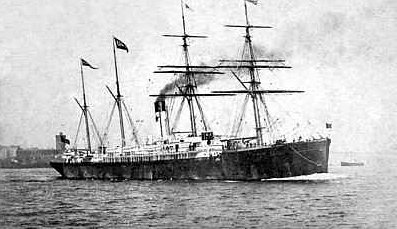
Cecilia and May’s time in Paris and England had come to an end in August 1889 and the pair boarded the steamship Anchoria at the Scottish port of Greenock Harbour on the River Clyde. On the twenty-second of August, the pair set sail ploughing their way through rough seas and a blanket fog. The intrepid pair finally arrived back in Philadelphia at the beginning of September 1889 after almost nineteen months away from home. Once home, her family bombarded Cecilia with questions about her European adventure and her plans for the future. Cecilia was unequivocal about her future life. It would be dedicated to her art and from the sale of her paintings she would shore up the family finances. She was also equally definite that her future life and plans would not be hampered by relationships with possible suitors. The family accepted her views and her plans for the future and set about trying to help her.

A photograph of Cecilia and Emma in the Chestnut Street studio (1890)

Her uncle, William Biddle, found a new studio for her at 1710 Chestnut Street, and then helped her arrange it so that she could set herself up as a professional artist. She and her cousin Emma shared the studio.  At the same time her family relieved her of all household duties. The sense of family loss was two-sided, for not only did her sister and aunts miss Cecilia, but she also missed her family despite the good times she experienced in Europe. Maybe it was the happiness of being back, once again, in the family fold that enticed her to complete many portraits of her sister’s family and other relatives. She also received many portraiture commissions from the Philadelphia “elite”. In the five years after her return home she completed over forty portraits.

Sita and Sarita by Cecilia Beaux (1894)

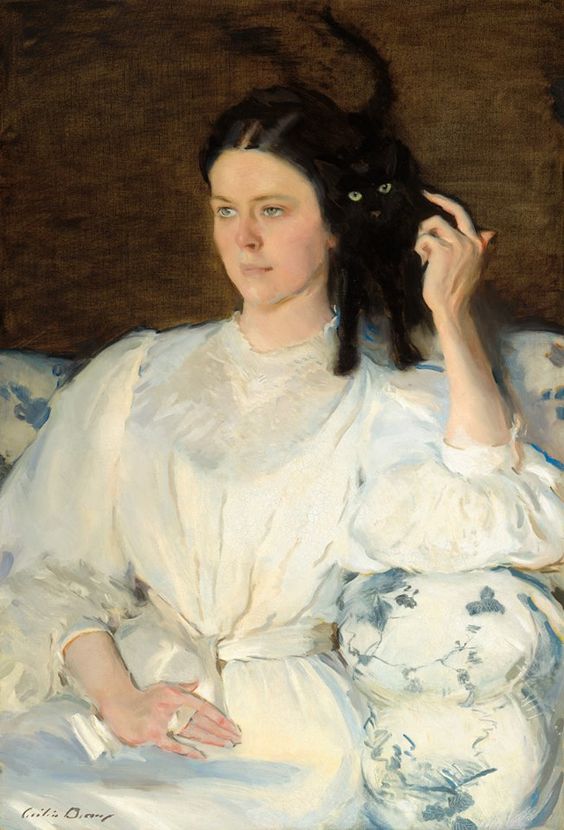
Probably her most famous family portrait was completed in 1894 and was entitled Sita and Sarita (Jeune Fille au Chat). It is a depiction of her cousin, Charles W. Leavitt’s wife Sarah (Allibone) Leavitt and the mysterious title of the painting comes from Beaux’s use of Spanish diminutives, Sarita for Sarah and Sita, meaning “little one,” for the cat. Sarah is dressed in white, with a small black cat perched precariously on her shoulder. The eyes of both the woman and the cat are green and almost lined up horizontally in the depiction. The combination of the whiteness of her dress and the palid complexion of her face are in direct contrast to the black furry animal standing on her shoulder. Both human and animal stare out enigmatically. Cecilia Beaux donated this painting to the Musée de Luxembourg and it is presently housed in the Musée d’Orsay. Twenty-seven years later she painted another version of the painting which is now housed in the National Gallery of Art in Washington, part of the Corcoran Collection.
Dorothea and Francesca by Cecilia Beaux (1898)

Another of her well-known portraits, Dorothea and Francesca, was that of the two eldest daughters of Helena de Kay and Richard Watson Gilder. Richard Watson Gilder was a poet and editor of the periodicals Scribner’s Monthly and The Century Magazine, and his wife Helena, who was artistically trained at The Cooper Union in Manhattan, was a portrait, still-life, and flower painter, and also a writer. The Gilders, who were very good friends of Cecilia, were leading lights of an artistic literary and music circle in New York and they played a central role in the founding of the Society of American Artists in 1877. Cecilia recalled in her biography the setting for the painting which took place in the Gilder’s Four Brooks Farm in Tyringham, Massachussets:
“…The big and little sisters, Dorothea and Francesca, used to execute a dance of the simplest and all too circumscribed design, invented by themselves, and adorned by their unconscious beauty alone. This was the subject. I built a platform with my own hands, as the girls could not move easily on the bare earth. When it rained hard, in September, the orchard let its surplus water run down the hill and under the barn-sill, so that, as my corner was rather low, I put on rubber boots and splashed in and out of my puddle, four inches deep. October was difficult, for it grew bitterly cold. But valiant posing went on, though the scenic effect of the group was changed by wraps. Summer, indeed, was over, when on a dark autumnal night, in the freezing barn, the picture was packed by the light of one or two candles and a lantern…”

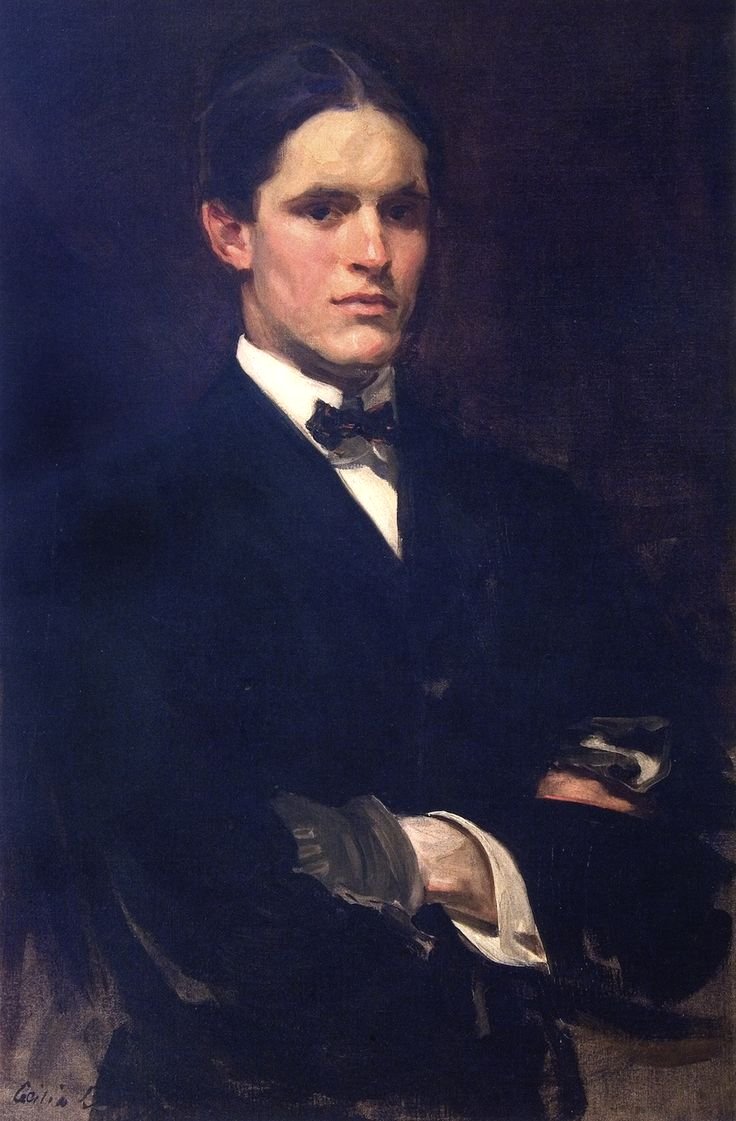
Charles Wellford Leavitt by Cecilia Beaux (1911)

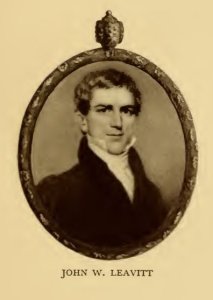
Cecilia Beaux’s cousin, Charles Wellford Leavitt, featured in another of her works. She completed the painting, Charles Welford Leavitt, the Artist’s Cousin in 1911. The sitter, who was forty at the time of the sitting, was a successful engineer and pioneer in the field of city planning. To acknowledge his profession Cecilia has added some of the tools of his trade on a table next to him. She has portrayed him with his arms crossed in front of him and his demeanour oozes a sense of importance and confidence.

In my final blog about the life of Cecilia Beaux I will look at her later years and the many portraits she did of the rich and famous.

…………………………………to be concluded.


Most of the information for the blogs featuring Cecilia Beaux came from two books:

Background with Figures, the autobiography of Cecilia Beaux

Family Portrait by Catherine Drinker Bowen

and the e-book:
Out of the Background: Cecilia Beaux and the Art of Portraiture by Tara Leigh Tappert.

Extracts from letters to and from Cecilia Beaux came from The Beaux Papers held at the Smithsonian’s Archives of American Art

Photograph from Pennsylvania Academy of the Fine Arts archive

Information also came from the blog, American Girls Art Club In Paris. . . and Beyond, featuring Cecilia Beaux was also very informative and is a great blog, well worth visiting on a regular basis.:
https://americangirlsartclubinparis.com/tag/catherine-ann-drinker/

Cecilia Beaux. Part 5 – Concarneau, the summer of 1888.

The Lady Artist by Charles “Shorty” Lasar

……………………..Cecilia Beaux and her cousin May Whitlock had arrived in Paris in the last week of January 1888. The weather had been typical January weather – wet, cold, and thoroughly miserable, rarely catching a glimpse of the sun. Add to this their insalubrious and uncomfortable pension and the way they had to dress in warm but shabby winter clothes, it is possible that Cecilia’s dream of the French capital may have been wavering. However, she had her course at Académie Julian and numerous art galleries to visit which, for her, made life worth living. She revelled in her visits to the Salon not only viewing the paintings but also “people-watching” the visitors circulating the galleries. In her autobiography she recalls such a time with great excitement:

“…The Salon drew crowds of all kinds. To Vernissage [a preview of an art exhibition] flocked the elite of Paris, the aristocracy of Society, of the Stage, of Music, and Literature, as well as of the Plastic Arts: in other words, the French Crowd, always intelligent, always amused, always disputive. How new to me to see a group of forceful, middle-aged, or old men, masters in some field without doubt, stooping over a small picture, arguing with heated insistence, denouncing, eulogizing! Never had I seen assembled so many men of ‘parts’ — real men, I would have said — so absorbed, so oblivious, greeting each other warmly, and with absolutely no general curiosity; pausing a moment, with great deference, before some quiet lady, or obvious beauty, but really there through profound interest in contemporary art. I longed to get closer — not to meet them, but to hear their talk, their dispute about the supreme Subject…”

And later describes how she witnessed one special visitor to the Salon:

“…Into the gallery one day, as our obscure party moved about,- there entered a Personage; a charming figure, with a following of worshippers. The lady was dressed in black lace, strangely fashioned. Though she was small, her step and carriage, slow and gracious as she moved and spoke, were queenly. She was a dazzling blonde, somewhat restored and not beautiful, as one saw her nearer. The striking point in her costume — and there was but one — was that the upper part of her corsage, or yoke, was made entirely of fresh violets, bringing their perfume with them. Every one, artists and their friends, ceased their examination of the pictures, and openly gazed, murmuring their pride and joy in their idol, Sarah Bernhardt…”

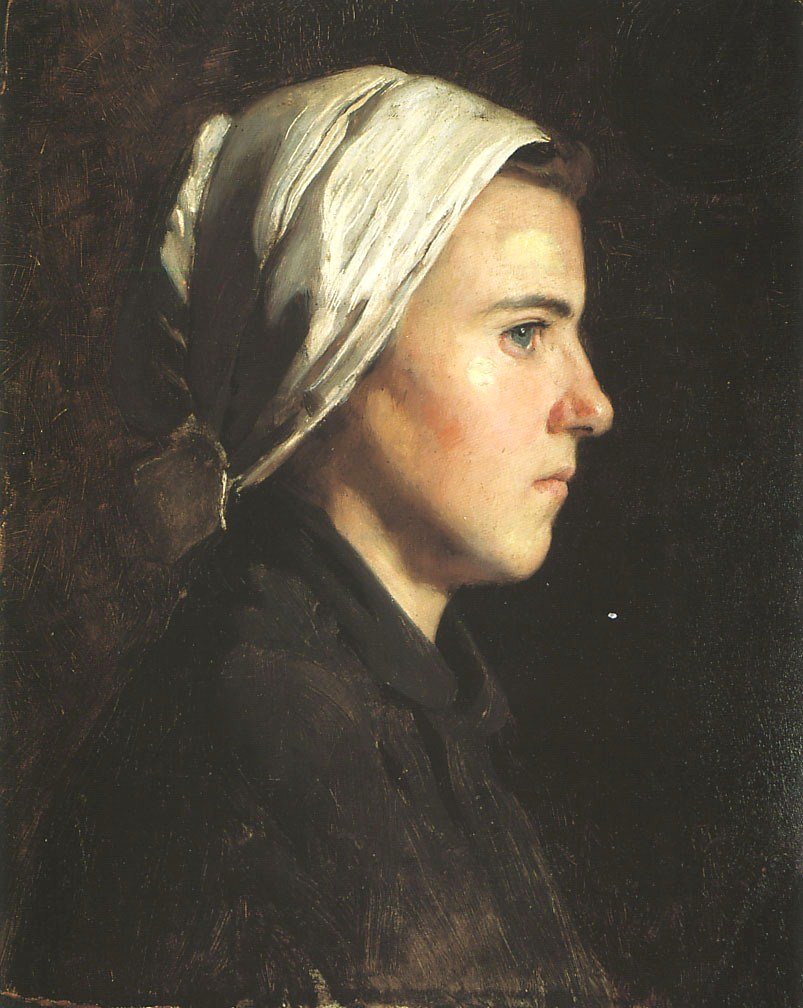
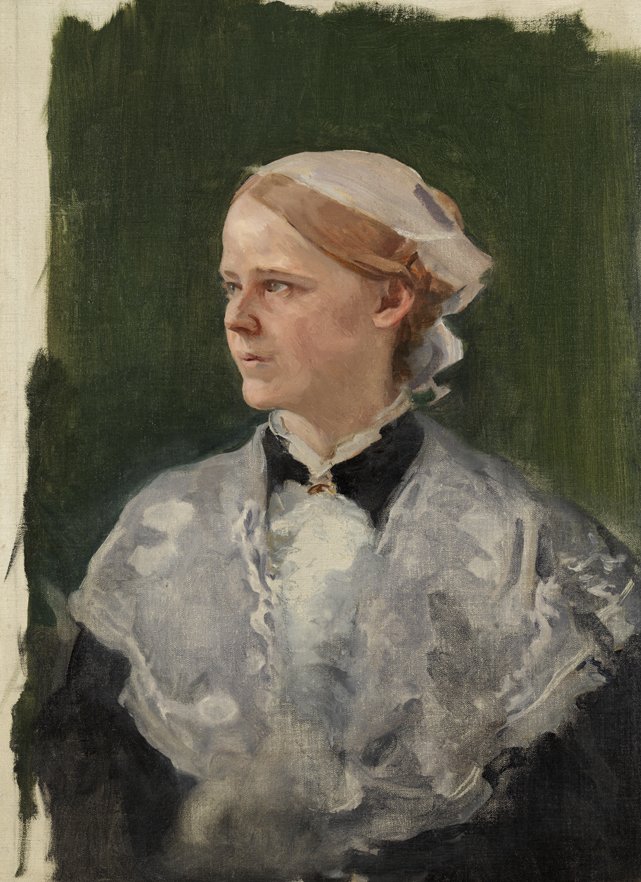
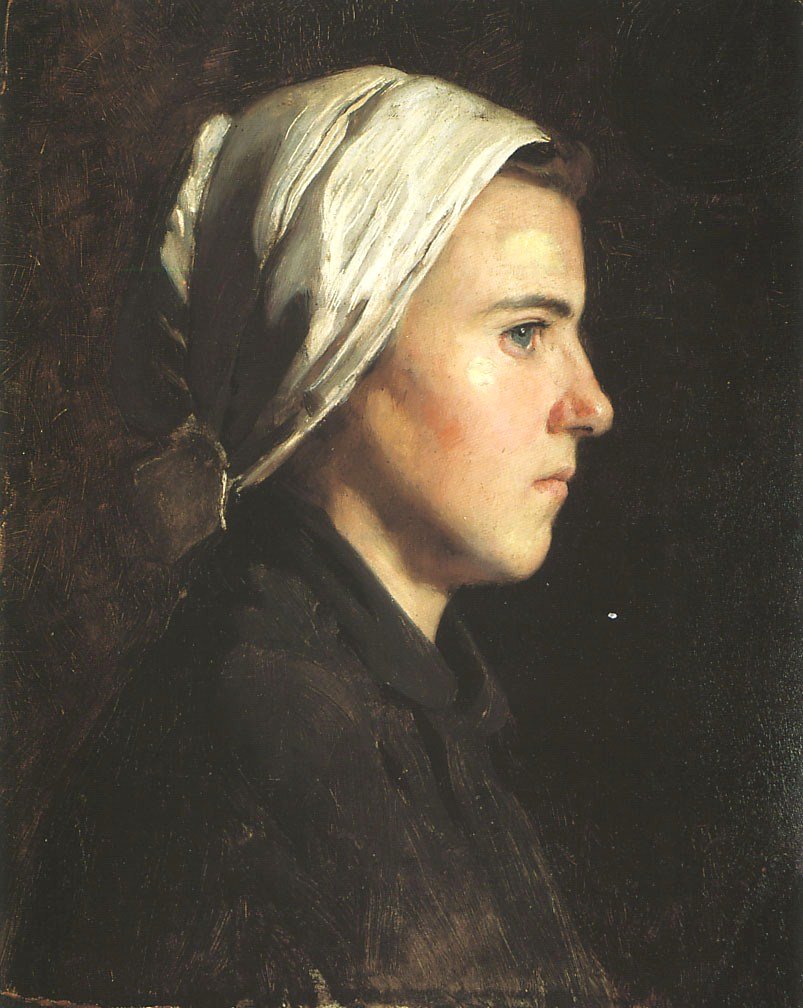
Head of a French Peasant Woman by Cecilia Beaux (1888)

All artists at one time or another make a choice about what medium they prefer to use but also what is to be their artistic style. Cecilia Beaux was no different. She had arrived in Paris at the beginning of 1881, the same year as the sixth Impressionist exhibitions. However, she was not seduced by Impressionism, writing:

“…The enthusiasm I felt for Monet’s iridescent pigments, his divided rays to reach the light of Nature by means of color only, left me with no desire to follow. Landscape, genre, I could pore over with no desire to take a white umbrella into the sun…”

For Cecilia, her Gods of art were the likes of Titian, Rembrandt, and Veronese, but she admitted there was even one thing that could seduce her away from art:

“…If there was anything that could have drawn me off my feet entirely, and divorced me from painting, it was to be found in the lower galleries of the Louvre, on some of the upper landings and among the isolated examples of Greek and Italian Renaissance sculptures. Mystery again. Sculpture for me was surrounded by the never really comprehended glamour of its creative act, as well as the absolute power of its beauty, on emotion…”

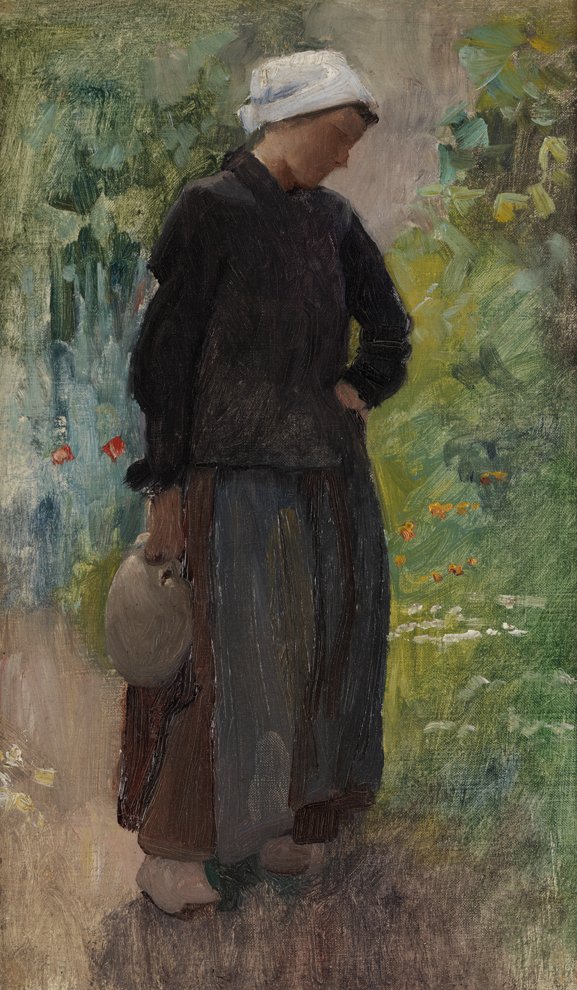
Country Woman, Concarneau, France by Cecilia Beaux (1888)

April was a welcome month for Cecilia as winter had almost been forgotten and the all the beauty of Springtime in Paris had arrived. With the improvement in the weather came the improvement in her disposition. She remembered the joy that this change in the weather brought to her spirit:

“…One morning in early April, we met, and saw, the first of Spring in Paris. All of youth, hope, and joy seemed to be in those shafts of sunshine, pouring through virgin leaf and violet shadow, and in the voices that called this and that from cleverly manipulated push-carts, heaped with flowers, vegetables, fruit, whose fresh moisture the sun touched with rainbow hues. Every French heart bounded with the hour’s happiness, and I knew that my heart was French, too…”

For Cecilia Beaux the summer of 1881 began with a new adventure. The academy had closed for the summer break and she and her fellow students were free to go off and paint. She and her American companions decided that the de rigeur destination for aspiring artists, especially Americans, was the artist colonies of Britany and specifically the coastal town of Concarneau.  Cecilia’s intrepid group set of on a late June afternoon by train bound for Concarneau.

South façade of the present day Château de Vitré

Because of the distance the party needed to break their journey and have an overnight stop-off at the town of Vitré famous for its twelfth century stone chateau built by the baron Robert I of Vitré, which the party visited before completing the second part of their journey. The party stayed at the little Hôtel de France. Cecilia Beaux had only sampled one French town, Paris, since her arrival in France and was amazed by the beauty of Vitré. She wrote:

“…It had been raining, I remember, and everything had all the color that moisture and a breaking sky, full of light, not sunshine, gives. When we looked up or down the steep little winding streets of mossy, grey, toppling houses, there was always a burning spot of red, a geranium in an upper window, or a white-coiffed woman, in a deep blue or green skirt, knitting in a doorway, coppers shining inside, or an old woman in sabots clattering down toward us over the rough stone pavement, or a tiny cherub in grown-up garments supping its bowl of pot au feu on a doorstep, and three children’s heads in a narrow window under the eaves, looking down at us…”

Seaside Inlet, Concarneau, France by Cecilia Beaux (1888)

The party continued their onward journey to Concarneau and arrived the next evening. They took a cab to the upmarket hotel, Les Voyageurs where they had dinner with friends before setting off to find and secure some more modest accommodation. They eventually settled on a small propriété owned by Papa and Maman Valdinaire, who were local florists. Cecilia loved the property, describing it in her autobiography:

“…a house and garden with an eight- or nine-foot wall entirely enclosing the estate, which was about an acre, and was in a garden full of flowers only. The walls were covered with carefully trained Bruit, pears and apricots, and a number of small trees, perhaps for blossom only, cast flickering light and shade over the flower-beds…”

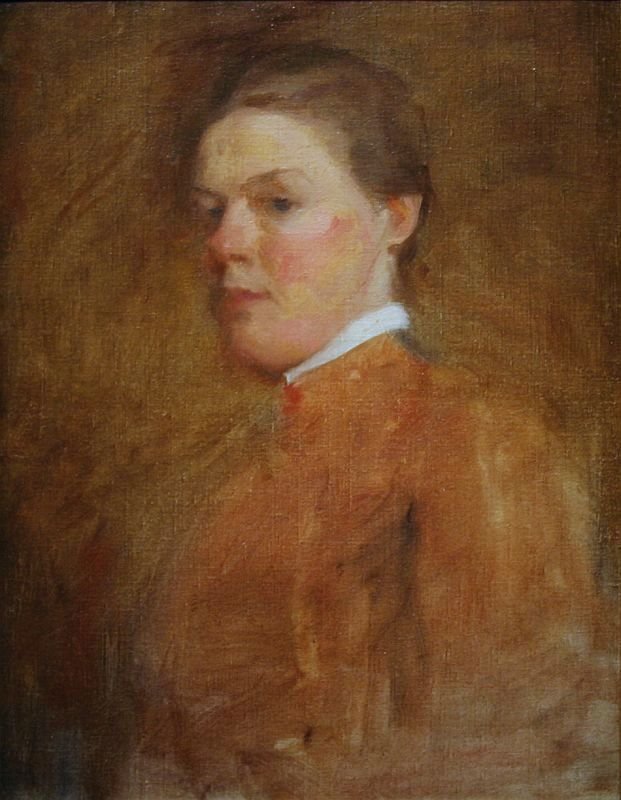
Head of a Woman by Cecilia Beaux (1888)

However, there were some drawbacks to their stay with the Valdinaires. The owners lived on the ground floor of the property and to gain access to the road or the garden they had to go through their accommodation which was also home to their chickens and their precious goat, which had freedom of the house but fortunately for them, couldn’t climb the stairs!! Also, according to Cecilia, the lady of the house “lacked character”. Cecilia described their accommodation:

“…The house was one room deep, and we were offered the two rooms on the second floor; also an attic for our kitchen. This had a large dormer window with lovely view toward the sea and a hosier for cooking on the hearth, really perfect in our eyes — but the fact that only one of the bedrooms was for the moment habitable was temporarily discouraging. They were at the top of the bare stairway, on — I called it — the second floor. There were windows on both sides, the sunny ones looking on the garden and within easy sight of the pigeons, and the garden, which was, with all its varied charms, to be our painting ground and studio…”

The Wave by T Alexander Harrison (1885)

One of the main reasons for Cecilia choosing Concarneau that summer was that two other important painters from Pennsylvania had studios in the area. They were Thomas Alexander Harrison and Charles “Shorty” Lasar. Harrison was mainly a marine painter and one of his most famous works was one he completed in 1885, entitled The Wave, which depicts waves rolling in on the beach. His mastery of light and colour in this painting is spectacular.

In Arcadia by T Alexander Harrison (c.1886)

One of his “non-marine” works, In Arcadia, was exhibited at the Paris Salon in 1885 and it received “an honourable mention” and it was to be the first of many awards Harrison received for his artistic works. The painting is now housed in the Musée d’Orsay.

Cecilia completed a portrait of T Alexander Harrison in 1888, whilst she was at Concarneau. Harrison was pleased with the completed work and commented about Cecilia’s painterly stating:

“…she had the “right stuff” to become a serious painter, the stuff that digs and thinks and will not be satisfied and is never weary of the effort of painting nor counts the cost…”

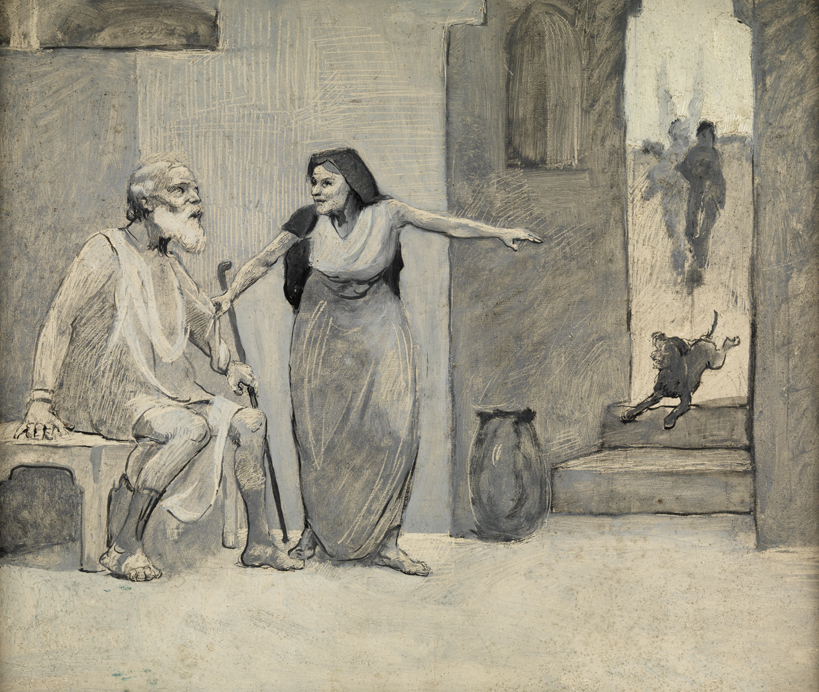
Tobias Returning to His Family by Cecilia Beaux (1888)

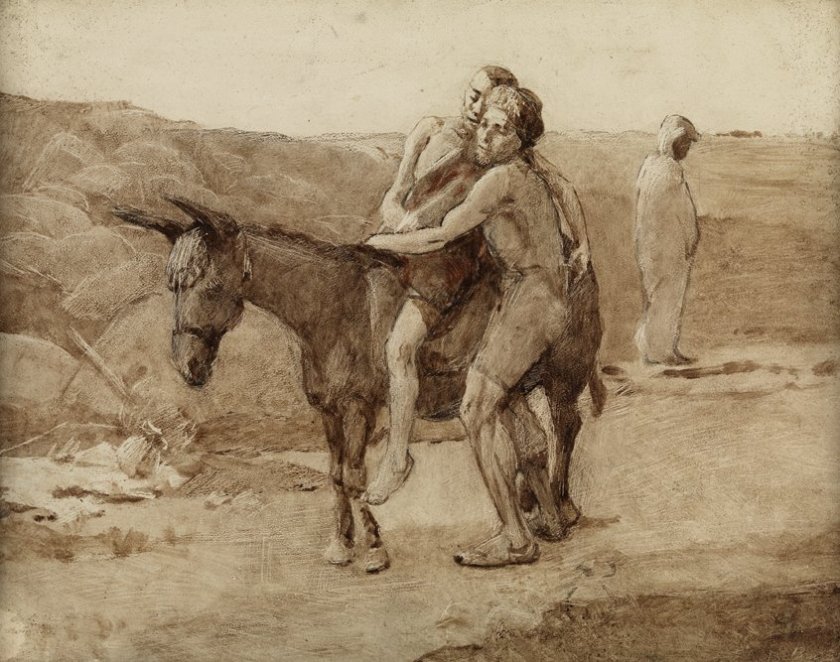
Whilst at Concarneau Cecilia Beaux complete several grisaille paintings. Grisaille paintings are those done entirely in shades of grey or another neutral greyish colour. The set of grisailles she completed all depicted biblical themes  and they were a distinct, if not fleeting, departure from her beloved portraiture. One such work was entitled Tobias Returning to His Family and is based on an Old Testament story about the blind man Tobit and his son, Tobias’ return home with his dog and how he cured his father’s blindness. In the Old Testament Book of Tobias 11:9 it describes the coming of Tobias preceded by the delighted dog:

“…and coming as if he had brought the news, shewed his joy by his fawning and wagging his tail…”

In the depiction we see Tobias’ dog bounding through the central doorway ahead of his master, “announcing” the son’s arrival.

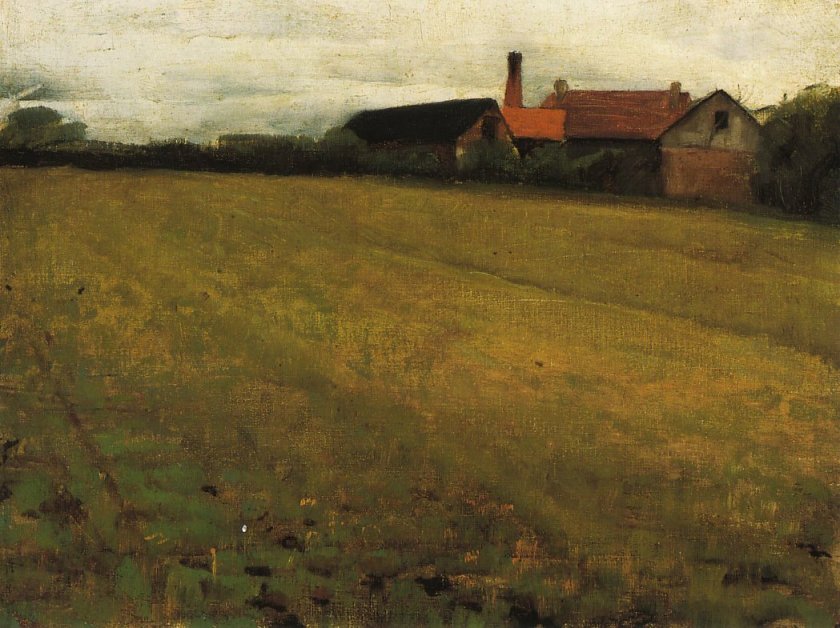
Landscape with Farm Building Concarneau by Cecilia Beaux (1888)

Whilst in Concarneau that summer, Cecilia Beaux also unusually strayed away from her usual portraiture to complete a couple of landscape works. One such work was entitled Landscape with a Farm Building.

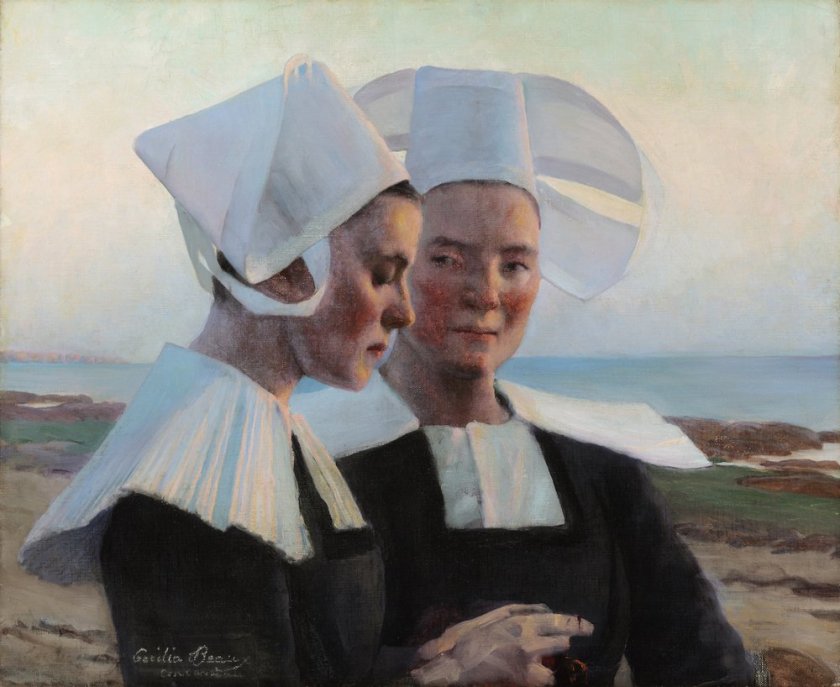
Twilight Confidences, by Cecilia Beaux (1888}

However, by far the most memorable works produced by Cecilia whilst in Concarneau was her 1888 painting entitled Twilight Confidences and the number of studies which led to the finished work, all of which are held at the Pennsylvania Academy of Fine Art in Philadelphia and the completed work was exhibited at their 1890 Annual Exhibition. This finished work is looked upon as her first foray into plein air painting. It is a juxtaposition of the two figures and the seascape and all are lit by the light of the setting sun. Cecilia recalled the sketches and painting:

“…I attempted two life-size heads, at dusk, on the beach; two girls of the merely robust type in conference or gossip — the tones of coiffe and col mingling with the pale blue, rose, and celadon of the evening sky…”

The coiffe is the decorative headdress and col is the decorative collar associated with Brittany.

In his 1983 book, Americans in Brittany and Normandy 1860-1910, David Sellin quotes Cecilia Beaux’s thoughts about the preparatory stage of this work:

“…if I succeed with my two heads it will be the opening of a new era for me, that of working from pochades [sketches] for large simple outdoor effects. I can see that the strongest part of what gift I have is my memory of impressions…”

Above is one of the many preparatory sketches held by the Pennsylvania Academy of Fine Art is a small (14 x 15cms) oil on cardboard grisaille sketch.

Good Samaritan by Cecilia Beaux (1888)

Their summer sojourn in Concarneau eventually ended and Cecilia and her friends, with the help of their landlady, Madame Valdinaire, decided to host a going-away party for their friends. On the menu was to be chicken which delighted Cecilia until she was told by her hostess that she must choisi le poulet. She remembered the incident well, writing:

“…It was a dark night in October. The chickens had retired early, and it was my lot to follow Madame V. and her lantern to the sleeping-quarters of her brood. Of course they had heard us coming, and when the door was opened and the lantern shone upon a row of dusky, perching bundles of feathers, a dilated, circular eye scintillated with terror in each sideways-turned head. A few sleepy, guttural croakings came from the back row, but those in front were silent and fixed. Madame Valdinaire, with cruel liberality, asked me if I preferred the brown or the speckled, or both, and seized one at random by its yellow legs, holding it upside down for me to palper [feel] its shrinking body, the one eye always turned up and fixed in the struggling bunch of squawks. Here I turned and fled, bidding Madame V. choisir herself, and stumbled into the house and up to our room, where my cousin sat placidly writing a letter…”

Cecilia Beaux and her companions left Concarneau in October 1888 and set off on what was to be a six-week trip around Europe by train. They went through Switzerland and crossed the Alps via the St Gothard Pass on their way to Venice, where they stayed for six days. From there they journeyed to Florence, stopping in the Tuscan city for six days. Sadly for Cecilia most of those days she was laid low with an illness. They then went across to France and called at Avignon and Nimes, the home town of Cecilia’s late father who had died in 1874. The journey ended back in Paris in December 1888 and Cecilia was proud of how frugal she had been during this six-week adventure saying:

“…It may be of passing interest to present-day tourists to know that in our six weeks’ journey we were only by way of second- and third-class, by train; and pension, never hotel; we spent just $107 apiece and had no sense of being penurious…”

……………………………….to be continued


Most of the information for the blogs featuring Cecilia Beaux came from two books:
Background with Figures, the autobiography of Cecilia Beaux
Family Portrait by Catherine Drinker Bowen
and the e-book:
Out of the Background: Cecilia Beaux and the Art of Portraiture by Tara Leigh Tappert.
Extracts from letters to and from Cecilia Beaux came from The Beaux Papers held at the Smithsonian’s Archives of American Art
Information also came from the blog, American Girls Art Club In Paris. . . and Beyond, featuring Cecilia Beaux was also very informative and is a great blog, well worth visiting on a regular basis.:
https://americangirlsartclubinparis.com/tag/catherine-ann-drinker/


Cecilia Beaux. Part 4 – The Parisian student and past and present romantic problems.

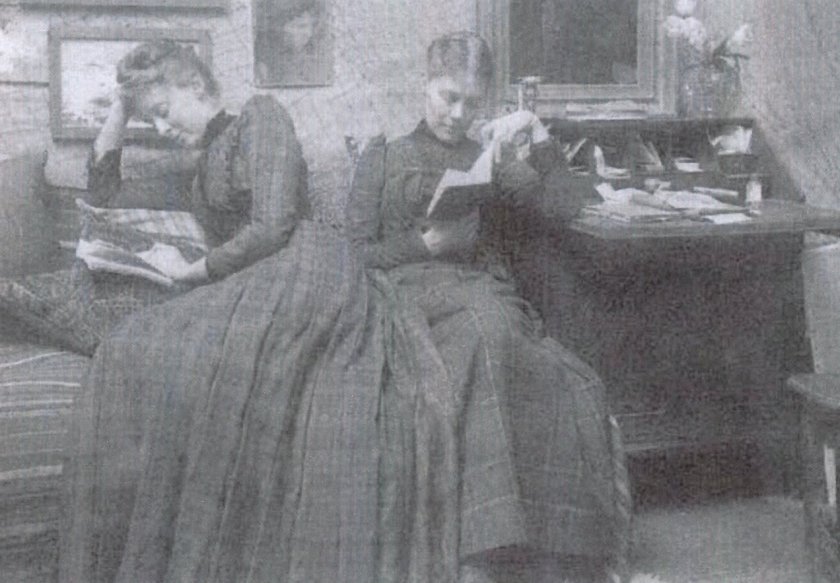
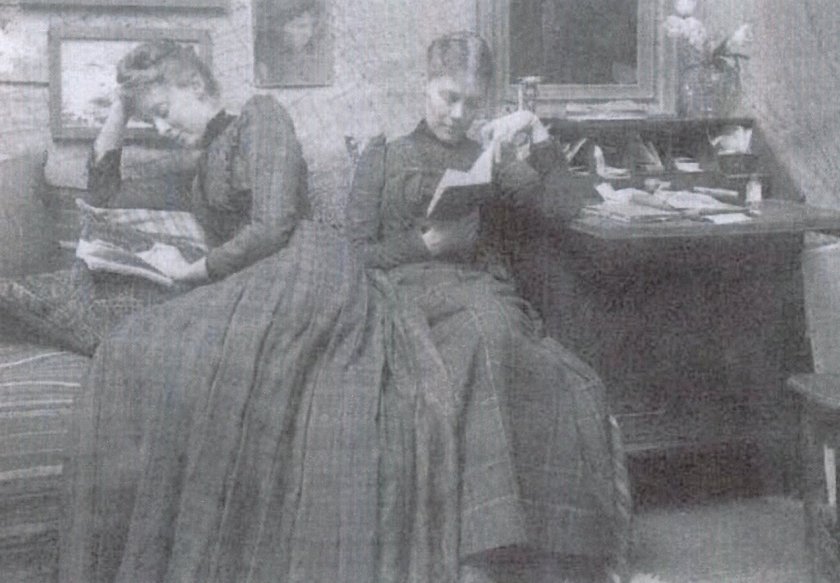
Cecilia Beaux and Enna Leavitt reading in their studio on Chestnut Street,
Philadelphia. Photograph, 1889-90.

………………….the year is 1887 and Cecilia still worked in her Chestnut Street studio completing many portraits. The pinnacle of this year as far as Cecilia was concerned was the exhibiting of her painting, Les Derniers Jours d’Enfance, at that year’s Paris Salon. This portrait of her sister and her nephew had been a labour of love and had taken two years to complete. It was not just its inclusion at the Salon which had excited her but as she looked at her returned painting, it was the thought of life in Paris which excited her. In her autobiography she recalled how she felt at that time:

“… After months it came back to me, bearing the French labels and number, in the French manner, so fraught with emotion to many hearts. I sat endlessly before it, longing for some revelation of the scenes through which it had passed; the drive under the sky of Paris, the studio of the great French artist, where his eye had actually rested on it, and observed it. The handling by employees; their French voices and speech; the propos of those who decided its placing; the Gallery, the French crowd, which later I was to know so well…”

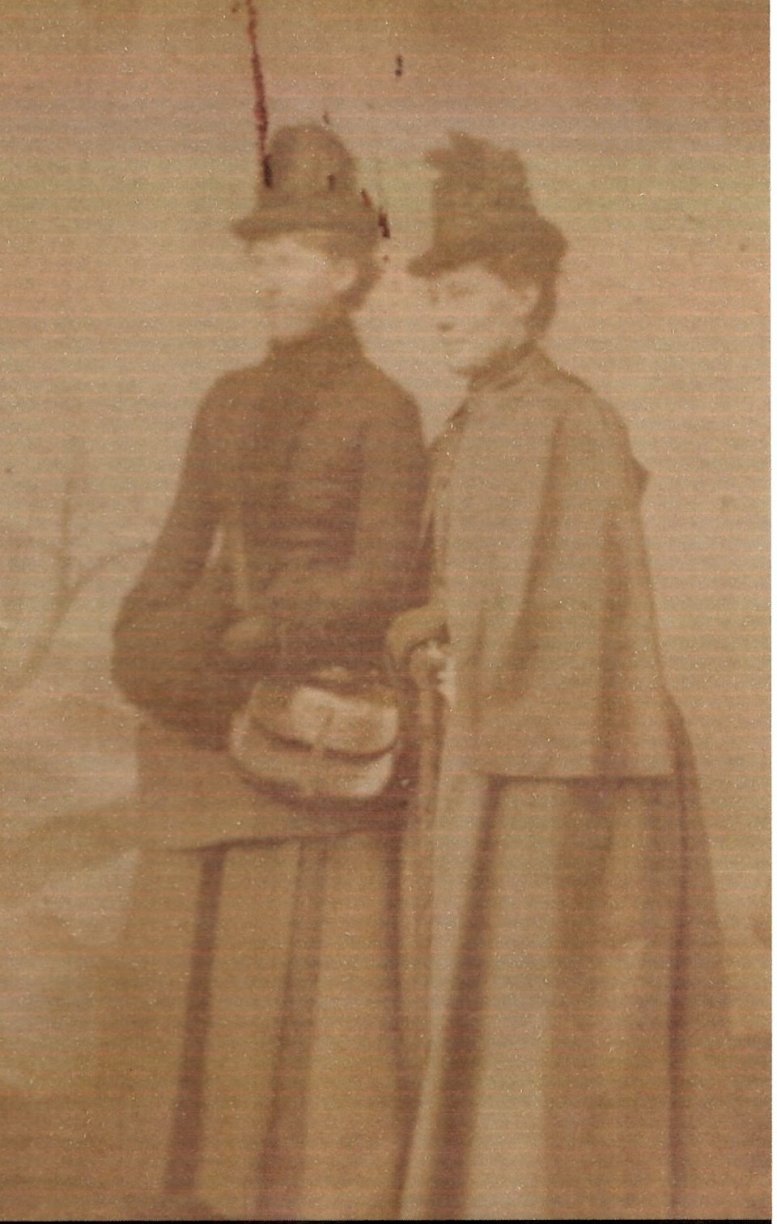
Cecilia Beaux and May Whitlock (1888)

She decided that she had to go and sample life in France, especially Paris. Her family were a little disconcerted about her proposed adventure, but they realised that as a thirty-two-year-old woman it was her decision. Her uncle William Biddle helped part finance the journey and sorted out a ticket for her ocean-going passage, passport, and letter of credit. He also persuaded a cousin of Cecilia, May Whitlock, to accompany her on the trip.

Cecilia also received a “farewell gift” from her good friend and fellow artist, Henry Thuron, who had once proposed to her. He gave her a set of monochrome drawings of paintings Cecilia was likely to see and sketch in the Louvre which could be used as preparation sketches or as she referred to them – ‘Springboards for the Galleries’.

S.S. Nordland

Cecilia and May Whitlock boarded the steamship Nordland in New York in January 1888 for a voyage which would terminate in Antwerp. The sea passage across the Atlantic Ocean was not a pleasant one. The vessel was battered by gales and bobbed unceremoniously on the ferocious sea, with many of the passengers, including the two women suffering from mal de mer for the first week of their journey. It took twelve days to reach their Belgium destination, arriving in Antwerp in late January on a freezing cold day with the dockside covered in snow.

Descent from the Cross by Rubens (1612-14)

Despite the inclement Belgium weather Cecilia and May managed to do some sightseeing and visited The Cathedral of Our Lady where she saw the Rubens triptych Descent from the Cross. She was mesmerised by Rubens work, writing in her autobiography, Background with Figures:

“…No one who has not met the material opposition of pigment and its allies can gauge Rubens’s power to command it. What his religious compositions lack in the subtler side of holiness, they gain in the presentment of human emotion, as it appears, humble, adoring, and abandoned to sorrow, even in the ignorant gazing upon the uncomprehended manifestations of Divinity…”

The two ladies visited Brussels and their stay in Belgium lasted just three days before they set off by train for Paris, arriving at the Gare du Nord during the last week of January 1888, where they were met by another of their cousins. The ladies moved into a pension at 12 rue Boccador, which was situated between the Seine, where it is crossed by the Pont de l’Alma, and the Champs-Élysée.  Their room at the pension was by no means salubrious but worse still it was cold and damp. Cecilia described their circumstances:

“…Our room was, of course, unheated, though it had a pretty chimney-piece and a clock, and what heat the previous summer had left behind had died long since between the closed windows and door. I was not pampered, and of course Steam heat was unknown to me at home. Our house had a small furnace, whose efforts were entirely devoted to the aged, the invalid, or the very young, but I had never known the damp, penetrating chill of never-heated houses in winter. Of course, a wood fire was impossible for us, but they wheeled us in a Schoubersky, a black charcoal stove, which could travel from room to room and never demand a chimney. Our chimney was a very retiring one, but with the Schoubersky approximately near it, we might avoid suffocation…”

Mother and Daughter by Cecilia Beaux (1898)
This was a portrait of Mrs. Clement Griscom and Frances C. Griscom.
Frances Canby Griscom was an American amateur golfer from Philadelphia and the daughter of shipping magnate Clement Griscom who owned the 7,000-acre hunting plantation in Bradfordville north of Tallahassee, Florida

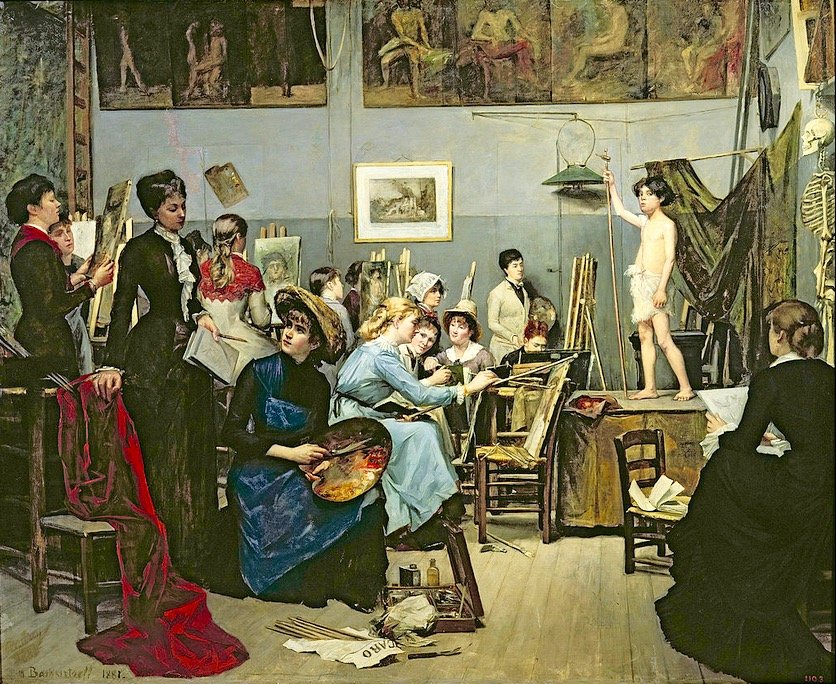
Soon after her arrival Cecilia enrolled at the Académie Julian. The Académie Julian was a private liberal art school, founded in 1868 by Rodolphe Julian, a painter and art administrator and in his early days, a prize-fighter. The academy was especially popular with Americans, and several exponents of American Impressionism studied at the Julian. The École des Beaux-Arts was considered the premier Parisian art academy, but Cecilia could not enrol for study at that establishment as women were not accepted as students there and that ruling did not change until 1897.

The Studio by Maria Bashkirtseff (1881)
Maria Bashkirtseff was a student at the Académie Julian in 1887

The new Académie Julian accepted her. Because of its fine reputation, it soon became recognised as one of the best private art schools in Paris. Two decades after it first opened, the number of students attending courses at the establishment numbered about six hundred and it necessitated the opening of four more branches, one of which was in the 8th arrondissement at No. 5 Rue de Berri where Cecilia Beaux studied.

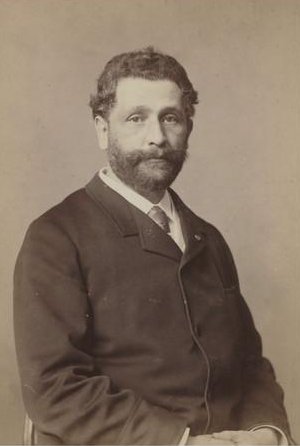
Tony Robert Fleury

Her first assignment at the Académie Julian was to produce a full-length drawing which would be commented upon by the tutor. Her tutor was Tony Robert Fleury, the French historical painter. She remembered how nervous she was when he entered the room. She wrote:

“…’Tony’ — that is Tony Robert Fleury — was to criticise that week, and at the hour entered a young-middle aged and very handsome man, with a face in which there were deep marks of disappointment; his eyes, grey and deeply set, smouldered with burnt-out fires. How un-American they were! As I observed him from behind my easel, I felt that I had touched for the first time the confines of that which made France and Paris a place of pilgrimage. Into the room with him came something, not perhaps a quality of his own, but of what he had come from and lived in. The class, although accustomed to him, was in a nutter. I was still and icy with terror, fearing other qualms that I might not understand him and blunder hideously…”

There were no exhibitions held at the Académie, but a regular routine was set which awarded the best students with prime painting positions in the atelier. Cecilia described the routine:

“…Every week subjects for composition were given out. The compositions were handed in on a Saturday, and the student who had produced the best in the opinion of ‘le Maitre’ had the privilege of first choice of place on Monday morning, for the new pose. This, in such a crowded room, was an immense advantage, but punctuality was also the price, for without it one’s chance was given to the next. I had the good luck to win it pretty often…”

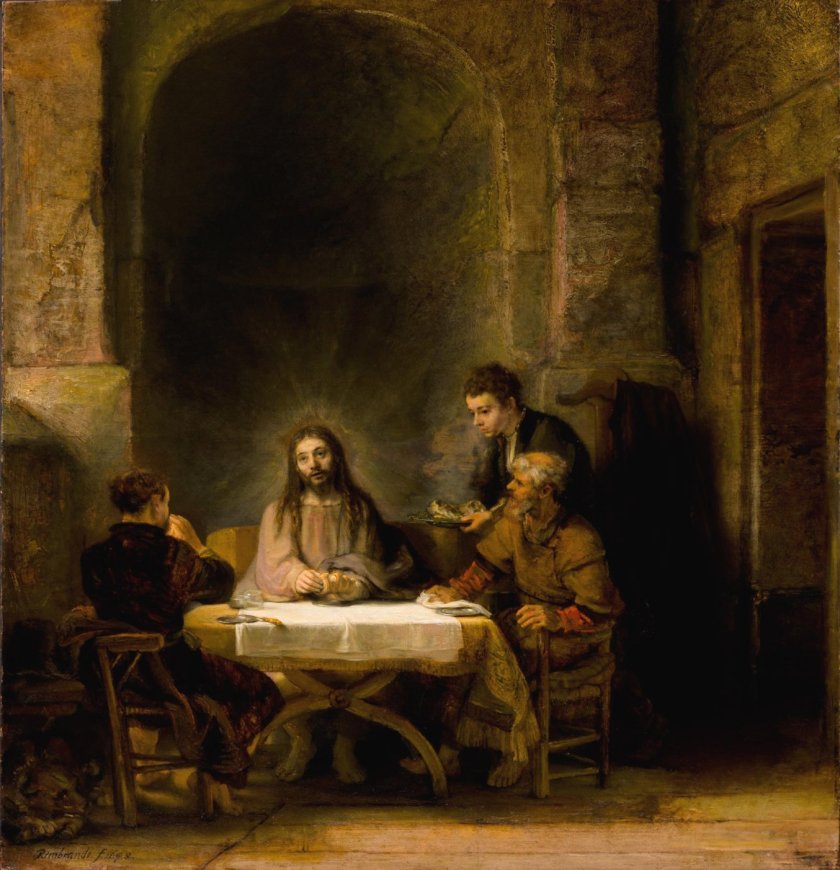
Supper at Emmaus by Rembrandt

The students would often have to copy biblical scenes and one of the earliest tests was to copy the painting Supper at Emmaus, Cecilia had already seen Rembrandt’s version of the work at the Salon Carré in the Louvre and so what she produced was an imitation of that of the Dutch Master. The efforts of all the students were placed on the walls of the atelier prior to the inspection by Fleury. Cecilia recalled what happened next:

“…He stood growling before them with folded arms. Pointing to mine, he said savagely, ‘Qui est-ce qui a fait ca?’ [Who did that?]
Mdlle C. dragged me out and thrust me, quaking, before him, for he was often bitterly ironical.
‘Humph,’ he said, ‘c’’est vu?  Je n’ai pas vu les autres, mais je sais bien que c’est la meilleure.’ [I have not seen the others, but I know it’s the best]…”

Within weeks of Cecilia and her cousin arriving in the French capital they had joined up with a group of expatriate artists including Florence Este, Gabrielle Clement, and Margaret Lesley Bush-Brown, who were all friends of Cecilia’s from the Pennsylvania Academy.

In Philadelphia, Cecilia’s love life never really took off despite the amorous attentions of suitors such as Henry Thuron who always put his rejection of marriage down to being both Catholic and poor!  It was Henry who had given Cecilia the monochrome drawings on oil-sketch boards in preparation of her sketching visits to the Louvre. She wrote to him just prior to her ocean voyage, letting him down gently:

“…try to be my friend still……………….I am going to keep your beautiful gift to prove how much I desire this — and for the roses I never thought there could be so much pain with such beauty and sweetness…”


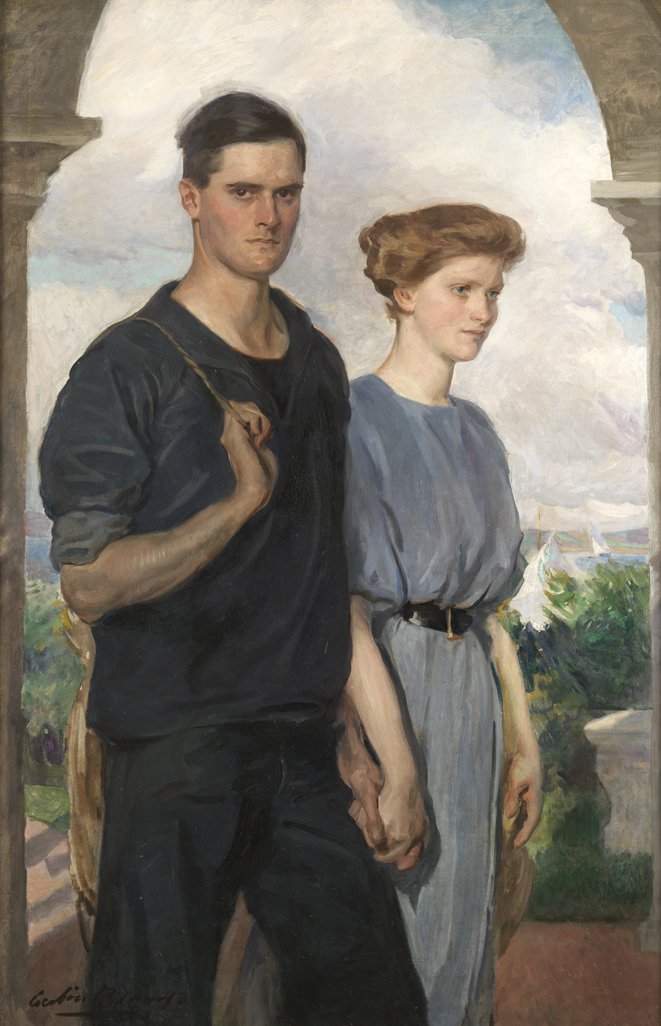
Portraits in Summer by Cecilia Beaux (1911)
This is a double portrait of Beaux’s nephew, Henry Sandwith Drinker, and his wife, Sophie Hutchinson Drinker. Henry was the son of Cecilia’s sister, Etta and her husband Henry Sturgiss Drinker. The painting was painted at Cecilia Beaux’s home (Green Alley) in Gloucester, Mass. during the couple’s honeymoon. Looking through the portico one can see sky, water, and sailboats in the distance.

During her stay in Paris she did enjoy the company of men and although she did go out with a couple of suitors, she would never commit to them. There was Leonard W. Bacon, a doctor whom she may have met four years earlier in Philadelphia when she sketched a posthumous portrait of his father. When his wife died he had, unbeknown to her, cast his eyes towards Cecilia as a possible “substitute”. He was on a visit to Paris in June 1888 and met up with her and had great hopes for their future and a replacement for his much-loved, late wife, Sarah. Unfortunately for him, he looked on Cecilia’s art as a mere hobby and something that would be forgotten when she became his wife and mother to his children. On his return to Philadelphia the following month Bacon came across Cecilia’s aunt Emily and told her about his hopes with regards Cecilia. She was “flabbergasted” by his aspiration that Cecilia would become the new mother to his children and told him that in her mind, he had no chance of success with his plan. Emily told her husband William Biddle about the conversation and he thought the whole situation was hilarious. He wrote a letter to Cecilia on July 24th 1888 and in it he commented on Bacon’s misguided plans for Cecilia:

“…”my logical mind insists on including the other consequence, which he didn’t mention, of your being a grand mother to his young grand children, & then I roar, — every time — Oh! dear me!” Dr. Bacon had “fallen from the pedestal” on which the aunts had placed him, and the “interview” with Aunt Emily “sav[ed] Cecilia from all further worry and trouble from that source…”

Young Woman by Ceclia Beaux (1909)

A more serious romantic issue for Cecilia was one that had begun back in Philadelphia with Edwin Swift Balch. Balch was ideal husband material. He was young (a year younger than Cecilia). He was a wealthy bachelor and part of the Philadelphia elite. He painted miniatures and was a writer, scientist, and an authority on polar history and exploration. He had met Cecilia as he had a studio in the same building in Philadelphia as Cecilia’s, and the tender shoots of romance began to appear. However, whilst in France, Cecilia realised that her great passion for her art was far greater than her passion for Balch. This realisation caused her to review her life. The whole process must have caused her great heartache as witnessed in the letter she wrote to her uncle, William Biddle, on September 30th, 1888:

“…And now prepare your dear mind for the real and serious thing I have to say. You will not perhaps believe the struggle that it costs me — because I know that this is the real end. It is all over between me and Mr. Balch. It is not his fault, but I believe now that he is reconciled to it. He speaks of it as “the break which I foresaw” and at the end — “I have written more but tore it up as it is silly to reproach you.” He will never know how much I cared for him and still do. What I admired in him, what attracted me, and what I really loved — time and distance could not, and have not changed, but what was not satisfied has grown more imperative and for the first time I know that it will not do. I have expanded here and I could not get into the place I might have got into before. Though even then I should have had to stifle something. You will say that I ought to have known this before. That if I had listened to reason I should have saved many people much pain. To which I can only say that no one but myself can know how I clung to what I found in him. I know that it was selfish, but I hoped to make up for it. Of one thing I feel sure that he does not suffer now more than I do, and he has, as regards this side of life, a much more hopeful future than I. All the same I ought to have made the sacrifice and taken the risk of losing. Do not think I am not paying for it — that is all.
I am waiting anxiously now to hear what you think about my staying over here a few months longer. You will easily understand that now I wish to stay as never before. It would be very painful for me to go home now, and for him too. He would almost be driven away himself if I did. Besides I must allow to the weakness of its being safer for both of us. I am besides very anxious to paint something for next year’s Salon…”

Biddle was concerned with what he had read and on October 10th, 1888, wrote back to Cecilia:

“…You do flit about pretty fast, — physically, — & perhaps Emotionally — but I trust not morally or mentally. With those departments of one’s being it is wiser & safer to “go slow”…. In regard to Mr. B. I can only say that if you really feel sure about yourself we all rejoice in your decision, — & unless you were prepared to accept now, or at least very soon, it was your duty to so decide anyway. Even if you were not sure of yourself, — or were sure, the other way…. Judging from what you have written me, his attitude in the affair seems manly & dignified & raises him in my estimation. I’m sorry for him, — but do not think his life will suffer…. If there is no change in our family status at 4305, I can see no valid reason for your hurrying home in May or June & leaving the Salon & Exposition unseen or only half seen…”

…………………………..to be continued.


Most of the information for the blogs featuring Cecilia Beaux came from two books:
Background with Figures, the autobiography of Cecilia Beaux
Family Portrait by Catherine Drinker Bowen
and the e-book:
Out of the Background: Cecilia Beaux and the Art of Portraiture by Tara Leigh Tappert.

Extracts from letters to and from Cecilia Beaux came from The Beaux Papers held at the Smithsonian’s Archives of American Art

Information alsocame from the blog, American Girls Art Club In Paris. . . and Beyond, featuring Cecilia Beaux was also very informative and is a great blog, well worth visiting on a regular basis.:
https://americangirlsartclubinparis.com/tag/catherine-ann-drinker/

and

Cecilia Beaux: The Power of Paris (1888)

Cecilia Beaux. Part 3 – the aspiring portrait artist.

Self portrait by Cecilia Beaux (c.1889-1894)

………….the year is 1881 and Cecilia Beaux had started to attend classes organised by a former schoolfriend and their work had been periodically critiqued by the painter William Sartain. These classes went on for two years but in 1883 Cecilia got her own studio on Chestnut Street, Philadelphia, and the class moved there where they did unsupervised life drawings. It was unsupervised as the visits by William Sartain had ended due to the long commute he had to make to get from New York to Philadelphia in order to examine and review the ladies’ work. At this time Cecilia was concentrating on her portraiture and as she wrote in her biography she even decided to try and have a work of hers included in an exhibition:

“…At this time, I did a study of a friend which resulted in my making my
first entrance into the doubtful field of the Exhibitions. It was well hung at the Pennsylvania Academy and was considerably noticed…”

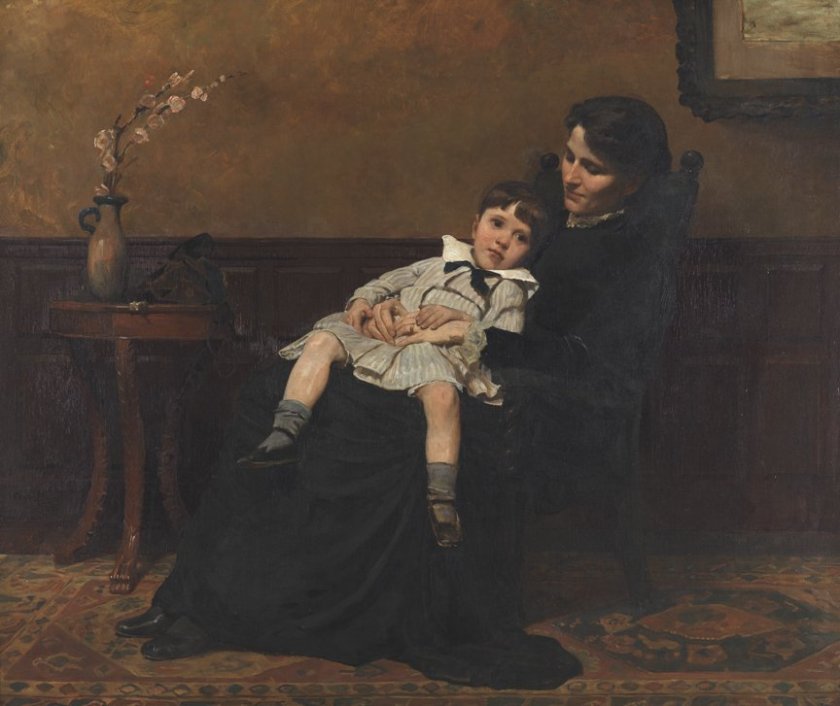
Les derniers jours d’ enfance by Cecilia Beaux (1883-1885)

It was whilst walking around her large and empty studio that Cecilia had the idea to paint a large portrait of two people in “landscape” format. Unbeknown to her at the time, it was to be one of her best-known works. Her idea was to paint a portrait of a mother and her small child. Not just any mother and child but her sister Etta, who had married Henry Sturgiss Drinker in 1879, and her first-born child, Henry (Harry) Sandwith who was born a year later. In her autobiography, Background with Figures, she envisioned how the portrait would look:

“…The mother in black sat in a low chair, the brown-eyed boy of three almost reclining in her arms. He was to wear a short blue-and-white cotton garment, his bare legs trailing over his mother’s knees. Her head was bent over him, and his hands lay upon her very white ones, which were clasped around him. The whole picture was to be warm in tone and in an interior which did not exist, except in the mind of the designer…”

She had discussed the idea with William Sartain who probably came up with the French title for the proposed work, Les derniers jours d’enfance. (The last days of childhood). Now, all she had to do was persuade her sister Etta to agree to pose with her son for the painting and she foresaw  problems, which she wrote about:

“…Poor Etta would have to take the boy to town, an hour’s trip in the horse-cars, climb eighty-four steps, and probably do this many times, with a rather uncertain result…”

However, all Cecilia’s worries came to nought as Etta was only too pleased to have her and her son depicted in a portrait. Cecilia embarked on this large painting (46 x 54 inches / 116 x 137cms) in 1883 and it took two years to complete. In the painting, we see Etta, sitting in an old steamer chair, dressed in a black frock with its various textures.  Cecilia had decided to show just one of her sister’s arms in the painting and so she had made up one closely-fitting black satin sleeve with rich lace at the wrist. Although hard to detect in the picture, Cecilia had placed a canton crepe shawl, which belonged to her grandmother, around her sister’s knees, the garment exactly taking the lines of the skirt. The shawl had been dyed black and though it was delicate, had a rich hanging texture, which made it form-fitting.

Cecilia had staged the depiction meticulously bringing several family accoutrements into her studio. On the floor she had laid one of the Leavitt family’s best oriental rugs and Etta had lent her one of her in-law’s heirlooms, a small wooden table upon which she placed a flower-filled vase belonging to the Drinker family. The background is interesting. Cecilia went out and bought a short piece of panelling from a carpenter’s shop and dyed it so it looked like a piece of mahogany and it was so placed behind the sitters so as to look like a piece of wainscoting joining the wall and floor.
Cecilia remembered in her autobiography that the numerous sittings for this joint portrait went well:

“…My sister bore her part with her usual gallantry. The boy was extremely amused by the novelty of the scene in which he found himself. His mother’s lap was comfortable, his head leaned upon her breast and her voice was close to his ear, and in the rests, he enjoyed running out into the hall with me to get a distant view of the canvas through the open door…”

It is interesting to note that Etta was occasionally relieved of her seated pose by a young woman who occupied the studio next door, for she volunteered to help as a model and posed for the draped knees and feet !

Mother and son’s joined hands

Look carefully how Cecilia had her sister and nephew pose with their hands entwined on her lap at the centre of the composition making it the focal point. Harry’s darkened fingers of his left hand placed on top of the white hand of his mother. The painting was exhibited at the Pennsylvania Academy of Fine Arts annual exhibition in 1885 and was awarded the Mary Smith Prize for the best work by a local woman.

Self-portrait by Margaret Lesley Bush-Brown (1914)

Two years later, in 1887, a girlfriend of Cecilia and a fellow painter, Margaret Lesley Bush-Brown, who had been studying art at the Académie Julian in Paris and was returning to France, suggested taking the painting to the Salon for examination by the exhibition jurists. Cecilia was taken aback by the offer but agreed and the Salon jurists accepted it and it was prominently displayed in the Paris Salon of 1887. Cecilia deemed this to be a great honour and marked the beginning of her artistic career.  More importantly maybe, it also gave her a hankering to taste the delights of Paris which she believed to be the heart and soul of the art world.

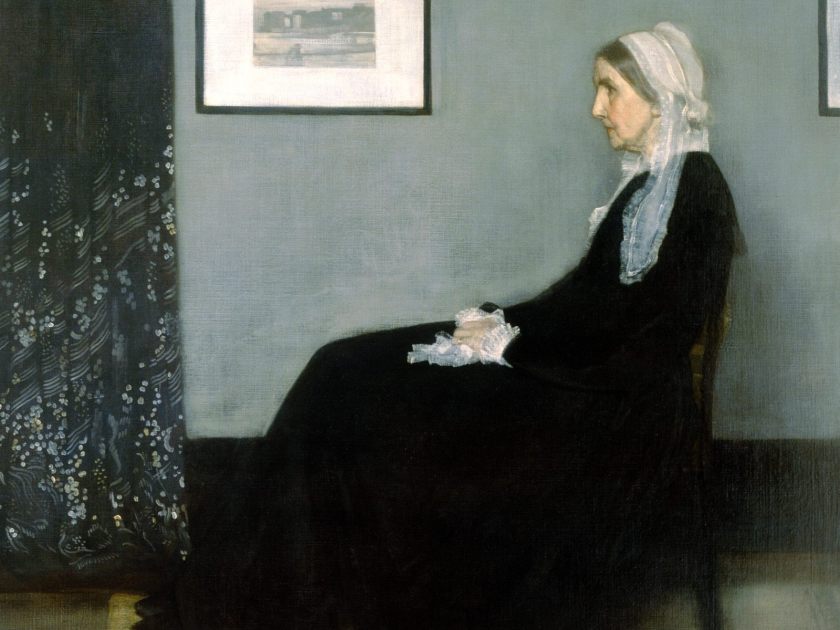
Arrangement in Grey and Black Portrait if the Artist’s Mother, by Whistler (1871)

Many people have commented on the likeness of the setting of Cecilia’s mother and child depiction to James McNeill Whistler’s Arrangement in Grey and Black: Portrait if the Artist’s Mother, which had been displayed at the 1881 Centennial Exhibition held in Philadelphia and probably had been seen by Cecilia, but she strongly denied that Whistler’s portrait of his mother had influenced her. The painting Les derniers jours d’enfance is now housed at the Pennsylvania Academy of the Fine Arts in Philadelphia.

Mrs. Alexander Sedgwick and Daughter Christina,by Cecilia Beaux (1902)

Cecilia Beaux went on to paint many tender mother and child portraits which had become so popular. One example of this was her  portrait, completed in 1902, entitled Mrs. Alexander Sedgwick and Daughter Christina. Five-year old Christina would, seventeen years later, marry the famous American writer and journalist, John Phillips Marquand who was famous for his Mr Moto spy stories.

The Reverend Doctor William Henry Furness by Cecilia Beaux (1886)

Following the completion and success of The Last Days of Childhood Cecilia Beaux carried on with her portraiture. She captured the likenesses of many leading figures from the worlds of politics and the arts, as well as works featuring friends, neighbours, family and, through her connections with the church, she produced three commissioned portraits of ministers, two of whom came through her involvement with the Woodland Presbyterian Church. One such portrait was of the well-known and well-respected eighty-four-year-old Philadelphia Unitarian minister, Reverend Doctor William Henry Furness, which she completed in 1886. Friends of the minister, who had just retired, commissioned the portrait to commemorate all the work he had done for the ministry over a fifty-year period. When the work was briefly exhibited at the Earle galleries, prior to it being given over to the Unitarian Church in Philadelphia for a fee of $500, it was well received by both the public and the art critics. The art critic of the Philadelphia Evening Telegraph, wrote in the December 28th edition of the newspaper:

“…Miss Beaux has copied nature with faithful care, and has concurrently reproduced those suggestions of individuality and personality…. In this respect the portrait is marvellously life-like, and no one not coldly indifferent and insensible can study the work without being impressed by the attributes of benign, gracious, potent manliness it presents…”

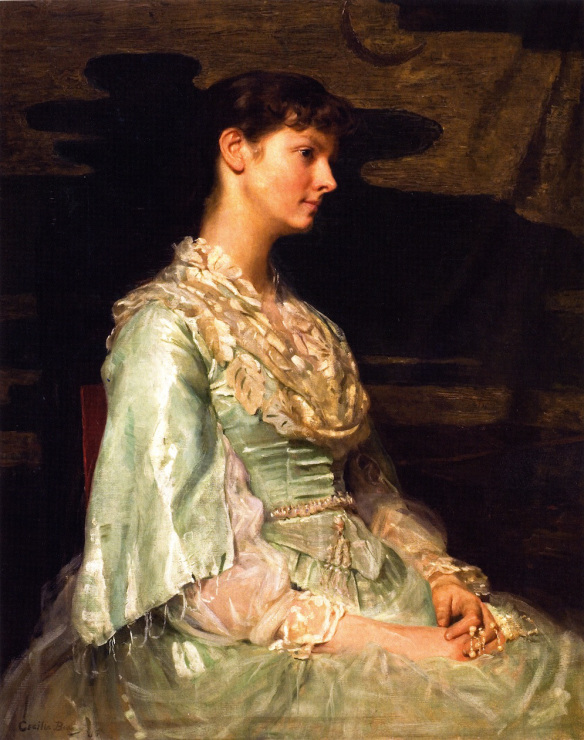
Ethel Page by Cecilia Beaux (1884)

Cecilia completed many portraits featuring Ethel Page, a Philadelphia socialite. Cecilia met Ethel Page in 1876. The 1884 portrait of Page with the sitter’s face brightly lit in contrast to the dark background was typical of was typical of Cecilia’s early style.

The haunting facial expression of the sitter with her piercing stare makes for a beautiful study.
Ethel Page as Undine by Cecilia Beaux (1885)

Another portrait of Page completed in 1885 depicts the actress in her role as Uncompaniondine and this again won Cecilia the Mary Smith Prize at the Pennsylvania Academy for the second year in a row.

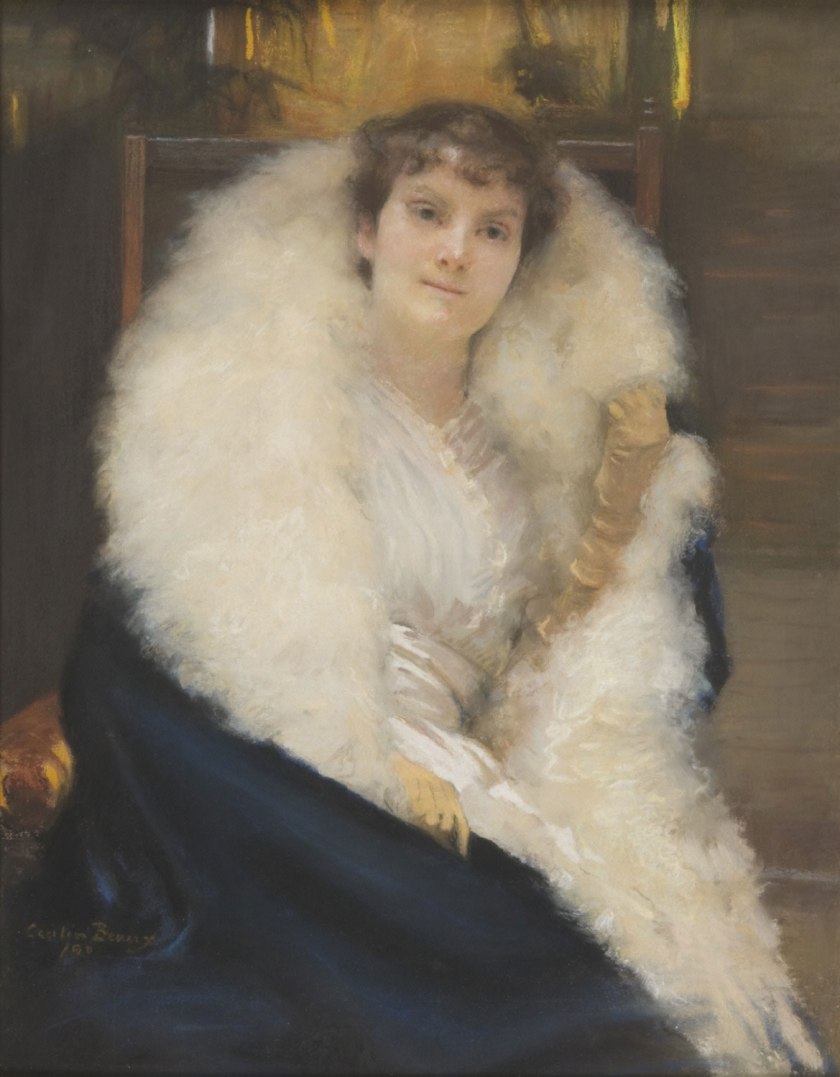
Ethel Page by Cecilia Beaux (1890)

Cecilia Beaux completed a pastel portrait of Ethel Page in 1890. It is a much softer depiction which has a feeling of warmth and in a way, highlights the artist-sitter’s friendly relationship. The portrait of Ethel Page also exudes a sense of elegance and I am sure the finished painting pleased the sitter.

A new phase in Cecilia Beaux’s life came in January 1888 when she and her companion, her cousin May Whitlock boarded the SS Nordland bound for Paris……..

………………………..to be continued.


Besides various internet websites, most of the information for the blogs featuring Cecilia Beaux came from two books:

Background with Figures, the autobiography of Cecilia Beaux

Family Portrait by Catherine Drinker Bowen

and the e-book:
Out of the Background: Cecilia Beaux and the Art of Portraiture by Tara Leigh Tappert

The blog, American Girls Art Club In Paris. . . and Beyond, featuring Cecilia Beaux was also very informative and is a great blog, well worth visiting on a regular basis.:

https://americangirlsartclubinparis.com/tag/catherine-ann-drinker/


Cecilia (Leilie) Beaux. Part 2 – the beginning of an artistic career.

Self-portrait, Cecilia Beaux (1885)

The early childhood and teenage years of Cecilia (Leilie) Beaux were challenging. She and her elder sister Etta lived with their maternal grandmother Cecilia Kent Leavitt and their maiden aunt Eliza. Leilie and Etta were completely different in character. Etta was the more placid and was happy to accept traditional domestic life and probably modelled herself on her grandmother who had nurtured her own eight children. Leilie, on the other hand, was both stormy and impassioned and hankered for her independence and believed that financial security would achieve that status. She would, like her late mother and aunt, Eliza, go out to work and earn money. Leilie was a perfectionist and suffered like all perfectionists tend to do. In her personal diary which she started at the age of fourteen, she wrote:

“…It seems to me that I haven’t progressed at all. I do believe that it is harder for some people to be good than others, a great deal harder. Some people seem to be good naturally like Etta…but as for poor me why I’m nothing absolutely nothing, able only to do wrong. Sometimes it seems to me as if I were tied in a spiritual way to a string of a certain length. I get on very well at first and feel so free and happy, feel as if I really was getting better, when suddenly I come to the end of my string, and am thrown back to the old place again…”

Leilie was often rebellious as a teenager, frustrated with her life and often aspiring to do something different. In her autobiography she remembered that in her teenage years she wrote a poem expressing her exasperation:

“…Lost hope, lost courage, lost ambition,
What’s left but shams of these to hide my true condition?
Feigned peace and joy, feigned happy effort,
False tongue, proclaiming, “Art’s my comfort.”
Nought’s left but bones, and stones and duty that’s not pleasure,
But grinding, ceaseless toil, whose end’s the measure
Of the short web of life the Fates have spun me.
What’s this… I’ve uttered words of treason.
What’s lost? My time, my daylight, and my reason…”

Leilie also suffered mentally from the departure of her father from the family home. Sadly, she blamed herself for his departure, as her mother had died giving birth to her.  She began to make excuses for him abandoning his daughters. Despite his untimely and devastating departure she still managed to put him on a pedestal, someone to be almost adored.

Little Lamerche by Cecilia Beaux (c.1900)

Leilie was brought up in a family environment where music was an essential part of life. Her aunt Eliza was a highly talented musician and earned money for the family by giving music lessons. The family owned a Chickering grand piano and there would be frequent family recitals in the evenings with performances given by Eliza and William Beadle, Emily’s husband, who also acted as organist at the local Presbyterian church the family attended. When Leilie was eleven years old, she learnt to play the piano but never reached a level of accomplishment which satisfied her and so, as a perfectionist, she gave it up.

Man with the Cat (Henry Sturgis Drinker) by Cecilia Beaux (1888)
Henry Sturgis Drinker, was Cecilia Beaux’s brother-in-law (Etta’s Leavitt’s husband). He was a railroad executive and president of Lehigh University in Pennsylvania.

Up to the age of fourteen Etta and Leilie were home-tutored, mainly because of the high cost of formal schooling.  Leilie’s early interest focused on literature and poetry and at one time she believed she would like to become a writer. William Biddle’s arrival on the scene as Emily Leavitt’s husband meant that the Leavitt’s finances improved, so much so, that it was decided that Etta and Leilie could afford to receive formal education at Misses Lymans’ School. It was an all-female school run by Catherine and Charlotte Lyman. This was the first time the two girls were able to absorb life outside the family. Leilie began to sketch and was pleased with her efforts. In her autobiography, Background with Figures, she wrote:

“…Long before it was discovered that I had more proficiency with a pencil than I had on the piano, I accompanied my aunts on visits to what picture galleries and special exhibitions there were…”

Henry James by Cecilia Beaux (1911)
The portrait depicts the America author Henry James during his final trip to the United States, when he was recovering from a nervous breakdown and the death of his brother, William.

Leilie began to develop and interest in the Arts and her aunts and uncles would take her to various art galleries to encourage her. It was during the 1870’s that there was a sudden desire of wealthy Americans to buy works of art especially by French painters. It was a status symbol for these wealthy households to have works by the emerging French masters hanging on the walls so that they would impress visiting dinner guests. One such person, a wealthy and successful businessman, was Henry C. Gibson, an art collector, banker, real estate developer, and distiller. His Philadelphia house on Walnut Street housed many works of art and Leilie’s uncle was fortunate to receive an invite to view the works of art and he took Leilie with him. They must have re-visited the house on several occasions for she wrote in her autobiography:

“…Very few of the pictures were large, and all could be easily seen. Of course, I knew nothing of these virtues of presentation; I knew nothing but my own happiness. I must have been taken several times to the gallery, for I had my favorites and was unembarrassed by the difference of schools…”

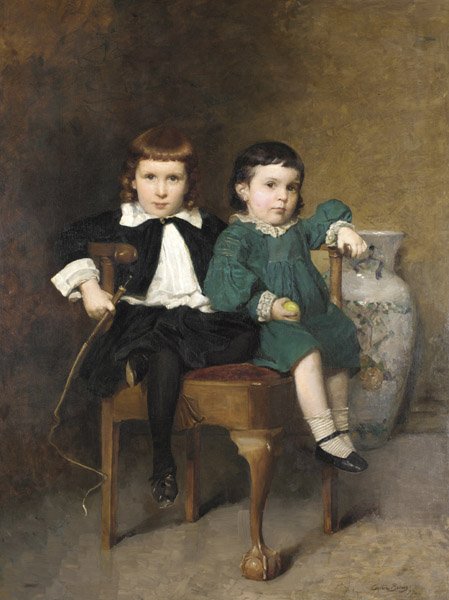
Harold and Mildred Colton by Cecilia Beaux (1887)

Her family decided that Leilie should pursue her interest in drawing and painting and needed to find someone who could nurture Leilie’s talent. The person chosen to guide Leilie was the talented artist, and painter of historical and biblical scenes, thirty-one-year-old Catherine Ann Drinker, who had a local studio. Coincidently, she would later become Etta’s sister-in-law in 1879 when Etta married her brother, Henry Sturgess Drinker. In 1871, sixteen-years-old Leilie remembered her first visit to Catherine Drinker’s Philadelphia studio which was at the top of an old house at Fifth and Walnut Streets on Independence Square. In her autobiography she wrote:

“…I am glad that the studio was typical, traditional, and not to be confused with any ordinary or domestic scene, for it was the first studio I ever entered. On its threshold, everyday existence dropped completely out of sight and memory. What windows there were, were covered with hangings, nondescript, as they were under the shadow of the skylight, which was upright, like a broad high window, and without glare. There was a vast sweeping curtain which partly shut off one side of the room, and this, with other dark corners, contributed to its mystery and suggestiveness. The place had long been a studio, and bore the signs of this in big, partly obliterated figures, outlines, drawn in chalk, upon its dusky wall, opposite the light. Miss Drinker had spent her early life in China, whence her family had brought many examples of Chinese art and furniture. The faded gold of a large seated Buddha gleamed from a dark corner. There was a lay figure, which was draped for a while in the rich robes that Miss Drinker had used for her ‘Daniel…”

Old-fashioned Music (Guitar Player) by Catherine Drinker (1880)

In 1880, Catherine Drinker won the prestigious Mary Smith Prize for her painting Old Fashioned Music.  This prize was awarded to women artists by the Pennsylvania Academy of Fine Arts. The award recognized the best work by a Philadelphia woman artist at the Pennsylvania Academy of the Fine Arts annual exhibition — a work that showed “the most originality of subject, beauty of design and drawing, and finesse of colour and skill of execution”.

Charles Sumner Bird and His Sister Edith Bird Bass by Cecilia Beaux (1907)
Many of Cecilia Beaux’s portraits were of New Englanders, including this elegant image of Charles Sumner Bird and his sister Edith.
The Bird family had made their fortune in the manufacture of paper, and they owned a 194-acre estate, called “Endean,” in East Walpole, Massachusetts, overlooking the Neponset River.

For Leilie, Catherine was not just an art teacher, she was a friend despite their fourteen-year age difference, a friendship which would last over fifty years. Leilie spent a year learning about art under the watchful eye of Catherine until Catherine decided that Leilie should move to a formal art school. She spoke to William Biddle, who, as the husband of Leilie’s aunt Emily, had been acting as Leilie’s unofficial guardian. Catherine suggested that the finest art school for his charge was the Van der Wielen School. It was run by a young Dutch-Flemish artist, Francis Adolf Van der Wielen, who had immigrated to Philadelphia in 1868 after he had trained at the Antwerp Academy of Fine Art. He opened his art school as a way of countering the fact that he had begun to find it difficult to paint due to his failing eyesight. In 1872, seventeen-year-old Leilie Beaux enrolled at the school.

Most of Van der Wielen’s female students had come to him to learn about art and looked upon it as a delightful hobby but some of his students, like Leilie, looked upon art as a skill that would eventually earn them money. Although Leilie had doubts about her tutor, due to his poor grasp of the English language and the fact that his eyesight was starting to fail him, thus making his visual criticism of his students’ work questionable. However, she remained at his school for almost two years gaining knowledge of linear and aerial perspective and the principles of light and shade. In 1873, Van der Wielen married one of his more mature students and the couple left America for a new life in Europe. His art school would have closed but for Catherine Drinker stepping in and taking over the teaching.

In 1873 Cecilia(Leilie) Beaux reached the age of eighteen and decided that it was time to put her artistic skills to work to earn money for herself and thus gain a modicum of independence and also to bolster the family’s finances. In her autobiography she wrote:

“…My grandmother’s house was my home, and in it I was the youngest born, but I wished to earn my living and to be perhaps some day a contributor to the family expenses…”

Plaque by Cecilia Beaux (1880)

For a month she took lessons in china painting and found that in a short time she had mastered the delicate technique. She would produce portraits on large china plates. One of her early successes was a china plaque featuring a young gold-haired girl, the parents of the child were delighted.

Plaque painted by Cecilia Beaux (1883)

From this came many commissions featuring paintings of young children.  However, she never really took to this type of work saying:

“…Without knowing why, I am glad to say that I greatly despised these productions, and would have been glad to hear that, though they would never ‘wash off,’ some of them had worn out their suspending wires and been dashed to pieces. This was the lowest depth I ever reached in commercial art, and, although it was a period when youth and romance were in their first attendance on me, I remember it with gloom and record it with shame…”

Catherine Drinker had taught art at Miss Sanford’s School for young ladies for many years but now, with taking over at Van der Wielen’s school she had to give up her post at the Sanford School and she recommended her protégé, Leilie to take her place. Leilie was taken on as a part-time drawing instructor at the school, teaching two classes, one morning a week. She would teach her young pupils how to draw, how to enlarge and how to shade. She taught there for three years and this led to her also giving private art lessons which earned her more money. In 1874, William Biddle introduced Leilie to a printer, Thomas Sinclair, of Thomas Sinclair and Sons. He and the Leavitts knew each other as they were fellow members of the Woodland Presbyterian Church and she was offered her first professional illustration job. Leilie had now finally launched herself into the art world and she decided that she needed to have a definite artistic identity and chose to revert to using her mother’s name. From thenceforth she was to be known as Cecilia Beaux.

As an aspiring artists Cecilia wanted the best artistic tuition that she could receive, given by the most talented tutors, and for her, this meant attending the Pennsylvania Academy of the Fine Arts (P.A.F.A.) which was a museum and art school in Philadelphia, and was founded in 1805. In 1871 it had been closed for major reconstruction and was not re-opened until 1876. Another reason for Cecilia wanting to attend classes at this prestigious art academy was that in 1878 Catherine Drinker became the first woman to teach there. However, Cecilia’s uncle William was dead set against the idea of his “charge” attending the academy. Cecilia remembered her uncle’s argument for his decision:

“…I was a seemly girl and would probably marry. Why should I be thrown into a rabble of untidy and indiscriminate art students and no one knew what influence? So reasoned his chivalrous and also Quaker soul, which revolted against the life-class and everything pertaining to it. He put a strong and quiet arm between me and what he judged to be a more than doubtful adventure…”

William Sartain in his studio

Cecilia’s next step on the artistic ladder came by way of a former school friend from Miss Lyman’s School. Her friend, who had come from a wealthy background had spent her years after finishing her schooling  “immersed in social gaiety” as a debutante but had now decided to take painting more seriously and had taken a studio and organised a class to be held three times a week to sketch and paint using a model. She invited Cecilia to join the class and her uncle, William Biddle thought this was a good idea and funded his wife’s niece participation. The work of all at the class was overseen on a fortnightly basis by the New York-based American painter William Sartain. Cecilia remembered the time well writing:

“…There were a few, only, in the class, all young, but all respectful toward what we were undertaking. It was my first conscious contact with the high and ancient demands of Art…”

…………………………to be continued


A lot of the information for the blogs featuring Cecilia Beaux came from two books:
Backgorund with Figures, the autobiography of Cecilia Beaux
Family Portrait by Catherine Drinker Bowen
and the e-book:
Out of the Background: Cecilia Beaux and the Art of Portraiture by Tara Leigh Tappert

Cecilia (Leilie) Beaux. Part 1 – Ancestors and the early years

Portrait of Cecilia Beaux by John Lambert (1905)

My featured artist today is looked upon as one of the greatest portrait painters of her time. Of her, the American painter, William Merritt Chase said:
“…[she is] the greatest woman painter that had ever lived…. She is a painter as Velasquez and Rembrandt were, and like them, she infuses the subtle quality of life into her work…”

John Wheeler Leavitt

She is the nineteenth century American society portrait painter, Cecilia Beaux (née Leavitt). This initial blog looks on her life before she became a professional painter but maybe to understand her better, one must understand the trials and tribulations of her early life and one has also to go back to the turn of the eighteenth century and her maternal grandparents John Wheeler Leavitt and his wife Cecilia Kent Leavitt. John and Cecilia were both born in the last decade of the eighteenth century and were married in 1820. Their ancestral history could be traced

Cecilia Kent Leavitt

back to seventeenth-century New England and before that to England. John was a prosperous textile merchant who founded the New York based family firm John W. & Rufus Leavitt Company, and was one of the most prominent businessmen of his age. He and his wife had eight children and as the saying goes “money was no object” for this family. The children were all home-tutored in all the academic subjects and taught to play the piano at which the second youngest, Eliza became a brilliant musician.

Mrs. John Wheeler Leavitt by Cecilia Beaux (1885) Cecilia Beaux’s maternal grandmother.

However, the good times ended abruptly in 1846 with problems in the cotton industry and debts that could not be serviced, and the company filed for bankruptcy. The Leavitt family owed their creditors so much money they had to sell their New York town house and their country estate on the Palisades in Hoboken and John and Cecilia Kent Leavitt were forced to move to a small house in a “rough” suburb.  Their two eldest daughters, Cecilia (the mother of Cecilia Beaux) and Eliza had to go out to work to help with the family finances. Cecilia worked as a music teacher and Eliza worked as a governess. It is noted in Cecilia Beaux’s autobiography Background with Figures, that the sons were of little help. As she put it, they were dreamers and not doers!  As is often the case when one is subjected to financial pressure, John Leavitt’s health took a turn for the worse and his wife had to take over the running of the house and manage the family finances.

A Little Girl (Fanny Travis Cochran), by Cecilia Beaux (1887)

Cecilia and Eliza moved from the family home in New York to Philadelphia around 1848 where they had distant relatives. With the help of friends, they were soon socially accepted. Financial help for John Leavitt and his family materialised in the form of a foreigner, Jean Adolph Beaux. He came from the city of Nimes in France, in 1848 and was from a family of French Huguenots, long engaged in the silk manufacture business. In 1848, aged thirty-eight, he emigrated to Philadelphia to set up an American branch of his family’s business, J. P. Beaux & Co., Sewing Silks.

Head of a French Peasant Woman by Cecilia Beaux (1888)

Although there were many eligible women for the Frenchman to choose a companion, he had fallen desperately in love with Cecilia Leavitt, maybe partly because she had an excellent grasp of the French language, which certainly helped as John-Adolph’s grasp of the English language was poor. Cecilia also fell for the charming and handsome French gentleman and wrote home to her family in New York saying she had met a French gentleman with beautiful blue eyes. However, she made sure her relationship with Jean Adolphe progressed slowly and it was some time later that he headed to New York to meet her father and ask him for his daughter’s hand in marriage. Cecilia father was satisfied that Jean Adolph could provide for his eldest daughter and so agreed. John Adolph Beaux and Cecilia Leavitt were married in a society wedding at the Fifth Avenue Presbyterian Church in New York on April 3rd, 1850 and soon after a branch of the Beaux family silk business was set up in Pine Street, New York, which was managed by John Wheeler Leavitt and once again the Leavitt family finances were on an even keel.

Helen Bigelow Merriman by Cecilia Beaux (1908)
Painter and art collector, and one of the founders of the Worcester Art Museum, Massachusetts

It was not long before Cecilia and Jean-Adolph started a family. Their first child, a daughter, Alice Zepherine was born in February 1851 but sadly only lived for eleven months. The couple’s second child, Aimée Ernesta, nicknamed Etta, was born on October 26th, 1852, just ten months after the death of Alice. By 1854 Jean-Adolph, his wife Cecilia and their daughter Etta had moved to Philadelphia and on May 1st, the following year, a further addition to the family arrived – a daughter whom they named Eliza Cecilia, the names of her aunt and mother. This should have been a joyous time but in fact it was a traumatic and sad time with Jean-Adolph’s wife dying twelve days after giving birth due to puerperal fever, a bacterial infection following childbirth complications.

Clement B. Newbold by Cecilia Beaux (1912)

Jean-Adolph was devastated and inconsolable by his wife’s death, so much so, he could not endure the heartache and returned to the comfort of his family in Nimes, leaving his company to be run by his brother Edmund and left his two children to the care of his mother-in-law, Cecilia Kent Leavitt, who had also lost a dear one two years earlier, with the death of her husband, John Wheeler Leavitt. Can you imagine how this all affected the two children, Etta and Cecilia? Aimée Ernesta (Etta) Beaux had witnessed the birth of her sister, quickly followed by the death of her mother, and then the departure of her father back to France. Can you understand that the irrevocable change in the structure of her family must have been a frightening and confusing event? Jean-Adolph stayed away from his children for two years, not returning to Philadelphia until 1857, at which time Cecilia and Etta were two and five years of age and living with their maternal grandmother and her four remaining children, who hadn’t flown the nest, Eliza, Samuel, Charles, and Emily.  On his return to America, Jean-Adolph had much to repair in his relationship with his children and his mother-in-law as well as attempt to set himself in business, once again. He achieved little on both these fronts although he did work for his old family company, J.P. Beaux & Co., Sewing Silks. Although the company prospered his charm offensive with the Leavitt family failed. They never forgave this “foreigner” for abandoning his children and his mother-in-law whom he was living with never considered him a fit father to his children and slowly took charge of the future of her two grandchildren, despite having had to rear eight children of her own. Rightly or wrongly, Cecilia’s grandmother probably never held back on her adverse comments with regards her son-in-law and later in life,  Cecilia commented on this:

“…We didn’t love Papa very much, he was so foreign. We thought him peculiar…”

The relationship between Jean-Adolph and his third child Cecilia was a troubled one as he found his new-born daughter to be little more than a sad reminder and pale substitute for his cherished but sadly departed wife. One believes that when he looked upon her, he immediately thought about the death of her mother in childbirth. It had even reached the point that he could not bear to call her Cecilia (also his late wife’s name) as it brought up too many sad memories of deceased wife and so despite the family’s dislike of the idea, she was referred to as Leilie and not Cecilia. Although this may have comforted her father, in a way it stigmatised the child herself who as she grew older believed that in a way she had caused the death of her mother and was now unfit to bear her name.

Mrs. Clement B. Newbold by Cecilia Beaux (1896)

Things went from bad to worse for Jean-Adolph. His business was failing and finally collapsed in 1860. His brother and partner in the firm, Edmund, went back to France but Jean-Adolph stayed with his children and in-laws albeit they had to move to a smaller house. Now having no business and the bringing up of his children having been “usurped” by his mother-in-law, Jean Adolph believed there was nothing left for him in Philadelphia and so he went back to France in 1861 and did not return to America for twelve years, which gives one an idea for the regard he had for his children.

Portrait of Mrs. Samuel Hamilton Brooks by Cecilia Beaux (1911)
Founder of the Memphis Brooks Museum of Art

With the collapse of the J.P. Beaux Silk Company there was now little money coming into the Leavitt household. For Leilie it was a very sad time without a mother and father. Although she asked her grandmother and her family about her mother, their sadness meant that they were never forthcoming with information and so Leilie began to invent romantic images of her mother. Maybe her memory of her father was slightly tainted by the views of her grandmother and aunts.

Portrait of Mr. Samuel Hamilton Brooks by Cecilia Beaux (1911)

It must be said that Leilie and her sister Etta who lived with the Leavitt family received vast amounts of love from their grandmother and their two aunts Eliza and Emily. Both girls were also very fond of their uncle Charles but often found their uncle Samuel annoying.

In 1860, Emily Leavitt, Leilie’s favourite aunt, married William Foster Biddle, an engineer by profession, and the two of them set up home. She was twenty-one and he was twenty-five. A year after their marriage, Biddle left his wife and began his military service with the rank of captain and rather than live alone, Emily returned to living with her mother, her siblings and the two Beaux girls. After completing his military service at the end of the Civil War, William Biddle was employed as a mining engineer and he and his wife Emily moved back to their own home.

Cecilia Kent Levitt ran the Leavitt household which now just comprised of her maiden daughter Eliza, and her two grandchildren, Etta and Leilia Beaux. Their aunt Emily looked after her two nieces’ education and their grandmother saw to their religious needs ensuring both girls, when they reached twelve years of age, were confirmed in the Presbyterian faith.

Half-Tide, Annisquam River by Cecilia Beaux (c.1905)
A rare example of Cecilia Beaux’s landscape work.

Cecilia Kent Leavitt, her daughter Emily and the two Beaux girls re-located on several occasions. Their frequent moves were due to Leavitt family’s deteriorating financial situation. However, through the good auspices of the son-in-law William Beadle, who rose to become vice president of Lehigh Coal & Navigation Company, their financial situation improved and this in turn lifted the family spirits of the four females. In 1873 Cecilia Kent Leavitt finally settled her family down in a house in Spruce Street, West Philadelphia. In her 1930 autobiography, Background with Figures, Leilie remembered that as a young fourteen-year-old how her Aunt Emily had shaped her life. She wrote:

“…My aunt had assisted in my education, and my uncle [Emily’s husband Walter Biddle] was to be, after my grandmother, the strongest and most beneficent influence in my life. I know that my Aunt Emily’s contribution to my bringing up had several channels. My lessons, with her, took place in the dining-room, rather a gloomy spot by day, on winter mornings, and we sat at either end of the green-felt-covered table. I am sure she labored over the sums and geography we bent over, but what remains consciously of these hours are the periods devoted to dictation. The use of the pen did not trouble me. Spelling was not one of my difficulties, and the appearance of new words, and of phrases far from anything I could have dreamed of, were a delight. Above all, and the real source of the living word enduring in this episode, was the choice…”

Mr. and Mrs. Anson Phelps Stokes by Cecilia Beaux (1898)
He was a wealthy American merchant, property developer, banker, and philanthropist.

Later in life Leilie told how the two greatest influences on her life were her grandmother and William Biddle. For Leilie, William was the main man in her teenage years and she relied on him for guidance and William Biddle recognised the energy and creativity of Leilie and he believed it was his job to channel this dynamism…………………………………..

……..to be continued

Jennie Augusta Brownscombe

Jennie Augusta Brownscombe (1850 – 1936)

In my last blog I looked at the life of the nineteenth century American painter, Anna Elizabeth Klumpke.  Today I want to look at the life of one of her contemporaries, Jennie Augusta Brownscombe, who was born just six years earlier.

Jennie Augusta Brownscombe was born December 10th, 1850 in a small log cabin farmhouse, built by her father, near Irving Cliff in Honesdale, in rural north-eastern Pennsylvania.  It was a picturesque area, which the historian, writer and author of the short stories, Rip van Winkle and The Legend of Sleepy Hollow, Washington Irvine, described as:

“…Honesdale is situated between high hills on a plain through which two romantic mountain streams flow, uniting in the village and forming the Lackawaxen River. There are two wide basins where the streams unite, and the water was formed into the two most picturesque lakes. From the Eastern shore of one of these, Lake Dyberry, a solid ledge of serried and moss-grown slate rock rises almost sheer to the height of nearly 400 feet…”

Peasant Girl Before a Gate by Jennie Augusta Brownscombe

Jennie was the only child of William Brownscombe, originally a farmer in the English county of Devon who had left England to seek his fortune in America in 1840 and his American wife Elvira Brownscombe (née Kennedy), who was said to be a direct descendent of an original Mayflower passenger.  Her mother who was a talented writer and amateur painter, nurtured her daughter’s interest in poetry and art.  Her early exploration of drawing is mentioned in the entry for Jennie Brownscombe in the 1897 book, American Women Fifteen Hundred Biographies:

“…She was studious and precocious, and about equally inclined to art and literature. She early showed a talent for drawing, and when only seven years old she began drawing, using the juices of flowers and leaves with which to colour her pictures. In school she illustrated every book that had a blank leaf or margin available…”

Jennie won awards for her art at the Wayne County Fair  when she was a high school student.

The New School-Mistress by Jennie Augusta Brownscombe (1873)

In 1868, when Jennie was eighteen years old, her father died.  To help herself and her mother financially, Jennie began selling illustrations to book and magazine publishers based on the landscape around her home and Irving Cliff.  One such illustration appeared in the illustrated journal, Harper’s Weekly, of September 20th 1873, entitled The New School-Mistress.   She also accepted a post as a school teacher at the high school in Honesdale.  Eventually she moved to New York to study art.  To get an idea of what this young aspiring artist was like we need to see the description of her given by art historian, Florence Woolsley Hazzard in her article on Brownscombe for the three-volume biographical dictionary, Notable American Women 1607-1950, in which she described the young artist:

“…she was slender, with a thin face in which large brown eyes and a dimpled chin were distinctive, and reserved in manner. She lived simply with one companion or servant…”

Jennie Brownscombe left home and went to New York where she studied under the Paris-born academic-style painter Victor Nehlig who had come to America in 1850 and opened up a studio in New York city, and was elected as an academician in the National Academy of Design.  In May 1871 Jennie graduated from the School of Design for Women of the Cooper Union for the Advancement of Science and Art more commonly known as the Cooper Union or Cooper Institute which was a privately funded college located in Cooper Square in the East Village neighbourhood of Manhattan, New York City.

Portrait of a Young Woman in Pink and Green by Jennie Brownscombe (1898)

For the next four years, until 1875, Jennie was enrolled at the National Academy of Design where she attended the Antique and Life Schools and studied painting under the tutelage of the American painters, Thomas LeClear and Lemuel Wilmarth, who was the director of the Academy.  The Academy also paid Jennie to teach some of the classes and this helped defray the cost of her tuition.  Whilst at the Academy Brownscombe won the first prize, the Charles Loring Elliott Medal, in the Antique School and the first prize, the Suydam Medal in the Life School, which was given annually by the Academy for achievements in life drawing and painting in the Life studies school.

Unfortunately, the Academy encountered financial problems at the end of the 1874/5 academic year and could no longer afford to employ Wilmarth and there was even talk that come the start of the next academic year in the autumn the Academy would not re-open.  With the uncertainty as to whether the Academy, due to financial pressures, would cancel all classes temporarily, forcing students to forgo drawing from life for a significant period of time, something had to be done.  Apart from this uncertain future, many of the students were also unhappy with the rigid artistic teaching at the Academy believing the favoured academic-style was too conservative especially in comparison with what was happening at the time with the art in Europe with the birth of Impressionism.  And so, in 1875, Lemuel Wilmarth and a group of artists, most of whom were students at the National Academy of Design, and many of whom were women, founded The Art Students League and Wilmarth was confirmed as its first president.

The present Art Students League of New York Building, West 57th Street, New York

Jennie Brownscombe was one of the founder members of the Art Students League.  Another founder member was the sculptor and illustrator James Edward Kelly whose comments about Jennie were published in 1925 in the Fiftieth Anniversary of the League publication.  He recalled the young artist:

“…Although I used to see Miss Jennie Brownscombe when she came to Harper’s Art Department, and as a student at the old Academy, I always visualize her sitting at her easel – working,  working, ceaseless and untiring.  The outcome was a series of paintings and etchings showing the halcyon days in the home life of America…”

The League opened its school with studio space on the top floor of a building at the corner of Fifth Avenue and 16th Street. Things were somewhat cramped and classes were conducted in just one small room.  It proved so popular that many more art students joined and by the end of the first semester the League had to rent the whole of floor to accommodate this new influx of artists.  Jennie returned to the National Academy of Design in 1879 and remained there as a student until mid-1881.

After completing her studies at the Academy, Jennie travelled to France and studied in Paris under the Polish-born American painter, Henry Mosler, who became well-known for his Breton peasant depictions.  Jennie returned to the United States but an eye injury curtailed her art until 1884 at which time she returned to painting in her studio in New York City.  Whilst living in New York she found time to make regular visits back to her mother who was still at the family home in Honesdale, Pennsylvania.  Her mother died in 1891.

The Homecoming by Jennie Augusta Brownscombe (1885)

Jennie Brownscombe’s art was of various genres.  Many of her works focused on the observance of rural family life and it was the sentimentality of these works which appealed to buyers who liked to remember those trouble-free days.  A good example of this is her 1885 painting, The Homecoming, which depicts the return of a husband and the greeting he received from his wife and child on the doorstep of their log cabin.  Everything we see in the painting oozes with happiness and contentment –  what’s not to like about it?

Ready for the Oven by Jennie Augusta Brownscombe

In another depiction of contented homeliness,  Ready for the Oven, we see a lady in the kitchen.  She holds a pie, which she has just made and is about to put it into the oven to bake.  Again, this is a work depicting the joy that can be had by simply staying at home and looking after one’s family.  It is a depiction of a clean and well organised country kitchen and the rural idyll.  A lot of her genre works featuring rural life were about a clean and contented homely American lifestyle and is in stark contrast to the rural/ peasant kitchens we see depicted in some of the Dutch genre paintings where realism seemed to mean showing less than clean interiors and chaotic lives, often caused by the demon alcohol.  So, what did people want from their paintings – idyllic sentimentality or realistic hell on earth?

Love’s Young Dream by Jennie Augusta Brownscombe

One of the most popular example of Brownscombe’s idyllic but sentimental depictions is her idealized painting depicting rural family life which is entitled Loves Young Dream.  The painting has two distinct parts to it.  In the right foreground, and squeezed in, we have the porch of a wooden house and three people whilst on the left and in the background the space is open and clutter-free as we look towards the hills shrouded in mist but it is this openness which gives us the sense of vast sweeping and unspoilt countryside and set up of the painting highlights the isolation of the small house.

We see a young woman standing on the outside step of her modest wooden home.  Her expression is one of yearning, as she looks out at the winding country lane which leads to her family home.  In the distance, we can just make out a man on horseback approaching. Could this be who she is awaiting?  On the right of the painting we see an elderly couple sitting on the porch. One, probably her mother, looks up from her knitting and looks at the young woman and probably worries about her daughter’s expectations.  She is completely oblivious to the fact that the cat is playing with her ball of wool.  The other person on the porch is an elderly man who is completely engrossed in his book and has no time to observe his daughter, wife or the approaching rider.

The New Scholar by Jennie Augusta Brownscombe (1879)

In another example of her genre paintings we have The New Scholar which captures what school days were like in a rural community in the past.  In the work, we see a very young girl heading to her lessons. She is new to the school and is somewhat frightened at the reception she would receive from her fellow pupils. She walks towards the school room door, head down, but surreptitiously eyeing some of her fellow pupils whilst they line her approach and blatantly study her.   This is yet another beautifully portrayal of individuals.  This work is housed in the Thomas Gilcrease Institute of American History and Art in Tulsa, Oklahoma

The First Thanksgiving held at Pilgrim Hall in Plymouth, Massachusetts by Jennie Brownscombe

In some works, she would produce depictions of special moments of American history such as the arrival of the first settlers in her painting The First Thanksgiving held at Pilgrim Hall in Plymouth, Massachusetts which commemorated the event which took place in early autumn of 1621, when the 53 surviving Pilgrims celebrated their successful harvest, which was an English custom.  Another reason for the depiction by Brownscombe could have been the colonial roots of her mother’s family.

In the painting, we see a group of Puritans in dark and dour-looking clothes gathered around a table being blessed by a pastor.  The idealisation of the depiction shows friendly native Americans looking on at the ceremony and are ready to participate in this communal meal. In the background, we see a solitary log cabin set amongst the yet to be developed New England countryside.  This is a quintessentially American depiction and paintings like this were very popular with American public.  Brownscombe sold the reproduction rights to more than a hundred of her genre and historical works which were then used by publishers to produce prints or incorporate them in calendars and greeting cards.

Washington Greeting Lafayette at Mount Vernon, 1784 by Jennie Brownscombe

Brownscombe was among a group of artists of the Colonial Revival Movement, which was a cultural movement which was both an architectural and decorating style. It was very popular in the late 19th and early 20th centuries and was motivated by a romantic adoration of the early American past. Paintings were created by artists depicting early American scenes.  Colonial heroes like George Washington and colonial history were popular subjects for artists, inspired by the 1876 centennial, which celebrated the 100th anniversary of the signing of the Declaration of Independence in Philadelphia.  Jennie Brownscombe’s painting Washington Greeting Lafayette at Mount Vernon is a classic example of Colonial Revival Movement painting.

Colonial Minuet by Jennie Augusta Brownscombe

Brownscombe developed a structured lifestyle geared up to her artistic life.  She would travel to Italy and spend the winters in Rome and it was during one such winter she met the American still-life and landscape artist George Henry Hall who had a studio in the Italian capital.  They became close friends and Hall who was twenty-five years her senior, became her mentor.  During the summer months, the two of them would return to Hall’s American residence, in Kaaterskill Clove Valley, in New York’s eastern Catskill Mountains, lying just west of the village of Palenville.   When Hall died in 1913 at the age of eighty-eight, he bequeathed the house and studio to Brownscombe.

Children Playing in the Orchard by Jennie Brownscombe (1934)

In 1932 Jennie Brownscombe suffered a stroke which temporarily stopped her painting but two years later in 1934, when she was eighty-four years old, she completed a work for the Lincoln School in her hometown of Honesdale entitled Children Playing in the Orchard.

Jennie Augusta Brownscombe, who never married, died on August 5th, 1936 four months before her eighty-sixth birthday and was buried next to her parents in the Glen Dyberry Cemetery in Honesdale next to her parents.

Jennie Augusta Brownscombe (c.1930)

I end this story with a quote from the blog The Jellybean Tree which perfectly sums up the life and work of Jennie Augusta Brownscombe and why her paintings appealed to so many:

“…Jennie Brownscombe was a pilgrim in her own way, making a name and life for herself in a time when most women were still housewives and mothers. She tapped into a talent and nostalgia that warmed the hearts of her viewers. Artists like Brownscombe place a mirror to our lives, forcing us to see the beauty in every day. Creative types can sometimes become bogged down with visions of the fantastic. A reminder of the subtle grace of life is always welcome…”

Theodore Robinson. Part 3 – Monet, Giverny and Robinson’s muse, Marie.

At the Piano by Theodore Robinson (1887)

Whilst Robinson often depicted women at work, other paintings of his  portrayed women at rest, sometimes relaxing at the piano as was depicted in his 1887 painting At the Piano.  The painting was completed whilst he was staying at the home of John Armstrong “Archie” Chanler, a wealthy American writer and activist, and an acquaintance of Robinson who was related to the elite Astor, Livingston, and Stuyvesant families. Chanler was a great supporter of American artists who had come to Paris to follow their artistic dream and it is thought that on occasions had provided financial support to Robinson.

Look at the different textures depicted such as the glistening surface of the piano top and the glowing fabric of the woman’s dress.  We can almost hear the sound of the music as we see the fingers of the lady caress the ivory keys.

The painting was very popular and Robinson believed he knew why.  In his diary entry for September 10th, 1893 he wrote:

“…It is probably the sincerity with which it was done – I remember it seemed to me a sad failure at the time, and at Archie’s rue Dumont d’Urville just before leaving for the country…”

At the Piano by Whistler (1859)

Many believe the inspiration for this work was a painting Robinson may have come across when he was in Philadelphia in 1881 or New York in 1882 when At the Piano by James Abbott McNeil Whistler was being exhibited. Albeit that work, which is a study of Whistler’s half-sister and niece, is much darker in comparison to Robinsons painting which is aglow with delicate light.

Lady in Red by Theodore Robinson (1885)

The model for Robinson’s painting was thought to be Marie a love interest of his during his time in Paris and Giverny although they never married.  Robinson first met Marie at the start of his second visit to France in the Spring of 1884.  She was an artist’s model who lived in Paris.    He first portrayed Marie in a watercolour in 1885 entitled Lady in Red in which she is depicted in profile against a dappled background of leaves and fragile branches.

The Red Gown (also known as His Favorite Model) by Theodore Robinson (1885)

Although that was just a head and shoulder depiction we see she is wearing a red costume which was often seen in other Robinson portraits, such as his painting entitled The Red Gown, and the dress is thought to be one of Robinson’s studio props.

Val d’Arconville by Theodore Robinson (c.1888)

Another of Theodore Robinson’s works featuring Marie was his beautiful 1888 work entitled Val D’Arconville, which can be seen at the Chicago Institute for Art.  In this depiction, we see Marie sitting on a flower-filled hillside overlooking the Arconville Valley which is situated southeast of Paris.  In the painting, Robinson used densely layered, broken brushwork, which was a technique he picked up from Monet.  This clever artistic method has the observer of the work relinquish their focus on the woman and their eye is led down the slope, and across the valley.  This was not simply an impressionistic painting which captured momentary effects such as the grass moving in the breeze, it becomes more of a structural work with the inclusion of the houses in the middle ground.

The painting was originally owned by Arthur Astor Carey, a cousin of John Armstrong Chanler, who had taken up residency at Giverny during the summer 1887.  The identity of Marie as the sitter for the painting was confirmed by an entry in Robinson’s diary for June 11th1893 in which he stated:

“…Mrs B. told me of the inspiration she got from a picture of mine (Carey’s, with Marie on the hill-side)…”

Little is known of Marie but in Sona Johnston book In Monet’s Light she quotes from a letter of a fellow American tourist and lodger at Hôtel Baudy who wrote home:

“…By the way, dear, it looks very strange but Mr. Robinson has a model down here who has a little daughter . . . Everyone says that . . . the little girl is the daughter of Mr. Robinson [and] the child looks very like him.”

Robinson had fell heavily for his muse and in a letter to his sister-in-law, Mary, on May 20th, 1887, he wrote:

“…I am in love with a French Girl, it is an affair of some time – and I came close to writing of it to Father but did not.  It is quiet just now and nothing may come of it so you had better say nothing about it – She has the same name as you in French – Marie – but she is as dark as you are fair…”

Nobody ever knew the surname of Robinson’s love as he never wrote it down in any of his letters or in his diary.  Despite his deep love for the young women, nothing came of the relationship.  The couple never married and we will never know why.  Maybe it was because of his failing health or maybe it was because of his poor financial state.  We do know that the relationship was not as Robinson would have liked as he discussed his disappointment with the state of his love life on many occasions over the dinner table with Will Low and his wife.   His relationship with Marie lasted for six years until he finally left France but he continued to correspond with Marie up until his death.

Claude Monet Painting by the Edge of a Wood by John Singer Sargent (1885)

Giverny became a popular spot for artists around mid-1880’s.  It is known that John Singer Sargent visited the village around 1885 and met with Monet and it was the latter’s love of en plein air painting that appealed to Sargent.  It was in that year that Sargent produced his painting entitled Claude Monet Painting at the Edge of the Wood which depicts the great man at work watched over by his future second wife, Alice Hoschedé.

In 1880s and 1890s, American aspiring artists poured into Paris looking for places at its art schools and a chance to work in the ateliers of famous French painters. To them Paris was the Mecca of art and to study at one of the academies or ateliers was a “must have” experience and at the same time it was a sought-after freedom from the rigidity of artistic training at American academies.  For them to study at one of the famed Parisian academies and then to head for the countryside or the coast during the summer months was, for them, their idea of Shangri-La.

In the summer of 1887 a small group of young American artists made their home in Giverny.  How this came about was documented in a book written by the English Impressionist painter, Dawson Dawson-Watson entitled The Real Story of Giverny, based on a conversation he had had with the American artist, John Leslie Breck in 1888.  Breck recounted:

“…In the spring of ’87 [he and] Willard Metcalf, Theodore Robinson, Blair-Bruce, Theo Wendel, and a chap named Taylor whose Christian name I cannot recall, were talking over some place to go for the summer.  All of the usual places, Pont Aven, Etretat, Ecoigu, and Grèz, were rejected because their interest was in finding a new location to paint. After consulting the destination board at the Gare St. Lazare, they agreed that Pont del’Arche was appealing, so they decided to visit the town and see if it was as picturesque as its name.

The train to Pont del’Arche followed the Seine into Normandy and required a change at Vernon. As they approached Vernon, Metcalf pointed out a little village of white houses and a Norman church at the base of the hill on the opposite bank of the river and commented on its loveliness. At Vernon, they were told the village was Giverny. Once aboard the new train they were treated to a second view of Giverny when they crossed the Seine and were doubling back. The painters agreed unanimously that if Pont del’Arche was not to their liking they would return to Giverny the following morning, which was exactly what they did…”

After the initial discovery, other American artists soon followed and many began to extend their visits beyond the summer months.

Robinson’s photograph of the Monet-Hoschedé family gathering at Giverny (c.1892)

In April 1883, forty-two-year-old Claude Monet left his home in the western Paris suburb of Poissy and went to live in the small Normandy farming village of Giverny, a village he had passed thorough many times during his train journeys from Paris to Rouen.  The unpretentious village nestled at the bottom of a hill across the River Seine from the town of Vernon.  It was then made up of simple farms, modest houses, and a Norman church and at the time had a population of less than three hundred residents.  What appealed to Monet about Giverny and the surrounding area was its pastoral charm.  Monet, at this time, had been widowed for four years.  He arrived at Giverny and set up home along with his two children, Jean and Michel, and his former patrons Ernest and Alice Hoschedé.  Ernest Hoschedé, a departments store magnate and art collector had been declared bankrupt in 1877 when his business failed.  With nowhere to live, he and his wife and six children went to live with Claude and Camille Monet and their two children.

Charcoal sketch of Claude Monet by Theodore Robinson (1890)

At the time of Monet’s arrival at Giverny, his artistic career was starting to take off.  Giverny was to be a secluded and peaceful retreat and so he was less than pleased by the summer influx of artists to Giverny.  In his 1993 book Monet’s Giverny: An Impressionists Colony. William Gerdts recalls what Monet told a reporter about the influx of Americans:

“…When I first came to Giverny I was quite alone, the little village was unspoiled. Now, so many artists, students, flock here, I have often thought of moving away…”

However, the great man did not move away. Instead he progressively removed himself to his compound where his garden and lily pond provided all the subject matter he needed for his paintings.

Theodore Robinson’s photograph of Monet (c.1889)

Theodore Robinson agreed with Monet about the downside of the influx of visitors and was set against the idea put forward by John Leslie Breck to establish Giverny as an artists’ colony, and he was quoted as saying:

“…Breck conceived the idea of making an art colony of it [Giverny]. Theo Robinson strenuously objected saying they had found a lovely spot and should keep it to themselves…”

Breck had replied that because everyone had been so damn nice, he wanted them to reap some real financial benefit and not withstanding Robinson’s objection, Breck had persuaded Monsieur Baudy, the owner of Café Baudy they frequented, to build six rooms in the courtyard in back of the building and so Hôtel Baudy came into existence.  He even persuaded the landlord to build a studio for Willard Metcalf.

Theodore Robinson may have objected to making Giverny a hub for artists to visit in the summer for other than selfish reasons, it could well have been due to his own social reserve.  Robinson was not an unfriendly person but was quite happy with his own company.  Robinson, at thirty-one years of age, was older than his friends who had come to Giverny with him and this may have been a factor as to why he had been befriended by Monet.  Robinson, being close to Monet, was probably aware of Monet’s dislike of the village being overrun by visiting artists.  Robinson and Monet’s friendship was an interesting one.  It was not based on Monet being the master and Robinson the pupil.  It was a friendship based on a shared common love – painting, and both appreciated the talent of the other.  It was a friendship that would last even after Robinson returned to America with many letters passing from one to the other.

La Vachère (The Cowherd) by Theodore Robinson (1888)

Robinson returned briefly to New York at the end of 1887, but was back in Paris by early 1888 and had once again re-visited Giverny that summer. One of his paintings he completed during that summer is now considered to be one of his first Impressionist paintings.  It was La Vachére. It is interesting to note that this work highlights a dilemma for Robinson.  Is he an Impressionist painter or an Academic painter?  The painting would seem to be part Impressionism in the way the trees and foliage are depicted as patches of colour and part Academic in the way he depicts the woman.  She is simply a figurative study within an Impressionistic backdrop.  The painting was exhibited in the 1889 Paris Salon.

Autumn Sunlight by Theodore Robinson (1888)

A more impressionist style of painting can be seen in Theodore Robinson’s 1888 work entitled Autumn Sunlight.  In this painting, we see a young woman standing in the woods.  She is what is termed a faggot gatherer, a person who collects firewood, a bundle of which we see at her feet.   The background of speckled light hints at tonalism, which emphasizes atmosphere and shadow. However, the foreground with its myriad of leaves depicted by a montage of broken brushstrokes is pure Impressionism.

Winter Landscape by Theodore Robinson (1889)

Robinson returned to New York in December 1888.  He rented a studio in Manhattan.  His artistic output was less than it had been during his days in Giverny but produced works that he exhibited at the American Watercolor Society in the Spring of 1889.  Come the summer of 1889, Robinson was back in Giverny and it was during that year that he completed his beautiful work entitled Winter Landscape.  The work depicts ta view of the village of Giverny after it had succumbed to a freak snowstorm.  The red rooves of the houses were suddenly transformed to a patchwork of white and the entire village is swathed in a icy-looking purple-blue ambience.  Once again Robinson had returned to New York that winter and entered this painting at the Society of American Artists annual exhibition.  It won the Webb Prize, an award given for the best landscape in the exhibition, painted by an American artist under forty years of age.  He also received a monetary prize amounting the three hundred dollars.  Ironically this was one of the pure landscapes Robinson painted without a person or persons being part of the scene and the category for the prize stipulated that only “pure” landscape paintings would be accepted by the judges!

Capri and Mount Solaro by Theodore Robinson (1890)

Robinson was back in Giverny, once again a resident of Hôtel Baudy, for the summer of 1890 but the highlight of the year for him was his trip to Italy and the south of France.  During that winter journey Robinson visited Capri and from that stop-over produced the painting Capri and Mount Solero.  This landscape work was a depiction of the town and mountain as seen from a hillside which looks across from the town.  Again, in this work, we see the juxtaposition of his two styles.  We have the geometrical depiction of the village and the flat-roofed houses and yet we have the Impressionism style loose brushstrokes which are used to depict the foliage.

Capri by Theodore Robinson (1890)

For the first three months of 1891 Robinson was in Frascati, a town twenty kilometres south-east of Rome.  It was in March 1891 that Monet contacted Robinson, summoning home:

“…[Spring] is close … and I hope you are not going to delay taking possession again of your little house…….”

Robinson returned to Giverny in April 1891 after a brief stay in the French coastal town of Antibes.  Once again, having arrived back in Giverny, he took up residence at the Hôtel Baudy where he stayed until December, at which time he returns to New York.  The year 1891 was one of the most productive for Robinson and it was in that year that he once again began to dabble with photography.  He wrote to his family explaining why:

“…Painting directly from nature is difficult as things do not remain the same, the camera helps retain the picture in your mind…”

Two in a Boat Theodore Robinson (1891)

His use and dependency on photography varied but was mainly for use in his figurative work.  In some cases, it was found that he drew a grid of squares on the photograph and on the canvas or sheet of paper he was to draw on so that he could transfer a composition with great accuracy.  One painting he completed using this method to depict the two figures was Two in a Boat which he completed whilst in Giverny in the summer of 1891.  The depiction is of two women reading while lounging in a skiff floating on the Seine or Epte rivers. The method Robinson used to complete the work is given by the Phillips Collection in Washington which houses the painting:

“…The relationship between Two in a Boat and the photograph from which it derived offers a vivid example of Robinson’s painting process. He lightly scored the photograph and the canvas with graphite and sketched in the composition, using the grid as a measure. The grid and under-drawing are visible throughout, because Robinson’s pink primed canvas was left exposed in many areas, particularly in the lines defining the interior of the occupied boat and the figures. The painting differs slightly from the photograph: Robinson excluded a fourth boat to the starboard side of the skiff and the branch falling diagonally from the top left corner; furthermore, the photograph’s strong contrast has been replaced by an overall tone of violet and green…”

Robinson was pleased with the painting and exhibited it in the Society of American Artists’ 1895 annual exhibition and in his one-person exhibition at Macbeth’s later that year.

On May 13th, 1892, Robinson departed for what would prove to be his last summer in Giverny and the following month celebrated his fortieth birthday.  Celebrate was probably not the best way to describe this milestone in his life as he was suffering from a bout of severe depression and self-doubt.

La Debacle (also known as Marie at the Little Bridge) by Theodore Robinson (1892)

In 1892 Robinson completed one of his best known and best loved paintings.  It had the strange title of La Débâcle and later a subtitle of Marie at Little Bridge was added.  The sitter for this work was again his muse, Marie, Robinson’s great love and regular model.  In the painting, we see a fashionably dressed young woman seated on the stone foundation of the bridge over the River Epte, which runs close to Giverny.  Something or someone has disturbed her although we have no clue to what or who it is.  Clutched in her hand is the most recent novel written by Emile Zola entitled La Débâcle which had just come on sale that year.  The title of the book refers to the ignominious defeat of France in its battle with Prussia in 1870.  However, there may be another reason for the title of the painting as Robinson had proposed to Marie on a number of occasions and had been spurned and in a way that was Robinson’s own Débâcle.  It was also the year Robinson left Giverny and France for the last time but with him on his final journey back to America was this painting.

The Wedding March by Theodore Robinson (1892)

Also in 1892 Robinson produced what is probably his best-known work, The Wedding March.  The painting was based on the wedding of the American painter, Theodore Earl Butler to one of Monet’s stepdaughter, Susan Hoschedé.  In a letter to his friend he described the event:

“…There was a double ceremony – first at the Mairie – then at the church.  Nearly all the wedding party were in full dress……Most of the villagers and all the pensionnaires were there – guns were fired, two beggars held open the carriage doors and received alms…”

Although one may have thought that Robinson painted the work using a photograph of the processional march but in fact he painted it from memory. In the painting, we see the procession from the orange-sided Mairie, or City Hall, on its way to the old Norman church down the lane which has since been named the rue Claude Monet. In the depiction, we see Monet himself escorting the bride at foreground while Butler and Madame Hoschedé bring up the rear. The unidentified girl in the middle is thought to be the youngest Hoschedé daughter.

Gathering Plums by Theodore Robinson (1891)

Robinson arrived back in America on December 12th, 1892.  He had hoped to survive financially through the sale of his paintings but this was not to be and due to ever increasing financial difficulties Robinson was forced to teach a summer class for the Brooklyn Art School.  Robinson was a shy person who favoured his own company and so due to this and his lack of confidence, teaching was not a favourite occupation, but beggars cannot be choosers.

Père Trognon and His Daughter at the Bridge (1891)

For the next three years, Theodore Robinson continued to paint and teach at various colleges but his health was beginning to fail.   During the winter of 1895, asthma was increasingly consuming more of Robinson’s strength. In his final letter to Monet in February 6th, 1896 he wrote to the great man saying that he hoped to return to Giverny but it was not to be. He finally succumbed to the respiratory ailment that he had been suffering from all his life and he died on April 2nd, 1896 at the New York home of his cousin, Agnes Cheney. Robinson’s funeral was held on 4 April at the Society of American Artists in New York, and his body was then sent to Evansville, Wisconsin for burial.  His death came just six weeks before what would have been his forty-fourth birthday.

Theodore Robinson has long been considered the first American Impressionist.


Theodore Robinson. Part 2 – Naturalism, Realism and Giverny

Theodore Robinson

……………………Theodore Robinson returned with some of his fellow students to the Fontainebleu Forest in the summer of 1878 to carry on with their en plein air painting but probably the highlight for Robinson that September was his trip to Italy with his fellow École des Beaux-Arts student Kenyon Cox.  They visited Turin, Milan, Verona and Bologna on their way to Venice.  In his 1986 book, An American Art Student in Paris, The Letters of Kenyon Cox 1877-1882, H.Wayne Morgan quotes from a letter Cox sent to his family after he had returned to France on December 15th 1878 and from it we have an insight into the physical health of his erstwhile fellow traveller, Robinson.  Cox wrote:

“…Robinson has come back from Venice very much used up.  He caught some sort of fever there and was sick for some days in a little German hotel, waiting for money to leave with, confined to his bed, unable to eat anything…….and almost afraid he should get out alive.   He is very thin and feeble, but I hope if he takes care of himself and lives better he will come around…”

Suzette (Peasant Girl) by Theodore Robinson (1879)

Robinson left Europe and returned to New York in late 1879 and rented a studio on Broadway hoping to establish himself as a professional artist but his financial situation became dire and he had to close his studio and return to his family in Evansville where he would paint local scenes but also dabbled with illustrative work.  One such illustration, Suzette, appeared in the August 31st 1880 issue of the Harper’s Young People magazine  in conjunction with a children’s story Viola’s Sketch.   The original black chalk drawing with white heightening, on grayish blue paper, mounted on board can be found at the Chrysler Museum of Art in Norfolk, Va.   It depicts an outdoor scene with a young girl, turned to the right, in a humble frock intent on sewing.  Her hair is styled in a long braid and she stands in wooden shoes, looking downward wistfully at her work.  The simple depiction of this guileless peasant girl probably harks back at Robinson’s academic training in Paris and the rustic genre imagery we have seen in the works of Jean-François Millet

However, Robinson’s life was at a low point, both physically and mentally as indicated in letters he sent to his friends.  One such friend was Will Low a fellow student at Carolus-Duran’s atelier in Paris.  In his 1908 book, A Chronicle of Friendship, Low wrote that on hearing of his friend’s predicament he had to:

“…extricate Robinson from the surroundings where….he was fast relapsing into a vegetable state…”

And so, Low arranged for Robinson to take a teaching position in New York at Mrs Sylvanus Reed’s Boarding and Day School for Young Ladies, a latter day finishing school for young women.  In May 1881 Robinson was elected to the Society of American Artists and following the short spell of teaching he began to work for the muralist and stained-glass window maker John La Farge.  He and his friend Will Lowe worked on a La Farge commission from Cornelius Vanderbilt to decorate his New York 5th Avenue home and following this they worked on Vanderbilt’s Tarrytown residence on the Hudson River.  Robinson then went on to work for the decorative painting company run by Prentice Treadwell and he works on architectural decorations in Boston, Albany and on decorations for the Metropolitan Opera House in New York as well as commissions for the well-heeled nouveau-riche industrialists.

Daisy Field, Nantucket by Theodore Robinson (1882)

In May 1881 Robinson’s mother died and he returned briefly to Evansville to be with his family but returned to New York that August.   During these periods of employment Robinson still carried on with his own paintings and spent time in the summer travelling around New York State, Vermont and made painting trips to Nantucket with fellow artists in the summer of 1882 painting local island life.

Nantucket by Theodore Robinson (1882)

Theodore Robinson spent the summer of 1882 on Nantucket Island and produced several paintings based on local scenes, including the one above.  The depiction of the rider and his mount at rest under the tree is a depiction of tranquillity and serenity.  In the distance, on the horizon, we can just make out the sea which lends itself to the belief that the setting was somewhere on the New England coast, probably Nantucket Island.  The painting can now be found at the Columbus Museum in Columbus, Georgia.

Flower of Memory by Theodore Robinson (1881)

He completed a beautiful work in 1881 entitled Flower of Memory which is a romantic (if somewhat schmaltzy) depiction of a young lady in an Empire dress, standing alone in a garden.  This sort of depiction was very popular with folk in America at this time and could well have epitomised the figures he was painting as a decorative artist for the La Farge and Treadwell commissions.

A Poacher by Theodore Robinson (1884)

However, Robinson’s art was not dominated by cloying sentimentality in his depictions as he was very much a believer in the realism portrayed in works such as those by Winslow Homer on of his favourite painters.  This is borne out when we look at his 1984 work, The Poacher.

French Impressionism had permeated towards America and Impressionist paintings had started to become sought-after items.  The influential Parisian art dealer, Paul Durand-Ruel had organised a large exhibition of works of Manet, Monet, Pissaro  and Renoir in Boston in September 1883.  So just as Impressionism was arriving on the American shores in the Spring of 1884, Theodore Robinson, who had saved enough money to buy himself a sea passage, left the country to return to France where he would remain for the next eight years with just the occasional visits back to New York.  During his stay in France he would also make trips Belgium and Holland where he would take in the Flemish and Dutch art scene.

By the end of the 1870’s the leading exponent of the style of art known as Naturalism, which is the depiction of realistic objects in a natural setting, was Jules Bastien-Lepage.  When Robinson arrived in France in 1884 the popularity and standing of Lepage was escalating, and his works of art were in great demand, a fact that Robinson must have been well aware of and there is no doubt that Lepage’s works influenced Robinson.   Lepage’s popularity and the sale of his artwork increased even more in December 1884 when he tragically died of stomach cancer at the young age of forty-four and this adulation culminated in 1885 with a retrospective of his paintings at the Hotel de Chimay in Paris which proved to be a runaway success.

Le petit Colporteur endormi (The little sleeping pedlar) by Bastien-LePage

Often Lepage’s works depicted rural peasants and urban labourers  and these detailed portrayals lacked sentimentality and yet brought home to the observer an honest if somewhat blunt snapshot of the life of the less well-off. Such was their popularity they appeared regularly at the Salon  exhibitions.

In 1886 Robinson’s good friend Will Low along with his wife arrived in Paris and Robinson was there to greet them as they alighted from the train at Gare St. Lazaire.  Such was his friendship with Low that for the next twelve months he lived with them at their rented accommodation on Rue Vernier in the Paris suburb of Neuilly-sur-Seine.   Robinson’s work during his time in France was diverse.  There was the sentimentality of works like Flower of Memory which as I said earlier probably originated from his time of painting mural decorations for La Farge and Treadwell.  There was his landscape work which derived from his en plein air painting at the Fontainebleau Forest during his summer breaks from the Paris Academy and finally there was his interest in genre painting and the depiction of peasants and urban dwellers at work or at home which he became interested in during his trips to Flanders and the Netherlands.

A Cobbler of Old Paris by Theodore Robinson (1885)

His 1885 painting A Cobbler in Old Paris is a prime example of Robinson’s look at urban life.  The focal point for the work is the woman who leans in through the open window to talk to the cobbler.  One should almost look at this work as a part still life painting with the cobblers workbench littered with still life objects, the tools of his trade, as is the wall in the background filled with the racks of shoes.  This type of scene of tranquil everyday life was popular in Victorian times and Robinson completed many similar works.

Young Girl with Dog by Theodore Robinson (1886)

In his 1886 painting, Young Girl with Dog, Robinson has preserved Bastien-Lepage’s method of honestly and frankly portraying an un-idealized figure seen in a landscape.   There is also an American source of inspiration that would have been well-known to Robinson. This small vertical format containing the standing figure illuminated under a dappled light is evocative of a series of watercolours produced by Winslow Homer in the summer of 1878 when he was invited to stay at Houghton Farm in upstate New York, the home of his patron Lawson Valentine.

Weary by Winslow Homer (1878)

One such work by Homer was entitled Weary.  Robinson was not only an early admirer of Homer’s watercolours, but it is rumoured that he purchased one of the watercolours in 1894.  Robinson first visited Giverny, a small Norman village, which was situated on the banks of the River Seine halfway between Paris and Rouen in 1885 when he and a friend of Claude Monet, Monsieur De Conchy visited the French painter. Claude Monet had moved there in 1883 with his two young sons Jean and Michel.   Pierre Toulgouat who was a descendent of Monet, wrote of the time in his 1948 book, Skylights in Normandy:

“…in 1885, his [Monet’s] friend, De Conchy came to visit him, accompanied by the young American painter, Theodore Robinson – and Robinson, particularly, was to remain a faithful Givernois, until his death, painting there when he could and writing longingly of it when he had to be away…”

In June of 1886 Robinson was in Paris and managed to visit Monet’s work at the Fifth International Exhibition of the Impressionists at the Galerie Georges Petit and came away captivated by Monet’s works especially their colour and luminosity

Portrait of Madame Baudy by Theodore Robinson (1888)

In June 1887 Robinson moved out of Paris and went to live in Giverny. He moved into rooms at the newly-opened Hotel Baudy, which lay in the centre of the village and was run by Angélina Baudy.  Giverny and the surrounding area, for Theodore Robinson, was all about the simplicity of the landscape, the colours and the light and he would love to go off and explore and paint.  He loved everything about the area.  He loved the hills and fields, the old buildings, the people and the animals and would immerse himself in the area painting as much as he could in the ever changing conditions of light and weather.

Valley of the Seine, Giverny by Theodore Robinson (1887)

A fine example of this is his 1887 painting Valley of the Seine in which we see a minute figure in white which somehow secures a pattern of one horizontal and several diagonals that contain and depict several hillside swaths of yellow and grey, and a triangle of blue sky. For his portrayal of the countryside Robinson has used muted earthen colours, ones that he would use in many of his later paintings.

La Vachère (The Cowherd) by Theodore Robinson (1888)

During his stay around the Giverny area Robinson depicted many of the residents of the area.  Most of his paintings featured women at work, sometimes seen gathering wood and fruit sometimes tending the farm animals or doing the laundry.  An example of this is his large 1888 painting entitled La Vachère (The Cowherd) 219 x 152cms (86 x 60 ins) which is housed in the Baltimore Museum of Art.  Before us we see a young woman and a cow both surrounded by foliage that glistens in the reflected light.  Look how Robinson has cleverly left an opening between the trees in way of the girl’s head.  It enhances the young woman’s profile and frames her face as well as adding depth to the depiction.  The addition of the cow into the depiction is almost as if the animal is vying for supremacy in the painting but it is completely ignored by the girl.

In The Grove by Theodore Robinson (c.1888)

One strange thing about this painting is that shortly after he completed the work Robinson painted the same woman in the same setting but without the cow!  Maybe he thought the animal detracted from the beauty of the female. The picture, which is much smaller, is entitled In the Grove and is also part of the Baltimore Museum of Art’s collection.

In my final look at Theodore Robinson’s life in the next blog, I will look closer at his relationship with Claude Monet and showcase more of his later works.