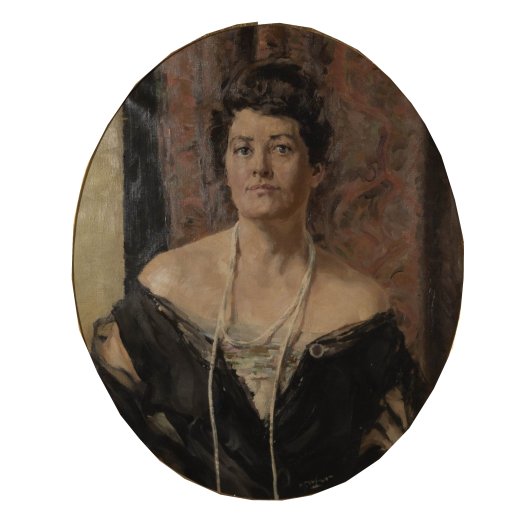
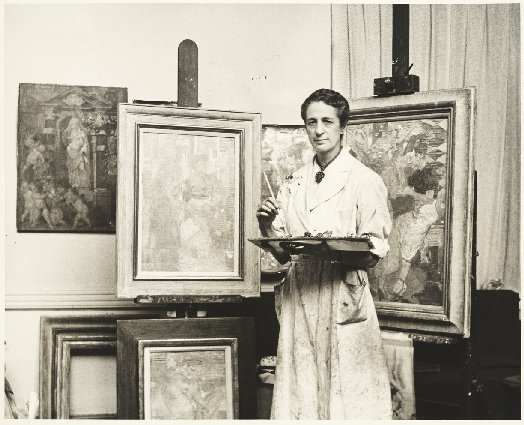
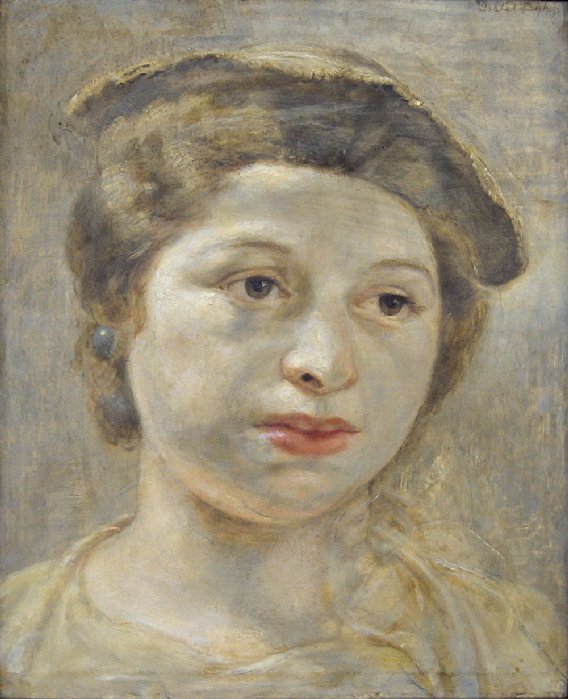
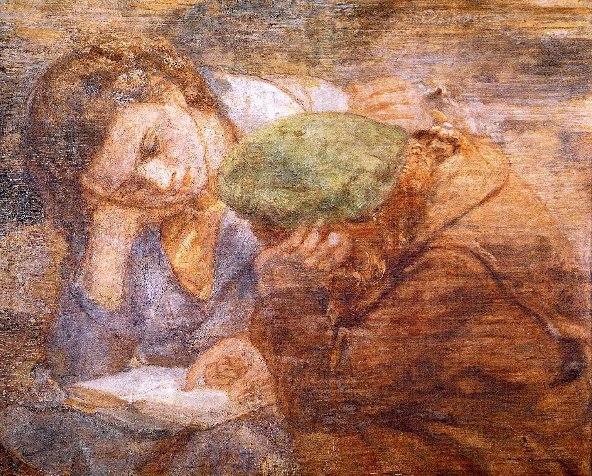
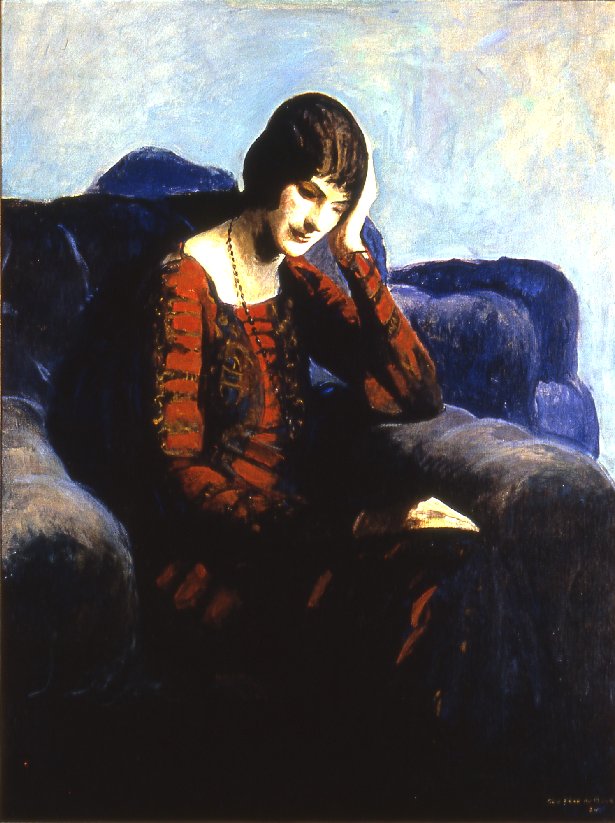
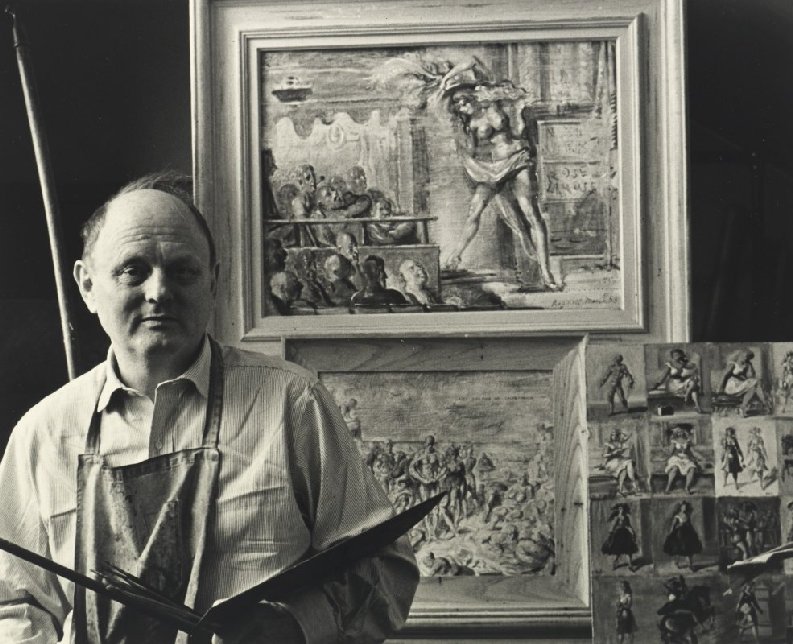
Emma Fordyce MacRea

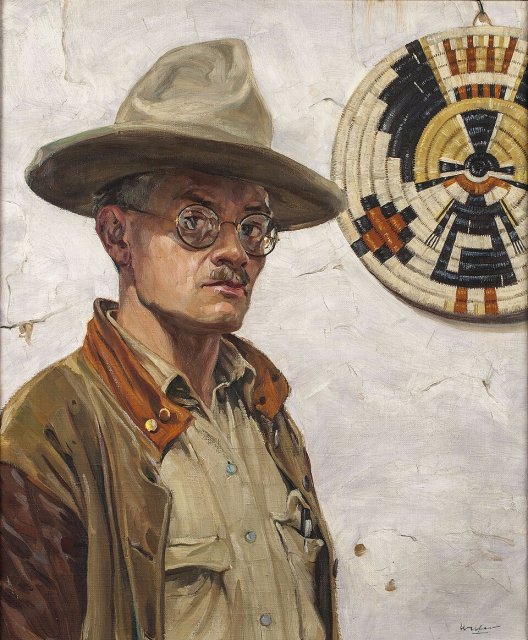
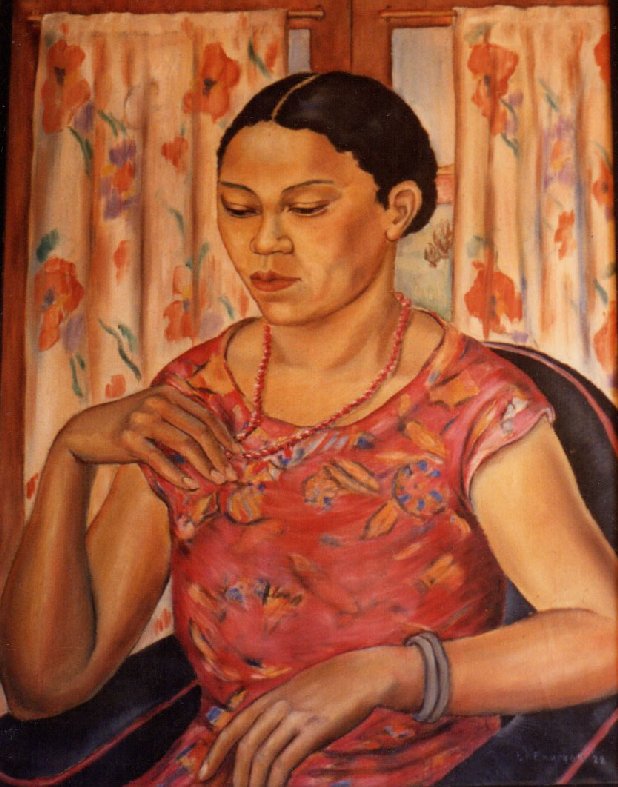
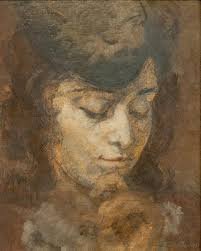
Detail from Emma Fordyce MacRea by Ivan Gregorewitch Olinsky (1930)

Emma Dean Fordyce was born on April 27th 1887 in Vienna.  She was the first-born child of Alice Dean Fordyce (née Smith) a woman of inherited wealth and Dr. John Addison Forsyth.  Her father was a professor of dermatology who was born in Guernsey County, Ohio and graduated in medicine from Northwestern University Medical College in 1881 and after a number of posts in America, travelled to Europe and spent the major part of this time in Vienna.   He returned to America in 1888, a year after his daughter was born and took up posts as a professor at New York University and later Columbia University.

Oriental Backgroumd by Emma Fordyce MacRea (1928)

Emma was brought up in a wealthy household and became interested in the arts through the family’s regular trips to Europe for her father’s work.  Her primary education was at Miss Chapin’s School, an all-girls independent day school on Manhattan’s Upper East Side neighbourhood in New York City.  From there she attended the Brearley School, an American all-girls private school on the Upper East Side of Manhattan. 

October Winds by Emma Fordyce MacRea (1914)

In 1910, twenty-three-year-old Emma married Thomas MacRea an intern at her father’s practice.  The marriage was a disaster and lasted less than twelve months.  In 1921 the marriage was annulled and a year later Emma married Homer Swift.  With her first marriage over in 1911 she decided to carry on with studying art and enrolled at the Art Students League under Frank Vincent du Mond, Luis Mora and Kenneth Hayes Miller.  She also took classes at the New York School of Art. In 1914 one of Emma’s paintings entitled October Winds was shown at the Anderson Galleries in New York.  It was a work in the Impressionist style .  Few of her earlier had a richer palette and a hint of form  and few of her very early works exist.  In the 2008 Cape Ann Museum Exhibition catalogue it stated that Emma had already laid down the subjects she favoured for her art.  They were landscapes, floral still life and female figurative compositions. She worked in a flat, linear, primarily two-dimensional style with references to Old Masters and Japanese prints.  MacRae was known for her unique painting style where she used paint sparingly and often scrapped away sections of paint to reveal a textured, chalky canvas. These techniques gave her paintings an antiqued look, while also feeling modern.

The Clam House, an etching by Arthur Wesley Dow (c.1892)

In the early 1920s Emma’s painting style changed.  Despite great reviews of her work exhibited in New York and Boston galleries she decided to move away from Impressionism and create her own artistic style.  We cannot be certain as to why she changed her painting style but it could be due to her second round of coursework at the Art Students League.  It could also have been the change in her personal life or what she had read in Arthur Wesley Dow’s influential book, Composition A Series of Exercises in Art Structure for the Use of Students and Teachers.  Dow was an American painter, printmaker, photographer, and educator known for his teachings based on Japanese principles of art and for his significant artistic and intellectual contributions to the Arts and Crafts movement.  Dow taught that rather than copying nature, individuals should create art through elements of the composition, such as line, mass, and colour.

Easter Lily by Emma Fordyce MacRea

An example of this change in Emma’s style could be seen in her painting entitled Easter Lily.

It is interesting to note that in many of her female figurative paintings she had focused not just on the sitter but various background items.

Left: Leonore in White by Emma Fordyce MacRea. Right: Ruth by Emma Fordyce MacRea.

In Emma’s painting, Leonore in White, the female figure is holding her book on her lap whilst in the background we have an oval mirror and on a table in the background there is a flower-filled vase. In the other painting, Ruth, we see another female reading with her book on the table and has a background of a painting and a blue upholstered chair.

Left: Distant Mountains by Emma Fordyce MacRea Right: 5 O’Clock by Emma Fordyce MacRea

In the subdued palette used in her painting, Distant Mountains the female wears her green dress which echoes the colour of the ground in the landscape that we see in the valley. In her painting, 5 O’Clock, the vibrant orange dress worn by the model is picked up in the deeper tones of the reddish-orange in the wallpaper. Also in the background there is a landscape painting and a large square clock showing the time as 5 O’Clock.

Fishermen’s Huts by Emma Fordyce MacRea

Lobstermen’s Huts by Emma Fordyce MacRea

With just a few exceptions Emma’s landscape paintings could not be classified as pure landscapes as she always populated the depictions with figures, buildings and boats. In her painting Fishermen’s Huts she has depicted the harbour wall and the coastline slicing diagonally through the depiction and by so doing separates the moored boats from the angular houses seen above the harbour.

The Lily by Emma Fordyce MacRae

Emma loved to paint floral still life depictions and would often use hardboiard Masonite as her painting surface and instead of using the front smooth side would instead paint on the gesso-ground rough rear side which in some ways mirrored a canvas surface.  One example of this was her painting entitled The Lily. First she would sketch in the composition with black chalk or a soft pencil and often she would leave some of this under-drawing visible as outlines in the final painting.

Pigeon Cove by Emma Fordyce MacRea (c.1930)

Emma MacRae’s paintings were exhibited at several important museums and galleries throughout the country, such as The National Academy of Design, Pennsylvania Academy, Carnegie International in Pittsburgh, Chicago Art Institute, John Herron Art Institute of Indianapolis (now the Herron School of Art and Design), the Corcoran Art Gallery in Washington D.C., Currier Museum of Art, and Boston Art Club. She also exhibited paintings between 1937 and 1945 as part of The Philadelphia Ten Painters, also known as The Ten, which was a group of female artists from the United States who exhibited together from 1917 to 1945. Emma joined several other artist groups, including the National Association of Women Painters and Sculptors, Allied Artists of America, North Shore Art Association, National Association of Mural Painters, Boston Art Club, and the New York Society of Painters. In 1951, she received full membership in the National Academy of Design.

Foxgloves in Cloisonné Pot by Emma Fordyce MacRea (1934)

Emma Fordyce MacRae, who married twice had one child, Alice MacRae, from her first marriage.   Emma kept her first married name throughout her professional painting career but for personal matters, after her second marriage to Dr. Homer Swift, went by the name “Swift” .

Rockport Beach, Cape Ann, Massachusetts by Emma Fordyce MacRea (1935)

In 1916, Emma’s father purchased some prime real estate land in the hills overlooking  Stage Fort Park, at Stage Head just west of Gloucester MA ,and on it he had a house built. 

Stage Fort across Gloucester Harbor by Fitz Henry Lane, (1862)

When her father died in 1925 the house became hers.  She would spend the summers there and soon built up a large portfolio of paintings depicting surrounding areas.  The house was called Atlantic Heights and in it she had her own studio.

Gloucester Garden by Emma Fordyce MacRea

It had a large garden which was looked after by her husband Homer Swift. It was often a mass of colours and many of the flowers featured in her floral Still Life works as well as in her painting entitled Gloucester Garden.

Emma Fordyce MacRea died on August 6th 1974 aged 87.


Most of the information regarding the life and works of Emma Fordyce MacRea came from two excellent websites:

Cape Ann Museum Archives

and

Cape Ann Museum Catalogue

Hannah Harrison Cohoon and the Shakers.

My short blog today is about n artist and a religion. It looks at the life and works of Hannah Cohoon, a person you may not have heard of before. Her art is both unusual and simplistic and is connected to a millenarian restorationist Christian sect known as The United Society of Believers in Christ’s Second Appearing, but more commonly referred to as the Shakers. The group grew out of a branch of Quakerism around  1747 in Northwest England and later, the visionary Ann Lee (Mother Ann) brought Shakerism to America in the 1780s.

Shaker workshop service showing worshippers on benches and marching in a spiral.

The Shakers were so-called because of their practices of shaking, dancing, whirling, and speaking, shouting, and singing in tongues.

Hancock Shaker Village

Round Stone Barn and Fields

Hannah Harrison Cohoon was an American painter born in Williamstown, Massachusetts on February 1st 1788 and later became a member of Hancock Shaker Village. Although there are only sketchy details of Hannah’s education it is thought that she would have been instructed in watercolour painting and probably would have learned needlework skills from her elders as it was a skill, like painting that was considered an essential ability that every young woman should possess Hannah, now married, and known as Hannah Cohoon was twenty-nine-years-old and the mother of two young children. Her son Harrison was born in 1812 and her daughter Mariah was born in 1814. It was on March 15th 1817 that the twenty-nine-year-old Hannah entered the Hancock Shaker Village community situated just outside  Hancock and Pittsfield, Massachusetts. In the main, the Hancock Shakers supported themselves through farming. The grew and cultivated flowers and plants and from them sold garden seeds. Over time they purchased more land and by the 1830s the Hancock Shakers owned about 3,000 acres (12 km2).

Tree of Light or Blazing Tree by Hannah Cohoon (1845)

The leading artists at the time who worked at Hancock were Joseph Wicker, Hannah Cohoon, and Polly Collins and all chose to depict images which were derived from nature, especially trees. For the Shakers, the Tree of Life was an immediately identifiable symbol, celebrated in sermons, gift songs, and in their early history as a representation of the unity of the Shaker Church.

Tree of Life by Hannah Cohoon (1854).   Ink and tempera on paper. Courtesy of Andrews Collection, Hancock Shaker Village.

When we look at Cohoon’s wonderful single-image paintings of trees we realise that her expertise in embroidery, the ornamental needlework of appliqué, and her knowledge of quilting techniques were all present in her mind when she painted. It was during a summer day in 1854, that Hannah Cohoon, who had been a member of the Shaker community in Hancock for thirty-seven years, had a vision of a singular and curious tree. She saw plainly the branches, leaves and fruit, and she sketched and painted them on a sheet of white paper. One of the Shaker elders saw what she had done and told her that the name of the tree was the Tree of Life. Cohoon described how the vision came to her to create the Tree of Life drawing:

…I received a draft of a beautiful Tree pencil’d on large sheet of plain white paper bearing ripe fruit. I saw it plainly, it looked very singular and curious to me. I have since learned that this Tree grows in the Spirit Land. Afterwards the Spirit showed me plainly the branches, leaves and fruit, painted or drawn upon paper. The leaves were check’d or cross’d and the same colours you see here. I entreated Mother Ann to tell me the name of this tree which she did on Oct. 1st 4th hour P.M. by moving the hand of a medium to write twice over Your Tree is the Tree of Life…”

A Bower of Mulberry Tree by Hannah Cohoon. (1854). Ink and tempera on paper. Courtesy of Andrews Collection, Hancock Shaker Village.

A Bower of Mulberry Trees by Hannah Cohoon (1854)

The main feature of Hannah’s painting entitled A Bower of Mulberry Trees is dominated by the curving branches of trees that form an arch over a long Shaker table which is set out for a feast. It came from her vision of Shaker elders feasting on cakes under mulberry trees which were held at biennial meetings,. The doves represent the bounties that the believer would experience in heaven, and the table depicts holy feasts which were held biennially.

A Little Basket Full of Beautiful Apples by Hannah Cohoon (1856) Art Work by Hannah Cohoon / Courtesy the Hancock Shaker Village Collection / American Folk Art Museum.

Hannah also completed A Little Basket Full of Beautiful Apples in 1856. In his article for the New Yorker journal, Adam Gopnik, a long-time staff writer for the paper, wrote:

...Shining Tree of Life is among the key drawings in American art, with a tonic sense of abundance—all the apples just alike, each with its rub-on of rouge, like blush applied by an adolescent girl—allied to obsessive order…”

Hannah Harrison Cohoon died in Hancock, Massachusetts, on January 7th, 1864, aged 75 and is buried in the family cemetery of the Church.


An image of Cohoon’s Tree of Life appeared in a December 1945 Antiques magazine article by Edward Deming Andrews. Andrews used the image for the covers of his books, Visions of Heavenly Sphere and Fruits of the Shaker Tree of Life in 1969 and 1975.
The Hancock Shaker Village became a museum in 1960, and sometime after that the Andrews sold Cohoon’s drawings and other gift drawings to the museum. Andrews also organized an exhibit at the Whitney Museum of American Art in 1935.
Her Tree of Life drawing was used in 1974 for a UNICEF Christmas postcard to raise funds for the organization. In 1980, the Whitney Museum of Art held another exhibition, “American Folk Painters of Three Centuries, which featured four of Cohoon’s drawings.

New Hope Artists. Part 3.

The third artist who was involved in the early days of the New Hope Artists Colony was Daniel Garber.  He has been looked upon as being one of the three most important painters of that group

Daniel Garber

Daniel Garber was born on April 11th, 1880, in North Manchester, Indiana. He was the son of Daniel Garber and Elizabeth Garber (née Blickenstaff). Daniel always had a love of art and the belief he could some day become a professional artist.  In 1897, when he was sixteen years old he enrolled at the Art Academy of Cincinnati.  In that same year he moved to Philadelphia and in 1899 he became a student at the Pennsylvania Academy of the Fine Arts on a six year course.  His instructors at the Academy included Thomas Anshutz, William Merritt Chase, and Cecilia Beaux.  During the summers of 1899 and 1900 he also registered to take summer school classes in Fort Washington, Pennsylvania, at the Darby School of Painting, where he studied under Hugh Breckenridge, an artist and educator who championed the artistic movements from impressionism to modernism and Thomas Anshutz, an artist known for his portraiture and genre scenes, and who, along with Breckenridge, was a co-founder of The Darby School. This summer art school flourished first in Darby, PA, and then in Fort Washington, PA, between 1898 and 1918.  Anshutz and Breckenridge brought a lot of new ideas about painting back to Philadelphia after their European stays, and introduced those ideas to a public that was initially not very responsive to Impressionism, 

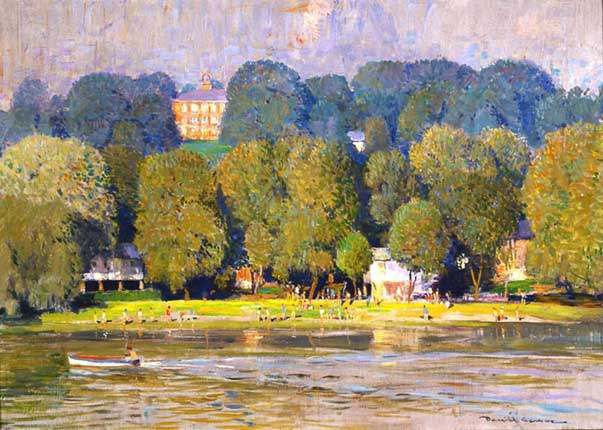
Lambertville Beach by Daniel Garber

During his time as a student at the Pennsylvania Academy, Daniel Garber met fellow artist Mary Ethel Franklin while she was posing as a model for the portrait class of Hugh Breckenridge. Peviously, she had been a student of Howard Pyle when he taught at the Drexel Institute. Following on from a two-year courtship, Garber and Mary were married on June 21st, 1901.

Battersea Bridge by Daniel Garber (1905)

Whilst still studying at the Academy, Daniel opened a studio in Philadelphia in 1901 and set to work as a portraitist and commercial artist. In May 1905, he won a Pennsylvania Academy award, The William Emlen Cresson Traveling Scholarship, which financed him to go to Italy, England and France for two years of independent studies. During his two-year sojourn in Europe he was continually creating paintings which depicted different rural villages and farm scenes and built up a collection of Impressionist landscapes some of which were exhibited at the Paris Salon. One such work was entitled Battersa Bridge.

Painting of Daniel Garber’s home, Cuttalossa, by J.C.Turner

Upon his return to America in 1907, Garber began teaching life and antique drawing classes at the Philadelphia School of Design for Women. That summer, Garber, his wife and baby Tanis settled in Lumberville, Pennsylvania, a small town just north of New Hope. Their new summer home came to be known as Cuttalossa, named after the creek which occupied part of the land. The family spent part of their time in Lumberville and part in Philadelphia at their Green Street townhouse which he used as a base when he was teaching.

Rural Landscape by Daniel Garber

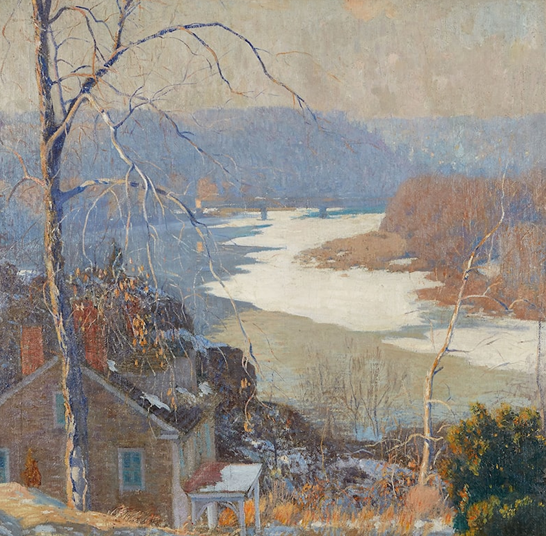
Up the River, Winter by Daniel Garber (1917)

Daniel submitted many of his Pennsylvania landscapes at various exhibitions and received numerous prestigious awards for these works.

Garber teaching at Chester Springs, c. 1935. Image courtesy of the Garber family.

In Autumn 1909, Garber was offered a position at the Pennsylvania Academy as an assistant to Thomas Anshutz. Garber accepted and became an notable instructor of art at the Academy where he taught for the next 41 years. As a lecturer in art, Garber aroused in his students an anxious silence as he passed among them, correcting the mistakes in their work. The brusque severity of his remarks often had his students, especially the women, in tears. He commented to one female student whilst critiquing her artwork:

“…Can you cook?……You sure can’t draw, so you’d better learn how to cook…”

Garber’s students, albeit often fearing his harsh critiques, respected his honest comments, realising the value of his observations and understanding the high expectations and dedicated concern underlying them.

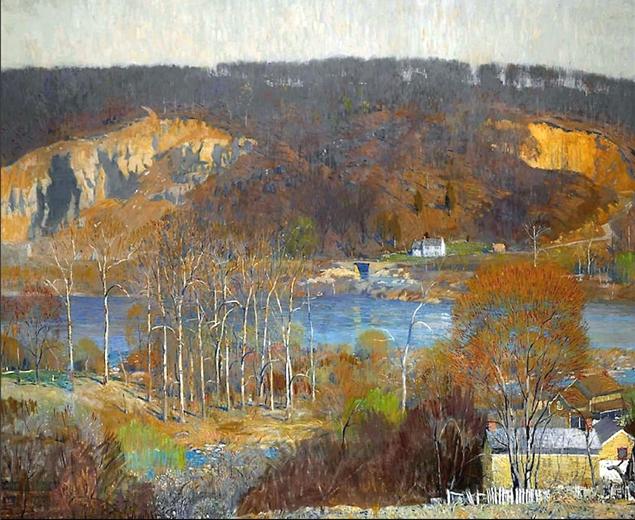
The Valley – Tohickon by Daniel Garber (1914)

Daniel Garber painted consummate landscapes depicting the Pennsylvania and New Jersey countryside which surrounded New Hope. In contrast to fellow New Hope artist, Edward Redfield, Garber delicately painted using a thin paint application technique. His paintings exude both beautiful colour and light, which generate a sensation of endless depth. Garber like Redfield painted large exhibition size works with the intention of submitting them to exhibitions and winning prizes which they were both extremely successful doing so.

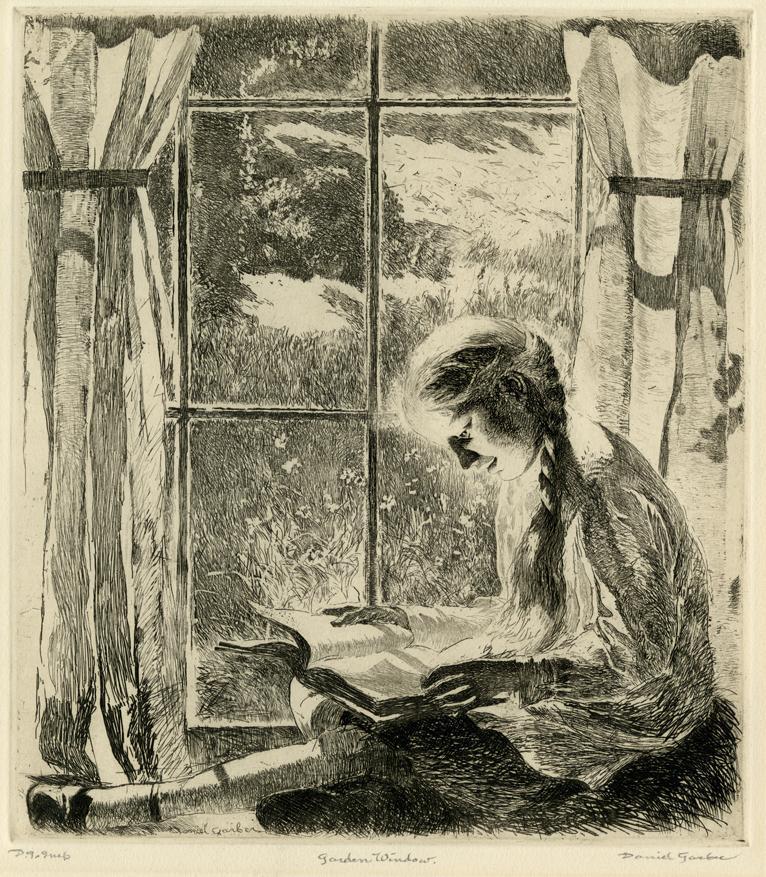
Garden Window, an etching and drypoint on paper by Daniel Garber (1946).

Although, he completed many small delicate paintings he was a fine draftsman, and completed many works on paper, mostly in charcoal but also a few works in pastel. Daniel Garber was also a talented etcher completing a series of about fifty different scenes, most of which run in editions of fifty or fewer etchings per plate.

Stockton Church etching by Daniel Garber (1941)

Daniel Garber loved to sketch. In fact the first jobs he held during his teenage years honed his skills as a draftsman. After working at the Franklin Engraving Company, Daniel Garber illustrated books and magazines, one of which was the collected works of Theodore Roosevelt. In 1917, he went back to his first love, drawing, this time as a printmaker. There was financial sense for Garber in making prints as by doing so he widened his exposure as an artist, exhibiting his work at print venues as well as the usual gallery outlets. He held many one-man exhibitions of his drawings, etchings, and prints and this meant an expansion to his market.

Tanis Garber by Daniel Garber (1914)

Daniel and Mary Garber’s first child Tanis had been born in Paris on December 16th 1906 and when she was seven years old her father completed her portrait. The portrait is part of the National Gallery, Washington’s collection.

Tanis by Daniel Garber (1915) From the Warner Collection of the Westervelt Warner Company, displayed in the Westervelt Warner Museum of American Art, Tuscaloosa, Alabama.

In this depiction (above) of his daughter Tanis he portrays her as if standing in a doorway of his studio at their home, Cuttalossa. In this work Garber began to explore the passage of light through air and objects. Although this might look like an Impressionist-style work, it is not about capturing fleeting light effects or impressions. In fact, Garber said that the painting was worked on over all of the summer months of 1915, with himt apparently returning to the work when his general light effects could be recreated. What Garber had in mind was his desire to simply achieve a Golden Age depiction of childhood; an eternal idealized image, rather than a momentary real one.

The Boys by Daniel Garber (1915) Depicting three of Garber’s students at the Pennsylvania Academy of the Fine Arts, this oil was created in his studio at Cuttalossa

Garber’s second child, John Franklin Garber was born in Pennsylvania on September 25th 1910, three years after his parents had returned to America from France. He grew up on the Garber property Cuttalossa, near Lumberville and he, like his sister Tanis and his mother, posed for many of Garber’s figurative paintings. He attended Penn Charter School and graduated with a degree in chemical engineering from Lehigh University in 1933. John Garber became a keen sponsor and advocate of his father’s work, assisting and corresponding with museums, private collectors, dealers and writers

Geddes Run by Daniel Garber (1930)

Daniel Garber’s works were exhibited nationwide and many earned awards, including a gold medal at the Panama-Pacific International Exposition in 1915 in San Francisco, California. He was elected a member of the National Academy of Design in 1913.

Buds and Blossoms by Daniel Garber (1916)

Daniel Garber died, aged 78, on July 5th, 1958, after falling from a ladder at his studio.

He continued to paint until nearly the end of his life and produced over 2,500 objects which were shown at over 750 exhibitions during the course of his lifetime. It had always been his desire to create and to share his art with the public. This interest in art and educating was also apparent by his forty-one years at the Pennsylvania Academy of Fine Arts, where he taught from 1909 until 1950, where he offered up his knowledge of art and was able to influence succeeding generations of artists. Garber’s paintings today are considered by collectors and art historians to be among the finest works produced from the New Hope art colony. His paintings can be seen in many major museums including the Smithsonian American Art Museum in Washington, DC, the Art Institute of Chicago and Philadelphia Museum of Art.

Was he the greatest of the New Hope painters ? I will let you decide.


Information for this blogs was obtained from a number of sources including:

Incollect

New Hope Colony Foundation of the Arts

Michener Art Museum

Jims at Lambertville

New Hope Artist Colony. Part 1.

In my last blog about the American Impressionist, M Elizabeth Price, I mentioned the New Hope Artist Colony and this name has cropped up in other of my blogs so I thought I would give you a more in-depth look at this artist colony and how it all began and the three artists who were part of its foundation.

William Langson Lathrop, Edward Willis Redfield and Daniel Garber

Dr. George Morley Marshall

The New Hope Artist’s Colony can be traced back to 1896 when a Philadelphia surgeon and laryngologist Dr. George Morley Marshall acquired the hamlet of Phillips’ Mill in Solebury Township, Pennsylvania from the Betts Family. The grist mill, originally built in 1756 by Aaron Phillips, was ideally positioned to serve the many surrounding family farms.

Four generations of the Phillips family ground locally-farmed grain until 1889, when the property was sold and the mill fell into disuse. The property included a grist mill with water rights and glen, a dam, a pond, the Primrose Creek and a 40-foot waterfall which fed the mill race to run the two waterwheels. The buildings which surrounded the mill soon became residences for summer tenants, including the new school of Impressionist landscape painters, who used the outbuildings as studios to capture the natural beauty of Solebury and its environs.

William Langson Lathrop – self portrait

In 1897, Dr. Marshall contacted his boyhood friend, the well-known landscape artist William Langson Lathrop, inviting him to come to New Hope to paint the magnificent landscapes which bordered Phillips Mill.

Ely’s Bridge by William Langson Lathrop

William Langson Lathrop was an American Impressionist landscape painter. He was born in Painesville, Ohio, a small town on the shores of Lake Erie, on March 29th 1859. It was on this vast lake that William learnt to sail, a hobby he would enjoy for the rest of his life and ultimately, was to be the death of him.

A Pennsylvania Farm by William Langson Lathrop

Once he had completed his formal education, Lathrop began his art career in New York City. He was largely self-taught until he traveled to New York for a brief period of study with William Merritt Chase at the Art Students League. In the early 1880’s Lathrop secured a job as a graphic artist with Charles Parsons at Harper’s Magazine but he found that the small amount of money he earned was barely enough to live on. In the 1880s he travelled to England, France and Holland and it was during his stay in the English city of Oxford that Lathrop met, and in 1888, married his wife, Annie Sarah Burt. They had five children, three daughters, Nancy, Elizabeth and Ellen and two sons Joseph and Julian. Lathrop returned to America with little money, depressed at the way his artistic journey had stalled and he decided to give up art as a profession. After several years of struggle and failure, his friends back home persuaded him to return to his art and try the medium of watercolour. Lathrop finally found fame as a painter when, with one his works, he won the prestigious Evans Prize at the American Watercolor Society’s annual exhibition in 1896.  More importantly, he received a fulsome review in The New York Times, and, buoyed by this success, Lathrop embarked on the re-launch of his artistic career. In 1902 he was elected to the National Academy of Design.

Landscape by William Langson Lathrop (1915)

Having received Dr. Marshall’s invitation to visit the New Hope area, Lathrop, along with his wife Annie Sarah and their three children, Nancy, Joseph and Julian, travelled to New Hope where they rented the miller’s house which once belonged to Aaron Phillips on Marshall’s property. William Lathrop would later buy the property together with the surrounding four acres of farmland.

Twilight after the Storm by William Langson Lathrop

Lathrop’s wife Annie became a beloved figure in the New Hope Arts community and she would host afternoon teas on a Sunday on the lawn of their home besides the canal. These Sunday afternoon tea parties featured lively discussion of aesthetic, philosophical, and political issues, and visitors to these teas would love to sample a feast of homemade sandwiches, jams, beverages, and pastries. Lathrop’s wife, Annie, was a gifted cook and an affable host who took a genuine interest in the students’ well-being. Annie would attend their every need, housing, feeding, and encouraging them in a warmly maternal fashion. Martha Candler Cheney, a writer on the arts, wrote about these Sunday afternoon events:

“…Sunday afternoons, the Lathrops’ lawn was a collecting place at tea-time and someone remembered nostalgically only the other day how the fine, almost lost art of conversation flourished there…”

Spring Landscape by William Langson Lathrop (c.1915)

It was Lathrop’s reputation as an artist and a teacher that attracted other artists such as Edward Redfield. Daniel Garber and Charles Rosen to come to New Hope and form the group known as the Pennsylvania Impressionists. Lathrop was often called the “dean” of the New Hope art colony, and regularly welcomed students into his home at Phillips Mill. Unlike some of his colleagues, he preferred to work in the studio, rather than outdoors, which distinguished him from other artists in the group. Known primarily as a tonalist, Lathrop created rustic, simplified landscapes with a muted palette.

Montauk by William Langson Lathrop (1938)

William Langson Lathrop’s loved sailing and always had a boat.

Wiliam Langson Lathrop and his boat The Widget

William Langson Lathrop’s greatest love besides his art was sailing and in 1927 Lathrop hand-built a wooden boat in his backyard and named it The Widge which would become the love of his life. He completed and launched it into the Delaware River in 1930. It subsequently became his painting studio. Lathrop, being a competent sailor, would take the boat on trips along the eastern seaboard of America during the summer months. A companion on one of these trips was Albert Einstein, who was teaching at Princeton. 

On September 21, 1938, whilst Lathrop was sailing his boat around eastern Mountauk Point in Long Island he received word of an approaching hurricane. He was miles away from a safe harbour and so decided to ride out the storm in a secluded bay. The boat survived the hurricane-whipped seas but Lathrop’s body was recovered along the shoreline a month later. It is thought that he had suffered a heart attack and been washed overboard. After his death, a painting, entitled Montauk, dated September 21, 1938 was discovered in the boat’s cabin, proving that until his poignant final moments, Lathrop drew inspiration from the sea.

His good friend and fellow Bucks County artist, Henry B Snell wrote:

“…He had no fear of meeting death as he did — facing one of nature’s greatest manifestations. I know he died as he would have wanted to…”

William Langso Lathrop was buried in Solebury Friends Graveyard, Solebury, Bucks County, Pennsylvania.

………to be continued.


Important information for this and subsequent blogs regarding the New Hope Artists Colony came from an assorted websites, some of which were:

New Hope Colony Foundation of the Arts

Google Arts and Culture

Solebury

Diversions – A Meandering Journey through the World of Art

Mitchener Art Museum, Doylestown PA.

Mary Elizabeth Price

Mary Elizabeth Price

Mary Elizabeth Price, sometimes simply known as M. Elizabeth Price, was born on March 1st 1877 near the town of Martinsburg, West Virginia. Her parents, Reuben Moore Price and Caroline Cooper Paxson Price were Quakers, who lived in Shenandoah, Virginia. She was one of five children, having a sister, Alice Price, and three brothers, Frederick Newlin Price, Rueben Moore Price and Carroll Price. During her early days she lived in Virginnia but the family moved to the Shenandoah Valley and later to New Hope, Pennsylvania where she grew up.

Pennsylvania Museum and School of Industrial Art, Philadelphia. 

Art classrooms at the Pennsylvania Museum and School of Industrial Art, (c. 1891)

According to the Friends Intelligencer and Journal, Elizabeth graduated from her Literary Course at the Friends’ Central School in 1896, aged nineteen, and she enrolled at the Pennsylvania Museum and School of Industrial Art, a museum and teaching institution which later split into the Philadelphia Museum of Art and University of the Arts.

Pennsylvania Academy of the Fine Arts building

In 1904, having completed her course, she enrolled at the Pennsylvania Academy of the Fine Arts and studied under Hugh Breckenridge an artist and educator who advocated the artistic movements from impressionism to modernism. Another of her tutors was Daniel Garber, an American Impressionist landscape painter and member of the art colony at New Hope, Pennsylvania. Elizabeth also took private art lessons from William Langson Lathrop, an American Impressionist landscape painter and who founded the art colony in New Hope, Pennsylvania, where he was an influential founder of Pennsylvania Impressionism.

Picking Flowers by M Elizabeth Price (1916)

In 1917 Elizabeth moved to New York and took part in the “Baby Art School,” which was a pioneering programme funded by Mrs. Harry Payne Whitney (Gertrude Vanderbilt) and previously known as the Neighbourhood Art School of the Greenwich House. Children from nearby public schools were taught the fine arts of drawing, painting, sculpting, pottery, and wood carving. This idea was so successful that Carnegie Institute of Technology in Pittsburgh asked Elizabeth to stage an exhibition of the children’s work in the winter of 1919-1920, in conjunction with an art education campaign for teachers and supervisors in art.

Delphinium Pattern by M Elizabeth Price (1933)

When looking at Elizabeth Price’s work, her floral painting are the ones that are best remembered. She often painted on wooden panels coated with a mixture of gesso and red clay. Then, gold or silver leaf was applied over that, followed by the painted image in oils. One example of this is her 1933 painting entitled Delphinium Pattern.

Summer Bouquet by M Elizabeth Price (c.1933)

Another such work was Summer Bouquet which she completed around 1933.

Elizabeth Price joined a group of female artists known as the Philadelphia Ten. This group exhibited together between 1917 and 1945, at first annually in Philadelphia and later, with traveling exhibitions at major museums and galleries on the east coast and in the Midwest. All the members had studied art in the schools of Philadelphia, most having been graduate students at the Philadelphia School of Design for Women (now Moore College of Art and Design). The aim of the group was to move beyond the perception that they were merely hobbyists, as they were commonly viewed in the early 20th century, and be accepted as professional artists. Price regularly exhibited with the group from 1921 until their last exhibition in 1945.

Pumpkinseed Cottage on the bank of the Delaware Canal

Elizabeth, having been brought up on a farmstead in a rural area around Martinsburg, West Virginnia, had always hoped to one day leave the hustle and bustle of New York city life and return to the quieter countryside. Around 1927 she had finished her teaching contract in New York and decided it was time to make that move. She had fallen in love with Bucks County and the area around the town of New Hope and took up residence in an old stone house on the banks of the Delaware Canal. Her house was known as Pumpkinseed Cottage due to its bold yellow colour and diminutive size. She spent much of her time in her home with its studio. She also had a garden where she grew irises, mallows, peonies, lilies, delphiniums, poppies, hollyhocks, and gladioliflowers which often provided her the focus of her many floral paintings. She loved living here and said of it:

“…When I first saw the original cottage it was painted such a vivid yellow that I instinctively thought of a pumpkin; and it was so small that I named it Pumpkin Seed more in derision than anything else. But the quaintness of the name grew on us so that we’ve learned to love it…”

Christmas Card by M. Elizabeth Price. Inside Reads: Christmas Greetings! Card of her studio in the “Pumpkinseed” she and her brother, Fredric Newlin Price, occupied on the Canal Bank – near Rabbit Run Bridge, New Hope, Pennsylvania

She remained living here for the rest of her life with her brother, Fredric Newlin Price, who owned a house, farm, and property in the New Hope area. Whilst living here, she took the opportunity to give talks on art to the New Hope Women’s Club, where she often exhibited her works of art and at the same time encouraged and inspired local artists.

Cheerful Barge 269 by M Elizabeth Price

Although Elizabeth may be best remembered for her floral art works she painted many other genres. One such painting was entitled Cheerful Barge 269, which depicts a bright orange barge sliding by the canal waters on a sunny day. In the painting we see the blue water of the canal seemingly covered by fallen leaves from the trees along the canal banks but in fact what we see on the water is the reflection of the leaves which remain on the overhanging trees. In the foreground we can see sets of stones, alongside a wooden building, which create a path along the canal bank. Strangely, at the bottom right of the painting, we see a single tall red flower, and wonder what made the artist depict such a solitary item.

Bucks County Landscape by M Elizabeth Price

A Country Lane by M Elizabeth Price

Many of her paintings were inspired by what she saw during her walks in the surrounding countryside.

57th Street Window by M Elizabeth Price

Back when she was living and teaching in New York she produced her urban landscape work entitled 57th Street Window.

Bathing in Yardley, Pennsylvania by M Elizabeth Price

Pennsylvania Impressionism, which the artwork of Elizabeth Price emulated, was an American Impressionist movement of the first half of the 20th century. It was characterised by an interest in the quality of colour, light, and the time of day. It was centred in and around Bucks County, Pennsylvania, and particularly the town of New Hope. The movement is sometimes referred to as the “New Hope School” or the “Pennsylvania School” of landscape painting. It all began when landscape artist, William Langson Lathrop moved to New Hope in 1898 and founded a summer art school. The mill town, New Hope, was located along the Delaware River, about forty miles from Philadelphia and seventy miles from Manhattan. It was a landscape artist’s paradise with its spectacular rolling hills, the picturesque river, its tributaries, and the Delaware Canal. An example of this is her painting, Bathing in Yardley, which is a riverside town about 10 miles southeast of New Hope.

Frederick Price, M. Elizabeth Price, Rae Bredin and Alice Price Bredin aboard ship.

M. Elizabeth Price was an untiring promoter of the arts and shared her passion with her talented siblings. One brother, Frederic Newlin Price, owned the successful Ferargil Art Gallery in New York City; another brother, R. Moore Price, was an art dealer and an accomplished frame maker, while his wife, Elizabeth Freedley Price, was a painter; and her brother-in-law, Rae Sloan Bredin, was a member of the New Hope Group. M. Elizabeth Price distinguished herself for her development of women’s and children’s involvement in the arts.

Mary Elizabeth Price died in Trenton, New Jersey on February 19th, 1965 at Mercer Hospital. At the time of her death, she was a member of the Solebury Friends Meeting and, at the age of 87, had been the last living of the Price children. She was survived by her nieces and nephews. Elizabeth Price was buried in the Solebury Friends Meeting House cemetery, Bucks County, Pennsylvania.


Information for this blog was sourced from

Hellenica World

Art Now and Then

Invaluable

Michener Museum

Louise Emerson Rönnebeck. Part 2.

Arnold and Louise settled down to living in the Colorado town of Denver in 1926. Soon the couple became active in the Denver art community and both were founding members of the Denver Artists Guild in 1928.  Whilst living in Denver during the 1920s and 1930s, they would regularly visit Santa Fe in New Mexico and when in Taos would be guests at Mabel Luhan’s Los Gallos compound.

The Rönnerbeck Family (1937)

The help Louise received from the WPA was just what she needed as her portrait commissions had dwindled due to the Depression and the little savings she had left from a family inheritance was quickly diminishing. Besides her portraiture she had always been interested in painting murals and accordingly she worked long and hard and entered a number of WPA competitions to win mural commissions in various US States. In all, she entered sixteen mural commission competitions for the Treasury Department Section of Painting and Sculpture,  a New Deal art project established on October 16, 1934, and administered by the Procurement Division of the United States Department of the Treasury.

The Fertile Land Remembers, oil on canvas mural by Louise Rönnebeck for the Worland, Wyoming Post Office, now in the Dick Cheney Federal Building, Casper, Wyoming, (1938)

In many of her submissions she focused on the power of women in striving for their goals but also depicted the plight of women and the children who were forced to work at a young age. In the end, she was awarded two commissions. In November 1937 she was invited to submit sketches for a mural that would decorate a wall in the post office of the Wyoming town of Worland. The Worland commission was for $570 and the artist was allowed 119 days for its completion. The organisers wrote Ronnebeck that the mural called for a “simple and vital design” based on a theme appropriate to the locale. Awarding Louise the Wyoming commission was a controversial decision as she was living in Colorado and many believed the commission should have gone to a Wyoming-based artist but the organisers stated bluntly that no Wyoming artist reached the standards they required. Louise commenced her oil on canvas mural entitled The Fertile Land Remembers in 1938. The mural depicts a white American couple with their child sitting in a wagon being pulled by two large oxen. These three figures, all looking towards us, are painted in a variety of rich colours whilst the native Indian horseback riders seen chasing buffalo are portrayed cloud-like figures in the sky above the wagon and are depicted in pale monochromatic luminous grey. None cast their eyes towards us. They are probably Cheyenne or Sioux, the forgotten people of Wyoming, who lived a nomadic lifestyle in order to pursue buffalo herds and were subdued and placed in reservations. Unlike the colourful people in the wagon being the present and future the pale grey figures are symbolic of the past. In the background we see the emerging elements of the white American future. Louise wrote about her thought process that went into the mural design:

“…The work is a romantic recollection of the covered wagon and the wild Indian and bison of the Old West, who still in retrospect hover over the irrigated fields and oil wells of the present. The covered wagon drawn by oxen is shown inexorably pressing through the galloping figures of a vanishing culture, whose form becomes shadowy and disappear into the past under the white man’s determination to open new lands. The landscapes on either side depict the present which was created by these pioneers. The way in which the idea is presented was suggested by the device of the double exposure used in many motion pictures to show the past and the present merging into one dramatic unit…”

Harvest by Louise Rönnebeck (1940)

Louise Rönnebeck’s second commission was for the post office and courthouse in the Colorado town of Grand Junction but which is now housed in the city’s Wayne N. Aspinwall Federal Building United States Courthouse. Louise won the opportunity to paint The Harvest through entering a contest anonymously, for fear of gender prejudice, and submitting a sample sketch. In 1940, with the enlargement of the Wayne N. Aspinall Federal Building, Rönnebeck’s mural was placed to embellish the postmaster’s office door pediment with its conspicuous V-shaped bottom. Her depiction represented the plight of the Native American Ute people who prior to the 1860s had lived in southwest Colorado for centuries and it was here that they had their seasonal hunting grounds. However, despite a Treaty which granted the Utes absolute and undisturbed use and occupation of their land, the lure of rich mineral deposits lured prospectors on to their land. The tribe was squeezed into an ever-smaller parcel of land by the incoming miners. The matter came to a head in 1881 when the Utes refused to leave the territory and were forced to the south-western border of Colorado. The six million acres of land once owned by the Utes was now up for grabs and settlers poured in establishing local industries such as orcharding in the form of growing peaches. In the foreground of Louise Rönnebeck’s large mural we see the harvesting of the peach crop by a young couple, modelled by Louise’s two children. To the left of the painting, we see settlers moving into the Ute’s land with their horses and to the right we see the result of this influx as the Ute people are forced out. This is a painting depicting a thriving local industry and acts as a counterpoint to the hard times of the Great Depression.

Unveiling of “missing” painting.

In a January 18th, 1992, article by Ginger Rice in Grand Junction’s Daily Sentinel, it describes the mural’s mysterious disappearance for more than twenty-five years. Workers removed the oil-on-canvas painting for conservation work, and it subsequently went missing. Fortunately, a General Services Administration building manager, Tim Gasparani, re-discovered the mural and in 1992, The Harvest finally returned to its original home.

The People vs Mary Elizabeth Smith. by Louise Emerson Rönnerbeck (1936)

In 1936, Louise Rönnerbeck completed a dramatic painting entitled The People vs Mary Elizabeth Smith. The depiction was based upon an emotional trial of an eighteen-year-old mother of a eight-month old child, Mary Elizabeth Smith, in January 1936. She, whom the press termed “the girl mother” had been accused of murdering her husband in the previous November. She had accused her estranged husband, nineteen-year-old Robert Dwight Smith, who was unemployed, as being abusive towards her. Just prior to the shooting he had petitioned the court to annul their three-year-old marriage which would result in their child being looked upon as being illegitimate. For Mary Elizabeth, this was too much to bear and so she took her brother’s hunting rifle, marched along to her sister-in-law’s house where her husband was staying and shot him. She told the police that she did not know why she did it. She just knew she had to protect her baby’s name. Her defence lawyers stated that having been deserted by her husband and struggling to bring up their son it had taken its toll on her mental health. Louise Rönnerbeck depicted the theatrical trial scene which she had witnessed.

The defence lawyer mitigated the actions of his client by reminding the jury of her personal history. Her father had deserted her leaving her mother to struggle to provide for her two children. Her own eight-month-old son, Rodney, born after a particular long and painful labour was the centre of her life. The courtroom was filled throughout the trial and the press feasted on the events. In his article, Jack Carberry of the Denver Post wrote:


“…”they met love, and in their ignorance of life, it engulfed them…”

Rönnebeck’s painting depicts the dramatic trial scene. In the witness box, at the centre of the legal proceedings, we see the frail reed-headed defendant, wearing a dark dress with a white collar, handkerchief in hand, as she grasps the side of the witness box. She is barely able to stand and is fully aware that if the all-male jury (at this time women were not allowed to be jury members) convicts her, she faces either the death penalty or life imprisonment. It was reported in the Denver Post that her testimony was one of child-like simplicity. On the left in the front row of the courtroom we see the girl’s mother holding her daughter’s infant son. She had come every day to offer support to her daughter. After Mary’s testimony it was reported that there was not one person in the courtroom who wasn’t crying, moved by the young woman’s simplistic testimony. Also in the scene we see the prosecutor waving the murder weapon and on a table to his right are the deceased bloodied shirt and trousers. The jury retired for five hours before returning and acquitting her for reasons of insanity.

The Children by Louise Emerson Rönnebeck (c.1935)

Following the end of World War II, Louise lectured at the University of Denver from 1945 to 1951 as well as providing some magazine illustrations. Her husband Arnold died of cancer on November 14th 1947, aged 62 and with her two children marrying, Arnold in 1950 and Ursula in 1953, she was left on her own. In 1954 she went to live in Bermuda where she and her family had spent many holidays. Here she taught art at the Bermuda High School for Girls between 1955 and 1959 and continued to paint. In the Autumn of 1973 she returned to Denver where she spent the rest of her life.

Louise Emerson Rönnebeck died in Denver on February 17th 1980, aged 78.


I collected information regarding the life and art of Louise Emerson Rönnerbeck from various sources. The main ones were:

Louise Emerson Ronnebeck

JStor: Louise Emerson Rönnebeck: A New Deal Artist of the American West
Betsy Fahlman. Woman’s Art Journal Vol. 22, No. 2 (Autumn, 2001 – Winter, 2002), pp. 12-18 (8 pages)

Living New Deal

Post Office Fans

Louise Emerson Rönnebeck. Part 1.

Louise at work (c.1930)

My featured artist today is Louise Emerson Rönnebeck, the twentieth century painter famous for her murals. Louise Emerson was born on August 25th 1901 in the Philadelphia suburb of Germantown but spent her childhood in New York. She was the third child of Mary Crawford Suplee and Harrington Emerson and had two elder sisters, Isabel Mary and Margaret Eleanor. Her father was the son of Edwin Emerson, a Professor of Political science and was an American efficiency engineer and business theorist, who founded the management consultancy firm, the Emerson Institute, in New York City in 1900.

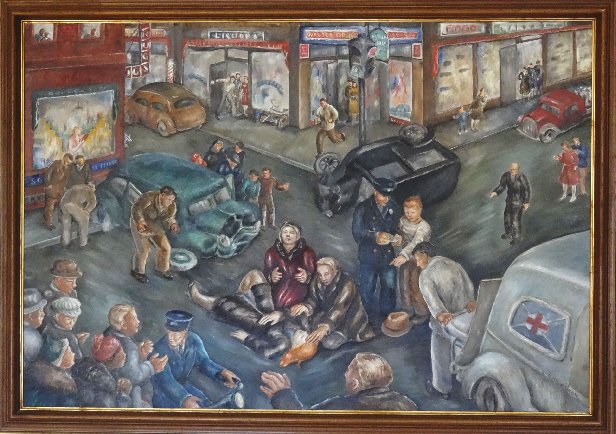
Car Accident at Aylard’s Corner (Denver) by Louise Emerson Rönnebeck ( 1937)

Having completed her regular schooling she attended Barnard College, Columbia University, which was then a private women’s liberal arts college in the New York City borough of Manhattan. In 1922 Louise Emerson graduated from Barnard College and, for the next three years, went on to study at the Art Students League of New York where she studied life drawing and anatomy with Canadian American painter, George Bridgman, sculpture with Leo Lentelli, the Italian sculptor and painting with Kenneth Hayes Miller. The latter had the greatest influence on her art and future career. Miller who taught at the Art Students League from 1911 until 1951 had among his students Edward Hopper and George Bellows.

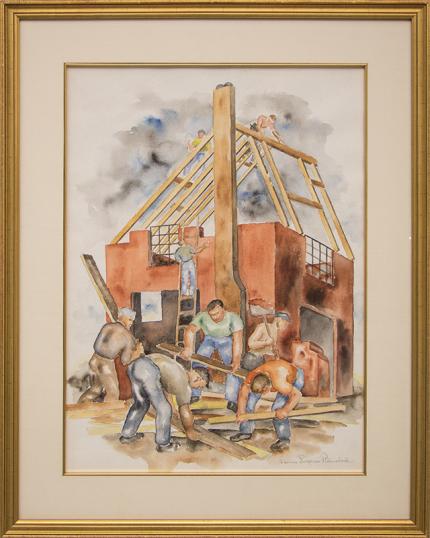
Building Boom by Louise Emerson Rönnebeck (1937)

During the summers of 1923 and 1924 Louise travelled to France and studied fresco painting at the Fontainebleau Schools which had been established in 1921. It was situated in Fontainebleau, thirty-five miles south-east of the centre of the French capital and consisted of two schools: The American Conservatory, and the School of Fine Arts. Here she studied under Paul-Albert Baudouin, a painter of genre, landscapes and decorative panels.

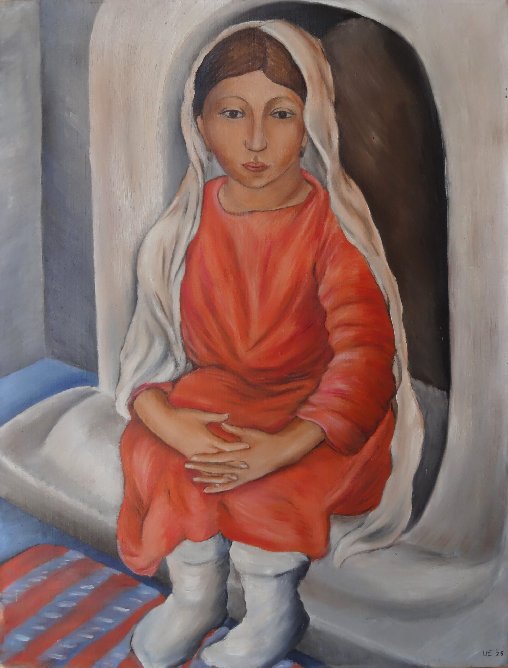
Taos Indian Child by Louise Emerson Rönnebeck (1925)

In the Summer of 1925, Louise did not carry on with her tradition of going to Paris to study at the American Conservatory and School of Fine Arts as she and her sister Isabel had been invited to stay at Taos in the New Mexico ranch home, Los Gallos, belonging to Mable Dodge Luhan. The ranch was located near the eastern edge of the town center of Taos. Luhan, the heiress of Charles Ganson, a wealthy banker, was an American patron of the arts, who was particularly associated with the Taos art colony. The ranch was a meeting place for many contemporary artists and writers and Louise Emerson distinctly remembered her visit there:

“…It was a marvellous place, all wild, strange, empty and romantic…”

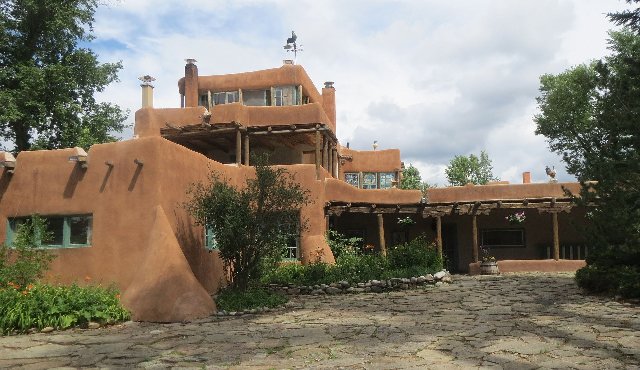
Mabel Dodge Luhan Ranch House

Other guests at the ranch at the time were the writers D.H. Lawrence and his wife Frieda along with Aldous Huxley. Louise was a great admirer of Lawrence and so she and her sister decided to call on him, albeit they had not been invited by the writer. Louise remembers that visit well. Despite not having been invited, it was perfectly all right. He seemed only too happy to have someone who would listen to him. She remembered that he had a red beard and deep-set eyes which conveyed a surprising intensity. She said she was impressed with this wiry, frail, yet madly gifted person, who talked in a common, ugly voice. He and his wife Frieda seemed very Bohemian and avant-garde. Lawrence fought with his wife and they shouted at each other. Despite looking very ill, he baked his visitors bread, and Frieda made jam. Sensing she had been in the presence of a genius, it remained, as Louise recalled, that it had been one of the most memorable days of my life.

Roberta by Louise Emerson Rönnebeck (1928)

Another of the guests staying at the Taos ranch was Arnold Rönnebeck. He was a German-born American modernist artist and sculptor who had arrived in America two years earlier. He was a good friend of many of the avant-garde writers and artists he had met during his time in Berlin and Paris. In America he had become friends with artist Georgia O’Keefe and photographer Alfred Stieglitz and it was at one of the latter’s gallery, An American Place that Rönnebeck first exhibited some of his artwork in America. The gallery was on the seventeenth floor of a newly constructed skyscraper on Madison Avenue. Arnold was impressed by Louise and wrote about her to his New York friend Stieglitz about his first impressions of this young woman:

“…What a summer!  …. The one other person who is doing something about this country is a young girl from New York, Louise Emerson, a pupil of Kenneth Hayes Miller at the league. Still under the influence of Derain, but strong and powerful and with a very personal vision. She lives in one of Mabel’s cottages and is going very good watercolors and oil landscapes…”

Louise and Arnold Rönnebeck’s Wedding Photograph

Soon the friendship between Louise and Rönnebeck turned into love and in New York City, twenty-five-year-old Louise Emerson and Arnold Rönnebeck married despite him being sixteen years older than her. The marriage took place in March 1926 at the All Angels Episcopal Church on the Upper Westside of Manhattan and the reception after the ceremony took place in Louise’s parent’s home close by. Despite her marriage, Louise continued to use her maiden name professionally until 1931.

Arnold Rönnebeck working on his sculpture “Grief” in Omaha, Nebraska (1926)

The couple took an extended honeymoon travelling to Omaha, Santa Fe, and Los Angeles, places which Rönnebeck had to visit to finalise some painting and sculptural commissions and attend the one-man exhibitions of his work in San Diego and Los Angeles . After the honeymoon the couple settled in Denver where Arnold became director of the Denver Art Museum.

Louise with her son Arnold (1927)

Louise Ronnebeck gave birth to their first child, Arnold Emerson, in 1927 and two years later a second child Anna Maria Ursula was born. The Rönnebeck household with two young children and two working artists was somewhat chaotic and Louise had to balance looking after the family and carrying on with her art. Add to this mix, Louise was just starting her artistic career whereas her husband had passed the high-point of his career and since he arrived in America from Germany he had not reached the level of his European fame. Her struggle to manage all her tasks and family duties was highlighted in a 1946 Denver Post article, in which Louise was described as:

“…a four handed woman – – managing home and children on one side, and teaching and painting on the other…” 

In letters and interviews Louise talked about the struggle to have time to be a mother, wife and artist. In a letter to Edward B Rowan, a friend and arts administrator, teacher, artist, writer, lecturer, critic, and gallerist, dated February 1938, she wrote:

“…Being mother of two strenuous children, and the caretaker of a fairly large house, I have to budget my time carefully…”

… Between the children’s meal time, the mother rests while the artist works…”

Louise Emerson Rönnebeck

In a February 1930 article in the daily newspaper, Rocky Mountain News, entitled Denverite Out to Prove She Can be Mother and Artist by Margaret Smith, Louise was quoted as saying that she would never encourage her children to become artists as an artist’s life is both unsocial and confining. Although her husband missed the big city lifestyle, Louise was content with her new life in Denver and in a 1934 letter to her former teacher, Kenneth Hayes Miller, she wrote:

“…I have become very attached to life in the west. We rent a charming really spacious house almost in the country for very little money, take frequent weekends in the mountains, and the children are radiant and adorable persons. Arnold, however, misses bitterly the stimulation of a big city and longs very much for a change…”

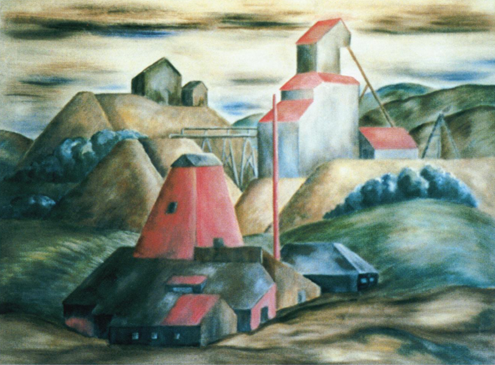
Colorado Minescape by Louise Emerson Rönnerbeck (c.1933)

Louise and Arnold had only been living in Denver for three years when the country was hit by the Great Depression and Louise knew that with their finances being in a poor state she and the family needed some help to survive. She turned to the WPA. The WPA was the Works Progress Administration, later known as the Work Projects Administration. This was an American New Deal agency that employed millions of jobseekers to carry out public works projects. The Federal Art Project was one of the five projects sponsored by the WPA, and the largest of the New Deal art projects. It was not solely created as some cultural activity, but as an assistance measure which would lead to artists and artisans being employed to create murals, easel paintings, sculpture, graphic art, posters, photography, theatre scenic design, and arts and crafts. One of the important things for the artists, besides earning money, was that commissions were essentially free of government pressure to control subject matter, interpretation, or style.
……….to be continued.


I collected information regarding the life and art of Louise Emerson Rönnerbeck from various sources. The main ones were:

Louise Emerson Ronnebeck

JStor: Louise Emerson Rönnebeck: A New Deal Artist of the American West
Betsy Fahlman. Woman’s Art Journal Vol. 22, No. 2 (Autumn, 2001 – Winter, 2002), pp. 12-18 (8 pages)

Living New Deal

Post Office Fans

Fourteenth Street School of Artists

“…I hope my work is recognizable as being by a woman, though I certainly would never deliberately make it feminine in any way, in subject or treatment.  But if I speak in a voice which is my own, it’s bound to be the voice of a woman…”

-Isabel Bishop

Isabel Bishop, 1959. Photo by Budd ( New York N.Y.). Archives of American Art, Smithsonian Institution.

The Ashcan School of painters was the artistic movement that depicted Urban Realism in America during the late 19th and early 20th century. A few decades later another group of American realist painters, who were also based in New York city, began to focus on everyday life in the city. For these artists, it was all about the bustling area which centred around 14th Street and Union Square in Lower Manhattan during the Depression era. They became known as the Fourteenth Street School of Artists. One of these artists was Isabel Bishop.

Female Head by Isabel Bishop

Isabel Bishop was the youngest of five children born on March 3rd 1902 in Cincinnati, Ohio, to John Renson Bishop and Anna Newbold Bishop. Her parents were descendants from East coast mercantile families but although they came from “old money” they were considered middle-class and often struggled financially. Isabel’s parents were both highly educated individuals. Her father was a Greek and Latin scholar and had a Ph.D in history. Her mother was a writer and an activist for women’s suffrage. The family frequently moved from town to town for financial reasons and to gain employment. Wherever they set up home, Isabel’s father, John, would find work at the local school where he often rose to become its principal and in some cases took ownership of the school.

Ice Cream Cones by Isabel Bishop

In 1887 the couple had their first children, twins, a boy and a girl, Mildred and Newbold and in 1890 another set of twins, once again a boy and a girl, was born, Remson and Anstice. This enlargement of the family caused financial hardship and her father had to continually look for better paying jobs. Isobel did not remember much about the two sets of twins as by the time she was born they were away at boarding school or college. According to Isabel her parents were very different in temperament. Her mother was a free spirit but very strong-willed and in her 1987 interview she recalls an incident that had repercussions on her father’s life:

“…It was hard on my father that she was strong. For one thing, in Detroit, Michigan, women were not supposed to be strong. She simply liked what she liked and that was it. One time she was asked to go down to the court and testify in some case. She went down, but she wouldn’t swear to be telling the truth. She was asked by the court why she wouldn’t and she said, “I don’t believe in God.” It was in the Detroit papers with the headline:


“SCHOOL PRINCIPAL’S WIFE DOESN’T BELIEVE IN GOD”


I really felt for my father. I mean, a school principal! His life was pretty impossible after that…”

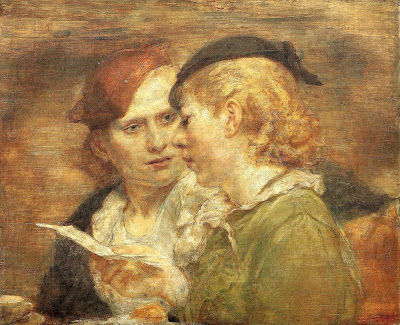
Two Girls with a Book by Isabel Bishop

Although born in Cincinatti Isobel and her parents moved to Detroit a year after she was born. In 1914, when she was twelve years of age, Isabel was enrolled in Saturday morning life drawing classes at the John Wicker Art School in Detroit. From there, at the age of sixteen, and once she had graduated from High School, she left Detroit and went to New York. It was here that she enrolled at the School of Applied Design for Women, where she studied illustration. In 1920, aged eighteen, Isabel, wanting to enhance her artistic knowledge and skills, attended the Art Students League where her first tutor was Max Weber, whom she disliked and who gave her a hard time. Later she was tutored by Kenneth Hayes Miller, another artist associated with the Fourteenth Street School who couldn’t be more different than Weber. Other tutors were Guy Pène du Bois, Robert Henri and Frank Vincent DuMond.

Portrait of Isabel Bishop by Guy Pene du Bois (1924)

According to Helen Yglesias’ 1989 biography Isabel Bishop, although Weber treated Isabel harshly and she felt intimidated by Robert Henri, in Kenneth Hayes Miller she found a mentor who, in her words, was “intellectually stimulating, not stultifying, a fascinating person who presented all sorts of new possibilities, new points of view.”

Isabel Bishop’s 9 West 14th Street Studio (no longer extant) highlighted in red, 14th Street, north side, west from Fifth Avenue. June 11, 1933.

Another friend she made at the Art Students League was Reginald Marsh, who made fleeting visits to the classes at the Art Students League whilst she was student there and this friendship led to her being witness to the working-class life of the city. In 1926, she went to live at 9 West Fourteenth Street, which was a short distance from where Marsh lived and it was in this vicinity that she kept her studio that overlooked Union Square at Broadway and East Fourteenth Street and remained there until 1982. From the windows of her studio she was able to witness the daily activities in Union Square. Fourteenth Street in the 20s and 30s was referred to as “The Poor Man’s Fifth Avenue.” It was a bustling center for bargain shopping and bawdy entertainment in the form of burlesque shows and movie theatres for everyday working-class New Yorkers. 

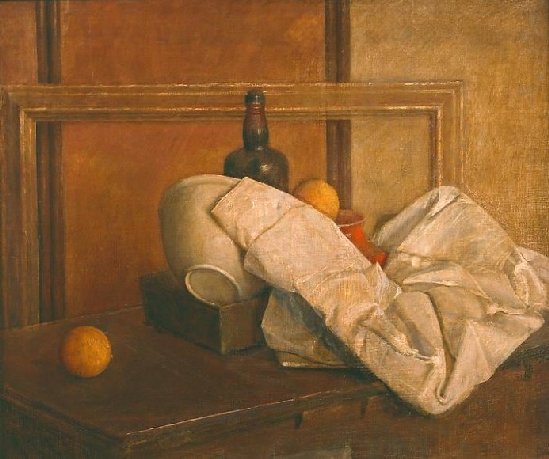
Still Life with Orange #1 by Isabel Bishop

Her friendship with fellow student, Reginald Marsh, encompassed many lunch or dinner dates when they discussed their day’s work. She affectionately recalled that they each paid for their own fifty cent meal and occasionally Marsh would take her to a Coney Island dance marathon or backstage at Minsky’s Burlesque. She recalled that it was great going with Reggie, and whilst there he would sketch the goings-on at the Burlesque show. She said that there were a number of occasions, the owner, Minsky bought Reggie’s work.

The Artist’s Table by Isabel Bishop

Isabel loved the area around Union Square and would regularly visit the Square itself, sketching for hours on end. She remembered those days saying:

“…I adored it. Drawing nourished my spirit; it was like eating. I got ideas there, for drawing is a way of finding out something, even though it might only be the discovery of a simple gesture…”

If she liked one of her sketches, she would turn it into an etching or make a painting from it. She soon became known for depicting urban life and was a leading member of the Fourteenth Street School of artists.

14th Street by Isabel Bishop

The Great Depression began in 1929 and nobody seemed to want to spend money buying the work of an unknown female artist, especially one who had not even had a solo show. Money was tight, people were losing their jobs and America had fallen into the grip of the worst depression in history and most Americans were worried about how they could survive the disaster that had befallen the nation. Isabel went from art gallery to art gallery hoping that they would accept her paintings but with little luck. It was a very depressing and frustrating time in Isabel’s life. A turning point came when Isabel met Alan Gruskin. Gruskin had hoped to become an artist, but while still a student realized that his talents were better suited to art administration than painting. On graduating from Harvard he worked at a New York gallery that specialized in the works of the Old Masters. He left there and returned home hoping to start a career as an author but that never came to fruition so he returned to Manhattan and, in 1932, opened the Midtown Galleries at 559 Fifth Avenue. He specialised in artwork by living American artists and in that year he staged a solo exhibition of Isabel’s paintings.

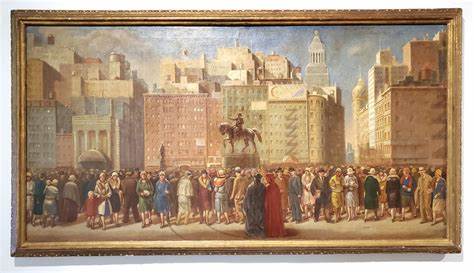
Dante and Virgil in Union Square by Isabel Bishop (1932)

Isabel Bishop’s paintings focused on the ordinary people of New York City, and in particular, those in her neighbourhood around Union Square and 14th Street. However, her 1932 painting entitled Dante and Virgil in Union Square was extraordinary with her inclusion of Dante, in the red cloak, and Virgil, with a laurel wreath on his head, which makes this work memorable. Isabel said she was motivated when she read the translation of Dante’s Inferno, the first part of Italian writer Dante Alighieri’s 14th-century narrative poem The Divine Comedy with its tales of life in the underworld. In her depiction, Isabel likened the hordes of poor souls that confronted Dante and Virgil in the various levels of hell with the hordes of human beings that daily passed through Union Square at rush hour. In the painting we see a crowd of people at Union Square, the equestrian statue of George Washington in the centre framed by the Union Square Savings Bank and other buildings in the background. It is a very busy scene a woman leading her child by the hand, pairs of women walking away from the crowd, and a number of working class men, portrayed in darker colours, facing into the Square seem completely unaware of the classical figures, who stand in the shadowed foreground of the sidewalk, as if embodying the evaluating gaze of another era.

At the Noon Hour by Isabel Bishop (1936)

In Ellen Wiley Todd 1993 book, The “New Woman” Revised: Painting and Gender Politics on Fourteenth Street, she describes the New Woman of the 1920s and 1930s as:
“…being a moderate sort, who hoped to capitalize on new job possibilities and to make herself attractive with the mass-produced products of the clothing and cosmetics industry…”

Hearn’s Department Store-Fourteenth Street Shoppers by Isabel Bishop (1927)

The entrance to Hearn’s Department Store was right across the street from Isabel Bishop’s studio and she realised that it was the perfect place to find and observe this “New Woman.” Isabel Bishop’s Hearn’s Department Store—Fourteenth Street Shoppers was completed in 1927, the same year that she enrolled in Kenneth Hayes Miller’s mural painting class at the Art Students League. It depicts the city’s middle-class shoppers who are wearing the latest fashions and who visit the shops around Union Square in order to pick up the latest bargains.

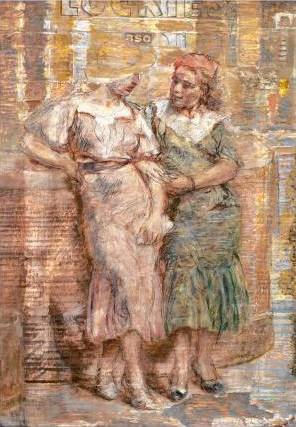
Two Girls by Isabel Bishop (1935)

In 1935 Isabel completed her painting entitled Two Girls. It was yet another of her works which depicted young working women. In this painting we see a close-up of two smartly dressed figures seemingly engaged discussing the contents of a letter. Isabel used two models for this depiction and for this work she used Rose Riggens, a server at a restaurant where Isabel often had breakfast, and Riggens’ friend Anna Abbott. The work exudes both warmth and tranquillity which counters the dire economic circumstances of the Great Depression in the 1930s. This painting which took her twelve months to complete was one of Isobel Bishop’s most well-known works and was originally shown at the Midtown Galleries in New York. It is now part of the city’s Metropolitan Museum of Art.

Encounter by Isabel Bishop (1940)

In her 1940 painting entitled Encounter we witness an exchange occurring between a man and a woman though the circumstance of this meeting remains unclear. From many of her paintings we can deduce that Isabel was an insightful observer of everyday activities of young women who visited offices and stores in her neighbourhood. Her works present working women as vivacious subjects for the American Art Scene, which centred on the daily lives of the city’s population. At a time of great unemployment Isabel found it easy to employ young unemployed clerical workers to pose for her. In this work, she depicts a young woman and her boyfriend, with whom she is having a rather stormy romance. The painting can be seen in the St Louis Art Museum.

Tidying Up by Isabel Bishop (1941)

In her 1941 painting Tidying Up, we see a woman, perhaps a secretary or salesperson, using a pocket mirror to check her teeth for lipstick smudges. Isabel liked to depict working-class women during their idle moments away from their jobs. She spent more than a decade depicting secretaries, salesclerks, and blue-collar workers who lived and often worked in and around Union Square. She favoured subjects of women who were simply going about their everyday lives, eating, talking, putting on makeup, and taking off their coats. It was these mundane actions along with facial expressions that Isabel Bishop believed divulged the character and temperament of the people she portrayed. This painting is part of the Indianapolis Museum of Art collection.

Girl Reading by Isabel Bishop (1935)

Bishop remained on Union Square, where she kept a studio until the end of her life. The area around Fourteenth Street and Union Square remained foremost as the subject matter for her paintings. She received many awards during her life and she was elected an associate member of the National Academy of Design in 1940 later in 1941 she was elevated to full Academician. She received a Benjamin Franklin Fellow at the Royal Society of Arts in London and was also elected a Member of the National Institute of Arts and Letters in 1944 and was the first woman to hold an executive position in the National Institute of Arts and Letters as vice-president. In 1979, she was awarded the Outstanding Achievement in the Arts Award presented to her by President Jimmy Carter.

Self portrait by Isabel Bishop (1927)

Isabel Bishop died on February 19th 1988 two weeks before her eighty-sixth birthday.


Most of the information for this blog came from the following excellent websites:

The Art Story

incollect

Isabel Bishop

Hellenica World

Off the Grid

Oral history interview with Isabel Bishop,
1987 November 12-December 11

Annex Galleries

Reading and Art

The Fourteenth Street School. Part 1.

When talking about American Urban Realism in art one thinks of The Ashcan School, which was an artistic movement in America during the late 19th and early 20th century. The name given to the group originated from a criticism written in the graphically pioneering American magazine of socialist politics, The Masses, in March 1916 by the cartoonist Art Young, who asserted that there were too many “pictures of ashcans and girls hitching up their skirts on Horatio Street.” The artists associated with this school of painting that produced works portraying scenes of daily life in New York, especially in the city’s poorer neighbourhoods, were Robert Henri, George Luks, William James Glackens, Everett Shinn, George Bellows and John Sloan.

Today I want to look at another group of American realist painters who were also based in New York city and who also focused on everyday life in the city. For them it was all about the bustling area which centred around 14th Street and around Union Square in Lower Manhattan during the Depression era. During the 1920s and the 1930s, these artists continued the tradition established by the Ashcan School. They became known as the Fourteenth Street School of Artists. This group of painters were inspired by the legacy of the Ashcan School artists who depicted urban life and this new group established studios in the Fourteenth Street area and were inspired by the crowds that would daily swamp the nearby streets.

Reginald Marsh sketching on 14th Street, New York, 1941.

The first of the artists of the Fourteenth Street School I am looking at is Reginald Marsh. He was born on March 14th, 1898, in an apartment in Paris above the Café du Dome. He was the second son born to American parents who were both artists. His father was Frederick Dana Marsh, who attended the School of the Art Institute of Chicago, where he worked with artists preparing murals for the Chicago World’s Fair in 1893. He went to Paris where in 1895 he married Alice Randall, a fellow Chicago art student and miniature painter. Whilst living in Paris, the couple had two sons, James in 1896 and Reginald two years later. Reginald’s father was one of the earliest American painters to depict modern industrialisation in America. The family lived affluently due to Reginald’s paternal grandfather. James Marsh, who had made a fortune in the Chicago meat packing business.

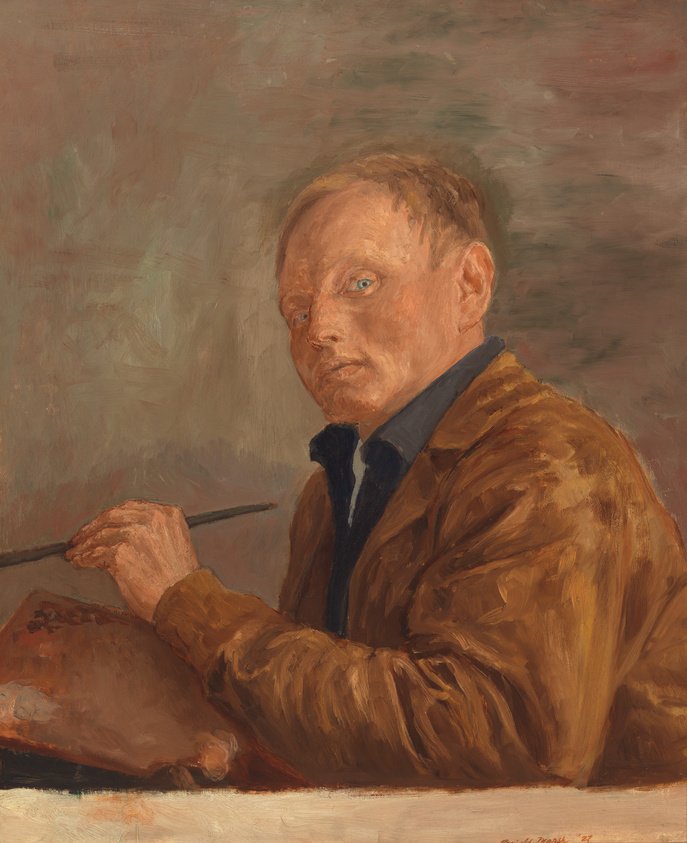
Self Portrait by Reginald Marsh (1927)

Reginald Marsh’s family moved to America in 1900 and relocated to Nutley, New Jersey where they set up a studio/home at No. 16 The Enclosure, a street that had been established as an artists’ colony some decades earlier by the American painter Frank Fowler, who had once owned their house. This resulted in Reginald being immersed in the world of art and painters who nurtured his love of painting and sketching. It was not just that art could be a good outlet for the teenager but it helped him to socialise with others and as he was a somewhat introverted and often tongue-tied boy, and so this was a bonus.

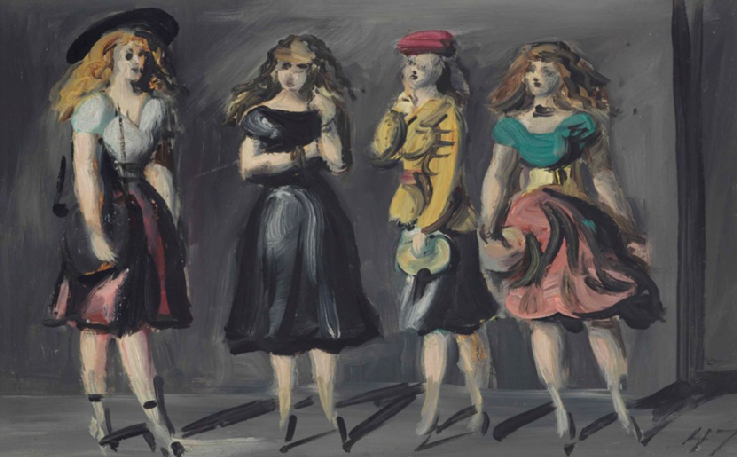
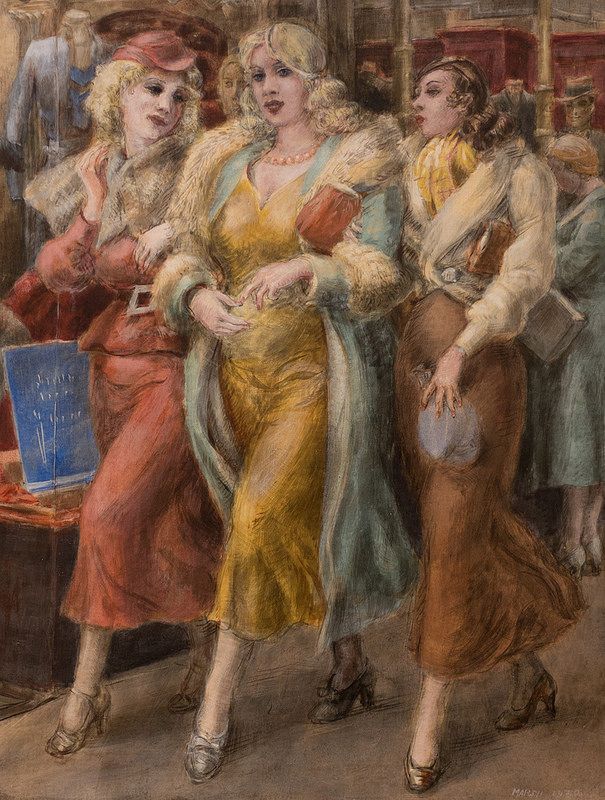
Four Women by Reginald Marsh (1947)

In 1914, the family moved to New Rochelle, in New York State. The family went on to buy an estate in Woodstock, New York, where they spent most of their summers. Reginald Marsh attended various schools including the Riverview Military Academy in Poughkeepsie and the Lawrenceville Preparatory School in New Jersey. After graduating from high school he enrolled at the Yale School of Art, the art school of Yale University, where he made a name for himself as an illustrator and cartoonist for the Art School’s humour magazine, The Yale Record

Figures on the Beach by Reginald Marsh (1921)

After graduating from Yale in 1920, Marsh re-located to New York, where, in 1922, he enrolled for a short period at the Art Students League. It was while studying art at this establishment that he gained a great deal of experience in painting and drawing from his skilled tutors, especially Kenneth Hayes Miller, an American painter and printmaker. Whilst at the Art Student League he became friends with fellow artist, Betty Burroughs. Their relationship grew and twelve months later, the couple married and as Betty’s father, Bryson Burroughs, was a curator at the Metropolitan Museum of Art he was able to introduce his son-in-law to important figures in the art world. Reginald Marsh was now the family’s breadwinner, and so he began painting seriously.

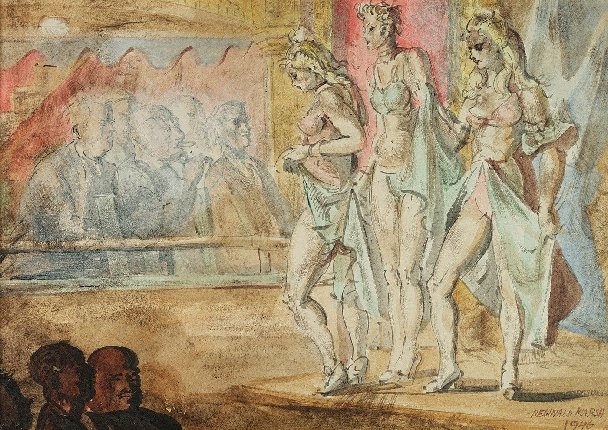
Burlesque by Reginald Marsh

Gaiety Burlesque by Reginald Marsh (1930)

Once Marsh had graduated from Yale School of Art he moved to New York in his search for employment as a freelance illustrator. His first opportunity came when the New York Daily News commissioned him to produce depictions of vaudeville and burlesque performers. Burlesque and vaudeville shows were at the height of their popularity and Marsh’s depictions of burlesque dancers, chorus girls and strippers. Although some people often criticised them for their raunchiness and vulgarity, others were delighted by the comedy and satire emanating from his portrayals. In Edward Laning’s 1973 book, The Sketchbooks of Reginald Marsh, he described burlesque as:

“… the theater of the common man; it expressed the humor, and fantasies of the poor, the old, and the ill-favored…”

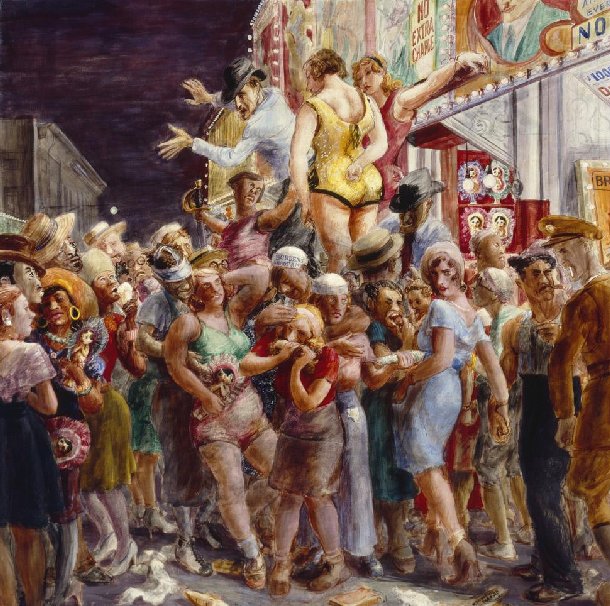
Wonderland Circus, Sideshow Coney Island by Reginald Marsh (1930)

Coney Island by Reginald Marsh (1933)

Mrsh’s job as a staff artist for the New York Daily News gave him the opportunity to explore the underbelly of society: He would wander the streets of Lower Manhattan, and gain inspiration from the burlesque shows along Bowery Street, the storefront windows and advertisements, and the beaches of Coney Island. Marsh also captured the throngs of theatre goers at these shows or outside the theatres and side-shows.

Ten Cents a Dance by Reginald Marsh

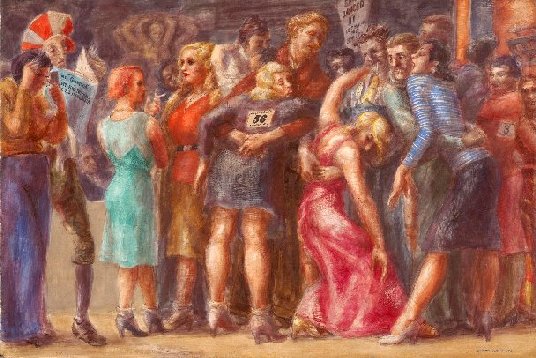
 Zeke Youngblood’s Dance Marathon by Reginald Marsh (1932)

And there was the ever-popular but brutal Dance Marathons !

The New Deal was formulated by President Franklin Delano Roosevelt’s administration which came up with ideas on how to alleviate the suffering of those who had neither jobs nor any money to support themselves. For the artistic community, Roosevelt came up with a number of schemes such as the Public Works of Art Project, the Treasury Section of Painting and Sculpture and the Treasury Relief Art Project. The Federal Art Project (FAP), which was created in 1935 as part of the Work Progress Administration (WPA), was one which directly funded visual artists and provided posters for other agencies like the Social Security Administration and the National Park Service. The William Jefferson Clinton Federal Building in Washington DC, which is a complex of several historic buildings, one of which was originally called the New Post Office, was completed in 1934. It housed the headquarters of the Post Office Department. The Clinton Federal Building was one of the initial locations that integrated various New Deal artworks that were originally commissioned and displayed in federally constructed buildings by the Treasury Department Section of Fine Arts during the 1930s and 1940s. In 1936, Reginald Marsh completed two murals for the interior of the building.
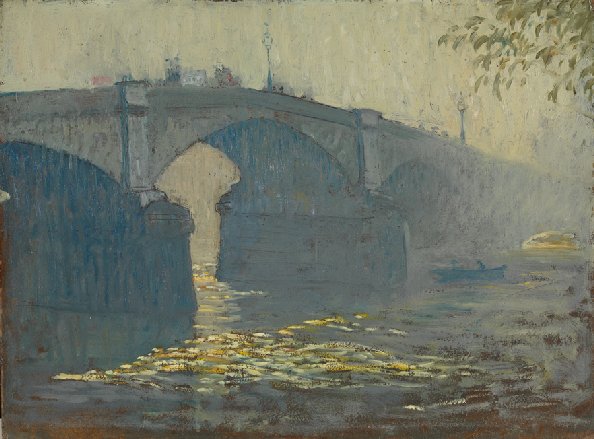
Sorting the Mail by Reginald Marsh (1936)   This mural was for the Ariel Rios Federal Building, Washington, D.C.

In preparation for his mural, Sorting the Mail, Marsh completed a number of preliminary sketches of the railway mail service which was located under the old Penn Station in New York, as well as the New York post office department building. He observed the new and modern technology, talked to the postal workers and watched them unloading and sorting the mail. Marsh’s depiction conveys the feverish dynamism of the workers. We see swarthy-skinned muscular men lifting and lugging large bags of mail. The various skin tones of the men allude to it being a diverse workforce of differing nationalities

Unloading the Mail by Reginald Marsh (1936)

Marsh’s other mural Unloading the Mail was also completed in 1936. The depiction in this mural was all about the international movement of mail from country to country. Marsh visited the Cunard liner RMS Berengaria which had docked in New York harbour. The Cunard line vessel, as well as carrying passengers across the Atlantic, brought mail to America from Europe and further afield. He made many sketches of the ship itself but the mural depicts the activities that occurred in the harbour boat which was used to bring the mail from the liner ashore for distribution. To the left we can catch a glimpse of the Manhattan shoreline whilst to the right we can see the officers of the liner handing the sacks of mail to the crew of the harbour tender. At the bottom left of the painting we can see a man, seated, tallying the sacks of mail that had been offloaded from the liner.

The Bowery by Reginald Marsh (1930)

By 1930, Reginald Marsh’s career was well established and thanks to inheriting some money from his late grandfather was comfortably well-off. Despite his wealth Marsh began to focus his work on depicting those who were less fortunate. It was his poignant depictions of the poverty suffered by the lower classes during the Great Depression that featured in many of his works, such as his 1930 work entitled The Bowery. In this painting Marsh has depicted the plight of the people hit hard by being out of work and in some cases, homeless. The scene before us has been created using a brown palette. We see large groups of men, who had suffered financially due to the financial crash, loitering along Bowery Street underneath many neon signs advertising cheap hotel accommodation. Above and to the right we catch a glimpse of the Third Avenue overhead railway.

Why Not Use The L by Reginald Marsh (1930)

A fascinating painting with and equally fascinating title is Reginald Marsh’s 1930 work, Why Not Use the “L”. The “L”—or “el”, is an elevated train that rose above the city streets. The western end started at Eight Avenue and 14th Street, ran through Union Square to the opposite end of the line at Rockaway Parkway, Brooklyn. The painting depicts three people in the railway carriage during the Depression. The woman to the right looks out apprehensively whilst the man seems exhausted. A second women to the left seems oblivious to her surroundings as she reads the newspaper. There are a number of advertising posters attached to the wall of the carriage. Reginald Marsh had accurately copied the adverts into his sketch books and added them to his final work.

One such advert extols the joys of Buckwheat Pancakes while another asserts that this form of transport is the best, using the title of this painting:


“…The subway is fast—certainly! But the open Air Elevated gets you there quickly, too—and with more comfort. Why not use the “L”?…”

Bread Line – No One has Starved by Reginald Marsh (1932)

For my last offering of a Reginald Marsh work I am looking at his very poignant etching entitled Bread Line–No One Has Starved. He completed this in 1932, at the height of the Great American Depression. It depicts a line of destitute men as they stand waiting in resignation for some sort of public assistance. The men are crowded into the black and white depiction and there is little to differentiate them. It is a depiction that represents poverty in general rather than an individual’s poverty. Marsh favoured depictions of the poor and down-and-out people and dismissed depicting the affluent saying that well-bred people were no fun to paint.

The Bread Line – the stark reality. Bowery men in bread line at Fleischman’s Restaurant, N.Y.C. – Thursday 2nd January 1908

By 1932, the unemployment figure in America had risen to unparalleled levels and President Herbert Hoover was forced to admit to a congressional committee that no one, not even the federal government, really knew how many people were unemployed. Nevertheless, President Hoover, who at the time was seeking re-election, insisted that the underlying conditions of the American economy were sound and that no one has starved, and this phrase was incorporated into the title of Marsh’s p[ainting.

Reginald Marsh at work (1954)

In the 1940s Reginald, Marsh became an important teacher at the Art Students League of New York, whilst carrying on his work as a magazine illustrator for well-known magazines such as Life, Fortune, and Esquire. Sadly for Marsh his style of art became less appreciated and this affected him. Shortly before his death, he was awarded the Gold Medal for Graphic Arts by the American Academy and the National Institute for Arts and Letters. His disillusionment at the lack of appreciation of his art at that time became apparent when he received the award and said that I am not a man of this century.

Reginald Marsh died from a heart attack in Dorset, Vermont, on July 3rd, 1954, aged 56.


As usual, a great deal of information came from various Wikipedia sites but most came from the excellent sites below:

ART CONTRARIAN
incollect
ART HISTORY
QUEST ROYAL FINE ARTS
INSIDE THE APPLE

Gertrude Horsford Fiske

Gertrude Horsford Fiske

The artist I am looking at today is the nineteenth century American painter Gertrude Horsford Fiske who was famous for painting people, still life, and landscapes. Gertrude Fiske was born into an established New England family that can trace their family history way back to the Governor of Plymouth Colony, William Bradford an English Puritan Separatist originally from the West Riding of Yorkshire in Northern England who moved to Leiden in Holland in order to escape persecution from King James I of England, and then emigrated to the Plymouth Colony on the Mayflower in 1620. Gertrude, born in 1879, was one of six children born into a wealthy Boston family, her father being an eminent lawyer. She was educated in Boston’s best schools but during her teenage years she showed little interest in art as much of her free time was taken up with horse riding and golf. She proved herself to be an extremely skilled professional golfer.

Woman in White by Gertrude Fiske

It was not until she was twenty-five years old that she took an interest in art and began to look at the possibility that her future could be as a professional artist. In 1904 she enrolled on a seven-year course at the School of the Museum of Fine Arts, Boston, (now the art school of Tufts University), where her tutors included Edmund C. Tarbell, an American Impressionist painter, Frank Weston Benson, known for his Realistic portraits, American Impressionist paintings, watercolours and etchings and Philip Leslie Hale, an American Impressionist artist, writer and teacher.

Charles Herbert Woodbury by John Singer Sargent (1921)


During the summers, she attended Charles Herbert Woodbury’s art classes in Ogunquit, Maine. Ogunquit was originally populated by The Abenaki indigenous people of the Northeastern Woodlands of Canada and the United States and in their language the name of the town means “beautiful place by the sea”. In the early years of the twentieth century, it had become a popular destination for artists who wanted to capture the landscape’s natural elegance.

Ogunquit Beach by Gertrude Fiske (1914)

Ogunquit Beach by Gertrude Fiske

Soon, a community of artists formed the Ogunquit Summer School of Drawing and Painting which was founded by Charles Woodbury. Woodbury was a great influence on Gertrude Fiske’s informative years and he encouraged her and her fellow students to “paint in verbs, not in nouns.” By this, he meant that his students should enter into the life of the things they painted. He wanted to inspire them to fresh, “active” seeing and expressive creativity and told them that in seascapes they did not draw what they saw of the wave – you draw what it does. The phrase implied that painting is perceptual and that realism is evidence of the felt and the seen and not just of what’s visible.

Bettina by Gertrude Fiske (1925)

Because of the family’s wealth, Fiske had the financial freedom to pursue her painting career and after she completed her time at the School of the Museum of Fine Arts, Boston in 1912, she spent time in France, continually sketching as she travelled. Her artistic style was a blend of the light-filled, classical, portrait style she had mastered under Edmund C. Tarbell with the freer, inventive, and colour-rich landscapes she had learnt during her summers spent at the Ogunquit school.

Nude in Interior by Gertrude Fiske (c.1922)

Gertrude Fiske painted a number of works featuring nudes. Her painting entitled Nude in Interior was completed around 1922. The subject of this work, the nude female, is shown posing for the artist, the image of whom we see in the background, reflected in a mirror. Gertrude often used this inclusion as a means to put over to the viewers the importance of the painter.
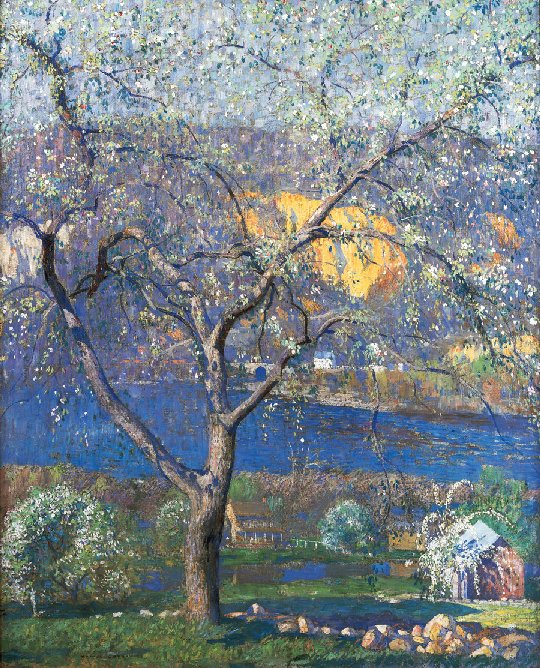
Bird of Paradise, Sleeping Nude by Gertrude Fiske (c.1916)

Another controversial nude work was her 1916 painting entitled Bird of Paradise, Sleeping Nude which received mixed reviews. It was praised for its honesty but more conservative critics said it was a scandalous depiction. Before us we see a foreshortened figure of a naked woman who appears supremely relaxed and unaware of us, the viewers. It is simply an honest depiction of a real woman.
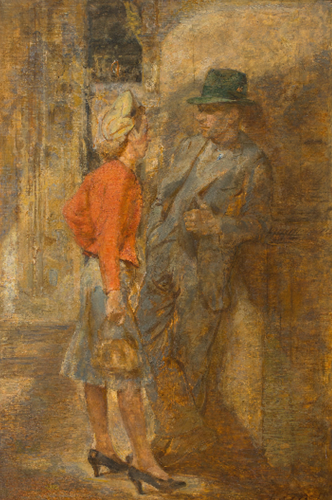
Zinnias by Gertrude Fiske (c.1920)

Gertrude returned to America but tragedy struck her family with the deaths of a sister, brother and mother around the time that the First World War was raging in Europe. Fiske then had to care for her aging father. However, despite the tragic losses and her new role as a carer she continued to be a prolific and much-admired painter. She kept a studio in Boston as well as at her family’s longtime home, Stadhaugh, in the town of Weston, fifteen miles west of Boston. It was at Stadhaugh that she worked in her studio which was located on the top floor of a converted barn. It had a picturesque setting overlooking woods and this vista served as the backdrop for several of her works.

By the Pond by Gertrude Fiske (c.1916)

In 1914, she, along with prominent painters of the day, including Edmund Tarbell, William Paxton and Frank Benson, helped create the Guild of Boston Artists. Its mission was to promote both emerging and established artists who lived in the region. The Guild developed a reputation for excellence in quality and presentation. Later, in 1917, Gertrude was part of setting up the Boston Society of Etchers and in 1918 Fiske became a member of the National Association of Women Artists.

Strollers by Gertrude Fiske (c.1926)

After the end of the First World War, America staged a rapidly growing industrial way of life and along with waves of immigration in the last quarter of the nineteenth century, elements of a new national consciousness arose in the United States. It was considered to be part of the colonial revival, which found expression in architecture, decorative arts, paintings, and all types of material life which represented an effort to regain a sense of an earlier time in America. Boston was in the forefront of colonial revivalism, and it was the Boston School of Painting, led by Edmund C. Tarbell, that is closely identified with the movement. Gertrude Fiske, who had spent seven years there as a full-time student at the School of the Museum of Fine Arts, Boston, was trained in this artistic dream of the future.

Wells, Maine by Gertrude Fiske


However Fiske was an independently minded and instead of blindly following social convention and the strong direction proposed by the Boston school with its more genteel mannerisms, she ploughed her own furrow and in her landscape depictions instead of removing signs of industry and technology from her work, she made a conscious decision to include them. A good example of this can be seen in her painting entitled Wells, Maine, in which she has retained depictions of a line of utility poles, with a secondary electrical line running across the painting. Her composition with utility poles set against the background of a seascape demonstrates the artist’s interest in juxtaposing signs of modernity with scenes more traditionally considered beautiful.

Portsmouth Burying Ground by Gertrude Fiske (c.1925)

Another example of Fiske’s urban landscape work is one she completed around 1932 entitled Portsmouth Burying Ground which depicts Portsmouth, New Hampshire’s oldest cemetery, known as the Point of Graves, which is situated on the banks of the Piscataqua River in the south end of town. This small historic cemetery dating to the 17th century was the final resting place for many of Portsmouth’s prominent residents. It is the oldest known surviving cemetery in Portsmouth, and one of the oldest in the state, which has about 125 gravestones. Whereas many landscape painters would have spent time amidst the beauty of the countryside Gertrude has chosen this discordant, working waterfront to position her easel to take in the surrounding land. Fiske confounded viewers of this work when she depicted the bright red gasometers and the Sheafe warehouse as a backdrop to the ancient burial ground.

Portrait of William by Gertrude Fiske (1930)

One of her best-known figurative works was one Gertrude completed in 1930 entitled Portrait of William which she exhibited at both the Boston Art Club’s Annual Winter Exhibition of Contemporary American Painting and at the National Academy of Design’s 105th Annual Exhibition. It is part figurative and part an interior depiction which was a popular concept favoured by many of the early Boston School teachers and yet she put her own mark on the composition by her use of colours, such as the juxtaposition of the green of the fabric on the pillows with the dotted Swiss cotton of the woman’s purple dress. She also adopts an unusual placement of figures and objects in the work.

The Carpenter by Gertrude Fiske (1922)

Gertrude Fiske was appointed as the first woman ever to the Massachusetts State Art Commission in January 1930. She was also the the founder of the Concord Art Association. In an article in January 1930’s Boston Globe it was written that she had always had a strong artistic individuality of her own, and there is a note of personal distinction in all of her work—a virile note.

Fiske died in 1961 in Weston, Massachusetts aged 82.