
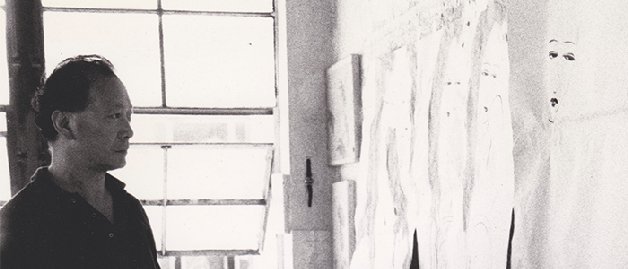
Walasse Ting (1929-2010)
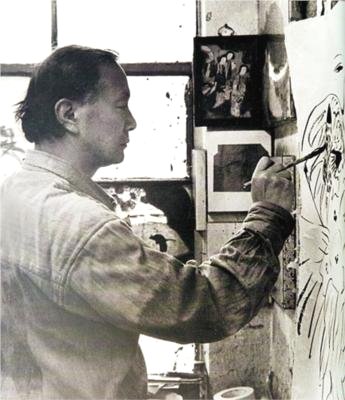
Walasse Ting at work in his studio
I have just returned from another stay in the Algarve where I could finally see some sun and experience warm weather. Whenever I visit the Algarve, I always visit the Art Catto gallery in Loule which I have often written about. This time I not only got a chance to return to the excellent small gallery in the centre of town,but take up their invitation to the opening of an exhibition at the Conrad Hotel in Quinta do Lago.

Conrad Hotel, Quinta do Lago, Algarve
The Conrad Hotel is, to say the least, a spectacularly lavish hotel, and the entrance foyer rooms where fine places to exhibit the expensive works of Walasse Ting. Seven years after his death, Walasse Ting’s has been given a place as a giant of 20th century paintings. He is such a captivating figure and the art he has produced over his 50-year career reveals many influences. Today, his artwork is in public collections which include MOMA, New York; Guggenheim Museum, New York; National Gallery of Chicago, Chicago; Tate Modern Museum, London; Centre Pompidou, Paris; Hong Kong Museum of Art, and the Shanghai Art Museum.

Beautiful Ladies by Walasse Ting

Many devoted private collectors also own his artwork. The latter group is growing especially fast, thanks in part to the rise of China as an economic and cultural force. From the very early works, Walasse Ting’s paintings have charmed viewers with his use of vivid colours and light-hearted mood.

Ladies with Parrots by Walasse Ting
Walassi Ting is a Chinese artist who was born in Wuxi, China in 1929 but in fact was raised in Shanghai. Ting is primarily a self-taught painter, sculptor, graphic artist, lithographer and poet, who began his life as an artist at a very young age. Ting studied at the Shanghai Art Academy before he left China in 1946 and after living briefly in Hong Kong set sail for France in 1950. Times were hard for the young aspiring artist continually battling against poverty. His stay in Paris coincided with the rise of the avant-garde artistic group known as CoBRA. The word Cobra is derived from the French names of the cities of Copenhagen, Brussels and Amsterdam.
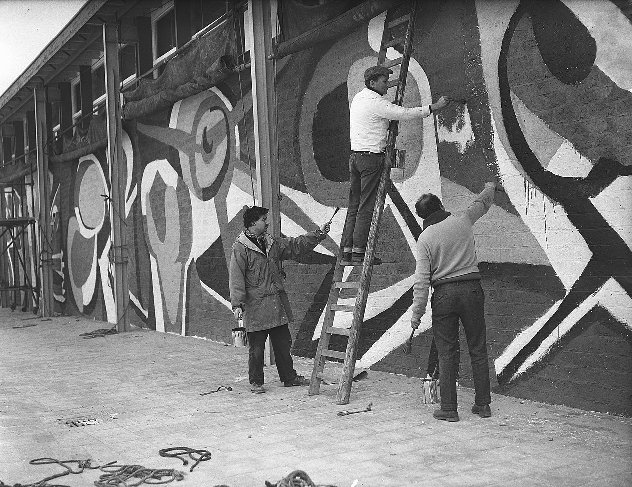
CoBra member Karel Appel working on a mural in Rotterdam for the Manifestation E55
The artists had founded the CoBRA group during a major international conference held in Paris in 1948 and they came from these three European capitals. Ting became acquainted with all the members of the avant-garde group, most notably Pierre Alechinsky and Asger Jorn.
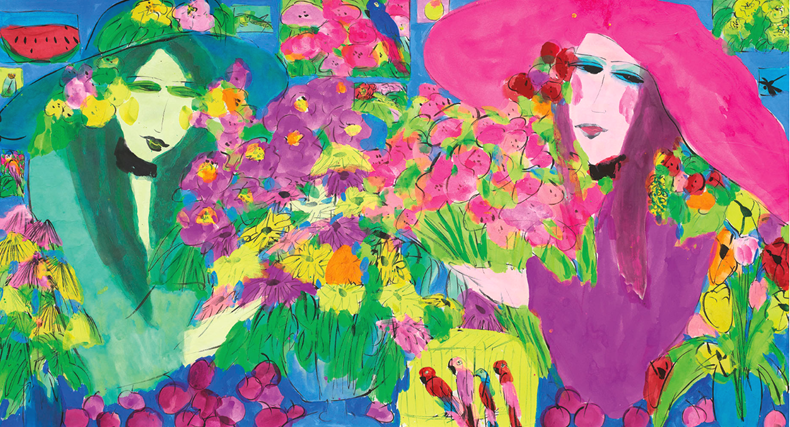
Women with Flowers by Walasse Ting
Walassi Ting left Paris and arrived in New York in 1959 and participated in the Pop Art and Abstract Expressionism movement where his closest associates were artists Sam Francis and Joan Mitchell, members of the second generation of Abstract Expressionist painters. He sold many paintings which often featured bold dripping strokes. It was just over a decade later in 1970 that Walassi Ting created a distinctive style using calligraphic brushstrokes to define outlines and filling flat areas of colour with vivid paint. After 15 years of abstract painting, Walasse Ting’s interest in the body and his exploration of sexuality led him back to figuration in the 1970’s. Like the colour master, Gauguin, Ting made a number of journeys to Tahiti continually on the lookout for the exotic colours that he loved. The subject of his paintings often contained women, cats, birds and peacocks.
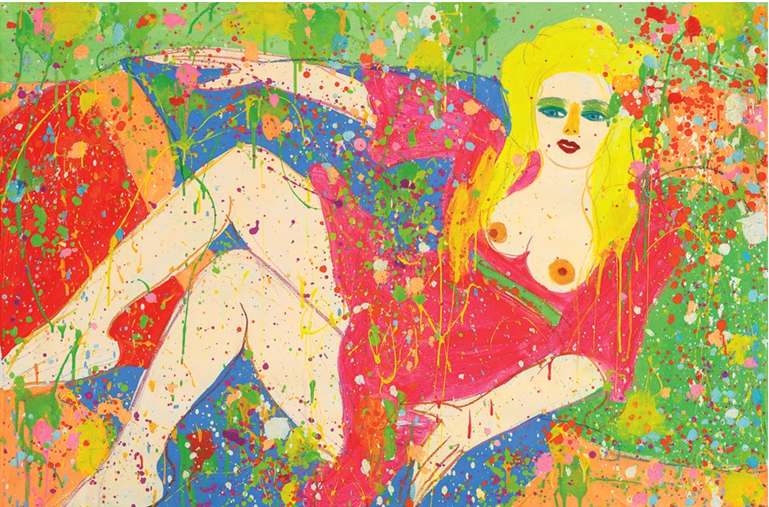
Kiss me, Kiss me by Walasse Ting
Ting embraced sexual desire through his art, as he conveyed his inner emotions through the fluent and expressive brushstrokes as he captured the alluring beauties set against a background of uncontrolled vibrant acrylic colours that break free into a dreamscape of sensual pleasure. In his 1974 acrylic on paper work entitled Kiss Me, Kiss Me, the title of the work and the bare-breasted model conjure up the emotions of sexual passion. The work comprises of flat planes of colour and simplified lines, and the woman exposes herself to us, and is drenched in a tumult of multicoloured drips as if she was incorporated into an abstract expressionist canvas.

Come Talk to Us by Walasse Ting
In the summer of 1976 Ting produced his acrylic on canvas work entitled Come Talk to Us which depicted two half-length female figures who stare at a plant-like bouquet of colours at the centre of the image, an image which divides the image in two. The mirror-image like effect creates a sense of calm and balance, and the dabs of green, blue, and red paint trickle slowly along the canvas, exuding a melancholic beauty like that of gazing through a window on a rainy day. The title of the painting, Come Talk to Us, questions the viewer and echoes a lonely yet tantalizing longing. Ting has once again used the depiction of his figures to express the feelings inspired in him by objects of beauty. Ting explained:
“…When I see a beautiful woman [and] I see flowers, its beauty makes me feel intangible, melancholy, love, refreshed, different, and reborn. I want to use different colours to express my inner feelings and emotions in my paintings.”
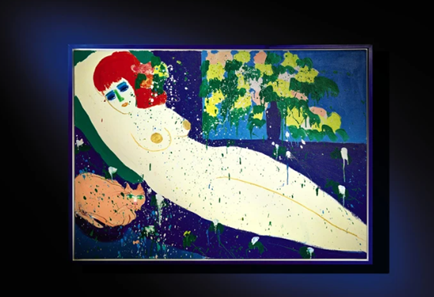
Eat me, I’m a Fish b y Walasse Ting
His 1978 work, with the strange title, Eat Me, I’m a Fish, Ting has splattered the paint over the entire canvas giving it the impression of a faint effervescence. This oblong depiction of the woman suggests the shape of a fish and the title boldly summons the viewer to come and consume its imagery, once again arousing the viewer’s culture’s sexual drive. The figure transects the diagonal of the picture plane while a cyan blue rectangle slices off the upper right quadrant of the image, giving the impression of a window. Eat Me, I’m a Fish is Walasse Ting’s vivid interpretation of everyday life, and yet the composition is an obvious reference to Édouard Manet’s masterpiece Olympia. This painting could be thought of as Ting’s homage to a modern master, reinterpreting the essence of this classic painting and challenging the earlier artist’s greatness.
At the Conrad exhibition, many of his paintings were watercolours on rice paper. They were both delicate and ornate, rendered with detail and repetitive patterns.
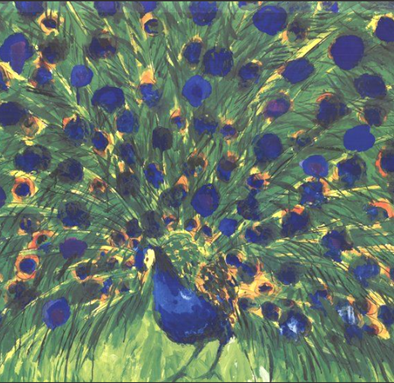
Peacock by Walasse Ting
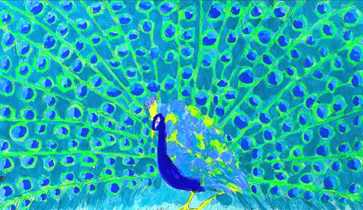
Peacock II by Walasse Ting
Ting frequently depicted cats, flowers and birds as in his painting, Peacock, in which the ‘eyes’ of the bird’s plumage radiate outwards across the large surface of the painting, creating a striking wallpaper of electric blue, yellow and green. The controlled circles, tightly arranged, create an arresting optical vibration.
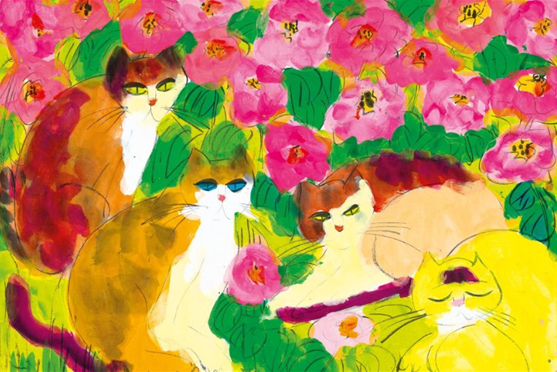
Cat Series by Walasse Ting
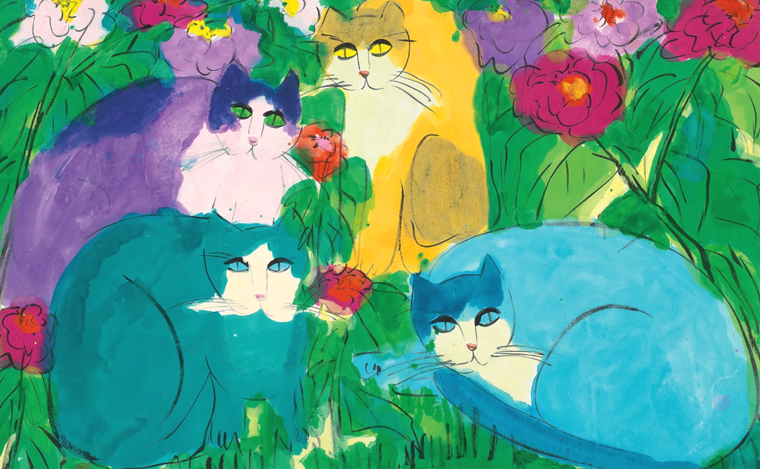
Cat Series by Walasse Ting
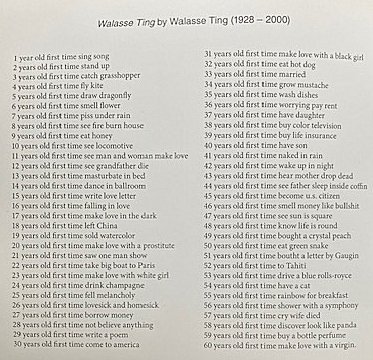
One very unusual thing at the exhibition was a display board giving a brief bio. by Ting himself It was also in the exhibition brochure. That is not strange in itself but what was unusual and some may say inappropriate, was his summary of his life “achievements”, year by year.
In the mid-1980s, he set up a studio in Amsterdam and in 2001 he permanently settled in that city. He was unable to create after a stroke in 2002. Ting died on May 17, 2010, at the age of 81 in New York.
 my daily art display