The Rhinoceros by Pietro Longhi

My Daily Art Display painting of the day is one which when once seen will never be forgotten.  Not necessarily for the breathtaking art but for the unusual subject of the painting.  My featured painting to today is The Rhinoceros by Pietro Longhi.
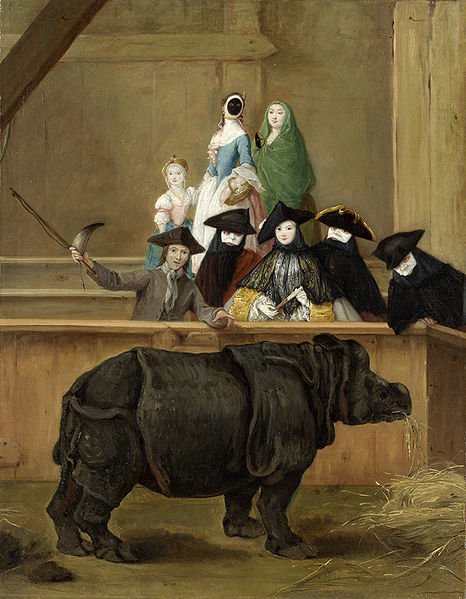
The Rhinoceros by Pietro Longhi (1751)

Longhi was born in Venice in the latter part of 1701. His parents were Antonia and his father Alessandro Falca, who was a silversmith.  Pietro changed his surname to Longhi once he started to paint.  He studied art initially under the guidance of the painter from Verona, Antonio Balestra, and finally was accepted as an apprentice to Giuseppe Crespi the Baroque painter from Bologna.  Longhi returned to Venice when he was thirty-one years of age and married Caterina Maria Rizzi and the couple went on to have eleven children.  Sadly, and it is a common story of that era, only three of their children reached the age of maturity, one of whom, Alessandro, became a successful portraitist.

His early work featured a number of altarpieces and religious paintings and he was commissioned to carry out a number of frescos in the walls and ceilings of the Ca’Sacredo in Venice, which is now an exclusive hotel.  Later his art turned to genre scenes of contemporary life in Venice of the aristocracy and the working class.  He produced numerous works and in many instances painted many different versions of the same scene.  His type of art,  his satirical look at everyday Venetian life with its coffee-drinking, receptions and social soireeswas extremely popular..  Some of his paintings remind one of the type of paintings done by William Hogarth.  The difference between the two was that Hogarth was often brutally satirical with his paintings in which he mocked the life of English folk whereas Longhi just wanted to chronicle the everyday life of his compatriots without standing in judgment and acting as a satirical moralist.  In a number of cases his patrons, who had commissioned his work where featured in the works and maybe for that reason Longhi was careful not to offend them.   Bernard Berenson, the American Art historian, talked about Longhi’s artistic style and the comparison with Hogarth when he wrote:

“…Longhi painted for the Venetians passionate about painting, their daily lives, in all dailiness, domesticity, and quotidian mundane-ness. In the scenes regarding the hairdo and the apparel of the lady, we find the subject of gossip of the inopportune barber, chattering of the maid; in the school of dance, the amiable sound of violins. It is not tragic… but upholds a deep respect of customs, of great refinement, with an omnipresent good humor distinguishes the paintings of the Longhi from those of Hogarth, at times pitiless and loaded with omens of change..”.

Longhi became Director of the Academy of Drawing and Carving in 1763 and it was around this time that he concentrated almost all his artistic efforts in to portraiture, ably assisted by his son, Alessandro.  He died aged 83 in 1785.

The featured painting today is based on historical facts and revolves around the Carnevale di Venezia, the annual festival, held in Venice. The Carnival starts around two weeks before Ash Wednesday and ends on Shrove Tuesday.  This grand event was described by John Evelyn, the 17th century English traveller and diarist:

“…At Shrovetide all the world repair to Venice, to see the folly and madness of the Carnival; the women, men, and persons of all conditions disguising themselves in antique dresses, with extravagant music and a thousand gambols, traversing the streets from house to house, all places being then accessible and free to enter. Abroad, they fling eggs filled with sweet water, but sometimes not over-sweet. They also have a barbarous custom of hunting bulls about the streets and piazzas, which is very dangerous, the passages being generally narrow. The youth… contend in other masteries and pastimes, so that it is impossible to recount the universal madness of this place during this time of license….”

The painting which hangs in the National Gallery in London centres on the unusual spectacle of Clara the young rhinoceros, which was brought to Europe in 1741 by a Dutch sea captain, Douwe Mout van der Meer, who had bought the lumbering creature.  It is believed that she was only the fifth rhinoceros to be imported from India to Europe since the days of the Roman Empire.  Clara, after extensive travels in Europe, arrived in Venice ten years later.   The female rhinoceros in Longhi’s painting, seen munching away at some hay seems somewhat docile, even depressed, as caged animals often are who suffer such a fate.
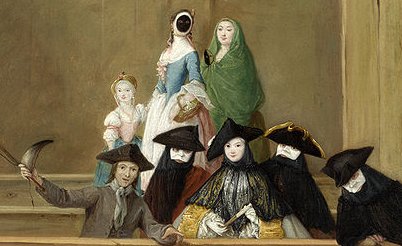
The Audience

Behind her we see the keeper of the animal and a number of spectators.  The keeper holds aloft a whip and the horn of the rhinoceros which according to historical notes, was not cut off but knocked off by Clara herself due to her continuous rubbing it against the sides of her cage.  The small audience of seven, some of whom wear their Carnival masks stand on wooden benches in an almost triangular formation.  They show no interest in the poor creature as they gaze vacuously in all different directions.  The elegant lady in the front row wearing a dark lace shawl, edged in gold is Catherine Grimani.  She stares directly out at us.  Her white-masked suitor, on her left, is her husband John Grimani and the couple were the commissioners of the painting.  Their servant stands to her right and looks straight ahead.  The man to the right of the group wearing a red cloak and has a long clay pipe in his mouth has his eyes cast downwards and seems lost in his own thoughts.  Above him, Longhi has painted a scroll-like notice which tells us all about the painting, which when translated reads:

“True Portrait of a Rinocerous  conducted in Venice  year 1751:

made for hand by  Pietro Longhi

Commissions  S of Giovanni  Grimani Servi Patrick Veneto “.

The small girl in the back row seems totally disinterested in Clara.  With the exception of the animal’s keeper brandishing the severed horn there seems no relationship with the audience and the animal on display.  It is if Longhi has merely added them to please his patrons and highlight the fact that the exhibition was at Carnival time in Venice.

One thing that I found fascinating is the lady in the upper middle of the audience dressed in the blue and white gown.  Instead of a white carnival mask she is wearing the soft black leather Moretta mask.  Moretta, means darkness, and the masks were only worn by women and were not tied around the wearer’s head but held in place by a leather button on the inside of the mask which is held in the clenched teeth of the wearer.  It has only two nearly circular openings for the eyes, restricting the lady’s breath a little, as the only airway is through the eye openings down to the nose.  Sweat also has to evaporate through the openings as well, quickly making the face hot.  Not only was that uncomfortable but it prevented the wearer from speaking.  This enforced silence especially pleased their male counterparts !

I was going to add a male-chauvinist comment, but thought better of it  !!!!!!

Portrait of Andrea Odoni by Lorenzo Lotto

Portrait of Andrea Odoni by Lorenzo Lotto (1527)

The featured artist in My Daily Art Display today is Lorenzo Lotto. He was born in Venice around 1480 and although little is known of his early life we but we know that he was greatly influenced by the works of Bellini. He was an artist of the High Renaissance period but there are signs in his work, such as unusual posing of his figures and some distortions in their body shape that he was a follower of the transitional stage leading to the Mannerism genre of art.

One knows that Lotto moved from Venice to Treviso around 1503. This move of his may have been due to the intense artistic competition in Venice with the likes of Giorgione and Titian and he may have believed he would fare better in the affluent town of Treviso. It was while here that he met the bishop, Bernardino de’ Rossi, who became his patron. After a few years spent here he moved to the Marche region of Italy and eventually ended up in Rome in 1508 where the pope, Julius II, commissioned some of his work. He carried on his nomadic lifestyle, travelling around Italy before finally returning to Venice in 1525. Here he took up residence at the Dominican monastery but his stay was cut short after a conflict with one of the brethren. By 1554 he was partially blind and he became a lay brother at a monastery at Loreto where he eventually died.

This nomadic and restless lifestyle of his mirrored his temperament which was said to be an existence of constant anxiety and change which made him a difficult person to get on with. His painting styles differed enormously. He was a keen observer of people. He is probably best known for his portraiture but in most of his portraits he conveyed a mood of psychological turmoil which was probably a mirror-image of his own mindset. His works of art often focused on religious works and he completed many altarpieces.

My Daily Art Display featured painting of the day is Lotto’s work entitled Portrait of Andrea Odoni which he completed in 1527 just two years after returning to Venice after his long self-exile from the city. .   The portrait has fittingly been described as one of the finest and most impressive of all of Lotto’s portraits and a calculated challenge to Titian’s supremacy in the field. So who was Andrea Odoni?    Odoni was an extremely successful Venetian merchant and collector of antiquities who lived in a grand house in Fondamenta del Gaffero in the district of Santa Croce.  The son of a wealthy recent Milanese immigrant to the city, Andrea Odoni was an important member of Venetian society.   He built upon the collection which he had inherited from his uncle, Francesco Zio, to become a renowned collector of paintings, sculpture, antique vases, coins, gems and natural history specimens. This portrait by Lotto was hung in Odoni’s bedroom alongside religious and profane paintings: a reclining nude by Savoldo, and paintings by Palma Vecchio and Titian.  His residence also contained an unusual combination of ancient and modern statues, with ‘mutilated and lacerated antique marble heads and other figures’.    The poet and satirist, Pietro Aretino, once wrote to Odoni in which he said that he believed Odoni had managed to re-create Rome in Venice.  However there was a subtle rebuke for the collector, as then Aretino went on to describe the splendours of the house in a tone that suggests it overstepped the boundaries of Venetian decorum.

In some ways it is an unusual portrait as it is in “landscape” orientation rather than the usual “portrait” orientation but this was to enable the artist to include some of Odoni’s collected antiquities.  As in a number of portraits the sitter likes to be depicted in a way that it will inform the viewers a little about himself or herself.  Where sitters want to highlight their wealth, the painting is adorned with the most sumptuous and expensive room decorations and the sitter is bedecked in the most magnificent fineries.  Odoni wanted people to look at his portrait and realise his passion for collecting antiquities.  However, it is amusing to read that with the exception of the bust of Hadrian, none of the antiques on show actually belonged to him and were probably plaster cast versions of the originals and were probably owned by Lotto.

Look at Odoni’s hand gestures.   His left hand clasps a small gold cross and presses it against his heart.  Is this simply a gesture signifying his heartfelt sincerity?  Is he merely indicating to us that he is an honest God-fearing man and that from his mouth will only come truthful utterings?  Maybe there is another reason behind the portrayal of him touching the cross to his heart.  It has been suggested that for Odoni, the true religion of Christianity, represented by the golden cross, will always take primacy over Nature and the pagan gods of antiquity, as indicated by the statuette of Diana and the busts of the other classical figures such as Hercules and Venus.

Look how his full beard and hair form a frame around his face.  Is it purely coincidental that the marble bust of the Emperor Hadrian we see in the foreground, peering from beneath the green table cloth, has a similar countenance?   Did Odoni ask the artist Lotto to position the bust in a prominent position in the painting so that we would make this comparison?  On the table we see a book, some medals and some coins.

In our sitters right hand he lovingly cradles the statuette of the Roman goddess Diana (the Greek goddess Artemis) of Ephesus with her body covered with breasts symbolising fertility.  She is the fertility goddess from classical mythology.  Is it meant as an offering to us?  What is the meaning of his gesture?

Odoni, sitting before us in his dark robe trimmed with fur in some way looks like a ringmaster at a circus with all the busts and statues surrounding him like his performers.   He appears as somebody very comfortable with his surroundings and maybe he is challenging us to “make what we will” of everything that we see before us.   In some ways this complex portrait has a sombre feel to it and by Odoni’s expression I am not convinced, despite his wealth, that we are looking at a particularly happy and contented man.

A Family Group by Bernardini Licinio

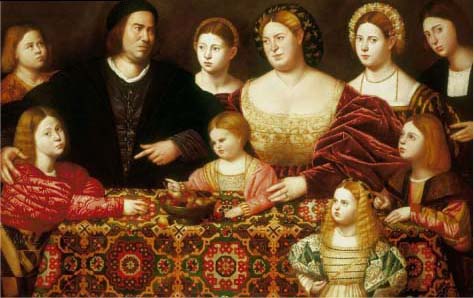
A Family Group by Bernardino Licinio (1524)

Bernardino Licinio was born in Venice around 1489 during the Italian High Renaissance.  It is thought that he could have trained as an artist in the workshop of Giovanni Bellini, the founder of the Venetian School of Painting.  Although being influenced by his “master”, Licinio soon developed his own down-to-earth style of realism painting.  When he had finished his artistic apprenticeship, Licinio set up his own workshop and produced a number of half length panels of the Virgin and Child, some altarpieces and group portraits one of which is featured in My Daily Art Display for today.  It is simply entitled A Family Group and was painted by Licinio in 1524.

In the painting we see nine members of a family.  It was once thought that it was an actual portrait of Licinio’s own family but there has been no documented evidence that he was ever married.  Licinio was famous for his group portraits and a few years after today’s painting he completed two similar works, namely, Arrigo Licinio and his Family (1535) and Portrait of a Sculptor with Five Apprentices(c. 1530) and all three are looked upon as his greatest works. 

Small-patterned Holbein carpet

 The members of the family are grouped around a table on which we see a Turkish table carpet, known as a small-patterned Holbein named after its characteristic geometric design.  These carpets are of Ottoman origin and so named because Hans Holbein used to often incorporate them into his paintings.  The “small pattern” terminology referred to the small size of the motifs.  These were expensive carpets and in paintings often symbolised wealth and in this case we are being subtly told that this family did not have any financial problems.

What I like about this family portrait is its realistic quality.  How many times have you wanted a family photograph taken with your children only to be thwarted by arguments between the young ones?  This is exactly what Licinio is recording in the painting.  The young boy in the elaborately painted striped hose, seated at the end of the table on the left, has just taken an apple from the bowl and of course this was the very one which his siblings had wanted.  Sounds familiar?   We can see the father, dressed in black, attempting to mediate in the argument.  His wife, in the gold and cream low-cut dress, is listening intently to his proposed solution. 

The determined child

My favourite character in the painting has to be the young girl standing in front of the table in the right foreground.  Look how she stands defiantly, arms akimbo, lips pouted as she demands justice.  Although she maybe the youngest of the siblings she demands to be heard. The one aspect of the painting which art critics have commented on is that there seems to be no face-to-face interaction between family members.  They fail to relate to each other. 

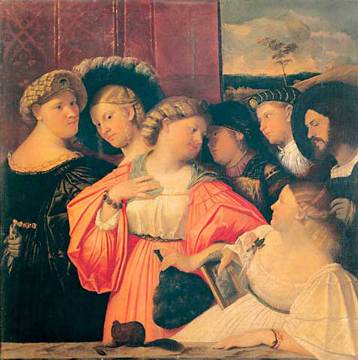
Seven Members of the Albani Family by Cariani

Compare this with, for example, Lotto’s 1547 family painting, Portrait of Giovanni della Volta with his Wife and Children, which has a similar bowl of fruit on a carpeted table but where there is an interaction between the family members or Giovanni Cariani’s Seven Members of the Albani Family (above) where everybody seems so animated.     Licinio’s family group seem to be just a collection of individuals who have no connection with each other.  The difference in style of the two portraits reminds me of two photographs a family photographer has taken.  In one he has instructed everybody to be still and look at the camera.  The result is a wooden photo, which often occurs in a formalised event where everybody has to stand still and look at the camera and not at each other.   In the other the photographer has let things develop naturally before he presses the camera button without warning.

Self Portrait by Rosalba Carriera

My featured artist today is the Venetian portraitist Rosalba Carriera.  I have chosen her because I saw her painting whilst in Venice and I was greatly moved by it.  As I told you yesterday, when I discover a “new” artist I become intrigued and curious to know more about them and so now that I am back home I have delved through my books and have come up with a somewhat sad tale which I will now tell you.

Rosalba Carriera was born in Venice in 1675 and was one of three sisters, one of whom, Angela, was later to marry the great Venetian painter Giovanni Pellegrini.  Rosalba studied art under Giuseppe Diamantini, the notable Baroque painter and printmaker, during which time she would copy oil paintings.  Her own first successes came in 1700 with her tempera portrait miniatures which she painted on ivory.  In 1705 she was made accademico di merito by the Accademia di San Luca in Rome.  This was a great honour and was reserved for non-Roman artists.   Her work was so good that soon her fame spread throughout Europe. 

Here is another question for you.  What do you think the connection was between Rosalba and snuff?

By the 18th century, snuff had become the tobacco product of choice among the elite, prominent users included Napoleon, King George III and his wife Queen Charlotte and even Pope Benedict XIII.   The taking of snuff helped to distinguish the elite members of society from the common populace, which generally smoked its tobacco.   As snuff-taking became popular in Europe so did Rosalba’s commissions.  Why?    Rosalba Carriera was able to paint miniature portraits, often on ivory, which formed the lids of the snuff boxes.  Her talent for these delicately painted snuff-boxes was in great demand.  From that, she progressed to portrait painting but again on a small scale, usually about 30cms x 50 cms.  In 1706 she was invited to the court in Dusseldorf to carry out various commissions and following on from that she was besieged by the nobility of Europe who flocked to her studio in Venice for her to paint their portraits or  portraits of somebody from their family.    

And so to My Daily Art Display painting simply entitled, Self-portrait which she completed around 1746 when she was aged 71.  This was unlike many of her portraits she did of women of the nobility.  Those portraits were of good-looking women, dressed in sumptuous clothes.  Here we have before us a pale faced elderly woman.  She is not smiling and it appears that happiness has passed her by.  She looks tired, drained by her long and arduous life.  I wonder if , in general, we are lulled into believing that somebody who has the ability to paint beautiful things must be happy.  But maybe that is at the crux of her sadness, as it is at about this time that she began to lose  her sight and she must have realised that her ability to produce such beautiful works as she had once done, was rapidly coming to an end.  Can you imagine what she must have been thinking at this time in her life?  Can you imagine her torment when she realised her days of painting were coming to an end? 

Sadly, she became totally blind five years after completing this self portrait and this sent her spiralling into a deep depression and she died six years later in 1757, aged 82.

The Entrance to the Grand Canal, looking East, with Santa Maria della Salute by Michele Marieschi

The Entrance to the Grand Canal, looking East with Santa Maria della Salute by Marieschi (c.1735)

I went to Venice today.  It was my first visit to this beautiful place.  I decided that once again My Daily Art Display should be a painting by a Venetian artist depicting this stunning city.  The painter is Michele Marieschi and his work is entitled The Entrance to the Grand Canal, looking East, with Santa Maria della Salute.    Although Venice is associated with the likes of Canaletto and Guardi I decided to select a painting of Venice by a less well-known artist.  Michele Marieschi, the son of an engraver, was born in 1710 and was a contemporary of the two great Venetian artists, Canaletto and Francesco Guardi and in some ways probably suffered from their presence. 

Santa Maria della Salute

What we are looking at in this painting is the entrance to the Grand Canal  which is dominated by the magnificent Basilica of St Mary of Health known locally as Basilica di Santa Maria della Salute.  This Roman Catholic church or basilica is situated on a small tongue of land  between the Grand Canal to the left as we look at the picture and the Bacino di San Marco to the right.    The dome of the basilica was an important addition to the Venetian skyline and was an inspiration to such artists as Guardi, Canaletto, Turner and Singer Sargent.  The basilica was built in the late seventeenth century by the Venetian architect, Baldassare Longhena in thankfulness for the ending of the bubonic plague which killed more than 80,000 Venetians in 1630.  This view has probably been taken from the monastery of San Gregorio which stands on the corner meeting point of the Grand Canal and the Rio della Salute and is on the opposite side of the Rio della Salute to the basilica.  If you follow the way past the steps of the basilica you can just make out the tower of Dogana da Mar the original Customs house which once controlled all movement of boats and their goods in and out of Venice.  On the opposite side of the Grand Canal are the Palazzo Manolesso and Contarini Fasan and if you look closely you can just make out the top of the famous Campanile of San Marco.  As with all Venetian scenes the water is full of boats of various shapes and sizes, some gondolas, others cargo boats.  If you look closely at the cargo boat in the left foreground it is loaded with cases marked “Roma” “Vienna” and “M:S:” the latter thought to be the artists signature.  It is interesting to see how the artist has divided the scene vertically by the long mast of the boat which is tied alongside the quay.  In some ways it balances the composition.  This composition has a two point perspective.   When you look at the basilica and the surrounding quay you get a strange sensation maybe caused by the “V” shape of the quay, that the bottom of the basilica appears to be coming towards you whilst the dome of the basilica seems to be moving away.  Art historians believe that this illusion may be because Marieschi used a camera obscura to paint this picture.

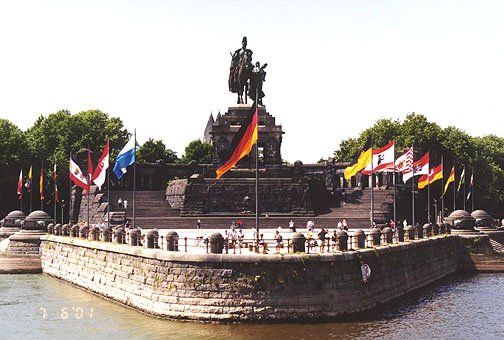
Deutsches Eck, Koblenz Germany


When I first saw this  painting I was immediately reminded of Deutsches Eck at Koblenz, the triangular shaped headland, which is at the confluence of the rivers Rhine and Mosel and on which is the giant equestrian statue in honour of Emperor William I.  It is strange the impression a painting gives you of a place.  You take it that it is almost a photograph and I was very suprised when I arrived at the place shown in the painting.  It was so different.   The distance from the bottom step of the basilica to the quay edge is no more than 10 paces.   I was expecting it to be like the Deutches Eck and the corner would be at least 50 metres away from the quay edgea nd that was based on the number of “small” people in the painting between the steps and the corner point of the quay.  So although the camera doesn’t lie, the painting does!!!

Notwithstanding that the painting like Venice itself is truly magnificent.

Grand Canal: Looking North-East towards the Rialto Bridge by Canaletto

Grand Canal: Looking North-East towards the Rialto Bridge by Canaletto (c.1725)

As today I am setting off for a short break in Milan and Venice, I thought it only right to feature a painting of the beautiful Adriatic city.  I suppose the name one conjures up in one’s mind when one thinks of art and Venice is Giovanni Antonio Canal better known by his nickname Canaletto (meaning little canal).    He was born in Venice in 1697 and was the son of Bernardo Canal, a painter, hence the use of the nickname to differentiate his works from those of his father.    My Daily Art Display for today is Grand Canal: Looking North-East towards the Rialto Bridge which Canaletto completed around 1725 and now hangs in the Gemäldegalerie in Dresden.

This was one of the largest works ever completed by Canaletto, measuring 146cms x 234cms.  We, the viewer, are looking on this scene from first floor of Palazzo Garzoni on the Grand Canal which is situated at the corner of Rio di Sant’Angelo.  If we look across the water to the left we are just able to make out the start of the Rio di San Polo, on the left side of which, in the left corner of the painting is the building, Palazzo Barbarigo della Terazza.  If you look over the top of the building you can just make out the top of the San Polo steeple.  Let your eyes alight on the buildings across the other side of the water and move along to the right to the end of the buildings and you can just see the famous Rialto Bridge

We are looking in a north-easterly direction at a threatening sky and by the dampness on the parapet in the right foreground one must presume there has been rain earlier on in the day and maybe the storm has passed or perhaps the heavens are about topen once again.

Canaletto has added a number of gondolas to the scene and we see them move up and down and criss-cross the Grand Canal.  I am not sure who has the right of way on the canal but if you look closely at the row-boat and the gondola in the left foreground they are about to collide with the men from the row-boat frantically trying to fend off the prow of the gondola.  The passenger of the gondola can be seen standing up gesticulating at his gondolier.  It is thought that Canaletto’s positioning of the various boats in the painting is not based on reality but more to add a picturesque quality to the work.  This is not the only thing which is not true to life as what we see does not exist.  Canaletto actually combined two views into one.  The right side of the painting is a view one would see from the north-east corner of the Palazzo Garzoni but the left hand side of our painting could only be viewed from the north-west corner of the Palazzo so although the two sides look as if they are opposite each other we are in fact looking at a scene which encompasses a ninety degree angle.  However let us not worry about that illusion, let us just take in the exquisite detail of life in 18th century Venice.

As I said at the begining I am about to go catch my flight to Milan and although I promised you a daily art display my output will be totally reliant on the WiFi availability at my hotels

Arrivederci

Portrait of a Woman Inspired by Lucretia by Lorenzo Lotto

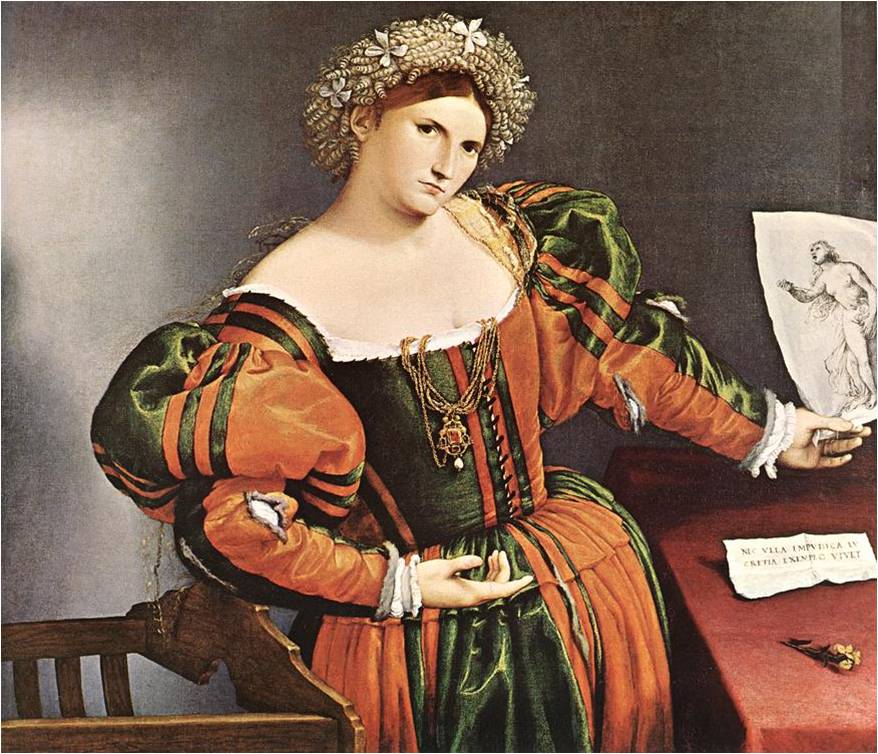
Portrait of a Woman Inspired by Lucretia by Lorenzo Lotto (c.1533)

The featured artist in My Daily Art Display today is Lorenzo Lotto.   He was born in Venice around 1480 and although we do not know much about his early life we are led to believe that he was greatly influenced by the works of Bellini.  He was an artist of the High Renaissance period but there are signs in his work, such as unusual posing of his figures and some distortions in their body shape that he was a follower of the transitional stage leading to the Mannerism genre of art.

One knows that Lotto moved from Venice to Treviso around 1503.  This move of his may have been due to the intense artistic competition in Venice with the likes of Giorgione and Titian and he may have believed he would fare better in the affluent town of Treviso.  It was while here that he met the bishop, Bernardino de’ Rossi, who became his patron.  After a few years spent here he moved to the Marche region of Italy and eventually ended up in Rome in 1508 where the pope, Julius II,  commissioned some of his work.  He carried on his nomadic lifestyle, travelling around Italy before finally returning to Venice in 1525.  Here he took up residence at the Dominican monastery but his stay was cut short after a conflict with one of the brethren.  By 1554 he was partially blind and he became a lay brother at a monastery at Loreto where he eventually died.

This nomadic and restless lifestyle of his mirrored his temperament which was said to be an existence of constant anxiety and change which made him a difficult person to get on with.  His painting styles differed enormously.  He was a keen observer of people.   He is probably best known for his portraiture but in most of his portraits he conveyed a mood of psychological turmoil which was probably a mirror-image of his own mindset.  His works of art often focused on religious works and he completed many altarpieces.

My Daily Art Display today is his oil on canvas painting entitled Portrait of a Woman Inspired by Lucretia which he painted around 1533 and which now hangs in the London National Gallery.    The “Lucretia” in the title of the painting is a character in a Roman legend and according to the ancient tale Lucretia was the beautiful wife of the early Roman army commander Lucius Tarquinius Collatinus. During a military expedition, Lucius and the other Roman leaders talked about how moral and good their wives were. They decided to return to Rome to see if the women were actually as faithful as each man claimed. They found only Lucretia at home; the other wives were misbehaving while their husbands were away.   One of the men in the group, Sextus Tarquinius, was the son of the Roman king. Fascinated by Lucretia’s beauty and goodness, he went to see her again and raped her at knifepoint. Lucretia made her husband and father swear to avenge the deed and then killed herself.   According to Roman legend, people were so outraged by the incident that they overthrew the monarchy and founded the Roman Republic. The story of Lucretia appears in works by the Italian artists Botticelli and Titian and in Shakespeare’s poem The Rape of Lucrece.

In today’s painting we see a woman leaning against a seat.  She is dressed in a decorative orange and green costume.  She looks directly at us.  It is a fixed stare which is somewhat grave and challenging.  It unsettles the viewer.  In her left hand she holds out a scrap of paper, on which is drawn a sketch of her namesake, the Roman Lucretia committing suicide by stabbing herself.  On the table lies a note inscribed:

NEC  VILA  IMPVDICA   LV  CRETIA  EXEMPLO  VIVAT

Which translated means “After Lucretia’s example let no violated woman live”

It is this drawing and this note that the woman in the painting is demanding that we should look at.  She insists that we have high regard for the sacrifice of Lucretia and that we understand why such a terrible sacrifice was necessary.    She is demanding of all women to acknowledge, and by so doing, agree to marital fidelity and to cast aside any thoughts of treachery. 

Lotto has filled the painting with the figure of the woman and by so doing has been able to give us wonderful details of the sitter such as her intense and expressive facial quality as well as being able to offer us a close-up look at her sumptuous and decorative attire.

Lorenzo Lotto was almost a forgotten painter until the mid twentieth century when there was a revival of interest in his works.  I believe he was a troubled soul who did not lead a happy life.  He was an outsider who was spurned by his contemporaries.  It is sad to think that such a lonely and unhappy person could produce such a beautiful work of art which has given pleasure to so many.

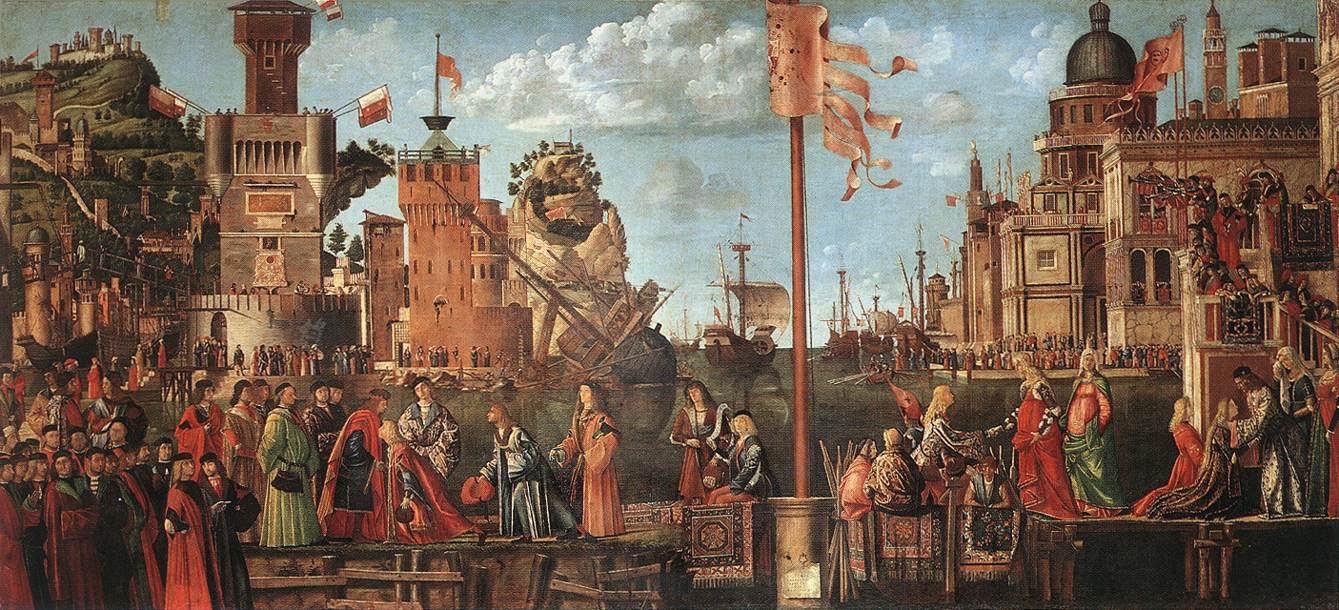
Meeting of the Betrothed Couple and the Departure of the Pilgrims by Vittore Carpaccio

Meeting of the Betrothed Couple and the Departure of the Pilgrims (1495)

My Daily Art Display today features a painting by the Venetian artist Vittore Carpaccio.  The painting is massive in size, measuring 280cms high and 611cms wide (9ft high by 20ft wide).  It is one of a series of nine, tempera on canvas, paintings.   The set of paintings, commissioned in 1488 by the Lordean family  They were a noble Venetian dynasty, three of whom became Doges of Venice, including Doge Leonardo Lordean whose portrait by Bellini was featured in an earlier blog (Nov 17th).   The paintings were created for the Scuola di Sant’ Orsola (Ursula) in Venice, a confraternity ( a type of brotherhood or society) of which the Lordean family was a patron.  All nine paintings can now be found in the Gallerie dell’ Accademia in Venice.  The artist was asked to tell the story of Saint Ursula through a series of paintings.  This legendary tale of the northern saint, Ursula, was very popular in the Middle Ages and Carpaccio’s design for the paintings came from Jacobus de Varigine’s Legenda Aurea (Golden Legends) which featured stories of the Saints and which had only just been translated into Italian.

The legend of Saint Ursula has like all good stories, over time, been added to and twisted, to make it a more thrilling tale.  The story is as follows….

At that time young girls did not choose their own husbands, their parents decided whom they would marry. A powerful pagan king and ruler of what is now Brittany requested of Ursula’s father that she would marry his son Ethereus. The pagan king sent ambassadors to Ursula’s father offering large sums of money and other promises if the marriage took place. However they added terrible threats of what would happen if the marriage were not to take place. Ursula’s father was very troubled by this turn of events.  He was afraid of the violent reaction of the other king if he declined the request and he wasn’t sure that Ursula would agree to marry and in any case both he and Ursula would prefer a Christian marriage.

However much to her father’s surprise Ursula, inspired by God, agreed to the marriage but only on certain conditions.   She demanded that her father and the pagan king put ten girls at her disposal and each of them would be accompanied by another thousand girls and that she and her entourage of ten thousand virgins would travel to Rome and once there, she would be granted three years to dedicate herself to God and that her future husband, Ethereus, would receive Christian instruction for baptism.  Ursula actually thought the proposal would be withdrawn on these conditions – but no, the king agreed and Ursula’s demands were carried out immediately.

Ursula’s father also invited a group of young men to accompany her and young people began arriving from all directions to join the voyage. During the journey Ursula converted all the girls to Christianity and soon they arrived in Cologne, Germany. Here an angel appeared to Ursula and told her that she and all her companions would return to this place and win the crown of martyrdom.

They moved on to Rome and Pope Cyriacus was delighted to see them since he himself came from Britain and he had many relations among Ursula’s travelling companions. That night an angel told the Pope that he too along with Ursula and her companions would gain the crown of martyrdom. In the next few days Pope Cyriacus asked to join Ursula’s group. He put another Pope in his place called Ametos. Pope Cyriacus, Ursula and her companions set out to return to Cologne.

The Huns were afraid that Christianity would become popular and that many people would become Christians. They gathered an army and plotted to kill Ursula and all her companions on their arrival back in Cologne.

Back in Britain, Ethereus who had now become king received a message from an angel that Ursula was on her way back to Cologne with the Pope and her companions and that he should go quickly and join them. He too would become a martyr. Ethereus set off for Germany and met Ursula and her companions in Cologne.

When Ursula and her companions arrived in Cologne they met the Huns who were only interested in women for pleasure. Ursula and her young girls resisted this violation. Julius, leader of the Huns, instructed his army to kill them all, including Ethereus and the ex-pope Cyriacus. Julius decided not to kill Ursula as he thought she was so beautiful he wanted to marry her. Ursula firmly refused his proposal because she wanted to keep the promise she had made to God to remain a virgin. Julius was so enraged he threw an arrow towards her, which pierced her heart and killed her. And so Ursula and her companions were martyred in Cologne.

With that story in mind Vittorio Carpacci set about his nine-painting story of Saint Ursula.  He didn’t paint the canvases in the chronological order of the events but in the order that the wall space at the Scuola di Sant’ Orsola was available for him.  He began this huge commission in 1490 and did not complete the ninth canvas until 1496. The full list of paintings is as follows:

Arrival of the Ambassadors – the arrival of the ambassadors of the pagan King of England at the Court of the Christian King of Brittany, to ask for the hands of his daughter Ursula for the son of their Lord

The Departure of the Ambassadors-  the conditions Ursula sets out before accepting the marriage proposal

The Return of the Ambassadors- the ambassadors return to the English Court

Meeting of Ursula and the Prince and the Departure of the Pilgrims-  the farewells and Ursula’s pilgrimage

The Saint’s Dream- the dream in which Ursula is forewarned of her martyrdom

Meeting of the Pilgrims with the Pope- her encounter with Pope Cyriacus in Rome

Arrivals of the Pilgrims in Cologne- her arrival in Cologne, occupied by the Huns

The Martyrdom and the Funeral of St. Ursula – the slaughter of the pilgrims and Ursula’s funeral

Glory of St. Ursula-  St Ursula in glory above the host of martyrs

I am not going to give you the nine paintings over nine days as I think that would be a little hard to swallow so for My Daily Art Display today, I have just chosen one – the fourth painting of the cycle entitled Meeting of the Betrothed Couple and the Departure of the Pilgrims which Carpaccio completed in 1495.  This was the largest of the nine paintings which make up the Stories of the Life of Saint Ursula.

The painting has been divided vertically into two halves by a pennant with its fluttering banners atop.  The various events which take place are all incorporated in this one painting.  To the left of the pennant we see Eretheus taking leave of his father and to the right we see the betrothed couple meeting for the first time as they prepare to depart from her parents and board their twelve-oared sloop and then to their ship.  To the left one can see their ship having departed with its sails billowing in the wind and the inscription “MALO” which is rather like a foreboding of what is to befall the pilgrims as they start their journey to Rome.

In the left background, perched on top of a hill we have the English town with its walled fortification and this is in complete contrast to the city in Britanny built along the water’s edge, which is shown on the right hand side of the painting and seems to be without any fortification at all.    It is thought that the buildings Carpaccio has placed on the right hand side of the painting were copies of Venetian palaces that were built at the end of the 15th century.   To the left of centre of the middle-ground Carpaccio has given us two towers situated on the steep slopes of the hill and fortified by high walls.  These are reproductions of the towers of the Knights of Rhodes and St Mark of Candia and more than likely modelled on the pictures found in Bernhard Von Breydenbach book Peregrinatio in terram sanctum.

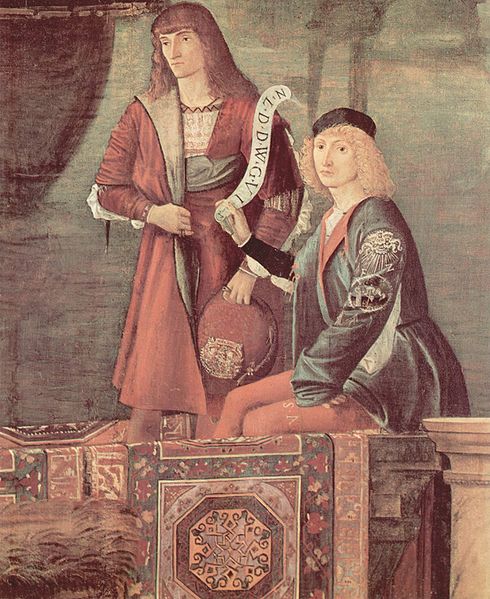
Antonio Loredan (seated on the right)

The bridges, piers and harbour-lined streets are full of people attired in the most decorative clothing.  People hang out of windows to catch a glimpse of the departure of the betrothed couple.  In the foreground sitting on the left of the central pennant and looking slightly towards us is Antonio Loredan, a member of the family who commissioned this work.  He is splendidly dressed and one can see, embroidered on his sleeve, the coat of arms of the Fratelli Zardinieri, one of the Compagnie della Calza.   In the centre-middleground on has the busy harbour and to the left we can see a large vessel lying on its side whilst the wooden planking of its hull is being re-caulked

This work of art is a hive of activity and one can spend lots of time scrutinising every facet of this large painting.  I look forward to going to Venice next month and visiting the Gallerie dell’ Accademia and standing in front of this magnificent work of art and the eight other paintings of the St Ursula cycle and absorbing all that is on display.

Lamentation of the Dead Christ by Andrea Mantegna

Lamentation of the Dead Christ by Andrea Mantegna (c.1490)

My Daily Art Display today focuses on a painting, the subject of which has many similarities to the Hans Holbein painting The Body of the Dead Christ in the Tomb by Hans Holbein, which was My Daily Art Display of the day on February 20th.  Today’s painting is entitled Lamentation of the Dead Christ and was painted by Andrea Mantegna around 1490.

Andrea Mantegna was born in Isola di Carturo a small village close to Padua which was then within the Republic of Venice.  His father, Biagio, was a carpenter.  When he was eleven years of age he started an apprenticeship with Francesco Squarcione, an Italian painter from Padua.   His school was very popular at the time and over a hundred painters passed through the school.  Padua at the time was looked upon as a great place to be if you were and aspiring artist and the likes of Uccello, Lippi and Donatello spent time in the city.  Mantegna stayed with his tutor for six years.

Mantegna’s first work of art was an altarpiece for the church of Santa Sofia in 1448.  Although he gained a great reputation as an artist and was admired by many, he left Padua and spent most of his life in Verona, Mantua and Rome where he carried on with his paintings.  In 1460 he entered the service of Ludovico Il Gonzaga the Marquis of Mantua as his court artist.  This engagement earned Mantegna a great deal of money which was a sign of the high regard in which his work was held.  Whilst employed by Gonzaga he completed many fresco paintings of the Gonzaga family.

Today’s painting of the Lamentation of the Dead Christ was completed around 1490.  It is one of very few oil on canvas paintings of the period.  It is an almost monochromatic vision of Christ.  The painting has a limited amount of tonal colouring, mainly pink, grey and golden-brown.   The setting of the painting seems to be a morgue-like and claustrophobic space with its cold dark walls.  This poorly lit space intensifies the paleness of the body. 

Feet of Chirst

The forceful image is of the body of Christ laid out on a stark and granulated marble slab.  Mantegna has toyed with the rules of perspective making the head large, whereas if the rules of perspective had been adhered to then the head would be much smaller than the feet.  There is an intense foreshortening of the body which makes it appear heavy and enlarged.   

Christ’s suffering, before death, is plain to see.  Mantegna has given us an unusual vantage point.   It places the observer at the feet of the subject and by doing so, adds to one’s sense of empathy. It could almost be described as a gruesome sight.  The face of Christ is lined.  His head of wavy hair rests upon a pink satin pillow.  The wounds seen on the back of his hands are like torn paper, as is the horizontal cut in his side made by the spear. It is almost blasphemous, as here Christ has not risen from the dead and he is like us mortals.  In the foreground are the feet of Christ each with dried puncture marks made by the crucifixion nails.  Look at the skill in which Mantegna has painted the folds of the shroud.

The Mourners


At the left we have three mourners, Mary, Saint John and perhaps slightly hidden by the other two mourners, Mary Magdalene.  Their tear-stained faces are distorted in grief.  These contorted facial features derive from the masks of classical tragedy.  One cannot help but be moved by their expressions.

Compare this painting with Holbein’s The Body of the Dead Christ in the Tomb and see which you think is the most moving.

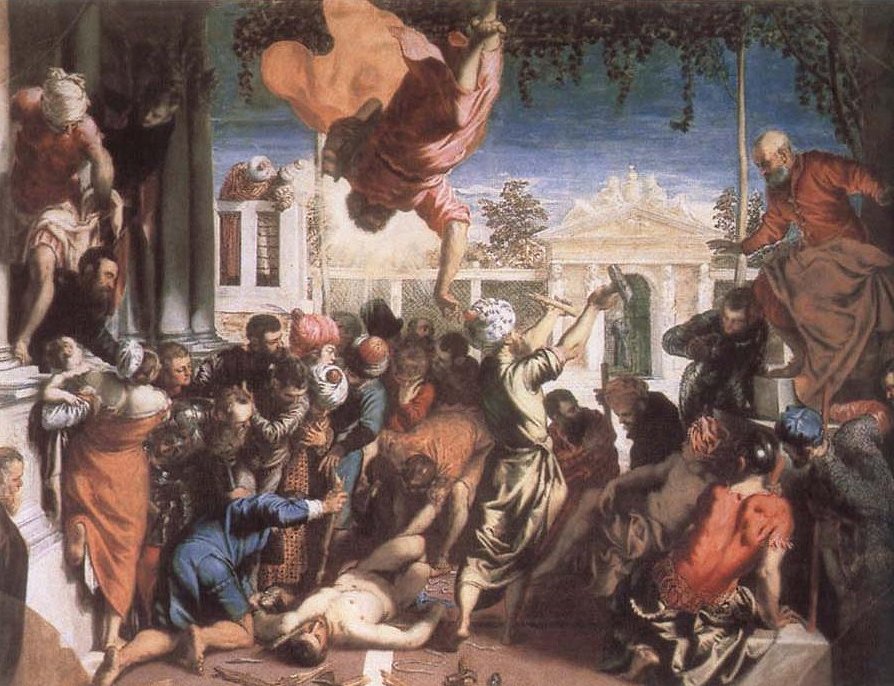
The Miracle of St Mark Freeing the Slave by Tintoretto

The Miracle of St Mark Freeing the Slave (1548)

So do you know who is Jacopo Comin ?   Have you heard of Jacopo Robusti ?  Jacopo Comin was born in Venice in 1518.  His father, Giovanni, was a weaver and dyer of cloth, who fought in the War of the League of Cambrai, which was part of the Italian Wars involving, France, the Papal States and Venice.  He put up such a stubborn and robust defence of the gates of Padua that his son, in his youth, became known as Jacopo Robusti.  However the father’s profession, dyer or tintore, gave Jacopo the name we know him by now.  Being the small son of the tintore he was given the nickname “little dyer” or Tintoretto.

Tintoretto was the eldest of twenty one children !   He was always interested in drawing and painting even from an early age.  Although he was to become, along with Bonifacio Veronese, the most successful of Venetian painters after the death of Titian, little is known of his early life although it is thought that he was at one time one of Titian’s pupils.  A lot of his artistic ability was self-taught.  His works were made to be spectacular, in size and quality to attract attention and his style was continuously imaginative.  His output of art works was prolific as he retained a large entourage of assistants. According to his contemporary and biographer, Carlo Ridolfi, the Italian artist and art historian, Tintoretto had inscribed on the wall of his workshop the motto: 

                    “The drawing of Michelangelo and the colour of Titian

These were his idols and  but his drawings were more emotive than those of Michaelangelo and he tried to synthesize the drawings of Michelangelo and the colouring of his old master Titian, but he used more sombre colours than those used by Titian.  For his phenomenal energy in painting he was termed Il Furioso.

His early works were signed “JACOBUS” followed by a drawing of a wheel, which was the symbol of the Dyers Guild, identifying himself as “Jacobus the Dyer’s son”    His first work, and My Daily Art Display painting today, was exhibited in 1548 and entitled The Miracle of St Mark Freeing the Slave.  It was this painting that launched Tintoretto’s career and made him an overnight sensation.   This enormous oil on canvas painting measures 415cms x 541cms (almost 12ft x 18ft).   He painted it at the age of thirty and it was to be the painting which made his reputation.  In this work of art we see Tintoretto’s use of foreshortening, which is a technique for creating the appearance that the object of a drawing is extending into space by shortening the lines with which that object is drawn.  He had an unusual way of coming to a decision about light and shading for his paintings.  He would create wax models and arrange them on a stage and then by training the light from spotlights on them he could see the effects the light would have on them and the shadows they would form.

This painting was one of four pictures he was commissioned to paint in the Scuola di San Marco.  The painting represents the legend of a Christian slave who was condemned by his master to have his legs broken and his eyes put out for worshipping the relics of Saint Mark, the patron saint of Venice, in defiance of his master’s wishes but was saved by the miraculous intervention of the saint who shattered the bone-breaking and blinding implements which were about to be used on the slave.  The naked slave lies face up in a stone courtyard, his torso twisted and his face turned toward the viewer.  His “owner” the slave’s master, dressed in black can be seen leaning into the center from a balcony on the left side of the canvas.   Saint Mark appears high up in the centre of the painting winging down from heaven to save the slave signifying that the latter should not be punished for his faithfulness.  His sharply foreshortened figure is shown in swirling orange and pink robes.  Surrounding the main characters are a myriad of people above and to the sides, more than twenty five in all,  pages, maids, servants etc. Those on the right hand side lean back as they look on whilst those on the left lean in to get a better view of the impending torture and killing.    The artist’s positioning of the figures around the slave and their disposition draws the eye of the observer to what they are all looking at – the slave and his miraculous rescue.  The way in which Tintoretto has depicted the varied reactions of these on-lookers is compelling.  His use of light and shadow add to the mood and aura.  But the most striking is the image of Saint Mark as the divine saviour as he descends.  

It is difficult to summarize the painting.  I believe it to be, in some ways, unsettling but thought-provoking.  Tintoretto’s use of “arrested motion” of the groups of onlookers adds to the aura of the painting.  The omission of a landscape makes us concentrate on the main scene.  The atmosphere of the painting is characterized by sudden and strong contrasts of light and shade.