
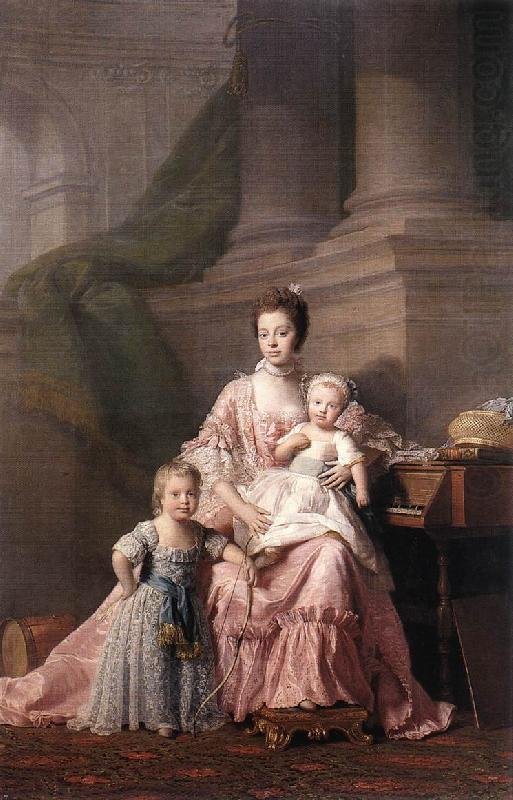
Queen Charlotte with her Two Eldest Sons by Allan Ramsay

Queen Charlotte with her Two Eldest Sons by Allan Ramsey (c.1764)

Britain is very fortunate to have so many art galleries.  Although if one lives in London I suppose one has the cream of the crop but dotted throughout the land there are some excellent art establishments.  One of the richest collection of art works is owned by the monarch and is held in trust for her successors and the nation.   There are more than 7000 paintings within the Royal Collection as well as thousands of watercolours, prints and drawings.  The collection is not held in just one place, Buckingham Palace, but is spread around the royal residences, such as Windsor Castle, Palace of Holyroodhouse in Edinburgh, Balmoral Castle, Hampton Court and Sandringham House.   The total collection is estimated to be worth around ten billion pounds.  My Daily Art Display today features a painting from the Royal Collection which hangs in Buckingham Palace.  It is entitled Queen Charlotte and her Two Eldest Sons by the Scottish portrait painter Allan Ramsay, which he completed around 1764.

Allan Ramsay was born in Edinburgh in 1713.  He was the eldest son of Allan Ramsay who was a poet and writer.  After completing his schooling in Scotland he moved to London when he was twenty years of age and studied art under the tutelage of Hans Hysing, the Swedish portrait painter and later was a student at the St Martin’s Lane Academy, which was the precursor to the present day Royal Academy.  In 1736, aged twenty-three he travelled to Rome and Naples to further his art education and he remained for almost three years.  On returning to Britain he went to Scotland and settled down in Edinburgh.

In 1739 he married his first wife, Anne Bayne, and the couple had three children but none survived childhood and his wife died during the birth of their third child in 1743.    Allan Ramsay supplemented his income from his paintings by teaching art and one of his pupils was Margaret Lindsay the eldest daughter of the nobleman Sir Alexander Lindsay of Evelick.  As a humble artist her parents frowned on their liaison outside of art tuition and knowing that, the couple eloped and were married in secret.  Her parents never forgave her for marrying lower than her station.  Allan Ramsey, in an attempt to ease their minds about how he would care for their daughter and that he had married their daughter for love and not for their money, wrote to them explaining that although he had to support his daughter from his first marriage along with his two sisters, he was well placed financially to look after their daughter.  Her parents were unmoved by his words.  The couple lived a happy life and went on to have two daughters and a son.

The devoted couple spent three years in Italy from 1754 to 1757, where they both spent time painting and copying old Masters and whilst there they would earn an income by painting portraits of the wealthy aristocratic travelers who were doing the Grand Tour of Europe.  They returned to Britain and went to live in London and in 1761, Allan Ramsey was appointed Principal Painter in Ordinary to George III.   The title of Principal Painter in Ordinary to the King or Queen of England was awarded to a number of artists, nearly all of whom were portraitists.  It was in this role that he completed many paintings of the royal couple and their children.  .

 So before us we have Queen Charlotte and two of her children but who was Charlotte and where did she come from?  Sophia Charlotte was born in 1744 and was the youngest daughter of Duke Charles Louis Frederick of Mecklenburg-Strelitz and his wife Princess Elizabeth Albertine of Saxe-Hildburghausen.  When King George III came to the throne it was decided that he should seek to marry someone of royal descent who would be use to life at court but would also have to be somebody who would be popular with the people of Britain.  Many of the ladies that George would have liked to have married were deemed, much to the monarch’s annoyance, unsuitable and inappropriate and he had to reluctantly agree to “look elsewhere” !    Eventually a royal match was made, when David Graeme, a British soldier, diplomat and courtier, who had visited many of the royal courts of Europe, reported back to the British that he had found an ideal marriage partner for George.   She was Princess Sophia Charlotte.

In 1761, when she seventeen years old, she married George III of England and at that young age became the queen consort of  the United Kingdom. With the marriage came stipulations which she had to agree to.  Firstly, she must become an Anglican and secondly, she had to promise not to become involved in the politics of the country.  George III bought Buckingham House in 1761 for his wife Queen Charlotte and it was here that fourteen of the fifteen children of theirs were born.  Charlotte was an extremely intelligent woman.     From her letters we can see that she was well read and loved the fine arts. The Queen was very musical and is known to have been taught music by Johann Christian Bach.   Wolfgang Amadeus Mozart, at aged eight, dedicated his Opus 3 piece to the Queen at her request.  She had a love of plants and trees and helped to establish Kew Gardens.       The Christmas tree was introduced to England by the Queen who had the first one in her house, in 1800.  The royal couple were very much in love with one another but sometimes for the young girl, suddenly having to take on the responsibility of queen consort, was trying but she always took her duties seriously.   In a letter to her younger brother, she wrote:

“…I find that the solitary and retiring life which I lead is not made for me. Having admitted this I assure you I shall not ignore my duty…”

My Daily Art Display today features one of Ramsay’s paintings of Queen Charlotte and her two eldest sons, George, who was Prince of Wales and was later to become George IV and Frederick, Duke of York.  As we have seen in other paintings despite the two children being male they were dressed in, what today, we would term girl’s clothing.  The elder son, George, stands with his bow in his hand and in the left side of the picture, we can see his drum.  These accoutrements have been added by the artist to symbolise George’s future soldierly spirit.  His mother Charlotte has her foot on a foot-stool and leans against a piano.  On the piano we have a sewing box and a copy of John Locke’s book Some Thoughts concerning Education.  At the time, this book, a treatise on education,  was considered the most important philosophical work on education in England and it was translated into almost all of the major written European languages during the eighteenth century.  The setting of this painting and the items depicted in it all add up to a compassionate relationship between a mother and her children and illustrate how she spent time with them whilst they were at play and how important family life was to them.

It is a lovely portrait of a mother and her children.  It is full of compassion and the smiles on their faces have put across the impression of happiness and fulfillment.

Springtime in Eskdale by James McIntosh Patrick

Springtime in Eskdale by James McIntosh Patrick (1934)

My Daily Art Display for today features another painting by a twentieth century British artist.  Today’s painting entitled Springtime in Eskdale was painted by the Scottish landscape artist and etcher James McIntosh Patrick in 1934.

James McIntosh Patrick was born in Dundee in 1907.  His father, an architect, encouraged his son’s interest in art and when he was 17 had him enrol as a second-year student at the Glasgow School of Art.   Later in 1926, he and one of his teachers, Maurice Grieffenhagen, had a three month summer vacation in the South of France working on paintings of the local landscape.  After he completed his studies he started off his working life as an etcher but in the 1930’s the demand for this type of work dwindled and Patrick began to concentrate on watercolour and oil painting.  The art genre he loved was that of landscape painting.   At the beginning, he would go out into the countryside make many sketches and bring them back to his studio and use them to complete his oil or watercolour painting.  It was not until later on that he perfected his style and technique in en plein air painting.  He believed this to be the best way to paint landscapes saying that it encouraged people to appreciate nature itself as they sat and painted. He was once quoted as saying:

“…I don’t suppose there is much sentimentality about my paintings, but I have a deep feeling that Nature is immensely dignified when you are out of doors.  I am struck by the dignity of everything…”

 “…..As I got to know the countryside better and better, I came to realise that rhythmic ideas are inside you and so you go around looking for landscapes where the countryside fits a preconceived idea that you have inside you and which you recognise when you see it. In other words, a twisted bit of wood, a wall or a gate, immediately causes you to say; ah, that’s the bit I am looking for… It is much easier to make up a picture than to paint nature as it appears before us…”

 He had many of his paintings shown at the Royal Academy.  The outbreak of the Second World War and his call-up into the Army Camouflage Corps curtailed his painting career for five years but when it ended he returned with his wife and family to his house in Dundee, which he had purchased before the start of war.  Their house overlooked the River Tay and it was at this time that he started experimenting with outdoor landscape painting.  His paintings were of the traditional variety in as much as “what you got is what you see” as he had no time for the “contemporary” interpretations of landscapes.  He taught art up until his eighties and continued painting up until his last few years when his eyesight began to fail.  His love for his native county of Angus was well documented in all his paintings of that area.  His depiction of the scenic countryside was shown in all types of weather conditions and at different times of the year.

Art historians rank James McIntosh Patrick as one of the greatest painters Scotland produced in the twentieth century and his artistic brilliance was a match for most of Europe’s best landscape painters of the twentieth century.  He died in Dundee, the town where he was born, in 1998, aged 91.

Today’s featured painting, Springtime in Eskdale, is a detailed landscape painting of The Crooks in Eskdalemuir, Dumfriesshire which was the birthplace of the famous civil engineer and architect Thomas Telford.  This painting by Patrick was completed in 1934 and was to mark the centenary of Telford’s death.  In the middle ground we can see people visiting a cottage whilst further back we can just make out a farmer ploughing his land.  Further back we see a small river at the foot of a line of hills, which rise into the background.  The artist’s view of the scene is from a somewhat elevated position looking down at the farmland.

I love the stone wall divisions we see in the painting.  Although I am not familiar with the location of the painting, it does remind me so much of the countryside landscape of Yorkshire with its multi coloured patchwork-quilt fields separated by dry-stone walls.  We are not looking solely at the element of Nature but we are seeing the man-made design element of stone walls, a cottage with its out-buildings and the ploughed field and how the two elements blend so perfectly.  The choice of season for the setting of this painting could well have come from the print publisher, Harold Dickens, who had seen the success of Patrick’s earlier work entitled Winter in Angus, which was in the Royal Academy exhibition of 1935  and Autumn Kinnorby and Midsummer in East Fife.

The inclusion of a road in the foreground encourages us to follow it with our eyes and thus explore the middle and background.  One of the most well-defined aspects of the painting is the way he has painted the trees.  He was a great believer that they were one of nature’s greatest gifts to mankind and he would put a lot of effort into their depiction in order for us to be more appreciative of what Mother Nature has bestowed upon us.  This painting was a result of many sketches he had made of the area and in some ways was a “slightly idealised” view of the landscape produced partly from his sketches and partly from what he could remember about the area.

Pegwell Bay, Kent – a Recollection of October 5th 1858 by William Dyce

Pegwell Bay, A Recollection of October 5th 1858 by William Dyce

My Daily Art Display for today is entitled Pegwell Bay, Kent – a Recollection of October 5th 1858,  by the distinguished Scottish artist, William Dyce.   This painting, which he completed four years before his death, is often considered to be his greatest work of art.   The title of the painting itself is unusual but the specific date must have stuck in the mind of the artist, probably for astronomical reasons which I will talk about later.  This is a lovely painting and for me it brings back many happy childhood memories of my early years when my mother would whisk me away to the seaside for a week each summer and I would be content (or as content as a pre-teenage child can be) to simply potter about the rock pools with my bucket, spade and net.

William Dyce was born in Aberdeen in 1806.  He trained as a doctor before reading for the church.  However at the age of nineteen he decided to become an artist and studied at the Royal Academy in London.  In his twenties, he travelled to Rome.  Here he studied the works of the “Masters” such as Titian, Rembrandt and Poussin and became interested in the Nazarene Movement when he met one of the movements leading artists, Friedrich Overbeck.  The Nazarene Movement was a group of early 19th century German Romantic painters who aimed to revive honesty and spirituality in Christian art. The name Nazarene came from a term of derision used against them for their affectation of a biblical manner of clothing and hair style.

After his travels in Europe he returned home and was put in charge of the School of Design in Edinburgh.  At this time he was considered to be the city’s finest portraitist.  Later in 1838, he moved to London where he headed up the Government School of Design which in 1896 became known as the Royal College of Art.  Dyce left the school in 1843 to give himself time to concentrate on his own painting

The intricate painting today is a beautifully detailed seaside landscape of Pegwell Bay in Kent.  It resulted from a trip he and his family made in late 1858 to the well-liked holiday resort, which is close to the small Kent seaport of Ramsgate.  For a seaside painting it is interesting to note the lack of people on the beach but as this was in October, the cold weather probably kept people, other than these hardy folk, away from the shingle beach and cold sea breezes.  In the picture we see the artist himself in the extreme right middle-ground staring up at the cliffs.  Near to him we can just make out a man with his group of donkeys which were used to give children rides along the shore.  One of Dyce’s interests was geology and we presume he was taking great interest in the flint-encrusted strata and eroded faces of the chalk cliffs.  See how Dyce has meticulously recorded the detail of the rock formation of the cliffs.

Collecting fossils

Seemingly uninterested in geology, his wife, her two sisters and his son, wrapped up against the elements in the late autumn afternoon, amuse themselves searching for fossils in the foreground of the painting.  Pegwell Bay was famous for fossil hunting.  The sun was beginning to disappear and the temperature was dropping. 

Another of Dyce’s interest was astronomy and in this painting, albeit hard to detect in the late afternoon sky, there is the barely visible trail of Donati’s Comet streaking across the sky.  This comet was nearest the Earth around the time of this painting.

In some aspects this is not a seaside holiday painting of fun and happiness with people enjoying the sunshine and blue sea.  There is poignancy to this painting.  I need to know why everybody looks somewhat miserable as they hunt for their fossils.  Maybe it was the cold, as we can see them all well wrapped up in warm clothes.  It is as if they have been told “off you go, enjoy yourselves” and yet things were conspiring against them.  This is a somewhat downbeat painting.    The artist has used subdued colours in the depiction of the landscape which in a way makes the colour of the clothing worn by his family stand out more.

To Pastures New by Sir James Guthrie (1882)

To Pastures New by Sir James Guthrie (1882)

Today’s work of art is by a Scottish painter, Sir James Guthrie, who was a founder member of the “Glasgow Boys”.   The Glasgow Boys identified themselves as young artists by claiming vociferously to be anti-establishment rejecting the older generation of artists, whom they called “Glue-Pots”.  This group of young artists formed in the 1880’s and were extremely popular between the 1890’s and 1910.  The Glasgow Boys consisted of several men, most of whom were trained in, or had strong ties to the city of Glasgow.  However, although enjoying being looked upon as being one of this rebellious group of artists, Guthrie exhibited his first major picture at the Royal Academy in London and within twenty years of painting, became the president of the Royal Academy which was the pinnacle of the “Establishment”.  In 1921 he was knighted.  So despite the bravado of their anti-establishment stance in their early days, many of the Glasgow Boys became very rich painting, as one art reviewer put it, “fat gentlemen in civic robes”.

Today’s painting by James Guthrie, aged 23 at the time, is an oil on canvas painting entitled To Pastures New, completed in 1882, and is of a goose girl driving her charges to pastures new.  The girl, who is about eight years of age, wearing, what look like, borrowed boots, which appear too large for her, wears a drab dress and a bright straw hat.  She, like a giant, marches into the picture shepherding her entrusted animals before her, all of whom fill the canvas with the background landscape taking only a secondary role in the composition.