The Mirror of Venus by Sir Edward Burne-Jones

Mirror of Venus by Edward Burne-Jones (1898)

 The featured artist in My Daily Art Display today is the English painter Sir Edward Coley Burne-Jones.  He had close connections with the later phase of the  Pre-Raphelite movement and had close links with the textile designer and artist William Morris.  Burne-Jones was born in Birmingham.  His father, Edward, was Welsh and worked as a frame-maker.  His mother, Elizabeth sadly died   just six days after giving birth to Edward, who from then on was brought up by his father and the family housekeeper.

From the age of eleven Burne-Jones attended the King Edward VI Grammer school in Birmingham and at the age of fifteen transferred to the Birmingham School of Art.  In 1852, aged 19, he attended Exeter College, Oxford where he studied theology and it was here that through his love of poetry he first met William Morris, a similar devotee to the written word.  These two poetry-lovers along with some of their friends formed a close and intimate society which they called The Brotherhood.  In 1856 Burne-Jones founded the Oxford and Cambridge Magazine.  It was at that time that Morris and Burne-Jones decided to seek outside contributions to their magazine and approached the poet and artist Dante Gabriel Rossetti.  The ensuing meetings between Burne-Jones and Rossetti was to change the former’s life forever, for he had set his heart on becoming a church minister but Rossetti persuaded him, and William Morris, to become artists.  Soon afterwards Burne-Jones put university life behind him and began a new life as an artist.  It was not just that Rossetti had inspired the two university students, but both Morris and Burne-Jones had made an impact on Rossetti himself, for some time after their first meeting Rossetti told his friend the poet and artist, William Bell Scott, about the encounter, writing:

“…Two young men, projectors of the Oxford and Cambridge Magazine, have recently come up to town from Oxford, and are now very intimate friends of mine. Their names are Morris and Jones. They have turned artists instead of taking up any other career to which the university generally leads, and both are men of real genius. Jones’s designs are marvels of finish and imaginative detail, unequalled by anything unless perhaps Albrecht Dürer’s finest works…”

In his early days as an artist Burne-Jones was heavily influenced by the works of Rossetti and it was not until he travelled to Italy with John Ruskin that his style changed and he became his own man.  In 1877 he was persuaded by a group of his friends to submit some of his oil paintings at the opening show of the Grosvenor Gallery, a newly established venue which was a rival to the well-established Royal Accademy.  Over the early years the gallery, founded by Sir Coutts Lindsay, was to become vital to the Aesthetic Movement for it gave them an opportunity to showcase their works, the like of which was often scorned and rejected by the conservative Royal Academy.  One of those paintings put forward by Burne-Jones is my featured painting of the day, entitled The Mirror of Venus.  The exhibition was highly acclaimed and his career as an artist took off.

There followed an honorary degree from Oxford in 1881 and the following year he was made an Honorary Fellow.  In 1893 Prime Minister Gladstone was instrumental in him being created a baronet.  On his death five years later, the Prince of Wales intervened and insisted that the death of Sir Edward Coley Burne-Jones should be honoured with a memorial service at Westminster Abbey.  This was an outstanding honour as he was the first artist to be recognised in such a way.

This painting is a mix of the traditions of Pre-Raphaelitism and Italian Renaissance culminating in a new aesthetic style.  We see in front of us ten women peering at their own reflections in a small pool of water.  The landscape is quite barren almost like that of a lunar landscape.   Burne-Jones often used this type of background and of course his reasoning may have been that it does not detract from the scene in the foreground.  In fact it is a complete contrast.  By the title of the painting we are to believe that the elegant young woman standing is in fact Venus and the other nine females are her handmaidens.  The bright colour of their dresses and their dream-like mood is consistent with Pre-Raphaelite paintings but the grace and style of the figures themselves leans towards the Italian Renaissance style and especially that of Sandro Botticelli, whose work had always inspired Burne-Jones.

There is no background story to this painting.  This is not part of a tale from Greek or Roman mythology.  There is nothing in the painting which needs to be interpreted.  There is no hidden symbolism to discover.  What you see is what you get, and what you get is a group of beautiful young ladies sumptuously dressed in clothes of varying colours.    The women look rather wistful and do not seem particularly happy as they stare down at their own reflections.  I wonder what is going through their minds.  I wonder what is causing them to be anxious.  Maybe my inquisitiveness is just what the artist wants.  Maybe he wants me to decide what the painting is all about.  The painting, to my mind,  has a romantic element to it.  There is a definite sense of beauty to the painting , similar to that which we see with most Pre-Raphaelite works.

On painting in general,  Burnes-Jones said:

“…. I mean by a picture a beautiful romantic dream of something that never was, never will be – in light better than any light that ever shone – in a land no-one can define, or remember, only desire….”

It is a painting I would love to hang on my wall.

Dante and Beatrice by Henry Holiday

Dante and Beatrice by Henry Holiday (1884)

My Daily Art Display painting of the day is Dante and Beatrice by the English painter Henry Holiday who was born in London in 1839.  Holiday was a landscape painter as well as a stained glass designer, sculptor and illustrator.  At his death he was described as “the last Pre-Raphaelite.

The painting, completed in 1884, was considered to be one Henry Holiday’s most important painting.  The theme of the painting is based on the medieval poet Dante Alighieri’s work La Vita Nuova.   Dante concealed his love for Beatrice by pretending to be attracted by other women. The scene depicted in the painting is that of Beatrice refusing to greet Dante because of the gossip that had reached her. Beatrice is the woman dressed in white and she was modelled by Eleanor Butcher. The woman next to Beatrice is Monna Vanna, a companion of Beatrice and the mistress of Dante’s friend Guido Cavalcanti. Monna Vanna was modelled by Milly Hughes.  Whilst Beatrice looks stern and statuesque ignoring the presence of Dante, Monna Vanna, in contrast, looks back at Dante so as to judge his reaction to Beatrice’s behaviour.

Holiday paid much attention to detail, so much so, he visited Florence in order to carry out research for the painting and describes what his findings were in a letter:

“…..I wanted to get on the spot and see the general lie of the lines – the perspective in fact, of the buildings and still more the sense of colour, and as far as possible to collect such fragments, as remain of buildings of Dante’s time, so as to be able to alter the details to the character of the period… . “

He set the scene of the painting at the Ponte Santa Trinita, looking towards the Ponte Vecchio under which flows the River Arno.

Echo and Narcissus by John William Waterhouse

Echo and Narcissus by John William Waterhouse (1903)

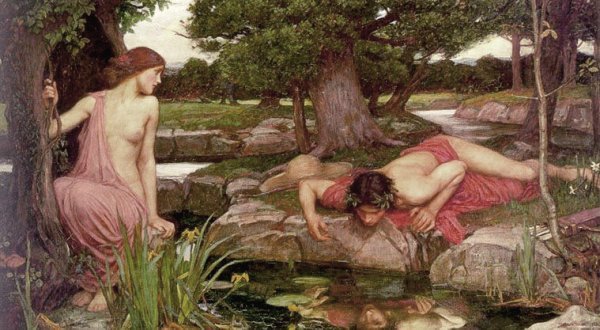
The story of Echo and Narcissus comes from Greek Mythology and tells the tale of Echo, a wood nymph’s love for a beautiful youth, Narcissus.  Sadly for Echo although many loved Narcissus, who enjoyed the attention, praise and envy, he, on the other hand, loved nobody considering all his “worshippers” to be unworthy of him.  After Echo had died of a broken heart, Narcissus continued to attract many nymphs all of whom he briefly entertained before scorning and refusing them.  The Gods were angered by his behaviour and cursed him and made it so there was only one whom he would love, someone who was not real and could never love him back.

One day whilst walking through the woods, Narcissus came upon a pool of water.  He looked in it and caught a glimpse of what he thought was a beautiful water spirit but in fact was his own reflection.  He bent to kiss the image which mimicked his actions.  He reached into the pool to touch the spirit but of course the image was destroyed.  When the water settled the image reappeared only to be destroyed again every time he touched the water’s surface.   Narcissus could only lay by the pool gazing in to the eyes of his beloved vision.

My Daily Art Display painting today is entitled Echo and Narcissus and is by the English pre-Raphelite painter John William Waterhouse.  The painting which can be found in the Walker Art Gallery, Liverpool was painted in 1903 and shows the unhappy Narcissus gazing at his own reflection in the pool whilst the unhappy rejected nymph Echo looks on.  Waterhouse was of a younger generation of pre-Raphaelites than Dante Rossetti and his subjects of doomed and unhappy love were prettier, less disturbing and more widely popular than theirs.

Have you a favourite painting which you would like to see on My Daily Art Display?  

If so, let me know and tell me why it is a favourite of yours and I will include it in a future offering.

Dante’s Dream at the Time of the Death of Beatrice by Rossetti

Dante's Dream at the Time of the Death of Beatrice by Dante Gabriel Rossetti (1871)

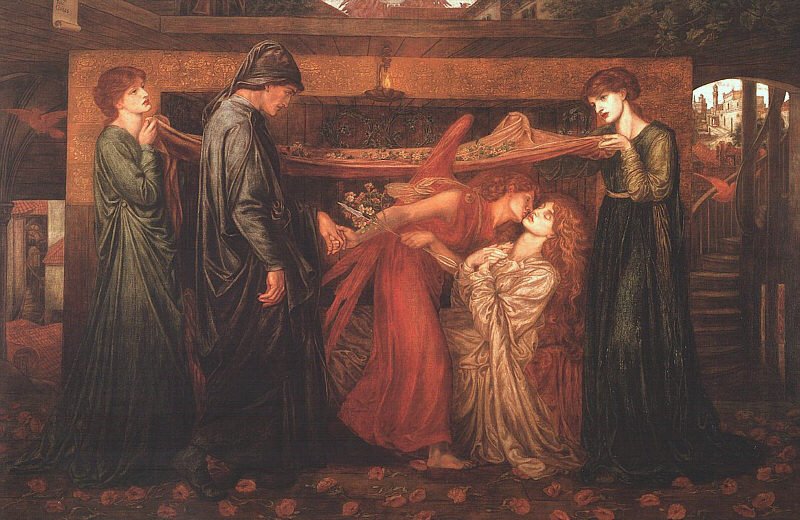
The poet and painter Dante Gabriel Rossetti was born in London in 1828.   His father was an exiled Italian patriot and Dante scholar.  Torn between a lifetime concentrating on his poetry or a lifetime as a painter, he decided that painting was his first love although he never gave up his love of writing poetry.  In 1848 he co-founded the Pre-Raphaelite Brotherhood with William Holman Hunt and John Everett Millais.  Maybe, because of his father, Dante Rossetti had a life-long interest in the Italian poet Dante Alighieri and today’s picture offering is Dante’s Dream at the Time of the Death of Beatrice which he painted in 1871 and which now hangs in the Walker Art Gallery in Liverpool.

The painting represents an episode from the Dante Alighieri poem La Vita Nuova (The New Life), a work made up of both verse and prose.  In this poem Dante Alighieri dreams that he is led by love to the death-bed of Beatrice Portinari, who was the object of his unfulfilled love.

This is Rossetti’s largest painting and with it he creates a visionary world using soft rich colours and complex symbols.  The two female attendants wear green, which is symbolic of hope.   The spring blossom held by the angel in red, who holds Dante’s hand, represents purity and the poppies strewn on the floor symbolise the sleep of dreams and death.   The model for Beatrice was Jane Morris, the wife of William Morris, whom Dante Rossetti had a long-term affair.  William Morris was an English textile designer, artist, and writer associated with the Pre-Raphaelite Brotherhood.

Dante Gabriel Rossetti abandoned Arthurian and Tennysonian subjects in his later works and concentrated on the subject closest to his heart – women.  He was a love poet and a love painter and there has been no greater worshipper of female beauty in English painting.

Have you a favourite painting which you would like to see on My Daily Art Display?  

If so, let me know and tell me why it is a favourite of yours and I will include it in a future offering.

Our English Coast by William Holman Hunt (1852)

Our English Coast by William Holman Hunt (1852)

William Holman Hunt was born in London in 1827.  He started off his working life as a clerk but moved away from the life of commerce and studied at the British Museum and National Gallery.  He, along with Dante Rossetti and John Millais, all members of the Royal Academy, formed the Pre-Raphelite Movement in 1848.  This newly formed group sort to reform art by emphasising the detailed observation of the natural world in a spirit of quasi-religious devotion to the truth.  They took on board the spiritual qualities of medieval art in opposition to the rationalism of the Renaissance personified by the likes of Raphael.  In 1854 Hunt went to the Holy Land to portray scenes from the life of Christ, aiming to achieve total historical and archaeological truth. He returned to Palestine in 1869 and again in 1873.   Hunt died in London in 1910, aged 83.

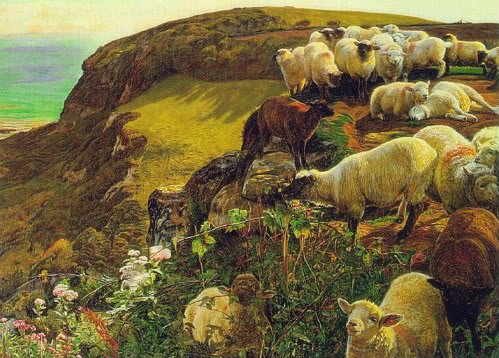
Today’s painting is Our English Coasts which Hunt painted in 1852 and was commissioned by Charles Maud.  This painting, which featured sheep, followed an earlier painting  of his which featured sheep in the background and was very well received, The Hireling Shepherds .  Hunt used the cliffs of Fairlight, east of Hastings, as the background for this work.  As with a lot of Pre-Raphelite work, there is an element of symbolism in their paintings.  Art historians believe that the use of the cliffs at Hastings, overlooking the English Channel, symbolised the fear of a possible French invasion of England.  The brilliance of the colours Hunt used made it the most remarkable of Hunt’s landscapes.

The painting can be found in the Tate Britain gallery, London.