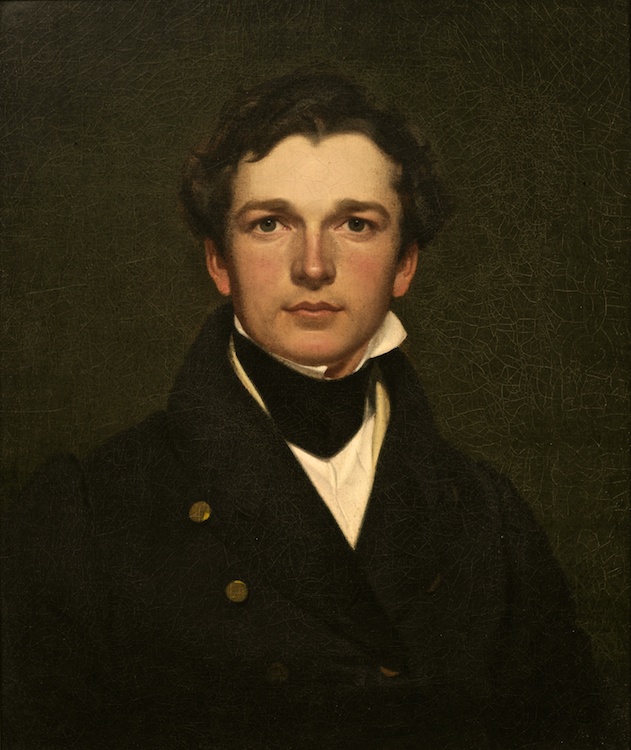
William Sidney Mount. Part 2 – The Portraitist, and some of his early historical works
Self portrait by William S Mount (1832)

In my last blog I looked at the early life of William Sidney Mount, hailed as the first American genre artist.  I looked at his love for music and how he depicted song and dance in his paintings.  Today I want to carry on with his life story and take a look at his early works and his portraiture.

 William had been working for his brother, Henry Smith Mount, at his sign writing business in Setauket and enjoyed it.  At first he found the work interesting and challenging but later found the painting of signs somewhat restrictive.  He gave up working for his brother and moved to New York to live with his uncle Micah Hawkins, who operated a tavern and grocery store in New York City.  His uncle was also a composer, playwright, and poet.  Micah combined music and storytelling into his theatrical productions which often delved into what was happening in politics and much of these ideas were to influence his nephew and his paintings.

  It was also around this time that William Mount visited his first art gallery, the American Academy in New York and in 1826 he enrolled at the newly opened National Academy of Design, an artistic establishment founded by a number of young painters such as Asher Durand, Thomas Cole, and Samuel Morse.  In those early years William Mount’s art was all about portraits and historical scenes.  William remained at the Academy for a year before returning home.

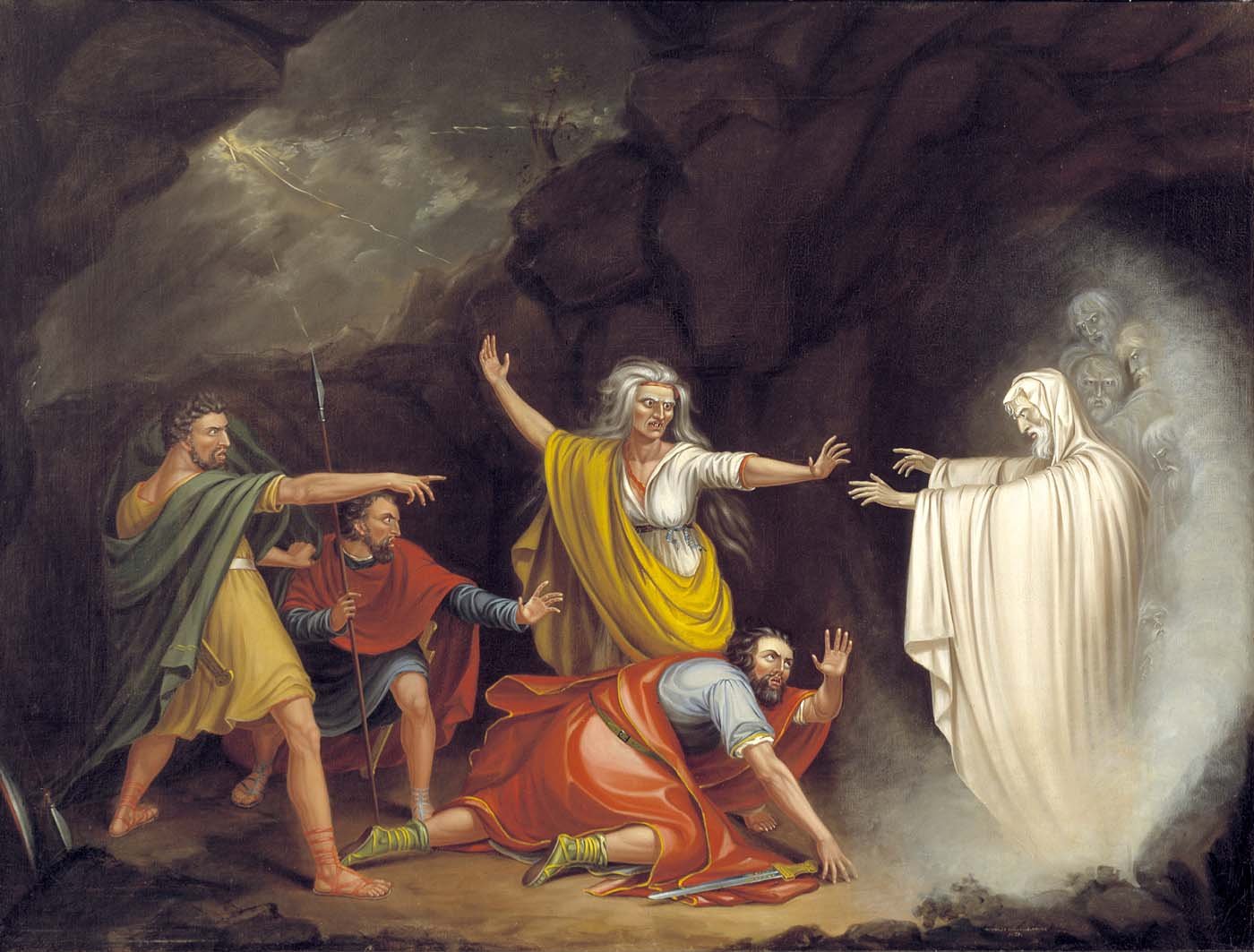
Saul and the Witch of Endor by William S. Mount (1828)

One of his early works was entitled Saul and the Witch of Endor, which he completed in 1828 and can now be found in the Smithsonian American Art Museum in Washington.   The painting depicts a passage from the Old Testament book of Samuel which tells of Saul and his battle with the Philistines.

 “… The Philistines assembled and came and set up camp at Shunem, while Saul gathered all Israel and set up camp at Gilboa. When Saul saw the Philistine army, he was afraid; terror filled his heart.  He inquired of the Lord, but the Lord did not answer him by dreams or Urim or prophets.  Saul then said to his attendants, “Find me a woman who is a medium, so I may go and inquire of her.

‘There is one in Endor,’ they said…”

 Saul seeks help from the oracle from Endor prior to him going into battle with the Philistines.  She summons the spirit of the prophet Samuel so that Saul could ask for his guidance.  In the painting we see Saul and his three companions cower in fear as the ghostly apparition approaches them.

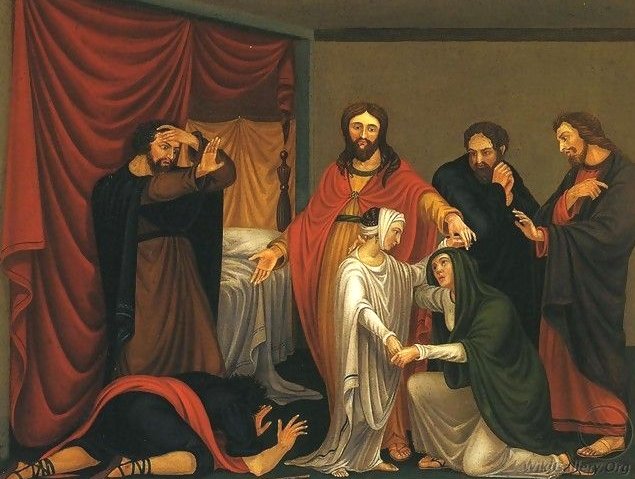
Christ Raising the Daughter of Jairus by William S Mount (1828)

In that same year he produced another biblical work based on Matthew’s Gospel (Matthew 9:23-26).  It was entitled Raising of Jairus’ Daughter.  The subject of this biblical work had been depicted many times before by great artists such as Veronese.  The bible relates the story:

“…When Jesus entered the synagogue leader’s house and saw the noisy crowd and people playing pipes, he said, “Go away. The girl is not dead but asleep.” But they laughed at him   After the crowd had been put outside, he went in and took the girl by the hand, and she got up.   News of this spread through all that region…”

William’s brother Henry was so impressed with the finished painting that he persuaded his brother to submit it at the annual National Academy exhibition.  It was well praised by the Academy professors.  William was now living at his brother’s place on Nassau Street, Lower Manhatten and had a studio in the attic.  He enjoyed painting historical and biblical works but the sales of which were not bringing in enough money so he reverted to portraiture which was always a guaranteed way of raising income.

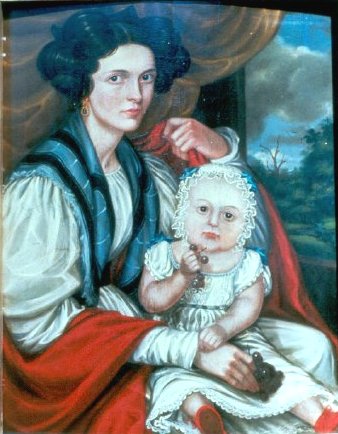
Ruth Hawkins Mount Seabury and Son Charles Edward by William S Mount (1828)

One of his early works of portraiture was a family portrait entitled Ruth Hawkins Mount Seabury and Son Charles Edward,  which he completed in 1828.  It depicts his nineteen year old sister Ruth Hawkins Mount and her infant son Charles Edward Seabury, the first of her seven children.

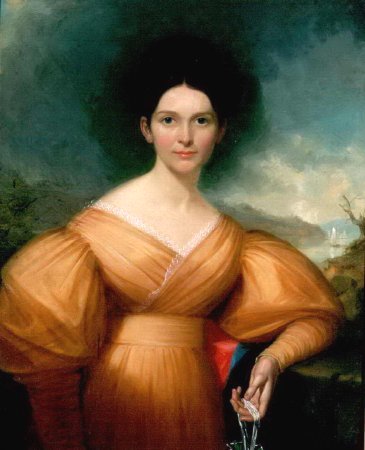
Ruth Mount Seabury by William S Mount (1831)

William Mount completed a portrait of his sister, Ruth in 1831.

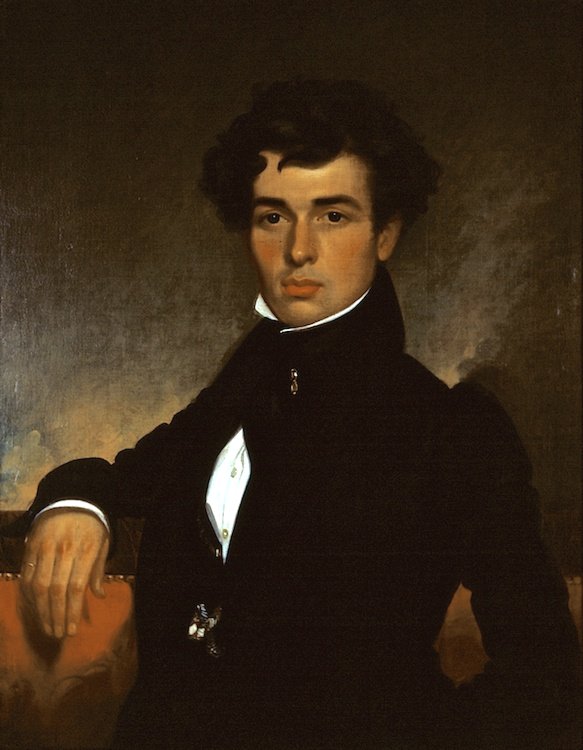
I suppose if you are looking for people to sit for you for a portrait, you turn firstly to your family and in 1828 he completed a portrait of his eldest brother, and his former employer, Henry Smith Mount.

Portrait of Henry Smith Mount by William S Mount (1831)

Three years later, in 1831, Henry Smith Mount was the subject of another of his younger brother’s portraits.  This portrait of his eldest brother (by five years) is a masterful portrait.  He has depicted his brother as a man of great self-confidence, a man who comes across as a thoughtful academic and yet, a man who by his facial expression, seems stern and somewhat menacing, as he stares out at us, lost in his own thoughts.

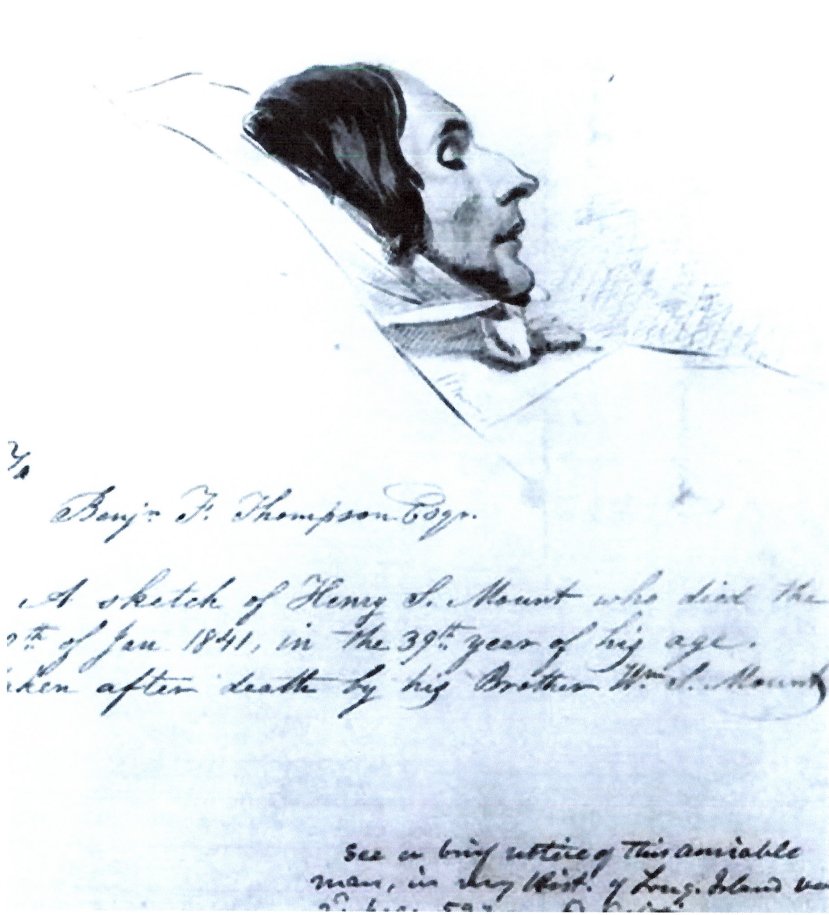
Henry Smith Mount on his deathbed by William S Mount (1841)

Thirteen years on he completed another depiction of his brother, Henry.  The circumstances surrounding this watercolour were much sadder as this was completed in January 1841 and the setting was Henry’s deathbed.  Henry was just thirty nine years of age.

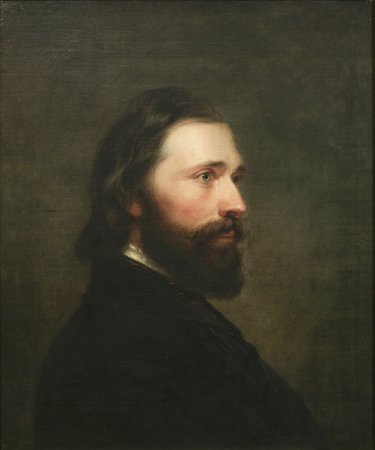
Shepherd Alonzo Mount by William S Mount (1847)

In 1847 William Mount painted a portrait of his other brother, Shepherd Alonzo Mount.

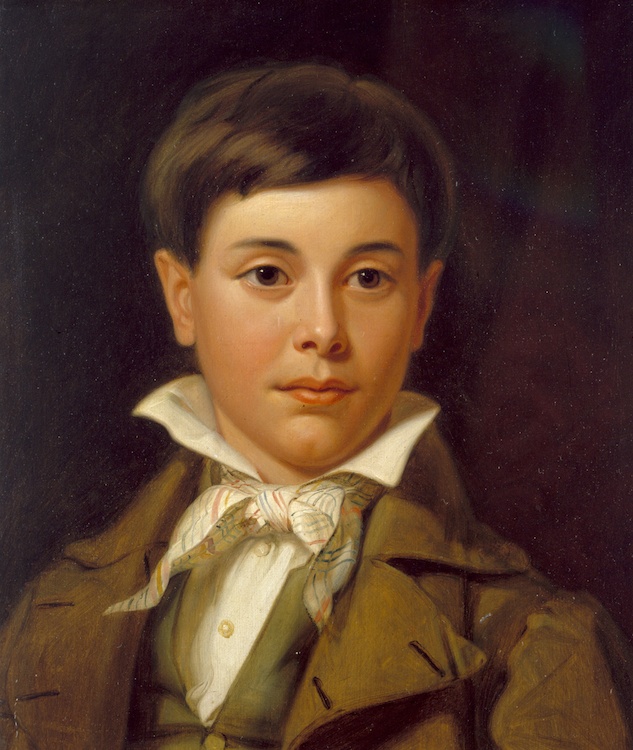
Portrait of Jedediah Williamson by William S Mount (c. 1837)

The next example of William Mount’s portraiture is one he completed in 1837 and was entitled Portrait of Jedediah Williamson.  It is a depiction of a ten year old boy commissioned by his family.  It is a full frontal depiction of the young lad and Mount has carefully and with great skill portrayed the boy’s facial features.  It is a very peaceful depiction of the boy as he looks out into the distance.  The family would have been very pleased to have received the work from Mount and it is recorded that they paid him fifteen dollars for the painting.  However there is a sad twist to this portrayal as this is a “mourning painting” or as Mount referred to them, “a painting after death”.  The boy had died and this portrait was in honour of him and may have given the family a modicum of comfort during the sadness of their great loss.  These “mourning paintings” were very popular at the time and artists found they could achieve a steady income from paintings which, for relatives, served as a reminder of a loved one who had passed away. One should remember that between 1861 and 1865 over 350,000 Americans died during the American Civil War, the families of many just had an artist’s painting to remind them of their lost son or daughter.

Portrait of Reuben Merrill by William S Mount (1832)

Another interesting portrait by William Mount was one entitled Portrait of Reuben Merrill.  It was one of Mount’s early works which he completed in 1832.  The question, which is yet to be resolved, is who is Reuben?  Some believe he was a gardener whilst others say he was a simple field worker on the farm owned by William’s sister, Ruth and her husband, Charles Saltonstall Seabury.  The fact that he identity of the sitter used by Mount is somewhat of a mystery is not uncommon as a number of the sitters in Mount’s portraits are unknown.  There is warmth about how Mount has depicted this man.  His face is weather beaten from all the outside work but he has compassionate eyes, which leads us to believe that although he was just a poor and simple labourer, there was some sort of warm connection between him and the artist which probably testifies to the fact that he was a hard worker and appreciated by his employers.

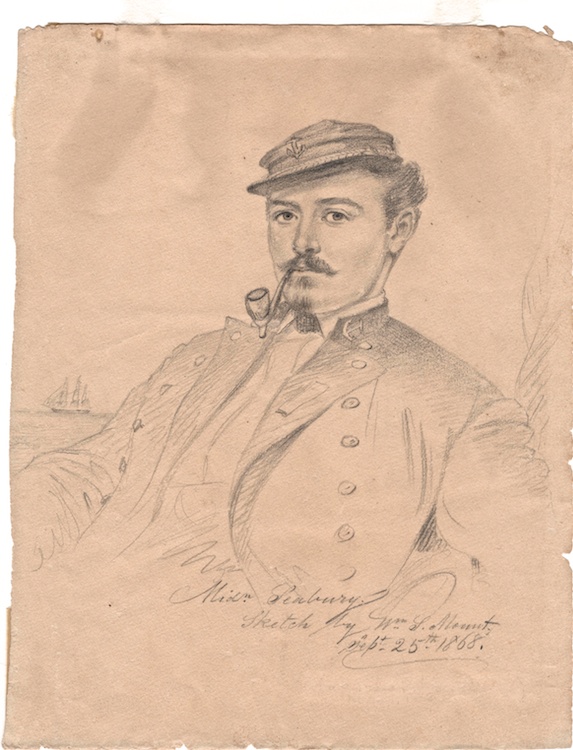
Portrait of Midshipman Seabury by William S Mount (1868)

My last example of Mount’s portraiture was also thought to have been his last artistic work.  It was completed in September 1868, less than two months before Mount’s death, and was a pencil sketch of his nineteen year old nephew Samuel Seabury.  Samuel was one of seven children.  His mother was Ruth Hawkins Mount Seabury, William Sidney Mount’s younger sister, and his father was Charles Saltonhall Seabury.   At the time of the portrait, Samuel Seabury was a midshipman in the navy, and the ship in the left hand background is a reminder of his profession.

In my next blog I will take my final look at William Sidney Mount and his work and I will feature some of his excellent non-musical genre work.

Marie Bashkirtseff. Part 1 The portraitist and feminist

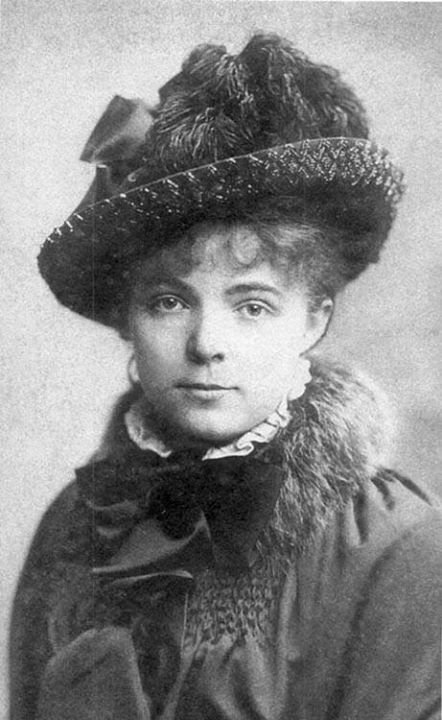
Photograph of twenty year old Marie Bashkirtseff (1878)

I had been researching the life of Jules Bastien-Lepage for a future blog when I came across the fascinating story of a Ukranian lady, a friend of his, who during her very short life excelled as a painter, a sculptor and a diarist.  It was her talent as a diarist and her personal diary which led to her notoriety.  I have split her lifestory, as short as it was, between two blogs, so come with me and explore the life of Maria Konstantinovna Bashkirtseva who became better known as Marie Bashkirtseff and her portraiture.

 Marie Bashkirtseff was born in November 1858 at Gavrontsi, a beautiful country estate close to the provincial town of Poltava in southern Ukraine.  Her father was Konstantin Bashkirtseff and her mother Mariia Babanina, who was a lady, fiercely proud of her Tartar heritage.   The family were wealthy and were looked upon as being of the petite noblesse social class, which was a termed used to describe the lesser nobility of France, especially rural landowners of noble ancestry.  A year later Marie’s brother Paul was born.  Marie was a studious and very intelligent child, speaking Russian and French fluently and even when young she exhibited a dynamic personality.  Her parents split up in 1859 and her mother took her and her brother back to her parents’ home in Tcherniakovka. 


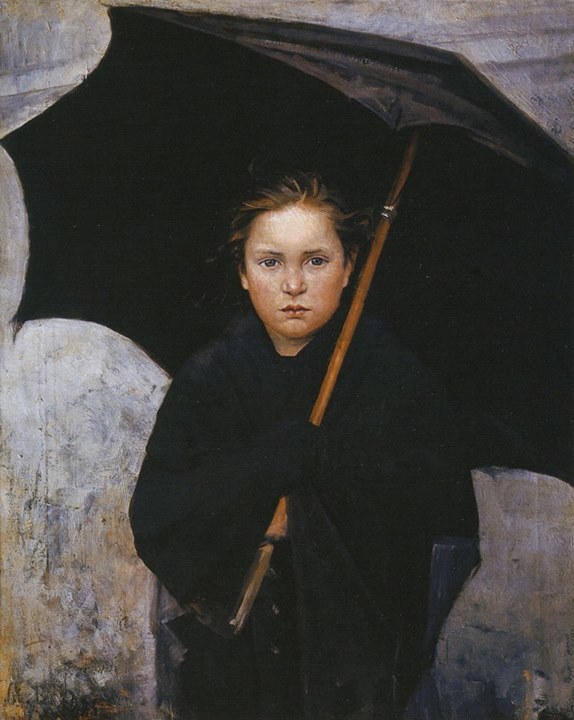
The Umbrella by Marie Bashkirtseff  (1883)
The Umbrella by Marie Bashkirtseff (1883)

In May 1870, when Marie was eleven years old, her grandfather, Stepan Babanin, her brother Paul, and a motley collection of other family members, along with the family physician, Doctor Walitsky, left Tcherniakovka for good and embarked on a voyage of discovery around Russia and Europe.  The extensive journey lasted almost two years until the weary travellers settled down in a villa situated in the foothills of the Mediterranean Alps overlooking the coastal resort of Nice.  It was at this idyllic setting that fourteen year old Marie started to dabble with her artwork and also started to write her diary.  This diary which was eventually published in 1887, three years after her death, was to become a best seller.  In it she would write about her life on the Côte d’Azur with her extended family, her teenage infatuations, her dreams for the future and her loves.  She had a fixed idea of what her diary would be all about, writing:

 “…If I don’t live enough to be illustrious, this diary will be interesting for naturalists; the life of a woman is always curious, day by day, without affectation, as if nobody in the world should ever read it and at the same time with the intention of being read; I’m sure that you will find me pleasant… and I mean everything. Otherwise, what’s the point in writing? Apart from this, you will see that I say everything…”

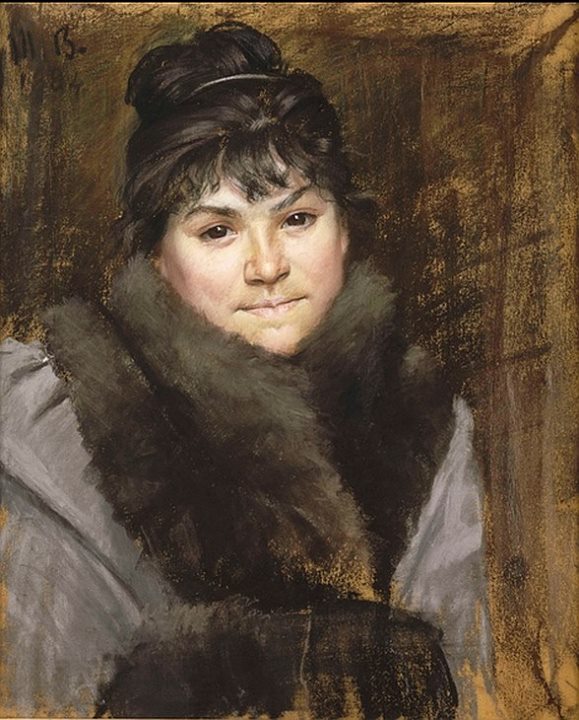
Portrait of Mme X by Marie Bashkirtseff (c.1884)

 Marie Bashkirtseff received a well rounded education.  She was home-tutored with the family employing governesses and private tutors and she studied a number of languages including English, German, Italian, Greek and Latin.  She was well versed in history, mythology and literature and it was that knowledge that found its way onto the pages of her diary.   She also developed a great love of music and singing.   She was an accomplished pianist, played the harp and was a talented singer and she hoped that one day she would become a professional mezzo-soprano.   This plan for her future was to be dashed after a severe bout of laryngitis which irrevocably affected her vocal chords.  She was devastated at this turn of events, once musing in her diary about what could have been:

 “…My God!  What a beautiful voice I had!  It was powerful, dramatic, captivating; it gave chills in the back. And now I have nothing, not even a voice to speak with!…”

 With music being a thing of the past, Marie needed another outlet for her exuberance and it came in 1877,  when, aged nineteen,  she decided to embark on a career as an artist.  For this to happen she decided that Nice was not the place to be and insisted that the whole family should move to the European capital of art, Paris, for it was here she believed she would receive the best art tuition and be able to study the paintings of the Masters.  The family opposed the move, not because they didn’t want to move to the capital but because of Marie’s fragile health.  They believed that the warm climate of Nice was more suitable for Marie than the colder, damper climate of Paris.  It was not because of their wish to stay warm and enjoy the sunny climate of the south but it was because Marie had been diagnosed with irreversible tuberculosis and doctors had warned against such a move.  However the dominant and forceful character of Marie won the day and that year they left the south of France and moved north.

Portrait of a Woman by Marie Bashkirtseff (1882)

The Parisian establishment, which was in the forefront of art tuition, was the École des Beaux-Arts but this was not an option for Marie as, at that time, women were not allowed to enrol for study at that academy.  Marie then chose to enrol at the Académie Julian, which was the only academy at the time which accepted female students, albeit the men and women trained separately.  However the training for females was similar, even allowing women to participate in life drawing classes with nude models, which was frowned upon by other art establishments.  It was founded by Rodolphe Julian in 1868.  It was a private studio school for art students, which, as well as training aspiring male artists to pass the exams to enter the hallowed and prestigious École des Beaux-Arts,  it also offered independent training in arts to wannabe female painters.  Whilst there Marie received excellent artistic training under the tutelage of the likes of Rodolphe Julian, Tony Robert-Fleury, Gustave Boulanger, and Jules-Joseph Lefebvre.  She revelled in this world of art and even the glamour of her social life took a back seat as she commented in her diary:

 “…as for me, although feeling pleased of being in the ballroom, I’ve been thinking all the time in a pastel painted this morning with which I wasn’t satisfied…

 Marie was a perfectionist in all that she did and was highly competitive.  This latter characteristic manifested itself in her fierce competition with her fellow student, the Swiss-born painter, Louise Catherine Breslau.  They both exhibited works at the Paris Salons and Marie’s competitive nature soon turned to jealousy, jealous of the artistic ability of her fellow student.  She looked upon Breslau as a competitor in the race to be recognised by the art critics and the public.  Breslau was two years older than Bashkirtseff  but was to outlive her by more than forty years and so was able to consolidate her reputation within the art world.

Parisienne, Portrait of Irma by Marie Bashkirtseff (1882)

Marie Bashkirtseff, besides her dedication to painting, developed another love whilst living in Paris.  She was drawn to the feminist movement .  Hubertine Auclert had founded the feminist movement known as Le Droit des Femmes in 1876, the year before Marie had arrived in Paris.  It was a movement that supported women’s right to have the vote.  Marie, using the pseudonym, Pauline Orell, applied her innate ability as a writer to produce articles in support of feminism.  She had some of her writings published in La Citoyenne, a bi-monthly feminist newspaper first published Hubertine Auclert in Paris in 1881.  In the March 1881 edition an article by Baskirtseff appeared which linked her artistic career with that of the plight of women.  She cynically wrote:

 “…I will not surprise anyone by saying that women are excluded from the School of Fine Arts as they are almost everywhere.  Yet we admit them to the School of Medicine, why not at the École des Beaux-Arts.  Perhaps one fears scandals that would cause the element in this female comedies environment…” 

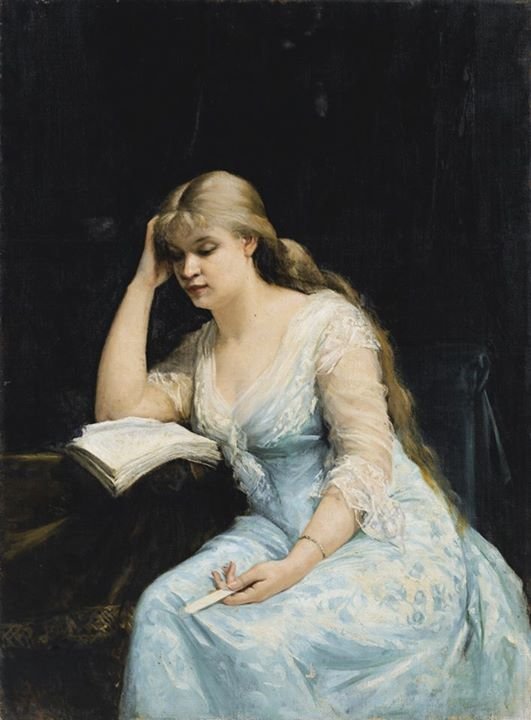
Jeune Femme Lisant la Question du Divorce d'Alexandre Dumas (Portrait of a Young Woman Reading) by Marie Bashkirtseff (1880)
Jeune Femme Lisant la Question du Divorce d’Alexandre Dumas (Portrait of a Young Woman Reading) by Marie Bashkirtseff (1880)

In 1880 , Marie Bashkirtseff submitted a beautiful work of portraiture to the Salon.  It was entitled Jeune femme lisant la Question du Divorce d’Alexandre Dumas (Portrait of a young woman reading).  It was not simply a portrait of a young woman,  it was a work of art with a message.  We see before us a portrait of a beautiful and stylish young woman who is totally engrossed in reading her book, The Divorce Question by Alexandre Dumas.  The sitter for this portrait is thought to be Marie’s cousin, Dina Babanine, who two years after Marie’s death would marry and become the Countess Toulouse-Lautrec.  There is a feminist statement behind this depiction.  There is the message that beautiful women have intelligence.  The title of the painting tells us the title of the book she is reading.  It was the 1880 work by the well-known author, Alexandre Dumas, who was discussing divorce and the French laws appertaining to the subject.  It was a controversial book and in some ways a ground-breaking one.  The serious and intellectual nature of the book was a statement that women do not, as believed by many, especially men, only read frothy romantic novels.   The artist was also making a statement regarding the important position of women in society.  In this case, it was about her aspirations for female independence.  The right to divorce and break free from an abusive relationship, the same right as men to be trained to become an artist, the women’s right to vote.  It was simply her belief regarding the right of women to be equal to men.

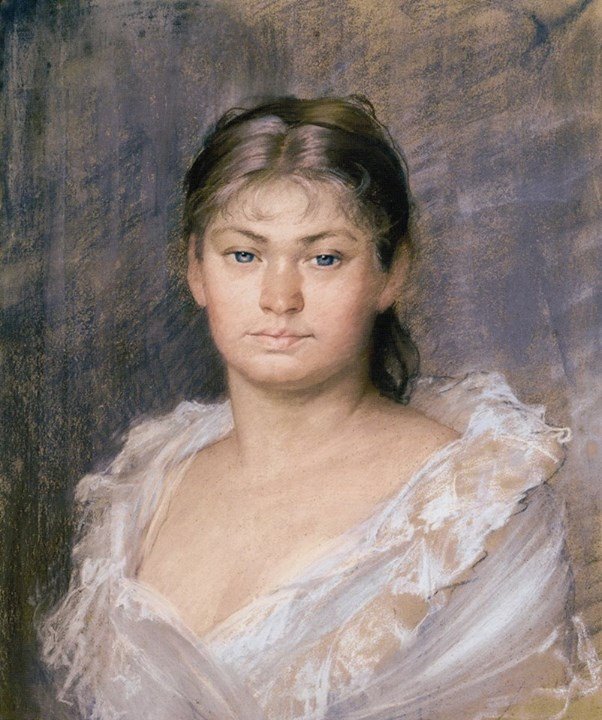
Portrait de la Comtesse Dina de Toulouse-Lautrec, by Marie Bashkirtseff (1883)

Dina Babanin featured in another of Bashkirtseff’s works.  It was a work in pastels, simply entitled Dina Babanine and was completed in 1883.   Dina was Marie’s cousin and also a close life-long friend.  Her early upbringing was in total contrast to that of Marie.  Dina and her brother had been brought up in a very disruptive household.  Her father had his marriage to their mother annulled making his children illegitimate.  This beautifully crafted portrait depicts the beauty of Marie’s cousin.  She wears a pale blue décolleté peignoir with a wide delicate white collar.  Her face, neck and chest have been depicted using delicately blended light tones which enhance the youthful beauty of the sitter.  Her full lips are pressed together but it is her eyes that catch our attention.  They are dark blue in colour.  She does not quite focus upon us.  There is a feeling that she has lost her power of concentration and there is a blankness about her stare.  Like all inquisitive and discerning observers we search for imperfections of her beauty but they are hard to find.  Maybe we comment upon the slight cleft of her chin.  Maybe we remark upon the flatness of her nose.  However we cannot but acknowledge her overall beauty.  Look at the composition.  It is all about the female.  There is no jewellery, no flowers attached to her simple but revealing dress with its plunging neckline.  The artist wanted nothing to divert our attention from her cousin’s beauty and in that she has unquestionably succeeded.

In my next blog I will conclude her life story, look at some of her most famous paintings and reveal more about her diary.

The portraiture of Giovanni Battista Moroni

Last week, I went to the Royal Academy which was staging three very different exhibitions.   Each one had its supporters and it was interesting to walk through each and compare the works on display.   I know that is somewhat foolhardy as one would never contemplate and compare the athletic prowess of a baseball star with a soccer star or a football star with and ice hockey player.  Each has a skill of their own and one cannot make a comparison across different sports so I suppose I should not contrast the works of Allen Jones with Anselm Keifer or Giovanni Moroni.  All are so different and it is up to one’s individual taste as to what  one believes is the most beautiful and the most eye-catching.

For me, the choice was a no-brainer.  I have always liked paintings from the 16th and 17th century and I have always admired the genre of portraiture and so my favourite, by far, was the Giovanni Battista Moroni exhibition which is on at the Sackler Gallery until January 25th.  In my next two blogs, I would like to whet your appetite by looking at the life and some of the works of art of one of the greatest Italian portraitists of the sixteenth century and by doing so try and persuade you to visit the wonderful exhibition.

Giovanni Battista Moroni was the son of architect Francesco Moroni and Maddalena di Vitale Brigati.  He was born around 1522 in the Venetian Lombardy region of northern Italy, in the commune of Albino, in the province of Bergamo.  It was a time close to the end of the Italian Renaissance period which had started back in the fourteenth century.  It was an exciting period of cultural change which brought about new styles of art, music, literature, and architecture.  This was a time designated as the Cinquecento also known as High Renaissance period and it was during this time that a secular theme started to manifest itself in the subject for paintings.  Moroni was apprenticed to Alessandro Bonvicino more commonly known as Il Moretto da Brescia who had a studio in Trento which at the time hosted the great meeting of Catholic clergy at the Council of Trent between 1545 and 1563.  For Roman Catholicism, this was It was the most important ecumenical council which had been called to come up with ideas to counter the Protestant Reformation.

The Tailor by Giovanni Moroni (c.1570)

In this first blog about Moroni I want to concentrate on his portraiture and I have chosen four of my favourite works from the exhibition.  One of his most famous works and considered to be one of the masterpieces of sixteenth century portraiture, is entitled Il Tagliapanni (Portrait of a Tailor), which he completed around 1570.  What is mystifying about this portrait is the fact that the title of the work although telling us this is a portrait of an artisan the costume of the man before us would seem to have aristocratic connotations.   The setting for the portrait is a bare room, which is not well illuminated and which contrasts with the way Moroni has illuminated the head of the tailor form a light source coming from the left of the painting.  The lack of furnishings allows us to concentrate on the subject of the painting.  The figure, who stands by his cutting bench, is the tailor.   He is wearing doublet and hose.  He has a cream fustian jacket and wears full red breeches, which almost, but not quite, hides a similar coloured codpiece.  The colour of the clothing worn by the tailor was a change from Moroni’s normal male portraits as he had, as a rule, had his sitters dress in all-black clothing which was the Spanish fashion-style of male sitters.  Around his waist is a sword belt – another hint of aristocracy.  He looks out at us pensively.  Maybe he just considering carefully what he is about to do.  He has a pair of scissors in his right hand, on the small finger of which is a gold ring set with a ruby.  His left hand spreads out a piece of black cloth which he is about to cut. One can just make out the faint white lines on the cloth which are a guide to the pattern which he is about to cut out.  This is not an impoverished tradesman and much speculation has been made as to who is this man.  Because of the richness of his clothes, some art historians, like Francesco Rossi in his 1991 book Il Moroni, would have us believe that he was an aristocrat who has turned to selling fabrics.  Others believe that not to be the case.  However the manner which the tailor is depicted gives one a distinct impression that the tailor was financially secure.    In the Grazietta Butazzi a leading authority on the history of fashion an article appeared in the 2005 edition on men’s fashion between fifteenth and seventeenth centuries and they were adamant that the style of costume on Moroni’s tailor was not out of place with his professional status as a tailor and that it was similar to garments seen on prints of the time, which depicted men in his trade.

Gian Gerolamo Albani by Giovanni Moroni (1568-70)

The next portrait by Moroni, which I am featuring, is of Gian Gerolamo Albani and with it comes an amusing anecdote.  Albani was a powerful politician and military man in the Lombardy Veneto region.   In 1563 he fell from grace and was exiled for five years on the Adriatic isle of Hvar and banished from Veneto .   Gian Gerolamo Albani had had to endure this fall from power following his implication in the murder by Albani’s son of a family member of the rival Brembati family, Achille Brembati.  From Hvar Gian Girolamo moved to Rome and in 1570, at the age of sixty-one, was made a cardinal in the Catholic Church by Pope Pius V. Pope Pius V, who was born Antonio Ghislieri, and served his time in the Catholic Church as an inquisitor, was a friend of Gian Battista Albani and it was Albani that had once saved the life of the future pope.

Moroni favoured his sitters to adopt a three-quarter style profile but in this portrait of Albani he sits directly facing the viewer.   There is an aura of power about this man before us.  He sits upright in a Dantesca chair, book in hand.  He wears a luxurious black robe which is lined with lynx fur, which can also be seen appearing from slashes around the shoulders and cuffs.  This “slash and puff” fashion style will again be seen in the portrait of his daughter, Lucia.  Around his neck, adding an even more prestigious appearance is a gold chain on which hangs the lion of St. Mark, which alludes to Albani being a member of the Knights of the Order of St. Mark, an honorific Order of Chivalry title conferred on him by Andrea Gritti, who was at the time, Doge of the Republic of Venice.  The winged Lion passant  holding a drawn sword in one paw and an open book with the motto Pax tibi, Marce Evangelista meus (Peace to you, Mark, my Evangelist) in the other.  On the reverse there was a portrait of the Doge and St Mark.

And so to the anecdote I mentioned about this portrait.  The seventeenth century Italian art biographer and painter, Carlo Ridolfi, wrote about the origin of this portrait in his 1648 book Le Maraviglie dell’arte: ovvero Le vite degli ’illustri pittori veneti, e dello sato, (The Marvels of art: namely The Lives of illustrious Venetian painters, and the state):

“…Gian Geralamo Albani, a gentleman from Bergamo, a member of the Albani family, finding himself in Venice, sought Titian out to have his portrait painted.  He was asked from which area he came and let it be known that he was from Bergamo.  ‘What’ replied Titian, ‘do you think you will get a better portrait from my hands than you would get in Bergamo from your Moroni?  Best leave this work to him, for it will be more valuable and more distinctive than mine’.  Sig. Albani then returned to Bergamo and told the story to Moroni who produced this stupendous portrait now belonging to Sig. Giuseppe Albani…”

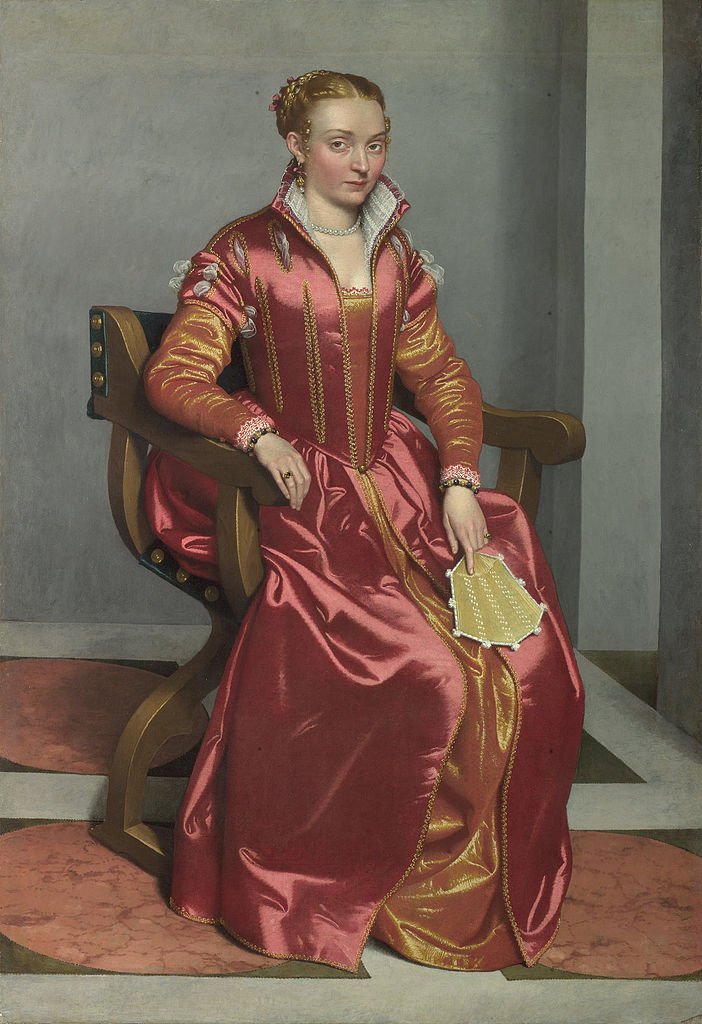
Portrait of Lucia Albani Avogadro ('La Dama in Rosso') by Giocvanni Battista Moroni (c.1555-60)
Portrait of Lucia Albani Avogadro (‘La Dama in Rosso’) by Giocvanni Battista Moroni (c.1555-60)

Whether the story is true or false I will let you decide but Gian Albani must have been already aware of Moroni and his skills as a portraitist as some ten years earlier, Moroni completed a female portrait entitled Portrait of Lucia Albani Avogadro (‘La Dama in Rosso’)She was one of Gian Albani’s daughters.  This is an exquisite work and can now be seen at the National Gallery in London.  The sitter for this work is Lucia Albani  Avogadro an Italian poet.  Lucia was one of seven children of Gian Gerolamo Albani, the head of the powerful Albani family of Bergamo.  This is not just a painting of a beautiful woman but a depiction of and an insight into of the fashion of the time.  Lucia Albani married Faustino Avogadro , her third cousin, when she was sixteen years old.  Her husband was a member of the powerful aristocratic family from Brescia.

She is depicted in three quarter profile seated on a Dantesca chair.  She wears a glittering red brocade dress with an open bodice which was popular in the 1550’s.  The silk was almost certainly given its exquisite colour by the use of the scales of the female cochineal insect from which the carminic acid is derived and which yields shades of red such as crimson and scarlet.   Once again we see the fashionable puff and slash style on the dress around the shoulders and upper chest .  This fashion style was popular with both men and women.  Portraits of Henry VIII often showed him wearing clothes which had the “puff and slash” stylisation.   The “puff and slash” effect was achieved by cutting slashes in the garment and pulling puffs of the undergarments through those slashes.

The lady sits upright  on the chair.  In her left hand is a fan which rests on her lap.  She is bedecked with expensive jewellery, including bracelets with agates, a ring on the finger of each hand, both set with precious stones.  Around her neck is a single strand of pearls which accompany a set of pearl earrings.  Her hair is swept to the back of her head in a most intricate fashion and is held in place by a gold chain with cabochon emeralds. Lucia was not just renowned for her beauty but for her literary skill as a poet but this portrait bears no reference to her literary work, it is simply a depiction of a beautiful lady and alludes to her aristocratic status.

Portrait of Faustino Avogadro by Giovanni Battista Moroni (c.1555-60)

My fourth and final offering of portraiture by Moroni has a connection to the lady in the previous work.  The work is entitled Portrait of Faustino Avogadro and is sometimes referred to as The Knight with the Wounded Foot or A Knight with his Jousting Helmet.   Giovanni Battista Moroni completed the portrait somewhere between 1555 and 1560 and is currently housed in the National Gallery in London.  Avogadro stands in front of an old wall, the base of which is made of marble.  There is an element of decay about this backdrop with green vegetation growing out of the cracks in the wall and brown streaks of damp running down across the marble

Faustino is predominately dressed in black.  It is a familiar style of the mid 1500’s.  He wears a high-collared white shirt and short puffed black pantaloons.  Over his shirt we see a torp-coloured jacket and over this, lying open, is a gambeson or arming doublet.  This is a padded jacket which was worn as part of protective armour.  It could be worn separately, or combined with chain mail or plate armour. The garment was made using a sewing technique known as quilting and was made of linen or wool.  In battle, a thrust of the enemy’s sword could penetrate the rings of the chain mail and this often drove the damaged rings deep into the wound. A lightly padded garment, such as the gambeson worn under the chain mail reduced the risk of these types of injuries.

Avogadro’s right hand touches the hilt of his long sword whilst he rests his left arm on his lavishly crested helmet which is adorned with an ostrich feather.  Around him are pieces of armour scattered on the floor, the light glinting on the highly polished surface of the steel pieces.  Besides this being a portrait of an aristocratic gentleman it is a depiction which is testament to his military rank and his involvement in tournament combat.  If one looks closely at his left knee one can see a sort of supporting brace on it which is attached to his left foot.  Some art historians believe this contraption was the result of an injury; hence the painting’s “sub-title” The Knight with the Wounded Foot.  However, Cecil Gould, a British art historian and curator, who specialised in Renaissance painting and once a Keeper and was at one time Deputy Director of London’s National Gallery, wrote in his 1975 National Gallery Catalogues: The Sixteenth Century Italian Schools that the brace we see in the portrait was more likely to be present to help remedy a congenital defect of the ligaments of the left ankle.  One would have thought that such a cumbersome contraption would have put paid to Avogadro’s taking part in tournaments, but apparently not.

Avogadro, like his father-in-law was involved in the deadly feud between the Albani and Brembati families with his servant being sentenced to death for his part in the murder of Count Achille Brembati in 1563.   Following this, Avogadro and his wife Lucia Albani fled their Bergamo home and went into exile in Ferrara to escape the aftermath and consequences of the murder.  A year later Faustino was dead.  It was reported that he fell down a well when he was drunk.  Fell or pushed?  One will never know for sure.  Four years later in 1568, his widow Lucia died, aged 34

In my next blog I will look at some of the religious paintings of Giovanni Battista Moroni.

Alexandre Cabanel Part 4 – Portraiture

Alexandre Cabanel (1823-89)

 In my last look at the life and works of Alexandre Cabanel I want to concentrate on his genius as a portraitist.   In my last blog I had reached 1863, the year in which his most famous work, Naissance de Venus (Birth of Venus), was exhibited at that year’s Salon, which was subsequently purchased by Napoleon III and is now on display at the Musée d’Orsay.  The work received great revues despite the subject’s nudity which caused some adverse comments.   Cabanel, at the age of forty, was honoured that year, when he was bestowed with the status of Officer of the Legion of Honour and was elected a member of the Institut Impérial de France.  On January 1st 1864 he opened his own studio at the École des Beaux-Arts.  He was reputed to have been an excellent teacher, who was well loved by his students, many of whom went on to win the Prix de Rome.  Many of his students went on to regularly exhibit at the Salon.

 Cabanel’s reputation as a leading artist of the time was well established by 1860 and his mastery of portraiture was well known throughout Europe and he had become the favoured portraitist of the European aristocracy.  In the 1863 Salon besides his Birth of Venus painting he exhibited a portrait of Countess de Clermont Tonnerre who had married into one of the most famous old families in France.

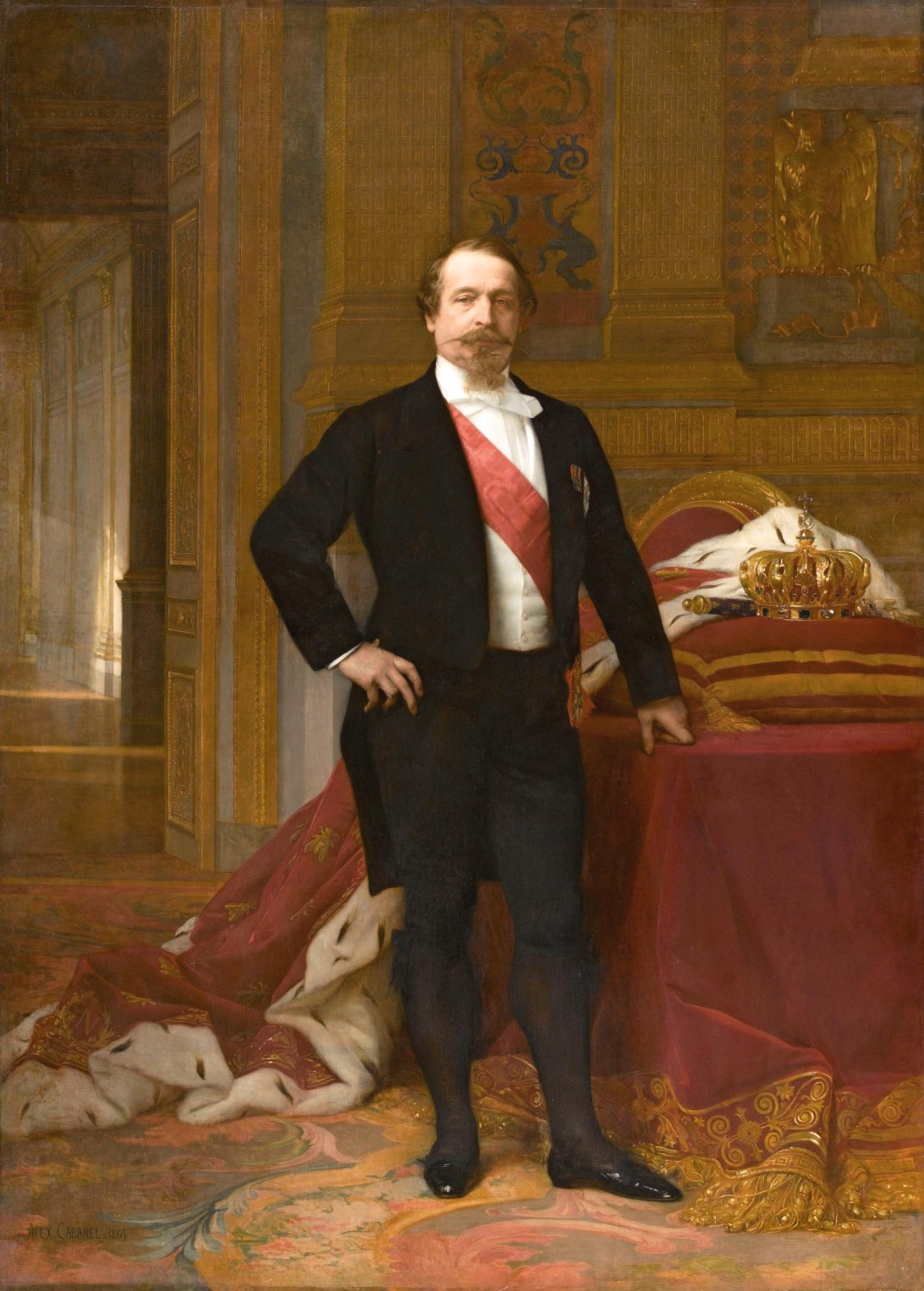
Emperor Napoleon III by Alexandre Cabanel (c.1865)

Napoleon III and his wife, the Empress Eugénie, had, up to this time, commissioned several royal portraits from Franz Xavier Winterhalter, Edouard Dubuffe and Hippolyte Flandrin.  Their portraits of Napoleon III were acclaimed by critics and yet the royal couple were not completely satisfied and so, in 1864, decided to commission Cabanel to paint a new portrait of Napoleon.  For Cabanel, this was the ultimate commission.  The portrait was completed and exhibited in the 1865 Salon and won Cabanel a Medal of Honour.    What the critics liked so much about the work was its simplicity and sophistication.  This was not a normal portrait of a ruler in military uniform.  In this work, the Emperor is depicted wearing a simple black evening suit, under which we see his military sash.  The ceremonial robes can be seen draped on a chair at his side.  There was a sense of modesty about the Emperor although his depiction maintained an aristocratic tone.  It was if he was truly “one of the people” which may well have been part of what the ruler wanted his portrait to depict of him.  The 1886 edition of the Magazine of Art, which was an illustrated monthly British journal devoted to the visual arts, and which was published from May 1878 to July 1904 in London and New York included an article by Alice Meynell, who wrote that Cabanel’s royal portrait remit was to produce:

 “…a portrait which should be more expressive of the stability, suavity, and prosperity of the Empire, and he not only succeeded in this, but produced a work which was in many solid qualities the finest example of his talent…”

The painting is now housed at the Musée du Château de Compiègne.

  The work was acclaimed a masterpiece, not only in Europe, but also in America and, along with Cabanel’s portraits of high-society European women,  it was this work by him which almost certainly inspired wealthy Americans to choose Cabanel to paint their portraits and portraits of their family members.  Portraiture had always been a lucrative genre but the fact that Cabanel was a man of means indicates that, for him, portraiture was not just a means of earning money but was an art genre he loved and many of his portraits were exhibited at the various Salons

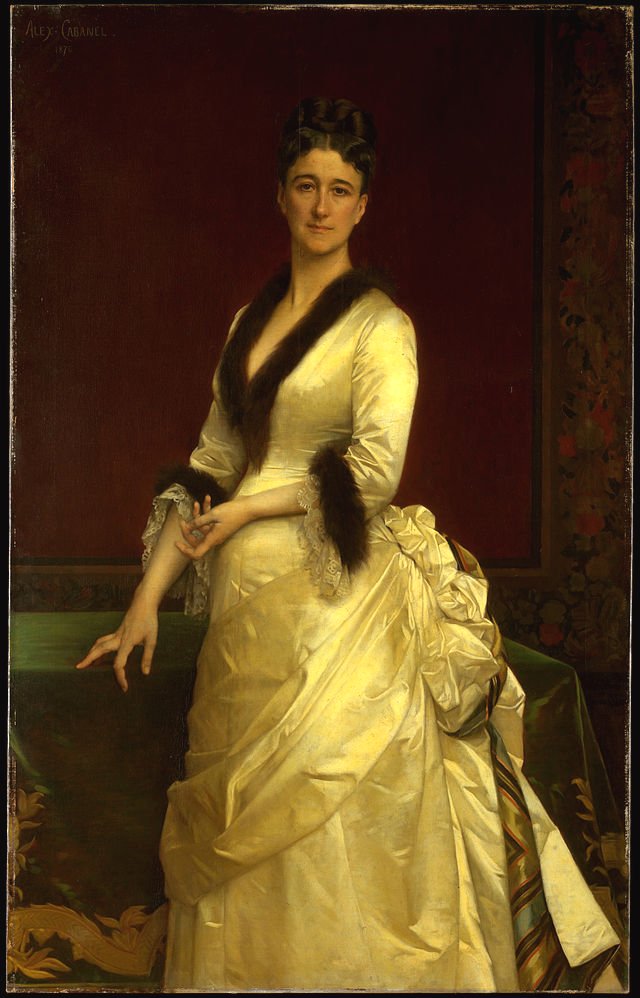
Catharine Lorillard Wolfe by Alexandre Cabanel (1876)

Catharine Lorillard Wolfe was an American philanthropist and art collector. She gave large amounts of money to institutions of which her most significant gifts were two bequests to the Metropolitan Museum of Art in New York . She also left her large collection of popular contemporary paintings to the museum, together with $200,000.

————————————————-

To have one’s portrait or a portrait of one’s partner painted by a well-known artist was a means of letting the world know that you had “arrived”.  You had made good and the “right” artist could depict you as a man or woman of class and wealth.  Around the 1880’s following the end of the American Civil War many people had amassed fortunes, much of which was spent on art – not just any art but the contemporary art of the European painters, especially works by the French artists.  In America, the period which spanned the final three decades of the nineteenth century was known as the Gilded Age.  The phrase Gilded Age derives from the many great fortunes created during this period and the way of life this wealth supported and the phrase was coined by Mark Twain’s 1873 novel, A Gilded Age, A tale of Today.

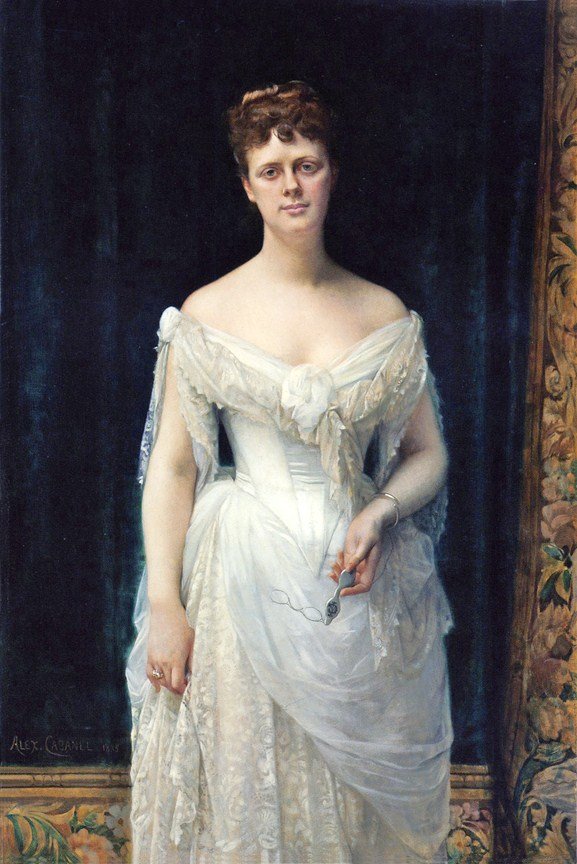
Mary Frick Garrett, by Alexandre Cabanel (1883)

Mary Sloan Frick married Robert Garrett, the oldest son of John W Garrett, who was president of the Baltimore and Ohio Railroad and Robert Garrett & Sons Bank.  Cabanel painted this portrait whilst his sitter was on holiday in Paris in 1883.

—————————————–

America’s industrial economy boomed.  It was a time of great wealth for the industrialists such as John D Rockefeller, with his oil, Andrew Carnegie, with his steel and Cornelius Vanderbilt, the railroad and steamboat tycoon.  For wealthy Americans like them, having a painting by a French artist hanging in one of the rooms of their large mansions signalled not just your wealth but alluded to your knowledge of European art and thus enhanced your air of intellectual prowess.  For these rich Americans what would be even better than just owning a painting by a well-known French artist, would be to have that artist paint your portrait or your wife’s portrait.  That would really impress your friends!

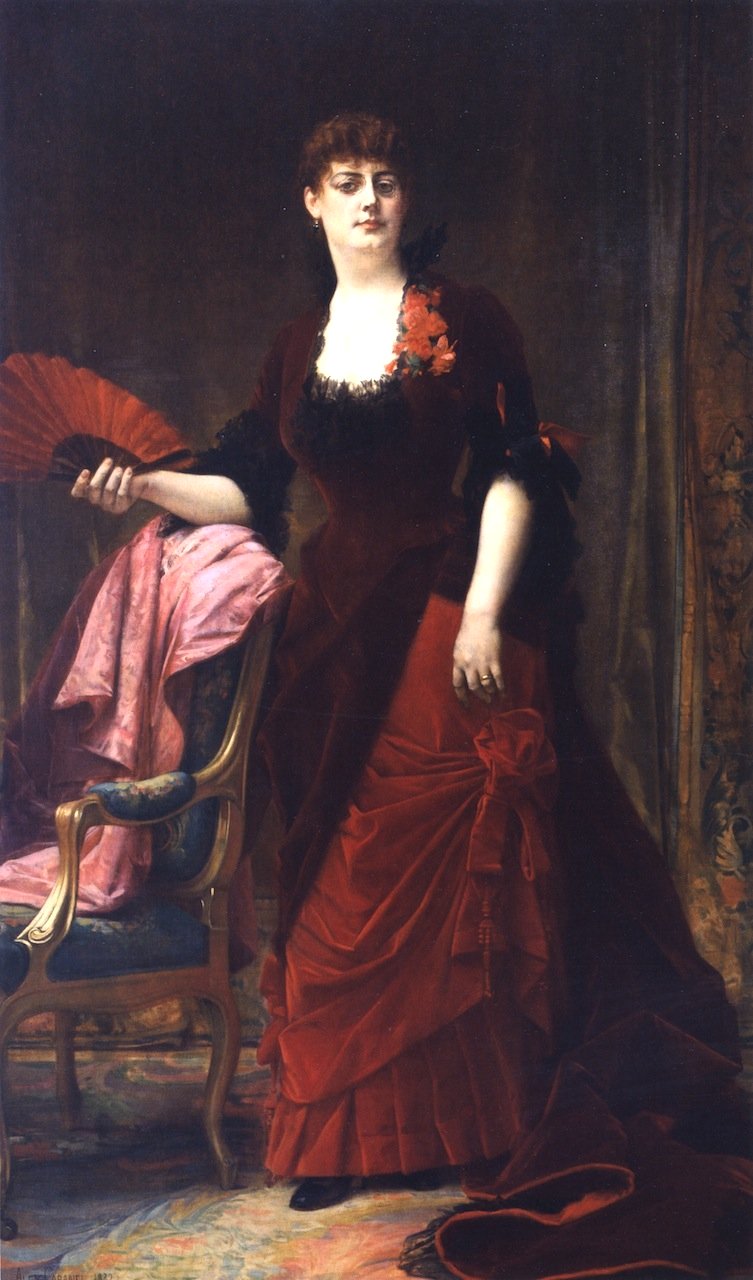
Olivia Peyton Murray Cutting by Alexandre Cabanel (1887)

 In 1877, Olivia Peyton Murray married William Bayard Cutting, a member of New York’s merchant aristocracy, an attorney, financier, real estate developer, sugar beet refiner and philanthropist.  Ten years later he commissioned Cabanel to paint a portrait of his wife which can now be found at the Museum of the City, New York.

———————————————-

Alexandre Cabanel’s reputation as an outstanding academic painter and portraitist was acknowledged on both sides of the Atlantic and his work was in great demand.

Mrs. Collis Potter Huntington by Alexandre Cabanel (1882)

Mrs Collis Huntington married Collis Potter Huntington, who was one of the Big Four of western railroading and who built the Central Pacific Railroad, which formed part of the first American transcontinental railroad.

—————————————————

A man of wealth would like to be portrayed by an artist in quite a sombre mood depicting his serious business-like nature whereas they would like their wives and daughters to be portrayed in the finest clothes, with the most expensive of jewellery but the women were not to be portrayed as being frivolous instead they must be seen as intelligent figures who played, like their husbands or fathers, a key role in society.

In a book which was published to coincide with Alexandre Cabanel’s retrospective 2010 exhibition at the Wallraf-Richartz Museum in Cologne, Michel Hilaire, the director of the Musée Fabre of Montpellier, where many of Cabanel’s work are housed, wrote of Cabanel’s life:

“…It was the end of a fulfilled life and artistic career characterised by hard work, but also full of success and esteem…”

Alexandre Cabanel died at his Paris home on the rue Alfred de Vigny close to the Parc Monceau Paris on January 23rd 1889, aged 65.

————————————————–

 For an excellent article on Alexandre Cabanel and his American portraits you should go and read an excellent article by Leanne Zalewski :

http://www.19thc-artworldwide.org/spring05/64-spring05/spring05article/300–alexandre-cabanels-portraits-of-the-american-aristocracy-of-the-early-gilded-age

Alexandre Cabanel. Part 1 – The early days and Rome

Self portrait by Alexandre Cabanel (1852)

My featured artist today, Alexandre Cabanel, was one of the most well respected Academic artists of the nineteenth century.  In my next couple of blogs I will look at this remarkable artist and some of his paintings.  His works of art varied from portraiture to historical, classical and religious scenes all executed in an academic style.  The term Academic art, also referred to as academicism or eclecticism, is traditionally used to describe the style of art which was championed by the European academies of art, notably the Académie des Beaux-Arts.  For Cabanel, Academic art was the true art and during his lifetime he would clash with Impressionist painters and their artistic style.  Cabanel was also well known for his décorations d’intériur.

 Alexandre Cabanel was born in September 1823 in Montpellier, France.   He was the ninth child of Pierre-Jean Cabanel and Marie Anne Jean Cabanel.  Even at a young age he showed an early artistic talent and when he was eleven years of age he attended the drawing classes at the Montpellier’s free École des Beaux-Arts, which was run by the French genre painter Charles François Matet.  Matet  was also curator of the Musée Fabre in Montpellier.   Cabanel earned himself some money whilst studying by making copies of artworks which were housed in the city’s Musée Fabre which he then sold.   In 1836, thanks to Matet’s recommendation, the Montpellier council awarded Cabanel his first art scholarship to allow him to study in Paris.

 Three years later Cabanel’s artistic talent was recognised as being so good that he was awarded a second scholarship to return to Paris.  The scholarship was a blessing as his father, who was a cabinet maker, could not have afforded to send him to the French capital.    Alexandre did go, thanks to the municipal two-year grant and in the October of 1840, a month after his seventeenth birthday, Alexandre Cabanel enrolled at the School of Painting at the École des Beaux-Arts in Paris as a pupil of François-Edouard Picot .  Picot was a well established painter who had studied under Jacques Louis-David and had tried to continue David’s artistic style, that of neoclassical values, to which, in his own works, Picot often added a more romantic flavour.

 For Cabanel the École des Beaux-Arts was not just an establishment which taught art it was a place where he was able to study literature, history and religion.  Cabanel received a good, well-rounded education and he thrived on the learning that was offered to him and in a way, it helped him convert his knowledge into visual imagery that would play a part in his future works of art. When his two-year scholarship came to an end in the summer of 1841 his mentor Picot wrote to the Montpellier authorities pleading on Cabanel’s behalf, for a further scholarship for his protégé and in return he would gain employment for Cabanel in the form of a major commission in the Hôtel de Ville in Paris.

Agony in the garden by Alexandre Cabanel (1844)

In 1843 aged nineteen, Cabanel exhibited his first work of art at that year’s Salon.  It was entitled Agony in the Garden, which is currently housed in the Musée des Beaux-Arts de Valenciennes.  In this work Cabanel has placed the Christ figure off-centre.  Behind him are a group of his persecutors.

 All the time Cabanel was attending L’École des Beaux-Arts he had one aim – to have a painting of his accepted into the establishment’s coveted Prix de Rome competition, in which the winning work of art enabled the artist to receive a scholarship for them to study for a number of  years at the Villa Medici in Rome.  There were also Prix de Rome scholarships for the best proponents of architecture, sculpture, music and engraving.

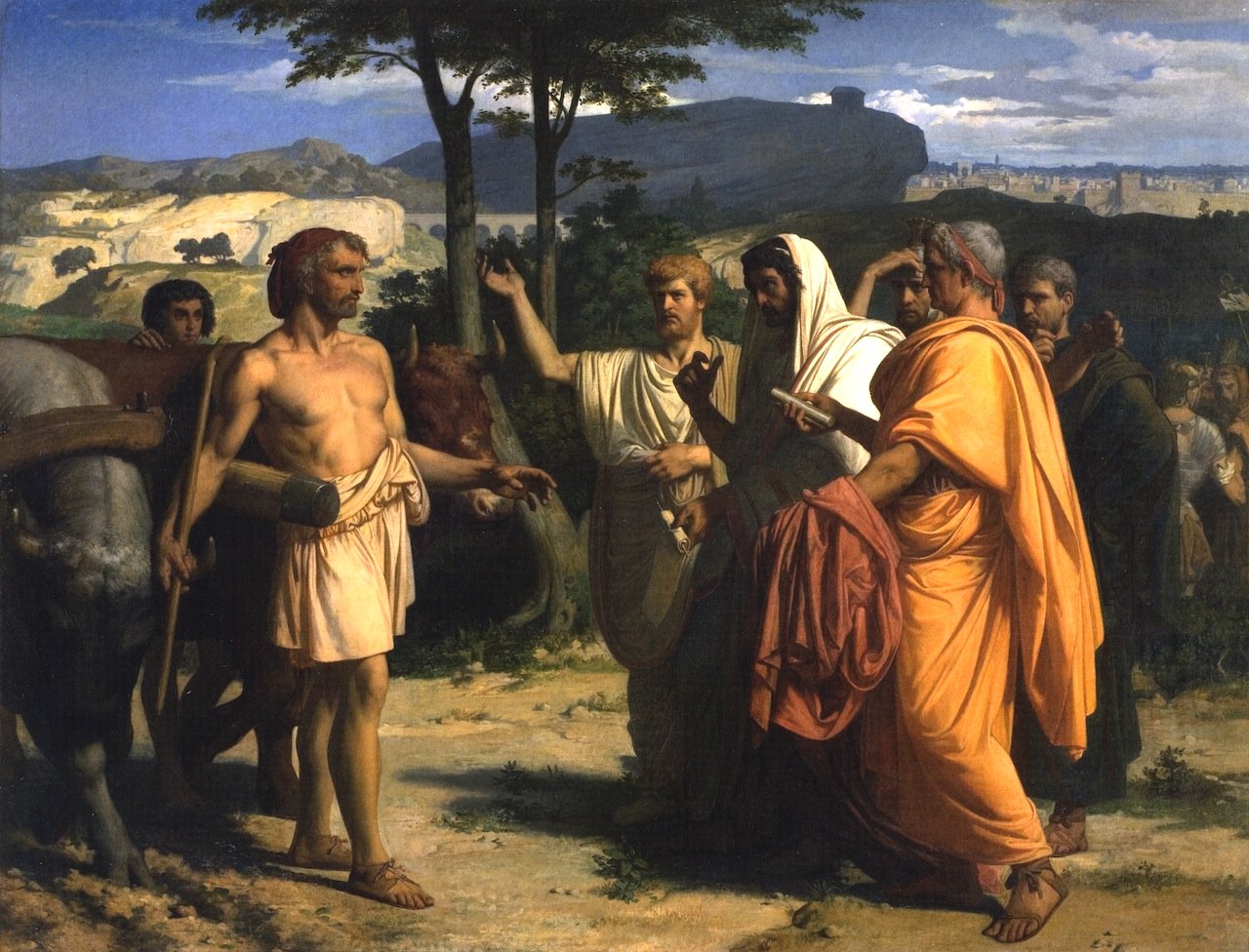
Envoys of the Senate offer the Dictatorship to Cincinnatus by Alexandre Cabanel (1844)

In 1843 he managed to reach the preliminary round of the competition with his work entitled Odysseus is Recognised by his Servant and buoyed up by that minor success he entered the competition again in 1844 this time with his painting, Envoys of the Senate offer the Dictatorship to Cincinnatus but he was only awarded sixth place.

The Mocking of Christ by Alexandre Cabanel (1845)

Better luck came in the 1845 competition when his work The Mocking of Christ, sometimes referred to as Christ at the Praetorium,  was judged and was awarded second place, with a fellow student of Picot, François-Léon Bénouville taking the top prize.   However second prize would not get the artist to Rome but the permanent Secretary to the Académie des Beaux-Arts, Désiré Raoul-Rochette, pleaded Cabanel’s case to be allowed to go to the Villa Medici as no Grand Prize for Music had been awarded that year.  A lot of wrangling followed between Rochette and Jean Victor Schnetz,  who was director at the Villa Medici, and who was against awarding Cabanel a scholarship.  In the end Schnetz backed down and Cabanel was granted a simple scholarship to go to Rome, which was to last for five years and the Prix de Rome second prize given to Cabanel was converted into a “Second First Grand Prize”.  All winners of the Prix de Rome received a financial allowance to cover the cost of their trip to Rome plus they were given a sum of money to cover their personal expenses and those they incurred during the production of their work. They also received free room and board.  The artists who came to the Villa Medici were allowed considerable freedom to paint subjects of their own choosing, but throughout their tenure they were all required to complete certain projects.  This allowed the French government, which had funded the scholarships, a way of assessing the progress of the Prix de Rome winning artists.  For the artists it was also a chance to bring their work to the attention of the members of the Academy, who also judged their annual submissions to see if their artistic ability had progressed.

 In January 1846 Cabanel set off for Rome.  It was early on in his stay at the Villa Medici that he met a fellow Montpellier citizen, Alfred Bruyas, who was enjoying the delights of the Grand Tour.   Bruyas was the son of a wealthy banker.  He was formerly taught art and would like to have become a professional painter despite his father’s wishes that he should embrace the world of finance and become partner in his father’s bank.  Bruyas loved art and loved to paint but soon realised he would never become a great artist and so concentrated on becoming an avid and discerning collector of art and a patron of the arts.  Many of his friends were artists such as Gustave Courbet.

Alfred Bruyas by Alexandre Cabanel (1846)

Bruyas supported Cabanel in these early days and in 1846, as a kind of repayment , Cabanel painted Bruyas’ portrait which now hangs in the Musée Fabre in Montpellier.  In the painting, Bruyas is depicted as a gentleman-traveller , dressed in his velvet-collared frock coat with a fashionable yellow waistcoat and pink and white cravat.  He is standing on the terrace of the Villa Borghese in Rome.  Bruyas and Cabanel became great friends during their short time together and Cabanel became very depressed when his friend left Rome in the summer of 1846.  Cabanel  would write to Bruyas telling him of his feeling of great loss when the latter had left the Eternal City.  In one letter, he wrote:

 “…Several times of an evening, I have put down on paper details from my present life so as to send them to you in letters.  On re-reading them, however, even I found them joyless and full of sorrow that I burned them…”

 For many aspiring artists who went to live in Rome they loved the liveliness of the Italian capital with all it had to offer but ,according to Cabanel, all Rome offered him was the chance to paint and copy the works of the Italian Masters.  He cut a lonely figure which was summed up in a letter he wrote to Bruyas in 1847.  In it he wrote that all he had left for consolation was his art :

 “…I have been leading a rather an orderly life, one completely devoted to art.  I have remained as untouched, as pure as Rome’s vestal virgins of days gone by……………….What’s more, I am weary of chasing after happiness that turns out to be an illusion, what’s the use?  Especially when I believe that I have long found it in my art for instance; I devote myself to it with complete freedom just as one devotes oneself to love or poetry…”


La Chiaruccia by Alexandre Cabanel (1848)

In 1848 Cabanel completed three amazing paintings for Bruyas, all of which are now in the Musée Fabre in Montpellier.  They were to be hung together in the form of a triptych.  The first was a painting of an Italian lady in traditional country peasant costume.  It is entitled La Chiarrucia.  The woman who modelled for this work also sat for many of the artists who lived and studied at the Villa Medici.

A Thinker, a Young Roman Monk by Alexandre Cabanel (1848)

The second of his three works, which was to be placed between the other two,  was entitled Un penseur, jeune moine romain,  (A Thinker, a Young Roman Monk)  and depicts a Franciscan monk lost in thought among the ruins of the Forum.

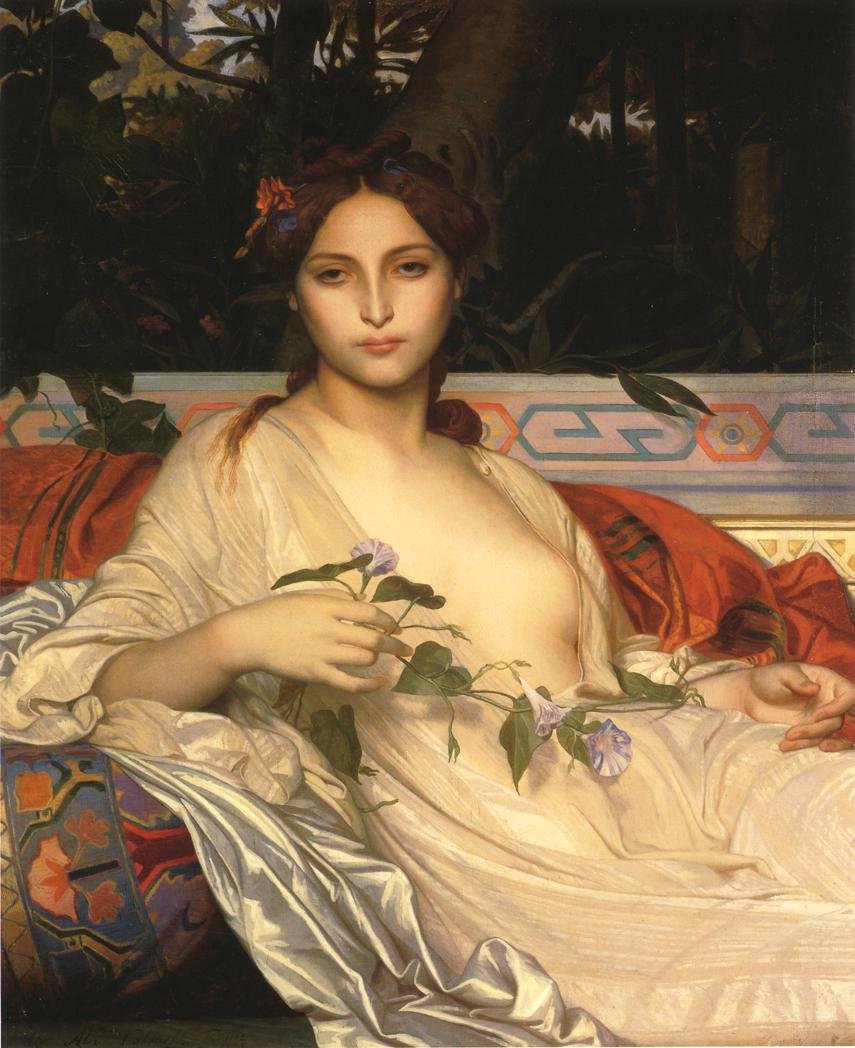
Albaydé by Alexandre Cabanel (1848)

The third, and my favourite, was simply entitled Albaydé.  The character of the title comes from Victor Hugo’s poem Fragments of a Serpent, which was one from a 1829 collection of poems known as Orientalia. The scene would appear to be a harem .  Cabanel has depicted the young woman, an Oriental courtesan, through the lustful eyes of the poet as she lies back languorously and looks out at us seductively with half closed eyes.  The beauty of this woman emanates from her eyes which I saw described as doe-like.  Her silken robe is open to the waist exposing the curve of her breasts.  She clutches a periwinkle vine which lies across her thighs.  It is a very sensuous depiction and she and La Chiaruccia ,either side of the monk, must have made for quite a formidable combination on Bruyas’ wall.

In my next blog I continue with Alexandre Cabanel’s life story and look at more of his exquisite paintings.

————————————————-

I gleaned most of my information for this blog and the next ones on Cabanel from a great book I came across entitled Alexandre Cabanel – The Tradition of Beauty which was published to coincide with La tradition du beau exhibition of Cabanel’s paintings, which was held at the Wallraf-Richartz Museum in Cologne in 2011 and the Musée Fabre in Montpellier in 2010.

Ary Scheffer

Self portrait by Ary Scheffer (1795)

I have often mentioned in previous blogs that the subject for a blog frequently comes from something I have stumbled upon whilst researching another blog.  Today’s blog is all about the Dutch painter Ary Scheffer who had a connection with the artist I talked about in the last two blogs, Théodore Géricault, but more of that connection later as I first want to look at the life of the Dutchman who was a leading Romantic painter.

Ary Scheffer came from an artistic background.  His father was Johann- Bernhard Scheffer a portraitist who originally hailed from Hamburg but from his early teenage years lived in the Netherlands.  He had married Cornellia Lamme, another artist who concentrated on miniature portraits.  Ary Scheffer’s maternal grandfather was Arie Lamme the Dutch landscape painter.  The couple, who lived in Dordrecht,  had three sons, Ary, the eldest, was born in February 1795, his brother Karel Arnold Scheffer who was born in 1796, went on to become a journalist and writer and their youngest, Hendrik, who also became an artist, was born in September 1798.

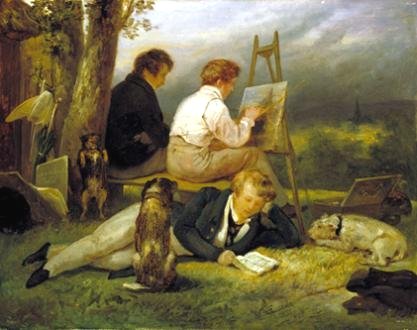
The Three Brothers Scheffer in a Landscape by Ary Scheffer (1824)

Ary Scheffer was given his first artistic tuition by his parents but when he was eleven years of age his parents enrolled him at the Stadstekenacademie in Amsterdam on a three year art course.   During that time he put forward one of his paintings, Hanibal Searing to Avenge the Death of his Brother Hasdrubal, in the first Exhibition of Living Masters in Amsterdam in 1808.

The painting is now in the Dordrecht Museum along with a number of his other works which are hung in the Ary Scheffer Room.  That same year, his father became the court painter of Louis Bonaparte, who ruled over the Kingdom of Holland, a position bestowed on him by his brother, Napoleon Bonaparte.  Ary’s father only held the position for a year as in 1809 he died.  Following the death of her husband, Cornelia Scheffer moved to Paris with her three sons where Ary and his brother Hendrik became pupils at the studio of the French painter, Pierre Guérin.   Ary and Hendrik were in good company at the studio as two of their fellow pupils would become the figureheads of the French Romantic movement in art, Eugène Delacroix and Théodore Géricault.

Ary Scheffer later attended the École des Beaux-Arts in Paris and from 1812 for the next thirty five years exhibited works at the annual Salons.  Along with Delacroix and Géricault, Ary Scheffer is recognised as one of the great painters of the Romantic school.  Following the end of the Revolution and the fall of Napoleon Bonaparte the French bourgeoisie once again came to prominence and along with the State were the main patrons of the Arts.   Scheffer’s work was very popular and at the end of each Salon his paintings would be snapped up by eager buyers.

The Soldier's Widow by Ary Scheffer
The Soldier’s Widow by Ary Scheffer

In the 1822 Salon he exhibited his very sentimental painting Soldier’s Widow which was very popular and although the whereabouts of the painting is unknown there are a number of monochrome prints of the work.

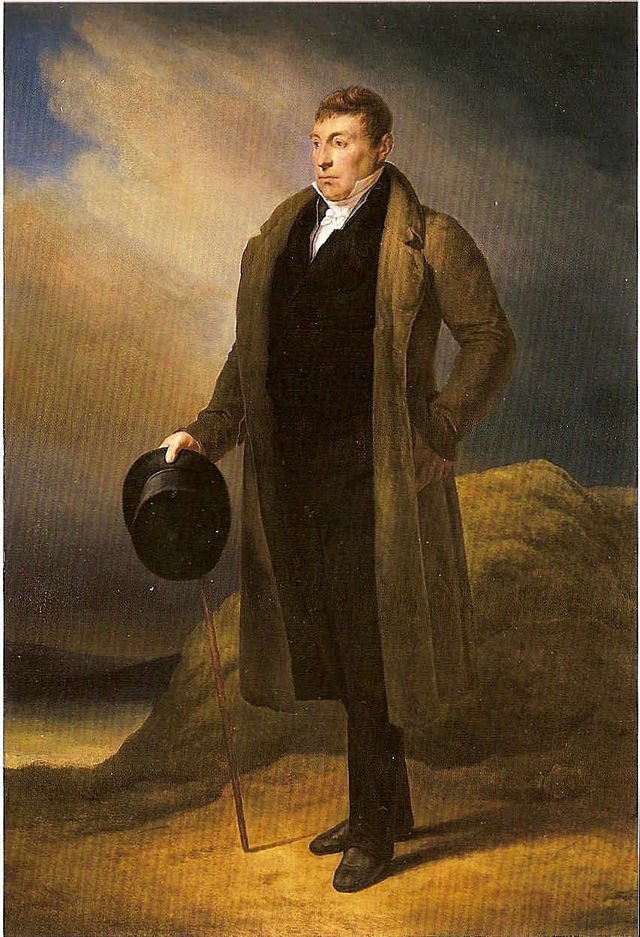
General Lafayette by Ari Scheffer (1823)

Ary Scheffer was also an excellent portraitist and in 1823 he completed probably one of the best portraits. It was of General Lafayette, the French aristocrat and military officer.  It was a full-length standing portrait that was the most popular image of Lafayette as an older man, who had once been a general in the American Revolution War (1775-83) against the British and a close friend of George Washington.  Lafayette was a popular subject for prints in the first half of the 19th century.  He was a hero to both the French and the Americans; he was the first foreign dignitary to address a joint session of the U.S. Congress and in 1824, on the occasion of Lafayette’s celebrated tour of the United States, Ary Scheffer presented his painting to the U.S. House of Representatives. It has hung to the left of the Speaker’s rostrum since the opening of the current House Chamber in 1858.  Lafayette would later figure in the French Revolution in 1789 and in the July Revolution of 1830 which led to Louis-Philippe becoming ruler of the French nation.  This painting, entitled Gilbert de Motier, Marquis de Lafayette, is now part of the collection of the US House of Representatives in Washington.

When Louis-Philippe came to power in 1830 it marked the zenith of Scheffer’s artistic career.  Scheffer, before the July revolution, had been giving drawing lessons to Louis-Philippe’s children and a great friendship between artist and his pupils blossomed.  Once Louis-Philippe came to power after the 1830 Revolution, Scheffer attained an influential position within the court. Louis-Philippe became the patron of the artist and the Orleans family bought many of Scheffer’s paintings. Scheffer received numerous lucrative commissions for the Musée Historique at Versailles, which Louis-Philippe founded in 1837 and which was situated in the wings of the Palace of Versailles.   The gallery which is one hundred and twenty metres long houses and also includes extensive tables that illustrate the major military events of the history of France.

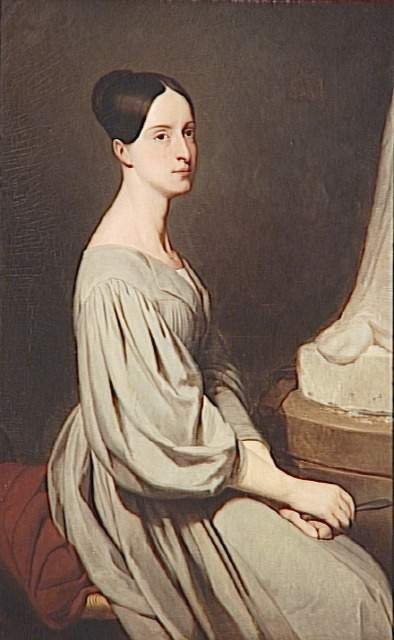
Princess Marie d'Orléans by Ary Scheffer (1831)
Princess Marie d’Orléans by Ary Scheffer (1831)

Ary Scheffer also completed a number of Royal portraits including one in 1831 of Princess Marie of Orléans the third child and second daughter of Louis-Philippe and his wife Maria Amalia of the Two Sicilies.  She later became the wife of Duke Alexander of Württenberg.  She was the most talented artist of all the Royal children and was constantly encouraged to pursue her love of art and sculpture by Ari Scheffer.  Sadly she died of tuberculosis when she was just twenty-five years old.

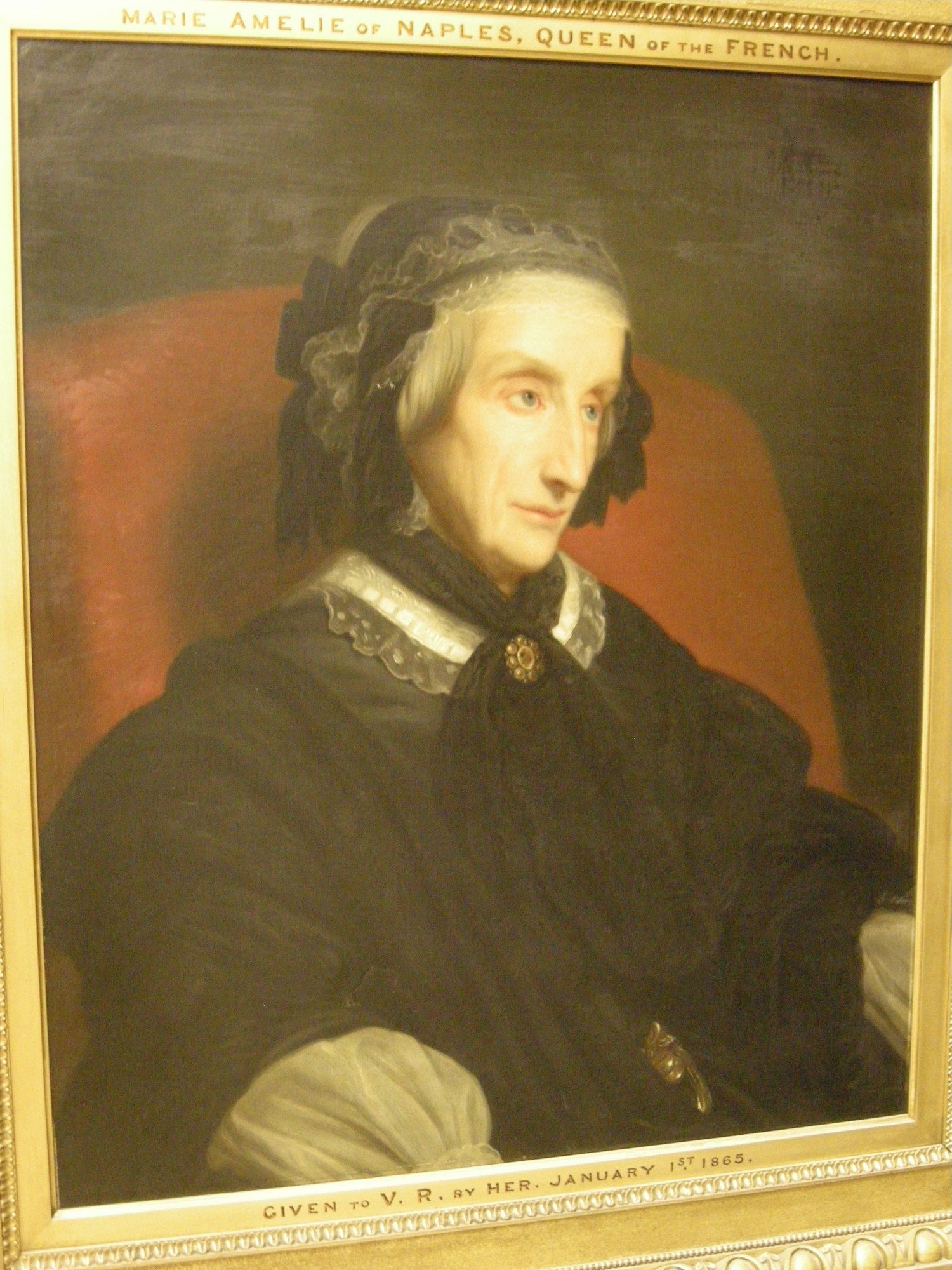
Marie Amélie of Naples, Queen of the French by Ary Scheffer (1857)

Another member of the he French Royal Family who featured in one of Scheffer’s portraits was Marie-Amalia, the niece of Marie-Antoinette and the wife of Louis-Philippe.  Louis-Philippe had reigned as the French monarch from 1830 when he came to power following the July Revolution and ruled for eighteen years but was deposed in the February 1848 Revolution which resulted in he and his wife, Marie-Amalia living a life in exile in England.

Claremont
Claremont

The couple lived at Claremont, a stately home owned by Leopold of the Belgians, but lent out to Queen Victoria.  In 1850 Louis-Philippe died but his widow remained at Claremont for the rest of her life.   Ary Scheffer visited Claremont in 1857 at which time he completed the portrait of the ex-Queen.   In it we see a frail seventy-five year old lady in mourning.

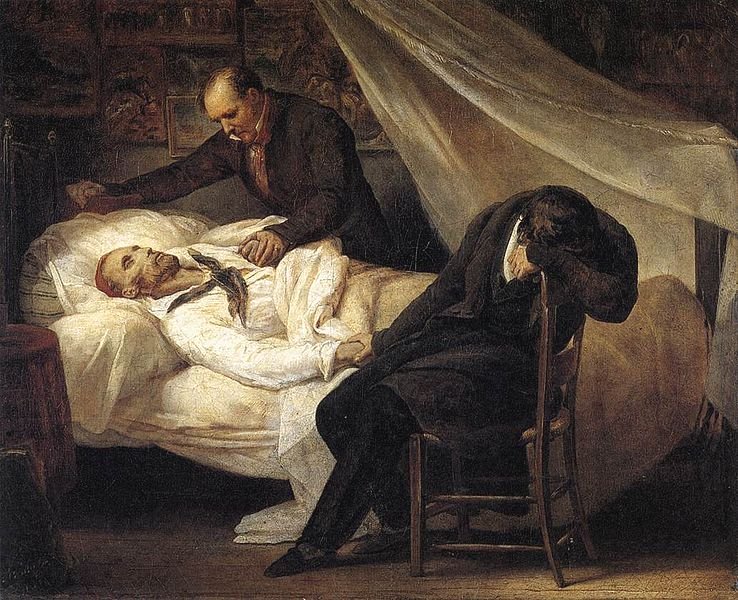
Death of Géricault by Ary Scheffer (1824)

What persuaded me to feature Ary Scheffer was when I was looking at the death of Théodore Géricault at the young age of thirty-two; I came across a painting entitled The Death of Géricault by today’s featured artist, Ary Scheffer.  It is beautiful work of art which highlights the French Romanticism style, which was so popular at the time.  Look at the man sitting on the chair who was presumably one of Géricault’s close friends.   Look at the way Scheffer has depicted him.  He grasps Géricault’s limp wrist with his right hand whilst he buries his head on his left hand which lies across the back of the chair which he is sitting on.  It is almost a scene from an old silent Hollywood movie or part of an amateur dramatics production.  The physician holds Géricault’s left hand which lies almost lifeless over his heart.  Look at Géricault’s face.  It is sunken.  It is almost skull-like.   In my last blog I featured Géricault’s last self-portrait which was a very disturbing depiction and somebody commented that it could not have been that bad but what we see in Scheffer’s painting is very close to that self-portrait.  This was the end for the great artist.

Théodore Géricault and Monomania

Self Portrait by Théodore Géricault

In my last blog I looked at some works by Théodore Géricault.  I examined his paintings which featured horses and the military and his masterpiece The Raft of the Medusa which I had examined in detail in my blog of June 10th 2011.  I finally looked at a highly erotic work which he painted for his own delectation around about the same time of the Medusa work.  In this blog I want to look at what I consider as his finest works, a series of portraits of men and women who had serious mental issues.

Raft of the Medusa by Théodore Géricault (1819)

Having completed The Raft of the Medusa around 1819 he exhibited it at that year’s Salon under the title Scène de Naufrage (Scene of Shipwreck).  It was hailed as the star piece of that year’s Salon and was well received by the French public including Louis XVIII himself, who had sponsored the exhibition.  Such was the fame of this work that Géricault was invited to London in June 1820 to exhibit the painting at William Bullock’s Egyptian Hall in Piccadilly.  It drew in crowds from all over the country and by the time the exhibition ended at the end of 1820, more than forty thousand people had come to view the masterpiece and as Géricault had negotiated a fee based on the number of people who paid to see his work it is thought that he walked away with twenty thousand francs and so it was just as well the French government would not countenance the purchase of the work when the 1819 Salon closed!

A year later, at the end of 1821, Géricault left London and returned to Paris.  It was at this time that he embarked on a series of ten portraits of people who were suffering from what is termed monomaniaMonomania is an exaggerated or obsessive enthusiasm for or preoccupation with one thing.  It is a type of partial insanity.  The word was first used by the French psychiatrist Jean Étienne Esquirol around 1810 and was a notion typified by the presence of an expansive fixed idea in which the person’s mind was diseased and deranged in some aspects but otherwise normal in others. So why would Géricault focus on this type of person and who commissioned the ten small works?

The man who commissioned the paintings is known to be Étienne-Jean Georget.  Georget was an intern at Salpêtrière, the women’s asylum in Paris, and later the medical supervisor at a private asylum in Ivry.  As to how the two men met is still up for debate amongst art historians.  One theory is that Géricault was treated by the psychiatrist.  He had been suffering from depression accompanied by paranoid delusions which culminated in a nervous breakdown around 1819.  Another possibility was that the two met during one of Géricault’s visits to the hospital morgue where he would go to acquire dissected limbs which he often used in his preliminary studies for major works, such as his Raft of the Medusa painting.  It could have been that Georget had commissioned the work as he believed such an artistic task would help Géricault recover from his own mental dark period.  When Géricault completed the work he gave them to the psychiatrist as a way of expressing his thanks.  Some art historians however believe that it was a simple commission, the result of which would help Georget in his studies into monomania.  However it should not be forgotten that Géricault had an intense interest in the causes and results of mental instability for his grandfather and one of his uncles had died insane. At the time Géricault was formulating his painting The Raft of the Medusa, which featured a group of men adrift on a raft after the sinking of their vessel Medusa, he knew that the key to success would be an authentic depiction of the terrified and dying seamen.   Géricault portrayed the men on the raft as dead or dying, desperately trying to signal for help.  To achieve a sense of realism he had contacted a variety of medical specialists. His principal concern had been to gain access to human bodies in various states of putrefaction, to ensure the genuineness of the finished painting and it could have been that he also talked to the likes of Georget about the psychological trauma suffered by the victims of the Medusa shipwreck.  It is known that he interviewed the surgeon, Henry Savigny, who had been serving on the vessel when the shipwreck occurred and the doctor, at the time, had been putting down in print his experiences and the way it mentally affected the stricken crew members.

Whatever the circumstances were we know the five paintings I am going to feature initially belonged to Georget.  He, like Géricault died when he was in his early thirties.   I mention five works and yet one of Géricault’s early biographers, Charles Clément, talked of there being ten portraits.  However, only five remain.  So did the missing five feature five other mental patients?  What is currently believed is that Georget had asked Géricault to paint a further five works featuring the same five people at a later time so as to highlight the change in their appearance.  For Georget this was the study of physiognomy, an art of judging character from the face and phrenology, which would link the external form of the cranium as indication of mental faculties.  Simply put it was the assessment of a person’s character or personality from his or her outer appearance.  We have no names as to the sitters, just the monomania that is afflicting each of them.  In his book On Madness, published in 1820, Georget is most definite that madness can be seen in the face of the afflicted.  He wrote:

“…In general the idiot’s face is stupid, without meaning; the face of the manic patient is as agitated as his spirit, often distorted and cramped; the moron’s facial characteristics are dejected and without expression; the facial characteristics of the melancholic are pinched, marked by pain or extreme agitation; the monomaniacal king has a proud, inflated expression; the religious fanatic is mild, he exhorts by casting his eyes at the heavens or fixing them on the earth; the anxious patient pleads, glancing sideways, etc…”

Certainly harsh and in some ways unfeeling words from the psychiatrist and are in complete contrast to the sympathetic way Géricault depicted the sitters.

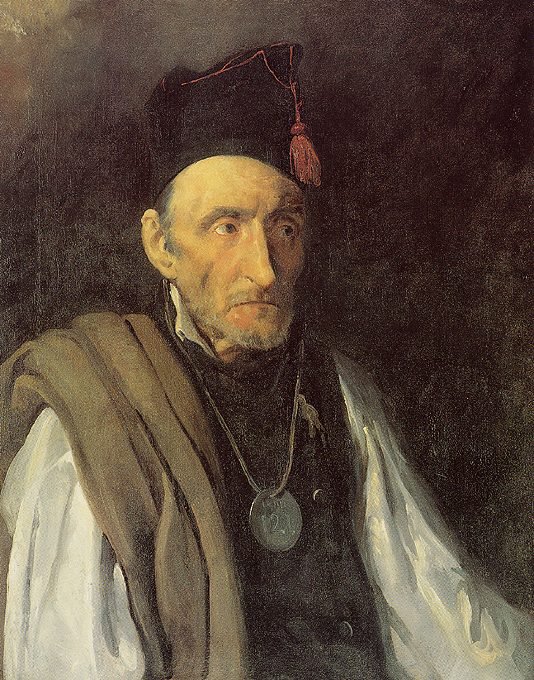
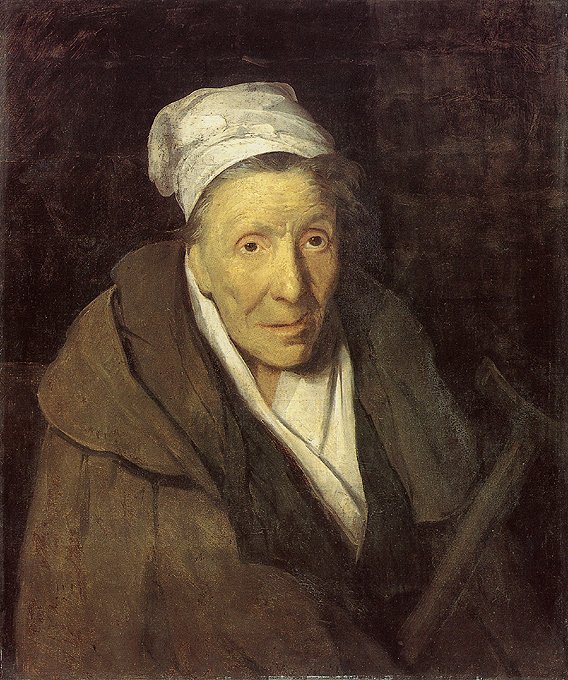
The five surviving portraits are entitled Portrait of a  Man Suffering from Delusions of Military Command;    A Kleptomaniac;  Portrait of a Woman Suffering from Obsessive Envy;     A Woman Addicted to Gambling and A Child Snatcher.  It seems likely that the featured women were inmates of the women’s hospital Salpêtrière, while the men were chosen from the many male inmates of the male asylums of Charenton and Bicȇtre.

Portrait of a Woman suffering from obsessive envy by Théodore Géricault (1822)

The first of the five I am featuring Portrait of a Woman Suffering from Obsessive Envy, which is housed in the Musée des Beaux-Arts in Lyons.  She avopids our gaze.  Her eyes are red-rimmed.  She has suffered and is probably still suffering.  Her case notes stated that she suffered from “envy obsessions” and maybe the slightest hint of a green tint to her face was the artist’s way to signify her obsession with envy.

Portrait of a Man suffering from Delusions of Military Command by Théodore Géricault (1822)

Next we have a man who suffers from delusions of grandeur and the portrait is entitled A Man Suffering from Delusions of Military Command which is in the Museum Oskar Reinhart in Winterthur in Switzerland.  The man in this particular portrait believed he was Napoleon and maybe Géricault believed that it was not just his sitter who had delusions of grandeur but it was targeted at the man himself, Napoleon, who may also suffered a similar delusional belief in himself as the head of the French Empire.  One needs to remember my previous blog when I featured some of Géricault’s military paintings.  Maybe now, like many French people after the defeat of Napoleon, he had misgivings about the glory of battle.  It is a very sympathetic portrayal of the old man and there is an air of sadness about his demeanour.  He looks like a defeated man and could well be an allegory for a defeated nation.

Portrait of a Kleptomaniac by Théodore Géricault (1822)

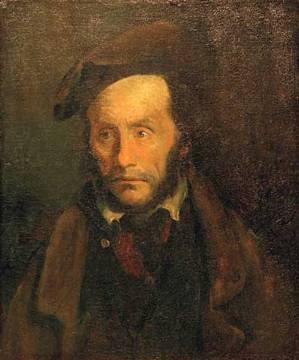
My third offering is the painting entitled Portrait of a Kleptomaniac which is housed in the Museum of Fine Arts in Ghent.  It is a strange depiction.  Just by looking at him we know there is something wrong in his life both physically and mentally.  He is dishevelled.  His sallow skin tone alerts us to him being ill.  His beard is unkempt and his hair is uncombed and messy.  Look at his face.  Look at the redness of his left cheek which looks swollen as if he has been involved in a fight.  He stares out at us, or maybe past us, but we have no idea what he is thinking. It is an empty gaze.  Géricault probably had no idea what his sitter was thinking but he made sure he captured every small detail about the man and maybe he wants us to decide on what has brought this man to the asylum.

Portrait of a Woman suffering from an  Obsessive Gambling disorder  by Théodore Géricault (1822)
Portrait of a Woman suffering from an Obsessive Gambling Disorder by Théodore Géricault (1822)

The fourth painting is entitled A Woman suffering from and Obsessive Gambling Disorder and can be found at the Louvre in Paris.  The old woman in the painting avoids stares out at us but it is a blank stare.  One has no idea what she is thinking.  She is lost in her own world, a world she is resigned to but does not enjoy.   Her eyes are red-rimmed probably brought on by the amount of mental and physical pain she has had to endure.  Her mouth is tense.  You can see in her facial expression that she is disturbed by something but with what?

Portrait of a Child Snatcher by Théodore Géricault (1822)

The final portrait by Géricault is entitled A Child Snatcher.  Before us we have a man who looks distinctly unhappy with his lot in life.   He is dressed in old brown clothes and has a dishevelled look about him.  His face is haggard.  His life has not been easy.  The dark background give us the distinct impression that this man lives in a world of isolation.  It is as if, as a resident of a mental institution, he has been cut adrift by society.  He avoids our gaze and looks to the side in a somewhat shifty manner.  Although we would compartmentalize this type of portrait as one of realism there is an element of romanticism in the way Géricault does not want us to judge the sitter.  Looking at the man we would not know his crime but the title of Child Snatcher tells us all we need to know about a man who in the present day would be probably be classed as a paedophile.

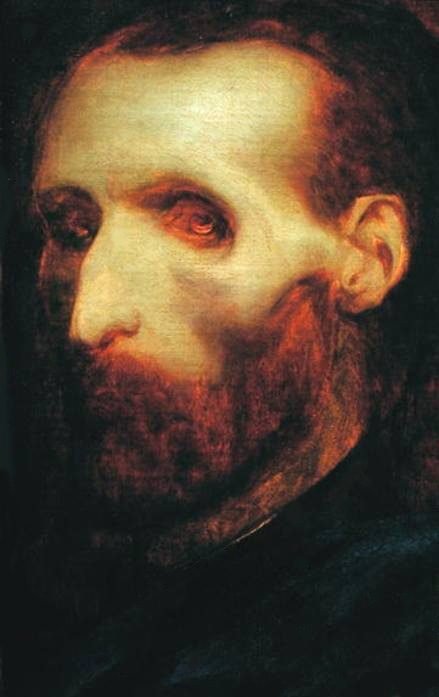
Last self portrait by Théodore Géicault (c. 1823 - 1824)
Last self portrait by Théodore Géicault (c. 1823 – 1824)

If you think that the five portraits were very disturbing and yet very real, I will leave you with one other shocking portrait.  It is the last self-portrait by Géricault, which he completed when close to death.  What a terrible sight it must have been as he looked in the mirror as he worked on his own portrait.  Remember this was a young man in his early thirties.

 The five existing portraits were discovered unframed and unstretched by Louis Viardot , the husband of the famous  French mezzo-soprano, Pauline Viardot .  Viardot was an artist himself, and a great admirer of Gericault, and so he recognised the style of the works as that of Géricault.  Géricault’s biographer Charles Clément researched the origin of the works and found that they had all belonged to a certain Dr Lacheze, to whom they had been bequeathed by another medical man, the psychiatrist Dr Etienne Georget.

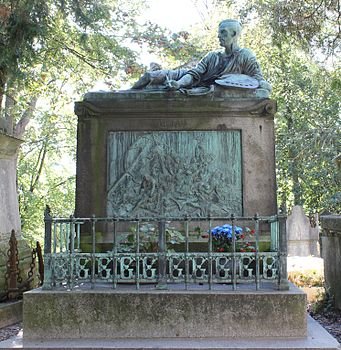
Théodore Géricault's tomb at Père-Lachaise cemetery in Paris
Théodore Géricault’s tomb at Père-Lachaise cemetery in Paris

Théodore Géricault died in January 1824, aged 32 and is buried in the Père-Lachaise Cemetery in Paris.  This series of portraits featuring mentally disturbed people was completed by an artist who also suffered depression during his later life.  In 1810, he wrote to his best friend, Pierre-Joseph Dedreux-Dorcy:

 “…Now I am disoriented and confused. I try in vain to find support; nothing seems solid, everything escapes me, deceives me. Our earthly hopes and desires are only vain fancies, our successes mere mirages that we try to grasp…”

Whereas Dr Georget was more clinical and some would say somewhat cold-hearted about his desire to have the portraits of these people we can see in the way Géricault depicted them with sympathy and even empathy.

Sarah Siddons

Sarah Siddons by J. Dickinson

The subject of my blog today is not an artist, although many would term her a theatrical artist, and in fact she was looked upon as one of the greatest English tragic actors of the eighteenth century. She was a Shakespearean actor of great renown and particularly famous for her interpretations of Lady Macbeth. She was a lady who was so popular that her portrait was painted a number of times by leading portraitists of the time. Let me introduce you to Sarae Kemble, later known as Sarah Siddons.

Sarae Kemble was born in the Welsh town of Brecon in July 1755. She was the eldest of twelve children of Roger Kemble and his wife Sarah Ward. Her father, who was a theatre manager, managed a troupe of travelling actors, the Warwickshire Company of Comedians. Sarah was fortunate to be the eldest child as her mother made sure that she received a good education and insisted on her attending school at the various towns the troupe of actors performed but this did not preclude her from making many appearances on the stage when she was still just a small child.

During her teenage years she fell in love with William Siddons, who was one of her father’s troupe of actors. However, like most parents, Sarah’s mother and father baulked at her liaison with Siddons as they had already received an offer of marriage from a local squire. Sarah would not agree to such a relationship and held out until she was eighteen and eventually in November of 1773 she married her beloved William Siddons in Trinity Church, Coventry. A year later, in 1774, she appeared as Belvidra in the English Restoration play, a tragedy, written by Thomas Otway, called Venice Preserv’d, which was first performed in 1680. Sarah Siddons’ performance was hailed a great success and the excellent revues of her depiction of her character came to the attention of the veteran actor of the time, David Garrick. She was invited to appear at the prestigious Theatre Royal, Drury Lane but whether it was nerves or whether she had still yet polished her acting ability, her performances were slated and, to her shame and horror, the theatre dispensed of her services.

It may have all been for the best as she spent the next six years travelling around the country with touring companies, honing her skill as an actor, all the time enhancing her reputation and finally she was invited back to the scene of her early disasters, Theatre Royal Drury Lane, where she was hailed as a theatrical genius for her portrayal of Isabella in David Garrick’s adaptation of Thomas Southerne’s play, Isabella or The Fatal Marriage.

Mrs. Siddons as the Tragic Muse by Sir Joshua Reynolds

It was around this time, in 1784 that she sat for Sir Joshua Reynolds who depicted her as the Tragic Muse, Melepoméne, in his famous portrait, Mrs Siddons as The Tragic Muse. The name Melpoméne comes from the Greek word melpo or melpomai, which means “to celebrate with dance and song. She is a Greek and Roman mythological character who was one of nine muses of the arts. She started off as the Muse of Song but later became the Muse of Tragedy. Reynolds was himself a great fan of the actor and was also a lover of all things classical and decided to combine his two loves in one single portrait. Reynolds was so overwhelmed by the actress that it was said that when she first visited him, he led her by the hand into his studio uttering:

“…Ascend upon your undisputed throne, and graciously bestow upon me some great idea of the Tragic Muse…”.

Further evidence of his devotion to the twenty-eight year old actor was that he signed his name on the gold embroidery at the hem of her dress. He explained this pictorial inclusion to the sitter saying:

“…I have resolved to go down to posterity on the hem of your garment…”

In the portrait we see Sarah Siddons seated in her throne chair with the allegories of Pity and Terror standing behind her and who merge into the brown background. Her body is towards us whilst her head and face are in profile. Her facial expression is one of concern. She looks troubled and in two minds as Pain and Terror influence her thought process. Despite this, she exudes an air of sophistication and dignity. Her dress is a mass of subtle colours, ochres and light and dark browns. Look at the beautiful and skilful way Reynolds has depicted the folds of the heavy fabric dress.

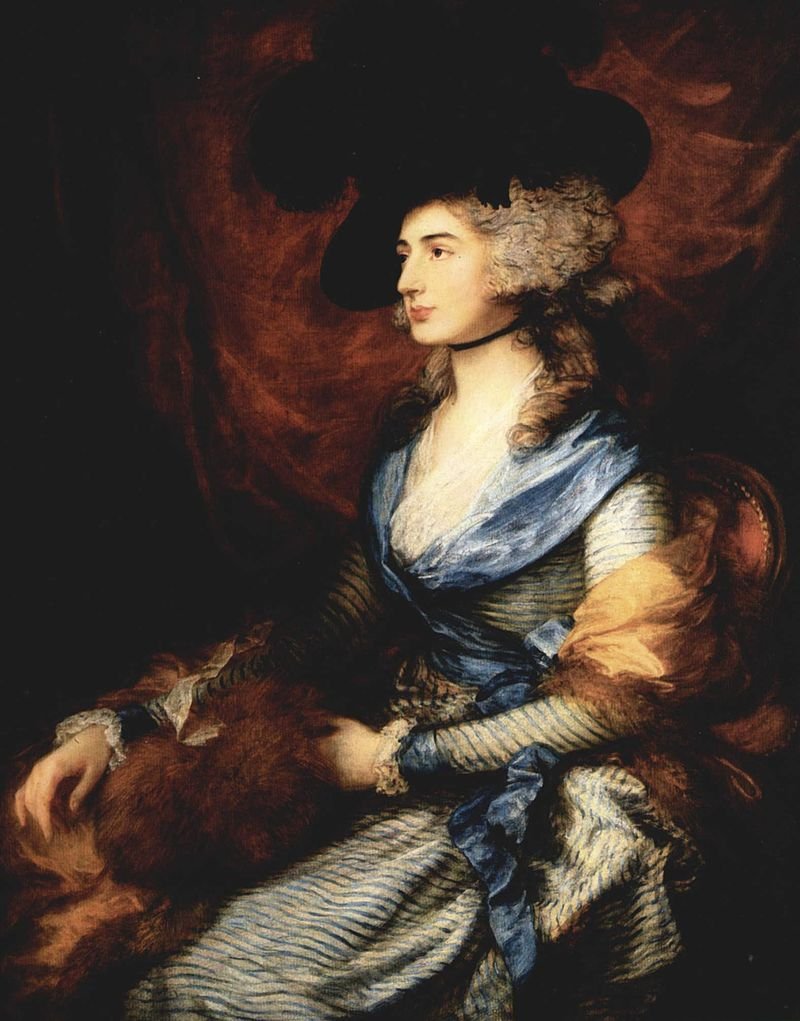
Sarah Siddons by Thomas Gainsborough

A year later, in 1785, another portrait of Sarah Siddons was completed. The artist was Thomas Gainsborough and the tile of the work was simply Sarah Siddons. It has been recorded that Gainsborough struggled with the portrait of Siddons especially when it came to her nose and her right hand which rests on the arm of the chair. It took him many attempts to get them right as has been revealed in the pentimenti. The word, pentimento (pentimenti is the plural), comes from the Italian word pentirsi, which means to repent or change your mind and pentimento is a change made by the artist during the process of painting. Such changes are concealed beneath  subsequent paint layers and often, if the final layer of paint has become transparent over a long period of time, an earlier layer of paint can be detected. Other ways of detecting such changes is with infra-red reflectograms and X-rays. Gainsborough himself commented about the difficulty he had with portraying her long nose when he uttered:

“…Confound the nose, there’s no end to it…”

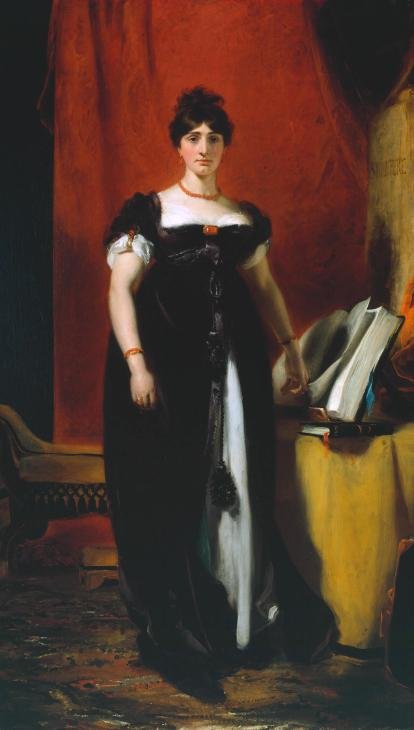
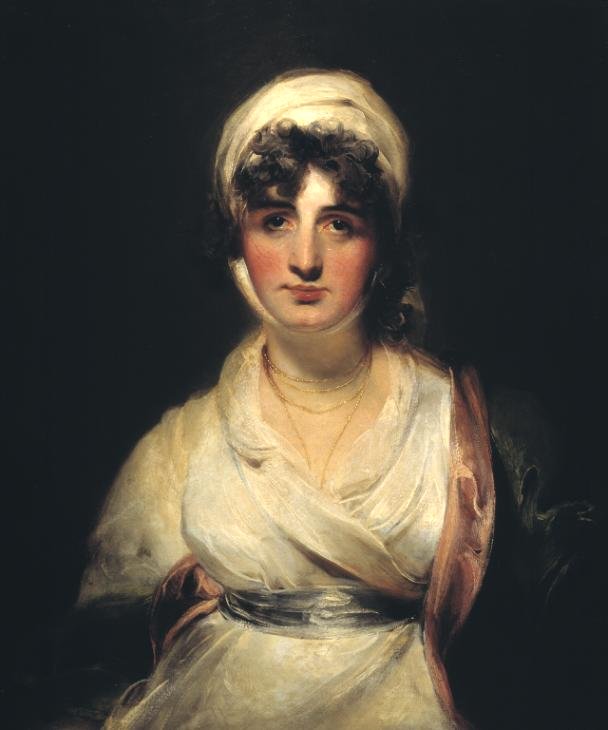
Another well known artist, Sir Thomas Lawrence, painted a portrait of Sarah Siddons in 1804 when she was forty-nine years of age and nearing the end of her theatrical career.

Sir Thomas Lawrence knew Sarah Siddons and her family well. His portraits of her were probably more about Siddons the woman rather than Siddons the actor or one of Siddon’s many female characters she had played on stage. Thomas Lawrence and Siddons had first met in Bath in 1777 when she was twenty-two and on tour with a theatrical production. He was just eight years of age. Lawrence was a kind of child prodigy, an accomplished artist even at that age and had the ability to recite poetry, the two achievements which his father used to extract money from the passing public. At her first meeting with young Thomas Lawrence, Siddons never realised how he would affect her later  life and that of her family.

In 1787, just before his eighteenth birthday, Thomas Lawrence arrived in London. He met up again with Sarah Siddons, who was by now a cultural icon at the high-point of her theatrical career. Lawrence began consecutive relationships with two of her daughters, Maria and Sarah. Sadly they both died in their twenties. Sarah Siddons was by now separated from her husband William. Siddons herself was also in love with Thomas Lawrence, her daughters’ charming and alluring suitor, and he painted many portraits of her.

Mrs Siddons by Sir Thomas Lawrence (1804)

In his 1804 portrait entitled Mrs Siddons, we do not see her portrayed as an actor playing one of her many roles but at one of her many recitals when she would, with an actor’s panache, read from one of the plays which had made her so famous. In this portrait we see Sarah standing next to a table. On the table is a small lectern, on which are scripts of plays by Thomas Otway and Shakespeare.

Mrs Siddons as Mrs Haller in ‘The Stranger’ by Sir Tomas Lawrence

Lawrence had completed an earlier painting of Sarah Siddons in 1797 entitled Sarah Siddons (possibly as Mrs Haller) in ‘The Stranger’ , a play written by August Friedrich Ferdinand von Kotzebue the German dramatist and writer. The role she played was of the adulteress, Mrs Haller. In the portrait we see the sadness in Sarah Siddon’s expression which could well be the feelings expressed by the character in the play or it could be the unhappiness of her own life which would have been well known to Lawrence.  At last we may be seeing the real Sarah Siddons.

Sarah Siddons was a tall woman with strikingly beautiful features. Her most famous role was that of Lady Macbeth in the Shakespeare play, Macbeth. The way in which she played the part of Macbeth’s wife was legendry for the emotions she expressed when murder was on her mind. She was so good in the role, she made it her own. Audiences were spellbound by her performances.

Statue of Sarah Siddons,_Paddington_Green

Sarah Siddons gave up acting in 1812. She died in London in 1831 a month before her 76th birthday and was interred in Saint Mary’s Cemetery at Paddington Green. There is a statue of her on Paddington Green.

John Singer Sargent and Virginie Amélie Avegno Gautreau

In my last blog I featured a painting by Theodore Roussel entitled The Reading Girl which was at the time both controversial and newsworthy, only going to prove the old adage that there is no such thing as bad publicity.  My blog today follows a similar theme, a controversial painting which had major repercussions on the artist and his career.

Self portrait by John Singer Sargent (1907)

My featured artist is John Singer Sargent.   He came from a very wealthy family.   His grandfather was Winthrop Sargent IV, who had descended from one of the oldest colonial families.  Due to a failed merchant-shipping business in Gloucester, Massachusetts, he moved his family to Philadelphia.  It was in that city that John Singer Sargent’s father, Fitzwilliam Sargent became an eye surgeon.  In 1850, Fitzwilliam Sargent married Mary Newbold Singer who was the daughter of a successful local merchant. In 1853 Mary gave birth to their first child, a daughter, who sadly died a year later.   Sargent’s mother suffered a nervous breakdown after the death of her daughter and her husband decided that it would be better for his wife’s health to move away from Philadelphia and the sad memories and take up residency in Europe.  Initially Sargent’s father’s idea was for he and his wife to stay in Europe just a short time until she was better but their life away from America extended and soon they became expatriates.  He and his wife based themselves in Paris but they would often travel and stay in Florence, Rome, or Nice in the winters and in the summers they would journey to the Alps were the climate was much cooler and more pleasant.   Their son John was born in January 1856 whilst they were in Florence.

Because of the nomadic lifestyle of the family and because of his determination not to stay in school, John Singer Sargent did not receive formal schooling and was taught at home by his father and mother.  He proved to be an excellent pupil excelling in languages and the arts.  Art played a great part in his early life as his mother was a talented amateur artist and his father was a talented medical illustrator.  Following more additions to the family and because his wife wanted to remain in Europe, John Singer Sargent’s father eventually resigned his post at the Willis Eye Hospital in Philadelphia and acquiesced to his wife’s wishes for the family to remain in Europe.

John Singer Sargent soon developed a love of art and his father had him enrol at the Accademia di Bella Arti in Florence during the winter of 1873/4.  In 1876, at the age of eighteen, Sargent passed the entrance exam to the École des Beaux-Arts in Paris.  Here he studied anatomy and perspective and spent time in the Paris museums copying the works of art of the masters. In those early days at the art academy Sargent was schooled as a French artist.  It was the era of French Impressionism and he was greatly influenced by the work of the Impressionist movement.  He was also a lover of the works of art by the Spanish painter, Velazquez and the Dutch master Frans Hals.

Portrait of Carolus-Duran by John Singer Sargent (1879)

However nearer to home he was inspired by his art tutor, the French painter, Carolus-Duran, a portrait of whom he completed in 1879.     John Singer Sargent’s reputation as a great artist and portraitist grew rapidly and in Paris he was the toast of artistic circles.  Everything he did was loved by the critics and the public.  The Parisians loved him.  He could do no wrong.  Well actually he could and did and through one painting, a portrait of a lady, his fall from grace was rapid and final and caused him to exile himself from Paris and France and take refuge in England.  So what happened?  The answer to this question is examined in this very blog.

The lady whose portrait caused such a stir was Virginie Amélie Avegno Gautreau.  Virginie Amélie Avegno was born in New Orleans in January 1859.  She was the daughter of a white Creole family.  Her father was Major Anatole Placide Avengo, a Confederate army soldier and her mother was Marie Virginie de Ternant who came from a wealthy Louisiana plantation owning family.  Her father was killed during the American Civil War at the Battle of Shiloh in 1862.  Five years later in 1867 her widowed mother took her eight year old daughter to live and be educated in Paris and as a teenager was introduced into high French society.

Virginie Amélie Avegno blossomed into a beautiful woman.  She was a pale-skinned brunette.  She was renowned for her great beauty and was accepted into Parisian society circles.  She dazzled all who met her with her exquisite clothing and undeniable beauty.  She mastered the art of make-up to enhance her looks and was known for her heavy use of chalky lavender powder which was dusted on her face and body affording her a very distinctive pallor.  Her beauty was unique.  She had a long nose which was somewhat longer than the accepted norm, her forehead was also too high and yet these physical characteristics never detracted from her hourglass figure and the seductive way she would walk when entering a room of people.

In his 2011 book The Greater Journey: Americans in Paris, David McCullough quotes an American art student named Edward Simmons who wrote about seeing Virginie and how the sight of her was unforgettable:

“…She walked as Virgil speaks of a goddess—sliding—and seemed to take no steps. Her head and neck undulated like that of a young doe, and something about her gave you the impression of infinite proportion, infinite grace, and infinite balance. Every artist wanted to make her in marble or paint…”

As always beauty as well as bringing out admirers, brings about jealousy and many of her detractors labelled her an arriviste, one who has attained a high position but has not attained general acceptance or respect.  I suppose we would liken her to one of the nouveau-riche looked down on by the “old establishment rich”

A mother’s most fervent wish is to see her daughters marry successfully which often translates into having their daughters marry a wealthy man.  Virginie’s mother must have been well pleased when her daughter married a wealthy French banker, Pierre Gautreau, and her daughter now had two of the greatest assets of life, beauty and a wealthy husband who held a great status in Parisian society.

John Singer Sargent met Virginie Gautreau at a social gathering around 1881.  He was smitten by her beauty and elegance; some say he soon became obsessed with her.  Having met her he wanted just one thing from life – to paint her portrait and have it exhibited at the Paris Salon so all could admire “his lady”.  Sargent had been inundated with portraiture commissions but on this occasion it was he who approached his desired sitter to ask if she would acquiesce to become the subject of his portrait.  Sargent realised that Gautreau was both part of high class Paris society and a renowned beauty and thus a portrait of her by him at the Salon would bring great kudos and he probably realised that if he portrayed her seductively it would cause a sensation similar to Manet’s Olympia at the 1865 Salon.  Sargent had unfortunately not realised how sensational it would turn out.

Watercolour figure study of Madame Gautreau  by John Singer Sargent (c.1883) Harvard Art Museum
Watercolour figure study of Madame Gautreau
by John Singer Sargent (c.1883)
Harvard Art Museum

After some help from colleagues Sargent persuaded Virginie Amélie Avegno Gautreau to sit for him.  For months on end he would complete many line drawings of her head in profile.  He would complete studies of her in pencil and watercolour, sometimes simply relaxing on a chaise-longue in a low-cut evening dress or depicted her in oil painting sketches drinking a champagne toast. In the summer of 1883, he stayed at the Gautreaus’ country estate in Brittany but admitted to his friend the writer, Vernon Lee, that he was still struggling to do justice to this un-paintable beauty.  He was also now having doubts as to whether it would be accepted into the 1884 Salon by the Salon jury.

In the winter of 1883, Sargent moved his Paris residence which had been on the Left Bank to a new studio across the Seine in the fashionable Parc Monceau neighbourhood and it was here that he completed his full-length portrait of Gautreau.  It was a nerve-wracking time for Sargent as he had suffered a loss of self-confidence in his artistic ability in respect to the depiction of his beloved beauty.  Despite his worries, the painting was finally completed in 1884 and the Salon jury accepted it into the 1884 Salon. This was the sixth year in a row that the Salon had accepted works by Sargent. Before the Salon opened there was already a frenzied excitement about the portrait.  Gautreau had talked wildly and incessantly to her friends and acquaintances about the painting, even though she had never seen the finished work.

Madam *** by John Singer Sargent as exhibited at 1884 Salon
Madam *** by John Singer Sargent
as exhibited at 1884 Salon

In the painting, Gautreau is seen dressed in a long black satin skirt with its sultry low-cut black velvet bodice.  Against the deep black of the dress and the plain dark background, the deathly blue-white of her powdered skin was even more eccentric and noticeable.   Her shoulders are bare with the exception of two narrow jewelled straps. Gautreau posture is one in which both her shoulders are held back, her body faces us and yet her head is angled to the left, which fully highlights her stunning profile.   Her left arm rests on her hip with her hand gripping the material of her dress.   Her right hangs down in a twisted manner s her fingers grasp the top of the table.  The result of this distorted pose was to create tension in the neck and arm but it also highlighted the subject’s graceful curves.   Her hair is pinned up high on her head atop of which is a tiara.  Sargent must have “designed” this un-natural pose presumably because he believed it brought a haughty sensuality to his sitter, for remember, besides wanting to do justice to his sitter’s beauty he also wanted this work to have a sensational affect when it was exhibited.  It was probably this thought of sensationalism that made him make the cardinal error which was to damn him.   During one of Gautreau’s sittings the thin strap of her dress had slipped from her right shoulder and as she was about to re-adjust it when Sargent told her to leave it down it was and he decided to make the portrait even more sultry by portraying Gautreau’s right shoulder bare.  The die was cast and the painting with the strapless shoulder went on exhibition under the title Portrait of Madame *** although most Parisians were aware that it was the portrait of Virginie Amélie Avegno Gautreau.

Even though the Salon had just opened the picture was condemned for what was termed the sitters’ “flagrant insufficiency” of clothing.  Little was said about the other aspects of the work, it was all about the seductive pose and dress (or undress) of the sitter.  The Paris public could not stop talking about Sargent’s portrait of Gautreau.  It was fast becoming a scandal of epic proportions.  The painting received many critical reviews.  Some objected to the portrait on the grounds that they disliked Madame Gautreau’s décolletage, others criticised what they termed the repulsive colour of her skin.  Few however were less harsh and stated that they liked the modern approach to the portrait and congratulated Sargent on is courageous approach.  It is difficult to understand the furore over the suggestiveness of the black dress when paintings of nudes littered the walls of the Salon but of course they would normally have biblical or mythological connotations to them which made blatant nudity acceptable.  Maybe it was the haughty pose of the arriviste with her heavily powdered features which was too much for the critics and public alike. Gautreau herself was humiliated by the whole affair and her mother, Madame Avegno, who was also horrified with publicity surrounding the portrait, demanded Sargent remove it from the Salon. He defended the portrait, telling the irate mother that it was a truthful likeness of the pose of her daughter and the clothes she wore.

John Singer Sargent in his studio with with his painting Madame X

Sargent had scandalised Paris society and he was widely criticised in Paris art circles for being improper.  For Sargent the criticism of the work and of him as an artist was almost impossible to bear.  He had been living and working in Paris for ten years and during that period he had received nothing but praise for his work and the commissions had poured in on the back of such praise.  The criticism of the portrait went beyond a simple poor review.  He was being mocked by the Paris public for what he later stated was the best painting he had ever completed.  For him the work was a true masterpiece but it would take a long time before the world acknowledged that fact.  Sargent hung the work first in his Paris studio and later in his studio in London and from 1905 onwards he allowed it to be seen at various international exhibitions.

Madame X by John Singer Sargent (c.1884) with the position of the strap of dress altered
Madame X by John Singer Sargent (c.1884)
with the position of the strap of dress altered

Sargent repainted the fallen strap on Guitreau’s right shoulder, re-titled it Madame X and eventually sold the work to the Metropolitan Museum of Art in New York in 1916 where it is housed today.  An unfinished second version of the same pose is in the Tate Gallery London.

Sargent found the criticism unjustified and shortly after the 1884 Salon, in the May, at the age of 28, he left Paris disillusioned by the incident and disappointed by the fall off of sales of his paintings and moved to London where he remained for the rest of his life England.  Although his long-term career as a portraitist in France was over, he once again thrived artistically in the English capital and some say that it was here that he reached the pinnacle of his fame.  In those days to have you portrait done by Sargent was looked upon as having it painted by the best portraitist of the time.

John Singer Sargent      (1856 - 1925)
John Singer Sargent
(1856 – 1925)

He died in London in 1925, aged 69.

Seymour Joseph Guy

At the Opera by Seymour Joseph Guy (1887)

I was looking at the website of a person who had commented on one of my blogs and I was fascinated by a painting he had posted.  I had to find out more about it and the artist who had painted it.  The title of the work is At the Opera and the creator of the work was the nineteenth century English-born,  American genre painter, Seymour Joseph Guy.  Genre paintings are works, which depict one or more persons going about their every day life.  They could be scenes in the kitchen, at the market or in a tavern and they are nearly always realistic depictions, lacking any sense of idealisation.  They are “warts and all” depictions of life.  Seymour Joseph Guy’s later works, which were often quite small “cabinet pieces”, concentrated mainly on depictions of children.  His works were meticulous in detail.

 Seymour Joseph Guy was born in 1824 in England, in the south London borough of Greenwich.   His father was Frederick Bennett Guy who owned an inn as well as a number of commercial properties.   His mother was Jane Delver Wilson.  Seymour had an elder brother, Frederick Bennett Guy Jnr. and a younger brother, Charles Henry.  When Seymour was five years old, his mother died and he and his brothers were brought up by their father.  Four years later their father died and the executors of their late father’s will were John Locke who was the owner of the inn called the Spanish Galleon and a local cheese merchant and friend of Seymour’s father, John Hughes.   It is the thought that the three orphaned boys came under the legal guardianship of one of these gentlemen.  Seymour’s schooling was at a local school in Surrey and it was during these early informative years that he took an interest in art and he liked to spend time drawing dogs and horses.   He enjoyed drawing so much that, when he was thirteen years old, he made it known that he would like to become an artist, or maybe a civil engineer.  This choice of career did not go down well with his guardian who actively discouraged the teenager, going as far as stopping his pocket money so he couldn’t buy any pencils and sketchbooks and that he believed would force his charge to abandon his artistic plans.  Seymour was not to be put off and despite his lack of pocket money; he managed to earn enough to buy his own drawing materials by becoming a part time sign-painter.

Open Your Mouth and Shut Your Eyes by Seymour Joseph Guy (c.1863)

Seymour Guy continued with his ambition to become a painter and in his late teenage years received some artistic tuition from Thomas Butterworth.  Butterworth, who had served as a seaman in the Royal Navy during the Napoleonic wars period, lived in Greenwich and was a marine painter.  His guardian decided that a good career for Seymour, and in line with his artistic ambitions, would be to become an engraver.  However the cost of an apprenticeship to learn the engraving trade was prohibitive and this proposed profession had to be abandoned and instead his guardian arranged for Seymour to begin a seven-year apprenticeship at an oil and colour firm which oversaw the making of pigments, preparing binders, as well as combining the two skills in order to make paint either by hand-grinding them or using a steam driven machine.   This was a valuable experience for Seymour as he learnt the intricacies and expertise of mixing various pigments which he would himself use in the future for his own paintings.

In 1845 Seymour’s legal guardian died. It was also a time, when having reached the age of twenty-one, the brothers’ late father’s estate was split between them.  In Seymour’s case this also coincided with the end of his seven-year apprenticeship at the colour factory.    Seymour Guy was twenty-one years of age and now had sufficient money to pursue his dream of becoming a professional painter.  A friend offered to sponsor him to enable his entrance to the Royal Academy but instead he decided to work on his own and so he obtained a copying permit and took his easel and brushes to the British Museum where he copied some of the works of art.  Understanding that working alone was not the answer to learning about art he also enrolled at the studio of the portrait and historical painter, Ambrosini Jerome, who had received a number of commissions from the English royal family.  Seymour Guy was to work with Jerome for the next four years.

The Crossing Sweeper by Seymour Joseph Guy (c.1860's)
The Crossing Sweeper by Seymour Joseph Guy (c.1860’s)

In 1852, aged twenty-eight, Seymour married Anna Maria Barber, who was the daughter of William Barber, an engraver.  The couple went on to have nine children, many of whom were used by Seymour as models for his genre paintings.  Two years later in 1854, Seymour moved his family from London to New York and settled in Brooklyn.  Here he set up his studio in Brooklyn Heights, played a leading role in the art life of the city and founded the Sketch Club and it was during these early times in Brooklyn that he met and became a close friend of another genre painter, John George Brown.  Brown who was also English-born had left his home in Durham and immigrated to America in 1853.  This close bond of friendship probably stemmed from them both being English born, and both genre painters who liked to concentrate on small-scale works which gave them the opportunity to demonstrate their intricate minute workmanship.   In those early days in Brooklyn Seymour Guy also completed a number of portraits of leading local figures.

In 1861, the two friends, Seymour Guy and John Brown, decided to move their studios from Brooklyn to the more fashionable Manhattan.  Seymour Guy had his studio on Broadway whilst John Brown moved into the Tenth Street Studio Building. Two years later Guy decided to leave his Broadway studio and move into the Tenth Street Studio Building.  The Tenth Street Building, which was on 51 West 10th Street, between Fifth and Sixth Avenue, was constructed in 1857 and was the first modern facility designed exclusively to the needs of artists.  Soon it became the hub of the New York art world and would remain so for the rest of the nineteenth century.  It was to be the home for many famous American artists including Winslow Homer, Frederic Edwin Church, William Merritt Chase and Albert Bierstadt.

Summer Issue by Seymour Joseph Guy (1861)

The genre work of John Brown with its depiction of young children in rural settings influenced Seymour Guy for around about 1861 he too started to produce similar depictions. Around this time, the two artists made a number of ferry trips across the East River,  to escape the manic setting of the big city, to the tranquil setting of Fort Lee in New Jersey.  The two artists liked the peace and quiet so much that they decided to quit Manhattan and move home to the New Jersey countryside.  Brown went in 1864 and Seymour Guy followed with his family two years later.  Seymour Guy and his family lived the quiet existence in the country for seven years until in 1873 when they moved back to Manhattan where they remained for the rest of their life.

Seymour Joseph Guy died in 1910, aged 86, by which time his art was out of vogue and he was almost completely forgotten as an artist.   During that first decade of the twentieth century Guy’s health had begun to fail and his role as an artist seemed simply to have acted as an elder statesman to younger artists who sought out his vast knowledge about the art and the craft of painting. One of the most complimentary eulogies to him following his death appeared in the Century Association’s annual journal, which stated:

“…He is remembered with deep affection by artists who came to him as to an older man of recognized position. He was most genial, cordial, and ready to place himself and the methods of his art at their disposal, rejoicing in their companionship and keeping himself young through participation in their pursuits. For twenty-two years he was of the rare artistic fellowship of The Century, though of late years, through the infirmities of age, seldom here…”

The Contest for the Bouquet.  The Family of Robert Gordon in Their New York Dining-Room  by Seymour Joseph Guy (1866)
The Contest for the Bouquet. The Family of Robert Gordon in Their New York Dining-Room by Seymour Joseph Guy (1866)

In 1866 Seymour Guy completed a painting entitled The Contest for the Bouquet: The Family of Robert Gordon in Their New York Dining-Room, which is a combination of a group portrait and a genre work.  It is a conversation piece sometimes referred to as a narrative painting.  Seymour had received the commission from the head of the family, Robert Gordon, a British-born financier and an avid collector of American art, who was also a founding trustee of the New York Metropolitan Museum of Art.  The commission was for the portrait of Gordon’s wife, Frances, and four of their children.  In this charming family portrayal we see the three older children of Robert Gordon playfully fighting to gain hold of a small floral corsage.  The elder boy, who is by far the tallest, holds the flowers aloft out of the reach of his sister whilst his brother stands on a chair to help him reach the “prize”.   To the right we can see the youngest child sitting on her mother’s lap, clinging to her, in order to avoid her three siblings.  The setting is the family dining room and appears to be around breakfast time as the three older children are already dressed in their school clothes.

The Story of Golden Locks by Seymour Joseph Guy

The final two paintings I am featuring were set in the same room.  The painting The Story of Golden Locks by Seymour Guy was completed around 1870 and in it we see a young girl reading the story of Goldilocks to two young boys, probably her brothers.  The storyteller is very animated and for the two young listeners it has probably turned the story telling into a somewhat nightmarish tale.  Look at their faces.  They are wide-eyed, unsure whether they want to hear more.  Maybe the frightening shadow of the girl’s head on the curtain above their bed has added to their trepidation.  On the chair next to the bed is the girl’s doll which lies in a drawer and this is thought to allude to the fact that the storyteller has finished with children’s toys and is transitioning between childhood and womanhood.

Making a Train by Seymour Joseph Guy (1867)

My final selected work by Seymour Guy was completed in 1867 and is entitled Making a Train.  There is an innocence about this painting although I am sure its content, the semi-nudity of a female child, would be criticised as being too salacious if it had been exhibited now.  In the same attic room as the setting for the previous work we see a young girl standing by her bed with a dress which has been lowered so that it drags along the ground like the train of a ball gown.  She looks over her shoulder to see the finished effect.   The painting is lit up by the light from an oil lamp which sits on a book on a wooden chair, to the right of the picture.  Once again Guy is depicting this young girl as moving from childhood to womanhood.  In the cabinet to the left of the picture we see a doll which has been put away.  This is the end of the era of playing with toys.  Now the interest is in fine clothing.  Her small breasts are both an evocation of her child-like innocence but also the start of her journey towards being a young woman.  In an era when realist painters liked to portray children as often sickly, dirty and poor street urchins many would have found favour with this work which depicts the young, clean, and healthy girl enjoying dressing-up.  It is thought that Seymour Guy’s daughter Anna modelled for this work.

For a further and much more detailed look at the life of Seymour Joseph Guy have a look at the website below, from which I got most of my information:

http://www.themagazineantiques.com/articles/seymour-joseph-guy/