Théophile “Théo” van Rysselberghe Part 2.

Van Rysselberghe went to Haarlem in September 1883 to study the light in the works of Frans Hals. He was fascinated by the way the artist had rendered the light and this facet of painting would remain with him for the rest of his life. It was also in the Netherlands that he first met the American painter William Merritt Chase.

Fantasia Araba, by Théo Van Rysselberghe (1884)

Having returned from the Netherlands he remained at home for a short while before setting off on his second painting trip to the Moroccan town of Tangier in November 1883 along with Franz Charlet who had accompanied him on his previous trip. He remained in Morocco for twelve months and managed to put together a large number of paintings and sketches. The highlight of which was his large painting (300 x 170cms) entitled Fantasia Araba, which he completed in 1884. It can be seen at the Royal Museums of Fine Arts of Belgium in Brussels.

Even though he was in North Africa Théo remained in close contact with Octave Maus discussing the running of Les XX. Les XX was a group of twenty Belgian painters, designers and sculptors, formed in 1883 by the Brussels lawyer, publisher, and entrepreneur Octave Maus.

Les XX poster for their sixth exhibition in 1889

For ten years, Les XX held an annual exhibition of their art; each year twenty other international artists were also invited to participate in their exhibition. Théo would suggest names of artists to Maus who he believed should be invited to their first exhibition in 1884. In the first year’s show the foreign invitees included Auguste Rodin, John Singer Sargent, Max Liebermann, Whistler and William Merritt Chase

Abraham Sicsu (Consul de Belgique a Tanger) by Théo Van Rysselberghe (1884)

His long stay in North Africa ended in October 1884 when he ran out of money and had to return home to Belgium. Once again he had many completed paintings to exhibit, including Fantasia Araba, at the second Les XX exhibition in 1885. Another of van Rysselberghe’s paintings exhibited was his portrait of Abraham Sicsu who had entered the service of the Belgian legation in Tangier in 1864 as an interpreter. Many famous painters and members of the Belgian royal family had visited him. He was appointed Belgian consul and officer of the Order of Leopold on 8 April 1889 and finally obtained Belgian naturalisation.

Madame Edmond Picard in Her Box at Theatre de la Monnaie by Theo Rysselberghe (1886)

In the 1886 Les XX exhibition van Rysselberghe saw the works of the Impressionist, Claude Monet and Auguste Renoir. He was so enthralled by what he saw that he decided to experiment with this artistic technique. An example of this is his 1886 painting entitled Madame Edmond Picard in Her Box at Theatre de la Monnaie.

Madame Oscar Ghysbrecht by Théo van Ryssdalberghe (1886)

… and his Portrait of Madame Oscar Ghysbrecht in which he used a palette of bright colours.

Les Dunes du Zwin, Knokke, by Théo van Rysselberghe (1887)

…and the impressionist style of van Rysselberghe carried on through many of his landscape and seascape painting including his 1887 work entitled Les Dunes du Zwin, Knokke, a municipality of of West Flanders in  Belgium.

A Sunday Afternoon on the Island of La Grande Jatte by Georges Seurat (1886)

Van Rysselberghe had cultivated close ties with the Parisian art scene, so much so that Octave Maus asked Rysselberghe to go to Paris and search out up-and-coming new talent who would be able to take part in future exhibitions of Les XX. Whilst in Paris van Rysselberghe became aware of Pointilism, a technique of painting in which small, distinct dots of colour are applied in patterns to form an image. It was a hallmark of Neo-Impressionist painters. Théo first saw it when he visited the eighth impressionism exhibition in 1886 and Georges Seurat’s painting, A Sunday Afternoon on the Island of La Grande Jatte. Théo and some other Belgian artists brought the pointillism art form back to Belgium but not every art critic was impressed by this new technique. Seurat was invited to exhibit at the 1887 salon of Les XX in Brussels but it received a very unfavourable reception with many art critics labelling it as “incomprehensible gibberish applied to the noble art of painting”.

Anna Boch by Théo van Rysselberghe (c. 1889)

Not to be deterred by the art critics’ vitriolic comments Théo decided to change his painting style abandoning realism and became proficient at pointillism. In the summer of 1887, he spent a few weeks in Batignolles, near Paris with Eugène Boch, a brother of Anna Boch, a Belgian painter, art collector, and the only female member of the artistic group, Les XX. His 1889 painting of Anna Boch is a good example of Théo’s pointillism style. It was while with Eugène Bloc that he met several painters from the Parisian art scene such as Sisley, Signac, Degas and especially Henri de Toulouse-Lautrec. He took the opportunity to invite several of them, including Signac, Forain, and Toulouse-Lautrec to the next exhibition of Les XX.

View of Meknès by Théo van Rysselberghe (1888)

In December 1887 Théo was invited, together with Edmond Picard, to accompany a Belgian economic delegation to Meknès, one of the four Imperial cities of Morocco, located in northern central Morocco and the sixth largest city by population in the kingdom.

Encampment near a Moroccan Village by Théo van Rysselberghe (1888)

Encampment near a Moroccan Village by Théo van Rysselberghe (1888)

His third stay in Morocco lasted three months during which time he completed many coloured pencil sketches, made copious notes and took many photos all of which he used to complete paintings. When he had finished these paintings, he stopped completely with this “Moroccan period” in his life. He now turned to portraiture, resulting in a series of remarkable neo-impressionist portraits.

Portrait of Alice Sèthe by Théo van Rysselberghe (1888)

The portrait of Alice Sèthe was an early one of van Rysselberghe’s divisionist (or pointillist) works which juxtaposes small touches of pure tones on the canvas. Alice stands before us in a beautiful blue and white dress. Behind her are the accoutrements of a luxurious setting. Van Rysselberghe’s mixing of colours no longer takes place on his palette but in the eye of the observer. Théo Van Rysselberghe remains one of the few artists who have put this technique in his portraits. This blue and gold portrait, completed in 1888, would become a turning point in his artistic life.

Portrait of Irma Sèthe by Théo van Rysselberghe (1894)

Gérard Sèthe was a wealthy textile merchant from Brussels who belonged to Van Rysselberghe’s circle of friends. Van Rysselberghe portrayed the Sèthe daughters, Irma, Maria and Alice on several occasions. The portrait of Irma Sèthe depicts her playing the violin. The Sèthe family were very musical with Maria playing the harmonium and Irma was apprenticed to the “King of Violin” Eugène Ysaÿe, a violinist and teacher at the Royal Conservatory of Brussels. The Portrait of Irma Sèthe epitomises Van Rysselberghe’s pointillism. The satin of Irma’s dress lights up in full pink, comprised of thousands of dots of unmixed colours. The changing light and colour effects create a strong plastic effect over the folds on Irma’s sleeves and skirt. In Irma’s portrait we see her completely engrossed in playing her violin. Our eyes are fixed on her and yet, maybe unnoticed at first, we see that she is not alone as sitting in the room next to her is another woman sitting in a chair with one hand laid on her blue dress. Why was this other woman included in the portrait? Is Irma aware of her presence? Only van Rysselberghe knows the answers. The portrait was exhibited in 1895 at the Paris Salon des Indépendants, in 1898 at the salon of La Libre Esthétique, and in 1899 at the thirteenth exhibition of the Vienna Secession.

Marie Monnom by Fernand Khnopff  (1887)

Fernand Khnopff completed this Portrait of Marie Monnom in 1887. Her father, a publisher of L’Art moderne in Brussels, had commissioned the work. We see her in Khnopff’s studio sitting in an armchair and seen from the side. It shares a number of elements with several portraits of women painted by Khnopff such as the golden circle on the wall on the upper left, the gloves that Marie is wearing, the framing which slices off the subject’s feet. She does not hold our gaze and her face, although bathed in light, is expressionless. Nothing of her personality shows through.

Sunset at Ambleteuse by Théo van Rysselberghe (1899)

Cap Griz Nez by Théo van Rysselberghe (1900)

On September 16th 1889, Théo van Rysselberghe, a close friend of Khnopff’s, married Marie Monnom and they went on their honeymoon to the south of England and then to Brittany where he made many sketches that he would later turn into finished paintings. In October 1890 their daughter Élisabeth was born.

Élisabeth by Théo van Rysselberghe, (1916)

Madame Theo van Rysselberghe and Her Daughter by Théo van Rysselberghe (1899)

Élisabeth in Straw Hat by Théo van Rysselberghe (1901)

Van Rysselberghe’s wife and daughter featured in many of his portraits.

Olive Trees near Nice by Théo van Rysselberghe (1905)

As the years passed van Rysselberghe used his pointillist technique less frequently and by 1910, he had completely put aside pointillism. His brushstrokes became longer and he used more often vivid colours and more intense contrasts, or softened hues. He had mastered the application of light and heat in his paintings.

Female Bathers Under the Pines at Cavaliere by Théo van Rysselberghe (1905) 

He completed his painting entitled Olive Trees near Nice in 1905 and the technique he used for this work is similar to one used by Vincent van Gogh with its longer brushstrokes in red and mauve becoming prominent in his 1905 painting, Bathing ladies under the Pine Trees at Cavalière.

The Vines in Saint Clair by Théo van Rysselberghe (1912)

Van Rysselberghe was travelling along the Mediterranean coast with his friend, the French Neo-Impressionist painter, Henri-Edmond Cross, looking for a suitable place to live. Cross lived in Saint-Clair and van Rysselberghe immediately fell in love with this coastal location. Théo’s brother Octave, who lived nearby, was an architect and, in 1911, he built a house for his brother. Théo now living on the Côte d’Azur slowly extricated himself from the Brussels art scene.

Bathers by Théo van Rysselberghe (1920)

The Model’s Siesta by Théo van Rysselberghe (1920)

Nude from behind Fixing her Hair by Théo van Rysselberghe (1920)

Now living on the Mediterranean coast many of Théo’s painting featured nearby landscape and coastal scenes. He continu

ed with his portraiture mainly focusing on his family. However in the first two decades of the twentieth century he produced many works featuring female nudity.

Théophile van Rysselberghe died on December 14th 1926 aged 64 and was buried in the cemetery of Lavandou, next to his friend and painter Henri-Edmond Cross.


Once again most of the information for this blog came from various Wikipedia and associated sites.

Peasant Girl Lighting a Fire. Frost, by Camille Pissarro

Peasant Girl Lighting a Fire. Frost by Camille Pissarro (1888)

My Daily Art Display’s featured painting today is entitled Peasant Girl Lighting a Fire. Frost, which was painted by Camille Pissarro in 1888 and can now be found in the Musée d’Orsay in Paris.  At this time Pissarro was still a leading light of the Impressionist movement, a movement he had helped to form.   However it was two years prior to this work that Pissarro began to become interested in the experimental work of young artists, who had adopted the fragmented brushstroke technique which Georges Seurat and Paul Signac were trying out, known as pointillism , a technique Pissarro used in parts of this painting.  For a more in depth look at pointillism see My Daily Art Display October 21st 2011 for a painting by Georges Seurat and November 29th 2011 for a painting by Paul Signac. Pissarro had been introduced to Seurat and Signac in 1885 and in the following years he began to work in the pointillist style which had then been adopted by the Neo-Impressionists.  By the time Pissarro was in his sixties he found that this pointillism technique too restricting and in the last ten years of his life he returned to a purer Impressionist style.
Camille Pissarro was fifty-eight years of age when he completed today’s featured work of art.  Ten years earlier his style of painting was such that he would portray nature in his landscapes by a myriad of smaller comma-like brushstrokes built up on the surface of the canvas such as his 1877 work, The Red Roofs (see My Daily Art Display of November 30th 2010).  Pissarro was concerned that these works lacked clarity and so he decided to change the way he worked.  He spent time working in collaboration with Degas, who was, of all the Impressionists, a great believer and advocate of figure painting and the primacy of the human figure at the expense of landscape background.  It was maybe the views of Degas that led to Pissarro to complete some works in which the human being(s) took pride of place in the painting, as is the case with today’s featured work.

The painting depicts two peasant girls working in a field in a cold and frosty winter morning and we see one of them tending a fire.  Pissarro often painted peasant women at work.  Two fine examples of this are his 1881 work entitled Girl with a Stick and the 1893 painting entitled Woman with a Green Shawl.  His portrayal of peasants received some criticism for copying the ideas of Jean-François Millet but Pissarro firmly contested such a notion.  However in general art critics looked upon his works as true representations of peasant life.  Look at the beautiful way in which Pissarro has depicted the landscape.  At the time of this painting Pissarro was extremely interested in the pointillism technique of Seurat and Signac and he used this method to present us with a sumptuous backdrop to the two girls.  The painting has a light and airy feel to it and there is a subtle delicate nature to the work.  The work was painted in Eragny just north-west of Paris where Pissarro and his family lived for a time.

In the far distance we can see the low hills topped by irregular spaced bushy trees.  In the middle ground, we observe grazing cows in the meadow, a line of poplar trees at the foot of the hills and possibly a hidden stream running horizontally across the mid ground.   Notwithstanding the backdrop, the focus of the painting is on the two girls in the foreground, who almost appear to stand next to us.  The scene is lit up by the sun, somewhere out of sight, to the left, which throws off long blue shadows across the field.  It is a wintry sun and still low in the sky, hence the long shadow of the girl in the foreground, which disappears off the painting to the right.    Although it emits light, the sun gives off little warmth and so our two young workers are wrapped up well.  The temperature is even colder due to the wind chill factor.  Look how the girls skirt and the smoke from her small fire are blown horizontally by the wind which comes from the left of the painting.  One can imagine how cold it is with the driving wind on a wintry day. We almost shiver as we look at this work of art.

The girls are both well wrapped up against the morning’s wintry chill.  The girl on the right, who seems no more than a child, is warming her hands by the fire.  She wears a blue dress and a thick dark brown coat.  She has a dark woolen hat on her head which is pulled down to protect her ears from the icy wind.   The older girl, who is closest to us and because of her height, is the main focus of our attention.  She has taken a branch from the pile behind her, and is about to break it up and add it to the fire.  She wears a pink skirt with a blue apron.  She too has protected her head, wearing a white scarf tied beneath her chin.  Her final layer of protection is a pink and white shawl from which emerge long black sleeves of her dress.

The colour combinations Pissarro uses to achieve the colour we see is fascinating.  The girls pink dress is made up of a combination of yellow, blue and pink.  The green grass of the meadow is achieved by using a combination green, blue, yellow, pink and white.  The only orange Pissarro used was for the flames of the fire.

Pissarro fled the traumas of the Franco-Prussian War in 1871 and, like Monet, went to live in London.   It was whilst in London that he saw a number of paintings by Turner.  Pissarro later commented on Turner’s works and was amazed by the way Turner succeeded in conveying the snow’s whiteness, not just by the use of white alone but by combining a host of multi-coloured strokes, dabbed in, one against the other, which when looked at from a distance, created the desired effect.  It is in this painting that Pissarro has, without the actual presence of snow, managed to give us a crystalline frost of a cold winter’s morning encapsulated in an aura of diamond blue.

Sunday Afternoon on the Island of La Grande Jatte by Georges Seurat

A Sunday Afternoon on the Island of La Grande Jatte by Georges Seurat (1884-86)

Today I am starting My Daily Art Display blog by introducing you to some new “isms” which have a connection with what is to follow.  They are Post-Impressionism, Neo-Impressionism, Pointillism and Divisionism and they all are connected in some way to today’s featured artist George Seurat.

By now you will have read many of my blogs that cover the works of the Impressionists such as Monet, Renoir, Degas and Caillebotte and so by now you are familiar with the term Impressionism.  Post Impressionism was a style of painting that grew out of Impressionism or maybe we could say it was a style of painting which was a reaction against Impressionism. The three main artists who were central to this new group of painters and who were termed Post Impressionists were Gaugin, Van Gogh and Cézanne.   Gaugin retained the intense light and colour of the Impressionists but discarded the idea of painting from nature.  He was totally against naturalism, where artists depict nature just as it is, and in its place he wanted his works to have more inventive subject matter and he also liked to experiment with colour.   On the other hand Van Gogh continued to paint from nature but developed a highly personal use of colour and brushwork which openly expressed his own expressive response to a subject.  Cézanne kept faith with the Impressionist’s principle of painting from nature but his works came across with a greater energy and vitality.

Today I am going to look at Neo-Impressionism and Neo-Impressionist artists who were a distinct group of painters within the Impressionist movement and in some ways formed a transition period between the Impressionists and the Post Impressionists.  The two leading figures of this trend were Georges Seurat and Paul Signac and they wanted to have a more scientific approach on how light was depicted in their paintings.  Their works were characterised by the use of a technique known as Divisionism or Pointillism.  Divisionism, also sometimes known as Chromolumanarism, was a method of painting in which colour effects were achieved by applying small areas of dots of pure unmixed colours on the canvas so that  an observer standing at an appropriate distance from the painting (suggested distance for best effect was three times the diagonal measurement of the work) the dots would appear to react together giving a greater luminosity and brilliance than if the same colours had been mixed together before putting them on the canvas. What these artists wanted to achieve was that the observer of the painting combines the colours, which are in the form of dots, optically instead of the artist pre-mixing them on a palette before putting them on the canvas.

Pointillism comes from the term peinture au point, which was used by the French art critic Félix Fénéon, when he described today featured painting by Seurat.   It can be defined specifically as the use of dots of paint and does not necessarily focus on the separation of colors.  Divisionism refers mainly to the underlying theory, pointillism describes the actual painting technique associated with the likes of Seurat, Signac and to a lesser extent Pissarro. Pointillism is related to Divisionism which is a more technical variant of the method. Divisionism is concerned with color theory, whereas pointillism is more focused on the specific style of brushwork used to apply the paint.

Enough is enough !!!!  I don’t want to get too bogged down with “isms” and their meanings and I am sure that there are many people out there who can give a much more expansive explanation of the differences between Divisionism and Pointillism .   My Daily Art Display today features what many believe is Georges-Pierre  Seurat’s greatest work.  It is entitled A Sunday Afternoon on the Island of La Grand Jatte.  It was the one of the first painting to be executed entirely in the Pointillist technique and the first to include a great many people playing a major role.   It caused a sensation when it was exhibited at the eighth and final Impressionist Exhibition in 1886.  It is thought that it was possibly intended as a pendant to Seurat’s other work, Bathers at Asnière,  which I will look at in a later blog.

He started the work in 1884 and did not complete it until 1886.  He spent two years making over sixty preparatory pencil and ink drawings, conté crayon studies and oil sketches on panel for this work.  He would alter the grouping of people, the number of people within a group and where each group or individual were positioned until he was satisfied that he had achieved the perfect balance.  There was a smaller version of the painting which can be found in the Metropolitan Museum of Art in New York.  There is also a version of the scene without the people which was once in the private collection of Mrs John Hay Whitney.   This painting we see today is massive in size measuring 207cms high by 308cms wide (almost 7ft tall and 10ft wide) and since 1924 has been housed in the Art Institute of Chicago.  Seurat completed the final version of this painting in his small Paris studio.

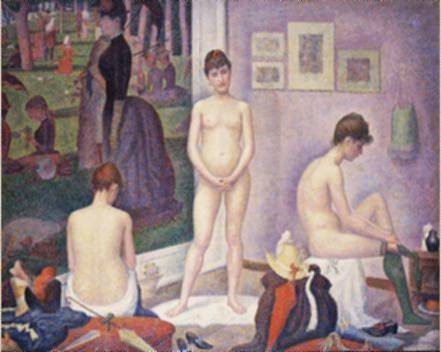
The Models by Seurat (1886-88)

In 1888, Seurat also completed another painting which was entitled The Models  using his pointillism technique, and which depicts models in his studio.  Included in the painting is a section of La Grande Jatte and art historians believe that by doing this painting, he was showing the world that this technique of Pointillism worked just as well for indoor scenes as outdoor ones.

The Île de la Grande Jatte is a small island in the River Seine, downriver from La Défense.  It is about 2 kilometers long and just 200 metres wide at its widest point.  At one time it was reduced to being an industrial site but now has public gardens and houses.   Living on the island are approximately 4000 inhabitants.  However in the days of Seurat it was a pastoral retreat where Parisians could come at weekends from their claustrophobic city existence and soak up the quiet and peace of this little idyll.

Before us we see Seurat’s idealized version of the Grand Jatte omitting both the cafés and restaurants and the nearby ugly shipyard and factories.  In the painting we see members of different social classes out for a stroll along the Grand Jatte by the side of the Seine.  The figures, shown mainly in profile or frontal position, have a peculiar formal and artificial feel to them.  As we look at the painting head-on, there seems to be a definite elongation of some of the people although I believe if you stand at a certain angle to the painting this is minimised.  Seurat would sketch individual groups or single characters and then return to his studio to decide if and where each group should be placed on the canvas.  He sketched people of different classes in society to give the idea that all types of people enjoyed promenading along La Grande Jatte.   Look at the trio in the right foreground.  Here we have the a man wearing a top hat and holding a cane who is more than likely from the upper classes of Paris society.  The man with the muscular arms, lying back with a cap on his head, smoking the pipe is probably a working-class boatman and finally we have the young genteel lady of an indeterminate class.  An unusual trio and who, although physically close in the painting, would be unlikely to have a closeness in that present-day society.  The faces of the people in the painting show little personality.  There is something very impersonal about them.  We must presume that this was a deliberate ploy by Seurat who seemingly did not want the painting to be sullied by observers of the painting trying to interpret facial expressions.  I don’t believe the artist ever intended this to be in any way a moralistic statement about the French culture and classes at the time. However, some would disagree.   Art historians like to interpret every painting and seek symbolic depictions within a work so let us have a look at a few that have been thrown up for consideration with regards this work of art.

In the left middle ground we see a lady dressed in gold and orange fishing in the river.  I suppose there is nothing strange about that albeit she is hardly dressed as a woman who was to go out on a fishing expedition.  Well consider what the French word is to fish – it is pêcher and some have suggested that Seurat has made a play on the word as the French word to sin is pécher.  So is Seurat secretly identifying her as a prostitute.  Again look at the woman in the right foreground accompanying the gentleman.  Look what she is holding in her left hand – a monkey on a leash.  That is certainly an unusual pet to take for a walk.   So why did Seurat include a monkey.  One possible reason is that a female monkey in French is une singesse.  The symbolists would have us believe that a monkey is a symbol of licentiousness and that is why the French slang for prostitute is singesse.  So again I ask the question is Seurat trying to tell us by symbolism that this woman is a prostitute who is out for a stroll with her client?

It is interesting to note and it is not shown in my attached picture, that later Seurat painted the border using parallel red, orange and blue dashes and dots.  He varied the combination of colours in different parts of this border in order to accentuate the adjacent colours in the painting itself.  Maybe if you go to see the painting in Chicago you can let me know if Seurat’s idea with this border really works.

Finally, I came across a poem about this painting which I was going to add to the blog but it was too long so instead I have added the URL where you can find it.  It is:

http://www.lamaquinadeltiempo.com/algode/delmore2.htm