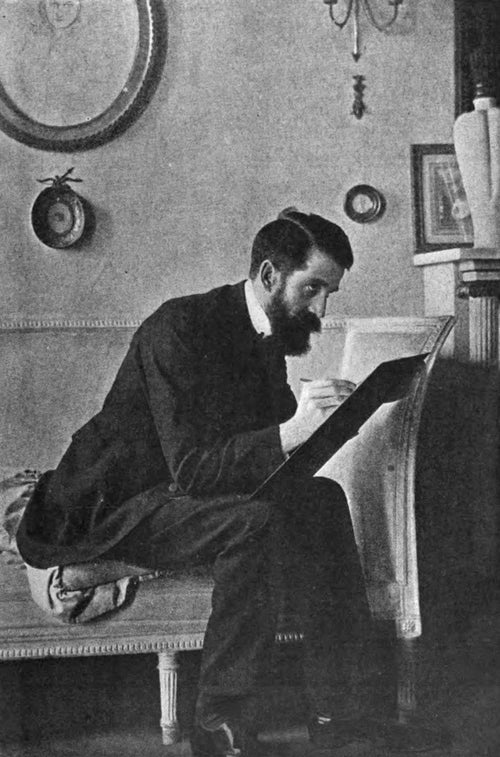
Paul César Helleu and Alice Guérin.

Paul César Helleu

At the end of my previous blog about the French artist Léon Bonnat, I talked about how he had bequeathed most of his art collection and the majority of his work to the local Bayonne museum and how the town named the Museum after him and yet it is now known as the Musée Bonnat-Helleu.. So who is “Helleu”?
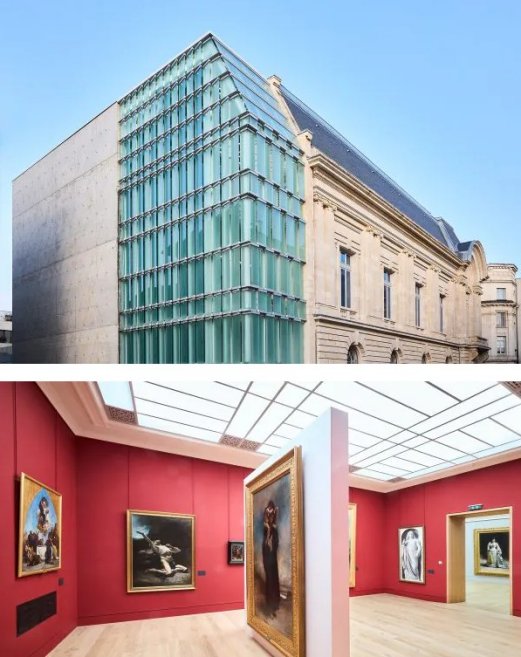
Musée Bonnat-Helleu, Bayonne

The donation of Paulette Howard-Johnston, the youngest child of Paul and Alice Helleu made the museum one of the places of reference for the works of Paul César Helleu from 1988 onwards. It houses his works thanks to his daughter’s donation, as well as the donations and bequests of Paulette Howard-Johnston’s nieces, Éliane Orosdi and Ghislaine de Kermaingant,  when in 2009, she died.  In her will,  the Bonnat Museum was designated as the heir to her collection of more than 300 new pieces.  In 2011, the museum closed its doors for a major renovation, while thanks to this last bequest made by the Helleu family, the museum became the Musée Bonnat-Helleu.
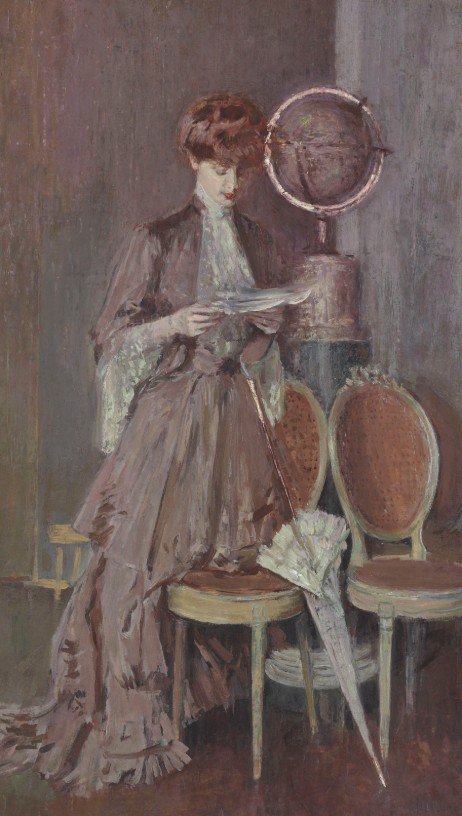
Portrait of Madame Helleu reading by Paul César Helleu

Paul César Helleu was born on December 11th, 1859, in the Brittany town of Vannes.  His mother, Marie Esther Guiot and his father, César Helleu, who was a customs receiver, were married in 1855 and had two sons Paul and his elder brother Édouard.   Paul took an interest in art when he was young. Following the death of his father when Paul was just a teenager, he decided he wanted to further his art studies by going to live in Paris.  His widowed mother was against this idea but Paul persisted and travelled to Paris to continue his schooling at the Lycée Chantal.  In 1876, at the age of sixteen Paul graduated and was admitted to the École des Beaux-Arts, at the atelier of Jean Leon Gerome, where he began his formal academic training in art.
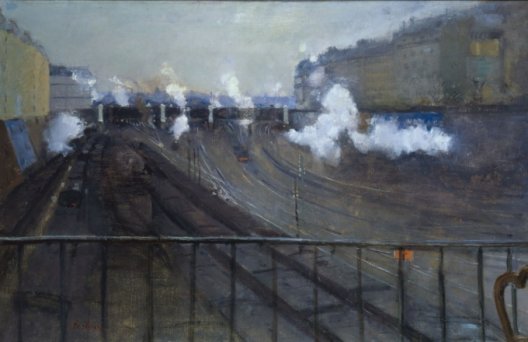
The Saint Lazare Train Station by Paul César Helleu (1885)

It was also in the Spring of 1876 that Helleu attended the Second Impressionist Exhibition at the Durand-Ruel Gallery in Paris. A total of nineteen artists participated in the exhibition, including prominent figures such as:  Degas, Monet. Morisot and Gustave Caillebot. Whilst in Paris,   Helleu made the acquaintance of John Singer Sargent, James McNeill Whistler, and Claude Monet. He was struck by their modern, bold alla  prima artistic technique, which was an approach to painting that involved applying layers of paint, also known as wet-on-wet, and completing a painting in a single sitting. This meant working with wet paint and not letting the layers dry, before applying the next layer. In Italian, the phrase alla prima translates to “at first attempt”.  Helleu was also impressed with their plein air style of painting.
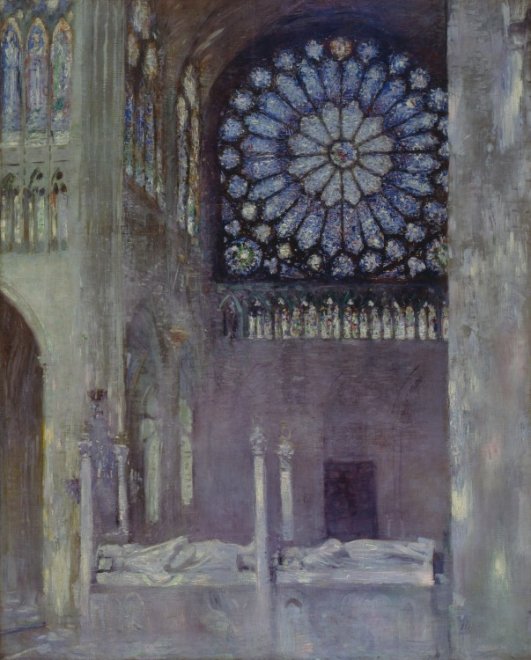
The Interior of the Abbey Church of Saint Denis by Paul César Helleu (c 1891)

Following graduation, Helleu found employment at the prestigious faience (earthenware) workshop, Joseph-Théodore Deck Ceramique Française.  Joseph-Théodore Deck was a 19th-century French potter, and an important figure in late 19th-century art pottery.  In 1856 he established his own earthenware workshop and began to experiment with styles from Islamic pottery, and particularly the Iznik style.  At the time Paul César Helleu joined the workshop, Japonisme, the popularity and influence of Japanese art and design following the forced reopening of foreign trade with Japan in 1858 was all the rage. Helleu created decorations for dishes.
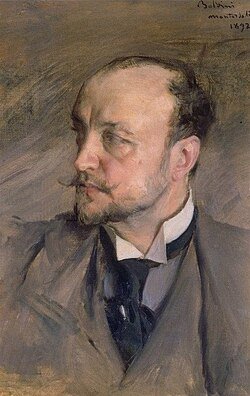
Giovanni Boldini self portrait (1892)
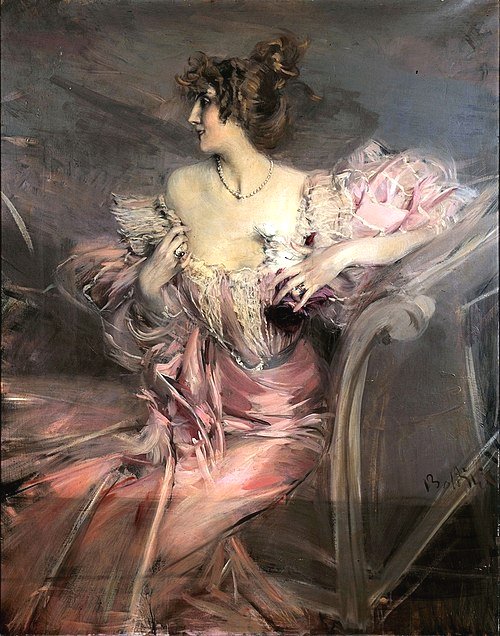
Portrait of Marthe de Florian, a French demi-mondaine and socialite,  by Giovanni Boldini (1898)

Around this time, Helleu met Giovanni Boldini, an Italian genre and portrait painter who lived and worked in Paris.   His portraiture focused on all the grandes dames of Paris, and for them to have their portrait painted by Boldini was looked upon as the crowning event of the social season. Boldini became a friend and mentor to Helleu, and his style of painting had a great influence on his artwork. The other great influence for Helleu was his friendship with John Singer Sargent, often referred to as the leader of “posh portraiture” in Britain, that majorly encouraged Helleu. Helleu even sold his first painting to Sargent. 

Portrait de Madame Chéruit by Paul César Helleu (1898) Madeleine Chéruit was a French fashion designer. She was among the foremost couturiers of her generation, and one of the first women to control a major French fashion house.

This time in Helleu’s life coincided with France’s Belle Époque era. The term, Belle Époque, literally means “Beautiful Age” and was a name given in France to the period between the end of the Franco-Prussian War in 1871 up to to the start of World War I in 1914. During those forty plus years of peace, the living standards for the upper and middle classes increased, (albeit the lower classes did not benefit in the same way, or to anywhere near the same extent).  It was the well-off who termed the phrase Belle Epoque labelling it a golden age in comparison to the humiliations that came with the Prussian invasion and what was to come, the devastation and occupation of the First World War.
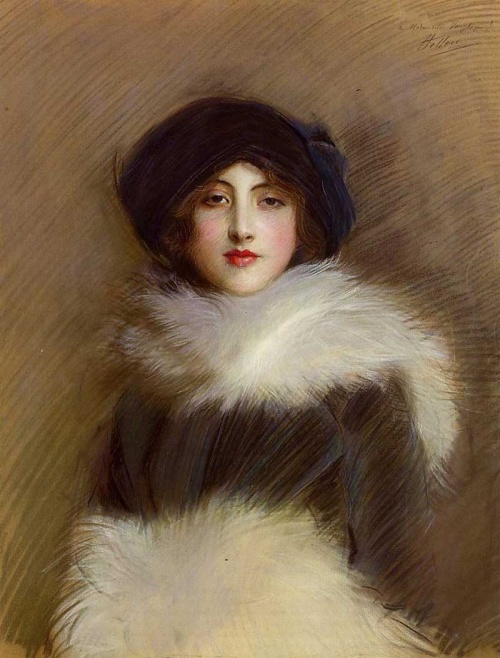
Mademoiselle Vaughan by Paul César Helleu (1905)

It was a time of booming progress and prosperity in Europe, with Paris the centre of the fast-flowing changes in economics, technology, and the arts. However, as the name denotes, beauty was a key element of this prosperous period.  The upper-class patrons would often commission artists to paint their portrait or one of a family member, in a luxurious and extravagant manner highlighting both their beauty and wealth.  The finished portraits heightened an artist’s reputation, ensuring more clients for the artists.

Alice Helleu by Paul César Helleu (1885)

This blog is not only about Paul César Helleu but also his muse, lover, and later his wife, Alice Louis-Guérin. Helleu met Alice in 1884 when her mother asked him to paint a portrait of her fourteen-year-old daughter, Alice. At the age of twenty-four, Helleu appears to have fallen in love with her during this first meeting.   Alice remained the artist’s favourite model throughout his life and she was also a muse for many other artists.  Her beauty and sophistication also helped introduce her husband into the elite circle of artists, writers and society figures of the French capital.  The Count de Montesquiou, who was a noted dandy and one of the leading figures in the artist’s group of friends, described her appearance as

“…La multiforme Alice, dont la rose chevelure illumine de son reflet tant de miroirs de cuivre…”

 (‘The multifaceted Alice, whose rosy hair illuminates so many copper mirrors with its reflection.’)
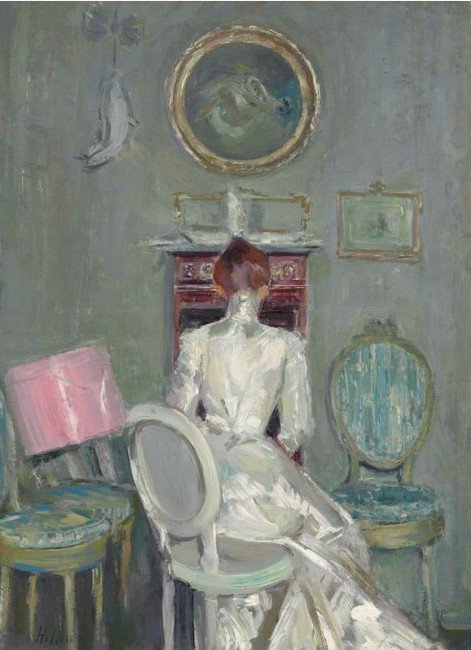
Madame Helleu à son bureau by Paul César Helleu.

Helleu often avoided standard conventional rules of portrait composition, and would frequently depict his sitters from behind – standing before a mirror, or sitting at a desk, as was the case of his painting entitled Madame Helleu à son bureau. Note the porcelain koi carp hanging in the upper left corner which was an example of Japonisme which was all the rage in Paris at the time.   The desk depicted in the painting and which appears in numerous works by Helleu is still in the artist’s family.  The painting hanging above it is Boldini’s Leda and the Swan.
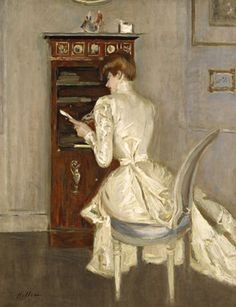
Madame Helleu assise à son bureau dans le salon de l’atelier de l’artiste, capturant une scène intérieure intime avec une élégance raffinée. (Madame Helleu seated at her desk in the artist’s studio salon, capturing an intimate interior scene with refined elegance.)

His painting entitled Mrs. Helleu sitting at her desk in the artist’s studio living room confirms Paul and Alice Helleu were had superb taste and these portraits depict Alice seated at a secrétaire in the couple’s drawing room of their Paris apartment, into which they moved in 1888. I suppose these two paintings cannot be considered as portraits in the conventional sense of the word, but rather as interior still life works, in which the furniture and surroundings are as vital as the sitter.
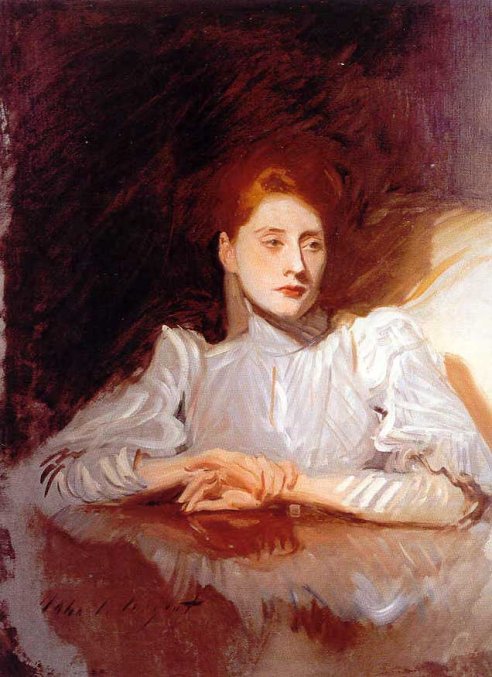
Madame Helleu by John Singer Sargent (1889)

Alice Guérin was depicted in a number of paintings by Paul Helleu’s friend John Singer Sargent.
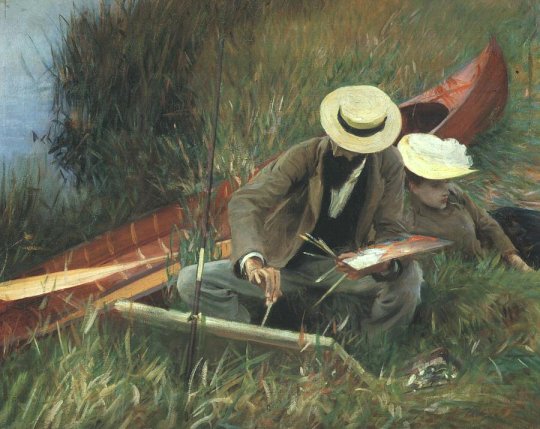
Paul Helleu Sketching with his Wife by John Singer Sargent (1889)

In his 1889 painting, Paul Helleu Sketching with his Wife, Sargent depicts a tranquil outdoor scene, portraying the French artist Paul Helleu engaged in the act of sketching. Alongside him, sits his wife Alice who appears happy and relaxed.  The figures of husband and wife are set against a lush, natural environment that suggests a calm and comforting ambiance. Sargent’s painting also manages to capture their fashionable clothing with Paul wearing a formal suit and Alice attired in an elegant dress.  Both wear wide-brimmed hats that both provide shade and stylishly adorn their heads.
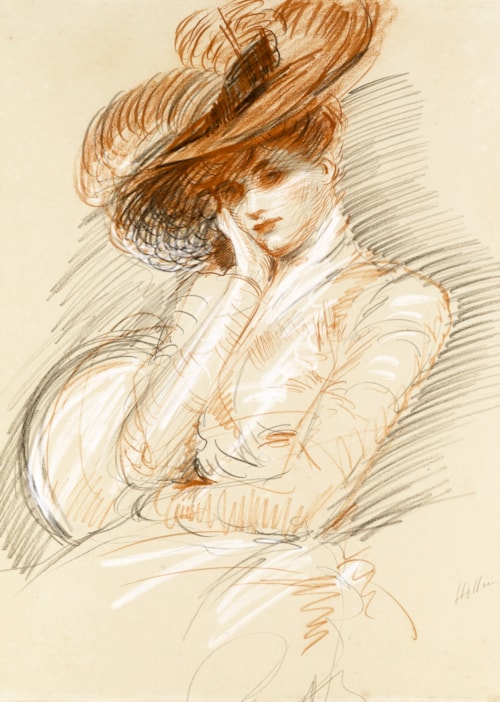
Portrait of Artist’s Wife by Paul César Helleu

Paul Helleu was one of Sargent’s closest friends.  Initially, they had met in Paris in 1878.  Paul was 18 years old and Sargent 22. Sargent’s artistic career had already taken off, and he was becoming known to the public as a great portraiture artist and was receiving many commissions for his work. However, on the other hand, Helleu was selling little of his work, and because of this, he was suffering from depression.  Paul Helleu was financially strapped with hardly enough money to even eat and had to leave his studies in art due to lack of funds.  Sargent, got to hear about the plight of his friend and visited him at his studio and although he never alluded to his friend’s dire financial difficulties, Sargent selected one of Helleu’s paintings, and commended it for its artistic merits. Helleu was so flattered that the successful Sargent would think so kindly of his work that he offered to give it to him.  The story goes that Sargent responded to Helleu’s offer, saying:

“…I shall gladly accept, Helleu, but not as a gift. I sell my own pictures, and I know what they cost me by the time they are out of my hand. I should never enjoy this pastel if I hadn’t paid you a fair and honest price for it…”

He paid Helleu one thousand francs for the painting.  Helleu never forgot Sargent’s generosity and moral support and later, when Sargent was suffering from depression after the death of his father, Paul and Alice Helleu went to stay with him in England.
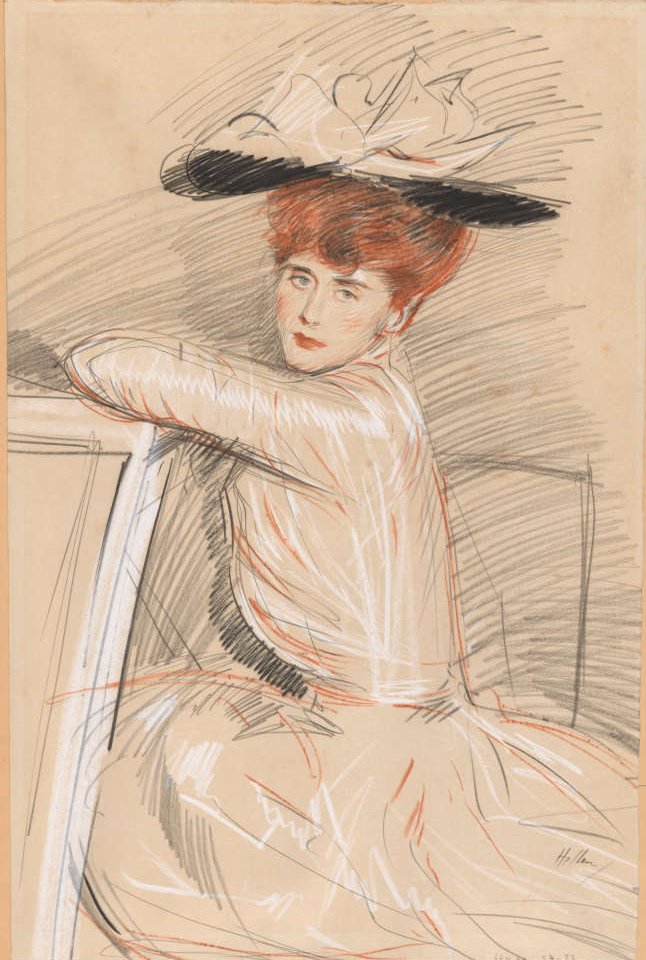
Portrait of Madame Helleu by Paul César Helleu.

Paul César Helleu and Alice Louis-Guérin married, two years after their first encounter, on July 29th, 1886, at Neuilly sur Seine.  She was two months away from her seventeenth birthday and Paul was twenty-six years old.  They went on to have four children, Hélène in 1887, Jean in 1894, Alice in 1896 and Paulette in 1904.
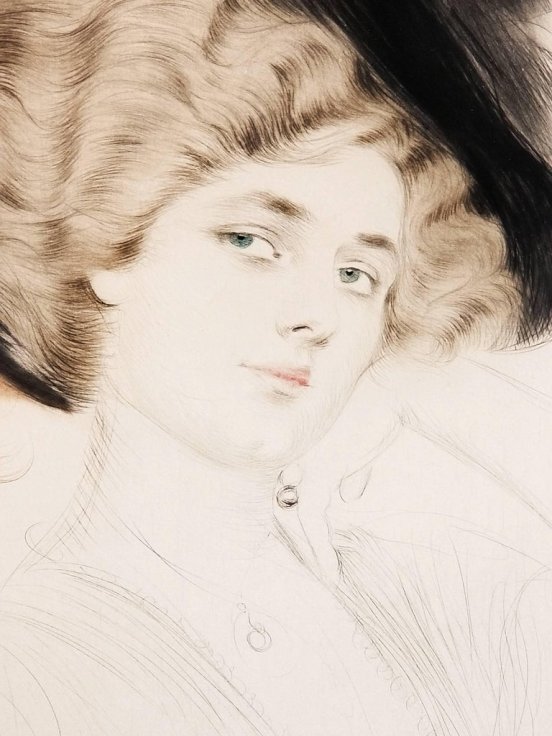
Details of Femme aux chapeau – Drypoint by Paul Helleu
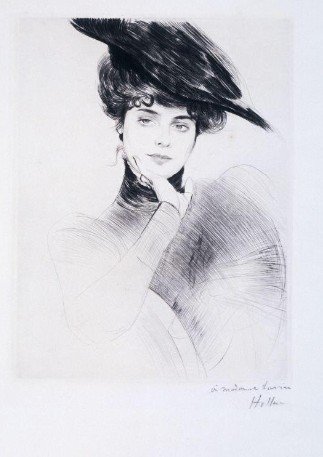
Drypoint Portrait of a Young Woman wearing a Hat by Paul César Helleu (c.1900)

It is believed that during a trip to London in 1885 Helleu once again met Whistler who introduced him to James Tissot a French society painter, illustrator, and caricaturist who was living in the English capital.  It was this established artist who taught Helleu the unique medium of etching.  Helleu became fascinated by drypoint etching.  Drypoint is a printing technique in which the printmaker scratches the lines on the printing plate with a sharp pointed tool. The printmaker holds the tool like a pencil and pushes the excess metal to either side of the furrow. It is this curl of rough metal, known as the ‘burr’, that gives the drypoint print its character. The ink is held in the burr as well as in the furrow and gives the edges of the printed line a soft, blurred quality. In Helleu’s work (above) the burr on the woman’s choker gives it a very velvety look.  Over the course of his career, Helleu produced more than 2,000 drypoint prints and he quickly mastered this technique, using the same flair with his stylus as he demonstrated with pastels.  It was the brilliance of his drypoint etchings that ensured Helleu’s place as one of the greats of the Belle Epoque, and he journeyed to Britain and America, and his artworks boosted his fame across both sides of the Atlantic.
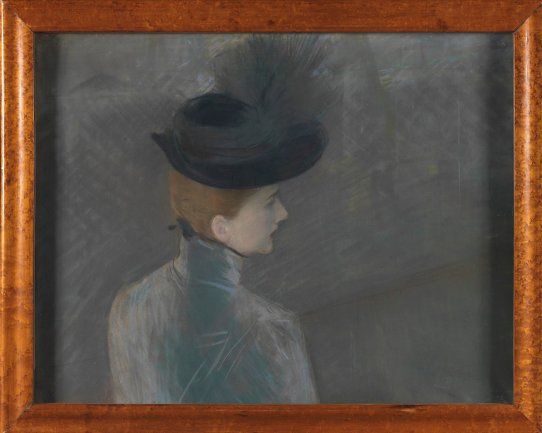
Alice au chapeau noir by Paul César Helleu

Helleu and his wife had made many friends in Paris including Countess Greffulhe, a French socialite, known as a renowned beauty and queen of the salons of the Faubourg Saint-Germain which allowed Helleu to successfully expand his career as a portrait artist to elegant women in the highest ranks of Paris society
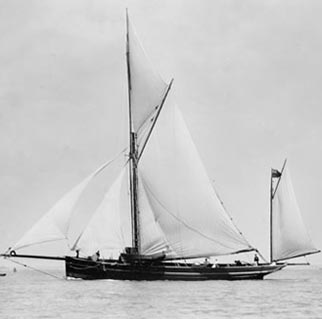
Paul Helleu’s yacht Étoile

Paul Helleu, wife Alice and baby daughter Paulette on L’Étoile (c.1904)

In 1904, Helleu was awarded the Légion d’honneur by the French president, Émile Loubet, and became one of the most celebrated artists of the Edwardian era in both Paris and London. He was an honorary member in important beaux-arts societies, including the Société Nationale des Beaux-Arts and the International Society of Painters, Sculptors, and Engravers, headed by Auguste Rodin. 
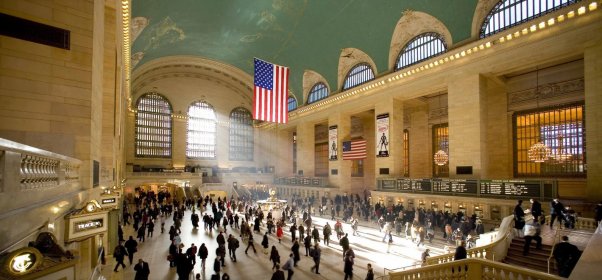
New York City’s Grand Central Terminal.

During his second trip to the United States in 1912, Helleu was awarded the commission to design the ceiling decoration in New York City’s Grand Central Terminal. Helleu decided on a mural of a blue-green night sky covered by the starry signs of the zodiac that cross the Milky Way.

Paul César Helleu (1859-1927)

Helleu made his last trip to New York in 1920 for an exhibition of his work, but he realized that the Belle Époque era was over. He sadly realised that he had lost touch with that vibrant era.   Shortly after his return to France, he destroyed nearly all of his copper plates.   While planning for a new exhibition with Jean-Louis Forain, a French Impressionist painter and printmaker, Helleu died of peritonitis following surgery in Paris, on March 23rd, 1927 at age 67.


Information needed for this blog came from Wikipedia and Facebook plus the following websites:
Brave Fine Art

Contessa Gallery

Stephen Ongpin Fine Art

John Singer Sargent Virtual Gallery

Sotheby’s

Léon Joseph Florentin Bonnat. Part 2

Léon Bonnat painting a portrait of artist, Alfred Roll (1918)

Léon Bonnat was born in Bayonne, France and lived there until he was thirteen years old.  Léon’s family then moved to Madrid where his father took on a book shop.  Léon’s love of art began to materialise after he went to live in the Spanish capital and, to encourage him, his father would take his son to the Prado.  He remembered those museum visits, saying:

“…I was brought up in the cult of Velasquez. I was very young, in Madrid; my father, on bright days such as one only sees in Spain, sometimes took me to the Prado Museum, where we did long stops in Spanish cinemas. I always left them with a feeling of deep admiration for Vélasquez… “.

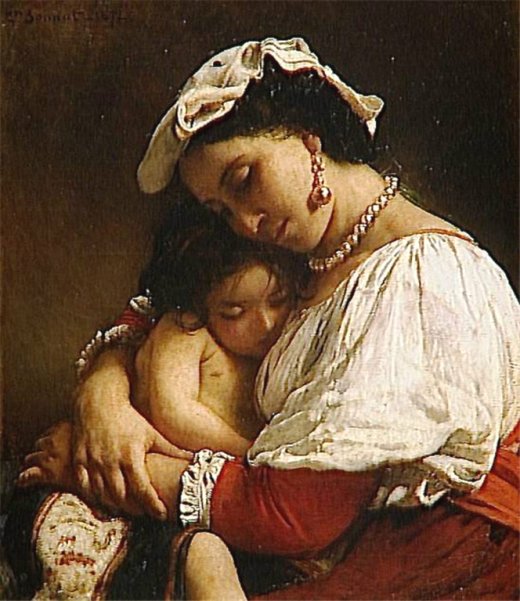
Italian Woman with Child by Léon Bonnat

In 1853, when Léon was twenty, his father died and the family returned to their French hometown of Bayonne.  After studying at the Ecole de Dessin de Bayonne, he went to live in Paris and study at the Ecole des Beaux-Arts.  In Paris, he was able to view paintings by the great Masters of French and Dutch art and particularly remembers seeing the works of Rembrandt and the influence his works had on him, commenting:

“…What is striking about Rembrandt is the power, the strength and the brilliance. He represents life in all its intensity. We see his characters, we talk with them, he resuscitates and revives an entire era. a marvellous and unique gift of interpretation, he joins the sensitivity, the goodness of a heart which vibrates to all the miseries, to all the joys, to all the emotions of humanity. He does not belong to any school. He has opened the new path which closed behind him…”

Roman Girl at a Fountain by Léon Bonnat (1875)

In 1857 he came second in the Prix de Rome competition and left Paris and spent three years at the Villa Medici.  The Villa Medici, now the property of the French State was founded by Ferdinando I de’ Medici, Grand Duke of Tuscany, and has housed the French Academy in Rome and welcomed winners of the Rome Prize since 1803, so as to promote and represent artistic creation in all its fields.

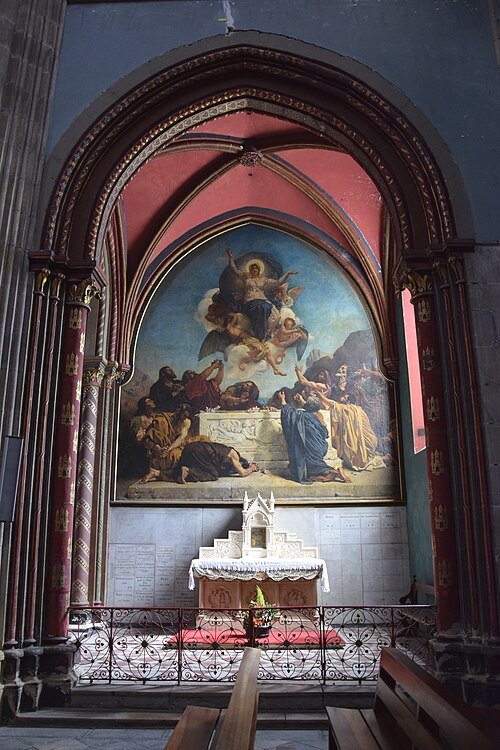
L’Assomption de Marie by Léon Bonnat (1869)

L’Assomption de Marie in situ in the Church Saint-André à Bayonne (Pyrénées-Atlantiques, Nouvelle-Aquitaine, France)

In 1869 Bonnat was awarded the Medal of Honor of the Salon for his painting L’Assomption.

The Martyrdom of Saint Denis by Léon Bonnat (1880)

One of Bonnat’s last religious paintings was his 1880 painting entitled The Martyrdom of Saint Denis.  St Denis was a 3rd-century Christian martyr and saint.  Denis was Bishop of Paris and through his speeches, made many conversions but he was looked upon by the local Roman priest as a danger and had Denis together with his faithful companions, the priest Rusticus and deacon Eleutherius, executed.  The place of the execution, by beheading, was on the highest hill in Paris, which is now known a Montmartre.   Denis was said to be against the beheading taking place at this spot and “folklore” has it that after Denis was beheaded, the corpse is said to have picked up his severed head and walked ten kilometres from the top of the hill, and during that entire walk he preached a sermon. 

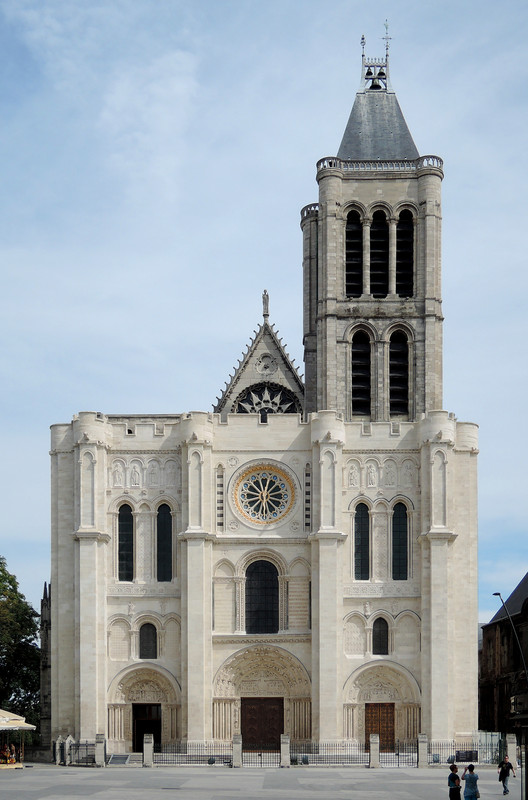
Basilica of St Denis, Paris

Detail of the north portal sculpture; the martyrdom of Saint Denis, Eleuthere and Rustique 

Denis finally collapsed at the place where he wanted to be buried, the spot where now stands the Basilica of St Denis and which is also the burial place of the Kings of France.  Saint Denis is the patron saint of both France and Paris.

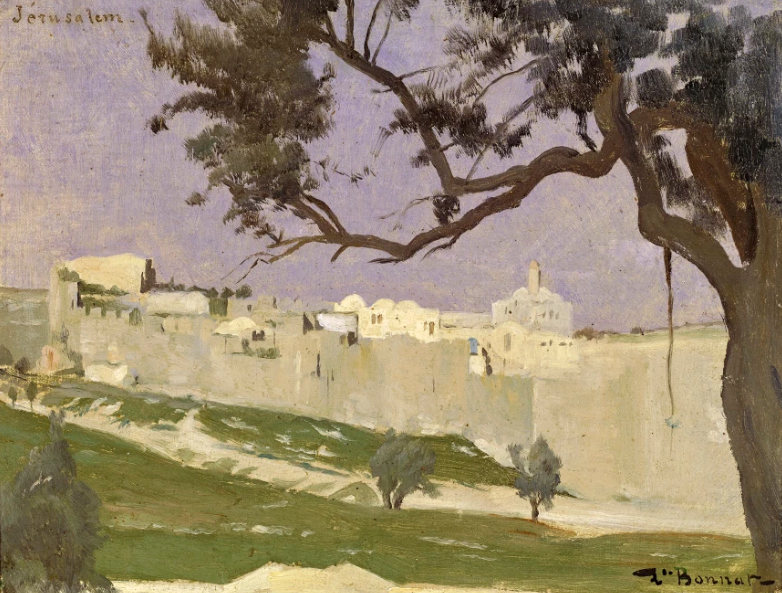
View of Jerusalem by Léon Bonnat

Although, as we will see later, Bonnat was best known for his portraiture and his early historical and religious subjects, but his landscapes and Orientalist depictions are looked upon as among his most intensely personal and beautifully crafted works.  Léon Bonnat travelled to the Middle East in 1868 together with a party that included the French painter, Jean-Léon Gérôme, his pupil Paul-Marie Lenoir,  the Dutch artist Willem de Farmas de Testas and Gérôme’s brother-in-law Albert Goupil.  The journey began in January 1868 at the Egyptian port of Alexandria and by the third of April, the group had arrived at the gates of Jerusalem.   Willem de Famars Testas recalled their first glimpse of the walled city:

“…The first glimpse of Jerusalem was gripping, the sun-illuminated city was silhouetted against a violet thundery light, while the outlying land lay under the shadow of clouds…”

Léon Bonnat recorded the impressions and the specifics of their arrival at the gates of Jerusalem in April of that year in one of his may oil on canvas sketches entitled View of Jerusalem.

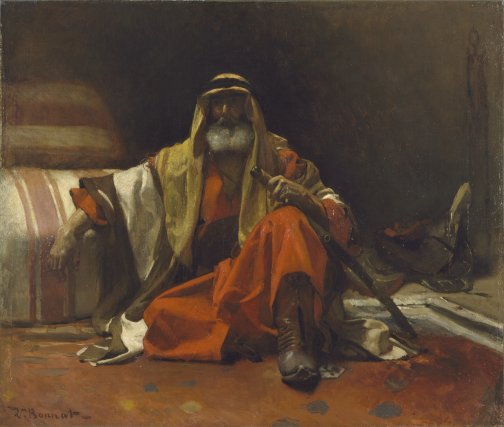
An Arab Sheik by Léon Bonnart (c.1870)

One of Léon’s works from this period was entitled An Arab Sheik which he completed once back in Paris.  It is thought that Bonnat’s depiction emerged from combining multiple resources such as the French model who posed for the seated figure; the saddle we see which Bonnat brought back from his travels and a multitude of sketched notations which he made during his travels in the Middle East.  Combining all this data Léon managed to create a painting that appears authentic, and yet, it is stereotypical of what Europeans believed about the Arabic world and its people such as the way the sheik holds his sword depicting his strength and fierceness and enhances how Europeans believed that that cultures in the Middle East and elsewhere were ruled by violence, in contrast to the supposedly more “civilized” societies of Europe and North America.

Christ on the Cross by Léon Bonnat(1674)

Bonnat’s haunting work entitled Christ on the Cross was commissioned in 1873 for the courtroom of the Cour d’Assises of the Palais de Justice in Paris.  The reasoning behind the commission was that it would embody divine justice in the eyes of the accused and by reminding them of the sufferings of Christ to save the fishermen. The painting was submitted  at the 1874 Salon.  The painting measures 1.59 meters in width and 2.27 meters in height. Bonnat’s depiction fundamentally renews the traditional representation of Christ on the cross. Christ is shown with a crown of thorns, his body is muscular and pale, and he wears a simple white loincloth. Blood is visible from the nails piercing his hands and feet. The background is dark and sombre. The crucified Christ is characterised in an extremely realistic way, accentuating Christ’s suffering due to the torture he received. Christ on the Cross is one of the best known and best loved crucifixion paintings of the western world. The painting can be viewed at the Petit Palais, Museum of Fine Arts of the City of Paris.

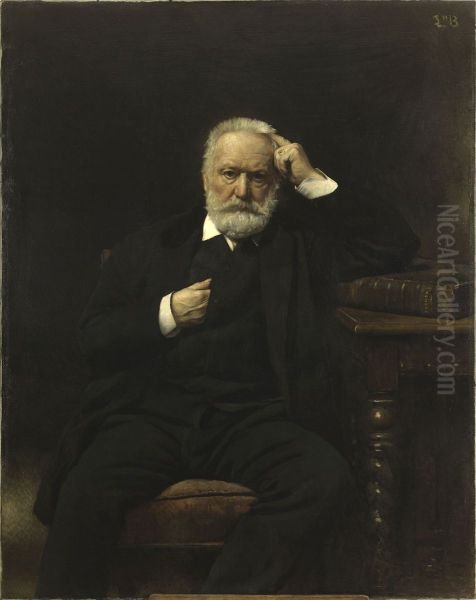
Victor Hugo by Léon Bonnat (1879)

For an artist to survive financially he or she must sell their work.  Once back in France, after his three-year stay at Villa Medici in Rome, Léon realised that the sale of his historical and religious paintings had fallen off and he had to look for another painting genre which would attract more buyers.  While Bonnat created many religious and historical works, his long-lasting fame rested on his exceptional career as a portrait painter. In an era before photography became the norm, painted portraits were central for chronicling the likenesses of important individuals, and Bonnat became one of the most sought-after portraitists of the French Third Republic and beyond. His sitters included presidents, politicians, writers, scientists, artists, and members of high society.

Jules Ferry by Léon Bonnat (1888) Jules François Camille Ferry was a French statesman and republican philosopher. He was one of the leaders of the Moderate Republicans and served as Prime Minister of France from 1880 to 1881 and 1883 to 1885.

Bonnat artistic brilliance as a portrait artist was his extraordinary skill in capturing not just a physical likeness but also the sitter’s charm, personality and social standing. His portraits are typified by their unruffled gravity, psychological perception, and scrupulous attention to every detail, whether it be the texture of fabrics to the detailed features of the face and hands. Bonnat often used dark, neutral backgrounds, which allowed viewers to focus entirely onto the subject, which were often illuminated by a carefully controlled light source, a technique evocative of the Spanish painter, Velázquez.

Portrait of Marthe and Therese Galoppe by Léon Bonnat (1889)

Marthe and Therese Galoppe were prominent figures in 19th-century France, known for their social standing and involvement in Parisian society. The painting captures their youthful beauty and grace, reflecting the evolving role of women in society during that time. Bonnat’s portrayal of the Galoppe sisters is significant as it showcases women not just as muses but as individuals with their own identities, challenging traditional views of women in art.

Armand Fallières by Léon Bonnat (1907) French statesman who was President of France from 1906 to 1913.

Among his most famous sitters were famous figures were the statesman Adolphe Thiers, the revered author Victor Hugo, the pioneering scientist Louis Pasteur, fellow painter Pierre Puvis de Chavannes, and French Presidents like Jules Ferry and Armand Fallières. Bonnat’s portraits served not only as personal records but also as official images that helped shape the public perception of these influential individuals. His success in this genre brought him considerable wealth and prestige.

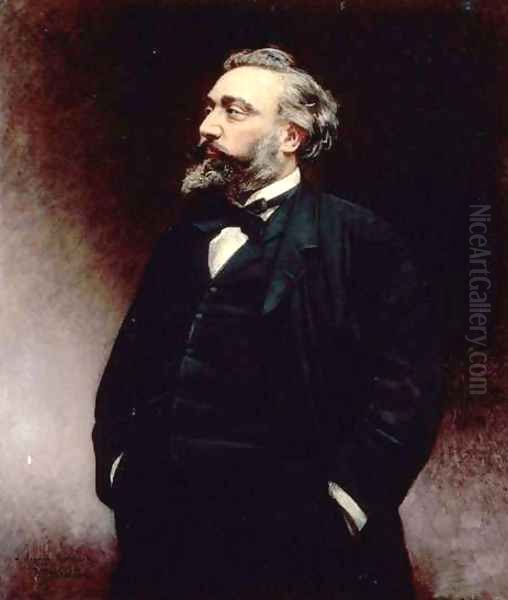
Portrait of Léon Gambetta by Léon Bonnat (1888) Gambetta was a French lawyer and republican politician who proclaimed the French Third Republic in 1870 and played a prominent role in its early government.

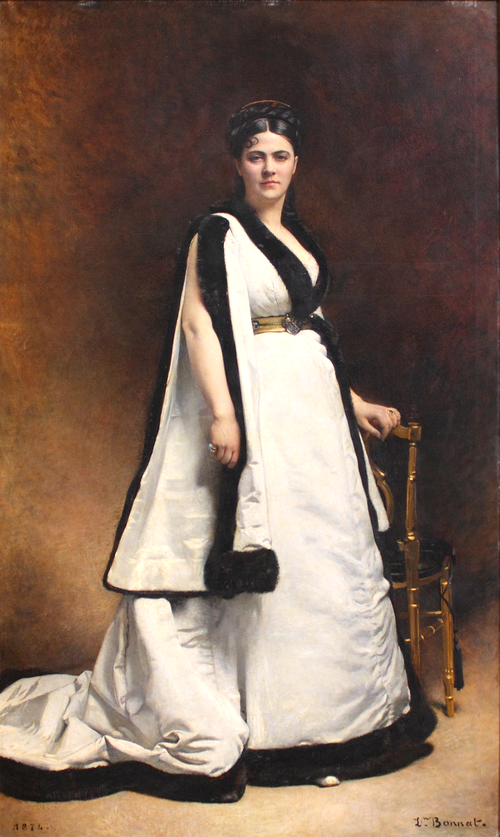
Madame Pasca by Léon Bonnat (1874) Alice Marie Angèle Pasquier was better known by her stage name Madame Pasca, a French stage actress.

Bonnat’s methodology when it came to creating portraits was known to be both thorough and painstaking. He demanded of his sitter numerous meetings so that he could carefully observe them in order to capture subtle gradations of expression and posture and because of this, he was able to achieve prolonged observations which allowed him to realise a high degree of naturalism along with psychological depth.  However, Bonnat’s long processes to achieve a finished portrait did not always please the sitters.  Although he was minded as to what the sitter wanted in the finished portrait, Bonnat refused to flatter his subject and simply strived for an unvarnished truth, but still conveying the dignity appropriate to the subject’s station in life. His commitment to authenticity along with his undoubted technical mastery in delivering form and texture, achieved the finished product being solid, present, and intensely real.

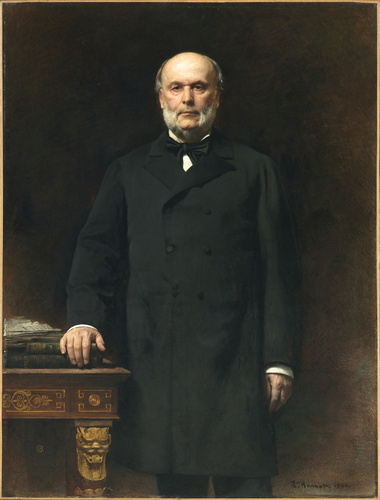
Portrait of Jules Grévy by Léon Bonnat (1880). Jules Grévy was  a French lawyer and politician who served as President of France from 1879 to 1887.

Léon Bonnat who had benefited, following the intervention of the mayor of Bayonne, Jules Labat, when he was granted a municipal scholarship from the city to study the Fine Arts in Madrid and then later in Paris, announced his intention to give his native city the gigantic art collection he had built up.  Léon Bonnat’s dedication to art extended well beyond his lifetime through this act of extraordinary generosity. Léon had no direct heirs, and decided to bequeath his extensive personal art collection, along with many of his own works, to his hometown of Bayonne.

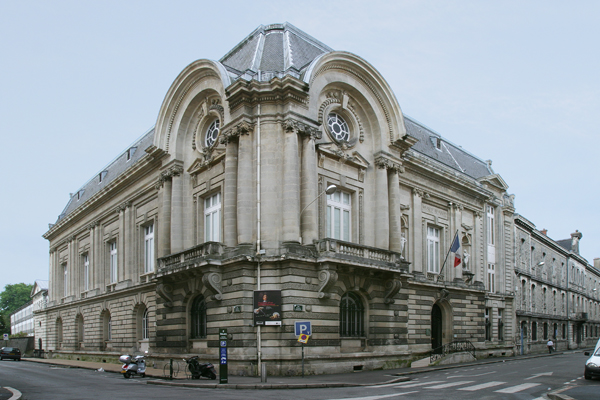
Musée Bonnat-Helleu in Bayonne, France

It was during the latter part of the nineteenth century that Bonnat had achieved financial stability and was able to indulge his passion for collecting art, especially drawings. He acquired sketches, drawings and prints by Rembrandt, Poussin, and Watteau as well as many others.  Eventually, his collection included drawings and paintings from the best of his students and colleagues as well. Like many collectors, Bonnat not only loved the art he had acquired, but he also hoped to share it with a larger public and so he proposed the idea of building a museum in his native Bayonne that would ultimately house his own collection. With his deep roots in the region, continuing family ties to Bayonne, and undoubtedly a sense of gratitude for the support he’d received as a fledgling painter, Bonnat worked tirelessly at developing the new museum. 

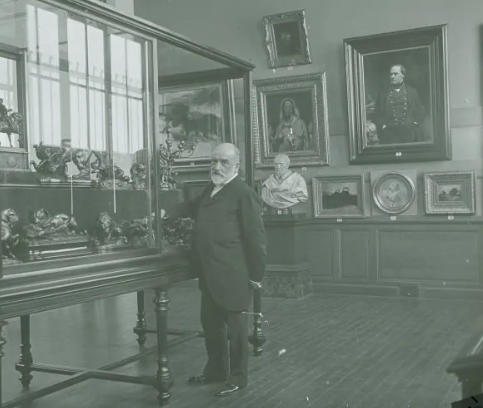
Léon Bonnat, installing his collection at the Musée Bonnat, Bayonne.

In 1902, he personally installed a large portion of his own unparalleled collection in the new Musée Bonnat.  The collection was later enriched by the donation of the collection of Paul Helleu and his wife Alice, leading to its current name, the Musée Bonnat-Helleu.  The chosen location of the museum was located at the corner of the two streets, Jacques-Laffitte and Frédéric-Bastiat, in the city centre, near the church of Saint-André where Léon Bonnat’s painting, Assumption of the Virgin can be seen. In 1896, the first stone of the future museum was laid by the Bayonne mayor Léo Pouzac and the classical-style building, in limestone, was completed eighteen months later. Inaugurated in 1901.  When the Bonnat Museum opened, the artist and collector came to set up his collection himself, while writing a will by which he bequeathed almost all of his works to the National Museums with the obligation to deposit them in Bayonne.

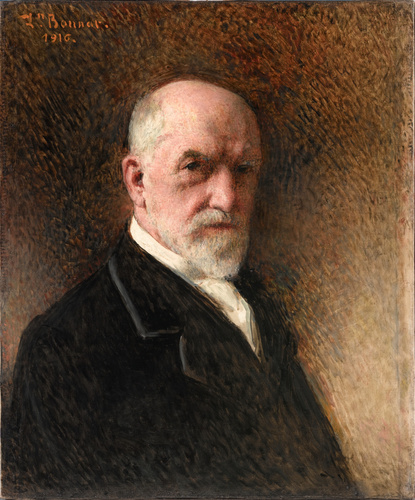
Self portrait by Léon Bonnat (1916)

Léon Bonnat died in Monchy-Saint-Éloi,  a commune in the Oise department in northern France, on September 8th 1922, aged 89.   Léon had never married and lived most of his life with his mother and sister. 

Léon Joseph Florentin Bonnat.

Self portrait by Léon Bonnat (1855)

The artist I am looking at today was one of the leading French painters of the nineteenth century.  He was a colossal figure in 19th-century French art, a painter whose career managed to tie together the past academic traditions with the proliferating trends of modernism. Let me introduce you to Léon Joseph Florentin Bonnat.

Madame Bonnat, mère de l’artiste by Léon Bonnat

Bonnat was born in Bayonne, in the French Basque Country in the far southwestern corner of France, close to the Spanish border, on June 20th1833.  He is remembered for his forceful, expressive and emotional portraits and yet he also made his name as talented history and religious painter, and an influential educator, who also built up a great personal art collection.

Portrait of Madame Melida, sister of Léon Bonnat by Léon Bonnat

In 1846. his family moved from France to Spain and went to live in the city of Madrid where his father took over the running of a bookshop. For thirteen years old Léon, who had developed a love of art this move was opportune. In the Spanish capital, Bonnat received his foundational art education, studying under the tutelage of José de Madrazo y Agudo one of the primary exponents of the Neoclassical style in Spain. He was also the patriarch of a family of artists that included his sons Federico and Luis; and his grandsons, Raimundo and Ricardo.  Federico de Madrazo y Kuntz, and his father were leading figures in Spanish academic art, and Federico was a renowned portraitist.

The Artist’s Sister by Léon Bonnat

Bonnat began his artistic education at the Academia Real de las Bellas Artes de San Fernando, in the studio of Federico Madrazo. Studying under Federico de Madrazo, he was plunged into the rich artistic heritage of Spain and he spent numerous hours in the Prado Museum, copying the works of Spanish Golden Age masters such as Diego Velázquez, Jusepe de Ribera, Francisco de Zurbarán, and Francisco Goya. These painters and their artworks had a great influence on Bonnat through their profound realism, dramatic use of chiaroscuro and the dignified way they depicted their subjects and their styles left an indelible mark on Bonnat’s developing style. Their portraits often used sombre palettes and this textural richness of Spanish art resonated deeply with him, and this style provided a contrast to the often more refined idealized French academic tradition that he would come across in his later years.

Job by Léon Bonnat (1880)

Léon’s father died in 1853 and Léon and his family moved back to France and their hometown of Bayonne.  Now back “home” Léon continued his art studies at the Ecole de Dessin de Bayonne, where one of his tutors was Bernard-Romain Julien, a French printmaker, lithographer, painter and draughtsman.  In 1854, with a stipend of 1500 francs from the city of Bayonne, Bonnat left Bayonne and travelled north to the French capital. His move to the French capital and the tuition costs were partly funded by the City of Bayonne. Having attained a strong foundation from his training in Madrid, Bonnat was able to enter the well-respected Ecole des Beaux-Arts. There, where he studied in the atelier of Léon Cogniet, a much admired historical and portrait painter. Cogniet’s studio was known for its demanding academic training, with great emphasis on students’ ability, emphasizing their drawing, and composition skills.  The students would also spend time studying the works of the old Masters. For a time whilst in Paris Bonnat briefly studied with Paul Delaroche, another prominent academic painter.

The Good Samaritan by Léon Bonnat

Adam and Eve Finding the Body of Abel by Léon Bonnat

Now in Paris, Bonnat began to create his reputation as an up-and-coming artist. In 1857, for the first time, he submitted paintings to the Paris Salon with works such as The Good Samaritan and Adam and Eve Finding the Body of Abel which demonstrated his skill in depicting religious and historical subjects, which confirmed the influence of his Spanish and Italian studies.

Villa Medici, Rome.

In 1857, whilst studying at the École des Beaux-Arts, Bonnat competed for the prestigious Prix de Rome in Painting, The Prix de Rome in Painting was one of the most prestigious awards in the field of fine arts. It was created in 1663, and this annual competition was organized by the Académie royale de peinture et de sculpture (Royal Academy of Painting and Sculpture) in Paris. Each year the winners of the Prix de Rome were sent to the Villa Medici in Rome to perfect their artistic training for a number of years.  The prize awarded to the winner was a scholarship that allowed promising artists to study cost-free in Rome. It was the goal of every early-career artist to win the award.   By rewarding talented young artists with a scholarship and a chance to stay at the Villa Medici in Rome, it was also seen as a way in which it helped to promote academic art and encourage artists to hone their skills. Bonnat, after two failures in 1854 and 1855 had made another attempt to win the prize in 1857.

The Resurrection of Lazarus by Léon Bonnat (1857)

Each year, entrants were given a subject to focus on and then present their submission in front of a demanding jury. This fierce competition encouraged artists to push their limits and express all their creativity.  The year, 1857, Bonnat attempted to win the award the subject matter chosen by the organisers was Lazarus. Léon Bonnat submitted his work entitled The Resurrection of Lazarus and he was awarded the second prize, which unfortunately did not include the full French state scholarship.

Lazarus Raised from the Dead by Charles Sellier

The winner of that year’s prize was the French painter who specialized in mythological and historical subjects, Charles Sellier with his painting, Lazarus Raised from the Dead.

Portrait of Léon Bonnat by Edgar Degas

Bonnat was pleased to receive the second-place award but disappointed that his prize did not allow him a three-year all expenses paid stay at the Villa Medici which was only awarded to the winner of the competition.  However, thanks to the financial assistance of a further 1500 francs granted to him by the city of Bayonne, as well as  money raised by some of the town’s wealthy citizens including the Personnaz family,  a wealthy Jewish family of fabric exporters,  he was able to spend the next three years in Rome, where he was able to study the works of the great Italian Masters, particularly the works of Raphael, Titian, and Michelangelo, as well as the powerful naturalism of Caravaggio.  During his stay in Rome, he also became friends with Edgar Degas, Gustave Moreau, Jean-Jacques Henner, and the sculptor Henri Chapu.

St Vincent de Paul Taking the Place of a Galley Slave by Léon Bonnat (1865)

Bonnat remained in the Italian capital from 1858 until 1861.   Bonnat’s early paintings, such as his 1865 St Vincent de Paul Taking the Place of a Galley Slave were renowned for their dramatic intensity and his religious works of that time strengthened his reputation in this genre.  This painting was based on a part of Vincent;s life. Vincent de Paul was an Occitan French Catholic priest who dedicated himself to serving the poor and became Chaplain-General of the Galleys in 1619, while working for the General of the Galleys of France, Philippe-Emmanuel de Gondi. This position took him to the port of Marseilles in 1622.   When not at sea, the galley slaves, or galères, would spend their time in a squalid prison in the fortified port’s prison. Vincent was horrified at the state of the prisoners and their environs and complained to his patron M. Gondi that such a situation could not continue if France was truly a Christian kingdom. Vincent began ministering to the galley slaves, providing aid to the Catholic prisoners, as well as to the enslaved Muslims and Protestants. At the same time, he instituted important reforms in relation to how these men were treated, regardless of their faith, and set about building a hospital in Marseilles to treat the galley slaves. Due to a lack of steady funding, the General Hospital of Galley Slaves, as it would eventually be called, was not finished until 1646.

Because of Léon’s artistic prowess and being looked upon as a leading academic artist, he was often asked to act as a juror for the annual Salon exhibitions, and in 1867, he was his nominated to the Legion of Honor.

…….to be continued.


Most of the information for these blogs about Léon Bonnat came from Wikpedia and these blogs:

NiceArtGallery

Rehs Gallery

Léon Bonnat by Guy Saigne

Vincent and the Galley Slaves