
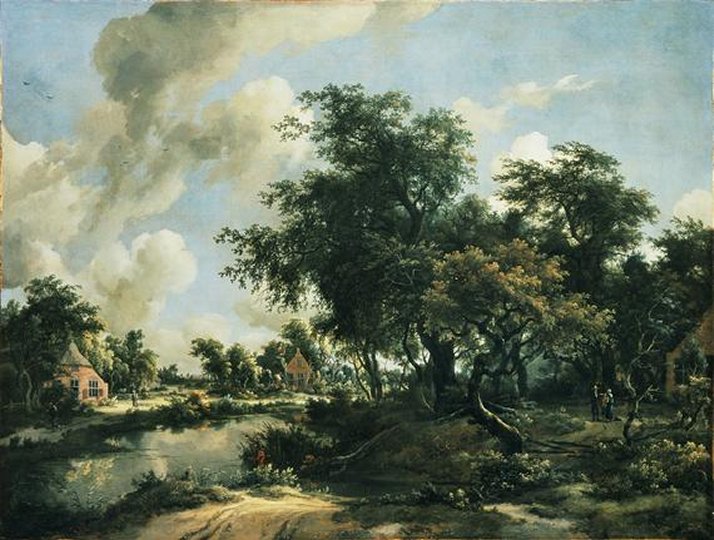
A Stormy Landscape by Meindert Hobbema

A Stormy Landscape by Hobbema (1663-5)

Meindert Hobbema was thought to have been born in 1638 in Amsterdam but there are varied opinions on this fact.  The name “Hobbema” was his own invention as his father’s name was Lubbert Meyndert.  He was the great landscape painter of the Dutch Golden Age.   The Dutch Golden age was that period in Dutch history which spanned the 17th century, at the time of, and following the Eighty Years War, which encompassed the struggle for Dutch independence. The newly formed Dutch Republic became the most prosperous nation in Europe, and led European trade, science, and art. The northern Netherlandish provinces that formed part of the new state had customarily been less significant as artistic centres in comparison with the Flemish cities in the south.  The war caused tremendous disruption and resulted in the break with the old monarchist and Catholic cultural traditions.  As a result, Dutch art needed to reinvent itself entirely, a task in which it was very largely successful and this re-birth was known as the Dutch Golden Age.

We know that Hobbema was active as an artist in Amsterdam and that he was a pupil of the great landscape painter Jacob van Ruisdael.  Some of Hobbema’s work showed a distinct similarity to his master’s work and as Ruisdael’s paintings were in great demand, a number of Hobbema’s works were passed off as being works of his master.  Strangely enough, in years to come when Hobbema’s flair as an artist and his artistic gift was established, the reverse would happen.

Hobbema married Eelije Vinck in 1668 who had been his serving maid.  One of the witnesses at the ceremony was Jacob Ruisdael.  The couple went on to have four children.   It was about this time that Hobbema started to work for the Customs & Excise in Amsterdam supervising the weighing and measuring of imported wine.  This was his full time job and from then on his artistic endeavours were reserved for his spare time.  The output of his paintings from then on decreased and was somewhat erratic.   In 1704 Eeltije died, and was buried in the pauper section of the Leiden cemetery at Amsterdam. Hobbema himself survived till December 1709, and he too was buried in a pauper’s grave in Amsterdam. It was a depressing fact of life that both van Ruisdael and Hobbema, looked upon as the two greatest Dutch landscape painters of the era, both died in poverty.  Like the two great Dutch painters Hals and Rembrandt some fifty years earlier, despite the demand for their works and the sale of their paintings, they too died penniless.   This sad fact has to be put down to either they let their paintings go too cheaply or simply their financial mismanagement which was brought on by them living a life they could not afford and as a result it was to prove to be their undoing.   
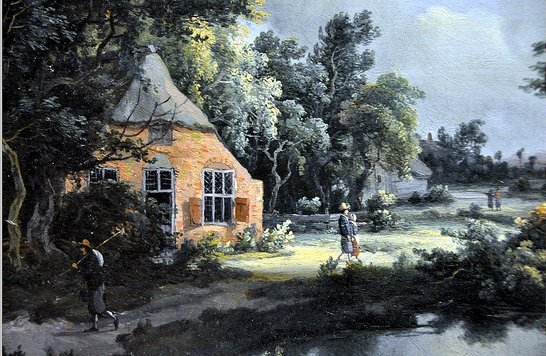
The Cottages and the passing walkers

Hobbema was a master painter when it came to painting woods and hedges, or mills and pools. This talent was derived from his life in the countryside, where day after day he might study the branching and foliage of trees, cottages and mills, under every variety of light, in every shade of transparency, during the various seasons.    His paintings had a characteristic rich texture to them.  Today’s featured painting entitled A Stormy Landscape, which he completed in 1665, is a prime example of his extraordinary talent as a landscape painter.  In it we can see his love of creating woodland scenes with various shaped trees which in turn gave him the opportunity to show off his talent in depicting illuminated clearings and patches of light randomly placed amongst the shaded areas caused by the massive trees and dense foliage.
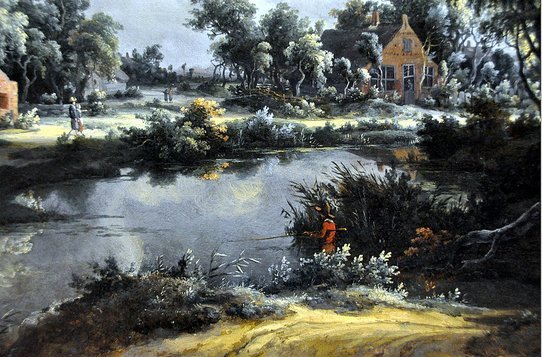
The Fisherman

In the foreground we have a fisherman with his line cast in the rippling waters of the river.  In total there are nine figures dotted around the rural scene, all quite small but put there by the artist for a specific reason, that of directing our eyes through the landscape.  There is no urgency in the movement of the water which adds to the tranquillity of the scene. To the man’s right we have a family strolling through the woods.  Across the river stand two cottages nestling under the cover of the large trees.  More people out for a stroll can be seen on that side of the river.   The heavy clouds shown to the left of the painting warn us of a storm approaching but this appears to be of little concern to our fisherman or the walkers.

This is a beautifully crafted work of art and one of Meindert Hobbema’s masterpieces. It has a soothing quality to it.  It is the type of picture you should look at when you feel stressed as its calm depiction of a country scene counteracts the stress of city life.  It has a calming effect and in some ways standing in front of it offers you a chance to relax.   Life alas can be hectic and I believe this painting offers one the perfect foil to our sometime chaotic existence.

The Bard by John Martin

The Bard by John Martin (1817)

My Daily Art Display today looks at a painting and the poem which inspired the work of art.   The artist who painted the picture was the English Romantic painter John Martin and his work which I am featuring today is entitled The Bard which he completed in 1817.

Martin was born in 1789 in the small Northumbrian village of Haydon Bridge which lies close to Hexham.  He was the youngest of thirteen children.  He attended the local school an although he showed a talent for drawing was not academically gifted.   In 1804, his father arranged for him to become an apprentice coach painter in Newcastle in order for him to learn the art of heraldic painting but John was not happy with the work and this, coupled with problems with wages, resulted in the cancelation of Martin’s  indentures.   His father then arranged for him to be tutored by Boniface Musso, an artist who had come to the country from Italy.  In 1806 John Martin moved from Northumbria to London with Boniface Musso and his son Charles, who a few years later sets himself up in the china and glass business and employed John Martin.  Not long after however, the business of selling painted china fell out of fashion and Musso’s business failed.

John Martin moves out of the Musso household in 1809 when he marries Susan Garrett.  The following year John submits a painting of a water nymph entitled Clytie, to the Royal Academy but it is rejected.   In 1811 he was delighted when he has his painting A Landscape Composition accepted.  The following year, by which time he has become a full-time artist, he managed to get a second painting exhibited at the prestigious establishment entitled Sadak in Search of the Waters of Oblivion and it eventually sells for 50 guineas to the Member of Parliament and  Governor of the Bank of England, William Manning.    Many of his works of this time were large in size depicting grand biblical scenes.  During this period many people made the Grand Tour of the Middle East and the Holy Land and so Martin’s paintings became very fashionable.

The year 1813 was to prove a very sad and traumatic year for John Martin with both his mother and father as well as his grandmother and one of his sons, Fenwick, dying.  His painting continued after a period of mourning and still his subjects were mainly biblical and the enormous canvases often depicted scenes of apocalyptic death and destruction.  In 1814 there is another addition to his family with the birth of his fourth child, sadly however that same year his second son, John, dies.  More bad luck was to befall the artist as he submits another painting of a water nymph for inclusion at the Royal Academy but whilst it was waiting to be hung another artist, whilst touching up his painting,  accidentally spills some dark restorative varnish over it and his work is ruined.

Joshua Commanding the Sun to Stand Still upon Gibeon by John Martin (1816)

In 1816 his fifth child Zenobia is born and in that year he exhibits his masterpiece Joshua Commanding the Sun to Stand Still upon Gibeon and once again Martin’s obsession with depicting Old Testament scenes.  For the first time we see Martin, instead of depicting a solitary figure in his biblical scene,  has filled the location with a multitude of little figures both Palestinian and Isrealites, whilst the spear-brandishing figure of Joshua takes centre stage.

And so to 1817 and the year John Martin painted today’s featured painting, The Bard.  I was drawn to this work as it has a connection with the Conwy Valley, where I live and I like its connection to a poem, with the same name, written by by Thomas Gray in 1755.  In the poem Gray narrates the story of King Edward I of England and his conquest of Wales in the late 13th century.   Following his victory over the Welsh Edward decided that all the bards, the professional poets, could be dangerous if they were allowed to spread the story of the bygone power of the Welsh people as this may incite the defeated Welsh to rise up against their English masters.

Edward ordered the Bards to be slaughtered and the painting depicts the fate of the last surviving bard who has been chased by Edward’s troops and who has climbed a precipice above a swirling river.  He stands aloft cursing the English troops, who having left their castle, are in pursuit of their quarry .  The castle, based on the one at Harlech, we see perched on rocks in the left middle-ground.  In the left foreground we see Edward’s riders with banners unfurled as they rush along the valley side like a swarm of ants.  On the top of the cliff on the opposite side of the fast flowing river we observe the bard, cursing his pursuers before throwing himself off the ledge and plunging to his death.

The painting is an example of sublime landscape style, which was very popular at the time, in which the landscapes feature craggy mountains, similar to those seen in the Alps, instead of softer rounded ones.  Waterfalls and trees seem taller than in actuality and there is a certain savagery about the depiction of the vistas.  I leave you to look at this amazing painting and read extracts from Gray’s poem, The Bard.

“Ruin seize thee, ruthless King!
Confusion on thy banners wait!
Tho’ fanned by Conquest’s crimson wing,
They mock the air with idle state.
Helm, nor hauberk’s twisted mail,
Nor e’en thy virtues, Tyrant, shall avail
To save thy secret soul from nightly fears,
From Cambria’s curse, from Cambria’s tears!”
Such were the sounds that o’er the crested pride
Of the first Edward scattered wild dismay,
As down the steep of Snowdon’s shaggy side
He wound with toilsome march his long array.
Stout Glo’ster stood aghast in speechless trance:
“To arms!” cried Mortimer, and couched his quiv’ring lance.

On a rock, whose haughty brow
Frowns o’er cold Conway’s foaming flood,
Robed in the sable garb of woe
With haggard eyes the Poet stood;
(Loose his beard and hoary hair
Streamed like a meteor to the troubled air)
And with a master’s hand, and prophet’s fire,
Struck the deep sorrows of his lyre.
“Hark, how each giant-oak and desert-cave
Sighs to the torrent’s awful voice beneath!
O’er thee, O King! their hundred arms they wave,
Revenge on thee in hoarser murmurs breathe;
Vocal no more, since Cambria’s fatal day,
To high-born Hoel’s harp, or soft Llewellyn’s lay.


Enough for me: with joy I see
The diff’rent doom our fates assign.
Be thine Despair and sceptred Care;
To triumph and to die are mine.”
He spoke, and headlong from the mountain’s height
Deep in the roaring tide he plunged to endless night.

The White House at Chelsea by Thomas Girtin

The White House at Chelsea by Thomas Girtin (1800)

From Tudor-period portraiture by a Flemish artist yesterday, I am switching today to a landscape painting by an English Artist.  My Daily Art Display’s featured artist today is Thomas Girtin who was born in Southwark, London in 1775.  Girtin was to become recognised as one of the greatest watercolour landscape artists of his time and a rival to his contemporary, Turner.

Girtin’s father, Thomas, who was a prosperous brush maker, died when his son was only a child and Thomas was brought up by his mother and step-father.  Initially Thomas received his art tuition from the painter and engraver, Thomas Malton and this was followed by an apprenticeship with the watercolourist Edward Dayes.  His seven-year apprenticeship did not run smoothly as Thomas had a turbulent existence with his master, Dayes.  Girtin had become friendly with a fellow pupil of Thomas Malton and they were both employed to fill in the outlines of pencil sketches by the antiquarian James Moore with watercolours.  Sometimes they would be set the task of copying drawings by John Cozens.   This friend and pupil was to prove to be one of Girtin’s great rivals.  His name was Joseph Mallord William Turner.  For Girtin, these tasks were of great importance for unlike Turner he never attended the Royal Academy schools and these tasks honed his talent as a watercolourist.

Girtin first exhibited a painting at the Royal Academy in 1794 at the age of nineteen.  He produced many landscape sketches and his use of watercolours was to establish his reputation as a great artist.  He travelled widely throughout Britain on sketching expeditions visiting the Lake District, North Wales and the West Country.  By the end of the eighteenth century, he had managed to acquire the influential patronage of Elizabeth, Countess of Sutherland and the wealthy British art patron and amateur painter, Sir George Beaumont, a man who played a decisive part in the creation of the London National Gallery.  In 1800 Girtin, who had attained financial security through the sale of his paintings, married sixteen year old Mary Ann Borrett, the daughter of a London goldsmith and the couple set up house in the fashionable Hyde Park area.  Although free of money worries, his health was beginning to deteriorate,  Despite this he travelled to Paris and spent five months painting watercolours and making a series of sketches which he then turned into engravings on his return to London, some of which were published posthumously as Twenty Views in Paris and its Environs after his death the following year.  In 1802, Girtin exhibited Eidometropolis, a monumental panorama of London that dazzled his contemporaries.  It was 18ft high and 108 feet in circumference.  In November 1802, whilst in his painting studio he collapsed and died at the young age of twenty seven.  The reported cause of death was thought to be asthma or tuberculosis.

My Daily Art Display today is entitled The White House at Chelsea and was completed by Thomas Girtin in 1800.  The scene is set on the River Thames and we see the great waterway as it flows peacefully under a twilight summer sky.  It is believed that the actual view can be narrowed down to an upstream view of the Thames as seen from a location very close to where Chelsea Bridge now stands.   In the background on the left we have Joseph Freeman’s windmill.  If we look to the right of this we can see the sunlit white house, which gives its name to the painting.  The little house glistens.  Its brightness is uncanny and its glow is added to by its own reflection in the water.   The position of the white house is about where Battersea Park is now located.  Move further round to the right and you can see Battersea Bridge and on the other side of the river is the Chelsea Old Church, which was almost completely destroyed in the Second World War in 1941.

Look how Girtin has painted the tranquil surface of the river.   It is awash with colour under the grey and pink clouds of the summer sky.  We see two working boats on the water.  The one on the left has its sails down as it lays peacefully at anchor whilst the other wends its way slowly upstream, its wake breaking the smooth glass-like appearance of the water.

The painting is amazing, as before us we don’t have the sun lighting up a magnificent building or famous London landmark.  All we have is a small nondescript building suddenly illuminated by Girtin’s evening sun.  It is just an ordinary house on a nondescript stretch of the Thames.

To end with let me give you two famous quotes by Thomas Girtin’s friend Turner.   On hearing of Girtin’s death Turner remarked:

“Poor Tom……..If Tom Girtin had lived, I should have starved.”

Today’s watercolour by Girtin was much admired by Turner and this was borne out by the anecdote:

“………..A dealer went one day to Turner, and after looking round at all his drawings in the room, had the audacity to say, I have a drawing out there in my hackney coach, finer than any of yours. Turner bit his lip, looked first angry, then meditative. At length he broke silence: Then I tell you what it is. You have got Tom Girtin’s White House at Chelsea………”.

Praise indeed !

February Fill Dyke by Benjamin Williams Leader

February Fill Dyke by Benjamin Williams Leader (1881)

My Daily Art Display returns to landscape painting but remains with English Victorian artists for the third day running.  My featured artist today is Benjamin Williams Leader who was to become one of the most acclaimed Victorian landscape painters during his lifetime.   He was born in Worcester in 1831 and he was the eldest of eleven children.  His father, Edward Leader Williams was a civil engineer and staunch non-conformist whilst his mother Sarah Whiting was a Quaker.  However after the two of them married in an Anglican church the Quaker establishment disowned them.     Benjamin was actually born as Benjamin Williams but in 1857 he added the surname, Leader, which was his father’s middle name, to distinguish himself from the rest of the Williams clan.

His father Edward was a keen amateur artist and was on friendly terms with John Constable.  Benjamin would often accompany his father on his painting expeditions along the Severn valley and soon he developed a love of art.  He attended the Royal Grammar School in Worcester and when he completed his schooling in 1845 was apprenticed as a draughtsman in his father’s engineering office.  However Benjamin never gave up his fondness for apinting and drawing and after many discussions with his father he was allowed to leave the world of engineering and follow his love of art.  His father gave his son one year to prove himself artistically.  Benjamin enrolled at the Worcester School of Design and one year later had achieved the position of “probationer” at the Royal Academy Schools.  A year on, and quite exceptionally for a first year student, he exhibited his first painting, Cottage Children Blowing Bubbles, which was bought by an American.  From then on he exhibited in every Summer Exhibition of the Royal Academy up until 1922 when he had reached the fine old age of 91.

Leader married fellow artist Mary Eastlake in 1876.  She was an artist whose subject speciality was flowers.  She came from an artistic background being the grand-niece of Sir Charles Locke Eastlake who was President of the Royal Academy between 1850 until his death in 1865.  The marriage of the couple did not find favour with her family as Benjamin Leader was twenty-two years older than their daughter and whereas the Eastlake family came from a long line of Plymouth gentry, Benjamin’s family where  mere “trades people”.  However as is often the case, the noble Eastlake family had seen better financial days whereas Benjamin Leader, with the sale of his many paintings,  was financially sound.  They did marry and went on to have six children, one of whom Benjamin Eastlake Leader, became an artist but was sadly killed in action during the First World War.

Leader spent most of time painting landscape scenes of his beloved Worcestershire and the Severn Valley and in Lewis Lusk’s The Works of B.W.Leader, R.A. which was published in The Art Journal of 1901, Leader was quoted as saying:

“…The subjects of my pictures are mostly English.  I have painted in Switzerland, Scotland and a great deal of North Wales, but I prefer our English home scenes.  Riversides at evening time, country lanes and commons and the village church are subjects that I love and am never tired of painting…”

It was the Summer Exhibition of 1881 at the Royal Academy that Leader exhibited today’s featured work, February Fill the Dyke and it was highly commended.  The Art Journal of the day commented:

“…title and picture suit one another well.  The characteristics of the kind of weather which gives the epithet of “fill dyke” to the month of February are most truthfully depicted in the overflowing ponds and splashy roads and the pale, streaked evening sky.  It is a thoroughly English landscape…”

And so to today’s featured painting which is a beautiful landscape painting with the unusual title February Fill Dyke by Benjamin William Leader.  I was intrigued by the title of the painting, which I discovered comes from an old country rhyme:

February fill the dyke,
Be it black or be it white;
But if it be white,
It’s the better to like

It means that the ditches get filled in February either with mud or with snow.  The first thing which struck me about this painting was its realism.  This was not an Italianate landscape painting with the sun glinting on a beautiful landscape.  This is a painting of the fields in Leader’s native Worcestershire.  The wet ground is being warmed slightly by the late winter’s sun.  Leader has humanised the scene by adding a couple of children and their dog heading home through pools of water on the muddy path.  Ahead of them, the farmer stands at the gate and we can see a woman in front of the cottage busily collecting firewood.

This is what we see when we go for a walk in the countryside on a wet winter’s day.  Before us we have what appears to be a cold and somewhat miserable end to a winter’s day.  Darkness is rapidly approaching and it is time to get back indoors to the safety of our home and the warmth of an open fire and maybe a hot scented bath which will banish the lingering thoughts of what lies outside.  It is a type of day in which the cold and dampness moves stealthily into one’s bones adding to our aches and pains.  Yet having said all that  is this not truly a beautiful painting?  Maybe it is the type of painting you enjoy looking at when you are sitting cosily in the warmth of your house

I do like landscape paintings even more so if they replicate an actual view.  I do understand and appreciate idealised landscapes where an artist has put together various pieces of landscapes he likes, to finish with his idea of a perfect landscape.  What I am not very fond of is a painting of a landscape which seems to bear no resemblance to the scene it is supposed to be portraying.  I am not an artist and have never had the ability to draw anything that one would recognise so I suppose I shouldn’t criticise but we all have the right to freedom of speech so I will exercise my right.  I watched a documentary the other day which was about landscape painting and we were with this artist who was in a field painting a scene with a mountain in the background.   When he finished it we saw his work which was depicting what we had all been looking at but the landscape we had seen was not on the artist’s canvas .  I wonder whether he read my thoughts as he said that his painting was not necessarily a true reflection of what we and he were looking at but it was the view that was conjured up in his mind at the time.  I am not sure I can go along with that thought process but maybe for any of you artists out there you will understand what he was saying.  However if he had given me the painting to hang on my wall I would have no idea what it was all about!

The Stages of Life by Caspar David Friedrich

The Stages of Life by Caspar David Friedrich (1835)

I read the other day that life expectancy for men in the UK is somewhere between 75 and 80 years of age which is some ten years higher than it was in the 1970’s and of course what were once killer diseases are now more often or not, treatable.  So why worry about dying if you are still young?

Well of course, as far as longevity is concerned, the life expectancy back in the nineteenth century was much less, due to such diseases as cholera and typhus and  probably for a man living in Europe to reach the age of 45 in the nineteenth century was somewhat of an achievement.  All this leads me nicely on to my featured artist of the day, the German painter Casper David Friedrich, who was continually concerned with, and depressed by, the thought of his own mortality.  To be fair to him, he probably had good reason to be concerned and depressed by death for Friedrich had early acquaintances with death: his mother, Sophie Dorothea Bechly, died in 1781 when Caspar David was just seven.   At the age of thirteen, Caspar David was present when his brother, Johann Christoffer, fell through the ice of a frozen lake and drowned.    It was even reported that Johann Christoffer died while trying to rescue Caspar David, who was also in danger on the ice. His sister Elisabeth died in 1782, while another sister, Maria, died of typhus in 1791.

Friedrich’s contemporaries said that the melancholy in his art could be attributed to these tragic childhood events.  However I am not so sure that he was a manic depressive as there are many reports that stated he at times had a great sense of humour.   This was borne out by the famous German doctor, natural scientist and writer Gotthilf Heinrich von Schubert, who knew the artist and in his autobiography, wrote of Friedrich:

“…..He was indeed a strange mixture of temperament, his moods ranging from the gravest seriousness to the gayest humour … But anyone who knew only this side of Friedrich’s personality, namely his deep melancholic seriousness, only knew half the man. I have met few people who have such a gift for telling jokes and such a sense of fun as he did, providing that he was in the company of people he liked…..”

So these mood swings of Friedrich could have been more symptomatic of a bi-polar disorder.

The painting featured today in My Daily Art Display is an allegorical painting by this German Romantic landscape painter Caspar Friedrich David, one of the greatest of all the landscape painters.  He completed this work of art five years before his death in 1840 aged 66.  So despite his concerns about his own mortality, he lived much longer than the then life expectancy of a German man.

The work of art is entitled The Stages of Life.  Art historians do not believe that this would have been the title that Friedrich gave to his painting as the artist believed that titles of paintings should not be blatantly descriptive as he wanted his paintings to speak for themselves and he did not want viewers to be swayed by descriptive titles.  It is quite possible that this title was added much later, after Friedrich’s death, and when the public’s interest in his work returned in the latter years of the nineteenth century.

So what do we have before us in Friedrich’s allegorical painting about mortality and the transient nature of life?  The setting for the painting is dusk on the peninsular headland at Utkiek, overlooking the entrance to the northeastern German Hanseatic seaport of Griefswald,  which is bathed by the light from the gold and lavender evening sky.  Griefswald was the birthplace of Caspar David.  In the foreground we see an elderly man wearing a long brown coat and black hat standing with his back to us looking out to sea.  He walks with the aid of a stick towards a group of people.    In front of him is a younger man with a top hat.  He has turned towards the elderly man beckoning him on and pointing something out to him.  Seated on the ground at the feet of the young man is a woman and between the young couple and the sea we can see two children.  These in fact were family members of Caspar David.  The elderly man is the artist himself.  The young man with the top hat was Caspar David’s nephew Johann Heinrich and the young woman, his daughter Emma.

The Swedish Pennant held aloft

The two children holding the Swedish pennant are his son Gustav Adolf, who the artist named after the Swedish king, King  Gustav Adolf IV, and his daughter Agnes Adelheid.  The Swedish flag was probably added by the artist as he believed himself to be half-Swedish as from 1630 Griefswald was part of Swedish Pomerania and under Swedish control, before it was taken by Prussia in 1815 and formed part of the Prussian Province of Pomerania.  This of course throws up the question as to the date of the painting which is given as 1835, some twenty years after control of this area changed from being Swedish to coming under Prussian jurisdiction.  So does the Swedish pennant held by the children mean that the town was still under Swedish control and thus the painting is pre-1815 or is it just a sentimental addition by the artist to those glorious days under Swedish control?

Art historians believe that this group of people represents the various stages of life.  The artist representing old age, the gentleman with the top hat representing maturity, the young woman seated on the ground representing youth and finally the children representing childhood.  Out at sea, and corresponding to the number of people depicted, we can see five sailing ships of various sizes and designs and differing distances from the shoreline.  The five ships, and their distance from shore, in a way symbolises the transience of life in the way that they are at different distances from the harbour and the end of their voyages symbolising man’s journey through life and his ultimate destination, death.   The largest of these sailing ships which we look at, head-on, has a mast and crosstree which form the shape of a cross which some believe symbolizes Friedrich’s deep religious faith.  However, to me, I must doubt that symbolism as it just appears to me as a simple sailing ship design.  There are many interpretations of the what the ships and people represent but I like the one given by Charles Rosen and Henri Zerner in their book Caspar David Friedrich and the Language of Landscape in which they postulate that the two ships in the distance represent the mother and father sailing off into the distance to discover life and by so doing, gaining experience and wisdom through parenthood.   The largest ship close to shore, on the other hand,  represents the old man, a person who has built up experience over time and who has lived life to the full and who now is finally putting into the harbour to end life.

Whether we agree with or argue against the  interpretaion and symbolism of the painting I am sure we all agree that it is a wonderful work of art.

Autumn by Jean-Baptiste Pillement

Autumn by Jean-Baptiste Pillement (1792)

On my journeys abroad I have always tried to visit the major public galleries, such as the Prado in Madrid, the Louvre in Paris and the Metropolitan Museum of Art in New York but I have never ever visited private galleries which I suppose could be termed “selling” galleries.  I have always thought I would feel slightly uncomfortable looking around the paintings knowing I had no intention of buying a work.  I did visit the Schiele Exhibition at the private Richard Nagy Gallery in London last week but that was advertised as an exhibition even though six of the paintings could have been bought by a viewer.  I was told the six on sale ranged between £280,000 and £3 million so that kind of put them out of my price range!  After leaving the gallery I was walking down Old Bond Street and happened upon another private gallery, Colnaghi, which according to the notice in the window had a small collection of Old Master Paintings.  I went in and asked if I could look around and they told me I could and I walked into their one main room which was probably about 20 metres square and hung on the walls were about twenty exquisite paintings.  I was the only person in the room and I could take my time to study these beautiful works of art.  The next time I return to London for a visit I will go to that Mayfair area and try and visit some of the other private galleries and see what other hidden gems are waiting to be discovered.

My featured artist today is Jean-Baptiste Pillement, the French artist, engraver and designer who was born in Lyon in 1728 and is best known for his Rococo style of painting and the engravings done after his drawings.  He was also well-known for his chinoiserie theme in many of his paintings and designs.  Chinoiserie being a French term for an artistic style which reflects Chinese influences.   His beautiful designs were used in porcelain and pottery as well as textile manufacture.  He became one of the most talented French landscape painters of the period.  His extensive travels throughout Europe gave him an opportunity to build a large portfolio of en plein-air drawings which he would later convert into beautiful landscape paintings.  Pillement was influenced by painters such as Francesco Zuccarelli, the great Italian Rococo painter, and Francois Boucher, the French painter and proponent of Rococo taste, who in the eighteenth century made pastoral paintings very popular.

When he was fifteen years old he moved to Paris and worked at the Gobelin factory which was a family run firm of dyers and manufacturers of tapestries.  Two years later he travelled to Spain to work as both a designer and painter and remained in the country for five years.  From there at the age of twenty-two he moved to Portugal and in 1754, aged twenty-six he travelled to London.  Whilst in England Pillement concentrated on landscape painting and soon he discovered a ready market for his quality works and the great English thespian, David Garrick became an avid collector of his work.

He left England in 1756 and journeyed around Europe.  He was employed as an artist at the Court of Marie Theresa and Francis I in Vienna.  In Warsaw he was commissioned to decorate the Royal Castle and the Ujazdowski Castle.  Wherever he went, whether it be St Petersburg, Milan or Rome he received lucrative commissions for his work and in Paris he worked for Marie Antoinette in the Petit Trianon.    In 1800 he returned to his birthplace, Lyon where he carried on painting, teaching at the local Academy and designing for the local silk industry.  Unfortunately for him the Rococo  genre was losing its popularity with the onset of the French Revolution and his commissions became less and less.  Due to his past association with matters royal, he was forced to seek refuge in the south of France, in the town of Pézenas. There he remained for ten years. It was during that time that he created some of his most admired works of art.  The last ten years of his life he spent in Lyon until his death in 1808, at the age of 80.

My Daily Art Display for today is a painting which I saw at the Colnaghi Gallery entitled  Autumn which Pillement completed in 1792.  This sun-drenched landscape has a feel of the 17th century Dutch Italianate paintings of Nicolaes Berchem and Jan Both and the French master of Arcadian landscape paintings, Claude Lorrain.  The romantic sensitivity of the painting probably emanates from his alpine travels and his contact with landscape painters such as Philippe de Loutherbourg.  Landscapes like this one by Pillement were very popular at the time, especially the sets of paintings showing the countryside during the different seasons.  Pillement painted a “companion” picture to go with today’s featured painting entitled Winter which was also present at the Colnaghi gallery.

Springtime in Eskdale by James McIntosh Patrick

Springtime in Eskdale by James McIntosh Patrick (1934)

My Daily Art Display for today features another painting by a twentieth century British artist.  Today’s painting entitled Springtime in Eskdale was painted by the Scottish landscape artist and etcher James McIntosh Patrick in 1934.

James McIntosh Patrick was born in Dundee in 1907.  His father, an architect, encouraged his son’s interest in art and when he was 17 had him enrol as a second-year student at the Glasgow School of Art.   Later in 1926, he and one of his teachers, Maurice Grieffenhagen, had a three month summer vacation in the South of France working on paintings of the local landscape.  After he completed his studies he started off his working life as an etcher but in the 1930’s the demand for this type of work dwindled and Patrick began to concentrate on watercolour and oil painting.  The art genre he loved was that of landscape painting.   At the beginning, he would go out into the countryside make many sketches and bring them back to his studio and use them to complete his oil or watercolour painting.  It was not until later on that he perfected his style and technique in en plein air painting.  He believed this to be the best way to paint landscapes saying that it encouraged people to appreciate nature itself as they sat and painted. He was once quoted as saying:

“…I don’t suppose there is much sentimentality about my paintings, but I have a deep feeling that Nature is immensely dignified when you are out of doors.  I am struck by the dignity of everything…”

 “…..As I got to know the countryside better and better, I came to realise that rhythmic ideas are inside you and so you go around looking for landscapes where the countryside fits a preconceived idea that you have inside you and which you recognise when you see it. In other words, a twisted bit of wood, a wall or a gate, immediately causes you to say; ah, that’s the bit I am looking for… It is much easier to make up a picture than to paint nature as it appears before us…”

 He had many of his paintings shown at the Royal Academy.  The outbreak of the Second World War and his call-up into the Army Camouflage Corps curtailed his painting career for five years but when it ended he returned with his wife and family to his house in Dundee, which he had purchased before the start of war.  Their house overlooked the River Tay and it was at this time that he started experimenting with outdoor landscape painting.  His paintings were of the traditional variety in as much as “what you got is what you see” as he had no time for the “contemporary” interpretations of landscapes.  He taught art up until his eighties and continued painting up until his last few years when his eyesight began to fail.  His love for his native county of Angus was well documented in all his paintings of that area.  His depiction of the scenic countryside was shown in all types of weather conditions and at different times of the year.

Art historians rank James McIntosh Patrick as one of the greatest painters Scotland produced in the twentieth century and his artistic brilliance was a match for most of Europe’s best landscape painters of the twentieth century.  He died in Dundee, the town where he was born, in 1998, aged 91.

Today’s featured painting, Springtime in Eskdale, is a detailed landscape painting of The Crooks in Eskdalemuir, Dumfriesshire which was the birthplace of the famous civil engineer and architect Thomas Telford.  This painting by Patrick was completed in 1934 and was to mark the centenary of Telford’s death.  In the middle ground we can see people visiting a cottage whilst further back we can just make out a farmer ploughing his land.  Further back we see a small river at the foot of a line of hills, which rise into the background.  The artist’s view of the scene is from a somewhat elevated position looking down at the farmland.

I love the stone wall divisions we see in the painting.  Although I am not familiar with the location of the painting, it does remind me so much of the countryside landscape of Yorkshire with its multi coloured patchwork-quilt fields separated by dry-stone walls.  We are not looking solely at the element of Nature but we are seeing the man-made design element of stone walls, a cottage with its out-buildings and the ploughed field and how the two elements blend so perfectly.  The choice of season for the setting of this painting could well have come from the print publisher, Harold Dickens, who had seen the success of Patrick’s earlier work entitled Winter in Angus, which was in the Royal Academy exhibition of 1935  and Autumn Kinnorby and Midsummer in East Fife.

The inclusion of a road in the foreground encourages us to follow it with our eyes and thus explore the middle and background.  One of the most well-defined aspects of the painting is the way he has painted the trees.  He was a great believer that they were one of nature’s greatest gifts to mankind and he would put a lot of effort into their depiction in order for us to be more appreciative of what Mother Nature has bestowed upon us.  This painting was a result of many sketches he had made of the area and in some ways was a “slightly idealised” view of the landscape produced partly from his sketches and partly from what he could remember about the area.

Landscape with a Marsh by Paul Bril

Landscape with a Marsh by Paul Bril (1590)

My apologies for a lack of a post yesterday but I was touring the Italian Lakes and ended up in a non-WiFi hotel.  This is the last day of my short break and I am at Milan airport awaiting a flight home.

I will start today’s blog with a question.  What do you like best about an art gallery visit?  Maybe that is a kind of obvious question but to many people galleries mean different things.  I will go to a gallery sort of prepared as to what I want to see, especially if it is a large gallery and I have no hope of seeing everything.  I am a great believer in the premise that if you try to see too much, you end up seeing very little.   It is like going on holiday and trying to visit too many places.  You do visit them all but you miss the soul of the places.  You miss the hidden gems of a town and so if you rush around a gallery, you miss their hidden gems and you miss the opportunity of carefully studying great works of art.   So back to my original question, what do you like best about art galleries? 

For me a visit to an art gallery is not complete without visiting the gallery shop.  My bookcase shelves groan at the weight of art books and gallery catalogues I have placed on them over the years.  However to take away a piece of the gallery to read and study at your own convenience is an absolute must.  Unfortunately when I have taken home gallery catalogues and read them I often kick myself for not reading the details of a painting before I actually stood in front of the paintings itself and thus would avoid the realization that I have missed something.

However most of all when I go to a gallery I like to discover a new artist, whom I have never heard of.   To see a beautiful painting by an artist unknown to me is like finding a gold nugget during a walk in the countryside.  You admire the landscape on your walk but then this little extra find makes your day.  At the art gallery it is the same.  You enjoy the paintings of well-known Masters but all of a sudden you come across a new name.   For from that discovery you can then learn about the artist and search for his or her other paintings.   It simply opens up a new window in your world.   When I was looking around the  Biblioteca Ambrosiana in Milan a few days ago, I came across a painting by Paul Bril and artist I had not heard of before.  Yes, I can just imagine some of you groaning at my lack of knowledge, but that is how it is and I, like everybody,  has to build up an artistic knowledge!

Paul Bril was a Flemish landscape painter and was born in Antwerp in 1550.  His brother Matthijs was also a landscape artist.  Paul, who received Papal Favour, a form of Papal patronage, lived and worked mostly in Rome. His brother died when he was quite young and Paul continued with his fresco work.  Paul was also a painter of small cabinet paintings.  These were small paintings, characteristically no larger than about two feet in either dimension, but often much smaller. The expression is especially used of paintings that show full-length figures at a small scale, as opposed to a head painted nearly life-size, and these cabinet pictures are painted very precisely, with a great amount of “finish”.   From the fifteenth century onwards wealthy collectors of art would keep this type of painting in a cabinet, hence the name, in a relatively small and private room to which only those with whom they were on especially intimate terms would be admitted.

The painting on display for My Daily Art Display is one I saw at the Biblioteca Ambrosiana in Milan and is entitled Landscape with a Marsh which he completed in 1590.  It is quite small in size, measuring 26cms x 35cms but its size does not detract from its beauty.   It is a haunting landscape with just a few wading birds or ducks present at the pool.  The water is still but appears crystal clear.  The silvery-green colours add a picturesque tranquility to the scene.  Wouldn’t you like just to sit on the bank of the pool and let the world pass you by?  I know I would.

Landscape with Aeneas at Delos by Claude Lorrain

Landscape with Aeneas at Delos by Claude Lorrain (1672)

The featured artist in today’s My Daily Art Display is the French landscape painter of the Baroque era, Claude Lorrain.  The artist was born around 1604 in the town of Chamagne in the province of Lorraine, which at that time was an independent Duchy.  His actual name was Claude Gellée but was better known by the province in which he was born.  He was one of five children who came from a poor family and became an orphan when he was twelve years of age.  After the death of his parents he went to Freiburg to live with his elder brother Jean who was a woodcarver.

In his teens he travelled to Rome and Naples where he became an apprentice to the German Baroque landscape painter Goffredo Wals.  In his early twenties he moved to Rome and became a student of Agostino Tassi, the Italian landscape artist. Whilst in Rome he was commissioned by Cardinal Bentivoglio to produce two landscape paintings.  His works received great acclaim, which earned him patronage from Pope Urban VIII. Over the next ten years he became more and more successful and his fame as a landscape and seascape painter blossomed.  It was around this time that he became friends with the French artist Nicolas Poussin and together they would travel into the Italian countryside sketching the beautiful and breathtaking landscapes.

Claude Lorrain was, in the main, a landscape artist and he would often commission other artists to add figures into his paintings.  He often commented to his patrons that he was giving them an exquisite landscape and the figures in the painting were gratis !   Lorrain was concerned that some of his work may be copied and passed off as his and he wanted to ensure also he didn’t want to duplicate his work.  To circumvent these problems he decided to make tinted outline drawings of all his pictures he had sent to different countries.  He collated these in six paper books and on the back of each drawing he wrote the name of the purchaser.   These six volumes he named  Liber Veritatis (Book of Truth).  Many of his works were engraved and published and have always been popular with aspiring landscape artists.  Claude Lorrain although brought up in a poverty-stricken background, died a rich man in Rome in 1682.

Today’s painting, which was included in his Liber Veritatis and completed in 1672, is entitled Landscape with Aeneas at Delos.  During his last ten years, Lorrain painted six stories of Aeneas, the hero of Virgil’s epic poem Aeneid, which told of the legendary origins of Rome.   He was also very interested in Ovid’s  Metamorphoses  which also recounted the adventures of Aeneas.  In Book III, Ovid tells how Aeneas fled from the burning Troy:

“..  taking with him sacred images of the gods, his father Anchises (the bearded man in blue) and his son Ascanius (the child on the right) Aeneas (in short red cloak) set sail and reached with his friends the city of Apollo [Delos].   Anius [in white on the left], who ruled over men as king and served the sun god as his priest, received him in the temple and his home. He showed his city, the new-erected shrines and the two sacred trees [olive and palm] to which Latona had once clung when she gave birth to her children [Diana and Apollo]….”

This type of painting genre encompassing classical and biblical tales was very popular in the 17th century and often these stories were the motivational foundation for Grand History paintings.  Although the painting is based on a classical story, Lorrain’s emphasis is on the natural surroundings and the panoramic view of the seaport.  Even though the story plays a fundamental part in the work of art, the figures, as far as Lorrain was concerned were of less importance.  We look down on this setting.  We see a woman and child crossing a bridge over a stream.  Sheep graze unhindered under the shade of two tall trees.   Further into the picture we see a semi-enclosed harbour with its many boats.  In the far distance we can just make out the distant hills.  There is much to see in the painting and it is an invitation from Lorrain for us to take in all that is going on.  It is a very airy scene and is enhanced by the cool blueness of the sky with the puffy white clouds which almost fills the upper half of the painting.  There is a definite contrast in the colours Lorrain used in this painting.  By using light whites and blues in the background and darker browns and greens in the foreground the artist has created an impression of spatial depth.  There is also a sense of stability in this painting.  The vertical elongation brought on by the tall trees and the columns of the building is balanced by the horizontal lines of the land and sea

Do you like the painting?  The great English landscape artist John Constable was very impressed with the artist and of Lorrain and his landscape paintings, he commented:

” …he is the most perfect landscape painter the world ever saw”, and declared that in Claude’s landscape “all is lovely – all amiable – all is amenity and repose; the calm sunshine of the heart…”

River Landscape with Horseman and Peasants by Aelbert Cuyp

River Landscape with Horseman and Peasants by Aelbert Cuypt (Late 1650's)

 My Daily Art Display today is a return to landscape painting and a revisiting of the Dutch artist Aelbert Cuyp.  The last time I offered you a painting by this great artist was over a month ago (February 8th) when I talked about a seascape of his.  Today I want to look at one of his many landscapes entitled River Landscape with Horseman and Peasants, which he completed in the late 1650’s and can now be found in the National Gallery, London.

This talented Dutch Italianate painter was born in 1620 in Dordrecht, a city in the Netherlands. He is one of the country’s most important landscape painters of 17th century.  This was the time of the Dutch Golden Age – a time when the local trade, science and art were recognized throughout the world.   Looking at a number of Cuyp’s landscape paintings, it is thought he may have spent time in Italy or he may simply have mixed with other Dutch Italianate landscape painters who had made the artistic pilgrimage. Throughout the 17th century a steady flow of Dutch painters made the difficult and strenuous journey to Italy, which was recognized as the “home of art.”   Here artists of other nationalities studied the great masters of the Renaissance and the contemporary painters of the Baroque genre.   The Dutch at this time  were enchanted with Italy  and landscapes of the Italian countryside.  They loved everything about the country.

Cuyp painted still lives, animals, portraits, and landscapes and worked in two distinct styles. In his early twenties he came under the influence of other artists and he tended to paint naturalistic, diagonal compositions that show a good sense of space and an almost monochromatic yellowish-gray colour. It wasn’t until he was in his thirties and forties that he exhibited a more individualistic style.  This was considered his best period.   Cuyp’s paintings are sunny and lively in atmosphere, profound in tonalities, simple in outline, well-balanced in composition, and notable for the large, rich foreground masses. His palette tends largely to yellow, pinkish red, warm browns, and olive green rather than blue and silver grey.

Today’s painting by Cuyp is looked upon as one of the greatest 17th century Dutch landscape paintings.   It is also believed to be the largest surviving landscapes of the Dordrecht artist and I believe one of his most beautiful. This river landscape with its distant mountain and town across the river is not topographically accurate.  It is not a painting of an actual location but a work of art which encompasses an evocation of an idyllic pastoral land bathed in sunlight, populated by a hunter, an elegant rider and some peasants tending the sheep and cattle. 

The elegantly dressed horseman surveys his animals and the peasants who are in charge of herding them.  This harks back to the feudal past and it is probable that the painting was for some rich landowner or member of the nobility who liked to be reminded of those “happy” days.  It is a very serene setting.  However, in the foreground to the left we spot a huntsman crouched down behind the reeds taking aim at the ducks, which are on the water, unaware of their coming fate.  Very soon the tranquility of the scene will be shattered by the deafening sound of gun fire.

Look how the riverbank is suffused in soft sunlight.  It lights up the animals and people as well as the fauna.  The cows cool themselves by resting quietly under the shadow of the trees.  The characteristic of this light is symptomatic of the Dutch Italianate artist’s approach to landscape painting where the artist turned to the Italian campagna for their subject matter with their glorious tonal control, mastery of colour and magical handling of light.  These Dutch Italianate artists would trek across the mountains to Italy and spend many days sketching the sun drenched Italian landscapes which were so different to the flat openness of their homeland with its often cloudy skies.   Cuyp’s landscape is truly remarkable.  It was painted at a time when the taste of wealthy Dutch patrons combined with the artist’s imagination and the influence of Italy and the important cultural elements of the Netherlands came together.  This actual painting was acquired by the Earl of Bute in the mid 18th century and it lead to other British collectors wanting to get hold of the artist’s work.

Is this not the type of spring day we dream of after coming through the cold of a prolonged winter?   Could you not lie back on the river bank and let the sun gently kiss your skin.   Can you see why the Dutch wanted to buy this little piece of heaven ?