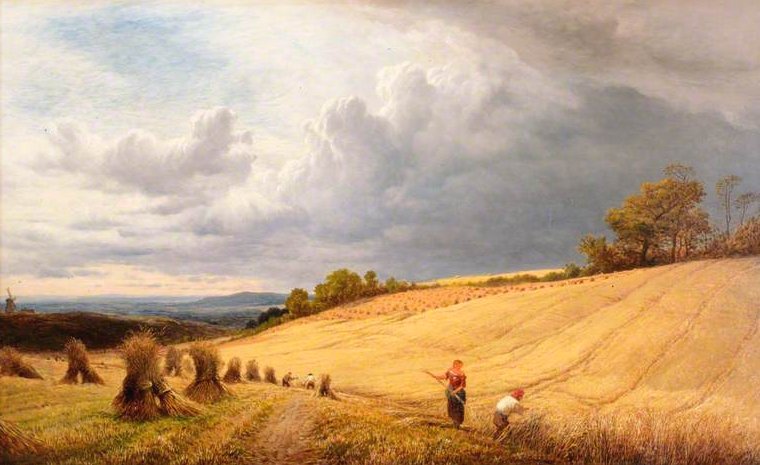
New Hope Artists. Part 3.

The third artist who was involved in the early days of the New Hope Artists Colony was Daniel Garber.  He has been looked upon as being one of the three most important painters of that group

Daniel Garber

Daniel Garber was born on April 11th, 1880, in North Manchester, Indiana. He was the son of Daniel Garber and Elizabeth Garber (née Blickenstaff). Daniel always had a love of art and the belief he could some day become a professional artist.  In 1897, when he was sixteen years old he enrolled at the Art Academy of Cincinnati.  In that same year he moved to Philadelphia and in 1899 he became a student at the Pennsylvania Academy of the Fine Arts on a six year course.  His instructors at the Academy included Thomas Anshutz, William Merritt Chase, and Cecilia Beaux.  During the summers of 1899 and 1900 he also registered to take summer school classes in Fort Washington, Pennsylvania, at the Darby School of Painting, where he studied under Hugh Breckenridge, an artist and educator who championed the artistic movements from impressionism to modernism and Thomas Anshutz, an artist known for his portraiture and genre scenes, and who, along with Breckenridge, was a co-founder of The Darby School. This summer art school flourished first in Darby, PA, and then in Fort Washington, PA, between 1898 and 1918.  Anshutz and Breckenridge brought a lot of new ideas about painting back to Philadelphia after their European stays, and introduced those ideas to a public that was initially not very responsive to Impressionism, 
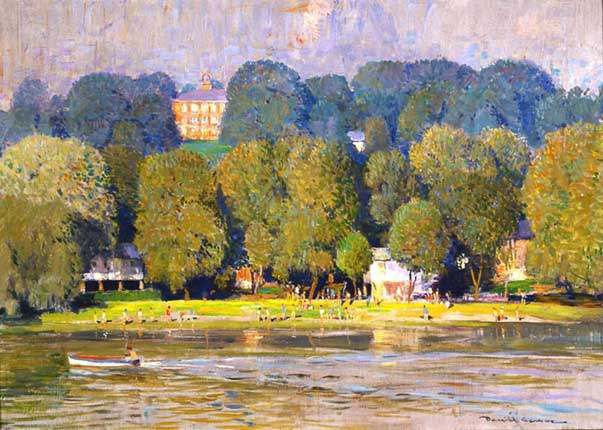
Lambertville Beach by Daniel Garber

During his time as a student at the Pennsylvania Academy, Daniel Garber met fellow artist Mary Ethel Franklin while she was posing as a model for the portrait class of Hugh Breckenridge. Peviously, she had been a student of Howard Pyle when he taught at the Drexel Institute. Following on from a two-year courtship, Garber and Mary were married on June 21st, 1901.
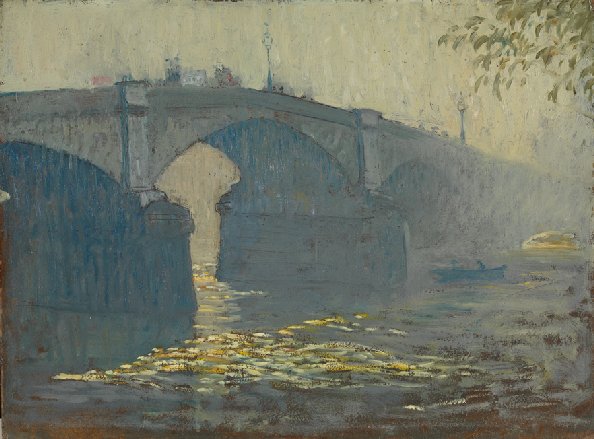
Battersea Bridge by Daniel Garber (1905)

Whilst still studying at the Academy, Daniel opened a studio in Philadelphia in 1901 and set to work as a portraitist and commercial artist. In May 1905, he won a Pennsylvania Academy award, The William Emlen Cresson Traveling Scholarship, which financed him to go to Italy, England and France for two years of independent studies. During his two-year sojourn in Europe he was continually creating paintings which depicted different rural villages and farm scenes and built up a collection of Impressionist landscapes some of which were exhibited at the Paris Salon. One such work was entitled Battersa Bridge.
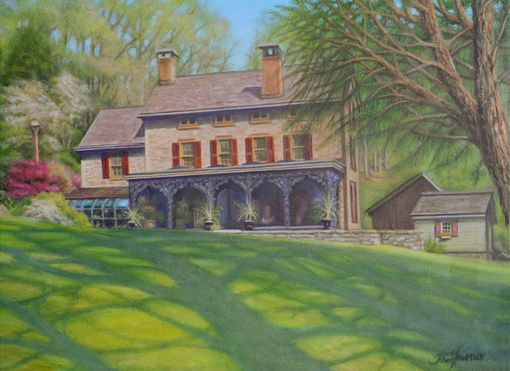
Painting of Daniel Garber’s home, Cuttalossa, by J.C.Turner

Upon his return to America in 1907, Garber began teaching life and antique drawing classes at the Philadelphia School of Design for Women. That summer, Garber, his wife and baby Tanis settled in Lumberville, Pennsylvania, a small town just north of New Hope. Their new summer home came to be known as Cuttalossa, named after the creek which occupied part of the land. The family spent part of their time in Lumberville and part in Philadelphia at their Green Street townhouse which he used as a base when he was teaching.
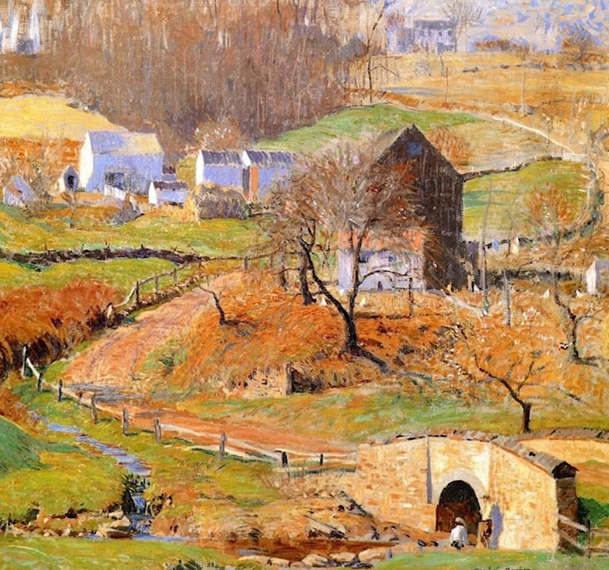
Rural Landscape by Daniel Garber
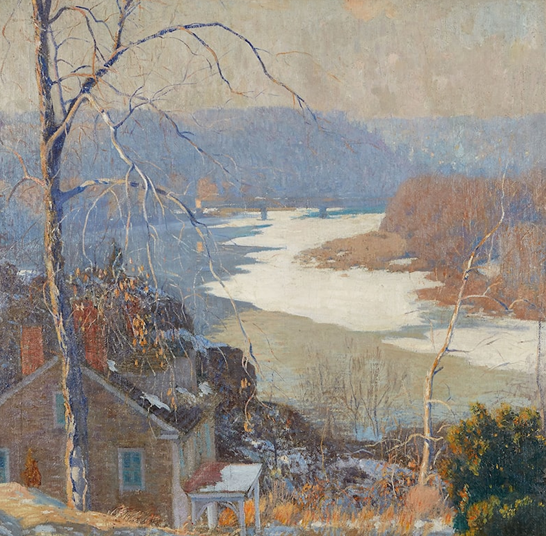
Up the River, Winter by Daniel Garber (1917)

Daniel submitted many of his Pennsylvania landscapes at various exhibitions and received numerous prestigious awards for these works.

Garber teaching at Chester Springs, c. 1935. Image courtesy of the Garber family.

In Autumn 1909, Garber was offered a position at the Pennsylvania Academy as an assistant to Thomas Anshutz. Garber accepted and became an notable instructor of art at the Academy where he taught for the next 41 years. As a lecturer in art, Garber aroused in his students an anxious silence as he passed among them, correcting the mistakes in their work. The brusque severity of his remarks often had his students, especially the women, in tears. He commented to one female student whilst critiquing her artwork:

“…Can you cook?……You sure can’t draw, so you’d better learn how to cook…”

Garber’s students, albeit often fearing his harsh critiques, respected his honest comments, realising the value of his observations and understanding the high expectations and dedicated concern underlying them.
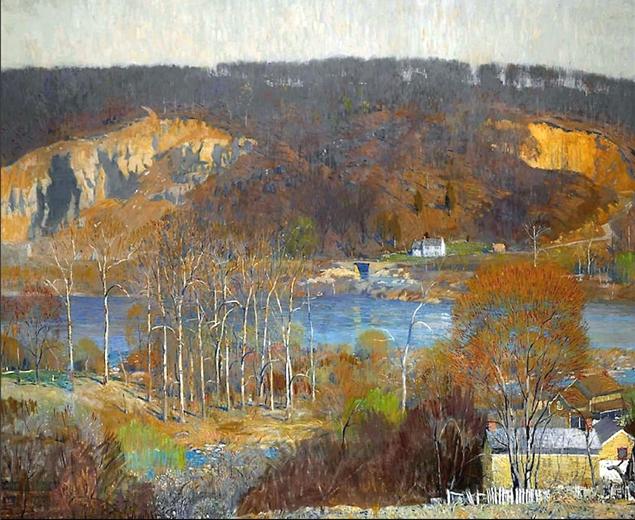
The Valley – Tohickon by Daniel Garber (1914)

Daniel Garber painted consummate landscapes depicting the Pennsylvania and New Jersey countryside which surrounded New Hope. In contrast to fellow New Hope artist, Edward Redfield, Garber delicately painted using a thin paint application technique. His paintings exude both beautiful colour and light, which generate a sensation of endless depth. Garber like Redfield painted large exhibition size works with the intention of submitting them to exhibitions and winning prizes which they were both extremely successful doing so.
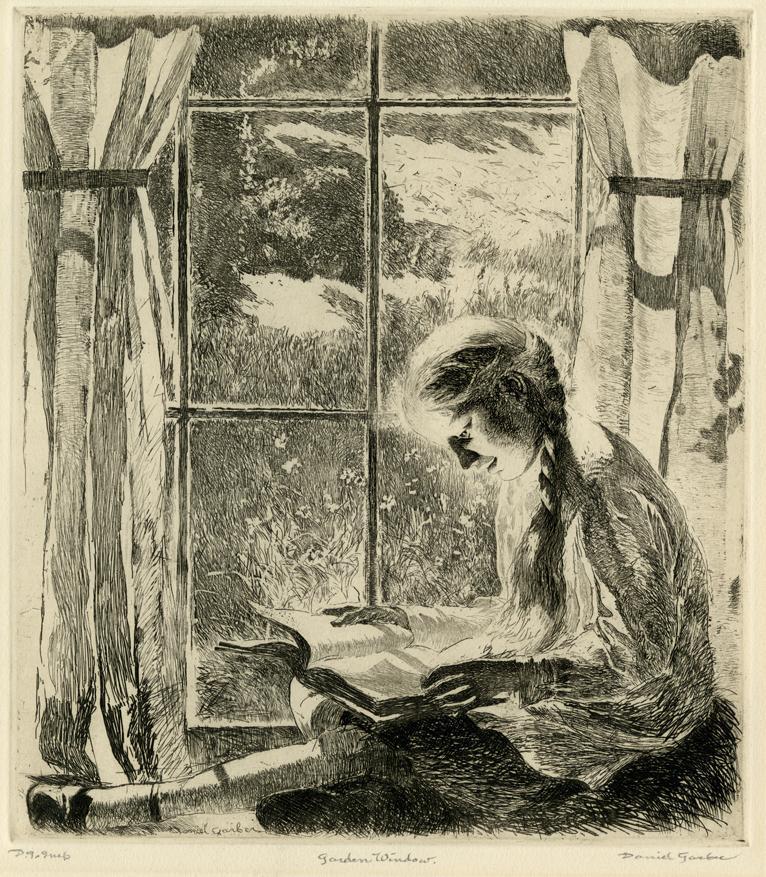
Garden Window, an etching and drypoint on paper by Daniel Garber (1946).

Although, he completed many small delicate paintings he was a fine draftsman, and completed many works on paper, mostly in charcoal but also a few works in pastel. Daniel Garber was also a talented etcher completing a series of about fifty different scenes, most of which run in editions of fifty or fewer etchings per plate.

Stockton Church etching by Daniel Garber (1941)

Daniel Garber loved to sketch. In fact the first jobs he held during his teenage years honed his skills as a draftsman. After working at the Franklin Engraving Company, Daniel Garber illustrated books and magazines, one of which was the collected works of Theodore Roosevelt. In 1917, he went back to his first love, drawing, this time as a printmaker. There was financial sense for Garber in making prints as by doing so he widened his exposure as an artist, exhibiting his work at print venues as well as the usual gallery outlets. He held many one-man exhibitions of his drawings, etchings, and prints and this meant an expansion to his market.
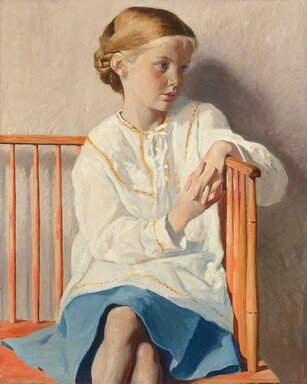
Tanis Garber by Daniel Garber (1914)

Daniel and Mary Garber’s first child Tanis had been born in Paris on December 16th 1906 and when she was seven years old her father completed her portrait. The portrait is part of the National Gallery, Washington’s collection.

Tanis by Daniel Garber (1915) From the Warner Collection of the Westervelt Warner Company, displayed in the Westervelt Warner Museum of American Art, Tuscaloosa, Alabama.

In this depiction (above) of his daughter Tanis he portrays her as if standing in a doorway of his studio at their home, Cuttalossa. In this work Garber began to explore the passage of light through air and objects. Although this might look like an Impressionist-style work, it is not about capturing fleeting light effects or impressions. In fact, Garber said that the painting was worked on over all of the summer months of 1915, with himt apparently returning to the work when his general light effects could be recreated. What Garber had in mind was his desire to simply achieve a Golden Age depiction of childhood; an eternal idealized image, rather than a momentary real one.

The Boys by Daniel Garber (1915) Depicting three of Garber’s students at the Pennsylvania Academy of the Fine Arts, this oil was created in his studio at Cuttalossa

Garber’s second child, John Franklin Garber was born in Pennsylvania on September 25th 1910, three years after his parents had returned to America from France. He grew up on the Garber property Cuttalossa, near Lumberville and he, like his sister Tanis and his mother, posed for many of Garber’s figurative paintings. He attended Penn Charter School and graduated with a degree in chemical engineering from Lehigh University in 1933. John Garber became a keen sponsor and advocate of his father’s work, assisting and corresponding with museums, private collectors, dealers and writers
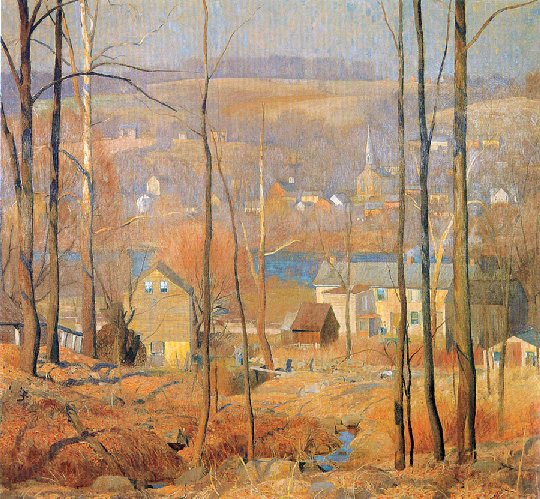
Geddes Run by Daniel Garber (1930)

Daniel Garber’s works were exhibited nationwide and many earned awards, including a gold medal at the Panama-Pacific International Exposition in 1915 in San Francisco, California. He was elected a member of the National Academy of Design in 1913.
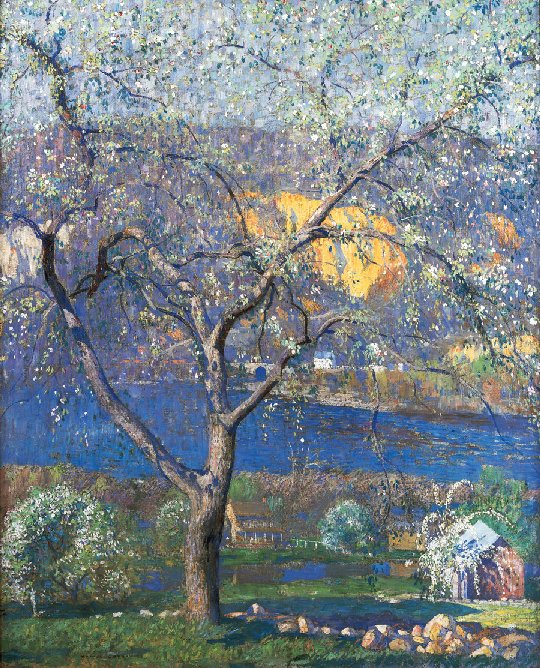
Buds and Blossoms by Daniel Garber (1916)

Daniel Garber died, aged 78, on July 5th, 1958, after falling from a ladder at his studio.

He continued to paint until nearly the end of his life and produced over 2,500 objects which were shown at over 750 exhibitions during the course of his lifetime. It had always been his desire to create and to share his art with the public. This interest in art and educating was also apparent by his forty-one years at the Pennsylvania Academy of Fine Arts, where he taught from 1909 until 1950, where he offered up his knowledge of art and was able to influence succeeding generations of artists. Garber’s paintings today are considered by collectors and art historians to be among the finest works produced from the New Hope art colony. His paintings can be seen in many major museums including the Smithsonian American Art Museum in Washington, DC, the Art Institute of Chicago and Philadelphia Museum of Art.

Was he the greatest of the New Hope painters ? I will let you decide.


Information for this blogs was obtained from a number of sources including:

Incollect

New Hope Colony Foundation of the Arts

Michener Art Museum

Jims at Lambertville

Fredrik Kruseman

During a period of very low temperatures and snowy conditions, it might seem appropriate to focus on art depicting sunshine, blue skies, and warm azure-coloured seas. However, today’s blog will start with featuring beautiful depictions of snow and ice and explore how people who experienced these conditions seemed to find enjoyment in them. Many such depictions are conjured up by nineteenth century Dutch artists and today’s blog is all about Fredrik Marinus Kruseman the Dutch painter who specialized in Romantic-style landscapes, and winter scenes, which made up about two thirds of his oeuvre.

Fredrik Kruseman was born in the Netherlands city of Haarlem on July 12th, 1816. He was the fourth son of Jacoba Mooij and her husband Benjamin Philip Kruseman, a Lutheran hat-maker. Fredrik had two older brothers, Hendrik and Jakob and a younger brother Benjamin. He also had two cousins who became famous painters. Cornelis Kruseman a painter of historical and biblical subjects who later became Director of the Royal Academy of Fine Arts of Amsterdam and Jan Adam Kruseman, a historical painter and portraitist.

A Winter’s Scene with Skaters on a Frozen Waterway by Fredrik Kruser (1858)

Fredrik was tutored by many of the great Dutch landscape artists of the nineteenth century school. In 1833, aged seventeen, he was apprenticed to Jan Reekers who taught him the skills required to draw from nature and the intricacies of perspective. Between 1832 and 1833 he also attended classes at the Vocational City Drawing School in Haarlem and studied painting with Nicholas Roosenboom, who had a studio near where Fredrik lived. It was in September 1833 that Fredrik Kruseman first exhibited his landscape work. It was at the Exhibition for Living Masters in The Hague. In 1835, Fredrik moved to the Gooi, an area around Hilversum, in the centre of the Netherlands. Here he took advanced studies with Jan van Ravenswaay. He also studied briefly with the landscape painter, Barend Cornelis Koekkoek.

During his twenties and thirties, Kruseman travelled widely throughout Northern Europe before finally setting up home in Brussels in 1841. He returned to the Netherlands and lived, between 1852 and 1856, on the outskirts of Haarlem. After that four-year sojourn he returned to the Belgian capital where he remained for the rest of his life.

Winter Landscape with Skaters and Wood Gatherers at a Ruin by Fredrik Kruseman

Kruseman’s 1845 painting entitled Winter Landscape with Skaters and Wood Gatherers at a Ruin depicts a frozen canal with skaters, walkers on a path along the shore, a picturesque castle and strange bare trees. Men scavenge for wood for their home fires. Life is hard at this time of year.

A Winter Landscape with Skaters on a Frozen River by Fredrik Kruseman (1862)

Kruseman’s painting entitled A Winter Landscape with Skaters on a Frozen River is a beautiful depiction and is a Romantic observance and veneration of nature. The sky dominates the paintingfxf. Before us we have a frozen waterway on which are a number of skaters bordered by snow-covered banks. On the right bank there is a refreshment table. We can also pick out a fallen skater in the left of the foreground and a young couple with their dog crossing the centre of the frozen river close to a wide crack in the ice. In the left middle-ground we can just make out a sailing boat frozen to the riverbank. The colours Kruseman has used are cool blue-grey tonality over the black mirror-like surface of the ice.

Wintry River Landscape with Windmill by Fredrik Kruseman (1844)

Although Kruseman is best known for his Romantic wintry landscape paintings he completed many other landscape works.

Monk Meditating near a Ruin by Moonlight by Fredrik Kruseman (1862)

One notable romantic piece is his 1862 painting titled Monk Meditating near a Ruin by Moonlight. The ruin of the title is the abbey in Villers-la-Ville near Brussels, which used to be one of the most significant Cistercian abbeys in Europe and close to where the painter lived for a while. In the right foreground of this nocturnal scene, we see a monk meditating near the overgrown ruin. The abbey was founded in 1146 and was a former Cistercian Abbey located in the very heart of Walloon Brabant.

Village Street on a Sunny Day by Fredrik Kruseman (ca. 1835)

Landscape with two Farmers by Fredrik Kruseman

In the foreground of this atmospheric work, we see two peasants talking to each other. One holds on to his ox, while the other is accompanied by his dog. The background consists of a wide landscape with a few hills. Once again the sky plays a dominant part of the painting.

Tranquil Landscape with Women Washing by a Stream with Cattle and Sheep by Fredrik Kruseman

 A River Landscape with Cows and Sheep by Fredrik Kruseman

In his winter scenes of frozen rivers, Fredrik Kruseman cleverly produced jet-black mirror surface of the ice and the marks left by skaters. Some of his most famous depictions were set in the fading light of early evening and combined the wintry scene with a background glow of a setting sun or a bright light emanating from the interior of a cottage or house.

Fredrik Marinus Kruseman worked well into the late 1870s and died in St Gilles, a suburb of Brussels, on May 25th 1882.

Jean-Baptiste Armand Guillaumin

Jean-Baptiste Armand Guillaumin, the French impressionist painter and lithographer, was born on February 16th 1841 in Paris.  He was brought up in a working-class family, the grandson of Jean Joseph Guillaumin who was a notary by trade.  He was sent to school in Moulins, where his family came from, and this period in central France, made him take note of the beautiful surroundings and the mountainous landscape which stimulated his interest in art and it was also in Moulins that he first met Eugéne Murer, a pastry chef, author, self-taught painter and collector of impressionist paintings, who became his life-long friend.

Farms in Janville by Armand Guillaumin (1878)

By 1857, at the age of sixteen, Guillaumin returned to Paris and began working as a clerk in his uncle’s lingerie shop awhile also studying art under the sculptor Louis Caillouet.  His interest in art and the time he spent studying it caused friction with his family and he left to hold a position in the French government railways. He then continued his art training at the Académie Suisse where he trained to draw from the models, in the mornings and evenings.  It was here that he first met with Courbet, and began more lasting friendships with painters such as Cézanne, Pissarro and Francisco Oller, a Puerto Rican Impressionist painter.

Garden in Janville in June by Armand Guillaumin (1886)

Now friendly with the artists associated with the Anonymous Society of Painters, Sculptors, Engravers, (later dubbed The Impressionists) he was able to exhibit with them at the first Salon des Refusés in 1863 and their first joint Impressionist Exhibitions in 1874 at the former studio of the photographer Nadar (at 35 Boulevard des Capucines) in Paris, and in total he submitted work to six of their eight annual exhibitions.  Still young, the art critics of the time judged him to be an accomplished draughtsman who completed amazing mature compositions.  He developed connections with Emile Zola and his circle of friends and was greatly influenced by the artwork of Manet and Courbet.

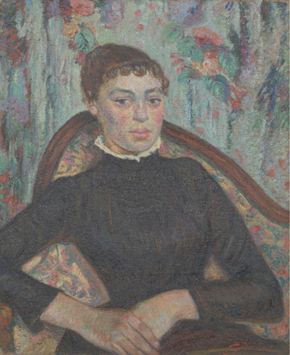
Portrait of a Young Woman by Armand Guillaumin (1876)

One of the problems Guillaumin soon encountered was financial as he had no private income to turn to and so he had to continue holding down a job to survive.  This situation was further exacerbated with the advent of the Franco-Prussian War in 1870.  Once the War and the Paris Commune fighting had ended there was some hope for Guillaumin who had managed to have himself included with the popular Impressionist movement.  Guillaumin and fellow Impressionist, Cézanne had met up with Dr Paul-Ferdinand Gachet, a French physician most famous for treating the painter Vincent van Gogh during his last weeks in Auvers-sur-Oise, and he bought a number of their works.  Guillaumin also sold a number of his works to his friend, Eugéne Murer who had recently established a successful café in Paris. Guillaumin and Cézanne began sharing a studio but both found themselves in precarious financial positions despite the sales of their work to Gachet and Murer who continued to be close friends of the pair.

Cottages in a Landscape by Armand Guillaumin (1896)

At the start of the 1880s the Impressionist group was beginning to break apart and it split into two camps.  One headed by Pissarro and the other by Degas.  Gaugin had vociferously supported Pissarro and he had allied himself with Guillaumin.  Although not initially supportive of the Impressionist group having misgivings about what its intentions were, Renoir and Monet joined the Impressionist Exhibition of 1882 with Guillaumin, Gauguin and Pissarro as well as Sisley, Morisot, Vignon and Caillebotte.  However, Degas was noticeably absent.

Moulins en Hollandee by Armand Guillaumin (1904)

It was somewhat surprising that Paul Gaugin, known for his irrational behaviour towards his fellow painters, continued to befriend Guillaumin and keep him in the Impressionist group despite its continued disintegration.  It was through Gaugin, that Guillaumin met many new young artists who had arrived on the Paris art scene such as the Symbolist painter, Odile Redon, and the Pointillists, Georges Seurat and Paul Signac. In the mid 1880s Guillaumin’ s studio had become a meeting place for the young group of painters.  By 1885, new styles of painting had come to the fore and this resulted in further rifts between the old guard of Impressionism resulting in the disintegration of the Impressionist Group. The other factor for the break-up of the Group was its leading man, Gaugin, became more and more temperamental and intolerant and was destroying the Movement from the inside.  Guillaumin decided it was time for him to exit the movement which he had been part of from the very start.  Guillaumin’s reputation had grown over the last decade and Paul Adam wrote in La Revue Contemporaine:

“…I was not aware of any other painter who has so correctly noted the corresponding values of the lights of the firmament and of the ground…. their unification in colour appears to be perfect…”

Again, Felix Feneon, the French art critic, gallery director, and writer reiterated this, writing about the same show Immense Skies and commented on Guillaumin’s work:

“… superheated skies where clouds jostle each other in a battle of greens and purples, of mauves and of yellows…”

Vue de Port by Armand Guillaumin (1880)

t was in 1886 that Guillaumin married.  His wife was his cousin Marie-Joséphine Charreton, a schoolteacher, who was able to support him financially.  They settled down at 13 quai d’Anjou in the Saint-Sulpice area of the 6th arrondissement of Paris. It had previously been the studio of the painter Charles-François Daubigny. Guillaumin’s relationship with Pissarro eventually ended with the latter beginning to concentrate on experimentation with pointillism while Guillaumin became progressively interested in romantic art. Guillaumin’s relationship with Gaugin also in due course ended as the latter being constantly away on his travels.

Agay Bay by Armand Guillaumin (1910)

From 1875 to 1880, Guillaumin was a frequent guest of Dr Gachet at Auvers, at a time when he was travelling in that area searching for views of the rural scenery of the Yonne valley to paint and, later, the Creuse valley and the countryside around the farming village of Crozant, where he spent most of his life. Around 1887 Guillaumin became a good friend and mentor to Vincent Van Gogh, who was twelve years his junior. Vincent’s letter to fellow painter Ermil Bernard in December 1887 shows how highly he thought of Guillaumin:

“… I believe that, as a man, Guillaumin has sounder ideas than the others [the Impressionists], and that if we were all like him we’d produce more good things and would have less time and inclination to be at each other’s throats.

Again in a letter to his brother Theo in June 1888, Van Gogh writes about a visit he made to Guillaumin’s house and how he was inspired by him:

“…Wasn’t it pleasant at Guillaumin’s last winter — finding the landing and even the stairs, not to mention the studio — chock-full of canvases? You understand since then that I have a certain ambition, not about the number of canvases, but that these canvases as a whole should, after all, represent a real labour on your part as well as mine…”

Neige by Armand Guillaumin (1876)

In the last decade of the nineteenth century Guillaumin’s circle of artist friends was dwindling.  Vincent van Gogh died in July 1890 and his brother Theo, the art dealer, died in the January of the following year.  Gaugin and Cézanne had left Paris and Guillaumin and Pissarro’s views on art had diverged so much that their friendship had gradually faded.  Despite all this Guillaumin’s life was to change rapidly when won he won the sum of 100,000 francs (about 400,000 euros in today’s money) in a state lottery.  This completely changed his life.  He no longer had to rely on commissions.  He no longer had to exude a subservience towards patrons.  He was now able to paint what he liked and strive for his own artistic goals.

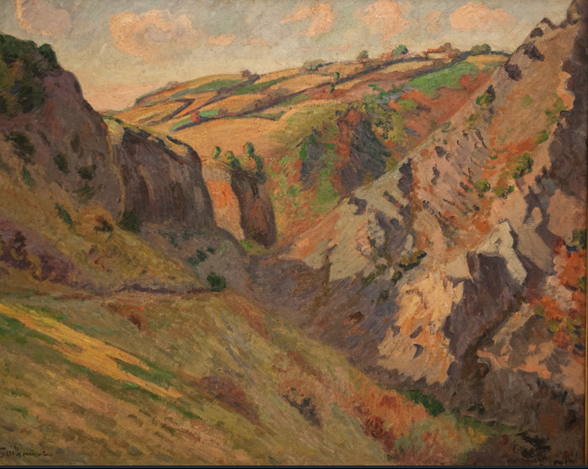
Caves Prunal near Pontgibaud by Armand Guillaumin

With this newly found wealth Guillaumin set off travelling around France capturing on his canvases the beautiful views of the countryside, mountains and the coast, often during sunrise and sunset.  His continuous journeying around was brought to an end with the onset of The Great War of 1914.  Once the war came to an end he once again set off on his travels but by then he was seventy-seven and he, like his artistic output, was declining.   In 1926 a retrospective exhibition was held at the Salon d’Automne.  He died at the Chateau de Grignon in Orly, Val-de-Marne, just south of Paris, on June 26th 1927 aged 86. He was the last survivor of the Impressionist Group.

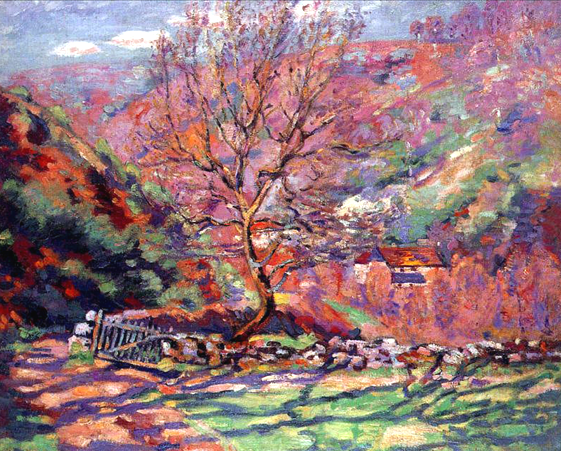
Crozant, Solitude by Armand Guillaumin (1915)

Guillaumin’s paintings are renowned  for their intense colours and can be found in major museums around the world. Most of all he is best remembered for his landscapes of Paris, the Creuse département, and the area around Les Adrets-de-l’Estérel near the Mediterranean coast in the Provence-Alpes-Côte d’Azur region of France. Guillaumin became known as the leader of the École de Crozant, a disparate group of painters who came to portray the landscape in the region of the Creuse around the village of Crozant.

Paysage à Crozant (1917)

One such depiction is entitled Landscape in Crozant, is part of the Art Institute of Chicago collection.

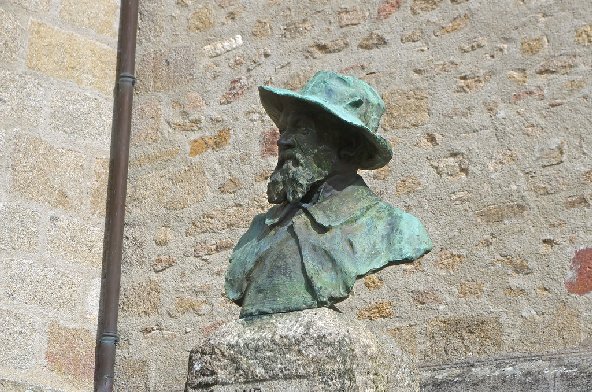
His bust is in the square near the village church in Crozant.

Jasper Francis Cropsey

Among the most vibrant and spectacular works of the nineteenth century, were the sweeping landscape depictions of the Hudson River School which managed to capture the rugged beauty of the American countryside and wildernesses.  The name Hudson River School was first used disparagingly by trendy Europhile critics who preferred the dignified depictions of the realism of L’École de Barbizon.  The beautiful paintings of the Hudson River School compellingly convey the natural grandeur, not just of the Hudson River Valley, as the name would imply, but also the Catskills, Adirondacks, White Mountains, the Maritimes, the American West and South America.  My guest artist was one of the great painters of that School.

Jasper Francis Cropsey

Jasper Francis Cropsey was born at Rossville, Staten Island on February 18th 1823.  He was the eldest of eight children and his ancestors were of Dutch and Huguenot ancestry. His father was Jacob Rezeau Cropsey who had a farm in Rossville and his mother was Elizabeth Hilyer Cropsey (née Cortelyeu).  During his early years, Cropsley suffered many bouts of ill health which resulted in him missing school and forced him to rest up at home.  During those frequent periods of inactivity, he taught himself to draw. Many of his sketches featured architectural drawings and landscapes.  Whilst attending the local country school he would help is father on the farm but in his pre-teen and teenage years he developed his main love, sketching and painting.  Much to the chagrin of his teachers he would often be found doodling on his school books.  In his 1846 unpublished biography, Reminiscences of My Own Time he wrote:

“…I was so disposed to adorn my writing book, on the margin, wherever there was a blank space, with fancy letters, boats, houses, trees, etc., and paint, or color the pictures in my books that I would undergo the reprimand of the teacher, rather than desist from it…”

The Valley of Wyoming, by Jasper Francis Cropsey (1865)

Cropsey as a young teenager was fascinated with architecture and this led him to assemble an elaborate model of a country house which he submitted to the 1837 fair of the Mechanics’ Institute of the City of New York and it won him a diploma.  The model was well received and Joseph Trench, a New York architect who saw it, offered fifteen-year-old Cropsey a five-year apprenticeship in his architectural office. After eighteen months, Cropsey’s proficiency in drawing had earned him the responsibility for nearly all the office’s finished renderings.   Cropsey prospered at the firm and during his penultimate year at the company he began painting the backgrounds of the architectural designs. To improve that skill, Joseph Trench persuaded his young apprentice to study watercolour painting with English-born watercolourist, Edward Maury.  The firm even provided him with paints, canvas, and a space in which to study and hone his artistic skills.

The Narrows from Staten Island, by Jasper Francis Cropsey (1868)

Cropsey left the Trench’s office in 1842 and in 1843 he first exhibited a painting, which was quite well-received.  It was a landscape entitled Italian Composition, probably based on a print he had seen at the National Academy of Design. Jasper Cropsey was elected an associate member of the Academy the following year and became a full member in 1851.

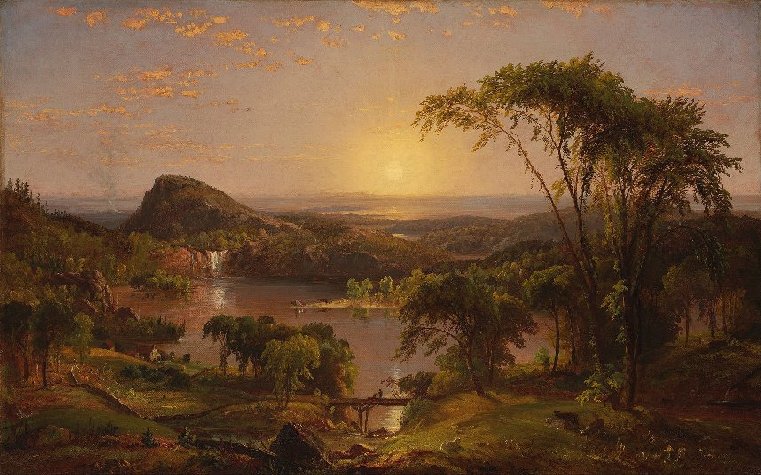
Sunset on Greenwood Lake by Jaasper Francis Cropsey (1877)

Having left the Trench architectural company Cropsey managed to support himself for the next two years by accepting commissions to provide architectural designs.  Although that brought him financial support, his main love was sketching and painting landscapes and he would often take painting trips to New Jersey and Greenwood Lake, which straddles the border of New York and New Jersey.  After one such trip, Cropsey had put together a number of sketches of the area, which on his return home he converted them into two paintings of Greenwood Lake that were accepted at an 1843 exhibition at the American Art Union.

Autumn Foliage in the White Mountains (Mount Chocorua) by Jasper Francis Cropsey (1862)

During one of his trips to Greenwood Lake, Cropsey met Maria Cooley, whom he later married in May 1847. They went on to have two children, Mary Cortelyou Cropsey in 1850 and Lilly Frances Cropsey born in 1859. He and his wife crossed the Atlantic for a two-year European honeymoon and visited England during the summer of 1847, travelled throough France and Switzerland and reached Italy wheree the Cropseys spent a year among the colony of American artists who had settled in Rome. During that lengthy stay in Rome, Cropsey worked out of the former studio of Thomas Cole, the founding father of the Hudson River School. Cropsey became familiar with the works of the Nazarenes and other German artists in Rome and it was their influence which may have reinforced his own liking of detail in his paintings. Like many other American artists who visited Italy, Cropsey made frequent sketching trips to the Roman Campagna and other regions of Italy, such as Sorrento, Capri, Amalfi, and Paestum.

Maria Cooley Cropsy by Daniel Huntingdon (c.1850)

Cropsey and his wife returned to America in 1849 and he made his first trip to the White Mountains, a mountain range covering about a quarter of the state of New Hampshire and a small portion of western Maine.  Cropsey rented studio space in New York which he shared with Edwin White, the Massachusetts-born artist, at 114 White Street in New York City. Here he taught and worked up his European sketches into finished oil paintings. Cropsey and his wife made their base in New York and from there in the summers they would make exploratory trips through New York State, Vermont, and New Hampshire, and he would continually sketch what they saw. Cropsey specialized in autumnal landscape paintings of the northeastern United States. He would convert sketches into finished paintings and sell them but also to supplement the family income he would teach.  

 Bayside, New Rochelle, New York by David Johnson (1886)

One of his pupils was the landscape painter David Johnson, who became a member of the second generation of Hudson River School painters.

Lord Byron’s Dream, by Charles Lock Eastlake (1827)

Cropsey and his wife made a second trip to England in 1856 and rented a studio in London at Kensington Gate.  It was an ideal place to host parties and make friends such as the art critic John Ruskin, John Singleton Copley, 1st Baron Lyndhurst, who was a British lawyer and politician and was three times Lord High Chancellor of Great Britain and Sir Charles Lock Eastlake who was a British painter, gallery director, collector and writer of the 19th century. He became the first director of the National Gallery and from 1850 to 1865 he served as President of the Royal Academy.    

Walton on Thames by Jasper Francis Cropsey (1860)

It was with friends such as these that ensured many English and American landscape painting commissions came Cropsey’s way from both English and American patrons. When Cropsey arrived in England he brought with him many commissions from his American patrons who wanted paintings depicting English castles and abbey ruins. He also found that there was a great interest amongst English clients for his American landscapes. The London printer Gambert and Company commissioned thirty-six views from Cropsey for publication in the American Scenery journal.

Autumn—On the Hudson River , 1860 by Jasper Francis Cropsey

In 1860 Cropsey completed one of his most famous paintings entitled Autumn—On the Hudson River of 1860. This monumental view of the Hudson River Valley was painted from memory and in-situ sketches he had made, in his London studio. Cropsey adopted a high vantage point, looking southeast toward the distant Hudson River and the flank of Storm King Mountain. It is an autumnal scene which would soon become Cropsey’s trademark.  The work was praised by critics and the public alike, including Queen Victoria.  The painting depicts a sweeping panoramic view of the river under a sun-streaked sky in this long, horizontal landscape painting (60 x 108 inches).  The leaves on the trees are fiery autumnal oranges and reds.  In the background we catch a glimpse of the mountains through the haze.  At the bottom of the painting we can see vine-covered, fallen tree trunks and mossy grey boulders.  At the bottom left we can just make out a trickling waterfall and small pool. 

Although not easy to spot, on the bank of the pool, three men and their dogs sit and recline around a blanket and a picnic basket, their rifles leaning against a tree nearby. From our viewpoint, the land stretches down to a grassy meadow which is crossed by a meandering stream at the heart of the painting. 

In the right foreground we see cattle on the riverbank drinking the water close to a wooden bridge. 

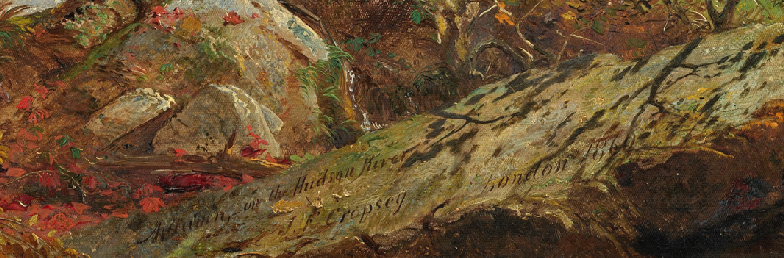
Artist’s signature on flat rock

Cropsey signed the painting as if he had carved it into the flat top of a rock at the centre foreground of the landscape with his name, the title of the painting, and date: “Autumn – on the Hudson River, J.F Cropsey, London 1860.”

Summer, Lake Ontario by Jasper Francis Cropsey (1857)

Besides earning money from the sale of his landscape paintings he also provided illustrations for books of poetry by Edgar Allan Poe and Thomas Moore and did a series of views of American scenery published by Gambert and Company, London.  Cropsy was acclaimed not only for his beautiful autumnal landscapes such as Autumn—On the Hudson River, 1860 which is now part of the National Gallery of Art, Washington, D.C. collection, but for bringing to the untravelled British people the exquisite scenery of the great Western continent.   Queen Victoria was so impressed by Cropsey’s works of art that she appointed him to the American Commission of the 1862 International Exposition in London, and he subsequently received a medal for his services.

Coast of Genoa by Jasper Francis Cropsey (1854)

Cropsey and his wife returned to America in 1863. The 1860s were the most successful time for Cropsey as far as the sales of his work and his ever increasing bank balance. Shortly after their arrival home to America they visited Gettysburg to record the battlefield’s topography in a painting. Cropsey also began to accept architectural commissions once again and produced his best-known designs, such as the ornate cast and wrought iron Queen Anne-style passenger stations of the Gilbert Elevated Railway along New York’s Sixth Avenue.

High Torne Mountain, Rockland County, New York by Jasper Francis Cropsey (1851)

Cropsey’s father-in-law, Isaac P. Cooley was a justice of the peace from 1837 to 1839 and became a judge over the New Jersey Court of Common Pleas in 1840.    Cooley later became a member of New Jersey State House of Assembly from 1860 to 1861.   Cooley offered to build his daughter and son-in-law a studio on his estate but Cropsey declined the  offer and instead, purchased forty-five acres of land near Greenwood Lake in Warwick, New York, where he designed and built a 29-room Gothic Revival mansion with its own studio which he called Aladdin. The family then divided their time between living in New York City, and spending time in Warwick.

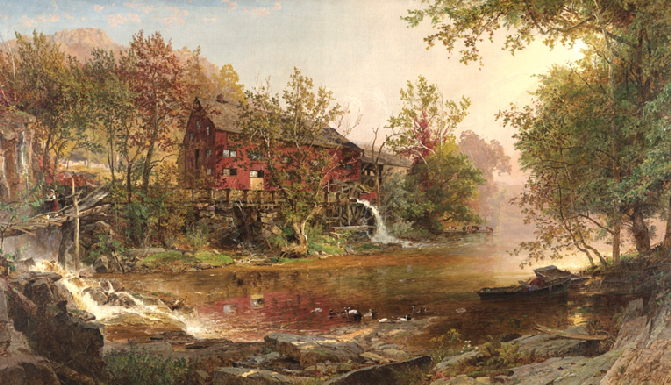
The Old Mill by Jasper Francis Cropsey (1876)

Unfortunately for Cropsey, the art of the Hudson River School began to lose its popularity and by the early 1870’s would be completely out of favour in the art world. In 1876 Cropsey completed his last major work, The Old Mill, which is now part of the Chrysler Museum of Art in Norfolk, VA. Collection.  The painting is a depiction of the Sanford gristmill, which stood on the banks of the Wawayanda Creek near Warwick, New York, and close to where Cropsey had built his palatial estate, Aladdin. The rural water mill was at the heart of the American pre-­industrial economy, but time moved on and in the 1870s, the water mills were quickly being replaced by more efficient steam-powered mills and factories.  This loss of such bygone icons concerned Cropsey.  For him, it was symbolic of the loss of the simple past.  It was a sentimental bereavement.  The depiction was typical of Cropsey’s past output – autumn landscapes that beautifully captured the sunlit atmosphere of autumn in New York and New England.  Cropsey exhibited it at the 1876 Centennial Exposition in Philadelphia, where he was awarded a medal for “excellence” in oils.

Wickham Pond and Sugar Loaf Mountain, Orange County by Jasper Francis Cropsey (1876)

The Hudson River School artwork began to lose its popularity by the mid 1870’s and by the end of the decade would be completely out of favour in the art world. In the early 1880’s the sale of Cropsey’s landscape paintings was dwindling eclipsed in popularity by the smaller scale works which were, softer, mood-evoking landscapes of Barbizon-inspired painters such as George Inness. As a result the Cropsy family’s financial situation became dire and the family was perilously close to having their home, Aladdin, in Warwick, NY, taken from them.   Fortunately, they managed to sell their lavish estate and at the same time, auctioned off many paintings, furniture, and household possessions in preparation to move to a smaller property.

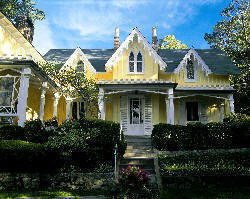
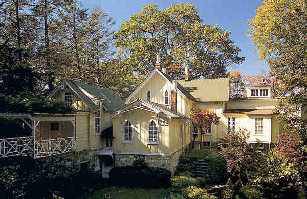
Ever Rest,  49 Washington Avenue, Hastings-on-Hudson

In 1885 the Cropsey family moved from Warwick to Hastings-on-Hudson, a village in Westchester County located in the southwestern part of the town of Greenburgh in the state of New York.  He firstly rented a property then later bought a house at 49 Washington Avenue, which they named Ever Rest. Cropsey and his family lived there for the rest of their lives.  They were content to live a quiet existence there at Ever Rest and did very little travelling.  As far as painting was concerned Cropsey concentrated in depicting local views or views based on the hundreds of sketches he had completed through the years, including studies he did in the two year period spent in Rome. .

Jasper Francis Cropsey by Edward Mooney (1850)

Jasper Francis Cropsey suffered a stroke in 1893 and died at Ever Rest on June 20th 1900 at the age of 77,  and Maria, his wife of 54 years, passed away in 1906.

The Cropsey home, known as Ever Rest,  was built in 1835 and purchased by Jasper F. Cropsey in 1885. Cropsey extended Ever Rest by adding an  artist’s studio to it in 1885. The Homestead is located at 49 Washington Avenue, Hastings-on-Hudson, NY.   On May 17, 1973, both the New York and National Historical Societies declared the Homestead an historical site. The Homestead is listed in the “National Register of Historic Places in New York”.


A great deal of information I needed cam fro some excellent websites:

Newington-Cropsey Foundation

Welcome Autumn with Jasper Cropsey’s Colorful Landscape Paintings

National Gallery of Art

Mark Murray Fine Paintings

Spellman Gallery

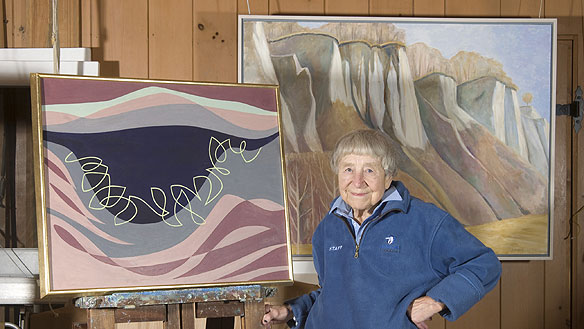
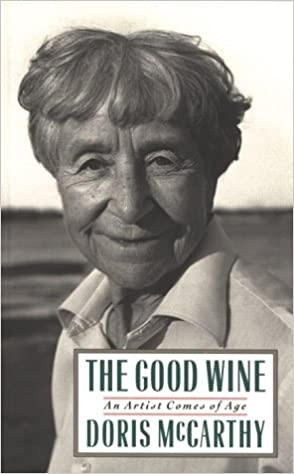
Doris McCarthy-beautiful simplicity.

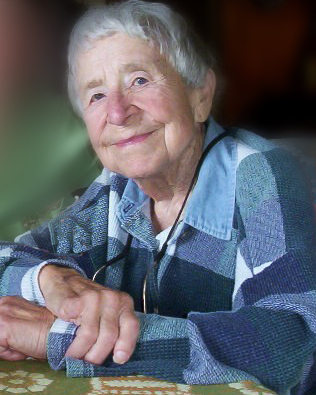
Doris McCarthy aged 96.

When I first saw the artwork of today’s featured artist, the phrase that first came to mind was “beautiful simplicity”.  I hope you will feel the same when you peruse this blog.  The artist I am showcasing today is Doris McCarthy, a Canadian painter, writer and educator and who is best known for her abstract landscapes.

Doris McCarthy was born on July 7th 1910 in Calgary, Alberta.  She was the youngest child of George Arnold McCarthy, an engineer, and Jennie McCarthy (née Moffatt).  Doris had two older brothers, Kenneth and Douglas. Because of her father’s job the family had to make many house moves.  In the Summer of 1912 the family moved to Vancouver, then Boise, Idaho that December.  The following Spring they lived in Berkeley, California and in the Summer of that year they had re-located to Moncton in New Brunswick, where Doris’ paternal grandparents lived. Finally in the Autumn of 1913, at the age of three, Doris and her family moved to Toronto where she spent her youth living in the east end of the city, in a neighbourhood known as The Beaches, on the shores of Lake Ontario.

Doris’ schooling started when she was five-years-old at which time she was a pupil at Williamson Road Public School in Toronto.  She remained there until she was eleven years of age.  She then transferred to the middle-school of the Malvern Collegiate Institute in 1921.  She remained at the Institute until she graduated in 1926.  As she began to enjoy sketching and painting, whilst attending the Institute, she also enrolled in Saturday Junior courses at the Ontario College of Art (OCA).  She showed such artistic aptitude during her time on these Saturday sessions that she was awarded a full scholarship to the college and started a three-year course in the Autumn of 1926. This was the start of her formal artistic training.

Hills at Dagmar, Ontario by Doris McCarthy (1948)

During her three-year stint at the college, she was mentored by some of the great Canadian artists such as Arthur Lismer, James McDonald and Lauren Harris who were founder members of the Group of Seven, also known as the Algonquin School of landscape painters, a group which was formed in 1920. These Impressionist painters loved to explore the uncharted areas of Canada continually recording through plein air sketches and paintings the beauty of their own country.  It was from their works that other artists realised what was on offer to those who would make the effort to discover the history, culture and geography of their fine nation and question the reasoning behind going to Europe in search of inspirational beautiful scenery.  Doris graduated from the college in 1930 and the following year she began to exhibit her work at the Ontario Society of Artists (OSA).  She was accepted as a member of the OSA in 1945 and later went on to become OSA Vice President from 1961 to 1964 and later, President from 1964 to 1967. 

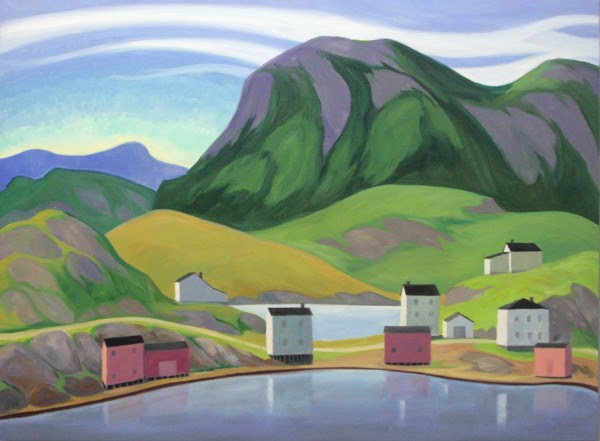
Village Under Big Hills by Doris McCarthy

Was she influenced by these artistic luminaries?  In an interview in 2004 she cast doubt on that assertion, saying:
“…I don’t think I was ever influenced by the Group of Seven’s actual paintings.  I was influenced very strongly by the tradition of going out into nature and painting what was there. I bought it. And I still buy it…”

Sutton Village, Quebec Province by Doris McCarthy

Whilst at the OCA, Doris met and became great friends with a fellow student, Ethel Curry and the two would often go off together on painting trips together they spent many holidays painting in Haliburton Ontario.  Haliburton, to the north-east of Toronto, was very popular with tourists with its beautiful lakes and old cottages. It was also referred to as the Haliburton Highlands, due to its geographical similarity to the Scottish Highlands.  It was an ideal location for landscape painters such as Doris and Ethel.

Houses on the Neck, Salvage, Newfoundland by Doris McCarthy (1999)

Doris graduated from OCA in 1930 and worked for very low wages at Grip, an advertising agency where many of the Group of Seven had previously been employed. However, her future pathway outside academia was given to her by one of her tutors, Arthur Lismer, who offered her an opportunity to teach children’s art classes at the Art Gallery of Toronto, which she accepted and thus began her career as an educator. Doris also worked part-time as a teacher with Moulton College from 1931 to 1932, and that year enrolled on a twelve-month teacher training course at the Ontario Training College for Technical Teachers in Hamilton during the years 1932 to 1933.

 Asters in the Field at Fool’s Paradise by Doris McCarthy (1953)

In 1932 Doris, aged twenty-two, began teaching art at the Central Technical School in Toronto, and this began her forty-year period of teaching at this institute.  In her forties, Doris McCarthy’s reputation as a landscape painter had blossomed.   She had faithfully kept faith with the Group of Seven’s premise of “going out into nature and painting what was there” and it was on her many painting trips into the Canadian wilderness that she built up her work.  Some of the places she visited looking for inspiration were Haliburton, Muskoka, Georgian Bay, the Badlands of Alberta, and the Arctic. 

Fool’s Paradise

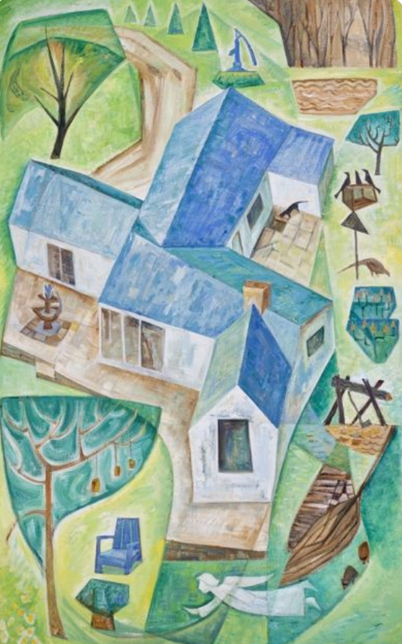
In 1939, whilst on a painting trip along Scarborough Bluffs she came across an abandoned property set high on top of a sheer section of the bluffs and along Gates Gully, a deep ravine at the end of Bellamy Rd.  The property was derelict and covered in poison ivy. However, it was the position looking out over Lake Ontario and other views over the tree-less farmland which appealed to her, and she decided to buy the plot of land.  It cost her $1,250 which was a “fortune” considering her teacher’s salary.  Her mother was horrified with her daughter’s purchase and referred to it as a “fool’s paradise”.  Doris was not deterred by her mother’s negative comments and designed a small single-storey cabin for the developed site.  During the following years she expanded the building and protected it against the harsh winter weather.   The State’s conservation authorities, wary of possible erosion of the land around her cabin, had trees planted around it but left the view of the lake unaffected.  The adjacent land was later subdivided into lots and a residential neighbourhood now surrounds McCarthy’s Fool’s Paradise.

Home – a painting of her home – Fool’s Paradise on the Scarborough Bluffs, Toronto, Canada by Doris McCarthy

Doris ventured further afield when she went on a year-long sabbatical to Europe in 1951 and ten years later another twelve-month sabbatical had her travelling through the Middle East and Asia, visiting far-off places such as Afghanistan, Iraq, Cambodia, just to mention a few.  McCarthy worked in both oils and watercolour and she cultivated a recognisable style of hard-edged angles, form and colour depictions.

Holman Island, Western Artic by Doris McCarthy (1977)

Using primarily thick oils and watercolours, McCarthy developed a style, often verging on abstraction, that was consistently praised for its vitality, boldness and skillful explorations of hard-edged angles, form and colour. In 1972, at the age of sixty-two, she retired from the Central Technical School.  She was interviewed by a journalist from the Huffington Post as to her life in retirement and she said:

“…When I retired from teaching, I thought that the next major event of my life would be dying.  There was no imagining that the best years were still ahead of me…”

For Doris McCarthy, retirement did not mean slowing down, for the following year after she retired, she enrolled at the University of Toronto Scarborough Campus as a part-time student. Sixteen years later, at the age of seventy-nine she was awarded an Honours Bachelor of Arts in Literature on June 6th, 1989.

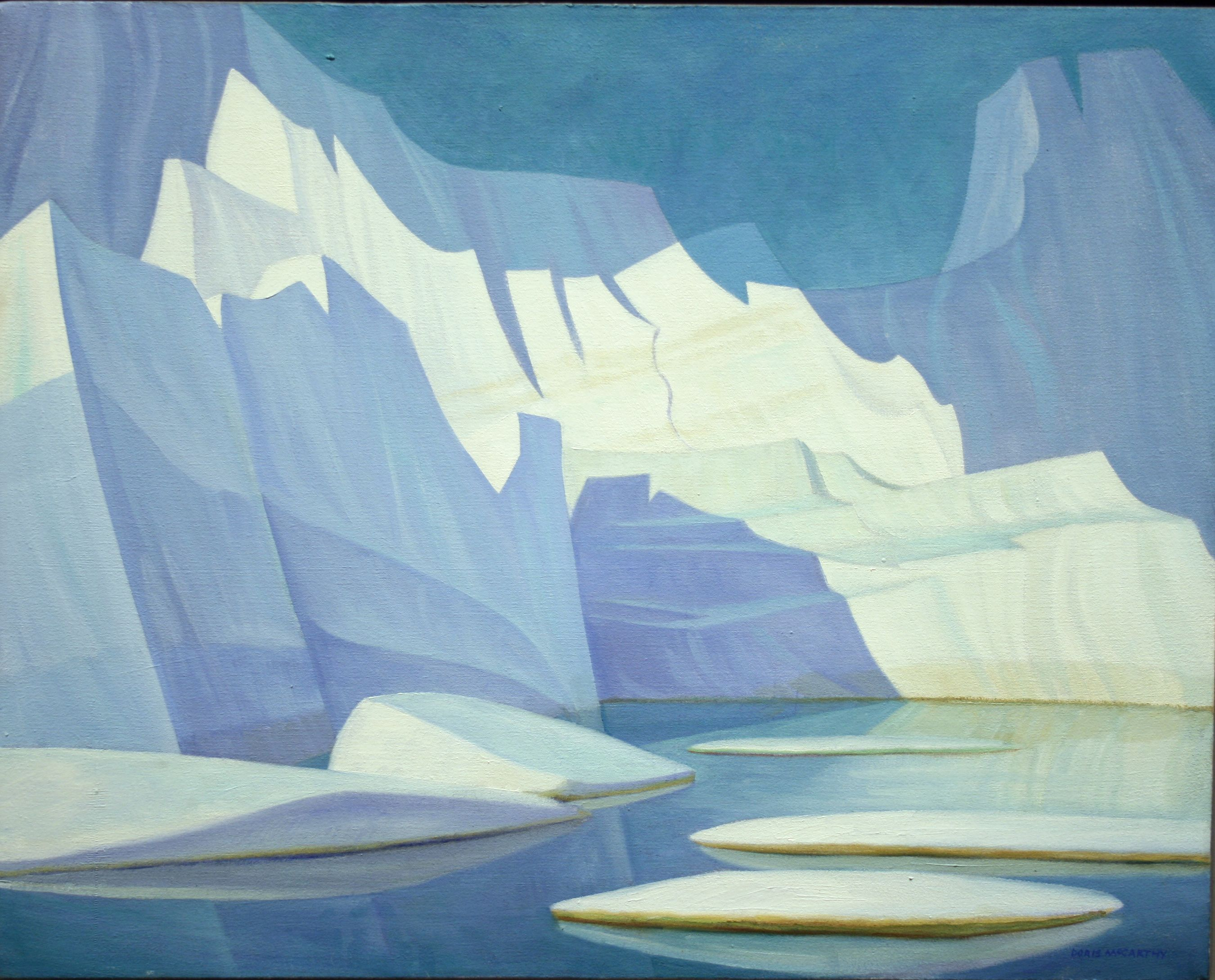
Iceberg Fantasy by Doris McCarthy

Dennis Reid is the author of The Concise History of Canadian Painting, which is considered the definitive volume on Canadian art.  He was also a curator at the Art Gallery of Ontario for over 30 years.  In his book of Canadian art he wrote about Doris McCarthy:

“…Following her retirement in 1972 from [teaching at] Central Technical School, Toronto, she began exhibiting commercially on a more regular basis, not just in Toronto but in Ottawa, Calgary and later Winnipeg, showing work that some saw as a fresh take on the Canadian landscape tradition. She made the first of a number of trips to the Arctic in 1972, and that encouraged greater boldness with light, colour and pattern, and in 1977 she began painting larger canvases that emphasized this confident command of formal issues even more.  She began showing with Aggregation Gallery in Toronto in 1979 (which became Wynick/Tuck Galley in 1982), and her subsequent regular showings there assured close critical attention to both the work of the half century already accomplished and the new, always fresh work that continued through the nineties and beyond…”

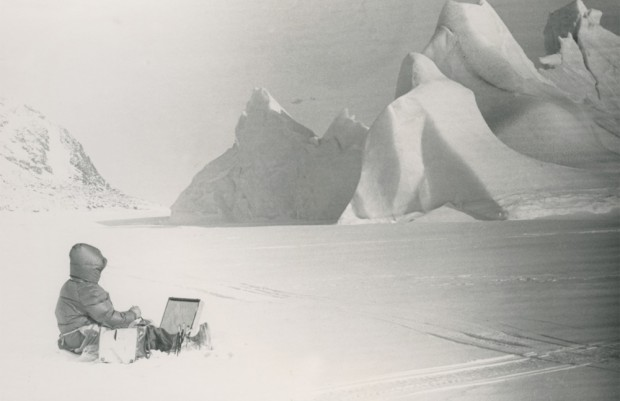
McCarthy painting at Grise Fjord, Nunavut 1976

Nunavut is the vast territory of northern Canada that stretches across most of the Canadian Arctic. It was created in 1999 out of the eastern portion of the Northwest Territories, Nunavut encompasses the traditional lands of the Inuit, the indigenous peoples of Arctic Canada.  Its name means “Our Land” in Inuktitut, the language of the Inuit. The capital is Iqaluit, at the head of Frobisher Bay on southern Baffin Island.

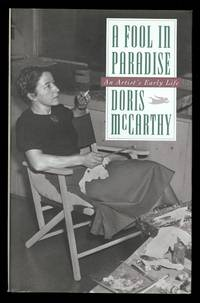
Doris McCarthy, besides painting numerous works, also wrote three autobiographies during various times in her life.  In 1990 she wrote A Fool in Paradise a fascinating memoir of her early years. It describes the fortunes of an artist who was striving to establish herself in the art world of the thirties and forties and the journey made by a spirited girl searching for her own path to fulfilment. Against the backdrop of those early years, Doris writes of studying art in pre-war London, winning a teaching position in the depths of the Depression and roughing it on painting expeditions to northern Ontario, the Maritimes and the Rockies. She reveals stories of her personal life: of breaking loose from a disapproving mother, building her own home on the bluffs above Lake Ontario, and of finding love in unexpected places.

Her second autobiography entitled The Good Wine: An Artist Comes of Age describes her life from 1950 to 1991. It tells of the time at the age of forty, she broke free of her teaching responsibilities to take a year’s sabbatical in Europe as a full-time painter. It was to be the first of many adventures around the world which included a solitary round-the- world odyssey from Japan to Australia, India to the Middle East. She also discovered the Arctic and in 1991, Antarctica, drawing inspiration for her art and her life in the far-flung corners she visited and in the beloved landscape of her own country.  It recounts her meetings with Dorothy Sayers and Arnold Toynbee, and all the controversies associated with the fledgling Canadian art community.

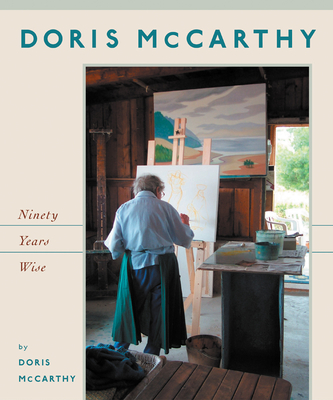
In 2004, at the age of 94, Doris McCarthy published her third and final autobiography.  In this final autobiography, Ninety Years Wise, she focuses on her 92nd summer and she tells of the summer ritual of heading to her summer home, her cottage on Georgian Bay, painting and entertaining friends.

During her long life, Doris McCarthy received many awards.  She was the recipient of the Order of Ontario, the Order of Canada, honorary degrees from the University of Calgary, the University of Toronto, Trent University, the University of Alberta, and Nipissing University, an honorary fellowship from the Ontario College of Art and Design and also had a gallery named in her honour on the Scarborough campus at the University of Toronto. 

Doris McCarthy died at her Fool’s Paradise home on November 25, 2010, aged 100. She is buried at Mount Pleasant Cemetery. Her Fool’s Paradise property now functions as an artist’s residence, the Doris McCarthy Artist-in-Residence Centre, and is in part funded by the Ontario Heritage Trust.


Some of the information for this blog came from the following websites:

The Life of Doris McCarthy. University of Toronto

https://doris.digital.utsc.utoronto.ca/content/life-doris-mccarthy

American Women Artists

https://americanwomenartists.org/rediscovered-women-artists-doris-mccarthy/

Fool’s Paradise Guided Tour

Doris McCarthy Gallery – Fool’s Paradise Guided Tour (utoronto.ca)

William James Muller. Part 1.

The Early Years

After two blogs featuring contemporary artists whose style of work may not find favour with many who love depictions they can relate to, I have returned to a more conventional painter.  William James Muller was a British figurative and landscape painter who was associated with the Bristol School, often referred to as the Bristol School of Artists, the informal association and works of a group of artists working in Bristol, England, in the early 19th century.

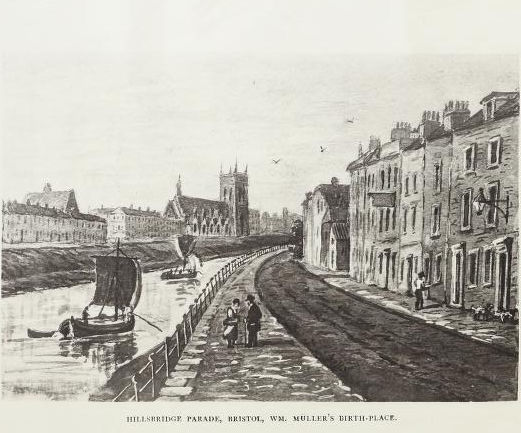
Muller, (or Müller) was born in Bristol on June 28th 1812 at 13 Hillsbridge Place, later becoming Hillsbridge Parade, which overlooked a man-made cut where the occasional small boat or barge would pass by.  His father, John Samuel Müller, a Prussian by birth, had been born in Danzig in 1779 but in 1801 when he was twenty-two, with the continuing conflict between Prussia and France, he and some friends decided to flee the country.  His method of escape was thought to be on a cargo boat carrying timber and which was plying its trade between the Baltic and Bristol.  Although arriving in the British city almost penniless, his love, knowledge and achievements in natural history and geology soon found favour with members of the Philosophical and Literary Society of Bristol who took him under their wings.  In 1821 William’s father published A Natural History of the Crinoidia or Lily-Shaped Animals and three years later he became the first curator of the Bristol Institution which later became the Bristol Museum and Art Gallery.

East Lynn, Lynmouth by Edmund Gustavus Muller

In 1806, five years after arriving in Bristol, John Samuel Muller married Margaret James who came from a well established Bristol family.  In 1808 the couple had their first child, Henry who later became a country doctor.  Their second born was William James who is the subject of this blog and their third and final offspring, born in 1816, was Edmund Gustavus who at first was trained to become a doctor but he, like William, became a well-known painter.

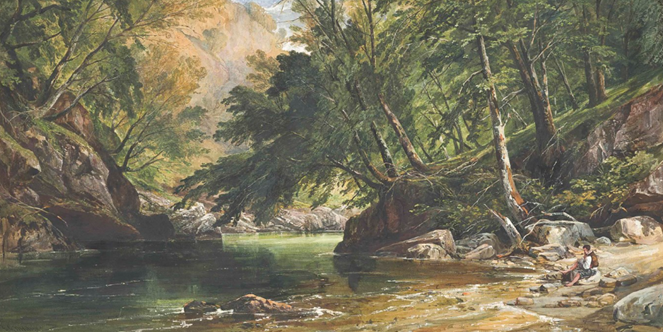
In the Vale of Llangollen by James Baker Pyne (1840)

William James Muller was initially home-educated by his mother.  In 1824, when he was twelve years old he began to be involved in his father’s work at the Bristol Institution sketching some of the establishment’s discoveries and would provide illustrations which then accompanied his father’s lectures.  In that same year, the Bristol Institution began to hold art exhibitions which young William Muller would have witnessed.  In 1827, when he was just sixteen years of age, his father had him apprenticed to the Bristol landscape painter James Baker Pyne whose works often depicted local views as well as imaginary ones.

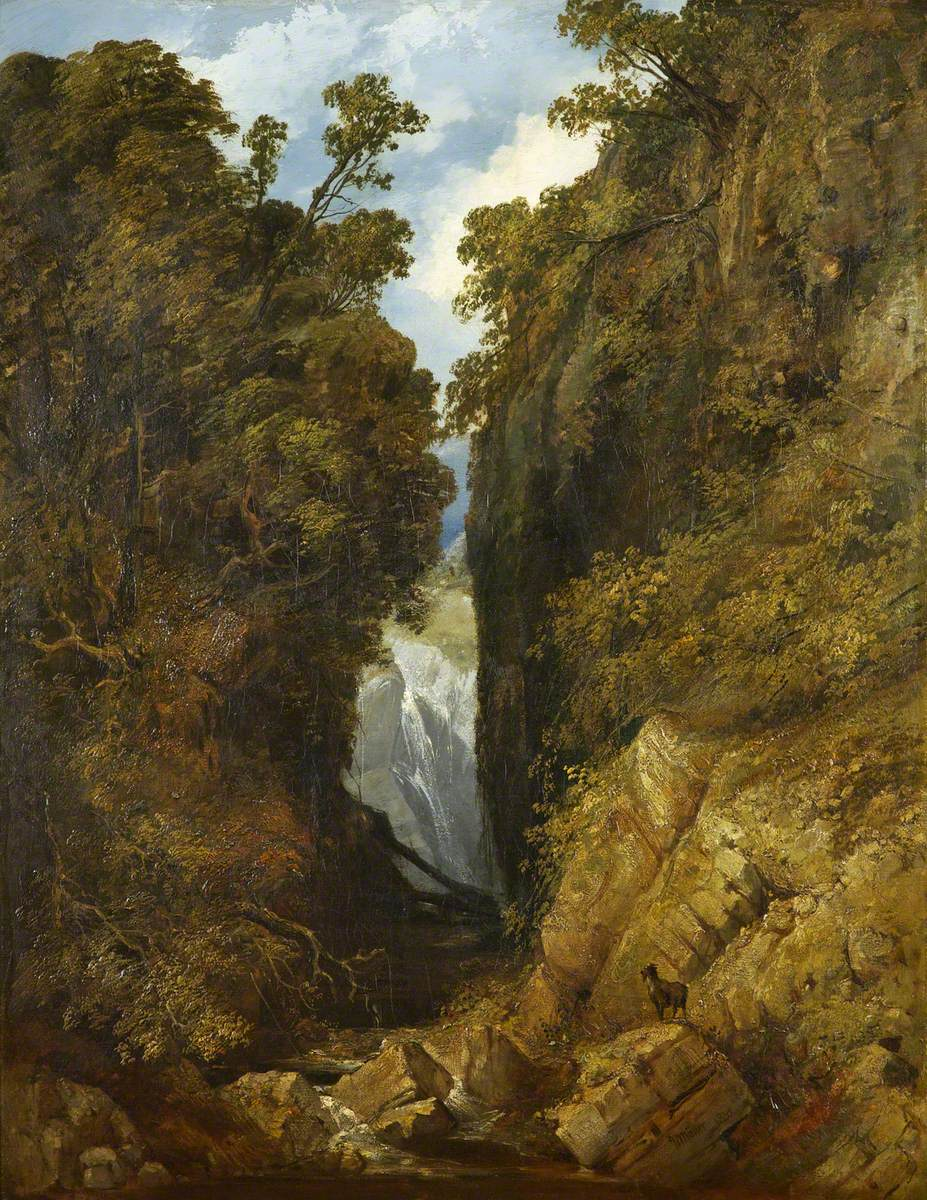
Falls on the River Lledr by William Muller (1830)

William Muller completed his apprenticeship with James Pyne in 1829.  The abrupt end to the apprenticeship came when William’s father complained to Pyne with regards how he was giving his son menial tasks to complete such as brush cleaning instead of teaching him artistic techniques.  Pyne responded by telling John Muller that he could break his son’s apprenticeship agreement if he wanted to and Muller Senior did just that !  Although it is thought that Pyne’s work did not influence Muller work greatly William did learn to appreciate the Old Masters especially the works of the seventeenth century painters such as Claude Lorrain and Nicholas Poussin. 

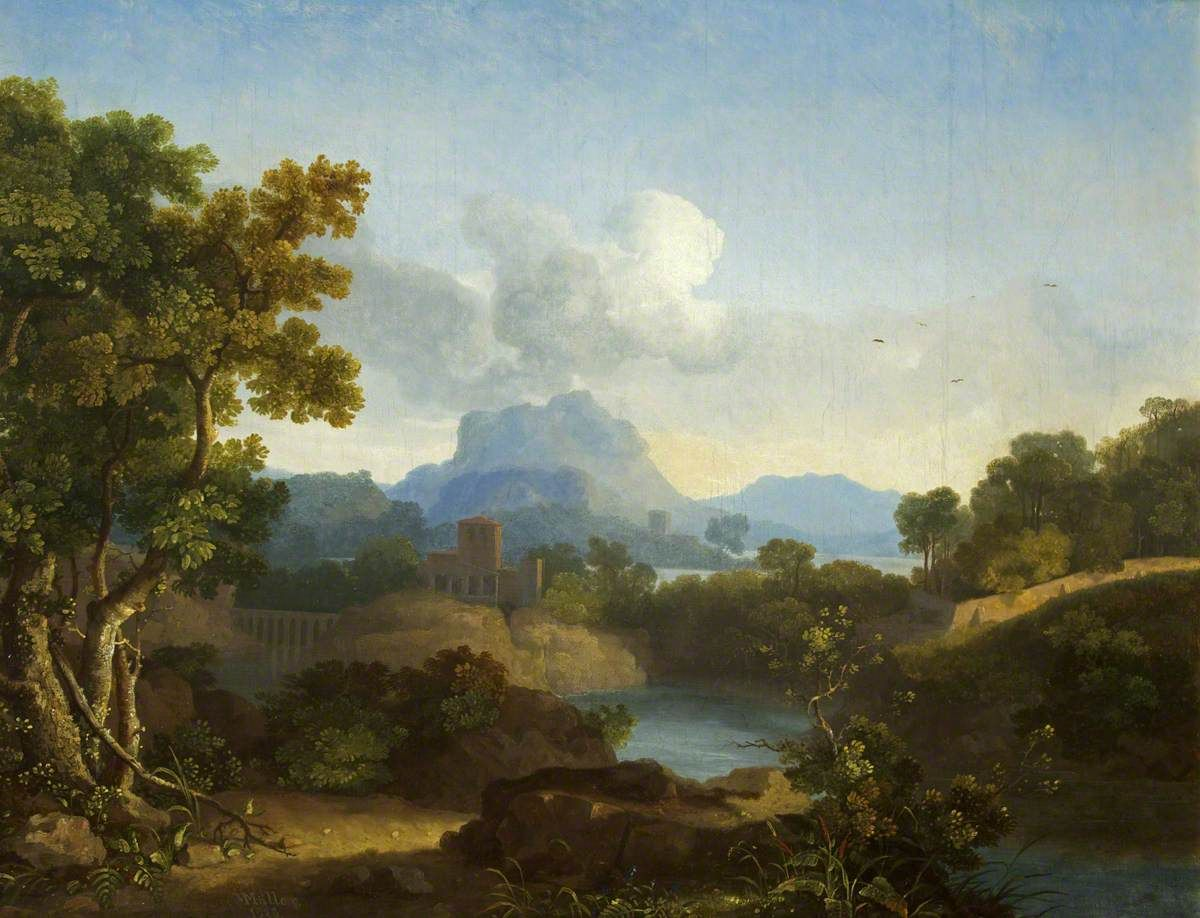
Classical Landscape by William Muller (1828)

The early termination of the agreement between Pyne and Muller did not put a barrier between them in later years and they always spoke about each other with a complimentary tone.  In 1843 Muller wrote to a friend about Pyne saying:
“…In early life placed under the direction of my friend J. B. Pyne — nay, serving a regular apprenticeship to the arts with him, to whom I owe so much — I commenced painting in earnest…”

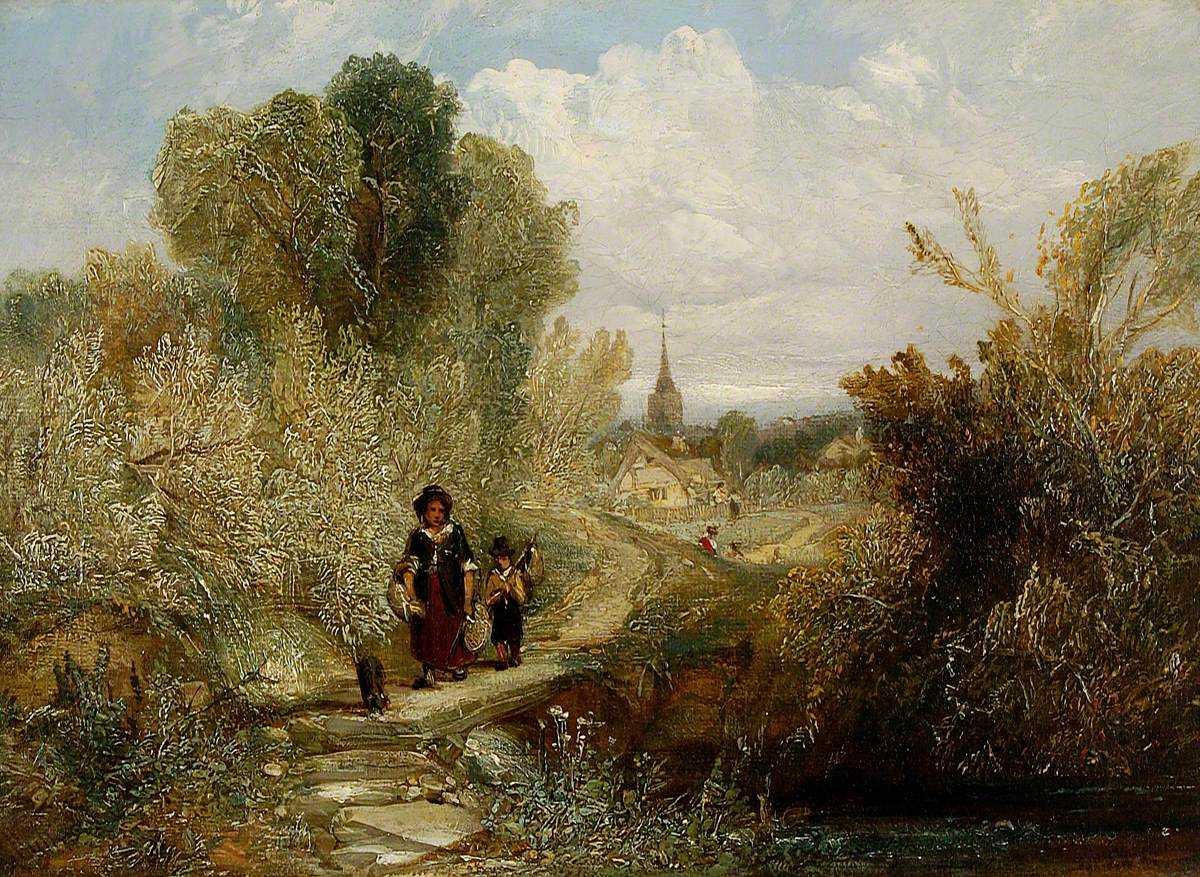
Landscape with Figures by William Muller

On May 25th 1830, William’s father died, aged 51.  As he had been the sole family earner, the family would have struggled financially but this was avoided when the Bristol Institution agreed to buy John Muller’s extensive natural history collection for the sum of seven hundred and thirty pounds. John Muller had brought up his sons to appreciate and love nature and the natural world and William never forgot his father’s words.  In a letter of 1843, William wrote:

“…Travel to me affords two pleasures—my love of botany, and natural history in general (for I cannot forget the impressions given me by my father, to whose acquirements as a man of science his works testify better than aught I can say). I continue to combine them as much as possible with my profession; a new flower often delights me as much as a new sketch…”

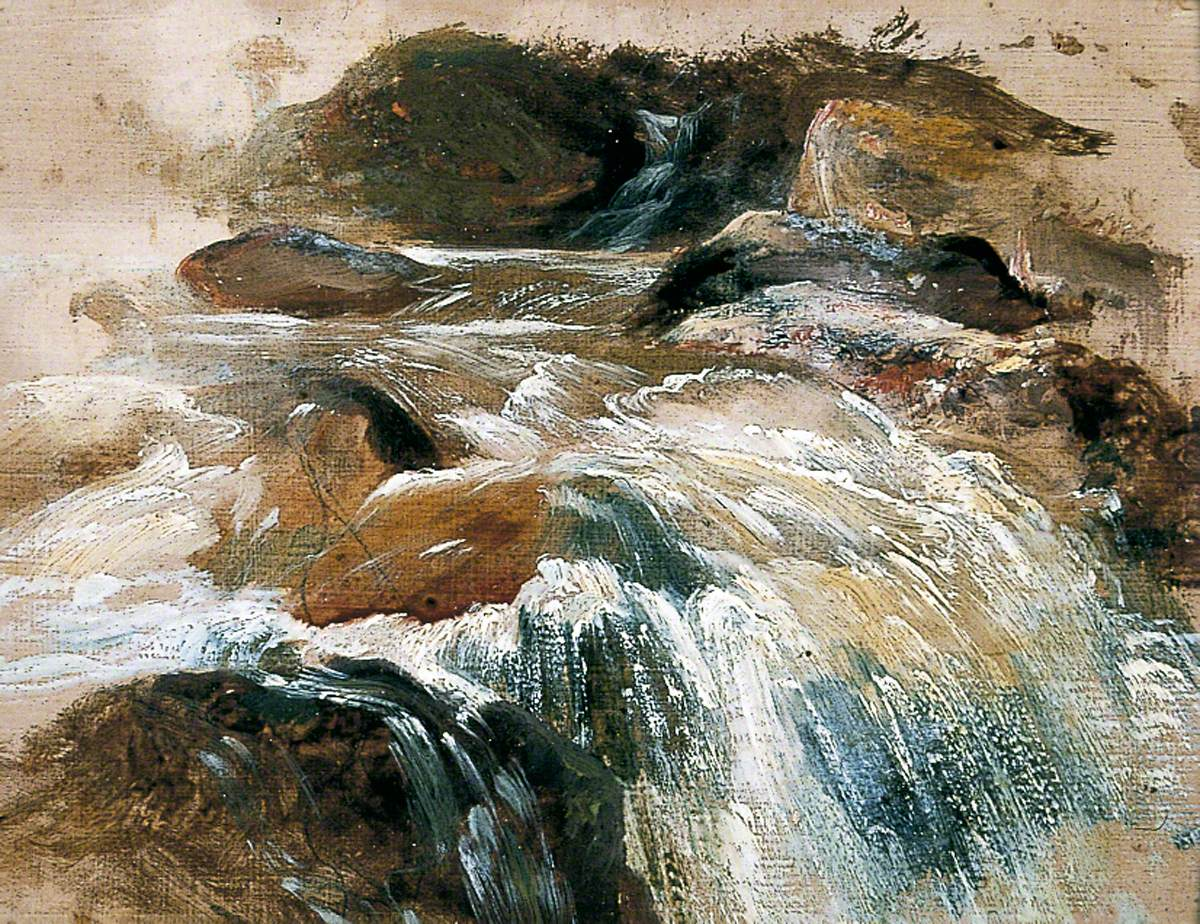
Waterfall by William Muller (c.1830)

The executor of William’s father’s will was the Right Reverend Dr. Beeke of Bristol Cathedral and it was he who commissioned William Muller to complete a painting of St Mary Redcliffe church and on completion he paid William £25.   The curate of the church was Reverend James Bulwer, an amateur artist and naturalist who was a good friend of the artist, John Sell Cotman and he and William Muller helped the formation of the first art exhibition of the Bristol Society of Artists at the Bristol Institution in 1832.   He and William each presented eight of their paintings at the exhibition.

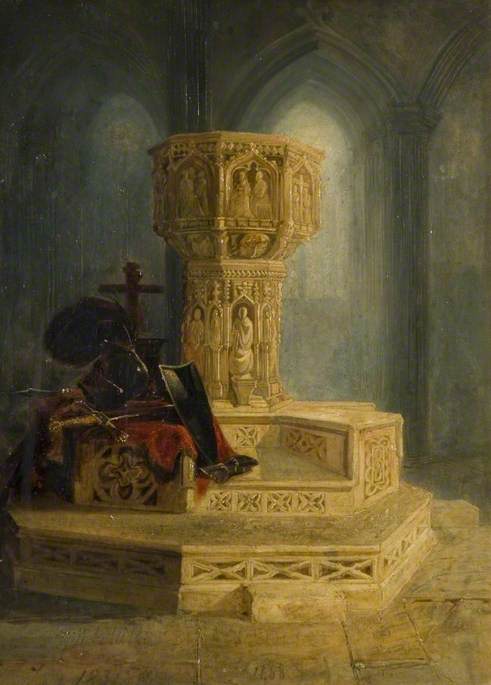
Font at Walsingham Church by William Muller (1831)

In the early part of 1831 Muller travelled to Norfolk and Suffolk and stayed with various clergymen during his two-month travels.  One of the paintings he completed during his trip was entitled The Font in Walsingham Church, although he probably completed the work once home in his studio, using sketches he made at the time.

Muller may have got the idea for his painting on seeing the illustration of the font in Architectural Antiquities of Norfolk by John Sell Cotman, dated 1818.

Trees, Suffolk by William Muller (1831)

During this period William Muller completed a number of largely monochrome watercolours such as Trees, Suffolk which he had sketched whilst visiting the Suffolk town of Lackford.

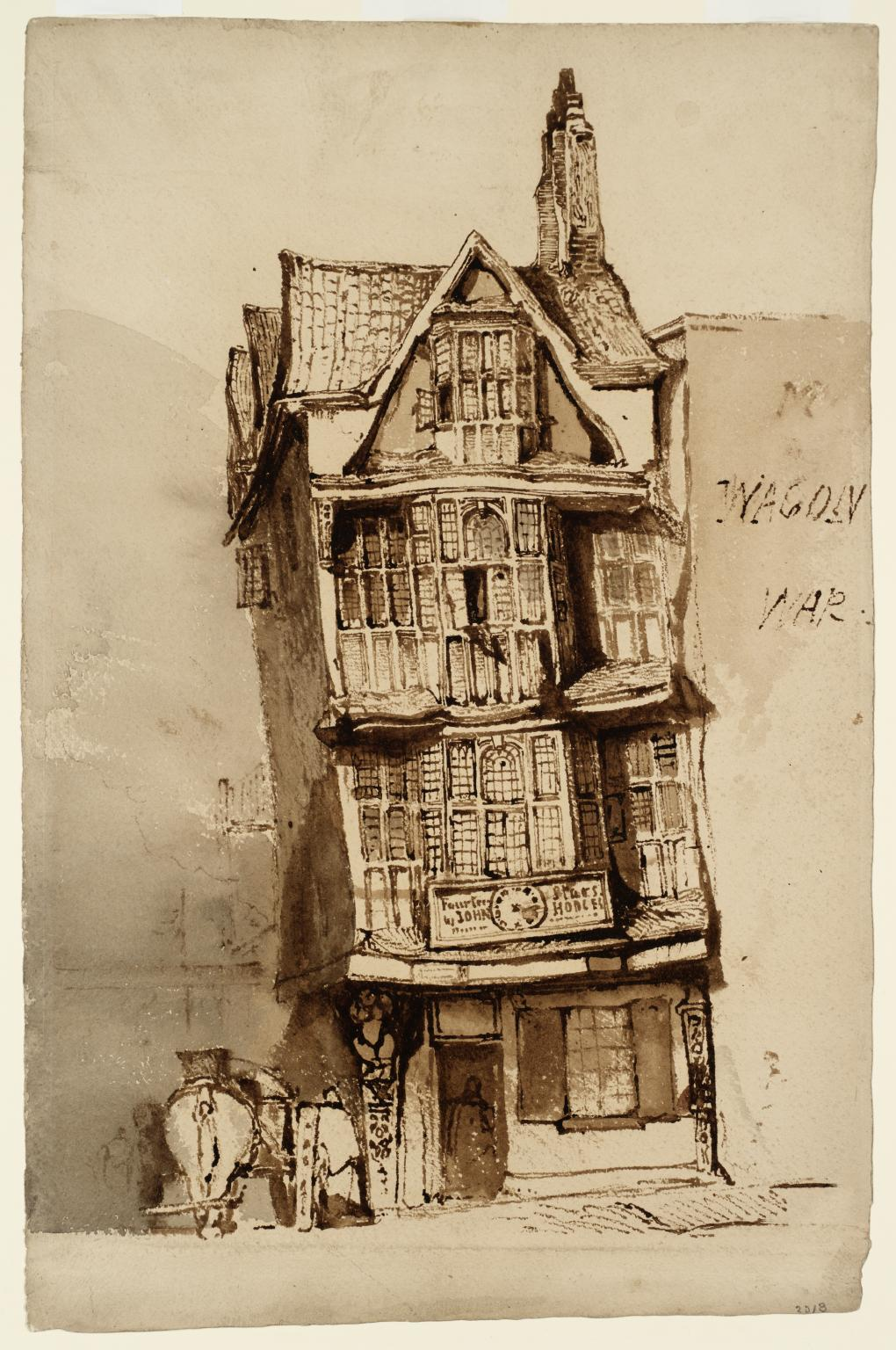
Fourteen Star Inn by William Muller (c.1832)

Another was of the Fourteen Star coaching inn.

In the second part of the blog looking at the life and works of William James Muller we will see how bloody riots and Mediterranean travel featured in his short life.

Joseph Farquharson RA

Self Portrait (1882)

We are approaching a time when we have to expect very cold weather and for some of us the oncoming of snow.  So as we are at the beginning of the Christmas month I thought I would treat you to some snowy scenes by one of the greatest exponent of such panoramas.  Permit me to introduce the nineteenth century Scottish painter, Joseph Farquharson, whose snowy winter landscape paintings were featured on many Christmas cards.

Joseph Farquharson was born in Edinburgh on May 4th 1846.  He was the son of Francis Farquharson, a doctor and laird of Finzean in Kincardineshire. Joseph’s brother Robert was a highly respected physician and local Member of Parliament.  Joseph’s mother, Alison Mary Ainslie, was a celebrated beauty, one of the daughters of the lawyer Robert Ainslie, who was a close friend of the poet Robert Burns.

Road to Loch Maree by Joseph Farquharson

Joseph’s early days were spent in his father’s house in Northumberland Street Edinburgh, below the Queen Street Gardens.  Later the family moved to Edinburgh’s Eaton Terrace and finally to the family estate at Finzean, in Aberdeenshire. Joseph was brought up in a strict family environment and was educated in Edinburgh.  Although his father encouraged him to sketch and paint and even let him use his own set of paints, he only allowed his son to paint on Saturdays.  Joseph developed his artistic skills and at the age of twelve, Francis Farquharson bought his son his first set of paints and a year later Joseph exhibited his first painting at the Royal Scottish Academy.

Joseph Farquharson’s first formal art training came in the 1860’s when he enrolled at the Trustees’ Academy in Edinburgh, the forerunner of the Edinburgh School of Art where his tutors included the landscape painter, Peter Graham R.A. who would be a constant influence on Farquharson and Graham’s style can be seen in many of Joseph’s works.  Joseph then spent time at the Life School of the Royal Scottish Academy.

Day’s Dying Glow by Joseph Farquharson (1873)

Joseph Farquharson’s first exhibit at the Royal Academy, was in 1873 when his 1873 painting, Day’s Dying Glow, was on display.

Mrs Farquharson of Finzean (the artist’s stepmother) by Joseph Farquhardson (1871)

Farquharson followed the trend of other leading Scottish artists and concentrated on exhibiting his work in London rather than Edinburgh and Glasgow, as this was where the opportunity to sell their work was the greatest.  Besides his Scottish landscape scenes, Joseph was also a a talented portrait painter and his first portrait to be exhibited was of his stepmother, Mary Ann Girdwood Farquharson, which he completed in 1871.

A Scottish Interior, the Box Bed by Joseph Farquharson (c.1874)

Joseph Farquharson produced a realist genre painting around 1874 entitled A Scottish Interior, the Box Bed which depicts a bed inside a cupboard and table and chair in a kitchen/bedroom/living room. The free-standing box or press bed developed into a very sophisticated piece of furniture, when cabinet-makers designed “secret” press beds disguised as wardrobes or sideboards, or hidden behind rows of bookshelves and drawers, even when there was no pressure on space, and no need to provide a mini-bedroom within a shared living area.

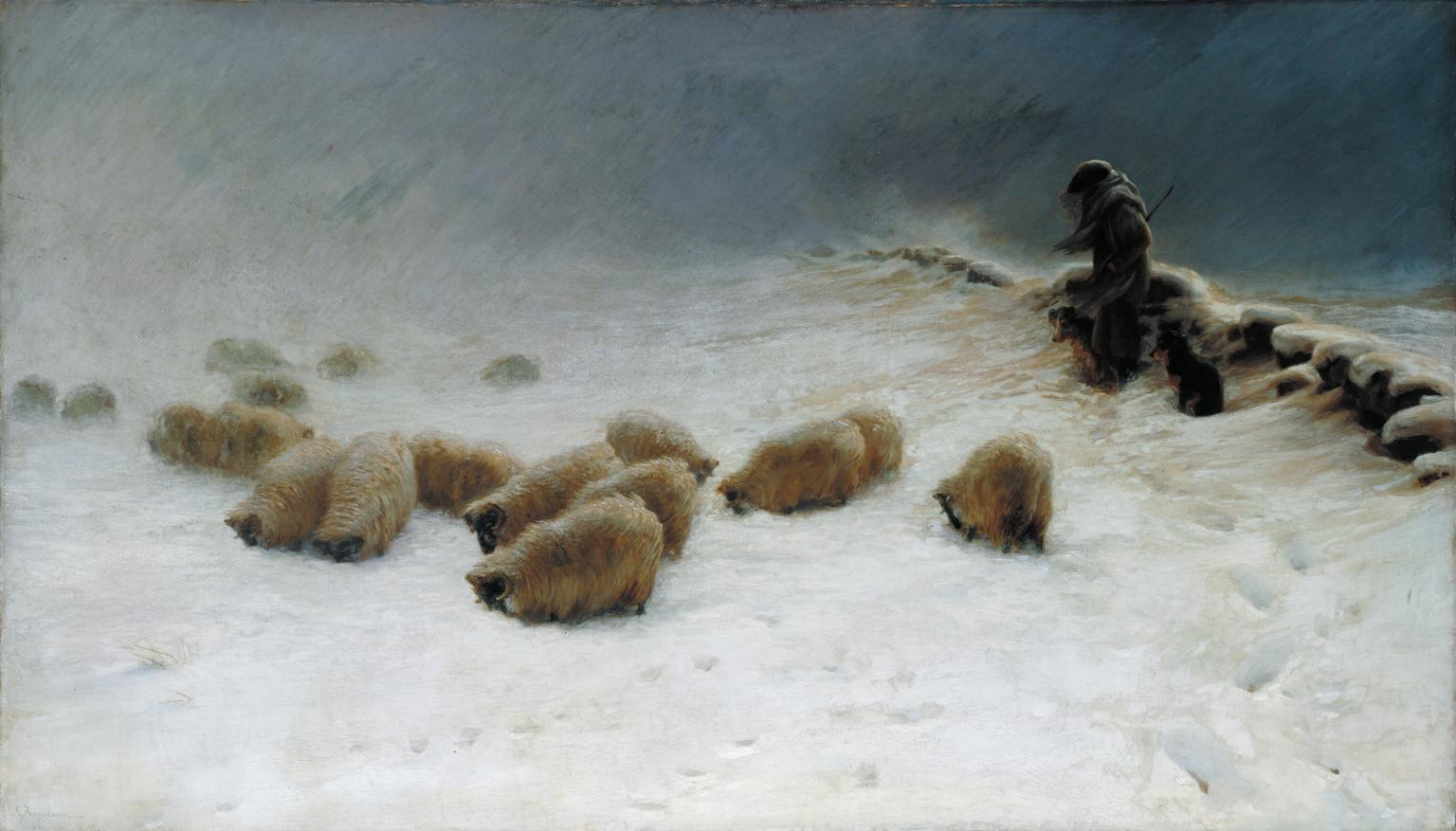
The Joyless Winter’s Day by Joseph Farquharson (1883)

However, Joseph Farquharson will be remembered for his bleak wintry landscapes often depicting sheep and the shepherd. One such painting can be seen in London’s Tate Britain, entitled The Joyless Winter’s Day which he completed in 1883. Despite blizzard conditions, Farquharson painted this en plein air although, he was in the relative comfort of his specially constructed mobile painting hut, which had the added benefit of a stove. This relative comfort enabled Farquharson to capture the remarkably realistic effects of a snow storm. Before you worry about the health of the sheep I have to tell you that those you see were made in plaster by a local sculptor

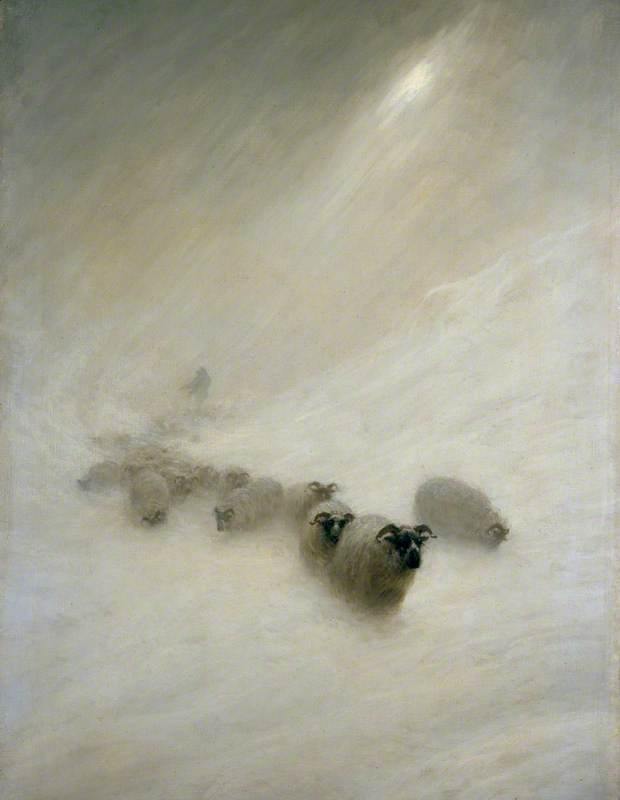
Sheep in a Snowstorm by Joseph Farquharson

Farquharson was famed for his Scottish snow scenes, and with the exception of 1914, he had a new painting exhibited at the Royal Academy every year between 1894 and 1925. . Farquharson combined a career as an artist with his inheritied responsibility as laird of the Finzean estate in Aberdeenshire, where many of his landscapes were painted.

The Stormy Blast by Joseph Farquharson (1898)

But it was not just about snow and blizzards.

The Winding Dee by Joseph Farquharson (1889)

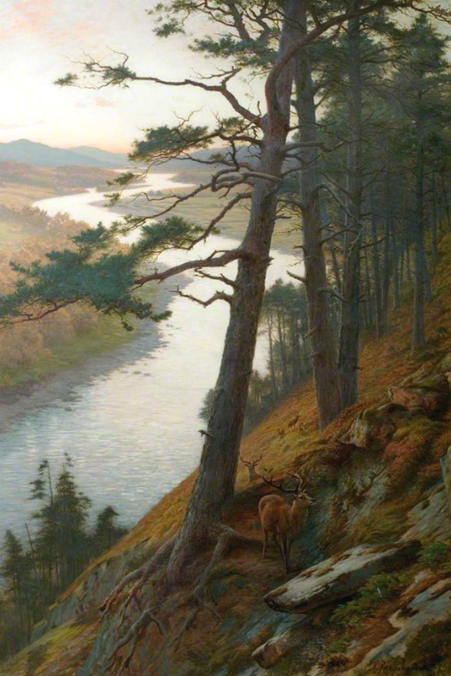
Some of his landscape paintings depicted the beauty of the Highlands, such as his 1889 painting featuring the River Dee, which rises in the Cairngorms and flows through southern Aberdeenshire to reach the North Sea at Aberdeen.

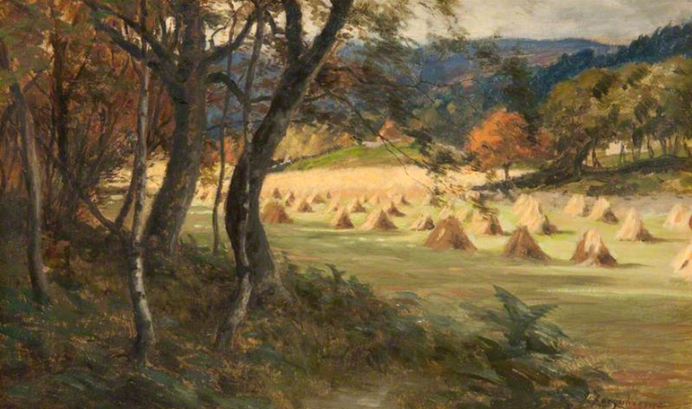
Corn Stooks by Joseph Farquharson (1880)

Harvesting, Forest of Birse, Aberdeenshire (1900)

Some of his paintings depicted the agricultural times in rural communities during the summer months.

When the West with Evening Glows by Joseph Farquharson (1901)

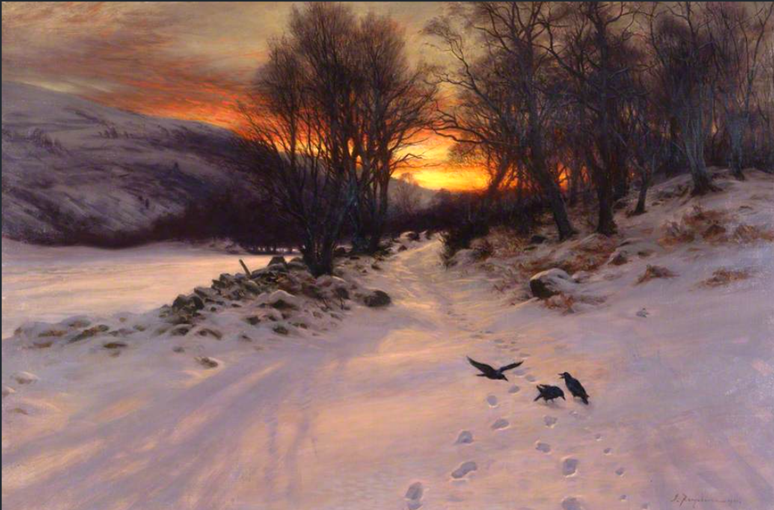
One of Farquharson’s greatest skills was his ability to depict scenes at sunrise and sunset as this can be seen in his beautiful 1901 painting entitled When the West with Evening Glows. It is a snowy winter landscape, and we look along a snow-covered path, which runs through fields, with groups of trees on either side, as seen in the mid ground of the painting. In foreground we see freshly-made footprints in the deep snow, with three crows having landed close to the footprints. The whole scene is illuminated by the warm glow of the rising sun from behind the hills in the background.

When the West with Evening Glows by Joseph Farquharson (1910)

The above 1910 painting is a slightly smaller version of the work which is owned by the Royal Academy. This version was exhibited at the Royal Academy in 1910 and now hangs in the collection of the Bristol Museum & Art Gallery. This painting was a commission Farquharson received from one of his patrons, who failed in his bid to buy the larger original version. Farquharson often copied his own paintings in order to satisfy his clients’ requests, or to provide an original for engravers tasked with the reproduction of a successful composition. It was such a popular painting with the public that thousands of prints of this work were sold. In his 1913 essay in the Christmas edition of the Art Annual, The Art of Joseph Farquharson, A.R.A, Archdeacon William Macdonald wrote about these popular works:

“…There is not one of Farquharson’s pastoral landscapes which is not treated from the contemplative or poetic point of view: the poetry of snow either in its suggestion of desolation, or of the endurance of peasantry life, or the exquisite beauty of rare tints in the sun or moon on deep snow surfaces and seen through leafless trees… and the varied voices with which Nature elevates us from the prosaic, the commonplace and the ugly in her countless moods…”

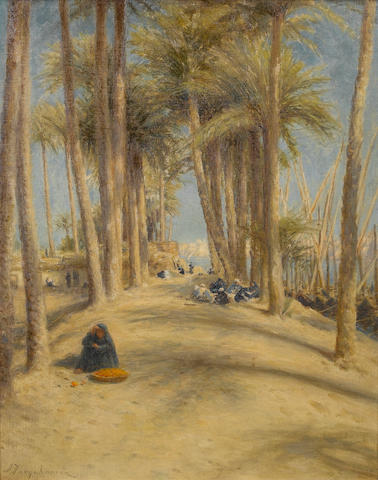
Market on the Nile by Joseph Farquharson (1893) 

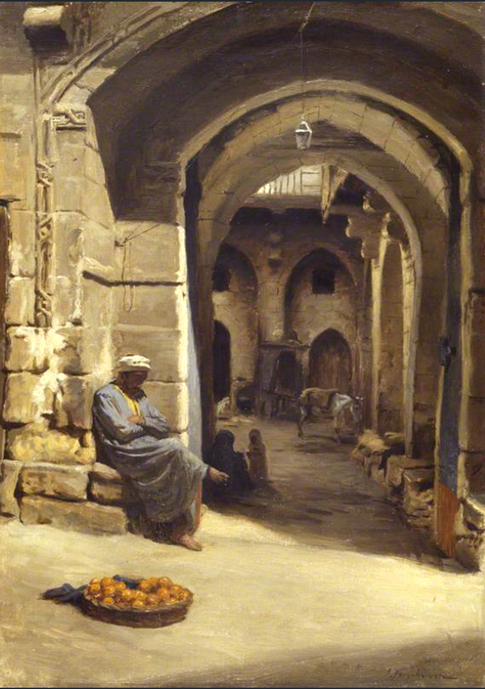
The Orange Seller by Joseph Farquharson (1893)

For the first four years of the 1880’s Farquharson spent the winters in Paris and studied with Carolus-Duran who installed in the minds of his students the importance of using the brush straight away and to think in terms of form and colour. In 1885 Farquharson went to North Africa. Among the works created during the subsequent 8 years were The Egyptian and On the Banks of the Nile opposite Cairo

On the Banks of the Nile opposite Cairo by Joseph Farquharson

Joseph Farquharson was elected Associate of the Royal Academy in July 1900, Royal Academician in February 1915 and finally, Senior Royal Academician in 1922.

Beneath the Snow Encumbered Branches by Joseph Farquharson (1901)

In addition to exhibiting over 200 works at the Royal Academy he showed seventy-three at the Royal Society of Arts and one hundred and eighty-one at the Fine Art Society. He also exhibited at the Royal College of Art and Tate Britain. The renowned artist-critic, Walter Sickert made Farquharson the subject of an essay comparing him favourably with Gustave Courbet. In it he extolled Farquharson’s tension and realism and criticized the pretension of his polar opposites, the Bloomsbury Group, who he wrote “fortunately does not run in the North of Scotland”. The remarkable realism of Farquharson’s work can be attributed to his desire to work en plein air. Farquharson painted so many scenes of cattle and sheep in snow he was nicknamed ‘Frozen Mutton Farquharson’

Farquharson inherited the title of Laird in 1918 after the death of his elder brother Robert. Joseph Farquharson died on April 15th 1935, three weeks before his eighty-ninth birthday..

Alfred Sisley Revisited

The villages of the Seine and its tributaries

Sisley went tirelessly in search of motifs along the Seine and its tributaries, he looked no further. He concentrated on views of village streets, or of interesting groups of buildings, he would be drawn to an old stone bridge, the kind of subject that had fascinated painters since Corot. In what many would dismiss as unprepossessing patches of gardens or meadows, landscapes on the outskirts of towns or along river banks, Sisley could often discover the most arresting colour or light effects.

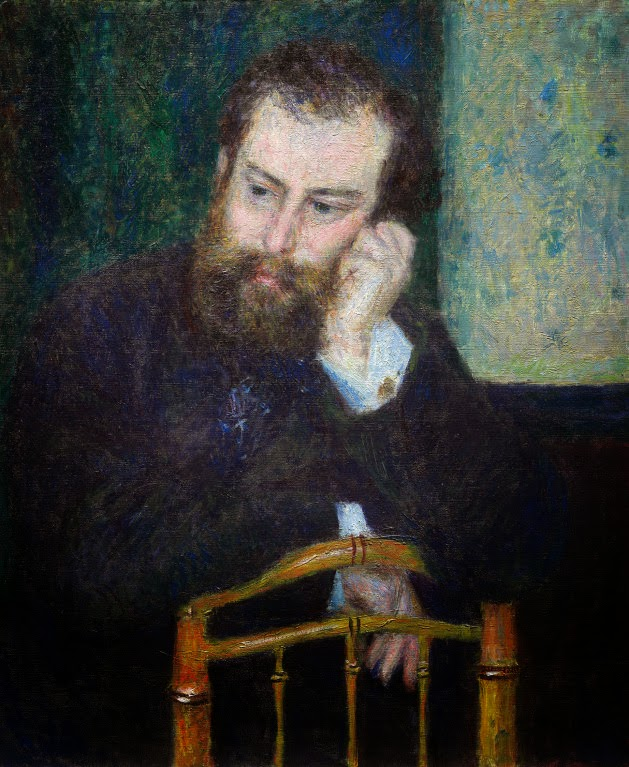
Alfred Sisley by Renoir (1876)

In 1866, Sisley began a relationship with Eugenie Lesouezec and shortly thereafter the couple had two children: a son, Pierre, in 1867 and daughter, Jeanne in 1869.  Although they remained together until Eugenie’s death in 1898, they didn’t marry until August 5, 1897.  In 1870, the Franco-Prussian War began and this precipitated the failure of Sisley’s father’s silk business which ended in his father’s bankruptcy and the financial devastation hastened his death.   Sisley had relied heavily on his father’s financial support because of the low prices being offered for his artwork, and this revenue stream had come to an end.

Louveciennes, above Marly by Alfred Sisley (1873)

To manage his financial difficulties and to avoid the Prussian War, Sisley gave up his home in Paris and moved to the countryside and the town of Louveciennes, a village west of Paris.  It is said that during the summer of 1871, Sisley, Renoir and Pissarro had watched Paris burn during the Prussian siege of the capital city. In his painting Louveciennes, above Marly, Sisley has depicted the view from Louveciennes, down over the forest and the riverside town of Marly.

Louveciennes: View of the Sèvrees Road by Alfred Sisley (1873)

Another of Sisley’s works featuring Louveciennes is his 1873 painting entitled Louveciennes: View of the Sèvres Road. It is a classic example of a perspective road which we see narrowing into the distance. He used this technique in many of his works as it allowed him to give movement to his depiction while also giving a feeling of space.

The Avenue at Middleharnis Meindert Hobbema (1689}

It is thought that Sisley’s depiction may have been influenced by Meindert Hobbema’s 1689 landscape painting, The Avenue at Middleharnis, which he would have seen at the National Gallery when he visited London.

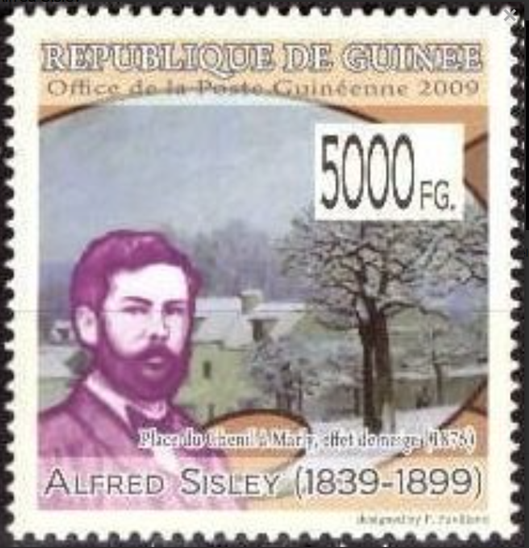
Place du Chenil à Marly, effet de neige by Alfred Sisley (1876)

Two years later, in October 1874, after his four-month summer holiday spent in London, Sisley and his family moved to 2 avenue de l’Abreuvoir in Marly-le-Roi, a commune in the Île-de-France region, in north-central France, located in the western suburbs of Paris, 18 kilometres from the centre of the French capital. The two following winters were especially harsh with temperatures below zero and frequent heavy snowfall. I particularly like Sisley’s 1876 painting entitled Place du Chenil at Marly, and the depiction of snow. There is an eerie stillness about the depiction of the town’s main square which since Sisley’s time has been renamed Place du Général-de-Gaulle. We see that a heavy snowfall has occurred and the town has been covered by a thick blanket of snow. Look at how Sisley has depicted the snow. It is not just coloured white but a subtle blending of blues, greens, creams and greys. There is nothing spectacular about the scene but it is just a timeless realistic rendition. Place du Chenil in Marly, Snow Effect is now located in Musée des Beaux-Arts de Rouen which is an art museum in Normandy, France. It was given to Musée des Beaux-Arts de Rouen by François Depeaux, a French art collector, industrialist and patron. He gave the painting to the museum in 1909, just over 100 years after the Musée des Beaux-Arts de Rouen was built.

Postage stamp issued in 2009

Commemorative postage stamp issued by Republic of Guinea on October 1st 2009 depicted Sisley’s painting Place du Chenil à Marly, effet de neige.

Village by the Seine (Villeneuve-La-Garenne) by Alfred Sisley (1874)

The Villeneuve-la-Garenne painting depicts the village on the River Seine, a commune in the northern suburbs of Paris, which lies less than ten kilometres from centre of the French capital. In 1872 Alfred Sisley created his painting depicting the small village entitled Village by the Seine (Villeneuve-La-Garenne). After visiting the small village, Sisley was inspired by what he saw and was determined to produce a work so that he could share the beauty of the place.  The depiction oozes tranquillity.  The two trees in the foreground act as if they were theatre curtains on either side of a stage.  In this work Sisley has managed to encapsulate the beauty of nature.

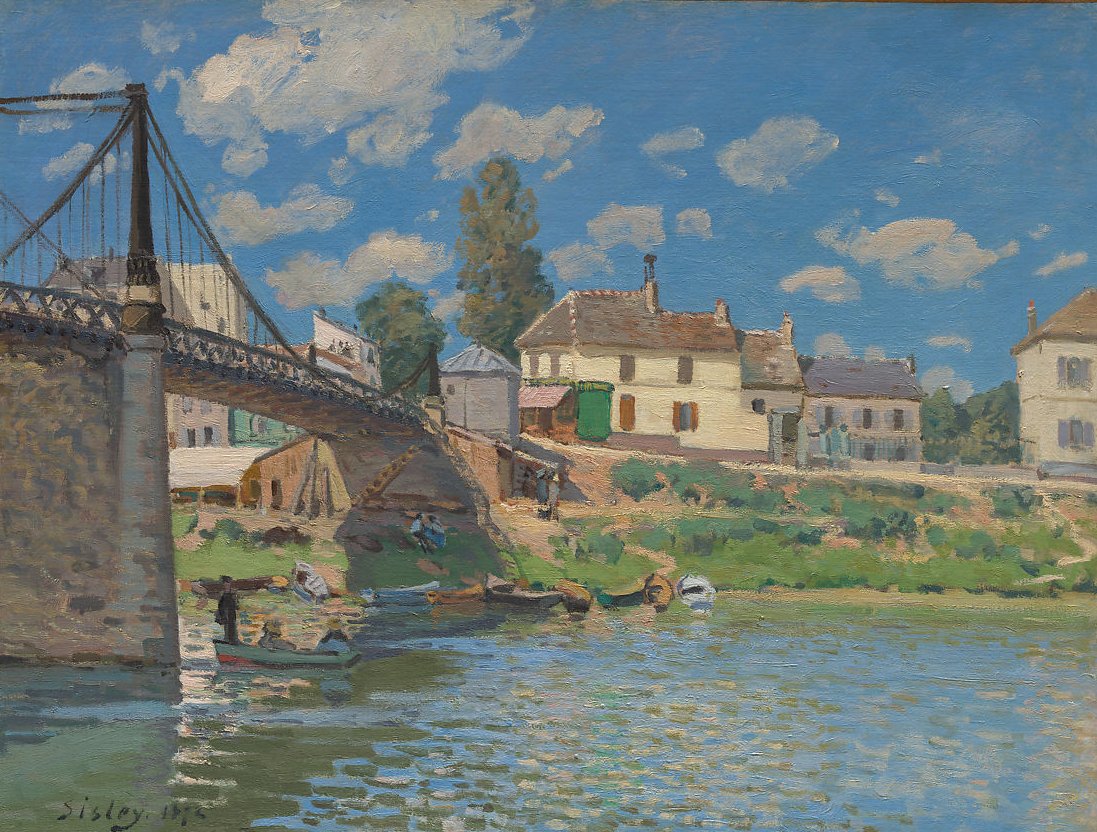
The Bridge at Villeneuve-la-Garenne by Alfred Sisley (1872)

Sisley completed a number of paintings featuring the village and just to the left of the previous painting, but out of view, is the bridge which crosses the river at Villeneuve-La-Garenne and this was the subject of Sisley’s 1872 painting, The Bridge at Villeneuve-la-Garenne. The cast-iron suspension bridge resting on stone abutments was built in 1844 to connect what had until then been a fishing village and small port with the Paris neighbourhood of Saint-Denis, on the other side of the river. The building of the bridge and the bridge itself was symbolic of French modernity, and the structure was depicted in a number of Sisley’s paintings of the 1870s and early 1880s. Sisley made the depiction somewhat livelier by including figures of holidaymakers on the riverbank and in a boat which is passing under the bridge.  Look how Sisley’s brushstrokes communicate the fleeting effect of sunlight on the water.

The Seine at Suresnes by Alfred Sisley (1877)

About six miles up-river from Villeneuve-La-Garenne is the town of Suresnes, a commune in the western suburbs of Paris, Île-de-France. In 1877 Sisley completed his painting entitled The Seine at Suresnes.  It is a typical work of Impressionism with its swirling clouds dominating his depiction of the sky.  His intention was to capture a fast-changing scene due to the approaching storm.  Look how he has depicted the river, no longer bathed in sunlight, now dimmed by the heavy clouds overhead.  Unlike many of Sisley’s best loved works which focus on tranquillity, this is more about doom-laden skies and what was to come to pass.  The painting was sold to fellow artist, Gustave Caillebotte, and along with Gustave’s other paintings he had amassed, it was later left to the French nation.

Canal de Loing by Alfred Sisley (1892)

With the canals from Briare and Orléans completed respectively in the second half of the seventeenth century, merchants started complaining about the poor navigability of the river Loing. The Duc d’Orléans ordered a survey and designs for the navigational route which would be part river and part canal.  The waterway was completed in 1723.  The Loing Canal is used by working barges and was the subject of many Sisley’s depictions.  In this painting we see a winding path, which follows the curve of the canal, alongside of which are poplar trees.  Our eyes, once we have taken in the house, follow the curve of the road and canal into the distance.  The inclusion of the winding road was one of Sisley’s favourite themes in which it plays a part in the perspective of the painting.  This painting, The Loing Canal, was offered to the Musée du Luxembourg after the painter died in 1899.  It was part of a gift from Sisley’s friends which was organised by Monet.

A Road in Seine et Marne by Alfred Sisley (1878)

Seine et Marne is a department in the Île-de-France region of northern France named after the rivers Seine and Marne and is on the eastern edge of the Ile de France.  It was to be Sisley’s countryside during the last twenty years of his life.  In 1880 he had moved to Veneux-Nadon, close to Moret-sur-Loing.  It was a “forced” move as Sisley had been evicted from his house in Sèvres for not paying his rent.  As some of his work prior to 1880 depicted scenes of Veneux-Nadon, it is clear that he had visited the area on a number of occasions.  This was an agriculturally rich and tranquil countryside with its woods and tiny hamlets.  It was a perfect venue for Sisley’s landscape work and allowed him to relax away from the chaos of Paris.  It worked for him as he produced many serene and beautiful paintings.

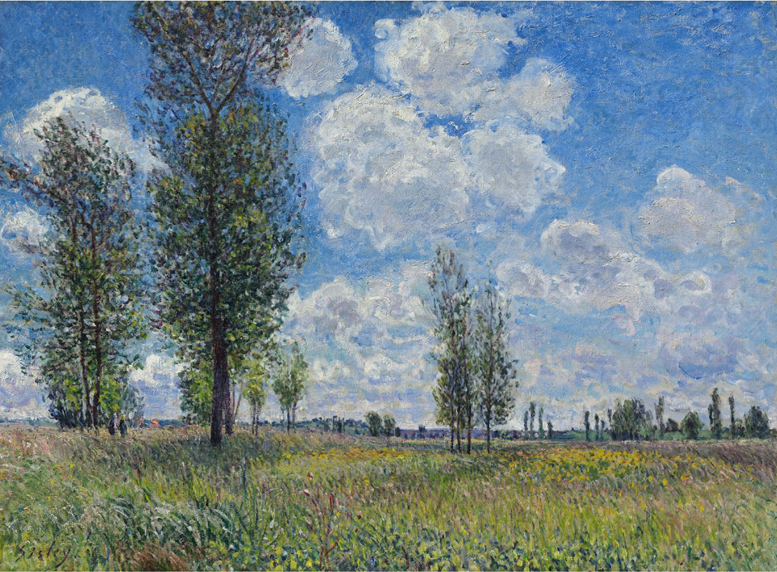
The Meadow at Veneux-Nadon by Alfred Sisley (1881)

Sisley’s painting, The Meadow at Veneux-Nadon, depicts the slender poplars with their delicate leaves and it leads our gaze into the depth of the picture space and gives it stability in this wide summer landscape. Through a juxtaposition of shimmering fields of colour and a reduction of motifs, Alfred Sisley lends an iridescent vitality and tension to the seemingly monotonous theme. Sisley exhibited the painting at the Seventh Impressionist Exhibition in 1882, in which the group focused on landscapes.

Le Bois des Roches Veneux Nadon, by Alfred Sisley (1880)

In his work, Le Bois des Roches Veneux Nadon, we see a windswept scene of a forest at the water’s edge . To the left we see a small rowing boat struggling in choppy waters.

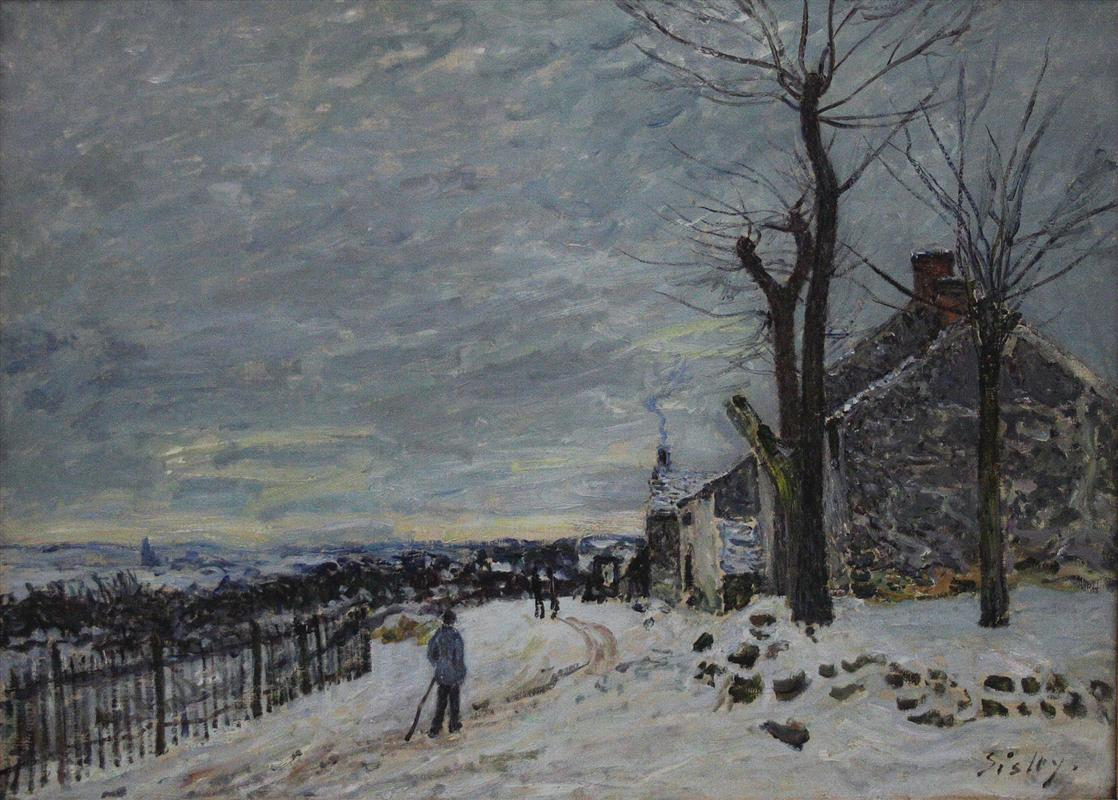
Snowy Weather at Veneux Nadon Alfred Sisley (1880)

This painting, Snowy Weather at Veneux Nadon, was completed during his first winter in Veneux- Narbon on the Loing in 1880. It is another of his snowscapes which this time is dominated by dark clouds with just a glimmer of the rising sun in the background. This was one of Sisley’s favourite depictions, often populated by workers heading for the mills, which were the village people’s primary source of employment. It is an atmospheric depiction of a cold early-morning scene and Sisley has used muted colours to ensure the contrast with the presence of the rising sun.

Veneux, August Afternoon by Alfred Sisley (1881)

Veneux, August Afternoon was painted by Alfred Sisley in 1881. Financially, it had not been a good year for him although he managed to afford to travel to the Isle of Wight in June. He had arranged for canvases to be sent to him on the island but they never arrived an he could not afford to pay for English canvases. When he arrived back in France in August he painted this work. It is a typical Sisley scene – quiet riverside setting with trees and picturesque sky. Our eyes are drawn to the creamy clouds in the upper left of the painting and then back down in a diagonal direction to the patch of sunlight we see falling on the pathway on the bottom right of the work.

Sailing Boats by Alfred Sisley (1885)

The painting Sailing Boats by Sisley depicts a scene of the boatyards at the riverside town of Saint-Mammès, sixty kilometres south-southeast of the French capital, at a point where the rivers Seine and Loing come together. Sisley has depicted a number of pleasure boats tied up next to a barge fitted with lifting gear. Sisley has used a familiar technique with the layout of his work – the subject is viewed head-on and the depiction is a series of wide horizontal bands, which, in this painting, is held together by the tall triangular shape of the lifting equipment. The scene is populated by a number of figures.

The Goose Girl by Alfred Sisley (1897)

Sisley’s favoured painting medium had always been oils but this late painting by him was a pastel. It is not known whether this pastel work was just a preliminary sketch that would later be used to complete the depiction in oils or whether Sisley was intrigued by the medium. Once again Sisley has used a winding path to give perspective to the depiction. The work is not simply a landscape but focuses on a girl looking after her flock of geese.

Alfred Sisley was born and spent most of his life in France, but retained British citizenship. In 1897, Sisley and his partner of over thirty years, Marie Eugénie Lescouezec, visited Britain and were finally married at the Cardiff Register Office on August 5th. On his return to France, in 1898, Sisley applied for French citizenship, but was refused. Later, a second application was made and on this occasion his application was supported by a police report, but Sisley became seriously ill and the process was halted. In October 1898 his wife died of cancer and four months later on January 29th 1899 Sisley died of throat cancer, aged 59. Sisley remained a British national until his death. He was buried with that of his wife at Moret-sur-Loing Cemetery.

Helen Allingham

Helen Allingham (c.1901)

When depicting life in rural England, artists had to decide whether their depictions would focus on the hard lives endured by the peasant workers or focus on the beautiful idyllic life folk had who managed to escape the industrialization of the cities.  The artist I am looking at today was of the second group of painters who wanted to cast her artistic spotlight on the beauty of rural life and was well known for her depictions of country cottages.  Let me introduce you to Helen Allingham.

Helen Allingham (c.1885)

Helen Mary Elizabeth Paterson was born into a well-to-do middle-class family on September 26th, 1848 in the small village of Swadlincote, near Burton on Trent in Derbyshire, England. She was the eldest of seven children born to Alexander Henry Paterson, a rural physician, and Mary Chance Herford, the daughter of a Manchester wine merchant. Within her first year of her life, the Patersons moved to Altrincham, Cheshire where Helen’s father set up a medical practice and the young family grew and prospered. It was during these years that young Helen’s interest and talent in art blossomed, inspired by her maternal grandmother, Sarah Smith Herford, a landscape painter and her aunt, Laura Herford, a professional and accomplished artist. 

The Little Emigrant by Laura Herford (1868)

One of Laura Herford’s most endearing paintings is her The Little Emigrant which she completed in 1868.  It depicts a young girl seated on the deck of a ship, with her head resting on her hands, her right arm on the ship’s railing. She has golden hair, wears a maroon dress with red and white striped neck scarf.  The work was painted by Laura after her visit to Auckland and Nelson.  The idea of the depiction is believed to be after Laura had listened to an account by a real emigrant to New Zealand on the siling ship, Lord Auckland, when as a child she remembered sitting for days and weeks on the seat that ran round the waist of the ship, under the high bulwarks, looking out over the wide, wide sea. She sat there dreaming of the homeland to which she would never return.

Laura Herford

In her twenties Laura Herford was heavily drawn into the argument of the recognition and training of female artists.   She signed the 1859 petition to admit women to the Royal Academy. She submitted several drawings to the Academy’s admissions tutors signed “L. Herford“. The use of initials masked her gender, leading to the assumption that she was a man.  She was admitted on the merits of these drawings and an offer was made to “L. Herford, Esq” and she took up her place at the Academy in 1860 !!!  She exhibited at the Royal Academy from 1861 to 1869 and also at the Suffolk Street Gallery and the British Institution.  Later, she invited her sister’s daughter, the painter Helen Paterson Allingham, to come live with her in London at the start of her career.

Helen’s mother, Mary was also an artist but gave it up when she married.  Helen’s father’s medical practice failed and the family moved out of the small rural community, which Mary never liked, and relocated to Altrincham, Mary’s hometown.  Her husband purchased another medical practice in the town.  The new practice thrived and soon the family could afford to have a house built in the countryside at Bowden.

Lessons by Helen Allingham

Helen Paterson attended the Unitarian boarding school, once attended by her mother and which had been founded by her grandmother, Sarah Smith Herford.  In May 1862, when Helen was aged thirteen, tragedy struck her family.  Her father battled to treat local victims during a severe diphtheria epidemic.  Dr. Paterson succumbed to the disease himself, along with Helen’s three-year-old sister Isabel.

Shortly after the death of the father, the young family moved to Edgbaston, Birmingham where their Paterson aunts helped house and feed them, but money was tight.   As time passed, Helen’s artistic talents grew and she enrolled in the Birmingham School of Design.  Here for fifteen shillings a term, she studied Drawing, Perspective, Practical Geometry and Painting, three times a week.  After three years of study, Helen won the School’s Special Prize, given to her for her outstanding anatomical studies.  The School was so impressed with her talent they advised her to apply to the Royal Academy Schools.


Spring on the Kentish Downs by Helen Allingham

At age seventeen, Helen secured a place in the Royal Female School of Art in London. A year later, in 1867, she was accepted into the prestigious Royal Academy Schools, a door first opened to women by Helen’s aunt Laura just a few years before.  The Royal Academy Schools boasted a number of highly thought of masters of the art world who visited and taught the students.  Helen Paterson was influenced the most by the lectures and tuition given by Frederick Walker, Sir Frederick Leighton, and Sir John Everett Millais, who was a co-founder of the Pre-Raphaelite movement. The tuition at the Royal Academy was free, but Helen still needed money to pay for her accommodation and living expenses. With that in mind, she sought work with engraving firms, sketching figures and scenes in black & white, and in 1869 was commissioned by the Once A Week magazine, a weekly illustrated literary magazine to contribute four full-page illustrations. Her work was well received, and this led to more commissions by other periodicals and children’s books while she continued her schooling three days a week.

Beneath the Cherry Tree by Helen Allingham

In 1870, twenty-two-year-old Helen was hired as one of the founding staff members, and the only female, on The Graphic, a British high-quality weekly illustrated newspaper, first published in December 1869.  During the next three years, commissions to illustrate books and periodicals continued to pour in and by 1872 Helen decided to give up her schooling at the Academy and work as a commercial artist. Some of her most important commissions included illustrations for Thomas Harding’s fourth novel, Far From the Madding Crowd which was first published in 1874.

Two sudden and unexpected deaths in the early 1870’s greatly saddened Helen.  In October 1870 she was summoned from her lodgings by William De Morgan who was concerned that his fellow lodger at Fitzroy Square, Laura Herford, had not been seen that day.  He knew that Helen was a relative of Laura Herford and so when the two went back and entered Laura’s lodgings they found her lying dead in bed.  She had been suffering from constant toothache and be self-medicating with morphine and it was thought that she had died from an accidental overdose.  She was thirty-nine-years-old.

Louisa Paterson by Helen Allingham (1871)

One year later, in November 1871 Helen was summoned home.  On returning to the family in Cheshire she was told that her eighteen-year-old sister Louisa was dying of consumption.  There was little Helen could do but help the family at this sad time and sit with her sister and help her mother nurse her dying sister.  During the times Helen sat at her sister’s bedside she made several pencil sketches of Louisa and one small and emotional watercolour of her.

The Saucer of Milk by Helen Allingham

Now in London and because of her commissions, Helen’s circle of friends grew and she came into contact with prominent writers and artists.  One such friend was William Allingham, the editor of Fraser’s Magazine.  William Allingham was born on 19 March 19th 1824 in Ballyshannon, a small town in the south of County Donegal in Ulster in the north of Ireland, which is now in the Republic of Ireland. He was the son of the manager of a local bank who was of English descent.  When William was nineteen, he became a Customs officer, and he was stationed at different places in Northern Ireland until he was thirty-nine years old. Shortly after he obtained his appointment with the Customs, he made his first trip to London and after that first visit, made many more to the English capital.  He would submit many articles to London’s periodicals. He retired from the Civil Service in 1870 and moved to London and sub-editor of Fraser’s Magazine under J. A. Froude, whom he succeeded as editor in 1874.  It was also in 1874, on August 22nd, that Allingham and Helen Paterson were married after the briefest of engagements.  He was fifty and she was a month away from her twenty-sixth birthday. William Allingham had developed many good friends in London’s literary and artistic circles such as Thomas Carlyle, Alfred Lord Tennyson, Robert Browning, John Ruskin, and Dante Gabriel Rossetti.

Portrait of William Allingham by Helen Allingham (1874)

A few months after their marriage, Helen Allingham painted a portrait of her husband.

Thomas Carlyle by Helen Allingham

The newly weds went to live in a house at Trafalgar Square, in the borough of Chelsea, close to William Allingham’s best friend, the Scottish essayist, historian and philosopher, Thomas Carlyle. Such was their close friendship that William had taken Helen to visit Carlyle before they married, just to make sure Carlyle approved of his choice of wife ! Helen and William became regular visitors to Thomas Carlyle’s home in London and after many preliminary sketches completed a painting of their good friend. Look at how Helen has incorporated all the details of the furnishings of Carlyle’s room.

The Interior of Thomas Carlyle’s Dining Room by Helen Allingham (1881)

Helen’s other paintings depicted the interior of Carlyle’s rooms at his residence in Cheyne Row London. It is said that such an accurate depiction of the room aided the National Trust when they came to the restoration of the room.

Married life suited Helen and she no longer had to go out to work.  She gave up her position at the Graphic and in a way she had been pleased to have worked at the journal for four years and it had allowed her to regularly send money to her mother.  Although working for the Graphic had been advantageous, Helen was pleased to be able to concentrate on her paintings, especially her watercolours and she did manage to do some freelance book illustrations for novels written by her friends, George Elliot, Thoams Hardy and Tennyson.

A Cottage with Sunflowers at Peaslake by Helen Allingham

In November 1875 Helen gave birth to her first child, a son, Gerald Carlyle named after her and her husband’s good friend. In February 1877 a second child, a daughter, Eva Margaret, was born. Her third child, a son, Henry William was born in 1882. He was the love of Helen’s life and she would often wear a locket with just his picture inside. In 1874 Helen Allingham had two of her watercolours, The Milkmaid and Wait for Me, exhibited at the Royal Academy and in 1875 she was put forward by the eminent watercolourist, Alfred Hunt, to become an Associate in the Royal Watercolour Society.  She was later to become the first woman to be admitted to full membership.

Harvest Moon by Helen Allingham (1879)

Her early work tended to feature large figures in a landscape, but later, influenced by their holidays in the country, her style shifted more to smaller figures with emphasis on the rural scene itself.  During the seven years the Allinghams lived in London, Helen exhibited more than a hundred watercolours, some depicting her own children as models.  During her early days, Helen produced rural depictions featuring large figures.  However, in her later paintings she focused on the inanimate and nature itself and any figures depicted were much smaller. 

On February 5th 1881, after a short illness, Helen and William’ close friend, Thomas Carlyle died, aged 85.  His death came as a terrible shock to them and now that he was not a close neighbour any more, they felt no reason to stay in the English capital.  They decided to move into the country and settled in the small Surrey hamlet of Sandhills.  It was from this new base that Helen developed the love of depicting pretty cottages. Sandhills proved to be an idyllic and peaceful resting place for both Helen and William.  He was able to spend time writing poetry and Helen passed the hours painting watercolours depicting the rural areas around their home, the numerous pretty flower gardens, her children as they grew up and of course the “chocolate-box” country cottages which were all around where they lived.  As the boom of industrial development continued to threaten traditional rural life, Allingham’s paintings captured unblemished landscapes and historic cottage architecture in superb detail.  Helen was fervently concerned for the preservation of the English countryside and this love of hers was also held by the viewing public.  In 1886 Helen was invited by the Fine Arts Society to hold a one-woman exhibition with the title Surrey Cottages.

A Cottage near Brook, Witley, Surrey by Helen Allingham

Helen’s depiction of the old, thatched cottages was not just an act of sentimentality but it was to remind people of what life was like before the railways built their tracks through acres of beautiful land and with the arrival of the railways came the hordes of middle-class families into rural communities.  Some bought the cottages and refurbished them while others demolished them and built modern monstrosities.  For Helen, the task was to memorialise the beauty and tranquillity of rural life and the exquisiteness of the country cottage which she depicted with such accuracy. She would roam the countryside and paint en plein air the cottages which were marked for demolition.  She would add small figures to the scenes and sometimes would substitute thatch rooves to depictions of cottages which had been modernised with man-made materials but at the same time tried to avoid the idealistic depictions.

Irish Cottage by Helen Allingham (1891)

In 1888, Helen’s husband William became ill with persistent indigestion and the couple decided to move away from the countryside and return to London to be close to family friends.  They took up residence in Hampstead in a large home in Eldon Road.  William Allingham’s health continued to deteriorate and despite an operation in the Spring of 1889, he died that November, aged 65, leaving Helen, then forty-one, to support herself and three young children, aged fourteen, twelve, and seven.  In 1891 Helen and her children travelled to the Irish town of Ballyshannon where their father, William was born and laid to rest.  A monument had been erected in honour of their late father and Mary took the opportunity to visit some of his relations.  She also painted a number of watercolours of the landscape and the peasant cottages.

In 1890 the Royal Society of Watercolours opened their membership to women, and Helen had the honour of being the first elected into the Society.  Helen exhibited her scenic country watercolours every year in London and her depictions of rural cottage scenes grew in popularity.  In 1903 Helen collaborated with Marcus B. Huish for a book about English country life titled Happy England, which featured eighty colour plates of Helen’s watercolours.

In 1905 she and her brother, Arthur Paterson, collaborated to produce a  book entitled “The Homes of Tennyson” which contained twenty of her paintings.  More books followed including editing several books of her late husband’s poetry. Helen continued to paint and exhibit her work.  On September 28th, 1926, two days after her seventy-eighth birthday, Helen Allingham died of a acute peritonitis while visiting an old friend at Valewood House in Haslemere, just a few miles from her old country home in Sandhills.


Most of the information for this blog came from the

The Barnes School (Part 4)

The children

Sidney Richard Percy and Alfred Walter Williams

Sidney Richard Percy

Sidney Richard Percy Williams.

The fifth son of Edward and Ann Williams was Sidney Richard Percy Williams.  He was born on March 22nd 1822 in London.  His eldest brother, Edward Charles was fourteen years old when Sidney was born.  Once again, like his brothers before him, he was taught to paint by his father and he never received any formal training. 

 Llanberis, North Wales, by Sidney Richard Percy (1871)

His childhood years were spent in or near the artist’s quarter of Tottenham Court and Brunswick Square.  In 1846 he moved to his father’s house at 32 Castelnau in the London suburb of Barnes.  It was here that he lived and worked with his father and his older brothers in a communal artist setting within the large house which had a studio which the father and sons shared.  Although Castelnau is a built-up metropolitan area now, at the time of the William’s family living there, it was at the heart of a rural countryside area, close to the River Thames.  It was an area of marshland and windmills with many small farms, ploughed fields and countryside inns.  It was an ideal area for budding landscape painters such as the Williams family.

Llyn-y-Ddinas, North Walesby Sidney Richard Percy (1873)

Sidney signed his early works of art Sidney Williams but from the age of twenty he signed his name Sidney Percy so as to set himself aside from his brothers and their paintings.  His elder brothers Henry (Boddington) and Arthur (Gilbert) had also changed how they signed their work for the same reason.  From 1842, his work was exhibited at the Royal Academy, the British Institution, and the Suffolk Street Gallery of the Society of British Artists.  He also exhibited in many of the lesser-known Victorian art venues.

Rest on the Roadside by Sidney Richard Percy (1861)

Sidney was also an avid amateur photographer, and some of his paintings show figures based on photographs that he took of gypsies frequenting the area around Barnes and Wimbledon Commons.  One such painting is his 1861 work entitled Rest on the Roadside.

Left: Detail from the painting. Right: Photo by Sidney Richard Percy

Although the painting seems to be a simple en plein air depiction of the two gypsies, the photograph which is part of the Victoria and Albert Museum collection states on its website that it may have been staged, rather than taken in an actual countryside setting, and in fact the characters in the depiction are household servants dressed up to look like gypsies. Photographs still survive that Sidney took at home of various family members.  He also took pictures of views of fishing boats and old buildings, many of which he used for his paintings.

Sidney with his wife Charlotte and their first child, Gordon Fairlam Percy Williams (1858)

Edward Williams, the family patriarch died in 1855 and two years later,  Sidney married Emily Charlotte Fairlam, one of the younger children of a large family of seven, on June 10th, 1857 in the Barnes Parish Church. He signed his name as Sidney Richard Percy Williams on his marriage certificate although he was known to the public and appears in the census records and exhibition catalogues, as Sidney Richard Percy.

Mountain Pass by Sidney Richard Perry (1872)

Once Sidney had married he left the home he had shared with his family at 32 Castelnau and moved with his wife to Florence Villa on Inner Park Road in nearby Wimbledon, Surrey.  It was said to be a substantial house on an acre and half of land, with coach house and servants quarters.  He and Emily remained there for four years during which time his wife gave birth to their four children.   The first born child was Gordon Fairlam Percy Williams who was born on April 12th, 1858.  Their daughter Edith Maude Percy Williams came next on April 14th 1859 and their third child, another daughter, Amy Dora was born on October 6th 1860.   Sidney Percy’s art had been selling well and the family finances were extremely good.  Whether it was their newly-found wealth or the fact that their family was expanding, Sidney’s wife decided they needed to move to a larger home and so in 1863, the year that their fourth child, Herbert, was born, the family moved to Hill House in the village of Great Missenden, Buckinghamshire.

Hill House, Great Missenden, where Sidney Richard Percy lived from 1863 to around.1872, and where Herbert Sidney Percy was born.

Hill House was a large, three-storey building complete with cellar and servants quarters.  It was situated in a position which boasted beautiful views across the Misbourne Valley and was an ideal starting point for sketching and painting trips into the nearby countryside. Sidney did not restrict his painting forays to the nearby countryside as he travelled extensively throughout Britain, visiting Northern Wales, Devon, Yorkshire, the Lake District and Skye continually pictorially recording the beautiful landscapes.  He also travelled to Venice in 1865 along with his friend and neighbour, the watercolour artist, William Callow.  The painting trip was brought to an abrupt end in 1866 when war broke out between Prussia and Austria, and Sidney was compelled to return to Hill House and to concentrate his painting trips to North Wales in and around the villages of Llanbedr and Arthog.

Cattle and Sheep in a Scottish Highland Landscape by Sidney Richard Perry (1851)

There was a downturn in the popularity of landscape art with the buying public and landscape artists found it difficult to sell their paintings.  Sidney suffered from this downturn in the popularity of his work in the 1870’s and the family income waned to such an extent that he and his wife could no longer live in the lap of luxury at Hill House and had to downsize in 1873 for a more modest residence in Redhill, Surrey.  They remained there until 1879 when they made their final house move to Woodseat, Mulgrave Road, in the London borough of Sutton.

On the Thames, Medmenham by Sidney Richard Perry (1847)

Sidney suffered a horse riding accident in the 1880’s and badly injured his knee when he was thrown from his horse.  The injury proved to be so serious that he had to have his leg amputated.  Sidney Richard Percy Williams died at home on April 13th 1886, aged 64, due to complications from the operation.  Sidney’s finances had been excellent in the 1870’s but at the time of his death they had deteriorated so much that at the end of 1886, his widow was forced to auction off his remaining works to try and boost her meagre inheritance.  However, Emily had to be supported in her final years by her Quaker son-in-law Fred Reynolds, the husband of their daughter, Amy Dora.   Sidney’s widow Emily died in 1904.  Sidney Richard Perry and his wife Emily Charlotte are buried at the Beckenham Cemetery on Elmers End Road, which is located in the Beckenham parish on the outskirts of London.

Alfred Walter Williams

Alfred Walter Williams

Alfred Walter Williams and his identical twin, Charles, were born on July 18th 1824 in Southwark, London.  Sadly, the second twin died a few days after birth. Alfred was the sixth son of the painter Edward Williams and Ann Hildebrandt and a member of the Williams family of painters, who also had family connections to such famous artists as James Ward, R.A. and George Morland. Alfred, who like his older brothers, was taught by his father and being the youngest also received artistic tuition from his siblings.

The Rescue by Albert Walter Williams (1859)

Alfred’s first work to be accepted by the Royal Academy was in 1843 and following that breakthrough he regularly exhibited there until 1890.  Alfred also exhibited his work at the Society of British Artists’ exhibitions.  That illustrious society was renamed the Royal Society of British Artists in 1887.

 The Castle of Ischia, off the Coast of Naples, Italy by Alfred Walter Williams (1865)

Alfred with his family had moved into a large Surrey home at 32 Castelnau, Barnes in 1846.  It was a large residence with a spacious coach house which was converted into a studio for the whole family.  

Playing Football Outside the Gun Inn by Alfred Walter Williams (1844)

Alfred was very close to his brother Sidney Richard Percy.  Sidney married Emily Fairlam in 1857 and left the family home at Castelnau and moved to Florence Villa, Wimbledon with their children.  Alfred boarded with them for a couple of years.  In 1860 he rented accommodation from Mr and Mrs Fitzsimon in their Westgate Street home in Reigate.  In 1870 he was on the move again, this time he went to Mead Vale in the Surrey town of Redhill.

Off Hastings, Sunrise by Alfred Walter Williams (1885)

On August 13th 1888, sixty-four year-old Alfred married his housekeeper, Ann Hutchence, who had been widowed since her husband died in 1862.  Ann was ten years younger than Alfred and not only did Alfred gain a wife but he became stepfather to Ann’s two daughter, Rosie who was twenty-eight at the time her mother re-married and Ada who was two years younger.  There is no record of Alfred and Ann  having any children.

Cornfield with Reapers by Alfred Walter Williams (1864)

Alfred and his family remained in their Mead Vale home until 1895 when they moved to 40 Croydon Road in Reigate, which was close to his older brother Arthur Gilbert, who lived on Canterbury Road in West Croydon.  Alas, Arthur died that same year.

The River Mole, Bletchworth, Surrey by Alfred Walter Williams.

Alfred Walter Williams died on December 16th, 1905 in the Croydon area of South London.  His wife is thought to have died around 1921.  Alfred and his wife are both buried in the Mitcham Road Cemetery in Croydon, Surrey.

Welsh Hillside Farmers Dragging Bracken by Alfred Walter Williams

Alfred Walter Williams produced grand and romantic landscapes in the best tradition of the Williams family, which through their popularity became the most successful Victorian family of painters.

Most of the information I have found for these blogs about the Barnes School came from the excellent website of Mike Clark, entitled Genealogy of the Percy, Williams and Ward families.  If you would like to read an in-depth account of the Williams family, this is a must-read.