The Funen Painters (Fynboerne)

The term Artists’ Colonies defines gatherings of artists in towns, villages and rural areas, who have assembled at places of natural beauty and where the cost of living is less than that of city life.  In the latter part of the nineteenth century, art colonies began to spring up as village movements with thousands of professional artists taking part in a mass exodus away from urban centres and heading for the idyllic countryside where they resided for varying lengths of time in artistic communities. Art colonies appeared on both sides of the Atlantic, forming on both the East and West coasts of America.  Many were also established in Europe such as Barbizon on the outskirts of Paris, Pont Aven in Brittany, Worpswede in Germany, Giverny in the northern French department of Eure, Lamorna and St Ives in Cornwall and the Newlyn School to name just a few.  Denmark had two important art colonies.  One was in Skagen in the north of the country, which I have written about on a number of occasions and the other was on the Danish Island of Funen.  In the following blogs I want to look at the Funen Art Colony and the artists who founded it and others who came later and were part of this artistic movement.

Self portrait by Kristian Zahrtmann (1915)

The Royal Danish Academy of Fine Arts was founded in 1754 and was the dominating force in the teaching of art to aspiring painters in that country.  In the first half of the nineteenth century during the era of the great Danish painting, Christoffer Eckersberg “ruled”, and the period became known as the Golden Age of Danish Painting.  At the centre of this movement was Copenhagen which although it had experienced fires, bombardment and national bankruptcy, the arts took on a new period of inspiration brought about by Romanticism, the dominant intellectual movement of German-speaking countries in the late 18th and early 19th centuries.  However, many artists began to rebel against the outdated way art was taught at the Academy and its policies. They wanted an alternative and this came in the form of  the Kunstnernes Frie Studieskoler, (Artists Studio School) an art school established in Copenhagen in 1882.  It became the central institution of the Modern Breakthrough in Danish art, the name given to the strong movement of naturalism and debating literature of Scandinavia which replaced Romanticism near the end of the 19th century.  Laurits Tuxen became the school’s first director and Peder Severin Krøyer one of its teachers.

The Funen Painters

One hundred years ago an exhibition took place when the Faaborg Museum building opened its doors back in 1915, the Funen artists curated their own work, as the Museum had been conceived and built solely to show their ‘home-grown’ art. In 1915 gallery convention required that paintings were hung closely together and so there was space for the 366 paintings, sculptures and drawings, which had been purchased by the Museum from 1910-15. The entrepreneur Mads Rasmussen had the idea for a museum to showcase work by the Funen artists and he set up a purchasing committee composed of artists which had free rein to select work

The Funen Painters group, similar to other artists’ colonies in the late 1800s, searched for an alternative to city life by setting up a colony which was not just about painting but also a new lifestyle. Their aim was to connect their art with the countryside and the everyday life of the rural community which they believed created an overall vision for a ‘lifestyle’ reflecting their artistic ideals.
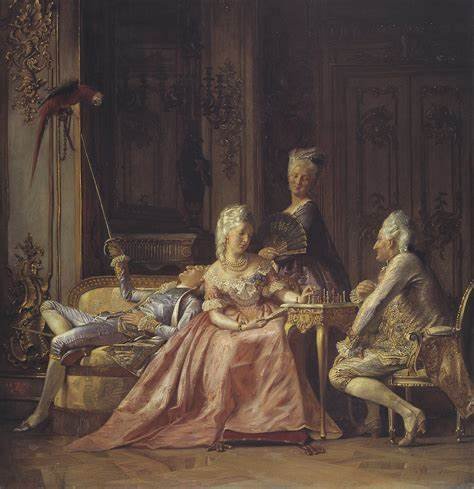
An oil painting recreating the frivolous court of Christian VII by Kristian Zahrtmann

In 1884 a preparatory class was added to the Kunstnernes Frie Studieskoler and in 1885 Kristian Zahrtmann became the head and, under him, it developed into an independent department.  Zahrtmann’s school became more avant-garde and innovative, due to his calls for radical experiments and strong use of colours.  By 1893 the preparatory class, which under his leadership,  turned into an independent department. He had some two hundred students from the Scandinavian countries and because of his stature as a teacher, the school was often simply referred to as “Zahrtmann’s School“.

A Family under Lamplight by Kristian Zahrtmann (1890)

Many of Zahrtmann’s students formed a group of painters who became known as Fynboerne (Funen Painters) due to their attachment to the island of Funen. His students included Peter Hansen, Fritz Syberg, Poul S. Christiansen, Johannes Larsen and Oluf Hartmann; and modern painters Karl Isakson; Edvard Weie, Harald Giersing and Olaf Rude. Zahrtmann travelled through Europe many times and his favourite country was Italy.
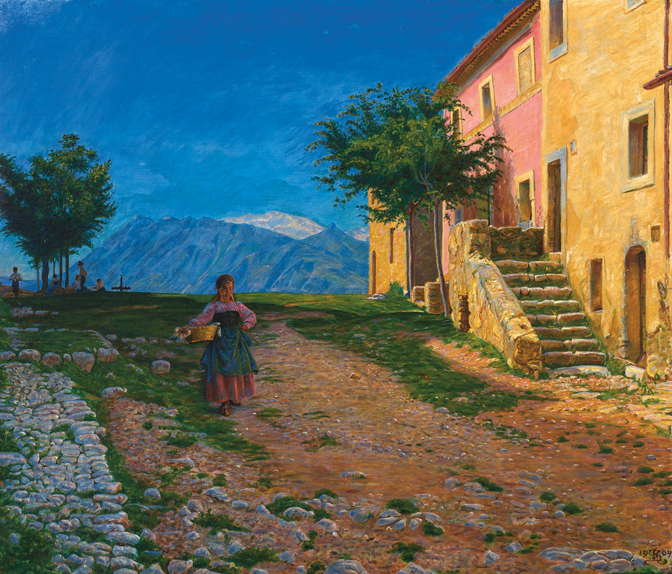
Piazza Santa Maria i Civita d´Antino by Kristian Zahrtmann (1904)

In June 1883, which was a very hot summer in Europe, Kristian Zahrtmann, travelled to the mountain town of Civita D’Antino in Italy, in search of cool temperatures as well as his love of good wine, and on the first afternoon in the town he decided that here was the ideal place for his summer painting school. His enduring fondness for Civita D’Antino lasted nearly 30 years and between 1890 and 1911 he spent every summer in the town living with the Cerroni family and gathering friends and students in an annual artist colony. He was named an honorary citizen of the town in 1902. This culminated in a vast production of portraits, landscapes, and scenes depicting an idyllic daily lifestyle around the mountain communit. His paintings are distinguished particularly by their realism and bold colour.
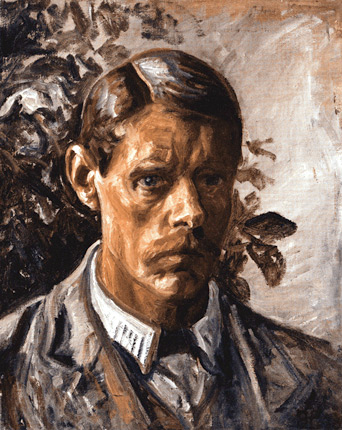
Johannes Larson, self portrait (1910)

Winter Day at the Zoo by Johannes Larson (1891)

One of the leading members of the Funen painters’ group was Johannes Larsen who was born in Kerteminde on the island of Funen on December 27th 1867. He was the son of Jeppe Andreas Larsen, a merchant and Vilhelmine Christine Bless.  During the 1880s, after regular schooling, Johannes studied art at the Free School in Copenhagen under Kristian Zahrtmann. It was whilst studying here that he met a number of aspiring painters who lived on Funen, notably Fritz Syberg and Peter Marius Hansen both of whom came from the southern port of Faaborg.  It was the coming together of these young artists that morphed into the Funen Painters group (Fynboerne).  Later they would create an art colony which would galvanise many Danish and Swedish artists to paint and exhibit their work.

Summer Sunshine and Wind by Johannes Larsen (1899)

After completing his studies with Kristian Zahrtmann, Johannes Larsen returned back home to his native Funen town of Kerteminde where he continued to paint working in oils, watercolour, woodcuts and drawing.  His depictions featured landscapes and other open-air scenes, and often included birds.  He received many commissions to illustrate books and paint large paintings for public buildings
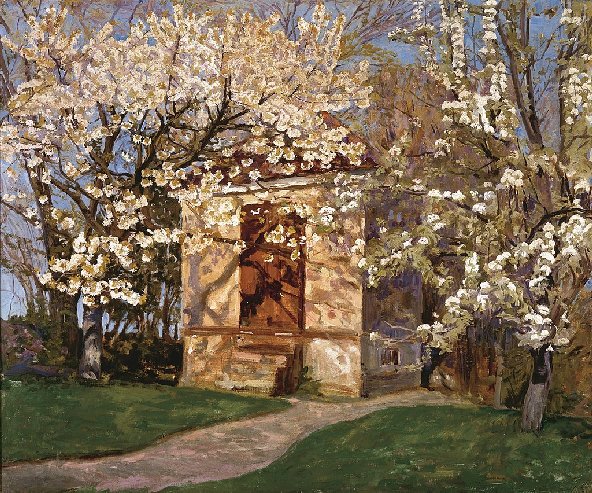
The Garden House with Blossoming Cherries by Alhed Maria Larsen (c.1920s)

In 1898, Johannes married the painter Alhed Maria Warberg.  She played a central role within the Funen Painters group and would often have the role as hostess at their events.
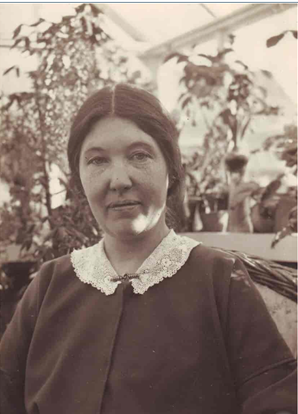
Alhed Larsen

Alhed Larsen was born on April 7th 1872.  She was the second eldest of eight children, Laura Maria and Albrecht Christopher Warberg.  She had six sisters and one brother.   Her father was the estate manager for a very large farmstead, Erikshåb, and he had an office help, a teacher for the children and six servants.  Alhed grew up in well-to-do circumstances on the estate.  It was said that the seven sisters would often shock the bourgeoisie neighbours by walking around the streets of the town without wearing gloves and by using newfangled bicycles !  Many young painters would gather at the farmstead and soon Alhed began to learn to paint and was guided by the painter, Fritz Syberg.  Later it was the task of her husband, Johannes Larsen to take the role of her artistic mentor.  Peter Hansen joined the group along with his sister Anna and Maria and Johannes’ sister Christine and it was Alhed who had the role of unifying these painters of Funen.
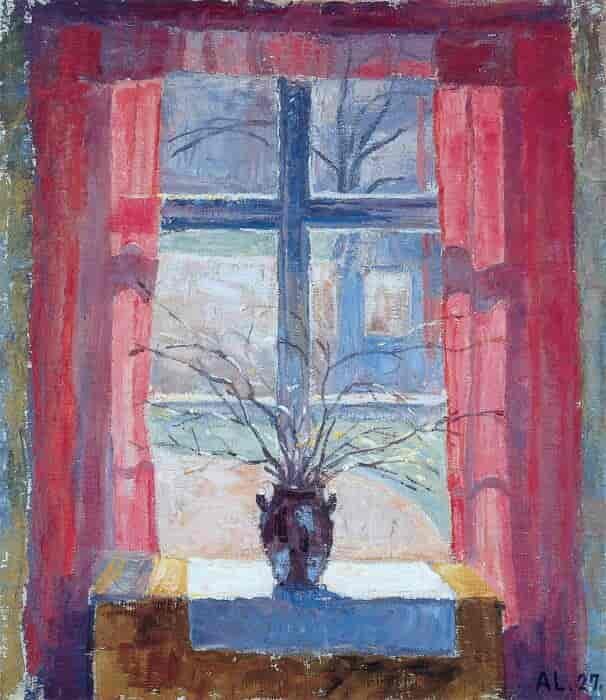
Beach Leaves in the Window, Båxhult by Alhed Larson (1927)

When she was seventeen, Alhed went to Copenhagen and lived with her maternal uncle, the sculptor, Ludvig Brandstrup.  Between 1890 and 1893. In 1893, Alhed worked at the Royal Porcelain Factory with underglaze painting, at the same time as she received drawing lessons from her maternal uncle.  In late 1893 she travelled to Italy with the Brandstrup family and during that long holiday she managed to master the Italian language.  Back home at Erikshåb she formed a close and romantic relationship with Johannes Larsen but her parents were not happy with the prospect of their daughter marrying an impoverished artist.  She finally overcame her parent’s reluctance to have Larson as their son-in-law and in 1898 the couple married and settled in Kerteminde. Three years after the wedding the couple had a new home built on Møllebakken, on the coastal slope on the outskirts of the town.   Alhed decided that she was not satisfied with simply being the wife of an artist and decided that she wanted to become a professional artist as well.

Rhododendrons by Alhed Larson

Alhed Larsen’s artwork primarily depicted flowers, still life, interiors and window views. In 1917, Alhed and Johannes’ house was expanded with a large studio added, spacious enough for each to have their own studio space.

Møllebakken home of Alhed and Johannes Larson

Between 1901 and 1902, the couple built their home on Møllebakken in Kerteminde. Their home became the gathering place in summer months for many painters, particularly younger artists from Zahrtmann’s school.

Landscape with birds by Johannes Larsen (1946)

The Funen painters guiding principle was to encourage plein air painting, not just sketching but painting, notwithstanding the weather. Following this principle led to paintings having a fresh purity and energy which was missing from studio painting. Their works were appreciated by the public and became very popular, so much so that the Symbolist painters of the time attacked their style and in 1907 in the midst of a newspaper debate on Danish art, the Symbolists derogatively called them “farmer painters”.  Instead of being browbeaten by this tirade the artist gained greater recognition.

Birds flying over a landscape by Johannes Larson (1929?)

A turning point for the group came in 1910 when businessman Mads Rasmussen, who operated a successful cooperative canning factory in Faaborg, proposed to help the group by creating a museum next to his canning factory at Møllebakken in Kerteminde. which would promote and exhibit Funish Art. This made it possible for the public to view and buy their paintings which gave the Funen artists financial support. Johannes and Alhed Larsen lived almost their entire lives at Møllebakken.
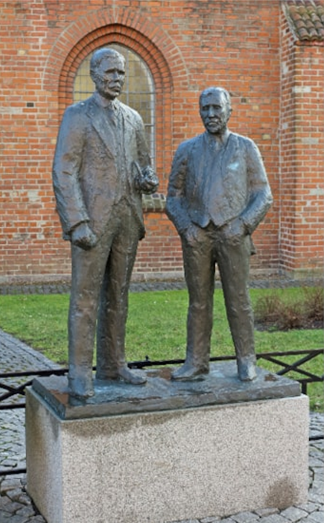
In the autumn of 2006, a sculpture by the city’s two great artists, Johannes Larsen (1867-1961) and Fritz Syberg (1862-1939), was unveiled on Nordre Kirkerist, Kerteminde, next to the parish church, executed by local sculptor Bjørn Nordahl.

Johannes Larsen is looked upon as one of the greatest painters of birds and a knowledgeable pictorial storyteller of nature. His knowledge, his role as a conservationist and his beautiful artwork earned him an honorary membership of the Danish Society for Nature Conservation. At the age of 92, he was named president of the Wildlife Foundation established by the prime minister’s department.

………to be continued.
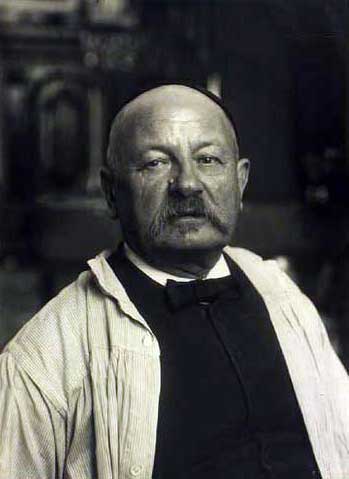
Kristian Zahrtman and Leonora Christina

Kristian Zahrtmann
Kristian Zahrtmann

My blog today is a mixture of art and history. It is about a late nineteenth century Danish painter Kristian Zahrtmann and his fascination with Leonora Christina, the daughter of King Christian IV of Denmark and Kirsten Munk. Zahrtmann was a painter, who produced landscapes, street scenes as well as many fine portraits but he was especially known for his history painting and especially paintings which featured legendary, and often tragic, females in Danish history.

Self portrait (1914)

Peder Henrik Kristian Zahrtmann was born in March 1843 in Rønne, a Baltic Sea town on the west coast of the Danish island of Bornholm. His mother was Laura Pouline Jesperson and his father, Carl Vilhelm Zahrtmann, was a doctor on the island. He was the eldest of nine children, having two sisters and six brothers. On completion of his normal schooling, at the age of seventeen, he left the Rønne Realskole and enrolled at the Sorø Academy on the Danish island of Zealand and it was here that he began to study painting under the tutorship of the Danish landscape painter and drawing master, Hans Hader. He graduated from the Academy in 1862 and a year later received his doctorate.

Following his graduation he went to live in Copenhagen and for the six months of the winter of 1863 he enrolled at the Technical Institute in Copenhagen where he studied drawing and design under the Danish artist, Christian Hetsch and architect Ferdinand Vilhelm Jensen. At the same time, he received private instruction from the genre painter Wenzel Ulrich. A year later he enrolled on a four-year course at the Royal Danish Academy of Art in Copenhagen. He graduated from the Academy in 1868 when he was twenty-five years of age and it was in this year that he first exhibited some of his first work at the Charlottenborg, the palace in which was situated the Danish Academy of Fine Arts.

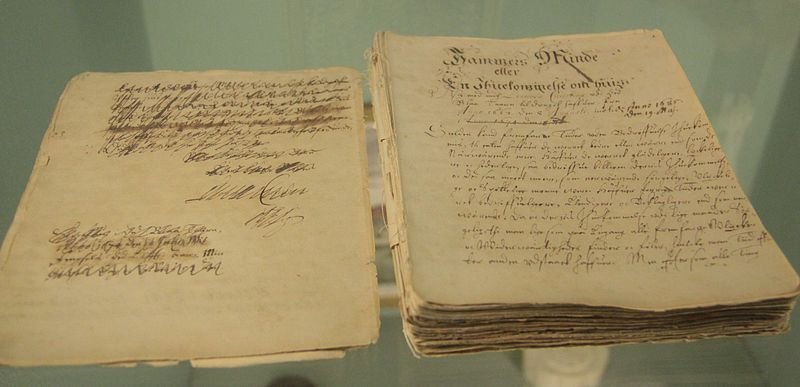
Jammers Minde The hand written autobiography of Leonora Christina
Jammers Minde
The hand written autobiography of Leonora Christina

It was around this time that Zahrtmann became great friends with aspiring Danish painters Otto Haslund and Pietro Krøhn with whom he shared a studio. It was this friendship that in some way was the starting point of this blog about Zahrtmann and the 17th century Danish princess Leonora Christina for it was they who gave Zahrtmann, for his birthday, a copy of Jammers Minde, which literally translated means A Memory of Lament. It was a posthumous autobiography written by Leonora during her twenty-two year solitary incarceration in the Blue Tower in Copenhagen Castle and which was not published until 170 years later, in 1869. So who was Leonora Christina and why was the daughter of the king imprisoned for over two decades of her life?

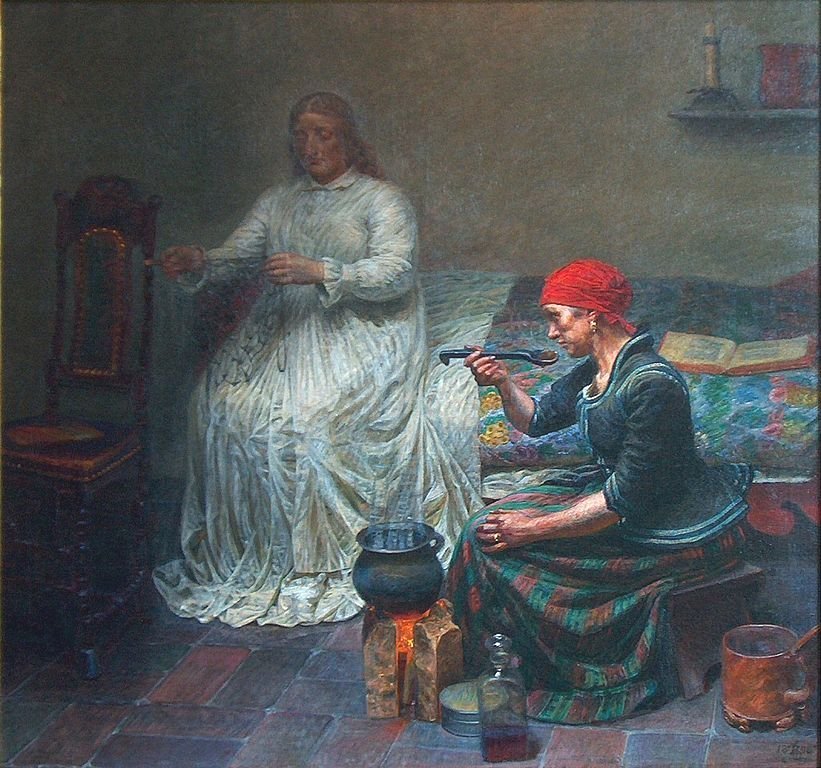
Leonora Christina in the Blue Tower by Kristian Zahrtmann

To find the answer to this we need to go back to King Christian IV of Denmark-Norway who succeeded his late father, Frederik II, at the age of eleven and ascended to the throne eight years later. He married his first wife Anne Catherine in 1597, when he was twenty years of age, and the couple went on to have seven children, four of whom died in infancy. Anne Catherine died in 1612 and three years later, in December 1615, Christian IV remarried. His second wife was Kirsten Munk, the daughter of a wealthy court official, who had been living with her family at the royal palace in Copenhagen . Although she was of the nobility, she held no title and so when she married the widowed king, Christian, it was a marriage between people of different social classes and the marriage was termed a morganatic marriage (similar to the present day marriage between Prince William and the “commoner” Kate Middleton). This difference in class between husband and wife could well have been the reason why the wedding ceremony was a private affair and not a full-scale church wedding. Kirsten Munk bore the king twelve children, ten of whom survived infancy, two sons and eight daughters. Leonora Christina was the couple’s fifth child, born in July 1621.

Leonora Christina i Fængselet (Leonora Christina in Prison) by Kristian Zahrtmann (1875)

Leonora Christina, like four of her sisters, did not marry princes from one of the many European monarchies but instead her father allowed them to marry powerful and wealthy Danish noblemen in an attempt to assure their allegiance to the monarchy. Leonora’s husband, whom she married in 1636 when she was just fifteen years old, was the thirty-eight year old Corfitz Ulfeldt, the son of the Danish chancellor. They had actually been engaged since she was nine years old! Corfitz Ulfeldt held great powers at the royal court but became more and more ambitious and grasping and it was these traits along with some bad political decisions which had him and the king fall out. Christian IV died in February 1648 and it was two months before the king’s second son, Leonora’s half brother, Frederick, from his first marriage, was elected the new King of Denmark and Norway. He became King Frederick III. During that two month transition period Corfitz Ulfeldt, as Steward of the Realm, the country’s de-facto prime minister, virtually ruled Denmark.

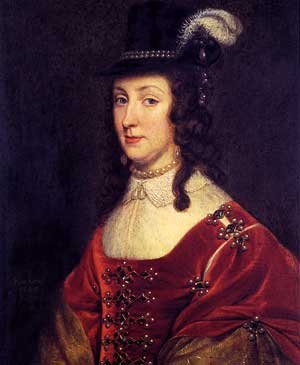
Leonora Christina Ulfeldt by Gerard van Honthorst (1647)

Corfitz Ulfeldt’s avarice and naked ambition during his rise to power irritated the new king and a perceived plot against the new monarch by Ulfeldt caused the latter, out of fear for his life, to flee the country with his wife Leonora and their family. Ulfeldt then forged a close alliance with Charles X of Sweden, Denmark’s old enemy, and offered his financial support with money which was thought to have been embezzled from the Danish state. This money was to help Charles facilitate the war against Denmark which began in July 1657. At the end of the conflict in 1658, Sweden had won its most celebrated victory, and for the vanquished, Denmark/Norway, they had suffered a humiliating and costly defeats of all time, having to cede territory to Sweden under the Treaty of Brömseboro. Ulfeldt even took part in these treaty negotiations, during which he took great pleasure in denigrating his former homeland. This, however, was to be his ultimate undoing. Ulfeldt, now feted by the Swedish monarch, once again became too ambitious and fell out with Charles X, who ordered his arrest and was condemned to death. In 1660, Ulfeldt decided that the lesser of two evils was to escape from Sweden with his wife Leonora Christina and return to his homeland, Denmark, and try and make his peace with Frederick III. Frederick was not amused and had the couple imprisoned for a year. Their release came after Ulfeldt paid a hefty fine which saw him and his wife almost reduced to a poverty-stricken existence. Their imprisonment had been both degrading and cruel and once released Ulfeldt plotted his revenge on Frederick. His act of treason against the Danish monarch was discovered and he was condemned to death in absentia. He escaped the jaws of death but died in a Rhine boating accident during one of his flights from impending arrest.

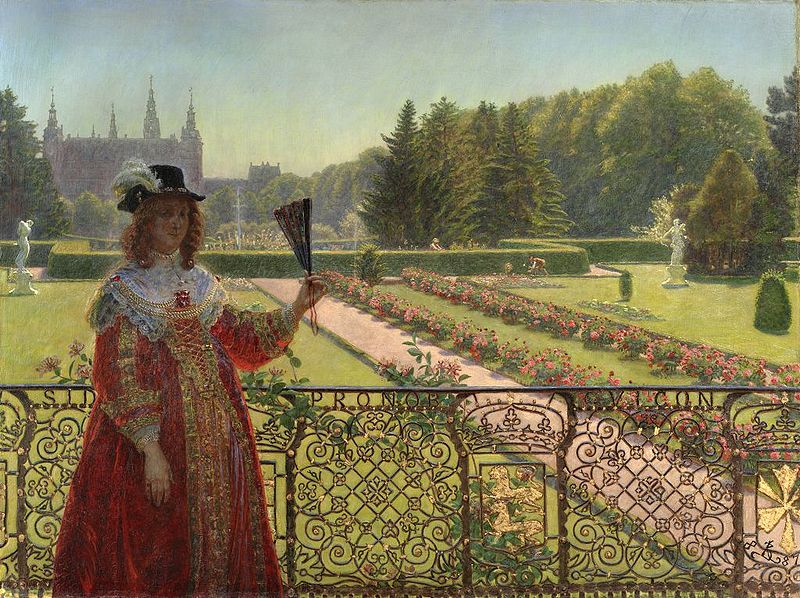
Leonora Christina in the Garden of the Frederisborg Palace by Kristian Zahrtmann (1887)

So what happened to Leonora Christina? After her and her husband’s release from prison Ulfeldt persuaded Leonora to go to England, seek an audience with Charles II and see if she could recover money he had lent the English monarch. Charles was unwilling to help and had Leonora arrested at Dover on her way back to the Continent. She was eventually hand over to Frederick and the Danish state, which as they still could not find Ulfeldt, instead decided to punish his wife and had her locked away in solitary confinement in the infamous Blue Tower at Copenhagen’s Castle. The conditions in the prison were both degrading and vile. So why was she so severely punished for the wrongdoings of her husband? Throughout her incarceration she blamed her downfall and her imprisonment, not on her half brother, the monarch Frederik, but on his wife Sophie-Amalie and the queen’s desire for revenge. Why this animosity between Leonora and Sophie-Amelie?

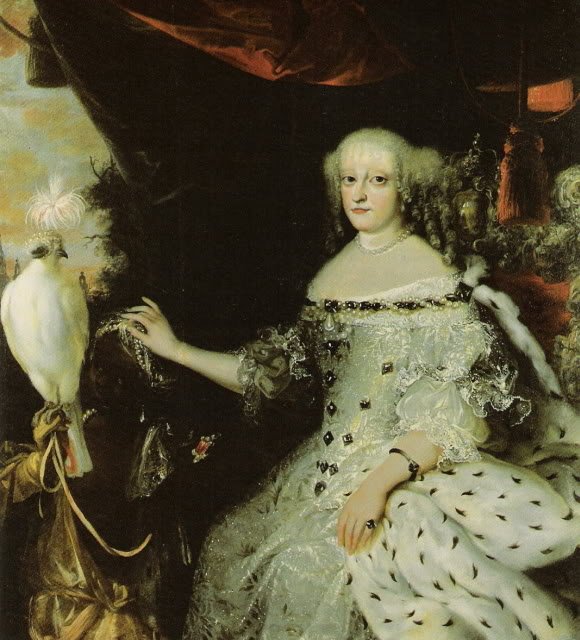
Sophie Amalie von Braunschweig-Lüneburg  with a slave by Abraham Wuchters (c.1670)
Sophie Amalie von Braunschweig-Lüneburg with a slave by Abraham Wuchters (c.1670)

Leonora had been her father’s favourite daughter and when her mother, Kirsten Munk, was banished from Copenhagen by her husband for infidelity, Leonora took on the role and power as the First Lady of Denmark. When her father died and Frederick came to the throne things changed. When you are at the pinnacle there is only one direction one can go – down! Frederick married Sophie-Amalie of Brunswick-Lüneburg, who became Queen of Denmark and Norway. She and Leonora, who had seen her power usurped by another woman, became bitter enemies and she probably played a leading part in having Leonore incarcerated.

Leonora Christina paa Maribo Kloster (Leonora Christina at Maribo Cloister)  by Kristian Zahrtmann (1883)
Leonora Christina paa Maribo Kloster (Leonora Christina at Maribo Cloister)
by Kristian Zahrtmann (1883)

Leonora Christina’s sworn enemy, Sophie-Amalie died in February 1685 and one of Leonora’s daughters went to the king, Christian V, the son of the late Frederick III and Sophie-Amalie, and begged for the release of her mother. The king agreed and in May 1685 and she went to live at a monastery run by the nuns of the St. Birgitte-order. It was here that Leonora completed her autobiography, Jammers Minde, which she had started to write during her long imprisonment. Leonora Christina died in March 1698 and was buried in the crypt of the monastery which is now the church at Maribo on the Danish island of Lolland. It is believed that some time later her sons had her body removed from the church and laid to rest in a secret location where her husband had been interred. Leonora’s last years in imprisonment improved due to the attitude of the new king Christian V and his wife, the queen-consort, Charlotte-Amelie despite his mother, Sophie-Amelie’s everlasting vindictive nature. In her autobiography Leonora wrote about her indebtedness to the king and queen improved situation:

“…My most gracious hereditary King was gracious enough several times in former years to intercede for me with his royal mother, through the high ministers of the State. Her answer at that time was very hard; she would entitle them “traitors”’ and, “as good as I was, and would point them to the door. All the favours which the King s majesty showed me — the outer apartment, the large window, the money to dispose of for annoyed the Queen Dowager extremely; and she made the Kings majesty feel her displeasure in the most painful manner…”.

Dronning Sophie Amalies død, (The Death of Queen Sophie Amalie)  by Kristian Zahrtmann (1882)
Dronning Sophie Amalies død, (The Death of Queen Sophie Amalie)
by Kristian Zahrtmann (1882)

Zahrtman was fascinated by the book and completed a number of paintings of the way he envisaged Leonora during her captivity and like Leonora, Zahrtmann blamed Sophie-Amalie for Leonora’s downfall and the artist depicted the deathbed scene of Leonora’s nemesis. The state of the dying queen mother and the pain-wracked expression on her face presumably comforted Zahrtmann !

For anybody who would like to read the translation of Leonora’s autobiography I believe there is a Guttenburg e-book available:

 http://www.gutenberg.org/ebooks/38128?msg=welcome_stranger