Venus of Urbino by Titian and the Sleeping (Dresden) Venus by Giorgione

Today I am remaining in Italy for My Daily Art Display but moving from fresco painting to one of the most famous and controversial oil paintings, the Venus of Urbinio by the Italian master Tiziano Vecellio.  Simply known as Titian, he is considered to be the most important member of the sixteenth century Venetian School of painters.  This oil on canvas painting hangs in the Uffizi Gallery in Florence and was completed by Titian in 1538.  The painting was commissioned by Guidobaldo II della Rovere, the Duke of Urbino, a title he inherited that same year, after the assassination of his father.   The painting was more than likely intended for the bridal chambers of the palace.  Titian was almost fifty years old when he painted this picture. 

However this is not a tale about one painting, rather a tale about two paintings of the Roman goddess of love, Venus.  One needs to go back to 1510 to the studio of Giorgione, the Italian High Renaissance artist, who painted, but never completed his painting, the Sleeping Venus, sometimes known as the Dresden Venus, which now hangs in the Gemäldergalerie, Dresden.  Giorgione had worked long and hard at this painting putting great effort into the background details and shadows.  Sadly he died at the young age of 33 and the completion of the landscape and background was left to his assistant Titian

The Dresden Venus by Giorgione (1510)

Giorgione’s painting of a nude woman reclining marked a revolution in art and some art historians believe this painting marked one of the starting points for modern art.   At this time, a nude of this size, as the main focal point of the painting, was unparalleled in Western painting.  Giorgione was actually reviving a tradition of the female nude that can be traced back to ancient Greek art.
 Was this painting erotic?   Maybe that is for the individual observer to decide.  The way she lies with her right arm behind her head exposing her breasts and her left hand on her groin may lead you to the conclusion that there were underlying erotic implications to this work of art.  Giorgione’s nude is painted in an idealized landscape setting. Many believe that she has not been painted for sexual desire, and that the nude is portrayed as a demure goddess asleep and oblivious that we are stealing a look at her.

So one can be certain that Titian had seen this painting for he completed the work of art for his dead colleague.   Titian was no doubt influenced by what he saw and there has to be a correlation between this work and his own Venus of Urbino some twenty eight years later.  Two well known sayings come to mind. An English cleric and writer, Charles Caleb said that “Imitation is the sincerest form of flattery” and Pablo Picasso said “Bad artists copy.  Great artists steal” by which he meant that great artists can draw inspiration from somebody else’s painting while still putting their own touch on it.   There can be no question that there is a definite similarity between the nude figure in the Venus of Urbino and the one in the Dresden Venus.

Venus of Urbino by Titian (1538)

Titian’s oil on canvas painting Venus of Urbino is one of his most celebrated and possibly the most debated of paintings.  Art historians will have us believe that the reason the word “Venus” (the Roman goddess of love and beauty) is in the title of the painting is because of the presence of roses and the myrtle tree in the painting which are traditionally attributed to Venus.   However other historians reason that because the painting shows maidservants searching in the cassone for clothes for the young woman, then this is simply a portrait of a naked mortal rather than a goddess.

Titian’s Venus is in complete contrast to the Venus of Giorgione. The main character in Titian’s painting is a young women reclining on a bed and as was the case with Giorgioni’s Dresden Venus; her left hand covers her groin.  Both women are voluptuous.   However there are some distinct differences between the paintings.  Titian’s Venus is painted in an indoor setting of some opulence, in what looks like a palace, somewhere in Venice whereas Giorgione’s Venus is painted in a landscape.   Titian’s Venus does not present us with any of the characteristics of the goddess she is supposed to symbolize: she is not shy or retiring, she does not give us the belief that she is unattainable, or aloof.  This Venus is a flesh-and-blood mortal, awake and fully conscious of the viewer’s presence

Titian’s young woman has her eyes open whereas Giorgione’s Venus has her eyes closed and may be asleep (hence the alternative title of his painting: Sleeping Venus) which gives her an air of aloofness and one has the feeling that she is unattainable.    With her eyes closed there is a lack of sensuality and seduction in her demeanour.  On the other hand, look at the facial expression of Titian’s Venus – what is she saying to you?  Is she giving you a look of indifference or is it a look of seduction?  Allegorically, is her expression one of lust or of one of marital love?   She appears to be totally at ease with her situation and maybe you, as the viewer, are the ones who are uncomfortable.  Her long chestnut hair falls over her naked shoulders.  Her nipples are erect.  The fingers of her left hand barely cover her groin and the dark shading is almost as if Titian has painted in pubic hair.  Notice how the painting is split in half vertically by the vertical line of the dark curtain behind Venus.  The drape ends just at her left hand which draws the observer’s eye to her loins which her fingers cover

The painting oozes with sensuality which is often played down by art historians but I will leave you to be a judge of that.  She is also wearing jewellery in the form of earrings, a small ring and a bracelet whereas Giorgione’s Venus was devoid of any such man-made accoutrements. 

In her right hand Titian’s Venus is holding a posy of red roses, the symbol of Venus and they give an accentuated tonal contrast against the white bed linen.  This same red is present in the mattress and the dress of one of the maidservants.  The small dog lies asleep nearby and symbolises fidelity, which lends to the theory that the overriding premise of this work of art is one of marital love.  On the window sill we can see a myrtle tree which symbolises undying love and commitment and a Hebrew emblem of marriage.

Titian’s Venus of Urbino will delight some and horrify others, like Mark Twain who saw the painting at the Uffizi, and wrote in his book, Tramp Abroad:

“…You enter [the Uffizi] and proceed to that most-visited little gallery that exists in the world –the Tribune– and there, against the wall, without obstructing rap or leaf, you may look your fill upon the foulest, the vilest, the obscenest picture the world possesses — Titian’s Venus. It isn’t that she is naked and stretched out on a bed –no, it is the attitude of one of her arms and hand. If I ventured to describe that attitude there would be a fine howl –but there the Venus lies for anybody to gloat over that wants to –and there she has a right to lie, for she is a work of art, and art has its privileges. I saw a young girl stealing furtive glances at her; I saw young men gazing long and absorbedly at her, I saw aged infirm men hang upon her charms with a pathetic interest. How I should like to describe her –just to see what a holy indignation I could stir up in the world…yet the world is willing to let its sons and its daughters and itself look at Titian’s beast, but won’t stand a description of it in words….There are pictures of nude women which suggest no impure thought — I am well aware of that. I am not railing at such. What I am trying to emphasize is the fact that Titian’s Venus is very far from being one of that sort. Without any question it was painted for a bagnio and it was probably refused because it was a trifle too strong. In truth, it is a trifle too strong for any place but a public art gallery…”

Allegory and Effects of Good and Bad Government by Ambrogio Lorenzetti

Palazzo Pubblico, Siena

My Daily Art Display today will, I hope, tempt you to travel and by so doing actually see today’s work of art.  Your journey will be well worth it and for those of you who live close to my proposed destination, I have to say I am indeed very jealous.   I have been there and the whole area is so beautiful and full of many places and things to see.  As an added bonus  for my female readers, I will also offer you an alternative way to lighten your hair à la Sienna !!


Sala della Pace

You need to go to Italy.  You need to go Tuscany.  You need to visit the beautiful city of Siena and to find today’s offering you need to visit the Plazzo Pubblico. The erstwhile palace is now the town hall.    Inside this beautiful building is the Sala dei Nove, also known as the Sala della Pace, where the nine chief magistrates held their meetings. 

On three walls of this high-ceilinged room is the fresco series painted by Ambrogio Lorenzetti and this work of his is looked upon as one of the most revolutionary and remarkable endeavours of the Renaissance.  Over the next three days I will show the three frescos, which are collectively known as Allegory and Effects of Good and Bad Government.  The aim of the frescos was to acclaim the political doctrine of the government of the Nove, who retained power in Siena until 1355.  The commissioning of the frescoes was uncommon for that time period as they were not commissioned by the church, as was the norm, but by the governing body of the city.  The scenes in some of the frescoes had nothing to do with religion and were definitely of a secular nature which in 14th century Italy was very unusual.  The group of frescoes elaborate on two themes.  Firstly that of justice and secondly the importance that private interests must always be secondary to the interests of the majority and  therefore for the common good of the majority.

Allegory of Good Government by Ambrogio Lorenzetti (c.1338-40)

The painted frescoes essentially work on two levels, one allegorical and symbolic and the other concerned with description and exemplification, while the whole cycle covers three walls of the great hall.   On the wall opposite the window, which is 7.7 metres long, is Allegory of Good Government, which is My Daily Art Display for today.    

The Allegory of the Good Government is situated on the smaller wall of the room and faces the windows. The fresco is built up from three horizontal bands. In the foreground the figures of contemporary Siena are represented. Behind them, on a stage, there are allegoric figures in two groups, representing the Good Government. The two groups are connected by the procession of the councillors. The upper band indicates the heavenly sphere with the floating body-less ghosts of the virtues.

The enthroned man on the right side of the middle band represents the city of Siena and embodies the Good Government.   Around his head the four letters C S C V (Commune Saenorum Civitatis Virginis) explain his identity. At his feet sit two children who are the sons of Remus, Ascius and Senius, the founders of Siena according to the Roman legends. On both sides of Siena the virtues of Good Government are represented by six crowned, stately female figures: Peace, Fortitude and Prudence on the left, Magnanimity, Temperance and Justice on the right. On the far left of the fresco the figure of a woman, the personification of Justice, can be seen as she balances the scales held by Wisdom who is floating over her throne.  On the viewer’s left, a convicted criminal is beheaded; on the right, figures receive the rewards of justice. At Justice’s feet, the personification of Virtue, also, unusually for the time, portrayed as a female figure, passes virtue among twenty four recognizable images of prominent male citizens of Siena. The men face towards the largest figure in the image, a judge located in the centre-right.   The figure of Justice bears a resemblance to the figure of Mary, Queen of Heaven, the patron saint of Siena, on a throne. The Judge reflects the tradition in the Christian Last Judgment to have God or Christ judging the saved on the left; the damned on the right. While classified as medieval or proto (pre)-renaissance art, this fresco shows a transition in thought and an evolution in theme from earlier religious art.

The judge is surrounded by additional personifications including Peace, who is represented as a fashionable, white-clad contemporary female figure with elaborate blonde hair.  Although blonde hair was fashionable it was not the dominant hair colour of Italian women from this region but it was not unusual in those days for women to lighten their hair by streaking it with urine and letting it dry in the sun!

Below the fresco there is the signature of the painter:

AMBROSIUS LAURENTII DE SENIS HIC PINXIT UTRINQUE.

Tomorrow and the day after I will look at the other two frescoes which appear on the walls of the Sala della Pace.

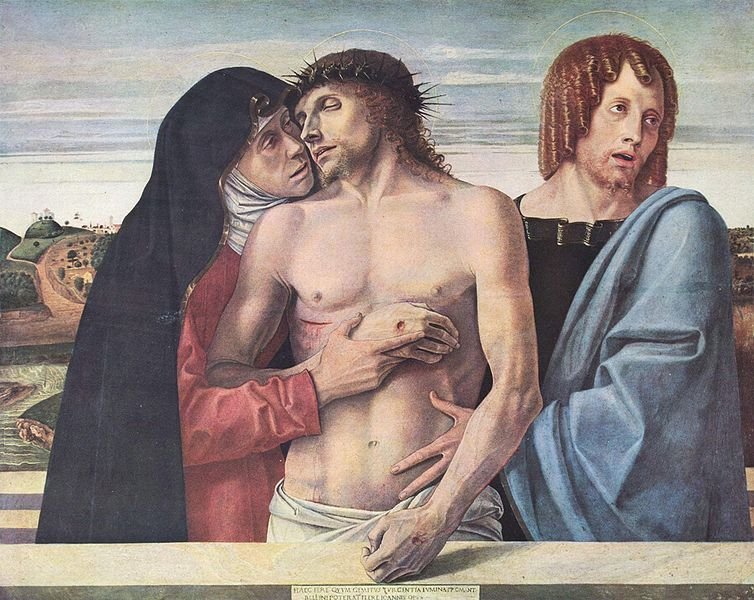
Dead Christ Supported by the Madonna and St John; (Pietà) by Giovanni Bellini

Dead Christ Supported by the Madonna and St John; (Pietà) by Giovanni Bellini (1460)

Some time ago I talked about Madonna and Child genre of paintings and said that I believed that, as far as religious paintings were concerned, they were the most prolific type of religious art throughout the ages.  Other highly popular religious concepts in paintings are the Pietà and the Lamentation. 

The Lamentation represents a particular moment from Christ’s Passion, between the Deposition (the bringing down of the lifeless body of Jesus Christ from the cross after the crucifixion) and the Entombment.   The paintings always show groups of grieving mourners gathered around the central figure of Christ and his mother, the Virgin Mary.  They often appeared in narrative paintings of the Passion of Jesus Christ.

The term Pieta derives from the Italian word for pity.   The Pietà is a timeless image, and is a term applied to a painting or sculpture which usually just depicts the Virgin Mary and the dead Christ, often with the Virgin Mary supporting the body of Christ on her lap.  However, sometimes the characters of St John the Evangelist or Mary Magdalene would be added to the scene.  The setting does not depict a particular moment in the Passion story, unlike scenes of the Lamentation.

So is My Daily Art Display today a Pietà or a Lamentation?  It is entitled a pietà so who am I to disagree !  It is tempera on panel painting which I came across this week and which I thought was very heartrending and poignant.   One could almost feel the grief of the Virgin Mary and St John the Evangelist.  The work of art painted in 1460 and entitled Dead Christ Supported by the Madonna and St John; (Pietàa) is by Giovanni Bellini and can be seen at the Pinacoteca di Brera in Milan.

At the bottom of the painting, on the parapet is the inscription:

HAEC FERE QUUM GEMITUS TURGENTIA LUMINA PROMANT: BELLINI POTERAT FLERE IOANNIS OPUS

which translated means:

When these swelling eyes evoke groans, this work of Giovanni Bellini could shed tears

To me, this perfectly sums up the painting.  It is not just me that is moved by this painting as it has been rightly considered as one of the most moving paintings in the history of art.  There is a deep passionate feeling to this painting.  It is not just religious passion but human and psychological passion.  Look at the Virgin Mary as she looks into the eyes of her dead son.  See how she is almost using his shoulder to support her chin.  There is a deep hurt and sorrow in her eyes as she looks intently at the face of her lifeless son.  Is there anything more moving that a mother’s sorrow for the loss of her only son?   She clutches the right wrist of Jesus and holds his lifeless limb across his chest.  She is almost cuddling him wishing she could breathe life into his dead body.  We can see the wound on the back of his right hand made by the crucifixion and Jesus’s left hand, with his fingers curled closed in pain, rests on the parapet.

To the right we see Saint John the Evangelist’s with his face wracked with sorrow and one can empathise with his desolation.  His head is turned away from Mary and Jesus as if he can no longer bear to look at the grieving mother clutching at her dead son.  John’s mouth is open as if he is crying out in anguish.  Maybe he is begging for some morsel of comfort.  It is as if he is asking for help to endure what is before him, as he is aware of his task ahead, that of consoling Mary.    

The three figures are in a tight group in the foreground behind which is an infinite horizon.  The sky is a steely grey-blue which gives a feeling of cold and accentuates the pervading anguish of the setting.

This is indeed a very sad and moving painting.

The Madonna of the Grand Duke by Raphael

The Madonna of the Grand Duke by Raphael (1504)

I wonder if you have ever considered what subject has been depicted the most in art.  If I was to guess and knowing the plethora of religious paintings I would have to say it was the depiction of the Madonna and Child.  It is very interesting to study how both the Virgin Mary and the Christ child are visually represented in these paintings and how they differ down the ages.  In some the young Christ Child almost has the face of a grown man.  In some the Virgin Mary has a very wooden expression and her looks would be described in modern terminology as plain.   Today I was attending a talk about the artist Raffaello Sanzio da Urbino, better known simply as Raphael and one of the paintings we looked at was his Madonna of the Grand Duke and the more I looked at it the more I fell in love with it,  so come and join me in this journey of discovery of what I believe is one of the most beautiful Madonnas.

The Madonna of the Grand Duke, or to give it its correct title Madonna del  Granduca, was painted by the Italian Renaissance artist Raphael Sanzio in 1504 shortly after he arrived in Florence and was owned by Grand Duke Ferdinand III, hence the name of the painting.  It can be found now in the Palatine Gallery of the Pitti Palace in Florence.  In the painting Mary is shown standing and we see her in more length than in Raphael’s other Madonna paintings such as the Madonna Tempi and Virgin with Chair. She has the features of a beautiful Italian girl.   She is wearing a long cloak that begins in a veil over her head which then cascades downwards and in doing so emphasises the long vertical lines of the frame.  Instead of the baby being held at shoulder height the Christ Child is tenderly held and supported by her at almost waist level.  It is almost as if the characters are painted to fit with the long length of the frame.  This has allowed Mary to be shown in a more majestic and venerable pose.  There is a dignified look about Mary but one also detects a look of sadness.  Whereas Mary gazes downward in an almost trance-like expression the Christ child is wide eyed and inquisitive.

Many artists despaired at Raphael’s talent.  His depictions of the Madonna, like today’s painting, and other female portraits show tenderness, warmth and elegance which other artists struggled to attain.  To many he is simply the painter of sweet Madonnas, which have become so well known as hardly to be appreciated as paintings any more.  Today’s painting is a classic and for artists that followed Raphael it acted as a standard of perfection. 

I challenge you to find me another Madonna painting of such exquisite beauty

The Discovery of the Body of Holofernes and the Return of Judith by Alessandro Botticelli

The Discovery of the Body of Holofernes by Botticelli (c.1470-1472)
The Return of Judith by Botticelli (c. 1470-1472)


Two for the price of one today.  Actually they were originally two panels of the same diptych, which had a carved and gilded walnut frame but which has since been lost.  These two tempera on wood panels can now be found as separate items in the Uffizi Gallery in Florence.  There is, as you would expect, a story connecting the two works of art.  For those who are slightly squeamish and don’t like the sight of blood, I apologise !

Both of today’s paintings are by Alessandro Botticelli and both refer to an Old Testament story from the Book of Judith (13:10).  It is very much like the story of David and Goliath, in which the underdog triumphs against great odds, a sort of virtue conquering vice.  Holofernes was the Assyrian general whose army was laying siege to the Jewish settlement of Bethulia. Under intense pressure from the enemy, some of the residents voiced their opinion that they should surrender.  However a rich widow, Judith, conceived a plan which would save her people.  One night, dressed in her finest clothes and looking her most alluring she passed through the town gates and with her maid and walked across the valley to the camp of her town’s oppressor, Holofernes.  She gained an audience with him by telling his guards that she would provide them with a route which would enable them to enter Bethulia.

Judith told Holofernes that she had deserted Bethulia and had been sent by God saying that her people had turned away from religion and therefore deserved to be destroyed and she would aid Holofornes in his battle.  Holofornes was pleased with this and said that Judith could remain in his camp and would be allowed to leave each evening with her maid, Abra, so as to pray.  He was mesmerised by Judith’s beauty.  On the fourth night Holofernes held a banquet for his commanders and Judith dressed seductively, went to Holofornes tent.  Holofernes drank excessively and sent all his men away so he could be alone with Judith.  Due to the amount he had drunk, he rapidly lost consciousness.  When he finally fell into a stupor Judith grasped his sword and with two mighty blows decapitated him.  Then she and her maid left the camp as they did each evening on the pretence to pray before returning.

This time, however, they kept walking.  At the gate of Bethulia, she called for entry, showed her trophy, and told the men to mount an attack on the Assyrian camp next morning. They did so, and when the Assyrians ran to Holofernes’s tent to rouse him, they found their leader headless. Horrified, the Assyrians decamped. The Israelites plundered the camp; all the best things of Holofernes were given to Judith, who then passed them to her late husband’s heirs.

So there you have it, the story of Judith and Holofernes.  The paintings, on offer today, are depictions of this tale.  One shows the headless body of the Assyrian leader being found by his servants.  Look at the faces on the servants.  Notice the shock and horror as they gaze down upon the muscled almost naked headless corpse of their leader Holofernes.  Study the musclature of the body.  It is an excellent nude study.  Note the skilful combination of colours and in the use of light to illuminate the clothing as well as the bedsheet on which the body of the dead Holofernes sprawls.

In the other painting, The Return of Judith, she and her maid are seen in flowing robes looking similar to young nymphs that are often found in this era of painting.  We see a jubilant Judith returning home with her maid, Abra, who carries the sack in which is the decapitated head of Holofernes. In one hand Judith has the bloodied sword which she used to kill Holofernes and countering that act of violence she carries in her other hand an olive branch which symbolises peace.  The painting of Judith shows a female heroine and depicts female dominance which is a theme that Botticelli often used in his paintings.  Botticelli has succeeded here in capturing both movement and stillness in a unique balance. Judith is pausing a moment in her striding forward to turn towards the observer, self-assured if not without a touch of melancholy, exactly as if she wished to present herself as the victor.

Although you do not get a sense of the size of the paintings, you may be surprised to know how small they are, measuring only 31cms x 24cms.

The Vision of Saint Jerome by Parmigianino

The Vision of St Jerome by Parmigianino (1527)

Another day, another painting and as was the case yesterday, I present you with an Italian artist whose known name is a derivative of the name of his birthplace.  Girolamo Francesco Maria Mazzola is the full name of today’s artist and he was born in Parma in 1503.  He is more commonly known by his nickname Parmigianino which means “the little one from Parma.  Parmigianino was the leading painter of Parma after Correggio, an artist he studied under, and is celebrated as one of the originators of the Mannerism movement.  He was influenced by artists such as Michelangelo and Raphael and was also a prolific draughtsman and printmaker.

He was one of  eight children.  His father was also a painter but sadly died of the plague when Parmigianino was only two years of age, who then went to live with his aunt and uncle, Michele and Pier Ilario, who were also both artists.  He became active in and around Parma.  In 1524, at the age of twenty-one, he went to live in Rome where he remained until 1527, the year the   Sack of Rome by Imperial troops took place.  His workshop was invaded by German soldiers but, according to Vasari, they were so amazed by his work they left him to continue unhindered.  However that year he left Rome and went to Bologna.  In 1530 he moved back to Parma.   There, he was contracted to paint frescos in Santa Maria della Steccata but failed to complete the commission and was jailed for breach of contract.   According to Vasari, the Renaissance art biographer, after Parmigianino returned to Parma he lost interest in his art and became infatuated with alchemy.   He died in 1540 at the young age of 37 and is buried in Caslamaggiore.

My Daily Art Display today is the altarpiece The Vision of St Jerome which Parmigianino completed in 1527 whilst in Rome and can be found in the National Gallery, London.  It is considered to be his most important work of this time.  Parmigianino experimented with complex poses, contortion and twisting of the human body and in this painting one can see an example of this style.  In a number of his paintings and as can be seen in this work, his figures are elongated, taking up twisted, if slightly unnatural, poses.

In today’s painting we have the Virgin Mary with the Infant Christ held between her knees.  We see Saint Jerome lying on the ground in a deep sleep dreaming of his vision of John the Baptist.  His cardinal’s hat is balanced on the jaw of a skull.  In the foreground we have John the Baptist who leans in a dramatic fashion towards the viewer.  His body is twisted around as he points heavenwards with his right index figure towards the Christ Child whose coming he had predicted.  This pointing gesture was often used by Leonardo.  Attached to his belt is a bowl which he employs for baptism and in his left hand he holds a reed cross.  The Christ Child assumes a contrapposto posture, hovering as if just about to take a step forward.

The Visitation by Jacopo Pontormo

The Visitation by Jacopo Pontormo (1528)

Today’s featured artist is Jacopo Carucci, who because of his birthplace, was usually known as Jacopo Pontormo.  He was an Italian Mannerist painter who was born in 1494 in the small town of Pontormo near Empoli.  Most of his work was carried out in and around Florence where he was recognised as one of the most exceptional painters of his time.  He studied with the likes of Leonardo da Vinci, Albertinelli, and worked in the workshop of Andrea del Sarto, where he served his apprenticeship.

My Daily Art Display today is Pontormo’s painting The Visitation which he completed in 1528 and now adorns the altar of a side chapel in a small church called the Pieve di San Michele in Carmignano, a town west of Florence. 

The setting for this painting is the visitation of the Virgin Mary on her pregnant but aged cousin Elisabeth who was the wife of Zacharias.  The two figures in the painting with their interlinked arms form a lozenge shape.  This intertwining of figures was one of Pontormo’s trademarks as was the way he makes the characters seem to be almost floating.  The two main characters, Elizabeth and Mary, who are painted in profile, gracefully embrace each other as they exchange glances of mutual affection.  They dominate the canvas as they stand on the threshold of Zacharias’s house. 

The two other figures in the background seem quite unbending and statuesque as they look at something outside the picture.  There is a lack of emotion in their faces and they seem to be taking no part in the main event.  They seem older than the main characters and may indeed be servants awaiting their instructions. 

In the middle ground of the picture, on the left hand side, we can just make out two small figures seated on a wall looking on at the greeting scene.  They are just small specks in comparison to the main figures and maybe Pontormo, by doing this, is saying that in comparison to Mary and Elisabeth the onlookers are just mere mortals watching an historic event.

Pontormo set great store, some say he was obsessive, in the portrayal of gestures of the characters in his paintings.  In this picture this factor is emphasised by the tense still gazes of the Mary and Elisabeth as they stare at each other, tight-lipped, with little hint of a smile.

The Lute Player by Orazio Gentileschi

The Lute Player by Orazio Gentileschi

My Daily Art Display offering today is The Lute Player and is one of the most famous works by the Italian artist, Orazio Gentileschi.

 Gentileschi was born in Pisa in 1563.  At the age of thirteen he moved to Rome.  The first word we have of him is when, along with a large number of artistic collaborators, he decorated the Vatican Library in 1588.  His collaboration on works of art continued but remained unheralded.  It was around this time in Rome that the young Caravaggio came to the forefront of the Art scene with his revolutionary new style of painting.  It was from around the early 1600’s that we find that Gentileschi is influenced by him and became one of the few Caravaggisti who was also one of his inner circle of friends.  After Caravaggio fled from Rome, Gentileschi’s style changed somewhat and his pictures became lighter in colour and more precise in subject detail.  In 1621 he moved Genoa where he received commissions from Giovanni Battista Sauli, a Genoese nobleman.   He stayed for two years and thereafter went to Paris where he carried out commissions for Marie de Médici and other royal and noble patrons.  At the time he was regarded as one of the leading Italian painters residing in France.   In 1623 he travelled to England and became court painter to Charles I.  He died in London in 1639.

 It was in 1626, whilst in London that he painted The Lute Player.  As a Caravaggisti, he would have been aware of Caravaggio’s own painting of The Lute Player (c.1596).  In Gentileschi’s painting we see a graceful young woman with her back to us.  Dressed in a white blouse and a flowery yellow dress with her hair in braids, she sits with her face turned towards us.  She is sitting at a table with the pear-shaped body of the lute almost touching her ear as she listens intently to the resonance of a note.  She appears totally immersed in her work.  At this time she maybe in the process of tuning the instrument before a musical performance.   On the table, covered by a velvet cloth, we can see a songbook and other instruments including a shawm and a violin.  The way in which Gentileschi paints the textures of her dress and the cloths covering the table and her stool is masterful and it is said that Dutch painters famous for their reproduction of fabrics in their works improved by scrutinising the works of Gentileschi.

Portrait of Pope Leo X with Two Cardinals

Portrait of Pope Leo X with two Cardinals (c.1518)

There is a saying that “Art follows Money”.  By that, one means that the very rich can afford to buy the very best paintings and whereas once the major works of art headed to the USA they are now more likely to end up in the Middle East or Asia, which are now areas of wealth.  In earlier times, the wealthy classes would become benefactors to the great artists.  The rich bankers and merchants could order paintings of subjects of their choice.  The church and the papacy had the wealth and power and much of the art was for them or commissioned by them and the subject of the art was of their choice.  During those days religious paintings were to the fore as there were so many rich and powerful religious benefactors.

My Daily Art Display today is Portrait of Pope Leo X with two Cardinals.  The artist was Raphael Sanzio  da Urbino, better known simply as Raphael,  and the painting can be found in the Uffizi Gallery in Florence.  The painting, completed around 1518, was believed to have been commissioned by Raphael’s great patron, Pope Leo X himself.  A great deal has been written about the symbolic meaning of this painting and many art historians have written profusely regarding how one should interpret the picture, often disagreeing with each other so let me just outline the fundamentals of this exquisite work of art.

In the picture seated at the table is Giovanni de’ Medici who was elected pope in 1513 and took the name Leo X.  The man standing behind the pope with his hand resting on the pope’s chair is the cardinal Luigi de’ Rossi.  He was Leo’s first cousin, slightly older, and a particular favourite of the pontiff.  The cardinal to the left of the picture is Giulio de’ Medici, the future Pope Clement VII, and was Leo’s right hand man in the papal court.

The reason for Raphael painting this picture is rife with conjecture and I will choose the most popular theory which is that it was a wedding present.  Theory has it that Leo X commissioned the painting so that his effigy would be present at the banquet celebrating the wedding in Florence of Lorenzo de’ Medici and Madeleine de la Tour d’Auvergne an event which he could not personally attend.  According to Lorenzo’s mother Alfonsina her son placed the portrait above the middle of the banquet table next to where the bride sat thus allowing her papal uncle and cardinal cousins to be symbolically present at the occasion.

Raphael has depicted Pope Leo X with a degree of realism, rather than idealism, showing him as being rather overweight and with a dour expression.  This look of solemnity may be due to the troubled times of his papacy with Martin Luther’s challenge to its authority and his condemnation of Leo’s method of selling indulgences to fund work on the reconstruction work on St Peter’s Basilica.  Leo, who was noted for his near-sightedness can be seen clutching a magnifying glass in his left hand which he may have been using to read the book on which his right hand rests.  This book has been identified as his own copy of the Hamilton Bible, which his father Lorenzo the Magnificent had given him.

In the foreground on the table there is silver bell with a golden scalloped dome on the side of which is a raised design of acanthus leaves, flowers and two Medici symbols, namely the Medici insignia, a diamond ring and three feathers and to the left and only just visible, the six-palle coat of arms of Leo X surmounted by the crossed papal keys and tiara.  The art critic and historian of the time Giorgio Vasari described the bell as “a little bell of wrought silver, which is more beautiful than words can tell”

All in all a magnificent painting, which has collected a myriad of different interpretations and elicited many theories regarding the symbolism of it as a whole and its many parts, should just be enjoyed and admired as a great work of art.

The Nativity by Correggio

The Nativity by Correggio (1530)

The name of many painters derives from their place of birth.  Today’s featured artist is no exception.  Antonio Allegri was born around 1490 in the Italian town of  Correggio, a small town a hundred miles south-east of Milan.  Little is known about Correggio’s early life or his artistic training except that his father was a merchant and he may have initially trained under his uncle the painter, Lorenzo Allegri.  When he was seventeen an outbreak of the plague forced him and his family to leave Correggio and move to Mantua. 

During his lifetime his artistic reputation was unexceptional but after his death his works of art were appreciated more and the influence he had on art was acknowledged.  Art historians believe his work was influenced by Andrea Mantegna, who had a studio in Mantua and maybe the two men encountered each other.  Correggio completed numerous altarpieces and small devotional works but his major work was to start when he was just twenty five years of age,

In 1514 he went to Parma and in 1522 he was contracted to paint the fresco of the Assumption of Our Lady on the central cupola of the cathedral.  It took him eight years to complete this major work.  However the fresco of the Virgin Mary ascending to heaven through a sea of limbs was not well received by the officials of the cathedral  with one priest stating that the fresco reminded him of a “stew of frogs’ legs” and it also met with bemusement from the public.  However, later, after Correggio’s death, this domed fresco was to be considered highly influential on the development of Baroque dome painting.  Whether it was due to the criticism at the time of this fresco or the death of his young wife but he became very depressed and returned to his birthplace were, at the young age of thirty six, he died.

As today is Christmas Day I thought my offering should be connected to the feast of Christmas and so have chosen The Nativity by Correggio.  It can be found in the Gemäldegalerie Alte Meister in Dresden.  The work of art was commissioned by Alberto Pratoneri for his family chapel in the church of St. Prosper of Reggio Emilia.  Correggio finished the work in 1530.  In 1640 it was moved to Modena and a century later to Dresden.  This painting was described as one of the first monumental nocturnal scene in European painting.  Correggio used a style and interpretation similar to that of some of Titian’s works.  The scene is fully à la chandelle with the light appearing to both bathe and emanate from the Child Jesus.  The Virgin Mary looks lovingly down at the Child as she cradles Him.  Looking on are the shepherds and St Joseph whilst up above in the clouds are the angels.