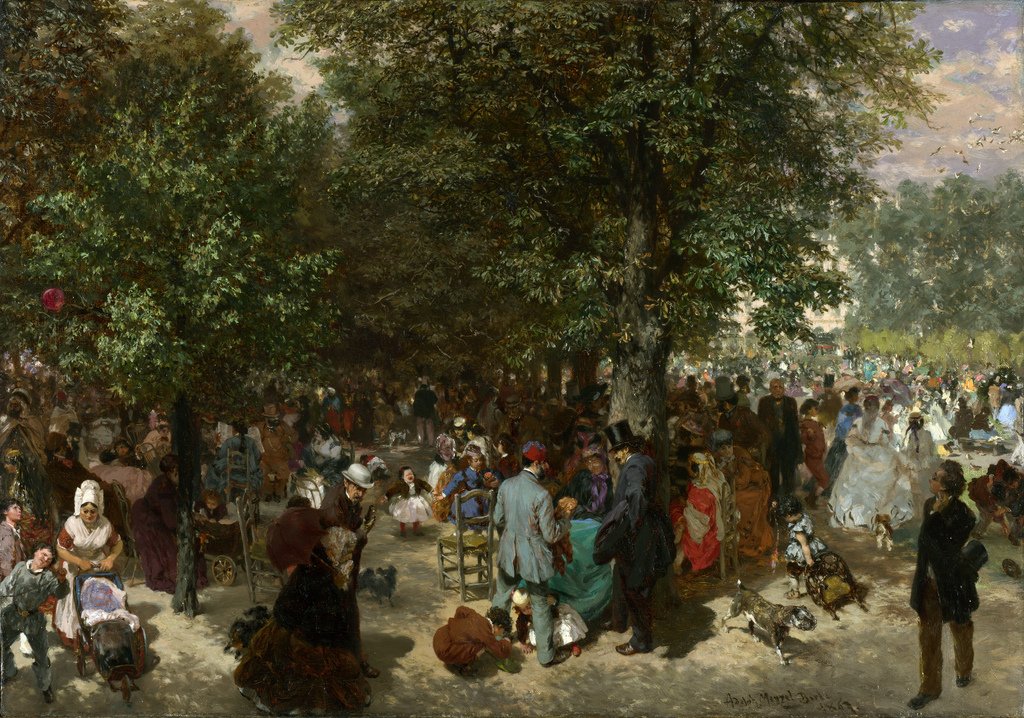
Afternoon at the Tuileries Garden by Adolph Menzel

Afternoon at the Tuileries Garden by Adolph Menzel (1867)

The featured artist in My Daily Art Display today is German and is looked upon, along with the artist I featured in my previous blog, Caspar David Friedrich, as one of the most famous and most successful German artists of the nineteenth century.  His name is Adolph Friedrich Erdmann von Menzel.

Menzel was born in 1815 in Breslau, which is now the Polish city known as Wroclau.  His father Carl Erdmann Menzel was originally a school headmaster but when young Menzel was just three years of age he gave up his educational career and started up a lithographic printing works.   Adolph Menzel first exhibited a drawing in 1827 when he was only twelve years of age and two years later he exhibited eight lithographs, which were printed in his father’s workshop and which featured the history of Breslau.   To gain more business opportunities for his printing company, Menzel’s father moved his family and business to Berlin in 1830 where he knew he was likely to receive more commissions.  Adolph Menzel became an apprentice in his father’s firm and at the age of seventeen took over the running of the company when his father suddenly died.  His mother and siblings now looked upon Adolph as the family breadwinner.
Künstlers Edenwallen

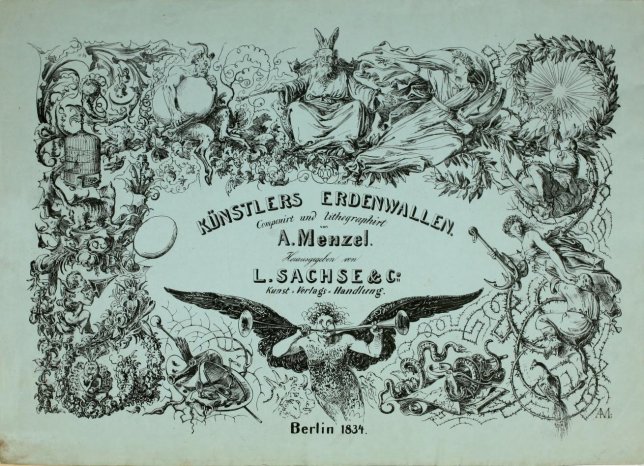
In 1833, aged 18 Menzel enrolled at the Berlin Königliche Akademie der Künste where he met the wallpaper manufacturer, Carl Heinrich Arnold, who would not only become Menzel’s close friend but would furnish him with a large number of commissions.  His reputation as an artist and illustrator grew after he had completed a commission for the art dealer and publisher, Louis Sachse, to create a number of lithographs for the German writer, Goethe, for his book Künstlers Erdenwallen.  It was not until 1837 that von Menzel started to paint in oils.  His speciality subject for his paintings was the life and events surrounding Friedrich the Great and in 1839 he was commissioned to illustrate a book,  Geschichte Friedrichs des Großen  (History of Friedrich the Great) written by Franz Kugler, a Prussian cultural administrator and art historian.  In a three year period 1839 to 1842 Menzel produced over 400 drawings.

It was not until the 1850’s that von Menzel started to travel extensively, visiting Vienna, Prague and Dresden.  It was also in 1855 that he made his first visit to Paris where he attended the inaugural Exposition Universelle, the first World Fair to be held in the capital.  It was held in the specially built building, Palais de l’Industrie, which overlooked the Champs-Elysées.  Whilst there, von Menzel, was able to study not only the industrial exhibits but also the art exhibits on display by French artists such as Gustave Courbet.  Eleven years later von Menzel returned to Paris to attend the second Exposition Universelle in 1867 and it was during this stay in the French capital that he visited the Tuileries Gardens which is the subject for today’s painting.  That same year he was decorated with the “Cross of the Légion d’honneur by Napoleon III for his service to the arts.

By the 1880’s von Menzel had established his international reputation as an artist and lithographer.  In 1884 the Nationalgalerie in Berlin held the first major retrospective of von Menzel’s work to commemorate the 50th anniversary of his career as an artist.  In 1890, aged 70, he was given an honorary doctorate from Berlin University.  He was bestowed with many other honours. He was made an honorary citizen of both Breslau and Berlin and made a member of both the Royal Academy of London and a member of the Akadémie des Beaux Arts, the Paris Academy.  His greatest honour came in 1898 when he became the first artist to be admitted to the Order of the Black Eagle as a Knight, the highest order of chivalry in the Kingdom of Prussia.

Adolph von Menzel died in Berlin in 1905, aged 89.

My Daily Art Display featured painting today is entitled Afternoon at the Tuileries Garden by Adolph Menzel.  He painted it in 1867 and now hangs in the National Gallery, London.  It was following Menzel’s 1867 trip to Paris that he returned to his studio in Berlin with many sketches of the Tuileries Gardens, which lay across from the Louvre.  He had become interested in painting scenes set in areas where society people pretentiously paraded and whilst in Paris was fascinated with the bustling social goings-on within the Gardens.  The subject matter of his paintings were at this time often depicting bourgeois society and he, because of his fame as an artist, lived the lifestyle of this very grand bourgeois.  Menzel’s painting is filled with detail and exudes a great deal of realism.

Woman and child

What I like about the works is that with so much going on in the painting your eyes flick from one group to another and every time you look at it your eyes focus on something different.  I like the number of separate vignettes taking place.  Let your eye wander up the centre of the painting and observe the little chubby girl being dragged off by the woman in blue.  How often have we seen that!   Dogs abound, in some cases having territorial disputes whilst the adults try their best to ignore such distractions and have only one thing in mind – to look their best!   When the painting was first exhibited Menzel was at pains to tell everybody that it was done from his memories of his recent visit to the French capital.

Was it a work just from memory or was there something else which prompted Menzel to depict such a scene?  In my next blog I will give you another possible motivation for Menzel’s depiction of the Tuileries Garden.  Notwithstanding what inspired Menzel to paint this lively event, which is buzzing with activity, it is a fascinating work of art.  I stood before it the other day and  I was mesmerised by what I was looking at and as I said the other day, when talking about Caspar David Friedrich’s Winter Landscape, I was so pleased I had visited Room 41 of the gallery.  The next time you visit the National Gallery; don’t forget to pay that particular room a visit.  I guarantee you will not be disappointed.

Winter Landscapes by Caspar David Friedrich

When I visited the National Gallery in London last week I knew I only had an hour to spare so decided to try and sensibly limit what I wanted to see rather than rush around trying to see as much as I could in the allotted time and end up really seeing nothing.  I decided to visit the Impressionist paintings which were housed in rooms 43 to 46.  They were awash with works by Degas, Monet, Manet, Renoir and the likes.  I spent some time in front of The Large Bathers by Cézanne as I knew I was going to write about the Philadelphia Museum of Art version of the painting which is very similar to the one in the National Gallery.  (See My Daily Art Display for March 13th).  The reason for mentioning all this is not that I am featuring another Impressionist work today but that having passed through these rooms I arrived at Room 41 which was simply entitled The Academy.

So why label this room as such?  The answer is that It goes back to the first half of the 19th century and the academic teachings of École des Beaux-Arts, which was the official art school in Paris. The training that young aspiring artists received at this establishment was very taxing and their tutors made them spend long periods drawing.  The students started by copying plaster cast statues and then later they would join the life classes. In some ways there art was regimented.  It had to conform to the rules of The Academy.  Their tutors only wanted to have them deliver what we now term academic art.   I had thought that the title of this room would mean that it would be full of works by French painters but it was not.  It was more to do with the style of paintings than the nationality of the artist and although there were a large number of works by famous French artists such as Corot, Delacroix, Géricault, and Jaques Louis-David there were some non-French contributors such as the Spanish painter, Francesco Hayez, the Danish painter Christen Købke and the German painter, Johann Philipp Eduard Gaertner.  However I came across a painting in this room, entitled Winter Landscape,  by one of my favourite artists, Caspar David Friedrich and it is this painting along with two of his other works, which are connected to this painting that I want to feature in My Daily Art Display blog today.   Caspar David Friedrich studied at the Royal Danish Academy of Fine Arts at the end of the eighteenth century.  This Academy is the oldest and most renowned place of higher learning in Denmark.

Caspar Friedrich was one of the leading artists of the German Romantic movement.  He specialised in landscape painting but with a difference.   His aspiration as a landscape artist was not to be a topographical artist portraying true representations of what he saw but he wanted his paintings, as he once said, “to reflect the artist’s soul and emotions in the landscape”.  He endowed his landscape works with symbolism and the natural elements in his work often took on a religious connotations.

There is something about all Friedrich’s paintings which make them so evocative.  I find his works of art breathtaking and I stood before this painting and marvelled how such a painting could exude an overwhelming feeling of both wonderment and awe.  As we have seen with other artists, they would often paint a number of versions of the same subject.  In some cases the difference between the various versions would be very noticeable in others the differences would not be so obvious. Two of today’s painting fall into the latter category.  The two paintings, Winter Landscape and Winter Landscape with Church look almost the same, but not quite.  To confuse things slightly I am also going to look at another work of his, also entitled Winter Landscape, which is almost a prequel to the other two.  Sounds confusing?  Let us take a look at each of the works.

Winter Landscape by Caspar David Friedrich (Schwerin) 1811

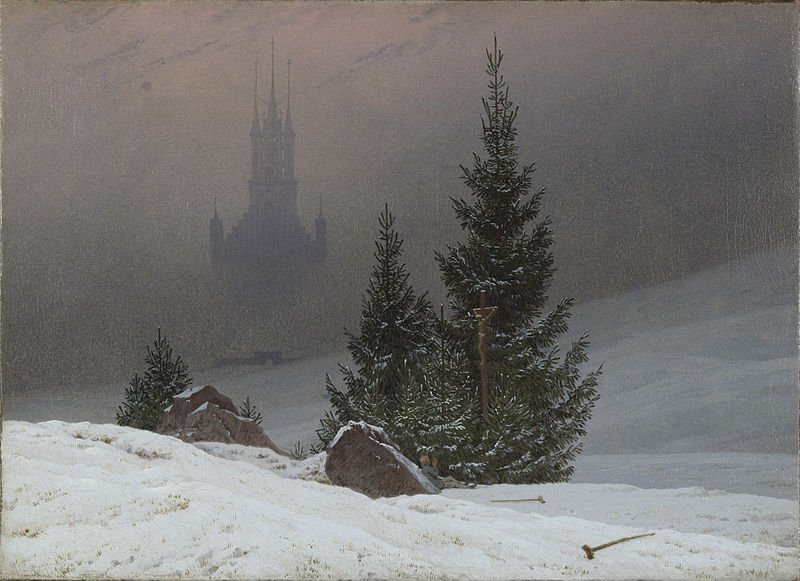
The oil on canvas painting, above, entitled Winter Landscape, can be found in the Staatliche Museum in Schwerin and was painted by Friedrich in 1811.   This painting has an intense feeling of solemnity and pathos as we look out at a bleak winter scene with a snow covered ground stretching out as far as the eye can see.  This melancholic depiction before us, with its threatening dark grey sky features a tiny old man, bent over and leaning on his two wooden crutches. He is standing between two gnarled tree trunks and into the distance we can see the stumps of trees which have been cut down.  Some art historians would have us believe that we should interpret this as being symbolic of the end of life and see the painting as an allegory for the aged man coming to end of his life as the landscape and vegetation also have reached the end of their life cycle.   So looking at this work are we to believe there is no hope for this man?  Probably so, but then Friedrich decided to paint a companion piece.  In fact that same year, 1811, he painted two companion pieces which follow up the story of the little old man. These two works depicted a tale of the old man’s salvation.

Winter Landscape by Caspar David Friedrich (National Gallery, London) 1811

One of the companion paintings was again entitled Winter Landscape and is housed in Room 41 of the National Gallery, London.  This work was discovered in a private collection in 1982, and was acquired by the National Gallery five years later.   The second one, thought to be a copy of the London painting, is entitled Winter Landscape with Church, and can be found in the Museum für Kunst und Kulturgeschichte (Museum of Art and Cultural History) in Dortmund.   In both of these paintings we see that Friedrich has introduced, for the first time in his art work, a Gothic church, which can just be seen emerging out of the misty backdrop with the somewhat red-streaked threatening winter sky overhead.   In the mid-ground we see a man leaning back against a boulder and is probably the same man we saw leaning on his crutches in the previous work.  He had arrived at the end of his journey and we see him gazing up, in prayer, at the crucifix which is positioned in front of a cluster of young fir trees. The figure of Christ on the cross looks down upon him.  In the foreground we see his crutches lying in the snow, which we presume he has discarded.  The abandoned crutches and the man looking up devotedly at the crucifix are interpreted as the man’s blind faith in his Christian beliefs and his feeling of security he has derived from those dearly held values.

In the first painting we looked at there is little to see but dead trees and stumps of once large ones.  We felt for the crippled man as he stood bent over his crutches in that wintry landscape and in a way we grieved for his unwanted solitude and wretchedness.  However in this scene before us now we see him in prayer and for him, we begin to realise he has reached the place he wants to be.   The mood of the painting is so different from the previous one.  The snow is the same. We still almost feel the coldness of the scene but the atmosphere has changed.  The once hopelessness has been replaced with a degree of hope.  The figure of Christ on the cross is symbolic of the hope that his resurrection would bring.  No longer does the man feel the necessity of wooden sticks to act as crutches.  The only support he wants is that given to him by his belief in Christ.

Looming on the horizon we see the facade of the spires of the grand Gothic church which reach toward the heavens, the silhouette of which has a marked similarity to that of the fir trees.  These trees along with the rocks we see appearing from beneath the snow in some ways symbolise faith and the large Gothic church, which appears to be rising from the ground, is symbolic of our belief that there is life after death.

Friedrich used few colours in these two paintings as he was more interested in the graduating tones of the few colours he used.  On a close examination of the actual paintings we are able to see that the misty but iridescent background has been achieved by stippling.  Stippling, in this case, is the creation of shading by using small dots.  The dots are made of a pigment of a single colour, and for this work the artist has used, the blue pigment, smalt, and has applied it with the point of a brush.

Winter Landscape with Church by Caspar David Friedrich (Dortmund) 1811

The London version of the painting is different to the version in Dortmund in as much as Friedrich has shown small blades of grass pushing up through the melting snow.  This symbolises hope and rebirth.   Also in the London version of the painting Friedrich has added an arched gateway in front of the church.

In November 1811 Friedrich sent these three works along with six others to an exhibition in Weimar.  This was the largest group of works shown by Friedrich so far.  The works were admired by a number of critics and poets, writers and famous figures like Goethe and Ludwig Tieck but they had their detractors who were opposed to the way Friedrich treated religious subjects and landscapes.

The Tribuna of the Uffizi by Johan Zoffany (part 2)

Tribuna of the Uffizi by Johan Zoffany

Thomas Beckford, the celebrated English art collector and novelist, wrote of the Tribuna of the Uffizi:

”…I fell into a delightful delirium which none but souls like us experience, and unable to check my rapture flew madly from bust to bust and cabinet to cabinet like a butterfly bewildered in a universe of flowers…’’

For anybody who has just clicked on this page you need to look at the previous blog first as this is a follow-on blog and will not really make sense if you had not read the previous one.

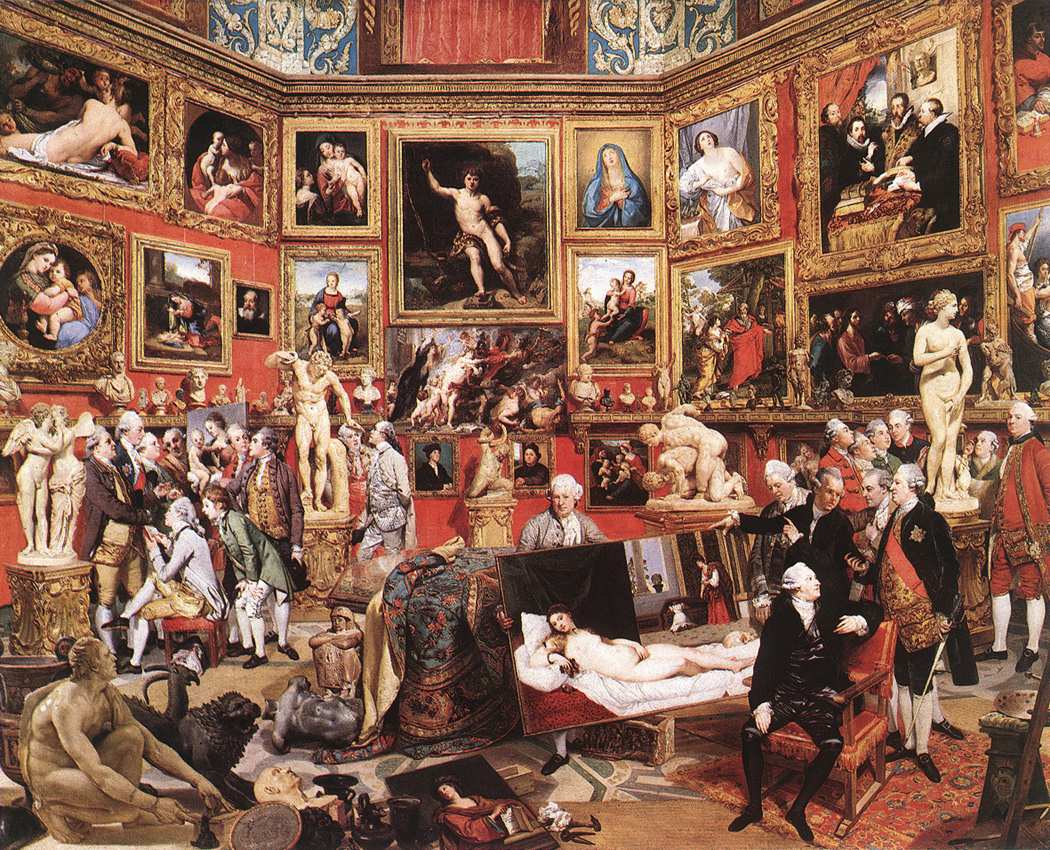
In this blog I am going to reveal the names of the paintings which formed part of the main work by Johan Zoffany entitled The Tribuna of the Uffizi but first, I will introduce you to some of the characters Zoffany included in his work.  It was the inclusion of some of these people, which upset his patrons, King George III and his wife Queen Charlotte.

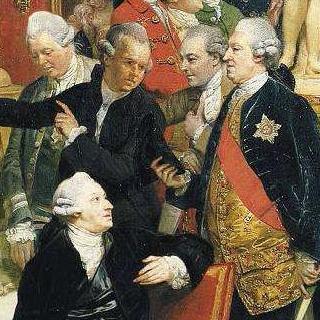
If we look at the central foreground we have six gentlemen clustered around the Venus of Urbino painting by Titian.  The gentleman seated is the Honourable Felton Hervey who was the ninth son of the 1st Earl of Bristol and who was Equerry to Queen Caroline of Ansbach, wife of George II, and had passed through Florence on his Grand Tour in 1772.

The two gentlemen, dressed in black standing behind the chair are, on the left with his right hand on the painting and his left hand pointing towards the Roman marble sculpture, The Wrestlers, is Thomas Patch.  The man on the right is Sir Horace Mann, British envoy to the Grand Duchy of Tuscany.  It was the inclusion of these two gentleman that upset George III and his wife.  Thomas Patch was an English painter, engraver and caricaturist. He travelled to Rome, where he met Joshua Reynolds and worked in the studio of Joseph Vernet, producing pastiches of Vernet’s work and his own views of Tivoli. However, in 1755 Patch was banished from the Papal States for some homosexual act and settled in Florence.   Here he earned a living undertaking art commissions from well-off young British men who were passing through Florence and Rome on Grand tours.

Sir Horace Mann was a diplomat and long standing British resident in Florence.  He kept an open house for British visitors at Florence, inviting them for conversazione, which were formal gatherings where something related to the arts was discussed when there was no performance at the theatre. His generosity and kindness was universally acknowledged, although his close friendship with the painter Thomas Patch sullied his reputation.  The two gentlemen in the fawn coats, both Grand Tourists, are Valentine Knightley of Fawsley, who stands between Patch and Mann and John Gordon who looks at the Titian painting, over the arm of Thomas Patch.  The man standing behind the painting is Pietro Bastianelli, who was a custode (custodian) of the Uffizi Gallery.

To the left of painting we see six men clustered around the Niccolini-Cowper Madonna which was painted by Raphael in 1508 and according to the provenance of the painting was bought by Zoffany in 1772, who resold it three years later.  After changing hands a number of times, the painting came into the possession of Andrew Mellon, the American banker, industrialist, philanthropist and great art collector.  On his death in 1937, the painting was bequeathed to the National Gallery of Art in Washington.  The four men to the left of the painting are from left to right, George, 3rd Earl Cowper, Prince of the Holy Roman Empire and avid art collector and frequent visitor to Florence.  Next to him is Sir John Dick, Baronet of Braid and was, at the time, British Consul at Leghorn and next to him looking up at the painting is Other Windsor, the 6th Earl of Plymouth who was known to have been in Florence in the first half of 1772.

Standing to the left and just looking around the Madonna painting is the artist himself, Johan Zoffany, who would often include himself in his group portraits.  The two men standing to the right of the Madonna are a Mr Stevenson, dressed in a red dress coat, who was the travelling companion to George Legge, Lord Lewisham, the portly man with the gold-coloured waistcoat, who stands next to him.  Legge was a member of the royal court of George III and he and Stevenson were known to have been in Florence in 1777.  The man, sitting sketching, is the artist,  Charles Lorraine-Smith and looking over his shoulder is Richard Edgcumbe who went on to become the 2nd Earl of Mount Edgcumbe.  He was a writer on music and also later in life became a politician

The final grouping on the right hand side of the painting are clustered around the Venus de’ Medici, a life-size Hellenistic marble sculpture depicting the Greek goddess of love Aphrodite.   It is a 1st century BC marble copy, perhaps made in Athens, of an original bronze Greek sculpture.  It was the grouping of these men staring at the posterior of Aphrodite and the lewd comments made by many of the Grand Tourists about the sculpture that offended Queen Charlotte as I explained in the previous blog.  The four men standing behind the statues and gazing up at “her” are from left to right, George Finch, the 9th Earl of Winchilsea,  a great cricket lover and patron to the sport and Messrs. Wilbraham, Watts and Doughty all of whom visited Florence on their Grand Tour between December 1772 and February 1773.  Standing in front of the Venus de’ Medici are, on the left Thomas Wilbraham, who was accompanying his brother and on the right, James Bruce the Scottish traveler and travel writer who had spent the previous dozen years in North Africa and Ethiopia, where he traced the origins of the Blue Nile.  He was known to have been in Florence in 1774.

And now to the paintings that are on display.  How many did you recognise?  I have already mentioned Titian’s Venus of Urbino and Raphael’s Niccolini-Cowper Madonna and here is a list of the others which Zofanny included in his painting.

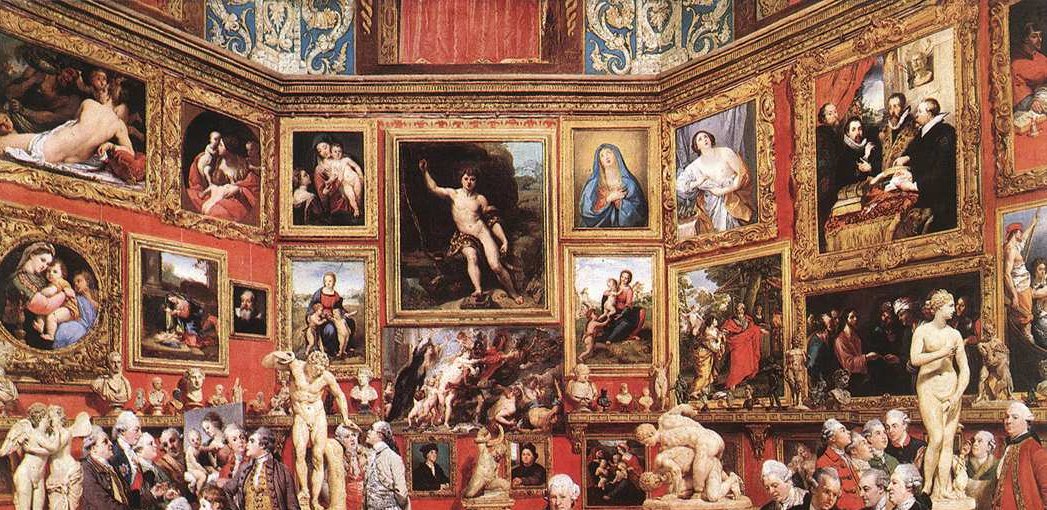
On the left-hand side wall there are two large paintings hanging above three others.  The upper paintings from left to right are Bacchante by Carracci and Charity by Guido Reni.  The three paintings below from left to right are Madonna della Sedia by Raphael, Virgin and Child by Correggio and Galileo by the Flemish painter, Justus Sustermans.

On the wall facing us there are nine paintings.  The three on the upper level from left to right are Madonna and Child with Saint Catherine by the School of Titian, the large painting in the middle is Saint John by Raphael and the upper right work is The Madonna by Guido Reni.  The middle layer of paintings on this wall, from left to right, comprises of Madonna del Cardellino by Raphael.  In the middle is Horror of War by Rubens and to the right is Madonna del Pozzo by the Florentine painter, Francesco di Christofano, better known simply as Franciabigio.  The three smaller paintings below eye-level on this wall are, from left to right, Sir Richard Southwell by Hans Holbein, Portrait of Verrocchio by Lorenzo di Credi but has since been identified as a Raphael’s portrait of Perugino and Holy Family by Niccolo Soggi.

Finally on the wall to the right there are a further six painting although the two works of art on the extreme right are partly hidden.  The three on the upper tier are from left to right, Cleopatra by Guido Reni, The Painter with Lipsius and his pupils by Rubens and Leo X with Cardinals de’ Medici and de’ Rossi by Raphael.  The three works on the lower tier are from left to right, Abraham and Hagar by Pietro da Cortona which is now hanging in the Kunsthistoriches Museum in Vienna.  In the middle hangs The Tribute Money attributed to the School of Caravaggio and on the right is The Miracle of Saint Julian by Cristofano Allori.

The only other painting not mentioned as yet lies face up on the floor in the foreground just to the left of the Venus of Urbino and is The Samian Sibyl by the Italian Baroque painter, Giovanni Francesco Barbieri, better known as Guercino or Il Guercino.

I apologise for so much detail in one blog but I hadn’t realised it would be so complicated to try and describe what was in front of our eyes!!

The Tribuna of the Uffizi by Johan Zoffany

The Tribuna of the Uffizi by Johann Zoffany (1772-77)

Johan Zoffany was born Johannes Josephus Zoffaly in Frankfurt-am-Main in 1733.  His father Anton Zoffaly was a court cabinet maker and architect to Alexander Ferdinand, Prince of Thurn and Taxis and it was at the Prince’s court that young Johan was brought up.  When the Prince took up residence in Regensburg, Zoffany served as an apprentice to the local painter, Martin Speer.  In 1750, at the age of 17 when he had completed his apprenticeship Johann travelled to Rome and studied with the portrait painter, Agostino Masucci.  In 1757, now back in Germany, Zoffany was commissioned by the Elector of Trier to paint frescoes and paintings for his new palace at Trier and his Ehrenbreitstein Palace in Koblenz.

In 1760 Zoffany travelled to London.  Here he was initially employed by Benjamin Wilson, the painter and printmaker and it was from his connection with Wilson that Zoffany came to the attention of one of Wilson’s patrons, the actor and theatre impresario, David Garrick, and he commissioned Zoffany to paint a number of theatrical works which featured the actor in famous theatrical roles.  Garrick also had Zoffany paint some conversation pieces of he and his wife set in the grounds of his Hampton estates.  The term Conversation Piece is an informal group portrait, often full length but usually small in scale in a domestic interior or garden setting and was a very popular art genre in 18th century England.   They would often portray a group of people apparently engaged in genteel conversation or some activity.  Usually the group would be members of a family, but sometimes friends would be included.  In some conversation pieces groups of friends or members of a society were depicted.  It was for these works that Zoffany made his name in England.

Zoffany’s fame spread among the London elite and commissions started to roll in for his portraiture and conversation pieces.  One such commission came from the Prime Minister, John Stuart, the 3rd Earl of Bute, who wanted Zoffany to paint portraits of his three sons and another portrait of his three daughters.  It was thanks to Bute that Zoffany was introduced to King George III and his wife Queen Charlotte in 1763.  Both were impressed by his work and commissioned Zoffany to paint portraits of their family.  The Royal Academy of Arts had been founded in December 1768 through a personal act of King George III.  Its task was to promote the arts of design in Britain through education and exhibition.  There were originally thirty four founder members, with Sir Joshua Reynolds its first President.  The rules stated that there would be forty Academicians.  In a Council of the Royal Academy in November 1769 it was reported to those present that “his Majesty had been pleased to appoint Mr Johan Zoffany to be one of the forty Academicians”.  Zoffany was now a Nominated Member of the Academy.

The Portraits of the Academicians of the Royal Academy by Johan Zoffany (1771-2)

George III also set him a task to paint a group portrait of the Royal Academy members which Zoffany duly completed in 1772 and was entitled The Portraits of the Academicians of the Royal Academy.  Zoffany himself is seen with brush and palette in his hand at the far left of the painting.  The king and his wife were delighted with the painting and Queen Charlotte commissioned Zoffany to paint an even larger and more elaborate conversation piece set in the Tribuna of the Uffizi, which would depict the art treasures held within the octagonal room.   Zoffany travelled to Italy to carry out the commission in 1772 and did not complete the ambitious work until 1777.

Zoffany returned to England with his masterpiece but was distressed to find that his genre of conversation pieces had gone out of vogue and his work was no longer required by his wealthy and fashionable clients.  He could have reverted to his other artistic forte, that of portraiture, but at the time he had many very successful rivals for that type of work, such as Thomas Gainsborough and Joshua Reynolds as well as the emerging “new kid on the bloc” George Romney.

By 1783 Zoffany had all but given up hope of receiving commissions for his work in England and decided to travel to India in his search for rich patrons.   For the next six years Zoffany bided his time in the sub-continent travelling between Calcutta and Lucknow completing commissions he received from the wealthy British colonials and the local Lucknow aristocracy.  Once again he had the opportunity to carry on with his beloved conversation pieces.  Such was the popularity of his work that he was inundated with commissions and by the time he returned to England in 1789 he had made his fortune.

Zoffany died in 1810, aged 77.  He was one of the greatest exponents of the English Conversation piece with its Rococo flamboyance and will also be remembered for the charm of his theatrical works depicting scenes from popular plays of the day.

My Daily Art Display featured painting today by Zoffany is looked upon as one of his greatest works.  It is his grand conversation piece entitled The Tribuna of the Uffizi, which he started in 1772 and completed in 1777.   Going to Italy at the behest of his Royal patrons, George III and his wife Queen Charlotte, to paint this work had not been his original plan as in 1772 he had hoped to secure a passage on Captain Cook’s vessel when he set sail on his second voyage to the South Seas but the offer of a sea voyage never materialised and so he took up the commission from Queen Charlotte to travel to Florence and record in a painting the collection of art and sculpture which the Grand Duke of Tuscany had put together in the Tribuna of the Uffizi Gallery in Florence.  Queen Charlotte had envisaged this work would be a pendant to Zoffany’s earlier work owned by the English rulers entitled Academicians of the Royal Academy which he completed in 1772 and was well received by the royal family.

The Tribuna was an octagonal room within the Uffizi Gallery, designed in the late 1580’s by Bernardo Buontalenti in which the art collection of Francesco de’ Medici would be housed.  In 1737 it came into the possession of Pietro Leopoldo, Grand Duke of Tuscany.  The commission was a great challenge to the talents of Zoffany as the Tribuna art collection was one of the greatest in all Europe.  Was it a true reproduction of what was there at the time?   Not quite, as Zoffany had to experiment and alter the perspective of the room in order to incorporate all the various pieces of sculpture and in some cases he had to reduce the size of individual pieces.  The collection of art in the Tribuna during the time Zoffany was painting it was also going through a slight reorganisation and this gave him the excuse to make his own decision as to what would be on display.   In doing so he omitted some paintings which were actually on display and added others which although housed in the Uffizi were never hung in the Tribuna.  One of these was Titian’s Venus of Urbino which we see in the central foreground.  There were also a number of paintings by Guido Reni which were housed in the Pitti Palace but were transported to the Uffizi just for Zoffany to copy!

There are twenty five paintings shown in this work.  How many can you identify?   All I will tell you is that amongst them there are six by Raphael, three by Guido Reni, two by Titian, two by Rubens and one each by Carracci, Corregio and Holbein.

Besides the works of art, sculptures and other artefacts, the painting is populated by no fewer than twenty two men all of whom were either connected with the Uffizi Gallery or were a miscellany of Grand Tourists.  So who were these Grand Tourists and what was the Grand Tour?  The Grand Tour was the traditional trip around Europe taken by mainly upper-class wealthy young European men, although primarily the term is associated with the British elite and nobility.   It reached the height of its popularity in the seventeenth and eighteenth century and it was a kind of rite of passage for this wealthy elite.   One amusing aspect of Zoffany’s inclusion of the men was that during the many years he worked on the painting he would add and remove people as he saw fit and would tell some of the travellers they had to sit for him as the George III had specifically asked for their portrait to be included.  Of course that was never the case.  The one thing Zoffany was adamant about was that he would not portray a woman within the group.  It is thought that this could be due to the fact that he incorporated some lewd visual jokes into the painting.   Look at the group of men to the right who are staring at and fascinated by the backside of the Venus de Medici.  This sculpture had been well-known for the lewd comments made about it by the Grand Tourists.  In Vicci Coltman’s book entitled Classical Sculpture and the Culture of Collecting in Britain since 1760 she quotes a comment made by Charles Townley, the English country gentleman and antiquary who had made a couple of Grand Tours whilst Zoffany was painting his masterpiece.  Townley had said that he had been told that:

“…the sight of the Venus in the Florence Gallery will give you some yammering after a Tuscan Whore…”

It was not just the heterosexual innuendos that made Zoffany’s painting risqué, but his addition of two well known homosexuals, Thomas Patch, in the right foreground in conversation with another homosexual, Sir Horace Mann.  Patch is pointing at the sculpture The Wrestlers and their addition in the painting was to prove a step too far.

Zoffany returned to England in 1779 and delivered the painting to his royal patrons.   Queen Charlotte was horrified to see the room cluttered by so many men and worse still to incorporate lewd innuendos of both a heterosexual and homosexual nature.  She was especially shocked that Zoffany had included portraits of the two infamous homosexuals into the scene.  George III reluctantly paid for the work but had it placed out of sight in a room in Kew Palace.  The artist Joseph Farrington was active in the social, cultural, and professional art world of his time and he kept a daily diary from 13 July 1793 until his death, missing only a few days. This diary often referred to the London art world. The diary eventually constituted 16 volumes and in one of the volumes Farrington recounts a conversation between George III and the artist William Beechey in which he quotes the king as saying of Zoffany’s Tribuna of the Uffizi:

“…[The King] expressed wonder at Zoffany having done so improper a thing as to introduce the portraits of Sir Horace Man[n], [Thomas] Patch, & others, who were considered as men addicted to improper practices – He sd. The Queen wd. Not suffer the picture to be placed in any of Her apartments…”

It is thought it was not so much that Zoffany took it upon himself to add the twenty two Grand Tourists into the painting but it was the character of some of them that shocked and offended George III and his Queen.  Zoffany never again received a royal commission and from that day on lost their patronage.

This is a beautiful work and one of unbelievable detail.  I stood before it yesterday when I visited the preview of the Johan Zoffany RA, Society Observed exhibition at the Royal Academy in London.  If you are in London you should make a point on visiting this exhibition which runs until June 10th.

Tomorrow I will give you the answer to the names of the paintings and the artists who painted them

Ideal Landscape near Rocca Canterana by Carl Philipp Fohr

Ideal Landscape near Rocca Canterana by Carl Philipp Fohr

My Daily Art Display today looks again at a German painter who was born at the end of the 18th century and is acknowledged as one of the most significant landscape painters of German Romanticism.  His name is Carl Philipp Fohr.

Fohr was born in Heidelberg in 1795.   His first art tuition was under the tutelage of Carl Rottmann, the genre and veduta painter, when he was aged thirteen.  It is said that when Fohr was fifteen years old the Darmstadt Court Councillor, Georg Wilhelm Issel, discovered him sketching at Stift Neuberg near Heidelberg and it was because of that and because Issel recognised the young man’s artistic potential, the following year Issel invited Fohr to come to Darmstadt and he provided him with both encouragement and financial support to continue with his artistic studies.   From 1813 Fohr received a number of commissions for paintings for the Grand Duchess Wilhelmina of Hesse, and it was for her that Fohr produced the Sketchbook of the Neckar Region, which consisted of a collection of watercolours of views and historical subjects of the region and a year later produced a similar sketchbook of the Baden area.  Such was the quality of his work that Fohr received an annual pension of 500 guilders from the Grand Princess. 

In 1815 Fohr became a student of landscape painting at the Kunstakademie in Munich, and it was here that his breakthrough into an independent and original drawing style came about.   He only remained at the Academy for a year as in 1816 he decided to embark on a walking adventure through Northern Italy which was to eventually take him to Rome.   It was whilst there that he came in contact with the group of artists, known as the Nazarene Brotherhood.  The brotherhood’s original members were six Vienna Academy students, four of whom, Friedrich Overbeck, Franz Pforr, Ludwig Vogel, and Johann Konrad Hottinger, moved to Rome in 1810, where they occupied the abandoned monastery of Sant’Isidoro.   Later they were joined by Peter von Cornelius, Wilhelm von Schadow, and others who at various times were associated with the movement.   The Nazarenes believed that all art should serve a moral or religious purpose; they admired painters of the late Middle Ages and early Renaissance and rejected most subsequent painting which were beloved by the European academies, believing that it abandoned religious ideals in favour of artistic virtuosity. They also thought that the mechanical routine of the academy system could be avoided by a return to the more intimate teaching situation of the medieval workshop.   For this reason, they worked and lived together in an almost monastic existence.    So where did the name, Nazarenes, come from?   Actually it was a derisory nickname they acquired because of their affectation of biblical style of hair and dress. The main aim of the Nazarenes was to revive the medieval art of fresco painting.   Fortune looked down favourably on the group as they received two important commissions to carry out the fresco decoration of the Casa Bartholdy in 1816 and a year later to carry out similar work in the Casino Massimo in Rome and their beautifully skilled work on the two projects brought their work to international attention.   However by the time the second project had been completed the Nazarene Brotherhood had all but disbanded.  The legacy of this group was that of honest expression of deeply felt ideals and it was to have an important influence on subsequent movements, particularly the English Pre-Raphaelites of the mid-19th century.

So where did Fohr go next for inspiration?   Sadly, Fohr’s life ended in tragic circumstances when in 1818, at the young age of twenty-three he drowned whilst swimming in the River Tiber.  Even sadder was the fact that his legacy to the world was only five oil paintings.

Today’s featured painting is The Ideal Landscape near Rocca Canterana and is one of Fohr’s best-known paintings, which he completed in 1818, the year of his death.   The painting shows a rocky pastoral landscape in the central mountains of Italy.  In the foreground, we can see a path which winds past craggy rocks and old, gnarled trees.   On this path we see a country girl dressed in some sort of festive costume.  In her arms she carries a young child, whilst hand in hand with another child, who is balancing a jug on her head.   If you look to the right middle-ground, under the trees, we can see a group of pilgrims who are heading towards a distant and illuminated valley.  The woman and children have just been passed by two shepherds who are heading for what Fohr has depicted as a peaceful, hilly region rimmed by steep mountains.

This painting is so like the old Arcadian landscape paintings of the past, which emerged in the Renaissance and which were inspirational to later artists who wanted to depict a “paradise on earth” theme to their works.  Fohr’ paradise on earth is emphasised by his inclusion of the pilgrims which alludes to the Christian Heaven.   The people in Fohr’s painting, who we see wandering around the landscape symbolise the journey we have to make on this earth before we die and  Fohr, in a way, is trying to remind us of the transience of all earthly things and the journey into the future, which some believe is the true goal and reason for human existence.

The picture in some ways is very simplistic but I hope you like it.

Die Teufelsbrücke or the Devil’s Bridge by Karl Blechen

Pont Valentré at Cahors

I will start My Daily Art Display today with a look at a local folklore that of the Devil’s Bridge.  Like most folklore there is not simply one version of the tale but many different versions of it depending on which country the structure is situated.   The first time I came across this phenomenon was when I visited Cahors in France and went to see the spectacular 14th century Pont Valentré Bridge.

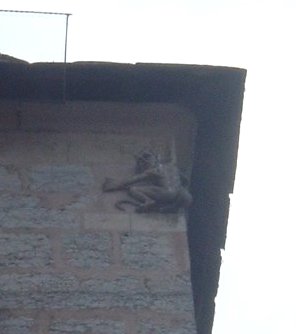
The Devil clinging to one of the towers of the Pont Valentré

Built in 1308 and completed seventy years later it became associated with the legend of the Devil’s Bridge and the architect Paul Gout made reference to this by placing a small sculpture of the devil at the summit of one of the towers.

The folklore of the Devil’s Bridge is all about the Devil, a bridge builder and his bridge.  The main gist of the story is that a bridge builder sets about building a bridge across a river or river gorge, but at some point in the building of the structure the bridge builder realises he hasn’t the strength or time to complete the task and has to turn to the Devil for assistance.  The price levied by the Devil for his assistance is that he should receive the first soul that crosses it.

Die Teufelsbrücke by Karl Blechen

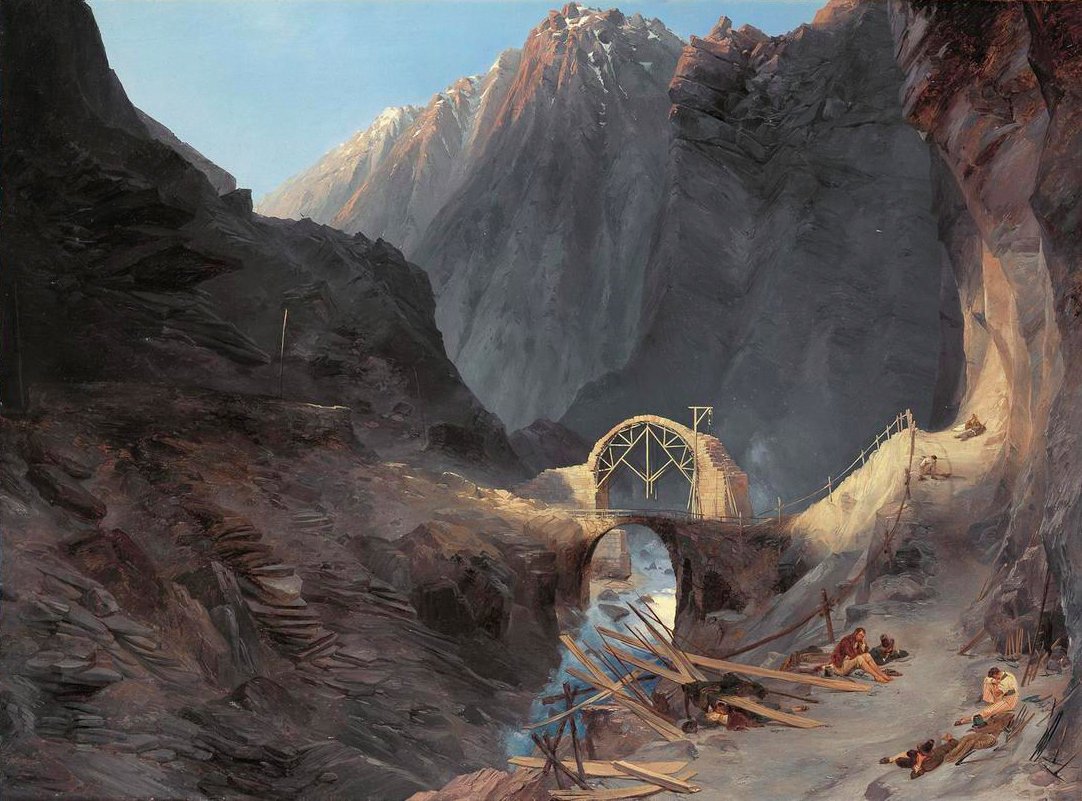
In my featured painting, Teufelsbrücke or Devil’s Bridge painted by the German Romantic artist, Karl Blechen, in 1832.  In the painting we see the Devil’s Bridge straddling the Swiss River Reuss as it passes through the Schöllenen Gorge on its way to Lake Lucerne.   The legend of this particular Devil’s Bridge states that the river was so difficult to cross that a Swiss goat herdsman asked the Devil to make a bridge. The Devil duly appeared, but required that if he should construct the bridge, the soul of the first to cross it would be given to him. The herder agreed, but instead of crossing the bridge first and risk losing his soul he drove a goat across ahead of him, thus tricking the devil.   The Devil was so angry that he had been duped he fetched a rock with the intention of smashing the bridge, but an old woman drew a cross on the rock and this prevented the Devil from being able to lift it.    The rock is still there and, in 1977, 300,000 Swiss Francs were spent to move the 220 ton rock by 127 m in order to make room for the new Gotthard road tunnel.

Karl Blechen was born in Cottbus in 1798.   His father was a local tax collector and Karl started his working life as a minor bank official.  It was not until he was aged twenty four that he began to study art.  In 1822 he enrolled at the Akademie der Künste, Berlin (Academy of the Arts).  Later when he was working in Dresden as an apprentice in an art studio he was befriended by two artists also based in the city , the German painter, Caspar David Friedrich and the Norweigen artist, Johan Christian Dahl who were leaders in the fields of art known as Romanticism and Realism.   My Daily Art Display has featured some of their works and they are well worth viewing.   Their styles would influence Blechen in his future works.   In 1828 he travelled to Italy where he remained for a year studying art and in particular, oil painting.  It was here that he was introduced to the en plein air style of painting and was influenced by the works of English landscape painter, Turner who was also in Italy at this time and by the French landscape painter, John-Baptiste Corot, who at this period in time, lived in Italy.  He returned to Germany and in 1831 and was awarded a professorship at the Berlin Academy.   Despite this academic recognition the sales of his work were disappointing and this depressed him.  His depression and mental state deteriorated and four years later, at the age of thirty-seven he was diagnosed as being mentally unstable.  Blechen died in 1840 in Berlin, a broken man, aged forty-two.

When Karl Blechen visited Italy his journey fostered an interest on visual phenomena and how light and colour effects landscapes.  A number of his paintings were categorised as being of a Romantic genre.  The Romantic artists, of which Blechen was one, applauded individualism, subjectivism, irrationalism, imagination, emotions and nature – emotion over reason and senses over intellect.  Whilst Blechen was returning back to Germany he travelled along the St Gothard’s pass and the Teufelsbrücke was still being built.  This Devil’s Bridge depicted by Blechen in his painting is enclosed by snow-capped mountains which soar into the sky and below them we can see the raging torrents of the Reuss River.  I think what I like most about this painting is the beautiful way in which Blechen has depicted the sunlight penetrating a gap in the mountains to light up the bridge and some of its builders.  It is as if somebody has switched on a spotlight to illuminate the scene.  In the central mid ground we see the arch of the old bridge and the partly constructed arch of the new one with its scaffolding.   The illuminated partly-built new arch is dwarfed by the mountains and one wonders whether its frailty and exposed position will be able to withstand the forces of nature when gale force winds relentlessly charge down the valley.    There is also a sensation of remoteness about the scene.  We are aware that we are miles from civilisation but can marvel in the savagery of nature.  In the right foreground we see some of the bridge builders taking a well earned rest from their labours amongst all their building materials.

Karl Blechen has managed to create an image which is both awe-inspiring and beautiful and one which makes us realise how small we are in comparison to our surroundings.   This awesome painting by Karl Blechen, which I have featured today,  hangs in
the Bavarian State Picture Collection housed in the Neue Pinakothek in Munich.


Lot and his Daughters by Lucas Cranach the Elder

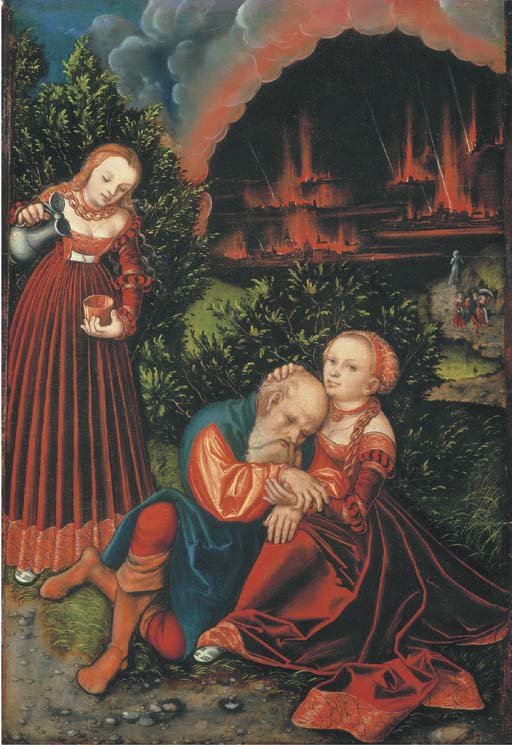
Lot and his Daughters by Lucas Cranach the Elder (C.1530)

My Daily Art Display today starts with a passage from the Bible.  It is from the book of Genesis (19: 30-38) and tells the story of Lot and his two daughters who we see in the painting above, entitled Lot and his Daughters which was painted by the great German Renaissance painter,  Lucas Cranach the Elder around 1530.  The Bible passage sets the scene:

30 Lot and his two daughters left Zoar and settled in the mountains, for he was afraid to stay in Zoar. He and his two daughters lived in a cave. 31 One day the older daughter said to the younger, “Our father is old, and there is no man around here to give us children—as is the custom all over the earth. 32 Let’s get our father to drink wine and then sleep with him and preserve our family line through our father.”

33 That night they got their father to drink wine, and the older daughter went in and slept with him. He was not aware of it when she lay down or when she got up.

34 The next day the older daughter said to the younger, “Last night I slept with my father. Let’s get him to drink wine again tonight, and you go in and sleep with him so we can preserve our family line through our father.” 35 So they got their father to drink wine that night also, and the younger daughter went in and slept with him. Again he was not aware of it when she lay down or when she got up.

36 So both of Lot’s daughters became pregnant by their father. 37 The older daughter had a son, and she named him Moab; he is the father of the Moabites of today. 38 The younger daughter also had a son, and she named him Ben-Ammi ; he is the father of the Ammonites of today.

Not being a reader of the Bible, nor being particularly religious, I was surprised to read the passage from Genesis, as on first seeing the painting, which is housed at Compton Verney in Warwickshire, I believed it to be simply a picture of two girls, one comforting a tired-looking old man whilst the other was bringing him something to drink.

It is known that Lucas Cranach the Elder painted this Old Testament subject on  at least four occasions and many other artists have depicted this same story in their paintings.  The early part of Chapter 19 of Genesis relates the story of how God destroyed the two cities of Sodom and Gomorrah, which are shown in flames in the background of the painting.  To save the righteous people of the two cities, God sent down two angels to lead Lot, his wife Edith, his nephew Abraham and his family away from the doomed cities.  The two angels warned Lot that they should quickly escape but nobody should look back on the burning cities but as we know Lot’s wife did and was turned into a pillar of salt and we see the grey pillar of salt in the right middle-ground of the painting.

In the foreground we have Lot on one knee his arms resting on the knees of one of his daughters, who rests her hand on his head, trying to console him after the loss of his wife.  As the biblical tale tells us the daughters, Pheiné and Thamma, fearing that with the destruction of all the people of the city they will not have the chance to bear children and their father will thus never have a male heir.  With that in mind they decide that their father should make them pregnant and so on two consecutive nights they got Lot drunk and had him make love to them.  The daughters became pregnant and each had a son, Moab and Benammi.

This is really a story of two females taking decisions about their own destiny rather than leaving it to a male to decide what should happen to them and their lives.  Stories of female domination over men were very popular in the late Middle Ages and could not only be seen in paintings, but could be read about in literature, and words of songs and plays of the time.

I am a great fan of both Cranach the Elder and his son Lucas Cranach the Younger and find their paintings

Crossing at the Schreckenstein by Ludwig Richter

Crossing at the Schreckenstein by Ludwig Richter (1836)

About five or six years ago I was fortunate enough to be having a short break in Europe  and one of my journeys was from Dresden to Prague, partly by boat on the river Elbe and partly by train.  The banks of the River Elbe, like the German Rhine, is littered with palaces and castles perched high above the river.  My featured painting for today entitled Crossing at the Schreckenstein by Ludwig Richter reminded me of that trip and I remember the castle well as it stood imperiously above the river.

Adrian Ludwig Richter, the son of Karl August Richter, a copper engraver, was born in 1803 in Dresden.   He received his initial artistic training from his father.  He attended the Dresden Academy of Art and his favoured artistic genre was that of landscape painting and at the age of twenty, with the financial backing of a Dresden book dealer, he was awarded a scholarship to travel to Rome to continue his studies.  Whilst in Rome he came across Joseph Anton Koch, an Austrian landscape painter of the German Romantic Movement who was famous for idealised landscapes.  It was whilst in Italy that Richter produced the first of many of his idyllic Italian landscape paintings.

Richter returned to Dresden in 1826 and two years later went to work as a designer at the Meissen factory.  Richter made many hiking trips through the mountains of Bohemia and along the Elbe and gradually his landscape art changed from the idealistic landscapes to the topographically accurate ones.  Richter was a lifelong lover of the works of Caspar David Friedrich and his influence can be seen in a number of Richter’s works.  In most cases he would add figures to his landscapes and through them tell a story.    In 1841 he became a professor at the Dresden Academy and would often take parties of students on walking tours through the local mountains where they would sketch and return to the college where they would use them to complete their works of art.

In 1874 at the age seventy-one an eye disease caused his sight to deteriorate to such an extent that he had to give up his art work.  He died in 1884 at Loschwitz ,  a few month short of his 81st birthday.

The harp player

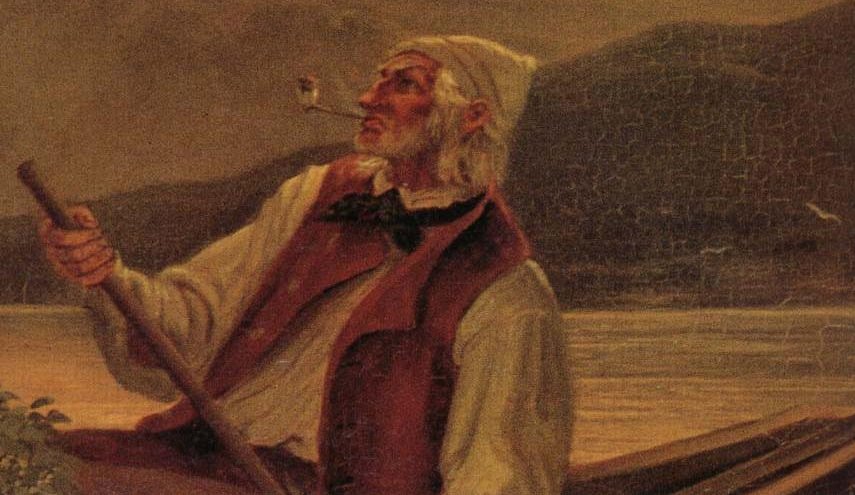
The title of today’s painting Crossing at Schreckenstein is also known as Crossing the Elbe at Schreckenstein near Aussig and I have even seen it referred to as Ferry at the Schreckenstein.   So what do we see before us?  One can almost hear the tune from the harp as the ferryman and his boat transport their passengers across the Elbe.  Note the varied age of the passengers, spread between the child through to the old man and it was thought that Richter’s ferryboat was a “ship of life” in which the passengers of all ages are united.  The ferryman leans back as he heaves on his paddle.  With pipe in his mouth, his eyes are raised towards the hilltop castle.  He still seems in awe of the great edifice notwithstanding how many daily crossing of the river he makes.

At his feet there seems to be a small cargo of plants which are being transported across the waterway and next to them we see a young girl standing with a pole in her hand.  We do not know whether she is the ferryman’s helper or just another passenger.  In the middle of the boat we focus our attention on a young man, standing up with his back to us, who like us,  stares up at the castle whilst the old man plays a folk song about times past.

The Ferryman

A young couple cuddle up together.  His hand rests on hers as she holds on to a posy of flowers. Neither of them are aware of the beauty of their surroundings or their fellow travellers.  They only have eyes for each other.   A man sits in front of the elderly harp player, resting his chin on his hand, his eyes cast downwards.  He too seems unaware of the surrounding landscape.  He is lost in thought.  A small boy at his feet with his hand resting over the gunwale of the craft, drags a small branch through the calm water, slightly rippled by the current.  The curved shape of the upper part of the painting in some way lends it a somewhat solemn and religious feel.

The setting for this picture was probably one Richter saw on his many hikes along the banks of the Elbe.  Maybe the last word on the painting should be given to the artist himself.  He described his work in his autobiography, Lebenserinnerungen eines deutschen Malers, which was edited by his son:

“…As I remained standing on the bank of the Elbe after sunset, watching the activities of the boatmen, I was particularly struck by an old ferryman who was responsible for the crossing.  The boat loaded with people and animals, cut through the quiet current, in which the evening sky was reflected.  So eventually it happened that the ferry came over, filled with a colorful crowd among who sat an old harpist who, instead of paying the penny for his passage, played a tune on his harp….”

The view is as magnificent today as it was in the time of Richter with the once mighty castle perched above the river.  Bridges and locks now straddle the waterway and the ferryman’s efforts are no longer needed.  If ever you visit the area be sure to take the river journey down the mighty Elbe and savour the splendour of the river banks.

Dance of Death by Bernt Notke

Dance of Death by Bernt Notke (1463-66)

Often when I research a painting for my Daily Art Display I am amazed by the complexity of the history of the painting or the biography of the artist and I find myself being sucked deeper and deeper into the story behind the work of art.  The deeper I go the more I realize how difficult it will be to précis what I have found so that the blog does not become too boring and burdensome.  My featured work of art today is an example of this complexity but, to be honest, the more complex a painting becomes the more interested I become and the more I need to dig deeper into the story.  I hope that the story behind My Daily Art Display today does not cross the line which separates intrigue and tedium.

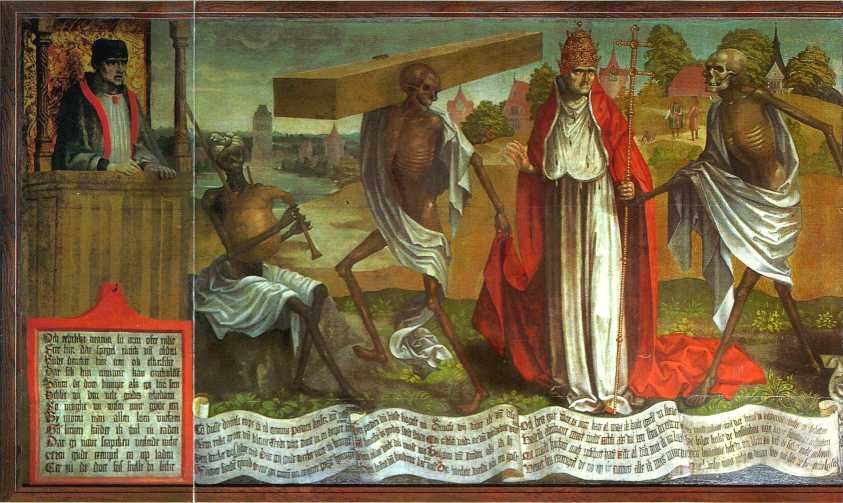
My featured artist today is Bernt Notke.  He was born around 1435 in Lassan, the German town near to the Baltic Sea coast, close to the border with Poland.  He was a painter, sculptor and woodcarver and was considered to be one of the most important exponents of his work in the whole of Northern Europe during his lifetime.  Today I am looking at his enormous tempera on linen Dance of Death frieze which he completed in 1466 and part of which can be seen in Tallinn at the St Nicholas Church Art Museum of Estonia.

Dance of Death paintings were quite common in the late Medieval times up to the beginning of the 16th century and they were painted to remind people that no matter how rich or poor they were, or no matter how powerful they were, death would take them all.  In those days,  epidemics, such as the Black Death, were both recurrent and numerous and they would kill millions of people.  The Hundred Years War between 1337 and 1453 alone claimed three million lives.  The devastation caused by such events enabled people to understand only too well the meaning of these paintings.  They were artistic expressions of the everyday fears of people with the subject of death.  The character “Death” in these works was viewed not as a destroyer but as a messenger of God summoning his people to the world beyond the grave.

The title Dance of Death varied slightly from country to country.  For example, it was known as Danse Macabre in France, Danza de la Muerte in Spain and Totentanz in German but all had the same meaning.  We have come across this type of thing before when we have looked at Vanitas paintings.  Vanitas being the Latin word for emptiness and corresponds in this case more to the word “meaningless” – the meaningless of earthly life.  Vanitas works were to be a stark reminder to us of the transience of life and the inevitability of death. Such paintings would usually incorporate objects which would in some way remind us of death such as a skull or skeleton, or an almost burnt-out candle, watches or hour glasses which symbolized time passing and in still life vanitas paintings rotting food could also be used as a symbol of decay.

Normally the Dance of Death paintings or frescoes were painted on the walls of cloisters or on walls within some churches.  In general we would see Death depicted as an emaciated corpse or skeleton paired with a person from a particular social class as they carry out their dance of death.  Below each pair there would be a verse, the first part of which would be spoken by Death addressing his victim often in cynical and sarcastic terms.  This is then followed by the victims reply as he or she begs for their life.

The join between two fragments of the painting

In the featured work today we see just the surviving part of Notke’s Dance of Death.  His original work was 30 metres in length but this only remaining fragment is only 7.5 metres in length.  The fragment  can be viewed today at the church museum in Tallinn and actually comprises of two pieces, one 6.4 metres long and a much smaller piece approximately 1.15metres long which incorporates the king, and which were joined together in 1843.  However if you look carefully at the join you can see that the background doesn’t run smoothly from one side to another nor does the hand of the devil attach itself to any part of the body of the king, so is there something missing or is it a case that the joining of the two pieces was not carried out correctly?   Further restoration work on this painting was carried out in Moscow in 1962.

Preacher, Musician and Pope

In the painting, we see on the far left the preacher in his pulpit reprimanding his congregation.  Next to the pulpit we see “death” seated playing what looks like bagpipes and I must say in this case “death” looks a little like ET !    Why the bagpipes?   The thought behind this is that bagpipes are known to be able to “wake the dead”.   The inclusion of this musician does add to the sense of macabre and of course he is the musician who will play as the characters to the right of him perform the Dance of Death.    Moving to the right we see another figure of “death” balancing a coffin on his shoulder with his right hand,  whilst at the same time his left hand grasps the clothing of the pope as he begins to lead him in the dance.   To the right of the pope we observe  another figure of “death”.  His right hand is grasping the left wrist of the pope whilst his left hand, which is behind him, holds the Emperor’s wrist.  This interconnection between earthly figures and the figures of “death” continues along the line as they start to dance.  In the surviving part of the painting we have five people facing out at us.  They are the pope, the empress, the emperor, the cardinal and the king and between each we see “death” in the form of a skeleton.

Empress and Cardinal with verses

As I stated earlier, in Dance of Death works a two part verse is often written below each character.  The first part of the eight-line verse is made up of words from the living person begging for his or her life and the second part is the eight-line reply from Death, the last line of which being and introduction to the next mortal along the chain.  An example of this is the verse below the Empress which when translated is:

I know, Death means me!
I was never terrified so greatly!
I thought he was not in his right mind,
after all, I am young and also an empress.
I thought I had a lot of power,
I had not thought of him
or that anybody could do something against me.
Oh, let me live on, this I implore you!

And Death replies:

Empress, highly presumptuous,
methinks you have forgotten me.
Fall in! It is now time.
You thought I should let you off?
No way! And were you ever so much,
You must participate in this play,
And you others, everybody —
Hold on! Follow me, Mr Cardinal!

The Cardinal now says his piece:

Have mercy on me, Lord, [when it] shall happen.
I can in no way escape it.
[When] I look in front or behind me,
I feel Death by me at all times.
What will the high rank avail me
[the rank] that I had? I must leave it
and become more unworthy at once
than an unclean, stinking dog.

And Death replies:

You were in status equal to
an apostle of God on earth,
in order to strengthen the Christian belief
with words and other good works.
But you have, with great haughtiness,
been riding your high horse.
Therefore you most mourn so much more now!
Now step here in front you too, Mr King!

And so it goes on along the line of mortals, all wanting to plead their case only to be refused by the inflexibility of Death.

On display in the St Nicholas’s Church art Museum in Tallinn

I would love to go and see this painting and sad to say I was in Tallinn about six years ago but knew nothing about this great work of art.  If you ever go to Tallinn make sure you add this painting to your “must

The Miraculous Draught of the Fishes by Konrad Witz

The Miraculous Draught of the Fishes by Konrad Witz (1444)

From yesterday’s late nineteenth century Swedish painter Sven Richard Bergh I am going back in time, almost five centuries, for today’s featured artist.  My Daily Art Display today looks at an exquisite painting by the 15th century German-born early Renaissance artist Konrad Witz.

Witz was born in Rottweil is now a german town some fifty kilometres north of the Swiss border and is part of the federal state of Baden-Württemburg, in south-west Germany    It was, at the time when Witz was born in 1400, a freie Reichsstadt (Free Imperial City) and formally ruled by the Emperor of the Holy Roman Empire until 1463.  At that time the town joined the Swiss Confederation where it remained until 1802 and the onset of the Napoleonic Wars when it reverted to part of the Wurttemburg dukedom.  Witz although born in Germany always considered himself to be Swiss.

Through historical records we know that a certain “Master Konrad of Rottweil” joined the painter’s guild in Basle in 1434 and in the same year Witz was granted citizenship of Basle, the Swiss town along with the city of Geneva where Witz spent most of his life.  His style of painting lends one to believe that at some time he received training in the Flemish and Netherlandish painting styles.  Witz is noted as one of the first painters to incorporate realistic landscapes into religious paintings, an example of which we will see in today’s featured painting.

My Daily Art Display featured work today is part of an altarpiece by Konrad Witz entitled The Miraculous Draught of the Fishes which he completed in 1444 two years before he died.  Art historians believe that this beautiful work is amongst the high points of Early Renaissance painting.  Because of hinge marks on the frame of the painting, we know it to be the left exterior wing of the altarpiece commissioned by Bishop Francois de Mies for the high altar of the chapel of Notre Dame des Maccabées of the Cathedral of Saint Peter in Geneva, which belongs to the Swiss Reformed Church.  The right hand exterior wing depicted the release of St Peter from prison but sadly the central panel is lost.   The interior wings of the triptych depict, on one side, the Adoration of the Magi and on the other Saint Peter’s presentation of the donor, Bishop Francois to the Virgin and Child.  Fortunately the wings survived the Protestant Iconoclasm, the collective name for the destruction of catholic churches and possessions which had been raging in Europe since the early sixteenth century and hit Geneva in 1535.  During this Protestant Iconoclasm, hundreds of catholic churches, chapels, abbeys and cloisters in the Netherlands were totally destroyed by rampaging Protestant mobs along with all their contents such as, altars, icons, chalices, paintings, and church books.  The painting is signed and dated 1444 on the original lower frame.

It is by far the most famous of Witz’s works and is sometimes looked upon as the first “real” landscape painting, a painting in which one can recognise a certain landscape as compared with “an idealised landscape” where it is a composite of many places morphed into one idealised picture.  In today’s painting we are standing on the north-west shore of Lac Lehman (Lake Geneva), near Geneva and looking across to the south-east.  We can see the Saleve mountains in the background and included in the scene is the recognisable peak of Mont Blanc.  In the middle ground on the right we can see a pointed jetty and across the water is the staccato line of a breakwater.  Although Witz has given us a true landscape the characters and the scene before us are an amalgam of ideas and the exact subject of the painting is somewhat blurred.

Although the landscape has been identified as Lake Geneva the figures in the painting are all part of biblical stories which obviously took place in the Holy Land.   One reason for this could be that Witz met with his sponsor of the altar, the Bishop of Geneva, François de Mies, during the Ecumenical Council held in Basle.  It was at this Council that it was decided to the elect Amadeus VIII of Savoy to the throne Pontifical under the name of Felix V.   He was to become the last of the Antipopes.  It could be reasoned that by transposing geographically the biblical scene to the land of the pontiff was therefore more of political move that an artistic impulse.

There are three biblical stories going on within this one painting.  Firstly, we have the man who was to become the first pope, Saint Peter, unsuccessfully trying to walk on water.  (Matthew 14:22-26).  Secondly we see Saint Peter, this time in the boat with some of his fellow disciples, fishing which reminds us of the parable of the fishes (Luke 5:1-11).   Lastly, the painting reminds us of the story of the resurrected Christ on the shores of the sea of Tiberius appearing to his disciples as they were in a boat fishing.

This is a beautifully executed painting.  Remember that this is an early 15th century painting.  Look how the artist has skilfully depicted the water with its reflected shadows of the buildings and jettylook at the mirrored reflections of the people in the boat.  Observe the transparency of the water in the foreground as we see the legs of Saint Peter splayed apart as he walks in the shallows having failed to master the “walking upon the water”.

This oil on panel work of art could be seen at Musée d’Art Histoire in Geveva.  I say “could” as it has been taken down for some restoration work to be carried out upon it and will not be re-hung until March 2012.