Louis Anquetin and cloisonnism

Girl reading a Newspaper by Louis Anquetin (1890)

Today I have a new artist for you and a new –ism !  My featured painter today is the nineteenth century French artist Louis Anquetin, who was one of the founders of the expressionist style of painting that was referred to as cloisonnism.  This artistic term comes from the French word cloison meaning partition and the French verb to partition off – cloisonner.   Cloisonné was originally a method used in decorating metalwork objects and later was used in the decorating of vitreous enamel. Wires known as cloisons were soldered to the body of the piece, filled with powdered glass and then fired.  There is also a similarity between cloisonné and old Gothic stained glass windows in which various pieces of coloured glass are often built up to form an image and are separated by black lead strips.   So why is the term attributable to an art form?  In art, the term cloisonnism refers to paintings that have areas of pure flat, colour enclosed by dark black outlines.  These areas, of often-unnatural colours, are entirely free of shading or anything that would give them a 3-D effect and so there is an overriding two-dimensional appearance.  In a lot of examples of cloisonnism there was an overwhelming simplicity to the forms seen in this artwork.  In some ways the emergence of cloisonnism was a way of counteracting works by the Impressionist painters who were fixated by depiction of light.  By resorting to cloisonnism, artists were able to bring together their artistic ideas with their chosen subject matter and by so doing, produce a more formidable form of modern art.   The French painters Émile Bernard and today’s featured painter, Louis Anquetin, around 1887, pioneered this new form of art.  Both painters had taken a great interest the Japanese Ukijo-e woodblock prints, which on Japan opening up its markets to the Western World in the late 1860’s, had a decade later become a major source of inspiration to the Post Impressionist artists of France.  Louis Anquetin and Bernard had both studied under Fernand Cormon at his Atelier Cormon in the late 1880’s along with Van Gogh, Toulouse Lautrec and the featured artist in my last blog, John Peter Russell. 

Henri de Toulouse-Lautrec by Louis Anquetin (1886)

And so to my featured artist, Louis Anquetin.   Louis Anquetin was born in January 1861 in Étrépagny, a commune in the Eure department in the Haute-Normandie region of northern France.  He was an only child.  His father, George Anquetin, was a butcher by trade and his mother was Rose-Felicite Chauvet.  His father’s business was very successful and Louis was brought up in a prosperous household and being an only child, led a very pampered lifestyle.  When he was eleven years old his parents got him to take an interest in drawing and soon he needed little persuasion to while away the hours sketching.  With his love of drawing successfully nurtured, his parents arranged for him to attend the art school in the nearby city of Rouen, the Lycée Pierre Corneille, named after the 17th century French dramatist.  One of his fellow pupils at the time, who became his lifelong friend, was Edouard Dujardin, a man who would later become a much-respected writer and poet and be first to coin the term cloisonnism

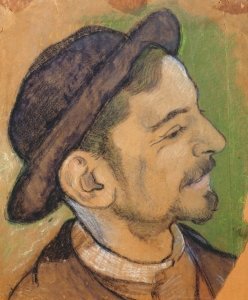
Émile Bernard by Louis Anquetin (c.1887)

After leaving school Louis went into the military and served in the 6th Cavalry Regiment of Dragoons.  Once he had completed his military service in 1882, Louis, now aged twenty-two, persuaded his parents to let him try to become a professional artist.  As had been the case for most of his early life, they were reluctant to deny their son anything and so acquiesced to his wish.  Louis travelled to Paris and took up lodgings in the city and went to study at the atelier of the painter, Léon Bonnat.     Whilst at Bonnat’s studio Louis became friends with another of Bonnat’s students, Henri de Toulouse Lautrec.  Louis only remained there a short time as Bonnat gave up his studio when he was appointed professor at the École des Beaux Arts.  In 1884, both Louis and Lautrec then moved on to work at the Atelier Cormon, which was run by the painter, Fernand Cormon.  Among the students there around this time were the Australian painter John Paul Russell, fellow Frenchman Émile Bernard and the Dutch painter, Vincent van Gogh.

As we saw in the blog of John Peter Russell the aspiring painters at Fernand Cormon in an effort to improve their portraiture would ask their colleagues to sit for them and Louis Anquetin at this time completed portraits of both Toulouse Lautrec and Emile Bernard. Louis Anquetin eventually left the Atelier Cormon but remained friends with Lautrec, Bernard and van Gogh and often the painters would jointly hold informal exhibitions.  One such “exhibition” was held in July 1887 at the Café du Tambourin, and was hosted by a friend of Van Gogh, the restaurant’s proprietor, Agostina Segatori.   Segatori, an Italian by birth, had been an artist’s model and with the money she had earned, opened up her own Paris restaurant on the Boulevard de Clichy, just round the corner from Theo van Gogh’s apartment, which he shared with Vincent.  She had become a good friend of Van Gogh and the two had a good working arrangement – he supplied the artwork for the restaurant’s walls and she fed him!  This informal exhibition was a red-letter day for Anquetin for it was at this exhibition that he sold his first paintings.

Le Faucher by Louis Anquetin (1887)

It was around 1886 that Louis Anquetin was introduced to Georges Seurat and to his new artistic style, which became known as Divisionism or Pointillism (see My Daily Art Display, Oct 21st 2011).  Anquetin and his friend Émile Bernard tried their hand at this new form of art but soon tired of it and adopted a new artistic style of their own, which was christened cloisonnism by Anquetin’s former school friend and now writer, Edouard Dujardin, when he reviewed their work for the symbolist journal, Revue Independent.  He had gone to see their paintings which were on show at the 1888 Salon des Independents exhibition in Paris and the 15th Annual Exposition of Les XX in Brussels.  Two of the best-known cloisonnism paintings by Louis Anquetin are the Avenue de Clichy: Five O’ clock and Le Faucher. 

Avenue de Clichy - Five O'Clock in the Evening by Louis Anquetin (1887)
Avenue de Clichy – Five O’Clock in the Evening by Louis Anquetin (1887)

The work, Avenue de Clichy: Five o’clock in the Evening was painted in a Cloisonnist style with its graceful black outlines as well as the flat treatment of the subjects in the composition and there is a definite influence of Japanese woodcuts in the work.  The subject of the painting gives us an insight of Parisian life in the opulent times of the Third French Republic in the last three decades of the nineteenth century and which lasted until the outbreak of the First World War.   These were good time.  Times of war were over and there was a general sense of optimism and it was a time when the arts flourished and theatre-going and visits to the various Parisian music halls were de rigeur.  This period in French history later became known as the Belle Epoque.  The setting for the painting is the late afternoon on the Avenue de Clichy, which was in Montmartre, near to Anquetin’s home and he would have, on numerous occasions, viewed the hustle and bustle of the throngs of people moving along the Avenue.   It is still raining and people huddle under the awnings looking into the butcher’s shop which is bathed in light, whilst others with umbrellas raised brave the open street.  This work by Louis Anquetin is often looked upon as being one of his finest works.  In his book, Anquetin: La Passion d’être Peintre, the author Frederic Destremau wrote about this painting:

“…the iron and glass awning, an aspect of industrial design, above the butchers shop has a ethereal quality which suggests the roof of a pagoda, the legs strung up in a garland recall Japanese lanterns, the elegant woman seen from behind, raising her skirts, creates a gathering of folds that is drawn in a very Japoniste style, but […] more than any of these details, it is the use of dark outlines and flat colours that brings to mind Japanese prints…” 

It is also interesting to note the inclusion of la boucherie (butcher’s shop) in the left foreground of the painting.  Could this be Anquetin’s way of honouring his father who we know had his own butcher’s shop? This new style of Anquetin and Bernard was very popular with the public and critics alike.   Louis had his works on display at the Fourth Paris International Exposition of 1889, which marked the centenary of the French Revolution. The sale of his works brought him not only fame but also a healthy bank balance and in keeping with his new status he moved his studio from Montmartre to the more fashionable Rue de Rome.   

A Woman on the Champs-Elysées, at Night by Louis Anquetin (c. 1891)

In 1891 he exhibited ten of his works at the Salon des Independents and the one that caught everybody’s eye and singled out as a gem was Woman on the Champs-Elysees by Night.  The painting depicts a finely attired woman who is walking alone along one of Paris’ main boulevards.  This somewhat enigmatic figure is illuminated from above by the glow of the streetlights. Although not easy to see, but to the right of the woman, there is a man with a  moustache who is paying close attention to her and one wonders whether he was there to find a companion for the night!   The painting is now housed in the Van Gogh Museum in Amsterdam and in a way is a reminder of the lifestyle van Gogh would have experienced whilst staying in the French capital with his brother Theo. Louis Anquetin’s new style of painting was to influence other artists of the time, such as Picasso, Gaugin and Toulouse Lautrec. 

However almost as quick as Anquetin had embraced this cloisonnism style of painting, he abandoned it.  Anquetin often changed his artistic style, always searching for something different.  The next change of style by Anquetin followed on from a trip he took to Belgium and Holland accompanied Toulouse Lautrec.  It was during this visit that Anquetin saw and was influenced by paintings of the great Flemish painter, Peter Paul Rubens and the Dutch Golden Age painters, Rembrandt van Rijn and Frans Hals.  He was extremely impressed by the brilliant colours used in their works and the fluidity of their brushstrokes and from then on Anquetin realised that he had to change his style yet again and moved to a more classical style. 

Lili Grenier by Louis Anquetin (1929)

He also decided that to retain a classical style he must work in oil, which was a decision contrary to a number of his contemporaries who had abandoned oil in favour of pastels.  He had at this juncture in his artistic career decided to abandon modern art and concentrate on classical art.   Unfortunately this change of painting style meant that his erstwhile artistic friends, who did not share his artistic views, abandoned him.  Toulouse Lautrec and Émile Bernard were the exceptions. Another aspect of classical painting that Anquetin wanted to emulate was the classical painters’ knowledge of the human anatomy which was so well depicted in many of their works.   For that reason Anquetin decided that he too should carefully study anatomy and for two years attended the laboratory of the anatomist, Professor Arroux, in the Paris suburb of Clamart. 

Rubens by Louis Anquetin

In 1901 his former mentor and tutor, Fernand Cormon had received a commission to paint murals at the Hôtel de Ville in Tours and he asked Anquetin for his help.  Cormon commissioned his former student to complete four mural panels for the interior of the building each of which would represent four greats of French history – the writer, Honoré de Balzac, the philosopher, René Descartes, the humanist and writer, François Rabelais and the poet and playwright, Alfred de Vigny. In 1906, when Louis was forty-five years old he married an affluent widow, Berthe Coquinot, whose late husband had been an army officer.  The couple moved into a house in the well-to-do rue des Vignes in Paris’16th arondissement.  In their home Louis had a studio for his painting as well as a place to teach his students.  Louis Anquetin had always been interested in the theoretical side of art and would often give lectures on painting techniques and styles. Anquetin wrote a book about his favourite painter Peter Paul Rubens and it was published in 1924.  Louis Anquetin died in Paris in August 1932, aged 71.
Suzanne Valadon. Part 6 – André Utter, the War and a change in circumstances

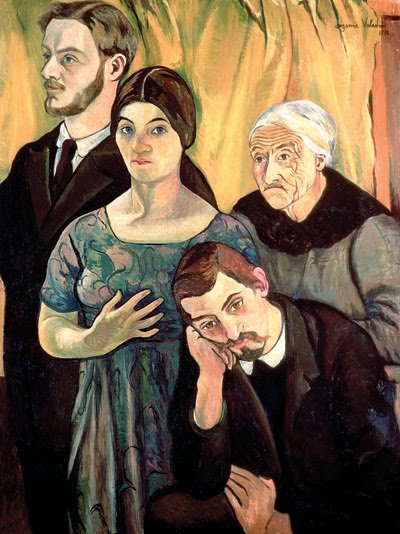
Self Portrait with Family (André Utter, Madeleine Valadon and Maurice Utrillo) by Suzanne Valadon (c.1910)
Self Portrait with Family
(André Utter, Madeleine Valadon and Maurice Utrillo)
by Suzanne Valadon (c.1910)

My last blog about Suzanne Valadon ended with the appearance on the scene of André Utter, a handsome young artist.  Utter and Suzanne’s son Maurice slowly became friends as they both had a shared love of art and soon they became inseparable.   Suzanne was delighted that at long last her son had found a companion.  Utter, a son of a plumber was three years younger than Maurice.  He had done well at school and his mother had high hopes that he would eventually enter a learned profession or even the priesthood whereas his father was convinced he would follow him into his plumbing business.  However Utter ignored their wishes as he was determined to become an artist and live the colourful life that went with the profession and he had strolled around the streets of Montmartre observing the artists sitting with their box of paints and easels and would try to engage them in conversation. 

It was 1908 when Utter first caught site of Suzanne, who was then forty-three years old.  He had been painting in a street at Montmagny with his friend Edmond Heuzé and as he wrote later:

“…She passed by, ignoring us but I began to dream about her…”

She had blossomed into a true beauty – small in stature, but with a voluptuous figure which exuded sensuality.   Later Maurice introduced Utter to Suzanne at his home at Pierrefitte-Montmagny and Utter recalls that first meeting:

“…That evening Maurice told his mother about our meeting.   His mother was pleased.  Apparently she thought I should be a good influence on him.   The next day Maurice introduced me to her.  She was a young woman I had been dreaming about!    She showed me two of her paintings, some pastels, some drawings and some etchings.   I left on a cloud…”

Utter during his late teens would become a leading figure of a group of young men who aspired to become great artists.   These self-taught young artists would try to emulate the established painters of Montmartre who they looked upon as their “role models”.  The young men, like their “role models” would paint en plein air by day and drink heavily at night.  Their favoured drink would be the powerful green spirit, known as “la fée verte” – absinthe.  After a number of glasses of absinthe they too, like their elders, experienced the dream-like effect it gave them after which they would fully experiment and sample the pleasures of love and sex!   Utter enjoyed copying the mannerisms of the street artists and at the age of thirteen he would often be seen wandering the streets with a pipe clenched between his teeth.

When Utter and Suzanne met in 1908 it was around the time that she had started to become disillusioned with her life at the big house in Montmagny and the bourgeois lifestyle she had thrust upon her by her “husband” Paul Mousis.   Mousis began to be aware of her disillusionment and in a desperate attempt to make things better he suggested they moved back to Montmartre and just used the Montmagny house as a weekend retreat.   Mousis rented a house at No.12 rue Cortot which had a separate studio attached.  The problem was he had made this gesture too late because Suzanne’s passion for the bourgeois lifestyle had waned months earlier and her relationship with Mousis had been in freefall with fierce arguments between them becoming the norm.  Another cause of their arguments was their differing views on how best to deal with the mental health issues her son, Maurice, which he was now frequently and more violently displaying.  Suzanne was wilting under the intolerable stress of having to pretend to be the happy “housewife” but at the same time she was well aware that her comfortable lifestyle was solely due to the wealth of Mousis.  Her dilemma was simple.  Was she prepared to forego the luxuries his wealth brought her and if she did leave him what would happen to Maurice? 

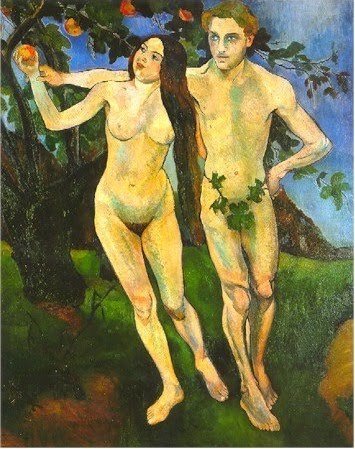
Adam and Eve by Suzanne Valadon (1909)

One day in 1909 whilst standing outside her home on rue Cortot she saw André Utter and she invited him in and from this meeting came her painting entitled Adam and Eve, which now hangs in the Musée National d’Art Moderne, at the Georges Pompidou Centre in Paris.  She posed as Eve whilst Utter posed as Adam.  She is fully naked whilst his genitals are hidden from view by carefully placed leaves.   Strangely there is no facial interaction between the two figures and although he has his hand on her wrist to try and stop her pulling the apple from the tree, there seems no relationship between man and woman.   The painting was exhibited at that year’s Salon d’Automne and what pleased Suzanne more than just its inclusion at the exhibition  was the fact that it was hung next to her son’s painting entitled Pont Notre Dame.    Later Utter posed for her two versions of The Joy of Life which Suzanne completed in 1910 and 1911. 

It was around this time that Utter and Suzanne’s son Maurice, shared the same lodgings at No.5 Impasse de Guelma and it was here that Suzanne would regularly meet up with Utter and eventually became his lover.  One would have thought that Suzanne would want to keep this love affair a secret so that no word of it got back to Mousis but that was not the case as often the pair would sit hand in hand at café tables, staring into each other’s eyes like lovesick teenagers and they seem unconcerned that their intimate relationship was on show to the world.  Utter loved, and was totally fascinated, by Suzanne despite the twenty year age difference.  The one artistic thing Utter brought to the relationship was his persuasion and her acceptance that she should move away from sketching and concentrate on oil painting. 

Portrait of her Son Maurice Utrillo, his Grandmother Madeleine and the Dog, by Suzanne Valadon (1910)

Although Utter and Suzanne were lovers and didn’t hide the fact from anybody, Suzanne still lived with Mousis and this eventually became intolerable and so, in 1909, she finally decided to leave him, packed up her belongings and along with her two cats, her German Shepherd dog, Pierret, and a goat, left the house at Montmagny and went to live with Utter and her son.  Two years later they would move to her former home at No.12 rue Cortot.  Soon the apartment and studio became a meeting place for young aspiring artists and poets.   Artists such as the Fauvists Raoul Dufy and Georges Braque and the Italian figurative painter Amedeo Modigliani were frequent visitors.  Modigliani was twenty-five at the time and had settled into life in Le Bateau Lavoir, a commune for penniless artists. 

The year was 1912 and, even as early as then, there was rumblings of a possible war in Europe.  Two years later in June 1914 it all came to a head when the heir to the Austro-Hungarian throne, Archduke Franz Ferdinand and his wife, Sophie, were shot dead by Gavril Princip on the streets of Sarajevo whilst making an inspection of the town.   A month later the French Socialist leader and pacifist, Jean Jaures, who had been an advocate of rapprochement with the Germans was gunned down as he sat in a café by a twenty-nine year old French Nationalist, Raoul Villain, who was an advocate of France going to war with Germany.  Three days later Germany declared war on France.  A feeling of patriotism swept through Montmartre as it did in the rest of France and as was the case in England, young Frenchmen rushed to army recruiting offices and celebrated what they believed would be a short and joyous war against the loathsome Imperial German forces but sadly, like the young Englishmen who marched to war, their euphoria was short lived. 

André Utter was one of the first to enlist.  He attended the army recruiting centre in February 1915 and was accepted and sent to the training centre at Argentan.  He eventually joined the 158th Infantry Regiment at Fontainebleau.  Before he left for the front he and Suzanne were married which ensured that she would receive an allowance from the military as a soldier’s wife.  She had been desperate to stop him enlisting but struggled to find a way.  Years earlier her body would have been enough to persuade a lover to be attentive and never to want to leave her side but she was now forty-nine years of age and Utter was just twenty-eight.  Suzanne was more and more conscious that her body was fighting a losing battle against the relentless march of time, and this despite her frequent changing of her date of birth! 

The Moulin la Galette (c.1918) by Maurice Utrillo

The year 1915 was Suzanne’s annus horribilis.  In June that year, her mother Madeleine died aged 84.   In August her son Maurice was placed in an asylum at Villejuif where he remained for three months and of course her husband was fighting a war.  Suzanne struggled to keep painting whilst her husband was away.  In 1917, however, the Bernheim Jeune Gallery in Paris, staged by their artistic director, Felix Fénéon, a long time admirer of Suzanne’s work, put on a joint exhibition of the works by Suzanne and her son, along with some paintings by her husband André Utter.  It was not only the works of the three that drew in the crowds but the extravagant and titillating tales that surrounded the trio.  Sales of the work were unfortunately poor but this was probably due to the war. However a nude painting by Suzanne and the painting entitled Moulin de la Galette by Utrillo were purchased by the eminent French fashion designer Paul Poiret.  Later, Poiret would tell his clients how chic it would be if they, like him, owned an original work by Suzanne Valadon or her son Maurice Utrillo and of course this led to a chain-reaction of feverish buying by the likes of the prestigious art dealers in the Rue du Faubourg  St Honoré. 

In that same year, 1917, Utter was wounded in the shoulder at the battle in the Champagne region of France and in January 1918 he was dispatched to an army recuperation centre at Belleville-sur-Saône.  Suzanne immediately rushed to his side eager to tell him about the increasing sales of her paintings, drawings and etchings.  It was a joyous reunion.  She dedicated her time to him, looking after his every need and for three months they lived in their newly-discovered idyll.   Utter was released from the army in January 1920 and returned to Paris to be with his wife and her son Maurice.  Suzanne was now fifty-four years old and even she had to admit that her looks, which once stirred the loins of most men, were beginning to fade.  She craved admiration.  She craved attention and would dress and act in the most strange fashion so as to achieve her aims.  She was desperate for Utter to admire and desire her as he once did when they first met.  She was hyper-sensitive to his comments and she would be angered and sulk if his words were not the ones she was hoping for.   Utter, in turn, was disappointed that those idyllic days at Belleville had not carried on in Paris.  Their arguments, which became more frequent, were more intense, more acidic and more vociferous. 

Following the cessation of the First World War money became freer once again and people began to cash in on their war savings and head for Paris to buy art.   The wealthy descended on the French capital and the raised prices this buying spree had caused did not daunt them.  Many bargain hunters headed to Montmartre in search of a bargain buy and it was around this time that a wealthy Belgian banker, Monsieur Pawels and his wife, Lucie, a former actress called on Suzanne.  Lucie wanted to be great friends with Suzanne but she was not wholeheartedly sold on reciprocating this friendship.   Sales of Suzanne, Maurice and Utter’s works continued to grow.  Whether she became slightly jealous of her husband and son’s sales we may never know but she was always adamant that her work was the best and she of the three was the most accomplished painter.  She was quite outspoken about this, once saying:

“…I do not seek to be known but to be renowned.  For I shall go to the Louvre.  That will be my glory…”

In 1920, with help from friends, she was elected as an associate of the Société des Artistes Indépendents.   As time went buy she became vainer, more arrogant, and more egotistical.  The person who suffered most from this attitude was her husband, Utter.  She demanded of him his admiration of her as a great artist and almost a recognition that she was a superior being.  She demanded his subservience.   One can only wonder what Utter thought of his situation living with a wife and her son, both of whom were suffering from mental issues. 

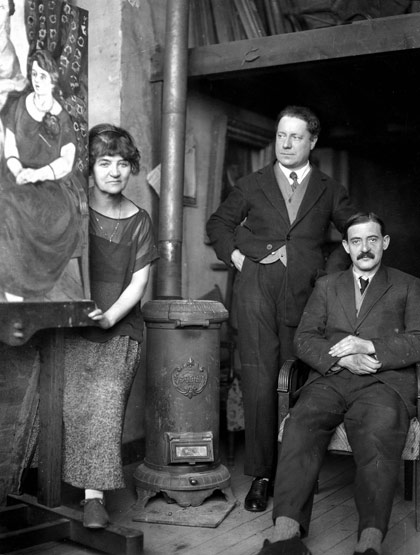
Suzanne Valadon, Her Son Maurice Utrillo (seated, right) and André Utter, (1920)

In 1921 Utter arranged a joint exhibition of Suzanne and Maurice’s work at Berthe Weill’s gallery.  It was an outstanding success and soon works by Suzanne Valadon and Maurice Utrillo were commanding high prices.  This sudden surge of demand for their work caused the Gallerie Bernheim-Jeune in the summer of 1923 to offer Suzanne and Maurice a contract guaranteeing them a minimum annual payment of a million francs (the equivalent of $60,000 at the time) for all their future works.  This was a turning point in the lives of Suzanne, her husband and her son.  It was today’s equivalent of us winning the lottery.  Their life was about to change.

Suzanne Valadon Part 5. Her son Maurice Utrillo, her husband Paul Mousis and her lover Erik Satie

Suzanne Valadon and her son Maurice (c.1889)

My look at the life of Suzanne Valadon would not be complete if I didn’t spend some time looking at the early years of her son Maurice and how he had such an effect on her life.  In my earlier blogs I told you that Suzanne, who was eighteen years at the time, gave birth to her son on December 26th 1883.  She was unmarried at the time and would never reveal the identity of the father.   She decided on the name Maurice for her son, reasoning that as none of her previous or present lovers had that Christian name it would therefore not give a hint as to who actually was Maurice’s father.  However in January 1891 she persuaded one of her former lovers, Miguel Utrillo to agree to sign the Act of Recognition naming himself as Maurice’s father.  The document was signed on February 27th 1891and it stated:

“…27 February 1891.  Act of Recognition of Maurice, Masculine Sex.  Born 26 December 1883 and inscribed on the 29th following at the mairie 18th arondissement as son of Marie Valadon and unnamed father.  Set up by us Charles-Paul-Auguste Bernard, assistant to the mayor, officer of the civil state 9th arondissement, on the declaration made by Michael (Miguel) Utrillo, 28 years of age, journalist of 50 Boulevard de Clichy, who has recognised as his son the aforementioned Maurice.  In the presence of Charles Mahut, 44 years of age, employed, residing in Paris, 5b Impasse Rodier, and of Félix Dunion, 44 years of age, waiter, residing in Paris, 3 rue Saint Rustique, who have signed with the petitioner and ourselves after reading.    Paris. 8 April 1891…”

One should note that the document refers to Suzanne by her original Christian name Marie (Marie-Clémentine) and not Suzanne, the name she changed it to on the advice of Toulouse-Lautrec.  So was Miguel really Maurice’s father, if not, why would he sign such a document?  It was not as if it was a “spur of the moment” decision as one can see by the dates at the start and the end of the document the process took almost six weeks to complete which would have given Miguel time to consider what he had been asked to sign and time to back out of the agreement.  Whether Miguel was the father we will probably never know.   She had many lovers as a teenager including Pierre-Puvis de Chavannes, the French artist.  There was also Adrian Boissy, the drunken accountant from an insurance company she met at the Moulin de Galette one night, and who according to Suzanne, took her to his home, plied her with drink and raped her. 

There is probably no greater love than that which a  mother gives to her children and although I am sure there was a maternal love between Suzanne and Maurice her maternal instinct must have been sorely tested as Maurice was not a normal child.  During his very early days Maurice was looked after solely by Suzanne’s mother, Madeleine, and their Breton maid, Catherine, whilst Suzanne pursued her career as an artist’s model.  To say that Maurice was not a typical child would be something of an understatement.  At times he would lie peacefully on his grandmother’s lap and then suddenly his body would become stiff and he would shudder violently, biting his lip until it bled and hold his breath until his whole face turned purple.  In later childhood this small waif-like little boy would throw himself on the floor in fits of rage.  Suzanne’s grandmother’s only solution was to give him some watered down wine to try and calm him down.  It was not Suzanne that spent the most time with him but his grandmother.  It was she who comforted him during his fits and rages.  It was she who fed and clothed him.  It was she who shared her bed at night with him.  It was she who gave him the nickname Mamau which stayed with him all his life.  Madeleine had spent little time or had shown much love towards her daughter Suzanne and she was now probably trying not to make the same mistake with her grandson.  In turn, Maurice loved his grandmother and revelled in her company.  Suzanne was not jealous of this grandmother/grandson close relationship, in fact as she had tried, without success, to please her mother all her life she was pleased that she had “given” her son to her mother as this had evoked so much pleasure.

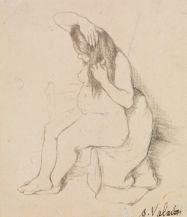
Nu assis se coiffant by Suzanne Valadon (1896)

At the age of five Suzanne enrolled Maurice at a nursery school, Pension La Flaiselle, in the rue Labat.  Her son hated the school, in fact he was terrified by it and yet although knowing his fear, Suzanne never walked the long distance up the hill to reach the place which, by doing so, would have afforded her son a modicum of comfort.  This terror Maurice felt began to have an effect on life at home as the older he got the more he would lapse into spells of depression often followed by bouts of extreme violence which manifested itself into the smashing of the household china and ripping down the curtains.  Despite the doctor’s prognosis that he would “grow out of it”, the violent episodes continued but at no time could Suzanne see the correlation between his mood swings and his unhappiness at the school.   Suzanne saw his terror of school life as a form of cowardice and whimpishness for one has to remember that as a child of Maurice’s age, Suzanne was completely fearless.  Suzanne showed Maurice little sympathy; on the contrary, she was embarrassed by his antics. When things got out of hand at home Suzanne would just leave the house to party or be with a lover and leave Maurice for her mother to handle.

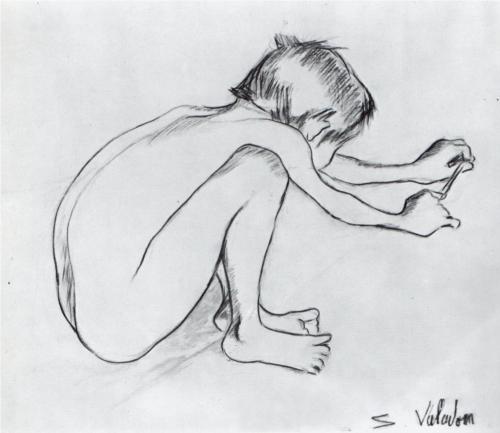
Maurice playing with slingshot by Suzanne Valadon (1895)

It was in 1888 that a new lover for Suzanne came on to the scene in the form of a young wealthy banker, Paul Mousis, whom she had seen around the café-cabaret establishments, Auberge du Clou and the Chat Noir.  Mousis would mingle with the artists who were at the Auberge du Clou and because he was a generous man, he would keep them supplied with drinks, and by this gesture, he was accepted as “one of their own”.  The Auberge was just a short distance from Toulouse-Lautrec’s home and Mousis along with his new friends would often visit the painter’s home and join one of Lautrec’s frequent soirées and it was here that he met Suzanne, who was acting as Lautrec’s unofficial hostess.  Mousis was immediately besotted with this beautiful young French woman and within a few weeks of their first meeting he had proposed marriage.  She refused him but said that she would readily become his lover.  Her reasoning was quite simple.  Being Mousis’ lover meant that she was on equal terms with him, whereas marrying Mousis would make her his property and in some way subservient. 

During her late teens and early twenties Suzanne had a number of lovers and would often tire of them very quickly.  Mousis offered her not only his companionship and love-making but financial stability and yet Suzanne, three months into their relationship, strayed, this time towards the strange enigmatic musician and composer, Erik Satie whom she met whilst he was playing the piano at Le Chat Noir café.  Twenty-one year old Satie was a dropout from the Paris Conservatoire, who had given up the bourgeois lifestyle he had whilst living with his parents, and moved to the bohemian lifestyle of the Montmartrois.   One would have thought that Paul Mousis would have been horrified at this turn of events but he wasn’t, maybe because he too was having a liaison with another woman!   Satie was besotted with Suzanne.  He even proposed marriage to her on their first meeting.  He lavished upon her numerous gifts, took her for walks in the Luxembourg Gardens and strange as it may seem, he would often go out in the evening with Suzanne and Mousis.  This was indeed a ménage à trois.  However the leading role in this love triangle was always Suzanne.  She choreographed the love triangle.  She constantly fussed around Satie looking after all his needs, such as feeding him, darning his socks and cleaning for him.   In Ornella Volta’s 1989 book, Satie seen through his letters, the depth of his love for Suzanne can be clearly seen.  He wrote to his brother in 1893:

“…I shall have great difficulty in regaining possession of myself, loving this little person as I have loved her …she was able to take all of me. Time will do what at this moment I cannot do…”

Mousis was not deterred by the presence of Satie as he felt that Suzanne was the only woman who could satisfy him sexually.  However all good things had to come to an end and Mousis became tired of the love triangle and told Suzanne it must end.  She refused to give up Satie and so Mousis went off for six months.  He did return and once again took up with Suzanne but now it was the turn of Satie to complain and tell Suzanne to end her relationship with Mousis.  Once again and highlighting her control of the love triangle she refused and Satie ended the ménage à trois being unable to share her with Mousis.

Portrait of Erik Satie  by Suzanne Valadon (c.1892)
Portrait of Erik Satie by Suzanne Valadon (c.1892)

In 1894 Suzanne and Mousis set up house at No. 2 rue Cortot, just two doors away from the house belonging to Satie.  After a short while, neighbours would refer to Suzanne as Madame Mousis.  She did visit Satie and it was in 1892 in his one-room house, two doors away, at No. 6 rue Cortot, that she had painted the twenty-six year old musician’s  portrait.  It is entitled Portrait of Erik Satie and it can now be found in the Musée National d’Art Moderne, Centre Georges Pompidou in Paris.  It was Suzanne’s first attempt at portraiture in oil.  It measures just 22 x 41 cms and because the height of the portrait is double that of its width there is an elongated look to it.  Satie almost fills the canvas.  His facial expression in this painting is one of dourness.  His red lips are partly hidden by his waxed moustache and the pince-nez glasses give him an intellectual air. 

In the summer of 1886 Suzanne and Satie parted company in acrimonious circumstances.  It is not clear what happened to initiate this final breakdown of their relationship, but final it was.  It is alleged that Satie was devastated, hurling himself on the floor weeping bitter tears and bitterly declaring that he was left with “nothing but an icy loneliness that fills the head with emptiness and the heart with sadness”.  In 1889 Satie left Montmartre and his one and only true love, Suzanne Valadon. It was also 1896 that Mousis and Suzanne were said to have married, but did they ever officially marry?  Although Mousis was often referred to as “Suzanne’s first husband” there is no official record of their marriage or divorce in either the mairies of Montmartre or Pierrefitte-Montmagny and maybe when her friends talk of  her marriage to Mousis it was just a figurative expression rather than a literal one.

Nu à la toilette by Suzanne Valadon (1892)

If we go back four years to 1892 there was a change in Suzanne Valadon’s lifestyle.  Her wealthy lover, Paul Mousis had tired of the bohemian lifestyle of Montmartre and wanted to return to his former bourgeois lifestyle which he believed befitted a successful banker and so he decided to lease a house in the village of Pierrefitte, situated in the Seine valley, and which lay twenty kilometres north of Paris.  This was to be a weekend retreat for himself, Suzanne and her family.  Suzanne’s grandmother, Madeleine, was delighted to move back to a quiet rural village similar to the one she had been brought up in.   She was now in her late sixties, a somewhat wizened old woman who suffered badly from rheumatism and who was still addicted to alcohol and spent much of her time in a semi-drunken haze.  Her one love, her one great pleasure in life was her grandson Maurice.  He still suffered from swiftly changing moods and his grandmother could only control his uncontrollable rages by plying him with glasses of wine.   However the alcohol did not always have the desired effect and instead of calming him down it lead to him demanding more glasses of it until he virtually passed out. He had become an alcoholic.

In 1894 Mousis, who loved living in the area decided to build the family a new house atop the Butte Pinson which was between the village of Pierrefitte and the village of Montmagny.  Suzanne was still uncertain about the move away from Montmartre so Mousis told her that the building of the new house was simply a business investment.  He also tried to persuade Suzanne that to achieve a great artistic standing she needed to move away from the chaos of Montmartre life.  As a compromise he agreed that Suzanne should keep her Montmartre studio in the rue Cortot.  Suzanne would commute back and forth between their home at Montmagny and her studio in Montmartre by her own pony and trap which Mousis had given her.  Soon she began to appreciate life at Montmagny and developed a passion for flowers and the enjoyment of gardening. 

Notwithstanding her new lifestyle and her love of nature, she was not able to ignore the ever-increasing problem she had in her life – her son Maurice and his worsening mental behaviour.  By his teenage years he like his grandmother had become addicted to alcohol but now it was not just wine, it was now the “green devil” itself, absinthe.  In his late teens he had also become much more violent during his uncontrollable rages and Mousis and Suzanne consulted many doctors and psychiatrists.  It culminated in 1901, just before his nineteenth birthday, when during a particularly nasty rage a doctor was called to forcibly sedate him and he was committed to the asylum of Saint-Anne where he remained for three months.   This was a terrible time for Suzanne as it was during her son’s confinement she also learnt of the death of her good friend and mentor, Henri Toulouse-Lautrec, who had died in a sanatorium at the age of thirty-seven.  The cause of death was partly put down to complications arising from his alcoholism and Suzanne must have wondered what her son’s fate would be.

Whilst Maurice remained in the asylum, Suzanne filled her life by concentrating on her art and spent nearly all the time at her studio in rue Cortot where she completed a series of nude drawings for which she served as her own model.  Maurice was finally released from the asylum and according to his mother, “he looked better than he has for years – and so beautiful”.  He was off drink but was very listless, avoided everybody and sat reading his books.  A turning point came when Suzanne persuaded him to take up art as a hobby.  Reluctant at first, he soon took a liking to it and within two years, would spend most of his time in his mother’s studio in Montmartre.  In that time, he had completed no fewer than 150 works. By the age of twenty-three he was living in her studio.  The only think he disliked about life in Montmartre was the people.  People everywhere and he just wanted to shut himself away from them all.  They annoyed him and soon the rages returned and to cope with the rages he turned back to drink and would, during the day, paint with excruciating hangovers.  Despite his abhorrence of people he would still go out and wander around Montmartre painting en plein air.  When buoyed by alcohol he would engage in conversation with others in the drinking establishments he frequented.  He always introduced himself as Maurice Valadon, adamantly shunning the name “Utrillo”.  The drinking resulted in his old habits returning – the violent outbursts of rage often culminating in fights with the locals. 

One day in 1909, which was to have an effect on his life and the life of his mother Suzanne, he was sitting outside painting when he was approached by a young man who introduced himself as a fellow artist.  He was André Utter.

                                               …………………………. to be continued.

Suzanne Valdon. Part 4 – Henri Toulouse-Lautrec and Degas

Self portrait by Suzanne Valadon (1883)

In my last blog, Part 3 of the life story of Suzanne Valadon, I talked about her relationship with the French painter Pierre-August Renoir and looked at his 1883 Dance Series of painting, two of which featured Suzanne.  At the end of the blog I stated that Renoir had nurtured Suzanne’s interest in art.  I suppose nurturing was the wrong word to use as although Renoir’s art influenced Suzanne it was more his dismissive attitude to her early attempts to paint and sketch that had an effect on her.  Renoir had a somewhat condescending attitude towards her attempts at drawing and painting and this along with his preference for Aline Charigot over her rankled Suzanne all her life.  However Renoir’s indifference regarding her artistic attempts galvanised the young woman in her mission to prove him wrong and at the same time it fostered in her a desire to become a great artist in her own right, for if nothing else, Suzanne was a very headstrong and determined character and one who would never accept failure lightly. 

Suzanne Valadon did however receive valuable help and support with her quest to become an artist.  This help came from two completely different sources.   Her initial help came from a young French artist who had just come on to the Parisian art scene and it was through his good auspices that she was introduced to an elderly artist who, at the time, was viewed as The Master of all the French artists.   The young artist was Henri de Toulouse-Lautrec and the Master was none other than Edgar Degas.

My Utrillo at the Age of Nine by Suzanne Valadon (1892)

Unabashed by Renoir’s attitude Suzanne set about sketching with pencil and charcoal.  She sketched avidly.  Any free time she had from her modelling engagements were spent sketching.  It was in the Spring of 1887 that she first met the twenty-two year old, Henri Toulouse-Lautrec, who had a top floor studio at No.7 rue Tourlaque, the same building in which Suzanne, her mother Madeleine and her son Maurice were living.  Toulouse Lautrec was once described as having a grotesque appearance.  At the age of fourteen, he slipped on a floor and broke his left thigh bone.  The following year, while out walking, he fell and broke his right thigh bone.  Neither leg healed properly.  It is now believed that this was due to a genetic disorder.  After these breaks, his legs never grew any longer which resulted in him attaining a height, as an adult, of just 1.54 m (5 ft 1 in) despite have a full sized torso.  His walk was just an embarrassing shuffle.  Add to this physical deformity his oversized nose, his dark and greasy skin and full black beard which masked his face, one can envisage the physical and mental torment he must have suffered.  However, despite this, he was quite a gregarious person and had a buoyant character and soon after setting up his studio it took on a new role as a meeting place for local artists and members of the literary set.  Lautrec would often provide food and drink at these meetings and conversation would often centre on art, artists and artistic trends.  Suzanne Valadon often helped Lautrec with these get-togethers and soon she was considered the unofficial hostess of Lautrec’s soirées.  One should remember that Suzanne was quite short in stature and so standing next to the diminutive Lautrec they made for an “ideal couple”.  Suzanne had always been a very good looking woman and so, when standing next to him her physical beauty meant eyes were immediately focused upon her and not her little companion. 

Suzanne was not “backward in coming forward” at these events and would unreservedly give her opinion on current artistic trends.  As ever, her wit and the acidity of her tongue came to the fore ensuring that the evening would never be dull and of course, her physical beauty was always admired by all the male guests.   As Suzanne helped Lautrec to run his parties and add her own brand of verbal entertainment at them Toulouse-Lautrec expressed his gratitude by taking an interest in her early art. He was also the first person to buy a couple of her sketches.   He hung them on the wall of his lodgings and was often amused when visitors attributed them to artists such as Degas and Théopile Steinlen, the painter and printmaker, but all viewers of these works were in agreement that they had been done by an accomplished artist. 

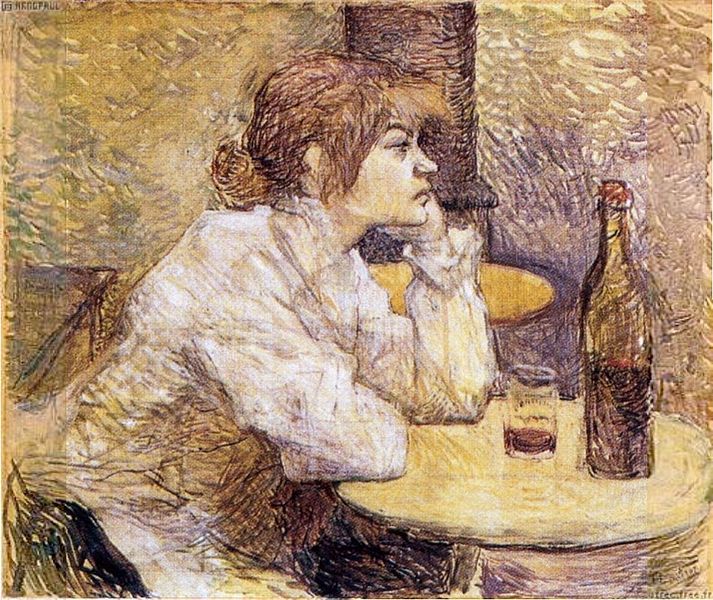
The Hangover; Portrait of Suzanne Valadon by Henri de Toulouse Lautrec (c. 1888)

Suzanne and Toulouse-Lautrec would often wile away their time together sketching.  He completed a number of portraits of her but would never pose for her.  One of the best portraits Toulouse Lautrec did of Suzanne was his 1888 painting entitled Gueule de Bois (The Hangover) in which we see her sprawled across a café table.  She received no payment from Lautrec for modelling for this picture.  It would have been unthinkable considering all the help he had given her.  Soon Toulouse-Lautrec began to advise Suzanne, not just on things artistic, but everyday things such as how she should dress what hats she should wear and would often accompany her on shopping trips. 

Portrait of the Artist Suzanne Valadon  by Toulouse Lautrec (1885)
Portrait of the Artist Suzanne Valadon by Toulouse Lautrec (1885)

It was Toulouse-Lautrec who persuaded her to change her name from that which she was baptised, Marie-Clémentine, to Suzanne as he believed her birth name was just too mundane for an up-and-coming artist.  Suzanne agreed to the change of name and she gave Lautrec the very first painting she completed, which had been signed “Suzanne Valadon”. 

It was on the insistence of Toulouse-Lautrec that in 1887, Suzanne went to see Edgar Degas and took along some of her sketches.  She recalled the time:

“…Lautrec’s great brown eyes laughed behind his thick glasses and his mouth was solemn and grave as a priest’s when he told me I must go to M. Degas with my drawings…” 

When she arrived at Degas’ house for the first time,  Suzanne always recalled that day stating on a number of occasions that it was “the wonderful moment of my life”.  She arrived at the house in rue Victor Massé clutching her portfolio of sketches.  She was extremely nervous in his presence.  She recalled the time vividly.  Degas took her sketches, moved to the window to see them better and slowly thumbed through them mumbling comments to himself, occasionally looking up at her.  On completing his examination of her work he turned to Suzanne, who was sitting straight-backed in a chair, and uttered the words that she would never forget:

“…Yes it is true.  You are indeed one of us…”

Nude getting into the Bath besides the Seated Grandmother by Suzanne Valadon (1903)

Degas, who had once described himself as simply a colourist with line, could see the merit in Suzanne’s work despite her work was in a pure and savage state and the sketches were totally without refinement, and yet there was a sense of grace about them.  Suzanne and Degas became good and long-lasting friends.  It was a friendship which would have, in some ways, seemed strange as Degas and Suzanne came from different backgrounds and different social classes but it could be the fact that Degas was uneasy in the company of women of his own social strata and that made Suzanne and ideal companion.  During their many meetings she would show him her latest work which he would assess and give advice and she in return would tell him all the gossip and news from Montmartre, for he rarely set foot outside stating he was too ill and it was also around this time that his eyesight began to fail. 

Although Suzanne Valadon was a self taught artist it is generally accepted that she owed a lot to Edgar Degas.  It was he that supervised her first engravings and it was he who ensured that Ambroise Vollard, one of the most important art dealers of the time, presented an exhibition of Suzanne’s engravings at his gallery in 1895.  As far as Suzanne was concerned, Edgar Degas was “The Master”, an artistic genius.  Of all the artists she came across, he was the one she respected the most.  She hung on his every word, basked in his praise for her work and although he had lost a number of friends due to his petulance and grumpiness, she looked on his irascibility as part of his charm and charisma.  Degas could do no wrong in her eyes.  Degas too loved her companionship and Suzanne Valadon was one of the few people who could call herself a friend of the great man and she was immensely proud of this mutual friendship.

                                                           ……………………………………….. to be continued

Suzanne Valadon. Part 3 Pierre-August Renoir

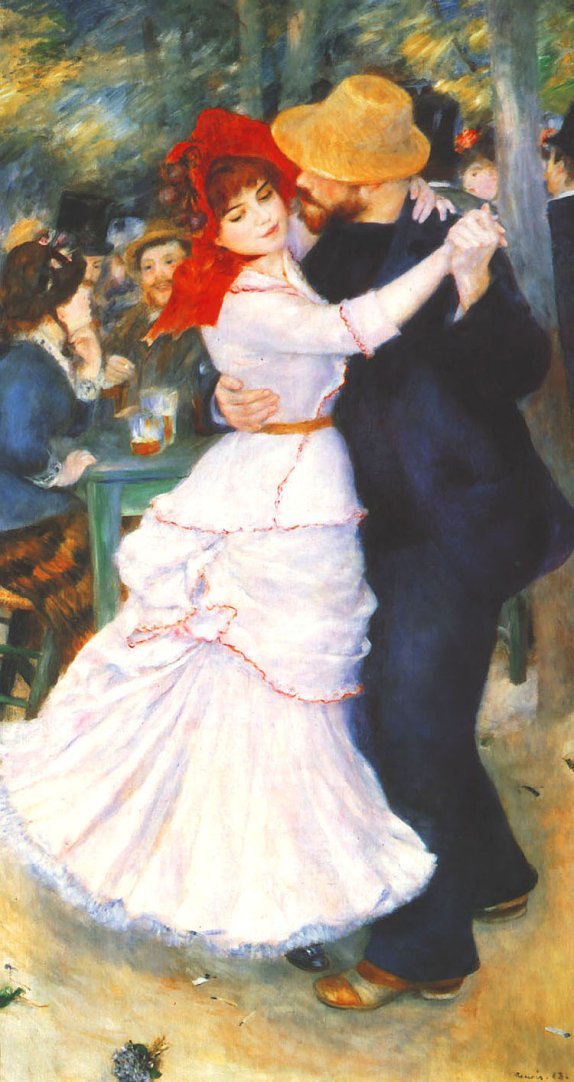
Dance at Bougival by Renoir (1883)
(featuring Suzanne Valadon and Eugene Pierre Lestringuez)

I ended my last blog about Suzanne Valadon with her relationship with Pierre Puvis de Chavannes ended and she had moved back in with her mother.  That summer she had become pregnant and in December 1883 had given birth to a baby boy whom she named Maurice.   The following year, after she had got herself back in shape and had employed a nanny to look after her son, she went back to her old life of modelling for artists by day and revelling in  café-bar life at night…..    

In 1883, before she became pregnant Suzanne was employed as a model by Pierre-August Renoir.  Besides being an artist an artist’s model they had something else in common – they both originated from Limoges.  Renoir had returned to Paris after extensively travelling around Europe and North Africa.   Despite being moderately well-off due to the sale of his paintings he chose to live in the less salubrious area of Montmartre.  Suzanne and Renoir would stroll along the streets of Montmartre arm in arm and nobody was in any doubt that they had become lovers.  They would go dancing at the Moulin de la Gatte on Sundays and picnic at Argenteuil and Chatou on sunny summer days. 

However, I want to turn the clock back two years to 1881 to look at what Renoir was doing at the time and, by doing so, look at the interaction between Suzanne and him a couple of years later.   Renoir had completed his famous painting Les Déjeuner des Canotiers (Luncheon of the Boating Party) in 1881 (see My Daily Art Display August 2nd 2011), which had been a group portrait of his friends dining on the upstairs terrace of Restaurant Fournaise which was in the small village of Bougival on the bank of the River Seine.   It was here that his friends would gather to eat and dance and watch the oarsmen row their boats up and down the river.  One of the people depicted in the painting was Aline Charigot who Renoir would eventually marry in 1890 albeit Aline had already given birth to their son, Pierre, in 1885. 

In 1882,  a year after completing the Déjeuner des Canotiers painting he was commissioned by Paul Durand-Ruel to complete three paintings, which became known as the Dance Series.  The series consisted of Dance à Bougival, Dance in the City and Dance in the Country.  These were life-sized works measuring about 180 x 90 cms.  In all three paintings there are two main characters, a male and a female dancing.  In the first two paintings, the model for the female was Suzanne Valadon and in the third one, the model was Aline Charigot. 

Dance in the City by Renoir (1883) (featuring Suzanne Valadon and Paul Lhôte)
Dance in the City by Renoir (1883)
(featuring Suzanne Valadon and Paul Lhôte)

The setting for Renoir’s painting Dance in the City is a high class Parisian establishment, for this is a “white ball”, which was favoured by the upper classes. Although the painting once again depicts a couple dancing, this work is all about the woman as the man is almost hidden from our view.  There is a shimmering opulence about this work.  Renoir has depicted the woman, modelled by Suzanne Valadon, wearing a two-piece white silk gown, – her toilette de bal (dance dress).  The cut of her dress reveals her back and shoulders.  Her partner, was thought to be modelled by Renoir’s close friend, Paul Lhôte, a journalist and writer of short fiction.  He is wearing formal evening wear and the tails of his long coat swish with the movement of the dance.    Both the man and woman wear white gloves which in a way makes the dance a more formal event ensuring that the bare hands of the man do not touch the delicate skin of the woman.  Their hands are clasped as in the Dance à Bougival but in this painting it is just the lightest coupling of hands. 

Suzanne Valadon always maintained that the Dancing à Bougival work featuring her was painted in-situ at Bougival thus implying that she was part of the Bougival “in-crowd”.  In later life she talked about her relationship with Renoir and the Dance à Bougival painting saying:

“…He fell in love with me and at Bougival he painted me in his famous picture…”

However Renoir stated quite categorically that he simply made a few sketches of Suzanne and the paintings was completed at his studio.  The painting Dance à Bougival is housed at the Museum of Fine Arts in Boston which acquired the work in 1937.  In this painting we see Suzanne Valadon dancing with Eugene Pierre Lestringuez, another of Renoir’s friends, who was an official at the Ministry of the Interior and who featured in a number of Renoir’s works including Les Déjeuner des Canotiers.  In this outdoor dance scene there is not the formality that we saw in the painting Dancing in the City.   Gone is the woman’s formal toilette de bal, replaced by a light pink dress with red piping.  The hands of the dancers are not gloved.  Gone is the man’s formal attire, replaced by a loose fitting blue jacket and wool sweater and atop his head he wears a yellow straw hat which hides part of his face and his eyes.  Gone are the lightly touching hands and in its place we see the left hand of the man gripping the lady’s hand tightly while his right hand snakes around her waist pulling her body into his.  Suzanne wears a large bright red hat, the colour of which draws your eyes to it and, by doing so, we focus on the faces of the dancers.  Look at the faces closely.  The woman pulls her face away from that of her partner and looks downwards avoiding any eye contact with the man whilst he stares at his partner with an unnerving intensity.  What is going on between the pair?  There is a strange uneasiness, tenseness, between the couple. There is no sense of intimacy between the dancers.

Facial expression (Detail from Dance at Bougival)
Facial expression
(Detail from Dance at Bougival)

As the artist, Renoir, was the one to decide on how he would depict the pair’s facial expressions and body language, what made Renoir portray the couple in this way?  Was Renoir in some way transferring Suzanne’s character into the painting?  This was supposed to be a joyful event in which couples twirl in the open air so why this pensiveness?  It is almost as if the man has said something inappropriate to the woman and she is slightly offended or could it be that the averting of her eyes is simply her way of teasing her dancing partner? 

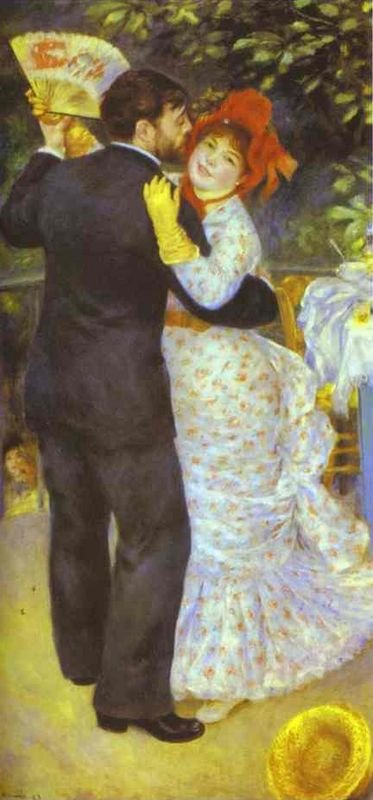
Dance in the Country by Renoir (1883) (featuring Aline Charigot and Paul Lhôte
Dance in the Country by Renoir (1883)
(featuring Aline Charigot and Paul Lhôte

Another question posed by Renoir’s Dancing series paintings that although Suzanne Valadon modelled for Dancing à Bougival and Dancing in the City why did the artist decide to switch to Aline Charigot for Dancing in the Country, who we see depicted partnering Paul Lhôte.  When I look at and compare  the faces of the two females depicted in the paintings I have to say that Suzanne’ thinner and more delicate face  is the more attractive and sophisticated and it could be that for a country dance scene Renoir decided that the fuller face with the rosy cheeks of Aline were more suited when it came to the ambience of the country.  Or could it be that Aline Charigot’s insisted that she, and not Suzanne, featured in the third work. 

The one aspect that the Bougival and City paintings have in common is the distracted expression on the face of Suzanne Valadon.  In both paintings she pays little attention to her partner and lacks the smile which Aline Charigot has on her face in Dancing in the Country.  Is this just coincidental?  Could it be that Renoir’s depictions of Aline and Suzanne give us a better feeling as to how he viewed his two lovers.  

The Bathers by Renoir (1887)

Suzanne travelled to Guernsey with Renoir in order for him to paint some pictures including a nude portrait of her.  Although he later destroyed the painting it is thought that he used the face for the central character in his painting The Bathers which he completed in 1887.  Amusingly, Suzanne was adament that it was not just her face that was used for the painting, but her whole body !!   Their painting trip to Guernsey was rudely interrupted with the news that Aline Charigot was coming to visit Renoir and one can only imagine Suzanne’s anger when Renoir arranged for her to return to Paris immediately so that the women would not meet.  There was obviously no love lost between Aline and Suzanne both vying to be Renoir’s one true love.  As I said earlier, Aline won that battle as she and Renoir eventually married.  

Suzanne Valadon by Pierre Auguste Renoir (1885)

Suzanne’s position as Renoir’s lover ended almost as soon as it had begun but she still modelled for him and in 1885 he completed a head and shoulder portrait of her.  At our first glance of this portrait we are aware of her facial expression.  It is not one of happiness but is one of despondency but it is still a charming depiction of his one time lover.

The Ponytail (Suzanne Valadon) by Renoir (1886)

In 1886 he completed another portrait of her which is sometimes referred to as The Braid (Susan Valadon) or The Ponytail (Susan Valadon) and which is housed in Museum Langmatt, Baden.   This is a far more sensuous portrait of Suzanne and her downward gaze adds to her innate sensuality.  There is no doubt that she was an extremely beautiful woman and one can see why artists like Renoir were drawn to this amazing young lady.  Renoir, besides employing her as a model and becoming her lover, did something else which was to change the course of her life.  He took an interest in her desire to draw and paint and nurtured the idea that she, one day, would become a great artist. 

                                                ………………………….. to be continued.

If you would like to have a more in-depth view of Suzanne Valadon’s lifestory then I would recommend that you read a book entitled The Valadon Drama, The Life of Suzanne Valadon, written by John Storm in 1923.

Susan Valadon. Part 2 – The artist’s model

Suzanne Valadon
Suzanne Valadon

In my last blog I looked at the early life and upbringing of my featured artist, Susan Valadon.  She and her mother Madeleine had moved from Limoges and had come to live in the Montmartre district of Paris.  They had survived the siege of the capital by the Prussian army as well as the bloody fight between the Communards and the French government troops which followed.  Suzanne had been trained as a seamstress but had ended up as a teenager working in a circus which culminated in her being injured in a fall whilst standing in for a trapeze artist.  She now needed to find an alternate income source……………

A friend of Suzanne suggested that she should consider becoming an artist’s model despite the modelling profession was looked upon as a risqué form of employment and just one inevitable step from becoming the artist’s lover and it was a profession which was frowned upon in many quarters.  Her mother believed that her daughter would become nothing more than a common prostitute but Suzanne, headstrong as ever, was not to be deterred.  Suzanne would meet every morning at the fountain in the Place de Pigalle with other young girls and wait to see if she would be chosen by an artist.  She had a lot of things going for her.  She had an elfin-like vivaciousness.  Her skin was soft and ivory in colour.  Even though she was till just sixteen years of age her figure had ripened.  She was a cross between an attractive and charming child and a self-assured voluptuous woman and more importantly ,as far as her job prospects were concerned, she was just what an artist was looking for.  She was constantly being chosen to model and she adored this new life.  She recalled the first time she was picked out of the waiting group of prospective models and sitting before an artist for the first time: 

“…I remember the first sitting I did.   I remember saying to myself over and over again ‘ This is it! This is it!’  Over and over I said it all day.  I did not know why.   But I knew that I was somewhere at last and that I should never leave…”

For her, modelling for artists meant that she was one of the players on the Montmartre artistic stage.  Her daily routine was fixed.  She would pose for the artists in the afternoons until the light started to fail, then in the evening she would accompany them to the bars and café-concerts and partake in what was known as the “green hour” – the time for relaxation in the pub, the time for stimulating conversation, but most importantly, the time for imbibing the 136 proof, anise-flavoured, green spirit, absinthe.

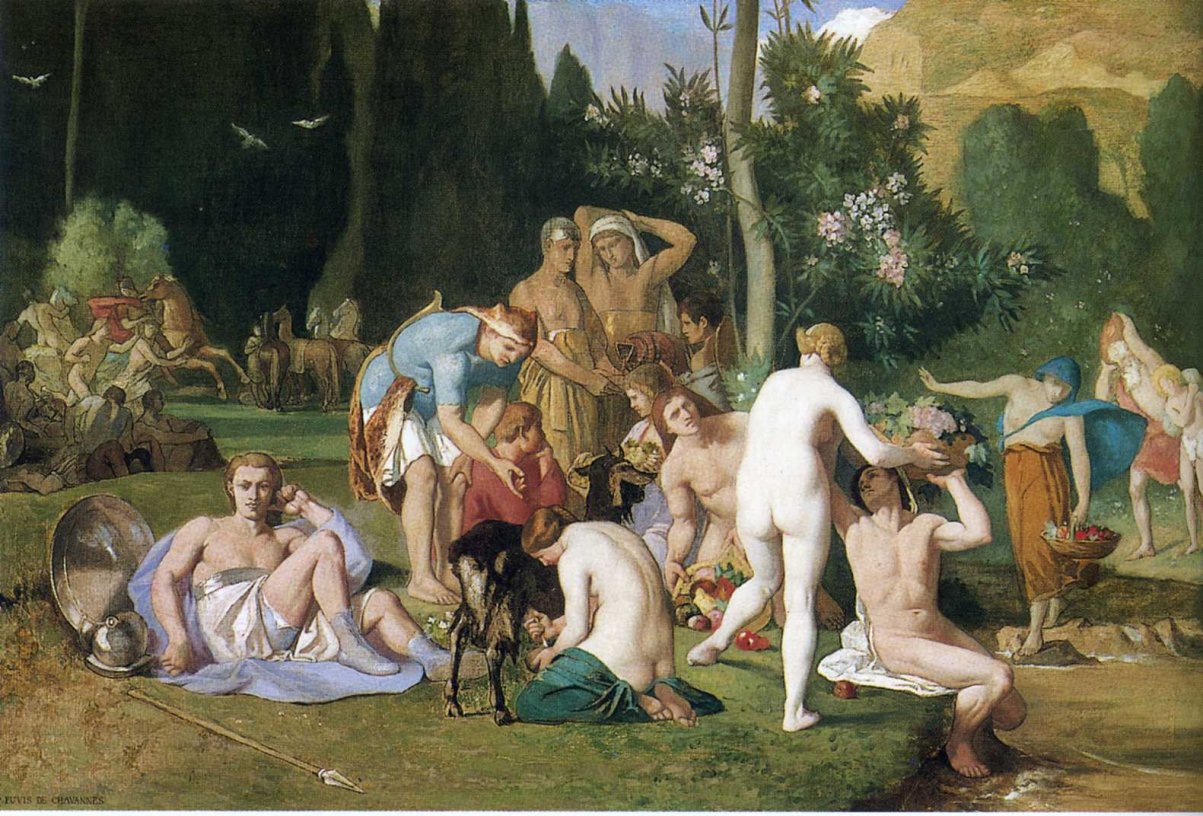
In 1882, when she was seventeen years of age, she was summoned by the French artist, Pierre Puvis de Chavannes, to attend his studio at Neuilly.   Pierre Puvis, who was fifty-seven at the time, was still a bachelor but was involved in a long lasting loving, but non-sexual, relationship with Princess Marie Cantacuzène, the wife of a Romanian nobleman.  Pierre and Marie would eventually marry in 1898, a few months before both of them died, Marie in the August and Pierre in the October.  Despite the forty year age gap Pierre Puvis and Suzanne became lovers and she moved into his Neuilly apartment.  She was dumbstruck by the opulence of his home.   This was a far cry from the lodgings she shared with her mother.  Pierre and Suzanne however could not have been more dissimilar in temperament.  She was wild, edgy and vocal whereas the artist was quietly spoken, laid back, and often lost in quiet contemplation.  She would hanker after a night at a café-cabaret while Puvis wanted nothing more than to go for a quiet stroll with her along the banks of the Seine. 

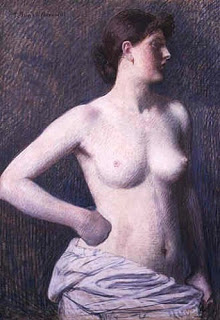
Suzanne Valadon by Pierre Puvis de Chavannes (1880)

Susanne Valadon modelled for Pierre Puvis de Chavannes for his pastel on paper work which he completed in 1880.  The nude study was untitled but one can see the physical attraction of the model to the artist.  It is a stunningly beautiful work of art.  Suzanne, like many of the artists’ models had no problems with posing nude and early photograph below shows her in such a pose.

Suzanne Valadon          (photo)
Suzanne Valadon
(photo)

The liaison between Pierre Puvis and Susan Valadon lasted for six months and during that time he probably became a slightly more spirited person through being around Suzanne and in return he seemed to have instilled a calming influence on the hyper young woman. It was the first time that Suzanne had been in some ways dominated by a man.  It would appear to be a similar situation to the Eliza Doolittle and Henry Higgins scenario in Pygmalion.  Inevitably the liaison came to an end.  It did not end in a fiery confrontation with insults being hurled.  Their liaison as lovers had run its course.  It was just a quiet and mutual ending to a relationship which they had both enjoyed.  Suzanne returned home to live with her mother in her one-bedroom Montmartre lodgings on the rue du Poteau but still on occasions modelled for Pierre. 

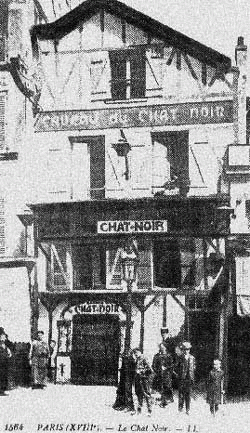
Le Chat Noir
Le Chat Noir

Suzanne soon returned to her old ways of modelling by day and celebrating at night and one evening whilst in Le Chat Noir she met Miguel Utrillo, a Spanish engineering student who was studying in Paris.  Soon the two became close friends which inevitably lead them to become lovers.   Utrillo was not the first man since Puvis that Suzanne had slept with as she had quite a number of sexual partners and so maybe it was not surprising that in late summer of 1883 she became pregnant.  The question on most people’s lips was – who was the father of Suzanne’s child?   Her friends would question her and put forward a name, to which Suzanne, not at all upset by the questioning, would just smile and amusingly state: “It could be” or “I hope so”.   Suzanne gave birth to a baby son on December 26th 1883 after a very prolonged and painful birthing process overseen by an irritable midwife and her ever drunk mother.  After giving birth Suzanne lapsed into a coma for two days.  The baby was registered at the town hall in Montmartre as Maurice Valadon.   Why Maurice?   Suzanne’s reasoning behind the choice of name was that none of her recent lovers had the name Maurice!   

Her old one-bedroom apartment in which she had been living with her mother was now not big enough and so after the birth Suzanne and her baby along with her mother Madeleine moved into a three-bedroom apartment in rue Tourlaque.  This was more expensive but Suzanne was not concerned, nor had she been concerned when she was pregnant and too big to be used as an artist’s model and her money from modelling dried up.   She was receiving money from an admirer or lover but she would never reveal the source of her income.  Once up and about, Suzanne reverted to her nights out at the bars and clubs accompanied by different men including Miguel Utrillo.

                                                                                          ……. to be continued

Susan Valadon, Part 1 – The early years

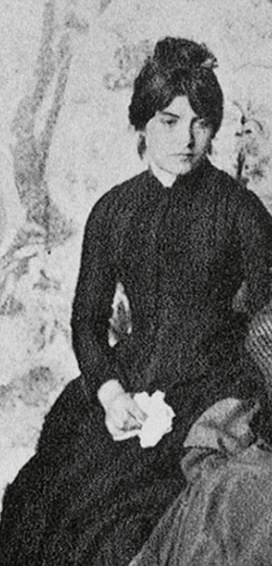
Suzanne Valadon aged 24

In my next few blogs I want to look at the life of a female who was both a great artist and artist’s model and whose name is synonymous with the artistic world of the late nineteenth/early twentieth century Montmartre.  She was, and still is, loved by the feminist movement who applaud her guts and determination.  She is Suzanne Valadon.   I want to spend time and look at the artistic friends she made during her life and how they adored her.  She was, to many artists, a model, a muse and, in some cases, a willing lover.   To fully understand why her lifestyle was as it was, one must go back and examine her family roots and look at her early childhood which was , as is the case for nearly all of us, the sewing and the germination of the seed which would eventually blossom and shape our lives. 

To examine her early life one needs to scrutinize the circumstances of her birth and for that it is necessary to look into the life of her family.   Her mother was Madeleine Valadon who was born in the small rural village of Bessines, close to the town of Limoges.  What we know of Madeleine comes from her own lips later in life and because she frequently changed the facts one needs to be careful as to what to believe.   She maintained that as a teenager she had once been married to a man from Limoges named Courland and that he died in jail when she was just twenty-one years of age but by which time she had given birth to a number of his children.  After his death Madeleine reverted back to her family name of Valadon and returned to her family home.  As a young girl, she was taught to read and write by nuns who also taught her to stitch and sew. She then fortuitously managed to secure employment as a live-in seamstress to the well-to-do Guimbaud family who lived nearby.  It was a position which she was pleased to accept and felt no grief for having to leave her children in their less than salubrious family home whilst she was living in comparative comfort close by.   She soon established herself as the head of the servants in the Guimbaud household and, unlike them, even dined with the family.  She remained in this employment for thirteen years but it came to an end when she once again became pregnant.   According to her, the father of the child was a local miller who was killed in an accident at work.  In later life she viewed the accident which killed him as divine retribution for making her pregnant!     

Naturally the small Bessines community was shocked by the news of her pregnancy and lack of a husband to act as a father figure to her newborn.  The Guimbaud family however treated her well and she remained in their house until her child, a daughter, was born.  According to the official records, the child was baptised Marie-Clémentine Valadon on September 23rd 1865.   It was not until she was nineteen years of age that Marie-Clémentine started calling herself Suzanne and this apparently was the suggestion of her friend, the artist, Henri Toulouse Lautrec.    It is also interesting to note that despite that documented official registration of her birth Suzanne always maintained she was born in 1867. 

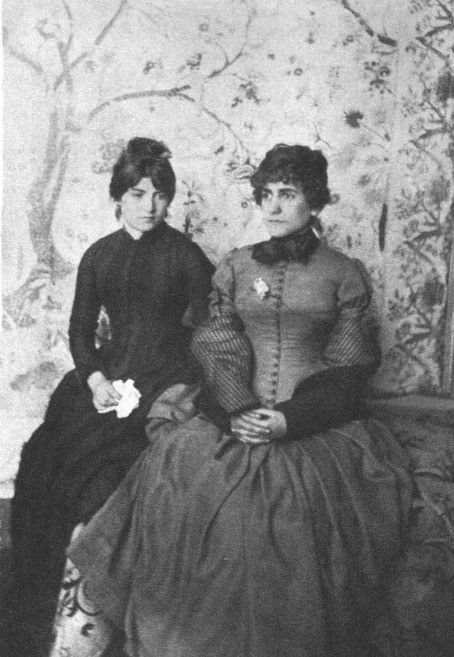
Madeleine Valadon with her daughter Suzanne

Madeleine Valadon left Bessines with her baby in January 1866 and headed for Paris.  She never looked back.  She never saw or communicated with her family, her other children or her former employer, the Guimbaud family, ever again and one can only wonder why she wanted this complete break from her past. 

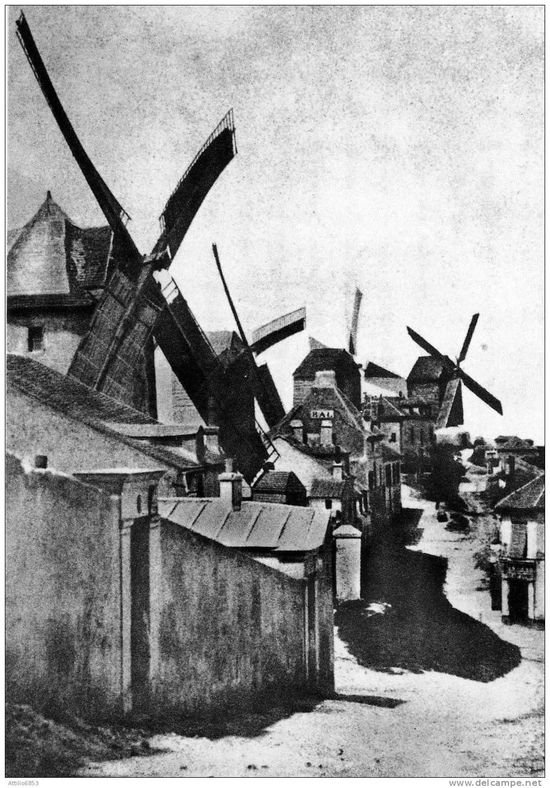
The windmills of Montmartre, taken in 1839 by Hippolyte Bayard

She arrived in Paris confidant that she would be able to earn a living as a seamstress.   Madeleine Valadon was amazed at the sight that greeted her to the north of the capital city – a hill on top of which were a number of windmills, a vista which was similar to the rural views back home.  The steep hill she viewed was the Mount of Martyrs, named after the execution of the first bishop of Paris, St Denis and his faithful lieutenants, St Rustique and St Éleuthère in the third century – Montmartre.  Madeleine settled into lodgings at the base of the hill in the Boulevard de Rochechouart and then, with a glowing reference from the Guimbaud family, set off to procure employment as a seamstress.  Her plans did not come to fruition as jobs were scarce and finally, in desperation, she had to settle for the menial job as a scrub-woman, cleaning floors whilst the wife of the concierge of her lodgings looked after Suzanne. 

Madeleine, no doubt aware that for her daughter to succeed in life she had to be educated, and so arranged for a priest to teach her to read and write and then had her attend the convent run by the nuns of St Vincent de Paul as a day pupil for a continuance of her education and to be taught, as she was, to become a seamstress.  However, once again her plans went awry with the start of the Franco-Prussian War which culminated in the siege of Paris by the Prussian army at the end of 1870 and the ousting of the French government, which retreated from Paris and based itself in Bordeaux.  In May 1871, following the conclusion of the Franco-Prussian War and the lifting of the Prussian siege of Paris, the French government returned to Versailles on the outskirts of Paris ready once again to rule the capital.  However many of the Parisians, who had suffered during the Paris siege, blamed their government for their misery and deprivation which they had to endure.  They remembered with bitterness the days they had to scavenge for food eating dogs, cats and rats to survive.  Out of this sense of bitterness and betrayal came the rise of the Communards.  The Communards were a group of working class disaffected Parisians who did not want the French government to return to control Paris.  They were very active around the area where Madeleine and Suzanne lived and their bloody determination that the defeated French government would not return to Paris from their bolt-hole at Versailles set up a clash which was in fact a mini civil war and which claimed the lives of more than twenty thousand Parisians. 

Suzanne, during these times of turmoil, had still attended the St Vincent de Paul convent for her lessons and during the Paris siege had been fed by the nuns from their home-grown produce.  However during the Paris Commune clashes between the government forces and the Communards the fighting had been so intense that the nuns barricaded themselves in the convent and closed it down to the day pupils and so Suzanne like many others lost their opportunity for learning and being fed.  Suzanne, who was six years of age and like many children of her age, revelled in not having to go to school.  Her mother, on the other hand, despaired and began to drink heavily.   At the end of the Paris Commune struggle at the end of May 1871 and with it, the return to law and order under the French government, the St Vincent de Paul nuns felt it safe to re-open their convent to their day pupils and Suzanne, who had enjoyed the freedom from the discipline of school life and the boredom of lessons reluctantly had to return to the confines of the convent.  She rebelled and was frequently absent preferring to play in the streets and on the hill of Montmartre with new friends both children and adults.   She mixed with the lowest elements of society, the prostitutes, the beggars and the thieves and loved every minute of it.  Later in life she recalled those times:

“…From that day the streets of Montmartre were home to me.  It was only in the streets that there was excitement and love and ideas – what other children found around their dining room tables…” 

Suzanne lived a feral existence.  She was small in stature and had a fierce temper and would often succumb to uncontrollable rages and on the streets of Montmartre she was often referred to as “The Little Valadon Terror”.   Her mother Madeleine became more morose and apathetic as the years passed.  She lost total interest in life and frequently descended into an alcoholic haze.  She rarely cleaned their lodgings and seldom did any laundry.  She begrudged cooking and having to feed Suzanne and when they ate at meal times they would normally eat apart.  Nothing Suzanne would do would lift her mother’s spirit.   Despite this lack of maternal love for Suzanne the two lived together for almost sixty years.  In later life Suzanne often depicted her mother in paintings.  She would nearly always portray her as being old, wrinkled and toothless but showed her hard at work. 

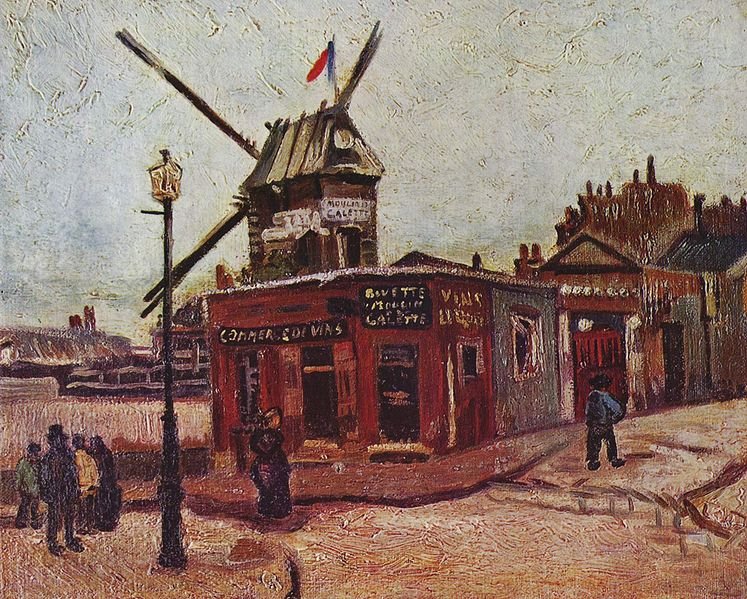
Le Moulin de Galette by Vincent van Gogh (1886)

Montmartre since the beginning of the 19th century was the centre of artistic life and drew artists, musicians and writers to it like a magnet.  Studio garrets shot up everywhere in which the artists would paint day in and day out and in the late evenings would look for some respite and so bars and music and dance halls, such as the notorious Moulin Rouge.  

L'Absinthe by Degas (1873)
L’Absinthe by Degas (1876)

The Café de la Nouvelle-Athènes, was a meeting place for the up and coming artists of the time including the “new kids on the block”, the Impressionists and it was outside this establishment that Degas depicted the two drinking companions in his famous 1876 work L’Absinthe  (See My Daily Art Display June 7th 2011).  Another popular establishment was Le Chat Noir, which opened in November 1881 in Boulevard Rochechouart, the same street where Madeleine and Suzanne lived and was run by the entertainment impresario, Rodolphe Salis.  The Divan Japonais, a café-concert (a combination of a concert hall and a pub) was a haunt of the French painter, Henri Toulouse-Lautrec.  Probably one of the most popular was the Moulin de la Galette.  This was originally a windmill, one of the thirty windmills on La Butte de Montmartre, which Madeleine saw as she arrived from Limoges.  The windmill owners then added a goguette (a wine shop) which also sold galettes (flat round crusty pastries) and later incorporated a dance hall and restaurant.  It was here that Suzanne Valadon reminisced that she had first set eyes on Degas whom she described as:  

“…a small round-shouldered man, fragile and sad-eyed, in pepper-and-salt tweeds, his throat swathed in woollen scarves…”

In 1874, at the age of nine, Madeleine took Suzanne to an atelier de couture where she was apprenticed as a seamstress.  Suzanne hated the life and made numerous attempts the workplace but unlike the nuns the workhouse owner would beat her when she was dragged back to the factory by her mother.  She stayed there for three years but eventually left and took jobs as a waitress in a café, a push-cart vendor of vegetables and working with horses at a livery stable.  It was this last job in which one of her jobs was to walk the horses around the streets.  People would stop on the street and watch this small young girl with her large horses.  Suzanne, ever the entertainer, was not content with just walking the horses but began to perform acrobatic tricks upon the horses to gain more notice and a modicum of applause.   In later years, she reckoned that a circus owner witnessed one of her “performances” and offered her a job.  She loved this new colourful and exciting life.  Although her role at the circus/carnival was a horse riding act, one day she was asked to stand in for a trapeze artist who had been taken ill.  She had done some trapeze work and so agreed.  Unfortunately the performance went badly and she fell, injuring her back and her circus life came to an end. 

                                                                        …………………… to be continued.

Having been chastised the other day for not acknowledging some of my sources I thought I had better behave myself today and tell you that most of my information came from a book I read (and I am still reading it) on the life of Suzanne Valadon entitled The Valadon Drama, The Life of Suzanne Valadon, written by John Storm in 1923.

Other sites I visited to find some pictures were:

http://lapouyette-unddiedingedeslebens.blogspot.co.uk/

http://youngbohemia.blogspot.co.uk/2012/01/suzanne-valadon_8445.html

http://www.messynessychic.com

The Blog:  It’s about time

http://bjws.blogspot.co.uk


The Poor Fisherman by Pierre Puvis de Chavannes

The Poor Fisherman by Pierre Puvis de Chevannes (1881)

My last blog looked at the early life of Pierre Puvis de Chavannes as well as feature a series of four large wall paintings he completed in the 1860’s.  In today’s blog I will conclude his life story and feature one of his best known paintings entitled The Poor Fisherman.  

Following the success of his wall paintings for the Musée de Picardie he went on to complete many other wall painting commissions, such as the staircase of the Hôtel de Ville at Poitiers.  In 1874 the Department of Fine Arts in Paris commissioned him to paint a number of wall paintings depicting the childhood and education of St Geneviève, the patroness of Paris, for the church of Saint Genevieve, which is now the Pantheon.  Puvis procured a second commission  for work in the Pantheon in 1896, depicting Genevieve’s accomplishments in old age which consisted of a single composition coupled with a triad of panels, the whole of which surmounted by a frieze. 

One of his largest commissions came in 1891 when Charles Follen McKim a partner in the architect firm of McKim, Mead and White, who had designed the new Boston library, went to Paris and approached Pierre Puvis to provide wall paintings for the grand staircase and loggia of their new building.  Puvis agreed to carry out this extensive commission despite being sixty-seven years of age.  Then Puvis had a change of heart when he accepted a commission for work in the Paris City Hall and so the following year, 1892, the Americans had to send over another representative to Paris to ask Puvis not to renege on his original agreement. After prolonged negotiations in July 1893 Puvis put pen to paper and the contract for the wall paintings was finalised, agreeing to pay the artist the sum of two hundred and fifty thousand francs.  Puvis completed his Paris City Hall commission in 1894 and in 1895 he began on the paintings which were to adorn the walls of the Boston Library.  To ensure that the wall paintings blended in with the internal architecture the architects sent Puvis samples of the marble which was to be used for the staircase and its surroundings.  Puvis worked on the wall paintings at a purpose built studio at Neuilly, just outside of Paris and completed them in 1898.  They were then shipped out to America.   Puvis never saw for himself his paintings in situ in the Boston library.   For a much more detailed account of this commission it is worth having a look at:

http://cool.conservation-us.org/jaic/articles/jaic36-01-005.html 

Pierre Puvis did not exclusively work on large-scale wall paintings, he would often relax by carrying out smaller easel paintings and today I am featuring one such work which he completed in 1881 and entitled The Poor Fisherman, which is housed in the Musée d’Orsay. Although not the size of one of his wall paintings, it is still a large work, measuring 155 x 192 cms.

The Angelus by Jean-François Millet (1859)

In the painting we see a forlorn-looking man, head bent, standing up in his boat with his hands clasped together in front of him as if in prayer and it is his stance along with the connection between Christ and his Apostles and fishermen, which gives the painting a somewhat religious feel to it.  Is he praying for success in his forthcoming fishing expedition or as some would have us believe it could be that it was noon and, as a practicing Catholic, the fisherman was reciting an Angelus prayer.  This supposition is based on the similar stance of the figures seen in Millet’s 1859 The Angelus painting.   On the bank there is a woman, his daughter, collecting flowers and his sleeping baby, lying on his back in a bed of wild flowers. One is struck by the bleak landscape and the contrast between the seemingly happy female as she picks the flowers, the peacefully sleeping child with the troubled poverty-stricken fisherman as he bows his head down in silent contemplation.   

The work was exhibited at the Paris Salon in 1881 and received a mixed reception and was not sold until 1887 when the French State purchased the work whilst it was on show at the French art dealer, Durand-Ruel’s showroom.  So what is there not to like about the work?  Is it just too depressing?  Does it fail to conform to the artistic norm?  In an article in the December 1916 issue of the The Art World magazine entitled “A Trivial Work of Art: The Poor Fisherman by Puvis de Chavannes, the art critic Petronius Arbiter summed up the painting:

“…It is an absolutely trivial work; and, coming from him, was a complete surprise and much criticized at the time. In the first place the lines of the composition are so zigzag that the work is irritating instead of soothing to the eyes. Then the sprawling of the badly drawn child over a low shrub, every leaf and branch of which would prick out of it all sense of sleep or even of comfort, is absurd.  Then the head of the mother is too large, and the hair that of a man rather than that of a woman. Then the man looks ‘sawed-off,’ for he is represented as standing with his knees against a seat in the boat. But where is the rest of his lower legs? The boat is either not deep enough or his lower legs are abnormally short, or sawed-off. This is also manifestly absurd. Then the head is so childishly constructed as to be ridiculous. Moreover, what is he doing – praying, fishing, philosophizing over his destiny, or what? The whole thing is childish to a degree. Here we have a meaningless ‘individuality’ with a vengeance…”

However the article’s author begrudgingly had some good words to say about the work:

“…The picture has but one redeeming feature – its charming colour.  A delicate general tone of mauve pervades the whole creation and the gradation of the tones in the water are so skilfully painted that we are drawn into the far distance whether we will or no.  That is, the values of the picture are remarkably true…”

Le Pauvre Pêcheur by Pierre Puvis de Chavannes (1881)  The National Museum of Western Art
Le Pauvre Pêcheur by Pierre Puvis de Chavannes (1881) The National Museum of Western Art

The artist painted another version of The Poor Fisherman in which he depicts just the fisherman and his baby child which this time lies in the botom of his boat.  This copy can be seen at the National Museum of Western Art in Tokyo.

Pierre Puvis de Chavannes died in October 1898 aged 73.   Shortly before his death he married his long time companion, Princess Marie Cantacuzène.   She died just a few months before her husband.

Following my last blog, which looked at the early life of Pierre Puvis de Chavannes, I was ticked off by the author Aimée Brown Price for using information from her books on the artist and not acknowledging the fact.  To defend myself I have to say up until receiving her email I had no idea she had written these books and probably took her information unknowingly from a third-party source.  However to rectify my misconduct I have given you below the title of her books on Pierre Puvis de Chavannes and I am sure if you want to read a more detailed account of the life and works of the artist they will be invaluable.

Aimée Brown Price, Pierre Puvis de Chavannes. Volume I: The Artist and his Art.  Volume II:  A Catalogue Raisonné of the Painted Work. New Haven: Yale University Press, 2010. ISBN 9780300115710, box set, two volumes, 750 pp. 1200 illustrations.

Pierre Puvis de Chavannes. Part 1 Wall paintings

Pierre Puvis de Chavannes (1882) aged 58.
Pierre Puvis de Chavannes (1882)
aged 58.

In my previous couple of blogs I looked at two married couples, all four of whom were artists who based themselves around Copenhagen and the Skagen area of northern Denmark.  The two wives, Anne Ancher née Brøndum and Marie Krøyer née Tiepcke both spent time studying art in various Paris ateliers, one of which was run by the French painter, Pierre-Cécile Puvis de Chavannes and so I thought over the next two blogs it would be interesting to look at his life story and examine some of his truly beautiful works of art.  In this first part I am going to concentrate on a series of his decorative works – his first set of wall paintings which can be seen at the Musée de Picardie in Amiens, a town in the Picardy region of northern France.  Pierre-Cécile Puvis, as it was not until somewhat later in life that he attached the ancestral name of his Burgundian forefathers “de Chevannes” to his surname, was born in Lyon, into a wealthy bourgeois family in December 1824.  His mother was Marguerite Guyot de Pravieux and his father, Marie-Julien-César Puvis de Chavannes, who was the Chief Engineer of Mines for the region.  His father’s wealth would ensure that Pierre never wanted financially for the rest of his life.  Pierre was the youngest of four children.   He had two sisters, Joséphine and Marie-Antoinette and a brother Edouard.     He went to school at the Lycée Royal and the Collège Saint-Rambert, in Lyon.  Later he attended the Lycée Henri IV in Paris and in 1842 at the age of eighteen Pierre Puvis had obtained his baccalaureate.  By 1843 both Pierre’s parents were dead.  His mother died in October 1840 and his father died three years later in Nice.   In 1843 he briefly enrolled at a law school in Paris but left after a few months. His father had had high hopes that his son would follow in his engineering footsteps.   However, any hopes of proceeding on to an engineering career via the l’Ecole Polytechnique in Lyon were dashed when he was struck down with a serious illness whilst studying for the entrance exam.  For most of 1844 and 1845 he had to convalesce at the home of his sister Joséphine and her husband Esprit-Alexandre Jordan in Mâcon in central France.   

In 1846 his life was to change as for part of his recuperation he decided to go on a trip to Italy.   It was during his journey around Italy that he fell in love with the art that he saw, and the frescos and murals stimulated his interest in painting and so, on his return to Paris, he announced his intention to become a painter.  The first painter he approached for an apprenticeship was the French history painter and portraitist Emile Signon but he was turned down and told to seek out Ary Scheffer who eventually arranged for Pierre to be trained at the atelier of his brother, Henri Scheffer.   In 1848 Pierre embarked on a second trip to Italy, this time accompanied by the painter Louis Bauderon de Vermeron.  On returning from Italy in late 1848, he worked at Eugène Delacroix’s studio but this only lasted a fortnight as Delacroix was taken ill and the studio was closed and Pierre went to work at the atelier of the French history painter Thomas Couture.  In 1850, Pierre Puvis set up his very own studio in rue St Lazare and in that year he had his first work, Dead Christ, exhibited at that year’s Salon. 

Later in the 1850’s Pierre Puvis, art changed and he concentrated on large decorative pieces for large houses or other important establishments.  These were neither frescos nor murals but were painted canvases which were then affixed to the wall.   These wall paintings were often secured to walls by a method known as marouflage where the canvas was “glued” to the wall by an adhesive which when it dries is as strong as plaster or cement.  The terminology marouflage comes from the French word, maroufle, which is the word to describe the sticky substance which has congealed at the bottom of artist’s paint pot.  

Le Paix (Peace) by Pierre Puvis de Chavannes (1861)

In 1861 Pierre Puvis produced two large paintings, each measuring 3.4 x 5.5m, one entitled Peace and the other, its companion piece was entitled War.  The work entitled Peace depicted an idyllic land with figures from ancient times relaxing in a peaceful landscape, with not a care in the world.  In the background we can see people riding horses, running and dancing whilst in the foreground we observe goats being milked.  Fruit is plentiful and we see it being gathered up.    Life in this state of peace and tranquillity could not be better and it is thought that Pierre Puvis based his work on Virgil’s fourth Eclogue in which the poet described such a place: 

“…..the uncultivated earth will pour out

her first little gifts, straggling ivy and cyclamen everywhere

and the bean flower with the smiling acanthus.

The goats will come home themselves, their udders swollen

with milk, and the cattle will have no fear of fierce lions….”

La Guerre (War)  by Pierre Puvis de Chavannes (1861)
La Guerre (War) by Pierre Puvis de Chavannes (1861)

In the work entitled War things couldn’t have been more different.  Gone is the idyllic landscape, now supplanted by a background showing a gloomy and desolate landscape in which we can see homes burning.  In the left mid-ground we see a soldier in all his armour, with his red cloak fluttering behind him as he pitilessly kills civilians.   In the foreground we see women on their knees begging for mercy as three riders sound their horns.  Could it be they are the attackers sounding off in a triumphal fashion or are they fleeing the enemy and urging their people to hurry along?  Behind the horsemen we see a column of stragglers, some being carried, fleeing the enemy.  Look at the beast on the ground to the left of the women.  See how by showing the white of its eye we get a sense of its fear whilst the other animal, next to it, raises its head, its neck stretched to the limit, as it bellows for mercy.  The French State purchased Peace and because Puvis did not want his pair of paintings to be separated he donated War to the French State.  Following the completion of Peace and War in 1861, Pierre Puvis found himself without any commissions so decided to paint two more works to act as companion pieces to Peace and War

Le  Travail (Work) by Pierre Puvis de Chavannes (1863)
Le Travail (Work) by Pierre Puvis de Chavannes (1863)

He entitled them Work and Repose and submitted them to the Salon of 1863. 

Le Repos (Repose) by Pierre Puvis de Chavannes (1863)

At around this time in Amiens a new museum, Musée de Picardie, was being built and one of its architects, Arthur-Stanislas Diet, approached Pierre Puvis to see if all four of these works could be placed on the wall of the museum’s monumental main staircase and the gallery.  He agreed.  The French State loaned the first two paintings to the museum and Pierre Puvis donated the other two works. 

La Paix by Pierre Puvis de Chavannes (1867) Philadelphia Museum of Art
La Paix by Pierre Puvis de Chavannes (1867)
Philadelphia Museum of Art

Four years later in 1867, Pierre Puvis produced smaller versions of Peace and War which can now be seen at the Philadelphia Museum of Art. 

La Guerre by Pierre Puvis de Chavannes (1867) Philadelphia Museum of Art
La Guerre by Pierre Puvis de Chavannes (1867)
Philadelphia Museum of Art

In my next blog I will feature some of Pierre Puvis’ smaller works and continue with his life story.

Victorine Meurent

Le Jour des Rameaux by Victorine Meurent (c.1880)

The painting above, Le Jour des Rameaux or Palm Sunday, is unique in as much as it is the only surviving painting by my featured artist.  It was recovered in 2004 and can now be found hanging in the local museum of Colombes, a suburb of Paris.  The artist who completed the work in the 1880’s is Victorine Meurent.  “Victorine who? “, do I hear you say.  If you haven’t heard the name as an artist, you may have heard of her as an artist’s model.

Victorine Meurent was born into a working class family in Paris in 1844.  It is thought that her father worked as an engraver, a patinator of bronze, and her mother worked as a milliner. Little is known of Victorine’s teenage years but it is known that she had a musical aptitude being able to play various instruments, such as the guitar and violin.   It is also thought that she must have shown an interest in art as it is believed that in 1860, at the age of sixteen, she worked as a model at the Senlis studio of the French history painter, Thomas Couture, and it was here she probably received her first artistic tuition.      Two years later, in 1862, she met Édouard Manet.  One account tells of their meeting at Couture’s studio, another version of the meeting was that Manet saw her walking down a Paris street carrying her guitar.  Whatever the circumstances of that first encounter, there was an immediate rapport between these two very different characters.  She was a young unsophisticated girl from a poor background eking out a living as an artist’s model whilst at the same time struggling to become an artist in her own right.   Édouard Manet, on the other hand, was twelve years her senior, a wealthy painter who came from an aristocratic background.   So what could the two offer each other?  I suppose it is obvious.  For her, Manet could provide her with employment as his model and at the same time offer her some drawing tuition.  For him, being a painter, he was always on the lookout for a good looking young female model and Victorine with her eye-catching long unruly red hair was just what he liked.  She was small, slightly dumpy in stature, which often led her to be given the nickname, la Crevette, the shrimp.   She was not what one would describe as an elegant beauty but she appealed to Manet.  It was almost a marriage made in heaven and she would, for the next ten years, become Manet’s favourite model.

Street Singer by Edouard Manet (1862)

The first time Manet used Victorine as a model was for a painting in 1862.   The painting is entitled Street Singer, which is now owned by the Museum of Fine Arts, Boston.  The woman we see depicted is modelled by Victorine.  She is hurriedly leaving a café, with her guitar securely tucked under her arm.  She is dressed in a drab brown gown alluding to the fact that she was poor and did not have the money to buy a new one.  She has been performing her music at the café and appears to be in a hurry to get to her next musical appointment.   Although she has no time to loiter, she quickly glances towards us and, at the same time, crams cherries into her mouth.  This gesture once again alludes to the fact that she is not one of Paris’ refined ladies.  She is too busy to stop and soon will disappear amongst the bustling Parisian crowd.    This painting by Manet was in some ways a new kind of art.  It was not the academic art which depicted women in scenes from the bible or from mythological stories.  This art of his depicted real life, real people and as he himself said:

“…You must be of your time and paint what you see…”

Probably the two most famous or maybe infamous works by Édouard Manet, and which also featured Victorine Meurent,  were the nude portrayals of her in his 1862 painting Olympia (see My Daily Art Display Oct 12th 2011) and his 1868 painting, Le Déjeuner sur l’herbe (My Daily Art Display Oct 23rd 2010)

Le Déjeuner sur l'herbe by Édourad Manet (1862-1863)
Le Déjeuner sur l’herbe by Édourad Manet (1862-1863)

The larger version of Le Déjeuner sur l’herbe  can be found at the Musée d’Orsay whilst a smaller version is housed in the Courtauld Gallery in London.   We see her completely naked with two fully clothed men lounging on the grass having just partaken of a picnic with two gentlemen friends.   The painting caused a furore and Victorine was caught up in the public scandal which followed the exhibition of the work.  It was said that respectable men hurried their wives past the naked depiction of Victorine before they themselves returned for a closer look !!!   Emperor Napoleon III who visited the exhibition was vociferous in his condemnation of the work saying that it was disgusting.

What particularly shocked the public was that she was portrayed as a naked woman who exhibited no mortification at her compromising position alongside two fully clothed men.  The man sitting next to Victorine was modelled by Manet’s brother-in-law, Ferdinand Leenhoff, and the man laying back opposite her is a composite of Manet’s two younger brothers, Eugène, who went on to marry the artist Berthe Morisot, and his other brother Gustave.  If we looked at historical paintings of the time, naked women who were depicted as nymphs or goddesses were more likely to be shown shrinking from the viewer in order to reach some piece of clothing to hide their nudity. In Manet’s picture, the young woman makes no attempt to hide her nudity.  She just sits there, seemingly bored by her companions and what they had to say and appears to have been lost in thought until we came on to the scene.  Now she fixes us with her gaze and we are made to feel uncomfortable as we take on the role as voyeurs.  It was maybe not just Victorine’s state of undress that shocked the public but her haughty and reproving gaze that caused the upset.   This painting had been rejected by the jurists of the 1863 Paris Salon and so Manet had to turn to the Salon des Refusés for inclusion in their exhibition.

Olympia by Édouard Manet (1863)

As Le Dejeuner sur l’herbe shocked the public and caused such a stir one may have been forgiven for thinking that Manet, with his model, Victorine Meurent would tone down his next work.    Far from toning down the subject of his next painting, he shocked the public even more with his following work which he completed in 1863, and which was entitled Olympia.  If we recall Le Dejeuner sur l’herbe we have to admit that there was no hint of sexual activity having taken place at the picnic.  The furore was caused by a naked woman being depicted next to two clothed gentlemen and if we, the viewers, wanted to accept a sexual connotation to the depiction then that was more of what was in our mind and not what was depicted on the canvas.   However Olympia went a step further by depicting the lady, modelled by Victorine, as a courtesan awaiting her next client.  The bedclothes she lies upon are still rumpled from her previous sexual encounter.   Her black maidservant has just brought her flowers from her next eager client but the courtesan ignores them and just looks out at us, a sign that the flowers meant nothing to her and it was simply a case of business is business.  One can just imagine how the visitors to the exhibition felt when they saw this work.  It is believed that this depiction of a female nude by Manet was the first time an artist had depicted a naked female.

The face of OlympiaAlthough similar to Giorgione’s Sleeping Venus Manet’s work did not hide the nudity as part of a mythological scene.  Another reason for the public’s condemnation of the work was the fact that Victorine’s face is clear.  Manet has not depicted the naked woman with just an indistinct face.  The face is real and by doing this Manet has humanized his courtesan or prostitute and it is that which upset the viewing public.  Maybe the gentle folk of Paris did not want to be reminded that prostitution existed and flourished in their fair city.  Courtesans had been depicted before in 19th century paintings but it was Manet’s unabashed and honest depiction of a prostitute lounging in bed, naked except for a pair of slippers and a necklace, which shocked the Parisians.

Gare Saint-Lazare or The Railway by Édouard Manet (1873)

The Manet painting I like the most which also featured Victorine was his 1873 work entitled Gare Saint-Lazare often known as The Railway (My Daily Art Display Nov 9th 2011).   This was the last painting by Manet featuring Victorine and can be seen at the Royal Academy’s current exhibition Manet, Portraying Life.

Although Victorine Meurent was used as a model in those three paintings,  were they accurate portraits of the model?   Not really and one must remember they were never supposed to be portraits of her but if we really want to see what she looked like at the age of eighteen we should take a look at Manet’s 1862 portrait of her, Victorine Meurent.  She is not a Society beauty and yet Manet has afforded her all his time to depict her beautifully in this portrait.  The first thing that strikes you about this young woman is her red hair.   We do not see the flowing locks we knew she had as her hair is held in place by a blue ribbon bow.  Her eyelashes are much lighter than the colour of her hair.  They are almost blonde and are somewhat difficult to detect.  There is a strange blankness about her expression.  It is a look of indifference.  Her lips are pressed tightly together.  She has a square jaw and a cleft chin.  We look at her face and wonder what she was thinking when Manet was painting her portrait.  Her forehead and left cheek are lit by an external light source which comes from her right.

During the time she was Manet’s model, she also worked as a model for Manet’s artist friends, Edgar Degas and the Belgian artist, Alfred Stevens who it is rumoured would later become her lover.  The Manet-Victorine Meurent partnership ended shortly after the artist had completed The Railway.  Victorine, by then, had taken up formal art lessons and her love of art leaned towards academic art which was anathema to Manet and may have caused the two to go their own separate ways.  In 1876 she had her self portrait exhibited at the 1876 Salon.  This was the same Salon that rejected two of Manet’s works, The Laundress and The Artist.  Manet was so annoyed by that decision that he opened his studio to the public to exhibit the refused paintings and other works.  Three years later in 1879 Victorine Meurent had her painting, Bourgeoise de Nuremberg au XVIe siècle, accepted at the Salon.  This time Manet’s works, Boating and The Greenhouse were also accepted for the exhibition.  Victorine managed to have her works accepted at six different annual Salons.

Victorine remained and worked in Paris, but times got harder for her and there is no doubt that she was suffering financial hardship.  In total desperation, it is said that in August 1883, five months after Manet’s death, she approached Manet’s widow for financial help.  She told Madame Manet that her late husband, Édouard, had promised to provide her with some money if he ever was successful in selling the paintings for which she had posed. At the time Victorine had declined Manet’s offer but had told him that she would remind him of it once her career as an artist’s model was over. Her appeal for money to Manet’s widow fell on barren ground and Victorine was never recompensed.   According to Édouard Manet’s biographer, Adolphe Tabarant, Victorine, in the 1890’s spent a lot of time around Montmartre drinking heavily, and telling stories about her and Manet to anybody who would listen to her and buy her a drink.   It would appear that things got somewhat better for Victorine for in 1893 as it is recorded that  she was again exhibiting her artwork, this time at the Palais de l’Industrie.

In 1903, aged 59 she was made a member of the Société des Artistes Français.     Three years later she left central Paris and moved to the northern suburb of Colombes where she lived with a friend, Marie Dufour.  The local census records show that Marie Dufour worked at different times as a secretary and a piano teacher and Victorine was listed as an artist.  Meurent died on March 17, 1927 aged 83.  After the death of Marie Dufour, in 1930, the contents of the house were liquidated; in the late 20th century, elderly neighbours recalled the last contents of the house, including a violin and its case, being burnt on a bonfire.

Many rumours still surround the life of Victorine Meurent.  She was rumoured to have plumbed the depths through drink and unsavoury tales abound regarding her sexual habits and her sexuality but I would rather just think of her as Manet’s muse and inspiration who, as a young girl, became part of some of his greatest works of art.