Georges de la Tour. Part 1

In my next two blogs I am looking at the life of the seventeenth century French artist, Georges de la Tour and featuring some of his works of art.   In this first blog I want to feature some of his genre paintings and in the second blog I will look at how he, like Caravaggio before him, was a master of tenebrism.

Georges de la Tour was born in 1593 in Vic-sur-Seille, a small town in the department of Lorraine in north-eastern France but which, at the time, was part of the Holy Roman Empire.  He was one of seven children born to his father Jean, a baker and mother Sybille.  Details of his early life are sparse but we know he married Diane le Nerf when he was twenty-four and they went on to have ten children.  Three years after marrying the couple moved to Lunéville, which was his wife’s home town, and was also just a short distance from Georges’ birthplace.  It was here that he spent the rest of his life.    He had quite a successful career and his paintings were bought by the likes of King Louis XIII, Cardinal Richelieu and the Duke of Lorraine whom he worked for between 1639 and 1642. He died in 1652 just short of his fifty-ninth birthday.
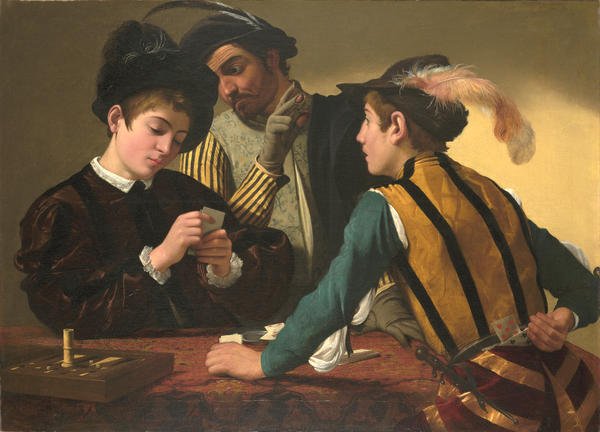
The Cardsharps by Caravaggio (c.1594)

Paintings featuring card players, and the perils of being cheated of your winnings, were not an unusual subject and one of the most famous was completed around 1594 by Caravaggio.  It was entitled The Cardsharps and now hangs in the Kimbell Art Museum in Fort Worth.   The boy on the right is the “cheater” and his older accomplice in the middle is giving him signs as to the cards held by his opponent.

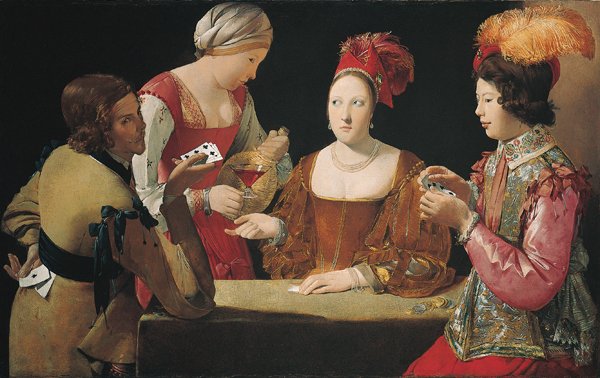
Le Tricheur à l'as de carreau or The Cheat with the Ace of Diamonds by Georges de la Tour (c. 1635)
Le Tricheur à l’as de carreau or The Cheat with the Ace of Diamonds
by Georges de la Tour (c. 1635)

The first of the Georges de la Tour paintings I want to showcase is one entitled Le Tricheur à l’as de carreau or The Cheat with the Ace of Diamonds which he completed around 1635 and is now to be found in the Louvre.   It is easy to see the similarity between this painting and the one painted forty years earlier by the Italian Master.  This seventeenth century work was put on show at the 1934 exhibition at the Musée de l’Orangerie in Paris entitled The Painters of Reality in France in the seventeenth century and it was through this memorable exhibition that French 17th century art was brought back to prominence and works by Georges de la Tour, who had almost been forgotten by French art lovers, once again became popular and his works following the exhibition were in great demand.

 The first thing we must decide on is what is going on.      On the right is a man dressed in the most expensive clothes carefully studying his hand of cards.    There is something about his appearance which makes us believe that he is slightly naive as his conspirators exchange sidelong glances.  He is slightly set apart from the other three characters.  Is he there at his own volition or has he been seduced into coming to the gambling den by the courtesan who sits next to him?  In a way it is a painting with a moral.  It is a depiction of a man who has to withstand three great inducements.   He has to withstand the temptations of lust brought on by the presence of the courtesan and serving maid, the temptation of alcohol which is being handed out to the card players and of course he has to resist the vice of gambling  French moral standards of the time frowned upon the three vices.  However he has put his moral standards to one side and for that, we know, by what we see happening before us, will be his undoing.

The courtesan is centre stage in the painting.  On the table by her is a small pile of money.  It is not as large as that of the guests but that will soon change.  Her clothes are sumptuous.  The plunging neckline of her costume no doubt titillates her male guest and probably distracts him from his game.  Her hair is topped by a fancy and fashionable feathered headdress.  Look at her eyes.  They are shifty.  Her whole expression, her whole demeanour, is one of deceitfulness.  Her right hand points to her co-conspirator probably advising him to play his hand.  We see him retrieving the ace of diamonds from under his belt, which will complete his winning hand.  The serving wench brings wine to the table and she too has a deceitful look about her as she casts a sidelong glance at the “mark”.  She knows what is going on.  She is part of the conspiracy.  The man, who is slightly in shadow and who is retrieving the ace of diamond looks out at us.  We have been drawn into this plot.  It is as if now we are also co-conspirators.
Cheat with Ace of Clubs by Georges de la Tour (c.1634)

A copy of this work which Georges de la Tour completed later can be found at the Kimbell Art Museum in Fort Worth Texas, the same gallery which owns the Caravaggio painting, Cheaters.   This painting is entitled Cheat with Ace of Clubs and once again is a moralistic painting warning people against the vices of lust, excess wine and gambling.  Like the painting in the Louvre the characters are the same, the shifty looks of the deceivers are the same it is just the suit of cards has changed from diamonds to clubs.
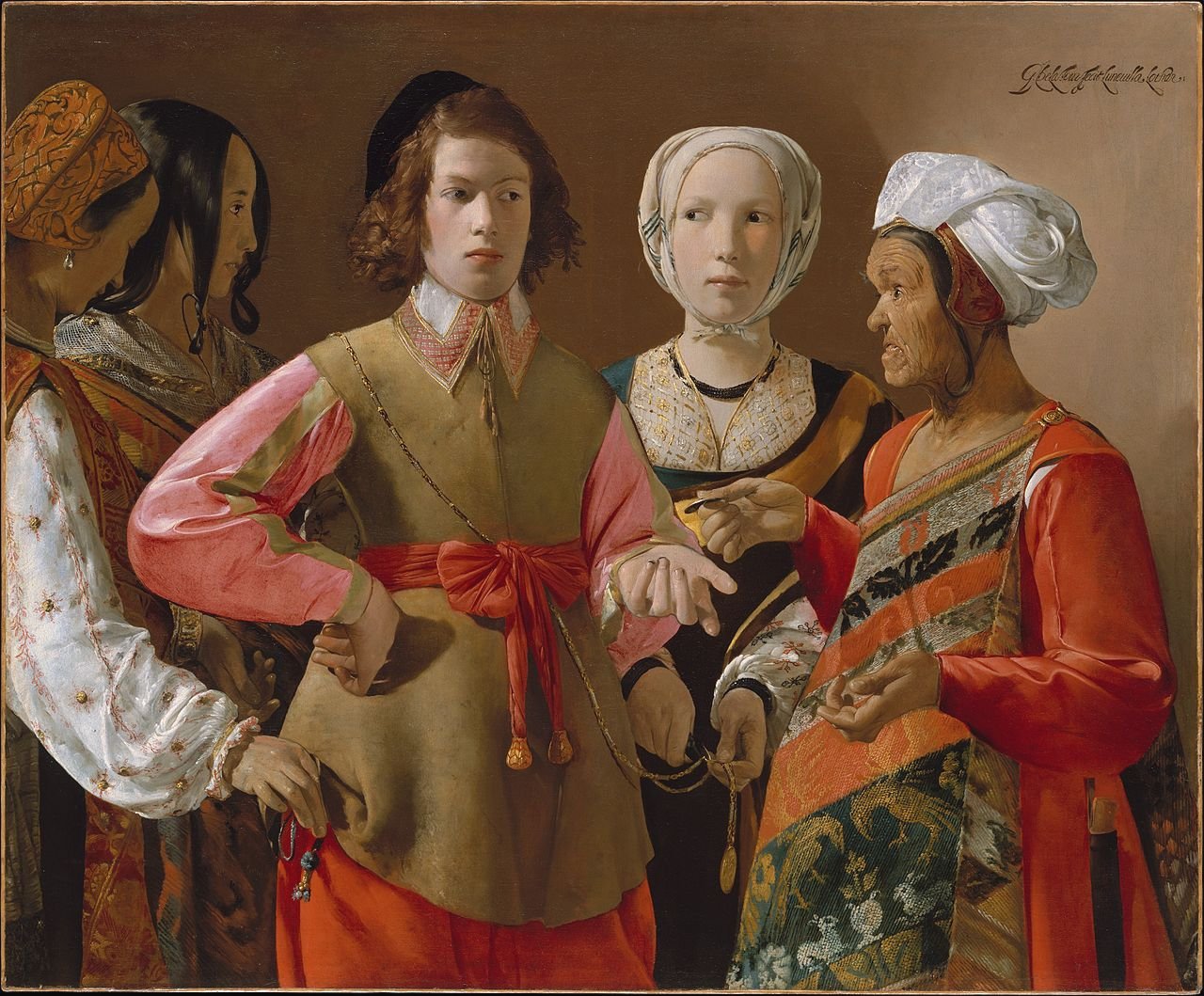
The Fortune Teller by Georges de la Tour (c.1630)

Four years before Georges de la Tour embarked on the theme of cheating at cards he focused on another piece of skulduggery – pick-pockets and con-artists.  The work in question was known as The Fortune Teller which he completed during the 1630’s and can now be found in the Metropolitan Museum of Art in New York.  In this work we see a naive young man standing between two young women.  He is well dressed and one is given the impression that he is also wealthy and ideal rich picking for the pick-pocket.   To the right of the painting is the wrinkle-skinned old crone who purports to be a fortune teller and has extracted a silver coin from the young man as payment for her telling him his fortune.  She is about to take the coin from his hand, and as part of the gypsy fortune-teller ritual, she will then cross his palm with it.   She, like the three younger women, are colourfully dressed and portrayed as gypsies.   As is often the case, even in today’s time, gypsies are pictorially portrayed in this work of art as thieves.  The crime is clearly there for us to witness as whilst the young man is engrossed in what the fortune teller has to say and at the same time as he hands over his fee the young lady on the right of the painting delicately removes the coin purse from the pocket.  However that is not all the young man is about to lose.  Look at the young woman between the fortune teller and the man.  She is more soberly dressed.  Look what she is doing with her hands.  She is just about to cut the gold medallion from its chain which is around the young man’s neck and right shoulder.  I like the way her eyes are fixed on his face in order to see if he is aware of what she was doing.

My final featured paintings by Georges de la Tour move away from the group genre scenes with the accompanying moral tale and focus on single portraits.  These are really exquisite works of art.  The subject of the next work of art is an elderly blind beggar and street musician trying to eke out a meagre living by playing a hurdy-gurdy. The hurdy-gurdy was the first stringed instrument to which the keyboard principle was applied. In France it was known as Viella a Roue , which literally translates to wheel fiddle and which describes the method by which sound is produced. The bowing action of the fiddle is replaced by a wheel cranked by a handle. The outer rim of the wooden wheel is coated with resin. When the crank is spun, the wheel turns and the gut strings vibrate.  The player of such an instrument was known as a vielleur.
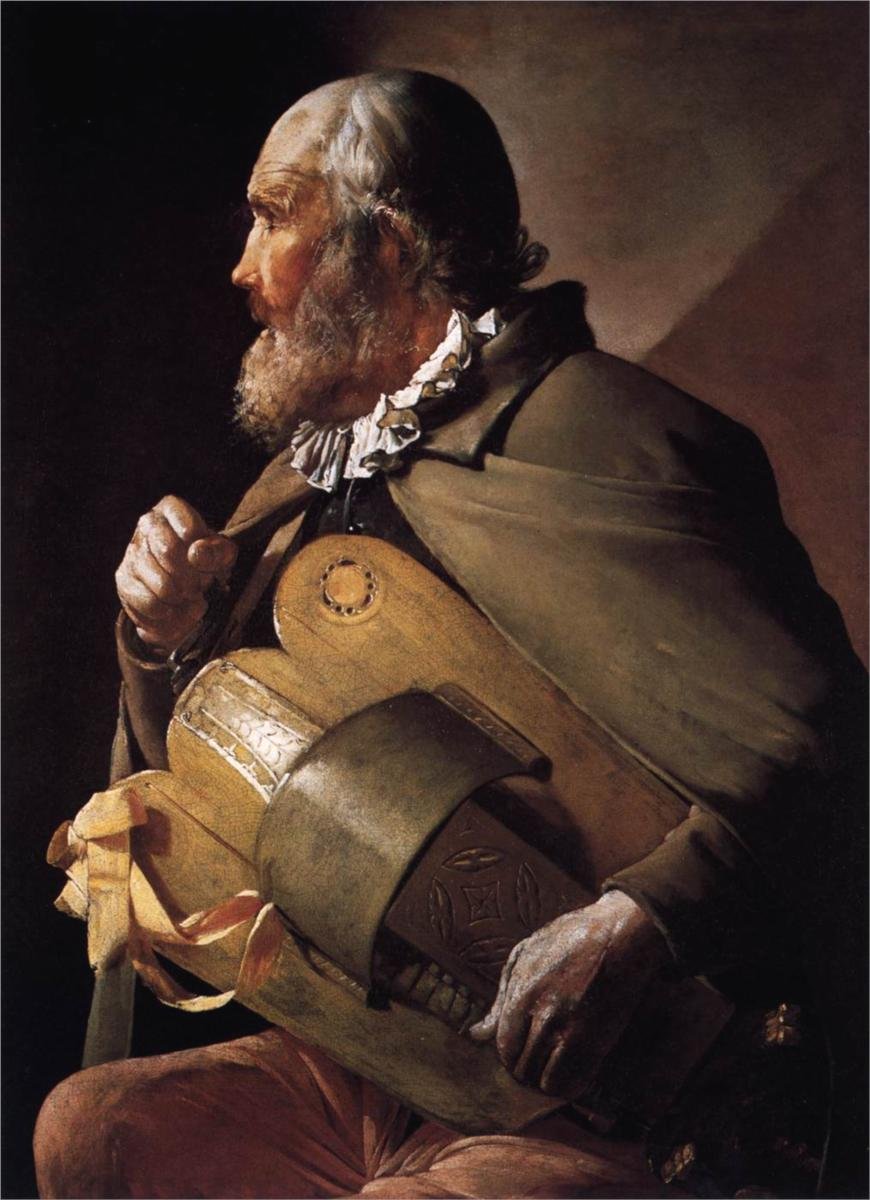
Blind Hurdy-Gurdy Man by Georges de la Tour (c.1630)

Georges de la Tour often painted several variations on the same subjects, and the depiction of a street musician was an example of this.  He painted the one shown above, entitled The Blind Hurdy-Gurdy Player, around 1630 and it can now be found in the Prado, Madrid.  The man is depicted in profile and, but for the title of the work, one would never have known that he was blind, although his eyes are closed.  He has a trouble-worn face and his forehead is heavily wrinkled.  His skin is swarthy from spending most of his time out on the streets.   He wears a thick grey-brown coat with a white lace ruff.  Look how the artist has spent time on depicting the texture of the musical instrument.

The Hurdy-Gurdy Player by Georges de la Tour (c.1630)

Another version of this work can be seen in the Musée des Beaux-Arts, Nantes in France.   This work entitled The Hurdy-Gurdy Player was also completed by de la Tour around 1630.  This is a more unsettling portrait of the beggar.  He looks unkempt and uncared for.  His facial expression is one of pain and anguish as he sings to the tune he plays on the hurdy-gurdy.  He wears the same heavy grey-brown coat with the white scarf or ruff.  On the floor in front of him, resting on a large stone, is his bright red hat with a plume of feathers and often this painting is referred to as The Hurdy-Gurdy Player with Hat.
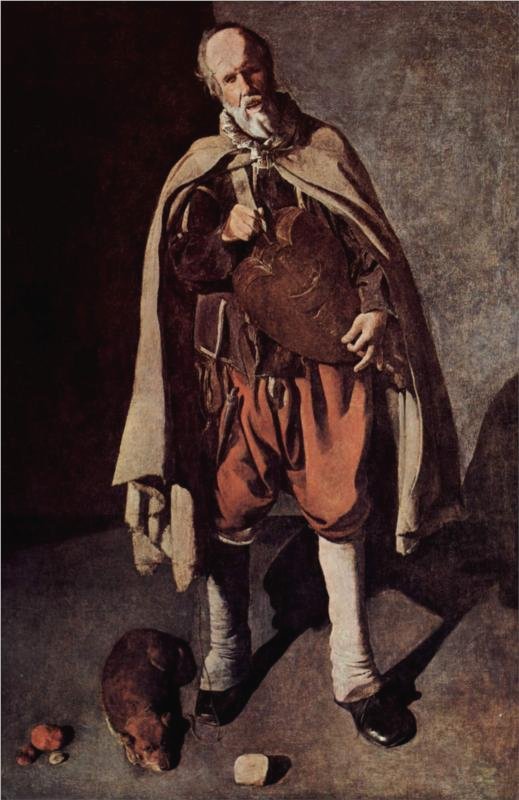
The Hurdy Gurdy Player with a Dog by Georges de la Tour (c.1625)

An earlier version, around 1625, on the same theme can be found in Bergues, the northern French town, close to the border with Belgium.   It is the Musée Municipal Bergues which houses The Hurdy-Gurdy Player with his Dog by Georges de la Tour.

In my next blog I will feature some of Georges de la Tour’s tenebrist paintings, a style which had been made popular by Caravaggio.

Adélaïde Labille-Guiard

Self portrait of Adélaïde Labille-Guiard )

In my last blog I looked at the life of the eighteenth century French artist, Anne Vallayer-Coster and featured a number of her exquisitely painted floral still-life works.   In today´s blog I am looking at the life and works of a contemporary of hers, the talented French miniaturist and portrait painter, Adélaide Labille-Guiard.

Adélaïde Labille was born in Paris in April 1749, the youngest of eight children, to Marie-Anne Saint-Martin and Claude-Edme Labille.  Her father was a marchand du corps de la mercerize (a haberdasher) and he and his wife owned a haberdashery shop, La Toilette, in the rue Neuve des Petits-Champs, at the heart of the capital.  Their home was also situated on this street.   The shop became very popular and by the 1760’s it had built up an élite clientele.  One interesting fact about the family shop was that in 1761 a young girl, Jeanne Antoinette Bécu, applied to work in it, was taken on and became friends with Adélaïde.  Whilst there she met the comte du Barry, became his mistress, left the shop and would later become la maitresse-en-titre, the chief mistress of Louis XV.

Giving birth to eight children took its toll on Adélaïde´s mother and she was often laid low with one illness after another.  In 1768, when Adélaïde was nineteen years old, her mother died.  Little is known about Adélaïde’s siblings except that one of her older sisters, Félicité, married the painter and art collector, Jean Antoine Gros in 1764.  However in a letter Adélaïde wrote to Comtesse d´Angiviller in 1783, she said she was the only surviving member of the family.

The Sculptor Augustin Pajou by Adélaïde Labille-Guiard (1783)

So what made Adélaïde want to become an artist?  One reason could be the location of the family home, which was close to the Palais Royale and had become the hub of theatres, music halls and dance halls but was also home to a large collection of professional artists as it was close to the Louvre, which at the time was the headquarters of the Académie Royale.  The most talented artists of the time, who were willing to comply with the strict guidelines of the Académie, had become members of this august establishment but many others painters who failed to be accepted into the halls of the institution had become members of the city’s trade guild, the Academy of Saint Luke.  It is thought that Adélaïde may have got her earliest artistic tuition from some of her artistic neighbours, one of whom was the Swiss-born painter of portrait miniatures, François-Élie Vincent, a member of the Guild of Saint Luke, who also lived in rue Neuve des Petits-Champs.  In 1769, Adélaïde, aged twenty, joined his classes and it was during this time as Vincent’s apprentice that she was able to exhibit some of her work at the Académie de Saint-Luc.   This was also the year she married.  Her husband was Louis-Nicolas Guiard who was an official in the Treasury of the Clergy and who lived on the same street as Adélaïde.  The ceremony took place at the local church of St Eustace on August 25th 1769.  The marriage contract recorded that Adélaïde was a professional painter at the Académie de Saint-Luc.

Madame de Genlis by Adelaide Labille-Guiard (1780)

Five years on, in 1774, Adélaïde had moved on artistically to work with pastels under the tutelage of the distinguished seventy year old French pastelist, Maurice-Quentin de la Tour who had his studio a few blocks away from Adélaïde’s home.  It is believed that Adélaïde had been introduced to him by one of his former students and a neighbour of hers, the Swedish portraitist Alexander Roslin.  Roslin, an Academician since 1753, was married to the painter, Marie Suzanne Giroud, and was a great believer in women’s right to become artists and was aware of the problems they had in trying to progress as professional painters.  Art historians believe that Roslin was the person who would later put forward Adélaïde’s name to become a member of the Académie Royale.

Three years on, around 1777, she started to work in oils and her introduction to, and tuition in this painting media came from François-André Vincent the son of her former tutor.  He was to become a leader of the neoclassical and historical movement in French art.  They became very close and such closeness fuelled rumours of a romantic tryst between the two artists.  Whether such rumours damaged her marriage or whether there were other reasons, the couple went their own separate ways in 1777 and her child-less marriage to Guiard ended in legal separation in 1779.  Adélaïde however kept signing her work Labille-Guiard. The relationship between Adélaïde and Vincent is examined in the 2012 book by Elizabeth Mansfield, entitled The Perfect Foil: François-André Vincent and the Revolution in French Painting and in it she suggests that the pair had been very close as far back as 1769 when she worked in his father’s studio, but the fact that he was a Protestant found little favour with Adélaïde’s father and so marriage was not a possibility.  However following the separation from her husband and after the reformation of divorce laws, the couple were able to marry in 1800. 


Portrait of François André Vincent by  Adélaïde Labille-Guiard (1795) Louvre, Paris
Portrait of François André Vincent by Adélaïde Labille-Guiard (1795)
Louvre, Paris

Adélaïde’s second husband François-André Vincent, being a talented artist and having the right connections, became a student at the Académie Royal in 1765, three years later won the prestigious Académie prize, Prix de Rome and was awarded a four-year scholarship at the Palazzo Mancini, the French Academy school in Rome.  On his return to Paris in 1782 he was made a full Academician.   For Adélaïde, her artistic journey was far more difficult.  Females wishing to become artists struggled to receive artistic training unless they had family members who were artists and who had their own studios but this was not the case for Adélaïde whose father was a merchant.  However as I said earlier she did eventually secure artistic tuition and with the support of Roslin she became a member of the Académie Royale on May 31st 1783, the same day in which Élizabeth Vigée-Lebrun was received into the Academy.  The addition of these two females to the Academy brought the number of female Academicians to four.  Anne Vallayer-Coster, the floral and still life painter and the miniaturist, Marie-Thérèse Réboul, also known as Madame Vien being the other two Academicians.  A royal decree had set a cap of four female Academicians at any one time.  The French Arts Minister, comte d’Angiviller, had obtained the royal ruling and had stated that such a cap would be sufficient to honour the talent of female artists but added condescendingly that they could never be useful to the progress of the arts!

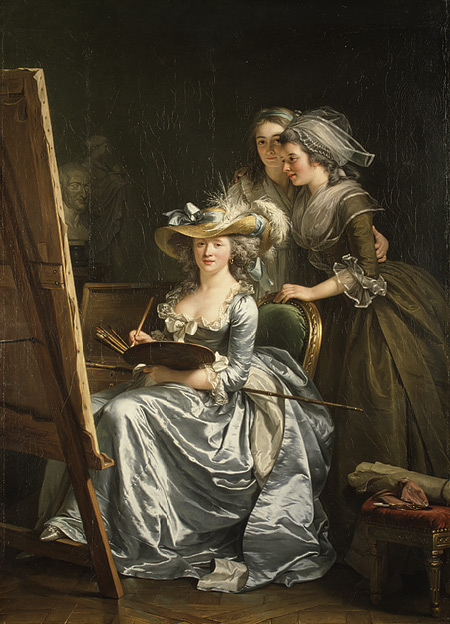
Self-Portrait with Two Pupils, Mademoiselle Marie Gabrielle Capet and Mademoiselle Carreaux de Rosemond by Adélaïde Labille-Guiard (1785)

In 1780 Adélaïde had set up her own studio and had accepted a group of women pupils, several of whom went on to become successful portraitists. By 1784, her reputation as a gifted art teacher was firmly established and one of her most famous works, which is now housed in the Metropolitan Museum of Art in New York, is her 1785 work entitled Self–Portrait with Two Pupils, Mademoiselle Marie Gabrielle Capet and Mademoiselle Carreaux de Rosemond, which highlights her role as a tutor. The work has often been construed as a piece of propaganda, symbolising the dispute over the role of women in the Academy. She has portrayed herself in her studio which is richly furnished and this was her way of denoting her favourable financial situation.  She is seated in front of a large canvas and behind her stand two of her students, Marie Gabrielle Capet and Mademoiselle Carreaux de Rosemond, who have been depicted in much plainer clothes.  Adélaïde wears a sumptuous and expensive low cut gown and large plumed hat neither of which would have been worn by an artist at work but is more likely to be a declaration of her femininity, and the fact that she is an artist who moved in high society.  The feminist stand on art education was further enhanced by the inclusion of her two female students both of whom would become great artists in their own right.  In the background she has included the bust of the Vestal Virgin as an additional emphasis of the feminist mood of the time.  One can tell by this work that she had a great belief in herself as an artist.  So if she wanted to paint a self-portrait, why include two other people in the work?  The reason for their inclusion is probably two-fold.  First of all, because she was a strong proponent of the education of women artists, it is her statement of belief that females should receive artistic tuition and secondly she is demonstrating her ability as a group portraitist and this painting received critical acclaim when it was exhibited which led to many commissions for family group portraits.  This was indeed a clever self advertisement by the artist.  One of the pupils in the painting, Marie Gabrielle Capet, became Adélaïde’s close friend and her favourite student.  She became a miniaturist and pastel portraitist in her own right and lived with Adélaïde Labille-Guiard before and after the artist’s marriage to Vincent.  After Adélaïde died Marie Gabrielle Capet remained in the house and continued to care for Adélaïde’s husband.

Marie Adélaïde de France, Known as Madame Adélaïde daughter of Louis XV and Marie Leszczyńska by Adélaïde Labille-Guiard (1787)

Labille-Guillard was an extremely talented portraitist and unlike her fellow Academician, Lebrun, she received portrait commissions from both sides of society, members of the aristocracy as well as revolutionary figures.  She also received royal commissions and one of her royal patrons was Princess Marie Adélaïde, the aunt of Louis XVI and through this received an annual government pension of 1000 livres.  Labille-Guiard painted the portrait of the princess and her sister, Princess Victoire-Louise, as well as a portrait of the sister of Louis XVI, Princess Élisabeth. Because of these royal commissions to paint portraits of female family members of Louis XVI, she came to be known as Peintre des Mesdames.  She would normally have been also allowed a studio at the royal court but because her pupils were female that was not to be.  However such royal patronage, in some ways, made Labille-Guiard politically vulnerable at the time of the French Revolution of 1789 and she was made to destroy a number of her portraits of court members of the fallen monarchy and for a time she decided, for her own safety, to leave Paris.   At the Salon exhibition of 1791 she exhibited portraits of two prominent members of the French National Assembly, Maximilien Robespierre and Armand, duc d’Aiguillon.

In 1795 Adélaïde was granted artists’ lodgings at the Louvre and had her government pension enhanced to 2000 livres.  As a member of the Académie Royale she continued to regularly exhibit her portraits at the Salon until 1800.   Adélaïde Labille-Guiard died in April 1803, aged 54.

Whilst researching the life of Adélaïde Labille-Guiard I came across a book entitled Adélaïde Labille-Guiard – Artist in the Age of Revolution by Laura Auricchio.  It is from this literary work that I gleaned most of the information regarding her life.   I can highly recommend the book if you want to find out more about the artist and study some of her exquisite works.
Anne Vallayer-Coster. The Queen of Floral Still-Life works

Anne Vallayer-Coster

At the end of 1362 the Florentine writer, Giuseppe Boccaccio, he of The Decameron fame, (see my Daily Art Display Feb 21st 2012), had completed his book, De mulieribus claris (Of Famous Women), a biography of famous (and infamous) women, some real, some mythological.  In it he wrote about three female artists and commented:

“…Art is Alien to the mind of women, and these things cannot be accomplished without a great deal of talent, which in women is usually very scarce…”

In this blog I am returning to look at female artists and I am featuring a highly talented lady whose superb artistic talent rubbishes Boccaccio’s theory.  Today, I am looking at the struggle she, like other female painters of the time, had fighting their way through to success in a male-dominated field.  One of my favourite paintings is by the eighteenth century French female artist Louise Elisabeth Vigée Le Brun (See My Daily Art Display November 21st 2012) and recently I have been reading about a contemporary of hers, the very talented 18th century French painter who, like Le Brun, gained the patronage of Marie-Antoinette, the wife of the French monarch, Louis XVI.   She is Anne Vallayer-Coster.   Such royal patronage was the ultimate prize for aspiring painters as it led to many lucrative commissions.  However, unlike Le Brun, Anne Vallayer was not solely a portraitist but was an exceptional still-life and floral painter.

Anne Vallayer-Coster was born in Paris in December 1744.  She was the second of four daughters.  Her mother was a painter of miniatures.  Her father, Joseph Vallayer, was a goldsmith working at the Gobelins Manufactory Company in Paris, and the family lived on the grounds of the Gobelins Manufacturing complex, which produced the finest tapestries as well as luxury objects, which often adorned the royal palaces.  In 1757 the family moved to another area of Paris and Anne’s father started to trade in jewellery.  His business soon expanded with royal patronage and was granted the right to produce metal products for the military.

Anne Vallayer became interested in sketching and painting at an early age and her mother encouraged her by arranging for her to have private tuition from an art teacher, Madeleine Françoise Basseporte, a one-time pupil of the great French botanical painter, Claude Aubriet, and she, like him, was made the Royal Painter at the court of Louis XV, teaching the royal princesses to paint flowers.  Anne Vallayer learnt well from Basseport and she too was to become a talented botanical artist.  Her next art tutor was the landscape painter Claude Joseph Vernet.  In a short period of time Anne Vallayer became an accomplished artist concentrating on floral still-life works.  Her works were a beautiful juxtaposition of the flowers and inanimate objects such as books, musical instruments, tableware and furnishings.  The inanimate objects Vallayer included in her floral depictions allowed her to highlight her artistry by depicting the various different surfaces, such as glass, pewter, and silver and how the light played differently on each of them.   The still-life works often included aspects of trompe-l’oeil affording depth perception.

Attributs de la musique by Anne Vallayer-Coster (1770)

In 1770, when she was just twenty-six years of age, such was her artistic talent that a number of her tutors and fellow artists suggested that she should apply to become a member of the Académie Royale.  To gain admittance to the Académie Royale de Peinture et de Sculpture she submitted two reception pieces.  They were still life works entitled Les attributs de la peinture, de la sculpture et de l’architecture (The Attributes of Painting), and Attributs de la musique (The Attributes of Music).

Les attributs de la peinture, de la sculpture et de l'architecture by Anne Vallayer-Coster  (1769)
Les attributs de la peinture, de la sculpture et de l’architecture by Anne Vallayer-Coster (1769)

It could be that Anne Valleyer was quite canny when she put forward to the Académie elders her reception piece The Attributes of Painting, as all the objects we see depicted are references to the various arts taught at the academy. The brushes and palette symbolize painting, the bust and torso epitomize sculpture, and the building plans signify architecture. The books and portfolios of drawings symbolize the scholarly facet of the fine arts.  It is thought that the bust is a self-portrait of Anne.

Her works met with great acclaim and the honourable Academicians unanimously elected her.  This was an extraordinary endorsement as there was a “four female artist at any one time cap” on admissions to the Académie at this time.    This achievement was recognised in the twice-weekly gazette and literary magazine Mercure de France of that year, when the journal paid tribute to her achievement, writing:

“…the disadvantages of her sex notwithstanding, she has taken the difficult art of rendering nature to a degree of perfection that enchants and surprises us…”

This should have been the happiest time of her life but the sudden death of her father overshadowed the joyous news.   With the main family breadwinner now gone, her mother had no choice but to take over the family business, whilst Anne helped the family finances with the sale of her paintings.

However, despite her being admitted to the Academy she, unlike the male Academicians, was still not allowed to take part in any of the establishment’s drawing courses which involved nude models, as women drawing nude men was considered indecent.  So with the drawing course out of her reach she was not able to break into the highest genre of art as set down by the Académie, historical paintings, and so she continued with her favoured art genre, still-lifes as well as some portraiture and landscapes and as an Academician she was now allowed to exhibit some of her work at the biennial Paris Salon exhibitions.  This she did starting in 1771 and went on exhibiting regularly there until 1817.  In a review of her work shown at the 1771 exhibition, the prominent French philosopher and art critic Denis Diderot wrote:

“…if all new members of the Royal Academy made a showing like Mademoiselle Vallayer’s, and sustained the same high level of quality, the Salon would look very different…”

Portrait of Marie-Adelaide-Louisa de France, called Madame Adelaide by Anne Vallayer-Coster (1780)

She completed a number of portraits of the royal family including one of Marie-Antoinette.  It is said that the queen disliked her portrait.  The French critics who were complimentary with regards her floral works, were  dismissive of her figurative work.  With this in mind and being aware that she had major rivals in that genre, including two fellow Academicians, Elisabeth Vigée Le Brun and Adelaide Labille-Guiard,  who were the favoured female portraitist of the time,  she decided to concentrate on her still-life painting.

Art was a very important facet in the life of the upper class and nobility.  A thorough knowledge of which artists were in vogue and who were the up-and-coming artists was of great importance.  Soon through word of mouth in Court circles and the glowing evaluations of her artistic ability, the floral still-life work of Anne Valleyer came to the attention of Queen Marie-Antoinette.  Anne Valleyer received a number of painting commissions from Marie-Antoinette and many members of the royal court as well as a number of wealthy art collectors.  As was the case with Elisabeth Vigée Le Brun, the artist and queen became friends and in fact, it was the queen who, at a ceremony at Versailles in 1781, witnessed and signed off the marriage contract between Anne and her betrothed, Jean-Pierre-Silvestre Coster, a wealthy lawyer and respected member of a powerful family from Lorraine.

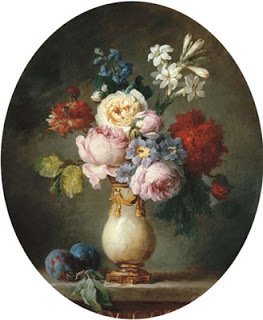
A Vase of Flowers, two Plums on a Marble Table top by Anne Vallayer-Coster (1781)

In total, Anne Valleyer-Coster painted over one hundred and twenty floral still-life works.  One painting which she completed in 1781 entitled A Vase of Flowers and Two Plums on a Marble Tabletop was used as a model by Gobelins for one of their tapestries.

Bouquet of Flowers in a Terracotta Vase, with Peaches and Grapes by Anne Vallayer-Coster (1776)

To fully appreciate the talent of Anne Valleyer-Coster as an artist take a look at a work she completed in 1776 entitled Bouquet of Flowers in a Terracotta Vase, with Peaches and GrapesThis still-life painting was one of a pendant pair and was commissioned by a high-ranking official of the entourage of the Queen of France, Marie Antoinette. Both paintings were exhibited at the Salon of 1777, the year after they were completed.  One has come to recognise her expertise in the way she depicts flowers but in this painting we see how accomplished she was when it came to her bas-relief imités.

Detail of bas-relief imités on vase

Look carefully  at the vase and the depicted bas-relief work.  In sculptural terms, Bas-relief is a form of sculpture in which a solid piece of material is carved so that objects project from a background.    This painting combines a number of different elements.  We have the exquisite floral painting.  We have the still-life depiction of the terracotta vase and the various fruit and finally we have the bas-relief imités depicted on the vase.  The skill of the artist in completing such a work is dramatic and totally eye-catching.

Vase of Flowers and Conch Shell by Anne Vallayer-Coster (1780).  Metroppolitan Museum of Art, New York
Vase of Flowers and Conch Shell by Anne Vallayer-Coster (1780).
Metroppolitan Museum of Art, New York

Another famous work of hers is Vase of Flowers and Conch Shell, which she completed in 1780.  This work of art is thought to be one of three small oval paintings of flowers and fruits which she exhibited in the Salon of 1781. The flowers are a selection of anemones and marguerites.  Look carefully how she has depicted the light reflecting on the gilt of the blue porcelain vase and the vase itself and how it shimmers on the multi-coloured conch shell.  She has paid close attention to the various textures of the objects on display and how the light reflects differently on their surfaces.

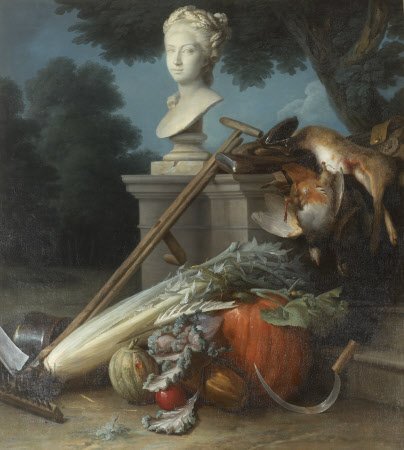
Garden Still Life, with Implements, Vegetables, Dead Game, and a Bust of Ceres (The Attributes of Hunting and Gardening by Anne Valleyer-Coster (1780)

A number of her paintings are in British galleries but her still-life work, Garden Still Life, with Implements, Vegetables, Dead Game, and a Bust of Ceres (The Attributes of Hunting and Gardening) can be found in Basildon Park, Berkshire, a country house run by the National Trust of Great Britain.

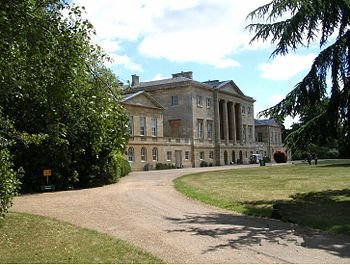
BasildonPark
BasildonPark

The Palladin-style house itself is worth a visit.  It was built between 1776 and 1783 for Sir Francis Sykes, a wealth English landowner, Member of Parliament and who was once the Governor of Kasimbazar, India.  Valleyer-Coster received this painting  commission along with its companion piece, A Still Life of a Vase of Flowers, Fruit, and a Bust of Flora, on a Table in an interior from Joseph-Marie Terray, abbé de Molesme,  who was the directeur-général des Bâtiments du Roy and contrôleur–général des finances.   The National Trust came by this work of art when it was allocated to them by the UK Government who, in 2010, had taken it in lieu of inheritance tax from the state of Lord and Lady Iliffe, the previous owners.  The setting is a park and in the work we see a rake and scythe propped up against a plinth.  In the foreground there is a variety of vegetables, a cardoon or wild artichoke, a gourd, a marrow, a melon, a cabbage, a tomato, along with a sickle.  On the plinth itself besides the bust of a young woman with an ear of corn in her hair, we see depicted  a gun, game-bag, two dead partridges and a hare.

When the fall of the ancien régime came during the French revolution all those close to Louis XVI and his wife Marie-Antoinette were in great danger and many of the artists, such as Vigée Le Brun, had to go into exile to save themselves.  Anne Valleyer-Coster was fortunate in as much as, regardless of her closeness to the queen, who along with her husband, Louis XVI, was hated by the common people, she managed to survive the bloodshed of the French Revolution.   However, along with the fall of the French monarchy, went her primary patrons and her lucrative commissions dried up completely.  She, as an artist, was forgotten during these turbulent times.

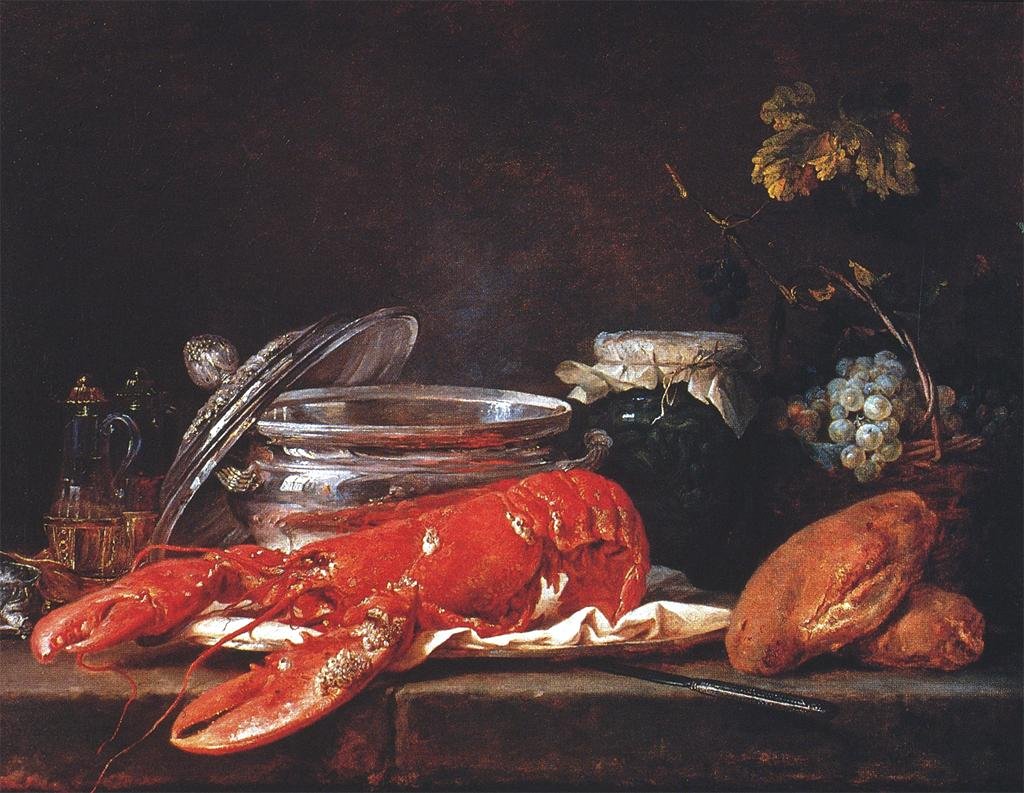
Still Life with Lobster by Anne Vallayer-Coster (1781)

It is interesting to note that a painting, Still Life with Lobster, which she completed in 1781.  Many believe it to be her best still-life work.  In 1817 she exhibited it in that year’s Paris Salon.  This painting came into the hands of Louis XVIII after he had been restored to the French throne in 1814.  Some art historians believe Vallayer-Coster gave it to the king as an expression of her joy as somebody who had remained loyal to the Bourbon cause throughout the turbulent years of the Revolution and the following Napoleonic imperialism. However, it should be noted that she had produced two works of art in 1804 for Napoleon’s Empress Josephine.  In the work, she has included many of the previous objects she had incorporated in earlier still life works. 

Anne Valleyer-Coster was one of the greatest still-life painters of the eighteenth century and art historians believe that her work was influenced by the great Jean-Baptiste-Siméon Chardin who died in 1779 and who is still considered to be one of the greatest French still-life and genre painters. She imitated his dark and shadowy tabletops on which were her arrangements of fruit, bread and dead game. In her later years she turned to a more unrestrained lavishness which was seen in Dutch floral painting.  She died in  Paris in 1818, aged 73 and will always be remembered for her still-life works with their distinctive colouristic brilliance and their almost photographic quality.  If you are lover of still-life and floral paintings, you will love her beautiful works of art.

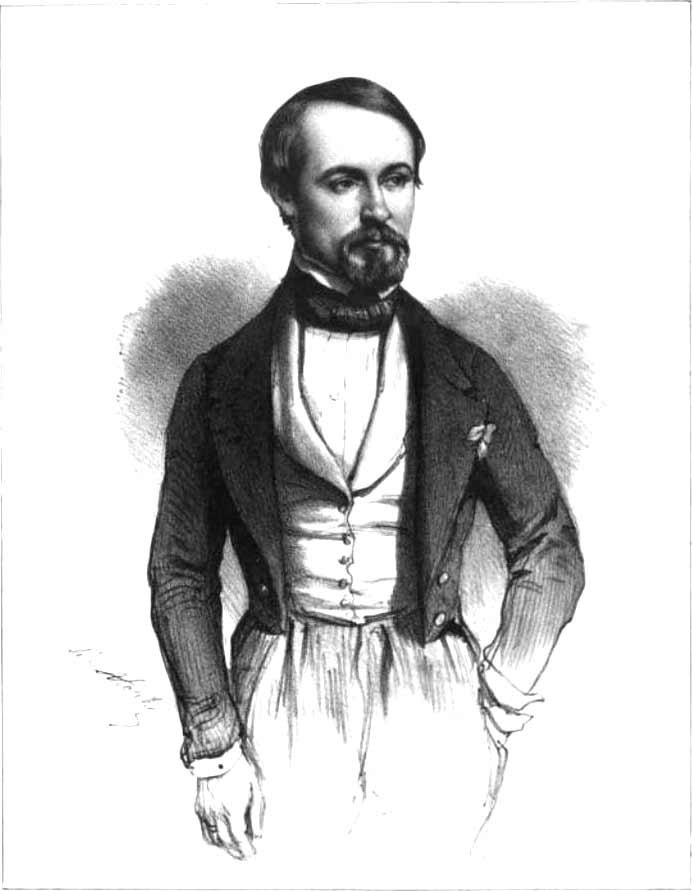
Camille-Joseph-Étienne Roqueplan

Camille-Joseph-Étienne Roqueplan

My featured artist today is the 19th century French Romantic painter and lithographer, Camille-Joseph-Étienne Roqueplan .   He was born in the small town of Mallemort which lies thirty-five kilometres south west of Avignon, but his family moved to Paris when he was still quite young.  He came from a well-to-do and cultured family and his younger brother Louis-Victor-Nestor Roqueplan went on to become a well-known writer, journalist, and co-director of the Paris Opera. Contrary to most young people who want to become artists despite opposition from their parents, Camille Roqueplan was wary about having art as his future profession despite his father’s encouragement that this should be his future path.  Camille liked to paint, but he believed art was just something to do for relaxation and should not be conceived as a future profession for he was adamant that his future lay in medicine.  His foray into studying medicine and anatomy was brief and having failed his first set of exams he went to work in the same office as his father, as a clerk in the Department of Finance.  This bureaucratic career was also short lived as he became bored and so after many career false starts he returned to painting

In February 1818, shortly after Camille’s eighteenth birthday he enrolled at the École des Beaux-Arts in Paris where he received his initial art tuition in the workshop of the French artist, Alexandre-Denis Abel de Pujol, but remained with him for just a short period before working in the studio of Antoine-Jean Gros, the French history and neo-classical painter, where he learnt to paint landscapes, marine paintings, historical subjects and genre scenes.  He used both the mediums of watercolours and oil and was taught the secrets of lithography, which at the time was a new method of printmaking.  He remained in Antoine-Jean Gros’ workshop for three years.

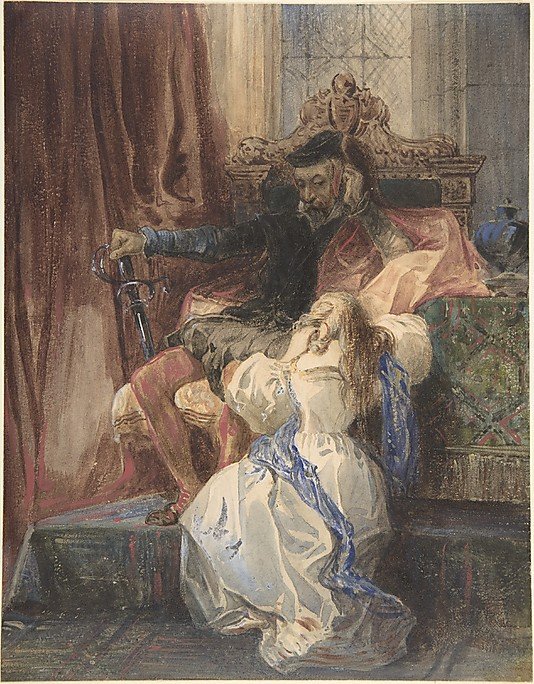
he Pardon Refused by Camille-Joseph-Étienjne Roqueplan (c.1829)

One of Roqueplan’s fellow students at L’ École des Beaux-Arts was the Nottingham-born, English painter Richard Parkes Bonnington, eighteen months younger than Roqueplan, who had moved to Paris when he was fourteen years of age and began studying at the  École des Beaux-Arts in 1820.  Bonnington favoured landscape painting and this no doubt influenced Roqueplan who began to produce small-scale paintings including some landscape works.  Roqueplan was also influenced by the works of the Scottish historical novelist, Sir Walter Scott and in 1824 he completed a work entitled Historical Landscape based on Scott’s novel, Quentin Durward.  Another small painting by Roqueplan, which he completed around 1829,  also featured characters from a Sir Walter Scott romantic tragedy novel, Kenilworth, in which we see the heroine Amy Robsart pleading for forgiveness from her father, Sir Hugh Robsart but he is untouched by her tearful pleadings.  This work, entitled The Pardon Refused, is housed in New York’s Metropolitan Museum of Art.

The Lion in Love by Roqueplan (1836)

Around 1835, Roqueplan changes his painting style from small landscape paintings to large-scale anecdotal works and one of his most famous of these can be seen at the Wallace Collection in London.  It was completed by Roqueplan in 1836, in time to be exhibited at that year’s Salon in Paris.  It is a large painting, measuring 219cms x 174cms and is entitled The Lion in Love.  The work is all about the power of love even if it is at the expense of wisdom.  I am sure many of us know how that feels!    The painting is based on a fable written by the Jean de la Fontaine, who was the most famous French writer of fables and one of the most widely read French poets of the 17th century.   There are 243 of these fables, originally written in French, by the poet in the late 1600’s which have since been translated in to many different languages.   The Lion in Love is a sad tale which tells of a noble lion, which has fallen in love with a shepherdess.  His love for the girl is so strong that he  unwisely consents to her father’s demand that his teeth and claws are clipped lest they should hurt his daughter .  The lion does not see through the father’s trickery and when his teeth and claws are paired down, his defence mechanism is rendered ineffectual, enabling the father to set his dogs on the defenceless lion.  The question of who shaves down the teeth and claws of the lion is not told in the poem but in Roqueplan’s painting he depicts the act being carried out by the shepherdess herself.  Maybe Roqueplan was drawing a parallel with the biblical tale of Delilah shaving off the hair of Samson, which rendered him defenceless.  Below is an English translation of the poem by Jean De La Fontaine which I found on the Aesop’s Fables website.

THE LION IN LOVE


Sévigné, whose attractiveness

Serves as a model to Beauties,

You were born so beautiful,

In case you are indifferent,

Would you be enclined

To an innocent Fable’s games,

And see, without fear,

A lion  tamed by Love?

Love is a strange master.

Happy is he who experiences it

Only through tales, minus its pains!

When it is told in front of you,

If  the truth offends you,

The Fable at least can be endured:

It is bold enough

To come offer itself at your feet,

By zeal or by gratitude.

In the times when animals spoke,

Lions among others wanted

To be accepted in our circles.

Why not? since their   kins

Were worth ours back in those times,

Having courage, intelligence,

And a beautiful head, moreover.

Here is how it happened:

A Lion from highly ranking parents,

While walking through a certain pasture,

Met a Sheperdess to his liking :

He asked for her in marriage.

The father would have preferred

A son-in-law a little less scary.

To give her to him seemed very harsh;

To refuse her was not so wise;

Even a rejection might have  made it possible

That some fine morning we’d have seen

A clandestine marriage.

Furthermore anyway

The beautiful girl was meant for noble people,

-Daughter becomes easily infatuated with

A long  maned lover.

So the father openly

Not daring to dismiss the lover,

Said to him: “My daughter is delicate;

Your claws could wound her

When you’ll wish to caress her.

Allow therefore that each paw of yours

Be declawed, and that your teeth,

Be filed down at the same time.

Your kisses will be less harsh,

And for you more delicious;

Because my daughter will respond to them better,

Being without these worries.

The Lion consented,

His heart was so blinded!

Without teeth or claws here he is,

Like a dismantled room.

A few dogs were turned aloose on him:

He did not resist much.

Love, Love when thou holdest us

One can well say: “Farewell prudence.”

In 1830, on the abdication of Charles X of France, a new king was crowned.  He was Louis Philippe and it was he who decided that some of the palace rooms at Versailles should be set aside for a Museum of the History of France.  These rooms were then filled with a large collection of paintings from the likes of Philippe de Champaigne, Charles Le Brun, Jacques-Louis David, Antoine Jean Gros, Rubens and the great female artist of the time, Elisabeth Vigée Le Brun, and one room was designated as the Galerie des Batailles (Hall of Battles) in which works depicting great French battles could be displayed.  Roqueplan contributed a work entitled  Battle of Elchingem ,which he completed in 1837, and featured a scene from the October 1805 battle between the victorious French forces under Marshal Ney and the Austrian army around the town of Elchingem in south west Bavaria

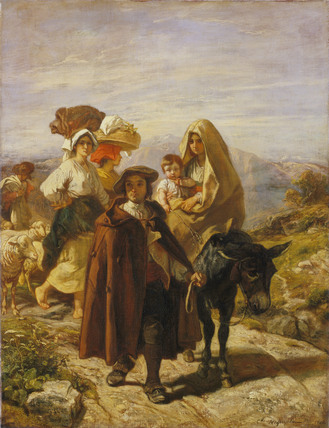
Peasants of the Béarn by Roqueplan (1846)

 Roqueplan’s health deteriorated in 1843 and as an aid to recovery he spent time in the foothills of the Pyrennees with its fresher and cleaner air.  He remained there for three years during which time he painted many scenes depicting mountainous landscapes and peasant life.  One such work can be found at the Wallace Collection in London with the title Peasants of the Béarn dated 1846.  Béarn is a French province in the Basse-Pyrenees and one of the geographical features of this province is the Ossau Valley.  It may be more than just a coincidence, but at the 1847 Salon, the year after the completion date given to  Peasants of the Béarn, Roqueplan exhibited a work with the title, Peasants of the Valley of Ossau.  Could these be one and the same painting?

Girl with Flowers by Roqueplan (1843)

Another painting of his which I like was painted around the same time, 1843.  It is an oval work, entitled Girl with Flowers and is now housed in the Hermitage Museum in St. Petersburg.  It is an everyday genre piece in which we see a young girl walking home with a bunch of wild flowers that she has collected, and which are held carefully in the folds of her raised skirt.  She is young and pretty.

Girl with Flowers (detail)

On her head is a wide-brimmed straw-coloured hat adorned with a pink flower and ribbons that seem to flutter down and fly off behind her giving us an impression of motion.  She holds on to the brim of her hat, pulling it downwards affording her more shade from the sun and maybe ensuring it does not fly from her head due to the breeze.  The hat frames her face.  She looks at us enticingly and we cannot help but fall under the spell of her young beauty.  What of course is more haunting is the sight of her left breast which has been uncovered due to lowering the neckline of her white linen blouse.

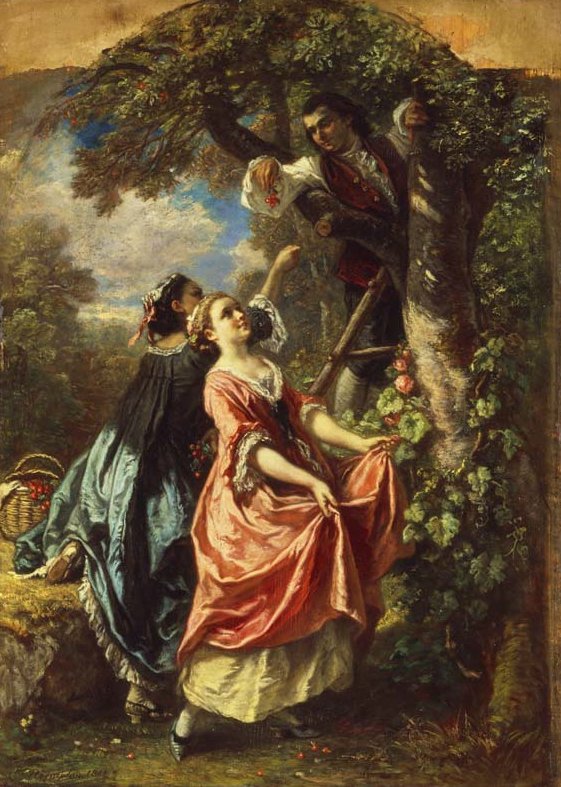
Rousseau and Mlle. Galley gathering Cherries by Rocqueplan (1851)
Rousseau and Mlle. Galley gathering Cherries by Roqueplan (1851)

My final offering is a work he completed in 1851 entitled Rousseau and Mlle. Galley gathering Cherries and is based on one of the autobiographical tales from The Confessions of Jean-Jacques Rousseau , written by the French philosopher and writer Jean-Jacques Rousseau.  This great work came in twelve volumes and recounted the first thirty-five years of his life.  In Volume IV  he recounts a tale from 1731, when he was nineteen years old, when he met and befriended a lady and her companion who were travelling through the countryside.  He had assisted them with getting their horses across a stream and then they had stopped at a hostelry and were partaking of lunch when they decided to go outside and look for some cherries and it was then that Rousseau tells of his longing for the lady:

“…After dinner, we were economical; instead of drinking the coffee we had reserved at breakfast, we kept it for an afternoon collation, with cream, and some cakes they had brought with them. To keep our appetites in play, we went into the orchard, meaning to finish our dessert with cherries. I got into a tree, throwing them down bunches, from which they returned the stones through the branches. One time, Mademoiselle Galley, holding out her apron, and drawing back her head, stood so fair, and I took such good aim, that I dropped a bunch into her bosom. On her laughing, I said to myself, “Why are not my lips cherries? how gladly would I throw them there likewise!…”

 In the painting we see Rousseau, having climbed a little way up the cherry tree, is dangling the fruit above Madamoiselle Galley.  She stands holding her apron open to catch the fruit but Rousseau has other ideas as to where the cherries should land!  The smile on her slightly flushed face is an indication that she too would like the cherries to be his lips.

Camille-Joseph-Étienne Roqueplan died in Paris in September 1855, aged 55.

 In this and my previous blogs about Gabriel Metsu I have featured paintings which are housed at the Wallace Collection in London.   If you are ever in London and want to visit an art gallery but are spoiled for choice, you must go to this one.  It is right in the centre of town, a five minute walk from the major department stores on Oxford Street.  I can assure you that you will not be disappointed with the collection.

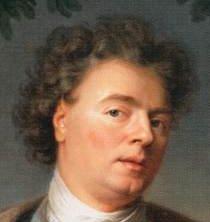
Alexandre-François Desportes. The Animal and Still Life painter.

Alexandre-François Desportes

When I looked at works by Gabriel Metsu in a recent blog I featured a couple of scenes which depicted hunters.  Scenes with hunters were very popular at the time especially with the upper classes and nobility as hunting was a pastime of the rich and so any painting which depicted the hunter alluded to wealth.  Hunting in the eyes of the nobility was one of the last symbols of class distinction.   It was not just the portrayal of the hunter and the hunt which was popular with the wealthy classes but also the portrayal of the hunted – the prey and the hunting dogs.    Today I am featuring the works of the French painter and decorative designer who specialised in animal paintings. Alexandre-François Desportes.

Dog and Wild Duck by Alexandre-François Desportes   (c. 1720)
Dog and Wild Duck by Alexandre-François Desportes (c. 1720)

Alexandre-François Desportes was born in Champigneulle, a small town fifty kilometres south of Reims, on February 24, 1661.   His father was a farm labourer.  When François was twelve years of age his father sent him to Paris to live with his uncle.  Shortly after his arrival at his uncle’s home he took ill and was confined to bed.  To while away his time his uncle gave him an engraving and told his nephew to try and copy it.  François’ effort was so good that his uncle arranged for him to study art under the Flemish painter Nicasius Bernaerts.  Bernaerts was an accomplished artist who had studied with Frans Snyders, the Flemish painter, famous for his depiction of animals and hunting scenes.  Bernaerts carried on the painting tradition of Snyders and had worked at Gobelins, the Parisian tapestry manufacturers, where his cartoons of animals were often used as designs in their tapestries.  He was to greatly influence the future work of François Desportes.  Whilst studying under Bernaerts, Desportes was put to work copying Flemish paintings, particularly those depicting animals and hunting scenes.  He was also encouraged to sketch flowers direct from nature and paint floral still-lifes.  Desportes never found this period of his life very fulfilling as Bernaerts, who although only in his mid-fifties, was often ill and his health was further impaired by his alcoholism and very rarely offered practical advice or assistance to his students.   Bernaerts died in 1678, aged 58.  After the death of Bernaerts, Desportes continued his artistic training at the Académie Royale where he was able to learn about traditional classical drawing but was also able to continue with his favoured painting method – en plein air.  Desportes had to fund his schooling, as well as buy food and pay for his lodgings, and to do this he earned money by designing stage scenery, gained portrait commissions and commissions to paint decorations in Paris hotels

During the 1680’s he assisted the French painter Claude Auran III in supplying paintings for Louis Joseph de Bourbon, Duc de Vendôme’s Chateau d’Anet.  Artists survive on commissions and without commissions they struggle to make ends meet.  France at the end of the seventeenth century struggled financially as it had been a century of costly wars.  France and Spain clashed during the Franco – Spanish war (1635 – 1639) and again between 1683 and 1684 during the War of Reunions.  The French and the Dutch clashed between 1672 and 1678 and France went into battle with most of its neighbours in the War of the Grand Alliance (1688-1697).  Wars cost money – lots of money and in consequence, the French government had no money left for grand artistic endeavours, which meant that lesser known painters, who had yet to establish their reputation, struggled to make a living.  Desportes did struggle but despite his financial hardship, Alexandre-François Desportes married Eléonore-Angélique Baudet.  His wife was a linen and lace maker and through her occupation she was able to support her husband and allow him to search out commissions and carry on with his studies.

Self-Portrait as a Huntsman by Alexandre-François Desportes (1699)

Desportes luck changed when in 1695 he received an invitation from the French ambassador to Poland to come to the court of the Polish king John III Sobieski who was also the Grand Duke of Lithuania.  Desportes was commissioned to paint portraits of the king, his wife Maria Kasimiera and some of the palace courtiers.  His stay at the royal court lasted less than a year as the Polish king died in June 1696.  Desportes was summoned to return to France by Louis XIV.  Desportes had spent a number of years painting portraits of wealthy people and he intended to carry on doing this when he returned to his homeland.  However he soon found that the art establishment was awash with highly skilful portraitists and realised that it would be difficult to obtain portraiture commissions and so he decided to revert back to the training he received from Nicasius Bernaerts – the depiction of animals and still life painting and as a twist to this he would incorporate the two in his artistry.  In August 1699 Desportes was received into the Académie Royale as an animal painter and his reception piece was Self Portrait as a Hunter.  The painting, in which we see the thirty-eight year old artist seated in a landscape with his two hunting dogs and a large array of dead game, was a move away from the normal self-portrait as he has used the setting and what has been included in the work was a tribute to his own skill as a specialist animal painter as well as being a talented landscape artist.  He was advertising his abilities!

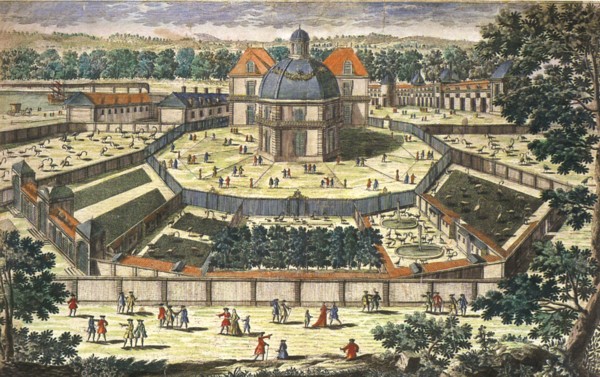
Backyard of the royal menagerie of Versailles during the reign of Louis XIV by Pierre Alexandre Aveline
Backyard of the Royal Menagerie of Versailles during the reign of Louis XIV by Pierre Alexandre Aveline

Louis XIV had started to have his palace at Versailles built in 1664 and he decided to incorporate a menagerie within the palace’s park.  The design of his menagerie was in line with other Baroque menageries of the time with its circular layout, in the centre of which was a magnificent pavilion. People were able to walk along the paths which surrounded this central building, and alongside them were the cages which housed the wild animals.  The king had been very impressed with the animal paintings of Desportes and commissioned him to complete five works of art which depicted animals and hunting scenes for the menagerie pavilion.  Desportes, like a present day method actor who immerses himself into his character, often went on hunting trips with Louis XIV so that he could realise the thrill of the hunt.  During the hunt he would carry with him a small notebook in which he would make on-site sketches of the hunt “trophies” – the dead animals, which could then be used later for still-life depictions of the game that resulted from the day’s hunt,  Louis XIV would then choose the best sketches and Desportes would go off and complete an oil on canvas painting of the king’s chosen subject.   Four such paintings, Deer Kill, Boar Hunt, Wolf Hunt and Hounds Guarding a Dead Deer,  still survive and are housed in the private Paris museum, Musée de la Chasse et de la Nature (Museum of Hunting and Nature).

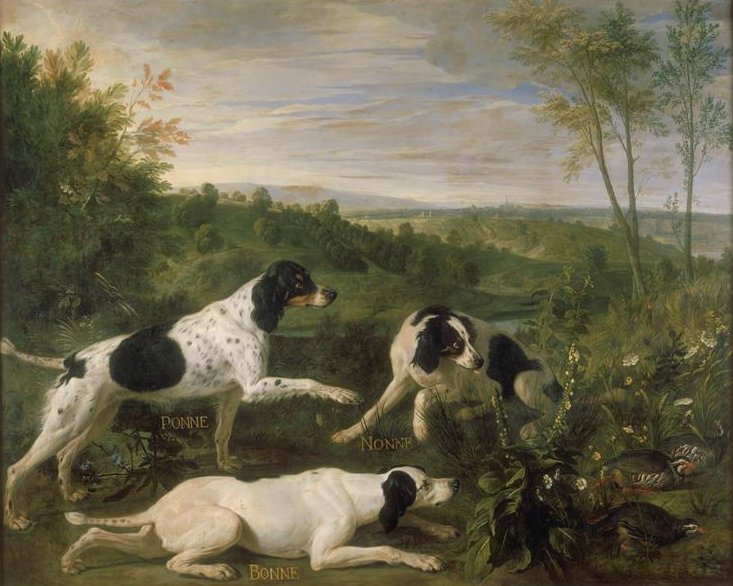
Bonne, Nonne and Ponne by Desportes

Louis XIV was so pleased with these paintings that in 1702, he commissioned Desportes to paint six works, portraying the portraits of the hunting dogs which were his personal favourites.  In one such work entitled Bonne, Nonne and Ponne we see the king’s three favourite hunting dogs chasing and flushing out pheasants and partridges from the long grass.  The king was so pleased with the work Desportes produced for him that he awarded him a pension and two years later he made Desportes a councillor of the Académie Royale.

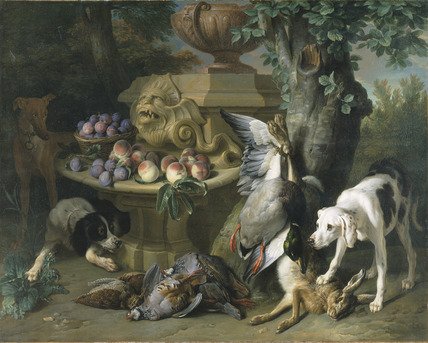
Dogs, Dead Game and Fruit by Alexandre-François Desportes (1715)

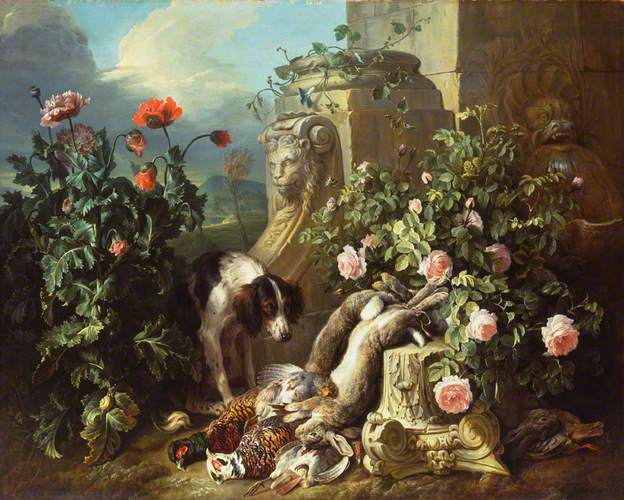
Desportes reputation as an artist spread outside of France and soon he was in high demand.  In 1712 he visited London and stayed for six months working on commissions.  When Louis XIV died in 1715, Desportes carried on working for the Regent of France, Philippe, Duc d’Orleans, who was ruling for the infant Louis XV, the grandson of Louis XIV and over time provided many paintings for the royal residences at Versailles, Marly, Meudon, Compiègne and Choisy.  It was not just hunting scenes that Desportes had mastered for he also spent time painting still-life works featuring the dead “trophies” brought back from the hunt cleverly arranged alongside floral displays or displays of vegetables lying on a table or even in landscape settings.  Two such paintings, Dog, Dead Game and Fruit and Dog with Flowers and Dead Game completed in 1715, can be seen in the Wallace Collection in London.

Dog with Flowers and Dead Game by Alexandre-François Desportes (1715)

These pendant pictures were commented on by the Revue Universelle des Arts in 1857 as being:

“…incontestably the finest which came from the brush of Desportes…”

The two works were bought by Captain Richard Seymour-Conway,  the 4th Marquess of Hertford in 1857 for his country house, Château de Bagatelle,  in France and at the time he commented on his acquisitions saying:

“… a little rubbish for the country…. beautiful of the sort and perfect for my shooting place…”

There is an interesting connection between the buyer of these paintings and where they are housed today for the purchaser of the paintings, Lord Hertford, also owned a house in London known as Manchester House, situated in Manchester Square.    He was an avid art collector and built up a sizeable collection of European art.  On his death in 1870, his illegitimate son, who had acted as his secretary, Sir Richard Wallace, inherited his father’s unentailed estates, and large collection of art in 1871. Wallace added to the collection himself, and in 1897, after his death, the works of art were donated to the nation by his widow. They are now housed in what was his London home, Hertford House, Manchester Square, London, and are part of the Wallace Collection.

Still Life with Silver  by Alexandre-François Desportes (c.1720)
Still Life with Silver
by Alexandre-François Desportes (c.1720)

Several of his still-life paintings which combined game with fruit or flower displays also featured some beautiful pieces of silverware which came from Louis XIV’s collection.  One such painting is entitled Still Life with Silver and was completed around 1720.  Before us is a buffet laid out with an array of objects in silver, porcelain, and semi-precious stone as an array of fruit.  The gold and silver vessels are displayed on a tiered console table which is weighed down with fruit and flowers. The composition is monumental in scale, measuring  262cms x 187cms (almost 8ft x 6ft).  This is what one might have seen as a centrepiece on the table if we had attended a royal banquet.  At the centre we can see the dragon-handled tureen and vermeil salvers both of which are in the Régence style of 1715-23.

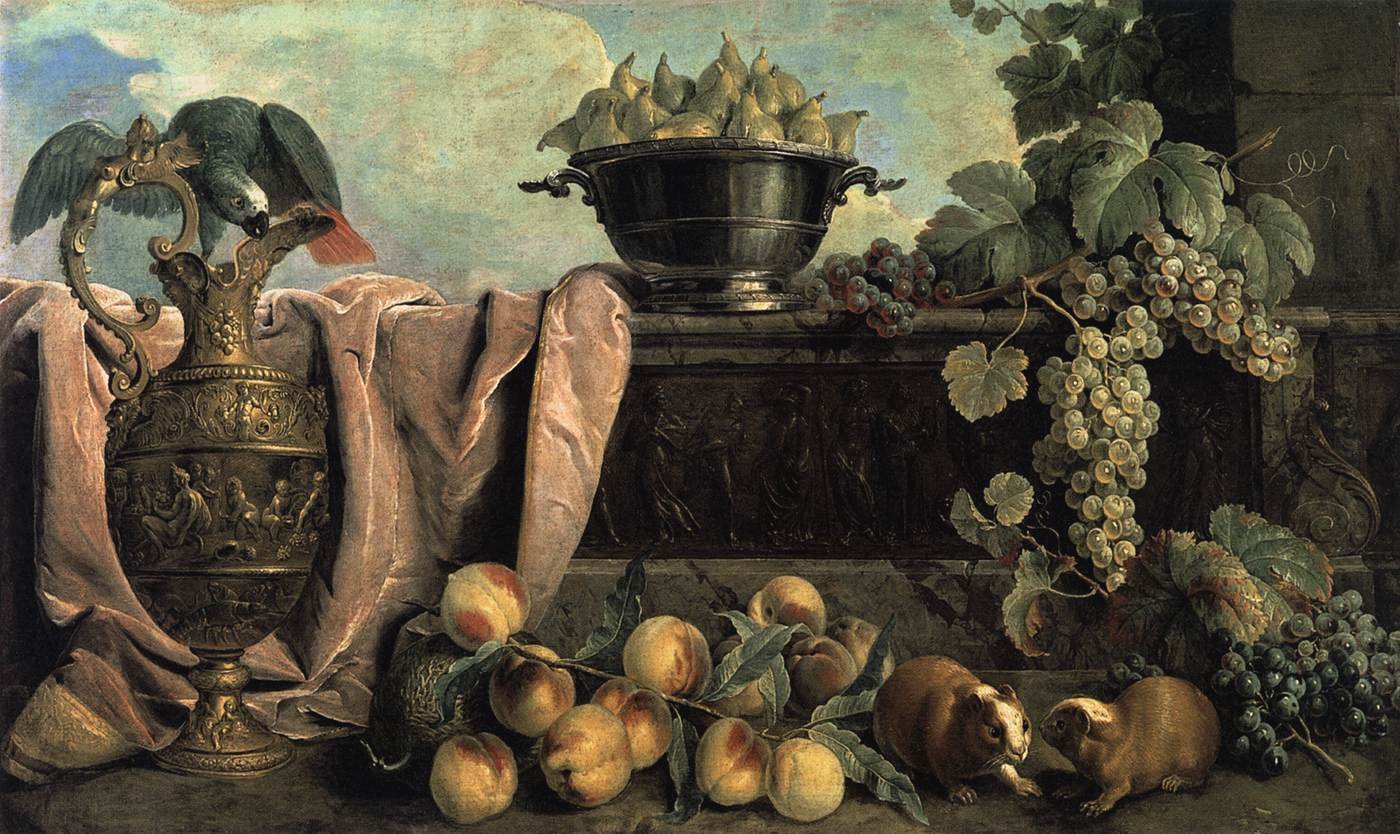
Still-Life with Ewer by Alexandre-François Desportes (1734)

Alexandre-François Desportes died in April 1743, aged 82.  He left a legacy of paintings and sketches as well as his cartoons which were used as designs for tapestries made up at the famous Parisian tapestry company, Gobelins.  Many of his designs were also used at the Savonnerie company, the Parisian carpet factory at Chaillot, which manufactured the most prestigious European manufacturer of knotted-pile carpets.

Adolphe-William Bouguerau. Part 3. A change of genre

Rest in Harvest by William Bouguereau (1865)

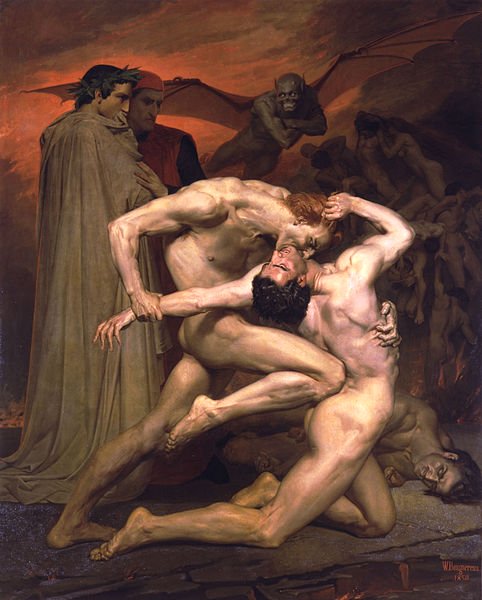
This is my third and final look at the life and works of the Classical French artist, Adolphe-William Bouguereau.  In Part 1, I looked at his History painting Dante and Virgil and in Part 2 looked at one of his many religious works, The Flagellation of Christ. Today I want to look at a completely different type of work he began to paint at the start of the 1850’s.  Why, if his classical History paintings were so successful, did he want a change of artistic genre?  The simple answer has to be money.  The commissions he once received from the church for his monumental religious works and the private commissions for his large History paintings had dwindled and he had a growing family to support.  He needed to increase his income.

In my last blog I looked at Bougereau’s early life.  I had reached the stage when through the financial backing of his aunt and money he had accrued by painting small portraits of the parishioners, who attended his curate uncle, Eugène’s church, he could head to the art capital of the world, Paris, and continue his studies.  The year was 1846 and Bouguereau was almost twenty-one years of age.  Through the recommendation of his former tutor at L’École Municipale de Dessin et de Peinture in Bordeaux, Jean-Paul Alaux, he was accepted into the studio of François-Edouard Picot at Paris’ École des Beaux Arts.  Picot’s reputation had been built on his mythological, religious and historical paintings and so was the ideal mentor to Bouguereau who had always admired the academic History works of art. His enrolment at the prestigious art school was a dream come true for Bouguereau as such an acceptance into this celebrated art establishment was the ultimate goal of all aspiring artists and it was the beginning of becoming accepted by the official artistic fraternity.

His artistic training at L’École des Beaux Arts was the standard academic type with its rigid tenets regarding the importance of draughtsmanship, life drawing, technical proficiency and ultimately the training to become a classic History painter and Academic portraitist.  Many artists found the strict regimentation of the tuition too authoritarian and suffocating but Bouguereau was a true believer in the academic training and remained so all his life.  In 1850, at his third attempt, Bouguereau was awarded one of the two Premier Grand Prix de Rome for the best Historical painting.  It was entitled Zénobie Retrouvée par les Bergers sur les Bords de l’Araxe  (Zenobia Discovered by Shepherds on the Bank of the River Araxes).  His prize was a three year stay at the Villa Medici, the French Academy in Rome, during which time he also had the opportunity to travel around Italy and its countryside and studied and made copies of the works of the great Renaissance masters.

Fraternal Love by Bouguereau (1851)

One of Bouguereau’s first paintings which saw a change in his style was completed in 1851 and was entitled Fraternal Love which can be found in the Museum of Fine Arts in Boston.  What immediately comes to mind when you look at the scene before you?   Is it a religious or secular work?   We know that Bouguereau was a very religious man and had painted many religious works so is this simply another one?  Is this the Virgin Mary with the blonde-haired Christ Child and maybe St John?  And yet the title is a secular one with no reference to members of the Holy Family.  So let us just contemplate what we are looking at.  We see a mother and her two boys.  The younger child, who sits on his mother’s lap, holds his elder brother’s face between his chubby hands and kisses him.  The mother looks down lovingly at this demonstrative display of filial love.  She is wearing a blue dress which of course makes us immediately think of the colour blue which we see in most portrayals of the Virgin Mary.

The painting was purchased by the Boston merchant and avid art collector, Thomas Wigglesworth and at the time when he purchased the painting it was known as Madonna and Child with John the Baptist but one must remember that Bouguereau’s gave the painting the secular title of Fraternal Love and by doing so transformed the painting from a religious one into a secular genre scene and by doing so enhanced its selling prospect as there were now far more buyers who would purchase a secularized Virgin Mary than the very religious portrayal of her in Christmas Nativity scenes.

Madonna and Child with St John the Baptist by William Bouguereau (1882)

However Bouguereau did paint religious works featuring the Virgin Mary and the Christ Child and it is interesting to compare the secular painting, Fraternal Love, with the one he painted thirty years later, in 1882, entitled Madonna and Child with St John the Baptist, which is housed in the Herbert F Johnson Museum of Art at Cornell University, Ithaca, New York.  The Christ Child in this religious work still has the curly blonde hair and John the Baptist the curly dark hair which we saw in the Fraternal Love painting.  Once again we see the close connection between the two children.  The setting for this painting, in comparison with his secular work, has a more formal setting.  It is an inside setting unlike the outside scene of Fraternal Love.  In this work the Virgin Mary is seated on a white marble throne which almost takes up the full width of the work.  Behind the throne is beautiful ornate tapestry.  The inclusion of such details adds a sense of traditional art of the great Masters which he must have witnessed during his time in Italy.  The painting is a depiction of tenderness between mother and child.  Look at the pose of the Christ child as he looks down at his friend, John the Baptist.  Even at this early age, one recognises a close bond of friendship between the two.  It has to be more than just a mere coincidence that Bouguereau has depicted the Christ child with his arms fully extended outwards in a fashion that reminds us of the crucifixion that will come in the future.
In 1854 Bouguereau returned to Paris.  Two years later, in 1856, aged 31, he married Marie-Nelly Monchablon.  The couple went on to have three sons, Georges, Adolphe-Paul and William-Maurice and two daughters, Henriette and Jeanne-Léontine.   Sadly his younger daughter, Jeanne-Léontine, died in 1866 when she was just five years old, Georges died in July 1875,  aged sixteen, but the saddest of all was that his forty-year old wife Nelly died giving birth to their fifth child, William-Maurice, in 1877 and he died a seven months later.

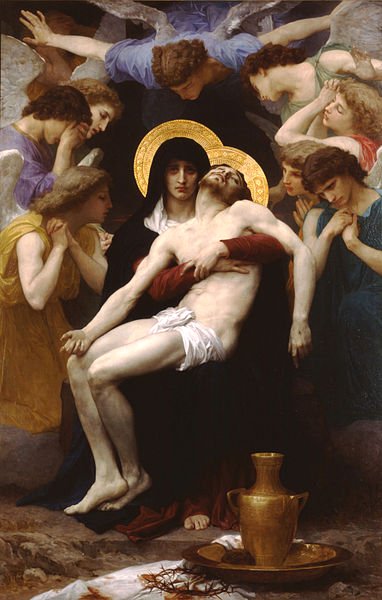
Pieta by Bouguereau (1876)

Two of Bouguereau’s greatest works derived from the sorrow he suffered at the death of family members.  In both works he has utilised religious themes to present to the world his grief and feeling of loss.  His 1876 work entitled Pietà was thought to be based upon the Virgin and Christ of Michelangelo’s marble Pietà. Bouguereau completed the painting shortly after the death of his son Georges.

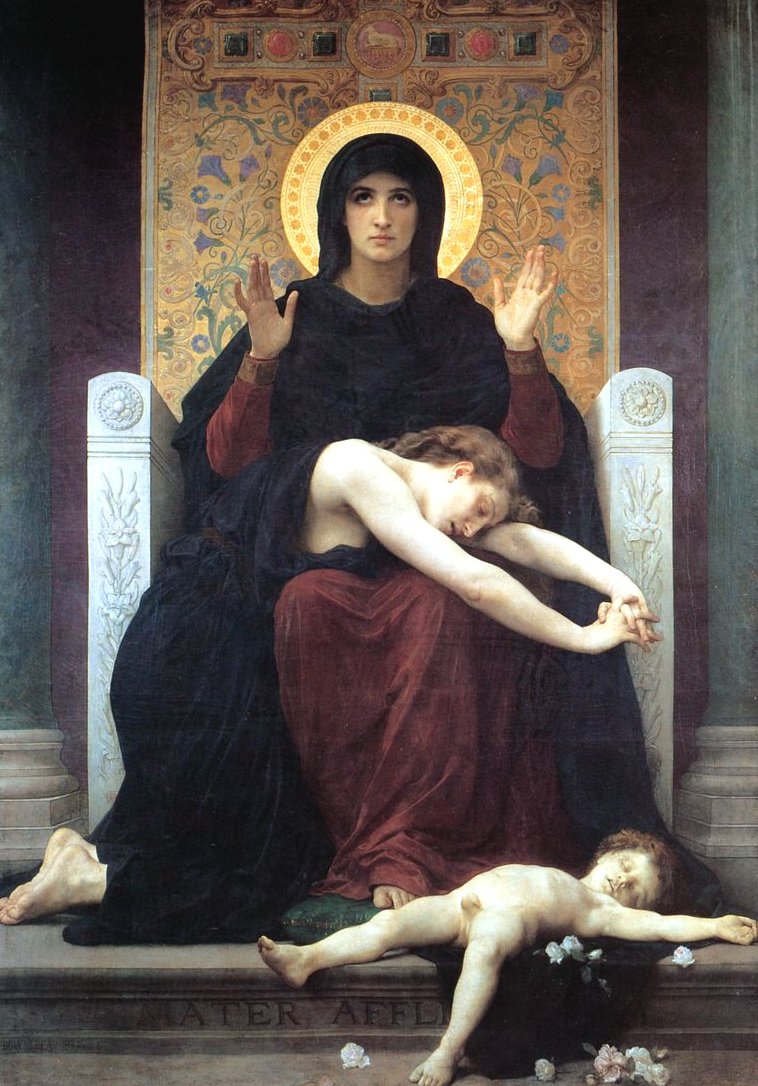
Vierge Consolatrice - The Virgin of Consolation by William Bouguereau (1875)
Vierge Consolatrice – The Virgin of Consolation by William Bouguereau (1875)

In 1877 Bouguereau dedicated a painting to his late wife Nelly who died in childbirth and his youngest William-Maurice who was seven months old when he too passed away.  It was entitled Vierge Consolatrice (Virgin of Consolation).  In the work we see the black-clad Virgin of Consolation, once again sitting on a white marble throne behind which is a large colourful tapestry.  Lying across her lap is a young woman who grieves utterly inconsolable at the death of her child, the body of whom we see lying naked at the Virgin’s feet.  The Virgin has raised her hands in prayer.   She is the intermediary between the mother and heaven.  At first glance one would be forgiven if we looked upon this work as being merely an over-sentimental painting but understanding the circumstances surrounding it, one becomes more understanding and less cynical.  It is thought that Bouguereau, who was a staunch Catholic, gained some solace from this work after the death of his wife and baby.

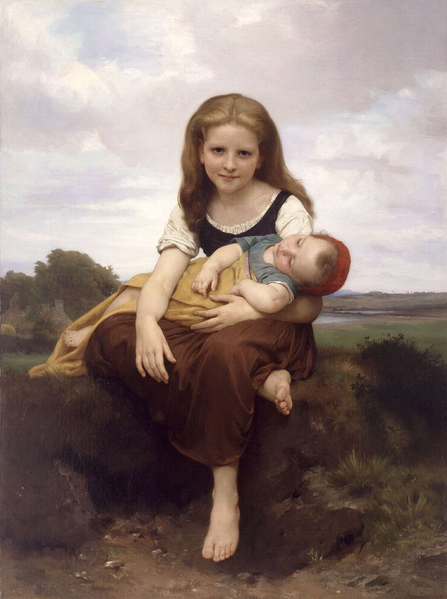
The Elder Sister by William Bouguereau (1869)

In 1869, before the tragic and untimely deaths of his wife and three children, Bouguereau painted a portrait of two children and used his twelve-year old daughter Henriette and her newly born brother Adolphe-Paul as models.   The work was entitled La soeur aînée (The Elder Sister) and hangs in the permanent collection of the Museum of Fine Arts in Houston.  According to the museum, this is one of the highlights of their collection and was an anonymous gift from a lady in memory of her father.  We see Henriette sitting, perched on a rock, cradling a sleeping infant on her lap.  The capped head of the baby lolls slightly in sleep.  Henriette looks directly out at us and smiles.  She, although bare-footed, wears clean clothes.  Her skin is without a single blemish.   Even at such an early age, one knows that she will grow up to become an exquisite beauty.  The painting has a tranquil countryside setting.  Everything is “just perfect” in the depiction of the children and the background.  This portrayal strays from realism.  It is more an idealised depiction.  Bouguereau has cleverly used a various mix of colours and merged them in such a way to create an image which has a softness to it.  There is an earthiness about the work.  The colour of Henriette’s frock/tunic clothes is the brown of the ground.  It seems to almost merge in with the colour of the foreground.

For Bouguereau, the 1870’s were a very sad time in his life with the deaths of his wife and three of his children.  The only high point for him during that decade was his election to the Académie des Beaux-Arts de l’Institut de France.  Throughout his life Bouguereau was a staunch defender of the Academy and all that it stood for and the honour of being elected to become a member of the institute was one he cherished.  He wrote:

“…To become a member of the Institut…is the only public distinction I ever really wanted…” 

The Bohemian by William Bouguereau (1890)

In 1890, Bouguerau completed  a work entitled The Bohemian which is sometimes referred to as Consuelo.   The young girl depicted in the painting almost fills the whole canvas.   She is a young gypsy girl and we see her seated on a stone bench on the Quai de Tournelle, which lies on the left Bank of the Seine.  In the background, across the river, we see Notre Dame cathedral and in the mid-ground we can just make out the Pont de l’Archevêché which straddles the Seine and links up the Left Bank with the Île de la Cité.  The girl looks out at us with a somewhat forlorn expression.  One cannot help but be moved by her dejected appearance.  Her clothes are shabby but the thickness of the fabric serves the purpose of keeping her warm.  Her dress is a dull grey but her multi-coloured shawl lightens up her appearance.   Her feet are uncovered which leads us to believe she is a beggar.  This assertion is further enforced as we see on her lap a violin which is the tool of her trade – begging for money.  This is not simply a painting about poverty.  In this work Bouguereau not only condemns the humiliation brought about by poverty but lauds those who strive to free themselves from destitution by virtues of their own endeavours.

One interesting aspect of this work is that we know it was changed by the artist.  How do we know that?  There is a photograph of this painting when it was “initially completed” by Bouguereau in 1889.  Bouguereau had decided to employ the photographers, Braun & Clement to photograph his complete collection of unsold works.  The photograph of The Bohemian showed a wall of bare stone behind the girl, which completely cut off any view of the River Seine or the bridge spanning it to the Île de la Cité.   It is thought that having not sold the painting that year a prospective buyer in 1890 asked for a “better” background to be added to the scene.   Bouguereau complied with the request and repainted part of the work.  There is also sign that the “8” and the “9” had been altered and over-painted with the numerals “9” and “0”, changing the completion date from 1889 to 1890.

The Young Shepherdess by Bouguereau (1885(Bouguereau painted many works featuring peasant girls.  This was an extremely popular subject in 19th century paintings.  For French artists of the time, including William Bouguereau the country peasant was somebody who lived a simple and honest life and got by through their laudable work ethic.  For the city dwellers who had not rubbed shoulders with a peasant they formed their visual understanding of who peasants were from the shepherds and shepherdesses with their multi-coloured clothes whom they saw depicted in Italian opera and theatre.  Bouguereau’s depiction of peasants was almost all of women and girls.  The setting for his portrayals of them and what they wore was often the same –  simple white blouses, overdresses of muted colours and thick material, set off by multi-coloured and multi-patterned shawls.  The female peasant was depicted bare-footed and  standing, seated or lying in some country scene such as a field or wood.  Bouguereau tended to steer clear of any other countryside indicators such as farming equipment or farm animals such as grazing sheep or cows.

Bouguereau, like all artists, needed to sell his work.  His clients were often middle and upper-middle class Parisians and the one thing the buyers did not want to be reminded of was the inequalities of life.  They did not want to be made to feel guilty about the social realities of their life and those of the peasant classes.   Unlike some of his contemporaries who were social realist painters and wanted to “accuse” through the depiction of the lower classes in their paintings highlighting how they suffered under an unjust economic system, Bouguereau’s depiction of peasant girls was all about their beauty, and little to do with any resentment or  condemnation of the class system.  His depiction of the peasant class was often very moving if, on occasions, heart-rending, but the peasants were never depicted as being threatening.   An artist and contemporary of Bouguereau, René Ménard,  wrote of Bouguereau’s depiction of the female peasants:

“… Rusticity is not with this painter and instinctive sentiment, and he paints a patched petticoat he yet suggests an exquisitely clean figure:  the naked feet he gives peasant-women seem to be made rather for elegant boots than for rude sabots; and, in a word, it is as if the princesses transformed into rustics by the magic wand in fairy tales had come to be models for his pictures, rather than the fat-cheeked lasses whose skin is scorched by the sun and whose shoulders are accustomed to heavy burdens…” 

After the death of his wife Nelly in 1877, Bouguereau lived in his house in Paris with his mother and two surviving children, Henriette and Adolphe-Paul and had taken up a post as professor at the Académie Julian in Paris.   This was a more liberal art establishment which allowed women to attend classes.  He was well thought of by his students, especially the women who idolised him.   The female artists were very appreciative of his training method and the skill he used when working with them in a lead-up to them establishing professional artistic careers.   Many of his female students were Americans and one in particular, Elizabeth Jane Gardner, fell under his spell.  She, as well as being a student of Bouguereau, was also friendly with his late wife.   Elizabeth was twelve years younger than Bouguereau.  Between teacher and student, there developed a mutual admiration which turned to love.  He told his mother and daughter Henriette that he intended to marry Gardner.  The only rock blocking this path of true love was Bouguereau’s mother.  She was a very religious person who had never been happy with the way her son had depicted so many nude figures in his classical works.  When it came to Bouguereau falling for another woman after his wife’s death, she was vociferous in her opposition to Bouguereau and Gardner marrying or living under the same roof as her and his children and so the pair’s courtship had to become more discreet and lasted almost twenty years until Bouguereau’s mother died.  Shortly after her death, in 1896, the couple married.  He was 71 and she was 59.

His daughter Henriette also married around that time, and Bouguereau was happy with her choice of husband.  However in 1900, tragedy was to strike again with his son Adolphe-Paul, who was a lawyer,  suddenly dying.  He was just thirty years old.  Bouguereau was devastated and it precipitated a deterioration of his health.  Despite this, he continued to paint and exhibit his works at the Salon.  He contracted a heart disease which although he fought hard to survive, he died a few months short of his eightieth birthday, in August 1905 at his home in rue Verdière in La Rochelle, the town where he was born.

Near the end of his life he described his love of his art:

“…Each day I go to my studio full of joy; in the evening when obliged to stop because of darkness I can scarcely wait for the next morning to come if I cannot give myself to my dear painting I am miserable…” 

Bouguereau was a workaholic.  He once sent a letter to his first wife in which he wrote:

“…When I cannot work, I am unhappy…”

And in a diary entry he wrote:

“…I rise every day at seven and breakfast then paint all day, with a light lunch at three which doesn’t interrupt my work…” 

He was always a firm believer in Academic art and Academic teaching.  He never wavered and he was often ridiculed for this view of how art should be.  La peinture bouguereauté was the derisory term given to French Salon artists and to students who painted badly!

During his lifetime he painted eight hundred and twenty-six paintings. To many people, Bouguereau was one of the greatest classical painters of his time, and some even compared him to Raphael.   However along with his admirers he had his fair share of detractors who criticized him. One such group of artists were the Impressionists who were hell-bent to rid themselves of  the shackles of traditional schools of painting. To them artists like Bouguereau were a regressive influence and hindered their move towards a new style of art.  To many people Bouguereau’s art was overburdened with sentimentality and that it was over-romanticizing.  To some, however, his art is full of beauty, compassion and piety.  I will leave you to decide which view you subscribe to.

As usual I have collated lots of information from the internet and reference books but most of the information was gleaned from an excellent book I treated myself to and which is yet another addition to my collection.  If you are interested in Bouguereau and his work I do suggest you buy it.  It is not expensive but is a true gem.  The title is Bouguereau and is by Fronia E. Wissman, an author who has written or contributed to a number of books about French artists.

Adolphe-William Bouguereau. Part 2 – The painter of Religious Scenes and his painting The Flagellation of Christ

Photograph of William Bouguereau (c.1870)

My blog today looks at another of Bouguereau’s great history paintings.  This is one of his religious works and has all the ferocity of his painting Dante and Virgil, which I featured in my last blog.  Whether you are a lover of religious historic paintings or not, I defy you to be unmoved by the beauty of this work.  Bouguereau was a devout catholic and looked upon his religious paintings as a form of his worship of both God and mankind.  Bouguereau’s religious belief can be plainly seen in his religious works.  The painting I am featuring today is entitled The Flagellation of Christ, which he completed in 1880. Before I discuss the painting let me tell you a little about his life.

Adolphe-William Bouguereau was born in the French Atlantic coastal town of La Rochelle in November 1825.  His father was Theodore Bouguereau, a seller of wine and olive oil.  His father struggled to make much money from his business and because of the financial hardship and family tensions William was sent to live with his uncle Eugène Bouguereau, who was curate in the town of Montagne, some twenty kilometres from Bordeaux.   This enforced move to his uncles was to prove highly fortuitous for the young boy as it was his uncle who introduced him to the world of Roman and Greek mythology and had him read the stories from the Old and New Testaments.  At the age of thirteen, William’s uncle arranged for him to attend the high school at Pons where he attended his first drawing classes under the guidance of Louis Sage, a young classical painter who had once studied under Ingres.   He remained at the school for three years.  In 1841, he eventually moved to Bordeaux where his father had set up his business and once again William was with his family.  William joined in his father’s business but at the same time, in 1842, he was allowed to enrol on a two-year part-time course at the city’s École Municipale de Dessin et de Peinture.  Here he studied under  Jean-Paul Alaux, the French landscape painter and lithographer.  He could not attend full-time because of his promise to help his father during the day, and so, he only attended art classes in the early morning and in the late evening.  Despite being a part-time student he excelled in what he did and in 1844 he won first prize for the best History painting with his depiction of Saint Roch.     Following this award William Bouguerau realised that his future was indelibly tied to art.  To earn some money for himself he designed lithographic labels for jars of jams and other preserves.

Bouguereau realised that to progress with his art he needed to be in Paris which was, at that time, considered the capital of the art world.   However to live in the French capital required money, a commodity he lacked.  His father’s business was not successful enough for him to give his son the money but fortunately for William, his uncle Eugène, the curate, once again proved to be his salvation.  He arranged for William to paint portraits of his parishioners for a fixed fee and after months of portraiture he had amassed nine hundred francs.  A similar sum was given to him by his aunt and he was all set to head to Paris.

The Flagellation of Christ by William Bouguereau (1880)

In my third and final blog about Bouguereau I will finish his life story but for today I want to focus on another of his great History paintings, his religious work entitled The Flagellation of Christ.   He exhibited this work at the 1880 Paris Salon.  It is a monumental work measuring 390 x 210 cms (almost 13ft high and 7ft wide).  One can easily imagine how it stood out from all the other works on show at the exhibition. This is acknowledged as being one of Bouguereau’s greatest religious works.  In this painting, Bouguereau has depicted Christ, tied to a column.  Christ’s body hangs down almost lifelessly with his feet dragging on the ground.  His head droops backwards.  His eyes are blank and unfocused. He is utterly powerless.  He can do little to stop the ferocious onslaught.  Unlike Bouguereau’s painting Dante and Virgil which I featured in the last blog, he has made no attempt to exaggerate the musculature in his portrayal of Christ’s body.  The body of Christ is that of a normal human being.  It is just like ours and in doing this Bouguereau has allowed us more easily to empathise with Christ’s suffering and pain.

A look of concern
A look of concern

We see Christ’s tormentors, two men, who stand on either side of him, arms raised in mid swing with their knotted rope whips airborne.  In the right foreground we see a third man kneeling.  He is in the process of tying up birch branches which will be used later to flagellate their prisoner.  Look at his facial expression.  It is one of concern.  It appears that maybe he is not convinced that what he sees before him is justified.  It is if he is beginning to question his part in the flogging.    In the background an inquisitive crowd gather to witness the flogging.  This is not a leering and jeering crowd we have seen in many of the crowd scenes in Northern Renaissance works.  This group of people cannot be likened to the snarling mob we have seen in earlier Passion of Christ depictions.

A child looks on
A child looks on

An old man in the crowd, maybe the father, lifts a baby aloft for him or her to get a better view.  There is little sign of compassion on the faces of the crowd.  Maybe they have accepted the charges that have been laid against Christ and feel that he needed to be punished.  However there is one exception.

Look closely at the far left of the background.  We see a young boy in a long green tunic who has turned away in horror of what is happening and has burrowed his head in the clothing of the woman who has wrapped her arm around him in a comforting gesture.  Maybe it is his mother.  Maybe she is horrified by what her young son has witnessed and is trying belatedly to protect him.  In the mid-background, there is a man wearing a white vest and grey headband.  He grips a sheath of birch branches and is readying himself to take part in the flogging.  There are a number of examples where the artist has decided to insert his own image into a work and Bouguereau has done the same in this painting.

The artist looks on
The artist looks on

Look at the face in the background to the right of the man wearing the white top and head band.  There, gazing between the spectators is a man with red hair and a red beard.  His brow is furrowed signifying his unease of what he sees before him.  This is believed to be the face of the artist himself.  He, like us, looks on at the terrible scene.

The size of the work almost certainly precluded the sale of it to a private individual and in 1881 Bouguereau gave it to the Society of Friends of the Arts in his home town of La Rochelle.  This majestic work can now be found at the Baptistery of La Rochelle Cathedral, France. 

Bouguereau never lost his love of Greek and Roman mythology which he had been brought up on from early age by his uncle Eugène.   As I said earlier, Bouguereau was a very religious man and religious imagery was a persistent theme in his paintings.   Often his religious works focused on sad and moving events and it is believed they mirrored the anguish and suffering he endured with the loss of loved ones in his own life, which I will talk about  next time.

Adolphe-William Bouguereau. Part 1 – The History Painter and his painting, Dante and Virgil

Self Portrait by William Bouguereau (1879)

In my next three blogs I want to look at the life and some of the works of one of the greatest and most prolific nineteenth century French painters, Adolphe-William Bouguereau.   At a time when many of his contemporaries were railing against academic art, Bouguereau was a staunch supporter of it.  He was a pure traditionalist.  So why did he support the establishment’s stance on art and the establishment’s method of training aspiring artists when many of his contemporaries were vociferous in their condemnation of all that the art establishment stood for?  To answer that question, one must look at the way art was taught in France or more precisely in the case of Bouguereau,  how it was taught in Paris which was then considered the art capital of the world.  Artistic training in that city was centred on the government-sponsored art school, the École nationale supérieure des Beaux-Arts, which was founded in the mid seventeenth century as the Académie des Beaux-Arts and once it had become independent from the government in 1863 changed its name to L’École des Beaux-Arts.

Viila Medici, the French Academy in Rome

It was here that young men (women were not admitted until 1898) were taught how to draw.   The actual teaching of putting paint on canvas was carried out in private studios which were often run by the professors of the school.   Artistic training was thorough and aspiring artists had to reach high standards before they were allowed to proceed with the course.  They would also have to enter work into a number of in-house competitions.  The most prestigious award being the Prix de Rome, which was given to the artist who submitted the best History painting.  Bouguereau won the coveted Prix de Rome in 1850, with his painting  Zenobia Found by Shepherds on the Banks of the Araxes. His reward was the chance to attend the Villa Medici, which was the French Academy in Rome, and remain there for four years.  During that time the student would have the opportunity to study the classical art of the Italian Renaissance masters.  The reason why the French art establishment believed that this was so important was their belief that no artist had ever achieved the level of excellence attained by the likes of Raphael, Titian or Michelangelo.  In their opinion, every aspiring artist was duty bound to emulate this type of art.

The Parisian art establishment which oversaw the running of L’École des Beaux-Arts issued artists with an official list detailing which genre of paintings they considered more important than others.  This hierarchy of genres was headed by History painting and the reason for that was that it somehow represented all the artistic skills the young artists had been taught during their passage through the Academy system. History paintings were generally very large works, and thus were nearly always destined to be hung in public places such as in churches, or the spacious rooms of government buildings or on gallery walls. History paintings delved into the world of classical, mythological, literary and religious events which had taken place in bygone days. Within this top-placed genre there was the allegorical works which, through their depiction, carried symbolic messages about good and evil. It was in these works that the depiction of nude figures, were considered acceptable and it was from years of studying the human figure in life drawing classes at the Academy that the aspiring artists were able to skilfully show off what they had been taught.

Once an artist had trained at the academy, he and later she, had to face up to the fact that to survive they had to sell their work.  In the past the government, the church and the wealthy aristocracy were the buyers of art works but it soon became obvious that their commissioning power was becoming limited and the new buyers of art were the Parisian people of middle and upper-class standing who had the money and wanted to fill their grand houses with fine art.  So where could these new buyers get their hands on fine works of art?  Parisian art dealers such as Paul Durand-Ruel and Adolphe Goupil did not become buyers and sellers of art until the mid nineteenth century.  Before then the most prestigious way of selling your paintings was to get them accepted at the Paris Salon’s annual exhibition.  Simply referred to as the Salon, it began in 1725 as the official art exhibition of the Académie des Beaux-Arts. These were massive exhibitions in which artist’s works, once they had passed the scrutiny of the Salon jurists, were exhibited floor-to-ceiling and on every available inch of wall space.   Potential buyers were then able to see, in one space, the art work that was on offer.  One can therefore realise that for a work to sell, not only had it to be pleasing on the eye of a potential buyer but it had to have been hung in a prominent position at the Salon exhibition.  The advantage the History painters had over others was the monumental size of their works which often dwarfed their “competition” and therefore were always placed in a prominent position.  

Dante And Virgil by William Bouguereau (1850)

In my next two blogs I want to look at two monumental history painting completed by Bouguereau, one secular, the other religious, but both follow the artistic traditions laid down by the Academy.   Today I am featuring the secular work, entitled Dante and Virgil in Hell, which is housed at the Musée d’Orsay in Paris.  This is a truly breathtaking work and is a prime example of classic art with so much attention paid to the musculature of the human body.  The first thing that strikes one about this painting is its unfettered ferocity, which has the effect of either you wanting to turn away from it in shock or you stare at it in a mesmeric state.

The setting for the work comes from Dante Alghieri’s 14th century epic poem, The Divine Comedy, which recounts the journey made by Dante through Hell along with his guide the ancient Roman poet, Virgil.  The poem tells us that Hell is made up of nine concentric circles within the bowels of Earth.  Each of the circles houses people who have committed certain types of sin.  Bouguereau’s painting depicts the two travellers arriving at the Eighth Circle of Hell.  This is the Circle which houses the deceased falsifiers.   This Circle, nicknamed Malebolge (evil pouches) is unlike the other Circles for it is surrounded by a wall of dull iron-coloured stone, and the valley itself is divided into ten secondary circles or pouches.  The setting for Bouguereau’s work is the tenth pouch of the eighth Circle of hell. We see Dante and Virgil watching a fight between two damned souls. 

So who are the two main characters depicted fighting in the painting and why are they condemned to stay in this Circle of Hell, which is the home of alchemists, counterfeiters, perjurers, and imposters?  Dante Alghieri would have known about the two men.  One is Capocchio, a heretic and alchemist from Sienna who was put to death by public burning at the stake in August 1293.  The other is Gianni Schicchi who is condemned to Hell for impersonating Buoso Donati and making his will highly favourable to himself.  The story goes that after the wealthy Florentine, Buoso Donati, died in 1299; his relatives conducted a frenetic search for his will.  The will was eventually found but to the relatives’ horror Donati had left most of his money and possessions to the local monks. The relatives then turn to the scheming but ingenious Gianni Schicchi, who has the gift of mimicry, to help them find a solution and save their inheritance.   Schicchi has no love for the money-grabbing relatives but however agrees to impersonate Buoso Donati, as nobody, other than the relatives, knows of his death.  Schicchi successfully passes himself off as the deceased Donati and changes the will.  The irony is that Schicchi, in changing the will, ends up giving himself most of the possessions belonging to the dead man.  The relatives were powerless to do anything as they were involved in the deception!   This usurping the identity of a Donati in order to fraudulently claim his inheritance has condemned him to the Eighth Circle of Hell.

The bite to the throat

The foreground of the painting is well lit and like the powerful light almost acts as a spotlight which has picked out the two fighting adversaries, Schicchi and Capocchio, in the foreground,.  Capocchio, the heretic and alchemist is attacked and bitten on the throat by Gianni Schicchi, the usurper.  He acts like a vampire.  In the background shadows we see Dante and Virgil standing together.  Virgil is dressed in a red cloak and hat and Dante is dressed in grey.  Virgil looks down at the fighters but Dante has covered his mouth in horror at what he sees before him.  However Dante’s eyes are not fixed on the fighting but at something to the right, out of picture.  So what is he looking at?   Maybe it is more naked writhing bodies similar to those which we see below the winged demon.  

Dante and Virgil the onlookers

Virgil has taken hold of Dante and wants him to move on away from this horrific scene.  Hovering above them is a flying demon which we see depicted against the fiery red background of Hell. 

The smiling flying demon

The demon has a wide smile as he sees the men below tearing each other apart.  On the floor by the fighting couple we see a man wracked in pain, the punishment for his past sins. 

Nails dig into flesh and draw blood

Look carefully how Bouguereau has embellished the muscle structure of the two men.  Look how the distortion of the bodies in their over-elaborate poses has added an animal-like ferocity to the painting.  I particularly like the way Bouguereau has exaggerated the depiction of Schicchi’s violent stretching of Capocchio’s skin, his finger nails starting to draw blood whilst his knee, which has slammed into Capocchio’s back, bends his victim’s spine.

The 19th century French art critic and poet Théophile Gautier was very complimentary about Bouguereau’s painting, saying:

“…Gianni Schicchi throws himself at Capocchio, his rival, with a strange fury, and Monsieur Bouguereau depicts magnificently through muscles, nerves, tendons and teeth, the struggle between the two combatants. There is bitterness and strength in this canvas – strength, a rare quality!..” 

It is a magnificent work of art albeit a very disturbing one.   In my next blog I will feature another of Bouguereau’s history paintings, a religious one, which like today’s work has an undeniable feel of savagery, which makes the viewer nervously unsettled by what they see before them.

Honoré Daumier – Lithographs and Caricatures

1830 issue of La Caricature

In my blog today I want to look at some of Honoré Daumier’s political and satirical caricatures and lithographs.  To get some idea as to why he came to satirise the ruling classes of his day I think it is worthwhile looking at the French history of Daumier’s time to find the answers.

The French Revolution began almost twenty years before Daumier’s birth in 1789 with the storming of the Bastille and the fall of the French monarchy.  The majority of upper-class and bourgeoisie Parisians who had managed to survive the slaughter, found themselves imprisoned.  In September 1792 the ruling body known as the National Convention had declared France a republic and took control of the country.  This ruling group was split into two major factions: the Moderates known as the Girondins and the Radicals known as the Jacobins but in Paris itself there was third and far more dangerous faction known as the sans-culottes, (those without breeches).  This group of radical left-wing partisans came from the lower classes and were typically urban labourers.  They were easily identifiable as they wore full-length working-class pants rather than the knee-length culottes which was the French name given to silk knee-length breeches worn by the moderate bourgeois revolutionaries of the National Convention.  The sans-culottes strove for popular democracy, affordable food but most of all they wanted to ensure that a counter-revolution would never come to fruition.  This fear of a counter-revolution was to have a bloody consequence as the sans-culottes were aware that there were a large number of political prisoners in gaols, the number of which they believed was greater than the free Parisians, and, in their mind, they viewed them as counter revolutionaries and a threat to the spirit of the Revolution.  Their decision to rid themselves of this threat was precipitated by rumours that the Prussian army was going to invade the country and when it got to Paris would be sympathetic to the imprisoned counter-revolutionaries.   The sans-culottes were now desperate to prevent the freeing of the prisoners and so on September 3rd and 4th of 1792 they stormed the prisons and within a few days had killed thousands of them.  Men and women, aristocrats and clergy were butchered.  The bloodbath became known as the September Massacre.  A year later, Louis XVI and his wife Marie Antoinette were beheaded.

As is often the case violence begets violence and in 1794 the leaders of the sans-culottes had themselves been executed by the Jacobins under Robespierre.  Robespierre was now a leader of the Convention and ruled through terror but by 1794 he was considered by many to have gone too far and eventually fell from grace.  He was arrested by the deputies in the National Convention and was executed in July 1794.  A new grouping known as The Directory was formed in 1795 with the intention of making France a republic.  For four years the Directory tried to please all the people but they themselves were still divided between those who wanted life to go back to the Pre-Revolution days and those who still wanted the bloodshed to continue and rid the country of the upper classes.

In October 1799 Napoleon Bonaparte arrived back in Paris from his battlefield heroics in Egypt.   The time was right for change.  Popular opinion was divided but all seemed to hate the Directory and so Bonaparte struck and his successful coup in November 1799 led him to become the new French ruler.  In December 1804 he was crowned Napoleon I, Emperor of the French by Pope Pius VII.   Bonaparte reign as leader lasted until his defeat at Waterloo in June 1815, after which he was exiled to St Helena where he died six years later.

On Bonaparte’s departure, France was once again under monarchist rule – this time it was the House of Bourbon and Louis XVIII.  On Louis death in 1824 his younger brother Charles X, who had been living in exile in London, returned to France and took up the reins of power.   Soon after coming to power Charles’ government passed a series of laws which strengthened the power of both the nobility and clergy.

Charles’ rule was of a dictatorial nature.  His was an absolute monarchy in which he exercised ultimate governing authority as the head of the country and his powers could not be limited by the country’s constitution or law. As an absolute monarch he was the supreme judicial authority and as such he could condemn men to death without the right of appeal.   Charles wielded his unlimited authority to reassert the power of the Catholic Church in the country.  He also sought to restrict the freedom of the press but most contentiously he passed laws which would compensate the families of the nobles who had had their property destroyed during the Revolution.  His popularity slowly but surely waned with the French people.  The “straw that broke the camel’s back” came about when Charles set forth what is now known as the July Ordinances which laid down a raft of new laws, one of which was to exclude the commercial middle-class from future elections.   Furthermore most businessmen were banned from running as candidates for the Chamber of Deputies, membership of which for many was a position that afforded them the ultimate in social prestige. Bankers were far from happy with this Ordinance and took their revenge by refusing to lend money, and business owners shuttered their factories and work places, which culminated in workers being callously turned out onto the streets where they were left to fend for themselves.   Naturally, the unemployed felt badly done by and decided that the only course of action left to them was to take to the streets in protest.  The July Revolution of 1830 had started.  It lasted three days and eventually forced Charles to flee to exile in England.  However rule by a monarch survived and Louis-Philippe became king of the French.   The downfall of Charles came to fruition, not only because of the workers protesting on the streets but because of the power wielded by the upper middle class society, the bourgeoisie, the bankers, railroad barons, mine and forest owners as well as wealthy merchants and so during Louis-Philippe’s eighteen year reign the power of the French bourgeoisie grew more powerful and became very close to the king.

However as years passed it was clear that not everybody was happy with Louis-Philippe’s monarchy and his government and many reform movements came in to being wanting more equality for the working classes.  In 1846 France suffered a financial crisis and it was also a year when the harvest was disappointing.  In 1847 the country descended into an economic depression and the peasant farmer workers began to rebel against their poor living standard.  It was not just the rural areas that were suffering as a third of Parisians were out of work.  Louis-Philippe and his government sought to silence the masses by banning political rallies but this only served to further incense the populace and the people took to the streets of Paris.  The military fired on the angry crowd and over fifty were killed.  Barricades were erected and shops, cars and omnibuses were set alight.  It was over for Louis Philipe and so, like his predecessor Charles X, the people had ousted him, forcing him to flee to exile in England.  The monarchy had once again fallen and the Second Republic of France was born.

It was in the middle of all this that Honoré Daumier was born in Marseille in February 1808.   He came from a working-class household.   When he was twelve years old the family moved to Paris.  His father was a glazier and picture-framer but gave it all up in his quest to become a successful playwright, alas to no avail.  The family was now short of money and Honoré had to supplement the family income by working as an errand boy at the law courts and as a clerk in a bookshop.  He had developed a love of sketching and would often spend time at the Louvre copying the Masters.   He secured some informal artistic training from a friend of his father, the painter, Alexandre Lenoir.  Later he attended life-classes and at the age of seventeen he became an apprentice at the studio of Zepherin Belliard, the lithographer and portraitist and it was his love and skill at lithography which would shape Daumier’s future.

Daumier being from a working-class background was a staunch republican and so was delighted with the July Revolution of 1830 and the overthrow of Charles X but was bitterly disappointed to find that instead of the formation of a Republic, the monarchy would continue with the arrival of King Louis-Philippe as the successor to Charles X.  His hope of a Republic had been dashed.   Daumier decided to fight the monarchy in the only way he could.  He would use the power of the political and satirical caricature to criticise the monarchy.  This was quite a dangerous form of dissent and many artists shied away from such a blatant form of criticism.  Daumier joined the newly founded Parisian satirical, anti-monarchist, illustrated newspaper Le Caricature.  The four-page weekly journal, with two or three lithographs usually in the form of political caricatures, was one of the first French satirical newspapers and was founded in November 1830 by the anti-royalist, Charles Philipon, five months after the July Revolution.

Gargantua by Honoré Daumier (1831)

Probably the most famous of Daumier’s caricatures was one he completed in 1831, entitled Gargantua.   The name Gargantua derives from Rabelais’ 16th century series of novels, which tells of the adventures of two giants, Gargantua and his son Pantagruel.   It was one of the first major political lithographs completed by Daumier. In the work, we see King Louis-Philippe seated on his high throne, which is actually a giant commode!  It is an unflattering caricature of the monarch but this pear-shaped head was Daumier’s constant caricature depiction of Louis-Philippe.  From the king’s mouth runs a stepping board to the ground on which the servants carry the sacks of money which, on reaching the top, tip into the king’s mouth.  Daumier is portraying the king as a devourer of his subjects’ hard-earned money.

In the bottom right of the work we see taxpayers who have been rounded up and told to empty their pockets into the baskets.  Look at the man who is just putting his money into the basket.  He is dressed in rags.  Sitting on the floor in the very right of the foreground is an emaciated-looking woman clutching her baby.  By depicting such people Daumier is highlighting that it is the lower class poor people who are giving money to the already-rich king.  Above the heads of the poor tax-givers we see the windmills and buildings of a port.  The sun is shining on this landscape and presumably Daumier is reminding his viewers that the economy was on track despite the way the king had an ever-demanding tax regime.

Look at the secondary scene by the feet of the king where we see well-dressed men with their tricorn hats.  They are standing under the steep walkway and are availing themselves of any coins which may fall from the servants’ baskets as they stagger upwards towards the king’s mouth.  Under the king’s commode/throne we see papers fluttering down and its is Daumier’s somewhat unsavoury way of showing the king “issuing” documents granting honours and privileges to the chosen few below, who are carrying their symbol of their status – their tricorn hats and who eagerly await to collect their privileges.  In the left of the painting we see these people from upper-middle class who have collected their documents of privileges running off towards the National Assembly.

The caricature appeared in the December 15th 1831 edition of La Caricature and was displayed in the window of La Caricature office in the Gallery Vero – Dodat to attract onlookers.  The ruling powers were horrified with this pictorial assault on royal power.  Louis-Philippe immediately reintroduced press censorship. Orders were given by the king’s government via the courts that all the copies of the caricature were to be seized and the lithographic stone broken.   The proprietor of the journal, Charles Philipon, was fined and Daumier was gaoled in August 1832 and not released until February 1833.  To raise money to pay the fines, Philipon, in August 1832,  immediately retaliated by launching the L’Association Mensuelle Liphographique, sometimes referred to as L’Association pour la Liberté de la Presse which published a monthly large format supplement which was distributed to regular subscribers.

The Legislative Belly by Honoré Daumier (1834)

Many of the issue would include a number of Daumier’s caricatures.  The first of these was entitled:

Le Ventre législatif

Aspects des bancs ministériels de la chamber improstituée de 1834

 The Legislative Belly

(Aspects of the Ministerial Benches of the Improstituted Chamber of 1834)

In it we see a meeting of some of the National Legislature.  There are thirty-five members shown in the work, all of who, at some time, had been unflatteringly caricatured separately by Daumier. These were members of the Centre Right faction of Louis-Philippe’s legislature.  One can see by the way Daumier has portrayed them that he has an extreme dislike of them and what they stand for.  He has depicted them as bloated and uninspiring, figures who struggle to keep awake.   Daumier is wishing to portray them as the embodiment of idleness, conceit and corruption as this was how he viewed the monarchy and its supporters.

Rue Transnonain le 15 avril 1834 by Honoré Daumier (1834)

The third and final Daumier work I am looking at is not a caricature but a lithograph which he completed in 1834 and once again highlights the artist’s interest in politics and the cause of the ordinary people as they struggled to survive.   It is entitled Rue Transnonain le 15 avril 1834.  This work was like many of his others in as much as Daumier wanted to put across, through his art his discontentment with what he believed was social injustice. Through his art work he wanted to remind people, if it was needed, that they should not have to put up with their lot in life.  The background story to this work was that Louis-Philippe’s government had just passed a law which would seriously curtail the power of the unions.  Louis-Philippe, although outwardly indicating that he would maintain the ideals which were held dearly by those revolutionists at the end of the eighteenth century, said that he would look after the lower classes.  Despite this promise his government still favoured the wealthy classes when it came to offering business contracts.  This we saw was highlighted in Daumier’s Gargantua caricature.  The rich got richer and these wealthy businessmen treated their workers badly and for these downtrodden people, their union was their only hope of improved conditions.  The workers could see that the curtailment of the union powers by this new proposed legislation was going to have dire consequences on their working life and living conditions and so they rose up against it.

In April 1834 the insurrections and public disorder began in Paris, part of which was centred around Rue Transnonain in the Parisian working class district of St. Martin,.  The house at number 12 Rue Transnonain was close to a barricade set up by the protesters and, according to the soldiers of the civil guard, who were trying to quell the uprising, a shot was fired at them from a window in that building and a civil guard was killed  The civil guard reacted swiftly and murderously.  They forced their way into the building and indiscriminately fired on the inhabitants. Nineteen people, men, women and children, were slaughtered.

If we look at the lithograph we are aware that there is a somewhat restrained brutality about this work.  We are not shown the actual killings but just witnessing the bloody aftermath.  It is as if we have just opened the door of the bedroom and are greeted with this dreadful sight.  There is a deathly stillness of what we see before us.  The main focal point of this lithograph is a man slumped against his bed, tangled up in the sheets of his bed.  He is dressed in his white night shirt which is stained with blood and he still has his nightcap on his head.  His attire gives us the impression that he had been asleep when the civil guard burst into the room, all guns blazing.  It is not until you look more closely at the slumped figure that you realise his inert body is lying on top of a dead child.  Blood is coming from a wound in the child’s head.  Cast your eyes to the left of the lithograph and in the shadows you can just make out another body of a woman lying on the ground and in the right foreground, on the floor by the bed, we see the head of an elderly man, yet another victim.  From the choice of bodies, Daumier has depicted he is highlighting the fact that neither the elderly, nor a child nor a woman escaped the massacre.

We have to admire Daumier’s skill in the way he has made us search the lithograph for more victims of this massacre.  Each one we find adds to the horror.  There is a matter-of-fact element to Daumier’s depiction.  Daumier had been quite clever with this lithograph.  The king and the government were not alluded to nor openly blamed in the work.  It was just a pictorial statement of facts of what happened on the night of April 14th 1834.   It was simply a piece of journalism.  People who looked upon the work were then allowed to make up their minds about what they saw before them and decide who to blame.  Baron Haussmann in his radical remodelling of Paris in the 1860’s and 1870’s merged Rue Transnonain with the larger Rue Beaubourg and the street name Rue Transnonain was deleted and with it the reminder of the atrocities which occurred on the night of April 14th 1834.

My apologies for the length of the blog but I thought it was important to give you a feel for what was happening in France which lead to the staunch Republican views of Honoré Daumier.  To all historians I just hope I have presented the French history facts correctly !!!

Jean-Marc Nattier

Jean-Marc Nattier by Louis Tocqué (c.1742) Toqué was taught by Nattier in the 1720's and married Nattier's daughter Marie in 1747.
Jean-Marc Nattier by Louis Tocqué (c.1742)Toqué was taught by Nattier in the 1720’s and married Nattier’s daughter Marie in 1747. 

The career you decide on as a teenager is often a logical follow-on from what one or both your parents did or what they were interested in.  There are cases when parents are disappointed that their children don’t follow their career footsteps, no matter how much they try to cajole them.  Musicians beget musicians, lawyers, beget lawyers and of course artists beget artists.   The father, mother and godfather of the painter featured in my blog today were all artists and so one should not be surprised to find that their sons became interested in all things artistic.  Of course to be interested in art and be good at art are two completely different things but my featured painter today was one of France’s most talented 18th century historical painter and portraitist.  He was Jean-Marc Nattier. 

Nattier was born in Paris in March 1685.  He was the second son of Marc Nattier a portrait painter and Marie Nattier (née Courtois) who was a miniaturist.  His father and his godfather were his first art tutors.  His godfather was Jean Jouvenet, a history painter, who specialised in religious scenes.  When he was fifteen years of age his father arranged for him to enrol in the drawing classes at the Académie royale de peinture et de sculpture of Paris and soon the establishment recognised the artistic talent of  Jean-Marc for in 1700 he was awarded the Premier Prix de Dessin.

The Wedding by Proxy of Marie de' Medici to King Henry IV by Rubens (1622-1625) Part of the Marie de' Medici cycle
The Wedding by Proxy of Marie de’ Medici to King Henry IV by Rubens (1622-1625)
Part of the Marie de’ Medici cycle

Nattier’s father had a royal licence to reproduce Rubens’s famous cycle of paintings known as the History of Marie de’ Medici, which was, at that time, housed in the Le Galerie du Palais du Luxembourg, Paris.  It is now housed in the Louvre.   Before he died, he arranged for the licence to be taken over by Jean-Marc and his brother, another artist,  Jean-Baptiste Nattier.  Nattier and his brother spent much time making drawings of this cycle of paintings.  The cycle consisted of twenty four monumental allegorical paintings of the French dowager Queen by the Flemish painter Peter Paul Rubens who began painting them in 1622 and which took him two years to complete.  It was a set of narrative paintings, commissioned by Maria de’ Medici, the widow of Henry IV of France, who, on her husband’s death, took control of the country until their thirteen year old son Louis XIII reached the age of thirteen.   Twenty-one of these works tell the story of her life, her struggles and triumphs as a widow, mother and ruler.  The other three paintings were portraits of her and her parents, Francesco I de’ Medici the Grand Duke of Tuscany and Joanna, Archduchess of Austria.  It was presumably in her mind that such a set of paintings about her would immortalize her in French history. Jean-MarcNattier, over time, made a series of drawings of this cycle of paintings which were turned into engravings by the leading engravers of the time.  The drawings appeared in 1710 under the title La Galerie du Palais du Luxembourg and  proved extremely popular.  Jean-Marc Nattier’s artistic ability was now recognised. 

Portrait of Tsar Peter by Jean-Marc Nattier (1717)

Through the good auspices of his uncle, Jean Jouvenet, Jean-Marc Nattier was offered the chance to visit Rome and study at the prestigious Académie de France à Rome.  Unlike his elder brother, John-Baptiste, however, he declined the offer and instead of heading to Italy, remained in Paris to further his career.  

Catherine I of Russia by Jean-Marc Nattier (1717)

In 1717, Nattier, at the age of thirty-two, travelled to Amsterdam where he was commissioned to paint portraits of the visiting Russian Tsar, Peter the Great and his second wife, the Tsarina, Catherine. Both portraits are housed at the Hermitage in St Petersburg.

Battle of Poltava by Jean-Marc Nattier (1717)

The Tsar, obviously pleased with the portraits then commissioned Nattier to produce two historical paintings depicting the 1709 Battle of Poltava and the 1708 Battle of Lesnaya, two of the major conflicts between Russia and Sweden in the Great Northern War which he completed in 1717. 

The Tsar was delighted with the history paintings and invited him to come to Russia and work at the Russian court but the Frenchman declined the offer and returned to the French capital.  Nattier remained in Paris for the rest of his life . 

Perseus Petrifies Phineas and his Companions with the head of Medusa by Jean-Marc Nattier (1718)

Nattier’s work between 1715 and 1720 focused on historical paintings such as his Great Northern War paintings (above) and he was received into the Académie Royale as a history painter on the strength of these works and in particular one he completed in 1718 entitled Perseus Petrifies Phineas and his Companions with the head of Medusa.   The painting is based on Book V of Ovid’s Metamorphoses,  which tells the tale of  Andromeda, who was betrothed to her uncle, Phineas, until Perseus rescued her from the sea monster, Cetus,  and in return for saving her life she agreed to marry him instead.    At their wedding celebrations Phineas and his followers burst in and attacked Perseus and the wedding guests.  Andromeda came to his aid but he was heavily outnumbered.  Perseus then unveils his ultimate weapon, the severed head of the gorgon, Medusa, that petrifies all those who look at it.  Perseus thus transforms all his attackers into statues and utters the words to Phineas:

“…You shall not suffer by the sword.  Rather I will cause you to be an enduring monument through the ages and you will always be seen in my father-in-laws palace, so that my wife may find solace in the statue of her intended…”  

Phineas tried to avert his eyes but it was too late.  His neck hardened, the tears on his cheek were turned to stone and he was turned into marble.  In Nattier’s painting we see the intruders on the left already turned to stone whilst those in the right foreground try to avert their eyes from the Medusa’s severed head which is being held aloft by Perseus.  Throughout the painting we see the bright flashes of highly polished armour.  There are also the gleaming  silver salvers and decorative pitchers which lie on the floor in the foreground that were being used for the wedding feast.  These random reflections catch our eye and have our gaze dart around the painting.  This attention-dispersing effect is known as the papillotage

Nattier’s was forced to move from historical paintings to the more lucrative genre of portraiture around 1720 when he, and numerous French citizens, lost most of their money they had invested in the government’s Mississippi Company, set up by Louis XIV’s financial adviser, the Scotsman, John Law.  The collapse of the company became known as the Mississippi Bubble.  Nattier was in a state of financial ruin and urgently needed to recoup his lost money and the most lucrative art genre was portraiture, although this form of art came low down in the academic hierarchy of genres.   Artists of the time who made money from their portraiture were frowned upon by the art establishment who considered that the portraitists had lost all artistic credibility.  Nattier was loathed to give up on his favoured genre of history painting, which he knew the art academies of 17th century Europe considered the highest intellectual achievement for an artist.   He was extremely unhappy that he was about to sell his soul for the financial gain of portraiture but “needs must”.   However to retain some artistic credibility he decided that his portraiture would revive the genre of allegorical portraiture and by depicting his sitters as characters from Greek and Roman mythology, history or biblical tales then he was not completely abandoning history painting.  Initially his portraiture clientele came from the Parisian bourgeoise but later in the 1730’s he began to work on portraits of the ladies of the Royal court and in the 1740’s he was commissioned to paint portraits of the Royal family of Louis XV.  

Henriette of France as Flora by Jean-Marc Nattier (1742)

Females liked this type of portraiture as artists could then depict them in roles outside their normally constrained and often boring professions, and elevate their status to that of Goddesses.  Nattier realised that with a little help from props and artificial settings the finished painting moved a tad closer to the much vaunted and more credible history painting genre.  His finished works pleased the female courtiers as besides elevating them to the status of Goddesses he would cleverly beautify his sitters without losing their true likeness.  Examples of this allegorical portraiture can be seen in his 1742 painting entitled Henriette of France as Flora.  The painting had been commissioned by Henriette’s mother, Maria Leczinska, the wife of Louis XV.  Nattier had transposed the princess into the mythological figure of the Roman goddess of flowers and the season of spring, Flora. 

Marie Adelaide of France by Jean-Marc Nattier (1745)

Three years later in 1745 he completed another allegorical portrait for Maria Leczinska.  This time it was a portrait of another of her daughters, Marie Adelaide, which was entitled Marie Adelaide of France as Diana.  Diana was the Roman goddess of hunting and in the painting we see Marie Adelaide sitting on the ground, one hand wrapped around her bow whilst the other hand withdraws an arrow from its quiver.  Both the paintings of Louis XV’s daughters can now be seen at the Uffizi Gallery in Florence.

Portrait of Queen Marie Leszczyńska by Jean-Marc Nattier (1748)

In 1748 Nattier received a commission to paint Louis XV’s wife, Maria Leszczynska, who was the daughter of the former King of Poland.  Louis and Maria’s marriage was an arranged one and fifteen year old Louis and twenty-one year old Maria met for the first time on the eve of their wedding.   It started off as a very happy marriage and the couple went on to have ten children.   There were complications with the birth of the last child, Princess Louise, in 1737 and from that time on the couples sex life was at an end and they slept in separate rooms.   It was around this juncture in their married life that Louis  began to have a series of love affairs including his famous one with Madame de Pompadour.   The portrait by Nattier of the Queen was a change of portraiture style.  This was not the usual allegorical portrait that he had been carrying out over the last twenty years, but a simple depiction of a forty-five year old married woman.  Marie had asked that she be depicted in habit de ville (day dress).   She wanted simplicity and that is exactly what Nattier gave her.  We see her seated with her left hand on top of an open bible which makes us aware of her strong religious beliefs.  She looks relaxed and at ease with herself.  She was a homely-type of person and Nattier has depicted her just so.  There is a natural quality about this work which must have pleased the queen.

Jean-Marc Nattier had married Marie-Madeleine de la Roche in 1724 and the couple went on to have four children, one of whom, Marie, married Louis Tocqué in 1747.  Tocqué who was only ten years younger than his father-in-law and had at one time been a student of his and they were colleagues at the Académie Royale.  Louis Tocqué and Jean-Marc Nattier were two of the most celebrated portraitists of the 18th century.

Self-Portrait with his Family, by Jean-Marc Nattier

Nattier completed a family portrait of himself, his wife and their four children which depicts them well dressed and quite affluent looking.  The painting would have been from the 1730’s when Nattier had started to recover from his financial losses a decade before.  

Jean-Marc Nattier’s health deteriorated in 1762 and he was forced to stop painting.   The popularity of his work had started to wane in the last decade of his life and he died a poor man.  

Jean-Marc Nattier  died in Paris in November 1766, aged 81.