The Large Bathers by Paul Cézanne

The Large Bathers by Cézanne (1907) Philadelphia Museum of Art

Paul Cezanne was born on January 19, 1839, in Aix-en-Provence.   His father, Louis Auguste Cézanne was the co-founder of a banking firm and Cézanne was brought up in a wealthy and prosperous environment which eventually, on his mother’s death in 1897, resulted in him receiving a large inheritance.  When he was thirteen years of age Paul Cézanne entered the Collège Bourbon, where he met and became friends with Émile Zola. This friendship was important for both of them; for with their youthful romanticism they always pictured themselves having successful careers in the art world of Paris and as we now know their dreams turned to reality with Cézanne becoming a highly successful painter and Zola a highly successful writer.   Throughout his life Cézanne would look back on his childhood and teenage years in Aix when he and his friends would spend many heady sunlit days soaking up the Provencal climate as they would go down for a swim in the nearby Arc River.  Maybe with that in mind, it is not surprising that Cézanne would recall those days pictorially, completing almost two hundred works featuring people, both male and female, bathing, sometimes in groups, sometimes singly, nearly all with landscape backgrounds.

The featured painting in My Daily Art Display today is one of his three larger works entitled The Bathers and sometimes referred to Large Bathers (Les Grandes Baigneuses) so as to distinguish it from some of his smaller works on the same theme.  This painting is housed in the Philadelphia Museum of Art.  The other two large works can be found in the National Gallery, London and the Barnes Foundation, Merion, Pennsylvania.  It is thought that Cézanne worked on all three paintings simultaneously.   All three were completed during the last ten years of Cézanne’s life and in some ways characterise his move towards abstraction.  This can be seen in the way the faces of the bathers are without any definition and their bodies seem to merge with the landscape.  Look at how Cézanne has depicted the angle of the back of the figure on the left which runs parallel to the tree.  It is almost as if he or she is part of the landscape.  I say “he or she” as are we sure of the sex of these bathers?  There is  little or no narrative to the painting, nothing to interpret, no symbolism although we must wonder a little as to who the two figures are that are seen on the other side of the river and why did the artist add in the swimmer who breaks the surface of the river as he swims past the naked gathering.

This work of art, which Cézanne started in 1897, was not completed until 1906, the year of his death and is looked upon as one of his greatest works.  It was the last of the three large works to be completed.  The painting of female nude figures in a pastoral setting had been done many times before by artists such as Titian and Nicolas Poussin, but their works often harked back to classical mythology, such as the depiction of the goddess Diane and her handmaidens, but in this work by Cézanne there is no mythological connotation.  The figures stemmed from Cézanne’s own imagination and possibly things he remembered from childhood and not from actual observation of models.

The women in some way exude a “goddess-like” aura and almost appear to be on a stage with the trees on either side forming a theatrical proscenium arch.  The bathers seem totally relaxed.  There is a definite calmness about Cézanne’s depiction of this river bank scene. As we look at the painting our eyes focus on three triangular structures.  The two triangular formations made by the groups of naked bathers on each side of the foreground and the central larger triangular structure formed by the leaning trees on each side and the horizontal of the blue-coloured river forming the base of the triangle.  The blue of the river splits the two bands of ochre coloured earth on either side.

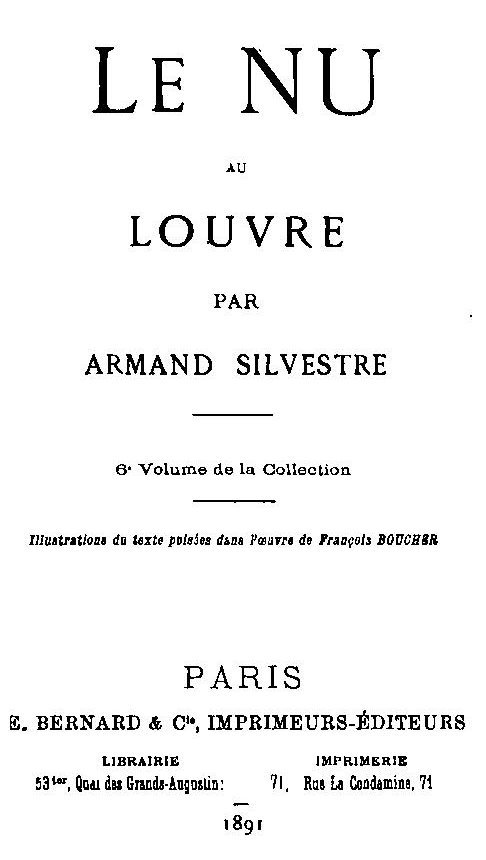
Le Nu au Musée du Louvre by Armand Silvestre

These three works featuring the bathers are thought to have been Cezanne’s final delving into the nude figure and his desire to associate human oneness with nature.  We know that Cezanne had a fascination with the depiction of the nude and would use photographs to aid his depictions.  The young French artist Francis Jourdain recounts the tale in his 1950 book Cézanne in which he visited Cézanne at his studio in 1904 and was shocked to discover that Cézanne owned a small art book, entitled Le Nu au Musée du Louvre, which consisted of photographic illustrations of nudes. Jourdain was shocked by it and described it as an affreux album jadis à Paris dans un kiosk des boulevards, (an awful album once bought in a kiosk in Paris boulevards).   The publication contained photographs of paintings and sculptures of nudes from Ancient Greek times up to the modern times.  Le Nu au Musée du Louvre was written by Armand Silvestre in 1891.  He had who also had written a five volume work, Le Nu au Salon.  He justified his work saying that it was to highlight the beauty of the feminine nude.

Cézanne would have wanted this book as it was literally a gold mine of images of the nude female figure and of course unlike live models who would constantly have wanted to move and grumble about having to sit still, the photographs were static and uncomplaining!  The professor of Art History, Theodore Reff, in his 1958 Harvard dissertation, Studies in the Drawings of Cézanne summed up Cezanne’s positive attitude to the use of nude photographs against the use of actual nude models:

“… [Unlike the models, the photographs] never moved or grew tired and more important, they never confronted him with the easily disturbing eroticism of the flesh.  Assimilated to an ideal aesthetic world of canvas or marble, they were neutralised and approachable…”

Of course the main disadvantage was that the photographs were of a single view but along with Cézanne’s sketches, the photographs served both as models of ideal beauty and as an aide-memoire for him when he represented the nude figure in natural settings as we see in today’s featured work.

When I look at today’s featured painting I cannot help but think it is like a preliminary sketch for a later completed painting.  There are many primed areas of unpainted canvas which show up as white patches.  Look closely at the figure in the foreground on the extreme right.  Are we looking at a pair of arms or are we looking at the backs of slightly bent legs?  To my mind we are seeing the long arms of the figure which only just shroud remnants of earlier legs. Look also at the face of the woman seated on the ground in the left foreground.  She has no face at all.  .

Although some would disagree, I believe this is an unfinished work, “completed” in the year he died.  Other say that Cézanne is asking us to use our imagination as to what is going on and does not want to spoon feed us with what we would term a “completed work”.  I prefer to go along with the Philadelphia Museum of Art’s description of their painting:

“…the painting has the feel of an unanswered question; a testament to the “anxiety” Picasso famously declared it to be the source of his great interest in Cézanne.  The artist left unresolved the startling contrast between the lushly painted landscape and the stiffly drawn, expressionless faces…”

Picasso once referred to Cézanne as “my one and only master” and in his youth the young Spanish painter was believed to have carried a gun, waving it half-seriously at anyone who annoyed him, particularly anyone insulting the memory of Cézanne. “One more word,” he would say, “and I fire.”

At first the three large Bathers canvases were not hailed by the public as masterpieces but Cézanne’s fellow contemporary artists saw the greatness in these last works of the genius.  Matisse commented:

“At critical moments in my artistic adventure it gave me courage; I drew from it my faith and endurance.”  

Cézanne had been out painting in fields near to his home and had been caught in a torrential downpour which soaked him to the skin.  He headed home but collapsed and had to be rescued by a passing motorist.  The next day, he got up to carry on with his painting but later on he collapsed once again.  The girl who had been modelling for him called for help and he was put to bed, which he never left it again.  Cezanne died of pneumonia on October 22nd 1906, aged 67.

On his death the painting I have featured today was bought from Cézanne’s son by Ambroise Vollard.  Vollard was one of the most important dealers and art collectors in French contemporary art at the beginning of the twentieth century and someone who championed the cause of  the then unknown artists such as Cézanne, Renoir, Gaugin and Van Gogh.   It became part of the collection of the Philadelphia Museum of Art in 1983.

Finished or unfinished that I will leave you to decide but nevertheless it is looked upon as one of the great masterpieces of art.

Manao tupapau -The Spirit of the Dead Watching by Gaugin

Manao tupapau -The Spirit of the Dead Keep Watch by Gaugin (1892)

Paul Gaugin – Part 3 (Conclusion)

 Today I am concluding my look at the life of Paul Gaugin.  My earlier blogs on February 23rd and February 25th looked at the early and middle part  of Gaugin’s life and should probably be read before you begin today’s offering.

We had reached 1887 and left Gaugin desperately wanting to leave France and head for Panama where he believed he would be able to lead a worry-free lifestyle.  He and his artist friend Charles Laval set sail in April of that year and before reaching Colon in Panama the ship weighed anchor off the island of Martinique.  They eventually arrived at Colon and Gaugin was disappointed not only with the area but also that his plea to his brother-in-law for financial assistance was turned down.  Gaugin and Laval now had insufficient money to return to their newly chosen destination, Martinique.  It was then imperative that they found the funds from another source to pay for their proposed sea passage and so they worked on the construction of the Panama Canal.  The French had made the first attempt to construct a sea-level canal in 1880 under the leadership of Ferdinand de Lesseps who had been involved in the construction of the Suez Canal some twenty five years earlier.  Gaugin and Laval finally accrued enough money for their trip to Martinique in June.   The Gods however didn’t look favourably on the two intrepid artists for whilst on the island of Martinique both Gaugin and Laval were extremely ill suffering from bouts of malaria and dysentery.  The pair returned to Paris in November 1887.  Despite his illness during his sojourn on Martinique, Gaugin believed his short time on the island was a defining moment in his life.  He wrote enthusiastically about it in a letter to his wife, Mette, in February 1888:

“…you must remember that I have a dual nature, the Indian and the sensitive civilised man.  The latter has disappeared [since my departure], which permits the former to take the lead…. the sensitive man has disappeared, which permits the Indian to forge resolutely ahead…”

Although he did not complete many paintings whilst at Martinique due to illness, what he brought back to Paris was remarkable and well received.  Gaugin lodged once again with the Schuffenecker family in Paris and struck up a friendship with Theo van Gogh, who worked as an art dealer for his family business at the Goupil Gallery.  Theo took on Gaugin on the strength of these Martinique works of art.  Theo’s brother Vincent van Gogh invited Gaugin to join him in Arles so that together they could set up and artistic colony and art institution which Vincent termed “A Studio in the South”.  Gaugin was disinclined to join Van Gogh on this project but Theo paid him to go to Arles to keep an eye on his brother.  In October 1888 Gaugin travelled south to Arles and stayed with Vincent van Gogh in the Yellow House.  The two artists were incompatible and within two months, and after many violent arguments, Gaugin left Vincent and returned to the Schuffenecker household in Paris.  Of his disagreements with van Gogh, Gaugin wrote in a letter that December to a fellow artist, Émile Bernard:

“….Vincent and I don’t agree on much, and especially not on painting….. He is romantic, whereas I, I am more inclined to a primitive state…”

 Van Gogh and Gaugin had a different philosophy to their art.  Van Gogh liked to have the subject he was painting in front of him whilst Gaugin preferred to paint from visions in his mind.  Once again we see Gaugin talking about his alter ego, that of him being the primitive man.

By 1889 the curse of wanderlust struck Gaugin again and this was heightened by his visit to the Exposition Universelle, the World Fair held in Paris that year.  Within the exhibition there were many stands highlighting the beauty and opportunities of the overseas French colonies.  Gaugin believed he could set off for one of these far-flung territories along with some of his artistic friends and set up a Studio of the Tropics.  Initially Gaugin favoured going to the French colony of Tonkin, which is now part of Vietnam or maybe go to Madagascar but finally he decided on Tahiti. Another reason for Gaugin to leave France could well have been that his preferred art dealer, Theo van Gogh,  who had managed to sell many of his works, suffered a mental breakdown and  died suddenly in January 1891 and with him went Gaugin’s main source of income.

In March 1891 Gaugin finally had agreement with the French government to sponsor his trip to Tahiti and in return for a reduced cost of the sea passage, he would record the customs, landscape and people in his paintings of the French colony.  Before he set sail he went to Copenhagen to see his wife and children and unbeknown to him at the time, it would be the last time he sees them.  Gaugin set off from Marseille on April 1st and arrived in the Tahitian port of Papeete on June 9th.   The Tahiti that Gaugin finds was not the Tahiti he had envisaged.  This was not the land of plenty which the Exposition Universal had described.  Tahiti was a down-at-heel French colony and Gaugin believed the native Tahitians had been ruined by missionary zeal.  What he had expected to see just did not exist.

His first works after he settled in Papeete were portraits of Tahitian women demurely dressed in their “Sunday-best” clothes but the demand from France was paintings of the pure full-blooded naked primitive native women.  They neither wanted to see depictions of the missionary-converted women, nor did they want to see the mixed race women, the product of their parents’ relationship with passing sailors.  Gaugin decided that if he was to find the true spirit of Tahiti he must move out of the colonial capital of Papeete and so along with his young mistress he went to Mataiea and away from the colonial influence of the capital.  He now felt much happier and in a letter to George-Daniel de Montfeid, the French artist, art collector and biographer of Gaugin, he wrote:

“…I am now living the life of a savage, walking around naked except for the essentials that women don’t like to see (or so they say)…”

Gaugin remained in Tahiti but his lack of money and hand-to-mouth existence was affecting his health and he became depressed and hankered to return to France but the Governor of the Island refused to let him leave.  In the spring of 1893, he sent a number of his Tahitian paintings to de Montfreid to be exhibited and sold.  In the autumn of 1893 he finally managed to leave the island and returned to Paris where he fully expected to be acclaimed a hero for all the Tahitian works of art he had sent home.  His works were exhibited at the Durand-Ruel Gallery in Paris and although they were well received by critics, sales were disappointing.

In the spring of 1894 he revisits Pont Aven with his very young Javanese mistress.  Gaugin had returned to this artist colony, not as a respectable gentleman artist but as the uncouth primitive savage, a persona which he had developed during his Tahitian stay.  His constant fornication with very young and under-age girls earned him a certain notoriety and his heavy drinking bouts often lead to fights with the locals and on one occasion his ankle was shattered causing him to be laid up for more than half a year.  In early 1895 he received his come-uppance for his unrestrained debauchery over the years when he was diagnosed as having contracted syphilis.  He is completely disillusioned with France and he sold as many of his paintings as he could and left the shores of France for the last time and headed back to Tahiti.

Life back in Tahiti was not kind to the ageing artist.  To his great disgust, the country had become more modern.  His health was slowly but steadily deteriorating due to the onset of the symptoms of syphilis.  His financial situation worsened and in 1897 he suffered a series of heart attacks. He also received the sad news from his wife Mette that his daughter Aline had died of pneumonia in Copenhagen, at the age of 20.   In the early months of 1898, in a moment of complete despair, he went into the mountains and attempted to kill himself with arsenic.  It does not kill him but badly damaged his internal organs and he had to be often hospitalised to stabilise his condition.  More bad news from home was to follow as his third and favourite child, Clovis, died in 1900 aged just 21.

In 1902 he moves from Tahiti to Atuona on Hiva-Oa in the remote Marquesas Islands where he died the following year of syphilitic heart failure, just a few weeks short of his fifty-fifth birthday.

My Daily Art Display featured oil on burlap painting today was completed by Gaugin in 1892 during his first stay in Tahiti and is entitled Manao tupapau -The Spirit of the Dead Watching and is housed at the Albright-Knox Art Gallery in Buffalo, New York.  Manao tupapau is the spirit of the dead.  The painting is a mass of colour, the yellow blanket, the black and gold valance and the phosphorescent greenish sparks on the violet background, which exaggerate the creepy atmosphere.     This is a highly atmospheric and sensuous scene, full of mystery and foreboding.  Fear emanates from the painting.  Gaugin explained his thought process when he painted this picture:

“…I have made a nude of a young girl… who is a Maori. These people traditionally fear the spirits of the dead… I must explain this fear with as few of the time-honoured literary devices as possible… there are a few flowers in the background but… as they only exist in the girl’s imagination… I make them like sparks… finally I have made the ghost just a plain little woman, for this girl… can only picture the spirits of the dead as looking like the person who has died…”

Gauguin in choosing the face-down pose of the young naked girl knew it could be highly problematic when it was seen by the French public and of course it was these very people who would be the potential buyers of his art.    He must have been fully aware that his depiction of the young girl would strongly hint at lovemaking, which had just occurred or was about to happen.  It is interesting to note that very few paintings up until then depicted the naked body of a woman lying down.  The one well-known exception was probably the Reclining Girl by François Boucher (My Daily Art Display, May 30th 2011).   Not to be detracted from his desire for that pose Gaugin probably then decided to incorporate the “spirit of the dead” theme with the fear that came with it, so as to add some gravitas to the work.

We need to understand the thought process of the Tahitians when it came to life and death.  The Tahitians divide their day into two halves: daylight, or ao, and darkness, or po.  With po they associate the tupapaus, and therefore they fear the night.   The tupapaus are the Tahitian personifications of the spirits of death.  For the Tahitians they are a genuine and permanent threat to them and they associate them with the darkness of night.   The Tahitians are so afraid of them that they never go out of their homes at night without a light, and even with a light they never venture out alone. They always keep their homes lit at night, so as to ward off the tupapaus.

Before us we see a young dark-skinned Tahitian female as she lies naked, face down on her stomach on top of a bed with a stray tendril of her jet-black hair lying across the pillow.  She is probably in her early teens, Gaugin’s age of choice for his mistresses.  She exudes an abundance of sexuality. Her body retains some of the “puppy fat” of a young female.  There is firmness to her limbs and buttocks and a definite seductiveness about her pose, which of course was all in the mind of the artist.    Her body is stiff as if she dare not move an inch for fear of the repercussion of so doing, although one can imagine that inwardly she is shuddering with fear.  She is terrified by the presence of the hooded spirit of death with its averted phosphorescent-coloured eye, which we see sitting crouched at the foot of the bed.  For the young girl, death was not a strange occurrence as  European ships and the sailors  brought to the island diseases such as smallpox, dysentery, scarlet fever and tuberculosis for which Tahitians had little or no immunity.  Add to this the weapons the sailors brought with them to the island to ttrade for food and which provided the natives with a much more effective killing machine during local rival confrontations.  She has witnessed death through disease and local confrontations many times over and by his depiction of this scene and despite its exotic colouring, Gaugin is, in a way,  commenting on the fragility of Tahitian life.

It is as if the spirit is keeping a vigil at the foot of the bed.  Maybe the girl believes the spirit has come to take her to the “next world”.  Native Polynesians believed that the phosphorescence of the light was the spirits of the dead.  The hag-like spirit with bulbous lips is seen in profile and the face and eye reminds me of Ancient Egyptian drawings of women.  The hand of the evil spirit lies menacingly on the bed.  In this case the spirit is the embodiment of an old woman dressed in a black shawl but for the frightened girl she is probably the embodiment of a dead relative who may have come for her.   In his 1901 book entitled Noa Noa: The Tahiti Journal of Paul Gauguin, Gaugin recalled the incident.  He had just returned home unexpectedly late one night.  The room was in darkness.  He struck a match and saw his wife, Tehura……

“…immobile, naked, lying face downward on the bed with the eyes inordinately large with fear . . . Might she not with her frightened face take me for one of the demons and spectres of the Tupapaus, with which the legends of her race people sleepless nights?…”

It is a remarkable painting and for me the story behind it adds to its appeal.

That ends my look at Gaugin and his life and I wonder what you think of him as a man and as an artist.  The two are quite different.  Such differences between the personality of a person and the quality of what he or she  produces have always existed and still do nowadays.  So should we just take in and enjoy what Gaugin has produced and put to the back of our minds his way of life and his proclivity for sex with under-age girls or is that just too difficult?  By compartmentalising Gaugin’s lifestyle and Gaugin’s art work, are we simply justifying the unjustifiable?

The Swineherd, Brittany, The Schuffenecker Family. Madame Gaugin by Paul Gaugin.

Life Story of Paul Gaugin (Part 2)

In my last blog I gave you a brief outline of Gaugin’s life up until April 1871 when Gauguin, having completed his military service, returned to his late mother’s home in St Cloud, only to find it had been destroyed during the year-long (July 1870 – May 1871) Franco-Prussian War.  He then moved back to Paris and takes an apartment close to where his former guardian Gustave Arosa lives with his family.  In 1872, through Arosa’s business connections with the owner of a stockbroker firm, Paul Bertin, Gaugin becomes a bookkeeper for the company.

The Schuffenecker Family by Paul Gaugin (1889)

It is whilst working here that Gauguin meets the part-time artist and his co-worker, Émile Schuffenecker, who joined the firm a few months earlier.  The friendship grew and they used to spend time in the Louvre studying the paintings of the Old Masters.  In December that year Gustave Arosa introduces Gauguin to a Danish woman Mette-Sophie Gad.  Mette was a judge’s daughter and formerly a governess to the children of a Danish Minister of State and she was in Paris with a friend to improve her cultural education.  Gaugin and Mette married in Paris in November 1873 and they became great friends with Emile Schuffenecker and his wife, Louise.  The Schuffeneckers who married seven years later in 1880 had two children, a daughter Jeanne born in 1882 and a son, named Paul after Gaugin, was born in 1884.   Gaugin and Mette’s first child, Emile (named after their friend Schuffenecker), was born in September 1874.  The couple at this time were experiencing a good standard of living derived from Gaugin’s earnings at the financial brokerage.

Mette Gad (Madame Gaugin) in an Evening Dress by Gaugin (1884)

Gauguin love of art blossomed, thanks mainly to two people.  Firstly from his former guardian Gustave Arosa who had, along with his brother, managed to build up an impressive collection of paintings from the likes of Gustave Courbet, Jean-Baptiste-Camille Corot, Eugène Delacroix and Jean-François Millet and it was Arosa who introduced Gaugin to Camille Pissarro who would occasionally tutor him.    The other person who encouraged Gaugin to paint was his friend and work colleague Émile Schuffenecker and the two of them would often go off on Sundays on painting trips.  The pair also spent the occasional evening at the life classes at the art school, Académie Colorossi.  To give one an idea of how quickly Gaugin learnt the art of painting, it should be noted that in 1876, within four years of starting to paint, Gaugin had a landscape Under the Tree Canopy at Viroflay accepted at that year’s Salon.  There was also a family connection with art as Mette’s sister Ingeborg had married the Norweigan painter Fritz Thaulow and when he and Gaugin got together they would discuss painting and Thaulow would offer critical advice to Gaugin about his works of art.

At the start of 1877, Gauguin decided to leave Paul Bertin’s stockbrokerage firm and move to André Bourdon’s bank. The job at the bank was better for Gaugin as it had regular business hours which meant that he could set aside regular periods for his painting.   Financially life was still good.  He received a regular salary from the bank and he had been very successful with his speculations on the Paris stock market.  Gaugin and his wife moved house and went to live to Vaugirard, a suburb in the south west of Paris, where they rented rooms in a property owned by the sculptor, Jules Bouillot and one of their neighbours was Jean-Paul Aubé.

In 1877 Gaugin’s daughter Aline was born and the following year there is an upturn in Gaugin’s financial situation as share prices rise and bank bonuses roll in.  Gaugin spends this money on buying contemporary art by the likes of Camille Pissarro and some of the other Impressionist painters.  In 1879 Gaugin is invited by Pissarro and Degas to exhibit some of his work at the Fourth Impressionist Exhibition.  That same year, Gaugin’s second son, Clovis, is born.  Life is good for Gaugin and his wife. They wanted for nothing. They are happily married; he is earning good money at the bank and is exhibiting more of his paintings at the Impressionist Exhibitions.  In April 1881 his third son Jean-René is born.

However, as in life, all good things come to an end.  For Gaugin the end came in January 1882, for it was then that the Paris Bourse (French stockmarket) crashed.  It caused the worst crisis in the French economy in the nineteenth century. The crash was triggered by the collapse of l’Union Générale Bank that month.  Around a quarter of the brokerage firms on the Bourse were on the brink of collapse and Gaugin lost most of his money he had riding on the stock market.   Now it was decision time for Gaugin; should he get out of the once lucrative world of finance altogether and concentrate on his art but by taking this course of action he risked the wrath of his wife?   That was his dilemma and despite having an ever expanding family to support (his fifth child Paul, often known as Pola was born in December 1883), he decided to turn his back on finance and commerce and become a full-time artist.    In January 1884 on the advice of Pissarro, Gaugin, now with little of his savings left and very little income coming in from the sale of his paintings,  moved his family from Paris to Rouen where the cost of living was less than in the capital.  Sales of his work were slow and he has to sell off some of his much loved art collection.  This life of poverty did not go down well with his wife Mette and the couple were constantly arguing and their marriage started to unravel.

In the summer of 1884 Mette had had enough of their impoverished lifestyle and along with the children sailed off to Copenhagen to be with her parents    She does return to Gaugin in Rouen and tells him that she has secured a position teaching French to Danish children but told him there was a great opportunity for him to sell his art work in Copenhagen as the Danes are showing an interest in Impressionism art.   In November 1884, Gaugin reluctantly joined his family and his in-laws, the Gad family, in Copenhagen and works for a while as a tarpaulin salesman for Dillies & Cie. on a commission-only basis.  Whereas his wife is very happy to be back home, he is extremely unhappy.  He could not speak the language, hated the job which he found demeaning and which got in the way of his one true love – his art.  However he persisted with his painting and in January 1885 wrote a somewhat upbeat letter to Shuffenecker in which he said:

“.. Here [in Copenhagen], I am more than ever tormented by art and although I have to worry about money and look for business, nothing can deter me…”

To make things worse the exhibition of his art work at the Academy of Art in Copenhagen proved to be a failure and is shut down after just five days.  Although he managed to paint a little he could not keep down a job and bring in money for his family and his attitude did not please his in-laws.  To Gaugin, his wife and her parents were holding him back and so in June 1885, he decided that enough was enough and returns to Paris with his favourite child, his second son Clovis.   Art historians have often discussed Gaugin’s split from his wife and many would have you believe it was not so much that he abandoned his wife but more the case that she threw him out.  Whatever the situation was Gaugin when he arrives back in Paris arranges to have six year old Clovis live with his sister Marie who is now married to a Chilean businessman Juan Uribe.   Between the years of 1883 and 1886, due to the many upheavals in his life, Gaugin paints very little.  In the summer of 1886, thanks to some financial assistance from his sister, his son Clovis attends a boarding school, leaving Gaugin free to travel to Pont-Aven, a picturesque Breton village and a centre for a community of artists.  He is happy here and is soon looked up to by his fellow artists.  In a letter to his wife in July 1886, Gaugin wrote:

“… I am respected as the best painter in Pont-Aven, although that does not put any more money in my pocket…”

Gaugin fell in love with Brittany and the Breton way of life. He lived for five months in the Pension Gloanec boarding house and struck up a friendship with the artists Charles Laval and Émile Bernard before returning to Paris in the autumn of that year.

Gaugin is unhappy with life in Paris and has once again developed a wanderlust,  maybe brought on by his days in the navy, and once again the desire to get out of the capital city and travel kicks in, as he explained in a letter to his wife Mette in January 1887:

“…what I want above all is to leave Paris which is a wasteland for a poor man… I am going to Panama to live the life of a native.  I know a little island called Tabogas a league off panama; it is virtually uninhabited, free and very fertile.  I shall take my paints and brushes and reinvigorate myself far from the company of men…”

I am wondering whether Gaugin occasionally feels pangs of guilt about leaving his wife in Copenhagen as in a letter to her in February 1887, he writes to her and tries to justify his departure and tries to get her to look on the bright side of their separation:

“…You are in your house, comfortably furnished, surrounded by your children, doing a tough job but one that you enjoy, you see people, and as you like the company of women and your compatriots you must be satisfied sometimes. You enjoy the comforts of married life without being bothered by a husband. What more do you want other than more money, like many others…”

I once again break off this life story of Gaugin at a point in his life when he looks forward to leaving France and enjoying a worry-free lifestyle in the Caribbean and Central America.  Was his journey a success and did it bring him the all that he desired.  I will tell you in the next blog.

The Swineherd, Britanny by Gaugin (1888)

One of the paintings Gaugin completed during his stay in Pont Avon was entitled The Swineherd, Britanny which he completed in 1888 and now hangs in the Los Angeles County Museum of Art.

This colourful work of art is much more realistic than his later works in the way the artists divides the various areas of the canvas.  There is a definite foreground in which we see the swineherd with his pigs.  There is a middle-ground partly separated from the foreground by a long low stone wall.  In the mid-ground there is the small village with its tall spired-church and a collection of houses and cottages with their black-tiled roofs.    There is a definite background in which we see the blue sky over rolling hills with its patchwork-quilt like fields.

The Vision After the Sermon (Jacob wrestling with the Angel) by Paul Gaugin

The Vision after the Sermon (Jacob and the Angel) by Gaugin (1888)

The featured artist in My Daily Art Display blog today is the much loved French post-impressionist painter Paul Gauguin.  This is the first time I have featured a painting by the artist which I am sure is very remiss of me.  I have spent a great deal of time researching Gaugin’s life.  There are numerous books and articles about his life and what I found strange is that they don’t all agree on some of the lesser known facts.  I have tried to bring together the masses of information I have discovered about the great man and I have made an informed guess as to which is the true version of some of the things that happened to him.  My collated version of his life is a little too long to put into one blog so over the next few weeks I will serialise the fascinating tale of his life and on each occasion include one of his major works.  So let me start at the beginning…………………………

Aline Gaugin, mother of Paul Gaugin

Eugène Henri Paul Gauguin was born in Paris in June 1848.  His father, Pierre Guillaume Clovis Gaugin was a radical French journalist working as an editor for the liberal-leaning, anti-Bonapartist National newspaper. His mother was Aline Maria Chazal, who was half French and half Peruvian Creole and who like her husband had strong political convictions. Paul Gaugin was the youngest of the couple’s two children, and their only son.   Gaugin’s maternal grandmother, who lived in Peru, was Flora Tristan.  She was the daughter of a Peruvian nobleman, and came from a very powerful and wealthy Peruvian dynasty.   She was a socialist writer and activist and also one of the founders of modern feminism.

In 1848 Louis-Napoleon Bonaparte came to power which caused a great deal of political unrest.  It ended in a coup d’état and revolution in 1851 and the dissolution of the French Assembly along with the imposition of Napoleon III on his people.  Gaugin’s father held strong political against Napoleon III and he frequently expressed such opinions in newspaper articles.  In August 1849 because of the political turmoil, he and his family fled Paris and headed for Peru with the idea of setting up a newspaper in Lima.   Gaugin’s father, Clovis, suffered a sudden heart attack during the voyage and died, aged 35, leaving Paul, his mother and sister Marie to fend for themselves. They lived for four years in Lima with Paul’s great-uncle and his family. Gaugin’s mother sought protection and help for her family from  the powerful and wealthy Don Pio Tristan Moscoso, the head of their extended family, who had family connections with the president of the country.

Despite the Gaguins sharing the exclusive and wealthy lifestyle of the Moscosos in Lima, when an opportunity arose to return home to France at the end of 1854, Aline seized it.  She was well aware that her presidential cousin was losing political power and that Don Pio’s promises to leave her a comfortable legacy might come to nothing.  Gaugin’s mother Aline decided that her best opportunities of an independent life lay in Europe.   Around this time she had also received word that her late husband’s father, Guilliame Gaugin, a retired merchant and widower, who was close to death, wanted to make his only grandchildren, Paul and Marie, his heirs.  Aline Gaugin realised that her future and that of her family now lay not in Peru but back in France.

In 1855 Aline, Marie and Paul Gaugin returned to Orléans, and went to live with their paternal grandfather.   While living there Paul and Marie attend an Orléans boarding school as day students. Their grandfather Guillaume died within months of their return to France, and it was also around this time that Aline’s great-uncle, Don Pio de Tristan Moscoso, died in Peru.  In 1859, Paul Gauguin enrols in the Petit Séminaire de la Chapelle-Saint-Mesmin, which was one of the top boarding schools located a few miles outside of Orléans, where he completed his education over the next three years.  His mother leaves Orléans and moves to Paris, and her children live with her there while on school breaks.  With the money she has received in her father-in-law’s will and because she was a trained dressmaker, she opens her own dressmaking business on the rue de la Chaussée in Paris in 1861.  Aline Gaugin falls ill in 1865 and retires to the Parisian countryside of St Cloud, a western suburb of Paris.  It is whilst living here that she meets and is befriended by a Parisian financier, Gustave Arosa, a wealthy Jewish businessman of Spanish descent who has his summer residence near to her home.

After his spell at the boarding school in Orléans, Paul Gaugin attends the Loriol private school in Paris where he prepares for the very demanding École Navale’s entrance examination.  It is probably at this juncture in Gaugin’s life that he receives his first artistic training as part of the exam is to be able to draw from plaster casts and live models as well as technical drawing and map making.  He doesn’t succeed in the exams but in December 1865, aged 17, Gaugin is accepted as a pilotin (officer cadet) in the merchant marine and his first positioni is on the vessel Luzitano which plied its trade between Le Havre and South America and Martinique.  He eventually reaches the rank of second lieutenant at the age of eighteen.  His mother Aline dies in July 1867 aged 42 whilst her son is away and in her will she entrusts Paul Gaugin and his sister Marie to the guardianship of Gustave Arosa.  Gaugin’s arrives back in Le Havre in December 1867 and he leaves the ship.  In January 1868, Gauguin joins the French navy to fulfil his military service requirement and in that March becomes a sailor third-class aboard the vessel, Jérôme-Napoléon in Cherbourg.  At the start of the Franco-Prussian War in July 1870, Gaugin serves in the French Naval campaigns in the Mediterranean and North Sea.

In April 1871 Gauguin completes his military service and returns to his late mother’s home in St Cloud, only to find it has been destroyed during the Franco-Prussian War.  He then moves back to Paris and takes an apartment near to where his former guardian Gustave Arosa lives with his family.

Jacob Wrestling with the Angel by Gustave Doré (1855)

I will leave Gaugin’s life story at this point in time, 1871, and look at My Daily Art Display’s featured painting which Gaugin completed in 1888.  It is entitled La Vision après le Sermon (La Lutte de Jacob avec l’Ange) [The Vision After the Sermon (Jacob wrestling with the Angel].  It can now be found in Edinburgh, hanging in the National Gallery of Scotland which purchased the painting in 1925 for a mere £1150.  The depiction of Jacob battling the angel had been depicted in paintings and murals before.  Rembrandt painted the scene in 1659 and Eugène Delacroix painted a mural of the scene in 1861 which can be seen in the Church of St-Sulpice in Paris, which of course has received thousands of visitors since the church was featured in the book The Da Vinci Code.  Works of art concerning the subject were also painted by Gustave Doré in 1855 and Gustave Moreau in 1878.  The latter two could well have been seen by Gaugin.

The painting before us by Gauguin has no identifiable light source and it is dominated by heavily-outlined flat areas of pure and contrasting colours.  The perspective Gaugin uses is sharp and by doing this he forces us to look at the paintings background and Jacob’s tussle with the angel.  The grass instead of being green is red.

The Plum Garden in Kameido by Hiroshige (1857)

A tree lying across the painting, bottom right to top left creates a strong diagonal as it dissects the painting, separating the real world from the imaginary one.  At the time of this painting France was being flooded with all things Japanese and it is thought that the way the tree dissects the painting in Gaugin’s work is something he may have seen in the woodblock print of The Plum Garden in Kameido by the Japanese artist Ando Hiroshige.  To the left of the tree we see a solitary cow and a group of Breton women wearing their traditional headdresses.  Each design of headdress denotes the ladies class, marital status, standing in society as well as which part of the area the woman comes from.   The women have emerged from a church service and on the far right of the painting is the priest who has just delivered the sermon.  On the other side of the tree we have the imaginary world created in the minds of the people after hearing the priest’s sermon about Jacob’s struggle with the Angel.

Here we see Jacob wrestling the angel and it is thought that Gaugin’s portrayal of the pair wrestling could have been based on one of the Japanese artist, Katsushika Hokusai’s prints of sumo wrestlers in his 1888 publication The Manga.  The story of Jacob and the Angel comes from the Book of Genesis, Chapter 32, in which we are told that Jacob is frantically trying to prove to the angel that he has repented for his sins and will not allow the Angel to leave until he has been successful.

This painting is all about what Gaugin believes the women will be thinking on leaving the church after hearing the priest’s sermon.  Gaugin loved the simple faith of the peasants and their spiritualism.  He believed that art should be about the inner meaning of the subjects, and not necessarily about their obvious outward appearance. He explains his thoughts about this painting in a letter he wrote to Vincent van Gogh in September 1888.

“…I have just painted a religious picture, very clumsily; but it interested me and I like it. I wanted to give it to the church of Pont-Aven. Naturally they don’t want it. A group of Breton women are praying, their costumes a very intense black. The bonnets a very luminous yellowy-white….. An apple tree cuts across the canvas, dark purple with its foliage drawn in masses like emerald green clouds with greenish yellow chinks of sunlight. The ground (pure vermilion). In the church it darkens and becomes a browny red. The angel is dressed in violent ultramarine blue and Jacob in bottle green. The angel’s wings pure chrome yellow.  The angel’s hair chrome  and the feet flesh orange…”

Gaugin offered the painting to the local curé of the church in Nizon, Pont Aven but he was horrified by the depicted scene and declined the offering!

Un atelier aux Batignolles (A Studio at Les Batignolles) by Henri Fantin-Latour

Un atelier aux Batignolles (A Studio at Les Batignolles)

Today I am looking at a work of art by the French painter, Henri Fantin-Latour, or to give him his full name, Ignace-Henri-Jean-Théodore Fantin-Latour.  The family was of Italian ancestry and the “Fantin” part of the name came from the fact that some of the ancestors hailed from the southern Italian town of San-Fantino.  In the 17th century, a Jean Fantin added “Latour” to the name of Fantin.

Henri was born in Grenoble in 1836.  His father, Theodore Fantin-Latour, originally from Metz, was a society portraitist painter.   In 1841 the family moved to Paris.  Having shown a liking for drawing at an early age, he received his initial artistic training from his father.  Then at the age of fourteen, he enrolled on a three-year course at the École de Dessin of the French artist and drawing instructor, Lecoq de Boisbaudran.  Following this, he spent a short time at the École des Beaux-Arts in Paris.  During his art student days he spent most of his time at the Louvre copying the painting of the old Masters as well as making many visits to the Musée de Luxembourg to study and copy the works of Eugene Delacroix.  In 1861, after he graduated from the art schools he worked for a time at the atelier of Gustave Courbet and supported himself by earning money as a copyist.

During his time copying paintings at the Louvre he came across and became friends with a number of the future Impressionists, such as Edgar Degas, Édouard Manet and Berthe Morisot.   In 1858, he struck up a special friendship with the American-born artist James Whistler and along with French-born English painter Alphonse Legros he founded the art group known as the Société des Trois.   Whistler, who had moved to London, invited Henri over for a visit which he accepted and through the good auspices of his two friends Whistler and Legros he was introduced to the art world of London.  This was the first of many trips to London made by Fantin-Latour.  One very important introduction whilst there was to Edwin Edwards, who had trained as a lawyer but also practiced as an artist and etcher.  He acted as Henri Fantin-Latour’s agent in England and found him many buyers for his floral paintings as well as a number of patrons.

Henri Fantin-Latour had started painting a number of works of art featuring floral still-lifes and these were well received in London although strangely enough never popular in France during his lifetime.  Henri Fantin-Latour exhibited a number of his works at the Paris Salon in 1861 and 1862  and later in 1863, at the Salon des Refusés, and  he exhibited regularly at the London Royal Academy.  Although he had been close friends to a number of the Impressionists, he never put up any of his paintings for their eight Impressionist Exhibitions.  The reason for that decision was probably due to the fact that although he counted them as friends, he disagreed with their artistic theories and philosophy.  His artistic style was more conservative.

Henri-Fantin Latour will always be remembered for his luxurious floral paintings but he was an artist who painted many group portraits and it through these works that we get an insight into the friendship between the now-famous artists, poets, musicians and writers of that era.  During his time as an artist he also completed no fewer than twenty three self-portraits.

In 1875, aged thirty nine, Henri Fantin-Latour married a fellow painter, Victoria Dubourg and the couple spent their summers at the country estate of his in-laws at Buré.  In 1879 Henri Fantin-Latour was awarded the Legion d’Honneur medal.  Henri Fantin Latour died in 1904, aged 68 and was buried in the Cimetière du Montparnasse in Paris.

The painting I am featuring today was not one of Fantin-Latour’s beautiful floral works of art but instead I am going to look at one of his group portraits. It is very like a painting I featured in My Daily Art Display on November 10th 2011 entitled Bazille’s Studio; rue de la Condamine by Frédéric Bazille, who also actually appears in today’s painting.

My painting today is entitled Un atelier aux Batignolles (A Studio at Les Batignolles) and he completed it in 1870.  Batignolles is part of the 17th arondissement of the city of Paris.  At the time of Fantin-Latour, this was a cultural hive of activity and served as a base for young painters such as Édouard Manet and many of his artist friends who, because of the locality, became known as Le groupe des Batignolles.  The painting today is a kind of “who’s who” of that group.   It is more than just that.  In some ways it is Henri Fantin-Latour paying homage to his friend Manet.

We are in the atelier of Édouard Manet and we see him sitting at his easel. He concentrates on the man sitting in the other chair, the subject of his painting, Zacharie Astruc.  Astruc was a painter, poet, sculptor and art critic who had rallied to support the likes of Courbet and Manet and the Impressionist group of painters when they were constantly being criticized.   Standing around and watching the artist at work are some of his friends.  At the far left of the painting, seen standing directly behind Manet is the German painter Otto Schölderer.  Next to him, wearing a hat, is Auguste Renoir.  Further to the right of the painting and almost in the background, are Emile Zola, the writer who also championed the cause of the Impressionists in their struggle with the Salon and its condemnation of this new grouping of artists, Edmond Maître another supporter of the Impressionist painters and who was, at the time, a civil servant at the town hall.  Almost hidden in the corner of the painting is Claude Monet.   Standing tall and upright behind the chair with a full beard is the twenty-six year old, Frédéric Bazille, who two months after this painting was completed was killed in the Franco-Prussian War.  There is a  formal air to this group portrait.  The men are all dressed in somber dark suits and their expressions are serious and unsmiling.   All these young artists had suffered at the hands of the art critics of the day.  They and their paintings were accused as being frivolous and contrary to what the art establishment was used to.  It is possibly for that reason that Henri Fantin-Latour decided to depict the gathering so formally and with an air of respectability.  Could this desire to show how these young artists had not completely put the antique traditions of the Academics of the Salon behind them be the reason why the artist has included a statuette of Minerva on the table at the left of the painting?  In my last blog regarding Monet and Camille Doncieux I mentioned that all things Japanese were the rage in Paris and France in the late nineteenth century.  Look how Fantin-Latour has positioned a Japanese stoneware vase next top Minerva in the painting.

This work by Henri Fantin-Latour is almost a historical painting.  It records for us a time in history when these characters were leaving their mark.  Each one of them is posing for posterity.  Zola once wrote about the struggle these artists had to endure and the way in which Édouard Manet tried to rally them when they became dispirited.  He wrote:
“…Around the painter so disparaged by the public has grown up a common front of painters and writers who claim him as a master…”

Henri Fantin-Latour put forward the painting to be exhibited at the 1870 Salon  The painting was accepted and he was awarded a  medal by the salon for this work of art.  In spite of his close relationship with the Impressionist painters he never followed their artistic techniques.  He remained a traditionalist and remained faithful to that traditional technique. In the latter part of his career he painted less and concentrated on lithography.

Did you wonder whether Manet was actually painting a picture of Zacharie Astruc as depicted in today’s featured work?  Who knows, but coincidentally, Manet did complete a portrait of Astruc four years earlier in 1866, which now hangs at the Kunsthalle in Bremen………………….

Portrait of Zacharie Astruc by Manet (1866)

Camille Doncieux and Claude Monet (Part 2)

Claude Monet and Camille Doncieux

In my last blog I looked at the first meeting of Camille Doncieux and Monet.  It occurred in 1865 when Frédéric Bazille, a good friend of the twenty-five year old Monet, introduced him to Camille Doncieux who was still in her teens.  Camille, who was of humble origins, worked as an artist’s model.  Monet soon made her his number one model and shortly afterwards the two became lovers. The couple, because of the poor sales of Monet’s works of art, lived in depressing poverty.   Today I complete the story of Camille and Monet and look at a few more paintings the artist completed depicting Camille.

From the 1860’s till the end of that century, France was in love with all things Japanese.  This Japonisme as it was called had inspired both artists and the public.  Monet was not immune from this trend which swept his country.  Besides his art, he had two other hobbies.  He loved gardening and he loved to collect Japanese art, especially the Japanese woodblock prints.   In all he had built up a collection of over two hundred of these.  He had also accumulated a number of Japanese fans, kimonos and screens, some of which can still be seen at his house in Giverny.

 The most palpable and undeniable proof of Monet being influenced by the art and culture of Japan is his oil on canvas painting, Madame Monet en Costume Japonais (La Japonaise), which he completed in 1875 and which currently hangs in the Boston Museum of Fine Arts. This work was in complete contrast to his earlier works.   Large-scale figure paintings had usually been looked upon as a major challenge for an artist.  Camille is depicted dressed in an elaborate kimono, holding a Japanese fan in her hand.   It is interesting to note that Camille is wearing a blond wig so as to emphasize her Western identity. Her kimono is sumptuously embroidered and the background is adorned with numerous Japanese fans. These accoutrements could, at the time, be bought for a few centimes in many of the Parisian shops and even the larger department stores had exclusive sections for all things Japanese.

In the painting Camille’s pose is of a conventional style and it is believed that Monet did this so as to enhance the chance of selling the work.   Because of this, there is a somewhat loss of spontaneity about it.  The scene looks very contrived.   However the brilliance of the colours he used is breathtaking.   Monet exhibited this work at the Second Impressionist Exhibition in 1876, where it attracted much attention.  Maybe Monet was saddened and felt somewhat guilty by the compromise he had made with this work solely to make it more attractive to potential buyers.  He later described it as “trash” and “a concession to the popular taste of its time”.

On June 28th 1870, Camille and Claude were married in a civil ceremony performed at the town hall of the eighth arrondissement of Paris. The French painter Gustave Courbet was one of the witnesses. Although Camille’s parents were present at the ceremony, Monet’s family were horrified by their son’s choice of partner and would not accept Camille Doncieux as their daughter in law, nor would they acknowledge their grandchild, Jean-Armand-Claude who had been born in August 1867.   Monet’s parents even tried to bribe their son into leaving his wife with the threat of their allowance to him being stopped if he continued the liaison.  However Monet chose his wife over money and refused to abandon Camille and Jean.   As a result, his allowance was cut off and his financial situation worsened and the three of them suffered extreme financial hardship, sometimes unable to afford food and often unable to afford paint.   He carried this burden for many years, and struggled greatly with poverty and the stress caused by Camille’s poor health, and his inability to pay for her medical care.   After the wedding and just before the start of the Franco-Prussian War the family travelled to London and Zaandam before returning to France and setting up home in Argenteuil, a town to the west of Paris.

Camille Holding a Posy of Violets by Monet 1877

In 1876, Camille Monet fell ill with what is believed to have been the beginnings of cervical cancer.   In Monet’s 1877 painting Camille Holding a Posy of Violets, which he completed that year, one can see the toll the disease has had on her health. Her face looks pale and haggard.  She looks tired and older. It was around this time that Monet received a commission from a patron Ernest Hoschedé and for a short time his finances took a turn for the better.  However in 1877 all this changed when Hoschedé went bankrupt and his art collection was auctioned off. This was a blow to the Impressionists, whom Hoschedé had supported,  and especially Monet.   The bankrupted Hoschedé and his family moved to a house in Vétheuil with Monet, Camille and Jean. However Ernest Hoschedé spent most of his time in Paris before fleeing to Belgium to avoid his creditors.   There soon followed speculation that Monet may have been carrying on an affair with Alice Hoschedé.    Some art historians have translated the look on Camille’s face in this painting as one of disgust with her husband and his liaison with Alice Hoschedé.  This was the last painting Monet did of Camille whilst she was alive.

Camille on her Deathbed by Monet (1879)

On March 17th 1878, Camille gave birth to her second son, Michel.  The birth of Michel further weakened Camille.   Over the next twelve months Camille’s health deteriorated and on August 31 1879, a priest was called to the house to administer the last rites and to sanction her marriage to Monet, although they had been married in a civil ceremony nine years earlier.   Camille’s death on September 5th 1879 devastated Monet. She was just thirty-two years of age.   Monet painted a picture of his wife on her death bed and the work can be seen at the Musée d’Orsay.  Monet remembered the time well writing to a friend telling him of his urge to paint that last portrait of Camille:

“…I caught myself watching her tragic forehead, almost mechanically observing the sequence of changing colours that death was imposing on her rigid face. Blue, yellow, grey and so on… my reflexes compelled me to take unconscious action in spite of myself…”

Monet included lots of blue and gray in this painting, as well as yellow,orange and red and in some people’s opinion the use of these colours made the painting too light. Light, coming from the right hand side, shines on the face of his deceased wife.   We do not get a very clear view of Camille although we can just make out her face and that she is wearing a shroud.

After Camille Monet’s death in 1879, Monet and Alice along with the children from the two respective families continued living together at Poissy and later Giverny. Ernest Hoschedé died in 1891, and, in 1892, Alice and Claude Monet were married.   Little is known about Camille Doncieux Monet mainly because Monet’s alleged mistress and second wife, Alice Hoschedé, was so jealous of Camille that she demanded that all photographs, mementos and letters between Monet and Camille were destroyed.  She was determined that Camille’s very existence was denied.

Why did she hate Camille so much?    Maybe she realised that Camille Doncieux was the one and only true love of Claude Monet.

Claude and Camille by Stephanie Cowell

If you would like to read a fictional account of the relationship between Camille Doncieux and Claude Monet then I suggest you read:

Claude and Camille: A novel on Monet by Stephanie Cowell

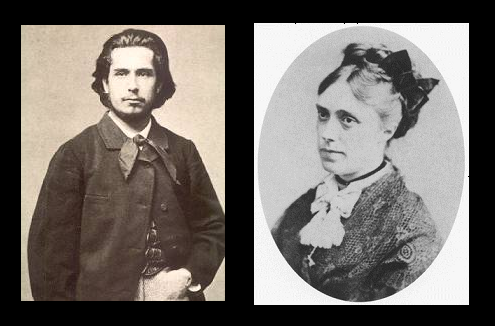
Camille Doncieux and Claude Monet

My next two blogs deal not with a particular painting but with the subject of a series of paintings completed lovingly by one artist.  The subject is Camille-Léonie Doncieux, who was the beloved model, mistress and wife of Claude Monet.  In 1861, Monet had enlisted as a soldier in the Chasseurs d’Afrique regiment and spent two years in Algeria.  His military life came to an end in 1863 because he had fallen ill with fever.  He went back to Paris where he studied at the atelier of the Swiss artist Charles Gleyre and it was during this time that he met up with the artists Sisley, Bazille and Renoir, who would later join together with others and become known as the Impressionists..

Camille Doncieux was born in 1846 and met the impoverished but talented painter, Claude Monet, for the first time in 1865 when she was just eighteen years of age.  She came from an ordinary unprivileged background.  She fell in love with him, leaving her home to live with the talented 25-year-old painter who struggled to sell his work. People called her La Monette.  Everyone she met fell under her spell.   It was recorded that she was a ravishingly good-looking girl with dark hair, very graceful, full of charm and kindness.  Monet, her future husband, was struck by her beauty and described her eyes as being wonderful.    It was not long after they met that she began modeling for him and soon became his favourite model.  His professional interest in her soon became personal and the two soon became lovers.   The first time we come across Camille in a painting by Monet was in a study for his ill-fated work Déjeuner sur l’Herbe.

Study for Le Déjeuner sur l'Herbe (1865/6)

In 1863, Édouard Manet had exhibited his painting Déjeuner sur l’Herbe at the Salon des Refusés (see My Daily Art Display, December 23rd 2010).   The critics and public were shocked by the work and Manet’s depiction of a nude woman seated with a pair of clothed men in a landscape setting.    Monet, who was known for his competitive streak decided to paint his own version of Déjeuner sur l’Herbe in the spring of 1865. This audacious venture would culminate in putting it forward for an exhibition at the Salon of 1866.  Following outdoor studies he made in the Forest of Fontainebleau, he immediately headed back to his nearby studio at Chaillyen-Bière and started to make preparatory sketches for what would be his mammoth canvas measuring an unbelievable 4.5 metres x 6 metres.  In one of his preparatory sketches, which he did in oil entitled Bazille and Camille (study for Déjeuner sur l’Herbe) we see Camille Doncieux and Monet’s fellow artist friend Frédéric Bazille.   Ultimately the painting was not a success. Monet was unable to finish it in time for the 1866 Salon and eventually abandoned the work. He left it, rolled up, with his landlord as part payment for rent he owed but it became damp and all that now remains are fragments of the work and some preparatory studies. The experience did, however, contribute to Monet’s realisation that to portray the brief moment in time, he would have to work on a much smaller scale.

La Femme à la Robe Verte by Monet (1866)

The next time we see Camille is in a painting Monet exhibited in the 1866 Salon.  The work was entitled Camille or Woman in a Green Dress and now hangs in the Kunsthalle, in Bremen.  After his disastrous attempt to emulate Manet with his painting of Déjeuner sur l’Herbe this work of his gained him critical acclaim.  Rumour had it that in his rush to meet the Salon deadline he completed the work in four days but one must doubt that assertion.  It is not strictly a portrait of Camille.  It is all about the dress.  She was simply his model for the painting.  The first thing which strikes one as we look at the work is the colour of the promenade dress which had probably been borrowed for the occasion.  Monet loved colour and the green he has used is awesome.  It dominates the painting and even detracts from the woman herself.  This is not about Camille but on the dress she wears and how it hangs.  The painting reminds one of a photograph out of a fashion shoot for a fashion magazine when the clothes are the important thing and not the model.  Look how the background is undefined.  It is simply plain and dark.  Monet had decided that nothing should deflect our gaze from the woman and her dress.  I like how Camille is just raising her right hand towards her face as if the picture has captured her just about to do something, a fleeting gesture, and we are left guessing as to what.  Maybe she is adjusting the ribbon of her bonnet.  The painting was accepted by the Salon jury and hung in their 1866 exhibition.    It was an immediate hit with both the art critics of the time and the public and the Paris newspapers called Camille the Parisian Queen.

One amusing anecdote about this painting was the story that Monet’s signature on the painting had been mistaken by many viewers for that of Manet, who had entered the Salon to a chorus of acclaim for his supposed work.  Monet told this story to the newspaper Le Temps:

“….imagine the consternation when he discovered that the picture about which he was being congratulated was actually by me !   The saddest part of all was that on leaving the Salon he came across a group which included Bazille and me.  ‘How goes it?’ one of them asked.  ‘Awful,’ replied Manet, ‘I am disgusted.  I have been complimented on a painting which is not mine’…….”

Camille au Petit Chien by Monet (1866)

That same year Monet produced a hauntingly beautiful and intimate portrait of his lover entitled Camille with a Little Dog, which is in a private collection.  We see Camille sitting side-on to us in quite a formal pose.  This is one of the few paintings of her by Monet that looks closely at her.  Once again as was the case in the Woman in a Green Dress, the background is plain and dark and in no way serves as a reason for taking our eyes off Camille.  We are not to be distracted from her beauty.  This painting is all about Camille.  It is interesting how Monet has painted the figure of the dog simply by thick brush strokes.  At a distance it looks like a dog but if you stand close up to the painting you can see it is just a mass of brush strokes.  However Monet has not treated the painting of Camille’s face with the same quick thick strokes of his brush.  She has been painted with delicate precision.  Monet did not want to depict the love of his life with hastily swishes of a brush. He took pains in her appearance.  This was a labour of love.

Luncheon by Monet (1868)

In 1867 Monet’s lover Camille gave birth to their son Jean.  A year later, during the winter of 1868, Monet started on his painting entitled Luncheon, which can be seen at the Städelsches Kunstinstitut in Franfurt.   This family, which now included their son Jean, were staying in Étretat at the house of a patron, where Monet had taken refuge from his Parisian creditors and critics.  It is a large highly detailed oil on canvas painting measuring 230cms x 150cms.   It is simplistic in its subject.  Before us we have sitting at the dining table Camille and her blonde-haired son.  She looks lovingly at him whilst he seems to only have eyes for the food.  A visitor stands with her back to the window and the maidservant is seen leaving the room.  A place is set out ready for her husband to join her at the meal table.  Look how Monet has painted a number of items overlapping the surfaces they are resting on.  On the table we have the loaf of bread, the newspaper and the serviette  all hanging over the cloth which Monet has depicted as being somewhat creased.  In the background we have two books overlapping the edge of the table.  All this in some ways adds to the realism of the painting.  Sunlight pours through the large window to the left of the painting and bathes the well-stocked table in light and by doing so brings it to life.  Monet submitted the painting to the 1870 Salon jury but it was rejected.  Four years later he included the work in the First Impressionist Exhibition in 1874.

to be concluded tomorrow………………………………

Étretat by Various artists

There are many subjects depicted by artists in their paintings which are the same.  One only has to think of religious paintings and the likes of the pietà or the deposition or even the crucifixion itself to see how numerous artists choose the same subject for their works of art.  It is also reasonably common for one artist to paint many versions of the same subject.  Think of how many times Vincent van Gogh painted his Sunflowers.  The last blog I did featured a painting of Bentheim Castle by Jacob van Ruisdael and I told you that he had actually painted the subject no fewer than fifteen times.  Today I am going to focus on geological structure that many artists have used in their paintings and I will let you compare them and see what you think.  First let me show you the location as you would see it today.

Cliffs and The Pinnacle at Étretat

The place is Étretat which is situated in the Haute-Normandie region of Northern France.  The town itself is about twenty miles north-east of Le Havre but it is not the town which claims the fame and which has always fascinated artists but its cliffs.  The single beach of Étretat is separated from the town by a sea-wall promenade and lies between two well-known cliffs.  To the east of the town lies the Amont Cliff and to the west lies the Aval cliff with its huge arch, Porte d’Aval,  cut through the chalk structure.   Slightly offshore of the Porte d’Aval stands the solitary needle rock known as L’Aiguille.    During the late nineteenth century this area of Normandy was very popular with Parisian families and with this popularity it soon became a very fashionable place to visit.

In 1868, Claude Monet lived at Étretat with Camille Doncieux,  whom he was to marry two years later.  He revisited the town on a number of occasions in the 1880’s so as to work on a number of paintings depicting the cliffs and sea.   Étretat had already been painted by both Delacroix and Courbet and in fact Monet owned a Delacroix watercolour of the area.. When Monet visited Étretat in 1883 he had planned to create his own Normandy seascapes, saying:

“I reckon on doing a big canvas on the cliff of Étretat, although it’s terribly audacious of me to do that after Courbet who did it so well, but I’ll try to do it differently.”

Because of the increasing popularity of the area with holidaymakers, Monet sensed that there would be a good market for paintings depicting this area. The area had everything, magnificent cliff structures from the top of which one had spectacular views of the sea, which sometimes had a mirror-like calm sheen about it, whilst on other times it exhibited a terrible unforgiving  ferocity as it crashed on to the foot of the cliffs, biting away at the base of the massive chalk structures

During the 1880s, Monet rediscovered the Normandy coast and visited the area many times so as to draw by the sea. He was fascinated by its dramatic cliffs and rock arches and was constantly looking for somewhere with outstanding natural beauty and a place where he could observe the effects of natural light on the sea and on the chalk and limestone cliffs.  He would move from one position to another continually looking for the best natural lighting of the cliffs and the sea. His search for the perfect light on the sea and the perfect position from where it could be seen was of paramount importance.  He once said:

“…I know that to really paint the sea it has to be seen every day at any hour and from the same spot to know its life at this very spot ; that’s why I’m repeating the same subjects up to four and even six times…”

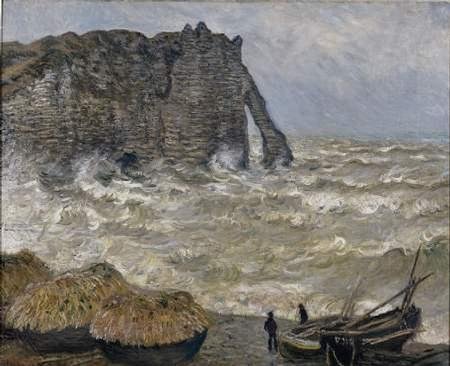
Stormy Sea at Étretat by Claude Monet (1883)

In 1883 Monet completed a work entitled Stormy Sea in Étretat, which is now housed in the Musée des Beaux-Arts in Lyon.  The painting is set on a winter day and we can see is being whipped up by gale force winds.  It is believed that Monet worked on this painting as he sat at the window of his hotel room.  What a wonderful depiction of the ferocity of the sea with the white curls of the surf atop the waves.  In the foreground we have the beach on which we see five boats.  Three of which are filled with what looks like thatch whilst the other two on the right seemed to have been abandoned and show signs that they have had to endure a battering in the waves.  Two men, stand by the boats, looking out on the rough seas.  To the left we have the cliffs and the Porte d’Aval,  above which we have the storm and rain clouds rushing towards the land.

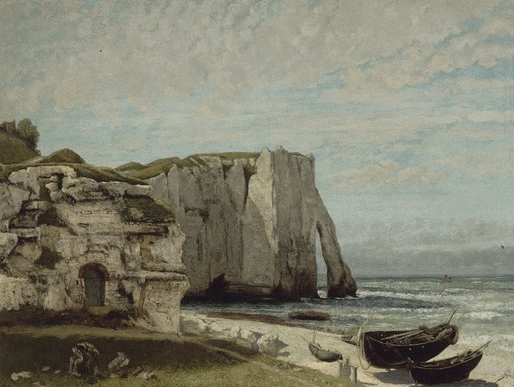
The Étretat Cliffs after the Storm by Gustave Courbet (1870)

The next painting I am featuring is one which depicts a similar view but is a work which depicts the time after a storm.  The title is La falaise d’Étretat après l’orage [The Etretat Cliffs after the Storm] and was completed by Gustave Courbet in 1870.  Courbet visited Étretat that summer and stayed in a house by the sea which was tucked against the Aval cliffs to the left of the bay.  He painted a number of versions of this scene but the one you see above is housed at the Musée d’Orsay in Paris.  Courbet like other artists was attracted to this area not only because of the breathtaking geological structures but because of the quality of natural light and the clarity of the air.  The composition of the sea, the land with its cliffs and rocks and the sky is well balanced.  Courbet had sent the painting for exhibition at the Paris Salon in 1870 where it was well received and Courbet’s reputation as a painter was enhanced.  Of the painting, the art critic and Courbet’s friend, Jules Antoine Castagnary, marvelled at the beauty of his friend’s work and described the elements of the work, speaking of:

 “…the free, joyous air which circulates in the canvas and envelops the details…”

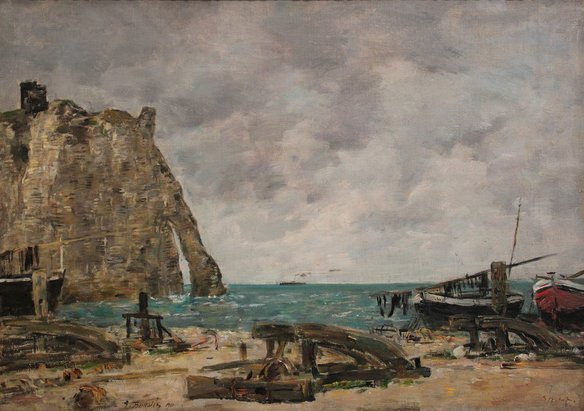
Beach at Etretat by Eugène-Louis Boudin (1890)

Another artist to depict this area in his painting was Eugène-Louis Boudin who in 1890 completed his work entitled Beach at Étretat.  Here we are looking at the scene from a vantage point similar to the previous works.  On the beach we once again see abandoned fishing boats which have been ravaged by the wind and sea.  Sails can be seen hanging from mast boom, shredded by the ferocity of a previous storm and probably act as a warning to the men as they contemplate a return to the fishing grounds.  In the distance we can just make out a steamship passing westward.

Étretat, Laundresses on the Beach, Low Tide by Eugène Bourdin (1892)

Two years later in 1892, Boudin, a noted marine painter, completed a very interesting depicting the beach at Étretat entitled Etretat, Laundresses on the Beach, Low Tide which is held in a private collectionThe setting is the same but the tide has retreated into the distance.  We are left with the brown and green of the rocks which have briefly lost their watery covering.  The breathtaking rock structure of the cliffs is not the focus of our attention in this work.  Before us we have a large group of women who have come down to the beach to do their washing.  It is a veritable hive of activity.

The Manneporte near Étretat by Monet (1886)

For my final painting I am returning to one painted by Monet in 1886 of the Manneporte, a spectacular rock structure just to the west of Étretat and the Aval cliffs.   It is entitled Manneporte (Étretat) and can now be found in the Metroploitan Museum of Art in New York.   This was one of nearly twenty views of the beach at Étretat and the spectacular rock formations such as the Porte d’Aval, Porte d’Amont and the Manneporte which rise upwards on along the coastline that Monet painted. In this painting Monet has captured the way the sunlight strikes the Manneporte, this beautiful natural wonder.  The reason for Monet painting so many pictures of the same scene was that he wanted to capture the changing light at different times of the day and during differing weather conditions

The writer Guy de Maupassant wrote his eyewitness account of Monet at Étretat.

“…The artist walked along the beach, followed by children carrying five or six canvases representing the same subject at different times of the day and with different effects. He took them up and put them aside by turns according to changes in the sky and shadows…”

One can so well imagine that scene.

Farm at Montfoucault by Camille Pissarro

Farm at Montfoucault by Camille Pissarro (1876)

At a time of chaos with Christmas Day just hours away and when family descend on us from every direction, it is very difficult to put aside time to develop a new blog for My Daily Art Display.  However today I am a writing a short entry featuring a painting by Camille Pissarro, which was on the majority of my Christmas cards which I sent out.  So, today’s blog is my Christmas card to you.  The painting is entitled Ferme à Montfoucault, effet de neige (Farm at Montfoucault, snow effect), which he completed in 1876 and can now be found in the Ashmoleon Museum.

It was Camille Pissarro’s good friend and fellow painter Ludovic Piette who had an estate at Montfoucault in the department of Mayenne in eastern Brittany.  Pissarro stayed there numerous times in the 1860’s and 1870’s.  It was during these periods that he completed many of his works of art depicting the region and its people.   Pissarro was in awe of the surrounding countryside and once commented to a friend that he always look forward with much anticipation to being in “the true countryside”.   This area was in complete contrast to Pontoise, where he had settled in 1872.  Pontoise was a modem town with a large population criss-crossed by roads and railway lines in complete contrast to the tranquillity of Montfoucault.  Montfoucault and the Mayenne department was criss-crossed, but not by numerous traffic-laden roads but by small country lanes and fields enclosed by hedgerows.  The whole of the Mayenne region at the time was somewhat remote and isolated.  It was Théodore Duret the French journalist and art critic who had recommended that Pissarro should journey to the area to find, as he termed it, “the path of rustic nature”.

The painting before you is of an enclosed barnyard of a farm which was close by to Ludovic Piette’s house.  In all, Pissarro completed no fewer than eighteen paintings which depicted the immediate surroundings of Piette’s house.   There is a coldness about this painting.  It is the kind of scene you appreciate as you sit at home and absorb the warmth of a wood fire.  The snow on the ground is melting slightly and turning to mud.   I like the way Pissarro has depicted the scene with a cold light which falls on the thatched roofs and bundles of straw.  Pissarro has managed to incorporate a number of animals into his painting as well as the figure of the farmer as he struggles through into the yard weighed down with bales of straw.

Despite his love for the area, this painting marked his last visit to the home of Ludovic Piette, who died in 1878.

So that is my Xmas card to you.  For my Christmas present to you I would (if I could) give you one of three books on artists, which I have enjoyed reading this year and which I thoroughly recommend you buy.

They are not strictly biographies but a kind of fictional biography which has allowed the author to mix facts with a touch of fiction and which I believe adds to the enjoyment.  The books are:

Luncheon of the Boating Party by Susan Vreeland and is a novel that brings to life Renoir’s masterpiece and how he came to paint the scene.  It also gives an insight into the Impressionists and the tensions between certain members of the group.

As Above, So Below by Rudy Rucker.  This is a fictional novel, based upon facts about the life and times of Pieter Bruegel the Elder.  It is a lively and interesting tale which will appeal to all of you who love the work of Bruegel.

The Passion of Artemisia by Susan Vreeland.   This is a fictional biography of Artemisia Gentileschi, one of the greatest female artists of all times and follows the struggles of the young woman who had to endure numerous setbacks and overcome much in a male-dominated society in order to reach the pinnacle of her career.

Finally let me wish you all,  a very Merry Christmas.

A Bar at the Folies Bergère by Édouard Manet

A Bar at the Folies Bergère byÉdouard Manet

Yesterday I looked at a painting by the Belgian artist Antoine Wiertz and bemoaned the fact that although I could discover facts about the artist himself, I could find little information about the featured work of art.  I have no such problem with today’s featured painting, A Bar of the Folies Bergère by Édouard Manet.  Much has been written about this enigmatic painting.  This will be the fourth occasion that I have featured one of Manet’s works and so I will not repeat his life story which you can find in my previous blogs (October 11th and 12th and November 9th).  Today in My Daily Art Display I want to simply concentrate on the painting itself.

As I have mentioned on a number of occasions previously, I believe that when you have a limited time in a town and you want to visit an art gallery it is sometimes better to go to a smaller one rather than rushing around a large establishment trying to see everything and failing miserably.  Today’s painting hangs in the Courtauld Gallery in London which in comparison to the National Gallery or the Tate Galleries is somewhat smaller but what its collection lacks in quantity really comes into its own when it comes to quality.   I first visited the Courtauld Gallery when I went to see Cezanne’s Card Players exhibition after which I decided to spend a few hours taking in the gallery’s permanent collection and it was then that I came across this fascinating and famous work by Manet.

The Folies Bergère, as most people know, is a famous Parisian night-club situated in the 9th Arrondissement of Paris, not far from the heart of the post-Haussmann cultural centre of Paris, south of Montmartre, and a little east of the boulevard des Italiens (known simply as The Boulevard).  The venue is located at 32 rue Richer, the same place that once housed a department store called ‘In the Pillars of Hercules’ .   After almost four years, the departmental store went out of business and so in 1867 it was decided that the store should be replaced a public auditorium.  The construction lasted for almost two years and it was the first music-hall to be opened in Paris.   It was based upon an imitation of the Alhambra in London, a music hall known and much-loved for broad comedy, opera, ballet and circus.  It opened in May 1869, a year before the start of the Franco-Prussian War, and is still in business today.  It was originally called the Folies Trévise because it was on the corner of the rue Richer and the rue Trévise but the name was changed in September 1872 because the Duc de Trévise would not allow his name to be brought into such potential notoriety. As the rue Bergère, a road named after a master dyer, was just a couple of blocks away, the decision was made to rename the establishment as the Folies Bergère.  A Folies-Bergère show typically included ballet, acrobatics, pantomime, operetta, animal acts, and many included spectacular special effects. However, the Folies-Bergère was perhaps more well-known for its sensual allures.  It became chic to be seen at the Folies Bergere, so aristocrats and royal families alike came from all over the European continent to claim their coveted seats at the Folies.  Manet’s picture features his friends, both artists and models and was the kind of trendy place in which he spent his evenings.  The painting we see before us was the last great work of art painted by Édouard Manet and was completed in 1882.  At the time Manet was suffering badly from a debilitating disease, brought on by untreated syphilis,  which he was to die from the following year.

So what are we looking at?  The woman in the painting is Suzon a waitress at the establishment, who posed for the picture in Manet’s studio.  When I first glanced at the painting I thought I was simply looking at a woman standing behind a marble-topped bar and behind her were a large throng of people who were enjoying a meal whilst watching the entertainment but in fact what we are looking at is the woman standing between us and a large mirrored wall, the bottom of its gold frame can be seen running the full width of the painting, and it reflects what is actually going on behind us as we stand at the bar.  The young woman, who rests her hands on the counter, wears a greyish blue skirt and a dark velvet jacket with a low-cut lacy collar and has a corsage of pink flowers at her breast.  She has blonde hair which is tied back and wears two small drop-earrings and a gold bangle on the wrist of her right hand. The woman before us is not looked upon as a just a simple bar tender but more than likely falls into the category of a demimondaine.  A demimondaine was a term used to describe a professional mistress who sold her company, affections and body in exchange for being maintained by a patron in a long term relationship.  Later the word became a euphemism for a courtesan or prostitute.  Some art historians have interpreted the main aspect of the painting, the woman, as not only the seller of the bottled products we see on the counter before her but possibly the seller of her own body.

Now cast your eyes to the right of the woman and we see the reflection of the woman, or do we?.  Should we simply believe that we are looking at a mirrored reflection of her?  If Manet has simply drawn her mirrored reflelection, how could it be, as if the mirror is parallel with the plane of the painting then the reflection of the woman should be directly behind her and thus out of our line of sight.    In the painting the waitress stands before us, upright and is looking directly out at us and yet the reflection of her as depicted in the painting has her bent over slightly turned sideways as she talks to a gentleman with a moustache and wearing a top hat.    Something is not right.  Many believe that in actuality Manet had not meant it to be a true mirrored reflection of the back of the woman but the image of the woman at another time in her life.  Maybe Manet wanted it to be a depiction of what she is thinking as she looks into our eyes.  Maybe she is dreaming of meeting her gentleman lover or remembering the intimate time when they last met.  In Jeffrey Meyers book Impressionist Quartet: The Intimate Genius of Manet and Morisot, Degas and Cassatt, he describes the intentional play on perspective and the apparent violation of the operations of mirrors:

 “Behind her, and extending for the entire length of the four-and-a-quarter-foot painting, is the gold frame of an enormous mirror. The French philosopher Maurice Merleau-Ponty has called a mirror ‘the instrument of a universal magic that changes things into spectacles, spectacles into things, me into others, and others into me.’ We, the viewers, stand opposite the barmaid on the other side of the counter and, looking at the reflection in the mirror, see exactly what she sees. Her own reflection, however, is not directly behind her, according to the strict rules of perspective, but at a right angle to where she’s standing. It seems to reveal her long hair, cheek, collar and back as she serves and chats to male customer. A critic has noted that Manet’s ‘preliminary study shows her placed off to the right, whereas in the finished canvas she is very much the centre of attention.’ Though Manet shifted her from the right to the center, he kept her reflection on the right. Seen in the mirror, she seems engaged with a customer; in full face, she’s self-protectively withdrawn and remote.”

Preliminary sketch

In an early preparatory sketch for this painting Manet placed the woman to the right of the picture and then her reflection in the mirror seems more realistic.

Suzon

The woman intrigues me.  I look at her and try and interpret her expression and by doing so, I  may be able to build up a picture of her existence.  How would you describe her expression?  Is it one of unhappiness, one of disappointment, maybe one of nervousness?  Her mind seems somewhere other than with us.  Her cheeks are flushed.  Is it simply due to the heat of the theatre or maybe it is a sign of extreme weariness.  In some ways she has a look of innocence but her reflected image talking to a customer or client belays that thought.  So in a way, maybe we are being asked to decide who the real woman is; the one who innocently looks out at us or the one who could well be negotiating the sale of herself?

Look at the bar which separates us from the woman.  On it we see a glass bowl containing oranges or mandarins, a small glass with two flowers in which we see a partial reflection of the woman’s corsage and an array of bottles of unopened champagne.  Critics have also pointed out that the mirror does not correctly reflect the bottles on the counter in type or quantity.  However more interestingly, note the bottles with the red triangle on the label. 

Bass Pale Ale

This was not a French product but Bass, a well known brand of English beer which was established in Burton on Trent by William Bass in 1777 and still can be bought today.  The inclusion of these bottles in the painting, which in present day terminology would be called product-placement, signifies the varied clientele. Members of the Jockey Club and English bookmakers used to congregate every evening at the Folie-Bergère bars and Bass beer was brought in especially for them.   Another interesting detail about the bottles on the counter is that the artist himself has signed his name “Manet 1852”on the label of the bottle containing the red liquid, on the far left.

The reflected background shows the interior of the theatre with its gilded balcony front and its large chandeliers hanging down from the high ceiling.  It is a glittering scene depicting a sensuous world of pleasure.  Round electric lights can be seen on the pillars which must have been in themselves a novelty as this type of lighting had only just come into being.  Look to the upper left corner of the painting and you can just make out a swing and a pair of small green-booted feet which belong to the trapeze artist who is poised aloft on a swing, performing for the theatregoers.

The installation of the painting at the Getty Centre exhibition (2007)

When this painting was lent out to the Getty Center in 2007 a mirror was installed to help dramatize the questions of vision and reflection raised by Manet’s painting.  The painting raises so many questions and as Manet is not with us to explain his work, one can only guess at the answers.  So I will leave you to ponder these points:

How would you describe the barmaid’s vacant expression, one of remorse, one close to tears ?

What had Manet in mind when he painted the off-set reflection of Suzon and why did he position her at the centre of the painting whereas in an early preparatory sketch she is to the right of the painting and the mirrored reflection of her seems more real?

The reflection shows a man talking to Suzon but why is he not shown on the side of the bar where we are standing?

We are standing on a balcony walkway in front of the bar and yet it is not shown in the mirrored reflection, why?

The marble bar top on which Suzon rests her hands stretches the full width of the painting and yet the reflected image of the of the bar top does not, why?

This is a truly intriguing painting and the next time you are in London you should make time to visit the Courtauld Gallery and stand in front of Suzon and see what you make of the painting.