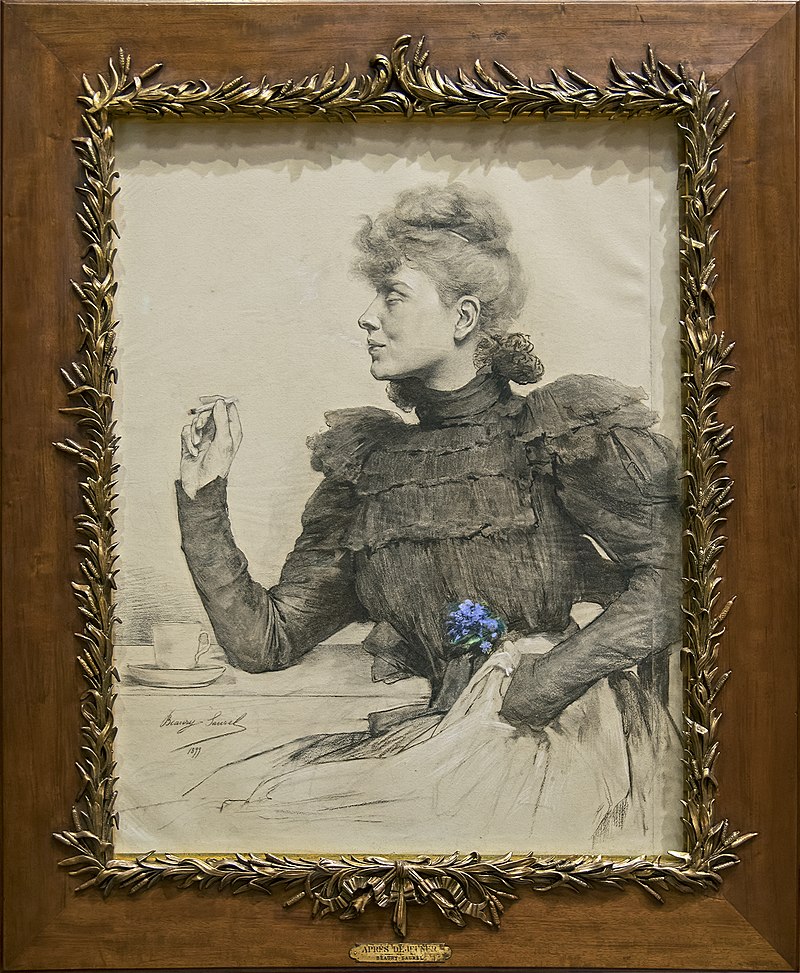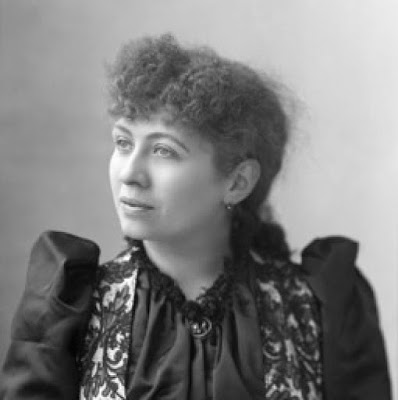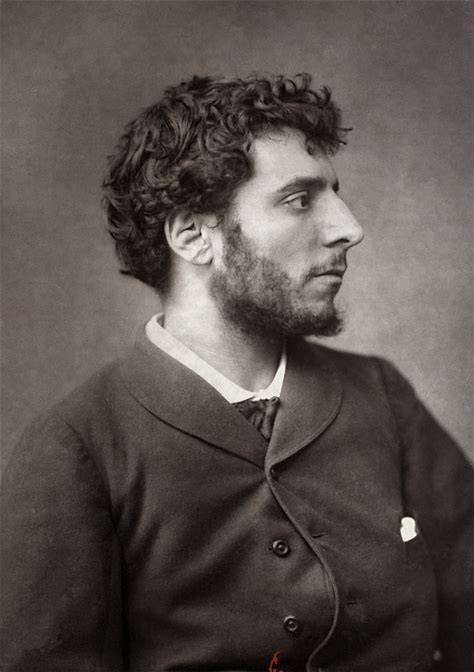
Léon Joseph Florentin Bonnat. Part 2

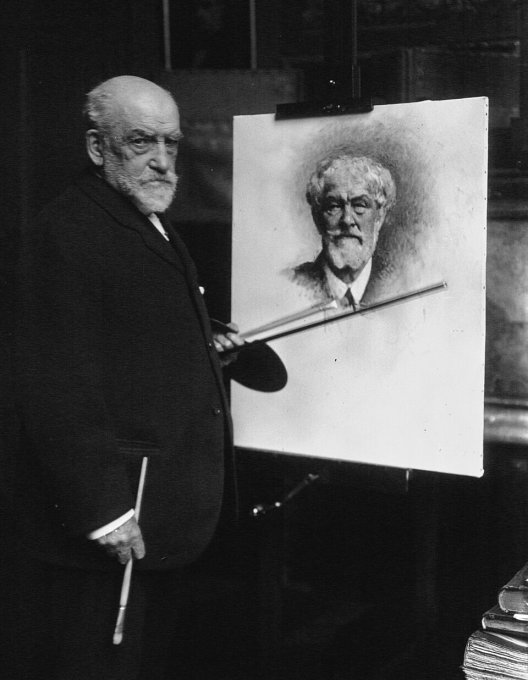
Léon Bonnat painting a portrait of artist, Alfred Roll (1918)

Léon Bonnat was born in Bayonne, France and lived there until he was thirteen years old.  Léon’s family then moved to Madrid where his father took on a book shop.  Léon’s love of art began to materialise after he went to live in the Spanish capital and, to encourage him, his father would take his son to the Prado.  He remembered those museum visits, saying:

“…I was brought up in the cult of Velasquez. I was very young, in Madrid; my father, on bright days such as one only sees in Spain, sometimes took me to the Prado Museum, where we did long stops in Spanish cinemas. I always left them with a feeling of deep admiration for Vélasquez… “.

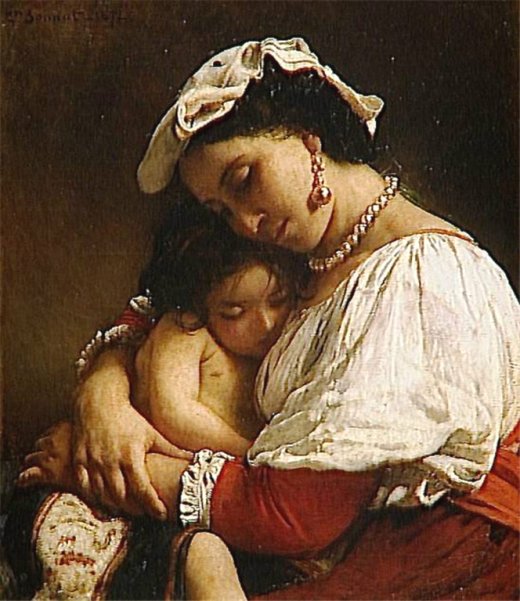
Italian Woman with Child by Léon Bonnat

In 1853, when Léon was twenty, his father died and the family returned to their French hometown of Bayonne.  After studying at the Ecole de Dessin de Bayonne, he went to live in Paris and study at the Ecole des Beaux-Arts.  In Paris, he was able to view paintings by the great Masters of French and Dutch art and particularly remembers seeing the works of Rembrandt and the influence his works had on him, commenting:
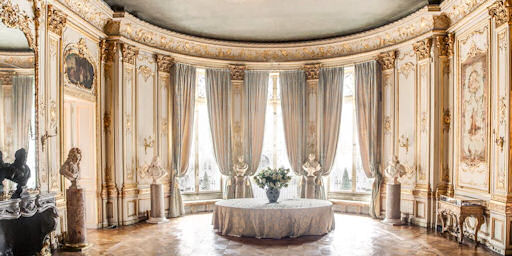
“…What is striking about Rembrandt is the power, the strength and the brilliance. He represents life in all its intensity. We see his characters, we talk with them, he resuscitates and revives an entire era. a marvellous and unique gift of interpretation, he joins the sensitivity, the goodness of a heart which vibrates to all the miseries, to all the joys, to all the emotions of humanity. He does not belong to any school. He has opened the new path which closed behind him…”

Roman Girl at a Fountain by Léon Bonnat (1875)

In 1857 he came second in the Prix de Rome competition and left Paris and spent three years at the Villa Medici.  The Villa Medici, now the property of the French State was founded by Ferdinando I de’ Medici, Grand Duke of Tuscany, and has housed the French Academy in Rome and welcomed winners of the Rome Prize since 1803, so as to promote and represent artistic creation in all its fields.

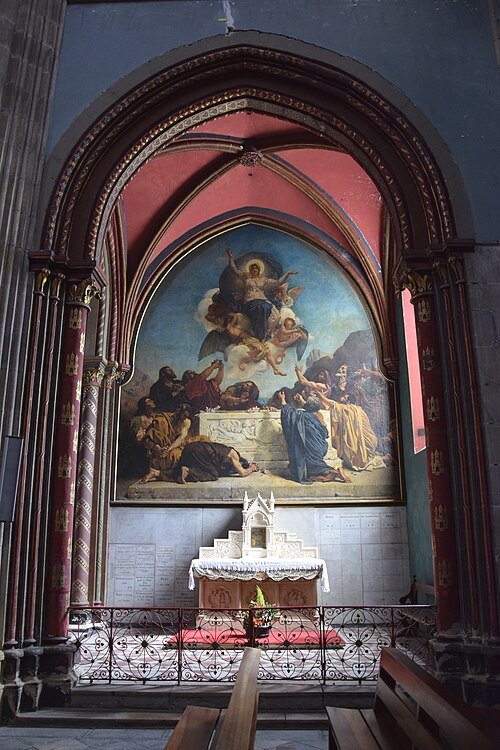
L’Assomption de Marie by Léon Bonnat (1869)

L’Assomption de Marie in situ in the Church Saint-André à Bayonne (Pyrénées-Atlantiques, Nouvelle-Aquitaine, France)

In 1869 Bonnat was awarded the Medal of Honor of the Salon for his painting L’Assomption.

The Martyrdom of Saint Denis by Léon Bonnat (1880)

One of Bonnat’s last religious paintings was his 1880 painting entitled The Martyrdom of Saint Denis.  St Denis was a 3rd-century Christian martyr and saint.  Denis was Bishop of Paris and through his speeches, made many conversions but he was looked upon by the local Roman priest as a danger and had Denis together with his faithful companions, the priest Rusticus and deacon Eleutherius, executed.  The place of the execution, by beheading, was on the highest hill in Paris, which is now known a Montmartre.   Denis was said to be against the beheading taking place at this spot and “folklore” has it that after Denis was beheaded, the corpse is said to have picked up his severed head and walked ten kilometres from the top of the hill, and during that entire walk he preached a sermon. 

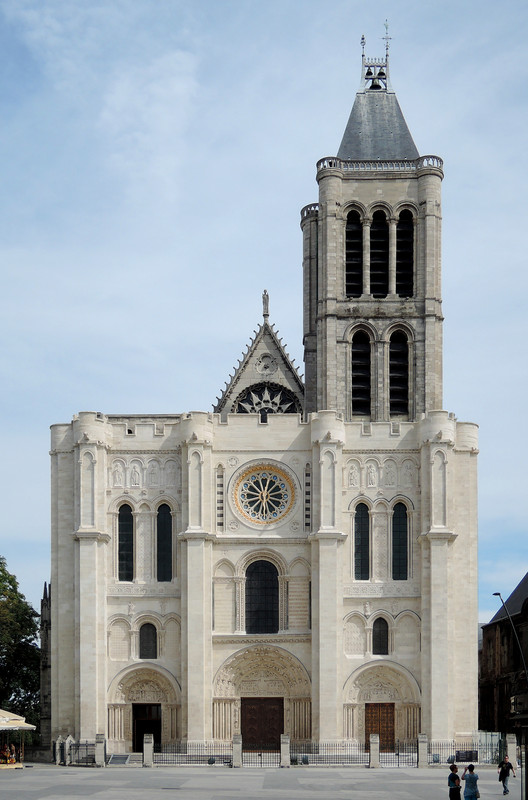
Basilica of St Denis, Paris

Detail of the north portal sculpture; the martyrdom of Saint Denis, Eleuthere and Rustique 

Denis finally collapsed at the place where he wanted to be buried, the spot where now stands the Basilica of St Denis and which is also the burial place of the Kings of France.  Saint Denis is the patron saint of both France and Paris.

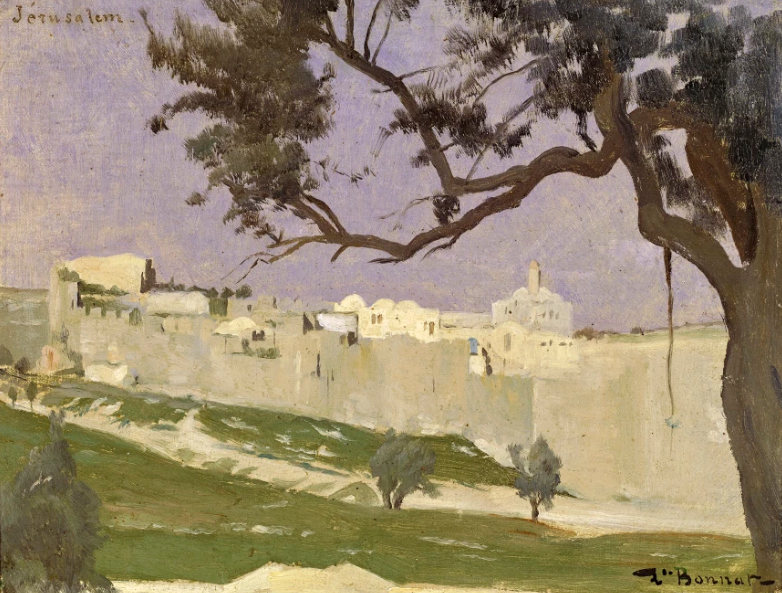
View of Jerusalem by Léon Bonnat

Although, as we will see later, Bonnat was best known for his portraiture and his early historical and religious subjects, but his landscapes and Orientalist depictions are looked upon as among his most intensely personal and beautifully crafted works.  Léon Bonnat travelled to the Middle East in 1868 together with a party that included the French painter, Jean-Léon Gérôme, his pupil Paul-Marie Lenoir,  the Dutch artist Willem de Farmas de Testas and Gérôme’s brother-in-law Albert Goupil.  The journey began in January 1868 at the Egyptian port of Alexandria and by the third of April, the group had arrived at the gates of Jerusalem.   Willem de Famars Testas recalled their first glimpse of the walled city:

“…The first glimpse of Jerusalem was gripping, the sun-illuminated city was silhouetted against a violet thundery light, while the outlying land lay under the shadow of clouds…”

Léon Bonnat recorded the impressions and the specifics of their arrival at the gates of Jerusalem in April of that year in one of his may oil on canvas sketches entitled View of Jerusalem.

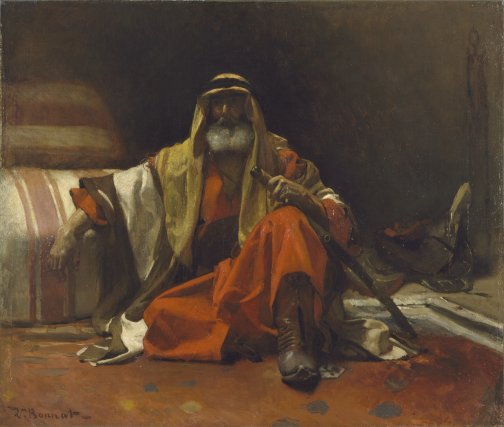
An Arab Sheik by Léon Bonnart (c.1870)

One of Léon’s works from this period was entitled An Arab Sheik which he completed once back in Paris.  It is thought that Bonnat’s depiction emerged from combining multiple resources such as the French model who posed for the seated figure; the saddle we see which Bonnat brought back from his travels and a multitude of sketched notations which he made during his travels in the Middle East.  Combining all this data Léon managed to create a painting that appears authentic, and yet, it is stereotypical of what Europeans believed about the Arabic world and its people such as the way the sheik holds his sword depicting his strength and fierceness and enhances how Europeans believed that that cultures in the Middle East and elsewhere were ruled by violence, in contrast to the supposedly more “civilized” societies of Europe and North America.

Christ on the Cross by Léon Bonnat(1674)

Bonnat’s haunting work entitled Christ on the Cross was commissioned in 1873 for the courtroom of the Cour d’Assises of the Palais de Justice in Paris.  The reasoning behind the commission was that it would embody divine justice in the eyes of the accused and by reminding them of the sufferings of Christ to save the fishermen. The painting was submitted  at the 1874 Salon.  The painting measures 1.59 meters in width and 2.27 meters in height. Bonnat’s depiction fundamentally renews the traditional representation of Christ on the cross. Christ is shown with a crown of thorns, his body is muscular and pale, and he wears a simple white loincloth. Blood is visible from the nails piercing his hands and feet. The background is dark and sombre. The crucified Christ is characterised in an extremely realistic way, accentuating Christ’s suffering due to the torture he received. Christ on the Cross is one of the best known and best loved crucifixion paintings of the western world. The painting can be viewed at the Petit Palais, Museum of Fine Arts of the City of Paris.

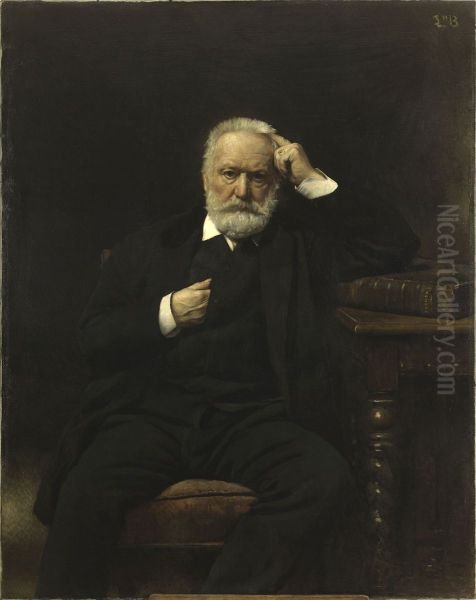
Victor Hugo by Léon Bonnat (1879)

For an artist to survive financially he or she must sell their work.  Once back in France, after his three-year stay at Villa Medici in Rome, Léon realised that the sale of his historical and religious paintings had fallen off and he had to look for another painting genre which would attract more buyers.  While Bonnat created many religious and historical works, his long-lasting fame rested on his exceptional career as a portrait painter. In an era before photography became the norm, painted portraits were central for chronicling the likenesses of important individuals, and Bonnat became one of the most sought-after portraitists of the French Third Republic and beyond. His sitters included presidents, politicians, writers, scientists, artists, and members of high society.

Jules Ferry by Léon Bonnat (1888) Jules François Camille Ferry was a French statesman and republican philosopher. He was one of the leaders of the Moderate Republicans and served as Prime Minister of France from 1880 to 1881 and 1883 to 1885.

Bonnat artistic brilliance as a portrait artist was his extraordinary skill in capturing not just a physical likeness but also the sitter’s charm, personality and social standing. His portraits are typified by their unruffled gravity, psychological perception, and scrupulous attention to every detail, whether it be the texture of fabrics to the detailed features of the face and hands. Bonnat often used dark, neutral backgrounds, which allowed viewers to focus entirely onto the subject, which were often illuminated by a carefully controlled light source, a technique evocative of the Spanish painter, Velázquez.

Portrait of Marthe and Therese Galoppe by Léon Bonnat (1889)

Marthe and Therese Galoppe were prominent figures in 19th-century France, known for their social standing and involvement in Parisian society. The painting captures their youthful beauty and grace, reflecting the evolving role of women in society during that time. Bonnat’s portrayal of the Galoppe sisters is significant as it showcases women not just as muses but as individuals with their own identities, challenging traditional views of women in art.

Armand Fallières by Léon Bonnat (1907) French statesman who was President of France from 1906 to 1913.

Among his most famous sitters were famous figures were the statesman Adolphe Thiers, the revered author Victor Hugo, the pioneering scientist Louis Pasteur, fellow painter Pierre Puvis de Chavannes, and French Presidents like Jules Ferry and Armand Fallières. Bonnat’s portraits served not only as personal records but also as official images that helped shape the public perception of these influential individuals. His success in this genre brought him considerable wealth and prestige.

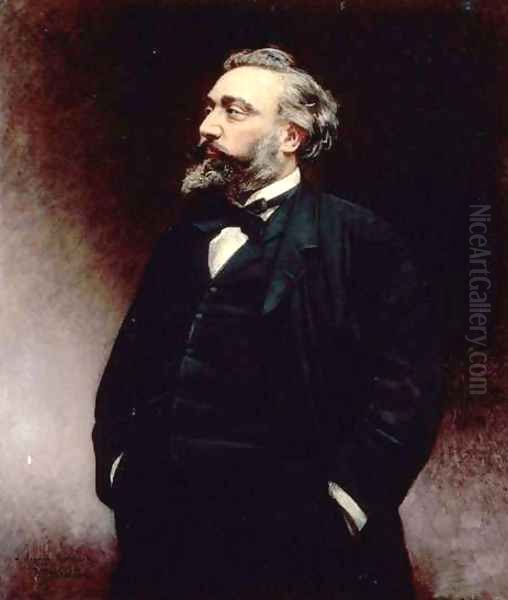
Portrait of Léon Gambetta by Léon Bonnat (1888) Gambetta was a French lawyer and republican politician who proclaimed the French Third Republic in 1870 and played a prominent role in its early government.

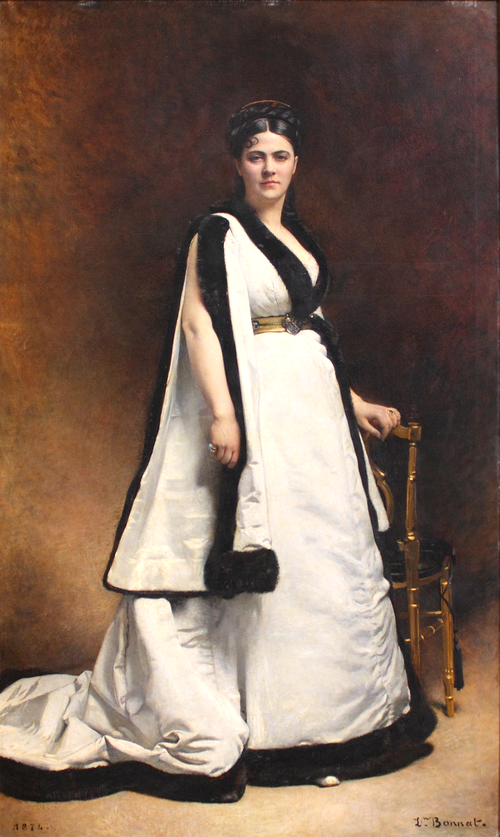
Madame Pasca by Léon Bonnat (1874) Alice Marie Angèle Pasquier was better known by her stage name Madame Pasca, a French stage actress.

Bonnat’s methodology when it came to creating portraits was known to be both thorough and painstaking. He demanded of his sitter numerous meetings so that he could carefully observe them in order to capture subtle gradations of expression and posture and because of this, he was able to achieve prolonged observations which allowed him to realise a high degree of naturalism along with psychological depth.  However, Bonnat’s long processes to achieve a finished portrait did not always please the sitters.  Although he was minded as to what the sitter wanted in the finished portrait, Bonnat refused to flatter his subject and simply strived for an unvarnished truth, but still conveying the dignity appropriate to the subject’s station in life. His commitment to authenticity along with his undoubted technical mastery in delivering form and texture, achieved the finished product being solid, present, and intensely real.

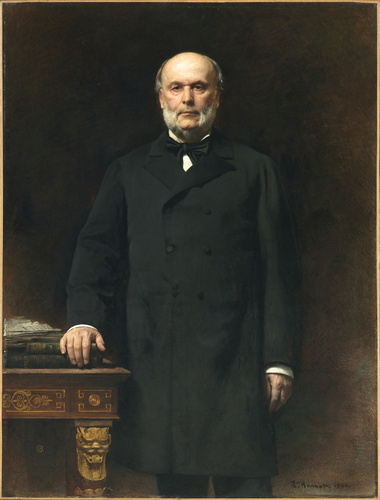
Portrait of Jules Grévy by Léon Bonnat (1880). Jules Grévy was  a French lawyer and politician who served as President of France from 1879 to 1887.

Léon Bonnat who had benefited, following the intervention of the mayor of Bayonne, Jules Labat, when he was granted a municipal scholarship from the city to study the Fine Arts in Madrid and then later in Paris, announced his intention to give his native city the gigantic art collection he had built up.  Léon Bonnat’s dedication to art extended well beyond his lifetime through this act of extraordinary generosity. Léon had no direct heirs, and decided to bequeath his extensive personal art collection, along with many of his own works, to his hometown of Bayonne.

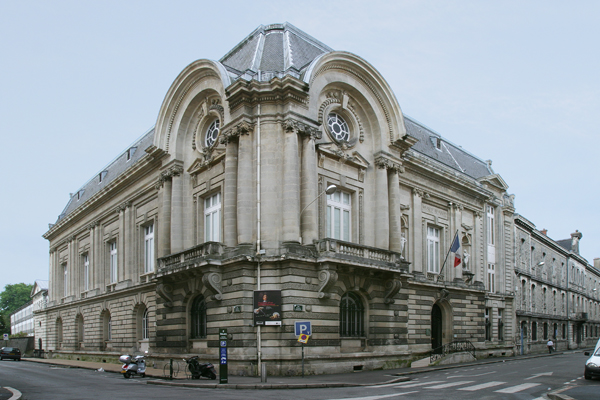
Musée Bonnat-Helleu in Bayonne, France

It was during the latter part of the nineteenth century that Bonnat had achieved financial stability and was able to indulge his passion for collecting art, especially drawings. He acquired sketches, drawings and prints by Rembrandt, Poussin, and Watteau as well as many others.  Eventually, his collection included drawings and paintings from the best of his students and colleagues as well. Like many collectors, Bonnat not only loved the art he had acquired, but he also hoped to share it with a larger public and so he proposed the idea of building a museum in his native Bayonne that would ultimately house his own collection. With his deep roots in the region, continuing family ties to Bayonne, and undoubtedly a sense of gratitude for the support he’d received as a fledgling painter, Bonnat worked tirelessly at developing the new museum. 

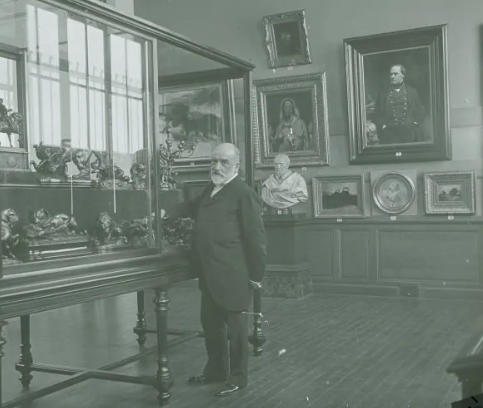
Léon Bonnat, installing his collection at the Musée Bonnat, Bayonne.

In 1902, he personally installed a large portion of his own unparalleled collection in the new Musée Bonnat.  The collection was later enriched by the donation of the collection of Paul Helleu and his wife Alice, leading to its current name, the Musée Bonnat-Helleu.  The chosen location of the museum was located at the corner of the two streets, Jacques-Laffitte and Frédéric-Bastiat, in the city centre, near the church of Saint-André where Léon Bonnat’s painting, Assumption of the Virgin can be seen. In 1896, the first stone of the future museum was laid by the Bayonne mayor Léo Pouzac and the classical-style building, in limestone, was completed eighteen months later. Inaugurated in 1901.  When the Bonnat Museum opened, the artist and collector came to set up his collection himself, while writing a will by which he bequeathed almost all of his works to the National Museums with the obligation to deposit them in Bayonne.

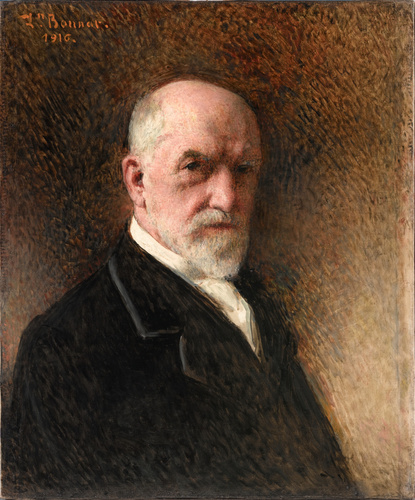
Self portrait by Léon Bonnat (1916)

Léon Bonnat died in Monchy-Saint-Éloi,  a commune in the Oise department in northern France, on September 8th 1922, aged 89.   Léon had never married and lived most of his life with his mother and sister. 

Léon Joseph Florentin Bonnat.

Self portrait by Léon Bonnat (1855)

The artist I am looking at today was one of the leading French painters of the nineteenth century.  He was a colossal figure in 19th-century French art, a painter whose career managed to tie together the past academic traditions with the proliferating trends of modernism. Let me introduce you to Léon Joseph Florentin Bonnat.

Madame Bonnat, mère de l’artiste by Léon Bonnat

Bonnat was born in Bayonne, in the French Basque Country in the far southwestern corner of France, close to the Spanish border, on June 20th1833.  He is remembered for his forceful, expressive and emotional portraits and yet he also made his name as talented history and religious painter, and an influential educator, who also built up a great personal art collection.

Portrait of Madame Melida, sister of Léon Bonnat by Léon Bonnat

In 1846. his family moved from France to Spain and went to live in the city of Madrid where his father took over the running of a bookshop. For thirteen years old Léon, who had developed a love of art this move was opportune. In the Spanish capital, Bonnat received his foundational art education, studying under the tutelage of José de Madrazo y Agudo one of the primary exponents of the Neoclassical style in Spain. He was also the patriarch of a family of artists that included his sons Federico and Luis; and his grandsons, Raimundo and Ricardo.  Federico de Madrazo y Kuntz, and his father were leading figures in Spanish academic art, and Federico was a renowned portraitist.

The Artist’s Sister by Léon Bonnat

Bonnat began his artistic education at the Academia Real de las Bellas Artes de San Fernando, in the studio of Federico Madrazo. Studying under Federico de Madrazo, he was plunged into the rich artistic heritage of Spain and he spent numerous hours in the Prado Museum, copying the works of Spanish Golden Age masters such as Diego Velázquez, Jusepe de Ribera, Francisco de Zurbarán, and Francisco Goya. These painters and their artworks had a great influence on Bonnat through their profound realism, dramatic use of chiaroscuro and the dignified way they depicted their subjects and their styles left an indelible mark on Bonnat’s developing style. Their portraits often used sombre palettes and this textural richness of Spanish art resonated deeply with him, and this style provided a contrast to the often more refined idealized French academic tradition that he would come across in his later years.

Job by Léon Bonnat (1880)

Léon’s father died in 1853 and Léon and his family moved back to France and their hometown of Bayonne.  Now back “home” Léon continued his art studies at the Ecole de Dessin de Bayonne, where one of his tutors was Bernard-Romain Julien, a French printmaker, lithographer, painter and draughtsman.  In 1854, with a stipend of 1500 francs from the city of Bayonne, Bonnat left Bayonne and travelled north to the French capital. His move to the French capital and the tuition costs were partly funded by the City of Bayonne. Having attained a strong foundation from his training in Madrid, Bonnat was able to enter the well-respected Ecole des Beaux-Arts. There, where he studied in the atelier of Léon Cogniet, a much admired historical and portrait painter. Cogniet’s studio was known for its demanding academic training, with great emphasis on students’ ability, emphasizing their drawing, and composition skills.  The students would also spend time studying the works of the old Masters. For a time whilst in Paris Bonnat briefly studied with Paul Delaroche, another prominent academic painter.

The Good Samaritan by Léon Bonnat

Adam and Eve Finding the Body of Abel by Léon Bonnat

Now in Paris, Bonnat began to create his reputation as an up-and-coming artist. In 1857, for the first time, he submitted paintings to the Paris Salon with works such as The Good Samaritan and Adam and Eve Finding the Body of Abel which demonstrated his skill in depicting religious and historical subjects, which confirmed the influence of his Spanish and Italian studies.

Villa Medici, Rome.

In 1857, whilst studying at the École des Beaux-Arts, Bonnat competed for the prestigious Prix de Rome in Painting, The Prix de Rome in Painting was one of the most prestigious awards in the field of fine arts. It was created in 1663, and this annual competition was organized by the Académie royale de peinture et de sculpture (Royal Academy of Painting and Sculpture) in Paris. Each year the winners of the Prix de Rome were sent to the Villa Medici in Rome to perfect their artistic training for a number of years.  The prize awarded to the winner was a scholarship that allowed promising artists to study cost-free in Rome. It was the goal of every early-career artist to win the award.   By rewarding talented young artists with a scholarship and a chance to stay at the Villa Medici in Rome, it was also seen as a way in which it helped to promote academic art and encourage artists to hone their skills. Bonnat, after two failures in 1854 and 1855 had made another attempt to win the prize in 1857.

The Resurrection of Lazarus by Léon Bonnat (1857)

Each year, entrants were given a subject to focus on and then present their submission in front of a demanding jury. This fierce competition encouraged artists to push their limits and express all their creativity.  The year, 1857, Bonnat attempted to win the award the subject matter chosen by the organisers was Lazarus. Léon Bonnat submitted his work entitled The Resurrection of Lazarus and he was awarded the second prize, which unfortunately did not include the full French state scholarship.

Lazarus Raised from the Dead by Charles Sellier

The winner of that year’s prize was the French painter who specialized in mythological and historical subjects, Charles Sellier with his painting, Lazarus Raised from the Dead.

Portrait of Léon Bonnat by Edgar Degas

Bonnat was pleased to receive the second-place award but disappointed that his prize did not allow him a three-year all expenses paid stay at the Villa Medici which was only awarded to the winner of the competition.  However, thanks to the financial assistance of a further 1500 francs granted to him by the city of Bayonne, as well as  money raised by some of the town’s wealthy citizens including the Personnaz family,  a wealthy Jewish family of fabric exporters,  he was able to spend the next three years in Rome, where he was able to study the works of the great Italian Masters, particularly the works of Raphael, Titian, and Michelangelo, as well as the powerful naturalism of Caravaggio.  During his stay in Rome, he also became friends with Edgar Degas, Gustave Moreau, Jean-Jacques Henner, and the sculptor Henri Chapu.

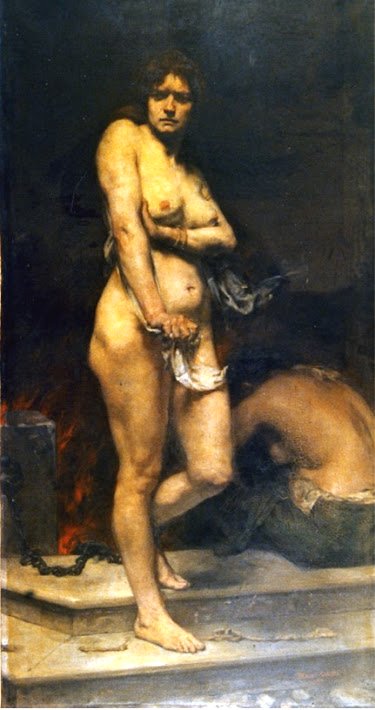
St Vincent de Paul Taking the Place of a Galley Slave by Léon Bonnat (1865)

Bonnat remained in the Italian capital from 1858 until 1861.   Bonnat’s early paintings, such as his 1865 St Vincent de Paul Taking the Place of a Galley Slave were renowned for their dramatic intensity and his religious works of that time strengthened his reputation in this genre.  This painting was based on a part of Vincent;s life. Vincent de Paul was an Occitan French Catholic priest who dedicated himself to serving the poor and became Chaplain-General of the Galleys in 1619, while working for the General of the Galleys of France, Philippe-Emmanuel de Gondi. This position took him to the port of Marseilles in 1622.   When not at sea, the galley slaves, or galères, would spend their time in a squalid prison in the fortified port’s prison. Vincent was horrified at the state of the prisoners and their environs and complained to his patron M. Gondi that such a situation could not continue if France was truly a Christian kingdom. Vincent began ministering to the galley slaves, providing aid to the Catholic prisoners, as well as to the enslaved Muslims and Protestants. At the same time, he instituted important reforms in relation to how these men were treated, regardless of their faith, and set about building a hospital in Marseilles to treat the galley slaves. Due to a lack of steady funding, the General Hospital of Galley Slaves, as it would eventually be called, was not finished until 1646.

Because of Léon’s artistic prowess and being looked upon as a leading academic artist, he was often asked to act as a juror for the annual Salon exhibitions, and in 1867, he was his nominated to the Legion of Honor.

…….to be continued.


Most of the information for these blogs about Léon Bonnat came from Wikpedia and these blogs:

NiceArtGallery

Rehs Gallery

Léon Bonnat by Guy Saigne

Vincent and the Galley Slaves

Musée Jacquemart-André, Baron Haussman and Georges de la Tour

Having been touring Europe for the last three weeks I have had a rest from my blog.   The last part of my journey was a short three-day stay in Paris and it was almost seven years since I had graced this wonderful city. I have visited many art galleries around the world, and my favourites have been the ones that offer something else other than walls of artwork.  I do like artwork which is hung on walls of the interiors of beautiful buildings.  It is like a 2 for 1 offering beautiful architecture and magnificent paintings.

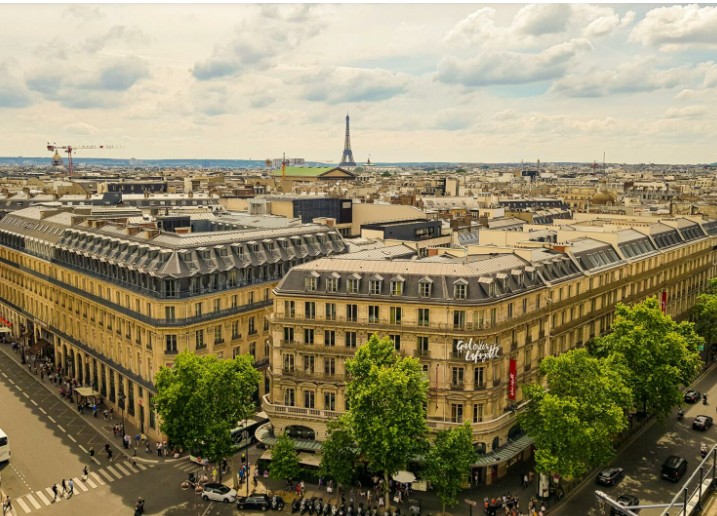
Baron Haussman’s Paris

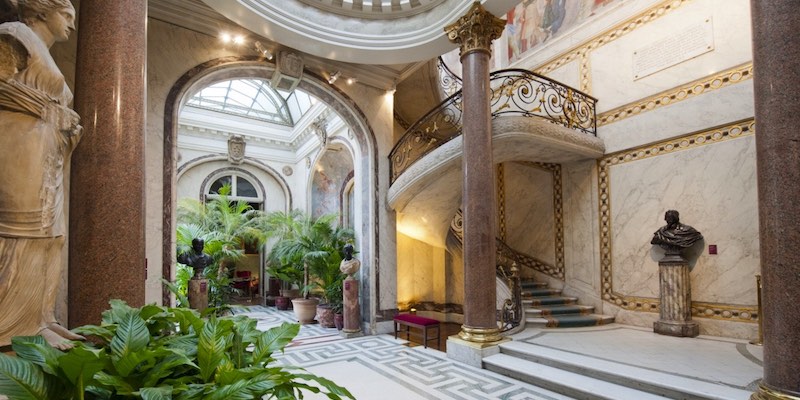
Whilst in Paris there was an exhibition of one of France’s great 17th century artists, and one of the greatest exponents of 17th century Baroque painting, Georges le Tour.  However, first let’s have a look at the impressive building which was hosting the exhibition.  The Musée Jacquemart-André is a private museum located at 158 Boulevard Haussmann in the 8th arrondissement of Paris.  The street named after Georges-Eugène “Baron” Haussmann, a French administrator, who in the mid nineteenth century, with the backing of Emperor Napoleon III, was responsible for the transformation of the ancient impoverished and unhealthy areas of Paris which involved the demolition of 19,730 historic buildings and the construction of 34,000 new ones. Old narrow streets gave way to long, wide avenues characterised by rows of regularly aligned and generously proportioned neo-classical apartment blocks faced in creamy stone.

One such building was Musée Jacquemart-André, situated on Haussman Boulevard, which was the private home of Édouard André and his wife Nélie Jacquemart which was to display the art they collected during their lives. It was what the French term it as a hôtel particulier, a grand urban mansion. Edouard André bought land on the newly created Boulevard Haussmann with the intention of having a mansion built. Building started in 1869 by the architect Henri Parent and completed in 1875. 

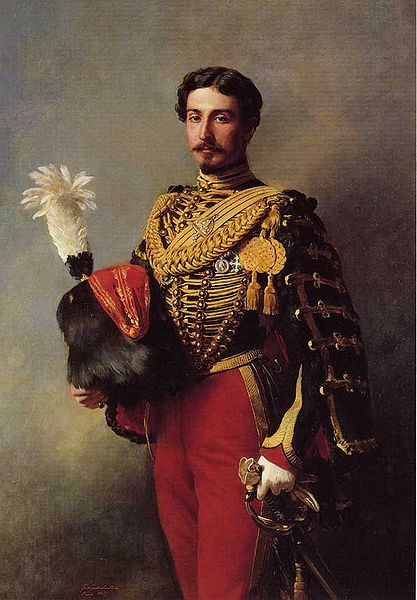
Portrait of Édouard André by by Franz Xaver Winterhalter. 

Nélie Jacquemart and Édouard André were an improbable and mismatched couple.  She was a Catholic woman and a famous society portrait painter, and he was the Protestant heir to a banking fortune. 

Nélie Jacquemart – Self portrait

They married in 1881. Nélie had painted Édouard André’s portrait ten years earlier. Each year, the couple would travel to Italy, buying works of art and slowly amassing one of the finest collections of Italian art in France. When Édouard André died in 1894, Nélie Jacquemart carried on the renovation of their home.  She also made many trips to Japan and neighbouring far-east countries adding many Oriental works to the collection.  Following her husband’s dying wishes, on her death in 1912, she bequeathed the mansion and its collections to the Institut de France as a museum, and it opened to the public in 1913. The couple’s relationship led to one of the most notable private art collections of fin-de-siècle Paris.

The Tapestry Room

The Round Room

Once inside the Musée Jacquemart-André we are able to glimpse into the splendour of Parisian aristocratic life as it was in the 19th century.  We can witness the luxurious setting, both inside and outside of Édouard André and Nélie Jacquemart former mansion.  Adorned with the finest works of art, one can see in every room the evidence of their passion for Italian and French art.  This was a building which hosted extravagant receptions and soirees.

The Winter Garden and Staircase


Grand Salon

Their collection of Italian artwork which Nélie meticulously curated is legendary and includes paintings by Sandro Botticelli, Giovanni Bellini, and Andrea Mantegna. Besides these Italian works of art, the museum houses an remarkable array of French, Dutch, Flemish, and English paintings, as well as sculptures, antique furniture, and objets d’art. Wandering through rooms one observes how they have been preserved in their original state, and one feels that we have been immersed into the world of Parisian high society.

One of the State Rooms and Picture Gallery

The grand salons were designed for hosting lavish events and feature stunning frescoes, sculptures, grand sweeping staircases, and luxurious decor. The experience of walking through lavishly decorated rooms and halls allows us to see how the affluent lived in a bygone era of luxury.

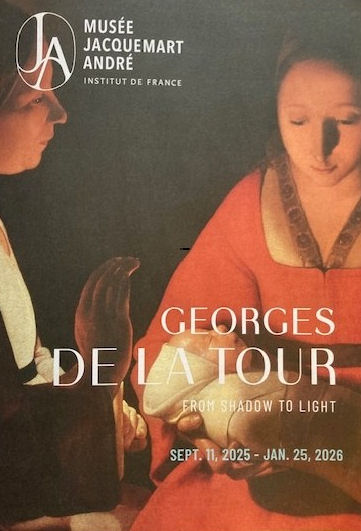
Once the excellent tour of the rooms and garden of the mansion was complete, I went to see the Georges la Tour exhibition which was spread across several upstairs rooms.   It was entitled From Shadow to Light which alludes to the way La Tour explored in his paintings nocturnal scenes, half hidden candles, light filtering through a translucent page, glimmers on a skull or a lantern punctuating the darkness in which meditation unfolds.

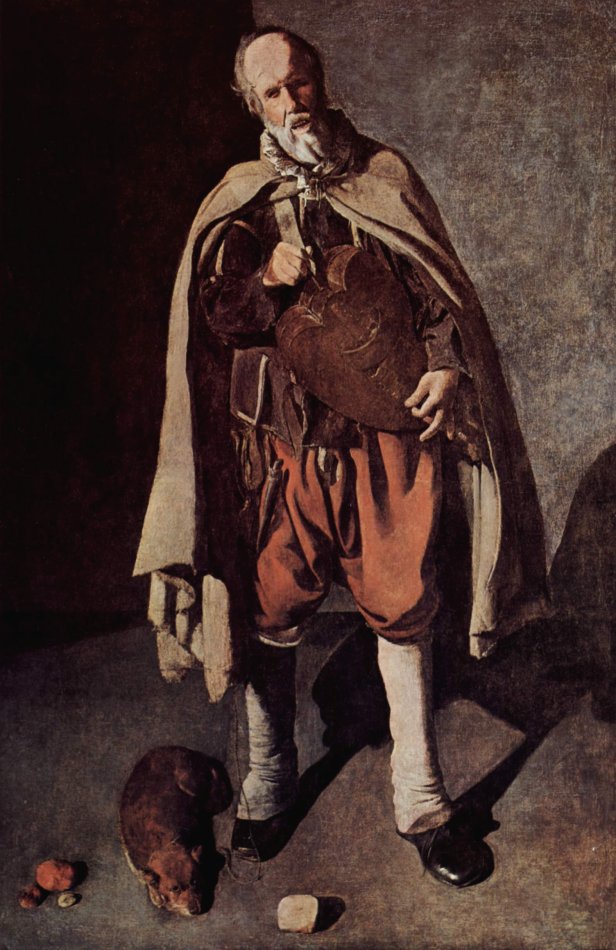
The Hurdy=Gurdy Man with a Dog by Georges de la Tour (1625)

Georges de la Tour was baptized in March 1593 in Vic-sur-Seille in Lorraine.  He was the second of seven children, born into a family of bakers.  Following a fire started by French troops during the Thirty Years’ War, his home, his studio, and some of his works were destroyed and he and some of his family escaped to Nancy.  A year later la Tour was appointed “First Painter to the King” by Louis XIII and as such, he lived in the Louvre and was officially recognized by the court and the Parisian artistic community.   At the height of his career, he painted for many prestigious patrons such as Cardinal Richelieu and the Dukes of Lorraine and became one of the wealthiest painters of his time.

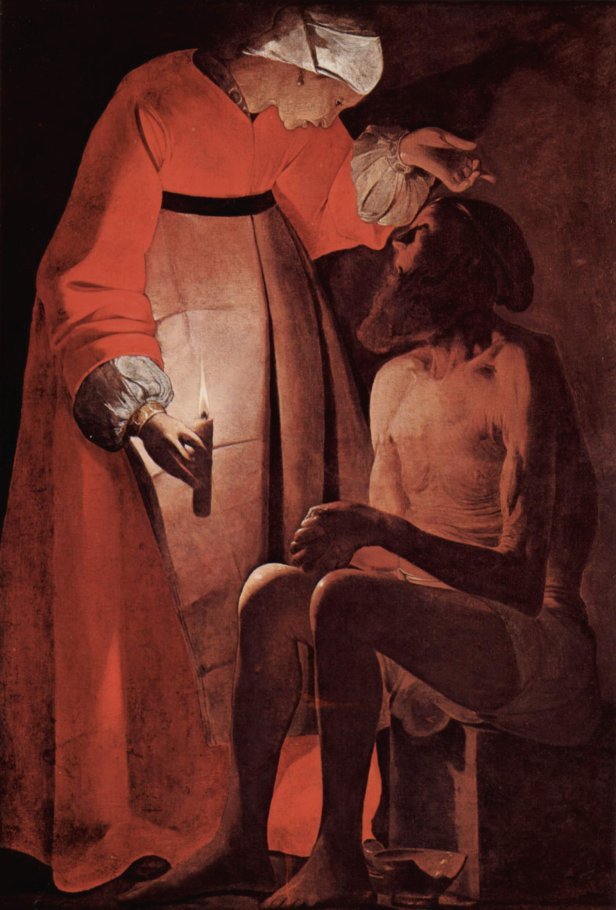
Job Mocked by his Wife by Georges de la Tour (1635)

As can be seen in his paintings, Georges de La Tour was influenced by the Italian painter Caravaggio whose style was then spreading throughout Europe. It is not thought that de la Tour ever travelled to Italy but he was probably influenced by Dutch and Lorraine Caravaggism.  De la Tour developed a personal and daring interpretation of chiaroscuro that made him truly original. His paintings are notable for their realism and sober compositions, which contrast with the dramatic intensity of Italian Caravaggist works. Although de la Tour’s work used the technique of chiaroscuro  his style is of painting is often alluded to as tenebrism.  Tenebrism, which comes from the Italian word tenebroso meaning dark, gloomy, mysterious and is a style of painting using especially pronounced chiaroscuro, where there are violent contrasts of light and dark, and where darkness becomes a dominating feature of the image. This technique was developed to add drama to an image through a spotlight effect and is common in Baroque paintings. Tenebrism is used only to obtain a dramatic impact while chiaroscuro is a broader term, also covering the use of less extreme contrasts of light to enhance the illusion of three-dimensionality.

St Peter Repentent by Georges de la Tour (1645)

The pamphlet that went with the exhibition describes the painting of St Peter as:

“…The celebrated St Peter Repentent exemplifies this sober style, in which lightbecomes the principal sign of the divine. The visual rhyme between the saint’s tonsureand the rooster’s crest introduces a discreet irony, a singular perspective on religious iconography…”

The painting is based on the Bible story of Jesus’s arrest on the night of the Last Supper, when the apostle Peter denied knowing him. Although Christ forgave his betrayal, Peter was consumed by guilt. In his painting, La Tour represents Peter as an old man, reflecting on his past actions in a state of perpetual repentance. The apostle’s red-rimmed eyes and the uncertain light of the lantern evoke the feeling that the Peter has spent anxious sleepless nights and the use of muted colours and simple forms give visual expression to Peter’s solemn and dejected emotions.

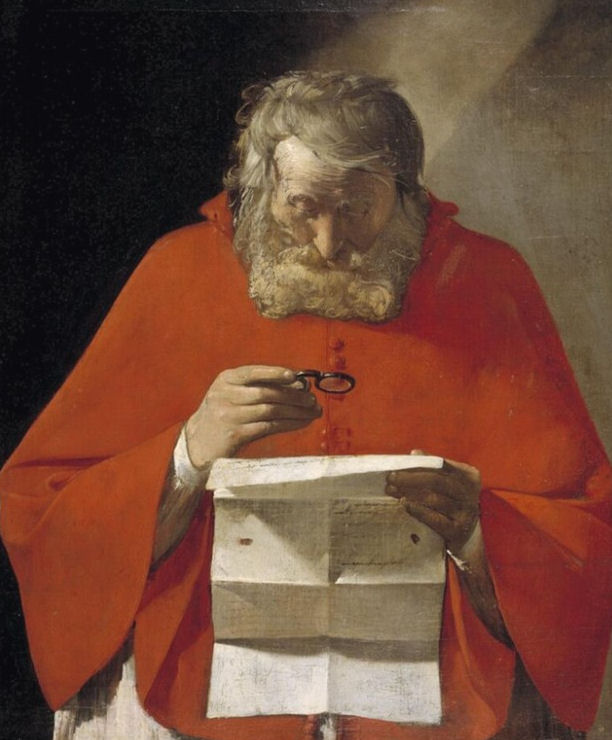
St Gerome Reading a Letter by Georges de la Tour (1629)

The painting by Georges de la Tour’s Saint Jerome Reading a Letter was completed around 1629 and is a masterclass in how to make a single, ordinary action, in this case, reading, carry the weight of a whole life. St Jerome was an early Christian priest, confessor, theologian, translator and historian and his image fills the frame at half-length, wrapped in a cardinal-red mantle.  His head bends slightly forward, and a wisped halo of grey hair catches the light that slants in from the upper right in a wedge-like form.  In his left hand, Jerome holds a creased sheet of paper and in his right hand, he lifts a small pair of spectacles toward the page, trying to focus on the written words.

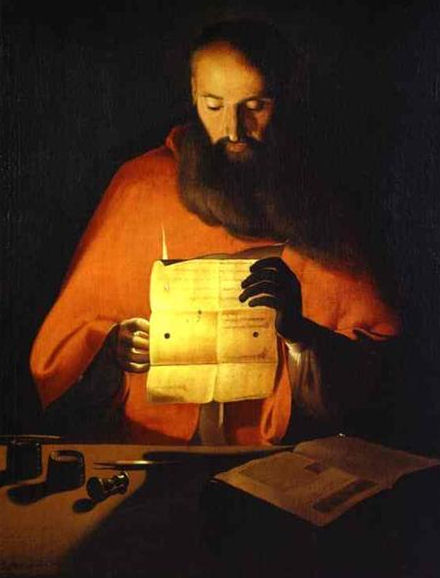
St Jerome Reading by Georges de la Tour (1650)

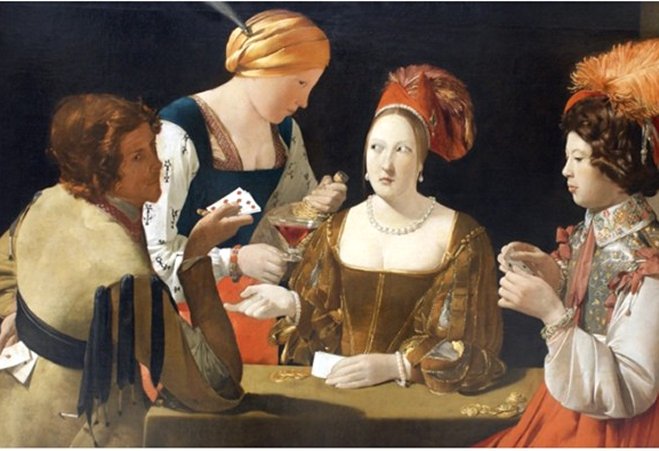
Georges de La Tour is best known for his religious paintings, which are instilled with extraordinary spiritual intensity despite the look of simplicity. In complete contrast to the religious works, de la Tour was interested in scenes of games of cards and dice as well as genre scenes. His interest in depicting card players and card cheats can be seen in two versions he made two years apart.

The Cheat with the Ace of Clubs by Georges de la Tour ( 1630–1634)

The earlier version is one of two versions of the composition by de la Tour and is known as The Cheat with the Ace of Clubs.   There are a number of variations in details of colour, clothing, and accessories between the two paintings.  This one is now hanging in the Kimbell Art Museum in Fort Worth, Texas.

The Card Sharp with the Ace of Diamonds by Georges de la Tour (1636-38)

The work, the later variation, depicts a card game in which the wealthy young man on the right is being cheated of his money by the other players, who both appear to be part of the scheme. The card sharp on the left is in the process of retrieving the ace of diamonds from behind his back.

The Dice Players by Georges de la Tour (1651)

De la Tour’s painting entitled The Dice Players is a genre painting which he completed in 1651.  In the work he depicts a group of five figures who are deeply absorbed in their game with dice. Their intimate gathering around a table, illuminated by a single, subtle light source, is a good example of his tenebrism-style that emphasizes dramatic contrasts between light and dark. Look how each figure has a different facial expression as we see them all concentrating on the game.  Besides this, look at how the artist has depicted details of their period clothes and he has created, through the dim, atmospheric lighting, a vivid record of 17th-century life, and a sense of realism to the scene. De la Tour has used a sombre palette and the careful attention to textural details highlights the gravity of the moment.

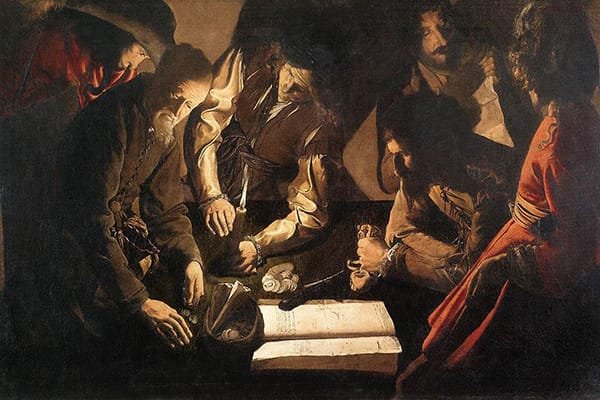
Payment of Taxes by Georges de la Tour (1620)

The painting entitled Payment of Taxes by Georges de La Tour was completed around 1620. Once again it highlights la Tour’s love of the artistic movement known as Tenebrism which is characterized by dramatic illumination and stark contrasts between light and dark. It is a large painting measuring 152 by 99 centimetres. The painting depicts a group of figures huddled together around a table. The depiction is dramatically lit by a single, stark light source, casting deep shadows and creating a profound sense of volume and space. This light appears to emanate from a candle or lantern which is out of view, highlighted by the reflective surfaces and illuminating select portions of the figures and objects. The men gathered around the table are engaged in an exchange, with a distinct focus on the act of counting or possibly exchanging money. The artist has focused their expressions and their hands and that emphasizes the gravity and concentration of the transaction at hand. The use of light and shadow not only gives the scene an emotional feeling but it also guides the viewer’s gaze through the composition, emphasizing the movement of money encapsulated in this painting.

Peasant Couple Eating by Georges de la Tour (c.1620)

Georges de la Tour’s painting entitled Peasant Couple Eating was completed around 1623, at the early part of his artistic career.   The two half-length figures which are almost life-size are tightly framed in the pictorial space.  They face us as if we have interrupted them during their meagre meal of dried peas.  The man exhibits a sour and resentful look as he looks down.  The woman stares fixedly at us with her deep-set almost dead eyes as she raises a spoon to her mouth.  As the background is a simple grey, we have no idea where the event is taking place.  However, this background enhances the old couple.  The painting of half-length figures like this one was a characteristic of Caravaggio’s style, an artist who influenced de la Tour in his early works.  This painting proved very popular and there are records of three 17th century copies.

In the book, Georges de la Tour of Lorraine, 1593-1652, by Furness, the author wrote of the artist:

“……Georges de la Tour is classed as a realist.  Realist he is in that his subjects, predominantly if not exclusively religious, are represented in terms of “real” life, often the life of his own country-town and surroundings in Lorraine.  But he avoided naturalism; rather, he chose to simplify, modelling his forms by marked contrasts of light and shade, and using large volumes and severe lines, with great selective economy of detail…”


Some of the paintings shown in this blog were not at the exhibition but I wanted to show you more of la Tour’s work.

Did I enjoy the exhibition ? The painting were excellent. However, for me the downside was two-fold. Firstly the rooms displaying the paintings were overcrowded (and this was a timed-enterance exhibition). Some people were moving clockwise whilst others moved anticlockwise and it felt slightly claustrophobic. Secondly all the paintings were accompanied by a card describing the work but they were all in French, rather bilingually. My love of visiting art museums is to buy a book with regards the exhibition and in this case a book about the actual museum itself and the works of the artist were on sale in many languages but none in English.. Brexit ???

I recommend you to the gallery website:

Musée Jacquemart-André | Museum in Paris

Jean-Jacques Henner

In my previous blog regarding the Dutch painter Thérèse Schwartze I mentioned that one of her early art tutors was Jean-Jacques Henner, the French painter famed for his portraiture.  Today I am going to focus on his life and his many artworks.

Jean-Jacques Henner

Henner was born on March 5th 1829 at the Alsatian town of Bernwiller.  Henner came from a family of Alsatian farmers who had settled in Bernwiller in the Haut-Rhin. He was the youngest of six siblings of George Guillaume Polycarpe Henner and Madeleine Henner (née Wadel).  He had two older sisters, Maria Anne and Madeleine and three older brothers, Séraphin, Grégoire and Ignace. He grew up in this farming community, but despite their modest financial situation, his parents sent him to the College of Altkirch where he studied drawing. His teacher was Charles Goutzwiller who noticed his rapid progress and encouraged him to move to Strasbourg and study at the studio of Gabriel-Christophe Guérin. His artistic studies continued when he enroled at the Ecole des Beaux-Arts in Paris as a pupil of Michel-Martin Drolling,  a neoclassic French painter noted especially as a history painter and portraitist. In 1851 he was tutored by another French artist, François-Édouard Picot, famed for his mythological, religious and historical paintings.   

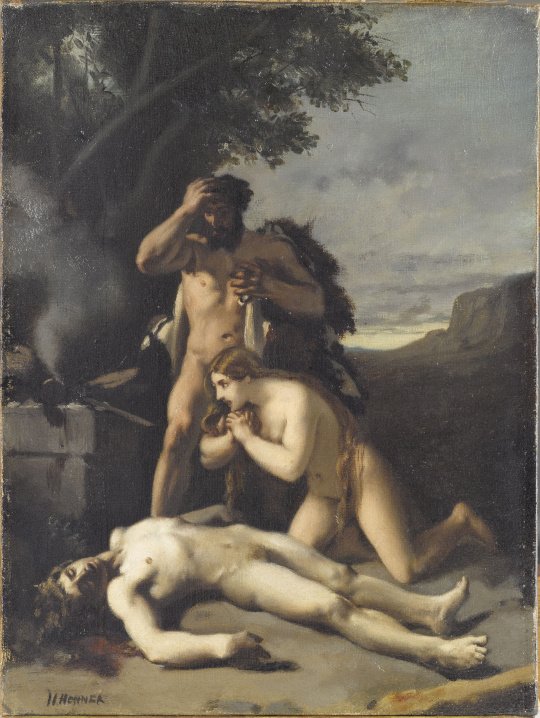
Adam and Eve find the Body of Abel by Jean-Jacques Henner (1858)

In 1848, he entered the École des Beaux Arts in Paris and in 1858 after two failed attempts he won the coveted Grand Prix de Rome award, which was a French scholarship for arts students.  His submission was his painting entitled Adam and Eve find the Body of Abel.  The prize for the winner was a bursary that allowed them to stay at the Villa Medici in Rome, for three to five years at the expense of the state. The painting can be seen at the Musée d’Orsay.

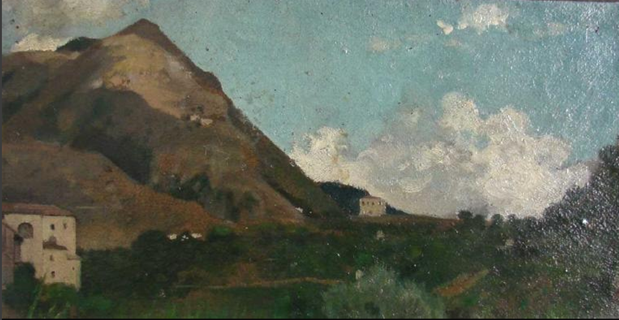
Mountains on the Outskirts of Rome by Jean-Jacques Henner (c.1861)

During his five-year stay in Rome, he was guided by Jean-Hippolyte Flandrin, a French Neoclassical painter.  Like many artists, Henner was captivated by Italy and spent many hours in museums reproducing the works of the painters that he respected. He also had plenty of time during his five-year stay to travel around the country, visiting Florence, Venice and Naples in which time he completed a number of small landscape paintings.  His works at that time showed his appreciation of past masters and it was Titian and Correggio who influenced him the most. In 1864 Henner returned to Paris and brought back copies of works by masters and a number of luminous landscapes.

Rome from the terrace of the Villa Medici by Jean-Jacques Henner (1860)

During those five years in Rome Henner painted this work at the Villa Medici where he stayed between 1859 and 1864. This is not simply a view of the Eternal City as observed from the villa. Once he had painted the garden, Henner then populated the terrace with groups of what he believed were “typical” characters, which he had often seen in real life and are simply identifiable by their clothes, monks, peasants, and elegant ladies. All are depicted in front of the classical panorama of the city, in which one can see the silhouette of Saint Peter’s Basilica in the background.

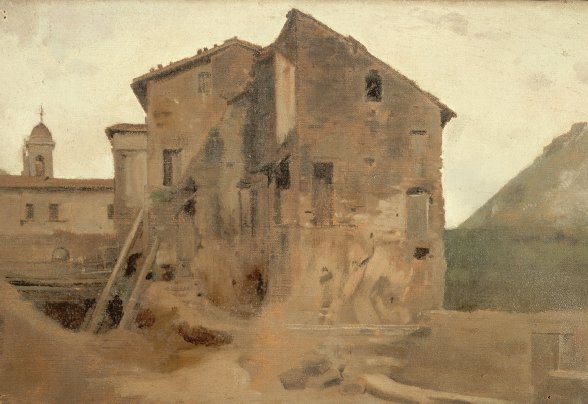
Masure dans la campagne de Rome (Dilapiated House in the Countryside of Rome) by Jean-Jacques Henner (c.1863)

La Chaste Suzanne by Jean-Jacques Henner (1864)

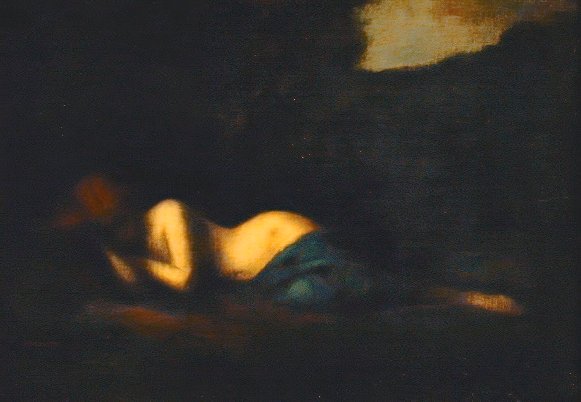
Henner had his painting Bather Asleep exhibited at the Salon in 1863 and at the following year’s Salon his painting La Chaste Suzanne was exhibited. The Biblical episode depicting Suzanne bathing was a popular one for painters and it was above all an opportunity for various artists to paint a beautiful nude. Jean-Jacques Henner sent back his version to the French Academy which he completed whilst in his last year of his residence at the Villa Medici in Rome. For Henner, this was a compulsory exercise, supposed to demonstrate the student’s progress and their skill in execution, and for the Academy to see if their prize winner was advancing artistically.

Sacred Love and Profane Love by Titian (1514)

Henner almost certainly took his inspiration from respected examples left by the great masters’ depiction of nudes which he had seen whilst in the Italian capital. It is thought that Henner was influenced Titian’s 1514 painting entitled Sacred Love and Profane Love which was at the Galleria Borghese in Rome. Henner’s work was not well-received and was harshly criticised for the heaviness and lack of graciousness in the model’s body. It was also criticised for the artificiality of the subject which although being put forward as a history/biblical painting offered little more than a depiction of a bather. However the propensity of ridding any narrative self-justification in painting the nude, and so giving it as a subject in itself, was becoming more common in the work of many contemporary artists, such as Courbet.

Séraphin Henner (brother) by Jean-Jacques Henner (c.1881)

Grégoir Henner (brother) by Jean-Jacques Henner (1889)

While a student in Paris Henner was particularly interested in portraiture, and during his frequent visits home to Alsace he would complete many portraits of his family as well as local dignitaries and scenes of Alsatian peasant life.

Eugénie and Jules Henner by Jean-Jacques Henner (c.1865)

Eugénie and Jules were two of the three children of his brother, Séraphin and his wife, Madeleine. Henner was very close to his nephew and niece and he paid for violin lessons for Jules and piano lessons for Eugenie when they were little. Henner had no children of his own, and on his death, he bequeathed them all that he possessed. Here, Eugénie and Jules are depicted together in their childhood.

Paul Henner by Jean-Jacques Henner (before 1867)

A rather sad portrait. Paul Henner was the third child of Séraphin and Madeleine Henner. He was born in 1860, but sadly died seven years later.

Byblis by Jean-Jacques Henner (c.1870)

In 1864 Henner returned to France and exhibited with great success at the Paris Salon between 1865 and 1903. During his early days back in France his works were of quasi-mythological subjects, such as his 1867 work entitled Byblis, which was exhibited at the 1867 Salon.

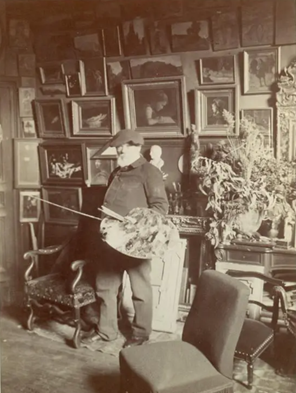
Jean-Jacques Henner in his Paris studio at 11 place Pigalle

Jean-Jacques Henner lived in rue La Bruyère and his studio was at 11 place Pigalle, where he lived from 1867.

L’Alsace. Elle Attend (Alsace, She Waits) by Jean-Jacques Henner (1871)

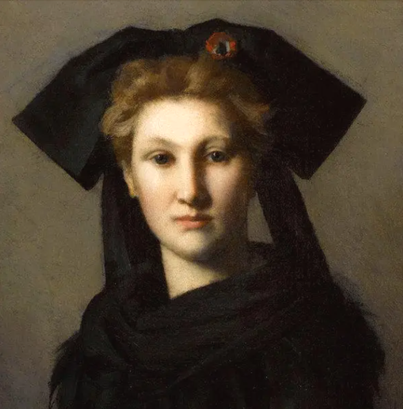
Jean-Jacques Henner’s birthplace was the region of Alsace and this north-east area of France borders Germany. With the defeat of France in the Franco-Prussian War in 1871, Alsace and northern Lorraine were annexed to the new German Empire. At the conclusion of the First World War, the defeat of Germany, and the Treaty of Versailles, Alsace once again came under French control. In 1940, during the Second World War Alsace–Lorraine was occupied by Germany during the Second World War. Although it was never formally annexed, Alsace–Lorraine was incorporated into the Greater German Reich. With the defeat of Germany in 1945 Alsace returned to French rule. Henner’s 1871 painting entitled L’Alsace. Elle Attend had political overtones. It depicts a young Alsatian woman in mourning and is a political comment on the German annexation of the province after the Franco-Prussian War. The patriotic image was very popular and achieved a wide circulation when it was engraved by Léopold Flameng.
L’Alsace. Elle Attend meaning Alsace, she awaits, was commissioned on the initiative of Eugénie Kestner, a member of the Thann industrial family from Alsace. On completion it was given Léon Gambetta, a French lawyer and republican politician, who was one of the fiercest opponents of the relinquishment of the Alsace-Lorraine region to the new German Empire following the war of 1870. Following the defeat of France by the Prussian armies a sense of fervent and heightened patriotism followed. Henner’s painting quickly became looked upon as a symbol of Alsace’s suffering, a pain shared by the painter who was very attached to the region of his birth. The painting depicts a young Alsatian woman in mourning, unassuming but gracious.

Donna sul divano nero (Woman on Black Divan) by Jean-Jacques Henner (1869)

At that time, Henner had assumed a naturalistic style which can be seen in his painting entitled Woman on a Black Divan, which was exhibited at the Salon of 1869 and now is housed at the Mulhouse, Musée des Beaux-Arts. A smaller version of this painting also included a rosette in the red, white and blue colours of France, pinned onto the traditional black Alsatian bow, gives the painting its patriotic significance without being pompous or anecdotal.

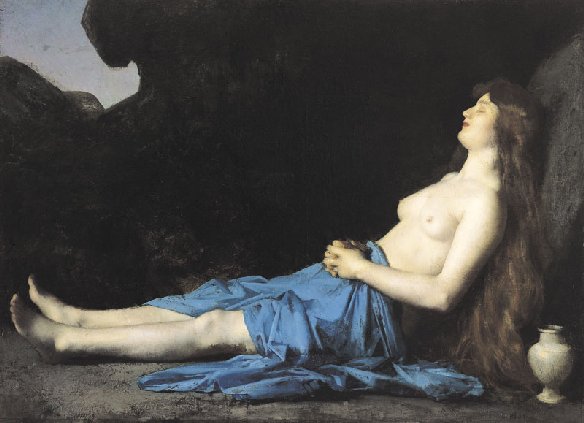
Magdalene in the Desert by Jean-Jacques Henner (1874)

After 1870 Henner’s entire work became a deliberation on the theme of death in various appearances. There were the depictions of Mary Magdalene in what became known as the Magdalene Series, such as Magdalene in the Desert, which was exhibited at the 1874 Salon, and Magdalene Weeping, which he completed in 1885.

Die Magadalena by Jean-Jacques Henner (Exhibited at the 1878 Salon)

La Magdaleine by Jean-Jacques Henner

Henner complted many more Magdalene paintings.

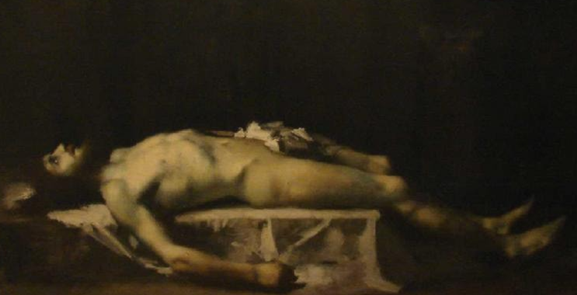
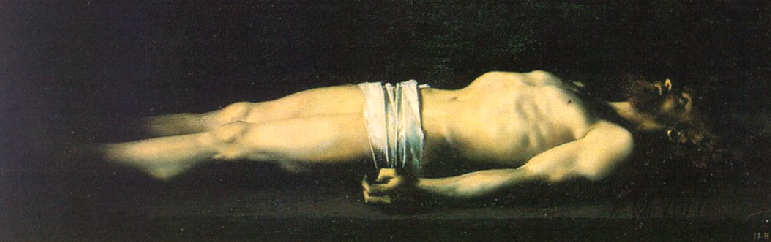
The Dead Christ by Jean-Jacques Henner (c.1884)

Jesus at the Tomb by Jean-Jacques Henner (c.1879)

There was also a number of works in Henner’s Dead Christ series with paintings such as Jesus at the Tomb, which was exhibited at the 1879 Salon and is now part of the Musée d’Orsay collection and the painting entitled Dead Christ which was exhibited at the 1884 Salon and now hangs at the Musée Beaux-Arts in Lille.

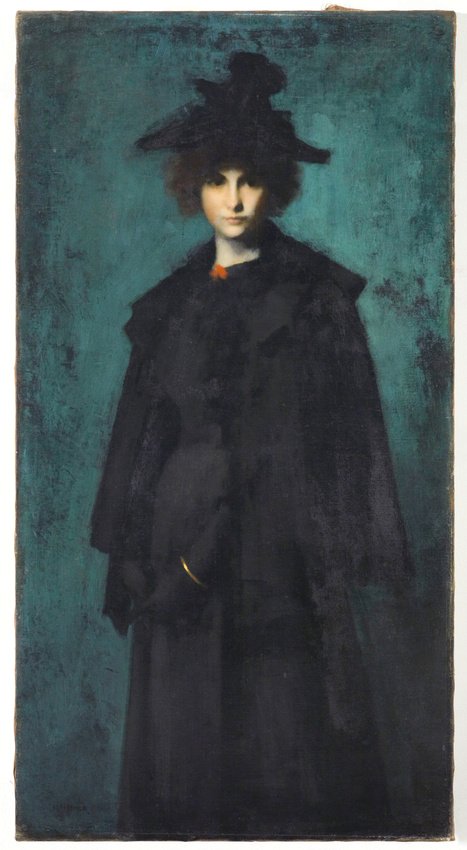
Portrait of Madame Laura Leroux by Jean-Jacques Henner

Jean-Jacques Henner will best be remembered for his portraiture which would provide him with financial stability. During his lifetime he completed many portraits of his family and famous people like his Portrait of Madame Laura Leroux. Laura Leroux-Revault was a French artist and painter. Her first teacher was her father, the painter Louis Hector Leroux and she later trained at the Académie Julian art school in Paris. She also trained under Jules Lefebvre and in Jean-Jacques Henner’s studio. The two artists were friends of her father.

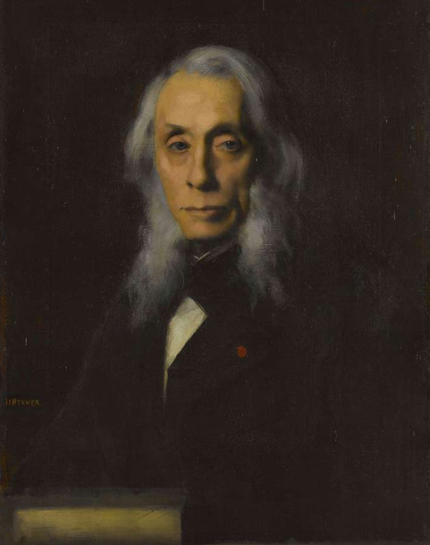
Portrait of Jean-Gaspard-Félix Laché Ravaisson-Mollien by Jean-Jacques Henner (1889)

Another famous person to be immortalised by Henner was Jean-Gaspard-Félix Laché Ravaisson-Mollien, a French philosopher, said to be France’s most influential philosopher in the second half of the nineteenth century.

The Reader by Jean-Jacques Henner

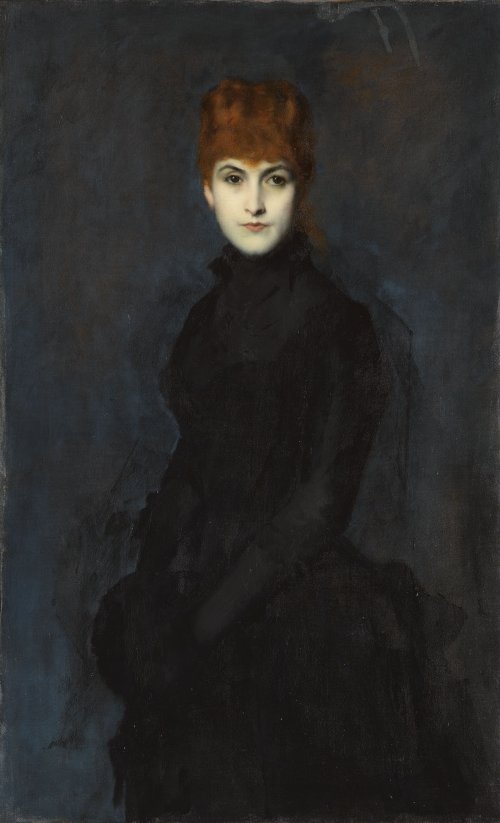
La comtesse Kessler by Jean-Jacques Henner (c.1886)

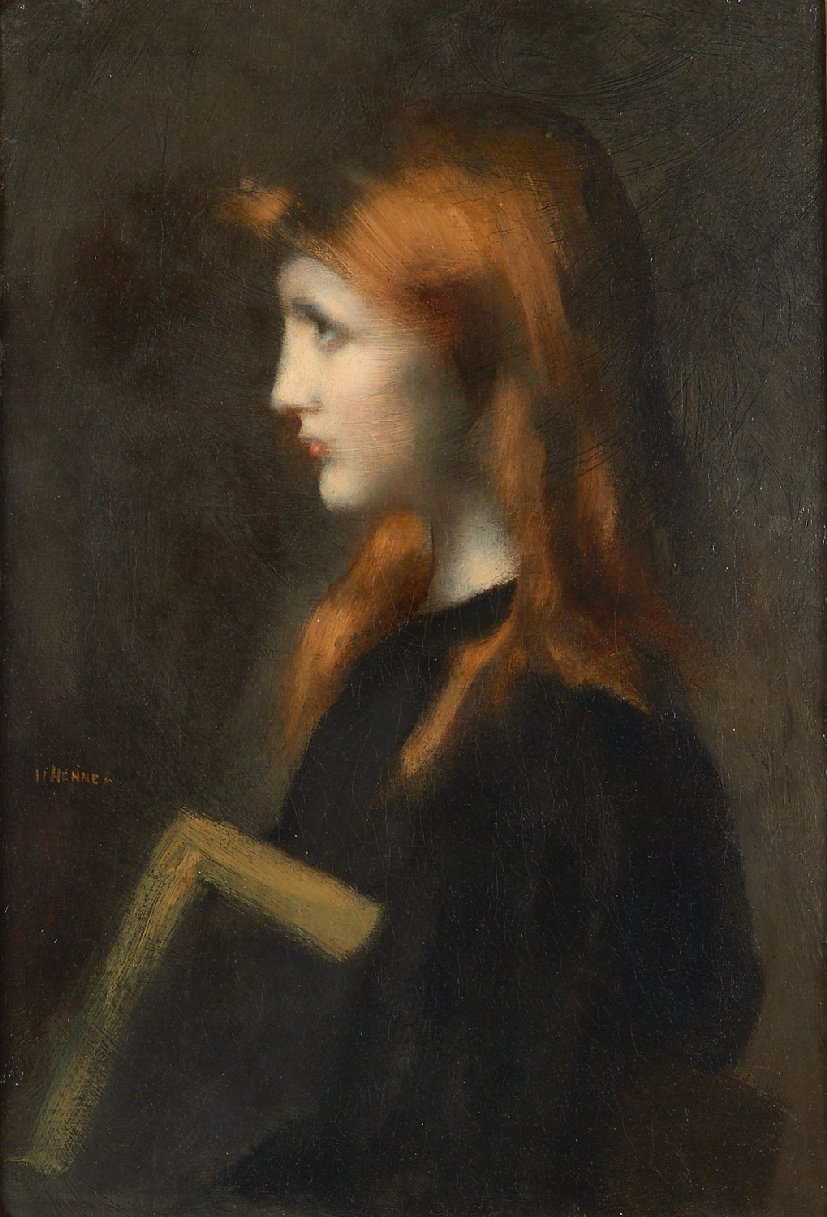
Henner’s love of portraying nudes in historical or mythological settings was not his only love. He had a passion for the colour red and of portraying women with red hair !

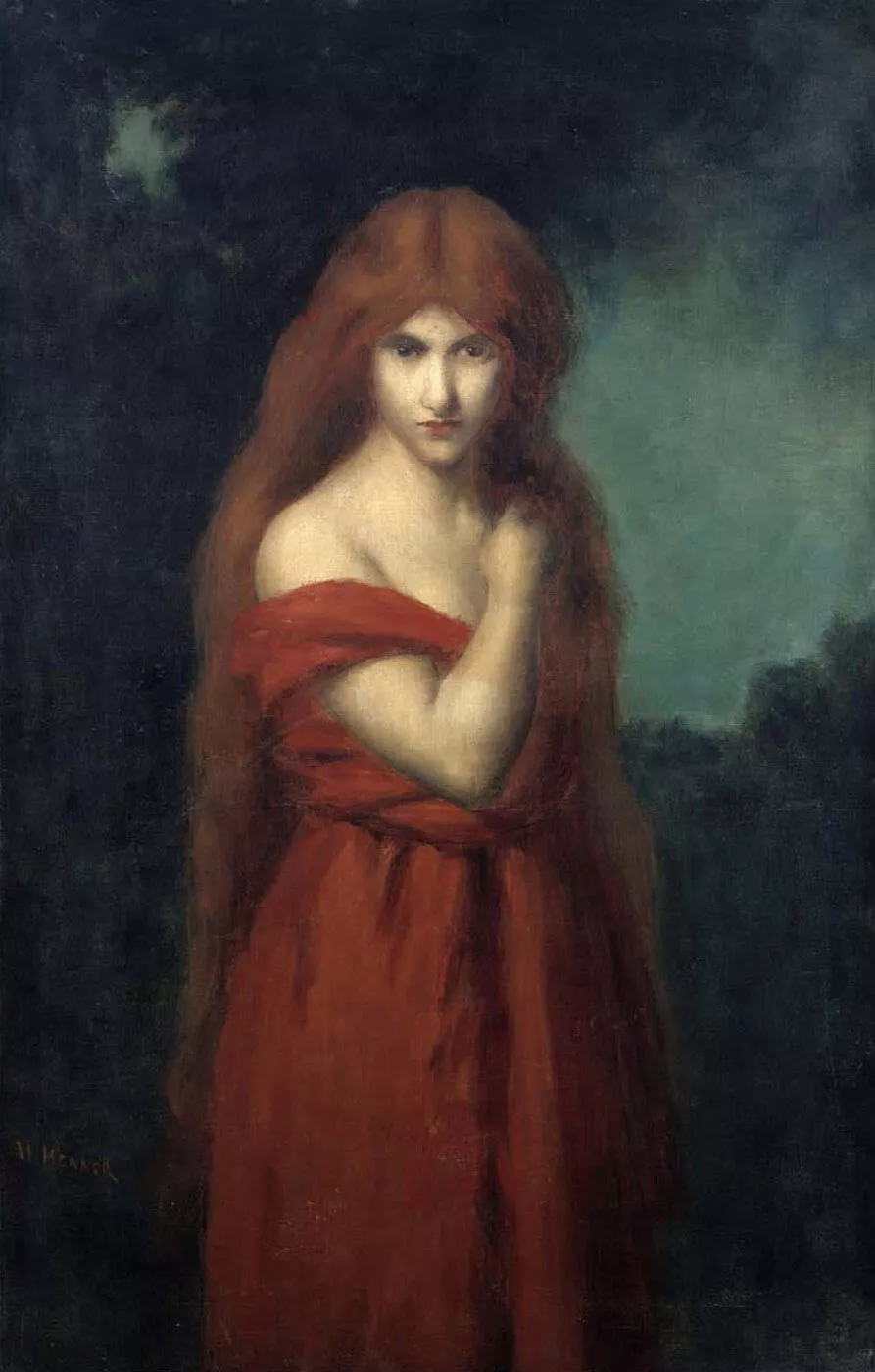
Woman in Red by Jean-Jacques Henner

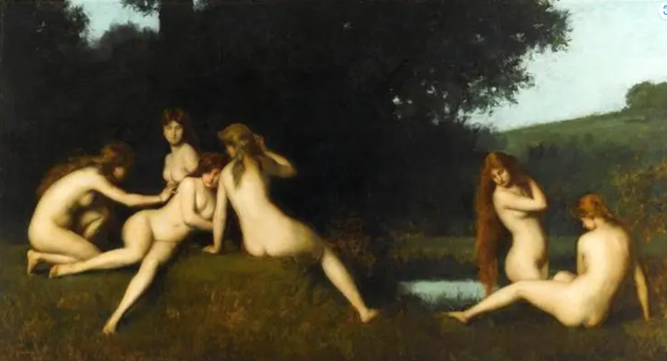
Les Naïades by Jean-Jacques Henner (1861). Painted for the Soyers’ dining room, 43 rue de Fauborg Saint-Honoré. Paris.

Alsatian Girl by Jean-Jacques Henner

L’Ecoliere by Jean-Jacques Henner

Over the years Henner tutored many aspiring painters. Between 1874 and 1889 he taught at what was termed “the studio of the ladies”, which he organized with Carolus-Duran, during the time when women were not allowed entry to the École des Beaux-Arts. Some of these students also served as his models such as Dorothy Tennant, Suzanne Valadon and Laura Leroux-Revault, daughter of his close friend Hector Leroux; Henner’s full-length portrait of Laura Leroux (shown earlier) is now at the Musée d’Orsay having been shown at the Paris Salon of 1898 and purchased by the French State.

Jean-Jacques Henner (Photograph by Nadar c.1900)

Jean-Jacques Henner died in Paris on July 23rd 1905 aged 76.

Marie Laurencin. Part 3.

Marie Laurencin – a photograph by Granger (1913)

Marie Laurencin left Spain and returned to Düsseldorf via Switzerland in 1919. She was very unhappy with her life.  She was depressed and felt unstable with her marriage failing.   Laurençin filed for a divorce from her husband telling friends that the reason for the marital split was because her husband had become an alcoholic. In 1921 Laurençin returned to Paris, knowing that her marriage was finished and she divorced von Wätjen.   However, despite the divorce, they remained on good terms, and Marie kept in touch with van Wätjen’s until his death in 1942.

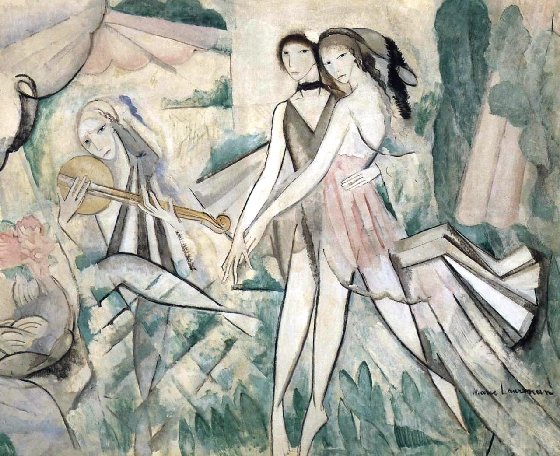
The Spanish Dancers by Marie Laurencin (1921)

Now having returned to the French capital Marie realised that she had been greatly affected by her separation from Paris which she looked upon as the unrivalled centre of artistic creativity. After her return, she developed a new style of painting which is reflected in her 1921 work, The Spanish Dancers.   Gone are the muted colours and the geometric patterns she had inherited from Cubism and these are replaced by light tones and undulating compositions. Once again, we note the coming together of the feminine world and the animal world, which became her favourite theme.  In the work we see three young women spinning around a small bounding dog, in front of a large grey horse. Marie has portrayed herself kneeling in the foreground wearing a pink tutu, which happens to be the only warm tone in the painting. Her hands are entwined with those of the young woman on the right, who is wearing a light grey dress with a light blue headscarf.  The woman on the left, wearing a light blue dress, is executing a dance step whilst holding a hat in place on her head.  Her eyes lead almost seamlessly into the large almond-shaped eye of the horse. The animals would appear to be the dancers’ confidantes in this strange setting.

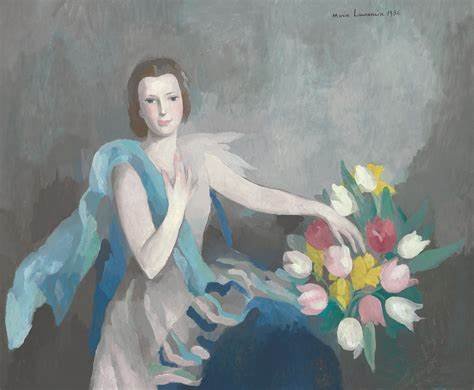
Femme aux tulipes by Marie Laurencin (1936)

Now back in Paris, Paul Rosenberg began to act as Marie Laurencin’s dealer which afforded her enhanced financial security and he also provided her with sound business advice.  Unfortunately, she did not always take Rosenberg’s advice and he was horrified to find that Marie often gave her work as a gift to those she liked. She also set higher prices for work which she found dull and often discounted some of her favourite works.  Curiously she often charged men double what she asked of women, and even charged brunettes more than blondes and furthermore she had a reputation for painting only children whom she liked.

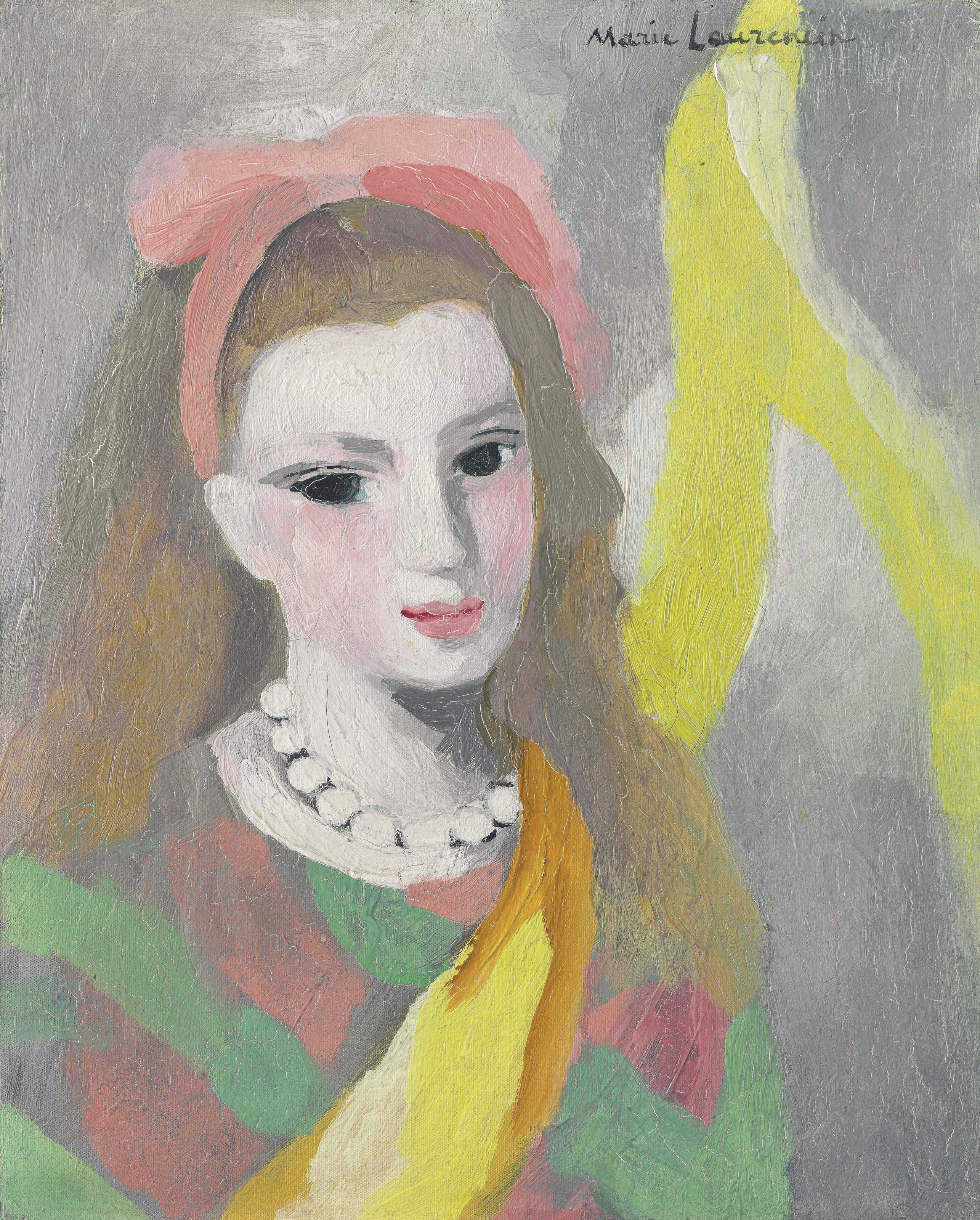
Jeunesse by Marie Laurencin (c.1946)

In her private life, while Marie Laurençin had a succession of male lovers, she also had close female friendships and lesbian relationships. She became part of the female expatriate community in Paris that searched for both artistic and sexual liberation. Lesbianism, for many of these women, was a crucial element of their resistance to bourgeois social conventions.

Gertrude Stein at 27 rue de Fleurus with her portrait by Picasso on the wall, May 1930

Now, based in the French capital, Marie was alone.  The first American who befriended her and bought her paintings was Gertrude Stein, an American novelist, poet, playwright, and art collector who had been born in Pennsylvania.  She had moved to Paris in 1903 and made France her home for the remainder of her life. She hosted a Paris salon, where the leading figures of modernism in literature and art, such as Pablo Picasso, Ernest Hemingway, F. Scott Fitzgerald, Sinclair Lewis, Ezra Pound, Sherwood Anderson and Henri Matisse, would meet for conversation and inspiration.  Laurençin soon became part of the Stein salon on rue de Fleurus.  Marie remained in contact with Gertrude Stein and Alice B. Toklas until Stein’s death in 1946 and continued to see Toklas until her own death.

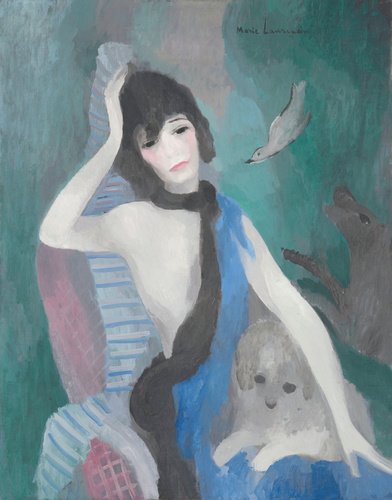
Portrait of Coco Chanel by Marie Laurencin (1923)

Laurencin held an exhibition of her work in 1921 at the Rosenberg Gallery in Paris. She had now built up her reputation as a talented portraitist, especially of celebrities, one of whom was Coco Chanel.  The commission to paint Chanel’s portrait came about in the autumn of 1923 when Marie Laurencin was working for Sergei Diaghilev’s Ballets Russes which was established in Paris, Monte-Carlo and London, and Marie was designing the costumes and sets for the ballet Les Biches [The Does]. At the same time, Coco Chanel was creating the costumes for the same company’s Le Train Bleu [The Blue Train] operetta .   At that time, Coco Chanel was both very rich and famous, and she commissioned Marie Laurencin to paint her portrait.  This was one of Laurencin’s early portrait commissions. Laurencin depicted Chanel face-on, seated in a relaxed, somewhat dreamy pose, with her head resting on her right arm. She appears relaxed and her eyes and mouth, neutral and expressionless, suggest that she is daydreaming or preoccupied by her thoughts. Marie Laurencin’s painting style was to incorporate animals in her works and here she depicts a white poodle sitting on the Coco Chanel’s knees. It is unclear where Chanel’s flesh ends and her dress begins; her pale outfit is accented with dark black and blue scarves, while the seat behind her is a textured pink and blue. On the right-hand side of the painting, we can see another dog leaping upwards towards a turtle dove which appears to be descending from the sky towards Coco Chanel, like the dove of the Holy Spirit, and thus Laurencin’s symbolising it as a sort of freedom. The colour palette is of a soft harmony of the colours – green, blue and pink, which is reinforced by the long black line of the scarf draped around the model’s neck.  The finished painting was so like Laurencin’s earlier works but did it capture the likeness of Coco Chanel.  The sitter did not think so and the artist did not deny it, but claimed that physical likeness was unimportant.  Chanel refused to pay for it and Laurencin was so annoyed by Chanel’s attitude that she refused to execute a second portrait and decided to keep the original herself.  Despite Chanel’s rejection of the painting, the success of Laurencin’s approach to portraiture was such that she continued to receive and execute portrait commissions in this style until the 1940s. The painting can now be found at the Musée de l’Orangerie in Paris.

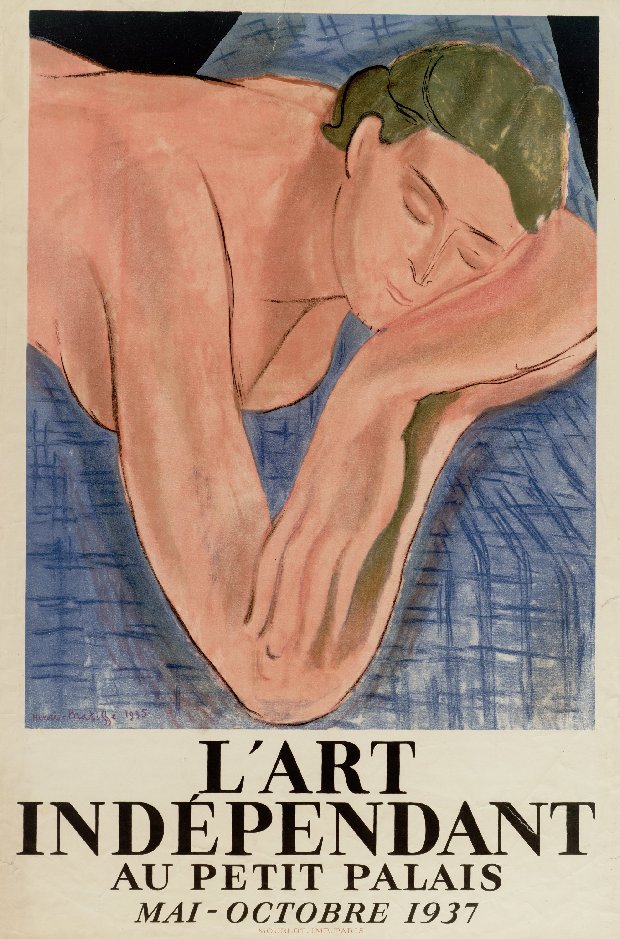
In 1931, Laurencin was one of the founding members of La Société des femmes artistes modernes, and took part in their annual exhibitions until the outbreak of World War II. During the period from 1932 to 1935, she tutored at the Villa Malakoff, a private art school.  In 1937, which art historians believe was the height of her career, a retrospective of Laurencin’s work was held in conjunction with the Great Exhibition of Independent Art Masters at the Petit Palais, which sought to promote the superiority of the contemporary French artistic school, extended to foreign artists “living or having lived in France for many years”. The year 1937 saw a change in Laurencin’s appearance when she finally acquired glasses, which changed her life considerably as she had been extremely short-sighted since childhood and had had difficulty negotiating staircases since the 1920s.

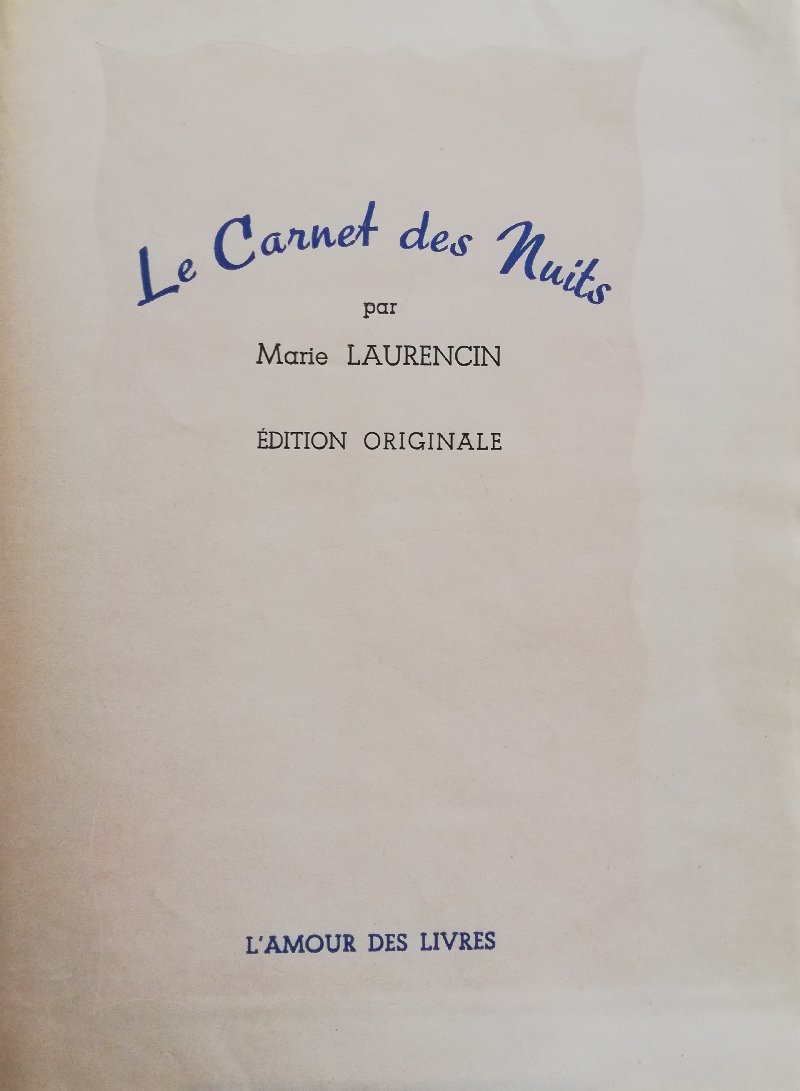
During World War II, Laurencin remained in Paris painting and working on designs for the ballet, and in 1942 she published Le Carnet des Nuits – a collection of poetry with short memoir pieces in prose.  Although Laurencin will be remembered as an artist and the grace and the elegance of her artworks; she is also the author of a diary, Le Carnet des Nuits, an important witness of her time. It tells of her early years she spent in Bateau-Lavoir.  Her writing is of the same delicate style used for her artworks. 

Head of a Woman by Marie Laurencin (1909)

In later years, Laurencin became withdrawn and increasingly isolated and sadly suffered from periods of depression and other health complaints, albeit, she continued to paint throughout this troubling passage of time. Her main companion was her maid, Suzanne Moreau, who had lived with her since 1925. Whether there was more to the mistress/servant relationship is unclear but it is thought that they were romantically linked.    In 1954, Laurencin made Moreau the beneficiary of her estate. It is thought this came about due to Laurencin’s legal struggle, resolved the following year, with tenants living in the apartment that she owned.

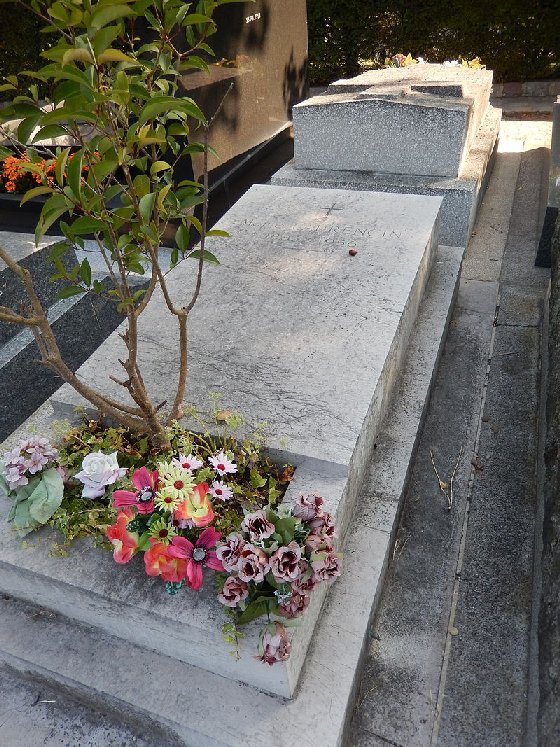
The tomb of Marie Laurencin in Père Lachaise Cemetery, Paris.

Laurencin died of a heart attack on June 8th, 1956, aged 72.  She was buried wearing a white dress in Père-Lachaise cemetery in Paris, as per her wishes, with Apollinaire’s love letters and a rose in her hand.


The main source of information for the three blogs about Marie Laurencin came from the excellent The Art Story website.

Marie Laurencin Part 2.

Marie Laurencin, Paris (c.1912.)

Marie Laurençin’s paintings dating from around 1910 have a strong flavour of cubism. However, she once again stated that although the experiments of cubism fascinated her, she was adamant that she would never become a cubist painter because she was not capable of it.

Bateau-Lavoir c. 1910

Laurençin spent a lot of time at Picasso’s open studio at the Bateau-Lavoir, (Laundry Boat) building at 13 Rue Ravignan at Place Emile Goudeau in Montmartre in the 18th arrondissement of Paris.  The building was so nicknamed as it was said to resemble the public clothes-washing boats moored on the Seine in the early years of the twentieth century. The ramshakle building was said to strain and groan when it was windy—just like the those laundry boats on the Seine. Here, Laurençin exhibited her work along with a group of artists known as the Bateau-Lavoir, which was the residence and meeting place for a group of outstanding artists and men of literature.  It was here that she met Max Jacob, the French poet, painter, writer, and critic, and André Derain, the French artist, painter, sculptor and co-founder of Fauvism.  She was also introduced to Gertrude Stein, the American novelist, poet, playwright, and art collector to whom she made her first sale in 1908.

Les jeunes filles (Jeune Femmes, The Young Girls) by Marie Laurençin (1911)

In 1911 Laurençin completed her painting entitled The Young Girls.  Marie Laurencin showed The Young Women at the Salon des Indépendants in Paris in 1911, alongside works by other artists painting in a similar style. The exhibition, which gave rise to the term “cubism”, caused a scandal but was also the breakthrough for Cubist art.  This work depicts four pale-skinned dark-eyed women with dark hair, independent of each other and yet overlapping.  They are all wearing  grey robes and stand against an abstracted pastoral backdrop. The female on the left is a violinist, playing music for the figure beside her, who dances. At the centre of the depiction we see a woman seated facing the dancer, but she turns her head to look back at us.  On the right, another woman appears in motion, carrying a bowl of fruit under her right arm and reaching down with her left hand to stroke the nose of a doe. All the limbs of the women have a fluidity which mirrors the drape of their dresses.   Their bodies are outlined with heavy black lines.  Laurençin has experimented with this depiction and artistic style. 

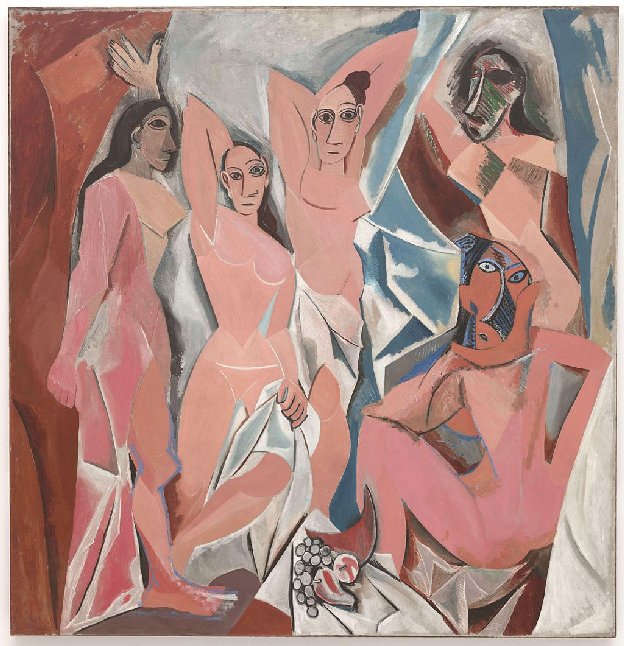
Les Demoiselles d’Avignon by Picasso (1907)

The posture of the four women with their flat, mask-like faces seems to have been influenced by her friend, Picasso’s 1907 painting Les Demoiselles d’Avignon.  In a way the work can be considered as a suggestion that the four women represent a fertile sphere of feminine creativity.  The presence of the doe is symbolic of femininity and naturalness that was a common theme in Laurencin’s work.  Critics believe the painting alludes to the of lesbian self-fashioning and as a celebration of an independent female realm.  The painting can be viewed at the Moderna Museet in Stockholm.

Portrait de jeune femme by Marie Laurencin

In 1913, Marie Laurençin’s mother died and this sad event coincided with her ending her relationship with Apollinaire, but this ending could have something to do with his reputation as a philanderer.   However, she would remain close to Apollinaire until his death, aged 38, in 1918. Her split from Apollinaire freed Laurencin of his Cubist influence, but at the same time, isolating her. On June 24th 1914, in Paris, Marie married Baron Otto van Wätjen, a German Impressionist and Modern painter whom she had first met as fellow students at the Académie Humbert.  

Marie Laurencin, Cecilia de Madrazo and the Dog, Coco by Marie Laurençin (1915)

In the Tate Britain, London, one can see the 1915 work by Laurençin entitled Marie Laurencin and Cecilia de Madrazo and the Dog, Coco.  Cecilia was an art collector friend of Maria.  Laurençin told a fellow artist that the painting was completed in 1915 while she and her husband were exiled in Madrid.  The girl wearing the hat is Cecilia de Madrazo, a young Spaniard, and the other figure is Marie herself wearing a pink dress with her dog poking up between them.  She had bought the dog from an English sailor at Malaga. Marie Laurencin was staying in Madrid with the Madrazos at the time.  Marie has depicted herself with short hair which covers her ears and forehead.  Although her skin is grey it is sharply in contrast with pink cheeks and lips and black eyes which are focused downwards.  Cecilia is fascinated by the dog.  She stares down at it and pushes a finger towards its very long snout. Cecilia’s skin is almost white, with pink lips and cheeks.  She is wearing a grey dress and has a white hat, with a large blue bow, atop her dark hair. The backdrop, almost without detail, is grey and there is a pink curtain at the right edge of the painting; the colour scheme is very limited, with Laurencin utilising only grey, pink, blue and very small amounts of beige. This painting is representative of Laurencin’s work, which has been both appreciated and criticised for its deliberately feminine aesthetic.  Marie’s palette concentrated on  pastel colours. The two figures depicted add a sense of peace and charm and they own the conventional female virtues of loveliness, sophistication and meekness. Laurencin’s unapologetic embrace of visual pleasure and the way she developed an aesthetic that acclaimed female softness, elegance and sweetness was itself a radical position. Laurencin’s painting has depicted such qualities as part of a creative process in which a masculine form is utterly unnecessary, and in a way it is a presentation of a work in which both artist and subject are female.   

The Fan by Marie Laurencin (1919)

In 1919 Laurencin completed her painting entitled The Fan and this, like the previous work, is part of the Tate Britain, London collection.  The painting was purchased by Gustav Kahnweiler, an art dealer, as a gift for his wife, Elly.  He and his wife amassed a modest art collection focused on Cubist paintings, sculptures, and works on paper. After the couple moved to England in the 1930s to escape Nazi persecution, Gustav and Elly loaned and gifted works from their collection to the Tate.  It is believed that the woman in the oval frame is Laurencin herself but the identity of the other woman is unknown.  The fan, which was a symbol of vanity, was one of Laurencin’s favourite accessories. The painting depicts a pink shelf that holds two images of women, one in a rectangular frame and the other in a round frame, against a pink and grey background. The portrait to the left, in the larger, rectangular frame, shows a woman and a dog in greyscale, accentuated by a pale blue ribbon, hat and curtains.  Next to it is an oval frame at the centre of the painting depicting a woman reputed to be Marie Laurencin herself, though it is unclear if this is a portrait or indeed a mirror. The lower right corner of the painting is dominated by the folds of a fan, painted in grey and white, that is cut off at the canvas’s edge.  Laurencin has cleverly depicted the fan in a position that could be seen as being held by someone who is staring at the two frames on the shelf.  The two portraits in the frames on the shelf are positioned such that the figures appear to look out towards us but also towards the person holding the fan.  There is an air of mystery about the depiction and the identities of the figures.  Some believe that the woman in the rectangular frame is Nicole Groult, a dressmaker with whom Laurencin is likely to have had a romantic relationship.

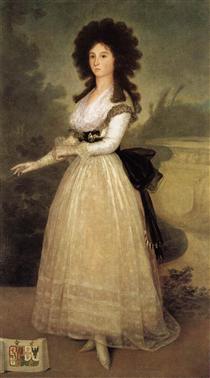
Dona Tadea Arias de Enriquez by Goya (1793)

Once married to Otto van Wätjen, Laurencin automatically lost her French citizenship and so took up German citizenship. She and her husband moved to neutral Spain at the beginning of the First World War in order to avoid France’s anti-German sentiment.  Here, Laurencin became involved with the Dada movement, editing the art and literary magazine 391, a Dada-affiliated arts and literary magazine created by Francis Picabia.  She also spent time looking closely at the work of Francisco Goya, whose dignified, dark-eyed women captivated her.

Simultaneous Windows on the City by Robert Delaunay (1912)

During this period in Spain she became great friends with Sonia Delaunay and Robert Delaunay, who had similarly left France to avoid the War.   Robert was an artist of the School of Paris movement, who, with his wife Sonia Delaunay and others, co-founded the Orphism art movement, noted for its use of strong colours and geometric shapes.

……to be continued.

Marie Laurencin. Part 1.

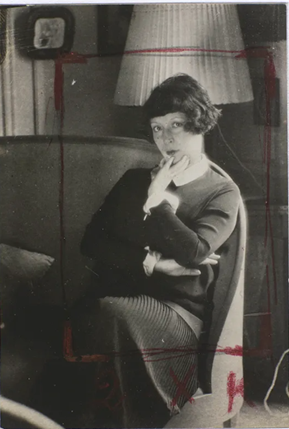
Marie Laurencin photographed by Man Ray (c.1925)

My blog today features the life and artwork of the nineteenth century French painter, Marie Laurencin.  She played an important role in the bringing out the female and lesbian identity in early-20th century modern art movements which at the time was dominated by men.  Her depictions were mainly of females, including many self-portraits but also many also accompanied by animals.  She prided herself with her choice of subjects famously stating:

“…Why should I paint dead fish, onions and beer glasses?  Girls are much prettier…”

Le Bal élégant, La Danse à la campagne by Marie Laurencin (1913)

From early in life, Laurencin was predominantly interested in worlds in which women moved independently and peacefully, creating self-portraits and scenes featuring animals and women which were striking in their thematic consistency. Her fame came through her association with Cubism and she exhibited her work with the Section d’Or, (“Golden Section”), which was also known as Groupe de Puteaux or Puteaux Group, a collective of painters, sculptors, poets and critics associated with Cubism and Orphism.  Her work was also exhibited in America at the Armory Show, but later in her life she fought against her art being compartmentalised in a specific art movement.  She concentrated on her own aesthetic, favouring escapist imagery in pastel hues, that was at once decorative and radical in its embrace of feminine images.

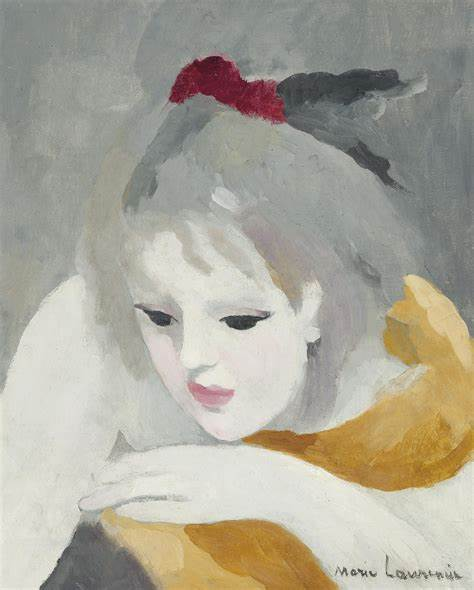
Tête pensive by Marie Laurencin

Marie Laurencin was born in Paris on October 31st, 1883, and lived in an apartment with her mother, Pauline Mélanie Laurencin, a seamstress. Laurencin was an illegitimate child but did not have the courage to question her mother about her absent father.  However, when she was twenty-one-years-old her mother disclosed that her father was the politician Alfred Toulet. Marie Laurencin’s achievements at school were limited although she w an avid reader and enjoyed sketching.  He failings at school precluded her from becoming a teacher, a profession favoured by her mother.   As a teenager, Marie found life difficult and this was presumably due to her classroom failings.  She became introverted and began to paint self-portraits which she carried on doing for most of her life.  After leaving school she studied the art of porcelain painting at the École de Sèvres with the flower painter Madeleine Lemaire.  In 1903 when she was twenty, she enrolled at the Académie Humbert where she worked on drawing, painting and printmaking. 

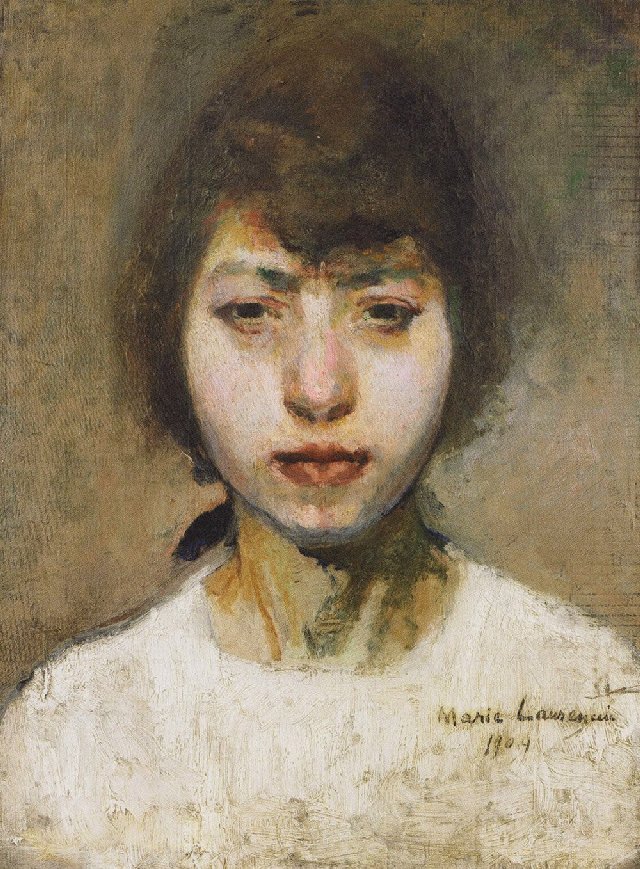
Self-portrait by Marie Laurencin (1904)

She completed one of early self-portraits in 1904 whilst studying at Académie Humbert.  Laurencin depicts herself wearing a white painter’s smock and her hair is tucked behind her face.  She stares out at us with calm confidence and yet serious expression and yet she has a piercing questioning stare. The palette Laurençin has used is dominated by browns, whites and pinks and she has cleverly used colour to model her face, with pinks shaping the sides of the nose and the eyelids and browns and greys indicating shadows around her cheeks.  Her lips, at the centre of the canvas, are red and full.  It was this love of self-portraiture throughout her artistic career that indicated her interest in depicting herself as the subject of her work which ties in closely to her concentration on female independence and self-fashioning. Laurencin always depicted herself as both an independent artist and as a modern woman.  The painting is part of the Musée Marie Laurencin, Nagano collection in Japan.

Portrait de jeune femme by Marie Laurencin

It was at the Académie Humbert that she first encountered fellow French students Georges Braque and Francis Picabia who would become famous artists of the twentieth century.  It was through her friendship with Braque that she soon became part of a group that included Picasso.

Natalie Clifford Barney

It was around this time that Marie first encountered Natalie Barney, an American writer born in Dayton, Ohio and after coming to Paris to live, hosted a literary salon at her Rue Jacob home, in Paris that attracted French and international writers.  Although the guests included some of the most prominent male writers of her time, Natalie Barney attempted to showcase female writers and their work.  For her, the events were celebrations inspired by the archaic Greek poet Sappho’s group on the island of Lesbos.  Many of these soirees were neo-Sapphic get-togethers, at which a crowd mainly comprised of lesbian and bisexual women would mingle and discuss links between female desire and creative production.  It was these events that were to influence Laurencin’s creative production which can be seen throughout her artwork.

Aléoutiennes by Marie Laurencin

Laurencin’s first print-making efforts came in 1904 with her illustrations of Pierre Louÿs’s The Songs of Bilitis, a collection of erotica, which basically was a set of lesbian poems celebrating erotic love between women. It was around this time that Marie Laurençin indicated her own preference for women.  In 1907, twenty-four-year-old Laurencin had her work shown at her exhibition debut at the Salon des Indépendants, which was held at the Gallery Clovis Sagot in Montmartre. Many of the Cubists painters had their artwork displayed at this event and they wanted to claim Laurencin as one of their own.  However, she refused to be compartmentalised with any one genre. 

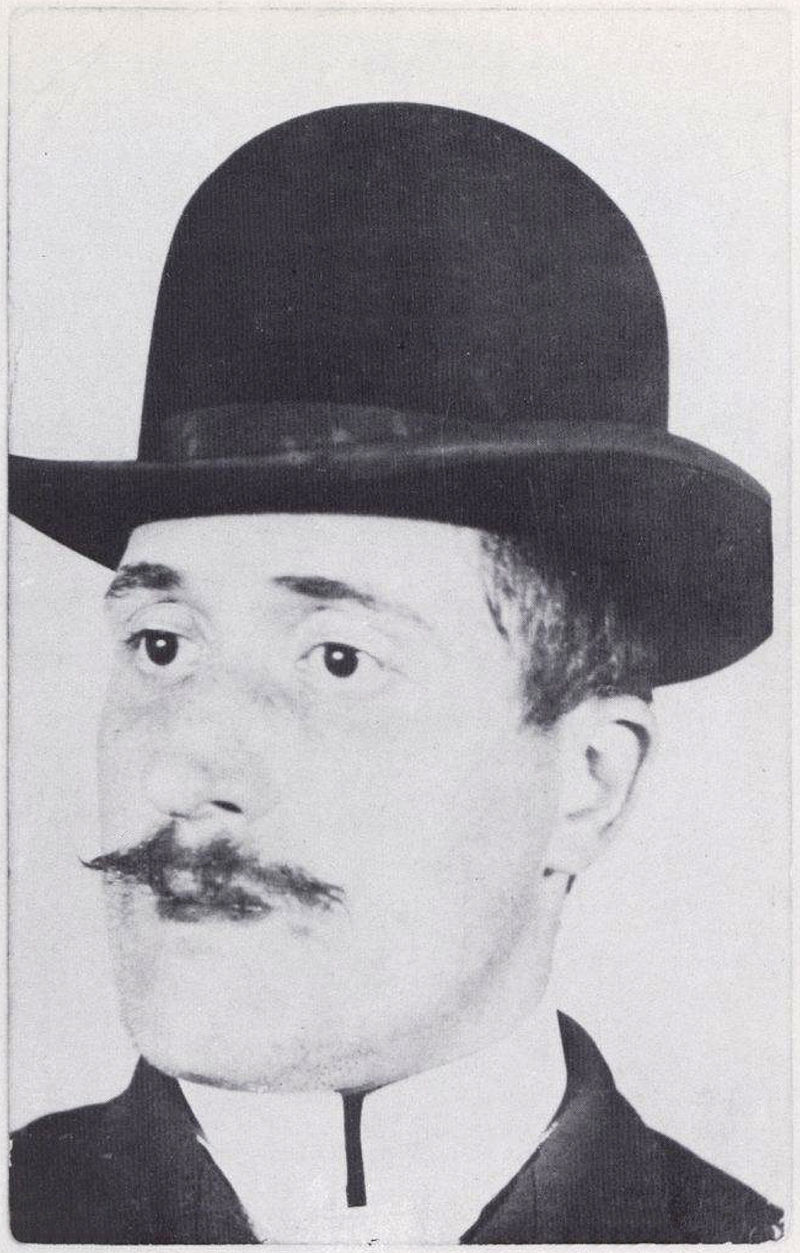
Guillaume Apollinaire,

Whilst attending the exhibition Pablo Picasso introduced her to Guillaume Apollinaire, the French poet, playwright, short story writer, novelist and art critic of Polish descent.  Laurençin and Apollinaire had a relationship that lasted for six years, during which Apollinaire wrote often about his lover and would refer to her as “Our Lady of Cubism” which of course led more people to associate her with the Cubism movement.

The Muse Inspires the Poet by Henri Rousseau (1909)

The relationship between the two lovers was a strange one. Both were illegitimate children of a single mother and whether this had something to do with it but they lived apart throughout their relationship. The pair never married, and it is thought that this was to the disapproval of their mothers and also they both believed in the modern lifestyle which reject the bourgeois convention of marriage. The “partnership” was depicted in Henri Rousseau’s 1909 portrait of Laurencin and Apollinaire, in 1909, entitled The Muse Inspires the Poet. The two were great influence on each other and their artistic vision so much so that Apollinaire referred to Laurençin as “a female version of himself” and his literary works inspired her dreamy imagery and the symbolism of her work.

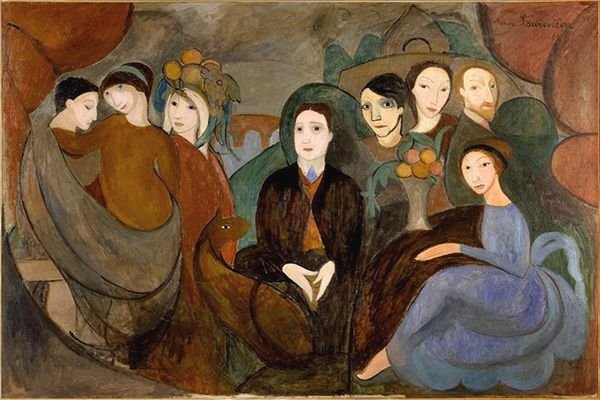
Apollinaire and his Friends by Marie Laurencin (1909)

Laurencin completed an interesting painting in 1909 entitled Apollinaire and his Friends.  The painting depicts a gathering of intellectuals, artists, and bohemians, with their host, Guillaume Apollinaire, the celebrated poet and art critic, in the centre of the painting.  He is surrounded by a group of friends.  Before him sits a dog who is depicted with its head turned in loving admiration of the poet !  On the left of Apollinaire are Gertrude Stein, the novelist and art collector, Fernande Olivier, a French artist and model known primarily for having been the model and first muse of painter Pablo Picasso, and for her written accounts of her relationship with him and an unknown woman with a lavish headdress.  To the right of Apollinaire, behind a vase of flowers, are the poets, Maurice Cremnitz, Marguerite Gillot, and Picasso.  Laurencin is seated on the ground wearing a pale blue dress.  She has turned her body turned toward Apollinaire while she looks out at us.  The colour of her dress and the colour of Apollinaire’s tie are similar and she has probably consciously did this to serve as a pictorially connection between her and him.  Laurencin gave the portrait to Apollinaire as a gift and she sold a smaller version to Gertrude Stein.  Apollinaire had the painting placed above his bed in his apartment on the Boulevard Saint-Germain, and it remained there throughout his life and after his death was preserved by his family. The painting can now be seen in the collection of the Musée Picasso in Paris

Laurencin’s paintings dating from around 1910 have a strong flavour of cubism. However, she once again stated that although the experiments of cubism fascinated her, she was adamant that she would never become a cubist painter because she was not capable of it.

…………to be continued.

Jean-Baptiste Armand Guillaumin

Jean-Baptiste Armand Guillaumin, the French impressionist painter and lithographer, was born on February 16th 1841 in Paris.  He was brought up in a working-class family, the grandson of Jean Joseph Guillaumin who was a notary by trade.  He was sent to school in Moulins, where his family came from, and this period in central France, made him take note of the beautiful surroundings and the mountainous landscape which stimulated his interest in art and it was also in Moulins that he first met Eugéne Murer, a pastry chef, author, self-taught painter and collector of impressionist paintings, who became his life-long friend.

Farms in Janville by Armand Guillaumin (1878)

By 1857, at the age of sixteen, Guillaumin returned to Paris and began working as a clerk in his uncle’s lingerie shop awhile also studying art under the sculptor Louis Caillouet.  His interest in art and the time he spent studying it caused friction with his family and he left to hold a position in the French government railways. He then continued his art training at the Académie Suisse where he trained to draw from the models, in the mornings and evenings.  It was here that he first met with Courbet, and began more lasting friendships with painters such as Cézanne, Pissarro and Francisco Oller, a Puerto Rican Impressionist painter.

Garden in Janville in June by Armand Guillaumin (1886)

Now friendly with the artists associated with the Anonymous Society of Painters, Sculptors, Engravers, (later dubbed The Impressionists) he was able to exhibit with them at the first Salon des Refusés in 1863 and their first joint Impressionist Exhibitions in 1874 at the former studio of the photographer Nadar (at 35 Boulevard des Capucines) in Paris, and in total he submitted work to six of their eight annual exhibitions.  Still young, the art critics of the time judged him to be an accomplished draughtsman who completed amazing mature compositions.  He developed connections with Emile Zola and his circle of friends and was greatly influenced by the artwork of Manet and Courbet.

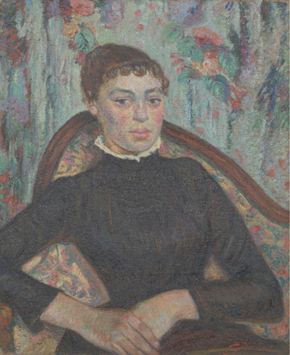
Portrait of a Young Woman by Armand Guillaumin (1876)

One of the problems Guillaumin soon encountered was financial as he had no private income to turn to and so he had to continue holding down a job to survive.  This situation was further exacerbated with the advent of the Franco-Prussian War in 1870.  Once the War and the Paris Commune fighting had ended there was some hope for Guillaumin who had managed to have himself included with the popular Impressionist movement.  Guillaumin and fellow Impressionist, Cézanne had met up with Dr Paul-Ferdinand Gachet, a French physician most famous for treating the painter Vincent van Gogh during his last weeks in Auvers-sur-Oise, and he bought a number of their works.  Guillaumin also sold a number of his works to his friend, Eugéne Murer who had recently established a successful café in Paris. Guillaumin and Cézanne began sharing a studio but both found themselves in precarious financial positions despite the sales of their work to Gachet and Murer who continued to be close friends of the pair.

Cottages in a Landscape by Armand Guillaumin (1896)

At the start of the 1880s the Impressionist group was beginning to break apart and it split into two camps.  One headed by Pissarro and the other by Degas.  Gaugin had vociferously supported Pissarro and he had allied himself with Guillaumin.  Although not initially supportive of the Impressionist group having misgivings about what its intentions were, Renoir and Monet joined the Impressionist Exhibition of 1882 with Guillaumin, Gauguin and Pissarro as well as Sisley, Morisot, Vignon and Caillebotte.  However, Degas was noticeably absent.

Moulins en Hollandee by Armand Guillaumin (1904)

It was somewhat surprising that Paul Gaugin, known for his irrational behaviour towards his fellow painters, continued to befriend Guillaumin and keep him in the Impressionist group despite its continued disintegration.  It was through Gaugin, that Guillaumin met many new young artists who had arrived on the Paris art scene such as the Symbolist painter, Odile Redon, and the Pointillists, Georges Seurat and Paul Signac. In the mid 1880s Guillaumin’ s studio had become a meeting place for the young group of painters.  By 1885, new styles of painting had come to the fore and this resulted in further rifts between the old guard of Impressionism resulting in the disintegration of the Impressionist Group. The other factor for the break-up of the Group was its leading man, Gaugin, became more and more temperamental and intolerant and was destroying the Movement from the inside.  Guillaumin decided it was time for him to exit the movement which he had been part of from the very start.  Guillaumin’s reputation had grown over the last decade and Paul Adam wrote in La Revue Contemporaine:

“…I was not aware of any other painter who has so correctly noted the corresponding values of the lights of the firmament and of the ground…. their unification in colour appears to be perfect…”

Again, Felix Feneon, the French art critic, gallery director, and writer reiterated this, writing about the same show Immense Skies and commented on Guillaumin’s work:

“… superheated skies where clouds jostle each other in a battle of greens and purples, of mauves and of yellows…”

Vue de Port by Armand Guillaumin (1880)

t was in 1886 that Guillaumin married.  His wife was his cousin Marie-Joséphine Charreton, a schoolteacher, who was able to support him financially.  They settled down at 13 quai d’Anjou in the Saint-Sulpice area of the 6th arrondissement of Paris. It had previously been the studio of the painter Charles-François Daubigny. Guillaumin’s relationship with Pissarro eventually ended with the latter beginning to concentrate on experimentation with pointillism while Guillaumin became progressively interested in romantic art. Guillaumin’s relationship with Gaugin also in due course ended as the latter being constantly away on his travels.

Agay Bay by Armand Guillaumin (1910)

From 1875 to 1880, Guillaumin was a frequent guest of Dr Gachet at Auvers, at a time when he was travelling in that area searching for views of the rural scenery of the Yonne valley to paint and, later, the Creuse valley and the countryside around the farming village of Crozant, where he spent most of his life. Around 1887 Guillaumin became a good friend and mentor to Vincent Van Gogh, who was twelve years his junior. Vincent’s letter to fellow painter Ermil Bernard in December 1887 shows how highly he thought of Guillaumin:

“… I believe that, as a man, Guillaumin has sounder ideas than the others [the Impressionists], and that if we were all like him we’d produce more good things and would have less time and inclination to be at each other’s throats.

Again in a letter to his brother Theo in June 1888, Van Gogh writes about a visit he made to Guillaumin’s house and how he was inspired by him:

“…Wasn’t it pleasant at Guillaumin’s last winter — finding the landing and even the stairs, not to mention the studio — chock-full of canvases? You understand since then that I have a certain ambition, not about the number of canvases, but that these canvases as a whole should, after all, represent a real labour on your part as well as mine…”

Neige by Armand Guillaumin (1876)

In the last decade of the nineteenth century Guillaumin’s circle of artist friends was dwindling.  Vincent van Gogh died in July 1890 and his brother Theo, the art dealer, died in the January of the following year.  Gaugin and Cézanne had left Paris and Guillaumin and Pissarro’s views on art had diverged so much that their friendship had gradually faded.  Despite all this Guillaumin’s life was to change rapidly when won he won the sum of 100,000 francs (about 400,000 euros in today’s money) in a state lottery.  This completely changed his life.  He no longer had to rely on commissions.  He no longer had to exude a subservience towards patrons.  He was now able to paint what he liked and strive for his own artistic goals.

Caves Prunal near Pontgibaud by Armand Guillaumin

With this newly found wealth Guillaumin set off travelling around France capturing on his canvases the beautiful views of the countryside, mountains and the coast, often during sunrise and sunset.  His continuous journeying around was brought to an end with the onset of The Great War of 1914.  Once the war came to an end he once again set off on his travels but by then he was seventy-seven and he, like his artistic output, was declining.   In 1926 a retrospective exhibition was held at the Salon d’Automne.  He died at the Chateau de Grignon in Orly, Val-de-Marne, just south of Paris, on June 26th 1927 aged 86. He was the last survivor of the Impressionist Group.

Crozant, Solitude by Armand Guillaumin (1915)

Guillaumin’s paintings are renowned  for their intense colours and can be found in major museums around the world. Most of all he is best remembered for his landscapes of Paris, the Creuse département, and the area around Les Adrets-de-l’Estérel near the Mediterranean coast in the Provence-Alpes-Côte d’Azur region of France. Guillaumin became known as the leader of the École de Crozant, a disparate group of painters who came to portray the landscape in the region of the Creuse around the village of Crozant.

Paysage à Crozant (1917)

One such depiction is entitled Landscape in Crozant, is part of the Art Institute of Chicago collection.

His bust is in the square near the village church in Crozant.

Amélie Beaury-Saurel and Rodolphe Julian.

Amélie Beaury-Saurel

Amélie Beaury a French painter, was actually born in Barcelona on December 17th 1848.  Her family had previously lived in Spain and Corsica before moving to the Catalan city in 1845.  Her parents, Camille Georges Beaury and Irma Catalina Saurel owned a large carpet and tapestry factory with more than twenty looms, which they called Saurell, Beaury y Compañía. Amélie was their middle child.  She had an elder sister, Irmeta, also an artist, and a younger sibling, Dolores. Amélie later added “Saurel” to her name in recognition of her mother’s family who could trace their lineage to the Byzantine emperors of the 11th century.

Portrait of the artist Jean-Paul Laurens by Amélie Beaury-Saurel (1919)

The happy family life was shattered in the late 1850s when Amélie’s father died and her mother decided to relocate with her three daughters to Paris.  Amélie recalled in an interview that she and her family lived in the French capital when she was ten years old and that her widowed mother, with little money, had to endure financial hardships.   Her mother instilled a love of art in her children and she would take them to the Louvre Museum to see the works of the Masters and encourage them to copy the works of the these great artists.

Portrait of Léonce Bénédite, curator of the Musée du Luxembourg,  by Amélie Beaury Saurel (1923)

Due to this family impoverishment, Amélie’s mother decided that her daughters should help with the financial burden and set about having them train as porcelain painting, a socially acceptable way of earning a living and eventually becoming financially independent. Amélie set to work as a painter of porcelainware but later said she considered what she was doing as commercial painting which in many ways damped down her creativity.  Her mother was very supportive of Amélie’s love of painting and, in 1874, initially paid for her nineteen-year-old daughter to study at the prestigious Académie Julian.  One of her first tutors was Pauline Coeffier, a French oil painter and pastelist, who specialized in the art of portraiture. Later many of the leading artists of the day would advise and tutor her, such as Tony Robert-Fleury, William Bouguereau, Jules Lefebvre, Benjamin-Constant, Jean-Paul Laurens and Pierre Auguste Cot.

Rodolphe Julian

The Académie Julian was founded in 1868 by Rodolphe Julian. It was a private art school for painting and sculpture.  Paris was looked upon as the capital of the art world, and the centre of modern art.  This was one reason many young aspiring painters came to the French capital to discover all the latest trends in painting, like Impressionism and Post Impressionism, decorative art of various types, new forms of representational art such as expressionism, lithography and much more. Also with having a reputation as a forward-thinking art college the Académie Julian profited from the reputation of Paris.

Chez Duval by Rodolphe Julian

Another reason for the popularity of Académie Julian was that it was the only art school in Paris to accept foreign students, many of whom struggled to pass the difficult French language exam, which was conditional on their acceptance into the Ecole des Beaux-Arts. Ambitious female painters were also barred from attending the official Ecole des Beaux-Arts until 1897 and even then, it was not considered suitable for women to study life drawing.  In contrast, Académie Julian was happy to offer them a full programme of education and training to women in fine art. They were offered the same classes as men, including the drawing of nude models. In fact, the Académie was one of the few schools to admit women to life-drawing classes. In fact, one of its four new branches was actually exclusively designed for female art students.

The Académie Julian was also regarded as a stepping stone to the prestigious École des Beaux-Arts by getting them prepared for the entrance exams and at the same time offered independent alternative education and training in arts.  Aspiring artists, both men and women, were welcome at the Académie Julian.   Men and women were trained separately, and women participated in the same studies as men, including drawing and painting of nude models.  The Académie Julian had no entrance requirements, was open from 8 a.m. until nightfall, and very soon became the most popular establishment of its type. Rodolphe Julian opened several branches throughout Paris, one of them especially for female artists, and by the 1880s the student population at these establishments reached six hundred.

Female Students at the Académie Julian in Paris, c. 1885

To ensure the success of the Académie, Rodolphe gathered together well-known and esteemed artists, such as Adolphe William Bouguereau, Jean-Paul Laurens, Tony Robert-Fleury, Jules Lefebvre and other foremost painters of that time trained in Academic art, to become tutors or visiting professors.  Académie Julian became recognised as a leading art establishment and its students were allowed to compete for the Prix de Rome, a prize awarded to promising young artists, and also show their work in the major Salons or art exhibitions.

So, who was Rudolphe Julian?

Rodolphe Julian was born in Lapalud, a commune in the Vaucluse department in the Provence-Alpes-Côte d’Azur region in southeastern France on June 13th 1839. He worked as an employee in a bookstore in Marseille but later moved to Paris, where he became a student of Léon Cogniet and Alexandre Cabanel, professor at the École des Beaux-Arts, albeit he never officially enrolled there.  Rodolphe was well aware of the struggles of artists who looked for artistic training once they had arrived in Paris and so, in 1863 he opened his own art school, Académie Julian.

Portrait of a Woman by Amélie Beaury-Saurel

Living in Paris, Amélie was determined to increase her knowledge of art and the Académie Julian offered her the best way of achieving that goal and eventually becoming a professional portrait artist.  However this course of action had to be funded so she approached Rodolphe Julian and proposed that in return to her helping out with the administrative and financial duties of the Académie, he would allow her to attend his classes free of charge.  He agreed. Rodolphe Julian had opened a women’s workshop in 1873 and in 1895 he put Amélie in charge of it.  As well as organising the workshop she had begun a very lucrative career as a portrait artist and received many commissions.

Académie by Amélie Beaury-Saurel (1890)

In 1890, Amelie completed one of her greatest paintings entitled Académie.  The title for the work refers to the art academy which at the time prohibited female painters from joining its ranks.  Her depiction conveys the compelling message to the viewer that she was not going to allow herself to be browbeaten by the male-dominated artistic establishment and she would not conform to their dictates.  The model in the painting exudes strength and determination as she stands grasping stalks of bamboo and stares out at us, challenging us.  It can be no coincidence that Amélie has depicted her model naked and this nude pose empathises the strong and defiant attitude women embraced as artists.

Deux vaincues (Two Defeated Women) by Amélie Beaury-Saurel (1892)

Two years later in 1892 Amelie produced another defiant depiction entitled Deux vaincues (Two Defeated Women).  It is looked upon as a rallying call to all female painters to be fearless as they travel through the unwelcoming and unforgiving world of art education and artistic professionalism and the many obstacles they had to overcome.  It was a plea to female artists to not allow themselves to be defeated in the face of the obstacles they would encounter.  The sketch depicts two women, both naked, chained to a wall.  Both face similar hardships but they have fared differently.  The one with her back to us is slumped forward in a defeated pose, while the other, in contrast, stands boldly upright, unrepentant and stares out defiantly.  The painting is a challenge to all women as to whether they give in or fight on. The work was exhibited at that year’s Salon.

 Portrait de Séverine by Amélie Beaury-Saurel (1893)

In 1893 Amelie completed a portrait of Caroline Rémy de Guebhard. She was a French journalist who held strong non-conformist views which labelled her as an anarchist, socialist, and communist.   She also was a great believer in feminist’s rights and opinions and this no doubt drew Amelie to paint the portrait.   Caroline Rémy de Guebhard would use the pen name Séverine, derived from the Latin severus which means “rigorous” or “brave”, for many of her newspaper articles.  When we look at the portrait, our eyes are immediately drawn to the vivid red flower on the sash of her dress.  The flower symbolizes Séverine’s leftist political views.  Look at her facial expression.  It is one that exudes strength, determination and tells you that this lady will not be moved.  Amelie’s ability as a great portraitist is borne out in this beautiful work.

Séverine by Renoir (c.1885)

A portrait of Caroline Rémy de Guebhard was also complted around 1885 by Renoir. It is in the permanent collection of the National Gallery of Washington.

Dans le bleu by Amélie Beaury-Saurel (1894)

One of my favourite works by Amelie is her 1894 painting entitled Dans le bleu.  It is a pastel on canvas which depicts a young woman waking up in the morning and indulging in the gratification of smoking that first cigarette.  However that is not the point of the depiction.  It is all about feminist assertions. In this painting, we see a woman depicted in profile, boldly treating herself to the pleasures of escapism. It is a depiction of defiance as women at this time were not seen smoking, especially not in public.  It was a habit that was counter to the feminine conceptions of the time.  We should remember that Amélie Beaury-Saurel had dedicated a large part of her work to the female model and had always maintained the feminist cause.  She supported the right to arts education and artist status for women.  In 1894 when she was working on this painting her reputation in Paris as an artist was at its highest point and her paintings were exhibited all over the French capital.

The background of the work is very dark, predominantly blue and this allows the figure stand out in the work.   It is hard to know whether the scene takes place in a private dwelling such as a kitchen or a living room or whether the setting was in a public place, such as a café.  The woman in the depiction sits smoking a cigarette, chin in hand.  She appears to be daydreaming. She seems preoccupied as she watches the blue smoke unfurl from her lips, drifting upward. What is she thinking about?  Would she, like the smoke, like to drift away?  Some have suggested this might be a Beaury-Saurel self-portrait, as the model resembles the artist.  The depiction is simple and realistic and in no way staged.  Amelie’s depiction is all about everyday reality and is without any hint of idealization which would have weakened the work and it is this simplicity that has added to the beauty of the depiction and has expressed the woman’s femininity.

Our Girl Scouts by Amelie Beaury-Saurel

In this painting by Amelie, the seven women are represented in a compact group, around a table with a pile of books. On the left, holding his handlebars in his hand gloved, the Belgian cycling champion, Hélène Dutrieu; next to her, holding a paintbrush, the publisher Anna-Catherine Strebinger (Madame Henri Rochefort) who was also a student at the Académie Julian; then the collector Marguerite Roussel looks at the viewer; in the center, in professional attire and pointing to an article in a code, the lawyer Suzanne Grinberg, an eminent member of the French Union for the women’s suffrage, created in 1909; leaning on her, in the outfit that she had adopted to travel safely to the Middle East, archaeologist and explorer Jane Magre-Dieulafoy. Then comes the novelist and journalist Lucie Delarue-Mardrus and aviator Elise Deroche, First woman to obtain a pilot’s license.

After Lunch by Amelie Beaury-Saurel (1899)

In 1895, Amélie Beaury-Saurel, married Rodolphe Julian and he put her in charge of the women’s workshops which he had started in 1873.  Amélie managed the expenses for the women’s studio, served as an intermediary between instructors and students, and ran the women’s group but also continued her career as a portraitist. She earned a medal for her submissions to the 1885 Paris Salon and the bronze medal at the 1889 Exposition Universelle. 

Chateau Julian, Lapalud

Rodolphe Julian died on February 2nd 1907, aged 67, and two months later on April 10th, Amelie’s mother died.  Following the death of Julian, Amelie took on the role of director of the Académie Julian.  This was a mammoth task and so she received help from her nephews Gibert and Jacques Dupuis, the children of her sister Dolores.  Rodolphe Julian had bought a large house in the village of Lapalud, where he was born and on his death they were bequeathed to his nephews.  Amelie bought this large property from her nephews and transformed it to accommodate her family. It was called the “Mas” Julian.

Amélie Beaury-Saurel

During her last years, Amélie continued to paint but also fought for women’s rights and supported women artists and their fight against male-dominated art circles.  She participated in solidarity exhibitions for the benefit of institutions such as the Société des Artistes Français, the Société Nationale des Beaux- Arts or the Fraternité des Artistes.  Such commitment to the promotion of art and her endless creative activity were recognized in 1923, a year before her death, through her appointment as Chevalier de la Légiond’honneur.   

Amélie Beaury Saurel died on May 30th 1924 aged 75 at he Paris home which she had once shared with her late mother and sisters.


Information for this blog came from the ususal search engines plus:

Aware Women Artists

Elles-d-artistes blogspot

Musings on Art

Ville de Lapalud

Eva Gonzalès. The French Impressionist.

In today’s blog I am looking at the life and work of the nineteenth century French painter, Eva Gonzales.  Eva Gonzalès is one of the great women artists of the nineteenth century along with Berthe Morisot, Mary Cassatt and Marie Bracquemond.  She was associated with the Impressionist movement despite her not exhibiting any of her paintings at any of the eight Impressionist exhibitions.

Eva Gonzalès

Eva was born in Paris on April 19th 1849 into a middle-class family.  Her father was Emmanuel Gonzalès, who came from a bourgeois family of Spanish Monegasque origin.  He was a novelist and playwright and her mother was Marie-Céline Ragut, who was a musician and daughter of a Lyon industrialist. Eva had a younger sister, Jeanne Constance Philippe Gonzalès.  Both Eva and Jeanne were encouraged to study art.  Eva could not attend the most prestigious art school, Ecole des Beaux-Arts as, at the time, the school did not accept any women who wanted to study art.  However, coming from a wealthy family, it allowed her parents to buy the services of the top teachers  and after she left school in 1866 she began taking lessons at the women’s studio run by the French portrait and landscape painter and printmaker Charles Chaplin, who was connected to the state-funded French Academy. 

Le Thé by Eva Gonzalez (1865)

One of Eva’s early paintings was entitled Le Thé which she completed in 1865.

The Donkey Ride by Eva Gonzalès (1880)

In February 1869, following a long period of classical training Eva took the decision to enter the studio of Edouard Manet and become his pupil and improve and refine her art.  She admired Manet’s work despite all the controversy surrounding some of it.  Manet had a provocative, some would say, scandalous reputation. He was a major player in the avant-garde art scene. He had repeatedly challenged the art establishment, submitting bold and unconventional works such as his 1863 painting, Déjeuner sur l’herbe, depicting a scantily dressed bather, a nude woman sitting at a picnic with two fully clothed men. The Salon jurists rejected the work and so Manet decided to exhibit it at the Salon des Refusés (Salon of the Rejected) which was a parallel exhibition to the official Salon, as an alternative exhibition in the Palais des Champs-Elysée. Manet completed another work that year, a nude painting, entitled Olympia, which was accepted by the Salon jurists in 1865 but the art critics and many of the public viewed the work as being shocking and scandalous when it was first unveiled at the Paris Salon.

Enfant de troupe (Soldier boy) by Eva Gonzales (1870)

Eva had been introduced to Manet in 1869 by Belgian painter Alfred Stevens and subsequently became his only pupil. She exhibited three works at the 1870 Salon, one of which was Enfant de troupe (Soldier boy).

Le Fifre (The fifer) by Edouard Manet (1866)

It was a positive artistic homage to her teacher’s Le Fifre (The fifer), which Manet had completed in 1866. Ironically, the Salon jurists rejected the work.

Portrait of Eva Gonzales by Edouard Manet (1870)

At the same (1870) Salon at which Eva had her painting, Enfant de troupe, exhibited, Manet ‘s portrait of her was also on show. The portrait was thought to have begun in February 1869 and involved numerous sittings, with the completion being around March 1870 and was shown at the Salon the same year. The portrait depicts Eva painting at her easel.  She is shown wearing an immaculate flowing white gown with transparent bodice, low-cut neckline and short sleeves and it brings to mind portraits by Goya who had influenced Manet and this Spanish-like appearance also reminds us of Eva’s Hispanic identity. The dress fills Manet’s masterpiece, with its brightness contrasting against the dark background making it almost an artificial light source. The one question the portrait brings to mind is whether we are looking at Gonzales the painter or Gonzales the artist’s model. If Manet wanted to highlight his pupil as an accomplished artist would she not have been posed in a painter’s smock standing, observing her painting and with brush on the canvas. Instead Gonzales is depicted in what would have been thought, at the time, as an immodest pose. A pose with so much bare skin that would have normally been modelled by a member of the lower-class hired sitter.

Manuscript

On the floor besides her we can see a half-rolled canvas carrying Manet’s signature.  This is a simple reminder to the viewer of his role as Eva’s teacher. .

La Loge by Renoir (1874)

Theatre auditoriums, and in particular the theatre boxes were popular places for the “society” people to mingle and exchange gossip and were popular depictions often chosen by the Impressionists. The most famous of these works is one by Renoir entitled La Loge (The Theatre Box) which was exhibited at the First Impressionist Exhibition in 1874 and now is part of the London Coutauld’s collection.

Une loge aux Italiens by Eva Gonzales (1874)

Eva Gonzales completed a similar work entitled Une loge aux Italiens (A box at the Théâtre des Italiens), which she also completed in 1874.  She submitted this painting to the Salon jurists for inclusion in the 1874 Salon but it was rejected.   Eva Gonzalès then made some changes to the painting and, five years later, once again submitted it for inclusion at the 1879 Salon and this time it was accepted.  The critics loved the work. Gonzales was pleased to tell people that she had been a pupil and a good friend of Manet.  Manet’s influence on Gonzales can be clearly seen in this painting in the choice of a modern subject and the way Gonzales has juxtaposed light with dark, with the pale skin and light-coloured fabrics against a dark background.  Also, note the inclusion by Eva of the bouquet which rests on the edge of the box and its similarity to the bouquet held by the maid in his Olympia depiction.

Sketch by Manet

One also has to remember that Manet made a pastel sketch of a similar depiction which may have influenced Gonzales when she made changes to her original painting. Look at the way Eva has depicted the two people in the painting.  There is a strange disinterest between the two figures.  On the right we have Henri Guérard, Eva’s husband. In 1879 Eva had married Guérard after a three-year courtship.  He was a graphic artist and Manet’s engraver.  The two people who often sat for Eva’s painting were her husband, Henri Guérard and her sister Jeanne, who after Eva died in 1883, at the age of 35, married Guerard and became the step-mother of her sister’s child.

Le Moineau (The Sparrow). by Eva Gonzaès (1870)

One of my favourite paintings by Eva Gonzalès was her early work entitled Le Moineau (The Sparrow).  The teenage model for this painting was the artist’s sister Jeanne.  Jeanne Gonzalès appeared in over twenty of Eva’s works.  It is a portrait of great elegance. It is a depiction of quiet introspection, and it illustrates the intimate connection that existed between Eva and Jeanne. Eva has focused on the graceful features of her favourite model, her younger sister Jeanne who was then in her teens, Eva’s portrait is a study on the interaction between light and shadow. She has focused the direct light on her sister’s bare back, and casts Jeanne’s face in soft shadow, which gives a somewhat air of inscrutability.  Jeanne is dressed in a swathe of transparent chiffon, seems lost in her own thoughts, as she gazes off into the distance.  Meanwhile, balanced on the edge of her hand, is the little sparrow.  It looks enquiringly up at her.  Eva has added touches of bright colour with the ears of corn that embellish her sister’s braided hair.

Morning Awakening by Eva Gonzales (1877)

Another painting by Eva Gonzales featuring her sister Jeanne is her 1877 work entitled Morning Awakening.  Eva Gonzales never completed a self portrait but featured her sister in many of her works.  Maybe she believed there was a familial resemblance.  This is a natural everyday depiction of her sister awakening in the morning.  This painting portrays a young woman, soon after she has awakened. Her facial expression is one of being distant, not quite fully aware of he surroundings. Eva has concentrated her depiction on the skin and black hair of the female which contrasts vividly with the white of the bedding and her bedclothes.  It is thought that Manet had advised Gonzales to depict her sister naked in bed but she refused the erotic suggestion and in all her works which featured Jeanne she was always depicted as a “pure” person.

Portrait of Jeanne Gonzales by Eva Gonzales (c.1872)

It is believed that Jeanne Gonzalès was a mirror-image of her sister, Eva, and in her paintings of her sister, Eva depicted Jeanne the way she wanted to imagine herself.  Around 1872 Eva completed a portrait of her sister, simply entitled Portrait de Jeanne Gonzalès.  It is an excellent and intimate portrayal of her sister.  Jeanne is adorned in a dress made of soft delicate fabric.  Here, Jeanne is pictured wearing an elegant pale pink and black dress, her brunette hair swept into an elaborate style and adorned with a pink ribbon and in her hand she holds an open fan.  The painting was completed soon after Eva Gonzalès had begun studying under Manet, and there are elements of Manet’s style in the depiction such as the soft brushstrokes, plain and simple background devoid of any items or colours which would detract from the sitter.  Jeanne also has the same inscrutable look of contemplation that are reminiscent of Manet’s attention-grabbing female portraits.  However, in this work Eva has implanted into this portrait of her sister a feeling of tenderness which is a telling reflection of the intimate kinship between the two women.

Nanny and Child by Eva Gonzalès (1878)

For my last choice of paintings by Gonzalès I have chosen another work by her which was probably influenced by one Manet’s famous works which he completed in 1873 entitled The Railway. Eva’s painting is entitled Nanny and Child which she completed whilst in Dieppe in 1878. In her work she depicts an interplay between a nanny and a child.  The Nanny looks out at us as she sits on a bench.  To her right her young charge, who has her back to us, is grasping at the lattice work of a fence.

Le Chemin de fer (The Train) by Edouard Manet (1874)

Manet’s painting was the last one featuring Victorine Meurent who was his favourite model and who had modelled for Manet for his infamous works, Olympia and the Déjeuner sur l’herbe. Le Chemin de fer (The Train) was exhibited at the Paris Salon in 1874, and eighty years later donated to the National Gallery of Art in Washington, D.C. in 1956 by Horace Havermeyer, the son of a prominent family from New York, of German origins, that owned significant sugar refining interests in the United States.  In Manet’s painting we once again see a Nanny and a young girl.  They are positioned by an iron fence near the Gare Saint-Lazare in Paris. The daughter of Manet’s neighbour Alphonse Hirsch models the young girl.

The most obvious difference between the two works is space.  Eva Gonzalès has chosen to make her depiction full of open space whereas Manet’s work is somewhat claustrophobic in the way he has depicted the two figures hemmed in between the narrow foreground and the black metal railings.  Gonzalès has gone for an airier open-space depiction of a summer’s day with sunlight streaming through trees in the background.  Eva Gonzalès’ work is not just a copy of her Master’s painting.  It is a well considered and highly original response to the subject, which she has reimagined and turned into a work,  wholly new and unquestionably her own.

In 1879, after a three-year engagement, Eva married Henri Guérard, a graphic artist and Manet’s engraver.   The couple had a son named Jean Raymond who was born in April 1883, shortly before Eva received news of the death of Manet on April 30th 1883. A week after the death of her mentor, on May 6th 1883, Eva Gonzalès died of an embolism at the age of thirty-four.  Her death left her son to be raised by his father and her sister, Jeanne, who later became Guerard’s second wife.