Alice Neel. Part 6. The latter years

 Alice Neel (1900-1984)
Alice Neel
(1900-1984)

Alice Neel had been receiving money for her involvement with the Works Project Administration (WPA).  The WPA was the largest and most ambitious American New Deal agency, employing millions of unemployed people, mostly unskilled men, to carry out public works projects.  The WPA employed musicians, artists, writers, actors and directors in large arts, drama, media, and literacy projects.  At its height in 1936, this federal project, the Federal Art Project employed over 5,300 artists. The Arts Service Division created illustrations and posters for the WPA writers, musicians, and theatres. However, with the onset of World War II, mass unemployment ended as millions of men joined the services and so President Roosevelt decided that there was no longer a need for such a national relief programme and the WPA was closed down at the end of 1942.  Alice was out of work and had then to turn to the state for public assistance which she kept drawing on for the next decade.
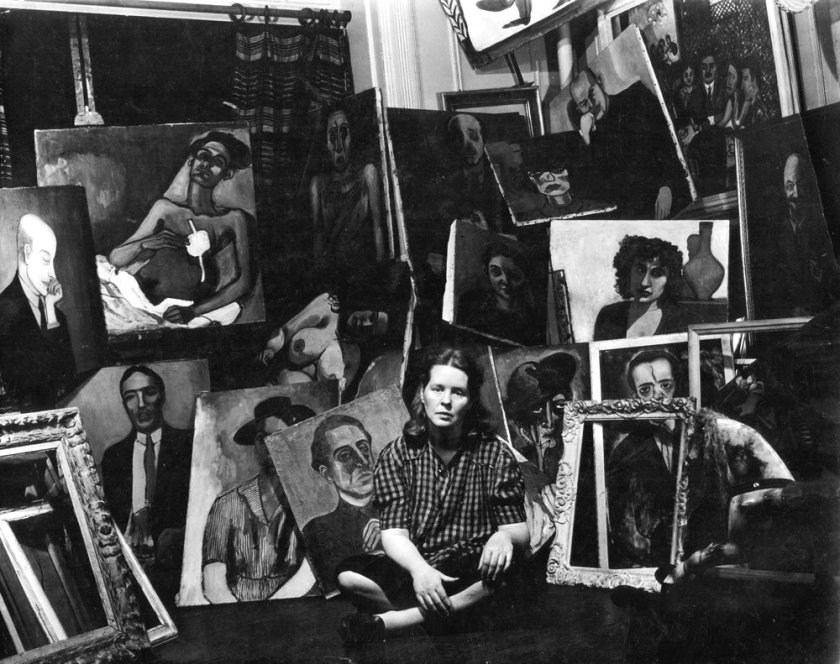
Photograph of Alice Neel sitting before her paintings which was used in the inviation to the exhibition

In March 1944 Alice held a solo exhibition at the New York Pinacotheca Gallery run by Rose Fried.  This was her first solo exhibition since 1938.  There were twenty-four of her works on display. The exhibition received mixed reviews.  An article in the prestigious art magazine, ArtNews, described her work:

“…Neel’s paintings at Pinacotheca have a kind of deliberate hideousness which make them hard to take even for persons who admire her creative independence … Nor does the intentional gaucherie of her figures lend them added expression. However, this is plainly serious, thoughtful work and in the one instance of The Walk, it comes off extremely well…”

As Bob Dylan once said The Times They are a-changin and this was the point in time that Alice Neel found herself.  After the 1944 Alice Neel’s retrospective exhibition at the Pinacotheca, gallery director Rose Fried never showed anything with a figure in it.  According to Neel, Rose had become a pure abstractionist and the works that Alice produced were no longer wanted.  The art world was changing; it had almost completely turned its back on Social Realism which had been the art form that had made Neel’s work so popular in the 1930’s.  So, Alice had to change but as another famous lady politician once said, “this lady is not for turning” and Alice likewise would not change her artistic style to suit others. In an interview with Eleanor Munro for her 1979 book Originals, American Women Artists, Neel is quoted as saying:

“…I never followed any school.  I never imitated any artist.  I never did any of that…”
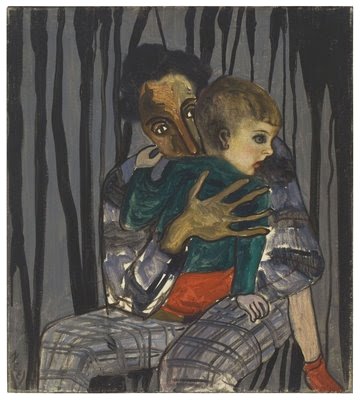
Sam and Hartley By Alice Neel

For Alice Neel, she knew what she wanted to paint and nobody or nothing was going to alter her artistic desires even though New York was now awash with European émigré artists who were leaders in the world of Cubism, Dadaism and Surrealism such as Max Ernst, André Breton, Marcel Duchamp and Salvador Dali, all of who had fled across the Atlantic to avoid the rise of Nazism.  Alfred Barr had founded the MOMA and in October 1942, millionaire, Peggy Guggenheim, who was married to Max Ernst, had arrived in New York from war-torn Europe had opened a new gallery/museum.   It was called The Art of This Century Gallery.  The Art of This Century Gallery was situated at 30 West 57th Street in Manhattan and occupied two commercial spaces on the seventh floor of a building that was part of the midtown arts district which included the Museum of Modern Art, and three of the four galleries were dedicated to Cubist and Abstract art, Surrealism and Kinetic art, with only the fourth, the front room, being a commercial gallery.

During the 1950’s Alice Neel was kept under surveillance by the FBI.  In a memo from their Miami office based on a 1954 letter sent to them by an informant they concluded that Alice Neel was:

“…a muddled romantic, Bohemian type Communist idealist who will carry out loyally the Communist sympathiser type of assignment, including illegal work if ordered to do so…”

Their file on her and her activities remained open until the early 1960’s.
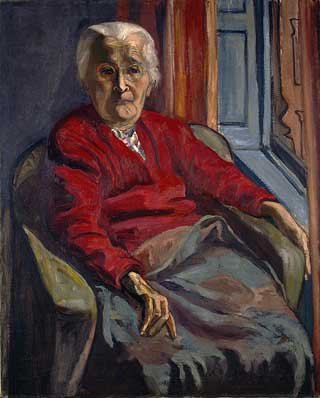
My Mother by Alice Neel (1952)

In March 1953, Alice’s mother comes to live with her in her Spanish Harlem apartment.  Sadly a year later Alice snr. aged 86, died from complications brought on by a broken hip.  For Alice, this was yet another traumatic moment in her life  She had always had to battle with depression and the death of her mother triggered the onset of the debilitating malaise for the next few years.  Physically she put on weight and sought the comfort of alcohol.

Alice often complained that she could not get any gallery space for her works of art.  She painted prolifically but still wanted to exhibit them.  The problem was that her genre of art had lost its appeal with the public.  She was going through a difficult period with mental health issues and was attending therapy sessions with a psychologist, Dr Anthony Sterrett.  He spent time with her trying to make her become more self-confident and self-assertive and it was he who persuaded Alice to contact Frank O’Hara to see if he would sit for her.  O’Hara was an American writer poet and art critic who was working as a reviewer for the prestigious art magazine, Artnews, and who, in 1960 was Assistant Curator of Painting and Sculpture Exhibitions for the Museum of Modern Art.  This position at the MOMA made him a prominent figure in New York City’s art world. He was looked upon as a leading figure in the New York School, which was an informal group of artists, writers and musicians who drew inspiration from jazz, surrealism, abstract expressionism, action painting and contemporary avant-garde art movements.

Frank O'Hara by Alice Neel (1960)
Frank O’Hara by Alice Neel (1960)

Alice completed two portraits of O’Hara in 1960 and they were looked upon as her breakthrough works.  In the painting, Frank O’Hara, Alice has beautifully and faithfully captured his distinguishing and unique profile.  The side view is hawk-like which is softened slightly by the bunch of lilac behind his head.
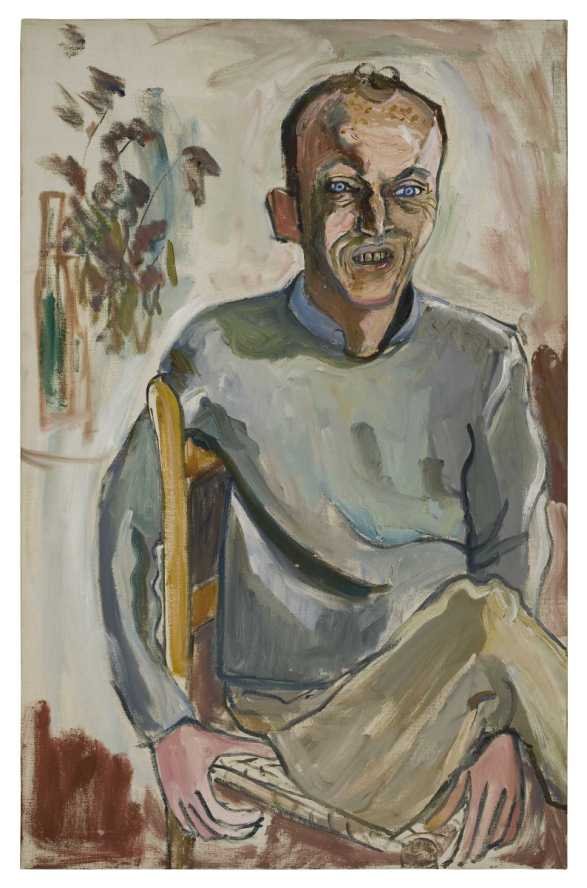
Frank O'Hara No.2 by Alice Neel (1960)
Frank O’Hara No.2 by Alice Neel (1960)

In stark contrast, the second portrait, Frank O’Hara No.2 is a more shocking depiction of the man.  Our eyes are immediately drawn to his bad teeth, which looked like tombstones, his sharp nose and somewhat wild eyes.  To be brutally honest, at first, he comes over as being ugly, even, dare I say, repulsive, but there is a vulnerability about Neel’s depiction of him.

Six years later, in the early morning hours of July 24, 1966, O’Hara was struck by a jeep on the Fire Island beach, after the beach taxi in which he had been riding with a group of friends broke down in the dark.  He died the following day.
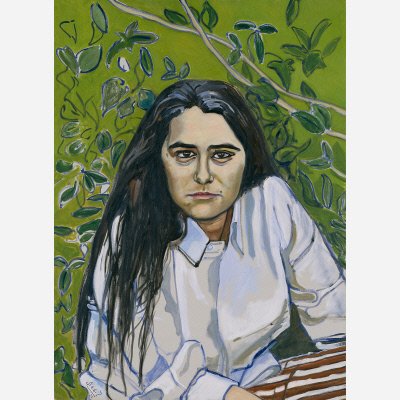
Kate Millett by Alice Neel (1970)

In America, the 60’s was dominated by the Civil Rights movement and the Vietnam War with its protests which swept the country.  It was also a time when the second wave of the modern feminist movement emerged.  It was a time when there was the growing cry for equal opportunity for women and it soon became one which could not be ignored.   Enter Katherine Murray “Kate” Millett, best known as Kate Millett.  She was an American feminist writer, educator, artist, and activist. She attended Oxford University and was the first American woman to be awarded a postgraduate degree with first-class honours by St. Hilda’s.  She is probably best known for her ground-breaking 1970 book Sexual Politics, which was her doctoral dissertation at Columbia University.
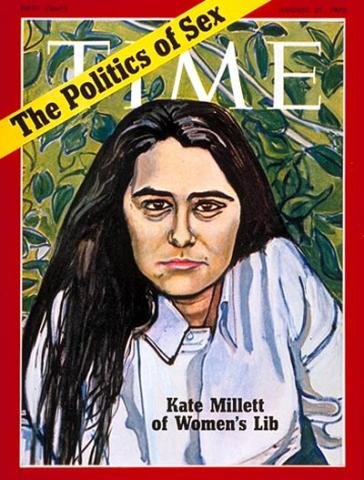
Time magazine cover
Time magazine cover

This book became a bible for feminism and feminist protest was such a hot topic that in August 1970, Time magazine decided that Kate would be the face of the feminist movement and therefore should appear on the cover of their magazine.  Millet was unimpressed by the way she was heralded as the embodiment of the movement and refused to pose for a painting by Alice Neel which would be used for the cover.  She believed that no one person could presume to represent the objectives of the feminist movement.  Time magazine was not to be put off by her refusal and instead asked Neel to complete the portrait, using a photograph.  After the publication of the magazine Alice Neel and her art was always linked with the feminist movement but as Alice once quipped, she had been a feminist before there was feminism!
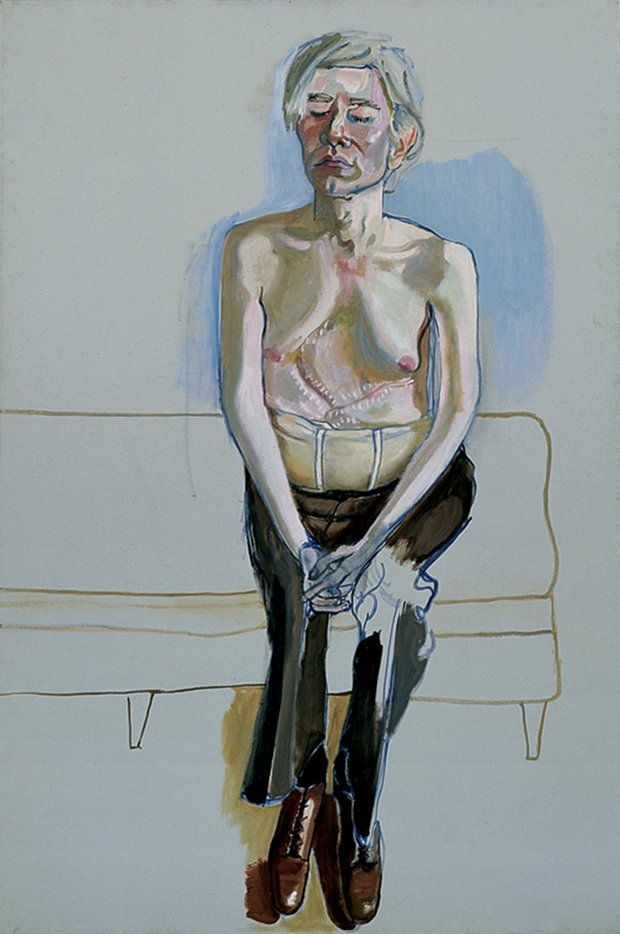
Andy Warhol by Alice Neel (1970)

The year 1970 was also the year that Alice Neel painted one of her most famous works, a depiction of Andy Warhol.  The painting can be found at the Whitney Museum of American Art, New York and rather than me trying to describe the painting I have reproduced the words of the museum’s audio-guide which was put together by Trevor Fairbrother, an independent curator and writer:

“…It’s an interesting year for both of these artists. Alice Neel was seventy years old when she painted it, and in a sense, was just hitting her stride as an important American realist. She’d had an incredible career since the thirties, but she hadn’t really had much recognition until the wave of feminist interest in the arts in the sixties. And suddenly she was a forebear for a whole new generation of feminist artists and writers.  The late sixties were much harder on Warhol. He’d been shot two years before Neel painted this portrait—an attempted assassination by a member of his artistic circle. In posing shirtless for Neel, he exposes the corset that he was required to wear for the rest of his life. He also bares his aging body, his chest sagging so that he almost appears to have breasts.  She shows him—I think it’s this kind of essence of loneliness and vulnerability, but at the same time I think she knows that he knows that everybody is looking at him. He was very much invested in famous artists. He wanted to be a kind of brand-name Pop artist, and he certainly is that now, long after his death. He, Warhol, in a sense is rising to her challenge to sit for her, to be painted and to take his clothes off. And so, in a sense, he’s doing a brave thing, but he’s also―he’s getting through it by shutting his eyes and being very focused internally.  I think part of the soulfulness of this picture is the fact that it might seem unfinished. I wouldn’t say it’s unfinished. I think she decided she had what she needed, and she stopped where she was ready to stop. The picture doesn’t need more…” 

Fame came to Alice Neel late in life and she believed she had the right to bask in the glory.  Her son Hartley recounted his mother’s feelings about this sudden fame:

“…She felt it was something she deserved.  She basked in it.  She really enjoyed it.  When we were young, she struggled, waiting around for some critic to review her work, up or down.  All of the sudden they were saying good things about her.  Her paintings were on the walls, and people were buying her work.  It was all different.  She wasn’t bitter.  She had a very upbeat attitude toward the whole thing…”

Self-portrait by Alice Neel (1980)

On October 14th 1980 at the Harald Reed Gallery on East 78th Street in New York a benefit dinner for the Third Street Music School Settlement was being held at which was the debut of an art exhibition entitled Selected 20th Century American Self Portraits, one of which was Alice Neel’s nude self-portrait which she had begun five years earlier.

She looks out at us completely oblivious or unconcerned about what we are thinking about why an eighty-year-old woman would want to depict herself naked.  Does she feel vulnerable?  There is no sign of that in her facial expression, in fact Neel’s steely gaze rivets us.  She exudes an air of self-confidence, despite her less than picture-perfect body.  We see her sitting regally in an upholstered chair with its hard vertical-striped arms which tend to accentuate her yielding and bounteous rolls of flesh.   It is a “warts and all” portrait.   She does not hide the visible signs of aging.  Instead she has decided to reveal herself with characteristic truthfulness and somewhat defencelessness. Yet there is also a sense of pride in this depiction.  In her right hand she holds a paintbrush whilst her left hand grasps a rag and, as we see no easel or canvas in the depiction, the two serve as artistic elements. The only personal accessory depicted is the presence of her eyeglasses which may have been added by her to remind us of her frailty and that she has passed her prime.

The painting was of course controversial and caused a stir but it also was testament that it was an audacious work by an artist who at the time was at the top of her form.  The other unusual aspect of this work was that beside a few pencil-sketched self-portraits, it was her first self-portrait painting.  The painting now resides at the National Portrait Gallery, Washington.
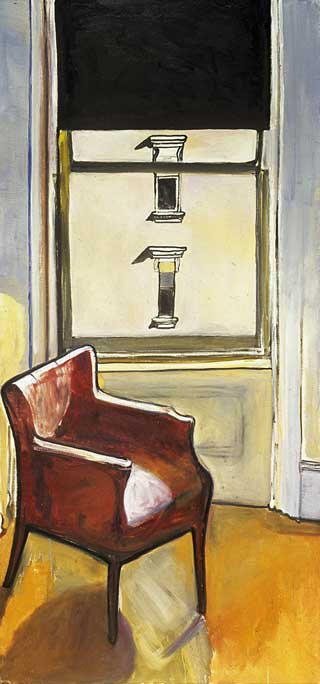
Loneliness by Alice Neel (1970)

In 1970 Alice completed a work entitled Loneliness, which she ironically referred to as a “self-portrait”.  It was about this time that her younger son Hartley had married Ginny and moved to Massachusetts.
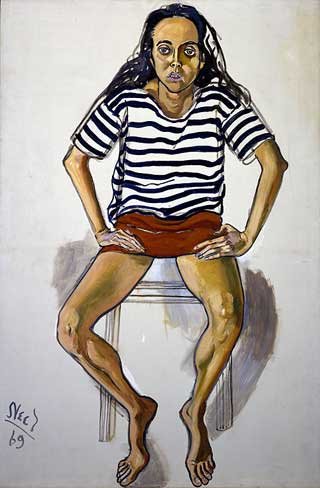
Ginny in a Striped Shirt by Alice Neel (1969)

Throughout her life Alice continued with her portraits of her family.  Her future daughter-in-law, Hartley’s wife, Ginny featured in her 1969 work, Ginny in a Striped Shirt.  Ginny was a feminist who looked upon Alice as a role model and they became good friends even before she became involved with Hartley.

Pregnant Woman by Alice Neel (1971)

Her other daughter-in-law, Nancy, Richard’s wife and Alice’s assistant during the last two decades of her life, was depicted in Alice’s 1971 painting, Pregnant Woman.  In the work, we see an image of her husband looming in the background.

In 1980 Alice Neel’s physical health takes a turn for the worse and after a series of tests it is decided that she had to be fitted with a pacemaker to regulate her heart rate. Four years later in 1984, during a routine visit to the Massachusetts General Hospital to have her pacemaker checked, X-rays indicate that she has advanced colon cancer which has already spread to her liver. She immediately undergoes surgery and afterwards returns to Vermont to stay with Hartley, Ginny and their children while she recuperates.

From the Spring to the Summer of 1984 she returns to New York and Spring Lake. With the help of her son and his wife, Richard and Nancy, and despite her rapidly deteriorating health, she continues with her busy schedule including an appearance on the Johnny Carson Show

Among her many commitments, interviews for the ArtNews article continue, and, on June 19th, she makes a second appearance on ‘The Tonight Show’ during which she insists that Johnny Carson visit her in New York to sit for a portrait. In July, she had to receive chemotherapy which further weakened her.  Despite her weakened condition, she continues to paint.

Alice Neel died in her Upper West Side Manhattan apartment on October 13th 1984 surrounded by her family and was buried in a private burial ceremony at a cemetery near her studio in Vermont.  On February 7th 1985, a memorial service for her is held at the Whitney Museum of American Art.

My look at the life and works of Alice Neel has been a long journey stretching over six blogs and yet I know I have missed so much out about her life and because she was a prolific artist I know I have only scratched at the surface with regards her works of art.  I have been careful not to be judgemental with regards her lifestyle which probably added to her problems but she had a difficult and often sad life which often was beyond her endurance.  She however always wanted to do her own thing and I leave you with one of her quotes:

“…”I had a very hard life, and I paid the price for it, but I did as I wanted,” Miss Neel said then. ”I’m a high-powered person…”  

– – – – – – – – – – – – – – – – – – – – – – – – – – – – – –

I have used numerous internet sources to put together this and the other blogs on the life and art of Alice Neel and I am currently reading a fascinating book about the artist by Phoebe Hoban entitled Alice Neel: The Art of Not Sitting Pretty. It is a very interesting read and one I can highly recommend.

Alice Neel’s art is being shown at several exhibitions in America but there are also a series of exhibitions of her work travelling around Europe at the current time including one I am due to visit next month:

Gemeentemuseum, Den Haag, Holland

(November 5th, 2016 – February 12th 2017)

Alice Neel. Part 3 – The men in her life – Kenneth Doolittle, John Rothschild and Joe Gould

Alice Neel
Alice Neel

Alice Neel was finally released from hospital in September 1931, almost thirteen months after her initial breakdown.  Once discharged from hospital she reacquainted herself with her friend Nadia Olyanova and her Norwegian Merchant Marine husband, Egil Hoye, who were now living in Stockton New Jersey.  It was during one of her visits to her friends that September, that she meets a friend of theirs, another Merchant Marine, Kenneth Doolittle. Doolittle had joined the merchant marines at the age of sixteen and it was during his first voyage that a fellow seaman introduced him to the world of communism.   Early the following year Alice and Doolittle moved in together and lived in an apartment on Cornelia Street in Greenwich Village, which was looked upon, at the time,  as the centre of bohemian life, an area which was full of bohemian cafés and bars, a place where eccentricity was the norm.  Alice was aware of Doolittle’s character flaws, one of which was that he was a drug addict and also a very jealous man, especially with regards to her relationships with other men.  Cindy Nemser, an American art historian, writer, as well as being the founder and editor of the Feminist Art Journal.  She was an activist and prominent figure in the feminist art movement who was best known for her writings on the work of women artists.  She wrote an article in the magazine Art Talks regarding Alice Neel and Kenneth Doolittle in which she quotes Alice’s thoughts on her lover:

“…I lived with a sailor. A rather interesting chap who played the guitar and sang and was rather nice except that he liked dope.  He had a coffee can full of opium.  I didn’t dare smoke opium since I had just had this nervous breakdown, but they smoked opium at my apartment…”

In Patricia Hills 1983 book, Alice Neel, the author wrote that Alice’s mother was far from being impressed with Doolittle and wanted to separate the two lovebirds.  Alice’s mother was quoted as saying:

“…Why don’t you go stay with your sister in Teaneck, instead of out there with that dirty old sailor…”

However, the relationship continued despite the maternal warning.

Well Baby Clinic by Alice Neel (1928)

In May 1932, Alice took part in the first Washington Square Outdoor Art Exhibit.  The Washington Square Outdoor Art Exhibit was, and still is, a biannual outdoor art festival which originated in 1931 by Jackson Pollock.  Pollock, who had fallen on hard times financially, would leave his Greenwich Village studio and set up his paintings on the sidewalk in hope that it may boost sales. Now these outdoor exhibits held by local artists help them sell their paintings and also help them gain recognition for their talents.  It was at this exhibition that Alice presented her 1928 work, Well Baby Clinic.  In the painting we see a nurse clothed in white and holding a baby. The pristine whiteness of her uniform contrasts with the dirty off-white colour of the nursery walls.  The nurse stands in the centre of the hospital ward and is surrounded by mothers feeding and cosseting their children whilst other babies can be seen lying unattended on white beds. In some ways this simplistic painting is quite disturbing, and probably offered the jaundiced view of childbirth held by the artist.  Alice Neel completed the work just a fortnight after the birth of her second child, Isabetta.

Degenerate Madonna, 1930, by Alice Neel

Neel also exhibited a very controversial painting at the exhibition entitled Degenerate Madonna but after many vociferous protestations from the Catholic Church she was asked to remove the work.  This was her take on the Madonna and Child genre

It was at this exhibition that she met a man who would be ever present throughout her life as her best friend and loyal supporter.  He was John Rothschild.  He had walked up to her during the exhibition and praised her work and later invited her and Doolittle to join him for drinks at his place.  John was a Harvard graduate who came from a wealthy background. His family owned the travel firm, Open Road.

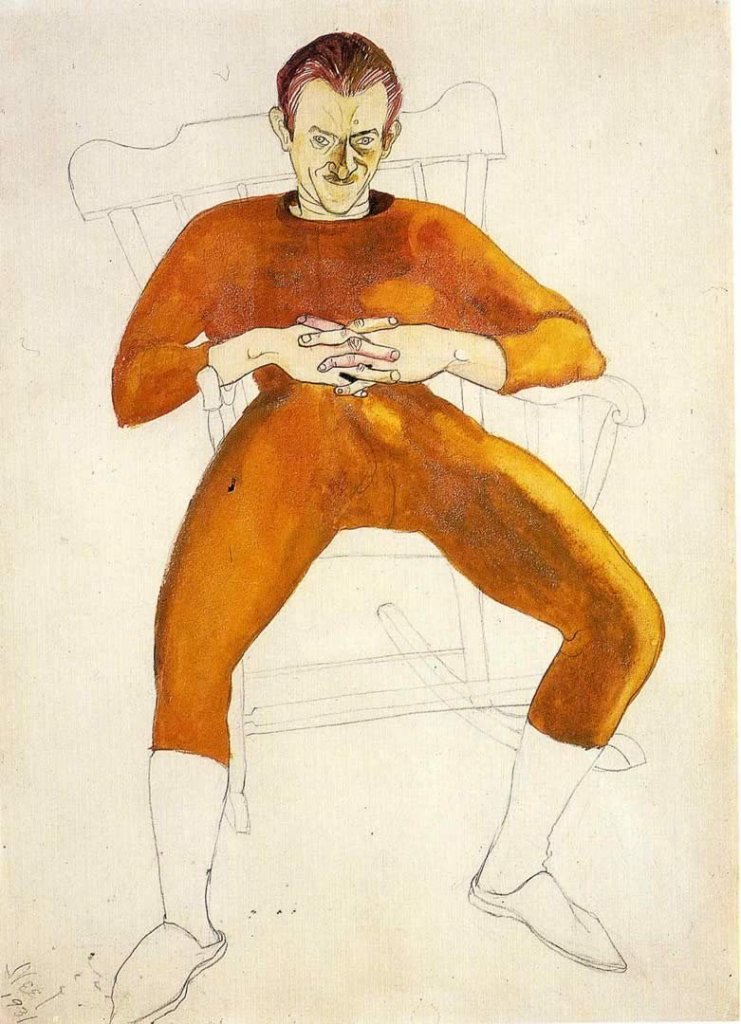
Kenneth Doolittle watercolour by Alice Neel (1931)

Alice’s relationship with Doolittle had intensified, however, it all came to an abrupt end in December 1934, after Doolittle, in a fit of jealous rage, slashed or burnt a large number of her early works. He was thought to have been jealous of Neel’s relationship with another man but others believed that “the other man” was her art and the amount of time she dedicated to her painting.   Later Neel recalled the incident, as quoted in Wayne Kostenbaum 1997 book Alice Neel: Paintings from the Thirties:

“…Kenneth Doolittle cut up and burned about sixty paintings and two hundred drawings and watercolors in our apartment at 33 Cornelia Street. Also, he burned my clothing. He had no right to do that. I don’t think he would have done that if he hadn’t been a dope addict. He had a coffee can full of opium that looked like tar off the street. And it was a frightful act of male chauvinism: that he could control me completely. I had to run out of the apartment or I would have had my throat cut. That was a traumatic experience as he had destroyed a lot of my best work, things I had done before I ever knew he existed. It took me years to get over it….”

After the violent break up with Doolittle, Neel moved out of their apartment and being homeless went to stay with John Rothschild, and thanks to some financial help from his parents she had enough money to buy a small cottage in Spring Lake, New Jersey.  At the time, Rothschild was married with children but told Alice that he loved her and left his wife and became Neel’s lover but he wanted a more formalised relationship but Neel was happy with a less prescribed liaison, added to which she was often openly scathing about his prowess as a lover.  She was unconvinced regarding the future of their relationship and later that year left him and moved, to live alone, in a Manhattan apartment.

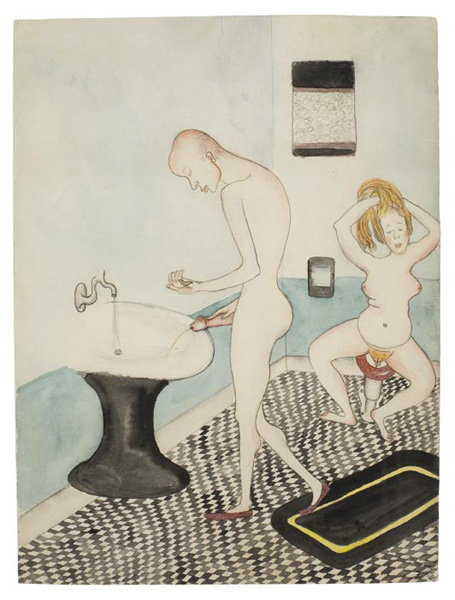
 That same year Alice depicted the two of them in the bathroom after a bout of lovemaking, in a painting entitled Bathroom Scene.

Untitled (Alice Neel and John Rothschild in the Bathroom) by Alice Neel (1935)

Alice Neel who was now in her mid-thirties, depicted herself in her 1935 painting entitled Alice and John in the Bathroom as a beautiful and curvy woman, with her long red hair. We see her seated on the toilet urinating while her lover, John Rothschild, stands at the sink, urinating with an erect penis in his hand. Stephanie Buhman in her 2009 article in on-line art magazine artcritical describes the painting:

“…Neel can be seen sitting on a toilet seat while urinating. John stands at the sink, urinating with an erect penis in his hand. Various shades of red accentuate details, such as Alice’s pubic hair, the toilet seat, John’s slippers and the head of his penis. Alice’s legs are turned outward, her arms crossed over her head, almost taking on the posture of an Indian deity. The scene could not be more humbling in its honesty and lack of glorification. Leaving the viewer in the role of a voyeur, Alice and John in the Bathroom is an ode to the pure sense of trust and privacy that two individuals, despite all imperfections, can experience when truly caring for each other…”

The work in no way beautifies the lovemaking which had just happened and I wonder what was in her mind when she painted this shockingly explicit work.

The first exhibition of the Washington Square Outdoor Art Exhibit was so successful that a second one was held that November.  The second event was even bigger than the first with over three hundred artists participating.  Juliana Force, who was the Director of the Whitney Museum of American Art, and who had endorsed the exhibition, was so impressed with the works on show that she invited many of the exhibitors to meet her and talk about their work and their artistic struggle to survive financially

At the end of 1933, Alice Neel enrolled in the Public Works of Art Project (PWAP), a government-funded program run under the auspices of the Whitney Museum of American Art and its director Juliana Force, aided by Vernon C. Porter.  In the 1977 book, New York City WPA Art: Then and  and Now, she recalled the time:

“…The first I heard of the W.P.A. was when in 1933 I received a letter from the Whitney Museum asking me to come and see them. I was interviewed by a young man who asked me ‘How would you like to paint for $30 a week?’ This was fabulous as most of the artists had nothing in those days and in fact there were free lunches for artists in the Village … All the artists were on the project. If there had been no such cultural projects there might

An interesting painting by Neel was completed in 1933 whilst she was part of the Works Progress Administration, which was a New Deal program to help the impoverished and unemployed.  In the work we see a scene which Neel could empathize with as she was then also struggling financially.   Before us we see a room at The Russell Sage Foundation, which had been established by Margaret Olivia Sage in 1907.  The aim of the foundation was to try and improve the social and living conditions in the United States.

Investigation of Poverty, Russell Sage Foundation by Alice Neel (1933)

In the painting, at the centre rear, we see an elderly grey-haired lady facing side on to us.  She is dressed all in black and we notice that she has her head buried in her hands. Her black clothing probably signifies that she is a widow. We see her seated in front of a small table around which are her interrogators. They look directly at her and one of them seems to be talking to her.  From looking at her, caste your eyes on her inquisitors.  How would you describe their expressions –reflective and yet detached?   It is an unusual grouping.  The men are all wearing suits and ties and the women all wear hats.  In the left foreground, with his back to the viewer, a man sits leaning forward, apparently one of the questioners.  The painting is all about the despair of the central character even though we cannot see her face. Despite the fact that the people investigating her status seem to be well-meaning, the woman is clearly bewildered by the situation that has necessitated her being at this meeting, a prerequisite if she wants financial assistance.  Alice Neel, through this painting, captures the essence of what life was like for the poor during the Depression.  What could be more demeaning than an old lady having to suffer the questions posed by the “suits” in order to gain financial help?.  In the right foreground we see two men, side on to us, who are next in line to be questioned.  One of them has a white moustache and is well dressed in suit and tie.  By the look of his expression he too seems overwhelmed by the ordeal

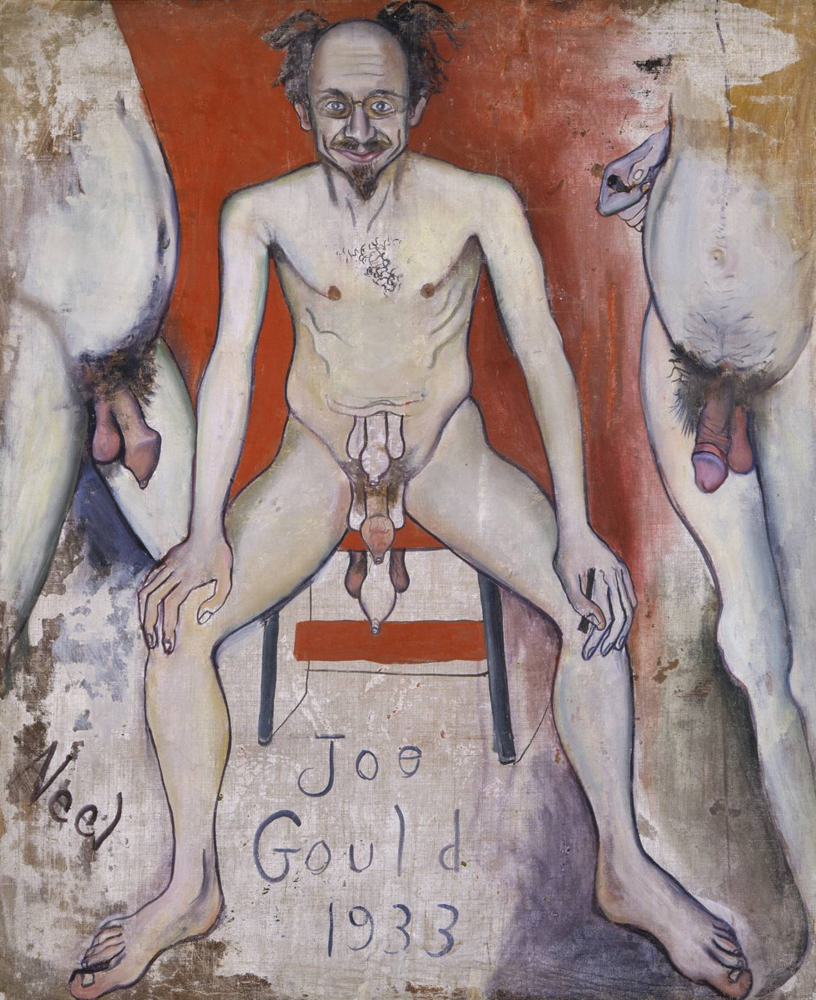
Joe Gould by Alice Neel (1933)

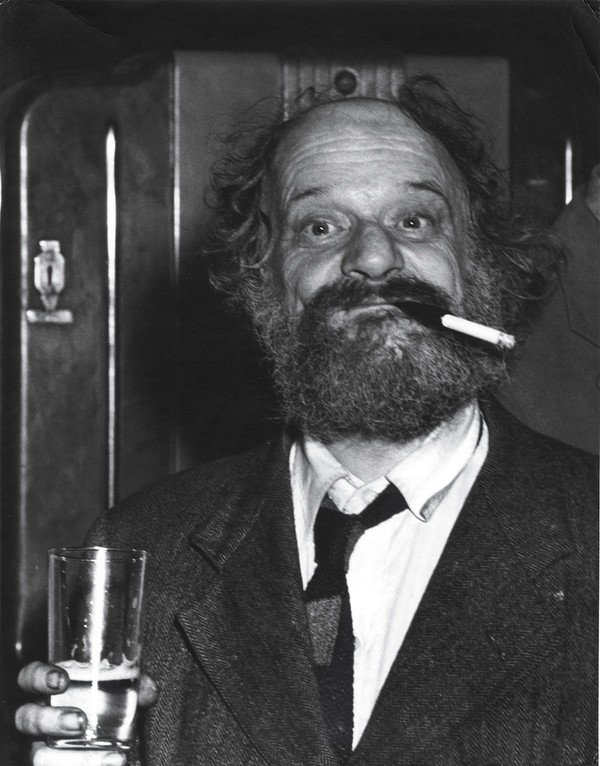
That year Alice Neel completed a somewhat controversial painting of Joe Gould.  For over three decades Gould, who was a homeless Harvard graduate, and a Greenwich Village eccentric who went from bar to bar telling those who would listen to him about the book he was writing.  It was not just any book, he said it was to be the longest book ever written, entitled An Oral History of Our Time.  There must have been something appealing about him as he was well supported by the Greenwich Village artists, poets and writers of the time.

Joe Gould
Joe Gould

The stories of his large tome spread and a journalist, Joseph Mitchell, on the New Yorker wrote a couple of pieces about Gould and his famous book.  Sadly for Mitchell the book was just a figment of Gould’s imagination !   However, Gould became a local legend thanks to all the publicity and it went to his head as he truly believed that his fame was well deserved and that now he was a great attraction especially for the women.  It was probably because of his belief that he was such a lady’s man and a great lover, again, like the book, probably a figment of his imagination, resulted in the way Alice Neel depicted him in her 1933 controversial painting, Joe Gould, which an art critic described as “a symphony of cocks”

In 1934 Alice receives a letter from her estranged husband Joe Enriquez, who on on the news of his mother’s death, had left Europe and returned to his home in Cuba.   In the letter he asked Alice to consider a reconciliation but by now she had other men in her life, her lover Kenneth Doolittle and her ardent admirer John Rothschild and so she declined the “invitation” and she and her husband were never to meet again.

In the early thirties Neel completed a number of nude paintings.  There was nothing erotic or genteel about them, on the contrary these paintings and sketches were down to earth “warts and all” honest depictions of nude men and women.

Alienation by Alice Neel (1935)

In her 1935 watercolour on paper work entitled Alienation she depicted herself lying voluptuously in bed while her friend and lover John Rothschild stands over her.  It is interesting to note that at this time the painting of nudity was not considered appropriate for a female artist to pursue.

Nadya and Nona by Alice Neel (1933)

Another early example is Nadya and Nona which she completed in 1933.  It is a challenging and provocative painting of two nude women lying in bed which scrutinised the subject of sexuality but at the same time avoided any erotic or seductive nuances.

It is around this time that another man comes into her life.  He is a married nightclub singer Jose Santiago Negron………………….

…………………to be continued.

– – – – – – – – – – – – – – – – – – – – – – – – – –

I have used numerous internet sources to put together this and the following blogs on the life and art of Alice Neel and I am currently reading a fascinating book about the artist by Phoebe Hoban entitled Alice Neel: The Art of Not Sitting Pretty. It is a very interesting read and one I can highly recommend.

Alice Neel’s art is being shown in a number of exhibitions in America but there are also a series of exhibitions of her work travelling around Europe at the current time:

Painter of Modern Life at the Ateneum Art Museum, Helsinki

(June 10th – October 2nd 2016)

and at the

Gemeentemuseum, Den Haag, Holland

(November 5th, 2016 – February 12th 2017)
Natalia Goncharova and Rayonism

Natalia Goncharova       1881 - 1962
Natalia Goncharova
1881 – 1962

In my blog today I want to look at the life of the avant-garde Russian painter, stage designer and printmaker, Natal’ya (Sergeevna) Goncharova.   Natalia was born in Russia on her father’s estate in the Tula governate in June 1881.  She was the daughter of Sergey Mikhaylovich Goncharov, a renowned architect and mathematician, and her mother was Yekaterina Il’icha Belyayeva.  However, in her early infant days she grew up in her grandmother’s home at Ladyzhino, near Kaluga. When she was ten years old, the family moved to Moscow and she attended the Fourth Gymnasium for Girls in Moscow and in 1898, when she was seventeen years old she decided to study sculpture and enrolled at the Moscow School of Painting, Sculpture and Architecture as a sculpture student where her tutor was Paolo Troubetskoy.  It was at this establishment in 1900 that she met and became friends with fellow student, Mikhail Larionov.  He had enrolled at the Moscow School of Painting, Sculpture and Architecture at the same time as Goncharova, studying painting under Isaac Levitan and Valentin Serov.  Larionov was a student with very contentious and provocative views and was suspended from the academy on three occasions for his deep-seated opinions.   He and Goncharova became lifelong friends and he was to have a great influence on her.  It was Larionov who persuaded Goncharova to switch from studying sculpture to concentrate on studying painting.

Natalya Goncharova by Laborov

Goncharova’s early work concentrated on the medium of pastels and her first works were showcased at the Diaghilev’s Russian Art Exhibition, which was held in Paris in 1906 at the Salon d’Automne and a year later her first paintings were shown at the Moskovskoye Tovarishchestvo Khudozhnikov (Moscow Association of Artists) of which she was a member.  At this time, her friend Larionov’s painting style was that of Impressionism and Natalya, for a time, also became interested in the style which had become so popular in France.  In 1908 she took part in the Golden Fleece exhibition and it was during this show that she became more aware of a modern style of art with the works of Bonnard, Matisse, Gaugin and Toulouse-Lautrec.  The influence of these painters made Goncharova rethink her artistic style.

Gardening by Natalya Goncharova (1908)

In 1909 she completed a work of art, which highlighted her much-loved topic that of Russian peasants hard at work on the land.  The painting, which is currently housed at the Tate Liverpool, is entitled Gardening.  It is a painting, which is typical of her depictions of peasant life and was made around the time of her stay on a family estate in rural Russia.  Of this style of painting and her patriotism, she explained:

‘…If I extol the art of my country, then it is because I think that it … should occupy a more honourable place than it has done hitherto…”

In the painting we immediately sense her love for colour and her depiction of the peasants is a somewhat stylistic portrayal.  The display caption at the Tate describes the way she has portrayed the subjects shown in the paintings as:

 “…Her statuesque peasants, with their thickset bodies and massive limbs, are imbued with a heroic grandeur…”

 Her subsequent works were so colourful that they were likened to the work of the Fauves, which was an avant-garde movement that thrived in France during the first decade of the twentieth century, led by the likes of Matisse and Derain, these artists were the first to split from the Impressionism.

Pillars of Salt by Natalia Goncharova (1908)

  In 1910, Goncharova became one of the founder members of the Jack of Diamonds group, sometimes referred to as Knave of Diamonds.  This group of painters was deemed to be the first group of Russian avant-garde artists and it was Mikhail Larionov who came up with the group’s name.   This collection of painters came from both Moscow and nearby provinces and most of them, including Goncharova, had studied at the Moscow School of Painting, Sculpture and Architecture.  They were all influenced by the works of Cezanne, Van Gogh, Gauguin and Matisse.  Once again we see a group of artists coming together with the common idea that they would discard the links with traditional art, and discard the knowledge that they were taught at their alma mater. For them, it was all about change and new artistic ideas.  Goncharova exhibited a number of her works in the group’s first exhibition in December 1910.  Their art was not loved by everybody, in fact it horrified some.  The influential Russian artist, art critic, historian criticised the group of young artists for having gone too far in overthrowing accepted artistic ideals.  Many other critics and members of the public declared that many of the works of art shown at the exhibition were in bad taste, gauche and lacked artistic elegance and some were even criticised as being too violent.

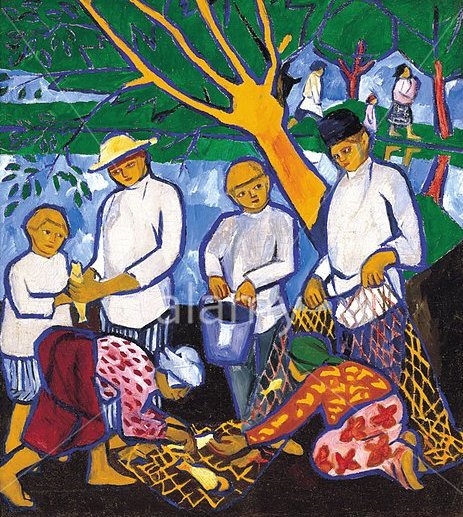
Fishing by Natalia Goncharova (1909)

She exhibited another example of her Primitivist style art at the 1912 Jack of Diamond exhibition.  It had been completed a couple of years earlier and was entitled Fishing.  Again the style is similar to her painting Gardening and is part of the Carmen Thyssen-Bornemisza Collection and is housed in the Thyssen-Bornemisza in Madrid.

The Evangelists by Natalia Goncharova (1911)

 Another one of the paintings which Goncharova exhibited was entitled The Evangelists and this was among her first mature works devoted to a religious subject.   In her 1962 book, The Russian Experiment in Art 1863-1922, art historian, Camilla Gray, the daughter-in-law of Sergei Prokoviev, wrote:

“...The depiction is typical of Russian iconic paintings and so is a combination of old and new influences in Russian art. Perhaps one of the most impressive aspects of these four paintings is their effective use of color, line, and composition to create a strong rhythmic whole. Goncharova manipulates these elements with such understanding and perception that when one looks at the four authors of the Gospels there are no distractions and no weak points — only strength and security in a modern interpretation of tradition and native style. Both line and color become here “expressive entities in their own right” and convey the sense of calm spirituality and wisdom treasured by icon painters. However, what the Neo-primitivists of Goncharova’s time might have treasured most was an almost childish “directness and simplicity” characteristic of folk art which they tried to imitate in their works. Today, the four paintings of the Evangelists may be admired for many reasons, and regardless of the basis for the viewer’s appreciation, they definitely are an integral part of the Russian avant-garde movement…”

This religious work by Goncharova was heavily criticised for its primitive depiction and the critics believed no religious work should be associated with a group known as The Donkey’s Tail as it was bordering on blasphemy and so it was removed from the exhibition.

Peacock in Bright Sunlight (Egyptian style) by Natalia Goncharova (1911)

Natalia Gonchorova produced a series of paintings in 1911 that became known as the Peacocks.  They were highly colourful and were influenced by Larionov and his new style of work at the time which was termed Rayonism or Luchism (luch being the Russian word for “ray”) which was a type of abstract or semi-abstract painting.  The Rayonists sought an art that floated beyond abstraction, outside of time and space, and to break the barriers between the artist and the public. They derived the name from the use of dynamic rays of contrasting colour, representing lines of reflected light — crossing of reflected rays from various objects.  .The painting seen above is an example of this and is entitled Peacock in Bright Sunlight (Egyptian style) which can be found in the Tretyakov Museum in Moscow.  The museum’s description of the work states:

“…The works in question combine the laws of Ancient Egyptian art and traditions of Russian folk art. The figure of peacock is transformed into an expressive sign. The bird’s chiselled head and elegant neck are shown in profile, whereas the magnificent tail is spread in front, as prescribed by Ancient Egyptian art. Between them is a green oval providing a background for the neck, head and body. The peacock seems to be examining its own tail in surprise, the tail resembling a grand architectural structure. It resembles at the same time the Coliseum, an arched iconostasis, a rainbow and palette. Unlike the artists of Art Nouveau, who associated peacock feathers with elegant luxury, Goncharova interprets this motif as primordial power, expressed in colours. The image of peacock seems to embody the ancient symbol of immortality…”

All was not well within the Jack of Diamond group as a rigorous debate took place between, on one side, David Burliuk, who was a fervent supporter and strongly supportive of Western art, and on the other side, Natalia Goncharova and Larionov, who favoured Russian themes. The two parties could not agree a compromise and so the Russian artists split into two camps. In the one corner was David Burliuk with his supporters, such as Alexi von Jawlensky and Wassily Kandinsky, who favoured the art which was influenced by Western painters.  In the other corner was the more traditional camp, including Goncharova and Larionov, who believed that a modern Russian art should address the question of national artistic traditions and therefore they disassociated themselves from the Jack of Diamonds on the grounds that Burliuk was a “decadent Munich follower” while the others, known as Cézanne-ists, were conservative and eclectic..

Sunset Over the Adriatic by the ficticious Genoese painter  Joachim Raphale Baronali
Sunset Over the Adriatic by the ficticious Genoese painter Joachim Raphale Baronali

A year later in 1911 the more radical artists in the group, including Goncharova and Larionov, broke away and formed a new artist’s group which Larionov launched as Osliny khvost (the Donkey’s Tail), in order to promote avant-garde art inspired exclusively by Russian themes.  The name, The Donkey’s Tail, derived from a famous Parisian hoax in which the art critic, Roland Dorgelès and Fréderic Gérard, proprietor of the Montmartre café, Le Lapin Agile, had painted a lurid red and blue seascape by tying a paintbrush to a donkey’s tail. The work was exhibited as Sunset Over the Adriatic under the name of Joachim Raphale Baronali at the Salon des Indépendants of 1910 apparently without comment.

Frédé and his donkey artist Lolo

That year, Ilya Repin recounted the incident of the donkey’s tail in his review of Izdebsky’s International Exhibition and used the term as a critical epithet for the modernist work on show. Shortly afterwards, the Russian press satirized the Knave of Diamonds exhibition by publishing a cartoon of a donkey painting with its tail, with the cynical caption:

“…Off home already after looking round just one hall. Don’t be shy. Get your sixty kopeks worth and next year come again. Then we will change the name and under the sign of ‘the Donkey’s Tail’ we will show you the way we paint our pictures...”

In adopting this name for his group, Larionov beat the critics with their own stick.  Other artists to join the group were Marc Chagal and Kazimir Malevich.  The group, however, was only short-lived, disbanding at the end of 1912 having only managing to stage one exhibition in the March of 1912.  Goncharova submitted over fifty works of art to this exhibition.

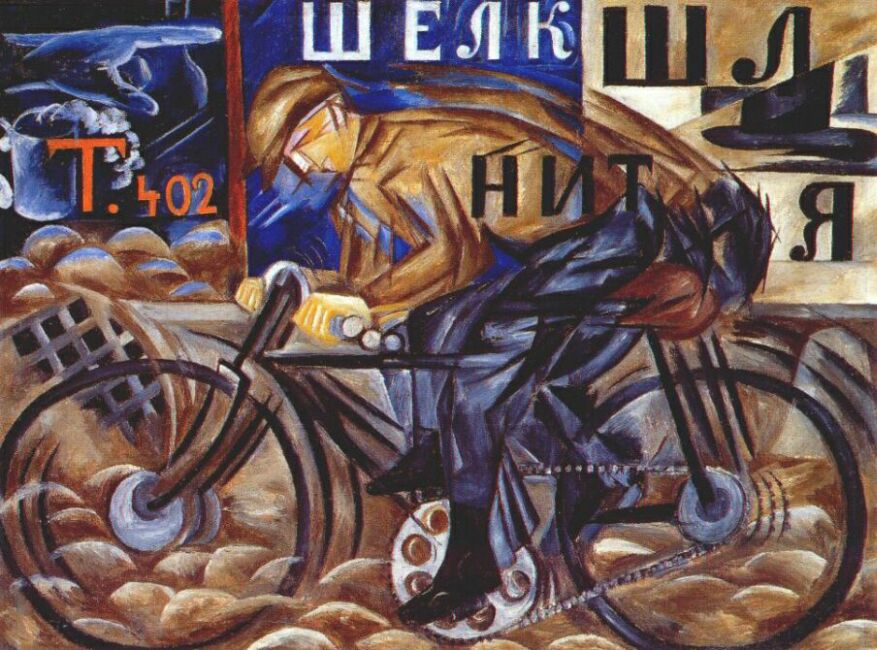
The Cyclist by Natalia Goncharova

Goncharova continued with her Rayonist works of art but unlike her friend Larionov her paintings depicted distinguishable objects or people, whereas Larionov’s paintings became more pure abstract. One of her most famous works of that period was one entitled The Cyclist in which her depiction cleverly captures the energy of the man on his bike as he passes by.  The blurred background adds to the sense of speed and movement.

Goncharova and Larionov were fervent believers of Rayonism, so much so they issued a joint manifesto in 1913 of what Rayonism meant to them.  The manifesto entitled Rayonists and Futurists, The Manifesto, began with:

“…We, rayonists and futurists, do not wish to speak about new or old art, and even less about modern Western art. We leave the old art to die and leave the “new” art to do battle with it; and incidentally, apart from a battle and a very easy one, the “new” art cannot advance anything of its own. It is useful to put manure on barren ground, but this dirty work does not interest us. People shout about enemies closing in on them, but in fact, these enemies are, in any case, their closest friends. Their argument with old art long since departed is nothing but a resurrection of the dead, a boring, decadent love of paltriness and a stupid desire to march at the head of contemporary, philistine interests. We are not declaring any war, for where can we find an opponent our equal? The future is behind us. All the same we will crush in our advance all those who undermine us and all those who stand aside. We don’t need popularization—our art will, in any case, take its full place in life—that’s a matter of time……..”

The American art historian, Camilla Gray, in her book gave her definition of Rayonism as:

“…[as an art style which] encompasses all existing styles and forms of the art of the past, as they, like life, are simply points of departure for a Rayonist perception and construction of a picture…”

Larionov and Goncharova started to believe that light was the indispensable source of our sensory appreciation of the world and believed that for any object to be observed it had to be lit up and the Rayonist style was to incorporate rays of light that then allows us to view a particular scene. Their manifesto explained:

 “…In fact, we do not sense the object as such. We perceive a sum of rays proceeding from a source of light; these are reflected from the object and enter our field of vision…”

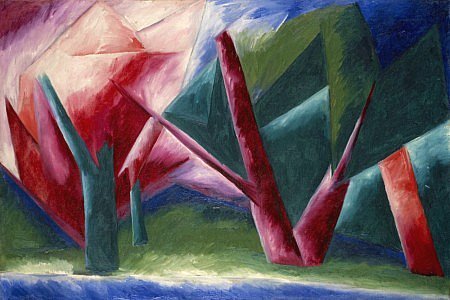
The Forest by Natalia Goncharova (c.1913)

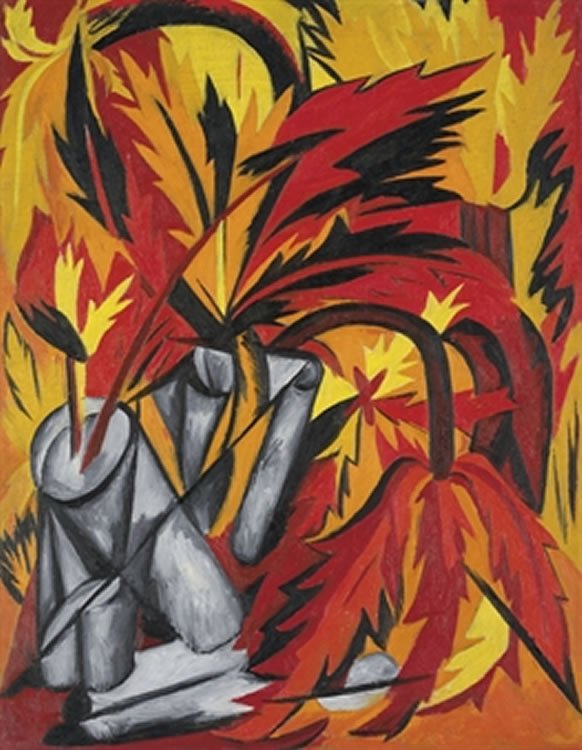
In March 1913 Goncharova’s friend Larionov organised an exhibition entitled Mishen (Target) to introduce the Donkey’s Tail group of painters to the Moscow art critics and public.  One of the paintings Goncharova exhibited at the show was entitled La Forêt (The Forest) which is now part of the National Gallery of Scotland collection.  Although this is looked upon as an example of Goncharova’s Rayonist style with its coloured rays shooting out in different directions, it offers up the thought that Goncharova was more influenced by the Cubist style when she painted this work.  The shapes she has used in the depiction of trees in this work was replicated in a number of her works around this time.  It is a truly fascinating work.


The Forest by Natalia Goncharova (c.1913)

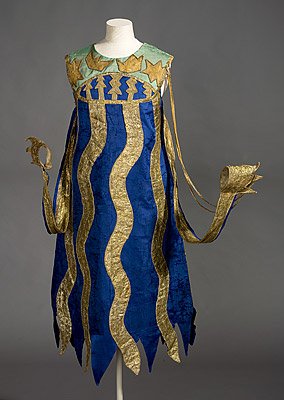
Goncharova went on to design ballet costumes and sets for ballets in Geneva and in 1914 she and Larionov moved to Paris to work alongside the great Russian ballet impresario, Sergei Diaghliev, during which time they designed a number of stage sets for Diaghilev’s Ballets Russes.  Goncharova still found time to carry on painting and exhibited works at the Salon d’Automne, Salon des Tuileries and the Salon des Indépendants.

Goncharova was quite a controversial character.  She was a woman that did not “toe the line” of convention.  It was said that she would sometimes appear topless in public, with symbols painted on her body. In a sense, their use of odd, possibly meaningless symbols united the masses with the past Symbolist aesthetic. In John Bowlt’s 1990 article in the Art Journal entitled Natalia Goncharova and Futurist Theatre, he commented on her bizarre behaviour writing:

“…in private relations and behavior, Goncharova enjoyed a license that only actresses and gypsies were permitted, and perhaps because of this dubious social reputation rather than as the result of any apparent innuendos in her paintings, she was said to traverse the ‘boundary of decency’ and to ‘hurt your eyes…”

According to Mary Charmot who wrote an article in 1955 for the Burlington Magazine entitled The Early Work of Goncharova and Larionov, Diaghliev was full of praise for this unconventional painter who had brought life to his ballets.  He talked of her, saying:

“…The most celebrated of these advanced painters is a woman. [. . .] This woman has all Saint Petersburg and all Moscow at her feet. And you will be interested to know that she has imitators not only of her paintings but of her person. She has started a fashion of nightdress-frocks in black and white, blue and orange. But that is nothing. She has painted flowers on her face. And soon the nobility and Bohemia will be driving out in sledges, with horses and houses drawn and painted on their cheeks, foreheads and necks…”

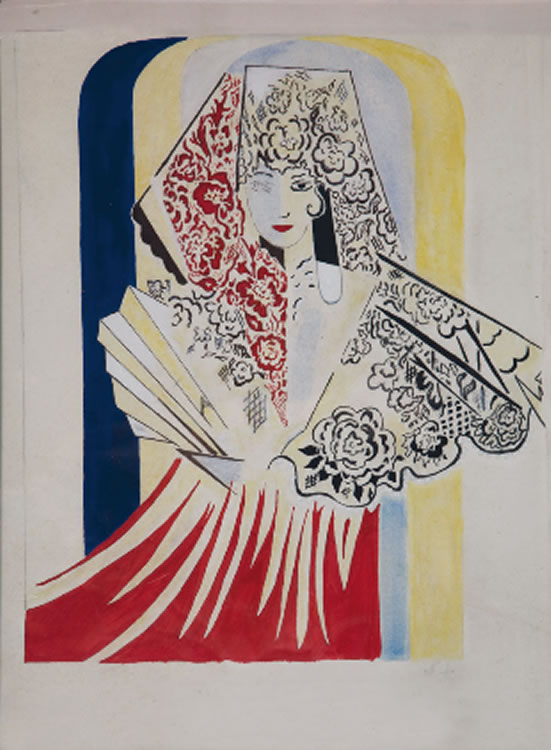
Project poster for the ballet by Manuel de Falla, El amor brujo by Natalia Goncharova (1935)

Goncharova and Larionov had lived together shortly after their first meeting in 1900 as fellow students at the Moscow School of Painting, Sculpture and Architecture and they stayed together as an unmarried couple for more than fifty years.  She and Larionov became French citizens in 1939 and in 1955 the two artists married.  The reason for marrying so late in their romantic relationship was believed to be so that their paintings would revert to the surviving partner.  In the latter years Larionov and Goncharova suffered financially.   Goncharova suffered badly with arthritis in her hands and it is said that to carry on painting she had to tie the paint brushes to her wrist.  Goncharova died in Paris, in October 1962 and Larionov died two years later.

So what happened to their works of art?  The story goes that when the couple had both died, most of their collections were inherited by another Russian émigré, Alexandra Tomilina, who had met Larionov in the 1930’s when she was his student, and later became his mistress.   After Goncharova died in 1962, Larionov married Tomilina in order that she would inherit all the paintings, which by this time was numbered in the thousands, and by doing so the two artists would continue to be remembered and therefore it would safeguard both artists’ legacies.  Sadly Tomilina had always viewed Goncharova as a love rival and so hated her, so much so that she gave away, destroyed or disposed of many of Goncharova’s works. Tomalina’s old age became one of a life of poverty and so, desperate to pay off her debts, contacted the Soviet authorities and offered them all the remaining artworks if they would financially support her for the rest of her life.  This they agreed to.  When Tomilina died in 1987, her ashes were buried in Goncharova and Larionov’s double grave

Picking Apples by Natalia Goncharova (1909)

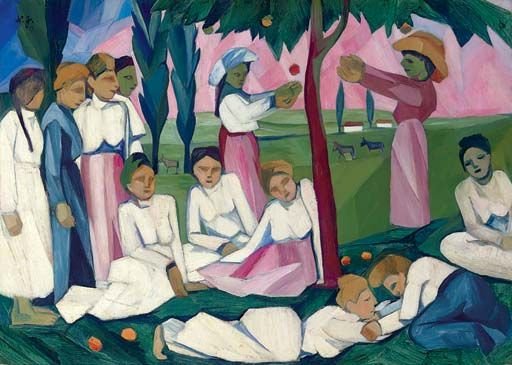
After her death, Goncharova was almost forgotten as a painter in the West. Why?  Maybe it was because she painted in many styles — Cubism, Futurism, Neo-Primitivism, Rayism, and  also maybe because she worked in many forms, from oil painting to textile design. This lack of recognition was all to change in 2007 when her work, Picking Apples, which she completed in 1909, was sold at Christie’s Modern and Impressionist sale in London for £4.9 million ($9.8 million), a record for a female artist, only to be bested a year later when her painting, The Flowers, sold for £5.53 million ($10.8 million).

The Flowers by Natalia Goncharova (1912)

Goncharova’s life, like her art, was very colourful.  She was unconventional and actually fell foul of the law on a number of occasions.  She was tried for pornography after a show of nude paintings in 1910 and as I mentioned earlier, her religious paintings were forcibly removed from several exhibitions and for a time were banned by the Holy Synod.

Maria Luise Katharina Breslau

Self portrait by Louise Breslau (1891)

In my recent blogs looking at the life of Marie Bashkirtseff, I talked about the time she spent studying art at the Académie Julian in Paris and her rivalry with her fellow artist Louise Breslau.  Despite the wealthy lifestyle of Bashkirtseff she was still constantly jealous of Breslau, who she perceived as her rival at the academy.  She was also very jealous of Breslau’s friendship with contemporary artists such as Edgar Degas.  So today, I thought I should dedicate this blog to her rival, and look at the life and works of the German-born artist, Louise Breslau.

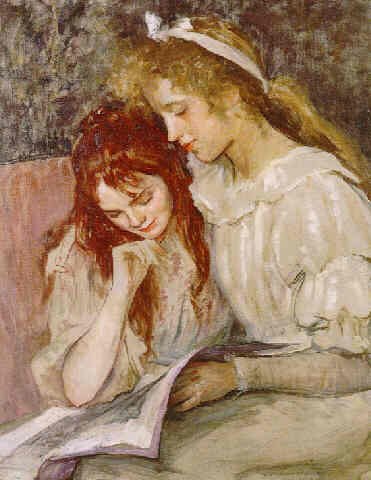
Two young girls sitting on a banquette by Louise Breslau (1896)

Maria Luise Katharina Breslau, who would later be known simply as Louise Catherine Breslau,  was born in Munich in December 1856 but spent much of her early life in Zurich. She was born into a prosperous middle-class family.   Louise had three younger sisters Marie-Henrietta, Emma and Bernadette.  Her father was an eminent obstetrician and gynaecologist and in 1858 he and his family moved to Zurich where he took up a position as head physician in obstetrics and gynaecology at the University Hospital of Zurich.

Louise suffered badly from asthma when she was young and was often confined to her bed and it was due to this enforced confinement, that to pass the time and counter loneliness, she immersed herself in reading and also developed a love of sketching.

La fille à l'orange by Louise Breslau (1897)
La fille à l’orange by Louise Breslau (1897)
In 1866, When Louise was nine years old, her father died of staph infection which he contracted during the execution of a postmortem examination. Louise, even though still very young, was tasked with helping her mother to bring up her three younger sisters.  When her health worsened, she spent some time in a convent near to Lake Constance where with its warmer climate it was hoped that her health would improve.   It was during her stay at the convent that she became more interested in art and she continued to sketch and paint during her teenage years.  Her love of art and her artistic ability became apparent to her mother who persuaded Louise to attend the drawing classes of the local Swiss portrait painter, Eduard Pfyffer.  She excelled under his tuition but after a while she believed that she had learnt all she could from Pfyffer and she wanted her art to be more than just a pleasing hobby.  All young ladies of a certain class, besides learning about domestic skills, were also encouraged to be able to play a musical instrument and be able to paint or sketch.   However, Louise wanted art not to be just a pleasant pastime, she wanted to become a professional artist and to achieve this she knew she had to leave Switzerland, move to the European capital of art, Paris, and enrol at a specialist art academy.   In 1876 she went to Paris but like many other female artists who wanted the best art training that Paris could offer, she was disappointed with the ruling of the prestigious Académie des Beaux-Arts that only male artists would be allowed to enter their hallowed establishment.  This sexist ruling did not change until 1897.  So, like Bashkirtseff, she enrolled at the Académie Julian who catered for aspiring female painters.

Children reading by Louise Breslau

Her fellow students at the Académie Julian included the Ukrainian artist, Marie Bashkirtseff, Madeleine Zillhardt, the French painter, Sophie Schäppi who, like Louise, had come to Paris from Switzerland and the Irish painter, Sarah Purser.  Louise excelled at the academy and was looked upon by her tutors as one of their best students and this fact did not lie well with Marie Bashkirtseff who was inordinately jealous of her fellow student. In 1879, Louise Breslau, Sophie Schäppi and the singer Maria Fuller moved into a large apartment in the Avenue des Thermes and that same year Breslau had her painting entitled Tout passé accepted at the Paris Salon.  This was a great achievement not only for Louise but also for the female atelier of Académie Julian.

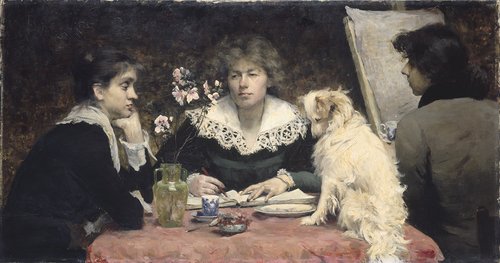
Les amies by Louise Breslau (1881)

Two years later, in 1881, she received an honourable mention at that year’s Salon for her triple portrait entitled, Les amies (Portrait of Friends).  In it we see her friends Maria Feller on the left, Sophie Schäppi in the centre and Louise on the right, with a white dog sitting on top of the scarlet tablecloth.  It is a painting in which we see the three females in a reflective mood.  The painting is now housed in the Musée d’Art et d’Histoire, Geneva.  Louise Breslau was now acknowledged as an up-and-coming artist.  She opened her own studio and soon started to receive numerous commissions for her work from the wealthy of Paris society.

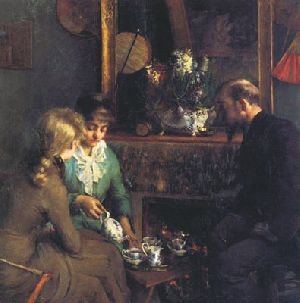
Le thé à cinq heures by Louise Breslau (1883)

In 1883 she was commissioned by the owner of the French newspaper Le Figaro to paint a portrait of his daughter.   She completed the commission and exhibited the painting entitled Isabelle de Rodays at the 1883 Salon.  She also exhibited another of her works, Five O’clock Tea at that year’s Salon and this can now be found at the Berne Kunstmuseum.

Chez soi by Louise Breslau (1885)

In 1885 Louis Breslau completed another great work entitled Chez Soi which is a portrayal of her mother and sister in an interior setting.  The dog sits at the feet of her mother and this genre piece exudes an air of silent contemplation.  The painting resides in the Musée d’Orsay in Paris.

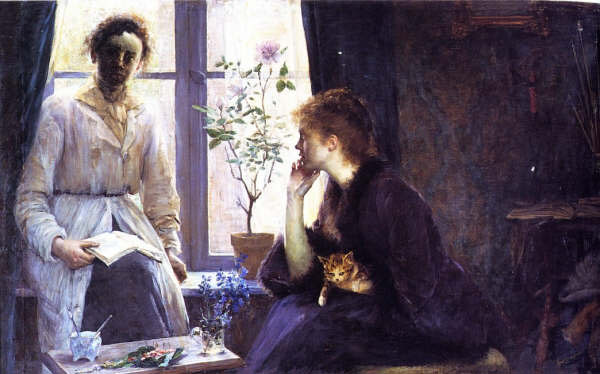
Contre Jour (Louise Breslau and Madeleine Zillhardt) by Louise Breslau

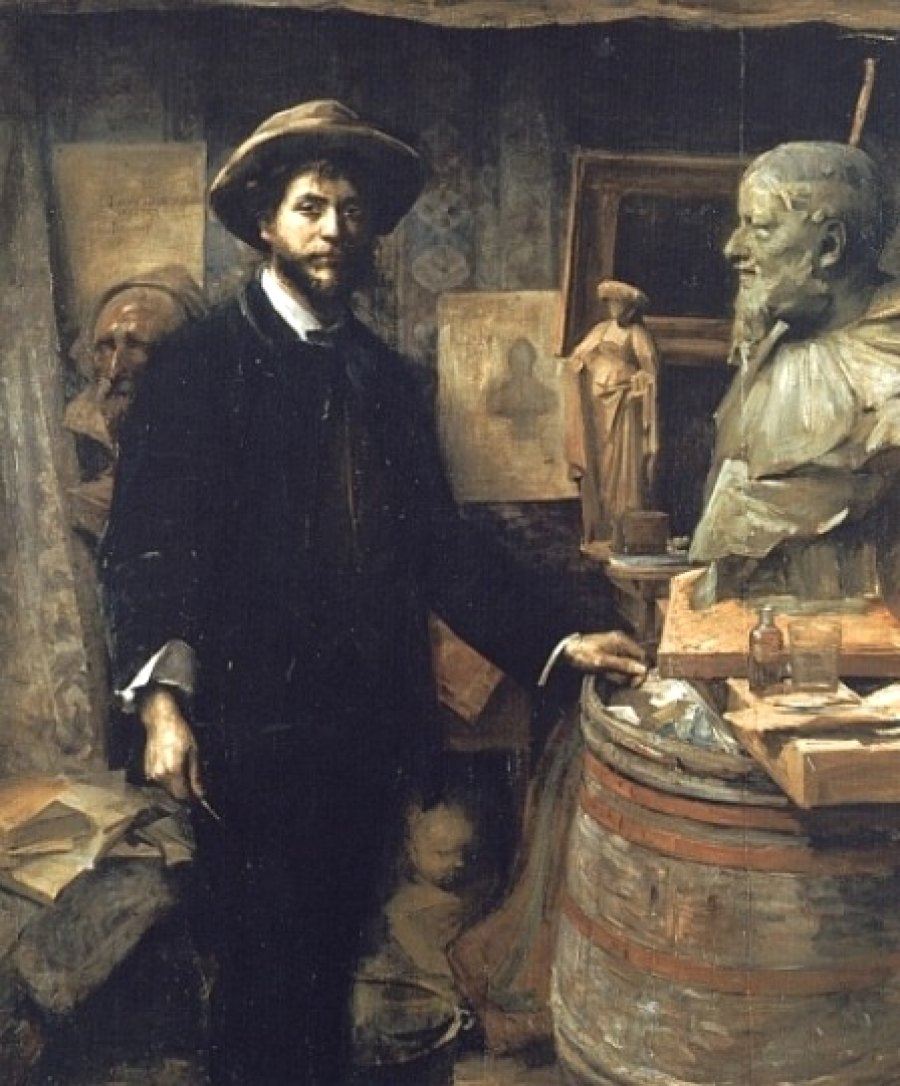
The friendship between Breslau and Madeleine Zillhardt would last a lifetime and she would appear in many of her paintings.  After a brief affair in 1886 with the sculptor Jean Carriès, whom she met through Jules Breton, Louise Breslau chose to share her life with Madeleine Zillhardt and in 1902 the two women moved to a studio in Neuilly-sur-Seine where they set up home.

Jean Carries in his Atelier by Louise Breslau

She eventually became the third woman artist, and the first foreign woman artist to be bestowed France’s Legion of Honour award.  During World War I Breslau, although by this time a naturalised Swiss citizen, and Zillhardt, remained at their home at Neuilly. Breslau showed her patriotism towards her new country, France, by drawing numerous portraits of French soldiers and nurses on their way to the Front. Louise was sixty-two years of age when the war ended and she began to withdraw from public view and was contented to stay at home and sit in her garden, painting flowers but she still loved to entertain her friends.

Louise Catherine Breslau died in May 1927, aged 70 after suffering from a long and debilitating illness.   Most of her estate went to her good friend and long-time companion Madeleine Zillhardt.  As per her wishes Louise Breslau’s body was taken to the small Swiss town of Baden where she was buried next to her mother.

Unlike Bashkirtseff, who died at the age of 25, Breslau had many years to forge her artistic reputation.  Bashkirtseff sadly knew, when she was told that she was dying, that she would never have the time to be able to build up such an artistic reputation as Breslau but of course Bashkirtseff will always be remembered for her diaries.  The works of art of Louise Breslau were very popular when she was alive but sadly, after she died, she was almost forgotten.

Marie Bashkirtseff. Part 2 her later life and diaries

Marie Bashkirtseff (1858 - 1884)
Marie Bashkirtseff (1858 – 1884)

In my previous blog I concentrated on the portraiture of Marie Bashkirtseff but she will probably be remembered best for other genres

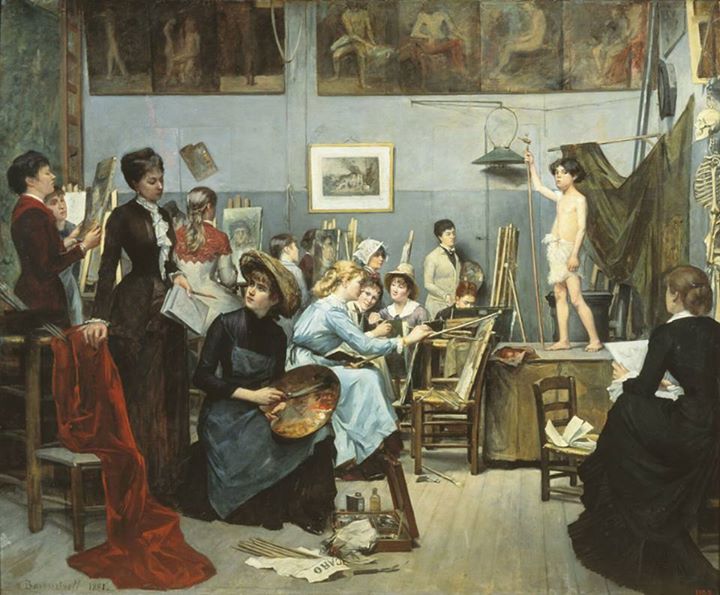
One painting by Marie Bashkirtseff which came about during her time at the Académie Julian was one commissioned by the founder of the establishment, Rodolphe Julian.  He asked her to paint a canvas depicting the artists at work in his academy.  The finished canvas was entitled L’Atelier Julian and is now looked upon as one of Bashkirtseff’s finest works.  Initially Marie was not impressed by the commission but could see the benefit for herself, writing in her diary:

“…As for the subject, it does not fascinate me, but it may be very amusing, and then Julian is so taken with it, and so convinced… A woman’s studio has never been painted.  Besides, as it would be an advertisement for him, he would do all in the world to give me the wonderful notoriety he speaks about…”

Atelier Julian (In the Studio) by Marie Bashkirtseff (1881)

The painting portrays the light and airy studio at the Académie Julian where Bashkirtseff and her fellow students would work.  L’atelier Julian is a quite large oil on canvas work measuring 154 x 186cms and is currently housed in the Dnepropetrovsk State Art Museum.  It is a fascinating work featuring sixteen students all taking part in a life-drawing session. The studio looks well organised, although small in size, but that maybe due to the number of people crammed into the room.  As an observer, we firstly focus on the woman seated at the centre of the work.  She wears a bright blue dress.  In her hands are a small brush and a maulstick.  She is working on a painting of the young nude model, who is holding a staff whilst standing on the raised dais so that he can be seen clearly by all the female studentsIf we look past this lady we see one of her colleagues staring out at us.  Maybe someone is entering the room to join this artistic group.  Our eyes now leave the lady in blue and we start to scan the rest of the room.  It is a hubbub of activity.  Some of the females are concentrating intently on their canvases whilst others partake in chit-chat. The two females in the foreground, one seated, one standing, engage in conversation.  The lady standing rests her hand on a wine-coloured velvet drape which has been laid over the back of the chair.  Look at the drape.  See how Bashkirtsteff has showcased her artistic ability in the way she has depicted the elaborate folds of the material.  Many artists in the past and in the present time like to show off their artistic skills in this way.  This large and multi-faceted work was exhibited to great acclaim at the 1881 Salon.

Following a visit to Russia in 1882 to visit her relatives she returned to Paris.  She had not been feeling well and decided to visit her doctor.  In Dormer Creston’s 1937 biography on the artist entitled Fountains of Youth – The Life of Marie Bashkirtseff, he quoted her diary entries:

“…At the doctor’s.  For the first time, I had the courage to say: Monsieur, I am becoming deaf.  It can be borne, but there will be a veil between me and the rest of the world…” 

Later that year her health deteriorated further and she noted in her dairy after visiting the physician that the news was not good:

“…I am consumptive, he told me so to-day…”

Despite her failing health she carried on with her art.  She punished herself by working long hours almost as if she realised her time was almost up and none should be wasted.  It was in 1882 that she met the French painter Jules Bastien-Lepage.  He was ten years older than Marie but he became her confidante and mentor and her greatest inspiration.  It has often been mooted that the two became very close romantically.  He persuaded her to look beyond her wealthy lifestyle and observe and depict in her paintings those who were less financially fortunate than herself.  She listened to Bastien-Lepage and soon the subjects of her work changed.  Her works soon depicted the lower classes and street scenes.  This was such a turn-around for a young woman who had only known the life of affluence.

The Meeting by Marie Bashkirtseff (1884)

One of her best loved paintings featuring the “real world” is entitled The Meeting which she completed in 1884 and was exhibited at that year’s Salon.  It is now housed at the Musée d’Orsay in Paris.   It was an enormous success, both with the press and public alike.  However, much to Bashkirtseff’s annoyance, her painting was not awarded a medal.  In her diary she wrote of her frustration and disappointment:

 “…I am exceedingly indignant because, after all, works that are really rather poor have received prizes…..There is nothing more to be done. I am a worthless creature, humiliated, finished…”

 Marie believed that being awarded a medal by the Salon jurists would help to immortalise her and that, to her, was of the utmost importance as, at this time, she knew her life was coming to an end.  She desperately did not want to die before her artistic talent was recognised.  She dreaded being forgotten.

 In this next work, Marie Bashkirtseff copies the Naturalist style of her friend and mentor, Jules Bastien-Lepage.   Lepage’s naturalism focused mainly on the countryside but Bashkirtseff decided to follow his style of naturalism or realism but concentrate on an urban setting.  In some ways the work is a genre scene, a depiction of everyday life.  Before us are six young boys, who stand in a circle fascinated with what the tallest boy has in his hand, although it is not visible to us.  Whatever it is, it has them deep in discussion.  Some still wear their school smocks.  The shabbiness of their clothes and shoes marks them as coming from poor working-class families and the setting is a run-down working class area.  We see, behind the group of boys, the old wooden fence with the graffiti and the torn posters all inferring that the setting is one of poverty.

 Bashkirtseff’s choice of depicting working-class schoolchildren in this painting may have come about as it was the subject of schooling which had become a great topic of conversation in the early 1880’s with Jules Ferry, a member of the French government at the time, establishing the law that saw the arrival of free, compulsory, secular education.  However other art critics would have us believe that the depiction of the boys was simply a bourgeois stereotype that people like Bashkirtseff would adopt.   Again some people wanted to look for a message in the painting, a message that may only be there in their eyes.  The feminists pointed to the fact that the group are all males and further suggest that the young girl walking away alone is symbolic of the feminist movement and their desire for better integration in society.  In the book, Overcoming All Obstacles:  The Women of the Académie Julian by Gabriel Weisberg and Jane Becker, the writers wrote about the painting and its lack of recognition by the Salon jurists:

 “…While painters at the Salon designated her for a medal, the jury passed on her submission. The public complained.  While Robert-Fleury was encouraging her to include passages of draped figures (to show off her virtuosity in that skill), Marie refused, not finding drapery fitting to her modern street boys.  Again the critics noted her sincerity of execution, freshness of facture, and realism in taking up the subject. While the work did not receive a medal, it was bought by the state, and several engravings and lithographs were made after it…”

Autumn by Marie Bashkirtseff (1883)

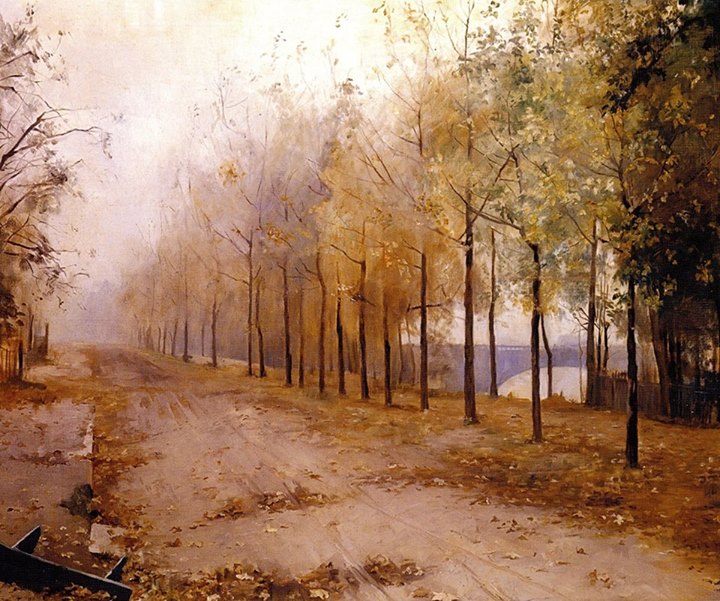
 Although I stated earlier that Bashkirtseff wanted to focus on urban portrayals, my next offering of her work is a beautiful painting entitled Autumn, which moves towards a landscape work.  The setting is a rutted tree-lined road which runs parallel to the river.  Through the trees we see an arched stone bridge which straddles the waterway.  The time must be late summer or maybe early autumn as many of the trees have shed their bronze-tinted leaves while others cling to the branches and retain their summer colour.  To the side of the road is a pavement.  Look at the details Marie has depicted of the sidewalk.  The fallen bench straddles the pavement and the road.  The crumbling stonework of the pavement is clearly visible and which is now home for the fallen, windswept leaves and what looks like an abandoned newspaper lies in the gutter close to the fallen bench.  Beside the pavement we see a stretch of garden fencing which has seen better days.  This is an example of Naturalism in art, a style Marie Bashkirtseff had adopted due to the influence of her close friend, Jules Bastien-Lepage.  The painting is devoid of people and this fact alone means we are not distracted from the artist’s detailed depiction of the area.  It also avoids the work of art being focused on people and the depiction of them may turn the painting into a work of Social Realism with the landscape being looked upon as merely a background to a story within the work.  The colours used by the artist set the scene for a certain time of year and also a certain time of day.  One can imagine the lighting of the scene would be different at another time of day and obviously it would be a far different depiction if this had been mid-winter.

 In a diary entry for May 1884, she wrote:

 “…What is the use of lying or pretending?  Yes, it is clear that I have the desire, if not the hope, of staying on this earth by whatever means possible.  If I don’t die young, I hope to become a great artist.  If I do, I want my journal to be published…”  

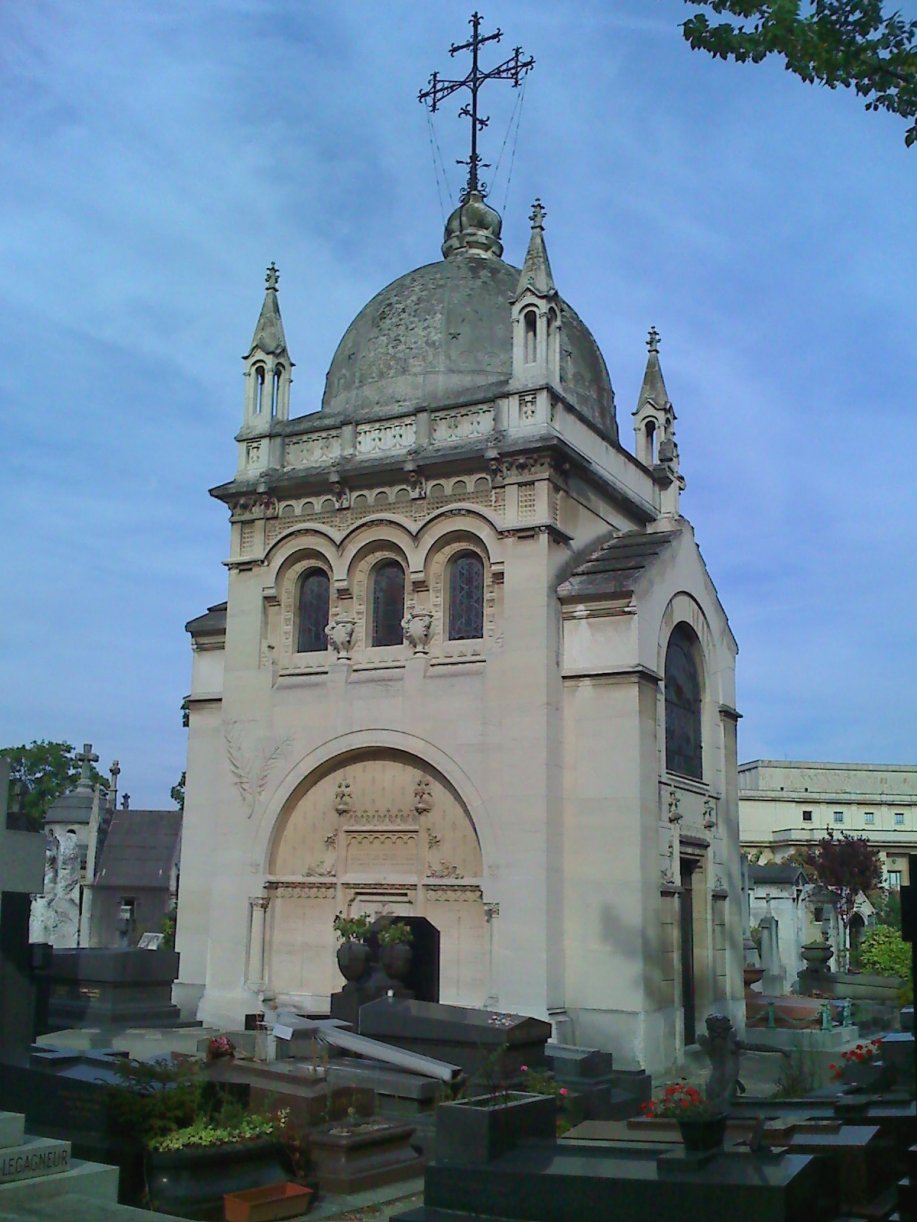
Marie Bashkirtseff's mausoleum  in Cimetière de Passy, Paris
Marie Bashkirtseff’s mausoleum in Cimetière de Passy, Paris

Four months after this entry, on October 31st 1884, Marie Bashkirtseff died of consumption (pulmonary tuberculosis) in Paris.  She was just twenty-five years old and for her, she sadly believed she had achieved little.

Inside of Marie Bashkirtseff's mausoleum
Inside of Marie Bashkirtseff’s mausoleum

She was buried in Cimetière de Passy in a large mausoleum, designed as a full-sized artist’s studio and has now become a French Heritage site. The inside of Marie Bashkirtseff’s mausoleum we see in the central background a copy of Marie’s bust which was sculpted by her friend the sculptor René de Saint Marceaux.  Behind the sculpture hanging on the wall is one of Marie Bashkirtseff’s last and unfinished paintings entitled Women Saints. At either side, on pedestals are busts of her parents Sadly almost two hundred of her works were destroyed or looted during the Second World War.  However her journal was published by her family in 1887.  Sadly it was an abridged version which had been heavily censored by her relatives who thought a lot of the contents about them were unflattering seeing to it that a good deal of material was critical and unflattering to the family and unfit for the reading public.  Having said that however, the diary stands as one of the great diaries of its time.  It was not until some years later, with the discovery of Marie’s original manuscript in the Bibliothèque nationale de France that it was realised that the diaries published by the family had been heavily edited.   An unabridged edition of the complete journal, based on the original manuscript, has been published in French in 16 volumes, and excerpts from the years 1873–76 have been translated into English under the title I Am the Most Interesting Book of All.

The diaries were started by a girl of fourteen and they began as a simple coming-of-age journal but later developed into an often sad account of how life conspired against her and her fight to survive.

I will leave you with an entry in her diary when she talks about how people may remember her.  She wrote:

“…If I do not die young I hope to live as great artist; but if I die young, I intend to have my journal, which cannot fail to be interesting, published. Similarly: “When I am dead, my life, which appears to me a remarkable one, will be read. (The only thing wanting is that it should have been different)…”

Marie Bashkirtseff. Part 1 The portraitist and feminist

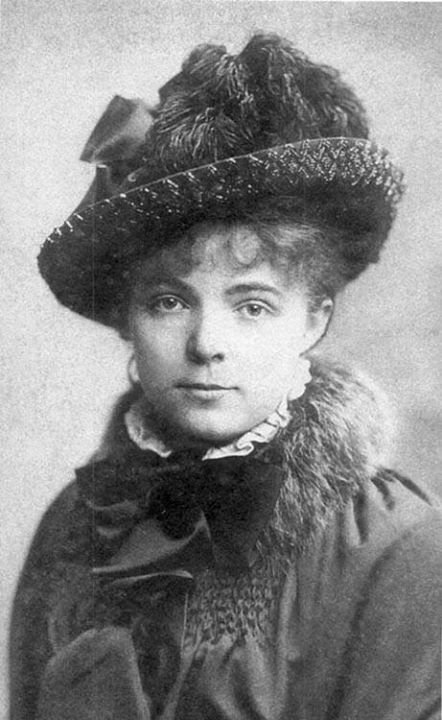
Photograph of twenty year old Marie Bashkirtseff (1878)

I had been researching the life of Jules Bastien-Lepage for a future blog when I came across the fascinating story of a Ukranian lady, a friend of his, who during her very short life excelled as a painter, a sculptor and a diarist.  It was her talent as a diarist and her personal diary which led to her notoriety.  I have split her lifestory, as short as it was, between two blogs, so come with me and explore the life of Maria Konstantinovna Bashkirtseva who became better known as Marie Bashkirtseff and her portraiture.

 Marie Bashkirtseff was born in November 1858 at Gavrontsi, a beautiful country estate close to the provincial town of Poltava in southern Ukraine.  Her father was Konstantin Bashkirtseff and her mother Mariia Babanina, who was a lady, fiercely proud of her Tartar heritage.   The family were wealthy and were looked upon as being of the petite noblesse social class, which was a termed used to describe the lesser nobility of France, especially rural landowners of noble ancestry.  A year later Marie’s brother Paul was born.  Marie was a studious and very intelligent child, speaking Russian and French fluently and even when young she exhibited a dynamic personality.  Her parents split up in 1859 and her mother took her and her brother back to her parents’ home in Tcherniakovka. 


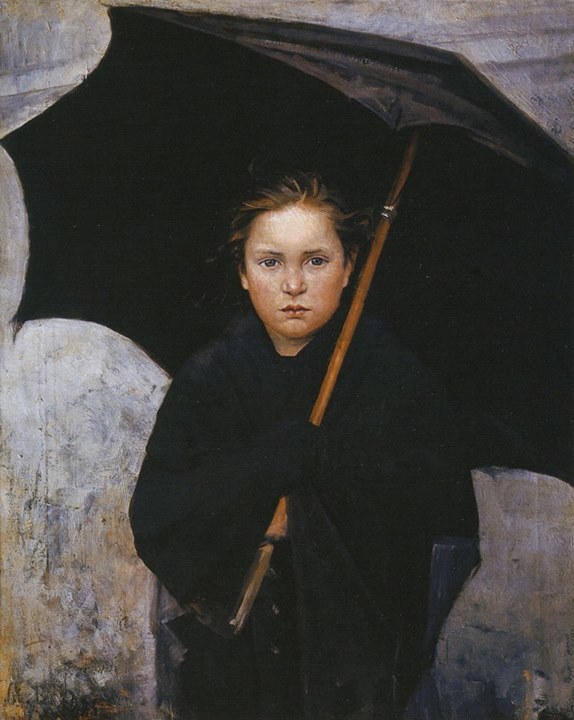
The Umbrella by Marie Bashkirtseff  (1883)
The Umbrella by Marie Bashkirtseff (1883)

In May 1870, when Marie was eleven years old, her grandfather, Stepan Babanin, her brother Paul, and a motley collection of other family members, along with the family physician, Doctor Walitsky, left Tcherniakovka for good and embarked on a voyage of discovery around Russia and Europe.  The extensive journey lasted almost two years until the weary travellers settled down in a villa situated in the foothills of the Mediterranean Alps overlooking the coastal resort of Nice.  It was at this idyllic setting that fourteen year old Marie started to dabble with her artwork and also started to write her diary.  This diary which was eventually published in 1887, three years after her death, was to become a best seller.  In it she would write about her life on the Côte d’Azur with her extended family, her teenage infatuations, her dreams for the future and her loves.  She had a fixed idea of what her diary would be all about, writing:

 “…If I don’t live enough to be illustrious, this diary will be interesting for naturalists; the life of a woman is always curious, day by day, without affectation, as if nobody in the world should ever read it and at the same time with the intention of being read; I’m sure that you will find me pleasant… and I mean everything. Otherwise, what’s the point in writing? Apart from this, you will see that I say everything…”

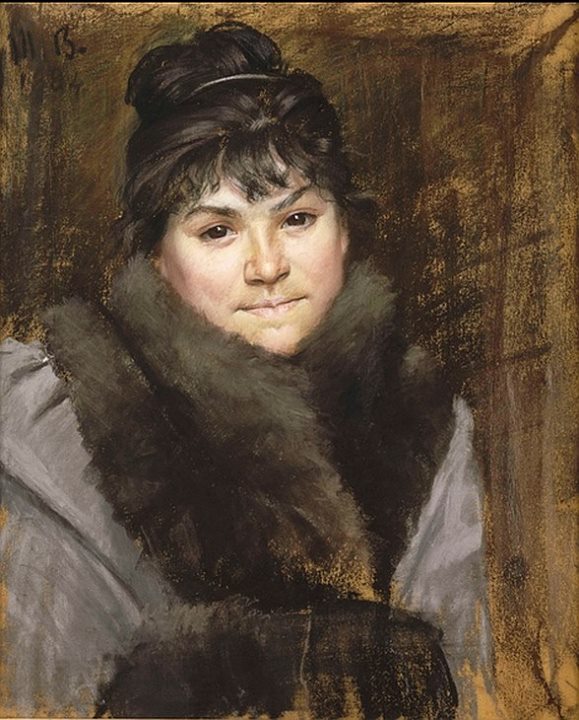
Portrait of Mme X by Marie Bashkirtseff (c.1884)

 Marie Bashkirtseff received a well rounded education.  She was home-tutored with the family employing governesses and private tutors and she studied a number of languages including English, German, Italian, Greek and Latin.  She was well versed in history, mythology and literature and it was that knowledge that found its way onto the pages of her diary.   She also developed a great love of music and singing.   She was an accomplished pianist, played the harp and was a talented singer and she hoped that one day she would become a professional mezzo-soprano.   This plan for her future was to be dashed after a severe bout of laryngitis which irrevocably affected her vocal chords.  She was devastated at this turn of events, once musing in her diary about what could have been:

 “…My God!  What a beautiful voice I had!  It was powerful, dramatic, captivating; it gave chills in the back. And now I have nothing, not even a voice to speak with!…”

 With music being a thing of the past, Marie needed another outlet for her exuberance and it came in 1877,  when, aged nineteen,  she decided to embark on a career as an artist.  For this to happen she decided that Nice was not the place to be and insisted that the whole family should move to the European capital of art, Paris, for it was here she believed she would receive the best art tuition and be able to study the paintings of the Masters.  The family opposed the move, not because they didn’t want to move to the capital but because of Marie’s fragile health.  They believed that the warm climate of Nice was more suitable for Marie than the colder, damper climate of Paris.  It was not because of their wish to stay warm and enjoy the sunny climate of the south but it was because Marie had been diagnosed with irreversible tuberculosis and doctors had warned against such a move.  However the dominant and forceful character of Marie won the day and that year they left the south of France and moved north.

Portrait of a Woman by Marie Bashkirtseff (1882)

The Parisian establishment, which was in the forefront of art tuition, was the École des Beaux-Arts but this was not an option for Marie as, at that time, women were not allowed to enrol for study at that academy.  Marie then chose to enrol at the Académie Julian, which was the only academy at the time which accepted female students, albeit the men and women trained separately.  However the training for females was similar, even allowing women to participate in life drawing classes with nude models, which was frowned upon by other art establishments.  It was founded by Rodolphe Julian in 1868.  It was a private studio school for art students, which, as well as training aspiring male artists to pass the exams to enter the hallowed and prestigious École des Beaux-Arts,  it also offered independent training in arts to wannabe female painters.  Whilst there Marie received excellent artistic training under the tutelage of the likes of Rodolphe Julian, Tony Robert-Fleury, Gustave Boulanger, and Jules-Joseph Lefebvre.  She revelled in this world of art and even the glamour of her social life took a back seat as she commented in her diary:

 “…as for me, although feeling pleased of being in the ballroom, I’ve been thinking all the time in a pastel painted this morning with which I wasn’t satisfied…

 Marie was a perfectionist in all that she did and was highly competitive.  This latter characteristic manifested itself in her fierce competition with her fellow student, the Swiss-born painter, Louise Catherine Breslau.  They both exhibited works at the Paris Salons and Marie’s competitive nature soon turned to jealousy, jealous of the artistic ability of her fellow student.  She looked upon Breslau as a competitor in the race to be recognised by the art critics and the public.  Breslau was two years older than Bashkirtseff  but was to outlive her by more than forty years and so was able to consolidate her reputation within the art world.

Parisienne, Portrait of Irma by Marie Bashkirtseff (1882)

Marie Bashkirtseff, besides her dedication to painting, developed another love whilst living in Paris.  She was drawn to the feminist movement .  Hubertine Auclert had founded the feminist movement known as Le Droit des Femmes in 1876, the year before Marie had arrived in Paris.  It was a movement that supported women’s right to have the vote.  Marie, using the pseudonym, Pauline Orell, applied her innate ability as a writer to produce articles in support of feminism.  She had some of her writings published in La Citoyenne, a bi-monthly feminist newspaper first published Hubertine Auclert in Paris in 1881.  In the March 1881 edition an article by Baskirtseff appeared which linked her artistic career with that of the plight of women.  She cynically wrote:

 “…I will not surprise anyone by saying that women are excluded from the School of Fine Arts as they are almost everywhere.  Yet we admit them to the School of Medicine, why not at the École des Beaux-Arts.  Perhaps one fears scandals that would cause the element in this female comedies environment…” 

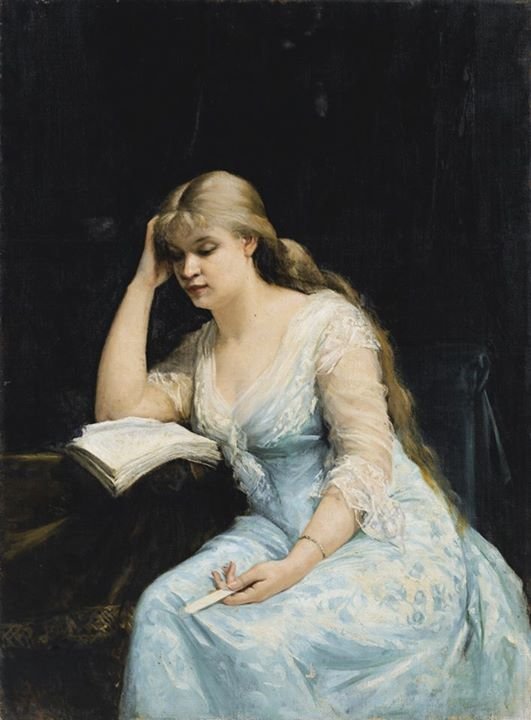
Jeune Femme Lisant la Question du Divorce d'Alexandre Dumas (Portrait of a Young Woman Reading) by Marie Bashkirtseff (1880)
Jeune Femme Lisant la Question du Divorce d’Alexandre Dumas (Portrait of a Young Woman Reading) by Marie Bashkirtseff (1880)

In 1880 , Marie Bashkirtseff submitted a beautiful work of portraiture to the Salon.  It was entitled Jeune femme lisant la Question du Divorce d’Alexandre Dumas (Portrait of a young woman reading).  It was not simply a portrait of a young woman,  it was a work of art with a message.  We see before us a portrait of a beautiful and stylish young woman who is totally engrossed in reading her book, The Divorce Question by Alexandre Dumas.  The sitter for this portrait is thought to be Marie’s cousin, Dina Babanine, who two years after Marie’s death would marry and become the Countess Toulouse-Lautrec.  There is a feminist statement behind this depiction.  There is the message that beautiful women have intelligence.  The title of the painting tells us the title of the book she is reading.  It was the 1880 work by the well-known author, Alexandre Dumas, who was discussing divorce and the French laws appertaining to the subject.  It was a controversial book and in some ways a ground-breaking one.  The serious and intellectual nature of the book was a statement that women do not, as believed by many, especially men, only read frothy romantic novels.   The artist was also making a statement regarding the important position of women in society.  In this case, it was about her aspirations for female independence.  The right to divorce and break free from an abusive relationship, the same right as men to be trained to become an artist, the women’s right to vote.  It was simply her belief regarding the right of women to be equal to men.

Portrait de la Comtesse Dina de Toulouse-Lautrec, by Marie Bashkirtseff (1883)

Dina Babanin featured in another of Bashkirtseff’s works.  It was a work in pastels, simply entitled Dina Babanine and was completed in 1883.   Dina was Marie’s cousin and also a close life-long friend.  Her early upbringing was in total contrast to that of Marie.  Dina and her brother had been brought up in a very disruptive household.  Her father had his marriage to their mother annulled making his children illegitimate.  This beautifully crafted portrait depicts the beauty of Marie’s cousin.  She wears a pale blue décolleté peignoir with a wide delicate white collar.  Her face, neck and chest have been depicted using delicately blended light tones which enhance the youthful beauty of the sitter.  Her full lips are pressed together but it is her eyes that catch our attention.  They are dark blue in colour.  She does not quite focus upon us.  There is a feeling that she has lost her power of concentration and there is a blankness about her stare.  Like all inquisitive and discerning observers we search for imperfections of her beauty but they are hard to find.  Maybe we comment upon the slight cleft of her chin.  Maybe we remark upon the flatness of her nose.  However we cannot but acknowledge her overall beauty.  Look at the composition.  It is all about the female.  There is no jewellery, no flowers attached to her simple but revealing dress with its plunging neckline.  The artist wanted nothing to divert our attention from her cousin’s beauty and in that she has unquestionably succeeded.

In my next blog I will conclude her life story, look at some of her most famous paintings and reveal more about her diary.

Marie Bracquemond

        Self Portrait  by Marie Bracquemond             (1870)
Self Portrait
by Marie Bracquemond
(1870)

I was reading the other day about the short list for the National Portrait Gallery – 2014 BP Award.  Apparently the judges, who decide on which works should be shortlisted, are not aware of the names of the artists when they make their selections.  For the first time in the twenty-five years of the competition, two of the portraits selected for the exhibition were works by a husband and wife, Henrietta Graham and Tim Hall and it made me wonder how well husband and wife artists co-exist and whether they were supportive of each other’s artistic efforts and style or were they occasionally critical and somewhat jealous of each other’s success.  My featured artist today was one half of a husband and wife duo but it is thought that the husband became so critical of his wife’s works and her style of painting that she eventually gave up art altogether.

Marie Bracquemond        (1840-1916)
Marie Bracquemond
(1840-1916)

The lady in question was born Marie Anne Caroline Quivoron in December 1840 in the small picturesque coastal village of Argenton-en-Landunvez, on the Brittany coast. She was of the same era as her female Impressionist contemporaries, Berthe Morisot, Mary Cassatt and Eva Gonzalez but her background was very unlike their more privileged and cultured upbringing.  Her mother’s first marriage was an arranged one to a sea captain.  It was neither a successful nor happy union.  However, it did not last long as he died shortly after the birth of his daughter, Marie Anne. Her mother was only a widow for a short period before marrying for a second time.  Her husband was a Monsieur Pasquiou.   Shortly after this second marriage, Marie, her mother and her mother’s new husband moved away from Britanny and went to live in the Jura, a mountainous region in the east of the country.  Then, soon after, they crossed over the border to take up residence in Switzerland.  Again their stay was short-lived and before long they moved back to central France and settled in Corrèze in the Auvergne, where Marie’s sister, Louise, was born.  According to what she told her son in later life, this was the happiest time of her childhood. They lived in a area surrounded by mysterious forests, fast-flowing streams and ancient ruined abbeys.  Living there was a truly magical time for her.  The family finally moved north and settled in Paris but later because of Marie’s health problems they were advised by the family physician, Doctor Hache, to move out of the polluted atmosphere of the city and settle in Étampes, a small town south-west of the capital where the air would be purer.

Woman in the Garden  (a portrait of her sister Louise)  by Marie Bracquemond
Detail from Woman in the Garden (a portrait of her sister Louise) by Marie Bracquemond
Woman in the Garden (Portrait of her sister Louise Quivoron) by Marie Bracquemond (1877)

Now a teenager, Marie developed a love for art and it was whilst living in Étampes that she received her first artistic tuition.  Her teacher was a Monsieur Wassor, an elderly man who gave art lessons to the young women of Étampes as well as earning money as an art restorer.  He got Marie to make copies of reliefs and plaster casts which he had scattered around his studio and he also got her to make copies of paintings he had accumulated.  When the summer came and the weather improved he would take Marie and other students outside to paint en plein air.  Her progress as an accomplished artist was swift and a measure of that is the fact at the age of seventeen she submitted a family portrait, which included her mother, her sister Louise and one of her elderly teachers, for inclusion at the 1857 Salon and it was accepted.

Pierre Bracquemond as child by Marie Bracquemond (1878)

Fate now took a hand in Marie’s future as the sister-in-law of the family doctor, Doctor Hache, was married to the Neoclassical painter, Jean-Auguste-Dominique Ingres and she arranged for Marie to meet her husband.  Ingres arranged for her to work with two of his students, Jean-Hippolyte Flandrin and Émile Signol and she learnt much from them.  Although grateful for Ingres’ help she was unhappy with the elderly artist’s disdain with regard female artists.  In a letter she wrote about Ingres’ contempt:

“…The severity of Monsieur Ingres frightened me.  I tell you, because he doubted the courage and perseverance of a woman in the field of painting.  He wished to impose limits.  He would assign to them only the painting of flowers, of fruits, of still lifes, portraits and genre scenes…”

For Marie, Ingres view on female artists was unacceptable.  Her determination to rail against Ingres’ criticism of female artists and his compartmentalising of the artistic genres suitable for female artists, materialised when she wrote of her split with the elderly painter:

“…There is in me a strong determination to overcome all obstacles.  I wish to work at painting, not to paint some flowers, but to express those feelings that art inspires in me…..All this will not come to pass in a year, but in any event, I do not wish to return to Monsieur Ingres…”

The Lady in White by Marie Bracquemond (1880)

Her artistic ability must have been well known as she soon received commissions including one from the court of Empress Eugenie, the Empress of France and wife of Napoleon III, which commissioned a depiction Cervantes in prison.   Following the successful conclusion of this commission she was approached by the Director-General of French Museums, Count de Nieuwerkerke, to work at the Louvre, making copies of the most famous paintings in the collection.   It was in 1867, whilst Marie was working in the Louvre copying a painting by Rembrandt, that a young man, Félix Bracquemond, an engraver and etcher, first caught sight and fell in love with this dark-haired beauty.  Félix, through his friend, Eugène Montrosier, was introduced to Marie.  A two-year courtship followed during which time Félix introduced Marie to all his artist friends, such as Millet, Corot, Degas, Rodin and Fantin-Latour and art critics and writers such as Edmond de Goncourt and Gustave Geffroy, and through them she received more and more commissions.   Unfortunately for Marie there was a problematic downside to this relationship.  Félix was not a particularly nice man.  He had a very off-hand brusque demeanour.  He was self-opinionated and later became über-critical of Marie’s artistic talent but despite Marie’s mother’s voiced concern over the relationship between Félix and her daughter, the couple were married in August 1869 and went to live in the rue de l’Université in Paris.  Marie was well aware of her husband’s unacceptable characteristics but presumably believed that all that would change when they were married.  It didn’t!  In 1870 Marie gave birth to their only child, Pierre.  Despite his uncompromising and offhand attitude Marie learnt a great deal from her husband and she exhibited works at the 1874 and 1875 Salon.

The Artist's Son and Sister in the Garden at Sèvres by Marie Bracquemond (1890
The Artist’s Son and Sister in the Garden at Sèvres by Marie Bracquemond (1890)

Haviland China was a factory set up in Limoges, France, by the American entrepreneur David Haviland and later was aided by his sons, Charles and Theodore.  The factory produced the finest china tableware.  In 1872 David’s son Charles, opened the Auteuil Studio in Paris, which attracted many of the great artists of the day, including Manet, Monet, and the Damousse brothers, all of whom greatly influenced Haviland’s floral designs.  It became known as the “French School”.   Félix Bracquemond, who had a reputation as a great ceramics decorator, was, in 1878, employed in the studio as the artistic director and Marie also worked there designing plates for dinner services.  In an article in the 1904 magazine Women in the Fine Arts, the writer, Clara Erskine Clement who was the author of Women in the Fine Arts from the Seventh Century to the Twentieth Century AD,wrote about Marie Bracquemond’s amazing ability:

“…Madame Bracquemond had the facility of employing the faience colours so well that she produced a clearness and richness not achieved by other artists.  The progress made in the Haviland faience in the 70’s was very largely due to Madame Bracquemond, whose pieces were almost always sold from the atelier before being fired, so great was her success…”

Faience is the conventional name in English for a tin-glazed earthenware.

One of Marie’s great accomplishments was to design and produce several dishes and a wide Faience panel of ceramic tiles entitled the Muses, all of which were exhibited at the Exposition Universelle in Paris in 1878; the preliminary sketch used for the design was shown at the Impressionist Exhibition of 1879 and among its greatest admirers was Edgar Degas.

On the Terrace at Sèvres by Marie Bracquemond (1880)

It was around 1880 that there was a change in Marie’s artistic style.  Gone were the small muted works of art and in their place came larger works with a greater intensity of colour and more of her paintings were carried out en plein air allowing her to catch the nuances of the daylight which constantly changed..  This was the era of the Impressionists and Marie Bracquemond had become great friends of Edgar Degas, Claude Monet, Renoir and Gaugin these artists had become her artistic mentors.  She had been welcomed into the Impressionists’ fold and she exhibited works at three of their annual exhibitions, in 1879, 1880 and the final Impressionist Exhibition in 1886.  Three of her works completed in 1880 which clearly demonstrate her alteration of style to a noticeable Impressionist style, were The Lady in White, On the Terrace at Sèvres and Le Gouter (Afternoon Tea).

Le Gouter or Afternoon Tea by Marie Bracquemond (1880)

She was delighted with her art and its popularity but this delight was not shared by her husband, Félix, who resented her success and her close liaison with the Impressionists.   Their son Pierre, who loved his mother and was the No.1 fan of her work, later wrote about his father’s resentment.  According to Pierre, Félix was jealous of her achievement and rarely showed her works to visiting artists and friends.  He said that Félix now resented any criticisms Marie might venture about his paintings.  It appeared that the once close artistic relationship between Marie and Félix, with each offering constructive critiques regarding their works, was over.  Félix would often hide his new works from his wife but at the same time was openly critical with regards to her artistic efforts.  This uncomfortable atmosphere in the marital home and the constant friction between her and Félix finally took its toll in 1890 when Marie could not stand her husband’s attitude to her work any longer and except for a few examples completely gave up her painting.  One of her last works was the Impressionist-style work entitled The Artist’s Son and Sister in the Garden at Sèvres which she completed in 1890.  At the time of this painting the constant battle with her husband had made her become introverted and she became a virtual recluse, rarely leaving their Sèvres home. Her sister Louise did not like her brother-in-law finding him overbearing and boorish in the way he treated her sister.

Pierre Bracquemond painting a bouquet of flowers by Marie Bracquemond (1887)

Pierre Bracquemond who was taught by his father later became involved in works for Gobelin, a Parisian tapestry factory.  He then worked at a career as an interior decorator specialising in the designs of carpets and tapestries.  He also carried on his love of art concentrating on seascapes and nudes, chiefly employing the technique of encaustic paintiing, which was also known as hot wax painting, as it involved using heated beeswax to which colored pigments were added.   He also wrote many critiques with regards art and the teachings of his father on the subject.  There were also many manuscripts he had written about his parents Marie and Félix, some of which were never published.

Marie Bracquemond died in Paris on January 17, 1916.

Marianne North the botanical painter

Marianne North     1830-1890
Marianne North
1830-1890

The artist I want to look at today could, I suppose, be labelled simply as a floral painter but in fact because of her desire for accuracy in floral detail she is often referred to as a botanical painter.  Even today, in the age of photography, botanical art still thrives and with so much destruction of habitats around the world, which nurtured rare flora, the necessity to record such species in detail is of paramount importance.  My featured artist today is the Victorian artist Marianne North.

The House at Hastings

Marianne North was born at Hastings Lodge in Hastings, England on October 24th 1830.  Her father Frederick North, an Old Harovian, was a wealthy landowner, local magistrate and, on a number of occasions, a Liberal Member of Parliament for Hastings.  His wife Janet (née Marjoribanks), was the daughter of Sir John Marjoribanks M.P., 1st Baronet of Lees in the County of Berwick.  She had been widowed when her first husband Robert Shuttleworth of Gawthorpe Hall in Lancashire died in a coaching accident 1818. She and her first husband had a daughter, Janet Shuttleworth.  Marianne North came from a long line of nobility and many of her ancestors’ portraits hung in the family dining room.  She was devoted to her father and in her autobiography, A Vision of Eden, she wrote of him:

“…My first recollections relate to my father.  He was from first to Last the one idol and friend of my life…”

Marianne had an elder brother, Charles and a younger sister, Catherine.  It is believed that she did not receive any formal education, except for a short period in a school in Norwich, which she hated.  Marianne was adamant that she taught herself all that was to be learnt, writing in her autobiography:

“…Walter Scott or Shakespeare gave me their versions of history, and Robinson Crusoe and some other old books my ideas of geography…”

Flowers of the Angel's Trumpet and humming birds, Brazil by Marianne North
Flowers of the Angel’s Trumpet and humming birds, Brazil by Marianne North

However the status and wealth of her father ensured that his children were well educated and often had the opportunity to mix with artists and musicians.  Marianne was said to have had a penchant for singing and as a child was given vocal lessons by Charlotte Helen Sainton-Dolby, the well-known English contralto, composer and singing teacher.  Unfortunately as a teenager her singing voice gave way and she began to concentrate on her other love – drawing and painting.  Life was good for Marianne.  As a young teenager, she had basked in a life of prosperity.  It was a privileged life.  Winters were spent at their Notting Hill house in London.  In the spring, they would move back to their large family home in Hastings.  During the summer months she and her family would either spend time on their farmhouse in Rougham, Norfolk, which had once been the laundry of Rougham Hall, once owned by her ancestors.  Alternatively, they would stay at Gawthorpe Hall in Lancashire which had been inherited by Marianne’s step-sister, Janet.  In the late summer of 1847 Marianne’s father took his family on a European tour which lasted almost three years.  Throughout this time Marianne studied flower painting, botany, and music.  On arrival back to London Marianne wanted to continue with her love of drawing and painting and it was arranged for her have some lessons in flower painting from a Dutch painter, Miss van Fowinkel and the English flower painter, Valentine Bartholemew, who had held the position of Flower Painter in Ordinary to the Queen from 1849 until his death thirty years later.

Marianne’s mother, Janet, who had increasingly become an invalid, died in January 1855.  The relationship between mother and daughter was nowhere as strong as the one between her and her father.  Marianne talked about her mother in her autobiography and commented:

“…On the 17th of January 1855 my mother died.  Her end had come gradually; for many weeks we felt it was coming.  She did not suffer, but enjoyed nothing, and her life was a dreary one.  She made me promise never to leave my father…”

Doum and Date Palms on the Nile above Philae, Egypt by Marianne North (c. 1880)

With her mother gone, Marianne, aged twenty-four, took on the role as the lady of the house, looking after her father and the running of the household.   Her father, who had been the Liberal MP for Hastings on a number of occasions, would during the parliamentary recess take his two daughters off on long trips around Europe.     One of their favourite destinations was the valleys around the southern slopes of Mont Blanc and Monta Rosa.    By this time Marianne’s brother Charles had married and his father had given him the old house in Rougham. Marianne’s sister Catherine had married in 1864 and her father, Frederick North, narrowly lost his Hastings parliamentary seat by just nine votes at the General Election in July 1865 and this gave him the opportunity to set off on another voyage of discovery with Marianne travelling through Europe and the Mediterranean isles of Corfu and Cyprus before reaching Syria and Egypt.

Papyrus Growing in the Ciane, Syracuse, Sicily by Marianne North (1870)

Three years after his defeat in the General Election Frederick North was re-elected as MP for Hastings in 1868.   Marianne’s father was sixty-eight years old and his health had begun to deteriorate but this did not stop him from taking a holiday to Southern Germany with Marianne.  However during their Bavarian sojourn, he became ill and Marianne was advised to take him back home to Hastings, which she did.  Frederick North died on October 29th.  Marianne was devastated for not only had she lost her father, she had lost her greatest friend.  She recalled his death in her autobiography, writing:

“…The last words in his mouth were, ‘Come and give me a kiss, Pop, I am only going to sleep’.  He never woke again and left me indeed alone…”

She recalled how much her father had meant to her and one can feel her deep sorrow.  She wrote:

“…For nearly forty years he had been my one friend and companion, and now I had to learn to live without him, and to fill up my life with other interests as I best might.  I wished to be alone, I could not bear to talk of him or anything else…”

The Aqueduct of Morro Velho, Brazil by Marianne North (1873)

Marianne North carried on with her two great loves, travelling and painting the flora she saw during those voyages of discovery.  In July 1871 she set off on a long journey which would last over two years.  She arrived in Canada, travelled on to the United States, and later the Caribbean island of Jamaica. From there, in 1872, she journeyed to Brazil where she spent much of her time drawing in a remote forest hut. She eventually returned to England in September 1873. Throughout her time on her travels she would be constantly sketching the flora of the area and the landscapes.

Roadside Scene under the Cocoanut Trees at Galle, Ceylon by Marianne North (c.1877)

In the spring of 1875 she was once again off on her travels.  This time she visited Tenerife, and later that year started her first round-the-world trip taking in the west coast of America, Japan, Borneo, Java, and Ceylon, and did not return home until March 1877.  Although she loved being in the house in Hastings and spent much time in the garden she had a wanderlust and in September 1878 this travel bug bit once again and she set off by ship to India, where she stayed for nearly six months,

Marianne North Gallery, Kew Gardens, London

By this time Marianne had built up a large collection of drawings which she had completed during her extensive travels.  As they were so popular she held an exhibition of her work in a London gallery.  Having been overwhelmed by their popularity she came up with the idea that they should be housed in a permanent collection and with this in mind she approached Sir Joseph Hooker, the director of the Kew Botanical Gardens in London and offered to present them with her art works and to fund the building of a gallery to house them.  This was agreed and the architect James Fergusson submitted designs for the building and building work started in 1880.  Sir Joseph Hooker as well as being a director of Kew Gardens was a good friend of Charles Darwin and he was introduced to Marianne and it was on his suggestion that she should visit Australia, and New Zealand to discover and sketch the native flora and vegetation.  Marianne took up his suggestion and once again left her homeland and sailed to the antipodean.

Inside the Marianne North Gallery

On her return to England she set about arranging her paintings inside the newly completed gallery building at Kew and on July 9th 1882 it opened to the public as the Marianne North Gallery.

The Wild Tamarind of Jamaica with Scarlet Pod and Barbet by Marianne North (1872)

She resumed her travels visiting South Africa in 1883 and the following winter she was in the Seychelles.  All this travelling and having to endure constantly changing climatic conditions eventually affected her health and, during her later years, she was unable to live a pain-free existence.  She began to lose her hearing and in 1888 began to suffer from liver disease which finally claimed her life.  Marianne North died on August 30th 1890 aged 60.  Maybe it would be fitting to leave the last words to her sister Catherine who wrote about her sister:

“…The one strong and passionate feeling of her life had been her love for her father.  When he was taken away she threw her whole heart into painting and this gradually led her into those long toilsome journeys.  They no doubt shortened her life; but length of days had never been expected or desired by her, and I think she was glad, when her self-appointed task was done, to follow him whom she had faithfully loved…”

I have only been able to attach a few of Marianne’s numerous sketches and I am sure a visit to her gallery at Kew Gardens would be an amazing experience.  For those of you who might not be able to make that journey may I suggest you get hold of her autobiography, the book which I have been reading and from which I gleaned  most of the facts about this talented painter.   It was not an expensive book and well worth the money. It is called A Vision of Eden; The Life and Work of Marianne North.

Mary Cassatt – Mother and Child – Part 2

Mary Cassatt
Mary Cassatt

As a follow-on from my previous blog I want to feature some more works by Mary Cassatt which feature the close relationship between mother and child. Mary Cassatt had always been enthusiastic about painting mothers and their children and this passion was once more awakened when, in 1880, Cassatt’s brother, Alexander, arrived in Paris with his young family. Their arrival renewed Cassatt’s interest in depicting children, and her nephews and nieces now provided the opportunity for Cassatt to study and paint children from life. She would often use her brother’s family as models. She would also use local women as her models for her paintings rather than employ professional models as, first of all, she did not believe that professional models would agree to sit for her, but secondly and more importantly, she was of the opinion that professional models posed self-consciously and that would destroy her objective of producing a natural mother and child portrait. As in most of her paintings, Cassatt did not seek to glamorise or sentimentalise her subjects; instead she wanted to depict the mothers as honest, clean-living, good-looking women.

Emmie and her Child by Mary Cassatt (1889)

The first mother and child work by Mary Cassatt that I am featuring is one she completed in 1889, entitled Emmie and Her Child. We can clearly see the influence of Impressionism in this work. Before us, we see a young child sitting on his or her mother’s knee. Look how relaxed the young child is as he gazes out at something off-canvas. The child rests his right hand on the mother’s chin. It seems to be almost an unconscious gesture. It assures him of her presence. It is not a demanding or needy gesture. His left hand is placed on his mother’s hand which encircles his waist. He is at ease. He feels secure in the close presence of his mother. The mother looks down lovingly at her child. She wraps her arms around her child offering comfort. She too is relaxed, content and happy.

There is a pleasing tranquillity about the depiction of mother and child. This tranquillity is enhanced by the colours Cassatt has utilised in this work. There is a lot of white but it is not a glaring brilliant white as it has been toned down by the grey, blue and brown she has added to the white. The white of the mother’s dress has also been toned down by the incorporation of a floral pattern of red roses, the colour of which almost optically masks the white of the dress. Although the white of the mother’s dress and the tinged white of the jug and bowl on the shelf in the background are less than pure it is the colour of the child’s vest which retains the pure white colour and thus makes it stand out. This pure white colour also reflects the light upwards on to the child’s face which thus cleverly captures our attention.

Baby's First Caress by Mary Cassatt (1891)
Baby’s First Caress by Mary Cassatt (1891)

My next featured work by Mary Cassatt is entitled Baby’s First Caress and was completed two years after my previous offering, in 1891. The first thing I noticed about this work was the similar way in which Cassatt has depicted the baby reaching up to touch and cup his mother’s chin with his tiny but pudgy hand. However, unlike the first painting, the baby boy is concentrating on his mother’s face. It is as if he is mesmerised by it and needs to feel the texture of his mother’s skin so as to glean some knowledge about her face. At the same time that he is touching her face she is holding his foot in her left hand, maybe soothingly stroking it with her thumb to give him some reassurance whilst her right arm which is out of sight cradles his back and keeps him secure on her knee. If we look closely, we can just make out the fingers of the mother’s right hand which the baby grasps in his right hand. She looks down at him with a loving expression. This work, unlike the first painting which was in oil, is in pastel. Once again the brilliant white of her dress has been toned down by strokes of blue as well as the hint of a red floral pattern. This has subdued the brightness of her dress and therefore does not distract us from the depiction of mother and child.

The provenance of this work is quite interesting. The painting had belonged to Louisine Waldron Elder Havemeyer. She was an art collector, fervent feminist and a patron of Impressionist art. After her father’s death in 1874, when she was eighteen years of age, her mother took Louisine and her sister to Paris. She attended the Marie Del Sarte’s boarding school where she became friends with a fellow student, also an American, Emily Sartain, and it was through this friendship that Louisine met Mary Cassatt. The two became inseparable and would often tour the Parisian art galleries and during one such visit Louisine met Degas. Cassatt convinced Louisine to invest in some of Degas’ works. It was good advice as in her autobiography Sixteen to Sixty: Memoirs of a collector, Louisine wrote that one of the works by Degas which she bought was a pastel, La Repetition de Ballett, and it cost her 500 francs (about $100 US) which was almost her week’s stipend. In 1965 her grandson George Frelinghuysen sold it for $410,000! After that first foray into the world of a buyer of artworks, Louisine and Mary Cassatt made many more art purchases and the pair of art lovers travelled all over Europe together. Louisine was introduced to other aspiring artists such as Monet and Manet. Louisine returned to America in 1880 and concentrated on becoming an art collector. Three years later she married Henry O. Havemeyer of the American Sugar Refining Company. In the years that followed she and her husband built up one of the most important private art collections. When she died Louisine’s most of the art collection went to the Metropolitan Museum of Art in New York and yet this work, Baby’s First Caress, did not, as Louisine bequeathed it to her daughter Elektra, who was the wife of the great polo player and member of the Vanderbilt family, James Watson Webb. The painting was then bequeathed to the New Britain Museum of American Art in New Britain, Connecticut where it is currently housed.

Portrait of Mrs. Havemeyer and Her Daughter Electra by Mary Cassatt (1895)

In 1895 Cassatt painted a portrait of Louisine and her daughter Electra.

Chateau Beaufresne
Chateau Beaufresne

Although based in her rue de Marignan apartment in Paris in the winter, with the occasional visit to Grasse in Provence if the winter weather was really bad, Mary Cassatt bought herself a summer residence in 1893. It was the Chateau Beaufresne which was situated fifty miles north-west of Paris in the commune of Mesnil-Théribus in the Oise department. She loved her summer home and stayed there 33 years up until 1926, the year she died. Of the country house she once said:

                                     “…I have two loves, my country and Beaufresne !…”

Reine Lefebvre Holding a Nude Baby by Mary Cassatt (1902)

My final offering is an oil painting by Mary Cassatt which she completed in 1902 and is entitled Reine Lefebvre Holding a Nude Baby. It was at Chateau Beaufresne that she completed this mother/daughter work. Reine Lefebvre was a local woman and neighbour and featured in a number of Cassatt’s works between 1902 and 1903 as well as being depicted in a number of preparatory sketches for this finished work. This oil painting of Reine and her baby was the culmination of many sittings and many preparatory sketches. We see the mother with her arms crossed together around the legs of the baby forming a platform for her to sit upon. She wears an orange robe and the simple flecks of white paint give it a polka-dot appearance. The addition of what looks like a red collar or scarf around Reine’s neck cleverly draws our eyes towards the faces of the mother and baby. The artist wants us to concentrate on the faces of her two characters. The lack of any objects in the plain dark background means that we focus purely on mother and baby.

Cassatt’s desire for realism extends to the depiction of the baby, which she has been portrayed as still having a fat stomach, which infants often have during the early days. The baby has wrapped her arms around Reine’s neck. They both focus on a point off-canvas. Reine’s eyes look tired. Once again Cassatt has avoided sentimentality in this work and the mother’s weary look is a true depiction of the tiredness that often goes hand in hand with a mother coping with a young baby. It would have been so simple to portray Reine as a person full of life with a loving smile for her baby but this portrayal of her is a realistic one and one that Cassatt believed was the way to depict a mother with her child. It is an honest portrayal and lacks sentimentality and hype.

In my two blogs featuring the mother/child portrayals by Cassatt I have constantly talked about her determination to avoid sentimentality which was often seen in works by other artists. The writer Joris-Karl Huysman was forthright in his condemnation of such artists who over-sentimentalised mother and child portrayals when he wrote about the way them. He wrote:


“…The bunch of English and French daubers have put them in such stupid and pretentious poses!…”


He went on to acknowledge the realism of Mary Cassatt’s work with its hint of Japonisme, writing:
“…[her works were]… irreproachable pearls

Anne Vallayer-Coster. The Queen of Floral Still-Life works

Anne Vallayer-Coster

At the end of 1362 the Florentine writer, Giuseppe Boccaccio, he of The Decameron fame, (see my Daily Art Display Feb 21st 2012), had completed his book, De mulieribus claris (Of Famous Women), a biography of famous (and infamous) women, some real, some mythological.  In it he wrote about three female artists and commented:

“…Art is Alien to the mind of women, and these things cannot be accomplished without a great deal of talent, which in women is usually very scarce…”

In this blog I am returning to look at female artists and I am featuring a highly talented lady whose superb artistic talent rubbishes Boccaccio’s theory.  Today, I am looking at the struggle she, like other female painters of the time, had fighting their way through to success in a male-dominated field.  One of my favourite paintings is by the eighteenth century French female artist Louise Elisabeth Vigée Le Brun (See My Daily Art Display November 21st 2012) and recently I have been reading about a contemporary of hers, the very talented 18th century French painter who, like Le Brun, gained the patronage of Marie-Antoinette, the wife of the French monarch, Louis XVI.   She is Anne Vallayer-Coster.   Such royal patronage was the ultimate prize for aspiring painters as it led to many lucrative commissions.  However, unlike Le Brun, Anne Vallayer was not solely a portraitist but was an exceptional still-life and floral painter.

Anne Vallayer-Coster was born in Paris in December 1744.  She was the second of four daughters.  Her mother was a painter of miniatures.  Her father, Joseph Vallayer, was a goldsmith working at the Gobelins Manufactory Company in Paris, and the family lived on the grounds of the Gobelins Manufacturing complex, which produced the finest tapestries as well as luxury objects, which often adorned the royal palaces.  In 1757 the family moved to another area of Paris and Anne’s father started to trade in jewellery.  His business soon expanded with royal patronage and was granted the right to produce metal products for the military.

Anne Vallayer became interested in sketching and painting at an early age and her mother encouraged her by arranging for her to have private tuition from an art teacher, Madeleine Françoise Basseporte, a one-time pupil of the great French botanical painter, Claude Aubriet, and she, like him, was made the Royal Painter at the court of Louis XV, teaching the royal princesses to paint flowers.  Anne Vallayer learnt well from Basseport and she too was to become a talented botanical artist.  Her next art tutor was the landscape painter Claude Joseph Vernet.  In a short period of time Anne Vallayer became an accomplished artist concentrating on floral still-life works.  Her works were a beautiful juxtaposition of the flowers and inanimate objects such as books, musical instruments, tableware and furnishings.  The inanimate objects Vallayer included in her floral depictions allowed her to highlight her artistry by depicting the various different surfaces, such as glass, pewter, and silver and how the light played differently on each of them.   The still-life works often included aspects of trompe-l’oeil affording depth perception.

Attributs de la musique by Anne Vallayer-Coster (1770)

In 1770, when she was just twenty-six years of age, such was her artistic talent that a number of her tutors and fellow artists suggested that she should apply to become a member of the Académie Royale.  To gain admittance to the Académie Royale de Peinture et de Sculpture she submitted two reception pieces.  They were still life works entitled Les attributs de la peinture, de la sculpture et de l’architecture (The Attributes of Painting), and Attributs de la musique (The Attributes of Music).

Les attributs de la peinture, de la sculpture et de l'architecture by Anne Vallayer-Coster  (1769)
Les attributs de la peinture, de la sculpture et de l’architecture by Anne Vallayer-Coster (1769)

It could be that Anne Valleyer was quite canny when she put forward to the Académie elders her reception piece The Attributes of Painting, as all the objects we see depicted are references to the various arts taught at the academy. The brushes and palette symbolize painting, the bust and torso epitomize sculpture, and the building plans signify architecture. The books and portfolios of drawings symbolize the scholarly facet of the fine arts.  It is thought that the bust is a self-portrait of Anne.

Her works met with great acclaim and the honourable Academicians unanimously elected her.  This was an extraordinary endorsement as there was a “four female artist at any one time cap” on admissions to the Académie at this time.    This achievement was recognised in the twice-weekly gazette and literary magazine Mercure de France of that year, when the journal paid tribute to her achievement, writing:

“…the disadvantages of her sex notwithstanding, she has taken the difficult art of rendering nature to a degree of perfection that enchants and surprises us…”

This should have been the happiest time of her life but the sudden death of her father overshadowed the joyous news.   With the main family breadwinner now gone, her mother had no choice but to take over the family business, whilst Anne helped the family finances with the sale of her paintings.

However, despite her being admitted to the Academy she, unlike the male Academicians, was still not allowed to take part in any of the establishment’s drawing courses which involved nude models, as women drawing nude men was considered indecent.  So with the drawing course out of her reach she was not able to break into the highest genre of art as set down by the Académie, historical paintings, and so she continued with her favoured art genre, still-lifes as well as some portraiture and landscapes and as an Academician she was now allowed to exhibit some of her work at the biennial Paris Salon exhibitions.  This she did starting in 1771 and went on exhibiting regularly there until 1817.  In a review of her work shown at the 1771 exhibition, the prominent French philosopher and art critic Denis Diderot wrote:

“…if all new members of the Royal Academy made a showing like Mademoiselle Vallayer’s, and sustained the same high level of quality, the Salon would look very different…”

Portrait of Marie-Adelaide-Louisa de France, called Madame Adelaide by Anne Vallayer-Coster (1780)

She completed a number of portraits of the royal family including one of Marie-Antoinette.  It is said that the queen disliked her portrait.  The French critics who were complimentary with regards her floral works, were  dismissive of her figurative work.  With this in mind and being aware that she had major rivals in that genre, including two fellow Academicians, Elisabeth Vigée Le Brun and Adelaide Labille-Guiard,  who were the favoured female portraitist of the time,  she decided to concentrate on her still-life painting.

Art was a very important facet in the life of the upper class and nobility.  A thorough knowledge of which artists were in vogue and who were the up-and-coming artists was of great importance.  Soon through word of mouth in Court circles and the glowing evaluations of her artistic ability, the floral still-life work of Anne Valleyer came to the attention of Queen Marie-Antoinette.  Anne Valleyer received a number of painting commissions from Marie-Antoinette and many members of the royal court as well as a number of wealthy art collectors.  As was the case with Elisabeth Vigée Le Brun, the artist and queen became friends and in fact, it was the queen who, at a ceremony at Versailles in 1781, witnessed and signed off the marriage contract between Anne and her betrothed, Jean-Pierre-Silvestre Coster, a wealthy lawyer and respected member of a powerful family from Lorraine.

A Vase of Flowers, two Plums on a Marble Table top by Anne Vallayer-Coster (1781)

In total, Anne Valleyer-Coster painted over one hundred and twenty floral still-life works.  One painting which she completed in 1781 entitled A Vase of Flowers and Two Plums on a Marble Tabletop was used as a model by Gobelins for one of their tapestries.

Bouquet of Flowers in a Terracotta Vase, with Peaches and Grapes by Anne Vallayer-Coster (1776)

To fully appreciate the talent of Anne Valleyer-Coster as an artist take a look at a work she completed in 1776 entitled Bouquet of Flowers in a Terracotta Vase, with Peaches and GrapesThis still-life painting was one of a pendant pair and was commissioned by a high-ranking official of the entourage of the Queen of France, Marie Antoinette. Both paintings were exhibited at the Salon of 1777, the year after they were completed.  One has come to recognise her expertise in the way she depicts flowers but in this painting we see how accomplished she was when it came to her bas-relief imités.

Detail of bas-relief imités on vase

Look carefully  at the vase and the depicted bas-relief work.  In sculptural terms, Bas-relief is a form of sculpture in which a solid piece of material is carved so that objects project from a background.    This painting combines a number of different elements.  We have the exquisite floral painting.  We have the still-life depiction of the terracotta vase and the various fruit and finally we have the bas-relief imités depicted on the vase.  The skill of the artist in completing such a work is dramatic and totally eye-catching.

Vase of Flowers and Conch Shell by Anne Vallayer-Coster (1780).  Metroppolitan Museum of Art, New York
Vase of Flowers and Conch Shell by Anne Vallayer-Coster (1780).
Metroppolitan Museum of Art, New York

Another famous work of hers is Vase of Flowers and Conch Shell, which she completed in 1780.  This work of art is thought to be one of three small oval paintings of flowers and fruits which she exhibited in the Salon of 1781. The flowers are a selection of anemones and marguerites.  Look carefully how she has depicted the light reflecting on the gilt of the blue porcelain vase and the vase itself and how it shimmers on the multi-coloured conch shell.  She has paid close attention to the various textures of the objects on display and how the light reflects differently on their surfaces.

Garden Still Life, with Implements, Vegetables, Dead Game, and a Bust of Ceres (The Attributes of Hunting and Gardening by Anne Valleyer-Coster (1780)

A number of her paintings are in British galleries but her still-life work, Garden Still Life, with Implements, Vegetables, Dead Game, and a Bust of Ceres (The Attributes of Hunting and Gardening) can be found in Basildon Park, Berkshire, a country house run by the National Trust of Great Britain.

BasildonPark
BasildonPark

The Palladin-style house itself is worth a visit.  It was built between 1776 and 1783 for Sir Francis Sykes, a wealth English landowner, Member of Parliament and who was once the Governor of Kasimbazar, India.  Valleyer-Coster received this painting  commission along with its companion piece, A Still Life of a Vase of Flowers, Fruit, and a Bust of Flora, on a Table in an interior from Joseph-Marie Terray, abbé de Molesme,  who was the directeur-général des Bâtiments du Roy and contrôleur–général des finances.   The National Trust came by this work of art when it was allocated to them by the UK Government who, in 2010, had taken it in lieu of inheritance tax from the state of Lord and Lady Iliffe, the previous owners.  The setting is a park and in the work we see a rake and scythe propped up against a plinth.  In the foreground there is a variety of vegetables, a cardoon or wild artichoke, a gourd, a marrow, a melon, a cabbage, a tomato, along with a sickle.  On the plinth itself besides the bust of a young woman with an ear of corn in her hair, we see depicted  a gun, game-bag, two dead partridges and a hare.

When the fall of the ancien régime came during the French revolution all those close to Louis XVI and his wife Marie-Antoinette were in great danger and many of the artists, such as Vigée Le Brun, had to go into exile to save themselves.  Anne Valleyer-Coster was fortunate in as much as, regardless of her closeness to the queen, who along with her husband, Louis XVI, was hated by the common people, she managed to survive the bloodshed of the French Revolution.   However, along with the fall of the French monarchy, went her primary patrons and her lucrative commissions dried up completely.  She, as an artist, was forgotten during these turbulent times.

Still Life with Lobster by Anne Vallayer-Coster (1781)

It is interesting to note that a painting, Still Life with Lobster, which she completed in 1781.  Many believe it to be her best still-life work.  In 1817 she exhibited it in that year’s Paris Salon.  This painting came into the hands of Louis XVIII after he had been restored to the French throne in 1814.  Some art historians believe Vallayer-Coster gave it to the king as an expression of her joy as somebody who had remained loyal to the Bourbon cause throughout the turbulent years of the Revolution and the following Napoleonic imperialism. However, it should be noted that she had produced two works of art in 1804 for Napoleon’s Empress Josephine.  In the work, she has included many of the previous objects she had incorporated in earlier still life works. 

Anne Valleyer-Coster was one of the greatest still-life painters of the eighteenth century and art historians believe that her work was influenced by the great Jean-Baptiste-Siméon Chardin who died in 1779 and who is still considered to be one of the greatest French still-life and genre painters. She imitated his dark and shadowy tabletops on which were her arrangements of fruit, bread and dead game. In her later years she turned to a more unrestrained lavishness which was seen in Dutch floral painting.  She died in  Paris in 1818, aged 73 and will always be remembered for her still-life works with their distinctive colouristic brilliance and their almost photographic quality.  If you are lover of still-life and floral paintings, you will love her beautiful works of art.