Clara Klinghoffer. Part 4.

The Latter Years

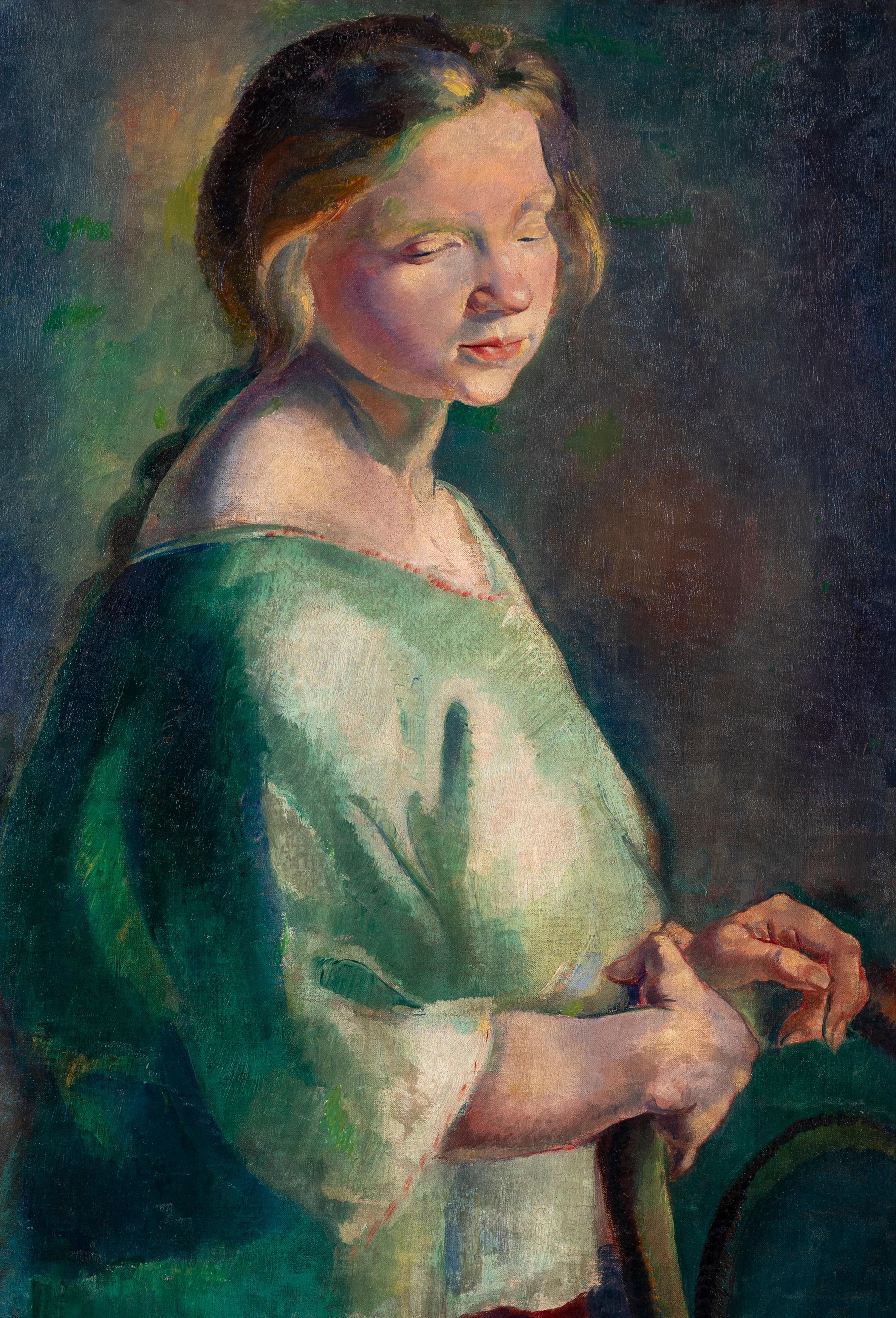
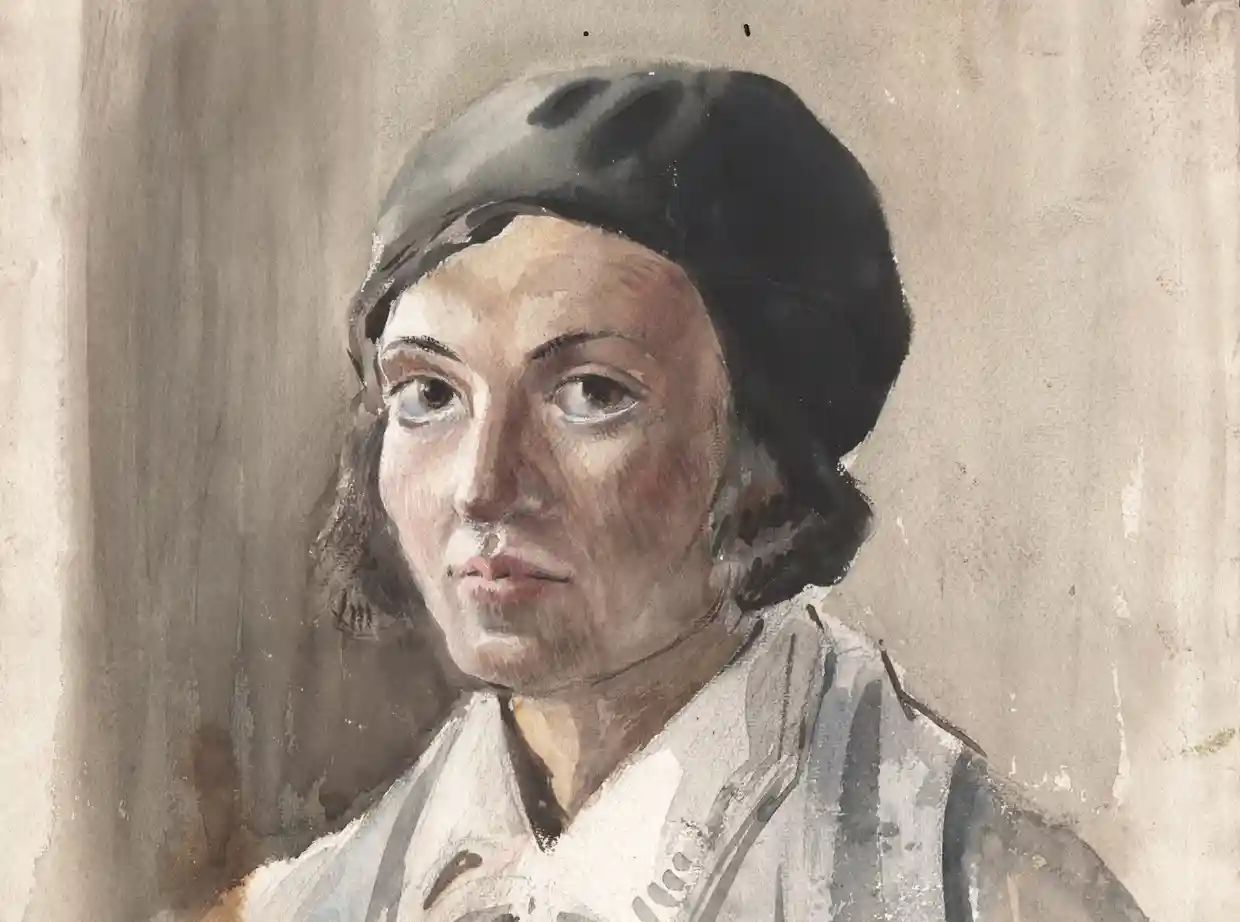
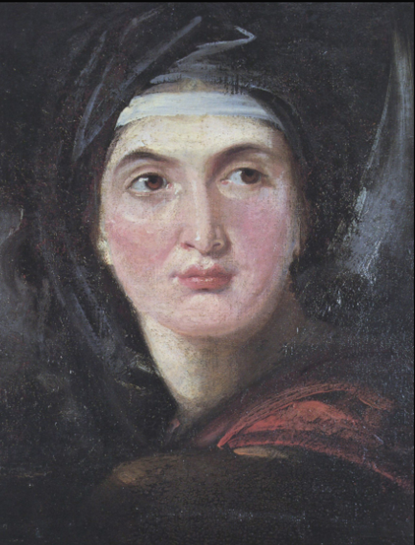
Portrait of a Girl by Clara Klinghoffer

Clara’s stay close to Menton with her husband and youngest sister had proved to be a great success and their plans to return home to London had been postponed on a number of occasions.  The decision as to whether to leave their rented villa, Villa Aggradito, was taken out of their hands eventually as the owner needed the villa for a long-term rental over the coming winter, and the price for renting the villa was well beyond their means.  They eventually moved and found Villa Josephine, a small ground floor flat with a small garden in the small Nice suburb of St. Sylvestre which was run by an elderly woman, Madame Rigolier.  No sooner had the trio moved to their new home in September than Clara declared she was pregnant.  Madame Rigolier immediately took on the role of “mother” and saw to all Clara’s needs.  Clara’s husband on seeing that his wife was being well looked after decided to return to London with Clara’s youngest sister, Hilda.   Clara was not being left alone as they invited Joop’s brother, who had not been well, to come and stay and they believed he would benefit from the warmer climate during the winter months.

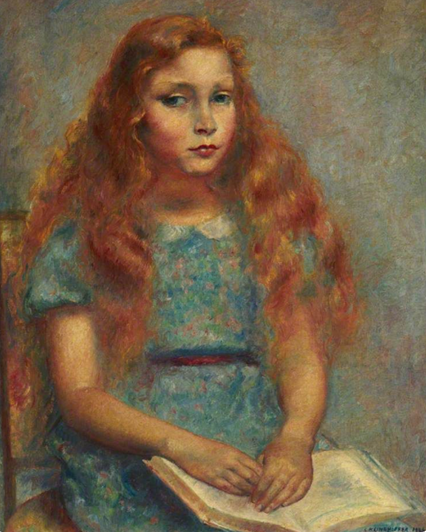
Portrait of a Young Girl by Clara Klinghoffer (1960)

With winter over Clara and Joop had to decide on their next move.  Clara was not happy with the medical help she received from the local doctor but could not afford the charges levied by the hospitals and doctors in Nice.  Clara and Joop left the Côte d’Azur in early March 1927 and headed to England with a two-day stopover in Paris.  They managed to rent a small ground floor flat in the London suburb of Hendon.  

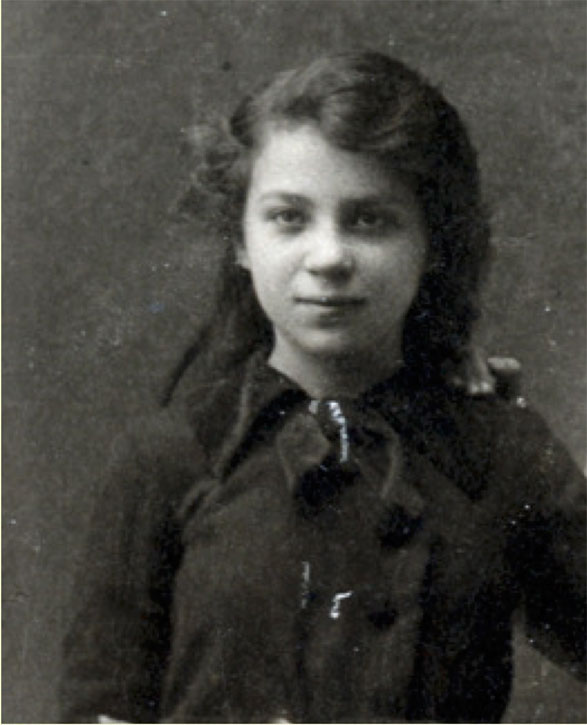
Portrait of Cera Lewin by Clara Klinghoffer (1935)

On May 28th 1927 Clara gave birth to their first child, a daughter, whom they named Sonia.  The family finances were not good.  It was true that Clara was selling her work to various galleries but by the time you deducted gallery commissions and the cost of painting materials there was barely any profit.  Joop was struggling to find newspapers and magazine willing to buy his journalistic offerings and so the couple struggled financially.  He was also aware of Clara’s family’s disappointment in him for not being able to provide for his wife.  However, on a positive note, Clara’s fame as a talented young artist was spreading into Europe.  The art critic of the leading Amsterdam Handelsblad wrote:

“…Clara Klinghoffer is among the few of her generation who have succeeded in circumventing the many pitfalls adhering to the work of most younger painters in England. Her recent ‘Old Troubadour is praised by leading critics as her best work to date. And rightly so, for in spite of the forcefully realistic conception of this picture, it is free of all coarseness, while the blending of its colours may safely be described as refined…”

Such favourable comments with regards to her work appeared in newspapers in England and throughout Europe and her work was being shown in a number of major exhibitions.  Despite the continuing high praise from art critics the sale of he work was slow and her husband believed this was due to the poor publicity of the galleries were her work was on show. 

My Sister Beth by Clara Kinghoffer (1918)

At the end of 1927 the family’s luck took a turn for the better when Clara’s husband, who could speak French and German, was offered a job as secretary to an American industrialist, Ray Graham, one of the three Graham brothers, who headed up the Graham Paige Motor Car Company of Detroit. He was arriving in Europe and needed a well-travelled multi-linguist as his aide-de-camp.

Girl with Plaits by Clara Klinghoffer

Ray Graham eventually returned to America and offered Joop a position in Detroit but Clara was horrified at this offer and her husband had to turn down the job.  All was not lost however as Graham then offered to set up an agency for his car company in Paris and wanted Joop to head it up.  Clara was not averse to living in Paris so Joop accepted the job offer.  They relocated to the French capital in the Spring of 1928 and rented a small flat in the Avenue de Chatillon on the Left Bank which was an area where many artists lived.  Their home was not at all what they expected and the manageress, who seemed to be an alcoholic, was both unpleasant and unhelpful.  Clara was unhappy and wrote about their home and the surroundings:

“…High up from my window I look down upon the square, grey and desolate. The rain has not left off since last night. The immense puddles are filled with little bubbles that swim about till they burst. The square is new, and the road still unmade. To the right a house is in the making: an incomplete red structure, bricks, mortar and wood are piled up and scattered about. The workmen have not come. Factories and many-storeyed flats arise on all sides. A distant funnel gives out a grey smoke, with irritating slowness. At the end of the square a tram passes by, then a taxi. A group of people und.er umbrellas go past quickly.  Then, for at least four minutes, not another human soul is to be seen…”

Heemstede Canal behind Rudi’s House by Clara Klinghoffer (1932)

Unhappy with their present flat they were pleased to hear about an ideal house for them from a friend of Joop, a fellow journalist.   It lay some ten miles north-west of Paris in the village of Montmorency.  The house was in the rue des Berceaux, close to the railway station, and both Clara and Joop were pleased to make it their home. The little ‘villa’, as they called it had a large corridor leading from the front door, spacious living rooms, a large kitchen and a bedroom.  A wide staircase led to more bedrooms and the bathroom.  At the rear of the property there was a small, enclosed garden.  Both Clara and Joop were pleased with their new home.

Mother and Child by Clara Klinghoffer

Having had her first solo exhibition at Hampstead Gallery in 1920, she held her first solo exhibition abroad in April 1928 when fifteen of her  paintings and thirty-five sketches were displayed at the Nationale Kunsthandel in Amsterdam.  Following the success of this exhibition Clara was bombarded by galleries, such as the Imperial Gallery, The New English Art Club and the Woman’s International Art Club, for more of her work for their future exhibitions.

Untitled (One of Clara’s sisters) Chalk on paper by Clara Klinghoffer   ©the artist’s estate. photo credit: the artist’s family

Joop was still working from his Paris office for the American car company Graham-Paige and Clara was so busy painting that she had to employ an au-pair, Anne-Marie, to look after baby Sonia.  However in October 1929 life in America was rocked by the Wall Street crash and the Great Depression.  The Presidential hopeful Herbert Hoover’s phrase “two chickens in every pot and a car in every garage” in his speech the previous year, now had a hollow ring to it. Joop’s boss’s car firm was all to do with high-end cars and they were hit badly.   People were laid off and money spent on publicity, which was Joop’s area of expertise, was cut back.  Joop began to realise that his job was in jeopardy.  Fortunately, he heard that the Paris branch of the American publicity house of Erwin Wasey had advertised for a linguist to assist their executive in charge of all West-European advertising for Esso products.  He applied for the job and was taken on.  Meanwhile Clara had submitted a number of works to London’s Redfern Gallery and it had proved to be a great success even though financial problems were having an adverse effect on sales of works in both France and England.
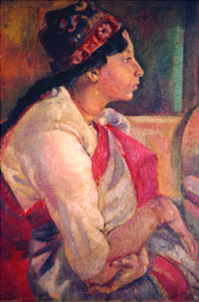
Lakshme by Clara Klinghoffer (1918)

Life was to change in 1930 when, in July that year, Clara found herself pregnant with her second child.  Around the same time Joop was “head-hunted” for a position at Lord & Thomas & Logan, a publicity company who were looking for a Dutch-speaker with a Dutch background who, at the same time, had the necessary experience in the international publicity field.  Joop was exactly who they were looking for and he, and after speaking to Clara, agreed terms with his new employer.  Clara was not unhappy about the move to The Netherlands as she had enjoyed her previous stay there and Amsterdam to London was a short distance to travel when she needed to talk to London gallery owners.

Grandmère and Sonia by Clara Klinghoffer (c.1930)

Joop travelled ahead to set up his Amsterdam office and a month later Clara joined him.  The couple found it difficult to rent suitable accommodation in the city and eventually, in the Autumn of 1930, settled for a small house in Heemstede- Aerdenhout, just south of Haarlem.  There they waited for their household furniture to arrive from Paris. Once again Clara, who was now heavily pregnant, needed help with looking after her daughter and husband and so they hired a maid to help with the chores.  It was not a good time for Clara and she became very stressed.
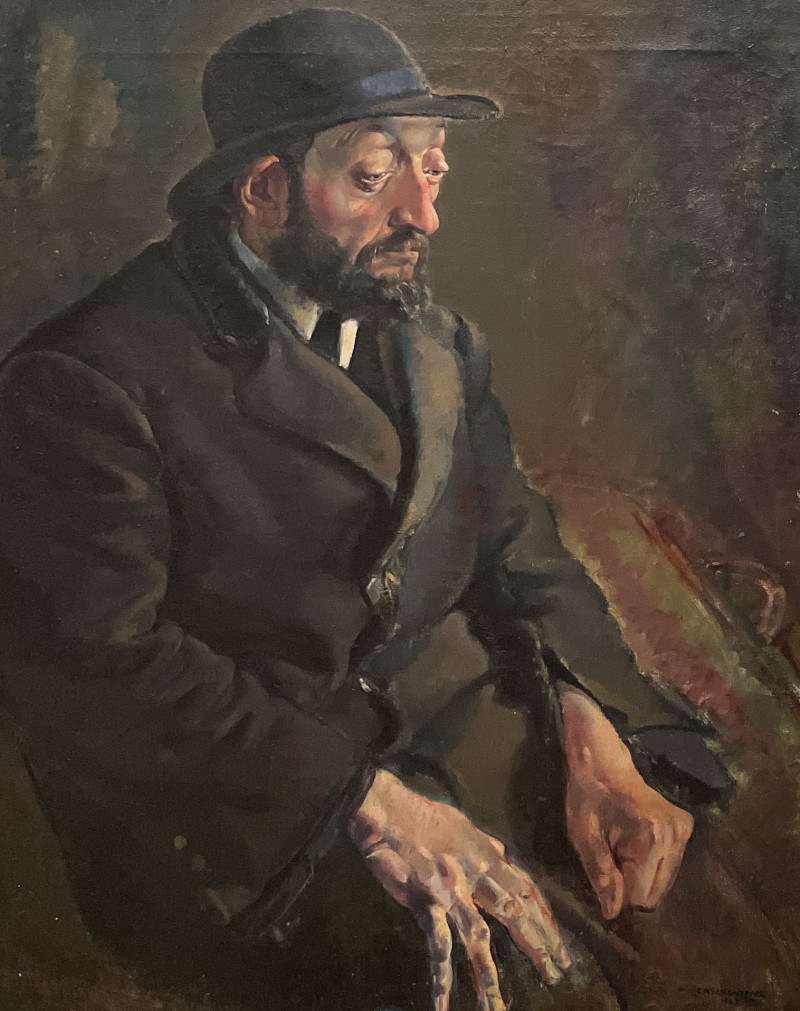
Portrait of Bananas the Pedlar by Clara Klinghoffer (1923)

On the twenty-fifth of January 1931 Clara’s second child, a boy, was born. They called him Michael Jacob.  The name Michael was chosen because they simply liked the sound of it, and Jacob because that was the name of Joop’s late father. With the birth of her son, Clara’s mood and physical health improved.  They even employed a German girl, Hettie, as nurse for the baby, but as Jews, they soon became wary of her and her questions relating to them and their families.  It proved later that the nurse was feeding this information back to the German embassy.  After confronting her, she hastily left the family home.  Help did materialise when her sisters, Leah and Hilda came to live with them during the summer.  In late 1931 Clara’s mother-in-law came to live with her and her son and she remained with them until she died in 1935.

Rosie with Apple by Clara Klinghoffer (c.1929)

The start of 1932 was a very sad time for Clara as she received news that Rosie, one of her younger sister and for many years one of her favourite models, had been ill for some times. At first her illness did not seem to be a very serious one. But her pains increased and then, on being examined by a specialist, Clara had to face the awful truth: that the girl, just about thirty years old, was dying of cancer.  Clara travelled to London at once and stayed there for some time, drawing as she always did and making an exquisite painting of Rosie.   Several doctors were consulted; even a Dutch physician of Utrecht who supposedly had a cure for cancer, was persuaded to send each week a bottle of his magic medicine to London. But it was, of course, all in vain. Rosie died that summer. It was a very hard blow. From now on the magic circle of the seven Klinghoffer girls existed no longer.  For some time the loss of Rosie paralyzed Clara’s desire for work. Then, gradually, she took up her brushes again and painted.
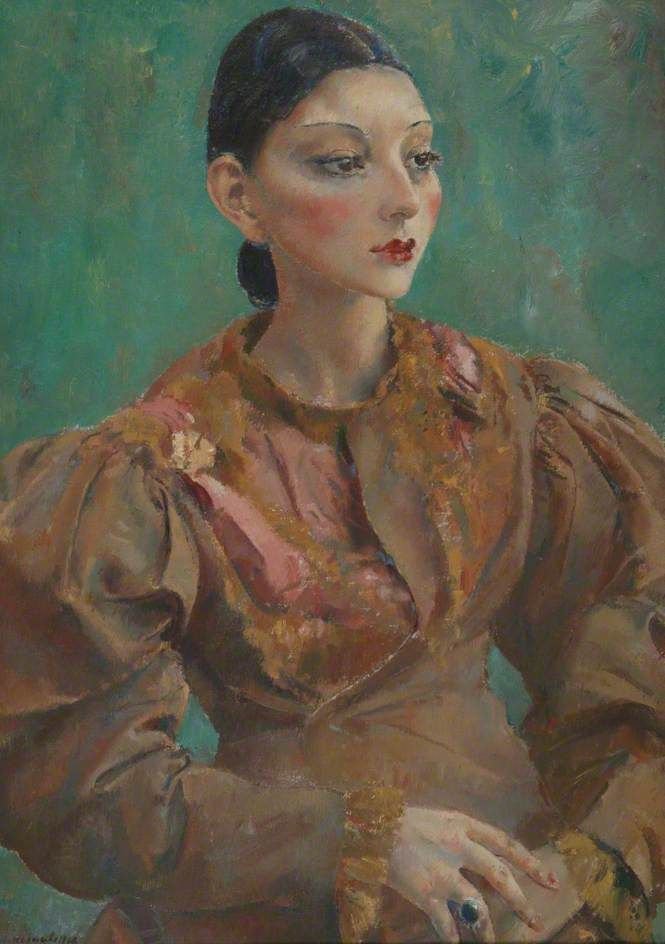
Giuseppina by Clara Klinghoff (1934)

In 1932 Hitler came to power when the Weimar Republic collapsed.  The National Socialist Movement in the Netherlands (Dutch Nazi party) led by Anton Mussert became more prominent following the rise of Hitler and grew more challenging, stressing ever stronger the anti-semitic principles of the Filhrer.   On February 27th 1933, the Reichstag in Berlin was set alight by a twenty-three-year-old Dutchman Marinus van der Lubbe and, as in Germany, anti-semitic tensions in The Netherlands grew fanned by inflammatory articles appearing in Mussert’s weekly newspaper Volk en Vaderland (People and Fatherland).  Notwithstanding the political tensions Clara and Joop managed to get away and have a holiday in Taormina, Sicily where they stayed in a small hotel which had beautiful vistas across the bay.  They became friendly with the owner, Ettore Silvestri and his daughter Giuseppina who agreed to pose for Clara. She said that posing for long periods would be a problem to her and Clara and Joop discovered she had been very ill for five years, an illness that tired her. In August 1935 whilst back home Joop and Clara received a letter from Taormina informing them that sadly, Giuseppina had died.
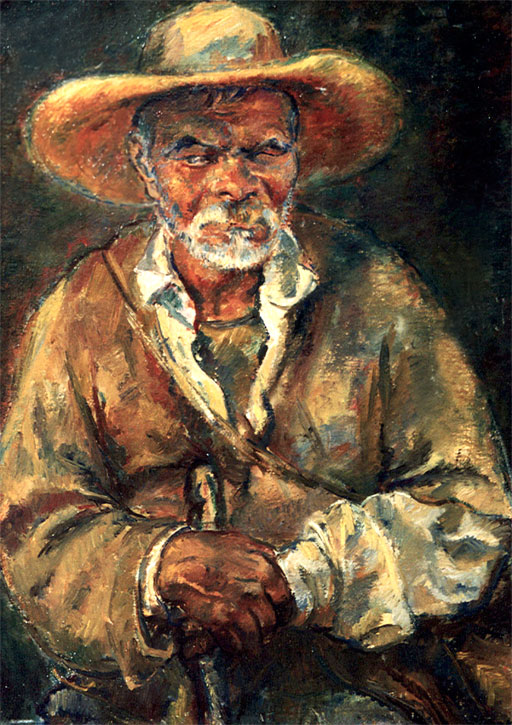
One-eyed Mexican Farmer by Clara Klinghoffer (1962)

In 1939, the anti-semitic feelings in The Netherlands had begun to escalate and there was talk of a Nazi invasion of the country and so Clara and Joop decided to move to London.  They packed up all their furniture and Clara’s paintings and they were stored in a warehouse in Haarlem but sadly their property was plundered during Nazi occupation.  When the Second World War ended Clara divided her time between her studios in London and New York. In New York Clara held a number of exhibitions of her work but the interest in her figurative art was waning as the art world had latched on to the new abstract expressionism, by the likes of Jackson Pollock and Willem de Kooning and suddenly Clara’s work was considered unfashionable and she struggled to attain exhibition space, even in London.  In 1952 she visited Mexico and she was attracted to the colourful landscapes and had no trouble finding locals who would model for her.  Her last exhibition was in 1969 at the Mexican/North American Cultural Institute in Mexico City.  She then returned to Europe and spent time in Southern France.  Her health began to deteriorate and she returned to London where she died on April 18th, 1970 at the age of 69.  Clara is buried at the Cheshunt Cemetery near London.

Clara Esther Klinghoffer (Stoppelman) 1900-1970

I end with a 1981 quote by Terrence Mullaly of The Daily Telegraph who wrote about Clara and her artistic talent:

“…If ever there was an artist who for some time has been unjustly forgotten, it is Clara Klinghoffer … While the temporary eclipse of her reputation was not, given trends in the visual arts, surprising, it is certainly lamentable. She was a portrait painter of sensitive talent and, above all, a fine draughtsman … In her work her obvious sensitivity towards her sitters is manifested, and enforced by her ability not only to suggest weight and substance of a body, but also to convey mood … When much more celebrated artists are forgotten, she will be remembered…”


Information for this blog was found in many sources but the most important ones were:

Clara Klinghoffer- 20th century English artist

Clara Klinghoffer: the girl who drew like Raphael and Leonardo

Clara Klinghoffer. Part 3.

Marriage and travels.

Lucien Pissarro by Clara Klinghoffer (1928)

Clara continued to paint and produce beautiful works of art.  She worked constantly at her easel from daybreak till sunset.  She was awarded a bursary by the Slade allowing her to attend classes three days a week for a year and receive tuition from the Slade Professors of Art, Frederick Brown, and Henry Tonks.  However, Clara only continued with this tuition for a few weeks, preferring to paint on her own at home.  In 1921, the excessive workload she had given herself and her innate perfectionism finally took a toll on her health and she suffered a breakdown and suddenly the desire to paint had left her.  She was suffering badly both mentally and physically, losing weight and becoming gaunt.  She talked to nobody about her struggle and her parents could not understand why she spent little time painting.  Clara recognised that she was ill and tried self-help but with little success.  It was almost a year later when something strange happened to arrest this decline.  At the rear of their large house, beyond their garden, there was a low border wall, on the other side of which was a set of newly constructed tennis courts.  Clara and her sisters were fascinated and loved to watch the tennis players in action.  The courts were owned by a good-looking young man in his early twenties, Julius Abrahams. A close friendship developed and Julius had strong feelings for Clara.  Clara painted a full sized portrait of him but as Julius was engaged to another woman, Clara decided that a friendship was all she could offer Julius. 

Upon Reflection by Clara Klinghoffer (1919)

Clara continued to build up a portfolio of her work and a number of her drawings were due to be exhibited at the Leicester Galleries in Central London in June 1923.  Her drawings caught the attention of a certain Mr Smith who had contacted her and asked to see more of her work.  Clara was requested to visit his house in Gordon Square in Central London’s Bloomsbury.  Despite disliking trudging across London in wintry weather to visit a possible patron, she needed to sell work to fund her artistic materials and so on January 10th 1924, a Sunday afternoon, she headed towards Gordon Square and to her meeting with Mr Smith – a meeting which would change the course of her life.

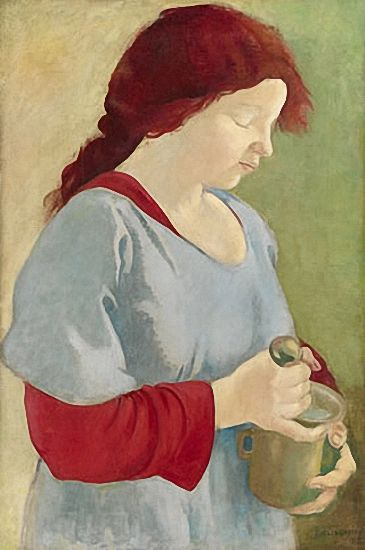
Rose with a Mortar and Pestle by Clara Klinghoffer (1919)

Unbeknown to Clara her meeting with Mr Smith was not a one-to-one meeting but she was heading to his house where he was hosting one of his artistic soiree.  One of the regulars to these “parties” was an Italian journalist who lived in Hampstead with his fellow lodger, a Dutch freelance journalist, Joseph (Joop) Stoppleman.  Joop was invited by his flatmate to come along to the party and reluctantly agreed, on the pretext that the experience might even make good copy for an article.  On entering the drawing room of the opulent house the two journalists were greeted by raucous singing led by their host, Mr Smith.  Midway through the party the doors to the Salon opened and Stoopleman in his biography, Clara Klinghoffer, The Life and Career of a Traditional Artist described what happened next:

“…the Study door was opened and a small girl with beautiful auburn hair, entered, carrying a portfolio much too large for her to hold with any comfort…”

The revellers were bemused by the sight of this small girl.  Mr Smith, who was halfway through giving his rousing speech to his guests, stopped and rushed towards Clara, taking her portfolio from her and raising it in the air, whilst acclaiming:

“…”Now my young friends you will have the privilege to see art that is on a par with the work of the great Masters. And who has created it?  This little girl–Clara Klinghoffer. Mark that name well, for one day it will be famous…”

The portfolio of Clara’s work was then placed on the large table at the centre of the Salon and Clara showed each of her paintings and drawings to the guests.  They were all amazed by what she had created.  When the party came to an end Joop Stoopleman offered to carry the heavy portfolio for Clara until she reached the trolleybus which would take her home.  He wanted to see her again and was both surprised and delighted when Clara asked if he wanted to visit her at home and see more of her work.  He avidly agreed and they exchanged telephone numbers and a date was set for the next meeting.  This was the start of a long friendship which resulted in a love affair and which would eventually result in marriage. Joop was well received by the family but as a freelance journalist he knew he could not boast a regular steady income.  As for Clara, she relied on the sale of her work so that their combined income was somewhat irregular.

Harriet Cohen by Clara Klinghoffer (1925)

The new year, 1925, was a very busy time for both Clara and Joop.  Clara worked steadily on her drawings and paintings. One of her sitters was Harriet Cohen, the celebrated British concert pianist. At the same time, she was organising her work for a large-scale exhibition in the Redfern Gallery, in Old Bond Street, which was to begin in March of 1926. Clara had collected together twenty new paintings and some thirty new drawings. By the time she had put together sufficient work for the exhibition she was both exhausted and deflated.  Her spirits were lifted when she was invited to accompany her friend Mabel Greenberg on a month-long holiday in the Pyrenees.  Clara, on her return home at the end of April, was refreshed and was filled with ideas that could be used as depictions for her future paintings.  In parallel to Clara’s busy schedule, Joop had to go on a trip to Holland visiting chief editors, to see if he could find new outlets for his writing.

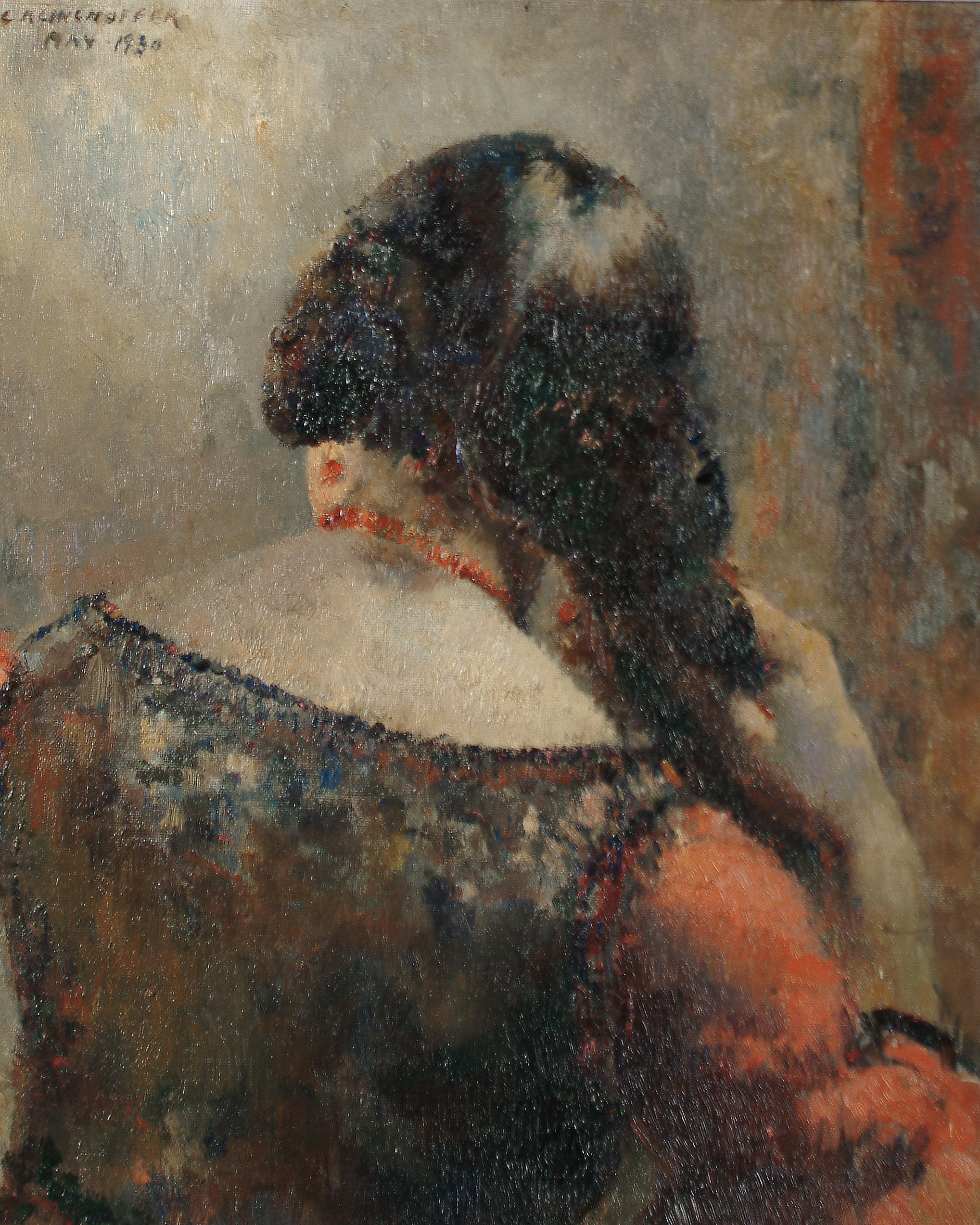
Portrait of a Girl in a Fur Hat by Clara Klinghoffer

During the New year celebrations of 1926, Joop and Clara decided that they would marry once the Redfern Gallery exhibition had run its course.  The exhibition which opened on March 9th was a great success and her paintings received much praise from the art critics.  The art critic of The Times wrote:

“…It is perhaps being wise after the event to say that “work has feminine characteristics when an artist is known to be a woman. But this is certainly the case with Clara Klinghoffer’ s exhibition of paintings and dnawings at the Redfern Gallery. That is to say she has the power to imitate with great skill the manner of another painter and yet of toning it down and adapting it to her own less emphatic means of expression, as Berthe Morisot did with Manet. Her drawings and small pictures, rather than her larger oils, show that she has real talent. Her drawings are by far her best work and please at once, though, while they are reminiscent of Leonardo da Vinci, they leave out his emphasis and thus their correctness becomes apparent only after close examination. As is the modern custom, they are intended to be works of art in themselves, not studies of works of art, and they do not show the curiosity of an artist who draws to find something out, not to produce a finished effect. They are sensitive, but not profoundly sensitive.  Mims Klinghoffer’s paintings are more under the influence of Renoir than of Leonardo, and in her biggest pictures she has tried to be more forcible than is in keeping with the character shown in her drawings…”

Portrait of the Artist’s Husband, aged 25 by Clara Klinghoffer

Once the Redfern Gallery Exhibition had completed, Clara felt utterly drained and Joop persuaded her to take a rest from painting and visit his homeland, Holland.  She agreed to the change of scene despite Joop not being able to accompany her from the start as he was committed to leading a tour party to Europe.  Joop arranged for her to stay with a family in the village of Voorthuizen and when, after six weeks,  Joop finally arrived,  the pair travelled north to his home town, Groningen and there she met Joop’s family.  Clara and Joop finally returned to London in June 1926 and their marriage took place on July 29th at the Duke Street Great Synagogue of London.  At the time of the wedding Clara’s youngest sister, Hilda had been very unwell.  Joop and Clara decided that as they were going to the warm weather of Southern France for their honeymoon, Hilda should accompany them so as to help restore her health.  All was agreed with the family and the three of them took the ferry to Calais and then the train south to Avignon for a short stay before arriving at their ultimate destination, the Côte d’Azur seaside town of Menton.

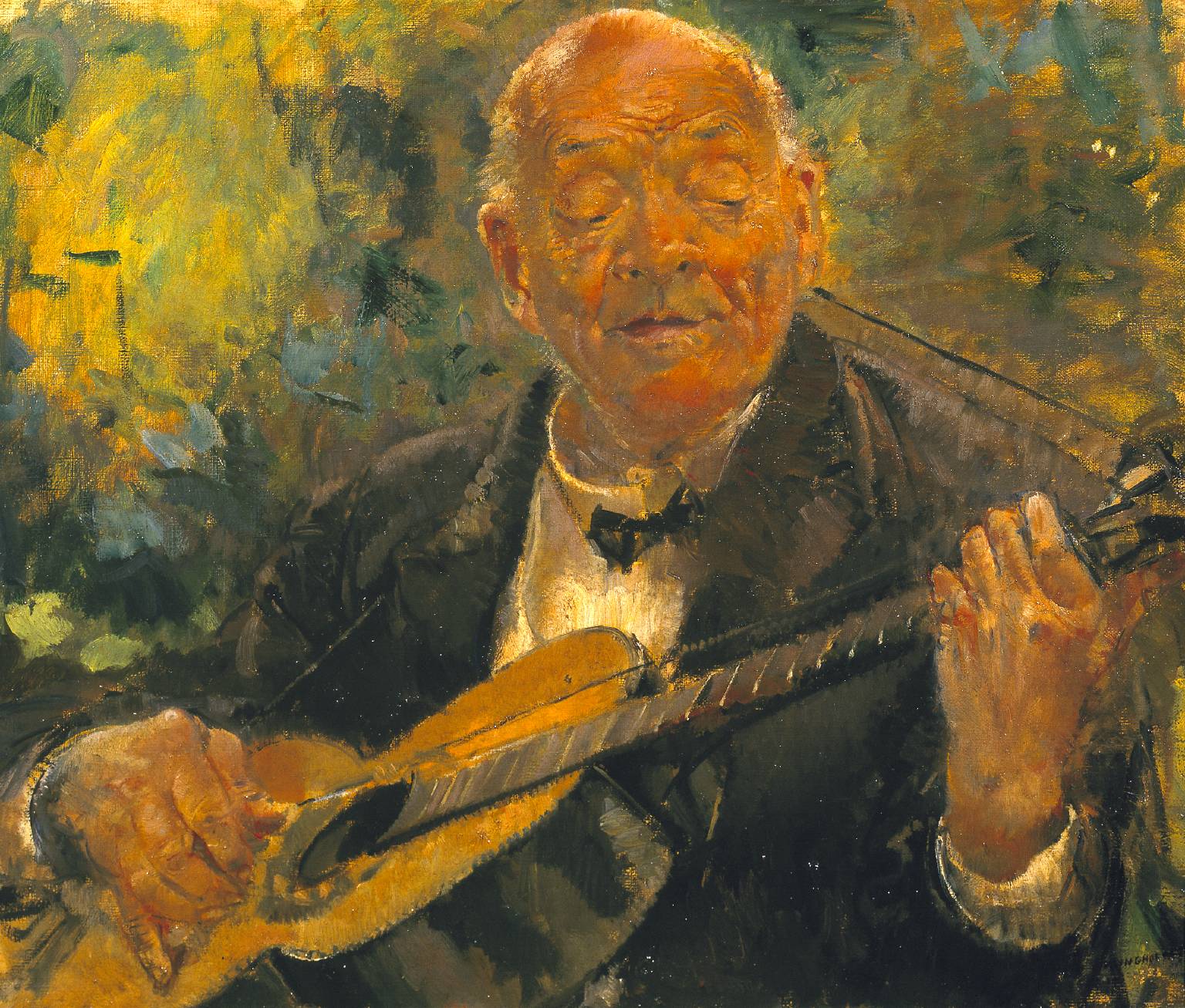
The Old Troubador by Clara Klinghoffer (1926)

The Menton pension they stayed in was very comfortable but quite expensive.  In fact, it was too expensive for them as they planned to stay in Menton for six or seven weeks.  Clara approached the pension owner and because they intended to stay a long time in Menton, he agreed to lease them a large house, Villa Aggridito, situated on the Boulevard de Garavan, on the outskirts of the town, and only charged them just four hundred francs a month.  They took him up on his generous offer.  One day whilst out walking they came across a man carrying a guitar.  In Joops biography of his wife he recalls the moment:

“…we saw a little man with grey hair standing in the middle of the right-hand lane. He was neatly dressed in black linen trousers and jacket and carried a large guitar on a leather strap across his shoulders. He had a long egg-shaped face, burnt a red brown by the summer sun. His straight nose had wide, sensitive nostrils; his large eyes were of a melancholy brown.   His forehead, wide and furrowed, blended into his high bald dome; and above both ears were thick tufts of snow-white hair.  On his open shirt collar a neat dress tie had somehow found a foothold. All in all, he made the impression of a musician on the way to an appointment, transporting his instrument in a somewhat unorthodox way.  As we approached, he quickly placed the guitar in position, and began to play. First a gay melody, then the popular ‘Valencia’ tune, of which he sang the words in a small, tremulous voice. We stopped and listened. There was nothing about him of the street singer. Rather, he seemed to be amusing himself and, accidentally, allowing us to share his enjoyment…”

The musician was Torquato Simoncelli and he came to their villa the next day and sat for Clara. It took half a dozen sittings for Clara to complete the portrait. On February 16th 1958, Clara wrote about that visit:

“…My husband and I spent the summer and autumn of 1926 in Menton-Garavan, close to the Italian border. It was there, at the border, that we met old Torquato Simoncelli, singing and playing on his guitar. This gentle and lovable old man came to sit for me on the terrace of our Villa, after his day’s work as a Troubadour was over (generally in the late afternoon). He sang, reminisced and played while I painted…. I did paint a second picture of him in another pose (this picture I still have)…”

………to be continued.


The information I used for this blog came from a variety of sources but the two main ones which would be of interest to you if you want a more in-depth look at Clara’s life are:

Clara Klinghoffer- 20th century English artist

and

Clara Klinghoffer: the girl who drew like Raphael and Leonardo

Clara Klinghoffer. Part 2.

The artistic road ahead.

“…I consider Clara Klinghoffer an artist of great talent, a painter of the first order…
Her understanding of form places her in the very first rank of draughtsmen in the world…”

Sir Jacob Epstein, London, March 30, 1939

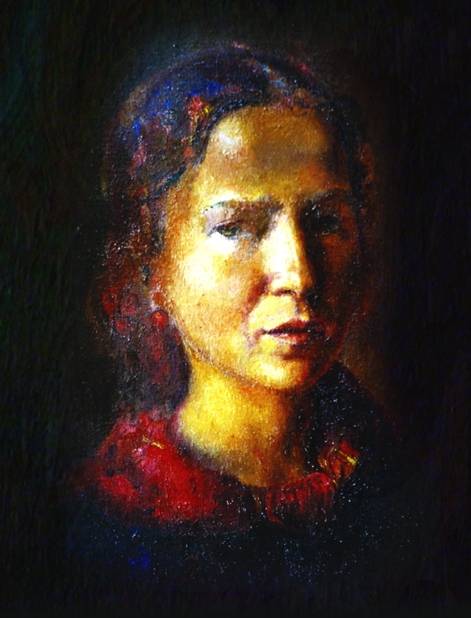
Self portrait by Clara Klinghoffer

Fourteen year old Clara was just about to leave St Mark’s School and it is thought that it could have been the head teacher of the school, Mrs Sinock, who suggested that Clara should enrol at Sir John Cass Institute in Aldgate. Once there she was set the task to make sketches of statues such as Michelangelo’s David concentrating on the various facial attributes. Soon the tutors realised she had a natural aptitude for sketching. A talent which she achieved with little effort, one that amazed her tutors. Clara was happy at the Institute but that all ended when one of the young tutors acted towards her in a sexually inappropriate manner which frightened her. The pleasure she once had attending the classes vanished and she left the Institute suddenly without giving a reason for her departure. For a fourteen year old girl this must have been a shocking moment in her life.

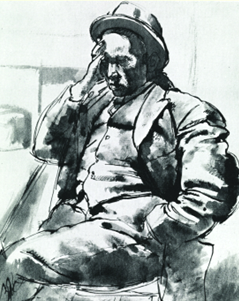
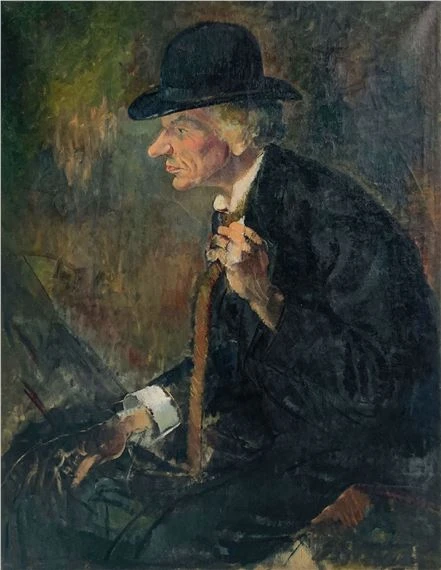
Salman Klinghoffer -Man In A Felt Hat (‘Daddy’) by Clara Klinghoffer (1929)

Clara’s father was disappointed that his daughter had given up her art studies and one day whilst travelling home on a tram he caught sight of an advert for the Central School of Arts and Crafts which was situated in Southampton Row in the West End of London He then managed to persuade his daughter to come with him to the art school and enrol. She agreed and took with her a portfolio of her sketches. The principal took a look at her work and immediately offered her a place, starting that next Monday. On the Monday, Clara, who was still very small, arrived at her classroom carrying her huge portfolio case much to the amusement of the two tutors who were overseeing the students. One was Douglas Grant a British painter who became part of the Bloomsbury Set and the other was Bernard Meninsky, the British figurative and landscape painter who had immigrated from Ukraine with his family when he was three weeks old. On looking at Clara’s portfolio, Meninsky was astounded by the quality of her work and set her the task of sketching a cast of a hand. He was astounded by the result and likened it to that of Da Vinci drawings. Both Meninsky and Grant had witnessed such talent in a person so young as Clara and often her sketches were hung on the walls of the classroom. Also on the wall was a print of Botticelli’s Primavera which Clara said that she loved above any other work she had seen. Another of her favourite works was a black and white reproduction of Titian’s Bacchus and Ariadne which she had seen a few years ago in the local library. More and more, she became influenced by Italian art.

East End Girl with Dark Hair by Clara Klinghoffer

Meninsky went on to tutor Clara in life drawing and became an important influence on her work.  He also introduced her to a number of luminaries of the art world such as Walter Sickert’s third wife, Thérèse Lessore, a British artist who worked in oil and watercolour and was a founder member of the London Group, the English writer and painter, Wyndham Lewis, and the New York born sculptor, Jacob Epstein and his publicist wife, Peggy, who became her close friends.

Harry, Old London Man by Clara Klinghoff (c.1920)

Clara remained at the Central School of Arts and Crafts for two years and during this period would often spend time at her easel, sketching at the Victoria and Albert Museum and her favourite venue, the British Museum, where she became a regular and was well known to the security guards, staff and regular visitors.

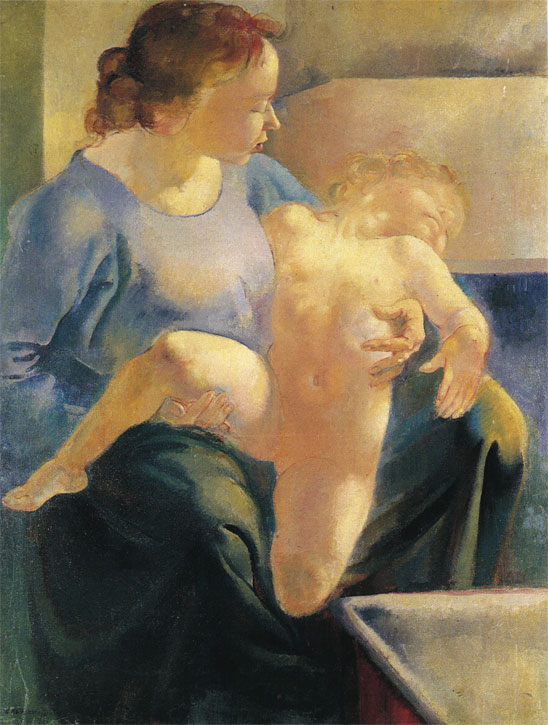
Mother and Child by Clara Klinghoffer. Modelled by Clara’s eldest sister Fanny and her youngest sister Hilda (1918)

One of Clara’s fellow students at the Central School of Arts & Crafts was a young man called Seidenfeld, who was besotted with Clara but she alas did not return his amour.  He, like Meninsky, praised Clara’s work and would tell everybody who would listen, about Clara’s work and her extraordinary talent.  Word of this young artistic genius reached the ears of a journalist, Joseph Leftwich and he was so impressed by her artistic talent that he spoke of it to the post-Impressionist painter, Alfred Wolmark,   Wolmark had some of his work shown at the Hamstead Art Gallery in London and he persuaded Clara to put together a portfolio of her work which would be used in her “one-man” show at the gallery in May 1920.  That gave her twelve months to complete a collection which was good enough to be exhibited and this entailed a period of non-stop painting. The painting Mother and Child was one which was exhibited at Clara solo show at the Harpenden Gallery in May 1920. The show received rave reviews and of this work, The Sunday Times art critic wrote:

“…Clara Klinghoffer’s ‘ Mother and Child’ will appeal to ‘many as having more sheer beauty than any work in the exhibition. While exceedingly able in point of drawing, this moving painting of a mother just lifting her child “out of the bath delights one by the piquancy of its colour, the shimmer of light on the bare flesh being rendered with the tenderness of a Renoir and the dexterity of a Besnard. In its dazzling radiance it is a joy of pure colour…”

Portrait of a girl in a fur hat, with red background by Clara Klinghoffer

Portrait of Woman Plaiting her Hair by Clara Klinghoffer

In the end Clara submitted twenty-one paintings and thirty-two framed and glazed drawings. On May 3rd 1920 the solo exhibition opened. The London Evening Standard stressed the brilliant future this 19-year-old painter is destined to have. and it continued:

“…One of the most encouraging things about her work is that it gives frank and full expression to what may be supposed to be her racial instincts and interests. She likes exuberant forms and bright colours and says so when painting with commendable frankness. Her strongest point at present is the ease with which she can fill her canvas. Evidently, she has studied the Old Masters, particularly Leonardo da Vinci, to good purpose…”

In 1920, an edition of the The Jewish Chronicle sang the praises of Clara’s work at the exhibition writing:

“…Clara Klinghoffer, in her exhibition at the Hampstead Art Gallery, has clearly proved to be a truly great artist. Her drawings are very beautiful and quite remarkable for an artist scarcely out of her teens. One feels how very much she has been influenced by the Great Masters–by Raphael and by Leonardo for example. And yet, her outlook is entirely modern; she has absorbed the past and expresses herself freely, inspired but never enslaved thereby. Her paintings are always well composed and this is so whether a single portrait or a group is considered. She has a peculiar sense of colour and makes no attempt to get the correct tone, which fact accounts for the unreal appearance of all save one or two portraits. She apparently paints without much effort, and the spontaneity of her work is charming……. There is nothing shallow in Miss Klinghoffer’s genius. She is perfectly sincere and employs her extraordinary gifts for a definite artistic purpose, simply and beautifully, without the slightest trace of affectation…”

The painting Mother and Child was then put on display at the New English Art Club that summer and the press was full of praise for the work

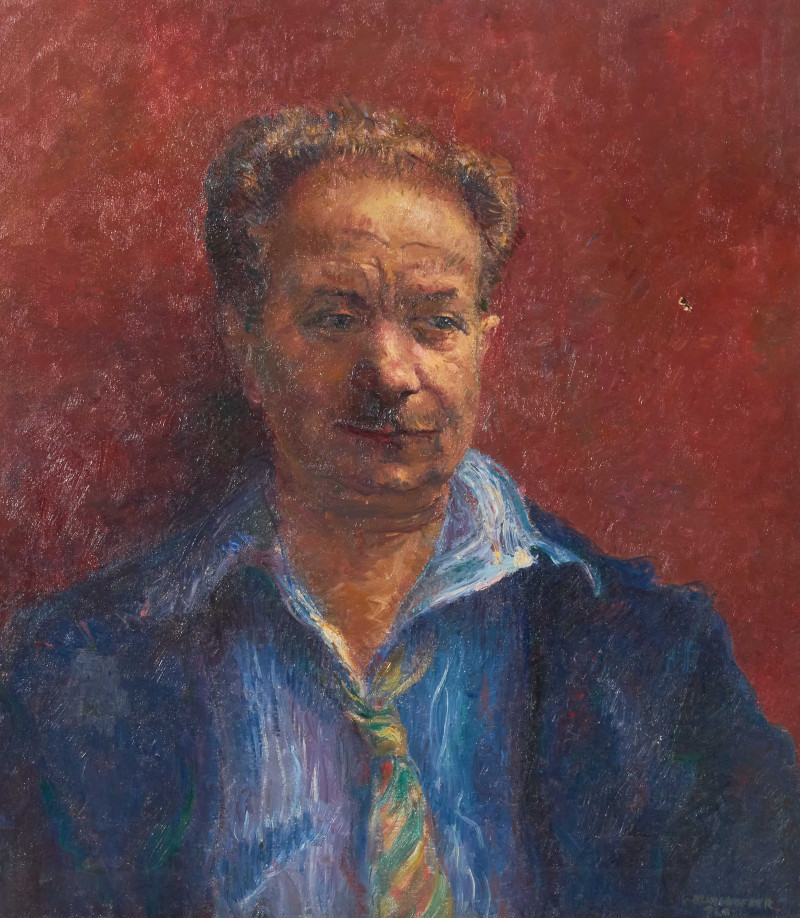
Portrait of a Man (on Red) by Clara Klinghoffer

Meanwhile, her father’s “mill end” business was flourishing, so too was her mother’s clothes shop, so much so, the family moved to a large Victorian House in King Edward Road, Hackney.  Compared to their previous London homes, this was paradise.  It was large with a basement kitchen, large first floor living rooms and several bedrooms on the upper floors.  The increase in the size of their home was fortuitous as Clara’s mother gave birth to a three further children, all daughters, which meant the house was home to mother, father and seven daughters !  Business success for her father meant that he could afford to buy Clara all the materials she needed for her paintings.  He and his wife were convinced their daughter would one day become a famous painter.

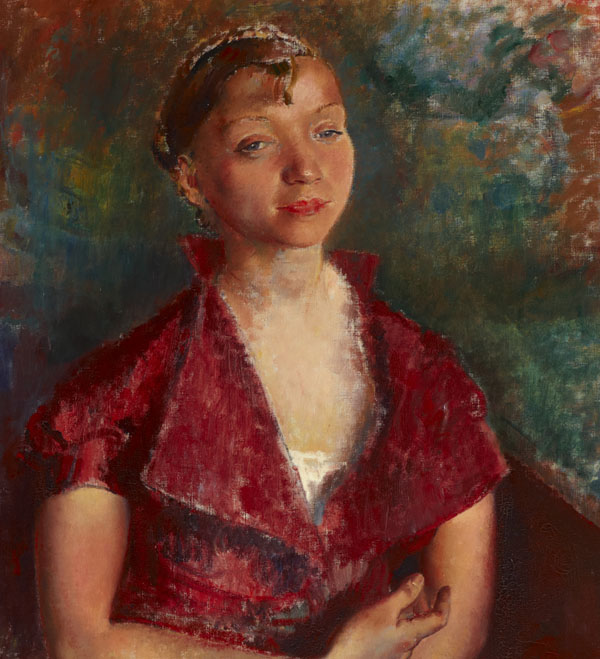
Portrait of the Artist’s Sister Rachel (Rachel in a Red Dress) by Clara Klinghoffer

Clara would complete small paintings of the neighbourhood children but realised that for her own exhibition at the Hampstead Gallery she would need to complete larger works and so she turned to her sisters, (Fanny, Rose, Rachel, Bertha, Leah, and Hilda), whose ages ranged from four to twenty-one, to act as models, but most frequently Rose (who also sat as a model for the sculptor Jacob Epstein), and Rachel. This shimmering portrait of Rachel is made from delicate brushstrokes and this was a recognisable style of Clara’s portraits and establish her renowned warmth and understanding in the way she depicts her sitters.

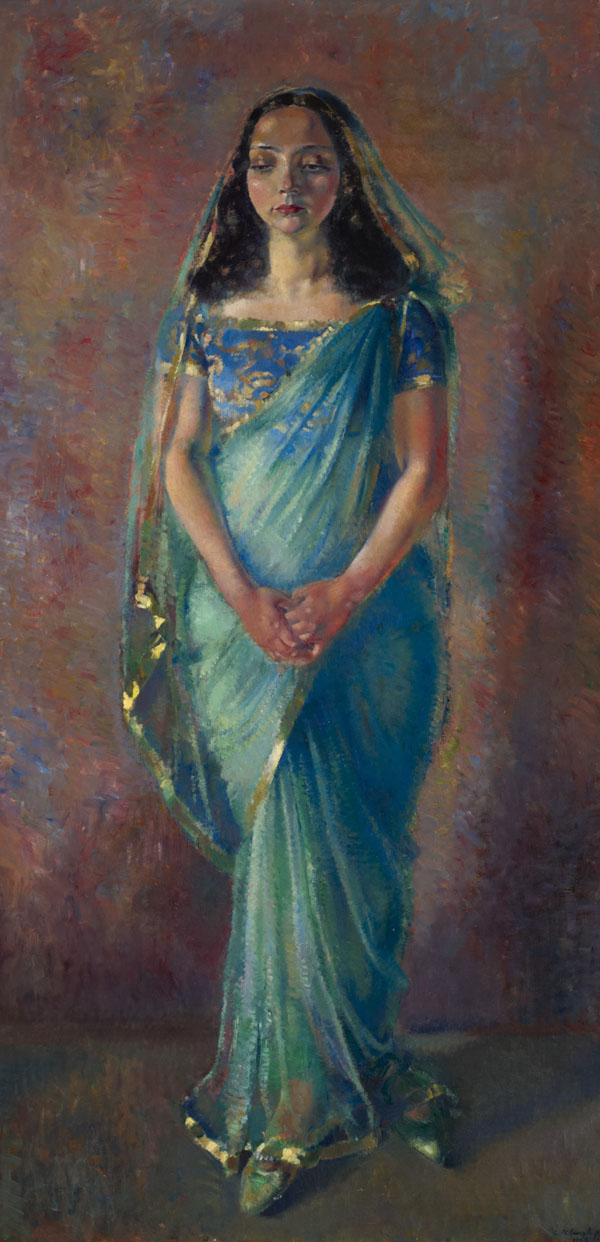
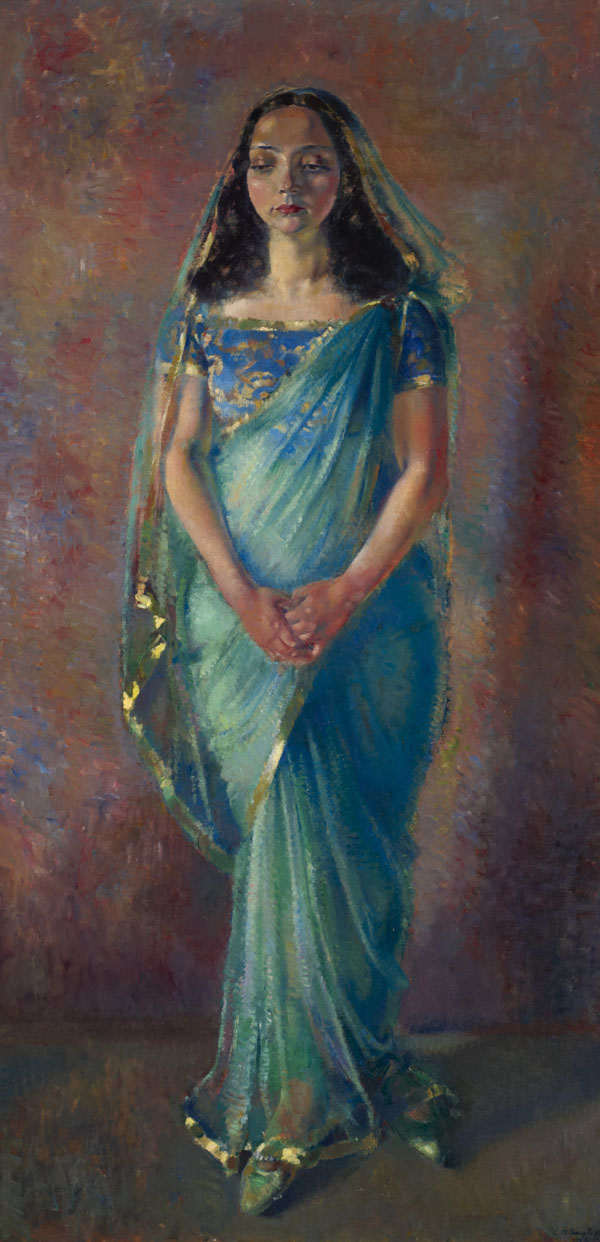
Girl in the Green Sari by Clara Klinghoffer (1926)

This portrait, Girl in the Green Sari, by Klinghoffer was that of the Bengali artist Pratima Devi, the  daughter-in-law of the famous Bengali poet and philosopher Rabindranath Tagore.  Pratima often travelled abroad with him and they often visited Klinghoffer in her London studio. In all, she completed at least three portraits of Pratima: the first, in oils, around 1919-20; the second, a pencil head, which The Times, in 1924, considered it remarkable for the sensitive drawing and the suggestion of light. This later full-length painting was carried out in 1926, which was the year Clara married and her husband remembers Pratima’s visit and sitting for her portrait.  She wore the blue sari and was adorned with dazzling jewellery.  Clara had Pratima remove all the jewellery, maybe as she believed it would detract from the woman’s depiction.  We observe Pratima as a demure, maybe shy, woman with her eyes downcast, dressed in a translucent sari standing in front of a glistening backdrop.

Portrait of Orovida Pissarro by Clara Klinghoffer

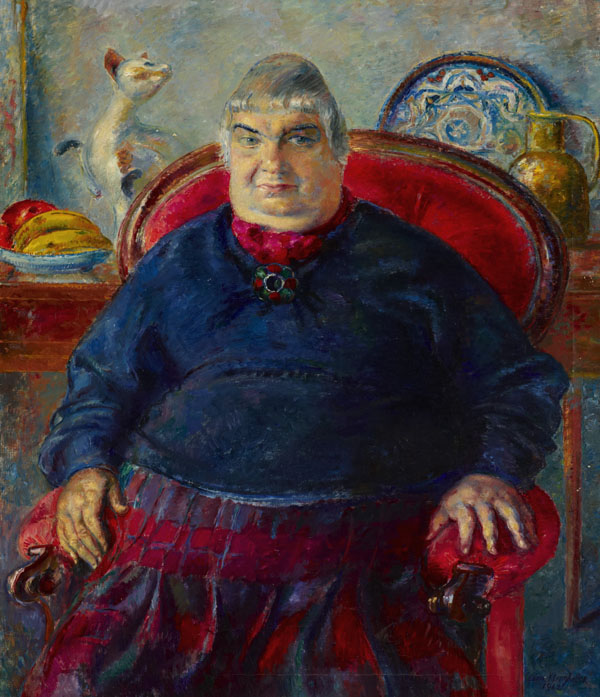
Clara’s arresting portrait of her friend and fellow artist Orovida Pissarro was completed in 1962.  Orovida was born in Epping, Essex, in 1893, and was the only child of Lucien and Esther Pissarro. Her father, Lucien Pissarro was an acclaimed artist and graphic illustrator, while Lucien’s father, Orovida’s grandfather, was the renowned Danish-French painter Camille Pissarro who was a founder of the Impressionist movement.  Much to her father’s horror, Orovida turned her back on Impressionism – and even dropped her famous surname, wanting to be simply known as ‘Orovida’. Her reason for this was not because she wanted to cut herself off from her family ties but because she wanted to make her own way in life, on her own terms.  Clara has depicted the form of her sitter including her rounded belly and full face framed by her cropped hairstyle, which is copied in the curves of the chair.  Behind her we see a collection of inanimate objects which probably referred to items which often appeared in Orovida’s portraiture.

……to be continued.


Information for this blog was found in many sources but the most important ones were:

Clara Klinghoffer- 20th century English artist

Clara Klinghoffer: the girl who drew like Raphael and Leonardo


Clara Klinghoffer. Part 1.

Early childhood and teenage years

Self portrait by Clara Klinghoffer (1937)

“…Now universally recognized as one of the greatest English woman painters, she was a poor and utterly unknown young girl from the East End when her first exhibition took the artistic world by storm in 1919. Hailed everywhere as the girl who could draw like Raphael, her superb technique has always been compared with the Old Masters, but at the time of her first show she had never seen any of the great Old Masters pictures…”    

–Women of Today, 1932

My blog today looks at the rise of one of the great female artists. For Clara Klinghoffer’s life story, I want to go back to her paternal grandparents, Abel and Witie Stark who lived in in Szerzezec, a village some forty minutes by train away from the large town of Lemberg, known to us now as the Ukranian city of Lviv, but at the time of Clara’s birth in 1900 it was part of the contested region that was once Polish Galicia, but was then part of the Austro-Hungarian Empire.  Since Galicia had split from Poland and came under Austrian control, life had been good.  The majority of the population of the small town of Szerzezec were Jewish but they had a good working and social relationship with their fellow Christian citizens.  It was an easy-going and liberal place to live where both Jews and Christians realised they needed each other.  Abel Stark ran a grain business and had achieved lucrative contracts with the Austrian military.

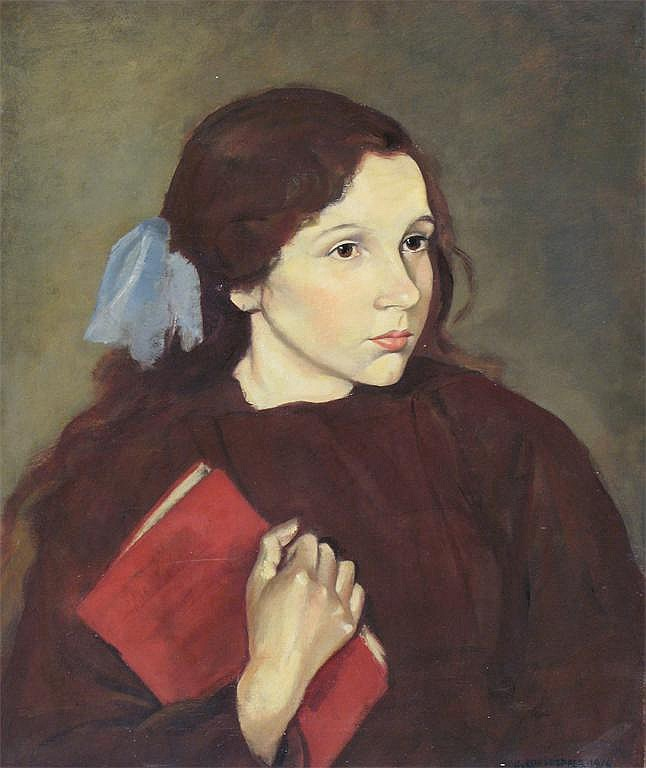
 Portrait of Annie Salomans with her book by Clara Klinghoffer (1918)

In 1898 Abel and Witie had one major problem to solve.  Their eldest daughter, Chana Riza (Hannah), was twenty four years old and despite her father and mother’s attempts to find her a husband and that of the local shadchan (matchmaker), she remained unwed !  If it was a problem for them, it was also a problem for her two younger sisters, Sarah and Leah, as according to ancient custom, they were not allowed to marry until the eldest sister married first.  Eventually a “marriage candidate” arrived who was acceptable to both parents and Chana Riza.  He was Salman Klinghoffer.  To Chana’s father, Salman was ideal and would be able to work in the family business whilst to Chana herself he had all the physical attributes she found pleasing. 

Self portrait by Clara Klinghoffer (1955)

Chana Riza and Salman Klinghoffer were married on March 1st 1898 at a large ceremony attended by most of the townsfolk and the merriment lasted for many days.  The newly-weds moved into her parents home and Salaman began working for his father in law but Salman and his father-in-law did not get on well.  They were two totally different characters.  Abel Stark was shrewd, dynamic and very determined which was the reason for his success in business.  On the other hand, Salaman was a quiet and contemplative man and somebody who shied away from confrontations.  Chalk and cheese !  Abel soon became aware that Salman would not eventually be able to take over the family grain business in a partnership with Abel’s son Ephraim and Salman riled at being treated like a lackey by his father in law..

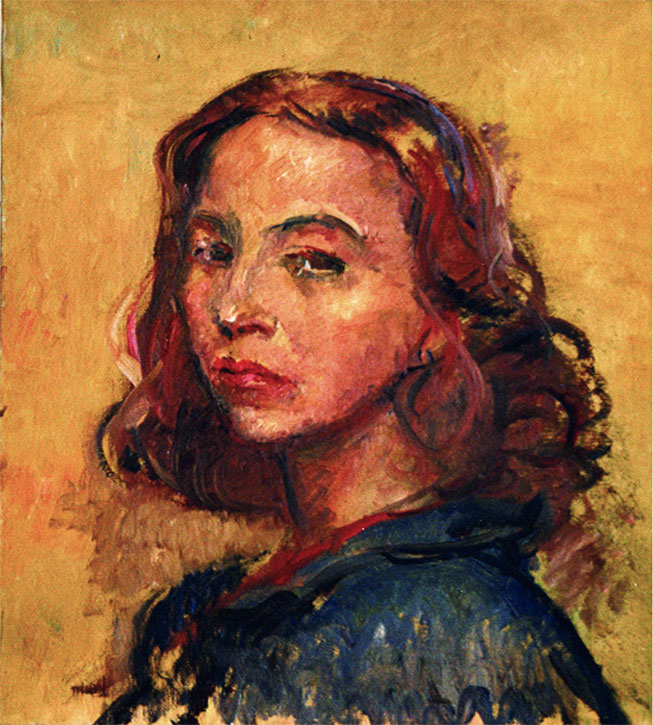
Untitled (Young Woman) by Clara Klinghoffer

Salman and Chana Rizi had their first child, Fegele, in early 1899 and later that year Chana became pregnant once more.  Her second child was born on May 18th 1900.  This second daughter was named Chaje Esther after her late maternal grandmother.  A third child, another daughter, Reisel, was born on April 4th 1902.  Although the grandparents were happy with the grandchildren, their happiness, at least in the eyes of Axel, was tempered by the fact that Chana Rizi had not given birth to any male offsprings.

Portrait of a Girl Reading by Clara Klinghoffer (1946)

Salman was fed up with life and working for Abel and soon on hearing many stories about the golden land of America decided that his future lay there and he would head there alone, get a job and then send for his wife and children.  Sadly Salman was a dreamer.    He broached the subject with Abel and Witie who did not oppose his dream and seemed to be pleased to be rid of him.  His wife viewed it differently but because she knew her husband was very unhappy, she believed he should grasp the chance to better his life and any way, soon she would join him.

Giuseppina by Clara Klinghoffer (1934)

Salman left Szerzezec but instead of going to America arrived in England in the city of Manchester and took a job as a presser in a tailor’s shop.  Nobody knows why he changed his plans of fulfilling his American Dream but maybe he had contacts in the northern English city.   At first he corresponded with his wife back home telling her what he was doing but there was never an invite for her and his three children to join him.  The arrival of letters from her husband soon became infrequent and eventually stopped altogether.  What had happened to him?  Had he taken up with another woman?  Had he become seriously ill?  Had he decided to journey on to America?  All were questions that Chana Rizi contemplated.  So in 1903, she took the momentous decision to go to Manchester with their two children Fegele and Chaje and look for her husband. Her youngest daughter, Reisel, was left with her grandparents.  Chana Rizi was just thirty years old and solo travel was hazardous and she would be arriving in a country whose language she could neither speak nor understand.  However, she did arrive in Manchester after a long boat trip during which time she was violently seasick and she eventually located her husband, much to his surprise.

Pastel portrait of Lucien Pissarro by Clara Klinghoffer (1928)

Salman was paid a pittance as a presser but Chana Rizi was determined to stay by his side so they could build a life together even if they all had to endure poverty.  It was also at this time that they changed the children’s first names.  Fegele became Fanny and Chaje Esther became Clara – Clara Klinghoffer.  The family could not make ends meet and so they moved to the Staffordshire town of Hanley.  Salman’s wages were better and Clara enjoyed the peace of the small rural town which compared favourably with the noisy and polluted city of Manchester but all was not well with the family dynamics and there was a rumour that Salman was having an affair with a local woman.  Chana Rizi, who was pregnant with her fourth child, packed their bags and demanded they returned to Manchester.

Harriet Cohen (pianist) by Clara Klinghoffer (1925)

The family arrived back in the city and rented a property at 18 Irwell Street in the Cheetham Hill district of the city and it was here in late June 1904 that Chana Rizi’s fourth child, another daughter, Rachel, was born.  Many years later, Chana went to visit a friend in London and when she returned to Manchester she announced to her family that they were going to move to the English capital and there would be a job waiting for her husband as manager of a drapery shop in Poplar in the East End of London, which would suit him better as the physical strain on him as a presser was proving too much for him and was affecting his health.  Salman went first to London to secure somewhere for the family to live.  He managed to rent a small East End flat in Puma Court, a tenement block off Whitechapel Road, close to Spitalfields fruit market.  Very little good could be said about their accommodation in their Puma Court flat or the neighbourhood and the smell of rotting fruit and veg coming from the market.

Clara’s early schooldays were ones she would rather forget.  Ferocious teachers who often meted out corporal punishment with a birch and unfriendly fellow pupils were things she had to put up with.  Added to that, her mother fell down the steps of their flat and broke her leg in a number of places which meant she had to rest up in bed with her leg in a heavy cast.

Pen & Ink fashion sketch from Clara’s childhood sketchbook (1913)

Salman was not happy working as manager at his cousin’s drapery shop.  He wanted to be answerable just to himself and so he looked to become self-employed.  He wanted to be his own boss.  He travelled back to Manchester where he set himself up as a “mill end” trader and arranged for bags of “end of roll” materials to be sent to his London home where they were stored in one of their rooms.  He and Clara’s mother then sorted them and Salman took them around various tailors selling the cloth.  The tailors in those days partly made their livelihood from repairing clothes and so needed various pieces of material.  Salman’s business prospered and he was soon able to lease his own shop in Grove Street, off Mile End Road in London’s East End, from where he would run his business and there would be accommodation above for the family.  Throughout the day, tailors would call at the shop looking for material.  Thanks to the support and ambition of his wife Chana, Salman had become a merchant – a profit-making businessman.  Around the early part of 1910 the family moved to another East End property, a roomier three-storey house at 148 Cannon Street Road where Clara’s mother had a dress shop and in April 1914 Salman Klinghoffer applied for naturalisation, probably due to the prospect of war in his homeland .

Photograph of Clara (c.1913)

Clara enrolled at St Mark’s School, a parish school serving poor and largely immigrant children, in nearby Cable Street and despite her sense of foreboding, she found she enjoyed school life and her favourite subjects were history drawing.  After school, Clara would return home and spend time in her mother’s dress shop and began to sketch some of the clients.  She would also spend time in the large attic which ran the whole width of their house and was used as a room to store her father’s mill ends. However there was a table in the attic at which she sat and sketched. This was her first “studio”.

Girl in Green Sari by Clara Klinghoffer

One of her mother’s clients, a young man, who saw Clara’s sketches told Clara’s mother that her daughter was very talented and she should take art lessons.  Clara’s mother was intrigued by the suggestion and she and her husband decided to do something to help their daughter. Studying art at an art school was very expensive but her father and mother managed to raise enough for her to enrol at the John Cass Institute, in Jewry Street, Aldgate. 

………….to be continued


Information for this blog was found in many sources but the most important ones were:

Clara Klinghoffer – 20th century English Artist

Clara Klinghoffer: the girl who drew like Raphael and Leonardo
Evelyn Dunbar

Detail from Self portrait by Evelyn Dunbar (1930)

Evelyn Dunbar was born in Reading on December 18th, 1906.  She was the fifth and youngest child of William Dunbar and Florence Dunbar (née Murgatroyd). William Dunbar was a Scotsman who originally came from Cromdale, Morayshire.  In 1913, when Evelyn was seven-years-old the family moved to Rochester in Kent where her father established himself as a draper and bespoke tailor.  Evelyn’s mother Florence was a keen gardener and amateur still-life artist and a Christian Scientist and soon Evelyn became one and remained one throughout her life.

Portrait of the artists mother, Florence, on a bentwood rocking chair, by Evelyn Dunbar (c.1930)

Evelyn Dunbar won a scholarship to attend the Rochester Grammar School for Girls.  From there she enrolled on a two-year art course at the Rochester School of Art, in 1925 and in 1927 attended the Chelsea School of Art remaining there until 1929.  That year, she won a scholarship to attend  the Royal College of Art where she studied until 1933 at which time she graduated as an ARCA (Associate of the Royal College of Art). Students at the Royal College of Art were encouraged by Sir William Rothenstein, College Principal and Professor of Painting, to find commissions for their work and engage socially with influential art world figures. 

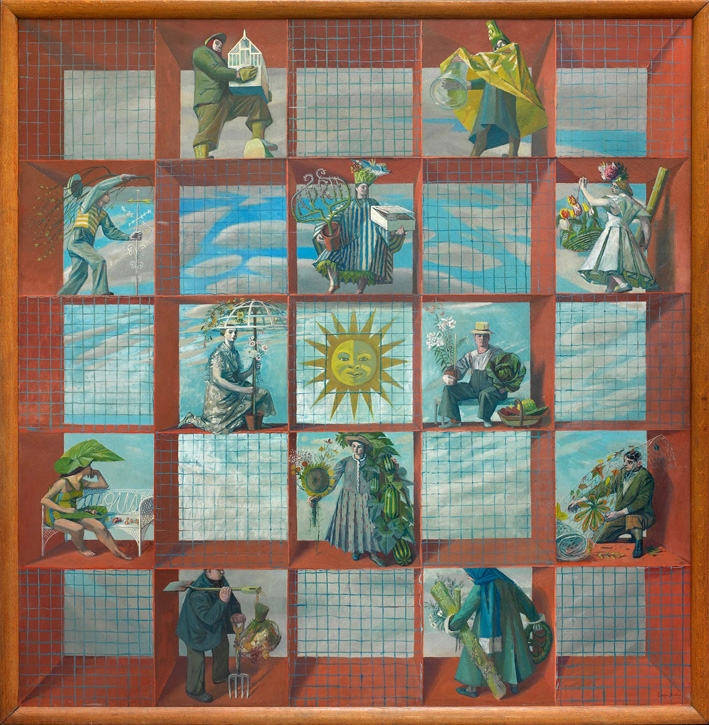
Compositional Study for The Pleasures of Life at Morley College by Charles Mahoney (1930)

Cyril Mahoney, known as Charles Mahoney, had been Visiting Painting Tutor at the RCA since 1928 and had carried out a commission to paint a thirty-foot long mural, entitled The Pleasures of Life, at the Morley College for Working Men which he and colleagues completed two years later.  In his memoir Since 50, Men & Memories 1922-1938, the first two names that appear on William Rothenstein list of top Royal College of Art students were Henry Moore and Charles Mahoney – the list continues with the names of other leading lights such as Eric Ravilious, Edward Bawden, Barnett Freedman Edward Le Bas, and Evelyn Dunbar.

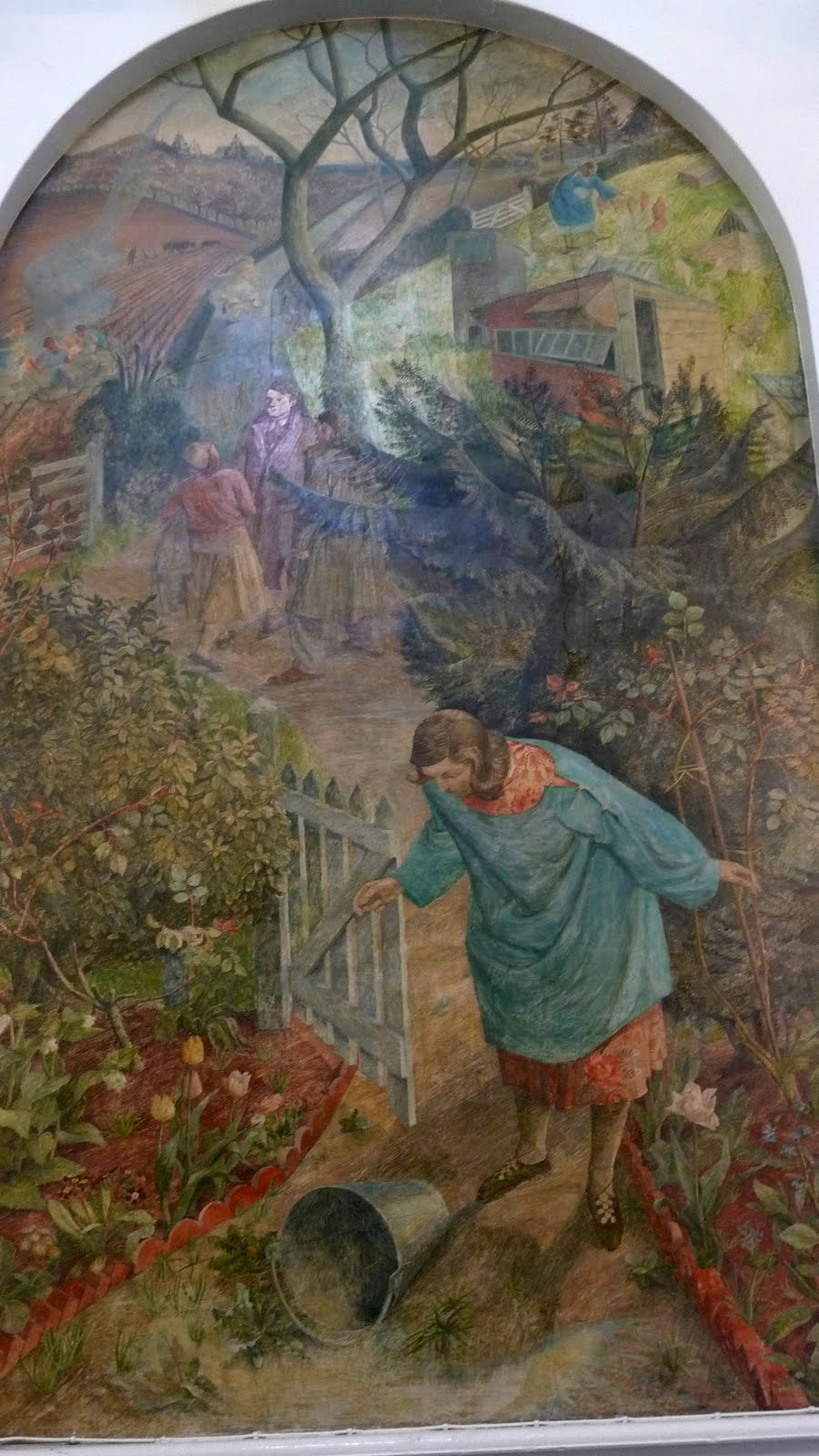
Mural by Evelyn Dunbar at Brockley County School for Boys

In 1932, Mahoney was offered a commission to decorate Brockley County School for Boys (which is now the Prendergast School for Girls) in South London, and following an appeal from Rothenstein for students to experiment further with mural painting, Mahoney chose three of his senior students to assist in the project, Evelyn Dunbar, Mildred Eldridge and Violet Martin. The subjects of these proposed five arched-top panel murals were to illustrate tales from Aesop’s Fables.  The painting of this set of murals was not completed until 1936. 

An English Calendar by Evelyn Dunbar (1938)

During Mahoney’s work with Evelyn on the mural their relationship intensified and he became her lover.   Mahoney and Evelyn shared a studio in South End Road, at the southern end of Hampstead Heath.  Besides painting and sketching,  they had another shared interest, that of plants and horticulture.  Mahoney’s love of horticulture resulted in an amusing warning from Evelyn who wrote to him:

“…Don’t ever have too big a garden, or with your avidity for making the names in the catalogue come true, you’ll never touch a brush or a pencil…”

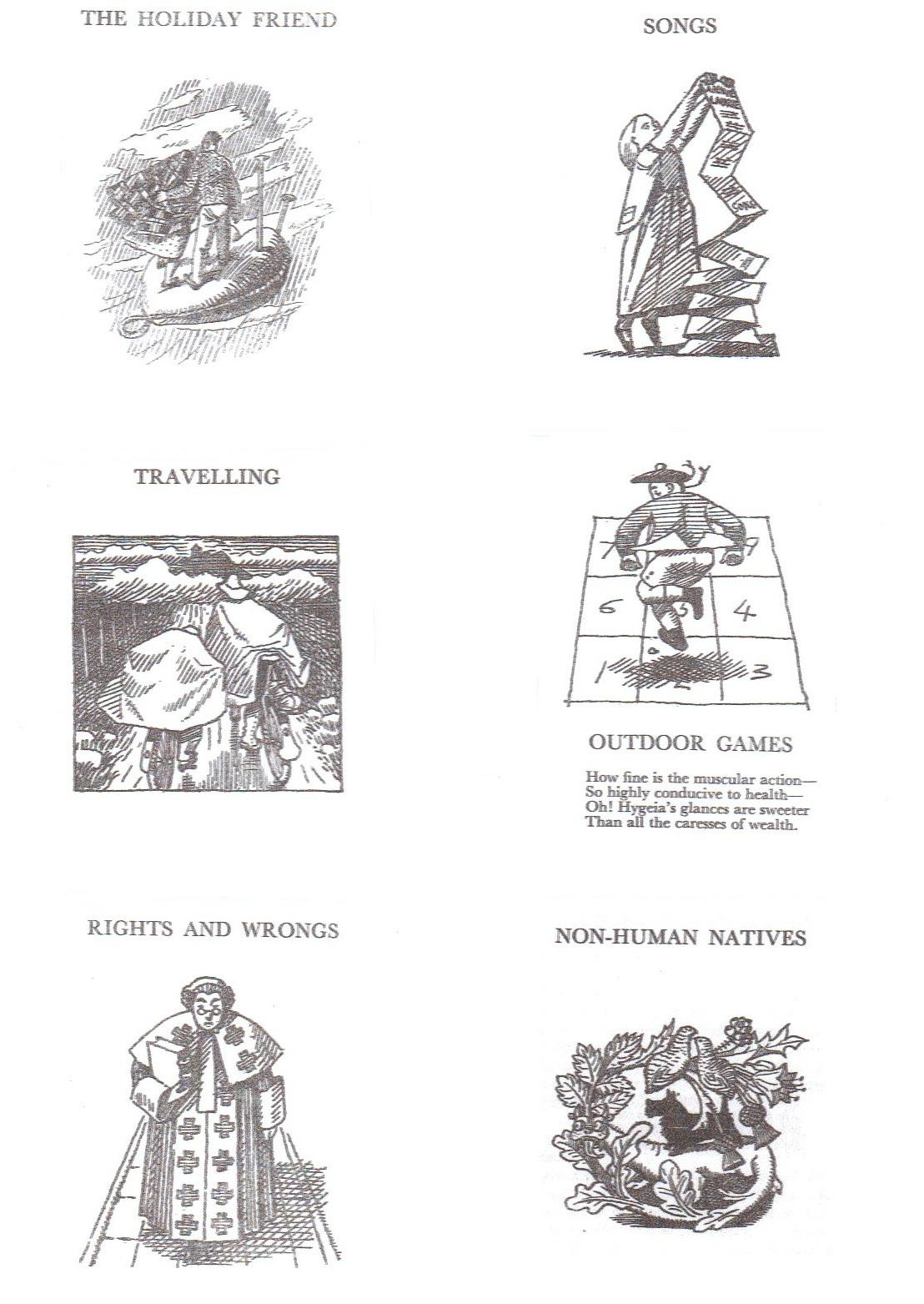
Whilst working on the Brockley murals Evelyn accepted another commission.  Near neighbours to Evelyn Dunbar and Charles Mahoney were Catherine and Donald Carswell, authors and journalists.  Donald Carswell had put together a series of short travel stories, to be published by Routledge & Sons, under the title, The Scots Week-End and Caledonian Vade-Mecum for Host, Guest and Wayfarer and needed an illustrator to produce accompanying illustrations. 

Evelyn Dunbar: Pen and ink vignettes from The Scots Week-End and Caledonian Vade-Mecum for Host, Guest and Wayfarer (1936)

They approached Charles Mahoney who recommended Evelyn.  She agreed to the commission and produced twenty-five pen and ink vignettes, the frontispiece and dust jacket for the miscellany. 

Evelyn Dunbar: Pen and Ink frontispiece to The Scots Week-End and Caledonian Vade Mecum for Host, Guest and Wayfarer (1936)

For Evelyn, it was not a labour of love and she wrote to Mahoney about her struggle to complete the commission asking for some moral support:

“…can you tell me why it is that whenever I get going on these blooming Scotch illustrations with vigour and spontaneity all my spontaneous and lively feelings completely desert me, and I am left clutching an unwilling, unwieldy pen, scratching at laborious and second-rate expressions of stereotyped and 5th rate (so it seems to me) ideas? I’m trying my best and I mean to get over it, but jobs of that kind seem to mesmerise me into a kind of stupidity and inability. Write me a few comforting and inspiring lines…”

With the success of the travel book more commissions came from the Routledge publishing house.  One of them was for the book, Gardeners’ Choice which comprised of the history, characteristics and cultivation advice for forty garden plants.  The book was illustrated in pen and ink, and was jointly written and illustrated by Dunbar and Mahoney.

Design for June for the Country Life 1938 Gardeners Diary by Evelyn Dunbar

More work came their way when the magazine, Country Life, commissioned Dunbar to compose their Gardener’s Diary 1938, a monthly journal and appointments book which contained literary texts chosen by Evelyn and illustrated with her pen and ink drawings.

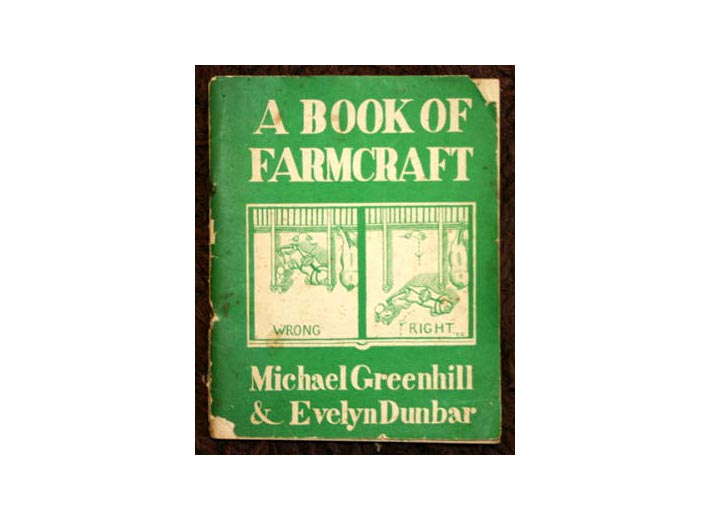
In 1941 Dunbar collaborated with author, Michael Greenhill by providing pen-and-ink illustrations for his book, A Book of Farmcraft.  It was a basic primer of husbandry for those who had little or no knowledge of farming. Michael Greenhill was an instructor of recruits to the Women’s Land Army at Sparsholt Farm Institute, near Winchester, Hampshire. Many of Evelyn’s illustrations, differentiated between the right way of undertaking some agricultural task and the wrong way.  For the illustrations, Evelyn used Sparsholt recruits as her models.

Putting on Anti-gas Protective Clothing by Evelyn Dunbar (1940) Composite image of a woman being assisted into an anti-gas suit by another woman

Having looked at Evelyn Dunbar’s mural work and her interest in horticulture, floral paintings and illustrations, one has to remember that she is best known for her depictions of the activities of the Women’s Voluntary Service and the Women’s Land Army during the Second World War.  In April 1940 Evelyn was appointed by the War Artists’ Advisory Committee, (WAAC), as an official war artist and later was the only woman artist to receive successive and continuous salaried commissions throughout the war.  The WAAC tasked her with pictorially documenting civilian contributions to the war effort on the home front.

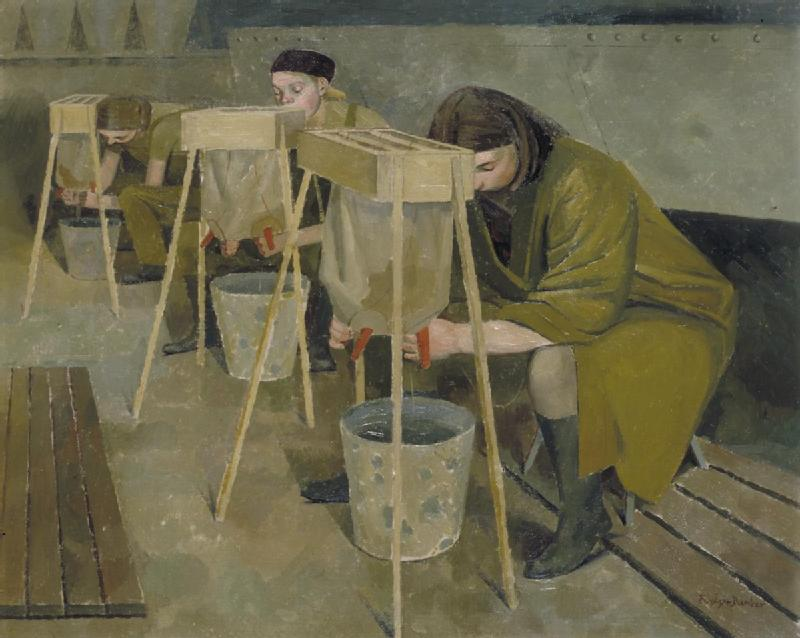
Milking Practice with Artificial Udders by Evelyn Dunbar 

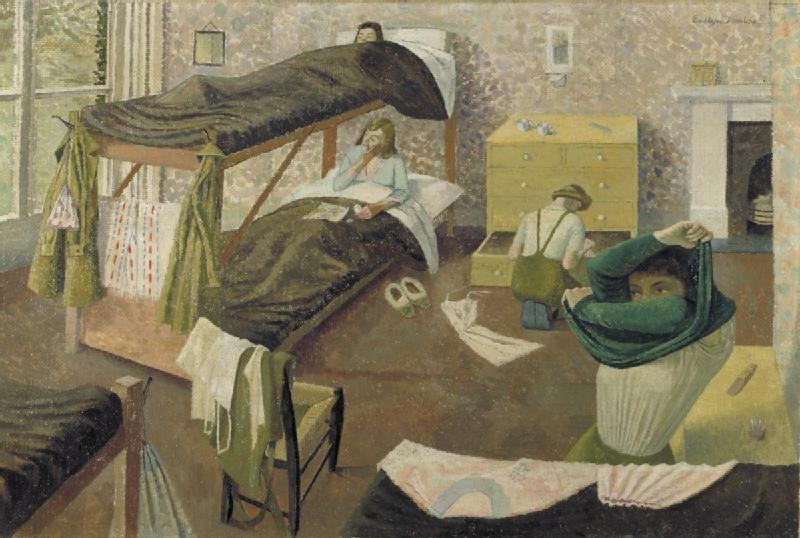
Land Army Girls going to Bed by Evelyn Dunbar

One of the most important tasks for women besides working in munitions factory was tending the land as so many male farm workers had gone to fight in the war.  The first harvest which the Women’s Land Army was largely responsible for bringing in during the summer/autumn of 1940 led to Evelyn’s painting entitled Men Stooking and Girls Learning to Stook.

Men Stooking and Girls Learning to Stook by Evelyn Dunbar (1940)

One of Evelyn’s paintings, A Canning Demonstration,  depicted some members of the Women’s Voluntary Service learning how to can and preserve the fruit which had been harvested that summer.

A Canning Demonstration by Evelyn Dunbar

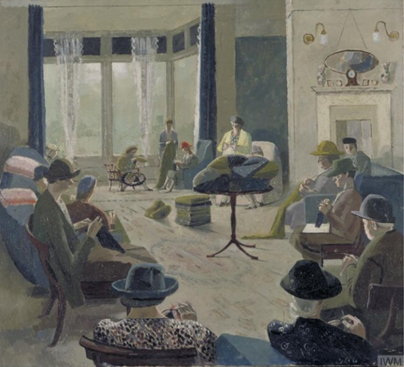
A Knitting Party by Evelyn Dunbar (1940)

Another important task for the women, who volunteered their services, was to organise knitting “gatherings” at which the women would make blankets and comforters which could be sent to the troops.  In her 1940 work entitled, A Knitting Party we see one such gathering.  The setting is the drawing room of the Dunbar family home in Rochester, Kent, and it depicts some fifteen women, one of whom is Evelyn’s mother,  Florence.

Portrait of Flying Officer Roger Folley in Flying Kit by Evelyn Dunbar

Whilst working for the War Artists’ Advisory Committee she encountered Roger Folley, who came from Lancashire and who had graduated from Leeds University.  Roger was an “outdoor person” and spent his holidays and time after university working on farms and enjoying life outdoors hiking around the countryside.  Having gained some experience working on farms combined with his two university degrees (B.Sc and B.Comm.) it qualified him to work as an agricultural economist and his first job was as Costing Officer at Sparsholt Farm Institute, near Winchester, where he first met Evelyn who had been posted there in 1940 to paint Women’s Land Army recruits at work.

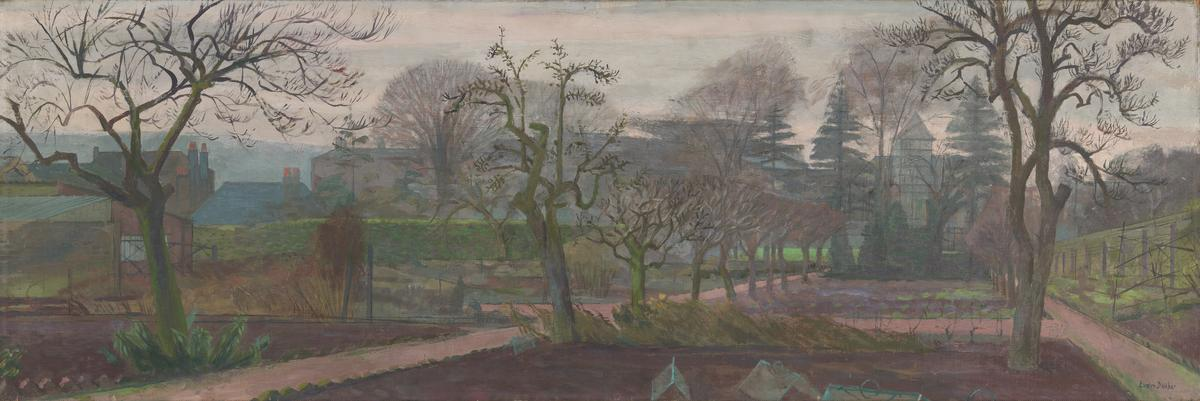
Winter Garden by Evelyn Dunbar (1929-37)

Roger was a Royal Auxiliary Air Force volunteer and at the outbreak of war, was called up to serve in the RAF.  He received his Flying Officer commission in 1941 and transferred from the Voluntary Reserve and became Flight Lieutenant Roger Folley RAF, serving as a navigator with 488 (NZ) Squadron.  Friendship between Evelyn and Roger blossomed into love and the couple were engaged in February 1942 and married the following August  

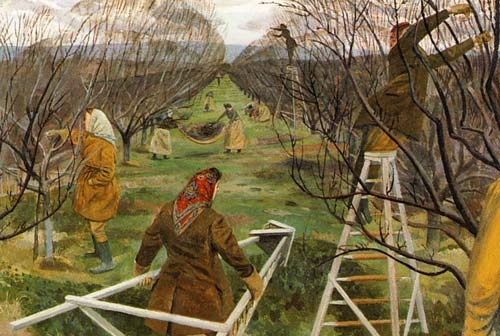
Pastoral, Land Girls Pruning at East Malling by Evelyn Dunbar (1944)

One of Evelyn’s and Roger’s great mutual loves was their commitment to the land and the careful management of its productivity.  For Evelyn this premise was in line with her Christian Science beliefs which she continued to follow.  She believed in the texts of the Old Testament that talked about a covenant between God and encompassed a covenant, frequently mentioned in the Old Testament, between God the Creator and mankind whereby the creator guaranteed the means of subsistence to mankind in return for mankind’s undertaking to cherish the land with love, intelligence and industry.

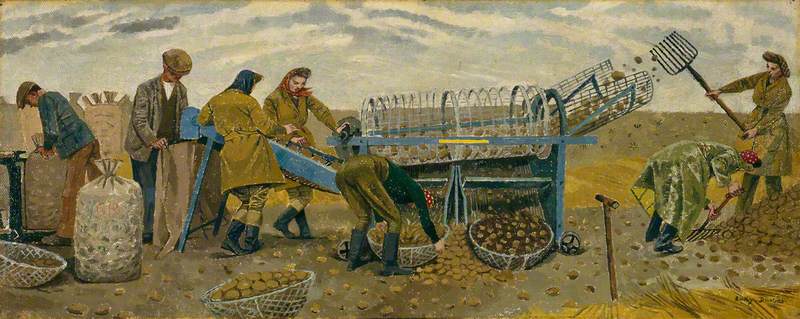
Potato Sorting, Berwick by Evelyn Dunbar

Evelyn often followed her husband when he was transferred to another military base and once he was stationed at RAF Charter Hall in Berwick. Whilst staying at the Scottish Borders, Evelyn made a sketch of women from the Women’s Land Army sorting newly dug-up potatoes.

Sprout Picking by Evelyn Dunbar

Much of the Land Girls’ work on the farm was back-breaking as can be seen by Evelyn’s painting entitled Sprout Picking.

Singling Turnips by Evelyn Dunbar

Turnip seeds are minute and they are scattered in ridges by seed-drill.  However a few weeks after the seeds have been “mechanically” sowed, the seedlings will shoot up in their masses along with a profusion of weeds.   To avoid the turnip shoots being choked by the weeds they have to be thinned out by hand and re-planted, known as “singling” – hence the title of the painting.

A Land Girl and the Bail Bull by Evelyn Dunbar (1945)

One of the last paintings Evelyn completed for the War Artists’ Advisory Committee, depicting the Land Girls was entitled A Land Girl and the Bail Bull.  It is a depiction of a Land Girl’s work with an outdoor dairy herd on the Hampshire Downs.  The name “bail” in the painting’s title refers to the moveable shed, which can be seen in the centre of the middle-ground and is where the milking is done.  The girl has to catch and tether the bull and we see her enticing the animal with a bucket of fodder whilst she hides the chain behind her, ready to snap on to the ring in its nose as soon as it is within her reach. The girl in the painting is modelled by Evelyn’s sister, Jessie .

The Cerebrant by Evelyn Dunbar

Once the Second World War had ended Evelyn and her husband went to live in Long Compton, Warwickshire, and they remained there for fifteen months.  In 1946 The Oxford School of Art welcomed Evelyn as a part-time tutor and she combined this with her role as a visiting teacher at the Ruskin School of Drawing and Fine Art. Having these two teaching posts in Oxford and with her husband, Roger Folley, obtaining a position in the nearby University Agricultural Economics Research Institute, the couple decided to move home from Long Compton and re-locate to Enstone, Oxfordshire, in the spring of 1947. They made the  Manor House at Enstone their home for next three years. In 1948, whilst living at Enstone, Evelyn completed a portrait of her thirty-five year-old husband Roger, entitled The Cerebrant.  The setting for the work was his study on the top floor of The Manor House.  It is a peaceful and relaxed portrait of her husband. He is depicted sitting  down at a small table, which has various coloured books on it. One of the books is open and he is holding one of the pages in his right hand. He is looking towards his right, which is the direction the light is coming from. Folley is dressed casually in a green, short-sleeved, collared shirt. The painting was given that title by Roger Folley some fifty-seven years later when he presented it to Manchester Art Gallery in 2005.  He had told one of his wife’s biographers that It was a celebration of Thinking.

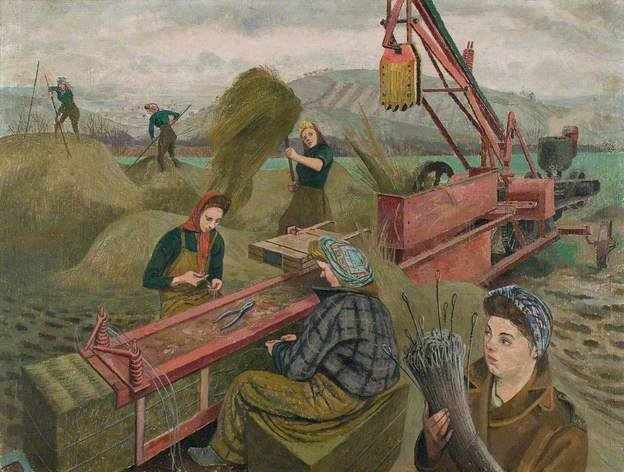
Bailing Hay by Evelyn Dunbar (1943)

Roger Folley changed jobs in 1950 when he was appointed to the Department of Economics at Wye College, Kent. The new position meant Folley and Eveleyn had to move home and they  leased an isolated house, The Elms, four miles from the Kent village of Wye, nestled in the hills of the Kent Downs.  Dunbar would run informal art classes but still managed to travel once a year to Oxford to give an annual lecture at the Ruskin School. In 1953 a solo exhibition of her paintings was held at Withersdane Hall on the Wye campus.

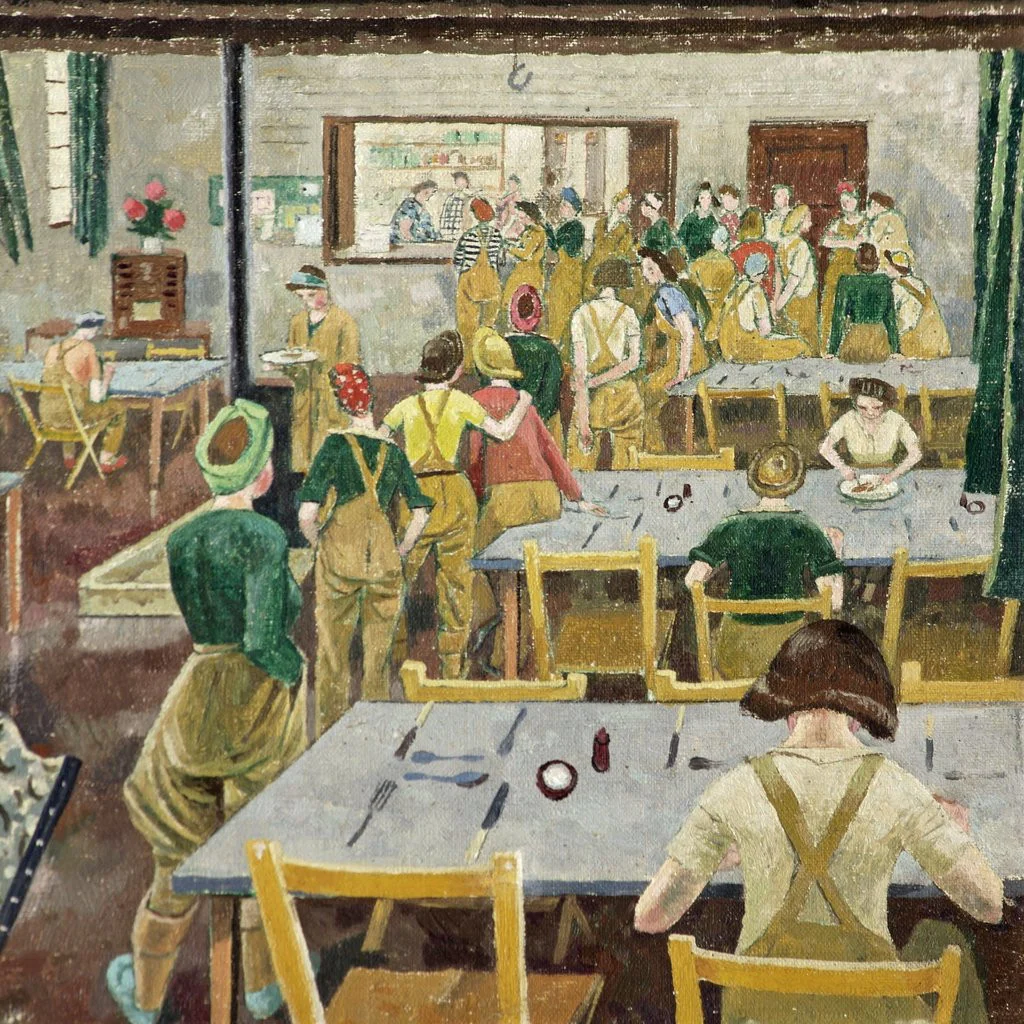
Women’s Land Army Hostel by Evelyn Dunbar

Roger Folley was away in the Caribbean working for the government whilst Evelyn remained at The Elms.   However their lease on the property was coming to an end and she had to organise a new home for her and her husband.   Evelyn chose a more modern property in the village of Wye, which had once been a vicarage. She named it Tan House.  It did not prove a good move and the couple were never happy there.  It was smaller than they were used to and did not have a studio space for Evelyn. In 1958 Roger and Evelyn, could no longer endure the limitations of Tan House and moved to a farmhouse called Staple Farm, close to the village of Etchinghill, on the North Downs and in this home Evelyn had her own studio.

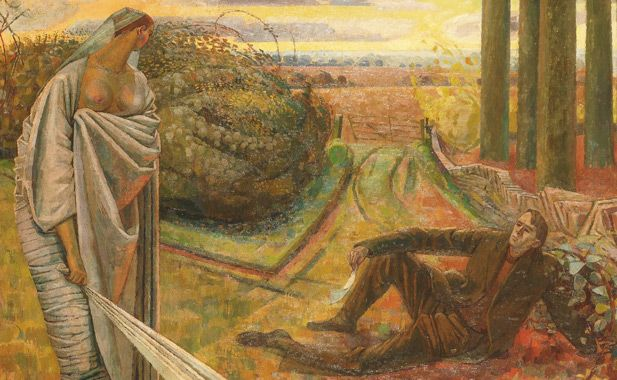
August and the Poet by Evelyn Dunbar (1960)

On the evening of May 12th 1960, whilst out walking in the woods around Staple Farm, Dunbar suddenly collapsed and died. One of Evelyn’s last paintings was Autumn and the Poet which she had started to paint ten years earlier and was still on one of her easels when she died.  The figure of the poet, half-seated on the ground, was modelled by her husband.  Unfortunately the painting was slightly smoke-damaged in a house fire in 2004, but was restored in time for the 2006 exhibition marking the centenary of Dunbar’s birth.

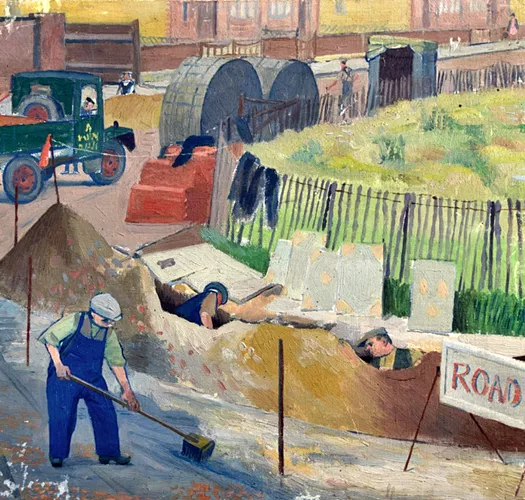
Roadworks by Evelyn Dunbar (Thought to have been produced while studying at Rochester School of Art in c.1926) sold in 2018 for £19,000.

Her main works were her oil paintings but she also left behind many portfolios of watercolours, drawings, pastels, sketches and other secondary work, most of which were not seen for many years after disappearing shortly after her death.   The Times newspaper in its obituary of Evelyn Dunbar wrote:

“…Living a retired life in Kent, absorbed in country pursuits, Miss Dunbar did not often come before the public in mixed exhibitions, but her mural paintings and illustrations, with their peculiar authenticity of work inspired by the ruling passion, appealed strongly to those who knew it…”

Roger Folley remarried in 1961, and Evelyn’s works of art were distributed among family and friends.


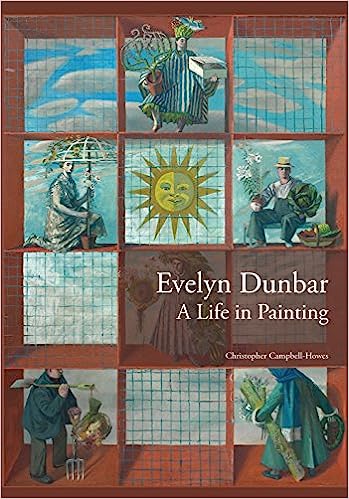
I have only scratched the surface of Evelyn Dunbar’s life and the majority of the information was gleaned from a beautifully written series of blogs regarding this wonderful artist written by her nephew, Christopher Campbell-Howes, who has also published a book on her life an art work.

Isabel Codrington Pyke Nott

Portrait study of Isabel, by Philip Alexius de László, (c.1909)

In 1856, John Nott , the Lord of the Bydown Manor estate within the parish of Swimbridge, close to the town of Barnstable in Devon, died childless and his two sisters Elizabeth and Marianne became his co-heirs.  In 1838 Elizabeth Nott married Reverend John Pyke, and their son John Nott Pyke, became the heir to Bydown.  John Nott Pyke was educated at Eton College and Exeter College, Oxford and was an amateur playwright.    In 1863 John Nott Pyke received royal licence to assume the additional surname of Nott, in compliance with the will of his uncle and thus became known as John Nott Pyke-Nott. In 1867 he married Caroline Isabella Ward, a writer and artist.  The couple had five children, three sons and two daughters.   John Moels Pyke-Nott, the eldest and heir to the estate was born in 1868.  Caroline Evelyn Eunice Pyke-Nott was born in 1870 and Isobel Codrington Pyke-Nott was born in 1874 and it is this lady, a painter that is the subject of this blog.

Phoebe by Isabel Codrington

Isabel Codrington Pyke Nott, more commonly referred to as Isabel Codrington, was born on the Bydown estate within the parish of Swimbridge in Devon in 1874.  When she was nine years old she and her family moved to London.  In 1885 Isobel and her sister Evelyn Caroline Eunice were enrolled at the Hastings and St Leonards School of Art.  From there Isobel and her sister attended the St John’s Wood Art School which was a precursor for entry into the Royal Academy Schools which Isobel entered in 1889, aged fifteen. It was also here that her sister Eunice met her husband-to-be, the artist Byam Shaw.  Isobel soon displayed her artistic talent and won two medals for her work and she soon began to have her work shown at various exhibitions.

Paul George Konody by William Roberts (1920)

Around the end of the nineteenth century Isobel Codrington met a young and highly motivated Hungarian-born art critic, Paul George Konody who at the time was the editor of The Artist, and later became a regular art reviewer for The Observer and The Daily Mail. The couple fell in love and were married on October 27th 1901 in the romantic village of Porlock, an English coastal village in Somerset.  Isabel was twenty-seven at the time of her marriage and her husband, twenty-nine. She was now Mrs Isabel Konody. The couple went on, during the next five years, to have two daughters, Pauline and Margaret.

At this time, Isabel’s work featured miniatures and inventive watercolours, one of which won her a medal at the Exposition Internationale d’arte in Barcelona in 1907.  Isobel and her husband lived in London and hosted many parties for their artistic and literary friends.  Isobel’s husband was a keen motorist and the couple and two male companions, Gustavus ‘Dan’ Mayer, the art dealer, and ‘Pomponius’, the architect, Edwin Alfred Rickards, embarked on an exciting road trip in 1911 driving through France and then down the length of Italy from north to south through the Alps and Apennines, in what Konody described as a ‘noiseless’ thirty-horse-power steam driven landau.  Out of this momentous trip Konody published the account of their exploratory journey in a 1912 book entitled Through the Alps and the Apennines.

Mrs Konody sketching an ox-cart at Assisi. Photograph by Gustavus Mayer from P.G. Konody’s book , Through the Alps to the Apennines, (1911)

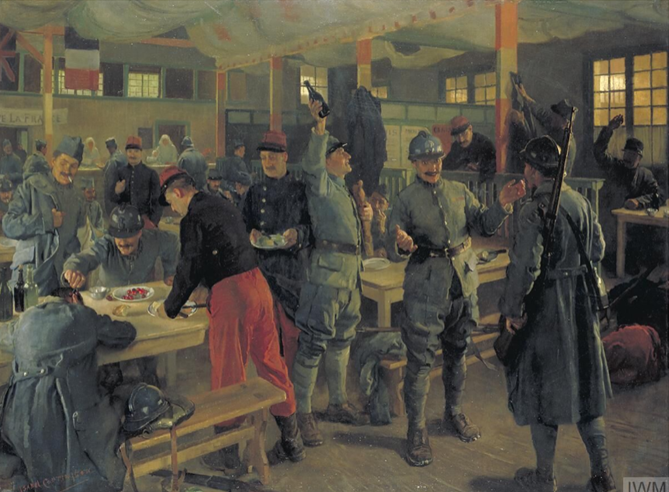
Cantine Franco-Britannique, Vitry-le-François by Isabel Codrington (1919)

Sadly Isobel’s marriage to Paul Konody came to an end around 1912 and they divorced in 1913.  That same year, Isabel married Gustavus Mayer, known as Dan, who had been with Isabel and her husband on their Italian road trip.  He was a director in the London art dealership, P & D Colnaghi.

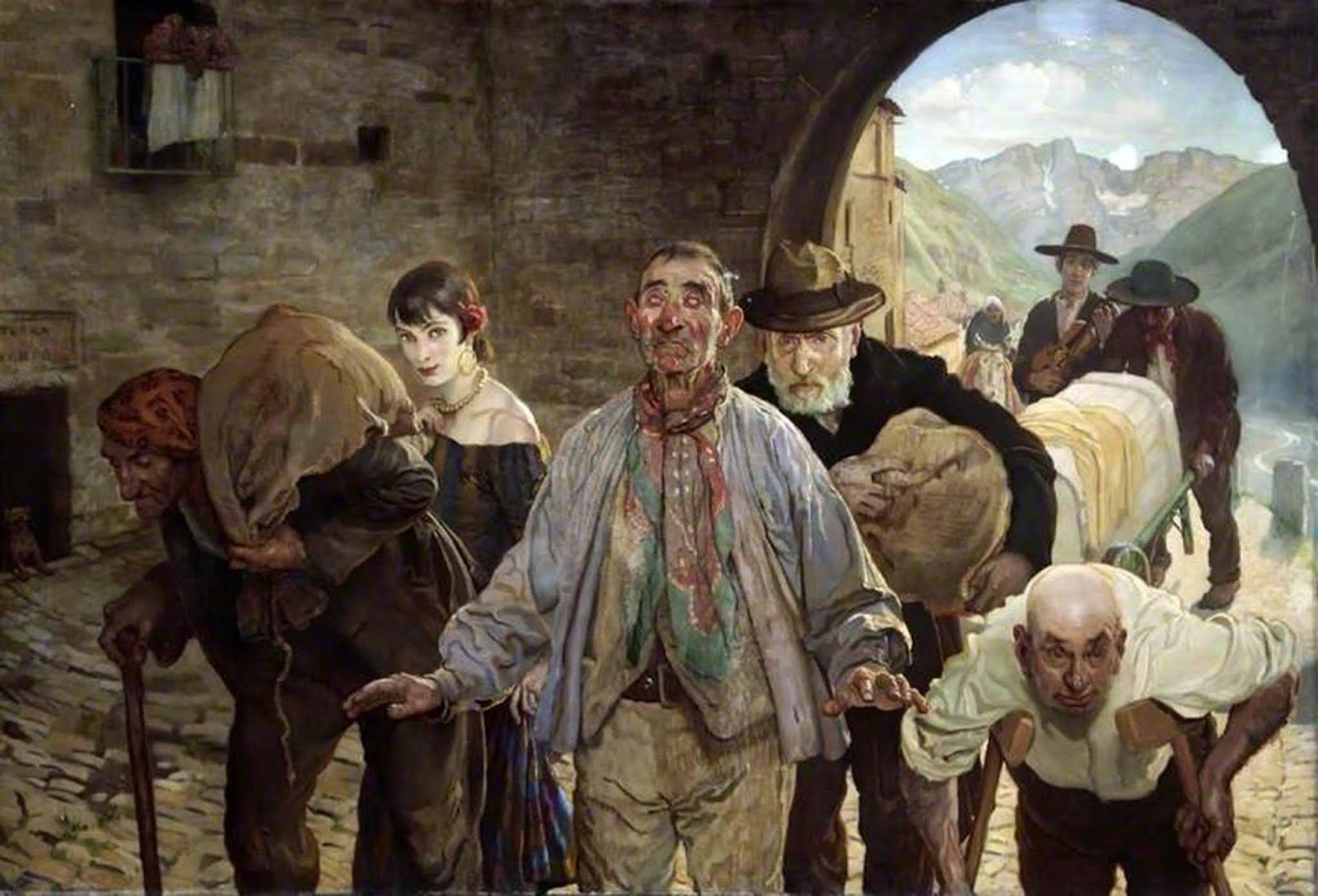
The Beggars are coming to Town by Isabel Codrington

Having two young daughters and a new husband to look after curtailed her painting for a few years.  She remembered the time she returned to her beloved art in an interview with a reporter in 1918, saying:

“…I felt I would like to begin again…… I had forgotten almost everything…”

The phrase “getting back on the horse” came to fruition in 1919 when she received a painting commission from the Imperial War Museum for a painting, Cantine Franco-Britannique, Vitry-le-François, which depicted life at a French canteen during the Great War.  It is an interior scene of a canteen for French troops and we see soldiers sitting and standing around the tables talking amongst their comrades. In the right foreground we observe one soldier greeting another who has just come into the room. On the extreme left of the foreground, we see one soldier slouched over with his head resting on his arms on a table.

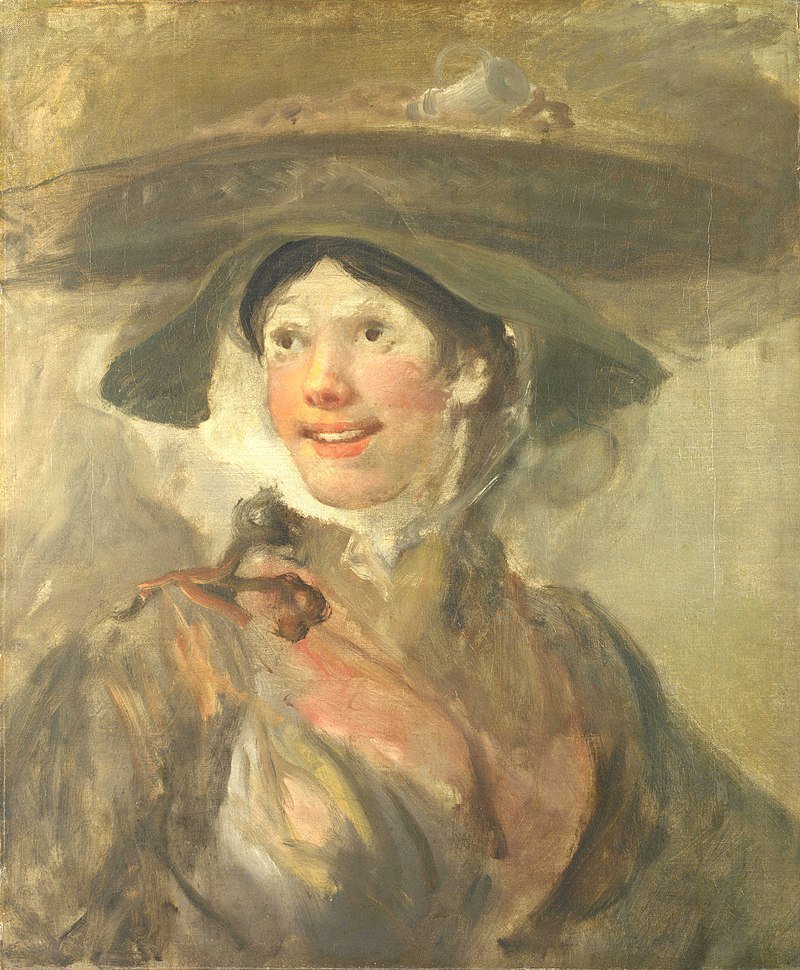
The Shrimp Girl by William Hogarth (c.1745)

The depiction of Costers, Hawkers and Gypsies became popular around the mid eighteenth century with the likes of William Hogarth’s painting, The Shrimp Girl. The painting was one of Hogarth’s later works and depicts a woman selling shellfish on the streets of London, which was typically a job assigned to the wives and daughters of fishmongers who owned stalls in markets such as Billingsgate. By the 1920s this type of depiction was favoured by the likes of George Clausen, who was one of Isabel Codrington’s most notable teachers.

The Old Tramp by Isabel Codrington (1926)

Her painting entitled The Old Tramp was well received by the critics and the art critic of the Colour magazine wrote:

“…At the present time Miss Codrington is among its ablest exponents as can be seen in this outdoor character study which is remarkably naturalistic and full of descriptive detail…”

The article also made reference to the plein air tradition of George Clausen and Bastien-Lepage.

Zillah Lee, Hawker by Isabel Codrington (c.1928)

Two years later in 1928 when her painting entitled Zillah Lee, Hawker was shown at the Paris Salon des Artistes Français, similar remarks were made about her depiction of the gypsy woman.  One French critic remarked that the depiction of the old woman was ‘sobres, très observés, traduites avec une grande simplicité de moyens, (simple, highly observed and translated with great simplicity of means). The exhibiting of her work that year was the fifth time her paintings had graced the walls of the Salon.  From Paris the painting went to London where it was exhibited at the Royal Academy.

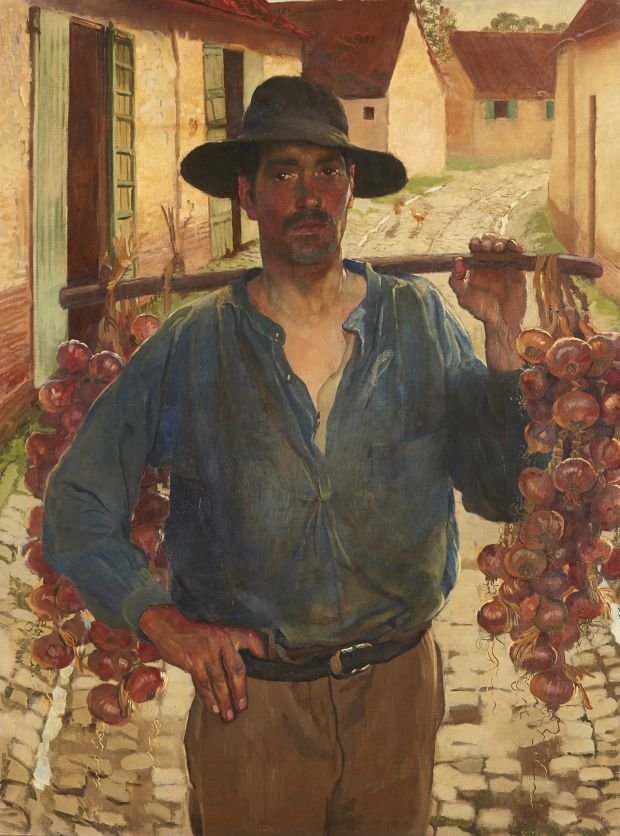
The Onion Rover by Isabel Codrington

In the 1920s Isabel had her work exhibited regularly at the Royal Academy and after 1923, her paintings could be seen hanging at the prestigious walls of the Paris Salon.  On one occasion she received a Mention Honorable from the Salon Jury. One of her favourite subjects for her paintings was that of peasant life.  She had exhibited works alongside the great George Clausen,  one of the foremost modern painters of landscape and of peasant life and maybe it was his influence that influenced Isabel. It could also be, despite her impressive circle of artist friends and the connections she made through her husband’s firm of P &D Colnaghi, that Isabel preferred scenes of peasant life which she would have come across during her travels through France, Spain and Italy. One of her “peasant” depictions was entitled Onion Rover.

The Old Violinist by Isabel Codrington (c.1933)

Fine Prints of the Year was an annual series of books that reported and discussed the etchings, engravings, woodcuts and lithographs published each year between 1923 and 1938 by major artists of the period.  Malcolm Salaman,  an art critic and Honorary Fellow of the Royal Society of Painter-Etchers and Engravers, who studied at Slade School of Art and Ruskin School of Art, Oxford,  explained in the preface to the 1933 volume of Fine Prints of the Year, why he had chosen to illustrate the distinctive figure of The Old Violinist in preference to Isabel Codrington’s consummate landscapes. He wrote about the subject of the print:

“…He is playing his way slowly along the poor street, his worn fingers touching the strings in no uncertain fashion, though his bowing is not perhaps what it was in his younger and more showy days. But there is something in the tone or the tune that attracts a small boy ambling along with his marketing mother. This etching is suggestive, the face, figure and clothes of the man show wear, but the fiddle is being strummed with a reminiscence that the child seems to recognise…”

Isabel often added distant figures to her etched street scenes, so to enrich the narrative element of the work.

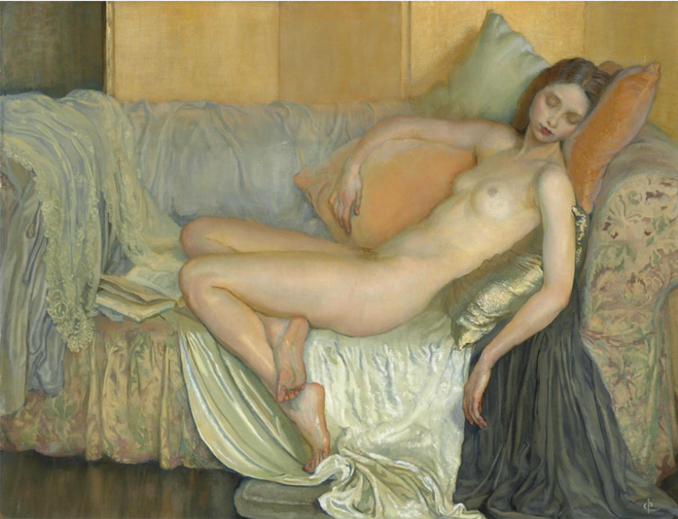
Drowsy Summer Days by Isabel Codrington (c.1935)

In complete contrast to Isabel’s paintings depicting gypsies, beggars and the like, she produced one of her most sensuous works entitled Drowsy Summer Days. Isabel Codrington may well have seen paintings depicting provocative reclining nudes which were popular in the 1920s and 1930s but she has depicted the sleeping female in the most sensitive way. 

Grande Odalisque by Ingres (1814)

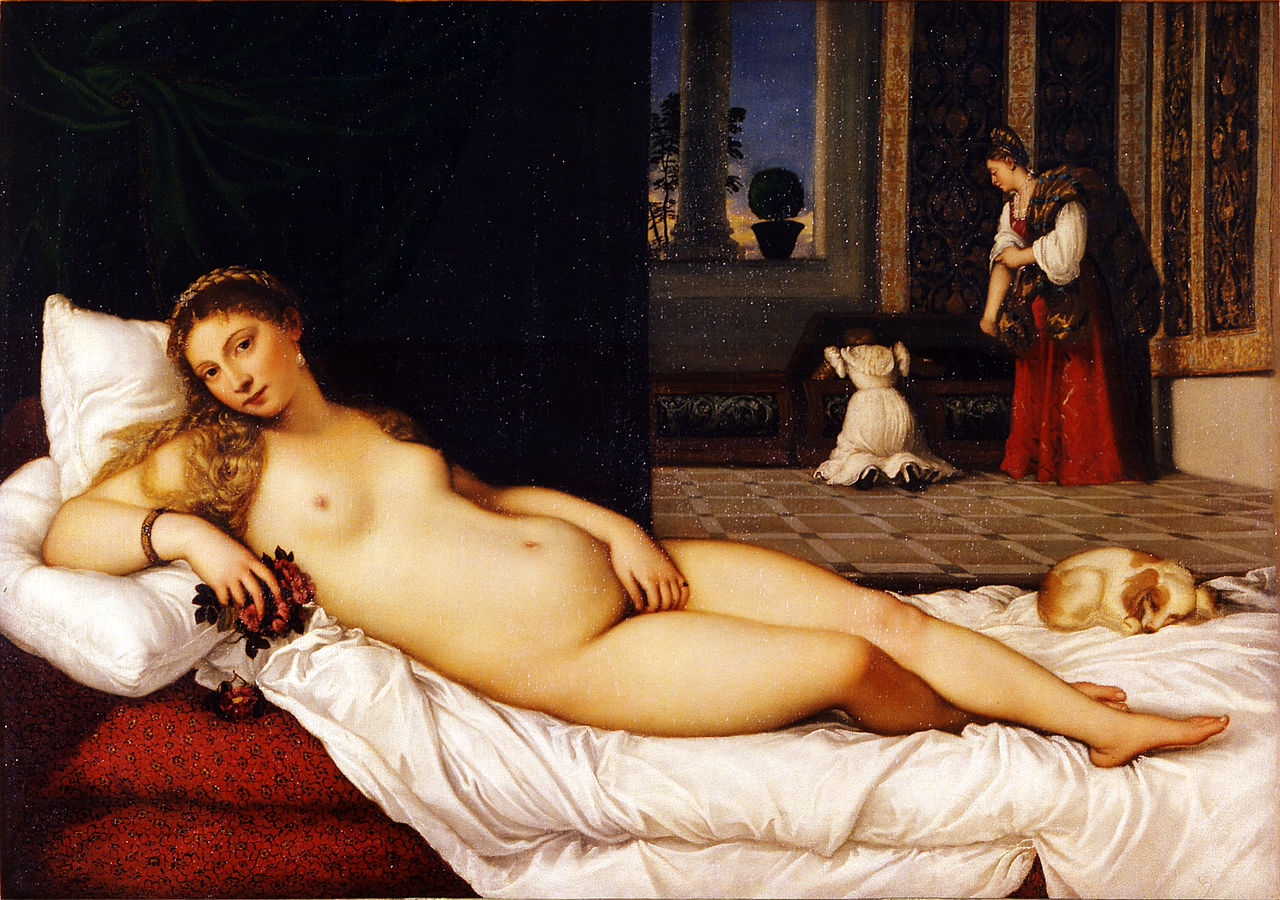
Her model’s sleek torso, pale skin, and the cool, silken cloths and cushions on which she rests, remind us of Ingres’ 1814 Grande Odalisque or the Venus of Urbino by Titian.. 

Venus of Urbino by Titian (1534)

In Isabel’s painting the woman’s body is bathed in the light from the fire in her boudoir on what appears to be a drowsy summer day. The young woman’s book has been set aside and her arms have fallen by her side, whilst her head has sunk into a silken pillow.  The painting was the last one she submitted to the Royal Academy.  Alfred Lys Baldry, the English art critic and painter commented on the work saying:

“…. it was an idealized rendering of the female nude as seen by a male painter and the frank fidelity of the female nude of the woman artist who has no illusions about the beauty of her sex…”

Morning by Isabel Codrington (1934)

Similar in some ways and yet in total contrast in other ways is Codrington’s 1934 work simply entitled Morning.  It was a masterclass on the use of light and shade.  Gone are the silk furnishings seen in her Drowsy Summer Days painting.  In this work we see a woman lying asleep in a simple metal bed. Her left arm lies outstretched towards the floor while her right hand clutches the sheets. The room is seedy and an untidy mess. In the room we see a plain wooden chair by her bed, enveloped with her discarded clothing and a melted candlestick.   In the foreground, the light from the morning sun streams through a window into the room. A breakfast table can be seen, cluttered with bread, cucumber, a bowl of tomatoes, a half-read newspaper, and a glass of water.  The lifestyle of the depicted woman could not be further away from the luxurious lifestyle of the female in the Drowsy Summer Days painting.

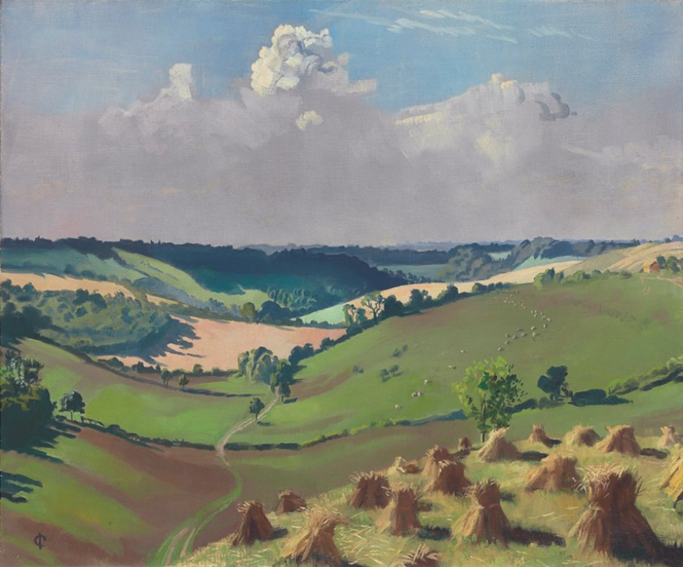
Wild Thyme Farm by Isabel Codrington (1927)

Isabel and her husband, Gustavus Mayer, moved to the village of Woldingham in Surrey, and bought a mock-Tudor mansion named Wistler’s Wood.

Isabel Codrington dominated the British art scene during the 1920s. Her landscape work was outstanding and her painting, Wild Thyme Farm was a prime example of her excellence.  The depiction with its foreground field of hay-stooks typifies a series of downland landscapes painted by Isabel on the estate surrounding her home at Whistler’s Wood, a forest in Surrey. The sun shines from the left on to the rolling hills and casts long shadows.

Frank Rutter, a British art critic, curator and activist who was the art critic for The Sunday Times, wrote about Isabel Codrington’s landscape works, saying:

“…since her art is based on simple domestic commodities and the homely landscapes and barns of the southern counties, Isabel Codrington has little need of an interpreter. Her pictures speak for themselves and speak simply but eloquently…”

The Lily Garden by Isabel Codrington (c.1935)

Isabel’s landscape paintings depicting rural scenes around her home, the Mayer estate, at Whistler’s Wood, Woldingham in Surrey, were shown at a 1929 exhibition.  During the 1930s, Isabel began to concentrate on etching and an exhibition of her etchings was presented at Colnaghi’s London gallery in 1933. 

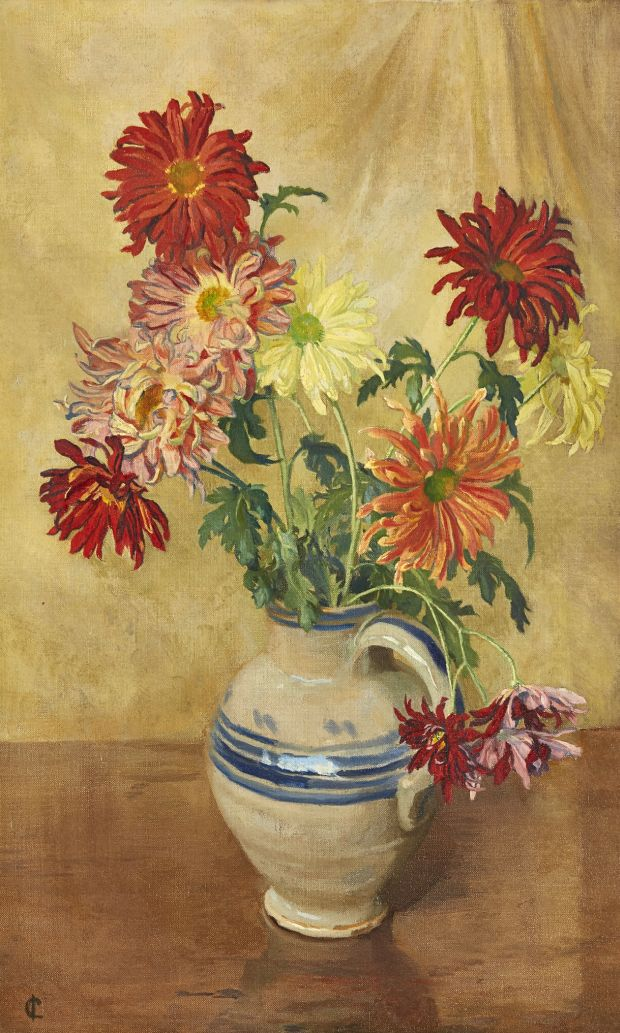
Chrysanthemums by Isabel Codrington

In 1935 she submitted work for the Royal Academy exhibition for the final time.  Her final solo exhibition of ‘Flower Paintings’ was held at the Rembrandt Gallery in Vigo Street in November 1935.  During the final years of her life, she moved to Devon where she died in 1943, aged 68.


Below are some websites I used when compiling this blog and they will offer you further reading about the life and works of Isabel Codrington.

Lyon & Turnbull

Artvee

Christies

Elizabeth Harvey Lee:  Original Prints 15th – 21st centuries

Benjamin Robert Haydon. Part 4.

The sad ending to life.

In the previous blog I told you about Benjamin Haydon’s trip to Paris with his friend David Wilkie.   The journey began at the end of May 1814 when the pair were able to take advantage of the ending of hostilities between England and France.  Whilst in the French capital the two artists spent time at the Louvre  and see the art collections gathered by Napoleon from across Europe.  

Portrait of Emperor Napoleon I by François Gérard (1815)

They also visited François Gérard’s studio.  Gérard was one of the foremost portrait-painters of the day and had eight of his portraits accepted at the 1808 Salon and fourteen in the Salon of 1810.  His portraiture depicted all of the leading figures of the French Empire and of the Bourbon Restoration, as well as all of the most celebrated men and women of Europe and his Paris studio was often a meeting place for upper-class society. 

Napoleon Bonaparte as First Consul by François Gérard (1803)

When Haydon and Wilkie visited the studio Haydon was most impressed by Gérard’s portraits of Napoleon Bonaparte and he became captivated by the French leader.

Napoléon Bonaparte (‘Napoléon on St Helena’) by Benjamin Haydon (1830)

Haydon painted over two dozen of pictures of Napoleon, even bought his death mask and tried on one of the emperor’s hats.  In his portrait of Napoleon entitled Napoleon on St Helena we see the French leader in a thoughtful, meditative mood, pondering on his past triumphs and calamities.  One of the first of Haydon’s Napoleon portraits was for the lawyer, Thomas Kearsey, in 1829 and the following year it was exhibited at the Western Exchange.   A whole-length version above, entitled Napoleon Musing at St Helena was commissioned by Sir Robert Peel. Many others followed including Napoleon Meditating at Marengo and Napoleon Contemplating his Future Grave.

Arthur Wellesley, 1st Duke of Wellington by Benjamin Haydon (1839)

Having completed the depiction of the French leader pondering his triumphs and failures whilst on St Helena, Haydon wanted to produce a companion piece featuring the great British military leader, Arthur Wellesley, the Duke of Wellington.  The painting was to depict  Wellington overlooking the rolling fields at Waterloo at sunrise, a companion piece to Napoleon Bonaparte on St Helena gazing across the sea at St Helena.

In a way the portrait has an element of sadness as we see the ageing hero, who is not adorned in his military uniform but is dressed in civilian clothes.  The painting completed in 1839 by Haydon is almost twenty-five years after the Battle of Waterloo and twenty years after Wellesley finally left the military and entered the world of politics.  In the work we see Wellesley looking out over the scene of his greatest triumph at Waterloo. The Duke who was seventy at the time of the portrait disliked sitting for his portrait, or at least he did at this time of his life

He was even more disinclined to lend Haydon the helmet and sword which we see in the left foreground. Haydon eventually persuaded the Duke to allow them to be used as “stage settings” for the work.  Haydon went on to paint twenty-five variants of the portrait, signifying his almost obsessive interest in the Duke.

The Raising of Lazarus by Benjamin Haydon (1821-23)

When Haydon began painting The Judgement of Solomon he had debts of more than £600. Two years later when he completed the work the size of his debt had doubled. In 1821 he embarked on his largest ever canvas (426 x 632 cms), The Raising of Lazarus and in that year, Haydon’s financial problems came to a head when he couldn’t fulfil his obligations to some people who had lent him money. He was admonished but only just avoided imprisonment.

Mary Hyman – a sketch by Benjamin Haydon

It was in late Spring that Haydon first caught sight of Mary Cawrse Hyman whilst he was walking with his friend, Maria Foote, and he recounted that first glimpse of Hyman. In his journal he recorded the moment:

“…Not far from my house she requested me to stop a moment whilst she left a letter with a lady who was going into Devonshire. I waited; a servant came down, and requested I walk up……and in one instant the loveliest face that was ever created since God made Eve smiled gently at my approach…”

Haydon was besotted with her beauty and would spend hours walking by her home hoping to catch a glimpse of her. One “fly in the ointment” with Haydon’s hopes of happiness was that she was married and had two young sons, Orlando and Simon.

Later he made a sketch of her, from memory, in his journal and inscribed it:

“…My lovely Mary when first I saw her…”

Mary Haydon as the Delphic Sibyl, by Benjamin Robert Haydon (1821)

Mary’s husband, a Devonport jeweller, was much older than his wife and was unwell. He actually died in 1821, three years after Hayman had had that first encounter with Mary. Mary Hyman and Benjamin Haydon married on October 10th 1821 at Church of St Mary le Bone. His friend David Wilkie witnessed the ceremony and he and Haydon drank many toasts to a successful marriage. This ready-made family added more financial pressure on Haydon and a day after the marriage ceremony Haydon was arrested because of he was unable to pay his creditors. Haydon, accompanied by the Sheriff’s Officer, went to the home of David Wilkie to see if his friend would stand guarantor for the debt but Wilkie was reluctant until Haydon managed to negotiate with his landlord a longer time to repay him and so Wilkie agreed to help his friend. Haydon in typical fashion wrote to Wilkie the following day berating him for his unfriendly behaviour. Wilkie, who had reluctantly agreed to stand guarantor, was horrified by Haydon’s words, said to be a mixture of sarcasm and truth, upbraiding him for his unfriendly behaviour.
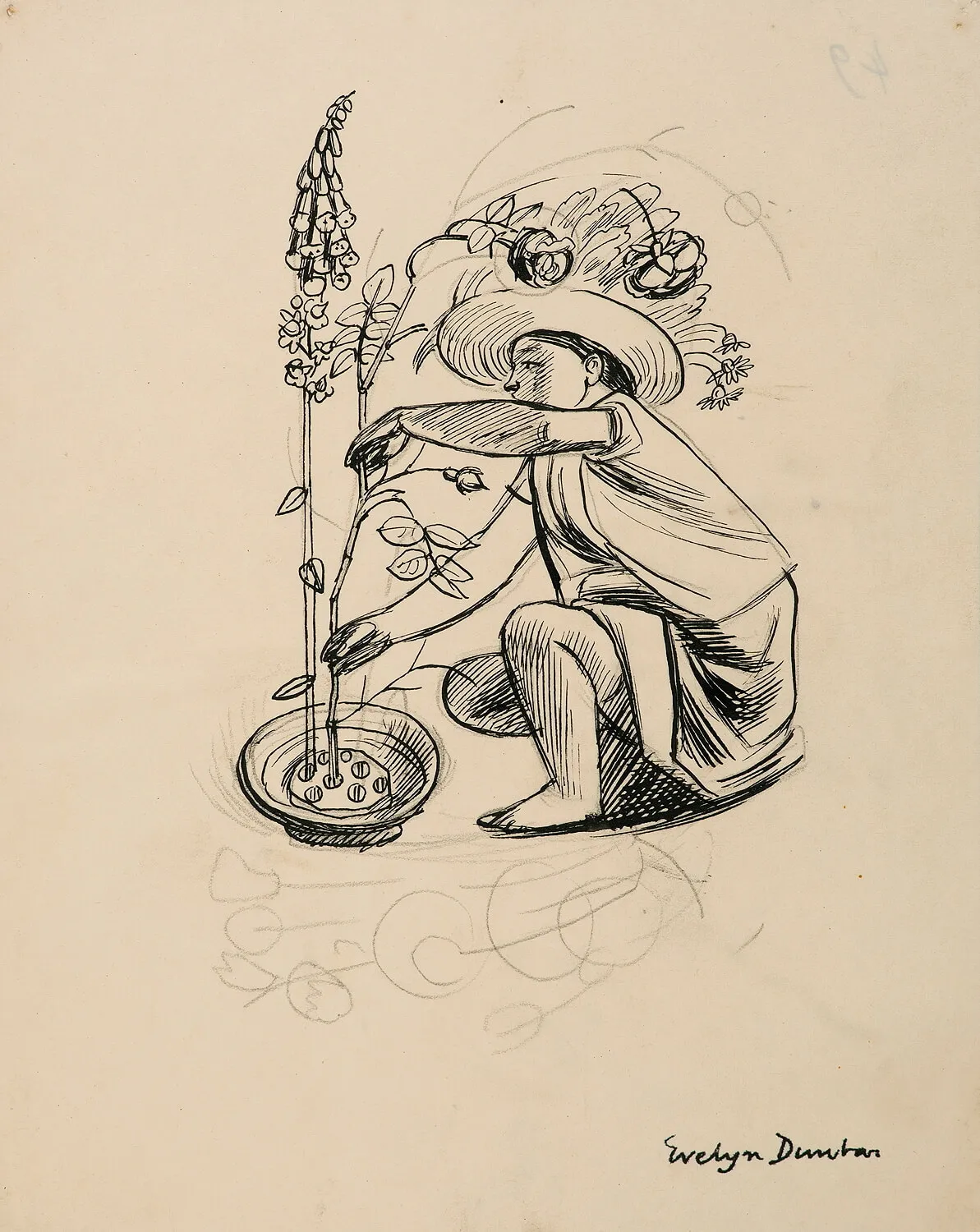
The Mock Election by Benjamin Haydon (1827)

On December 12th 1822 Mary gave birth to their first child, a son, Frank. He was the first of eight children fathered by Haydon, although sadly, five died in infancy. Haydon’s financial difficulties increased with the enlargement of the family and lack of sales of some of his works and this resulted him spending time in the debtor’s prison on a number of occasions.

His second such incarceration was in 1827 when Haydon was in King’s Bench Prison for debt. It was whilst staying here that he observed other inmates putting on a sham election in order to open a poll for the election of a member to plead for their parliamentary rights, which had been taken from them once they were imprisoned. It was proposed that they should elect a member of parliament to represent Tenterden, (a slang name for the prison).  Three candidates stood for election, one of whom was Lieutenant Meredith, a veteran of the Peninsula War. It was just like a normal election with addresses made by the candidates’ placards were printed and affixed to the walls of the prison and the electors were invited to attend the poll on Monday morning, the 16th of July.  Haydon recalled the riotous scene:

“…… As I approached the unfortunate, but merry, crowd, to the last day of my life I shall ever remember the impression… baronets and bankers, authors and merchants, painters and poets… dandies of no rank in rap and tat-ters… all mingled in indiscriminate merriment, with a spiked wall, twenty feet high, above their heads…”

King George IV bought the painting and gave Haydon 500 guineas.

Chairing the Member by Benjamin Robert Haydon (1828)

Probably Haydon’s best-known non-biblical works were painted around 1829.  In August 1828 he completed his large oil on canvas work entitled Chairing the Member. Haydon had been so encouraged by the sale of The Mock Election to George IV that he painted a companion piece, Chairing the Member, and returned to the prison to make drawings of some of the inmates. Later a third painting of contemporary life depicted in his painting entitled Punch and May Day in the New Road at Marylebone. He had great hopes that George IV would buy these works as well but he was to be disappointed, a setback he blamed on the actions of the Keeper of the King’s Pictures, William Seguier.

Chairing the Member is a crowd scene, the main characters of which are in a riotous mood brought on by an excess of alcohol.  In the background, we can see two men being hoisted aloft on the shoulders of their friends.  In the centre foreground we observe a man wearing a red waistcoat and coat, white breeches and a Napoleonic hat carrying a long pole attempts to challenge three guards, who stand on guard, seemingly unaffected by the riotous behaviour of the crowd.  A small child also grips the pole.  To the right we see a man slouched drunkenly on a stool still gripping a bottle of ale.  A woman, adorned in a black dress and wearing a white bonnet with pink ribbons, holds the man’s shoulders to prevent him falling off the stool.  A small child with a hoop stands in front of the seated man and places her hand on his thigh in order to steady him.  To the left, on the ground, we see a man slumped under a table, atop of which are glasses and glass decanters of wine.  Also, below the table, on the ground by the fallen man’s feet, is a small barrel in which are a pineapple and two other bottles wine. The whole disorderly scene is closely watched by an elderly man from an upstairs window on the right and, to the left, another man hangs out of an upper window below a red flag and toasts the revellers.  The painting is now part of the Tate Britain collection.

Punch or May Day by Benjamin Haydon (1829)

In 1829, a year after the completion of Chairing the Member, Haydon completed another work that depicted people enjoying themselves.  Initially Haydon had thought to entitle the work, Life, as it would encapsulate everyday life of everyday people but he later gave the work the title, Punch or May Day.  Hayden resolved to highlight the contrasts of everyday life. We see a crowd of mixed classes, ages and races who happily mingle with a costumed procession and a Punch and Judy show in the Marylebone Road.   On the right we see a marriage coach in which are a bride and groom.  In the background we see a hearse.  The newlyweds, tranquil and happy, look out of the window of their coach at the mayhem of the Punch and Judy performance with all its violence.  Even the May Day celebrations and procession in Marylebone Road, which were pagan traditions, is set against a backdrop which includes the Christian church of St Marylebone.  Taking part in this parade is a young dancing chimney sweep with blonde curls and soot-blackened face. The boy’s lively countenance contrasts with the artist’s treatment of the austere black footman standing at the back of the wedding coach.  In the left foreground we see a barefooted female slumped on the ground next to a table of wares which she is trying to sell.  Haydon believed he was a great history painter but also believed, like the woman selling her goods, he and his paintings were similarly under-appreciated.  In contrast, next to the beggar woman, and attentively watching the Punch & Judy show is a man dressed in the finest expensive clothes.  Look closely and you will see he is just about to have his pockets picked by a young pick-pocketer. Standing by the wedding coach and peering around the cavalry officer is a Bow Street runner, who is watching the antics of the thief. Behind the dandy is a rosy-cheeked farmer up from the country. Close to the Punch & Judy stage, a woman holds up her baby aloft so she could see the puppets close up. Haydon had been living in London for twenty-five years and he had enjoyed the capital’s vibrancy and in this painting he had aimed to encapsulate this energy and the diversity of the inhabitants.

Venus and Anchises by Benjamin Haydon (1826)

Haydon became well known as a lecturer on painting, and in 1835 he began to travel around England and Scotland on lecture tours. He was also a fervent believer that the country’s public buildings should be decorated with history paintings showing the glories of the nation’s past.  No doubt he believed he could supply such great works.

Curtius Leaping into the Gulf by Benjamin Haydon (1843)

Curtius Leaping into the Gulf was a painting Haydon completed in 1843 and depicts an ancient Roman legend, the young Marcus Curtius, throwing himself into a huge crack in the ground that had opened up in Rome. According to legend, the Roman gods were satisfied with Curtius’s sacrifice and the crack closed again.  In this work, Curtius is a self-portrait of Haydon Whether it was just a coincidence that Haydon should choose the act of suicide for his Curius painting we will never know but what is known that Haydon talked about suicide as an escape from his own life on a number occasions and he had often discussed suicide and the reasons why a person would end their own life.  He was a devote Catholic, so for religious reasons he would never countenance the taking of his own life and yet by the mid-1840s life had become very difficult as a result of his financial difficulties and his constant begging of his friends to alleviate his poverty.  He was becoming desperate.  The day before his death he was out walking with his son, Frank, and expressed how he gained pleasure on the idea of throwing himself off the Monument and dashing his head to pieces.  The viewing gallery at the top of the Monument in London was a favourite place for people wanting to commit suicide and this was only curtailed when the whole of the gallery was encased in an iron cage.  Frank was worried by his father’s mood and pleaded with him to discard any thoughts of taking his own life.  Back home, Frank told his mother about her husband’s dark thoughts but she laughed it off. 

Bartholomew Fair by Benjamin Haydon

The next morning Haydon asked his wife to travel to Brixton to invite over one of his journalist friends, David Coulton, to discuss some business.  That next morning with his wife out of the house, Haydon went to the premises of Isaac Rivière, a gun-maker, and bought himself a pocket-sized pistol.  He arrived back home within the hour and locked himself in his painting studio, with his unfinished work, The Blessings of Justice: Alfred and the First Trial by Jury on an easel.  A portrait of his wife sat on a smaller easel.  He wrote a will, but as it had not been witnessed, was invalid.  He wrote short letters to some of his friends.  One letter was to Sir Robert Peel in which he wrote:

“…Life is unsupportable!  Accept my gratitude for always feeling for me in adversity – I hope I have earned for my dearest Wife security from Want…”

He also wrote a letter to his wife:

“…God bless thee, dearest love.  Pardon this last pang, many thou has suffered from me.  God bless thee in dear widowhood.  I hope Sir Robert Peel will consider I have earned a pension for thee.  A thousand kisses.  Thy husband & love to the last…”

He also wrote a short note to each of his sons and daughter asking them to look after their mother and lead a good and honest life.  He then opened his diary which he had been keeping for the last thirty-eight years and wrote in it:

God forgive me – Amen

Finis

Of B.R.Haydon

‘Stretch me no longer on this tough World’ – Lear

End

He then cocked his pistol and shot himself in the head.  His wife and daughter heard the bang but thought it came from the nearby barracks and ignored it.  The pistol Haydon had bought that morning was of such a low calibre the bullet although fracturing his skull, did not penetrate his brain.   Not to be thwarted he picked up one of his razors and made two cuts to his neck and throat.  His wife and daughter still had no idea of what was happening and both left the house.  Benjamin Robert Haydon lay on the floor and bled to death.

The Maid of Saragossa by Benjamin Haydon

Benjamin Robert Haydon died in his London home on June 22nd 1846, aged 60.  His wife survived him by eight years, dying on July 25th 1858 aged 61.

I recounted this life story of Haydon over four blogs and yet I have only scratched the surface of his life.  Before you judge Haydon, and if you would like to find out more about this talented painter, then I do recommend you reading  Paul O’Keeffe’s biography: A Genius for Failure, The Life of Benjamin Robert Haydon. It was from this book that I got the majority of information for these blogs.

Benjamin Robert Haydon.

Part 3. The Elgin Marbles affair

Judgement of Solomon by Benjamin Haydon

The eventual sale of Haydon’s painting, Judgement of Solomon, to a pair of Plymouth bankers, Sir William Elford and his partner, Mr T J Tingcombe gave Haydon a much needed seven hundred guineas but although that lessened his debt, he still owed more than four hundred guineas to various other creditors.  Even before the sale of the work Hayden had decided that he would complete another monumental biblical painting and ordered in the large canvas measuring 396 x 457 cms, a metre taller and a metre wider than his Judgement of Solomon canvas, which was considered colossal at the time.  Haydon believed that the finished work would bolster his artistic stature as a great historical painter.  The subject of the painting would be the arrival of Christ into Jerusalem a few days before his crucifixion.

Christ’s Triumphant entry into Jerusalem by Benjamin Haydon (1812-16)

In August 1814, despite his dire financial situation, Haydon took a two-month trip to Paris with Wilkie, He returned to London and started his monumental biblical painting.  A month later he was struck down with severe eye trouble and had to take time off to recuperate on the south coast.  News came in September that lifted his spirits.  He had been made Freeman of Plymouth for his “extraordinary merit as a historical painter and particularly for his recent painting”.  His latest biblical painting progressed slowly and for the last three months of the year he set about recruiting models for the depiction.

The painting was not completed until the end of 1816.

Portrait of Leigh Hunt by Benjamin Haydon (1813)

The monumental painting was halted for a short time to allow Haydon to complete a portrait of his friend James Henry Leigh Hunt which he had started a couple of years previously.  Leigh Hunt was an English essayist, critic and poet who had worked in the War Office before becoming editor of The Examiner, a journal that had been founded by his brother John Hunt, and had articles also written by another brother Robert Hunt.  It was a controversial publication often writing stinging attacks on the government and the royalty, some in the shape of personal attacks on the Prince Regent.  In 1813 the government tried the three brothers and for their attacks on the unpopular prince regent and they were sentenced to two years imprisonment. Leigh Hunt, who continued to write for The Examiner whilst languishing in the Surrey County Gaol. He was regarded as a martyr in the cause of liberty.  He was released from prison in February 2nd 1813.  John Hunt had approached Haydon to paint his brother’s portrait.  The portrait shows Leigh Hunt as a pale-faced man with round cheeks and pouting lips.  The broad, floppy white collar gave him a young appearance, younger than his thirty-one years. The portrait had not been a labour of love for Haydon who wrote about the different feelings he had painting his large biblical painting against his feelings about painting the portrait:

“…I miserably feel……different sensations after concluding [the portrait] to those after a day’s work on my Picture [Christ’s Entry into Jerusalem].  The one was all the timid, mean sensation of a face; the other all the swelling, bursting glories of realising….visions of imaginations.  I feel the beauties of individuality as much as any one, the sharpness and softness of flesh, the delicacy of touch, and calm sweetness of breath & melting, racy flush of colour, but if all these tend to elicit a mean character, of what value are they?…”

After this experience, Benjamin Haydon refused to paint another portrait and this determination lasted eight years.

Despite the money, seven hundred guineas, Haydon had received for his Solomon painting together with a one hundred guinea prize for it from the British Institution, he was still deeply in debt which had been exacerbated by his two-month “holiday” in France. His financial situation was so bad that he had to make his first visit to a moneylender asking for one hundred guineas, He described the man as:

“… a little low fellow, with red eyes, his lids hanging down over his pupils so that he was obliged to throw his head back & look at you through the slit, as it were, his eye lids made…”

The moneylender had a novel way of making a profit from the transaction as he made Haydon buy a poor quality sketch of Rubens for twenty guineas before he gave him the loan !

Christ’s Agony in the Garden by Benjamin Haydon

George Philips, the MP for Ilchester in Somerset, had approached Haydon with regards a five hundred guinea commission to paint the biblical work depicting Christ’s Agony in the Garden.  Haydon received 100 guinea on account and two months later a further 100 guineas.  In 1815 Haydon once again approached Philips to solicit more money, despite not having started the commission, nor had he completed his painting entitled Christ’s Triumphant Entry into Jerusalem.  His work on his paintings had to stop that September as his eyesight was deteriorating and he was advised to convalesce on the south coast and he moved to Brighton.  After a month, the solitude caused him to become depressed but that was alleviated with the arrival of his friend, David Wilkie.

Haydon sleeping – A sketch by David Wilkie (1815)

While staying with Haydon in Brighton Wilkie made a quick sketch of his friend whilst he was asleep. The sketch depicts the artist lying on his side, arms crossed over his chest, right hand resting on a book, still wearing his glasses. It is a sketch of great tranquility, one portraying his friend as being somewhat gentle, carefree but with a certain vulnerability. This was at the mid-point in Haydon’s life with no inclination of what was coming. Haydon and Wilkie returned to London a month later.

A portrait depicting the Elgin Marbles in a temporary Elgin Room at the British Museum surrounded by museum staff, a trustee and visitors, 1819

Benjamin Haydon fell in love with the Elgin Marbles from the very first encounter with them accompanied by his friend David Wilkie, when the two of them visited the makeshift museum in a shed at the bottom of a garden of Gloucester House.  Haydon declared they were the most heroic style of art combined with all the essential details of actual life.  He spent hours and days in Lord Elgin’s garden shed/museum making copies of the figures and the artefacts so they could be used for his Dentatus painting Haydon would constantly think, speak and write of the Elgin’s Marbles until his death. 

In December of 1798 Thomas Bruce, the Seventh Earl of Elgin and Eleventh Earl of Kincardine, was appointed Ambassador Extraordinary and Minister Plenipotentiary of His Britannic Majesty to the Sublime Porte of Selim III, Sultan of Turkey. Lord Elgin decided to undertake a survey of the Temple of Minerva (the Parthenon) at Athens to record and remove Greek antiquities, fearing their destruction in the ongoing conflict between the Greeks and the Turks.  Elgin decided he would engage, at his own expense, a team of artists and architects to produce plaster casts and detailed drawings of ancient Greek buildings, sculptures and artefacts.  Later it was decided to remove about half of the Parthenon frieze, fifteen metopes, and seventeen pedimental sculpture fragments and Elgin and his team arranged to bring back casts and sketches that might serve to improve the general “taste” in Britain. They became known as the Elgin Marbles and were removed from Ottoman Greece and between 1801 and 1812 and then were transported to Britain by agents of the Earl of Elgin.  According to Elgin, the act of removing the artefacts was with permission of the Ottoman officials who, at the time, exercised authority in Athens. The truth with regards this “permission” has since been queried.  The bringing to Britain of these structures was not well-received in all quarters with Lord Byron, at the time, likening Elgin’s actions as a form of vandalism and looting. 

Visitors at the British Museum looking at sections of the frieze of the Elgin Marbles

In 1816 Lord Elgin, newly divorced and deeply in debt, needed to sell the Marbles to the UK government in an attempt to recoup the £74,240 it had cost him to remove them and bring them to England.  However, there was one big problem for Elgin, as he and the government had differing views as to their worth.   The diplomat and Under Secretary for Foreign Affairs under the then British Prime Minister, Lord Castlereagh, valued them at £62,000.  Artists such as Sir Thomas Lawrence, a future President of the Royal Academy and Benjamin West, the incumbent President of the Royal Academy and sculptors such as Joseph Nollekens, John Flaxman and Richard Westmacott were sounded out by the government’s Select Committee as to what they believed the Marbles were worth and most believed they were of a superior standard, although most declined to put a figure on them.  The government turned to the Art Connoisseurs, art experts, with a more refined and more intricate knowledge about art and artists who advised institutions and investors. One such connoisseur was Richard Payne Knight,  Britain’s “leading” antiquarian, who was outspoken about the Marbles being of “mixed quality”, some of which were “second-rate” and he advised the government that they should pay Elgin no more than £25,000 which he still believed was twice what they were worth on the open market. 

Much to his annoyance Benjamin Haydon, who loved the artefacts and spent days copying them, was not consulted about their worth.  However, this did not stop him voicing his opinion on the matter.  Between the completion of the Select Committee’s meetings and the publication of their report about the value they put on Elgin’s Marbles, Haydon launched a bitter attack in the pages of the Examiner, a leading intellectual journal expounding radical principles, and the Champion, a radical eight-page newspaper.  His article entitled On the Judgement of Connoisseurs being preferred to that of Professional Men, he was critical of the Government listening to the advice of Connoisseurs (such as Payne Knight) rather than the advice of artists and sculptors.  He went on to write that in no other profession is the opinion of the man who has studied a subject for his amusement preferred to that of him who has devoted his soul to excel at it, adding that no man would trust his limb to a connoisseur in surgery.

Haydon’s comments are thought to have irked the government, which finally offered Lord Elgin £35,000 for the Marbles which he reluctantly accepted.  Haydon however, due to the article in the journals, had made a name for himself and he even had the article translated into a number of foreign languages.  There was a downside to this for Haydon who incurred the wrath of the “Connoisseurs” and in particular Lord Mulgrave who had made plans for Haydon with the British Institution directors.  They were shelved as they believed Haydon’s criticism of Richard Payne Knight was a criticism of them.  Once again Haydon had upset the “establishment”  On April 19th 1816, after the Parliamentary Select Subcommittee that had been appointed to make recommendations concerning the purchase of Lord Elgin’s collection announced that they were in favour of the purchase and in June 1816, granted £35,000 to Lord Elgin in exchange for the sculptures.

Many of the public believed that the government should not waste their money on buying Elgin’s Marbles and instead, be spending the money on much more needy things such as alleviating poverty and feeding the people during the time of famine.  A John Bull satirical cartoon appeared in the newspaper in 1816 highlighted the problem.  In the cartoon by George Cruikshank entitled The Elgin Marbles! or John Bull buying stones at the time his numerous family want bread, John Bull’s family are starving during the famine caused by the catastrophic harvest of 1816. During the same summer the 7th Earl of Elgin persuaded the British government to purchase the sculptures he had removed from the temples of the Athenian acropolis. The cartoon depicts the Leader of the House of Commons, Lord Castlereagh, as a sinister salesman trying to lure John Bull into buying some statues. It depicts Castlereagh saying:

“…Here’s a Bargain for you Johnny! Only £35,000!! I have bought them on purpose for you! Never think of Bread when you can have Stones so wonderous Cheap!!…”

…………………………………..to be continued


The majority of the information I have used in this and the subsequent blogs on the life of Benjamin Haydon came from an excellent second-hand book, published in 1998, I came across entitled A Genius for Failure, The Life of Benjamin Robert Haydon by Paul O’Keefe.  If you are interested in Haydon’s life, I can highly recommend you try to get yourself a copy.

In this particular blog further information I gleaned regarding the Elgin Marbles came from the Foundations website:

http://ww2.jhu.edu/foundations/?p=8

Benjamin Robert Haydon. Part 2

His lifelong quarrel with the Royal Academy,

In 1805 Hayden met another student who had arrived to study at the Royal Academy Schools and the two became great friends.  He was David Wilkie, who had begun his artistic training at Edinburgh’s Trustees Academy at the age of fifteen.

Pitlessie Fair by David Wilkie (1804)

One of his first paintings Wilkie exhibited was Pitlessie Fair which was inspired by examples of seventeenth century Dutch and Flemish paintings and also by Scottish folklore and cultural traditions celebrated in contemporary literature. This was well liked when shown in London and resulted in several prestigious commissions. The first meeting of Haydon and Wilkie was described in Wilkie’s biography, Life of Sir David Wilkie by Allan Cunningham.  Haydon recalls that meeting at the RA:

“…We sat and drew in silence for some time; at length Wilkie rose, came and looked over my shoulder, said nothing, and resumed his seat.  I rose, went and looked over his shoulder, said nothing, and resumed my seat.  We saw enough to satisfy us as to each other’s skills…”

‘The Egyptian Room’ by Thomas Hope as seen in the magazine ‘Household Furniture & Interior Decoration’ (1807).

In 1807, when twenty-one-year-old Haydon had his first work shown at the Royal Academy exhibition.  It was his work entitled The Repose in Egypt, and it was purchased by Thomas Hope for the Egyptian Room at his town house, a house designed by Robert Adam in Duchess Street, Portland Place, London, which he remodelled with a series of themed interiors.

In November 1807 Haydon’s mother who had been seriously ill travelled from Plymouth with Haydon and his sister to get further medical help in London. However she never made it to the English capital and died at the Windmill Inn, a coach stop at Salt Hill, just west of Slough.

Assassination of L. S. Dentatus,   After Benjamin Robert Haydon. Engraving by William Harvey (1821)

As far as his artwork was concerned, Haydon could not have wished for a better start to his professional career as an artist. Following on shortly after the sale of his biblical painting Haydon received a commission from the Henry Phipps, 1st Earl of Mulgrave, for a large history painting featuring the Roman general, Lucius Siccius Dentatus.  Mulgrave himself had been a general in the Army as well as a prominent politician.   The subject of the work was that of the celebrated Roman Tribune, Dentatus, who is seen making his last desperate effort against his own soldiers, who attacked and murdered him in a narrow pass. It took Haydon two years to complete and was ready for exhibiting at the 1809 Royal Academy Exhibition. 

With his historical painting of Dentatus completed Haydon had to decide where it should be exhibited.  Many of his friends such as Sir George Beaumont and David Wilkie, as well as his tutor, Fuseli, had seen the painting and were full of praise for what he had achieved.  Beaumont pressed Haydon to exhibit the work at the British Institution where it could vie for the 100 guinea premium (prize) which was awarded to the best painting of historical or poetical composition but Haydon wanted this new work of his to be exhibited along with the greats of the Royal Academy.  He was scornful with regards the standard of art and artists showing at the British Institution and dismissive of the prize money, saying:

“…If [Benjamin] West and all the Academicians were to be my competitors, nothing would give me greater delight, even if I lost it – less glory would be lost, and more won if I gained it.  But to contend with a parcel of mannered, ignorant, illiterate boys, without science or principle [at the British Institution], if I were successful would be no honour, and if, unsuccessful, I should never hold up my head again.  Besides what do I care for prizes?  I want public approbation and fame – this is the only prize I esteem…

It is that last sentence that tells us so much about Haydon’s character !

  Haydon believed to achieve this sought after fame his work had to be shown in the Great Hall of the Royal Academy’s Exhibition.  One morning on April 1809, Haydon and a couple of companions carried the massive painting along The Strand and deposited it at the Royal Academy in Somerset House.  The full title of Haydon’s beloved work was The Celebrated Old Roman Tribune, Dentatus, Making his Last Desperate Effort against his own Soldiers, who Attacked and Murdered him in a Narrow Pass.

The Hanging Committee selected Haydon’s work for the exhibition and Fuseli had positioned it in the Great Hall.  However Benjamin West, the President of the Royal Academy had it moved to the dark Ante-Room, which is the way Haydon described its positioning, albeit others disagreed.  West’s reasoning being that the Great Hall was a space reserved for Academicians’ paintings.  Haydon never forgave the Academy for what he looked upon as a personal insult.  Twenty-five years later he recounted his feelings with regards the affair.  He wrote:

“…I lost my Patrons – & sunk into a species of despair & embarrassment from which I have had occasional gleams of Sunshine but never permanent fortune….[It] threw a cloud on the whole of my life – embarrassments, exasperations followed….I lost all employment & sunk to a Prison…”

Lord Mulgrave did buy the painting and paid Haydon two hundred and ten guineas.

Haydon’s fury at how his painting had been treated by the Academy festered for many years despite being warned by some of the Academicians, including Constable, that his attitude towards the Academy and the Academicians was unacceptable and would work against him.

Although the leading lights of the Royal Academy did not agree with Haydon, regarding the positioning of his painting at the Academy Exhibition, the well-known writer and art critic wrote the following in the May 29th 1809 edition of The Examiner:

“…From the trash with which it is mostly filled and from its indistinct light the Anti-room seems to be considered by the Academy, as I am sure it is by the tasteful visitor, little more than a mere vestibule to the larger room and is therefore frequently hurried over with scarcely a glance.  If however the visitor will allow me to be his intellectual caterer, I advise him to pause as he enters this sepulchral Anti-room and I am confident that in Mr Haydon’s picture of Dentatus making his last desperate effort against his soldiers who murdered him in a narrow pass, no.259, he will enjoy a treat served up by the hand of a genius and displayed with a refinement of science and of art…”

A Life Class at the Royal Academy, Somerset House by Thomas Rowlandson (1811)

Following shortly after Haydon’s clash with the Royal Academy he was engaged in a protracted argument with one of his patrons, Sir George Beaumont, over a commission to paint Macbeth.  It was all to do with the size of the painting and the figures within the depiction. Haydon was not deterred by this unfortunate situation as he felt that the work could be exhibited at the British Institution and he would secure the three hundred guineas prize. On the strength of that hope Haydon began to borrow money. Alas, the three hundred pound prize was not given to Haydon who was offered just thirty guineas to cover the cost of framing. Haydon was devastated. To add to his worries, his success on selling some of his work had a downside. His father viewing his son’s success stopped paying him his annual allowance of £200 which added to his son’s financial problems.

Having passed the test of drawing from plaster Haydon was allowed to enter the life-drawing sessions using live models.  An idea of what those classes were like can be gleaned from Thomas Rowlandson’s image of these classes, such as his 1811 painting entitled A Life Class at the Royal Academy, Somerset House.  It depicts Royal Academy students and Royal Academicians seated on semi-circular benches facing the model on a platform.  These classes ran for two hours every night during term-time.  Tuition at these classes was provided by visiting artists who were Royal Academicians.  There were nine visitors each year and their stint lasted one month.   The Royal Academy website offers an amusing anecdote about Rowlandson and his image of the Life Drawing class:

“…Rowlandson was himself a student at the Royal Academy from 1772-1778 when the life class was still in Old Somerset House. He is said to have nearly been expelled after firing a pea- shooter at the female model during the life class.  This characterisation of the Academicians and RA students as lechers is typical of Rowlandson’s caricatures…”

In Patricia Phagan’s 2011 book,  Thomas Rowlandson: Pleasures and Pursuits in Georgian England, she talks about Rowlandson’s interest in the Royal Academy School’s life drawing classes:

“…there was something compulsive in his repeated depiction of the seductive or voyeuristic relationships of grotesque old men and busty young women, or of the traitorous triangle of young wife, young lover, and old husband…”

The Judgement of Solomon by Benjamin Haydon (1812)

In 1812 Haydon made a start on his new painting that would be entitled The Judgement of Solomon.  The new painting was a depiction based on the Hebrew biblical story about King Solomon who made a ruling in a case featuring two women both claiming to be the mother of a child. Solomon revealed their true feelings and relationship to the child by suggesting the baby be cut in two, each woman to receive half. With this strategy, he was able to discern the fraudulent mother as the woman who entirely approved of this proposal, while the actual mother begged that the sword might be sheathed and the child committed to the care of her rival.

Study of head for ‘The Judgement of Solomon” by Benjamin Robert Haydon, c.1812–4

At this juncture in Haydon’s life, he was in debt, owing six hundred pounds to various creditors and he was constantly approaching friends for more financial help, many of whom had already loaned him money and had not been paid back. This was the start of Haydon’s financial decline and it was beginning to affect Haydon’s mental health.

………….to be continued

The majority of the information I have used in this and the subsequent blogs on the life of Benjamin Haydon came from an excellent second-hand book, published in 1998, I came across entitled A Genius for Failure, The Life of Benjamin Robert Haydon by Paul O’Keefe. If you are interested in Haydon’s life, I can highly recommend you try to get yourself a copy.

Benjamin Robert Haydon

The beginning.

Benjamin Robert Haydon

I was watching the film Mr Turner for the second time the other day and often on a second viewing of a film or the second reading of a book you come across things that you didn’t see the first time around.  During the second viewing of the film about Turner I noticed a minor character in it who Turner referred to as Haydon.  He was depicted as a “fussy” man who had great money troubles and was constantly approaching Turner for a financial loan.  I had never come across an artist named Haydon and it peaked my interest.  So, let me share with you a look at the life and works of a very troubled, whom some would say, was a very talented English artist.  Let me introduce you to Benjamin Robert Haydon.

Benjamin Robert Haydon by William Nicholson RSA (c.1820)

Benjamin Robert Haydon was born in Wimpole Street in the south coast English garrison town of Plymouth on January 26th, 1876.  He had a younger sister Harriet; another sister, Sarah, had died in infancy.  His father was Benjamin Robert Haydon who had married his wife Mary, one of eight children and the second daughter of the Rev. Benjamin Cobley, curate of Shillingford and later, the rector of Dodbrook, near Kingsbridge, in the county of Devon.  Haydon’s father was a well-to-do printer, stationer and publisher and had a shop in Plymouth at 75 Market Place.  He was also an amateur “special correspondent” to the Bristol Journal, who as he lived in a garrison town, he enjoyed writing about the valorous exploits of the English military heroes fighting for their country in various parts of the world.

The Banishment of Aristides from Athens by Benjamin Haydon

In 1792 Benjamin Haydon, then aged six, first attended school and it was the start of his interest in sketching and he would often draw rough portraits of his school friends..  The following year, 1793, England and France went to war and it was that same year that seven-year-old Benjamin Haydon attended the Plymouth Grammar School run by the headmaster, the Reverend Dr. Bidlake.  Bidlake, Haydon recalled the head painted and played the organ and realising the young Haydon had a love and aptitude for sketching gave him and one of his fellow pupils some painting lessons.    That fellow student was Samuel Prout who would later become a renowned watercolourist, and one of the masters of watercolour architectural painting.  Bidlake encouraged Haydon to paint landscapes en plein air but this was countered by the advice given to him by a Neapolitan worker in his father’s business, a Mr. Fenzi, who would regale excitedly about the works of Raphael and Michelangelo.  Haydon was excited about what he saw and heard and remembered Fenzi’s words of advice about ignoring landscape painting and concentrate on figurative painting:

“…Do not draw de landscape; draw de feegoore, Master Benjamin…”

When Haydon was eleven years old he contracted measles and was laid up in bed.  He recalled the time well, as his father visited his bedside to excitedly announce the British naval victory at Cape St Vincent.  Later Haydon recalled the excitement in the household with the news of Horatio Nelson’s naval victories.

Plympton Grammar School

(Photograph taken 28 August 2001 © Mr Gerald Rendle)

In 1798, at the age of twelve, Haydon left Plymouth Grammar School and was admitted as a boarder to All Hallows School in Honiton, some sixty miles from his home.  Here the headmaster was Reverend William Hayne who was tasked by Haydon’s father to help his son improve his art.  In 1800 Reverend William Hayne was offered a teaching post at Plympton Grammar School and he accepted and moved his family and pupils to Plympton St Maurice.  In a way it was a return home for Haydon who had spent his early years nearby.  Fifty years earlier the grammar school had been where the artist, Sir Joshua Reynolds, studied and Reynold’s father had been the headmaster.  In all, Haydon had been under the tutelage of Reverend Hayne for two years at Honiton and a further six months at Plympton Grammar where he rose to become head boy at the age of fifteen and by which time he had acquired a good understanding of the Latin, Greek, and French languages.

Haydon left the school and the world of the classic literature and had to decide on his next move.  However, that decision was taken away from him by his father who saw his son as being his successor in the family business and so had his son move to Exeter where he studied business and as Haydon saw it, the dry tuition of profit/loss and ledgers.  He was not enamoured by the world of finance and bookkeeping.  His course lasted six months at which time he returned home to Plymouth where he was indentured for a period of seven years as an apprentice to his father.  Life could not have been worse according to young Haydon who hated everything about the job.  He hated everything – his father’s customers, serving behind the counter in his father’s shop, working on his father’s accounts.  Nothing pleased him and he would spend long periods of time sulking at his lot in life.

Benjamin Haydon came to the conclusion that his future lay ahead as an artist.  His father and his grandfather both had similar thoughts at Benjamin’s age but they soon faded and Benjamin’s father believed the same would happen to his son’s great artistic ambitions.  Heated and constant family arguments followed on a daily basis over young Haydon’s future, so much so, Haydon became ill and suffered severe inflammation of his eyes.  Benjamin’s father believed this would put an end to his son’s fantasies of becoming an artist and told him he could never become an artist as he couldn’t see properly, but he was mistaken for his son was not to be deflected.

Discourses by Sir Joshua Reynolds

Haydon believed that his eyesight problem was not a major stumbling block and he was buoyed by the words of Joshua Reynolds in his first Discourse he delivered to the Royal Academy during the opening session in January 1769. Reynolds set out his theories on art in a series of fifteen lectures in the Royal Academy Schools, which were later published as Discourses on Art.  It was all about the fact that nothing would be achieved without hard work.  Reynolds said:

“…But young men have not only this frivolous ambition of being thought masters of execution inciting them on one hand, but also their natural sloth tempting them on the other. They are terrified at the prospect before them of the toil required to attain exactness. The impetuosity of youth is disgusted at the slow approaches of a regular siege, and desires, from mere impatience of labor, to take the citadel by storm. They wish to find some shorter path to excellence and hope to obtain the reward of eminence by other means than those w4iich the indispensable rules of art have prescribed. They must, therefore, be told again and again that labor is the only price of solid fame, and that whatever their force of genius may be, there is no easy method of becoming a good painter…”

Haydon met Samuel Northcote, one of his father’s customers and hearing of young Haydon’s wish to become an artist Northcote advised him to study anatomy.  Haydon took that advice and purchased a book at the Plymouth Naval Hospital Auction entitled Tables of the Skeleton and Muscles of the Human Body written by Bernhard Siegfried Albinus in 1749   It cost him two pounds ten shillings, an amount he did not have !  This attitude to buying things he could not afford would haunt him all his life.  Haydon rushed home and spoke to his father who grudgingly gave him the money.  Haydon immersed himself in the anatomy book and after two weeks of constant studying the drawings and information, he claimed that he knew every muscle and every bone in the human body.

Haydon’s constant battle with his mother and father as to his future continued with neither side relaxing their stance.  However, he must have finally worn them down as they finally agreed to him travelling to London and enrolling on a two-year course at the Royal Academy Schools.  They gave him an initial twenty pounds to cover the cost of lodgings which he secured in the Strand, close to Somerset House, the home of the Royal Academy.  The course was free of charge but to get a place on the course one had to be recommended by an Academician.  This was achieved through Haydon’s uncle Benjamin Cobley who contacted his friend and Academician, Prince Hoare.   Haydon left Plymouth on an overnight coach on the morning of May 4th 1804 and arrived in London the next day.

Haydon, on arrival in London, took lodgings at 3 Broad Street, Carnaby Market. One of the first outings Haydon made was to the Royal Academy’s thirty-sixth annual exhibition which was being held at Somerset House (The Royal Academy did not move to its present location at Burlington House on Piccadilly until 1868).  There was a one shilling entrance fee which entitled you to a catalogue and according to the catalogue outlined the reason for the charge:

“…it was to prevent the Rooms from being filled  by improper Persons, to the entire Exclusion of those for whom the Exhibition is apparently intended…”

Laocoön’s head

Haydon settled into his course at the Royal Academy Schools and studied hard.  He decided that his favoured painting genre would be that of historical paintings. The first stage of his admission to the Royal Academy Schools was to present a drawing from plaster casts and so he immediately went to a seller of plaster casts who had a shop in nearby Drury Lane.  Here he purchased a cast of Laocoön’s head, a famous pieces of Hellenistic sculpture, along with some casts of arms, hands and feet and these together with his copy of Albinus’ anatomy book he set about creating acceptable drawings.  He worked non-stop and described his daily ritual:

“…I rose when I woke, at three, four or five; drew at anatomy until eight, in chalk from my casts from nine to one and from half-one until five – then walked, dined and to anatomy again from seven to ten and eleven…”

Dissection of the neck from the 1794 book ‘Engravings, Explaining the Anatomy of the Bones, Muscles and Joints’ by John Bell.

Another early purchase Haydon made was a copy of the 1794 book Anatomy of the Bones, Muscles and Joints by John Bell and this was to supplement his Albinus book on anatomy.

 It took a while before he made meaningful friendships with the exception of his sponsor and Royal Academy’s Secretary of Foreign Correspondence, Prince Hoare, who, on seeing Haydon’s sketches introduced him to John Opie and James Northcote.  Opie concurred with Haydon as to the importance of studying anatomy whereas Northcote advised Haydon to forget about anatomy and historical paintings and concentrate on portraiture but Haydon would not be deterred.  At the meetings Haydon spoke to the two artists about whether he should take lessons from a master.  Once again Opie and Northcote had differing views.  Opie was for it, Northcote against it saying Opie was only interested in extracting money from Haydon and Haydon’s father.  In the end he decided to follow Opie’s advice about studying anatomy but Northcote’s advice with regards not working under a master painter.

The Nightmare by Fuseli (1781)

On Christmas Eve 1804 Prince Hoare introduced Haydon to the Academy’s Professor of Painting, the Swiss-born painter John Henry Fuseli.  Fuseli held the position at the Royal Academy as Keeper, who carried overall responsibility for the Royal Academy Schools.  Haydon had seen Fuseli’s “strange” works such as his 1781 painting The Nightmare and his 1802 painting, Uriel watches Saturn on his Flight to Earth, a print of which he remember seeing in his father’s shop and so was delighted to visit this great master in early January and show him his sketches.  Fuseli was duly impressed with Haydon’s works and granted him admission to the RA Schools as a Probationer.

A sheet of anatomical drawings of the bones, muscles and tendons of the arm and hands by Benjamin Haydon  (ca. 1805)

One of Haydon’s early tasks he had to perform at the RA School was to copy a cast but the object was set up some distance from him and he realised that his poor sight was going to pose a problem and so had to purchase a pair of spectacles.  Haydon continued to work hard and such attitude found favour with Fuseli. 

The statue of the athlete Discobulus by Myron (c.450BC)

In March 1804, having completed the task of drawing the figure of Discobolus he received his “ticket” and became a ”Student of Painting”.  Shortly after, Haydon was summoned home by his family as his father was dying.  However, despite still being a patient at Royal Naval Hospital in Plymouth his father had recovered and Haydon remained in the city that summer.  Haydon immediately sought permission from the hospital authorities to draw from their collection of preserved human bones with dried muscle. He drew obsessively, combining his depiction of the specimens with poses typically found in anatomical textbooks. 

Anatomical drawing of the bones and muscles of the lower leg by Benjamin Haydon (1805)

The result was an album with a collection of anatomical drawings.  Haydon believed that anatomy was the key to comprehending the ‘principles of heroic form’ which would then result in successful completion of grand historical works which was still his artistic aim. His ambition was to become the greatest historical painter England had ever known.

……to be continued


The majority of the information I have used in this and the subsequent blogs on the life of Benjamin Haydon came from an excellent second-hand book, published in 1998, I came across entitled A Genius for Failure, The Life of Benjamin Robert Haydon by Paul O’Keefe. If you are interested in Haydon’s life, I can highly recommend you try to get yourself a copy.