Portrait of a Man (Self Portrait?) by Jan Van Eyck

Portrait of a Man by Jan van Eyck (1433)

My Daily Art Display yesterday featured the painting A Man with a Quilted Sleeve by Titian in which we saw a portrait of a man with a brightly-coloured blue tunic and I discussed what was one’s initial focus of attention, the face of the subject or the blue sleeve of the tunic.   Today’s painting, Portrait of a Man (Self portrait?), poses a similar question, what do we focus on when we first look at the painting, the bright red head gear of the man or the man himself?

Portrait of a Man (Self Portrait?) is a painting by Jan van Eyck which he completed in 1433 and is housed in London’s National Gallery.  The painting is still in its original wooden frame on which are inscriptions that have been painted in such a way that they look like they have been carved into the wood.    Along the bottom the inscription reads:

JOHES DE EYCK ME FECIT ANO MCCCC.33. 21. OCTOBRIS

Which when translated reads “Jan Van Eyck Made me on October 21st 1433”

Across the top of the wooden frame is the motto:

AlC IXH XAN

This is considered to be a punning allusion to the painter’s name “Als Ich Can (as I/Eyck can) which loosely translated reads “I Do as I Can” – a motto which appeared on a number of other paintings by Jan Van Eyck.

And so to the picture itself.  At first glance it is just a simple portrait.  The man stares out at us.  On his head is a red chaperon which was a form of hat that was worn throughout Western Europe in the Middle Ages.  Van Eyck’s painting of the headgear is wonderful.   The hat actually occupies more space in the painting than the face of the sitter.  Look at the multitude of folds and tucks in the chaperon.   One wonders how long it took the artist to master this part of the painting and how many preliminary drawings were made before he was happy.    As was the case of Titian’s A Man with a Quilted Sleeve, Jan Eyck’s man is seen against a plain dark background, which makes the figure stand out.  At first our eyes just register a red headpiece on the head of a pale white-faced man and do not take in the detail.  However careful examination of the face and the chaperon reveals a multitude of subtle shades and it is actually the painting is awash with detail. 

His eyes have a slight bloodshot appearance. In the book by Lorne Campbell, research curator at the National Gallery, London, entitled The Fifteenth-Century Netherlandish Paintings, he wrote of Jan Van Eyck’s depiction of the left eye thus:

 “…The white of the eye is laid in white mixed with minute quantities of red and blue. A very thin scumble of red is brought over the underlayer, which is, however, left exposed in four places to create the secondary highlights. The veins are painted in vermilion into the wet scumble. The iris is ultra-marine, fairly pure at its circumference but mixed with white and black towards the pupil. There are black flecks near the circumference and the pupil is painted in black over the blue of the iris. The principal catchlights are four spots of lead white applied as final touches, one on the iris and three on the white, where they register with the four secondary lights to create the glistening effect…”

 The man’s skin is weather-beaten and wrinkled.  There are signs of stubble on the chin, the texture of which is in contrast with the smoothness of the soft fur collar.   It is hardly a flattering portrait and has a “warts and all” reality to it, which makes one think that it may be a self-portrait of the then thirty-eight year old artist, as if it had been a portrait of a dignitary they may wanted it to be more pictorially agreeable.

 There is a distinct realism to this painting and Jan Van Eyck’s clever use of shadows is a characteristic of Italian Renaissance paintings.

 So there you have it – today and yesterday I have given you two portraits with some similar characteristics, which do you like the most and why?

The Jewish Cemetery by Jacob van Ruisdael

The Jewish Cemetery by Jacob van Ruisdael (c.1660)

When I come to think about the painting I am going to use for My Daily Art Display I like to try and find one by an artist I haven’t featured before.  I also like to showcase an artist I had not heard of previously so that when I research his or her life it is a learning curve for me.  Today, however My Daily Art Display is a three-fold repeat which limits what I can say, without being accused of repeating myself.

 Firstly I have offered you a painting by Jan van Ruisdael before (January 9th) but I will not apologise for that as he is an amazing painter and has completed many superb works of art.   Secondly, the painting today is a Vanitas-type painting, a type of painting, which I talked about when I offered you the Still Life of Food and Drink by Willem Heda on February 11th, and lastly this painting resembles in many ways the painting by Arnold Böcklin which I gave you on January 5th.  Having said all that, I have to tell you that when I was looking through some art books for my next presentation I was immediately taken aback by the strength of this painting and the aura that emanates from it.

My Daily Art Display today is The Jewish Cemetery by Jacob van Ruisdael which he completed around 1660 and now hangs in the Gemäldegalerie Alter Meister in Dresden with a larger version in the Detroit Institute of Arts.  This is a Vanitas genre painting, which is a type of painting that depicts an object or collection of objects symbolizing the brevity of life and the transience of all earthly pleasures and achievements.  In other words it is a painting which reminds us that we are not immortal and notwithstanding how rich or powerful we are –  we will all die sooner or later.

There is a definite melancholic and depressing feeling about this painting.  There is also that sense of foreboding which was present in Arthur Böcklin Island of the Dead which I gave you on January 5th.  The ruins, the graves and the dark skies set the mood of the painting.  Ruisdael had this uncanny talent to be able create such feelings in how and what he depicts.   This is a painting of the Portugeuse-Jewish Cemetery at Ouderkerk on the Amstel River close to Amsterdam, however to be absolutely accurate, I must tell you that only some of the elements in the painting actually exist such as the three large tombs shown in the mid-ground, but that’s about it !  

The backdrop to the cemetery bears no similarity to the place at Ouderkerk.  There are no ruins overlooking the actual cemetery.  The ruins Ruisdael painted were the remains of the Egmond Castle which is situated near Alkmaar some thirty miles away.   There is no river running through the cemetery but Ruysdael just used it to portray the fact that the water like time rushes away from us.  The landscape, the river and the “added-in” ruins were just figments of Ruysdael’s imagination but one has to admit they do lend themselves well to the atmosphere he wanted to project.   

The three large tombs in the middle ground, which immediately catch one’s eye, the dead beech tree in the right foreground and the broken tree trunk overhanging the fast flowing river all indicate allegorically the fast approach of death.  However, Ruisdael does offer us a glimmer of hope in the way we can see a shaft of light penetrating the black clouds.  We can also see a rainbow and if we look carefully there are signs of flourishing growth amongst the dead trees, so he is telling us there may be a better life still to come after death.   Art historians have interpreted this painting simply as a reminder that man lives in a transient world and that despite being beset by sinful temptations there is always hope for salvation and deliverance.

In Luxury, Look Out by Jan Steen

In luxury Look out by Jan Steen (1663)

The first ever painting of My Daily Art Display was the Netherlandish Proverbs by Pieter Bruegel the Elder and today’s painting has many similarities to that great work of art.

My Daily Art Display for today is entitled In Weelde Siet Tot, (In Luxury, Look Out) painted by the Dutch artist Jan Steen in 1663.  Steen was born in 1626 in Leiden, Netherlands and came from an affluent Catholic family who ran a brewery and tavern named the Red Halbert.  After he passed through the local grammar school he settled down to an artistic education in Utrecht under the German-born, Dutch Golden Age painter, Nicolaes Knupfer.  In 1648 Steen, with his friend Gabriel Metsu, founded the painters’ Guild of St Luke at Leiden.  A year later he became an assistant to the Dutch landscape painter Jan van Goyen who was also his landlord.  In 1649 Steen married van Goyen’s daughter Margriet and this couple went on to have eight children.

Jan Steen’s favourite theme for his paintings was ordinary daily life.  The scenes he painted were often lively and chaotic and the Dutch to this day often use the phrase “A Jan Steen household” meaning a chaotic and messy household.  His paintings of household chaos were supposed to act as a warning to observers that life needed to be more organised and orderly.  Today’s painting is one of these typical works of art of Jan Steen – chaotic, messy and full of hidden meanings.

In today’s painting Steen interprets the moralistic truths of Dutch genre painting as a humorist in which realistic actions and educational advice are confused.  Steen has illustrated in his painting various examples of overindulgence and recklessness in a degenerate household.  Many of the individual scenes within this painting allude to Dutch proverbs and sayings, similar to Bruegel’s Proverbs painting.  The housewife sitting left of centre in a respectable dress, who is probably the head of the household, has fallen asleep at the table and unbeknown to her, chaos has broken out around her.  Asleep with tiredness or asleep through inebriation ?

In the painting we have a plain room in a house which has fallen into complete chaos.  We can see four adults, an adolescent, three children, a baby, a pig, a monkey and a dog.  A young woman faces us with a glass of red wine in her left hand placing it on the crotch of the man sitting next to her.  Her low-cut neckline would be more customary on a barmaid or a prostitute.  The man next to her is distracted by a woman and an older gentleman, who is reciting to him from the book he holds.  The older man is standing slightly hunched over his book and has a duck on his shoulder which is staring at another young man as he plays a violin and at the same time is watching a young girl stealing a coin from a purse.  The woman sleeps on despite the chaos and does not hear the bowl crashing to the floor knocking over the pewter tankard.  Next to her is a small boy with a pipe, possibly blowing smoke at her in order to wake her up and alert her to the fact that the dog standing on the table is eating their meat pie.  The baby sitting at the table turns around and stares at the barrel spilling beer onto the floor.  Why is the beer pouring out of the barrel ?  Look at the pig on the right of the painting and see what he has in its mouth – the beer barrel tap !  The pig with its teeth clenched around the tap is nuzzling a rose on the floor which has fallen from the stem of roses in the man’s hand.  Scattered across the floor is the man’s hat, his pipe a number of pretzels.  Couple these with the large amounts of alcohol on show one could not be blamed for thinking the setting for this painting is a tavern or brothel.  However because of the presence of children, the kitchen to the right of the scene and the purse above the violinist one has to revert to the belief that this is simply a room in somebody’s house.

In the foreground at the right there is a slate leaning against a step and it is inscribed with the first part of a Dutch proverb:  In weelde siet tot, which translated means “In Luxury, Look Out”.  The ending of the proverb, (not inscribed on the plate) is “and fear the rod”.  Translated it means “beware the punishment which follows excess as fortunes often change especially through bad management”.  Maybe as a reminder of such consequences the artist has painted a basket hanging from the ceiling, in which one can see, precariously hanging out of it, crutches and a sword.  On the floor we see playing cards littering the floor while at the top right we see a monkey stopping a clock.  Maybe the stopping of the clock stopped the passage of time, giving the artist time to record the proliferation of chaos !  This is a large painting, 1.5m across and would have taken the artists weeks, maybe months to sketch in all the characters.

As the woman sleeps....


Total and utter chaos !  But should we read more into the painting?  Take for instance the sleeping woman and the child furtively stealing money from the purse in the cupboard.  Could this mean that if one is not resolute and in control of what is happening around one, then poverty will follow?   This is indicated by the flat purses hanging on the wall above the woman’s head and which appear to be empty and devoid of coins.  The dog being allowed to get on the table and eat the food of the humans underscores the negligence of the adults and sets out a bad example to the children.  Moralists traditionally likened dogs licking pots to children being brought up badly.  

What of the pig ?   There is a Dutch proverb which says “The pig runs off with the tap” meaning “the party is drinking with abandon”. 

The snuffling pig

The pig nuzzling the rose was a reminder of another proverb.   “Throwing roses before the swine” meaning wastefulness.  The monkey stopping the clock reminds us of the saying “In folly, time is forgotten”.  A “quacking” duck symbolizes nonsensical banter.  The duck on the man’s shoulder therefore probably alludes to his conversation being futile banter during which they have chosen to ignore the chaos around them.

Hanging basket

Will the occupants of this room receive what they deserve for their lack of attention ?  The artist hints that they may receive their “come uppance” by in the way he drew a basket hanging from the ceiling above their heads – a kind of Sword of Damocles !  The content of this hanging basket is full of items which suggest poverty and disease.  There are crutches, a leper’s rattle and switches which were used to lash petty criminals.

This painting by Jan Steen is a real but comical distortion of a Dutch family household, living in chaotic conditions and may act as a warning to observers of the folly and the consequences of such a lifestyle.  If you live in chaotic conditions maybe you should go out and buy yourself a print of this painting and hang it on the wall to remind yourself and your housemates of the dire consequences of living in such disarray.

Still Life of Food and Drink by Willem Claesz Heda

Still Life of Food and Drink by Willem Heda (1631)

My Daily Art Display is another first.  It is the first time my chosen painting has been a still-life.   Still-life paintings are not one of my favourite art genres but I do admire the skill of the artist who paint still-life subjects.  So what does one mean when one talks about still-life works of art ?   Still-life paintings are works of art, which, in the main, depict inanimate objects.  Such inanimate objects maybe either natural, such as flowers, plants and food or they may be man-made objects, such as vases, jewellery, books and drinking vessels etc. 

The history of still life painting can be traced back as far as Ancient Greek and Ancient Egyptian times.  If one goes back to the Ancient Egyptian times one has learnt that among the items found in their burial chambers in those days were still life paintings of the deceased’s favourite foods.  These were placed with the mummified body in the belief that they would travel to the after-life with the deceased and when he or she arrived there, the food would become real and available for use by the now re-born person. 

An artist painting a still life, of course, had more scope in arranging the design within a still life composition than a landscape or portrait painter had when transferring their subject on to canvas.  Still life artistry developed separately in the Netherlands in the late sixteenth century and this term “still life” probably derives from the Dutch word “stilleven”.  Illustrations in illuminated manuscripts were often decorated along the borders with intricate displays of flowers.  Later when books took over from illuminated manuscripts the same artistry was used in scientific botanical illustrations.

Another favourite item to feature in “still-life” paintings, especially those of Northern Europe, was food and kitchenware.  These, often massive works of art, were favoured by the Flemish artists of the time, such as Pieter van Aelst and Joachim Beuckelaer.   At the beginning of the seventeenth century oil paintings of flowers became very trendy.  Another style of still life painting was known as “breakfast paintings” which were works of art which not only represented a literal presentation of the food which the upper-class of the time would consume but they would be a religious reminder to steer clear of one of the seven deadly sins – that of gluttony.

This brings me nicely to our artist of the day and his still life painting.  My Daily Art Display artist for today is the Dutch artist Willem Claeszoon Heda.  Heda was born in Haarlem in 1594 and devoted all his artistic life to still life painting.   His father Claes was the city architect for Haarlem and his uncle Cornelis Claesz Heda was a painter.  Willem Heda was to become, along with his countryman Peter Claesz, one of the most important representatives of ontbijt (breakfast piece) painting in the Netherlands.

Today’s painting entitled Still Life of Food and Drink was completed in 1631.  This is one of five known still-life paintings featuring items of food and drink on a simple table by Heda.  On the food tables that he painted, one would often see mincemeat pies, ham and oysters.  Today’s painting by Heda is a Vanitas.  A Vanitas is a symbolic type of work of art which was associated with Heda and other Northern European artists in Flanders and the Netherlands during the 16th and 17th centuries.  The word is Latin and means “emptiness”.   Vanitas works of art were usually still-life pictures depicting an object or group of objects symbolising the shortness of life on earth and the transience of all earthly pleasures and triumphs.

In today’s painting we see left-over, half eaten mincemeat pies which will soon decay and be gone, symbolising the brevity of life.  On the table we can also see a knife, an upturned tazza, a glass römer goblet and a timepiece, the latter being another symbol of the passing of time. The peeled lemon alludes to a deceptive appearance – beautiful to look at but sour tasting.  The half-peeled lemon appeared in a number of Heda’s still-life paintings of the time and was clearly favoured for artistic reasons, lending strong colour to the picture.  Lemon was also used in those days to improve the taste of wine.  The painting is characterized by subdued, close tonal harmonies.  Heda wanted to contrast the different textures of the objects on display – the dull sheen of the pewter plate and the gloss of the upturned silver tazza.  For this painting, Heda painted a plain, softly illuminated background which gave a fleeting appearance that the objects in the foreground were floating.

The Maas at Dordrecht by Aelbert Cuyp

The Maas at Dordrecht by Aelbert Cuyp (1650)

I have been fortunate that wherever I have lived has been close to either the sea or a river and I have always been fascinated by the ships and boats that move on these waters.  I have spent many a memorable holiday staying in accommodation on both the Rhine and the Mosel Rivers and spent many happy hours relaxing, watching the laden barges as they travelled slowly up and down the busy waterways.  So today I decided to offer you a riverscape painting which encompasses all that I love about water and on which the barges that ply their trade,

My Daily Art Display artist today is the Dutch painter Aelbert Cuyp who was born in the Dutch town of Dordrecht which is on an island bordered by a number of rivers, one of which is the Oude Maas, an off-shoot of the Rhine.  Aelbert Cuyp was born in 1620 and came from a large family of painters but was by far the most famous.  He was the son of the portraitist Jacob Gerritsz Cuyp, who looked after his early training. He, in turn, assisted his father by supplying landscape backgrounds for his father’s portrait commissions.  Aelbert soon tired of portraiture and concentrated on landscapes and riverscapes.  He was a religious man and had an active involvement in the Dutch Reformed Church.

From his paintings of landscapes and townscapes it is apparent that at some time in his twenties he had travelled extensively within the Netherlands and along the upper Rhine in Germany.  Because of the Italianate lighting effects seen in his later works, it is thought he may have spent time in Italy and also mixed with other Dutch Italianate landscape painters.

In 1658, at the age of thirty eight, he married Cornelia Bosman, the wealthy widow of Johan van de Corput, a naval officer and member of a very wealthy Dordrecht family.  After his marriage Aelbert appeared to have spent less time painting and more time involved with church activities.  His new found wealth meant that he did not have to earn a living by selling his paintings.

Aelbert Cuyp died in Rotterdam in 1691, aged seventy one.

Today’s painting is entitled The Maas at Dordrecht which Cuyp painted in 1650 and is housed in the National Gallery of Art in Washington.   In this picture it is not the town of Dordrecht which has centre stage but the River Maas itself and the craft on it which are plying their trade on its waters.  This vast, sunny composition specifically accents one figure.   In the foreground we see a small boat which has come alongside a sailing barge.  In the boat we can see a dignitary dressed in a black jacket with an orange sash.  He could be the festival’s master of ceremonies and could also be the patron who commissioned Cuyp to document the historic event.  He is greeted by a distinguished looking gentleman who stands among numerous other figures, including a man beating a drum. On the left a second rowboat approaches, carrying other dignitaries and a trumpeter who signals their impending arrival. Most of the ships of the large fleet anchored near the city have their sails raised and flags flying as though they are about to embark on a voyage. The early morning light, which floods the tower of the great church and creates striking patterns on the clouds and sails, adds to the dramatic character of the scene.

It is almost certain that Cuyp was commissioned to mark this event in a painting.  The event, a two-week festival, is believed to have happened in 1646 when an enormous fleet of ships carrying thirty thousand soldiers was anchored off Dordrecht.  Crowds jam the docks, bugles and drums sound fanfares and cannons fire salutes.  One can see that the sunlight in the painting rakes across the panel and by doing so accentuates small bits of detail in the golden light.

The “Merry Company” paintings by Willem Buytewech

My Daily Art Display yesterday featured the Dutch Italianate landscape painter Herman van Swanevelt and in the early part of his life I mentioned that is was thought that he learnt some of his art techniques from another Dutch painter, Willem Buytewech, so today I thought I would showcase this man and look at his style of painting, which was completely different to that of his pupil van Swanevelt.

Merry Company by Willem Buytewech c 1622-1624

Willem Pieterszoon Buytewech was born in Rotterdam around 1591.  His father Pieter was a cobbler and candlemaker.  He started his artistic studies in the Dutch town of Haarlem where at the age of twenty one, he eventually became a member of the local artist’s guild Haarlem Guild of St Lukes , along with two other young local artists Hercules Segers and Essias van de Velde,Here at this prestigious workshop he worked alongside many great Dutch painters including the master himself, Frans Hals, who proved a great influence on Buytewech’s works.  The Guild was named after their patron saint: St Luke. Craftsmen had to be members of the guild to practice their trade. They were expected to adhere to certain requirements relating to quality and price, but the guilds also had funds to protect their members against hardship, economic or social. An extensive system of apprenticeship was maintained by the guilds. Only a fully-trained master could become a member of a guild. House painters and fine-art painters alike belonged to the St Luke’s guild. In the 17th century, however, the artists became increasingly hostile towards the craftsmen, or ‘coarse painters’.

Merry Company by Willem Buytewech (c.1617-20)

Willem Buytewech, who was known as the inventor of Dutch genre paintings, was nicknamed by his contemporaries “Geestige Willem” meaning “Spirited or Jolly” Willem for his penchant of irony and that he was one of the first Dutch painters to use a group of people carousing as a subject for a painting.   In 1613 Willem married Aeltje van Amerongen who came from a well-to-do family and they returned to Rotterdam.

Unfortunately there are only a small number of Buytewech’s paintings in existence but he will be remembered as one of the most interesting artists during the first years of the great period of Dutch painting.  His pictures of dandies, fashionable ladies, drinkers and lusty wenches are amongst the most spirited of the Dutch genre scene and instituted the category known as “Merry Company” which is the title Buytewech gave to his three paintings in today’s My Daily Art Display.

Willem Buytewech died prematurely in Rotterdam in September 1624 at the young age of thirty three and never saw his son, Willem the Younger who was born the following year and who was to follow his father’s footsteps and become a painter.

Merry Company by Willem Buytewech circa 1620-1622

Another interesting note concerning the bottom and middle painting is the framed map on the wall behind the revellers.   Buytewech was the first artist to use wall maps as a major motif in interior scenes. He was a leading pioneer of genre interiors.    Of the ten paintings by Buytewech, four include wall maps. The two paintings I have featured today, one painted around 1617-1620  and the other around 1620-1622, both  feature wall maps with the legible title HOLANDIA. These cartographic backgrounds serve to associate both scenes specifically with the province where the pictures were painted.
One of the strange things about these early Dutch maps is that one may not recognize the geographical contents of Buytewech’s two maps of Holland, for both are oriented with south at the top.   At this time, the designing of maps with north at the top was not yet a standardized practice; a map could be arranged with north at the left, right, or bottom, according to the preference of the cartographer.

Italian Landscape with bridge by Herman van Swanevelt

Italian Landscape with bridge by Herman van Swanevelt (c.1645-50)

The other day I came across a beautiful landscape painting by an artist that was unknown to me.  His name was Herman van Swanevelt and the painting was entitled Italian Landscape with bridge which he painted circa 1645-50 and which hangs in the Dulwich Picture Gallery in London.

The artist was born in Woerden which was one of the smaller towns of the province of Holland in the newly independent Dutch Republic.  His early history is somewhat sketchy other than knowing he came from a family of craftspeople and some way back in his lineage was the celebrated artist Lucas van Leyden.  As there were no well known artists identified as having lived in Woerden at that time it is just conjecture as to how van Swanevelt learnt his artistic trade.  Some art historians believed he spent time in Rotterdam under the tutelage of Willem Buytewech the Dutch painter, draughtsman and etcher, who was considered to be the “inventor” of Dutch genre painting.

Herman van Swanevelt was recorded as having been in Paris in 1623 and later lived in Rome between 1629 and 1641.  It was during his time in Italy that Herman concentrated his works of art on the first generation of the Dutch Italianates and the whole Italianate landscape genre with his paintings focusing on beautiful landscapes sparkling in sunny conditions and a classic example of this is in My Art Display’s painting.  His paintings of  sumptuous Italian landscapes and the views of Roman ruins soon gained favour with the wealthy art collectors of Rome and the Vatican.  One of his large scale paintings was commissioned by King Philip IV which he installed in Buen Retiro, his country palace near Madrid.

In 1642 van Swanevelt  returned to Paris, where he became a member of the Académie Royale de Peinture et de Sculpture in 1651    His landscape works now began to take on a more Northern appearance and to his pleasure found that French art collectors were equally impressed with his works of art and were only too keen to purchase all that he could produce.  For his artistic work he received the prestigious appointment of “peintre ordinaire du roi”.   In the later years of his life van Swanevelt returned occasionally to his home town of Woerden as can be seen by the name of the town being added to his signature on some of his paintings he completed in the 1640’s.

His popularity as a Dutch painter continued unabated and as a genre, Dutch Italianate landscape paintings were highly prized in the northern Netherlands during the 17th and 18th centuries. In the 17th century they fetched higher prices than native Dutch landscapes paintings.  Then, at the end of the nineteenth century Dutch Italianate landscape paintings in general suddenly fell out of favour.  The reason for this fall from grace of van Swanevelt’s  paintings was that many prominent art critics of the time believed that he and other Dutch 17th century Italianate landscape painters had been unpatriotic in the way they had chosen Italian landscapes as the subject for their paintings.  The art critics of the time also believed that the settings seen in their landscapes lacked a sense of realism and as such their landscape paintings were of a hybrid style that was neither Dutch nor Italian.  Such harsh criticism from the art critics caused art galleries, which had once scrambled to be the first to hang their paintings,  now took them down from their walls and caste them to their basement storerooms.

Have a look at today’s painting and decide whether you like the sunny pituresque nature of the subject or would you prefer a touch more realism.

Judgement of Cambyses and the Flaying of Sisamnes by Gerard David

The Judgment of Cambyses and the Flaying of Sisamnes by Gerard David (1498)

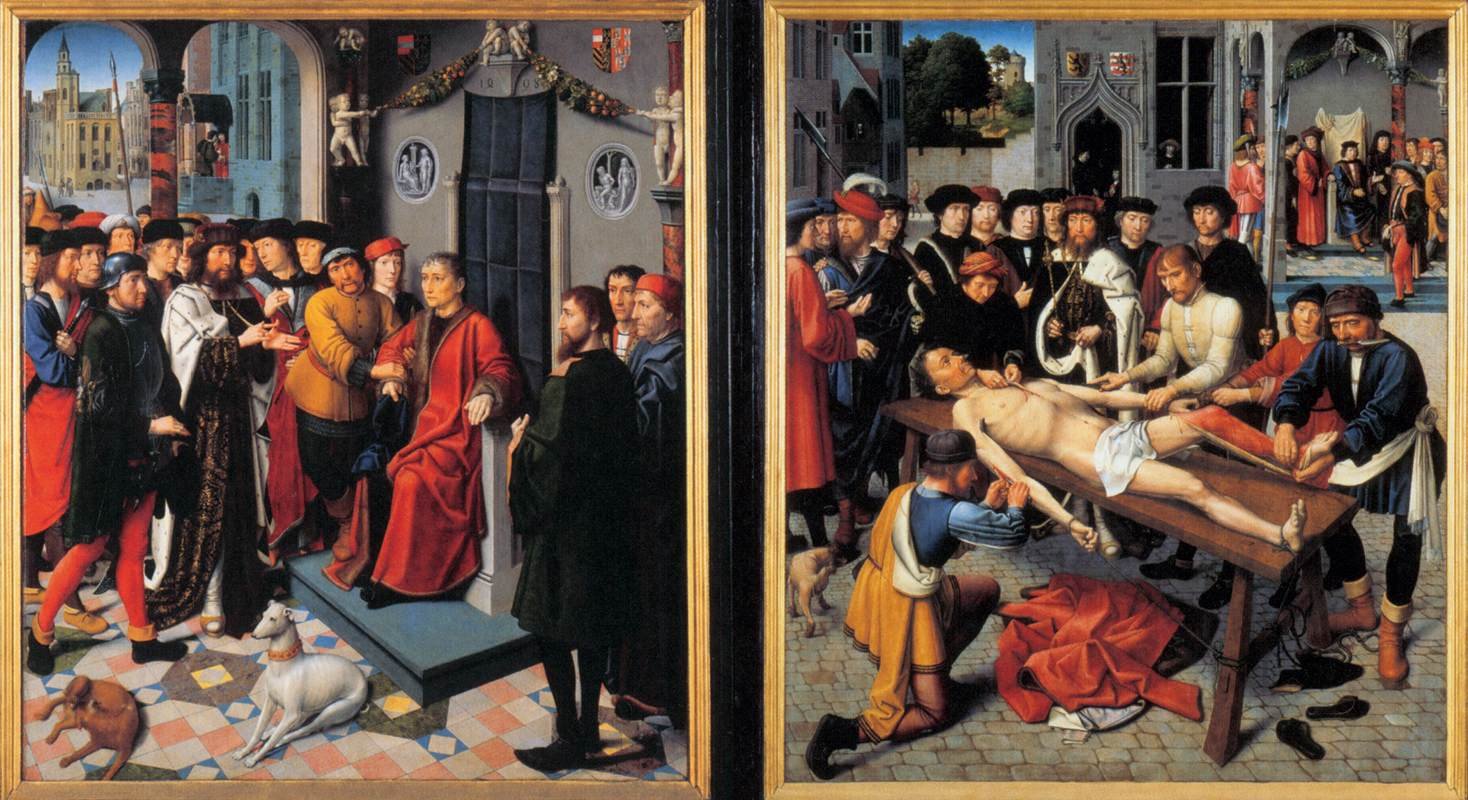
Once again I apologise to all of you who do not like the sight of blood as today’s offering is not for the squeamish !   My Daily Art Display painting for today is a diptych consisting of two oil on wood panel paintings, hinged together.  The left panel painting is entitled Judgement of Cambyses and the right hand panel is entitled Flaying of Sisamnes.  The diptych painted in 1498 by Gerard David, the Netherlandish painter can be seen at the Groeninge Museum in Bruges.

The paintings are based on a story concerning the trial and execution of an unjust and corrupt judge, Sisamnes which occurred in the 6th BC.  The great Greek historian Herodotus preserved for posterity the story of the harsh judgment of the Persian King Cambyses II, who reigned 529-522 B.C.,  against the corrupt judge Sisamnes. It is a story that for both its moral and its horror is not easily forgotten. The story is succinctly presented in the fifth book of Herodotus’s Histories.

Sisamnes, Herodotus tells us, was a royal judge under the reign of King Cambyses II. Sisamnes accepted a bribe from a party in a lawsuit, and therefore rendered an unjust judgment. King Cambyses learned of the bribe, accused Sisamnes, and had him arrested and punished, but by no ordinary punishment. The punishment was as creative as it was cruel:

King Cambyses slit his throat and flayed off all his skin and he strung the chair, on which Sisamnes had used to sit to deliver his verdicts, with these thongs.

Cambyses’s creativity did not stop there. To replace Judge Sisamnes whom he had killed and flayed, Cambyses appointed Sisamnes’s son, Otanes, as the new judge. Cambyses warned Otanes to bear in mind the source of the leather of the bench upon which he would sit to hear evidence, deliberate, and deliver his decisions. Without doubt, King Cambyses’s warning buttressed by the reupholstered seat left a lingering impression on his new judge.

Judgement of Cambyses by Gerard David

In 1498, Gerard David was commissioned by the aldermen of the town of Bruges to paint two panels depicting this ancient tale and the finished work was to hang in the chambers of the aldermen in the town hall.  This was then a warning to the local magistrates, who would see the painting every day, that the town expected them to uphold their duty to render justice free of the corruption of outside financial interests.  So that this 6th century BC story had any relevance to 15th century society, David used the technique known as “actualisation”, in which his painting was representative of that period by having the characters dressed in 15th century Flemish clothing. 

Burghers's Lodge

As was the case in yesterday’s painting, I would like you to focus on the details of the painting and by so doing, understand how David’s attempts to tell the story without the use of words.   Look under the arch of the loggia.  There we see Sisamnes’s crime taking place – that of a litigant or his servant handing over a purse of money to him as a payment for a bribe and this was the basis of the crime.  Through the left hand arch of the loggia we can see David’s depiction of the Burgher’s Lodge in Bruges.  Above the judge’s bench where Sisamnes sits one can see the crests of Phillip the Handsome and his wife Joanna of Castille.

The bearded central character in the group who stand before Sisamnes is Cambyses, the accuser.  Look how he seems to be counting on his fingers.  This could well be him counting off the acts of Sisamnes’s bribery on his fingers as he angrily regales him with the accusations.  One can see the concern on Sisamnes’s face as he realises his fate has been sealed.  One thing David had to achieve with this painting was to conjure up a hate for Sisamnes and he did this by giving him the likeness of Pieter Lanchals, a conspirator who betrayed the City of Bruges to Maximillian I of Austria in his dispute with the Council of Bruges.  The group of people, some of which were portraits of the then Bruges aldermen, represented the fact that the whole town was witnessing Cambyses’s accusation.  The man, wearing the red cap, on the left of the seated Sisamnes is the young Phillip the Handsome, the ruler of Burgundy and the Burgundian Netherlands.

The lozenge shaped medallions on either side of the judge’s bench illustrate scenes from Ovid’s Metamorphoses.  On the left are Hercules and Delaneira, the wife he betrayed, and who then gave him a robe to wear which was soaked in the blood of the Centaur, which caused the flesh of Hercules to fall from his body.  The crime perpetrated by Sisamnes was a betrayal of justice – a betrayal of the people of Bruges and the outcome of his punishment was going to be similar to that which happened to Hercules. 

The medallion on the right shows the god Apollo and the satyr Marsyas, who in the contest between them, the terms stated that the winner could treat the defeated party any way he wanted. Since the contest was judged by the Muses, Marsyas naturally lost and was flayed alive in a cave near Celaenae for his challenge of a god.  Marsyas was the symbol of hypocrisy.  David’s addition of this medallion was presumably a reminder of that salutary tale and that justice, which Sisamnes dabbled with, was a gift of the Gods, a gift to the public and his acceptance of a bribe to change the course of justice was a sin against his people as justice did not belong to him, it belonged to the people.

The Flaying of Sisamnes by Gerard David

The right hand panel of the diptych illustrates the fate of Sisamnes after being convicted of bribery.  The punishment was brutal, and yet not uncommon in the fifteenth century, that of flaying.  David’s portrayal of the flaying is graphic and shocking. We see Sisamnes lying naked on a table, his judicial red robes cast aside on the ground below.  One can quite clearly see the grimace of excruciating pain on Sisamnes’s contorted face as the four flayers busy themselves methodically with the gruesome task at hand.  The skin of the body is carefully removed as it will be turned into leather strips to be used as upholstery for the judge’s chair.  

Otanes seated on judge's chair

Look in the background and one can see seated on the judge’s chair, which is draped with flayed skin, Otanes, who is the son of the dying Sisamnes and who Cambryses has appointed to succeed his father.  According to the book Gesta Romanorum, the Latin book of anecdotes and tales, Cambryses said to Otana on making him a judge:

“  You will sit, to administer justice, upon the skin of your delinquent father: should any one incite you to do evil, remember his fate. Look down upon your  father’s skin, lest his fate befall you ”

 Those words were also meant to act as a deterrent to all future magistrates of Bruges, who may foolishly consider repeating the sins of Sisamnes.  The paintings reminded them in a most abhorent way that they needed to be mindful that any betrayal of the trust given to them would be severely dealt with.

These two paintings, although gruesome, are rich in colour and detail and worthy of a place in My Daily Art Display.

Esau Sells his Birthright by Hendrick ter Brugghen

Esau Sells his Birthright by Hendrick ter Brugghen (c.1626)

In the book of Genesis (25:29-34) we learn about the twin brothers of Isaac and Rebecca.  Esau was the first-born followed by Jacob.  In those ancient times, the birthright belonged to the first born child and thus the birthright belonged to Esau as well as his right to have the chief portion of the inheritance.   But it was more than just a title to the physical assets of a family; it was also a spiritual position.  However Esau did not appreciate what he had as the tale unfurls:

“…When Jacob had cooked stew, Esau came in from the field and he was famished; and Esau said to Jacob, ‘Please let me have a swallow of that red stuff there, for I am famished.’ Therefore his name was called Edom. But Jacob said, ‘First sell me your birthright.’ Esau said, ‘Behold, I am about to die; so of what use then is the birthright to me?’ And Jacob said, ‘First swear to me”; so he swore to him, and sold his birthright to Jacob. Then Jacob gave Esau bread and lentil stew; and he ate and drank, and rose and went on his way. Thus Esau despised his birthright.”

It is this biblical tale which is depicted in today’s painting, Esau Sells his Birthright by Dutch artist, Hendrick Jansz ter Brugghen.   He completed the painting around 1627 and is now part of a collection of his work in the Gemäldegalerie Berlin.  Ter Brugghen or Terbrugghen was born in The Hague in 1588 but shortly after the family move to the predominantly Catholic Utrecht.  Hendrick was apprenticed to Abraham Bloemaert, the Dutch painter and printmaker.  Terbrugghen spent time in Italy in his late teens to gain some artistic experience and was in Rome during the time of Caravaggio and would have come under his artistic influence and other Italian Caravaggisti such as Gentileschi, Carracci and Reni.

He returned to Utrecht around 1616 where he and fellow artist and friend, the Utrecht painter Thijman van Galen, whom he had lodged with whilst in Milan, were registered as master painters.  In that same year Ter Brugghen married Jacomijna Verbeeck, the stepdaughter of his elder brother who was an innkeeper.  They went on to have eight children.  Neither he nor his wife were active churchgoers.  He considered himself to be a Protestant but rejected the hard-line Calvanist approach to religion.   He must have had some sympathy towards the Catholic cause by the way he treated Catholic subjects in his paintings.  

Today’s painting in which Esau returns hungry from hunting and sells his birthright to his brother Jacob for a dish of lentils draws life entirely from the expressive, but silent dialogue between the brothers.   The fateful deal is concentrated on their hands, which are holding the bowl of lentils.  Directly above this gesture, whitish-yellow candlelight forms the centre of the picture and illuminates the beautifully formed profiles of the boys, turned eloquently towards each other.  The parents, Isaac and Rebecca are present in the room but seem untouched by this bargain.  To the left, Isaac is bending over the table spooning up his soup whilst Rebecca, whose shadow is reflected on the side wall, busy but restrained, is behind the table carrying a copper plate.  She is holding herself stiffly but with a positively dignified expression.

Hendrick ter Brugghen died in 1629 three years after completing this painting, aged 41.

Dam Square in Amsterdam by Jacob van Ruisdael

Dam Square Amsterdam by Jacob van Ruisdael (1670)

Today, Jacob van Ruisdael is my featured artist in My Daily Art Display.   He was born in Haarlem in 1628 and was brought up in an artistic household.  His father, Isaak van Ruysdael and his uncle, Salomon van Ruysdael were both landscape painters.  Little is known about Jacob’s early artistic training but it is thought that his father probably taught him with guidance from his uncle.  At the age of twenty he was admitted as a member of the Guild of St Luke in Haarlem.  The Guild of Saint Luke was the most common name for a city guild for painters and other artists especially in the Low Countries.   They were named in honor of the Evangelist Luke, who was the patron saint of artists.

Unfortunately during his lifetime Jacob van Ruisdael’s artistic talent was not appreciated and by all accounts he led a poverty-stricken existence.  At the age of fifty three the Haarlem council was petitioned for his admission into the town’s almshouse.  He died in Amsterdam a year later in 1682 and his body was brought back to be buried in Haarlem

Jacob van Ruisdael travelled considerably during his lifetime but seldom went outside his own country.   He was a prolific painter with over seven hundred paintings and a hundred drawings attributed to him.  His great love was to paint countryside scenes showing fields of corn and windmills as well as woodland scenes.  He was also a renowned painter of trees and their foliage.    Another favourite subject of his was seascapes and the neighbouring dune lands.  He also liked to paint waterfalls based on the work of Allart van Everdingen, the Dutch painter, who had travelled extensively in Scandinavia.

Today’s painting, The Dam Square in Amsterdam, completed in 1670 is neither a landscape nor a seascape.  The subject is Dam Square in Amsterdam, a place which he was very familiar with as he lived on the south side of the square at this time.   The square was dominated by the old Amsterdam municipal weighbridge and one can see several bales of goods under the canopy waiting to be weighed.   On the right of the building one can see the Damark with its sailing boats and the tower of Oude Kerk.  In the foreground of the painting there are a large number of figures.  It is not thought that Ruisdael actually painted these as he was not an established figure specialist.  Experts believe they may have been painted by the Rotterdam artist Gerard van Battem.  The pale light from the left of the painting casting long shadows across the square suggests that it is daybreak.

 His artistic works although not fully appreciated during his lifetime have since his death been highly praised and he is now often considered the greatest Dutch landscape painter of all time.