A Winter Scene with a Man Killing a Pig by David Teniers the Younger

A Winter Scene with a Man Killing a Pig by David Teniers II (c.1650)

I think there is an adage, or maybe it was just advice I was once given, that says you should be happy with what you have or maybe it was that you should just want what you have.  There is certainly an element of truth in that as I can always remember a disastrous policy my former company brought out in making it known to all the employees what each person earned by publishing the grades of each employee and having a separate list of salary against each grade.  Up to that point nobody knew what each other earned and most people had, until then,  been reasonably happy with their remuneration but once they found out what their colleagues earned there were unmerciful screams around the building.

So what has all this got to do with art?  The reason I bring this up is that as I told you the other day I went to see the Group of Seven and Tom Thomson exhibition at the Dulwich Picture Gallery in London and a large number of them focused on winter in Canada.  The winter scenes were well executed and very lifelike.  However the problem came when I decided to have a look around the rest of the Gallery and its permanent collection and came across a winter landscape by David Teniers the Younger and really, in my mind, it was in a different class to those of the Canadian artists.  I was completely amazed by the works of the Canadian artists until my eyes focused on Teniers’ work.  Of course, by now you know I love Dutch and Flemish art and therefore I am slightly biased with my comparison but I thought I would let you compare the two styles and see what you think.

David Teniers the Younger was born in Antwerp in 1610.  His father was David Teniers the Elder, also an artist, as were his son David Teniers III and grandson, David Teniers IV.  His artistic connections don’t end there as his wife, Anna, was the daughter of Jan (Velvet) Brueghel the Elder and granddaughter of the Master himself, Pieter Bruegel the Elder. His initial art training came from his father whose artistic talent would soon be eclipsed by his son, who would become the most famous, most revered and most prolific of the Teniers’ family of artists.  Adriaen Brouwer, who at the time was well known and well loved for his everyday scenes,  greatly influenced Teniers during his early career as did Rubens who was his wife-to-be’s guardian.  At the age of twenty-two he was registered in the Antwerp Guild of St Luke and would later become deacon of that painter’s association.

In 1637 he married Anna Brueghel.   The major part of Anna’s dowry was made up of pictures and drawings completed by her grandfather, Pieter Bruegel the Elder, and her father, Jan Brueghel.  Teniers spent much time studying these beautifully crafted works of art and they proved to be significant in the development of Teniers’s genre painting.  In the year of his marriage to Anna Breughel, Teniers painted his first genre work entitled Peasant Wedding, which hangs in the Hermitage Museum in St Petersburg.  It was the period between 1640 and 1650 that art historians believe Teniers produced his finest works.  His expertise at depicting village scenes with large crowds of people, often in an open landscape was breathtaking.  There was often an element of humour in his paintings and warmth in the way his characters were depicted on his canvases.  In many of his works one could recognise the influence of the Bruegel family.

In 1651, David Teniers and his family moved to Brussels and besides carrying on his own art business he took up the post of court painter and the director of the art gallery of the Spanish governor-general, Archduke Leopold-Wilhelm.  If you look back to My Daily Art Display of January 18th you will see a painting Teniers completed entitled Archduke Leopold William in his Gallery at Brusselswhich precisely documented some of the famous works from the Archduke’s collection. Whilst looking after this vast collection Teniers made many small-scale individual copies of paintings in the Duke’s collection by foreign artists, especially the paintings of the Italian Masters. Of these, two hundred and forty-four were engraved in 1660 under the title Theatrum Pictorium. 

On the death of the Archduke Leopold-Wilhelm his successor, Don Jon of Austria continued to employ Teniers as court painter and in 1663 Teniers founded the Royal Academy of Fine Arts Antwerp which still exists and is one of the oldest of its kind in Europe.  David Teniers the Younger was a highly productive artist and when he died in 1690, he left more than two thousand works.  Most of the major galleries of the world exhibit a number of his works.  He was an extremely good businessman and was highly liked by the aristocracy.  Teniers knew the type of art the people liked and was very astute when it came to following the latest fashions and whims of his clients.   His art work covered numerous subjects from portraits and religious scenes to genre pictures and still-life paintings.  Teniers died at the age of seventy-nine in Brussels, five years after the death of his eldest son, David Teniers III.

The featured work for My Daily Art Display today is a painting David Teniers the Younger completed around 1650 and is entitled A Winter Scene with a Man Killing a Pig.  The painting is amazing.  It just glows in front of your eyes.  An art historian and contemporary of Teniers summed up the beauty of this painting when he wrote:

“…For the richness of his golden and silvery light, for the delicacy of his vivid colours there is only one word, and that word is ‘magical…”

Before us we see a winter landscape and in some ways reminiscent of Teniers’ wife’s grandfather, Pieter Brueghel’s work, Hunters in the Snow another winter landscape painting completed almost a hundred years earlier.  As well as being a landscape painting it is also a genre picture which does not offer us an idealized landscape, but instead provides us with a window for us to see real people getting on with their daily lives in a real setting.  Snow lies deep on the ground and by the looks of the dark clouds there is more snow to come.  Look how the artist depicts the rays of weak sunlight forcing their way through the clouds to light up the frosty winter scene.

Work on the farms almost came to a halt at wintertime giving time to the peasants to take the break from working the fields and well-earned time to sleigh and skate.  To the left of the painting we see some houses.  In front of the nearest house, a pig is about to be slaughtered.  Although we may cringe at the depiction of the killing it should be remembered that in Teniers time this would be a common practice.  It marked a time of celebration and we see emerging from the end house, a woman carrying a baby and an old man, dressed in black, leading out a young child so they could witness the scene.  The butcher kneels on the animal while a woman holds out a pan to collect the blood. Every part of the carcass will be used.  The children would be given the pig’s bladder so that they could blow it up and use it as a ball.  The skin, once the hair had been singed off it, would be used as a kind of leather, maybe for shoes.  The flesh from the large animal would provide meat for their meals all the way to Lent, at which time, the staple food would switch to fish until the end of the “fast” and the arrival of Easter.

So now you have seen an early twentieth century Canadian winter scene and a mid-seventeenth Dutch winter scene and I will let you choose which you prefer

Winter Scene by Isack van Ostade

Winter Scene by Isack von Ostade (c.1646)

Over the next two blogs I am going to take a look at two Flemish artists who besides being highly talented were brothers.   They were the van Ostade brothers.  Today I am going to feature Isack, who was the lesser known of the two, maybe because he only lived to the age of twenty-eight.

Isack van Ostade was born in Haarlem in 1621.  He was a Dutch landscape and genre painter.  Genre paintings were ones depicting scenes of daily life and were particularly popular in 17th century Holland.  Isack and his brother Adriaen, who was eleven years older, were the sons of Jan Hendricx Ostade, a weaver from the town of Ostade, close to the city of Eindhoven.  Despite being born in Haarlem both he and his brother took the name “van Ostade” as their family name.  Isack studied painting under the guidance of his elder brother until he was almost twenty-one years of age at which time he independently set up his artistic business.  He started off painting subjects similar to his brother and his work was always viewed as not as accomplished as the works of Adriaen van Ostade.  Realising this, Isack decided to stop painting the genre scenes and concentrate more on landscape work in the fashion of Salomon van Ruysdael, the Dutch Golden Age landscape artist.

In his earlier paintings the figures were the key feature but in his later works his landscape becomes increasingly significant.  His change to landscape painting paid off and this coupled with his skill at figure painting ensured the popularity of his winter scenes in which we would see groups of animated people in wintery landscape settings.  These winter scenes like my featured painting today, Winter Scene, were his speciality.  He painted this picture around 1645 and it now hangs in the National Gallery in London.  It is quite similar to the painting, Winter Landscape with Wooden Bridge which another Dutch painter, Philips Wouwerman completed fifteen years later.

The painting we see before us is beautifully picturesque and we view the scene from low down which allows us to see the old rickety wooden bridge outlined against a silvery grey winter sky with its dark snow bearing cloud approaching the area.  The scene is populated by peasants.  Some, like the youngsters, are enjoying themselves sledging and skating on the frozen river whilst others, the adults, are hard at work as we see the man encouraging his old white horse to drag the laden cart up the riverbank and we watch old man as he slowly climbs the steps of the bridge, his back straining under his load of firewood.   

Sadly fewer than three dozen winter landscapes of Isack van Ostade are known today.  He died in 1649 at the early age of twenty-eight.  He had few, if any, pupils yet his influence on the succeeding generation of Haarlem painters was great and the likes of Philips Wouwerman  owed a lot to this young man.

The Anaemic Lady by Samuel van Hoogstraten

The Anaemic Lady by Samuel van Hoogstraten (c.1667)

As promised a while back, today I am going feature another painting by the Dutch artist Samuel van Hoogstraten and at the same time have a look at his life story.

Samuel Dirksz van Hoogstraten was born in Dordrecht, Holland in 1627.  He was the eldest of seven children.  His parents were Dirck van Hoogstraten, a silversmith and painter, and Maeiken de Conink.   He came from an artisan background.  His grandfather Hans was registered as a member of the Antwerp St Luke’s Guild, an association for painters and many of his mother’s ancestors were gold and silversmiths by trade.  The line of work the van Hoogstratens were in was a highly paid and one of the most prestigious of occupations.  In the late 16th century, the van Hoogstratens and the de Coninks moved from Antwerp to Dordrecht for a combination of religious, political and economic reasons.   Samuel’s grandparents and those of his wife-to-be were Mennonites, who had lived in Antwerp and because of their religious beliefs had had to escape persecution by the catholic Spanish rulers of the Spanish Netherlands

At the age of three, Samuel and his family moved to The Hague and his father Dirck enrolled in the local painters’ guild.  In 1640, Samuel’s maternal grandfather died and left his mother a sizeable inheritance as well as his house and business.  The family sold their house in The Hague, at a considerable profit, and returned to Dordrecht where they moved into the grandfather’s much larger house.  This was probably not before time as by then the family group had grown and now consisted of Samuel’s parents and seven children.  The family continued with the family’s silversmiths business.  Sadly, within a year of the move, Samuel’s father also died, leaving his mother to bring up the family single-handedly and at the same time persevere with the family business.     

From the age of seven Samuel van Hoogstraten had showed an interest in art and was taught the basics of drawing and the technique of engraving by his father.  In 1678 he wrote what is now considered as one of the most impressive painting treatises to be published in the Netherlands in the seventeenth century entitled Inleyding tot de Hooge Schoole der Schilderkonst (Introduction to the Academy of Painting) and in it he talked about his early love of art and his decision to become a painter despite some opposition from his uncle, his guardian.  He wrote:

“…I remember very well how when my father died my guardian advised me with gentle counsel to give up the art of painting and with pleasant words recommend another profession which seemed to him more secure.  And though I was not yet fourteen years old, I felt as if he wanted to take away my happiness and condemn me to slavery…”

Samuel achieved his wish to study to become a painter, for shortly after his father’s death, he moved to Amsterdam and entered the school of Rembrandt.   When he had completed his apprenticeship at Rembrandt’s studio, Samuel van Hoogstraten became an official Master and Painter.   It is only in some of his earlier works that the influence of his teacher can be seen.  In his later years during the 1660’s and early 1670’s he concentrated on genre paintings of domestic households as is the case with today’s featured work of art.  He was a man of many talents.  As well as being an accomplished artist, he was an expert in etchings and engravings, a gifted poet and writer and in 1656 when he was almost thirty years of age he married, went to live in Dordt, a suburb of Dordrecht, and became director of the local mint.  Samuel van Hoogstraten died in Dordrecht in 1678 aged 51.

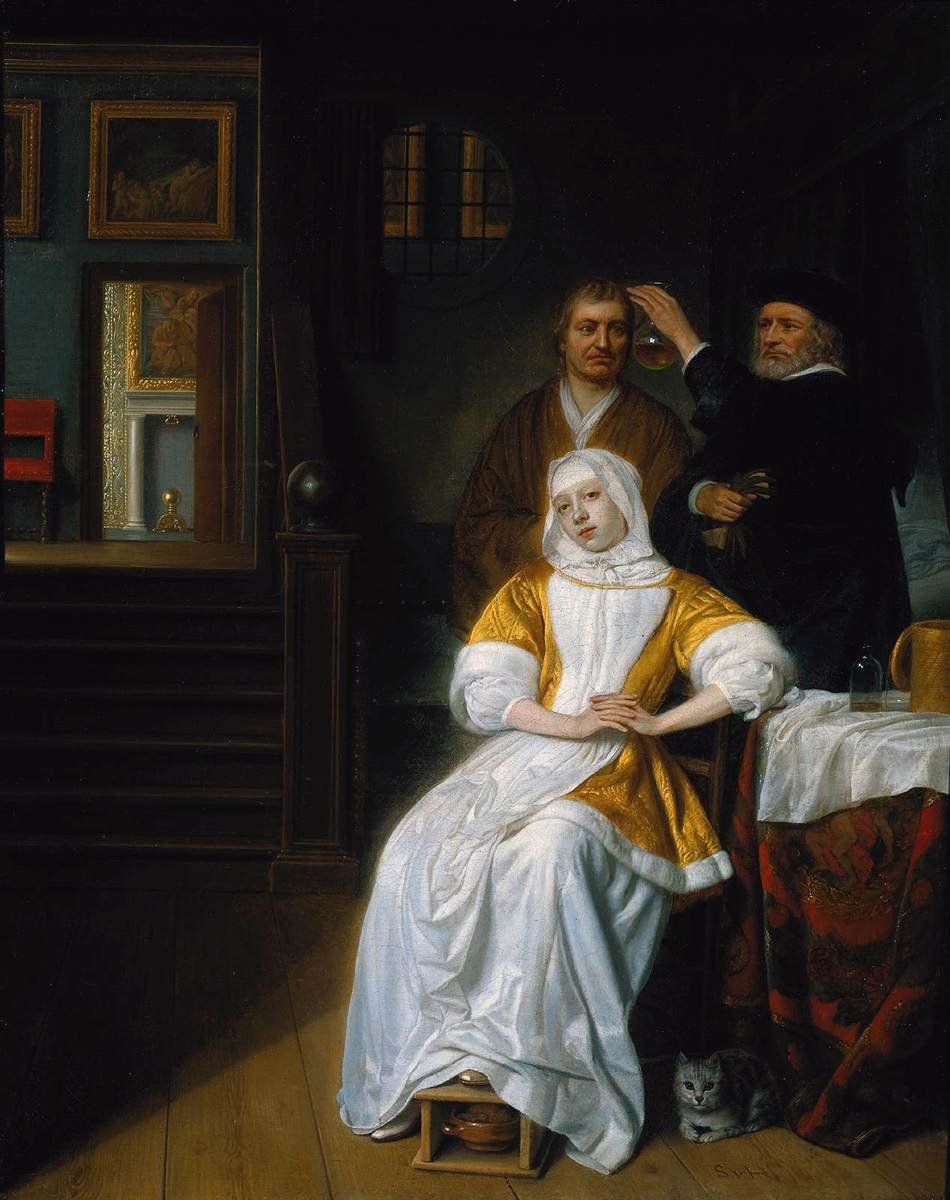
My Daily Art Display featured painting today is entitled The Anaemic Lady which Samuel van Hoogstraten completed around 1667 and can now be seen at the Rijksmuseum in Amsterdam.  The setting is a room in a house.  It appears to be a wealthy household judging by the sumptuous furnishings, gilt leather wall hangings and the paintings on the wall.  Before us is a pale faced woman, head slightly tilted to one side, reclining passively,  if somewhat lethargically in her chair, with her hands clasped before her.   It is a mysterious scene and we immediately wonder what is happening in the painting.  Although the woman has a sickly pallor we are not sure what ails her but there are clues.  Behind her we see two men.  One is a doctor holding up a flask of the woman’s urine to the light in order to determine whether she is in fact pregnant.   The other man, perhaps her husband, perhaps her lover, looks on with great apprehension at the bottle and maybe he fears the result of the examination. So what is the story behind this scene?  There are a couple of helpful hints in the painting.  Look at the naked figures, part of the design of the tablecloth and then look at the painting above the door which depicts an image of Venus, the goddess of love.  More importantly, look on the floor by the woman’s feet.  We see a cat.  Why would the artist add a cat to the painting?  Was it just a sign of domesticity and the family pet?   We should however remember that the cat was a medieval symbol of lust and in this painting its presence may represent illicit love.   This is not simply a cat stretched out on the floor but one which has trapped a mouse between its paws and maybe we should interpret that as reflecting the fact that maybe the man and the woman have, like the mouse, been caught and trapped by one moment of passion?

Does that sound a little farfetched?  Well here is a further twist to the story of the painting.  What you are looking at now is the painting after its restoration in 1989.  During the restoration work an overpainting was discovered.  Prior to the restoration work there was neither the mouse between the cat’s paws nor a second man in the painting.  The work just depicted a doctor treating a woman who was ill and the family pet lay lovingly at her feet.  There was now no hint of pregnancy, or entrapment.    It was thought that some time during the 19th century both the mouse and the man were painted out.  The reason for this overpainting is believed to be because it was not considered genteel or proper to refer to an unwelcome pregnancy or hint at its consequences.   

I will let you decide whether this is simply a scene of domesticity and whether the cat and mouse is just a load of nonsense, but if so, why overpaint the mouse and the second man?

Road by the Edge of a Lake by Jan Both

Road by the Edge of a Lake by Jan Both (1637-41)

Today I am looking at a landscape painting by the Dutch painter and etcher Jan Dirksz Both.  The artist was born in Utrecht around 1618, the younger brother of Andries Both, who was one of a group of genre painters who worked in Rome in the 17th century and who brought to the Italians the sixteenth century Netherlandish art which depicted peasant subjects.  They were known as the bamboccianti.  The term came from the nickname Il Bamboccio, which translated means “ugly doll” or “ugly puppet”, and was a nickname given to the Dutch painter and leader of the group, Pieter van Laer, because of his physical deformity, as well as the puppet-like figures in his paintings.

It was whilst the two Both brothers were working in Rome that Jan Both met the French landscape artist Claude Lorrain and a fellow Dutch painter Herman van Swanevelt, and it was with these two painters that he collaborated on a series of landscape works.   It was from Claude that he acquired the skill of rendering effects of golden or silvery light and this technique was hugely influential after he returned to Holland in 1642.  Originally Jan Both produced the popular genre paintings and scenes from the everyday life of the streets of Rome but on his return to Utrecht he concentrated all his artistic efforts on Italianate landscape paintings, which were characterised by the golden glow of sunlight.  His brother Andries, on the other hand, preferred the genre painting in the manner of Pieter van Leer.   Like Jan and Andries Both, throughout the 17th century, a steady stream of Dutch painters made the long and demanding trek to Italy, which was, at that time, acknowledged as the home of art.  Aspiring artists from many European countries would descend on Rome in order to study the great masters of the Renaissance and the contemporary painters of the Baroque.  The Dutch who had come from a colder harsher climate with its gloomy and overcast skies were thrilled by the beauty of a sunny Italy.  They marveled at the light, and the myriad of colours offered by the Italian landscapes.   The Dutch artists depicted these wonderful Roman Campagna landscapes in their paintings along with the ruins of earlier civilizations which were dotted throughout the countryside.  This group of 17th century Netherlandish painters were known as the Dutch Italianates.

Jan returned to Utrecht around 1641.  He became the main pioneer of Italianate landscape painting in 17th-century Holland.   He introduced to Dutch landscape paintings a style based on the work of Claude Lorrain, which he had witnessed in Rome. Later this Italianate landscape style of his was developed by other artists such as Nicolaes Berchem and Aelbert Cuyp.  This Italianate style of landscape painting when transferred to the native Dutch landscapes was very popular and much in demand in Holland.  His landscape paintings became more refined over the years and he would often produce large works of idealised landscapes drenched in the golden light of the Mediterranean.

The painting of Jan Both, which I am featuring today, is entitled Road by the Edge of a Lake which he completed between 1637 and 1641 dating back to his Italian sojourn.  It currently hangs in the Dulwich Gallery, London.  The earth has a subtle red tinge to it which mirrors that found in Italy.  There is a tranquillity about this painting as we see the herdsman slowly weaving their way home towards the golden sunset.  The slanting light from the falling sun produces long shadows even from the smallest of molehills we see on the herdsmen’s trail.  This painting incorporates a typical golden sunset, which Jan Both probably learnt from Claude Lorrain when he was in Italy.  Look at the tones and colours of his sky.  Look how the artist has depicted the background, with its bright yellows and yet it also has a misty quality about it, which is what we would experience if we looked towards the setting sun on a clear day.  Move your eyes to the background on the right and the colour changes to a bluer tone and the mistiness gradually disappears.  The way the artist has depicted the background is a seamless continuity of the bright but misty yellowish haze to the clarity of blue sky.  I also like the way the artist has captured the way the sunlight falls on the leaves of the trees and even the individual blades of grass which borders on to the path to the left of the herdsman.

It is interesting to note that some art historians believe that Jan’s brother Andries may have had a hand in this painting.  They come to this conclusion when they studied the figures of the herdsme.  These reminded them of the figures seen in many of Pieter van Laer’s paintings and as I told you earlier, Andries Both was a dedicated follower on Il Bamboccio.

It is a magical painting and one can almost feel the warmth from the setting sun.  It is no wonder the Dutch liked to hang this type of painting on the walls of their houses as they sat inside by their fires and shivered with the cold of a Dutch winter’s day.

Man at the Window by Samuel van Hoogstraten

Man at the Window by Samuel van Hoogstraten (1653)

My Daily Art Display today enters the world of trompe l’oeil.  The term is French and literally means “trick of the eye”.  It is a kind of artistic illusionism which gives the appearance of three-dimensional realism.  This story of trompe l’oeil originated in ancient Greece.  Pliny the Elder records in his Natural Histories the famous confrontation between two Greek 5th Century BC painters, Zeuxis and Parrhasius who were involved in a painting contest. Each would try to make a picture that produced a more perfect illusion of the real world.   Zeuxis painted a likeness of grapes so natural that birds flew down to peck at them. Then his opponent, Parrhasius, brought in his picture covered in a cloth. Reaching out to lift the curtain, Zeuxis was stunned to discover he had lost the contest.  What had appeared to be a cloth was in reality his rival’s painting.

The early precursors of modern trompe l’oeil appeared during the Renaissance, with the discovery of mathematically correct perspective. But the fooling of the eye to the point of confusion with reality only emerged with the rise of still-life painting in the Netherlands in the l7th century.  Trompe l’oeil sets itself apart from ordinary decorative painting by its intent to mislead the observer, and it is this which sets it apart from ordinary still-life painting. The artist’s technical ability is meant to go undetected and, with use of perfect perspective, cleverly observed light and realistic colours, the ploy is to make the viewer believe that a flat surface is not actually flat, or that a space exists where there, in fact, is no space. A trompe l’oeil painting is one which shows apparently three dimensional objects and spaces in a way which the eye accepts as realism in the context of their surroundings.

The Staircase Group (Portrait of Raphaelle Peale and Titian Ramsay Peale), 1785

The new genre soon spread throughout Europe and America.   In American art, we have the Charles Willson Peale’s painting of 1795 entitled  The Staircase Group (Portrait of Raphaelle Peale and Titian Ramsay Peale), which is housed in the Philadelphia Museum of Art.   Peale executed this painting to prove that he was still one of the city’s preeminent artists. On a very large canvas, he made one of his rare full-length portraits, showing two of his sons on an enclosed spiral staircase. The high degree of detail and finish shows that the painting was undoubtedly intended to be a trompe l’oeil, an effect that Peale had never attempted before. To enhance the illusion, he set up the painting within a doorframe in his studio, with a real step in front. Rembrandt Peale, another son, recalled that his father’s friend George Washington, misled by Peale’s artifice, tipped his hat and greeted the two young men as he walked by!

Though highly regarded by collectors, from the beginning art theorists often rubbished trompe l’oeil as the lowest category of art.  These “wise” men regarded it as a mere technical tour-de-force that did not require invention or intellectual thought.  However in the l7th century, leading trompe l’oeil artists were not only receiving acclaim and acknowledgement from many quarters they were seen as also pushing the boundaries of the genre.  My Daily Art Display’s featured painter today,  Samuel van Hoogstraten was even  awarded a medal for his services to Art by the Emperor Ferdinand III, the Holy Roman Emperor, after being so impressed by one of his trompe l’oeil paintings.

My Daily Art Display featured painting today today is entitled Man at the Window which Hoogstraten completed in 1653 and now hangs in the Kunsthistoriches Museum in Vienna.   Look how the artist’s has splendidly portrayed the old man’s wrinkles and the graying of his beard.  The old man’s brow is furrowed and his head is slightly angled.  See how much detail the artist has given the window.   On the sill outside the window he has added a small vase which enhances and emphasizes the depth in the painting.  This window ledge is shaped by a stone wall surrounding the window.  Look at the amazing amount of detail Hoogstraten has put into his depiction of the texture and surface of the stonework.  You can almost believe that if you touched the surface of the painting it would feel like stone.  It is quite amazing.  Also on the windowsill, the artist has added a feather and a couple of leaves, one of which hangs over the side of the sill.  We see the man’s head protruding from one of the panes in the window and this gives the appearance that he is actually coming out towards our space.  Although it is a kind face there is something very haunting about it.  One can easily imagine that as an observer passes this painting and glances at it, they suddenly imagine that they are being watched by this elderly but real person. 

Today’s artist, besides his many trompe d’oeil works, completed many varied paintings and in a future blog I will look at the life of Samuel van Hoogstraten and another of his paintings.   He was not only a very talented painter but also a writer on art. He painted genre scenes in the style of de Hooch and Metsu, and completed many portraits, but maybe he will be best remembered as a specialist in perspective effect.

Still Life with Flowers and Fruit by Rachel Ruysch

Still Life with Flowers and Fruit by Rachael Ruysch (1703)

My Daily Art Display moves into unfamiliar territory on two counts.  My featured artist is a woman and up to now, I have showcased only a few paintings by women and secondly the work is a still-life painting, a genre which I have rarely selected for my daily blog.  I marvel at the intricacy of the painting and I have no doubt that the detailed work which goes into still-life paintings is equal if not greater than in other painting genres.

My featured artist today is the Dutch artist Rachel Ruysch.  Art historians who have studied the art of the Dutch Golden Age have placed her in the top three female artists of that period.  The other two being and Maria van Oosterwijk, another specialist in flower still-life paintings and Judith Leyster, the genre painter who painted a few portraits and who also produced a single still life work. Ruysch  is widely looked upon as the most talented female in the history of still-lifes of flowers and fruits and among the greatest exponents of either sex of this genre.  True praise indeed!!

 Rachel was born in The Hague in 1664.  She came from a wealthy family and was one of twelve children.  Her mother was the daughter of Pieter Post, a Dutch painter of landscapes and battle scenes, before becoming a talented classical-style architect.  Her father Frederick Ruysch, a talented amateur painter was also a renowned Dutch botanist and anatomist.  He accepted a professorship in Amsterdam and so when Rachel was just three years old the family all moved there.    Her father was an expert in anatomical preservation and the creation of dioramas,  three-dimensional full-size or miniature models, sometimes enclosed in a glass showcase, and which would house human parts which had first been preserved and embalmed in liquor balsamicum.   Rachel took an interest in her father’s work and would often help him to decorate the collection with flowers, fishes, seashells and the delicate body parts with lace.  With his trained scientific eye, Rachel’s father was able to observe and record nature with a high degree of accuracy, and it was a talent that he inspired in his daughter. This talent was to greatly influence her works of art in the future, for her still-life floral paintings would be characterized by realism.  Another reason for Rachel’s love of plants and flowers was that she and her family lived in a district of Amsterdam called Bloemgracht, which means “flower canal”. This area was of great natural beauty and was a favourite place of artists

In 1679, at the age of fifteen she had developed a love for art and was exceptionally talented even at that young age.  Recognising his daughter’s artistic aptitude, her father arranged an apprenticeship for her with William van Aelst, a renowned painter, who specialized in still-life works with flowers or game.  Van Aelst, who moved to Amsterdam in 1657, was famous for creating elaborate still-life paintings that featured spiralling compositions and avoided the convention of symmetrical arrangements of depicted bouquets.  Van Aelst taught her the necessary skill of composing a bouquet in a vase but in his less formal manner that produced a much more realistic and tangible effect. In their more realistic works, some flowers and leaves were allowed to droop over the sides of vases, while others were revealed from the back, and by so doing, produced a more rounded shape. Later in her artistic journey, Ruysch would build upon van Aelst’s compositional innovations and this would instil a vitality into her paintings.

Rachel remained a pupil of his until his death four years later in 1683.  Her earliest art works started to appear around 1680 and by the time she was eighteen years of age in 1682 she was producing a number of independently signed paintings and her successful artistic career had just begun.

 In 1693, aged twenty nine she married the lace dealer and portrait painter, Juriaen Pool.  The couple moved to The Hague where they both enrolled in the city’s Guild of St Luke, the professional artists’ organization which regulated the sales and handled the promotion of the artists’ works.  By all accounts their marriage was a happy one and the couple went on to have ten children.  Even though, as she claimed, she essentially raised her children on her own, her life of domesticity and all the chores that went with it coincided with her most creative artistic period. Her large family seemed in no way to get in the way of the quality of her work

In 1708, both Rachel and her husband were invited to Dusseldorf, where they became court painters to the Elector Palatine of Bavaria, Johann Wilhelm.   This proved to be a very successful period in their lives and they remained there and worked for him until his death in 1716, at which time they returned to Holland.  Flower painting emerged as part of the Baroque movement and was especially popular in the late 17th century.   The reason for its popular emergence was the increase in the number of more affluent merchants and middle classes, as well as the growing interest in plants that resulted from the developing science of botany.  It was also around this time in northern Europe, especially Holland, that there was a marked increase in the importation of many new and exotic plants. The Dutch had developed a wide variety of flowers and gardening became increasingly popular. Often, gardeners would commission artists to paint pictures of their best or rarest flowers.

In light of her situation, she was fairly productive throughout her lifetime. She finished her final painting in 1747, when she was 83. By the time she died, she had produced more than 250 pictures, an average of about five pictures a year, which was a considerable number of works for someone creating flower paintings in painstaking detail.

Rachel Ruysch had to overcome two problems which were common in the artistic world of northern Europe at the time.  Firstly she had to overcome the fact that she was a woman and artistic painting was considered a male province.  Secondly, during this period, art was divided into two categories – “greater” and “lesser”.  Into the “greater” category one found paintings of religious and historical themes and compartmentalised in the “lesser” category were portraits, landscapes and still-lifes.  It was this “lesser” category which was deemed fit for female artists.  Women artists who painted were considered to be just painting as a hobby and were completely incapable of artistic genius. However Rachel Ruysch triumphed and became a highly regarded artist who made her mark in the male world of the Dutch Old Masters, becoming one of the greatest flower painters in either gender.

Ruysch died in 1750 at age 86, and during her lifetime she gained widespread fame, and her artistic works were highly valued.   Despite the fact that flower paintings today is still  considered as a lesser form of artistic expression, Ruysch’s reputation as a great painter remains intact.   During the 20th century, there was great interest in her works and her paintings are still featured in major exhibitions in Europe.  She is thought to have produced over 250 paintings in her life but only about 100 are known to still exist, and most of these are in museums or private collections. When any of her paintings do come up for sale they make headlines. In France her 1710 painting Still Life of Fruit with a Birds Nest and Insects went for the equivalent of $508,000.

My Daily Art Display painting by Rachel Ruysch is entitled Still Life with Flowers and Fruit, which she painted in 1703.  This painting, which measures 85cms x 68cms, has an opulent arrangement of flowers and fruit but could never have existed in nature as the various flower specimens and fruit blossomed and bore fruit in different seasons.  This blossoming was simply a figment of the artist’s imagination.  There is a technical perfection about this painting which had come from Rachel’s extensive botanical training.  The painting now hangs in the Akademie der bildenden Künste, in Vienna

Card Players in a Sunlit Room by Pieter de Hooch

Card Players in a Sunlit Room by Pieter de Hooch (1658)

Today My Daily Art Display returns to the Netherlands for its featured artist.  Today I am looking at a painting by the 17th century Dutch Golden Age artist Pieter de Hooch.   He was a contemporary of the great Jan Vermeer and there are some similarities between their works which we will look at later.

Pieter de Hooch was born in 1629 in Rotterdam, just three years before the birth of Vermeer.  He was the eldest of five children.  His father Hendricksz de Hooch was a bricklayer whilst his mother Annetge Pieters was a midwife.  Pieter studied art in Haarlem at the studio of Nicolaes Pieterszoon Berchem, the prolific Dutch Golden Age landscape painter.  His earliest employment was with Justus de la Grange a linen merchant and art collector where he acted as servant and general helper and it is thought that he paid for his board and lodgings by giving la Grange paintings some of his paintings, which was often the way aspiring artists managed to survive.  De Hooch went with la Grange on many of his business trips throughout Holland, including the town of Delft where he moved to temporarily in 1652, and on a more permanent basis in 1654 and 1655 during which time he joined the Guild of St Luke, the painters’ guild in Delft.

In 1654, whilst living in Delft, he married Jannetje van der Burch and the couple went on to have seven children.  In Delft he came under the influence of two of the town’s greatest painters, Carel Fabritius and Nicolaes Maes.  In the 1640’s, these two artists were originators  of the Delft School, a group of mid-17th century Dutch Golden Age painters named after its main base, the town of Delft.   It is best known for genre painting, such as images of domestic life, views of households, church interiors, courtyards, squares and the streets of the city.  The Delft School of painting in the 1650’s would number as its members the great Jan Vermeer and today’s featured artist.

Pieter de Hooch’s work at this time, both in style and subject matter, was in many ways similar to the paintings of Vermeer, who was still  living in Delft at that time.  De Hooch’s paintings, like Vermeer’s, were small works and though he sometimes painted open-air scenes and tavern genres he preferred painting two or three figures occupied with their normal daily duties and often shown in a sober interior interrupted only by the streaming in of radiant light from outside which, if by magic, transforms the scene.  At this time, the family unit was central to an increasing middle-class Dutch society, and de Hooch’s main characters in his works include friends, families and maids.  The world we see depicted in his paintings are glimpses of life seen unobtrusively through open doors and windows.  His works, which showed the simple life of the local inhabitants, were free of sentimentality and moralising.  Art historians believe that this period in Delft saw de Hoochcomplete his greatest works and that the artist was at this time at the height of his artistic powers.

In 1661, when Pieter de Hooch was thirty-two, he and his family moved on to Amsterdam.  De Hooch’s decision to leave Delft was undoubtedly brought on by the expectation of a larger market for his paintings in the flourishing and prosperous commercial centre of Amsterdam. It was here that he found a wealthier, more ambitious clientele, and the artwork they required was not of homely family scenes but paintings depicting extravagantly dressed people in contrived luxurious surroundings, such as country villas with palatial halls and their sumptuous marble interiors.  The patrons also wanted their paintings to be on a much large scale than he had tended to do in Delft.

In 1667 life took a turn for the worse for Pieter de Hooch.  His wife died leaving him, aged just 38, to bring up their large family.  Her death hit him hard and he struggled to cope with bringing up his young children.  Art critics believe that his struggle to survive affected his work.  His mental and physical health deteriorated and he died in 1684 in an Amsterdam mental asylum.  He was aged just 55.

The featured painting today is entitled Card Players in a Sunlit Room which he completed around 1658 whilst still living in Delft.  The finished work remained in Holland for almost one hundred and seventy years until it was bought by Lord Farnborough for King George IV of England in 1827.   It is now housed in the Royal Collection in London.  Before us we have two men and a woman sat at a table playing cards with another male onlooker standing besides the woman, pipe in hand, surveying the card game.  The mood of the painting is one of calmness.  There is an air of contemplation among the players.  This is not an animated scene, the participants are restrained.  The work is quite detailed in the way de Hooch has depicted the playing cards, the raised glass in the man’s hand and the broken pipe on the floor in the right foreground.  We fix our eyes on the fragments of the pipe on the floor and the five of spades playing card and cannot help but wonder why the artist has included them in the painting.  Was there some symbolism to its inclusion?  Should we look to interpret the existence of the abandoned pipe fragments and the single card on the floor or I wonder if the artist just wanted to get us to do what we are doing right now – trying to solve a mystery, when none exists!

One aspect of this painting which we have seen before in some of his other works is the setting of an inner room with an open door letting us see out into a much brighter exterior.  Observe the way de Hooch depicts the light flooding in from the sunlit courtyard in the middle ground of the painting, through the doorway into the interior, lighting up some parts of the room and some of the card players, whilst other parts are cast in shadow.    It is if de Hooch wants to showcase his skill in how he handles light as it falls over different surfaces.  Look how he has depicted the effect the sunlight has on the translucent curtains and the small panes of glass in the windows.  Again see how de Hooch has allowed the light streaming in through the door play on the card players, and by so doing, defining the form of their figures.

The paintings of Pieter de Hooch often exhibited a sophisticated and delicate treatment of light which was very similar to what we see in many of Jan Vermeer’s works, who as I said earlier, lived in Delft at the same time as de Hooch.  Art historians in the nineteenth century had originally assumed that Vermeer had been influenced by de Hooch’s work, but the opposite is now being seriously considered.

Granida and Daifilo by Gerard van Honthorst

Granida and Daifilo by Gerard van Honthorst (1625)

As I research paintings and artists for my blog, I delve into various books which I have and of course use the internet.  One of the best art history magazines about is The Burlington Magazine which is published monthly.  However although I have, in a rush of blood to the head, almost signed up for it, the cost of a few pence under £20 per issue I feel  is just too much.  However the other day I bought the Centenary Anthology of the magazine from eBay and although I have just skimmed through some of the 250+ pages I am pleased with my purchase.  It was as I flicked through the pages I came across a beautiful work by Gerard van Honthorst and I thought it was time to feature this Dutch painter and one of his works.

Gerard or Gerrit van Honthorst was born in Utrecht in 1592.  His father was a textile painter and his younger brother Willem also went on to become an artist.  His first taste of art came when he was apprenticed to the great Dutch painter Abraham Bloemaert.  Bloemaert, who resided in Utrecht, was an outstanding teacher and virtually all the aspiring young Utrecht painters of that time, who went on to become famous, had at one time studied under this artistic master.

In his early twenties, Honthorst travelled to Italy and during his stay in Rome where he lived in the palace of a patron of Caravaggio, Vincenzo Giustiniani, he was influenced by the works and style of the famous artist who was at the height of his popularity.  Whilst in Italy, Honthorst developed a similar artistic style to Caravaggio in the way he often portrayed his figures in the darkness of night lit by candlelight and this style acquired him the Italian nickname Gherardo delle Notti (Gerard of the Night).   His paintings were very popular and he managed to acquire a number of wealthy patrons including the powerful Scipione Borghese the Italian Renaissance cardinal who was a great patron of the arts and an avid art collector.  He was also patron to Caravaggio.  Another of his patrons was Marchese Vincenzo Giustiniani an aristocratic Italian banker and art collector

Honthorst returned to Utrecht around 1620 and that same year married Sophia Coopmans.  Along with his fellow artist, Hendrick ter Brugghen, they set up an art school in Utrecht.  Due to the influence of Caravaggio  on the works of the two Dutch painters and the way their paintings showed strong and bold contrasts between light and dark known as chiaroscuro,  they were looked upon as representing Utrecht Caravaggism.

In 1622 van Honthorst joined the Guild of St Luke in Utrecht and three years later was made president of the society.   Van Honthorst fame as a painter spread and he was much sort after as a teacher so much so that in 1627 he moved to a much larger house and turned part of it into his workshop.  The following year, following his rising artistic reputation reaching the English court, he was invited to work at the court of King Charles I.  He remained in England until the end of 1628 at which time he returned to Utrecht.

In 1637 Van Honthorst moved to The Hague when he became the court painter to the Princess of Orange and received a number of commissions for portraits from the Dutch ruler Frederick Hendrick, Prince of Orange and his family and during this period he also worked on the decoration of the royal residences.  His fame spread and he received many royal commissions from the likes of the French Queen Maria de Medici, mother of King Louis XIII, King Christian IV of Denmark and Elizabeth of Bohemia, Charles I of England’s sister.

With success came great wealth and he was fortunate enough to live a luxurious lifestyle.  Gerard van Honthorst died in Utrecht in 1656, aged 64.

The featured painting in today’s My Daily Art Display is entitled Granida and Daifilo which Gerard van Honthorst completed in 1625 and was commissioned by  Stadholder Frederick Hendrick  for his residence at Honselaerdijk and was to form part of a number of paintings of pastoral scenes.

The title of the painting refers to the characters in a pastoral play written by Pieter Hooft, the Dutch historian, poet and playwright entitled Granida.  The story of the play was that Granida and Daifilo were lovers.   Granida, the daughter of an eastern king, was betrothed to Prince Tisiphernes but one day became lost while out hunting.  She came upon a shepherd Daifilo and his mistress Dorilea who had just quarrelled.  Daifilo fetched water for the princess to drink and fell in love with her. He followed her to court and, after several twists and turns in the story, they fled to the woods together to live a pastoral life. However, Daifilo was taken prisoner by one of Granida’s several suitors. The play had a happy ending and the couple were finally reunited after the intervention of Tisiphernes who took pity on the young pair and gave up his claim to her.

The colours of this painting are bright and the details of the two protagonists in this amorous scene set in this idealised woodland setting give it a touch of classicism.  Nevertheless, there is a touch of realism, which was associated with the Caravaggists as we see the dirty soles of Daifilo’s feet.  In the background to the right we see the soldiers approaching the lovers with the intent to arrest them.

The play set a fashion for pastoral idyll in the Netherlands where Granida and Daifilo became iconic symbols of love. The play was noted for the delicacy of its poetry and the simplicity of its moral.  The moral to this tale was that individuals and nations can be at peace only when rulers and subjects alike shun ambition and seek only to serve. Though not well known today, it was a very popular work in early 17th century Netherlands, and Granida and Daifilo were the subject of many important paintings by Dutch masters.

The painting can be found in the Centraal Museum, Utrecht

The Life of Man by Jan Steen

The Life of Man by Jan Steen (c.1665)

My Daily Art Display today is about two paintings and the reason I am looking at two is because the second one, which is a copy of the first by a different artist, is almost identical but not quite and it does show up certain details much clearer, which are harder to see on the original work by Jan Steen.  Sounds interesting? – Well then, read on !

Jan Havicksz Steen was born in Leiden around 1626.  He was the eldest son of the brewer and former grain merchant, Havick Jansz Steen and his wife, Elisabeth Capiteyn, the daughter of a city clerk.  Steen was brought up in a well-to-do Catholic family home.  His forefathers and parents had run the tavern, The Red Halbert, for two generations.  Jan Steen, like his contemporary Rembrandt, went to the Latin School and later became a student in the Department of Letters at Leiden University.  Art historians question whether he actually studied at the university as he never attained a degree.  It is thought that he may have enrolled at the university to take advantage of the privileges bestowed on students, such as exemption from serving in the civic gurad and not having to pay the municipal excise tax on beer and wine !  His artistic education was overseen by the German painter, Nicolaes Knupfer,  a specialist in history paintings and produced works based on stories from the Bible, from Greek and Roman history and from mythology.   He was to have a great influence on Jan Steen.  Two other painters who had some bearing on Steen’s future artistic career were the brothers Adriaen and Isaac van Ostade, both of who lived in nearby Utrecht

In March 1648, at the age of twenty-two, Jan Steen and Gabriel Metsu, a fellow artist, founded the painters’ Guild of St Luke at Leiden.  It was shortly after that time that, Jan Steen went to The Hague where he met and became assistant to Jan van Goyen, the prolific landscape artist.  Within a short space of time Steen left his lodgings and moved into van Goyen’s home.  In October 1648 Jan Steen married van Goyen’s daughter Margriet and the couple went on to have six children, their first child, a son Thadeus was born in 1651.   Van Goyen and Steen worked together for a further five years until 1654 at which time Steen and his family moved to Delft and to supplement his income from his art, he rented a brewery for 400 guilders a month, known as De Slang (The Serpent), also sometimes known as De Roskam (The Curry Comb) which was on the Oude Delft canal,  but the enterprise met with little success.

The year 1654 was to be a momentous and a tragic year for Delft and its inhabitants.  This was the year in which The Delft Explosion occurred on October 12th,  when a gunpowder store exploded, destroying much of the city. Over a hundred people were killed and thousands wounded.  Thirty tons of gunpowder had been stockpiled in a former Clarissen Convent in the Doelenkwartier district of the city.   On that morning the keeper of the magazine, which stored the explosives, opened up the store and an enormous explosion followed.   The death toll could have been much worse but fortunately many of the people of Delft had gone to a market at the nearby town of Schieden.  One of the casualties of the explosion was the artist Carl Fabritius, many of whose paintings were also destroyed in the explosion and fire.  After this disaster and the fall-out from the First Anglo-Dutch War, the art market in the city almost collapsed and sales of Steen’s works fell sharply.  Once again Jan Steen moved his family.

Jan Steen, following his departure from Delft in 1657, moved around the country, living for a time in Warmond, a small village north of Leiden and in 1660 moved to Haarlem where the next year Steen became a member of the Haarlem Guild of St Luke.   In May 1669 his wife died and the following year his father died.  Jan Steen inherited the family house in Leiden (his mother had died a year earlier) and he moved his family back home.  He returned to Leiden in 1672 when again he opened a tavern.  The year 1672 in Holland was known as the rampjaar (“disaster year”).   In that year, the Republic of the Seven United Provinces was after the outbreak of the Franco-Dutch War and the Third Anglo-Dutch War attacked by both England, France, and the invading armies very quickly defeated the Dutch States Army and conquered a large part of the Republic.  Steen’s unsuccessful brewery business and the fall in his art sales led him into debt which was further exacerbated by his heavy drinking.

In April 1673 he re-married.  His second wife was Maria Dircksdr van Egmont, the widow of a Leiden bookseller, who soon after gave birth and the forty-seven year old artist became a father yet again.  Jan van Steen died penniless in 1679, aged fifty-three.  After his death, his wife had to sell most of their possessions and her husband’s paintings to pay off his many debts.  Maria died eight years later.

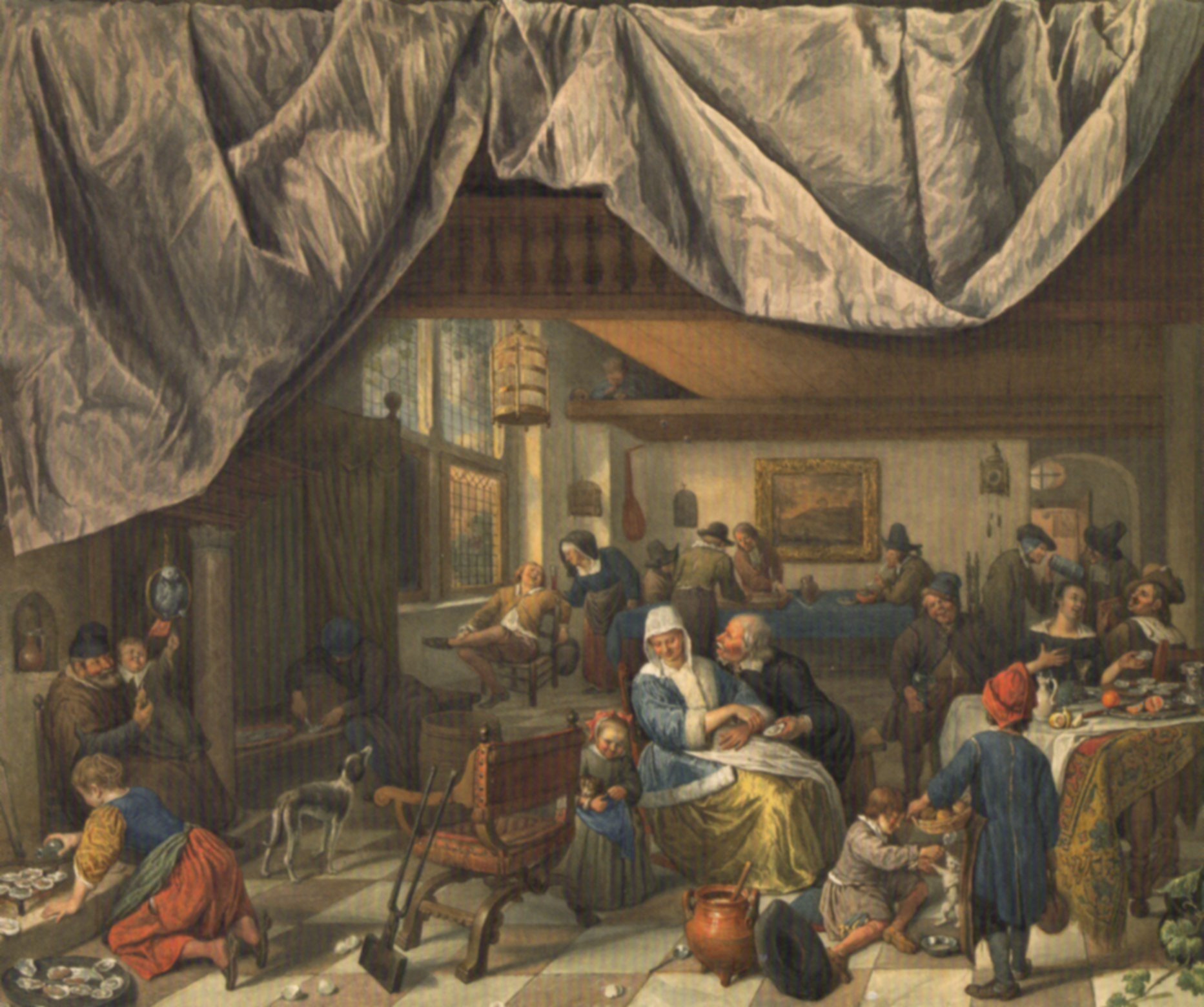
My Daily Art Display’s featured painting by Jan Steen is entitled The Life of Man which he completed around 1665.  In the painting before us we glimpse into the busy bar of a tavern full of people of various ages with one thing in common – they are all there to enjoy themselves.  They create their own enjoyment through making music, singing and playing tric-trac, the popular dice game of that time.     In the centre of the painting we see a young woman, dressed in blue and white, seated, turning away from an older man who is offering her an oyster.  We can see by the smile on her face that maybe her initial rebuff of his gift may soon be reversed.  Behind the pair we can see a hunchbacked lute player, who looks on and seems happy to ridicule the mismatched pair.

To the right of the picture we see a young woman and another lute player sitting together at a table.  This relationship seems to be prospering, if the sultry look she is giving the musician is anything to go by.  It would appear that the owners of the tavern are use to preparing and selling large quantities of oysters, a supposed aphrodisiac, to their clientele.

As I have said many times before I like paintings where a lot of things are going on as every time I look at one of these paintings I notice something different.   Cast your eyes around the tavern scene and see what you can discover.  To the left we can see an old man eating an oyster and on his knee he has a small child who is wriggling from his grasp trying to grab the tail of a parrot.  In the central foreground we see a small girl cradling a small dog in her apron and by the table on the right and sitting on the floor is a small boy who is trying to teach a kitten to stand on its hind legs.  It is interesting to focus on the small boy in the right foreground, with the blue coat and red hat, who holds a basket of bread rolls under his arm.  Jan Steen has painted this figure with his back to us and has used this technique in other paintings and what it does is to get us to look at where the boy is looking and thus the artist gets the viewer to focus his or her eye into the depths of the picture.

Across the top of the painting we have what looks like a raised curtain and what Steen wants us to accept that we are not just looking at any old tavern but in some ways we are looking at a stage and the curtain is a theatre curtain raised to show the cast of players.  In Shakespeare’s play, As You Like It, there is the famous line:

All the world’s a stage,

And all the men and women merely players:

They have their exits and their entrances;

And one man in his time plays many parts,

 As the painting is by a Dutch artist maybe we should look at the Dutch saying by Joost van den Vondel:

De wereld is een schouwtoneel
Elk speelt zijn rol en krijgt zijn deel.

Which translated roughly means:

“  The world‘s a stage
Each plays his role and gets his share”

And so maybe Jan Steen wants us to look at this scene as more than just people in a tavern but as “the world stage “and the people we see in the tavern are just players.

The Life of Man by Reinier Craeyvanger (c.1840)

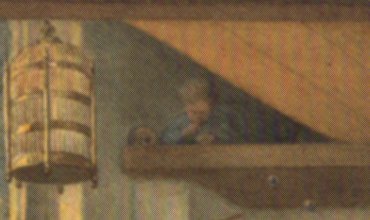
And so I come to my second painting which is also entitled The Life of Man but the artist is Reiner Craeyvanger.  It is obviously a copy of Jan Steen’s work but I am showing it for two reasons.  Firstly, when I was researching the painting by Jan Steen I kept reading about “a boy lying in the loft above, blowing bubbles”.  I searched Jan Steen’s painting for hours looking for the boy and couldn’t find him and convinced myself that the picture I had was a cropped version of the original.  However when I saw Craeyvanger’s copy I immediately saw the boy and when I looked back at Steen’s painting I could just make out a fuzzy image of the boy.  See if you can find him.

Boy on balcony blowing bubbles

The boy is laying there blowing bubbles and next to him is a skull.  From this we must believe that both are symbolic and the message is, that like a bubble which will suddenly burst, our life may suddenly come to an end and we die and of course the addition of a skull which we often see in Vanitas painting symbolises that death is always around the corner.  Although it is not very clear in the attached pictures the painting on the rear wall has a gallows in it and that again is harking back to life and death.

There are two other interesting things in the painting.  Firstly we see broken egg shells scattered on the floor which could be symbolically interpreted as the frailty of life itself, and secondly, look at the right background and the old woman staring into a tankard.  She is a kannekijker,  which literally translated means a “pot looker” or “someone who looks into a pot”.  This gesture was a well-known literary and artistic convention of the time that signified the habitual drinker or drunkard.  I am sure there is more symbolism incorporated in this painting, such as why has Steen depicted a pot with a spoon and a hat in the foreground?  How are we to interpret these objects or maybe there is nothing to interpret!

However I will leave you with a question.  Although Craeyvanger has carefully copied Jan Steen’s painting, what is the main difference between his work and that of Jan Steen’s painting?  I am not talking about colours, tones or technique.  It is more obvious than that, something is missing from the later painting, but what ?

Dordrecht Harbour by Moonlight by Aelbert Cuyp

Dordrecht Harbour by Moonlight by Aelbert Cuyp (c.1645)

I am putting religion and religious paintings behind me today and I am going to feature a truly beautiful riverscape painting by one of my favourite artists, Aelbert Cuyp.   I really cannot get enough of this man’s paintings.  Whether it be his landscapes, riverscapes or seascapes, they are all delights to behold.  My Daily Art Display today is the painting Cuyp completed around 1645 entitled Dordrecht Harbor by Night and which now hangs in the Wallraf-Richartz Museum in Cologne.

Aelbert Cuyp was born in 1620 and is the most famous member of the Cuyp family and today is proclaimed as one of the greatest of all landscape painters.  He was the son and, more than likely, the pupil of Jacob Gerritsz Cuyp, a portrait painter.  In his early works one can detect the influence of Jan van Goyen, the prolific seventeenth century Dutch landscape painter.  Aelbert was born and died at Dordrecht, and spent a lot of time travelling along the great rivers of Holland reaching the eastern borders of the country and the western part of what is now Westphalia, Germany.   He was an artist, who naturally signed his works, but very rarely dated them and thus it has been difficult for art historians to build up a chronological list of his works

In 1658 Cuyp married a wealthy widow, and in the 1660’s, with his newly found financial stability, he seems to have practically forsaken painting. He died in 1691 and was buried in the Augustijner Church in Dordrecht.   Although for a hundred years after his death his works seemed to have been ignored, but the eighteenth century proved a turning point for the sale of his paintings.   The greatest collector of his paintings was the eighteenth-century Dordrecht iron dealer and mint-master Johan van der Linden van Slingeland, who owned forty-one works by the artist.   After the sale of his collection in 1785, many of these paintings entered collections in England, where Cuyp’s work was greatly admired for their grandeur.

The popularity of his paintings in France and England grew unabated, so much so,  that by the late eighteenth century there were hardly any of his paintings left in his native Netherlands.   From fame in Europe came fame in America with art dealers clambering to get hold of his works.

It was around 1640 that Dutch painters began to be fascinated with the depiction of extraordinary light and weather conditions but such paintings were deemed to be one of the most complicated challenges faced by artists.

The challenge was to be able to accurately depict the various colours of the moonlight reflections.  It was interesting to read about the debate from the Italian Renaissance period, known as the paragone, in which one form of art, whether it be architecture, sculpture, painting or poetry, is championed to be the superior in comparison to the others.  Bearing in mind today’s featured work, it is interesting to see what Philips Angel, the Dutch Golden Age painter, and a contemporary of Cuyp, wrote in his published a defence of the art of painting:

“..unlike sculpture, painting can depict a rainbow, rain, thunder, lightning, clouds, vapour, light, reflections….. the rising of the sun, early morning, the decline of the sun, evening, the moon illuminating the night, with her attendant companions, the stars, reflections in the water…”

The painting, Dordrecht Harbor by Night is a beautiful study of moonlight over water.  The Dutch painter and esteemed biographer of 17th century Dutch artists, Arnold Houbraken, who lived in Dordrecht at the time of Cuyp was able to have firsthand knowledge of the artist’s work.  Of Cuyp, he wrote:

“.. [Cuyp] paid much attention to the time of day in which he portrayed his subjects, so that one can distinguish in his paintings the misty early mornings from the bright afternoons from the saffron-colored evening time…… I have also seen various moonlight scenes by him which were very realistic and arranged in such a way that the moon was beautifully reflected in the water….”

Aelbert Cuyp’s ability to depict a moonlight scene is exactly what we see in this painting.  Look how the moonlight shimmers on the still waters of the inland waterway.  Look at the colours the artist has used in his depiction of the clouds and sky.  It is an extremely atmospheric and haunting work with its sailboats at a dock across the harbour from Dordrecht’s Rietdijkspoort.  It is believed to be one of the few moonlight scenes painted by Cuyp.  There is an utter stillness to the painting.  Maybe just a whispered conversation of the men standing on the pier awaiting a morning ferry would be heard over the sound of the lapping water which caresses the pier structure and the wooden hulls of the sailing boats.   Above we have dark billowing clouds which try and mask the moonlight which is being cast onto the still water.  The moonlight refuses to be diffused by the threatening clouds and floods across the scene reflecting on the sails of the boats and the old stone windmill.   It would seem that bad weather is on its way or has just passed.

To look at this painting is almost theraputic.  Its calmness has a calming effect on the viewer.  Look at it, relax and enjoy.