Walker Art Gallery revisited.

The Walker Art Gallery in Liverpool has one of the most significant and famous collection of artworks in the UK, which includes European Renaissance paintings, masterpieces by Rubens, Rembrandt, Turner and Stubbs, Pre-Raphaelite artworks by Rossetti and Millais, Impressionist works by Monet and Degas and contemporary works by Hockney, Wylie and the winners of the John Moores Painting Prize.   I have covered many of the Pre-Raphaelite works exibited here in previous blogs and following a visit I made to the gallery last week I have chosen a few more paintings which impressed me.
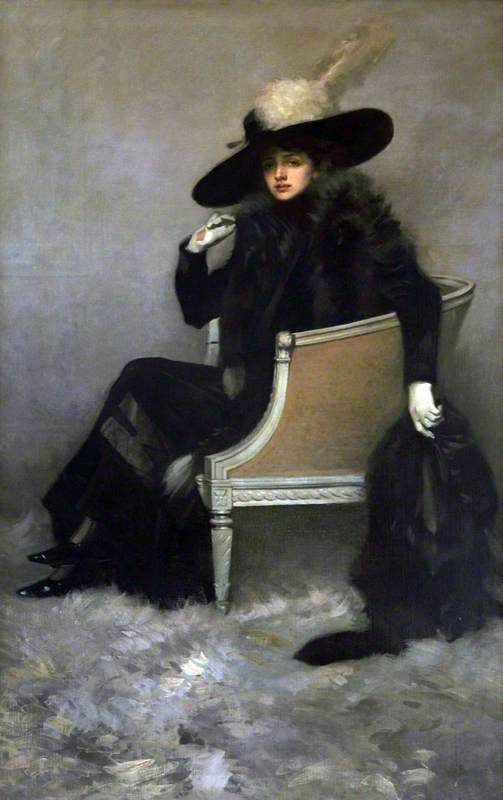
Lady in Black Furs by Pilade Bertieri (1912)

The first painting, I am showcasing is Lady in Black Furs, a work by the Italian painter Pilade Bertieri, which he completed around 1912.  Bertieri was born in Turin and exhibited in major cities in Italy, in New York and notably Manchester and Liverpool as well as Paris at the Salon from 1907 to 1931.  The painting depicts Bertieri’s wife Genevieve Wilson, the daughter of a wealthy New York socialite.  It was during a voyage in 1905 from Italy and America that they met and a year later they got married.  Bertieri said that he was first attracted to Genevieve when he saw seated on a deckchair.  For him, her graceful composure was just too much to resist and this depiction is a reconstruction of his first view of her but this time in a more fashionable chair.  The fact that she is wearing the very same furs, shoes and velvet and satin dress as she did aboard the ship in 1912 evokes memories for him of that first meeting.  At the time of the painting Genevieve was pregnant with their first child.

Fantine by Margaret Bernardine Hall (1886)

Margaret Bernadine Hall completed her painting entitled Fantine in 1886 and it depicts the character Fantine who was featured in Victor Hugo’s novel Les Misérables.  Fantine was dismissed from her job because of her illegitimate child and was forced into the life of a sex worker in order for her and her daughter to survive.  In the depiction we see Fantine protectively watching over her sleeping daughter.

Margaret Bernadine Hall was an English painter, born in 1863 in Wavertree, Liverpool.  Her father was Bernard Hall, a merchant, local politician and philanthropist, who was elected Mayor of Liverpool in 1879. Her mother was Margaret Calrow from Preston, who was Bernard Hall’s second wife. Margaret was their second child, and their oldest daughter.  In 1882 the family moved to London but at the end of that year nineteen-year-old Margaret went to live and study in Paris. Between 1888 and 1894 she travelled extensively to countries including Japan, China, Australia, North America, and North Africa, returning to live in the French capital in 1894. She moved back to England in 1907, where she died three years later.

River Scene with a Ferry Boat by Salomon van Riysdael (1650)

One of my favourite landscape painters is Salomon van Ruysdael and in his painting entitled River Scene with a Ferry Boat we see the kind of work he produced for the art-loving public. At this time, artists had mostly depicted religious subjects in their paintings and the Catholic Church used to be most artists’ best client, as they ordered altarpieces and other artworks to decorate churches and sacred places, but this came to an end with the Reformation as many Protestants refused to allow the presence of religious paintings or sculptures in churches.  This led to a great crisis for artists in Northwestern European countries as artists had only a few ways left to make money: painting portraits and illustrating books but there was also a revival of landscape paintings.  As well as the ever popular genre scenes, people began to buy landscape paintings to decorate their homes. Jacob Isaackszoon van Ruisdael, Salomon’s nephew, is generally considered the pre-eminent landscape painter of the Dutch Golden Age, a period of great wealth and cultural achievement when Dutch painting became highly popular. Jacob was best known for his atmospheric river scenes based upon the countryside around the city of Haarlem where he lived. He was also a merchant who dealt in the blue dye that was used in Haarlem’s famous cloth bleaching factories.

The Walker Art Gallery houses Salomon’s painting entitled River Scene with a Ferry Boat and we see a ferry crossing the river laden with people, livestock and even a small cart.  These ferries were an essential feature of the watery Dutch countryside, and a popular subject with landscape painters such as the Ruysdael family. This work is typical of much 17th-century Dutch landscape painting: naturalistic in its clear light and cloudy, rain-washed sky, but at the same time carefully organised to achieve a balanced composition. This work despite looking as though it was painted en plein air was not painted outdoors.  It is an idealised depiction and probably does not represent any particular place but is an amalgam of various details and features from a number of different places juxtaposed to form this vista.  Close to the riverbank we see a smaller boat with busy pulling in a fishing net. On the bank is a barn in which workers are salting fish and putting them into barrels. On top of the barn is a large dovecot. In a way the painting is a ‘foodscape’ as well as a landscape, highlighting what nature has to offer.  The Dutch patrons liked this kind of narrative painting.
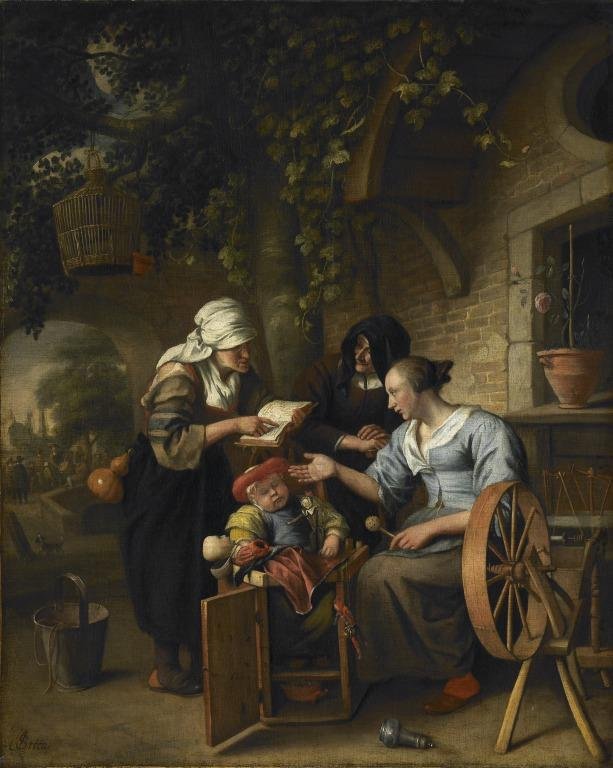
The Fortune Teller by Jan Steen (1663)

One of the greatest Dutch genre painters was Jan Steen. In Holland he ranks next to Rembrandt, Vermeer, and Hals in popularity.  He is best known for his humorous genre scenes, warm hearted and animated works in which he treats life as a vast comedy of manners.  Steen was born in Leiden and is said to have studied with Adriaen van Ostade in Haarlem and Jan van Goyen (who became his father-in-law) in The Hague. He worked in various towns – Leiden, The Hague, Delft, Warmond, and Haarlem and in 1672 he opened a tavern in Leiden.  In his painting The Fortune Teller we see a young woman sitting by her spinning wheel having her fortune told.  One interpretation of this depiction is that she is a sex worker, the old, black hooded lady is the brothel keeper and the soldiers in the background are her clients.  Fortune-telling was strongly associated with deceit, and therefore frowned upon in the seventeenth century.

The Epte in Giverny by Claude Monet (1864)
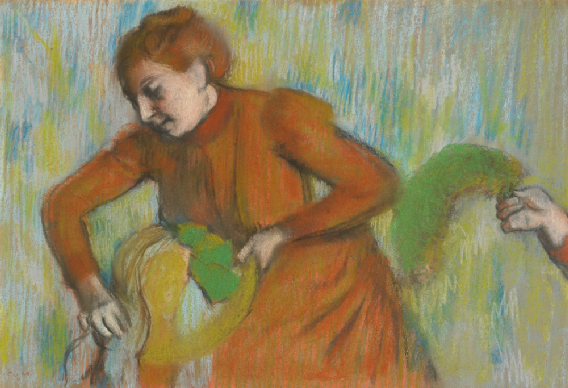
Modiste Decorating a Hat by Edgar Degas. (c.1895)

My next two offerings, The Epte in Giverny, by Monet and Modiste Decorating a Hat by Degas, are new arrivals at the gallery thanks to the beloved taxman. They have been acquired by National Museums Liverpool through the Government’s Acceptance in Lieu scheme which allows people, who have Inheritance tax bills to pay, to transfer important works of art and heritage objects into public ownership which are then allocated to museums, archives or libraries for people to enjoy.  Both the Monet and Degas artworks come from the collection of Mary Elliot-Blake and have been owned by the Montagu family by descent. Due to the family’s connection to Liverpool, the paintings were allocated to the Walker Art Gallery.

Monet completed the painting, The Epte in Giverny, in 1884, and it depicts the fast-flowing Epte river, which rises in Seine-Maritime in the Pays de Bray, near Forges-les-Eaux and empties into the Seine not far from Giverny where the artist painted his famous water lily series.

The second work is by Degas’ entitled Modiste Decorating a Hat and depicts a milliner adjusting a hat in a shop window.
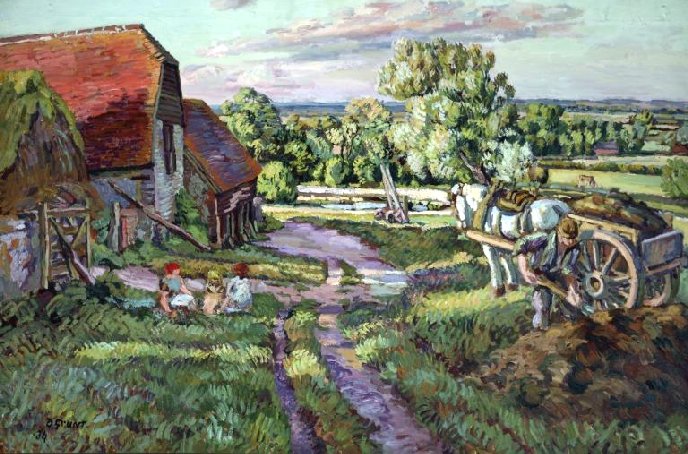
Farm in Sussex by Duncan Grant (1934)

The 1934 painting, entitled Farm in Sussex, is a depiction of Charleston Farm at Firle in Sussex is by the artist Duncan Grant. The picture was painted in his studio over a period of several years. The first thing that strikes you about the depiction is the unusually bright colours he has used and this is due to Duncan Grant’s great interest in Fauvism, which was popular between 1905 and 1910. The Fauves (the Beasts) used bright, clashing colours and fierce brushstrokes to express feelings and emotions.  In 1909, Grant met Henri Matisse, who was a leading light of this group.

He also saw more of the groups work in Roger Fry’s Post-Impressionist exhibition in London in November 1910, Fry had organised the exhibition Manet and the Post-Impressionists at the Grafton Galleries, London. This exhibition was the first to prominently feature Gauguin, Cézanne, Matisse, and Van Gogh in England and brought their art to the public.

Duncan Grant lived at Charleston Farm from 1916 with Vanessa Bell (neé Woolf), who was an artist and the sister of Virginia Woolf. They had met through the Bloomsbury Set, a London-based group of artists and writers who met regularly to discuss their work and ideas about modernism and art. Charleston Farm became a meeting place for the Bloomsbury Set outside of London.  The pair had moved to the countryside from London following the outbreak of World War I so that Grant could avoid conscription by working as a farm labourer. The couple each had their own studio at the farmhouse and decorated the entire building, including walls, fireplaces, door panels and furniture, with their paintings, fabrics and ceramics. They kept the house after the war and used it as a summer home. The painting highlights the bright colours that characterise Grant’s work. The painting was completed in 1934, the same year that Roger Fry died. Fry had been a close friend of both Duncan Grant and Vanessa Bell and was a regular visitor to Charleston. The painting reflects Grant’s affection for the Farm and the people he associated with it
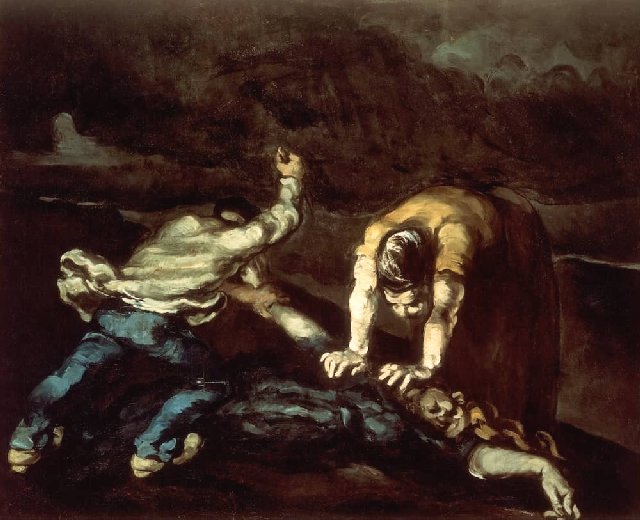
The Murder by Cezanne (c.1870)

The Murder is one of Cézanne’s early paintings which he completed around 1870.  It is a dark and highly melodramatic work which ably communicates the brutality of the act. In the depiction we see the murderer raising his hand and is about to give the final strike while his female conspirator forcefully holds down the rounded heavy-set body of the female victim whilst the fatal blow is struck.  Little can be made out of the figures; just the outline head and arms of the victim whose facial expression is contorted with pain.  The faces of her two assailants are blurred.  Cezanne was not interested with the identities of the murderers but the scene simply depicts the heinous act of anonymous violence.  The scene is made more frightening by the bleak surroundings and the dark sky overhead.  Close to the figures is a riverbank and we can deduce that the body of the dead woman will eventually be dumped into the dark waters.

Publicity Poster for Zola’s novel

The Murder was painted at a time when Cézanne was still influenced by the Old Masters such as Eugene Delacroix and Francisco Goya, and Diego Velazquez.  So after painting so many colourful landscapes why would he depict a brutal murder?  It is thought that Cezanne’s choice of depicting this brutal subject may have been inspired by Emile Zola’s novel Thérése Racquin which had been published in 1867, in which the heroine murders her husband. It was Zola’s third novel, though the first to earn wide fame. The novel’s adultery and murder were considered scandalous and famously described as “putrid” in a review in the newspaper Le Figaro. The painting’s subject could also be inspired by illustrations in the popular press.
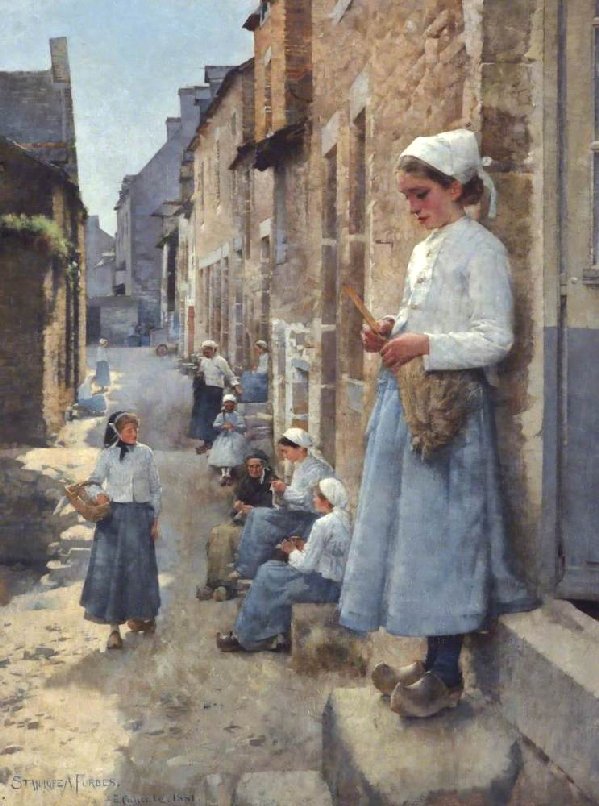
A Street in Britanny by Stanhope Forbes (1881)

My final painting is A Street in Brittany by Stanhope Alexander Forbes which he completed in 1881.  It is a depiction of figures in a narrow street: women in white headgear known as coiffes and blue petticoats.  They are grouped around their cottages, some are seated on their knitting blue jerseys for their fishermen husbands.

Stanhope Forbes was born in Dublin, the son of Juliette de Guise Forbes, a French woman, and William Forbes, an English railway manager, who was later transferred to London. He was educated at Dulwich College, and he studied art under John Sparkes at Lambeth College of Art, who later taught at South Kensington School of Art. Forbes then studied at the private atelier of Léon Bonnat in Clichy, Paris from 1880 to 1882.  It was in the French capital that Forbes met up with fellow artist, Henry Herbert La Thangue, who had also attended Dulwich College, Lambeth School of Art and the Royal Academy.

In 1881 Forbes and La Thangue went to Cancale, a village in Brittany, at the western end of the bay of Mont-Saint-Michel, fifteen kilometers east of Saint-Malo. It was here that Forbes began to paint en plein air and produced this painting. 
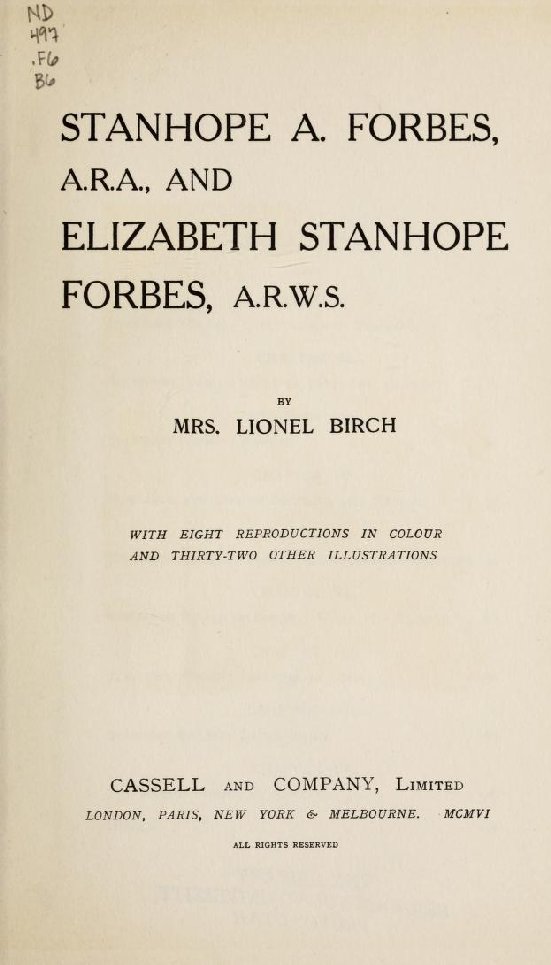
His biographer, Mrs. Lionel Birch in her 1906 book Stanhope A. Forbes, A. R. A., and Elizabeth Stanhope Forbes, A. R. W. S. recalled the setting of this work:

“..One of the first results of the visit to Cancale was a composition of figures in a narrow street: women in white coiffes and blue petticoats, grouped round their cottages and seated on their doorsteps engaged in their everlasting occupation of knitting blue jerseys for their fisher husbands…”

The biographer continues:

“…It was a very simple motif, but painted with great care and conscientiousness, and with a close and searching attention to those truths of lighting and that clear out-of-door aspect which the painter sought to betray. It was interesting, too, as the first attempt Stanhope Forbes had made in what might be termed figure composition, if, indeed, a picture in which there is so little of arrangement in the grouping of the figures can be termed a composition. But it was, at any rate, a great step from simple portraiture, and its success — for it brought the young painter a very signal one — had the most marked influence in determining his future. Exhibited at the Royal Academy of 1881, it attracted favourable attention, and when, later on, it was sent to Liverpool, the Committee of the Walker Art Gallery decided to purchase it for their permanent collection…”

Forbes left France and returned to London and exhibited the works he had made in Brittany at the 1883 Royal Academy and Royal Hibernian Academy shows.  In 1884 he moved to Newlyn in Cornwall, and soon became a leading figure in the growing colony of artists.

I hope this blog will tempt you to visit the Walker Art Gallery in Liverpool. You will not be disappointed.

Barber Institute of Fine Arts. Part 3.

The Sun Setting Through Vapour by Turner (c.1809)

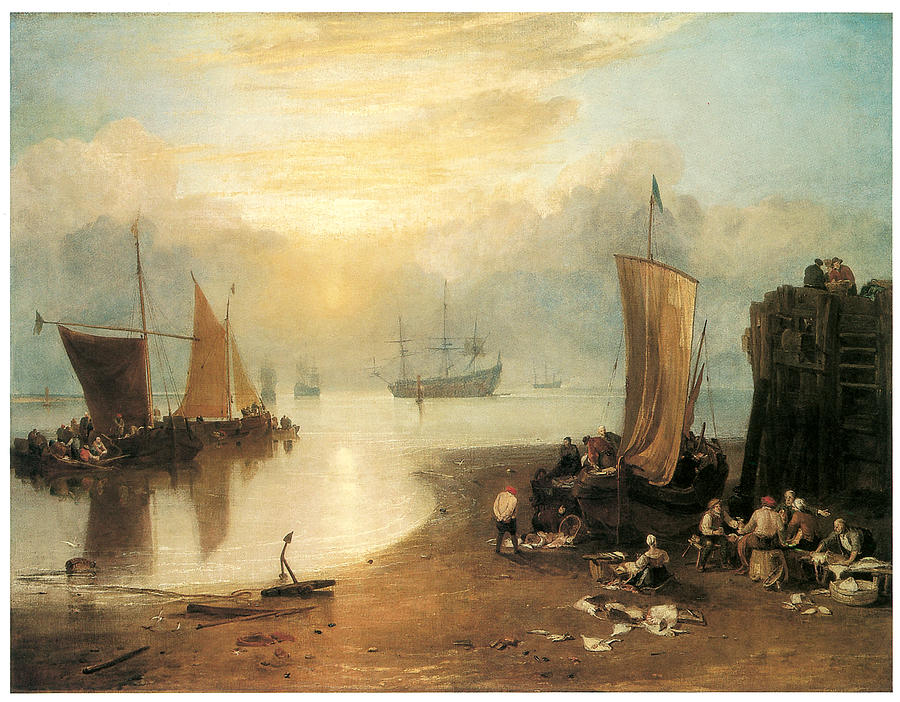
Joseph Mallord William Turner’s painting The Sun Rising Through Vapour was described at the time as masterly, and his early reputation was founded on a series of dramatic seascapes that he regularly showed at the Royal Academy, the British Institution and in his own gallery until about 1810.  The sun disperses the clouds and infuses sand and sea with a golden glow. In the foreground against a seascape with the setting sun which casts a golden light over the entire picture, we see a group of fishermen and women unloading their catch and laying it out on the beach for sale.    In the distance we see a number of ships at anchor including a man-of-war and a dismasted hulk which was being used as a prison ship, which is a stark reminder that at the time Turner completed the work, France and England were still at war.  Turner painted numerous marine subjects early in his career. As here, he sought to make his reputation by matching the Dutch masters of the 17th century.  Throughout his life Turner was fascinated with including the sun in his paintings

See the source image
The Sun Rising through Vapour by Turner (1807-09). National Gallery London

A similar painting can be found in the National Gallery, London entitled The Sun Rising through Vapour. The setting is low tide in the early morning and fishermen unload their catch from a boat beached high and dry on the shore. Some of the people are partaking of a meal whilst others prepare the catch for sale. There is a noticeable contrast between the human activity on the shore with the stillness of the glassy sea which, like a mirror, reflects the hazy sunlight. The sun is just a pale yellow glow and has yet the power to burn off the sea mist which is alluded to with the word ‘vapour’ in the picture’s title.

See the source image
The Adoration of the Magi by Bassano (c.1556)

My next offering is by the Italian painter, Jacopo dal Ponte, better known as Jacopo Bassano, named after, Bassano dal Grappa, a village northwest of Venice, where he was born in the first decade of the sixteenth century.  He was probably first trained by his father, Francesco, before becoming an apprentice in Bonifazio Veronese’s large Venetian workshop. He was mainly active, throughout his long life, in Bassano, where he painted landscapes and genre scenes. In his painting, Adoration of the Magi sometimes known as the Adoration of the Kings he depicted the Three Kings, or Magi, carrying their gifts, as they approached the infant Christ. It’s a scene that has been caught countless times on canvas.  Despite their status and wealth, they bow to Christ who they acclaim as the King of Kings. The setting, is the inside of a ruined classical building and has a symbolic meaning.  The decaying building symbolises the decline of the pagan world and the old gods.  They will be further ruined as a result of Christ’s divine mission. Look at the various aspects of this picture.  Look how Bassano has painted the sumptuously extravagant robes and depicted a splendid collection of animals and servants. Look how the light comes through the decaying architecture and settles on the head of the baby Jesus.  This is looked upon as being a light source emanating from God the Father.

Visual search query image
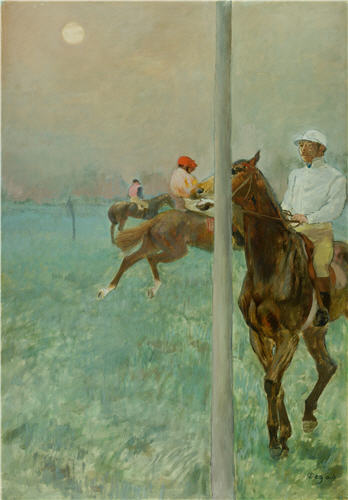
Jockeys Before the Race by Edgar Degas (1879)

I wrongly associated paintings solely depicting ballerinas with the French painter Edgar Degas but in fact he had another favourite theme for his work – horse racing.  Horse racing was a popular pastime in the nineteenth century in  France under Louis-Philippe and Napoleon III. Degas became fascinated by the sport while visiting friends in Normandy. During his lifetime, Degas created forty-five oils, twenty pastels, two hundred and fifty drawings, and seventeen sculptures related to horses.  One such work featuring horse racing is in the Barber Institute collection, entitled Jockeys Before the Race.   It is a painting, made using oil essence, gouache, and pastel, which he completed in 1879.  It is an image of three jockeys on horseback readying themselves at the start of a race on a dull winter’s day with its watery sun. This very large work (107 x 73cms) was exhibited at the Fourth Impressionist Exhibition in 1879.  There is a definite lack of symmetry about this work as the vertical starting post is placed two-thirds from the left-hand side.  The warm red and pink colours of the jockey’s clothes on the left of the painting are balanced by the lighter white/blue colours of the clothes worn by the jockey, who sits astride his horse in the right foreground.

The Castle by the Sea
Castle by the Sea by Caspar Nepomuk Scheurer (1860)

My next choice of painting is both unusual and yet strangely beautiful.  It is a 1860 watercolour over pen and pencil, partly heightened with white and gold work by Caspar Nepomuk Scheuren, a German landscape painter and etcher.  It is thought to have been commissioned as a prize in a lottery held by Kristiania Kunstforenings, Oslo, the oldest art gallery in Norway, which is why the Norwegian coat of arms is at the top centre of the work.   It is an elicitation of a poem by the German nineteenth century poet, Ludwig Uhland which tells of a legendary magical castle, depicted in the centre of the painting, which reaches up towards the moonlit sky and down to the shimmering sea.   On one side we see a king and queen and on the other, their musical daughter, who serenades passers-by with a tearful lament, whose premature death forms the focus of the poem’s lament. The castle and characters are surrounded by an architectural framework, in which the separate compartments serve to isolate episodes of the unfolding narrative.  The tragic fate of all three characters is depicted at the bottom of the painting.  In the centre the king and queen are seen dressed in mourning clothes.  To the left we see the tomb of their daughter and to the right we see a depiction of their own tomb.  Below is the poem which tells the sad story.

The Castle By The Sea

By Johann Ludwig Uhland

‘Hast thou seen that lordly castle, 
That Castle by the Sea? 
Golden and red above it 
The clouds float gorgeously. 

‘And fain it would stoop downward 
To the mirrored wave below; 
And fain it would soar upward 
In the evening’s crimson glow.’ 

‘Well have I seen that castle, 
That Castle by the Sea, 
And the moon above it standing, 
And the mist rise solemnly.’ 

‘The winds and the waves of ocean, 
Had they a merry chime? 
Didst thou hear, from those lofty chambers, 
The harp and the minstrel’s rhyme?’ 

‘The winds and the waves of ocean, 
They rested quietly, 
But I heard on the gale a sound of wail, 
And tears came to mine eye.’ 

‘And sawest thou on the turrets 
The King and his royal bride? 
And the wave of their crimson mantles? 
And the golden crown of pride? 

‘Led they not forth, in rapture, 
A beauteous maiden there? 
Resplendent as the morning sun, 
Beaming with golden hair?’ 

‘Well saw I the ancient parents, 
Without the crown of pride; 
They were moving slow, in weeds of woe, 
No maiden was by their side!’

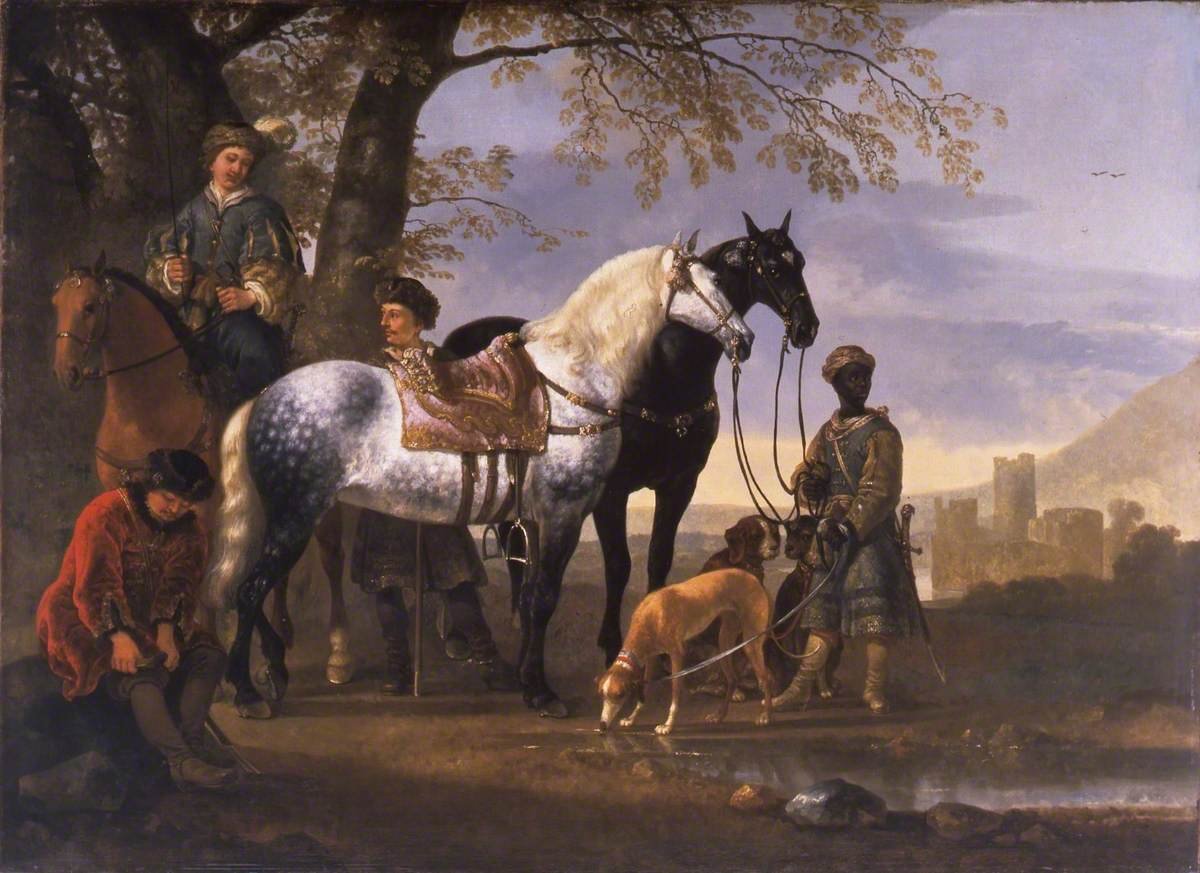
Huntsmen Halted by Aelbert Cuyp (1655)

One of my favourite Dutch painters and one who is regarded as one of the finest artists of the so-called “Golden Age” of Dutch painting, a period during and after the later part of the Eighty Years’ War (1568–1648) for Dutch independence is Aelbert Cuyp.  Cuyp was born and raised in the town of Dordrecht where he completed paintings for his patrons.  His notoriety as a great painter only came the late eighteenth century when British aristocratic collectors began to collect his pictures.  His works were admired for the way he combined his figures with his beautiful landscapes and the British aristocracy particularly liked his many depictions of equestrian and hunting themes.  Although Cuyp did not visit Italy himself, but he studied those Dutch artists who had been there and who had adopted the poetic light of the paintings by the French artist, Claude Lorrain.  In fact, Cuyp was dubbed the Dutch Claude.

In this work we see a party of hunters at rest under the shade of a large tree.  The huntsmen we see depicted are the three sons of Cornelis van Beveren, Cuyp’s wealthiest patron. De Beveren was the most powerful man in mid-seventeenth century Dordrecht.  On five occasions he had been appointed burgomaster of the town, representative to the Staaten-General and ambassador to England, as well as to France.  The van Beverens were not classed as aristocrats but undoubtedly prosperous members of the so-called “striving classes” – the nouveau riche.

The three riders wear fashionable Hungarian hunting costume and are accompanied by an exotically dressed black servant, another sign of their wealth. Why Hungarian costumes?  The reason was probably because Hungarians were admired by the Dutch not only for their famed equestrian skills but also for their staunch support of the Protestant cause, which also reflected a newfound sense of Dutch national pride and independence from the Catholic Spanish rule. The depiction shows the hunting party has come to rest in a landscape bathed in a warm golden light more associated with southern Europe than Holland. The right to hunt had once been jealously guarded by royalty and aristocracy, and thus those who hunted were afforded a traditional mark of the very highest status.  However, in the region of Zuid Holland, which governed Dordrecht, regulations had been altered in 1623 expanding hunting privileges to owners of country estates and to citizens with an annual income of more than 100 guilders.

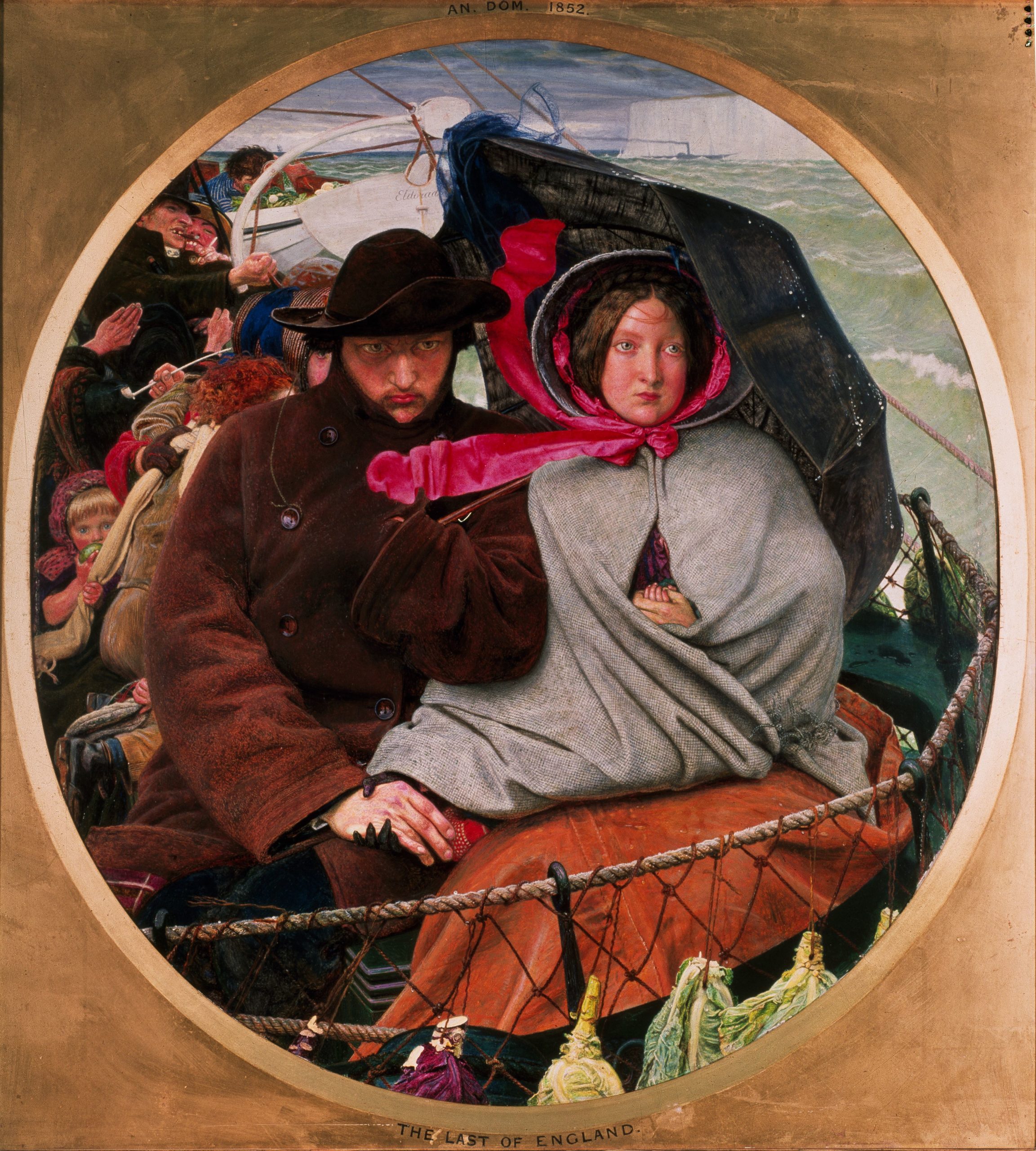
The Last of England by Ford Madox Brown (1855)

For my last offering I want to look at a painting which is part of the collection usually on display at Birmingham Museum and Art Gallery, but as I said at the start of Part One of this blog, the main Birmingham Museum is closed for renovations and this painting was then loaned out to the Barber Institute.   The Last of England was completed in 1855 by the leading Pre-Raphaelite artist Ford Madox Brown and is recognised as a masterpiece of Victorian painting. In the depiction we see a young family huddling together on an open boat as they say farewell to the shores of England and head off to find a better life and a fresh start in Australia.  This oval shape of the work which is almost circular, makes us concentrate our focus on the faces of the young couple, who have literally turned their backs on their homeland.   In the picture we see a father, mother and two children wrapped up well against the cold sea breezes as the ship leaves the familiar shores of their English homeland.   The picture, in some way, was inspired by the emigration to Australia of Maddox Brown’s friend, the sculptor Thomas Woolner in 1852.  It is ironic that although Maddox Brown started the painting the year Woolner departed from England, he had returned to England the following year, disillusioned by the false promises of wealth to be had from the gold rush.  This was some two years before Ford Madox Brown had completed the work.  Thousands of working-class and lower middle-class people, who were totally disillusioned with their life of poverty and slum-like dwellings of England, just packed up the few possessions they had and made this long and momentous journey to the other side of the world.  There were about fifty thousand free immigrants arriving each year in Australia.  The immigrants were following their dream and although they believed the “grass would be greener” for them in Australia, they would a little as to whether they had made the right decision.  Such worry and doubt was etched on the faces of the couple in the painting and in some ways we can empathise with them even though we know they had a free choice in the matter. 

In the background we can make out the white cliffs of England as they fade away in the distance.  This rock structure of white chalk is often depicted in paintings which highlight the coast of England.  In contrast to the white rock formation, we see a black steamship, with billowing black smoke coming from its funnel, heading for port.  The ship that the family is sailing on is surrounded by choppy green seas topped with white crests and this may in some way allude to the testing and difficult times ahead for our emigrants.  It is interesting to see in the foreground netting around the lifeboat deck, hanging on which are some of the ship’s fresh vegetable supplies.  We can see some cabbages and wonder how long they will remain fresh during this long, probably six-to-eight-week journey.  If we look behind “our family” we can see a small child wearing a pink bonnet, her right hand grasping the scarf warn by her mother, whilst she eats an apple held in her other hand.  Somebody, slightly hidden from view, can be seen smoking a long clay pipe but the characters that amuse me the most, and who are just visible in the background in this painting, are a pair of angry men arguing.  The man wearing the top hat has turned away and as he looks back at the departing coastline, waves his fist at it.   To this man, his departure from England is a thing of joy and for some reason he seems to be cursing the country he has just left behind.

The main characters in this painting are the father and mother and these are portraits of the artist himself and his second wife and beloved model Emma Hill.  The small fair-haired girl in the background eating the apple is their daughter Katty and the baby hidden from view is their son, Oliver.  The father is tightly wrapped up in his warm brown woollen coat.  His hat is being buffeted by the strong winds but see how there is a “safety string” from the hat attached to and wrapped around a button of his coat.  The sight of the father with his grim determined face says it all for me.  This is a journey into the unknown and probably he is still racked with doubt with regards his decision to remove his family from the safe environment of their home and whisking them off to a foreign land.  It still troubles him but he knows that he and his family cannot go back now and so his resolute look tells us that he is determined to see the venture through to its conclusion.  The look on the face of his wife is indicative that she too has concerns about their venture.  Her small, slim black leather gloved-hand tightly grasps her husband’s bare workman-like hand, the force of which wrinkles his skin.  It is, in a way, a sign that she supports him and it lets him know that fact.   Her other hand is holding the tiny fingers of the baby she cradles in her arm and which is hidden from view inside her warm woollen cape.  She is wearing a pink bonnet which is partly covered by the grey hood of her cape but we see the pink ribbons of her bonnet flying horizontally in the gale-force wind.   It is a touching picture of a family on the move.

This tense and challenging time for our emigrants was mirrored by the testing times felt by the artist himself.  Commenting on his frame of mind at the time of the painting, Maddox Brown said:

“…I am intensely miserable, very hard up and not a little mad…”

And it was at these times that he, himself, thought about emigrating to Australia.

That is my final blog about the works held in the Barber Institute of Fine Arts’ collection and if you ever visit Birmingham, England, I hope you will visit this excellent institution.

Suzanne Valdon. Part 4 – Henri Toulouse-Lautrec and Degas

Self portrait by Suzanne Valadon (1883)

In my last blog, Part 3 of the life story of Suzanne Valadon, I talked about her relationship with the French painter Pierre-August Renoir and looked at his 1883 Dance Series of painting, two of which featured Suzanne.  At the end of the blog I stated that Renoir had nurtured Suzanne’s interest in art.  I suppose nurturing was the wrong word to use as although Renoir’s art influenced Suzanne it was more his dismissive attitude to her early attempts to paint and sketch that had an effect on her.  Renoir had a somewhat condescending attitude towards her attempts at drawing and painting and this along with his preference for Aline Charigot over her rankled Suzanne all her life.  However Renoir’s indifference regarding her artistic attempts galvanised the young woman in her mission to prove him wrong and at the same time it fostered in her a desire to become a great artist in her own right, for if nothing else, Suzanne was a very headstrong and determined character and one who would never accept failure lightly. 

Suzanne Valadon did however receive valuable help and support with her quest to become an artist.  This help came from two completely different sources.   Her initial help came from a young French artist who had just come on to the Parisian art scene and it was through his good auspices that she was introduced to an elderly artist who, at the time, was viewed as The Master of all the French artists.   The young artist was Henri de Toulouse-Lautrec and the Master was none other than Edgar Degas.

My Utrillo at the Age of Nine by Suzanne Valadon (1892)

Unabashed by Renoir’s attitude Suzanne set about sketching with pencil and charcoal.  She sketched avidly.  Any free time she had from her modelling engagements were spent sketching.  It was in the Spring of 1887 that she first met the twenty-two year old, Henri Toulouse-Lautrec, who had a top floor studio at No.7 rue Tourlaque, the same building in which Suzanne, her mother Madeleine and her son Maurice were living.  Toulouse Lautrec was once described as having a grotesque appearance.  At the age of fourteen, he slipped on a floor and broke his left thigh bone.  The following year, while out walking, he fell and broke his right thigh bone.  Neither leg healed properly.  It is now believed that this was due to a genetic disorder.  After these breaks, his legs never grew any longer which resulted in him attaining a height, as an adult, of just 1.54 m (5 ft 1 in) despite have a full sized torso.  His walk was just an embarrassing shuffle.  Add to this physical deformity his oversized nose, his dark and greasy skin and full black beard which masked his face, one can envisage the physical and mental torment he must have suffered.  However, despite this, he was quite a gregarious person and had a buoyant character and soon after setting up his studio it took on a new role as a meeting place for local artists and members of the literary set.  Lautrec would often provide food and drink at these meetings and conversation would often centre on art, artists and artistic trends.  Suzanne Valadon often helped Lautrec with these get-togethers and soon she was considered the unofficial hostess of Lautrec’s soirées.  One should remember that Suzanne was quite short in stature and so standing next to the diminutive Lautrec they made for an “ideal couple”.  Suzanne had always been a very good looking woman and so, when standing next to him her physical beauty meant eyes were immediately focused upon her and not her little companion. 

Suzanne was not “backward in coming forward” at these events and would unreservedly give her opinion on current artistic trends.  As ever, her wit and the acidity of her tongue came to the fore ensuring that the evening would never be dull and of course, her physical beauty was always admired by all the male guests.   As Suzanne helped Lautrec to run his parties and add her own brand of verbal entertainment at them Toulouse-Lautrec expressed his gratitude by taking an interest in her early art. He was also the first person to buy a couple of her sketches.   He hung them on the wall of his lodgings and was often amused when visitors attributed them to artists such as Degas and Théopile Steinlen, the painter and printmaker, but all viewers of these works were in agreement that they had been done by an accomplished artist. 

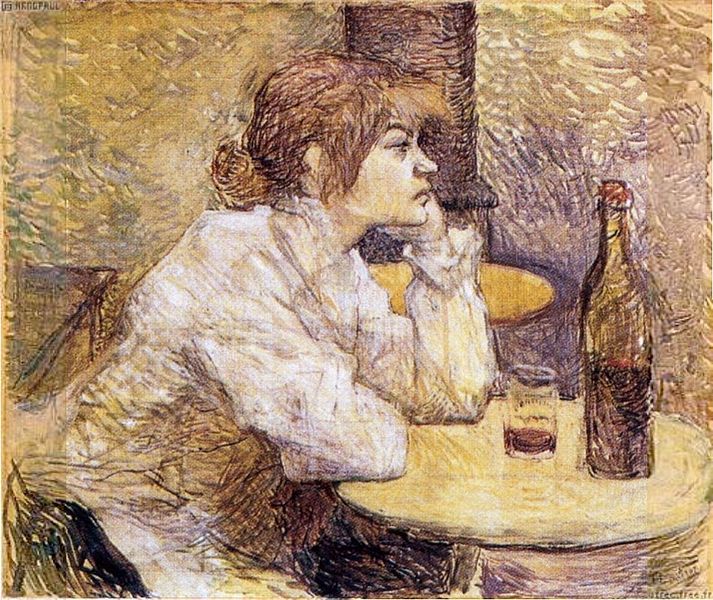
The Hangover; Portrait of Suzanne Valadon by Henri de Toulouse Lautrec (c. 1888)

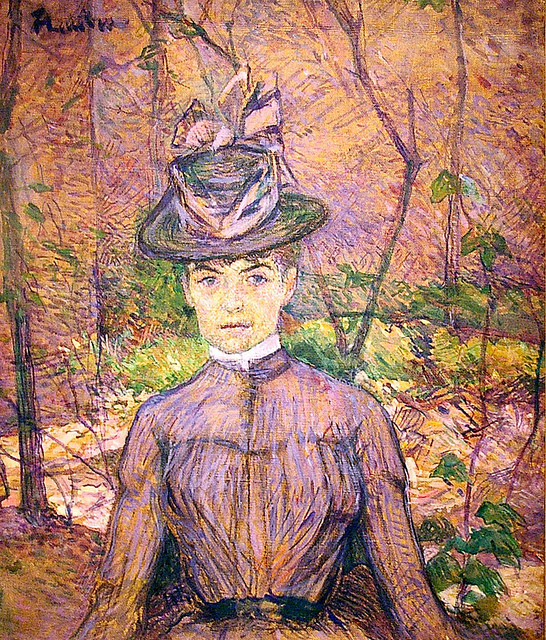
Suzanne and Toulouse-Lautrec would often wile away their time together sketching.  He completed a number of portraits of her but would never pose for her.  One of the best portraits Toulouse Lautrec did of Suzanne was his 1888 painting entitled Gueule de Bois (The Hangover) in which we see her sprawled across a café table.  She received no payment from Lautrec for modelling for this picture.  It would have been unthinkable considering all the help he had given her.  Soon Toulouse-Lautrec began to advise Suzanne, not just on things artistic, but everyday things such as how she should dress what hats she should wear and would often accompany her on shopping trips. 

Portrait of the Artist Suzanne Valadon  by Toulouse Lautrec (1885)
Portrait of the Artist Suzanne Valadon by Toulouse Lautrec (1885)

It was Toulouse-Lautrec who persuaded her to change her name from that which she was baptised, Marie-Clémentine, to Suzanne as he believed her birth name was just too mundane for an up-and-coming artist.  Suzanne agreed to the change of name and she gave Lautrec the very first painting she completed, which had been signed “Suzanne Valadon”. 

It was on the insistence of Toulouse-Lautrec that in 1887, Suzanne went to see Edgar Degas and took along some of her sketches.  She recalled the time:

“…Lautrec’s great brown eyes laughed behind his thick glasses and his mouth was solemn and grave as a priest’s when he told me I must go to M. Degas with my drawings…” 

When she arrived at Degas’ house for the first time,  Suzanne always recalled that day stating on a number of occasions that it was “the wonderful moment of my life”.  She arrived at the house in rue Victor Massé clutching her portfolio of sketches.  She was extremely nervous in his presence.  She recalled the time vividly.  Degas took her sketches, moved to the window to see them better and slowly thumbed through them mumbling comments to himself, occasionally looking up at her.  On completing his examination of her work he turned to Suzanne, who was sitting straight-backed in a chair, and uttered the words that she would never forget:

“…Yes it is true.  You are indeed one of us…”

Nude getting into the Bath besides the Seated Grandmother by Suzanne Valadon (1903)

Degas, who had once described himself as simply a colourist with line, could see the merit in Suzanne’s work despite her work was in a pure and savage state and the sketches were totally without refinement, and yet there was a sense of grace about them.  Suzanne and Degas became good and long-lasting friends.  It was a friendship which would have, in some ways, seemed strange as Degas and Suzanne came from different backgrounds and different social classes but it could be the fact that Degas was uneasy in the company of women of his own social strata and that made Suzanne and ideal companion.  During their many meetings she would show him her latest work which he would assess and give advice and she in return would tell him all the gossip and news from Montmartre, for he rarely set foot outside stating he was too ill and it was also around this time that his eyesight began to fail. 

Although Suzanne Valadon was a self taught artist it is generally accepted that she owed a lot to Edgar Degas.  It was he that supervised her first engravings and it was he who ensured that Ambroise Vollard, one of the most important art dealers of the time, presented an exhibition of Suzanne’s engravings at his gallery in 1895.  As far as Suzanne was concerned, Edgar Degas was “The Master”, an artistic genius.  Of all the artists she came across, he was the one she respected the most.  She hung on his every word, basked in his praise for her work and although he had lost a number of friends due to his petulance and grumpiness, she looked on his irascibility as part of his charm and charisma.  Degas could do no wrong in her eyes.  Degas too loved her companionship and Suzanne Valadon was one of the few people who could call herself a friend of the great man and she was immensely proud of this mutual friendship.

                                                           ……………………………………….. to be continued