
Today, as I promised in my last blog, I am going to continue looking at the life of the Danish painter Christen Købke and concentrate on some of his intriguing and exquisite portraiture work.

In my last blog, I had reached the year 1836 in the life of Købke and he had just completed a series of works featuring the Frederiksborg Castle. A year later, in November 1837, Købke married Susanne Cecilie Købke, whom he called Sanne, and shortly afterwards painted a portrait of his young bride. The following August after gaining a travel stipend awarded to him by the Royal Danish Academy, Købke leaves his wife and home and along with the Danish decorative artist, Georg Christian Hilker, sets off on a two year painting expedition around Europe. On their way to Italy they call at Dresden and Munich and pass through Austria before arriving in Rome on December 8th 1838. It is in the Italian capital that Købke meets up with many other Danish artists living in the Eternal City as well as the sculptor and medallist, Frederik Krohn, his brother-in-law, who had married his sister Susanne. In May 1839 Købke, along with Hilker and another Danish artist, Constantin Hansen journey to Naples and later to Capri where they stay until the end of that year painting out in the open air. The following year Købke spends months examining the ruins of Pompeii where he completes a series of sketches and paintings.
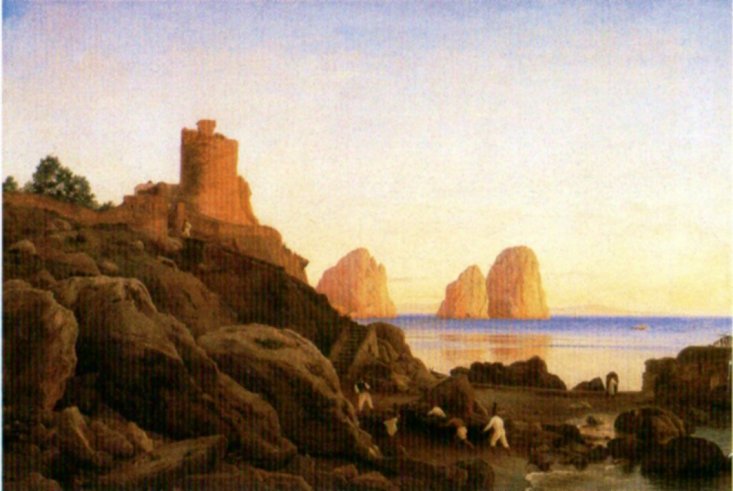
In September 1840 Købke returns home to Copenhagen and in June 1841, Købke’s wife Susanne gives birth to their first child, a son, Hans Peter Carl. In 1842 Købke applies for membership to the Royal Danish Academy which accepts his proposal of a landscape work featuring Capri as his membership piece. He was given two years in which to complete the painting. In 1843 Købke’s father, Peter, dies. By the end of 1844 Købke has still to complete his membership piece for the Academy but fortunately they give him a two year extension. In 1845 his second child was born, a daughter, Juliane Emilie. In 1846 he had finally finished the painting entitled View of Marina Picola on Capri and submits it to the Academy. To his amazement and disappointment the Academy rejects the work.

On February 7th 1848, Christen Købke died of pneumonia, aged 37 albeit his family maintained that the rejection of his painting by the Academy was a contributing factor in his death. Købke was buried in Assistens Cemetery in Copenhagen. He left behind his wife Susanne and children Hans and Juliane. His wife died the following year and his children were looked after by Købke’s sister Sophie.
Today’s blog concentrates on some of Købke’s portraiture. Portraiture is not simply the representation of a specific individual or individuals. It is not just documentary evidence of a person’s features. A good portrait looks into the soul of the person and can be used to define who the person is and by so doing the finished work gives us a clear and coherent sense of the real person we see before us on the canvas. If one thinks about a media outlet, such as a newspaper office, and think about the use of their photograph archives. Take an example of an editorial the newspaper wants to put out an article about a celebrity. They go to their photo archives and pick a photo which corroborates the story that they are writing. In other words, the picture gives one an idea about that person’s character but of course we need to remember that the newspaper can manipulate their story by cleverly using a photograph simply to prove their point, whether it be true or false. This is the same with portraiture. The portrait artist is able to manipulate his or her work so that the finished depiction can present certain characteristics or status of the sitter, which the sitter wants us to see. The portraitist can also add objects to the portrait so as to represent an idea, such as wealth by adding luxury furnishings or by depicting the sitter in expensive clothing. They can add smouldering candles or a skull to create a Vanitas painting in which they want us to contemplate the passing of time and our own mortality. In other words, the secret to great portraiture is not just how well the finished likeness is to the sitter but about how much it tells us about the sitter, about his or her place in society and their character.
As far as the Academic “pecking order” was concerned portraiture was secondary to History Painting in the painting genres. Portraiture has been around since the Ancient Egyptians with their wall paintings depicting their gods and their Pharoes. We saw portraiture in the form of sculptures and on the coinage in Ancient Greek and Roman times. The Renaissance brought us portraits of the royalty, nobility and religious leaders and later we were to see portraits of the nouveau riche and the bourgeoisie classes. In present times the art world is flooded with portraits of so-called “celebrities”. All the sitters for these portraits wanted the artist to create a portrait which would confirm their new position in society.
Christen Købke’s portraits differ from many of his contemporaries as he liked to depict the sitter in such a way so that we could read their character from their expressions. He had decided what their character was and translated that into the painting. Some of his best portraiture was a simple head and shoulder depiction with no external accoutrements such as furniture or items which could be used to tell the story of the sitter. The story of the sitter was in the face – the facial expression was to tell its own story. His works were the culmination of his probing of the personality of the sitter. Throughout his life, Købke was to complete numerous portraits. The majority were single-figure portraits whose image was full of character. However this intense searching for character in a person and his disinterest in having tell-tale inclusion of items advertising their status was in some ways counterproductive as for many would-be major portrait commissions that was just what sitters wanted and Købke’s modus operandi could well explain his lack of many lucrative commissions. When we look at many of his portraits they are of family members, friends and acquaintances and not for rich fee-paying clients. It was their loss as his outstanding talent as a portrait artist cannot be questioned.
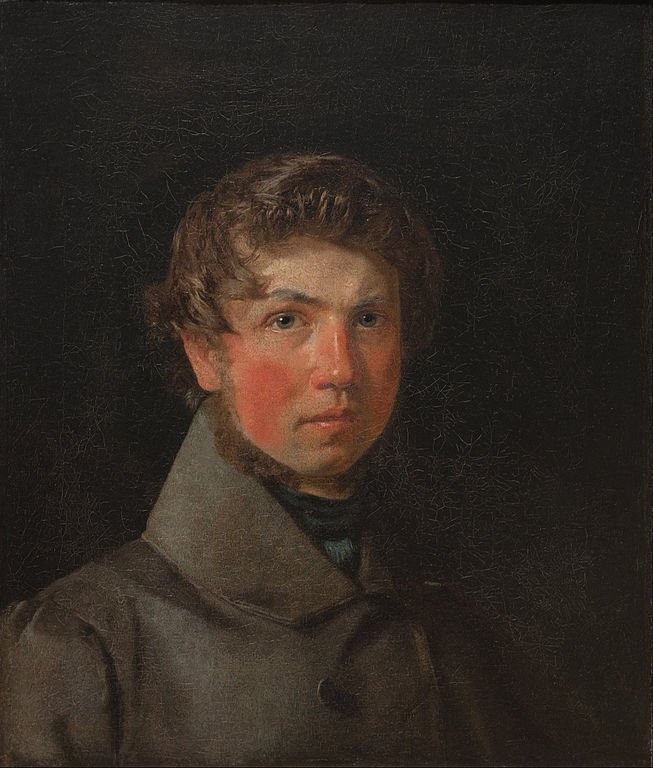
His self-portrait, at the start of this blog, was the only one he ever painted and it was completed around 1833 when he was twenty-three years old. It is a head and shoulder pose against a plain dark background which can thus not distract our eyes from looking directly at the sitter. Although now in his early twenties there is a boyish look to him and that is enhanced by his ruddy-red cheeks, a facial quality which allegedly went down well with the local Italian girls when he visited their country some years later. He has an engaging countenance and a look of sincerity.
Købke also painted his parents portraits. Portrait of the Artist’s Mother, Ceilia Margarete, née Petersen was completed in 1829 when he was nineteen years of age. Six years later, he completed a portrait of his father, entitled Portrait of the Artist’s Father, Master Baker Peter Købke.

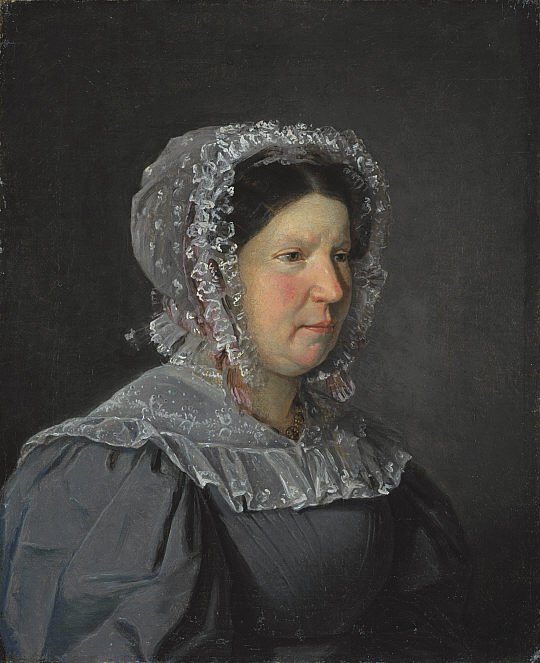
One of my favourite portraiture works of Købke was one he completed in1832. It was a portrait of Inger Høyen, who was the mother of his friend and mentor, the art historian, Niels Høyen. The portrait, simply entitled Portrait of Inger Margrethe Høyen née Schrøder, was completed by Købke in 1832. It is a beautifully painted work brimful of characterisation. It is a very sympathetic depiction of an old lady. Inger was a prosperous, self-made woman, the daughter of a Jutland gardener who went on to marry a man who worked as a distiller in a local brewery and who would later go on to run his own distillery. By all accounts she was a mild-mannered but astute person who possessed an imaginative quality. Look how Købke has portrayed her. Notwithstanding the wrinkles of time on her face he has clearly depicted her as a woman with a caring and an unassuming nature, an unpretentious character whose face radiates charm and kindness.

The final portrait I want to show you by Købke differs from most of his portraiture as there is a background to the painting and has objects included in the depiction which were there as an aid to telling the story of the sitter and his friendship with the artist. It is a carefully crafted work and needs to be studied carefully. As I told you in the last blog, Købke, in 1832, just before completing his Academy training, rented a studio with his friend and fellow student, Frederik Sødring in Toldbodvej, which was close to the Citadel. The street is now renamed Esplanaden. It was in that same year that Købke painted his friends portrait as he sat in their studio. The painting is entitled Portrait of a Landscape Painter Frederik Sødring. What is amazing about this painting is that Købke was just twenty-three years of age when he completed this work. He gave the portrait to Sødring as a twenty-third birthday present and on the reverse of the canvas there is an inscription written by Sødring:
“…Presented to me by my friend! Ch: Købke on my birthday 31 May 1832…”
It is an intimate portrait done by friend, of a friend. I am struck by Sødring’s youthful ruddy cheeks. Before us we see Sødring relaxing, partly slouched in an upright wooden chair, in a somewhat inelegant fashion. I wonder how the sitter and artist decided on the pose. Despite his somewhat ungainly posture, there is an air confidence about him. In his left hand he holds his palette whilst in his right hand, which rests on his leg, he holds a palette knife. He is ready to start painting. Sødring is wearing a striped shirt and brocaded silk waistcoat with a black velvet collar. Look how well the folds of the crisp cotton shirt and the brocade are beautifully painted by the artist. What did Købke want the painting tell the world about his friend and their friendship? Can you imagine the conversation between the two artists during the hours the portrait was being painted?
Købke has also managed to give us the impression that their studio was not pristine but somewhat untidy, somewhat cluttered – a working space. The setting appears “stage-managed” and items have been added to the portrait which mean something to the two men. Behind the sitter we see a door with an ornate brass latch and on the door is hanging an oval mirror. Why would you hang a mirror on a door? Maybe the answer is in the reflection we can see in the mirror of an easel and a picture frame. By including these images in this way it allowed Købke to not have to fill the painting with the actual easel or have his friend sitting before it. The depiction of mirrored reflections within a painting was used by many artists, especially the Dutch and Flemish painters. Famous paintings incorporating mirrored reflections include the Arnolfini Portrait by Van Eyck and Velazquez’s painting Las Meninas.
Also on the doors are a number of copper engravings, some of ancient Roman ruins and one of a cow. After Købke’s death in February 1848 an itinerary was made of all his works and those of other artists he had collected. Amongst the list was five etchings by Paulus Potter, the Dutch painter, who was famous for his depiction of cows and the one we see in the Sødring portrait is more than likely to be one of those. Below the mirror we see an accomplished still life depiction on a mahogany table incorporating a potted ivy plant and some sketch books. The ivy is a plant which always clings to its support, and in art symbolises attachment and undying affection and its inclusion in the painting is probably a reminder of the close friendship between the two aspiring artists, Sødring and Købke. The items placed on the table are of different textures and subtle colours which add an element of contrast. Amongst them is an eye-catching red box, which because of its vibrant colour, captures our attention and draws our eyes towards the table and its contents. To the right of the seated artist, leaning against the panelled wall, is a portable artist’s folding stool which alludes to Sødring’s artistic forte, plein air landscape paintings. The painting is housed in the Hirschprung Collection, the Copenhagen art museum which is located close to the much larger Danish National Gallery. The works of art in this smaller museum concentrate on paintings of the Danish Golden Age from 1800 to 1850.
Sadly during Købke’s lifetime his artistic work was not appreciated and he received few commissions. His life was relatively short and his total output was small compared to many of his contemporaries and much of it was held by family members. However, as is often the case, Købke is now looked upon by art historians as one of the most distinguished Danish painters of his time. He is now thought of as one of the most gifted among the Danish Golden Age painters.
I am ending this blog on a personal note. My first blog was published on November 9th 2010 and today’s blog is my 500th ! Back at the start of this venture I had no idea that I would complete so many but as long as I get enjoyment out of researching the works and the artists I will try to carry on a little longer. I was always determined that my blog should not just be a painting and its title. I wanted to write more about the subject of the painting, the life of the artist and a little about the history of the time. When I look back at the early blogs I see I wrote far fewer words but I was able to publish more often. However, recently, it has been my intention to write in more depth and publish less blogs and although the “Daily” in the title of my blog is now a misnomer I feel the “more in-depth but less frequent” publications are for the best. I would like to thank the many of you who have favourably commented on the blogs and to the couple of people I have upset with my words, I apologise.



 my daily art display