
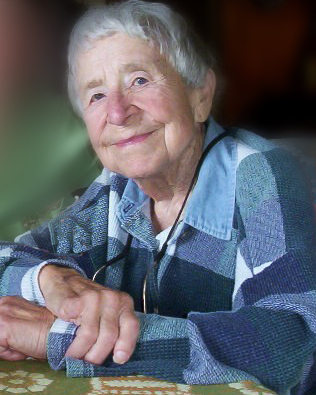
Doris McCarthy aged 96.
When I first saw the artwork of today’s featured artist, the phrase that first came to mind was “beautiful simplicity”. I hope you will feel the same when you peruse this blog. The artist I am showcasing today is Doris McCarthy, a Canadian painter, writer and educator and who is best known for her abstract landscapes.
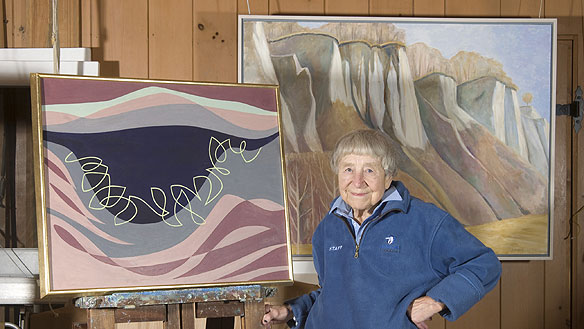
Doris McCarthy was born on July 7th 1910 in Calgary, Alberta. She was the youngest child of George Arnold McCarthy, an engineer, and Jennie McCarthy (née Moffatt). Doris had two older brothers, Kenneth and Douglas. Because of her father’s job the family had to make many house moves. In the Summer of 1912 the family moved to Vancouver, then Boise, Idaho that December. The following Spring they lived in Berkeley, California and in the Summer of that year they had re-located to Moncton in New Brunswick, where Doris’ paternal grandparents lived. Finally in the Autumn of 1913, at the age of three, Doris and her family moved to Toronto where she spent her youth living in the east end of the city, in a neighbourhood known as The Beaches, on the shores of Lake Ontario.

Doris’ schooling started when she was five-years-old at which time she was a pupil at Williamson Road Public School in Toronto. She remained there until she was eleven years of age. She then transferred to the middle-school of the Malvern Collegiate Institute in 1921. She remained at the Institute until she graduated in 1926. As she began to enjoy sketching and painting, whilst attending the Institute, she also enrolled in Saturday Junior courses at the Ontario College of Art (OCA). She showed such artistic aptitude during her time on these Saturday sessions that she was awarded a full scholarship to the college and started a three-year course in the Autumn of 1926. This was the start of her formal artistic training.

Hills at Dagmar, Ontario by Doris McCarthy (1948)
During her three-year stint at the college, she was mentored by some of the great Canadian artists such as Arthur Lismer, James McDonald and Lauren Harris who were founder members of the Group of Seven, also known as the Algonquin School of landscape painters, a group which was formed in 1920. These Impressionist painters loved to explore the uncharted areas of Canada continually recording through plein air sketches and paintings the beauty of their own country. It was from their works that other artists realised what was on offer to those who would make the effort to discover the history, culture and geography of their fine nation and question the reasoning behind going to Europe in search of inspirational beautiful scenery. Doris graduated from the college in 1930 and the following year she began to exhibit her work at the Ontario Society of Artists (OSA). She was accepted as a member of the OSA in 1945 and later went on to become OSA Vice President from 1961 to 1964 and later, President from 1964 to 1967.

Village Under Big Hills by Doris McCarthy
Was she influenced by these artistic luminaries? In an interview in 2004 she cast doubt on that assertion, saying:
“…I don’t think I was ever influenced by the Group of Seven’s actual paintings. I was influenced very strongly by the tradition of going out into nature and painting what was there. I bought it. And I still buy it…”

Sutton Village, Quebec Province by Doris McCarthy
Whilst at the OCA, Doris met and became great friends with a fellow student, Ethel Curry and the two would often go off together on painting trips together they spent many holidays painting in Haliburton Ontario. Haliburton, to the north-east of Toronto, was very popular with tourists with its beautiful lakes and old cottages. It was also referred to as the Haliburton Highlands, due to its geographical similarity to the Scottish Highlands. It was an ideal location for landscape painters such as Doris and Ethel.
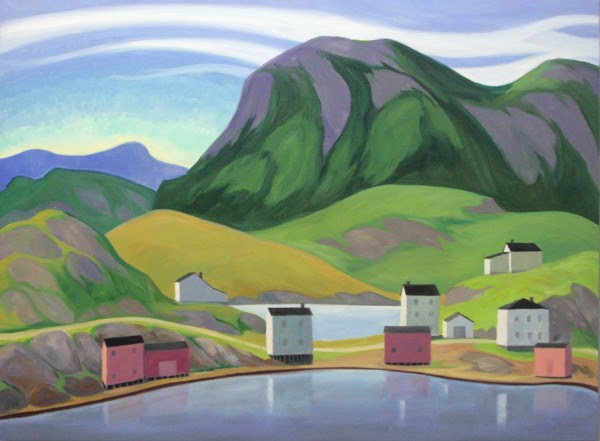
Houses on the Neck, Salvage, Newfoundland by Doris McCarthy (1999)
Doris graduated from OCA in 1930 and worked for very low wages at Grip, an advertising agency where many of the Group of Seven had previously been employed. However, her future pathway outside academia was given to her by one of her tutors, Arthur Lismer, who offered her an opportunity to teach children’s art classes at the Art Gallery of Toronto, which she accepted and thus began her career as an educator. Doris also worked part-time as a teacher with Moulton College from 1931 to 1932, and that year enrolled on a twelve-month teacher training course at the Ontario Training College for Technical Teachers in Hamilton during the years 1932 to 1933.
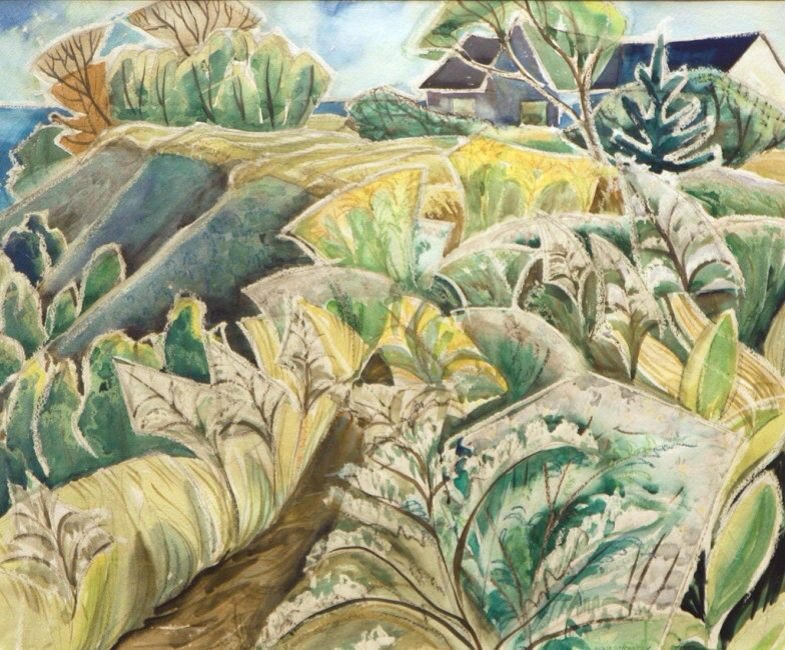
Asters in the Field at Fool’s Paradise by Doris McCarthy (1953)
In 1932 Doris, aged twenty-two, began teaching art at the Central Technical School in Toronto, and this began her forty-year period of teaching at this institute. In her forties, Doris McCarthy’s reputation as a landscape painter had blossomed. She had faithfully kept faith with the Group of Seven’s premise of “going out into nature and painting what was there” and it was on her many painting trips into the Canadian wilderness that she built up her work. Some of the places she visited looking for inspiration were Haliburton, Muskoka, Georgian Bay, the Badlands of Alberta, and the Arctic.
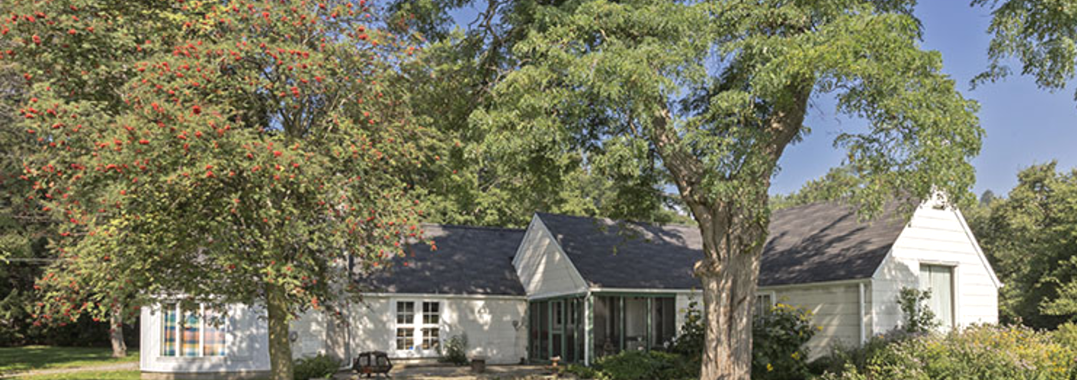
Fool’s Paradise
In 1939, whilst on a painting trip along Scarborough Bluffs she came across an abandoned property set high on top of a sheer section of the bluffs and along Gates Gully, a deep ravine at the end of Bellamy Rd. The property was derelict and covered in poison ivy. However, it was the position looking out over Lake Ontario and other views over the tree-less farmland which appealed to her, and she decided to buy the plot of land. It cost her $1,250 which was a “fortune” considering her teacher’s salary. Her mother was horrified with her daughter’s purchase and referred to it as a “fool’s paradise”. Doris was not deterred by her mother’s negative comments and designed a small single-storey cabin for the developed site. During the following years she expanded the building and protected it against the harsh winter weather. The State’s conservation authorities, wary of possible erosion of the land around her cabin, had trees planted around it but left the view of the lake unaffected. The adjacent land was later subdivided into lots and a residential neighbourhood now surrounds McCarthy’s Fool’s Paradise.
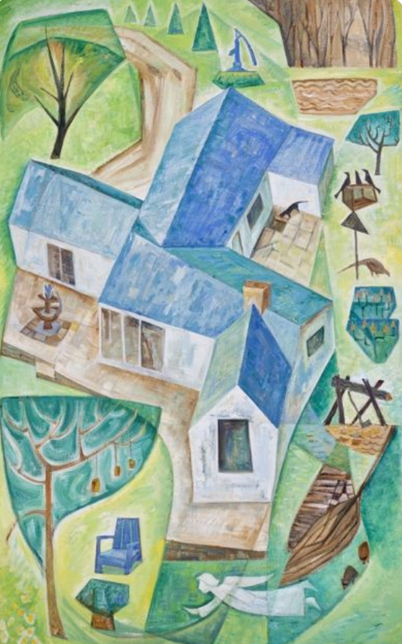
Home – a painting of her home – Fool’s Paradise on the Scarborough Bluffs, Toronto, Canada by Doris McCarthy
Doris ventured further afield when she went on a year-long sabbatical to Europe in 1951 and ten years later another twelve-month sabbatical had her travelling through the Middle East and Asia, visiting far-off places such as Afghanistan, Iraq, Cambodia, just to mention a few. McCarthy worked in both oils and watercolour and she cultivated a recognisable style of hard-edged angles, form and colour depictions.

Holman Island, Western Artic by Doris McCarthy (1977)
Using primarily thick oils and watercolours, McCarthy developed a style, often verging on abstraction, that was consistently praised for its vitality, boldness and skillful explorations of hard-edged angles, form and colour. In 1972, at the age of sixty-two, she retired from the Central Technical School. She was interviewed by a journalist from the Huffington Post as to her life in retirement and she said:
“…When I retired from teaching, I thought that the next major event of my life would be dying. There was no imagining that the best years were still ahead of me…”
For Doris McCarthy, retirement did not mean slowing down, for the following year after she retired, she enrolled at the University of Toronto Scarborough Campus as a part-time student. Sixteen years later, at the age of seventy-nine she was awarded an Honours Bachelor of Arts in Literature on June 6th, 1989.
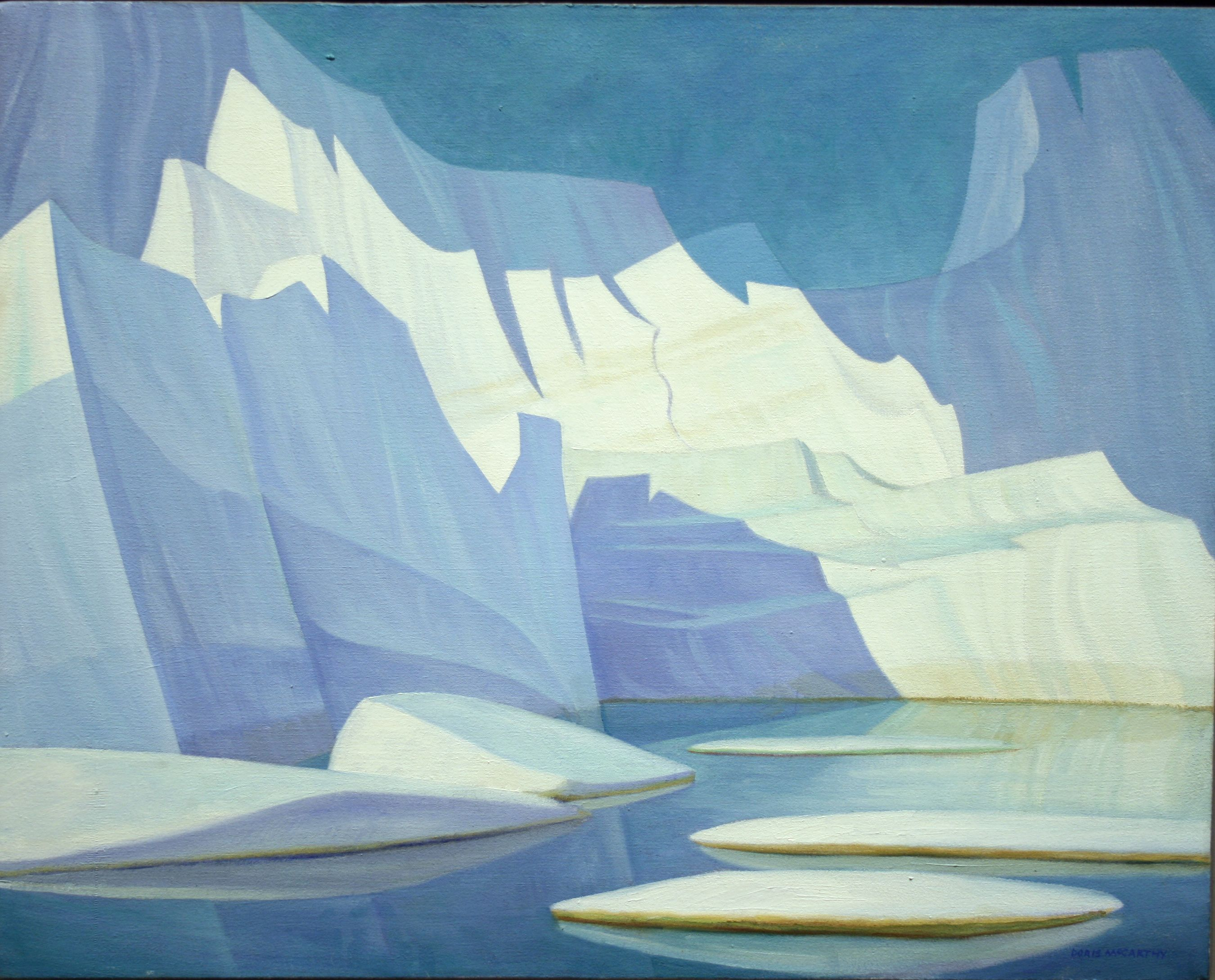
Iceberg Fantasy by Doris McCarthy
Dennis Reid is the author of The Concise History of Canadian Painting, which is considered the definitive volume on Canadian art. He was also a curator at the Art Gallery of Ontario for over 30 years. In his book of Canadian art he wrote about Doris McCarthy:
“…Following her retirement in 1972 from [teaching at] Central Technical School, Toronto, she began exhibiting commercially on a more regular basis, not just in Toronto but in Ottawa, Calgary and later Winnipeg, showing work that some saw as a fresh take on the Canadian landscape tradition. She made the first of a number of trips to the Arctic in 1972, and that encouraged greater boldness with light, colour and pattern, and in 1977 she began painting larger canvases that emphasized this confident command of formal issues even more. She began showing with Aggregation Gallery in Toronto in 1979 (which became Wynick/Tuck Galley in 1982), and her subsequent regular showings there assured close critical attention to both the work of the half century already accomplished and the new, always fresh work that continued through the nineties and beyond…”
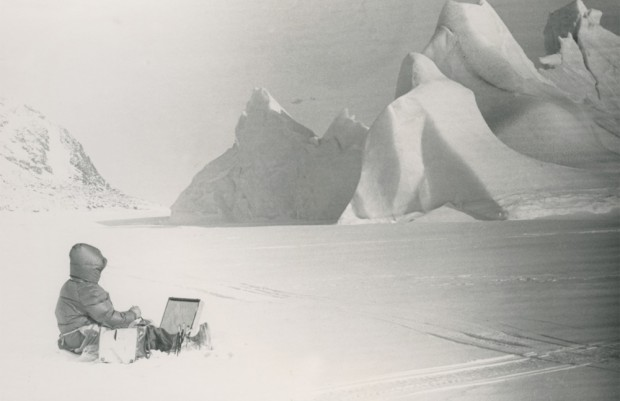
McCarthy painting at Grise Fjord, Nunavut 1976
Nunavut is the vast territory of northern Canada that stretches across most of the Canadian Arctic. It was created in 1999 out of the eastern portion of the Northwest Territories, Nunavut encompasses the traditional lands of the Inuit, the indigenous peoples of Arctic Canada. Its name means “Our Land” in Inuktitut, the language of the Inuit. The capital is Iqaluit, at the head of Frobisher Bay on southern Baffin Island.
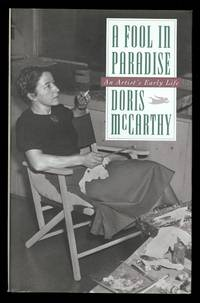
Doris McCarthy, besides painting numerous works, also wrote three autobiographies during various times in her life. In 1990 she wrote A Fool in Paradise a fascinating memoir of her early years. It describes the fortunes of an artist who was striving to establish herself in the art world of the thirties and forties and the journey made by a spirited girl searching for her own path to fulfilment. Against the backdrop of those early years, Doris writes of studying art in pre-war London, winning a teaching position in the depths of the Depression and roughing it on painting expeditions to northern Ontario, the Maritimes and the Rockies. She reveals stories of her personal life: of breaking loose from a disapproving mother, building her own home on the bluffs above Lake Ontario, and of finding love in unexpected places.
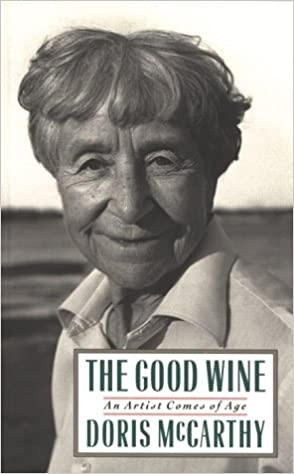
Her second autobiography entitled The Good Wine: An Artist Comes of Age describes her life from 1950 to 1991. It tells of the time at the age of forty, she broke free of her teaching responsibilities to take a year’s sabbatical in Europe as a full-time painter. It was to be the first of many adventures around the world which included a solitary round-the- world odyssey from Japan to Australia, India to the Middle East. She also discovered the Arctic and in 1991, Antarctica, drawing inspiration for her art and her life in the far-flung corners she visited and in the beloved landscape of her own country. It recounts her meetings with Dorothy Sayers and Arnold Toynbee, and all the controversies associated with the fledgling Canadian art community.
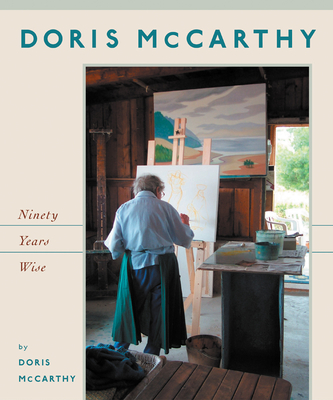
In 2004, at the age of 94, Doris McCarthy published her third and final autobiography. In this final autobiography, Ninety Years Wise, she focuses on her 92nd summer and she tells of the summer ritual of heading to her summer home, her cottage on Georgian Bay, painting and entertaining friends.
During her long life, Doris McCarthy received many awards. She was the recipient of the Order of Ontario, the Order of Canada, honorary degrees from the University of Calgary, the University of Toronto, Trent University, the University of Alberta, and Nipissing University, an honorary fellowship from the Ontario College of Art and Design and also had a gallery named in her honour on the Scarborough campus at the University of Toronto.

Doris McCarthy died at her Fool’s Paradise home on November 25, 2010, aged 100. She is buried at Mount Pleasant Cemetery. Her Fool’s Paradise property now functions as an artist’s residence, the Doris McCarthy Artist-in-Residence Centre, and is in part funded by the Ontario Heritage Trust.
Some of the information for this blog came from the following websites:
The Life of Doris McCarthy. University of Toronto
https://doris.digital.utsc.utoronto.ca/content/life-doris-mccarthy
American Women Artists
https://americanwomenartists.org/rediscovered-women-artists-doris-mccarthy/
Fool’s Paradise Guided Tour
Doris McCarthy Gallery – Fool’s Paradise Guided Tour (utoronto.ca)


 my daily art display