Woman with Homunculus by Egon Schiele

Woman with Homunculus by Egon Schiele (1910)

The best laid plans of mice and men….. etc etc.   I had intended to travel to London yesterday and visit a couple of art galleries including the Queens Gallery to see the Dutch Landscape exhibition but because of a certain visitor by the name of Mr Obama the Buckingham Palace Gallery was closed to the public.   However I did go to the National Gallery to see The American Experiment, a small exhibition of paintings by the Ashcan School of painters which was small but made for excellent viewing.   More about that later in the week.

Richard Nagy Gallery exhibition

As I had time on my hand I decided to visit the Richard Nagy private gallery in Old Bond Street and have a look at an Egon Schiele exhibition.  I am not sure what I expected to find at this display but the weekend newspapers gave it a “Must not miss” tag so I had high hopes.   They were not wrong.  It is a small but excellent exhibition and you should really try and visit it before it closes on  June 30th.  I remember when I visited Vienna at the end of last year; the three beloved artists of that country were Klimt, Kokoschka and Schiele.  This exhibition had more than forty paintings and drawings by Schiele which had not been previously seen together in a UK gallery and which of course is just the tip of his iceberg as he has more than four thousand works attributed to him. 

I intend to look at the life of Schiele over the next two days and see if I can offer you examples of his work, which are not likely to offend my readers.  I am not sure one can shy away from the word “pornographic” by clouding it with the word “art” but then it is a matter of opinion.  You will be able to look at his more risqué works on the internet and then decide for yourself.  It is up to each individual to decide when  art crosses the line from being erotic and sensual to becoming pornographic.

Egon Schiele was born in 1890 in the small Austrian town of Tulln, which lies on the River Danube, just outside Vienna.  He was the first and only surviving son of  Adolph and Marie Schiele.   His mother Marie came from Krumau (now Cesky Krumlov) in Bohemia and his father Adolph, an Austrian, was a station master for the State railways.  Schiele had two sisters, Melanie who was four years older than him and Gertrude who was four years his junior.   They all lived with their parents in an apartment above the Tulln train station which was also the place of work for their father.  Egon went to the local school and soon developed a love for art. His parents hoping he would be university-material enrolled him at the age of eleven as a boarder at the Krems Realgymnasium some twenty-five miles from their home.   Although his father had hoped he would use his artistic skills coupled with his seeming love of trains to become a railway engineer,  it was not to be.  His father lost patience with young Egon when he fell behind in his academic studies due to his fixation on art and at one point his father destroyed his sketch books.

In 1904 Adolph was taken ill having contracted syphilis.   He had to leave his job and that year he died.  It was a prolonged and painful death, with its sickness and eventual insanity and it affected Egon badly. Ten years later he wrote to a friend recalling this harrowing time.  In the letter he wrote:

“… I don’t know whether there is anyone else at all who remembers by noble father with such sadness.  I don’t know who else is able to understand why I visit those places where my father used to be and where I can feel the pain…….Why do I paint graves and many similar things?   Because this continues to live in me….”

Later, his sister, Melanie, would assert that her brother’s promiscuity was a challenge to the “Gods” to inflict him with the same disease which had killed his father.  The death of the main breadwinner caused the family financial hardship and Egon’s mother had to turn to Egon’s uncle, Leopold Czihaczek for help.  He eventually became joint guardian of the boy.

Egon attended the School of Arts and Crafts in Vienna which was the old alma mater of Klimt.  Schiele excelled at this school, so much so, that in 1906, he transferred to Vienna’s Akademie der Bildenden Kunste, the more traditional route for aspiring artists.  It was around this time that he met and was mentored by Gustav Klimt who appreciated the young Schiele’s talent.  Klimt even bought some of Schiele’s works as well as swapping some of his own work with that of the young would-be painter.  Schiele owed a lot to Klimt who put him in touch with potential buyers and Schiele held his first exhibition at the age of 18.  A year later in 1909 he left the Academy disillusioned with its teaching style and artistic constraints.  He joined a group of like-minded painters to form the Neukunstgruppe, (New Art Group).

Although Schiele had benefited immensely from what he learnt and who he met at the Academy he had felt artistically constrained and once away from the establishment he began to delve into not just the human form but also human sexuality.  It was this aspect of his paintings and drawings which was to engender controversy.  His critics described some of his works which focused on death and sex as grotesque and pornographic.  His portraits, often of nudes were painted in a realist manner and that was what probably upset some of his detractors.  Schiele took part in the International Jagdausstellung in Vienna in 1910 and he showed his life-sized, seated female nude.  Allegedly when Emperor Franz Joseph saw it he turned away muttering “This is absolutely hideous”

The Egon Schiele painting I am featuring in My Daily Art Display was painted by him in 1910 and is entitled Woman With Homonculus.  A homunculus being a scale model of a human body and refers to the seated figure to the right of the woman which tries to cling to her.  This is undoubtedly an erotic painting of a woman with her back to us, wearing only a pair of black stockings.   She has twisted her upper torso around to look over her shoulder at us in a coquettish fashion.  The reddening with rouge of the tip of her left breast and nipple can just be seen and it is this “just be seen” look which tantalises the viewer.   It is most certainly a pose and a look of a seductress and I believe she is wondering what we make of her body –  but I am sure she already knows the answer.

Tomorrow I will complete the life story of Schiele and show you a few more of his paintings and sketches.

A Man aged 38 by Lucas van Leyden

A Man aged 38 by Lucas van Leyden

My Daily Art Display for today returns to portraiture.   The oil on canvas painting is entitled A Man aged 38 and is by the Dutch artist Lucas van Leyden.  Along with the likes of Gossaert and Massys he was looked upon as one of the most significant Netherlandish artist of the early sixteenth century.  According to the eminent Dutch painter and biographer of Netherlandish artists, Karel van Mander, Leyden was born around 1494 in Leiden, one of five children.  His father was the painter Huig Jacobsz.   Leyden is looked upon as a child art prodigy as at the age of nine he was already making engravings and three years later had sold his first painting, Legend of St Hubert.  He received artistic training from his father and also from Cornelis Engelbrechtsz, a leading artist of the day.  By 1508 he was, according to the biographer van Mander, “a master of repute as a copperplate engraver”.

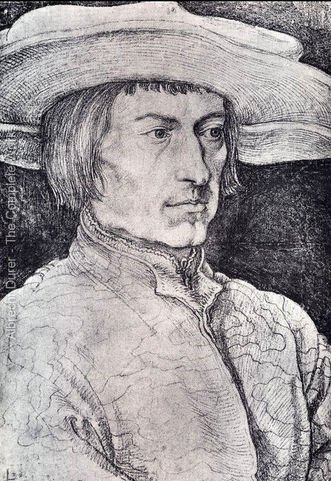
Lucas Van Leyden portrait in silverpoint by Durer

In 1521, whilst in Antwerp, van Leyden met Albrecht Dürer, an artist who had influenced his work.   In Dürer’s diary kept during his travels in the Low Countries, he records that whilst at Antwerp he met Lucas, who asked him to dinner, and that he had accepted the invitation. He valued the art of Lucas at its true figure, and exchanged the Dutchman’s prints for eight florins’ worth of his own.  Dürer even drew a silverpoint portrait of the young Dutch artist (above).  Lucas returned to his home town of Leiden.  In 1526 he married Lysbeth van Bosschuysen, a young lady from one of the most influential and wealthiest families of the town.  In 1527 Lucas journeyed around the Netherlands, hosting dinners to the painters of the guilds of Middleburg, Ghent, Malines and Antwerp.    During his tour of the Netherlands he had Jan Mabuse (Gossaert) as a companion.   Van Leyden liked to imitate him in his style as well as in his love of rich costume.

After returning home, van Leyden took ill and remained unwell until his death in 1533, aged 39 years of age.  Van Leyden was convinced that an envious colleague, who was jealous of his success, had given him poison.   He left a wife, daughter Gretchen who days before his death had given birth to van Leyden’ first grandchild.

The majority of van Leyden’s work was engravings and etchings of which he completed almost one hundred and seventy between 1508 and 1530.  These circulated throughout Europe and because of this the young artist’s reputation grew steadily. However today I am not featuring one of his many engravings or etchings but his painted portrait of a young man which he completed around 1521 at around the time he met up with Albrecht Dürer.

 We see in front of us the bust-length figure of a clean-shaven man wearing a black coat and dark green gown clutching a piece of paper in his right hand.  Inscribed on the paper are the numbers “3” and “8” and it is believed that this refers to the age of this unknown sitter.  He looks lost in his own thoughts.  He is a picture of concentration.  The background is of a plain mid-green colour and is only interrupted by the dark shadow cast by the man’s head and his black cap.  This type of shadowing effect was often seen in sixteenth century portraiture.    Although the man is looking to our left we see his face in full.    Look carefully at his eyes.  I am fascinated by how we can see the reflection of a double-light window in his eyes as he stares out at the light.  This full light shining on the sitter allows us to see clearly every detail of the tone and colour his face.  One strange facial characteristic of the sitter is his extremely low-set eyebrows.   Art historians have discussed the face and lean towards the view that maybe van Leyden has by enlarging the eyes and the angles of the face made the sitter’s portrait more flattering.  Obviously the sitter has commissioned the portrait from the artist and is expecting both a truthful and flattering image, which of course is often at odds with one another!  Still, I am sure the sitter was pleased with the result.

 Of the painting the English writer and art historian Sir Claude Phillips wrote:

 “…neither Dürer nor Holbein has painted anything more expressive than this still youthful dreamer of dreams, who but seems to look out at the spectator – in reality absorbed in the sad contemplation of his own soul….”

Portrait of a Young Man by Petrus Christus

Portrait of a Young Man by Petrus Christus (c.1460)

I suppose I lay myself open to criticism by the way I jump from one genre of painting to another or from one period to another but all I am trying to achieve is to offer you up as many art genres as possible and by so doing open up the world of art to you.   There are many web blogs which concentrate on one particular art genre and maybe when you have decided what particular type of painting you like you can then find a website or blog which solely concentrates on that genre.  However for me, my love of art is not centred on one particular genre.  I love being able to dip in and out of painting types and by doing so I am able to discover real gems.  Yesterday, I featured a twentieth-century American artist and his city landscape today I am going back in time to the fifteenth century and looking at a portrait by a Netherlandish painter.  My featured artist today is Petrus Christus and My Daily Art Display is his oil on oak painting entitled Portrait of a Young Man which he completed around 1460 and which now can be seen in the National Gallery of London.

Petrus Christus was born around 1410 in what is now known as Baarle-Hertog and lies on the Belgium side of the Belgium-Netherland’s border.  Little is known of his early life until 1444 when he was noted as being an active painter in the city of Bruges.  It is thought that earlier he could have been a student of Jan van Eyck and on van Eyck’s death in 1441, Christus took over his workshop and completed some of his master’s work, but this is purely speculation and has yet to be irrefutably proven.  One argument against this turn of events is that it is known that Christus did not receive his Bruges citizenship until 1444, which is three years after van Eyck’s death.  Had he been a pupil of, and working for, van Eyck at the time of his death in 1441, he would automatically have received his Bruges ‘citizenship then.  So the question of whether Christus was a pupil of, or a successor to, remains unanswered.  However, having said all that, the one thing which is certain is that as an artist he was influenced by the work of van Eyck and made many copies of his works and became van Eyck’s successor.

And so, to today’s painting.  We see in front of us a young man holding an open prayer book looking towards the right of the picture, which lends us to believe that this is probably the left hand part of a devotional diptych and that the missing right-hand part of the diptych may have been a picture of the Virgin Mary. 

The Veronica

Over the man’s left shoulder, we can see on the wall an illuminated parchment showing an image of a revered icon known as the veronica, and a prayer.  The words of the prayer Salve sancta facies, “Hail, Holy Face”, which was a prayer to the face of Christ imprinted miraculously on Veronica’s veil.  .   The veronica according to legend bears the likeness of the face of Jesus Christ and comes from the Latin word “vera” meaning ‘truth’ and “icon” meaning ‘image’ and therefore the Veil of Veronica, simply known as The Veronica was regarded in the Middle Ages as the true image of Jesus’ face.  These illuminated manuscripts were very popular at this time as indulgences could be gained by reciting the prayer whilst looking at the face of Christ.

Look how Christus has painstakingly painted the minute details of this illuminated parchment.  It is amazing.  See how he has illustrated the curling up of the bottom right hand corner of the parchment as it comes away from its wooden backing.  The parchment has been fixed to the wood with metal pins which have been pressed through a narrow red ribbon which acts as a colourful border to the sacred parchment. 

To the left of the picture we see a stone arch way which has been decorated with carved stone statuettes.  On the outer side we have two statuettes, one of a prophet and the other a sibyl or prophetess, who foretold of the coming of Christ.  On the inner side of the arch we have the stone sculpture of John the Baptist who also foretold the coming of Christ.  Below his carved figure there is an empty plinth and one wonders what statuette had been intended for that space.

Purse

The artists has skilfully illustrated the folds in the young man’s long red cloak with its fur trim and I particularly like the elaborate design of the money pouch with the metal purse bar which can be seen under the right arm of the figure.

This is a truly remarkable painting.

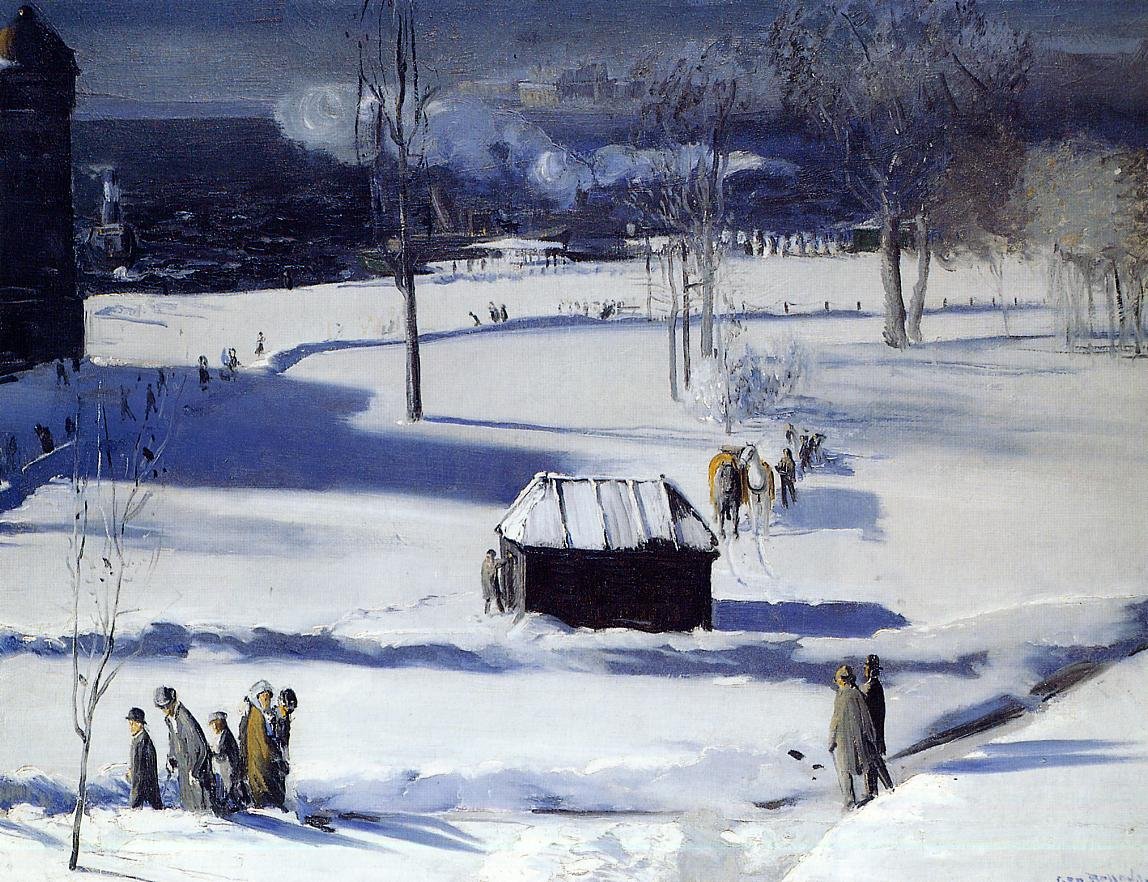
Blue Snow, The Battery by George Bellows

Blue Snow, The Battery by George Bellows (1910)

A few days ago I featured the art of Samuel Luke Fildes who in his early artistic days was a Social Realist painter.  His paintings and illustrations for The Graphic magazine dwelled on the plight of the poor in his native England and what they had to endure.  Today I am featuring an American artist of around the same era who wanted to paint pictures of real life in New York City.  He is George Wesley Bellows, the American realist painter.

George Bellows was born in Columbus, Ohio in 1882 and after passing through the various school years arrived at Ohio State University at the age of nineteen.  It was here that his sports prowess came to the fore and at one time it was thought that he may take up baseball professionally.  During his time at the university he funded himself by working as a commercial illustrator.  However Bellows had one aim in life and that was to become an artist, so much so, that he quit the university just before he was due to graduate and moved to New York to study art.

He enrolled in the New York School of Art and became a student of Robert Henri.  It was through Henri that Bellows came into contact with a group of artists known as The Eight and later became paert of  The Ashcan School.  The Eight was a group of artists whose fame derives from, and for what they will always be remembered for, their one and only joint exhibition in 1908 at the Macbeth Gallery in New York.  The exhibition was a sensation and it is now looked upon as one of the most important events in the development of twentieth-century American art

The Aschcan School was a loose collection of realist painters associated with Robert Henri.  The term “Ashcan” was first used by Art Young the American socialist writer and cartoonist when he was writing about this art movement.  They were however unified with their desire to be truthful with their art and depict the city of New York and its working-class neighbourhoods as it was and not just an idealised and formal portrayal of these suburbs.  They wanted us to see life in the raw.  The scenes of the city painted by Bellows highlighted the crudity and disorder of life amongst the working class.  This was American Realism, and he and his fellow Ashcan artists believed that their art should be similar to journalism showing the city as it was, “warts and all”.  In a way this group, including Bellows was determined to rebel against American Impressionism which was so popular at the time.  Their art did not focus on light but in general their art was darker in tone and brought the seamier side of life to the fore with subjects such as prostitution, drunks and overcrowded tenements cluttered with lines of washing.  Bellows also painted pictures of boxing matches which with their dark and atmospheric backgrounds brought out the bloody savagery of the sport.  In some of their works they depicted the poor and their struggle with everyday life.  These were the equivalent to the English Social Realism genre of art of which Samuel Luke Fildes was a leading figure.

The painting of George Bellows I am featuring today is not one of his Social Realism paintings.   My featured painting of George Bellows is entitled Blue Snow, The Battery which he completed in 1910The setting for the painting is Battery Park which lies adjacent to the financial district of the city.  There is a breathtaking beauty about this work of art.  His imaginative and powerful use of blue energizes the scene of the southern tip of Manhattan.  Bellows painted a number of scenes with New York City under snowfall and as with my featured painting it is amazing how he has developed a strong sense of light and visual texture contrasting the white and blue of the snow and the dark grimy outline of the old buildings.  It is a beautiful strong composition which is normally housed at the Columbus Museum of Art.

Bellows went on to teach at the Art Institute of Chicago but spent half the year at the home he built in Woodstock, New York. He illustrated novels including a number for H G Wells.   In 1925, at the young age of 42 he died of peritonitis after failing to tend to a ruptured appendix.

I hope to see some of his art when I visit the National Gallery in London tomorrow where thay have a small exhibition of works by George Bellows and the Ashcan painters, entitled An American Experiment.

The Farmer’s Wife and the Raven by George Stubbs

The Farmer's Wife and the Raven by George Stubbs (1782)

George Stubbs, the English artist who is best loved for his painting of horses, was born in Liverpool in 1724.  He would become the finest painter of horses that ever lived.  His father was a prosperous currier – a specialist in the leather processing industry.  Stubbs helped his father in that trade until his father died when George was seventeen years of age.  He then went on to serve a short term apprenticeship as a painter and engraver but didn’t like the work he was asked to perform.   He carried on with his love for art and took a keen interest in anatomy which was to be one of the driving passions of his life.   He was able to study this at close hand at the York County Hospital.

When he was thirty years of age he travelled to Italy.  The purpose of this European journey, he told his friend and fellow artist, Oziah Humphrey, was “to convince himself that nature was and always  is superior to art whether Greek or Roman and having renewed this conviction he immediately resolved upon returning home”.  He did return to England and settled down in a rented farmhouse in a remote part of Lincolnshire with his common-law wife Mary Spencer and with her assistance set about dissecting dead horses to learn more about their anatomy.  In 1766 he published a paper entitled The Anatomy of the Horse and the original drawings and etchings he made for this are now kept in the Royal Academy collection.

George Stubbs was recognised as a “Master” of horse painters and he received many commissions from several dukes and lords.  His masterly depictions of hunters and racehorses commanded high prices.  Stubbs soon became quite rich from the sale of his horse paintings and with the proceeds bought a house in Marylebone, an extremely fashionable part of London, where he lived until his death in 1806, a few weeks short of his eighty-second birthday.

My Daily Art Display today is not one of his many fine horse paintings but one of comparatively few subject pictures by the artist.  The painting is entitled The Farmer’s Wife and the Raven, which he painted in 1782,  and is based on a tale from John Gay’s Book of Fables.  In the painting we see a farmer’s wife astride her old white horse on her way to the market.  In the pannier baskets are her eggs which she intends to sell.   Her poor old horse, Blind Ball, is startled by the squawking of a raven, which sits high up on the branch of a nearby tree, causing it to stumble and fall.  The eggs fall out of the basket and lie broken, their yellow yokes can be seen clearly on the ground.  This painting is a tale of greed.  The large farmer’s wife did not care for the welfare of her old horse, her mind being set on the profits she was going to make from the sale of her eggs.  English people loved horses and a  painting illustrating the come-uppance of someone who did not treat their animal well was a very  popular subject for artists of the time.

The way in which Stubbs has painted the stumbling horse is testament to his great ability as an artist and his knowledge of a horse’s anatomy.     It is a perfect anatomical depiction which manages to capture the anguish of the horse in pain and its movement as it staggers to the ground.  Look how he has captured the woman who is desperately trying to avoid being thrown over the head of the stumbling horse.  Our eyes follow the story the artist has depicted.  First our eyes are drawn to the fallen white horse which stands out vividly against a dark background.  Our gaze moves up the horse’s withers to the unfortunate woman whose right arm is flung high like a rodeo rider on a bucking bronco.   We see her look of horror as she fixes her eyes on the “over-sized” raven sitting on the branch of the nearby oak tree.  The bird’s mouth is still open after letting out the squawk which has set the disaster in motion.

The painting has an inscription (in bold type below) taken from this fable:

Betwixt her swagging panniers’ load
A farmer’s wife to market rode,
And, jogging on, with thoughtful care
Summed up the profits of her ware;
When, starting from her silver dream,
Thus far and wide was heard her scream:
   ‘That raven on yon left-hand oak
(Curse on his ill-betiding croak)
Bodes me no good.’ No more she said,
When poor blind Ball, with stumbling tread,

Fell prone; o’erturned the pannier lay,
And her mashed eggs bestrewed the way.
   She, sprawling in the yellow road,
Railed, swore and cursed: ‘Thou croaking toad,
A murrain take thy whoreson throat!
I knew misfortune in the note.’
   ‘Dame,’ quoth the raven, ‘spare your oaths,
Unclench your fist, and wipe your clothes.
But why on me those curses thrown?
Goody, the fault was all your own;

For had you laid this brittle ware,
On Dun, the old sure-footed mare,
Though all the ravens of the hundred,
With croaking had your tongue out-thundered,
Sure-footed Dun had kept his legs,
And you, good woman, saved your eggs.’

A Dream of the Past – Sir Isumbras at the Ford by John Everett Millais

A Dream of the Past – Sir Isumbras at the Ford by Millais (1857)

My Daily Art Display painting of the day is one by John Everett Millais, entitled A Dream of the Past – Sir Isumbras at the Ford, which he completed in 1857.  It depicts an ancient knight on horseback carrying two children of a poor woodcutter across a river.  The character of Sir Isumbras comes from the 14th century medieval romance written in Middle English.   The actual scene we see before our eyes was not part of the original tale but more than likely came from a romance written in fake medieval verse based on the original and penned by Millais friend, the art critic Tom Taylor. 

The original poem tells the story of the humbling of the once arrogant knight.  The scene is set by the art critic and member of the Pre- Raphaelite Brotherhood, Frederic Stephens.  Stephens was not an artist but in today’s terminology, he would be described as the Pre-Rapaelite’s public relations man.  It was his job to communicate the aims of the Brotherhood to the public.  Of this painting, he wrote:

“….Sir Isumbras at the Ford was the subject of the picture Millais made his leading work in the year 1857.   It represented an ancient knight, all clad in golden armour, who had gone through the glories of this life — war honour, victory and reward, wealth and pride. Though he is aged and worn with war, his eye is still bright with the glory of human life, and yet he has stooped his magnificent pride so far as to help, true knight as he was, two little children, and carries them over a river ford upon the saddle of his grand war-horse, woodcutter’s children as they were. The face of this warrior was one of those pictorial victories which can derive their success from nothing less than inspiration. The sun was setting beyond the forest that gathered about the river’s margin, and, in its glorious decadence, symbolised the nearly spent life of the warrior…”.

This painting is a classic example of the Pre-Raphaelites’ interest in topics about medieval chivalry.  The old knight in his gleaming golden armour has helped the two children cross the stream.  The girls stares into the face of the knight with a worried expression whilst the young lad, with the wood strapped to his back, looks out at us, as he desperately clings on to the knight.   The bright and vivid colours of the children’s clothes is typical of the colours used in Pre-Raphaelite paintings

When Millais exhibited the painting it received hostile reviews and was condemned by many art critics of the time.  The leading art critic of the day, and former patron of Millais, John Ruskin, savagedly criticised the artist and the painting declaring it to be a “catastrophe”.  Millais was criticised for painting the “ugly” horse out of proportion to the figures on its back and by doing so had given the illusion that the three figures are almost floating above the animal’s back.   He also criticised Millais for how he had painted the foreground lighter than the exposed hills in the background, saying that the artist had “made errors in pictorial grammar”.   I suppose it has to be remembered that Millais, two years earlier, had married Ruskin’s wife Effie, after she had been granted an annulment of her marriage to Ruskin on the grounds that it had never been consummated.  This whole affair was splashed across the London press and had caused a scandal.   Ruskin never forgave his former protogé Millais.  Millais must have listened to the torrent of criticism as he repainted parts of it before exhibiting it in an exhibition in Liverpool. For all its criticism and the large number of detractors, this painting inspired many other artists to depict gallant knights rescuing beautiful maidens.

A Nightmare by Frederick Sandys (c.1857)

Finally let me finish with another Pre-Raphaelite painter, Frederic Sandys who satirised Millais’ painting with his print entitled A Nightmare,  in which he caricatured  Millais as the knight and his fellow artists Gabriel Dante Rossetti and Holman Hunt as the children and Sandys adds more scorn on the trio by turning the horse into a donkey which has been branded on its flank with the letters “J  R” – the initials of Ruskin !

An Al-Fresco Toilette by Samuel Luke Fildes

An Al-Fresco Toilette by Samuel Luke Fildes (1889)

For the third day running I am featuring a British artist.  The reason being is that the small art gallery I visited last week, although it had some wonderful pictures, ninety per cent were by British artists and whilst the paintings were fresh in my mind and I could still decipher my notes I thought I would dwell on what I saw.

My featured artist today is Samuel Luke Fildes who was born in Liverpool in 1844.  At the age of 17 and after he had completed his basic schooling he moved to the nearby Warrington School of Art before moving south to London and becoming a student at the South Kensington Art School and later the Royal Academy.   It was here that he was influenced by Frederick Walker, the English Social Realist painter who John Everett Millais described as “the greatest artist of the century”.   The Social Realism, sometimes termed Socio-Realism, was an  art movement whose members depicted social and racial injustice and economic hardship and in their works of art.  The subjects of their paintings were often members of the “working class” pictured struggling to survive the hardships of life.    Social Realism genre of painting was also very popular in America during the Great Depression and one famous example of  an American Social Realism painting was one by Grant Wood, entitled American Gothic which I featured on January 7th.

In 1869 when he was 24, Fildes joined the staff of the The Graphic, a new illustrated weekly newspaper, which was founded by the artist and social reformer William Luson Thomas.  Thomas believed strongly in the power of visual images and that they could change public opinion and it was his hope that this may lead to the eradication of social injustice and poverty.  Luke Fildes submitted an illustration, which was to run side by side with an article on the 1864 Houseless Poor Act and his poignant offering showing a line of homeless people queueing  up to get a ticket which would give them access to overnight accommodation.  This engraving entitled Houseless and Hungry caught the attention of a fellow artist who also worked for The Graphic, the Pre-Raphaelite painter, John Everett Millais, who showed it to the author Charles Dickens.  The author having recently just lost his book illustrator through ill-health, immediately commissioned Fildes to illustrate his new novel, The Mystery of Edwin Drood.  Fame soon followed and in 1870, Fildes left the newspaper to concentrate on his artistic work. 

I am leaving the story of Fildes life at this point as I want to conclude it tomorrow with another of his paintings, which is extremely poignant and sad and is connected to an incident later in his life.  However for today, I want to look at a painting which he completed in 1889 entitled An Al-Fresco Toilette and which can now be found in the Lady Lever Art Gallery on Merseyside.  This painting was a move away from his social realist work which was the main focus of his early artistic life.  Fildes, who began this painting in Venice, had originally decided to call this painting The Morning of the Fiesta.  It is set in a Venetian courtyard of a very old building with its vine-covered trellis work over the main entrance.   The building belonged to the artist Henry Wood.  Fildes and Wood were, at that time, looked upon as leaders of the Neo-Venetian art movement and many of their works depicted scenes of happy groups of girls passing the time away along the sides of the canals or posing on their balconies.  This type of painting was extremely popular in exhibitions and as illustrations in magazines and most importantly with art collectors.

In this painting, we see some women and children preparing themselves for that day’s Fiesta.  It is a vibrant painting full of charm and the sun has lit up the courtyard and the three women as they discuss the forthcoming event.  It is not known with any amount of certainty but it is believed that this is not an en plein air painting of a real life scene but was probably based on various individual preliminary sketches Fildes made and which were then used to build up the finished composition when he returned to his studio.  This type of happy, sunny painting was popular with art buyers.  Lord Leverhulme, the Northern Industrialist, philanthropist, and soap-manufacturer bought the painting in 1913 and considered it appropriate for his soap advertisements. 

However not everybody was happy with Fildes new art genre.  Art critics and the Art Establishment never forgave Fildes for abandoning the Social Realism genre of his early career, which had highlighted the terrible circumstances some of the poorest people in Britain had to suffer.   The Art Establishment still fervently believed that art still had an important moralistic role to play but unfortunately the taste of the buying public was starting to change.   They were moving away from these downbeat works, with all their distressing scenes, and look towards happier and sunnier scenes and Fildes realised that this was the route to financial stability.

The Doctor by Samuel Luke Fildes

The Doctor by Luke Fildes (1889)

Yesterday I was telling you about the life of Samuel Luke Fildes and featured one of his paintings An Al-Fresco Toilette, which he completed in 1889.  I ended by saying I would return to his life later as it had a connection with another of his paintings, entitled The Doctor which he completed in 1891.

Yesterday I told you how he had given up his work on the Socialist magazine The Graphic and also changed his painting style from the Socialist Realism genre to become, along with his artist friend and brother-in-law, Henry Wood, leaders of the Neo-Venetian school of painting, which had become very popular. His popularity was in the ascendancy and he had become one of the best British painters of his time.  Besides his Venetian-style paintings he completed a number of portraits including those of King Edward VII and Queen Alexandra.  He was elected as an associate of the Royal Academy in 1879 and eight years later an academician.  He was knighted in 1906.

Fildes’ eldest son, Philip tragically died of tuberculosis in 1877.  Fildes was devastated at this sad event and this terrible ordeal was captured in his painting The Doctor, which shows the medical man at the side of an ailing child.  In 1949 this painting was used by the American Medical Association in its campaign against a proposal put forward by the President of America, Harry Truman to nationalise health care.  Sixty-five thousand posters incorporating Fildes’ painting with words “Keep Politics Out of this Picture” were displayed around the country with the intention of raising public awareness of what the government was trying to do and by doing so, raising public scepticism for this new-fangled idea of nationalised health care.

Luke Fildes R.A., Painting his Picture "The Doctor" by Reginald Cleaver (c.1891)

The Doctor is probably the most famous painting by Luke Fildes.  He made numerous sketches before he sat down to paint the picture.  Fildes had travelled all over the Scottish highlands sketching the interiors of small cottages which he could maybe use in his painting.   He even had an exact replica of the sick room made in his studio right down to the table cloth and lampshade tilted towards the sick child, as shown in the drawing by the artist Reginald Cleaver.  This was actually published in the illustrated newspaper, The Graphic, which twenty-two years earlier had been the place of employment for the young aspiring artist.

In the painting we see the early morning light streaming in through the window on the left hand side.  In some ways it is a time of jubilation as the child has survived through the night.  It is a new dawn and maybe hope comes with it.  In the background we see the mother, who is both relieved and exhausted from a sleepless night, laying her head on her hands on the table.  Her husband places a comforting hand on her shoulder.  In the foreground we have the doctor and the child both illuminated by sunlight.  Look at the child.  He is not lying on a comfortable bed but stretched across two wooden chairs which are maybe all the family could afford. 

It is a poignant picture, the subject of which obviously brought memories flooding back to Fildes regarding the death of his son.  It is also, in a way, a return to the Social Realism genre of painting which Fildes did in his early twenties,  in the way it shows the poverty some people had to endure.

Springtime in Eskdale by James McIntosh Patrick

Springtime in Eskdale by James McIntosh Patrick (1934)

My Daily Art Display for today features another painting by a twentieth century British artist.  Today’s painting entitled Springtime in Eskdale was painted by the Scottish landscape artist and etcher James McIntosh Patrick in 1934.

James McIntosh Patrick was born in Dundee in 1907.  His father, an architect, encouraged his son’s interest in art and when he was 17 had him enrol as a second-year student at the Glasgow School of Art.   Later in 1926, he and one of his teachers, Maurice Grieffenhagen, had a three month summer vacation in the South of France working on paintings of the local landscape.  After he completed his studies he started off his working life as an etcher but in the 1930’s the demand for this type of work dwindled and Patrick began to concentrate on watercolour and oil painting.  The art genre he loved was that of landscape painting.   At the beginning, he would go out into the countryside make many sketches and bring them back to his studio and use them to complete his oil or watercolour painting.  It was not until later on that he perfected his style and technique in en plein air painting.  He believed this to be the best way to paint landscapes saying that it encouraged people to appreciate nature itself as they sat and painted. He was once quoted as saying:

“…I don’t suppose there is much sentimentality about my paintings, but I have a deep feeling that Nature is immensely dignified when you are out of doors.  I am struck by the dignity of everything…”

 “…..As I got to know the countryside better and better, I came to realise that rhythmic ideas are inside you and so you go around looking for landscapes where the countryside fits a preconceived idea that you have inside you and which you recognise when you see it. In other words, a twisted bit of wood, a wall or a gate, immediately causes you to say; ah, that’s the bit I am looking for… It is much easier to make up a picture than to paint nature as it appears before us…”

 He had many of his paintings shown at the Royal Academy.  The outbreak of the Second World War and his call-up into the Army Camouflage Corps curtailed his painting career for five years but when it ended he returned with his wife and family to his house in Dundee, which he had purchased before the start of war.  Their house overlooked the River Tay and it was at this time that he started experimenting with outdoor landscape painting.  His paintings were of the traditional variety in as much as “what you got is what you see” as he had no time for the “contemporary” interpretations of landscapes.  He taught art up until his eighties and continued painting up until his last few years when his eyesight began to fail.  His love for his native county of Angus was well documented in all his paintings of that area.  His depiction of the scenic countryside was shown in all types of weather conditions and at different times of the year.

Art historians rank James McIntosh Patrick as one of the greatest painters Scotland produced in the twentieth century and his artistic brilliance was a match for most of Europe’s best landscape painters of the twentieth century.  He died in Dundee, the town where he was born, in 1998, aged 91.

Today’s featured painting, Springtime in Eskdale, is a detailed landscape painting of The Crooks in Eskdalemuir, Dumfriesshire which was the birthplace of the famous civil engineer and architect Thomas Telford.  This painting by Patrick was completed in 1934 and was to mark the centenary of Telford’s death.  In the middle ground we can see people visiting a cottage whilst further back we can just make out a farmer ploughing his land.  Further back we see a small river at the foot of a line of hills, which rise into the background.  The artist’s view of the scene is from a somewhat elevated position looking down at the farmland.

I love the stone wall divisions we see in the painting.  Although I am not familiar with the location of the painting, it does remind me so much of the countryside landscape of Yorkshire with its multi coloured patchwork-quilt fields separated by dry-stone walls.  We are not looking solely at the element of Nature but we are seeing the man-made design element of stone walls, a cottage with its out-buildings and the ploughed field and how the two elements blend so perfectly.  The choice of season for the setting of this painting could well have come from the print publisher, Harold Dickens, who had seen the success of Patrick’s earlier work entitled Winter in Angus, which was in the Royal Academy exhibition of 1935  and Autumn Kinnorby and Midsummer in East Fife.

The inclusion of a road in the foreground encourages us to follow it with our eyes and thus explore the middle and background.  One of the most well-defined aspects of the painting is the way he has painted the trees.  He was a great believer that they were one of nature’s greatest gifts to mankind and he would put a lot of effort into their depiction in order for us to be more appreciative of what Mother Nature has bestowed upon us.  This painting was a result of many sketches he had made of the area and in some ways was a “slightly idealised” view of the landscape produced partly from his sketches and partly from what he could remember about the area.

Jeunesse Dorée by Gerald Leslie Brockhurst

Jeunesse Dorée by Gerald Brockhurst

Yesterday I visited the Lady Lever Art Gallery on the Wirral peninsular in order to stand face to face with Holman Hunt’s painting The Scapegoat as this was going to be my featured painting.  Of course, whilst I was there I went around the gallery, half of which is taken up by fine art paintings, mainly from British artists, and the other half was set aside for tapestries, sculptures, furniture and porcelain.  It was an interesting gallery and I can thoroughly recommend you visit it if you are in the vicinity.  The reason I mention all this is that I was mesmerised by one of the paintings on display.  I kept having to return to it and try and work out in my own mind what was the magnetic attraction of the work.  It still haunts me even now as I put my thoughts on paper.  Unfortunately the gallery shop could not offer met a print of it or even a postcard which was very disappointing.  My Daily Art Display today is this exquisite painting entitled Jeunesse Dorée by Gerald Leslie Brockhurst, who was one of the outstanding English artists of the twentieth century and a renowned portrait painter.

Gerald Brockhurst (Self Portrait)

Brockhurst was born in Edgbaston, a suburb of Birmingham, in 1890.  His father, a coal merchant, deserted the family and went to America.   He attended a number of local schools but found it hard to settle down to school life.  This was exacerbated by recurring ear infections he frequently suffered from and which often left him bedridden.  The young lad had an aunt who lived in India and he would frequently send her illustrated letters and it was this that got him interested in art and he was determined to become a painter.  His artistic talent was recognised at the early age of twelve and he won a place at the Birmingham School of Art where he remained for five years.  It was here he began to fall in love with portraiture.  He won many awards at the Birmingham School of Art and later the Royal Academy Schools, the oldest art school in the country, which was founded through a personal act of King George III in 1768. 

In 1912 Brockhurst was awarded the prestigious Gold Medal and Travelling Scholarship.  Two years later he used this scholarship to travel with his new wife Anais to Paris and Italy.  During his travels he studied the works of the “Old Masters” of the 15th and 16th centuries and these were to have a lasting impact on his art.

Anais Brockhurst first wife of the artist

Brockhurst and his wife Anais Folin went to live in Ireland and remained there for five years.  It was during those years that he created many etched and painted portraits of his wife.  From them, we can see that he was truly in love with her and was mesmerised by her beauty.  It was during this period of his life that he first met the portraitist, Augustus John who introduced Brockhurst to his circle of friends.  In fact, it was Augustus John who persuaded him to stage two major exhibitions of his works at the Chenil Gallery, London in 1916 and again in 1919.  These launched his career and Brockhurst, who had moved back to London in 1920, started to enter some of his etchings and drawings to the Royal Academy.  It was in the 1920’s that he established himself as an outstanding and flourishing portrait painter, and also strengthened his reputation as one of the exceptional printmakers of his generation

Teaching in the Royal Academy Schools was undertaken by a system of lectures delivered by Professors and Royal Academician ‘Visitors‘, and in 1928, when Brockhurst was thirty-eight years old, he was appointed a Visitor to the Royal Academy Schools.  During this time he met the sixteen year-old artist’s model Kathleen Woodward.  Brockhurst was immediately besotted by her youthful beauty and she was to become his lifelong model.  He renamed her Dorette.  Their relationship led to the break-up of Brockhurst’s marriage to Anais and a protracted and bitter divorce case, much sensationalised in the press.   The adverse publicity from this divorce together with the onset of World War II led to his decision to leave England with Kathleen ‘Dorette’ Woodward in 1940 and emigrate to America.   Brockhurst and Kathleen eventually married in 1947.

In New York Brockhurst became both famous and wealthy and lived out his life supported by a number of loyal patrons who loved his portraiture.  During his career, he carried out over six hundred portraits including portraits of the rich and famous such as the Duchess of Windsor, Wallis Simpson, J Paul Getty and Marlene Dietrich.  He died in New Jersey in 1978 at the age of 88.  Kathleen Dorette Woodward died in 1996.

And so to the painting which captivated me yesterday.  Jeunesse Dorée, meaning “gilded youth” in French, is a term applied to wealthy and fashionable society people.  It was painted by Brockhurst in 1934 and exhibited at that year’s Royal Academy Summer Exhibition.  It was purchased for £1000 by Lord Leverhume, for his Lady Lever Gallery on the very first day of the show.  The buyer’s determination to have the painting stemmed from his disappointment the year before when he tried to buy Brockhurst’s etching Dorette, but his Gallery Trustees dithered on funding the proposed acquisition and it was bought by the Harris Museum and Art Gallery of Preston.

Like myself yesterday, many people have been captivated by this wonderful painting.  The Daily Mail of the day reported on the painting and its admirers stating:

“…again I saw people yesterday standing before the picture trying to fathom the secret of those curiously haunting deep-blue eyes…”

Let us look at the painting in more detail.  It is a half-length portrait with an almost two-dimensional stark and rocky idealised landscape along with an immense sky as the background.  There is a lack of depth to the background of this painting, which in a way projects the young girl towards us.  This setting was consistent with his many portraits of the 1930’s and 1940’s but which was in contrast to the works of other portraitist who preferred to use realistic three-dimensional settings.  He has used sombre colours.  The girl stares straight at us almost daring us to blink. As you look at her you wonder what is going through her mind.  Her eyes are penetrating as if she is looking into your very soul.   There is no hint of a smile on her full-red lips.  Hers is an inscrutable expression as she fixes her gaze on us.  Having said all that, in my mind, there can be no doubting her beauty and her alluring sensuality.  Her plain-coloured cardigan, echoing the shades of the background, clings tightly to her body.  Her full breasts strain against the material and the buttons of the cardigan which hold them captive.   It is no wonder that Brockhurst was seduced by her beauty and fell in love with her.  I think I too was lost in her enigmatic loveliness.