Cecilia Beaux. Part 3 – the aspiring portrait artist.

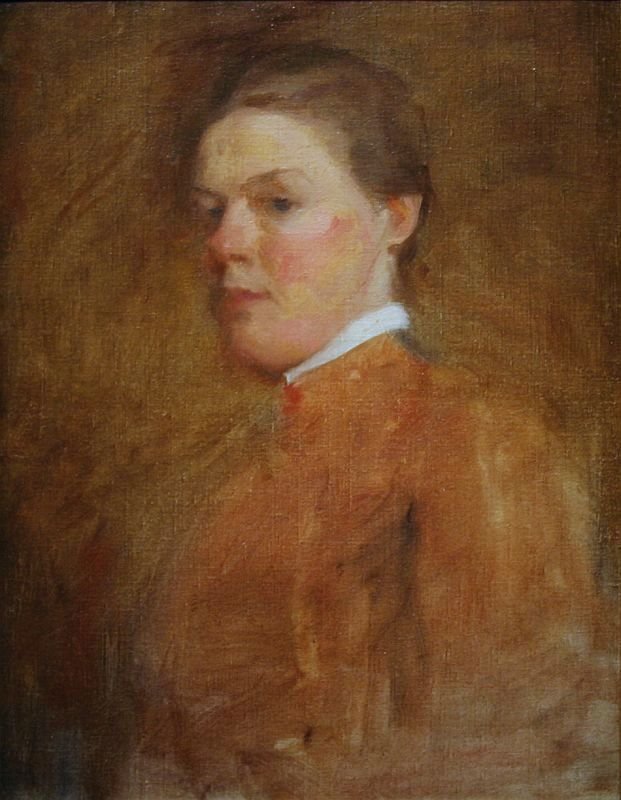
Self portrait by Cecilia Beaux (c.1889-1894)

………….the year is 1881 and Cecilia Beaux had started to attend classes organised by a former schoolfriend and their work had been periodically critiqued by the painter William Sartain. These classes went on for two years but in 1883 Cecilia got her own studio on Chestnut Street, Philadelphia, and the class moved there where they did unsupervised life drawings. It was unsupervised as the visits by William Sartain had ended due to the long commute he had to make to get from New York to Philadelphia in order to examine and review the ladies’ work. At this time Cecilia was concentrating on her portraiture and as she wrote in her biography she even decided to try and have a work of hers included in an exhibition:

“…At this time, I did a study of a friend which resulted in my making my
first entrance into the doubtful field of the Exhibitions. It was well hung at the Pennsylvania Academy and was considerably noticed…”
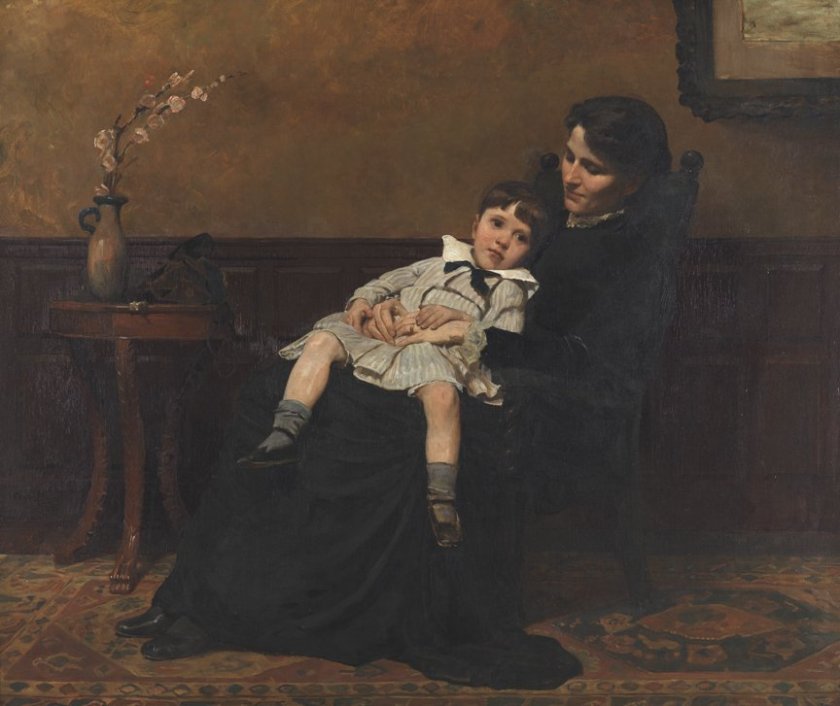
Les derniers jours d’ enfance by Cecilia Beaux (1883-1885)

It was whilst walking around her large and empty studio that Cecilia had the idea to paint a large portrait of two people in “landscape” format. Unbeknown to her at the time, it was to be one of her best-known works. Her idea was to paint a portrait of a mother and her small child. Not just any mother and child but her sister Etta, who had married Henry Sturgiss Drinker in 1879, and her first-born child, Henry (Harry) Sandwith who was born a year later. In her autobiography, Background with Figures, she envisioned how the portrait would look:

“…The mother in black sat in a low chair, the brown-eyed boy of three almost reclining in her arms. He was to wear a short blue-and-white cotton garment, his bare legs trailing over his mother’s knees. Her head was bent over him, and his hands lay upon her very white ones, which were clasped around him. The whole picture was to be warm in tone and in an interior which did not exist, except in the mind of the designer…”

She had discussed the idea with William Sartain who probably came up with the French title for the proposed work, Les derniers jours d’enfance. (The last days of childhood). Now, all she had to do was persuade her sister Etta to agree to pose with her son for the painting and she foresaw  problems, which she wrote about:

“…Poor Etta would have to take the boy to town, an hour’s trip in the horse-cars, climb eighty-four steps, and probably do this many times, with a rather uncertain result…”

However, all Cecilia’s worries came to nought as Etta was only too pleased to have her and her son depicted in a portrait. Cecilia embarked on this large painting (46 x 54 inches / 116 x 137cms) in 1883 and it took two years to complete. In the painting, we see Etta, sitting in an old steamer chair, dressed in a black frock with its various textures.  Cecilia had decided to show just one of her sister’s arms in the painting and so she had made up one closely-fitting black satin sleeve with rich lace at the wrist. Although hard to detect in the picture, Cecilia had placed a canton crepe shawl, which belonged to her grandmother, around her sister’s knees, the garment exactly taking the lines of the skirt. The shawl had been dyed black and though it was delicate, had a rich hanging texture, which made it form-fitting.

Cecilia had staged the depiction meticulously bringing several family accoutrements into her studio. On the floor she had laid one of the Leavitt family’s best oriental rugs and Etta had lent her one of her in-law’s heirlooms, a small wooden table upon which she placed a flower-filled vase belonging to the Drinker family. The background is interesting. Cecilia went out and bought a short piece of panelling from a carpenter’s shop and dyed it so it looked like a piece of mahogany and it was so placed behind the sitters so as to look like a piece of wainscoting joining the wall and floor.
Cecilia remembered in her autobiography that the numerous sittings for this joint portrait went well:

“…My sister bore her part with her usual gallantry. The boy was extremely amused by the novelty of the scene in which he found himself. His mother’s lap was comfortable, his head leaned upon her breast and her voice was close to his ear, and in the rests, he enjoyed running out into the hall with me to get a distant view of the canvas through the open door…”

It is interesting to note that Etta was occasionally relieved of her seated pose by a young woman who occupied the studio next door, for she volunteered to help as a model and posed for the draped knees and feet !

Mother and son’s joined hands

Look carefully how Cecilia had her sister and nephew pose with their hands entwined on her lap at the centre of the composition making it the focal point. Harry’s darkened fingers of his left hand placed on top of the white hand of his mother. The painting was exhibited at the Pennsylvania Academy of Fine Arts annual exhibition in 1885 and was awarded the Mary Smith Prize for the best work by a local woman.

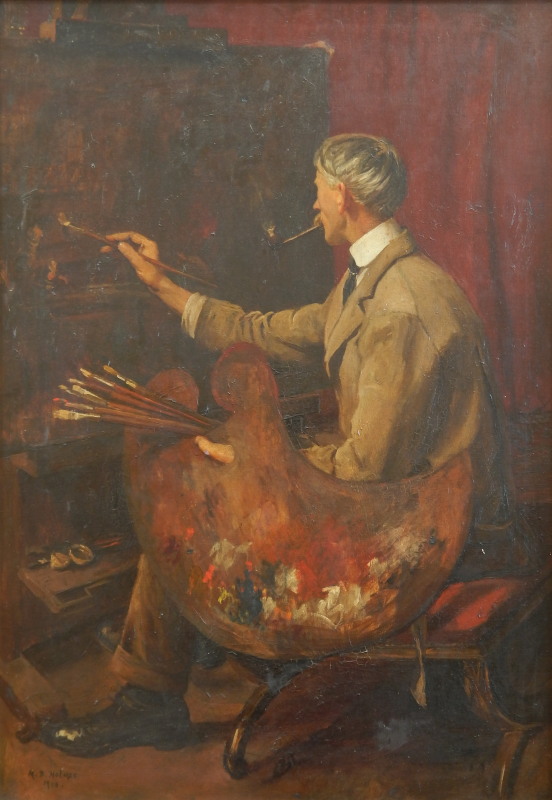
Self-portrait by Margaret Lesley Bush-Brown (1914)

Two years later, in 1887, a girlfriend of Cecilia and a fellow painter, Margaret Lesley Bush-Brown, who had been studying art at the Académie Julian in Paris and was returning to France, suggested taking the painting to the Salon for examination by the exhibition jurists. Cecilia was taken aback by the offer but agreed and the Salon jurists accepted it and it was prominently displayed in the Paris Salon of 1887. Cecilia deemed this to be a great honour and marked the beginning of her artistic career.  More importantly maybe, it also gave her a hankering to taste the delights of Paris which she believed to be the heart and soul of the art world.
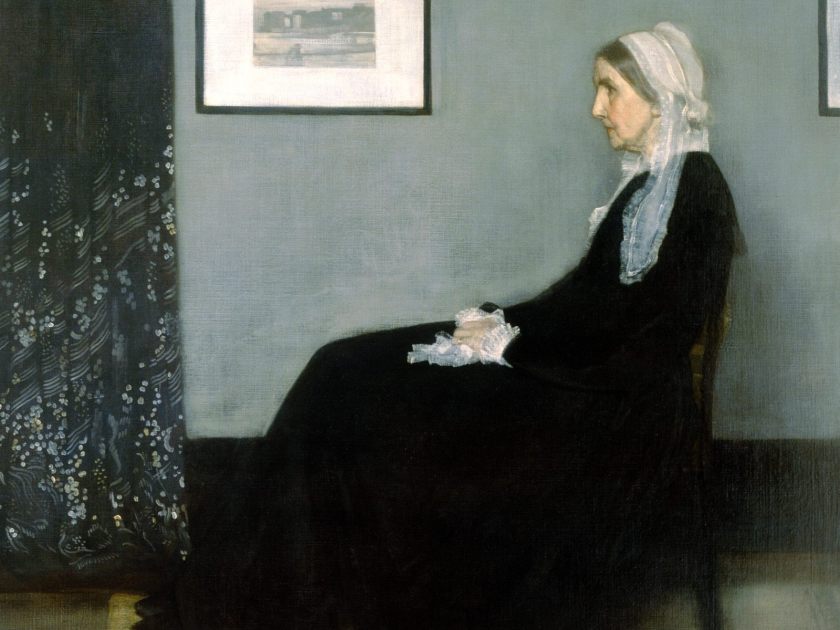
Arrangement in Grey and Black Portrait if the Artist’s Mother, by Whistler (1871)

Many people have commented on the likeness of the setting of Cecilia’s mother and child depiction to James McNeill Whistler’s Arrangement in Grey and Black: Portrait if the Artist’s Mother, which had been displayed at the 1881 Centennial Exhibition held in Philadelphia and probably had been seen by Cecilia, but she strongly denied that Whistler’s portrait of his mother had influenced her. The painting Les derniers jours d’enfance is now housed at the Pennsylvania Academy of the Fine Arts in Philadelphia.

Mrs. Alexander Sedgwick and Daughter Christina,by Cecilia Beaux (1902)

Cecilia Beaux went on to paint many tender mother and child portraits which had become so popular. One example of this was her  portrait, completed in 1902, entitled Mrs. Alexander Sedgwick and Daughter Christina. Five-year old Christina would, seventeen years later, marry the famous American writer and journalist, John Phillips Marquand who was famous for his Mr Moto spy stories.

The Reverend Doctor William Henry Furness by Cecilia Beaux (1886)

Following the completion and success of The Last Days of Childhood Cecilia Beaux carried on with her portraiture. She captured the likenesses of many leading figures from the worlds of politics and the arts, as well as works featuring friends, neighbours, family and, through her connections with the church, she produced three commissioned portraits of ministers, two of whom came through her involvement with the Woodland Presbyterian Church. One such portrait was of the well-known and well-respected eighty-four-year-old Philadelphia Unitarian minister, Reverend Doctor William Henry Furness, which she completed in 1886. Friends of the minister, who had just retired, commissioned the portrait to commemorate all the work he had done for the ministry over a fifty-year period. When the work was briefly exhibited at the Earle galleries, prior to it being given over to the Unitarian Church in Philadelphia for a fee of $500, it was well received by both the public and the art critics. The art critic of the Philadelphia Evening Telegraph, wrote in the December 28th edition of the newspaper:

“…Miss Beaux has copied nature with faithful care, and has concurrently reproduced those suggestions of individuality and personality…. In this respect the portrait is marvellously life-like, and no one not coldly indifferent and insensible can study the work without being impressed by the attributes of benign, gracious, potent manliness it presents…”
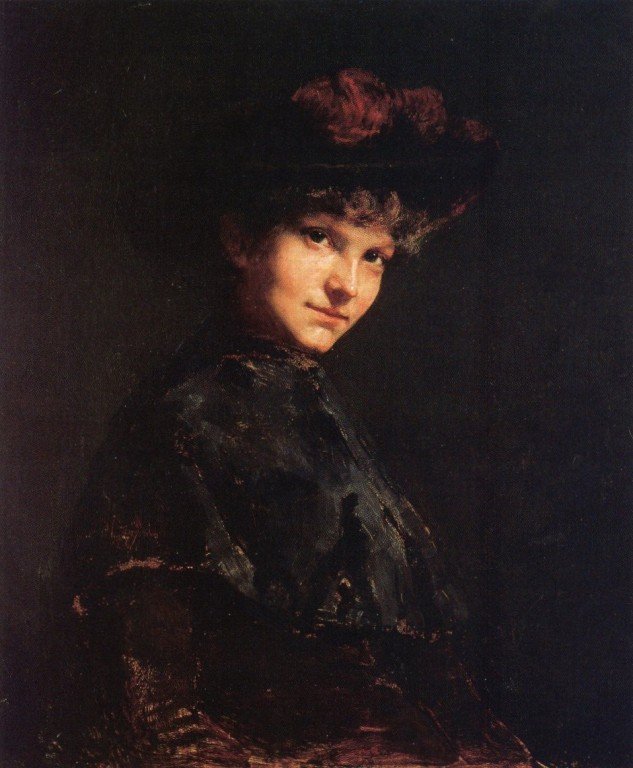
Ethel Page by Cecilia Beaux (1884)

Cecilia completed many portraits featuring Ethel Page, a Philadelphia socialite. Cecilia met Ethel Page in 1876. The 1884 portrait of Page with the sitter’s face brightly lit in contrast to the dark background was typical of was typical of Cecilia’s early style.

The haunting facial expression of the sitter with her piercing stare makes for a beautiful study.
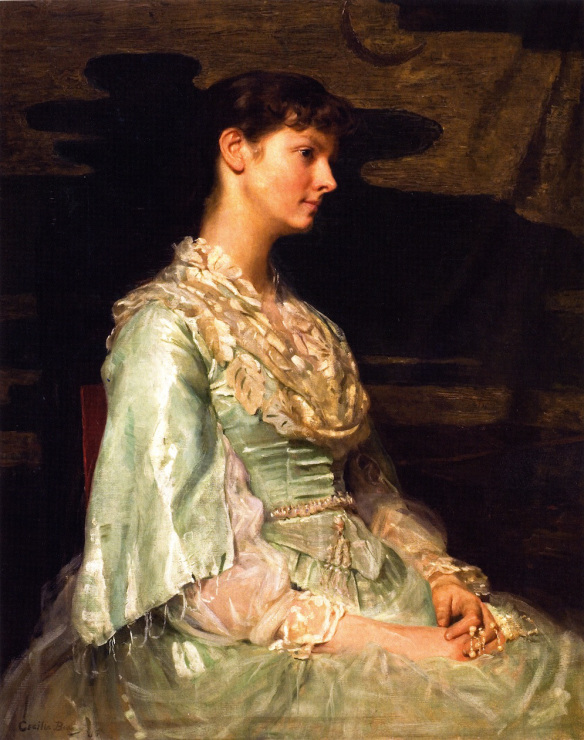
Ethel Page as Undine by Cecilia Beaux (1885)

Another portrait of Page completed in 1885 depicts the actress in her role as Uncompaniondine and this again won Cecilia the Mary Smith Prize at the Pennsylvania Academy for the second year in a row.
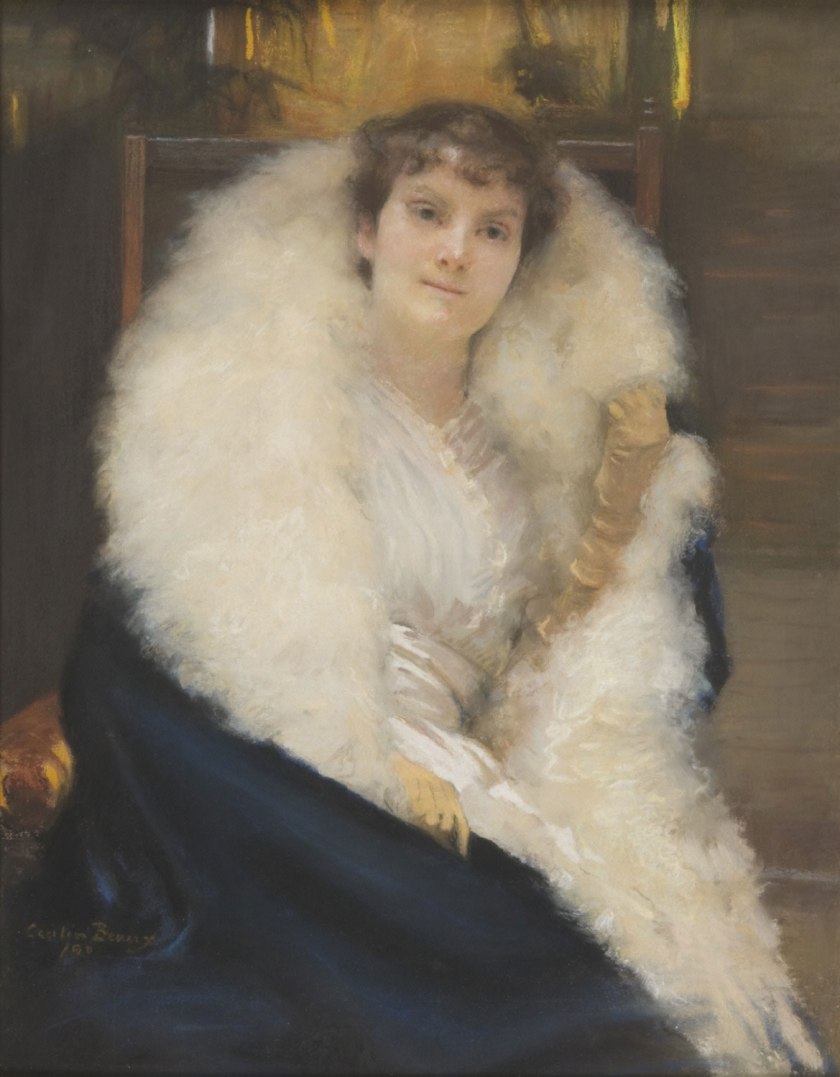
Ethel Page by Cecilia Beaux (1890)

Cecilia Beaux completed a pastel portrait of Ethel Page in 1890. It is a much softer depiction which has a feeling of warmth and in a way, highlights the artist-sitter’s friendly relationship. The portrait of Ethel Page also exudes a sense of elegance and I am sure the finished painting pleased the sitter.

A new phase in Cecilia Beaux’s life came in January 1888 when she and her companion, her cousin May Whitlock boarded the SS Nordland bound for Paris……..

………………………..to be continued.


Besides various internet websites, most of the information for the blogs featuring Cecilia Beaux came from two books:

Background with Figures, the autobiography of Cecilia Beaux

Family Portrait by Catherine Drinker Bowen

and the e-book:
Out of the Background: Cecilia Beaux and the Art of Portraiture by Tara Leigh Tappert

The blog, American Girls Art Club In Paris. . . and Beyond, featuring Cecilia Beaux was also very informative and is a great blog, well worth visiting on a regular basis.:

https://americangirlsartclubinparis.com/tag/catherine-ann-drinker/


Cecilia (Leilie) Beaux. Part 2 – the beginning of an artistic career.

Self-portrait, Cecilia Beaux (1885)

The early childhood and teenage years of Cecilia (Leilie) Beaux were challenging. She and her elder sister Etta lived with their maternal grandmother Cecilia Kent Leavitt and their maiden aunt Eliza. Leilie and Etta were completely different in character. Etta was the more placid and was happy to accept traditional domestic life and probably modelled herself on her grandmother who had nurtured her own eight children. Leilie, on the other hand, was both stormy and impassioned and hankered for her independence and believed that financial security would achieve that status. She would, like her late mother and aunt, Eliza, go out to work and earn money. Leilie was a perfectionist and suffered like all perfectionists tend to do. In her personal diary which she started at the age of fourteen, she wrote:

“…It seems to me that I haven’t progressed at all. I do believe that it is harder for some people to be good than others, a great deal harder. Some people seem to be good naturally like Etta…but as for poor me why I’m nothing absolutely nothing, able only to do wrong. Sometimes it seems to me as if I were tied in a spiritual way to a string of a certain length. I get on very well at first and feel so free and happy, feel as if I really was getting better, when suddenly I come to the end of my string, and am thrown back to the old place again…”

Leilie was often rebellious as a teenager, frustrated with her life and often aspiring to do something different. In her autobiography she remembered that in her teenage years she wrote a poem expressing her exasperation:

“…Lost hope, lost courage, lost ambition,
What’s left but shams of these to hide my true condition?
Feigned peace and joy, feigned happy effort,
False tongue, proclaiming, “Art’s my comfort.”
Nought’s left but bones, and stones and duty that’s not pleasure,
But grinding, ceaseless toil, whose end’s the measure
Of the short web of life the Fates have spun me.
What’s this… I’ve uttered words of treason.
What’s lost? My time, my daylight, and my reason…”

Leilie also suffered mentally from the departure of her father from the family home. Sadly, she blamed herself for his departure, as her mother had died giving birth to her.  She began to make excuses for him abandoning his daughters. Despite his untimely and devastating departure she still managed to put him on a pedestal, someone to be almost adored.

Little Lamerche by Cecilia Beaux (c.1900)

Leilie was brought up in a family environment where music was an essential part of life. Her aunt Eliza was a highly talented musician and earned money for the family by giving music lessons. The family owned a Chickering grand piano and there would be frequent family recitals in the evenings with performances given by Eliza and William Beadle, Emily’s husband, who also acted as organist at the local Presbyterian church the family attended. When Leilie was eleven years old, she learnt to play the piano but never reached a level of accomplishment which satisfied her and so, as a perfectionist, she gave it up.

Man with the Cat (Henry Sturgis Drinker) by Cecilia Beaux (1888)
Henry Sturgis Drinker, was Cecilia Beaux’s brother-in-law (Etta’s Leavitt’s husband). He was a railroad executive and president of Lehigh University in Pennsylvania.

Up to the age of fourteen Etta and Leilie were home-tutored, mainly because of the high cost of formal schooling.  Leilie’s early interest focused on literature and poetry and at one time she believed she would like to become a writer. William Biddle’s arrival on the scene as Emily Leavitt’s husband meant that the Leavitt’s finances improved, so much so, that it was decided that Etta and Leilie could afford to receive formal education at Misses Lymans’ School. It was an all-female school run by Catherine and Charlotte Lyman. This was the first time the two girls were able to absorb life outside the family. Leilie began to sketch and was pleased with her efforts. In her autobiography, Background with Figures, she wrote:

“…Long before it was discovered that I had more proficiency with a pencil than I had on the piano, I accompanied my aunts on visits to what picture galleries and special exhibitions there were…”

Henry James by Cecilia Beaux (1911)
The portrait depicts the America author Henry James during his final trip to the United States, when he was recovering from a nervous breakdown and the death of his brother, William.

Leilie began to develop and interest in the Arts and her aunts and uncles would take her to various art galleries to encourage her. It was during the 1870’s that there was a sudden desire of wealthy Americans to buy works of art especially by French painters. It was a status symbol for these wealthy households to have works by the emerging French masters hanging on the walls so that they would impress visiting dinner guests. One such person, a wealthy and successful businessman, was Henry C. Gibson, an art collector, banker, real estate developer, and distiller. His Philadelphia house on Walnut Street housed many works of art and Leilie’s uncle was fortunate to receive an invite to view the works of art and he took Leilie with him. They must have re-visited the house on several occasions for she wrote in her autobiography:

“…Very few of the pictures were large, and all could be easily seen. Of course, I knew nothing of these virtues of presentation; I knew nothing but my own happiness. I must have been taken several times to the gallery, for I had my favorites and was unembarrassed by the difference of schools…”

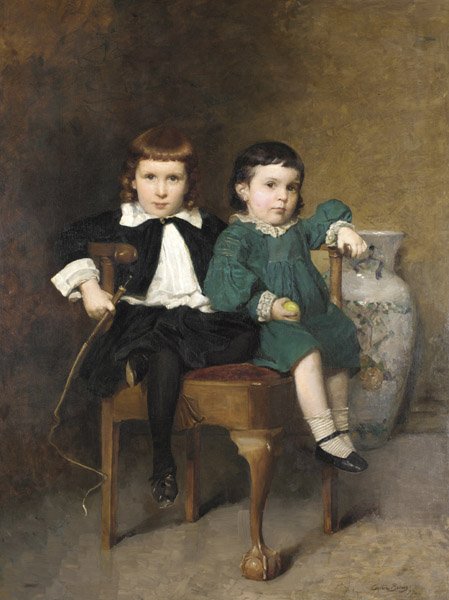
Harold and Mildred Colton by Cecilia Beaux (1887)

Her family decided that Leilie should pursue her interest in drawing and painting and needed to find someone who could nurture Leilie’s talent. The person chosen to guide Leilie was the talented artist, and painter of historical and biblical scenes, thirty-one-year-old Catherine Ann Drinker, who had a local studio. Coincidently, she would later become Etta’s sister-in-law in 1879 when Etta married her brother, Henry Sturgess Drinker. In 1871, sixteen-years-old Leilie remembered her first visit to Catherine Drinker’s Philadelphia studio which was at the top of an old house at Fifth and Walnut Streets on Independence Square. In her autobiography she wrote:

“…I am glad that the studio was typical, traditional, and not to be confused with any ordinary or domestic scene, for it was the first studio I ever entered. On its threshold, everyday existence dropped completely out of sight and memory. What windows there were, were covered with hangings, nondescript, as they were under the shadow of the skylight, which was upright, like a broad high window, and without glare. There was a vast sweeping curtain which partly shut off one side of the room, and this, with other dark corners, contributed to its mystery and suggestiveness. The place had long been a studio, and bore the signs of this in big, partly obliterated figures, outlines, drawn in chalk, upon its dusky wall, opposite the light. Miss Drinker had spent her early life in China, whence her family had brought many examples of Chinese art and furniture. The faded gold of a large seated Buddha gleamed from a dark corner. There was a lay figure, which was draped for a while in the rich robes that Miss Drinker had used for her ‘Daniel…”

Old-fashioned Music (Guitar Player) by Catherine Drinker (1880)

In 1880, Catherine Drinker won the prestigious Mary Smith Prize for her painting Old Fashioned Music.  This prize was awarded to women artists by the Pennsylvania Academy of Fine Arts. The award recognized the best work by a Philadelphia woman artist at the Pennsylvania Academy of the Fine Arts annual exhibition — a work that showed “the most originality of subject, beauty of design and drawing, and finesse of colour and skill of execution”.

Charles Sumner Bird and His Sister Edith Bird Bass by Cecilia Beaux (1907)
Many of Cecilia Beaux’s portraits were of New Englanders, including this elegant image of Charles Sumner Bird and his sister Edith.
The Bird family had made their fortune in the manufacture of paper, and they owned a 194-acre estate, called “Endean,” in East Walpole, Massachusetts, overlooking the Neponset River.

For Leilie, Catherine was not just an art teacher, she was a friend despite their fourteen-year age difference, a friendship which would last over fifty years. Leilie spent a year learning about art under the watchful eye of Catherine until Catherine decided that Leilie should move to a formal art school. She spoke to William Biddle, who, as the husband of Leilie’s aunt Emily, had been acting as Leilie’s unofficial guardian. Catherine suggested that the finest art school for his charge was the Van der Wielen School. It was run by a young Dutch-Flemish artist, Francis Adolf Van der Wielen, who had immigrated to Philadelphia in 1868 after he had trained at the Antwerp Academy of Fine Art. He opened his art school as a way of countering the fact that he had begun to find it difficult to paint due to his failing eyesight. In 1872, seventeen-year-old Leilie Beaux enrolled at the school.

Most of Van der Wielen’s female students had come to him to learn about art and looked upon it as a delightful hobby but some of his students, like Leilie, looked upon art as a skill that would eventually earn them money. Although Leilie had doubts about her tutor, due to his poor grasp of the English language and the fact that his eyesight was starting to fail him, thus making his visual criticism of his students’ work questionable. However, she remained at his school for almost two years gaining knowledge of linear and aerial perspective and the principles of light and shade. In 1873, Van der Wielen married one of his more mature students and the couple left America for a new life in Europe. His art school would have closed but for Catherine Drinker stepping in and taking over the teaching.

In 1873 Cecilia(Leilie) Beaux reached the age of eighteen and decided that it was time to put her artistic skills to work to earn money for herself and thus gain a modicum of independence and also to bolster the family’s finances. In her autobiography she wrote:

“…My grandmother’s house was my home, and in it I was the youngest born, but I wished to earn my living and to be perhaps some day a contributor to the family expenses…”

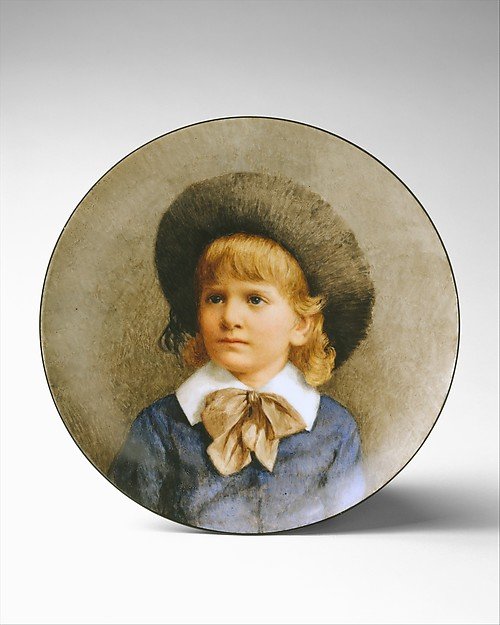
Plaque by Cecilia Beaux (1880)

For a month she took lessons in china painting and found that in a short time she had mastered the delicate technique. She would produce portraits on large china plates. One of her early successes was a china plaque featuring a young gold-haired girl, the parents of the child were delighted.

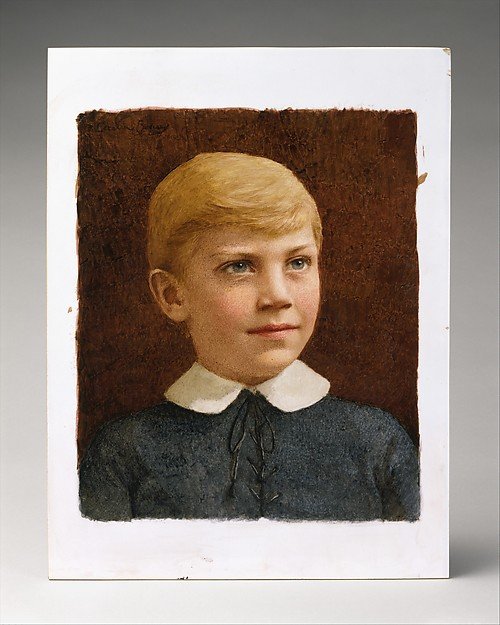
Plaque painted by Cecilia Beaux (1883)

From this came many commissions featuring paintings of young children.  However, she never really took to this type of work saying:

“…Without knowing why, I am glad to say that I greatly despised these productions, and would have been glad to hear that, though they would never ‘wash off,’ some of them had worn out their suspending wires and been dashed to pieces. This was the lowest depth I ever reached in commercial art, and, although it was a period when youth and romance were in their first attendance on me, I remember it with gloom and record it with shame…”

Catherine Drinker had taught art at Miss Sanford’s School for young ladies for many years but now, with taking over at Van der Wielen’s school she had to give up her post at the Sanford School and she recommended her protégé, Leilie to take her place. Leilie was taken on as a part-time drawing instructor at the school, teaching two classes, one morning a week. She would teach her young pupils how to draw, how to enlarge and how to shade. She taught there for three years and this led to her also giving private art lessons which earned her more money. In 1874, William Biddle introduced Leilie to a printer, Thomas Sinclair, of Thomas Sinclair and Sons. He and the Leavitts knew each other as they were fellow members of the Woodland Presbyterian Church and she was offered her first professional illustration job. Leilie had now finally launched herself into the art world and she decided that she needed to have a definite artistic identity and chose to revert to using her mother’s name. From thenceforth she was to be known as Cecilia Beaux.

As an aspiring artists Cecilia wanted the best artistic tuition that she could receive, given by the most talented tutors, and for her, this meant attending the Pennsylvania Academy of the Fine Arts (P.A.F.A.) which was a museum and art school in Philadelphia, and was founded in 1805. In 1871 it had been closed for major reconstruction and was not re-opened until 1876. Another reason for Cecilia wanting to attend classes at this prestigious art academy was that in 1878 Catherine Drinker became the first woman to teach there. However, Cecilia’s uncle William was dead set against the idea of his “charge” attending the academy. Cecilia remembered her uncle’s argument for his decision:

“…I was a seemly girl and would probably marry. Why should I be thrown into a rabble of untidy and indiscriminate art students and no one knew what influence? So reasoned his chivalrous and also Quaker soul, which revolted against the life-class and everything pertaining to it. He put a strong and quiet arm between me and what he judged to be a more than doubtful adventure…”

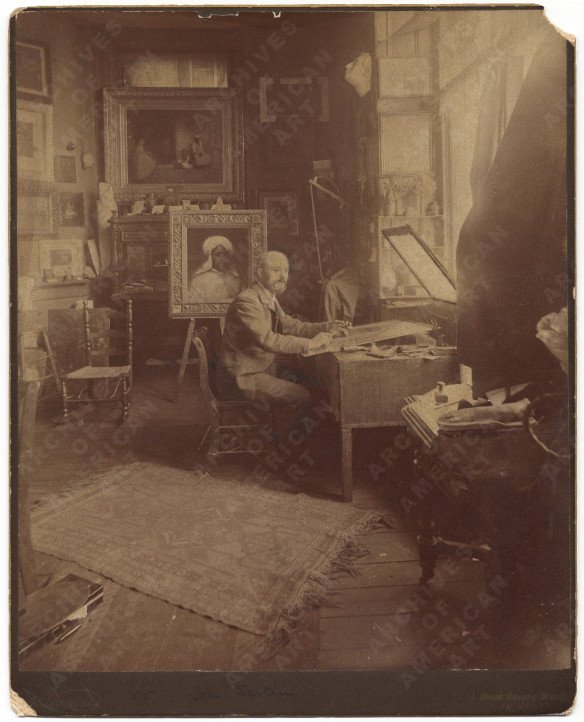
William Sartain in his studio

Cecilia’s next step on the artistic ladder came by way of a former school friend from Miss Lyman’s School. Her friend, who had come from a wealthy background had spent her years after finishing her schooling  “immersed in social gaiety” as a debutante but had now decided to take painting more seriously and had taken a studio and organised a class to be held three times a week to sketch and paint using a model. She invited Cecilia to join the class and her uncle, William Biddle thought this was a good idea and funded his wife’s niece participation. The work of all at the class was overseen on a fortnightly basis by the New York-based American painter William Sartain. Cecilia remembered the time well writing:

“…There were a few, only, in the class, all young, but all respectful toward what we were undertaking. It was my first conscious contact with the high and ancient demands of Art…”

…………………………to be continued


A lot of the information for the blogs featuring Cecilia Beaux came from two books:
Backgorund with Figures, the autobiography of Cecilia Beaux
Family Portrait by Catherine Drinker Bowen
and the e-book:
Out of the Background: Cecilia Beaux and the Art of Portraiture by Tara Leigh Tappert

Cecilia (Leilie) Beaux. Part 1 – Ancestors and the early years

Portrait of Cecilia Beaux by John Lambert (1905)

My featured artist today is looked upon as one of the greatest portrait painters of her time. Of her, the American painter, William Merritt Chase said:
“…[she is] the greatest woman painter that had ever lived…. She is a painter as Velasquez and Rembrandt were, and like them, she infuses the subtle quality of life into her work…”

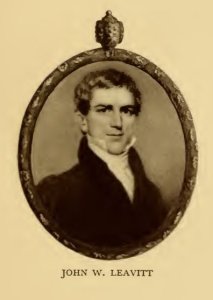
John Wheeler Leavitt

She is the nineteenth century American society portrait painter, Cecilia Beaux (née Leavitt). This initial blog looks on her life before she became a professional painter but maybe to understand her better, one must understand the trials and tribulations of her early life and one has also to go back to the turn of the eighteenth century and her maternal grandparents John Wheeler Leavitt and his wife Cecilia Kent Leavitt. John and Cecilia were both born in the last decade of the eighteenth century and were married in 1820. Their ancestral history could be traced

Cecilia Kent Leavitt

back to seventeenth-century New England and before that to England. John was a prosperous textile merchant who founded the New York based family firm John W. & Rufus Leavitt Company, and was one of the most prominent businessmen of his age. He and his wife had eight children and as the saying goes “money was no object” for this family. The children were all home-tutored in all the academic subjects and taught to play the piano at which the second youngest, Eliza became a brilliant musician.

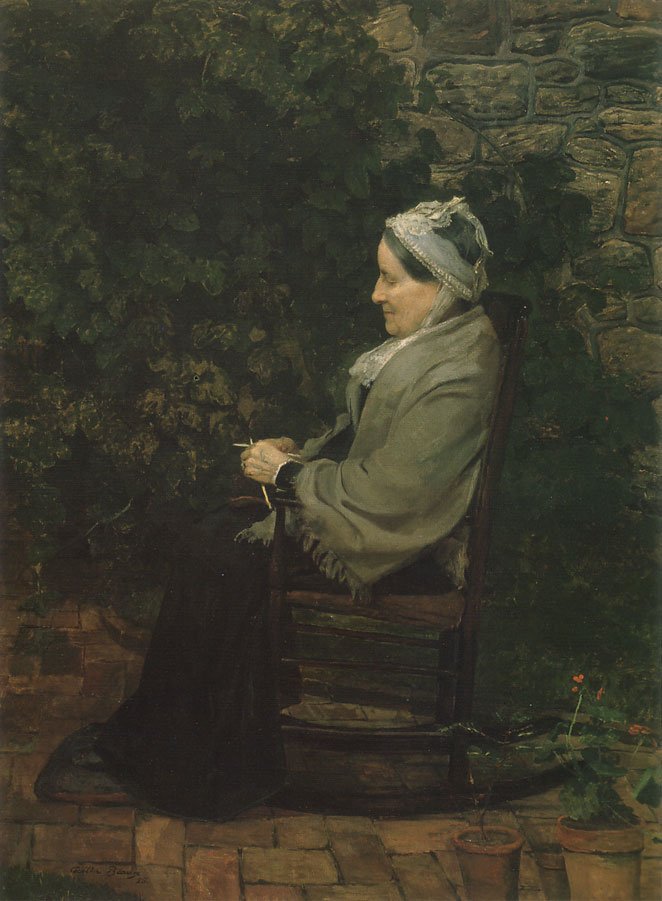
Mrs. John Wheeler Leavitt by Cecilia Beaux (1885) Cecilia Beaux’s maternal grandmother.

However, the good times ended abruptly in 1846 with problems in the cotton industry and debts that could not be serviced, and the company filed for bankruptcy. The Leavitt family owed their creditors so much money they had to sell their New York town house and their country estate on the Palisades in Hoboken and John and Cecilia Kent Leavitt were forced to move to a small house in a “rough” suburb.  Their two eldest daughters, Cecilia (the mother of Cecilia Beaux) and Eliza had to go out to work to help with the family finances. Cecilia worked as a music teacher and Eliza worked as a governess. It is noted in Cecilia Beaux’s autobiography Background with Figures, that the sons were of little help. As she put it, they were dreamers and not doers!  As is often the case when one is subjected to financial pressure, John Leavitt’s health took a turn for the worse and his wife had to take over the running of the house and manage the family finances.

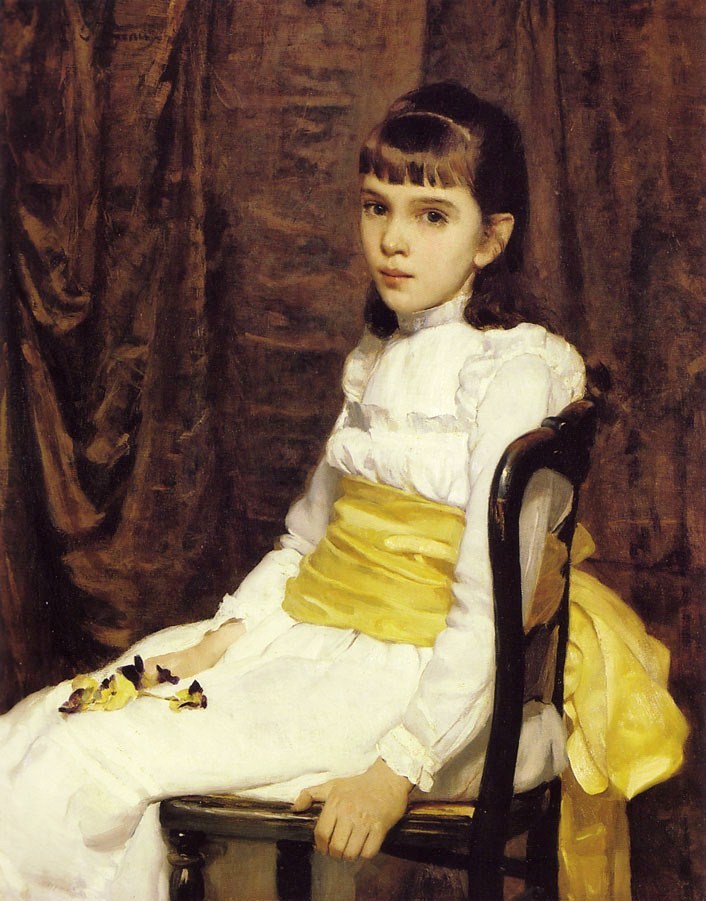
A Little Girl (Fanny Travis Cochran), by Cecilia Beaux (1887)

Cecilia and Eliza moved from the family home in New York to Philadelphia around 1848 where they had distant relatives. With the help of friends, they were soon socially accepted. Financial help for John Leavitt and his family materialised in the form of a foreigner, Jean Adolph Beaux. He came from the city of Nimes in France, in 1848 and was from a family of French Huguenots, long engaged in the silk manufacture business. In 1848, aged thirty-eight, he emigrated to Philadelphia to set up an American branch of his family’s business, J. P. Beaux & Co., Sewing Silks.

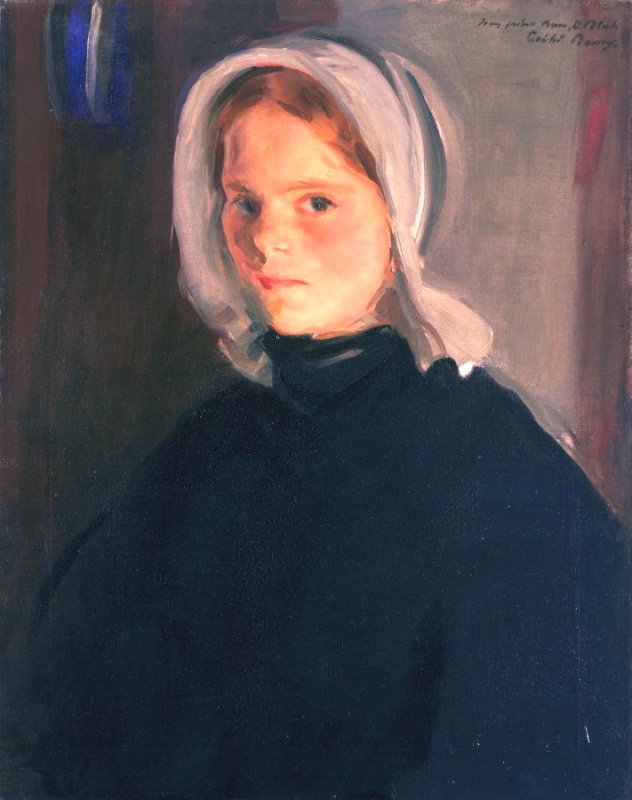
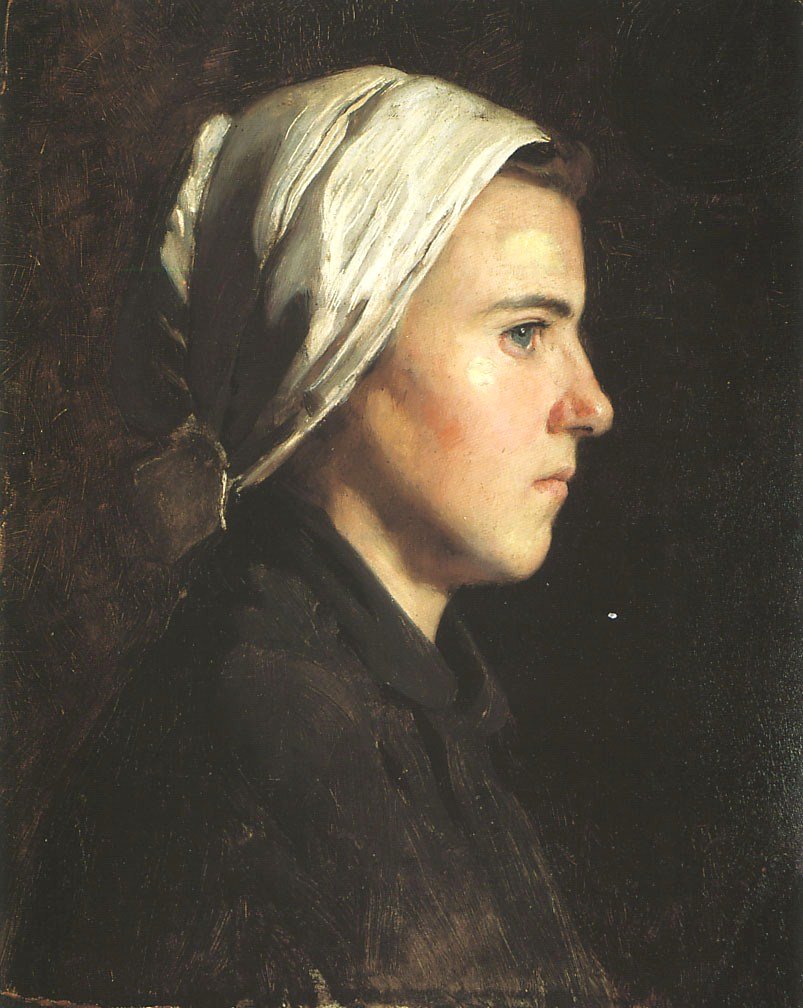
Head of a French Peasant Woman by Cecilia Beaux (1888)

Although there were many eligible women for the Frenchman to choose a companion, he had fallen desperately in love with Cecilia Leavitt, maybe partly because she had an excellent grasp of the French language, which certainly helped as John-Adolph’s grasp of the English language was poor. Cecilia also fell for the charming and handsome French gentleman and wrote home to her family in New York saying she had met a French gentleman with beautiful blue eyes. However, she made sure her relationship with Jean Adolphe progressed slowly and it was some time later that he headed to New York to meet her father and ask him for his daughter’s hand in marriage. Cecilia father was satisfied that Jean Adolph could provide for his eldest daughter and so agreed. John Adolph Beaux and Cecilia Leavitt were married in a society wedding at the Fifth Avenue Presbyterian Church in New York on April 3rd, 1850 and soon after a branch of the Beaux family silk business was set up in Pine Street, New York, which was managed by John Wheeler Leavitt and once again the Leavitt family finances were on an even keel.

Helen Bigelow Merriman by Cecilia Beaux (1908)
Painter and art collector, and one of the founders of the Worcester Art Museum, Massachusetts

It was not long before Cecilia and Jean-Adolph started a family. Their first child, a daughter, Alice Zepherine was born in February 1851 but sadly only lived for eleven months. The couple’s second child, Aimée Ernesta, nicknamed Etta, was born on October 26th, 1852, just ten months after the death of Alice. By 1854 Jean-Adolph, his wife Cecilia and their daughter Etta had moved to Philadelphia and on May 1st, the following year, a further addition to the family arrived – a daughter whom they named Eliza Cecilia, the names of her aunt and mother. This should have been a joyous time but in fact it was a traumatic and sad time with Jean-Adolph’s wife dying twelve days after giving birth due to puerperal fever, a bacterial infection following childbirth complications.

Clement B. Newbold by Cecilia Beaux (1912)

Jean-Adolph was devastated and inconsolable by his wife’s death, so much so, he could not endure the heartache and returned to the comfort of his family in Nimes, leaving his company to be run by his brother Edmund and left his two children to the care of his mother-in-law, Cecilia Kent Leavitt, who had also lost a dear one two years earlier, with the death of her husband, John Wheeler Leavitt. Can you imagine how this all affected the two children, Etta and Cecilia? Aimée Ernesta (Etta) Beaux had witnessed the birth of her sister, quickly followed by the death of her mother, and then the departure of her father back to France. Can you understand that the irrevocable change in the structure of her family must have been a frightening and confusing event? Jean-Adolph stayed away from his children for two years, not returning to Philadelphia until 1857, at which time Cecilia and Etta were two and five years of age and living with their maternal grandmother and her four remaining children, who hadn’t flown the nest, Eliza, Samuel, Charles, and Emily.  On his return to America, Jean-Adolph had much to repair in his relationship with his children and his mother-in-law as well as attempt to set himself in business, once again. He achieved little on both these fronts although he did work for his old family company, J.P. Beaux & Co., Sewing Silks. Although the company prospered his charm offensive with the Leavitt family failed. They never forgave this “foreigner” for abandoning his children and his mother-in-law whom he was living with never considered him a fit father to his children and slowly took charge of the future of her two grandchildren, despite having had to rear eight children of her own. Rightly or wrongly, Cecilia’s grandmother probably never held back on her adverse comments with regards her son-in-law and later in life,  Cecilia commented on this:

“…We didn’t love Papa very much, he was so foreign. We thought him peculiar…”

The relationship between Jean-Adolph and his third child Cecilia was a troubled one as he found his new-born daughter to be little more than a sad reminder and pale substitute for his cherished but sadly departed wife. One believes that when he looked upon her, he immediately thought about the death of her mother in childbirth. It had even reached the point that he could not bear to call her Cecilia (also his late wife’s name) as it brought up too many sad memories of deceased wife and so despite the family’s dislike of the idea, she was referred to as Leilie and not Cecilia. Although this may have comforted her father, in a way it stigmatised the child herself who as she grew older believed that in a way she had caused the death of her mother and was now unfit to bear her name.

Mrs. Clement B. Newbold by Cecilia Beaux (1896)

Things went from bad to worse for Jean-Adolph. His business was failing and finally collapsed in 1860. His brother and partner in the firm, Edmund, went back to France but Jean-Adolph stayed with his children and in-laws albeit they had to move to a smaller house. Now having no business and the bringing up of his children having been “usurped” by his mother-in-law, Jean Adolph believed there was nothing left for him in Philadelphia and so he went back to France in 1861 and did not return to America for twelve years, which gives one an idea for the regard he had for his children.

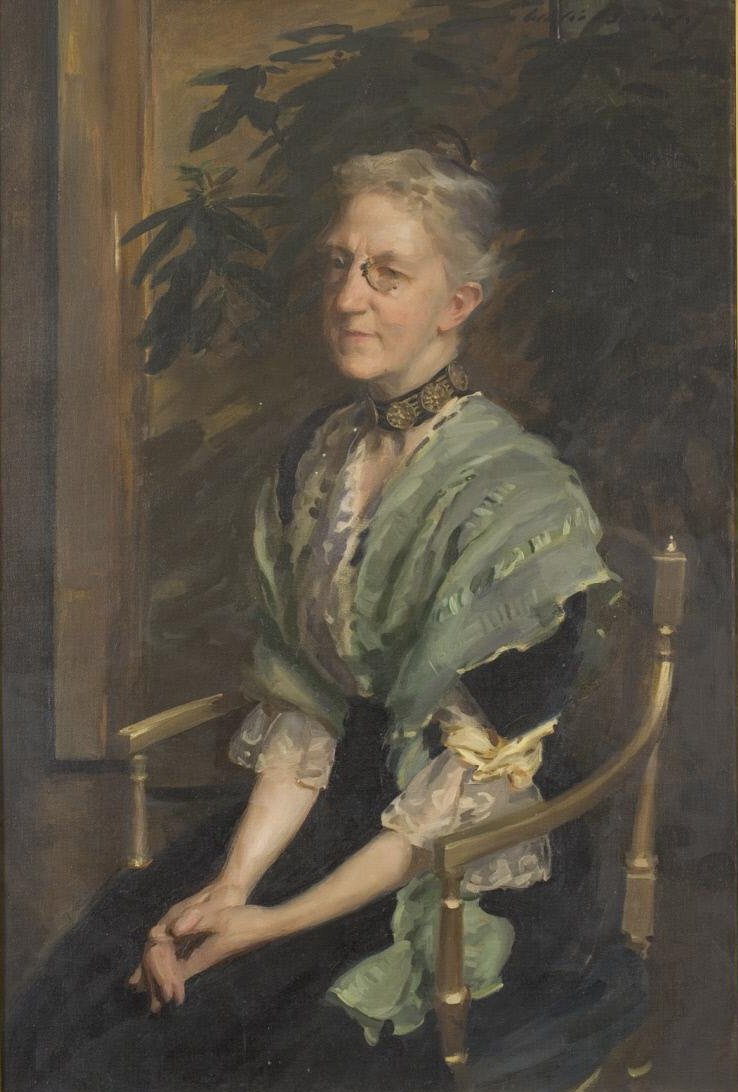
Portrait of Mrs. Samuel Hamilton Brooks by Cecilia Beaux (1911)
Founder of the Memphis Brooks Museum of Art

With the collapse of the J.P. Beaux Silk Company there was now little money coming into the Leavitt household. For Leilie it was a very sad time without a mother and father. Although she asked her grandmother and her family about her mother, their sadness meant that they were never forthcoming with information and so Leilie began to invent romantic images of her mother. Maybe her memory of her father was slightly tainted by the views of her grandmother and aunts.

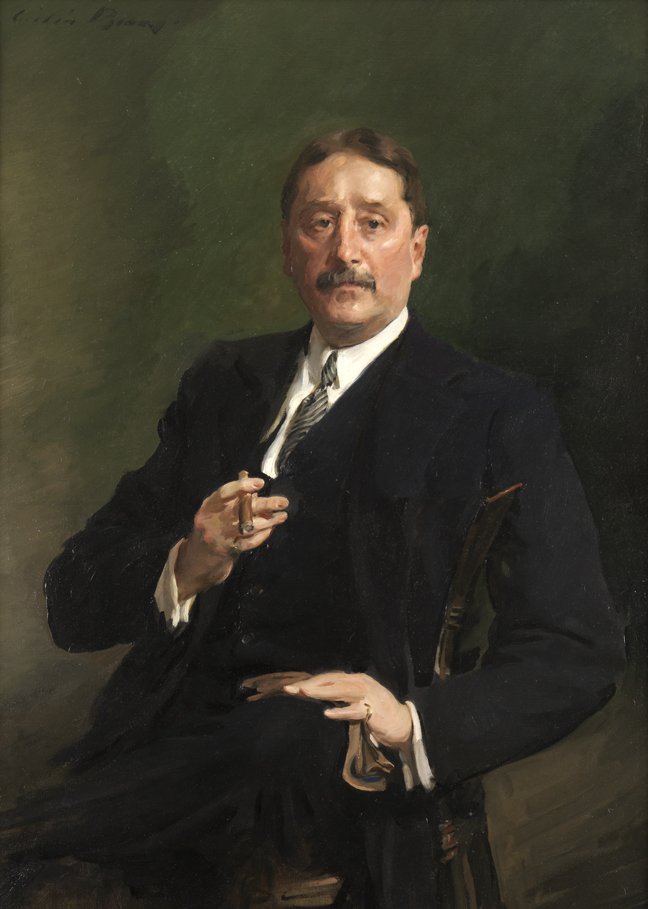
Portrait of Mr. Samuel Hamilton Brooks by Cecilia Beaux (1911)

It must be said that Leilie and her sister Etta who lived with the Leavitt family received vast amounts of love from their grandmother and their two aunts Eliza and Emily. Both girls were also very fond of their uncle Charles but often found their uncle Samuel annoying.

In 1860, Emily Leavitt, Leilie’s favourite aunt, married William Foster Biddle, an engineer by profession, and the two of them set up home. She was twenty-one and he was twenty-five. A year after their marriage, Biddle left his wife and began his military service with the rank of captain and rather than live alone, Emily returned to living with her mother, her siblings and the two Beaux girls. After completing his military service at the end of the Civil War, William Biddle was employed as a mining engineer and he and his wife Emily moved back to their own home.

Cecilia Kent Levitt ran the Leavitt household which now just comprised of her maiden daughter Eliza, and her two grandchildren, Etta and Leilia Beaux. Their aunt Emily looked after her two nieces’ education and their grandmother saw to their religious needs ensuring both girls, when they reached twelve years of age, were confirmed in the Presbyterian faith.

Half-Tide, Annisquam River by Cecilia Beaux (c.1905)
A rare example of Cecilia Beaux’s landscape work.

Cecilia Kent Leavitt, her daughter Emily and the two Beaux girls re-located on several occasions. Their frequent moves were due to Leavitt family’s deteriorating financial situation. However, through the good auspices of the son-in-law William Beadle, who rose to become vice president of Lehigh Coal & Navigation Company, their financial situation improved and this in turn lifted the family spirits of the four females. In 1873 Cecilia Kent Leavitt finally settled her family down in a house in Spruce Street, West Philadelphia. In her 1930 autobiography, Background with Figures, Leilie remembered that as a young fourteen-year-old how her Aunt Emily had shaped her life. She wrote:

“…My aunt had assisted in my education, and my uncle [Emily’s husband Walter Biddle] was to be, after my grandmother, the strongest and most beneficent influence in my life. I know that my Aunt Emily’s contribution to my bringing up had several channels. My lessons, with her, took place in the dining-room, rather a gloomy spot by day, on winter mornings, and we sat at either end of the green-felt-covered table. I am sure she labored over the sums and geography we bent over, but what remains consciously of these hours are the periods devoted to dictation. The use of the pen did not trouble me. Spelling was not one of my difficulties, and the appearance of new words, and of phrases far from anything I could have dreamed of, were a delight. Above all, and the real source of the living word enduring in this episode, was the choice…”

Mr. and Mrs. Anson Phelps Stokes by Cecilia Beaux (1898)
He was a wealthy American merchant, property developer, banker, and philanthropist.

Later in life Leilie told how the two greatest influences on her life were her grandmother and William Biddle. For Leilie, William was the main man in her teenage years and she relied on him for guidance and William Biddle recognised the energy and creativity of Leilie and he believed it was his job to channel this dynamism…………………………………..

……..to be continued

Mary Dawson Elwell

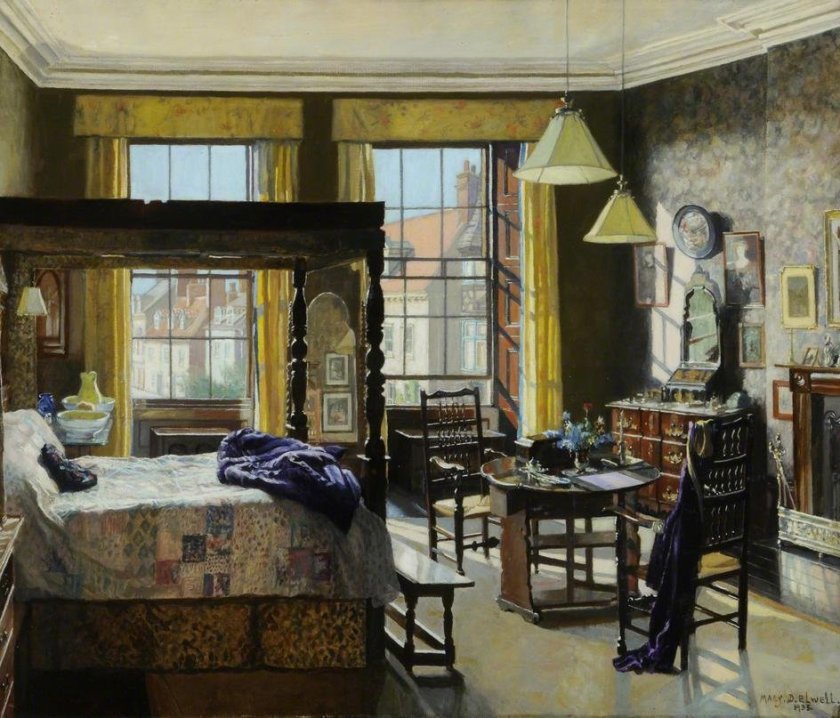
Bedroom, Bar House, Beverley, East Riding of Yorkshire by Mary Dawson Elwell (1935)

In a recent blog (My Daily Art Display, October 15th, 2017 – The Alma-Tadema Ladies. Part 2 – The Two Daughters, Anna and Laurense), I highlighted the artwork of Anna Alma-Tadema, the daughter of the great painter, Lawrence Alma-Tadema and marvelled at some of her interior paintings. In today’s blog I am going to look at another female painter who had mastered the art of depicting the interior of houses. She is the nineteenth century artist, Mary Dawson Holmes Ewell. I had featured her in a series of blogs about her husband, Frederick Elwell but for this blog I want to concentrate on her outstanding ability as an artist.

The Landing in Summer by Mary Elwell (1930)

Mary Dawson Bishop was born in Liverpool on August 13th, 1874. Her father, John Bishop, was a ship broker. Her mother, Mary Ellen Dawson, was the daughter of a Liverpool boot maker, Thomas Candlin and his wife Sarah who was a milliner and dress maker. Mary and her younger sister, Elsie, lived in the Fairfield district of Liverpool. Tragedy struck the family in 1879 when Mary’s thirty-six-year-old father died. Shortly after the death of her husband, Mary and her two daughters moved to Heaton Chapel, Manchester to live with her bachelor brother Henry who was fifteen years her senior. It was here that Mary and Elise went to kindergarten and primary school.

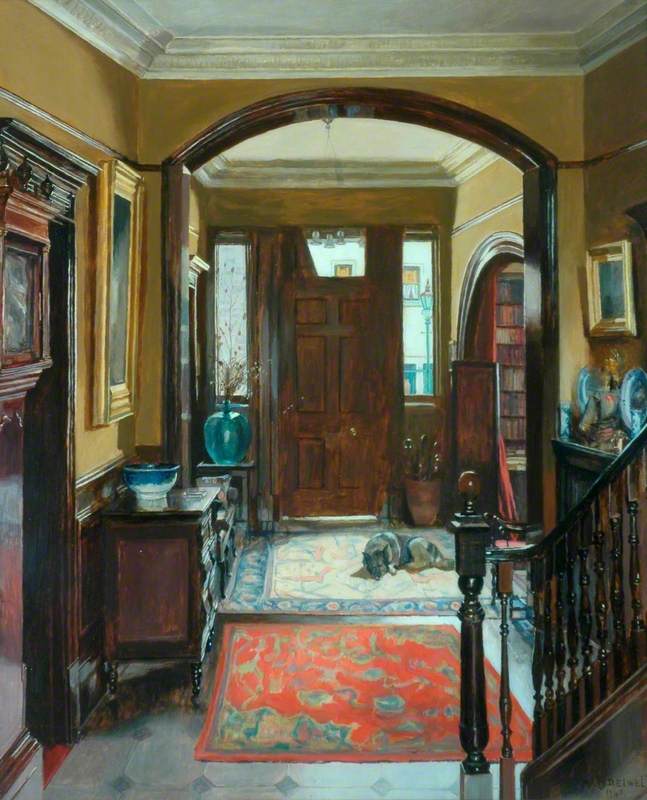
The Front Door by Mary Elwell (c.1940)

Having completed her primary schooling in 1885, eleven-year old Mary enrolled at Manchester’s prestigious Ellerslie College and it was here that she received her early artistic tuition, to ensure she had this “must-have” social skill for young Victorian ladies. The pupils attending this school were mainly from merchant families and it was probably due to Mary’s Uncle Henry and his business connections that allowed her to gain entrance to the college. Mary Bishop completed studies at Ellerslie around the early 1890’s. Not much is written about her life after leaving college but it is believed she carried on her art studies influenced by two of her uncles, Henry and Walter were not only successful business men but avid art collectors.

The next we hear of Mary Dawson Bishop was that she married George Alfred Holmes at the Church of All Saints, Heaton Norris, Stockport in June 1896. Mary was twenty-one years old and her husband George Alfred was forty-one. So why did Mary marry a man twice her age? This has been the topic of much speculation. George Alfred Holmes lived and had his office in Hull and was a prosperous oil broker and so there was the element that on her marriage to him, Mary would be financially secure. Hull, like her birthplace, was a seaport and maybe Mary looked on the prospect of living in Hull with her husband. Maybe she looked upon her husband as a father figure, having lost her own father at the age of five. But, of course, it could simply be that Mary fell in love with George Alfred Holmes.

Mary and Alfred Holmes set up their home in the small inland market town of Beverley which was just ten miles north of from Hull, a town where she would stay for the rest of her life.

It was in 1904 that Frederick Elwell was to enter the life of Mary Bishop Holmes. Following a somewhat unsuccessful period in London as far as his art sales were concerned, Fred Elwell had left London, a somewhat defeated man, and returned to Yorkshire. In the capital there were just too many artists chasing a small amount of commissions and this sudden realisation that the London streets were not paved with gold affected Elwell and there was a suggestion that he had suffered a nervous breakdown brought on by his financial situation. On hearing of his son’s state of health and financial predicament, his father travelled from Yorkshire and brought his son back to Beverley where his family and friends were and where he could expect a more profitable future.

Portrait of Frederick William Elwell by Mary Elwell (1913)

His year in London and his struggle to survive had taken a toll on him so the first thing the family had wanted him to do was to relax and enjoy the tranquillity of the Yorkshire countryside. Elwell also enjoyed the freedom offered by sailing and he would often take a small boat and cruise along Beverley Beck which joined the River Hull. Many like-minded painters would do the same as the clarity of light and the beautiful countryside including the East Riding flatlands surrounding the river was an idyllic setting for landscape artists. On occasion he would tie up the boat alongside a jetty and would welcome visitors to look at his artwork and, by so doing, would often receive commissions. Elwell’s love of landscape painting coincided with the English public’s change of attitude of what they wanted to see in a work of art. Depictions of city life were becoming less popular, displaced by depictions of the tranquillity of the countryside. This was a period when people wanted to “go back to nature”. They worked in cities but hankered for the fresh air of the countryside. They wanted to soak up country life by sailing along inland waterways or get themselves horse-drawn caravans and lose themselves in the peacefulness and serenity of the rural areas.

Self Portrait by Fred Elwell (1911)

For complete tranquillity Elwell made his home on a houseboat which he had borrowed from a friend. Not only did he travel up and down the river he would tie up alongside a local hostelry, the Brigham Arms, and his boat acted as his own selling gallery. He also had a “gypsy-type” horse-drawn caravan in which he would wend his way around the country lanes, sketching the beauty of the area. His artwork which depicted the tranquillity and the beauty of the Yorkshire countryside sold well and soon both his health and his finances had improved significantly.

Fred Elwell would also take on portrait commissions and often would visit the client rather than have them come to his studio. It was in 1904, that he received a visit from Alfred Holmes, a luminary of the Beverley community. Holmes asked Elwell to paint a portrait of his wife, Mary. Elwell agreed and went to the Holmes’ family home where he met Mary Holmes for the first time.

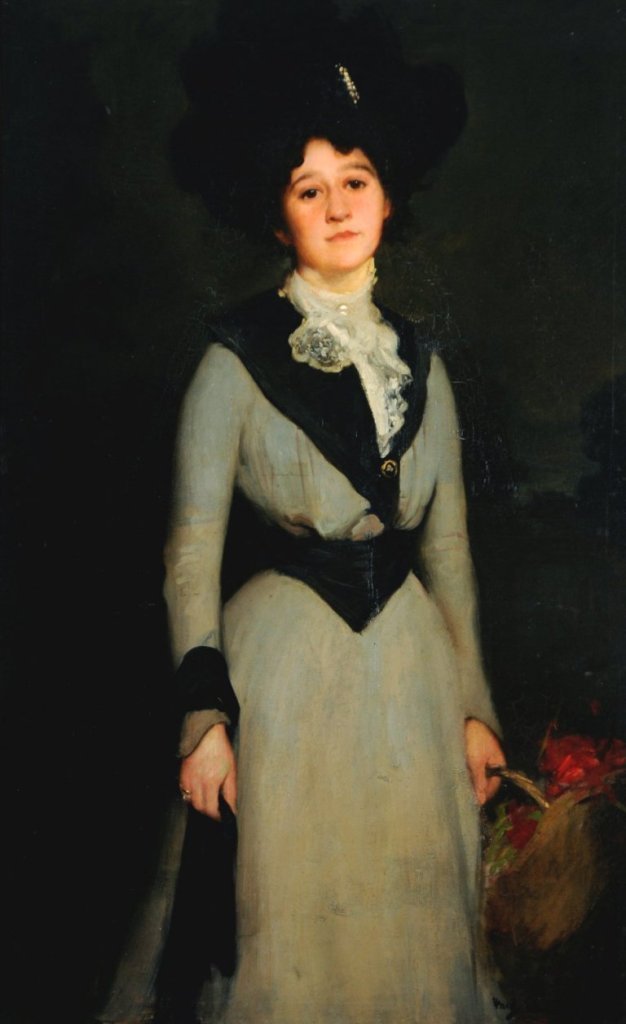
Mary Dawson Holmes by Frederick William Elwell (1904)

Elwell completed the Portrait of Mary Dawson Holmes that year and had it exhibited at the Royal Academy. It is a beautiful work of portraiture with Mary shown as a lady of gracious elegance. Her clothes remind one of the French fashion of the time. We see her adorned in a tight-fitting dress finished off with a fine white lace collar. She tilts her head to one side but holds an upright stance. Her eyes are dark and almond-shaped. Her expression teases us into imagining her thoughts. Does she look a willing participant as a model for this portrait? There is a hint of reticence in her facial expression. Was she unwilling to sit for Elwell or was it simply that she was shy and slightly embarrassed with all the attention.

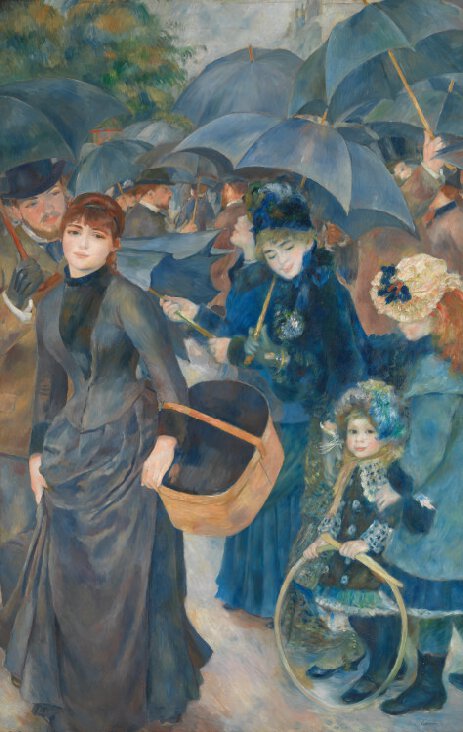
Les Parapluies by Renoir (c.1886)

The depiction of Mary has often been compared to Renoir’s 1886 work Les Parapluies, which Elwell would have seen, because of the similarity between the way Mary stands, tilts her head, and similarly carries a basket.

In the Trossachs by Mary Elwell (c.1900)

Alfred and Mary Holmes became good friends of Fred Elwell and they even had joint ownership of a sailing boat and the three of them took many trips on the Beverley Beck to the upper reaches of the River Hull, a tributary of the Humber. The three of them would often travel to Europe, visiting Venice and Switzerland where Fred Elwell and Mary Holmes would take the opportunity to sketch and paint the local landscapes.

The Wreath by Mary Elwell (1909)

Mary had her work exhibited at the Royal Academy from 1904 onwards and in 1908 she completed one of her most famous works, The Wreath, which was on display at the 1909 Royal Academy annual exhibition. It depicts a recently widowed woman grieving for the loss of a loved one. Queen Victoria had died in 1901 and this solemn period and the Victorian period prior to her death saw many artists concentrate on human loss and the grief felt when a loved one died. Queen Victoria suffered the loss of her beloved husband, Albert in 1861, and continually wore mourning clothes for ten years after he died. Many paintings compared the happiness of life before the death of a loved one with the inconsolable grief of those left behind. Violet Prest, a local girl, a costumier of Minster Moorgate West, in Beverley, modelled the woman in the painting. Ironically, six years after the painting was completed, her husband was killed in the Great War.

Chamonix, France by Mary Elwell (1938)

She was a much-admired artist and her popularity as an artist and that of Fred Elwell rose amongst the public and the art critics. Mary, and her future husband, Elwell, as far as their artistic ability was concerned, should never be looked upon as pupil and master as was the dictate of social expectation in the early twentieth century. They were truly equals.

A Quiet Hour by Mary Elwell (1942)

The health of Alfred Holmes began to deteriorate in 1910 and he sold his business and gave up his part ownership with Fred Elwell of their beloved sailing boat. That year May and Alfred moved from their large Westwood Road house in Beverley and bought Bar House which was also in Beverley, situated on North Bar Within. Alfred Holmes’ health had got so bad that by 1913 he realised he was dying and it is thought that due to his very close friendship with Fred Elwell he intimated that Elwell and Mary should get together when he died. George Alfred Holmes died on August 5th, 1913 aged just fifty-eight, leaving his widow comfortably provided for and allowing her to employ staff to help run the house.

North Bar Within, Beverley, East Riding of Yorkshire by Mary Elwell. (1916)

Holmes’ dying wish with regards his wife and Fred Elwell came to fruition on September 28th, 1914 when they married, and Elwell came to live with his new wife at her beloved Bar House. In 1916 Mary Elwell painted a scene entitled North Bar Within, Beverley which depicted a view from the front steps of Bar House. It is interesting work set during an overcast day and one of predominantly brown tones.

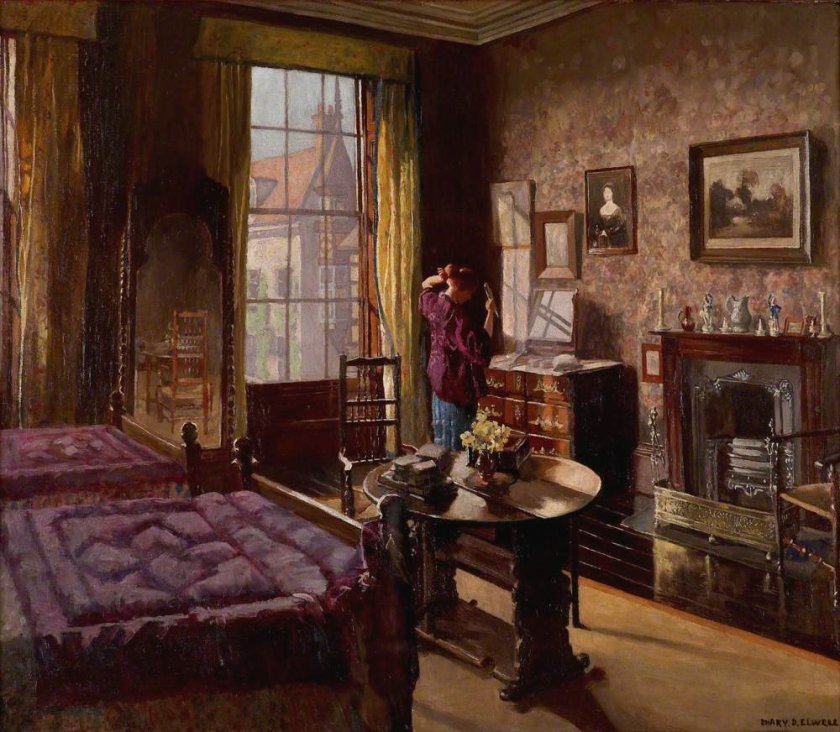
At the Mirror or Bedroom, Bar House by Mary Elwell

Mary painted many depictions of Bar House including a bedroom scene, which was entitled At the Mirror. There are two large double beds each covered with a purple quilt. In the central background there is a large window which frames the view of Wylies House. The using of a window as a framing device for a townscape was very popular at the time and was typical of the practice of the Camden Town Group of artists. It allowed viewers to catch a glimpse of the outside world, seen through the framing device of a window. The large full-length mirror, next to the window, reveals a reflection of the room. The light which shines through the windows of the room lights it up and the polished brass fender casts its reflection on the dark polished wooden floor. To the right of the window, we see a young woman standing before a mirror attending to her hair. She is oblivious of the outside world that we see through the window. The model used by Mary for this work was Annie Towse, the daughter of one of their employees.

Bar House Garden by Fred Elwell (1914)

Mary’s mother, Mary Ellen Bishop had died in 1901 and Mary Elwell’s uncles Henry and Walter died in 1917 and 1924. Neither had married and their wealth and properties were divided between Mary Elwell and her sister Elsie. Mary also received her late uncle’s art collection.

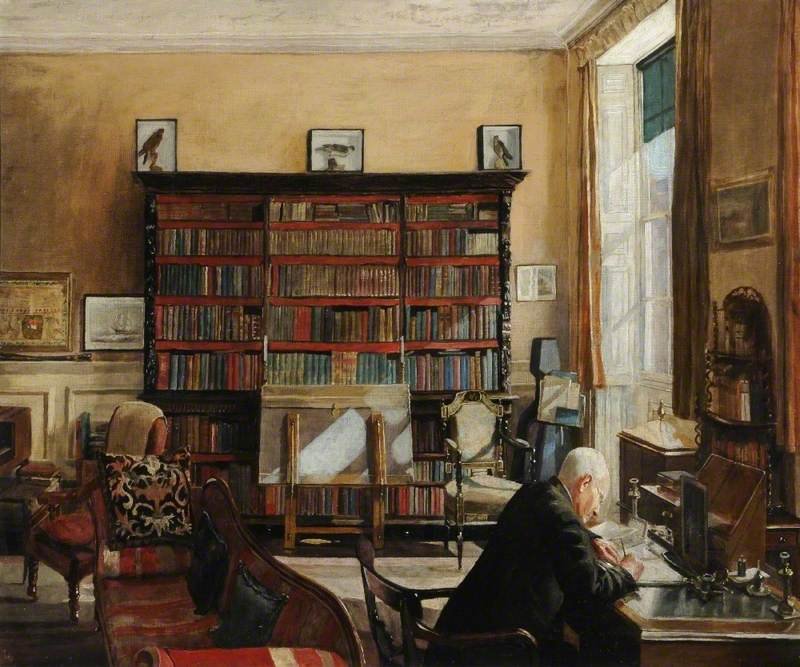
Interior Study by Mary Elwell (1937)

One of my favourite interior works by Mary Elwell is one she completed in the 1932 entitled At No.14 Newbegin, Beverley with an alternative title Interior Study. It is a depiction of a sitting room at No.14 Newbegin a house belonging to Reverend Wigfall the curate at Beverley Minster, who we see sitting at his writing desk. The room itself was light due to it having three large windows. The window we see in the painting allows a shaft of light into the room illuminating the large ornately carved bookcase on top of which are three glass cases, each of which contain stuffed birds. A cushion with its bold design and rich colours is placed for decorative effect on the arm of the sofa. The richness of colour of this painting is brought about by the liberal use of reds. The painting was exhibited at the Royal Academy in 1932.

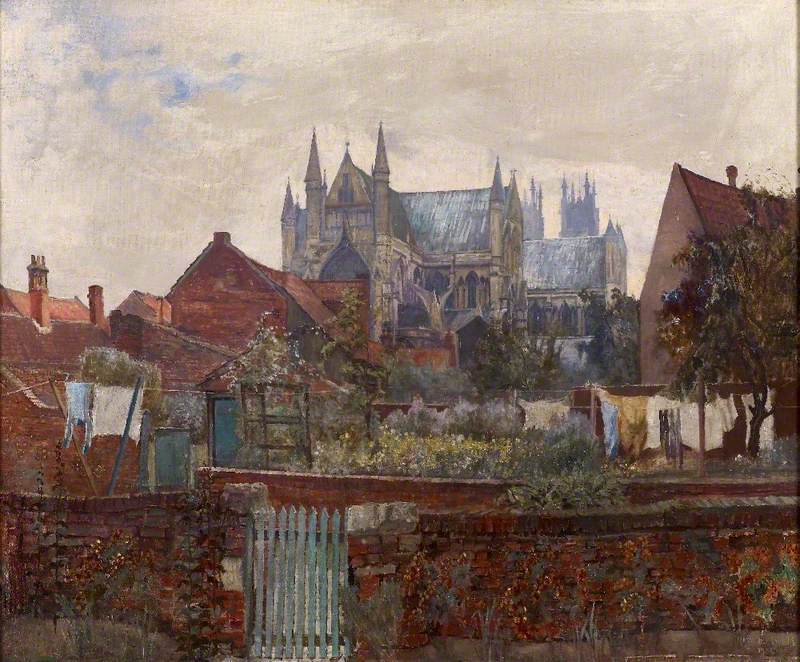
Beverley Minster from the Friary, by Mary Elwell (1934)

Beverley Minster from the Friary is a painting Mary Elwell completed in 1934. It is a comparative composition. The imposing edifice of Beverley Minster looms over the modest dwellings we see in the middle ground, which lie close to the railway track. The gable ends of the houses in the middle ground seem to reiterate the shape of the Minster’s transept. Elwell captures the spirit of the time with her depiction of the washing lines laden with clothes in the back yards of the houses. One of the houses on the right was occupied by Miss Woodmansey who ran a wash-house and who would, after washing the clothes, hang them out in her back yard, every day except Sunday. The painting was exhibited at the Royal Academy in 1934.

Matterhorn from Zermatt, Switzerland by Mary Elwell (1939)

In 1947 Mary suffered the first of a series of debilitating strokes which meant that she had to have round the clock nursing.  Her sister Elsie came to stay for longer periods.   Having made her final appearance at the Royal Academy in 1949, she withdrew from the world outside.  Mary Dawson Elwell died on the 28th August 1952, aged a fortnight before her seventy-eighth birthday.  She was buried in Saint Mary’s Cemetery in Beverley and according to her husband’s wish her gravestone was carved with an artist’s palette.. Her second husband, Fred Elwell died in January 1958 and was laid to rest in the same grave.

Fred Elwell gave a number of her paintings away to people who had cared for her, inscribing them:

“…in grateful remembrance of Mary D. Elwell…”

Peder Mork Mønsted – The great Danish landscape artist.

By The River, Brondbyvester by Peder Mønsted (1922)

Landscape and seascape painting must be the most popular art genre. Like all painting genres there are many good examples and some exceptional examples of such paintings. In today’s blog I want to highlight the exceptional landscape work of the nineteenth century Danish painter, Peder Mork Mønsted, who due to his naturalistic plein-air depictions, was considered the foremost landscape painter of his day in Denmark.

The Red Umbrella by Peder Mønsted (1887)

Mønsted was born on December 10th, 1859, a few years following the end of what was known as Den danske guldalder (The Danish Golden Age). This period of Danish history straddles the first half of the nineteenth century and is a period of outstanding creative production in Denmark. The start of the nineteenth century had been a disastrous period for Denmark and especially its capital, Copenhagen which had suffered from fires, bombardment and national bankruptcy, but it was also a period when the arts took on a new period of inspiration and originality brought on by the Romanticism movement of Germany, which was at its peak in the first half of the nineteenth century. It was a period when much of Copenhagen had to be rebuilt and this saw the development of Danish architecture in the Neoclassical style. The city took on a new look, with buildings designed by Christian Frederik Hansen and by Michael Gottlieb Bindesbøll.

The Gatehouse in the Park of Villa Borghese, Rome, by Christoffer Eckersberg (1816)

This Golden Age was most commonly associated with the Golden Age of Danish Painting from 1800 to around 1850 which included the work of Christoffer Wilhelm Eckersberg (see My Daily Art Display five-part blog starting August 5th, 2016) and his students, such as Wilhelm Bendz, Christen Købke, Martinus Rørbye, Constantin Hansen and Wilhelm Marstrand. Eckersberg taught at the Academy in Copenhagen from 1818 to 1853, and became its director from 1827 to 1828. He was an important influence on the following generation, in which landscape painting came to the fore. He taught most of the leading artists of the period.

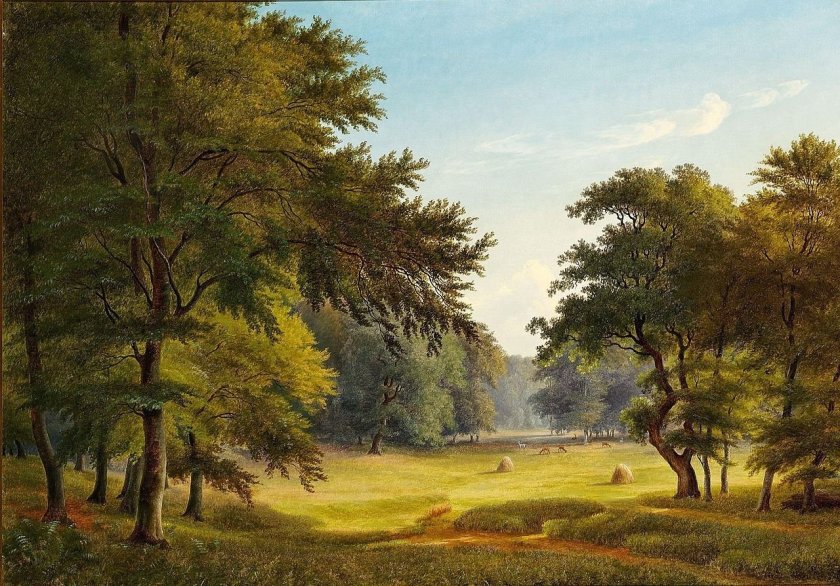
A Summer Day at the Dyrehaven by Peter Skovgaard

Peder Mork Mønsted was born near Grenå in eastern Denmark. He was the son of Otto Christian Mønsted, a prosperous ship-builder, and Thora Johanne Petrea Jorgensen. He had an elder brother, Niels. He was a pupil at the Crown Prince Ferdinand’s Drawing School in Aarhus where he studied under Andries Fritz, the Danish landscape and portrait painter. After leaving the Drawing School in 1875, Mønsted moved to Copenhagen and enrolled on a three-year art course at the Royal Academy of Art where he received tuition in many facets of art including the tutoring in figure painting by the Danish genre painter, Julius Exner. It was at the Academy that he began to learn about, and be influenced by, the art of Christen Købke and Pieter Christian Skovgaard, a romantic nationalist painter and one of the main figures associated with the Golden Age of Danish Painting. Skovgaard is particularly known for his large-scale depictions of the Danish landscape.

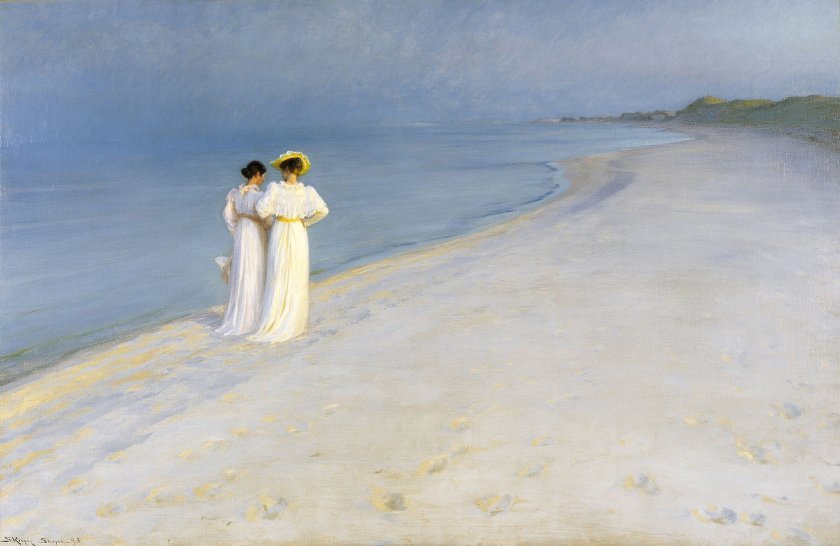
Summer Evening on Skagen’s Southern Beach with Anna Ancher and Marie Krøyer by Peder Severin Krøyer (1893)

In 1878 Mønsted left the Academy to study under the artist Peder Severin Krøyer. Krøyer was one of the best known and the most colourful of the Skagen Painters, who were a community of Danish and Nordic artists living and painting in Skagen, Denmark. Krøyer was the unofficial leader of the group.

In the Shadow of an Italian Pergola by Peder Mønsted (1884)

In his early twenties, Mønsted travelled extensively. In 1882 he journeyed through Switzerland and on to Italy where he visited the isle of Capri. During these journeys he would constantly sketch the people and the landscapes. One such painting to come from that Italian trip was completed in 1884 entitled In the Shadow of an Italian Pergola. Before returning to his home in Denmark he visited Paris and stayed there for four months during which time he studied at the studio of William-Adolphe Bougureau, the French academic painter.

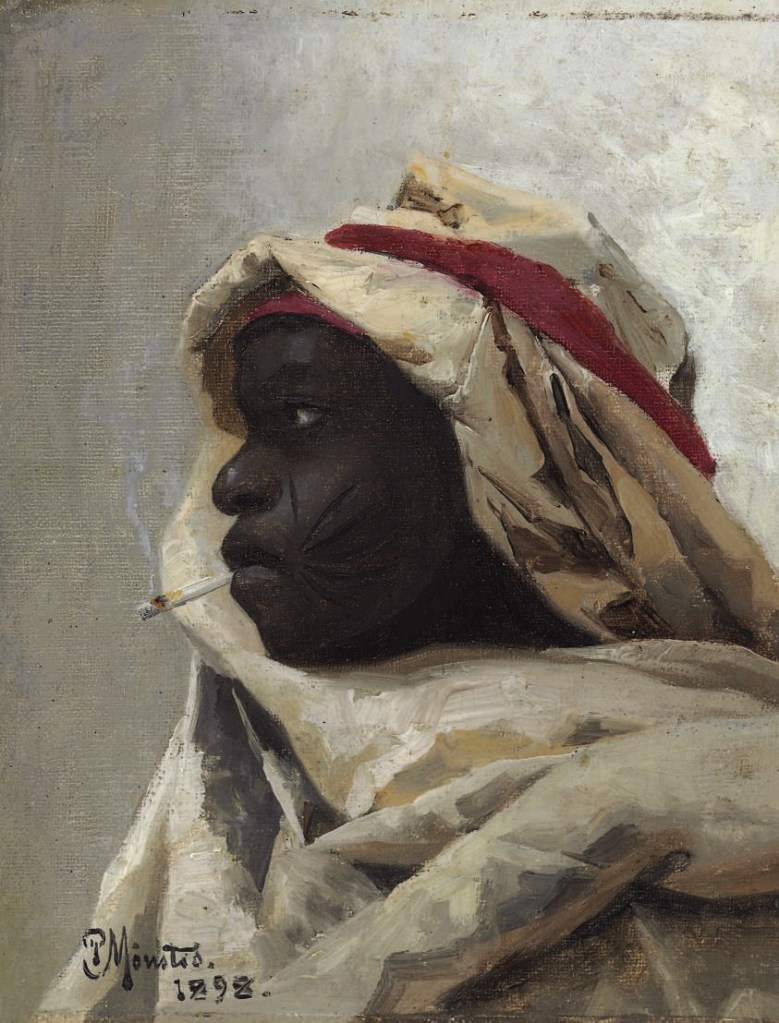
The Smoking Moor by Peder Mønsted (1898)

Mønsted was a habitual traveller constantly seeking places and people to paint. In 1884, he first visited North Africa returning to Algeria in 1889. One of his later paintings, a portrait entitled The Smoking Moor, came from his time in North Africa.

Olga by Peder Mønsted (1917)

Peder Mønsted besides being an exceptional landscape painter was also a talented portraitist as we can see in his 1917 work, simply entitled Olga.

The Cloister, Taormina by Peder Mork Mønsted (1885)

In 1885 his journeys took him to Sicily and Taormina, the commune in the Metropolitan City of Messina, which lies on the east coast of the island. It was from this visit that Mønsted completed his painting The Cloister, Taormina.

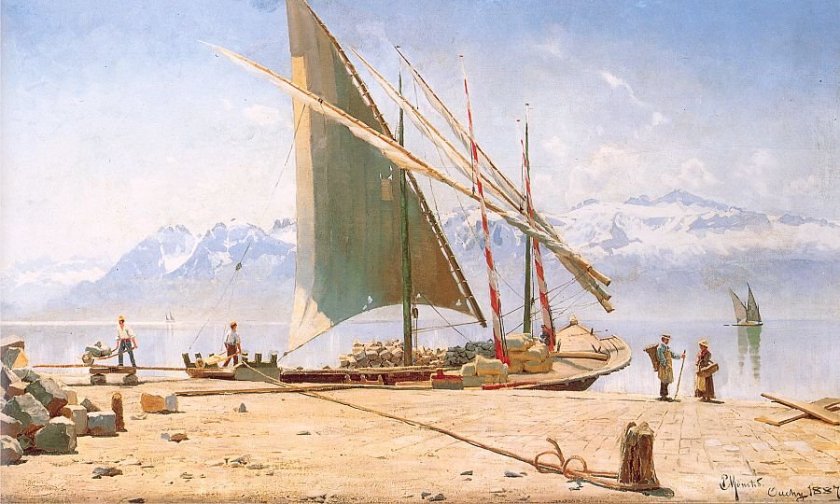
Unloading Stone from a Barge at Ouchy by Peder Mork Mønsted (1887)

Mønsted visited Switzerland on several occasions and his 1887 painting Unloading Stone from a Barge at Ouchy recalled the time he visited the port of Ouchy which is situated south of the city of Lausanne, on the edge of Lake Léman.

On March 14th, 1889, at Frederiksberg, Peder Mork Mønsted married Elna Mathilde Marie Sommer. Nine years later the couple had a son, Tage.

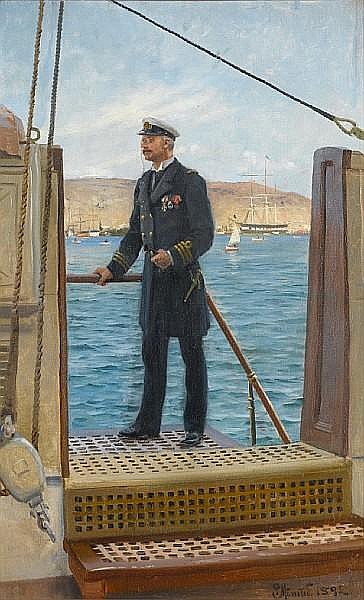
King George I of Greece by Peder Monsted

In 1892, Mønsted travelled to Greece, where he was a guest of King George I, who was Danish. While there, he completed portraits of the Royal Family including one of the king himself at the top of a ship’s gangway.

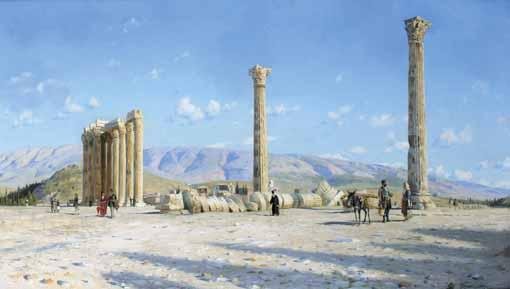
With his royal invitation to Greece, he also took the opportunity to depict the ancient sites. The above large-scale work (80 x 137cms) is one of his finest paintings of the last decade of the nineteenth century. It is thought that the two finely-dressed people depicted to the left in the mid-ground are King George I and his wife, Queen Olga of Greece. Further to the left are members of the famous Presidential Guard known as the Evzones.  From Greece, Mønsted travelled to Egypt and Spain.
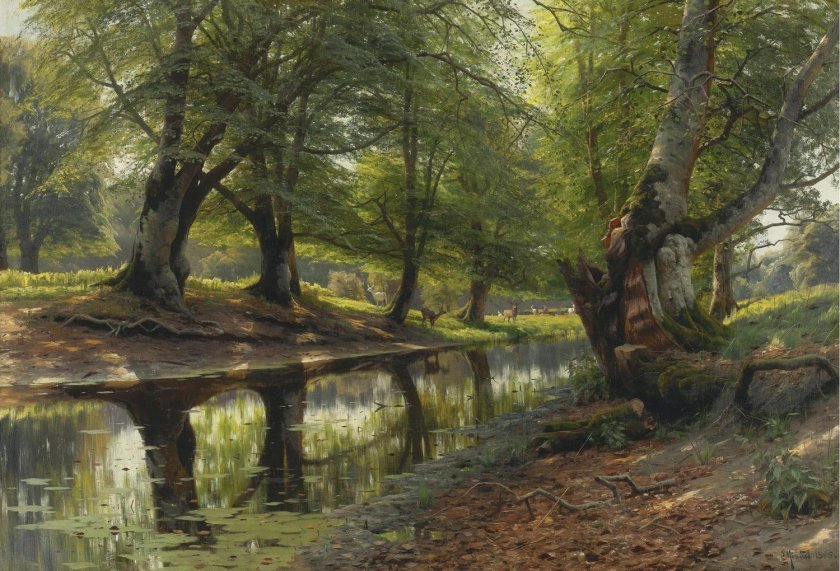
Landscape with River by Peder Mønsted

However, Peder Mork Mønsted will always be remembered for his beautiful landscape works often featuring his native countryside. It is hard to describe the works in a single word but if one had to then words like serene, placid, and tranquil come to mind. His depiction of water in the form of rivers and brooks and the surface reflections are breathtakingly beautiful.  One good example of this is his painting Landscape with River.

Creek North of Copenhagen by Peder Mønsted

Mønsted continued all his life to paint the Danish and Scandinavian landscapes and coastlines. His depictions of nature were poetic, even romantic. His forte as far as his landscape works are concerned is his discerning eye for the grandeur of nature and his unerring ability to record both detail and colour.

Spring Landscape in Saeby by Peder Mork Mønsted (1912)

Of all the motifs within the landscape theme, water seems to be one that arouses the greatest admiration when depicted with serene beauty. It is in such landscape works that there is a multitude of conditions that challenge and stimulate an artist, whether they be beginners or the most experienced painters. It is known that many famous Impressionists had real problems when it came to the representation of water in their compositions and ended up with their depictions, concentrating much more on the effects 0f light on a scene rather than on a realistic representation.

A Tranquil Forest Lake by Peder Mork Mønsted (1904)

The onset of World War I caused Mønsted to curtail his European travels but the 1920’s and 1930’s once again saw him journeying around the Mediterranean countries.

A Sleigh Ride Through a Winter Landscape by Peter Mønsted (1915)

His travels produced numerous sketches that later became paintings which he presented at several international exhibitions. Most of his landscapes were, however, devoted to Scandinavia. He was especially popular in Germany, where he held several shows at the Glaspalast in Munich. During his later years, he spent a great deal of time in Switzerland and travelling throughout the Mediterranean. Most of his works are now held in private collections. In 1995, a major retrospective, called “Light of the North”, was held in Frankfurt am Main.

The Community of Hoje Taastrup, outside Copenhagen by Peder Mønsted

Philip Weilbach’s artistic icon, Weilbach Dansk Kunstnerleksikon often just referred to as Weilbach, is the largest biographical reference book of Danish artists and artists and the entry on Peder Mønsted sums up the work of this great man:

“…[Mønsted’s] great success was largely a consequence of his ability to develop a series of schematic types of landscape, which could each individually represent the quintessence of a Scandinavian, Italian, or most frequently Danish landscape. In motifs, built up around still water, trees, and forest, he specialised in portraying the sunlight between tree crowns and the network of trunks and branches of the underwood, the reflections on the water of forest and sky and snow-laden winter landscape paintings with sensations of spring, often all together in the same painting. Insofar as Mønsted included figures in his paintings, these were principally used as ornaments with a view to emphasising the idyllic character of the motif; and only rarely were the figures and the anecdotal element given as prominent a role as in traditional genre paintings…

Peder Mork Mønsted died in his Danish homeland on June 20th 1941, aged 81.

The Alma-Tadema Ladies. Part 2 – The Two Daughters, Anna and Laurense.

(Detail from full-length portrait) Miss Anna Alma-Tadema by Lawrence Alma-Tadema (1883)

In my last blog I looked at the lives of Lawrence Alma-Tadema’s two wives, Marie-Pauline Gressin-Dumoulin de Boisgirard and Laura Theresa Epps and how, in a way their two lives were intertwined.  In this second part of the blog I am looking at Alma-Tadema’s Ladies but in this blog I am looking at the lives of his two daughters, Laurense and Anna Alma-Tadema.

In the painting above, entitled Miss Anna Alma-Tadema, which her father completed in 1883 we see fifteen year old Anna, standing at the door of the library at Townshend House.  In her hand is a vase of carnations and she wears an Aesthetic dress probably made of Indian cotton, with a shell necklace.  Look how the artist has mastered the depiction of the different textures of the various surfaces whether it be clothes or inanimate objects.

Hall in Townshend House by Ellen Epps (1873)
Painting of Laurense and Anna painted by the sister of their step-mother

On September 24th, 1863, twenty-seven-year-old Laurens Alma-Tadema married a French lady, Marie-Pauline Gressin-Dumoulin de Boisgirard in Antwerp City Hall and the couple went on to have three children.  Their first-born, a son, died aged six months of smallpox.  The couple then went on to have two daughters, Laurense in August 1865 and Anna in 1867.  Both children were born in Brussels.

Laurense, Anna, their father, and his sister Atje moved to London in 1870, a year after Marie-Pauline’s death.  Lawrence Alma-Tadema re-married in 1871.  His second wife, who was sixteen years younger than him, was Laura Epps the English daughter of a homeopathic doctor.   Laurense and Anna were home-schooled by their father and step-mother.

Sir Lawrence Alma-Tadema – The Sculpture Gallery (1874)

In 1874 Lawrence Alma-Tadema painted one of his largest works, The Sculpture Gallery which measured 223 x 174cms.  In this work, which depicts an Ancient Roman temple setting, he has included depictions of his two wives and two children as well as himself.  We see his second wife Laura Theresa wearing a gold armlet in the centre of the work, and to the right of her are her two children Laurense and Anna.  Lawrence Alma-Tadema is seated on the left and to his right, sitting upright hold a purple feather fan is thought to be a portrayal of his late wife, Marie-Pauline Gressin-Dumoulin de Boisgirard who died five years earlier.

Sir Lawrence Alma-Tadema’s Study, Townshend House, London, (1884)

Anna developed her father’s and step-mother’s love of art and by the age of seventeen had become a talented artist.  She focused on painting the elaborate interiors of the family home, as well as portraits and flower paintings. Her gift as an artist can be seen in a set of watercolour and pen and ink depictions she completed in 1884 and 1885 of the family’s first London home, Townshend House close to Regents Park.  The detail is truly amazing and these works were almost certainly due to the influence of her father.   Her painting entitled Sir Lawrence Alma-Tadema’s Study in Townshend House, London was completed by Anna in 1884.  The interior of Townshend House was designed and furnished by her father.  He managed to create a set of ornate and diverse interiors in a variety of styles ranging from traditional Dutch to Egyptian, Ancient Greek, Pompeiian, Byzantine, and Japanese based on his journeys.  The setting in this work is the interior of a comfortable library.  The intricate detail amazes me.  At the back of the room we see a very comfortable couch made even more so with the addition of a fur covering. It is almost a day-bed to be used by a weary reader who has come to the library for some peace and quiet.  The room is bright due to its dual aspect stained-glass windows and in the evening the candle-lights of the bronze chandelier, which Alma-Tadema designed, will illuminate the room.  The room has many pieces of heavy Dutch oak furniture which probably reminded Anna’s father of his birthplace.   On the ceiling to the left there seems to be a Japanese lantern or it could be an upturned parasol.  The floor is covered by a tatami matting, which was used as a flooring material in traditional Japanese-style rooms.  Hanging from the fireplace is a large palm leaf fan and on top of the fireplace mantle is a vase full of peacock feathers.  Just take your time and look at everything that Anna has painstakingly depicted in this very busy room.

The Drawing Room, Townshend House by Anna Alma-Tadema (1885),

In a small (27 x 19cms) watercolour and ink painting The Drawing Room which Anna completed in 1885 we see another room in Townshend House.   We are standing in the Gold Room and looking through the archway into the Columned Drawing Room albeit the columns themselves are hidden.   In the work we see one of a suite of ornate drawing rooms in the family’s home.  In this work take a close look and see how she has mastered light and the texture of the objects.  Look at how she has depicted the full-length brocade curtain which seems to act as a room-divider.  Look at the way she has illustrated the shiny surface of the floor lit by a light source emanating from an unseen window to the right.  Anna exhibited at the Grosvenor Gallery in 1886 and exhibited at the World’s Columbian Exposition in Chicago, in 1893.

The Gold Room by Anna Alma-Tadema (1884)

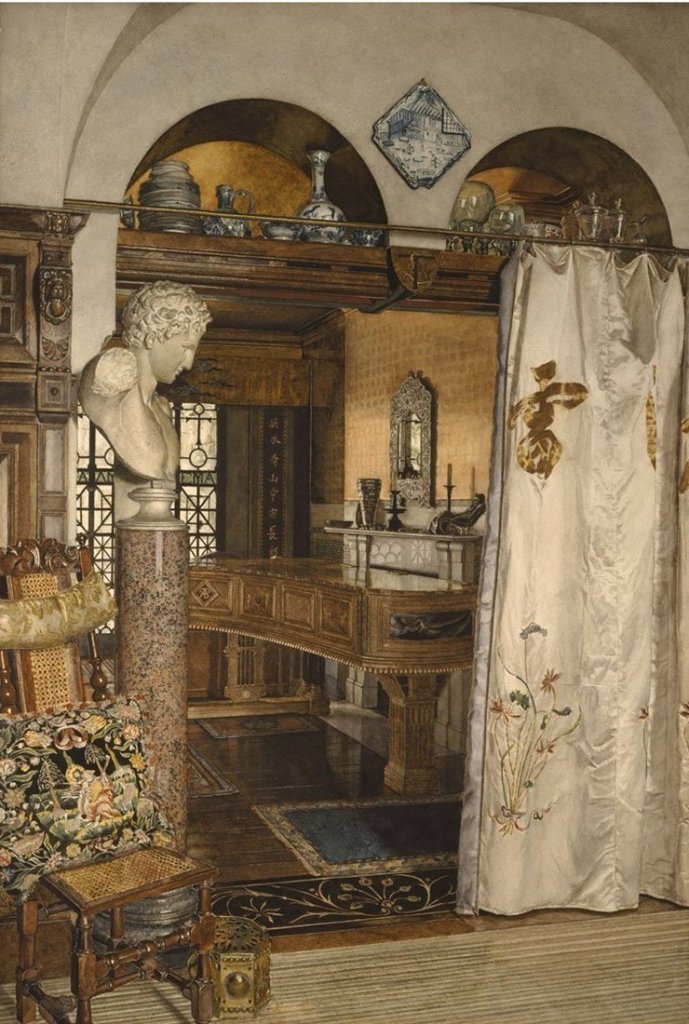
Finally, we have her work entitled The Gold Room which she completed in 1884.   This watercolour depicts a view into the Gold Room which was named thus because its walls were overlaid with gold leaf.  The centre of the painting is dominated by the large ornate piano which has inlays of ivory and tortoiseshell.  On the right we see a sumptuous full-length curtain made of Chinese silk.  If you look carefully at the window in the background you will see that the leading of it forms the family name, “Alma-Tadema”.  We cannot but be amazed by the talent of this seventeen-year-old girl at how she has managed to create the rich and bright surfaces we see as well as the various textures of the objects.  The inclusion of an antique bust on a pedestal was probably testament to her father’s interest in Roman and Greek history.  The painting was shown at the 1885 Royal Academy exhibition and is housed at the Nelson-Atkins Museum of Art in Kansas City Missouri.

Eton College Chapel by Anna Alma-Tadema

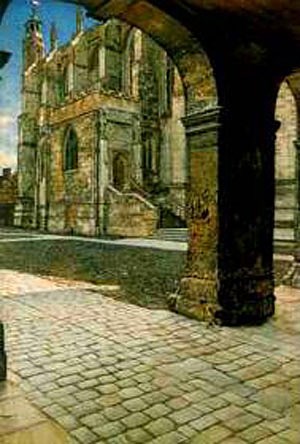
Another 1885 painting highlighted Anna’s ability to replicate detail onto canvas.  It was her watercolour work entitled Eton College Chapel which she completed when she was just twenty years of age and was exhibited at the Royal Academy.  Of Anna and her great artistic skill her father’s biographer, Helen Zimmerman, wrote in her 1902 biography, Sir Lawrence Alma-Tadema R.A., that she was:

“…a delicate, dainty artist who has inherited much of her father’s power for reproducing detail…”

The Closing Door by Anna Alma-Tadema

In 1886, the family moved to a larger house, No. 17 Grove End Road, St. John’s Wood, London, which had previously been owned by the painter James Tissot.  Anna’s father carried out major refurbishments to the house and had extra studios added so that all four in the family could paint!   A room, thought to be on the upper floor in this house was the setting for Anna’s 1899 painting, The Closing Door.  It is a beautiful painting, full of mystery and atmosphere.  Once one has enjoyed the detail of the inanimate objects in the room our gaze goes to the central character of this work, the lady and soon our head is filled with questions.  So what story is unfolding before us?  Look at the woman – how is she feeling and why?  I suppose we recognise that something has badly upset her.  Look how she has roughly grasped the bead necklace and broken it.  If you look carefully you can see beads on the carpet.  Look at her facial expression –wretchedness, bewilderment, and fear are all recognisable.  So, what has brought her to this state of bleak despondency.  A lover’s tiff, a break-up of a relationship?  All possible.  Maybe if we look at some of the objects on the table we may get a clue.  A small vase of anemones symbolising the death of a loved one for in Greek mythology, the anemone sprang from Aphrodite’s tears as she mourned the death of Adonis.  In Victorian times, the anemone was looked upon as a symbol of dying love or departure of a loved one to the “point of no return”.  So, has her “loved one” died or abandoned her?  Next to the vase is a bottle of violet ink, the colour of which has associations with modesty and humility which probably tells us more about the lady herself.  The final mystery associated with this painting is the door.  Look closely at it and you will see fingers grasping it as if to close it.  Is this another sign of somebody “leaving”?  Or is this somebody about to enter which is causing the lady to be afraid?  So many questions and only the artist knows the answers.

Girl in a Bonnet with her Head on a Blue Pillow by Anna Alma-Tadema (1902),

In 1902 Anna Alma-Tadema painted Girl in a Bonnet with Her Head on Blue Pillow   It is a haunting painting with the girl seeming to stare at us as we observe the work but, on closer scrutiny, it is a blank stare.  She shows little interest at what is going on her around her.  Something is troubling her.  She feels helpless and alone.  Her hands are clasped tightly together in a pleading manner.  What solace does she crave? We, the observers, want to help her but how?  Is this simply about an unknown stranger or is this about the artist herself and her mood?

Following the death of her father in 1912, the value of his paintings fell drastically, and this loss of family revenue adversely affected the finances of his two daughters who lived their latter years in poverty.  Anna Alma-Tadema, who never married, died in 1943, aged seventy-six.

Photograph of Laurence Alma-Tadema from the US Library of Congress

Anna’s elder sister was born Laurense Alma-Tadema in August 1865 but she is always referred to as Laurence Alma-Tadema.  For this portion of the blog there will be few paintings as Laurence, unlike her sister, father and step-mother was not an artist.

Love’s Dream by Laurence Alma-Tadema

She was a novelist, playwright, short story writer, and poet. Her first novel, Love’s Martyr was published in 1886.  She wrote in various genres during the late nineteenth and the early twentieth centuries.

The Yellow Book periodical

She also submitted work to various periodicals such as The Yellow Book, a British quarterly literary periodical that was published in London from 1894 to 1897.  She also edited a periodical.  Many of her works were privately printed.

She left the family home and went to live in the Kent village of Wittersham in a cottage named The Fair Haven.  She became an active member of the local community, and involved herself with music and plays.  She even had a place built which could accommodate a hundred people and was to be used by the villagers to stage music concerts and plays and where the children of the village could be taught many local handicrafts.  She named it the Hall of Happy Hours.  In 1907 and 1908 she gave a series of readings in America on her literary work The Meaning of Happiness, which proved to be very well-liked by her American audiences.

World War I Propaganda Poster

She was an ardent activist and often spoke on the plight of the Polish people who were being displaced from their homes by the Austro-German troops in World War I.  She was a close friend and ardent admirer of Jan Paderewski, the Polish concert pianist and composer, politician, and spokesman for Polish independence.  Laurense was secretary of the Poland and the Polish Victims Relief Fund from 1915 to 1939 and her name appeared on many of their propaganda posters.  On her book tour in America, she spoke on the plight of the divided Poland and asked her audience to support the Polish people’s cause.

Laurense died in a nursing home in London on March 12th 1940, aged seventy-five.  Laurense like her sister Anna never married and one wonders whether either ever loved somebody and whether they missed “married bliss”.   Laurense’s poem If One Ever Marries Me would make one believe at least she was resigned to a solitary life.

 If no one ever marries me,—

And I don’t see why they should,

For nurse says I’m not pretty,

And I’m seldom very good—

 If no one ever marries me

I shan’t mind very much;

I shall buy a squirrel in a cage,

And a little rabbit-hutch:

 I shall have a cottage near a wood,

And a pony all my own,

And a little lamb quite clean and tame,

That I can take to town:

 And when I’m getting really old,—

At twenty-eight or nine—

I shall buy a little orphan-girl

And bring her up as mine.

————————–

I visited the exhibition At Home in Antiquity which features many paintings by Lawrence Alma-Tadema.   It is being held in London at the Leighton House Museum until October 29th.  It is a “must-see” exhibition of Lawrence Alma-Tadema’s works as well as works by his daughter and second wife.


The Alma-Tadema Ladies. Part 1 – The Two Wives, Marie-Pauline Gressin-Dumoulin de Boisgirard and Laura Epps.

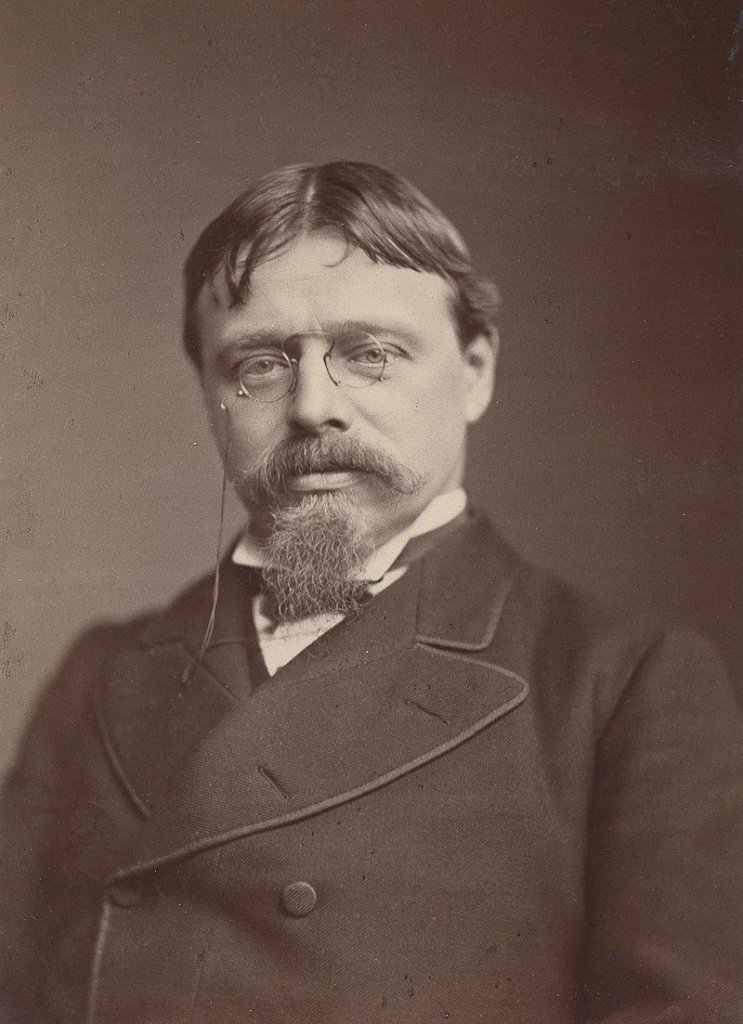
Laurens Alma-Tadema (1870)

In My Daily Art Display (June 21st, 2011) I wrote about the artist Lawrence Alma-Tadema and one of his paintings. My next two blogs are focusing on the some of the extraordinarily talented women in Lawrence Alma-Tadema’s life.  In Part 1,  I am looking at Lawrence Alma-Tadema’s two wives.

Pauline in Pompeii by Lawrence Alma-Tadema (1863)

Laurens (Lawrence) Alma-Tadema was born in January 1836 in the small Dutch town of Dronrijp which lies in the province of Friesland. On September 24th 1863, at the age of twenty-seven he married a French lady, Marie-Pauline Gressin-Dumoulin de Boisgirard in Antwerp City Hall and the couple went on honeymoon to Italy and it was during that celebratory period that he visited Florence, Rome, Naples and Pompeii and became interested in the life during the days of ancient Greece and Rome and he acquired a life-long interest in classical archaeology and architecture and soon began to acquire a reputation as a painter of historical subjects, particularly of Greek and Roman antiquity.

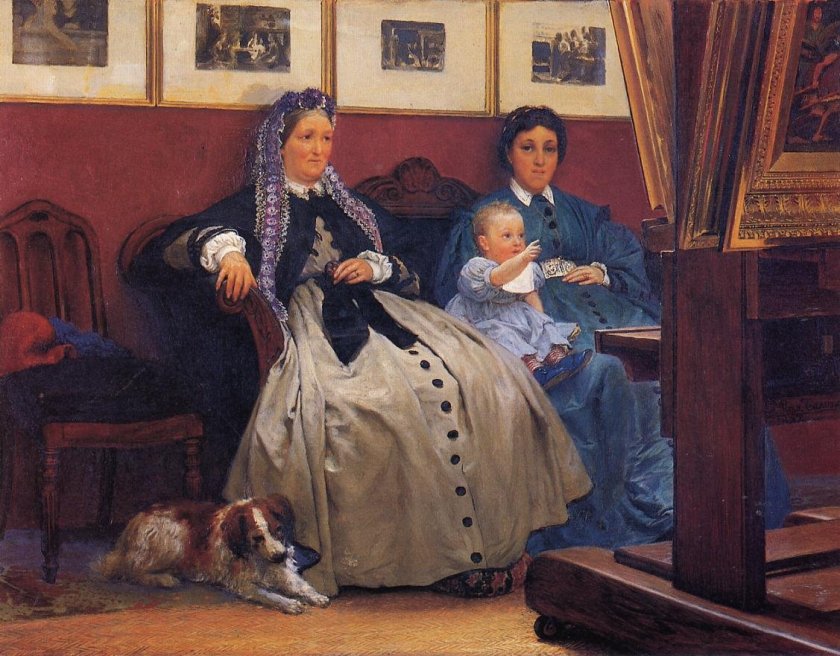
My Studio (also known as The aesthetic viewn -Madame Dumoulin, Pauline and Laurense) by Laurens Alma-Tadema (1867)

The couple settled in Paris in 1864 and two years later the couple moved to Brussels, where their daughters were born. The couple had three children. A son, who died of smallpox at the age of six months, and two daughters, Laurense in August 1865, and Anna Alma in 1867. Marie-Pauline, who had health problems for several years finally succumbed to smallpox on May 28th 1869 at the young age of thirty-two. Laurens was devastated by the death of his young wife, which left him to bring up his two young daughters.  Marie-Pauline appeared in many of his paintings although he only painted her portrait three times, including an 1867 portrait entitled My Studio, a three-generational work featuring her mother Madam Dumoulin, herself and her daughter Laurense.

The Persistent Reader by Laura Alma-Tadema

Alma-Tadema became very depressed following the sudden death of his wife, and, for four months stopped painting. Concerned about her brother’s declining mental and physical health, his sister Atje came to live with him to help look after his children. Despite this assistance, the health of Laurens Alma-Tadema failed to improve  and so, on the advice of his art dealer friend Ernest Gambart, he travelled to England to seek further medical advice. It was in 1869, whilst in the English capital that he received an invite to visit the house of the Pre-Raphaelite painter Ford Madox Brown and it was there in that December that he first met  the impressionable and high-spirited seventeen-year-old, Laura Theresa Epps. It has been said that for Alma-Tadema, it was love at first sight, despite the seventeen-year age difference.

Portrait of Laura Theresa Epps (Lady Alma-Tadema) as a Child by John Brett (1860)

Laura was one of four children of Dr George Napoleon Epps, an English homeopathic practitioner and writer and his wife Charlotte. Laura had one brother, John, who became a surgeon and two sisters, Emily and Ellen who also later became painters. The Epps family was part of an artistic circle which included Dante Rossetti and his wife, Elizabeth Siddal, and Ford Madox Brown. The children of George and Charlotte Epps had the fortune of being brought up in a wealthy upper-middle class family and their parents were conscious of their role of ensuring their three daughters received the social skills which would bring about a “good” marriage.  One of those skills was the ability to paint. With that in mind all three daughters were tutored in the art of drawing, painting, as well as music. Their eldest daughter Emily received lessons from the Pre-Raphaelite painter, John Brett and the middle daughter Ellen was taught by Ford Madox Brown. Initially Laura was happy to concentrate all her teenage efforts on her music but later began to enjoy her art.

This is Our Corner (Portrait of Laurense and Anna Alma-Tadema) by Laurens Alma-Tadema

After Alma-Tadema’s visit to London, he returned to his family home in Antwerp but his stay there only lasted a few months before he took his two daughters and sister, Atje, back to London in September 1870 where he eventually became a British citizen. So why the sudden return to England? It was probably an amalgam of three reasons. Firstly, in July the Franco-Prussian War had started and there was no knowing how far that was going to spread. Secondly, Alma-Tadema’s paintings were selling well in London and it made sense to position himself close to the buyers of his works and thirdly he was in love with Laura Epps and wanted to pursue her romantically.  Alma-Tadema spoke of his decision:

“…”I lost my first wife, a French lady with whom I married in 1863, in 1869. Having always had a great predilection for London, the only place where, up till then my work had met with buyers, I decided to leave the continent and go to settle in England, where I have found a true home…”

On arrival in London he called on Laura. An insight into what happened at that meeting was given by Laura’s niece Sylvia Gosse:

“…The second time Alma-Tadema saw the young woman, he is said to have asked in his broken English: ‘Vy have I never seen any of your paintings? I know the work of both your sisters and dey are very goood [sic]!’ To which Laura replied, ‘You haven’t seen any because I haven’t done any! I am not a painter I am a musician.’ ‘I’m sure you be able to draw and paint,’ countered Alma-Tadema. ‘Vy not let me give you some lessons. I shall teach you how to paint…”

Laura agreed to be tutored by Alma-Tadema. The couple grew closer and, soon after, he asked her father for his daughter’s hand in marriage. Dr Epps was very unhappy with the liaison considering that Alma-Tadema was thirty-four and his youngest daughter was only eighteen years of age. Eventually he relented but with the proviso that they got to know each other better and didn’t rush headlong into a “fixed partnership”. Lawrence Alma-Tadema and Laura Therese Epps married in July 1871.

Self-portraits of Alma Tadema and Laura Epps, (1871)

To commemorate their wedding Lawrence Alma-Tadema and Laura each painted a self-portrait, and the two were united by a replica of a Roman frame and hidden behind walnut shutters painted with emblems. The portraits are encircled by an inscription in elongated capitals which is evocative of Pompeiian examples and the two portraits are enclosed by doors, painted on which are  two emblems – a Dutch tulip on Lawrence’s side, an English rose on Laura’s.

Satisfaction by Laura Therese Alma-Tadema (1893)

The family lived in London in Townshend House, near St. Regent’s Park. In 1886 the family moved to a larger house in Grove End Road, again close to Regents Park, which had been formerly owned by the French painter, James Tissot. Laura not only gained a husband, she also gained two step children,  Anna Alma, then aged four and Laurense, aged six.  She also took on the role of  a proficient hostess at the frequent soirées organised by her and her husband for their friends from the world of art and music. Lawrence Alma-Tadema and his wife became well known on the social circuit, associating with the wealthy upper middle-class society from which his major clients were drawn. She was often asked by her husband to model for his paintings and she also modelled for other artists such as the French sculptor, Jules Dalou and the French realist painter Jules Bastien-Lepage. Besides this work as an artist’s model she was also a very talented painter. She also carried out occasional work as an illustrator, particularly for the English Illustrated Magazine.

The Mirror by Laura Theresa Alma-Tadema (1872)

In the early years she painted some still life works including the masterful The Mirror in 1872 in which she skilfully depicts a table and the objects placed upon it and she also incorporated a circular mirror on the wall showing a reflection of the artist at work. Paintings with mirror images were popular at the time.

The Tea Party by Laura Therese Alma-Tadema

Laura Theresa also took time to paint portraits of her step-children. One such painting was entitled The Tea Party completed around 1873 and featuring Laurense, the elder daughter of Lawrence Alma-Tadema.

The Bible Lesson by Laura Theresa Alma-Tadema

Her artistic style was very like that of her husband’s but instead of depictions of the splendour of Roman bygone days she concentrated on depictions of Dutch interiors with their whitewashed walls and splendid antique oak furniture. They were somewhat idealised portrayals of Dutch life. The works would often include depictions of young mothers with their children both of whom were adorned in seventeenth costumes. Why depictions of life in the Netherlands? It could be that Laura developed a particular interest in this genre due to her husband’s and step-daughters’ origins, or it could have been that she was captivated by the Dutch paintings of the period. One example of this type of work is one entitled The Bible Lesson which also displays her love for Dutch painted tiles of that time.

At the Doorway by Laura Alma-Tadema (1898)

In 1873 Laura Alma-Tadema (later Lady Alma-Tadema) began to exhibit her work at the annual Royal Academy exhibitions. Buyers and critics alike praised her work especially in countries such as France where her work was shown at the annual Salon and she was one of only two British women artists to have work accepted for the Exposition Universelle in Paris in 1878. Her artwork was very popular in Germany where she received many awards including the gold medal from the German government in 1896, when one of her best pictures was bought by Emperor Wilhelm II.

World of Dreams by Laura Theresa Alma-Tadema (1876)

In 1876 she completed World of Dreams. Again, we see the type of interior depiction (black and white chequered floor tiles) favoured by Dutch artists such as Vermeer with settings bathed in light streaming through a window and reflections in mirrors. In this painting Laura has portrayed a nurse or maybe a nanny or even a mother who has fallen asleep, possibly from a tiring day looking after the home and children. For comfort and inspiration she has turned to the large illustrated family Bible and the book of Amos but fatigue has won the battle.

In Good Hands by Laura Theresa Alma-Tadema

The Dutch artist Vermeer had a great influence on Laura Alma-Tadema, and she was much inspired by the depiction of interiors in his works, which can be seen in her painting In Good Hands. The painting came about when one Lawrence Alma-Tadema’s most faithful patrons, and art connoisseurs and Director of the Metropolitan Museum of Art, Henry Marquand, commissioned Lawrence Alma-Tadema to decorate the Music Salon at his new home on Madison Avenue which would act as a focal point for New York Society. The painting by Alma-Tadema’s wife was one of the pictures purchased by Marquand and was hung in his house. The depiction is a domestic scene with a young girl keeping watch over her younger sibling who is sleeping in a large ornate four-poster bed along with his toy windmill. The girl is seen sewing and rests her feet on a foot warmer.

A Family Group by Lawrence Alma-Tadema (1896)

An insight into the family life of Laura Alma-Tadema in 1871 can be seen in an 1896 portrait by Lawrence Alma-Tadema, entitled A Family Group, which depicts Laura, her two sisters Emily and Ellen, her brother John and Alma-Tadema himself in the background studying a painting mounted on an easel. The two emblems representing Alma-Tadema and his wife, the tulip and the rose, can be seen on the wooden frame.

On 15 August 1909 Laura Theresa Alma-Tadema’s died at the age of fifty-seven. Lawrence, her husband, was devastated and died three years later.
On her death a newspaper correspondent wrote:

“…Lady Alma-Tadema spent the months of June and July in a German cure, from which she returned a few days ago in a very weak state. She was advised to leave town immediately, and she entered an establishment in Hindhead. Here her malady suddenly took a critical turn on Friday last and she passed away painlessly after an unconsciousness of many hours on the night of Sunday…”


I hope to visit an exhibition next week which is currently on in London at the Leighton House Museum until October 29th entitled At Home in Antiquity which features many paintings by Lawrence Alma-Tadema.   Maybe some of his wife’s and daughter’s works will also be featured.

Briton Rivière

Portrait of Briton Rivière by Philip Hermogenes Calderon

Sentimentality in art was very popular during Victorian times.  I have looked at many artists whose motifs often depicted “cute” little boys and cute little girls in pretty dresses.

Bubbles by John Everett Millais (1886)

Even the great artists, such as John Everett Millais, with his famous 1886 painting Bubbles, realised such paintings of young children were money-spinners.  This painting shows a boy blowing bubbles with a pipe and a bowl of soap suds. The boy was Millais’ four-year-old grandson, Willie James.   A. & F. Pears bought the painting from Millais in 1886.

Fidelity by Briton Rivière (1869)

Another motif which was popular at the time in Victorian England was small animals, especially dogs.  Add to that motif a touch of pathos and the painting is sold!   My artist today was a master of such depictions.  Let me introduce you to Briton Rivière.

His Only Friend by Briton Rivière (1871)

Briton Rivière was born in St Pancras, London on August 14th 1840. He was the youngest child and only son of William Rivière, who was the third of twelve children, and Anne Rivière (née Jarvis) whom he had married in 1830. Briton had three elder sisters, Marion born in 1833, Henrietta Fanny born in 1835 and Annette Louise born in 1837.  Briton’s love of art probably came from his parents. His mother was a still-life painter and his father trained to be an artist at the Royal Academy when he was eighteen years old and two years later began to exhibit his work at the Academy.

Jilted by Briton Rivière (1872)

William Rivière was appointed Master of the drawing academy at Cheltenham College in 1849, a town at which the family then lived. There he succeeded in establishing a drawing-school which was unique of its kind, and was hailed as the best school of art outside of London. Briton Rivière’s paternal uncle Henry Parsons Rivière was also a noted watercolourist, who had exhibited his paintings at the Royal Watercolour Society, London, and the Royal Birmingham Society of Artists.

Much happened in his family life when Briton was thirteen years of age.  In 1853 his eldest sister Marion married and a year later his sister Henrietta, then aged nineteen died in Brighton

The Long Sleep by Briton Rivière (1868)

Briton’s father resigned from Cheltenham College in 1859, and he, his wife and two children, Annette and Briton left Cheltenham and moved to Park Town, Oxford, where he convinced the University to initiate the study of art for undergraduates and he set up his own drawing school.  His son Briton studied painting and drawing at the university.  Briton Rivière had some of his works hung at the Royal Academy exhibitions from 1858 onwards but he had yet to make a breakthrough with his paintings.  That all changed in 1869 when he exhibited his work, The Long Sleep.  The painting pulled at the heartstrings of the viewers and was an immediate hit with Victorian art lovers.  It was to be first of many which featured domestic animals and their owners intertwined with a sense of pathos.  In this work we see and old man sitting in his chair besides the fire.  His head lolls forward on to his chest.  His clay pipe, which has slipped from his life-less fingers, lies broken on the stone floor.  He is not asleep.  He has died and his two faithful friends, his dogs, become agitated at his lack of movement.  One jumps up to lick his face in the hope that this may awaken their master but, of course, to no avail.

Sympathy by Briton Riviere (c.1878)

In 1878 Rivière completed a work entitled Sympathy. In this work we see a young girl sitting on stairs, all alone except for her beloved pet.  The story behind the painting is that she has been naughty and, as punishment, has been sent to sit on the “naughty step”.    The only comfort she receives is from her beloved four-legged friend.

Companions in Misfortune by Briton Rivière

His work, Companions in Misfortune, similarly depicts a solitary human having only his animal friend as company and for many observers of the work, they can empathise with the man as in their lives they often only have the love of an animal to look forward to.

Giants at Play by Briton Rivière (1882)

Rivière’s painting were not always sad depictions as he had the ability to inject humour into his depictions as we see in his 1882 painting Giants at Play.  Rivière depicts three men at rest, enjoying themselves by playing with a tiny young bull-pup. They tantalise the dog by dragging a feather attached to a piece of string always just out of reach of the puppy.  Just a harmless game or as some will have you believe it may have been the initial stage in the training that will prepare the dog for fighting and baiting

A Blockade Runner by Briton Rivière (1888)

Another humorous painting was Rivière’s 1888 work entitled A Blockade Runner in which we see a cat escape across the top of a wall to escape the clutches of its four canine assailants.

Beyond Man’s Footsteps by Briton Rivière

In 1894, in total contrast to these works Rivière exhibited at the Royal Academy a completely different type of work with his painting Beyond Man’s Footsteps.  The setting for the painting is the Arctic, a region where no human had ventured but through Rivière’s depiction the viewer was able to imagine what it was like to be in this bleak and remote region.  The foreground is dark and shadowy which contrasts with the colourful beauty of the sky brought about by the setting sun in the background.   Atop the overhanging rock we see a solitary polar bear looking out over its terrain.  It is thought that Rivière based the depiction of the animal on sketches he made of a polar bear he saw in London’s Regent Park zoo.  The depiction of Rivière’s Arctic, free of mankind, is awesome.  The Norwegian explorer, scientist, diplomat, humanitarian, and Nobel Peace Prize laureate Fridtjof Nansen’s narrative of The First Crossing of Greenland was written and published in 1890 and it is believed that Rivière had read the translated version and based his painting on what he had read.  One passage from the book described what Nansen had witnessed during his journey:
“…when the sun sank lowest, and set the heavens in a blaze … the wild beauty of the scene was raised to its highest’. At the foot of the ‘spires’ of huge, glittering icebergs, ‘there were marvellous effects and tints of blue, ranging to the deepest ultramarine … a floating fairy palace, built of sapphires, about the sides of which brooks ran and cascades fell … in fantastic forms…”

Saint George and the Dragon by Briton Riviere

During the 1870’s Rivière began to exhibit Classical and Religious paintings.  His depiction of this classic story of George and the Dragon is somewhat unusual.  Normally Saint George would be portrayed astride his horse, lance in hand but in Rivière’s work we see the dragon’s conqueror lying on the ground, exhausted, close to his fallen adversary.

Daniel in the Lion’s Den by Briton Rivière (1872)

His painting Daniel in the Lion’s Den was based on the biblical story about Daniel which tells how Daniel is raised to high office by his royal master Darius the Mede, but jealous rivals trick Darius into issuing a decree which condemns Daniel to death. Hoping for Daniel’s deliverance, but unable to save him, the king has him cast into the pit of lions. At daybreak he hurries back, asking if God had saved his friend.  In the Old Testament (Daniel 6:20-22) the story unfolds:

“…When he had come near the den to Daniel, he cried out with a troubled voice. The king spoke and said to Daniel, “Daniel, servant of the living God, has your God, whom you constantly serve, been able to deliver you from the lions?”   

Then Daniel spoke to the king, “O king, live forever!

“My God sent His angel and shut the lions’ mouths and they have not harmed me, in as much as I was found innocent before Him; and also toward you, O king, I have committed no crime…”

(c) Russell-Cotes Art Gallery & Museum; Supplied by The Public Catalogue Foundation

However, for most people the name Briton Rivière was synonymous with painting of animals and in an interview, he did for the Chums Boys Annual in August 1897 he explained how he mastered the drawing of both wild and domesticated animals:

“…I have always been a great lover of dogs but I have worked at them so much that I’ve grown tired of having them about me. However, you can never paint a dog unless you are fond of it. I never work from a dog without the assistance of a man who is well acquainted with animals….. Collies, I think, are the most restless dogs….greyhounds are also very restless, and so are fox terriers….. The only way to paint wild animals is to gradually accumulate a large number of studies and a great knowledge of the animal itself, before you can paint its picture…… I paint from dead animals as well as from live ones. I have had the body of a fine lioness in my studio….. I have done a great deal of work in the dissecting rooms at the Zoological Gardens from time to time…”

A Study in Black and White, Mrs Henrietta Riviere. (Briton Rivière’s daughter-in-law) (c.1910)

Early in his career, Rivière became an illustrator for the Punch magazine. Briton Rivière married Mary Alice Dobell in 1867.  She too was a talented painter.  The couple went on to have seven children, four sons, Hugh Goldwyn, Clive, Philip Lyle, and Bernard and three daughters, Millicent Alice, Evelyn, and Theodora.   In 1878, when he was thirty-eight, Rivière was elected an Associate of the Royal Academy of Arts and three years later, a Royal Academician.  He stood for election to become President of the Royal Academy but failed in his bid – the position being awarded to Edward John Poynter.
Briton Rivière died in London on April 20th 1920, aged seventy-nine.

Frits Thaulow. Part 2 – the realist landscape painter.

Frits Thaulow at work

Many of Thaulow’s best known Norwegian scenes are from Åsgårdstrand, a town 100 km south of Oslo.  It had become a significant centre for artists and painters from the 1880’s. The town had been home to many internationally famous painter, such as Edvard Munch, Christian Krogh, and Hans Heyerdahl, who had either visited or lived in the town.  Again, like Skagen, the reason it was popular with painters was because of its unique light which the best artists wanted to depict in their works.

Street in Kragerø by Frits Thaulow (1882)

Thaulow visited the Norwegian coastal town of Kragerø which was, and still is, a place where people went to “get away from it all”.  It was a location which the great Norwegian painter Edvard Munch fell in love with, calling it ” Perlen blandt kystbyene (The Pearl of the Coastal Towns). The town of Kragerø is characterized by clear, blue water and beautiful views.

Houses in Kragerø by Frits Thaulow (1882)

However, in one of Thaulow’s paintings of the town, Houses in Kragerø, we see a more realistic depiction of it.  Gone are the blue water and beautiful views and instead we see an everyday view of the backs of the old houses with clothes pegged to a washing line fluttering in a strong breeze.  There is a lack of bright colours, a lack of blue skies, just a simple depiction of an area of the town, “warts and all”.

Haugsfossen ved Modum by Frits Thaulow (1883)

In 1883 after a visit to Blaafarveværket, a cobalt mining and industrial company located at Amort in Modum in the Norwegian county of Buskerud, some thirty miles west of Oslo.  Here there is the spectacular Haugsfossen waterfall and it was here that Thaulow completed his 1883 painting entitled Haugsfossen ved ModumIt is a spectacular painting and once again we witness Thaulow’s great talent when it comes to painting scenes which include stretches of water.  The green tones used for the water when combined with shades of white in contrast to the black rocks allow us to imagine the ferocity of the water has it hurtles down the waterfall, carrying with it fallen logs.

Rialto by Frits Thaulow (1895)

Thaulow travelled to Venice on a number of occasions in the 1890’s and made many sketches and paintings of the city highlighting the city’s canals and architecture and completed many paintings of that city.  In 1892, Thaulow returned once again to France but this time to make it his home.  Originally, he lived in Paris but soon tired of the hustle and bustle and preferred a quieter life in the smaller towns of Dieppe, Montreuil-sur-Mer, Quimperle in Brittany and further south, the town of Beaulieu-sur-Dordogne.

Back Mills, Montreuil-sur-Mer by Frits Thaulow (1892)

Frits Thaulow had met Claude Monet when he was in Paris and a friendship between the two plein-air painters developed.   Both Thaulow and Monet painted in Normandy with Monet preferring to base himself on the coast and depict the stormy sea and the windswept coastal landscapes whereas Thaulow preferred the tranquillity of painting on quiet rivers.

A Stream in Spring by Frits Thaulow

Thaulow’s weather tends to be calmer which in a way was more in keeping with his temperament. Thaulow said of himself:

“…I am more drawn to the gentle and harmonic than to the vigorous…”

Thaulow had urged Monet to paint in Norway, and the French artist finally acquiesced and travelled there in the winter of 1895, to visit his stepson, Jacques Hoschedé, who lived in Christiania. It proved a disastrous visit because of the severe winter climate with the temperature at minus twenty degrees Celsius when he arrived and because of the amount of snow falling, painting outdoors was a very difficult chore for Monet.  One of the works completed during the visit was Sandvika.  This small town just south-west of Oslo, looks as though it had been done in a blizzard.

Sandvika, Norway by Monet (1895)

It is interesting to note the colours used in the painting – cold blues and lavender whereas Thaulow often used gold and yellow in his winter scenes giving it a slightly warmer feeling.  Maybe Monet just wanted to make sure we knew how cold and uncomfortable it was to paint winter scenes in such conditions whereas Thaulow was more forgiving.

The Akerselven River in the Snow by Frits Thaulow

Despite the adverse conditions, Monet painted twenty-nine Norwegian scenes during his two-month stay and these included at least six views of Sandvika.  It is thought that the iron bridge we see in the foreground may have reminded Monet of the Japanese bridge at his home in Giverny.  Monet never returned to Norway – he had had enough of the cold and inhospitable climate.

Evening in Camiers by Frits Thaulow (1893)

The Normandy coastal village of Camiers, which lies about ten miles south of Boulogne-sur-Mer, was visited by Thaulow in 1893 and that year he completed a painting depicting the village, entitled Evening in Camiers in which we see the sun setting over the dunes and rose-tinted houses caught up in the evening sunlight.

Thaulow the Painter and his Children by Jacques-Emile Blanche (1895)

Through an 1895 painting by Jaques-Emile Blanche we get an insight into Thaulow’s family life.   In the portrait, Thaulow the Painter and his Children, also known as The Thaulow Family, Frits Thaulow appeared with his daughter Else, aged 15 from his first marriage and two of the children from his second marriage, Harold then aged 8 and Ingrid aged 3.  The third child from his second marriage, Christian, was only born that year and does not appear in the work. The painting is housed in the Musée d’Orsay.  Blanche’s portrait was presented at the Salon de la Société Nationale des Beaux-Arts in 1896, was greeted with unanimous critical acclaim, which prompted Blanche to say later that this work was the one that “made him a painter”.

The Adige River at Verona by Frits Thaulow

In the 1890’s Thaulow travelled to various European cities constantly sketching and painting what he observed.  On his trip through northern Italy in 1894, he visited Verona on his way to Venice and completed a painting entitled The Adige River at Verona.  In this work Thaulow used only muted colours and understated tonal harmonies which depict the view of the fast-flowing Adige River as it passes beneath the five arches of the sixteenth century Ponte della Pietra.  In the background, we can see the Duomo of S. Maria Matricolare, and to the right the Sanmicheli’s campanile.

Small town near La Panne by Frits Thaulow (1905)

In the summer of 1905 Frits Thaulow spent some time with his family at La Panne, a small Flemish coastal resort. He had bought himself a small car and with this new-found transport was able to drive himself and his family to small Belgian towns in the area always looking for subjects for his paintings.  One such painting was his 1905 work entitled Small Town Near La Panne.  In the painting, we see small town houses nestled on the river bank and in the mid-ground a small arched bridge.  Thaulow made three versions of this scene all slightly different in the way he depicted the bridge and the houses.

Evening at the Bay of Frogner by Frits Thaulow (1880)

Thaulow received several honours for his artistic work including his appointment as commander of the 2nd Royal Norwegian Order of St. Olav in 1905. He received the French Legion of Honour, Order of Saints Maurice and Lazarus from Italy and the Order of Nichan Iftikhar from Tunisia.

Johan Frederik “Frits” Thaulow
1847-1906

Thaulow developed diabetes in 1897, a time before insulin had been developed and his condition worsened over the next nine years Thaulow died in Volendam, in the Netherlands on November 5th 1906, aged 59.

Thaulow was a painter working within the framework of Realism, to which he made an original contribution. He forged a friendship with Monet and Rodin and was a valuable connection between Norwegian and French art.

Frits Thaulow. Part 1 – the early days.

Portrait of Frits Thaulow by Christian Krohg

As a painter, I wonder whether you have a favourite motif.  Is there one aspect of your landscape work, maybe the sky, maybe trees, etc., which you feel that you excel at?  If so, do you try and incorporate that feature into many of your paintings?  My artist today seems to be a virtuoso when it came to depictions of water and the reflections on the surface and so many of his paintings include stretches of water.  Let me introduce you to the Norwegian Impressionist landscape painter Johan Frederik Thaulow, better known as “Frits” Thaulow.

An Orchard on the Banks of a River by Frits Thaulow

Johan Frederik Thaulow was born on October 20th, 1847 in the Norwegian capital, Christiania (renamed Oslo in 1925).  He was one of ten children.   His father was Harald Conrad Thaulow, a wealthy pharmacist and his mother was Nicoline (“Nina”) Louise Munch. In order to satisfy his father’s wishes he carried on with his normal school and college studies and eventually attained a doctorate but his real love was for art and specifically maritime art and so, in 1870, aged twenty-three, he went to Copenhagen to try to become a marine painter.

Sailing Ships in the Strait South of Kronborg by Carl Frederik Sorensen (1857)

He enrolled on a two-year course at the Academy of Art in Copenhagen and one of his tutors was Carl Frederik Sørensen, the great Danish marine painter, whose paintings often depicted the relationship between weather and the effect it had on sea conditions.

The Mill Stream by Frits Thaulow

In 1873, Thaulow left Copenhagen and travelled to Karlsruhe where, for two years, he attended the Baden School of Art.  At the time one of the professors lecturing at the academy was the Norwegian Romanticist landscape and marine painter, Hans Fredrik Gude.

Hardanger Fjord by Hans Fredrik Gude

Gude had previously been a professor at the Düsseldorf Academy of Art and through his popularity especially with his fellow countrymen, had built up a sizeable number of Norwegian students.  When he left the Academy to take up a post at the Baden School of Art many followed him.

Landscape and River by Frits Thaulow

In October 1874, Thaulow married Ingeborg Charlotte Gad, whose sister Mette-Sophie Gad had married Paul Gaugin, and a year later the couple had a daughter, Nina, but the marriage ended in divorce in 1886. In September of that same year, Thaulow re-married. His second wife was Alexandra Lasson, the daughter of Carl Lasson, a noted Norwegian attorney.  Alexandra was fifteen years younger than Thaulow.  The couple went on to have three children, two sons and a daughter.    Harald was born a year after the marriage, Ingrid born in 1892 and Christian who was born in 1895.

High Tide, Le Havre (1878) by Frits Thaulow

In 1875, Thaulow departed Karlsruhe and journeyed to Paris where he lived for most of the next four years.  During his time in the French capital he concentrated on his marine and coastal paintings whilst also absorbing the exciting times of the French art scene. The year before his arrival, the Impressionists had held their first exhibition at the former Parisian studio of the photographer Nadar at 35 Boulevard des Capucines   Another influence on Thaulow was the work of the French realist painter, Jules Bastien-Lepage.  Thaulow believed in realism in art and considered that his fellow Norwegian artists should also consider this genre.  Paris had always been popular with aspiring artists and had been fashionable among Norwegian artists. Thaulow became part of a group of Scandinavian landscape painters living in Paris, and worked with the Swedish painter Carl Skanberg, who was famous for his coastal, harbour paintings.

Skagen Painters,1883, Frits Thaulow

In the autumn of 1879 Thaulow left Paris and along with his friend and fellow artist Christian Krohg, a naturalist painter, illustrator, author, and journalist, and then the two arrived at Skagen from Norway in Thaulow’s little boat.  Skagen was situated on the east coast of the Skagen Odde peninsula in the far north of Jutland.  In the late 1870’s until the end of the nineteenth century, Denmark’s Skagen Art Colony became a magnet to numerous artists in the summer months who were drawn to the isolated fishing village and the quality of the light.  The twilight of the early morning and evening was often referred to as the “blue hour” during which the sun is at a sizable depth below the horizon and this is a time when the remaining, indirect sunlight takes on a predominantly blue shade.

A Stream in Spring by Frits Thaulow

The Skagen area also provided beautiful and unspoiled landscapes and seascapes.  The artists were hailed as part of a modern breakthrough movement, which wanted to abandon the academic tradition of neoclassical painting styles which was taught at the Academy of Fine Arts in Copenhagen and in its place these artists decided to follow the dictates of realism and naturalism which was part of the ethos of the Barbizon plein-air painters.  They also became followers of the impressionist movements and by doing so, they could portray everyday life and everyday people in an un-idealized way.  It was here that Thaulow’s depictions concentrated on the lives of the fishermen and the boats which had been dragged up onto the shore.

Evening at the Bay of Frogner by Frits Thaulow (1880)

After his stay in Skagen, Thaulow returned to Norway in 1880. He became one of the leading young figures in the Norwegian art scene, together with Christian Krohg and Erik Werenskiold and with them organised the first National Art Exhibit in late 1882, known as the Høstutstillingen or Autumn Exhibition. This first Høstutstillingen was held in Oslo as a radical protest the established bourgeois dominance of the Christiania Art Society and these three organisers decided that they would not let, unlike the Christiania Art Society,  an artist jury to decide what could be included in the exhibition.

Thaulow spent the next twelve years in Norway.  It was a period during which Realist painting based on the French model was accepted in Norway. And Thaulow’s personal interpretation of the Norwegian landscape was generally believed to be new. Although based in Norway he made several trips abroad visiting Scotland and Venice and returning to Paris

View of Overgaden, Christianshavn by Frits Thaulow (1881)

One of my favourite works by Thaulow is one he completed in 1881 entitled View of Overgaden, Christianshavn.  Christianshaven is a district of Copenhagen and the Christianhaven Canal bisects the neighbourhood.  Christianshavns Kanal is now noted for its bustling sailing community with numerous houseboats and sailboats, particularly in the northern half of the canal.  Overgaden oven Vandet and Overgaden neden Vandet are the two streets running along each side of the waterway.  Beside Thaulow’s masterful depiction of the water, look at the detailed portrayal of the buildings and cobbled walkways.

………………………………………….. to be continued.